On March 7, 1956, immediately after France’s recognition of Morocco’s independence, the United States did likewise with a statement of congratulations to Morocco, and later that same year Cavendish Cannon presented his credentials as the first post-independence U.S. ambassador to the country[1]
Since then, the two countries have had an increasingly close relationship. “The two countries share common concerns and consult closely on regional security and sustainable development. Morocco is a strong partner in counterterrorism efforts, and it works closely with U.S. law enforcement to safeguard both countries’ national security interests.”[2]
Counterterrorism Cooperation
As noted in an earlier post, Morocco participates in various multilateral counterterrorism efforts.
According to the U.S. State Department, “U.S. assistance to Morocco enhances the [latter’s] . . . capacity to promote security and prevent acts of terrorism, while addressing core drivers of instability and violent extremism, such as political and social marginalization, especially of youth. Our support has positive impact beyond Morocco’s borders in both the Middle East and Africa, bolstering Morocco’s emergence as a major partner for regional stabilization efforts and participation in the U.S.-led anti-Islamic State of Iraq and the Levant (ISIL) coalition and stabilization efforts in Libya, further contributing to U.S. security.”
Under the August 2014 “U.S.-Morocco Framework for Cooperation on Training for Civilian Security Services, [the U. S. provides] Anti-Terrorism Assistance funds [to] support the goal of developing Moroccan expertise in the areas of crisis management, border security, and terrorism investigations to strengthen regional counterterrorism capabilities and to deny space to terrorists and terrorist networks. The Framework outlines steps to identify and further develop a cadre of Moroccan training experts, jointly train civilian security and counterterrorism forces in partner countries in the greater Maghreb and Sahel regions, and measure the effectiveness of these trainings.”
The U.S. “International Military Education and Training (IMET)-funded Professional Military Education assists Morocco’s military force structure to become more similar to that of the [U.S.], which aids to further develop the interoperability required to meet shared counter-terror and counter-illicit-trafficking objectives. IMET also funds the installation of English language labs, significantly increasing Moroccan capacity and joint U.S.-Morocco efforts via a common operational language. The Moroccan military used Foreign Military Financing to bolster its air force, which conducts much of Morocco’s intelligence, surveillance, and reconnaissance in support of counter-terrorism efforts.”
The U.S. “Export Control and Related Border Security (EXBS) Program is focused on facilitating the creation, adoption, and implementation of appropriate laws and regulations that comply with [a U.N. Security Council resolution obligating] member States ‘to adopt legislation to prevent the proliferation of nuclear, chemical and biological weapons, and their means of delivery, and establish appropriate domestic controls over related materials to prevent their illicit trafficking.’ In addition, EXBS provides considerable training assistance to Moroccan law enforcement and border security officials as well as equipment, such as mobile cargo scanners, for [the] Tanger-Med Port.”
Morocco’s Criminal Justice Reform Agenda
The U.S. “Bureau of International Narcotics and Law Enforcement Affairs partners with [Morocco’s] . . . national police, the penitentiary administration and the judiciary to support Morocco’s reform agenda in the criminal justice sector. The corrections program is focused on prison management practices through training and technical assistance. The police program is focused on strengthening police capacity and professionalization. The justice sector programming supports the reforms called for in the 2013 Judicial Reform Charter.”
Morocco’s Peaceful Reform Agenda
The U.S. Agency for International Development (USAID) “is working with Morocco to advance the country’s initiatives for implementing its peaceful reform agenda: USAID is enhancing the employability of Morocco’s large youth population through a model career development system and by supporting civil society initiatives that address the needs of marginalized youth susceptible to extremist recruitment. . . . USAID also improves learning outcomes in the early grades of primary schools, thus decreasing the likelihood of future dropouts. Lastly, USAID works to expand citizen participation in governance and political party engagement with citizens at the local level through more open structures and improved ability of political parties to implement policies that reflect citizens’ needs.”
Cooperation on Other Civil Matters
The November 2015 U.S. Millennium Challenge Corporation-Morocco compact provides U.S. aid “for two [Moroccan] priorities: education and land productivity. The $220 million education for employability project will work to increase access to higher-quality secondary education and workforce development programs. The $170.5 million land productivity project will assist [Morocco’s development of] . . . a sector-wide land governance strategy to help remove institutional blocks to privatization and will also work with [Morocco] . . . to increase land productivity through investments in rural and industrial land.”
The U.S. “Middle East Partnership Initiative (MEPI) program supports direct engagement with Moroccan civil society through Washington-issued grants, local grants to Moroccan civil society organizations (CSO), and exchange programs for Moroccan citizens. MEPI has been active in Morocco and the region for over a decade and has a long history of building civil society capacity, while also enabling CSO partners to support women’s empowerment, youth leadership and volunteerism, increased civic engagement, entrepreneurship, skills training, and small business development.”
U.S.-Morocco Free Trade Agreement
“In 2006, the U.S. and Morocco entered into a free-trade agreement (FTA). “Since its entry into force, Moroccan exports to the [U.S.] have more than doubled, and U.S. exports to Morocco have more than tripled. From 2005 to 2015, the total value of Moroccan goods exported to the [U.S.] increased from $445.8 million to $1 billion, and U.S. exports to Morocco have increased from $480 million to $1.6 billion. The FTA has paved the way for increased foreign direct investment [in Morocco] by helping to improve Morocco’s business climate, harmonize standards, and create legal guarantees for investors. While Morocco has made significant improvements in its business environment, foreign companies still encounter issues related to sluggish bureaucracy and lack of judicial expediency.”
Conclusion
Concluding this summary, the U.S. State Department states, “Morocco is a moderate Arab state that maintains close relations with Europe and the [U.S.]. It is a member of the [U.N., the African Union,] the Arab League, Arab Maghreb Union, Organization of Islamic Cooperation (OIC), the Non-Aligned Movement, and the Community of Sahel-Saharan States. King Mohammed VI is the chairman of the [OIC’s] Al-Quds [Jerusalem] Committee.”
======================================
[1] U.S. State Department, A Guide to the United States’ History of Recognition, Diplomatic and Consular Relations, by Country, since 1776: Morocco. On June 23, 1776, Morocco became the first country in the world to recognize the new U.S.A. with a treaty of peace and friendship; this peaceful relationship continued until October 20, 1917, when the U.S. formally recognized the French and Spanish protectorates of Morocco. This peaceful relationship resumed on March 7, 1956, immediately after France’s recognition of Morocco’s independence,
[2] U.S. State Department, Fact Sheet: U.S. Relations with Morocco (Jan. 20, 2017). The close relations between the two countries was also apparent in the 2013 White House meeting between President Obama and King Mohammed VI that was discussed in an earlier post. This State Department Fact Sheet was issued on the date of Donald Trump’s inauguration and thus obviously was the work of the Obama Administration’s State Department to assist the incoming administration, but to date it has not been countermanded by the Trump Administration.
In November 2013, Morocco’s King Mohammed VI met at the White House with President Barack Obama. Below is a photograph of the two men in the White House.
Their subsequent Joint Statement “reaffirmed the strong and mutually beneficial partnership and strategic alliance between the [U.S.] and the Kingdom of Morocco; . . . [their mapping] out a new and ambitious plan for the strategic partnership and [pledging] . . . to advance our shared priorities of a secure, stable, and prosperous Maghreb, Africa, and Middle East. The two leaders also emphasized our shared values, mutual trust, common interests, and strong friendship, as reflected throughout our partnership.”[1]
Democratic and Economic Reforms. After the President “commended the [King’s] action and the leadership . . . in deepening democracy and promoting economic progress and human development,” the two men “reaffirmed their commitment to work together to realize the promise of Morocco’s 2011 constitution and explore ways in which the [U.S.] can help strengthen Morocco’s democratic institutions, civil society, and inclusive governance. . . . [They also] reaffirmed their commitment to the UN human rights system and its important role in protecting and promoting human rights and fundamental freedoms, and committed to deepening the ongoing U.S.-Morocco dialogue on human rights, which has been a productive and valuable mechanism for the exchange of views and information. . . . [The] President expressed support for Morocco’s initiative to reform its asylum and immigration system based on recommendations from Morocco’s National Human Rights Commission. The President [also] welcomed Morocco’s intent to take concrete steps to . . . [ensure] women fully participate in public life, and that they lead and benefit from inclusive economic growth.”
Economic and Security Cooperation. “The two leaders emphasized that the [U.S.] and Morocco are dedicated to working together to promote human and economic development in Morocco [under several specified programs].” They noted that the two countries [had] signed a Customs Mutual Assistance Agreement . . . to expand bilateral cooperation on the detection of money laundering, trade fraud, and other financial crime. . . . [and] a Trade Facilitation Agreement that furthers the U.S.-Morocco Free Trade Agreement and represents a forward-leaning, 21st century agreement on customs reform and modernization. . . . These important initiatives reflect our common commitment to building stronger economic ties with and among the region.”
They both “recognized the importance of Morocco as a trade and investment platform for North Africa and Sub-Saharan Africa and the benefits of maintaining an attractive business climate for investment in Morocco.” A prior and upcoming “U.S.-Morocco Business Development Conference” each “aims to build on business-to-business contacts in aviation, the agriculture and food industry, and energy to expand trade and promote investment, as well as regional economic integration.” Morocco also will be hosting the “Global Entrepreneurship Summit, and both leaders highlighted the importance of fostering broad-based economic opportunity in the region, particularly for young people and women.”
Educational and Cultural Cooperation. The two leaders expressed their commitment “to exploring further cooperation to promote mutual understanding and interfaith dialogue in Morocco and throughout the region, . . . to enhance and diversify [their] exchange programs, . . . [to ratify and implement an] agreement on the registration and status of the system of American schools in Morocco, . . . to strengthening ties and increasing mutual understanding between Moroccan and American youth.”
The Issue of the Western Sahara. “The President pledged to continue to support efforts to find a peaceful, sustainable, mutually agreed-upon solution to the Western Sahara question. . . . [The U.S.] has made clear that Morocco’s autonomy plan is serious, realistic, and credible, and that it represents a potential approach that could satisfy the aspirations of the people in the Western Sahara to run their own affairs in peace and dignity. We continue to support the negotiations carried out by the United Nations . . . and urge the parties to work toward a resolution. The two leaders affirmed their shared commitment to the improvement of the lives of the people of the Western Sahara and agreed to work together to continue to protect and promote human rights in the territory.[2]
Regional Security and Counterterrorism Cooperation. “The leaders noted their partnership on the [U.N.] Security Council over the past two years in the advancement of international peace and security, including in Mali, the Sahel, Syria, Libya, and the Middle East. They reaffirmed their commitment to continue to deepen civilian and military cooperation in the areas of non-proliferation and counter-terrorism. To address their deep concern for the continuing threat posed by terrorism, the [U.S.] and Morocco intend to continue cooperation to bolster democratic criminal justice institutions and to counter the threat of violent extremism in the region. The leaders also reinforced their commitment to regional cooperation initiatives.”[3]
“The leaders are committed to continuing close cooperation in the Global Counterterrorism Forum and to work to strengthen regional political, economic, and security ties across North Africa and the Sahel, including through a reinvigorated Arab Maghreb Union and other regional forums.
“The President encouraged Morocco to join the [U.S.] in founding the International Institute of Justice and the Rule of Law in Malta, which intends to train a new generation of criminal justice officials across North, West, and East Africa on how to address counterterrorism and related security challenges through a rule of law framework.”
Africa. “The President acknowledged . . . the King’s leadership and the actions carried out by Morocco in the field of peace keeping, conflict prevention, human development, and the preservation of cultural and religious identity. In this context, both countries committed to explore joint initiatives to promote human development and stability through food security, access to energy, and the promotion of trade based on the existing Free Trade Agreement. [They] were pleased to note their common assessment of the critical role of human and economic development in promoting stability and security on the African continent, and committed to explore in greater detail concrete options for pragmatic, inclusive cooperation around economic and development issues of mutual interest.”
Middle East Peace. His Majesty commended the continuous commitment of the . . . [U.S.] to advance Middle East peace. The President acknowledged the contribution of His Majesty, Chairman of the [Organization of Islamic Cooperation’s] Al Quds [Jerusalem] Committee, to the efforts aiming to achieve a two state solution.”
Conclusion. The President and His Majesty the King [emphasized] . . . their shared commitment to the special and longstanding relationship between the [U.S.] and . . . Morocco, which in 1777 became the first nation to recognize the independence of the [U.S.]. [The two leaders] . . . reaffirmed their commitment to stay in close contact and to continue on a path of increased cooperation that will strengthen the [U.S.]-Morocco strategic partnership.”
[2] As noted in a prior post, the U.N. Security Council on April 28, 2017, unanimously passed a resolution extending the mandate of the U.N. Mission for the Referendum in Western Sahara (MINURSO) until 30 April 2018 and calling on the parties to that conflict to resume negotiations under the auspices of the Secretary-General without preconditions and in good faith, in order to facilitate a just, lasting and mutually acceptable political solution.
[3] Another prior post discussed Morocco’s current bilateral and multilateral counter-terrorism activities.
In response to post-9/11 regional security risks Morocco has developed a “tripartite counterterrorism approach” that combines (1) hard security measures; (2) equitable and inclusive human development coupled with political reforms; and (3) religious moderation. This post will focus on Morocco’s important multilateral and bilateral efforts at counterterrorism; subsequent posts will concentrate on its efforts to promote religious moderation as an important part of these efforts.
Morocco is one of the 30 founding members of the Global Counterterrorism Forum, which in close partnership with the United Nations “serves as a mechanism for furthering the implementation of the universally-agreed UN Global Counter-Terrorism Strategy and, more broadly, complements and reinforces existing multilateral counterterrorism efforts, starting with those of the U.N. The GCTF also works extensively with non-GCTF members including states; international, regional and sub-regional bodies; and other stakeholders and experts.”
At the Forum’s 5th ministerial meeting Morocco played a leading role, and then U.S. Secretary of State John Kerry complimented Morocco on its leadership in developing “the first global set of good practices on stopping the flow of foreign terrorist fighters.”
Morocco co-chairs the Forum’s Foreign Terrorist Fighters (FTF) Working Group, which addresses the ongoing and salient challenges presented by the FTF phenomenon pursuant to The Hague-Marrakech Memorandum on Good Practices for a More Effective Response to the FTF Phenomenon.
Morocco also has been active in the U.N. Security Council’s Counter-Terrorism Committee, which was established by the Council after the 9/11 terrorist attacks in the U.S. and charged with monitoring states’ implementation of a number of measures intended to enhance their legal and institutional ability to counter terrorist activities at home, in their regions and around the world.
For example in September 2014 the Committee’s open briefing focused on countering incitement to commit terrorist acts motivated by extremism and intolerance with a major presentation by three Moroccan officials. The Committee’s Chair, H.E. Ambassador Raimonda Murmokaitë, Permanent Representative of Lithuania to the U.N. said the theme of this briefing grew out of the Committee’s 2013 visit to Morocco and its identification of its “national strategy to promote dialogue among civilizations as a good practice to be shared among other States.” (The Moroccan comments about management of religious affairs as part of its counter-terrorism strategy will be discussed in a subsequent post.)
Another multilateral counter-terrorism effort claiming Morocco’s attention is the U.S. Trans-Sahara Counterterrorism Partnership , which is a multi-year U.S. Government program aimed at defeating terrorist organizations in the Pan-Sahel and Maghreb northwestern regions of Africa by strengthening regional counterterrorism capabilities, enhancing and institutionalizing cooperation among the region’s security forces, promoting democratic governance, discrediting terrorist ideology, and reinforcing bilateral military ties with the U.S.
Yet another is Morocco’s joining 67 other states in the U.S. Global Coalition To Counter ISIS, which was formed in September 2014 “to degrading and ultimately defeating Daesh [ISIS]” by “tackling Daesh on all fronts, to dismantling its networks and countering its global ambitions, . . .tackling Daesh’s financing and economic infrastructure; preventing the flow of foreign terrorist fighters across borders; supporting stabilization and the restoration of essential public services to areas liberated from Daesh; and exposing Daesh’s delusional narrative including its claims to statehood, military success and the group’s false religious narrative.”
Bilaterally Morocco in 2014 announced it will provide military, operational, and intelligence support to the United Arab Emirates to assist in its fight against terrorism as part of a bilateral military cooperation agreement between the two countries focusing on operational military and intelligence aspects.
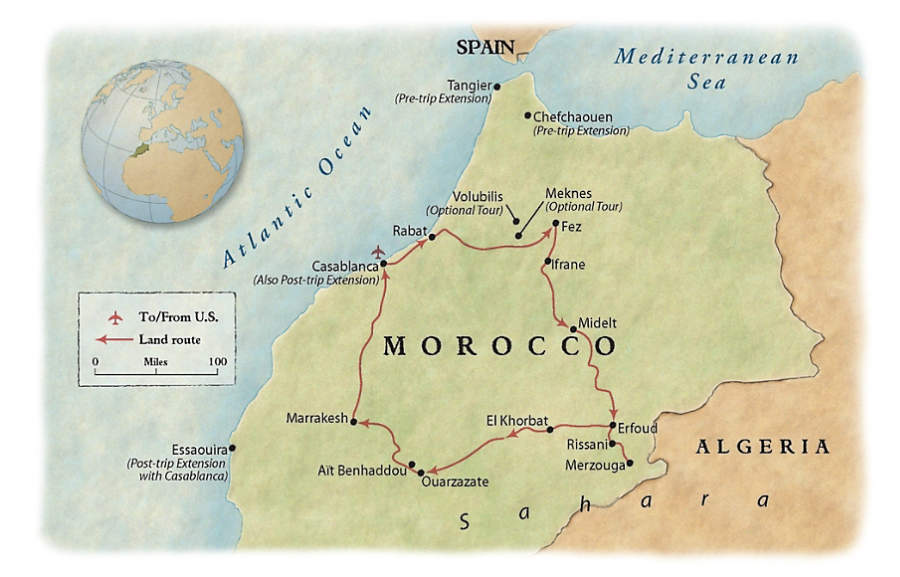
Last month my wife and I went on a wonderful two-week tour of Morocco with Overseas Adventure Travel. Here is the OAT map for the tour:
We were impressed by the country’s fascinating history and people, its beautiful architecture, cities and rugged Atlas Mountains, the immensity of the rolling Sahara Desert along its southern border and its current construction boom.
While there we also learned of Morocco’s recent re-establishment of its diplomatic relations with Cuba, a country about which I have written a lot, and of Morocco’s membership in the African Union, both related to Morocco’s lingering conflict over the Western Sahara, which was the subject of a recent U.N. Security Council resolution, all of which were discussed in recent posts.[1]
Also fascinating was the country’s religious profile. Its population of 33.7 million is 99% Sunni Muslim with 1% Shia Muslims, Christians, Jews and Bahias. In every town the mosques’ minarets were the instantaneously recognizable tallest structures.[2]
Our OAT tour guide told us that the current king, Mohammad VI, has been leading efforts to ensure that Muslims in Morocco are not encouraged to join extremists groups like ISIS or Al Qaeda. All imams have to complete an education course at the capitol at Rabat that is organized and administered by the government’s ministry of religious affairs (The Ministry of Endowments and Islamic Affairs of the Kingdom of Morocco) and that excludes the extremist ideologies promoted by ISIS and Al Qaeda.
We also were told that neither the government nor the Muslim leaders discriminate against Christians or Jews, and we visited a synagogue in Fez. On the other hand, we were told, the Christians and Jews are forbidden from preaching or proselytizing or evangelizing in public.
Previously I had learned that the five “pillars” of Islam are (1) shahada, declaring as a matter of faith and trust that there is only one God (Allah) and that Mohammad is God’s messenger; (2) salat, saying the Islamic prayer five times a day; (3) zakat, giving to the poor and needy; (4) slym, fasting during the month of Ramadan; and (5) haji, making a pilgrimage to the holy city of Mecca at least once in a lifetime.
Although in Morocco I only experienced hearing the call to prayer over a minaret’s loudspeaker, I came to see these pillars of faith as similar to various practices of Christian spirituality, as ways of reinforcing a believer’s connections with God (Allah), and as ways that help believers live in accordance with the will of God (Allah). These pillars and practices, in my opinion, also rest on the belief that no one is perfect, that all find it too easy to stray from the path of faithfulness and that all need reminders of God or Allah’s way.
I felt fortunate that my Minneapolis church (Westminster Presbyterian) has warm relations with a local mosque and that we have hosted at least two worship services including its leaders. [3]
After returning to the U.S., I conducted research and discovered more about the previously mentioned government ministry; Morocco’s positive relations with international anti-terrorism groups; the important Declaration of Marrakesh promoting respect for religious minorities in Muslim countries; the most current U.S. State Department’s assessment of Morocco’s religious freedom; and the nature of current U.S.-Morocco relations. These topics will be explored in subsequent posts.
Disputes over the Western Sahara, a former Spanish colony, have followed its 1975 annexation by Morocco in opposition to competing claims by the Polisario Front. In 1991 the U.N. brokered a cease-fire and established a peacekeeping monitoring mission and to help prepare a referendum on the territory’s future that has never taken place. So far the parties have been unable to agree upon how to decide on self-determination. Morocco wants an autonomy plan under Moroccan sovereignty while Polisario wants a U.N.-backed referendum including on the question of independence. Below is a map of the Western Sahara.
On April 28, 2017, the U.N. Security Council unanimously adopted Resolution 2351 extending the mandate of the U.N. Mission for the Referendum in Western Sahara (MINURSO) until 30 April 2018 and calling on the parties to that conflict to resume negotiations under the auspices of the Secretary-General without preconditions and in good faith, in order to facilitate a just, lasting and mutually acceptable political solution.[1]
Other provisions of the resolution called on the parties to cooperate fully with the operations of MINURSO, to take the necessary steps to ensure unhindered movement for U.N. and associated personnel in carrying out their mandate, to demonstrate the political will to work in an atmosphere propitious for dialogue in order to resume negotiations, to implement the relevant Security Council resolutions, to resume cooperation with the Office of the U.N. High Commissioner for Refugees, to ensure that the humanitarian needs of refugees were adequately addressed. It also supported an increase in the ratio of medical personnel within the current uniformed authorization, as requested in the Secretary-General’s most recent report to address MINURSO’s severely overstretched medical capacity. Yet another part of the resolution noted that both sides had withdrawn troops from the Guerguerat area of the territory, a vast swath of desert bordering the Atlantic Ocean that has been contested since 1975.
In support of the resolution, U.S. Deputy Permanent Representative to the United Nations, Ambassador Michele Sisson, emphasized hat peacekeeping missions should support political solutions, said that postponing the [referendum] had been the key to allowing MINURSO to close out the 2016 chapter in the territory. The U.S. was pleased with the mandate renewal, which helped in returning the Council’s attention where it belonged — supporting a political process to resolve the situation on the ground. Emphasizing that the situation must change, she said the Council must look at the “big picture” in Western Sahara, including the absence of any political process for many years, she said. The resolution demonstrated the importance of the parties working with the U.N. to return to the table. The Mission must be able to hire the right staff in order to be as effective as possible, and to adjust components that were not working, as well as they should. The U.S. would watch closely to see what happened on the ground, she said.
Also speaking in support of the resolution were the other Security Council members: Uruguay, Sweden, Senegal, Ethiopia, China, France, United Kingdom, Italy, Bolivia, Japan, Ukraine and the Russian Federation.
Although the resolution was passed unanimously, France, a permanent Council member, backs Morocco, its former colony, while Polisario has been supported by some non-permanent council members and by South Africa.
Afterwards Morocco’s foreign ministry said the kingdom was satisfied with the resolution and hoped for a “real process” toward a solution, which it said should be on its autonomy initiative. Morocco also called for neighboring Mauritania and Algeria, the latter of which backs Polisario and maintains tense relations with Morocco, to be involved in negotiations. Algeria, on the other hand, called the resolution a victory for the Sahrawi cause that put the process “back on track.”
Morocco recently has made at least two diplomatic moves that may be related to enhancing its position in such negotiations.
First, on January 31, 2017, the African Union (AU) at its Summit, 39 to 9, approved Morocco’s request for readmission after having left the AU in 1984 in response to a majority of its members recognizing the disputed territory in the Western Sahara.
Morocco’s King Mohammed VI in his speech at this year’s AU Summit emphasized “how indispensable Africa is to Morocco and how indispensable Morocco is to Africa.” As evidence he mentioned that “since 2000, Morocco has [signed] nearly a thousand agreements with African countries, in various fields of cooperation,” including providing scholarships for Africans to attend Moroccan universities, launching the African Atlantic Gas Pipeline, creating a regional electricity market, constructing fertilizer production plants, creating the Adaptation of African Agriculture program to respond to climate change. These actions, he asserted, demonstrated Morocco’s “commitment to the development and prosperity of African citizens, [who] have the means and the genius; [so that] together, we can fulfill the aspirations of our peoples.”
This readmission, say analysts, also enhances Morocco’s status in upcoming negotiations over the Western Sahara although the King did not mention this in his speech. Instead, he made a modest allusion to this conflict when he said, “We know that we do not have unanimous backing from this prestigious assembly. Far be it from us to spark off a sterile debate! We have absolutely no intention of causing division, as some would like to insinuate!”[2]
The other diplomatic move that can be seen as an attempt to soften resistance towards Morocco’s position in negotiations over the Western Sahara was its re-establishment of diplomatic relations with Cuba, as discussed in a prior post.
On September 22, Cuba’s Foreign Minister, Bruno Rodriguez Parilla, addressed the annual meeting of the United Nations General Assembly.[1] The next day he repeated some of the themes of this speech while talking at a meeting at the U.N. of the G77 + China, the intergovernmental organization of 134 U.N.-member developing countries that promotes their collective economic interests, their joint negotiating capacity on such issues and South-South cooperation for development.[2]
Foreign Minister’s Speech to the U.N. General Assembly
“The statistics could not be more eloquent. 80% of the world population owns only 6% of the wealth, while the richest 1%, enjoys half the heritage of the planet. No less than 795 million people suffer from chronic hunger. 18,000 children die daily because of poverty. More than 660 million use non-potable water and 780 million adults and 103 million young people are illiterate.”
“The huge nuclear and conventional arsenals and annual military spending of 1.7 billion million dollars, belie those who claim that there are no resources to eliminate poverty and underdevelopment.”
“The waves of refugees into Europe, caused by underdevelopment and NATO interventions, show the cruelty, the oppressive nature, inefficiency and unsustainability of the current international order . . . .”
“2015 was also the worst in terms of climate change, with increasing global temperatures, melting of polar ice, the ocean levels and volume growth emission of greenhouse gases. . . . While it is expected that the industrialized countries will make progress in fulfilling the obligations assumed with the ambiguous Paris Agreement, only tangible data on financing and technology transfer to developing countries may justify hopes of survival of the human species.”
“Peace and development are the raison d’être of the [U.N.] For the human species, it is imperative and urgent . . . to create a culture of peace and justice as the basis of a new international order. . . . For peaceful coexistence among States, it is essential to respect the [U.N.] Charter and international law.”
“The UN must [combat] unilateralism and . . . be thoroughly reformed in order to democratize it and bring it closer to the problems, needs and aspirations of peoples in order to make it capable of [moving] the international system towards peace, sustainable development and respect for all human rights for all. The reform of the Security Council, both in its composition and its working methods, is a task that can no longer be postponed. Strengthening the General Assembly and rescuing [its] functions that have been usurped by the Security Council should guide the search for a more democratic and efficient organization.”
Rodrigues also supported the rights of the people of Palestine, the Sahara, the Syrian Arab Republic, Russia (and against NATO), Venezuela, Colombia (and their agreement to end the conflict with the FARQ), Brazil (and against “the parliamentary coup d’eta against President Rousseff”) and Puerto Rico.
He praised Cuban medical personnel who are “working in [61 countries in] all continents . . . for the life and health of humans” and criticized the U.S. Parole Program for Cuban Medical Personnel that seeks to interfere with such beneficial medical programs.
On the other hand, he recognized that “just over a year has passed since the restoration of diplomatic relations between Cuba and the United States and the reopening of embassies.” Since then “there has been some progress in our bilateral ties, especially in diplomatic affairs, dialogue and cooperation on issues of common interest, as reflected in the high-level visits, including the visit of President Barack Obama, and the dozen agreements signed on issues that can bring benefits to both countries and throughout the hemisphere.
However, “the reality is that the [U.S. embargo] blockade remains in force, continues to cause serious damage and hardship to the Cuban people and continues to hamper the functioning of the economy and its relations with other countries. Executive measures adopted by the [U.S.}, although positive, are insufficient.” Therefore, the Cuban government “will present [this October] to the Assembly the draft resolution entitled ‘Necessity of Ending the Economic, Commercial and Financial Tax by the United States of America against Cuba.’”
In the meantime, “the Cuban government [will continue to develop] a respectful dialogue with the [U.S.] Government, knowing that remains a long way to go to move towards normalization, which means building an entirely new bilateral relations [model].” For this to be possible some day, it will be imperative that the blockade [be] . . . lifted” and that the territory [allegedly] illegally occupied by the Naval Base of the United States in Guantanamo” be returned to Cuba.
“The Cuban people continues [to be engaged in updating [its] economic and social model . . . in order to build an independent, sovereign, socialist, prosperous and sustainable nation.”
Foreign Minister’s Speech at Meeting of G-77+ China
Rodriguez emphasized what he called “the historical debt owed to the nations of the South by the industrialized countries that built their wealth from centuries of colonialism, slavery and plundering of natural resources. This debt needs to be settled by [the industrialized countries] paying [the nations of the South] with financial flows and technology transfers.”
“The external [financial] debt [of the South] must be abolished because it already has been paid many times.”
The Cuban Foreign Minister of Cuba also advocated a direct and active participation of the South in global decisions.
He reiterated Cuba’s allegations against the U.S. economic, commercial and financial embargo (blockade) despite the recent rapprochement between the two governments. More will be heard on this subject when Cuba this October presents its annual resolution against the embargo to the General Assembly
Conclusion
There really was nothing new in these remarks, but it is heartening to hear again that Cuba continues to pursue normalization with the U.S. and to updating its economic and social model in order to build a more prosperous society.
On September 2nd at the United Nations headquarters, Dr. Hanan Ashraw, a member of the executive committee of the Palestine Liberation Organization (PLO), said that Palestine has decided to join the International Criminal Court (ICC).
Ever since Palestine obtained observer-state status at the U.N. in late 2012, over Israeli and U.S. opposition, Palestine’s government has threatened to join the Court as a way to prosecute Israeli actions in the occupied territories. But the PLO deferred a decision, Dr. Ashrawi said, in order to give U.S.-led diplomacy a chance to succeed.
The deferral also gave the P.L.O. leadership the opportunity to convince other Palestinian political factions, including the militants, that they would have more to gain than to lose from joining the ICC, including subjecting Palestinian factions, including Hamas, to its jurisdiction. The PLO leadership, Dr. Ashrawi said, “wanted to ensure that all factions are O.K. with it,” and now they are.
As a prior post reported, Palestine with observer-state status at the U.N. is eligible to join the ICC. The U.S. and Israel are opposed to such membership, but they cannot prevent it from happening.
Later this month, the Palestinians are planning another move to put more pressure on Israel. This will be a motion to have the U.N. Security Council demand that Israel end its occupation of Palestinian territory within three years. If such a motion is made, the U.S. is expected to veto the measure. Anticipating such a veto, the Palestinians may put the issue before the U.N. General Assembly, where Palestine has wide support.
We just reviewed the status of the investigative situations and cases of the International Criminal Court (ICC) and other ICC developments. Now we look at developments in U.S.-ICC relations.[1]
U.N. Security Council. On October 17, 2012, the U.N. Security Council had a general discussion on the promotion and strengthening of the rule of law in the maintenance of international peace and security with emphasis on the role of the ICC.
Susan Rice
U.S. Ambassador to the U.N., Susan Rice, said at that meeting that “strengthening the global system of accountability for the worst atrocities remains an important priority for the [U.S.]. President Obama has emphasized that preventing mass atrocities and genocide is a core national security interest and core moral responsibility for our nation. We are committed to bringing pressure to bear against perpetrators of atrocities, ensuring accountability for crimes committed, and prioritizing the rule of law and transitional justice in our efforts to respond to conflict.”
Rice added that the U.S. “recognize[s] that the ICC can be an important tool for accountability. We have actively engaged with the ICC Prosecutor and Registrar to consider how we can support specific prosecutions already underway, and we’ve responded positively to informal requests for assistance. We will continue working with the ICC to identify practical ways to cooperate – particularly in areas such as information sharing and witness protection – on a case-by-case basis, as consistent with U.S. policy and law.”
Another important point for Rice was the need “to improve cooperation and communication between the Security Council and the Court. For example, the Council should monitor the developments in situations it refers to the Court, since the ICC may face dangers in conducting its work. However, we must also recognize that the ICC is an independent organization. This status raises concerns about proposals to cover its expenses with UN-assessed funding.” In addition, she said, the “interests of peace, security and international criminal justice are best served when the Security Council and the ICC operate within their own realms but work in ways that are mutually reinforcing. We should not accept the false choice between the interests of justice and the interests of peace.”
Assembly of States Parties. The U.S. continues to participate as an observer at meetings of the Court’s governing body, the Assembly of States Parties. At its November 2012 meeting, for example, major speeches were made by U.S. Ambassador-at-Large Stephen J. Rapp of the Department of State’s Office of Global Criminal Justice and Harold Koh, who then was U.S. Department of State Legal Advisor.
Stephen Rapp
Ambassador Rapp said the U.S. had “worked diligently to promote an end to impunity” and had been “supporting the work of the ICC in each of its current cases.” He then outlined the following priorities for the Court and its supporters:
“First, it is essential that the fugitives who currently remain at large in the ICC’s cases are apprehended . . . and that the witnesses who testify and the victims who wish to participate in the proceedings are assured of their safety.” The U.S. uses “an array of tools to advance the causes of apprehension and witness protection.”
Second, “it is crucial that members of the international community continue to reinforce the legal norms and prohibitions that lead to the creation of institutions such as the ICC.” One example is the U.S. establishment of the Atrocities Prevention Board that was discussed in a prior post.
Third, “we must continue to strive to improve our system of international justice. . . . [The ICC needs] to build a solid jurisprudence, navigate challenges that arise in international cooperation, and establish legitimacy . . . as a fair and efficient criminal justice institution that makes prudent decisions in the cases it pursues, and those it declines to pursue.”
Fourth, “we all must continue to recognize that the ICC cannot and must not operate alone. States retain primacy, both legal and moral, in ensuring justice for grave crimes. Justice closer to the victims is always preferable, in a system that can account for local laws and custom, in a familiar language, and in an accessible setting. Even where the ICC does operate, tremendous work will remain to be done at the national level. . . . [The U.S.] looks forward to continuing to collaborate in promoting this crucial work.”[2]
Harold Koh
Legal Advisor Koh said the Court was “an important forum” for advancing U.S. national security and humanitarian interests. It “can help increase stability and thus decrease the need for more costly military interventions in the future.”
Koh reviewed the five stages of the historical development of international criminal justice: (1) International Criminal Justice 1.0: The Nuremberg Trials that worked to establish the principles of legitimacy, professionalism, cooperation, and legality; (2) International Criminal Justice 2.0: The Ad Hoc Tribunals; (3) International Criminal Justice 3.0: The Hybrid Tribunals; (4) International Criminal Justice 4.0: The ICC; and (5) International Criminal Justice 5.0: The Future.
After reviewing the history of U.S. relations with the ICC, Koh discussed four important issues for the Court’s future. First, it needs to continue to develop the practice of positive complementarity so that the ICC is the court of last resort with fewer cases. Second, the ICC established important precedents with its first conviction (Lubanga of the DRC) and establishment of procedures and principles for reparations for victims in that case. Third, the ICC must build up its resources and capacities; it must function in a fair and transparent manner with able and unbiased prosecutors and judges; national judicial systems must be bolstered to reduce the ICC’s burdens; it must improve cooperation with states and enhance the efficiency and effectiveness of its prosecutions; and it should be cautious about moving forward with the amendment on the crime of aggression that was adopted at the Kampala Review Conference.
Koh concluded with more general comments about the future. He said the challenge is “to build the accountability agenda of the past seventy years into a sustained ‘Smart Power Approach’ to international criminal justice that sees accountability as part of a broader approach to diplomacy, development, rule of law, and atrocities prevention.”
New U.S. Statute To Assist ICC. On January 15th, President Obama signed The Department of State Rewards Program Update and Technical Corrections Act of 2012 (S.2318). The President said the new law “will enhance the ability of the U.S. Government to offer monetary rewards for information that leads to the arrest or conviction of foreign nationals accused by international criminal tribunals of atrocity-related crimes, and of individuals involved in transnational organized crime.” The President added, “This powerful new tool can be used to help bring to justice perpetrators of the worst crimes known to human kind. . . . We have made unmistakably clear that the United States is committed to seeing war criminals and other perpetrators of atrocities held accountable for their crimes, and today’s legislation can help us achieve that goal.
The new law declares “the sense of Congress that the rewards program of the Department of State should be expanded in order to … target other individuals indicted by international, hybrid or mixed tribunals for genocide, war crimes, or crimes against humanity.” It then goes on to authorize the State Department to pay rewards for “the transfer to or conviction by an international criminal tribunal … of any foreign national accused of war crimes, crimes against humanity, or genocide, as defined under the statute of such tribunal.”
Two provisions of the law show a continuing wariness about the ICC. One requires that 15 days before announcing a reward for the arrest of a particular foreign national accused of those crimes, the State Department must submit a report to Congress explaining why the arrest would be in the national security interest of the United States. The other declares that the law does not authorized activities precluded under the American Servicemembers’ Protection Act.
On April 3rd this new law was used when the U.S. offered to pay up to $5 million for information leading to the arrest, transfer or conviction of four ICC fugitives: Joseph Kony, Dominic Ongwen and Okot Odhiambo of the Lord’s Resistance Army in Uganda and Sylvestre Mudacumura of the Democratic Republic of the Congo. The names will be broadcast on radio and appear on reward posters printed in the languages of the fugitives’ countries, he said. “The offer of rewards for I.C.C. fugitives will be the biggest step we’ve taken toward engagement and support” for the court, Ambassador Rapp said.
We just reviewed the current status of the investigative situations and cases of the International Criminal Court (ICC). [1] Now we look at two other major issues facing the ICC–Syria and Palestine, last year’s meeting of the Court’s Assembly of States Parties and the Chief Prosecutor’s statement about this month’s being genocide awareness month.
Syria. As we know from many news sources, popular demonstrations against Syrian President Bashar al-Assad commenced in March 2011 and immediately grew throughout the country. In April 2011, the Syrian Army was deployed to quell the uprising, and soldiers were ordered to open fire on demonstrators. After months of military sieges, the protests evolved into an armed rebellion. By January 2013 the U.N. estimated the war’s death toll had exceeded 60,000, and a month later this figure was updated to 70,000. Another 6,000 reportedly were killed in March 2013.
To respond to this horrible suffering, many have called for the ICC to become involved. One who has repeatedly done so is the U.N. High Commissioner for Human Rights, Navi Pillay. Here are some examples:
During a debate on Syria by the U.N. Human Rights Council in February 2012, she said she believed that the situation of Syria should be referred to the ICC by the U.N. Security Council.
On June 7, 2012, she said, “We continue to witness a serious deterioration of the human rights situation in Syria, which demands our full attention and engagement.” There is evidence of “a pattern of widespread or systematic attacks against civilian populations, and may amount to crimes against humanity and other international crimes. There are indications that the situation in Syria – at least in certain areas – amounts to an internal armed conflict. This would have legal implications, triggering the possibility of commission of war crimes, in addition to crimes against humanity. It makes the call I made to the Security Council to consider referring the case of Syria to the International Criminal Court even more urgent.”
At a February 13, 2013, Security Council meeting, she said, “The lack of consensus on Syria and the resulting inaction has been disastrous and civilians on all sides have paid the price. We will be judged against the tragedy that has unfolded before our eyes.” She said that referring Syria to the ICC could have a very significant preventive effect because it “would send a clear message to both the government and the opposition that there will be consequences for their actions”.
In January 2013, 58 countries signed a joint statement calling for such a referral. In response at least five Security Council members voiced support for same– France, Britain, Australia, Luxembourg and South Korea. The next month, February 2013, U.N. human rights investigator Carla del Ponte said the “time has come” for the Security Council to refer war crimes in Syria to the ICC for prosecution. Similar calls for referral have come from Amnesty International and Human Rights Watch.
The Syrian government obviously opposes such a referral. In January 2013 it said it “regrets the persistence of these countries [that signed the joint statement favoring referral] in following the wrong approach and refusing to recognize the duty of the Syrian state to protect its people from terrorism imposed from abroad.” The statement also accused some of the countries signing the statement of “deceit and double standards” in blaming Syria while financing, training and hosting “terrorists.”
Because Syria is not a state party to the ICC’s Rome Statute, the only way for the Syrian situation to get before the ICC is by a referral from the U.N. Security Council. But so far that has been impossible because Russia and China as permanent members of the Council would veto such a referral as they already have vetoed resolutions to impose sanctions on Syria.[2] For example, this past January the Russian Foreign Ministry said the joint request by over 50 countries for such a referral was “ill-timed and counterproductive to resolving the main task at this moment: an immediate end to the bloodshed in Syria.”
Palestine. In November 2012 the U.N. General Assembly, 138 to 9 with 41 abstentions, voted to grant non-member observer state status to the Palestinian Authority. Those voting “No” included Israel, U.S. and Canada. The abstainers included the U.K. and Germany.
Israel and the U.S. are concerned that the Palestinian Authority (PA) may use its new U.N. status to try a press for an ICC investigation of Israeli practices in the occupied territories. The PA could: (1) attempt to become a State Party at the ICC by ratifying the Rome Statute and then referring alleged crimes to the ICC; or (2) remain a non-State Party but make a declaration accepting the Court’s jurisdiction over a particular set of crimes.
In either option the PA would have to refer an entire situation or train of events to the ICC that would permit the ICC Prosecutor to investigate or prosecute any crime within that situation allegedly committed by anyone, including alleged crimes by Palestinians against Israelis. The State Party option would require the PA to ratify the Rome Statute and then present a document certifying the ratification to the U.N. Secretary-General, who is responsible for administering the Rome Statute. He would have to decide whether the PA was a state competent to ratify. Should he so decide, the Prosecutor and the rest of the ICC would be obliged to proceed as with any other State Party.
In the non-State Party option of a declaration of acceptance of jurisdiction followed by a referral, the ICC Prosecutor would have to make the first decision on whether the PA was a state competent to make the referral. This decision could be challenged in the Pre-Trial Chamber by the PA, or by another state involved in the situation giving rise to the referral, such as Israel.
The PA has in fact already tried this option by submitting a report of alleged crimes and declaration of acceptance of jurisdiction to the ICC Prosecutor in 2009. In April 2012, however, the Prosecutor released a statement that at he was not empowered to decide on the PA’s statehood status. Instead, the Prosecutor said, a U.N. body such as the Security Council or the General Assembly, or the ICC’s Assembly of States Parties, would have to make this determination. After the General Assembly’s recent action, the press has reported that the current Prosecutor is giving the earlier PA declaration further consideration.
Assembly of States Parties. Last November the Assembly of States Parties (ASP) held its 11th session and adopted a budget and made certain elections.
The ASP approved an amendment to the Court’s Rules of Procedure (new Rule 132 bis) that will permit a single judge to perform the functions of a Trial Chamber for the purposes of trial preparation. The amendment was agreed by consensus and is expected to expedite ICC trial preparation.
The ASP also had a general discussion of complementarity, i.e., the principle and practice of the ICC’s deferring to criminal prosecutions in national court systems. Helen Clark, the former prime minister of New Zealand and current administrator of the U.N. Development Program, spoke about the role international development agencies, such as UNDP and others, can contribute to domestic capacity for dealing with ICC crimes. She also urged governments to take responsibility to deliver justice.
U.S. Ambassador-at-Large for Criminal Justice, Stephen J. Rapp, congratulated the ASP for this crucial discussion on both the policy and practice of complementarity. He stressed the importance to governments – States Parties and non-States Parties alike – to strengthen domestic judicial capacity in a manner that is both concerted and coordinated. He also said the U.S. supports ICC prosecutions and building national justice systems by funding support of complementarity; using the tools of diplomacy to support complementarity; providing technical and legal assistance to national systems; and improving fugitive tracking efforts.
There also was discussion about an initiative to adopt a treaty on crimes against humanity that has been prepared by the Whitney R. Harris World Law Institute at the Washington University in St. Louis School of Law.
Genocide Awareness Statement by Prosecutor. In light of this April’s being genocide awareness month, the Court’s Chief Prosecutor called on “all States, whether parties to the Rome Statute or not, to cooperate with the ICC in seeking/pursuing accountability for genocide.” In particular, this meant enforcing the ICC’s warrant for the arrest of Sudanese President Omar al Bashir, who is charged with “genocide by killing, causing serious bodily injury or mental harm and by deliberating inflicting conditions of life calculated to bring about the physical destruction of the Fur, Masalit and Zaghawa ethnic groups in Darfur.”
This post will review the current status of the eight situations (all from Africa) currently under investigation by the Office of the Prosecutor (TOP) of the International Criminal Court (ICC) and the 30 individuals that have been charged by the ICC with crimes in those situations.[1]
In July 2004, pursuant to a referral by the government of Uganda, TOP opened an investigation into the situation of the Lord’s Resistance Army (LRA)in Northern Uganda. That has resulted in charges of crimes against humanity and war crimes against five individuals, four of whom remain at large: Joseph Kony, Vincent Otti, Okot Odhiambo and Dominic Ongwen. The other (Raska Lukwiya) is deceased.
The hunt for Kony and other LRA leaders continues. Uganda has some 2,500 soldiers deployed around the border areas of Central African Republic (CAR) the Democratic Republic of Congo and South Sudan, where Kony and his fighters are thought to spend most of their time. The Ugandan troops are joined by 500 Congolese fighters, 500 South Sudanese and 350 CAR troops, all operating under the auspices of the African Union (AU). They have been assisted by 100 U.S. special forces. These efforts will continue despite the recent coup in the CAR.
On March 18, 2013, TOP issued a statement that LRA members will not be killed or tortured if they surrender to the ICC. All their human rights will be protected and the cases against them will be in accordance with accepted international human rights standards. They will face a fair, impartial and public justice that respects all their rights, including the right to be represented by a lawyer of their choice, and to present evidence in their defense. If convicted they will not be sentenced to death. Therefore, they should hand themselves over and face a fair justice process at the ICC or remain fugitives in full knowledge that military forces from many countries are looking for them, and they may be cornered, captured, and possibly killed or wounded in the process.
In June 2004, pursuant to a referral by the government of the Democratic Republic of the Congo (DRC), TOP opened an investigation into the situation in the country since June 1, 2002. That has resulted in six cases against six individuals.
Thomas Lubanga Dyilo on March 1, 2012, was convicted of war crimes and on July 10, 2012, sentenced to 14 years imprisonment.
On July 8, 2012, the ICC issued its first decision on reparations. It decided that the potential beneficiaries are the direct and indirect victims who suffered harm following the crimes of enlisting, conscripting and using children under the age of 15 in Ituri in the DRC (9/1/02–8/13/03), including family members of direct victims and individuals who intervened to help the victims or to prevent the commission of these crimes. The decision also established the following principles for reparations:
no discrimination as regards age, ethnicity or gender;
reconciling the victims of child recruitment and their families and communities in Ituri;
preserving their dignity and privacy;
taking into account the age of the victims and the sexual violence that they may have suffered; and
the need to rehabilitate the former child soldiers within their communities.
Germain Katangawent on trial (with Mathieu Ngudjolo Chui) on November 24, 2009, on charges of crimes against humanity and war crimes within the meaning of Article 25(3)(a) of the Statute (committing the crimes jointly through another person). On February 7, 2012, evidence in the case was closed and closing arguments were heard in May 2012 by the Trial Chamber.
On November 21, 2012, the Chamber, 2 to 1, issued an order severing Mr. Chui from this case and deciding that the mode of liability of Mr. Katanga might be changed under Regulation 55(2)[2] to Article 25(3)(d) of the Statute (contributing in any other way to the commission of the crimes by a group of persons acting with a common purpose).
This proposed change (after the trial) was appealed by Mr. Katanga, and on March 27, 2013, the Appeals Chamber, 2-1, affirmed the Trial Chamber. It held that the decision was in accordance with Regulation 55(2) and did not violate the defendant’s right to a fair trial. However, it said, the Trial Chamber will have to be vigilant in its further deliberations to ensure that this right will not be infringed by further trial proceedings.
Mathieu Ngudjolo Chui , as just indicated, was tried with Mr. Katanga from November 24, 2009 through May 23, 2012 on charges of crimes against humanity and war crimes within the meaning of Article 25(3)(a) of the Statute (committing the crimes jointly through another person), but on November 21, 2012, Mr. Chui’s charges were severed.
On December 18, 2012, the Trial Chamber issued its unanimous verdict acquitting Mr. Chui of all charges because it had not been proven beyond reasonable doubt that he was the commander of the Lendu combatants from Bedu-Ezekere during the attack against the Bogoro village on 24 February 2003. On December 21, 2012, Mr. Chui was released from detention pursuant to an order by the Appeals Chamber.
The Office of the Prosecutor has appealed that verdict.
Bosco Ntaganda has been charged with three counts of crimes against humanity and seven counts of war crimes.
On March 22, 2013, he voluntarily surrendered himself to the U.S. Embassy in Rwanda and asked to be turned over to the ICC. His decision prompted speculation as to why he did so. One theory says he was threatened by member of his own rebel group and wanted to save his own life. In any event, soon thereafter he made his initial appearance before the Court and said he was not guilty. The date for his confirmation of charges hearing was set for September 23, 2013.
Callixte Mbarushimana was charged with five counts of crimes against humanity and eight counts of war crimes, but on December 16, 2011, the Pre-Trial Chamber refused to confirm the charges, and on December 23, 2011, he was released from the Court’s custody.
Sylvestre Mudacumura on July 13, 2012, was the subject of the Pre-Trial Chamber’s arrest warrant for allegedly committing nine counts of war crimes in the DRC, including attacking civilians, murder, mutilation, cruel treatment, rape, torture, destruction of property, pillaging and outrages against personal dignity. He is at large.
On May 22, 2007, pursuant to a referral by the government of the Central African Republic (CAR), TOP opened an investigation into alleged crimes, in 2002 and 2003, in that country. In which civilians were killed and raped; and homes and stores were looted in the context of an armed conflict between the government and rebel forces.
Jean-Pierre Bemba Gombo is the only case. He is charged as a military commander, with two counts of crimes against humanity: (murder and rape) and three counts of war crimes (murder, rape and pillaging). His trial started on November 25, 2010, and is not finished.
On June 6, 2005, pursuant to a referral by the U.N. Security Council, TOP opened an investigation into the situation in Darfur, Sudan since July 1, 2002.
That has resulted in six cases involving seven individuals, the following four of whom are still at large: (i) Ahmad Muhammad Harun (20 counts of crimes against humanity and 22 counts of war crimes); (ii) Ali Muhammad Ali Abd-Al-Rahman (22 counts of crimes against humanity and 28 counts of war crimes); (iii) Omar Hassan Ahmad Al Bashir, the President of Sudan (5 counts of crimes against humanity, 2 counts of war crimes and 3 counts of genocide); and (iv) Abdel Raheem Muhammad Hussein (7 counts of crimes against humanity and 6 counts of war crimes).
Bahar Idriss Abu Garda was charged with war crimes, but in 2010, the Pre-Trial Chamber refused to confirm the charges, and rejected the Prosecutor’s application to appeal.
Abdallah Banda Abakaer Nourain and Saleh Mohammed Jerbo Jamus are charged with co-commission of three war crimes. Their trial is scheduled to start on May 5, 2014.
In the latest (December 2012) semi-annual report to the U.N. Security Council on this situation and cases,[3] the Chief Prosecutor said that her office would consider whether further investigations and additional arrest warrants were needed to address recent violations, including reports of thwarting humanitarian aid deliveries, attacks on African Union-United Nations Hybrid Operation in Darfur (UNAMID) peacekeepers and bombardments and attacks on civilian populations.
The Chief Prosecutor also told the Council, “The question that remains to be answered is how many more civilians must be killed, injured and displaced for this Council to be spurred into doing its part. There are no words to properly express the frustration of Darfur’s victims, which we share, about the lack of any meaningful progress towards arresting those indicted by the Courts.”
In response, Sudan’s representative told the Security Council that the Prosecutor’s report was flawed, saying it contained unsubstantiated allegations, and contradicted UNAMID reports. The report’s allegations of gender violence, for instance, did not provide sources, and it mistook tribal clashes for fighting between militias. Also, reported attacks on peacekeepers had in fact been committed by bandits now being pursued by Sudanese authorities. He said the Court had become a tool for “blackmail” and for violating the sovereignty of small States and was being exploited by certain political interests.
Among the other statements at the Council meeting, a U.S. diplomat said mounting violence was a grave concern, including targeted civilian attacks and denying UNAMID access to affected areas. Since UNAMID’s initial deployment in 2007, 43 peacekeepers had been killed, in attacks that could be prosecuted as war crimes. The Council should condemn any and all attacks on mission personnel. Reversing the cycle of violence required accountability for the perpetrators, he said, expressing dismay that the Sudanese Government was not cooperating with the Court, despite its obligation to do so fully. Continued impunity for crimes committed in Darfur fomented instability and sent a dangerous message that there were no consequences to attacking civilians. Welcoming the willingness of States to consider creative approaches and new tools to assist the Court, he also embraced further discussions on resolutions concerning Council referrals to the Court. [4]
On March 31, 2010, the Pre-Trial Chamber, 2-1, authorized TOP to proceed with an investigation that it had proposed into the situation in Kenya between June 1, 2005 and November 26, 2009.
Uhuru Muigai Kenyatta is charged as an indirect co-perpetrator of crimes against humanity (murder, deportation or forcible transfer, rape, persecution and other inhumane acts. The charges stem from his alleged role in funding and organizing ethnic violence leading to the death of an estimated 1,200 people after the 2007 presidential election. His trial is scheduled to start on July 9, 2013.
In the meantime, on March 3, 2013, Kenyatta, who employed anti-ICC propaganda in his presidential election campaign, was narrowly elected President of Kenya, and on March 30th the country’s Supreme Court unanimously rejected a challenge to the election from his main electoral opponent. Kenyatta’s election creates an “awkward” situation, as the New York Times said, for the U.S. and other countries who need good diplomatic relations with Kenya.
William Samoei Ruto was charged with being an indirect co-perpetrator of crimes against humanity. His trial is scheduled to begin on May 28, 2013.
Joshua Arap Sang was charged with having contributed to crimes against humanity. His trial is scheduled to begin on May 28, 2013.
Henry Kiprono Kosgey was charged as an indirect co-perpetrator of crimes against humanity, but the Pre-Trial Chamber declined to confirm the charges.
Mohammed Hussein Ali was charged with crimes against humanity, but in 2012, the Pre-Trial Chamber refused to confirm the charges.
Francis Kirimi Muthaura was charged as an indirect co-perpetrator of crimes against humanity, and the re-Trial Chamber in January 2012 confirmed some of the charges. In March 2013, however, TOP filed notice to withdraw the charges because several people who may have provided important evidence regarding his actions, have died, while others are too afraid to testify for the Prosecution; the Government of Kenya failed to provide TOP with important evidence; and the key witness against him had recanted a crucial part of his evidence and had admitted he had accepted bribes.
On February 26, 2011, the U.N. Security Council referred the situation in Libya since February 15, 2011 to the Court. That has resulted in TOP’s charges against three individuals, one of whom died (Muammar Gaddafi) resulting in the dismissal of his case.
The other two (Saif Al-Islam Gaddafi and Abdullah Al-Senussi) are in the custody of the Libyan Provisional Authority and have not been turned over to the Court despite negotiations to that effect.
In October 2012, Libya asked the ICC to abandon its claims against the two men because it said Libya can give them fair trials in Tripoli. In early 2013, Libyan officials told the ICC that the two men would be put on trial in Libya in May this year and would not face summary trial and execution.
In the latest (November 2012) semi-annual report to the U.N. Security Council on this situation and cases,[5] the Chief Prosecutor said both Saif Al-Islam Qadhafi and Abdullah Al-Senussi had been arrested and detained in Libya, and that the Libyan authorities had challenged the admissibility of the ICC’s case against Mr. Qadhafi and possibly of the case against Mr. Al-Senussi. She said the ICC’s Pre-Trail Chamber would decide the merits of the challenge as to whether the case should be heard at the Court or in Libya, and should the challenge ultimately succeed, TOP would monitor those proceedings and cooperate with Libya, to the extent of the mandate.Emphasizing the pressing need for complementary and mutually supportive approaches to address accountability, she encouraged international support and assistance to enhance Libya’s capacity to deal with past crimes and to promote the rule of law.
A Libyan representative at the Council meeting said his Government had set out its plans for stability, reconciliation and comprehensive justice for crimes that had been committed in his country and that its investigation was already at an advanced stage in some of those cases although the Qadhafi trial had been postponed in order to allow for the most thorough possible investigation. Libya, he continued, has been cooperating with the ICC and was now awaiting the decision on the admissibility challenge in the Qadhafi case and a forthcoming similar challenge in the Al-Senussi case. He reiterated his country’s pledge to carry out all procedures in compliance with international law.
A U.S. diplomat at the Security Council urged the Libyan Government to continue its cooperation with the Court. It was an important moment for both Libya and the Court as they worked together, under their respective roles, in ensuring peace and accountability. It was critical for Libya to ensure the safety of ICC personnel on visits to the country. She added that the U.S. had endeavored to cooperate with the ICC in its efforts regarding Libya, consistent with U.S. law and policy. Impunity for all serious crimes in Libya, including gender crimes, must be avoided, and victims should be assisted. The U.S. would continue to work with the international community to assist Libyan efforts to reform its justice sector and advance human rights in the country.
On October 3, 2001, the Court’s Pre-Trial Chamber granted TOP request to commence an investigation into the situation in the Ivory Coast since November 28, 2010, and in February 2012 the Chamber expanded the investigation to cover the period September 19. 2002 through November 28, 2010.
Laurent Gbagbo, the former president of the country, has been charged with four counts of crimes against humanity. He was surrendered to the Court in November 2011, and his confirmation of charges hearing was held in February 2013.
Simone Gbagbo, the wife of Laurent Gbagbo, has been charged as an indirect co-perpetrator with four counts of crimes against humanity. She has not been turned over to the Court.
On July 13, 2012, the government of Mali referred the situation in that country since January 2012 to the ICC, which has assigned it to the Pre-Trial Chamber.
In January 2012 a rebellion began in Northern Mali, led by the National Movement for the Liberation of Azawad (MNLA). In March 2012, military officer Amadou Sanogo seized power in the country in a coup d’etat, citing the president’s failure to eliminate the rebellion. The MNLA quickly took control of the north, declaring independence as Azawad. However, Islamist groups that had helped the MNLA defeat the government, turned on the rebel group and took control of the North with the goal of implementing Sharia Law in Mali.
On January 11, 2013, the French Armed Forces intervened at the request of Sanogo’s government. On January 30th, the coordinated advance of the French and Malian troops claimed to have retaken the last remaining Islamist stronghold.
In the midst of these military engagements, on January 16, 2013, TOP announced that it formally had opened an investigation into the Situation in Mali since January of 2012. After thorough analysis it said it had found that evidence, admissibility, gravity of potential cases, and interest of justice all support the requirements to open a formal investigation into war crimes allegedly committed in Mali. Crimes alleged to have happened include murder; mutilation, cruel treatment and torture; intentionally directing attacks against protected objects; the passing of sentences and the carrying out of executions without previous judgment pronounced by a regularly constituted court; pillaging; and rape. The ICC will move to investigate these alleged crimes and bring charges against individuals “who bear the greatest criminal responsibility for the most serious crimes committed.
In late January 2013, TOP warned Malian authorities to put an immediate stop to the alleged abuses and, on the basis of the principle of complementarity, to investigate and prosecute those responsible for the alleged crimes. TOP reminded all parties to the on-going conflict in Mali that it has jurisdiction over all serious crimes committed within the territory of Mali, from January 2012 onwards. All those alleged to be responsible for serious crimes in Mali must be held accountable.
Conclusion
The following summarizes the status of those charged with crimes by the Court as it nears its 11th anniversary on July 1, 2013:
Status
Number
Deceased
2
At large or not in Court custody
12
Pre-Trial: charges not confirmed
6
Pre-Trial: pending
1
Trials scheduled to start by 12/31/14
5
At trial
1
Tried and convicted
1
Tried and status in question
1
Tried and acquitted
1
TOTAL
30
[1] There have been many prior posts about the ICC.
[2]Regulation 55, which is titled “Authority of the Chamber to modify the legal characterization of facts,” says in part (2),”If, at any time during the trial, it appears to the Chamber that the legalcharacterisation of facts may be subject to change, the Chamber shall give noticeto the participants of such a possibility and having heard the evidence, shall, atan appropriate stage of the proceedings, give the participants the opportunity tomake oral or written submissions. The Chamber may suspend the hearing toensure that the participants have adequate time and facilities for effectivepreparation or, if necessary, it may order a hearing to consider all mattersrelevant to the proposed change.” Part (3) goes on to say, “For the purposes of sub-regulation 2, the Chamber shall, in particular,ensure that the accused shall:(a) Have adequate time and facilities for the effective preparation of his or herdefence [sic] in accordance with article 67, paragraph 1 (b); and (b) If necessary, be given the opportunity to examine again, or have examined again, a previous witness, to call a new witness or to present other evidence admissible under the Statute in accordance with article 67, paragraph 1 (e).”
[3] A prior post discussed the June 2012 ICC report to the Security Council on the Darfur/Sudan referral.
[4] The U.S. statement regarding Sudan/Darfur is available online.
[5] A prior post discussed the May 2012 ICC report to the Security Council on the Libyan referral.