The Fifth Day of Pope Francis’ Mission to the American People

Pope Francis’ fifth day in the U.S. started with a plane ride from New York City’s J.F. Kennedy International Airport to Philadelphia’s International Airport where he was welcomed by a group of dignitaries, including local church officials and Philadelphia Mayor Michael Nutter. The Pope, however, reserved his greatest affection and hug for Gabrielle Bowes, daughter of former Philadelphia police officer Richard Bowes who had been shot and injured in the line of duty. As the Pope’s car was about to join the motorcade to leave the airfield, he stopped, got out and greeted a group of people craning to see him from behind a security barrier. Among them was Michael Keating, 10, who was in a wheelchair.

Francis then went to the Cathedral Basilica of Sts. Peter and Paul, where he celebrated mass. Next was a trip to Independence Hall where he spoke about religious liberty and immigration before a crowd of 50,000. That evening he attended the Festival of Families in the city with an estimated 1 million people and gave remarks.

Cathedral Basilica of Sts. Peter and Paul[1]

At the Cathedral Francis was welcomed by Philadelphia’s Archbishop, Charles J. Chaput, who jokingly said, “This is a city that would change its name to Francisville today.” Among the 2,4000 people in the pews were bishops, priests and nuns from Pennsylvania.
Unknown-1

In his homily, Francis said, “This morning I learned something about the history of this beautiful Cathedral: the story behind its high walls and windows. I would like to think, though, that the history of the Church in this city and state is really a story not about building walls, but about breaking them down. It is a story about generation after generation of committed Catholics going out to the peripheries, and building communities of worship, education, charity and service to the larger society.” (A photograph of the Pope delivering the homily is above.)

“That story is seen in the many shrines which dot this city, and the many parish churches whose towers and steeples speak of God’s presence in the midst of our communities. It is seen in the efforts of all those dedicated priests, religious and laity who for over two centuries have ministered to the spiritual needs of the poor, the immigrant, the sick and those in prison. And it is seen in the hundreds of schools where religious brothers and sisters trained children to read and write, to love God and neighbor, and to contribute as good citizens to the life of American society. All of this is a great legacy which you have received, and which you have been called to enrich and pass on.”

“Most of you know the story of Saint Katharine Drexel, one of the great saints raised up by this local Church. When she spoke to Pope Leo XIII of the needs of the missions, the Pope – he was a very wise Pope! – asked her pointedly: ‘What about you? What are you going to do?’ Those words changed Katharine’s life, because they reminded her that, in the end, every Christian man and woman, by virtue of baptism, has received a mission. Each one of us has to respond, as best we can, to the Lord’s call to build up his Body, the Church.”

“’What about you?’ I would like to dwell on two aspects of these words in the context of our particular mission to transmit the joy of the Gospel and to build up the Church, whether as priests, deacons, or members of institutes of consecrated life.

First, those words – ‘What about you?’ – were addressed to a young person, a young woman with high ideals, and they changed her life. They made her think of the immense work that had to be done, and to realize that she was being called to do her part. How many young people in our parishes and schools have the same high ideals, generosity of spirit, and love for Christ and the Church! Do we challenge them? Do we make space for them and help them to do their part? To find ways of sharing their enthusiasm and gifts with our communities, above all in works of mercy and concern for others? Do we share our own joy and enthusiasm in serving the Lord?”

“One of the great challenges facing the Church in this generation is to foster in all the faithful a sense of personal responsibility for the Church’s mission, and to enable them to fulfill that responsibility as missionary disciples, as a leaven of the Gospel in our world. This will require creativity in adapting to changed situations, carrying forward the legacy of the past not primarily by maintaining our structures and institutions, which have served us well, but above all by being open to the possibilities which the Spirit opens up to us and communicating the joy of the Gospel, daily and in every season of our life.”

“‘What about you?’ It is significant that those words of the elderly Pope were also addressed to a lay woman. We know that the future of the Church in a rapidly changing society will call, and even now calls, for a much more active engagement on the part of the laity. The Church in the United States has always devoted immense effort to the work of catechesis and education. Our challenge today is to build on those solid foundations and to foster a sense of collaboration and shared responsibility in planning for the future of our parishes and institutions. This does not mean relinquishing the spiritual authority with which we have been entrusted; rather, it means discerning and employing wisely the manifold gifts which the Spirit pours out upon the Church. In a particular way, it means valuing the immense contribution which women, lay and religious, have made and continue to make, to the life of our communities.”

“Dear brothers and sisters, I thank you for the way in which each of you has answered Jesus’ question which inspired your own vocation: ‘What about you?’ I encourage you to be renewed in the joy of that first encounter with Jesus and to draw from that joy renewed fidelity and strength. I look forward to being with you in these days and I ask you to bring my affectionate greetings to those who could not be with us, especially the many elderly priests and religious who join us in spirit.”

“During these days of the World Meeting of Families, I would ask you in a particular way to reflect on our ministry to families, to couples preparing for marriage, and to our young people. I know how much is being done in your local Churches to respond to the needs of families and to support them in their journey of faith. I ask you to pray fervently for them, and for the deliberations of the forthcoming Synod on the Family.

Now, with gratitude for all we have received, and with confident assurance in all our needs, let us turn to Mary, our Blessed Mother. With a mother’s love, may she intercede for the growth of the Church in America in prophetic witness to the power of her Son’s Cross to bring joy, hope and strength into our world. I pray for each of you, and I ask you, please, to pray for me.”

Independence Hall[2]

29906170001_4512150057001_video-still-for-video-4512122801001

After visiting Independence Hall, to an orchestra’s playing of Aaron Copland’s “Fanfare for the Common Man,” Francis went in front of the building to the lectern used by Abraham Lincoln to deliver the Gettysburg Address. There Francis gave his address extolling the principles of the country’s founding fathers embodied by the Declaration of Independence signed in that building. (The above photograph shows Pope Francis at the lectern to the right of the statue of George Washington in front of the entrance to Independence Hall.) Here are the words of that address.

“One of the highlights of my visit is to stand here, before Independence Mall, the birthplace of the United States of America. It was here that the freedoms that define this country were first proclaimed. The Declaration of Independence stated that all men and women are created equal, that they are endowed by their Creator with certain inalienable rights, and that governments exist to protect and defend those rights. Those ringing words continue to inspire us today, even as they have inspired peoples throughout the world to fight for the freedom to live in accordance with their dignity.”

“But history also shows that these or any truths must constantly be reaffirmed, re-appropriated and defended. The history of this nation is also the tale of a constant effort, lasting to our own day, to embody those lofty principles in social and political life. We remember the great struggles which led to the abolition of slavery, the extension of voting rights, the growth of the labor movement, and the gradual effort to eliminate every kind of racism and prejudice directed at successive waves of new Americans. This shows that, when a country is determined to remain true to its founding principles, based on respect for human dignity, it is strengthened and renewed.”

“All of us benefit from remembering our past. A people that remembers does not repeat past errors; instead, it looks with confidence to the challenges of the present and the future. Remembrance saves a people’s soul from whatever or whoever would attempt to dominate it or use it for their interests. When individuals and communities are guaranteed the effective exercise of their rights, they are not only free to realize their potential, they also contribute to the welfare and enrichment of society.”

“In this place which is symbolic of the American way, I would like to reflect with you on the right to religious freedom. It is a fundamental right that shapes the way we interact socially and personally with our neighbors whose religious views differ from our own.”

“Religious freedom certainly means the right to worship God, individually and in community, as our consciences dictate. But religious liberty, by its nature, transcends places of worship and the private sphere of individuals and families.”

“Our various religious traditions serve society primarily by the message they proclaim. They call individuals and communities to worship God, the source of all life, liberty and happiness. They remind us of the transcendent dimension of human existence and our irreducible freedom in the face of every claim to absolute power. We need but look at history, especially the history of the last century, to see the atrocities perpetrated by systems which claimed to build one or another ‘earthly paradise’ by dominating peoples, subjecting them to apparently indisputable principles and denying them any kind of rights. Our rich religious traditions seek to offer meaning and direction, “they have an enduring power to open new horizons, to stimulate thought, to expand the mind and heart” (Evangelii Gaudium, 256). They call to conversion, reconciliation, concern for the future of society, self-sacrifice in the service of the common good, and compassion for those in need. At the heart of their spiritual mission is the proclamation of the truth and dignity of the human person and human rights.”

“Our religious traditions remind us that, as human beings, we are called to acknowledge an Other, who reveals our relational identity in the face of every effort to impose ‘a uniformity to which the egotism of the powerful, the conformism of the weak, or the ideology of the utopian would seek to impose on us’ (M. de Certeau).”

“In a world where various forms of modern tyranny seek to suppress religious freedom, or try to reduce it to a subculture without right to a voice in the public square, or to use religion as a pretext for hatred and brutality, it is imperative that the followers of the various religions join their voices in calling for peace, tolerance and respect for the dignity and rights of others.”

“We live in a world subject to the ‘globalization of the technocratic paradigm’ (Laudato Si’, 106), which consciously aims at a one-dimensional uniformity and seeks to eliminate all differences and traditions in a superficial quest for unity. The religions thus have the right and the duty to make clear that it is possible to build a society where ‘a healthy pluralism which respects differences and values them as such’ (Evangelii Gaudium, 255) is a ‘precious ally in the commitment to defending human dignity… and a path to peace in our troubled world’ (ibid., 257).”

“The Quakers who founded Philadelphia were inspired by a profound evangelical sense of the dignity of each individual and the ideal of a community united by brotherly love. This conviction led them to found a colony that would be a haven of religious freedom and tolerance. That sense of fraternal concern for the dignity of all, especially the weak and the vulnerable, became an essential part of the American spirit.”

After his comments about the Quakers, Francis extemporaneously added that globalization was a force for good if it worked toward equalizing, uniting and bringing respect to people. But if it “tries to make everybody even, as if it was a sphere, that globalization destroys the richness and specificity of each person and each people.”

Returning to his text, Francis said, “During his visit to the United States in 1987, Saint John Paul II paid moving homage to this, reminding all Americans that: ‘The ultimate test of your greatness is the way you treat every human being, but especially the weakest and most defenseless ones’ (Farewell Address, 19 September 1987, 3).”

“I take this opportunity to thank all those, of whatever religion, who have sought to serve the God of peace by building cities of brotherly love, by caring for our neighbors in need, by defending the dignity of God’s gift of life in all its stages, by defending the cause of the poor and the immigrant. All too often, those most in need of our help are unable to be heard. You are their voice, and many of you have faithfully made their cry heard. In this witness, that frequently encounters powerful resistance, you remind American democracy of the ideals for which it was founded, and that society is weakened whenever and wherever injustice prevails.”

“Among us today are members of America’s large Hispanic population, as well as representatives of recent immigrants to the United States. I greet all of you with particular affection! Many of you have emigrated to this country at great personal cost, but in the hope of building a new life. Do not be discouraged by whatever challenges and hardships you face. I ask you not to forget that, like those who came here before you, you bring many gifts to your new nation. You should never be ashamed of your traditions. Do not forget the lessons you learned from your elders, which are something you can bring to enrich the life of this American land. I repeat, do not be ashamed of what is part of you, your life blood. You are also called to be responsible citizens, and to contribute fruitfully to the life of the communities in which you live. I think in particular of the vibrant faith that so many of you possess, the deep sense of family life and all those other values which you have inherited. By contributing your gifts, you will not only find your place here, you will help to renew society from within.”

“Dear friends, I thank you for your warm welcome and for joining me here today. May this country and each of you be renewed in gratitude for the many blessings and freedoms that you enjoy. And may you defend these rights, especially your religious freedom, for it has been given to you by God himself. May he bless you all. I ask you, please, not to forget to pray for me.

World Meeting of Families[3]

The Pope ended the day with an appearance at the large gathering of people at the Festival of Families, an intercultural celebration of family life around the world. There were musical acts — Aretha Franklin, Sister Sledge, The Fray and the Philadelphia Orchestra— with testimony from six families from around the world and readings.

Pope Francis addresses the Festival of Families during the World Meeting of Families in Philadelphia Sept. 26. (CNS photo/Gregory A. Shemitz) See POPE-FAMILIES-FESTIVAL Sept. 27, 2015.

When the time case for Francis to speak, he abandoned his prepared speech (in English) about the need for government support for families. Instead, as shown in photograph to the left, for 25 minutes Francis delivered the following extemporaneous remarks in Spanish (here in English translation).

“All that is beautiful leads us to God. Because God is good, God is beautiful, God is true. Thank you all those who have offered their witness. And for the presence of all of you, that is also great witness…a real witness that it’s worth being a family.”

“Once a child asked me . . . ‘Father, what did God do before creating the world?’. . . [I responded,]Before creating the world, God loved. Because God is love. He had so much love: Father, Son and Holy Spirit. It was so overflowing. . . . It had to be poured out of him. So as to share that love with those out of himself. And then God created the world. God made this marvelous world in which we live. . . . ”

“But the most beautiful thing that God did, says the Bible, was the family. God made man, and he made woman. And he gave them everything. He gave them the world. So they could multiply and cultivate the land. All that love he made in creation, he bestowed it to them in the family.”

“All of the love that God has in himself, all the beauty that he has in himself, he gives it to the family. And the family is really family when it is able to open its arms and receive all that love.”

“Of course, it’s not quite earthly paradise. There are still problems. Men and women, through the astuteness of the devil, have learned unfortunately how to divide themselves. And all that love that God gave, almost was lost.”

“In a little period of time – the first crime. The first instance of fratricide. A brother kills another brother. And war. Love, beauty and truth of God [on the one hand]and destruction and war [on the other hand]. And between those: we walk ahead. It’s up to us to choose. It’s up to us to decide which path we want to take forward.”

“When man and his wife made a mistake, God did not abandon them. So great was His love, that He began to walk with humanity, with His people, until the right moment came, and He made the highest expression of love – His own Son. And where did He send his Son – to a palace? To a city? No. He sent him to a family. God sent him amid a family. And He could do this, because it was a family that had a truly open heart. The doors of their heart opened.”

“Mary, she couldn’t believe it. How can this happen? When the angel explained it to her, she agreed. Joseph. He finds himself in a surprising situation that he doesn’t understand, and he accepts. He obeys. In Mary and Joseph, there is a family in which Jesus is born.”

“God likes to give his love to open hearts. Do you know what he loves most? To knock on the door of families, and find families who love each other, who bring up their children to grow, and help them move forward. To create and develop a society with truth, goodness and beauty.”

“We are celebrating the Feast of the Family. Families have a citizenship which is divine. The identity card that they have is given to them by God. So that within the heart of the family, truth, goodness and beauty can truly grow.”

“Some of you might say, ‘Father, you speak like that because you are single. Families have the difficulties. Families, we quarrel, and sometimes plates can fly. And children bring headaches. I won’t speak about mother-in-laws.”

“But in families, there is always light. Because the love of God, the Son of God opened also that path for us. But just as there are problems in families, we have to remember there is the light of the resurrection afterwards. Because the Son of God created that path.”

“The family is like a factory of hope. It’s a factory of resurrection. God opened this path, this possibility.”

“And children, yes they bring their challenges. And they also are the cause of work and worry. Sometimes at home, I see some of my helpers, they come to work and they look tired. They have a one-month-old baby, and I ask them did you sleep? And they say I couldn’t sleep, Holiness, because they were crying all night.”

“In the family, indeed, there are difficulties. But those difficulties are overcome with love. Hatred is not capable of dealing with any difficulty and overcoming any difficulty. Division of hearts cannot overcome any difficulty. Only love. Only love is able to overcome. Love is about celebration, love is joy, love is moving forward.”

“I would like just to offer two points about the family. Some things we really need to take care of: the children and grandparents. Children, whether young or older, they are the future, the strength that moves us forward. We place our hope in them. Grandparents are the living memory of the family. They passed on the faith, they transmitted the faith, to us. To look after grandparents, to look after children, is the expression of love. A people that doesn’t know how to look after its children or grandparents is a people that has no future. Because it doesn’t have strength or the memory to go forward.”

“Family is beautiful, but there is effort involved and there are problems. In families there are unfriendly relationships. Husbands and wives quarrel, can end up badly, separated. Never let the day end without making peace. In a family, you can’t finish the day off not being in peace.”

“May God bless you. May God give you hope, the strength to move forward, let us look after the family. Let’s protect the family. Because it’s in the family that our future is at play.”

“God bless you. And please, pray for me.”

=================================================

[1] Heller, Seilers & Ruane, In Philadelphia, Pope Francis challenges Americans to live up to nation’s ideals, Wash. Post (Sept. 26, 2015); Pope Francis’ Homily at the Basilica of Sts. Peter and Paul Mass (Sept. 26, 2015).

[2] Pope Francis’ Remarks at Independence Hall, N.Y. Times (Sept. 26, 2015); Yardley & Wakin, At Independence Hall, Pope Offers a Broad Vision of Religious Freedom, N.Y. Times (Sept. 26, 2015).

[3] Pope Francis’ Impromptu Speech at the Festival of Families (Sept. 26, 2015)


The Fourth Day of Pope Francis’ Mission to the American People

On Friday, September 25 (the fourth day of the mission to the American people) Pope Francis’ audience was in fact the whole world, when he went to the headquarters of the United Nations in east midtown Manhattan to speak briefly to U.N. employees and then extensively to the U.N. General Assembly. Francis next was driven to lower Manhattan’s 9/11 Memorial and Museum, where he participated in a multifaith worship service. In the afternoon he visited Our Lady Queen of Angels School in East Harlem. Afterwards in his popemobile, he motored through Central Park to go to Madison Square Garden, the site of a mass.[1]

United Nations Employees[2]

The Pope told U.N. employees, “The vast majority of the work done here is not of the kind that makes the news. Behind the scenes, your daily efforts make possible many of the diplomatic, cultural, economic and political initiatives of the United Nations, which are so important for meeting the hopes and expectations of the peoples who make up our human family. You are experts and experienced fieldworkers, officials and secretaries, translators and interpreters, cleaners and cooks, maintenance and security personnel. Thank you for all that you do!”

“Your quiet and devoted work not only contributes to the betterment of the United Nations. It also has great significance for you personally. For how we work expresses our dignity and the kind of persons we are.”

“Many of you have come to this city from countries the world over. As such, you are a microcosm of the peoples whom this organization represents and seeks to serve. Like so many other people worldwide, you are concerned about your children’s welfare and education. You worry about the future of the planet, and what kind of a world we will leave for future generations. But today, and everyday, I would ask each of you, whatever your capacity, to care for one another. Be close to one another, respect one another, and so embody among yourselves this organization’s ideal of a united human family, living in harmony, working not only for peace, but in peace; working not only for justice, but in a spirit of justice.”

“Dear friends, I bless each one of you from my heart. I will pray for you and your families, and I ask each of you, please, to remember to pray for me. And if any of you are not believers, I ask you to wish me well. God bless you all.”

United Nations General Assembly[3]


Pope Francis @ U.N. General Assembly

My predecessors have “expressed their great esteem for the Organization, which they considered the appropriate juridical and political response to this present moment of history, marked by our technical ability to overcome distances and frontiers and, apparently, to overcome all natural limits to the exercise of power. An essential response, inasmuch as technological power, in the hands of nationalistic or falsely universalist ideologies, is capable of perpetrating tremendous atrocities. I can only reiterate the appreciation expressed by my predecessors, in reaffirming the importance which the Catholic Church attaches to this Institution and the hope which she places in its activities.”

“The United Nations is presently celebrating its seventieth anniversary. The history of this organized community of states is one of important common achievements over a period of unusually fast- paced changes. Without claiming to be exhaustive, we can mention the codification and development of international law, the establishment of international norms regarding human rights, advances in humanitarian law, the resolution of numerous conflicts, operations of peacekeeping and reconciliation, and any number of other accomplishments in every area of international activity and endeavor. All these achievements are lights that help to dispel the darkness of the disorder caused by unrestrained ambitions and collective forms of selfishness. Certainly, many grave problems remain to be resolved, yet it is clear that, without all those interventions on the international level, mankind would not have been able to survive the unchecked use of its own possibilities. Every one of these political, juridical and technical advances is a path towards attaining the ideal of human fraternity and a means for its greater realization.”

“For this reason I pay homage to all those men and women whose loyalty and self-sacrifice have benefited humanity as a whole in these past seventy years. In particular, I would recall today those who gave their lives for peace and reconciliation among peoples, from Dag Hammarskjöld to the many United Nations officials at every level who have been killed in the course of humanitarian missions, and missions of peace and reconciliation.”

“Beyond these achievements, the experience of the past seventy years has made it clear that reform and adaptation to the times is always necessary in the pursuit of the ultimate goal of granting all countries, without exception, a share in, and a genuine and equitable influence on, decision-making processes. The need for greater equity is especially true in the case of those bodies with effective executive capability, such as the Security Council, the Financial Agencies and the groups or mechanisms specifically created to deal with economic crises. This will help limit every kind of abuse or usury, especially where developing countries are concerned. The International Financial Agencies are should care for the sustainable development of countries and should ensure that they are not subjected to oppressive lending systems which, far from promoting progress, subject people to mechanisms which generate greater poverty, exclusion and dependence.”

“The work of the United Nations, according to the principles set forth in the Preamble and the first Articles of its founding Charter, can be seen as the development and promotion of the rule of law, based on the realization that justice is an essential condition for achieving the ideal of universal fraternity. In this context, it is helpful to recall that the limitation of power is an idea implicit in the concept of law itself. To give to each his own, to cite the classic definition of justice, means that no human individual or group can consider itself absolute, permitted to bypass the dignity and the rights of other individuals or their social groupings. The effective distribution of power (political, economic, defense-related, technological, etc.) among a plurality of subjects, and the creation of a juridical system for regulating claims and interests, are one concrete way of limiting power. Yet today’s world presents us with many false rights and – at the same time – broad sectors which are vulnerable, victims of power badly exercised: for example, the natural environment and the vast ranks of the excluded. These sectors are closely interconnected and made increasingly fragile by dominant political and economic relationships. That is why their rights must be forcefully affirmed, by working to protect the environment and by putting an end to exclusion.”

“First, it must be stated that a true “right of the environment” does exist, for two reasons. First, because we human beings are part of the environment. We live in communion with it, since the environment itself entails ethical limits which human activity must acknowledge and respect. Man, for all his remarkable gifts, which ‘are signs of a uniqueness which transcends the spheres of physics and biology’ (Laudato Si’, 81), is at the same time a part of these spheres. He possesses a body shaped by physical, chemical and biological elements, and can only survive and develop if the ecological environment is favorable. Any harm done to the environment, therefore, is harm done to humanity. Second, because every creature, particularly a living creature, has an intrinsic value, in its existence, its life, its beauty and its interdependence with other creatures. We Christians, together with the other monotheistic religions, believe that the universe is the fruit of a loving decision by the Creator, who permits man respectfully to use creation for the good of his fellow men and for the glory of the Creator; he is not authorized to abuse it, much less to destroy it. In all religions, the environment is a fundamental good (cf. ibid.).”

“The misuse and destruction of the environment are also accompanied by a relentless process of exclusion. In effect, a selfish and boundless thirst for power and material prosperity leads both to the misuse of available natural resources and to the exclusion of the weak and disadvantaged, either because they are differently abled (handicapped), or because they lack adequate information and technical expertise, or are incapable of decisive political action. Economic and social exclusion is a complete denial of human fraternity and a grave offense against human rights and the environment. The poorest are those who suffer most from such offenses, for three serious reasons: they are cast off by society, forced to live off what is discarded and suffer unjustly from the abuse of the environment. They are part of today’s widespread and quietly growing ‘culture of waste’”.

“The dramatic reality this whole situation of exclusion and inequality, with its evident effects, has led me, in union with the entire Christian people and many others, to take stock of my grave responsibility in this regard and to speak out, together with all those who are seeking urgently-needed and effective solutions. The adoption of the 2030 Agenda for Sustainable Development at the World Summit, which opens today, is an important sign of hope. I am similarly confident that the Paris Conference on Climatic Change will secure fundamental and effective agreements.”

“Solemn commitments, however, are not enough, even though they are a necessary step toward solutions. The classic definition of justice which I mentioned earlier contains as one of its essential elements a constant and perpetual will: Iustitia est constans et perpetua voluntas ius sum cuique tribuendi. Our world demands of all government leaders a will which is effective, practical and constant, concrete steps and immediate measures for preserving and improving the natural environment and thus putting an end as quickly as possible to the phenomenon of social and economic exclusion, with its baneful consequences: human trafficking, the marketing of human organs and tissues, the sexual exploitation of boys and girls, slave labor, including prostitution, the drug and weapons trade, terrorism and international organized crime. Such is the magnitude of these situations and their toll in innocent lives, that we must avoid every temptation to fall into a declarationist nominalism which would assuage our consciences. We need to ensure that our institutions are truly effective in the struggle against all these scourges.”

“The number and complexity of the problems require that we possess technical instruments of verification. But this involves two risks. We can rest content with the bureaucratic exercise of drawing up long lists of good proposals – goals, objectives and statistical indicators – or we can think that a single theoretical and aprioristic solution will provide an answer to all the challenges. It must never be forgotten that political and economic activity is only effective when it is understood as a prudential activity, guided by a perennial concept of justice and constantly conscious of the fact that, above and beyond our plans and programs, we are dealing with real men and women who live, struggle and suffer, and are often forced to live in great poverty, deprived of all rights.”

“To enable these real men and women to escape from extreme poverty, we must allow them to be dignified agents of their own destiny. Integral human development and the full exercise of human dignity cannot be imposed. They must be built up and allowed to unfold for each individual, for every family, in communion with others, and in a right relationship with all those areas in which human social life develops – friends, communities, towns and cities, schools, businesses and unions, provinces, nations, etc. This presupposes and requires the right to education – also for girls (excluded in certain places) – which is ensured first and foremost by respecting and reinforcing the primary right of the family to educate its children, as well as the right of churches and social groups to support and assist families in the education of their children. Education conceived in this way is the basis for the implementation of the 2030 Agenda and for reclaiming the environment.”

“At the same time, government leaders must do everything possible to ensure that all can have the minimum spiritual and material means needed to live in dignity and to create and support a family, which is the primary cell of any social development. In practical terms, this absolute minimum has three names: lodging, labor, and land; and one spiritual name: spiritual freedom, which includes religious freedom, the right to education and other civil rights.”

“For all this, the simplest and best measure and indicator of the implementation of the new Agenda for development will be effective, practical and immediate access, on the part of all, to essential material and spiritual goods: housing, dignified and properly remunerated employment, adequate food and drinking water; religious freedom and, more generally, spiritual freedom and education. These pillars of integral human development have a common foundation, which is the right to life and, more generally, what we could call the right to existence of human nature itself.”

“The ecological crisis, and the large-scale destruction of biodiversity, can threaten the very existence of the human species. The baneful consequences of an irresponsible mismanagement of the global economy, guided only by ambition for wealth and power, must serve as a summons to a forthright reflection on man: “man is not only a freedom which he creates for himself. Man does not create himself. He is spirit and will, but also nature” (BENEDICT XVI, Address to the Bundestag, 22 September 2011, cited in Laudato Si’, 6). Creation is compromised “where we ourselves have the final word… The misuse of creation begins when we no longer recognize any instance above ourselves, when we see nothing else but ourselves” (ID. Address to the Clergy of the Diocese of Bolzano-Bressanone, 6 August 2008, cited ibid.). Consequently, the defense of the environment and the fight against exclusion demand that we recognize a moral law written into human nature itself, one which includes the natural difference between man and woman (cf. Laudato Si’, 155), and absolute respect for life in all its stages and dimensions (cf. ibid., 123, 136).”

“Without the recognition of certain incontestable natural ethical limits and without the immediate implementation of those pillars of integral human development, the ideal of “saving succeeding generations from the scourge of war” (Charter of the United Nations, Preamble), and “promoting social progress and better standards of life in larger freedom” (ibid.), risks becoming an unattainable illusion, or, even worse, idle chatter which serves as a cover for all kinds of abuse and corruption, or for carrying out an ideological colonization by the imposition of anomalous models and lifestyles which are alien to people’s identity and, in the end, irresponsible.”

“War is the negation of all rights and a dramatic assault on the environment. If we want true integral human development for all, we must work tirelessly to avoid war between nations and between peoples.”

“To this end, there is a need to ensure the uncontested rule of law and tireless recourse to negotiation, mediation and arbitration, as proposed by the Charter of the United Nations, which constitutes truly a fundamental juridical norm. The experience of these seventy years since the founding of the United Nations in general, and in particular the experience of these first fifteen years of the third millennium, reveal both the effectiveness of the full application of international norms and the ineffectiveness of their lack of enforcement. When the Charter of the United Nations is respected and applied with transparency and sincerity, and without ulterior motives, as an obligatory reference point of justice and not as a means of masking spurious intentions, peaceful results will be obtained. When, on the other hand, the norm is considered simply as an instrument to be used whenever it proves favorable, and to be avoided when it is not, a true Pandora’s box is opened, releasing uncontrollable forces which gravely harm defenseless populations, the cultural milieu and even the biological environment.”

“The Preamble and the first Article of the Charter of the United Nations set forth the foundations of the international juridical framework: peace, the pacific solution of disputes and the development of friendly relations between the nations. Strongly opposed to such statements, and in practice denying them, is the constant tendency to the proliferation of arms, especially weapons of mass distraction, such as nuclear weapons. An ethics and a law based on the threat of mutual destruction – and possibly the destruction of all mankind – are self-contradictory and an affront to the entire framework of the United Nations, which would end up as “nations united by fear and distrust”. There is urgent need to work for a world free of nuclear weapons, in full application of the nonproliferation Treaty, in letter and spirit, with the goal of a complete prohibition of these weapons.”

“The recent agreement reached on the nuclear question in a sensitive region of Asia and the Middle East is proof of the potential of political good will and of law, exercised with sincerity, patience and constancy. I express my hope that this agreement will be lasting and efficacious, and bring forth the desired fruits with the cooperation of all the parties involved.”

“In this sense, hard evidence is not lacking of the negative effects of military and political interventions which are not coordinated between members of the international community. For this reason, while regretting to have to do so, I must renew my repeated appeals regarding to the painful situation of the entire Middle East, North Africa and other African countries, where Christians, together with other cultural or ethnic groups, and even members of the majority religion who have no desire to be caught up in hatred and folly, have been forced to witness the destruction of their places of worship, their cultural and religious heritage, their houses and property, and have faced the alternative either of fleeing or of paying for their adhesion to good and to peace by their own lives, or by enslavement.”

“These realities should serve as a grave summons to an examination of conscience on the part of those charged with the conduct of international affairs. Not only in cases of religious or cultural persecution, but in every situation of conflict, as in Ukraine, Syria, Iraq, Libya, South Sudan and the Great Lakes region, real human beings take precedence over partisan interests, however legitimate the latter may be. In wars and conflicts there are individual persons, our brothers and sisters, men and women, young and old, boys and girls who weep, suffer and die. Human beings who are easily discarded when our only response is to draw up lists of problems, strategies and disagreements.”

“As I wrote in my letter to the Secretary-General of the United Nations on 9 August 2014, “the most basic understanding of human dignity compels the international community, particularly through the norms and mechanisms of international law, to do all that it can to stop and to prevent further systematic violence against ethnic and religious minorities” and to protect innocent peoples.”

“Along the same lines I would mention another kind of conflict which is not always so open, yet is silently killing millions of people. Another kind of war experienced by many of our societies as a result of the narcotics trade. A war which is taken for granted and poorly fought. Drug trafficking is by its very nature accompanied by trafficking in persons, money laundering, the arms trade, child exploitation and other forms of corruption. A corruption which has penetrated to different levels of social, political, military, artistic and religious life, and, in many cases, has given rise to a parallel structure which threatens the credibility of our institutions.”

“I began this speech recalling the visits of my predecessors. I would hope that my words will be taken above all as a continuation of the final words of the address of Pope Paul VI; although spoken almost exactly fifty years ago, they remain ever timely. “The hour has come when a pause, a moment of recollection, reflection, even of prayer, is absolutely needed so that we may think back over our common origin, our history, our common destiny. The appeal to the moral conscience of man has never been as necessary as it is today… For the danger comes neither from progress nor from science; if these are used well, they can help to solve a great number of the serious problems besetting mankind (Address to the United Nations Organization, 4 October 1965). Among other things, human genius, well applied, will surely help to meet the grave challenges of ecological deterioration and of exclusion. As Paul VI said: “The real danger comes from man, who has at his disposal ever more powerful instruments that are as well fitted to bring about ruin as they are to achieve lofty conquests” (ibid.).”

“The common home of all men and women must continue to rise on the foundations of a right understanding of universal fraternity and respect for the sacredness of every human life, of every man and every woman, the poor, the elderly, children, the infirm, the unborn, the unemployed, the abandoned, those considered disposable because they are only considered as part of a statistic. This common home of all men and women must also be built on the understanding of a certain sacredness of created nature.”

“Such understanding and respect call for a higher degree of wisdom, one which accepts transcendence, rejects the creation of an all-powerful elite, and recognizes that the full meaning of individual and collective life is found in selfless service to others and in the sage and respectful use of creation for the common good. To repeat the words of Paul VI, ‘the edifice of modern civilization has to be built on spiritual principles, for they are the only ones capable not only of supporting it, but of shedding light on it’ (ibid.).”

“El Gaucho Martín Fierro, a classic of literature in my native land, says: ‘Brothers should stand by each other, because this is the first law; keep a true bond between you always, at every time – because if you fight among yourselves, you’ll be devoured by those outside.’”

“The contemporary world, so apparently connected, is experiencing a growing and steady social fragmentation, which places at risk ‘the foundations of social life” and consequently leads to “battles over conflicting interests’ (Laudato Si’, 229).”

“The present time invites us to give priority to actions which generate new processes in society, so as to bear fruit in significant and positive historical events (cf. Evangelii Gaudium, 223). We cannot permit ourselves to postpone ‘certain agendas’ for the future. The future demands of us critical and global decisions in the face of worldwide conflicts which increase the number of the excluded and those in need.”

“The praiseworthy international juridical framework of the United Nations Organization and of all its activities, like any other human endeavor, can be improved, yet it remains necessary; at the same time it can be the pledge of a secure and happy future for future generations. And so it will, if the representatives of the States can set aside partisan and ideological interests, and sincerely strive to serve the common good. I pray to Almighty God that this will be the case, and I assure you of my support and my prayers, and the support and prayers of all the faithful of the Catholic Church, that this Institution, all its member States, and each of its officials, will always render an effective service to mankind, a service respectful of diversity and capable of bringing out, for sake of the common good, the best in each people and in every individual.”

9/11 Memorial and Museum[4]

Francis paused at the reflecting pools marking the footprints of the Twin Towers destroyed in the attacks and where 2,606 people died after Islamist militants of al Qaeda crashed hijacked jetliners into the buildings. Overall, 2,977 victims died and the 19 hijackers of four planes they commandeered. Here the Pope met family members of six people killed in the attacks, including five who worked in the towers and a flight attendant who had been on one of the hijacked aircraft.

Unknown

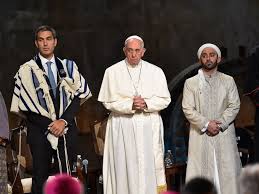
Joined by a dozen religious leaders from the Jewish, Muslim, Hindu, Sikh, Buddhist and Greek Orthodox traditions, Francis spoke to a crowd of about 700 people in an underground gallery at the Museum. To the right is a photograph of the Pope with a rabbi and an imam.

Here is what he said: “I feel many different emotions standing here at Ground Zero, where thousands of lives were taken in a senseless act of destruction. Here grief is palpable. The water we see flowing towards that empty pit reminds us of all those lives which fell prey to those who think that destruction, tearing down, is the only way to settle conflicts. It is the silent cry of those who were victims of a mindset which knows only violence, hatred and revenge. A mindset which can only cause pain, suffering, destruction and tears.”

“The flowing water is also a symbol of our tears. Tears at so much devastation and ruin, past and present. This is a place where we shed tears, we weep out of a sense of helplessness in the face of injustice, murder, and the failure to settle conflicts through dialogue. Here we mourn the wrongful and senseless loss of innocent lives because of the inability to find solutions which respect the common good. This flowing water reminds us of yesterday’s tears, but also of all the tears still being shed today.”

“A few moments ago I met some of the families of the fallen first responders. Meeting them made me see once again how acts of destruction are never impersonal, abstract or merely material. They always have a face, a concrete story, names. In those family members, we see the face of pain, a pain which still touches us and cries out to heaven.

At the same time, those family members showed me the other face of this attack, the other face of their grief: the power of love and remembrance. A remembrance that does not leave us empty and withdrawn. The names of so many loved ones are written around the towers’ footprints. We can see them, we can touch them, and we can never forget them.”

“Here, amid pain and grief, we also have a palpable sense of the heroic goodness which people are capable of, those hidden reserves of strength from which we can draw. In the depths of pain and suffering, you also witnessed the heights of generosity and service. Hands reached out, lives were given. In a metropolis which might seem impersonal, faceless, lonely, you demonstrated the powerful solidarity born of mutual support, love and self-sacrifice. No one thought about race, nationality, neighborhoods, religion or politics. It was all about solidarity, meeting immediate needs, brotherhood. It was about being brothers and sisters. New York City firemen walked into the crumbling towers, with no concern for their own wellbeing. Many succumbed; their sacrifice enabled great numbers to be saved.”

“This place of death became a place of life too, a place of saved lives, a hymn to the triumph of life over the prophets of destruction and death, to goodness over evil, to reconciliation and unity over hatred and division.”

“In this place of sorrow and remembrance I am filled with hope, as I have the opportunity to join with leaders representing the many religious traditions which enrich the life of this great city. I trust that our presence together will be a powerful sign of our shared desire to be a force for reconciliation, peace and justice in this community and throughout the world. For all our differences and disagreements, we can experience a world of peace. In opposing every attempt to create a rigid uniformity, we can and must build unity on the basis of our diversity of languages, cultures and religions, and lift our voices against everything which would stand in the way of such unity. Together we are called to say ‘no’ to every attempt to impose uniformity and ‘yes’ to a diversity accepted and reconciled.”

“This can only happen if we uproot from our hearts all feelings of hatred, vengeance and resentment. We know that that is only possible as a gift from heaven. Here, in this place of remembrance, I would ask everyone together, each in his or her own way, to spend a moment in silence and prayer. Let us implore from on high the gift of commitment to the cause of peace. Peace in our homes, our families, our schools and our communities. Peace in all those places where war never seems to end. Peace for those faces which have known nothing but pain. Peace throughout this world which God has given us as the home of all and a home for all. Simply PEACE. Let us pray in silence.”

“In this way, the lives of our dear ones will not be lives which will one day be forgotten. Instead, they will be present whenever we strive to be prophets not of tearing down but of building up, prophets of reconciliation, prophets of peace.”

After his remarks, Francis viewed relics of the 9/11 Memorial Museum. They included a cross formed of fused steel girders found in the towers’ smoldering wreckage and a copy of the New Testament found in the debris that is displayed Harlem

open to the Gospel passage in which Jesus urges believers to “turn the other cheek” rather than strike back.

Our Lady Queen of Angels School[5]

images

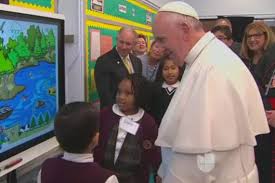
In the afternoon, Francis visited Our Lady Queen of Angels School,  a Roman Catholic elementary school that has served the East Harlem Community for over 120 years with a high quality, well-rounded education, rooted in Gospel values and attentive to individual differences. There he was greeted by students and faculty as seen in the photograph to the left.

His remarks included the following: “They tell me that one of the nice things about this school is that some of its students come from other places, even from other countries. That is nice! Even though I know that it is not easy to have to move and find a new home, new neighbors and new friends. It is not easy. At the beginning it can be hard, right? Often you have to learn a new language, adjust to a new culture, even a new climate. There is so much to learn! And not just at school.”

“The good thing is that we also make new friends, we meet people who open doors for us, who are kind to us. They offer us friendship and understanding, and they try to help us not to feel like strangers. To feel at home. How nice it is to feel that school is a second home. This is not only important for you, but also for your families. School then ends up being one big family. One where, together with our mothers and fathers, our grandparents, our teachers and friends, we learn to help one another, to share our good qualities, to give the best of ourselves, to work as a team and to pursue our dreams.”

“Reverend Martin Luther King . . . said, ‘I have a dream.’ His dream was that many children, many people could have equal opportunities. His dream was that many children like you could get an education. It is beautiful to have dreams and to be able to fight for them.”

“Today we want to keep dreaming. We celebrate all the opportunities which enable you, and us adults, not to lose the hope of a better world with greater possibilities. I know that one of the dreams of your parents and teachers is that you can grow up and be happy. It is always good to see children smiling. Here I see you smiling. Keep smiling and help bring joy to everyone you meet.”

“Dear children, you have a right to dream and I am very happy that here in this school, in your friends and your teachers, you can find the support you need. Wherever there are dreams, there is joy, Jesus is always present. Because Jesus is joy, and he wants to help us to feel that joy every day of our lives.”

“Please don’t forget to pray for me, so that I can share with many people the joy of Jesus. And let us also pray so that many other people can share the joy like yours.”

Motorcade through Central Park[6]

At least 80,000 people crowded Manhattan’s Central Park to catch a glimpse of Pope Francis as his popemobile made its way to Madison Square Garden. Here are some photographs of that event.

Crowds CentPark

Popemobile 9.25

Madison Square Garden[7]

jpPOPE1-blog427

At Manhattan’s Madison Square Garden, famed for its sporting events, Pope Francis celebrated mass before a congregation of 20,000. To the left is a photograph of the Pope during his his homily, when he said the following: “In this place, which represents both the variety and the common interests of so many different people, we have listened to the words: ‘The people who walked in darkness have seen a great light’ (Is 9:1).”

“The people who walked – caught up in their activities and routines, amid their successes and failures, their worries and expectations – have seen a great light. The people who walked – with all their joys and hopes, their disappointments and regrets – have seen a great light.”

“In every age, the People of God are called to contemplate this light. A light for the nations, as the elderly Simeon joyfully expressed it. A light meant to shine on every corner of this city, on our fellow citizens, on every part of our lives.”

“’The people who walked in darkness have seen a great light.’ One special quality of God’s people is their ability to see, to contemplate, even in ‘moments of darkness,’ the light which Christ brings. God’s faithful people can see, discern and contemplate his living presence in the midst of life, in the midst of the city.”

“Together with the prophet Isaiah, we can say: The people who walk, breathe and live in the midst of smog, have seen a great light, have experienced a breath of fresh air.

Living in a big city is not always easy. A multicultural context presents many complex challenges. Yet big cities are a reminder of the hidden riches present in our world: in the diversity of its cultures, traditions and historical experiences. In the variety of its languages, costumes and cuisine. Big cities bring together all the different ways which we human beings have discovered to express the meaning of life, wherever we may be.

But big cities also conceal the faces of all those people who don’t appear to belong, or are second-class citizens. In big cities, beneath the roar of traffic, beneath ‘the rapid pace of change,’ so many faces pass by unnoticed because they have no ‘right’ to be there, no right to be part of the city. They are the foreigners, the children who go without schooling, those deprived of medical insurance, the homeless, the forgotten elderly. These people stand at the edges of our great avenues, in our streets, in deafening anonymity. They become part of an urban landscape which is more and more taken for granted, in our eyes, and especially in our hearts.”

“Knowing that Jesus still walks our streets, that he is part of the lives of his people, that he is involved with us in one vast history of salvation, fills us with hope. A hope which liberates us from the forces pushing us to isolation and lack of concern for the lives of others, for the life of our city. A hope which frees us from empty‘connections,’ from abstract analyses, or sensationalist routines. A hope which is unafraid of involvement, which acts as a leaven wherever we happen to live and work. A hope which makes us see, even in the midst of smog, the presence of God as he continues to walk the streets of our city. Because God is in the city.”

“What is it like, this light travelling through our streets? How do we encounter God, who lives with us amid the smog of our cities? How do we encounter Jesus, alive and at work in the daily life of our multicultural cities?”

“The prophet Isaiah can guide us in this process of ‘learning to see.’ He speaks of the light which is Jesus. And now he presents Jesus to us as ‘Wonderful Counselor, the Mighty God, the Everlasting Father, the Prince of Peace.’ In this way, he introduces us to the life of the Son, so that his life can be our life.”

Wonderful Counselor. The Gospels tell us how many people came up to Jesus to ask: ‘Master, what must we do?’ The first thing that Jesus does in response is to propose, to encourage, to motivate. He keeps telling his disciples to go, to go out. He urges them to go out and meet others where they really are, not where we think they should be. Go out, again and again, go out without fear, go out without hesitation. Go out and proclaim this joy which is for all the people.”

The Mighty God. In Jesus, God himself became Emmanuel, God-with-us, the God who walks alongside us, who gets involved in our lives, in our homes, in the midst of our ‘pots and pans,’ as Saint Teresa of Jesus liked to say.”

The Everlasting Father. No one or anything can separate us from his Love. Go out and proclaim, go out and show that God is in your midst as a merciful Father who himself goes out, morning and evening, to see if his son has returned home and, as soon as he sees him coming, runs out to embrace him. This is beautiful. An embrace which wants to take up, purify and elevate the dignity of his children. A Father who, in his embrace, is ‘glad tidings to the poor, healing to the afflicted, liberty to captives, comfort to those who mourn’ (Is 61:1-2).”

Prince of Peace. Go out to others and share the good news that God, our Father, walks at our side. He frees us from anonymity, from a life of emptiness, and brings us to the school of encounter. He removes us from the fray of competition and self-absorption, and he opens before us the path of peace. That peace which is born of accepting others, that peace which fills our hearts whenever we look upon those in need as our brothers and sisters.”

“God is living in our cities. The Church is living in our cities. God and the Church living in our cities want to be like yeast in the dough, to relate to everyone, to stand at everyone’s side, proclaiming the marvels of the Wonderful Counselor, the Mighty God, the Eternal Father, the Prince of Peace.”

“’The people who walked in darkness have seen a great light.’ And we, as Christians, are witnesses to this.”

============================================

[1] An overall website on Pope Francis’ visit to the U.S. is “Pope Francis Visit 2015.”

[2] Pope Francis’ Remarks to United Nations Staff, N.Y. Times (Sept. 25, 2015)

[3] Pope Francis’ Remarks to the United Nations General Assembly, N.Y. Times (Sept. 25, 2015); AFP, Pope Addresses the United Nations, N.Y. Times (Sept. 25, 2015) (video); Pope Francis Addresses U.N., Calling for Peace and Environmental Justice, N.Y. Times (Sept. 25, 2015).

[4] Pope Francis’ Speech at 9/11 Memorial Museum (Sept. 25, 2015); Agence France-Presse, Pope Visits Ground Zero (Sept. 25, 2015) (video); Reuters, Resist Uniformity, Embrace Diversity: Pope at New York Attack Site, N.Y. Times (Sept. 25, 2015).

[5] Pope Francis’ Remarks at The Our Lady Queen of Angels School, abc6 Action News (Sept. 25, 2015).

[6] Baker, Mueller & Poderaro, Rib-Crushing Throngs Press Toward Central Park to See Pope Francis, N.Y. Times (Sept. 25, 2015).

[7] Wilson, Pope Francis, in New York, Takes on Extremism and Inequality, N.Y. Times (Sept. 25, 2015); Pope Francis’ Madison Square Garden Homily (Sept. 25, 2015); Agence France-Presse, Pope Celebrates Mass in New York, N.Y. Times (Sept. 25, 2015)(video).


The Third Day of Pope Francis’ Mission to the American People

September 24 marked the third day of Pope Francis’ mission to the American people. The highlight was his morning appearance before the U.S. Congress, which was much anticipated by all members of Congress, 31% of whom are Roman Catholic along with Vice President Joseph R. Biden Jr., who serves as president of the Senate. Immediately afterwards the Pope greeted the American people from the west front of the U.S. Capitol followed by a visit to St. Patrick’s Catholic Church in D.C. and Catholic Charities of the Archdiocese of Washington before his flight to New York City. There he participated in an evening prayer service at St. Patrick’s Cathedral.

Speech to the U.S. Congress[1]


Pope Francis @ U.S. Congress

With the Chamber of the U.S. House of Representatives packed with Senators and Representatives and with invited guests in its Gallery, Pope Francis made the following lengthy remarks.

“I am most grateful for your invitation to address this Joint Session of Congress in ‘the land of the free and the home of the brave.’ I would like to think that the reason for this is that I too am a son of this great continent, from which we have all received so much and toward which we share a common responsibility.

“Each son or daughter of a given country has a mission, a personal and social responsibility. Your own responsibility as members of Congress is to enable this country, by your legislative activity, to grow as a nation. You are the face of its people, their representatives. You are called to defend and preserve the dignity of your fellow citizens in the tireless and demanding pursuit of the common good, for this is the chief aim of all politics. A political society endures when it seeks, as a vocation, to satisfy common needs by stimulating the growth of all its members, especially those in situations of greater vulnerability or risk. Legislative activity is always based on care for the people. To this you have been invited, called and convened by those who elected you.”

“Yours is a work which makes me reflect in two ways on the figure of Moses. On the one hand, as the patriarch and lawgiver of the people of Israel he symbolizes the need of peoples to keep alive their sense of unity by means of just legislation. On the other, the figure of Moses leads us directly to God and thus to the transcendent dignity of the human being. Moses provides us with a good synthesis of your work: you are asked to protect, by means of the law, the image and likeness fashioned by God on every human face.”

“Today I would like not only to address you, but through you the entire people of the United States. Here, together with their representatives, I would like to take this opportunity to dialogue with the many thousands of men and women who strive each day to do an honest day’s work, to bring home their daily bread, to save money and – one step at a time – to build a better life for their families. These are men and women who are not concerned simply with paying their taxes, but in their own quiet way sustain the life of society. They generate solidarity by their actions, and they create organizations that offer a helping hand to those most in need.”

“I would also like to enter into dialogue with the many elderly persons who are a storehouse of wisdom forged by experience and who seek in many ways, especially through volunteer work, to share their stories and their insights. I know that many of them are retired, but still active; they keep working to build up this land. I also want to dialogue with all those young people who are working to realize their great and noble aspirations, who are not led astray by facile proposals and who face difficult situations, often as a result of immaturity on the part of many adults. I wish to dialogue with all of you, and I would like to do so through the historical memory of your people.”

“My visit takes place at a time when men and women of good will are marking the anniversaries of several great Americans. The complexities of history and the reality of human weakness notwithstanding, these men and women, for all their many differences and limitations, were able by hard work and self- sacrifice – some at the cost of their lives – to build a better future. They shaped fundamental values which will endure forever in the spirit of the American people. A people with this spirit can live through many crises, tensions and conflicts, while always finding the resources to move forward, and to do so with dignity. These men and women offer us a way of seeing and interpreting reality. In honoring their memory, we are inspired, even amid conflicts, and in the here and now of each day, to draw upon our deepest cultural reserves.”

I would like to mention four of these Americans: Abraham Lincoln, Martin Luther King, Dorothy Day and Thomas Merton.

“This year marks the one hundred and fiftieth anniversary of the assassination of President Abraham Lincoln, the guardian of liberty, who labored tirelessly that ‘this nation, under God, [might] have a new birth of freedom.’ Building a future of freedom requires love of the common good and cooperation in a spirit of subsidiarity and solidarity.”

“All of us are quite aware of, and deeply worried by, the disturbing social and political situation of the world today. Our world is increasingly a place of violent conflict, hatred and brutal atrocities, committed even in the name of God and of religion. We know that no religion is immune from forms of individual delusion or ideological extremism. This means that we must be especially attentive to every type of fundamentalism, whether religious or of any other kind. A delicate balance is required to combat violence perpetrated in the name of a religion, an ideology or an economic system, while also safeguarding religious freedom, intellectual freedom and individual freedoms. But there is another temptation which we must especially guard against: the simplistic reductionism which sees only good or evil; or, if you will, the righteous and sinners. The contemporary world, with its open wounds which affect so many of our brothers and sisters, demands that we confront every form of polarization which would divide it into these two camps. We know that in the attempt to be freed of the enemy without, we can be tempted to feed the enemy within. To imitate the hatred and violence of tyrants and murderers is the best way to take their place. That is something which you, as a people, reject.”

“Our response must instead be one of hope and healing, of peace and justice. We are asked to summon the courage and the intelligence to resolve today’s many geopolitical and economic crises. Even in the developed world, the effects of unjust structures and actions are all too apparent. Our efforts must aim at restoring hope, righting wrongs, maintaining commitments, and thus promoting the well-being of individuals and of peoples. We must move forward together, as one, in a renewed spirit of fraternity and solidarity, cooperating generously for the common good.”

“The challenges facing us today call for a renewal of that spirit of cooperation, which has accomplished so much good throughout the history of the United States. The complexity, the gravity and the urgency of these challenges demand that we pool our resources and talents, and resolve to support one another, with respect for our differences and our convictions of conscience.”

“In this land, the various religious denominations have greatly contributed to building and strengthening society. It is important that today, as in the past, the voice of faith continue to be heard, for it is a voice of fraternity and love, which tries to bring out the best in each person and in each society. Such cooperation is a powerful resource in the battle to eliminate new global forms of slavery, born of grave injustices which can be overcome only through new policies and new forms of social consensus.

[Editor’s Note: The following section, which was in the prepared remarks, was not included in the speech.] [“Politics is, instead, an expression of our compelling need to live as one, in order to build as one the greatest common good: that of a community which sacrifices particular interests in order to share, in justice and peace, its goods, its interests, its social life. I do not underestimate the difficulty that this involves, but I encourage you in this effort.]

“Here too I think of the march which Martin Luther King led from Selma to Montgomery fifty years ago as part of the campaign to fulfill his ‘dream’ of full civil and political rights for African Americans. That dream continues to inspire us all. I am happy that America continues to be, for many, a land of ‘dreams.’ Dreams which lead to action, to participation, to commitment. Dreams which awaken what is deepest and truest in the life of a people.”

“In recent centuries, millions of people came to this land to pursue their dream of building a future in freedom. We, the people of this continent, are not fearful of foreigners, because most of us were once foreigners. I say this to you as the son of immigrants, knowing that so many of you are also descended from immigrants. Tragically, the rights of those who were here long before us were not always respected. For those peoples and their nations, from the heart of American democracy, I wish to reaffirm my highest esteem and appreciation. Those first contacts were often turbulent and violent, but it is difficult to judge the past by the criteria of the present.”

“Nonetheless, when the stranger in our midst appeals to us, we must not repeat the sins and the errors of the past. We must resolve now to live as nobly and as justly as possible, as we educate new generations not to turn their back on our ‘neighbors’ and everything around us. Building a nation calls us to recognize that we must constantly relate to others, rejecting a mindset of hostility in order to adopt one of reciprocal subsidiarity, in a constant effort to do our best. I am confident that we can do this.”

“Our world is facing a refugee crisis of a magnitude not seen since the Second World War. This presents us with great challenges and many hard decisions. On this continent, too, thousands of persons are led to travel north in search of a better life for themselves and for their loved ones, in search of greater opportunities. Is this not what we want for our own children? We must not be taken aback by their numbers, but rather view them as persons, seeing their faces and listening to their stories, trying to respond as best we can to their situation. To respond in a way which is always humane, just and fraternal. We need to avoid a common temptation nowadays: to discard whatever proves troublesome. Let us remember the Golden Rule: ‘Do unto others as you would have them do unto you’ (Mt 7:12).”

“This Rule points us in a clear direction. Let us treat others with the same passion and compassion with which we want to be treated. Let us seek for others the same possibilities which we seek for ourselves. Let us help others to grow, as we would like to be helped ourselves. In a word, if we want security, let us give security; if we want life, let us give life; if we want opportunities, let us provide opportunities. The yardstick we use for others will be the yardstick which time will use for us. The Golden Rule also reminds us of our responsibility to protect and defend human life at every stage of its development.”

“This conviction has led me, from the beginning of my ministry, to advocate at different levels for the global abolition of the death penalty. I am convinced that this way is the best, since every life is sacred, every human person is endowed with an inalienable dignity, and society can only benefit from the rehabilitation of those convicted of crimes. Recently my brother bishops here in the United States renewed their call for the abolition of the death penalty. Not only do I support them, but I also offer encouragement to all those who are convinced that a just and necessary punishment must never exclude the dimension of hope and the goal of rehabilitation.”

“In these times when social concerns are so important, I cannot fail to mention the Servant of God Dorothy Day, who founded the Catholic Worker Movement. Her social activism, her passion for justice and for the cause of the oppressed were inspired by the Gospel, her faith, and the example of the saints.”

“How much progress has been made in this area in so many parts of the world! How much has been done in these first years of the third millennium to raise people out of extreme poverty! I know that you share my conviction that much more still needs to be done, and that in times of crisis and economic hardship a spirit of global solidarity must not be lost. At the same time I would encourage you to keep in mind all those people around us who are trapped in a cycle of poverty. They too need to be given hope. The fight against poverty and hunger must be fought constantly and on many fronts, especially in its causes. I know that many Americans today, as in the past, are working to deal with this problem.”

“It goes without saying that part of this great effort is the creation and distribution of wealth. The right use of natural resources, the proper application of technology and the harnessing of the spirit of enterprise are essential elements of an economy which seeks to be modern, inclusive and sustainable. ‘Business is a noble vocation, directed to producing wealth and improving the world. It can be a fruitful source of prosperity for the area in which it operates, especially if it sees the creation of jobs as an essential part of its service to the common good’ (Laudato Si’, 129). This common good also includes the earth, a central theme of the encyclical which I recently wrote in order to ‘enter into dialogue with all people about our common home’ (ibid., 3). ‘We need a conversation which includes everyone, since the environmental challenge we are undergoing, and its human roots, concern and affect us all’ (ibid., 14).”

“In Laudato Si’, I call for a courageous and responsible effort to ‘redirect our steps’ (ibid., 61), and to avert the most serious effects of the environmental deterioration caused by human activity. I am convinced that we can make a difference and I have no doubt that the United States – and this Congress – have an important role to play. Now is the time for courageous actions and strategies, aimed at implementing a ‘culture of care’ (ibid., 231) and ‘an integrated approach to combating poverty, restoring dignity to the excluded, and at the same time protecting nature’ (ibid., 139). ‘We have the freedom needed to limit and direct technology’ (ibid., 112); ‘to devise intelligent ways of… developing and limiting our power’ (ibid., 78); and to put technology ‘at the service of another type of progress, one which is healthier, more human, more social, more integral’ (ibid., 112). In this regard, I am confident that America’s outstanding academic and research institutions can make a vital contribution in the years ahead.”

“A century ago, at the beginning of the Great War, which Pope Benedict XV termed a ‘pointless slaughter,’ another notable American was born: the Cistercian monk Thomas Merton. He remains a source of spiritual inspiration and a guide for many people. In his autobiography he wrote: ‘I came into the world. Free by nature, in the image of God, I was nevertheless the prisoner of my own violence and my own selfishness, in the image of the world into which I was born. That world was the picture of Hell, full of men like myself, loving God, and yet hating him; born to love him, living instead in fear of hopeless self-contradictory hungers.’ Merton was above all a man of prayer, a thinker who challenged the certitudes of his time and opened new horizons for souls and for the Church. He was also a man of dialogue, a promoter of peace between peoples and religions.”

“From this perspective of dialogue, I would like to recognize the efforts made in recent months to help overcome historic differences linked to painful episodes of the past. It is my duty to build bridges and to help all men and women, in any way possible, to do the same. When countries that have been at odds resume the path of dialogue – a dialogue which may have been interrupted for the most legitimate of reasons – new opportunities open up for all. This has required, and requires, courage and daring, which is not the same as irresponsibility. A good political leader is one who, with the interests of all in mind, seizes the moment in a spirit of openness and pragmatism. A good political leader always opts to initiate processes rather than possessing spaces (cf. Evangelii Gaudium, 222-223).”

“Being at the service of dialogue and peace also means being truly determined to minimize and, in the long term, to end the many armed conflicts throughout our world. Here we have to ask ourselves: Why are deadly weapons being sold to those who plan to inflict untold suffering on individuals and society? Sadly, the answer, as we all know, is simply for money: money that is drenched in blood, often innocent blood. In the face of this shameful and culpable silence, it is our duty to confront the problem and to stop the arms trade.”

“Three sons and a daughter of this land, four individuals and four dreams: Lincoln, liberty; Martin Luther King, liberty in plurality and non-exclusion; Dorothy Day, social justice and the rights of persons; and Thomas Merton, the capacity for dialogue and openness to God.

“I will end my visit to your country in Philadelphia, where I will take part in the World Meeting of Families. It is my wish that throughout my visit the family should be a recurrent theme. How essential the family has been to the building of this country! And how worthy it remains of our support and encouragement! Yet I cannot hide my concern for the family, which is threatened, perhaps as never before, from within and without. Fundamental relationships are being called into question, as is the very basis of marriage and the family. I can only reiterate the importance and, above all, the richness and the beauty of family life.”

“In particular, I would like to call attention to those family members who are the most vulnerable, the young. For many of them, a future filled with countless possibilities beckons, yet so many others seem disoriented and aimless, trapped in a hopeless maze of violence, abuse and despair. Their problems are our problems. We cannot avoid them. We need to face them together, to talk about them and to seek effective solutions rather than getting bogged down in discussions. At the risk of oversimplifying, we might say that we live in a culture which pressures young people not to start a family, because they lack possibilities for the future. Yet this same culture presents others with so many options that they too are dissuaded from starting a family.”

“A nation can be considered great when it defends liberty as Lincoln did, when it fosters a culture which enables people to ‘dream’ of full rights for all their brothers and sisters, as Martin Luther King sought to do; when it strives for justice and the cause of the oppressed, as Dorothy Day did by her tireless work, the fruit of a faith which becomes dialogue and sows peace in the contemplative style of Thomas Merton.”

“In these remarks I have sought to present some of the richness of your cultural heritage, of the spirit of the American people. It is my desire that this spirit continue to develop and grow, so that as many young people as possible can inherit and dwell in a land which has inspired so many people to dream.”

“God bless America!”

Greeting to the American People[2]

Pope @ U.S. Capitol
Pope @ U.S. Capitol

Immediately after the speech to the Congress, Pope Francis was escorted to the West Front of the Capitol, where he could see the thousands of people who wanted at least a glimpse of the Pope. “Buenos días,” he said. “I am so grateful for your presence here, most importantly the children. I have asked God to bless them. Father of all, bless each of them, bless the families. I ask you all, please, to pray for me. And if there are any who do not believe or who cannot pray, I ask you to send good wishes my way.”

St. Patrick’s Catholic Church in D.C.[3]

Pope @ St. Patrick's Church
Pope @ St. Patrick’s Church

Pope & bishops 9.27


At the church, the Pope first sent greetings to his Muslim brothers and sisters as they celebrate the feast of sacrifice and a prayer of closeness as they faced the tragedy of suffering at Mecca. He then delivered the following homily.

“Here I think of a person whom I love, someone who is, and has been, very important throughout my life. He has been a support and an inspiration. He is the one I go to whenever I am ‘in a fix.’ You make me think of Saint Joseph. Your faces remind me of his.”

“Joseph had to face some difficult situations in his life. One of them was the time when Mary was about to give birth, to have Jesus. The Bible tells us that, ‘while they were [in Bethlehem], the time came for her to deliver her child. And she gave birth to her firstborn son and wrapped him in bands of cloth, and laid him in a manger, because there was no place for them in the inn’ (Lk 2:6-7).”

“The Bible is very clear about this: there was no room for them. I can imagine Joseph, with his wife about to have a child, with no shelter, no home, no place to stay. The Son of God came into this world as a homeless person. The Son of God knew what it was to start life without a roof over his head. We can imagine what Joseph must have been thinking. How is it that the Son of God has no home? Why are we homeless, why don’t we have housing? These are questions which many of you may ask daily. Like Saint Joseph, you may ask: Why are we homeless, without a place to live? These are questions which all of us might well ask. Why do these, our brothers and sisters, have no place to live? Why are these brothers and sisters of ours homeless?”

“Joseph’s questions are timely even today; they accompany all those who throughout history have been, and are, homeless.”

“Joseph was someone who asked questions. But first and foremost, he was a man of faith. Faith gave Joseph the power to find light just at the moment when everything seemed dark. Faith sustained him amid the troubles of life. Thanks to faith, Joseph was able to press forward when everything seemed to be holding him back.”

“In the face of unjust and painful situations, faith brings us the light which scatters the darkness. As it did for Joseph, faith makes us open to the quiet presence of God at every moment of our lives, in every person and in every situation. God is present in every one of you, in each one of us.”

“We can find no social or moral justification, no justification whatsoever, for lack of housing. There are many unjust situations, but we know that God is suffering with us, experiencing them at our side. He does not abandon us.”

“We know that Jesus wanted to show solidarity with every person. He wanted everyone to experience his companionship, his help, his love. He identified with all those who suffer, who weep, who suffer any kind of injustice. He tells us this clearly: ‘I was hungry and you gave me food, I was thirsty and you gave me something to drink; I was a stranger and you welcomed me’ (Mt 25:35).”

“Faith makes us know that God is at our side, that God is in our midst and his presence spurs us to charity. Charity is born of the call of a God who continues to knock on our door, the door of all people, to invite us to love, to compassion, to service of one another.”

“Jesus keeps knocking on our doors, the doors of our lives. He doesn’t do this by magic, with special effects, with flashing lights and fireworks. Jesus keeps knocking on our door in the faces of our brothers and sisters, in the faces of our neighbors, in the faces of those at our side.”

“Dear friends, one of the most effective ways we have to help is that of prayer. Prayer unites us; it makes us brothers and sisters. It opens our hearts and reminds us of a beautiful truth which we sometimes forget. In prayer, we all learn to say ‘Father.’ ‘Dad.’ We learn to see one another as brothers and sisters. In prayer, there are no rich and poor people, there are sons and daughters, sisters and brothers. In prayer, there is no first or second class, there is brotherhood.”

“It is in prayer that our hearts find the strength not to be cold and insensitive in the face of injustice. In prayer, God keeps calling us, opening our hearts to charity.”

“How good it is for us to pray together. How good it is to encounter one another in this place where we see one another as brothers and sisters, where we realize that we need one another. Today I want to be one with you. I need your support, your closeness. I would like to invite you to pray together, for one another, with one another. That way we can keep helping one another to experience the joy of knowing that Jesus is in our midst. Are you ready?”

“’Our Father in heaven, hallowed be your name. Your kingdom come. Your will be done, on earth as it is in heaven. Give us this day and our daily bread. And forgive us our debts, as we also have forgiven our debtors. An do not bring us to the time of trial, but rescue us from the evil one. Amen.’” (NRSV)

“Before leaving you, I would like to give you God’s blessing: ‘The Lord bless you and keep you; the Lord make his face to shine upon you and be gracious to you; the Lord lift up his countenance upon you, and give you peace’ (Num 6:24-26). And, please, don’t forget to pray for me.”

Pope & people

Immediately afterwards the Pope went to a luncheon for the homeless outside the church, blessed the meal and greeted the people, as shown in photograph to the right.. This luncheon was sponsored by Catholic Charities of the Archdiocese of Washington.

Vespers Service at St. Patrick’s Cathedral[4]

The Pope arrived around 5:00 p.m. (EST) at New York City’s John F. Kennedy International Airport and then traveled by helicopter to lower Manhattan. The popemobile then took him by waving crowds on Fifth Avenue to 50th and 51st Street’s St. Patrick’s Cathedral.   There he was greeted by New York Governor Andrew M. Cuomo, New York City Mayor Bill de Blasio and New York’s U.S. Senator Chuck Schumer.

Pope @ St. Patrick's Cathedral
Pope @ St. Patrick’s Cathedral

At the Cathedral the Pope participated in a vespers prayer service for nearly 2,500 worshipers, including clergy members, brothers and nuns, and delivered the following homily.

“’There is a cause for rejoicing here”, although ‘you may for a time have to suffer the distress of many trials’ (1 Pet 1:6). These words of the Apostle remind us of something essential. Our vocation is to be lived in joy.”

“This beautiful Cathedral of Saint Patrick, built up over many years through the sacrifices of many men and women, can serve as a symbol of the work of generations of American priests and religious, and lay faithful who helped build up the Church in the United States. In the field of education alone, how many priests and religious in this country played a central role, assisting parents in handing on to their children the food that nourishes them for life! Many did so at the cost of extraordinary sacrifice and with heroic charity. I think for example of Saint Elizabeth Ann Seton, who founded the first free Catholic school for girls in America, or Saint John Neumann, the founder of the first system of Catholic education in the United States.”

“This evening, my brothers and sisters, I have come to join you in prayer that our vocations will continue to build up the great edifice of God’s Kingdom in this country. I know that, as a presbyterate in the midst of God’s people, you suffered greatly in the not distant past by having to bear the shame of some of your brothers who harmed and scandalized the Church in the most vulnerable of her members… In the words of the Book of Revelation, I know well that you ‘have come forth from the great tribulation’ (Rev 7:14). I accompany you at this time of pain and difficulty, and I thank God for your faithful service to his people. In the hope of helping you to persevere on the path of fidelity to Jesus Christ, I would like to offer two brief reflections.”

“The first concerns the spirit of gratitude. The joy of men and women who love God attracts others to them; priests and religious are called to find and radiate lasting satisfaction in their vocation. Joy springs from a grateful heart. Truly, we have received much, so many graces, so many blessings, and we rejoice in this. It will do us good to think back on our lives with the grace of remembrance. Remembrance of when we were first called, remembrance of the road travelled, remembrance of graces received… and, above all, remembrance of our encounter with Jesus Christ so often along the way. Remembrance of the amazement which our encounter with Jesus Christ awakens in our hearts. To seek the grace of remembrance so as to grow in the spirit of gratitude. Perhaps we need to ask ourselves: are we good at counting our blessings?”

“A second area is the spirit of hard work. A grateful heart is spontaneously impelled to serve the Lord and to find expression in a life of commitment to our work. Once we come to realize how much God has given us, a life of self-sacrifice, of working for him and for others, becomes a privileged way of responding to his great love.”

“Yet, if we are honest, we know how easily this spirit of generous self-sacrifice can be dampened. There are a couple of ways that this can happen; both are examples of that ‘spiritual worldliness’ which weakens our commitment to serve and diminishes the wonder of our first encounter with Christ.”

“We can get caught up measuring the value of our apostolic works by the standards of efficiency, good management and outward success which govern the business world. Not that these things are unimportant! We have been entrusted with a great responsibility, and God’s people rightly expect accountability from us. But the true worth of our apostolate is measured by the value it has in God’s eyes. To see and evaluate things from God’s perspective calls for constant conversion in the first days and years of our vocation and, need I say, great humility. The cross shows us a different way of measuring success. Ours is to plant the seeds: God sees to the fruits of our labors. And if at times our efforts and works seem to fail and produce no fruit, we need to remember that we are followers of Jesus… and his life, humanly speaking, ended in failure, the failure of the cross.”

“Another danger comes when we become jealous of our free time, when we think that surrounding ourselves with worldly comforts will help us serve better. The problem with this reasoning is that it can blunt the power of God’s daily call to conversion, to encounter with him. Slowly but surely, it diminishes our spirit of sacrifice, renunciation and hard work. It also alienates people who suffer material poverty and are forced to make greater sacrifices than ourselves. Rest is needed, as are moments of leisure and self-enrichment, but we need to learn how to rest in a way that deepens our desire to serve with generosity. Closeness to the poor, the refugee, the immigrant, the sick, the exploited, the elderly living alone, prisoners and all God’s other poor, will teach us a different way of resting, one which is more Christian and generous.”

“Gratitude and hard work: these are two pillars of the spiritual life which I have wanted to share with you this evening. I thank you for prayers and work, and the daily sacrifices you make in the various areas of your apostolate. Many of these are known only to God, but they bear rich fruit for the life of the Church. In a special way I would like to express my esteem and gratitude to the religious women of the United States. What would the Church be without you? Women of strength, fighters, with that spirit of courage which puts you in the front lines in the proclamation of the Gospel. To you, religious women, sisters and mothers of this people, I wish to say “thank you”, a big thank you… and to tell you that I love you very much.” (Emphasis added to these words that drew applause from the people in the pews.)

“I know that many of you are in the front lines in meeting the challenges of adapting to an evolving pastoral landscape. Whatever difficulties and trials you face, I ask you, like Saint Peter, to be at peace and to respond to them as Christ did: he thanked the Father, took up his cross and looked forward!”

“Dear brothers and sisters, in a few moments we will sing the Magnificat. Let us commend to Our Lady the work we have been entrusted to do; let us join her in thanking God for the great things he has done, and for the great things he will continue to do in us and in those whom we have the privilege to serve.”

===================================================

[1] Beckwith, Transcript: Read the Speech Pope Francis Gave to Congress, Time (Sept. 24, 2015); Assoc. Press, Pope’s Full Speech to Congress, N.Y. Times (Sept. 24, 2015) (video); Hulse, Herszenhorn & Steinhauer, Across Political Divide, Finding Much to Cheer in Pope’s Speech, N.Y. Times (Sept. 24, 2015); Baker, Pope Francis’ Speech to Congress Comes at Time of Political Division, N.Y. Times (Sept. 2015); Goodstein, Yardley, Cave & Davenport, Inside Pope Francis’ Address to Congress, N.Y. Times (Sept. 24, 2015).

[2] Reuters, Pope greets well-wishers from Capitol balcony, N.Y. Times (Sept. 24, 2015) (video).

[3] Pope Francis’ Remarks at St. Patrick’s church in Washington, N.Y. Times (Sept. 24, 2015); Assoc. Press, Pope Francis at St. Patrick’s Church, N.Y. Times (Sept. 24, 2015)(video); Reuters, ‘No Justification Whatsoever’ for Homelessness, Pope Says in Washington, N.Y. Times (Sept. 24, 2015); Pope blesses meal at Catholic charity event, N.Y. Times (Sept. 24, 2015) (video).

[4] Agence France-Presse, Pope Francis Arrives in New York, N.Y. Times (Sept. 24, 2015) (video of airport arrival); Agence France-Presse, Pope Visits St. Patrick’s Cathedral (Sept. 25, 2015) (video of parade to the Cathedral and part of the service); Reuters, Pope expresses closeness to world’s Muslims after haj stampede, N.Y. Times (Sept. 24, 2015)(video); Santora & Otterman, Arriving in Manhattan, Pope Tells Clergy to Serve Humbly, N.Y. Times (Sept. 24, 2015); Pope Francis’ Homily at St. Patrick’s Cathedral, N.Y. Times (Sept. 24, 2015).

The Second Day of Pope Francis’ Mission to the American People

On Wednesday, September 23, Pope Francis was in Washington, D.C. He first went to the White House to be welcomed to the U.S., held a midday prayer service with the Roman Catholic Bishops of the U.S. and conducted the Junipero Serro canonization mass. After the mass, Francis made an unscheduled stop at the Little Sisters of the Poor residence.

White House Welcoming Ceremony[1]

White HOuse

About 15,000 people were gathered on the south lawn of the White House for the welcoming of Pope Francis to the United States preceded by historic American music. To the left is a photograph of the Pope and President Obama before they made their remarks.

 President Obama’s Welcoming Remarks. “[O]n behalf of the American people, it is my great honor and privilege to welcome you to the United States of America.”

“Holy Father, your visit not only allows us, in some small way, to reciprocate the extraordinary hospitality that you extended to me at the Vatican last year.  It also reveals how much all Americans, from every background and every faith, value the role that the Catholic Church plays in strengthening America.   From my time working in impoverished neighborhoods with the Catholic Church in Chicago, to my travels as President, I’ve seen firsthand how, every single day, Catholic communities, priests, nuns, laity are feeding the hungry, healing the sick, sheltering the homeless, educating our children, and fortifying the faith that sustains so many.”

“And what is true in America is true around the world.  From the busy streets of Buenos Aires to the remote villages in Kenya, Catholic organizations serve the poor, minister to prisoners, build schools, build homes, operate orphanages and hospitals.  And just as the Church has stood with those struggling to break the chains of poverty, the Church so often has given voice and hope to those seeking to break the chains of violence and oppression.”

“And yet, I believe the excitement around your visit, Holy Father, must be attributed not only to your role as Pope, but to your unique qualities as a person. In your humility, your embrace of simplicity, in the gentleness of your words and the generosity of your spirit, we see a living example of Jesus’ teachings, a leader whose moral authority comes not just through words but also through deeds.”

“You call on all of us, Catholic and non-Catholic alike, to put the ‘least of these’ at the center of our concerns.  You remind us that in the eyes of God our measure as individuals, and our measure as a society, is not determined by wealth or power or station or celebrity, but by how well we hew to Scripture’s call to lift up the poor and the marginalized, to stand up for justice and against inequality, and to ensure that every human being is able to live in dignity –- because we are all made in the image of God.”

“You remind us that ‘the Lord’s most powerful message’ is mercy.  And that means welcoming the stranger with empathy and a truly open heart, from the refugee who flees war-torn lands to the immigrant who leaves home in search of a better life. It means showing compassion and love for the marginalized and the outcast, to those who have suffered, and those who have caused suffering and seek redemption.  You remind us of the costs of war, particularly on the powerless and defenseless, and urge us toward the imperative of peace.”

“Holy Father, we are grateful for your invaluable support of our new beginning with the Cuban people which holds out the promise of better relations between our countries, greater cooperation across our hemisphere, and a better life for the Cuban people.  We thank you for your passionate voice against the deadly conflicts that ravage the lives of so many men, women and children, and your call for nations to resist the sirens of war and resolve disputes through diplomacy.”

“You remind us that people are only truly free when they can practice their faith freely. Here in the United States, we cherish religious liberty.  It was the basis for so much of what brought us together.  And here in the United States, we cherish our religious liberty, but around the world, at this very moment, children of God, including Christians, are targeted and even killed because of their faith.  Believers are prevented from gathering at their places of worship.  The faithful are imprisoned, and churches are destroyed.  So we stand with you in defense of religious freedom and interfaith dialogue, knowing that people everywhere must be able to live out their faith free from fear and free from intimidation.”

“And, Holy Father, you remind us that we have a sacred obligation to protect our planet, God’s magnificent gift to us. We support your call to all world leaders to support the communities most vulnerable to changing climate, and to come together to preserve our precious world for future generations.”

“Your Holiness, in your words and deeds, you set a profound moral example.  And in these gentle but firm reminders of our obligations to God and to one another, you are shaking us out of complacency.  All of us may, at times, experience discomfort when we contemplate the distance between how we lead our daily lives and what we know to be true, what we know to be right.  But I believe such discomfort is a blessing, for it points to something better.  You shake our conscience from slumber; you call on us to rejoice in Good News, and give us confidence that we can come together in humility and service, and pursue a world that is more loving, more just, and more free.  Here at home and around the world, may our generation heed your call to “never remain on the sidelines of this march of living hope.”

“For that great gift of hope, Holy Father, we thank you, and welcome you, with joy and gratitude, to the United States of America.”

Pope Francis’ Response. “I am deeply grateful for your welcome in the name of all Americans. As the son of an immigrant family, I am happy to be a guest in this country, which was largely built by such families. I look forward to these days of encounter and dialogue, in which I hope to listen to, and share, many of the hopes and dreams of the American people.”

“During my visit I will have the honor of addressing Congress, where I hope, as a brother of this country, to offer words of encouragement to those called to guide the nation’s political future in fidelity to its founding principles. I will also travel to Philadelphia for the Eighth World Meeting of Families, to celebrate and support the institutions of marriage and the family at this, a critical moment in the history of our civilization.”

“Mr. President, together with their fellow citizens, American Catholics are committed to building a society which is truly tolerant and inclusive, to safeguarding the rights of individuals and communities, and to rejecting every form of unjust discrimination. With countless other people of good will, they are likewise concerned that efforts to build a just and wisely ordered society respect their deepest concerns and their right to religious liberty. That freedom remains one of America’s most precious possessions. And, as my brothers, the United States Bishops, have reminded us, all are called to be vigilant, precisely as good citizens, to preserve and defend that freedom from everything that would threaten or compromise it.”

“Mr. President, I find it encouraging that you are proposing an initiative for reducing air pollution. Accepting the urgency, it seems clear to me also that climate change is a problem that can no longer be left to a future generation. When it comes to the care of our ‘common home,’ we are living at a critical moment of history. We still have time to make the changes needed to bring about ‘a sustainable and integral development, for we know that things can change’ (Laudato Si’, 13). Such change demands on our part a serious and responsible recognition not only of the kind of world we may be leaving to our children, but also to the millions of people living under a system which has overlooked them. Our common home has been part of this group of the excluded which cries out to heaven and which today powerfully strikes our homes, our cities and our societies. To use a telling phrase of the Reverend Martin Luther King, we can say that we have defaulted on a promissory note and now is the time to honor it.”

“We know by faith that “the Creator does not abandon us; he never forsakes his loving plan or repents of having created us. Humanity still has the ability to work together in building our ‘common home’ (Laudato Si’, 13). As Christians inspired by this certainty, we wish to commit ourselves to the conscious and responsible care of our common home. The efforts that were recently made to mend broken relationships and to open new doors to cooperation within our human family represent positive steps along the path of reconciliation, justice and freedom. I would like all men and women of good will in this great nation to support the efforts of the international community to protect the vulnerable in our world and to stimulate integral and inclusive models of development, so that our brothers and sisters everywhere may know the blessings of peace and prosperity which God wills for all his children.”

“Mr. President, once again I thank you for your welcome, and I look forward to these days in your country. God bless America!”

The Pope and President Obama with an interpreter then held a private meeting in the Oval Office of the White House, the details of which were not publicly released. Afterwards the Pope in the popemobile then waved at the crowds of people attending the Papal Parade around the Ellipse and the National Mall.

Prayer Service with U.S. Bishops

At St. Matthew’s Cathedral, Pope Francis participated in a prayer service with U.S. bishops of the Roman Catholic Church and made the following lengthy remarks (in English translation).

“As I look out with affection at you, their pastors, I would like to embrace all the local Churches over which you exercise loving responsibility. I would ask you to share my affection and spiritual closeness with the People of God throughout this vast land.”

“The heart of the Pope expands to include everyone. To testify to the immensity of God’s love is the heart of the mission entrusted to the Successor of Peter, the Vicar of the One who on the cross embraced the whole of mankind. May no member of Christ’s Body and the American people feel excluded from the Pope’s embrace. Wherever the name of Jesus is spoken, may the Pope’s voice also be heard to affirm that: ‘He is the Savior’ ! From your great coastal cities to the plains of the Midwest, from the deep South to the far reaches of the West, wherever your people gather in the Eucharistic assembly, may the Pope be not simply a name but a felt presence, sustaining the fervent plea of the Bride: ‘Come, Lord!’”

“Whenever a hand reaches out to do good or to show the love of Christ, to dry a tear or bring comfort to the lonely, to show the way to one who is lost or to console a broken heart, to help the fallen or to teach those thirsting for truth, to forgive or to offer a new start in God… know that the Pope is at your side and supports you. He puts his hand on your own, a hand wrinkled with age, but by God’s grace still able to support and encourage.”

“My first word to you is one of thanksgiving to God for the power of the Gospel which has brought about remarkable growth of Christ’s Church in these lands and enabled its generous contribution, past and present, to American society and to the world. I thank you most heartily for your generous solidarity with the Apostolic See and the support you give to the spread of the Gospel in many suffering areas of our world. I appreciate the unfailing commitment of the Church in America to the cause of life and that of the family, which is the primary reason for my present visit. I am well aware of the immense efforts you have made to welcome and integrate those immigrants who continue to look to America, like so many others before them, in the hope of enjoying its blessings of freedom and prosperity. I also appreciate the efforts that you are making to fulfill the Church’s mission of education in schools at every level and in the charitable services offered by your numerous institutions. These works are often carried out without appreciation or support, often with heroic sacrifice, out of obedience to a divine mandate that we may not disobey.”

“I am also conscious of the courage with which you have faced difficult moments in the recent history of the Church in this country without fear of self-criticism and at the cost of mortification and great sacrifice. Nor have you been afraid to divest whatever is unessential in order to regain the authority and trust which is demanded of ministers of Christ and rightly expected by the faithful. I realize how much the pain of recent years has weighed upon you and I have supported your generous commitment to bring healing to victims – in the knowledge that in healing we too are healed – and to work to ensure that such crimes will never be repeated.”

“I speak to you as the Bishop of Rome, called by God in old age, and from a land which is also American, to watch over the unity of the universal Church and to encourage in charity the journey of all the particular Churches toward ever greater knowledge, faith and love of Christ. Reading over your names, looking at your faces, knowing the extent of your churchmanship and conscious of the devotion which you have always shown for the Successor of Peter, I must tell you that I do not feel a stranger in your midst. I am a native of a land that is also vast, with great open ranges, a land which, like your own, received the faith from itinerant missionaries. I too know how hard it is to sow the Gospel among people from different worlds, with hearts often hardened by the trials of a lengthy journey. Nor am I unaware of the efforts made over the years to build up the Church amid the prairies, mountains, cities and suburbs of a frequently inhospitable land, where frontiers are always provisional and easy answers do not always work. What does work is the combination of the epic struggle of the pioneers and the homely wisdom and endurance of the settlers. As one of your poets has put it, ‘strong and tireless wings’ combined with the wisdom of one who knows the mountains.’”

“I do not speak to you with my voice alone, but in continuity with the words of my predecessors. From the birth of this nation, when, following the American Revolution, the first diocese was erected in Baltimore, the Church of Rome has always been close to you; you have never lacked its constant assistance and encouragement. In recent decades, three Popes have visited you and left behind a remarkable legacy of teaching.”

“Their words remain timely and have helped to inspire the long-term goals that you have set for the Church in this country.”

“It is not my intention to offer a plan or to devise a strategy. I have not come to judge you or to lecture you. I trust completely in the voice of the One who ‘teaches all things’ (Jn 14:26). Allow me only, in the freedom of love, to speak to you as a brother among brothers. I have no wish to tell you what to do, because we all know what it is that the Lord asks of us. Instead, I would turn once again to the demanding task – ancient yet never new – of seeking out the paths we need to take and the spirit with which we need to work. Without claiming to be exhaustive, I would share with you some reflections that I consider helpful for our mission.”

“We are bishops of the Church, shepherds appointed by God to feed his flock. Our greatest joy is to be shepherds, and only shepherds, pastors with undivided hearts and selfless devotion. We need to preserve this joy and never let ourselves be robbed of it. The evil one roars like a lion, anxious to devour it, wearing us down in our resolve to be all that we are called to be, not for ourselves but in gift and service to the ‘Shepherd of our souls’ (1 Pet 2:25).”

“The heart of our identity is to be sought in constant prayer, in preaching (Acts 6:4) and in shepherding the flock entrusted to our care (Jn 21:15-17; Acts 20:28-31).”

“Ours must not be just any kind of prayer, but familiar union with Christ, in which we daily encounter his gaze and sense that he is asking us the question: ‘Who is my mother? Who are my brothers?’ (Mk 3:31-34). One in which we can calmly reply: ‘Lord, here is your mother, here are your brothers! I hand them over to you; they are the ones whom you entrusted to me.’ Such trusting union with Christ is what nourishes the life of a pastor.”

“It is not about preaching complicated doctrines, but joyfully proclaiming Christ who died and rose for our sake. The ‘style’ of our mission should make our hearers feel that the message we preach is meant ‘for us.’”

“May the word of God grant meaning and fullness to every aspect of their lives; may the sacraments nourish them with that food which they cannot procure for themselves; may the closeness of the shepherd make them long once again for the Father’s embrace. Be vigilant that the flock may always encounter in the heart of their pastor that ‘taste of eternity’ which they seek in vain in the things of this world. May they always hear from you a word of appreciation for their efforts to confirm in liberty and justice the prosperity in which this land abounds. At the same time, may you never lack the serene courage to proclaim that ‘we must work not for the food which perishes, but for the food which endures for eternal life’ (Jn 6:27).”

“Shepherds who do not pasture themselves but are able to step back, away from the center, to ‘decrease,’ in order to feed God’s family with Christ. Who keep constant watch, standing on the heights to look out with God’s eyes on the flock that is his alone. Who ascend to the height of the cross of God’s Son, the sole standpoint that opens to the shepherd the heart of his flock.”

“Shepherds who do not lower our gaze, concerned only with our concerns, but raise it constantly toward the horizons which God opens before us and which surpass all that we ourselves can foresee or plan. Who also watch over ourselves, so as to flee the temptation of narcissism, which blinds the eyes of the shepherd, makes his voice unrecognizable and his actions fruitless. In the countless paths that lie open to your pastoral concern, remember to keep focused on the core which unifies everything: ‘You did it unto me’ (Mt 25:31-45).”

“Certainly it is helpful for a bishop to have the farsightedness of a leader and the shrewdness of an administrator, but we fall into hopeless decline whenever we confuse the power of strength with the strength of that powerlessness with which God has redeemed us. Bishops need to be lucidly aware of the battle between light and darkness being fought in this world. Woe to us, however, if we make of the cross a banner of worldly struggles and fail to realize that the price of lasting victory is allowing ourselves to be wounded and consumed (Phil 2:1-11).”

“We all know the anguish felt by the first Eleven, huddled together, assailed and overwhelmed by the fear of sheep scattered because the shepherd had been struck. But we also know that we have been given a spirit of courage and not of timidity. So we cannot let ourselves be paralyzed by fear.”

“I know that you face many challenges, that the field in which you sow is unyielding and that there is always the temptation to give in to fear, to lick one’s wounds, to think back on bygone times and to devise harsh responses to fierce opposition.”

“And yet we are promoters of the culture of encounter. We are living sacraments of the embrace between God’s riches and our poverty. We are witnesses of the abasement and the condescension of God who anticipates in love our every response.”

“Dialogue is our method, not as a shrewd strategy but out of fidelity to the One who never wearies of visiting the marketplace, even at the eleventh hour, to propose his offer of love (Mt 20:1-16).”

“The path ahead, then, is dialogue among yourselves, dialogue in your presbyterates, dialogue with lay persons, dialogue with families, dialogue with society. I cannot ever tire of encouraging you to dialogue fearlessly. The richer the heritage that you are called to share with candor, the more eloquent should be the humility with which you should offer it. Do not be afraid to set out on that ‘exodus’ which is necessary for all authentic dialogue. Otherwise, we fail to understand the thinking of others, or to realize deep down that the brother or sister we wish to reach and redeem, with the power and the closeness of love, counts more than their positions, distant as they may be from what we hold as true and certain. Harsh and divisive language does not befit the tongue of a pastor, it has no place in his heart; although it may momentarily seem to win the day, only the enduring allure of goodness and love remains truly convincing.”

“We need to let the Lord’s words echo constantly in our hearts: ‘Take my yoke upon you, and learn from me, who am meek and humble of heart, and you will find refreshment for your souls’ (Mt 11:28-30). Jesus’ yoke is a yoke of love and thus a pledge of refreshment. At times in our work we can be burdened by a sense of loneliness, and so feel the heaviness of the yoke that we forget that we have received it from the Lord. It seems to be ours alone, and so we drag it like weary oxen working a dry field, troubled by the thought that we are laboring in vain. We can forget the profound refreshment that is indissolubly linked to the One who has made us the promise.”

“We need to learn from Jesus, or better to learn Jesus, meek and humble; to enter into his meekness and his humility by contemplating his way of acting; to lead our Churches and our people – not infrequently burdened by the stress of everyday life – to the ease of the Lord’s yoke. And to remember that Jesus’ Church is kept whole not by ‘consuming fire from heaven’ (Lk 9:54), but by the secret warmth of the Spirit, who ‘heals what is wounded, bends what is rigid, straightens what is crooked.’”

“The great mission that the Lord gives us is one which we carry out in communion, collegially. The world is already so torn and divided, brokenness is now everywhere. Consequently, the Church, ‘the seamless garment of the Lord’ cannot allow herself to be rent, broken or fought over.”

“Our mission as bishops is first and foremost to solidify unity, a unity whose content is defined by the Word of God and the one Bread of Heaven. With these two realities each of the Churches entrusted to us remains Catholic, because open to, and in communion with, all the particular Churches and with the Church of Rome which ‘presides in charity.’ It is imperative, therefore, to watch over that unity, to safeguard it, to promote it and to bear witness to it as a sign and instrument which, beyond every barrier, unites nations, races, classes and generations.”

“May the forthcoming Holy Year of Mercy, by drawing us into the fathomless depths of God’s heart in which no division dwells, be for all of you a privileged moment for strengthening communion, perfecting unity, reconciling differences, forgiving one another and healing every rift, that your light may shine forth like ‘a city built on a hill’ (Mt 5:14).”

‘This service to unity is particularly important for this nation, whose vast material and spiritual, cultural and political, historical and human, scientific and technological resources impose significant moral responsibilities in a world which is seeking, confusedly and laboriously, new balances of peace, prosperity and integration. It is an essential part of your mission to offer to the United States of America the humble yet powerful leaven of communion. May all mankind know that the presence in its midst of the ‘sacrament of unity’ (Lumen Gentium, 1) is a guarantee that its fate is not decay and dispersion.”

“This kind of witness is a beacon whose light can reassure men and women sailing through the dark clouds of life that a sure haven awaits them, that they will not crash on the reefs or be overwhelmed by the waves. I encourage you, then, to confront the challenging issues of our time. Ever present within each of them is life as gift and responsibility. The future freedom and dignity of our societies depends on how we face these challenges.”

“The innocent victim of abortion, children who die of hunger or from bombings, immigrants who drown in the search for a better tomorrow, the elderly or the sick who are considered a burden, the victims of terrorism, wars, violence and drug trafficking, the environment devastated by man’s predatory relationship with nature – at stake in all of this is the gift of God, of which we are noble stewards but not masters. It is wrong, then, to look the other way or to remain silent. No less important is the Gospel of the Family, which in the World Meeting of Families in Philadelphia I will emphatically proclaim together with you and the entire Church.”

“These essential aspects of the Church’s mission belong to the core of what we have received from the Lord. It is our duty to preserve and communicate them, even when the tenor of the times becomes resistant and even hostile to that message (Evangelii Gaudium, 34-39). I urge you to offer this witness, with the means and creativity born of love, and with the humility of truth. It needs to be preached and proclaimed to those without, but also to find room in people’s hearts and in the conscience of society.”

“To this end, it is important that the Church in the United States also be a humble home, a family fire which attracts men and women through the attractive light and warmth of love. As pastors, we know well how much darkness and cold there is in this world; we know the loneliness and the neglect experienced by many people, even amid great resources of communication and material wealth. We see their fear in the face of life, their despair and the many forms of escapism to which it gives rise.”

“Consequently, only a Church which can gather around the family fire remains able to attract others. And not any fire, but the one which blazed forth on Easter morn. The risen Lord continues to challenge the Church’s pastors through the quiet plea of so many of our brothers and sisters: ‘Have you something to eat?’ We need to recognize the Lord’s voice, as the apostles did on the shore of the lake of Tiberius (Jn 21:4-12). It becomes even more urgent to grow in the certainty that the embers of his presence, kindled in the fire of his passion, precede us and will never die out. Whenever this certainty weakens, we end up being caretakers of ash, and not guardians and dispensers of the true light and the warmth which causes our hearts to burn within us (Lk 24:32).”

“Before concluding these reflections, allow me to offer two recommendations which are close to my heart. The first refers to your fatherhood as bishops. Be pastors close to people, pastors who are neighbors and servants. Let this closeness be expressed in a special way towards your priests. Support them, so that they can continue to serve Christ with an undivided heart, for this alone can bring fulfillment to ministers of Christ. I urge you, then, not to let them be content with half-measures. Find ways to encourage their spiritual growth, lest they yield to the temptation to become notaries and bureaucrats, but instead reflect the motherhood of the Church, which gives birth to and raises her sons and daughters. Be vigilant lest they tire of getting up to answer those who knock on their door by night, just when they feel entitled to rest (Lk 11:5-8). Train them to be ready to stop, care for, soothe, lift up and assist those who, ‘by chance’ find themselves stripped of all they thought they had (Lk 10:29-37).”

“My second recommendation has to do with immigrants. I ask you to excuse me if in some way I am pleading my own case. The Church in the United States knows like few others the hopes present in the hearts of these ‘pilgrims.’ From the beginning you have learned their languages, promoted their cause, made their contributions your own, defended their rights, helped them to prosper, and kept alive the flame of their faith. Even today, no American institution does more for immigrants than your Christian communities. Now you are facing this stream of Latin immigration which affects many of your dioceses. Not only as the Bishop of Rome, but also as a pastor from the South, I feel the need to thank and encourage you. Perhaps it will not be easy for you to look into their soul; perhaps you will be challenged by their diversity. But know that they also possess resources meant to be shared. So do not be afraid to welcome them. Offer them the warmth of the love of Christ and you will unlock the mystery of their heart. I am certain that, as so often in the past, these people will enrich America and its Church.”

 Junípero Serro Canonization Mass[2]

Mass 9.23

Pope Francis entered the Basilica of the National Shrine of the Immaculate Conception on the campus of the Catholic University of America to raucous cheers and applause from more than 2,000 men and women studying to become priests and nuns. Afterwards the Pope went outside the Cathedral for the open-air mass attended by the 25,000 people who had tickets, including Vice President Joe Biden and many Latinos. The photograph at the left shows the Pope at the mass. In his native Spanish (below in English translation), offered the following homily.

“Rejoice in the Lord always! I say it again, rejoice! These are striking words, words which impact our lives. Paul tells us to rejoice; he practically orders us to rejoice. This command resonates with the desire we all have for a fulfilling life, a meaningful life, a joyful life. It is as if Paul could hear what each one of us is thinking in his or her heart and to voice what we are feeling, what we are experiencing. Something deep within us invites us to rejoice and tells us not to settle for placebos which simply keep us comfortable.”

“At the same time, though, we all know the struggles of everyday life. So much seems to stand in the way of this invitation to rejoice. Our daily routine can often lead us to a kind of glum apathy which gradually becomes a habit, with a fatal consequence: our hearts grow numb.”

“We don’t want apathy to guide our lives… or do we? We don’t want the force of habit to rule our life… or do we? So we ought to ask ourselves: What can we do to keep our heart from growing numb, becoming anesthetized? How do we make the joy of the Gospel increase and take deeper root in our lives?”

“Jesus gives the answer. He said to his disciples then and he says it to us now: Go forth! Proclaim! The joy of the Gospel is something to be experienced, something to be known and lived only through giving it away, through giving ourselves away.”

“The spirit of the world tells us to be like everyone else, to settle for what comes easy. Faced with this human way of thinking, ‘we must regain the conviction that we need one another, that we have a shared responsibility for others and for the world’ (Laudato Si’, 229). It is the responsibility to proclaim the message of Jesus. For the source of our joy is ‘an endless desire to show mercy, the fruit of our own experience of the power of the Father’s infinite mercy’ (Evangelii Gaudium, 24). Go out to all, proclaim by anointing and anoint by proclaiming. This is what the Lord tells us today. He tells us: A Christian finds joy in mission: Go out to people of every nation!”

“A Christian experiences joy in following a command: Go forth and proclaim the good news! A Christian finds ever-new joy in answering a call: Go forth and anoint!”

“Jesus sends his disciples out to all nations. To every people. We too were part of all those people of two thousand years ago. Jesus did not provide a short list of who is, or is not, worthy of receiving his message, his presence. Instead, he always embraced life as he saw it. In faces of pain, hunger, sickness and sin. In faces of wounds, of thirst, of weariness, doubt and pity. Far from expecting a pretty life, smartly-dressed and neatly groomed, he embraced life as he found it. It made no difference whether it was dirty, unkempt, broken. Jesus said: Go out and tell the good news to everyone. Go out and in my name embrace life as it is, and not as you think it should be. Go out to the highways and byways, go out to tell the good news fearlessly, without prejudice, without superiority, without condescension, to all those who have lost the joy of living. Go out to proclaim the merciful embrace of the Father. Go out to those who are burdened by pain and failure, who feel that their lives are empty, and proclaim the folly of a loving Father who wants to anoint them with the oil of hope, the oil of salvation. Go out to proclaim the good news that error, deceitful illusions and falsehoods do not have the last word in a person’s life. Go out with the ointment which soothes wounds and heals hearts.”

“Mission is never the fruit of a perfectly planned program or a well-organized manual. Mission is always the fruit of a life which knows what it is to be found and healed, encountered and forgiven. Mission is born of a constant experience of God’s merciful anointing.”

“The Church, the holy People of God, treads the dust-laden paths of history, so often traversed by conflict, injustice and violence, in order to encounter her children, our brothers and sisters. The holy and faithful People of God are not afraid of losing their way; they are afraid of becoming self-enclosed, frozen into élites, clinging to their own security. They know that self-enclosure, in all the many forms it takes, is the cause of so much apathy.”

“So let us go out, let us go forth to offer everyone the life of Jesus Christ (Evangelii Gaudium, 49). The People of God can embrace everyone because we are the disciples of the One who knelt before his own to wash their feet (ibid., 24).”

“The reason we are here today is that many other people wanted to respond to that call. They believed that ‘life grows by being given away, and it weakens in isolation and comfort’ (Aparecida Document, 360). We are heirs to the bold missionary spirit of so many men and women who preferred not to be ‘shut up within structures which give us a false sense of security… within habits which make us feel safe, while at our door people are starving’ (Evangelii Gaudium, 49). We are indebted to a tradition, a chain of witnesses who have made it possible for the good news of the Gospel to be, in every generation, both ‘good’ and ‘news’”.

“Today we remember one of those witnesses who testified to the joy of the Gospel in these lands, Father Junípero Serra. He was the embodiment of ‘a Church which goes forth,’ a Church which sets out to bring everywhere the reconciling tenderness of God. Junípero Serra left his native land and its way of life. He was excited about blazing trails, going forth to meet many people, learning and valuing their particular customs and ways of life. He learned how to bring to birth and nurture God’s life in the faces of everyone he met; he made them his brothers and sisters. Junípero sought to defend the dignity of the native community, to protect it from those who had mistreated and abused it. Mistreatment and wrongs which today still trouble us, especially because of the hurt which they cause in the lives of many people.”

“Father Serra had a motto which inspired his life and work, a saying he lived his life by: siempre adelante! Keep moving forward! For him, this was the way to continue experiencing the joy of the Gospel, to keep his heart from growing numb, from being anesthetized. He kept moving forward, because the Lord was waiting. He kept going, because his brothers and sisters were waiting. He kept going forward to the end of his life. Today, like him, may we be able to say: Forward! Let’s keep moving forward!”

Little Sisters of the Poor[3]

Pope Francis & Sisters of the Poor

After the canonization mass, Pope Francis made an unscheduled 15-minute stop on Wednesday at a Washington residence operated by the Little Sisters of the Poor, an order of Catholic nuns who care for the elderly poor. There he met with about 45 sisters and said that their “mission to the elderly” was” important it is in a society that tends to marginalize the elderly and the poor.”

Later Jesuit Father Federico Lombardi, the Vatican spokesman, told journalists that the papal visit was intended as a sign of support for the Little Sisters’ lawsuit against the Obama administration’s mandate that all employers offer contraceptive coverage in their health plans or participate in a religious “accommodation” that the sisters have refused.

====================================

[1] White House, Remarks by President Obama and His Holiness Pope Francis at Arrival Ceremony (Sept. 23, 2015); Read Pope Francis’ Speeches to the White House, the Bishops and Congress, Word on Fire Blog (Sept, 25, 2015); Reuters, On White House Lawn, Pope Urges U.S. Action on Climate Change, N.Y. Times (Sept. 23, 2015).

[2] Pope Francis’ Homily at the Canonization Mass for the Rev. Junípero Serra, N.Y. Times (Sept. 23, 2015); Santos, Pilgrims Gather in Washington to See Pope Francis Canonize Junípero Serra, N.Y. Times (Sept. 23, 2015); Assoc. Press, Pope Canonizes 18th-Century Missionary; Not Everyone Happy, N.Y. Times (Sept. 23, 2015).

[3] Hadro, Pope Francis made surprise stop at Little Sisters of the Poor to show support, Cath. News Agency (Sept. 23, 2015).

The First Day of Pope Francis’ Mission to the American People

The first day of Pope Francis’ mission to the American people (Tuesday, September 22) was brief.

His plane from Cuba arrived around 4:00 p.m. (EST)  at Joint Base Andrews in Prince George’s County, Maryland. There he was greeted by President Barack Obama, Vice President Joseph R. Biden, Jr. and their families. Francis then left the Base in a modest Fiat 500L hatchback for the ride to the Apostolic Nunciature, the equivalent of an embassy, where he was staying in Washington, D.C. Below are photographs of his welcome at the airport and of his ride in the front passenger seat of the Fiat. [1]

PopeUS 9.22

Pope in Fiat


On the plane to the U.S., the Pope told journalists “I have never said anything that is not in the social doctrine of the church. Maybe some things sounded slightly leftish, but that would be the wrong interpretation.”

=============================================

[1] Baker, Ahmed & Yardley, Pope’s Arrival in the U.S. Is a Low-Key Prelude to Pageantry, N.Y. Times (Sept. 22, 2015).

The Fourth Day of Pope Francis’ Mission to the Cuban People

Pope Francis’ fourth and last day of his mission to the Cuban people (Tuesday, September 22) was spent that morning in and near Santiago de Cuba, at the eastern end of the island.[1]

The Basilica of Our Lady of Charity of El Cobre

Mass @ Cobre

Cobre


At the Basilica of Our Lady of Charity of El Cobre, a small village just outside Santiago, Pope Francis celebrated mass. Above are photographs of the Pope at the mass and of the Basilica. Here is the text of his homily.

“The Gospel we have just heard tells us about something the Lord does every time he visits us: he calls us out of our house.  These are images that we are asked to contemplate over and over again.  God’s presence in our lives never leaves us tranquil: it always pushes us to do something.  When God comes, he always calls us out of our house.  We are visited so that we can visit others; we are encountered so as to encounter others; we receive love in order to give love.”

“In the Gospel we see Mary, the first disciple.  A young woman of perhaps between fifteen and seventeen years of age who, in a small village of Palestine, was visited by the Lord, who told her that she was to be the mother of the Savior.  Mary was far from ‘thinking it was all about her,’ or thinking that everyone had to come and wait upon her; she left her house and went out to serve.  First she goes to help her cousin Elizabeth.  The joy which blossoms when we know that God is with us, with our people, gets our heart beating, gets our legs moving and ‘draws us out of ourselves.’  It leads us to take the joy we have received and to share it in service, in those ‘pregnant’ situations which our neighbors or families may be experiencing.  The Gospel tells us that Mary went in haste, slowly but surely, with a steady pace, neither too fast nor so slow as never to get there.  Neither anxious nor distracted, Mary goes with haste to accompany her cousin who conceived in her old age.  Henceforth this was always to be her way.  She has always been the woman who visits men and women, children, the elderly and the young.  She has visited and accompanied many of our peoples in the drama of their birth; she has watched over the struggles of those who fought to defend the rights of their children.  And now, she continues to bring us the Word of Life, her Son, our Lord.”

“These lands have also been visited by her maternal presence.  The Cuban homeland was born and grew, warmed by devotion to Our Lady of Charity.  As the bishops of this country have written: ‘In a special and unique way she has molded the Cuban soul, inspiring the highest ideals of love of God, the family and the nation in the heart of the Cuban people.’”

“This was what your fellow citizens also stated a hundred years ago, when they asked Pope Benedict XV to declare Our Lady of Charity the Patroness of Cuba.  They wrote that ‘neither disgrace nor poverty were ever able to crush the faith and the love which our Catholic people profess for the Virgin of Charity, for whom, in all their trials, when death was imminent or desperation was at the door, there arose, like a light scattering the darkness of every peril, like a comforting dew…, the vision of that Blessed Virgin, utterly Cuban and loved as such by our cherished mothers, blessed as such by our wives.’”

“In this shrine, which keeps alive the memory of God’s holy and faithful pilgrim people in Cuba, Mary is venerated as the Mother of Charity.  From here she protects our roots, our identity, so that we may never stray to paths of despair.  The soul of the Cuban people, as we have just heard, was forged amid suffering and privation which could not suppress the faith, that faith which was kept alive thanks to all those grandmothers who fostered, in the daily life of their homes, the living presence of God, the presence of the Father who liberates, strengthens, heals, grants courage and serves as a sure refuge and the sign of a new resurrection.  Grandmothers, mothers, and so many others who with tenderness and love were signs of visitation, valor and faith for their grandchildren, in their families.  They kept open a tiny space, small as a mustard seed, through which the Holy Spirit continued to accompany the heartbeat of this people.”

“Whenever we look to Mary, we come to believe once again in the revolutionary nature of love and tenderness” (Evangelii Gaudium, 288).

“Generation after generation, day after day, we are asked to renew our faith.  We are asked to live the revolution of tenderness as Mary, our Mother of Charity, did.  We are invited to ‘leave home; and to open our eyes and hearts to others.  Our revolution comes about through tenderness, through the joy that always becomes closeness and compassion, and leads us to get involved in, and to serve, the lives of others.  Our faith makes us leave our homes and go forth to encounter others, to share their joys, their hopes and their frustrations.  Our faith, ‘calls us out of our house;’ to visit the sick, the prisoner and to those who mourn.  It makes us able to laugh with those who laugh, and rejoice with our neighbors who rejoice. Like Mary, we want to be a Church that serves, that leaves home and goes forth, that goes forth from its chapels, its sacristies, in order to accompany life, to sustain hope, to be a sign of unity.  Like Mary, Mother of Charity, we want to be a Church that goes forth to build bridges, to break down walls, to sow seeds of reconciliation.  Like Mary, we want to be a Church that can accompany all those ‘pregnant’ situations of our people, committed to life, to culture, to society, not washing our hands but rather walking with our brothers and sisters.”

“This is our most valuable treasure (cobre), this is our greatest wealth and the best legacy we can give: to learn like Mary to leave home and set out on the path of visitation.  And to learn to pray with Mary, for her prayer is one of remembrance and gratitude; it is the canticle of the People of God on their pilgrimage through history.  It is the living reminder that God passes through our midst; the perennial memory that God has looked upon the lowliness of his people, he has come the aid of his servant, even as promised to our forebears and their children for ever.”

Our Lady of the Assumption Cathedral of Santiago

Following the Mass, the pope traveled to Santiago in the popemobile, waving to throngs lining the streets. In the Our Lady of the Assumption Cathedral of Santiago, he met with families. Below our photographs of the Pope at this Cathedral.

Pope Santiago

Pope&childSantiago


The Pope was welcomed to Our Lady of the Assumption Cathedral by The Archbishop of Santiago and the president of Cuba’s Council of Bishops, Dionisio Garcia Ibáñez, who described the challenges facing Cubans divided by emigration, economic pressures and a breakdown of family ties. He said, “Young people with families today want to have children but so often their plans turn into a problem, because so many young people have emigrated, or are separated for reasons of employment, or economic struggles, housing shortages.” He added that Cuba’s low fertility rate and population decline “leaves our country to grow old” and “destabilizes families. Our families want to be strengthened by your message of encouragement and hope.”

The Pope responded, “Thank you, Cubans, for making me feel part of a family, for making me feel at home, in these days. . . . To conclude my visit with this family gathering is a reason to thank God for the ‘warmth’ spread by people who know how to welcome and accept someone, to make him feel at home. Thank you! I am grateful to Archbishop Dionisio García of Santiago for his greetings in the name of all present, and to the married couple who were not afraid to share with all of us their hopes and struggles in trying to make their home a ‘domestic church.’ John’s Gospel tells us that Jesus worked his first miracle at the wedding feast of Cana, at a family party. There he was, with Mary, his Mother, and some of his disciples, taking part in a family celebration.”

“Weddings are special times in many people’s lives. For the ‘older folks’– parents and grandparents–it is an opportunity to reap the fruits of what they have sown. Our hearts rejoice when we see children grow up and make a home of their own. For a moment, we see that everything we worked for was worth the effort. To raise children, to support and encourage them, to help them want to make a life for themselves and form a family: this is a great challenge for all parents.”

“Weddings, too, show us the joy of young spouses. The future is open before them, and everything ‘smacks’ of new possibilities, of hope. Weddings always bring together the past that we inherit and the future in which we put our hope. They are an opportunity to be grateful for everything that has brought us to this day, with the same love which we have received. Jesus begins his public life at a wedding. He enters into that history of sowing and reaping, of dreams and quests, of efforts and commitments, of hard work which tills the land so that it can yield fruit. Jesus began his life within a family, within a home. And he continues to enter into, and become a part of, our homes.”

“It is interesting to see how Jesus also shows up at meals, at dinners. Eating with different people, visiting different homes, was a special way for him to make known God’s plan. He goes to the home of his friends, Martha and Mary, but he is not choosy; it makes no difference to him if they are publicans or sinners, like Zacchaeus. He didn’t just act this way himself; when he sent his disciples out to proclaim the good news of the kingdom of God he told them: Stay in the same house, eating and drinking what they provide (Lk 10:7). Weddings, visits to people’s homes, dinners: those moments in people’s lives become ‘special’ because Jesus chose to be part of them.”

“I remember in my former diocese how many families told me that almost the only time they came together was at dinner, in the evening after work, when the children had finished their homework. These were special times in the life of the family. They talked about what happened that day and what each of them had done; they tidied the house, put things away and organized their chores for the next few days. These were also times when someone might come home tired, or when arguments or bickering might break out.”

“Jesus chooses all those times to show us the love of God. He chooses those moments to enter into our hearts and to help us to discover the Spirit of life at work in our daily affairs. It is in the home that we learn fraternity, solidarity, and not to be overbearing. It is in the home that we learn to receive, to appreciate life as a blessing and to realize that we need one another to move forward. It is in the home that we experience forgiveness, that we are continually asked to forgive and to grow. In the home there is no room for ‘putting on masks:’ we are who we are, and in one way or another we are called to do our best for others. That is why the Christian community calls families ‘domestic churches.’ It is in the warmth of the home that faith fills every corner, lights up every space, builds community. At those moments, people learn to discover God’s love present and at work.”

“In many cultures today, these spaces are shrinking, these experiences of family are disappearing, and everything is slowly breaking up, growing apart. We have fewer moments in common, to stay together, to stay at home as a family. As a result, we don’t know how to be patient, we don’t know how to ask permission or forgiveness, or even to say ‘thank you,’ because our homes are growing empty. Empty of relationships, empty of contacts, empty of encounters.”

“Not long ago, someone who works with me told me that his wife and children had gone off on vacation, while he remained home alone. The first day, the house is completely quiet, ‘at peace,’ and nothing was out of place. On the third day, when I asked him how things were going, he told me: I wish they would all come back soon. He felt he couldn’t live without his wife and children.”

“Without family, without the warmth of home, life grows empty, there is a weakening of the networks that sustain us in adversity, nurture us in daily living and motivate us to build a better future. The family saves us from two present-day phenomena: fragmentation (division) and uniformity. In both cases, people turn into isolated individuals, easy to manipulate and to rule. Societies that are divided, broken, separated or rigidly uniform are a result of the breakup of family bonds, the loss of those relationships which make us who we are, which teach us to be persons.”

“The family is a school of humanity that teaches us to open our hearts to others’ needs, to be attentive to their lives. Amid all the difficulties troubling our families today, please, never forget one thing: families are not a problem, they are first and foremost an opportunity. An opportunity that we have to care for, protect and support.”

“We talk a lot about the future, about the kind of world we want to leave to our children, the kind of society we want for them. I believe that one possible answer lies in looking at yourselves: let us leave behind a world with families. No doubt about it: the perfect family does not exist; there are no perfect husbands and wives, perfect parents, perfect children, but this does not prevent families from being the answer for the future. God inspires us to love, and love always engages with the persons it loves. So let us care for our families, true schools for the future. Let us care for our families, true spaces of freedom. Let us care for families, true centers of humanity. I do not want to end without mentioning the Eucharist. All of you know very well that Jesus chose a meal to be the setting for his memorial. He chose a specific moment of family life as the “place” of his presence among us. A moment that we have all experienced, a moment we all understand: a meal.”

“The Eucharist is the meal of Jesus’ family, which the world-over gathers to hear his word and to be fed by his body. Jesus is the Bread of Life for our families. He wants to be ever present, nourishing us by his love, sustaining us in faith, helping us to walk in hope, so that in every situation we can experience the true Bread of Heaven.”

“In a few days I will join families from across the globe in the World Meeting of Families and, in less than a month, in the Synod of Bishops devoted to the family. I ask you to pray in a particular way for these two events, so that together we can find ways to help one another and to care for the family, so that we can continue to discover Emmanuel, the God who dwells in the midst of his people, and makes his home in our families.”

Before leaving Santiago, the Pope blessed the city from a balcony in front of the Cathedral, directly across historic Cespedes Park. He said, “A people that takes care of its grandparents, its children and its poor has its triumph secured.”

Conclusion

Santiago, in eastern Cuba, also carries deep ideological symbolism as the birthplace of Fidel Castro’s revolution in the 1950s. From the very same balcony just used by Francis, for example, Fidel in 1959 proclaimed the victory of the Revolución.

At approximately 12:30 p.m. (EST) the Pope finished his mission to the Cuban people when his airplane left Cuba bound for Washington, D.C. and the start of his mission to the American people. On the plane, the Pope, in response to a journalist’s question, said that the lifting of the U.S. embargo (blockade) was part of the ongoing bilateral negotiations and that he would not make specific comments on the subject. However, he said, “Both presidents have spoken; I hope that an agreement which satisfies both parties is reached.”

After I have written about Francis’ mission to the American people, I will study and pray about Francis’ remarks to the two peoples in order to make my own analysis of these wonderful missions by a humble, merciful, charming man of God.[2]

==============================================

[1] Montgomery & Miroff, Pope wraps up Cuba visit with call for ‘revolution of tenderness,’ Wash. Post (Sept. 22, 2015); Pope Francis in Cuba: Minute by minute, Granma (Sept. 23, 2105); Pope Francis reflects on blockade of Cuba, Granma (Sept. 23, 2015); Pentin, Full Text of Pope’s Homily at Shrine of Our Lady of Charity of El Cobre, Cuba, Nat’l Cath. Reg. (Sept. 22, 2015); Jervis, The pope pays a visit to El Cobre and the Virgin Mary, USA Today (Sept. 22, 2015); Pope Francis in Cuba—Holy Mass at the Shrine of Our Lady of Charity of El Cobre, Vatican Radio (Sept. 22, 2015)(video); Text of the Pope’s speech to families in Santiago, Cuba, Rome Reports (Sept. 22, 2015); Pope in Cuba: ‘A Child Is a Source of Hope. . . I Bless the Children in the Womb,’ Nat’l Cath. Reg. (Sept. 22, 2015).

[2] Previous posts have covered Pope Francis’ first, second and third days of his mission to the Cuban people.

The Third Day of Pope Francis’ Mission to the Cuban People

Pope Francis’ third day in Cuba, September 21, opened with an airplane ride of 400 miles from Havana east to Holguín, Cuba’s fourth-largest city. There he was welcomed by singing children and a small crowd waving Cuban and Vatican flags and some crying out, “Francis! Holguín is with you!” He then celebrated an open-air mass in the city’s Plaza de Revolución, before an estimated crowd of 150,000. Afterwards he made a brief visit to Loma de la Cruz (The Hill of the Cross) before flying 86 miles southeast to Santiago de Cuba, the country’s second largest city, where he participated in a short prayer service at the Shrine of the Virgin of Charity in the nearby village of El Cobre.[1]

Celebration of Mass in Holguín

Pope mass in Holguin

Pope at mass


Above are photographs of the Pope at the mass in Holguín, and the following are the words of his homily that day.

“We are celebrating the feast of the apostle and evangelist Saint Matthew. We are celebrating the story of a conversion. Matthew himself, in his Gospel, tell us what it was like, this encounter which changed his life. He shows us an ‘exchange of glances’ capable of changing history.”

“On a day like any other, as Matthew, the tax collector, was seated at his table, Jesus passed by, saw him, came up to him and said: ‘Follow me.’ Matthew got up and followed him.

“Jesus looked at him. How strong was the love in that look of Jesus, which moved Matthew to do what he did! What power must have been in his eyes to make Matthew get up from his table! We know that Matthew was a publican: he collected taxes from the Jews to give to the Romans. Publicans were looked down upon and considered sinners; as such, they lived apart and were despised by others. One could hardly eat, speak or pray with the likes of these. For the people, they were traitors: they extorted from their own to give to others. Publicans belonged to this social class.”

“Jesus, on the other hand, stopped; he did not quickly take his distance. He looked at Matthew calmly, peacefully. He looked at him with eyes of mercy; he looked at him as no one had ever looked at him before. And this look unlocked Matthew’s heart; it set him free, it healed him, it gave him hope, a new life, as it did to Zacchaeus, to Bartimaeus, to Mary Magdalen, to Peter, and to each of us. Even if we do not dare raise our eyes to the Lord, he looks at us first. This is our story, and it is like that of so many others. Each of us can say: ‘I, too, am a sinner, whom Jesus has looked upon.’ I ask you, in your homes or in the Church, to be still for a moment and to recall with gratitude and happiness those situations, that moment, when the merciful gaze of God was felt in our lives.”

“Jesus’ love goes before us, his look anticipates our needs. He can see beyond appearances, beyond sin, beyond failures and unworthiness. He sees beyond our rank in society. He sees beyond this, to our dignity as sons and daughters, a dignity at times sullied by sin, but one that endures in the depth of our soul. He came precisely to seek out all those who feel unworthy of God, unworthy of others. Let us allow Jesus to look at us. Let us allow his gaze to run over our streets. Let us allow that look to become our joy, our hope.”

“After the Lord looked upon him with mercy, he said to Matthew: ‘Follow me.’ Matthew got up and followed him. After the look, a word. After love, the mission. Matthew is no longer the same; he is changed inside. The encounter with Jesus and his loving mercy has transformed him. He leaves behind his table, his money, his exclusion. Before, he had sat waiting to collect his taxes, to take from others; now, with Jesus he must get up and give, give himself to others. Jesus looks at him and Matthew encounters the joy of service. For Matthew and for all who have felt the gaze of Jesus, other people are no longer to be ‘lived off,’ used and abused. The gaze of Jesus gives rise to missionary activity, service, self-giving. Jesus’ love heals our short-sightedness and pushes us to look beyond, not to be satisfied with appearances or with what is politically correct.”

“Jesus goes before us, he precedes us; he opens the way and invites us to follow him. He invites us slowly to overcome our preconceptions and our reluctance to think that others, much less ourselves, can change. He challenges us daily with the question: ‘Do you believe? Do you believe it is possible that a tax collector can become a servant? Do you believe it is possible that a traitor can become a friend? Do you believe is possible that the son of a carpenter can be the Son of God?” His gaze transforms our way of seeing things, his heart transforms our hearts. God is a Father who seeks the salvation of each of his sons and daughters.”

“Let us gaze upon the Lord in prayer, in the Eucharist, in Confession, in our brothers and sisters, especially those who feel excluded or abandoned. May we learn to see them as Jesus sees us. Let us share his tenderness and mercy with the sick, prisoners, the elderly and families in difficulty. Again and again we are called to learn from Jesus, who always sees what is most authentic in every person, which is the image of his Father.”

“I know the efforts and the sacrifices being made by the Church in Cuba to bring Christ’s word and presence to all, even in the most remote areas. Here I would mention especially the ‘mission houses’ which, given the shortage of churches and priests, provide for many people a place for prayer, for listening to the word of God, for catechesis and community life. They are small signs of God’s presence in our neighborhoods and a daily aid in our effort to respond to the plea of the apostle Paul: ‘I beg you to lead a life worthy of the calling to which you have been called, with all lowliness and meekness, forbearing one another in love, eager to maintain the unity of the Spirit in the bond of peace’ (cf. Eph 4:1-3).”

“I now turn my eyes to the Virgin Mary, Our Lady of Charity of El Cobre, whom Cuba embraced and to whom it opened its doors forever. I ask Our Lady to look with maternal love on all her children in this noble country. May her ‘eyes of mercy’ ever keep watch over each of you, your homes, your families, and all those who feel that they have no place. In her love, may she protect us all as she once cared for Jesus.”

The Feast of St. Matthew is especially important to Francis as this year it is the 62nd anniversary of his going to confession at his parish church in Buenos Aires as 17-year-old Jorge Mario Bergoglio. During the confession, he later wrote, he “realized God was waiting for me” and knew he was going to become a priest. Although he did not enter seminary for several more years, the feast of St. Matthew has remained a crucial reference point for the Pope. His episcopal motto — Miserando atque eligendo (Having had mercy, he called him) — is inspired by the feast day and the story of Matthew, a sinner who was looked upon with mercy by Jesus and was changed forever.

Vatican spokesman, the Rev. Federico Lombardi, said, “This Gospel of St. Matthew, this experience of Jesus who looks him in the eye and calls him to conversion to follow him, is something that is absolutely fundamental to the spirituality and life of the pope. It is something that is at the root of Bergoglio’s religious vocation.”

Loma de la Cruz

During a brief ceremony at the chapel with a large wooden cross at the top of a mountain overlooking the city of Holguin, Pope Francis blessed the people who inhabit the populous settlement of the Cuban northeast, whose emergence dates back to 1545 when Captain Garcia Holguin came to these shores with the Christian faith as his standard. Francis also congratulated the members of the children’s choir at the ceremony for their performance. Below are photographs of that event.

Francis at Holguin

Pope at hill in city


Prayer Service at the Shrine of the Virgin of Charity of El Cobre

Cobre

The Pope ended his last full day in Cuba at its holiest sanctuary, the Shrine of the Virgin of Charity of El Cobre. There he placed a bouquet of flowers before the foot-tall wooden statue of the Virgin and offered a short prayer: “Mother of Reconciliation, reunite your people dispersed around the world. Make the Cuban nation a home of brothers and sisters so that this people open wide their minds, their hearts and their lives to Christ.” Above is a photograph of the Pope at the Shrine.

Francis then was serenaded by a Cuban girls choir. Francis seemed deeply pleased with the performance and thanked them heartily afterward.

The sanctuary where the pope spoke holds the small wooden effigy of the Madonna and Child. According to tradition, the statue was found at sea – miraculously dry – in the early 1600s by three salt-gatherers and holds deep significance for Cubans.

========================================

[1] Beckwith, Read the Sermon Pope Francis Gave in Holguín, Cuba, Time (Sept. 23, 2015); Assoc. Press, Pope Presses Message to Cuba: Be Willing to Change, N.Y. Times (Sept. 21, 2015); Reuters, Pope Francis Celebrates Mass in [Holguin] Cuba, N.Y. Times (Sept. 21, 2105) (video); Reuters, Pope Prays for Cuban Reconciliation on Eve of U.S. Visit, N.Y. Times (Sept. 21, 2015); Pentin, Full Text of Pope’s Homily at Mass in Holguín, Nat’l Cath. Reg. (Sept. 21, 2015); Placencia, Blessed by Pope Holguín, Granma (Sept. 21, 2015).


The Second Day of Pope Francis’ Mission to the Cuban People

On Sunday, September 20, 2015, Pope Francis celebrated mass in Havana’s Plaza de Revolutión before a crowd of thousands. In attendance were Cuban President Raúl Castro and other government officials. The Pope also had separate private meetings with Fidel and Raúl Castro and later presided at a vespers service and met with a group of young people.[1]

Celebration of Mass in Plaza de la Revolución

Mass

Crowd @ mass


The above photos show the large crowd at the Sunday morning mass at Plaza de la Revolución. In his homily Francis said, “The Gospel shows us Jesus asking a seemingly indiscreet question of his disciples: ‘What were you discussing along the way?’  It is a question he could also ask each of us today: ‘What do you talk about every day?  What are your aspirations?’  The Gospel tells us that the disciples ‘did not answer because on the way they had been arguing about who was the most important.’  The disciples were ashamed to tell Jesus what they were talking about.  As with the disciples then, we too can be caught up in these same arguments: who is the most important?”

“Jesus does not press the question.  He does not force them to tell him what they were talking about on the way.  But the question lingers, not only in the minds of the disciples, but also in their hearts.”

“Who is the most important?  This is a life-long question to which, at different times, we must give an answer.  We cannot escape the question; it is written on our hearts.  The history of humanity has been marked by the answer we give to this question.”

“Jesus is not afraid of people’s questions; he is not afraid of our humanity or the different things we are looking for.  On the contrary, he knows the ‘twists and turns’ of the human heart, and, as a good teacher, he is always ready to encourage and support us.  As usual, he takes up our searching, our aspirations, and he gives them a new horizon.  As usual, he somehow finds the answer which can pose a new challenge, setting aside the ‘right answers,’ the standard replies we are expected to give.  As usual, Jesus sets before us the ‘logic’ of love.  A mindset, an approach to life, which is capable of being lived out by all, because it is meant for all.”

“Far from any kind of elitism, the horizon to which Jesus points is not for those few privileged souls capable of attaining the heights of knowledge or different levels of spirituality.  The horizon to which Jesus points always has to do with daily life, also here on ‘our island.’ something which can season our daily lives with eternity.”

“Who is the most important?  Jesus is straightforward in his reply: ‘Whoever wishes to be the first among you must be the last of all, and the servant of all.’  Whoever wishes to be great must serve others, not be served by others.

“Here lies the great paradox of Jesus.  The disciples were arguing about who would have the highest place, who would be chosen for privileges, who would be above the common law, the general norm, in order to stand out in the quest for superiority over others.  Who would climb the ladder most quickly to take the jobs that carry certain benefits.”

“Jesus upsets their ‘logic.’ their mindset, simply by telling them that life is lived authentically in a concrete commitment to our neighbor.”

“The call to serve involves something special, to which we must be attentive.  Serving others chiefly means caring for their vulnerability.  Caring for the vulnerable of our families, our society, our people.  Theirs are the suffering, fragile and downcast faces which Jesus tells us specifically to look at and which he asks us to love.  With a love that takes shape in our actions and decisions.  With a love that finds expression in whatever tasks we, as citizens, are called to perform.  People of flesh and blood, people with individual lives and stories, and with all their frailty: these are those whom Jesus asks us to protect, to care for, to serve.  Being a Christian entails promoting the dignity of our brothers and sisters, fighting for it, living for it.  That is why Christians are constantly called to set aside their own wishes and desires, their pursuit of power, and to look instead to those who are most vulnerable.”

“There is a kind of ‘service’ that truly ‘serves,’ yet we need to be careful not to be tempted by another kind of service, a ‘service’ that is ‘self-serving/’  There is a way to go about serving which is interested in only helping ‘my people,’ [or] ‘our people.’  This service always leaves ‘your people’ outside, and gives rise to a process of exclusion.”

“All of us are called by virtue of our Christian vocation to that service which truly serves, and to help one another not to be tempted by a ‘service’ that is really ‘self-serving.’  All of us are asked, indeed urged, by Jesus to care for one another out of love.  Without looking to one side or the other to see what our neighbor is doing or not doing.  Jesus tells us: Whoever would be first among you must be the last, and the servant of all.  He does not say: if your neighbor wants to be first, let him be the servant!  We have to be careful to avoid judgmental looks and renew our belief in the transforming look to which Jesus invites us.”

“This caring for others out of love is not about being servile.  Rather, it means putting our brothers and sisters at the center.  Service always looks to their faces, touches their flesh, senses their closeness and even, in some cases, ‘suffers’ in trying to help.  Service is never ideological, for we do not serve ideas. We serve people.”

“God’s holy and faithful people in Cuba are a people with a taste for parties, for friendship, for beautiful things. It is a people who marches with songs of praise.  It is a people who has its wounds, like every other people, yet knows how to stand up with open arms, to keep walking in hope, because it has a vocation of grandeur.  Today I ask you to care for this vocation of yours, to care for these gifts that God has given you, but above all I invite you to care for and be at the service of the frailty of your brothers and sisters.  Do not neglect them for plans that can be seductive, but are unconcerned about the face of the person beside you.  We know, we are witnesses of the incomparable power of the resurrection, which ‘everywhere calls forth the seeds of a new world.’”

“Let us not forget the Good News we have heard today: the importance of a people, a nation, and the importance of individuals, which is always based on how they seek to serve their vulnerable brothers and sisters.  Here we encounter one of the fruits of a true humanity. ‘Whoever does not live to serve, does not ‘serve’ to live.’”

“We have heard in the Gospel how the disciples were afraid to question Jesus when he spoke to them about his passion and death.  He frightened them, and they could not grasp the idea of seeing Jesus suffer on the cross.  We too are tempted to flee from our own crosses and those of others, to withdraw from those who suffer.  In concluding this Holy Mass, in which Jesus has once more given himself to us in his body and blood, let us now lift our gaze to the Virgin Mary, our Mother.  We ask her to teach us to stand beside the cross of our brothers and sisters who suffer.  To learn to see Jesus in every person bent low on the path of life, in all our brothers and sisters who hunger or thirst, who are naked or in prison or sick.  With Mary our Mother, on the cross we can see who is truly “the greatest” and what it means to stand beside the Lord and to share in his glory.”

“Let us learn from Mary to keep our hearts awake and attentive to the needs of others.  As the wedding feast of Cana teaches us, let us be concerned for the little details of life, and let us not tire of praying for one another, so that no one will lack the new wine of love, the joy that Jesus brings us.”

“I ask you now to join with me in praying to Mary, that we may place all our concerns and hopes before the heart of Christ.  We pray to her in a special way for those who have lost hope and find no reasons to keep fighting, and for those who suffer from injustice, abandonment and loneliness.  We pray for the elderly, the infirm, children and young people, for all families experiencing difficulty, that Mary may dry their tears, comfort them with a mother’s love, and restore their hope and joy.  Holy Mother, I commend to you your sons and daughters in Cuba.  May you never abandon them!”

Although the Pope had no direct remarks regarding political issues facing Cuba, he did mention the ongoing peace negotiations in Havana between the Colombian government and the FARC rebels. He said, “I feel bound to direct my thoughts to the beloved land of Colombia, ‘conscious of the crucial importance of the present moment when, with renewed effort and inspired by hope, its sons and daughters are seeking to build a peaceful society.’ May the blood shed by thousands of innocent people during long decades of armed conflict, united to that of the Lord Jesus Christ crucified, sustain all the efforts being made, including those on this beautiful island, to achieve definitive reconciliation.  Thus the long night of pain and violence can, with the support of all Colombians, become an unending day of concord, justice, fraternity and love, in respect for institutions and for national and international law, so that there may be lasting peace.  Please, we do not have the right to allow ourselves yet another failure on this path of peace and reconciliation.” He also added a word of gratitude to President Raul Castro for his efforts to assist the negotiations.

Meeting with Fidel Castro

The Pope & Fidel
The Pope & Fidel

In the early afternoon Francis met with Fidel Castro for about a half-hour at the former Cuban leader’s home. The conversation was reported to be informal and took place in the presence of Castro’s children and grandchildren.

In the Pope’s gifts for Fidel were a collection of sermons by Castro’s former Jesuit teacher, the Rev. Amando Llorente, and two CD recordings of the priest, who was forced to leave Cuba soon after Fidel took power in 1959 and who died in Miami in 2010. Other papal gifts were two books by an Italian priest, Alessandro Pronzato, and copies of Francis’ papal encyclical “Praise Be” and his book, “The Joy of the Gospel.”

Francis’ biographer, Austen Invereigh, thinks the Llorente materials were sending a subtle message to Fidel, whose rule was marked by conflict with the Catholic Church and other groups.

Castro gave Francis a collection of his own conversations about religion with Brazilian priest Frei Betto: “Fidel and Religion: Castro Talks on Revolution and religion with Frei Betto” (1988),

Meeting with Raúl Castro

Pope + Raul@ PalceRaul +Pope


Later in the afternoon the Pope met with President Raúl Castro and other government officials at the Palace de la Revolutión as shown in the above photographs. The President showed Francis what appear to be official gifts for the Pontiff on display inside the Palace: a huge crucifix made of oars and a painting of the Virgin of Charity of Cobre, Cuba’s patron saint.

Before their private meeting at the Palace, Pope Francis was heard saying to Castro: “In the first place I want to thank you for the warmth of the reception, the fact that in your speech you’ve cited things that really send a signal of (inaudible) and warmth. I also want to thank you for the pardons [of 3,522 prisoners].”

Vespers Service

Pope Francis @ Cathedral

That evening Francis presided over a vespers service in Havana’s 18th century Immaculate Conception and San Cristobal Cathedral.

He did not read his prepared homily, but instead spoke extemporaneously on the importance of poverty to the Roman Catholic Church. “Our dear mother church is poor. God wants it poor, as he wanted our Holy Mother Mary to be poor. The spirit of the world does not follow the path of the son of God who emptied himself and became poor to be like us.”

He also warned of the dangers of falling prey to the temptations of wealth. “When possessions enter the heart and guide your life, you have already lost, you are no longer like Jesus. He quoted St. Ignatius when he said that poverty was the mother and also the wall of consecrated life. Pope Francis summoned the spirit of dispossession, to leave everything behind in order to follow Jesus.

Meeting with Young People

Francis finished his busy day with a meeting with hundreds of young people at the Félix Varela Cultural Center, which is the former San Carlos and San Ambrosio Seminary and which is not far from the Cathedral.

The young people presented him for blessing a cross that will accompany them during World Youth Day in 2016, and one of them said, “Our great strength lies in maintaining solidarity at all costs to help us to overcome any obstacle.” Their representative then welcomed the Pope to Cuba, saying “the Cuban youth love you.”

In his message to the young people, Francis cited the words of a Latin American writer: “People have two eyes, one of flesh and the other made of glass, with the one of flesh we see what we are looking at, with the one made of glass we see what we dream.” The ability to dream must be included within the objectivity of life. “He who cannot dream is not young.” Dream that the world may be different, if you give the best of yourselves you will help to have a different world. “ Do not forget to dream,” he insisted.

A family is destroyed by enmity, a country destroyed by enmity, the world is destroyed by enmity. And the biggest enmity is war,” the Pope stated. We all must have respect for differences and work together for the common good. Let’s negotiate, but not kill the world anymore. We are killing the ability to unite, to create social friendship.”

“To you, young Cubans, although you have different views, I want you to be accompanied, seeking the future and the dignity of your homeland together. At the end something even better awaits you, the sweet hope of the motherland we want to achieve. I will pray for you and ask you to pray for me, and if one cannot pray because he is not a believer, at least, wish me good things. May God bless you all.”

Conclusion

Once again I am impressed and moved by the words and actions of Pope Francis. He has a constant message of humility, love and forgiveness for individuals and nations. I give thanks to God for Francis!

================================

[1] Yardley & Ahmed, Pope Francis Celebrates Mass at Political Heart of Cuba, N.Y. Times (Sept. 20, 2015); Reuters, Pope Celebrates First Mass in Cuba, N.Y. Times (Sept. 20, 2015) (video); Assoc. Press, Pope in Cuba Begs Colombia, Rebels to End Conflict, N.Y. Times (Sept. 20, 2015); Assoc. Press, The Latest: Pope Presides Over Vespers Service in Cathedral, N.Y. Times (Sept. 20, 2015); Reuters, Pope Meets Fidel Castro, Warns Against Ideology on Cuba Trip, N.Y. Times (Sept. 20, 2015);Assoc. Press, The Latest: Pope speaks of importance of poverty to the church, Wash. Post (Sept. 20, 2015); Pope Francis in Havana’s Plaza de la Revolución (+ Photos), Granma (Sept. 20, 2015); Pope Francis in Cuba: Minute by minute, Granma (Sept. 20, 2015); Pope in Havana: prays for success of Colombian peace talks, Vatican Radio (Sept. 20, 2015); Pope in Cuba: serve rather than be served, Vatican Radio (Sept. 20, 2015); Pope meets former Cuba president Fidel Castro, Vatican Radio (Sept. 20, 2015); Pope at Vespers: Be a poor and merciful Church in Cuba, Vatican Radio (Sept. 20, 2015).


Cuba’ Prepares for Pope Francis Visit with Conflicting Actions Regarding Prisoners

Pope Francis
Pope Francis

The Cuban government has made plans to celebrate Pope Francis’ visit to Cuba, September 19-22.[1] The government also has taken conflicting actions regarding prisoners. On September 11 the Cuban government announced that it would release 3,522 prisoners.[2] Two days later, on September 13, it detained about 50 predominantly Roman Catholic citizens whom the government regards as dissidents.[3]

Cuba’s Plans To Celebrate the Pope’s Visit

In anticipation of the visit, Granma, the Communist Party’s official newspaper, published a lengthy and extraordinary article about the role of religion in Cuba. It started with the recognition that the visit will be “in the year of the 80th anniversary of the establishment of diplomatic relations between Cuba and the Holy See, and the 100th anniversary of the request by the veterans of the Cuban War of Independence for Our Lady of Charity to be declared Patron Saint of Cuba,”

“As Cubans we are conscious, whether religious or not, of the fact that the Pope will be welcomed by a combative, noble and united people, accustomed to rising above difficulties and walking tall, despite having been subjected to a brutal economic, commercial and financial blockade for over five decades, and having confronted the limitations resulting from this without neglecting to defend our culture, identity and roots, while safeguarding the education of our children.”

The Pope “will find a country that learns every day how to move forward with a progressive and constantly updated social project; a society that is built on the basis of the struggle for a better world; and whose history includes [sympathetic priests] . . . the synthesis of Cuban ethics, and for whom love of their homeland and of God were two consubstantial passions.”

The Pope also “will find a nation of cultural and religious multiplicity, the product of a process of transculturation, . . . essential to an understanding of the history of the nation and of Latin America. A mix of beliefs and manifestations marks the country’s religious makeup, described by the researcher as complex, heterogeneous and contradictory, due to its origins, ideas and representations and ways of organizing and expressing itself through rituals, etc.”

This diversity has “ the Catholic, Evangelical, Protestant and Orthodox churches coexist[ing with] Judaism, spiritualism, Afro-Cuban religions, Islam and Buddhism.” This diversity is protected by Article 8 of the Cuban Constitution, which states:

  • “The State recognizes, respects, and guarantees religious freedom. In the Republic of Cuba, religious institutions are separate from the State. The different creeds and religions enjoy equal consideration.”

Article 55 of the Constitution also states: “The State, which recognizes, respects and guarantees freedom of conscience and religion, simultaneously recognizes, respects, and guarantees the freedom of every citizen to change religious creeds, or not to have any; and to profess the religious worship of their choice, with respect for the law. The law regulates the State’s relations with religious institutions.”

These principles have also been reflected in the thoughts and actions of . . . Comandante en Jefe Fidel Castro Ruz. [He] met with Chilean priests in 1971 and expressed the need to “unite Christians and revolutionaries” in the struggle for freedom. Later, when visiting Jamaica in 1977, this time addressing a predominantly Protestant audience, he returned to the theme of the “strategic alliance” that should exist between religion and socialism.”

“Years later, as evidence of the maturity of the Cuban revolutionary process and in line with the wishes of both parties, meetings between the Comandante and evangelical and protestant leaders in Cuba began to take place – a tradition maintained today by the highest authorities of the government – until, in 1991, at the Fourth [Communist] Party Congress, the wish of those believers eager to join the ranks of the organization was crystallized, an intention reiterated in January 2012 at the First National Conference of the [Communist] Party.”

“There are currently three Protestant pastors, a Presbyterian, a Baptist and an Episcopalian in the Cuban parliament, elected by popular vote; and in the same way members of the Catholic Church and other denominations and religious manifestations form part of the organs of state power and political and mass organizations.”

“The activities undertaken by religious institutions in cooperating with the state in the management of hospitals and nursing homes are examples of their connection with the most pressing problems of society, particularly related to the family and the aging population. These issues have featured on the agenda of recent meetings held between representatives of the institutions and fraternal associations, and the country’s leadership.”

“The visits of Popes John Paul II in 1998 and Benedict XVI in 2012, reflected the similarities between the Cuban social project and Christian sentiments, in the effort to eliminate poverty and exclusion, in praising the role of the family, in defense of peace and against war, and in the preservation of the human species. In addition, they demonstrated the deeply humanistic culture of an entire people.”

Benedict XVI said in his farewell address in Cuba: “I hold deep in my heart all the Cuban people, each and every one. You have surrounded me with prayer and affection, offered me cordial hospitality and shared with me your profound and rightful aspirations.”

John Paul II expressed, “I am grateful to you for your cordial hospitality, an authentic expression of the Cuban soul, and above all for being able to share with you intense moments of prayer and reflection.”

“Other religious figures, including leaders of the Latin American Council of Churches, the Latin American Episcopal Council and the Caribbean Conference of Churches, general secretaries and presidents of the National Council of Churches of Christ in the USA, cardinals and other prelates of the Holy See, pastors, priests, rabbis, Yoruba leaders, Muslims, Buddhists and scholars, have also visited our country.”

“In 2011, the Cuban Interfaith Platform, which includes representatives of all religious manifestations, was created. Undoubtedly, of special significance was its struggle for the return of the Cuban Five imprisoned in the United States, and in establishing a bridge between them and their families. The Council of Churches of Cuba was also a leading protagonist in the return home of Elián González and in confronting the blockade, another of the battles of our people for justice.

“Pope Francis will encounter these and other realities . . . [in Cuba. We] will welcome him on behalf of all Cuba. Among the gathered there may be those who don’t share the same religious beliefs, even those who are there motivated simply by that feeling of warmth and hospitality so inherent to Cubans.

But we are sure that [the Pope] will leave this land taking with him the imprint of intense days shared with a united and respectful people, true to its ancestors and patriotic sentiment; a nation with a deep commitment to justice and freedom.”

The Release of Prisoners

On September 11 the government announced that it would release 3,522 prisoners, including women, inmates younger than 20 with no prior offenses, those older than 60, prisoners with illnesses, some foreigners whose countries have agreed to repatriate them and others whose terms are coming to an end. Excluded from the release will be those charged with serious crimes like murder or child sexual abuse or crimes against national security.

“It’s a gift to Pope Francis— a grand gesture,” said Elizardo Sánchez, president of the Cuban Commission for Human Rights and National Reconciliation, a group that tracks rights in Cuba.

Sebastián A. Arcos, a former political prisoner in Cuba and now the associate director of the Cuban Research Institute at Florida International University in Miami, said the mass release on the cusp of the Pope’s visit was a cynical and opportunistic effort to demonstrate a more tolerant government. “It’s makeup,” he said.

Mr. Arcos added that Cuba was able to make such a mass release largely because so many people were jailed for doing things that would not be illegal in any other country. “The reality is that Cuban prisons are overpopulated, and they have been for many years, because we are talking about a police state, a repressive police state, where almost anything is a crime,” he said. “Before these economic reforms were implemented, selling peanuts on the corner in Havana was a crime.”\

The Detention of Dissidents

 On Sunday, September 13, Cuban police detained about 50 people when a predominantly Roman Catholic dissident group led a march in Havana. In their weekly rally following mass at Havana’s Santa Rita Catholic Church, about 40 of the women, accompanied by about a dozen male supporters, marched outside their authorized route and down a side street where they were set upon by some 200 government supporters and police. Female police pushed, pulled and carried the women onto buses as some sat down in an attempt to resist. The men were handcuffed and shoved into police cars and vans.

Such detentions have become common following regular Sunday marches by the Ladies in White, a group that has criticized the Roman Catholic Church and Cuban Cardinal Jaime Ortega for failing to advocate on its behalf with the Cuban government.

Ladies in White leader Berta Soler told Reuters the women planned to attend masses that Pope Francis will lead in Havana and Holguin while in Cuba. “I would discuss with the pope the need to stop police violence against those who exercise their freedom to demonstrate in public,” Soler said.

Cuba’s government considers the dissidents to be provocateurs who are financed by anti-communist groups in the U.S. as part of an effort to destabilize the government in Havana.

Among those detained for about an hour on Sunday was Jose Daniel Ferrer, head of the Patriotic Union of Cuba, the country’s largest dissident organization. “The Church should be concerned about this or any time human rights are involved,” Ferrer said. “It is their duty.”

Conclusion

Francis’ visit to Cuba and then to the U.S. and what he has to say to the people and leaders of the two countries will be interesting and most challenging in light of his having played a significant role in helping the two countries to reach their historic decision last December to pursue normalization of relations. These future remarks undoubtedly were previewed in his recent critique of capitalism in an encyclical about environmental degradation and climate change. This theme also was prominent in remarks in his recent trips to Ecuador, Bolivia and Paraguay. He called the “unfettered pursuit of money” the “dung of the devil” and urged the poor and disenfranchised to rise up against “new colonialism,” including corporations, loan agencies, free trade treaties, austerity measures, and “the monopolizing of the communications media.”

On the other hand, as Nick Miroff in a Washington Post article pointed out, In a 1998 book about Pope John Paul II’s trip to Cuba, Francis, then still a high official of the church in Argentina, said that “socialism was an ‘anthropological misreading’ of human nature that fails to address man’s spiritual needs, mistakenly believing that the state is the solution to all of society’s problems. He also said, “Cuba and other nations need to transform some of their institutions and especially their policies, substituting corrupt, dictatorial and authoritarian governments for democratic and participatory ones. The free participation of citizens in public life, the guarantee of civil and human rights, are an imperative condition for the full human development of all people.”

============================================

[1] Guerrero, Cuba ready to welcome Pope Francis, Granma (Sept. 10, 2015)

[2] Ahmed & Robles, Cuba to Release 3,522 Prisoners Before Pope Francis’ Visit, N.Y. Times (Sept. 11, 2015); Miroff, Cuba pardons more than 3,500 prisoners ahead of Pope Francis visit, Wash. Post (Sept. 11, 2015); Council of State agrees to pardon 3,522 prisoners, Granma (Sept. 11, 2015).

[3] Reuters, Cuba Detains Dissidents Ahead of Pope Francis Visit, N.Y. Times (Sept. 13, 2015).

Pope Francis Holds Private Audience with Raúl Castro

President Castro & Pope Francis

On Sunday, May 10th, Pope Francis held an hour-long private audience at the Vatican with Raúl Castro, the President of Cuba.[1]

Immediately afterwards President Castro gave the Pontiff two gifts. One was a painting of a large cross made with several boats and a child praying to the cross; the Cuban artist Alexis Leyva Machado said the painting was referring to the suffering of thousands of African people trying to reach Europe by crossing the Mediterranean Sea. The other gift for the Pope was a medal commemorating the 200th anniversary of the Cathedral of Havana. In turn, the Holy Father gave Raúl a copy of his apostolic exhortation “The Joy of the Gospel” and a medal “St. Martin of Tours and the beggar covered with the mantle,” explaining that he gave it to world leaders because it recalls the obligation to help the poor and at the same time promote dignity.

At a subsequent press conference, Castro praised the Pope for helping Cuba and the United States to reach an agreement to restore diplomatic relations and resolve other issues and promised a warm welcome for Francis when he goes to Cuba in September. Castro also said he had been “very impressed by [Francis’] wisdom, his modesty, and all his virtues that we know he has.”

On a personal note, Castro said, “When the Pope comes to Cuba in September, I promise to go to all his Masses and I will be happy to do so.” He added that he reads all of the speeches of Francis, who has made defense of the poor a major plank of his papacy. Moreover, Castro said, “If the Pope continues to talk as he does, sooner or later I will start praying again and return to the Catholic Church, and I am not kidding.” (Both Mr. Castro and his brother Fidel Castro were baptized as Roman Catholics.)[2]

Raúl was kidding, however, when he said, “The pontiff is a Jesuit, and I, in some way, am too. I studied at Jesuit schools.” Castro also observed that he was “from the Cuban Communist Party that used to not allow [religious] believers, but now [since 1991] we are allowing it. It’s an important step.”

===========================================================

[1] This post is based upon the following: Yardley, Raúl Castro Meets with Pope Francis at Vatican, N.Y. Times (May 10, 2015); Pullella, Raul Castro meets pope, says might return to the Church, Reuters (May 10, 2015); Scammell, Castro thanks Pope Francis for brokering thaw between Cuba and US, Guardian (May 10, 2015); Ordoz, Castro: “If the Pope continues, I’ll pray and return to the church,” El Pais (May 10, 2015) (Google translation); BBC, Raul Castro thanks Pope Francis for brokering Cuba-U.S. deal, (May 10, 2015); Francisco Raul and the Pope meet in historic meeting, Granma (May 10, 2015) (Google translation).

[2] The Cuban newspaper Granma previously cited report of this historic meeting and the subsequent press conference did not mention Castro’s comments about his plan to attend all the Pope’s masses in Cuba and perhaps to start praying and return to the Catholic Church.