Pope Francis’ fifth day in the U.S. started with a plane ride from New York City’s J.F. Kennedy International Airport to Philadelphia’s International Airport where he was welcomed by a group of dignitaries, including local church officials and Philadelphia Mayor Michael Nutter. The Pope, however, reserved his greatest affection and hug for Gabrielle Bowes, daughter of former Philadelphia police officer Richard Bowes who had been shot and injured in the line of duty. As the Pope’s car was about to join the motorcade to leave the airfield, he stopped, got out and greeted a group of people craning to see him from behind a security barrier. Among them was Michael Keating, 10, who was in a wheelchair.
Francis then went to the Cathedral Basilica of Sts. Peter and Paul, where he celebrated mass. Next was a trip to Independence Hall where he spoke about religious liberty and immigration before a crowd of 50,000. That evening he attended the Festival of Families in the city with an estimated 1 million people and gave remarks.
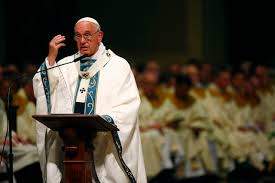
Cathedral Basilica of Sts. Peter and Paul[1]
At the Cathedral Francis was welcomed by Philadelphia’s Archbishop, Charles J. Chaput, who jokingly said, “This is a city that would change its name to Francisville today.” Among the 2,4000 people in the pews were bishops, priests and nuns from Pennsylvania.

In his homily, Francis said, “This morning I learned something about the history of this beautiful Cathedral: the story behind its high walls and windows. I would like to think, though, that the history of the Church in this city and state is really a story not about building walls, but about breaking them down. It is a story about generation after generation of committed Catholics going out to the peripheries, and building communities of worship, education, charity and service to the larger society.” (A photograph of the Pope delivering the homily is above.)
“That story is seen in the many shrines which dot this city, and the many parish churches whose towers and steeples speak of God’s presence in the midst of our communities. It is seen in the efforts of all those dedicated priests, religious and laity who for over two centuries have ministered to the spiritual needs of the poor, the immigrant, the sick and those in prison. And it is seen in the hundreds of schools where religious brothers and sisters trained children to read and write, to love God and neighbor, and to contribute as good citizens to the life of American society. All of this is a great legacy which you have received, and which you have been called to enrich and pass on.”
“Most of you know the story of Saint Katharine Drexel, one of the great saints raised up by this local Church. When she spoke to Pope Leo XIII of the needs of the missions, the Pope – he was a very wise Pope! – asked her pointedly: ‘What about you? What are you going to do?’ Those words changed Katharine’s life, because they reminded her that, in the end, every Christian man and woman, by virtue of baptism, has received a mission. Each one of us has to respond, as best we can, to the Lord’s call to build up his Body, the Church.”
“’What about you?’ I would like to dwell on two aspects of these words in the context of our particular mission to transmit the joy of the Gospel and to build up the Church, whether as priests, deacons, or members of institutes of consecrated life.
First, those words – ‘What about you?’ – were addressed to a young person, a young woman with high ideals, and they changed her life. They made her think of the immense work that had to be done, and to realize that she was being called to do her part. How many young people in our parishes and schools have the same high ideals, generosity of spirit, and love for Christ and the Church! Do we challenge them? Do we make space for them and help them to do their part? To find ways of sharing their enthusiasm and gifts with our communities, above all in works of mercy and concern for others? Do we share our own joy and enthusiasm in serving the Lord?”
“One of the great challenges facing the Church in this generation is to foster in all the faithful a sense of personal responsibility for the Church’s mission, and to enable them to fulfill that responsibility as missionary disciples, as a leaven of the Gospel in our world. This will require creativity in adapting to changed situations, carrying forward the legacy of the past not primarily by maintaining our structures and institutions, which have served us well, but above all by being open to the possibilities which the Spirit opens up to us and communicating the joy of the Gospel, daily and in every season of our life.”
“‘What about you?’ It is significant that those words of the elderly Pope were also addressed to a lay woman. We know that the future of the Church in a rapidly changing society will call, and even now calls, for a much more active engagement on the part of the laity. The Church in the United States has always devoted immense effort to the work of catechesis and education. Our challenge today is to build on those solid foundations and to foster a sense of collaboration and shared responsibility in planning for the future of our parishes and institutions. This does not mean relinquishing the spiritual authority with which we have been entrusted; rather, it means discerning and employing wisely the manifold gifts which the Spirit pours out upon the Church. In a particular way, it means valuing the immense contribution which women, lay and religious, have made and continue to make, to the life of our communities.”
“Dear brothers and sisters, I thank you for the way in which each of you has answered Jesus’ question which inspired your own vocation: ‘What about you?’ I encourage you to be renewed in the joy of that first encounter with Jesus and to draw from that joy renewed fidelity and strength. I look forward to being with you in these days and I ask you to bring my affectionate greetings to those who could not be with us, especially the many elderly priests and religious who join us in spirit.”
“During these days of the World Meeting of Families, I would ask you in a particular way to reflect on our ministry to families, to couples preparing for marriage, and to our young people. I know how much is being done in your local Churches to respond to the needs of families and to support them in their journey of faith. I ask you to pray fervently for them, and for the deliberations of the forthcoming Synod on the Family.
Now, with gratitude for all we have received, and with confident assurance in all our needs, let us turn to Mary, our Blessed Mother. With a mother’s love, may she intercede for the growth of the Church in America in prophetic witness to the power of her Son’s Cross to bring joy, hope and strength into our world. I pray for each of you, and I ask you, please, to pray for me.”
Independence Hall[2]

After visiting Independence Hall, to an orchestra’s playing of Aaron Copland’s “Fanfare for the Common Man,” Francis went in front of the building to the lectern used by Abraham Lincoln to deliver the Gettysburg Address. There Francis gave his address extolling the principles of the country’s founding fathers embodied by the Declaration of Independence signed in that building. (The above photograph shows Pope Francis at the lectern to the right of the statue of George Washington in front of the entrance to Independence Hall.) Here are the words of that address.
“One of the highlights of my visit is to stand here, before Independence Mall, the birthplace of the United States of America. It was here that the freedoms that define this country were first proclaimed. The Declaration of Independence stated that all men and women are created equal, that they are endowed by their Creator with certain inalienable rights, and that governments exist to protect and defend those rights. Those ringing words continue to inspire us today, even as they have inspired peoples throughout the world to fight for the freedom to live in accordance with their dignity.”
“But history also shows that these or any truths must constantly be reaffirmed, re-appropriated and defended. The history of this nation is also the tale of a constant effort, lasting to our own day, to embody those lofty principles in social and political life. We remember the great struggles which led to the abolition of slavery, the extension of voting rights, the growth of the labor movement, and the gradual effort to eliminate every kind of racism and prejudice directed at successive waves of new Americans. This shows that, when a country is determined to remain true to its founding principles, based on respect for human dignity, it is strengthened and renewed.”
“All of us benefit from remembering our past. A people that remembers does not repeat past errors; instead, it looks with confidence to the challenges of the present and the future. Remembrance saves a people’s soul from whatever or whoever would attempt to dominate it or use it for their interests. When individuals and communities are guaranteed the effective exercise of their rights, they are not only free to realize their potential, they also contribute to the welfare and enrichment of society.”
“In this place which is symbolic of the American way, I would like to reflect with you on the right to religious freedom. It is a fundamental right that shapes the way we interact socially and personally with our neighbors whose religious views differ from our own.”
“Religious freedom certainly means the right to worship God, individually and in community, as our consciences dictate. But religious liberty, by its nature, transcends places of worship and the private sphere of individuals and families.”
“Our various religious traditions serve society primarily by the message they proclaim. They call individuals and communities to worship God, the source of all life, liberty and happiness. They remind us of the transcendent dimension of human existence and our irreducible freedom in the face of every claim to absolute power. We need but look at history, especially the history of the last century, to see the atrocities perpetrated by systems which claimed to build one or another ‘earthly paradise’ by dominating peoples, subjecting them to apparently indisputable principles and denying them any kind of rights. Our rich religious traditions seek to offer meaning and direction, “they have an enduring power to open new horizons, to stimulate thought, to expand the mind and heart” (Evangelii Gaudium, 256). They call to conversion, reconciliation, concern for the future of society, self-sacrifice in the service of the common good, and compassion for those in need. At the heart of their spiritual mission is the proclamation of the truth and dignity of the human person and human rights.”
“Our religious traditions remind us that, as human beings, we are called to acknowledge an Other, who reveals our relational identity in the face of every effort to impose ‘a uniformity to which the egotism of the powerful, the conformism of the weak, or the ideology of the utopian would seek to impose on us’ (M. de Certeau).”
“In a world where various forms of modern tyranny seek to suppress religious freedom, or try to reduce it to a subculture without right to a voice in the public square, or to use religion as a pretext for hatred and brutality, it is imperative that the followers of the various religions join their voices in calling for peace, tolerance and respect for the dignity and rights of others.”
“We live in a world subject to the ‘globalization of the technocratic paradigm’ (Laudato Si’, 106), which consciously aims at a one-dimensional uniformity and seeks to eliminate all differences and traditions in a superficial quest for unity. The religions thus have the right and the duty to make clear that it is possible to build a society where ‘a healthy pluralism which respects differences and values them as such’ (Evangelii Gaudium, 255) is a ‘precious ally in the commitment to defending human dignity… and a path to peace in our troubled world’ (ibid., 257).”
“The Quakers who founded Philadelphia were inspired by a profound evangelical sense of the dignity of each individual and the ideal of a community united by brotherly love. This conviction led them to found a colony that would be a haven of religious freedom and tolerance. That sense of fraternal concern for the dignity of all, especially the weak and the vulnerable, became an essential part of the American spirit.”
After his comments about the Quakers, Francis extemporaneously added that globalization was a force for good if it worked toward equalizing, uniting and bringing respect to people. But if it “tries to make everybody even, as if it was a sphere, that globalization destroys the richness and specificity of each person and each people.”
Returning to his text, Francis said, “During his visit to the United States in 1987, Saint John Paul II paid moving homage to this, reminding all Americans that: ‘The ultimate test of your greatness is the way you treat every human being, but especially the weakest and most defenseless ones’ (Farewell Address, 19 September 1987, 3).”
“I take this opportunity to thank all those, of whatever religion, who have sought to serve the God of peace by building cities of brotherly love, by caring for our neighbors in need, by defending the dignity of God’s gift of life in all its stages, by defending the cause of the poor and the immigrant. All too often, those most in need of our help are unable to be heard. You are their voice, and many of you have faithfully made their cry heard. In this witness, that frequently encounters powerful resistance, you remind American democracy of the ideals for which it was founded, and that society is weakened whenever and wherever injustice prevails.”
“Among us today are members of America’s large Hispanic population, as well as representatives of recent immigrants to the United States. I greet all of you with particular affection! Many of you have emigrated to this country at great personal cost, but in the hope of building a new life. Do not be discouraged by whatever challenges and hardships you face. I ask you not to forget that, like those who came here before you, you bring many gifts to your new nation. You should never be ashamed of your traditions. Do not forget the lessons you learned from your elders, which are something you can bring to enrich the life of this American land. I repeat, do not be ashamed of what is part of you, your life blood. You are also called to be responsible citizens, and to contribute fruitfully to the life of the communities in which you live. I think in particular of the vibrant faith that so many of you possess, the deep sense of family life and all those other values which you have inherited. By contributing your gifts, you will not only find your place here, you will help to renew society from within.”
“Dear friends, I thank you for your warm welcome and for joining me here today. May this country and each of you be renewed in gratitude for the many blessings and freedoms that you enjoy. And may you defend these rights, especially your religious freedom, for it has been given to you by God himself. May he bless you all. I ask you, please, not to forget to pray for me.
World Meeting of Families[3]
The Pope ended the day with an appearance at the large gathering of people at the Festival of Families, an intercultural celebration of family life around the world. There were musical acts — Aretha Franklin, Sister Sledge, The Fray and the Philadelphia Orchestra— with testimony from six families from around the world and readings.

When the time case for Francis to speak, he abandoned his prepared speech (in English) about the need for government support for families. Instead, as shown in photograph to the left, for 25 minutes Francis delivered the following extemporaneous remarks in Spanish (here in English translation).
“All that is beautiful leads us to God. Because God is good, God is beautiful, God is true. Thank you all those who have offered their witness. And for the presence of all of you, that is also great witness…a real witness that it’s worth being a family.”
“Once a child asked me . . . ‘Father, what did God do before creating the world?’. . . [I responded,]Before creating the world, God loved. Because God is love. He had so much love: Father, Son and Holy Spirit. It was so overflowing. . . . It had to be poured out of him. So as to share that love with those out of himself. And then God created the world. God made this marvelous world in which we live. . . . ”
“But the most beautiful thing that God did, says the Bible, was the family. God made man, and he made woman. And he gave them everything. He gave them the world. So they could multiply and cultivate the land. All that love he made in creation, he bestowed it to them in the family.”
“All of the love that God has in himself, all the beauty that he has in himself, he gives it to the family. And the family is really family when it is able to open its arms and receive all that love.”
“Of course, it’s not quite earthly paradise. There are still problems. Men and women, through the astuteness of the devil, have learned unfortunately how to divide themselves. And all that love that God gave, almost was lost.”
“In a little period of time – the first crime. The first instance of fratricide. A brother kills another brother. And war. Love, beauty and truth of God [on the one hand]and destruction and war [on the other hand]. And between those: we walk ahead. It’s up to us to choose. It’s up to us to decide which path we want to take forward.”
“When man and his wife made a mistake, God did not abandon them. So great was His love, that He began to walk with humanity, with His people, until the right moment came, and He made the highest expression of love – His own Son. And where did He send his Son – to a palace? To a city? No. He sent him to a family. God sent him amid a family. And He could do this, because it was a family that had a truly open heart. The doors of their heart opened.”
“Mary, she couldn’t believe it. How can this happen? When the angel explained it to her, she agreed. Joseph. He finds himself in a surprising situation that he doesn’t understand, and he accepts. He obeys. In Mary and Joseph, there is a family in which Jesus is born.”
“God likes to give his love to open hearts. Do you know what he loves most? To knock on the door of families, and find families who love each other, who bring up their children to grow, and help them move forward. To create and develop a society with truth, goodness and beauty.”
“We are celebrating the Feast of the Family. Families have a citizenship which is divine. The identity card that they have is given to them by God. So that within the heart of the family, truth, goodness and beauty can truly grow.”
“Some of you might say, ‘Father, you speak like that because you are single. Families have the difficulties. Families, we quarrel, and sometimes plates can fly. And children bring headaches. I won’t speak about mother-in-laws.”
“But in families, there is always light. Because the love of God, the Son of God opened also that path for us. But just as there are problems in families, we have to remember there is the light of the resurrection afterwards. Because the Son of God created that path.”
“The family is like a factory of hope. It’s a factory of resurrection. God opened this path, this possibility.”
“And children, yes they bring their challenges. And they also are the cause of work and worry. Sometimes at home, I see some of my helpers, they come to work and they look tired. They have a one-month-old baby, and I ask them did you sleep? And they say I couldn’t sleep, Holiness, because they were crying all night.”
“In the family, indeed, there are difficulties. But those difficulties are overcome with love. Hatred is not capable of dealing with any difficulty and overcoming any difficulty. Division of hearts cannot overcome any difficulty. Only love. Only love is able to overcome. Love is about celebration, love is joy, love is moving forward.”
“I would like just to offer two points about the family. Some things we really need to take care of: the children and grandparents. Children, whether young or older, they are the future, the strength that moves us forward. We place our hope in them. Grandparents are the living memory of the family. They passed on the faith, they transmitted the faith, to us. To look after grandparents, to look after children, is the expression of love. A people that doesn’t know how to look after its children or grandparents is a people that has no future. Because it doesn’t have strength or the memory to go forward.”
“Family is beautiful, but there is effort involved and there are problems. In families there are unfriendly relationships. Husbands and wives quarrel, can end up badly, separated. Never let the day end without making peace. In a family, you can’t finish the day off not being in peace.”
“May God bless you. May God give you hope, the strength to move forward, let us look after the family. Let’s protect the family. Because it’s in the family that our future is at play.”
“God bless you. And please, pray for me.”
=================================================
[1] Heller, Seilers & Ruane, In Philadelphia, Pope Francis challenges Americans to live up to nation’s ideals, Wash. Post (Sept. 26, 2015); Pope Francis’ Homily at the Basilica of Sts. Peter and Paul Mass (Sept. 26, 2015).
[2] Pope Francis’ Remarks at Independence Hall, N.Y. Times (Sept. 26, 2015); Yardley & Wakin, At Independence Hall, Pope Offers a Broad Vision of Religious Freedom, N.Y. Times (Sept. 26, 2015).
[3] Pope Francis’ Impromptu Speech at the Festival of Families (Sept. 26, 2015)