Global Music on World Communion Sunday

As mentioned in a prior post, Minneapolis’ Westminster Presbyterian Church’s celebration of World Communion Sunday on October 1 featured a sermon on where was the Reformation headed today.

As that sermon mentioned, the service included global music. Our Westminster and Global Choirs joined together to sing five anthems from other countries and to lead the congregation in singing five hymns from around the world. [1] Our leaders were Dr. Melanie Ohnstad, Organist and Minister of Music and Arts; and Tesfa Wondemagegnehu, Director of Choral Ministries; Barbara Prince, Director of Global Choir; and Jeffrey Gram, percussionist.

Introit

The Introit or hymn which is sung at the start of a worship service was “Somlandela,” a traditional South African anthem that was arranged by Barbara Prince. It had one verse in Zulu, another in French and one in English, the last of which stated, “I will follow, I will follow Jesus, I will follow everywhere he goes.”

Offertory

The Offertory anthem was “Indodana,” also from South Africa in traditional isiXhosa, which is one of the country’s official languages and spoken by about 18% of the population, and arranged by Michael Barrett and Ralf Schmitt. Luckily for me as a bass singer, most of our lines were “oo” and “oh”with “Zjem Zjem zja baba” (three times) and “Ho Baba Baba, ho Baba Baba, Je ho Va!” (twice). Just being part of the choir’s singing this beautiful piece brought tears to my eyes. [2]

The church bulletin provided the following English translation of the lyrics: “The Lord has taken his son who lived amongst us, the son of the Lord God was crucified. Hololo Father Jehovah, Zjem zja father.” (“Hololo” and “Zjem zja” are expressive words with no English translation.)

Holy Communion

During the distribution of the bread and the cup for communion, we sang three anthems.

The first was “Nasibi (My Portion),” a Palestinian Hymn arranged by Maggie Hamilton. Its Refrain was in Arabic (English translation: “The Lord is the only strength of my heart, so says my soul”). The text, which were sung in English, was the following:

  • “The Lord is my portion for evermore, so says my soul. In heav’n above, who else have I? Who else, on earth, might I desire? The Lord alone is all I need, true treasure of my soul. For God, I’ll give my wealth away, strew valleys with unwanted gold, that God may be my only prize, my portion and my share.”

The second was “O Jumalan Karitsa” by Matti Rantatalo and sung in the original Finnish language with the following English translation in the church bulletin: “O, Lamb of God, who takes away the sins the world, have mercy on us. O, Lamb of God, who takes away the sins of the world, give us peace and blessing.”

The third anthem was “Ukuthula,” another South African piece sung in Zulu. Again, the English translation was provided in the bulletin: “Peace in this world of sin (Hallelujah) the blood of Jesus brings peace. Redemption in this world of sin (Hallelujah) the blood of Jesus brings redemption. Praise (gratefulness) in this world of sin (Hallelujah) the blood of Jesus brings praise (gratefulness). Faith in this world of sin (Hallelujah) the blood of Jesus brings faith. Victory in this world of sin (Hallelujah) the blood of Jesus brings victory. Comfort in this world of sin (Hallelujah) the blood of Jesus brings comfort.”

Congregational Hymns

The global theme of the service also was emphasized in the following five hymns.

“In Christ, There Is No East or West” (No. 317 in Glory to God: the Presbyterian Hymnal) whose first verse states, “In Christ there is no east or west, in him no south or north, but one great fellowship of love throughout the whole wide earth.” This and the other verses were written in 1908 by John Oxenham (a/k/a William Arthur Dunkerly) and the music is an African-American spiritual, which was the very first such music used in a mainline North American hymnal in 1940.

 “O Lord, Have Mercy” (No. 578) is the traditional “Kyrie eleison:” “O lord, have mercy, O Lord have mercy, O Lord have mercy, have mercy on us.” The hymnal also contained the verses in Greek and Guarani, which we did not sing.

“Sheaves of Wheat” (No. 532) has music and text (in Spanish) by Cesáreo Gabaráin, a Spanish priest and composer, but we sang the English translation by Mary Louise Bringle. The first verse goes this way: “Sheaves of wheat turned by sunlight into gold, grapes in clusters, like rubies on the vine, feed our hearts as the precious blood and body of our Lord: gifts of heaven from earthly bread and wine.”

“Holy, Holy, Holy” (No. 594) has music and text by Guillermo Cuéllar, a Salvadoran composer, with English translation by Linda McCrae. The choir and the congregation sang the refrain in Spanish: “Santo, santo, santo, santo, santo, santo es nuestra Dios, Señor de toda la tierra. Santo, santo, es nuestro Dios. Santo, santo, santo, santo, santo, santo es nuestro Dios, Señor de toda la historia. Santo, santo es nuestro Dios.”

“May the Love of the Lord” (No. 549) has music by LIM Swee Hong, an Asian Christian, and text by Maria Ling, who are the parents of a son who stopped breathing at one day old , but who was revived by the prompt action of nurses. The hymnal has Chinese and English lyrics, the latter of which says, “May the love of the Lord rest upon your soul. May God’s love dwell in you, throughout every day. May God’s countenance shine upon you and be gracious to you. May God’s Spirit be upon you as you leave this place.”

Conclusion

In the shorter, earlier worship service that day the Global Choir with augmentation by some of the Westminster Choir members sang all but “Indodana” of the anthems and only one of the hymns (“In Christ There Is No East or West”), but we also closed that service by singing the Refrain with the congregation joining in the stanzas of “Halle, Halle, Hallelujah!” (No. 591 in the Hymnal), which has a traditional Caribbean melody with stanzas by Marty Haugen. The words of the first stanza are these: “O God, to whom shall we go? You alone have the words of life. Let your words be our prayer and the song we sing: hallelujah, hallelujah!”

There were so many things happening in these services, I once again discovered by reviewing the service, re-reading the pieces that we sung, researching about the composers and lyricists and writing this blog post enhanced my understanding and appreciation of the services.

Although I joined the Global Choir in 2014, it was created in 2001, and for the regular church calendar (September through May), we sing nine times in the early worship service in the church’s Chapel. Just contact the church to join the Global Choir! All are welcome.

=====================================

[1] The church’s website has the bulletin for the main service.  A video of the service also is there; go to http://westminstermpls.churchonline.org/ and click on the icon with three white dots and lines at the top of the video screen; next you will see small screens with the dates of services; then select “Oct. 1, 2017.”

[2] Beautiful performances of “Indodana” by (a) the combined voices of the University of Pretoria Camerata, the Missouri State University Chorale, and the Emory and Henry College Choir at the University of Pretoria Musaion, (Pretoria, South Africa) and (b) South Africa’s Stellenbosch University Choir are available on YouTube.


The Protestant Reformation: Where Does It Go from Here?  

The World Communion Sunday, October 1, worship service at Minneapolis’ Westminster Presbyterian Church featured Rev. Timothy Hart-Andersen’s last of four sermons on the 500th anniversary of the Protestant Reformation: ”The Protestant Reformation Today: Where Does It Go from Here?” [1]The first three sermons, as covered in prior posts, discussed the three great themes of the Reformation: grace alone, faith alone and scripture alone. Below are photographs of the church’s Sanctuary and of Rev. Hart-Andersen.


Listening for the Word

Readings from Holy Scripture:

Revelation 22: 1-6, 16-17 (NRSV)

“Then the angel showed me the river of the water of life, bright as crystal, flowing from the throne of God and of the Lamb through the middle of the street of the city. On either side of the river is the tree of life with its twelve kinds of fruit, producing its fruit each month; and the leaves of the tree are for the healing of the nations. Nothing accursed will be found there any more. But the throne of God and of the Lamb will be in it, and his servants will worship him; they will see his face, and his name will be on their foreheads. And there will be no more night; they need no light of lamp or sun, for the Lord God will be their light, and they will reign forever and ever.”

“And he said to me, ‘These words are trustworthy and true, for the Lord, the God of the spirits of the prophets, has sent his angel to show his servants what must soon take place.’”

“It is I, Jesus, who sent my angel to you with this testimony for the churches. I am the root and the descendant of David, the bright morning star.”

“The Spirit and the bride say, ‘Come.’
And let everyone who hears say, ‘Come.’
And let everyone who is thirsty come.
Let anyone who wishes take the water of life as a gift.”

Galatians 3: 23-29 (NRSV): 

“Now before faith came, we were imprisoned and guarded under the law until faith would be revealed. Therefore the law was our disciplinarian until Christ came, so that we might be justified by faith. But now that faith has come, we are no longer subject to a disciplinarian, for in Christ Jesus you are all children of God through faith. As many of you as were baptized into Christ have clothed yourselves with Christ. There is no longer Jew or Greek, there is no longer slave or free, there is no longer male and female; for all of you are one in Christ Jesus. And if you belong to Christ, then you are Abraham’s offspring, heirs according to the promise”

Sermon:

“Where does the Reformation go from here? What does the future hold for the great Protestant traditions flowing out of Europe 500 years ago?”

“I see at least three directions we might expect the Reformation to take in coming years.”

First: an ecumenical, interfaith direction. Protestant Churches have shown themselves, especially in the last 50-75 years, to be uniquely capable of forming cross-denominational relationships, usually in institutional, organizational, and structured ways: councils of churches at the local level, the state level, nationally, and at the global level. In coming years this will happen in less institutional ways, less structured ways, and increasingly in local relationships.”

“The past week illustrates this emerging new reality. On Tuesday, for the first time ever, the Evangelical Lutheran Church in America allowed one of its candidates for ministry to be ordained to serve a non-Lutheran church. We celebrated the ordination of Matt Johnson, Westminster’s Interim Associate Pastor, at Bethlehem Lutheran Church. Candidly, that break with tradition did not start in the bishop’s office or the presbytery’s office; it began with a few of us conspiring locally to make it happen. Localized ecumenical relationships, yielding that kind of change. Congratulations, Matt.”

“Then yesterday I co-presided with a Roman Catholic priest at the wedding of a Westminster woman and her Catholic fiancé, now husband. That would have been unthinkable even a few years ago. The fact that we pulled it off has less to do with relaxing of standards in Rome – we did not contact the bishop or presbytery – than with developing ecumenical relationships in local communities. The old walls separating us don’t mean as much anymore.”

“’In Christ Jesus you are all children of God through faith,’ the Apostle Paul writes to the Galatians. ‘There is no longer Jew or Greek’ – Paul dissects the binary way people tend to look at the world – ‘There is no longer slave or free, there is no longer male and female; for all of you are one in Christ Jesus.’ (Galatians 3:6-8)”

“It’s as if we were undoing the divisions resulting from the Reformation between Protestants and Catholics, and among Protestants themselves. If we ask where the Reformation goes from here, an obvious first answer is that it goes in the direction of a Christianity that has fewer barriers standing among and between the various branches of the Church than it has had for the last 500 years.”

“The same thing is happening with interfaith collaboration. The Reformation taught us the God alone is Lord of the conscience, and that grace alone saves us, not our behavior or a particular creed. From those Reformation-era principles it is a short step to respectful interfaith dialogue and cooperation.”

“A major world challenge on the religious horizon – locally and globally – is learning to live with people of other faiths. Protestant churches, with our emphasis on freedom and respecting the rights and responsibilities of individuals with regard to religious matters, can and will lead the way in interfaith collaboration.”

“Westminster is certainly doing its part. Our interfaith dialogue sermons and relationships with multi-faith organizations are not one-off novelties or the whim of your pastor. They are the vanguard of 21st century open-minded, open-hearted Christianity more concerned with practicing the faith in real ways with real people, some of whom have other faiths, than perfecting or judging it.”

“In recent years I have co-presided at a number of Jewish weddings – again, something that even a few years ago would not have happened. I’ve also done this with Buddhist priests. Many of us have attended a Muslim iftar, when the Ramadan fast is broken. We never would have done that 10-15 years ago. These are local outbursts of interfaith commitment – not handed down from on high, but local efforts – resulting in a shifting religious landscape.”

“Where does the Protestant Reformation goes from here? It’s moving in an ecumenical and interfaith direction.”

Secondly, on this World Communion Sunday we’re enjoying sounds and rhythms and movement from all over the globe. Again, this is not a one-time experience, where we trot out the world music on one Sunday a year. We’re now drawing regularly from the music of Christians in other parts of the world to enliven our worship, to teach us other ways of praising God, to inspire us.”

“Over the last 150 years Protestant churches moved out from Europe to the world, in particular the global south, where the Reformation churches are growing rapidly. There are more Presbyterians today in South Korea than there are in the U.S. The same is true for Kenya and South Africa.”

“Christianity is on the move. One hundred years ago two-thirds of the world’s Christians lived in Europe. Today, nearly two-thirds of the world’s Christians live in the global south. The Church there is exploding in growth, and our churches are receding. North American churches had 15% of the world’s Christians 100 years ago; today we have 10%.”

“We can see the impact of this emerging reality not only from a distance, but closer to home. The Roman Catholic priest friend who co-presided at the wedding yesterday serves a Minneapolis parish overflowing with people from Latin America. He told me last Saturday he did 29 baptisms and yesterday 28 were scheduled. They baptize around 400 per year, and they’re all babies of Latino immigrants. The parish has discovered that their future lies not with the Euro-Americans who brought Catholicism here –Irish, Germans and others from Europe –- but with Catholics form the global south. The Roman Church in the US would be shrinking if not for Catholics coming from Latin America.”

“Similarly, we Protestants who lament the decline of our churches here can rejoice in the vast growth of the Reformation churches in the global south. We, too, can welcome immigrants coming from other parts of the world, especially sub-Sahara Africa, where the Reformed churches are so strong. Westminster has experienced an influx of West African Christians over recent decades, now serving as leaders in our church –and what a richer, healthier congregation we are.”

“The global south will bear the Protestant stream of Christianity into the future.”

“The third emerging direction for the Protestant movement, especially in this land, is increasing openness to diversity. At the local level we’re coming to see that in the future our churches will either reflect the contexts in which we minister, or they’ll not be sustainable for the long haul. We’re too isolated, too divided in our communities, racially, ethnically and culturally. It’s not the way of the gospel. Mono-cultural eco-systems cannot continue to thrive. They must be diverse in order to have the adaptive capacities to live into the future.”

“One of the last images of the Bible is found in the Book of Revelation when the Heavenly City comes to earth and settles among the human family. There is a river flowing through that city, and on the banks of the river is the Tree of Life. The leaves of the tree, the text says, ‘Are for the healing of the nations.’”

“I’ve usually interpreted that verse as pointing to healing among the political nations of the earth. But the Greek word here for nations is ethnos, that is, the leaves of the tree are for the healing of the variety of ethnicities in the human family that do not live well together. This may be less a political comment and more a call to learn to live in harmony with those different from us within our own land.”

“The vision of the Holy City invites us to be part of the healing of the racial divide that exists among us, to finally put aside, to do away with, the old reality that Martin Luther King used to remind us of – that Sunday at 11AM is the most segregated hour in America. The Church’s future lies in congregations that are more diverse, that reflect God’s hope that the human family might one day learn to live together in peace.”

“Here at Westminster our new members classes in recent years have been 10-15% racially mixed. Around 7-8% of Westminster members are people of color. We’re changing, but the world is changing a lot faster all around us.”

“A recent study of more than 100,000 Americans in all 50 states shows that only 43% of the population is made up of white Christians. Forty years ago that number was 80%. Twenty years ago it was two-thirds. Things are changing rapidly, all around us, and the church will need to change.”

“And forty years ago 55% of the population was made up of white Protestants. Today that number is under 40%. We are watching in our lifetime the end of America as a white Christian nation. And some see that as a threat. We see the rise of white supremacy and white nationalism and the clinging to white privilege in response, much of it cloaked in Christian language.”[2]

“The changing reality shouldn’t frighten us, but, rather, call us to open our doors and hearts and open our lives to new friends who’ve been our neighbors for many years. We can either move constructively with these challenging new realities and learn ways to be faithful in worship and mission, or we can struggle against them and find our churches continuing to wither and weaken and die. This is hard work, but essential to the future of the church.”

“Where does the 500-year old Reformation go from here? The Protestants churches, heirs to the great legacies of grace alonefaith alone, and scripture alone, will need to grow new ministries that reach across divisions we’ve long accepted as normative. That means creating new ecumenical and interfaith relationships and partnerships, welcoming Christians from the global south and learning from them, participating in the work of racial reconciliation, which may be the most difficult of all these things, and developing congregations that reflect our changing world.”

“To do this, the people of God will have to trust that the Holy Spirit is at work among us, stirring things up for the future health and vitality of the Christian Church.”

“We will have to use a holy imagination to see and join the new thing God is doing among us. May that imagination, that holy imagination, be kindled today at this World Communion table, as we join with Christians around the globe in celebrating the love of God that unites us in one human family, in all its wonderful and rich diversity.”

Conclusion

I agree that “Westminster and other churches need to develop  new ecumenical and interfaith relationships and partnerships, welcoming Christians from the global south and learning from them, participating in the work of racial reconciliation, which may be the most difficult of all these things, and developing congregations that reflect our changing world.”

Westminster already is engaged in global partnerships with churches in Cuba, Cameroon and Palestine, and for 10 years I chaired our Global Partnerships Committee and visited our partners in Cuba (three times), Cameroon (once) and Brazil (once). I know that they have enriched my spiritual life and of others in the church and in our partners.

As the sermon stated, music from around the world will play a major part in our worship as it did this day and as will be discussed in another post.

========================================

[1] The bulletin for this service and the text of the sermon are on the church website. Excerpts of the sermon are  set forth below.

[2] Wilson, We’re at the end of White Christian America. What will that mean?, Guardian (Sept. 20, 2017); Pew Research Center, Religious Landscape Study.


The Non-Aligned Movement Holds Summit in Venezuela

On September 17 in Venezuela Raúl Castro addressed the Summit of the Non-Aligned Movement (NAM), an organization of 120 states that advocates for solutions to global economic and other problems.[1] We will review that speech and the Summit’s concluding Declaration before making observations about this event.

Castro’s Speech

For Cuba, he said, “non – alignment means the struggle to radically change the international economic order imposed by the great powers, which has led to 360 people possessing a higher income than 45% of the world population annual wealth. The gap between rich and poor countries is growing. Technology transfer from North to South is an elusive aspiration.”

“Globalization mainly favors a select group of industrialized countries. The debt of southern countries multiplies. . . . [Mamy] people are pushed into unemployment and extreme poverty; millions [of] children die each year from hunger and preventable diseases; almost 800 million people cannot read or write, while more than 1.7 [billion] dollars are devoted to military spending.”

Castro reported that it has been “21 months since we announced simultaneously with President Barack Obama, the decision to restore diplomatic relations between Cuba and the United States.”

“There has been some progress, especially in the diplomatic arena and cooperation on issues of mutual interest, but has not been the same in the economic and commercial sphere, due to the limited scope, while positive, of the measures taken so far by the American government.”

“Cuba will continue to demand the lifting of the economic, commercial and financial blockade that [had caused] much damage and deprivation to Cuba and that also affects many countries for its extraterritorial scope.” Cuba also “will continue to demand that our sovereignty is returned to the territory illegally occupied by the US Naval Base in Guantanamo. Without [these and other changes by the U.S.] there can be no normal relations [between the two countries].”

Nevertheless, “we reaffirm the will to sustain civilized coexistence relations with the United States, but Cuba will not give up one of its principles, or . . . make concessions inherent in its sovereignty and independence. It will not relent in defending their revolutionary and anti-imperialist ideals, [or] in supporting self-determination of peoples.”

Castro also rejected any attempts to “regime change” and reaffirmed rejection of any country’s “resorting to aggression and use of force,” and “commitment to the principles of the United Nations Charter and International law; [to peaceful resolution of disputes] and full respect for the inalienable right of every state to choose its political, economic, social and cultural system as an essential condition to ensure coexistence among nations.”

More specifically Castro reaffirmed (a) Cuba’s “unconditional support for the government and Venezuelan people, the civil-military union and the constitutional President Nicolas Maduro Moros;” (b) Cuba’s rejection of the parliamentary “coup” in Brazil against President Dilma Rousseff; (c) Cuba’s support of Colombia’s “implementing the Agreement” with the FARQ; (d) Cuba’s support of “the people of the Syrian Arab Republic resolving their “without external interference aimed at promoting regime change, . . . “the creation of an independent Palestinian state with East Jerusalem as its capital, . . . the self-determination of the Saharawi people, . . . the historical demand of the Puerto Rican people towards self-determination and independence, . . . [and] the claim of Argentina over the Falkland Islands, South Sandwich and South Georgia;” and (e) Cuba’s congratulations to “the Islamic Republic of Iran for his work in the recently concluded mandate.”

Castro’s concluded with this assertion: “The only alternative to the enormous dangers and challenges ahead is unity and solidarity in defense of our common goals and interests.”

Summit’s Declaration[2]

The Summit’s Declaration concluded with a 21-point statement of NAM objectives: (1) consolidate and revitalize NAM; (2) consolidation of the international order; (3) the right to self-determination; (4) disarmament and international security; (5) human rights; (6) condemnation of unilateral sanctions; (7) condemnation of terrorism; (8) dialogue among civilizations; (9) support for Palestine; (10) reform of the U.N. Security Council and General assembly; (11) selection and appointment of new U.N. Secretary-General; (12) U.N. peace-keeping operations; (13) sustainable development goals; (14) promotion of education, science and technology for development; (15) climate change; (16) reforming the international economic governance; (17) South-South cooperation (18) international solidarity in combatting pandemics; (19) support for refugees and migrants; (20) young women, peace and security; and (21) new world order of information and communication.

Conclusion

These words of Raúl Castro were nothing new.

The real news from the NAM Summit was the low turn-out. Of the 120 NAM members only 13 attended, including the leaders of Cuba, Iran, Palestine, Ecuador, Bolivia and Zimbabwe and the Venezuelan host.

Venezuela’s President Nicolas Maduro called the meeting as an opportunity to increase international solidarity for his socialist government as the oil-dependent economy reels from widespread food shortages and triple digit inflation. However, according to observers, the low attendance indicates that almost all of the NAM members were not interested in engaging in such solidarity with this country under these circumstances.[3]

Nevertheless, Maduro spoke defiantly at the Summit about Venezuela’s problems, blaming them on the country’s foreign enemies. “Venezuela is facing a global attack, which is against all of Latin America and Caribbean. An attack that aims to impose a political, economic and cultural reorganization of our countries with the old oligarchy.”

As repeatedly stated, this blog concurs that the U.S. should end its embargo (blockade) of Cuba and that the peace agreement between the government of Colombia and the FARQ is to be applauded and hopefully will be approved in the October 2 referendum in that country. I also agree that Cuba and the other NAM members have the right to organize and advocate their many other positions.This blog, however, disagrees with Cuba’s allegation that the U.S. is illegally occupying Guantanamo Bay.

Finally soon after the NAM Summit,  President Maduro met with U.S. Secretary of State John Kerry when both were in Cartagena Colombia for the signing of the Colombia-FARQ peace agreement. The next day on his regular television show in his country, Maduro, mentioning his 40-minute meeting with Kerry, said, “I ask that God bless the results of the meeting [with Kerry] and that Venezuela opens a new era of relations with the United States.” He also said that veteran U.S. diplomat Tom Shannon, who has been the U.S. point man for the troubled relationship, will visit Caracas again soon and that an invitation was open to Kerry.[4]

The U.S. State Department, acknowledging the meeting, said, “The Secretary expressed our commitment to the well-being of the Venezuelan people, and our willingness to work with all sectors of Venezuelan society to enhance our relationship. He also spoke of our concern about the economic and political challenges that have affected millions of Venezuelans, and he urged President Maduro to work constructively with opposition leaders to address these challenges.” In addition, the Department said that “Kerry stressed our support for democratic solutions reached through dialogue and compromise” and that the two men “agreed to continue the bilateral discussions begun in recent months.”[5]

==============================================

[1] Castro, The only alternatives to the enormous dangers and challenges is unity and solidarity, Granma (Sept. 17, 2016).

[2] Declaration of the XVII Summit of Heads of State and Government of the Non-Aligned Movement (NAM), Granma (Sept. 18, 2016).

[3] Assoc. Press, Venezuela’s Crisis Keeps Non-Aligned Summit Turnout Low, N.Y. Times (Sept. 17, 2016); Reuters, Venezuela Summit Draws Few Leaders in Blow to Maduro, N.Y. Times (Sept. 17, 2016); Reuters, Maduro Revels in Support From Zimbabwe, Iran as Critics Decry Failed Summit, N.Y. Times (Sept. 19, 2016);  Castro, Venezuela closes the summit of non-aligned countries amid criticism, El Pais (Sept. 18, 2016).

[4] Reuters, Venezuela’s Maduro Calls for New Era of Relations With U.S., N.Y.Times (Sept. 27, 2016).

[5] U.S. State Dep’t, Secretary Kerry’s Meeting with Venezuelan President Maduro (Sept. 26, 2016).


Cuba’s Foreign Minister Advocates Cuban Interests at the U.N.

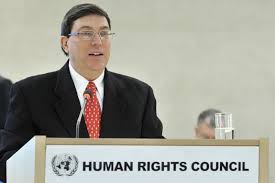
Foreign Minister Bruno Rodriguez

On September 22, Cuba’s Foreign Minister, Bruno Rodriguez Parilla, addressed the annual meeting of the United Nations General Assembly.[1] The next day he repeated some of the themes of this speech while talking at a meeting at the U.N. of the G77 + China, the intergovernmental organization of 134 U.N.-member developing countries that promotes their collective economic interests, their joint negotiating capacity on such issues and South-South cooperation for development.[2]

 Foreign Minister’s Speech to the U.N. General Assembly

“The statistics could not be more eloquent. 80% of the world population owns only 6% of the wealth, while the richest 1%, enjoys half the heritage of the planet. No less than 795 million people suffer from chronic hunger. 18,000 children die daily because of poverty. More than 660 million use non-potable water and 780 million adults and 103 million young people are illiterate.”

“The huge nuclear and conventional arsenals and annual military spending of 1.7 billion million dollars, belie those who claim that there are no resources to eliminate poverty and underdevelopment.”

“The waves of refugees into Europe, caused by underdevelopment and NATO interventions, show the cruelty, the oppressive nature, inefficiency and unsustainability of the current international order . . . .”

“2015 was also the worst in terms of climate change, with increasing global temperatures, melting of polar ice, the ocean levels and volume growth emission of greenhouse gases. . . . While it is expected that the industrialized countries will make progress in fulfilling the obligations assumed with the ambiguous Paris Agreement, only tangible data on financing and technology transfer to developing countries may justify hopes of survival of the human species.”

“Peace and development are the raison d’être of the [U.N.] For the human species, it is imperative and urgent . . . to create a culture of peace and justice as the basis of a new international order. . . . For peaceful coexistence among States, it is essential to respect the [U.N.] Charter and international law.”

“The UN must [combat] unilateralism and . . . be thoroughly reformed in order to democratize it and bring it closer to the problems, needs and aspirations of peoples in order to make it capable of [moving] the international system towards peace, sustainable development and respect for all human rights for all. The reform of the Security Council, both in its composition and its working methods, is a task that can no longer be postponed. Strengthening the General Assembly and rescuing [its] functions that have been usurped by the Security Council should guide the search for a more democratic and efficient organization.”

Rodrigues also supported the rights of the people of Palestine, the Sahara, the Syrian Arab Republic, Russia (and against NATO), Venezuela, Colombia (and their agreement to end the conflict with the FARQ), Brazil (and against “the parliamentary coup d’eta against President Rousseff”) and Puerto Rico.

He praised Cuban medical personnel who are “working in [61 countries in] all continents . . . for the life and health of humans” and criticized the U.S. Parole Program for Cuban Medical Personnel that seeks to interfere with such beneficial medical programs.

On the other hand, he recognized that “just over a year has passed since the restoration of diplomatic relations between Cuba and the United States and the reopening of embassies.” Since then “there has been some progress in our bilateral ties, especially in diplomatic affairs, dialogue and cooperation on issues of common interest, as reflected in the high-level visits, including the visit of President Barack Obama, and the dozen agreements signed on issues that can bring benefits to both countries and throughout the hemisphere.

However, “the reality is that the [U.S. embargo] blockade remains in force, continues to cause serious damage and hardship to the Cuban people and continues to hamper the functioning of the economy and its relations with other countries. Executive measures adopted by the [U.S.}, although positive, are insufficient.” Therefore, the Cuban government “will present [this October] to the Assembly the draft resolution entitled ‘Necessity of Ending the Economic, Commercial and Financial Tax by the United States of America against Cuba.’”

In the meantime, “the Cuban government [will continue to develop] a respectful dialogue with the [U.S.] Government, knowing that remains a long way to go to move towards normalization, which means building an entirely new bilateral relations [model].” For this to be possible some day, it will be imperative that the blockade [be] . . . lifted” and that the territory [allegedly] illegally occupied by the Naval Base of the United States in Guantanamo” be returned to Cuba.

“The Cuban people continues [to be engaged in updating [its] economic and social model . . . in order to build an independent, sovereign, socialist, prosperous and sustainable nation.”

 Foreign Minister’s Speech at Meeting of G-77+ China

Rodriguez emphasized what he called “the historical debt owed to the nations of the South by the industrialized countries that built their wealth from centuries of colonialism, slavery and plundering of natural resources. This debt needs to be settled by [the industrialized countries] paying [the nations of the South] with financial flows and technology transfers.”

“The external [financial] debt [of the South] must be abolished because it already has been paid many times.”

The Cuban Foreign Minister of Cuba also advocated a direct and active participation of the South in global decisions.

He reiterated Cuba’s allegations against the U.S. economic, commercial and financial embargo (blockade) despite the recent rapprochement between the two governments. More will be heard on this subject when Cuba this October presents its annual resolution against the embargo to the General Assembly

Conclusion

There really was nothing new in these remarks, but it is heartening to hear again that Cuba continues to pursue normalization with the U.S. and to updating its economic and social model in order to build a more prosperous society.

================================

[1] Rodriguez, The UN must be defended [against] unilateralism and at the same time, it must be deeply reformed to democratize, Granma (Sept. 22, 2016); At UN, Cuba cites progress in US relations, but with embargo still in force, ‘there is a long way ahead,” UN News Centre (Sept. 22, 2016).

[2] Our country wants to settle historical debt to the South, Granma (Sept. 23, 2016).

IRS’ Unjustified Threats Against IFCO/Pastors for Peace

The Interreligious Foundation for Community Organization (IFCO) is a multi-issue U.S. ecumenical agency whose tax-exempt status is being challenged by the Internal Revenue Service (IRS). In order to understand this challenge, we will look at IFCO’s background and the purported bases for the IRS’ position before concluding that people concerned about U.S.-Cuba normalization should support IFCO in this matter.

IFCO Background[1]

According to its own website, IFCO “is a multi-issue national ecumenical agency, which was founded in 1967 by progressive church leaders and activists. For [nearly 50 years it] . . . has assisted hundreds of community organizations and public policy groups – by providing technical assistance, training organizers, making and administering grants, and using our global network of grassroots organizers, clergy, and other professionals to advance the struggles of oppressed people for justice and self-determination.”

“IFCO has assisted the poor and disenfranchised in developing and sustaining community organizations to fight human and civil rights injustices. This work includes education about the realities of the poor in the U.S. and the third world and to organize and to assist local communities who are organizing around issues of racial, social, and economic justice. . . . In pursuit of this mission, IFCO promotes, funds and coordinates domestic and international community development efforts – programs designed to improve people’s own communities.”

“IFCO’s international work, which began in Africa in the 1970s, has focused on Central America and the Caribbean since the early 1980s. IFCO’s project Pastors for Peace was founded in 1988,” and in 1992 it started its annual “Friendshipment” caravans which IFCO/Pastors for Peace delivers to Cuba” to provide “humanitarian aid to the Cuban people   . . . as a nonviolent direct challenge to the brutal US economic blockade of Cuba. The caravans, brigades and delegations have also provided an opportunity for numerous US citizens to see Cuba with their own eyes.”

IRS Challenge to IFCO’s Tax-Exempt Status

On October 3, 2015, IFCO publicly announced that the IRS planned “to revoke the group’s non-profit tax exempt status because of its humanitarian work in Cuba and other countries.” This announcement was the result of the organization’s learning that the IRS Appeals Office planned to uphold the revenue agent’s recommendation to revoke our 501(c)3 status . . . . [because of IFCO’s] humanitarian aid to Cuba as well as IFCO’s fiscal sponsorship of a humanitarian flotilla that delivered aid to the people of Palestine.”[2]

On August 24, 2016, the organization apparently told a journalist, “The IRS claimed that our work to bring humanitarian aid and build friendship with the Cuban people was done in violation of the Treasury Department’s ‘Trading with the Enemy Act.’”

On September 1, 2016, IFCO’s Executive Director, Gail Walker, stated that the IRS had abandoned its efforts to remove its tax-exempt status because of its Cuba programs and instead was basing its efforts on IFCO’s alleged sloppy record-keeping.[3]

The IRS, on the other hand, has not made any public comment about IFCO’s tax-exempt status.

U.S. Legal Requirements for Tax-Exempt Organizations

The IRS summary of the U.S. legal requirements for tax-exempt (501(c)(3)) status[4] states the following:

  • “To be tax-exempt under section 501(c)(3) of the Internal Revenue Code, an organization must be organized and operated exclusively for exempt purposes set forth in section 501(c)(3), and none of its earnings may inure to any private shareholder or individual. In addition, it may not be an action organization, i.e., it may not attempt to influence legislation as a substantial part of its activities and it may not participate in any campaign activity for or against political candidates.”
  • “The exempt purposes set forth in section 501(c)(3) are charitable, religious, educational, scientific, literary, testing for public safety, fostering national or international amateur sports competition, and preventing cruelty to children or animals.  The term charitable is used in its generally accepted legal sense and includes relief of the poor, the distressed, or the underprivileged; advancement of religion; advancement of education or science; erecting or maintaining public buildings, monuments, or works; lessening the burdens of government; lessening neighborhood tensions; eliminating prejudice and discrimination; defending human and civil rights secured by law; and combating community deterioration and juvenile delinquency.”
  • Political activities and legislative activities (commonly referred to as lobbying) are two different things and are subject to two different sets of rules and have different consequences of exceeding the limitations. The rules applied in a given situation depend on several issues: the type of tax-exempt organization (different rules apply to private foundations than to other section 501(c)(3) organizations), the type of activity (political or lobbying) at issue, and the scope or amount of the activity conducted.”

The U.S. Trading with the Enemy Act

On April 6, 1917, the U.S. Congress declared war on Germany followed by a similar declaration against Austria-Hungary on December 7, 1917. In between these events–on October 6, 1917–the Trading with the Enemy Act (12 U.S.C. §§ 95a95b and 50 U.S.C. App. §§ 1—44) was enacted. Here are the relevant provisions of this statute:

  • Section 2(b) defines “enemy” as including “The government of any nation with which the United States is at war, or any political or municipal subdivision thereof, or any officer, official, agent, or agency thereof.”
  • Section 3(a) makes it unlawful for “any person in the [U.S.], except with the license of the President, granted to such person, . . . to trade, or attempt to trade, either directly or indirectly, with, to, or from, or for, or on account of, or on behalf of, or for the benefit of, any other person, with knowledge or reasonable cause to believe that such other person is an enemy or ally of enemy, or is conducting or taking part in such trade, directly or indirectly, for, or on account of, or on behalf of, or for the benefit of, an enemy or ally of enemy.”
  • Section 5(b)(1) of this statute: “During the time of war, the President may, through any agency that he may designate, and under such rules and regulations as he may prescribe, by means of instructions, licenses, or otherwise (A) . . . regulate, or prohibit, any transactions in foreign exchange . . . and (B) . . . regulate . . . or prohibit. . . transactions involving, any property in which any foreign country . . . has any interest. . . .”
  • Section 16 provides that any person who “willfully violate[s]” the statute or any regulation thereunder “shall, upon conviction, be fined not more than $1,000,000 [or $100,000 for natural persons] or imprisoned for not more than ten years.

On December 28, 1977, this Act was amended by Public Law 95-223, which provides in section 101(b) that “authorities conferred upon the President by section 5(b) of the Trading With the Enemy Act, which were being exercised with respect to a country on July 1, 1977, as a result of a national emergency declared by the President before such date, may continue to be exercised with respect to such country . . . . [upon a determination by the] President [to] extend the exercise of such authorities for one-year periods upon a determination for each such extension that the exercise of such authorities with respect to such country for another year is in the national interest of the United States.”

This authority has been annually used by every president since 1978 to extend the prohibitions of the Act with respect to Cuba. Should a president fail to renew this designation, the statute’s application to Cuba will die as will the president’s executive authority to relax and modify regulations causing the embargo to automatically revert, word-for-word, to the strict form they had on March 1, 1996 under the Helms-Burton Law and thereby require congressional action to change its terms.[5]

The latest such annual extension occurred on September 13, 2016, when President Obama signed a document determining “that the continuation for 1 year of the exercise of . . . [certain authorities under the Trading With the Enemy Act] with respect to Cuba is in the national interest of the United States.” [6] Those authorities are found in the Cuban Assets Control Regulations, 31 C.F.R. Part 515. Specific information about these regulations is set forth in a U.S. Department of the Treasury website.

Conclusion

I personally am glad that IFCO has been engaged in providing certain goods to Cuba, and I have enjoyed riding around in Cuba in a garishly decorated Pastors-for-Peace bus that was left there after one of IFCO’s caravans. I have signed a petition asking the IRS and Congress to stop this persecution of IFCO and urge others to do the same. I also am pleased that IFCO has obtained the support in this dispute from many Cuban organizations: the Cuban Council of Churches, Havana’s Martin Luther King Center, the Religious Organizations of Cuba, Cuba’s Institute of Friendship with the Peoples (ICAP) and Cuba’s First Deputy Education Minister.[7]

The U.S. use of the Trading of the Enemy Act with respect to Cuba after the December 17, 2014, announcement of the beginning of normalization of U.S.-Cuba relations is paradoxical and contradictory on its face. However, as noted above, this statute gives the president authority to relax the embargo, which President Obama has done. Without the annual renewals regarding Cuba under this statute, the president would not have any such authority and the embargo would be tightened unless and until Congress passes a law to end the embargo, which certainly will not happen during the remaining months of Obama’s presidency.

This statute, however, is not directly linked to the tax-exempt status of IFCO or any other organization, and the IRS does not have authority to enforce it. Perhaps the IRS’ apparent abandonment of this ground for revoking IFCO’s tax-exempt status is the IRS’ implicit recognition of the validity of the argument against any IRS use of the Trading with the Enemy Act.

Instead the Department of Justice has the authority to enforce statutes that carry criminal penalties for their violation. As previously mentioned, the Trading with the Enemy Act calls for a fine of not more than $1,000,000 [or $100,000 for natural persons] or imprisonment for not more than ten years. Thus, if IFCO were charged with such a crime and found guilty after a trial in federal court, IFCO would be subject to such a fine. I suspect that the fine would be relatively small in light of the organization’s overall religious purposes, its not making a financial profit from such activities, its not secretly conducting its activities regarding Cuba, its not having been previously challenged by the U.S., and IFCO’s not adversely affecting U.S. national security.

Moreover, I do not see how IFCO’s caravans to Cuba could be deemed to be attempting to influence legislation as a substantial part of its activities or participating in any campaign activity for or against political candidate, all of which are illegal for a 501(c)(3) organization and would be a ground for revoking tax-exempt status.

However, I must confess that I am not familiar with the case law interpreting these provisions. As always I invite comments of concurrence or disagreement or pointing out errors and omissions.

================================================================

[1] IFCO, About IFCO.

[2] IFCO Press Release, IRS Attacks Faith Based Civil Rights Group for Humanitarian Work with Cuba (Oct. 3, 2015).

[3] Whitney, Pastors for Peace Close to Losing Tax Exempt Status Courtesy of IRS Assault, CounterPunch (Sept. 2, 2016); Torres, IRS goes after Pastors for Peace for sending aid to Cuba, InCubaToday (Aug. 24, 2016); Barbosa, Solidarity organization harassed for its work in Cuba, Granma (Sept. 13, 2016).

[4] IRS, Exemption Requirements—501(c)(3) Organizations; IRS, Exempt Purposes—Internal Revenue Code Section 501(c)(3); IRS, Political and Lobbying Purposes.

[5] Muse, Press Release: Presidential Embargo Authority over Cuba: Renew it or Lose it, Latin America Goes Global (Sept. 2, 2015).

[6] White House, Presidential Determination—Continuation of the Exercise of Certain Authorities Under the Trading with the Enemy Act (Sept. 13, 2016);Obama renews Act trading with the Enemy supporting the blockade of Cuba, CubaDebate (Sept. 13, 2016); Muse, Press Release: Presidential Embargo Authority over Cuba: Renew it or Lose it, Latin America Goes Global (Sept. 2, 2015).

[7] Cuban Council of Churches, Communioqué from Cuban Council of Churches, Granma (Sept. 1, 2016); Reuters, Cuban Churches Denounce U.S. Probe of Humanitarian Aid Project, N.Y. Times (Sept. 7, 2016); Gomez, Love should not pay taxes, Granma (Sept. 7, 2016); Cubans support ecclesiastics Pastors for Peace, “Love and faith cannot pay taxes, CubaDebate (Sept. 7, 2016); Statement by religious organizations of Cuba in support of IFCO/Pastors for Peace, Granma (Sept. 1, 2016); Rodriguez, Pastors for Peace faces attack on solidarity work, Granma (Aug. 30, 2016).


The Confession of Belhar Is Adopted by the Presbyterian Church (U.S.A.)

PCUSA

On June 23, 2016, the General Assembly of the Presbyterian Church (U.S.A.) overwhelmingly voted (540 to 33) to include in its Book of Confessions the 1986 Confession of Belhar from South Africa.

Let us examine that Confession, its adoption by the PC(USA)’s General Assembly, the PC(USA)’s Book of Confessions and the recent use of the Belhar Confession at Minneapolis’ Westminster Presbyterian Church, a member of the PC(USA).

 The Confession of Belhar[1]

The Belhar Confession emerged from the era of apartheid in South Africa, 1948-1994. That doctrine and practice of racial segregation was embraced by the Dutch Reformed Church in South Africa (DRC) for whites and imposed upon its racially segregated offshoots: the Dutch Reformed Mission Church (DRMC) for colored or mixed-race people, the Dutch Reformed Church in Africa for blacks and the Reformed Church in Africa for people of Indian descent.

After the 1960 Sharpeville Massacre, the 1964 convictions and imprisonments of anti-apartheid activists Nelson Mandela and Walter Sisulu, the 1976 Soweto Uprising and the 1976 condemnation of South Africa and apartheid by the United Nations, the Synod of the DRMC in 1978 concluded that apartheid was anti-evangelical and a structural and institutional sin.

Eight years later, in 1986, another Synod of the DRMC met in Belhar, a colored suburb of Capetown, South Africa, and adopted the Confession of Belhar. It has the following primary confessional statements:

  1. “We believe in the triune God, Father, Son and Holy Spirit, who gathers, protects and cares for the church through Word and Spirit. This, God has done since the beginning of the world and will do to the end.”
  2. “We believe in one holy, universal Christian church, the communion of saints called from the entire human family.”
  3. “We believe that God has entrusted the church with the message of reconciliation in and through Jesus Christ; that the church is called to be the salt of the earth and the light of the world, that the church is called blessed because it is a peacemaker, that the church is witness both by word and by deed to the new heaven and the new earth in which righteousness dwells.”
  4. “We believe that God has revealed himself as the one who wishes to bring about justice and true peace among people.”
  5. “We believe that, in obedience to Jesus Christ, its only head, the church is called to confess and to do all these things, even though the authorities and human laws might forbid them and punishment and suffering be the consequence.”

Three of these statements also set forth additional detailed belief statements and rejections of any doctrine and ideology which:

  • “absolutizes  natural diversity or the sinful separation of people;”
  • “explicitly or implicitly maintains that descent or any other human or social factor should be a consideration in determining membership of the church;”
  • “sanctions in the name of the gospel or of the will of God the forced separation of people on the grounds of race or color;”
  • “would legitimate forms of injustice and any doctrine which is unwilling to resist such an ideology in the name of the gospel.”

The PC(USA)’s Adoption of the Belhar Confession [2]

As previously noted, on June 23, 2016 (30 years after the DRMC adoption of the Confession of Belhar), the General Assembly of the PC(USA) voted to add that Confession to the U.S. church’s Book of Confessions.

Rev. Godfrey Betha
Rev. Godfrey Betha

Immediately after the vote, the General Assembly was addressed by Rev. Godfrey Betha, the Vice Moderator of the Uniting Reformed Church in Southern Africa, which was formed by the DRMC and the Dutch Reformed Church in Africa for blacks. Betha told the General Assembly, “It is important to seek solidarity with South Africa. We’ve come a long way with the PC(USA). We are grateful to have you as partners in service to the Lord. Today we offer gratitude, we salute you as the PC(USA) for your historic decision to adopt the Belhar Confession as a standard of faith for your church. I bow in humility to God and thankfulness to you … I’ll never forget this date.”

Betha added: “Your decision affirms that, like those other historic standards of faith, the Belhar Confession transcends its historic circumstances as a standard for faith in all places and times. Your decision affirms that Belhar does speak against ideological and theological attempts to justify specific historical forms of injustice. Your decision affirms to your church, [and] to all, when you come looking for the demon of racism, don’t come to us.”

Rev. Allan Boesak
Rev. Allan Boesak

Also present at the General Assembly was Rev. Allan Boesak, a co-author of the Confession of Belhar and the moderator of the DRMC when it was adopted in 1986. He said, “I thank God for what happened here tonight. I thank God for your faithfulness. I thank God for your acknowledgement of our common humanity in doing this … I thank God, and I thank you, and because of Jesus and because of God’s faithfulness, we shall overcome.”

Rev. Denise Anderson
Rev. T. Denise Anderson

At that point the commissioners linked hands throughout the plenary hall and spontaneously broke into “We Shall Overcome,” the famous song of the U.S. African-American civil rights movement, led by the General Assembly’s Co- Moderator, Rev. T. Denise Anderson, Pastor, Unity Presbyterian Church, Temple Hills, MD.

Earlier that same day, and before the General Assembly action, Boesak had addressed a breakfast meeting at the General Assembly. He said the Belhar Confession “stirs us, humbles us, and inspires us … It’s a unifying document. We cannot yet foresee the consequences of the Confession. No other Confession has been so clear in its intentions: not only unity, but its foundationality; not just reconciliation, but its inescapability; not only justice, but its indivisibility.”

“Today is a defining moment for the PC(USA), as it was for the Dutch Reformed Mission Church 30 years ago as we finally adopted the Belhar Confession,” Boesak continued. “But the defining moment  was  not  just  the  adoption  of  the confession, as stunning as it was. In the years between 1982 and 1986, my friend and colleague and co-author Jaap Durand offered crucial prophetic insights that inspired and haunted the church in ways we couldn’t imagine in 1982, saying, ‘A  confession does not and cannot engage in mere trivialities. It can only be an extension of the ancient confession that Christ is Lord… I’m convinced that the Confession of Belhar will outlive apartheid and the heresy that formed it.’”

Recalling the struggles of black South Africans to remain faithful and pursue unity in light of terrible oppression, mass detention and cruel policies, Bosack said: “The church became directly involved in the efforts of freedom and justice in South Africa. The Jesus we worship and confess as Lord in the sanctuary is the Jesus we take into the street. Our people were slaughtered. Everyone was touched in one way or another.”

“By 1986 we saw no sense in, and had no desire for, unity with the white church, or with white people in general,” he said of the general despair that afflicted the DRMC. “But we had Belhar, [which] . . . understood [John] Calvin as he spoke of Holy Communion. ‘Christ has only one body of which he makes us all partakers.’”

Calling the unity of the church both a gift and command, Boesak said it was difficult in those years to find points of unity or reconciliation with those who were actively opposing the rights of black South Africans. The Belhar Confession, however, understood from Isaiah that God is not only a God of justice, but that God is a God of indivisible justice,” he said. “So against our self-absorbed instinct for self-absorbed victimhood, the black church confessed God as a God who wants to bring forth peace and justice in the world, and that God calls the church to follow in this, that the church must stand next to people in any form of need or injustice.”

This teaching of Belfar also challenged the DRMC when it faced the issue of the rights of LGBTQI and eventually affirmed those rights. Boesak said his denomination had “to face the consequences, not only with the white Dutch Reformed Church, but within itself.”

“In following Christ, the church must fight against those who use their privilege to oppress and put down any people,” he said. In asking the PC(USA) to “witness against any form of injustice,” Boesak turned his attention to Palestine, asking the denomination to support the boycott, divestment and sanctions movement – similar to those used to end apartheid – to place economic pressure on Israel to end the occupation and expansion of territories. “Kairos Palestine is a cry from the heart of suffering,” he said. “Unless it rolls down for Palestinians, it will not roll down for others. Indivisible. Do justice, love mercy and walk humbly with our God.”

In conclusion, Boesak said of Belhar and its broader implications: “It is a confession that stirs us, humbles us, and inspires us … It’s a unifying document.”

The PC(USA)’s Book of Confessions

The Book of Confessions is a collection of confessions and creeds that declare to the church’s “members and to the world who and what [the church] is, what it believes and what it resolves to do.” Prior to the addition of the Belhar Confession, the Book contained 11 confessions and creeds starting with the Nicene Creed of 325 and ending with A Brief Statement of Faith– Presbyterian Church (U.S.A.) of 1983.[3]

According to the church’s Book of Order, These creeds and confessions are “subordinate standards . . . subject to the authority of Jesus Christ, the Word of God, as the Scriptures bear witness to him” that “identify the church as a community of people known by its convictions as well as by its actions,” that “guide the church in its study and interpretation of the Scriptures,” that “summarize the essence of Christian tradition,” that “direct the church in maintaining sound doctrines” and that “equip the church for its work of proclamation.” They also give “witness to the faith of the church catholic” while identifying “with the affirmations of the Protestant Reformation:” “grace alone, faith alone, Scripture alone.”[4]

Westminster’s Recent Use of the Belhar Confession

One of Belhar Confession’s central themes was adapted for use by Minneapolis’ Westminster Presbyterian Church as its July 17, 2016, Call to Worship (in call and response mode):[5]

  • One: This we believe.
  • All: God longs to bring justice and peace among all people.
  • One: This we believe.
  • All: God teaches the church to do what is good and to seek the right.
  • One: This we believe.
  • All: God sees a day when all people – black, white, red, yellow, and brown – will live together in harmony.
  • One: This we believe.
  • All: God calls the church to follow Jesus, to lift up the poor, to heal those who hurt, to feed those who hunger, and to comfort those who grieve.”

==============================================================

[1] PCUSA, Confession of Belhar (English translation); PCUSA, The Belhar Confession (paper about the history of the Confession); PCUSA, 30 Days with the Belhar Confession: Reflections on Unity, Reconciliation and Justice (this book weaves together Scripture passages and the Confession’s timely themes of unity, reconciliation and justice; it is written by a diverse collection of scholars, theologians and church leaders and is a great resource for individuals, study groups or entire congregations wanting to familiarize themselves with the Confession through prayer and reflection; the Confession itself is included).

[2] PCUSA, Allan Boesak commends Belhar Confession (June 23, 2016); PCUSA, Belhar added to PC(USA)’s Book of Confessions (June 23, 2016); Duffield, Adopting Belhar, the 222nd General Assembly Makes History, Presbyterian Outlook (June 23, 2016). The Confession previously had been adopted by Namibia’s Evangelical Reformed Church in Africa, Belgium’s United Protestant Church, the Reformed Church in America and the Christian Reformed Church of North America. The Dutch Reformed Church in South Africa, however, has not adopted the Confession in a manner acceptable to the Uniting Reformed Church in Southern Africa and, therefore, has not merged into the latter.

[3] PCUSA, Book of Confessions.

[4] PCUSA, Book of Order, Ch. II (1983-85 edition).

[5] Westminster, Worship Bulletin (July 17, 2016).


Presidents Obama and Castro Speak and Meet at United Nations

Over the last week Cuban President Raúl Castro has made two speeches at the United Nations in New York City as has U.S. President Barack Obama. Afterwards the two of them with advisors held a private meeting at the U.N. with subsequent comments by their spokesmen. Here is a chronological account of these events.

President Castro’s September 26th Speech[1]


On September 26, President Raúl Castro 11131154waddressed the U.N. Summit on Sustainable Development, as shown in the photograph to the right. In his remarks he said, ”The reestablishment of diplomatic relations Between Cuba and the United States of America, the opening of embassies and the policy changes announced by President Barack Obama . . . constitute a major progress, which has elicited the broadest support of the international community.”

However, he added, “the economic, commercial and financial blockade [by the U.S.] against Cuba persists bringing damages and hardships on the Cuban people, and standing as the main obstacle to our country’s economic development, while affecting other nations due to its extraterritorial scope and hurting the interests of American citizens and companies. Such policy is rejected by 188 United Nations member states that demand its removal.”

More generally Castro condemned “the pervasive underdevelopment afflicting two-thirds of the world population” and the widening “gap between the North and the South” and “wealth polarization.”

Thus, he argued, “If we wish to make this a habitable world with peace and harmony among nations, with democracy and social justice, dignity and respect for the human rights of every person, we should adopt as soon as possible concrete commitments in terms of development assistance, and resolve the debt issue.” Such a commitment, he said, would require “a new international financial architecture, removal of the monopoly on technology and knowledge and changing the present international economic order.”

Nevertheless, according to President Castro, Cuba will continue to help other developing nations despite its limited capabilities and “shall never renounce its honor, human solidarity and social justice” that “are deeply rooted in our socialist society.”

President Obama’s September 27th Speech[2]

635789669053394239-AFP-544774880

On September 27, President Obama addressed the same U.N. Summit on Sustainable Development without touching on U.S.-Cuba relations. Instead he concentrated on the purpose of the Summit– sustainable development. (His photograph is to the left.)

He started by rejecting the notion that “our efforts to combat poverty and disease do not and cannot work, that there are some places beyond hope, that certain people and regions are condemned to an endless cycle of suffering.” Instead, he asserted, “the global hunger rate has already been slashed.  Tens of millions of more boys and girls are today in school.  Prevention and treatment of measles and malaria and tuberculosis have saved nearly 60 million lives.  HIV/AIDS infections and deaths have plummeted.  And more than one billion people have lifted themselves up from extreme poverty — one billion.”

Nevertheless, much remains to be done, according to Obama, and the nations at this Summit “commit ourselves to new Sustainable Development Goals, including our goal of ending extreme poverty in our world.  We do so understanding how difficult the task may be.  We suffer no illusions of the challenges ahead.  But we understand this is something that we must commit ourselves to.  Because in doing so, we recognize that our most basic bond — our common humanity — compels us to act.”

In this work, President Obama stated, the U.S. “will continue to be your partner.  Five years ago, I pledged here that America would remain the global leader in development, and the United States government, in fact, remains the single largest donor of development assistance, including in global health.  In times of crisis — from Ebola to Syria — we are the largest provider of humanitarian aid.  In times of disaster and crisis, the world can count on the friendship and generosity of the American people.”

Therefore, Obama said, he was “committing the United States to achieving the Sustainable Development Goals” and to “keep fighting for the education and housing and health care and jobs that reduce inequality and create opportunity here in the United States and around the world.” This effort will include other “governments, more institutions, more businesses, more philanthropies, more NGOs, more faith communities, more citizens.” Moreover, the “next chapter of development must also unleash economic growth — not just for a few at the top, but inclusive, sustainable growth that lifts up the fortunes of the many.”

President Obama concluded by noting these obstacles to achieving these goals: bad governance; corruption; inequality; “old attitudes, especially those that deny rights and opportunity to women;” failure to “recognize the incredible dynamism and opportunity of today’s Africa;” war; and climate change

President Obama’s September 28th Speech[3]

 In a wide-ranging speech on international affairs, President Obama commented on U.S. relations with Cuba. He said, “I also believe that to move forward in this new era, we have to be strong enough to acknowledge when what you’re doing is not working. For 50 years, the United States pursued a Cuba policy that failed to improve the lives of the Cuban people. We changed that. We continue to have differences with the Cuban government. We will continue to stand up for human rights. But we address these issues through diplomatic relations, and increased commerce, and people-to-people ties. As these contacts yield progress, I’m confident that our Congress will inevitably lift an embargo that should not be in place anymore. Change won’t come overnight to Cuba, but I’m confident that openness, not coercion, will support the reforms and better the life the Cuban people deserve, just as I believe that Cuba will find its success if it pursues cooperation with other nations.”

Later in the speech, Obama added these words: “Think of the Americans who lowered the flag over our embassy in Havana in 1961 — the year I was born — and returned this summer to raise that flag back up. (Applause.) One of these men said of the Cuban people, “We could do things for them, and they could do things for us. We loved them.” For 50 years, we ignored that fact.

These comments were in the context of the following more general discussion of international affairs by President Obama: “We, the nations of the world, cannot return to the old ways of conflict and coercion. We cannot look backwards. We live in an integrated world — one in which we all have a stake in each other’s success. We cannot turn those forces of integration. No nation in this Assembly can insulate itself from the threat of terrorism, or the risk of financial contagion; the flow of migrants, or the danger of a warming planet. The disorder we see is not driven solely by competition between nations or any single ideology. And if we cannot work together more effectively, we will all suffer the consequences.”

“No matter how powerful our military, how strong our economy, we understand the United States cannot solve the world’s problems alone.” So too, in words that could be aimed at Cuba and others, “repression cannot forge the social cohesion for nations to succeed. The history of the last two decades proves that in today’s world, dictatorships are unstable. The strongmen of today become the spark of revolution tomorrow. You can jail your opponents, but you can’t imprison ideas. You can try to control access to information, but you cannot turn a lie into truth. It is not a conspiracy of U.S.-backed NGOs that expose corruption and raise the expectations of people around the globe; it’s technology, social media, and the irreducible desire of people everywhere to make their own choices about how they are governed.”

In a similar vein, Obama said, “The strength of nations depends on the success of their people — their knowledge, their innovation, their imagination, their creativity, their drive, their opportunity — and that, in turn, depends upon individual rights and good governance and personal security.”

Finally, according to Obama, we must “defend the democratic principles that allow societies to succeed” with a recognition that “democracy is going to take different forms in different parts of the world. The very idea of a people governing themselves depends upon government giving expression to their unique culture, their unique history, their unique experiences. But some universal truths are self-evident. No person wants to be imprisoned for peaceful worship. No woman should ever be abused with impunity, or a girl barred from going to school. The freedom to peacefully petition those in power without fear of arbitrary laws — these are not ideas of one country or one culture. They are fundamental to human progress.”

“A government that suppresses peaceful dissent is not showing strength; it is showing weakness and it is showing fear. History shows that regimes who fear their own people will eventually crumble, but strong institutions built on the consent of the governed endure long after any one individual is gone.”

“That’s why our strongest leaders — from George Washington to Nelson Mandela — have elevated the importance of building strong, democratic institutions over a thirst for perpetual power. Leaders who amend constitutions to stay in office only acknowledge that they failed to build a successful country for their people — because none of us last forever. It tells us that power is something they cling to for its own sake, rather than for the betterment of those they purport to serve.”

“Democracy — inclusive democracy — makes countries stronger. When opposition parties can seek power peacefully through the ballot, a country draws upon new ideas. When a free media can inform the public, corruption and abuse are exposed and can be rooted out. When civil society thrives, communities can solve problems that governments cannot necessarily solve alone. When immigrants are welcomed, countries are more productive and more vibrant. When girls can go to school, and get a job, and pursue unlimited opportunity, that’s when a country realizes its full potential.”

President Castro’s September 28th Speech[4]

On September 28, Cuban President Raúl Castro in his address to the U.N. General Assembly essentially reiterated his comments of two days earlier about U.S.-Cuba relations with these words: ‘After 56 years, during which the Cuban people put up a heroic and selfless resistance, diplomatic relations have been reestablished between Cuba and the United States of America.”

“Now, a long and complex process begins toward normalization that will only be achieved with the end of the economic, commercial and financial blockade; the return to our country of the territory illegally occupied by the Guantanamo Naval Base; the suspension of radio and TV broadcasts, and subversion and destabilization attempts against the Island; and, when our people are compensated for the human and economic damages they continue to endure.”

“As long as the blockade remains in force, we will continue to introduce the Draft Resolution entitled ‘Necessity of Ending the Economic, Commercial and Financial Embargo imposed by the United States of America on Cuba.’ To the 188 governments and peoples who have backed our just demand, here, and in other international and regional forums, I reaffirm the eternal gratitude of the Cuban people and government for your continued support.” [5]

The rest of this Castro speech argued that the U.N. has failed in its 70 years of existence to fulfill the lofty purposes of its Charter. The speech also noted Cuba’s solidarity with its Caribbean brothers, African countries, the Bolivarian Republic of Venezuela, the Republic of Ecuador, the people of Puerto Rico, the Republic of Argentina, the Brazilian people and President Dilma Rouseff, the Syrian people and the Palestinian people. Castro also supported the nuclear agreement with the Islamic Republic of Iran.

On the other hand, Castro reaffirmed Cuba’s “rejection of the intention to expand the presence of NATO up to the Russian borders, as well as of the unilateral and unfair sanctions imposed on that nation” and Cuba’s condemnation of NATO and European countries’ efforts to destabilize countries of the Middle East and Africa that have led to the recent migrant crisis in Europe.

In conclusion, Castro said, “the international community can always count on Cuba to lift its sincere voice against injustice, inequality, underdevelopment, discrimination and manipulation; and for the establishment of a more equitable and fair international order, truly focused on human beings, their dignity and well-being.”

The Presidents’ Meeting[6]

Obama &Castro

The two presidents with their advisors held a 30-minute private meeting at the U.N. on Tuesday, September 29. The photograph at the left shows them shaking hands.

The U.S. delegation consisted of Secretary of State, John Kerry; National Security Adviser, Susan Rice; National Security Council Senior Director for Western Hemisphere Affairs, Mark Feierstein; and the U.S. Permanent Representative to the U.N., Samantha Power.

Cuba’s delegation was composed of the Foreign Minister, Bruno Rodriguez; Consultant, Alejandro Castro Espin (the son of President Raúl Castro); Vice President of Cuba’s Defense and Security Committee, Juan Francisco Arias Fernández; Cuba’s Director General of U.S. Affairs, Ministry of Foreign Affairs, Josefina Vidal; and Cuba’s Ambassador to the U.S., José Ramón Cabañas.

White House’s Comments on the Meeting[7]

On a September 29 flight from New York City to Washington, D.C., White House Press Secretary Josh Earnest, in response to a journalist’s question, said, “I know that the two leaders had an opportunity to discuss some of the regulatory changes that have been announced in the last couple of weeks on the part of the [U.S.]. The State Department is leading civil aviation coordination talks in Cuba right now.  And these are all additional steps that are moving toward more normal relations between our two countries.”

“The President, as he always does, . . . reaffirmed our commitment to seeing the Cuban government do a better job of not just respecting, but actually proactively protecting, the basic human rights of the Cuban people.”

We “continue to believe that deeper engagement and deeper people-to-people ties, deeper economic engagement between the [U.S.] and Cuba will have the effect of moving the government and the nation in a positive direction.”

Thereafter the White House released the following written statement about the meeting: “President Obama met today with President Raul Castro of Cuba to discuss recent advances in relations between the United States and Cuba, as well as additional steps each government can take to deepen bilateral cooperation. The two Presidents discussed the recent successful visit of Pope Francis to both countries.  President Obama highlighted U.S. regulatory changes that will allow more Americans to travel to and do business with Cuba, while helping to improve the lives of the Cuban people.  The President welcomed the progress made in establishing diplomatic relations, and underscored that continued reforms in Cuba would increase the impact of U.S. regulatory changes.  The President also highlighted steps the United States intends to take to improve ties between the American and Cuban peoples, and reiterated our support for human rights in Cuba.”

Cuban Foreign Minister’s Press Conference[8]

Soon after the presidential meeting, Cuban Foreign Minister Bruno Rodriguez held a press conference at the U.N. In his opening statement, he said that in a “respectful and constructive” atmosphere, the two presidents exchanged their views on the recent visit of Pope Francisco to Cuba and the United States, as well as issues on the bilateral agenda established between the two countries.

“The presidents agreed on the need to continue working on the set bilateral agenda, which includes areas of mutually beneficial bilateral cooperation and in third countries such as Haiti, the development of dialogue on issues of bilateral and multilateral interest and resolving outstanding issues between two states.”

President Castro affirmed Cuba’s desire to build a new relationship with the U.S. based on respect and sovereign equality, but reiterated that to have normal relations the U.S. had to lift the blockade, which is causing damage and hardship to the Cuban people and affects the interests of American citizens.

Castro also confirmed that Cuba on October 27 would introduce in the General Assembly a resolution condemning the embargo (blockade). Said the foreign Minister, the blockade is “a massive, flagrant and systematic violation of human rights of all Cubans and harms all Cuban families, even Cubans living outside Cuba.” Cuba fully expects this year’s resolution to once again have overwhelming support.

The Foreign Minister said the return of the territory illegally occupied by the Guantanamo Naval Base in Cuba is a high priority element in the process of normalization of relations between the U.S. and Cuba, as a vindication of Cuban people.

At another point he added that “we are very proud of the accomplishments of Cuba on human rights and that human rights are universal, not subject to political selectivity or manipulation of any kind. ” Cuba guarantees the full exercise of political rights and civil liberties, and economic, social and cultural rights. We have many concerns with the situation on human rights in the world, particularly in the U.S. and Western Europe, as illustrated by the current immigration refugee crisis. The pattern of racial discrimination and police brutality against African Americans in the [U.S.] is really serious.

Conclusion

Cuba reiterated its insistence on ending the U.S. embargo as an essential condition for normalization of relations, an objective shared by President Obama and this blog. [9] We now await the U.N. General Assembly’s debate and anticipated approval on October 27 of another resolution condemning the embargo and whether the U.S. will, for the first time, abstain on the vote.

Cuba continues to assert that the U.S. lease of Guantanamo Bay is illegal, but its saying so does not make it so. Previous blog posts have discussed this contention and do not find it persuasive and, therefore, suggested the two countries submit the dispute for resolution to the Permanent Court of Arbitration at The Hague in the Netherlands.[10]

The same means has been suggested in this blog for resolving the disputes about whether or not Cuba has been damaged by the embargo (blockade) and the amount of such alleged damages as well as the amount of damages to U.S. interests by Cuba’s expropriation of property in the early years of the Cuban Revolution.

==============================================

[1] Cuba Ministry Foreign Affairs, Raul Castro: Unacceptable levels of poverty and social inequality persist and even aggravate across the world (Sept. 26, 2015); Reuters, Cuba’s Castro Slams U.S. Trade Embargo at United Nations, N.Y. Times (Sept. 26, 2015); Reuters, U.S. Embargo ‘Main Obstacle’ to Cuba’s Development: Castro, N.Y. Times (Sept. 26, 2015) (video)

[2] White House, Remarks by President on Sustainable Development Goals (Sept. 27, 2015).

[3] Reuters, Quotes from President Obama’s U.N. Speech, N.Y. Times (Sept. 28, 2015); President Obama’s Speech to the United Nations General Assembly 2015, N.Y. Times (Sept. 28, 2015); White House, Remarks by President Obama to the United Nations General Assembly (Sept. 28, 2015).

[4] Raúl at the United Nations: The International community can always count on Cuba’s voice in the face of injustice, Granma (Sept. 28, 2015); Full text [of Castro’s speech], Granma (Sept. 28, 2015); Reuters, At U.N., Castro Says U.S. Must End Embargo to Have Normal Cuba Ties, N.Y. Times (Sept. 28, 2015); Assoc. Press, Raúl Castro Addresses General Assembly, N.Y. Times (Sept. 28, 2015) (video); Goldman, At the U.N., Raúl Castro of Cuba Calls for End to U.S. Embargo, N.Y. Times (Sept. 28, 2015).

[5] A prior post reviewed last year’s General Assembly’s condemnation of the embargo.

[6] Assoc. Press, U.S., Cuba Leaders Meet for 2nd Time in This Year, N.Y. Times (Sept. 29, 2015); Reuters, Obama, Castro Meet as They Work on Thawing U.S.-Cuba Ties, N.Y. Times (Sept. 29, 2015); Cuba and U.S. Presidents meet, Granma (Sept. 30, 2015)

[7] White House, Press Gaggle by Press Secretary Josh Earnest en route Washington, D.C., 9/29/15; White House, Readout of the President’s Meeting with Cuban President Raul Castro (Sept. 29, 2015).

[8] Reuters, Cuban Minister on Obama-Castro Meeting, N.Y. Times (Sept. 29, 2015) (video); Bruno Rodriguez: The blockade is a massive, flagrant and systematic violation of human rights, Granma (Sept. 30, 2015).

[9] This blog has discussed the initial bills to end the embargo in the House and Senate as well as later bills to do the same in the Senate and House.

[10] Resolution of U.S. and Cuba’s Damage Claims (April 4, 2015); Resolution of Issues Regarding U.S.-Lease of Guantanamo Bay (April 6, 2015); Does Cuba Have a Right to Terminate the U.S. Lease of Guantanamo Bay? (April 26, 2015).

Issues of Cuban Human Rights To Be Discussed by Cuba and United States (Part I)

On March 26 Cuba announced that the U.S. and Cuba will commence their negotiations regarding human rights on March 31 in Washington, D.C.; this was covered in a prior post.

Now we examine issues of Cuban human rights that probably will be put on the agenda for further discussions by looking at the recent speech on this subject by Cuban Foreign Minister Bruno Rodriguez Parrilla. [1] Subsequent posts will look at the U.N. Human Rights Council’s most recent Universal Periodic Review (UPR) of Cuba and at the latest U.S. State Department report on Cuban human rights (the one issued in 2014 for 2013). Observations about these sources will be made in a later post while other subsequent posts will engage in a similar analysis about issues of U.S. human rights that are likely to be covered in the bilateral talks.

Bruno Rodriguez Parrilla

As discussed in a prior post, the U.N. Human Rights Council opened what it called its “High -Level Segment” on March 2, 2015, at its headquarters in Geneva Switzerland. One of the speakers that day was the Cuban Foreign Minister, whose speech will be excerpted below.

Cuba’s Commitment to International Human Rights. The Foreign Minister stressed Cuba’s “commitment to a genuine international cooperation based on the indivisibility of human rights, non-selectivity and non-politicization” and to “the struggle for the establishment of a more just, democratic and equitable international order that would remove the obstacles that hamper all national efforts that are made to guarantee the exercise of all human rights.”

Cuba, he asserted, maintains “a high level of cooperation and interaction with the procedures and mechanisms of the [U.N.] when it comes to universal human rights and a positive dialogue with the organs created by virtue of international treaties. It is in that spirit that we are conveying an invitation to the President of the International Committee of the Red Cross and the [U.N.] Rapporteur on Trafficking in Persons” to visit Cuba.

“Despite its deficiencies and difficulties, Cuba has shared and will continue to share its achievements and experience with other nations, with which we have made a selfless contribution to the exercise of human rights by other peoples of the world.”

For example, under Cuba’s “cooperation project known as ‘Miracle Operation,’ 3.4 million persons from 34 countries have undergone eye surgery free of charge.  Likewise, 9 million persons have already graduated from the literacy program ‘Yes, I Can,’ and 1,113,000 persons have graduated from the follow-up program ‘Yes, I Can Continue.’”

“Today, more than 51 000 Cuban health cooperation workers are offering their services in 67 countries of the world.” Cuba “will continue offering our cooperation in the struggle against the Ebola virus in Africa. More than 250 voluntary and specialized health cooperation workers of the medical brigade ‘Henry Reeve’ are taking part in this struggle in the most affected regions.  Another 4,000 Cuban health cooperation workers are participating in the prevention program that is being implemented in 32 African countries.”

“On the occasion of the Seventieth Anniversary of the [U.N.], the Principles and Purposes that were enshrined in [its] Charter and supported its creation are more valid than ever.  As was recently stated by Cuba’s President Raúl Castro Ruz: “We will never renounce our ideals of independence and social justice, or abandon a single one of our principles, nor cede a millimeter in the defense of our national sovereignty.  We will not accept any pressure regarding our internal affairs. We have earned this sovereign right through great sacrifices and at the price of great risks.”

People’s Participation in Government.The Foreign Minister emphasized that “more than 2,000 organizations and associations of an infinite diversity contribute very actively to the economic, social and cultural life [of Cuba]. . . . The participation of the people in the Governments’ decision-making processes, . . . has been the experience of the Cuban Revolution.”

This was illustrated in 2011 by the Cuban government’s consultations with the people over the proposed economic and social program that included “the introduction of 400,000 amendments thereto and the modification of two-thirds of the original text.  More recently a new Labor Code was discussed following this same procedures.”

Workers’ Rights. In Cuba “almost all workers – including those who work in small private businesses–are unionized and protected by collective agreements.  There are union representatives in the Council of Ministers as well as in the ministerial and corporate organs. In 1938 [long before the Cuban Revolution], the workers’ movement in Cuba managed to found a Unitarian Workers’ Central, which today encompasses as many as 17 different unions and thousands of other grassroots organizations.”

The Foreign Minister also raised the subjects of the International Labor Organization’s Convention 87 [2] and Convention 98 [3], both of which have been ratified by Cuba.

Palestine. Cuba supports “the inalienable right of the Palestinian people to a State of their own, on the pre-1967 borders and with East Jerusalem as its capital.  The [U.N.] General Assembly should act with resolve and guarantee, without further delay, the full [U.N.] membership of Palestine.”

Venezuela. “We ratify our firmest support to the Bolivarian Revolution and the legitimate Government headed by President Nicolás Maduro Moros.” (Several posts have investigated the reactions of Venezuela, Cuba and other countries to a U.S. executive order imposing sanctions on seven Venezuelans.)

Cuba’s Negotiations with the EU and the U.S. Cuba’s current negotiations with the U.S. and the EU over human rights and other issues were noted. Rodriguez said those discussions will occur within the agreed reciprocal basis of “sovereign equality, mutual respect, non-interference in internal affairs [and] respect for the legal systems of the parties.”

=====================================

[1] This portion of the post is based upon the following: Vigezzi, Statement by Bruno Rodriguez at Human Rights Council in Geneva, Nat’l Network on Cuba (Mar. 2, 2015); U.N. Hum. Rts. Council, Human Rights Council hears from 11 dignitaries as it continues its High-Level Segment, (Mar. 2, 2015); Cuban Foreign Minister speaks at the Human Rights Council, Granma (Mar. 4, 2015). The Cuban Foreign Minister’s speech also criticized certain aspects of the human rights records of the U.S. and other unnamed industrialized countries; these comments will be examined in a later post about issues of U.S. human rights that might be added to the agenda for discussions between the two countries.

[2] ILO Convention No. 87 (Convention on Freedom of Association and Protection of the Right to Organise [sic], 1948) has been ratified by 153 states, including Cuba and all 28 EU members. The U.S. has not so ratified and thus is not a party to this treaty although there are many federal and state laws on the subject.

[3] ILO Convention No. 98 (Right to Organize and Collective Bargaining Convention, 1949) has been ratified by 164 states, including Cuba and all 28 EU members. The U.S. has not so ratified and thus is not a party to this treaty although there are many federal and state laws on the subject.


Palestine Has Decided To Join the International Criminal Court

Dr. Hanan Ashrawi
Dr. Hanan Ashrawi

On September 2nd at the United Nations headquarters, Dr. Hanan Ashraw, a member of the executive committee of the Palestine Liberation Organization (PLO), said that Palestine has decided to join the International Criminal Court (ICC).

Ever since Palestine obtained observer-state status at the U.N. in late 2012, over Israeli and U.S. opposition, Palestine’s government has threatened to join the Court as a way to prosecute Israeli actions in the occupied territories. But the PLO deferred a decision, Dr. Ashrawi said, in order to give U.S.-led diplomacy a chance to succeed.

The deferral also gave the P.L.O. leadership the opportunity to convince other Palestinian political factions, including the militants, that they would have more to gain than to lose from joining the ICC, including subjecting Palestinian factions, including Hamas, to its jurisdiction. The PLO leadership, Dr. Ashrawi said, “wanted to ensure that all factions are O.K. with it,” and now they are.

As a prior post reported, Palestine with observer-state status at the U.N. is eligible to join the ICC. The U.S. and Israel are opposed to such membership, but they cannot prevent it from happening.

Later this month, the Palestinians are planning another move to put more pressure on Israel. This will be a motion to have the U.N. Security Council demand that Israel end its occupation of Palestinian territory within three years. If such a motion is made, the U.S. is expected to veto the measure. Anticipating such a veto, the Palestinians may put the issue before the U.N. General Assembly, where Palestine has wide support.


International Criminal Court Prosecutor: ICC has No Jurisdiction Over Alleged War Crimes in Palestine (Gaza)

International Criminal Court

On September 2, 2014, the International Criminal Court Prosecutor, Fatou Bensouda, issued a statement, “The Public Deserves to know the Truth about the ICC’s Jurisdiction over Palestine.” The conclusion? The Court has no jurisdiction over any claims arising out of events in Palestine.

As the statement says, the “Rome Statute, the ICC’s founding treaty, is open to participation by states. [The] Prosecutor . . . can only investigate and prosecute crimes committed on the territory or by the nationals of states that have joined the ICC Statute or which have otherwise accepted the jurisdiction of the ICC through an ad hoc declaration to that effect pursuant to article 12-3 of the Statute.” Those requirements for ICC jurisdiction have not been satisfied. Here are the predicates for that conclusion:

  • In 2009 the Palestinian Authority sought to   accept the ICC’s jurisdiction, but the Prosecutor in April 2012 after “thorough analysis and public consultations” concluded that the Palestinian Authority’s “observer entity” status at the UN at that time meant that it could not sign up to the Rome Statute. As Palestine could not join the Rome Statute, the former Prosecutor concluded that it could not lodge an article 12-3 declaration bringing itself under the ambit of the treaty either, as it had sought to do. “  (Emphases added.)
  • On November 29, 2012, Palestine’s status was upgraded by the UN General Assembly (UNGA) to “non-member observer State” through the adoption of resolution 67/19. The [Prosecutor’s] Office examined the legal implications of this development for its purposes and concluded that while this change did not retroactively validate the previously invalid 2009 declaration lodged without the necessary standing, Palestine could now join the Rome Statute.”[1]
  • “To date, [however,] the Rome Statute is not one of the treaties that Palestine has decided to accede to, nor has it lodged a new declaration [accepting the Court’s jurisdiction] following the November 2012 UNGA resolution.”
  • “It is a matter of public record that Palestinian leaders are in the process of consulting internally on whether to do so; the decision is theirs alone to make and the ICC Prosecutor cannot take this decision for them.”

If the requirements for jurisdiction over events in Palestine were established, the Prosecutor said she “will vigorously pursue those – irrespective of status or affiliation – who commit mass crimes that shock the conscience of humanity.”

Finally, the statement said, “The Office of the Prosecutor of the ICC has never been in a position to open such an investigation for lack of jurisdiction. We have always, clearly and publicly, stated the reasons why this is so.” Indeed, in November 2013, the Office of the Prosecutor released its Report on Preliminary Examination Activities 2013, which on pages 53-54 set forth basically the same analysis and conclusion in the just released statement.

=====================================

[1] A prior post discussed the U.N. General Assembly resolution upgrading Palestine’s status and the resulting Prosecutor’s investigation of that development on ICC jurisdiction. Earlier posts in 2011 and 2012 also touched on the jurisdictional issue regarding Palestine while another post provided an introduction to the ICC..