President Obama’s Audience with Pope Francis

President Obama & Pope Francis
          President Obama &               Pope Francis 

On March 27th U.S. President Barack Obama had an audience with His Holiness Pope Francis at the Vatican followed by the President’s meeting with His Eminence Cardinal Pietro Parolin, the Vatican’s Secretary of State, and Archbishop Dominique Mamberti, its Secretary for Relations with States.

Afterwards the Vatican issued a press release that said, “During the cordial meetings, views were exchanged on some current international themes and it was hoped that, in areas of conflict, there would be respect for humanitarian and international law and a negotiated solution between the parties involved.”

The press release continued, “In the context of bilateral relations and cooperation between Church and State, there was a discussion on questions of particular relevance for the Church in that country, such as the exercise of the rights to religious freedom, life and conscientious objection, as well as the issue of immigration reform. Finally, the common commitment to the eradication of trafficking of human persons in the world was stated.”

Also afterwards at a joint news conference with Matteo Renzi, the prime minister of Italy, President Obama said the Pope and he “had a wide-ranging discussion.  I would say that the largest bulk of the time was discussing two central concerns of his.  One is the issues [sic] of the poor, the marginalized, those without opportunity, and growing inequality.”

“[T]hose of us as politicians have the task of trying to come up with policies to address issues, but His Holiness has the capacity to open people’s eyes and make sure they’re seeing that this is an issue.  And he’s discussed in the past . . . the dangers of indifference or cynicism when it comes to our ability to reach out to those less fortunate or those locked out of opportunity.”

The President continued, “[W]e spent a lot of time talking about the challenges of conflict and how elusive peace is around the world.  There was some specific focus on the Middle East where His Holiness has a deep interest in the Israeli-Palestinian issue, but also what’s happening in Syria, what’s happening in Lebanon, and the potential persecution of Christians.  And I reaffirmed that it is central to U.S. foreign policy that we protect the interests of religious minorities around the world.  But we also touched on regions like Latin America, where there’s been tremendous progress in many countries, but there’s been less progress in others.”

“I think the theme that stitched our conversation together was a belief that in politics and in life the quality of empathy, the ability to stand in somebody else’s shoes and to care for someone even if they don’t look like you or talk like you or share your philosophy — that that’s critical.  It’s the lack of empathy that makes it very easy for us to plunge into wars.  It’s the lack of empathy that allows us to ignore the homeless on the streets.  And obviously central to my Christian faith is a belief in treating others as I’d have them treat me.  And . . . [what has] created so much love and excitement for His Holiness has been that he seems to live this, and shows that joy continuously.”
“In terms of domestic issues, the two issues that we touched on — other than the fact that I invited and urged him to come to the United States, telling him that people would be overjoyed to see him — was immigration reform.  And as someone who came from Latin America, I think he is very mindful of the plight of so many immigrants who are wonderful people, working hard, making contribution, many of their children are U.S. citizens, and yet they still live in the shadows, in many cases have been deported and are separated from families.  I described to him how I felt that there was still an opportunity for us to make this right and get a law passed.”

The President added that the Pope “did not touch in detail on the Affordable Care Act.  In my meeting with the Secretary of State, Cardinal Parolin, we discussed briefly the issue of making sure that conscience and religious freedom was observed in the context of applying the law.  And I explained to him that most religious organizations are entirely exempt.  Religiously affiliated hospitals or universities or NGOs simply have to attest that they have a religious objection, in which case they are not required to provide contraception although that employees of theirs who choose are able to obtain it through the insurance company.”

The President said, “I pledged to continue to dialogue with the U.S. Conference of Bishops to make sure that we can strike the right balance, making sure that not only everybody has health care but families, and women in particular, are able to enjoy the kind of health care coverage that the AC offers, but that religious freedom is still observed.”

In addition, the President said we “actually didn’t talk a whole lot about social schisms in my conversations with His Holiness.  In fact, that really was not a topic of conversation.  I think His Holiness and the Vatican have been clear about their position on a range of issues, some of them I differ with, most I heartily agree with.  And I don’t think that His Holiness envisions entering into a partnership or a coalition with any political figure on any issue.  His job is a little more elevated.  We’re down on the ground dealing with the often profane, and he’s dealing with higher powers.”

“I do think that there is a potential convergence between what policymakers need to be thinking about and what he’s talking about.  I think he is shining a spotlight on an area that’s going to be of increasing concern, and that is reduced opportunities for more and more people, particularly young people — who, by the way, have more and more access to seeing what’s out there and what’s possible because they have access to the Internet or they have access to other media, and they see the inequality and they see themselves being locked out in ways that weren’t true before. And that’s true internationally, not just within countries.”

Moreover, according to the President, for the Pope “to say that we need to think about this, we need to focus on this, we need to come up with policies that provide a good education for every child and good nutrition for every child, and decent shelter and opportunity and jobs . . . reminds us of what our moral and ethical obligations are.  It happens also to be good economics and good national security policy.  Countries are more stable, they’re going to grow faster when everybody has a chance, not just when a few have a chance.”

The President concluded his press conference comments on the audience by saying the Pope is “hopefully, creating an environment in which those of us who care about this are able to talk about it more effectively.  And we are in many ways following not just his lead but the teachings of Jesus Christ and other religions that care deeply about the least of these.”

The President also separately stated the following after the audience:

  • “I think the theme that stitched our conversation together was a  belief in politics and in life, the quality of empathy, the ability to stand in somebody else’s shoes and to care for someone even if they don’t look like you or talk liked you or share your philosophy—that that’s critical. It’s the lack of empathy that makes it very easy for us to plunge into wars. It’s the lack of empathy that allows us to ignore the homeless on the streets. And obviously central to my Christian faith is a belief in treating others as I’d have them treat me. And what’s I think created so much love and excitement for His Holiness has been that he seems to live this, and shows that joy continuously.”


My Vocations

The words and music about vocation at the January 26th and February 9th worship services at Minneapolis’ Westminster Presbyterian Church have inspired my general thoughts about vocation set forth in a prior post. Now I reflect on my own vocations.

Until I was in my early 40’s, I had no religious beliefs after high school and no sense of vocation.

That started to change in 1981 when I joined Westminster and embraced what I now see as my first vocation: serving the church as a ruling elder (1985-1991) and over time as an active member of several of its committees (Spiritual Growth, Communications and Global Partnerships). More recently I joined its Global Choir. After all, a new member covenants to find “a definite place of usefulness” in the church.

For 10 years (2003-2013) I served as chair of Global Partnerships, which supervises the church’s partnerships with churches and other organizations in Cuba, Cameroon, Palestine and for a time in Brazil. This lead to my going on three mission trips to Cuba, one to Cameroon and another to Brazil. As a result, I established personal friendships with people in those countries as part of our collective, and my personal, vocation of being present with our brothers and sisters in other parts of the world and standing in solidarity with them. I also learned about the history, culture and current issues of those countries. This in turn lead to a strong interest in promoting reconciliation between the U.S. and Cuba and Cuban religious freedom, and as a U.S. citizen I have endeavored to do just that.

This sense of religious institutional vocation also encompassed my serving on the Board of Trustees of United Theological Seminary of the Twin Cities for another 10-year period (1988-1998). In my small way, I helped nurture future ministers of the church. In the process I got to know interesting members of the faculty, administration and board and about the life of U.S. seminaries.

I, however, initially struggled with how to integrate my newly reclaimed religious beliefs and my life as a practicing lawyer, and over the years found ways to share this struggle with others, especially with my fellow lawyers.

One way I discovered a vocation in the practice of law resulted from experiencing the bitterness and lack of reconciliation between opposing parties in litigation and, too often, as well between their lawyers, including myself. This experience lead in the late 1980’s through the 1990’s to a personal interest in, and writing and speaking about, alternative dispute resolution (ADR), one of whose objectives is resolution of such disputes more amicably, and to my active participation in the ADR Section of the Minnesota State Bar Association.

Another and more powerful vocation involving my professional life emerged when a senior partner of my law firm in the mid-1980’s asked me to provide legal counsel to the firm’s client, the American Lutheran Church (“ALC” and now the Evangelical Lutheran Church in America). The problem: how should the ALC respond to information that the U.S. immigration agency (INS) had sent undercover agents into worship services and Bible-study meetings at ALC and Presbyterian churches in Arizona that provided sanctuary or safe places to Salvadorans and Guatemalans fleeing their civil wars.

The conclusion of this engagement was the ALC and the Presbyterian Church (USA)—my own denomination—jointly suing the U.S. government to challenge the constitutionality of such spying. Eventually the U.S. district court in Arizona held that the U.S. Constitution’s First Amendment “free exercise” of religion clause protected churches from unreasonable government investigations.

U.S. immigration law was in the background of this case, but I did not know anything about that law. I, therefore, sought to remedy that deficiency by taking a training course in asylum law from the Minnesota-based Advocates for Human Rights.

I then volunteered to be a pro bono lawyer for a Salvadoran seeking asylum in the U.S. because of his claim to a well-founded fear of persecution in his home country because of his political opinions and actions opposing its government. Again, my initial motivation for this action was to be a better lawyer for the ALC.

I discovered, however, that being a pro bono asylum lawyer was my passionate vocation while I was still practicing law and continued doing so until I retired from the practice in the summer of 2001. In addition to El Salvador, my other clients came from Somalia, Afghanistan, Burma and Colombia. I was able to assist them in obtaining asylum and thereby escape persecution. In the process, I learned more about asylum law and other aspects of immigration law as well as the horrible things that were happening in many parts of the world. I was able to use my experience and gifts in investigating and presenting facts and legal arguments to courts and officials and came to see this as one of the most important and rewarding vocations I have ever had.

In the process of this asylum work, I also learned for the first time about the humbling and courageous ministry and vocation of Salvadoran Archbishop Oscar Romero, who was assassinated in March 1980 because he repeatedly spoke out against human rights violations in his country. He now is my personal saint. I also learned about the important and courageous work in that country by the Jesuit priests and professors at the University of Central America, six of whom were murdered in November 1989 for the same reason, and they too have become heroes for me.

Another Salvadoran I met on my first trip to that country enriched my sense of the potential for vocation in practicing law. He was Salvador Ibarra, a lawyer for the Lutheran Church’s human rights office, who spoke about the joy he experienced in his work.

After retiring from the full-time practice of law in 2001, I served as an Adjunct Professor at the University of Minnesota Law School (2002 through 2010) to co-teach international human rights law. I thereby hoped to encourage law students to become interested in the field and to include such work in their future professional lives. Thus, this became another vocation with the side benefit of enabling me to learn more about the broader field of international human rights.

I chose another retirement in 2011, this time from part-time teaching, in order to start this blog about law, politics, history and religion. I came to see it as yet another vocation. I think it important to share my religious experiences and beliefs in the midst of active consideration of legal and political issues and demonstrate that it is possible for an educated, intelligent individual to have such beliefs.

In 2011 as a member of the planning committee for my Grinnell College class’ 50th reunion. I thought we should do more to remember our deceased classmates than merely list their names in our reunion booklet. I, therefore, suggested that if each committee member wrote five or six obituaries, we would have written memorials for all of our departed classmates. However, no one else volunteered to participate in this project so I did it all myself except for a few written by spouses. After the reunion, I continued to do this when the need arises.

Although this project required a lot of work, I came to see it as pastoral work and rewarding as I learned about the lives of people, many of whom I had not really known when we were together as students. I drew special satisfaction when I learned that a classmate who had died in his 30’s had two sons who had never seen the College annuals that had a lot of photographs of their father as a physics student and co-captain of the football team, and I managed to find a set of those annuals which were sent to the sons. I thus came to see this as a vocation.

Many of these vocations resulted from invitations from others to do something, which I accepted. Initially the invitations did not seem to be calls for a vocation, and it was only after doing these things and reflecting upon them that I saw them as such.

The concept of vocation often seems like doing something for others without any personal rewards other than feeling good about helping others. I, therefore, am amazed by the many ways I have been enriched by these endeavors. I have learned about different areas of the law, different countries and the lives of interesting people, living and dead.

I feel blessed that I have discovered at least some of the work that God has called me to do, in Frederick Buechner’s words, “the work that I need most to do and that the world most needs to have done.”

Or as Rev. Hart-Andersen said on February 9th, “When Jesus calls we get up and go, stepping forward in the direction of the one calling us. Being a follower of Jesus is not a destination . . . . Being called to follow Jesus is a way of life, a pilgrimage on which we embark together.”

What’s next?


The Global Choir of Minneapolis’ Westminster Presbyterian Church

The Global Choir is one of several choral groups at Minneapolis’ Westminster Presbyterian Church.

Since 2001 this small Choir has explored the vast landscape of sacred music from all over the world. It generally sings once a month at the 8:30 a.m. service in the Chapel and is directed by Barbara Prince, who serves in many capacities in the church. It includes members of the church’s regular choir and others regardless of age or experience. (I recently joined this Choir even though the last time I sang in a choir was nearly 60 years ago when I was a member of the Youth Choir at the First Methodist Church in Perry, Iowa.)

The Global Choir is one way that Westminster seeks to be in solidarity with her sisters and brothers around the world and to remind us in Minnesota that our Christian faith perspective is not the only one in the world. Another way is congregational and individual participation in our ongoing partnerships with churches and other organizations in Cuba, Cameroon and Palestine.

To illustrate this choral mission, here are the anthems from the Choir’s most recent appearance and from the forthcoming early worship service on February 16th.

January 19, 2014

On January 19th, the Global Choir sang Palestinian and Israeli anthems.

The Palestinian anthem, Truth Is Our Call, has the following lyrics:

  • “Truth is our call and justice our claim. The will of our God is our vanguard and aim; the God of us all, of mercy and love, of freedom and peace for all of humankind.
  • Refrain: We’ll strive and we’ll strive and we will not be still to lift all oppression with God’s help and will. We’ll raise high the banner of righteousness and truth, we’ll strive and we’ll strive and we will not be still.
  • We shall not give in to fear or to hate; we will speak the truth and we’ll strive to be just. With love we will stir the conscience of the world; with patience and faith we’ll save our home and land.”
  • Refrain.

Truth Is Our Call was composed by Rima Nasir Tarazi, a musician, an activist, a community leader and, above all, a humanist and a loving grandmother. After 1967, she started writing the lyrics for her compositions. Through those songs she documents the inhumane daily events taking place under the Israeli military occupation. She expresses the voice of Palestinian mothers, prisoners and children who all yearn for freedom, dignity and peace. Although Rima’s songs are about a dispossessed and suffering people, yet they are full of hope as they communicate the dreams and aspirations of the Palestinian people.

The Israeli anthem was Sim Shalom—Prayer for Peace. Here are its lyrics:

  • “Grant us peace Thy most precious gift, O Thou eternal source of peace. Bless our country, that it may be a stronghold of peace. May contentment reign within its borders, bonds of friendship throughout the world. Plant virtue in every soul and love for Thy name in every heart. Give us peace.”

Sim Shalom (Song of Peace) was composed by Max Janowski (1912–1991), a composer of Jewish liturgical music, a conductor, choir director, and voice teacher. Born in Berlin, in his early 20’s he became head of the piano department at a music academy in Tokyo, Japan, but emigrated to the U.S. in 1937 and served in the U.S. Navy during World War II. After the war he was the longtime music director at a synagogue in Hyde Park, near the University of Chicago.

Sim Shalom is dedicated to the U.S. African-American diplomat Ralph Bunche, who was awarded the 1950 Nobel Peace Prize for his work as the United Nations’ chief mediator in assisting Israel and its neighbors (Egypt, Lebanon, Jordan and Syria) in negotiating the 1949 Armistice Agreements that ended the 1948 Arab-Israeli War and established Armistice Demarcation Lines.

February 16, 2014

On February 16th in honor of U.S. black history month the Choir will sing an African-American spiritual and an anthem from Uganda.

The spiritual is “Who Will Be a Witness” with new words and music by Donald Moore, an Ohio-based composer, arranger, lyricist and author of over 800 sacred, secular, educational and pop choral works.[1] Its words are the following:

  • “Who will be a witness, O my Lord? Who will be a witness, O my Lord?  Who’ll be there beside me?  Who’ll be there to guide me?     Who will be a witness, O my Lord?                                                                   I’m goin’ to heaven, want to do it right. I’m goin’ to heaven, I’ll be dressed in white.
  • Who’ll be there to meet me? Who’ll be there to greet me?                   Who will be a witness, O my Lord?                                                                   Don’t want to stumble, don’t want to fall.                                                     I’m goin’ to heaven when the roll is called.                                                   Heaven bells are ringin’. Saints are all a singin’.                                         Who will be a witness, O my Lord?                                                                   A witness, a witness, O my Lord.                                                                       Who’ll be there beside me? Who’ll be there to guide me?                     Who’ll be there to meet me? Who’ll be there to greet me?                   Who will be a witness, O my Lord?”

The Ugandan anthem is “Come and Let Us Worship God,” which was composed by Cranmer Mugisha, a Bishop of the Church of Uganda, a “Jesus-loving, Bible-believing, Spirit-filled Anglican Church engaged in the mission of Jesus Christ in today’s world.” The anthem’s words are as follow:

  • “Come and let us worship God, turn to serve the living Lord, move from where we are misled, do as ancient prophets said.
  • Oh our living God, We, the creatures of your word, come to make our home in you, knowing that your word is true.
  • Let us hear our Maker’s voice, and let Christ inform each choice.
  • Sister women, brother men, let us turn to God again.
  • Oh our living God, We, the creatures of your word, come to make our home in you, knowing that your word is true.

[1] Moore also is the President and CEO of Moore Racing Enterprises LLC, which maintains a competitive midget race-car team, and a smooth-jazz/greatest-hits solo performer.

International Criminal Court: Other Developments

ICClogo

We just reviewed the current status of the investigative situations and cases of the International Criminal Court (ICC). [1] Now we look at two other major issues facing the ICC–Syria and Palestine, last year’s meeting of the Court’s Assembly of States Parties and the Chief Prosecutor’s statement about this month’s being genocide awareness month.

Syria. As we know from many news sources, popular demonstrations against Syrian President Bashar al-Assad commenced in March 2011 and immediately grew throughout the country. In April 2011, the Syrian Army was deployed to quell the uprising, and soldiers were ordered to open fire on demonstrators. After months of military sieges, the protests evolved into an armed rebellion. By January 2013 the U.N. estimated the war’s death toll had exceeded 60,000, and a month later this figure was updated to 70,000. Another 6,000 reportedly were killed in March 2013.

To respond to this horrible suffering, many have called for the ICC to become involved. One who has repeatedly done so is the U.N. High Commissioner for Human Rights, Navi Pillay. Here are some examples:

  • During a debate on Syria by the U.N. Human Rights Council in February 2012, she said she believed that the situation of Syria should be referred to the ICC by the U.N. Security Council.
  • On June 7, 2012, she said, “We continue to witness a serious deterioration of the human rights situation in Syria, which demands our full attention and engagement.” There is evidence of “a pattern of widespread or systematic attacks against civilian populations, and may amount to crimes against humanity and other international crimes. There are indications that the situation in Syria – at least in certain areas – amounts to an internal armed conflict. This would have legal implications, triggering the possibility of commission of war crimes, in addition to crimes against humanity. It makes the call I made to the Security Council to consider referring the case of Syria to the International Criminal Court even more urgent.”
  • At a February 13, 2013, Security Council meeting, she said, “The lack of consensus on Syria and the resulting inaction has been disastrous and civilians on all sides have paid the price. We will be judged against the tragedy that has unfolded before our eyes.” She said that referring Syria to the ICC could have a very significant preventive effect because it “would send a clear message to both the government and the opposition that there will be consequences for their actions”.

In January 2013, 58 countries signed a joint statement calling for such a referral. In response at least five Security Council members voiced support for same– France, Britain, Australia, Luxembourg and South Korea. The next month, February 2013, U.N. human rights investigator Carla del Ponte said the “time has come” for the Security Council to refer war crimes in Syria to the ICC for prosecution. Similar calls for referral have come from Amnesty International and Human Rights Watch.

The Syrian government obviously opposes such a referral. In January 2013 it said it “regrets the persistence of these countries [that signed the joint statement favoring referral] in following the wrong approach and refusing to recognize the duty of the Syrian state to protect its people from terrorism imposed from abroad.” The statement also accused some of the countries signing the statement of “deceit and double standards” in blaming Syria while financing, training and hosting “terrorists.”

Because Syria is not a state party to the ICC’s Rome Statute, the only way for the Syrian situation to get before the ICC is by a referral from the U.N. Security Council. But so far that has been impossible because Russia and China as permanent members of the Council would veto such a referral as they already have vetoed resolutions to impose sanctions on Syria.[2] For example, this past January the Russian Foreign Ministry said the joint request by over 50 countries for such a referral was  “ill-timed and counterproductive to resolving the main task at this moment: an immediate end to the bloodshed in Syria.”

Palestine. In November 2012 the U.N. General Assembly, 138 to 9 with 41 abstentions, voted to grant non-member observer state status to the Palestinian Authority. Those voting “No” included Israel, U.S. and Canada. The abstainers included the U.K. and Germany.

Israel and the U.S. are concerned that the Palestinian Authority (PA) may use its new U.N. status to try a press for an ICC investigation of Israeli practices in the occupied territories. The PA could: (1) attempt to become a State Party at the ICC by ratifying the Rome Statute and then referring alleged crimes to the ICC; or (2) remain a non-State Party but make a declaration accepting the Court’s jurisdiction over a particular set of crimes.

In either option the PA would have to refer an entire situation or train of events to the ICC that would permit the ICC Prosecutor to investigate or prosecute any crime within that situation allegedly committed by anyone, including alleged crimes by Palestinians against Israelis.

The State Party option would require the PA to ratify the Rome Statute and then present a document certifying the ratification to the U.N. Secretary-General, who is responsible for administering the Rome Statute. He would have to decide whether the PA was a state competent to ratify. Should he so decide, the Prosecutor and the rest of the ICC would be obliged to proceed as with any other State Party.

In the non-State Party option of a declaration of acceptance of jurisdiction followed by a referral, the ICC Prosecutor would have to make the first decision on whether the PA was a state competent to make the referral. This decision could be challenged in the Pre-Trial Chamber by the PA, or by another state involved in the situation giving rise to the referral, such as Israel.

The PA has in fact already tried this option by submitting a report of alleged crimes and declaration of acceptance of jurisdiction to the ICC Prosecutor in 2009. In April 2012, however, the Prosecutor released a statement that at he was not empowered to decide on the PA’s statehood status. Instead, the Prosecutor said, a U.N. body such as the Security Council or the General Assembly, or the ICC’s Assembly of States Parties, would have to make this determination. After the General Assembly’s recent action, the press has reported that the current Prosecutor is giving the earlier PA declaration further consideration.

Assembly of States Parties. Last November the Assembly of States Parties (ASP) held its 11th session and adopted a budget and made certain elections.

The ASP approved an amendment to the Court’s Rules of Procedure (new Rule 132 bis) that will permit a single judge to perform the functions of a Trial Chamber for the purposes of trial preparation. The amendment was agreed by consensus and is expected to expedite ICC trial preparation.

The ASP also had a general discussion of complementarity, i.e., the principle and practice of the ICC’s deferring to criminal prosecutions in national court systems. Helen Clark, the former prime minister of New Zealand and current administrator of the U.N. Development Program, spoke about the role international development agencies, such as UNDP and others, can contribute to domestic capacity for dealing with ICC crimes. She also urged governments to take responsibility to deliver justice.

U.S. Ambassador-at-Large for Criminal Justice, Stephen J. Rapp, congratulated the ASP for this crucial discussion on both the policy and practice of complementarity. He stressed the importance to governments – States Parties and non-States Parties alike – to strengthen domestic judicial capacity in a manner that is both concerted and coordinated. He also said the U.S. supports ICC prosecutions and building national justice systems by funding support of complementarity; using the tools of diplomacy to support complementarity; providing technical and legal assistance to national systems; and improving fugitive tracking efforts.

There also was discussion about an initiative to adopt a treaty on crimes against humanity that has been prepared by the Whitney R. Harris World Law Institute at the Washington University in St. Louis School of Law.

Genocide Awareness Statement by Prosecutor. In light of this April’s being genocide awareness month, the Court’s Chief Prosecutor called on “all States, whether parties to the Rome Statute or not, to cooperate with the ICC in seeking/pursuing accountability for genocide.” In particular, this meant enforcing the ICC’s warrant for the arrest of Sudanese President Omar al Bashir, who is charged with “genocide by killing, causing serious bodily injury or mental harm and by deliberating inflicting conditions of life calculated to bring about the physical destruction of the Fur, Masalit and Zaghawa ethnic groups in Darfur.”


[1] Many posts have covered the ICC.

[2] Some prior posts have discussed possible ICC consideration of the Syrian situation (here and here).

The Order of Worship at Minneapolis’ Westminster Presbyterian Church

Westminster Presbyterian Church

Worship services at Minneapolis’ Westminster Presbyterian Church are divided into three sections: Preparing for the Word; Listening for the Word; and Responding to the Word.

Note that the focus of all three sections is on what the worshiper should be doing: preparing, listening and responding.

This structure helps me to focus and concentrate on the central message and thereby derive greater meaning from the service. Occasionally I have visited other churches without such a tripartite or any other stated structure and with a long list of different parts of the service with the sermon near the end. By the time the sermon is reached, I am tired or bored. They are not nearly as meaningful for me.

Preparing for the Word

We already have seen examples of the musical parts of Preparing for the Word:  the jazzy preludes, the percussive preludes, the Processional Hymn “O Holy One and Nameless,” the world premiere of Palestinian hymns and the choral anthem “God Be in My Head.”

A central part of this first section of the service is the Prayer of Confession, an example of which was set forth in a prior post.

All of the parts of this section of the service are designed to prepare the worshiper for the reading of, and listening for, the Word of God in Holy Scripture.

Listening for the Word

The central part of the worship service is the reading of the Word from Holy Scripture and the Sermon with commentary on the Word.

As an example of the intelligent, challenging sermons at Westminster we have looked at the one by Westminster’s Senior Pastor, the Rev. Dr. Timothy Hart-Andersen: “How Do We Know God: Human Community.”

We also have reviewed the engaging sermons of two guest pastors in prior posts: Rev. Dr. Mitri Raheb of Bethlehem Evangelical Lutheran Christmas Church in Palestine and Rev. Dr. James Gertmenian of Minneapolis’ Plymouth Congregational Church. From time to time future posts will review other sermons.

Responding to the Word

Supplemented by the congregational singing of hymns and the choir’s singing of anthems, this section features the Affirmation of Faith, the Pastoral Prayer, the Lord’s Prayer, the Offertory and on the first Sunday of the month communion.

 An example of the Pastoral Prayer will be provided in a future post.

The service concludes with this Charge to the Congregation: “Go forth into the world in peace; Be of good courage; Hold fast to that which is good; Render to no person evil for evil. Strengthen the faint-hearted; Support the weak; Heal the afflicted. Honor all people. Love and serve the Lord, Rejoicing in the power of the Spirit.”

Especially meaningful for me is the Charge’s emphasis on rendering “to no person evil for evil” and on honoring “all people.” That means everyone; no one is excluded.

This emphasis on total inclusiveness is repeated in the following Benediction; “And now may the peace of our Lord Jesus Christ, the love of God and the communion of the Hold Spirit be with us and those whom God loves this whole world over.”

The worshipers are then invited to the Passing of the Peace, when the people are encouraged to greet one another with the peace of Christ.

The Postlude concludes the service.

The Latest U.S. Report on International Terrorism

 On July 31, 2012, the U.S. Department of State issued its latest annual report on terrorism in the world: Country Reports on Terrorism 2011. This post will review the report as a whole.

This report was submitted in compliance with 22 U.S.C. § 2656f, which defines “terrorism” for this purpose as ” premeditated, politically motivated violence perpetrated against non-combatant targets by subnational groups or clandestine agents” while the term  “international terrorism” means “terrorism involving citizens or the territory of more than one country.”

The report included the following statistics on terrorists attack during the year:

Area Number of Attacks
Near East & South Asia    7,721
Africa       978
Europe & Eurasia       561
East Asia & Pacific       543
Western Hemisphere       480
     TOTAL   10,283

The report’s “Strategic Assessment ” section puts all of this into a worldwide context. It highlights the death of Osama bin Laden and other top leaders of al-Qa’ida as putting its “network on a path of decline that will be difficult to reverse.” However, its affiliated groups around the world increased their impact. Iran was also criticized for its lethal support of terrorism in Iraq and Palestine. Others specifically mentioned in this Assessment were certain terrorist groups in South-Asia, the Kurdistan Workers Party in Turkey, anarchists in Greece and Italy, dissident Republican groups in Northern Ireland and Anders Behring Breivik (the Norwegian right-wing extremist who killed 77 people last July).

The statutory authorization of this report requires the Department of State to identify countries that have “repeatedly provided support for acts of international terrorism” as “State Sponsors of Terrorism.” This year the following four countries were so designated: Iran, Sudan, Syria and Cuba. A subsequent post will examine this designation of Cuba.

A wide range of sanctions may be imposed as a result of a State Sponsor of Terrorism designation, including: (a) a ban on arms-related exports and sales; (b) controls over exports of dual-use items, requiring 30-day Congressional notification for goods or services that could significantly enhance the terrorist-list country’s military capability or ability to support terrorism: (c) prohibitions on economic assistance; and (d) imposition of miscellaneous financial and other restrictions.

Palestinian Dancers Perform in Minneapolis

On May 3, 2012, 10 teenager members of the Diyar Dance Theater of Bethlehem, Palestine presented their “Portraits of Fear . . . Room for Hope” at the Women’s Club of Minneapolis’ packed auditorium. It was the opening event in Westminster Presbyterian Church’s Palestinian Arts Festival.

This performance emphasized the process of creating hope in the midst of fear in the following six segments:

  1. Palestinian young people come together from different neighborhoods to discover their identities and self-confidence in the midst of oppression.
  2. The young people try to develop a positive spirit in the face of depressing information in the newspapers about the occupation.
  3. The young people live within many social constraints created by men oppressing women, the old oppressing the young and the strong oppressing the weak.
  4. The young people face lack of work opportunities with 40% youth unemployment.
  5. Fears of isolation help the young people unite to become stronger as a community.
  6. The young people find strength by uniting to forge hope, artistic confidence and a feeling of freedom.

The Diyar Dance Theater is a program of the Evangelical Lutheran Christmas Church of Bethlehem, Palestine, which is a partner of Westminster Presbyterian Church. Its mission is to celebrate Bethlehem’s rich history and culture and to nurture creativity, imagination and freedom of expression.

The photos are by Tom Northenscold.

World Premier of Palestinian Christian Hymns at Minneapolis’ Westminster Presbyterian Church

Westminster Presbyterian Church, Minneapolis
Ensamble @ Westminster (Northenscold photo)

On May 6, 2012, two Palestinian Christian hymns had their world premiers during the Sunday morning worship service at Minneapolis’ Westminster Presbyterian Church. Both were commissioned by two Westminster members to celebrate the church’s partnership with Evangelical Lutheran Christmas Church of Bethlehem, Palestine.

The music for these hymns was written by Palestinian musicians Marwan Abado, Naser Musa and Georges Lammam. They along with three others (Antoine Lammam, Miles Jay and Tim O’Keefe) constitute  the Georges Lammam Ensemble who were present and played and sung the hymns and other Middle Eastern music during the service. The lyrics for both were written by Rev. Dr. Mitri Raheb, the Pastor of the Christmas Church.

The first hymn, Ahar (We Are Free), had three verses and refrain that were a Christian response to the realities of the contemporary Middle East. The hymn’s lyrics in Arabic were on the cover of the church bulletin for the service shown at the right. The verses were sung in Arabic by the Ensemble to their own accompaniment on Middle Eastern instruments. The refrain was sung in English by the congregation:

  • “We’re free, unbound from slavery.
  • We’re free, in our humanity.
  • As dark as it may seem, we’ll work toward the dream until we see the beam, the light of liberty.
  • We’re free. We’re free. We’re free.”

The lyrics for the other hymn, Ghanu Lil Hayat (A Hymn for Life) had a message of resurrection to be sung in the Easter season. Its two verses were sung in Arabic by the Palestinian musicians with their own accompaniment, and the congregation repeated the first verse in Arabic:

  • Lai sa ho wa ha hou naa ha hou naa
  • Kuf fu a’n nii bu kaa caa ma naa buu ha y aat
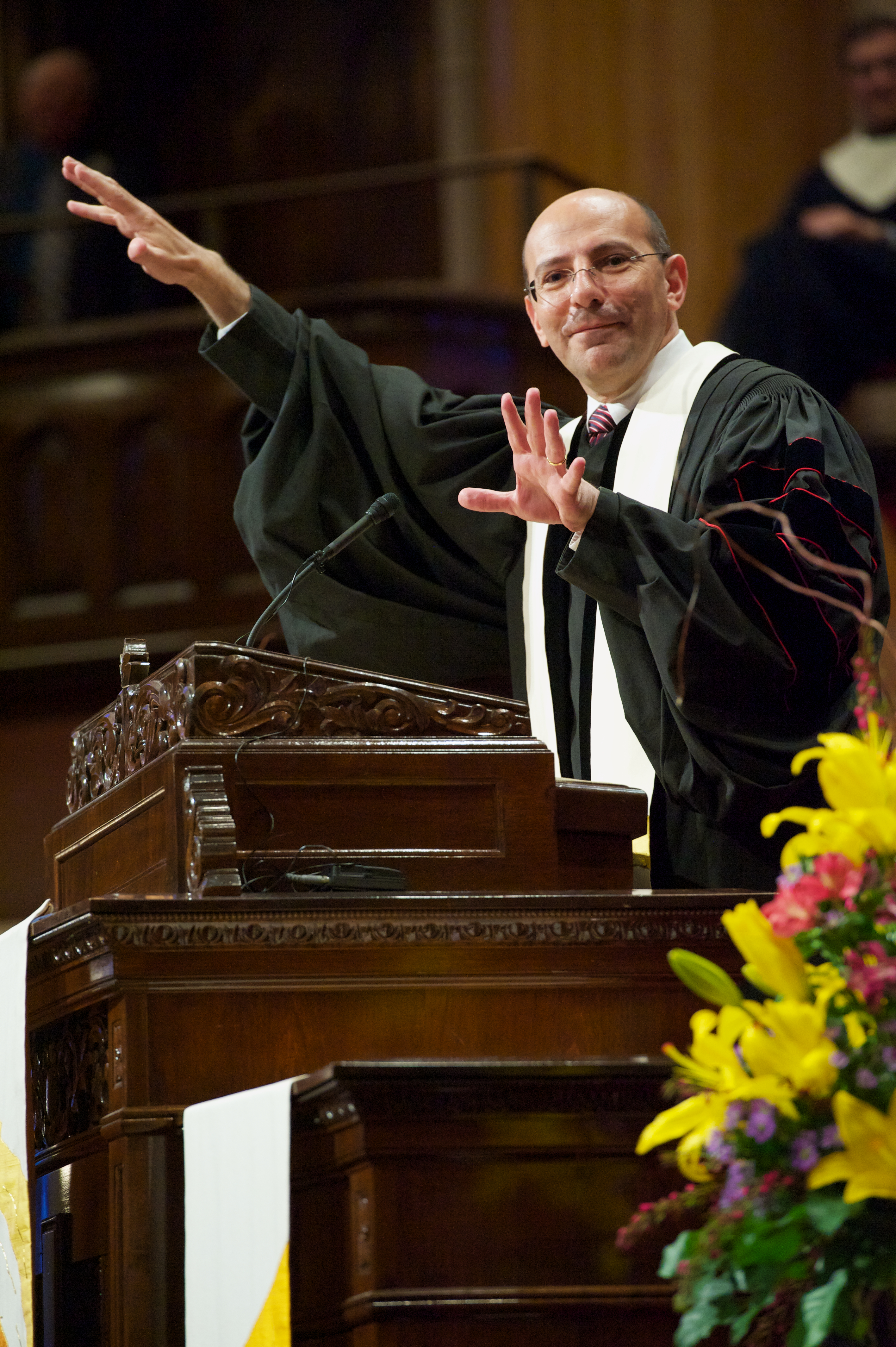
Rev. Raheb            (Northenscold photo)
Rev. Raheb delivered the sermon, “A Village Tour,” based on this passage from the Gospel of Mark (1: 35-39):
  • “In the morning, while it was still very dark, [Jesus] got up and went out to a deserted place, and there he prayed. And Simon and his companions hunted for him. When they found [Jesus], they said to him, ‘Everyone is searching for you.’ He answered, ‘Let us go on to the neighboring towns, so that I may proclaim the message there also; for that is what I came out to do.’ And he went throughout Galilee, proclaiming the message in their synagogues and casting out demons.”

This passage, Raheb said, was a short summary of Jesus’ political program. In the context of His having been born, raised and lived under Roman occupation and having been oppressed day and night, He was faced with the question, how can His people be liberated?

To answer this question, Raheb continued, Jesus chose not to go to Rome, the capitol of the occupying power, to demand that the people be liberated. Nor did He have any desire to be a king or religious leader or the founder of a political party. Jesus had a different concept of liberation. Instead He chose to go on a village tour to preach, teach and heal the people who were marginalized, who were not in control of their lives. Jesus told them that their liberation starts in the mind and in the heart and that they–the outsiders– were being called to be His ambassadors for the Kingdom of God. We are free!

The service was attended by a local Islamic imam and was live-streamed to the Internet and watched by members of Christmas Church in Bethlehem and by Christians in Europe. It is now archived and can be watched by anyone. It was the concluding event in Westminster’s Palestinian Arts Festival.

In my opinion, this worship service was one of the most meaningful in Westminster’s recent history. It fully integrated the mission of our global partnerships with our worship service. It emphasized that God speaks and acts in different ways, in different times and in different places. We in the United States do not have a monopoly on understanding God and Jesus. The Bible was not written in English in 21st century U.S.A. We can gain additional perspectives on God and Jesus from symbolically standing in the shoes of our brothers and sisters in different places and circumstances. Jesus lived and worked in an era of occupation.

“Christians of the Holy Land” on CBS-TV’s 60 Minutes

Roman Catholic Procession in Palestine


Rev. Dr. Mitri Raheb

As noted in a prior post, on April 22nd CBS-TV’s 60 Minutes aired the report “Christians of the Holy Land.” It reported that Christians have been leaving Palestine in large numbers for years and that its Christian population is now less than two percent. The program explored differing explanations for this decline.

Rev. Dr. Mitri Raheb, the Pastor of Evangelical Lutheran Christmas Church, said that Palestinian Christians, once a powerful minority, are becoming the invisible people, squeezed between a growing Muslim majority and burgeoning Israeli settlements. “If you see what’s happening in the West Bank, you will find that the West Bank is becoming more and more like a piece of Swiss cheese where Israel gets the cheese that is the land, the water resources, the archaeological sites. And the Palestinians are pushed in the holes behind the walls.”

The Israeli Ambassador to the U.S., Michael Oren, however, vigorously disagreed. He asserted that the Christians in Palestine were being persecuted by Islamic extremism and that the Israeli government did not bother to respond to a 2009 Christian document, Kairos, because it allegedly made inflammatory accusations that Israel had crimes historically associated with anti-Semitism.

Rev. Raheb and others rejected the Ambassador’s assertion that Islamic extremism was the basic cause of the Christian exodus. Raheb said he was a member of the Christian group that wrote and published Kairos: A Moment of truth: A word of faith, hope and love from the heart of Palestinian suffering. This document, he said, criticized Islamic extremism and advocated non-violent resistance to the Israeli occupation which they called a sin against God. This document was endorsed by the leaders of 13 Christian denominations, including Greek Orthodox, Roman Catholic, Lutheran and Anglican.

On May 6th Rev. Raheb will be preaching at the 10:30 a.m. (CDT) worship service at Minneapolis’ Westminster Presbyterian Church. This will be the concluding event in its Palestinian Arts Festival.

The Kairos Document

The 60 Minutes reference to the Kairos document calls for a more complete account of its contents. It is available on the web and opens with descriptions of what it calls “The reality on the ground: ” “Israeli occupation of Palestinian territories, deprivation of our freedom.” Here are the specifics of that accusation:

  • “1.1.1 The separation wall erected on Palestinian territory, a large part of which has been confiscated for this purpose, has turned our towns and villages into prisons, separating them from one another, making them dispersed and divided cantons. Gaza, especially after the cruel war Israel launched against it during December 2008 and January 2009, continues to live in inhuman conditions, under permanent blockade and cut off from the other Palestinian territories.”
  • “1.1.2 Israeli settlements ravage our land in the name of God and in the name of force, controlling our natural resources, including water and agricultural land, thus depriving hundreds of thousands of Palestinians, and constituting an obstacle to any political solution.”
  • “1.1.3 Reality is the daily humiliation to which we are subjected at the military checkpoints, as we make our way to jobs, schools or hospitals.”
  • “1.1.4 Reality is the separation between members of the same family, making family life impossible for thousands of Palestinians, especially where one of the spouses does not have an Israeli identity card.”
  • “1.1.5 Religious liberty is severely restricted; the freedom of access to the holy places is denied under the pretext of security. Jerusalem and its holy places are out of bounds for many Christians and Muslims from the West Bank and the Gaza strip. Even Jerusalemites face restrictions during the religious feasts. Some of our Arab clergy are regularly barred from entering Jerusalem.”
  • “1.1.6 Refugees are also part of our reality. Most of them are still living in camps under difficult circumstances. They have been waiting for their right of return, generation after generation. What will be their fate?”
  • “1.1.7 And the prisoners? The thousands of prisoners languishing in Israeli prisons are part of our reality. The Israelis move heaven and earth to gain the release of one prisoner, and those thousands of Palestinian prisoners, when will they have their freedom?”
  • “1.1.8 Jerusalem is the heart of our reality. It is, at the same time, symbol of peace and sign of conflict. While the separation wall divides Palestinian neighbourhoods, Jerusalem continues to be emptied of its Palestinian citizens, Christians and Muslims. Their identity cards are confiscated, which means the loss of their right to reside in Jerusalem. Their homes are demolished or expropriated. Jerusalem, city of reconciliation, has become a city of discrimination and exclusion, a source of struggle rather than peace.”
  • “1.2 Also part of this reality is the Israeli disregard of international law and international resolutions, as well as the paralysis of the Arab world and the international community in the face of this contempt. Human rights are violated and despite the various reports of local and international human rights’ organizations, the injustice continues.”

The Kairos document concludes with these appeals to the peoples of Palestine and beyond:

  • “8. Finally, we address an appeal to the religious and spiritual leaders, Jewish and Muslim, with whom we share the same vision that every human being is created by God and has been given equal dignity. Hence the obligation for each of us to defend the oppressed and the dignity God has bestowed on them. Let us together try to rise up above the political positions that have failed so far and continue to lead us on the path of failure and suffering.”
  • “9.1 This is a call to see the face of God in each one of God’s creatures and overcome the barriers of fear or race in order to establish a constructive dialogue and not remain within the cycle of never-ending manoeuvres [sic] that aim to keep the situation as it is. Our appeal is to reach a common vision, built on equality and sharing, not on superiority, negation of the other or aggression, using the pretext of fear and security. We say that love is possible and mutual trust is possible. Thus, peace is possible and definitive reconciliation also. Thus, justice and security will be attained for all.”
  • “9.3 Trying to make the state a religious state, Jewish or Islamic, suffocates the state, confines it within narrow limits, and transforms it into a state that practices discrimination and exclusion, preferring one citizen over another. We appeal to both religious Jews and Muslims: let the state be a state for all its citizens, with a vision constructed on respect for religion but also equality, justice, liberty and respect for pluralism and not on domination by a religion or a numerical majority.”
  • “9.4 To the leaders of Palestine we say that current divisions weaken all of us and cause more sufferings. Nothing can justify these divisions. For the good of the people, which must outweigh that of the political parties, an end must be put to division. We appeal to the international community to lend its support towards this union and to respect the will of the Palestinian people as expressed freely.”
  • “10. In the absence of all hope, we cry out our cry of hope. We believe in God, good and just. We believe that God’s goodness will finally triumph over the evil of hate and of death that still persist in our land. We will see here ‘a new land’ and ‘a new human being,’ capable of rising up in the spirit to love each one of his or her brothers and sisters.”

Palestinian Christian Leader To Appear on CBS-TV’s “60 Minutes” TODAY

Rev. Dr. Mitri Raheb
Westminster Presbyterian Church

Today (April 22nd), Rev. Dr. Mitri Raheb, the Pastor of Evangelical Lutheran Christmas Church in Bethlehem, Palestine, will appear on CBS-TV’s “60 Minutes” program.

Two weeks later (May 6th) Rev. Raheb will be preaching at the 10:30 a.m. (CDT) worship service at Minneapolis’ Westminster Presbyterian Church. This will be the concluding event in Westminster’s Palestinian Arts Festival.