Cuban Migration Developments  

In recent weeks there have been significant developments regarding Cubans leaving, and returning to, the island and possible changes to U.S. laws regarding Cubans coming to the U.S.

Cuban Migrants in Central America

  1. “Test Plan” for Transit of Cuban Migrants to U.S.

As reported in prior posts, about 8,000 Cuban migrants have been stranded in Costa Rica on their journeys to the U.S., but last December Mexico and certain Central American governments agreed on a “test plan” to transport the migrants via air and bus from Costa Rica through El Salvador, Guatemala, Honduras and Mexico to the U.S. border.[1]

On January 12 the initial group of 180 of these migrants started this journey, and on the next morning they had arrived in Ciudad Hidalgo on the Honduras-Mexico border, where they were granted 20-day transit visas. They were then put on their own to get to the Mexico-U.S. border. The first of them reached the Mexico-U.S. border at Laredo, Texas on the evening of January 14. And on January 18 a group of 30 arrived in Florida (Tampa, Sarasota, Fort Myers and Miami).[2]

In anticipation of the arrival of many of these Cubans in the Miami, Florida area, the mayors of Miami-Dade County in Florida have asked the federal government for funds to assist in welcoming many of those Cubans who are expected to come to their county.[3]

  1. Evaluation of “Test Plan[4]
Guatemala Meeting
Guatemala Meeting

On January 20 Guatemala hosted a meeting with representatives of Costa Rica, El Salvador, Honduras, Mexico, Panama, Belize and members of the International Organization for Migration to review the operation of the “test plan.” During the meeting an analysis of the operation was performed and each country presented their experience in the management of migration and visa issues as well as logistics and security. They concluded that the process was successful and that the passage of the Cuban migrants was made in a legal, orderly, safe and transparent manner. They also agreed to collaborate better and improve coordination needed for future transfers and to meet again on February 15 to review further progress.

  1. Future Transit of Cuban Migrants to the U.S.

The representatives at the January 20 meeting also concluded to resume the transit of Cubans in Costa Rica on February 4 with two weekly flights (February 9, 11, 16, 18, 23 and 25) from Costa Rica to El Salvador followed by their busing to the Honduras-Mexico border and thence on their own to the Mexico-U.S. border. Priority will be given to households with pregnant women or children, with earlier dates of entry into Costa Rica, the numbers on their Costa Rica visas and the financial resources to pay for the transit. In addition, Costa Rican officials will visit Cubans remaining in shelters to renew their visas.

Each Cuban will pay $555 for the charter flight, the bus and food arranged by a travel agency. Once in Mexico, the Cubans will receive a 20-day transit visa to make it on their own to the U.S. border. U.S. and Mexican officials hope is to hatch a similar plan for the 3,000 Cubans stranded in Panama.

 Cuban Migrants By Sea

On May 2, 1995, in response to a large increase in Cubans who were attempting to make the dangerous crossing of the Caribbean Sea to get to Florida, the U.S. and Cuba entered into an agreement whereby the two countries “reaffirm their common interest in preventing unsafe departures from Cuba. Effective immediately, Cuban migrants intercepted at sea by the [U.S.] and attempting to enter the [U.S.] will be taken to Cuba.”[5]

Since then, the U.S. has done just that. Such an agreement and practice, it was believed, would discourage other Cubans from attempting such dangerous journeys. This then became known as the “wet feet” part of the U.S. disjunctive dry feet/wet feet policy. Here are the statistics on such interdictions:[6]

Fiscal Year

(Oct.1-Sept. 30)

Number of

Interdictions

1995    525
1996    411
1997    421
1998    903
1999 1,619
2000 1,000
2001    777
2002 666
2003 1,555
2004 1,225
2005 2,712
2006 2,810
2007 2,868
2008 2,216
2009    799
2010    422
2011    985
2012 1,275
2013 1,357
2014 2,111
2015 2,924

So far in Fiscal 2016 (10/01/15-01/14/16), the U.S. Coast Guard estimates that 1,942 Cubans have been interdicted at sea or have attempted to land in the U.S. or have actually landed by sea. For the first half of January 2016 alone, a total of 396 Cuban migrants have been picked up in the waters between Florida and Cuba and returned to Cuba. The increases in Fiscal 2015 and so far in Fiscal 2016 are believed to have been caused by the December 2014 announcement of normalization between the two countries and Cubans’ concern that the U.S. might end its special immigration benefits for Cubans.[7]

In addition, the U.S. Coast Guard reports that more of the Cubans who have been interdicted and put on Coast Guard vessels are jumping overboard, trying to poison themselves or making self-inflicted wounds in attempts to be taken to U.S. shore. As a result the Guard has added security personnel on the vessels.

A Guard official recently said, “Immigration policies have not changed, and we urge people not to take to the ocean in unseaworthy vessels. It is illegal and extremely dangerous.”

Some Cubans Returning to Cuba[8]

Nick Miroff of the Washington Post reports there is a “growing number of Cubans who have opted to move back to the island in recent years as the Castro government eases its rigid immigration rules. The returnees are a smaller, quieter counter-current to the surge of Cubans leaving, and their arrival suggests a more dynamic future when their compatriots may come and go with greater ease, helping to rebuild Cuba with earnings from abroad.”

Indeed, Miroff says, these returnees or “repatriates are not coming back for socialism. They are coming back as capitalists. . . . [or as] trailblazing entrepreneurs. Prompted by President Raúl Castro’s limited opening to small business and his 2011 move allowing Cubans to buy and sell real estate, the repatriates are using money saved abroad to acquire property and open private restaurants, guesthouses, spas and retail shops.”

In 2012, Cuban immigration officials said they were processing about 1,000 repatriation applications each year. “The numbers appear to have increased since then, at least judging from anecdotal evidence and the proliferation of new small businesses in Havana run by returnees.”

“Many of the repatriates . . . are returning from Europe and Latin America. Cubans in the [U.S.] may be more reluctant to return to the island because of their relatively high incomes . . . [in the U.S. and because U.S.] economic sanctions also make it essentially illegal for any U.S. resident to go to Cuba and run a business. And the ability to buy property remains mostly restricted to Cubans who live on the island.”

Possible Changes in U.S. Immigration Laws Regarding Cubans

 As noted in previous posts, Cuba and now Central American countries have been vigorous opponents of the U.S. policy of allowing Cubans who arrive on land to come into the U.S. without visas, and the U.S. Administration repeatedly has said it has no intentions of changing that policy.

In the meantime, the only congressional bill to end the special treatment for Cubans arriving by land at the U.S. border that was offered by Representative Paul Gosar (Rep., AZ)—Ending Special National Origin-Based Immigration Programs for Cubans Act of 2015 (H.R.3818)– has gained little support beyond its nine cosponsors.[9]

Under another law, Cubans who have arrived in the U.S. by land are automatically eligible for federal public assistance under the Refugee Resettlement Program. On January 12, 2016, Senator Marco Rubio (Rep., FL), a candidate for the Republican presidential nomination, introduced a bill to end these automatic federal benefits.[10]

The bill, The Cuban Immigrant Work Opportunity Act of 2016 (S.2441), which has no cosponsors and which was referred to the Senate Finance Committee, would terminate the automatic eligibility for federal public assistance for Cuban nationals under the Refugee Resettlement Program, while maintaining it for those that have been persecuted that are in need of resettlement assistance.

Rubio said, ““It is outrageous whenever the American people’s generosity is exploited. It is particularly outrageous when individuals who claim to be fleeing repression in Cuba are welcomed and allowed to ‎collect federal assistance based on their plight, only to return often to the very place they claimed to be fleeing. The weaknesses in our current law not only allow the flow of American tax dollars into the Castro regime’s coffers, it also undermines the legitimate cause of those Cubans who are truly fleeing repression and political persecution.”

Rubio’s rationale for this bill would also justify the U.S.’ ending its previously mentioned “dry feet” immigration policy.

Yet another special U.S. immigration program for Cubans—the Cuban Medical Professional Parole Program—is under consideration for cancellation by the Obama Administration.[11]

====================================================

[1] Cubans in Central America Provide Cuba with an Opportunity to Reiterate Its Objections to U.S. Immigration Policies (Nov. 20, 2015); Update on Cuban Migrants in Central America (Nov. 27, 2015); Status of Cuban Migrants in Central America Still Unresolved (Dec. 11, 2015); Resolution of Problem of Cuban Migrants Stranded in Costa Rica (Dec. 30, 2015).

[2] Date set for the departure of first group of Cuban migrants from Costa Rica, Granma (Jan. 8, 2016); Robles, Cubans, Fearing Loss of Favored Status in U.S., Rush to Make an Arduous Journey, N.Y. Times (Jan. 9, 2016); Reuters, First Group of Stranded Cuban Migrants Leave Costa Rica, N.Y. Times (Jan. 13, 2016); Assoc. Press, Cubans Begin Pilot Transfer From Costa Rica to Mexico, N.Y. Times (Jan. 13, 2016); Assoc. Press, Stranded Cuban Migrants Brought by Air, Bus to Mexico, N.Y. Times (Jan. 13, 2016); Reuters, Mexico to Grant Transit Visas to Cuban Migrants, N.Y. Times (Jan. 13, 2016); Perez & Cordoba, Stranded Cuban migrants brought by air, bus to Mexico, Wash. Post (Jan. 13, 2016); First group of Cuban migrants arrive in Mexico, Granma (Jan. 13, 2016); Assoc. Press, Stranded Cuban Migrants Make Plans to Cross Mexico, N.Y. Times (Jan. 14, 2015); Assoc. Press, First of 8,000 Stranded Cuban Migrants Cross Into US, N.Y. Times (Jan. 15, 2016); Barbero, The first Cubans stranded in Central America come to Miami, El Pais (Jan. 19, 2016).

[3] Barbero, Miami seeks help from Obama before the arrival of Cubans, El Pais (Jan. 7, 2016),

[4]  Prensa Latina,Guatemala: Cuban Migrant Issue to be Tackled in regional Meeting, Esacambray (Jan. 20, 2016); Costa Rice Foreign Ministry, Next trip to Cuban migrants will be on February 4 (Jan. 20, 2016); Central American governments agreed to Cubans plan, Granma (Jan. 21, 2016).

[5] U.S.-Cuba Joint Statement on Migration, May 2, 1995, Dispatch Magazine.

[6] Focus on Cuba: Current Issues and Developments at 41 (2008); U.S. Coast Guard, Alien Migrant Interdiction (May 31, 2015)

[7] Clary, Number of Cubans intercepted at sea rises to highest level in two decades, SunSentinel (Nov. 4, 2015); Flechas, U.S. Coast Guard repatriates 169 Cuban migrants, Miami Herald (Jan. 14, 2016)  Rohrer, Post-Thaw, Cuban refugees surge in Florida, Orlando Sentinel (Jan. 19, 2016); Assoc. Press, Coast Guard: Migrants Fleeing Cuba Increasingly Violent, N.Y. Times (Jan. 20, 2016).

[8] Miroff, Amid a historic wave of emigration, some Cubans are returning home, Wash. Post (Jan. 1, 2015).

[9] Gosar, Press Release: Gosar Introduces Bill to End Wet Foot/Dry foot Policy & Stop Cuban Amnesty (Oct. 23, 2015)

[10] Rubio, Rubio Introduces Legislation To End Rampant Abuse of Cuban Refugee Resettlement Benefits (Jan. 12, 2016); Reuters, Republican Rubio Authors Senate Bill to Curb Cuban Immigration Benefits, N.Y. Times (Jan. 12, 2016)  A companion bill (H.R.4247) was introduced in December 2015 in the House by Representative Carlos Curbelo, a fellow Cuban-American Republican from Florida. It has 12 cosponsors and was referred to the House Judiciary Committee.

[11] U.S. Ending Its Cuban Medical Professional Parole Program? (Jan. 8, 2016).

The First Day of Pope Francis’ Mission to Cuba

On Saturday, September 19, at 15:52 (Cuban time; EST) Pope Francis’ airplane from Rome arrived at Havana’s airport. This post will cover the Pope’s flight to Cuba, the final hours of Cuba’s preparation and anticipation of his arrival; and his arrival.[1] Subsequent posts will cover each of the Pope’s other three days in Cuba and then each of his six days in the United States of America.

The Pope’s Flight to Cuba

At 04:15 (EST) the Pope’s plane left Rome with an entourage that included Cardinal Secretary of State Pietro Parolin and Vatican “Foreign Minister” Monsignor John Gallagher. From the plane the Pope issued many tweets. One of them said: “I ask you to join me in praying for my trip to Cuba and the United States.”

On the plane the Pope told journalists, “I love the Cuban people a great deal.” He also noted the need to extend a hand and open parish doors to immigrants.

Preparations in Havana

That morning U.N. Secretary General Ban Ki-moon issued a statement acknowledging, “The visit [next week] of His Holiness Pope Francis to the United Nations comes at a moment of challenge and hope. As the world struggles to cope with conflict, poverty and climate change, Pope Francis has been a leading voice for urgent action to protect people and our planet.” The Secretary General’s message also included the following words:

  • “I am deeply privileged to have had the opportunity to meet several times with His Holiness, who impressed me as a man of great humility and humanity. When we met last year at the Vatican in May, the Pope urged senior United Nations officials to ‘work together in promoting a true, worldwide ethical mobilization which, beyond all differences of religious or political convictions, will spread and put into practice a shared ideal of fraternity and solidarity, especially with regard to the poorest and those most excluded.’”
  • “Pope Francis has called on people everywhere to work towards realizing the new sustainable development goals ‘with generosity and courage.’ As I discussed with the Pope, this will require challenging all forms of injustice.”
  • “I fully concur with Pope Francis in his recent encyclical that climate change is a moral issue, in addition to its other dimensions, and one of the principal challenges facing humanity. His Holiness rightly cited the solid scientific consensus showing significant warming of the climate system, with most global warming in recent decades mainly a result of human activity.”
  • “Pope Francis and I wholeheartedly agree on the urgency for action, and the critical need to support the poorest and most vulnerable members of our human family from a crisis they did least to cause, but suffer from the most. Other faith groups have echoed this view, including most recently a gathering of eminent Islamic scholars and religious leaders.”
  • “Pope Francis’ message extends far beyond the world’s 1.2 billion Roman Catholics. On the first page of his recent encyclical, the Pope states that ‘faced as we are with global environmental deterioration, I wish to address every person living on this planet.’”
  • “Pope Francis has demonstrated the value of religious leaders engaging on these pressing global issues. I count on him and other faith leaders to counteract the prevailing forces of division and hate with dialogue and understanding. Together, we can realize our vision of a peaceful world where all people live in safety and dignity.”
Frei Betto
Frei Betto

Later that morning Frei Betto–a Brazilian Roman Catholic priest and the author of “Fidel and Religion: Castro Talks on Revolution and Religion with Frei Betto” (1988)–held a press conference at Havana’s Hotel Nacional. He noted that “only two Latin American countries have had the privilege of receiving, in a relatively short period of time (17 years), the visit of the last three Popes: Brazil and Cuba.” While 70% of Brazilians are Roman Catholic, Cuba has religious syncretism. With the reestablishment of diplomatic relations between the U.S. and Cuba, Frei said, the challenges point toward the need to change attitudes within the U.S. government. Francis is undertaking a revolution within the Catholic Church itself, which is why some see him as the leading statesman of our time and as a strong candidate for the Nobel Peace Prize. Indeed, added Frei, Francis preaches in favor of peaceful coexistence in the world, reaching out to the poor and boosting high-impact programs to eradicate hunger, poverty and environmental degradation. The Cuban Revolution has taught evangelical values, which are the same as human moral values and are not “additional” for revolutionaries or for the religious.

Welcoming Francis at Havana’s Airport

Pope Francis & President Castro

The Pope was met at the airplane by Cuban President Raul Castro accompanied by the Cuban Foreign Minister Bruno Rodriguez and Cuban Archbishop Jamie Lucas Cardinal Ortega. In a lengthy speech that recited many of the accomplishments of the Cuban Revolution and Cuba’s claims against the U.S., President Castro said his meeting with the Pope at the Vatican gave them the opportunity to exchange ideas about important world issues. We have followed your statements about these issues with much interest. We want future generations to inherit human dignity from us. The weight of the crisis falls on the third world and minorities do not escape from it. Your Holiness, we have thanked you for your support during the talks between the United States and Cuba. Now the Pope’s meetings with the Cuban people will be very important.

Francis responded by thanking the Cuban people for their welcome and expressing his fraternal greetings to Comandante en Jefe Fidel Castro. The Pope recalled that the 80th anniversary of Cuba and the Holy See’s uninterrupted relationship is being celebrated; that Popes John Paul II and Benedicto XVI had visited Cuba; and that this trip coincides with the centenary of the declaration of Cobre’s Our Lady of Charity as Cuba’s patron saint. Francis said that Cuba plays an extraordinary role in the meeting of the North and South, East and West. Its natural vocation is as a point of encounter. The process underway toward the reestablishment of relations between Cuba and the U.S. is an example of the effectiveness of a culture of exchange and dialogue.

The Pope then left for the Apostolic Nunciature in Havana where he stayed the night. On the journey there an estimated 100,000 Cubans were on the streets to welcome him, as shown in the photographs below.

Motorcase

f0008839

Vatican Spokesman’s Press Conference

Federico Lombardi
Federico Lombardi

The Vatican spokesman, Monsignor Federico Lombardi, then held a press conference at Hotel Nacional. He said that peace was the key word for this visit, that the Pope was greatly moved by the Cuban people’s warm welcome and enthusiasm; that the Pope had highlighted the importance of 80 years of uninterrupted ties between Cuba and the Vatican; and that the Pope will visit the Shrine of Our Lady of Charity of El Cobre as a son and pilgrim.

Lombardi also emphasized that the Catholic Church and the current and previous Popes are opposed to the U.S. blockade. The process of the reestablishment of diplomatic relations between Washington and Havana constituted a sign of hope to change the history of relations between the two countries. Peace, reconciliation and the building of bridges: clear messages from Pope Francis regarding the significance of his current apostolic visit to Cuba and the United States.

According to Lombardi, the Pope’s speech at the airport and his subsequent speeches are directed toward Cuban men and women, including Cubans throughout the world no matter where they reside. Many of them remember the historic words of the first Pope to visit Cuba, now a Saint, (John Paul II): “May Cuba with all its glorious possibilities open up to the world, and may the world open up to Cuba.”

Conclusion

The incredible major sources for this and subsequent posts about the Cuban mission are Granma, the official newspaper of the Communist Party of Cuba, and the Vatican.

The online edition of Granma at 06:03 a.m. (Cuban time) commenced a minute-by-minute reporting (with photographs) of the Pope’s plane’s earlier departure from Rome and of the preparations in Cuba. It also mentioned the Cuban government’s establishment of a Twitter account: #ElPapaEnCuba. Another article in Granma focused on the actual airport arrival.

While the coverage of the Pope’s first day in Cuba by the Cuban media was focused on the details of what actually happened, the New York Times’ lead article chose to concentrate on what it saw as the Pope’s “new challenge” of trying to “open up Cuba to the Roman Catholic Church.” Its first quotation was from the Rev. Jorge Cela, who oversaw the Jesuit religious order in Cuba from 2010 to 2012, who said, “It is an occasion to ask for more openness. The relationship is not easy.” Its second identified source was Rev. José Conrado, a Cuban priest in the central city of Trinidad, who said, “We could do more. The church should not back off, even if doing so is difficult and problematic for the church itself.” The balance of the Times’ article talked about criticism of Cuban Archbishop Ortega and the need to find his successor when he retires.

The Washington Post’s lead article at least covered the welcoming speeches at the Havana airport in addition to discussing issues about the Roman Catholic’s role in Cuba and whether they would be the subjects of the Pope’s public comments or private discussions with President Castro.


Reactions to Reopening of U.S. and Cuba Embassies and Other Issues Regarding U.S.-Cuba Normalization

As discussed in an earlier post, on the morning of July 20, 2015, Cuba officially opened its Embassy in Washington, D.C., and the United States did likewise in Havana although the ceremonial opening of the latter will be on August 14 when Secretary of State John Kerry goes to Havana to preside over that event. Another post, that afternoon’s joint press conference at the U.S. Department of State by U.S. Secretary of State John Kerry and Cuba’s Foreign Minister Bruno Rodriguez; yet another post, recent comments about Cuba by the White House Press Secretary.

Now we look at the reactions to the significant issues raised by these events: (1) restoration of diplomatic relations; (2) future changes in Cuba; (3) future changes in Cuban human rights; (4) ending the U.S. embargo (or blockade) of Cuba; (5) altering or terminating Cuba’s lease of Guantanamo Bay to the U.S.; (6) ending U.S. Radio and TV Marti; (7) ending USAID and other covert U.S. “democracy” programs in Cuba; (8) Cuba’s returning U.S. fugitives; and (9) nominating and confirming the appointment of an U.S. ambassador to Cuba.

1. Restoration of U.S.-Cuba Diplomatic Relations?

There has been substantial U.S. approval of the restoration of diplomatic relations.

According to the Center for Democracy in the Americas (CDA), for instance, 12 public opinion polls conducted and released since January 1 show that “public support for the Cuba opening is strong, growing, and pervasive. Support for the new policy is bipartisan. It is significantly high among segments of voters — such as Hispanics — that candidates running for office increasingly care about. Most of all, the latest research shows that public support is rising. For example, support for ending the embargo was measured in July by the Chicago Council on Global Affairs at 67%, and earlier this year by Gallup at 59% and by the Associated Press at 60%.”[1]

Moreover, CDA sees “evidence that public support for America’s new Cuba policy is exerting its force on policymakers in the U.S. Congress.” It points to last week’s action of the Senate Appropriations Committee’s approving amendments eliminating House measures that would impede normalization in various ways[2] and to Republican legislators—Senator Dean Heller (NV) and Representative Bradley Byrne (AL)–who recently joined the ranks of supporters of normalization.

Despite the vigorous opposition to normalization repeatedly expressed by Cuban-Americans in Congress—Senators Marco Rubio (Rep., FL) and Robert Menendez (Dem., NJ) and Representatives Ileana Ros-Lehtinen (Rep., FL) and Mario Diaz-Balart (Rep., FL) [3]—there has been little organized opposition to normalization in the Cuban-American community, especially in Florida.[4]

This assessment has been confirmed by prominent Cubans in the U.S. and on the island. Pedro Freyre, a Cuban-born Miami lawyer with a national law firm representing several U.S. and foreign clients seeking to do business in Cuba and a former hardliner himself, said, “It’s over and done in Miami. It died with a whimper.” Indeed, he added that President Obama’s new policy was now widely accepted by South Florida’s 1.5 million Cuban exiles. Similar views were expressed in the Miami Herald by Mike Fernandez, a healthcare millionaire and Bush supporter, who said, “Cuban-Americans everywhere, but especially the diaspora in South Florida, have been awakening to the reality that Cuba’s isolation was and is not a sustainable strategy. It’s time to accept change. Let us not heed those relatively few voices who would go on continuing to trap our minds in hatred.” Carlos Alzugaray Treto, a former Cuban diplomat who is close to President Raúl Castro and his brother Fidel, put it best. He said, “The genie is out of the bottle. And once it’s out, you’re not going to be able to put it back in.”

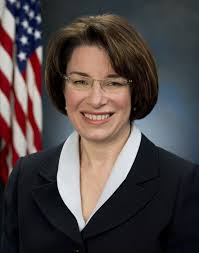
Senator Amy Klobuchar (Dem., MN), who is the author of a bipartisan bill to lift the embargo, said this must be done for the U.S. to avoid losing investment opportunities that will come with loosening of travel restrictions to the island. She said, “Once millions of American tourists are going, they will need places to stay and they will need food to eat. … So when they come, they are going to be starting to sleep in Spanish hotels and eat German foods because those countries will be able to supply what they need in the tourism industry, not to mention the computers and Wi-Fi and everything else.”[5]

James Williams, the President of Engage Cuba, a major bipartisan group promoting this normalization, issued a statement on the reopening of embassies. He said, “we begin a new chapter of engagement between our two countries. American diplomats will now be much better equipped to engage with the Cuban people and civil society. They will be in a stronger position to elevate issues of concern, like human rights, as well as expanding on areas of cooperation with Cuba.” He pointed out that the “vast majority of the American people, and 97% of the Cuban people support opening relations. We applaud both governments for taking this important step to move forward beyond the Cold War policies of the past and call on Congress to play a constructive role at this historic moment of transition.”[6]

John Dinges, Associate Professor at Columbia University’s School of Journalism and an expert on U.S.-Cuba relations, said for the U.S. “the new relationship with Cuba removed a stumbling block in relations with the entire region, where the US attitude [was] considered irrational and stupid.”[7]

However, others argue that this change is misguided and erroneous. For example, Edward Gonzalez, professor emeritus of political science at U.C.L.A., stated that “in the face of potentially destabilizing change and high expectations at home, Cuban officials are tightening state controls in the short term.” Moreover, “given the regime’s totalitarian proclivity and apparatus, the state’s repression of dissidents and civil society, and its control over the lion’s share of the island’s economy, it is likely to continue into the distant future.” Therefore, he continues, the new U.S. engagement with Cuba “makes the [U.S.] complicit in propping up the regime both economically and politically, while leaving Cuban society even more isolated and defenseless vis-à-vis the all-powerful, coercive state.”[8]

Moreover, Senator Marco Rubio and former Florida Governor Jeb Bush, currently two of the many contenders for the Republican nomination for president in 2016, have said that if elected president in 2016, they would rescind the diplomatic relations. And Senator Tom Cotton (Rep., AK) has pledged to “work to maintain and increase sanctions on the regime, block the confirmation of a new ambassador, demand the extradition of U.S. fugitives from justice, and hold the Castro regime accountable.”[9]

Secretary of State John Kerry in his July 20 interviews,[10] responded to these threats to rescind the relations with Cuba. Kerry said that whoever is elected president in 2016, including Marco Rubio, will have “the ability to make a decision [on whether or not to rescind the re-establishment of diplomatic relations with Cuba]. Congress, obviously, has an ability to have an impact on that.” [11] But I think it would be a terrible mistake [to rescind such diplomatic relations]. The vast majority of the American people believe this is a very good thing to do. It doesn’t make sense. I mean, we had diplomatic relations with the Soviet Union. We had diplomatic relations with then-called Red China. We have to have relationships with countries to do business. And American citizens get hurt when we don’t do that.” Moreover, Kerry added, “I believe . . . President [Obama] has taken an irreversible step. I do not believe a next president, Republican or Democrat, will change it.”

Kerry continued, “Given the fact there are so many Cuban Americans, people who have family in Cuba, to not have a relationship where we can advocate for people, advocate for human rights, advocate for fairness, for elections, for democracy, for travel, for engagement, and all these things that make a difference in the quality of life of Cubans would be a terrible, terrible mistake. So I think, as time goes on, people will see the benefits that come from this policy.”

2. Future Changes in Cuba?

As Foreign Minister Rodriguez’s July 20 statement and Secretary Kerry’s statements made clear and as both governments previously had recognized, the opening of the embassies did not mean the process of normalization had been completed. Indeed, it has just started.

Secretary Kerry, in his interviews, observed, There are “key issues in the normalization process, and . . . [Minster Rodriguez and I] both said today that it will be long and complex. . . . [T]he measure of progress and success is really going to come from what happens in the next months as we go through this early diplomatic rekindling of a relationship. My suspicion is that there’s a possibility it could move faster than people think, simply because I think the Cuban people want it. And as we are there doing diplomacy, more present, able to engage, we actually can work at these kinds of issues more effectively than we’ve been able to for the last 50, 60 years.”

Kerry added that if Cuba is “willing to embrace it, we can bring them a tremendous leap in their economy. We could bring a better standard of living to their people. We can bring technology. We can bring various modern instruments of education, of health delivery, of communications. And I believe that over time things will change . . . at a pace that will be acceptable and, frankly, helpful to Cuba.” Kerry also said, the U.S. wants to see “a true, deep engagement [by Cuba], a willingness to work through these issues. There’s so much that we can cooperate on right now. We want to cooperate on law enforcement, . . . the environment, . . . our visas, . . . health, education, the rights of people, . . . hemispheric issues and interests like the war in Colombia or the relationship with Venezuela.”

Although not in direct response to the reopening of the embassies, Cuba’s President Raúl Castro in his July 15 speech to Cuba’s legislature (the National Assembly of People’s Power)[12] asserted, “We will continue the process of transformations in Cuban society at our own pace, which we have sovereignly chosen, with the majority support of the people, in the interest of constructing a prosperous and sustainable socialism, the essential guarantee of our independence.” (Emphases added.) He reiterated this theme near the end of his speech with these words: “Changing everything which must be changed is the sovereign and exclusive domain of Cubans. The Revolutionary Government is willing to advance in the normalization of relations, convinced that both countries can cooperate and coexist in a civilized manner, to our mutual benefit, beyond the differences we have and will have, thus contributing to peace, security, stability, development and equity in our continent and the world.” (Emphases added.)

A New York Times editorial said, “The full normalization of relations between the United States and Cuba will take years and will be an arduous process. Issues that will be hard to resolve include the disposition of American property the Cuban government seized in the 1960s, and the fate of the United States Navy base in Guantánamo Bay, which the Cuban government considers an illegally occupied territory.”[13]

Professor Dinges offered a similar assessment of the future. He said, “’normal’ relations are not compatible with the [U.S.] travel ban, with [the U.S.] economic embargo, with a recent history of semi-clandestine operations by the [USAID] to promote economic and social discontent. I hope to see in the near future gestures of friendship and rapprochement. For the [U.S.], it is important to dismantle the Guantanamo prison, and the minimization of military forces at the base. On behalf of Cuba, a gesture of detente toward the Miami Cubans would not cost anything and could have huge benefits. . . . There is distrust, there is a long history of [U.S.] aggression [against Cuba]. . . . [He believes future] “changes will be economically, technically, diplomatically. It would be illusory to expect radical changes in political structures in Cuba. Equally unrealistic to think that the US will stop talking about democracy and human rights.”

3. Future Changes in Cuban Human Rights?

Probably the leading U.S. desire for future changes in Cuba is with respect to human rights. For example, in one of his July 20 interviews, Kerry said Cuba does not “want [domestic] interference, but they know we’re not going to stop raising human rights issues. We made that very clear. . . . [W]e’re not giving up the DNA of the [U.S.], which is a deep commitment to human rights, to the values of democracy, freedom of speech, and so forth. So those . . . will be on the agenda. But on the other hand, the great step forward here is that neither of us . . . [is] taking one of our issues of contention and making it a showstopper. We want to engage, and when you get to that point, that’s what begins to break down the barriers.”

Kerry also told Andrea Mitchell, “There’s been a little bit of give . . . [by Cuba] with respect to some agreement on human rights. And I think that over time the elections discussion and the more pointed human rights issues are going to be very much part of the discussion. They are in every country where we have an embassy and an ambassador. We are fearless in our determination to walk in and talk to the authorities and give them a shared our sense of the problems that exist.”

According to the non-governmental Cuban Commission for Human Rights and National Reconciliation, there were 2,822 politically related detentions in the first six months of 2015, less than half the 5,904 registered in the same period last year. Many of those detained this year, however, report being treated more roughly, however.[14]

The previous source also reports, “more than 20 U.S. lawmakers have come to Cuba since February without meeting with opposition groups that once were an obligatory stop for congressional delegations.” This was apparently due to “Cuban officials . . . [having] made clear that if Congress members meet with dissidents, they will not get access to high-ranking officials such as First Vice President Miguel Diaz-Canel, the man expected to be the next president of Cuba” and to U.S. assessment that “talking with Cuban leaders is clearly the most promising way to promote reform on the island.”

On the issue of Cuban human rights, I submit that there is an enormous cognitive dissonance in the minds of U.S. opponents of normalization. Here are the reasons for that conclusion:

  • First, any objective student of history has to conclude that the U.S., especially since the start of the Cuban Revolution in 1959, has committed and threatened serious acts of hostility towards Cuba, including the embargo, the 1961 U.S.-supported invasion of Cuba’s Bay of Pigs, the 1962 threatened bombing of Cuba during the Cuban Missile Crisis, the embargo of the island and CIA attempts to assassinate Cuban President Fidel Castro. Moreover, U.S. hostility toward Cuba started at least in 1898 when it intervened in Cuba’s war of independence from Spain. Indeed, Foreign Minister Rodriguez’ July 20 speech referred to the late 19th century warning by José Marti of the U.S. “excessive craving for domination [over Cuba].”
  • Second, Cuba, therefore, has good reason to be fearful of the much larger and more powerful U.S. and as a result to take steps to protect itself against such perceived threats by restricting dissent. What would you do if you were in the Cubans’ shoes? It, therefore, will take time for Cuba to develop a sense of trust of the U.S. and as a result modify its restrictions on free speech and assembly.
  • Third, the self-proclaimed advocates of Cuban human rights like Rubio and Jeb Bush do not appear to be aware of the first two points. In addition, they apparently do not appreciate that their very hostility towards Cuba and normalization, purportedly on the ground of promoting Cuban human rights, instead contributes to Cuban skepticism about the good intentions of the U.S. and to the prolonging of Cuba’s restrictions on free speech and other civil liberties.

4. Ending the U.S. Embargo of Cuba?

Ending the embargo or blockade, of course, is a key demand by Cuba, and President Obama has asked the Congress to do just that. As discussed in previous posts, various bills to end the embargo have been introduced in this Session of the Congress, and supporters of normalization or reconciliation of the two countries, like this blogger, urge the Congress to approve such bills as soon as possible.

Such congressional action is in the U.S. national interest because the embargo has failed for over 50 years to produce positive change in Cuba, the embargo clearly has harmed or damaged the island’s economy, and Cuba has insisted on its removal as a key requirement for full normalization of relations.

In addition, there are at least two additional reasons for ending the embargo that this blogger has not seen mentioned in all the public discussion of this issue.

  • First, last October at the U.N. General Assembly Cuba alleged that the damage to Cuba from the embargo or blockade totaled $1.1 trillion, and the longer the embargo remains in effect that number will only increase. For a U.S. business this would require at least a footnote to its balance sheet identifying this as a contingent liability and explaining whatever reasons the business has for challenging the claim or the alleged amount of the claim. The rational action for such a business would be to terminate the conduct allegedly causing the damage, especially when it is not producing some benefit to the business.
  • Second, because of the U.S.-Cuba rapprochement of last December, other countries, especially the European Union and its members, are accelerating their efforts to obtain beneficial trade arrangements with Cuba. In short, the longer the U.S. waits to end the embargo, the further behind the U.S. will be with respect to competitors from around the world seeking to do business with Cuba.

Wake up, Congress!

5. Altering or Terminating the Cuba-U.S. Lease of Guantanamo Bay?

As previously noted, Foreign Minister Rodriguez at the July 20 reopening of the Cuban Embassy and at the subsequent joint press conference with Secretary Kerry reiterated Cuba’s request or desire to have its lease of Guantanamo Bay to the U.S. terminated and the territory returned to Cuba. Although the Foreign Minister did not set forth any alleged legal basis for this claim, he did mention that the 1906 lease occurred during a period of U.S. military occupation of the island that “led to the usurpation of [this] piece of Cuban territory”and thereby suggested that the lease was unfairly or coercively obtained.

Interestingly Rodriguez did not mention a previous legal theory advanced by the Fidel Castro regime: that the lease purportedly runs in perpetuity and, therefore, is illegal under Cuban law. Nor did Rodriguez mention another theory for ending the lease: the U.S. operation of a prison/detention facility at Guantanamo that allegedly is not permitted by the lease and, therefore, the U.S. has breached the lease.[15]

At that same joint press conference, Secretary Kerry immediately rejected U.S. willingness to return Guantanamo to Cuba. However, there were caveats in his comment: he said, At this time, there is no discussion and no intention on our part at this moment to alter the existing lease“ and “I can’t tell you what the future will bring but for the moment that is not part of the discussion on our side.” (Emphasis added.) This was reiterated, with similar qualifications, on July 22 by National Security Advisor Susan Rice at a White House press conference.[16] She said, “We’ve been clear that we’re not, at this stage, at all interested in changing the nature of our understanding and arrangements on Guantanamo.  And they may choose to raise it, but we’ve been equally clear that, for us, that’s not in the offing at the present.” (Emphasis added.) Do these caveats indicate an U.S. willingness in the future to discuss altering or even terminating the lease? I could understand a lease amendment increasing the amount of the rent and perhaps making administrative changes, but would be surprised if the U.S. would be willing to discuss termination of the lease and returning Guantanamo to Cuba.[17]

Although Cuba has not mentioned the U.S. operation of a detention facility at Guantanamo and the alleged U.S. torture of some of the detainees as a reason for Cuba’s desire to have the territory returned, it should be noted that President Obama has been trying to close that facility since the start of his first term.

On July 22, White House Press Secretary Josh Earnest confirmed “that the administration is, in fact, in the final stages of drafting a plan to safely and responsibly close the prison at Guantanamo Bay and to present that plan to Congress. That has been something that our national security officials have been working on for quite some time, primarily because it is a priority of the President.  He believes it’s in our clear national security interest for us to close the prison at Guantanamo Bay.” Earnest also said the President has decided to veto a defense spending bill now being negotiated in Congress if it includes provisions that would make it harder to close the prison.[18]

A few more details about the plan to close the detention facility were offered on July 25 by Lisa Monaco, one of Obama’s top national security aides, who said that such a plan was nearing completion. It will call for the U.S. to step up the transfers of 52 detainees cleared for resettlement in other countries and for the transfer to U.S. “Supermax” or military prisons for trials or continued military detention of at least some of the other 64 detainees still at Guantanamo who are deemed too dangerous to release. Efforts will be made to reduce the size of the latter group through “periodic review boards” that have been used to clear others for transfer.[19]

6. Ending U.S. Radio and TV Marti?

Another Cuban request is for the U.S. to stop its radio and TV broadcasts aimed at Cuba (Radio and TV Marti), again mentioned on July 20 by Minister Rodriguez. On July 22 National Security Advisor Rice stated, apparently in response to this request, the U.S. ”will continue to say and do what we think is appropriate to advance our interests in human rights and democracy in Cuba. . . . we’re not going to change just because the Cuban government may wish that we did.”

7. Ending USAID and Other Covert U.S. “Democracy” Programs in Cuba?

Prior posts have discussed recent “discreet” or covert programs in Cuba operated by the U.S. Agency for International Development (USAID) through private contractors purportedly to promote democracy in Cuba and the latter’s objections to same. Rodriguez in his July 20 speech did not specifically mention such programs, but did so indirectly by objecting to the U.S. seeking “obsolete and unjust goals” (i.e., regime change) by “a mere change in the methods.”

These prior posts have expressed this blogger’s objections to such USAID programs. The New York Times has done the same.

8. Cuba Returning U.S. Fugitives?

Although not specifically mentioned last week by Secretary Kerry or Minister Rodriguez, the issue of Cuba’s returning U.S. fugitives remains a top priority for many in Congress and in the U.S. generally. On July 24 Representative Jerry McNerney (Dem., CA) raised the issue with respect to Charles Hill, who is the sole surviving member of a group who hijacked an airliner in 1971; Hill and two others were fleeing charges relating to the killing of a New Mexico state trooper. McNerney, who was on that hijacked airliner, wants Hill to be returned to the U.S.[20]

9. Nominating and Confirming U.S. Ambassador to Cuba?

With respect to congressional threats to not provide funds for the U.S. embassy in Cuba and to not confirm an ambassador to that country, Kerry observed, “it always matters when Congress is sort of stepping in the way of something being able to . . . be fully effected. . . . [W]hy are they going to do that? Are they going to do that because the [old] policy [purportedly] has been so successful? Are they going to do that because they can show so much change that’s taken place in the last 60 years that this is a crazy path? . . . [It] just doesn’t make sense to prevent our diplomats from carrying the message . . . [of human rights and democracy]. To not be able to meet with more people in Cuba to know what is going on is a huge cutoff of opportunity. So I just think it’s cutting off your nose to spite your face and it’s a shame.”

Kerry also said, “Well, it depends on whom, obviously, the next president is, and we don’t know that now. So you can’t bet on it that way. You have to do what you think is right. You have to do what’s appropriate and make the difference. Nobody can guard against every eventuality of the future. But I believe the President has taken an irreversible step. I do not believe a next president, Republican or Democrat, will change it.”

Conclusion

The time has come for all U.S. citizens to support full normalization of our relations with Cuba!

=======================================================

[1] Center for Democracy in Americas, Flag Poles to Public Opinion Polls—Is Congress (Finally) Getting the Message (July 24, 2015)

[2] The Senate Committee on July 23 voted, 18 to 12, to lift the “decades-long ban on travel to Cuba . . . . to block enforcement of a law prohibiting banks and other U.S. businesses from financing sales of U.S. agricultural exports to Cuba. . . . [and] to lift restrictions on vessels that have shipped goods to Cuba from returning to the U.S. until six months have passed.” A journalist asserted, “The panel’s votes reflect growing sentiment, even among some GOP conservatives, to ease the five-decade-plus Cuba trade embargo and travel restrictions to the island, which have failed to move the Castro regime toward democracy.” (Assoc. Press, GOP-Controlled Senate Panel Votes to Life Cuba Travel Ban, N.Y. Times (July 24, 2015); Davis, Senate Panel Takes Small Step Toward Easing Travel Restrictions with Cuba, N.Y. Times (July 23, 2015); Shabad, GOP-led Senate panel votes to lift travel ban to Cuba, The Hill (July 23, 2015).) This move in the Senate Appropriations Committee is part of a Democratic Senators’ strategy of attacking House riders in appropriation bills that imperil U.S.-Cuba reconciliation. (Shabad, Dems show their hand in budget poker, The Hill (July 26, 2015),)

[3] Menendez, Menendez Statement on Cuban Embassy Opening (July 20, 2015;    Ros-Lehtinen, Opening of Cuban Embassy in Washington, D.C. Harms Our National Security, Says Ros-Lehtinen (July 20, 2015); Diaz-Balart, Embassy in Washington, D.C. Will Represent the Castros, Not the Cuban People (July 20, 2015).

[4] Reuters, Cuban-American Resistance to Diplomatic Thaw Proves Tepid, N.Y.Times (July 21, 2015); Assoc. Press, Poll: Majority of Americans Favor Diplomatic Ties With Cuba, N.Y. Times (July 21, 2015); Reuters Video, Cubans enthusiastic about reopening of U.S. embassy in Havana, N.Y. Times (July 21, 2015).

[5] Klobuchar, News Release: Klobuchar: Opening of Cuban Embassy Marks Next Chapter in Relationship (July 20, 2015).

[6] Engage Cuba, Statement from Engage Cuba on Official Opening of U.S. and Cuba Embassies (July 20, 2015).

[7] Elizalde, John Dinges on Cuba-US relations: ‘I’m optimistic,’ CubaDebate (July 23, 2015)

[8] Gonzalez, Letter to Editor: Effects of Our Cuba Policy, N.Y. Times (July 24, 2015)

[9] Carney, GOPer doubles down on pledge to block Obama on Cuba, The Hill (July 20, 2015).

[10] Dep’t of State, [John Kerry] Interview with Steve Inskeep of National Public Radio (July 20, 2015); Dep’t of State, [John Kerry] Interview with Andrea Mitchell of NBC News (July 20, 2015).

[11] This blogger disagrees with Kerry’s saying Congress had a role in deciding to recognize a foreign government; such a congressional role appears to be unconstitutional in light of a recent U.S. Supreme Court decision that the president has the exclusive constitutional authority to recognize foreign governments.

[12] Speech presented by Army General Raúl Castro Ruz: ‘We will continue the process of transformations in Cuban society at our own pace, CubaDebate (July 15, 2015.

[13] Editorial, Formal Restoration of Diplomatic Ties with Cuba Is Just a Beginning, N.Y. Times (July 20, 2015).  The Washington Post, on the other hand, continued its opposition to normalization with Cuba with an editorial that focused on the human rights problems in Cuba and urging our diplomats to concentrate on those issues. (Editorial, U.S. diplomats in Cuba would do well to focus on human rights, Wash. Post (July 20, 2015).) As Secretary Kerry emphasized in his remarks, the U.S. continues to concentrate on those issues.

[14] Assoc. Press, Cuban Dissidents Feel Sidelined as Focuses on State Ties, N.Y. Times (July 23, 2015).

[15] A prior post suggested that Cuba’s best argument for terminating the lease was the U.S. operation of the prison/detention facility. However, Dr. Michael Strauss, an expert on this lease, asserts that at least in 2002 Cuba offered to facilitate U.S. transportation of detainees to Guantanamo; such conduct should weaken, if not demolish, such an argument for Cuba. (Strauss, Cuba and State Responsibility for Human Rights at Guantanamo Bay, 37 So. Ill. Univ. L.J. 533, 546 (2013).)

[16] White House, Press Briefing by Press Secretary Josh Earnest, 7/22/15.

[17] A prior post discussed these issues about the Guantanamo lease and recommended that the parties submit any unresolved disputes about the lease to the Permanent Court of Arbitration at the Hague in the Netherlands.

[18] Assoc. Press, White House Finishing Up Latest Plan for Closing Guantanamo, N.Y. Times (July 22, 2015) Guantanamo, N.Y. Times (July 22, 2015).

[19] Reuters, Some Guantanamo Inmates Would Go to U.S. Under New Plan: Obama Aide, N.Y. Times (July 26, 2015)

[20] Hattem, House Dem demands fugitives in Cuba be returned to the U.S., The Hill (July 24, 2015). A prior post explored the issues regarding extradition under a U.S.-Cuba treaty on the subject and recommended submitting any unresolved disputes about extradition to the Permanent Court of Arbitration at the Hague.

Seventh Summit of the Americas Is Underway in Panama

Summit logoThe Seventh Summit of the Americas will take place in Panama City, Panama on April 10 and 11. Such Summits are institutionalized gatherings of heads of state and government of the member states of the Western Hemisphere where leaders discuss common policy issues, affirm shared values and commit to concerted actions at the national and regional level to address continuing and new challenges faced by countries in the Americas. [1]

In the meantime, preliminary Summit events are underway while planning for the meetings of heads of state and government are nearly complete.

This post will review the plans for this Summit by the organizers and then discuss Summit developments involving the U.S., Cuba and Venezuela. [2]

 The Summit Organizers’ Plan

The Summit’s central theme is “Prosperity with Equity: The Challenge of Cooperation in the Americas” with several sub-themes, including education, health, energy, environment, migration, security, citizen participation and democratic governance. These issues will be discussed by 35 heads of state and government. In addition to these officials, the Vatican Secretary of State, Cardinal Pietro Parolin, will attend.

The priority of the organizers in Panama is to work on a comprehensive document titled “Mandates for Action”, which will contain agreements from all countries involved on topics related to health, education, security, migration, environment, energy, democratic governance and citizen participation.

The Summit’s main events will take place in the ATLAPA Convention Center in central Panama City as shown in the photograph below.

PanamaCtr

The Summit also will host the four following forums:

  • Civil Society Forum will seek to promote governments’ consultation and coordination, dialogue and exchange with civil society. It also will offer input and recommendations for the consideration of the participating States.
  • The Youth Forum will provide young entrepreneurs an opportunity to offer their recommendations to the participating States.
  • The Business Forum will explore the trade and investment opportunities and public-private sector cooperation.
  • The University Presidents’ Forum will focus on academic mobility, the role of innovation and technology in enhancing research skills and college education for the region; and the importance of scholarly research on entrepreneurship and sustainable economic development.

 U.S. Plans for the Summit

 A prior post reviewed some of the U.S preparations for the Summit. In addition, the U.S. Department of State asserts that this Summit “is an historic opportunity to deepen partnerships, collaborate on shared challenges, and make tangible commitments to securing a brighter future for all of the people of the Americas. . . . The [U.S.] is working closely with partners throughout the Americas to ensure the 2015 Summit upholds our common commitment to inclusive economic development, democracy, and human rights, while providing robust engagement among government leaders, civil society groups, and regional business communities.”

The U.S. especially has been calling for the participation of Cuban civil society in the Summit. Indeed, in his December 17th announcement of the rapprochement with Cuba, President Obama said, “we are prepared to have Cuba join the other nations of the hemisphere at the Summit. . . . But we will insist that civil society join us so that citizens, not just leaders, are shaping our future.”

Interestingly I have not seen any news or information about the U.S. inviting U.S. civil society, youth, business or university presidents to participate in the Summit.

The U.S. was hoping that by the time of the Summit, the U.S. and Cuba would have re-established normal diplomatic relations and that this would be an occasion for the two countries to enjoy receiving congratulations from the other countries in the Americas.

The resumption of normal relations, however, has not yet happened, and now there are many countries demonstrably upset over President Obama’s executive order of March 9th imposing sanctions on seven Venezuelans. This week at Venezuela’s invitation, a senior Department of State official went to Venezuela to meet with the country’s foreign minister.

The Washington Post this week published an editorial criticizing the U.S. opening to Cuba. It said there have been no benefits to the U.S. to date while Cuba has gained. President Castro will attend the Summit. Soon the U.S. probably will rescind its designation of Cuba as a “State Sponsor of Terrorism” in disregard of Cuba’s alleged “continued support for Colombia’s terrorist groups, its illegal arms trading with North Korea and the sanctuary it provides American criminal JoAnne Chesimard.” In addition, says the editorial, Cuba is joining Venezuela in unjustifiably attacking the U.S. over President Obama’s executive order imposing sanctions on seven Venezuelans.

Cuba’s Plans for the Summit

According to the Cuban press, the country has been preparing for full participation in the Summit. The Cuban Minister of Foreign Trade and Foreign Investment, Rodrigo Malmierca, emphasized that over 100 representatives of Cuban civil society, including youth, academics, intellectuals, entrepreneurs and coop leaders would be going to the Summit. They will show the possibilities that Cuba provides for the development of international economic relations from the adoption of Law 118 Foreign Investment and Development Special Zone Mariel (ZEDM).

On Tuesday pro-government representatives of Cuban civil society in Panama issued a statement denouncing the presence at the Summit of other Cubans who allegedly were “mercenaries paid by the historic enemies of our nation,” i.e., the U.S. Such Cubans, the pro-government representatives said, “make up a tiny ‘opposition’ manufactured from abroad, lacking any legitimacy or decorum. Several of its members are publicly linked to recognized terrorists who have caused infinite pain to the Cuban people.”

The statement asserted, “It is offensive that such people, who have made betraying the homeland a well-paid profession and shamefully usurp the name of the country that they slander and offend day after day, are participating in these forums. For the dignified and sovereign Cuba that has withstood more than five decades of blockade and harassment, for the overwhelming majority of Cubans, for us, we who have come to Panama with modesty and a spirit of cooperation to share experiences of our social development, it is unacceptable that there are people of such low moral character here.”

The next day, Wednesday, during one of the forums, about 100 supporters of Cuba’s government heckled Cuban dissidents by calling them “imperialist” and “mercenaries” Organizers appealed for calm during the hour-long frenzied scene. The pro-government groups joined by pro-government groups from Venezuela angrily marched out, saying they wouldn’t attend the proceedings in the presence of individuals they accuse of trying to destabilize Cuba’s government.

From Havana, Cuban Vice-President (and reputed future president) Miguel Diaz-Canel, stated, “Nobody could think that in a process of re-establishing relations, which we’re trying to move forward on with the [U.S.], Cuban support for Venezuela could be made conditional. If they attack Venezuela, they’re attacking Cuba. And Cuba will always be on Venezuela’s side above all things.”

A Cuban online newspaper, CubaDebate, has a journalist in Panama to provide minute-by-minute tweets about the Summit.

Venezuela’s Plans for the Summit

Venezuela plans to make a major effort to obtain the Summit’s condemnation of President Obama’s executive order imposing sanctions on seven Venezuelans. For example, President Maduro will bring a petition against the executive order that has been signed by over nine million of his people. A Caracas pollster said, “Maduro is taking advantage of Obama’s order. It’s an extreme campaign that distracts from the internal problems of the country. You just want your people in the street, proselytizing and campaigning.”

In addition, Maduro’s political allies are sending 825 activists to the Summit to protest Obama and support Maduro.”There will be marches, caravans and anti-imperialist stands,” said Rafael Uzcategui, secretary general of the ruling Fatherland for All, who said that Nicaragua, a close ally of Chavez, will send a delegation with a similar purpose.

Others plan to focus on Venezuela’s alleged human rights violations. In recent weeks many countries and human rights organizations have criticized Venezuela’s imprisonment of political dissidents. This includes the U.N., the European Parliament, the governments of the U.S., Spain, Canada and Colombia and the Socialist International, Amnesty International and Human Rights Watch, among others.

Now 21 Latin American presidents have issued a statement to denounce the “democratic alteration” of Venezuela and to advocate for the release of prisoners and the restoration of political autonomy. Their proposed Declaration of Panama asks the Summit of the Americas to seek a solution to the Venezuelan crisis “that respects the constitutional principles and international standards.” The signers of this statement include Colombians Andres Pastrana, Alvaro Uribe and Belisario Betancur; Costa Ricans Laura Chinchilla, Rafael Calderon, Miguel Angel Rodriguez and Luis Alberto Monge; Chilean Sebastián Piñera ; and Spain’s José María Aznar.

In addition, this week 28 human rights organizations across the continent (including: Human Rights Watch, Amnesty International, Transparency International and the International Commission of Jurists) issued a statement requiring cessation of “harassment against human rights defenders of human rights ” and called on the governments participating in the Summit of the Americas” to demand the government of Nicolas Maduro to ensure that the defenders and human rights defenders can carry out their work without fear of reprisal.”

A group of Venezuelan human rights organizations will be going to Panama to present their complaints about human rights in their country. President Maduro’s response is to call them “CIA stooges.”

Conclusion

New York Times editorial has urged U.S. and Cuban government officials at the Summit to “not ignore” the Cuban civil society representatives, “but rather work to amplify their voices. They have struggled for years to be heard in their own country, where those critical of the Communist system have faced repression.” The Times also notes that some Cubans “who cannot afford a trip to Panama or are restricted from traveling have pledged to hold a parallel meeting in Cuba. . . . Increasingly, the [Cuban] government will have to reckon with the fact that many of the dissidents’ aspirations are shared by most Cubans.”

Now we will have to see what actually happens at the rest of the Summit.

===========================================

[1] Prior Summits were held in Miami, Florida, USA (I, 1994); Santiago, Chile (II, 1998); Quebec City, Canada (III, 2001); Mar del Plata, Argentina (IV, 2005); Port of Spain, Trinidad and Tobago (V, 2009); and Cartagena, Colombia (VI 2012). This process also held a Summit on Sustainable Development in Santa Cruz, Bolivia in 1996 and a Special Summit in Monterey, Mexico in 2004.

[2] In addition to information from the Summit’s website, this post is based upon the following: Vyas, Venezuela’s Maduro Takes Petition Against U.S. Sanctions to Summit of the Americas, W.S.J. (April 8, 2015); Sanchez, Senior U.S. official in Venezuela for meetings with Maduro, Wash. Post (April 8, 2015); Goodman & Rodriguez, Cuban dissidents heckled at Americas Summit, Wash. Post (April 8, 2015); Statement by the Cuban delegation to the parallel forums of the Summit of the Americas, Granma (April 7, 2015); Gómez, Given the presence of mercenaries, Cuban delegation abandons Civil Society Forum, Granma (April 8, 2015); Editorial, Mr. Obama’s opportunity in Panama, Wash. Post (April 7, 2015); Neuman, In a Surprise, a Top Kerry Adviser Visits Venezuela, N.Y. Times (April 8, 2015); Reuters, Defying U.S., Cuba Stands by Venezuela on Eve of Regional Summit, N.Y. Times (April 8, 2015); Meza, US seeks to open a channel for dialogue with the government of Maduro, El Pais (April 9, 2015).


American People’s Reactions to U.S.-Cuba Reconciliation

After looking at international, Cuban and U.S. Government reactions to the December 17th announcement of U.S.-Cuba reconciliation, we now examine the reactions of the American people.

Those reactions can be obtained from public opinion polls and the views of prominent Americans, newspapers and business interests and from efforts to promote understanding of the issues and congressional support of the changes.

American public opinion polls consistently have shown that a majority of Americans favor reestablishing relations with Cuba. In April 2009 the favorable opinion ranged from 60% to 71% with the opponents from 20% to 30%. In April 2014 it was 51% to 20%, and in October 2014, 56% to 29%. [1]

This was confirmed just after President Obama’s December 17th announcement of the breakthrough with Cuba in a poll conducted by ABC News and the Washington Post. Re-establishing diplomatic relations was supported, 64% to 31%. Ending the embargo, 68% to 29%. Ending travel restrictions, 74% to 24%. [2]

On January 19, 2015, over 70 prominent Americans sent a letter to President Obama ”commending [him] on the historic actions [he is] taking to update America’s policy toward Cuba and Cuban citizens. Our new posture of engagement will advance our national interests and our values by empowering the Cuban people’s capacity to work towards a more democratic and prosperous country–conditions that are very much in the U.S. interests.” [3]

The New York Timeseditorial of December 18, 2014, “Mr. Obama’s Historic Move on Cuba,” stated that the changes in U.S. relations with Cuba “ends one of the most misguided chapters in American foreign policy. The White House is ushering in a transformational era for millions of Cubans who have suffered as a result of more than 50 years of hostility between the two nations.” 

The Wall Street Journal’s editorial on the announcement of the changes first admitted that “20 years ago these columns called for lifting the U.S. trade embargo on Cuba. We did so to assist the impoverished Cuban people and perhaps undermine the regime.” The Journal, however, went on to argue that “Mr. Obama’s approach will provide immediate succor to the Castro government in the hope of eventually helping the Cuban people.”  A similar negative view was expressed by the Journal’s conservative columnist, Mary Anastasia O’Grady, “So How’s That Cuba Deal Going?” Another of the Journal’s conservative columnists, Peggy Noonan, however, reached a different conclusion in her article, “The Cuban Regime is a Defeated Foe: In time, normalized relations will serve the cause of freedom.

An even more negative review was provided in the Washington Post’s editorial, “President Obama’s ‘betrayal’ of Cuban democrats.” 

On January 8, 2015, the United States Agricultural Coalition for Cuba was launched by 30 companies and other organizations “to strive to turn Cuba from an enemy to an ally . . . by building trade relations with an honest appraisal of the past and a fresh look to the future.” This mission is based upon the beliefs that “the improvement of agricultural trade between the U.S. and Cuba is the foundation for building successful and enduring relations between the two countries” and that “an increased exchange of ideas, knowledge, capital and credit will benefit both countries.” Speaking in support of this Coalition were U.S. Secretary of Agriculture (Tom Vilsack), Governor of Missouri (Jay Nixon), U.S. Senators Amy Klobuchar (Dem., MN) and Jerry Moran (Rep., KS) and U.S. Representatives Sam Farr (Dem., CA), Kevin Cramer (Rep., ND) and Rodney Davis (Rep., IL).

Another supporter of the reconciliation, including the ending of the embargo, is the U.S. Chamber of Commerce, the world’s largest business federation representing the interests of more than 3 million businesses of all sizes, sectors, and regions, as well as state and local chambers and industry associations. On December 17, 2014, it stated, ““The U.S. business community welcomes today’s announcement, and has long supported many of the economic provisions the president touched on in his remarks. We deeply believe that an open dialogue and commercial exchange between the U.S. and Cuban private sectors will bring shared benefits, and the steps announced today will go a long way in allowing opportunities for free enterprise to flourish. The Chamber and its members stand ready to assist as the Cuban people work to unleash the power of free enterprise to improve their lives.”

CodePINK (Women for Peace) has started a campaign to have citizens: “Tell Congress that you support the President’s effort to improve US-Cuba relations, and you’d like them to go even further by lifting all travel restrictions, take Cuba off the terrorist list, and return Guantanamo naval base to the Cuban people.” 

An important event to promote Minnesotans understanding of these issues will be on February 23rd (9:30-11:00 a.m.): “Modernizing U.S.-Cuba Relations Summit.” [4] This Summit has been called by our Senator Amy Klobuchar, a self-identified “strong supporter of normalizing ties with Cuba and increasing travel and commerce that could create new economic opportunities for American farmers and businesses while increasing the quality of life for Cubans.” After the Senator’s opening remarks, the keynote speaker will be Michael Scuse (Undersecretary for Farms and Foreign Agricultural Services, U.S. Department of Agriculture). The Senator will then moderate a panel discussion with Dave Fredrickson (Commissioner, Minnesota Department of Agriculture), Devry Boughner Verwerk (Cargill Incorporated’s Director of Latin American Corporate Affairs and Chair of the U.S. Agricultural Coalition for Cuba), Rodolfo Gutierrez (Executive Director, Hispanic Advocacy and Community Empowerment through Research) and Ralph Kaehler (Minnesota farmer who has participated in trade missions to Cuba).

I am helping to organize Minnesotans for U.S.-Cuba Reconciliation to inform the citizens of our state about the importance of this breakthrough and to mobilize public opinion to persuade our representatives in Congress to support the various measures to implement such reconciliation.

Conclusion

Now is the time for U.S. citizens who want to see our country reconciled with Cuba to be active. Say thank you and support, politically and financially, senators and representatives who support this effort. Identify those in Congress who appear to be open to this point of view from the citizenry and communicate your views to them. Write letters to the editor or op-ed articles for publication. Or, like me, research and write blog posts on the issues. Talk with your friends and colleagues.

Fellow Minnesotans should contact me to join Minnesotans for U.S.-Cuba Reconciliation. Citizens in other states, I hope, will organize similar groups.

I also invite comments to this post with corrections or additional facts and sources regarding the American people’s reactions to this important change in our country’s relations with Cuba.

================================================

[1] Edwards-Levy, Polls Show Support for U.S. To Re-Establish Ties with Cuba, Huff. Post (Dec. 18, 2014); Dugan, Americans on Cuba: For Normalized Relations, but Party Divide Exists, Gallup (Dec. 18, 2014). 

[2] Holyk, Poll Finds Broad Public Support for Open Relations with Cuba, abc News (Dec. 23, 2014).

[3] Fuerte, Prominent USA personalities Urge Obama to Deepen Relationship with Cuba, Havana Times (Jan 19, 2015). The signers of the letter included Bruce Babbitt (former Governor of Arizona and former U.S. Secretary of the Interior), Harriett Babbitt (former U.S. Ambassador to the Organization of American States), Samuel Berger (former U.S. National Security Advisor), Chet Culver (former Governor of Iowa), Francis Fukuyama (Stanford University), Dan Glickman (former U.S. Congressman and former U.S.Secretary of Agriculture). Thomas Pickering (former U.S. Ambassador and former U.S. U.S. Under Secretary of State for Political Affairs), Bill Richardson (former Governor of New Mexico and former U.S. Ambassador to the U.N.), Ken Salazar, former Colorado Attorney General, former U.S. Senator and former U.S. Secretary of the Interior), George Schultz (Former U.S. Secretary of State, Treasury and Labor) and Strobe Talbott (former U.S. Deputy Secretary of State).

[4]  The Summit will be at at the University of Minnesota College of Continuing Education, Room 135, 1890 Buford Avenue, St. Paul, MN 55108. It is free and open to the public. Please RSVP to Clara_Haycraft@Klobuchar.senate.gov.

Rejection of Criticism of Cuba’s Cancellation of Open-Microphone Event in Havana’s Plaza de la Revolución and Arrests of Its Organizers

Tania Bruguera
  Tania Bruguera

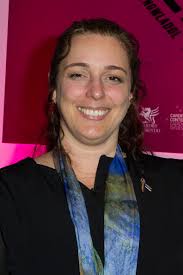
On December 30th Cuban authorities cancelled an open-microphone event at Havana’s Plaza de la Revolución and detained or arrested its organizers. The principal detainee was Tania Bruguera, a Cuban citizen who lives on the island and in Miami, Florida and who is a performance artist. She intended to provide an open-microphone for any attendee to give a one-minute statement on his or her opinions and recommendations for Cuba’s future.

This cancellation and related arrests have provoked strong condemnation from the U.S. Department of State and major U.S. newspapers. Initially I was persuaded by such condemnations and worried that they would foster U.S. political resistance to recent U.S.-Cuba reconciliation. After further investigation, however, I have come to reject such harsh condemnations. In order to understand this conclusion, this post will examine what happened in Havana, the reactions from the State Department and western newspapers and then the reasons why I reject such condemnations.

Cuban Events Relating to the Open-Mike Performance[1]

Plaza_de_la_Revolution

Plaza3

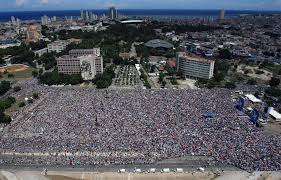
On December 30th Cuban performance artist Tania Bruguera was planning to stage an open-microphone event, “Yo tambien exijo,” [I also demand],” in Havana’s Plaza de la Revolución, the huge public square usually reserved for large government-sponsored events.[2] (The photo on the top shows an empty Plaza while the other one has a large crowd in attendance.) She planned to give any attendee a one-minute platform to discuss his or her opinions about, and recommendations for, Cuba’s future. She told the U.S. National Public Radio that she wanted “people in the street [to] come and share . . . [their] doubts, [their] happiness – whatever [they] think right now about what is happening in Cuba, and what is the idea of Cuba that [they] want?”

Bruguera was proceeding with these plans even though her application for a permit had been denied and even though the Government’s National Fine Arts Council had told her that it would not be providing her with institutional support for the event as proposed because it “would negatively impact public opinion, in a key time of negotiation between the Cuban government and the government of the United States.”

On December 30th the Council issued a public statement documenting its decision not to support the event. It said, “Under current circumstances, it is unacceptable performing this purported performance in the symbolic space of the Plaza of the Revolution, especially considering the extensive media coverage and manipulation that has been in the media broadcasters counterrevolution.”

The Council, however, also stated that Bruguera had rejected its suggestions on conducting the event subject to the following conditions: (a) move the event to the National Museum of Fine Arts, a prestigious cultural institution in the field of visual arts; (b) the Museum would be freely open to diverse people of dissimilar social sectors; (c) the government would “reserve the right” to bar people whose “sole interest is to be provocative;” and (d) the performance would be limited to 90 minutes.

Just hours before the planned event, Cuban police detained, on public disorder charges, Bruguerea and at least three leading dissidents: Antonio Rodiles, the head of Citizens Demand for Another Cuba; Eliezer Avila, the leader of the opposition group Somos Mas; and Reinaldo Escobar, a senior editor of a dissident website 14medio.com. Escobar’s spouse, Blogger Yoani Sanchez, was also detained at her home by police. There were reports that up to 50 members of the political opposition were detained.

Ms. Bruguera was released the next afternoon along with most of the political dissidents. She then announced she would hold a news conference and public gathering on the Malecón, Havana’s coastal highway, at the memorial to the Maine, the American battleship that sank in Havana Harbor in 1898. Cuban agents, however, stopped her en route to the gathering and took her away for interrogation. She was told she could not leave Cuba “for two or three months” while the case was being processed. Again she was released.

However, on January 1, 2015, she was arrested again along with several dissidents when they went to a jail to demand the release of 15 additional dissidents who had been arrested on the day of the planned event. The next day (January 2) she was released.

Reactions to the Cancelation and Arrests

On December 30th, the U.S. Department of State issued a Press Statement saying the U.S. was “deeply concerned about the latest reports of detentions and arrests by Cuban authorities of peaceful civil society members and activists . . . [and] strongly condemn[ed] the Cuban government’s continued harassment and repeated use of arbitrary detention, at times with violence, to silence critics, disrupt peaceful assembly and freedom expression, and intimidate citizens.”

The Statement added, “Freedoms of expression and peaceful assembly are internationally recognized human rights, and the Cuban government’s lack of respect for these rights, as demonstrated by today’s detentions, is inconsistent with Hemispheric norms and commitments. We urge the Government of Cuba to end its practice of repressing these and other internationally protected freedoms and to respect the universal human rights of Cuban citizens.”

The Statement concluded that the U.S. has “always said we would continue to speak out about human rights, and as part of the process of normalization of diplomatic relations, the United States will continue to press the Cuban government to uphold its international obligations and to respect the rights of Cubans to peacefully assemble and express their ideas and opinions, just like their fellow members of civil society throughout the Americas are allowed to do.”

Also on December 30th Assistant Secretary of State Roberta Jacobson tweeted “Freedom of expression remains core of US policy on #Cuba; we support activists exercising those rights and condemn today’s detentions.”

These views were shared by the New York Times’ December 30th editorial, “Cuba Turns Off Critics’ Open Mike.” It said, “By stifling critical voices, the Cuban government is showing its unwillingness to tolerate basic freedoms most citizens in the hemisphere enjoy.”

The Times’ editorial continued, “This move, unfortunately, will amplify the criticisms of those who opposed Mr. Obama’s historic shift on Cuba policy. Heavy-handed tactics by the Castro government will give them ammunition next year, when Republicans will control both chambers of Congress, to stymie the Obama administration’s steps to ease the embargo through executive authority and dim the prospects of legislative change to pare back the web of sanctions Washington imposes on Cuba. That result would be a shame and, in the long run, self-defeating for Havana.”

The editorial on the same subject by the Washington Post, which earlier opposed the December 17th reconciliation, was in the same vein. It stated, “[T]he Castro regime has been left free to continue stifling dissent, while reaping the economic and political benefits of Mr. Obama’s ‘engagement.’ Raúl Castro declared in a speech shortly after the agreement was announced that the Communist political system would remain unchanged. Two weeks later, not one of the 53 political prisoners the White House said would be freed — about half of the total identified by human rights activists — has been reported released.”

The Washington Post editorial concluded, “Cubans who seek basic freedoms continue to be arrested, harassed and silenced, while the regime celebrates what it portrays as ‘victory’ over the United States. If support for the Cuban people and American values is supposed to be the point of this process, then it is off to a very poor start.”

People opposed to the resumption of relations with Cuba were quick to hold up the arrests as a sign that the Castro government had no intention of pursuing political change and would reap only economic benefits from Mr. Obama’s moves. For example, Senator Marco Rubio, Republican of Florida and a Cuban-American, tweeted, “Castro govt. arrests of activists in #Havana exposes the folly of new Obama #CubaPolicy.”

Rejection of the Condemnation

As a long-time member of the American Civil Liberties Union and as a pro bono attorney in one of its important free speech cases, I am a strong believer in the importance of free speech. Therefore, I initially concurred in the State Department and New York Times’ condemnation of Cuba’s cancellation of this event and related arrests, and I worried that this controversy might cause the U.S. to abandon the recently announced U.S.-Cuba reconciliation.

On the other hand, I was and continue to be troubled by the State Department and most of the articles about this event not mentioning the Cuban Fine Arts Council’s willingness to support the event in another location and with certain limits. This action by the Arts Council suggests at a minimum that the State Department and western media are over-reacting to these events and unfairly rushing to judgment.

These U.S. critics also forget that governmental authorities in the U.S. sometimes determine that it is not appropriate to stage a protest at a particular time and place. It just happened in my home state of Minnesota at the Mall of America (MOA) on a big shopping day (December 20th). Although MOA officials had told the organizers that it was against its policies for them to hold a “Black Lives Matter” protest at the Mall on that day,[3] they did so anyway as this video shows. After 2,000 to 3,000 protesters flooded a Mall rotunda and held “die-ins” in front of several nearby businesses, riot-gear-clad police officers arrested 25 for trespass, peacefully dispersed the crowd and tried to block people from re-entering the rotunda. Afterwards the local city attorney announced plans “to file additional charges against ‘ringleaders’ of the protest and to seek restitution for the costs of 250 police at the event and lost sales during the two to three hours when more than 75 stores in the mall were closed.” On January 5th some of the protesters spoke against such prosecution at a city council meeting. This story obviously is not yet over.

In addition, there is a report that raises the much more serious question of whether the event was an idea of Cubans acting by themselves. According to the Wall Street Journal, an opponent of reconciliation with Cuba, at the scheduled time for the event, “Cuban cellphones received mysterious messages from a Florida area code offering cheap beer to all those gathering on the plaza.” This was confirmed in an interview by U.S. National Public Radio with Marc Frank, a U.S. journalist who was one of about a dozen people at the Plaza at the time of the planned event. He said, “text messages were sent from somewhere in Miami to a lot of cell phones here, including mine, basically saying that there’s going to be an event at the Plaza de la Revolución, and there’d be free beer.” Frank added that “Tania is an artist, lives some in Cuba and mainly in Miami, . . . [but] she’s not really well-known in Cuba at all.”[4]

These messages about free beer in the Plaza from a Miami telephone number raise the question of whether the event was actually being planned by the U.S. Agency for International Development (USAID) or another U.S. government agency or by Cuban-Americans opposed to the reconciliation of the two countries.

As discussed in prior posts, USAID (U.S. Agency for International Development) had funded via a private contractor at least three covert (or as the agency prefers to say “discreet”) programs in Cuba to promote civil society and dissent or regime change, all without the prior knowledge or consent of the Cuban government. One was for U.S. citizen Alan Gross to take communications equipment to Cuba, for which he was arrested, convicted and imprisoned in Cuba for violating its laws.[5] Another such USAID program via a private contractor unsuccessfully tried to create a Cuban social media program Yet another used Central Americans to promote purported HIV informational efforts on the island. The final one that has been discovered so far by journalists again via a private contractor attempted to infiltrate the Cuban rap-artist community.

These USAID programs were sharply criticized in a November New York Times editorial, as discussed in an earlier post. The editorial said, ““Far from accomplishing . . . the goal [of instigating democratic reforms on the island], the initiatives have been largely counterproductive. The funds have been a magnet for charlatans, swindlers and good intentions gone awry. The stealthy programs have increased hostility between the two nations, provided Cuba with a trove of propaganda fodder and stymied opportunities to cooperate in areas of mutual interest.”

Instead, the Times’ November editorial argued, “The United States should strive to promote greater freedoms on the island of 11 million people and loosen the grip of one of the most repressive governments in the world. Instead of stealth efforts to overthrow the government, American policy makers should find ways to empower ordinary Cubans by expanding study-abroad programs, professional exchanges and investment in the new small businesses cropping up around the island. They should continue to promote Internet connectivity, but realize that accomplishing that goal on a large scale will require coordination with the Cuban government.” Moreover, “Washington should recognize that the most it can hope to accomplish is to positively influence Cuba’s evolution toward a more open society. That is more likely to come about through stronger diplomatic relations than subterfuge.”

Perhaps the Times forgot this editorial when it more recently lambasted the Cuban actions over the “open-microphone” event.

In any event, the U.S. government apparently has not learned the lesson outlined by the Times in October because the USAID website, which says it was last updated on December 16 (the day before the announcement of U.S.-Cuba reconciliation), still contains general information about its Cuba programs to “[p]romote human rights and fundamental freedoms.”

In addition, on December 22, 2014 (five days after that announcement), the U.S. Department of State’s Bureau of Democracy, Human Rights and Labor issued a Public Notice of its “Request for Statements of Interest: Program Fostering Civil, Political and Labor Rights in Cuba.” The Bureau’s prospective funding of $11 million would be used for typically funded proposals, the Bureau said, like “[o]rganizational assistance to Cuban civil society to improve management, strategic planning, sustainability, and collaboration of local civil society groups; [o]ff-island trainings, short-term fellowships, or engagement; [d]istribution of software that would be easily accessible in an open society; . . . [and] ]a]ssistance mechanisms designed to provide independent Cuban civil society with tools, opportunities, and trainings that civil society counterparts in open societies can access.”

Both the USAID and State Department statements read as if they are promoting programs in Cuba without the knowledge, cooperation or agreement of the Cuban government. This is contrary to President Obama’s statement in his nationally televised speech on December 17th, in which he said the U.S. would “raise those differences [with the Cuban government] directly . . .[such as] democracy and human rights in Cuba. But I believe we can do more to support the Cuban people and promote our values through engagement [with the Cuban government].” He added, “no Cubans should face harassment or arrest or beatings simply because they’re exercising a universal right to have their voices heard, and we will continue to support civil society there.”

Similar thoughts were expressed the same day in the White House’s FACT SHEET: Charting a New Course on Cuba.” It said, “We know from hard-learned experience that it is better to encourage and support reform than to impose policies that will render a country a failed state.” It also stated, “The Administration will continue to implement U.S. programs aimed at promoting positive change in Cuba, and we will encourage reforms in our high level engagement with Cuban officials.”

Although President Obama apparently was talking about encouraging the Cuban government to expand the Cuban people’s rights to express different opinions on what their government should do, a prior post shows some ambiguity in these statements that could allow the continuation of the USAID and State Department’s covert or “discreet” efforts to promote regime change.

If the open-microphone event, in fact, was orchestrated by USAID or some other U.S. government agency, it is Orwellian. Such programs purport to promote democracy and human rights with undemocratic and non-human rights means. Such programs are publicly mentioned—in very general terms—on U.S. government websites yet are conducted covertly or “discreetly” on the island. Such programs are hostile to a country with which the U.S. purportedly is attempting to build a normal and respectful diplomatic relationship. These programs also logically motivate Cuban authorities to be vigilant in reacting to events like the “open-microphone” one.

In other words it is horribly stupid and unwise to have such behind-the-back programs when the two countries are embarking on a long and complicated path for full reconciliation. As the New York Times said in November, the U.S. “should recognize that the most it can hope to accomplish is to positively influence Cuba’s evolution toward a more open society. That is more likely to come about through stronger diplomatic relations than subterfuge.”

===========================================================

[1] This account of the planned event and the arrests by the Cuban government is based on articles in the New York Times, Washington Post, Wall Street JournalGuardian, Los Angeles Times,  National Public Radio, the Cuban Fine Arts Council and again the New York Times.

[2] The Plaza is the 31st largest public square in the world; it measures 72,000 square meters (774,936 square feet) and has been the site for crowds of 1 million for major speeches by Fidel Castro and for a mass celebrated by Pope John Paul II. The idea that the open-microphone event might create such a large crowd should have been seen as ridiculous by everyone, including the Cuban authorities, and a small gathering like the 12 or so that showed up on the 30th would have demonstrated the over-reaction of the those authorities in shutting it down and the State Department and western media in attacking the shut-down.

[3] Before the protest the local city (Bloomington) sent a letter to the protest organizers warning that the city would enforce the mall’s private-property rights under the authority of a Minnesota Supreme Court decision that held the MOA was a private entity with the right to exclude demonstrators.

[4] The Director of Security Operations at Telecommunications Company of Cuba reported that since December 21st Cuba had been receiving electronic messages calling for participation in an event with Tania Bruguera. These messages came from a platform “Wake Cuba,and these messages were similar to previous ones paid for by USAID.  Another Cuban source states that some Cuban email addresses were hacked and used to send emails to Cubans about this event.

[5] Gross on December 17th was released from Cuban prison and returned to the U.S.

U.S. Senate Democrats Unwisely Re-elect Harry Reid as Leader

Senator Harry Reid
Senator Harry Reid

Today, November 13th, the Senate Democrats re-elected Senator Harry Reid as their leader, now Minority Leader, for the next Session of Congress starting in January. [1]

Although the voting was by secret ballot, it was not unanimous. At least four of the Senators rejecting Reid have been identified: Claire McCaskill of Missouri, Heidi Heitkamp of North Dakota, Joe Manchin of West Virginia and Mary Landrieu of Louisiana. McCaskill said, “When you have an election like this, common sense says we need to change things. The voice was very loud and unmistakable. To me that means changing leadership, and it was just that simple.” Heitkamp added, “This was a change election. I think that we needed to demonstrate that we heard the American public.”

Over the last several months, these four were part of a group of about 10 more junior Democratic senators have begun more openly registering their dissatisfaction with Mr. Reid’s approach. Others include Senator Angus King of Maine and Senator Jon Tester of Montana.

The leadership votes went ahead after several in the caucus asked for a delay to give them an opportunity to consider others for the leadership posts.

Senator Reid apparently responded to these negative views of his leadership by appointing Senator Elizabeth Warren of Massachusetts as the Caucus’ Strategic Policy Advisor, Senator Amy Klobuchar of Minnesota to chair a caucus committee that handles outreach to outside allies and activists and Senator Tester as Chair of the Democratic Senatorial Campaign Committee.

As a Democrat, I think the re-election of Reid is a horribly unwise. I have cringed every time Reid appears on television as the voice of the Senate Democrats. He comes across as tired, old, cranky, dull, weak and unpersuasive. When he appears on television with the Republican leader, Senator Mitch McConnell, soon to be the Majority Leader, the personal animosity between the two often is apparent. The Democrats and the country do not want to see a continuation of this outworn drama.

Senator Amy Klobuchar

As a Minnesotan, I believe our Senator Amy Klobuchar would be an excellent new Minority Leader. She would be a fresh face, younger (age 54) and female in sharp contrast to McConnell. She also has a record of being able to get along with Republicans in the Chamber. In the final debate this year for Minnesota’s other U.S. Senate seat, the unsuccessful Republican candidate, Mike McFadden, frequently praised Klobuchar and said “I’m here to say Amy Klobuchar sets the bar for work ethic and authenticity.”

Scott Lehigh, a Boston Globe columnist, said the 74-year old Reid “should announce that when this session of Congress ends, [he] will relinquish [his] role as leader of [the] . . . Democratic [caucus].” Reid is a “tired face, stale voice, entrenched presence in Washington. . . . After a certain period, congressional leaders’ caricatured images get so ingrained that they become electoral liabilities for their parties.” (Lehigh makes the same argument about why Nancy Pelosi should not be the Democratic leader of the House in the new Congress, but that is an argument for another day.)

Another columnist in the Wall Street Journal, Gerald Seib, posed a similar question, “Where are the [Democrat] party’s fresh young leaders?” But he assumed that Reid would be the new Minority Leader, and instead mentioned Senator Elizabeth Warren as a potential national leader of the party along with “highly capable younger Democrat [Senators]:” Mark Warner, . . . a 59-year-old moderate from a key swing state, as is Colorado’s 49-year-old Michael Bennet. New York Sen. Kirsten Gillibrand, 47, is a rising star.”

I have no quarrel with any of these prominent Democratic Senators, and any of them would change the public persona of the Senate Democrats, but I point out that they have less experience in the Senate than Senator Klobuchar’s eight years: Warner (six years), Gillibrand (six years), Bennet (four years) and Warren (two years).

Here is a personal plea to Senator Reid. Wake up. Give someone else the opportunity to lead. Do not be a liability to your party. Stand down.

==============================================

[1] This account of the re-election of Senator Reid is based upon articles in the New York Times, Washington Post, Wall Street Journal and Politico.


U.N. General Assembly Again Condemns U.S. Embargo of Cuba

U.N. General Assembly Voting Results Screen
U.N. General Assembly   Voting Results Screen

On October 28, 2014, the U.N. General Assembly by a vote of 188 to 2 again condemned the U.S. embargo of Cuba. The two negative votes were cast by the U.S. and by Israel while three small Pacific nations abstained–Marshall Islands, Micronesia and Palau. All the other U.N. members supported the resolution. [1]

 The Resolution

The resolution [A/69/L.4] reiterated the General Assembly’s “call upon all States to refrain from promulgating and applying laws and measures of the kind referred to in the preamble to the present resolution [‘the economic, commercial and financial embargo imposed by the [U.S.] against Cuba’ and the Helms-Burton Act], in conformity with their obligations under the Charter of the United Nations and international law, which, inter alia, reaffirm the freedom of trade and navigation.”

The resolution also “again urges States that have and continue to apply such laws and measures [i.e., the U.S.] to take the steps necessary to repeal or invalidate them as soon as possible in accordance with their legal regime.”

Cuba’s Statement Supporting the Resolution

Bruno Rodriguez Parrilla

Bruno Rodríguez Parrilla, the Cuban Minister for Foreign Affairs, introducing the resolution, said that in recent times “the economic, commercial and financial blockade imposed by the [U.S.] against Cuba had been tightened, and its extraterritorial implementation had also been strengthened through the imposition of unprecedented fines, totaling $11 billion against 38 banks . . . for carrying out transactions with Cuba and other countries.” In addition, Cuba’s “accumulated economic damages of the blockade totaled $1.1 trillion . . . [and] human damages were on the rise.”

Nevertheless, “Cuba had offered every possible form of assistance to the [U.S.] in the wake of disasters there, such as in the aftermath of the September 11, 2001 terrorist attacks. Cuba had never been a threat to the national security of the [U.S.].  Opinion polls showed that there was increasing support from all sectors of [U.S.] society for lifting the blockade.  Religious leaders had citied legitimate, indisputable ethical and humanitarian reasons.“

In addition, ”the blockade was harmful to . . . the [U.S.]. The ‘absurd and ridiculous’ inclusion of Cuba on the [U.S.] list of States that sponsored international terrorism redounded to the discredit of the [U.S.].  Cuba would never renounce its sovereignty or the path chosen by its people to build a more just, efficient, prosperous and sustainable socialism.”  Neither, he continued, would his Government “give up its quest for a different international order, nor cease in its struggle for ‘the equilibrium of the world.’”

Rodríguez also invited the U.S. government “to establish a mutually respectful relation, based on reciprocity. We can live and deal with each other in a civilized way, despite our differences.”

Other Countries’ Statements Supporting the Resolution [2]

The following Latin American countries voiced support for the resolution: Argentina (MERCOSUR [3]) (embargo was “morally unjustifiable” and violated “the spirit of multilateralism and was immoral, unjust and illegal”); Barbados (CARICOM [4]); Bolivia (Group of 77 [5] and China); Brazil (Group of 77 and CELAC [6]); Colombia; Costa Rica (CELAC)); Ecuador; El Salvador (Group of 77 and CARICOM); Mexico; Nicaragua; St. Vincent and the Grenadines (CARICOM, Non-Aligned Movement, [7] Group of 77 and CELAC); Uruguay; and Venezuela.

The African supporters of the resolution that spoke were Algeria (Non-Aligned Movement, Group of 77, Group of African States [8] and Organization of Islamic Cooperation [9]); Angola; Kenya (Group of 77, Non-Aligned Movement and African Group); Malawi (African Group); South Africa (Group of 77, Non-Aligned Movement and African Group); Sudan (Group of 77, Non-Aligned Movement and Organization of Islamic Cooperation); United Republic of Tanzania; Zambia (Non-Aligned Movement) and Zimbabwe (Non-Aligned Movement, Group of 77 and African Group).

From Asia and the Pacific were Belarus; China (Group of 77); Democratic People’s Republic of Korea (North Korea); Indonesia (Group of 77);  India (Group of 77 and Non-Aligned Movement); Iran (Non-Aligned Movement); Lao People’s Democratic Republic; Myanmar (Group of 77 and Non-Aligned Movement); Russian Federation; Solomon Islands; and Viet Nam (Non-Aligned Movement, Group of 77 and China).

Middle Eastern countries speaking in favor of the resolution were Egypt, Saudi Arabia (Organization of Islamic Cooperation); and Syria (Non-Aligned Movement, Group of 77 and China).

The sole European supporter of the resolution that spoke at the session was Italy (European Union [10]), which said the U.S.’ “extraterritorial legislation and unilateral administrative and judicial measures were negatively affecting European Union interests”).

U.S. Statement Opposing the Resolution

Although Israel voted against the resolution, it chose not to speak in support of its vote. Only the U.S. by Ambassador Ronald D. Godard, U.S. Senior Advisor for Western Hemisphere Affairs, tried to justify the negative vote.

Ronald D. Godard
Ronald D. Godard

Ambassador Godard said the U.S. “conducts its economic relationships with other countries in accordance with its national interests and its principles. Our sanctions toward Cuba are part of our overall effort to help the Cuban people freely exercise their human rights and fundamental freedoms, and determine their own future, consistent with the Universal Declaration of Human Rights and the democratic principles to which the United Nations itself is committed.”

Ambassador Godard also said, “the Cuban government uses this annual resolution in an attempt to shift blame for the island’s economic problems away from its own policy failures. The Cuban government now publicly recognizes that its economic woes are caused by the economic policies it has pursued for the last, past half-century. We note and welcome recent changes that reflect this acknowledgement, such as those that allow greater self-employment and liberalization of the real estate market. But the Cuban economy will not thrive until the Cuban government permits a free and fair labor market, fully empowers Cuban independent entrepreneurs, respects intellectual property rights, allows unfettered access to information via the Internet, opens its state monopolies to private competition and adopts the sound macro-economic policies that have contributed to the success of Cuba’s neighbors in Latin America.”

According to Ambassador Godard, the U.S. “remains a deep and abiding friend of the Cuban people. The Cuban people continue to receive as much as $2 billion per year in remittances and other private contributions from the [U.S.]. This support . . . was made possible . . . by U.S. policy choices. By the Cuban government’s own account, the [U.S.] is one of Cuba’s principal trading partners. In 2013, the [U.S.] exported approximately $359 million in agricultural products, medical devices, medicine and humanitarian items to Cuba. Far from restricting aid to the Cuban people, we are proud that the people of the [U.S.] and its companies are among the leading providers of humanitarian assistance to Cuba. All of this trade and assistance is conducted in conformity with our sanctions program, which is carefully calibrated to allow and encourage the provision of support to the Cuban people.”

Furthermore, the U.S. “places the highest priority on building and strengthening connections between the Cuban people and [our] people. U.S. travel, remittance, information exchange, humanitarian and people-to-people policies updated in 2009 and 2011 provide the Cuban people alternative sources of information, help them take advantage of limited opportunities for self-employment and private property and strengthen independent civil society. The hundreds of thousands of Americans who have sent remittances and traveled to the island, under categories of purposeful travel promoted by President Obama, remain the best ambassadors for our democratic ideals.”

Ambassador Godard continued, “[The U.S.] strongly supports the Cuban people’s desire to determine their own future, through the free flow of information to, from, and within Cuba. The right to receive and impart information and ideas through any media is set forth in Article 19 of the Universal Declaration of Human Rights. It is the Cuban government’s policies that continue to prevent enjoyment of this right. The Cuban government now claims to share our goal of helping the Cuban people access the Internet. Yet the Cuban government has failed to offer widespread access to the Internet through its high-speed cable with Venezuela.  Instead, it continues to impose barriers to information for the Cuban people while disingenuously blaming U.S. policy.”

“Moreover, the Cuban government continues to detain Alan Gross, a U.S. citizen who was sentenced to 15 years in prison for facilitating Internet access for Cuba’s small Jewish community. [[11]] The [U.S.] calls on Cuba to release Mr. Gross immediately, [[12]] allow unrestricted access to the Internet, and tear down the digital wall of censorship it has erected around the Cuban people.

 {T]his resolution only serves to distract from the real problems facing the Cuban people. . . . Though Cuba’s contributions to the fight against Ebola are laudable, they do not excuse or diminish the regime’s treatment of its own people. We encourage this world body to support the desires of the Cuban people to choose their own future. By doing so, it would truly advance the principles the United Nations Charter was founded upon, and the purposes for which the United Nations was created.”

Media Coverage of the Resolution and Debate

 U.S. media coverage of this important U.N. vote was almost non-existent. It was not mentioned in the “World” or “Americas” news sections of the New York Times, and only its “Opinion” section had a short article about the issue. It got no mention whatsoever in the Wall Street Journal. Not even the Miami Herald, which has a separate page for Cuba news, mentioned it. [13]

At 2:37 p.m. on October 28th the Associated Press published a release on the subject, and the Washington Post published it online while the StarTribune of Minneapolis/St. Paul picked it up the next day in its online, but not its print, edition.

Cuba’s state-owned newspaper, Granma, of course, headlined this vote while stating that the embargo has caused $1.1 trillion of damage to the Cuban economy and “incalculable human suffering.” Its article also emphasized that this was the 23rd consecutive such resolution with a table showing that the number of votes in favor of the resolutions has increased from 59 in 1992 to 188 in 2012-2014, that the largest number of votes against the resolutions was only 4 in 1993 and 2004-2007 and that the number of abstentions has decreased from 71 in 1992 to 1 in 2005-2007 and now 3 since 2010.

Conclusion

This overwhelming international opposition to the U.S. embargo in and of itself should be enough to cause the U.S. to end the embargo. Moreover, the embargo has not forced Cuba to come begging to the U.S. for anything that the U.S. wants. The U.S. policy is a failure. The New York Times recently called for abandonment of this policy as has this blog in urging reconciliation of the two countries, in an open letter to President Obama and in a rebuttal of the President’s asserted rationale for the embargo and other anti-Cuban policies.

==============================================================

[1] This post is based upon the sources embedded above and upon U.N. General Assembly Press Release [GA/11574], As General Assembly Demands End to Cuba Blockade for Twenty-Thjrd Consecutive Year, Country’s Foreign Minister Cites Losses Exceeding $1 Trillion (Oct. 28, 2014); Londoño, On Cuban Embargo, It’s the U.S. and Israel Against the World, Again, N.Y. Times (Oct. 29, 2014); Associated Press, UN General Assembly Condemns US Cuba Embargo (Oct. 28, 2014); U.S. Dep’t of State, Explanation of Vote by Ambassador Ronald D. Godard on the Cuba Resolution in the General Assembly Hall (Oct. 28, 2014). The General Assembly also has videos of the debate (A and B). A prior post reviewed the 2011 General Assembly’s adoption of a similar resolution against the embargo.

[2] Many of the cited statements supporting the resolution were issued on behalf of, or aligned with, larger groups of nations as noted above. In addition, prior to the October 28th session of the General Assembly, the U.N. Secretary General submitted a report containing statements against the embargo from 154 states and 27 U.N. agencies.

[3] MERCOSUR (Southern Common Market) is a customs union and trading bloc of five South American countries with five other associate members in the continent.

[4] CARICOM (Caribbean Community) is a group of 15 Caribbean countries with five associate members for economic cooperation.

[5] The Group of 77 was established in 1964 by 77 developing countries to promote their collective economic interests and South-South cooperation; now there are 134 members that have retained the original name for historical significance.

[6] CELAC (Community of Latin American and Caribbean States) is a group of 33 states in the region to deepen economic integration and combat the influence of the U.S.

[7] The Non-Aligned Movement is a group of 115 developing countries that are not aligned with or against any major power bloc. Its current focus is advocacy of solutions to global economic and other problems

[8] The African Group is a group of 54 African states that are U.N. Members.

[9] The Organization of Islamic Cooperation is a group of 57 states that seek to protect the interests of the Muslim world in the spirit of promoting peace and harmony in the world.

[10] The European Union is a group of 28 European states that have combined for a peaceful, united and prosperous Europe.

[11] The activities in Cuba by Mr. Gross are not so simple. A Cuban court in 2011 found him guilty of participating in a “subversive project of the U.S. government that aimed to destroy the revolution through the use of communications systems out of the control of authorities,” and sentenced him to 15 years in prison. According to his own lawsuit against the U.S. Government, and subsequent disclosures, Gross alleged the U.S. Agency for International Development (USAID) and its contractor, DAI, sent him on five semi-covert trips to Cuba without proper training, protection or even a clear sense of the Cuban laws that led to his detainment. The case highlighted the frequent haste and lack of attention to the risks of the USAID programs in Cuba under the Helms-Burton Act, which allowed for money to be set aside for “democracy building efforts” that might hasten the fall of Fidel and Raúl Castro.

[12] In discussions with the U.S., Cuba already has expressed a willingness to exchange Mr. Gross for one or more of the three of “the Cuban Five” who remain in U.S. prisons.

[13] Nor did I find any mention of the vote in London’s Guardian or Madrid’s El Pais.


Alarming Federal Government Fiscal Challenges

On August 29th Dana Milbank of the Washington Post wrote an alarming column on the federal government’s fiscal challenges. Moreover, it was not his own opinion he was voicing, but rather that of the Semiannual Report of the nonpartisan Congressional Budget Office that was issued on August 27, 2014.

The CBO Report, Milbank says, shows that “the long-term fiscal disaster, predicted for some time, has crept into the short term.” Here are the particulars for that conclusion from the Report itself:

  • The foundation for the report is the CBO’s own economic forecast that “the economy will grow slowly this year . . . and then at a faster but still moderate pace over the next few years;” that “inflation is expected to remain below the Federal Reserve’s goal, and interest rates on Treasury securities . . . are projected to rise considerably.”
  • Another basic CBO assumption is “current laws governing federal taxes and spending generally remained unchanged.”
  • Federal debt held by the public will reach 74 percent of gross domestic product this year, more than twice what it was at the end of 2007 and higher than in any year since 1950. In a decade, it will hit 77 percent; in 25 years, 100 percent.
  • “85 percent of the federal government’s spending increases between now and 2024 will be consumed by just three items: Social Security (which will claim 28 percent of the increase), Medicare and other health-care programs (32 percent) and interest on the debt (25 percent). Spending on everything else — military and domestic programs alike — would fall to the lowest proportion of the economy since at least 1940, when such statistics were first collected.”
  • “The persistent and growing deficits that CBO projects . . . would have serious negative consequences, including . . . Increased federal spending for interest payments, Restraining economic growth in the long term, Giving policymakers less flexibility to respond to unexpected challenges, and Eventually increasing the risk of a financial crisis (in which investors would demand high interest rates to buy the government’s debt).”

These problems, says Milbank, will come “because of the cowardice of leaders on both sides, who have avoided serious changes to the tax code and to Medicare and the other ‘mandatory’ spending programs.”

Milbank’s comments came before the release of a report by Northwestern University economist, Robert Gordon, claiming that the CBO’s modest projection of U.S. economic growth over the next decade is unattainable. Gordon for several years has argued that reduced labor productivity, reduced labor market participation and meager capital investment have adversely affected the U.S. economy’s ability to grow. Thus, under Gordon’s analysis, the fiscal challenges facing the federal government will only be worse.


Over-Reaction to Eric Cantor’s Electoral Defeat?

The big U.S. political news this week was the defeat of Eric Cantor in Tuesday’s Republican primary in his U.S. House district in Virginia. Pundits and politicians say it means increased power for Tea Party/Republicans. The Republican Party will become more conservative and even less willing to negotiate with President Obama and congressional Democrats. Etc. Etc.

I have not read all of the newspaper articles about this election and have no desire to do so. But I was surprised by a column by New York Times’ columnist Charles Blow that emphasized the very small size of the vote in this election. Here are the key facts:


District population 760,000
Total votes in District: 2012 general election 381,000
Total votes in District: 2012 GOP primary   47,719
Total votes in District: 2014 GOP primary   65,008
Total votes in District: 2014 GOP primary– David Brat   36,110
Total votes in District: 2014 GOP primary– Eric Cantor   28,898

Ezra Klein of the Vox Conversations website believes that Cantor lost because of the low turnout in this week’s primary; Cantor failed to get his supporters to the polls.   Philip Bump in the Washington Post disagrees; he asserts that the GOP primary turnout in 2014 was larger than in 2012 and that the increased turnout was to vote against Cantor.

I am sure there are other interpretations of the result of this primary election, and I certainly am not able to wade in with my own opinion on the subject. Nor do I want to.

I merely point out that only 7,212 (36,110-28,898) more people voted for Brat than for Cantor. Are the many grandiose interpretations of this election merely over-reactions?