On Visit to Turkey, Vice President Biden Discusses Possible U.S. Extradition of Fethullah Gulen

As discussed in a prior post and two comments thereto, the United States and Turkey continue to be involved in discussions regarding Turkey’s request for the U.S. to extradite to Turkey a Muslim cleric, Fethullah Gulen, who now is living in the U.S.

The subject also came up with respect to U.S. Vice President Joe Biden’s August 24 visit to Turkey: first in the White House Press Secretary’s August 22 press briefing; second in Biden’s August 24 joint press conference with Turkey’s Premier Binali Yildirim; third in Biden’s August 24 joint press conference with Turkey’s President Recep Tayyip Erdogan; fourth at the White House Press Secretary’s August 24 press briefing; and fifth at the State Department’s August 24 Daily Press Briefing.

White House Press Briefing[1]

On August 22 White House Press Secretary Josh Ernest addressed Biden’s then upcoming visit to Turkey. He said that Biden will “indicate our continued, ongoing support for our allies in Turkey.  It’s a country that obviously is going through a lot.  This is a country that was subject to a failed coup attempt earlier this summer.  That is a coup attempt that was roundly and publicly condemned by the United States government.  And we continue to strongly support the democratic government of our allies in Turkey” and “the steps that Turkey has taken to make contributions to our counter-ISIL effort.”

As it relates to Mr. Gülen, the Press Secretary stated, Biden “will say what President Obama [already] has communicated directly to President Erdogan, which is that there is a treaty, an extradition treaty, that’s been on the books between the United States and Turkey for more than 30 years.  And the United States is committed to following the procedure and guidelines that are outlined in that treaty.” This includes “extensive coordination between officials at the Department of Justice and their Turkish counterparts.”  But extradition is “not a presidential decision.  There is a process that is codified in that treaty and in U.S. law. . . . But . . . [the decision] will be guided by the evidence and . . . by the rules and procedures that are codified in the extradition treaty and in United States law.”

Biden and Yildirim Press Conference[2]

BCiden+Premier

Upon his arrival in Ankara, Biden and Turkey’s Premier Yildirim held a joint press conference. To the right is a photograph of them.

Biden emphasized, “President Obama asked me to come to Turkey today in order to remind the world of the paramount importance that we place on the relationship between our nations as allies, as partners, and as friends. It is as an ally and a long-term friend of the Turkish people, that I’m here today to express in no uncertain terms the continuing, unwavering support of the United States for Turkey in the wake of last month’s attempted coup.”

“So on behalf of President Obama and the people of the United States, I want to once again, Mr. Prime Minister, extend to all the people of Turkey our condolences to the families and loved ones who were injured, but particularly those who lost a loved one.  We pay tribute to not only their bravery but their incredible resolve, their incredible commitment to their democracy, to ensuring that their country remains strong, vibrant and resilient, and democratic.”

“The . . . people of the United States of America abhor what happened, and under no circumstances would support anything remotely approaching the cowardly act of the treasonous members of your military who engaged in this behavior.  We did not have prior knowledge.  We did not support.  We immediately condemned.  And we continue, as we did before the coup, to stand shoulder to shoulder with not only the government of Turkey, but with the people of Turkey.”

“I understand the intense feeling your government and the people of Turkey have about [Mr. Gulen] . . . . We are cooperating with Turkish authorities.  Our legal experts are working right now with their Turkish counterparts on the production of and the evaluation of material and evidence that needs to be supplied to an American court to meet the requirements under our law and the extradition treaty to extradite Gulen. And we’re going to continue to do so as you continue to bring forward additional information.  We have . . . no interest whatsoever in protecting anyone who has done harm to an ally.  None.  But we need to meet the legal standard requirement under our law.”

“[U]nder American law:  No President of the United States has authority to extradite anyone on his own power.  That only an American court can do that.  Were a President to attempt to do that, it would be an impeachable offense.  But we have no reason to do anything other than cooperate with you and take every substantiating fact and make it available to the extent it exists to an American court.”

Premier Yildirim in his remarks welcomed the Vice President and recognized that “the relationship between Turkey and the United States has a very long history, a very deep-rooted history.   Therefore, from time to time, there might be incidents that tend to damage this relationship.  But on both sides, of course, we should never allow this to happen.”

“[T]his heinous coup attempt was, in our opinion, orchestrated and instructed by Fethullah Gulen.  And as per the treaties that we have between our two countries, the necessary steps should be taken with a view to his extradition to our country.  And we have taken the initial step in that process.  And you have had very frank remarks for the Turkish people and also for our government . . . of vital importance for a sound functioning of this process, and we are grateful to you for those remarks.”

“So having a [U.S.] technical team . . . here in Turkey, and talking to our judges and prosecutors here on the ground, is a clear sign from your side that you’re taking this very seriously, that you’re attaching great importance to this.  Therefore, I would like to once again thank you for being sensitive about the matter.”

“The process of extraditing the head of the terrorist organization that was behind the attempted coup, if it can be expedited and accelerated, and if we can have more cooperation in the process, I think the grief and grievances of the Turkish people, of the Turkish nation, will be remedied to a certain degree, and their overall sentiments about the issue will go back to being more positive.”

The Premier repeated this last thought in later responding to a journalist’s question: “I am sure that the healthy and sound functioning of the processes with regard to the extradition of the head of the terrorist organization will also, in a short amount of time, return or rectify the people’s perception back to their normal, positive situation.”

Biden and Erdogan Press Conference[3]

BidenErdogan

At the joint press conference after their private meeting, Biden opened by expressing his “personal condolences and the condolences of my country for the brutal, unconscionable attack in Turkey. . . .The attempted coup went to the heart of who your people are — principled, courageous and committed.  And for a people who have struggled so long to establish a true democracy, this was, from my perspective and the President’s perspective, the ultimate affront.  So my heart goes out to not just the government, but to the Turkish people.” He added, “the United States stands with our ally, Turkey.  We support the people of Turkey.  And our support is absolute and it is unwavering.” (Above is a photograph of the two men.)

“That’s why the United States.” Biden said, “is committed to doing everything we can to help [Turkey] through your justice [system] hold all those responsible for this coup attempt while adhering to the rule of law. . . . [O]ur American experts are on the ground, here in Ankara, meeting with your people, closely coordinating with our Turkish counterparts to evaluate and gather the material with regard to Turkish requests to extradite Gulen, in accordance with our bilateral extradition treaty.”

As “powerful as my country is, as powerful as Barack Obama is as President, he has no authority under our Constitution to extradite anyone.  Only a federal court can do that. . . . If the President were to take this into his own hands, . . . he would be impeached for violating the separation of powers.”

The U.S. has no “reason to protect Gulen or anyone else who, in fact, may have done something wrong. . . . [T]his case, like all others, is going to have to be assessed by an independent federal court along with evidence backing it up.  That’s what we’re working on together now.  And it takes time to work an extradition request, but there should be no doubt that we’ll continue to work closely with the Turkish government as this process unfolds.”

In response to a journalist’s question at the end of the press conference, Biden repeated these thoughts about extradition. “We are a nation of laws.  We are bound by a constitution. . . . The constitution and our laws require for someone to be extradited, that the court in the United States has to conclude with probable cause to be extradited.  Not only do we apply that standard as it relates to extradition; we apply that standard every day we do our country.”

Biden continued, “we have a team of our lawyers and experts who were here in Ankara yesterday, sitting down with your experts on the judiciary and your prosecutors, saying, give us the data we need in order to be able to bring these to a court of law that will say, yes, we must extradite [Mr. Gulen]. . . . What possible interest could the United States have in wanting to protect someone who, in fact, met the standard under our law of being deported?”

Until yesterday, the Vice President added, “[T]here has been no evidence presented about the coup.  When you go to an American court, you can’t go into a court and say, this is a bad guy, generally.  You have to say this is a guy or a woman who committed the following explicit crime.  That’s what we’re working with President [Erdogan] right now to gather the evidence that will establish in a court of law probable cause to believe he may have done this.  We are determined — we are determined to listen to every scrap of evidence that Turkey can provide or that we can find out about.”

“We will continue to abide by [our] system.  And God willing, there will be enough data and evidence to be able to meet the criteria that you all believe exists.  We have no reason to shelter someone who would attack an ally and try to overthrow a democracy.” (Emphasis added.)

President Erdogan thanked the Vice President for coming and saluted him with “all my most heartfelt emotions.”

Erdogan then stressed that the “leader of the FETO terrorist organization [Gulen] needs to be extradited to Turkey as soon as possible.  That is the first measure that needs to be taken.  There are references made to the verdicts to be issued by courts, and we have previously submitted all of the folders regarding the actions engaged in by these terrorists before July the 15th.  And right now, we are amassing certain documents pointing out to their involvement in this failed coup that took place on July the 15th.”

Under the U.S.-Turkey extradition treaty, Erdogan said, “those individuals should be taken into pretrial detention, they should be arrested, and throughout the trial they need to remain in custody.  This person [Gulen], however, is currently managing and directing the terrorist organization where he lives.  They are present in more than 170 countries around the world, and they are present through school associations and other sorts of educational institutions. . . . [He] is still providing interviews to media outlets in the United States.  Some journalists are being taken into the Pennsylvania residence, and he is still continuing his actions around the world, and he’s shaping his actions for the future using these outlets.  That’s why it is very important for him to be contained through pretrial detention, which is actually part of the bilateral extradition treaty that was signed between our two countries, which we should not ignore.  And that is something I especially feel that I need to remind you of.  And I’m confident that the United States will take the necessary measures to cater to our expectations in that regard.”

Another White House Press Briefing[4]

Biden’s “God willing” comment came up in a question at the Wednesday afternoon, August 24, White House press briefing. Josh Earnest responded that the “point that the Vice President was making is that this is not going to be a decision that is made by the executive branch.  The decision about the evidence that Turkey has compiled is one that will follow the guidelines of the extradition treaty, and will ultimately involve a federal judge who will have to render [his or her] . . . own judgment, [his or her] . . . own assessment of the situation consistent with U.S. law and consistent with the terms of the extradition treaty.”

The White House Press Secretary also said that the U.S. has “concerns about the Turkish government’s activity since the coup have been a reflection of our longstanding concerns about protection of human rights inside of Turkey.  Turkey is a valuable NATO ally, and we’re able to work effectively with them on a variety of issues in a way that advances the interests of both our countries.  But even in the midst of our progress in pursuit of those shared priorities, the President has periodically raised concerns directly with President Erdogan, particularly on issues like freedom of the press inside of Turkey.” Nevertheless, “since the coup, we’ve understood the significant concerns that have been raised in Turkey and the need for a thorough investigation to get to the bottom of what exactly happened.”

With respect to Mr. Gülen, “there is a well-established process, and both the United States and Turkey are engaged in that process.  That process is governed by an extradition treaty between the United States and Turkey that’s been on the books for 35 years or so. . . . [T]here is a rather high bar, a high evidentiary standard that’s required.  So considering that the coup took place — what was it — six or eight weeks ago, I think it’s understandable that Turkey wouldn’t be able to build such a robust case, if there is one to be presented, against Mr. Gülen in such a short period of time.”

In addition, “Turkey has longstanding concerns with Mr. Gülen’s activity and they have presented significant evidence to the United States, and Department of Justice officials are carefully reviewing that evidence.  In fact, Justice officials are in Turkey this week, meeting with their counterparts to discuss and review that evidence.  What we have said all along is that the terms of the treaty and the law on the books here will ultimately determine how this is resolved.”

State Department Daily Briefing[5]

The Department’s spokesman said “our legal experts are working right now with their Turkish counterparts to evaluate the material, the evidence that needs to be supplied to meet the standards for extradition under our treaty. . . . As we’ve said, Turkey has provided materials relating to Mr. Gulen. We continue to analyze those materials. Under our laws, extradition requests must be assessed by an independent federal court along with the evidence backing it up. . . . It always takes time to work through an extradition request. However, there should be no doubt that we will continue to work through this working with our Turkish counterparts.”

Conclusion

Vice President Biden, President Obama and other U.S. officials consistently and rightly have emphasized that Turkey’s requested extradition of Gulen will be handled in accordance with the U.S.-Turkey extradition treaty and U.S. law, which were explained in a prior post and which were illustrated in February 6 and August 22 posts about the ongoing proceedings for extradition of a former Salvadoran military officer to Spain for the criminal case regarding the 1989 murder of the Jesuit priests.[6]

Turkey’s refusal to make a public acknowledgement of this reality cannot be based on ignorance of its extradition treaty or U.S. law. Instead it has to be based in part on Erdogan’s wanting to appear to the Turkish people as a strong leader and fomenting Turkish public pressure for the extradition. Perhaps too it is based upon Erdogan’s apparently increasing belief in his own power to control everything.

In any event, at least one Turkish journal had a very negative reaction to Biden’s remarks in their country.[7] An editorial in Istanbul’s Daily Sabah stated, Biden “came all the way from the U.S. just to mention the importance of rule of law of his own definition.” He “parroted the same stale remarks Turkey has heard since July 15. . . . Unfortunately, Biden came and went without leaving a trace. His sly smile, insincere apology about not having come sooner and feeble remarks of friendship between the people will deservedly fall on deaf ears.”

The Daily Sabah editorial even claimed the U.S. was not abiding by Article 9 of the bilateral extradition by not detaining Gulen. That Article states, “The Contracting Parties shall take all necessary measures after the information and documents related to the request for extradition have been received, including a search for the person sought. When located the person sought shall be detained until the competent authorities of the Requested Party reach their decision. If the request for extradition is granted, the detention shall be continued until surrender.”[8]

Yes, the editorial accurately quotes Article 9, but that Article states the obligation to detain arises only “after the information and documents related to the request for extradition have been received” (here, by the U.S.). The published reports indicate that some information and documents regarding Gulen have been provided to the U.S. by Turkey, but it is unclear if Turkey has completed that process. Moreover, as indicated above, the U.S. is meeting with Turkish officials to aid them in providing the necessary materials for the application.

The editorial also fails to examine Article 10(1) of the treaty, which provides, “In cases of urgency, either Contracting Party may apply for the provisional arrest or detention of the person sought before the request for extradition has been submitted to the Requested Party through diplomatic channels. The request for provisional arrest or detention may be made either through diplomatic channels or directly between the Department of Justice of the United States and the Ministry of Justice of Turkey.” Article 10(2) then goes on to list what needs to be in such an application. Public information has not indicated that Turkey has availed itself of this remedy.

Relevant here, but unacknowledged by the Daily Sabah, is the U.S. Attorneys’ Manual that covers the procedures for detention or arrests of persons potentially subject to extradition in these situations.[9]

Therefore, the Daily Sabah editorial, in this blogger’s judgment, is not well founded.

========================================================

[1] Press Briefing by Press Secretary Josh Earnest, 8/22/16.

[2] White House, Remarks by Vice President Joe Biden and Turkish Prime Minister Binali Yildirim at a Press Availability (Aug. 25, 2016); Reuters, Biden Says U.S. Cooperating With Turkey on Evidence Against Gulen, N.Y. Times (Aug. 24, 2016); Assoc. Press, Biden Calls on Turkey to Be Patient in Gulen Case, N.Y. Times (Aug. 24, 2016); Kraychik, Biden Apologizes To Turkey For US Constitution, Daily Wire (Aug. 24, 2016).

[3] White House, Remarks by Vice President Biden and President Erdogan of Turkey in Pool Spray (Aug. 25, 2016); Reuters, Biden Tells Turkey’s Erdogan: Only a Federal Court Can Extradite Gulen, N.Y. Times (Aug. 24, 2016); Reuters, Turkey Must Control Its Own Border, U.S. Vice President Biden Says, N.Y. Times (Aug. 24, 2016); Reuters, Turkey’s Erdogan Says U.S. Agreements Require Coup Suspect Arrest, N.Y. Times (Aug. 24, 2016); Wayne & Sink, Biden Met by Snubs as He Seeks to Mollify Turkey’s Angry Erdogan, Bloomberg News (Aug. 24, 2016).

[4] Press Briefing by Press Secretary Josh Earnest, 8/24/16; Reuters, U.S. Reviewing Turkey’s Evidence on Coup Suspect Gulen: White House, N.Y. Times (Aug. 24, 2016).

[5] U.S. State Dep’t, Daily Press Briefing (Aug. 24, 2016).

[6] See also Assoc. Press, U.S., Turkey at an Impasse Over Extraditing Muslim Cleric, N.Y. Times (Aug. 25, 2016).

[7] Editorial, Biden wasted a trip, Turkey wasted time, Daily Sabah (Aug. 25, 2016). Daily Sabah also published two articles about the alleged Gülinist involvement in the recent attempted coup. One is a special report on the subject. The other asserts that a prosecutor who has been arrested for membership in the alleged Gülenist terror group says that it first started plans to topple President Erdoğan in 2011, instigated two coup attempts in 2013 and an attempted assassination of Erdoğan in the recent attempted coup. (Turkey coup attempt of Gülinist explained in special report, Daily Sabah (Aug. 24, 2016); Karaman, Güllenist prosecutor says group has sought to topple Erdoğan since 2011, Daily Sabah (Aug. 24, 2016).)

[8] U.S.-Turkey Extradition Treaty, 32 U.S.T. 3111.

[9] U.S. Attorneys’ Manual § 9-15.700.


Turkey Presses U.S. to Extradite Muslim Cleric in U.S.

In the wake of the July 15 failed coup in Turkey, its President Recep Tayyip Erdogan and others in his government have been pressing the United States as soon as possible to extradite Fethullah Gülen, a Muslim cleric now living in Pennsylvania. This request is based upon Turkey’s allegations that Gülen was the mastermind of the attempted coup.[1] The U.S., however, has not done so, stressing instead that the established U.S. legal procedures for extradition need to be followed. Turkey publicly has not accepted this response and repeatedly has criticized the U.S. for not extraditing Gülen.[2]

As explained in an earlier post, extradition is the legal process “by which one country (the requesting country) may seek from another country (the requested country) the surrender of a person who is wanted for prosecution, or to serve a sentence following conviction, for a criminal offense.  In the U.S., international extradition is treaty based, meaning that the U.S. must have an extradition treaty with the requesting country in order to consider the request for extradition.”[3]

Here then is a preliminary analysis of the U.S. legal issues governing any such extradition request by Turkey.

The U.S.-Turkey Extradition Treaty[4]

 The U.S. and Turkey do have such an extradition treaty that was signed in Ankara, Turkey on June 7, 1979, and entered into force on January 1, 1981.

Under Article 1 of the treaty each party has an obligation “to surrender to each other, in accordance with the provisions and conditions laid down in this Treaty, all persons who are found within the territory of the Requested Party [here, the U.S.] and who are being prosecuted for or have been charged with an offense, or convicted of an offense, or are sought by the other Party [here, Turkey] for the enforcement of a judicially pronounced penalty for an offense . . . .”

Here, Mr. Gülen apparently is found in the U.S. (the territory of the Requested Party) and is being prosecuted by Turkey (the Requesting Party). Thus, the preliminary condition of the treaty is satisfied.

Thus, the next issue is where did Mr. Gülen allegedly commit the offense. Since he apparently has not been in Turkey for many years, it would appear that whatever alleged offense he allegedly has committed was done “outside the territory of the Requesting Party” (Turkey).

That presents the next issue. Is Mr. Gülen still a citizen and thus a “national” of Turkey (the Requesting Party)? If he is, it would appear that Turkey “has jurisdiction, according to its laws, to try” him. Thus, the issue becomes whether the U.S. has an obligation to extradite him under other provisions of the treaty.

If, on the other hand, Mr. Gülen no longer is a national of Turkey, then the issue is whether “the laws of the Requested Party [the U.S.] provide for the punishment of such an offense committed in similar circumstances” and if so, whether the U.S. has an obligation to extradite him under other provisions of the treaty. Analysis of this issue would have to start with the particulars of the criminal charges under Turkish law, which so far are not readily available in public sources.

A potential treaty-based ground for the U.S. refusing to extradite Gülen is found in Article 3 (a), which states that extradition is not required, “If the offense for which extradition is requested is regarded by the Requested Party [here, the U.S.] to be of a political character or an offense connected with such an offense; or if the Requested Party concludes that the request for extradition has, in fact, been made to prosecute or punish the person sought for an offense of a political character or on account of his political opinions.” However, Article 3 (a) goes on to provide that “any offense committed or attempted against a Head of State or a Head of Government or against a member of their families shall not be deemed to be an offense of a political character.” Here, the public statements by the Turkish government certainly indicate that this exception might apply.

Another potential ground for a U.S. refusal to extradite is found in Article 3 (e): “If the offense for which extradition is requested has, according to the laws of the Requested Party [here, the U.S.], been committed in its territory and has been or will be submitted to its appropriate judicial authorities for prosecution.” (Emphasis added.) This obviously would require a U.S. prosecution, which has not yet happened and probably will not happen, in my opinion.

Yet another potential ground for a U.S. refusal to extradite Gülen is in Article 4(1): “Neither of the Contracting Parties shall be bound to extradite its own nationals.” This would require him to be a naturalized U.S. citizen, and the public information does not indicate if Gülen is such a citizen. There was a source that said he obtained a U.S. “green card” or permanent residency status in 2001, and the U.S. ambassador to Turkey in January 2015 said he believed that Gülen was not a U.S. citizen.[5]

Article 7 of the treaty has great details about the evidence that needs to be submitted, here by Turkey, to initiate a formal request for extradition. The public information to date indicates that Turkey has provided the U.S. with certain information and evidence, but whether it satisfies the requirements of Article 7 is not clear.

U.S. Obligations Under the Torture Treaty

As discussed in prior posts, the U.S. is a party to the multilateral Convention Against Torture and Other Cruel, Inhuman or Degrading Treatment or Punishment, and under Article 2(1) of that treaty the U.S. is obligated not “to extradite a person to another State where there are substantial grounds for believing that he would be in danger of being subjected to torture [as defined in Article 1 of that treaty].”

As indicated in a prior post, the final step in the U.S. process of determining whether an individual should be extradited includes the Secretary of State examining whether extradition would violate the U.S. obligations under the torture treaty.

With respect to Turkey this is a serious concern.

A. Concerns Raised by the U.S. State Department

The most recent U.S. State Department report on human rights around the world said this about Turkey and torture in 2015.[6] “The [Turkish] constitution and law prohibit torture and other cruel, inhuman, or degrading treatment, but there were reports that some government officials employed them. Human rights organizations continued to report allegations of torture and abuse, especially of persons who were in police custody but not in a place of detention, and during demonstrations and transfers to prison, where such practices were more difficult to document.”

“[Turkish] Prosecutors investigated allegations of abuse and torture by security forces during the year but rarely indicted accused offenders. The National Human Rights Institution (NHRI) is administratively responsible for investigating human rights violations, including allegations of torture, excessive use of force, or extrajudicial killings. Domestic human rights organizations claimed the NHRI’s failure to follow through in investigating potential human rights violations deterred victims of abuse from filing complaints. Authorities regularly allowed officers accused of abuse to remain on duty during their trial.”

“Human Rights Watch (HRW) alleged in a report published in September [2015] that [Turkish] police abused detainees in August and September while responding to perceived security threats in the Southeast. It documented three cases in which police severely beat detainees, forced men to remain in kneeling positions for hours, and threatened them with torture and execution. In another case police detained a boy who had a severe gunshot wound and for several hours denied him medical treatment.”

“[Turkish] Police in several parts of the country sometimes used disproportionate force to disrupt protests, often leading to injury.”

“Human rights groups alleged that although torture and mistreatment in police custody decreased following installation of closed-circuit cameras in 2012, police continued to abuse detainees outside police stations. On July 13, [2015] a media report included footage from security cameras showing police beating 24-year-old university student Tevfik Caner Ertay multiple times in 2013 during the Gezi Park protests before transporting him to a police station in the trunk of a police car. Ertay suffered multiple injuries, including a broken nose. Police perpetrators included some of the same officers later accused of killing fellow university student Ali Ismail Korkmaz.”

“Some human rights observers reported detainees often refrained from reporting torture and abuse because they feared retaliation or believed complaining to authorities would be futile. Human rights organizations documented cases of prison guards beating inmates and maintained those arrested for ordinary crimes were as likely to suffer torture and mistreatment as those arrested for political offenses, such as speaking out against the government.”

“Through the first nine months of the year [2015], the [Turkish] Ministry of Justice reported 98 investigations regarding allegations of torture, 26 of which resulted in indictments.”

“The HRA reported receiving hundreds of allegations of torture and excessive use of force, including 213 cases through September 21 [2015] that involved the alleged abuse of detainees. For example, on January 29, in Sirnak, police reportedly beat four citizens whom they had detained during raids of their homes.”

B. Concerns Raised by the U.N. Committee Against Torture

As explained in an earlier post, the multilateral treaty against torture created a Committee Against Torture, one of whose responsibilities is to review the records of the parties to the treaty. That Committee on June 4, 2016, did just that for Turkey by issuing 20 numbered paragraphs of “principal subjects of concern.”[7] Here are the key concerns for purposes of the pending extradition request.

“The Committee is concerned that, despite the fact that the State party has amended its law to the effect that torture is no longer subject to a statute of limitations, it has not received sufficient information on prosecutions for torture, including in the context of cases involving allegations of torture that have been the subject of decisions of the European Court of Human Rights. The Committee is also concerned that there is a significant disparity between the high number of allegations of torture reported by non-governmental organizations and the data provided by the State party in its periodic report . . ., suggesting that not all allegations of torture have been investigated during the reporting period. Further, while the State party has undertaken many investigations into allegations of ill-treatment and excessive use of force by its officials, these have resulted in relatively few cases of disciplinary sanctions, and in fines and imprisonment in only a small number of cases. The Committee regrets that the State party did not provide information requested by the Committee on the six cases in which officials received sentences of imprisonment for ill-treatment between 2011 and 2013, nor on any cases in which officials received sentences of imprisonment for ill-treatment in 2014 or 2015. The Committee further regrets that State party did not respond to the concern raised by Committee members that law enforcement authorities have on many cases brought ‘countercharges,’ such as ‘resisting’ or ‘insulting’ police officers, against those individuals lodging complains of torture, ill-treatment and other police brutality. The Committee further regrets, with reference to its previous recommendations . . . that the State party has not yet created an independent State body to investigate complaints of torture and ill-treatment against law enforcement officers.”

“The Committee is seriously concerned about numerous credible reports of law enforcement officials engaging in torture and ill-treatment of detainees while responding to perceived and alleged security threats in the south-eastern part of the country . . . in the context of the resurgence of violence between the Turkish security forces and the Kurdistan Workers’ Party (PKK) following the breakdown of the peace process in 2015 and terrorist attacks perpetrated by individuals linked to the so-called Islamic State in Iraq and the Levant (ISIL). The Committee is further concerned at the reported impunity enjoyed by the perpetrators of such acts.”

“In addition to the allegations of torture and ill-treatment of detainees noted above, the Committee is concerned at reports it has received concerning the commission of extrajudicial killings of civilians by the State party’s authorities in the course of carrying out counter-terrorism operations in the south-eastern part of the country. The Committee regrets that the State party did not respond to requests for information as to whether investigations are under way into widely reported cases, such as the alleged killing by police snipers of two unarmed women, . . . on 8 September 2015. The Committee also regrets the failure by the State party to ensure accountability for the perpetrators of killings in cases previously raised by the Committee, such as the killing by security forces of . . . in November 2004, which was the subject of a decision of the European Court of Human Rights. The Committee is further concerned at reports that family members of those killed in clashes between security forces and members of armed groups have been denied the ability to retrieve their bodies, which has the effect of impeding investigations into the circumstances surrounding those deaths.”

“The Committee is concerned that allegations of excessive use of force against demonstrators have increased dramatically during the period under review. The Committee notes with regret that the State party’s investigations into the conduct of officials in the context of the 2013 Gezi Park protests in Istanbul and Ankara have not resulted in any prosecutions, despite the allegations of excessive use of force noted by observers, including the European Committee for the Prevention of Torture and Inhuman or Degrading Treatment or Punishment. The Committee also regrets that the State party did not provide any data on the specific sentences, if any, that police officers tried on charges of excessive use of force during the reporting period had received. It further expresses concern over the recent legislative amendments in the Domestic Security Package granting additional powers to the police, in particular the expanded power to use firearms against demonstrators.”

“Although the Criminal Code defines torture as a specific offence, the Committee notes that the definition set out in article 94 [of the Code] is incomplete inasmuch as it fails to mention the purpose of the act in question. There is also no specific mention of the act of torture carried out in order to intimidate, to coerce or to obtain information or a confession from a person other than the person who was tortured.”

“While taking note of the legal safeguards enshrined in Turkish legislation, the Committee is concerned at recent amendments to the Code of Criminal Procedure, which give the police greater powers to detain individuals without judicial oversight during police custody. Placing suspects under constant video surveillance in their cells is another matter of concern.”

“The Committee is concerned at the ‘almost complete lack of accountability for cases of enforced disappearance’ in the State party and its ‘palpable lack of interest [in] seriously investigating, prosecuting and adjudicating these cases’, as reported by the Working Group on Enforced or Involuntary Disappearances in its preliminary observations publicly . . . announced at the end of its visit to Turkey from 14 to 18 March 2016. . . .”

“The Committee regrets the lack of complete information on suicides and other sudden deaths in detention facilities during the period under review.”

“The Committee is concerned by the restrictive conditions of detention for persons sentenced to aggravated life imprisonment, a sentence that was established after the abolition of the death penalty in 2004.”

C. Human Rights NGOs and Others

 Especially after the failed coup, human rights NGOs have raised increasing concerns about human rights in Turkey. These concerns were heightened by the Turkish government’s July 20 declaration of a state of emergency for the next three months. This gives the government the power to impose rule by decrees that are published and rushed through parliament for approval the same day. The possibility of review by the Constitutional Court is curbed. Human Rights Watch expressed its alarm over this development: “A state of emergency imposed where there are clear signs that the government is ready to crack down more broadly – combined with far more scope for unchecked executive action – is an alarming prospect. It risks further undermining democracy by providing a legal – if not justifiable – basis for a crackdown on rights.”[8]

Amnesty International (AI) on July 18 (only three days after the attempted coup) said that several Turkish “government officials have suggested reinstating the death penalty as punishment for those found responsible for the failed coup, and . . . [AI] is now investigating reports that detainees in Ankara and Istanbul have been subjected to a series of abuses, including ill-treatment in custody and being denied access to lawyers.” Two days later AI stated, “We are witnessing a crackdown of exceptional proportions in Turkey,” including freedom of expression.[9]

On July 24 AI reported that it had “gathered credible evidence that detainees in Turkey are being subjected to beatings and torture, including rape, in official and unofficial detention centers in the country.” According to these accounts, “police held detainees in stress positions, denied them food, water and medical treatment, verbally abused and threatened them and subjected them to beatings and torture, including rape and sexual assault.”[10]

On August 2 President Erdogan in a public speech challenged AI’s research underlying its assertion that some detainees had been tortured. In response AI’s Secretary General stated, ““The serious human rights violations documented by an . . . [AI] team on the ground in Turkey are alarming. These findings are based on detailed interviews with lawyers, doctors, family members and an eyewitness to torture in a detention facility.”[11]

A Turkish bar group in the capital of Ankara has stated that some of its members have reported alleged abuses of their clients in detention while other lawyers and human rights organizations have made similar allegations.[12]

The Turkey-U.S. Dispute Over the Requested Extradition of Gülen

Turkey’s Foreign Ministry has to be aware of the terms of its extradition treaty with the U.S. and the latter’s procedures for handling extradition requests. Thus, Erdogran and his government’s strident complaints about the U.S. not immediately granting the request for Gülen has to be intended to show Turkish citizens the strength and resolve of the regime. There even have been rumors that the U.S. was behind the attempted coup.

In any event, “Usually deeply polarized, the two sides [of Turkey’s population] are largely united in their opposition to military coups and the . . . [extradition] of Fethullah Gülen, a Muslim cleric who lives in self-exile in Pennsylvania and has been accused by Turkey of orchestrating the failed uprising.” There even is widespread support for the “sweeping purge of suspected followers of Mr. Gülen from the state bureaucracy and other professions” and Mr. Erdogan’s asking “Turks to inform on those they believe are connected to Mr. Gülen.”

Istanbul

The unity was on vivid display at a recent Istanbul rally of at least two million Turks who put aside their political differences to express solidarity.”[13] (To the right is a photograph of that rally.)


The U.S., however, needs to continue to resist acquiescence in these strong-arm tactics and to insist on following U.S. law and procedures for such requests. Secretary of State Kerry and President Obama have done just that.[14] So too have State Department spokespeople at daily press briefings.[15] This is not easy since the U.S. has a strong national security interest in maintaining Turkey as an ally in the fight against ISIS/ISIL.

Tomorrow U.S. Vice President Joe Biden will be visiting Turkey to see President Erdogan. The Associated Press opines that Biden will have difficulties in persuading Turkey that the U.S. values Turkey as a key NATO ally amid worrying signs that Turkey is flirting with having closer ties with Russia and that the U.S. and Turkish approaches to the Syrian conflict may be diverging.[16]

Today, says the Associated Press, a U.S. Justice Department team is meeting with Turkish officials in Ankara to discuss U.S. technical requirements of Turkey’s extradition request. This includes firm evidence of Gülen’s involvement in the coup whereas senior officials in the Obama administration say Turkey’s extradition requests to date have been based on allegations of other crimes against Gülen, not evidence of involvement in the coup attempt. A Turkish professor of international relations said that Turkish “people have an expectation that Gülen should be returned to Turkey immediately. If the extradition request is refused or delayed I’m afraid that’s going to have serious repercussions.”

The Washington Post editorial board urges the Vice President “to reassure Mr. Erdogan once again that the two nations share vital interests, not the least of which are fighting the Islamic State and ending the conflagration that has consumed Syria.” The Vice President also “should make clear he understands how much Turkish civilians are suffering from terrorist attacks” and “convince Mr. Erdogan that the United States does not desire to destabilize Turkey.”[17]

The Washington Post editorial further urges Biden “to candidly tell his host that the United States did not instigate the coup and that it will not relinquish Mr. Gülen to a witchhunt. Mr. Erdogan may not want to hear it, but he also should be reminded that crushing the rule of law will dim Turkey’s prospects.”

In the midst of this high-stakes squabble between the two countries, Gülen wrote an article for the New York Times in which he stated, “During the attempted military coup in Turkey this month, I condemned it in the strongest terms. ‘Government should be won through a process of free and fair elections, not force.’ I said, ‘I pray to God for Turkey, for Turkish citizens, and for all those currently in Turkey that this situation is resolved peacefully and quickly.’” President Erdogan’s suggestion that I was the mastermind of the coup “run[s] afoul of everything I believe in, it is also irresponsible and wrong. My philosophy — inclusive and pluralist Islam, dedicated to service to human beings from every faith — is antithetical to armed rebellion.”[18]

Moreover, Gülen said, “Throughout my life, I have publicly and privately denounced military interventions in domestic politics. In fact, I have been advocating for democracy for decades. Having suffered through four military coups in four decades in Turkey — and having been subjected by those military regimes to harassment and wrongful imprisonment — I would never want my fellow citizens to endure such an ordeal again. If somebody who appears to be [my] . . . sympathizer has been involved in an attempted coup, he betrays my ideals.”

Gülen concluded his article with this plea to the U.S. government. The U.S. “must not accommodate an autocrat [Erdogan] who is turning a failed putsch into a slow-motion coup of his own against constitutional government.”

===========================================================

[1] Reuters, Turkey to Ready Dossier for Gulen Extradition in 10 Days: Foreign Minister, N.Y. Times (July 23, 2016); Dugan, Turkey’s Failed Coup Puts Spotlight on a Rural Pennsylvania Town,W.S.J. (July 24, 2016); Fethullah Gullen Website, https://www.fgulen.com/en/Fethullah Güllen; Wikipedia. Fethullah Güllen; LaPorte, Watson & Tuysusz, Who is Fethullah Gulen, the man blamed for coup attempt in Turkey? CNN (July 16, 2016).

[2] E.g., Reuters, Turkey Says U.S. Could Extradite Cleric Gulen Quickly if Wants to, N.Y. Times (July 22, 2016); Assoc. Press, Turkey Criticizes U.S. Over Cleric Accused of Coup Plot, N.Y. Times (July 22, 2016); Kalin, The Coup Leader Must Be Held Accountable, N.Y. Times (July 24, 2016); Coker, Turkish Premier Demands U.S. Help with Gulen, W.S.J. (July 26, 2016).

[3] U.S. State Dep’t, Report on International Extradition Submitted to the Congress Pursuant to Section 211 of the Admiral James W. Nance and Meg Donovan Foreign Relations Authorization Act, Fiscal Years 2000 and 2001 (Public Law 106-113) (2001); U.S. Justice Dep’t, Frequently Asked Questions Regarding Extradition.

[4] U.S.-Turkey Extradition Treaty, 32 U.S.T. 3111.

[5] Fathullah Gullen, Wikipedia; U.S. Embassy to Turkey, Transcript of Ambassador Bass’s Interview with Sabah Ankara Bureau Chief Okan Muderrisoglu and Daily Sabah Correspondent Alli Unal (Jan. 12, 2015).

[6] U.S. State Dep’t, Country Reports on Human Rights Practices for 2015 (updated 4/18/16 & 6/14/16).

[7] Comm Agst Torture, Concluding observations on Turkey (June 2, 2016).

[8] Human Rights Watch, Dispatches: Turkey’s State of Emergency (July 22, 2016); Yeginsu & Arango, Turkey Cracks Down on Journalists, Its Next Target After Crushing the Coup, N.Y. Times (July 25, 2016).

[9] Amnesty Int’l, Human rights in grave danger following coup attempt and subsequent crackdown in Turkey (July 18, 2016); Amnesty Int’l, Media purge threatens freedom of expression in Turkey (July 20, 2016); Amnesty Int’l, Turkey: Intensified crackdown on media increases atmosphere of fear (July 28, 2016).

[10] Amnesty Int’l, Turkey: Independent monitors must be allowed to access detainees amid torture allegations (July 24, 2016).

[11] Amnesty Int’l, Turkey: Response to President Erdogan’s speech challenging Amnesty International’s findings (Aug. 2, 2016).

[12] Morris, ‘Law is suspended’: Turkish lawyers report abuse of coup detainees, Wash. Post (July 24, 2016).

[13] Yeginsu, After Failed Coup, Turkey Settles Into a Rare Period of Unity, N.Y. Times (Aug. 23, 2016).

[14] Assoc. Press, Kerry to Turkey: Send Us Evidence, Not Allegations on Gulen, N.Y. Times (July 20, 2016); White House, Remarks by President Obama and President Peno Nieto of Mexico in Joint Press Conference (July 22, 2016).

[15] E.g., State Dep’t, Daily Press Briefing (July 21, 2016); State Dep’t, Daily Press Briefing (July 22, 2016).

[16] Assoc. Press, U.S., Biden Face Tough Task to Mend Relations with Turkey, N.Y. Times (Aug. 23, 2016).

[17] Editorial, Biden needs to give Turkey’s Erdogan tough advice, Wash. Post (Aug. 22, 2016).

[18] Gulen, Fethullah Gulen: I Condemn All Threats to Turkey’s Democracy, N.Y. Times (July 25, 2016).


Fidel Castro’s Disingenuous Criticism of President Obama Over Nuclear Weapons

As reported in a prior post, Fidel Castro on August 12, 2016, criticized President Obama over his not apologizing to Japan over the 1945 U.S. dropping of atomic bombs on Hiroshima and Nagasaki. This criticism on its face was unfair. Although Obama in his recent speech at Hiroshima did not apologize, he recounted the horror of the bombing and stressed the need for the U.S. and other countries to eliminate nuclear weapons.

Fidel’s criticism of Obama also was disingenuous because near the end of what we call the Cuban Missile Crisis Fidel was urging the Soviet Union to conduct a nuclear attack on the U.S. and to keep its nuclear missiles in Cuba. Here are the details according to historians with access to original records.[1]

Background: The Bay of Pigs and the Cuban Missile Crisis

Let us first, however, set the stage for these remarks by Fidel from what is now known.

In April 1961 at the start of the third year of the Cuban Revolution’s operation of the Cuban government, a CIA-sponsored paramilitary group conducted an unsuccessful invasion of Cuba’s de Playa Girón (the Bay of Pigs).[2]

Soon thereafter, Fidel Castro told the Cuban people, “The result of aggression against Cuba will be the start of a conflagration of incalculable consequences, and they will be affected too. It will no longer be a matter of them feasting on us. They will get as good as they give.”

In July 1961, at a secret meeting of Fidel Castro and Nikita Khrushchev, the Premier of the Soviet Union agreed to Castro’s request to station nuclear missiles on the island to deter U.S. harassment of Cuba. Later that summer construction commenced on the sites for such missiles.

On October 14, 1962, an American U-2 spy plane making a high-altitude pass over Cuba photographed a Soviet medium-range ballistic missile being assembled for installation.[3]

On October 16, 1962, President Kennedy was briefed about the situation, and he immediately called together a group of advisors and officials. For nearly the next two weeks, the president and his team wrestled with this weighty crisis as did their counterparts in the Soviet Union.

On October 22, 1962, in a national television broadcast President Kennedy notified the American people about the presence of the missiles, explained his decision to enact a naval blockade of shipping to and from Cuba and made it clear that the U.S. was prepared to use military force if necessary to neutralize this perceived threat to U.S. national security.

On October 24, Soviet ships bound for Cuba neared the line of U.S. vessels enforcing the blockade, but stopped short of the blockade.

On October 26, Khrushchev sent a message to Kennedy offering to remove the Cuban missiles in exchange for a promise by U.S. leaders not to invade Cuba. The letter stated, “Let us then display statesmenlike wisdom. I propose: we, for our part, will declare that our ships bound for Cuba are not carrying any armaments. You will declare that the United States will not invade Cuba with its troops and will not support any other forces which might intend to invade Cuba. Then the necessity for the presence of our military specialists in Cuba will be obviated.”

The following day, the Soviet leader sent a second letter proposing that the Soviets would dismantle its missiles in Cuba if the Americans removed their missile installations in Turkey.

The Kennedy administration decided to accept the terms of the first letter, and on October 28, Robert F. Kennedy, the Attorney General, hand delivered to the Soviet Ambassador in Washington the administration’s letter accepting the terms of the first message. (The administration officially ignored the second letter, but privately agreed to withdraw U.S. missiles from Turkey.)

On October 28, the immediate crisis drew to a close with a joint U.S. and Soviet announcement of the agreement.

On November 20, 1962, after all Soviet offensive missiles and light bombers had been withdrawn from Cuba, the blockade was formally ended.

Fidel’s Urging Nuclear Armageddon and Nuclear Missiles in Cuba

In the midst of this crisis Fidel strenuously objected to the Soviets removing nuclear missiles from Cuba and pleaded for those missiles to remain on the island. “Castro fumed. He had been bypassed in negotiations between the two superpowers. Set on keeping the nuclear warheads [on the island], he began to chafe at his handlers in Moscow.”

On October 26, Castro summoned the Soviet Ambassador, Aleksandr Alekseev, to the Cuban command post. Fidel could not understand why Soviet troops in Cuba were sitting on their hands while American planes were flying over the island with impunity. He urged them to start shooting at U-2 spy planes with surface-to-air missiles and suggested that Cuban troops should begin firing on low-flying planes with antiaircraft guns, contrary to Soviet wishes. Alekseev promised to relay Castro’s complaints to the Kremlin.

Very early the next day, October 27, Castro, unaware of Kennedy and Khrushchev’s progress toward a deal, decided to send a cable to Khrushchev, encouraging him to use his nuclear weapons to destroy the United States in the event of an invasion of Cuba. At 3:00 a.m., he arrived at the Soviet Embassy in Havana and told Ambassador Alekseev that they should go into the bunker beneath the embassy because a U.S. attack was imminent. According to declassified Soviet cables, a groggy but sympathetic Alekseev agreed, and soon they were set up underground with Castro dictating and aides transcribing and translating a letter.

Castro became frustrated, uncertain about what to say. After nine drafts, with the sun rising, Alekseev finally confronted Castro: are you asking Comrade Khrushchev to deliver a nuclear strike on the U.S.? Castro responded, “If they attack Cuba, we should wipe them off the face of the earth!” Alekseev was shocked, but he dutifully assisted Castro in fine-tuning the 10th and final draft of the cable and then cabled it to Moscow.

That cable stated that in the event of an American invasion, “the danger that that aggressive policy poses for humanity is so great that following that event the Soviet Union must never allow the circumstances in which the imperialists could launch the first nuclear strike against it.” A U.S. invasion of Cuba “would be the moment to eliminate such danger forever through an act of clear, legitimate defense however harsh and terrible the solution would be, for there is no other.”

Premier Khrushchev, according to his son and biographer, received the Castro cable in the midst of a tense leadership meeting and shouted, “This is insane; Fidel wants to drag us into the grave with him!” Khrushchev had not understood that Castro believed that Cuba was doomed, that war was inevitable, and that the Soviets should transform Cuba from a mere victim into a world martyr.

To calm Castro down, Khrushchev in early November sent Soviet Deputy Prime Minister Anastas Mikoyan to Havana. Mikoyan initially told Castro he could keep the tactical nukes that had escaped U.S. notice. On November 20, Castro instructed Cuba’s U.N. ambassador to tell the world that Cuba possessed tactical nuclear warheads, but that announcement was never made because Mikoyan said all Soviet missiles had to be removed from the island.

This rescission happened on November 22 after Mikoyan on his own had concluded that Castro could not be trusted and that the USSR could not control Cuba. Mikoyan told Castro that a Soviet law — which did not exist — banned a permanent transfer to the Cubans. Fidel responded, “So you have a law that prohibits transfer of tactical nuclear weapons to other countries? It’s a pity. And when are you going to repeal that law?” Mikoyan merely said, “We will see.”

Conclusion

When, Fidel, did you offer an apology for your 1962 efforts to threaten the United States and the world with nuclear Armageddon? You are not a wizened guru of world peace.

==============================================================

[1] Bright & Lang, How Castro Held the World Hostage, N.Y. Times (Oct. 25, 2012); Bright & Lang, The Armageddon Letters: Kennedy/Khrushchev/Castro in the Cuban MIssile Crisis (2012); Mikoyan & Savranskaya (ed.), The Soviet Cuban Missile Crisis: Castro, Mikoyan, Kennedy, Khrushchev, and the Missiles (2012); Cuban Missile Crisis’ Untold Story: Casto Almost Kept Nuclear Warheads on the Island, Huff. Post (Oct. 15, 2012). James G. Blight and Janet M. Lang are professors at the Balsillie School of International Affairs (Waterloo, Ontario, Canada) and the authors of “The Armageddon Letters: Kennedy/Khrushchev/Castro in the Cuban Missile Crisis.” Many of the documents mentioned above have been donated to George Washington University’s National Security Archive by the son of Anastas Mikoyan, Sergo Mikoyan, who with the Archive’s researcher, Svetlana Savranskaya, co-authored the previously mentioned “The Soviet Cuba Missile Crisis.”


[2] Invasion of Bar of Pigs, Wikipedia. https://en.wikipedia.org/wiki/Bay_of_Pigs_Invasion


[3] Cuban Missile Crisis, History, http://www.history.com/topics/cold-war/cuban-missile-crisis

Nikita– https://en.wikipedia.org/wiki/Nikita_Khrushchev


Cuba and Nine Other Countries Reject Accreditation of Free Press Group To Participate in U.N. Meetings 

On May 26, a United Nations committee rejected, 10 to 6, an application for accreditation to attend U.N. meetings from the Committee to Protect Journalists (CPJ), an international, independent group that monitors attacks on journalists around the world and campaigns for the release of those who are jailed.[1]

The 10 negative votes came from Cuba along with Azerbaijan, Burundi, China, Nicaragua, Pakistan, Russia, South Africa, Sudan and Venezuela. The yes votes came from Greece, Guinea, Israel, Mauritania, the United States and Uruguay. The abstentions were by India, Iran and Turkey, the latter two having reputations for persecuting journalists.

At the committee meeting U.S. Ambassador Sarah Mendelson made a lengthy statement advocating accreditation for CPJ, which, she said, is “a reputable non-governmental organization that promotes press freedom worldwide and defends the right of journalists to report the news without fear of reprisal.” Such a group has shown that “a free press remains a critical foundation for prosperous, open, and secure societies, allowing citizens to access information and hold their governments accountable. Indeed, the Universal Declaration of Human Rights reiterates the fundamental principle that every person has the right ‘to seek, receive, and impart information and ideas through any media and regardless of frontiers.’”[2]

Afterwards the U.S. Ambassador to the U.N., Samantha Power, said, “It is increasingly clear that the NGO committee acts more and more like an anti-NGO committee.” She also said that the U.S. would appeal the committee’s decision to the full 54-member U.N. Economic and Social Council.

CPJ stated, “It is sad that the U.N., which has taken up the issue of press freedom through Security Council and General Assembly resolutions and through the adoption of the U.N. Action Plan, has denied accreditation to CPJ, which has deep and useful knowledge that could inform decision making. A small group of countries with poor press freedom records are using bureaucratic delaying tactics to sabotage and undermine any efforts that call their own abusive policies into high relief.”[3]

This April CPJ’s annual report ranked Cuba 10th on its list of the 10 Most Censored Countries. Key for this ranking was Cuba’s having “the most restricted climate for press freedom in the Americas. The print and broadcast media are wholly controlled by the one-party Communist state, which has been in power for more than half a century and, by law, must be ‘in accordance with the goals of the socialist society.'” In addition, CPJ stated, “The government continues to target critical journalists through harassment, surveillance, and short-term detentions.”[4]

============================================

[1] Sengupta, Press Freedom Group’s Application for U.N. Accreditation is Rejected, N.Y. Times (May 26, 2016); Assoc. Press, UN Committee Denies Credentials to Press Freedom Group, N.Y. Times (May 26, 2016); Reuters, U.N. Panel Rejects Press Freedom Watchdog Accreditation Request, N.Y. Times (May 26, 2016).

[2] Mendelson, Remarks at the UN Committee on Non-Governmental Organizations Regarding the Accreditation of the Committee to Protect Journalists, U.S. Mission to the U.N. (May 26, 2016).

[3] CPJ, CPJ denied ECOSOC consultative status after vote in UN NGO Committee (May 26, 2016).

[4] Cuba Gets Low Marks on Press Freedom from Committee to Protect Journalists, dwkcommentaries.com (April 18, 2016).

United States-Cuba Bilateral Commission Meets To Review Normalization Status                                                                                                

On May 16, in Havana the U.S.-Cuba Bilateral Commission held its third meeting to review the status of the countries’ efforts to normalize relations. The U.S. delegation was headed by Ambassador Kristie Kenney, currently serving as Counselor of the Department of State, who was assisted by John S. Creamer, Deputy Assistant Secretary of State, Bureau of Western Hemisphere Affairs, U.S. Department of State; and by U.S. Ambassador Jeffrey DeLaurentis, Chargé d’Affaires, U.S. Embassy, Havana, Cuba. The Cuban delegation’s head was Josefina Vidal Ferreiro, the Director General of the Cuban Ministry of Foreign Affairs’ Department of the United States.[1]

Before the meeting the U.S. State Department said it “will provide an opportunity to review progress on a number of shared priorities since the last Bilateral Commission meeting in November 2015, including progress made during the President’s historic trip to Cuba in March. The United States and Cuba expect to plan continued engagements on environmental protection, agriculture, law enforcement, health, migration, civil aviation, direct mail, maritime and port security, educational and cultural exchanges, telecommunications, trafficking in persons, regulatory issues, human rights, and claims for the remainder of 2016.”

Director General Vidal’s Press Conference

images

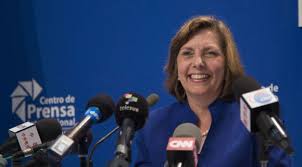
At a press conference after the meeting, Director General Vidal said the meeting had been “productive” and conducted in a “professional climate of mutual respect.” (A photograph of Vidal at the press conference is on the left.) The parties agreed to hold the fourth meeting of the Bilateral Commission in September 2016 in Washington, D.C.

Vidal also said she had told the U.S. delegation that Cuba reiterates its “appreciation for the positive results from President Obama’s visit to Cuba” that had been mentioned by President Raúl Castro during Obama’s visit. Indeed, she said, Cuba believes this visit is “a further step in the process towards improving relations” between the two countries and “can serve as an impetus to further advance this process.”[2]

Vidal acknowledged that there has been an increase in official visits as well as technical meetings on topics of common interest resulting in nine bilateral agreements to expand beneficial cooperation.[3]

According to Vidal, both delegations agreed on steps that will improve relations, including conducting high-level visits and technical exchanges on environmental, hydrography, and implementation and enforcement of the law, including fighting trafficking in drugs and people, and immigration fraud. The two countries also are getting ready to conclude new agreements to cooperate in areas such as health, agriculture, meteorology, seismology, terrestrial protected areas, response to oil-spill pollution, fighting drug trafficking and search and rescue, among others. They also are ready to start a dialogue on intellectual property and continue those relating to climate change and regulations in force in the two countries in the economic and trade area.

However, Vidal said, progress has not been as fast in the economic area because “the blockade [embargo] remains in force” despite the positive measures taken by President Obama to loosen U.S. restrictions. There still are significant U.S. restrictions on U.S. exports to Cuba and imports from Cuba. In addition, U.S. investments in Cuba are not allowed except in telecommunications, and there are no normal banking relations between the two countries. Therefore, Cuba stressed again the priority of the “lifting the economic, commercial and financial blockade [embargo].”

More specifically Vidal said Cuba had told the U.S. representative that in the last six months two American companies and one French company had been fined by the U.S. for maintaining links with Cuba while Cuba has had problems with 13 international banks’ closing accounts, denying money transfers or suspending all operations with Cuba. In addition, six service providers have ceased providing services to Cuban embassies and consulates in third countries (Turkey, Austria, Namibia and Canada).

In addition, the Cuban delegation, said Vidal, had reaffirmed the need for the U.S. to return to Cuba the territory [allegedly] illegally occupied by the U.S. naval base in Guantanamo. It “is the only case of a military base in the world that is based in a territory leased in perpetuity, which is an anomaly from the point of view of international law.[4] There is no similar example in the world and is the only instance of a military base in a foreign country against the will of the government and people of that country.

Vidal also mentioned the following U.S. policies and actions that needed to be changed:

  • the U.S. preferential migration policies for Cuban citizens, expressed in the existence of the policy of dry feet/wet feet;
  • the U.S. Cuban Adjustment Act regarding those immigration policies;
  • the U.S. program of parole for Cuban health professionals;
  • the special U.S. radio and television broadcasts designed especially for Cuba (Radio and TV Marti); and
  • U.S. programs designed to bring about changes in the economic, political and social system of Cuba.[5]

These U.S. policies, according to Vidal, underscored “a huge contradiction” for the U.S. On the one hand, President Obama said in his speech in Cuba that the U.S. has neither the intention nor the ability to bring about change in Cuba and that in any case it was up to the people of Cuba to make their own decisions. On the other hand, the U.S. has programs with huge budgets ($20 million dollars every year) aimed at bringing about such change. If indeed there is neither the intention nor the ability to bring about change in Cuba, then there is no reason to have such programs.

Normalization, said Vidal, also needs to have protection of rights to trademarks and patents because there are Cuban companies owning well-known marks, which for reasons of the blockade and other reasons have been taken away from the Cubans.

Before the meeting, another Cuban Foreign Ministry official said that the parties previously had discussed, but not negotiated, with respect to Cuba’s claim for damages with respect to the U.S. embargo and the U.S. claims for compensation for property expropriated by the Cuban government. At the meeting itself, according to a Cuban statement, the Cubans had delivered a list of its most recent alleged damages from the blockade (embargo).

U.S. Embassy Statement

The U.S. Embassy in Havana after this Bilateral Commission meeting issued a shorter, but similar, statement about the “respectful and productive” discussions. “Both governments recognized significant steps made toward greater cooperation in environmental protection, civil aviation, direct mail, maritime and port security, health, agriculture, educational and cultural exchanges, and regulatory issues. The parties also discussed dialogues on human rights and claims, and the [U.S.] looks forward to holding these meetings in the near future.”

Conclusion

Since the actual meeting was conducted in secret, it is difficult to assess what was actually accomplished except through officials’ subsequent public comments.

On May 17, the two countries conducted their second Law Enforcement Dialogue, which will be discussed in a subsequent post.

===============================================

[1] U.S. Department of State, United States and Cuba to Hold Third Bilateral Commission Meeting in Havana, Cuba (May 12, 2016); Gomez, MINREX: relations between Cuba and the United States would advance more nonblocking, Granma (May 12, 2016); Reuters, Cuba and U.S. Officials to Meet Next Week to Deepen Detente, N.Y. Times (May 12, 2016); Francisco & Elizalde, Cuba-US Bilateral commission: a productive meeting, Josefina Vidal  (+ Photos and Video), CubaDebate (May 16, 2016); Assoc. Press, Top Cuba Diplomat: Obama Trip Positive, Created Momentum, N.Y. Times (May 16, 2016); Reuters, Cuba and United States Draw Up Roadmap for Talks to Deepen Détente, N.Y. Times (May 16, 2016); Gomez, Cuba and the United States defines ambitious agenda for the coming months, Granma (May 16, 2016); U.S. Embassy, Havana, Cuba, Third Bilateral Commission Meeting in Havana (May 16, 2016); Press release issued by the Cuban delegation to the Third Meeting of the Cuba-U.S. Bilateral Commission, Granma (May 17, 2016); Cuba and U.S. set ambitious agenda for coming months, CubaDebate (May 17, 2016).

[2] Vidal’s positive comment about Obama’s visit is in sharp contrast to the negative comments about the visit from Vidal’s superior, Foreign Minister Bruno Rodriguez at the recent Congress of the Communist Party of Cuba. (See Conclusion of Seventh Congress of Communist Party of Cuba, dwkcommentaries.com (April 20, 2016).)

[3] Beforehand an official of Cuba’s Foreign Ministry said that since the December 2014 announcement of détente the parties had signed nine agreements covering the environment, email, navigation safety, agriculture and travel. In addition, the Telecommunications Company of Cuba (ETECSA) had signed agreements with three U.S. companies for cellular roaming in Cuba; a U.S. company (Starwood) had an agreement to manage several Cuban hotels; and the Carnival cruise lines had made a maiden voyage to the island.

[4] The U.S., however, contends that the lease is not in perpetuity, but for so long as the U.S. uses it as a “naval station.” This is one of the potential issues to be resolved in an international arbitration as suggested in a previous post. (Does Cuba Have a Right To Terminate the U.S. Lease of Guantanamo Bay? dwkcommentaries.com (April 26, 2015).)

[5] Prior posts have concurred in the Cuban requests for ending all of these U.S. programs and policies. See Topical List of Posts—Cuba.

Cuba’s Possession of U.S. Missile Threatens To Disrupt U.S.-Cuba Normalization

On January 7, 2016, it became publicly known through a Wall Street Journal article that since sometime in 2014 Cuba has had possession of an inert U.S. missile that was erroneously shipped to Cuba from Europe.[1] This post will discuss what is now known about this missile in Cuba and the reactions to this news.

Diversion of U.S. Missile to Cuba

Hellfire missile
Hellfire missile

The object is a dummy U.S. Hellfire missile without any explosives that is a laser-guided, air-to-surface weapon that weighs about 100 pounds and that can be deployed from an attack helicopter or an unmanned drone.

Its manufacturer, Lockheed Martin, in early 2014, with U.S. State Department authorization, shipped the missile from Orlando, Florida to Spain for a NATO training exercise for later return to the U.S. After the completion of the training exercise, it was packaged in Rota, Spain and sent on another freight-forwarder’s truck to Madrid, where it was sent by plane to Frankfurt, Germany. There it was supposed to have been shipped to Lockheed in Florida. Instead for unknown reasons it was shipped from Frankfurt to Paris on an Air France flight, and from Paris to Havana on another Air France flight. Upon its arrival in Cuba, a Cuban official noticed the labeling on the crate and seized it.

Around June 2014 Lockheed, after realizing the missile was missing and likely was in Cuba, notified the U.S. State Department. Thereafter the U.S. has been pressing the Cuban government for information about the missile and for Cuba to return it to the U.S., but Cuba has not responded.

During the summer of 2014, of course, the U.S. and Cuba were engaged in the final steps leading up to the December 17, 2014, announcement that the two countries were embarked upon normalization of relations. Since then, they have been taking various steps toward normalization.

The reason for the shipment to Cuba is unknown. Was it a stupid mistake by a freight forwarder or several of such companies? That I find difficult to believe. That seems to leave it being an intentional criminal or espionage act.

The U.S. is concerned that Cuba has or could give access to the missile to learn about its technology to Russia, China or North Korea. But an article by someone who apparently is technically sophisticated in such matters discounts such dire consequences because “there’s good reason to suspect that China and other large cyber powers might already have blueprints and more, thanks to the still-vague scope of several highly successful military cyber attacks;” because “the US sells thousands upon thousands of working Hellfires to ‘close military ‘allies’ like Iraq, Saudi Arabia, and Turkey;” and because “the fall of Iraq’s Mosul to forces from ISIS . . . led to about $700 million worth of working Hellfire missiles falling into the hands of terrorists.”[2]

 Criticism of the Obama Administration[3]

Unsurprisingly this news has prompted severe criticism of the Administration.

U.S. Senator Marco Rubio (Rep., FL), a Republican presidential candidate, voiced his criticism in a letter to Assistant Secretary of State for Western Hemisphere Affairs, Roberta Jacobson. Rubio opened with the seemingly incontrovertible statement, “Preventing the proliferation of sensitive U.S. technology is one of the most important duties carried out by the State Department.” Because Jacobson has been so deeply involved with normalization negotiations with Cuba, she was asked these questions:

  • “When was the State Department informed that a U.S. Hellfire missile had been sent to Cuba?
  • When were you personally first informed of this matter and by whom?
  • What has been done to obtain the missile’s return by the Cuban government?
  • What specific entity of the Cuban government is currently in possession of the missile?
  • Please provide a list of the specific occasions on which you or other U.S. Government officials have raised this issue with the Castro regime.
  • Why was the return of the missile not obtained as a result of the negotiations that led to President Obama’s December 17, 2014 announced change in U.S. policy toward Cuba?
  • Why was the return of the missile not a condition of removal of Cuba from the State Sponsors of Terrorism list?
  • Why was the return of the missile not a condition of establishment of embassies in Havana and Washington?
  • What members of Congress did you inform of this issue during your briefings and testimony regarding U.S. policy toward Cuba over the last 18 months?
  • Does the State Department know if the Cuban government shared the missile or its design with any foreign governments?”

The Rubio letter concluded, “Sensitive U.S. technology falling into the hands of such a regime [as Cuba’s] has significant implications for U.S. national security.  The fact that the administration, including you, have apparently tried to withhold this information from the congressional debate and public discussion over U.S.-Cuba policy is disgraceful.”

Also on Friday, Republican presidential candidate Jeb Bush tweeted: “Whether it’s Iran holding U.S. citizens hostage or Cuba holding a U.S. missile hostage, Obama always caves. I won’t.’’

Four other lawmakers critical of the Obama position toward Cuba also criticized the handling of the missile case. In a joint statement, Reps. Ileana Ros-Lehtinen (R., Fla.), Mario Diaz Balart (R., Fla.), Carlos Curbelo (R., Fla.) and Albio Sires (D., N.J.) said:

  • “Regardless of how Cuba came into possession of a U.S. Hellfire missile – which must be investigated – it is unconscionable that the Obama administration knew the Castros were in possession of this sensitive U.S. military technology since June 2014 and still moved forward with its policy to open up travel, trade, investment and diplomatic relations with the regime.”
  • “The fact that the Castro regime was able to acquire a U.S. Hellfire missile could be indicative of the lengths it is willing to go to undermine our national security and harm our interests. Congress must provide oversight to determine how the U.S. export control system failed to prevent this gross violation from occurring, and if Cuba’s espionage apparatus played a role in this Hellfire acquisition.”
  • “The Cuban regime rebuffed the President’s efforts to secure the return of the Hellfire missile even as the negotiations were ongoing, and yet the regime still got everything it could have wanted. It is no wonder that the Castro brothers feel ever more emboldened to continue on with the repression of the Cuban people, with intimidation and unlawful arrests at an alarmingly high rate.”
  • “This is a very serious breach and we are deeply concerned that the Castros have already shared the sensitive technology with the likes of Russia, North Korea or China. . . . We urge the Administration to start holding the Cuban regime accountable for its continued transgressions not only against its own people, but its continued disregard for international norms.”

Senator Ron Johnson (Rep., WI), the Chair of the Committee on Homeland Security and Government Affairs, sent a letter to the heads of the Pentagon and the State Department, asking for an explanation “why the U.S. military would forgo complete control, care, and custody of such cargo when transporting it abroad.’’ Mr. Johnson also asked the administration for details of any other lost shipments of sensitive technology over the past five years.

Administration’s Response to Criticism[4]

White House spokesman Josh Earnest said on January 8 that the administration takes the issue very seriously. “The Department of Defense and the State Department are, again, I think for obvious reasons, quite interested in getting to the bottom of exactly what happened.’’

The same day the U.S. State Department spokesman, John Kirby, said, “I am restricted under federal law and regulations from commenting on specific defense trade licensing cases and compliance matters. What I can say is that under the Arms Export Control Act the State Department licenses both permanent and temporary exports by U.S. companies of regulated defense articles. U.S. companies are responsible for documenting their proposed shipping logistics in the application of their export license as well as reporting any shipping deviations to the department as appropriate.”

Conclusion

Although I have been, and still am, a strong advocate for U.S.-Cuba reconciliation, I am very troubled by the news of this missile ending up in Cuban hands and of its diversion in mid-2014 apparently not affecting U.S. negotiation of normalization. Final assessment has to await Assistant Secretary Jacobson’s responses to Senator Rubio’s questions and other news about this situation. I pray that it does not disrupt or sabotage further progress towards normalization.

=========================================

[1] Barrett & Lubold, Missing U.S. Missile Shows Up in Cuba, W.S.J. (Jan. 7, 2016); Reuters, Inert U.S. Hellfire Missile Wrongly Shipped to Cuba in 2014:WSJ, N.Y. Times (Jan. 7, 2016); Assoc. Press, Dummy Hellfire Missile Mistakenly Shipped to Cuba, N.Y. Times (Jan. 8, 2016); Ayuso, The mystery of the US missile ended in Cuba, El Pais (Jan. 9, 2016).

[2] Templeton, It probably won’t matter Cuba got a dummy Hellfire missile—and that’s terrifying, ExtremeTech (Jan. 9, 2016).

[3] Barrett & Lubold, Republicans Criticize Obama Administration Over Missile Sent to Cuba, W.S.J. (Jan. 8, 2015); Missile that turned up in Cuba ignites backlash, Miami Herald (Jan. 8, 2016); Rubio, Rubio Demands Answers From Administration On U.S. Missile in Cuba’s Possession (Jan. 8, 2016); Ros-Lehtinen, Ros-Lehtinen, Diaz-Balart, Curbelo and Sires Make Joint Statement Regarding Unaccounted U.S. Hellfire Missile Acquired by the Castro Regime (Jan. 8, 2016)

[4] U.S. Dep’t of State, Daily Press Briefing (Jan. 8, 2016).


Status of Cuban Migrants in Central America Still Unresolved  

Previous posts have discussed the plight of Cuban migrants in Central America on their way for entry to the U.S. under its current “dry feet” policy. Nicaragua refused to admit such migrants from Costa Rica, and a regional meeting of foreign ministers failed to resolve the problem.[1] That is still the case.[2]

Other Countries‘ Refusal To Help

On December 8, the President of Costa Rica announced that his country had failed to find other countries in the region that are willing to take any of the approximately 5,000 Cuban migrants in Costa Rica so that they may continue their journey north to the U.S.

Belize has rejected Costa Rica’s request to allow the Cubans to transit through that country while Guatemala has requested a Mexican pledge to allow the migrants to go through that country to the U.S. before Guatemala will let the Cubans enter their country.

Nevertheless, Costa Rica has stated that it would not deport any of the Cubans to their home country against their will.

In the meantime Costa Rica has asked Ecuador, Colombia and Panama to limit the transit of any more Cubans. Panama now has approximately 1,000 Cuban migrants.

Inter-American Commission on Human Rights’ Concern

The Inter-American Commission on Human Rights has expressed its concern about the plight of the Cuban migrants in Costa Rica. The Commission, however, welcomed the decision of the Costa Rican government to grant transit visas to Cubans and to seek cooperation of other states in the region to facilitate the safe, orderly and documented transit of the migrants to the U.S. The Commission also has taken note of the November 30 U.S.-Cuba meeting about various migration issues.

The Commission reiterated that States have an obligation to respect and ensure the human rights of all migrants who are under their jurisdiction. Those rights are derived from the principle of human dignity

More specifically the Commission has urged the Nicaraguan government to investigate its alleged ill-treatment of the migrants. And to implement training programs on guidelines for use of force and the principle of non-discrimination. The Commission also has stressed the principle of non-refoulement, which necessarily implies that people are not rejected at border or expelled without an adequate and individualized analysis of their situations; the absolute prohibition of collective expulsions; and the obligation to take special measures for the different treatment of vulnerable groups within migrants.

In addition, the Commission urged the Cuba not to put obstacles to people wishing to leave the country.

Upcoming Costa Rica-Cuba Bilateral Meetings

On December 13-15, Costa Rica will hold apparently prearranged bilateral meetings in Havana because the published agenda does not include any mention of the migrant crisis. Instead that agenda includes the following:

  1. Create a strategic alliance to link ecosystems biotechnology research
  2. Strengthen ties of cooperation among public universities that have institutes of biotechnology.
  3. Create links between software industries.
  4. Promote training processes in high performance sport developing anti-doping testing.
  5. Increase tourism connectivity by adding Costa Rica to flights that Cuba receives from China, Russia and Turkey,
  6. Exchange experiences and knowledge in health case, especially primary care, cancer treatments and vaccines.
  7. See investment opportunities in Cuba for Costa Rican businesses.

Let us hope that perhaps behind the scenes the presidents of the two countries will discuss and find ways to reduce or solve the crisis.

=================================================

[1] Cubans in Central America Provide Cuba with an Opportunity To Reiterates Its Objections to U.S. Immigration Policies (Nov. 20, 2015); Update on Cuban Migrants in Central America (Nov. 27, 2015); U.S. and Cuba Fail To Resolve Complaints About U.S. Immigration Policies (Dec. 1, 2015); President Obama Should Exercise His Legal Authority To End U.S. Admission of Cubans with “Dry Feet” (Dec. 4, 2015).


[2] Reuters, Belize Rejects Plan to Allow Cuban Migrants to Pass Through Its Territory, N.Y. Times (Dec. 8, 2015); Costa Rica Foreign Min., Belize says Cuban migration must be resolved as a regional issue and for now not serve this population (Dec. 8, 2015); OAS, IACHR Expresses Great Concern Regarding Situation of Cuban Migrants on the Costa Rica-Nicaragua Border (Dec. 8, 2015); Costa Rica Foreign Min., Commission expresses deep concern over situation of Cuban migrants at the border between Costa Rica and Nicaragua (Dec. 8, 2015); Assoc. Press, Costa Rica Will Not Send Cuban Migrants Home, N.Y. Times (Dec. 9, 2015);Costa Rica President Sends Message to Cuban migrants to failure of negotiations with countries in the region, Granma (Dec. 9, 2015); Guatemala demands Mexico pledge over blocked Cuban migrants, Tico Times (Dec. 9, 2015); Costa Rica Foreign Min., Bilateral ministerial meetings agenda official visit to Cuba (Dec. 10, 2015).


U.S. Process for Screening Refugees

The U.S. process for screening refugees only commences after representatives of the United Nations High Commissioner for Refugees screens and determines that an individual meets the international standard for refugees: an individual who has a “well-founded fear of being persecuted for reasons of race, religion, nationality, membership of a particular social group or political opinion, is outside the country of his nationality and is unable, or owing to such fear, is unwilling to avail himself of the protection of that country.” [1]

Once an individual is determined to be a “refugee” by that U.N. agency and is designated for resettlement in the U.S., the U.S. commences its process for screening such an individual before he or she is permitted to come to the U.S. On November 19, 2015, Mr. Simon Henshaw, the U.S. Principal Deputy Assistant Secretary of State for Population, Refugees, and Migration, gave a special briefing on that U.S. process. [2] Here is what he had to say.

The U.S. “remains deeply committed to safeguarding the American people from terrorists, just as we are committed to providing refuge to the world’s most vulnerable people. We do not believe these goals are mutually exclusive or that either has to be pursued at the expense of the other.”

“All refugees go through the most intensive security screening of any travelers to the [U.S.]. It includes multiple federal intelligence, security, and law enforcement agencies, including the National Counterterrorism Center, the FBI Terrorist Screening Center, and the Departments of Homeland Security, State, and Defense. A refugee applicant cannot be approved for travel until all required security checks have been completed and cleared.”

“Syrian refugees go through yet additional forms of security screening. . . . We prioritize admitting the most vulnerable Syrians, including female-headed households, children, survivors of torture, and individuals with severe medical conditions. We have, for years, safely admitted refugees from all over the world, including Syrian refugees, and we have a great deal of experience screening and admitting large numbers of refugees from chaotic environments, including where intelligence holdings are limited.” In addition, the Government continues “to examine options for further enhancements for screening Syrian refugees, the details of which are classified.”

The “Department of Homeland Security has full discretion to deny admission before a refugee comes to the U.S. When in doubt, DHS denies applications on national security grounds and the individual never travels to the [U.S.]. Their decisions are guided by the key principle directed by the President and affirmed throughout the U.S. Government that the safety and security of the American people must come first. The U.S. Government has the sole authority to screen and decide which refugees are admitted to the [U.S.]. Security checks are a shared responsibility between the State Department and DHS.”

“All available biographical and biometric information is vetted against a broad array of law enforcement, intelligence community, and other relevant databases to help confirm a refugee’s identity, check for any criminal or other derogatory information, and identify information that could inform lines of questioning during the interview. DHS conducts extensive in-person interviews of all refugee applicants. Biographic checks against the State Department’s Consular Lookout and Support System, known as CLASS, which includes watch list information, are initiated at the time of a prescreening carried out by State Department contractors.”

“In addition, the State Department requests security advisory opinions from the law enforcement and intelligence communities for those cases meeting certain criteria. Biometric checks are coordinated by USCIS [U.S. Customs and Immigration Service] using mobile fingerprint equipment and photographs at the time of the interview.[3] These fingerprints are screened against the vast biometric holdings of the FBI, the integrated automated fingerprint identification system, and screened and enrolled in DHS’s Automated Biometric Identification System, which is known as IDENT.”

“Through IDENT, applicant fingerprints are screened not only against watch list information, but also for previous immigration encounters in the [U.S.] and overseas, including cases in which the applicant previously applied for a visa at a U.S. embassy. The classified details of the refugee . . . security screen process are regularly shared with relevant congressional committees.”

“The U.S. welcomed 1,682 vulnerable Syrian refugees in Fiscal Year 2015, and the President has directed his team to make preparations to admit at least 10,000 Syrian refugees in Fiscal Year 2016. Measured against more than four million Syrian refugees currently hosted in the Middle East, this is a modest but an important contribution to the global effort to address the Syrian refugee crisis.”

In addition, it has been widely reported that the U.S. screening of an individual Syrian refugee typically takes at least two years.

Conclusion

This account of the screening process should provide assurances to the American public that no additional procedures are necessary and that the recent bill to do that as passed by the House of Representatives is unnecessary.

=================================================

[1] Refugee and Asylum Law: Modern Era (July 9, 2011); Refugee and Asylum Law: Office of U.N. High Commissioner for Refugees (July 10, 2011).

[2] State Dep’t, Special Briefing: Refugee Screening Process (Nov. 19, 2015).

[3] The mobile units for screening Syrian refugees currently are located in Turkey and Jordan with another unit planned for Lebanon.

The U.S. Commission on International Religious Freedom’s Annual Report 2014   

Comm'n Intl Religious Free                                                

On April 30, 2014, the quasi-independent U.S. Commission on International Religious Freedom released its Annual Report 2014, pursuant to the International Religious Freedom Act of 1988 (“the Act”).[1]

Introduction

The Commission relies upon this definition of the freedom in the Universal Declaration of Human Rights: “Everyone has the right to freedom of thought, conscience and religion; this right includes freedom to change his religion or belief, and freedom, either alone or in community with others and in public or private, to manifest his religion or belief in teaching, practice, worship and observance.” Similar provisions are found in several multilateral human rights treaties.[2] (P. 9.)

The Report stressed the importance of this freedom. It says this right “protects the freedom of religious communities, as groups, to engage in worship and other collective activities. It also protects every individual’s right to hold, or not to hold, any religion or belief, as well as the freedom to manifest such a religion or belief, subject only to the narrow limitations specified under international law.” (P. 9.)

This right is important, says the Commission, “because it enables people to follow what their conscience dictates. . . . People are entitled to religious freedom by virtue of their humanity.” Therefore, there can be no “coercion or compulsion in these matters.” (P. 2.)

Moreover, whenever this freedom is abused, “societal well-being would suffer” as well as democracy and other human rights and economic productivity. So too “peace and security may become more elusive.” In short, according to the commission, “the defense of religious freedom is both a humanitarian imperative and a practical necessity.” (P. 3.)

General Recommendations

The Commission recommended that the U.S. do the following with respect to this freedom:

  • develop and implement a religious freedom strategy;
  • demonstrate the importance of religious freedom , including the designation of “countries of particular concern ” identified by the Commission;
  • reinvigorate and create new tools under the Act;
  • expand training, programming and public diplomacy about the subject;
  • expand multilateral efforts on the subject; and
  • protect asylum-seekers from being returned to countries where they face persecution for religious reasons. (Pp. 7-8.)

“Countries of Particular Concern” (Tier 1 Countries)

Under its authorizing statute, the Commission is required to designate as “countries of particular concern” (CPC) (or “Tier 1 Countries”) those that have engaged in or tolerated “particularly severe” violations of religious freedom. (P. 5.)

The latest report recommends that the Secretary of State re-designate the following eight countries as Tier 1 countries: Burma, China, Eritrea, Iran, North Korea, Saudi Arabia, Sudan and Uzbekistan. In addition, the Report recommends that the following additional eight countries also be so designated by the State Department: Egypt, Iraq, Nigeria, Pakistan, Syria, Tajikistan, Turkmenistan and Vietnam. (P. 5.)

Tier 2 Countries

The Commission also designates some countries as “Tier 2 Countries,” i.e., countries on the threshold of Tier 1 status, i.e., when their “violations . . . are particularly severe” and when at least one, but not all three, of the criteria for that status (“systematic, ongoing and egregious”) is met. (P. 5.)

The latest Report designated the following nine countries as Tier 2: Afghanistan, Azerbaijan, Cuba, India, Indonesia, Kazakhstan, Laos, Russia and Turkey.[3] (P. 5.)

Other Countries

The latest Report also discussed seven other countries (Bahrain, Bangladesh, Belarus, Central African Republic, Ethiopia, Kyrgyzstan and Sri Lanka) and one region (Western Europe) that it monitored during the year. (P. 5.)

Conclusion

Because of my personal interest in Cuba, including its religious freedom, a subsequent post will critique the Report regarding that country.

=========================================

[1] The Act § § 202, 205. The Report contains an account of the development of the Act and the 15-year history of its implementation. (Pp. 11-23.) A prior post examined the fascinating structure and composition of the Commission, and another post its report issued in 2013.

[2] See Post: International Law Regarding Freedom of Religion (Jan. 1, 2012).

[3] Previously the Commission called this group the “Watch List of countries where the serious violations of religious freedom engaged in or tolerated by the governments do not meet the CPC threshold, but require close monitoring.” According to the Commission, the “Watch List provides advance warning of negative trends that could develop into severe violations of religious freedom, thereby providing policymakers with the opportunity to engage early and increasing the likelihood of preventing or diminishing the violations.”


Global Forced-Displacement Tops 50 Million

On June 20th, the United Nations refugee agency (U.N. High Commissioner for Refugees or UNHCR) reported that the number of refugees, asylum-seekers and internally displaced (IDPs) people was 51.2 million in 2013. This is the first time after World War II that the number has topped 50 million. (Articles about this report may be found in the New York Times and the Guardian.)[1]

This represented an increase of 6 million over the prior year due largely to the war in Syria and conflicts in the Central African Republic and South Sudan. Here is a graph showing the totals (with components), 1993-2013:


Refugee graph

Here is another graph showing the largest sources of refugees in 2013:

Source of refugees

Developing countries host 86% of the world’s refugees. The top five host countries are Pakistan, 1.6 million; Iran, 0.9 million; Lebanon, 0.9 million; Jordan, 0.6 million; and Turkey, o.6 million. The U.S. ranks 10th as a host country with 0.3 million.

The U.N. High Commissioner for Refugees, António Guterres, said,”We are seeing here the immense costs of not ending wars, of failing to resolve or prevent conflict. Peace is today dangerously in deficit. Humanitarians can help as a palliative, but political solutions are vitally needed. Without this, the alarming levels of conflict and the mass suffering that is reflected in these figures will continue.” He added, “The international community has to overcome its differences and find solutions to the conflicts of today in South Sudan, Syria, Central African Republic and elsewhere. Non-traditional donors need to step up alongside traditional donors.”

Serge Schmemann of the New York Times editorial board observed that the report indicates that half “the refugees are children; a growing number of these are on their own . . . . More than half of the 6.3 million refugees under the refugee agency’s care have been in exile for five years or more, testifying to conflicts that rage on and on.” Schmemann added that the “stunning figures offer a bitter counterpoint to the growing resistance in Europe and the United States to letting in immigrants and asylum seekers, and to the endless sterile blame-games about responsibility for the various conflicts.”

=====================================================

[1] A brief history of the UNHCR was provided in a prior post while another post discussed its report for 2010. Another post reviewed the international law of refugees and asylum seekers.