Another U.N. Condemnation of the U.S. Embargo of Cuba

                                                                                       O

U.N. General Assembly

On October 26, the United Nations General Assembly voted, 191 to 0 (with two abstentions), to adopt a resolution proposed by Cuba to condemn the United States embargo of Cuba. For the first time in the 25-year history of the annual vote on such resolutions, the U.S, rather than opposing the text, cast an abstention, prompting Israel to do likewise.[1]

This post will examine the resolution’s text, its presentation by Cuba, its support by other countries and the arguments for abstention offered by the U.S. and Israel. This post will then conclude with a brief discussion of reaction to the abstention in the U.S. Prior posts discussed the similar General Assembly resolutions against the embargo that were adopted in 2011, 2014 and 2015.

The Actual Resolution

The actual resolution, “Necessity of ending the economic, commercial and financial embargo imposed by the United States of America against Cuba” (A/RES/71/5 and A/71/L.3) had two principal operative paragraphs.

It reiterated “its call upon all States to refrain from promulgating and applying laws and measures [like the U.S. embargo against Cuba] . . . in conformity with their obligations under the Charter of the United Nations and international law, which, inter alia, reaffirm the freedom of trade and navigation (¶ 2). It also urged “States that have and continue to apply such laws and measures to take the steps necessary to repeal or invalidate them as soon as possible in accordance with their legal regime (¶ 3).

The resolution’s preamble reaffirmed “the sovereign equality of States, non-intervention and non-interference in their internal affairs and freedom of international trade and navigation, which are also enshrined in many international legal instruments” and recited the previous General Assembly resolutions against the embargo. It then welcomed “the progress in the relations between the Governments of Cuba and the [U.S.] and, in that context, the visit of the President of the [U.S.], Barack Obama, to Cuba in March 2016” while also recognizing “the reiterated will of the President of the [U.S.] to work for the elimination of the economic, commercial and financial embargo against Cuba” and “the steps taken by the [U.S.] Administration towards modifying some aspects of the implementation of the embargo, which, although positive, are still limited in scope.”

Cuba’s Presentation of the Resolution

Bruno Rodriguez
Bruno Rodriguez

Speaking last in the debate, Cuba’s Foreign Minister Bruno Rodriguez Parrilla, presented arguments for adopting the resolution. Here are extracts of that speech:

“[T]here has been progress [between Cuba and the U.S. since December 2014] in the dialogue and cooperation on issues of common interest and a dozen agreements were signed [and] reciprocal benefits reported. Now just announced the vote of the US abstention on this draft resolution.”

“The [U.S.] president and other top officials have described [the embargo/blockade] as obsolete, useless to advance American’s interests, meaningless, unworkable, being a burden for [U.S.] citizens, . . . [harming] the Cuban people and [causing]. . . isolation to the [U.S.] and [have] called [for the embargo/blockade] to be lifted.”

“We recognize that executive measures [to reduce the scope of the embargo] adopted by the government of the [U.S.] are positive steps, but [have] very limited effect and scope. However, most of the executive regulations and laws establishing the blockade remain in force and are applied rigorously to this minute by U.S. government agencies.”

“Meanwhile, the U.S. Congress has not approved any of the 20 amendments or legislative initiatives, with bipartisan support, . . . [for] eliminating some restrictions of the blockade or even all of this policy. [Moreover,] there have been more than 50 legislative initiatives that threaten to reinforce key aspects of the blockade, preventing the President [from] approving new executive or implementing measures already adopted.”

“It cannot be underestimated in any way the powerful political and ethical message that [action by this Assembly] . . . sends to the peoples of the world. The truth always [finds] its way. Ends of justice prevail. The abstention vote announced surely is a positive step in the future of improved relations between the[U.S.] and Cuba. I appreciate the words and the efforts of Ambassador Samantha Power.”

“[There] are incalculable human damages caused by the blockade. [There is no] Cuban family or industry in the country that does not suffer its effects on health, education, food, services, prices of goods, wages and pensions.” For example, the “imposition of discriminatory and onerous conditions attached to the deterrent effects of the blockade restrict food purchases and the acquisition in the U.S. market for drugs, reagents, spare parts for medical equipment and instruments and others.”

“The [embargo/] blockade also [adversely] affects the interests of American citizens themselves, who could benefit from various services in Cuba, including health [services].”

“The [embargo/] blockade remains a massive, flagrant and systematic violation of human rights of all Cubans and qualifies as an act of genocide under the Convention on the Prevention and Punishment of the Crime of Genocide of 1948. It is an obstacle to cooperation [in] international humanitarian areas.”

“The blockade is the main obstacle to economic and social development of our people. It constitutes a flagrant violation to international law, the United Nations Charter and the Proclamation of Latin America and the Caribbean as a Zone of Peace. Its extraterritorial application adds further to its violation of international law nature of magnitude.”

“Other causes, in addition to [the blockade/embargo] . . . , determine our economic difficulties: the unjust international economic order; the global crisis; the historical distortions and structural weaknesses caused by underdevelopment; high dependence on energy and food imports; the effects of climate change and natural disasters; and also . . . our own mistakes.”

“Between April 2015 and March 2016, the direct economic damage to Cuba by the blockade amounted to $4.68 billion at current prices, calculated rigorously and prudently and conservatively. The damages accumulated over nearly six decades reach the figure of $753 billion, taking into account depreciation of gold. At current prices, [that is] equivalent to just over $125 billion.”

“On 16 April 2016 President Raul Castro Ruz said, ‘We are willing to develop a respectful dialogue and build a new relationship with the [U.S.], as that has never existed between the two countries, because we are convinced that this alone . . . [will provide] mutual benefits.’ And last September 17, he said ‘I reaffirm the will to sustain relations of civilized coexistence with the [U.S.], but Cuba will not give up one of its principles, or make concessions inherent in its sovereignty and independence.’”

“The government of the [U.S.] first proposed the annexation of Cuba and, failing that, to exercise their domination over it. The triumph of the Cuban Revolution . . . [prompted the U.S. adoption of the embargo whose purpose] was ‘to cause disappointment and discouragement through economic dissatisfaction and hardship … to deny Cuba money and supplies, in order to reduce nominal and real wages, with the aim of causing hunger, desperation and overthrow of government. ‘”

“The [new U.S.] Presidential Policy Directive [states] that the Government of the [U.S.] recognizes ‘the sovereignty and self-determination of Cuba’ and [the right of] the Cuban people to make their own decisions about their future.’” It also states “the U.S. will not seek a ‘change of regime in Cuba.’”[2]

But the Directive also says “’the [U.S.] will support the emerging civil society in Cuba and encourage partners and non-governmental actors to join us in advocating in favor of reforms. While the United States remain committed to supporting democratic activists, [we] also [will] participate with community leaders, bloggers, activists and other leaders on social issues that can contribute to the internal dialogue in Cuba on civic participation.’ The Directive goes on to say: “The [U.S.] will maintain our democracy programs and broadcasting, while we will protect our interests and values, such as Guantanamo Naval Base … The government of the United States has no intention of modifying the existing lease agreement and other related provisions.’”

The Directive also asserts that Cuba “remains indebted to the [U.S.] regarding bilateral debts before the Cuban Revolution.”

The U.S. needs to “recognize that change is a sovereign matter for Cubans alone and that Cuba is a truly independent country. It gained its independence by itself and has known and will know how to defend [its] greatest sacrifices and risks. We are proud of our history and our culture that are the most precious treasure. We never forget the past because it is the way never to return to it. And we decided our path to the future and we know that is long and difficult, but we will not deviate from it by ingenuity, by siren songs, or by mistake. No force in the world can force us to it. We will strive to build a sovereign, independent, socialist, democratic, prosperous and sustainable nation. We will not return to capitalism.”

Other Countries’ Statements of Support[3]

During the debate the following 40 countries expressed their support of the resolution:

  • Latin America: Argentina, Bolivia, Brazil, Colombia, Costa Rica, Dominican Republic (for Commonwealth of Latin American and Caribbean States (CELAC)), Ecuador, El Salvador, Jamaica (for Caribbean Community (CARICOM)), Mexico, Nicaragua, Saint Vincent and Grenadines, Uruguay and Venezuela (for Non-Aligned Movement (NAM)).
  • Africa: Algeria, Angola, Libya, Mozambique, Namibia, Niger (for African States), South Africa, Sudan and Tonga.
  • Middle East: Egypt, Kuwait (for Organization of Islamic Conference (OIC)) and Syria.
  • Asia: Belarus, China, Democratic People’s Republic of Korea [North Korea], India, Indonesia, Iran, Lao People’s Democratic Republic, Malaysia, Myanmar, Russian Federation, Singapore (for Association of Southeast Asian Nations (ASEAN)), Thailand (for Group of 77 and China) and Viet Nam.
  • Europe: Slovakia (for European Union (EU)).

U.S. Abstention[4]

Samantha Power
Samantha Power

The U.S. Ambassador and Permanent Representative to the United Nations, Samantha Power, announced the U.S. abstention before the debate and voting on the resolution. Here are extracts of her speech about that vote.

“For more than 50 years, the [U.S.] had a policy aimed at isolating the government of Cuba. For roughly half of those years, U.N. Member States have voted overwhelmingly for a General Assembly resolution that condemns the U.S. embargo and calls for it to be ended. The [U.S.] has always voted against this resolution. Today the [U.S.] will abstain.”

“In December 2014, President Obama made clear his opposition to the embargo and called on our Congress to take action to lift it. Yet while the Obama Administration agrees that the U.S. embargo on Cuba should be lifted, . . . we don’t support the shift for the reason stated in this resolution. All actions of the [U.S.] with regard to Cuba have been and are fully in conformity with the U.N. Charter and international law, including applicable trade law and the customary law of the sea. We categorically reject the statements in the resolution that suggest otherwise.”

“But [today’s] resolution . . . is a perfect example of why the U.S. policy of isolation toward Cuba was not working – or worse, how it was actually undermining the very goals it set out to achieve. Instead of isolating Cuba, . . . our policy isolated the [U.S.], including right here at the [U.N.].”

“Under President Obama, we have adopted a new approach: rather than try to close off Cuba from the rest of the world, we want the world of opportunities and ideas open to the people of Cuba. After 50-plus years of pursuing the path of isolation, we have chosen to take the path of engagement. Because, as President Obama said in Havana, we recognize that the future of the island lies in the hands of the Cuban people.”[5]

“Abstaining on this resolution does not mean that the [U.S.] agrees with all of the policies and practices of the Cuban government. We do not. We are profoundly concerned by the serious human rights violations that the Cuban government continues to commit with impunity against its own people – including arbitrarily detaining those who criticize the government; threatening, intimidating, and, at times, physically assaulting citizens who take part in peaceful marches and meetings; and severely restricting the access that people on the island have to outside information.”

“We [,however,] recognize the areas in which the Cuban government has made significant progress in advancing the welfare of its people, from significantly reducing its child mortality rate, to ensuring that girls have the same access to primary and secondary school as boys.”

“But none of this should mean that we stay silent when the rights of Cuban people are violated, as Member States here at the [U.N.] have too often done. That is why the [U.S.] raised these concerns directly with the Cuban government during our [recent] historic dialogue on human rights . . ., which shows that, while our governments continue to disagree on fundamental questions of human rights, we have found a way to discuss these issues in a respectful and reciprocal manner.[6] We urge other Member States to speak up about these issues as well.”

“As President Obama made clear when he traveled to Havana, we believe that the Cuban people – like all people – are entitled to basic human rights, such as the right to speak their minds without fear, and the right to assemble, organize, and protest peacefully. Not because these reflect a U.S.-centric conception of rights, but rather because they are universal human rights – enshrined in the U.N. Charter and in the Universal Declaration of Human Rights – which all of our 193 Member States are supposed to respect and defend. Rights that are essential for the dignity of men, women, and children regardless of where they live or what kind of government they have.”

The U.S. concedes that it “has work to do in fulfilling these rights for our own citizens. And we know that at times in our history, U.S. leaders and citizens used the pretext of promoting democracy and human rights in the region to justify actions that have left a deep legacy of mistrust. We recognize that our history, in which there is so much that makes us proud, also gives us ample reason to be humble.”

“The [U.S.] believes that there is a great deal we can do together with Cuba to tackle global challenges. That includes here at the [U.N.], where the decades-long enmity between our nations has at best been a distraction – and at worst, an obstacle – to carrying out some of the most important work of this institution and helping the world’s most vulnerable people.”

U.S. Reactions[7]

Engage Cuba, a U.S. national coalition of private companies, organizations and state and local leaders working to lift the embargo, said, “Year after year, the international community has condemned our failed unilateral sanctions that have caused great economic hardship for the people of Cuba and continue to put American businesses at a competitive disadvantage. The fact that the Administration and Israel abstained from voting for the first time ever demonstrates the growing recognition that the U.S. embargo on Cuba is a failed, obsolete policy that has no place in today’s international affairs.”

Senator Marco Rubio (Rep., FL), on the other hand, blasted the abstention, saying the Obama administration had failed to honor and defend U.S. laws in an international forum. Similar negative reactions were registered by Senators Ted Cruz (Rep., FL) and Robert Menendez (Dem., NJ), Republican Representatives from Florida, Ileana Ros-Lehtinen and Mario Diaz-Balart, and the U.S.-Cuba Democracy PAC.

As an U.S. citizen-advocate for ending the embargo as soon as possible, I am pleased with the U.S. abstention and agree with Ambassador Power that this vote does not mean the U.S. agrees with the resolution’s stated reasons.

Moreover, too many in the U.S. believe the Cuban damages claim from the embargo is just a crazy Cuban dream, but I disagree. Given the amount of the claim, Cuba will not someday tell the U.S. to forget it. A prior post, therefore, suggested that the two countries agree to submit this and any other damage claims by both countries for resolution by an independent international arbitration panel such as those provided by the Permanent Court of Arbitration at the Hague in the Netherlands.

========================================================

[1] U.N. Press Release, U.S. abstains for first time in annual UN vote on ending embargo against Cuba (Oct. 26, 2016).

[2] A prior post replicated the Presidential Policy Directive while another post provided reactions thereto.

[3] U.N. Press Release, General Assembly Plenary (Oct. 26, 2016); The defeat of the blockade is the world’s largest moral and political victory for the people of Cuba against the empire, Granma (Oct. 26, 2016) (Venezuela’s statement); Today not only do we vote against the blockade, we voted for hope, Granma (Oct. 26, 2016) (Bolivia’s statement).

[4] Ambassador Power, Remarks at a UN General Assembly Meeting on the Cuban Embargo (Oct. 26, 2016).  Israel, which also abstained, merely said that it welcomed the improved U.S.-Cuba relations and hoped it would lead to a new era in the region.

[5] A prior post reviewed President Obama’s eloquent speech in Havana to the Cuban people.

[6] A prior post reviewed the limited public information about the recent human rights dialogue.

[7] Ordońez, For 1st time, U.S. changes its position on U.N. resolution blasting Cuba trade embargo, InCubaToday (Oct. 26, 2016); Engage Cuba, Press Release: Engage Cuba Praises First Ever Unanimous Passage of United Nations Resolution Condemning the Cuban Embargo (Oct. 26, 2016); Lederer & Lee, US abstains in UN vote on Cuba embargo for the first time, Wash. Post (Oct. 26, 2016); Rubio, Rubio: Obama Admin Ignoring U.S. Law on Cuba Embargo, Giving More Concessions to Castro Regime at U.N. (Oct. 26, 2016).
President Obama’s Reflections on His Pursuit of Normalization with Cuba      

Jon Lee Anderson, the author of a Che Guevara biography and a forthcoming book about Fidel Castro and the Cuban revolution, has written a fascinating article about President Obama and Cuba in The New Yorker.[1] It provides the following details about Obama’s March 2016 visit to the island and comments about his decision to seek normalization with Cuba beyond those already discussed in earlier posts.[2]

During his visit to Cuba, President Obama hosted an Entrepreneurship and Opportunity Event at La Cervecería (a beer hall) on Havana Harbor. Attending were invited American and Cuban entrepreneurs, government officials and journalists. Brian Chesky, the co-founder of Airbnb, told the group that Cuba was one of its fastest growing markets. In response to Obama’s question, he said his company was now valued at $25 billion after only eight years of operation, and Obama used this as an example of what could happen to a new business. Obama said, “Cuba should take ideas, steal ideas from wherever you see something working, not from where they are not. There are some economic models (like Cuba’s) that just don’t work. That’s just the objective reality. The American people are not interested in Cuba failing. We’re interested in Cuba being a partner with us.”

After Obama had departed the island, a member of Cuba’s security services said that this event was “as subversive as the Bay of Pigs.” Other Communist Party loyalists voiced similar opinions.

Later Obama admitted that he thought the Cuban pushback to his visit would be a lot stronger. The beer hall event, he said, intentionally bypassed the Cuban state in order to advertise and promote the possibilities of commerce freed of political constraint.

Obama also said after his trip that his decision to seek normalization with Cuba was based upon these premises: (1) “Cuba is a tiny, poor country that poses no genuine threat to the [U.S.]” (2) “In this era of the Internet and global capital movements, openness is a more powerful change agent than isolation.” (3) “If you are interested in promoting freedom, independence, civic space inside of Cuba, then . . . remittances to give individual Cubans some cash . . . that then allowed them to start a [business] . . . was going to be the engine whereby individual Cubans . . . can start expecting more.”

Important for Obama was growing up in underdeveloped Indonesia and “never [being] star-struck by revolution. [He believed that Cuba’s revolution had started because of good motives, but he] “was never persuaded that they had taken the right course of action.”

Obama also told Anderson that he believes Raúl Castro’s pursuit of normalization with the U.S. was based upon two conclusions. First, Castro recognized—“particularly in light of what’s happening in Venezuela—that sustaining their economic model over the next ten years becomes increasingly untenable. [Therefore,] how . . . [does he] make [the Cuban] economy run without giving up power. . . . [Second,] Raúl recognizes that any substantial change to their economic system, . . . their civil society, . . . their full political system—requires him to do some downfield blocking [i.e., preparatory work]. If a younger generation tries to pull this off without the revolutionary credentials, there will be too much pushback.”

=====================================================

[1] Anderson, The Cuba Play, The New Yorker at 42 (Oct. 3, 2016).

[2] See posts listed in “Obama & Cuba, 2007-2014,” “U.S. & Cuba Reconciliation, 2014-2015,” and “Obama’s Visit to Cuba, March 2016” in List of Posts to dwkcommentaries—Topical: Cuba.

Analysis of What Cuba’s Minister of Economy and Planning Said to Cuba’s Legislature  

A previous post covered the July 8th speeches to Cuba’s legislature (the National Assembly of People’s Power) by President Raúl Castro and Minister of Economy and Planning, Marino Murillo. However, that post was unable to dissect the English translation of the latter. Now Granma, Cuba’s Communist Party newspaper, has provided the following analysis of Murillo’ speech.[1]

In the last half of 2016, the Cuban government will be implementing measures that are “intended to optimize the country’s finances and emphasize the need for rational use of resources and efficiency, in order to reduce expenses and take advantage of untapped opportunities for savings.”

These measures include “plans to reduce liquid operations, which include adjustments by entities which have hard currency self-financing systems in place. Others involve suspending the assumption of short and medium term credits, as well as a cut, of approximately 28%, in planned energy consumption in the non-residential sector.”

The reductions of these expenses will mean “elimination of income” for some, but “other sectors with untapped opportunities are called upon to make an extra contribution to the economy. Tourism, for example, must generate some 25 million pesos more than initially planned.”

“In terms of energy consumption, fuel cutbacks of some 369,000 tons . . . are needed, while use of electrical energy must be reduced by 786 gigawatts. . . . However, the residential sector, which represents 60% of the country’s electricity consumption, will not be impacted.”

“Economic activities, such as tourism, which make a strategic contribution to the national economy – and consequently the country as a whole – will receive their projected supply of electricity, as will others capable of assuring export income or replacing imports with their products. Nor will the importing and production of food, or retail sales, be affected.”

“Also prioritized is the production of construction materials and indispensable inputs for agriculture, while maintaining attention to the country’s internal financial equilibrium.”

The steps to be taken in the last half of this year “are intended to address limitations with rationality, without changing the basic plan, and respond to the energy situation with precisely focused adjustments.”

There will be “strict adherence to the principle that funds allocated for salaries must be backed by production, in accordance with guiding benchmarks. Avoiding a negative impact on the average salary-productivity ratio is key to advancing along the course charted.”

“Leading the list of imperatives is stopping the importing of containers full of items that can be produced domestically, since reducing imports is crucial to balancing the budget equation.”

Encouragement was found in the increase in the “volume of milk collected by the state wholesale system . . ., implying a reduction in expenses associated with importing powdered milk, initially projected at 53,000 tons. Since dairy farmers have surpassed plans by more than seven million liters and the industry by 32 million, projected imports can be reduced.”

Another premise for these measures is “reducing expenses in hard currency to a minimum, maintaining only the indispensable associated with key economic activities.”

Also important is “avoiding the addition of inflationary pressures. Adequate levels of retail sales will be assured, and the necessity of salary expenses having productive backing is reiterated.”

“Other results thus far this year indicate the need to reprogram levels of freight transportation and, therefore, scheduled investments. It is now projected, however, that 17% of the funds originally planned for investment will not be spent. The 2016 total was estimated at 6.5 billion pesos, placing the transport sector among those with the largest investment plans in the country. Key development projects to a tune of 4.5 billion pesos will be guaranteed. The prioritized group of sectors in which strategic investments will be fully funded includes tourism, energy, the oil industry, and agricultural programs.”

The “average salary in state enterprises will be slightly lower than projected, with a reduction in the wage expenses-gross value added index.”

“In reference to the food supply, . . . planned imports of foodstuffs are assured. Fortunately, a decline in prices on the international market for some [food] products has given the state some relief in terms of funds allocated for food imports, allowing for savings of approximately 193 million U.S. dollars. Nevertheless, domestic shortfalls in projected production of food items have led to unplanned imports, costing some 50 million additional dollars.”

Recent steps have been “taken to increase the buying power of the Cuban peso, adding that efforts to stabilize their supply in retail outlets continue, to make the impact of price reductions sustainable over time. Lower prices for chicken, rice, cooking oil, powdered milk, and chickpeas have led to [recent] increased sales.”

“Throughout the report, a renewed call for increased productivity and efficiency, on the part of all, was made clear. Using resources rationally at all times, in all places, is now imperative.”

==================================================

[1] Delgado, Morales & Rodriguez, Efficiency on the economic agenda, Granma (July 14, 2016). On July 13, only five days after this speech, Murillo was replaced as Minister of Economy and Planning by Ricardo Cabrisas Ruiz, Vice President of Council of Ministers. According to the State Council, Murillo, in his capacity as Deputy Prime Minister and Head of the Permanent Commission for Implementation and Development, will now focus on updating the Cuban economic and social model, adopted by the 6th and the 7th Party congresses. However, no reasons were provided for this change. Official Note, Granma (July 13, 2016), ; Assoc. Press, Cuba Shuffles Economic Leadership Amid Fiscal Struggles, N.Y. Times (July 13, 2016).


United States-Cuba Bilateral Commission Meets To Review Normalization Status                                                                                                

On May 16, in Havana the U.S.-Cuba Bilateral Commission held its third meeting to review the status of the countries’ efforts to normalize relations. The U.S. delegation was headed by Ambassador Kristie Kenney, currently serving as Counselor of the Department of State, who was assisted by John S. Creamer, Deputy Assistant Secretary of State, Bureau of Western Hemisphere Affairs, U.S. Department of State; and by U.S. Ambassador Jeffrey DeLaurentis, Chargé d’Affaires, U.S. Embassy, Havana, Cuba. The Cuban delegation’s head was Josefina Vidal Ferreiro, the Director General of the Cuban Ministry of Foreign Affairs’ Department of the United States.[1]

Before the meeting the U.S. State Department said it “will provide an opportunity to review progress on a number of shared priorities since the last Bilateral Commission meeting in November 2015, including progress made during the President’s historic trip to Cuba in March. The United States and Cuba expect to plan continued engagements on environmental protection, agriculture, law enforcement, health, migration, civil aviation, direct mail, maritime and port security, educational and cultural exchanges, telecommunications, trafficking in persons, regulatory issues, human rights, and claims for the remainder of 2016.”

Director General Vidal’s Press Conference

images

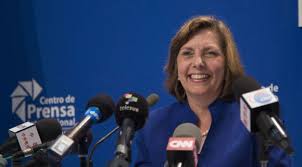
At a press conference after the meeting, Director General Vidal said the meeting had been “productive” and conducted in a “professional climate of mutual respect.” (A photograph of Vidal at the press conference is on the left.) The parties agreed to hold the fourth meeting of the Bilateral Commission in September 2016 in Washington, D.C.

Vidal also said she had told the U.S. delegation that Cuba reiterates its “appreciation for the positive results from President Obama’s visit to Cuba” that had been mentioned by President Raúl Castro during Obama’s visit. Indeed, she said, Cuba believes this visit is “a further step in the process towards improving relations” between the two countries and “can serve as an impetus to further advance this process.”[2]

Vidal acknowledged that there has been an increase in official visits as well as technical meetings on topics of common interest resulting in nine bilateral agreements to expand beneficial cooperation.[3]

According to Vidal, both delegations agreed on steps that will improve relations, including conducting high-level visits and technical exchanges on environmental, hydrography, and implementation and enforcement of the law, including fighting trafficking in drugs and people, and immigration fraud. The two countries also are getting ready to conclude new agreements to cooperate in areas such as health, agriculture, meteorology, seismology, terrestrial protected areas, response to oil-spill pollution, fighting drug trafficking and search and rescue, among others. They also are ready to start a dialogue on intellectual property and continue those relating to climate change and regulations in force in the two countries in the economic and trade area.

However, Vidal said, progress has not been as fast in the economic area because “the blockade [embargo] remains in force” despite the positive measures taken by President Obama to loosen U.S. restrictions. There still are significant U.S. restrictions on U.S. exports to Cuba and imports from Cuba. In addition, U.S. investments in Cuba are not allowed except in telecommunications, and there are no normal banking relations between the two countries. Therefore, Cuba stressed again the priority of the “lifting the economic, commercial and financial blockade [embargo].”

More specifically Vidal said Cuba had told the U.S. representative that in the last six months two American companies and one French company had been fined by the U.S. for maintaining links with Cuba while Cuba has had problems with 13 international banks’ closing accounts, denying money transfers or suspending all operations with Cuba. In addition, six service providers have ceased providing services to Cuban embassies and consulates in third countries (Turkey, Austria, Namibia and Canada).

In addition, the Cuban delegation, said Vidal, had reaffirmed the need for the U.S. to return to Cuba the territory [allegedly] illegally occupied by the U.S. naval base in Guantanamo. It “is the only case of a military base in the world that is based in a territory leased in perpetuity, which is an anomaly from the point of view of international law.[4] There is no similar example in the world and is the only instance of a military base in a foreign country against the will of the government and people of that country.

Vidal also mentioned the following U.S. policies and actions that needed to be changed:

  • the U.S. preferential migration policies for Cuban citizens, expressed in the existence of the policy of dry feet/wet feet;
  • the U.S. Cuban Adjustment Act regarding those immigration policies;
  • the U.S. program of parole for Cuban health professionals;
  • the special U.S. radio and television broadcasts designed especially for Cuba (Radio and TV Marti); and
  • U.S. programs designed to bring about changes in the economic, political and social system of Cuba.[5]

These U.S. policies, according to Vidal, underscored “a huge contradiction” for the U.S. On the one hand, President Obama said in his speech in Cuba that the U.S. has neither the intention nor the ability to bring about change in Cuba and that in any case it was up to the people of Cuba to make their own decisions. On the other hand, the U.S. has programs with huge budgets ($20 million dollars every year) aimed at bringing about such change. If indeed there is neither the intention nor the ability to bring about change in Cuba, then there is no reason to have such programs.

Normalization, said Vidal, also needs to have protection of rights to trademarks and patents because there are Cuban companies owning well-known marks, which for reasons of the blockade and other reasons have been taken away from the Cubans.

Before the meeting, another Cuban Foreign Ministry official said that the parties previously had discussed, but not negotiated, with respect to Cuba’s claim for damages with respect to the U.S. embargo and the U.S. claims for compensation for property expropriated by the Cuban government. At the meeting itself, according to a Cuban statement, the Cubans had delivered a list of its most recent alleged damages from the blockade (embargo).

U.S. Embassy Statement

The U.S. Embassy in Havana after this Bilateral Commission meeting issued a shorter, but similar, statement about the “respectful and productive” discussions. “Both governments recognized significant steps made toward greater cooperation in environmental protection, civil aviation, direct mail, maritime and port security, health, agriculture, educational and cultural exchanges, and regulatory issues. The parties also discussed dialogues on human rights and claims, and the [U.S.] looks forward to holding these meetings in the near future.”

Conclusion

Since the actual meeting was conducted in secret, it is difficult to assess what was actually accomplished except through officials’ subsequent public comments.

On May 17, the two countries conducted their second Law Enforcement Dialogue, which will be discussed in a subsequent post.

===============================================

[1] U.S. Department of State, United States and Cuba to Hold Third Bilateral Commission Meeting in Havana, Cuba (May 12, 2016); Gomez, MINREX: relations between Cuba and the United States would advance more nonblocking, Granma (May 12, 2016); Reuters, Cuba and U.S. Officials to Meet Next Week to Deepen Detente, N.Y. Times (May 12, 2016); Francisco & Elizalde, Cuba-US Bilateral commission: a productive meeting, Josefina Vidal  (+ Photos and Video), CubaDebate (May 16, 2016); Assoc. Press, Top Cuba Diplomat: Obama Trip Positive, Created Momentum, N.Y. Times (May 16, 2016); Reuters, Cuba and United States Draw Up Roadmap for Talks to Deepen Détente, N.Y. Times (May 16, 2016); Gomez, Cuba and the United States defines ambitious agenda for the coming months, Granma (May 16, 2016); U.S. Embassy, Havana, Cuba, Third Bilateral Commission Meeting in Havana (May 16, 2016); Press release issued by the Cuban delegation to the Third Meeting of the Cuba-U.S. Bilateral Commission, Granma (May 17, 2016); Cuba and U.S. set ambitious agenda for coming months, CubaDebate (May 17, 2016).

[2] Vidal’s positive comment about Obama’s visit is in sharp contrast to the negative comments about the visit from Vidal’s superior, Foreign Minister Bruno Rodriguez at the recent Congress of the Communist Party of Cuba. (See Conclusion of Seventh Congress of Communist Party of Cuba, dwkcommentaries.com (April 20, 2016).)

[3] Beforehand an official of Cuba’s Foreign Ministry said that since the December 2014 announcement of détente the parties had signed nine agreements covering the environment, email, navigation safety, agriculture and travel. In addition, the Telecommunications Company of Cuba (ETECSA) had signed agreements with three U.S. companies for cellular roaming in Cuba; a U.S. company (Starwood) had an agreement to manage several Cuban hotels; and the Carnival cruise lines had made a maiden voyage to the island.

[4] The U.S., however, contends that the lease is not in perpetuity, but for so long as the U.S. uses it as a “naval station.” This is one of the potential issues to be resolved in an international arbitration as suggested in a previous post. (Does Cuba Have a Right To Terminate the U.S. Lease of Guantanamo Bay? dwkcommentaries.com (April 26, 2015).)

[5] Prior posts have concurred in the Cuban requests for ending all of these U.S. programs and policies. See Topical List of Posts—Cuba.

Prominent Latin American Journalist’s Critical Observations About Cuba

imagesAlma Gillermoprieto, a prominent journalist who has written extensively about Cuba and Latin America,[1] in an article dated April 15, 2016,[2] had interesting observations about Cuba, which subsequently have been confirmed by the Seventh Congress of the Communist Party of Cuba and other events. (Her photograph is to the right.)

She was in Cuba during President Obama’s visit and did not disagree with the U.S. media’s declaring “Obama the winner in the encounter” with Raúl Castro, an unsurprising conclusion since “Obama is as skilled at public relations as any U.S. politician, and the leader of a monolithic state hardly needs charm.” Obama and his speech to the Cuban people on live television, as discussed in an earlier post, made a significant impact on the Cuban people with the speech’s content as well as his persona—young, vigorous, handsome and African-American.

The Broken Cuban Economic System

Guillermoprieto noted that everyone in Cuba obviously was aware of the state of disrepair of nearly everything on the island. It prompted the “joke on everyone’s lips,” she reports, “that Obama should stay in Havana for a month, because in preparation for his three-day visit [in March] more had been done to fix up the place than in the previous half-century.” This was but one indication of the broken Cuban economic system.

For Raúl Castro and the other leaders of the Government and the Communist Party of Cuba, Guillermoprieto speculates, the question has been “How many mistakes can safely be corrected? When the house you live in is falling apart, how much can you tinker with the plumbing, the windows, the doorjambs, and the supporting walls before the whole edifice collapses around you?”

Raúl in his April 21 speech to the Party Congress admitted some of the major ways in which the Cuban economic house was falling apart. Economic growth [over the past five years], he said, was “not enough to ensure the creation of the productive and infrastructure conditions required to advance development and improve the population’s consumption.” Indeed, “wages and pensions are still unable to satisfy the basic needs of Cuban families.” (Emphasis added.)

A major problem, Castro admitted at the Congress, was insufficient agricultural production and hence rising prices for basic foodstuffs and the need to maintain consumer subsidies in the form of lower prices with ration books. Such price controls to lower prices on basic foods were instituted on April 22, and on May 3 additional price controls on foodstuffs were implemented.[3]

Moreover, said Castro, “The state enterprise system, which constitutes the main management mode in the national economy, finds itself in at a disadvantage when compared to the growing non-state sector which benefits from working in monetary system with an exchange rate of one CUC to 25 CUP, while the state system operates on a basis of one CUC to one CUP. This serious distortion must be resolved as soon as possible and a single currency reestablished.” (Emphasis added.)

According to Castro, efforts to implement the economic reforms approved five years ago have been delayed due to “slow implementation of legal regulations and their assimilation.” The “main obstacle,” however, has been “out-dated mentalities, which give rise to an attitude of inertia or lack of confidence in the future. There also remain, as was to be expected, feelings of nostalgia for the less difficult times in the revolutionary process, when the Soviet Union and socialist camp existed.”(Emphasis added.)

Incorporating Private Enterprise in the Cuban System

Guillermoprieto further speculates that Raúl “may be trying to modernize Cuban socialism to the point where it is capitalist and open enough to accommodate the restless generations who are now under forty-five years of age . . . . Perhaps he has the sense that the revolution is finished, that there is no future in the old dogmas and failures, that sixty years of poverty and repression are enough, and that he has no real power to control the inevitable future. Perhaps he is simply trying to ensure, finger in the dike, that a newly capitalist Cuba does not slide into a morass of corruption and cynicism.”

At the subsequent Party Congress, Raúl clearly embraced private enterprise as necessary and welcome to Cuba. He said, “Cooperatives, self-employment and medium, small and micro private enterprise are not in their essence anti-socialist or counter-revolutionary.” With non-state employment increasing from 18.8% in 2010 to 29.2% of the economy in 2015, “just over half a million Cubans [now] are registered as self-employed; they provide services and generate much-needed production. An atmosphere that does not discriminate against or stigmatize duly authorized self-employment is being defined. . . . [We] favor the success of non-state forms of management.” (Emphasis added.)

Moreover, according to Raúl, “Recognizing the market in the functioning of the our socialist economy does not mean that the Party, government and mass organizations are no longer fulfilling their role in society. . . .The introduction of the rules of supply and demand is not at odds with the principle of planning. Both concepts can coexist and complement each other for the benefit of the country.” (Emphasis added.)

At the same time, Raúl made it clear that these welcome changes did not constitute an abandonment of the ideals of the Revolution, that state ownership of the means of production would still be the mainstay of the economy, that the changes did not constitute a restoration of capitalism, that the state would not permit concentrations of wealth and property and that Cuba needed to be wary of powerful external forces (i.e., the U.S.) seeking to take advantage of these changes.

Other signs of Cuba’s economic distress are the recent firing of an economist at the university of Havana and the upsurge of Cubans, especially younger people, leaving the island, as mentioned in a prior post.

Internal Cuban Opposition to Economic Reforms

Guillermoprieto notes that Raúl has internal opposition to rapid and significant changes to the economy and government, including brother Fidel in his rambling article in Granma after Obama’s visit that was discussed in a prior post. That article has opened the gates for other opposition, cleverly directed at Obama instead of Raúl.

Indeed, at the subsequent Party Congress, Foreign Secretary Bruno Rodriguez and one of the Cuban Five delivered speeches with harsh criticism of President Obama as the “pied piper’ attempting to lure Cubans down the path of capitalism. This too was discussed in an earlier post.

Guillermoprieto also quotes respected Cuban historian Rafael Rojas, now based in Mexico, about other opposition to Raúl coming from government ministries who believe “change must come more quickly.” A key problem for such rapid change that was recognized in Raúl’s recent report to the Party Congress was the need to eliminate as soon as possible the dual currency system (the CUC and the CUP), but the state’s subsidization of many prices in CUC makes that exceedingly difficult financially.

Inequality in Cuba

Guillermoprieto notes that there already is income and wealth inequality in Cuba growing out of its allowance of self-employment, i.e., private enterprise, in certain occupations over the last five years and the allowance of higher salaries or wages for medical doctors (now $67 per month) versus those employed in state-enterprises ($25 per month). The prospect is that there will be more inequality contrary to the ideals of the Revolution.

The recent allowance of higher salaries for Cuban physicians apparently was justified on the theory of a pyramid of workers with those with higher skills like doctors at the top of the pyramid earning higher salaries. Indeed, in Raúl’s speech to the Party Congress he complained about the inversion of the pyramid where lower-skilled workers like hotel bus boys and gas pump operators earn more through tips In hard currencies and illegal sales of gasoline than highly-skilled workers like physicians. This lamentable situation, said Castro, “does not allow work to be compensated in a fair manner, in accordance with its quantity, quality and complexity, or living standards to reflect citizens’ legal income.” This situation also generates “an unmotivated workforce and cadres, which also discourages employees from seeking out positions of greater responsibility.”

Guillermoprieto also reports that physicians who go on Cuba’s famous foreign medical missions are paid $500 per month ($300 while in the foreign country plus $200 deposited in a Cuban bank to encourage their return to the island). Because this is less than the Cuban government is paid for their services, she apparently regards this as unfair. I, however, draw the opposite conclusion while assuming her numbers are correct. The $500 per month is over seven times higher than the physician’s salary in Cuba and clearly is economically attractive to the physician. It totally negates the U.S. State Department contention that the Cuban doctors on foreign missions are engaged in illegal forced labor as discussed in a prior post.[4]

Conclusion

I am grateful for Guillermoprieto’s sharing her observations about Cuba. She provides additional evidence of the brokenness of the Cuban economic system and the difficulties of reforming or restructuring that system to include the advantages of free enterprise while simultaneously controlling its disadvantages.

===============================================

[1] Alma Guillermoprieto, Wikipedia. In her memoir, Dancing with Cuba: A Memoir of the Revolution, she recounts moving in 1970 from New York City to Havana to teach at Cuba’s National School of Dance. For six months, she worked in mirrorless studios (it was considered more revolutionary); her poorly trained but ardent students worked without them but dreamt of greatness. Yet in the midst of chronic shortages and revolutionary upheaval, Guillermoprieto found in Cuba a people whose sense of purpose touched her forever.

[2] Guillermoprieto, Cuba: The Big Change, N.Y. Rev. Books (May 12, 2016).

[3] New measures announced to regulate prices of agricultural produce, Granma (May 3, 2016)  Such price controls, however, are seen by most economists as misguided ways to cope with supply and demand issues.

[4] That earlier post pointed to a study by Indiana State University’s Emeritus Professor of International Politics and Latin America, Dr. H. Michael Erisman, who said, “most evidence indicates that the overwhelming majority [of Cuban doctors on foreign missions] are motivated by philosophical and/or pragmatic considerations. In the first instance, one needs to understand that the Cuban medical profession . . . is permeated by norms which stress self-sacrifice and service to the community, both at home and abroad. At the core of this ethos is the principle, which is firmly entrenched in the curriculum of the island’s medical schools and reinforced throughout one’s career, that health care should not be seen as a business driven by a profit motive, but rather as a human right that medical personnel have an unconditional duty to protect. Such convictions often underlie participation in the medical aid brigades. There are, however, also some pragmatic factors that can come into play. Overseas service could . . . help to further one’s professional aspirations and for some assignments the total remuneration involved is more generous than what is available back in Cuba. . . . [T]hese are the considerations which apply to the vast majority of people” in such programs, not involuntary servitude. Also relevant is the fact that Cuban medical education is free and in a quid-pro-quo the student agrees to serve in such missions upon becoming a doctor.


United Kingdom Promotes Engagement with Cuba


The United Kingdom’s Foreign Secretary, Philip Hammond, visited Cuba in late April to celebrate and promote his country’s engagement with Cuba. It was the first visit by a U.K. foreign secretary since the Cuban Revolution of 1959.[1]

Before the trip, the Foreign Secretary said, “Britain and Cuba have outlooks on the world and systems of government that are very different. But as Cuba enters a period of significant social and economic change, I am looking forward to demonstrating to the Cuban government and people that the UK is keen to forge new links across the Atlantic.”

“That is why Cuba and the UK are set to reach new cooperation agreements on energy, financial services, education and culture, to the benefit of both our nations. [This also] is an opportunity to hear for myself what Cuba thinks about its present challenges and where it sees its future.”

Upon his arrival in the island, Hammond said that Britain was “keen to forge new links” with the Caribbean nation.”

During the visit the U.K. and Cuba reached an agreement to restructure Cuba’s medium and long-term debt with the UK, which should contribute to the expansion of economic, commercial and financial ties between the two nations.

On April 30 after meeting with President Raúl Castro, Hammond said Castro ”is espousing a programme of gradual change, embracing the realities of the world we live in. I was very struck by the fact that he described the Internet as the reality of our world, spoke positively about the benefits the Internet could bring.” In addition, “Castro is seeking to position himself in the middle between those who are resisting change and those who want much faster, more radical change.” In particular, Castro said Cuba lacks “management expertise in banking services’ and this is an area where the UK has something very clear to offer.” (Below is a photograph of Castro and Hammond.)

hammond_meets_castro-large_trans++eo_i_u9APj8RuoebjoAHt0k9u7HhRJvuo-ZLenGRumA

British exports to Cuba rose by almost a third last year compared to 2014, and Britain was the second-biggest source of foreign tourists to Cuba after Canada, with 160,000 Britons making the trip in 2015.Education is seen as another growing area of cooperation, with significant numbers of Cuban students interested in higher education in the UK.

One of the problems Britain faces in such engagement is the extraterritorial effects of the U.S. embargo. Hammond commented, “We have also had discussions with the U.S. about the challenges for British and other European banks in doing business with countries that face U.S. sanctions. There are some problems here but we are working through them with the U.S. and hope to make progress in a way that will enable British businesses to do more business with Cuba.

Conclusion

This is but the latest European promotion of engagement with Cuba. For example, earlier this year President Raúl Castro visited France, where he was the official guest for a state dinner hosted by French President François Hollande, who urged U.S. President Obama to fully lift the embargo against Cuba.[2]

France sees strong potential for some of its largest companies to grow their presence in Cuba. Pernod Ricard SA is the biggest investor in Cuba through its ownership of the Havana Club brand of rum, but others are lining up such as hotels group Accor SA and construction group Bouygues SA. France also wants to boost exports to Cuba, which totaled €131 million ($143 million) in the first 11 months of 2015, down from €157 million in 2014. France is well positioned to cash in on Cuban growth after it played a leading role in negotiating debt forgiveness for Cuba at the end of last year and after President Hollande said this February that around half of Cuba’s remaining dues to France will be used to create a €220 million fund to invest in Franco-Cuban projects.

Ahead of the state dinner, French and Cuban officials signed bilateral agreements covering tourism, rail transport and trade. They also signed off on a road map for France’s development agency to begin investing in Cuban infrastructure.

The efforts of the U.K., France and other European countries to expand trade with Cuba are too often ignored in U.S. discussions of ending the U.S. embargo on the implicit and unexamined assumption that the U.S. is Cuba’s only potential trading partner. Eliminating that assumption provides another reason for the U.S. to eliminate the embargo as soon as possible in order to enhance U.S. efforts to expand trade with Cuba.

=========================================

[1] U.K. Foreign Ministry, Foreign Secretary Visits Cuba (April 28, 2016); Press Ass’n, Philip Hammond arrives in Cuba to help “forge new links,” Guardian (April 28, 2016); Reuters, Britain Praises Cuba’s Castro for Embracing Realities of Modernity, N.Y. Times (April 30, 2016); Alexander, Philip Hammond Meets Raul Castro during historic visit to Cuba, Telegraph (April 30, 2016); Raúl receives British Foreign Secretary, Granma (May 1, 2016).

[2] Horobin, France Seeks Closer Ties with Cuba During Castro Visit, W.S.J. (Feb. 1, 2016); Assoc. Press, France: Castro Finds Advocates in Paris, N.Y. Times (Feb. 1, 2016).


Presidents Obama and Castro Speak and Meet at United Nations

Over the last week Cuban President Raúl Castro has made two speeches at the United Nations in New York City as has U.S. President Barack Obama. Afterwards the two of them with advisors held a private meeting at the U.N. with subsequent comments by their spokesmen. Here is a chronological account of these events.

President Castro’s September 26th Speech[1]


On September 26, President Raúl Castro 11131154waddressed the U.N. Summit on Sustainable Development, as shown in the photograph to the right. In his remarks he said, ”The reestablishment of diplomatic relations Between Cuba and the United States of America, the opening of embassies and the policy changes announced by President Barack Obama . . . constitute a major progress, which has elicited the broadest support of the international community.”

However, he added, “the economic, commercial and financial blockade [by the U.S.] against Cuba persists bringing damages and hardships on the Cuban people, and standing as the main obstacle to our country’s economic development, while affecting other nations due to its extraterritorial scope and hurting the interests of American citizens and companies. Such policy is rejected by 188 United Nations member states that demand its removal.”

More generally Castro condemned “the pervasive underdevelopment afflicting two-thirds of the world population” and the widening “gap between the North and the South” and “wealth polarization.”

Thus, he argued, “If we wish to make this a habitable world with peace and harmony among nations, with democracy and social justice, dignity and respect for the human rights of every person, we should adopt as soon as possible concrete commitments in terms of development assistance, and resolve the debt issue.” Such a commitment, he said, would require “a new international financial architecture, removal of the monopoly on technology and knowledge and changing the present international economic order.”

Nevertheless, according to President Castro, Cuba will continue to help other developing nations despite its limited capabilities and “shall never renounce its honor, human solidarity and social justice” that “are deeply rooted in our socialist society.”

President Obama’s September 27th Speech[2]

635789669053394239-AFP-544774880

On September 27, President Obama addressed the same U.N. Summit on Sustainable Development without touching on U.S.-Cuba relations. Instead he concentrated on the purpose of the Summit– sustainable development. (His photograph is to the left.)

He started by rejecting the notion that “our efforts to combat poverty and disease do not and cannot work, that there are some places beyond hope, that certain people and regions are condemned to an endless cycle of suffering.” Instead, he asserted, “the global hunger rate has already been slashed.  Tens of millions of more boys and girls are today in school.  Prevention and treatment of measles and malaria and tuberculosis have saved nearly 60 million lives.  HIV/AIDS infections and deaths have plummeted.  And more than one billion people have lifted themselves up from extreme poverty — one billion.”

Nevertheless, much remains to be done, according to Obama, and the nations at this Summit “commit ourselves to new Sustainable Development Goals, including our goal of ending extreme poverty in our world.  We do so understanding how difficult the task may be.  We suffer no illusions of the challenges ahead.  But we understand this is something that we must commit ourselves to.  Because in doing so, we recognize that our most basic bond — our common humanity — compels us to act.”

In this work, President Obama stated, the U.S. “will continue to be your partner.  Five years ago, I pledged here that America would remain the global leader in development, and the United States government, in fact, remains the single largest donor of development assistance, including in global health.  In times of crisis — from Ebola to Syria — we are the largest provider of humanitarian aid.  In times of disaster and crisis, the world can count on the friendship and generosity of the American people.”

Therefore, Obama said, he was “committing the United States to achieving the Sustainable Development Goals” and to “keep fighting for the education and housing and health care and jobs that reduce inequality and create opportunity here in the United States and around the world.” This effort will include other “governments, more institutions, more businesses, more philanthropies, more NGOs, more faith communities, more citizens.” Moreover, the “next chapter of development must also unleash economic growth — not just for a few at the top, but inclusive, sustainable growth that lifts up the fortunes of the many.”

President Obama concluded by noting these obstacles to achieving these goals: bad governance; corruption; inequality; “old attitudes, especially those that deny rights and opportunity to women;” failure to “recognize the incredible dynamism and opportunity of today’s Africa;” war; and climate change

President Obama’s September 28th Speech[3]

 In a wide-ranging speech on international affairs, President Obama commented on U.S. relations with Cuba. He said, “I also believe that to move forward in this new era, we have to be strong enough to acknowledge when what you’re doing is not working. For 50 years, the United States pursued a Cuba policy that failed to improve the lives of the Cuban people. We changed that. We continue to have differences with the Cuban government. We will continue to stand up for human rights. But we address these issues through diplomatic relations, and increased commerce, and people-to-people ties. As these contacts yield progress, I’m confident that our Congress will inevitably lift an embargo that should not be in place anymore. Change won’t come overnight to Cuba, but I’m confident that openness, not coercion, will support the reforms and better the life the Cuban people deserve, just as I believe that Cuba will find its success if it pursues cooperation with other nations.”

Later in the speech, Obama added these words: “Think of the Americans who lowered the flag over our embassy in Havana in 1961 — the year I was born — and returned this summer to raise that flag back up. (Applause.) One of these men said of the Cuban people, “We could do things for them, and they could do things for us. We loved them.” For 50 years, we ignored that fact.

These comments were in the context of the following more general discussion of international affairs by President Obama: “We, the nations of the world, cannot return to the old ways of conflict and coercion. We cannot look backwards. We live in an integrated world — one in which we all have a stake in each other’s success. We cannot turn those forces of integration. No nation in this Assembly can insulate itself from the threat of terrorism, or the risk of financial contagion; the flow of migrants, or the danger of a warming planet. The disorder we see is not driven solely by competition between nations or any single ideology. And if we cannot work together more effectively, we will all suffer the consequences.”

“No matter how powerful our military, how strong our economy, we understand the United States cannot solve the world’s problems alone.” So too, in words that could be aimed at Cuba and others, “repression cannot forge the social cohesion for nations to succeed. The history of the last two decades proves that in today’s world, dictatorships are unstable. The strongmen of today become the spark of revolution tomorrow. You can jail your opponents, but you can’t imprison ideas. You can try to control access to information, but you cannot turn a lie into truth. It is not a conspiracy of U.S.-backed NGOs that expose corruption and raise the expectations of people around the globe; it’s technology, social media, and the irreducible desire of people everywhere to make their own choices about how they are governed.”

In a similar vein, Obama said, “The strength of nations depends on the success of their people — their knowledge, their innovation, their imagination, their creativity, their drive, their opportunity — and that, in turn, depends upon individual rights and good governance and personal security.”

Finally, according to Obama, we must “defend the democratic principles that allow societies to succeed” with a recognition that “democracy is going to take different forms in different parts of the world. The very idea of a people governing themselves depends upon government giving expression to their unique culture, their unique history, their unique experiences. But some universal truths are self-evident. No person wants to be imprisoned for peaceful worship. No woman should ever be abused with impunity, or a girl barred from going to school. The freedom to peacefully petition those in power without fear of arbitrary laws — these are not ideas of one country or one culture. They are fundamental to human progress.”

“A government that suppresses peaceful dissent is not showing strength; it is showing weakness and it is showing fear. History shows that regimes who fear their own people will eventually crumble, but strong institutions built on the consent of the governed endure long after any one individual is gone.”

“That’s why our strongest leaders — from George Washington to Nelson Mandela — have elevated the importance of building strong, democratic institutions over a thirst for perpetual power. Leaders who amend constitutions to stay in office only acknowledge that they failed to build a successful country for their people — because none of us last forever. It tells us that power is something they cling to for its own sake, rather than for the betterment of those they purport to serve.”

“Democracy — inclusive democracy — makes countries stronger. When opposition parties can seek power peacefully through the ballot, a country draws upon new ideas. When a free media can inform the public, corruption and abuse are exposed and can be rooted out. When civil society thrives, communities can solve problems that governments cannot necessarily solve alone. When immigrants are welcomed, countries are more productive and more vibrant. When girls can go to school, and get a job, and pursue unlimited opportunity, that’s when a country realizes its full potential.”

President Castro’s September 28th Speech[4]

On September 28, Cuban President Raúl Castro in his address to the U.N. General Assembly essentially reiterated his comments of two days earlier about U.S.-Cuba relations with these words: ‘After 56 years, during which the Cuban people put up a heroic and selfless resistance, diplomatic relations have been reestablished between Cuba and the United States of America.”

“Now, a long and complex process begins toward normalization that will only be achieved with the end of the economic, commercial and financial blockade; the return to our country of the territory illegally occupied by the Guantanamo Naval Base; the suspension of radio and TV broadcasts, and subversion and destabilization attempts against the Island; and, when our people are compensated for the human and economic damages they continue to endure.”

“As long as the blockade remains in force, we will continue to introduce the Draft Resolution entitled ‘Necessity of Ending the Economic, Commercial and Financial Embargo imposed by the United States of America on Cuba.’ To the 188 governments and peoples who have backed our just demand, here, and in other international and regional forums, I reaffirm the eternal gratitude of the Cuban people and government for your continued support.” [5]

The rest of this Castro speech argued that the U.N. has failed in its 70 years of existence to fulfill the lofty purposes of its Charter. The speech also noted Cuba’s solidarity with its Caribbean brothers, African countries, the Bolivarian Republic of Venezuela, the Republic of Ecuador, the people of Puerto Rico, the Republic of Argentina, the Brazilian people and President Dilma Rouseff, the Syrian people and the Palestinian people. Castro also supported the nuclear agreement with the Islamic Republic of Iran.

On the other hand, Castro reaffirmed Cuba’s “rejection of the intention to expand the presence of NATO up to the Russian borders, as well as of the unilateral and unfair sanctions imposed on that nation” and Cuba’s condemnation of NATO and European countries’ efforts to destabilize countries of the Middle East and Africa that have led to the recent migrant crisis in Europe.

In conclusion, Castro said, “the international community can always count on Cuba to lift its sincere voice against injustice, inequality, underdevelopment, discrimination and manipulation; and for the establishment of a more equitable and fair international order, truly focused on human beings, their dignity and well-being.”

The Presidents’ Meeting[6]

Obama &Castro

The two presidents with their advisors held a 30-minute private meeting at the U.N. on Tuesday, September 29. The photograph at the left shows them shaking hands.

The U.S. delegation consisted of Secretary of State, John Kerry; National Security Adviser, Susan Rice; National Security Council Senior Director for Western Hemisphere Affairs, Mark Feierstein; and the U.S. Permanent Representative to the U.N., Samantha Power.

Cuba’s delegation was composed of the Foreign Minister, Bruno Rodriguez; Consultant, Alejandro Castro Espin (the son of President Raúl Castro); Vice President of Cuba’s Defense and Security Committee, Juan Francisco Arias Fernández; Cuba’s Director General of U.S. Affairs, Ministry of Foreign Affairs, Josefina Vidal; and Cuba’s Ambassador to the U.S., José Ramón Cabañas.

White House’s Comments on the Meeting[7]

On a September 29 flight from New York City to Washington, D.C., White House Press Secretary Josh Earnest, in response to a journalist’s question, said, “I know that the two leaders had an opportunity to discuss some of the regulatory changes that have been announced in the last couple of weeks on the part of the [U.S.]. The State Department is leading civil aviation coordination talks in Cuba right now.  And these are all additional steps that are moving toward more normal relations between our two countries.”

“The President, as he always does, . . . reaffirmed our commitment to seeing the Cuban government do a better job of not just respecting, but actually proactively protecting, the basic human rights of the Cuban people.”

We “continue to believe that deeper engagement and deeper people-to-people ties, deeper economic engagement between the [U.S.] and Cuba will have the effect of moving the government and the nation in a positive direction.”

Thereafter the White House released the following written statement about the meeting: “President Obama met today with President Raul Castro of Cuba to discuss recent advances in relations between the United States and Cuba, as well as additional steps each government can take to deepen bilateral cooperation. The two Presidents discussed the recent successful visit of Pope Francis to both countries.  President Obama highlighted U.S. regulatory changes that will allow more Americans to travel to and do business with Cuba, while helping to improve the lives of the Cuban people.  The President welcomed the progress made in establishing diplomatic relations, and underscored that continued reforms in Cuba would increase the impact of U.S. regulatory changes.  The President also highlighted steps the United States intends to take to improve ties between the American and Cuban peoples, and reiterated our support for human rights in Cuba.”

Cuban Foreign Minister’s Press Conference[8]

Soon after the presidential meeting, Cuban Foreign Minister Bruno Rodriguez held a press conference at the U.N. In his opening statement, he said that in a “respectful and constructive” atmosphere, the two presidents exchanged their views on the recent visit of Pope Francisco to Cuba and the United States, as well as issues on the bilateral agenda established between the two countries.

“The presidents agreed on the need to continue working on the set bilateral agenda, which includes areas of mutually beneficial bilateral cooperation and in third countries such as Haiti, the development of dialogue on issues of bilateral and multilateral interest and resolving outstanding issues between two states.”

President Castro affirmed Cuba’s desire to build a new relationship with the U.S. based on respect and sovereign equality, but reiterated that to have normal relations the U.S. had to lift the blockade, which is causing damage and hardship to the Cuban people and affects the interests of American citizens.

Castro also confirmed that Cuba on October 27 would introduce in the General Assembly a resolution condemning the embargo (blockade). Said the foreign Minister, the blockade is “a massive, flagrant and systematic violation of human rights of all Cubans and harms all Cuban families, even Cubans living outside Cuba.” Cuba fully expects this year’s resolution to once again have overwhelming support.

The Foreign Minister said the return of the territory illegally occupied by the Guantanamo Naval Base in Cuba is a high priority element in the process of normalization of relations between the U.S. and Cuba, as a vindication of Cuban people.

At another point he added that “we are very proud of the accomplishments of Cuba on human rights and that human rights are universal, not subject to political selectivity or manipulation of any kind. ” Cuba guarantees the full exercise of political rights and civil liberties, and economic, social and cultural rights. We have many concerns with the situation on human rights in the world, particularly in the U.S. and Western Europe, as illustrated by the current immigration refugee crisis. The pattern of racial discrimination and police brutality against African Americans in the [U.S.] is really serious.

Conclusion

Cuba reiterated its insistence on ending the U.S. embargo as an essential condition for normalization of relations, an objective shared by President Obama and this blog. [9] We now await the U.N. General Assembly’s debate and anticipated approval on October 27 of another resolution condemning the embargo and whether the U.S. will, for the first time, abstain on the vote.

Cuba continues to assert that the U.S. lease of Guantanamo Bay is illegal, but its saying so does not make it so. Previous blog posts have discussed this contention and do not find it persuasive and, therefore, suggested the two countries submit the dispute for resolution to the Permanent Court of Arbitration at The Hague in the Netherlands.[10]

The same means has been suggested in this blog for resolving the disputes about whether or not Cuba has been damaged by the embargo (blockade) and the amount of such alleged damages as well as the amount of damages to U.S. interests by Cuba’s expropriation of property in the early years of the Cuban Revolution.

==============================================

[1] Cuba Ministry Foreign Affairs, Raul Castro: Unacceptable levels of poverty and social inequality persist and even aggravate across the world (Sept. 26, 2015); Reuters, Cuba’s Castro Slams U.S. Trade Embargo at United Nations, N.Y. Times (Sept. 26, 2015); Reuters, U.S. Embargo ‘Main Obstacle’ to Cuba’s Development: Castro, N.Y. Times (Sept. 26, 2015) (video)

[2] White House, Remarks by President on Sustainable Development Goals (Sept. 27, 2015).

[3] Reuters, Quotes from President Obama’s U.N. Speech, N.Y. Times (Sept. 28, 2015); President Obama’s Speech to the United Nations General Assembly 2015, N.Y. Times (Sept. 28, 2015); White House, Remarks by President Obama to the United Nations General Assembly (Sept. 28, 2015).

[4] Raúl at the United Nations: The International community can always count on Cuba’s voice in the face of injustice, Granma (Sept. 28, 2015); Full text [of Castro’s speech], Granma (Sept. 28, 2015); Reuters, At U.N., Castro Says U.S. Must End Embargo to Have Normal Cuba Ties, N.Y. Times (Sept. 28, 2015); Assoc. Press, Raúl Castro Addresses General Assembly, N.Y. Times (Sept. 28, 2015) (video); Goldman, At the U.N., Raúl Castro of Cuba Calls for End to U.S. Embargo, N.Y. Times (Sept. 28, 2015).

[5] A prior post reviewed last year’s General Assembly’s condemnation of the embargo.

[6] Assoc. Press, U.S., Cuba Leaders Meet for 2nd Time in This Year, N.Y. Times (Sept. 29, 2015); Reuters, Obama, Castro Meet as They Work on Thawing U.S.-Cuba Ties, N.Y. Times (Sept. 29, 2015); Cuba and U.S. Presidents meet, Granma (Sept. 30, 2015)

[7] White House, Press Gaggle by Press Secretary Josh Earnest en route Washington, D.C., 9/29/15; White House, Readout of the President’s Meeting with Cuban President Raul Castro (Sept. 29, 2015).

[8] Reuters, Cuban Minister on Obama-Castro Meeting, N.Y. Times (Sept. 29, 2015) (video); Bruno Rodriguez: The blockade is a massive, flagrant and systematic violation of human rights, Granma (Sept. 30, 2015).

[9] This blog has discussed the initial bills to end the embargo in the House and Senate as well as later bills to do the same in the Senate and House.

[10] Resolution of U.S. and Cuba’s Damage Claims (April 4, 2015); Resolution of Issues Regarding U.S.-Lease of Guantanamo Bay (April 6, 2015); Does Cuba Have a Right to Terminate the U.S. Lease of Guantanamo Bay? (April 26, 2015).

The First Day of Pope Francis’ Mission to Cuba

On Saturday, September 19, at 15:52 (Cuban time; EST) Pope Francis’ airplane from Rome arrived at Havana’s airport. This post will cover the Pope’s flight to Cuba, the final hours of Cuba’s preparation and anticipation of his arrival; and his arrival.[1] Subsequent posts will cover each of the Pope’s other three days in Cuba and then each of his six days in the United States of America.

The Pope’s Flight to Cuba

At 04:15 (EST) the Pope’s plane left Rome with an entourage that included Cardinal Secretary of State Pietro Parolin and Vatican “Foreign Minister” Monsignor John Gallagher. From the plane the Pope issued many tweets. One of them said: “I ask you to join me in praying for my trip to Cuba and the United States.”

On the plane the Pope told journalists, “I love the Cuban people a great deal.” He also noted the need to extend a hand and open parish doors to immigrants.

Preparations in Havana

That morning U.N. Secretary General Ban Ki-moon issued a statement acknowledging, “The visit [next week] of His Holiness Pope Francis to the United Nations comes at a moment of challenge and hope. As the world struggles to cope with conflict, poverty and climate change, Pope Francis has been a leading voice for urgent action to protect people and our planet.” The Secretary General’s message also included the following words:

  • “I am deeply privileged to have had the opportunity to meet several times with His Holiness, who impressed me as a man of great humility and humanity. When we met last year at the Vatican in May, the Pope urged senior United Nations officials to ‘work together in promoting a true, worldwide ethical mobilization which, beyond all differences of religious or political convictions, will spread and put into practice a shared ideal of fraternity and solidarity, especially with regard to the poorest and those most excluded.’”
  • “Pope Francis has called on people everywhere to work towards realizing the new sustainable development goals ‘with generosity and courage.’ As I discussed with the Pope, this will require challenging all forms of injustice.”
  • “I fully concur with Pope Francis in his recent encyclical that climate change is a moral issue, in addition to its other dimensions, and one of the principal challenges facing humanity. His Holiness rightly cited the solid scientific consensus showing significant warming of the climate system, with most global warming in recent decades mainly a result of human activity.”
  • “Pope Francis and I wholeheartedly agree on the urgency for action, and the critical need to support the poorest and most vulnerable members of our human family from a crisis they did least to cause, but suffer from the most. Other faith groups have echoed this view, including most recently a gathering of eminent Islamic scholars and religious leaders.”
  • “Pope Francis’ message extends far beyond the world’s 1.2 billion Roman Catholics. On the first page of his recent encyclical, the Pope states that ‘faced as we are with global environmental deterioration, I wish to address every person living on this planet.’”
  • “Pope Francis has demonstrated the value of religious leaders engaging on these pressing global issues. I count on him and other faith leaders to counteract the prevailing forces of division and hate with dialogue and understanding. Together, we can realize our vision of a peaceful world where all people live in safety and dignity.”
Frei Betto
Frei Betto

Later that morning Frei Betto–a Brazilian Roman Catholic priest and the author of “Fidel and Religion: Castro Talks on Revolution and Religion with Frei Betto” (1988)–held a press conference at Havana’s Hotel Nacional. He noted that “only two Latin American countries have had the privilege of receiving, in a relatively short period of time (17 years), the visit of the last three Popes: Brazil and Cuba.” While 70% of Brazilians are Roman Catholic, Cuba has religious syncretism. With the reestablishment of diplomatic relations between the U.S. and Cuba, Frei said, the challenges point toward the need to change attitudes within the U.S. government. Francis is undertaking a revolution within the Catholic Church itself, which is why some see him as the leading statesman of our time and as a strong candidate for the Nobel Peace Prize. Indeed, added Frei, Francis preaches in favor of peaceful coexistence in the world, reaching out to the poor and boosting high-impact programs to eradicate hunger, poverty and environmental degradation. The Cuban Revolution has taught evangelical values, which are the same as human moral values and are not “additional” for revolutionaries or for the religious.

Welcoming Francis at Havana’s Airport

Pope Francis & President Castro

The Pope was met at the airplane by Cuban President Raul Castro accompanied by the Cuban Foreign Minister Bruno Rodriguez and Cuban Archbishop Jamie Lucas Cardinal Ortega. In a lengthy speech that recited many of the accomplishments of the Cuban Revolution and Cuba’s claims against the U.S., President Castro said his meeting with the Pope at the Vatican gave them the opportunity to exchange ideas about important world issues. We have followed your statements about these issues with much interest. We want future generations to inherit human dignity from us. The weight of the crisis falls on the third world and minorities do not escape from it. Your Holiness, we have thanked you for your support during the talks between the United States and Cuba. Now the Pope’s meetings with the Cuban people will be very important.

Francis responded by thanking the Cuban people for their welcome and expressing his fraternal greetings to Comandante en Jefe Fidel Castro. The Pope recalled that the 80th anniversary of Cuba and the Holy See’s uninterrupted relationship is being celebrated; that Popes John Paul II and Benedicto XVI had visited Cuba; and that this trip coincides with the centenary of the declaration of Cobre’s Our Lady of Charity as Cuba’s patron saint. Francis said that Cuba plays an extraordinary role in the meeting of the North and South, East and West. Its natural vocation is as a point of encounter. The process underway toward the reestablishment of relations between Cuba and the U.S. is an example of the effectiveness of a culture of exchange and dialogue.

The Pope then left for the Apostolic Nunciature in Havana where he stayed the night. On the journey there an estimated 100,000 Cubans were on the streets to welcome him, as shown in the photographs below.

Motorcase

f0008839

Vatican Spokesman’s Press Conference

Federico Lombardi
Federico Lombardi

The Vatican spokesman, Monsignor Federico Lombardi, then held a press conference at Hotel Nacional. He said that peace was the key word for this visit, that the Pope was greatly moved by the Cuban people’s warm welcome and enthusiasm; that the Pope had highlighted the importance of 80 years of uninterrupted ties between Cuba and the Vatican; and that the Pope will visit the Shrine of Our Lady of Charity of El Cobre as a son and pilgrim.

Lombardi also emphasized that the Catholic Church and the current and previous Popes are opposed to the U.S. blockade. The process of the reestablishment of diplomatic relations between Washington and Havana constituted a sign of hope to change the history of relations between the two countries. Peace, reconciliation and the building of bridges: clear messages from Pope Francis regarding the significance of his current apostolic visit to Cuba and the United States.

According to Lombardi, the Pope’s speech at the airport and his subsequent speeches are directed toward Cuban men and women, including Cubans throughout the world no matter where they reside. Many of them remember the historic words of the first Pope to visit Cuba, now a Saint, (John Paul II): “May Cuba with all its glorious possibilities open up to the world, and may the world open up to Cuba.”

Conclusion

The incredible major sources for this and subsequent posts about the Cuban mission are Granma, the official newspaper of the Communist Party of Cuba, and the Vatican.

The online edition of Granma at 06:03 a.m. (Cuban time) commenced a minute-by-minute reporting (with photographs) of the Pope’s plane’s earlier departure from Rome and of the preparations in Cuba. It also mentioned the Cuban government’s establishment of a Twitter account: #ElPapaEnCuba. Another article in Granma focused on the actual airport arrival.

While the coverage of the Pope’s first day in Cuba by the Cuban media was focused on the details of what actually happened, the New York Times’ lead article chose to concentrate on what it saw as the Pope’s “new challenge” of trying to “open up Cuba to the Roman Catholic Church.” Its first quotation was from the Rev. Jorge Cela, who oversaw the Jesuit religious order in Cuba from 2010 to 2012, who said, “It is an occasion to ask for more openness. The relationship is not easy.” Its second identified source was Rev. José Conrado, a Cuban priest in the central city of Trinidad, who said, “We could do more. The church should not back off, even if doing so is difficult and problematic for the church itself.” The balance of the Times’ article talked about criticism of Cuban Archbishop Ortega and the need to find his successor when he retires.

The Washington Post’s lead article at least covered the welcoming speeches at the Havana airport in addition to discussing issues about the Roman Catholic’s role in Cuba and whether they would be the subjects of the Pope’s public comments or private discussions with President Castro.


President Barack Obama’s Second-Term Record Regarding Cuba, 2013-2014

In light of President Barack Obama’s historic December 17th announcement of rapprochement with Cuba, It is interesting to examine Obama’s earlier statements and actions about Cuba. Prior posts examined his campaign for the Democratic Party’s presidential nomination in 2007-2008; his campaign for the the presidency as the Democratic Party’s nominee in 2008; his first presidential term, 2009-2013; and his presidential re-election campaign of 2012. Now we look at the first two years of his second presidential term, 2013-2014. [1]

In November 2012, as we have seen in a prior post, President Obama won reelection with 48% of the Cuban-American vote.

The next month (December 2012), as a prelude to his second term, Obama instructed aides to make Cuba a priority and “see how far we could push the envelope.” The President also concluded that “it would be a good fit to have someone who was known to be very close to the President [involved in such an effort on Cuba] because the Cubans are very wary of engagement and they want to know that the engagement is reaching the top. They felt like there [had] been several other efforts of engagement where it turned out . . . where they had conversations with the Americans, [but after] they reached a certain point . . . there was never follow through [by the U.S.]. . . . [In short, the Cubans] wanted someone . . . [involved for the U.S.] who were very close to the President and . . . they wanted it to be discreet.” Hence, the President designated Ben Rhodes, a Deputy National Security Advisor, to be in charge of this new effort to engage Cuba.

Thereafter, Mr. Rhodes sent a secret message to the Cuban government that the U.S. wanted “to initiate a dialogue about prisoners and other issues.” As we will see below, this created a fascinating contrast between the Administration’s public negative face on Cuba and its secret negotiations with the latter.

Obama’s Second Term, 2013

President Obama's Oath of Office, Jan. 2013
President Obama’s Oath of Office,    Jan. 2013
U.S. Capitol for President Obama's Inauguration, Jan. 2013
U.S. Capitol for President Obama’s Inauguration, Jan. 2013


On January 21, 2013, President Obama was inaugurated for his second term as President. Most of his Inaugural Address was focused on domestic concerns, but he did say, “We will show the courage to try and resolve our differences with other nations peacefully—not because we are naïve about the dangers we face, but because engagement can more durably lift suspicion and fear.” He made no reference to Cuba.

That same month, January 2013, we recently have come to know, Ricardo Zuniga, Obama’s top Latin American adviser, went to Miami and met with a representative of the anti-Castro Cuban American National Foundation and with young Cuban-Americans, the latter of whom helped confirm the waning influence of older Cuban exiles who have traditionally supported the half-century-old embargo. (Zuniga in 2001 as a State Department staffer contributed to its National Intelligence Estimate that officially concluded, for the first time, that the embargo of Cuba had been a failure.)

On April 19, 2013, the U.S. Department of State released its Country Reports on Human Rights Practices for 2012, and again it had a negative assessment of Cuba: it is “an authoritarian state” with the following “principal human rights abuses . . .: abridgement of the right of citizens to change the government; government threats, intimidation, mobs, harassment, and detentions to prevent free expression and peaceful assembly; and a record number of politically motivated and at times violent short-term detentions.”

By April 2013, however, we now know that the White House was ready to proceed with the Cubans by quietly proposing back-channel talks after learning that Havana would be receptive. Obama initially froze out the State Department on these developments in part due to concern that its “vested interests” would still be bent on perpetuating a confrontational approach. Even Secretary of State John Kerry was informed of the talks only after it appeared they might be fruitful.

On May 29, 2013, the plight of Alan Gross again emerged as a distracting element when a federal district court dismissed his lawsuit against the U.S. for $60 million alleging the government and its private contractor sent him on five semi-covert trips to Cuba without proper training, protection or even a clear sense of the Cuban laws that ultimately led to his arrest and detainment. Experts said the dismissal had been widely expected because of a rule barring lawsuits against the American government based on consequences suffered in foreign countries.[2]

The next day (May 30, 2013) the U.S. Department of State released its Country Reports on Terrorism 2012. Again Cuba was a designated “state sponsor of terrorism,” but the asserted grounds were very weak: there was no indication Cuba “provided weapons or paramilitary training to terrorist groups;” Cuba “has committed to adopting and implementing” anti-money laundering recommendations by an international group; but Cuba continued to provide support to certain U.S. fugitives.

In any event, the secret U.S.-Cuba negotiations started in June 2013 in Ottawa, Canada. The Cubans opened with harangues about the embargo and other perceived wrongs. Rhodes, age 37, responded, “Look I wasn’t even born when this policy was put in place. We want to hear and talk about the future.” The Cubans in these initial sessions also insisted on an exchange of the remaining three of “The Cuban Five” in U.S. prison for U.S. citizen, Alan Gross, in Cuban prison. Obama refused such a deal because Washington denied Gross was a spy and because Obama did not want a three-for-one trade. As a result by the end of 2013, the negotiations had stalled.

On December 3, 2013, Alan Gross’ imprisonment again surfaced as an important issue when his wife read a public letter from him to President Obama asking, “Why am I still here? With the utmost respect, Mr. President, I fear that my government, the very government I was serving when I began this nightmare, has abandoned me.” A White House spokesman responded by saying Mr. Obama had “personally engaged foreign leaders and other international figures to use their influence with Cuba” to free Mr. Gross.[3]

Barack Obama & Raul Castro

That same month, December 2013, something publicly happened that we now know had a positive effect on the secret U.S.-Cuba negotiations. At the funeral for Nelson Mandela in South Africa on December 15th, President Obama met and shook hands with President Raùl Castro, which at the time some in the U.S. criticized. Moments after the handshake Obama addressed the funeral gathering, talking about Mandela’s demonstrating the need for trust and reconciliation and forgiveness. Some at the time wondered whether his remarks might also apply to the apparently frozen diplomatic relationship between the U.S. and Cuba, but White House officials declined to offer any explanation of the handshake or confirm that there had been a discussion about whether to offer [an explanation].” [4]

Obama’s Second Term, 2014

In early January 2014 the U.S. and Cuba, with public notice, resumed negotiations from the prior July about migration, which the State Department said “does not represent any change in policy towards Cuba” and which journalists saw as “a signal of the longtime Cold War foes’ recent willingness to engage in areas of mutual interest but unlikely to be a harbinger of a major thaw in relations.” Afterwards Cuba said, “”The meeting took place in a respectful environment. An analysis was made of the status of compliance with the migration accords in force between both countries, including the actions taken by both parties to combat illegal migration and aliens smuggling.”[5]

At the January 2014 secret negotiation session in Toronto, said Mr. Rhodes, “the Cubans started [with just want[ing] their people back—the three Cubans who were imprisoned in the [U.S.] – [in exchange for their release of Alan Gross.] In response the U.S. proposed – to the Cubans’ surprise – Cuba’s releasing Rolando Sarraff, a spy for the U.S. who had been imprisoned in Cuba since 1995, and thereby enabling the U.S. to claim it was a true “spy swap” and giving it political cover. But the Cubans dis not immediately agree to release Sarraff, a cryptographer who Washington says helped it disrupt Cuban spy rings in the U.S.

At this January meeting Rhodes “started talking . . . about how we wanted to change the relationship. And then they started talking about some of the things that they were considering doing in terms of their own system.” However, “the idea of reestablishing diplomatic relations was not something that was . . . immediately attractive to them. . . . [T]hey’re very comfortable in a position of being an opposition to the[U.S.]. They have built the legitimacy in part [for] much of their approach around the fact that they’re resisting [purported] American aggression. So it was not a no-brainer by any stretch of the imagination for the Cubans to agree to a process of normalization and to an establishment of diplomatic relations.”

Nevertheless, according to Rhodes, the U.S. “came to the view of in the discussions . . . that if we were going to take these very difficult steps of having this prisoner exchange where we get a Cuban intelligence asset of ours and Alan Gross to be released [and] they would get these three Cubans, . . . we needed to broaden the scope of what we are talking about.” The two countries “would have one opportunity to make a big move together and . . . we should try to do as much as we could in that space. And that led to them taking certain confidence-building measures like the release of . . . political prisoners [on a list] that we provided to them, [and] that led to . . . this discussion of setting out a process of normalization . . . [and] to a discussion of establishing diplomatic relations and sending a signal to the world that essentially we are willing to leave the past behind.”

At the same time, according to Rhodes, the U.S. “made very clear in every meeting, we’re going to have differences with your political system. We are going to find much to criticize, we are going to continue [the U.S.] democracy program, we’re going to continue [to criticize] your human rights practices. It doesn’t mean we like everything you do, but we are going to get farther by engaging with this government and opening up Cuba so that there can be more business, more American travel, more engagement between the American and Cuban people. That holds out a lot greater promise to promote the things we care about than the alternative.”

Also at this secret January session in Toronto, the Cubans gratefully remarked that President Obama had treated President Castro with respect at the Mandela funeral the prior month by shaking Raúl’s hand and that no [prior U.S. president or other official had] done that before. Rhodes responded by saying “not only was it the appropriate thing to do–you see someone why would you snub them and not shake his hand. If the Cubans have the right to be any place, it’s certainly at the funeral of Nelson Mandela who[m] they helped in many ways.”

In early February 2014 reporters for Reuters concluded that U.S. relations with Cuba were “at their best in almost two decades, but President Barack Obama seems unwilling or unable to confront a well-organized anti-Cuba lobby and push for further progress.”[6] Reuters obviously did not know about the secret negotiations then going on.

On February 27, 2014, the U.S. Department of State released its Country Reports on Human Rights Practices for 2013, and again it had a negative assessment of Cuba: it is “an authoritarian state” with the following “principal human rights abuses: . . . abridgement of the right of citizens to change the government and the use of government threats, extrajudicial physical violence, intimidation, mobs, harassment, and detentions to prevent free expression and peaceful assembly.”

While the U.S. proposal for Cuba’s release of Sarraff was still on the table, but not yet accepted by Cuba, President Obama held a secret White House meeting in February 2014 with certain lawmakers, including Democratic Senators Patrick Leahy and Dick Durbin. Obama stressed his opposition to a straight Gross-Cuban Three trade and Durbin “raised the possibility of using the Vatican and the Pope as intermediaries.” Thereafter Senator Leahy confidentially persuaded two unnamed Roman Catholic cardinals to ask Pope Francis to raise Cuba and the prisoners when the Pontiff was scheduled to hold a private audience with Obama on March 27th.

President Obama & Pope Francis

That private papal audience did occur on March 27, and immediately afterwards, as discussed in a prior post, the Vatican reported that “during the cordial meetings [with President Obama], views were exchanged on some current international themes and it was hoped that, in areas of conflict, there would be respect for humanitarian and international law and a negotiated solution between the parties involved.” We now know that this was an allusion to their discussion about U.S.-Cuba relations.

Also immediately after that private audience President Obama made comments that in retrospect also alluded to their conversations about Cuba. The President said the Pope and he “had a wide-ranging discussion.“[W]e spent a lot of time talking about the challenges of conflict and how elusive peace is around the world. . . . [W]e also touched on regions like Latin America, where there’s been tremendous progress in many countries, but there’s been less progress in others. . . . [T]he theme that stitched our conversation together was a belief that in politics and in life the quality of empathy, the ability to stand in somebody else’s shoes and to care for someone even if they don’t look like you or talk like you or share your philosophy — that that’s critical.  It’s the lack of empathy that makes it very easy for us to plunge into wars.  It’s the lack of empathy that allows us to ignore the homeless on the streets.  And obviously central to my Christian faith is a belief in treating others as I’d have them treat me.  And . . . [what has] created so much love and excitement for His Holiness has been that he seems to live this, and shows that joy continuously.” The President added, “ I was extremely moved by his insights about the importance of us all having a moral perspective on world problems and not simply thinking in terms of our own narrow self-interests.”

Soon after the March Audience, Pope Francis secretly sent the two presidents letters, appealing to both to keep pushing for an agreement.

On April 2, 2014, Alan Gross’s name started to appear in the news again as he commenced a hunger strike in his Cuban prison “to object to mistruths, deceptions, and inaction by both governments, not only regarding their shared responsibility for my arbitrary detention, but also because of the lack of any reasonable or valid effort to resolve this shameful ordeal. Once again, I am calling on President Obama to get personally involved in ending this standoff so that I can return home to my wife and daughters.” Later that month he terminated his hunger strike, and his U.S. lawyer reported that Gross had lost most vision in his right eye, walks with a limp due to hip problems, has lost a tooth and is 110 pounds lighter than at the time of his arrest. Moreover, Gross says in another year he will be dead if he stays in the Cuban prison. Later in June he was threatening to commit suicide.[7]

On April 30, 2014, the U.S. Department of State released its Country Reports on Terrorism 2013. Again Cuba was a designated “state sponsor of terrorism,” but the asserted grounds were very weak: there was no indication Cuba “provided weapons or paramilitary training to terrorist groups;” Cuba continued to provide support to certain U.S. fugitives. Cuba’s Foreign Ministry retorted that it “energetically rejects the manipulation of a matter as sensitive as international terrorism by turning it into an instrument of policy against Cuba and it demands that our country be definitively excluded from this spurious, unilateral and arbitrary list.”[8]

Another public distraction emerged in April 2014 with the Associated Press reports of a  covert or “discreet” program of the U.S. Agency for International Development (USAID) that created in Cuba a social media effort to encourage communications among dissidents. Four months later the AP reported about other USAID programs in Cuba with similar aims. [9]

In June 2014 the Pope sent additional private letters to Obama and Castro calling on them to resolve the cases of Alan Gross and the three Cubans in U.S. prison and also encouraging the two countries to pursue a closer relationship. The letter from Pope Francis, U.S. officials said after December 17th, “gave us greater impetus and momentum for us to move forward. ” This appeal from the Pope was ‘very rare’ and unprecedented. The Pope, acted as a “guarantor” that both sides would live up to the terms of a secret deal.

As the Vatican put it in its press statement on December 17th, “In recent months, Pope Francis wrote letters to . . . [the two presidents] and invited them to resolve humanitarian questions of common interest, including the situation of certain prisoners, in order to initiate a new phase in relations between the two Parties.”

Francis’ involvement also provided Obama with potential political coverage against any future criticism by Cuban-American (and Roman Catholic) Senators Robert Menendez (Dem., NJ) and Marco Rubio (Rep., FL) and others.

In the meantime, the U.S. public stance towards Cuba remained unchanged. In early October 2014, Cuba publicly stated it had not received any indication the Obama administration might change U.S. policy toward Cuba despite increasing support within the United States for closer ties. We now know that this was a false report designed to conceal their ongoing secret negotiations.[10]

On October 28, 2014, the U.N. General Assembly again condemned the U.S. embargo of Cuba by a vote of 188 to the 2 negative votes cast by the U.S. and Israel. At this session Cuba asserted that the embargo had damaged its economy in the total amount of $1.1 trillion.

Also in October 2014 the New York Times began what became a series of editorials through mid-December 2014 that called for normalization of the two countries’ relations, commended Cuba for its medical teams in West Africa that were fighting Ebola, called for prisoner exchanges and criticized the USAID programs in Cuba, the U.S. special immigration status for Cuban medical personnel and the U.S. designation of Cuba as a “state sponsor of terrorism” while reiterating its advocacy of normalization. One wonders whether the Times had advance tips or inklings that the Obama Administration soon would be announcing a major shift in U.S. policies toward Cuba and whether the Times was preparing the country for the changes.

Behind the scenes in October 2014 (before the U.S. mid-term elections) the deal was secretly finalized in Rome, where the U.S. and Cuban teams met separately with Vatican officials, then all three teams together. According to the Vatican’s press statement on December 17th, “The Holy See received Delegations of the two countries in the Vatican last October and provided its good offices to facilitate a constructive dialogue on delicate matters, resulting in solutions acceptable to both Parties.”

In early December Rhodes and Zuniga secretly met the Cubans again at the Vatican to nail down logistics for the December 17 announcements of prisoner releases, easing of U.S. sanctions, normalization of U.S.-Cuba relations and Cuba’s freeing of 53 political prisoners.

Pressures for an announcement as soon as possible at the end of 2014 were several. The health of Alan Gross was reportedly declining in a Cuban prison, and President Obama and Secretary of State John Kerry legitimately believed that reconciliation would be destroyed if he died in that prison. Delaying the announcement also ran the risk of a leak of the existence of the secret negotiations that would upset, if not destroy, the reconciliation. Less immediate was the upcoming Summit of the Americas in April 2015 with the U.S. needing to have a positive position on host country Panama’s invitation to Cuba to attend the Summit.

In addition, U.S. domestic political considerations pointed towards a December announcement before the Republican-controlled 114th Congress opened in early January and as soon as possible (the next day) after the adjournment of the 113th so that there would be no resulting interference with the completion of the many items of unfinished business of the current Congress. December also is the traditional time for exercise of presidential clemency (pardons and commutation of sentences), the latter of which was used for the release of the remaining three of the Cuban Five on December 17th.

As noted in a prior post, President Obama as part of his December 17th announcement of rapprochement with Cuba acknowledged that “His Holiness Pope Francis” had supported these measures and thanked the Pope, “whose moral example shows us the importance of pursuing the world as it should be, rather than simply settling for the world as it is.” In particular, the President said, “His Holiness Pope Francis issued a personal appeal to me and to Cuban President Raul Castro urging us to resolve Alan [Gross]’s case and to address Cuba’s interest in the release of three Cuban agents who have been jailed in the United States for over 15 years.”

Similarly Cuban President Raúl Castro in his December 17th remarks to the Cuban people said, “I wish to thank and acknowledge the support of the Vatican, most particularly the support of Pope Francisco, in the efforts for improving relations between Cuba and the United States.”

Immediately after the December 17th announcements by Presidents Obama and Castro, Pope Francis publicly expressed his “his warm congratulations for the historic decision taken by the Governments of the United States of America and Cuba to establish diplomatic relations, with the aim of overcoming, in the interest of the citizens of both countries, the difficulties which have marked their recent history.” The Pontiff also said, “The Holy See will continue to assure its support for initiatives which both nations will undertake to strengthen their bilateral relations and promote the wellbeing of their respective citizens.”

This initiative with Cuba, recently said Rhodes, is an example of what he called “the Obama doctrine and our whole foreign policy. We have to reposition the United States to be able to lead in this century. . . . We have been trying steadily to reposition the [U.S.], to refocus on the Asia-Pacific through the TPP agreement to withdraw that resource allocation and put in place a more sustainable counterterrorism policy that doesn’t eliminate risk but manages it and aims to prevent attacks on the [U.S.].

Conclusion

The Obama Administration’s conducting 24-months of secret negotiations with the Cuban government without any leak is an amazing accomplishment. One example of this lack of outside knowledge is a 2014 book by Chuck Todd, NBC’s noted Washington political reporter who reportedly knows everything that is going on, that says, “There has been little effort to engage or open Cuba, even as the end of the Castro brothers’ regime approaches. In fact, Cuba’s a great example of Obama’s famous caution. While he has been unusually critical of American policy toward Cuba, he won’t use his executive power to make a change.”[11] Sorry, Chuck, you were so very wrong.

These negotiations were without preconditions, just as then candidate Obama had urged when he was campaigning for the Democratic Party’s presidential nomination in 2007-2008. Here too he was hit with charges that such a strategy was misguided and naive. But, I submit, it is the only rational strategy after 50-plus years of trying the opposite approach when, in my opinion, many of what we in the U.S. see as Cuban human rights violations are Cuba’s understandable defensive reactions to a long record of U.S. hostility and aggression against Cuba.

While all of this was going on, U.S. public opinion polls showed increasing support for normalization of U.S.-Cuba relations, and new groups supporting normalization or reconciliation were emerging. Especially in 2014, on the other hand, the Obama Administration was compelled to react to news about the USAID’s purported pursuit of Cuban democracy through various “discreet” or covert programs. Guantanamo Bay also kept in the news with disputes about detainee transfers and Obama’s continuing efforts to close its detention facility. Of course, strident cries objecting to any normalization or reconciliation continued to come from Senators Rubio, Cruz and Menendez and from Representatives Ileana Ros-Lehtinen and Mario Diaz-Balart.

After the December 17 announcement, as recounted in many subsequent posts, the two countries engaged in publicly announced negotiations on many subjects; the U.S. loosened regulations about U.S. trade with, and travel to, the island; the U.S. rescinded its designation of Cuba as a “state sponsor of terrorism;” many U.S. politicians and business officials traveled to Cuba to observe and discuss future prospects; and bills were introduced in Congress to end the U.S. embargo and restrictions on travel to the country while die-hards in that body offered measures to try to prevent or stall normalization and reconciliation. As everyone recognizes, however, the job of normalization is just starting.

As President Obama put it in his January 20, 2015, State of the Union Address to the Congress, the American people and the world,“I believe in a smarter kind of American leadership.  We lead best when we combine military power with strong diplomacy; when we leverage our power with coalition building; when we don’t let our fears blind us to the opportunities that this new century presents.  That’s exactly what we’re doing right now.  And around the globe, it is making a difference.”

“In Cuba, we are ending a policy that was long past its expiration date.  When what you’re doing doesn’t work for 50 years, it’s time to try something new. And our shift in Cuba policy has the potential to end a legacy of mistrust in our hemisphere.  It removes a phony excuse for restrictions in Cuba.  It stands up for democratic values, and extends the hand of friendship to the Cuban people.  And this year, Congress should begin the work of ending the embargo.”

“As His Holiness, Pope Francis, has said, diplomacy is the work of ‘small steps.’ These small steps have added up to new hope for the future in Cuba.  And after years in prison, we are overjoyed that Alan Gross is back where he belongs.  Welcome home, Alan [, who was in the public gallery with First Lady Michelle Obama].  We’re glad you’re here.”

============================================

[1] Ultimately after public release of many Obama Administration documents after the completion of his presidency, scholars will undertake a detailed examination of those documents and provide their assessments of his record regarding Cuba. Now a preliminary assessment is possible based upon the following: William M. LeoGrande & Peter Kornbluh, Back Channel to Cuba: The Hidden History of Negotiations between Washington and Havana (Univ. North Carolina Press; Chapel Hill, NC; 2014);  President Barack Obama’s Inaugural Address (Jan. 21, 2013); Shear, Obama Reaches Out to Cuba’s Leader, but the Meaning May Elude Grasp, N.Y. Times (Dec. 10, 2013). Initial information about the secret negotiations is found in Reuters, How Obama Outmaneuvered Hardliners and Cut a Cuba Deal, N.Y. Times (Mar. 23, 2015) and Rhodes, The Obama Doctrine: America’s Role in a Complicated World, Aspen Ideas Festival (June 29, 2015).

[2] Cave, American Contractor Held in Cuba Loses a Lawsuit, N.Y. Times (May 29, 2013);

[3] Reuters, Contractor Jailed in Cuba Appeals to Obama to Press for Release, N.Y. Times (Dec. 3, 2013).\.

[4] Hauser, The Distraction of a Handshake in South Africa, N.Y. Times (Dec.10, 2013).

[5] Assoc. Press, U.S., Cuba to Hold Migration Talks in Havana, N.Y. Times (Jan. 8, 2014); Reuters, Cuba, U.S. Meet on Migration in Latest Sign of a Thaw (Jan. 9, 2014); Assoc. Press, US Official: Cuba Migration Talks Productive, N.Y. Times (Jan. 10, 2014).

[6] Reuters, U.S. Policy Change on Cuba Stalled by Obama, N.Y. Times (Feb. 6, 2014)

[7] Assoc. Press, American Imprisoned in Cuba Begins Hunger Strike, N.Y. Times (April 8, 2014); Assoc. Press, Lawyer: US Man Held in Cuba Seeks to Go Home Soon, N.Y. Times (April 23, 2014); Reuters, American Jailed in Cuba Plans Suicide, Lawyer Says, N.Y. Times (June 25, 2014).

[8] Reuters, Cuba Calls Terrorism Designation by U.S., Absurd, Manipulative, N.Y. Times (May 1, 2014).

[9] The USAID programs were discussed in posts on April 4, 9 and 9 and August 12, 13 and 14.

[10] Reuters, Havana Sees No Sign Obama Will Change U.S. Policy on Cuba, N.Y. Times (Oct. 8, 2014). A previous post criticized U.S. “stupidity” and “cowardice” in making this designation of Cuba as a “state sponsor of terrorism.”

[11] Chuck Todd, The Stranger: Obama in the White House at 484 (Little Brown & Co.; New York; 2014).

Joint Press Conference of U.S. Secretary of State John Kerry and Cuba Foreign Minister Bruno Rodriguez  

On the morning of July 20, 2015, Cuba officially opened its Embassy in Washington, D.C., and the United States did likewise in Havana although the ceremonial opening of the latter will be on August 14 when Secretary of State John Kerry goes to Havana to preside that event. A prior post discussed the ceremonial opening of the Cuban Embassy. This post covers that afternoon’s joint press conference at the U.S. Department of State by U.S. Secretary of State John Kerry and Cuba’s Foreign Minister Bruno Rodriguez.[1] Subsequent posts will review comments about U.S.-Cuba relations offered by the White House Press Secretary at a July 20 press conference and the reactions to these events.

Bruno Rodriguez & John Kerry @ U.S. State Department

Secretary Kerry’s Opening Statement

The conference was opened by Kerry, saying it was “an historic day; a day for removing barriers.” This day was welcomed by the U.S. as a “new beginning in its relationship with the people and the Government of Cuba. We are determined to live as good neighbors on the basis of mutual respect, and we want all of our citizens – in the U.S. and in Cuba – to look into the future with hope. Therefore we celebrate this day . . . because today we begin to repair what was damaged and to open what has been closed for many years.”

His prior discussion with Minister Rodriguez, Kerry said, “touched on a wide range of issues of mutual concern including cooperation on law enforcement, counter-narcotics, telecommunications, the internet, environmental issues, human rights, including trafficking in persons. And of course, we also discussed the opening of our embassies.”

This milestone, however, Kerry added, “does not signify an end to differences that still separate our governments, but it does reflect the reality that the Cold War ended long ago, and that the interests of both countries are better served by engagement than by estrangement, and that we have begun a process of full normalization that is sure to take time but will also benefit people in both Cuba and the United States.” Indeed, “the process of fully normalizing relations between the United States and Cuba will go on. It may be long and complex. But along the way, we are sure to encounter a bump here and there and moments even of frustration. Patience will be required. But that is all the more reason to get started now on this journey, this long overdue journey.”

Foreign Minister Rodriguez’s Opening Statement

Rodriguez opened in English by saying he had “a constructive and respectful meeting with [the] Secretary . . . [and] an exchange on the issues discussed by Presidents Raul Castro and Barack Obama during their historical encounter at the Summit of the Americas in Panama, the current status of the bilateral relations, and the progress achieved since the announcements of December 17th, 2014, including Cuba’s removal from the list of state sponsors of terrorism and the expansion of official exchanges on issues of common interest, and the re-establishment of diplomatic relations and the reopening of embassies.”

The Cuban people and government recognize “President Obama for his determination to work for the lifting of the blockade, for urging Congress to eliminate it, and for his willingness to adopt executive measures that modify the implementation of some aspects of this policy. Their scope is still limited, but these are steps taken in the right direction.”

Cuba also “emphasized that, in the meantime, the President of the [U.S.] can continue using his executive powers to make a significant contribution to the dismantling of the blockade, not to pursue changes in Cuba, something that falls under our exclusive sovereignty, but to attend to the interests of U.S. citizens.”

Rodriguez also “emphasized that the total lifting of the blockade, the return of the illegally occupied territory of Guantanamo, as well as the full respect for the Cuban sovereignty and the compensation to our people for human and economic damages are crucial to be able to move towards the normalization of relations.”

“We both ratified our interest in normalizing bilateral relations, knowing that this will be a long and complex process, which will require the willingness of both countries. There are profound differences between Cuba and the [U.S.] with regard to our views about the exercise of human rights by all persons all over the world, and also issues related to international law, which will inevitably persist. But we strongly believe that we can both cooperate and coexist in a civilized way, based on the respect for these differences and the development of a constructive dialogue oriented to the wellbeing of our countries and peoples, and this continent, and the entire world.”

He also “expressed to the Secretary of State that he will be welcome in Cuba on the occasion of the ceremony to reopen the U.S. embassy in Havana [on August 14].”

Rodriguez then essentially repeated these comments in his native Spanish language. He also “reiterated our invitation to all U.S. citizens to exercise their right to travel to Cuba, as they do to the rest of the world, and to the companies of that country to take advantage on an equal footing of the opportunities offered by Cuba.”

Question and Answer Session

The press then asked the following questions, and the two officials provided these answers.

  1. QUESTION: The first question had the following three parts: (a) What was the U.S. position with respect to Rodriguez’ statement that only the lifting of the trade embargo and the return of Guantanamo Bay would lend meaning to today’s historic events and that Cuba did not want any U.S. interference in its domestic policies? (b) What changes in Cuban human rights would the U.S. be pursing? (c) What changes would Cuba be willing to make at the request of the U.S. before the lifting of the embargo and return of Guantanamo?

SECRETARY KERRY: “[T[here are things that Cuba would like to see happen; there are things the United States would like to see happen.” But that does not mean that these things will happen.

“With respect to the embargo, President Obama . . . has called on Congress to lift the embargo.” The Administration hopes “that the embargo at the appropriate time will in fact be lifted and that a great deal more foundation can be built for this relationship.”

At this time, there is no discussion and no intention on our part at this moment to alter the existing [Guantanamo Bay] lease treaty or other arrangements with respect to the naval station, but we understand that Cuba has strong feelings about it. I can’t tell you what the future will bring but for the moment that is not part of the discussion on our side.”

The U.S., on the other hand, has “expressed and we will always express – because it’s part of the United States foreign policy; it’s part of our DNA as a country – and that is our view of human rights and our thoughts about it. We have shared good thoughts on that. We’ve had good exchanges. And as you know, part of this arrangement that took place involved an exchange of people as well as the release of some people. And our hope is that as time goes on, we’ll continue to develop that.”

What we did talk about today was how to further the relationship most effectively, and perhaps through the creation of a bilateral committee that might work together to continue to put focus on these issues.”

FOREIGN MINISTER RODRIGUEZ: “In recent times, the U.S. Government has recognized that the blockade against Cuba is a wrong policy, causing isolation and bringing about humanitarian damages and privations or deprivations to our people, and has committed to engage Congress in a debate with the purpose of lifting the blockade. . . . [T]he President of the U.S. [also] has adopted some executive measures which are still limited in scope but which are oriented in the right direction.”

In exchanges with Secretary Kerry we “have not spoken about conditions but rather about the need to move on through the dialogue on the basis of sovereign equality and mutual respect and create a civilized behavior, despite the profound differences that exist between both governments, to better attend to the interests of our respective peoples.”

“[I]t is very important that today a [Cuban] embassy was reopened in Washington and that diplomatic instruments could be created ensuring full mutual recognition, which is a practical contribution to the development of bilateral dialogue. . . . [For] Cuba, the normalization of relations presupposes the solution of a series of pending problems, [including] “the ceasing of the blockade against Cuba, the return of the territory of Guantanamo, and the full respect for the sovereignty of our country.” We also confirmed “that there are conditions . . . [for expanding] the dialogue . . . with the purpose of expanding mutually beneficial cooperation between our . . . countries and, of course, taking into account the fact that the situation between the U.S. and Cuba is asymmetric because our . . . country has not implemented any discriminatory policy against American citizens or enterprises. Cuba does not implement any unilateral coercive economic measure against the U.S. Cuba does not occupy any piece of U.S. territory. Precisely through the dialogue, we are supposed to create the proper conditions to move on towards the normalization of relations.”

  1. QUESTION: This was a three-part question: (a) What are the advantages [for Cuba’s having an embassy in the U.S,] taking into consideration that the blockade is still in place? (b) What are the advantages for the U.S.’ having an embassy in Havana? (c) Will the U.S. in the future respect the Vienna Conventions on Diplomatic Relations?

FOREIGN MINISTER RODRIGUEZ: “The fact that diplomatic relations have been re-established and that embassies have been reopened in both capitals shows first and foremost the mutual willingness to move on towards the improvement of the relations between our both countries. Second, new instruments are [being] created to further deepen this dialogue. . . . Third, . . . the basis for the normal functioning of these diplomatic missions would be the purposes and principles enshrined in the U.N. Charter: the principles of international law and the regulations containing the Vienna Conventions on diplomatic and consular relations. Therefore, we have reached agreements in these areas, and I can say that Cuba would absolutely respect those provisions. Cuban diplomats will strictly abide by those rules, and we will create in Cuba every necessary condition for the normal functioning of the new U.S. Embassy in our country.”

SECRETARY KERRY: Part “of the negotiations leading up to the opening of the embassies was . . . coming to agreement with respect to all of the diplomatic functions. . . . [That led to an] “agreement which is in accord with the Vienna Conventions and meets both of our countries’ understandings of what is needed and what is appropriate at this moment in time. It could be subject to change later in the future, obviously, but for the moment we are satisfied and we are living within the structure of the Vienna Convention.”

  1. QUESTION: A three-part question: (a) In “your discussions today, did you establish any sort of road map for talks going forward? (b) If so, what are your priorities? (c) As a result, do you envision a political opening in Cuba on issues such as greater freedom of speech and assembly, and also the legalization of opposition parties?”

FOREIGN MINISER RODRIGUEZ: We will “welcome Secretary Kerry in the next few weeks in Havana to continue our talks, to establish the appropriate mechanisms to expand the dialogue in areas related to bilateral cooperation oriented to the common benefit, and to retake our talks about the substantial aspects of the bilateral relations I have mentioned before, which will determine this process towards the normalization of relations.”

The “political opening in Cuba happened in the year 1959. . . . We Cubans feel very happy with way in which we manage our internal affairs. We feel optimistic when it comes to the solution of our difficulties and we are very zealous of our sovereignty, so we will maintain in permanent consultations with our people to change everything that needs to be changed based on the sovereign and exclusive willingness of Cubans.”

  1. QUESTION: A four-part question: (a) Is “this new era of relations with Cuba [based on a] recognition that the U.S. policies of isolating countries in Latin America that differ from . . . [U.S.] political views don’t work?” (b) “Do the recent trips to Caracas of Mr. Thomas Shannon [of the U.S. State Department] . . . [constitute a] beginning of trying to rebuild the relationship with Venezuela?” (c) Is it possible [for Cuba] to have relations with the U.S. when the U.S. is giving every signal that it is not willing to lift the blockade or the embargo as it is called here and cannot withdraw from Guantanamo?” (d) Has the U.S. after failing to change Cuba from the outside “now implemented a creative way to try to change Cuba from the inside?”

FOREIGN MINISTER RODRIGUEZ: The “fact that diplomatic relations are being established and that we are reopening both embassies is a show of the mutual willingness to move on towards the normalization of bilateral relations.” [Last] December President Obama recognized that the U.S. policy against Cuba had been wrong, causing damages and hardships to the Cuban people, and causing isolation to the U.S.”

The “re-establishment of diplomatic relations and the opening of embassies are appreciated by my country as a signal of progress towards a civilized relationship, despite the differences, and it would lend some meaning only if the blockade is lifted, if we are able to solve the pending problems for more than one century, and if we are able create a new type of relationship between the U.S. and Cuba different from what has existed all along the history.”

Cuba feels “that [President Obama’s] recognition of the need to lift the blockade against Cuba, that during the talks that we have had, including this morning’s talks, we have perceived respect for Cuba’s independence to the full determination of our people, [that the two countries] have talked, on the basis of absolute equal sovereignty despite differences shows that the dialogue is fruitful and that the U.S. and Cuba, by a mandate of the American people and the Cuban people, are in the condition to move on towards a future of relations different from the one accumulated throughout our history, responding precisely to the best interests of our citizens.”

“There is an international order. International law is recognized as the civilized behavior to be adopted by states. There are universally accepted principles, and these have been the ones who have allowed us to reach this date and the ones that . . . will reorient our behavior in our relations in the future.”

SECRETARY KERRY: With respect to Cuba, “passions ran deep . . . to this day in the [U.S.]. There are many Cuban-Americans who have contributed in so many ways to life in our country, some of whom are still opposed to a change, some of whom believe it is time to change.”

“When I served in the [U.S.] Senate, there were many of us who believed over a period of time that our policy of isolating [Cuba] was simply not working; we were isolating ourselves in many ways. And we felt that after all those years it was time to try something else. President Obama is doing that now. And it is clear that we have chosen a new path, a different path. Already, people tell me who have visited Cuba that they feel a sense of excitement, a sense of possibility. And I am convinced that as we work through these issues we are going to find a better path forward that speaks to the needs of both peoples, both countries.”

With respect to Venezuela, Counselor of the State Department, Ambassador Tom Shannon has had several conversations with the Venezuelans. We had a very productive conversation prior to the Summit of the Americas in Panama. The [U.S.] has said many times we would like to have a normal relationship with Venezuela and have reached out in an effort to try to change the dialogue, change the dynamics. There are differences that we have with President Maduro and his government, and we raise those differences and we talk about them.”

“Just today, Foreign Minister Rodriguez and I talked specifically about Venezuela and our hopes that we can find a better way forward, because all of the region will benefit if no country is being made a scapegoat for problems within a country, and in fact, all countries are working on solving those problems.”

“We hope that our diplomatic relations with Cuba can encourage not only greater dialogue with Venezuela but perhaps even efforts to try to help Colombia to end its more than 50-years war and perhaps even other initiatives.”

“It’s clear that Cuba has significant progress to make in all of those areas.  What’s also clear is that the previous [U.S.] . . . [did not] really make much progress [on these issues].  The President believed that a change was necessary.  And we’re hopeful that in the coming years we’ll start to see the kind of respect for basic human rights on the island of Cuba that the U.S.] has long advocated.”

[Moreover, an] overwhelming percentage of the Cuban people are supportive and optimistic about this change in policy because of a chance that is has to improve their prospects on the island nation of Cuba.”

“So the President is looking forward to these kinds of changes taking effect [so] that the Cuban people and the Cuban government start to enjoy the benefits and see the results from greater engagement with the [U.S.]”

“In the days after this agreement was announced back in December, a substantial number of individuals who had previously been held by the Cuban government for their political views were released.  And that’s an indication that the Cuban government is trying to at least change their reputation when it comes to these issues.“

“But we have got a long list of concerns.” In addition, “for a long time the U.S. policy of trying to isolate Cuba became a source of irritation in the relationship between the [U.S.] and other countries in the Western Hemisphere.  And by removing that source of irritation, the [U.S.] can now focus attention of . . . other countries in the Western Hemisphere on the Cuban government’s rather sordid human rights record.”

“And again, that is part of the strategy for seeking to engage the Cuban people more effectively, and bring about the kind of change that we would like to see inside of Cuba.”

================================================

[1] U.S. Dep’t of State, Press Availability with Cuban Foreign Minister Bruno Rodriguez (July 20, 2015). A video and audio recording of the press conference is available on C-Span.