The Reopening of U.S. and Cuba Embassies

On the morning of July 20, 2015, Cuba officially opened its Embassy in Washington, D.C., and the United States did likewise in Havana although the ceremonial opening of the latter will be on August 14 when Secretary of State John Kerry goes to Havana to preside over that event.[1]

This post will focus on the ceremonial opening of the Cuban Embassy; subsequent posts will discuss the afternoon’s joint press conference at the U.S. Department of State by U.S. Secretary of State John Kerry and Cuba’s Foreign Minister Bruno Rodriguez as well as reactions to the reopening of the embassies.

Opening of Cuba’s Embassy

Cuban Embassy
Cuban Embassy (Photo by Andrew Hamik)

Cuba’s opening was celebrated in the morning by the raising of its flag in front of its former Interests Section building. It was the same flag that was removed 54 years ago when the two countries severed diplomatic relations.

The event was attended by more than 500 people, including U.S. Assistant Secretary of State Roberta Jacobson, who led the U.S. delegation in negotiations with Cuba after the December 17, 2014, announcement of rapprochement; Tom Malinowski, Assistant Secretary for Democracy, Human Rights and Labor of the State Department, who has participated in those negotiations; Jeffrey DeLaurentis, current charge d’affaires of the U.S. Embassy in Havana; Ben Rhodes, U.S. Deputy National Security Advisor who led 18 months of behind-the-scenes secret negotiations with Cuban officials with the aim of restoring diplomatic ties; Wayne Smith, a Cuban expert who was forced to leave the U.S. Embassy in Havana in 1961 when the two countries broke diplomatic ties; U.S. Senators Patrick Leahy (Dem, VT), Amy Klobuchar (Dem., MN) and Jeff Flake (Rep., AZ) along with U.S. Representatives Barbara Lee (Dem., CA), Donna Edwards (Dem., MD), Kathy Castor (Dem., FL), Karen Bass (Dem., CA) and Raul Grijalva (Dem., AZ).[2]

Afterwards Senator Klobuchar, the author of a bill to end the U.S. embargo (Freedom to Export to Cuba Act), said in a press release, “The opening of the Cuban embassy in Washington, DC, marks an important step in modernizing our relationship with Cuba after more than 50 years of isolation. This evolution in our relationship with 11 million people 90 miles off of our shore was long overdue, and it is now time to not only open our own fully equipped and staffed embassy in Havana, but to lift the trade embargo once and for all. Passing my bipartisan bill to lift the embargo would benefit the people of both of our countries by boosting U.S. exports and allowing Cubans greater access to American goods.”[3]

Foreign Minister Rodriguez’s Speech

The attendees then went inside the Embassy, where they heard a speech by Cuba’s Foreign Minister, Bruno Rodriguez. Here are excerpts from those remarks.

The Cuban flag now flying in front of the Embassy “embodies the generous blood that was shed, the sacrifices made and the struggle waged for more than one hundred years by our people for their national independence and full self-determination, facing the most serious challenges and risks. Today we pay homage to all those who died in its defense and renew the commitment of the present generations, fully confident on the newer ones, to serve it with honor.”

“We evoke the memory of José Martí, who was fully devoted to the struggle for the freedom of Cuba and managed to get a profound knowledge about the United States: In his “North American Scenes” he made a vivid description of the great nation to the North and extolled its virtues. He also bequeathed to us a warning against its excessive craving for domination [over Cuba] which was confirmed by a long history of disagreements.”

“We’ve been able to make it through this date thanks to the firm and wise leadership of Fidel Castro Ruz, the historic leader of the Cuban Revolution, whose ideas we will always revere with utmost loyalty. We now recall his presence in this city, in April of 1959, with the purpose of promoting fair bilateral relations, as well as the sincere tribute he paid to Lincoln and Washington. The purposes that brought him to this country on such an early time [of the Cuban Revolution] are the same that have pursued throughout these decades and coincide exactly with the ones that we pursue today.”

“This ceremony has been possible thanks to the free and unshakable will, unity, sacrifice, selflessness, heroic resistance and work of our people and also the strength of the Cuban Nation and its culture.”

“I bring greetings from President Raúl Castro, as an expression of the good will and sound determination to move forward, through a dialogue based on mutual respect and sovereign equality, to a civilized coexistence, even despite the differences that exist between both governments, which makes it possible to solve bilateral problems and promote cooperation and the development of mutually beneficial relations, just as both peoples desire and deserve.”

“We know that this [rapprochement] would contribute to peace, development, equity and stability in the continent; the implementation of the purposes and principles enshrined in the U.N. Charter and in the Proclamation of Latin America and the Caribbean as a Zone of Peace, which was signed at the Second Summit of the Community of Latin American and Caribbean States held in Havana.”

“Today, the re-establishment of diplomatic relations and the re-opening of embassies complete the first stage of the bilateral dialogue and pave the way to the complex and certainly long process towards the normalization of bilateral relations.”

“The challenge is huge because there have never been normal relations between the United States of America and Cuba, in spite of the one and a half century of intensive and enriching links that have existed between both peoples.”

“The Platt Amendment, imposed [on Cuba by the U.S.] in 1902 under a military occupation, thwarted the liberation efforts that had counted on the participation or the sympathy of quite a few American citizens and led to the usurpation of a piece of Cuban territory in Guantánamo. Its nefarious consequences left an indelible mark in our common history.”

“In 1959, the [U.S.] refused to accept the existence of a fully independent small and neighboring island and much less, a few years later, a socialist Revolution that was forced to defend itself and has embodied, ever since then, our people’s will.”

“I have referred to history to reaffirm that today an opportunity has opened up to begin working in order to establish new bilateral relations, quite different from whatever existed in the past. The Cuban government is fully committed to that.”

“Only the lifting of the economic, commercial and financial blockade which has caused so much harm and suffering to our people; the return of the occupied territory in Guantánamo; and the respect for Cuba’s sovereignty will lend some meaning to the historic event that we are witnessing today.”

“Every step forward will receive the recognition and the favorable acceptance of our people and government, and most certainly the encouragement and approval of Latin America and the Caribbean and the entire world.

“We reaffirm Cuba’s willingness to move towards the normalization of relations with the [U.S.] in a constructive spirit, but without any prejudice whatsoever to our independence or any interference in the affairs that fall under the exclusive sovereignty of Cubans.”

[For the U.S.] to insist in the attainment of obsolete and unjust goals, only hoping for a mere change in the methods to achieve them will not legitimize them or favor the national interest of the [U.S.] or its citizens. However, should that be the case, we will be ready to face the challenge.”

“We will engage in this process, as was written by President Raúl Castro in his letter of July 1st to President Obama, “encouraged by the reciprocal intention of developing respectful and cooperative relations between our peoples and governments. From this Embassy, we will continue to work tirelessly to promote cultural, economic, scientific, academic and sports relations as well as friendly ties between our peoples.”

“We would like to convey the Cuban government’s respect and recognition to the President of the [U.S.] for urging the U.S. Congress to lift the blockade as well as for the change of policy that he has announced [last December], but in particular for the disposition he has showed to make use of his executive powers for that purpose.”

“We are particularly reminded of President Carter’s decision to open the respective Interests Sections back in September of 1977.” We also “express our gratitude to the members of Congress, scholars, religious leaders, activists, solidarity groups, business people and so many U.S. citizens who worked so hard for so many years so that this day would come.”

“To the majority of Cubans residing in the [U.S.] who have advocated and called for a different kind of relation of this country with our Nation, we would like to express our recognition. Deeply moved, they have told us that they would multiply their efforts and will remain faithful to the legacy of the patriotic emigration that supported the ideals of independence.”

“We would like to express our gratitude to our Latin American and Caribbean brothers and sisters who have resolutely supported our country and called for a new chapter in the relations between the [U.S.] and Cuba, as was done, with extraordinary perseverance, by a lot of friends from all over the world.”

“From this country José Martí organized the Cuban Revolutionary Party to conquer freedom, all the justice and the full dignity of human beings. His ideas, which were heroically vindicated in his centennial year, continue to be the main inspiration that moves us along the path that our people have sovereignly chosen.”

Opening of U.S. Embassy

 With the ceremonial opening of the U.S. Embassy in Havana not happening until August 14, the changes there were subtler. There was no raising of the U.S. flag. There was no changing of the sign on the building. The U.S. diplomats who previously worked in the Interests Section now worked in the Embassy. A future post will review the ceremonial opening of the Embassy, now scheduled for August 14.

===============================================

[1] This post is based upon the following: Ahmed & Davis, U.S. and Cuba Reopen Long-Closed Embassies, N.Y. Times (July 20, 2015); Schwartz, Embassies Reopen, as U.S., Cuba Restore Ties, W.S.J. (July 20, 2015); Ayuso, ‘Mojito diplomacy’ as Cuba reboots US relations in reopened embassy, El Pais (July 21, 2015); Gómez, Cuban flag waves in U.S. capital, Granma (July 20, 2015); Gómez, The flag day, Granma (July 21, 2015).

[2] The famous Cuban-American jazz pianist and a resident of Minnesota, Nachito Herrera, was invited to attend the opening of the Cuban Embassy, but unfortunately had to decline because of previously scheduled performances at the Dakota Jazz Club in Minneapolis with his new group The Universals, featuring saxophonist Mike Phillips, who has worked with Prince and Stevie Wonder; Cuban drummer Raul Pineda; Senegal bassist Cheikh Ndoye; and violinist Karen Briggs. (Bream, On special day for Cuba, Nachito Herrera gets emotional at the Dakota, StarTribune (July 21, 2015).) As previously noted in this blog, Nachito has frequently performed at Minneapolis’ Westminster Presbyterian Church.

[3] A similar press release was issued by Senator Leahy.

Cuba Announces Agreement To Restore Diplomatic Relations with the United States

On July 1, 2015, the U.S. and Cuba announced an agreement to restore diplomatic relations. This post will discuss Cuba’s announcement and reactions.[1] A prior post did the same for the U.S. announcement and reactions.

The Cuban government’s announcement of the resumption of diplomatic relations stated the following:

  • “The President of the Councils of State and Ministers of the Republic of Cuba, Army General Raúl Castro Ruz, and the President of the United States of America, Barack Obama, exchanged letters through which they confirmed the decision to reestablish diplomatic relations between the two countries and open permanent diplomatic missions in their respective capitals, from July 20, 2015.”
  • “By formalizing this step, Cuba and the United States ratified the intention to develop respectful and cooperative relations between both peoples and governments, based on the purposes and principles enshrined in the Charter of the United Nations and International Law, in particular the Vienna Conventions on Diplomatic and Consular Relations.”
  • “The Government of Cuba has decided to reestablish diplomatic relations with the United States in full exercise of its sovereignty, invariably committed to the ideals of independence and social justice, and in solidarity with the just causes of the world, and reaffirming each of the principles for which our people have shed their blood and ran all risks, led by the historic leader of the Revolution Fidel Castro Ruz.”
  • “With the reestablishment of diplomatic relations and the opening of embassies, the first phase concludes of what will be a long and complex process towards the normalization of bilateral ties, as part of which a set of issues will have to be resolved arising from past policies, still in force, which affect the Cuban people and nation.”
  • “There can be no normal relations between Cuba and the United States as long as the economic, commercial and financial blockade that continues to be rigorously applied, causing damages and scarcities for the Cuban people, is maintained. It is the main obstacle to the development of our economy, constitutes a violation of International Law and affects the interests of all countries, including those of the United States.”
  • “To achieve normalization it will also be indispensable that the territory illegally occupied by the Guantanamo Naval Base is returned, that radio and television transmissions to Cuba that are in violation of international norms and harmful to our sovereignty cease, that programs aimed at promoting subversion and internal destabilization are eliminated, and that the Cuban people are compensated for the human and economic damages caused by the policies of the United States.”
  • “In recalling the outstanding issues to be resolved between the two countries, the Cuban Government recognizes the decisions adopted thus far by President Obama, to exclude Cuba from the list of state sponsors of international terrorism, to urge the U.S. Congress to lift the blockade and to begin to take steps to modify the application of aspects of this policy in exercise of his executive powers.”
  • “As part of the process towards the normalization of relations, in turn, the foundations of ties that have not existed between our countries in all their history will need to be constructed, in particular, since the military intervention of the United States 117 years ago, in the independence war that Cuba fought for nearly three decades against Spanish colonialism.”
  • “These relations must be founded on absolute respect for our independence and sovereignty; the inalienable right of every State to choose its political, economic, social and cultural system, without interference in any form; and sovereign equality and reciprocity, which constitute inalienable principles of International Law.”
  • “The Government of Cuba reiterates its willingness to maintain a respectful dialogue with the Government of the United States and develop relations of civilized coexistence, based on respect for the differences between the two governments and cooperation on issues of mutual benefit.”
  • “Cuba will continue immersed in the process of updating its economic and social model, to build a prosperous and sustainable socialism, advance the development of the country and consolidate the achievements of the Revolution.”
Ramón Cabañas & Anthony Blinken

That same day (July 1) Ramón Cabañas Rodríguez, the Head of the Cuban Interests Section in Washington, delivered to Interim Secretary of State Anthony Blinken at the U.S. State Department a letter from Raúl Castro to President Obama, confirming that “the Republic of Cuba has decided to reestablish diplomatic relations with the United States of America and open permanent diplomatic missions in our respective countries, on July 20, 2015.” That letter went on to say the following:

  • “Cuba makes this decision, motivated by the mutual intention to develop relations of respect and cooperation between both peoples and governments.”
  • “Cuba likewise draws inspiration from the principles and objectives established in the United Nations Charter and international law, namely, sovereign equality; the settlement of disputes by peaceful means; abstention from acts or threat of aggression or the use of force against the territorial integrity or political independence of any States, non-intervention in matters within the domestic jurisdiction of any State, the promotion of friendly relations among nations based on respect for the principles of equal rights and that of the people’s right to self-determination, and cooperation in solving international problems and in promoting and encouraging respect for human rights and fundamental freedoms for all.”
  • “The above stated principles are in accordance with the spirit and norms established in the Vienna Convention on Diplomatic Relations of April 18, 1961 and the Vienna Convention on Consular Relations of April 24, 1963, to which both the Republic of Cuba and the United States of America are parties, and will govern diplomatic and consular relations between the Republic of Cuba and the United States of America.”

Cuba also confirmed that on July 1 Jeffrey DeLaurentis, the Head of the U.S. Interests Section in Havana, had delivered to the Cuban Foreign Ministry a July 1 letter from President Obama to President Castro that was quoted in the prior post about the U.S. announcement of restoration of diplomatic relations.

Cuban Reaction

According to a U.S. reporter for the New York Times, Cubans in the streets of Havana welcomed the news about the resumption of diplomatic relations.

Roberto, a parking attendant who minds cars near the U.S. Interests Section on the Malecon, said, ““This will benefit the country. Maybe, I don’t know, it will eventually benefit me.”

Regina Coyula, a blogger who for several years worked for Cuban state security, commented, “People realize that the Americans aren’t going to solve their problems, and nor is the government” of Cuba. The reaction to the December 17th announcement of rapprochement was “like a firework display. Everyone watched them. Everyone thought they were beautiful. And then they went back to their lives.”

Coyula added that with American money being spent in private restaurants and homes and on car services, those Cubans who are doing well will do even better. “The difference between those Cubas is only going to grow.”

“We’ve been waiting all our lives for this, and it’s very welcome,” said Carmen Álvarez, 76, who was walking with friends near the Interests Section. “We’re waiting with our arms and our minds wide open.”

Yosvany Coca Montes de Oca, 38, who began listing his one-bedroom apartment in Havana with Airbnb, the online house-sharing service, in April, said, “Things are going really well.” He used to get four or five Americans staying at his house every month. For the past two months, he has had more than 15 and has been showered with reservations. But Mr. Coca acknowledged that he was part of a privileged economic circle that was feeling the immediate benefit of new American interest in Cuba. Many Cubans, he said, felt little change. “For ordinary people, it doesn’t have a direct impact. People are mainly concerned with getting by day to day.”

More generally, the U.S. reporter concluded,“The euphoria that prompted Cubans to toot their horns and wave flags [on December 17th] . . . has given way to a tempered hope that an influx of Americans, and the eventual end of the trade embargo, will help pry open the economy and the political system.”

Similar positive comments from people on the street in Havana were captured by Granma, the official newspaper of Cuba’s Communist Party.

Other Reactions

Cuba’s Granma newspaper reported positive reactions to the restoration of diplomatic relations from China, Brazil, the European Union and the United Nations.

Conclusion

The Cuban announcement reiterated some of the issues that Cuba has raised before and after the December 17th announcement of rapprochement and that have been addressed in prior posts to this blog.

Foremost for Cuba is ending the U.S. embargo or blockade of Cuba. President Obama agrees that this should happen and again yesterday called on Congress to adopt legislation doing just that. Senators Amy Klobuchar, Jerry Moran and Angus King have introduced bills to that end, and in the House Charles Rangel, Bobby Rush and Jose Serano have authored similar bills. Now the relevant congressional committees need to hold hearings and report the bills to the floors of the respective chambers for voting them up or down.[2]

Related to ending the embargo or blockage is Cuba’s repeated allegation that it is illegal under international law and has damaged Cuba, allegedly $1.1 trillion as of last October. It is exceedingly unlikely that the U.S. will agree with these assertions and pay Cuba that sum of money. Therefore, this blogger has suggested that this Cuban claim, along with others by Cuba and the U.S., be submitted for resolution to the Permanent Court of Arbitration at the Hague in the Netherlands.[3]

The other significant issue for Cuba is ending the alleged U.S. illegal occupation of Guantanamo Bay and returning that territory to Cuba. Again it is exceedingly unlikely that the U.S. will agree with that allegation and demand. Remember that the Cuban government in 1906 leased that territory to the U.S. for use as a “coaling station” or “naval station” and that there are many problems with Cuba’s assertion that it has the right to terminate the lease. Therefore, this blogger has suggested that this Cuban claim and others relating to Guantanamo, including unpaid rent for the last 50-plus years, also be submitted for resolution to the Permanent Court of Arbitration.[4]

Cuba’s complaint about U.S. radio and television transmissions to Cuba (Radio and TV Marti), in this blogger’s opinion, is secondary. Again I see no U.S. acceptance of this complaint, and thus it too should be submitted to the Permanent Court of Arbitration.[5]

The other secondary Cuban complaint concerns the U.S. “programs aimed at promoting subversion and internal destabilization.” This refers to the covert, secret or “discreet” programs of the U.S. Agency for International Development (USAID), such as its social media program, the HIV workshop program and the hip-hop artist campaign. These programs, in this blogger’s opinion, are a stupid waste of U.S. taxpayers’ funds and should be terminated by the U.S. Any U.S. programs to promote democracy in Cuba should be joint ventures with the Cuban government.[6]

Now the more difficult work comes for the two countries’ diplomats to meet, discuss and negotiate to attempt to resolve or at least narrow these and many other issues. We wish them courage, persistence and humility in their work.

===============================================

[1] Statement by the Revolutionary Government, Granma (July 1, 2015); Letter from Cuban President Raúl Castro to Barack Obama (July 1, 2015); Interim Minister of Foreign Relations receives letter from U.S. President to Army General Raúl Castro Ruz, Granma (July 1, 2015); Cuba and the U.S. confirm reestablishment of diplomatic relations, Granma (July 1, 2015); Burnett, Cubans Greet Latest Step in U.S. Thaw With Hope Tempered by Reality,N.Y. Times (July 1, 2015).

[2] Prior posts have discussed bills to end the embargo in the U.S. House of Representatives and similar bills by Senators Klobuchar and Moran and King.

[3] A prior post concerned the October 2014 U.N. General Assembly’s overwhelming approval of a resolution condemning the embargo and Cuba’s allegation of $1.1 trillion of damages. Arbitration of Cuba’s alleged damages claim was suggested in another post.

[4] A post examined the 1906 lease of Guantanamo Bay; another, whether Cuba had a right to terminate the lease and another. arbitration of unresolved issues about the lease.

[5] One post looked at the status of Radio and TV Marti.

[6] Prior posts have covered USAID’s social media program; the U.S. Senate’s comments on that program; USAID’s HIV workshop program and reactions thereto by the U.S. government and by others; the New York Times’ criticism of the programs; criticism of the programs by the Latin American Working Group; and this bloggers’ open letter to President Obama complaining about the programs.

More Details on Remaining Issues for Re-establishment of U.S.-Cuba Diplomatic Relations 

Two of the remaining issues for re-establishment of U.S.-Cuba diplomatic relations, as briefly mentioned in a prior post, are (1) the U.S. offering of journalism courses to Cubans at the U.S. Interests Section in Havana and (2) U.S. democracy-promotion programs in Cuba. Here are additional details about these issues.

 U.S. Journalism Courses

According to an Associated Press article,[1] the free courses cover the ABCs of journalism: how to craft a news story, write a headline and check sources. Taught via video link by professors from the International Media Center at Florida International University, there is no obvious attempt to politicize the material. John Caulfield, a retired diplomat who was in charge of the Interests Section in 2011-14, said the journalism program stays clear of politics. “It’s a very open, transparent program. What we were doing was not ideologically driven except for the fact I guess that part of our ideology is that people should have a right to free expression.”

Cuban attendees confirm the lack of an U.S. agenda for criticizing the Cuban government. One said, “”If the conversation even got close to political, the professor would say, ‘Stop, stop, stop,'”

Cuba has complained in the past about the courses. In 2013, the Cuban Foreign Ministry delivered a diplomatic note of protest, which was followed by a critical story in the official newspaper Granma. There also have been reports of Cuban attendees being roughed up, detained and having equipment stolen by security agents.

More recently President Raúl Castro mentioned the journalism courses as an obstacle to re-establishment of diplomatic relations. He said, ““What most concerns me is that they [people at the U.S. Interests Section] continue doing illegal things. For example, graduating independent journalists.”

The U.S. Department of State, however, has said, “The United States continuously works to promote free expression around the world through bilateral engagement, public diplomacy programming, and multilateral diplomacy,” the State Department said. “This includes support to independent journalists around the world, particularly in closed countries where freedom of the press is lacking or independent journalists are under threat.”

State Department and USAID Democracy Programs

The State Department website states that in the Western Hemisphere the Bureau of Democracy, Human rights and Labor “currently supports over 33 democracy, human rights, and labor programs. . . . Current funding for such programs in [the Western Hemisphere] exceeds $35 million. Program topics include forensic assistance, combating violence against women and children, increasing civic participation of indigenous groups, and supporting free press.”

The latest information about such programs in Cuba on the Department’s website says, the Bureau “has a robust Cuba program that focuses on democracy, human rights and the rule of law.”  Another Department web page states, “U.S. programs in Cuba include humanitarian support to political prisoners and their families, human rights and democracy promotion, and facilitating the free flow of information to, from and within the island.”

All such democracy programs of the Department would be appropriated nearly $2.265 billion for FY 2016 in Section 7032 (pp. 110-12) of the House Appropriations Committee’s pending appropriations bill for the Department. The programs, as defined in subsection (c ), are not subject to the prior approval by any foreign government, under subsection (e).[2]

Presidential Press Secretary, Josh Earnest, at the June 1st White House press briefing, was asked whether the U.S. would continue in Cuba the democracy-promotion programs of the State Department and the U.S. Agency for International Development (USAID).

After referring specific questions about those programs to those two government agencies, the Press Secretary said, “[T]he U.S. government will continue to invest in efforts to strengthen the engagement between our two countries, between our two governments, and even between the citizens of our two countries.” The new U.S. approach to Cuba, he added, will “give the Cuban people greater exposure to the kind of values and lifestyle that we so deeply value in this country; and that by promoting that kind of engagement, we can actually place additional pressure on the Cuban government to do a better job of living up to the values and the protection of basic universal human rights that we hold so dear in this country.”

Therefore, said the Press Secretary, the U.S. “is going to go and promote our values around the world . . . [as] something that we’ve been engaged in for quite some time in a variety of countries.  And we’re certainly going to continue to do that in a place like Cuba that so frequently tramples those kinds of values.”

==========================================

[1] Assoc. Press, US Journalism Courses Rile Cuba Amid Effort to Heal Rift, N.Y. Times (June 3, 2015).

[2] House App. Comm., Draft Bill Making appropriations for the Department of State, foreign operations, and related programs for the fiscal year ending September 30, 2016, and for other purposes (June 2, 2015)


Presidents Obama and Castro’s Meeting at the Summit of the Americas

Raul Castro & Barack Obama

On April 11th U.S. President Barack Obama and Cuba’s President Raul Castro had a private meeting at the Seventh Summit of the Americas in Panama after each of them had given their major speeches. Here are their public statements immediately before that meeting  as well as Obama’s subsequent press conference on these issues. [1]

 President Barack Obama’s Pre-Meeting Comments

“This is obviously a historic meeting. The history between the United States and Cuba is obviously complicated, and over the years a lot of mistrust has developed. But during the course of the last several months, there have been contacts between the U.S. and the Cuban government. And in December, as a consequence of some of the groundwork that had been laid, both myself and President Castro announced a significant change in policy and the relationship between our two governments.”

“[A]fter 50 years of policy that had not changed on the part of the [U.S.], it was my belief that it was time to try something new, that it was important for us to engage more directly with the Cuban government and the Cuban people. And as a consequence, I think we are now in a position to move on a path towards the future, and leave behind some of the circumstances of the past that have made it so difficult, I think, for our countries to communicate.”

“Already we’ve seen majorities of the American people and the Cuban people respond positively to this change. And I truly believe that as more exchanges take place, more commerce and interactions resume between the [U.S.] and Cuba, that the deep connections between the Cuban people and the American people will reflect itself in a more positive and constructive relationship between our governments.”

“Now, obviously there are still going to be deep and significant differences between our two governments. We will continue to try to lift up concerns around democracy and human rights. And as you heard from President Castro’s passionate speech this morning, they will lift up concerns about U.S. policy as well.” [2]

“But I think what we have both concluded is that we can disagree with the spirit of respect and civility, and that over time it is possible for us to turn the page and develop a new relationship in our two countries.”

“And some of our immediate tasks include normalizing diplomatic relations and ultimately opening an embassy in Havana, and Cuba being able to open an embassy in Washington, D.C. so that our diplomats are able to interact on a more regular basis.”

“So I want to thank President Castro for the spirit of openness and courtesy that he has shown during our interactions. And I think if we can build on this spirit of mutual respect and candidness, that over time we will see not just a transformation in the relationship between our two countries, but a positive impact throughout the hemisphere and the world.”

“And President Castro earlier today spoke about the significant hardships that the people of Cuba have undergone over many decades. I can say with all sincerity that the essence of my policy is to do whatever I can to make sure that the people of Cuba are able to prosper and live in freedom and security, and enjoy a connection with the world where their incredible talents and ingenuity and hard work can thrive.”

 President Raul Castro’s Pre-Meeting Comments (English translation)

“Mr. President, friends from the press, we have been making long speeches and listening to many long speeches too, so I do not want to abuse the time of President Obama or your time.”

“I think that what President Obama has just said, it’s practically the same as we feel about the topics, including human rights, freedom of the press. We have said on previous occasions to some American friends that we are willing to discuss every issue between the [U.S.] and Cuba. We are willing to discuss about those issues that I have mentioned and about many others, as these — both in Cuba but also in the [U.S.].”

“I think that everything can be on the table. I think that we can do it, as President Obama has just said, with respect for the ideas of the other. We could be persuaded of some things; of others, we might not be persuaded. But when I say that I agree with everything that the President has just said, I include that we have agreed to disagree. No one should entertain illusions. It is true that we have many differences. Our countries have a long and complicated history, but we are willing to make progress in the way the President has described.”

“We can develop a friendship between our two peoples. We shall continue advancing in the meetings which are taking place in order to re-establish relations between our countries. We shall open our embassies. We shall visit each other, having exchanges, people to people. And all that matters is what those neighbors can do; we are close neighbors, and there are many things that we can have.”

“So we are willing to discuss everything, but we need to be patient — very patient. Some things we will agree on; others we will disagree. The pace of life at the present moment in the world, it’s very fast. We might disagree on something today on which we could agree tomorrow. And we hope that our closest assistants –some of them are here with us today — we hope that they will follow the instructions of both Presidents.”

President Obama’s Post-Meeting Press Conference

Immediately after his meeting with President Castro, Obama held a press conference with the following additional remarks about Cuba.

“In keeping with the Inter-American Democratic Charter, we continue to stand up strongly for democracy and human rights.  This was the first Summit of the Americas to include a formal role for civil society.  As I said at yesterday’s forum, the [U.S.] will continue to deepen our support for civil society groups across the Americas and around the world.  I’m pleased that there was widespread agreement among the nations here that civil society groups have a permanent role in future summits.  And the [U.S.] will support this work through the new innovation center we’re creating to empower civil society groups across Latin America.”

“How to promote greater opportunity for the Cuban people was also a major focus of my meeting with President Castro, the first between leaders of our two nations in more than half a century.  I told President Castro in private what I’ve have said in public — that our governments will continue to have differences and the [U.S.] will continue to stand firmly for universal values and human rights.  At the same time, we agreed that we can continue to take steps forward that advance our mutual interests. We’ll continue to work toward reestablishing diplomatic relations, reopening embassies in Havana and Washington, and encouraging greater contacts and commerce and exchanges between our citizens.”

“I’m optimistic that we’ll continue to make progress and that this can indeed be a turning point — not just between the [U.S.] and Cuba, but for greater cooperation among countries across the region.”

“[W]ith respect to Cuba, there is majority support of our policy in the [U.S.], and there’s overwhelming support for our policy in Cuba.  I think people recognize that if you keep on doing something for 50 years and it doesn’t work, you should try something new.”

“And so the American people don’t need to be persuaded that this is, in fact, the right thing to do.  I recognize that there are still concerns and questions that Congress may have; we’ve got concerns and questions about specific activities that are taking place in Cuba, and human rights and reform.  And there were two members of the Cuban civil society that were in attendance at the meeting that I had yesterday who expressed much of what they have to go through on a day-to-day basis.  They were supportive of our policy of engagement with Cuba. And so I don’t think that it’s so much we have to persuade anybody.”

“The issue of the State Sponsor of Terrorism list — as you know, the State Department has provided a recommendation; it’s gone through our interagency process.  I’ll be honest with you, I have been on the road, and I want to make sure that I have a chance to read it, study it, before we announce publicly what the policy outcome is going to be.” [2]

“But in terms of the overall direction of Cuba policy, I think there is a strong majority both in the United States and in Cuba that says our ability to engage, to open up commerce and travel and people-to-people exchanges is ultimately going to be good for the Cuban people.”

“It was a candid and fruitful conversation between me and Raul Castro.  I can tell you that, in the conversations I’ve had so far with him — two on the phone and, most recently, face-to-face — that we are able to speak honestly about our differences and our concerns in ways that I think offer the possibility of moving the relationship between our two countries in a different and better direction.”

“We have very different views of how society should be organized.  And I was very direct with him that we are not going to stop talking about issues like democracy and human rights and freedom of assembly and freedom of the press — not because we think we are perfect and that every country has to mimic us exactly, but because there are a set of universal principles for which we stand.”

“And one of the goals of my administration is to have some consistency in speaking out on behalf of those who oftentimes don’t have a voice.  And I think during his speech in the plenary session, he was pretty clear about areas of U.S. policy he doesn’t like, and I suspect he’s going to continue to speak out on those.”

“What’s been clear from this entire summit, though, is the unanimity with which, regardless of their ideological predispositions, the leaders of Latin America think this is the right thing to do.  Because what they see is the possibility of a more constructive dialogue that ultimately benefits the Cuban people, and removes what too often has been a distraction or an excuse from the hemisphere acting on important challenges that we face.”

“So I am cautiously optimistic that over the coming months and coming years that the process that we’ve initiated, first announced in December, reaffirmed here at the Summit of the Americas, will lead to a different future for the Cuban people and a different relationship between the United States and Cuba.

“On Cuba, we are not in the business of regime change. We are in the business of making sure the Cuban people have freedom and the ability to participate and shape their own destiny and their own lives, and supporting civil society.”

“And there’s going to be an evolution, regardless of what we do, inside of Cuba.  Partly it’s going to be generational.  If you listened to President Castro’s comments earlier this morning, a lot of the points he made referenced actions that took place before I was born, and part of my message here is the Cold War is over.  There’s still a whole lot of challenges that we face and a lot of issues around the world, and we’re still going to have serious issues with Cuba on not just the Cuban government’s approach to its own people, but also regional issues and concerns.  There are going to be areas where we cooperate as well.  Cuban doctors deployed during the Ebola crisis made a difference; Cuban activity in Haiti in the wake of the earthquake made a difference.  And so there may be areas of collaboration as well.”

“What I said to President Castro is the same thing that I’ve said to leaders throughout the region.  We have a point of view and we won’t be shy about expressing it.  But I’m confident that the way to lift up the values that we care about is through persuasion.  And that’s going to be the primary approach that we take on a whole host of these issues — primarily because they don’t implicate our national security in a direct way.”

“And I think that we have to be very clear if Cuba is not a threat to the United States.  That doesn’t mean we don’t have differences with it.  But on the list of threats that I’m concerned about, I think it’s fair to say that between ISIL and Iran getting a nuclear weapon, and activities in Yemen and Libya, and Boko Haram, Russian aggression in Ukraine and the impact on our allies there — I could go down a pretty long list — climate change — so I think our approach has to be one of trying to work with the region and other countries, and be very clear about what we believe and what we stand for, and what we think works and what doesn’t.”

“And so often, when we insert ourselves in ways that go beyond persuasion, it’s counterproductive.  It backfires.  That’s been part of our history — which is why countries keep on trying to use us as an excuse for their own governance failures.  Let’s take away the excuse.  And let’s be clear that we’re prepared to partner and engage with everybody to try to lift up opportunity and prosperity and security for people in the region.”

I “did not get into the [minute] details [about rescinding the State Sponsor of Terrorism with President Castro.] As I said before, the State Sponsor of Terrorism recommendation will be coming to me.  I will read it; I’ll review it.  There’s a process whereby if, in fact, I accept those recommendations, Congress has an opportunity to review it, as well, and it will be there for people to see.”

“I think that the concerns around the embassy are going to be mostly on the Cuban side.  They haven’t dealt with an American embassy in Cuba in quite some time.  And changing in this way is, I’m sure, an unsettling process.  We’re accustomed to this.  We . . . “are familiar with how that gets done in a way that’s consistent with improving diplomatic relations over the long term.  This is probably a more profound shift for them than it is for us.”

“But we stand ready to move forward.  We’re confident that it can lead to an improved dialogue.  And our bottom line at the end is, is that it can lead to an improved set of prospects for the Cuban people.”

========================================

[1] In addition to the hyperlinked text of these remarks, this post is based upon the following: Lederman & Kuhnhenn, In historic face to face, Obama and Castro vow to turn the page, Wash. Post (April 11, 2015), DeYoung & Miroff, Obama and Castro hold historic meeting, agree to foster a ‘new relationship,’ Wash. Post (April 11, 2015).  Future posts will cover other aspects of the Summit of the Americas. Prior posts set forth substantial extracts of Obama’s and Castro’s major speeches at the Summit.

[2] As discussed in a prior post, President Obama on April 14th rescinded the designation of Cuba as a State Sponsor of Terrorism, to be effective in 45 days.


Cuban President Raul Castro’s Major Speech at the Summit of the Americas

On April 10 and 11, Cuba for the first time was welcomed to the Summit of the Americas. Presidents Raul Castro and Barack Obama exchanged handshakes and friendly greetings, and their speeches promised commitment to the process of reconciliation. Other leaders of the Americas celebrated this demonstration of reconciliation.

On April 11th after President Obama’s speech that was discussed in a prior post, President Castro delivered his major Summit speech, most of which was a critical review of the history of U.S. relations with Cuba and other Latin American countries.

This post contains substantial extracts from Castro’s speech. Other posts will examine the two presidents’ subsequent private meeting at the Summit plus Obama’s comments on other subjects and the reactions from other leaders.

 President Castro’s Speech

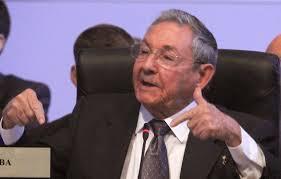
President RAul castro
President Raul Castro

“In 1800, there was the idea of adding Cuba to the [U.S.] to mark the southern boundary of the extensive empire. The 19th century witnessed the emergence of such [U.S.] doctrines as the Manifest Destiny, with the purpose of dominating the Americas and the world, and the notion of the ‘ripe fruit’, meaning Cuba’s inevitable gravitation to the [U.S.], which looked down on the rise and evolution of a genuine rationale conducive to emancipation.”

“Later on, through wars, conquests and interventions that expansionist and dominating force stripped Our America of part of its territory and expanded as far as the Rio Grande.”

“After long and failing struggles, José Martí organized the ‘necessary war’ [for independence against Spain], and created the Cuban Revolutionary Party to lead that war and to eventually found a Republic ‘with all and for the good of all’ with the purpose of achieving ‘the full dignity of man’. . . . Martí committed to the duty ‘of timely preventing the [U.S.] from spreading through the Antilles as Cuba gains its independence, and from overpowering with that additional strength our lands of America.’”

On “April 11, 1898, the President of the [U.S.] requested Congressional consent for military intervention in the [Cuban] independence war already won with rivers of Cuban blood, and that legislative body issued a deceitful Joint Resolution recognizing the independence of the Island ‘de facto and de jure.’ Thus, [the U.S.] entered [this war] as [Cuba’s supposed] ally and seized the country as an occupying force.”

“Subsequently, an appendix was forcibly added to Cuba’s Constitution, the Platt Amendment, that deprived it of sovereignty, authorized the powerful neighbor to interfere in [Cuba’s] internal affairs, and gave rise to Guantánamo Naval Base, which still holds part of our territory without legal right. It was in that period that the [U.S.] invaded the country, and there were two military interventions and support for cruel dictatorships.”

At the time, the prevailing [U.S.] approach to Latin America was the ‘gunboat policy’ followed by the ‘Good Neighbor’ policy. Successive interventions ousted democratic governments and in twenty countries installed terrible dictatorships, twelve of these simultaneously and mostly in South America, where hundreds of thousands were killed. President Salvador Allende [of Peru] left us the legacy of his undying example.”

“It was precisely 13 years ago that a [U.S.] coup d’état staged against beloved [Venezuelan] President Hugo Chavez Frías was defeated by his people. Later on, an oil coup would follow.”

“On January 1st, 1959, sixty years after the U.S. troops entered Havana, the Cuban Revolution triumphed and the Rebel Army commanded by Fidel Castro Ruz arrived in the capital.”

“On April 6, 1960, barely one year after victory, [U.S.] Assistant Secretary of State Lester Mallory drafted a wicked memorandum, declassified tens of years later, indicating that ‘The majority of Cubans support Castro […] An effective political opposition does not exist […]; the only foreseeable means of alienating internal support [to the government] is through disenchantment and disaffection based on economic dissatisfaction and hardship […] to weaken the economic life of Cuba […] denying it money and supplies to decrease monetary and real wages, to bring about hunger, desperation and overthrow of government.’”

“We have endured severe hardships. Actually, 77% of the Cuban people were born under the harshness of the blockade, but our patriotic convictions prevailed. Aggression increased resistance and accelerated the revolutionary process. Now, here we are with our heads up high and our dignity unblemished.”

“When we had already proclaimed socialism and the people had fought in the Bay of Pigs to defend it, President Kennedy was murdered, at the exact time when Fidel Castro, leader of the Cuban Revolution, was receiving [Kennedy’s] message seeking to engage Cuba in a dialogue.”

“After the [U.S.] Alliance for Progress, and [after] having paid our external debt several times over while unable to prevent its constant growth, our countries were subjected to a wild and globalizing neoliberalism, an expression of imperialism at the time that left the region dealing with a lost decade.”

“Then, the [U.S.] proposal of a ‘mature hemispheric partnership’ resulted in the imposition of the Free Trade Association of the Americas (FTAA), –linked to the emergence of these Summits– that would have brought about the destruction of the economy, sovereignty and common destiny of our nations, if it had not been derailed at [the Fourth Summit of the Americas at] Mar del Plata [Argentina] in 2005 under the leadership of Presidents Kirchner, Chavez and Lula. The previous year, Chavez and Fidel had brought to life the Bolivarian Alternative known today as the Bolivarian Alliance for the Peoples of Our America.”

“We have expressed to President Barack Obama our disposition to engage in a respectful dialogue and work for a civilized coexistence between our states while respecting our profound differences. I welcome as a positive step his recent announcement that he will soon decide on Cuba’s designation in a list of countries sponsor of terrorism, a list in which it should have never been included.”

“Up to this day, the [U.S.] economic, commercial and financial blockade is implemented against the island with full intensity causing damages and scarcities that affect our people and becoming the main obstacle to the development of our economy. The fact is that it stands in violation of International Law, and its extraterritorial scope disrupts the interests of every State.”

“We have publicly expressed to President Obama, who was also born under the blockade policy and inherited it from 10 former Presidents when he took office, our appreciation for his brave decision to engage the U.S. Congress in a debate to put an end to such policy.” In an apparent extemporaneous addition, Castro said, “I apologize to Obama for expressing myself so emotionally. President Obama has no responsibility for this. There were 10 presidents before him; all have a debt to us, but not President Obama. . . . I have read his books — parts of them — and I admire his life.”

“This and other issues should be resolved in the process toward the future normalization of bilateral relations.”

“As to us, we shall continue working to update the Cuban economic model with the purpose of improving our socialism and moving ahead toward development and the consolidation of the achievements of a Revolution that has set to itself the goal of ‘conquering all justice.’”

“Venezuela is not, and it cannot be, a threat to the national security of a superpower like the United States. We consider it a positive development that the U.S. President has admitted it.”

A major section of the Castro speech covered Cuba’s continued advocacy for the ideals of the Revolution, for true international governance of the Internet, for changes in hemispheric relations and cooperation against cyber warfare, climate change, terrorism, drug-trafficking organized crime and inequality and for eradication of poverty, illiteracy and hunger. He also commended the efforts in these areas of CELAC [Community of Latin American and Caribbean States], UNASUR [Union of South American Nations], CARICOM [Caribbean Community], MERCOSUR [Southern Common Market], ALBA-TCP [Bolivarian Alliance of the Peoples of Our America—Peoples’ Trade Treaty], SICA [System for Integration of Central America] and ACS [Association of Caribbean States].

Castro concluded with these words: “Cuba, a small country deprived of natural resources, that has performed in an extremely hostile atmosphere, has managed to attain the full participation of its citizens in the nation’s political and social life; with universal and free healthcare and education services; a social security system ensuring that no one is left helpless; significant progress in the creation of equal opportunities and in the struggle against all sorts of discrimination; the full exercise of the rights of children and women; access to sports and culture; and, the right to life and to public safety.”

“Thanks to Fidel and the heroic Cuban people, we have come to this Summit to honor Martí’s commitment, after conquering freedom with our own hands ‘proud of Our America, to serve it and to honor it […] with the determination and the capacity to contribute to see it loved for its merits and respected for its sacrifices.’”

Conclusion.

It would be easy to criticize this speech as an unnecessary historical review going back to the late 19th century and as an unproductive way to advance the cause of Cuba-U.S. reconciliation in 2015.

On the other hand, I see the speech as a necessary recital to the U.S., other countries in the hemisphere and the world of the reasons for Cuba’s historical and current suspicions of U.S. motives and actions and for Cuba’s wariness in engaging in the current negotiations for restoration of normal relations with the U.S. Nevertheless, this history is not preventing Cuba ifrom engaging in those negotiations, and by its actions Cuba is demonstrating that such reconciliation is in Cuba’s national interest.


President Obama’s Major Speech at the Summit of the Americas

On April 10 and 11, Cuba for the first time was welcomed to the Summit of the Americas. Presidents Raul Castro and Barack Obama exchanged handshakes and friendly greetings, and their speeches promised commitment to the process of reconciliation. Other leaders of the Americas celebrated this demonstration of reconciliation.

President Obama made several speeches and remarks at the Summit. This post will discuss his April 11th speech to the Summit’s plenary meeting; subsequent posts will cover his other remarks and those of President Castro.

 President Obama’s Speech

Obama

“When I came to my first Summit of the Americas six years ago, I promised to begin a new chapter of engagement in this region.  I believed that our nations had to break free from the old arguments, the old grievances that had too often trapped us in the past; that we had a shared responsibility to look to the future and to think and act in fresh ways.  I pledged to build a new era of cooperation between our countries, as equal partners, based on mutual interest and mutual respect.  And I said that this new approach would be sustained throughout my presidency; it has, including during this past year.  I’ve met that commitment.”

“We come together at a historic time.  As has already been noted, the changes that I announced to U.S. policy toward Cuba mark the beginning of a new relationship between the people of the United States and the people of Cuba.  It will mean, as we’re already seeing, more Americans traveling to Cuba, more cultural exchanges, more commerce, more potential investment.  But most of all, it will mean more opportunity and resources for the Cuban people.  And we hope to be able to help on humanitarian projects, and provide more access to telecommunications and the Internet, and the free flow of information.”

“We continue to make progress towards fulfilling our shared commitments to formally reestablish diplomatic relations, and I have called on Congress to begin working to lift the embargo that’s been in place for decades.  The point is, the [U.S.] will not be imprisoned by the past.  We’re looking to the future and to policies that improve the lives of the Cuban people and advance the interests of cooperation in the hemisphere.”

“This shift in U.S. policy represents a turning point for our entire region.  The fact that President Castro and I are both sitting here today marks a historic occasion.  This is the first time in more than half a century that all the nations of the Americas are meeting to address our future together.  I think it’s no secret — and President Castro, I’m sure, would agree — that there will continue to be significant differences between our two countries.  We will continue to speak out on behalf of universal values that we think are important.  I’m sure President Castro will continue to speak out on the issues he thinks are important.”

“But I firmly believe that if we can continue to move forward and seize this momentum in pursuit of mutual interests, then better relations between the [U.S.] and Cuba will create new opportunities for cooperation across our region — for the security and prosperity and health and dignity of all our people.”

“Now, alongside our shift toward Cuba, the [U.S.] has deepened our engagement in the Americas across the board.  Since I took office, we’ve boosted U.S. exports and also U.S. imports from the rest of the hemisphere by over 50 percent.  And that supports millions of jobs in all of our countries.  I’ve proposed $1 billion to help the people of Central America strengthen governance, and improve security and help to spark more economic growth and, most importantly, provide new pathways for young people who too often see their only prospects an underground economy that too often leads to violence.”

“We’re partnering with countries across the region to develop clean, more affordable and reliable energy that helps nations to combat the urgent threat of climate change, as [Brazil’s] President Rousseff already noted.  Our 100,000 Strong in the Americas initiative is working to bring 100,000 students from Latin America to the [U.S.] and 100,000 students from the [U.S.] to Latin America.  The new initiatives that I announced in Jamaica will help empower a new generation of young people across the Americas with the skills and job training that they need to compete in the global economy.”

“During the course of my meetings with CARICOM [Caribbean Community], as well as my meetings with SICA [System for Integration of Central America] as well as the discussions that I’ve had with many of you bilaterally, there have been additional ideas that we’re very interested in — finding ways in which we can expand access to the Internet and broadband; how we can structure private-public partnerships to rebuild infrastructure across the region; and to expand our commercial ties in a broad-based and inclusive way.  Because I am firmly of the belief that we will only succeed if everybody benefits from the economic growth, not just a few at the top.”

“At home, I’ve taken executive actions to fix as much of our broken immigration system as I can, which includes trying to help people come out of the shadows so that they can live and work in a country that they call home.  And that includes hundreds of thousands of young people we call DREAMers, who have already received temporary relief.  And I’m remaining committed to working with our Congress on comprehensive immigration reform.”

“So the bottom line is this:  The [U.S.] is focused on the future.  We’re not caught up in ideology — at least I’m not.  I’m interested in progress and I’m interested in results.  I’m not interested in theoretic arguments; I’m interested in actually delivering for people.  We are more deeply engaged across the region than we have been in decades.  And those of you have interacted with me know that if you bring an issue to my attention, I will do my best to try to address it.  I will not always be able to fix it right away, but I will do my best.”

“I believe the relationship between the [U.S.] and the Americas is as good as it has ever been.  I’m here today to work with you to build on this progress.  Let me just mention a few areas in which I think we can make more progress.”

“First, we will continue to uphold the Inter-American Democratic Charter, which states that “the peoples of the Americas have a right to democracy.”  I believe our governments, together, have an obligation to uphold the universal freedoms and rights of all our citizens.  I want to again commend [Panama’s] President Varela and Panama for making civil society groups from across the region formal partners in this summit for the first time.  I believe the voices of our citizens must be heard.  And I believe going forward, civil society should be a permanent part of these summits.”

“Second, we have to focus on reigniting economic growth that can fuel progress further in those communities that have not been reached.  And that means making the Americas more competitive.  We still have work to do to harmonize regulations; encourage good governance and transparency that attracts investment; invest in infrastructure; address some of the challenges that we have with respect to energy.  The cost of energy in many communities — in many countries, particularly in Central American and the Caribbean, are so high that it presents a great challenge to economic development, and we think that we can help particularly around clean energy issues.”

“We have to confront the injustice of economic inequality and poverty.  I think that collectively we are starting to identify what programs work and which programs do not work.  And we should put more money in those things that do work, and stop doing those things that don’t.  We don’t have money to waste because of too many young people out there with enormous needs.  I think President Varela is right to focus particularly on education and skills building.  And this is an agenda which we should all tackle collectively.”

“Third, we have to keep investing in the clean energy that creates jobs and combats climate change.  The [U.S.] is today leading this global effort, along with many of you.  And I should point out that America’s carbon pollution is near its lowest level in almost two decades.  Across the Americas, I think we have the opportunity to expand our clean energy partnerships and increase our investments in renewables.”

“And finally, we have to stand firm for the security of our citizens.  We must continue to join with our partners across the region, especially in Central America, but also in the Caribbean, to promote an approach, a holistic approach that applies rule of law, respects human rights, but also tackles the narco-traffickers that devastate so many communities.  This is a shared responsibility.  And I’ve said before that the [U.S.] has a responsibility to reduce the demand for drugs and to reduce the flow of weapons south, even as we partner with you to go after the networks that can cause so much violence.”

“So, a new relationship with Cuba.  More trade and economic partnerships that reduce poverty and create opportunity, particularly focusing on education.  Increased people-to-people exchanges.  More investment in our young people.  Clean energy that combats climate change.  Security cooperation to protect our citizens and our communities.  That’s the new chapter of engagement that the [U.S.] is pursuing across the Americas.”

“I want to make one last comment addressing some of the points that [Ecuador’s] President Correa raised and I’m sure will be raised by a few others during this discussion.  I always enjoy the history lessons that I receive when I’m here.  I’m a student of history, so I tend to actually be familiar with many of these episodes that have been mentioned.  I am the first one to acknowledge that America’s application of concern around human rights has not always been consistent.  And I’m certainly mindful that there are dark chapters in our own history in which we have not observed the principles and ideals upon which the country was founded.”

“Just a few weeks ago, I was in Selma, Alabama celebrating the 50th anniversary of a march across a bridge that resulted in horrific violence.  And the reason I was there, and the reason it was a celebration, is because it was a triumph of human spirit in which ordinary people without resort to violence were able to overcome systematic segregation.  Their voices were heard, and our country changed.”

“America never makes a claim about being perfect.  We do make a claim about being open to change.  So I would just say that we can, I suppose, spend a lot of time talking about past grievances, and I suppose that it’s possible to use the [U.S.] as a handy excuse every so often for political problems that may be occurring domestically.  But that’s not going to bring progress.  That’s not going to solve the problems of children who can’t read, who don’t have enough to eat.  It’s not going to make our countries more productive or more competitive in a global economy.”

“So I just want to make very clear that when we speak out on something like human rights, it’s not because we think we are perfect, but it is because we think the ideal of not jailing people if they disagree with you is the right ideal.”

“Perhaps President Correa has more confidence than I do in distinguishing between bad press and good press.  There are a whole bunch of press that I think is bad, mainly because it criticizes me, but they continue to speak out in the [U.S.] because I don’t have confidence in a system in which one person is making that determination.  I think that if we believe in democracy it means that everybody has the chance to speak out and offer their opinions, and stand up for what they believe is right, and express their conscience, and pray as they would, and organize and assemble as they believe is appropriate — as long as they’re not operating violently.”

“So we will continue to speak out on those issues not because we’re interested in meddling, but because we know from our own history.  It’s precisely because we’re imperfect that we believe it’s appropriate for us to stand up.  When Dr. King was in jail, people outside the United States spoke up on his behalf.  And I would be betraying our history if I did not do the same.”

“The Cold War has been over for a long time.  And I’m not interested in having battles that, frankly, started before I was born.  What I am interested in is solving problems, working with you.  That’s what the [U.S.] is interested in doing.  That’s why we’ve invested so much in our bilateral relationships, and that’s why I will continue to invest in creating the kind of spirit of equal partnership and mutual interest and mutual respect upon which I believe progress can advance.”


Issues of Cuban Human Rights To Be Discussed by Cuba and United States (Part I)

On March 26 Cuba announced that the U.S. and Cuba will commence their negotiations regarding human rights on March 31 in Washington, D.C.; this was covered in a prior post.

Now we examine issues of Cuban human rights that probably will be put on the agenda for further discussions by looking at the recent speech on this subject by Cuban Foreign Minister Bruno Rodriguez Parrilla. [1] Subsequent posts will look at the U.N. Human Rights Council’s most recent Universal Periodic Review (UPR) of Cuba and at the latest U.S. State Department report on Cuban human rights (the one issued in 2014 for 2013). Observations about these sources will be made in a later post while other subsequent posts will engage in a similar analysis about issues of U.S. human rights that are likely to be covered in the bilateral talks.

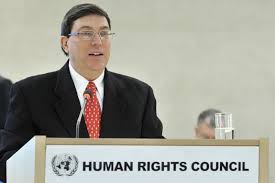
Bruno Rodriguez Parrilla

As discussed in a prior post, the U.N. Human Rights Council opened what it called its “High -Level Segment” on March 2, 2015, at its headquarters in Geneva Switzerland. One of the speakers that day was the Cuban Foreign Minister, whose speech will be excerpted below.

Cuba’s Commitment to International Human Rights. The Foreign Minister stressed Cuba’s “commitment to a genuine international cooperation based on the indivisibility of human rights, non-selectivity and non-politicization” and to “the struggle for the establishment of a more just, democratic and equitable international order that would remove the obstacles that hamper all national efforts that are made to guarantee the exercise of all human rights.”

Cuba, he asserted, maintains “a high level of cooperation and interaction with the procedures and mechanisms of the [U.N.] when it comes to universal human rights and a positive dialogue with the organs created by virtue of international treaties. It is in that spirit that we are conveying an invitation to the President of the International Committee of the Red Cross and the [U.N.] Rapporteur on Trafficking in Persons” to visit Cuba.

“Despite its deficiencies and difficulties, Cuba has shared and will continue to share its achievements and experience with other nations, with which we have made a selfless contribution to the exercise of human rights by other peoples of the world.”

For example, under Cuba’s “cooperation project known as ‘Miracle Operation,’ 3.4 million persons from 34 countries have undergone eye surgery free of charge.  Likewise, 9 million persons have already graduated from the literacy program ‘Yes, I Can,’ and 1,113,000 persons have graduated from the follow-up program ‘Yes, I Can Continue.’”

“Today, more than 51 000 Cuban health cooperation workers are offering their services in 67 countries of the world.” Cuba “will continue offering our cooperation in the struggle against the Ebola virus in Africa. More than 250 voluntary and specialized health cooperation workers of the medical brigade ‘Henry Reeve’ are taking part in this struggle in the most affected regions.  Another 4,000 Cuban health cooperation workers are participating in the prevention program that is being implemented in 32 African countries.”

“On the occasion of the Seventieth Anniversary of the [U.N.], the Principles and Purposes that were enshrined in [its] Charter and supported its creation are more valid than ever.  As was recently stated by Cuba’s President Raúl Castro Ruz: “We will never renounce our ideals of independence and social justice, or abandon a single one of our principles, nor cede a millimeter in the defense of our national sovereignty.  We will not accept any pressure regarding our internal affairs. We have earned this sovereign right through great sacrifices and at the price of great risks.”

People’s Participation in Government.The Foreign Minister emphasized that “more than 2,000 organizations and associations of an infinite diversity contribute very actively to the economic, social and cultural life [of Cuba]. . . . The participation of the people in the Governments’ decision-making processes, . . . has been the experience of the Cuban Revolution.”

This was illustrated in 2011 by the Cuban government’s consultations with the people over the proposed economic and social program that included “the introduction of 400,000 amendments thereto and the modification of two-thirds of the original text.  More recently a new Labor Code was discussed following this same procedures.”

Workers’ Rights. In Cuba “almost all workers – including those who work in small private businesses–are unionized and protected by collective agreements.  There are union representatives in the Council of Ministers as well as in the ministerial and corporate organs. In 1938 [long before the Cuban Revolution], the workers’ movement in Cuba managed to found a Unitarian Workers’ Central, which today encompasses as many as 17 different unions and thousands of other grassroots organizations.”

The Foreign Minister also raised the subjects of the International Labor Organization’s Convention 87 [2] and Convention 98 [3], both of which have been ratified by Cuba.

Palestine. Cuba supports “the inalienable right of the Palestinian people to a State of their own, on the pre-1967 borders and with East Jerusalem as its capital.  The [U.N.] General Assembly should act with resolve and guarantee, without further delay, the full [U.N.] membership of Palestine.”

Venezuela. “We ratify our firmest support to the Bolivarian Revolution and the legitimate Government headed by President Nicolás Maduro Moros.” (Several posts have investigated the reactions of Venezuela, Cuba and other countries to a U.S. executive order imposing sanctions on seven Venezuelans.)

Cuba’s Negotiations with the EU and the U.S. Cuba’s current negotiations with the U.S. and the EU over human rights and other issues were noted. Rodriguez said those discussions will occur within the agreed reciprocal basis of “sovereign equality, mutual respect, non-interference in internal affairs [and] respect for the legal systems of the parties.”

=====================================

[1] This portion of the post is based upon the following: Vigezzi, Statement by Bruno Rodriguez at Human Rights Council in Geneva, Nat’l Network on Cuba (Mar. 2, 2015); U.N. Hum. Rts. Council, Human Rights Council hears from 11 dignitaries as it continues its High-Level Segment, (Mar. 2, 2015); Cuban Foreign Minister speaks at the Human Rights Council, Granma (Mar. 4, 2015). The Cuban Foreign Minister’s speech also criticized certain aspects of the human rights records of the U.S. and other unnamed industrialized countries; these comments will be examined in a later post about issues of U.S. human rights that might be added to the agenda for discussions between the two countries.

[2] ILO Convention No. 87 (Convention on Freedom of Association and Protection of the Right to Organise [sic], 1948) has been ratified by 153 states, including Cuba and all 28 EU members. The U.S. has not so ratified and thus is not a party to this treaty although there are many federal and state laws on the subject.

[3] ILO Convention No. 98 (Right to Organize and Collective Bargaining Convention, 1949) has been ratified by 164 states, including Cuba and all 28 EU members. The U.S. has not so ratified and thus is not a party to this treaty although there are many federal and state laws on the subject.


U.S. Radio and Television Broadcasts to Cuba at Crossroads

In 1983 the Cuban American National Foundation, a once-monolithic lobbying group of Cuban exiles, helped persuade the Reagan administration to establish Radio Martí, which started broadcasting from Miami to Cuba in 1985, and TV Martí began in 1990. [1]

For most of its 30 years, the Martí services have been known for their anti-Castro, one- dimensional slant and advocacy. As a result, the Cuban regime has been very hostile to these services. It has made them illegal and often blocks their reception on the island.

The Martís, with a budget of $27 million, also have U.S. critics, including former American diplomats in Cuba. These critics “have considered them taxpayer-funded relics controlled by Cuban exiles that too often slide into propaganda, which has damaged their credibility.” In addition, “reports by congressional staff members and federal agencies, like the Inspector General for the State Department, have delivered stinging assessments” of Martí; the most recent such report came last summer accusing the Martís of ‘a lack of balance, fairness and objectivity,’ of cronyism, malfeasance and, most recently, low employee morale.”

More recently Martí has “focused on diversifying coverage of Cuba and ramping up a Martí website. [This includes] bringing more Cubans into the conversation through video, articles, texts, blogs and social media. “ This includes an expansion of a “cadre of journalists in Cuba who file videos and articles, with their names made public at great risk. Some of those interviewed by the reporters are also identified, a sign of diminishing fear.” In addition, Cubans now “can post their own blogs and news items through features like “Reporta Cuba,” which often spreads news of detentions.” “And a separate social network created by the Martís, Piramideo, allows Cubans to use cellphones or email accounts to gain access to a site that circumvents government restrictions. From there, they can send messages to hundreds of Cubans in Cuba about nearly anything.”

Another goal at Martí “was to lift journalistic standards, [especially attempting] to offer more diverse views of Cuban life and [U.S.] foreign policy. Reporters now call the Cuban government to get its response for certain stories.”

Now Martí presents “snippets of life on the island, like examples of the recently unleashed zeal for private enterprise. So one of the hosts, as part of an effort to bolster Cuba’s fledgling independent businesses, recently promoted “Hilda in Havana,” who is offering desserts and decorations for events and restaurants. Next up was a listing from a Havana man peddling his churro cart.” Other topics are housing problems in Cuba, the latest small-business ventures (public bathrooms in private homes, 25 cents for a quick stop, 50 cents for longer visits), dissident detentions, how to find the rare Wi-Fi hot spots.”

In addition to their live broadcasts, every month, Martí distributes nearly 15,000 DVDs of its programming in Cuba and circulated through flash drives. The goal of all of these efforts is to provide news and information about Cuba to Cubans without Cuban censorship.

In the last few years, Martí has been challenged by increased competition. “Cubans now use flash drives that are loaded with television shows and movies from satellite dishes and sold on the black market.”

With the December 17, 2014, announcement of the U.S. and Cuba intent to pursue normal diplomatic relations, the future of the Martí ventures is under re-examination.

“While Obama administration officials support the Martís, they are eager to cut the Office of Cuba Broadcasting loose from the federal mantle. In its budget for next year, the administration proposed consolidating the Office of Cuba Broadcasting and Voice of America’s Spanish-language programs, turning them into a nonprofit. The organization would be funded by federal grants, with federal oversight, but would not be part of the government. [This is the way that] Radio Free Europe/Radio Liberty, which gained prominence during the Soviet era and served as the model for the Martís, has long operated this way.”

In January, Cuba’s President Raúl Castro called for an end to the Martís as a condition for normalizing relations with the United States, but this proposal has not been mentioned in the limited publicly available information about the negotiations between the two countries.

There is a bill in Congress to terminate the two broadcasting services: H.R.570, Stop Wasting Money on Cuba Broadcasting Act. It was offered by Minnesota’s Democratic Representative, Betty McCollum. As of March 25, there had been no action on the bill in the House of Representatives although it has gained four Democratic cosponsors—Barbara Lee (CA), Raul Grijalva (AZ), Richard Nolan (MN) and Jose Serrano (NY).

====================================

[1] This post is based upon Alvarez, Radio and TV Martí, U.S. Broadcasters for Cuba, Face New Obstacles, N.Y. Times (Mar. 24, 2015),


Cuba Meets with European Union and Russian Ministers

This week Cuban leaders have held meetings in Havana with the foreign ministers of the European Union and Russia.

European Union-Cuba

A previous post examined the recent history of Cuba’s relations with the European Union (EU), including their negotiations on improving relations in 2014 and earlier this month. Another set of such negotiations or meetings took place in Havana on March 23-24 with the EU’s [1]

The most recent meetings were with the EU’s High Representative for Foreign Affairs and Security Policy and Vice President of the European Commission, Federica Mogherini.

EU +Castro

She met with Cuban President Raúl Castro and Foreign Minister Bruno Rodriguez Parrilla. Also present were Stefano Manservisi, Mogherini’s chief of staff; Herman Portocarero, EU Ambassador to Cuba; and Rogelio Sierra Diaz, Cuba’s Minister and Deputy Foreign Minister. (To the left is a photograph of Mogherini and Castro.)

In addition, Magherini met with the President of the National Assembly of Popular Power, Esteban Lazo Hernández; Vice President of the Council of Ministers and Minister of Economy and Planning, Marino Murillo Jorge; and Minister of Foreign Trade and Foreign Investment, Rodrigo Malmierca.

Afterwards Magherini said that although the pace of progress in the EU-Cuba talks on improving their relations was “slow,” it was gaining “political momentum” and that the two parties had “decided to speed up the rhythm of our negotiations, hopefully to manage to finalize the framework of our dialogue and agreement by the end of this year.” She also referred to the signing of a program between the island and the EU in the amount of 50 million euros until 2020, which will be used in commercial areas and especially in agriculture and complimented Cuba for its essential role in regional processes such as the Colombia-FARC peace negotiations taking place in Havana.

A Cuban newspaper reported the President Castro observed that “in a friendly atmosphere,” the two of them “exchanged ideas about the links between the EU and Cuba .They agreed on the importance of developing relationships of mutual respect, based on the purposes and principles of the United Nations Charter. Also, they discussed issues of common interest of the international agenda.”

Bruno Rodriguez reiterated Cuba’s “willingness to work to advance these links and . . . constructive engagement with the negotiations for an agreement on political dialogue and bilateral cooperation that is underway.” He also noted Cuba’s appreciation for the votes of EU members in support of Cuba’s resolution against the U.S. blockade (embargo) at last Fall’s U.N. General Assembly meeting.

Magherini and Bruno Rodriguez will see each other at the Summit of the Americas on April 10-11 in Panama, to which both Cuba and the EU are invited for the first time before the two of them meet in Brussels on April 22. In addition, Cuban officials will attend a summit of European and Latin American leaders scheduled for June in Brussels.

Russia-Cuba [2]


Serguei-Lavrov-y-Raúl-Castro1

On March 24, Russian Foreign Minister Sergey Lavrov met in Havana with Cuban President Raúl Castro. Also present were Mikhail L. Kamynin, Russian Ambassador to Cuba; Alexander V. Schetinin, the Director of Latin America at Russia’s Foreign Ministry; Cuban Foreign Minister, Bruno Rodríguez Parrilla; and Cuban Deputy Foreign Minister, Rogelio Sierra Díaz. (Above is a photograph of Larov and Castro.)

The participants discussed the excellent state of their relations and ratified the willingness to work together in the effective implementation of the bilateral economic agenda and deepen exchanges in areas of common interest. Castro thanked Russia’s support for ending the U.S. economic, commercial and financial blockade against Cuba and reiterated his country’s opposition to the unilateral sanctions imposed by the U.S. and its NATO allies against Russia.

Larov said, “Normalization between the United States and Cuba makes us happy. We salute this rapprochement,” and “we call for the lifting of the (U.S.) trade and financial blockade of Cuba as soon as possible.”

Earlier Larov met separately with Foreign Minister Rodriguez and with Ricardo Cabrisas, Vice President of Cuba’s Council of Ministers. They discussed bilateral cooperation and the interest of Russian companies in investing in Cuba’s development.

CubaRussia-0a5c9

Simultaneously a Russian ship of the class generally used for intelligence gathering was in the Havana Harbor as shown in the photograph to the left by Desmond Boylan/Associated Press.

 Conclusion

These meeting emphasize that Cuba’s redefining its relationships with the U.S. is not the only bilateral issue facing Cuba and that the U.S. is in competition with the EU and Russia for improving economic relations.

culPanama Canalbra-cutAnother factor influencing all of these discussions is Cuba’s construction of a deep-sea port at Mariel to accommodate larger ships going through an expanded Panama Canal, which announced this week that the expansion should be completed next year. (To the right is a photograph of one portion of the expanded canal.)

=======================================================

[1] This section of the post is based upon the following sources: Reuters, EU, Cuba to Speed Up Talks, Seek Deal by End of 2015, N.Y. Times (Mar. 24, 2015); Raúl received the High Representative of the European Union, CubaDebate (Mar. 24, 2015); Raúl received the High Representative of the European Union, Granma (Mar. 24, 2015); Forte, Visit of European High Representative promotes relations with Cuba, Granma (Mar. 24, 2015); Abellán, EU foreign affairs chief steps up talks for new Cuba cooperation policy, El Pais (Mar. 24, 2015).

[2] This section of the post is based upon the following source Assoc. Press, Russian FM Visits Cuba, Calls for End of US Trade Embargo, Wash. Post (Mar. 24, 2015); Reuters, Russian Foreign Minister Praises New U.S.-Cuba Relations, N.Y. Times (Mar. 24, 2015); Raul held meeting with the Foreign Minister of Russia, CubaDebate (Mar. 24, 2015); Raul meets with Russian Foreign Minister, Granma (Mar. 25, 2015).


Mogherini–


European Union and Cuba’s Negotiations Over Human Rights and Other Issues