Another U.N. General Assembly Resolution Condemning the U.S. Embargo of Cuba                                                                                    

U.N. General Assembly, 10/27/15

On October 27, 2015, the United Nations General Assembly adopted Resolution 5 (A/RES/70/5), 191 to 2 {the U.S. and Israel against with no abstentions) on the necessity of ending the economic, commercial and financial embargo imposed by the U.S. against Cuba. This was the 24th consecutive year that the Assembly has condemned the embargo, this time with the largest number of members voting for the resolution.[1]

This post will review the resolution itself and the debate leading to its adoption and preliminary documents filed with the General Assembly before concluding with observations about where we go from here.

The Resolution

These are two key provisions of this resolution:

  • First, the General Assembly reiterates “its call upon all States to refrain from promulgating and applying laws and measures of the kind referred to in the preamble to the present resolution, in conformity with their obligations under the Charter of the United Nations and international law, which, inter alia, reaffirm the freedom of trade and navigation.”
  • Second, the General Assembly “again urges States [e., the U.S.] that have and continue to apply such laws and measures to take the steps necessary to repeal or invalidate them as soon as possible in accordance with their legal regime.”

The Debate

Here we will look at Cuba’s arguments in favor of the resolution, the comments of other U.N. members supporting the resolution and those of the two countries opposing the measure (the U.S. and Israel).

Cuba[2]

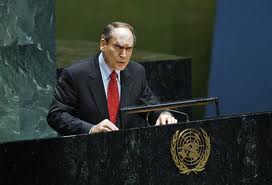
Foreign Minister Bruno Rodriguez

In presenting the resolution, Cuba’s Foreign Minister, Bruno Rodriguez, opened by acknowledging that last December 17 U.S. President Obama “recognized that the economic, commercial and financial blockade imposed against Cuba had failed, is obsolete, has not met the originally envisaged goals and causes damages to the Cuban people and isolation to the US Government.” To that end the U.S. President “has urged the Congress . . . to do so . . . [and has used] his executive prerogatives to modify its implementation.” Nevertheless, “the economic, commercial and financial blockade imposed against Cuba is being fully and completely implemented.”

The U.S. removal removal of Cuba “ from the spurious list of States Sponsors of International Terrorism was the inevitable rectification of a nonsense, but this has hardly had any impact on the implementation of the blockade, which is supported by a far more comprehensive system of previously established sanctions and laws.”

“The blockade is a flagrant, massive and systematic violation of the human rights of all Cubans; it is contrary to International Law; it has been described as  a crime of genocide by the Convention for the Prevention and Punishment of the Crime of Genocide of 1948 and is the main obstacle to the economic and social development of our people.”

“The human damages it has caused are inestimable.  Seventy seven per cent of all Cubans have been suffering the blockade since the day they were born.  The shortages and deprivations that it causes to all Cuban families cannot be accounted for.”

According to rigorous and conservative calculations, the economic damages it has caused after more than half a century amount to [US$ 833.755 billion (based on the price of gold) or US$ 121.192 billion (current prices).

“Historically, the United States has intended to establish its domination and hegemony on our homeland and, since 1959, it has tried to change the political, economic and social system that our people,   fully exercising the right to self-determination, has freely chosen.”

“The lifting of the blockade will be the essential element that will give some meaning to the progress achieved in the last few months in the relations between both countries and shall set the pace towards normalization.”

“Cuba is ready to accept the opportunities and face the challenges of a  new era in the relations between  both countries, but it will never negotiate its socialist system or its internal affairs, nor will it allow any blemish on its independence, which was conquered at the price of the blood of its best sons and daughters and after the huge sacrifices made by many generations since the beginning of  our independence wars in 1868.”

“As has been reiterated by President Raúl Castro Ruz, both governments must find the way to coexist in a civilized manner, despite their profound differences, and advance as much as possible for the benefit of the peoples of the United States and Cuba, through a dialogue and cooperation based on mutual respect and sovereign equality.”

“We appreciate and recognize the progress achieved recently with the re-opening of embassies, the visits paid by the Secretaries of State and Commerce and the exchange of delegations; the functioning of a Steering Committee; the expansion of the areas of dialogue and cooperation, particularly in the filed of air and aviation safety; the combat of drug-trafficking, illegal migration and traffic in persons; law enforcement, environmental protection and health, among others. We are really interested in developing fruitful relations; offering our hospitality to the US citizens who enjoy the freedom of traveling to Cuba; expanding enriching, cultural, sports, scientific and academic exchanges; promoting a multifaceted cooperation in areas of common interest, trade and investments. We have initiated a human rights dialogue with a strict reciprocal character and despite our huge differences.”

“We have presented a new draft resolution that reflects the reality of the rigorous and oppressive implementation of the blockade against Cuba and also welcomes and recognizes, in the new preamble paragraphs, the progress achieved in the course of last year.”

On behalf of the heroic, self-sacrificing and fraternal people of Cuba, I ask you to vote in favor of the resolution.”

Other Countries.

Luxembourg, an U.S. ally, expressing the common position of the European Union members, said that the U.S. trade policy towards Cuba was fundamentally a bilateral issue, but that the effects and side effects of U.S. extraterritorial legislation and unilateral measures were also negatively affecting the EU’s economic interests. The EU’s Common Commercial Policy had firmly and continuously opposed such measures. The EU and the U.S. had agreed in 1998 to alleviate problems with U.S. extraterritorial legislation and the U.S. had to fully respect and implement that agreement.

Speakers from 37 other countries voiced their support for the resolution while many also welcomed the renewal of diplomatic ties between the U.S. and Cuba and the island’s removal from the U.S. list of state sponsors of terrorism. Some of these speakers, however, said the steps taken by the U.S. were still limited and that the embargo remained unchanged or had even been tightened since the historic rapprochement was announced last December.

Colombia’s permanent representative, for example, said her country was optimistic that Obama will obtain Congress to lift the embargo, which “runs counter to international law.” Jamaica’s representative, speaking on behalf of CARICOM, said the embargo wasn’t only punitive against Cuba, “but an impediment to our shared regional development.”

United States of America[3]
Ronald D. Goddard
Ronald D. Goddard

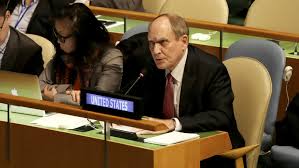
A short explanation for the U.S. vote against the resolution was provided to the General Assembly by Ronald D. Goddard, U.S. Senior Advisor for Western Hemispheric Affairs. He mentioned last December’s historic announcement of a new era in U.S.-Cuba relations and some of the subsequent steps toward normalization. In addition, he said that U.S. President Obama had “called on Congress to lift the embargo as soon as possible and has taken executive action to adjust regulations to facilitate many transactions involving Cuba.”

Therefore, Goddard continued, the U.S. regretted “that the Government of Cuba has chosen to proceed with its annual resolution. The text falls short of reflecting the significant steps that have been taken and the spirit of engagement President Obama has championed.. . . If Cuba thinks this exercise will help move things forward in the direction both governments have indicated they wish, it is mistaken.”

Israel.

Israel, the only other U.N. member to join the U.S. in opposing the resolution, merely said that it had followed the adoption of the resolution with great interest and welcomed the renewal of diplomatic relations between Cuba and the U.S. Given Israel’s special relationship with the latter, it had voted against the resolution.

Preliminary Documents Regarding the Resolution

Cuba’s Report to General Assembly. In June 2015 Cuba submitted a 37-page report to the General Assembly on its last year’s resolution on the embargo (blockade). This report contains a list of the U.S. statutes and regulations imposing the embargo and blockade and asserts that these U.S. actions have violated the Cuban people’s right to health and food; education, sports and culture; and development. In addition, this U.S. policy allegedly has damaged Cuba’s foreign commerce and investments; and finances, especially with its extraterritorial applications. These alleged damages total US$ 121.192 billion (in current prices) or US$ 833.755 billion (adjusted to reflect the depreciation of the US Dollar against the value of gold).[4]

These alleged damages include the alleged blocking of Cuban access to diagnostic equipment for monitoring the treatment of leukemia patients; preventing the sale to Cuban hospitals of devices critical for pediatric heart surgery patients; and hindering efforts by the U.N. Development Program getting medicine and support into Cuba for its over 18,000 patients living with HIV/AIDS.

U.N. Secretary-General’s Report to General Assembly. On July 30, 2015, the U.N. Secretary-General submitted a 178-page report to the General Assembly summarizing the comments on the resolution from 156 governments and 33 U.N. agencies and entities.[5] The U.S. and Israel, the only two countries to vote against the same resolution last year, had not submitted any comments at the time of the publication of this report, and the Holy See merely stated that it had “never drawn up or applied economic, commercial or financial laws or measures against Cuba.”

The other 155 governments basically supported the resolution with the European Union and Japan emphasizing that the U.S. “trade policy towards Cuba is fundamentally a bilateral issue,” but that “the extraterritorial extension of the [U.S.] embargo . . . violate commonly accepted rules of international trade.”

Of the 33 U.N. agencies and entities, the Office of the United Nations High Commissioner for Human Rights says that generally coercive economic sanctions justified on human rights grounds more often than not fail to improve those conditions; instead they punish the poorest people, the intended beneficiaries of the sanctions, at the cost of increased unemployment and poverty and risks to their health.

Conclusion

This blog consistently has called for the U.S. to end its embargo (blockade) of Cuba. It also has recommended that Cuba’s claims against the U.S. for alleged damages from the embargo be submitted for determination to the Permanent Court of Arbitration at The Hague in the Netherlands. In such a proceeding the U.S. could mount any and all arguments it has against (a) the major premise of the claims (the embargo is illegal under international law) and (b) the amount and causation of the alleged damages from the embargo. In the meantime, this blog has pointed out that as a matter of financial prudence the U.S. should end the embargo as soon as possible to reduce the amount of this contingent liability.[6]

==================================================

[1] United Nations, Despite Resumption of Relations between United States, Cuba, General Assembly Adopts, Almost Unanimously, Resolution Calling for Blockade to Be Lifted (Oct. 27, 2015); Assoc. Press, UN Overwhelmingly Condemns US Embargo on Cuba, N.Y. Times (Oct. 27, 2015); Reuters, Amid Renewed U.S., Cuba ties, U.N. condemns Embargo for 24th Year, N.Y. Times (Oct. 27, 2015); Whitefield, United Nations Votes 191-2 to condemn U.S. embargo against Cuba, Miami Herald (Oct. 27, 2015). As an example of the very limited U.S. coverage of this important U.N. action, the StarTribune, which is the major newspaper in the State of Minnesota, merely stated the following in an 8th page column of “nation+ world” news in the October 28th print edition: “UNITED NATIONS: Vote condemns embargo on Cuba In the first U.N. vote on a resolution condemning the U.S. embargo against Cuba since the two countries renewed diplomatic ties, the U.N. voted 191-2 in favor of the condemnation. The United States said that it couldn’t support the resolution because it failed to take into account ‘the significant steps in the spirit of engagement’ undertaken by the United States.”

[2] Bruno Rodriguez: “We will continue to present this draft resolution for as long as this blockade persists,” CubaMinRex (Oct. 27, 2015) (official Cuban Foreign Ministry English translation). On the day the resolution was debated in the General Assembly, Cuba’s newspaper, Granma, and its website, Cubadebate, had a minute-by-minute reporting of the proceedings starting at 08:33 a.m. (CDT). The Cuban Foreign Ministry has a separate website, “CubavsBloquero,” regarding the embargo (blockade). Another special Ministry website focuses on Cuba-EEUU {United States} relations.

[3] U.S. Mission to U.N., Explanation of Vote at a UN General Assembly Meeting on the Cuba Embargo (Oct. 27, 2015)  In the weeks before the General Assembly vote, the U.S. reportedly considered abstaining on the resolution this year. Last week, however, the U.S. decided it would not abstain because the text did not fully reflect the new spirit of cooperation between the two countries

 [4] Report by Cuba On Resolution 69/5 of the United Nations General Assembly entitled “Necessity of ending the economic, commercial and financial blockade imposed by the United States of America against Cuba” (June 2015). The Report breakdown for some, but not all, of the components of these alleged damages, but does not explain how the alleged gold standard dollar figures were calculated.

[5] U.N. Gen. Assembly, Report of the Secretary General: Necessity of ending the economic, commercial and financial embargo imposed by the United States of America against Cuba (July 30, 2015)

[6] E.g., Letter to President Obama Regarding Cuba (Aug. 17, 2012) (recommends ending embargo); Senator Klobuchar Introduces Bill To End Embargo of Cuba (Feb. 13, 2015) (Cuba’s “damage claim must be recognized as a contingent liability of the U.S., and ending the embargo will minimize the amount of that liability”); Resolution of U.S. and Cuba’s Damage Claims (April 6, 2015).
President Obama’s Lack of Comments About Cuba During His Reelection Campaign of 2012


In light of President Barack Obama’s historic December 17, 2014, announcement of rapprochement with Cuba, it is interesting to examine Obama’s earlier statements about Cuba. Prior posts examined his campaign for the Democratic presidential nomination in 2007-2008; his campaign for the presidency as the Democratic Party’s nominee in 2008; and his first presidential term, 2009-2013. Now we examine his presidential reelection campaign of 2012.[1] A subsequent post will examine his second presidential term (up to the December 17, 2014, announcement), 2013-2014.

On April 4, 2011, Obama had an unusual way of formally announcing he would be running for reelection in 2012. He did so with an understated two-minute Internet video titled “It Begins With Us,” which features his supporters talking about the need to re-elect him and in which he does not appear. No mention of Cuba was made.

As the incumbent president, Obama secured the Democratic nomination with no serious opposition at its national convention in Charlotte, North Carolina. On September 5, 2012, he was re-nominated, and the following night he accepted the nomination. In his acceptance speech he said the election “will be a choice between two different paths for America, a choice between two fundamentally different visions for the future. Ours is a fight to restore the values that built the largest middle class and the strongest economy the world has ever known.”

Obama in his acceptance speech asked all citizens “to rally around a set of goals for your country, goals in manufacturing, energy, education, national security and the deficit, real, achievable plans that will lead to new jobs, more opportunity and rebuild this economy on a stronger foundation. That’s what we can do in the next four years, and that is why I am running for a second term as president of the United State.” Obama also talked about various problems around the world, but made no mention of Cuba.

His Republican opponent, Mitt Romney, previously had been nominated at its national convention on August 28 with his acceptance on August 30.

The campaigns focused heavily on domestic issues: debate centered largely around sound responses to the Great Recession in terms of economic recovery and job creation. Other issues included long-term federal budget issues, the future of social insurance programs, and the Affordable Care ActForeign policy was also discussed including the phase-out of the Iraq War, the size of and spending on the military, preventing Iran from obtaining nuclear weapons, and appropriate counteractions to terrorism.

The two main presidential candidates held three debates, all in October (3rd, 16th and 22nd).

In the first debate on October 3 the candidates “quarreled aggressively over tax policy, the budget deficit and the role of government, with each man accusing the other of being evasive and misleading voters.” Romney, for example, accused Obama of failing to lead the country out of the deepest economic downturn since the Great Depression of the 1930’s while Obama implored Americans to be patient. On a basic level it was a clash of two ideologies, the president’s Democratic vision of government playing a supporting role in spurring economic growth, and Mr. Romney’s Republican vision that government should get out of the way of businesses that know best how to create jobs.” There was practically no mention of foreign issues, and not a word about Cuba.

The second debate on October 16 again dealt primarily with domestic affairs, including taxes, unemployment, job creation, the national debt, energy and energy independence, women’s rights and immigration. But this debate also touched on foreign policy, especially the then recent attack on the U.S. consulate in Benghazi, Libya. Again, no mention of Cuba.

The last debate on October 22 was to be devoted to foreign policy, and it did have discussions about the attack on Benghazi, Iran’s nuclear program, the Arab Spring, the Syrian civil war, relations with Israel and Pakistan, the War on Terror, the withdrawal of U.S. troops from Afghanistan, the size and scope of the U.S. military, and relations and trade with China. There also were further comments about domestic policy issues, such as job creation, the federal deficit and education. Again, there was no mention of Cuba.

On November 6, 2012, Obama was re-elected for his second term as President of the United States. He won 65,916,000 popular votes (51.1%) and 332 electoral votes to Romney/Ryan’s 60,934,000 (47.2%) and 206 electoral votes. Nationally the Democratic ticket overwhelmingly won the Hispanic vote, 71% to 27% for the Republicans. Obama and Biden also won the key state of Florida, 50.0% versus 49.1% for Romney and Ryan, with nearly 50% of the state’s Cuban-Americans going for the Obama ticket.

In his victory speech in Chicago, President Obama proclaimed, “Tonight, in this election, you, the American people, reminded us that while our road has been hard, while our journey has been long, we have picked ourselves up, we have fought our way back, and we know in our hearts that for the United States of America, the best is yet to come.”

Conclusion

 Unless it was due to my limited research, there was no mention of U.S. policy regarding Cuba during this presidential election. This is not too surprising in light of the primacy of domestic economic issues in 2012, the problems in the Middle East and the Administration’s apparent lack of attention to Cuba since Cuba’s arrest of Alan Gross in December 2009 and its subsequent conviction and imprisonment of Gross.

=======================================================

[1] This post and the subsequent posts about Obama’s prior statements about Cuba are not based upon comprehensive research. The primary research tool was online searching of the New York Times for articles mentioning “Obama and Cuba” for the relevant time period. Therefore, this blogger especially welcomes comments with corrections and additions. Ultimately after public release of many Obama Administration documents after the completion of his presidency, scholars will undertake a detailed examination of those documents and provide their assessments of his record regarding Cuba. This post is based upon the following: Shear, Obama Begins re-Election Facing New Political Challenges, N.Y. Times (April 4, 2011) President Obama’s Full Remarks From the Democratic National Convention, N.Y. Times (Sept. 6, 2012); Zeleny & Rutenberg, Obama and Rommey, in First Debate, Spar Over Fixing the Economy, N.Y. Times (Oct. 3, 2012); Baker, A Clash of Philosophies, N.Y. Times (Oct. 4, 2012); Transcript of the Last Debate, N.Y. Times (Oct. 22, 2012); Baker & Cooper, Sparring Over Foreign Policy, Obama Goes on the Offensive, N.Y. Times (Oct. 22, 2012); President Obama’s Election Night Speech, N.Y. Times (Nov. 7, 2012); Wikipedia, 2012 Democratic National Convention; Wikipedia, Barack Obama presidential campaign, 2012; Wikipedia, 2012 Republican National Convention; Wikipedia, United States presidential election debates, 2012; Wikipedia, United States presidential election, 2012; Jonathan Alter, The Center Holds: Obama and His Enemies (Simon & Schuster; New York; 2013); Daniel Belz, Collision 2012: Obama vs. Romney and the future of elections in America (Viking; New York; 2013).

U.S. Supreme Court Decision Bolsters Obama Administration’s Normalizing Relations with Cuba

On June 8, 2015, the U.S. Supreme Court, 6 to 3, decided that the U.S. President had the exclusive power in the U.S. Government to recognize foreign nations and governments. The Court, therefore, declared unconstitutional an Act of Congress that allowed U.S. citizens born in Jerusalem to have their U.S. passports identify Israel as their birthplace. (Zivotofsky v. Kerry, No. 13-628.)

This decision has major implications for the ongoing Obama Administration to normalize relations with Cuba with respect to existing law as well as current congressional Republican efforts to halt or hinder that normalization.

Zivotofsky v. Kerry

The Facts

Since the U.S. official recognition of the State of Israel in 1948, every U.S. president consistently has not acknowledged any country’s sovereignty over Jerusalem. Instead, the Executive Branch has maintained that “‘the status of Jerusalem . . . should be decided not unilaterally but in consultation with all concerned.’” Moreover, this issue of sovereignty is of great sensitivity in Arab-Israeli relations and negotiations. Therefore, the consistent policy and practice of the U.S. Department of State has been

to record the place of birth on a U.S. passport as the “country [having] present sovereignty over the actual area of birth” and to record the place of birth for citizens born in Jerusalem as “Jerusalem.”

In 2002, Congress passed the Foreign Relations Authorization Act, Fiscal Year 2003,116 Stat. 1350. Section 214 of the Act is titled “United States Policy with Respect to Jerusalem as the Capital of Israel,” and its subsection (d) allows U.S. citizens born in Jerusalem to list their place of birth as “Israel.”

When President George W. Bush signed the Act, he issued a statement declaring that section 214 would, “if construed as mandatory rather than advisory, impermissibly interfere with the President’s constitutional authority to formulate the position of the United States, speak for the Nation in international affairs, and determine the terms on which recognition is given to foreign states.” Therefore, since then the State Department has not changed the previously described policy and practice regarding U.S. passports, the statute would not be honored.

When the State Department rejected the request on behalf of U.S. citizen Menachem Binyamin Zivotofsky, who was born in Jerusalem, to have his passport designate Israel as his birthplace, his guardians sued to enforce Section 214. Thus, the issue for the Supreme Court was whether Section 214 was constitutional.[1]

The Opinion of the Court [2]

The opinion of the Court by Justice Anthony Kennedy acknowledged the international sensitivity of the issue. It said, “A delicate subject lies in the background of this case. That subject is Jerusalem. Questions touching upon the history of the ancient city and its present legal and international status are among the most difficult and complex in international affairs.” Moreover, “Jerusalem’s political standing has long been, and remains, one of the most sensitive issues in American foreign policy, and indeed it is one of the most delicate issues in current international affairs.”

The opinion then started with key constitutional provisions regarding foreign affairs. The key was Article II, Section 3 of the U.S. Constitution, which directs that the President “shall receive Ambassadors and other public Ministers.” After consulting the writings of international legal scholars at the time of the drafting of the Constitution, the Court concluded that it is “a logical and proper inference, then, that a Clause directing the President alone to receive ambassadors would be understood to acknowledge his power to recognize other nations.” This conclusion also was supported by the President’s other constitutional powers to make treaties, by and with the Advice and Consent of two-thirds of two-thirds of the Senators present (Art. II, §2, cl. 2.) and the power to “nominate, and by and with the Advice and Consent of the Senate, . . . [to] appoint Ambassadors” as well as “other public Ministers and Consuls.”

These provisions and other considerations led the Court to conclude that “the text and structure of the Constitution grant the President the power to recognize foreign nations and governments” and that this power is exclusively the President’s. “Put simply, the Nation must have a single policy regarding which governments are legitimate in the eyes of the United States and which are not. Foreign countries need to know, before entering into diplomatic relations or commerce with the United States, whether their ambassadors will be received; whether their officials will be immune from suit in federal court; and whether they may initiate lawsuits here to vindicate their rights. These assurances cannot be equivocal.”

Nevertheless, the Court said in dicta, “many decisions affecting foreign relations—including decisions that may determine the course of our relations with recognized countries— require congressional action. Congress may ‘regulate Commerce with foreign Nations,’ ‘establish an uniform Rule of Naturalization,’ ‘define and punish Piracies and Felonies committed on the high Seas, and Offences against the Law of Nations,’ ‘declare War,’ ‘grant Letters of Marque and Reprisal,’ and ‘make Rules for the Government and Regulation of the land and naval Forces.’” (U. S. Const., Art. I, §8.) “In addition, the President cannot make a treaty or appoint an ambassador without the approval of the Senate.” (Art. II, §2, cl. 2.) “The President, furthermore, could not build an American Embassy abroad without congressional appropriation of the necessary funds.” (Art. I, §8, cl. 1.) (Emphasis added.) [3] Under basic separation-of-powers principles, it is for the Congress to enact the laws, including ‘all Laws which shall be necessary and proper for carrying into Execution’ the powers of the Federal Government.”(§8, cl. 18)

This point about congressional power was underscored by the Court when it said “it is essential the congressional role in foreign affairs be understood and respected. For it is Congress that makes laws, and in countless ways its laws will and should shape the Nation’s course. The Executive is not free from the ordinary controls and checks of Congress merely because foreign affairs are at issue. It is not for the President alone to determine the whole content of the Nation’s foreign policy.” (Citations omitted.)

Reactions to the Court’s Decision

The White House Press Secretary, Josh Earnest, released a statement embracing the decision as it “reaffirms the long-established authority of the President to recognize foreign states, their governments, and their territorial boundaries” and “upholds the President’s long-standing authority to make these sensitive recognition determinations as part of his conduct of diplomacy and foreign policy.”

Alan Morrison, the Lerner Family Associate Dean for Public Interest & Public Service Law, George Washington University Law School and the author of an amicus brief in the case in support of the Zivotofsky family, saw possible implications of the case for the current conflicts over Cuba policy between President Obama and the Republican-controlled Congress. Morrison said, President Obama “might announce that he has recognized the Castro-led Cuban government, with no worry about an effort of Congress to override him.” Congress, on the other hand, “might decide to up the ante by . . . using the power of the purse, especially as part of a bill that the president must sign to keep the government from shutting down.”[4]

Indeed, the Center for Democracy in the Americas asserts that this decision invalidates a major portion of the Helms-Burton Act, which “arrogates to the Congress a lot of authority for determining when – and under what circumstances – the United States can resume normal relations [with Cuba]. The law says . . . [only] when the government in Cuba fits the definition of a government in transition or a democratically-elected government can the President recognize Cuba, trade with Cuba, negotiate with Cuba over Guantanamo, allow Cuba to enter the World Bank or other financial institutions, etc.”[5]

In addition, at least three pending bills in Congress would appear to be unconstitutional under this recent Supreme Court decision as they would impose congressional preconditions to a presidential normalization and re-establishment of diplomatic relations: H.R.1782 (Cuba ceasing to violate human rights of its citizens), H.R.2466 and S.1388 (Administration plan for resolving all U.S. claims for property expropriated by Cuba).[6]

There also is at least one pending bill that would bar use of appropriated funds to construct a U.S. Embassy in Havana or expand the present facility housing the U.S. Interests Section there; that is the Department of State’s Appropriations Act FY 2016 that is still before the House Appropriations Committee.[7] That certainly would inhibit the operation of such a facility, but the Court in dicta in Zivotofsky said, ““The President, furthermore, could not build an American Embassy abroad without congressional appropriation of the necessary funds.” (Emphasis added.) Thus, this pending bill would seem to be within Congress’ prerogative, but the Administration always could make a request for a supplemental appropriation to convert the building to an embassy.

There are many bills imposing restrictions on U.S. changes affecting the prison or detention facility at Guantanamo Bay Cuba that, in my opinion, unnecessarily would limit the Administration’s desire to close that facility as well as its discussions with Cuba about the lease of that territory to the U.S., but would not run afoul of the Zvotofsky decision. In the House they are H.R.240, H.R. 401, H.R.654, H.R.1689, H.R.1735, H.R.2029, H.R.2578 and H.R.2685; in the Senate, S.165, S.778 and S.1376.[8]

Other pending bills similarly would impede reconciliation, but would not be barred by the Zvotofsky case. They are H.R.2323 (maintain Ratio and TV Marti), H.R.2577 (ban travel to Cuba on or over expropriated U.S. property), H.R.2578 (no exports to Cuban military and intelligence personnel and their families) and Department of Treasury Appropriations Act FY 2016 pending in the House Appropriations Committee (no imports of expropriated property and no financial transactions with Cuban military personnel).

Conclusion

Maybe this legal discussion is beside the point.

There are reports that the U.S. and Cuba by early July will re-establish diplomatic relations, and on June 13, Senator Jeff Flake (Rep., AZ) predicted the opening of both a Cuban embassy in Washington and a U.S. embassy in Havana will occur in the very near future. “Nothing has been set, but it’s imminent,” he said. Flake’s comments were made just after a meeting in Havana with Cuba’s Foreign Minister Bruno Rodriguez Parrilla, Josafina Vidal, Cuba’s lead negotiator with the U.S., and Cuba’s First Vice President Miguel Diaz Canel. [9]

If this happens, any new legislation to impose preconditions to recognition would be moot and litigation over the constitutional issue would take years to resolve. In any event, however, the Zvotofsky decision bolsters the Obama Administration’s pursuit of normalization and reconciliation with Cuba.

==========================================================

[1] The case originally was dismissed by the district court on the grounds that the petitioner lacked standing and that the case presented a nonjusticiable political question. The court of appeals affirmed on the political question ground while reversing on the standing ground. The Supreme Court granted certiorari, vacated the judgment and remanded for the circuit court to decide whether the statute was constitutional. Upon remand the circuit court decided that the statute was unconstitutional, which was affirmed by the Supreme Court in this recent decision..

[2] Mr. Justice Thomas filed a separate opinion, concurring in part and dissenting in part. Chief Justice Roberts filed a separate dissenting opinion, and he along with Mr. Justice Alito joined the dissenting opinion of Mr. Justice Scalia. Analysis of these opinions will be left to others. The opinion of the Court and these other opinions are briefly discussed in Liptak, Supreme Court Backs White House on Jerusalem Passport Dispute, N.Y. Times (June 8, 2015).

[3] On commentator saw the highlighted mention of congressional power to withhold funds for building an embassy as a reference to a possible future congressional refusal to appropriate funds to convert the U.S. Interests Section in Havana to a U.S. Embassy.

[4] Morrison, Symposium: President wins in Zivotofsky: Will there be another battle? SCOTUSblog (June 9, 2015).

[5] Center for Democracy in Americas, Is The Supreme Court Passport Decision A Threat to Helms-Burton? We think so (June 12, 2015).

[6] These bills are discussed in the May 26, 2015 post.

[7] This bill is discussed in the June 12, 2105 post.

[8] These and the subsequently mentioned bills are discussed in the posts of May 26 and 28 and June 2, 10 and 12.

[9] Reuters, Exclusive: U.S.-Cuba Deal Expected in Early July to Restore Ties, Reopen Embassies, N.Y. times (June 13, 2015); Assoc. Press, Republican Senator Sees US Embassy in Cuba coming Soon, N.Y. Times (June 13, 2015). Accompanying Senator Flake on this Cuba trip were Republican Senators Susan Collins (ME) and Pat Roberts (KS).


Spain’s Criminal Investigation of 1989 Murders of Jesuits in El Salvador Is Approved by Spain’s Supreme Court

On May 6th Spain’s Supreme Court affirmed its High Court’s criminal investigation and prosecution of former Salvadoran military officials for the 1989 murders of six Jesuit priests and their housekeeper and her daughter at the University of Central America in San Salvador.[1]

The legal issue for the Supreme Court was whether a 2014 amendment to Spain’s statute regarding universal jurisdiction barred further proceedings in the case. Important for the Supreme Court’s conclusion that it did not were (a) the fact that five of the murdered priests were Spanish citizens and (b) “serious and reasonable” indications that El Salvador’s 1991 criminal trial in this case was not held to find those responsible for the murder but instead to obstruct justice, “all of it accompanied by the absence of the necessary guarantees of independence and impartiality.” One of the grounds for the latter reason was the resignation of the Salvadoran prosecutors after the country’s attorney general refused to allow them to call important military officials to testify at the trial.

In previous developments in this case, Spain had issued arrest warrants for former Salvadoran military officials and requested their extradition to Spain, but El Salvador denied the request for most of these men. One of them (former Colonel Inocente Orlando Montano), however, had been living in the U.S., where he was prosecuted, convicted and imprisoned for lying to U.S. immigration about his military record in El Salvador, and on April 8, 2015, the U.S. government filed a request in a U.S. district court in Massachusetts seeking the extradition to Spain of Col. Montano for his alleged role in the 1989 Jesuit massacre.  Montano will now face an extradition hearing before a U.S. magistrate judge and, if ruled extraditable, will be transferred to Spain to stand trial.[2]

Last month Spain’s Supreme Court upheld the dismissals of two High Court investigations of alleged human rights violations by Chinese officials in Tibet under Spain’s universal jurisdiction statute. Still awaiting decision by the Supreme Court are whether the amended universal jurisdiction statute permits investigations of the 1976 murder of Spanish diplomat Carmelo Soria during the Pinochet dictatorship in Chile and the 2010 Israeli attack on volunteers in the Freedom Flotilla, who were bringing aid to Gaza.

============================================

[1] This post is based upon the following: Spain’s Supreme Court, Press Release: The Supreme Court agreed that the High Court continue to investigate the death of five Spanish priests in El Salvador in 1989 (May 6, 2015); Rincoń, Supreme Court approves inquiry into 1989 Jesuit massacre in El Salvador, El Pais (May 7, 2015); Spanish Justice decides to investigate deaths of Jesuits in El Salvador, DiarioCoLatino (May 6, 2015). Previous posts examined the general international law principle of universal jurisdiction; Spain’s universal jurisdiction statute and its 2014 amendment.

[2] Other posts discussed El Salvador’s criminal prosecution regarding the Jesuits’ murders; the early history of Spain’s Jesuits case; Spain’s issuance of criminal arrest warrants in Jesuits case; other developments in Spain’s Jesuits case; Spain’s request for extradition in Jesuits case and El Salvador’s denial of extradition; and update on Spain’s Jesuits case.


Obama’s Negative Reaction to Netanyahu’s Planned Speech to U.S. Congress Validates Cuba’s Negative Reaction to U.S. Meeting with Cuban Dissidents in Cuba

At the invitation of John Boehner, the Republican Speaker of the U.S. House of Representatives, Israeli Prime Minister Benjamin Netanyahu is planning to give a speech to the U.S. Congress regarding sanctions on Iran. Apparently this plan was suggested by Ron Dermer, Israel’s Ambassador to the U.S., who once worked for a Republican pollster in Florida and who is a confident of Sheldon Adelson, a billionaire GOP donor. [1]

This was done without the prior knowledge and approval of the Obama Administration which under the U.S. Constitution is in charge of foreign affairs. In response the White House Press Secretary, Josh Earnest, said that the planned speech was “a departure from protocol [as] such invitations are usually made leader to leader” and that Obama would not meet with Netanyahu while he was in the U.S.

An unnamed U.S. official was more outspoken. He or she said this “is not the way people act. It is unprecedented. It is barbaric behaviour. It is so impolite it is disgraceful.” Richard Cohen, a columnist for the Washington Post, said it showed Netanyahu’s contempt for Obama and threatened U.S. bipartisan understanding and support for Israel. Cohen sarcastically said he would not be surprised to see Netanyahu as a delegate at the Republican Party’s 2016 national convention.

U.S. criticism is also directed at Ambassador Dermer. A senior Obama administration official said the Ambassador had “repeatedly placed Mr. Netanyahu’s political fortunes above the relationship between Israel and the U.S.”

Netanyahu is in the midst of an election campaign in Israel and undoubtedly saw the speech as bolstering his status as an international statesman. But instead it has prompted severe criticism in his country. His former ambassador to the U.S., Michael Oren, who is running for the country’s parliament, called on Netanyahu to cancel the speech, and Amos Yadlin, a former Israeli military intelligence chief, denounced the plan as “irresponsible.” An Israeli professor specializing in Israeli-American relations, said, “It’s a huge miscalculation. People are now questioning [Netanyahu’s] judgment.”

The controversy also apparently is bolstering support for Obama’s Iran policies from at least the Democrats in Congress

Finally the forceful criticism of the planned Netanyahu speech shows the validity of a prior post’s description of the Cuban government’s unhappiness with the recent meeting in Havana with Cuban dissidents  by U.S. Assistant Secretary of State Roberta Jacobson and with the USAID covert or “discreet” programs on the island purportedly to promote democracy and human rights.

========================================================

[1] This post is based upon Zogby, Boehner, Netanyahu outsmarted themselves, Chicago Trib. (Jan. 26, 2015); Cohen, Netanyahu’s Contempt for President Obama, Wash. Post (Jan. 26, 2015); Bernstein, Is Netanyahu’s address to Congress unconstitutional?, Wash. Post (Jan. 26, 2015); Rudoren, Israeli Opposition Takes Aim at Netanyahu Over Planned Speech to Congress, N.Y. Times (Jan. 27, 2015); Peters, G.O.P.’s Invitation to Netanyahu Is Aiding Obama’s Cause on Iran, N.Y. Times (Jan. 29, 2015); Davis, White House’s Dismay Over Netanyahu’s Visit Extends to Ambassador, N.Y. Times (Jan. 29, 2015); Hulse & Peters, Netanyahu Is Talking to Leading Democrats to Little Effect So Far, N.Y. Times (Jan. 30, 2015); Robinson, Boehner’s Invitation to Netanyahu backfires on them both, Wash. Post (Jan. 29, 2015); Kagan, Five reasons Netanyahu should not address Congress, Wash. Post (Jan. 29, 2015).

U.N. General Assembly Again Condemns U.S. Embargo of Cuba

U.N. General Assembly Voting Results Screen
U.N. General Assembly   Voting Results Screen

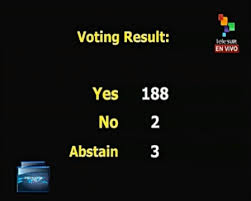
On October 28, 2014, the U.N. General Assembly by a vote of 188 to 2 again condemned the U.S. embargo of Cuba. The two negative votes were cast by the U.S. and by Israel while three small Pacific nations abstained–Marshall Islands, Micronesia and Palau. All the other U.N. members supported the resolution. [1]

 The Resolution

The resolution [A/69/L.4] reiterated the General Assembly’s “call upon all States to refrain from promulgating and applying laws and measures of the kind referred to in the preamble to the present resolution [‘the economic, commercial and financial embargo imposed by the [U.S.] against Cuba’ and the Helms-Burton Act], in conformity with their obligations under the Charter of the United Nations and international law, which, inter alia, reaffirm the freedom of trade and navigation.”

The resolution also “again urges States that have and continue to apply such laws and measures [i.e., the U.S.] to take the steps necessary to repeal or invalidate them as soon as possible in accordance with their legal regime.”

Cuba’s Statement Supporting the Resolution

Bruno Rodriguez Parrilla

Bruno Rodríguez Parrilla, the Cuban Minister for Foreign Affairs, introducing the resolution, said that in recent times “the economic, commercial and financial blockade imposed by the [U.S.] against Cuba had been tightened, and its extraterritorial implementation had also been strengthened through the imposition of unprecedented fines, totaling $11 billion against 38 banks . . . for carrying out transactions with Cuba and other countries.” In addition, Cuba’s “accumulated economic damages of the blockade totaled $1.1 trillion . . . [and] human damages were on the rise.”

Nevertheless, “Cuba had offered every possible form of assistance to the [U.S.] in the wake of disasters there, such as in the aftermath of the September 11, 2001 terrorist attacks. Cuba had never been a threat to the national security of the [U.S.].  Opinion polls showed that there was increasing support from all sectors of [U.S.] society for lifting the blockade.  Religious leaders had citied legitimate, indisputable ethical and humanitarian reasons.“

In addition, ”the blockade was harmful to . . . the [U.S.]. The ‘absurd and ridiculous’ inclusion of Cuba on the [U.S.] list of States that sponsored international terrorism redounded to the discredit of the [U.S.].  Cuba would never renounce its sovereignty or the path chosen by its people to build a more just, efficient, prosperous and sustainable socialism.”  Neither, he continued, would his Government “give up its quest for a different international order, nor cease in its struggle for ‘the equilibrium of the world.’”

Rodríguez also invited the U.S. government “to establish a mutually respectful relation, based on reciprocity. We can live and deal with each other in a civilized way, despite our differences.”

Other Countries’ Statements Supporting the Resolution [2]

The following Latin American countries voiced support for the resolution: Argentina (MERCOSUR [3]) (embargo was “morally unjustifiable” and violated “the spirit of multilateralism and was immoral, unjust and illegal”); Barbados (CARICOM [4]); Bolivia (Group of 77 [5] and China); Brazil (Group of 77 and CELAC [6]); Colombia; Costa Rica (CELAC)); Ecuador; El Salvador (Group of 77 and CARICOM); Mexico; Nicaragua; St. Vincent and the Grenadines (CARICOM, Non-Aligned Movement, [7] Group of 77 and CELAC); Uruguay; and Venezuela.

The African supporters of the resolution that spoke were Algeria (Non-Aligned Movement, Group of 77, Group of African States [8] and Organization of Islamic Cooperation [9]); Angola; Kenya (Group of 77, Non-Aligned Movement and African Group); Malawi (African Group); South Africa (Group of 77, Non-Aligned Movement and African Group); Sudan (Group of 77, Non-Aligned Movement and Organization of Islamic Cooperation); United Republic of Tanzania; Zambia (Non-Aligned Movement) and Zimbabwe (Non-Aligned Movement, Group of 77 and African Group).

From Asia and the Pacific were Belarus; China (Group of 77); Democratic People’s Republic of Korea (North Korea); Indonesia (Group of 77);  India (Group of 77 and Non-Aligned Movement); Iran (Non-Aligned Movement); Lao People’s Democratic Republic; Myanmar (Group of 77 and Non-Aligned Movement); Russian Federation; Solomon Islands; and Viet Nam (Non-Aligned Movement, Group of 77 and China).

Middle Eastern countries speaking in favor of the resolution were Egypt, Saudi Arabia (Organization of Islamic Cooperation); and Syria (Non-Aligned Movement, Group of 77 and China).

The sole European supporter of the resolution that spoke at the session was Italy (European Union [10]), which said the U.S.’ “extraterritorial legislation and unilateral administrative and judicial measures were negatively affecting European Union interests”).

U.S. Statement Opposing the Resolution

Although Israel voted against the resolution, it chose not to speak in support of its vote. Only the U.S. by Ambassador Ronald D. Godard, U.S. Senior Advisor for Western Hemisphere Affairs, tried to justify the negative vote.

Ronald D. Godard
Ronald D. Godard

Ambassador Godard said the U.S. “conducts its economic relationships with other countries in accordance with its national interests and its principles. Our sanctions toward Cuba are part of our overall effort to help the Cuban people freely exercise their human rights and fundamental freedoms, and determine their own future, consistent with the Universal Declaration of Human Rights and the democratic principles to which the United Nations itself is committed.”

Ambassador Godard also said, “the Cuban government uses this annual resolution in an attempt to shift blame for the island’s economic problems away from its own policy failures. The Cuban government now publicly recognizes that its economic woes are caused by the economic policies it has pursued for the last, past half-century. We note and welcome recent changes that reflect this acknowledgement, such as those that allow greater self-employment and liberalization of the real estate market. But the Cuban economy will not thrive until the Cuban government permits a free and fair labor market, fully empowers Cuban independent entrepreneurs, respects intellectual property rights, allows unfettered access to information via the Internet, opens its state monopolies to private competition and adopts the sound macro-economic policies that have contributed to the success of Cuba’s neighbors in Latin America.”

According to Ambassador Godard, the U.S. “remains a deep and abiding friend of the Cuban people. The Cuban people continue to receive as much as $2 billion per year in remittances and other private contributions from the [U.S.]. This support . . . was made possible . . . by U.S. policy choices. By the Cuban government’s own account, the [U.S.] is one of Cuba’s principal trading partners. In 2013, the [U.S.] exported approximately $359 million in agricultural products, medical devices, medicine and humanitarian items to Cuba. Far from restricting aid to the Cuban people, we are proud that the people of the [U.S.] and its companies are among the leading providers of humanitarian assistance to Cuba. All of this trade and assistance is conducted in conformity with our sanctions program, which is carefully calibrated to allow and encourage the provision of support to the Cuban people.”

Furthermore, the U.S. “places the highest priority on building and strengthening connections between the Cuban people and [our] people. U.S. travel, remittance, information exchange, humanitarian and people-to-people policies updated in 2009 and 2011 provide the Cuban people alternative sources of information, help them take advantage of limited opportunities for self-employment and private property and strengthen independent civil society. The hundreds of thousands of Americans who have sent remittances and traveled to the island, under categories of purposeful travel promoted by President Obama, remain the best ambassadors for our democratic ideals.”

Ambassador Godard continued, “[The U.S.] strongly supports the Cuban people’s desire to determine their own future, through the free flow of information to, from, and within Cuba. The right to receive and impart information and ideas through any media is set forth in Article 19 of the Universal Declaration of Human Rights. It is the Cuban government’s policies that continue to prevent enjoyment of this right. The Cuban government now claims to share our goal of helping the Cuban people access the Internet. Yet the Cuban government has failed to offer widespread access to the Internet through its high-speed cable with Venezuela.  Instead, it continues to impose barriers to information for the Cuban people while disingenuously blaming U.S. policy.”

“Moreover, the Cuban government continues to detain Alan Gross, a U.S. citizen who was sentenced to 15 years in prison for facilitating Internet access for Cuba’s small Jewish community. [[11]] The [U.S.] calls on Cuba to release Mr. Gross immediately, [[12]] allow unrestricted access to the Internet, and tear down the digital wall of censorship it has erected around the Cuban people.

 {T]his resolution only serves to distract from the real problems facing the Cuban people. . . . Though Cuba’s contributions to the fight against Ebola are laudable, they do not excuse or diminish the regime’s treatment of its own people. We encourage this world body to support the desires of the Cuban people to choose their own future. By doing so, it would truly advance the principles the United Nations Charter was founded upon, and the purposes for which the United Nations was created.”

Media Coverage of the Resolution and Debate

 U.S. media coverage of this important U.N. vote was almost non-existent. It was not mentioned in the “World” or “Americas” news sections of the New York Times, and only its “Opinion” section had a short article about the issue. It got no mention whatsoever in the Wall Street Journal. Not even the Miami Herald, which has a separate page for Cuba news, mentioned it. [13]

At 2:37 p.m. on October 28th the Associated Press published a release on the subject, and the Washington Post published it online while the StarTribune of Minneapolis/St. Paul picked it up the next day in its online, but not its print, edition.

Cuba’s state-owned newspaper, Granma, of course, headlined this vote while stating that the embargo has caused $1.1 trillion of damage to the Cuban economy and “incalculable human suffering.” Its article also emphasized that this was the 23rd consecutive such resolution with a table showing that the number of votes in favor of the resolutions has increased from 59 in 1992 to 188 in 2012-2014, that the largest number of votes against the resolutions was only 4 in 1993 and 2004-2007 and that the number of abstentions has decreased from 71 in 1992 to 1 in 2005-2007 and now 3 since 2010.

Conclusion

This overwhelming international opposition to the U.S. embargo in and of itself should be enough to cause the U.S. to end the embargo. Moreover, the embargo has not forced Cuba to come begging to the U.S. for anything that the U.S. wants. The U.S. policy is a failure. The New York Times recently called for abandonment of this policy as has this blog in urging reconciliation of the two countries, in an open letter to President Obama and in a rebuttal of the President’s asserted rationale for the embargo and other anti-Cuban policies.

==============================================================

[1] This post is based upon the sources embedded above and upon U.N. General Assembly Press Release [GA/11574], As General Assembly Demands End to Cuba Blockade for Twenty-Thjrd Consecutive Year, Country’s Foreign Minister Cites Losses Exceeding $1 Trillion (Oct. 28, 2014); Londoño, On Cuban Embargo, It’s the U.S. and Israel Against the World, Again, N.Y. Times (Oct. 29, 2014); Associated Press, UN General Assembly Condemns US Cuba Embargo (Oct. 28, 2014); U.S. Dep’t of State, Explanation of Vote by Ambassador Ronald D. Godard on the Cuba Resolution in the General Assembly Hall (Oct. 28, 2014). The General Assembly also has videos of the debate (A and B). A prior post reviewed the 2011 General Assembly’s adoption of a similar resolution against the embargo.

[2] Many of the cited statements supporting the resolution were issued on behalf of, or aligned with, larger groups of nations as noted above. In addition, prior to the October 28th session of the General Assembly, the U.N. Secretary General submitted a report containing statements against the embargo from 154 states and 27 U.N. agencies.

[3] MERCOSUR (Southern Common Market) is a customs union and trading bloc of five South American countries with five other associate members in the continent.

[4] CARICOM (Caribbean Community) is a group of 15 Caribbean countries with five associate members for economic cooperation.

[5] The Group of 77 was established in 1964 by 77 developing countries to promote their collective economic interests and South-South cooperation; now there are 134 members that have retained the original name for historical significance.

[6] CELAC (Community of Latin American and Caribbean States) is a group of 33 states in the region to deepen economic integration and combat the influence of the U.S.

[7] The Non-Aligned Movement is a group of 115 developing countries that are not aligned with or against any major power bloc. Its current focus is advocacy of solutions to global economic and other problems

[8] The African Group is a group of 54 African states that are U.N. Members.

[9] The Organization of Islamic Cooperation is a group of 57 states that seek to protect the interests of the Muslim world in the spirit of promoting peace and harmony in the world.

[10] The European Union is a group of 28 European states that have combined for a peaceful, united and prosperous Europe.

[11] The activities in Cuba by Mr. Gross are not so simple. A Cuban court in 2011 found him guilty of participating in a “subversive project of the U.S. government that aimed to destroy the revolution through the use of communications systems out of the control of authorities,” and sentenced him to 15 years in prison. According to his own lawsuit against the U.S. Government, and subsequent disclosures, Gross alleged the U.S. Agency for International Development (USAID) and its contractor, DAI, sent him on five semi-covert trips to Cuba without proper training, protection or even a clear sense of the Cuban laws that led to his detainment. The case highlighted the frequent haste and lack of attention to the risks of the USAID programs in Cuba under the Helms-Burton Act, which allowed for money to be set aside for “democracy building efforts” that might hasten the fall of Fidel and Raúl Castro.

[12] In discussions with the U.S., Cuba already has expressed a willingness to exchange Mr. Gross for one or more of the three of “the Cuban Five” who remain in U.S. prisons.

[13] Nor did I find any mention of the vote in London’s Guardian or Madrid’s El Pais.


Palestine Has Decided To Join the International Criminal Court

Dr. Hanan Ashrawi
Dr. Hanan Ashrawi

On September 2nd at the United Nations headquarters, Dr. Hanan Ashraw, a member of the executive committee of the Palestine Liberation Organization (PLO), said that Palestine has decided to join the International Criminal Court (ICC).

Ever since Palestine obtained observer-state status at the U.N. in late 2012, over Israeli and U.S. opposition, Palestine’s government has threatened to join the Court as a way to prosecute Israeli actions in the occupied territories. But the PLO deferred a decision, Dr. Ashrawi said, in order to give U.S.-led diplomacy a chance to succeed.

The deferral also gave the P.L.O. leadership the opportunity to convince other Palestinian political factions, including the militants, that they would have more to gain than to lose from joining the ICC, including subjecting Palestinian factions, including Hamas, to its jurisdiction. The PLO leadership, Dr. Ashrawi said, “wanted to ensure that all factions are O.K. with it,” and now they are.

As a prior post reported, Palestine with observer-state status at the U.N. is eligible to join the ICC. The U.S. and Israel are opposed to such membership, but they cannot prevent it from happening.

Later this month, the Palestinians are planning another move to put more pressure on Israel. This will be a motion to have the U.N. Security Council demand that Israel end its occupation of Palestinian territory within three years. If such a motion is made, the U.S. is expected to veto the measure. Anticipating such a veto, the Palestinians may put the issue before the U.N. General Assembly, where Palestine has wide support.


International Criminal Court Prosecutor: ICC has No Jurisdiction Over Alleged War Crimes in Palestine (Gaza)

International Criminal Court

On September 2, 2014, the International Criminal Court Prosecutor, Fatou Bensouda, issued a statement, “The Public Deserves to know the Truth about the ICC’s Jurisdiction over Palestine.” The conclusion? The Court has no jurisdiction over any claims arising out of events in Palestine.

As the statement says, the “Rome Statute, the ICC’s founding treaty, is open to participation by states. [The] Prosecutor . . . can only investigate and prosecute crimes committed on the territory or by the nationals of states that have joined the ICC Statute or which have otherwise accepted the jurisdiction of the ICC through an ad hoc declaration to that effect pursuant to article 12-3 of the Statute.” Those requirements for ICC jurisdiction have not been satisfied. Here are the predicates for that conclusion:

  • In 2009 the Palestinian Authority sought to   accept the ICC’s jurisdiction, but the Prosecutor in April 2012 after “thorough analysis and public consultations” concluded that the Palestinian Authority’s “observer entity” status at the UN at that time meant that it could not sign up to the Rome Statute. As Palestine could not join the Rome Statute, the former Prosecutor concluded that it could not lodge an article 12-3 declaration bringing itself under the ambit of the treaty either, as it had sought to do. “  (Emphases added.)
  • On November 29, 2012, Palestine’s status was upgraded by the UN General Assembly (UNGA) to “non-member observer State” through the adoption of resolution 67/19. The [Prosecutor’s] Office examined the legal implications of this development for its purposes and concluded that while this change did not retroactively validate the previously invalid 2009 declaration lodged without the necessary standing, Palestine could now join the Rome Statute.”[1]
  • “To date, [however,] the Rome Statute is not one of the treaties that Palestine has decided to accede to, nor has it lodged a new declaration [accepting the Court’s jurisdiction] following the November 2012 UNGA resolution.”
  • “It is a matter of public record that Palestinian leaders are in the process of consulting internally on whether to do so; the decision is theirs alone to make and the ICC Prosecutor cannot take this decision for them.”

If the requirements for jurisdiction over events in Palestine were established, the Prosecutor said she “will vigorously pursue those – irrespective of status or affiliation – who commit mass crimes that shock the conscience of humanity.”

Finally, the statement said, “The Office of the Prosecutor of the ICC has never been in a position to open such an investigation for lack of jurisdiction. We have always, clearly and publicly, stated the reasons why this is so.” Indeed, in November 2013, the Office of the Prosecutor released its Report on Preliminary Examination Activities 2013, which on pages 53-54 set forth basically the same analysis and conclusion in the just released statement.

=====================================

[1] A prior post discussed the U.N. General Assembly resolution upgrading Palestine’s status and the resulting Prosecutor’s investigation of that development on ICC jurisdiction. Earlier posts in 2011 and 2012 also touched on the jurisdictional issue regarding Palestine while another post provided an introduction to the ICC..

President Obama’s Audience with Pope Francis

President Obama & Pope Francis
          President Obama &               Pope Francis 

On March 27th U.S. President Barack Obama had an audience with His Holiness Pope Francis at the Vatican followed by the President’s meeting with His Eminence Cardinal Pietro Parolin, the Vatican’s Secretary of State, and Archbishop Dominique Mamberti, its Secretary for Relations with States.

Afterwards the Vatican issued a press release that said, “During the cordial meetings, views were exchanged on some current international themes and it was hoped that, in areas of conflict, there would be respect for humanitarian and international law and a negotiated solution between the parties involved.”

The press release continued, “In the context of bilateral relations and cooperation between Church and State, there was a discussion on questions of particular relevance for the Church in that country, such as the exercise of the rights to religious freedom, life and conscientious objection, as well as the issue of immigration reform. Finally, the common commitment to the eradication of trafficking of human persons in the world was stated.”

Also afterwards at a joint news conference with Matteo Renzi, the prime minister of Italy, President Obama said the Pope and he “had a wide-ranging discussion.  I would say that the largest bulk of the time was discussing two central concerns of his.  One is the issues [sic] of the poor, the marginalized, those without opportunity, and growing inequality.”

“[T]hose of us as politicians have the task of trying to come up with policies to address issues, but His Holiness has the capacity to open people’s eyes and make sure they’re seeing that this is an issue.  And he’s discussed in the past . . . the dangers of indifference or cynicism when it comes to our ability to reach out to those less fortunate or those locked out of opportunity.”

The President continued, “[W]e spent a lot of time talking about the challenges of conflict and how elusive peace is around the world.  There was some specific focus on the Middle East where His Holiness has a deep interest in the Israeli-Palestinian issue, but also what’s happening in Syria, what’s happening in Lebanon, and the potential persecution of Christians.  And I reaffirmed that it is central to U.S. foreign policy that we protect the interests of religious minorities around the world.  But we also touched on regions like Latin America, where there’s been tremendous progress in many countries, but there’s been less progress in others.”

“I think the theme that stitched our conversation together was a belief that in politics and in life the quality of empathy, the ability to stand in somebody else’s shoes and to care for someone even if they don’t look like you or talk like you or share your philosophy — that that’s critical.  It’s the lack of empathy that makes it very easy for us to plunge into wars.  It’s the lack of empathy that allows us to ignore the homeless on the streets.  And obviously central to my Christian faith is a belief in treating others as I’d have them treat me.  And . . . [what has] created so much love and excitement for His Holiness has been that he seems to live this, and shows that joy continuously.”

“In terms of domestic issues, the two issues that we touched on — other than the fact that I invited and urged him to come to the United States, telling him that people would be overjoyed to see him — was immigration reform.  And as someone who came from Latin America, I think he is very mindful of the plight of so many immigrants who are wonderful people, working hard, making contribution, many of their children are U.S. citizens, and yet they still live in the shadows, in many cases have been deported and are separated from families.  I described to him how I felt that there was still an opportunity for us to make this right and get a law passed.”

The President added that the Pope “did not touch in detail on the Affordable Care Act.  In my meeting with the Secretary of State, Cardinal Parolin, we discussed briefly the issue of making sure that conscience and religious freedom was observed in the context of applying the law.  And I explained to him that most religious organizations are entirely exempt.  Religiously affiliated hospitals or universities or NGOs simply have to attest that they have a religious objection, in which case they are not required to provide contraception although that employees of theirs who choose are able to obtain it through the insurance company.”

The President said, “I pledged to continue to dialogue with the U.S. Conference of Bishops to make sure that we can strike the right balance, making sure that not only everybody has health care but families, and women in particular, are able to enjoy the kind of health care coverage that the AC offers, but that religious freedom is still observed.”

In addition, the President said we “actually didn’t talk a whole lot about social schisms in my conversations with His Holiness.  In fact, that really was not a topic of conversation.  I think His Holiness and the Vatican have been clear about their position on a range of issues, some of them I differ with, most I heartily agree with.  And I don’t think that His Holiness envisions entering into a partnership or a coalition with any political figure on any issue.  His job is a little more elevated.  We’re down on the ground dealing with the often profane, and he’s dealing with higher powers.”

“I do think that there is a potential convergence between what policymakers need to be thinking about and what he’s talking about.  I think he is shining a spotlight on an area that’s going to be of increasing concern, and that is reduced opportunities for more and more people, particularly young people — who, by the way, have more and more access to seeing what’s out there and what’s possible because they have access to the Internet or they have access to other media, and they see the inequality and they see themselves being locked out in ways that weren’t true before. And that’s true internationally, not just within countries.”

Moreover, according to the President, for the Pope “to say that we need to think about this, we need to focus on this, we need to come up with policies that provide a good education for every child and good nutrition for every child, and decent shelter and opportunity and jobs . . . reminds us of what our moral and ethical obligations are.  It happens also to be good economics and good national security policy.  Countries are more stable, they’re going to grow faster when everybody has a chance, not just when a few have a chance.”

The President concluded his press conference comments on the audience by saying the Pope is “hopefully, creating an environment in which those of us who care about this are able to talk about it more effectively.  And we are in many ways following not just his lead but the teachings of Jesus Christ and other religions that care deeply about the least of these.”

The President also separately stated the following after the audience:

  • “I think the theme that stitched our conversation together was a  belief in politics and in life, the quality of empathy, the ability to stand in somebody else’s shoes and to care for someone even if they don’t look like you or talk liked you or share your philosophy—that that’s critical. It’s the lack of empathy that makes it very easy for us to plunge into wars. It’s the lack of empathy that allows us to ignore the homeless on the streets. And obviously central to my Christian faith is a belief in treating others as I’d have them treat me. And what’s I think created so much love and excitement for His Holiness has been that he seems to live this, and shows that joy continuously.”


U.S. State Department’s Latest Report on Cuban Human Rights

U.S. Flag
U.S. Flag

The U.S. State Department’s just-released 2013 Country Reports on Human Rights Practices’ chapter on Cuba needs analysis.[1]

The Report’s Negative Comments about Cuban Human Rights

The Executive Summary of its chapter on Cuba has a strongly negative tone. It states the following:

  • “Cuba is an authoritarian state led by Raul Castro, who is president of the council of state and council of ministers, Communist Party (CP) first secretary, and commander in chief of security forces. The constitution recognizes the CP as the only legal party and ‘the superior leading force of society and of the state.’ A CP candidacy commission preapproved all candidates for the February uncontested National Assembly elections, which were neither free nor fair. The national leadership that included members of the military maintained effective control over the security forces, which committed human rights abuses against civil rights activists and other citizens alike.
  • In January the government largely dropped travel restrictions that prevented citizens from leaving the island, but these reforms were not universally applied, and authorities denied passport requests for certain opposition figures or harassed them upon their return to the country.
  • The principal human rights abuses were abridgement of the right of citizens to change the government and the use of government threats, extrajudicial physical violence, intimidation, mobs, harassment, and detentions to prevent free expression and peaceful assembly.
  • The following additional abuses continued: harsh prison conditions, arbitrary arrest, selective prosecution, and denial of fair trial. [2] Authorities interfered with privacy, engaging in pervasive monitoring of private communications. The government did not respect freedom of speech and press, severely restricted internet access and maintained a monopoly on media outlets, circumscribed academic freedom, and maintained significant restrictions on the ability of religious groups to meet and worship. The government refused to recognize independent human rights groups or permit them to function legally. In addition, the government continued to prevent workers from forming independent unions and otherwise exercising their labor rights.
  • Most human rights abuses were official acts committed at the direction of the government. Impunity for the perpetrators remained widespread.”

The Report’s Positive Comments about Cuban Human Rights

This Executive Summary paints a bleak picture of Cuban human rights, and I have no doubt that many of these points are legitimate. But I still believe that it overstates the negatives.

Indeed, the Executive Summary failed to acknowledge that the Report itself stated there were “no reports that the [Cuban] government or its agents committed arbitrary or unlawful killings . . . [or] politically motivated disappearances.”

In addition, the Report itself stated in Cuba that there was “no societal pattern of child abuse;” that the government operated family counseling centers; that the government “continued to carry out media campaigns” against domestic violence; that the government “actively promoted racial integration and inclusiveness;” that a government resolution “accords persons with disabilities the right to equal employment opportunities and equal pay for equal work;” and that there was no “discrimination officially reported or permitted based on sexual orientation” accentuated by President Castro’s daughter’s promotion of LGBT rights.

With respect to Cuba’s prisoners and pretrial detainees, the Report conceded that they “had access to visitors;” that many “were able to communicate information about their living conditions through telephone calls to human rights observers and reports to family members;” that they “could practice limited religious observance;” and that “the Catholic Church and the Cuban Council of Churches reported access to prisoners during the year, with services offered in prisons and detention centers in most if not all provinces.”

On Cuban religious freedom more generally, the Report merely incorporated by reference the section on Cuba in the Department’s most recent International Religious Freedom Report that this blog previously criticized as understating the extent of religious freedom on the island.[3]

Moreover, the new overall Human Rights Report admits that “religious groups reported greater latitude to express their opinions during sermons and at religious gatherings than in the past;” that “[r]eligious leaders in some cases criticized the government, its policies, and even the country’s leadership without reprisals;” that the “Catholic Church operated a cultural center in Havana that hosted debates featuring participants voicing different opinions about the country’s future, at which well-known dissidents were allowed to participate;” and that the “Catholic Church published two periodicals that sometimes included criticism of official social and economic policies . . . [and] a pastoral letter advocating for political and economic reforms and greater rights for citizens.”

The new overall Report also says that the “Catholic Church received permission to broadcast Christmas and Easter messages on state-run television stations . . . [while] the Council of Churches, the government-recognized Protestant umbrella organization, was authorized to host a monthly 20-minute radio broadcast;” that religious “groups reported the ability to gather in large numbers without registering or facing sanctions;” and that “[r]ecognized churches, [and] the Roman Catholic humanitarian organization Caritas . . . were . . . legally permitted to function outside the formal structure of the state, the [Communist Party], and government-organized organizations.” In addition, there were “no reports of anti-Semitic acts.”

Finally the Report concedes that the Cuban constitution and other laws prohibit abusive treatment of detainees and prisoners and provide alternative sentencing for nonviolent offenders and juveniles as well as rights to seek redress for improper prison conditions and treatment. Cuban law, the Report said, also specifies reasonable procedures for investigations and prosecutions of alleged crimes.

Conclusion

Cuba’s regrettable lapses on human rights, though perhaps understandable in context, should not be a reason for continued U.S. hostility toward the island. A subsequent post will examine what this blogger sees as the implications of this report for U.S. policies regarding Cuba.


[1] A prior post reviewed the Department’s overall summary of global human rights in 2013.

[2] The most recent annual report (May 2013) from Amnesty International makes similar allegations about Cuba as did Human Rights Watch’s April 2013 submission to the U.N. Human Rights Council regarding its Universal Periodic Review of Cuba.

[3] This blog criticized the prior reports on Cuban religious freedom by the State Department and by the U.S. Commission on International Religious Freedom. In addition, another post reviewed positive comments on religious freedom from religious leaders with direct experience on the island. Similar points were made on February 27th, 2014, by six Cuban Protestant Christian leaders at a congressional briefing hosted by U.S. Senator Jeff Flake (Republican of Arizona) and Representative Jim McGovern (Democrat of Massachusetts). In response, a strong supporter of current U.S. policies regarding Cuba launched an unwarranted ad hominem attack on these leaders.