President Obama Should Exercise His Legal Authority To End U.S. Admission of Cubans Arriving with “Dry Feet”

The U.S. has a law and policy that allows Cubans who arrive on land (with “dry feet”) in the U.S. to be admitted to the U.S. without visas and to be eligible one-year later to apply for permanent residency[1] This blog repeatedly has called for that law and policy to be ended because it is antithetical to the U.S.’ having a normal relationship with Cuba.[2]

A related and important legal issue is whether the president by executive order may end that law and policy. This post will examine how this law and policy work and whether the president, without Congress, may end that policy of admitting those Cubans arriving on land.

 How the Current Law and Policy Work

 The Cuban Adjustment Act of November 2, 1976, as amended, allows any Cuban “native or citizen who has been inspected and admitted or paroled into” the U.S., after one year of “physical presence,” to apply to the U.S. Citizenship and Immigration Services to adjust his or her U.S. legal status to permanent resident alien. Such an adjustment, however, is not automatic or guaranteed by that Act. Instead, the Act provides that the Attorney General has “discretion” to do so if the Cuban applicant “is eligible to receive an immigrant visa and is admissible to the [U.S.] for permanent residence.” If the applicant does not satisfy those requirements, the Attorney General has the discretion to deny the application.[3]

The admissibility requirement involves examination of the applicant’s health; any criminal history in or outside the U.S., especially involving “crimes of moral turpitude,” prostitution, “commercialized vice;” participation in, or support of, terrorist activities; military or paramilitary activities; membership in the Communist Party; and other issues.

Recently many Cubans have been fearing that the U.S. will abolish this policy and have been leaving the island, especially through Ecuador, Colombia, Panama, Costa Rica and then on through Nicaragua, Honduras, Guatemala and Mexico to reach the U.S. Now many are stranded in Costa Rica and Panama. (See n.2.)

How Can the U.S. Dry Feet Policy Be Abolished?

Significantly, in my opinion, the Cuban Adjustment Act does not require the U.S. to admit into the country any and all Cubans who arrive by land. Indeed, it says nothing whatsoever about that issue. Instead the Act only provides a benefit (the right to file an application to become a permanent resident alien of the U.S.) after he or she has been in the U.S. for a year after having been “inspected and admitted or paroled into” the U.S.

This fact about the law has been recognized by by a respected U.S. academic commentator on U.S.-Cuba issues—William LeGrande. He concludes that the “’dry foot’ policy . . . is a matter of executive discretion [and] could be rescinded by the attorney general without prior notice.” In short, stop admitting such Cubans into the U.S.[4]

On the other hand, in my opinion, the Administration does not have the legal authority, without congressional adoption of a statute to repeal the Cuban Adjustment Act, to stop considering applications for permanent residency, based upon the facts and law, submitted by Cubans who have been in the U.S. for at least one year.

Meanwhile, some Cuban-Americans in Congress are voicing opposition to that policy because it has been allowing Cubans who are granted legal status in the U.S. under that policy to return repeatedly to Cuba. And one Republican Congressman, Paul Gosar (AZ), on October 23 introduced a bill to repeal the Cuban Adjustment Act and the policy. (Ending Special National Origin-Based Immigration Programs for Cubans Act of 2015 (H.R. 3818)); with nine cosponsors it has been referred to the House Judiciary Committee.[5] :

Conclusion

This commentator, therefore, concludes that the president has the authority to cease admitting into the U.S. any and all Cubans who arrive at the U.S. border and that he should exercise that authority and do just that. (U.S. immigration law is very complex and I do not have intimate knowledge of its many details. Therefore, I would appreciate anyone with such knowledge to point out any errors in my analysis and conclusion.)

Moreover, the president should do so immediately because of the large number of Cuban migrants stranded in Central America on their journey to the U.S.

=====================================================

[1] Cubans who are intercepted at sea and thus have “wet feet” are returned to Cuba by the U.S. unless at sea they assert a fear of persecution if returned to Cuba. This is a result of September 1994 and February 1995 agreements or accords between the U.S. and Cuba to seek to stop Cubans from taking dangerous journeys in small boats in the Caribbean to try to reach the U.S.

[2] E.g., Cubans in Central America Provide Cuba with an Opportunity To Reiterate Its Objections to U.S. Immigration Policies (Nov. 20, 2015); Update on Cuban Migrants in Central America (Nov. 27, 2015); Assoc. Press, Costa Rica Asks Belize to Accept Stranded Cuban Migrants, N.Y. Times (Dec. 4, 2015).

[3] Cuban Adjustment Act, Pub. Law 89-732 (Nov. 2, 1966)(as amended); USCIS, Green Card for a Cuban Native or Citizen; U.S.CIS, Green Card Eligibility; USCIS, Form I-485, Application to Register Permanent Residence or Adjust Status; USCIS, Instructions for I-485, Application to Register Permanent Residence or Adjust Status; CLINIC PowerPoint, Cuban Adjustment Act (Mar. 19, 2014); Cuban Adjustment Act, Wikipediia. Some commentators have argued that the statute’s saying the Attorney General has “discretion” to grant permanent residency means that the president, without Congress, may abolish the “dry foot” policy. CDA, The Doorbell in the Wall (Nov. 20, 2015); Muse, U.S. Presidential Action on Cuba: The New Normalization? Americas Quarterly.) This “discretion” language, however, in my opinion, has nothing to do with whether the president has the authority to end the policy without congressional approval.

[4] LeoGrande, A New Crisis of Cuban Migration, N.Y. Times (Dec. 5, 2015).

[5] Gosar, Rep. Gosar Introduces a Bill to End Wet Foot/Dry Foot Policy and Stop Cuban Amnesty (Oct. 23, 2015).


Update on Cuban Migrants in Central America

A prior post discussed the conflict between Costa Rica and Nicaragua over Cubans trying to traverse Central American countries on their way to the United States. Since then, the foreign ministers of the eight countries of the Central American Integration System (SICA) and of other interested countries (Cuba, Ecuador and Colombia) held an inconclusive meeting to discuss that situation and thereafter Ecuador announced a change in its policies for Cuban migrants. Here is a summary of those developments.

Situation of Cubans in Central America

An estimated 3,000 Cubans are now stuck in Costa Rica over Nicaragua’s refusing to allow their entry into that country for their journey to the U.S. Many of these Cubans have smart phones and social media that have assisted them in their trek from Ecuador to Central America and, they hope, on to the U.S.[1]

SICA Foreign Ministers Meeting

The situation of the Cuban migrants was the focus of the just mentioned SICA meeting on Tuesday (November 24) . Note that the U.S. was not present or invited.[2]

The situation was prompted by Nicaragua’s refusing to admit Cuban migrants from Costa Rica. Nicaragua said Costa Rica had created and manipulated this crisis by seeking to ignore the real cause: the U.S. immigration policies that need to be changed. “Our governments do not have the resources to deal with this new threat to our national security,” suggesting that Nicaragua was faced with the wave of Cubans that could facilitate terrorism or migrants from other countries. Nicaragua also criticized the Cold-War-era U.S. policies that allow the Cubans special status as migrants.

The Cuban Ministry of Foreign Affairs said the Cubans in Costa Rica came legally to different nations of Latin America, with all the requirements established by the migratory regulations of their country. “In an attempt to reach U.S. territory, [however,] they have become victims of traffickers and criminal gangs, which unscrupulously profit from the control of the passage of these people through South America, Central America and Mexico.” Moreover, Cuba stated that the migrants also were victims of the politicization of the migration issue by the U.S. government, through the Cuban Adjustment Act and the “wet-foot, dry-foot policy.”

Cuba also said it has remained in contact with the governments of the countries involved. Indeed, Cuba’s Foreign Minister, Bruno Rodriguez Parilla, visited officials of its allies, Ecuador and Nicaragua, on November 19 and 20 respectfully to discuss the situation.

Ecuador supported Nicaragua’s position by saying that under international law creation of humanitarian corridors only applies in situations of war or armed conflict which was not the case here.

The Salvadoran Minister of Foreign Affairs, Hugo Martinez, afterwards said it was necessary to reach a comprehensive solution that addressed the current immigration crisis. He also said that El Salvador will ask the International Organization for Migration to support Costa Rica in shelter conditions for the Cuban migrants. However, he said, allowing the passage of the migrants was subject to the “principle of self-determination” of each of the SICA countries and that the migration was not encouraged by the country of origin (Cuba) or by the Central American countries, but by the U.S. with its special immigration policies for Cubans.

After the meeting Costa Rica’s Foreign Minister, Manuel Gonzalez, said that Nicaragua had refused again to cooperate in finding and adopting a solution for the migrants.

The solution proposed by Costa Rica was an arrangement to enable the safe, orderly and documented transit of the Cuban migrants so that they would avoid falling prey to international trafficking networks. According to Gonzalez, Nicaragua objected to this proposal and did not present any viable alternative approach.

Ecuador’s Requiring Visas for Cubans

On November 26 Ecuador announced that effective December 1 it will require Cubans to have visas to enter the country. Ecuador’s Deputy Minister of Foreign Affairs, Xavier Lasso, said this change was to honor commitments it made at the SICA meeting “to stop human rights violations and even loss of lives” and to halt threats to Cuba’s population. Lasso also urged the U.S. to rescind its “dry feet” immigration policy so that Cubans would no longer attempt this journey.[3]

The next day hundreds of Cubans gathered at the Ecuadorian Embassy in Havana to protest the new visa policy. They were angry because they say they had bought airplane tickets to Ecuador before visas were required. An Embassy spokesman said the Cubans would have to get a new visa and speak to the airlines about refunds.[4]

Conclusion

I agree that special immigration benefits for Cubans arriving on land in the U.S. and the risk that these benefits will be eliminated are prompting many Cubans to try to come to the U.S. as soon as possible. I also agree that these U.S. laws and policies should be eliminated as soon as possible.[5] In a future post I will attempt at least a preliminary legal analysis of the claim that the Obama Administration on its own by executive order or changes in regulations could do this.

I also agree that the U.S. should abolish the Cuban Medical Professional Parole Program as discussed in prior posts.[6] Again I have not attempted to determine whether the Obama Administration on its own by executive order or changes in regulations could do this or whether it requires Congress to pass a bill. (I would appreciate comments on this issue by those with more knowledge of the issues.)

The continuation of these U.S. immigration laws and policies will clearly be at the top of the Cuban agenda for the biannual round of bilateral discussion of migration issues in Washington, D.C. on November 30. Now Cuba will emphasize the recent Cuban migrant situation in Central America as an additional reason for prompt U.S. action.[7]

I originally was baffled by the U.S.’ continued assertions that there would be no changes in U.S. immigration policies regarding Cuba because those policies, in my opinion, are so illogical and inappropriate for countries with normal relations. Now I suspect that those assertions were based upon the Administration’s assessment of the difficulty (or impossibility) in obtaining Congressional approval of any necessary legislative changes on these issues and the Administration’s belief or hope that such assertions would discourage Cubans from immediately accelerating their plans or desire to leave Cuba for the U.S.

I reach these conclusions even though I suspect that Nicaragua’s precipitating the current problem in Central America was at the request of its close ally, Cuba, because, in my opinion, (a) Nicaragua would not do anything regarding Cuba against the latter’s wishes; (b) Cuba is concerned about the number of Cubans leaving the island and with Nicaragua’s assistance perhaps could stop a major route for such an exodus; (c) Cuba would like to have another occasion or reason to blame the U.S. for the problem; and (d) Nicaragua’s complaints against Costa Rica are absurd. I also believe, for similar reasons, that Ecuador’s recent requirement of visas for Cubans was at the request of Cuba.

===================================================

 [1] Assoc. Press, Social Media Helps Drive Historic Cuban Exodus to US, N.Y. Times (Nov. 23, 2015).

[2] Sica meeting will address situation of Cuban migrants in Central America, Granma (Nov. 20, 2015); Cuban Foreign Minister held working visit to Ecuador and Nicaragua, Granma (Nov. 22, 2015); Begins Tuesday SICA meeting on migration in Central America, Granma (Nov. 23, 2015); Moran, Cuban migration could generate humanitarian crisis, ContraPunto (Nov. 23, 2015); Assoc. Press, Central American Officials Meet on Cuban Migrant Problem, N.Y> Times (Nov. 24, 2015); Foreign Ministers Discuss in El Salvador on Cuban Migrants Situation, Prensa Latina (Nov. 24, 2015); SICA meeting solution Cuban migrants issue in Costa Rica, CubaDebate (Nov. 24, 2015); Costa Rica Foreign Ministry, Nicaragua PREVENTS regional and humanitarian solution for protection of Cuban Migrants (Nov. 24, 2015); Moran, Nicaragua blocks outlet for Cuban immigrants, ContraPunto (Nov. 24, 2015); SICA Meeting in El Salvador: Regional gathering discusses situation of Cuban migrants in Costa Rica, Granma (Nov. 25, 2015); Gomez, Central America, a broker of broken dreams, Granma (Nov. 26, 2015).

[3] Ecuador Foreign Ministry, Ecuador requests tourist visas to Cubans starting December 1 (Nov. 26, 2015); From December 1 Ecuador requires visas for Cubans, El Commercio (Nov. 26, 2015); Ecuador asked the Cuban visa from December 1 (+ Note of the Foreign Ministry), CubaDebate (Nov. 26, 2015); Ecuador announces visa requirement for Cubans, Granma (Nov. 26, 2015); Assoc. Press, Ecuador to Require Cubans to Get Entry Visas, N.Y. times (Nov. 26, 2015); Cubans need visas to enter Ecuador again, LaHora (Nov. 27, 2015); Soraya, Ecuador puts a stop to the arrival of Cubans, El Pais (Nov. 27, 2015).

[4] Reuters, Cubans Protest New Ecuador Visa Regulation, N.Y. Times (Nov. 27, 2015); Assoc. Press, Hundreds Gather in Havana in Frustration at Ecuador Visa Rule, N.Y. Times (Nov. 27, 2015).

[5] E.g., Results of U.S.-Cuba Discussions After Ceremonial Opening of U.S. Embassy in Havana (Aug. 18, 2015).

[6] E.g., New York Times Calls for End of U.S. Program for Special Immigration Relief for Cuban Medical Personnel ( Nov. 23, 2014)

[7] Cuban Foreign Ministry, Cuba and the United States will hold a new round of migration talks, Granma (Nov. 26, 2015); U.S. State Dep’t, United States and Cuba Hold Migration Talks, Counter-Narcotics Dialogue (Nov. 25, 2015)

Cubans in Central America Provide Cuba with an Opportunity To Reiterate Its Objections to U.S. Immigration Policies

U.S. immigration laws and policies regarding Cubans have reemerged into the spotlight. After a brief look at those laws and policies, we will examine the new controversy arising over Cubans in Central America.

 U.S. Laws and Policies[1]

In 1966, the U.S. adopted the Cuban Adjustment Act that provided certain immigration benefits to Cubans. In 1995 this statute was amended to allow anyone who fled Cuba and entered the U.S. to pursue permanent residency a year later.

In addition, the U.S. and Cuba in 1994 and 1995 entered into migration agreements to promote “safe, legal and orderly migration” between the two countries. Under one of its provisions, the U.S. agreed to stop permitting Cubans intercepted at sea to come to the U.S. On the other hand, this agreement did not touch on the U.S. practice and policy of admitting Cubans who arrive on land at a U.S. port of entry. This is the so-called U.S. “wet feet/dry feet” policy.

Since the U.S.-Cuba December 2014 rapprochement, the Cuban government repeatedly has complained about this Act and the wet feet/dry feet policy and has requested the U.S. to abolish them. The U.S., however, has consistently told the Cuban government that the U.S. was not planning to change its immigration policies regarding Cubans.[2]

Current Issues About Cubans in Central America[3]

As noted in an earlier post, since the December 2014 U.S.-Cuba rapprochement there have been increasing numbers of Cubans coming to the U.S. to take advantage of the provisions of the previously mentioned Act and policy before, they fear, those provisions will be rescinded. For example, more than 45,000 Cubans arrived at U.S. checkpoints along the Texas-Mexico border in the U.S. fiscal year ending September 30, 2015.

Many of the Cubans flew from Cuba to Ecuador, which allows them entry without visa; and from there they traveled by land through Colombia, Panama and Costa Rica with the objective of continuing through Nicaragua, Honduras, Guatemala and Mexico to the U.S. For all their current frustration over recent actions by Nicaragua, most of the Cubans’ anger is aimed at the Cuban government, which they accuse of cronyism, mismanaging the economy and limiting free speech. One of the Cubans, a teacher and a father of two, now in Costa Rica said that his grandmother had sold her house for $5,000 to pay for his passage to the U.S. and that he cannot return because his family is waiting for him to start sending money back.

This situation recently reached a new level with the precipitating events taking place in Central America. Over 1,500 Cubans on their migration have been in Costa Rica after initially being excluded from that country and then admitted after Costa Rica last Friday (November 13) said it would be issuing special seven-day transit visas to Cubans.

On Sunday (November 15), Nicaragua, a close ally of Cuba, closed its border with Costa Rica. This Nicaraguan action forced the Cubans to turn the Costa Rican side of a border station into a temporary shelter with makeshift beds, piles of luggage and improvised washing lines. Hundreds of others are being housed in buildings around a nearby small town.

Nicaraguan Military @ Border
Nicaraguan Military @ Its Border
Cubans @ Costa Rican Bprder


Nicaragua simultaneously asserted that Costa Rica was creating a “humanitarian crisis” by allowing the Cubans into its country. Costa Rica was accused of “failing to comply with its obligations as a state” and of violating Nicaragua’s sovereignty.

The Nicaraguan complaint was confirmed the next day in a blistering press release in which it “deplores and condemns . . . the irresponsible, disrespectful attitude [towards] all international conventions and agreements on human mobility [by] Government of Costa Rica.” The latter allegedly had violated Nicaragua’s “national territory, our sovereignty” and had made “the unprecedented claim . . . [to the] right to determine the entry into our territory of people in a situation of illegality and violent behavior intended to” occur in Nicaragua. The statement also reported that on Tuesday (November 17), Nicaragua would bring this alleged “serious crisis” to the Security Commission of the Central American Integration System, SICA. Nicaragua also said it would present its complaint to the Community of Latin American and Caribbean States (CELAC).

Theses accusations immediately were rejected by Costa Rica, and on Tuesday (November 17) Costa Rica’s Foreign Minister Manuel Gonzalez proposed the creation of a “humanitarian corridor” for Cubans transiting Central America. “Countries have to prevent migrants falling into the hands of networks and coyotes, because remember that the migrants’ purpose is to arrive in the [U.S.] and we will try to do everything possible [for them] to achieve” that goal. The Foreign Minister also said that “Costa Rica is neither the origin nor the destination country for the Cubans, and the government has undertaken all necessary efforts to deal with this situation responsibly under the strict guidance of international treaties” and that he had not ruled out taking the migrant problem before the Organization of American States (OAS) and other international forums. In the meantime Costa Rica was trying to organize a meeting of the foreign ministers of the Central American countries and Mexico.

 SICA’s Consideration of the Situation[4]

As indicated above, Nicaragua’s complaint was considered on Tuesday by a subcommittee of the Security Commission of the Central American Integration System, SICA, in preparation for the Thursday meeting of the Commission.[5]

At that later meeting, Nicaragua accused Costa Rica of attempting to avoid discussion of the issue at SICA and to “systematically block” Nicaragua’s request. It also was alleged that Costa Rica never warned Nicaragua that more than 1,900 Cubans were about to show up at the border. The Nicaragua Foreign Ministry’ s press release regarding this meeting again was blistering in its complaint against Costa Rica. It said the following:

  • Nicaragua denounced “the systematic blocking [by] . . . Costa Rica” of SICA’s considering the “irregular and illegal migration of Cubans.”
  • Nicaragua also denounced “the arrogance of Costa Rica . . . ignoring international law and agreements . . . has violated our territory, threatened and blocked Trade and International Freight, and is concentrating more Cuban citizens on our southern border, to pressure and blackmail our government.”
  • Costa Rica’s suggested humanitarian corridor would subject “Americans, including children, to “hazards, even dying, in an effort to reach the [U.S.]”
  • Nicaragua proposed that SICA demand that the U.S. provide reciprocity to Central American citizens seeking entry to the U.S. in the same manner that it treats Cuban migrants.

Costa Rica denied these allegations, and the subcommittee agreed on the need to see this issue from a holistic perspective and human rights, not as a security issue. Afterwards, Costa Rica’s Foreign Minister said, “The countries [of SICA] have reacted in a positive and supportive way. They have understood that the humanitarian aspect is at stake and should be tackled, comprehensively, by the entire region.”

On Monday (November 23) the SICA Council of Ministers of Foreign Affairs along with others, by invitation, from Cuba, Ecuador, Colombia and Mexico will meet to find a comprehensive solution to the situation.

Cuba’s Response to Central American Situation[6]

On Tuesday (November 17), the Cuban Foreign Ministry issued a statement about the situation in Central America that gave greater prominence to its objection to the U.S. Cuban Adjustment Act and the dry feet/wet feet policy. Here are the main points of the Cuba statement:

  • These Cubans in Central America “have become victims of traffickers and criminal gangs which unscrupulously profit from their control of the passage of persons through South America, Central America and Mexico.”
  • “Cuban authorities have maintained ongoing contact with the governments of the countries involved, with the goal of finding a rapid, appropriate solution, which would take into consideration the wellbeing of the Cuban citizens.”
  • “The Ministry of Foreign Relations would like to emphasize that these citizens are victims of the politicization of the migration issue on the part of the United States government, the Cuban-American Adjustment Act, in particular, and the application of the so-called “wet foot-dry foot” policy, which gives Cubans differentiated treatment – the only one of its kind in the world – which admits them immediately and automatically, regardless of the route or means used, even if they arrive in an illegal manner to U.S. territory.”
  • “This policy encourages irregular immigration from Cuba to the United States, and constitutes a violation of the letter and spirit of Migratory Accords currently in effect, in which both countries assumed the responsibility to guarantee legal, safe, orderly emigration.”
  • The statement went on to object to another U.S. immigration policy affecting Cuba: “the U.S. government’s continued maintenance of the so-called Cuban Medical Professional Parole Program . . . to encourage Cuban doctors and other medical personnel to abandon their missions in third countries, and emigrate to the United States. This is a reprehensible practice, meant to damage Cuban cooperation programs, and deny Cuba and many countries the vital human resources they need.”
  • “The Ministry of Foreign Relations reiterates once again that the ‘wet foot-dry foot’ policy and the ‘Cuban Medical Professional Parole Program’ are inconsistent with the current bilateral context, impede to the normalization of migratory relations between Cuba and the United States, and create problems for other countries.”
  • “The Ministry of Foreign Relations confirms that Cuban citizens who have left the country legally, and abide by current Cuban migratory law, have the right to return to Cuba, if they so desire.”

Conclusion

I agree that special immigration benefits for Cubans arriving on land at U.S. ports of entry and the risk that they will be eliminated is prompting many Cubans to try to come to the U.S. as soon as possible. I also agree that these U.S. laws and policies should be eliminated as soon as possible.[7] Although I am a retired attorney, I have not attempted to determine whether the Obama Administration on its own by executive order or changes in regulations could do this or whether it requires Congress to pass a bill to do this. (I would appreciate comments on this issue by those with more knowledge of the issues.)

I also agree that the U.S. as soon as possible should abolish the Cuban Medical Professional Parole Program as discussed in prior posts.[8] Again I have not attempted to determine whether the Obama Administration on its own by executive order or changes in regulations could do this or whether it requires Congress to pass a bill to do this. (I also would appreciate comments on this issue by those with more knowledge of the issues.)

I originally was baffled by the U.S.’ continued assertions that there would be no changes in U.S. immigration policies regarding Cuba because those policies, in my opinion, are so illogical and inappropriate for countries with normal relations. Now I suspect that those assertions were based upon the Administration’s assessment of the difficulty (or impossibility) in obtaining Congressional approval of any necessary legislative changes on these issues and the Administration’s belief or hope that such assertions would discourage Cubans from immediately accelerating their plans or desire to leave Cuba for the U.S.

I reach these conclusions even though I suspect that Nicaragua’s precipitating the current problem in Central America was at the request of its close ally, Cuba, because, in my opinion, (a) Nicaragua would not do anything regarding Cuba against the latter’s wishes; (b) Cuba is concerned about the number of Cubans leaving the island and with Nicaragua’s assistance perhaps could stop a major route for such an exodus; (c) Cuba would like to have another occasion or reason to blame the U.S. for the problem; and (d) Nicaragua’s complaints against Costa Rica are absurd.

Now we will see what happens next Monday at the meeting of the foreign ministers of the SICA members and their guests.

=======================================================

[1] U.S. Pub. L. 89-732, 80 Stat. 1161 (Nov. 7, 1966); U.S. Pub. L. 94-571, 90 Stat. 2703 (Oct. 20, 1976) U.S. Customs and Immigration Service, Green Card for a Cuban Native or CitizenThe Cuban Adjustment Act, Wikipedia; Moffett, U.S. Allows Cuban Migrants Different Treatment aboutnews; Wet feet/dry feet policy, Wikipedia; Johnson, Cuban Migration: Averting a Crisis, Imm. Policy Center (June 2003).

[2] E.g., Results of U.S.-Cuba Discussions After Ceremonial Opening of U.S. Embassy in Havana (Aug. 18, 2015).

[3] Salinas, Nicaragua deports hundreds of Cuban migrants back to Costa Rica, El Pais (Nov. 17, 2015); Costa Rica Foreign Ministry, Regional government seeks to arrange an appointment to find about our a migration of Cubans (Nov. 17, 2015) (Ministry’s English translation); Costa Rica Foreign Ministry, Government Rejects Accusations of Costa Rica Nicaragua Case for Cuban Migrants (Nov. 16, 2015); Nicaraguan Foreign Ministry, Nota de Prensa (NP 060-2015) (Nov. 16, 2015); Tensions between Nicaragua and Costa Rica by Cuban migrants; convene meeting of SICA and Cuba blames US (Nov. 18, 2015); Murillo, Costa Rica struggling to deal with Cuban migrant crisis, El Pais (Nov. 19, 2015); Reuters, Stranded at Nicaragua Border, Cuban Migrants’ American Dream in Peril, N.Y. Times (Nov. 18, 2015).

[4] Nicaragua Foreign Ministry Press Release, COMUNICADO “NICARAGUA DENUNCIA BLOQUEO SISTEMÁTICO DE COSTA RICA EN EL SICA A DISCUSIÓN SOBRE EMIGRACIÓN IRREGULAR EN LA REGIÓN CENTROAMERICANA, (NP-063-2015) (Nov. 19, 2015); Assoc. Press, Costa Rica Says Regional Bloc to Consider Cuban Migrants, N.Y. Times (Nov. 19, 2015); Costa Rica Foreign Ministry, SICA supports Costa Rica proposal for Council of Foreign Ministers of the region to find solution to migration crisis, (Nov. 19, 2015).

[5] SICA is the “institutional framework for Central American Regional Integration” that was created in 1991. Its current members are Belize, Costa Rica, Dominican Republic, El Salvador, Guatemala, Honduras, Nicaragua and Panama. Its headquarters is in El Salvador.

[6] Ministry of Foreign Relations Statement on Migratory Policy, Granma (Nov. 18, 2015); Reuters, Cuba Blames U.S. for Migrant Crisis in Central America, N.Y. Times (Nov. 17, 2015); Assoc. Press, Cuba Blames US for Instigating Surge of Migrants From Island, N.Y. Times (Nov. 17, 2015).

[7] E.g., Results of U.S.-Cuba Discussions After Ceremonial Opening of U.S. Embassy in Havana (Aug. 18, 2015).

[8] E.g., New York Times Calls for End of U.S. Program for Special Immigration Relief for Cuban Medical Personnel ( Nov. 23, 2014). Another blog post has rejected the U.S. claim that the service of Cuban medical personnel on that country’s foreign medical missions constitutes illegal forced labor.

Another U.N. General Assembly Resolution Condemning the U.S. Embargo of Cuba                                                                                    

U.N. General Assembly, 10/27/15

On October 27, 2015, the United Nations General Assembly adopted Resolution 5 (A/RES/70/5), 191 to 2 {the U.S. and Israel against with no abstentions) on the necessity of ending the economic, commercial and financial embargo imposed by the U.S. against Cuba. This was the 24th consecutive year that the Assembly has condemned the embargo, this time with the largest number of members voting for the resolution.[1]

This post will review the resolution itself and the debate leading to its adoption and preliminary documents filed with the General Assembly before concluding with observations about where we go from here.

The Resolution

These are two key provisions of this resolution:

  • First, the General Assembly reiterates “its call upon all States to refrain from promulgating and applying laws and measures of the kind referred to in the preamble to the present resolution, in conformity with their obligations under the Charter of the United Nations and international law, which, inter alia, reaffirm the freedom of trade and navigation.”
  • Second, the General Assembly “again urges States [e., the U.S.] that have and continue to apply such laws and measures to take the steps necessary to repeal or invalidate them as soon as possible in accordance with their legal regime.”

The Debate

Here we will look at Cuba’s arguments in favor of the resolution, the comments of other U.N. members supporting the resolution and those of the two countries opposing the measure (the U.S. and Israel).

Cuba[2]

Foreign Minister Bruno Rodriguez

In presenting the resolution, Cuba’s Foreign Minister, Bruno Rodriguez, opened by acknowledging that last December 17 U.S. President Obama “recognized that the economic, commercial and financial blockade imposed against Cuba had failed, is obsolete, has not met the originally envisaged goals and causes damages to the Cuban people and isolation to the US Government.” To that end the U.S. President “has urged the Congress . . . to do so . . . [and has used] his executive prerogatives to modify its implementation.” Nevertheless, “the economic, commercial and financial blockade imposed against Cuba is being fully and completely implemented.”

The U.S. removal removal of Cuba “ from the spurious list of States Sponsors of International Terrorism was the inevitable rectification of a nonsense, but this has hardly had any impact on the implementation of the blockade, which is supported by a far more comprehensive system of previously established sanctions and laws.”

“The blockade is a flagrant, massive and systematic violation of the human rights of all Cubans; it is contrary to International Law; it has been described as  a crime of genocide by the Convention for the Prevention and Punishment of the Crime of Genocide of 1948 and is the main obstacle to the economic and social development of our people.”

“The human damages it has caused are inestimable.  Seventy seven per cent of all Cubans have been suffering the blockade since the day they were born.  The shortages and deprivations that it causes to all Cuban families cannot be accounted for.”

According to rigorous and conservative calculations, the economic damages it has caused after more than half a century amount to [US$ 833.755 billion (based on the price of gold) or US$ 121.192 billion (current prices).

“Historically, the United States has intended to establish its domination and hegemony on our homeland and, since 1959, it has tried to change the political, economic and social system that our people,   fully exercising the right to self-determination, has freely chosen.”

“The lifting of the blockade will be the essential element that will give some meaning to the progress achieved in the last few months in the relations between both countries and shall set the pace towards normalization.”

“Cuba is ready to accept the opportunities and face the challenges of a  new era in the relations between  both countries, but it will never negotiate its socialist system or its internal affairs, nor will it allow any blemish on its independence, which was conquered at the price of the blood of its best sons and daughters and after the huge sacrifices made by many generations since the beginning of  our independence wars in 1868.”

“As has been reiterated by President Raúl Castro Ruz, both governments must find the way to coexist in a civilized manner, despite their profound differences, and advance as much as possible for the benefit of the peoples of the United States and Cuba, through a dialogue and cooperation based on mutual respect and sovereign equality.”

“We appreciate and recognize the progress achieved recently with the re-opening of embassies, the visits paid by the Secretaries of State and Commerce and the exchange of delegations; the functioning of a Steering Committee; the expansion of the areas of dialogue and cooperation, particularly in the filed of air and aviation safety; the combat of drug-trafficking, illegal migration and traffic in persons; law enforcement, environmental protection and health, among others. We are really interested in developing fruitful relations; offering our hospitality to the US citizens who enjoy the freedom of traveling to Cuba; expanding enriching, cultural, sports, scientific and academic exchanges; promoting a multifaceted cooperation in areas of common interest, trade and investments. We have initiated a human rights dialogue with a strict reciprocal character and despite our huge differences.”

“We have presented a new draft resolution that reflects the reality of the rigorous and oppressive implementation of the blockade against Cuba and also welcomes and recognizes, in the new preamble paragraphs, the progress achieved in the course of last year.”

On behalf of the heroic, self-sacrificing and fraternal people of Cuba, I ask you to vote in favor of the resolution.”

Other Countries.

Luxembourg, an U.S. ally, expressing the common position of the European Union members, said that the U.S. trade policy towards Cuba was fundamentally a bilateral issue, but that the effects and side effects of U.S. extraterritorial legislation and unilateral measures were also negatively affecting the EU’s economic interests. The EU’s Common Commercial Policy had firmly and continuously opposed such measures. The EU and the U.S. had agreed in 1998 to alleviate problems with U.S. extraterritorial legislation and the U.S. had to fully respect and implement that agreement.

Speakers from 37 other countries voiced their support for the resolution while many also welcomed the renewal of diplomatic ties between the U.S. and Cuba and the island’s removal from the U.S. list of state sponsors of terrorism. Some of these speakers, however, said the steps taken by the U.S. were still limited and that the embargo remained unchanged or had even been tightened since the historic rapprochement was announced last December.

Colombia’s permanent representative, for example, said her country was optimistic that Obama will obtain Congress to lift the embargo, which “runs counter to international law.” Jamaica’s representative, speaking on behalf of CARICOM, said the embargo wasn’t only punitive against Cuba, “but an impediment to our shared regional development.”

United States of America[3]

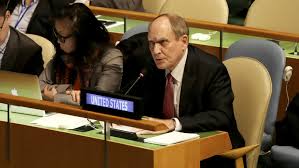
Ronald D. Goddard
Ronald D. Goddard

A short explanation for the U.S. vote against the resolution was provided to the General Assembly by Ronald D. Goddard, U.S. Senior Advisor for Western Hemispheric Affairs. He mentioned last December’s historic announcement of a new era in U.S.-Cuba relations and some of the subsequent steps toward normalization. In addition, he said that U.S. President Obama had “called on Congress to lift the embargo as soon as possible and has taken executive action to adjust regulations to facilitate many transactions involving Cuba.”

Therefore, Goddard continued, the U.S. regretted “that the Government of Cuba has chosen to proceed with its annual resolution. The text falls short of reflecting the significant steps that have been taken and the spirit of engagement President Obama has championed.. . . If Cuba thinks this exercise will help move things forward in the direction both governments have indicated they wish, it is mistaken.”

Israel.

Israel, the only other U.N. member to join the U.S. in opposing the resolution, merely said that it had followed the adoption of the resolution with great interest and welcomed the renewal of diplomatic relations between Cuba and the U.S. Given Israel’s special relationship with the latter, it had voted against the resolution.

Preliminary Documents Regarding the Resolution

Cuba’s Report to General Assembly. In June 2015 Cuba submitted a 37-page report to the General Assembly on its last year’s resolution on the embargo (blockade). This report contains a list of the U.S. statutes and regulations imposing the embargo and blockade and asserts that these U.S. actions have violated the Cuban people’s right to health and food; education, sports and culture; and development. In addition, this U.S. policy allegedly has damaged Cuba’s foreign commerce and investments; and finances, especially with its extraterritorial applications. These alleged damages total US$ 121.192 billion (in current prices) or US$ 833.755 billion (adjusted to reflect the depreciation of the US Dollar against the value of gold).[4]

These alleged damages include the alleged blocking of Cuban access to diagnostic equipment for monitoring the treatment of leukemia patients; preventing the sale to Cuban hospitals of devices critical for pediatric heart surgery patients; and hindering efforts by the U.N. Development Program getting medicine and support into Cuba for its over 18,000 patients living with HIV/AIDS.

U.N. Secretary-General’s Report to General Assembly. On July 30, 2015, the U.N. Secretary-General submitted a 178-page report to the General Assembly summarizing the comments on the resolution from 156 governments and 33 U.N. agencies and entities.[5] The U.S. and Israel, the only two countries to vote against the same resolution last year, had not submitted any comments at the time of the publication of this report, and the Holy See merely stated that it had “never drawn up or applied economic, commercial or financial laws or measures against Cuba.”

The other 155 governments basically supported the resolution with the European Union and Japan emphasizing that the U.S. “trade policy towards Cuba is fundamentally a bilateral issue,” but that “the extraterritorial extension of the [U.S.] embargo . . . violate commonly accepted rules of international trade.”

Of the 33 U.N. agencies and entities, the Office of the United Nations High Commissioner for Human Rights says that generally coercive economic sanctions justified on human rights grounds more often than not fail to improve those conditions; instead they punish the poorest people, the intended beneficiaries of the sanctions, at the cost of increased unemployment and poverty and risks to their health.

Conclusion

This blog consistently has called for the U.S. to end its embargo (blockade) of Cuba. It also has recommended that Cuba’s claims against the U.S. for alleged damages from the embargo be submitted for determination to the Permanent Court of Arbitration at The Hague in the Netherlands. In such a proceeding the U.S. could mount any and all arguments it has against (a) the major premise of the claims (the embargo is illegal under international law) and (b) the amount and causation of the alleged damages from the embargo. In the meantime, this blog has pointed out that as a matter of financial prudence the U.S. should end the embargo as soon as possible to reduce the amount of this contingent liability.[6]

==================================================

[1] United Nations, Despite Resumption of Relations between United States, Cuba, General Assembly Adopts, Almost Unanimously, Resolution Calling for Blockade to Be Lifted (Oct. 27, 2015); Assoc. Press, UN Overwhelmingly Condemns US Embargo on Cuba, N.Y. Times (Oct. 27, 2015); Reuters, Amid Renewed U.S., Cuba ties, U.N. condemns Embargo for 24th Year, N.Y. Times (Oct. 27, 2015); Whitefield, United Nations Votes 191-2 to condemn U.S. embargo against Cuba, Miami Herald (Oct. 27, 2015). As an example of the very limited U.S. coverage of this important U.N. action, the StarTribune, which is the major newspaper in the State of Minnesota, merely stated the following in an 8th page column of “nation+ world” news in the October 28th print edition: “UNITED NATIONS: Vote condemns embargo on Cuba In the first U.N. vote on a resolution condemning the U.S. embargo against Cuba since the two countries renewed diplomatic ties, the U.N. voted 191-2 in favor of the condemnation. The United States said that it couldn’t support the resolution because it failed to take into account ‘the significant steps in the spirit of engagement’ undertaken by the United States.”

[2] Bruno Rodriguez: “We will continue to present this draft resolution for as long as this blockade persists,” CubaMinRex (Oct. 27, 2015) (official Cuban Foreign Ministry English translation). On the day the resolution was debated in the General Assembly, Cuba’s newspaper, Granma, and its website, Cubadebate, had a minute-by-minute reporting of the proceedings starting at 08:33 a.m. (CDT). The Cuban Foreign Ministry has a separate website, “CubavsBloquero,” regarding the embargo (blockade). Another special Ministry website focuses on Cuba-EEUU {United States} relations.

[3] U.S. Mission to U.N., Explanation of Vote at a UN General Assembly Meeting on the Cuba Embargo (Oct. 27, 2015)  In the weeks before the General Assembly vote, the U.S. reportedly considered abstaining on the resolution this year. Last week, however, the U.S. decided it would not abstain because the text did not fully reflect the new spirit of cooperation between the two countries

 [4] Report by Cuba On Resolution 69/5 of the United Nations General Assembly entitled “Necessity of ending the economic, commercial and financial blockade imposed by the United States of America against Cuba” (June 2015). The Report breakdown for some, but not all, of the components of these alleged damages, but does not explain how the alleged gold standard dollar figures were calculated.

[5] U.N. Gen. Assembly, Report of the Secretary General: Necessity of ending the economic, commercial and financial embargo imposed by the United States of America against Cuba (July 30, 2015)

[6] E.g., Letter to President Obama Regarding Cuba (Aug. 17, 2012) (recommends ending embargo); Senator Klobuchar Introduces Bill To End Embargo of Cuba (Feb. 13, 2015) (Cuba’s “damage claim must be recognized as a contingent liability of the U.S., and ending the embargo will minimize the amount of that liability”); Resolution of U.S. and Cuba’s Damage Claims (April 6, 2015).

The Sixth Day of Pope Francis’ Mission to the American People

Sunday, September 27, the sixth and final day of Pope Francis’ mission to the American people was another busy day in Philadelphia.

He started with meeting a small group of the Church’s sexual abuse victims. He then went to St. Charles Borromeo Seminary’s St. Martin’s Chapel, where he met with Catholic bishops attending the World Meeting of Families. Francis then visited the city’s Curran-Fromhold Correctional Facility to meet with 100 inmates – a quarter female – as well as family members and prison staff. An unscheduled stop was made at St. Joseph’s University.

That afternoon the Pope returned to the World Meeting of Families to celebrate mass for over a million people. His mission to the American people concluded at the city’s International Airport where he met with organizers and volunteers from the World Meeting before his plane departed for Rome around 7:30 p.m. (EST). On the plane he held a press conference.

Meeting with Abuse Victims[1]

The day began with meeting a small group of abuse victims and their family members. Francis told them, “ Words cannot fully express my sorrow for the abuse you suffered. You are precious children of God who should always expect our protection, our care and our love. I am profoundly sorry that your innocence was violated by those whom you trusted. In some cases the trust was betrayed by members of your own family, in other cases by priests who carry a sacred responsibility for the care of soul. In all circumstances, the betrayal was a terrible violation of human dignity.”

“For those who were abused by a member of the clergy, I am deeply sorry for the times when you or your family spoke out, to report the abuse, but you were not heard or believed. Please know that the Holy Father hears you and believes you. I deeply regret that some bishops failed in their responsibility to protect children. It is very disturbing to know that in some cases bishops even were abusers. I pledge to you that we will follow the path of truth wherever it may lead. Clergy and bishops will be held accountable when they abuse or fail to protect children.”

“We are gathered here in Philadelphia to celebrate God’s gift of family life. Within our family of faith and our human families, the sins and crimes of sexual abuse of children must no longer be held in secret and in shame. As we anticipate the Jubilee Year of Mercy, your presence, so generously given despite the anger and pain you have experienced, reveals the merciful heart of Christ. Your stories of survival, each unique and compelling, are powerful signs of the hope that comes from the Lord’s promise to be with us always.”

“It is good to know that you have brought family members and friends with you today. I am grateful for their compassionate support and pray that many people of the Church will respond to the call to accompany those who have suffered abuse. May the Door of Mercy be opened wide in our dioceses, our parishes, our homes and our hearts, to receive those who were abused and to seek the path to forgiveness by trusting in the Lord. We promise to support your continued healing and to always be vigilant to protect the children of today and tomorrow.”

“When the disciples who walked with Jesus on the road to Emmaus recognized that He was the Risen Lord, they asked Jesus to stay with them. Like those disciples, I humbly beg you and all survivors of abuse to stay with us, to stay with the Church, and that together, as pilgrims on the journey of faith, we might find our way to the Father.”

Afterwards Rev. Federico Lombardi, a Vatican spokesman, said this meeting included victims of abuse by relatives or educators in order to show that the church is taking a “larger perspective” on the problem of sexual abuse. He added that the Pope had waited to make these remarks until Sunday, when he was scheduled to address an international group of bishops, because “we know the problem is a universal problem, in the universal church, and also in society.”

Meeting with Bishops Attending World Meeting on Families[2]

Unknown

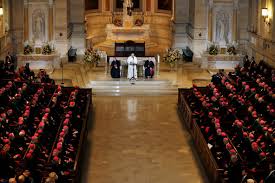
At St. Martin’s Chapel at St. Charles Borromeo Seminary, Francis met with bishops and seminarians who were attending the World Meeting on Families as shown in the photograph to the right.

Before his prepared remarks, the Pope offered these words: “I carry in my heart the stories, the suffering and the pain of the minors that have been sexually abused by priests. I’m overwhelmed by the shame that people who were in charge of caring for those young ones raped them and caused them great damages. I regret this profoundly. God cries! The crimes and sins of the sexual abuse to minors can’t be kept a secret anymore. I commit to the zealous oversight of the Church to protect minors, and I promise that everyone responsible will be held accountable. You, they, the survivors of abuse have become real heralds of hope and ministers of mercy. Humbly we owe each one of them and their families our gratitude for their immense courage for making the light of Christ shine over the evil of minor sexual abuse. I say this because I have just met by a group of people who where abused when they were children, that are helped and accompanied here in Philadelphia, with especial care from Monsignor Chaput.”

The Pope then continued with the following prepared remarks.

“For the Church, the family is not first and foremost a cause for concern, but rather the joyous confirmation of God’s blessing upon the masterpiece of creation. Every day, all over the world, the Church can rejoice in the Lord’s gift of so many families who, even amid difficult trials, remain faithful to their promises and keep the faith!”

“I would say that the foremost pastoral challenge of our changing times is to move decisively towards recognizing this gift. For all the obstacles we see before us, gratitude and appreciation should prevail over concerns and complaints. The family is the fundamental locus of the covenant between the Church and God’s creation. Without the family, not even the Church would exist. Nor could she be what she is called to be, namely ‘a sign and instrument of communion with God and of the unity of the entire human race’ (Lumen Gentium, 1).”

“Needless to say, our understanding, shaped by the interplay of ecclesial faith and the conjugal experience of sacramental grace, must not lead us to disregard the unprecedented changes taking place in contemporary society, with their social, cultural – and now juridical – effects on family bonds. These changes affect all of us, believers and non-believers alike. Christians are not ‘immune’ to the changes of their times. This concrete world, with all its many problems and possibilities, is where we must live, believe and proclaim.”

“Until recently, we lived in a social context where the similarities between the civil institution of marriage and the Christian sacrament [of marriage] were considerable and shared. The two were interrelated and mutually supportive. This is no longer the case.”

After talking about the abandonment of local stores and their bonds with neighbors, the Pope said, “our culture has become more and more competitive. Business is no longer conducted on the basis of trust; others can no longer be trusted. There are no longer close personal relationships. Today’s culture seems to encourage people not to bond with anything or anyone, not to trust. The most important thing nowadays seems to be follow the latest trend or activity. This is even true of religion. Today consumerism determines what is important. Consuming relationships, consuming friendships, consuming religions, consuming, consuming… Whatever the cost or consequences. A consumption that does not favor bonding, a consumption which has little to do with human relationships. Social bonds are a mere ‘means’ for the satisfaction of ‘my needs.’ The important thing is no longer our neighbor, with his or her familiar face, story and personality.”

“The result is a culture which discards everything that is no longer ‘useful’ or ‘satisfying’ for the tastes of the consumer. We have turned our society into a huge multicultural showcase tied only to the tastes of certain ‘consumers,’ while so many others only ‘eat the crumbs which fall from their masters’ table’ (Mt 15:27).”

“This causes great harm. I would say that at the root of so many contemporary situations is a kind of impoverishment born of a widespread and radical sense of loneliness. Running after the latest fad, accumulating ‘friends’ on one of the social networks, we get caught up in what contemporary society has to offer. [The result:] Loneliness with fear of commitment in a limitless effort to feel recognized.”

“Should we blame our young people for having grown up in this kind of society? Should we condemn them for living in this kind of a world? Should they hear their pastors saying that ‘it was all better back then,’ ‘the world is falling apart and if things go on this way, who knows where we will end up?’ No, I do not think that this is the way. As shepherds following in the footsteps of the Good Shepherd, we are asked to seek out, to accompany, to lift up, to bind up the wounds of our time. To look at things realistically, with the eyes of one who feels called to action, to pastoral conversion. The world today demands this conversion on our part. ‘It is vitally important for the Church today to go forth and preach the Gospel to all: to all places, on all occasions, without hesitation, reluctance or fear. The joy of the Gospel is for all people: no one can be excluded’ (Evangelii Gaudium, 23).”

“We would be mistaken, however, to see this ‘culture’ of the present world as mere indifference towards marriage and the family, as pure and simple selfishness. Are today’s young people hopelessly timid, weak, inconsistent? We must not fall into this trap.”

“Many young people, in the context of this culture of discouragement, have yielded to a form of unconscious acquiescence. They are paralyzed when they encounter the beautiful, noble and truly necessary challenges which faith sets before them. Many put off marriage while waiting for ideal conditions, when everything can be perfect. Meanwhile, life goes on, without really being lived to the full. For knowledge of life’s true pleasures only comes as the fruit of a long-term, generous investment of our intelligence, enthusiasm and passion.”

“As pastors, we bishops are called to collect our energies and to rebuild enthusiasm for making families correspond ever more fully to the blessing of God which they are! We need to invest our energies not so much in rehearsing the problems of the world around us and the merits of Christianity, but in extending a sincere invitation to young people to be brave and to opt for marriage and the family. Here too, we need a bit of holy parrhesia [candor]!”

“A Christianity which ‘does’ little in practice, while incessantly ‘explaining’ its teachings, is dangerously unbalanced. I would even say that it is stuck in a vicious circle. A pastor must show that the ‘Gospel of the family’ is truly ‘good news’ in a world where self-concern seems to reign supreme! We are not speaking about some romantic dream: the perseverance that is called for in having a family and raising it transforms the world and human history.”

“A pastor serenely yet passionately proclaims the word of God. He encourages believers to aim high. He will enable his brothers and sisters to hear and experience God’s promise, which can expand their experience of motherhood and fatherhood within the horizon of a new ‘familiarity’ with God (Mk 3:31-35).”

“A pastor watches over the dreams, the lives and the growth of his flock. This ‘watchfulness’ is not the result of talking, but of shepherding. Only one capable of standing ‘in the midst of’ the flock can be watchful, not someone who is afraid of questions, contact, accompaniment. A pastor keeps watch first and foremost with prayer, supporting the faith of his people and instilling confidence in the Lord, in his presence. A pastor remains vigilant by helping people to lift their gaze at times of discouragement, frustration and failure. We might well ask whether in our pastoral ministry we are ready to ‘waste’ time with families. Whether we are ready to be present to them, sharing their difficulties and joys.”

“Naturally, experiencing the spirit of this joyful familiarity with God, and spreading its powerful evangelical fruitfulness, has to be the primary feature of our lifestyle as bishops: a lifestyle of prayer and preaching the Gospel (Acts 6:4). By our own humble Christian apprenticeship in the familial virtues of God’s people, we will become more and more like fathers and mothers (as did Saint Paul: cf. 1 Th 2:7,11), and less like people who have simply learned to live without a family.”

“Our ideal is not to live without love! A good pastor renounces the love of a family precisely in order to focus all his energies, and the grace of his particular vocation, on the evangelical blessing of the love of men and women who carry forward God’s plan of creation, beginning with those who are lost, abandoned, wounded, broken, downtrodden and deprived of their dignity. This total surrender to God’s agape is certainly not a vocation lacking in tenderness and affection! We need but look to Jesus to understand this (cf. Mt 19:12).”

“The mission of a good pastor, in the style of God – and only God can authorize this, not our own presumption! – imitates in every way and for all people the Son’s love for the Father. This is reflected in the tenderness with which a pastor devotes himself to the loving care of the men and women of our human family.”

“For the eyes of faith, this is a most valuable sign. Our ministry needs to deepen the covenant between the Church and the family. Otherwise it becomes arid, and the human family will grow irremediably distant, by our own fault, from God’s joyful good news.”

“If we prove capable of the demanding task of reflecting God’s love, cultivating infinite patience and serenity as we strive to sow its seeds in the frequently crooked furrows in which we are called to plant, then even a Samaritan woman with five ‘non-husbands’ will discover that she is capable of giving witness.”

“And for every rich young man who with sadness feels that he has to calmly keep considering the matter, an older publican will come down from the tree and give fourfold to the poor, to whom, before that moment, he had never even given a thought.”

“May God grant us this gift of a renewed closeness between the family and the Church. The family is our ally, our window to the world, and the evidence of an irrevocable blessing of God destined for all the children who in every age are born into this difficult yet beautiful creation which God has asked us to serve!”

Curran-Fromhold Correctional Facility[3]

Francis went to the Curran-Fromhold Correctional Facility, which holds almost 3,000 individuals, the vast majority of whom have not been convicted of the charges against them and are still awaiting trial. He met with roughly 100 men and women detainees, who presented him a hand-carved chair, for which he thanked them.

Francis said to them, “Thank you for receiving me and giving me the opportunity to be here with you and to share this time in your lives. It is a difficult time, one full of struggles. I know it is a painful time not only for you, but also for your families and for all of society. Any society, any family, which cannot share or take seriously the pain of its children, and views that pain as something normal or to be expected, is a society ‘condemned’ to remain a hostage to itself, prey to the very things which cause that pain. I am here as a pastor, but above all as a brother, to share your situation and to make it my own. I have come so that we can pray together and offer our God everything that causes us pain, but also everything that gives us hope, so that we can receive from him the power of the resurrection.”

“I think of the Gospel scene where Jesus washes the feet of his disciples at the Last Supper. This was something his disciples found hard to accept. Even Peter refused, and told him: ‘You will never wash my feet’ (Jn 13:8).”

“In those days, it was the custom to wash someone’s feet when they came to your home. That was how they welcomed people. The roads were not paved, they were covered with dust, and little stones would get stuck in your sandals. Everyone walked those roads, which left their feet dusty, bruised or cut from those stones. That is why we see Jesus washing feet, our feet, the feet of his disciples, then and now.”

“Life is a journey, along different roads, different paths, which leave their mark on us.”

“We know in faith that Jesus seeks us out. He wants to heal our wounds, to soothe our feet which hurt from traveling alone, to wash each of us clean of the dust from our journey. He doesn’t ask us where we have been, he doesn’t question us what about we have done. Rather, he tells us: ‘Unless I wash your feet, you have no share with me’ (Jn 13:8). Unless I wash your feet, I will not be able to give you the life which the Father always dreamed of, the life for which he created you. Jesus comes to meet us, so that he can restore our dignity as children of God. He wants to help us to set out again, to resume our journey, to recover our hope, to restore our faith and trust. He wants us to keep walking along the paths of life, to realize that we have a mission, and that confinement is not the same thing as exclusion.”

“Life means ‘getting our feet dirty’ from the dust-filled roads of life and history. All of us need to be cleansed, to be washed. All of us are being sought out by the Teacher, who wants to help us resume our journey. The Lord goes in search of us; to all of us he stretches out a helping hand. It is painful when we see prison systems which are not concerned to care for wounds, to soothe pain, to offer new possibilities. It is painful when we see people who think that only others need to be cleansed, purified, and do not recognize that their weariness, pain and wounds are also the weariness, pain and wounds of society. The Lord tells us this clearly with a sign: he washes our feet so we can come back to the table. The table from which he wishes no one to be excluded. The table which is spread for all and to which all of us are invited.”

“This time in your life can only have one purpose: to give you a hand in getting back on the right road, to give you a hand to help you rejoin society. All of us are part of that effort, all of us are invited to encourage, help and enable your rehabilitation. A rehabilitation which everyone seeks and desires: inmates and their families, correctional authorities, social and educational programs. A rehabilitation which benefits and elevates the morale of the entire community.”

“Jesus invites us to share in his lot, his way of living and acting. He teaches us to see the world through his eyes. Eyes which are not scandalized by the dust picked up along the way, but want to cleanse, heal and restore. He asks us to create new opportunities: for inmates, for their families, for correctional authorities, and for society as a whole. I encourage you to have this attitude with one another and with all those who in any way are part of this institution. May you make possible new opportunities, new journeys, new paths.”

“All of us have something we need to be cleansed of, or purified from. May the knowledge of that fact inspire us to live in solidarity, to support one another and seek the best for others.”

“Let us look to Jesus, who washes our feet. He is ‘the way, and the truth, and the life.’ He comes to save us from the lie that says no one can change. He helps us to journey along the paths of life and fulfillment. May the power of his love and his resurrection always be a path leading you to new life.”

Unknown

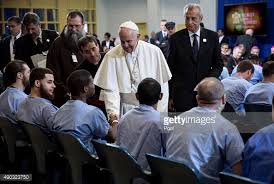
After the speech, Francis walked along the rows of inmates sitting in chairs, shaking hands, chatting, laying his hand on their foreheads and hugging a few. Here is a photograph to the right showing some of those interactions.

St. Joseph’s University[4]

statue (1)


Francis, a member of the Jesuit religious order, made an unscheduled stop at St. Joseph’s University, a Jesuit school. There he blessed a new statue dedicated to ties between Catholics and Jews as shown in the photograph to the left.


Mass at the World Meeting of Families[5]

images

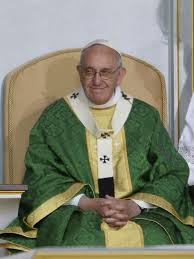
Sunday’s Mass, marking the end of the World Meeting of Families, took place on Eakins Oval in front of the Philadelphia Museum of Art, with nearly a million people on the facing Benjamin Franklin Parkway, which was studded with jumbotron screens. Here is a photograph to the right of the Pope at this mass.

In his homily Francis said the following:

“Today the word of God surprises us with powerful and thought-provoking images. Images which challenge us, but also stir our enthusiasm. In the first reading, Joshua tells Moses that two members of the people are prophesying, speaking God’s word, without a mandate. In the Gospel, John tells Jesus that the disciples had stopped someone from casting out evil spirits in the name of Jesus.”

“Here is the surprise: Moses and Jesus both rebuke those closest to them for being so narrow! Would that all could be prophets of God’s word! Would that everyone could work miracles in the Lord’s name!”

“Jesus encountered hostility from people who did not accept what he said and did. For them, his openness to the honest and sincere faith of many men and women who were not part of God’s chosen people seemed intolerable. The disciples, for their part, acted in good faith. But the temptation to be scandalized by the freedom of God, who sends rain on the righteous and the unrighteous alike (Mt 5:45), bypassing bureaucracy, officialdom and inner circles, threatens the authenticity of faith. Hence it must be vigorously rejected.”

“Once we realize this, we can understand why Jesus’ words about causing ‘scandal’ are so harsh. For Jesus, the truly ‘intolerable’ scandal consists in everything that breaks down and destroys our trust in the working of the Spirit!”

“Our Father will not be outdone in generosity and he continues to scatter seeds.”

“He scatters the seeds of his presence in our world, for ‘love consists in this, not that we have loved God but that he loved us’ first (1 Jn 4:10). That love gives us a profound certainty: we are sought by God; he waits for us. It is this confidence which makes disciples encourage, support and nurture the good things happening all around them. God wants all his children to take part in the feast of the Gospel. Jesus says, ‘Do not hold back anything that is good, instead help it to grow!’”

“To raise doubts about the working of the Spirit, to give the impression that it cannot take place in those who are not ‘part of our group,’ who are not ‘like us,’ is a dangerous temptation. Not only does it block conversion to the faith; it is a perversion of faith! Faith opens a ‘window’ to the presence and working of the Spirit. It shows us that, like happiness, holiness is always tied to little gestures. ‘Whoever gives you a cup of water in my name will not go unrewarded,’ says Jesus (cf. Mk 9:41).”

“These little gestures are those we learn at home, in the family; they get lost amid all the other things we do, yet they do make each day different. They are the quiet things done by mothers and grandmothers, by fathers and grandfathers, by children. They are little signs of tenderness, affection and compassion. Like the warm supper we look forward to at night, the early lunch awaiting someone who gets up early to go to work.”

“Homely gestures. Like a blessing before we go to bed, or a hug after we return from a hard day’s work. Love is shown by little things, by attention to small daily signs which make us feel at home. Faith grows when it is lived and shaped by love. That is why our families, our homes, are true domestic churches. They are the right place for faith to become life, and life to become faith.”

“Jesus tells us not to hold back these little miracles. Instead, he wants us to encourage them, to spread them. He asks us to go through life, our everyday life, encouraging all these little signs of love as signs of his own living and active presence in our world.”

“So we might ask ourselves: How are we trying to live this way in our homes, in our societies? What kind of world do we want to leave to our children (cf. Laudato Si’, 160)? We cannot answer these questions alone, by ourselves. It is the Spirit who challenges us to respond as part of the great human family.”

“Our common house can no longer tolerate sterile divisions. The urgent challenge of protecting our home includes the effort to bring the entire human family together in the pursuit of a sustainable and integral development, for we know that things can change (cf. ibid., 13). May our children find in us models and incentives to communion! May our children find in us men and women capable of joining others in bringing to full flower all the good seeds which the Father has sown!”

“Pointedly, yet affectionately, Jesus tells us: ‘If you, who are evil, know how to give good gifts to your children, how much more will the heavenly Father give the Holy Spirit to those who ask him!’ (Lk 11:13). How much wisdom there is in these few words! It is true that, as far as goodness and purity of heart are concerned, we human beings don’t have much to show! But Jesus knows that, where children are concerned, we are capable of boundless generosity. So he reassures us: if only we have faith, the Father will give us his Spirit.”

“We Christians, the Lord’s disciples, ask the families of the world to help us! How many of us are here at this celebration! This is itself something prophetic, a kind of miracle in today’s world. The world is tired of creating new division and new disasters. Wouldn’t it be great if all of us where prophets. If all of us would be open ot the miracles of love for the good of all families.”

“I leave you with this question, for each one of you to respond to. In my home, do we yell, or do we speak with love and tenderness? This is a good way to recognize our love.”

“Would that we could all be prophets! Would that all of us could be open to miracles of love for the sake of all the families of the world, and thus overcome the scandal of a narrow, petty love, closed in on itself, impatient of other. And how beautiful it would be if everywhere, even beyond our borders, we could appreciate and encourage this prophecy and this miracle! We renew our faith in the word of the Lord which invites faithful families to this openness. It invites all those who want to share the prophecy of the covenant of man and woman, which generates life and reveals God!”

“Anyone who wants to bring into this world a family which teaches children to be excited by every gesture aimed at overcoming evil – a family which shows that the Spirit is alive and at work – will encounter our gratitude and our appreciation. Whatever the family, people, region, or religion to which they belong! May God grant to all of us, as the Lord’s disciples, the grace to be worthy of this purity of heart which is not scandalized by the Gospel!”

Return Flight to Rome[6]

Before he boarded his plane to return to Rome, Francis met with the organizers, volunteers and benefactors of the World Meeting of Families to thank them for all their work. At approximately 7:30 p.m. (EST) the Pope’s plane left Philadelphia for Rome.

On the plane the Pope held a press conference. He again strongly condemned priests who molested children as “sacrilegious” and publicly acknowledged that bishops had covered up abuse cases. “When a priest abuses, it is very grave because the vocation of the priest is to make that boy, that girl grow toward the love of God. For this reason, the church is strong on this and one must not cover these things up. Those who covered this up are guilty. Even some bishops who covered this up.”

Francis commended the sisters in the U.S., who “have done marvels in the field of education, in the field of health. The people of the United States love the sisters. . . . They are great, they are great, great, great women. . . .”

He defended his recent changes to Roman Catholic rules on marriage annulments, saying the changes had improved the system, but had not transformed it into an administrative “Catholic divorce.”

Francis described the deep roots of the migrant crisis while dismissing border barriers, like the one being constructed in Hungary, as pointless. He recognized that Europe was facing a difficult situation but promoted dialogue as a solution, not walls.

Francis expressed hope that a tentative peace agreement between the Colombian government and the Revolutionary Armed Forces of Colombia, or FARC, would be realized by the March [2016] deadline. He said he had spoken twice to President Juan Manuel Santos of Colombia while Vatican diplomats had also been involved. “I was very happy, and I felt like I was part of it,” he said.

When asked about government employees who refused to discharge their duties as an act of religious conscience, including refusing to grant marriage licenses to gay couples, Francis did not offer specifics but described conscientious objection as “a human right.”

This last issue re-emerged after the Pope’s return to the Vatican when it became known that on the third day of his American mission (September 24), the Pope met at the Vatican Embassy in Washington with several individuals, including Kim Davis, the Kentucky county clerk who was jailed for contempt of court for refusing to grant wedding licenses to same-sex couples because of her religious beliefs. According to her lawyer, the Pope gave her and her husband two rosaries, embraced her and told her to “stay strong.” The Vatican spokesman, Federico Lombardi, however, subsequently stated,“The pope did not enter into the details of the situation of Mrs. Davis, and his meeting with her should not be considered a form of support of her position in all of its particular and complex aspects.”  The Vatican spokesman added that the only “real audience” given by the Pope in the U.S. was to one of his former students, who is a gay man, and his male partner.[7]

=================================================

[1] Pope Francis’ Remarks to Victims of Sexual Abuse, N.Y. Times (Sept. 27, 2015); Goodstein & Wakin, Pope Francis Ends Visit With Mass After Meeting Bishops and Inmates, N.Y. Times (Sept. 27, 2015).

[2] Goodstein, After Criticism, Pope Francis Confronts Priestly Sexual Abuse, N.Y. Times (Sept. 27, 2015); Read Pope Francis’ Speech to Bishops, NBC4 (Sept. 27, 2015) (video + text).

[3] Reilly, Pope Francis Tells Inmates That Society Can’t Ignore Their Pain, HuffPost (Sept. 27, 2015); Pope Francis’ Speech to Curran-Fromhold Correction Facility Inmates (Sept. 27, 2015).

[4] Pontiff Makes Historic Visit to Philadelphia’s Jesuit University (Sept. 27, 2015).

[5] Pope Francis’ Homily at the World Meeting of Families Closing Mass (Sept. 27, 2015).

[6] Pope’s Visit with organizers, volunteers and benefactors of the World Meeting of Families (Sept. 27, 2015); Yardley, Pope Francis, on Flight Home, Strongly Condemns Child Sexual Abuse, (N.Y. Times (Sept. 28, 2015); Murphy, Pope expands warnings on sex abuse scandals after return to Rome, Wash. Post (Sept. 28, 2015); Pope Francis: “I’m not a star, but the servant of servants of God,” Vatican Radio (Sept. 28, 2015).

[7] Goodstein & Yardley, Pope Francis, the Kentucky Clerk and Culture Wars Revisited, N.Y. Times (Sept. 30, 2015); Yardley & Goodstein, Before Pope Francis Met Kim Davis, He Met With Gay Ex-Student, N.Y. Times (Oct. 2, 2015). There also has been speculation about whether the papal nuncio to the U.S. was responsible on his own for inviting Ms. Davis without adequately briefing the Pope about her case. (Horowitz, Archbishop at Center of Mystery of Papal Meeting with Kim Davis, N.Y. Times (Oct. 3, 2015).


The Second Day of Pope Francis’ Mission to the Cuban People

On Sunday, September 20, 2015, Pope Francis celebrated mass in Havana’s Plaza de Revolutión before a crowd of thousands. In attendance were Cuban President Raúl Castro and other government officials. The Pope also had separate private meetings with Fidel and Raúl Castro and later presided at a vespers service and met with a group of young people.[1]

Celebration of Mass in Plaza de la Revolución

Mass

Crowd @ mass


The above photos show the large crowd at the Sunday morning mass at Plaza de la Revolución. In his homily Francis said, “The Gospel shows us Jesus asking a seemingly indiscreet question of his disciples: ‘What were you discussing along the way?’  It is a question he could also ask each of us today: ‘What do you talk about every day?  What are your aspirations?’  The Gospel tells us that the disciples ‘did not answer because on the way they had been arguing about who was the most important.’  The disciples were ashamed to tell Jesus what they were talking about.  As with the disciples then, we too can be caught up in these same arguments: who is the most important?”

“Jesus does not press the question.  He does not force them to tell him what they were talking about on the way.  But the question lingers, not only in the minds of the disciples, but also in their hearts.”

“Who is the most important?  This is a life-long question to which, at different times, we must give an answer.  We cannot escape the question; it is written on our hearts.  The history of humanity has been marked by the answer we give to this question.”

“Jesus is not afraid of people’s questions; he is not afraid of our humanity or the different things we are looking for.  On the contrary, he knows the ‘twists and turns’ of the human heart, and, as a good teacher, he is always ready to encourage and support us.  As usual, he takes up our searching, our aspirations, and he gives them a new horizon.  As usual, he somehow finds the answer which can pose a new challenge, setting aside the ‘right answers,’ the standard replies we are expected to give.  As usual, Jesus sets before us the ‘logic’ of love.  A mindset, an approach to life, which is capable of being lived out by all, because it is meant for all.”

“Far from any kind of elitism, the horizon to which Jesus points is not for those few privileged souls capable of attaining the heights of knowledge or different levels of spirituality.  The horizon to which Jesus points always has to do with daily life, also here on ‘our island.’ something which can season our daily lives with eternity.”

“Who is the most important?  Jesus is straightforward in his reply: ‘Whoever wishes to be the first among you must be the last of all, and the servant of all.’  Whoever wishes to be great must serve others, not be served by others.

“Here lies the great paradox of Jesus.  The disciples were arguing about who would have the highest place, who would be chosen for privileges, who would be above the common law, the general norm, in order to stand out in the quest for superiority over others.  Who would climb the ladder most quickly to take the jobs that carry certain benefits.”

“Jesus upsets their ‘logic.’ their mindset, simply by telling them that life is lived authentically in a concrete commitment to our neighbor.”

“The call to serve involves something special, to which we must be attentive.  Serving others chiefly means caring for their vulnerability.  Caring for the vulnerable of our families, our society, our people.  Theirs are the suffering, fragile and downcast faces which Jesus tells us specifically to look at and which he asks us to love.  With a love that takes shape in our actions and decisions.  With a love that finds expression in whatever tasks we, as citizens, are called to perform.  People of flesh and blood, people with individual lives and stories, and with all their frailty: these are those whom Jesus asks us to protect, to care for, to serve.  Being a Christian entails promoting the dignity of our brothers and sisters, fighting for it, living for it.  That is why Christians are constantly called to set aside their own wishes and desires, their pursuit of power, and to look instead to those who are most vulnerable.”

“There is a kind of ‘service’ that truly ‘serves,’ yet we need to be careful not to be tempted by another kind of service, a ‘service’ that is ‘self-serving/’  There is a way to go about serving which is interested in only helping ‘my people,’ [or] ‘our people.’  This service always leaves ‘your people’ outside, and gives rise to a process of exclusion.”

“All of us are called by virtue of our Christian vocation to that service which truly serves, and to help one another not to be tempted by a ‘service’ that is really ‘self-serving.’  All of us are asked, indeed urged, by Jesus to care for one another out of love.  Without looking to one side or the other to see what our neighbor is doing or not doing.  Jesus tells us: Whoever would be first among you must be the last, and the servant of all.  He does not say: if your neighbor wants to be first, let him be the servant!  We have to be careful to avoid judgmental looks and renew our belief in the transforming look to which Jesus invites us.”

“This caring for others out of love is not about being servile.  Rather, it means putting our brothers and sisters at the center.  Service always looks to their faces, touches their flesh, senses their closeness and even, in some cases, ‘suffers’ in trying to help.  Service is never ideological, for we do not serve ideas. We serve people.”

“God’s holy and faithful people in Cuba are a people with a taste for parties, for friendship, for beautiful things. It is a people who marches with songs of praise.  It is a people who has its wounds, like every other people, yet knows how to stand up with open arms, to keep walking in hope, because it has a vocation of grandeur.  Today I ask you to care for this vocation of yours, to care for these gifts that God has given you, but above all I invite you to care for and be at the service of the frailty of your brothers and sisters.  Do not neglect them for plans that can be seductive, but are unconcerned about the face of the person beside you.  We know, we are witnesses of the incomparable power of the resurrection, which ‘everywhere calls forth the seeds of a new world.’”

“Let us not forget the Good News we have heard today: the importance of a people, a nation, and the importance of individuals, which is always based on how they seek to serve their vulnerable brothers and sisters.  Here we encounter one of the fruits of a true humanity. ‘Whoever does not live to serve, does not ‘serve’ to live.’”

“We have heard in the Gospel how the disciples were afraid to question Jesus when he spoke to them about his passion and death.  He frightened them, and they could not grasp the idea of seeing Jesus suffer on the cross.  We too are tempted to flee from our own crosses and those of others, to withdraw from those who suffer.  In concluding this Holy Mass, in which Jesus has once more given himself to us in his body and blood, let us now lift our gaze to the Virgin Mary, our Mother.  We ask her to teach us to stand beside the cross of our brothers and sisters who suffer.  To learn to see Jesus in every person bent low on the path of life, in all our brothers and sisters who hunger or thirst, who are naked or in prison or sick.  With Mary our Mother, on the cross we can see who is truly “the greatest” and what it means to stand beside the Lord and to share in his glory.”

“Let us learn from Mary to keep our hearts awake and attentive to the needs of others.  As the wedding feast of Cana teaches us, let us be concerned for the little details of life, and let us not tire of praying for one another, so that no one will lack the new wine of love, the joy that Jesus brings us.”

“I ask you now to join with me in praying to Mary, that we may place all our concerns and hopes before the heart of Christ.  We pray to her in a special way for those who have lost hope and find no reasons to keep fighting, and for those who suffer from injustice, abandonment and loneliness.  We pray for the elderly, the infirm, children and young people, for all families experiencing difficulty, that Mary may dry their tears, comfort them with a mother’s love, and restore their hope and joy.  Holy Mother, I commend to you your sons and daughters in Cuba.  May you never abandon them!”

Although the Pope had no direct remarks regarding political issues facing Cuba, he did mention the ongoing peace negotiations in Havana between the Colombian government and the FARC rebels. He said, “I feel bound to direct my thoughts to the beloved land of Colombia, ‘conscious of the crucial importance of the present moment when, with renewed effort and inspired by hope, its sons and daughters are seeking to build a peaceful society.’ May the blood shed by thousands of innocent people during long decades of armed conflict, united to that of the Lord Jesus Christ crucified, sustain all the efforts being made, including those on this beautiful island, to achieve definitive reconciliation.  Thus the long night of pain and violence can, with the support of all Colombians, become an unending day of concord, justice, fraternity and love, in respect for institutions and for national and international law, so that there may be lasting peace.  Please, we do not have the right to allow ourselves yet another failure on this path of peace and reconciliation.” He also added a word of gratitude to President Raul Castro for his efforts to assist the negotiations.

Meeting with Fidel Castro

The Pope & Fidel
The Pope & Fidel

In the early afternoon Francis met with Fidel Castro for about a half-hour at the former Cuban leader’s home. The conversation was reported to be informal and took place in the presence of Castro’s children and grandchildren.

In the Pope’s gifts for Fidel were a collection of sermons by Castro’s former Jesuit teacher, the Rev. Amando Llorente, and two CD recordings of the priest, who was forced to leave Cuba soon after Fidel took power in 1959 and who died in Miami in 2010. Other papal gifts were two books by an Italian priest, Alessandro Pronzato, and copies of Francis’ papal encyclical “Praise Be” and his book, “The Joy of the Gospel.”

Francis’ biographer, Austen Invereigh, thinks the Llorente materials were sending a subtle message to Fidel, whose rule was marked by conflict with the Catholic Church and other groups.

Castro gave Francis a collection of his own conversations about religion with Brazilian priest Frei Betto: “Fidel and Religion: Castro Talks on Revolution and religion with Frei Betto” (1988),

Meeting with Raúl Castro

Pope + Raul@ PalceRaul +Pope


Later in the afternoon the Pope met with President Raúl Castro and other government officials at the Palace de la Revolutión as shown in the above photographs. The President showed Francis what appear to be official gifts for the Pontiff on display inside the Palace: a huge crucifix made of oars and a painting of the Virgin of Charity of Cobre, Cuba’s patron saint.

Before their private meeting at the Palace, Pope Francis was heard saying to Castro: “In the first place I want to thank you for the warmth of the reception, the fact that in your speech you’ve cited things that really send a signal of (inaudible) and warmth. I also want to thank you for the pardons [of 3,522 prisoners].”

Vespers Service

Pope Francis @ Cathedral

That evening Francis presided over a vespers service in Havana’s 18th century Immaculate Conception and San Cristobal Cathedral.

He did not read his prepared homily, but instead spoke extemporaneously on the importance of poverty to the Roman Catholic Church. “Our dear mother church is poor. God wants it poor, as he wanted our Holy Mother Mary to be poor. The spirit of the world does not follow the path of the son of God who emptied himself and became poor to be like us.”

He also warned of the dangers of falling prey to the temptations of wealth. “When possessions enter the heart and guide your life, you have already lost, you are no longer like Jesus. He quoted St. Ignatius when he said that poverty was the mother and also the wall of consecrated life. Pope Francis summoned the spirit of dispossession, to leave everything behind in order to follow Jesus.

Meeting with Young People

Francis finished his busy day with a meeting with hundreds of young people at the Félix Varela Cultural Center, which is the former San Carlos and San Ambrosio Seminary and which is not far from the Cathedral.

The young people presented him for blessing a cross that will accompany them during World Youth Day in 2016, and one of them said, “Our great strength lies in maintaining solidarity at all costs to help us to overcome any obstacle.” Their representative then welcomed the Pope to Cuba, saying “the Cuban youth love you.”

In his message to the young people, Francis cited the words of a Latin American writer: “People have two eyes, one of flesh and the other made of glass, with the one of flesh we see what we are looking at, with the one made of glass we see what we dream.” The ability to dream must be included within the objectivity of life. “He who cannot dream is not young.” Dream that the world may be different, if you give the best of yourselves you will help to have a different world. “ Do not forget to dream,” he insisted.

A family is destroyed by enmity, a country destroyed by enmity, the world is destroyed by enmity. And the biggest enmity is war,” the Pope stated. We all must have respect for differences and work together for the common good. Let’s negotiate, but not kill the world anymore. We are killing the ability to unite, to create social friendship.”

“To you, young Cubans, although you have different views, I want you to be accompanied, seeking the future and the dignity of your homeland together. At the end something even better awaits you, the sweet hope of the motherland we want to achieve. I will pray for you and ask you to pray for me, and if one cannot pray because he is not a believer, at least, wish me good things. May God bless you all.”

Conclusion

Once again I am impressed and moved by the words and actions of Pope Francis. He has a constant message of humility, love and forgiveness for individuals and nations. I give thanks to God for Francis!

================================

[1] Yardley & Ahmed, Pope Francis Celebrates Mass at Political Heart of Cuba, N.Y. Times (Sept. 20, 2015); Reuters, Pope Celebrates First Mass in Cuba, N.Y. Times (Sept. 20, 2015) (video); Assoc. Press, Pope in Cuba Begs Colombia, Rebels to End Conflict, N.Y. Times (Sept. 20, 2015); Assoc. Press, The Latest: Pope Presides Over Vespers Service in Cathedral, N.Y. Times (Sept. 20, 2015); Reuters, Pope Meets Fidel Castro, Warns Against Ideology on Cuba Trip, N.Y. Times (Sept. 20, 2015);Assoc. Press, The Latest: Pope speaks of importance of poverty to the church, Wash. Post (Sept. 20, 2015); Pope Francis in Havana’s Plaza de la Revolución (+ Photos), Granma (Sept. 20, 2015); Pope Francis in Cuba: Minute by minute, Granma (Sept. 20, 2015); Pope in Havana: prays for success of Colombian peace talks, Vatican Radio (Sept. 20, 2015); Pope in Cuba: serve rather than be served, Vatican Radio (Sept. 20, 2015); Pope meets former Cuba president Fidel Castro, Vatican Radio (Sept. 20, 2015); Pope at Vespers: Be a poor and merciful Church in Cuba, Vatican Radio (Sept. 20, 2015).


Joint Press Conference of U.S. Secretary of State John Kerry and Cuba Foreign Minister Bruno Rodriguez  

On the morning of July 20, 2015, Cuba officially opened its Embassy in Washington, D.C., and the United States did likewise in Havana although the ceremonial opening of the latter will be on August 14 when Secretary of State John Kerry goes to Havana to preside that event. A prior post discussed the ceremonial opening of the Cuban Embassy. This post covers that afternoon’s joint press conference at the U.S. Department of State by U.S. Secretary of State John Kerry and Cuba’s Foreign Minister Bruno Rodriguez.[1] Subsequent posts will review comments about U.S.-Cuba relations offered by the White House Press Secretary at a July 20 press conference and the reactions to these events.

Bruno Rodriguez & John Kerry @ U.S. State Department

Secretary Kerry’s Opening Statement

The conference was opened by Kerry, saying it was “an historic day; a day for removing barriers.” This day was welcomed by the U.S. as a “new beginning in its relationship with the people and the Government of Cuba. We are determined to live as good neighbors on the basis of mutual respect, and we want all of our citizens – in the U.S. and in Cuba – to look into the future with hope. Therefore we celebrate this day . . . because today we begin to repair what was damaged and to open what has been closed for many years.”

His prior discussion with Minister Rodriguez, Kerry said, “touched on a wide range of issues of mutual concern including cooperation on law enforcement, counter-narcotics, telecommunications, the internet, environmental issues, human rights, including trafficking in persons. And of course, we also discussed the opening of our embassies.”

This milestone, however, Kerry added, “does not signify an end to differences that still separate our governments, but it does reflect the reality that the Cold War ended long ago, and that the interests of both countries are better served by engagement than by estrangement, and that we have begun a process of full normalization that is sure to take time but will also benefit people in both Cuba and the United States.” Indeed, “the process of fully normalizing relations between the United States and Cuba will go on. It may be long and complex. But along the way, we are sure to encounter a bump here and there and moments even of frustration. Patience will be required. But that is all the more reason to get started now on this journey, this long overdue journey.”

Foreign Minister Rodriguez’s Opening Statement

Rodriguez opened in English by saying he had “a constructive and respectful meeting with [the] Secretary . . . [and] an exchange on the issues discussed by Presidents Raul Castro and Barack Obama during their historical encounter at the Summit of the Americas in Panama, the current status of the bilateral relations, and the progress achieved since the announcements of December 17th, 2014, including Cuba’s removal from the list of state sponsors of terrorism and the expansion of official exchanges on issues of common interest, and the re-establishment of diplomatic relations and the reopening of embassies.”

The Cuban people and government recognize “President Obama for his determination to work for the lifting of the blockade, for urging Congress to eliminate it, and for his willingness to adopt executive measures that modify the implementation of some aspects of this policy. Their scope is still limited, but these are steps taken in the right direction.”

Cuba also “emphasized that, in the meantime, the President of the [U.S.] can continue using his executive powers to make a significant contribution to the dismantling of the blockade, not to pursue changes in Cuba, something that falls under our exclusive sovereignty, but to attend to the interests of U.S. citizens.”

Rodriguez also “emphasized that the total lifting of the blockade, the return of the illegally occupied territory of Guantanamo, as well as the full respect for the Cuban sovereignty and the compensation to our people for human and economic damages are crucial to be able to move towards the normalization of relations.”

“We both ratified our interest in normalizing bilateral relations, knowing that this will be a long and complex process, which will require the willingness of both countries. There are profound differences between Cuba and the [U.S.] with regard to our views about the exercise of human rights by all persons all over the world, and also issues related to international law, which will inevitably persist. But we strongly believe that we can both cooperate and coexist in a civilized way, based on the respect for these differences and the development of a constructive dialogue oriented to the wellbeing of our countries and peoples, and this continent, and the entire world.”

He also “expressed to the Secretary of State that he will be welcome in Cuba on the occasion of the ceremony to reopen the U.S. embassy in Havana [on August 14].”

Rodriguez then essentially repeated these comments in his native Spanish language. He also “reiterated our invitation to all U.S. citizens to exercise their right to travel to Cuba, as they do to the rest of the world, and to the companies of that country to take advantage on an equal footing of the opportunities offered by Cuba.”

Question and Answer Session

The press then asked the following questions, and the two officials provided these answers.

  1. QUESTION: The first question had the following three parts: (a) What was the U.S. position with respect to Rodriguez’ statement that only the lifting of the trade embargo and the return of Guantanamo Bay would lend meaning to today’s historic events and that Cuba did not want any U.S. interference in its domestic policies? (b) What changes in Cuban human rights would the U.S. be pursing? (c) What changes would Cuba be willing to make at the request of the U.S. before the lifting of the embargo and return of Guantanamo?

SECRETARY KERRY: “[T[here are things that Cuba would like to see happen; there are things the United States would like to see happen.” But that does not mean that these things will happen.

“With respect to the embargo, President Obama . . . has called on Congress to lift the embargo.” The Administration hopes “that the embargo at the appropriate time will in fact be lifted and that a great deal more foundation can be built for this relationship.”

At this time, there is no discussion and no intention on our part at this moment to alter the existing [Guantanamo Bay] lease treaty or other arrangements with respect to the naval station, but we understand that Cuba has strong feelings about it. I can’t tell you what the future will bring but for the moment that is not part of the discussion on our side.”

The U.S., on the other hand, has “expressed and we will always express – because it’s part of the United States foreign policy; it’s part of our DNA as a country – and that is our view of human rights and our thoughts about it. We have shared good thoughts on that. We’ve had good exchanges. And as you know, part of this arrangement that took place involved an exchange of people as well as the release of some people. And our hope is that as time goes on, we’ll continue to develop that.”

What we did talk about today was how to further the relationship most effectively, and perhaps through the creation of a bilateral committee that might work together to continue to put focus on these issues.”

FOREIGN MINISTER RODRIGUEZ: “In recent times, the U.S. Government has recognized that the blockade against Cuba is a wrong policy, causing isolation and bringing about humanitarian damages and privations or deprivations to our people, and has committed to engage Congress in a debate with the purpose of lifting the blockade. . . . [T]he President of the U.S. [also] has adopted some executive measures which are still limited in scope but which are oriented in the right direction.”

In exchanges with Secretary Kerry we “have not spoken about conditions but rather about the need to move on through the dialogue on the basis of sovereign equality and mutual respect and create a civilized behavior, despite the profound differences that exist between both governments, to better attend to the interests of our respective peoples.”

“[I]t is very important that today a [Cuban] embassy was reopened in Washington and that diplomatic instruments could be created ensuring full mutual recognition, which is a practical contribution to the development of bilateral dialogue. . . . [For] Cuba, the normalization of relations presupposes the solution of a series of pending problems, [including] “the ceasing of the blockade against Cuba, the return of the territory of Guantanamo, and the full respect for the sovereignty of our country.” We also confirmed “that there are conditions . . . [for expanding] the dialogue . . . with the purpose of expanding mutually beneficial cooperation between our . . . countries and, of course, taking into account the fact that the situation between the U.S. and Cuba is asymmetric because our . . . country has not implemented any discriminatory policy against American citizens or enterprises. Cuba does not implement any unilateral coercive economic measure against the U.S. Cuba does not occupy any piece of U.S. territory. Precisely through the dialogue, we are supposed to create the proper conditions to move on towards the normalization of relations.”

  1. QUESTION: This was a three-part question: (a) What are the advantages [for Cuba’s having an embassy in the U.S,] taking into consideration that the blockade is still in place? (b) What are the advantages for the U.S.’ having an embassy in Havana? (c) Will the U.S. in the future respect the Vienna Conventions on Diplomatic Relations?

FOREIGN MINISTER RODRIGUEZ: “The fact that diplomatic relations have been re-established and that embassies have been reopened in both capitals shows first and foremost the mutual willingness to move on towards the improvement of the relations between our both countries. Second, new instruments are [being] created to further deepen this dialogue. . . . Third, . . . the basis for the normal functioning of these diplomatic missions would be the purposes and principles enshrined in the U.N. Charter: the principles of international law and the regulations containing the Vienna Conventions on diplomatic and consular relations. Therefore, we have reached agreements in these areas, and I can say that Cuba would absolutely respect those provisions. Cuban diplomats will strictly abide by those rules, and we will create in Cuba every necessary condition for the normal functioning of the new U.S. Embassy in our country.”

SECRETARY KERRY: Part “of the negotiations leading up to the opening of the embassies was . . . coming to agreement with respect to all of the diplomatic functions. . . . [That led to an] “agreement which is in accord with the Vienna Conventions and meets both of our countries’ understandings of what is needed and what is appropriate at this moment in time. It could be subject to change later in the future, obviously, but for the moment we are satisfied and we are living within the structure of the Vienna Convention.”

  1. QUESTION: A three-part question: (a) In “your discussions today, did you establish any sort of road map for talks going forward? (b) If so, what are your priorities? (c) As a result, do you envision a political opening in Cuba on issues such as greater freedom of speech and assembly, and also the legalization of opposition parties?”

FOREIGN MINISER RODRIGUEZ: We will “welcome Secretary Kerry in the next few weeks in Havana to continue our talks, to establish the appropriate mechanisms to expand the dialogue in areas related to bilateral cooperation oriented to the common benefit, and to retake our talks about the substantial aspects of the bilateral relations I have mentioned before, which will determine this process towards the normalization of relations.”

The “political opening in Cuba happened in the year 1959. . . . We Cubans feel very happy with way in which we manage our internal affairs. We feel optimistic when it comes to the solution of our difficulties and we are very zealous of our sovereignty, so we will maintain in permanent consultations with our people to change everything that needs to be changed based on the sovereign and exclusive willingness of Cubans.”

  1. QUESTION: A four-part question: (a) Is “this new era of relations with Cuba [based on a] recognition that the U.S. policies of isolating countries in Latin America that differ from . . . [U.S.] political views don’t work?” (b) “Do the recent trips to Caracas of Mr. Thomas Shannon [of the U.S. State Department] . . . [constitute a] beginning of trying to rebuild the relationship with Venezuela?” (c) Is it possible [for Cuba] to have relations with the U.S. when the U.S. is giving every signal that it is not willing to lift the blockade or the embargo as it is called here and cannot withdraw from Guantanamo?” (d) Has the U.S. after failing to change Cuba from the outside “now implemented a creative way to try to change Cuba from the inside?”

FOREIGN MINISTER RODRIGUEZ: The “fact that diplomatic relations are being established and that we are reopening both embassies is a show of the mutual willingness to move on towards the normalization of bilateral relations.” [Last] December President Obama recognized that the U.S. policy against Cuba had been wrong, causing damages and hardships to the Cuban people, and causing isolation to the U.S.”

The “re-establishment of diplomatic relations and the opening of embassies are appreciated by my country as a signal of progress towards a civilized relationship, despite the differences, and it would lend some meaning only if the blockade is lifted, if we are able to solve the pending problems for more than one century, and if we are able create a new type of relationship between the U.S. and Cuba different from what has existed all along the history.”

Cuba feels “that [President Obama’s] recognition of the need to lift the blockade against Cuba, that during the talks that we have had, including this morning’s talks, we have perceived respect for Cuba’s independence to the full determination of our people, [that the two countries] have talked, on the basis of absolute equal sovereignty despite differences shows that the dialogue is fruitful and that the U.S. and Cuba, by a mandate of the American people and the Cuban people, are in the condition to move on towards a future of relations different from the one accumulated throughout our history, responding precisely to the best interests of our citizens.”

“There is an international order. International law is recognized as the civilized behavior to be adopted by states. There are universally accepted principles, and these have been the ones who have allowed us to reach this date and the ones that . . . will reorient our behavior in our relations in the future.”

SECRETARY KERRY: With respect to Cuba, “passions ran deep . . . to this day in the [U.S.]. There are many Cuban-Americans who have contributed in so many ways to life in our country, some of whom are still opposed to a change, some of whom believe it is time to change.”

“When I served in the [U.S.] Senate, there were many of us who believed over a period of time that our policy of isolating [Cuba] was simply not working; we were isolating ourselves in many ways. And we felt that after all those years it was time to try something else. President Obama is doing that now. And it is clear that we have chosen a new path, a different path. Already, people tell me who have visited Cuba that they feel a sense of excitement, a sense of possibility. And I am convinced that as we work through these issues we are going to find a better path forward that speaks to the needs of both peoples, both countries.”

With respect to Venezuela, Counselor of the State Department, Ambassador Tom Shannon has had several conversations with the Venezuelans. We had a very productive conversation prior to the Summit of the Americas in Panama. The [U.S.] has said many times we would like to have a normal relationship with Venezuela and have reached out in an effort to try to change the dialogue, change the dynamics. There are differences that we have with President Maduro and his government, and we raise those differences and we talk about them.”

“Just today, Foreign Minister Rodriguez and I talked specifically about Venezuela and our hopes that we can find a better way forward, because all of the region will benefit if no country is being made a scapegoat for problems within a country, and in fact, all countries are working on solving those problems.”

“We hope that our diplomatic relations with Cuba can encourage not only greater dialogue with Venezuela but perhaps even efforts to try to help Colombia to end its more than 50-years war and perhaps even other initiatives.”

“It’s clear that Cuba has significant progress to make in all of those areas.  What’s also clear is that the previous [U.S.] . . . [did not] really make much progress [on these issues].  The President believed that a change was necessary.  And we’re hopeful that in the coming years we’ll start to see the kind of respect for basic human rights on the island of Cuba that the U.S.] has long advocated.”

[Moreover, an] overwhelming percentage of the Cuban people are supportive and optimistic about this change in policy because of a chance that is has to improve their prospects on the island nation of Cuba.”

“So the President is looking forward to these kinds of changes taking effect [so] that the Cuban people and the Cuban government start to enjoy the benefits and see the results from greater engagement with the [U.S.]”

“In the days after this agreement was announced back in December, a substantial number of individuals who had previously been held by the Cuban government for their political views were released.  And that’s an indication that the Cuban government is trying to at least change their reputation when it comes to these issues.“

“But we have got a long list of concerns.” In addition, “for a long time the U.S. policy of trying to isolate Cuba became a source of irritation in the relationship between the [U.S.] and other countries in the Western Hemisphere.  And by removing that source of irritation, the [U.S.] can now focus attention of . . . other countries in the Western Hemisphere on the Cuban government’s rather sordid human rights record.”

“And again, that is part of the strategy for seeking to engage the Cuban people more effectively, and bring about the kind of change that we would like to see inside of Cuba.”

================================================

[1] U.S. Dep’t of State, Press Availability with Cuban Foreign Minister Bruno Rodriguez (July 20, 2015). A video and audio recording of the press conference is available on C-Span.


U.S. Senate Foreign Relations Committee Holds Hearing About Cuba

On May 20th the U.S. Senate Foreign Relations Committee held a hearing, “U.S.-Cuban Relations—The Way Forward.”[1]

 Chairman Corker’s Opening Statement

Senator Bob Corker
Senator Bob Corker

The Committee Chair, Bob Corker (Rep., TN) opened by stating that the hearing would focus “on the strategy behind the President’s significant shift in U.S. policy towards Cuba.” Even though this shift “has been welcomed in Latin America and the Caribbean . . . significant differences of opinion exist in the [U.S.] over the extent to which this change in policy will advance U.S. interests and improve circumstances for the Cuban people.”

Therefore, according to Corker, the strategic issue was “how our nation can best engage strategically with the region and beyond to help Cuba rejoin the mainstream of the Americas and offer its citizens the same rights and freedoms enjoyed by citizens of other countries in the region.”

Ranking Member Cardin’s Opening Statement

Senator Ben Cardin
Senator Ben Cardin

The Ranking Member of the Committee, Senator Ben Cardin (Dem., MD), stated, “The President’s action [on December 17th] brought with it a new opportunity to forge a bilateral relationship that will strengthen our efforts to advance and defend U.S. national interests, and will allow our government and our citizens to expand support for the Cuban people. Today’s hearing provides an important opportunity to review the advances achieved under the Administration’s new Cuba policy and to understand the strategy for moving forward.  Without a doubt, this is a complicated process and it will take time to achieve the progress we want to see.”

“[W]e all stand together in our aspirations to see the Cuban people have the opportunity to build a society where human rights and fundamental freedoms are respected, where democratic values and political pluralism are tolerated, and where individuals can work unobstructed to improve their living conditions. We also share concerns about critical issues, such as the Cuban government’s ongoing abuse of human rights and the presence of American fugitives in Cuba, especially those wanted for the murder of U.S. law enforcement officers.”

“But, the central question is: how can we best advance these aspirations while also addressing these concerns? It goes without saying that our previous policy did not achieve the progress that we wanted to see, and so a new approach is needed.”

“President Obama has laid out a new path based on the belief that principled engagement will bring more results. I think that this is the right path for the following reasons:

“First, for far too long, the Cuban government has used U.S. policy as an excuse to justify its shortcomings and the hardships the Cuban people face.  The Cuban government also has exploited U.S. policy for diplomatic gains, focusing international debate about what the U.S. should do, rather than about what Cuba needs to do to better provide for its citizens.”

“Second, despite differences we may have with a government, our foreign policy should always endeavor to support that country’s people to the greatest degree possible.  Our disagreements with the Cuban government are well known and many.  But, over time, we have allowed those disagreements to get in the way of developing a strategy that utilizes all of our resources to empower the people of Cuba.”

“I have no doubt that the dynamism of American society will make a positive contribution to empowering the Cuban people and provide them with the information they need to build the future of their country.”

“Third, the Administration’s new Cuba policy will provide the U.S., and especially our diplomats, with new tools to engage directly with the Cuban government to have principled and frank discussions about the issues we disagree about and how we might work together better on issues of common interest.”

Testimony of Assistant Secretary of State Jacobson

Assistant Secretary Roberta Jacobson

Roberta Jacobson, Assistant Secretary of State for Western Hemisphere Affairs, testified, “[W]e have begun to see the Administration’s new approach to Cuba providing space for other nations in the hemisphere and around the world to focus on promoting respect for human rights and fundamental freedoms in Cuba and elsewhere in the region. This was illustrated at the Summit of the Americas in Panama last April. Engagement by the President and the Secretary at the Summit re-invigorated our momentum on a variety of issues.”

“Our new approach has drawn greater attention to the potential for greater political and economic freedom for the Cuban people and the gap between Cuba and other countries in the Hemisphere. More Americans are travelling to Cuba, getting past the rhetoric, meeting Cubans, and building shared understanding between our people. We have seen practical cooperation in our official dialogues with Cuba on issues in our national interest like maritime and aviation safety, telecommunications, and environmental cooperation.

“Our future discussions on law enforcement cooperation, coupled with the ongoing migration talks, will expand the avenues available to seek the return of American fugitives from justice as well as the return of Cubans residing illegally in the United States. The same is true for future talks on human rights and settling American claims for expropriated properties. Most importantly, the President’s new approach makes clear that the United States can no longer be blamed as an obstacle to progress on things like access to information and connecting Cubans to the world.”

Nevertheless, “significant differences remain between our two governments. We continue to raise our concerns regarding democracy, human rights, and freedom of expression. And we will seek to engage with all Cubans to gain their perspectives on the best way forward for the country.”

“Our policy towards Cuba is based on a clear-eyed strategy that empowers the Cuban people to determine their own future by creating new economic opportunities and increasing their contact with the outside world. That is why we made it easier for Cuban-Americans to travel and send remittances to their families in Cuba, and opened new pathways for academic, religious, and people-to-people exchanges. These changes create powerful new connections between our two countries and help the nascent private sector in Cuba, which is already an agent of positive change on the island. The steps we have implemented build on this foundation by increasing authorized travel, authorized commerce, and the flow of information to, from, and within Cuba.”

“Our new approach emphasizes targeted forms of commerce that offer economic opportunity to independent Cuban entrepreneurs or, like expanded communications, benefit all Cubans. Comprehensive changes in our economic relationship will require Congressional action to lift the embargo. The President has urged Congress to begin that effort. In the meantime, we are using available policy tools to promote a prosperous, democratic, and stable Cuba.”

“In a short period of time, we have already started to see U.S. enterprises seizing the new opportunities. The regulatory changes we announced are intended to increase the financial and material resources available to the Cuban people and the emerging Cuban private sector. They also enable U.S. companies to offer expanded telecommunications and internet services in ways that could help Cuban civil society members advance their aspirations and collectively become more prosperous.”

“Regarding the Administration’s decision to rescind Cuba’s designation as a state sponsor of terrorism, as President Obama said, ‘throughout this process, our emphasis has been on the facts.’ . . . We will continue to have differences with the Cuban government, but our concerns over a wide range of Cuba’s policies and actions do not relate to any of the criteria relevant to that designation.”

“While progress has been made in our efforts to reestablish diplomatic relations, there is more to do to ensure a future U.S. Embassy will be able to function more like other diplomatic missions elsewhere in the world and foreign diplomatic missions in Cuba. Even today, under challenging circumstances, our diplomats do their very best to represent the interests and values of the United States, just as we do in hundreds of places around the world. Our engagement with the broadest range of Cubans will expand once we establish diplomatic relations with Cuba.”

Testimony of State Department Counselor Shannon

Counselor Thomas A. Shannon, Jr.

State Department Counselor Thomas A. Shannon, Jr. testified, “My purpose today is to address the regional context in which . . . [the U.S. Cuba] policy is unfolding, and to lay out some of the strategic dimensions of our diplomacy.”

“The decision to engage with Cuba and seek normalization of our bilateral relationship attempts to create a new terrain on which to pursue a future that meets our interests and corresponds to our values. Our commitment to democracy and human rights, and our desire and hope that the Cuban people will know the benefits of liberty and become the sovereigns of their own destiny, is no less for our action.”

“The President has been clear about the commitment in our Cuba policy to our enduring and fundamental principles of self-government and individual liberty. However, he has also been clear about our inability to effect significant change in Cuba acting alone across so many decades. Instead, he determined that our efforts would be more effective if we could position Cuba squarely within an inter-American system that recognizes democracy as a right that belongs to all the peoples of our Hemisphere, believes that democracy is essential to the political, economic, and social development of our peoples, and has the juridical instruments, treaties, and agreements to give shape, form, and weight to these commitments. It was our determination that this kind of environment would be the most propitious to support the only legitimate agent of peaceful and enduring political change in Cuba: the Cuban people.”

“The Americas, and specifically Latin America, has anticipated many of the events that are shaping our world. It is a region that has moved largely from authoritarian to democratic government, from closed to open economies, from exclusive to inclusive societies, from autarkical development to regional integration, and from isolation to globalization.”

“Latin America is the first developing region of the world to commit itself explicitly to democratic governance through the Inter-American Democratic Charter, the first to build a democratic model of development, and the first to establish regional structures to promote and protect human rights.”

“While creating a broad base of shared political values, Latin America has also constructed shared economic understandings and a commitment by many of the most successful countries in the Hemisphere to market economies and free trade. In the process, it has built sub-regional integration and political dialogue through organizations like the Common Market of the South, the Andean Community, the Union of South American Nations, and the Central American Integration System, all the while preserving larger hemispheric institutions, such as the Organization of American States and the Summit of the Americas process, that connect Latin America to the Caribbean and North America.”

“As Latin America advances into the 21st century, it is undergoing a second generation of change. Politically, it has consolidated democratic government and is strengthening democratic states and societies. This has opened up political institutions to new voices and actors, deepening the representativeness of many Latin American governments and challenging traditional elites and interests. In some countries, weak democratic institutions have not been able to contain the social energy unlocked by democratization, leading to populism and political polarization as groups struggle for control of the state. As troubling as this phenomenon can be, it does not define the democratization of the region but instead presents a challenge for the region to show how it can address such incidents through the organizations and institutional mechanisms it has created.”

“Economically, Latin America is building innovative integration mechanisms such as the Pacific Alliance, and reaching into Asia and North America to find new and important economic partners. We have FTAs with 12 countries in the Hemisphere, and the continued globalization of Latin America is driven not only by the regions abundant commodities, especially food and energy, but also by growing middle classes that have created attractive markets for manufactured goods and services.”

“The profound changes unleashed in Latin America show clearly that democracy and markets can deliver economic development and address longstanding social inequities such as poverty, inequality, and social exclusion. In effect, Latin America has used democracy and markets to launch peaceful social revolutions that are transforming many countries in important and long-lasting ways. Our ability to promote profound and dramatic change in Latin America is an example of what the United States can accomplish through diplomacy and engagement.”

“If we accomplished such a profound transformation in our Hemisphere through engagement, why not try the same approach with Cuba? And better yet, why not try it in partnership with countries and institutions that are now prepared to work with us because of the President’s new policy?”

“Cuba today finds itself part of a dynamic, vibrant region where transformative change has been the watchword for several decades. And it finds itself in a region where the momentum of that change will continue to reshape political, economic, and social landscapes. In such an environment, the Cuban people will find many models and partners from which to learn and choose. We should be one of those models and partners.”

Questioning Assistant Secretary Jacobson and Counselor Shannon

Of the 11 Committee members in attendance, six made comments and asked questions supportive of U.S.-Cuba reconciliation: Ben Cardin (Dem., MD), Barbara Boxer (Dem., CA), Tom Udall (Dem., NM), Tim Kaine (Dem., VA), Edward Markey (Dem., MA) and Jeff Flake (Rep., AZ).

With Chairman Corker being judiciously noncommittal in his comments, the other four in attendance were hostile to the reconciliation: Bob Menendez (Dem., NJ), Marco Rubio (Rep., FL), Ron Johnson (Rep., WI) and David Perdue (Rep., GA).

In response to Senator Corker’s opening question about whether to date the U.S. had obtained any changes in Cuba policies, Jacobson implicitly said none by emphasizing that the U.S. actions to increase the ability of U.S. nationals to travel to Cuba and to send remittances to Cubans were assisting the latters’ ability to form businesses and over time to be agents for change. The same was true, she said, of new U.S. policies to encourage U.S. businesses to export telecommunications equipment to the island. Shannon added that the new U.S. policies helped the U.S. with other countries in Latin America, especially within the Organization of the American States (OAS) and the Summit of the Americas.

Jacobson also mentioned the OAS and the United Nations as well as continued U.S. annual reports about human rights as means the U.S. would use to assess whether Cuba makes improvements in human rights. She also reiterated her point about U.S. travel and investment in Cuba as instruments for aiding such improvements, all in response to a question from Senator Rubio.

Rubio also pressed Jacobson to concede that the U.S. and Cuba had different notions of human rights. She did so with respect to free speech, peaceful assembly and elections, but she did not point out the U.S.-Cuba agreement on many theoretical issues of human rights as discussed in a prior post.

Another major Rubio argument was increased American travel to Cuba merely benefited the Cuban government and military, which owned, in whole or in part, hotels and car rental companies. The amount of such travel to Cuban bed and breakfasts in private homes was insignificant and, in any event, such private establishments had to pay big fees to the government for such businesses. Moreover, Rubio continued, many of these hotels and other properties had been owned by Americans and others and stolen by the Cuban government. Therefore, Rubio said, the U.S. should not be promoting such increased travel.

Senator Boxer responded to this argument by pointing out that the U.S. permits travel to Viet Nam, China and Russia where hotels and other businesses are owned by the state. She also pointed out that direct interactions between U.S. and Cuban citizens should encourage the latter to want more rights. In addition, Boxer said, the rapprochement was improving cooperation regarding Cuba for the U.S. from Europe and others in this Hemisphere. An example was Panama’s reaction to Cuban efforts to suppress free speech at the recent Summit of the Americas in that country.

However, I was surprised that no one responded to Rubio’s argument about hotels that had been stolen by the Cuban government. Indeed, there are substantial damage claims against the Cuban government for its uncompensated expropriation of property, and this is one of the claims the U.S. now is asserting against Cuba, and a prior post argued for submitting these and other damage claims by both countries to an international arbitration.

Senator Johnson focused on provisions of the Libertad Act (a/k/a the Helms-Burton Act) imposing preconditions on U.S. relaxing sanctions against Cuba, presumably as a predicate for an argument that President Obama’s easing of certain sanctions was unauthorized and, therefore, illegal. Jacobson pointed out, however, that other laws had exceptions to sanctions and provided authority to the President to do what he has done. Moreover, she said, the Administration had asked Congress to enact legislation repealing the U.S. embargo of the island, including the Libertad Act.

Senator Menendez, a Cuban-American and a vigorous opponent of the reconciliation, barely concealed his anger over the change in U.S. policies. Since December 17th, he argued, there has been no improvement in Cuban human rights, and in fact there has been a deterioration on this subject.

Senator Perdue reiterated Menendez’ argument about human rights and asserted that Cuba was still a state supporter of terrorism. It allegedly was helping Islamist terrorists, had shipped arms to North Korea that were intercepted in Panama and had another ship with explosives that on February 28, 2015, was intercepted by Colombia. Counselor Shannon pointed out that this Colombian government action was an example of the increased cooperation the U.S. now is obtaining from others in Latin America as a result of the new U.S. policies about Cuba.

Senator Kaine stated that there are roughly 600 bilateral relations in the Western Hemisphere and that the only one without normal diplomatic relations is U.S.-Cuba. In addition, there are no inter-state wars in the Hemisphere and the only civil war is in Colombia, which is the subject of peace negotiations now being held in, and aided by, Cuba. Counselor Shannon concurred, saying this was a remarkable achievement for the Hemisphere going along with its economic and democratic improvements.

 Conclusion

This hearing, in my opinion, did not really provide any new information about the issues or the positions of the participants, which probably why it was not covered in U.S. news media.[2]

The hearing and the lack of news coverage underscored the importance of U.S. citizens who support the reconciliation efforts to convey their opinions to their Senators and Representatives and of the formation and actions of groups like the U.S. Agricultural Coalition for Cuba and Engage Cuba Coalition.

====================================================

[1] This post is based upon a video of the hearing and on the embedded citations to the opening statements of Senators Corker and Cardin, the testimony of Assistant Secretary Jacobson and Counselor Shannon and to some of the comments by Senators Rubio, Menendez and Perdue.

[2] This brief article is the only one found in a Google search: Gomez, Senators question wisdom of Obama’s Cuba policy, USA Today (May 20, 2015),

Inter-American Commission on Human Rights Criticizes Cuban Human Rights

IACHROn May 7th the Inter-American Commission on Human Rights issued its 2014 annual report containing “accessible, comprehensive, and relevant information concerning the Commission’s work and resources” in order “to promote compliance with the Commission’s decisions, ensure accessibility to victims, give an accounting of the petition and case system, and report on the human rights situation in the region.”[1]

Chapter IV.B of the report has special reports the Commission considers necessary regarding the human rights situation in those Member States with the most troubling human rights records, i.e., the so called “black list” of the Commission. There are only two countries on that list for 2014: Cuba and Venezuela.

The report’s 45 pages about Cuba (Report at 388-431) was summarized as follows in the Commission’s press release about the report:

  • “[R]estrictions on political rights, freedom of association, freedom of expression and dissemination of ideas, the lack of elections, the lack of an independent judiciary, and restrictions on freedom of movement over decades have come to shape a permanent and systematic situation of violation of the human rights of the inhabitants of Cuba. Over the course of 2014, the information available suggests that the general human rights situation has not changed. The above-mentioned human rights situations persist, along with severe repression and restrictions on human rights defenders. The [Commission] also received information concerning discrimination and violence against LGBTI persons and persons with disabilities in Cuba.”

The Press Release also noted that the Commission welcomed “the restoration of diplomatic relations between the governments of Cuba and the United States, while reiterating its concern about the negative impact that the economic and trade embargo imposed by the [U.S.] on Cuba has on the human rights of the Cuban population” and noting “that the embargo does not release [Cuba] of its international obligations established in the American Declaration [of the Rights and Duties of Man].”

Other parts of the report set forth a general overview of the Commission’s activities during the year (Ch. I); an accounting of how cases, petitions, and precautionary measures have been handled, (Ch. II); the activities of the seven Rapporteurships (Ch. III);[2] an overview of the human rights situation in the hemisphere with emphasis on citizen insecurity, discrimination on the basis of nationality, discrimination on the basis of ethnic and racial origin, and the situation of migrants (Ch. IVA); the status of recommendations issued by the Commission on Jamaica and Colombia (Ch. V); and the challenges the Commission faces in terms of human and financial resources (Ch. VI).

The discussion in Chapter IVA (pp. 366-72) regarding racial discrimination commented on the U.S. problems of police brutality with alleged racial bias, especially the notorious case of the shooting of black teenager Michael Brown in Ferguson Missouri. Although the U.S. was seeking solutions to this problem, “there is still much to do” and the state and others in the region need “to continue and extend the studies and the police measures to eliminate racial profiling. ” Moreover, the report notes that the Commission has begun a Report on Criminal Justice and Race in the U.S. to analyze recent cases of alleged police racially motivated abuses and ways to prevent a situation that the Commission considers “very worrying.”

OASThe Commission is a principal and autonomous organ of the Organization of American States (“OAS”) whose mission is to promote and protect human rights in the American hemisphere. It is composed of seven independent members who serve in a personal capacity. Created by the OAS in 1959, the Commission has its headquarters in Washington, D.C.

======================================================

[1] This post is based upon the following: Ayuso, Venezuela and Cuba remain on black list of human rights, El Pais, (May 7, 2015); IACHR, Press Release: IACHR Presents Its Annual Report (May 7, 2015); IACHR, IACHR Annual Report, 2014 (May 7, 2015). This blog contains many posts about various cases decided by the Commission.

[2] The Commission has appointed its seven members as Rapporteurs to focus on the following human rights in the hemisphere: indigenous peoples; women; migrants; the child; human rights defenders; persons deprived of their liberty; persons of African descent and against racial discrimination.

Seventh Summit of the Americas Is Underway in Panama

Summit logoThe Seventh Summit of the Americas will take place in Panama City, Panama on April 10 and 11. Such Summits are institutionalized gatherings of heads of state and government of the member states of the Western Hemisphere where leaders discuss common policy issues, affirm shared values and commit to concerted actions at the national and regional level to address continuing and new challenges faced by countries in the Americas. [1]

In the meantime, preliminary Summit events are underway while planning for the meetings of heads of state and government are nearly complete.

This post will review the plans for this Summit by the organizers and then discuss Summit developments involving the U.S., Cuba and Venezuela. [2]

 The Summit Organizers’ Plan

The Summit’s central theme is “Prosperity with Equity: The Challenge of Cooperation in the Americas” with several sub-themes, including education, health, energy, environment, migration, security, citizen participation and democratic governance. These issues will be discussed by 35 heads of state and government. In addition to these officials, the Vatican Secretary of State, Cardinal Pietro Parolin, will attend.

The priority of the organizers in Panama is to work on a comprehensive document titled “Mandates for Action”, which will contain agreements from all countries involved on topics related to health, education, security, migration, environment, energy, democratic governance and citizen participation.

The Summit’s main events will take place in the ATLAPA Convention Center in central Panama City as shown in the photograph below.

PanamaCtr

The Summit also will host the four following forums:

  • Civil Society Forum will seek to promote governments’ consultation and coordination, dialogue and exchange with civil society. It also will offer input and recommendations for the consideration of the participating States.
  • The Youth Forum will provide young entrepreneurs an opportunity to offer their recommendations to the participating States.
  • The Business Forum will explore the trade and investment opportunities and public-private sector cooperation.
  • The University Presidents’ Forum will focus on academic mobility, the role of innovation and technology in enhancing research skills and college education for the region; and the importance of scholarly research on entrepreneurship and sustainable economic development.

 U.S. Plans for the Summit

 A prior post reviewed some of the U.S preparations for the Summit. In addition, the U.S. Department of State asserts that this Summit “is an historic opportunity to deepen partnerships, collaborate on shared challenges, and make tangible commitments to securing a brighter future for all of the people of the Americas. . . . The [U.S.] is working closely with partners throughout the Americas to ensure the 2015 Summit upholds our common commitment to inclusive economic development, democracy, and human rights, while providing robust engagement among government leaders, civil society groups, and regional business communities.”

The U.S. especially has been calling for the participation of Cuban civil society in the Summit. Indeed, in his December 17th announcement of the rapprochement with Cuba, President Obama said, “we are prepared to have Cuba join the other nations of the hemisphere at the Summit. . . . But we will insist that civil society join us so that citizens, not just leaders, are shaping our future.”

Interestingly I have not seen any news or information about the U.S. inviting U.S. civil society, youth, business or university presidents to participate in the Summit.

The U.S. was hoping that by the time of the Summit, the U.S. and Cuba would have re-established normal diplomatic relations and that this would be an occasion for the two countries to enjoy receiving congratulations from the other countries in the Americas.

The resumption of normal relations, however, has not yet happened, and now there are many countries demonstrably upset over President Obama’s executive order of March 9th imposing sanctions on seven Venezuelans. This week at Venezuela’s invitation, a senior Department of State official went to Venezuela to meet with the country’s foreign minister.

The Washington Post this week published an editorial criticizing the U.S. opening to Cuba. It said there have been no benefits to the U.S. to date while Cuba has gained. President Castro will attend the Summit. Soon the U.S. probably will rescind its designation of Cuba as a “State Sponsor of Terrorism” in disregard of Cuba’s alleged “continued support for Colombia’s terrorist groups, its illegal arms trading with North Korea and the sanctuary it provides American criminal JoAnne Chesimard.” In addition, says the editorial, Cuba is joining Venezuela in unjustifiably attacking the U.S. over President Obama’s executive order imposing sanctions on seven Venezuelans.

Cuba’s Plans for the Summit

According to the Cuban press, the country has been preparing for full participation in the Summit. The Cuban Minister of Foreign Trade and Foreign Investment, Rodrigo Malmierca, emphasized that over 100 representatives of Cuban civil society, including youth, academics, intellectuals, entrepreneurs and coop leaders would be going to the Summit. They will show the possibilities that Cuba provides for the development of international economic relations from the adoption of Law 118 Foreign Investment and Development Special Zone Mariel (ZEDM).

On Tuesday pro-government representatives of Cuban civil society in Panama issued a statement denouncing the presence at the Summit of other Cubans who allegedly were “mercenaries paid by the historic enemies of our nation,” i.e., the U.S. Such Cubans, the pro-government representatives said, “make up a tiny ‘opposition’ manufactured from abroad, lacking any legitimacy or decorum. Several of its members are publicly linked to recognized terrorists who have caused infinite pain to the Cuban people.”

The statement asserted, “It is offensive that such people, who have made betraying the homeland a well-paid profession and shamefully usurp the name of the country that they slander and offend day after day, are participating in these forums. For the dignified and sovereign Cuba that has withstood more than five decades of blockade and harassment, for the overwhelming majority of Cubans, for us, we who have come to Panama with modesty and a spirit of cooperation to share experiences of our social development, it is unacceptable that there are people of such low moral character here.”

The next day, Wednesday, during one of the forums, about 100 supporters of Cuba’s government heckled Cuban dissidents by calling them “imperialist” and “mercenaries” Organizers appealed for calm during the hour-long frenzied scene. The pro-government groups joined by pro-government groups from Venezuela angrily marched out, saying they wouldn’t attend the proceedings in the presence of individuals they accuse of trying to destabilize Cuba’s government.

From Havana, Cuban Vice-President (and reputed future president) Miguel Diaz-Canel, stated, “Nobody could think that in a process of re-establishing relations, which we’re trying to move forward on with the [U.S.], Cuban support for Venezuela could be made conditional. If they attack Venezuela, they’re attacking Cuba. And Cuba will always be on Venezuela’s side above all things.”

A Cuban online newspaper, CubaDebate, has a journalist in Panama to provide minute-by-minute tweets about the Summit.

Venezuela’s Plans for the Summit

Venezuela plans to make a major effort to obtain the Summit’s condemnation of President Obama’s executive order imposing sanctions on seven Venezuelans. For example, President Maduro will bring a petition against the executive order that has been signed by over nine million of his people. A Caracas pollster said, “Maduro is taking advantage of Obama’s order. It’s an extreme campaign that distracts from the internal problems of the country. You just want your people in the street, proselytizing and campaigning.”

In addition, Maduro’s political allies are sending 825 activists to the Summit to protest Obama and support Maduro.”There will be marches, caravans and anti-imperialist stands,” said Rafael Uzcategui, secretary general of the ruling Fatherland for All, who said that Nicaragua, a close ally of Chavez, will send a delegation with a similar purpose.

Others plan to focus on Venezuela’s alleged human rights violations. In recent weeks many countries and human rights organizations have criticized Venezuela’s imprisonment of political dissidents. This includes the U.N., the European Parliament, the governments of the U.S., Spain, Canada and Colombia and the Socialist International, Amnesty International and Human Rights Watch, among others.

Now 21 Latin American presidents have issued a statement to denounce the “democratic alteration” of Venezuela and to advocate for the release of prisoners and the restoration of political autonomy. Their proposed Declaration of Panama asks the Summit of the Americas to seek a solution to the Venezuelan crisis “that respects the constitutional principles and international standards.” The signers of this statement include Colombians Andres Pastrana, Alvaro Uribe and Belisario Betancur; Costa Ricans Laura Chinchilla, Rafael Calderon, Miguel Angel Rodriguez and Luis Alberto Monge; Chilean Sebastián Piñera ; and Spain’s José María Aznar.

In addition, this week 28 human rights organizations across the continent (including: Human Rights Watch, Amnesty International, Transparency International and the International Commission of Jurists) issued a statement requiring cessation of “harassment against human rights defenders of human rights ” and called on the governments participating in the Summit of the Americas” to demand the government of Nicolas Maduro to ensure that the defenders and human rights defenders can carry out their work without fear of reprisal.”

A group of Venezuelan human rights organizations will be going to Panama to present their complaints about human rights in their country. President Maduro’s response is to call them “CIA stooges.”

Conclusion

New York Times editorial has urged U.S. and Cuban government officials at the Summit to “not ignore” the Cuban civil society representatives, “but rather work to amplify their voices. They have struggled for years to be heard in their own country, where those critical of the Communist system have faced repression.” The Times also notes that some Cubans “who cannot afford a trip to Panama or are restricted from traveling have pledged to hold a parallel meeting in Cuba. . . . Increasingly, the [Cuban] government will have to reckon with the fact that many of the dissidents’ aspirations are shared by most Cubans.”

Now we will have to see what actually happens at the rest of the Summit.

===========================================

[1] Prior Summits were held in Miami, Florida, USA (I, 1994); Santiago, Chile (II, 1998); Quebec City, Canada (III, 2001); Mar del Plata, Argentina (IV, 2005); Port of Spain, Trinidad and Tobago (V, 2009); and Cartagena, Colombia (VI 2012). This process also held a Summit on Sustainable Development in Santa Cruz, Bolivia in 1996 and a Special Summit in Monterey, Mexico in 2004.

[2] In addition to information from the Summit’s website, this post is based upon the following: Vyas, Venezuela’s Maduro Takes Petition Against U.S. Sanctions to Summit of the Americas, W.S.J. (April 8, 2015); Sanchez, Senior U.S. official in Venezuela for meetings with Maduro, Wash. Post (April 8, 2015); Goodman & Rodriguez, Cuban dissidents heckled at Americas Summit, Wash. Post (April 8, 2015); Statement by the Cuban delegation to the parallel forums of the Summit of the Americas, Granma (April 7, 2015); Gómez, Given the presence of mercenaries, Cuban delegation abandons Civil Society Forum, Granma (April 8, 2015); Editorial, Mr. Obama’s opportunity in Panama, Wash. Post (April 7, 2015); Neuman, In a Surprise, a Top Kerry Adviser Visits Venezuela, N.Y. Times (April 8, 2015); Reuters, Defying U.S., Cuba Stands by Venezuela on Eve of Regional Summit, N.Y. Times (April 8, 2015); Meza, US seeks to open a channel for dialogue with the government of Maduro, El Pais (April 9, 2015).