The overwhelming international response to the December 17th announcement of U.S.-Cuba reconciliation has been very positive, especially in Latin America. Future posts will examine the responses in Cuba and the U.S.
Latin American Reactions [1]
Virtually all Latin American countries had been increasingly frustrated with the 50 years of estrangement and hostility between the U.S. and Cuba. According to a historian of the region, Enrique Krauze, “Cuba has been the epicenter of anti-Americanism in modern Latin America” and the Cuban Revolution of 1959 “opened a new cycle of anti-Americanism.”
Now, Krauze continues, the U.S. has renounced its “imperial destiny and recovers much of the moral legitimacy needed to uphold the democratic ideals that led to its foundation (and also of the countries of Latin America).”
The President of Brazil congratulated Raul Castro, Obama and Pope Francis. Similar comments were made by the leaders of Mexico, Peru, Colombia and Nicaragua.
Jose Miguel Insulza, Secretary General of the Organization of American States, the regional forum where Cuba’s seat has been empty since 1962, said Obama’s decision removed a major irritant in Washington’s relations with Latin America. “This ends the attempt to isolate Cuba for so long. Cuba is undertaking a process of economic reforms that will, I hope, lead to political reforms.”.
These reactions were emphasized by U.S. Assistant Secretary of State, Roberta Jacobson, who said, ““Our previous Cuba policy was clearly an irritant and a drag on our policy in the region,”adding that it had caused friction even with countries friendly to Washington. She said that countries “with whom we have significant differences are going to be, let’s say, thrown off their stride by a move like this.”“It removes an excuse for blaming the United States for things,” she added.
The Wall Street Journal reported the day after the announcement of the detente that government officials, diplomats and scholars believe this change has “the potential to redraw political and economic alliances across the hemisphere,” especially with countries like Argentina, Ecuador and others. It will be most difficult for Venezuela, which has held “a long-held animosity toward El Imperio–the empire.”
But the President of Venezuela immediately called the detente a “victory for Fidel and the Cuban people” while also acknowledging President Obama’s “courage” in “perhaps the most important step of his presidency.”
On January 26th the United Nations Economic Commission for Latin America and the Caribbean (ECLAC) [2] applauded the agreement’s making possible Cuba’s attending the Summit of the Americas in Panama this coming April.
European Reactions [3]
On the day after the historic announcement, the European Union released a statement hailing it as a “historic turning point.” It continued, “Today another Wall has started to fall. These moves represent a victory of dialogue over confrontation.”
The leading newspaper of Spain, El Pais, editorialized, “Today, when freedom seems to be calling for an end to the doors of Cuba, Spain must accompany Cubans in their new journey: supporting their political, economic and social modernization, with clarity, consistency and realism; aware of the limits of his diplomatic skills-but place value on the european-dimension and also aware that resetting relations with Cuba, the United States restored its relations with Latin America.”
Positive comments of the change came from leaders of Germany, Italy, France and Spain.
Other International Reactions [4]
Canada, we recall, hosted some of the secret U.S.-Cuba negotiations that resulted in the December 17th announcement of the start of the process of their reconciliation. Afterwards Canada’s Foreign Minister, John Baird, said, “”I agree with this policy. I don’t think previous U.S. policy has been effective. If you flood Cuba with American values, American people, and American investment, it will help transform the country.”
U.N. Secretary General, Ban Ki-moon, said at a press conference on December 17th, “I have been informed in advance by the US Government. This news is very positive. I’d like to thank President Barack Obama of the United States and President Raul Castro for taking this very important step towards normalizing relations. As much of the membership of the United Nations has repeatedly emphasized through General Assembly resolutions during the last many, many years, it is time that Cuba and the United States normalize their bilateral relations. In that regard, I heartily welcome today’s development. I sincerely hope these measures, this announcement will help to expand further the exchanges between the two peoples who have been separated quite a long time. The United Nations stands ready to help both countries to cultivate their good neighbourly relations.”
Conclusion
I would appreciate comments identifying other international reactions.
As was anticipated in the December 17th announcements by presidents Obama and Castro and as we already have seen, the path to lasting reconciliation is not easy for either country. There are many unresolved issues for the two countries over the last 50-plus years.
These words of congratulations from around the world will have to justified by the further negotiations of the two countries. If they fail to resolve these issues, the international reaction will be severe, and if other countries and international organizations believe the U.S. was primarily responsible for such failure, then there could be even worse anti-Americanism unleashed.
[1] Rebussio, Maduro: It is a victory for Fidel and the Cuban people, El Pais (Dec. 17, 2014); Mezzi, Venezuela is left alone, El Pais (Dec. 17, 2014); Anderson, Mynaya & Vyas, Detente Scrambles Political Calculus in Latin America, W.S.J. (Dec. 18, 2014); Assoc. Press, AP Analysis: U.S. Was at Odds With World Over Cuba Policy, N.Y. Times (Dec. 18,2014); Romero & Neuman, Cuba Thaw Lets Rest of Latin America Warm to Washington, N.Y. Times (Dec. 18, 2014); Assoc. Press, Latin America Cheers U.S.-Cuba Rapprochement, N.Y. Times (Dec. 18,2014);Krauze, End of Anti-Americanism?, N.Y. Times (Jan. 7, 2015); ECLAC applauds presence of Cuba in Summit of the Americas, Granma (Jan. 26, 2015)
[2] ECLAC was established by the U.N. in 1948 to contribute to the economic development of the region and to promote its social development. Its 44 members include 11 from Asia (Japan and Republic of Korea), Europe (France, Germany, Italy, Netherlands, Portugal, Spain and United Kingdom) and North America (Canada and U.S.) with historical, economic and cultural ties to the region. In addition, 13 non-independent Caribbean territories are associate members.
[3] Rebussio, Maduro: It is a victory for Fidel and the Cuban people, El Pais (Dec. 17, 2014); Reuters, “Another Wall Falls:’ Europe Hails U.S.-Cuba Breakthrough, N.Y. Times (Dec. 18, 2014); Editorial, With Cuba, El Pais (Dec. 21, 2014).
On December 15th a New York Times editorial, “Cuba’s Economy at a Crossroads,” called for the U.S. to end its designation of Cuba as a “State Sponsor of Terrorism.” This recommendation first was made on October 11th in the Times’ initial editorial in its series “Cuba: A New Start.”
Summary of the Editorial
Now, however, ending the designation is seen as a way the U.S. could assist a struggling Cuban economy. Surprisingly this editorial does not mention ending the U.S. embargo of the island as another, and more important, way the Cuban economy could be aided by the U.S. Instead the Times makes a vague suggestion of the U.S.’ “relaxing sanctions through executive authority and working with the growing number of lawmakers who want to expand business with Cuba.”
Most of the editorial is devoted to discussing the many problems of the Cuban economy.
The 1959 Cuban Revolution’s “[c]ommunism brought an ever more anemic and backward economy, one propped up largely by Moscow. But after the Soviet Union collapsed in 1991, so did Cuba’s economy.” After that collapse, Cuba found Venezuela as a “new benefactor” that provided “heavily subsidized oil” to the island, but now that country’s “worsening economic and political crisis” threatens that subsidy.
Low wages and poor prospects have forced many Cubans to leave the island “in recent years in search of a better life.” This could be accelerated by the elimination of the country’s two-currency system, which the government plans to do.
“The country’s birthrate is declining, while its elderly are living longer.” Couple these facts with the exodus of working-age citizens presents Cuba with an enormous demographic challenge.
“The agricultural sector remains stymied by outdated technology and byzantine policies. A foreign investment law Cuba’s National Assembly approved in March has yet to deliver a single deal.”
Cuba’s leaders have adopted various measures to reform the economy, but the “pace [of economic reform] has been halting, with plenty of backtracking from the government’s old guard.”
Yet these reforms have created a “small but growing entrepreneurial class.” All of them “struggle with the [Cuban] bureaucracy, since they are unable to import legally items as basic as mattresses and pillows. Bringing items from the United States is onerous and complicated by American sanctions.” Changes in U.S. policies could make “it easier for Americans to provide start up-capital for independent small businesses. Doing that would empower Cuban-Americans to play a more robust role in the island’s economic transformation. More significantly, it would gradually erode the Cuban government’s ability to blame Washington for the shortcomings of an economy that is failing its citizens largely as a result of its own policies.”
Continuing U.S. antagonism, on the other hand, “is only helping the old guard.”
Reactions
I concur in the Times’ call for ending the U.S. designation of Cuba as a “State Sponsor of Terrorism.” It is an unfounded, stupid, absurd action that is only counter-productive as has been argued in posts in 2010, 2011, 2012 (with supplement), 2013 and 2014.
But I do not see ending this policy as the linchpin for the U.S.’ helping the Cuban economy. Instead it is ending the embargo, which the Times on October 11threcommended, but which is not mentioned in the latest editorial.
Moreover, I think the latest editorial understates the troubled state of the Cuban economy even though a prior post expressed optimism about Cuba’s attracting $8.0 billion of foreign investment for the Mariel port’s industrial park now under construction. Further reflection raises the following points that question that optimism:
First, the Cuban economy by itself is obviously unable to afford to purchase the many commodities that presumably will be unloaded from the new super-container ships that will be able to cross the expanded Panama Canal.
Second, for the commodities to go elsewhere will require the unloading of the super-container ships at Mariel and then reloading those commodities in smaller container vessels to go to the major countries on the northern and eastern sides of the South American continent: Venezuela, Brazil, Argentina, Uruguay and Paraguay. How big are those markets?
Third, presumably the major Latin American countries with coasts on the Pacific Ocean like Mexico, El Salvador, Costa Rica, Colombia, Ecuador, Peru and Chile will not be markets for commodities transshipped from Mariel.
Fourth, unless there is U.S.-Cuba reconciliation, the largest potential market for such transshipment, the U.S., presumably would not be importing commodities from the Mariel port.
Similar skepticism about Cuba’s ability to attract foreign investment for other reasons have been voiced by foreign investment experts. The Inter-American Dialogue, which is the leading U.S. center for policy analysis, exchange, and communication on Western Hemisphere affairs, has provided the following four such skeptics.
Matthew Aho, consultant in the corporate practice group of Akerman Senterfitt in New York, said, “While the [Cuban] rhetorical message was positive: ‘Cuba is open for business,’ little has changed to improve Cuba’s general investment climate, and foreign companies there report few changes to their dealings with Cuban counterparts. In fact, many businesses say the same bottlenecks, delays and idiosyncrasies that have long frustrated investors have been exacerbated recently by growing wariness among major banks to handle legitimate Cuba-related transactions.” He added, “While Cuba clearly has potential, most mainstream investors will steer clear until the Cubans define clearer rules of the road and improve their track record with new and existing partners.”
According to José R. Cárdenas, director of Visión Américas in Washington, “Eight billion dollars is a wildly exaggerated figure that Cuba has no chance of ever realizing. [Foreign investors] demand such things as transparency, legal guarantees and predictability, which the Cuban government is incapable of providing. Witness the widely publicized ordeals of Canadian businessman Cy Tokmakjian and Englishman Stephen Purvis, among others, who wound up in incarcerated in Cuba’s Kafkaesque legal system for unclear reasons. There may as well be a ring of flashing red lights surrounding the island warning foreign investors of the exorbitant risks to doing business in Cuba. . . . Any progressing economy needs the freedom to innovate, take risks and guarantee that one will reap the benefits of their efforts. Cuba, like China, cannot ultimately offer such conditions. As long as the primacy of the Communist Party remains the Cuban lodestar, the country will continue to head into an uncertain future.”
Scott J. Morgenstern, associate professor and director of the Center for Latin American Studies at the University of Pittsburgh also was skeptical. He said, “Cuba must create new opportunities for private employment. Thus, while the reforms are making some investment possible, investors will not find wide-open markets and streamlined bureaucratic procedures. In many areas, there are severe limits concerning where people can invest and the types of businesses they can open. Currency convertibility will also be a critical issue for any business; currently there are two currencies, only one of which is convertible. Foreigners, formally, are only allowed to use the convertible currency, and the official exchange rates distort the currency values. Reforms are promised, but the uncertainty will likely discourage some investors. One other important concern for investors is the size of the Cuban domestic market. The country is attracting several million tourists per year, and many Cubans do receive financial support from abroad, but purchasing power is still limited.”
Carlos A. Saladrigas, chairman of the Cuba Study Group and Regis HR Group offered these comments. “Cuba’s economic reforms so far have been too little, too late and too timid to result in significant economic performance . . . . [Cuba’s] continuing economic mismanagement, the numerous distortions in Cuba’s economic and political systems, a stubborn ideology, an obtuse and weighty bureaucracy and the fears of change harbored by Cuba’s leaders all play even more heavily in keeping Cuba’s economy from reaching its full potential. Cuban leaders continue to expect ‘silver bullet solutions’ to their economic woes. The port of Mariel is a perfect example. Pinning hopes of an economic recovery on mega-projects or a few foreign investments take attention away from the core distortions and inefficiencies plaguing the entire domestic economy. Fear of change and ideological rigidity can be clearly seen in Cuba’s eight-month-old foreign investment law. Since the law was passed, Cuban authorities still don’t have any significant major investment projects to report. The foreign investment law was a great missed opportunity to really send a message to the world, and specifically to the United States, that Cuba is ready for business. Such a message would have added great momentum to the anti-embargo movement, which is building momentum in the United States and in Miami. Yet, they chose more of the same, leaving arbitrariness, lack of clarity and burdensome regulations.”
Similar skeptical opinions about the Cuban efforts to develop the Mariel port were expressed by Richard Feinberg, the Brookings Institution’s Nonresident Senior Fellow, Foreign Policy, Latin American Initiative. He said, “the industrial sites are not yet fully leveled nor are they hooked up to basic infrastructure! But the problems run much deeper: previous Cuban efforts to launch free trade zones floundered on the requirement of hiring expensive labor through government employment agencies, and the continuing closure of the most logical export market, the nearby [U.S.]. Cuba’s newly revised foreign investment laws appear to allow investors greater flexibility in setting wage scales, but this potentially promising reform, and its impact on labor costs, remains to be fully tested in practice.”
Finally, Miguel Coyula, a retired Cuban government official on a trip to Washington before returning home to the island, stated ““Mariel is the most promoted place in Cuba, with special development zones for investors. But soon it’ll be a year after the opening of Mariel, and there is absolutely nothing. Even the container terminal in Havana was moved to Mariel to give it a sense of activity, but no one will invest there. For one thing, potential foreign investors in Mariel don’t like the fact that they can’t hire employees on their own, but instead must pay a government employment agency in dollars for that labor. The agency, in turn, pays workers in Cuban pesos. That’s because the Castro government wants to avoid creating a class of highly paid Cubans who work for foreign companies, ‘but inequalities are there whether you like it or not.’”
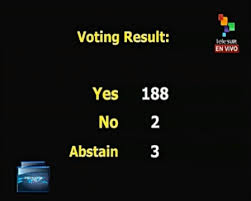
On October 28, 2014, the U.N. General Assembly by a vote of 188 to 2 again condemned the U.S. embargo of Cuba. The two negative votes were cast by the U.S. and by Israel while three small Pacific nations abstained–Marshall Islands, Micronesia and Palau. All the other U.N. members supported the resolution. [1]
The Resolution
The resolution [A/69/L.4] reiterated the General Assembly’s “call upon all States to refrain from promulgating and applying laws and measures of the kind referred to in the preamble to the present resolution [‘the economic, commercial and financial embargo imposed by the [U.S.] against Cuba’ and the Helms-Burton Act], in conformity with their obligations under the Charter of the United Nations and international law, which, inter alia, reaffirm the freedom of trade and navigation.”
The resolution also “again urges States that have and continue to apply such laws and measures [i.e., the U.S.] to take the steps necessary to repeal or invalidate them as soon as possible in accordance with their legal regime.”
Cuba’s Statement Supporting the Resolution
Bruno Rodriguez Parrilla
Bruno Rodríguez Parrilla, the Cuban Minister for Foreign Affairs, introducing the resolution, said that in recent times “the economic, commercial and financial blockade imposed by the [U.S.] against Cuba had been tightened, and its extraterritorial implementation had also been strengthened through the imposition of unprecedented fines, totaling $11 billion against 38 banks . . . for carrying out transactions with Cuba and other countries.” In addition, Cuba’s “accumulated economic damages of the blockade totaled $1.1 trillion . . . [and] human damages were on the rise.”
Nevertheless, “Cuba had offered every possible form of assistance to the [U.S.] in the wake of disasters there, such as in the aftermath of the September 11, 2001 terrorist attacks. Cuba had never been a threat to the national security of the [U.S.]. Opinion polls showed that there was increasing support from all sectors of [U.S.] society for lifting the blockade. Religious leaders had citied legitimate, indisputable ethical and humanitarian reasons.“
In addition, ”the blockade was harmful to . . . the [U.S.]. The ‘absurd and ridiculous’ inclusion of Cuba on the [U.S.] list of States that sponsored international terrorism redounded to the discredit of the [U.S.]. Cuba would never renounce its sovereignty or the path chosen by its people to build a more just, efficient, prosperous and sustainable socialism.” Neither, he continued, would his Government “give up its quest for a different international order, nor cease in its struggle for ‘the equilibrium of the world.’”
Rodríguez also invited the U.S. government “to establish a mutually respectful relation, based on reciprocity. We can live and deal with each other in a civilized way, despite our differences.”
Other Countries’ Statements Supporting the Resolution [2]
The following Latin American countries voiced support for the resolution: Argentina (MERCOSUR [3]) (embargo was “morally unjustifiable” and violated “the spirit of multilateralism and was immoral, unjust and illegal”); Barbados (CARICOM [4]); Bolivia (Group of 77 [5] and China); Brazil (Group of 77 and CELAC [6]); Colombia; Costa Rica (CELAC)); Ecuador; El Salvador (Group of 77 and CARICOM); Mexico; Nicaragua; St. Vincent and the Grenadines (CARICOM, Non-Aligned Movement, [7] Group of 77 and CELAC); Uruguay; and Venezuela.
The African supporters of the resolution that spoke were Algeria (Non-Aligned Movement, Group of 77, Group of African States [8] and Organization of Islamic Cooperation [9]); Angola; Kenya (Group of 77, Non-Aligned Movement and African Group); Malawi (African Group); South Africa (Group of 77, Non-Aligned Movement and African Group); Sudan (Group of 77, Non-Aligned Movement and Organization of Islamic Cooperation); United Republic of Tanzania; Zambia (Non-Aligned Movement) and Zimbabwe (Non-Aligned Movement, Group of 77 and African Group).
From Asia and the Pacific were Belarus; China (Group of 77); Democratic People’s Republic of Korea (North Korea); Indonesia (Group of 77); India (Group of 77 and Non-Aligned Movement); Iran (Non-Aligned Movement); Lao People’s Democratic Republic; Myanmar (Group of 77 and Non-Aligned Movement); Russian Federation; Solomon Islands; and Viet Nam (Non-Aligned Movement, Group of 77 and China).
Middle Eastern countries speaking in favor of the resolution were Egypt, Saudi Arabia (Organization of Islamic Cooperation); and Syria (Non-Aligned Movement, Group of 77 and China).
The sole European supporter of the resolution that spoke at the session was Italy (European Union [10]), which said the U.S.’ “extraterritorial legislation and unilateral administrative and judicial measures were negatively affecting European Union interests”).
U.S. Statement Opposing the Resolution
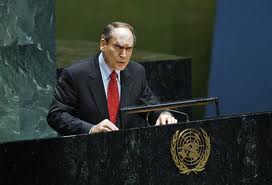
Although Israel voted against the resolution, it chose not to speak in support of its vote. Only the U.S. by Ambassador Ronald D. Godard, U.S. Senior Advisor for Western Hemisphere Affairs, tried to justify the negative vote.
Ronald D. Godard
Ambassador Godard said the U.S. “conducts its economic relationships with other countries in accordance with its national interests and its principles. Our sanctions toward Cuba are part of our overall effort to help the Cuban people freely exercise their human rights and fundamental freedoms, and determine their own future, consistent with the Universal Declaration of Human Rights and the democratic principles to which the United Nations itself is committed.”
Ambassador Godard also said, “the Cuban government uses this annual resolution in an attempt to shift blame for the island’s economic problems away from its own policy failures. The Cuban government now publicly recognizes that its economic woes are caused by the economic policies it has pursued for the last, past half-century. We note and welcome recent changes that reflect this acknowledgement, such as those that allow greater self-employment and liberalization of the real estate market. But the Cuban economy will not thrive until the Cuban government permits a free and fair labor market, fully empowers Cuban independent entrepreneurs, respects intellectual property rights, allows unfettered access to information via the Internet, opens its state monopolies to private competition and adopts the sound macro-economic policies that have contributed to the success of Cuba’s neighbors in Latin America.”
According to Ambassador Godard, the U.S. “remains a deep and abiding friend of the Cuban people. The Cuban people continue to receive as much as $2 billion per year in remittances and other private contributions from the [U.S.]. This support . . . was made possible . . . by U.S. policy choices. By the Cuban government’s own account, the [U.S.] is one of Cuba’s principal trading partners. In 2013, the [U.S.] exported approximately $359 million in agricultural products, medical devices, medicine and humanitarian items to Cuba. Far from restricting aid to the Cuban people, we are proud that the people of the [U.S.] and its companies are among the leading providers of humanitarian assistance to Cuba. All of this trade and assistance is conducted in conformity with our sanctions program, which is carefully calibrated to allow and encourage the provision of support to the Cuban people.”
Furthermore, the U.S. “places the highest priority on building and strengthening connections between the Cuban people and [our] people. U.S. travel, remittance, information exchange, humanitarian and people-to-people policies updated in 2009 and 2011 provide the Cuban people alternative sources of information, help them take advantage of limited opportunities for self-employment and private property and strengthen independent civil society. The hundreds of thousands of Americans who have sent remittances and traveled to the island, under categories of purposeful travel promoted by President Obama, remain the best ambassadors for our democratic ideals.”
Ambassador Godard continued, “[The U.S.] strongly supports the Cuban people’s desire to determine their own future, through the free flow of information to, from, and within Cuba. The right to receive and impart information and ideas through any media is set forth in Article 19 of the Universal Declaration of Human Rights. It is the Cuban government’s policies that continue to prevent enjoyment of this right. The Cuban government now claims to share our goal of helping the Cuban people access the Internet. Yet the Cuban government has failed to offer widespread access to the Internet through its high-speed cable with Venezuela. Instead, it continues to impose barriers to information for the Cuban people while disingenuously blaming U.S. policy.”
“Moreover, the Cuban government continues to detain Alan Gross, a U.S. citizen who was sentenced to 15 years in prison for facilitating Internet access for Cuba’s small Jewish community. [[11]] The [U.S.] calls on Cuba to release Mr. Gross immediately, [[12]] allow unrestricted access to the Internet, and tear down the digital wall of censorship it has erected around the Cuban people. {T]his resolution only serves to distract from the real problems facing the Cuban people. . . . Though Cuba’s contributions to the fight against Ebola are laudable, they do not excuse or diminish the regime’s treatment of its own people. We encourage this world body to support the desires of the Cuban people to choose their own future. By doing so, it would truly advance the principles the United Nations Charter was founded upon, and the purposes for which the United Nations was created.”
Media Coverage of the Resolution and Debate
U.S. media coverage of this important U.N. vote was almost non-existent. It was not mentioned in the “World” or “Americas” news sections of the New York Times, and only its “Opinion” section had a short article about the issue. It got no mention whatsoever in the Wall Street Journal. Not even the Miami Herald, which has a separate page for Cuba news, mentioned it. [13]
At 2:37 p.m. on October 28th the Associated Press published a release on the subject, and the Washington Post published it online while the StarTribune of Minneapolis/St. Paul picked it up the next day in its online, but not its print, edition.
Cuba’s state-owned newspaper,Granma, of course, headlined this vote while stating that the embargo has caused $1.1 trillion of damage to the Cuban economy and “incalculable human suffering.” Its article also emphasized that this was the 23rd consecutive such resolution with a table showing that the number of votes in favor of the resolutions has increased from 59 in 1992 to 188 in 2012-2014, that the largest number of votes against the resolutions was only 4 in 1993 and 2004-2007 and that the number of abstentions has decreased from 71 in 1992 to 1 in 2005-2007 and now 3 since 2010.
Conclusion
This overwhelming international opposition to the U.S. embargo in and of itself should be enough to cause the U.S. to end the embargo. Moreover, the embargo has not forced Cuba to come begging to the U.S. for anything that the U.S. wants. The U.S. policy is a failure. The New York Timesrecently called for abandonment of this policy as has this blog in urging reconciliation of the two countries, in an open letter to President Obama and in a rebuttal of the President’s asserted rationale for the embargo and other anti-Cuban policies.
[2] Many of the cited statements supporting the resolution were issued on behalf of, or aligned with, larger groups of nations as noted above. In addition, prior to the October 28th session of the General Assembly, the U.N. Secretary General submitted a report containing statements against the embargo from 154 states and 27 U.N. agencies.
[3]MERCOSUR (Southern Common Market) is a customs union and trading bloc of five South American countries with five other associate members in the continent.
[4]CARICOM (Caribbean Community) is a group of 15 Caribbean countries with five associate members for economic cooperation.
[5] The Group of 77 was established in 1964 by 77 developing countries to promote their collective economic interests and South-South cooperation; now there are 134 members that have retained the original name for historical significance.
[6]CELAC (Community of Latin American and Caribbean States) is a group of 33 states in the region to deepen economic integration and combat the influence of the U.S.
[7] The Non-Aligned Movement is a group of 115 developing countries that are not aligned with or against any major power bloc. Its current focus is advocacy of solutions to global economic and other problems
[8] The African Group is a group of 54 African states that are U.N. Members.
[9] The Organization of Islamic Cooperation is a group of 57 states that seek to protect the interests of the Muslim world in the spirit of promoting peace and harmony in the world.
[10] The European Union is a group of 28 European states that have combined for a peaceful, united and prosperous Europe.
[11] The activities in Cuba by Mr. Gross are not so simple. A Cuban court in 2011 found him guilty of participating in a “subversive project of the U.S. government that aimed to destroy the revolution through the use of communications systems out of the control of authorities,” and sentenced him to 15 years in prison. According to his own lawsuit against the U.S. Government, and subsequent disclosures, Gross alleged the U.S. Agency for International Development (USAID) and its contractor, DAI, sent him on five semi-covert trips to Cuba without proper training, protection or even a clear sense of the Cuban laws that led to his detainment. The case highlighted the frequent haste and lack of attention to the risks of the USAID programs in Cuba under the Helms-Burton Act, which allowed for money to be set aside for “democracy building efforts” that might hasten the fall of Fidel and Raúl Castro.
[12] In discussions with the U.S., Cuba already has expressed a willingness to exchange Mr. Gross for one or more of the three of “the Cuban Five” who remain in U.S. prisons.
[13] Nor did I find any mention of the vote in London’s Guardian or Madrid’s El Pais.
On March 24, 1980, Oscar Romero, the Archbishop of San Salvador, was assassinated while saying mass at a chapel in that city because of his preaching the Gospel and denouncing the Salvadoran regime’s violations of the human rights of his people.
I have been hoping that the Roman Catholic Church officially would recognize him as a saint, something many people in El Salvador and around the world, including this Protestant Christian, already have done unofficially. [1]
Now over 34 years later, on August 18, 2014, Pope Francis said that Romero’s beatification (one of the Church’s preconditions for sainthood) [2] should happen swiftly. That was the conclusion drawn by many from the Pope’s answer to a journalist’s question at an informal press conference on the papal plane’s return flight to Rome after the papal visit to South Korea.[3] Here is that answer in the Vatican’s official English translation:
Pope Francis & Journalists, August 18, 2014 (Photo–Daniel Dal Zennaro/European Pressphoto Agency)
“The process [for the beatification of Romero] was at the Congregation for the Doctrine of the Faith, blocked “for prudential reasons”, so they said. Now it is unblocked. It has been passed to the Congregation for Saints. And it is following the usual procedure for such processes. It depends on how the postulators move it forward. This is very important, to do it quickly.”
“What I would like is a clarification about martyrdom in odium fidei, whether it can occur either for having confessed the Creed or for having done the works which Jesus commands with regard to one’s neighbour. And this is a task for the theologians. They are studying it. Because after him [Romero] there is Rutilio Grande [[4]] and there are others too; there are others who were killed, but none as prominent as Romero. You have to make this distinction theologically.”
“For me Romero is a man of God, but the process has to be followed, and the Lord too has to give His sign… If He wants to do it, He will do it. But right now the postulators have to move forward because there are no obstacles.”
Analyzing this statement first requires an examination of the Roman Catholic Church’s structure and procedures regarding beatification and of the history of the “cause” for such status for Romero.
First, Pope Francis’s recent statement implicitly says that he does not have the authority to make the beatification decision himself. Instead, under the Church’s Apostolic Constitution (Pastor Bonus or Good Pastor) two parts of the Roman Curia (the Congregation for the Cause of Saints (CCS) and the Congregation for the Doctrine of the Faith (CDF)) have to make certain decisions before a recommendation for beatification comes to the Pope for approval or disapproval. [5]
Before the CCS enters the picture, however, a candidate for beatification must be recommended for that honor by the bishop of the diocese where the individual died after a thorough investigation (initiated only after at least five years after the individual’s death) establishing his or her theological virtues (faith, hope and charity) and cardinal virtues (prudence, justice, temperance and fortitude) and the performance of a “miracle” (an event that can be witnessed by the senses but is in apparent contradiction to the laws of nature). If the candidate is a martyr, however, a miracle is not required for beatification, but is for sainthood. (Emphasis added.)
The bishop’s conclusion and documentation then is submitted to the CCS, which has 34 members (cardinals, archbishops and bishops), one promotor of the faith (prelate theologian), five relators, 83 consultants and a staff of 23; it is headed by Prefect Cardinal Angelo Amato. The CCS is charged with conducting a rigorous examination into the life and writings of an individual to determine if he or she demonstrates a heroic level of virtue or suffered martyrdom. A CCS member is appointed Postulator by the CCS to oversee all aspects of the cause at the congregational level. With the assistance of a member of the congregational staff (a Relator), the Postulator prepares the “Positio” or summary of the documentation relating to the merits of the individual’s cause. The “Positio” is then subjected to an examination by nine theologians, and if a majority of them view the “Positio” positively, it then goes to examination by cardinals and bishops who are members of the CCS. If the latter group is favorable to the cause, the head or “Prefect” of the CCS presents the entire cause to the Pope. If the Pope then approves the cause, he authorizes the CCS to draft an appropriate decree, which eventually is read and promulgated.
Apparently during this process the CCS may submit certain issues to the CDF, which has 23 members (cardinals, archbishops and bishops), 28 consultants and a staff of 47; the CDF is headed by Prefect Cardinal Gerhard Ludwig Müller. Under the previously mentioned Apostolic Constitution the CDF is charged “to protect and safeguard the doctrine on faith and morals . . . in things that touch this matter in any way” (Art. 48) and to help “the bishops, individually or in groups, in carrying out their office as authentic teachers and doctors of the faith, [including] the duty of promoting and guarding the integrity of that faith” (Art. 50). I assume this must have happened because the Pope stated that the CDF had blocked the beatification process for lack of proof of Romero’s ‘”prudence,” one of the required cardinal virtues for such status.
Second, the history of the process for Romero’s beatification[6] sheds light on Pope Francis’ recent remarks:
The process was started in 1993 with the Archbishop of San Salvador’s announcement of his intent to proceed and with the CCS’ permission to proceed. By November 1996 the archdiocesan investigation of the cause was complete when the Archbishop approved the investigation’s findings and sent documentation to the CCS, and by 1998 all the necessary records had been submitted to the Congregation.
In 2000, pursuant to an objection by Colombian Cardinal Alfonso Lopez Trujillo, who expressed concerns about Romero’s association with Liberation Theology, Romero’s cause was investigated by the . . . CDF,” then headed by Cardinal Joseph Ratzinger, who later was elected Pope Benedict XVI. Between 2000 and 2005, the CDF studied the writings, sermons, and speeches of Archbishop Romero to ensure that they were free from doctrinal error. In 2001, Bishop Vincenzio Paglia, the initial Postulator of Romero’s cause, held a special congress in Italy, bringing together experts and theologians to try to determine if Archbishop Romero’s actions and written and spoken words were within the authorized teaching of the Church. Eventually the CDF concluded that “Romero was not a revolutionary bishop, but a man of the Church, the Gospel and the poor.”
Subsequently the cause was again referred to the CDF apparently on complaint by certain Latin American cardinals who demanded a study of Romero’s concrete pastoral actions. Thereafter the cause apparently was neglected and stalled.
Shortly after the inauguration of Pope Francis in March 2013, Postulator Paglia publicly reported that the Pope in a private audience on April 20, 2013, told him that the Pope was authorizing the beatification process to proceed. Paglia said that the process had been “unblocked.”
The Pope’s recent comment that at some point the CDF had concluded that Romero lacked “prudence” has been interpreted as concern that Romero had Marxist ideas. Another commentator stated, the CDF “had questioned whether the Salvadoran prelate qualified as a martyr, since his assassins clearly had political motives. Was the archbishop killed because of his faith, or because of his political involvements? And were his political activities entirely inspired by his faith? Those were the questions that complicated the cause.”
Third, the Pope said the blocking of the process by the CDF had been removed and there were now no doctrinal problems, but it is not totally clear when, why and how that happened. Apparently, as just stated, it was a decision by Pope Francis himself in April 2013, but details are lacking.
Fourth, the Pope said that he wanted clarification on whether martyrdom in ‘odium fidei’ (out of hate for the faith) is for confessing the [Roman Catholic] credo or for performing the works that Jesus commands us to do for our neighbors and that theologians were now studying this issue. It, however, was unclear as to whether this was being done by the CDF or the CCS. In either event, another commentator said that official martyrdom traditionally has been limited to those who were killed as persecution for their Catholicism. Indeed, this is the traditional test known as ‘odium fidei’ (out of hate for the Catholic faith) while death for the cause of Christian justice—sometimes called “odium iustitiae”— is currently a subsidiary test and potentially could be established as an alternative formula to prove martyrdom.
Fifth, the Pope’s recent comments made it very apparent that he supported Romero’s beatification. He called Romero “a man of God” and said that it was “very important, [for the postulators] to do it [their work] quickly.” I also thought the Pope impliedly endorsed the idea that martyrdom includes performing “the works which Jesus commands with regard to one’s neighbour“ (“odium iustitiae”), which is exactly what Romero was doing and why he was assassinated.
For example, Julian Filochowski, chairman of the Archbishop Romero Trust, said the Pope’s recent comment was “reaffirming in public what he’s said in private: that he hopes this process for the beatification of Romero will be dealt with and come to a speedy conclusion.” Filochowski also said, “Archbishop Romero was never the leftist some supposed him to be. His theology was essentially the theology of the Beatitudes [the teachings that begin with ‘blessed are the poor in spirit.’]”
Indeed, during his brief time as Pope, Francis has repeatedly discussed Romero and his beatification with visitors. Just after his inauguration, he “received several guests who took up Romero with the new pope, including the Anglican archbishop of York, who handed Pope Francis a “Romero Cross.” Francis met twice with the Argentine Nobel Peace laureate Adolfo Pérez Esquivel, and they discussed Romero and the desirability of a positive result in his canonization process. “[That] same topic . . . took center stage in . . . meetings with then Salvadoran president Mauricio Funes, with his successor Salvador Sánchez Cerén, . . . with the President of the Central American Parliament, who Francis assured that the canonization is ‘on the right path’” and when this May the Pope met with a delegation of Salvadoran bishops. Moreover, Romero’s message seems to fit the themes of Francis’ papacy, especially the emphasis on the poor from a son of the Latin American church.[7]
Sixth, Francis’ comment that “Romero is a man of God” should be particularly well-received in San Salvador, where the Church has just launched a “Romero Triennium”—a three year program of commemorations leading to the 100th anniversary of Romero’s birth in 2017. The theme for the first year is “Romero, Man of God.” Some suggest that the year 2017 would be a very opportune time for Pope Francis to go to El Salvador and proclaim Romero as “Santo Romero.”
Indeed, many in El Salvador were jubilant over the Pope’s statement. Said President Salvador Sanchez Ceren,”We are confident that in this land where Monsignor Romero lived, a determination of his martyrdom will receive his blessings.” The Minister of Foreign Affairs of El Salvador, Hugo Martínez, added, “We are delighted by the interest and determination of His Holiness, Pope Francisco, to advance the process of beatification of Archbishop Romero our spiritual leader.”[8]
[1] I have written many posts about Romero, some of which have concerned the beatification process.
[2] Beatification is part of the Roman Catholic Church’s process towards sainthood. It recognizes the person as someone who has lived a faithful or holy life. After beatification they are known as ‘blessed’ and can be venerated by Catholics but, unlike canonization, it is not required. Upon a grant of beatification status, a separate process for canonization commences.
[4]Rutilio Grande was a Salvadoran priest and a friend of Romero who was murdered in 1978 for his vocal advocacy and actions to support the interests of the poor people of his country. In May 2013 Pope Francis reportedly told Salvadoran President Funes that Grande also should be beatified.
[5] This account of the two congregations is based upon the English language summary by the U.S. Conference of Catholic Bishops. Amplification and correction, especially on this account, from others more knowledgeable on this subject would be greatly appreciated.
[7] Before becoming Pope, Sr. Jorge Mario Bergoglio as Archbishop of Buenos Aires and as Cardinal made statements and attended events honoring Romero. In addition, Francis’ two papal predecessors have made similar comments. Saint John Paul II discussed Archbishop Romero in seven different public speeches/audiences. The most famous of these was a 1983 mass in San Salvador where he called Romero a “zealous pastor, whom love of God and service of brethren drove to surrender his life in a violent manner.” Saint Benedict XVI spoke about Romero during three different public events, including an in-flight press conference after a 2007 trip to Brazil, during which he said, “That Romero as a person merits beatification, I have no doubt … Archbishop Romero was certainly an important witness of the faith, a man of great Christian virtue who worked for peace and against the dictatorship, and was assassinated while celebrating Mass. Consequently, his death was truly ‘credible’, a witness of faith.”
An Argentine court has invoked universal jurisdiction over a case brought by relatives of people who were victims of torture and other crimes committed in Spain during the Spanish Civil War (1933-1939) and the Franco regime (1939-1975).[1]
In September 2013 the Argentine court issued an international warrant for the arrest of four suspects in that case. Two of them are residents of Spain; the other two are deceased.[2]
Spain’s High Court’s Denial of Extradition
One of these suspects who lives in Spain, Jesús Muñecas, earlier this month appeared in Spain’s High Court to contest the Argentine court’s request to have him extradited to Argentina to face charges that while a Spanish Civil Guard captain in August 1968, he tortured and beat an individual at a Spanish prison. Muñecas’ opposition to extradition was supported by the Spanish prosecutor on the ground that the statute of limitations had expired on these charges.
On or about April 25th Spain’s High Court denied the extradition request. It said the Argentine charges did not reveal any facts that could be construed as genocide – a crime without a statute of limitations – and that even if torture were proven, Spain’s 10-year statute of limitations for torture had expired and, therefore, barred the case.
Spain’s High Court’s Invitation to Argentina To Start a Case in Spain
In denying extradition of Senor Muñecas, the High Court added that Argentina could try to get the case opened in Spain. According to the High Court, “This would give the victims the possibility to access proceedings and, in some way, satisfy their desire for justice.”
This invitation is utterly disingenuous and ironical as shown below.
Baltasar Garzón
Previously Spain’s High Court had opened a criminal investigation of certain crimes committed during the Spanish Civil War and Franco regime, but the investigation was quashed in May 2010. Simultaneously the judge who initiated that investigation, former High Court Judge Baltasar Garzón, was charged with a crime for doing so and suspended from his judicial service.
In February 2012, this criminal case against Garzón was dismissed when Spain’s Supreme Court decided that he had not abused his judicial power in initiating the investigation even though, according to the Court, he had overstepped his authority and “exceeded himself in the interpretation of the law” in doing so.
In the meantime, however, two other criminal cases were brought against Garzón.
One of these prosecutions resulted in his February 2012 conviction for prevarication (knowingly making an unjust decision) in a case involving his authorization of police bugging of communications between individuals charged with corruption and their attorneys. For this conviction, Judge Garzón was removed from the bench for 11 years and fined Euros 2,500.[3]
These three criminal cases against Garzón and his conviction in one of them have been widely condemned as motivated by the Spanish government’s desire to punish him for his Franco-era investigation as discussed in posts of February 10, 11 and 14, 2012.
One of the criticisms of his conviction came from the European Magistrates for Democracy and Freedom (EMDF), an organization with 15,000 members from 11 states of the European Union. They petitioned the Spanish courts for a pardon of Garzón because the organization believes his conviction and sentence affects the entire international judicial community and runs the risk of limiting judicial independence, especially in countries trying to construct a democratic system of justice. Judges must have the freedom to render their own legal interpretations, said this organization, and the Garzón case could be used to curb judges’ independence and autonomy.
In late February 2014, Spain’s Supreme Court opposed the EMDF’s petition for such a pardon on the ground that it did not satisfy certain legal criteria. The court also said it was inappropriate to reinstate Garzón as he maintains that he was within his rights to order the recordings of the attorney-client communications. Said the court, “In the request there is no indication that he has expressed remorse, and this court is not aware of his having done so.” Moreover, according to the court, Garzón had displayed “indifference” to his suspension “as a way of reaffirming his position prior to the sentence.”
Now Spain’s Ministry of Justice will make the final decision on the request for pardon. As of April 27th, the prosecution apparently had advised the Ministry that there were no reasons of justice, fairness or public interest to grant such a pardon.
Meanwhile in reaction to the Supreme Court decision opposing his pardon, Garzón said it was “not legal” for the Court to demand he show remorse. “This is not a legal requisite,” he said. Nor, he added, does the fact that it was EMDF that had requested the pardon reflect his “indifference.” Garzón reasserted his innocence and said, “I believe that this offense was created with the express purpose of punishing me, and that I am within my rights to disagree and to resort to another court, as I have done in Strasbourg [the European Court of Human Rights], in order to evaluate whether the Supreme Court has violated my fundamental rights.”[4]
Finally Spain High Court’s invitation for Argentina to start a case in Spain is ironic. Argentina decided to exercise universal jurisdiction over crimes committed during Spain’s Civil War and the Franco regime only after Spain quashed its own investigation of such crimes, the one initiated by Garzón.
[2] The other living suspect and Spanish resident, Juan Antonio González Pacheco, alias Billy the Kid, also is opposing his extradition to Argentina. He is a former police inspector who faces 13 charges of torture.
[3] The other criminal case against Judge Garzón involving alleged corruption was dismissed as being barred by the statute of limitations.
[4] In March 2011 Garzon brought a case before the European Court of Human Rights challenging the legality of his criminal prosecution, conviction and sentence on his approving the prosecution’s bugging of communications between certain criminal defendants and their lawyers. This case apparently is still pending.
A prior post discussed the March 22, 2013, resolution by the General Assembly of the Organization of American States (OAS) that strengthened the Inter-American Human Rights System, especially the Inter-American Commission on Human Rights (“Commission”).
In so doing, the OAS rejected efforts to weaken the Commission under the guise of reform proposals that had been offered by Ecuador and other states that the Commission has criticized (Venezuela, Bolivia and Nicaragua).
We now examine the background to that surreptitious effort to weaken that System and the debate at the March 22nd General Assembly meeting
Background
1. Multilateral Treaties and Other Instruments Regarding the Right of Free Expression.
The right of free expression by the media and others is well established in international law.
The United Nation’s General Assembly’s Universal Declaration of Human Rights of 1948 in Article 19 states, “Everyone has the right to freedom of opinion and expression; this right includes freedom to hold opinions without interference and to seek, receive and impart information and ideas through any media and regardless of frontiers.” In 1966 this was put into legally enforceable form in Article 19 of the International Covenant on Civil and Political Rights, which entered into force in 1976.
To like effect is the American Convention on Human Rights, which was adopted by the OAS in 1969 and which entered into force in 1978. Its Article 13(1) says, “Everyone has the right to freedom of thought and expression . . . [including the] freedom to seek, receive, and impart information and ideas of all kinds, regardless of frontiers, either orally, in writing, in print, in the form of art, or through any other medium of one’s choice.” Article 13(3) goes on to say, “The right of expression may not be restricted by indirect methods or means, such as the abuse of government or private controls over newsprint, radio broadcasting frequencies, or equipment used in the dissemination of information, or by any other means tending to impede the communication and circulation of ideas and opinions.”
Ecuador under the presidency of Rafael Correa since January 2007 has through policies and actions retaliated against journalists and media that have criticized him and his government. Correa has insulted and filed lawsuits against reporters and news outlets and promoted a series of legal measures to roll back press freedoms. His government has expropriated television channels, radio stations, newspapers and magazines.
Journalists in the country also have been subjected to physical threats and assaults with lackluster efforts by the government to investigate and prosecute those responsible.
3. The Commission and Civil Society’s Criticism of Ecuador’s Hostility to Freedom of Expression.
The Commission in 1997 created the Special Rapporteur for Freedom of Expression “to encourage the defense of the right to freedom of thought and expression in the hemisphere, given the fundamental role this right plays in consolidating and developing the democratic system and in protecting, guaranteeing, and promoting other human rights.”
This Rapporteur has been in the forefront of criticizing Ecuador for these actions against journalists and the media. Since January 1, 2009 it has issued nine press releases expressing its concern over specific criminal prosecutions and imprisonments of journalists for libel for publication of articles about corruption of public officials and for specific physical threats and assaults on journalists.
In addition, since 2006 the annual reports of the Rapporteur have had sections specifically addressing Ecuador’s conduct in this area.
For example, the latest such report (for 2011) devotes 31 pages (78-108) for a detailed, footnoted review of Ecuador’s assaults and attacks on media and journalists; legal proceedings and arrests (the “Rapporteur is concerned about the consistent tendency of high-ranking public officials to rebuke, arrest, and prosecute citizens who criticize them at public events”); presidential broadcasts and government interruptions of news programs; disparaging statements by senior state authorities against media outlets and reporters critical of the government; constitutional amendment and legislative proposals to regulate the content of all media, establish the grounds for liability and the applicable sanctions and serve as an authority on enforcement; and cloture and regulation of communications media.
Such actions also have subjected the country to similar criticism by the U.N. Human Rights Council in its Universal Periodic Review of Ecuador in the summer of 2012. One of the Council’s closing recommendations in that Review was for Ecuador to reform its legislation regarding freedom of expression with a view to bringing it in conformity with international standards and those of the Inter-American Commission on Human Rights. In response Ecuador said that it could not agree to reform its legal framework in accordance with standards from the Commission, when it is the Inter-American Court of Human Rights, not the Commission, which has judicial competency over this matter. Nor could Ecuador, it said, eliminate laws that criminalize opinion since it had no such laws.
In addition, Ecuador has been severely chastised by the Committee to Protect Journalists, which put the country on its Risk List of the 10 countries in the world where press freedom suffered the most in 2012. Similar rebukes have come from Human Rights Watch, Freedom House and the Washington Post Editorial Board.
4. Ecuador’s Campaign for Its Proposed “Reforms” of the Commission.
In response to the Special Rapporteur’s persistent and documented criticism of Ecuador, the country developed a set of proposals to “reform” the Commission. Prominent in this package were reduction in funding (and hence the work) of the Special Rapporteur and elimination of his separate annual report.
Ricardo Patino
In early 2013 Ecuador conducted a lobbying campaign in support of these proposals. Its Foreign Minister, Ricardo Patino, went on a tour of Mexico, Chile, Argentina, Brazil, Colombia, Dominican Republic, Haiti and Venezuela to promote them. He also advocated them at a meeting of the Political Council of the Bolivarian Alliance for the Peoples of Our Americas (ALBA) [1] and at a March 11th meeting in Guayaquil, Ecuador of the 24 states that were parties to the American Convention on Human Rights.[2]
The latter event was opened by a long speech by Ecuadorian President Correa, who emphasized that the Commission should have its headquarters in a state that has ratified said Convention (not Washington, D.C.); that the Commission should have its own budget provided only by state parties to the Convention (without voluntary contributions by outsiders like the U.S., Canadian and European governments and NGO’s); that the Commission should not be “autonomous” and instead be controlled by said states parties; the abolition of the Commission’s rules authorizing its issuance of precautionary measures; having the Commission focus on general promotion of human rights, not investigating and deciding on alleged violations of human rights; and elimination of the separate annual report of the Special Rapporteur for Free Expression and instead including such a report in a comprehensive report for all of the rapporteurships.
The Ecuador meeting resulted in the Declaration of Guayaquil whereby the 24 states parties agreed that at the March 22nd meeting of the OAS General Assembly they would support the following: a group of their foreign ministers would press the U.S., Canada and other non-parties to the Convention to ratify or accede to same; the Commission would be refocused on promotion of human rights through national systems; financing of the Commission would be increased by states parties and by “neutral” others; all rapporteurships would be treated equally; an analysis of the costs of the OAS Human Rights System would be obtained; the Commission’s headquarters would be moved to a state party; and annual conferences about reforming the System would be held.
Opposition to such proposals came forward from the U.N. High Commissioner for Human Rights, Navi Pillay, who urged the OAS members “to strengthen its exemplary human rights system, by promoting universal access for citizens . . ., respecting the Commission’s autonomy to progressively improve its policy and practices in response to the needs of victims and concerns of member states, and providing the necessary resources [to the System].” Similar concerns were voiced by Amnesty International, Human Rights Watch, the Committee to Protect Journalists, Freedom House, a group of 98 prominent Latin Americans and a coalition of 700 hemispheric human rights organizations.
Another opponent of Ecuador’s campaign was Cesar Gaviria Trujillo, a former president of Colombia and past secretary general of the OAS. He said that the so called “reforms” of the Commission put forward by Ecuador would “severely weaken the [C]omission and make it easier for governments to ignore basic rights and limit free speech.” They would “drastically curtail [the Commission’s] autonomy” and put a “financial stranglehold” on its operations, including a “devastating impact” on the Special Rapporteur for Freedom of Expression. [3]
The March 22nd OAS General Assembly Meeting
Jose Miguel Insulza, OAS Secretary General
In opening remarks that day, the OAS Secretary General, Jose Miguel Insulza from Chile, stressed that the autonomy of the System needed to be maintained. He also said that strengthening some of the Commission’s rapporteurships “cannot mean that others are weakened” and that the Special Rapporteurship on Freedom of Expression should be strengthened “with a program of ample defense of [such] freedom . . . . ” This would include “issues relating to the curtailment of that freedom by public authorities . . . as well as the threats and crimes to which journalists and the social media are increasingly subjected in our region and the obligation of states to protect them.”
William J. Burns, U.S. Deputy Secretary of State
Similar remarks were made by U.S. Deputy Secretary of State, William J. Burns. He noted that even though the U.S. was not a party to the American Convention on Human Rights, the U.S. still collaborates with the Commission when it challenges the U.S. on such issues as the death penalty, the human rights of migrants and children and the status of detainees at Guantanamo Bay, Cuba. He added, “We must be vigilant against efforts to weaken the Commission under the guise of reform. [Such efforts] . . . seek to undermine the Commission’s ability to hold governments accountable when they erode democratic checks and balances and concentrate power through illiberal manipulation of democratic processes.”
Ecuadorian Foreign Minister Patino in his remarks accused the opposition and the media of distorting his government’s proposals. He also accused the Commission of improperly assuming the power to issue precautionary measures. Its decisions were independent, he said, but the Commission was not autonomous. He rhetorically asked, the Commission is autonomous and independent of whom? Sotto voce, a Spanish journalist answered, “You,” causing laughter by those around the journalist.
The resolution adopted by acclamation at the midnight conclusion of the March 22nd meeting already has been discussed. It clearly did not adopt all of the items in Ecuador’s package.
This resolution emerged after a long day in which the U.S., Canada, Mexico, Colombia, Costa Rica, Panama and Chile lead the opposition to the proposals from Ecuador, Bolivia, Venezuela and Nicaragua. A Human Rights Watch observer said, “It was a resounding victory for the Commission, and a major defeat for the Venezuela-Ecuador bloc. It became evident that [the latter] . . . were totally isolated, without the support they were expecting from other countries.”
Towards the end of the meeting Ecuador and Bolivia threatened to withdraw from the Commission and leave the meeting. To avoid such a rupture, Argentina offered a face-saving amendment to the resolution about the OAS’ Permanent Council continuing the dialogue on the “core aspects for strengthening” the System, which Ecuador and the other ALBA countries ultimately accepted.
Conclusion
Afterwards Ecuador’s Foreign Minister tried to whitewash his country’s defeat by saying that the resolution accepted its proposal to continue the debate in the future. Before the next meeting of the OAS General Assembly in June 2014, the Foreign Minister said that there would be another meeting of the states parties to the American Convention like the one on March 11th in Guayaquil to discuss these issues. He also hinted at Ecuador’s possible withdrawal from the OAS Commission by saying there was an agreement being negotiated to create a Human Rights Commission of the Union of South American Nations (UNASUR).
Unless there are unexpected changes in regimes or policies in this Hemisphere over the next 14 months, I do not expect Ecuador and its allies will be successful at the June 2014 OAS meeting in gaining acceptance of its proposals to weaken the Inter-American Commission.[4] We will then see if this small group will leave that Commission and form its own, more limited, human rights system.
[1]ALBA is an alternative to the U.S.-sponsored Free Trade Area of the Americas. differing from the latter in that it advocates a socially-oriented trade block rather than one strictly based on the logic of deregulated profit maximization. The only members of ALBA are Ecuador, Bolivia, Venezuela, Nicaragua and three small Caribbean states (Antigua and Barbuda, Dominica and Saint Vincent and the Grenadines.
[2] This campaign is discussed in press releases from Ecuador’s Foreign Minister.
[3] Such a limitation on financing undoubtedly would result in a reduction of such funding and thus on the work of the Commission.
[4] I assume that Ecuador has another burden to overcome in attempting to win support for its “reform” proposals. Its credibility within the OAS, I suspect, has been adversely affected by its recent exaggerated, alarmist call for an OAS Consultative Meeting of Foreign Ministers over the alleged United Kingdom threat to invade Ecuador’s London Embassy because of its providing diplomatic asylum in that Embassy to Julian Assange.
From her home in Havana, Cuba, Yoani Sanchez has been courageously blogging her critical comments on many aspects of life in her country as noted in a prior post.
In January 2013, under Cuban’s new law granting Cubans increased ability to obtain passports, she received her Cuban passport. She was overjoyed by this development after she had been denied a passport 20 times over the last five years.
Upon receiving the great news that she would obtain a passport, she bravely said in her blog:
She intends to “continue ‘pushing the limits’ of reform, to experience first hand how far the willingness to change really goes. To transcend national frontiers I will make no concessions. If the Yoani Sánchez that I am cannot travel, I am not going to metamorphose myself into someone else to do it. Nor, once abroad, will I disguise my opinions so they will let me ‘leave again’ or to please certain ears, nor will I take refuge in silence about that for which they can refuse to let me return. I will say what I think of my country and of the absence of freedoms we Cubans suffer. No passport will function as a gag for me, no trip as bait.”
“These particulars clarified, I am preparing the itinerary for my stay outside of Cuba. I hope to be able to participate in numerous events that will help me grow professionally and civically, to answer questions, to clarify details of the smear campaigns that have been launched against me… and in my absence. I will visit those places that once invited me, when the will of a few wouldn’t let me come; I will navigate the Internet like one obsessed, and once again climb mountains I haven’t seen for nearly ten years. But what I am most passionate about is that I am going to meet many of you, my readers. I have the first symptoms of this anxiety; the butterflies in my stomach provoked by the proximity of the unknown, and the waking up in the middle of the night asking myself, what will you look like, sound like? And me? Will I be as you imagine me?”
On February 17th she plans a worldwide tour visiting Latin American (Brazil, Argentina, Chile, Peru, Colombia and Mexico), North America (U.S. and Canada) and Europe (Italy, Czech Republic, Poland, Switzerland and Germany).
I pray that there will not be any last minute move by the Cuban government to block her leaving the island. I look forward to her comments on Cuba during her visits to these countries.
Yoani, congratulations and God Speed on your journey!