On October 19, the U.S. State Department’s Bureau of Democracy, Human Rights and Labor (DRL) announced another objectionable “democracy promotion” program in Cuba.[1]
The New DRL Program
This time it was a DRL request for persons to submit “program ideas to promote internationally-recognized, civil, political, and labor rights in Cuba as set forth in the Universal Declaration of Human Rights and other international instruments.” Such submissions shall be evaluated by DRL and some applicants will be selected to submit full proposal applications. The eventual successful applications are expected to have funding of $5.6 million.
The announcement stated that DRL does not fund programs to support Cuban government institutions. Instead, examples of typical funded programs include:
“Organizational assistance to Cuban civil society to improve management, strategic planning, sustainability, and collaboration of local civil society groups such as labor groups, civil and political rights groups, youth groups, and religious freedom advocates, and that encourage the participation of marginalized populations;
Capacity building on and off the island. Off-island activities sometimes include short-term fellowships;
Access to software that would be easily accessible in an open society, or the adaption of said software for the Cuban technological environment;
Assistance mechanisms designed to provide independent Cuban civil society with tools, opportunities, and trainings that civil society counterparts in open societies can access;
Incorporation of independent Cuban civil society into initiatives, fora, and coalitions led by their regional and global civil society counterparts; and
Increase access to uncensored information within the island.”
This program, says DRL, purportedly is justified by its allegation: “The Cuban government fails to respect the above universal rights, in particular the freedom of speech, by limiting independent journalists and media, censoring and limiting access to the internet, maintaining a monopoly on political power and media outlets, circumscribing academic freedom, and limiting religious freedom. The government refuses to recognize non-governmental human rights groups or permit them to function legally. The government continues to prevent workers from forming independent unions and dismisses or otherwise limits economic opportunities for workers who exercise any of their rights in contradiction of government policy. Common human rights abuses in Cuba include a lack of periodic and genuine elections-thereby denying citizens the right to participate in their government -selective prosecution and denial of fair trial, as well as the use of government threats, extrajudicial physical violence, intimidation, organized mobs, harassment, and detentions to prevent free expression and peaceful assembly. Authorities lack transparency and pervasively monitor private communications.”
Granma, the official newspaper of the Communist Party of Cuba, noticed this DRL public announcement and immediately condemned it as “subversive” and “containing all the usual ingredients of the typical aggressive and interventionist policies of the past.”
Moreover, Granma says, the DRL announcement was inconsistent with the recent “Presidential Policy Directive—United States-Cuba Normalization,” which was replicated in a prior post. That Directive said that so-called democracy promotion programs for Cuba would be “transparent.”
Granma also rejects the allegation that it does not respect human rights while asserting that the U.S. has many blemishes on its human rights record.
Conclusion
I share DRL’s belief in the importance of “internationally-recognized, civil, political, and labor rights . . . as set forth in the Universal Declaration of Human Rights and other international instruments.” I also share the DRL’s belief that Cuba has deficiencies in these rights while regretting U.S. inability to appreciate Cuba’s legitimate suspicion of such U.S. criticism as a cover for regime-change efforts by its larger and more powerful northern neighbor. I also concur in the Presidential Policy Directive’s statement that any and all U.S. democracy programs in Cuba should be “transparent.”
But DRL’s public announcement on the Internet of its solicitation of submissions of interest from U.S. or foreign NGO’s (non-governmental organizations) or universities in becoming contractors to conduct such programs does not constitute transparency. It does not because the DRL announcement does not say that such programs will be conducted with the knowledge and cooperation of the Cuban government. Indeed, DRL affirmatively states that it does not fund programs to support Cuban government institutions and previous DRL programs on the island were not conducted transparently. Instead they were conducted undercover or secretly.
A prior post criticized the Policy Directive’s failure to announce cessation of U.S. secretive “democracy promotion” programs and this blogger had hoped that there would be a subsequent announcement to that effect. Instead, we have this objectionable DRL request for proposals.
Such DRL programs, in this blogger’s opinion, are inherently self-contradictory. Promote democracy and human rights with anti-democratic programs that are secret and undercover and without the permission and cooperation of the country’s government? NO!
On May 26, a United Nations committee rejected, 10 to 6, an application for accreditation to attend U.N. meetings from the Committee to Protect Journalists (CPJ), an international, independent group that monitors attacks on journalists around the world and campaigns for the release of those who are jailed.[1]
The 10 negative votes came from Cuba along with Azerbaijan, Burundi, China, Nicaragua, Pakistan, Russia, South Africa, Sudan and Venezuela. The yes votes came from Greece, Guinea, Israel, Mauritania, the United States and Uruguay. The abstentions were by India, Iran and Turkey, the latter two having reputations for persecuting journalists.
At the committee meeting U.S. Ambassador Sarah Mendelson made a lengthy statement advocating accreditation for CPJ, which, she said, is “a reputable non-governmental organization that promotes press freedom worldwide and defends the right of journalists to report the news without fear of reprisal.” Such a group has shown that “a free press remains a critical foundation for prosperous, open, and secure societies, allowing citizens to access information and hold their governments accountable. Indeed, the Universal Declaration of Human Rights reiterates the fundamental principle that every person has the right ‘to seek, receive, and impart information and ideas through any media and regardless of frontiers.’”[2]
Afterwards the U.S. Ambassador to the U.N., Samantha Power, said, “It is increasingly clear that the NGO committee acts more and more like an anti-NGO committee.” She also said that the U.S. would appeal the committee’s decision to the full 54-member U.N. Economic and Social Council.
CPJ stated, “It is sad that the U.N., which has taken up the issue of press freedom through Security Council and General Assembly resolutions and through the adoption of the U.N. Action Plan, has denied accreditation to CPJ, which has deep and useful knowledge that could inform decision making. A small group of countries with poor press freedom records are using bureaucratic delaying tactics to sabotage and undermine any efforts that call their own abusive policies into high relief.”[3]
This April CPJ’s annual report ranked Cuba 10th on its list of the 10 Most Censored Countries. Key for this ranking was Cuba’s having “the most restricted climate for press freedom in the Americas. The print and broadcast media are wholly controlled by the one-party Communist state, which has been in power for more than half a century and, by law, must be ‘in accordance with the goals of the socialist society.'” In addition, CPJ stated, “The government continues to target critical journalists through harassment, surveillance, and short-term detentions.”[4]
Recent Cuban statements about its human rights often state or suggest that Cuba’s concept of international human rights is different and broader than the U.S.’s. According to Cuba, its includes economic, social and cultural rights while the U.S.‘s does not.
That is an incorrect assertion or belief.
Modern History of International Human Rights [1]
An examination of the modern history of this subject shows that the United States was the leading architect of what we now know as international human rights, including economic, social and cultural rights.
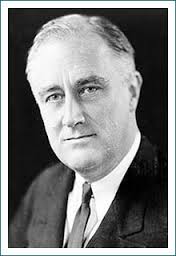
President Franklin D. Roosevelt
During World War II, U.S. President Franklin D. Roosevelt (FDR) on several occasions spoke about the world’s need for such rights. In his State of the Union Address (or the “Four Freedoms” Speech) to the Congress on January 6, 1941 (before U.S. entry in that war), he said one of these four freedoms was “freedom from want, which . . . means economic understandings which will secure to every nation a healthy peace time life for its inhabitants–everywhere in the world.”
Three years later, in his January 11, 1944, State of the Union Address, Roosevelt expanded this thought with these words:
“We have come to a clear realization of the fact that true individual freedom cannot exist without economic security and independence. ‘Necessitous men are not free men.’ People who are hungry and out of a job are the stuff of which dictators are made.”
“In our day these economic truths have become accepted as self-evident. We have accepted, so to speak, a second Bill of Rights under which a new basis of security and prosperity can be established for all—regardless of station, race or creed.” Among these rights are [he following:
“The right to a useful and remunerative job in the industries or shops or farms or mines of the Nation;”
“The right to earn enough to provide adequate food and clothing and recreation;”
“The right of every farmer to raise and sell his products at a return which will give him and his family a decent living;”
“The right of every businessman, large and small, to trade in an atmosphere of freedom from unfair competition and domination by monopolies at home or abroad;”
“The right of every family to a decent home;”
“The right to adequate medical care and the opportunity to achieve and enjoy good health;”
The right to adequate protection from the economic fears of old age, sickness, accident, and unemployment;”
“The right to a good education.”
“All of these rights spell security. . . . [W]e must be prepared to move forward, in the implementation of these rights, to new goals of human happiness and well-being.”
“America’s rightful place in the world depends in large part upon how fully these and similar rights have been carried into practice for our citizens. For unless there is security here at home there cannot be lasting peace in the world.”
San Francisco Conference
After the end of World War II in 1945, the U.S. was one of the principal leaders in the drafting [2] and the unanimous adoption of the United Nations Charter on June 26, 1945, at the conclusion of the United Nations Conference on International Organization in San Francisco, California. Both the U.S. and Cuba attended this Conference and voted to adopt the Charter. Two days later (June 28th) the U.S. Senate, 89-2, gave its advice and consent to U.S. ratification of that treaty. Its Article 55 provides:
The U.N. “shall promote: higher standards of living, full employment, and conditions of economic and social progress and development; solutions of international economic, social, health, and related problems; and international cultural and educational cooperation; and universal respect for, and observance of, human rights and fundamental freedoms for all without distinction as to race, sex, language, or religion.” In addition Article 56 provides that all members pledge “to take joint and separate action . . . for the achievement of the purposes set forth in Article 55.”
The United Nations itself came into existence on October 24, 1945; its original members included the U.S. and Cuba.
Eleanor Roosevelt & Universal Declaration
One of the first tasks of the U.N. under its Charter was the preparation of what became the Universal Declaration of Human Rights that was adopted by the U.N. General Assembly on December 10, 1948. (The vote was 48 to 0 with 8 abstentions; both the U.S. and Cuba voted for adoption.) The chair of the committee that drafted this document was Eleanor Roosevelt, the widow of FDR. [3]
The Declaration provides in Article 22:
“Everyone, as a member of society, has the right to social security and is entitled to realization, through national effort and international co-operation and in accordance with the organization and resources of each State, of the economic, social and cultural rights indispensable for his dignity and the free development of his personality.”
The Declaration also proclaims that everyone has the rights to work and join trade unions (Art. 23), rest and leisure (Art. 24), an adequate standard of living (Art. 25), education (Art. 26) and participate freely in cultural life (Art. 27).
The Declaration, however, is inspirational and aspirational. It is not a treaty that creates rights for individuals and obligations of states. As a result, the U.N. Commission on Human Rights then had the task of preparing a treaty to cover the rights covered by the Declaration.
The Commission’s committee that was assigned this task initially intended to create just one such treaty, but soon decided to prepare two treaties: the International Covenant on Civil and Political Rights (ICCPR), and the International Covenant on Economic, Social and Cultural Rights (ICESCR), both of which were unanimously adopted by the U.N. General Assembly in December 1966. [4] Together with the Universal Declaration of Human Rights, they are known collectively as the International Bill of Human Rights.
As the first treaty’s title—Civil and Political Rights–suggests, it covers civil and political rights and is reminiscent of the U.S. Bill of Rights.
The second treaty—Economic Social and Cultural Rights–again as its title suggests, has provisions relating to economic, social and cultural rights, but its Article 2(1) states that each party “undertakes to take steps, individually and through international assistance and co-operation, especially economic and technical, to the maximum of its available resources, with a view to achieving progressively the full realization of the rights recognized in the present Covenant by all appropriate means, including particularly the adoption of legislative measures. (Emphasis added.)
In summary, the U.S. was a major advocate for, and participant in, creating international economic, social and cultural rights. Cuba, on the other hand, mostly before its Revolution, was not so intimately involved although it voted for adoption of the U.N. Charter, the Universal Declaration and the above two treaties.
U.S. Responses to the International Bill of Rights
Instead, the U.S. through legislative measures has addressed, imperfectly to be sure, the issues addressed by the latter treaty. For example, the U.S. has Social Security, Medicare, Medicaid and the Affordable Care Act. The U.S. has unemployment compensation and workers’ compensation for job-related injuries. It has various forms of public housing.
The U.S. through various foreign aid programs has assisted many other countries in these areas as well.
Cuba Responses to the International Bill of Rights
In 2008 Cuba signed both of these treaties, but has not ratified either of them. In its most recent Universal Periodic Review by the U.N. Human Rights Council, various countries recommended that Cuba join these treaties, but Cuba did not accept these recommendations; instead it merely noted them with the comment that the Cuban “process of ratifying an international instrument is very rigorous.” [5]
Like the U.S., Cuba has chosen to address the rights covered by the ICESCR by legislative measures and policy choices. By all reports, it has been providing free education and health care to its citizens, and Cuba has generously provided such services without cost to other countries. For these efforts, Cuba is to be commended.
Cuba also has asserted that human rights are universal and indivisible and no one has more value than another. That is a debatable proposition for another occasion.
Conclusion
Cuba, like anyone defending his own conduct, “accentuates the positive” in its human rights record—its education and health care at home and abroad. It also “eliminates the negative”—its record on freedom of assembly and speech. Foreign Minister Rodriguez in his recent speech at the U.N. Human Rights Council, for example, said nothing on the latter.
The U.S., like anyone criticizing or attacking another’s conduct, does exactly the reverse. It accentuates the negatives of Cuba’s record while eliminating the positive. With respect to the U.S. record, the U.S. in various ways and fora and in different levels of government investigates and debates our failings and possible solutions.
This rather abstract discussion of concepts of human rights implicitly raises the question of what do the two countries hope to achieve in their bilateral discussions of this subject. Both have admitted that they do not have perfect human rights records. At least the U.S., I believe, would concede that most of the Cuban criticisms of the U.S. record are valid. On the other hand, I am skeptical about Cuba’s willingness to make a similar concession about U.S. criticisms of the island’s human rights.
As a result, I think the real issue in these talks should be whether there is anything that one of the countries can do to help the other country improve its record on particular issues.
For example, the U.S. has allocated funds to improve Cuban human rights and democracy. In recent years those funds have been used (I would say “misused”) by the U.S. Agency for International Development (USAID) to conduct covert or “discreet” programs in Cuba; any and all such programs should be forever abolished. [6] Instead, those funds could be used for joint U.S.-Cuba programs to promote civil society’s involvement on the island.
Cuba, on the other hand, could offer to collaborate with the U.S. to improve health care in emergencies or in under-served parts of the U.S. Minnesota and other parts of the U.S., for instance, are projecting physician shortages as current practitioners retire and as their populations grow older. Cuban physicians could practice in these states.
=============================================
[1] See David Weissbrodt, Fionnuala Ni Aolain, Joan Fitzpatrick, Frank Newman, International Human Rights: Law, Policy, and Process at 11-14, 97-105 (4th ed. LexisNexis 2009).
[2] One of the drafters of the Charter was Bernard Meltzer, one of my professors at the University of Chicago Law School.
[3] A fascinating account of Eleanor Roosevelt’s involvement in the preparation of the Universal Declaration is Mary Ann Glendon, A World Made New, Eleanor Roosevelt and the Universal Declaration of Human Rights (Random House 2001).
[4] The ICCPR was adopted 104 to 0 with 18 member states not voting. The ICESCR was adopted 102 to 0 with 3 abstentions and 17 members not voting. Both the U.S. and Cuba are believed to have voted for both of these treaties. 2 Rights Charters Approved by U.N., N.Y. Times (Dec. 16, 1966),
International law regarding voting is found in the International Covenant on Civil and Political Rights (ICCPR or Covenant) that was approved and adopted by the United Nations General Assembly on December 16, 1966. The drafting of the treaty was the work of the U.N. Commission on Human Rights, in which the U.S. participated.[1]
The Covenant’s Terms and Parties
This Covenant establishes an international minimum standard of governmental conduct for rights of self-determination; legal redress; equality; life; liberty; freedom of movement; fair, public and speedy trial of criminal charges; privacy; freedom of expression, thought, conscience and religion; peaceful assembly; freedom of association; family; and participation in public life. The Covenant forbids “cruel, inhuman or degrading treatment or punishment;” slavery; arbitrary arrest; double jeopardy; and imprisonment for debt.
Article 25 (b) of this treaty states, “Every citizen shall have the right and the opportunity, without any of the distinctions mentioned in article 2 [race, colour [sic], sex, language, religion, political or other opinion, national or social origin, property, birth or other status] and without unreasonable restrictions: To vote and to be elected at genuine periodic elections which shall be by universal and equal suffrage and shall be held by secret ballot, guaranteeing the free expression of the will of the electors.” (Emphasis added.)
On June 8, 1992, the U.S. finally became a party to the treaty, nearly 26 years after the Covenant had been approved by the U.N. The U.S. accession to the treaty was subject to five reservations, five understandings, four declarations and one proviso. Potentially relevant to the issue of voting rights for felons are the U.S. understandings that (1) distinctions based on . . . other status [felon?] are permissible if rationally related to a legitimate governmental objective; . . . (3) certain practices concerning accused and convicted individuals were preserved; . . . and (5) the obligation of the U.S. federal government to enforce the Covenant in the federal system were limited.”[2]
Earlier (on March 23, 1976), the Covenant had gone into force, in accordance with its Article 49(1), after 35 states had ratified or acceded to the treaty. Now there are 168 states parties to the Covenant.
The Covenant’s Human Rights Committee
Article 28 of this treaty establishes a Human Rights Committee that is empowered under Article 40 to receive, analyze and comment on periodic reports from parties to the treaty regarding their compliance with its provisions, and the Committee may also issue authoritative “general comments” about the treaty.
The Committee’s General Comment No. 25 Regarding Voting Rights
On August 27, 1996, the Committee issued its General Comment No. 25: “The right to participate in public affairs, voting rights and the right of equal access to public service.”
It stated, in part, “The right to vote at elections and referenda must be established by law and may be subject only to reasonable restrictions, such as setting a minimum age limit for the right to vote. It is unreasonable to restrict the right to vote on the ground of physical disability or to impose literacy, educational or property requirements. Party membership should not be a condition of eligibility to vote, nor a ground of disqualification.” (Para. 10) (Emphasis added.)
The Comment added, “In their reports, States parties should indicate and explain the legislative provisions which would deprive citizens of their right to vote. The grounds for such deprivation should be objective and reasonable. If conviction for an offence [sic] is a basis for suspending the right to vote, the period of such suspension should be proportionate to the offence [sic] and the sentence. Persons who are deprived of liberty but who have not been convicted should not be excluded from exercising the right to vote.” (Para. 14)
Proceedings Regarding the Most Recent U.S. Report to the Committee[3]
The U.S. Report to the Committee.
The U.S. has submitted four periodic reports to the Committee, most recently on December 30, 2011, which stated the following with respect to voting rights:
“Criminal conviction and mental incompetence. The Fourteenth Amendment to the United States Constitution explicitly recognizes the right of states to bar an individual from voting ‘for participation in rebellion, or other crime.’ Accordingly, most states deny voting rights to persons who have been convicted of certain serious crimes. The standards and procedures for criminal disenfranchisement vary from state to state. In most states, this inability to vote is terminated by the end of a term of incarceration or by the granting of pardon or restoration of rights.” (Para. 457) (Emphasis added.)
“Felony disenfranchisement is a matter of continuing debate in the states of the United States. It has been criticized as weakening our democracy by depriving citizens of the vote, and also for its disproportionate affects on racial minorities. As noted in the Second and Third Periodic Report, in August 2001 the National Commission on Federal Election Reform, chaired by former Presidents Carter and Ford, recommended that all states restore voting rights to citizens who have fully served their sentences. At the time of the previous report, a number of states had moved to reduce the scope of felony disenfranchisement or otherwise to facilitate the recovery of voting rights for those who can regain them.” (Para. 458) (Emphasis added.)
“Since the submission of the Second and Third Periodic Report in 2005, modification of state laws and procedures has continued. For example, in 2005, the Governor of Iowa issued an executive order eliminating lifetime disenfranchisement for persons convicted of an “infamous crime” and making restoration of voting rights automatic for persons completing their sentences. This order, however, was revoked by a successor Governor in 2011. Also in 2005, the legislature in Nebraska repealed its lifetime ban on voting for all felons and replaced it with a 2-year post-sentence ban. In 2006, Rhode Island voters approved a referendum to amend the state’s constitution to restore voting rights to persons currently serving a sentence of probation or parole. In 2006, the Tennessee legislature amended its complex restoration system to provide a more straightforward procedure under which all persons convicted of felonies (except electoral or serious violence offenses) are now eligible to apply for a ‘certificate of restoration’ upon completion of their sentences. In 2007, the Maryland legislature repealed all provisions of the state’s lifetime voting ban and instituted an automatic restoration policy for all persons upon completion of a sentence.” (Para. 459)
“In 2009, the Washington state legislature enacted the Washington Voting Rights Registration Act, which eliminates the requirement that persons who have completed their felony sentences pay all fees, fines and restitution before being allowed to vote. Florida, however, toughened its laws in March 2011, banning automatic restoration of voting rights for all convicted felons. Currently 48 states restrict voting by persons convicted of felonies in some manner; further information on felony disenfranchisement can be found in the Common Core Document.” (Para. 459)
“In July 2009, a bill entitled the Democracy Restoration Act of 2009 was introduced in both the Senate (S. 1516) and the House of Representatives (H.R. 3335). This bill would establish uniform standards restoring voting rights in elections for federal office to Americans who are no longer incarcerated but continue to be denied their ability to participate in such elections. A hearing on H.R. 3335 was held in the House of Representatives on March 16, 2010, but the bills did not proceed further. This legislation has been reintroduced in the House in the 112th Congress (H.R. 2212).” (Para. 460)[4]
The Committee’s List of Issues for the U.S.
On April 29, 2013, the Committee issued its “List of issues” for response by the U.S. Its paragraph 26(a) stated, “Please provide information on: (a) The rationale for prohibiting persons with felony convictions from voting in federal elections once they have completed their sentence. Please provide information on steps taken to ensure that states restore voting rights to citizens who have fully served their sentences and those who have been released on parole. Please also provide information on the extent that the regulations relating to deprivation of votes for felony conviction impact on the rights of minority groups.” (Emphasis added.)
U.S. Replies to the Committee’s List of Issues
On July 5, 2013, the U.S. submitted its replies to the Committee’s list of issues. In paragraph 128, the U.S. stated, “The U.S. Constitution generally provides that governments of the individual states, not the U.S. Congress, determine who is eligible to vote in their state. Congress has the power to regulate elections for federal offices and has constitutional authority to eradicate discrimination in voting through the Fourteenth and Fifteenth Amendments. According to the Brennan Center of NYU Law School, 48 states restrict voting by persons convicted of felony offenses in some manner, although the majority of these states provide for restoration of voting rights to felons who have been released from prison and/or are no longer on parole or probation. A few states prohibit felons from voting for life. Legal challenges alleging that state felon disenfranchisement laws violate either the U.S. Constitution’s non-discrimination principle or other federal voting rights statutes have generally not succeeded absent proof of racially discriminatory purpose.” (Emphasis added.)
U.S. Attorney General’s Statement About Felony Disenfranchisement
Attorney General Eric Holder
Outside the context of the Committee’s review of the U.S. report, on February 11, 2014, U.S. Attorney General Eric Holder made extensive and powerful comments regarding felony disenfranchisement in his speech, “Criminal Justice Reform,” at Georgetown University Law Center. He said the following:
“[W]e’ve seen that maintaining family connections, developing job skills, and fostering community engagement can reduce the likelihood of re-arrest. And we know that restoring basic rights – and encouraging inclusion in all aspects of society – increases the likelihood of successful reintegration. We’ve taken significant steps forward in improving reentry policies and addressing the unintended collateral consequences of certain convictions.”
“Yet formerly incarcerated people continue to face significant obstacles. They are frequently deprived of opportunities they need to rebuild their lives. And in far too many places, their rights – including the single most basic right of American citizenship – the right to vote – are either abridged or denied.”
“As the Leadership Conference Education Fund articulated very clearly in . . . [its] recent report, ‘there is no rational reason to take away someone’s voting rights for life just because they’ve committed a crime, especially after they’ve completed their sentence and made amends.’ On the contrary: there is evidence to suggest that former prisoners whose voting rights are restored are significantly less likely to return to the criminal justice system. As . . . [this] report further notes, a study recently conducted by a parole commission in Florida found that, while the overall three-year recidivism rate stood at roughly 33 percent, the rate among those who were re-enfranchised after they’d served their time was just a third of that.”
“Unfortunately, the [Florida] re-enfranchisement policy that contributed to this stunning result has been inexplicably and unwisely rolled back since that study was completed. And, in other states, officials have raised hurdles to be faced by those with past convictions seeking to regain their access to the ballot box. And that’s why I believe that . . . [it] is time to fundamentally reconsider laws that permanently disenfranchise people who are no longer under federal or state supervision.”
“These restrictions are not only unnecessary and unjust, they are also counterproductive. By perpetuating the stigma and isolation imposed on formerly incarcerated individuals, these laws increase the likelihood they will commit future crimes. They undermine the reentry process and defy the principles – of accountability and rehabilitation – that guide our criminal justice policies. . . . At worst, these laws, with their disparate impact on minority communities, echo policies enacted during a deeply troubled period in America’s past – a time of post-Civil War repression. And they have their roots in centuries-old conceptions of justice that were too often based on exclusion, animus, and fear.”
“The history of felony disenfranchisement dates to a time when these policies were employed not to improve public safety, but purely as punitive measures – intended to stigmatize, shame, and shut out a person who had been found guilty of a crime. Over the course of many decades – court by court, state by state – Americans broadly rejected the colonial-era notion that the commission of a crime should result in lifelong exclusion from society.”
“After Reconstruction, many Southern states enacted disenfranchisement schemes to specifically target African Americans and diminish the electoral strength of newly-freed populations. The resulting system of unequal enforcement – and discriminatory application of the law – led to a situation, in 1890, where ninety percent of the Southern prison population was black. And those swept up in this system too often had their rights rescinded, their dignity diminished, and the full measure of their citizenship revoked for the rest of their lives. They could not vote.”
“Yet – despite this remarkable, once-unimaginable [civil rights] progress – the vestiges, and the direct effects, of outdated practices remain all too real. In many states, felony disenfranchisement laws are still on the books. And the current scope of these policies is not only too significant to ignore – it is also too unjust to tolerate.”
“Across this country today, an estimated 5.8 million Americans – 5.8 million of our fellow citizens – are prohibited from voting because of current or previous felony convictions. That’s more than the individual populations of 31 U.S. states. And although well over a century has passed since post-Reconstruction states used these measures to strip African Americans of their most fundamental rights, the impact of felony disenfranchisement on modern communities of color remains both disproportionate and unacceptable.”
“Throughout America, 2.2 million black citizens – or nearly one in 13 African-American adults – are banned from voting because of these laws. In three states – Florida, Kentucky, and Virginia – that ratio climbs to one in five. These individuals and many others – of all races, backgrounds, and walks of life – are routinely denied the chance to participate in the most fundamental and important act of self-governance. They are prevented from exercising an essential right. And they are locked out from achieving complete rehabilitation and reentry – even after they’ve served the time, and paid the fines, that they owe.”
“Fortunately . . . in recent years we have begun to see a trend in the right direction. Since 1997, a total of 23 states – including Nebraska, Nevada, Texas, and Washington State – have enacted meaningful reforms. In Virginia, just last year, former Governor McDonnell adopted a policy that began to automatically restore the voting rights of former prisoners with non-violent felony convictions.”
“These are positive developments. But many of these changes are incremental in nature. They stop well short of confronting this problem head-on. And although we can be encouraged by the promising indications we’ve seen, a great deal of work remains to be done. Given what is at stake, the time for incrementalism is clearly over.”
“Eleven states continue to restrict voting rights, to varying degrees, even after a person has served his or her prison sentence and is no longer on probation or parole – including the State of Florida, where approximately 10 percent of the entire population is disenfranchised as a result. In Mississippi, roughly 8 percent of the population cannot vote because of past involvement with the criminal justice system. In Iowa, action by the governor in 2011 caused the state to move from automatic restoration of rights – following the completion of a criminal sentence – to an arduous process that requires direct intervention by the governor himself in every individual case. It’s no surprise that, two years after this change – of the 8,000 people who had completed their sentences during that governor’s tenure – voting rights had been restored to fewer than 12.”
“That’s moving backwards – not forward. It is unwise, it is unjust, and it is not in keeping with our democratic values. These laws deserve to be not only reconsidered, but repealed. And so today, I call upon state leaders and other elected officials across the country to pass clear and consistent reforms to restore the voting rights of all who have served their terms in prison or jail, completed their parole or probation, and paid their fines.”
“And I call upon the American people – who overwhelmingly oppose felony disenfranchisement – to join us in bringing about the end of misguided policies that unjustly restrict what’s been called the ‘most basic right’ of American citizenship.”
The “inconsistent patchwork of laws affecting felony disenfranchisement varies so widely between states – and, in some places, between cities and counties – that even those who administer the laws are sometimes unfamiliar with how to apply them. The New York Times noted in 2012 that this kind of confusion means that many who are legally allowed to vote erroneously believe that their rights are restricted. And too often, those who do understand their rights are wrongfully turned away.”
“[P]ermanent exclusion from the civic community does not advance any objective of our criminal justice system. It has never been shown to prevent new crimes or deter future misconduct. And there’s no indication that those who have completed their sentences are more likely to commit electoral crimes of any type – or even to vote against pro-law enforcement candidates.
“What is clear – and abundantly so – is that these laws sever a formerly incarcerated person’s most direct link to civic participation. They cause further alienation and disillusionment between these individuals and the communities . . . . And particularly at a time when our prisons are overflowing – and many who are serving sentences for nonviolent drug crimes find themselves trapped in a vicious cycle of poverty and incarceration – it is counterproductive to exclude these individuals from the voting franchise once their involvement with the corrections system is at an end. It is contrary to the goals that bring us together today.”
“Whenever we tell citizens who have paid their debts and rejoined their communities that they are not entitled to take part in the democratic process, we fall short of the bedrock promise – of equal opportunity and equal justice – that has always served as the foundation of our legal system. So it’s time to renew our commitment – here and now – to the notion that the free exercise of our fundamental rights should never be subject to politics, or geography, or the lingering effects of flawed and unjust policies.”
Committee’s Hearings
At a Committee hearing on March 14, 2014, an U.S. representative (Roy Austin, Jr., Deputy Assistant Attorney General, Civil Rights Division, Department of Justice) said, “Persons convicted of crimes were not necessarily informed before sentencing that they would lose their right to vote.“
Austin also stated later at that hearing, “There was no national guarantee ensuring that defendants and prisoners were made aware of the loss of the right to vote. However, in practice, whenever defendants took a plea or were sentenced, they were informed of the fact that they would lose certain constitutional rights. Furthermore, the American Bar Association had launched a website entitled the National Inventory on the Collateral Consequences of Conviction as part of an effort to help defence [sic] lawyers fully inform their clients of, inter alia, any rights they would lose as the result of a conviction for a crime.”
Committee’s Concluding Observations
After reviewing all of the records regarding the U.S. report,[5] the Committee on March 26, 2014, adopted its Concluding Observations. Here is what it said in paragraph 24 about U.S. voting rights.
“While noting with satisfaction the statement by the Attorney General on 11 February 2014, calling for a reform of state laws on felony disenfranchisement, the Committee reiterates its concern about the persistence of state-level felon disenfranchisement laws, its disproportionate impact on minorities and the lengthy and cumbersome voting restoration procedures in states. The Committee is further concerned that voter identification and other recently introduced eligibility requirements may impose excessive burdens on voters and result in de facto disenfranchisement of large numbers of voters, including members of minority groups. Finally, the Committee reiterates its concern that residents of the District of Columbia (D.C.) are denied the right to vote for and elect voting representatives to the United States Senate and House of Representatives (arts. 2, 10, 25 and 26)”
“The State party should ensure that all states reinstate voting rights to felons who have fully served their sentences; provide inmates with information about their voting restoration options; remove or streamline lengthy and cumbersome voting restoration procedures; as well as review automatic denial of the vote to any imprisoned felon, regardless of the nature of the offence. The State party should also take all necessary measures to ensure that voter identification requirements and the new eligibility requirements do not impose excessive burdens on voters and result in de facto disenfranchisement. The State party should also provide for the full voting rights of residents of Washington, D.C.” (Emphasis in original.)
This very polite language is the way the Committee was saying the U.S. was not complying with the Convention’s provisions regarding voting.[6]
Conclusion
The U.S. problem of felon disenfranchisement still persists. The previously mentioned proposed federal Democracy Restoration Act has not been adopted. Only two states (Maine and Vermont) do not have any restrictions on voting by citizens convicted of a felony. Thirteen states and the District of Columbia restore voting after completion of the term of incarceration; four states, after incarceration and parole; 20 states, after incarceration and parole and probation. The other 11 states permanently ban voting by felons under certain conditions. In addition 10 states restrict some people convicted of misdemeanors from voting.
Therefore, the U.S. is not complying with the Convention’s provisions regarding voting.
[1] Weissbrodt, Ni Aoláin, Fitzpatrick & Newman, International Human Rights: Law, Policy, and Process at 141-43 (4th ed. LEXIS-NEXIS 2009). The Covenant is baed upon the Universal Declaration of Human Rights of 1948, which states in Article 21(3), “The will of the people shall be the basis of the authority of government, this will shall be expressed in periodic and genuine elections which shall be by universal and equal suffrage . . . .”
[2] The long, convoluted history of the U.S. accession to the Covenant is discussed in a prior blog post.
[3] The most recent Committee’s consideration of the U.S. human rights record has been discussed in prior posts about the Committee’s hearings, its concluding observations and felon voting. The actual U.S. report, the list of issues, the U.S. replies to that list of issues, a summary of the hearings, the submissions from Civil Society Organizations and the concluding observations are available on the Committee’s website.
[4] The Democracy Restoration Act also was introduced in the Senate (S. 2017) in the 112th Congress, but it died in committees in both chambers.
[5] The record included several hundred submissions from Civil Society Organizations. Felony disenfranchisement was addressed by at least one such submission: the one from the American Civil Liberties Union, the ACLU of Florida, the Lawyers’ Committee for Civil Rights under Law, the Leadership Conference, the NAACP, the NAACP Legal Defense Fund and the Sentencing Project. It argued that U.S. felony disenfranchisement laws had a disproportionate impact on minorities, and it reviewed the history and rationale of such laws, the increasing international isolation of the U.S. on such laws, the terms of such laws and the legal challenges to such laws. This submission also criticized the U.S. reply to this issue on the Committee’s list of issues and suggested recommendations for the Committee to make to the U.S.
[6] Another treaty to which the U.S. is not a party–the Protocol 1 to the European Convention on the Protection of Human Rights and Fundamental Freedoms–has been interpreted to ban national laws that “applied automatically to convicted prisoners in detention, irrespective of the length of their sentence and irrespective of the nature or gravity of their offence [sic] and their individual circumstances.” This was the decision in 2005 by the European Court of Human Rights, which said “the severe measure of disenfranchisement was not to be resorted to lightly and the principle of proportionality required a discernible and sufficient link between the sanction and the conduct and circumstances of the individual concerned. “ (Hirst v. United Kingdom, 2005-IX Reports of Judgments & Decisions 195 (Eur. Ct. Hum. Rts. 2005),}
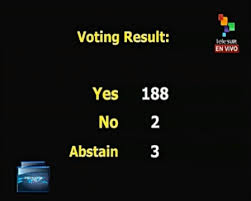
On October 28, 2014, the U.N. General Assembly by a vote of 188 to 2 again condemned the U.S. embargo of Cuba. The two negative votes were cast by the U.S. and by Israel while three small Pacific nations abstained–Marshall Islands, Micronesia and Palau. All the other U.N. members supported the resolution. [1]
The Resolution
The resolution [A/69/L.4] reiterated the General Assembly’s “call upon all States to refrain from promulgating and applying laws and measures of the kind referred to in the preamble to the present resolution [‘the economic, commercial and financial embargo imposed by the [U.S.] against Cuba’ and the Helms-Burton Act], in conformity with their obligations under the Charter of the United Nations and international law, which, inter alia, reaffirm the freedom of trade and navigation.”
The resolution also “again urges States that have and continue to apply such laws and measures [i.e., the U.S.] to take the steps necessary to repeal or invalidate them as soon as possible in accordance with their legal regime.”
Cuba’s Statement Supporting the Resolution
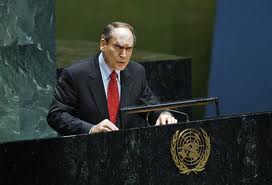
Bruno Rodriguez Parrilla
Bruno Rodríguez Parrilla, the Cuban Minister for Foreign Affairs, introducing the resolution, said that in recent times “the economic, commercial and financial blockade imposed by the [U.S.] against Cuba had been tightened, and its extraterritorial implementation had also been strengthened through the imposition of unprecedented fines, totaling $11 billion against 38 banks . . . for carrying out transactions with Cuba and other countries.” In addition, Cuba’s “accumulated economic damages of the blockade totaled $1.1 trillion . . . [and] human damages were on the rise.”
Nevertheless, “Cuba had offered every possible form of assistance to the [U.S.] in the wake of disasters there, such as in the aftermath of the September 11, 2001 terrorist attacks. Cuba had never been a threat to the national security of the [U.S.]. Opinion polls showed that there was increasing support from all sectors of [U.S.] society for lifting the blockade. Religious leaders had citied legitimate, indisputable ethical and humanitarian reasons.“
In addition, ”the blockade was harmful to . . . the [U.S.]. The ‘absurd and ridiculous’ inclusion of Cuba on the [U.S.] list of States that sponsored international terrorism redounded to the discredit of the [U.S.]. Cuba would never renounce its sovereignty or the path chosen by its people to build a more just, efficient, prosperous and sustainable socialism.” Neither, he continued, would his Government “give up its quest for a different international order, nor cease in its struggle for ‘the equilibrium of the world.’”
Rodríguez also invited the U.S. government “to establish a mutually respectful relation, based on reciprocity. We can live and deal with each other in a civilized way, despite our differences.”
Other Countries’ Statements Supporting the Resolution [2]
The following Latin American countries voiced support for the resolution: Argentina (MERCOSUR [3]) (embargo was “morally unjustifiable” and violated “the spirit of multilateralism and was immoral, unjust and illegal”); Barbados (CARICOM [4]); Bolivia (Group of 77 [5] and China); Brazil (Group of 77 and CELAC [6]); Colombia; Costa Rica (CELAC)); Ecuador; El Salvador (Group of 77 and CARICOM); Mexico; Nicaragua; St. Vincent and the Grenadines (CARICOM, Non-Aligned Movement, [7] Group of 77 and CELAC); Uruguay; and Venezuela.
The African supporters of the resolution that spoke were Algeria (Non-Aligned Movement, Group of 77, Group of African States [8] and Organization of Islamic Cooperation [9]); Angola; Kenya (Group of 77, Non-Aligned Movement and African Group); Malawi (African Group); South Africa (Group of 77, Non-Aligned Movement and African Group); Sudan (Group of 77, Non-Aligned Movement and Organization of Islamic Cooperation); United Republic of Tanzania; Zambia (Non-Aligned Movement) and Zimbabwe (Non-Aligned Movement, Group of 77 and African Group).
From Asia and the Pacific were Belarus; China (Group of 77); Democratic People’s Republic of Korea (North Korea); Indonesia (Group of 77); India (Group of 77 and Non-Aligned Movement); Iran (Non-Aligned Movement); Lao People’s Democratic Republic; Myanmar (Group of 77 and Non-Aligned Movement); Russian Federation; Solomon Islands; and Viet Nam (Non-Aligned Movement, Group of 77 and China).
Middle Eastern countries speaking in favor of the resolution were Egypt, Saudi Arabia (Organization of Islamic Cooperation); and Syria (Non-Aligned Movement, Group of 77 and China).
The sole European supporter of the resolution that spoke at the session was Italy (European Union [10]), which said the U.S.’ “extraterritorial legislation and unilateral administrative and judicial measures were negatively affecting European Union interests”).
U.S. Statement Opposing the Resolution
Although Israel voted against the resolution, it chose not to speak in support of its vote. Only the U.S. by Ambassador Ronald D. Godard, U.S. Senior Advisor for Western Hemisphere Affairs, tried to justify the negative vote.
Ronald D. Godard
Ambassador Godard said the U.S. “conducts its economic relationships with other countries in accordance with its national interests and its principles. Our sanctions toward Cuba are part of our overall effort to help the Cuban people freely exercise their human rights and fundamental freedoms, and determine their own future, consistent with the Universal Declaration of Human Rights and the democratic principles to which the United Nations itself is committed.”
Ambassador Godard also said, “the Cuban government uses this annual resolution in an attempt to shift blame for the island’s economic problems away from its own policy failures. The Cuban government now publicly recognizes that its economic woes are caused by the economic policies it has pursued for the last, past half-century. We note and welcome recent changes that reflect this acknowledgement, such as those that allow greater self-employment and liberalization of the real estate market. But the Cuban economy will not thrive until the Cuban government permits a free and fair labor market, fully empowers Cuban independent entrepreneurs, respects intellectual property rights, allows unfettered access to information via the Internet, opens its state monopolies to private competition and adopts the sound macro-economic policies that have contributed to the success of Cuba’s neighbors in Latin America.”
According to Ambassador Godard, the U.S. “remains a deep and abiding friend of the Cuban people. The Cuban people continue to receive as much as $2 billion per year in remittances and other private contributions from the [U.S.]. This support . . . was made possible . . . by U.S. policy choices. By the Cuban government’s own account, the [U.S.] is one of Cuba’s principal trading partners. In 2013, the [U.S.] exported approximately $359 million in agricultural products, medical devices, medicine and humanitarian items to Cuba. Far from restricting aid to the Cuban people, we are proud that the people of the [U.S.] and its companies are among the leading providers of humanitarian assistance to Cuba. All of this trade and assistance is conducted in conformity with our sanctions program, which is carefully calibrated to allow and encourage the provision of support to the Cuban people.”
Furthermore, the U.S. “places the highest priority on building and strengthening connections between the Cuban people and [our] people. U.S. travel, remittance, information exchange, humanitarian and people-to-people policies updated in 2009 and 2011 provide the Cuban people alternative sources of information, help them take advantage of limited opportunities for self-employment and private property and strengthen independent civil society. The hundreds of thousands of Americans who have sent remittances and traveled to the island, under categories of purposeful travel promoted by President Obama, remain the best ambassadors for our democratic ideals.”
Ambassador Godard continued, “[The U.S.] strongly supports the Cuban people’s desire to determine their own future, through the free flow of information to, from, and within Cuba. The right to receive and impart information and ideas through any media is set forth in Article 19 of the Universal Declaration of Human Rights. It is the Cuban government’s policies that continue to prevent enjoyment of this right. The Cuban government now claims to share our goal of helping the Cuban people access the Internet. Yet the Cuban government has failed to offer widespread access to the Internet through its high-speed cable with Venezuela. Instead, it continues to impose barriers to information for the Cuban people while disingenuously blaming U.S. policy.”
“Moreover, the Cuban government continues to detain Alan Gross, a U.S. citizen who was sentenced to 15 years in prison for facilitating Internet access for Cuba’s small Jewish community. [[11]] The [U.S.] calls on Cuba to release Mr. Gross immediately, [[12]] allow unrestricted access to the Internet, and tear down the digital wall of censorship it has erected around the Cuban people. {T]his resolution only serves to distract from the real problems facing the Cuban people. . . . Though Cuba’s contributions to the fight against Ebola are laudable, they do not excuse or diminish the regime’s treatment of its own people. We encourage this world body to support the desires of the Cuban people to choose their own future. By doing so, it would truly advance the principles the United Nations Charter was founded upon, and the purposes for which the United Nations was created.”
Media Coverage of the Resolution and Debate
U.S. media coverage of this important U.N. vote was almost non-existent. It was not mentioned in the “World” or “Americas” news sections of the New York Times, and only its “Opinion” section had a short article about the issue. It got no mention whatsoever in the Wall Street Journal. Not even the Miami Herald, which has a separate page for Cuba news, mentioned it. [13]
At 2:37 p.m. on October 28th the Associated Press published a release on the subject, and the Washington Post published it online while the StarTribune of Minneapolis/St. Paul picked it up the next day in its online, but not its print, edition.
Cuba’s state-owned newspaper,Granma, of course, headlined this vote while stating that the embargo has caused $1.1 trillion of damage to the Cuban economy and “incalculable human suffering.” Its article also emphasized that this was the 23rd consecutive such resolution with a table showing that the number of votes in favor of the resolutions has increased from 59 in 1992 to 188 in 2012-2014, that the largest number of votes against the resolutions was only 4 in 1993 and 2004-2007 and that the number of abstentions has decreased from 71 in 1992 to 1 in 2005-2007 and now 3 since 2010.
Conclusion
This overwhelming international opposition to the U.S. embargo in and of itself should be enough to cause the U.S. to end the embargo. Moreover, the embargo has not forced Cuba to come begging to the U.S. for anything that the U.S. wants. The U.S. policy is a failure. The New York Timesrecently called for abandonment of this policy as has this blog in urging reconciliation of the two countries, in an open letter to President Obama and in a rebuttal of the President’s asserted rationale for the embargo and other anti-Cuban policies.
[2] Many of the cited statements supporting the resolution were issued on behalf of, or aligned with, larger groups of nations as noted above. In addition, prior to the October 28th session of the General Assembly, the U.N. Secretary General submitted a report containing statements against the embargo from 154 states and 27 U.N. agencies.
[3]MERCOSUR (Southern Common Market) is a customs union and trading bloc of five South American countries with five other associate members in the continent.
[4]CARICOM (Caribbean Community) is a group of 15 Caribbean countries with five associate members for economic cooperation.
[5] The Group of 77 was established in 1964 by 77 developing countries to promote their collective economic interests and South-South cooperation; now there are 134 members that have retained the original name for historical significance.
[6]CELAC (Community of Latin American and Caribbean States) is a group of 33 states in the region to deepen economic integration and combat the influence of the U.S.
[7] The Non-Aligned Movement is a group of 115 developing countries that are not aligned with or against any major power bloc. Its current focus is advocacy of solutions to global economic and other problems
[8] The African Group is a group of 54 African states that are U.N. Members.
[9] The Organization of Islamic Cooperation is a group of 57 states that seek to protect the interests of the Muslim world in the spirit of promoting peace and harmony in the world.
[10] The European Union is a group of 28 European states that have combined for a peaceful, united and prosperous Europe.
[11] The activities in Cuba by Mr. Gross are not so simple. A Cuban court in 2011 found him guilty of participating in a “subversive project of the U.S. government that aimed to destroy the revolution through the use of communications systems out of the control of authorities,” and sentenced him to 15 years in prison. According to his own lawsuit against the U.S. Government, and subsequent disclosures, Gross alleged the U.S. Agency for International Development (USAID) and its contractor, DAI, sent him on five semi-covert trips to Cuba without proper training, protection or even a clear sense of the Cuban laws that led to his detainment. The case highlighted the frequent haste and lack of attention to the risks of the USAID programs in Cuba under the Helms-Burton Act, which allowed for money to be set aside for “democracy building efforts” that might hasten the fall of Fidel and Raúl Castro.
[12] In discussions with the U.S., Cuba already has expressed a willingness to exchange Mr. Gross for one or more of the three of “the Cuban Five” who remain in U.S. prisons.
[13] Nor did I find any mention of the vote in London’s Guardian or Madrid’s El Pais.
The Commission relies upon this definition of the freedom in the Universal Declaration of Human Rights: “Everyone has the right to freedom of thought, conscience and religion; this right includes freedom to change his religion or belief, and freedom, either alone or in community with others and in public or private, to manifest his religion or belief in teaching, practice, worship and observance.” Similar provisions are found in several multilateral human rights treaties.[2] (P. 9.)
The Report stressed the importance of this freedom. It says this right “protects the freedom of religious communities, as groups, to engage in worship and other collective activities. It also protects every individual’s right to hold, or not to hold, any religion or belief, as well as the freedom to manifest such a religion or belief, subject only to the narrow limitations specified under international law.” (P. 9.)
This right is important, says the Commission, “because it enables people to follow what their conscience dictates. . . . People are entitled to religious freedom by virtue of their humanity.” Therefore, there can be no “coercion or compulsion in these matters.” (P. 2.)
Moreover, whenever this freedom is abused, “societal well-being would suffer” as well as democracy and other human rights and economic productivity. So too “peace and security may become more elusive.” In short, according to the commission, “the defense of religious freedom is both a humanitarian imperative and a practical necessity.” (P. 3.)
General Recommendations
The Commission recommended that the U.S. do the following with respect to this freedom:
develop and implement a religious freedom strategy;
demonstrate the importance of religious freedom , including the designation of “countries of particular concern ” identified by the Commission;
reinvigorate and create new tools under the Act;
expand training, programming and public diplomacy about the subject;
expand multilateral efforts on the subject; and
protect asylum-seekers from being returned to countries where they face persecution for religious reasons. (Pp. 7-8.)
“Countries of Particular Concern” (Tier 1 Countries)
Under its authorizing statute, the Commission is required to designate as “countries of particular concern” (CPC) (or “Tier 1 Countries”) those that have engaged in or tolerated “particularly severe” violations of religious freedom. (P. 5.)
The latest report recommends that the Secretary of State re-designate the following eight countries as Tier 1 countries: Burma, China, Eritrea, Iran, North Korea, Saudi Arabia, Sudan and Uzbekistan. In addition, the Report recommends that the following additional eight countries also be so designated by the State Department: Egypt, Iraq, Nigeria, Pakistan, Syria, Tajikistan, Turkmenistan and Vietnam. (P. 5.)
Tier 2 Countries
The Commission also designates some countries as “Tier 2 Countries,” i.e., countries on the threshold of Tier 1 status, i.e., when their “violations . . . are particularly severe” and when at least one, but not all three, of the criteria for that status (“systematic, ongoing and egregious”) is met. (P. 5.)
The latest Report designated the following nine countries as Tier 2: Afghanistan, Azerbaijan, Cuba, India, Indonesia, Kazakhstan, Laos, Russia and Turkey.[3] (P. 5.)
Other Countries
The latest Report also discussed seven other countries (Bahrain, Bangladesh, Belarus, Central African Republic, Ethiopia, Kyrgyzstan and Sri Lanka) and one region (Western Europe) that it monitored during the year. (P. 5.)
Conclusion
Because of my personal interest in Cuba, including its religious freedom, a subsequent post will critique the Report regarding that country.
=========================================
[1] The Act § § 202, 205. The Report contains an account of the development of the Act and the 15-year history of its implementation. (Pp. 11-23.) A prior post examined the fascinating structure and composition of the Commission, and another post its report issued in 2013.
[3] Previously the Commission called this group the “Watch List of countries where the serious violations of religious freedom engaged in or tolerated by the governments do not meet the CPC threshold, but require close monitoring.” According to the Commission, the “Watch List provides advance warning of negative trends that could develop into severe violations of religious freedom, thereby providing policymakers with the opportunity to engage early and increasing the likelihood of preventing or diminishing the violations.”
The top officials of the U.S. Commission on International Religious Freedom have set forth compelling reasons why religious freedom around the world is important. Its Chairperson, Robert P. George, and its Vice Chairperson, Katrina Lantos Swett, have done so in an essay in the Wall Street Journal entitled “Religious Freedom Is About More Than Religion.”
Dr. Robert P. GeorgeDr. Katrina Lantos Swett
They assert, “To respect fundamental human rights is to favor and honor the [human being] . . . who is protected by those rights—including the rights to freedom of speech, press, assembly and religion.” Therefore, honoring the individual human being favors “human flourishing in its many dimensions. For those who regard humans not just as material beings but also as spiritual ones—free, rational and responsible—it is obvious that their spiritual well-being is no less important than their physical, psychological, intellectual, social and moral well-being.”
Such human flourishing “requires respect for their freedom—as individuals and together with others in community—to address the deepest questions of human existence and meaning. This allows them to lead lives of authenticity and integrity by fulfilling what they conscientiously believe to be their religious and moral duties.”
Moreover, religious “faith by its nature must be free. A coerced ‘faith’ is no faith at all. Compulsion can cause a person to manifest the outward signs of belief or unbelief. It cannot produce the interior acts of intellect and will that constitute genuine faith.” Indeed, coercion “in the cause of belief, whether religious or secular, produces not genuine conviction, but pretense and inauthenticity.”
Religious freedom, therefore, must “include the right to change one’s beliefs and religious affiliation. It also includes the right to witness to one’s beliefs in public as well as private, and to act—while respecting the equal right of others to do the same—on one’s religiously inspired convictions in carrying out the duties of citizenship.”
As a result, “one of the aims of U.S. foreign policy should be to combat . . . [religious] intolerance—not just because religious freedom reduces the risk of sectarian conflict, but more fundamentally because it protects the liberty that is central to human dignity.”
Conclusion
This statement echoes the words of the international legal instruments that appropriately guide the work of the U.S. Commission on International Religious Freedom: the Universal Declaration of Human Rights, which the U.S. supported in the U.N. General assembly in 1948, and the International Covenant on Civil and Political Rights, which the U.S. ratified in 1992.
The Universal Declaration opens with these words in its Preamble: “recognition of the inherent dignity and of the equal and inalienable rights of all members of the human family is the foundation of freedom, justice and peace in the world.” It then declares in Article 18, “Everyone has the right to freedom of thought, conscience and religion; this right includes freedom to change his religion or belief, and freedom, either alone or in community with others and in public or private, to manifest his religion or belief in teaching, practice, worship and observance.”
These latter words are essentially repeated in Article 18(1) of the International Covenant. Its Article 18(2) goes on to say, “No one shall be subject to coercion which would impair his freedom to have or to adopt a religion or belief of his choice.”
Annually the U.S. Department of State, pursuant to statutory authorization, releases a report on the status of religious freedom in every country in the world.[1] In addition, the quasi-independent U.S. Commission on International Religious Freedom releases annual reports on the same subject for selected countries.[2]
It should be noted at the outset that these two agencies are not seeking to impose on the rest of the world the U.S. constitutional prohibition of the “establishment of religion” or of “abridging the free exercise [of religion].” [3] Instead the agencies reports rely upon this definition of the freedom in the Universal Declaration of Human Rights: “Everyone has the right to freedom of thought, conscience and religion; this right includes freedom to change his religion or belief, and freedom, either alone or in community with others and in public or private, to manifest his religion or belief in teaching, practice, worship and observance.” Similar provisions are found in several multilateral human rights treaties.[4]
The post will review the latest State Department report on this subject for all 194 other countries in the world and the Commission’s latest report on 29 countries plus one large region (Western Europe).[5]
Latest State Department Report
After emphasizing the importance of religious freedom, the State Department’s May 20, 2013, report “tells stories of courage and conviction, but also recounts violence, restriction, and abuse. While many nations uphold, respect, and protect religious freedom, regrettably, in many other nations, governments do not protect this basic right; subject members of religious minorities to violence; actively restrict citizens’ religious freedom through oppressive laws and regulations; stand by while members of societal groups attack their fellow citizens out of religious hatred, and fail to hold those responsible for such violence accountable for their actions.”
The report continues.”The immediate challenge is to protect members of religious minorities. The ongoing challenge is to address the root causes that lead to limits on religious freedom. These causes include impunity for violations of religious freedom and an absence of the rule of law, or uneven enforcement of existing laws; introduction of laws restricting religious freedom; societal intolerance, including anti-Semitism and lack of respect for religious diversity; and perceptions that national security and stability are best maintained by placing restrictions on and abusing religious freedom.”
Highlighted for concern by the report were “[l]aws and policies that impede the freedom of individuals to choose a faith, practice a faith, change their religion, tell others about their religious beliefs and practices, or reject religion altogether remain pervasive. Numerous governments imposed such undue and inappropriate restrictions on religious groups and abused their members, in some cases as part of formal government law and practice.” Another concern was the “use of blasphemy and apostasy laws.” They “continued to be a significant problem, as was the continued proliferation of such laws around the world. Such laws often violate freedoms of religion and expression and often are applied in a discriminatory manner.”
The report documented “a continued global increase in anti-Semitism. Holocaust denial and glorification remained troubling themes, and opposition to Israeli policy at times was used to promote or justify blatant anti-Semitism. When political leaders condoned anti-Semitism, it set the tone for its persistence and growth in countries around the world. Of great concern were expressions of anti-Semitism by government officials, by religious leaders, and by the media.”
According to the report, “Governments that repress freedom of religion and freedom of expression typically create a climate of intolerance and impunity that emboldens those who foment hatred and violence within society. Government policy that denies citizens the freedom to discuss, debate, practice, and pass on their faith as they see fit also undercuts society’s ability to counter and combat the biased and warped interpretations of religion that violent extremists propagate. Societal intolerance increased in many regions during 2012.”
Finally the report said, “Governments exacerbated religious tensions within society through discriminatory laws and rhetoric, fomenting violence, fostering a climate of impunity, and failing to ensure the rule of law. In several instances of communal attacks on members of religious minorities and their property, police reportedly arrested the victims of such attacks, and NGOs alleged that there were instances in which police protected the attackers rather than the victims. As a result, government officials were not the only ones to commit abuses with impunity. Impunity for actions committed by individuals and groups within society was often a corollary of government impunity.”
The report also acknowledged the Department’s statutory obligation to designate “Countries of Particular Concern (CPCs), i.e., those countries that are considered to commit “particularly severe violations of religious freedom,” and whose records call for the U.S. government to take certain actions under the terms of the Act. The term ‘‘particularly severe violations of religious freedom’’ means systematic, ongoing, egregious violations of religious freedom, including violations such as: (a) torture or cruel, inhuman, or degrading treatment or punishment; (b) prolonged detention without charges; (c) causing the disappearance of persons by the abduction or clandestine detention of those persons; or (d) other flagrant denial of the right to life, liberty, or the security of persons.”
Accordingly the report re-designated the following eight countries as CPCs: Burma, China, Eritrea, Iran, North Korea, Saudi Arabia, Sudan and Uzbekistan.[6]
Latest Commission Report
Under the authorizing statute, the Commission is required to designate as “countries of particular concern” (CPC) (or “Tier 1 Countries”) those that have engaged in or tolerated “particularly severe” violations of religious freedom.
In its latest report, issued on April 30, 2013, the following 15 countries were so designated: Burma, China, Eritrea, Iran, North Korea, Saudi Arabia, Sudan and Ubekistan (all of which had been designated as “Countries of Particular Concern” (CPC) by the State Department the prior year) plus Egypt, Iraq, Nigeria, Pakistan, Tajikistan, Turkmenistan and Vietnam.
The Commission also designates some countries as “Tier 2 Countries,” i.e., countries on the threshold of Tier 1 status, i.e., when their “violations . . . are particularly severe” and when at least one, but not all three, of the criteria for that status (“systematic, ongoing and egregious”) is met.
The latest report designated the following eight countries as Tier 2: Afghanistan, Azerbaijan, Cuba, India, Indonesia, Kazakhstan, Laos and Russia.[7]
The latest report also discussed six other countries (Bahrain, Bangladesh, Belarus, Ethiopia, Turkey and Venezuela and one region (Western Europe) that it monitored during the year. At first glance the monitoring of Western Europe seems anomalous, but here are the topics of concern to the Commission:
Restrictions on religious dress (full-face veils) in France and Belgium.
Failure in Sweden, Luxembourg, Switzerland, Poland, Norway and Iceland to exempt religious slaughter of animals from laws requiring prior stunning of the animals.
Suggestions in Germany and Norway that religious circumcisions of male children were illegal.
Restrictions on construction of Islamic minarets in Switzerland, and the lack of an official mosque in Athens, Greece.
“Incitement to hatred” and other laws in almost all European states that can be used to restrict expression of religious beliefs.
Reluctance in many European states to provide accommodation of religious objections to generally applicable laws.
Measures in France, Austria, Belgium and Germany against religious groups perjoratively characterized as “cults” or “sects.”
Societal intolerance, discrimination and violence based on religion or belief such as towards Muslim women with full-face veils, Jewish people and Jehovah’s Witnesses.
It should also be noted that the Commission sometimes takes an adversarial position vis-à-vis the U.S. State Department. For example, on April 30, 2013, when the Commission released its latest report, its simultaneous press release recommended that the Department designate as “Countries of Particular Concern” the seven additional countries the Commission had placed in Tier 1 as noted above.
When the Department failed to do so in its May 20th report, the next day the Commission issued a press release criticizing the Department for failure to make additional CPC designations since August 2011 and to do so for the same seven additional countries.
Conclusion
Because of my personal interest in Cuba, including its religious freedom, a subsequent post will compare and contrast the two reports regarding that country.
Such a comparison, in my opinion, will show that the State Department’s reports are more balanced and fair at least with respect to Cuba.
[5] A prior post examined the prior State Department report.
[6] The State Department report noted that it considers the recommendations of the Commission on CPCs, but that the Secretary of State makes the final decision on that issue. The Department’s report thereby implicitly rejected the Commission’s recommendation for an additional seven countries to be so designated.
[7] Previously the Commission called this group the “Watch List of countries where the serious violations of religious freedom engaged in or tolerated by the governments do not meet the CPC threshold, but require close monitoring.” According to the Commission, the “Watch List provides advance warning of negative trends that could develop into severe violations of religious freedom, thereby providing policymakers with the opportunity to engage early and increasing the likelihood of preventing or diminishing the violations.”
A prior post discussed the March 22, 2013, resolution by the General Assembly of the Organization of American States (OAS) that strengthened the Inter-American Human Rights System, especially the Inter-American Commission on Human Rights (“Commission”).
In so doing, the OAS rejected efforts to weaken the Commission under the guise of reform proposals that had been offered by Ecuador and other states that the Commission has criticized (Venezuela, Bolivia and Nicaragua).
We now examine the background to that surreptitious effort to weaken that System and the debate at the March 22nd General Assembly meeting
Background
1. Multilateral Treaties and Other Instruments Regarding the Right of Free Expression.
The right of free expression by the media and others is well established in international law.
The United Nation’s General Assembly’s Universal Declaration of Human Rights of 1948 in Article 19 states, “Everyone has the right to freedom of opinion and expression; this right includes freedom to hold opinions without interference and to seek, receive and impart information and ideas through any media and regardless of frontiers.” In 1966 this was put into legally enforceable form in Article 19 of the International Covenant on Civil and Political Rights, which entered into force in 1976.
To like effect is the American Convention on Human Rights, which was adopted by the OAS in 1969 and which entered into force in 1978. Its Article 13(1) says, “Everyone has the right to freedom of thought and expression . . . [including the] freedom to seek, receive, and impart information and ideas of all kinds, regardless of frontiers, either orally, in writing, in print, in the form of art, or through any other medium of one’s choice.” Article 13(3) goes on to say, “The right of expression may not be restricted by indirect methods or means, such as the abuse of government or private controls over newsprint, radio broadcasting frequencies, or equipment used in the dissemination of information, or by any other means tending to impede the communication and circulation of ideas and opinions.”
Ecuador under the presidency of Rafael Correa since January 2007 has through policies and actions retaliated against journalists and media that have criticized him and his government. Correa has insulted and filed lawsuits against reporters and news outlets and promoted a series of legal measures to roll back press freedoms. His government has expropriated television channels, radio stations, newspapers and magazines.
Journalists in the country also have been subjected to physical threats and assaults with lackluster efforts by the government to investigate and prosecute those responsible.
3. The Commission and Civil Society’s Criticism of Ecuador’s Hostility to Freedom of Expression.
The Commission in 1997 created the Special Rapporteur for Freedom of Expression “to encourage the defense of the right to freedom of thought and expression in the hemisphere, given the fundamental role this right plays in consolidating and developing the democratic system and in protecting, guaranteeing, and promoting other human rights.”
This Rapporteur has been in the forefront of criticizing Ecuador for these actions against journalists and the media. Since January 1, 2009 it has issued nine press releases expressing its concern over specific criminal prosecutions and imprisonments of journalists for libel for publication of articles about corruption of public officials and for specific physical threats and assaults on journalists.
In addition, since 2006 the annual reports of the Rapporteur have had sections specifically addressing Ecuador’s conduct in this area.
For example, the latest such report (for 2011) devotes 31 pages (78-108) for a detailed, footnoted review of Ecuador’s assaults and attacks on media and journalists; legal proceedings and arrests (the “Rapporteur is concerned about the consistent tendency of high-ranking public officials to rebuke, arrest, and prosecute citizens who criticize them at public events”); presidential broadcasts and government interruptions of news programs; disparaging statements by senior state authorities against media outlets and reporters critical of the government; constitutional amendment and legislative proposals to regulate the content of all media, establish the grounds for liability and the applicable sanctions and serve as an authority on enforcement; and cloture and regulation of communications media.
Such actions also have subjected the country to similar criticism by the U.N. Human Rights Council in its Universal Periodic Review of Ecuador in the summer of 2012. One of the Council’s closing recommendations in that Review was for Ecuador to reform its legislation regarding freedom of expression with a view to bringing it in conformity with international standards and those of the Inter-American Commission on Human Rights. In response Ecuador said that it could not agree to reform its legal framework in accordance with standards from the Commission, when it is the Inter-American Court of Human Rights, not the Commission, which has judicial competency over this matter. Nor could Ecuador, it said, eliminate laws that criminalize opinion since it had no such laws.
In addition, Ecuador has been severely chastised by the Committee to Protect Journalists, which put the country on its Risk List of the 10 countries in the world where press freedom suffered the most in 2012. Similar rebukes have come from Human Rights Watch, Freedom House and the Washington Post Editorial Board.
4. Ecuador’s Campaign for Its Proposed “Reforms” of the Commission.
In response to the Special Rapporteur’s persistent and documented criticism of Ecuador, the country developed a set of proposals to “reform” the Commission. Prominent in this package were reduction in funding (and hence the work) of the Special Rapporteur and elimination of his separate annual report.
Ricardo Patino
In early 2013 Ecuador conducted a lobbying campaign in support of these proposals. Its Foreign Minister, Ricardo Patino, went on a tour of Mexico, Chile, Argentina, Brazil, Colombia, Dominican Republic, Haiti and Venezuela to promote them. He also advocated them at a meeting of the Political Council of the Bolivarian Alliance for the Peoples of Our Americas (ALBA) [1] and at a March 11th meeting in Guayaquil, Ecuador of the 24 states that were parties to the American Convention on Human Rights.[2]
The latter event was opened by a long speech by Ecuadorian President Correa, who emphasized that the Commission should have its headquarters in a state that has ratified said Convention (not Washington, D.C.); that the Commission should have its own budget provided only by state parties to the Convention (without voluntary contributions by outsiders like the U.S., Canadian and European governments and NGO’s); that the Commission should not be “autonomous” and instead be controlled by said states parties; the abolition of the Commission’s rules authorizing its issuance of precautionary measures; having the Commission focus on general promotion of human rights, not investigating and deciding on alleged violations of human rights; and elimination of the separate annual report of the Special Rapporteur for Free Expression and instead including such a report in a comprehensive report for all of the rapporteurships.
The Ecuador meeting resulted in the Declaration of Guayaquil whereby the 24 states parties agreed that at the March 22nd meeting of the OAS General Assembly they would support the following: a group of their foreign ministers would press the U.S., Canada and other non-parties to the Convention to ratify or accede to same; the Commission would be refocused on promotion of human rights through national systems; financing of the Commission would be increased by states parties and by “neutral” others; all rapporteurships would be treated equally; an analysis of the costs of the OAS Human Rights System would be obtained; the Commission’s headquarters would be moved to a state party; and annual conferences about reforming the System would be held.
Opposition to such proposals came forward from the U.N. High Commissioner for Human Rights, Navi Pillay, who urged the OAS members “to strengthen its exemplary human rights system, by promoting universal access for citizens . . ., respecting the Commission’s autonomy to progressively improve its policy and practices in response to the needs of victims and concerns of member states, and providing the necessary resources [to the System].” Similar concerns were voiced by Amnesty International, Human Rights Watch, the Committee to Protect Journalists, Freedom House, a group of 98 prominent Latin Americans and a coalition of 700 hemispheric human rights organizations.
Another opponent of Ecuador’s campaign was Cesar Gaviria Trujillo, a former president of Colombia and past secretary general of the OAS. He said that the so called “reforms” of the Commission put forward by Ecuador would “severely weaken the [C]omission and make it easier for governments to ignore basic rights and limit free speech.” They would “drastically curtail [the Commission’s] autonomy” and put a “financial stranglehold” on its operations, including a “devastating impact” on the Special Rapporteur for Freedom of Expression. [3]
The March 22nd OAS General Assembly Meeting
Jose Miguel Insulza, OAS Secretary General
In opening remarks that day, the OAS Secretary General, Jose Miguel Insulza from Chile, stressed that the autonomy of the System needed to be maintained. He also said that strengthening some of the Commission’s rapporteurships “cannot mean that others are weakened” and that the Special Rapporteurship on Freedom of Expression should be strengthened “with a program of ample defense of [such] freedom . . . . ” This would include “issues relating to the curtailment of that freedom by public authorities . . . as well as the threats and crimes to which journalists and the social media are increasingly subjected in our region and the obligation of states to protect them.”
William J. Burns, U.S. Deputy Secretary of State
Similar remarks were made by U.S. Deputy Secretary of State, William J. Burns. He noted that even though the U.S. was not a party to the American Convention on Human Rights, the U.S. still collaborates with the Commission when it challenges the U.S. on such issues as the death penalty, the human rights of migrants and children and the status of detainees at Guantanamo Bay, Cuba. He added, “We must be vigilant against efforts to weaken the Commission under the guise of reform. [Such efforts] . . . seek to undermine the Commission’s ability to hold governments accountable when they erode democratic checks and balances and concentrate power through illiberal manipulation of democratic processes.”
Ecuadorian Foreign Minister Patino in his remarks accused the opposition and the media of distorting his government’s proposals. He also accused the Commission of improperly assuming the power to issue precautionary measures. Its decisions were independent, he said, but the Commission was not autonomous. He rhetorically asked, the Commission is autonomous and independent of whom? Sotto voce, a Spanish journalist answered, “You,” causing laughter by those around the journalist.
The resolution adopted by acclamation at the midnight conclusion of the March 22nd meeting already has been discussed. It clearly did not adopt all of the items in Ecuador’s package.
This resolution emerged after a long day in which the U.S., Canada, Mexico, Colombia, Costa Rica, Panama and Chile lead the opposition to the proposals from Ecuador, Bolivia, Venezuela and Nicaragua. A Human Rights Watch observer said, “It was a resounding victory for the Commission, and a major defeat for the Venezuela-Ecuador bloc. It became evident that [the latter] . . . were totally isolated, without the support they were expecting from other countries.”
Towards the end of the meeting Ecuador and Bolivia threatened to withdraw from the Commission and leave the meeting. To avoid such a rupture, Argentina offered a face-saving amendment to the resolution about the OAS’ Permanent Council continuing the dialogue on the “core aspects for strengthening” the System, which Ecuador and the other ALBA countries ultimately accepted.
Conclusion
Afterwards Ecuador’s Foreign Minister tried to whitewash his country’s defeat by saying that the resolution accepted its proposal to continue the debate in the future. Before the next meeting of the OAS General Assembly in June 2014, the Foreign Minister said that there would be another meeting of the states parties to the American Convention like the one on March 11th in Guayaquil to discuss these issues. He also hinted at Ecuador’s possible withdrawal from the OAS Commission by saying there was an agreement being negotiated to create a Human Rights Commission of the Union of South American Nations (UNASUR).
Unless there are unexpected changes in regimes or policies in this Hemisphere over the next 14 months, I do not expect Ecuador and its allies will be successful at the June 2014 OAS meeting in gaining acceptance of its proposals to weaken the Inter-American Commission.[4] We will then see if this small group will leave that Commission and form its own, more limited, human rights system.
[1]ALBA is an alternative to the U.S.-sponsored Free Trade Area of the Americas. differing from the latter in that it advocates a socially-oriented trade block rather than one strictly based on the logic of deregulated profit maximization. The only members of ALBA are Ecuador, Bolivia, Venezuela, Nicaragua and three small Caribbean states (Antigua and Barbuda, Dominica and Saint Vincent and the Grenadines.
[2] This campaign is discussed in press releases from Ecuador’s Foreign Minister.
[3] Such a limitation on financing undoubtedly would result in a reduction of such funding and thus on the work of the Commission.
[4] I assume that Ecuador has another burden to overcome in attempting to win support for its “reform” proposals. Its credibility within the OAS, I suspect, has been adversely affected by its recent exaggerated, alarmist call for an OAS Consultative Meeting of Foreign Ministers over the alleged United Kingdom threat to invade Ecuador’s London Embassy because of its providing diplomatic asylum in that Embassy to Julian Assange.
On July 30, 2012, the U.S. Department of State released its 2011 Report on International Religious Freedom.
The operating definition for this purpose is found in Article 18 of the Universal Declaration of Human Rights that was approved by the United Nations General Assembly in 1948. It states, “Everyone has the right to freedom of thought, conscience and religion; this right includes freedom to change his religion or belief, and freedom, either alone or in community with others and in public or private, to manifest his religion or belief in teaching, practice, worship and observance.” Similar provisions are found in several multilateral human rights treaties.
Introducing the report, U.S. Secretary of State Hilary Clinton placed the subject in a broader context. She said, “religious freedom is both an essential element of human dignity and of secure, thriving societies. It’s been statistically linked with economic development and democracy stability.” Without such freedom, she continued, there can be “a climate of fear and suspicion that weakens social cohesion and alienates citizens from their leaders” and thereby “make it more difficult to solve national problems.” Indeed, she asserted that “the absence of religious freedom . . . is correlated with religious conflict and violent extremism.” As a result, the Obama Administration has made such freedom a diplomatic priority.
This report highlights what it sees as key trends in the year 2011: (a) the impact of political and demographic transitions on religious minorities; (b) the effects of conflict on religious freedom; (c) expanded use and abuse of blasphemy laws; and (d) the rising tide of anti-Semitism;
This annual report reviewing the worldwide status of religious freedom is mandated by the International Religious Freedom Act of 1988, which also requires the report to designate countries as “Countries of Particular Concern” when they have “engaged in or tolerated particularly severe violations of religious freedom,” i.e., ” systematic, ongoing, egregious violations of religious freedom, including violations such as torture, degrading treatment or punishment, prolonged detention without charges, abduction or clandestine detention, or other flagrant denial of the right to life, liberty, or the security of persons.”
In this latest report covering 2011, the following eight countries were so designated: Burma, China, Eritrea, Iran, North Korea, Saudi Arabia, Sudan and Uzbekistan.
With respect to China, the report said in 2011 there was a “marked deterioration . . . in the government’s respect for and protection of religious freedom.” It cited specific restrictions In the Tibetan Autonomous Region and other Tibetan areas. The report noted that only “groups belonging to one of the five state-sanctioned ‘patriotic religious associations'(Buddhist, Taoist, Muslim, Roman Catholic, and Protestant) . . . [could] register with the government and legally hold worship services.” Moreover, “Proselytizing in public or unregistered places of worship is not permitted” and some “religious and spiritual groups are outlawed.” Finally according to the report “Chinese Communist Party (CCP) members are required to be atheists and are generally discouraged from participating in religious activities.”
Not too surprisingly China immediately rejected the report’s comments. China said the report was “full of prejudice, arrogance and ignorance” and was “a political tool used by the U.S. Government to exert pressure on other countries, mostly deemed its rivals.”
The importance of religious freedom for the U.S. is evidenced by the U.S. Constitution’s First Amendment stating “Congress shall make no law respecting an establishment of religion, or prohibiting the free exercise thereof” and by the U.S. Supreme Court’s broad interpretation of those provisions. This importance also has been demonstrated by the following more recent events:
The 1988 enactment of the previously mentioned International Religious Freedom Act, which In addition to requiring the annual reports on the subject, created in the Department of State the Office of International Religious Freedom headed by an Ambassador at Large for International Religious Freedom.
That same Act also created the quasi-independent U.S. Commission on International Religious Freedom that is required to issue separate annual reports on such freedom. In addition, it is charged to “consider and recommend options for policies of the [U.S.] Government with respect to each foreign country the government of which has engaged in or tolerated violations of religious freedom, including particularly severe violations of religious freedom, including diplomatic inquiries, diplomatic protest, official public protest demarche of protest, condemnation within multilateral fora, delay or cancellation of cultural or scientific exchanges, delay or cancellation of working, official, or state visits, reduction of certain assistance funds, termination of certain assistance funds, imposition of targeted trade sanctions, imposition of broad trade sanctions, and withdrawal of the chief of mission.”
On October 18, 2011, the Department of State established the Working Group on Religion and Foreign Policy that includes representatives of religious groups and other members of civil society. Its mission is to engage in “a continuing dialogue with religious leaders and other members of civil society that informs U.S. foreign policy and fosters common partnerships with the NGO community, including faith-based groups, in support of conflict mitigation and development as well as efforts to promote human rights, including religious freedom.”
I have developed a special interest in Cuban religious freedom, and a subsequent post will review this report’s section on Cuba.