Aung San Suu Kyi’s Nobel Peace Prize

Myanmar (Burma)
Aung San      Suu Kyi

On June 16, 2012, Aung San Suu Kyi gave her lecture in Oslo, Norway accepting the Nobel Peace Prize awarded her 21 years ago. She was unable to be present on that prior occasion because she was under house arrest in her native Myanmar (Burma) for protesting the abuses of its military regime.

The 1991 Peace Prize Presentation

Nobel Prize Medal

When the Prize was presented in absentia in 1991 for her non-violent struggle for democracy and human rights in Burma, the Chairman of the Norwegian Nobel Committee said, “In the good fight for peace and reconciliation, we are dependent on persons who set examples, persons who can symbolise [sic]what we are seeking and mobilise [sic] the best in us. Aung San Suu Kyi is just such a person. She unites deep commitment and tenacity with a vision in which the end and the means form a single unit. Its most important elements are: democracy, respect for human rights, reconciliation between groups, non-violence, and personal and collective discipline.”

The presentation continued, “The central position given to human rights in her thinking appears to reflect a real sense of the need to protect human dignity. Man is not only entitled to live in a free society; he also has a right to respect. On this platform, she has built a policy marked by an extraordinary combination of sober realism and visionary idealism. And in her case this is more than just a theory: she has gone a long way towards showing how such a doctrine can be translated into practical politics.”

An “absolute condition [for such a translation] is fearlessness,” the Nobel Chairman stated. He added that Aung San Suu Kyi had said “it is not power that corrupts, but fear. The comment was aimed at the totalitarian regime in her own country. They have allowed themselves to be corrupted because they fear the people they are supposed to lead. This has led them into a vicious circle. In her thinking, however, the demand for fearlessness is first and foremost a general demand, a demand on all of us. She has herself shown fearlessness in practice.”

The Nobel Committee concluded its 1991 statement  with the words: “In awarding the Nobel Peace Prize … to Aung San Suu Kyi, the Norwegian Nobel Committee wishes to honour [sic] this woman for her unflagging efforts and to show its support for the many people throughout the world who are striving to attain democracy, human rights and ethnic conciliation by peaceful means.”

Recognizing her inability to be present for the award in 1991, the Nobel Committee Chairman said, “The great work we are acknowledging has yet to be concluded. She is still fighting the good fight. Her courage and commitment find her a prisoner of conscience in her own country, Burma. Her absence fills us with fear and anxiety . . . .”

Aung San Suu Kyi’s Acceptance Speech

Aung San Suu Kyi @          Oslo City Hall
Aung San Suu Kyi (Photo: Daniel S. Lauten/AFP/            Getty Images

Twenty-one years later, Aung San Suu Kyi formally accepted the 1991 Peace Prize in the City Hall of Oslo, Norway. The text and video of the speech are available online.

She talked about the impact in 1991 of learning of the award while she was under house arrest. “Often   . . .  it felt as though I were no longer a part of the real world. There was the house which was my world, there was the world of others who also were not free but who were together in prison as a community, and there was the world of the free; each was a different planet pursuing its own separate course in an in different universe. What the Nobel Peace Prize did [in 1991] was to draw me once again into the world of other human beings outside the isolated area in which I lived, to restore a sense of reality to me. . . . And what was more important, the Nobel Prize had drawn the attention of the world to the struggle for democracy and human rights in Burma. We were not going to be forgotten.”

She continued, “To be forgotten . . .  is to die a little. It is to lose some of the links that anchor us to the rest of humanity. . . . When the Nobel Committee awarded the Peace Prize to me they were recognizing that the oppressed and the isolated in Burma were also a part of the world, they were recognizing the oneness of humanity. So for me receiving the Nobel Peace Prize means personally extending my concerns for democracy and human rights beyond national borders. The Nobel Peace Prize opened up a door in my heart.”

“The Burmese concept of peace,” she explained, is “the happiness arising from the cessation of factors that militate against the harmonious and the wholesome. . . . Everywhere there are negative forces eating away at the foundations of peace. Everywhere can be found thoughtless dissipation of material and human resources that are necessary for the conservation of harmony and happiness in our world.”

“Are we not still guilty, if to a less violent degree, of recklessness, of improvidence with regard to our future and our humanity? War is not the only arena where peace is done to death. Wherever suffering is ignored, there will be the seeds of conflict, for suffering degrades and embitters and enrages.”

While living in isolation she said she ruminated over the meaning of the Buddhist concept of the six great “dukha” or suffering: “to be conceived, to age, to sicken, to die, to be parted from those one loves, to be forced to live in propinquity with those one does not love. . . . I thought of prisoners and refugees, of migrant workers and victims of human trafficking, of that great mass of the uprooted of the earth who have been torn away from their homes, parted from families and friends, forced to live out their lives among strangers who are not always welcoming.”

“How often during my years under house arrest have I drawn strength from my favourite [sic] passages in the preamble to the Universal Declaration of Human Rights:

  • ……. disregard and contempt for human rights have resulted in barbarous acts which have outraged the conscience of mankind, and the advent of a world in which human beings shall enjoy freedom of speech and belief and freedom from fear and want has been proclaimed as the highest aspirations of the common people,
  • …… it is essential, if man is not to be compelled to have recourse, as a last resort, to rebellion against tyranny and oppression, that human rights should be protected by the rule of law . . .”

“The peace of our world is indivisible,” Aung San Suu Kyi continued.” As long as negative forces are getting the better of positive forces anywhere, we are all at risk. It may be questioned whether all negative forces could ever be removed. The simple answer is: ‘No!’ It is in human nature to contain both the positive and the negative. However, it is also within human capability to work to reinforce the positive and to minimize or neutralize the negative. Absolute peace in our world is an unattainable goal. But it is one towards which we must continue to journey, our eyes fixed on it as a traveller in a desert fixes his eyes on the one guiding star that will lead him to salvation. Even if we do not achieve perfect peace on earth, because perfect peace is not of this earth, common endeavours [sic] to gain peace will unite individuals and nations in trust and friendship and help to make our human community safer and kinder.”

She then emphasized kindness. [The] most precious . . . [lesson from her isolation] I learnt . . . [was] the value of kindness. Every kindness I received, small or big, convinced me that there could never be enough of it in our world. To be kind is to respond with sensitivity and human warmth to the hopes and needs of others. Even the briefest touch of kindness can lighten a heavy heart. Kindness can change the lives of people. ”

Aung san Suu Kyi concluded with these words. “Ultimately our aim should be to create a world free from the displaced, the homeless and the hopeless, a world of which each and every corner is a true sanctuary where the inhabitants will have the freedom and the capacity to live in peace. Every thought, every word, and every action that adds to the positive and the wholesome is a contribution to peace. Each and every one of us is capable of making such a contribution. Let us join hands to try to create a peaceful world where we can sleep in security and wake in happiness.”

Conclusion

I have never been to Myanmar (Burma), and I do not know the history of that country in any great detail. But in 2001 as a pro bono attorney I helped a Burmese man obtain asylum in the U.S. because of his well-founded fear of persecution if he returned to his homeland due to his political opposition to its military regime. He had been arrested in his home country for distributing video tapes of the movie “Beyond Rangoon [now Yangon],” which was critical of the military regime.

Aung San Suu Kyi also suffered persecution because of her political opinions and thereby demonstrated the importance of human rights for her and for all of us. I share this belief in human rights although I never have had to pay the personal cost she did. I also share with her the experience of having “read” Philosophy, Politics and Economics at the University of Oxford.

Aung San Suu Kyi’s life and her acceptance speech are especially moving for me.

International Law Regarding Freedom of Religion

We in the U.S. are familiar with our constitutional protections of freedom of religion.[1] In addition, international law has recognized the right to religious freedom. Here are the most important ones for those of us in the Western Hemisphere.

Under Article 18 of the Universal Declaration of Human Rights, “Everyone has the right to freedom of thought, conscience and religion; this right includes freedom to change his religion or belief, and freedom, either alone or in community with others and in public or private, to manifest his religion or belief in teaching, practice, worship and observance.”[2]

Under Article 18(1) of the International Covenant on Civil and Political Rights, “Everyone shall have the right to freedom of thought, conscience and religion. This right shall include freedom to have or to adopt a religion or belief of his choice, and freedom, either individually or in community with others and in public or private, to manifest his religion or belief in worship, observance, practice and teaching.”[3]

Under Article 12(1) of the American Convention on Human Rights, “Everyone has the right to freedom of conscience and of religion. This right includes freedom to maintain or to change one’s religion or beliefs, and freedom to profess or disseminate one’s religion or beliefs, either individually or together with others, in public or in private.”[4]

In addition, under Article 1(A)(2) of the Convention Relating to the Status of Refugees, a “refugee” is defined to include “any person” who has a “well-founded fear of being persecuted for reasons of . . . religion. . . , is outside the country of his nationality and is unable, or owing to such fear, is unwilling to avail himself of the protection of that country . . . . ” [5]


[1] U.S. Const., First Amend.

[2] Universal Declaration of Human Rights, http://www1.umn.edu/humanrts/instree/b1udhr.htm.

[3] International Covenant on Civil and Political Rights, http://www1.umn.edu/humanrts/instree/b3ccpr.htm.

[4]  American Convention on Human Rights, http://www1.umn.edu/humanrts/oasinstr/zoas3con.htm.

[5] Convention Relating to the Status of Refugees,  http://www.unhcr.org/3b66c2aa10.html.

The Alien Tort Statute Interpreted by the U.S. Supreme Court in 2004

The Alien Tort Statute (ATS) was enacted by the Congress in 1789 and then virtually was unused through 1979. In 1980 that changed when the U.S. Court of Appeals for the Second Circuit decided that the ATS permitted a lawsuit for money damages by two Paraguayans against another Paraguayan for the torture and killing of a member of their family. For the next 25 years without guidance from the U.S. Supreme Court the lower federal courts upheld many similar cases under the ATS.[1]

In 2004 the Supreme Court finally entered the discussion.

Justice David Souter

In Sosa v. Alvarez-Machain, 542 U.S. 692 (2004), the U.S. Supreme Court, 9-0, held that a single illegal detention of less than a day, followed by a transfer of custody to lawful authorities and a prompt arraignment did not violate any treaty or norm of customary international law, and, thus, the plaintiff did not have a valid claim for damages under the ATS.[2]

In reaching this holding, the Court, 9-0, in an opinion by Justice Souter, made the following conclusions regarding the ATS:

  •   The ATS is a jurisdictional statute and does not create a cause of action (id. at 713-14, 729).
  •  Torts in violation of the law of nations were recognized as being within the common law in 1789, when the ATS was adopted (id. at 714-15, 729).
  • Although it is difficult to be certain about congressional intent in adopting the ATS in 1789, Congress did not intend the ATS to be a dead letter until a future Congress or state legislature adopted a statute creating causes of action for torts against the law of nations and instead intended the ATS to be a jurisdictional basis for a “relatively modest set” of such causes of action (id. at 716-24).

The opinion for the Court, 6 to 3, went on to hold that customary international law was part of federal common law, that such international law constituted the customs and usages of civilized nations, as evidenced by the works of well qualified jurists and commentators, and that such international law to give rise to a cause of action for damages under the ATS must have the definite content and acceptance among civilized nations equivalent to the late 18th century’s ban on piracy, infringements on the rights of ambassadors and violation of safe conducts. (Id. at 724-25, 731-32.)[3]

The Court also noted, 6-3, these reasons for “judicial caution” in creating or recognizing such claims in the common law: (1) the concept of common law had radically changed from 1789 to one acknowledging that such law is created or made; (2) common law (since Eire R. Co. v. Tompkins in 1938) is now generally a matter of state law, leaving federal common law to “havens of specialty;” (3) the Supreme Court recently and repeatedly has said that creation of private causes of action generally is better left to legislative judgment; (4) creation of common law causes of action for torts against the law of nations can affect foreign relations which is the responsibility of other branches of government; and (5) Congress has not specifically authorized or encouraged the courts to create such causes of action (id. at 725-30).

In this regard, the opinion, 6-3, said that the lower federal courts since 1980 generally had taken this approach to recognizing such causes of action. It cited the Second Circuit’s opinion in Filartigav. Pena-Irala, 630 F.2d 876 (2d Cir. 1980), that the torturer was like the pirate and slave trader (542 U.S. at    732).[4] The Court also suggested that what was sufficiently definite to be recognized as such a tort as a matter of common law could change over time, citing conflicting lower court opinions, separated by 11 years, on the issue of whether a private actor like a corporation or individual could be liable for such a tort (id. at 732, n.20). In addition, the Court suggested that exhaustion of domestic remedies and case-specific deference to the political branches could be additional limitations on creation or recognition of such torts. (Id. at 733, n.21).

In resolving the specific issue before them, the Court also evaluated the relevance of certain international human rights instruments. The Universal Declaration of Human Rights, the Court said, “does not of its own force impose obligations as a matter of international law” (id. at 734-35). The International Covenant on Civil and Political Rights, on the other hand, did impose obligations on the United States because of its ratification of same, but that ratification was “on the express understanding that it was not self-executing and so did not itself create obligations enforceable in the federal courts” (id. at 735). Indeed, the more general use of such understandings or declarations that certain treaties were not self-executing was recognized by the Court earlier in its opinion (id. at 728).[5]


[1] See Post: The U.S. Alien Tort Statute, 1789-1979 (Oct. 21, 2011); Post: U.S. Court of Appeals’ 1980 Decision Validates Use of Alien Tort Statute To Hold Foreign Human Rights Violators Accountable (Oct. 23, 2011); Post: The U.S. Alien Tort Statute, 1980-2004 (Oct. 25, 2011).

[2]  Sosa v. Alvarez-Machain, 542 U.S. 692 (2004). The Court also held, 9-0, that the United States Government was immune from liability on the plaintiff’s claim under the Federal Tort Claims Act (id. at 699-712). Justice Ginsburg, concurring, reached the same result on different grounds (id. at 751-60).

[3]  Justice Scalia, joined by Chief Justice Rehnquist and Justice Thomas, dissented on the issue of the federal courts’ ability to recognize or create new causes of action for such torts as a matter of federal common law (id. at 738-51.)

[4]  See: Post: U.S. Court of Appeals’ 1980 Decision Validates Use of Alien Tort Statute To Hold Foreign Human Rights Violators Accountable (Oct. 23, 2011). The concurring opinion of Justice Breyer in Sosa suggested that torture, genocide, crimes against humanity and war crimes constituted matters that were appropriate for damages claims under international law as incorporated into federal common law. (Id. at 760-63.) Justice Breyer also suggested that recognition of such causes of action as a matter of federal common law was consistent with notions of international comity and that the concept of universal jurisdiction for criminal prosecutions was the way to take into account this comity consideration (id.).

[5]  The Court did not consider any treaties that were not ratified by the U.S., but the opinion for the Court strongly suggests that they would not be given any weight.

Refugee and Asylum Law: The Modern Era

As previously indicated, the history of refugees and asylum, in my opinion, may be divided into two major periods: the pre-modern era (before the adoption of the Universal Declaration of Human Rights in 1948) and the modern era (after that adoption).[1] We now examine that Declaration and its implementation in the Convention Relating to the Status of Refugees and the Protocol Relating to the Status of Refugees.

Universal Declaration of Human Rights

The United Nations Charter, which entered into force on October 24, 1945, created the Economic and Social Council in Chapter X. Under Article 68 of the Charter, this Council was to establish a commission for the promotion of human rights.[2]

In early 1946 this Council created a committee to make recommendations on the structure and functions of such a commission. Eleanor Roosevelt, the widow of U.S. President Franklin D. Roosevelt, and eight others were appointed to this committee, and she was elected its chair. It recommended that the first project of the new commission should be the writing a bill of human rights. Thereafter, in June 1946, the Council created the U.N. Human Rights Commission and directed it to prepare an international bill of human rights.[3]

In January 1947 the Human Rights Commission held its first meeting and elected Eleanor Roosevelt as its chair.[4]

At the Commission’s June 1947 meeting Great Britain proposed preparing a covenant or treaty of human rights, rather than a declaration full of high-sounding generalities. The U.S., however, favored a broad declaration followed by treaties. The U.S. position appears to have been a strategy to avoid the U.S. Senate ratification process that constitutionally was necessary for ratification of treaties, but was not required for U.S. voting in the U.N. General Assembly. Remember that President Truman was heading into the 1948 presidential election and did not want to provoke a Senate vote he might lose. In any event, the Commission decided to work on both a declaration and covenants.[5]

In December 1948 (only one month after Truman won the presidential election), the U.N. General Assembly adopted the Universal Declaration: 48 in favor (including the U.S.); 0 against; 8 abstentions (the USSR and its allies, South Africa and Saudi Arabia); and 2 absences.[6]

Eleanor Roosevelt & UDHR

The Declaration had two important provisions relevant to refugees and asylum. Its Article 13(2) stated, “Everyone has the right to leave any country, including his own, and to return to his country.” Article  14(1) went on to say, “Everyone has the right to seek and to enjoy in other countries asylum from persecution.” (Emphasis added.)[7]

Even though the Declaration was not a treaty that created legal obligations for subscribing states, its declaring that every individual human being had a right to asylum was a historic departure from the pre-modern era where asylum was a matter of discretion for the protecting state. This provision also set an objective for the treaty on refugees then being formulated. These provisions of the Universal Declaration, in my opinion, also constitute an atonement for the failure of the civilized world in the 1930’s to protect German Jewish refugees.

In any event, ever since its adoption, the Universal Declaration has set the agenda for the subsequent development of international human rights treaties. The Declaration also continues to act as an inspirational and aspirational document throughout the world, as I discovered on my first visit to El Salvador in April 1989.[8]

Convention Relating to the Status of Refugees


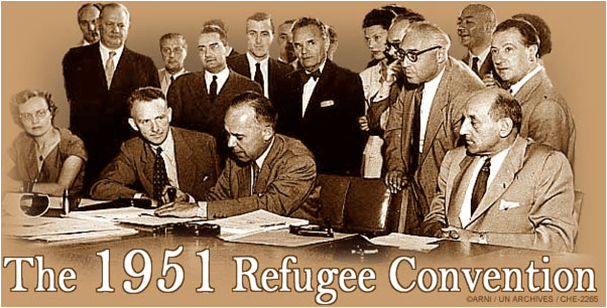
On July 2, 1951, an international conference in Geneva, Switzerland concluded with the signing of the Convention Relating to the Status of Refugees by the conference attendees and the opening of the treaty for accession or ratification by nation states.[9] By its Article 43(1) it was to enter into force or become a binding treaty 90 days after the sixth state had acceded or ratified the treaty. That happened on April 22, 1954.[10]

Its preamble noted that the U.N. had “manifested its profound concern for refugees and endeavored to assure refugees the widest possible exercise of . . . fundamental rights and freedoms.” The preamble also stated, “the grant of asylum may place unduly heavy burdens on certain countries, and . . . a satisfactory solution of a problem . . . [of] international scope and nature cannot therefore be achieved without international cooperation.”

This treaty adopted the following definition of “refugee” in Article 1(A)(2) as any person who:

  • “[As a result of events occurring before 1 January 1951] and owing to well- founded fear of being persecuted for reasons of race, religion, nationality, membership of a particular social group or political opinion, is outside the country of his nationality and is unable or, owing to such fear, is unwilling to avail himself of the protection of that country; or who, not having a nationality and being outside the country of his former habitual residence as a result of such events, is unable or, owing to such fear, is unwilling to return to it.”

The bracketed phrase [“As a result of events occurring before 1 January 1951”] was the provision that limited the coverage of the Convention to the problems still being faced by many World War II refugees still scattered across Europe. This limiting phrase was eliminated in the Protocol Relating to the Status of Refugees discussed below.

Excluded from the definition of “refugee” in Article 1(F) was “any person . . . [who] (a) . . . has committed a crime against peace, a war crime or a crime against humanity . . . ; (b) . . . has committed a serious non-political crime outside the country of refuge prior to his admission to that country as a refugee; [and] (c) . . . has been guilty of acts contrary to the purposes and principles of the [U.N.].”[11]

The Convention granted refugees certain rights within a country of refuge as well as imposing on them certain obligations. The Convention further stipulates that, subject to specific exceptions, refugees should not be penalized for their “illegal entry or presence.” This recognizes that the seeking of asylum can require refugees to breach immigration rules. Prohibited penalties might include being charged with immigration or criminal offences relating to the seeking of asylum, or being arbitrarily detained purely on the basis of seeking asylum.

Importantly, the Convention contains various safeguards against the expulsion of refugees. Its Article 33(1) states, “No Contracting State shall expel or return (‘refouler’) a refugee in any manner whatsoever to the frontiers of territories where his life or freedom would be threatened on account of his race, religion, nationality, membership of a particular social group or political opinion.”

Protocol Relating to the Status of Refugees

By 1966, it had become apparent that new refugee situations had arisen since the Refugee Convention had been adopted and that all refugees should enjoy equal status. As a result, a new treaty was prepared to eliminate the previously mentioned limitation of the Convention to those refugees created by pre-1951 events. This was the Protocol Relating to the Status of Refugees that went into force on October 4, 1967.[12]

Parties to the Convention or Protocol

As of April 1, 2011, there were 145 nation states (and the Holy See) that were parties to the Convention and Protocol or the latter, including the U.S. That represents 76.2% of the U.N. members (plus the Holy See).[13]

Conclusion

In subsequent posts we will review (a) the work of the principal U.N. agency concerned with refugees (the Office of the United Nations High Commissioner for Refugees); (b) U.S. law and procedures for refugees; and (c) U.S. law and procedures for asylum.


[1]  See Post: Refugees and Asylum Law: The Pre-Modern Era (July 7, 2011).

[3] See Mary Ann Glendon, A World Made New: Eleanor Roosevelt and the Universal Declaration of Human Rights (New York: Random House 2002)(fascinating history of the development of the Universal Declaration).

[4] Id.

[5] Id.

[6]  Id.

[8]  See Post: My Pilgrimage to El Salvador, April 1989 (May 25, 2011).

[9] UNHCR, 1951 Conference of Plenipotentiaries on the Status of Refugees and Stateless Persons, http://www.unhcr.org/cgi-bin/texis/vtx/search/?page=&comid=3c07a8642&cid=49aea9390&scid=49aea9398.

[10]  UNHCR, Convention and Protocol Relating to the Status of Refugees, http://www.unhcr.org/3b66c2aa10.html; UNHCR, The 1951 Refugee Convention: Questions and Answers (2007), http://www.unhcr.org/3c0f495f4.html.

[11] There are certain other stated exclusions from the definition of “refugee” in Article 1(C), (D), (E).

[12] Id.

[13]  UNHCR, States Parties to the 1951 Convention relating to the Status of Refugees and the 1967 Protocol,        http://www.unhcr.org/3b73b0d63.html. In addition Madagascar and St. Kitts & Nevis are parties only to the Convention with its now outmoded temporal limitations. (Id.)


My Pilgrimage to El Salvador, April 1989

For my second Salvadoran asylum case, I decided that I needed to go to El Salvador to do investigations for the case and to learn more about the country. In April 1989 I made my first of six trips to the country. I went with a group led by Minneapolis’ Center for Global Education at Augsburg College.[1]

The Salvadoran Civil War was still going on, and on the day we arrived her Attorney General was assassinated with a car bomb. In response, the Salvadoran military forces were in the streets with their automatic rifles at the ready, stopping everyone to provide identification. People in the “popular organizations” were being arrested. It was a very dangerous and tense 10 days in the country.

These days turned out to be the most intense religious and spiritual experience of my life. It was and still is a major reason why I now say that El Salvador liberated this American lawyer in many ways and helped him integrate his religious faith with his professional life.

We went to a service of solidarity for a Catholic priest who that week had received death threats. The service was in a screened recreational building next to a very dusty soccer field. As we entered, we were handed mimeographed sheets with words for hymns of the people about Archbishop Oscar Romero, who had been murdered nine years earlier. Thus began my learning about Romero.[2]

Our group visited the office of COMADRES in a small house in the city. (It is the committee of the mothers of the disappeared and assassinated). A young woman talked about her jailing and torture earlier that week. Right behind her I saw a bust of Robert Kennedy representing the very first Robert F. Kennedy Human Rights Award. It was granted to COMADRES for its struggle for amnesty for political prisoners, information regarding the “disappeared” and punishment for those responsible for human rights violations.[3] (During the Reagan Administration, the U.S. would not grant a U.S. visa to a COMADRES representative to come to the U.S. to receive the award.)

At the COMADRES’ office I also saw a framed copy en espanol of the Universal Declaration of Human Rights,[4] which I had never regarded as important and about which I knew nothing. Even though I could not read the Spanish text, I could see that it was an inspirational document for these people. This experience came rushing back to me when later I learned about the Universal Declaration.

Our group met with Phil Anderson, a Lutheran pastor from Minnesota who was working in El Salvador for Lutheran World Federation. Earlier that week he had sent faxes to the Federation’s headquarters in Switzerland with information about the arrests of many people from the popular organizations so that the next day the headquarters could send faxes of complaints to the Government of El Salvador. I gained a new appreciation for the work of international organizations around the world and about the sinister messages that are sent when they are kicked out of a country.

My fellow travelers on this trip were from the Washington, D.C. Synod of the Evangelical Lutheran Church of America (the successor of the Lutheran Church in America, my client in the Sanctuary Movement case). Through their connections I was introduced to the significant work in El Salvador of its small Lutheran Church and its Bishop Medardo Gomez, who is frequently regarded as the spiritual heir to Archbishop Romero.[5]

We also met Salvador Ibarra, a lawyer for the human rights office of the Lutheran Church of El Salvador. He told us that in late 1980 a judge had appointed him to represent one of the Salvadoran national guardsmen accused of raping and murdering the four American church women.[6] Someone from the U.S. Embassy then asked Ibarra to call a press conference and announce that he had investigated and had found no involvement of higher officials in this horrible crime. This, however, was not true, and he refused to hold a press conference. In response he received death threats that prompted him and his family to flee the country. His wife told him that he was stupid to put her and their children’s lives at risk, and she took the children and divorced him. Yet Ibarra subsequently returned to his country to be a human rights lawyer and thereby continued to put his life on the line. He spoke about the joy he had in his work as a lawyer for people whose human rights were at greater risk.

In my subsequent work as a pro bono asylum lawyer and human rights advocate, I continued to be inspired by Salvador Ibarra. How easy it was for me as a large law-firm lawyer in Minneapolis to do this work. I did not have to risk my life as he did.

Our group visited the “22nd of April” community in San Salvador. This community was a three-block area of land on a steep hill between railroad tracks above and a road below. It had been used as a garbage dump, but on April 22nd in the early 1980’s displaced Salvadorans (“desplazados”) started to occupy it. In April of 1989 there were at least 10,000 people living there. They were mainly women and small children because teenage and adult males were fighting in the civil war or had been killed or disappeared. The people lived in “houses”– some of concrete blocks and tin roof; others of cheap tin or aluminum sheets or scrap lumber; yet others made with cardboard.

We walked around “22nd of April” with its pastor–Father Jim Barnett, a Dominican priest from Sioux Falls, South Dakota. He talked about his ministry of accompaniment and solidarity. He was inspired by the example of Archbishop Oscar Romero, who had entered the total experience of the poor–physical, spiritual, social, economic and political–and who had spoken about the church’s need to be incarnated in the life of the people and the institutional injustice and violence in El Salvador.

Another stop on our trip was UCA, the Universidad de Centro America, a Jesuit institution with a beautiful, serene campus on a hill in the capital city.[7] We spent an hour with Father Jon Sobrino, a noted liberation theologian.[8]  Only seven months later six of his fellow Jesuit priests were brutally murdered at that very place by the Salvadoran Armed Forces. (Sobrino escaped this fate because he was in Thailand giving lectures.)[9]

We went to the small, modern, beautiful, serene Chapel of Divine Providence on the quiet grounds of a cancer hospital. This is where Oscar Romero was assassinated while celebrating mass on March 24, 1980. (Across the street was the three-room apartment where Romero lived. No luxurious Archbishop’s palace for him.) Along the way to the chapel I saw graffiti messages: “Romero vive!” (“Romero lives!”)

The Cathedral of San Salvador, on the other hand, is in el centro with all the noise and hurly-burly of buses and other traffic. In April 1989 the building was not finished. (Romero had halted all construction because he did not think it was right for the church to be spending money on its building when the people were suffering from poverty and human rights abuses.) On the steps were women from COMADRES with their bullhorns protesting against the latest wave of repression. Inside, scraps of linoleum were on the floor along with scattered plain wooden benches. In the right transept was Romero’s tomb–plain concrete and covered with flowers and prayers of the people. As I stood there, the words “My body broken for you” from the Christian sacrament of communion echoed in my mind.


[1]  Center for Global Education, http://www.augsburg.edu/global/.

[2]  Later posts will discuss the life and witness of Archbishop Romero and why he is my personal saint.

[3]  Robert F. Kennedy Center for Justice & Human Rights, http://www.rfkcenter.org/ourwork/humanrightsaward.

[4]  Universal Declaration of Human Rights, http://www1.umn.edu/humanrts/instree/b1udhr.htm.

[5]  Medardo Gomez, Fire Against Fire (Minneapolis, MN: Augsburg Fortress 1990); Medardo Gomez, And the Word Became History (Minneapolis, MN: Augsburg Fortress 1992).

[6]  E.g., Ford v. Garcia, 289 F.3d 1283 (11th Cir. 2002), cert. denied, 537 U.S. 1147 (2003); Gonzalez, 2 Salvadoran Generals Cleared by U.S. Jury in Nuns’ Deaths, N.Y. Times, Nov. 4, 2000, at A3.

[7]  Universidad Centroamericana “José Simeón Cañas,” http://www.uca.edu.sv/.

[8]  Wikipedia, Jon Sobrino, http://en.wikipedia.org/wiki/Jon_Sobrino.

[9]  Sobrino, et al., Companions of Jesus: The Jesuit Martyrs of El Salvador (Maryknoll, NY: Orbis 1990); Center for Justice & Accountability, Jesuits Massacre Case, http://www.cja.org/article.php?list=type&type=84.

International Criminal Justice: Introduction

Since the end of World War II, we the peoples of the world, acting through our nation-state governments, have codified or created numerous international human rights norms. This started with 1945’s Charter of the United Nations and 1948’s Universal Declaration of Human Rights and the Convention on the Prevention and Punishment of the Crime of Genocide. Other multilateral human rights treaties have followed, including the International Convention on Civil and Political Rights, the International Convention on Economic, Social and Cultural Rights and the Convention Against Torture and Other Cruel, Inhuman or Degrading Treatment or Punishment.[1]

Given the world’s nation-state sovereignty basis, we the peoples of the world have grappled with the very real problem of how to enforce such norms in order to punish violators, to deter future violations, to provide redress to victims and survivors, and to investigate and promulgate the “truth” about past violations. The response has been the creation of various mechanisms, none of which is perfect: state reporting to U.N. Charter and treaty bodies for review, comment and recommendations; complaints by states and individuals to such bodies for recommended solutions; international investigations of specific countries or problems; civil litigation for money damages against violators in domestic courts and international courts like the Inter-American Court of Human Rights; and truth commissions.[2]

Another response has been seeking to subject violators to criminal sanctions (imprisonment) in national courts under the international law principle of universal jurisdiction whereby a nation’s courts have legitimate criminal jurisdiction over genocide, crimes against humanity and war crimes no matter where in the world such crimes were committed. Criminal sanctions have also been imposed by international criminal tribunals like the Nuremberg and Tokyo War Crimes Tribunals at the end of World War II and more recently by so called ad hoc tribunals created by the U.N. Security Council (the International Criminal Tribunal for the Former Yugoslavia (ICTY) and the International Criminal Tribunal for Rwanda (ICTR)). Even more recently the International Criminal Court (ICC) has been created.[3] Collectively these mechanisms often are referred to as international criminal justice.

In future posts we will examine a Spanish court’s use of the universal jurisdiction principle to commence criminal investigations. In other posts we will analyze the International Criminal Court and its relations with the United States.


[1]  David Weissbrodt, Fionnuala Ní Aoláin, Joan Fitzpatrick, and Frank Newman, International Human Rights: Law, Policy and Process, ch. 1 (4th ed. 2009) [“Weissbrodt”].

[2]  Id. , chs. 4-6, 9, 11, 12, 14, 15, 16.

[3]  Id. at 11, 483-586. The text of the Rome Statute, which will be referenced throughout this article, is available at:  http://www.icc-cpi.int/NR/rdonlyres/EA9AEFF7-5752-4F84-BE94-0A655EB30E16/0/Rome_Statute_English.pdf.