I am currently taking a brief course, “Sub-Saharan African History to Colonialism,” to learn about such history “from many angles: anthropological, historical, geographic, cultural, and religious. From human origins through the populating of the continent, the great civilizations, the slave trades, to the beginning of European domination.” Offered by the University of Minnesota’s Osher Lifelong Learning Institute (OLLI), the course’s instructor is Tom O’Toole, Emeritus Professor of Sociology and Anthropology of Minnesota’s St. Cloud State University.
Why does this Euro-American septuagenarian take this course? Foremost, I know virtually nothing about this history and want to know more. I also realize that I have various direct and indirect connections with Africa.
The most immediate precipitating cause is reading the discussion of the names of African and African-American intellectuals and historical figures that were discovered at Howard University by African-American author Ta-Nehisi Coates and recounted in his book “Between the World and Me” and my realizing that I did not know virtually any of these people. This book also has prompted me to research and investigate my own notions of race, including my recent posts about statements from the American Anthropological Association about race’s non-scientific basis and historical and cultural background. Further posts about notions of race are forthcoming.
I learned more about one of these figures of African history this spring when my 10th-grade grandson wrote a History Day paper on Mansa Musa, who was a 14th century Emperor or King of Mali. Moreover, one of my sons knows more about this history from his having studied African history and Swahili at the University of Minnesota and from spending a semester in Kenya with a program of the National Outdoor Leadership School and then a week on his own living with a Maasai tribesman in that country.
Coates also legitimately castigates the U.S. history of slavery and its lasting impacts on our country. This has underscored my interest in the importation of slaves from Africa to the Western Hemisphere. This was part of Lawrence Hill’s fascinating novel “The Book of Negroes” (“Someone Knows My Name”), about which I have written. Moreover, I have visited Matanzas, Cuba and Salvador, Brazil, which were major ports of importation of African slaves to work on sugar plantations in those countries.
I have a number of friends from West Africa (Cameroon, Nigeria and Ghana) and visited Cameroon on a mission trip from Minneapolis’ Westminster Presbyterian Church. There I learned about the country’s having been a German colony (Kamerun) in the 19th century and then having French and British administration under League of Nations mandates after Germany was stripped of its African colonies by the 1919 Treaty of Versailles ending World War I. Forty-plus years later Cameroon became an independent country with the joinder of the Francophone and Anglophone territories. Yet life today in the country is still affected by the language and cultural differences from the French and British governance and less so by the previous 30-plus years of German rule.
I also have visited Namibia, Botswana and South Africa focused primarily on observing their magnificent wildlife and nature, but also the prison on Robben Island, where Nelson Mandela and other African National Congress leaders were imprisoned during the years of apartheid. In addition, I had the opportunity to see and hear Mandela speak at a 2003 celebration of the centennial of the Rhodes Scholarships held at Westminster Hall in London and to see him escorted through the Hall’s audience, only 10 feet from me and my wife, by Bill Clinton and Tony Blair.
The visit to South Africa also included stopping at Cecil Rhodes’ Cottage and Museum at Mulzenberg overlooking False Bay and the Indian Ocean at the southwest corner of the country. (My interest in Cecil Rhodes, the Founder of the Scholarships, and his 19th century involvement in South Africa and Rhodesia (now known as Zimbabwe) stems from being a Rhodes Scholar who was “up” at Oxford, 1961-1963, and from my gratitude for being a beneficiary of his largess.)
While co-teaching international human rights law at the University of Minnesota Law School, I learned about the International Criminal Court, whose initial cases all came from Africa, thereby prompting some resistance from African leaders who thought this was anti-African discrimination. (I have written many blog posts about the ICC.) Previously I had been a pro bono lawyer for two Somali men’s successful applications for asylum in the U.S.
Other indirect connections are provided by three Grinnell College classmates. One became a professor of African history. Another served in Africa with the Peace Corps in Ethiopia, where he met his English wife serving in a similar British program and where they both frequently return to participate in a project of preparing and distributing audio textbooks for blind students. The third classmate, also in the Peace Corps, served in Mali, where he was involved in smallpox eradication. In addition, one of my Grinnell roommates from Chicago now lives in South Africa.
All of these direct and indirect connections with Africa provided additional motivation to learn more about its history. In a subsequent post I will attempt to summarize the key points of this brief exploration of African history.
On June 19, 2015, the U.S. Department of State released its “Country Reports on Terrorism 2014.” Such annual reports are required by federal statute to cover the prior calendar year.[1]
Tina S. Kaidanow, U.S.Ambassador-at-Large and Coordinator for Counterterrorism, gave a special briefing on this report. She pointed out that “the number of terrorist attacks [worldwide] in 2014 increased 35 percent, and total fatalities increased 81 percent compared to 2013, largely due to activity in Iraq, Afghanistan and Nigeria. More than 60 percent of all attacks took place in five countries: Iraq, Pakistan, Afghanistan, India, and Nigeria. And 78 percent of all fatalities due to terrorist attacks also took place in five countries: Iraq, Nigeria, Afghanistan, Pakistan, and Syria. The increase in total fatalities was in part a result of certain attacks that were exceptionally lethal.”
The Ambassador then provided broader context by discussing the terrorism committed in 2014 by al-Qaida, ISIL, Boko Haram and the civil war in Syria and of the need for the U.S. to have partners “to disrupt terrorist plots and degrade terrorist capabilities . . . [and to] help counter the spread of violent extremist recruitment and address the conditions that make communities susceptible to violent extremism. We must do more to address the cycle of violent extremism and transform the very environment from which these terrorist movements emerge.”
The U.S. last year, the Ambassador emphasized, provided “ counterterrorism assistance . . . in the fields of rule of law and countering recruitment, . . . a wide array of expertise and programmatic support for our partners to help them identify and disrupt the financing of terrorism, strengthen aviation and border security, and sharpen their law enforcement and crisis response tools to respond to the terrorist threat.” In addition, the U.S. engaged “in robust diplomacy, expanding our partnerships, building bilateral and regional capabilities, and promoting holistic and rule-of-law based approaches to counter terrorism and violent extremism.”
The report’s chapter on “State Sponsors of Terrorism” noted that such a state has been determined by the Secretary of State “to have . . . [a] government [that] has repeatedly provided support for acts of international terrorism. Once a country is designated, it remains a State Sponsor of Terrorism until the designation is rescinded in accordance with statutory criteria.” For 2014 there were four such states: Cuba, Iran, Sudan and Syria. Here is what was said about Cuba for 2014:
“Cuba was designated as a State Sponsor of Terrorism in 1982. Though not within the timeframe covered by this report, on April 14, 2015, President Obama submitted to Congress the statutorily required report and certifications indicating the Administration’s intent to rescind Cuba’s State Sponsor of Terrorism designation, including the certification that Cuba has not provided any support for international terrorism during the previous six-months; and that Cuba has provided assurances that it will not support acts of international terrorism in the future. The required 45-day Congressional pre-notification period expired, and the Secretary of State made the final decision to rescind Cuba’s designation as a State Sponsor of Terrorism, effective on May 29, 2015.” [2]
“In recent years, Cuba has taken a number of steps to fully distance itself from international terrorism and has taken steps to strengthen its counterterrorism laws. In 2013, Cuba made a commitment to work with the Financial Action Task Force to address its anti-money laundering/counterterrorism finance (AML/CFT) deficiencies. Since that time, Cuba has made significant progress in establishing the framework necessary to meet international AML/CFT standards by, for example, adequately criminalizing money laundering and terrorist finance and establishing procedures to identify and freeze terrorist assets, among other legal and regulatory actions.”
“Throughout 2014, Cuba supported and hosted internationally recognized negotiations between the Revolutionary Armed Forces of Colombia (FARC) and Government of Colombia aimed at garnering a peace agreement. Safe passage of FARC members provided in the context of these talks has been coordinated with representative of the governments of Colombia, Venezuela, Chile, and Norway, as well as the International Committee of the Red Cross. There is no credible evidence that the Government of Cuba has provided specific material support, services, or resources, to members of the FARC, or the National Liberation Army (ELN), outside of facilitating the internationally recognized peace process between those organizations and the Government of Colombia.”
“The Government of Cuba does continue to allow approximately two dozen members of the Basque Fatherland and Liberty Organization (ETA) to remain in the country. The Cuban government provided assurances that it would never permit the ETA members living in Cuba to use Cuban territory for that organization’s activities against Spain or any other country. There is no available information that the Government of Cuba allowed any of these ETA members to plan, finance, lead, or commit acts of international terrorism while residing in Cuba.”
“The Government of Cuba does continue to harbor fugitives wanted to stand trial or to serve sentences in the [U.S.] for committing serious violations of U.S. criminal laws, and provides some of these individuals limited support such as housing, food ration books, and medical care. Although Cuba continues to refuse to return certain individuals that fled to Cuba in the past, it has been more cooperative with the [U.S.] in recent years. In 2014, the Government of Cuba engaged in talks with U.S. officials in reference to some of these fugitives still residing in Cuba.”
Conclusion
There is nothing surprising in the Report’s discussion of Cuba. The report is statutorily required to cover the prior calendar year, and Cuba’s designation of state sponsorship was not rescinded until May 29, 2015. Therefore, it had to be included in this report as such a sponsor, and the discussion is fully consistent with that subsequent rescission.
[2] A prior post discussed the April 14, 2015, presidential notification of such rescission to the Congress and another post, the May 29, 2015, official rescission of Cuba as such a sponsor. Earlier posts covered the legal and political issues regarding such rescission and the U.S. already having conceded many reasons why Cuba had provided assurances that it will not support future acts of international terrorism.
The ultimate step in the process of becoming a naturalized U.S. citizen that was discussed in a prior post is taking the Oath of Allegiance to the United States. This is usually done in a collective ceremony.
Such a ceremony was held on May 26, 2015, by the U.S. District Court for the District of Minnesota when it welcomed 453 new U.S. citizens from the following regions of the world: Africa, 167; Asia, 160; Latin America, 56; Europe 43; Middle East, 20; and Other, 7. Of the 76 foreign countries represented, the largest numbers came from Somalia, 42; Ethiopia, 34; Liberia, 26; Burma (Myanmar), 24; Thailand, 23; Nigeria, 23; and Mexico, 22.
After everyone sang the “Star-Spangled Banner,” an officer of the U.S. Citizenship and Immigration Services collectively presented the new citizens to the court, and U.S. Magistrate Judge Jeffrey J. Keyes administered the following Oath of Allegiance to the new citizens:
“I hereby declare, on oath, that I absolutely and entirely renounce and abjure all allegiance and fidelity to any foreign prince, potentate, state, or sovereignty, of whom or which I have heretofore been a subject or citizen; that I will support and defend the Constitution and laws of the United States of America against all enemies, foreign and domestic; that I will bear true faith and allegiance to the same; that I will bear arms on behalf of the United States when required by the law; that I will perform noncombatant service in the Armed Forces of the United States when required by the law; that I will perform work of national importance under civilian direction when required by the law; and that I take this obligation freely, without any mental reservation or purpose of evasion; so help me God.”
Judge Keyes then congratulated them. He said he saw the U.S. as a fabric or quilt of diverse elements that combined to create a beautiful whole that continuously is regenerated with new citizens. He urged the new citizens never to forget the poetry, the culture, the land and the ancestors of their homelands.
On a personal note, Keyes said his ancestors came from Ireland 150 years ago, and he was confident that they never imagined that someday an Irishman could become President of the United States. Yet in 1960 John F. Kennedy of Irish heritage was elected to that office. So too many people in this country could not have imagined that a black man could also be so elected, and yet Barack Obama was the victor in the presidential elections of 2008 and 2012.
With citizenship came many rights and responsibilities under our Bill of Rights, Keyes continued. There was freedom of speech and the responsibility to listen and understand the opinions of others. There was no established religion and the freedom to have or not have your own religious beliefs and the responsibility to understand and accept others’ religious beliefs. Another right was the freedom of assembly and the responsibility to engage in the political arena and to vote.
Other words of welcome were made in a videotape presentation by President Obama. One of his messages was in American no dream is impossible.
The ceremony concluded with everyone reciting the Pledge of Allegiance.
One of the largest single naturalization ceremonies in Minnesota was on September 6, 2012, when 1,509 individuals from 100 countries became U.S. citizens; the largest numbers of these came from Somalia (344), Ethiopia (141), Laos (101), Liberia (95) and Mexico (84).
The U.N. Human Rights Council, which is responsible for strengthening the promotion and protection of human rights around the globe, addressing situations of human rights violations and making recommendations on the subject, [1] is in the midst of its 28th regular session at its headquarters in Geneva Switzerland with the session ending on March 27th. [2]
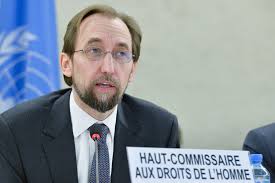
Zeid Ra-ad Al Hussein
At the opening of the session on March 2 the U.N. High Commissioner for Human Rights, Zeid Ra’ad Al Hussein, [3] set forth his concerns on human rights. Three days later, on March 5th, he commented on his annual report on human rights. This post will examine both of these speeches.
From March 2 through 5, the Council conducted what it called its High Level Segment, in which national leaders addressed the Council on the overall subject of human rights. Two of those national leaders were U.S. Secretary of State john Kerry and Cuban Foreign Minister, Bruno Rodriguez Parrilla. Their remarks will be covered in subsequent posts while another post will analyze those remarks and the speeches of the High Commissioner.
High Commissioner’s Speech, March 2nd [4]
The “cruelty and moral bankruptcy of violent extremists . . . continue daily, and we condemn their merciless conduct daily.”
“And yet, if we are not careful, if we are not completely principled and cunning in our collective attempt to defang them, we will, unwittingly and inexcusably, be advancing their interests. How we define the opening chapters of this already agitated century depends heavily on us not becoming like them. For us, international humanitarian law and international human rights law cannot be trifled with or circumvented, but must be fully observed.”
“It has been 70 years since the great Charter of the [U.N.] was drawn up, and since then States have also written and agreed to a range of strong international treaties, to establish in binding law the legal principles of human rights. They are a distillation of all human experience, all the warnings and screams of our combined human history.” By “ratifying the U.N. Charter, [states] have made a clear commitment [in the words of its Preamble] to ‘reaffirm faith in fundamental human rights; in the dignity and worth of the human person; in the equal rights of men and women, and of nations large and small; and to establish conditions under which justice and respect for the obligations arising from treaties, and other sources of international law, can be maintained; and to promote social progress, and better standards of life in larger freedom.’”
“And yet, with alarming regularity, human rights are disregarded, and violated, sometimes to a shocking degree.”
“States claim exceptional circumstances. They pick and choose between rights. One Government will thoroughly support women’s human rights and those of the LGBT communities, but will balk at any suggestion that those rights be extended to migrants of irregular status. [U.S.?] Another State may observe scrupulously the right to education, but will brutally stamp out opposing political views. [Cuba?] A third State comprehensively violates the political, civil, economic, social and cultural rights of its people, while vigorously defending the ideals of human rights before its peers.”
“In recent months I have been disturbed deeply by the contempt and disregard displayed by several States towards the women and men appointed by [the Council] as [its] independent experts – and also by the reprisals and smear campaigns that are all too frequently exercised against representatives of civil society, including those who engage with the Council and its bodies. I appeal to all of you, once again, to focus on the substance of the complaint, rather than lash out at the critic – whether that person is mandated by States, is a member of my Office, or is a human rights defender.”
“The overwhelming majority of victims of human rights abuses around the world share two characteristics: Deprivation, and discrimination – whether it is based on race or ethnicity, gender, beliefs, sexual orientation, caste or class. From hunger to massacres, sexual violence and slavery, human rights violations are rooted in these hidden, and sometimes not so hidden, factors.”
“They are not spontaneously generated. Most violations of human rights result from policy choices, which limit freedom and participation, and create obstacles to the fair sharing of resources and opportunities.”
“The most powerful instrument in the arsenal we have against poverty and conflict is the weapon of massive instruction. Respect for the human rights of all, justice, education, equality – these are the strongly interlocking elements that will build fair, confident and resilient societies; true development; and a permanent peace.”
“Everybody knows when police use torture, and when tweets are brutally suppressed. Everybody knows when discrimination means poverty, while corrupt elites gorge on public goods, supported by a corrupt judiciary. Everybody knows when women are treated like property, and children go hungry, and unschooled, in squalid neighborhoods.”
“Some of the evidence may be hidden. But the reality, in far too many countries, of massacres and sexual violence; crushing poverty; the exclusive bestowal of health-care and other vital resources to the wealthy and well-connected; the torture of powerless detainees [U.S.?]; the denial of human dignity – these things are known. . . . [T]hey are what truly make up a State’s reputation; together with the real steps – if any – taken by the State to prevent abuses and address social inequalities, and whether it honors the dignity of its people.”
“The only real measure of a Government’s worth is . . . the extent to which it is sensitive to the needs – and protects the rights – of its nationals and other people who fall under its jurisdiction, or over whom it has physical control.”
“Some policy-makers persuade themselves that their circumstances are exceptional, creating a wholly new reality unforeseen by the law. This logic is abundant around the world today: ‘I arrest arbitrarily and torture because a new type of war justifies it. I spy on my citizens because the fight against terrorism requires it. I don’t want new immigrants, or I discriminate against minorities, because our communal identity is being threatened now as never before. I kill without any form of due process, because if I do not, others will kill me.’ “
“I must remind you of the enduring and universal validity of the international human rights treaties that your States wrote and ratified. In reality, neither terrorism, nor globalization, nor migration are qualitatively new threats that can justify overturning the legal foundations of life on Earth. They are not new.”
“At a time of intensifying global anxiety, I believe the people of the world are crying out for profound and inspiring leadership equal to the challenges we face. We must therefore renew, by the strongest action, our dedication to the reality of inalienable and universal human rights, to end discrimination, deprivation, and the seemingly inexhaustible litany of conflicts and crises that generate such terrible, and needless, suffering.”
“What will become of us, of our world, if we ignore our treaties and principles? Can we be so stupid as to repeat scenes from the twentieth century, punctured as it was by such awful inhumanity? You must not make it so. This is principally your burden, and ours. Together, if we succeed in turning the corner, in improving our global condition, we can then say the screams of history and of the millions upon millions of victims, have been heard, finally. Let us make it so.”
High Commissioner’sSpeech, March 5th [5]
The High Commissioner was “appalled by the massive suffering ISIL provokes [in Syria, Iraq and Libya]: from the murders, torture, rape and sale of children . . . ; to mass beheadings; burning people alive in cages; seemingly genocidal attacks on ethnic and religious groups; the obliteration of due process; torture; deprivation of income and every kind of service and resource; recruitment of children; the destruction of elements of the cultural heritage of humanity; and, not least, particularly vicious and comprehensive attacks on the rights of women and girls.” [Similar horrible actshe said, were perpetrated in Nigeria by Boko Haram and in Yemen and Somalia by other groups.]
“My Office strongly supports efforts by States around the world to prevent and combat terrorism, and to ensure that the perpetrators of terrorism, as well as their financiers and suppliers of arms, are brought to justice.”
“Terrorist attacks [,however,] cannot destroy the values on which our societies are grounded – but laws and policies can. Measures that build what has been termed the ‘national security state’ – such as arbitrary or prolonged detention; torture and ill-treatment; massive surveillance that contravenes the right to privacy; unfair trials; discriminatory policing; and the abusive use of legislation to curb legitimate rights to peaceful protest and to freedom of expression – are human rights violations. They generate legitimate resentment, harm social cohesion, and undermine the essential values of the international community.”
“There is real danger that in their reaction to extremist violence, opinion-leaders and decision-makers will lose their grasp of the deeper principles that underpin the system for global security which States built 70 years ago to ward off the horror of war. The fight against terror is a struggle to uphold the values of democracy and human rights – not undermine them. . . [C]ounter-terrorist operations that are non-specific, disproportionate, brutal and inadequately supervised violate the very norms that we seek to defend. They also risk handing the terrorists a propaganda tool – thus making our societies neither free nor safe. The use of torture, neglect of due process and collective punishment do not make the world any safer.”
“To be truly effective, any response to extremist violence must be targeted, proportionate, and legal. Military campaigns, financial sanctions and attempts to staunch the inflow of weapons – such as the United Nations Arms Trade Treaty – may be part of the solution.”
“But other actions are needed to stem the root causes that feed into these conflicts. We must acknowledge that large numbers of people do not join such extremist movements en masse because they have been suddenly and inexplicably hypnotized. Extremism – however repugnant – is nurtured by ideology, and by alienation fed by years of tyranny, corruption, repression, discrimination, deprivation and neglect of the legitimate rights of communities.”
He especially was “disturbed by a continuing trend of harsh restrictions on public freedoms by States across all regions. I refer to military crackdowns on demonstrations; harsh sentencing of human rights defenders, journalists and dissidents in politically motivated trials; brutal punishments for simple tweets; censorship; oppressive and illegitimate regulations of civil society movements; the use of new technologies to stifle human rights in the virtual space; and new security laws that are unjustly broad, endangering civil liberties and human rights.”
“And yet the great pillar of every resilient and participative society is freedom of expression. Freedom to formulate the ideas of equality led to the overthrow of colonialism, and has powered every movement against discrimination and injustice. To immunize against dictatorship or totalitarianism, to undo discrimination, to drive justice and accountability, we need freedom of expression – full and free and far-reaching. There is no good governance without free speech.”
The High Commissioner’s speech included specific criticisms of many countries. About the U.S., he said: “In the United States, the Senate report on torture in the context of counter-terrorism operations is courageous and commendable, but profoundly disturbing. For a country that believes so strongly in human rights to have swiftly abandoned their fundamentals at a time of crisis is as astonishing as it is deplorable. And yet few other countries have had the courage to likewise publicly investigate and publicly admit to rights abuses resulting from counter-terror operations – and many should.”
“Under international law, the [Senate] report’s recommendations must be followed through with real accountability. There is no prescription for torture, and torture cannot be amnestied. It should also lead to examination of the institutional and political causes that led the US to violate the absolute prohibition on torture, and measures to ensure this can never recur.”
“As the Senate report clearly demonstrates, the neglect of due process, use of torture and collective punishments that were permitted by US officials in the post-9/11 context did not make the world – or the US – any safer. On the contrary, they increased the threat of terrorism, by feeding into the grievances on which it thrives. The orange jumpsuits of Guantanamo are a recruitment tool for ISIL and other groups. As former President George W. Bush has conceded, Guantanamo became, I quote, ‘a propaganda tool for our enemies.’”
The High Commissioner also expressed regret at the renewed use of the death penalty in a number of countries – Jordan, Pakistan, and Indonesia – and “the continuing extensive use” of the death penalty in China, Iraq, Iran and the U.S.
In conclusion, he said, “It is the people who sustain government, create prosperity, heal and educate others and pay for governmental and other services with their labour. It is their struggles that have created and sustain States. Governments exist to serve the people – not the other way round.”
“Governments that protect human rights, combat discrimination and deprivation, and which are accountable to their people are more prosperous and more secure than those which stifle rights, hamper opportunities, and repress freedoms. When people’s rights are respected – when they are accorded dignity, have opportunities to express their skills and are given a fair share of resources – they form resilient societies. When they are wronged, their rights betrayed, there is a constant threat of turmoil. Respect for the human rights of the people is not destabilizing; but driving legitimate opposition underground is.”
Conclusion
Speeches about human rights in international fora often are replete with platitudes. These speeches by the High Commissioner are not. While he condemns the horrible actions of ISIL and Boko Haram, these groups are not represented at the Council. Instead the countries that are represented are often the victims of their evil deeds. Therefore, the High Commissioner spent most of his time chastising the latter countries for failing to live up to the human rights commitments they have made as they are combatting terrorism. Moreover, these speeches address some countries by name and point our their failings.
In a later post we will look again at these speeches in the context of the issues of human rights in the process of U.S.-Cuba reconciliation.
[1] The Human Rights Council has 47 member states elected by the U.N. General Assembly. Currently both the U.S. and Cuba are such members.
[2] Materials about the Council’s 28th session are available on its website.
[3] The High Commissioner for Human Rights is the principal human rights official of the U.N. and the head of the Office of the High Commissioner for Human Rights, which “spearheads the [U.N.’s] human rights efforts . . . by strengthening international human rights mechanisms; enhancing equality and countering discrimination; combating impunity and strengthening accountability and the rule of law; integrating human rights in development and in the economic sphere; widening the democratic space; and early warning and protection of human rights in situations of conflict, violence and insecurity.”
Prince Zeid Ra’ad Al Hussein of Jordan was unanimously elected the High Commissioner by the U.N. General Assembly in June 2014. His many years of diplomatic service include being Jordan’s Ambassador to the U.S., his country’s Permanent Representative to the U.N. and his serving as an officer of the International Criminal Court. He holds a Bachelor of Arts degree from The Johns Hopkins University and a Doctorate in Philosophy from Cambridge University.
In its waning days the 113th Congress has taken at least three actions regarding international religious freedom.
New U.S. Ambassador at Large for International Religious Freedom
David N. Saperstein
On December 12th the U.S. Senate by a vote of 62 to 35 confirmed President Obama’s nomination of David N. Saperstein, a prominent Reform rabbi, to be Ambassador at Large for International Religious Freedom, in charge of countering religious persecution around the world.
Saperstein was a member of President Obama’s Advisory Council on Faith-Based and Neighborhood Partnerships from 2010 to 2011. He also was a member of the U.S. Commission on International Religious Freedom (the Commission) from 1999 to 2001 and its Chair (1999-2000). For 40 years, Mr. Saperstein has been director of the Religious Action Center of Reform Judaism, lobbying on a wide range of civil rights and social justice issues.
At a confirmation hearing in September, Mr. Saperstein spoke out against religious discrimination in Burma, China, Iran, Iraq, Saudi Arabia and Syria, among other countries. “Even in Western Europe,” he said, “we are witnessing a steady increase in anti-Semitic discourse and violence against Jewish communities.”
The Senate Republican Policy Committee noted that Mr. Saperstein had criticized a ruling in June in which the Supreme Court said that some corporations could deny contraception coverage to their female workers on religious grounds. He expressed dismay at the ruling, which was hailed by conservatives as a victory for religious liberty, and he supported legislation to override the decision, in an effort to protect women’s health.
Amendment of the International Religious Freedom Act of 1998 [1]
On August 8, 2014, H.R. 4028 became Public Law No.: 113-154. It amended the “Findings” section (Section 2(a)(4)) of the 1998 statute to add three words (“desecration of cemeteries”) so that it reads as follows:
“The right to freedom of religion is under renewed and, in some cases, increasing assault in many countries around the world. More than one-half of the world’s population lives under regimes that severely restrict or prohibit the freedom of their citizens to study, believe, observe, and freely practice the religious faith of their choice. Religious believers and communities suffer both government-sponsored and government-tolerated violations of their rights to religious freedom. Among the many forms of such violations are state-sponsored slander campaigns, confiscations of property, desecration of cemeteries, surveillance by security police, including by special divisions of “religious police”, severe prohibitions against construction and repair of places of worship, denial of the right to assemble and relegation of religious communities to illegal status through arbitrary registration laws, prohibitions against the pursuit of education or public office, and prohibitions against publishing, distributing, or possessing religious literature and materials.” (Emphasis added.)
The author of this bill, Representative Grace Ming (Dem. NY), said during the House debate, “There are two related problems we seek to address through this legislation. One is the religiously motivated vandalism of cemeteries that occurs with alarming regularity. The second is the building and development over cemeteries in places where there are no communities remaining to protect and look out for the cemeteries.” She added that the bill “works to identify and preserve cemeteries, memorials, and buildings in foreign countries that are associated with the cultural heritage of Americans, and it does much work in areas of the former Soviet Union, where Jewish communities were destroyed by the Holocaust and where power subsequently passed to atheistic, communist regimes.”
Other bills in this Congress were offered to make other amendments to the statute, but they were not adopted, including a bill by Senator Marco Rubio (S. 2675) that would have imposed requirements and restrictions on presidential actions with respect to countries designated by the Commission as “of Particular Concern for Religious Freedom.” He introduced his bill the day after the State Department had issued its annual report on this freedom, and Rubio said, “While I welcome . . . [the Department’s] announcement updating CPC designations, this administration has failed to do so since 2011.” This proposed amendment “encourages the administration to take a firmer stance on religious freedom violators and codifies America’s commitment to advancing religious freedom as a key objective of U.S. foreign policy.”
In December 2014, too late for any legislative action this year, Reps. Joe Pitts (Rep., PA) and Anna Eshoo (Dem., CA) introduced H.R. 5878 (An Act to amend the International Religious Freedom Act of 1998 to further express United States foreign policy with respect to, and to strengthen United States advocacy on behalf of, freedom of religion or belief abroad and individuals persecuted in foreign countries on account of religion or belief, and for other purposes). It would add non-state actors like Boko Haram in Nigeria to the group of bodies the U.S. government can sanction for violating religious freedoms. The bill will be re-introduced in the next Session of Congress.
Reauthorization of the Commission on International Religious Freedom
On December 10thth the House adopted H.R. 5816 re-authorizing the Commission essentially for only another nine months (to September 30, 2015), and on December 15th the Senate added its approval of the bill.
This action reflected the inability of the two chambers to reach agreement on the terms of a lengthier reauthorization. In this context, I was surprised by a statement about this inability from Leonard L. Leo, the Executive Vice President of the Federalist Society for Law & Public Policy Studies and a former member of the Commission (2007-2009) and its Chair (2009-2012). He said that the Commission was formed in 1998 to be a watchdog on the State Department to ensure that it would promote religious freedom.
In July the House passed a reauthorization bill (H.R. 4653) that never passed the Senate. It would have extended the Commission through September 30, 2019, essentially another five years. It also would have (a) required training of foreign service officers on “the relationship between religious freedom and security, and the role of religious freedom in United States foreign policy;” (b) encouraged the Department of State to allow Commission members and staff to have “access to classified information;” and (c) allowed the Commission interns, fellows and volunteers to be paid compensation by “sponsoring private parties” so long as there was no conflict of interest.
During the House debate on this bill, Rep. Chris Smith (Rep., NJ), said that the original statute was passed by “a somewhat supportive Congress but highly reluctant [Bill Clinton] White House.” He lamented that eight countries designated as “Countries of Particular Concern” or CPCs by the Commission had not been similarly designated by the State Department and that the Obama Administration had not enacted sanctions for such designations of other countries.
During another House debate, the one on the previously mentioned “desecration of cemeteries” bill, the same Representative Smith said at a May 22, 2014, hearing he chaired, there had been evidence of “the lack of enforcement and the lack of due diligence on the part of the administration when it comes to the International Religious Freedom Act. Not since 2011 has there been a designation of what we call country of particular concern, CPC status, or the dishonorable status that it conveys ought to be done every year. . . . [despite the Commission’s pointing out] that there are eight [other] countries that ought to be so designated, followed by eight others, including Vietnam, that needed to be added to the list, making a total of 16 countries that are then liable to sanctions.”
In the other chamber Senator Richard Durbin (Dem., Illinois) offered a reauthorization bill (S. 2711) that was not adopted by either chamber. It would have extended the Commission through September 30, 2016, but also would have required annual rotation of its chair and vice chair based on political party affiliation and restricted service in such positions to one term. It also would have required the Ambassador at Large for International Religious Freedom to be notified in advance of all Commission meetings and allowed the Ambassador to attend all meetings as a nonvoting member. Finally it would have required (a) at least six commissioners to approve any commission statement and allow dissenting statements and separate staffs for the two major political parties; and (b) the Commission’s annual report to be issued after the issuance of the annual religious freedom reports by the Department of State.
Conclusion
Congressional criticism of the State Department and the President for their alleged failure to follow every recommendation of the Commission, in my judgment, is uncalled for. I also disagree with any proposed legislation like that of Senator Rubio’s that seeks to impose legislative constraints on the president based upon the Commission’s reports.
The basic reason for this judgment was expressed well by the Commission’s current Chair, Ms. Katrina Lantos Swett, when she acknowledged the Commission has limited authority when compared with the U.S. Department of State and implicitly the U.S. President. She said, “The State Department has a more difficult job than we do because they are balancing American security interests, American commercial interests, American cultural interests, American exchange interests, a whole range of diplomatic interests, and one of the things that they are putting into that mix is the defense of our fundamental values, human rights and religious freedom and other such things. Because of its much larger portfolio the State Department cannot be as single-minded as we are.”
=================================================
[1] Detailed information about bills in Congress can be obtained at www. Congress.gov. A prior post summarized the structure and members of the Commission while others posts have discussed the international law on this subject and some of the Commission’s annual reports. Although I believe that freedom of religion is important for every individual and for nation states, I believe that the Commission’s negative views on the status of that freedom in Cuba for 2011 and 2013 are unjustified.
On July 28, 2014, the U.S. State Department released its annual report on religious freedom around the world.[1]
Secretary of State Kerry’s Comments
Announcing the release of the report, U.S. Secretary of State John Kerry said although the U.S. was “obviously far from perfect,” it was important for the U.S. to treasure freedom of religion as “a universal value. . . . The freedom to profess and practice one’s faith is the birthright of every human being . . . [and] are properly recognized under international law. The promotion of international religious freedom is a priority for President Obama and it is a priority for me as Secretary of State.” In short, “religious freedom remains an integral part of our global diplomatic engagement.”
Executive Summary of the Report
The world had the largest displacement of religious communities in recent memory. In almost every corner of the globe, millions of Christians, Muslims, Hindus, and others representing a range of faiths were forced from their homes on account of their religious beliefs. Out of fear or by force, entire neighborhoods are emptying of residents. Communities are disappearing from their traditional and historic homes and dispersing across the geographic map.” In conflict zones (Syria, Central African Republic and Burma), this mass displacement has become a pernicious norm.
All around the world, individuals were subjected to discrimination, violence and abuse, perpetrated and sanctioned violence for simply exercising their faith, identifying with a certain religion, or choosing not to believe in a higher deity at all. Countries where this was a significant problem were Pakistan, Egypt, Saudi Arabia, Iran, Bangladesh, Sri Lanka and Eritrea. Throughout Europe, the historical stain of anti-Semitism continued to be a fact of life.
Governments repressed religious freedom. Governments from all regions subjected members of religious groups to repressive policies, discriminatory laws, disenfranchisement, and discriminatory application of laws. These governmental actions not only infringed on freedom of religion themselves, but they also often created a permissive environment for broader human rights abuses. Restrictive policies included laws criminalizing religious activities and expression, prohibitions on conversion or proselytizing, blasphemy laws, and stringent registration requirements or discriminatory application of registration requirements for religious organizations. This was especially true in North Korea, Saudi Arabia, Iran, Sudan, China, Cuba, Tajikistan, Turkmenistan, Uzbekistan, Pakistan, Burma, Russia and Bahrain.
Governments engaged in discrimination, impunity and displacement of religious minorities. When governments choose not to combat discrimination on the basis of religion and intolerance, it breeds an environment in which intolerant and violent groups are emboldened, even to the point of physically attacking individuals on the basis of their religious beliefs. Governments in these countries failed to protect vulnerable communities and many religious minority communities were disproportionately affected, resulting in a large number of refugees and internally displaced persons. This was especially true in Syria, Sri Lanka, Egypt, Iraq, Bangladesh, Indonesia, India and Nigeria. Rising anti-Semitism and anti-Muslim sentiment in the following countries of Europe demonstrated that intolerance is not limited to countries in active conflict:Belgium, France, Germany, Hungary, Italy, Latvia, Sweden and United Kingdom.
Religious minority communities were disproportionately affected by violence, discrimination and harassment. In many regions of the world, religious intolerance was linked to civil and economic strife and resulted in mass migration of members of religious minority communities throughout the year. In some of these areas, the outward migration of certain communities has the potential to permanently change the demographics of entire regions.
“Countries of Particular Concern”
Pursuant to the International Religious Freedom Act of 1998, the Secretary of State designated the following countries as “Countries of Particular Concern” (CPC): Burma, China, Eritrea, Iran, North Korea, Saudi Arabia, Sudan, Turkmenistan, and Uzbekistan. Such countries “engage in or tolerate particularly severe violations of religious freedom” or “systematic, ongoing, and egregious violations of religious freedom, including torture, cruel, inhuman, or degrading treatment or punishment, prolonged detention without charges, abduction or clandestine detention of persons, or other flagrant denial of the right to life, liberty, or the security of persons based on religion.”
Turkmenistan, which is new to this State Department list, is the only one of eight countries recommended for such designation by the latest report from the U.S. Commission on International Religious Freedom. The others so recommended by the Commission are Egypt, Iraq, Nigeria, Pakistan, Syria, Tajikistan and Vietnam.
Ambassador-at-large for International Religious Freedom
Simultaneously with this report’s release, the Obama administration announced the nomination of Rabbi David Saperstein as the next ambassador-at-large for international religious freedom. Rabbi Saperstein, a reform rabbi and lawyer known for his work in Washington to advance religious freedom, would be the first non-Christian to lead the State Department’s Office of International Religious Freedom, if confirmed by the Senate.
The Commission relies upon this definition of the freedom in the Universal Declaration of Human Rights: “Everyone has the right to freedom of thought, conscience and religion; this right includes freedom to change his religion or belief, and freedom, either alone or in community with others and in public or private, to manifest his religion or belief in teaching, practice, worship and observance.” Similar provisions are found in several multilateral human rights treaties.[2] (P. 9.)
The Report stressed the importance of this freedom. It says this right “protects the freedom of religious communities, as groups, to engage in worship and other collective activities. It also protects every individual’s right to hold, or not to hold, any religion or belief, as well as the freedom to manifest such a religion or belief, subject only to the narrow limitations specified under international law.” (P. 9.)
This right is important, says the Commission, “because it enables people to follow what their conscience dictates. . . . People are entitled to religious freedom by virtue of their humanity.” Therefore, there can be no “coercion or compulsion in these matters.” (P. 2.)
Moreover, whenever this freedom is abused, “societal well-being would suffer” as well as democracy and other human rights and economic productivity. So too “peace and security may become more elusive.” In short, according to the commission, “the defense of religious freedom is both a humanitarian imperative and a practical necessity.” (P. 3.)
General Recommendations
The Commission recommended that the U.S. do the following with respect to this freedom:
develop and implement a religious freedom strategy;
demonstrate the importance of religious freedom , including the designation of “countries of particular concern ” identified by the Commission;
reinvigorate and create new tools under the Act;
expand training, programming and public diplomacy about the subject;
expand multilateral efforts on the subject; and
protect asylum-seekers from being returned to countries where they face persecution for religious reasons. (Pp. 7-8.)
“Countries of Particular Concern” (Tier 1 Countries)
Under its authorizing statute, the Commission is required to designate as “countries of particular concern” (CPC) (or “Tier 1 Countries”) those that have engaged in or tolerated “particularly severe” violations of religious freedom. (P. 5.)
The latest report recommends that the Secretary of State re-designate the following eight countries as Tier 1 countries: Burma, China, Eritrea, Iran, North Korea, Saudi Arabia, Sudan and Uzbekistan. In addition, the Report recommends that the following additional eight countries also be so designated by the State Department: Egypt, Iraq, Nigeria, Pakistan, Syria, Tajikistan, Turkmenistan and Vietnam. (P. 5.)
Tier 2 Countries
The Commission also designates some countries as “Tier 2 Countries,” i.e., countries on the threshold of Tier 1 status, i.e., when their “violations . . . are particularly severe” and when at least one, but not all three, of the criteria for that status (“systematic, ongoing and egregious”) is met. (P. 5.)
The latest Report designated the following nine countries as Tier 2: Afghanistan, Azerbaijan, Cuba, India, Indonesia, Kazakhstan, Laos, Russia and Turkey.[3] (P. 5.)
Other Countries
The latest Report also discussed seven other countries (Bahrain, Bangladesh, Belarus, Central African Republic, Ethiopia, Kyrgyzstan and Sri Lanka) and one region (Western Europe) that it monitored during the year. (P. 5.)
Conclusion
Because of my personal interest in Cuba, including its religious freedom, a subsequent post will critique the Report regarding that country.
=========================================
[1] The Act § § 202, 205. The Report contains an account of the development of the Act and the 15-year history of its implementation. (Pp. 11-23.) A prior post examined the fascinating structure and composition of the Commission, and another post its report issued in 2013.
[3] Previously the Commission called this group the “Watch List of countries where the serious violations of religious freedom engaged in or tolerated by the governments do not meet the CPC threshold, but require close monitoring.” According to the Commission, the “Watch List provides advance warning of negative trends that could develop into severe violations of religious freedom, thereby providing policymakers with the opportunity to engage early and increasing the likelihood of preventing or diminishing the violations.”
On April 30, 2014, the U.S. State Department submitted Country Reports on Terrorism 2013 to the U.S. Congress as required by law.[1] This report provides an assessment of trends and events in international terrorism that occurred during 2013. The Department’s Fact Sheet about the report highlighted the following as the most noteworthy developments of the year:
“The terrorist threat continued to evolve rapidly in 2013, with an increasing number of groups around the world – including both al-Qa’ida (AQ) affiliates and other terrorist organizations – posing a threat to the United States, our allies, and our interests.
As a result of ongoing worldwide efforts against the organization and leadership losses, AQ’s core leadership has been degraded, limiting its ability to conduct attacks and direct its followers. Subsequently, 2013 saw the rise of increasingly aggressive and autonomous AQ affiliates and like-minded groups in the Middle East and Africa who took advantage of the weak governance and instability in the region to broaden and deepen their operations.
The AQ core’s vastly reduced influence became far more evident in 2013. AQ leader Zawahiri was rebuffed in his attempts to mediate a dispute among AQ affiliates operating in Syria, with the Islamic State of Iraq and the Levant publicly dissociating their group from al-Qa’ida. AQ affiliates routinely disobeyed Zawahiri’s 2013 tactical guidance to avoid collateral damage, seen in increasingly violent attacks against civilian religious pilgrims in Iraq, hospital staff and convalescing patients in Yemen, and families at a shopping mall in Kenya, for example.
Terrorist groups engaged in a range of criminal activity to raise needed funds, with kidnapping for ransom remaining the most frequent and profitable source of illicit financing. Private donations from the Gulf also remained a major source of funding for Sunni terrorist groups, particularly for those operating in Syria.
In 2013, violent extremists increased their use of new media platforms and social media, with mixed results. Social media platforms allowed violent extremist groups to circulate messages more quickly, but confusion and contradictions among the various voices within the movement are growing more common.
Syria continued to be a major battleground for terrorism on both sides of the conflict and remains a key area of longer-term concern. Thousands of foreign fighters traveled to Syria to join the fight against the Asad regime – with some joining violent extremist groups – while Iran, Hizballah, and other Shia militias provided a broad range of critical support to the regime. The Syrian conflict also empowered the Islamic State of Iraq and the Levant to expand its cross-border operations in Syria, resulting in a dramatic increase in attacks against Iraqi civilians and government targets in 2013.
Since 2012, the United States has also seen a resurgence of activity by Iran’s Islamic Revolutionary Guard Corps’ Qods Force (IRGC-QF), the Iranian Ministry of Intelligence and Security (MOIS), and Tehran’s ally Hizballah. On January 23, 2013, the Yemeni Coast Guard interdicted an Iranian dhow carrying weapons and explosives likely destined for Houthi rebels. On February 5, 2013, the Bulgarian government publicly implicated Hizballah in the July 2012 Burgas bombing that killed five Israelis and one Bulgarian citizen, and injured 32 others. On March 21, 2013, a Cyprus court found a Hizballah operative guilty of charges stemming from his surveillance activities of Israeli tourist targets in 2012. On September 18, Thailand convicted Atris Hussein, a Hizballah operative detained by Thai authorities in January 2012. And on December 30, 2013, the Bahraini Coast Guard interdicted a speedboat attempting to smuggle arms and Iranian explosives likely destined for armed Shia opposition groups in Bahrain. During an interrogation, the suspects admitted to receiving paramilitary training in Iran.
‘Lone offender’ violent extremists also continued to pose a serious threat, as illustrated by the April 15, 2013 attacks near the Boston Marathon finish line, which killed three and injured approximately 264 others.”
This report was submitted in compliance with 22 U.S.C. § 2656f, which defines “terrorism” for this purpose as ” premeditated, politically motivated violence perpetrated against non-combatant targets by subnational groups or clandestine agents” while the term “international terrorism” means “terrorism involving citizens or the territory of more than one country.”
The Department is statutorily required to identify countries that have “repeatedly provided support for acts of international terrorism” as “State Sponsors of Terrorism.” This year the following four countries were so designated: Iran, Sudan, Syria and Cuba. A subsequent post will examine this absurd designation of Cuba.
Another chapter of the report concerns “terrorist safe havens,” i.e., “ungoverned, under-governed, or ill-governed physical areas where terrorists are able to organize, plan, raise funds, communicate, recruit, train, transit, and operate in relative security because of inadequate governance capacity, political will, or both.” The following were identified as such havens: Africa (Somalia, Trans-Sahara and Mali), Southeast Asia (Sulu/Sulawesi Seas Littoral and Southern Philippines), Middle East (Iraq, Lebanon, Libya and Yemen), South Asia (Afghanistan and Pakistan) and Western Hemisphere (Colombia and Venezuela).
The Secretary of State also is required to designate “Foreign Terrorist Organizations,” i.e., foreign organizations that engage in terrorist activity or terrorism or retain the capability and intent to do so and that threaten the security of U.S. nationals or the U.S. national security (national defense, foreign relations, or the economic interests). This year the report designates 54 such organizations.
In 2013, according to the report, a total of 9,707 terrorist attacks occurred worldwide, resulting in more than 17,800 deaths and more than 32,500 injuries. In addition, more than 2,990 people were kidnapped or taken hostage. The 10 countries with the most such attacks (in descending order) were Iraq, Pakistan, Afghanistan, India, Philippines, Thailand, Nigeria, Yemen, Syria and Somalia. More than half of all attacks (57%), fatalities (66%) and injuries (73%) occurred in these three countries: Iraq, Pakistan and Afghanistan.
——————————————–
[1] Prior posts discussed the terrorism reports for 2011 and 2012.
On February 6th at the National Prayer Breakfast in Washington, D.C., President Obama affirmed that we are “all children of a loving God; brothers and sisters called to make His work our own. But in this work, as Lincoln said, our concern should not be whether God is on our side, but whether we are on God’s side.”
It was important, Obama said, that “as Americans, we affirm the freedoms endowed by our Creator, among them freedom of religion. . . . [This] freedom safeguards religion . . . [and] religion strengthens America. Brave men and women of faith have challenged our conscience and brought us closer to our founding ideals, from the abolition of slavery to civil rights, workers’ rights.”
In addition, the President declared, “promoting religious freedom is a key objective of U.S. foreign policy.” Therefore, the U.S. must take steps to challenge the threats to that freedom around the world. “We see governments engaging in discrimination and violence against the faithful. We sometimes see religion twisted in an attempt to justify hatred and persecution against other people just because of who they are, or how they pray or who they love. Old tensions are stoked, fueling conflicts along religious lines, . . . even though to harm anyone in the name of faith is to diminish our own relationship with God. Extremists succumb to an ignorant nihilism that shows they don’t understand the faiths they claim to profess — for the killing of the innocent is never fulfilling God’s will; in fact, it’s the ultimate betrayal of God’s will.”
Specific criticisms for violations of religious freedom were directed by the President at China, Burma, Nigeria, Pakistan, Iran, Egypt, Syria and North Korea.
The President also made a personal confession of his own religious faith. He said, God had “directed my path to Chicago and my work with churches who were intent on breaking the cycle of poverty in hard-hit communities there. . . . [The] church fed me . . .[and] led me to embrace Jesus Christ as my Lord and Savior . . . [and] to Michelle — the love of my life — and it blessed us with two extraordinary daughters [and] to public service. And the longer I serve, especially in moments of trial or doubt, the more thankful I am of God’s guiding hand.”
Earlier this year the President, proclaiming January 16th as Religious Freedom Day, emphasized that “America embraces people of all faiths and of no faith. We are Christians and Jews, Muslims and Hindus, Buddhists and Sikhs, atheists and agnostics. Our religious diversity enriches our cultural fabric and reminds us that what binds us as one is not the tenets of our faiths, the colors of our skin, or the origins of our names. What makes us American is our adherence to shared ideals — freedom, equality, justice, and our right as a people to set our own course.”
Samantha Power
A similar statement about Religious Freedom Day was made by U.S. Ambassador Samantha Power, the U.S. Permanent Representative to the U.N. She said, “Protecting freedom of religion is a cornerstone of American foreign policy, carried out by prioritizing accountability for religiously-motivated violence, urging governments to adopt legal protections for religious minorities, and promoting societal respect for religious diversity. And at the United Nations, we work with our partners to fight for the world’s religious minorities, including adoption of the landmark Human Rights Council resolution calling on member states to combat intolerance, violence, and discrimination based on religion.”[1]
[1] The New York Times and Washington Post issued reports on the President’s speech at the National Prayer Breakfast. Earlier posts have discussed the work on international freedom of religion by the U.S. Department of State and by the quasi-independent U.S. Commission on International Religious Freedom.
On May 30, 2013, the U.S. State Department submitted Country Reports on Terrorism 2012 to the U.S. Congress as required by law. [1] This report provides an assessment of trends and events in international terrorism that occurred during 2012. The Department’s Fact Sheet about the report highlighted the following as the most noteworthy developments of the year:
Iran’s state sponsorship of terrorism, through its Islamic Revolutionary Guard Corps-Qods Force (IRGC-QF), its Ministry of Intelligence and Security, and Tehran’s ally Hizballah had a marked resurgence.
The al-Qa’ida (AQ) core in Pakistan continued to weaken.
Tumultuous events in the Middle East and North Africa have complicated the counterterrorism picture. Leadership losses have driven AQ affiliates to become more independent.
AQ affiliates are increasingly setting their own goals and specifying their own targets.
There is a more decentralized and geographically dispersed terrorist threat.
Although terrorist attacks occurred in 85 different countries in 2012, they were heavily concentrated geographically. As in recent years, over half of all attacks (55%), fatalities (62%), and injuries (65%) occurred in just three countries: Pakistan, Iraq and Afghanistan.
This report was submitted in compliance with 22 U.S.C. § 2656f, which defines “terrorism” for this purpose as ” premeditated, politically motivated violence perpetrated against non-combatant targets by subnational groups or clandestine agents” while the term “international terrorism” means “terrorism involving citizens or the territory of more than one country.”
The Department is statutorily required to identify countries that have “repeatedly provided support for acts of international terrorism” as “State Sponsors of Terrorism.” This year the following four countries were so designated: Iran, Sudan, Syria and Cuba. A subsequent post will examine this absurd designation of Cuba.
Another chapter of the report concerns “terrorist safe havens,” i.e., “ungoverned, under-governed, or ill-governed physical areas where terrorists are able to organize, plan, raise funds, communicate, recruit, train, transit, and operate in relative security because of inadequate governance capacity, political will, or both.” The following were identified as such havens: Africa (Somalia, Trans-Sahara and Mali), Southeast Asia (Sulu/Sulawesi Seas Littoral and Southern Philippines), Middle East (Iraq, Lebanon, Libya and Yemen), South Asia (Afghanistan and Pakistan) and Western Hemisphere (Colombia and Venezuela).
The Secretary of State also is required to designate “Foreign Terrorist Organizations,” i.e., foreign organizations that engage in terrorist activity or terrorism or retain the capability and intent to do so and that threaten the security of U.S. nationals or the U.S. national security (national defense, foreign relations, or the economic interests). This year the report designates 51 such organizations.
In 2012, according to the report, a total of 6,771 terrorist attacks occurred worldwide, resulting in more than 11,000 deaths and more than 21,600 injuries. In addition, more than 1,280 people were kidnapped or taken hostage. The 10 countries with the most such attacks were Pakistan, Iraq, Afghanistan, India, Nigeria, Thailand, Yemen, Sudan, Philippines and Syria.
————————
[1] A prior post reviewed the State Department’s terrorism report for 2011.



 On April 30, 2014, the U.S. State Department submitted

