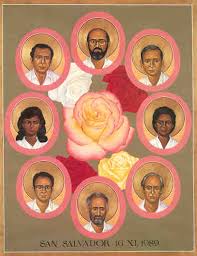
Other Legal Proceedings Regarding the Murders of the Jesuit Priests of El Salvador and Their Housekeeper and Her Daughter

As we have seen in a recent post, the Spanish criminal investigation and prosecution of former Salvadoran military officers and soldiers for the murders of the Jesuit priests and their housekeeper and her daughter are still pending and hopefully the case will go to trial in 2015 against at least one of the 19 Salvadoran military officers and soldiers charged with the crime.

There, however, have been other legal proceedings regarding this horrible crime. Here is a summary of these proceedings.

 Other Proceedings

 Salvadoran Investigations. Immediately after the murders, the Salvadoran military took steps to destroy evidence and to cover up their involvement in the crime while supposedly conducting an independent investigation of the crime. With widespread international outrage at the crime, the Minister of Defense was forced to establish a Special Honor Commission, consisting of five officers and two civilians to do a more thorough investigation. It concluded that nine people were responsible for the murders: four lower-ranking officers and five soldiers. International Criminal Justice: Salvadoran Military’s Attempted Cover-Up of Its Committing the Murders of the Jesuit Priests (June 7, 2011), http://dwkcommentaries.com/2011/06/07/international-criminal-justice-salvadoran-militarys-attempted-cover-up-of-its-committing-the-murders-of-the-jesuit-priests/.

Salvadoran Criminal Charges. The murders of the Jesuit priests caused such a huge international uproar that El Salvador had to do something to make it appear as if it were pursuing justice in the case. As a result, in January 1990 the Salvadoran government commenced a criminal prosecution of five Salvadoran military officers and five soldiers of the Atlacatl Battalion. The highest-ranking officer was Colonel Guillermo Alfredo Benavides Moreno, the Director of the Military College, who was accused of having given the order to murder the priests. (International Criminal Justice: Salvadoran Criminal Case Regarding the Murders of the Jesuit Priests (June 8, 2011).)

Salvadoran Criminal Trial. After lengthy pre-trial proceedings, this criminal trial finally took place in September 1991. Benevides was convicted of all eight counts of murder and instigation and conspiracy to commit acts of terrorism. One of the Lieutenants was convicted of one count of murder (the 16-year-old girl), instigation and conspiracy to commit acts of terrorism and being an accessory. Benevides and this Lieutenant were sentenced to 30 years imprisonment. The other two Lieutenants were convicted of instigation and conspiracy to commit acts of terrorism; they were sentenced to three years imprisonment, but released on bail and continued to serve in the military. A Lieutenant Colonel was convicted of being an accessory and sentenced to three years imprisonment, but he too was released on bail and continued to serve in the military. The five soldiers were acquitted of all charges. (Id.)

Salvadoran Truth Commission Investigation and Report. The Peace Accords of January 1992 that ended the Salvadoran Civil War established the Truth Commission for El Salvador to investigate the most serious crimes that had occurred during the war, including the murders of the Jesuits. Its March 1993 final report found the following facts regarding the murders:

  • On the night of 15 November 1989, then Colonel René Emilio Ponce, in the presence of ad in collusion with General Juan Rafael Bustillo, then Colonel Juan Orlando Zepeda, Colonel Inocente Orlando Montano and Colonel Francisco Elena Fuentes, gave Colonel Guillermo Alfredo Benavides the order to kill Father Ignacio Ellacuría and to leave no witnesses. For that purpose, Colonel Benavides was given the use of a unit from the Atlacatl Battalion, which had been sent to search the priests’ residence two days previously.
  • That same night, Colonel Guillermo Alfredo Benavides informed the officers at the Military College of the order for the murder. When he asked whether anyone had any objection, they all remained silent.
  • The operation was organized by then Major Carlos Camilo Hernández Barahona and carried out by a group of soldiers from the Atlacatl Battalion under the command of Lieutenant José Ricardo Espinoza Guerra and Second Lieutenant Gonzalo Guevara Cerritos, accompanied by Lieutenant Yusshy René Mendoza Vallecillos.
  • Subsequently, all these officers and others, including General Gilberto Rubio Rubio, knowing what had happened, took steps to conceal the truth, including destruction of evidence.

(International Criminal Justice: The Jesuits Case in The Truth Commission for El Salvador (June 9, 2011).)

Adoption of Salvadoran Amnesty Law. Five days after the delivery of the Truth Commission Report in March 1993, El Salvador’s National Assembly adopted the General Amnesty Law for the Consolidation of the Peace (Decree 486). Its provisions included “a full, absolute and unconditional amnesty to all those who participated in any way in the commission, prior to January 1, 1992 [the end of the civil war], of political crimes or common crimes linked to political crimes or common crimes in which the number of persons involved is no less than twenty.” (International Criminal Justice: El Salvador’s General Amnesty Law and Its Impact on the Jesuits Case (June 11, 2011).)

Implementation of Amnesty Law. Immediately after the adoption of the Amnesty Law and pursuant to this Law, Colonel Benavides and the Lieutenant who had been convicted and imprisoned in the Jesuits case were released from prison. (Id.)

Instigation of Case before the Inter-American Commission on Human Rights. Meanwhile, on the same day the Jesuit priests were murdered (November 16, 1989), Americas Watch, a non-governmental human rights organization, filed a complaint with the Inter-American Commission on Human Rights alleging that the Salvadoran government had violated the American Convention [Treaty] on Human Rights with respect to the murder of the Jesuits and their cook and her daughter.  (International Criminal Justice: The Inter-American Commission on Human Rights’ Case Regarding the Jesuit Priests (June 13, 2011).)

Investigation and Report by the Inter-American Commission on Human Rights. Ten years later (December 22, 1999), the Inter-American Commission issued its report. Relying heavily on the findings of the Truth Commission, the report made detailed findings about the murder and subsequent events and concluded that the state had violated the American Convention. As a result, the Commission recommended that the government conduct an expeditious, effective investigation and prosecute and punish those who were involved “without reference to the amnesty,” to make reparations and to render the General Amnesty Law null and void. (The Commission did not, and does not, have the power to order any of the states to do anything. (Id.)[1]

Conclusion

 Now twenty-five years after the crimes and 15 years after the Inter-American Commission’s report, no one has been convicted of the crime and imprisoned other than the two officers who were convicted by a Salvadoran court and who briefly were in prison before being released under the Amnesty Law.

Moreover, the government of El Salvador has not fully complied with the Commission’s recommendations.

In November 2009, however, El Salvador presented the nation’s highest award (National Order of Jose Matias Delgado) to the Jesuit priests’ relatives as an act of atonement and formally advised the Commission and the Inter-American Court of Human Rights that the Salvadoran state accepted the binding nature of their past decisions involving the country and the state’s responsibility to implement their recommendations in those cases.

In addition, in January 2010, Salvadoran President Mauricio Funes admitted that during the civil war state security forces “committed serious human rights violations and abuses of power,” including “massacres, arbitrary executions, forced disappearances, torture, sexual abuse, arbitrary deprivation of freedom” and other acts of repression. Funes then made a formal apology to all of the victims of these crimes and asked for their forgiveness and created a commission to offer redress to the victims. (Id.)

========================================================

[1] There has been much debate in El Salvador about whether or not the Amnesty Law is valid and/or should be abolished. The country’s Supreme Court is expected in the next several months to decide whether the Law is constitutional.   Meanwhile, U.S. courts have determined that the Salvadoran Amnesty Law is not applicable to litigation in U.S. courts.

Additional Commemoration of the Martyred Jesuits

Andreu Oliva
Andreu Oliva

Andreu Oliva, the current Rector of the University of Central America (Universidad de Centro America or UCA), in an article titled, Celebrating with gratitude, hope and commitment, said, “[W]e celebrate [the martyred Jesuits] because their wrongful death, so violent and cruel, has become a source of life, urging delivery, the commitment to the causes of the poor and marginalized, to move forward in building the Kingdom of God among us.”

“The martyrs continue to inspire us today and not only in El Salvador: they are inspiration for many people around the world. The large number of visitors, mainly from the U.S., Spain and Canada, who came these days to El Salvador to participate in the anniversary, and to be happy and full of spirit, strengthened in their commitment to the struggle for faith and justice that faith requires of us is without doubt a clear example of the power of the resurrection, that love is stronger than hate. In short, the promise of Jesus is made: ‘Blessed are those who hunger and thirst for righteousness for they shall be filled.’”

“It’s been 25 years since the slaughter happened in the UCA, but the martyrs continue giving life, continue to inspire commitment to justice and the poor, continue evangelizing and attracting women and men to join the project of the Kingdom of God. They are an example of a life offered from following Jesus, and lived to the fullest, in the service of the Salvadoran people, serving the defense of the poor and the persecuted by demanding that the equal dignity of every human being be recognized. They belong to us and to the world as examples to follow, an invitation to continue on the same path and with the same feeling.”


University of Central America Endorses the Beatification and Canonization of Salvadoran Archbishop Oscar Romero

Archbishop Oscar Romero


In the midst of its commemoration of the 25th anniversary of the murders of its martyred Jesuit priests and professors, El Salvador’s University of Central America (Universidad de Centro America), also made news regarding the beatification and canonization of Salvadoran Archbishop Oscar Romero.


In early November UCA’s website had an article by Jon Sobrino, S.J., the Director of its Archbishop Romero Center, entitled, “Beatification of Bishop.” He reported that Salvadoran Archbishop Jose Luis Escobar recently had said that Pope Francis had told him that Romero would be beatified next year (2015).

Subsequently Sobrino corrected this to say that he had not attended the meeting of the clergy where Archbishop Escobar made the announcement, but instead Sobrino had received the information second-hand from someone who had conveyed erroneous information.  In particular, Sobrino clarified that Archbishop Escobar had not spoken to Pope Francis, but instead to Archbishop Vincenzo Paglia, the postulator (advocate) of Romero’s cause for beatification and canonization, who had said beatification would “possibly” be in 2015.[1]

After the publication of the initial Sobrino article, Archbishop Escobar said that he hoped beatification of Romero would occur in 2015, which will be the 35th anniversary of his assassination and part of the Triennial, 2014-2017, ending in 2017, the year marking the centennial of his birth. But although beatification “was in its final stages, no date has been set,” said the Archbishop.[2]

On November 14th UCA published on its website an editorial, “Holy to the World,” endorsing the beatification and canonization of Romero. It started, “The news [by UCA] of the possible beatification of Archbishop Romero [in 2015]spread like wildfire, both inside and outside the country. The UCA has received many reactions from many countries of the continent. The vast majority of these reactions expressed joy and hope for good news. Only a very small group of people was opposed.”

The editorial continued “Eventual beatification and subsequent canonization of Romero will be an act of justice to his career, qualities and generous dedication to the Salvadoran people. Definitely, Monsignor Romero was and still is . . . good news for the poor. To recognize this is to recognize the causes he defended, by which he lived and why he was murdered. Beatification and canonization [will recognize his] complaint against structural injustice and his fight for justice for the victims of senseless violence and an exclusionary and undemocratic system that concentrates wealth in a few hands.”

“Doing justice to Archbishop Romero is also doing justice [for those] he championed:  the work of [Fr.] Rutilio Grande, the suffering of many victims of state violence who found comfort, encouragement and hope in Romero and the Archbishop’s legal aid office. Doing justice to Archbishop Romero also is doing justice to the victims of the violence he denounced, victims before and after their death, and the poor.”

Beatification and canonization also “implies a moral condemnation of his opponents, who reviled him, persecuted others and rejoiced with his murder.” This anticipated recognition of Romero leaves “in the pit of shame and disrepute the mainstream media, which systematically slandered him, branded him a communist agitator and even suggested the way to silence him.” It also will “bare the guilt of those who constantly threatened him, the masterminds who forged his death.”

“In short, to do justice to Archbishop Romero is to accept that he was right, that he was telling the truth, and makes these points clear to those who until now have remained rooted in lies and injustice.”

Beatification and canonization “will only be a formal recognition of what most people have in their hearts and cries. Romero said that if he were killed, he would be resurrected in the Salvadoran people. But his life and resurrection have transcended borders, religions and ideologies. Archbishop Oscar Romero is holy not only for El Salvador, but for the whole world.”

============================================

[1] A Salvadoran newspaper (Diario CoLatino) had an article about the Archbishop’s correction of the story. A fascinating, detailed examination of Sobrino’s error is provided in an article on the “SuperMartyrio” website that is dedicated to advocating Romero’s beatification and canonization:

[2] Earlier posts have discussed the Roman Catholic Church’s processes for beatification and canonization of Romero: Beatification of Salvadoran Archbishop Oscar Romero? (May 23, 2013); Progress on Vatican’s Canonization of Archbishop Oscar Romero (May 20, 2014); Pope Francis Urges Swift Beatification of Salvadoran Archbishop Oscar Romero (Aug. 22, 2014). My attention to this issue prompted the writing of another post, A Presbyterian’s Musings About Saints (Sept. 19, 2014).

Update on Spain’s Case Regarding the Murders of the Jesuits of El Salvador

Spain’s National Court (Audicencia Nacional) since November 2008 has been conducting a criminal case regarding the murders of six Jesuits priests and their housekeeper and her daughter in El Salvador on November 16, 1989. This lead in January 2009 to the Spanish equivalent of indictments of 14 former Salvadoran military officials and soldiers for murder, crimes against humanity and state terrorism. In May 2011 the court added six indictees and issued 20 international arrest warrants. Thereafter in November 2011 Spain issued requests for extradition of these men to Spain to face the charges. [1]

However, in August 2011 El Salvador’s Supreme Court refused to enforce the Interpol arrest warrants for 13 of the indictees who were living in that country and in May 2012 denied the requests for their extradition on the ground that the country’s constitution prohibited extradition of its citizens. Another indictee, Inocente Orlando Montano, had been living in the U.S. and now is in U.S. prison after pleading guilty to lying multiple times to U.S. immigration officials. (One indictee, former Colonel René Emilio Ponce, died during the prior proceedings.)

Just this October the Spanish court’s Criminal Chamber, en banc, decided that the court did have jurisdiction over all of the charges: murder, crimes against humanity and state terrorism.

Almudena Bernabeu
Almudena Bernabeu

Last week Almudena Bernabeu, CJA’s International Attorney and Transitional Justice Program Director and the lead private attorney for the prosecution in this case, was in El Salvador to discuss the case in connection with the twenty-fifth anniversary of these horrible crimes. [2]

First, she reported that the case is now at a standstill because none of the suspects is physically present in Spain.

Inocente Orlando Montano

Next year, however, she hopes this will change. In April of 2015, Senor Montano will complete his incarceration in the U.S. [3] By then the U.S. must decide whether it will honor Spain’s request to extradite Montano to Spain.

Although the U.S. is not legally required to consult with El Salvador on this issue, as a matter of inter-state courtesy the U.S. probably would do so, she said. Therefore, Bernabeu has conferred with officials of the Salvadoran government, who have confirmed that there is absolute willingness to collaborate with the Spanish process for the extradition of Mr. Montano from the U.S.  Thus, it is important to know that when the U.S. faces the decision whether to extradite Montano, the government of El Salvador has decided not to interfere.

Second, upon such an extradition and Montano’s arrival in Spain, the Spanish case would be re-activated to prepare the case for trial, presumably within 30 days.

Third, if, however, the U.S. deported Montano to El Salvador, the Salvadoran courts probably would refuse to extradite him in light of their prior refusal to extradite to Spain other indictees in the case who are Salvadoran citizens. In that event, the case in Spain could not proceed further.

Fourth, Bernabeu said she unsuccessfully has tried three times to have former Salvadoran President Alfredo Cristiani added as a defendant and indictee because she believes the evidence shows he ultimately was responsible for the crime committed by the military’s High Command and was an accessory to the killing. Indeed, she said that the testimony of two former Salvadoran military officials and documents, including declassified U.S. documents from the CIA, FBI and Department of Defense, show that Cristiani knew of the plan to kill the Jesuits before the murders happened. Whatever the reasons, the Spanish court has been reluctant to join a former foreign president as a defendant. [4]

Fifth, she said El Salvador’s General Amnesty Act of 1993 was a major problem for this case and others like it. This was so even though the Inter-American Commission on Human Rights in December 1999 decided in the Jesuits case that the Amnesty Law violated the American Convention on Human Rights and ordered El Salvador to declare it null and void and even though the Inter-American Court of Human Rights in December 2012 in another case (the El Mozote Massacre) ordered El Salvador to repeal the Amnesty Act. [5] That has not yet happened, but the Constitutional Chamber of El Salvador’s Supreme Court sometime soon is expected to rule on the constitutionality of that Act.

====================================================

[1] The Spanish court has jurisdiction over the case under Spain’s statute for universal jurisdiction over the most serious crimes of international concern. This statute is an implementation of the international legal principle of universal jurisdiction whereby a state has universal jurisdiction over certain crimes of international concern regardless of where the crime was committed or the nationality of the victim or perpetrator.  A detailed summary of the Jesuits case along with some of the court documents and other materials is available on the website of the non-profit Center for Justice and Accountability (CJA) based in San Francisco, California. CJA, the sponsor of the case in Spain. It is an international human rights organization dedicated to deterring torture and other severe human rights abuses around the world and advancing the rights of survivors to seek truth, justice and redress. It uses litigation to hold perpetrators individually accountable for human rights abuses, develop human rights law, and advance the rule of law in countries transitioning from periods of abuse.

[2] This account of Bernabeu’s comments is based upon Castillo, 25 Yrs After El Salvador Priest Killings, Groups Press for Justice, NBC News (Nov. 13, 2014); Labrador & Fatima, The government of El Salvador has decided not to hinder Montano’s extradition to Spain, El Faro (Nov. 14, 2014); Jaminez, Await Extradition of Montano, DiarioCoLatino (Nov. 15, 2014); Dalton, Cristiani knew at time of slaughter of Jesuits in El Salvador,” El Pais (Nov. 17, 2014). El Faro also recently published (a) a collection of articles from other Salvadoran newspapers evidencing the right’s hatred of the Jesuits before their murders; (b) biographies of the murdered priests, their housekeeper and her daughter and the six Salvadoran military personnel who were prosecuted for the crime in El Salvador (with only two convicted and then subsequently released from prison on the basis of the General Amnesty law); (c) an article describing how that Salvadoran prosecution for this crime was impeded by their attorney general; (d) an archive of U.S. diplomatic cables and other documents about the crime; and (e) a hyperlinked collection of El Faro’s prior articles about the Jesuits case.

[3] The U.S. legal proceedings against Montano are discussed in prior posts and comments: Comment [to “Spain Requests Extradition” post]: Ex-Salvadoran Military Officer [Montano] Indicted for Alleged Violations of U.S. Immigration Laws (Feb. 12, 2012); Comment [to “Spain Requests Extradition” post]: Former Salvadoran Military Officer [Montano] Pleads Guilty to Lying to U.S. Immigration Officials (Sept. 15, 2012); Former Salvadoran Colonel Inocente Orlando Montano To Serve 21 Months in U.S. Prison (Sept. 5, 2013).

[4] On December 16, 2008, the U.S. Embassy in El Salvador sent a cable to the U.S. Secretary of State. It reported that earlier that month senior officials of the Salvadoran government went to Spain and met with its attorney prosecuting the Jesuits case and with other top-level Spanish government officials, who said they were embarrassed about the case’s seeking to add Alfredo Cristiani, El Salvador’s former president, as a defendant. The Spanish prosecutor also promised support and cooperation to the Salvadoran officials.

[5] Yet another post reviewed the decision in the El Mozote Massacre case by the Inter-American Court of Human Rights.

Other Details About Commemoration of the Twenty-Fifth Anniversary of the Murders of the Jesuits of El Salvador

A prior post reviewed some of the ways in which El Universidad de Centro America (the University of Central America or UCA) is commemorating the twenty-fifth anniversary of the brutal murders of six of their Jesuit brothers and professors on November 16, 1989. Here are some of the other ways.

Memorial Mass

Memorial Mass, November 16, 2014

On November 16th a memorial Mass was celebrated for the martyrs at the tomb of Archbishop Oscar Romero in the Crypt of the Metropolitan Cathedral of San Salvador.

Monsignor José Gregorio Rosa Chávez, the Auxiliary Archbishop of San Salvador, delivered the homily. He quoted the words of one of the martyrs, Ignacio Ellacuría: “With Archbishop Romero, God passed by El Salvador.” Chavez then said that God also passed through the country with the martyrs. They along with Archbishop Romero and Fr. Rutilio Grande “devoted their lives for the defense of the poor and the needy during a brutal armed conflict.”

All of the current Jesuits of El Salvador and others in attendance joined in songs and prayers to celebrate the work of the martyrs and to condemn the injustice of the perpetrators of this horrible crime not having been tried and convicted.

Comments by Fr. Jon Sobrino, S.J.

Separately Fr. Jon Sobrino, S.J., who escaped murder 25 years ago because he was in Asia giving lectures, remembered these words of Ellacuría: “It’s up to the university awakening more and more hope.” In other words, said Sobrino, “Hope is not optimism and, therefore, the crucial question is how hope is generated. Not every university exists in a time for hope, but it does so exist when, humbly and honestly, it works for the poor of this world, learns from them and is willing to give everything it has for them.”

“That’s exactly what our martyrs did at UCA,” continued Sobrino. “And they still generate hope. As Ellacuría wrote, ‘Let new men and women always continue to announce firmly a greater future, because El Salvador envisions God, the God of liberation.’”

Comments by Fr. Rodolfo Cardenal, S.J.

Rodolfo Cardenal, UCA’s Vice Rector for Academics and Social Projection, also separately recalled the university’s six years of “institutional depression” after the murders of the Jesuits. “This was overcome thanks to the work of the surviving Jesuits and others who came from abroad, and the active collaboration of a group of lay people who were very capable and committed to UCA’s vocation. In the end, they overcame the depression with the obstinacy of reason, truth and justice.”

In this effort they were aided by the martyrs who “were present with great clarity” in “the communion of saints. Their presence encouraged us to follow, despite uncertainty and fear during the remainder of the civil war and with the postwar academic, organizational and administrative challenges that seemed insurmountable. Among those challenges were dignifying the victims of state terrorism, demanding justice for the perpetrators of human rights, containing social violence and combating new forms of poverty and exclusion.”

 UCA’s Website

 The UCA website contains statements by today’s students on why we should remember the martyrs and the following words describing the legacy of the martyrs, each of which is linked to a statement about the word’s importance:


The Martyred Jesuit Priests of El Salvador Continue To Inspire Others

Bodies of Jesuits, November 16, 1989
Bodies of Jesuits,         November 16, 1989

Twenty-five years ago today (November 16th), six Jesuit priests and professors at El Universidad de Centro America (the University of Central America or UCA) in San Salvador, the capital of El Salvador, were brutally murdered along with their housekeeper and her daughter. The priests were: (1) Ignacio Ellacuría, the Rector of the University; (2) Ignacio Martín Baró, an UCA social psychologist whose research focused on the psychic problems of living in a context of structural violence; (3) Segundo Montes, an UCA anthropologist interested in the effects of social stratification and displaced victims of the country’s civil war; (4) Amando López Quintana, the chair of UCA’s philosophy department, a parish priest and director of a mass-literacy campaign; (5) Joaquín López y López, director of UCA’s Fe y Alegria (Faith and Joy), a vocational training program for impoverished youth; and (6) Juan Ramón Moreno, who served at UCA’s Center for Theological Reflection, which addressed questions of faith and justice.

An U.S. journalist, Mary Jo McConahay, was in El Salvador that day, and after hearing reports that morning of the murders she was one of the first individuals to see the bodies of four of the Jesuits in a garden near their UCA apartments. In a recent article in the U.S. National Catholic Reporter she recounts what is was like to be there that morning:

  • “On the grass a few feet from the residence lay the forms of four bodies covered with white sheets. What appeared to be blood stained some of the sheets. . . .
  • In the hall [of the residence] with doors open to rooms on both sides, a body lay face down on the floor. A strip of what looked like blood marked the floor, as if the body had been dragged.”
  • [Fr. José María Tojeira, the Jesuit provincial for Central America] . . . bade me step inside one of the rooms, where another man lay dead . . . .”
  • We stepped outside past the white sheets and turned to descend a few steps to stand at the open door of a small apartment. Inside lay two bodies, a woman and a young girl, fallen backward a few feet from the threshold . . . . I recorded how the girl’s pelvic area looked as if the killer had emptied his gun there, how the woman’s legs had fallen over the girl’s, as if she had stood in front when the killers entered . . . . “
  • “[Back in the garden] the sheets came off [the bodies] and there in death were the priests I had known in life. . . . There was Ellacuría, his clear voice silenced, lying face up, as if he had looked at his killers at the moment of death” joined by Segundo Montes, Ignacio Martín-Baró and Amando López.”

Subsequent investigations have revealed that members of the country’s Armed Forces under the direction and command of higher officials committed these horrible crimes. They did so in order to silence Fr. Ellacuría’s publicly criticizing social injustices in the country and calling for peace negotiations to end the civil war and persecution of the poor and to leave no witnesses to the murder of Ellacuría.

UCA’s Commemoration

Jesuit Martyrs & Housekeeper & Daughter

UCA is marking this anniversary with nine days of programs and masses. This post will discuss two of those events, and subsequent posts will cover others as they become available on the UCA website.

In a discussion about the legacy of the martyrs, Hector Saymour said the legacy was the mission of social projection for UCA and other universities.  Such universities by engaging in rational and scientific research seek to increase understanding of the current situation and to create viable theoretical alternatives. For UCA and other Jesuit universities Jesus Christ is the inspiration for this struggle to transform unjust structures and to construct a new civilization based on solidarity. Omar Serrano, the Director of UCA’s Social Projection, added that UCA “has a continuing commitment to continue the legacy of the martyrs and to ‘transform the reality of Salvadoran society.’”

UCA also published an essay–“Freedom and Martyrs”—by the previously mentioned José Maria Tojeira, now the Director of UCA’s Campus Ministry and the former UCA Rector (1997-2010). It focused “on one of the fundamental characteristics usually common to all martyrs, since the dawn of Christianity until today, including, of course, Romero and many other Salvadorans. This is freedom. As St. Paul said, “for Christ has set us free” (Gal 5: 1).

The martyred Jesuits, Tojeira continued, were “universal fellow human beings of goodwill, [who] lived their freedom in an exceptional way. They started practicing it very soon with their youthful decision to come to America, leaving their roots, family and familiar environment. Their maturing love opened them to the new world . . . with a true devotion to the particular world of the poor of El Salvador. The option for the poor is already an act of freedom, and they demanded the Latin American Church take the matter seriously. And they used [UCA] . . . to find the roots of reality, not only opted for the poor, but also for their causes: social change, liberation from injustice, fully incorporating human rights into existence, creating a new culture in which they predominate over having and work over capital.”

“The severe social tensions (the fruit of injustice), repression and later civil war posed new challenges. . . . When words soar and thinking intellectuals become an enemy to the military, it is not easy to keep . . . [one’s] balance and safeguard life. The Jesuits’ decision to stay, to continue speaking freely, to continue publishing, to continue to defend the victims, risking life even looking at the face of death without defending their trust in reason and the Gospel, shows their tough libertarian convictions. For freedom is not measured by speeches defending money, property, or self-interest, but by the life choices of defending human rights.”

According to Tojiera, “In the exercise of this freedom . . . the martyred Jesuits maintained [UCA as] a quality university in a time that viciously persecuted intelligence and condemned the national university. At the same time, they multiplied their analysis and social criticism, their choice for peace with justice and human rights, while the government encouraged the creation of universities to promote conservative ideologies. The martyred Jesuits wanted to remain faithful to the intellectual quality of their voices so that victims would be protected, so that peace would emerge. And from that intellectually respectable quality, they started to speak of dialogue and negotiation as the only valid way out of the conflict.”

UCA’s “publications, conferences, studies [in 1989 and before] were mainly aimed at saving lives. The Jesuits said they stayed in El Salvador to fight for peace: ‘Basically what we want and where we direct our efforts is to save lives.’ Wanting to save the lives of many is what eventually led to the Jesuits’ death.  Finally, the Army, by a compact of silence and concealment, took the decision to kill the Jesuits, a crime against humanity, for which the military still has not apologized nor has recognized it as such.  What 25 years ago was cause for tears, now is a cause for rejoicing. Because our comrades still are alive generating critical thinking, lucid intelligence and true freedom.”

U.S. Jesuit Conference

Father Timothy Kesicki, SJ, who is the president of the U.S. Jesuit Conference, said, “The slaughter of eight innocents had a visceral impact on me and my Jesuit brothers, one that continues to shape us. More importantly, 25 years later, it helps highlight the continuing failures of U.S. policy toward Central America. Back in 1989, the UCA killers were instructed to leave no witnesses, but by silencing eight people, they unintentionally and, ironically, gave voice to a generation of activists proud to walk in the footsteps of the martyrs. We need that same sense of urgency and mission now, as we struggle to help those suffering in Central America today.”

Last week Fr. Kesicki led a visit to El Salvador by Jesuit provincials, the incoming international director of Jesuit Refugee Service, the president of the Association of Jesuit Colleges and Universities and the presidents of nine Jesuit universities. They visited UCA, participated in its forum and commemorated the martyrs at Mass at the Cathedral in San Salvador and at the Romero Chapel, where Archbishop Óscar Romero was assassinated in 1980.

In addition, more than 1,300 participants from Jesuit universities, high schools and parishes converged on Washington, D.C. this weekend for the annual Ignatian Family Teach-In for Justice. It will feature a wide array of speakers and the premiere of a documentary about the martyrs, “Blood in the Backyard.” Other scheduled events include a Capitol Hill rally and congressional visits. Each of the nation’s 28 Jesuit colleges and universities also marked the anniversary with lectures, panel discussions, Masses and prayer services.

An article this month in the U.S. National Catholic Reporter remembered these words by Fr. Ellacuría when in 1982 he received an honorary degree from California’s Santa Clara University, “Our work is oriented . . . above all on behalf of a people who, oppressed by injustice, struggle for their self-determination—people often without liberty or human rights. The university should be present intellectually where it is needed: to provide science for those without science; to provide skills for those without skills; to be a voice for those without voices; to give intellectual support for those who do not possess the academic qualifications to make their rights legitimate.”

The website for the U.S. Conference of Jesuits has other fascinating relevant features: (a) “Legacy of the Martyrs: Lives Changed, Causes Embraced,” that contains recollections of 38 U.S. Jesuit priests and other religious workers of what they felt when they first heard the news in 1989 of the murders of the six priests in El Salvador; and (b) U.S. Jesuits’ recollections of the martyrs.

Fr. Michael McCarthy, S.J.

 Fr. Michael McCarthy, another fellow Jesuit priest and a professor and the executive director of California’s Ignatian Center for Jesuit Education at Santa Clara University, also has expressed in the New York Times his inspiration by the martyred Jesuits. He credits Ellacuría’s recognizing “the responsibility of his institution as lending intellectual support to those who did not have the academic qualifications to legitimize their rights. His life has challenged me to keep my sights not on conventional measures of success but on what really matters: the contribution I am making to the world.”

In addition, McCarthy treasures Ellacuría’s “vision of a university that would be an ‘inescapable social force’ for good. That is no less important in 2014 than it was in 1989. I still believe that an education not grounded in justice is a farce and that we desperately need wise, courageous, even heroic academic leaders to realize the highest purposes of education.”

 Conclusion

 Many others have been transformed and inspired by the witness and ministry of the Jesuit priests of El Salvador.

One of them, Fran Rossi Szplczym, Pastoral Associate for Administration, Immaculate Conception Church of Albany, NY, said, “the lust for power, control, and domination is essentially the way of the world. That is one of the reasons we who are Catholic [and other] Christians live our faith as we do. We are not here to be against the world, nor to withdraw from the world. Jesus might have gone to the desert now and then, but he did not come here to simply be alone and pray, or to hide out with the apostles and feel superior to everyone else. Jesus came to transform us and the world with it.”

She added, “We cannot give up, we cannot turn away, we cannot turn to violence. To walk to the cross with Christ might mean lying face down on the ground with part of your brain splattered nearby, but it also means that we must all be changed. That is the call of discipleship put into action, no matter the cost. Let the Jesuit martyrs of El Salvador remind us of this daunting task of loving and changing the world in Jesus’ name. No matter what tiny and beautiful, or grand and magnificent ways that we are called to be that change in Christ.”

As a Christian of the Presbyterian persuasion, I too have been inspired by the Jesuit martyrs as I will discuss in a subsequent post.

New Examination of the 1980 Rapes and Murders of the Four American Churchwomen in El Salvador

The American Churchwomen


The November 10, 2014, edition of the New York Times published a video and textual “RetroReport[1] by Clyde Haberman about the December 1980 rapes and murder in El Salvador of the four American Churchwomen: Maryknoll missionaries Maura Clarke, Ita Ford, Dorothy Kazel and Jean Donovan. The article contains disturbing videos of the exhumation of their bodies that month from shallow graves near the airport in that country along with other contemporaneous videos of the churchwomen and U.S. officials and news reports about this horrible crime.

This “RetroReport” was presented as background for the article’s discussion of the pending U.S. legal proceedings to remove or deport two retired Salvadoran generals for having been responsible for those horrible crimes: “José Guillermo García, now 81, and Carlos Eugenio Vides Casanova, 77, [who] have been living in Florida for a quarter-century. They were allowed to settle there during the presidency of George Bush, who, like his predecessor, Ronald Reagan, considered them allies and bulwarks against a Moscow-backed leftist insurgency.”

“But administrations change, and so do government attitudes. Over the past two and a half years, immigration judges in Florida have ruled that the generals bore responsibility for assassinations and massacres, and deserve now to be ‘removed’ — bureaucratese for deported. Both are appealing the decisions, so for now they are going nowhere. Given their ages, their cases may be, for all parties, a race against time.”

The Times pointed out that the proceedings against these two Salvadoran military officers rely on a 2004 U.S. federal statute “prohibiting human rights abusers from entering or living in this country and that [the U.S. government] has broadened its scope to include violators from all over. Immigration and Customs Enforcement, a branch of the Department of Homeland Security, reported last December that over the previous decade, it had obtained deportation orders for more than 640 people.”

This blog has published the following seven posts about the American Churchwomen:

In addition, this blog has published the following four posts about the U.S. proceedings to remove or deport García and Vides Casanova:

Although Garcia and Casanova escaped civil liability for money damages over the murders of the churchwomen in U.S. federal court under the Torture Victims Protection Act, they were held liable for $54.6 million of money damages in another civil case in U.S. federal court involving other victims as discussed in a prior post.

Maura Clarke, Ita Ford, Dorothy Kazel and Jean Donovan continue to inspire many by their living out Jesus’ Gospel of loving God with all your heart, mind and soul and your neighbor as yourself.

===========================================================================

[1] The Times article states that this RetroReport is part of a documentary series that looks back at major stories that shaped the world using fresh interviews, analysis and compelling archival video footage. This nonprofit project, which was started with a grant from Christopher Buck, has a staff of 13 journalists and 10 contributors.


U.N. General Assembly Again Condemns U.S. Embargo of Cuba

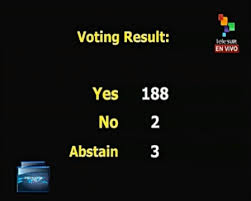
U.N. General Assembly Voting Results Screen
U.N. General Assembly   Voting Results Screen

On October 28, 2014, the U.N. General Assembly by a vote of 188 to 2 again condemned the U.S. embargo of Cuba. The two negative votes were cast by the U.S. and by Israel while three small Pacific nations abstained–Marshall Islands, Micronesia and Palau. All the other U.N. members supported the resolution. [1]

 The Resolution

The resolution [A/69/L.4] reiterated the General Assembly’s “call upon all States to refrain from promulgating and applying laws and measures of the kind referred to in the preamble to the present resolution [‘the economic, commercial and financial embargo imposed by the [U.S.] against Cuba’ and the Helms-Burton Act], in conformity with their obligations under the Charter of the United Nations and international law, which, inter alia, reaffirm the freedom of trade and navigation.”

The resolution also “again urges States that have and continue to apply such laws and measures [i.e., the U.S.] to take the steps necessary to repeal or invalidate them as soon as possible in accordance with their legal regime.”

Cuba’s Statement Supporting the Resolution

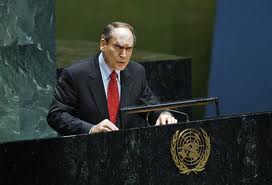
Bruno Rodriguez Parrilla

Bruno Rodríguez Parrilla, the Cuban Minister for Foreign Affairs, introducing the resolution, said that in recent times “the economic, commercial and financial blockade imposed by the [U.S.] against Cuba had been tightened, and its extraterritorial implementation had also been strengthened through the imposition of unprecedented fines, totaling $11 billion against 38 banks . . . for carrying out transactions with Cuba and other countries.” In addition, Cuba’s “accumulated economic damages of the blockade totaled $1.1 trillion . . . [and] human damages were on the rise.”

Nevertheless, “Cuba had offered every possible form of assistance to the [U.S.] in the wake of disasters there, such as in the aftermath of the September 11, 2001 terrorist attacks. Cuba had never been a threat to the national security of the [U.S.].  Opinion polls showed that there was increasing support from all sectors of [U.S.] society for lifting the blockade.  Religious leaders had citied legitimate, indisputable ethical and humanitarian reasons.“

In addition, ”the blockade was harmful to . . . the [U.S.]. The ‘absurd and ridiculous’ inclusion of Cuba on the [U.S.] list of States that sponsored international terrorism redounded to the discredit of the [U.S.].  Cuba would never renounce its sovereignty or the path chosen by its people to build a more just, efficient, prosperous and sustainable socialism.”  Neither, he continued, would his Government “give up its quest for a different international order, nor cease in its struggle for ‘the equilibrium of the world.’”

Rodríguez also invited the U.S. government “to establish a mutually respectful relation, based on reciprocity. We can live and deal with each other in a civilized way, despite our differences.”

Other Countries’ Statements Supporting the Resolution [2]

The following Latin American countries voiced support for the resolution: Argentina (MERCOSUR [3]) (embargo was “morally unjustifiable” and violated “the spirit of multilateralism and was immoral, unjust and illegal”); Barbados (CARICOM [4]); Bolivia (Group of 77 [5] and China); Brazil (Group of 77 and CELAC [6]); Colombia; Costa Rica (CELAC)); Ecuador; El Salvador (Group of 77 and CARICOM); Mexico; Nicaragua; St. Vincent and the Grenadines (CARICOM, Non-Aligned Movement, [7] Group of 77 and CELAC); Uruguay; and Venezuela.

The African supporters of the resolution that spoke were Algeria (Non-Aligned Movement, Group of 77, Group of African States [8] and Organization of Islamic Cooperation [9]); Angola; Kenya (Group of 77, Non-Aligned Movement and African Group); Malawi (African Group); South Africa (Group of 77, Non-Aligned Movement and African Group); Sudan (Group of 77, Non-Aligned Movement and Organization of Islamic Cooperation); United Republic of Tanzania; Zambia (Non-Aligned Movement) and Zimbabwe (Non-Aligned Movement, Group of 77 and African Group).

From Asia and the Pacific were Belarus; China (Group of 77); Democratic People’s Republic of Korea (North Korea); Indonesia (Group of 77);  India (Group of 77 and Non-Aligned Movement); Iran (Non-Aligned Movement); Lao People’s Democratic Republic; Myanmar (Group of 77 and Non-Aligned Movement); Russian Federation; Solomon Islands; and Viet Nam (Non-Aligned Movement, Group of 77 and China).

Middle Eastern countries speaking in favor of the resolution were Egypt, Saudi Arabia (Organization of Islamic Cooperation); and Syria (Non-Aligned Movement, Group of 77 and China).

The sole European supporter of the resolution that spoke at the session was Italy (European Union [10]), which said the U.S.’ “extraterritorial legislation and unilateral administrative and judicial measures were negatively affecting European Union interests”).

U.S. Statement Opposing the Resolution

Although Israel voted against the resolution, it chose not to speak in support of its vote. Only the U.S. by Ambassador Ronald D. Godard, U.S. Senior Advisor for Western Hemisphere Affairs, tried to justify the negative vote.

Ronald D. Godard
Ronald D. Godard

Ambassador Godard said the U.S. “conducts its economic relationships with other countries in accordance with its national interests and its principles. Our sanctions toward Cuba are part of our overall effort to help the Cuban people freely exercise their human rights and fundamental freedoms, and determine their own future, consistent with the Universal Declaration of Human Rights and the democratic principles to which the United Nations itself is committed.”

Ambassador Godard also said, “the Cuban government uses this annual resolution in an attempt to shift blame for the island’s economic problems away from its own policy failures. The Cuban government now publicly recognizes that its economic woes are caused by the economic policies it has pursued for the last, past half-century. We note and welcome recent changes that reflect this acknowledgement, such as those that allow greater self-employment and liberalization of the real estate market. But the Cuban economy will not thrive until the Cuban government permits a free and fair labor market, fully empowers Cuban independent entrepreneurs, respects intellectual property rights, allows unfettered access to information via the Internet, opens its state monopolies to private competition and adopts the sound macro-economic policies that have contributed to the success of Cuba’s neighbors in Latin America.”

According to Ambassador Godard, the U.S. “remains a deep and abiding friend of the Cuban people. The Cuban people continue to receive as much as $2 billion per year in remittances and other private contributions from the [U.S.]. This support . . . was made possible . . . by U.S. policy choices. By the Cuban government’s own account, the [U.S.] is one of Cuba’s principal trading partners. In 2013, the [U.S.] exported approximately $359 million in agricultural products, medical devices, medicine and humanitarian items to Cuba. Far from restricting aid to the Cuban people, we are proud that the people of the [U.S.] and its companies are among the leading providers of humanitarian assistance to Cuba. All of this trade and assistance is conducted in conformity with our sanctions program, which is carefully calibrated to allow and encourage the provision of support to the Cuban people.”

Furthermore, the U.S. “places the highest priority on building and strengthening connections between the Cuban people and [our] people. U.S. travel, remittance, information exchange, humanitarian and people-to-people policies updated in 2009 and 2011 provide the Cuban people alternative sources of information, help them take advantage of limited opportunities for self-employment and private property and strengthen independent civil society. The hundreds of thousands of Americans who have sent remittances and traveled to the island, under categories of purposeful travel promoted by President Obama, remain the best ambassadors for our democratic ideals.”

Ambassador Godard continued, “[The U.S.] strongly supports the Cuban people’s desire to determine their own future, through the free flow of information to, from, and within Cuba. The right to receive and impart information and ideas through any media is set forth in Article 19 of the Universal Declaration of Human Rights. It is the Cuban government’s policies that continue to prevent enjoyment of this right. The Cuban government now claims to share our goal of helping the Cuban people access the Internet. Yet the Cuban government has failed to offer widespread access to the Internet through its high-speed cable with Venezuela.  Instead, it continues to impose barriers to information for the Cuban people while disingenuously blaming U.S. policy.”

“Moreover, the Cuban government continues to detain Alan Gross, a U.S. citizen who was sentenced to 15 years in prison for facilitating Internet access for Cuba’s small Jewish community. [[11]] The [U.S.] calls on Cuba to release Mr. Gross immediately, [[12]] allow unrestricted access to the Internet, and tear down the digital wall of censorship it has erected around the Cuban people.

 {T]his resolution only serves to distract from the real problems facing the Cuban people. . . . Though Cuba’s contributions to the fight against Ebola are laudable, they do not excuse or diminish the regime’s treatment of its own people. We encourage this world body to support the desires of the Cuban people to choose their own future. By doing so, it would truly advance the principles the United Nations Charter was founded upon, and the purposes for which the United Nations was created.”

Media Coverage of the Resolution and Debate

 U.S. media coverage of this important U.N. vote was almost non-existent. It was not mentioned in the “World” or “Americas” news sections of the New York Times, and only its “Opinion” section had a short article about the issue. It got no mention whatsoever in the Wall Street Journal. Not even the Miami Herald, which has a separate page for Cuba news, mentioned it. [13]

At 2:37 p.m. on October 28th the Associated Press published a release on the subject, and the Washington Post published it online while the StarTribune of Minneapolis/St. Paul picked it up the next day in its online, but not its print, edition.

Cuba’s state-owned newspaper, Granma, of course, headlined this vote while stating that the embargo has caused $1.1 trillion of damage to the Cuban economy and “incalculable human suffering.” Its article also emphasized that this was the 23rd consecutive such resolution with a table showing that the number of votes in favor of the resolutions has increased from 59 in 1992 to 188 in 2012-2014, that the largest number of votes against the resolutions was only 4 in 1993 and 2004-2007 and that the number of abstentions has decreased from 71 in 1992 to 1 in 2005-2007 and now 3 since 2010.

Conclusion

This overwhelming international opposition to the U.S. embargo in and of itself should be enough to cause the U.S. to end the embargo. Moreover, the embargo has not forced Cuba to come begging to the U.S. for anything that the U.S. wants. The U.S. policy is a failure. The New York Times recently called for abandonment of this policy as has this blog in urging reconciliation of the two countries, in an open letter to President Obama and in a rebuttal of the President’s asserted rationale for the embargo and other anti-Cuban policies.

==============================================================

[1] This post is based upon the sources embedded above and upon U.N. General Assembly Press Release [GA/11574], As General Assembly Demands End to Cuba Blockade for Twenty-Thjrd Consecutive Year, Country’s Foreign Minister Cites Losses Exceeding $1 Trillion (Oct. 28, 2014); Londoño, On Cuban Embargo, It’s the U.S. and Israel Against the World, Again, N.Y. Times (Oct. 29, 2014); Associated Press, UN General Assembly Condemns US Cuba Embargo (Oct. 28, 2014); U.S. Dep’t of State, Explanation of Vote by Ambassador Ronald D. Godard on the Cuba Resolution in the General Assembly Hall (Oct. 28, 2014). The General Assembly also has videos of the debate (A and B). A prior post reviewed the 2011 General Assembly’s adoption of a similar resolution against the embargo.

[2] Many of the cited statements supporting the resolution were issued on behalf of, or aligned with, larger groups of nations as noted above. In addition, prior to the October 28th session of the General Assembly, the U.N. Secretary General submitted a report containing statements against the embargo from 154 states and 27 U.N. agencies.

[3] MERCOSUR (Southern Common Market) is a customs union and trading bloc of five South American countries with five other associate members in the continent.

[4] CARICOM (Caribbean Community) is a group of 15 Caribbean countries with five associate members for economic cooperation.

[5] The Group of 77 was established in 1964 by 77 developing countries to promote their collective economic interests and South-South cooperation; now there are 134 members that have retained the original name for historical significance.

[6] CELAC (Community of Latin American and Caribbean States) is a group of 33 states in the region to deepen economic integration and combat the influence of the U.S.

[7] The Non-Aligned Movement is a group of 115 developing countries that are not aligned with or against any major power bloc. Its current focus is advocacy of solutions to global economic and other problems

[8] The African Group is a group of 54 African states that are U.N. Members.

[9] The Organization of Islamic Cooperation is a group of 57 states that seek to protect the interests of the Muslim world in the spirit of promoting peace and harmony in the world.

[10] The European Union is a group of 28 European states that have combined for a peaceful, united and prosperous Europe.

[11] The activities in Cuba by Mr. Gross are not so simple. A Cuban court in 2011 found him guilty of participating in a “subversive project of the U.S. government that aimed to destroy the revolution through the use of communications systems out of the control of authorities,” and sentenced him to 15 years in prison. According to his own lawsuit against the U.S. Government, and subsequent disclosures, Gross alleged the U.S. Agency for International Development (USAID) and its contractor, DAI, sent him on five semi-covert trips to Cuba without proper training, protection or even a clear sense of the Cuban laws that led to his detainment. The case highlighted the frequent haste and lack of attention to the risks of the USAID programs in Cuba under the Helms-Burton Act, which allowed for money to be set aside for “democracy building efforts” that might hasten the fall of Fidel and Raúl Castro.

[12] In discussions with the U.S., Cuba already has expressed a willingness to exchange Mr. Gross for one or more of the three of “the Cuban Five” who remain in U.S. prisons.

[13] Nor did I find any mention of the vote in London’s Guardian or Madrid’s El Pais.


Spanish Court Issues Decision on Use of Universal Jurisdiction

On October 3, 2014, the 20 judges of the Criminal Chamber (Sala de lo Penal) of Spain’s National Court (Audiencia Nacional) issued an important ruling on Spain’s use of universal jurisdiction (UJ). In order to understand this decision, we first must look at UJ under customary international law and at Spain’s incorporation of this principle into its statutory law.

Customary International Law Regarding Universal Jurisdiction

Under customary international law and certain treaties, a nation state’s courts have UJ over certain crimes of international concern regardless of where the crime was committed or the nationality of the victim or perpetrator. These crimes of international concern are (a) piracy; (b) slavery; (c) war crimes; (d) crimes against peace; (e) crimes against humanity; (f) genocide; and (g) torture.

Spain’s Statutes Regarding Universal Jurisdiction

Spain implemented this principle in 1985 in its own domestic statutory law by conferring such jurisdiction on its National Court for certain crimes, including genocide; terrorism; and any other crimes under international treaties or conventions that should be prosecuted in Spain.

In 2009 Spain amended this statute to add these additional crimes for universal jurisdiction: crimes against humanity; illegal trafficking or illegal immigration of persons; and female genital mutilation (FGM). In addition, the amendment specified that these conditions or limitations had to be established for such jurisdiction: the alleged perpetrators were in Spain; or the victims were of Spanish nationality; or there was another connecting link to Spain.

The 2009 amendment also specified that for such Spanish jurisdiction to exist, another country or international tribunal had not started a process involving an investigation and successful prosecution of such offenses; if there were such another process, then the Spanish court should suspend or stay its case until the other investigation and prosecution has been concluded. The latter provision is referred to as the subsidiary principle.

In March 2014, Spain’s legislature (los Cortes Generales), approved another amendment to this statute (Article 23.4 of the 1985 Organic Law of the Judicial Power, as amended).[1] Here are the principal provisions of the amendment that have been at issue in the October 3, 2014, decision by the Criminal Chamber of the National Court and in other recent judicial cases:

  • For genocide, crimes against humanity and war crimes, universal jurisdiction exists only if the accused individual is a Spanish citizen or a foreign citizen who is habitually resident in Spain or a foreigner who is found in Spain and whose extradition had been denied by Spanish authorities.
  • For torture and disappearances, universal jurisdiction exists only if the prospective defendant is a Spanish citizen, or the victims were (at the time of the events in question) Spanish citizens and the person accused of the crime was in Spanish territory.
  • Certain crimes were added for universal jurisdiction, including war crimes (crimes against persons or goods in armed conflict); torture and crimes against moral integrity; and crimes covered by the Council of Europe Convention on the prevention and combatting of violence against women and domestic violence.[1]

The Criminal Chamber’s Decision Regarding Universal Jurisdiction

The October 3, 2014, Criminal Chamber’s decision concerned use of UJ in (i) the Jesuits Massacre Case; (ii) the Guatemala genocide case; (iii) the case against American service members for alleged murder of a Spanish cameraman in the Iraq war; (iv) the case against U.S. personnel for alleged torture of detainees at Guantanamo Bay; and (v) cases involving alleged Female Genital Mutilation (FGM).[2]

Jesuits Massacre Case.[3] The Chamber unanimously decided that Spain had UJ over the lower court’s criminal investigation of the November 1989 murders in El Salvador of the Spanish Jesuit priest, Ignacio Ellacuria, five fellow Jesuit priests and their cook and her daughter. Although the statutory amendment imposed limits on UJ for crimes against humanity, such charges could be considered in this case because they are related to the murder charges for which there is clear UJ.

The Chamber further explained that upon having asserted jurisdiction over a set of criminal facts that constitute the state terrorism crime, Spanish Judges have jurisdiction over all other crimes connected to the facts investigated, even if that crime is a crime against humanity.

The Chamber’s decision was a result of an appeal from a decision by Judge Eloy Velasco, who handled the Jesuits case and who previously had indicted 20 Salvadoran military officials for murder, terrorism, and crimes against humanity. Velasco rejected the crime against humanity claim and decided to continue only with the terrorism claim. The appeal was brought by the U.S.-based Center for Justice & Accountability and the Spanish Pro Human Rights Association.

Guatemala Genocide case.[4] The Chamber also decided that investigations in the Guatemala Genocide case involving claimed UJ could proceed for the moment, but the Chamber did so on procedural grounds without reaching the merits.

The Chamber’s decision was the result of an appeal from the May 2014 decision by Judge Santiago Pedraz Gomez of the National Court. He decided that the case could proceed for two reasons. First, the charges include terrorism—a crime that falls within Spanish extraterritorial jurisdiction whenever there are Spanish victims. Second, the charges of terrorism, genocide, and other atrocities are all based on the same facts. Under Spanish law, as in many European countries, a court’s jurisdiction extends to all criminal charges that arise from the same acts. Because the Court has jurisdiction over the terrorism offenses, Judge Pedraz announced that he will investigate the other connected crimes.

Judge Pedraz’s rationale appears to be the same as the Chamber’s in allowing the Jesuits case to proceed on the merits.

Case Against American Servicemembers for Alleged Murder of a Spanish Cameraman. The lower court has been investigating a case under UJ against American soldiers in the Iraq war for the alleged murder in 2003 of a Spanish cameraman. The Chamber also allowed it to proceed for a procedural error by the prosecution without a ruling on the merits.

The Chamber’s decision was the result of an appeal from a March 2014, decision by the lower court’s Judge Santiago Pedraz Gómez. He held that the amendment could not be applied to this case because, he said, the amendment contradicted Spain’s obligations under the 1949 Geneva Convention (IV) relative to the Protection of Civilian Persons in Time of War. The judge stated that the Geneva Convention obliges Spain to “prosecute the crime (search for people and make them appear) regardless of the perpetrators’ nationalities and wherever they may be.” Therefore, the court’s decision said, “The judge must refrain from applying . . . [the new statutory amendment]. The rule of law requires the existence of independent bodies to protect the rights and freedoms of citizens, by impartially applying standards that express the people’s will and control the activities of public authorities.”

Case Against American Personnel for Alleged Torture of Guantanamo Detainees.[5] Another lower court judge has been investigating under UJ the alleged torture by American personnel of Guantanamo detainees. The chamber also allowed it to proceed because of a procedural error by the prosecution without the Chamber addressing the merits.

This decision occurred in an appeal from the March 2014 lower court’s Judge Pablo Ruz’ order. He concluded that under the new amendment “torture and war crimes cannot be pursued . . . because the target of the procedure is not a Spaniard or a resident of Spain.” These restrictions, however, are trumped, held the judge, by international treaties ratified by Spain–the Geneva Conventions and the Convention Against Torture–which force signatory countries to pursue crimes.

Judge Ruz also pointed out that the new amendment stipulates that crimes cannot be pursued in Spain if they are already being investigated by an international court or by the country where they were committed. Therefore, Judge Ruz this March renewed his request to the U.S. Government for information about U.S. investigation of this case. This blogger is not aware of any U.S. response to date to this request.

FGM Cases. The Chamber also unanimously decided that UJ could be used for criminal investigations and prosecutions of alleged Female Genital Mutilation (FGM) where the victims or perpetrators have some connection to Spain. This decision was based, in part, upon Spain’s August 1, 2014, ratification of the Council of Europe Convention on preventing and combating violence against women and domestic violence, which requires Spain to prosecute such crimes. The case involved the FGM of a young woman in Gambia in 2005

========================================================

[1] Other provisions of the original 1985 statute and the 2014 amendment are covered in a prior post.

[2]This post is based upon prior posts that are embedded above; the Spanish court’s announcement of the decision; Perez, The new universal justice can pursue ablation, El Pais (Oct. 3, 2014); Center for Justice & Accountability, Spanish National Court Upholds Spanish Jurisdiction To Investigate 1989 Massacre of Jesuit Priests in El Salvador (Oct. 3, 2014); Center for Justice & Accountability, Spain Presses Ahead with Guatemala Genocide Case Despite New Limits on Universal Jurisdiction (May 22, 2014). The text of the actual decision by the Criminal Chamber should become available online. Corrections or elaborations of this post by lawyers more knowledgeable about Spanish law are especially welcome.

[3] Some of the filings in the Jesuits case are available online.

[4] Some of the filings in the Guatemala case are available online.

[5] Many of the documents In the Guantanamo torture case are available online.


A Presbyterian’s Musings about Saints

My recent investigation and writing of a post about the Roman Catholic Church’s process for the beatification and canonization of Salvadoran Archbishop Oscar Romero prompt these musings about blesseds and saints in that church and their absence in my own church, Minneapolis’ Westminster Presbyterian Church, and its denomination, The Presbyterian Church (U.S.A.).

The Roman Catholic Church[1]

According to a Catholic secondary source (“Fundamentals of Catholic Dogma”), a saint is “…a member of the Church [who] has been assumed into eternal bliss and may be the object of general veneration. A saint is also a person of remarkable holiness who lived a life of heroic virtue, assisted by the Church, during their pilgrimage on earth. They are as varied and exceptional as only God could create them, and each has his own distinct story.”

The veneration of saints (in Latin, cultus, or the “cult of the saints”) describes a particular popular devotion or abandonment to a particular saint or saints. Although the term “worship” of the saints is sometimes used, it is intended to mean honor or give respect. According to the Catholic Church, Divine Worship is properly reserved only for God and never to the saints.  They can be asked to intercede or pray for those still on earth, just as one can ask someone on earth to pray for them.

A saint may be designated as a patron saint of a particular cause or profession, or invoked against specific illnesses or disasters, sometimes by popular custom and sometimes by official statements. Saints are not thought to have power of their own, but only that granted by God.

Apparently under canon law, before beatification, the body of the candidate must be exhumed and authenticated and relics taken for veneration. This has produced disputes, some of which have been resolved by dividing the body. For example, St. Catherine of Sienna is entombed in Rome, but her head is revered in a Sienna basilica. Now the beatification and canonization of Bishop Fulton J. Sheen is being delayed because of a dispute whether his corpse should remain in a crypt in St. Patrick’s Cathedral in New York City or be moved to St. Mary’s Cathedral in Peoria, Illinois, where he was ordained.[2]

Relics of saints are respected in a similar manner to holy images and icons. The practice of past centuries in venerating relics of saints for healing is taken from the early Church. Once a person has been declared a saint, the body of the saint is considered holy. The remains of saints are called holy relics and are usually used in churches. Saints’ personal belongings may also be used as relics. Some of the saints have a symbol that represents their life.

In 993, Pope John XV was the first pope to proclaim a saint, but it was not until the papacy of Pope Innocent III (1198-1216) that the Pope claimed an exclusive monopoly on the canonization of saints. In 1983, Pope John Paul II made sweeping changes in the canonization procedure for Catholics whom are generally regarded as holy with the local bishop first investigating a deceased candidate’s life and writings for heroic virtue (or martyrdom) and orthodoxy of doctrine. Then a panel of theologians at the Vatican evaluates the candidate. After approval by the panel and cardinals of the Congregation for the Causes of Saints, the pope proclaims the candidate “venerable.”

Beatification

The next step, beatification, requires evidence of one miracle (except in the case of martyrs). Since miracles are considered proof that the person is in heaven and can intercede for us, the miracle must take place after the candidate’s death and as a result of a specific petition to the candidate. When the pope proclaims the candidate beatified or “blessed,” the person can be venerated by a particular region or group of people with whom the person holds special importance.

Although I do not know the total number of “blessed” in the Roman Catholic Church, the last three Popes have beatified 2,860 (Pope John Paul II, 1,342; Pope Benedict XVI, 843; and Pope Francis, 675 (including 124 Korean Martyrs on his recent trip to South Korea).)

Canonization

The Roman Catholic Church has over 10,000 named saints (or over 27 for every day of a normal year).

Only after one more miracle will the pope canonize the saint (this includes martyrs as well). The title of saint tells us that the person lived a holy life, is in heaven, and is to be honored by the universal Church. Canonization does not “make” a person a saint; it recognizes what God has already done.

The last three Popes have canonized 1,355 saints: Pope John Paul II, 482; Pope Benedict XVI, 45; and Pope Francis, 828. A source says that Pope Francis’ 828 in the first 18 months of his papacy is more than all the Popes of the last three centuries.

Westminster and the PCUSA

sermon

The PCUSA and Westminster do not have a roster of designated blesseds and saints. As a result, Westminster does not have statues or paintings of such individuals in our Sanctuary.Instead, most of Westminster’s Sanctuary’s beautiful stained-glass windows from the 1950s and 60s, made by Willet Studios, primarily depict images of the life of Jesus like the one to the right for His Sermon on the Mount that is on the north side of the main floor of the Sanctuary. Earlier windows feature Victorian and early 20th century stylized organic and geometric designs. Here below, for example, is a photograph of the large Rose Window that was installed at the back of the balcony in 1897 with the construction of our Sanctuary.

RoseWindow

Westminster, however, at the back of the Sanctuary’s main floor does have four Gospel Windows (images of Saints Matthew, Mark, Luke and John, the authors of the New Testament’s Gospels). Below is a photograph of these windows.

Saints Matthew & Mark
Saints Luke & John
Saints Luke & John


In addition, there are two stained glass windows at the back of the Sanctuary’s balcony with images of prominent Protestants. One is called the “Reformation Window” with images of Protestant reformers Huldrych Zwingli, Martin Luther, John Calvin and John Knox. The other is called the “Missionary Window” with images of four Protestant missionaries: William Carey (India), David Livingstone (Africa), Sheldon Jackson (Alaska) and Marcus Whitman (Northwest U.S.). Photographs of these windows are below. Finally, also in the balcony we have a window for unnamed Martyrs and another window for Jesus’ Disciples and Apostles (without names). (Thanks for the photographs to Dr. Rodney Allen Schwartz, Director of Westminster’s Gallery and Archives.)

Westminster's "Reformers' Window"
Westminster’s                            “Reformation Window”
Westminster's "Missionaries Window"
Westminster’s                         “Missionary Window”


According to a comment on the PCUSA website, “In the Presbyterian/Reformed tradition, we have and always will acknowledge and honor saints. Our designation as saints comes from our rich inheritance of Christ’s righteousness.” This commentator then adds the following:

  • “In St. Paul’s understanding, the title ‘saint’ belongs to all those who have been united with Christ, those who have a share in the rich inheritance as Children of God (baptism). St. Paul routinely calls the members of his churches ‘saints’ because of who they are in Christ and not because of what they have accomplished.”
  • “Furthermore, based on the teachings of the Second Helvetic Confession, and the early church fathers, Presbyterians do not pray for the mediation of the saints. We pray to God through Christ alone, and only look to the saints, ordinary people who had extra-ordinary faith, as examples and role models.”
  • “Also, as John Calvin and the early church fathers taught in regard to the mystery of Holy Communion, we believe that when we gather at the Lord’s Table and partake of the sacrament in faith, by the work of the Holy Spirit we become united in Christ and in prayer with those gathered around the eternal throne of God (which the Lord’s Table also represents) in accordance to the vision of St. John in the Book of Revelation.”

The PCUSA website introduces the subject of All Saints Day by saying, “In early Christian tradition, saints’ days began as a way to mark the anniversary of a martyr’s death — his or her “birthday” as a saint. By the middle of the church’s first millennium, there were so many martyrs . . . that it was hard to give them all their due. All Saints’ Day was established as an opportunity to honor all the saints, known and unknown.”

The PCUSA website goes on to say, “All Saints’ Day has a rather different focus in the Reformed tradition. While we may give thanks for the lives of particular luminaries of ages past, the emphasis is on the ongoing sanctification of the whole people of God. Rather than putting saints on pedestals as holy people set apart in glory, we give glory to God for the ordinary, holy lives of the believers in this and every age. [All Saints Day for Presbyterians] . . . is an appropriate time to give thanks to members of the community of faith who have died in the past year. We also pray that we may be counted among the company of the faithful in God’s eternal realm.”

Bishop William Walsham How
Ralph Vaughan Williams

At Westminster, All Saints Day is observed by reciting the names of our most recent saints, those church members who died during the prior year, and by singing the famous hymn “For All the Saints” with words by William Walsham How (1823-1897)[3] and beautiful music by Ralph Vaughan Williams (1872-1958).[4] The words of this hymn in Glory to God: The Presbyterian Hymnal go like this:

  1. “For all the saints, who from their labors rest, who thee by faith before the world confessed, thy name, O Jesus, be forever blessed. Alleluia, Alleluia!”
  1. “Thou wast their rock, their fortress and their might; thou, Lord, their captain in the well-fought fight; thou, in the darkness drear, their one true light. Alleluia, Alleluia!”
  1. “O blest communion, fellowship divine! We feebly struggle, they in glory shine; yet all are one in thee, for all are thine. Alleluia, Alleluia!”
  1. “And when the strife is fierce, the warfare long, steals on the ear the distant triumph song, and hearts are brave, again, and arms are strong. Alleluia, Alleluia!”
  1. “From earth’s wide bounds, from ocean’s farthest coast, through gates of pearl streams in the countless host, singing to Father, Son and Holy Ghost, Alleluia, Alleluia!”

Interestingly this hymn originally had six other verses that probably were eliminated in our Hymnal to keep the hymn of reasonable length by contemporary standards. But three of those deleted verses specifically recognize the Apostles, the Evangelists and the Martyrs as saints and thereby may suggest that only they are saints.

We also must acknowledge that the names of some Presbyterian churches include the names of saints: the Apostles of Jesus (Peter (or Simon), Andrew, James, John, Philip, Thomas and Matthew), the authors of the synoptic Gospels (Mathew, Mark, Luke and John), the first evangelist (Paul) and other Roman Catholic saints (Elmo (or Erasmus)), Stephen, Barnabus, Giles and Patrick).

 Observations

I recognize that all of us as sinners need all the help we can get in striving to live holy lives and that blesseds and saints undoubtedly provide such assistance to many people. Moreover, I believe it must be useful for many people to have blesseds and saints from their own country or ethnic group or era to connect with Jesus, who lived and died 2,000 years ago.

A church’s having blesseds and saints can also be seen as a way for the church to evangelize, i.e., to spread the Good News of the Bible. In secular terms, it is a way to market the faith. Pope Francis’ recent beatification of 124 Korean martyrs can be seen in this light.

Once a church decides that it will have blesseds and saints, it obviously needs a well-established set of rules and procedures for making such important decisions, and Pope John Paul II’s previously mentioned changes in that regard I see as a rational management response.

However, I do not understand why the beatification and canonization of Salvadoran Archbishop Oscar Romero can be seen as controversial or difficult when he had the courage to act, despite repeated death threats, as Jesus taught all of us to act (Love your neighbor as yourself).

As an outsider to the Catholic faith, I see the proliferation of blesseds and saints as perhaps interfering with Christianity’s focus on Jesus Christ and God. I also find it difficult to accept the miracles that are requirements for beatification (except for martyrs) and for canonization. According to the Catholic Church, to be deemed a miracle, it happens after the death of the candidate for beatification or canonization, and “a medical recovery must be instantaneous, not attributable to treatment, [and the medical problem] disappear for good.”

In the Presbyterian version of Christian faith as I have experienced at Minneapolis’ Westminster, on the other hand, we avoid having our focus on Jesus interrupted by statues and references to the blesseds and the saints. Moreover, our sermons frequently use the faith and actions of contemporary people to illustrate important points of Scripture. In this way we help to see how Jesus’ teachings can be important in our lives today.

=====================================================

[1] This account of the history and practices of the Roman Catholic Church’s blessed and saints is based upon the following secondary sources in addition to those that are hyperlinked above: http://catholicism.about.com/od/holydaysandholidays/p/All_Saints_Day.htm; http://www.catholic.org/saints/faq.php; http://en.wikipedia.org/wiki/List_of_saints; http://www.uscatholic.org/articles/201310/how-many-saints-are-there-28027. I welcome amplification and corrections by those with more knowledge of the Catholic history and practice of beatification and canonization.

[2] Otterman, Tug of War Between Dioceses Halts a Bishop’s Beatification, N.Y. Times (Sept. 14, 2014.)

[3] How was an Anglican priest who served as Bishop of Wakefield in northern England and as Bishop of Bedford in the East End of London. He also was a poet and author of the lyrics for other hymns.

[4] Williams, who was Welsh-English, was a composer of symphonies, operas, chamber and choral music and film scores.