U.S. Secretary of Agriculture Visits Cuba

On November 11-13, U.S. Secretary of Agriculture Tom Vilsack, a former Iowa Governor, visited Cuba.[1]

Vilsack in Cuba

In his meeting with Ricardo Cabrisas Ruiz, a Council of Ministers Vice President, they discussed international economic relations, the interest of the U.S. agriculture sector in the island and obstacles to trade between the two countries caused by the U.S. embargo (blockade). Vilsack and the U.S. delegation are on the left in the above photo; the Cuban delegation, on the right.

At a meeting with Cuban Agriculture Minister, Gustavo Rodriguez Rollero, Vilsack said the U.S. was “very anxious to establish a positive working relationship with Cuba and to work together cooperatively in a number of issues.” These included organic farming, agricultural cooperatives, the Cuban experience in biotechnology, confronting common pests and diseases and the impact of climate change. They also talked about Cuban procedures for fruit and vegetable export certification and field inspections.

The U.S. delegation also had a meeting with Cuba’s Foreign Minister, Bruno Rodriguez, and Josefina Vidal Ferreiro, the Director General of U.S. Affairs at the Foreign Ministry.

Vilsack visited an agricultural market in Havana and was impressed by the fact that the vegetables and fruits came from hundreds of farms scattered throughout the city. “Urban agriculture is something that Cuba has long practiced and the United States wants to learn,” he said.

On a visit to two cooperatives, near the city, a member of one of the coop’s board of directors expressed confidence that Cuba’s new relationship with the U.S. will make life on the farm easier. The coop director said, “We believe that this represents something that will bring us improvement in every sense: production, better equipment, new tractors.”Vilsack, in turn, observed that it “was very clear that the farmers are people who have deep love for the land and the work they do for the citizens of their country.” He noted that they expressed their concern over problems with machinery, irrigation systems and tools needed to plant and harvest and the impact of climate change. But, he said, their creativity and innovation to maintain production levels were impressive.

In a press conference at the U.S. Embassy in Havana Vilsack said that lifting trade barriers with Cuba was a matter of “common sense” and promised to look for ways to relax existing measures. “We have work to do to identify those barriers, understanding and seeing what kinds of flexibilities may be to remove them or at least minimize them.” The Secretary also complimented Cuba’s reaction to the recent U.S. problems with avian flu. “Unlike other countries which decreed a general ban on importing U.S. poultry, Cuba “faced the problem regionally, looking state by state, which is the focus of international organizations and which is based on science.”

According to Vilsack, the U.S. stands to gain a significant portion of Cuba’s agricultural import market. That market is about $2 billion annually, with the U.S. holding about 16 percent. Before sanctions were put in place, the U.S. was responsible for nearly half. “There is no reason why if barriers can be reduced and eliminated that we wouldn’t be in a very competitive circumstance,” Vilsack stated that a number of U.S. agricultural products could be attractive in Cuba, including pork, corn, soybeans and poultry.

Important in this regard, said Vilsack, was the need for the U.S. to eliminate the ban on trade credit on U.S. agricultural exports to Cuba. A bill to do just that, Vilsack mentioned, recently had been introduced in the House of Representatives by Congressman Rick Crawford (Rep., AK).[2]

“Trade is a two-way street,” Vilsack said. “Consumers in the U.S. are interested in having a variety of products throughout the year and [U.S. agricultural] imports have reached record levels in recent years. One of the challenges we have when ending the embargo [blockade] is a container that comes with products to Cuba should return to the U.S. with Cuban products. This is common sense.” Such Cuban exports would be assisted by the U.S.’ having an office in Cuba for the Agriculture Department’s Foreign Agricultural Service and Animal and Plant Health Inspection Service personnel to facilitate technical conversations and addressing any problems in Cuba’s meeting U.S. requirements.

Moreover, Vilsack noted that Cubans have embraced organic agriculture, one of the fastest-growing U.S. food segments. Cuba has a strong organic sector because it hasn’t had access to chemicals and pesticides. “They had no other alternative but to be organic.” Vilsack emphasized that this is an opportunity for Cuba because only 1 percent of America’s land mass is committed to organic production. “There is no question the demand is there.”

Vilsack was accompanied by Democratic Senator Jeff Merkley (Oregon) and three Democratic members of the House of Representatives: Kurk Schrader (Oregon), Suzan Delbene (Washington); and Terri Sewell (Alabama) as well as other representatives from the Department of Agriculture and the Chargé d’Affaires of the U.S. Embassy in Havana, Jeffrey DeLau­rentis.

===================================================

[1] Cabrisas receives U.S. secretary of agriculture, Granma (Nov. 12, 2015); Gomez, USA wants to expand trade with Cuba, but maintain restrictions, Granma (Nov. 12, 2015); US Agriculture Secretary talks with his counterpart in Havana, CubadDebate (Nov. 12, 2015); Gomez, Lifting the blockade is a matter of common sense, Granma (Nov. 12, 2015); Assoc. Press, US Agriculture Secretary Visits Cuba to Build Trade Momentum, N.Y. Times (Nov. 13, 2015); Minister of Foreign Affairs received the Secretary of Agriculture of the United States, Granma (Nov. 13, 2015); Doering, Vilsack: Cuba a great opportunity for U.S. agriculture, Des Moines Register (Nov. 13, 2015); Vilsack: Permanent USDA presence needed in Cuba, Farm Futures (Nov. 16, 2015).

[2] On October 6, 2015, Representative Rick Crawford introduced H.R. 3687, the Cuba Agricultural Exports Act, on behalf on himself and House Agriculture Committee Chairman Michael Conaway (Rep., TX) and Representative Ted Poe (Rep., TX) with 11 other Republican and 2 Democratic cosponsors. Crawford said this bill “would repeal restrictions on export financing and give producers access to Department of Agriculture marketing programs that help the US compete in foreign markets. Further, this legislation enables limited American investment in Cuban agribusinesses, as long as US regulators certify the entity is privately-owned and not controlled by the Government of Cuba, or its agents.” Crawford concluded, “ I believe that agriculture trading partnerships with Cuba will help build a foundation of goodwill and cooperation that will open the door to long-sought reforms in the same the way that American influence has brought reform to other communist states.” (Crawford, Crawford Introduces Cuba Agricultural Exports Act (Oct. 6, 2015); Poe, Cuba Agricultural Exports Act (Oct. 7, 2015).


Another U.N. General Assembly Resolution Condemning the U.S. Embargo of Cuba                                                                                    

U.N. General Assembly, 10/27/15

On October 27, 2015, the United Nations General Assembly adopted Resolution 5 (A/RES/70/5), 191 to 2 {the U.S. and Israel against with no abstentions) on the necessity of ending the economic, commercial and financial embargo imposed by the U.S. against Cuba. This was the 24th consecutive year that the Assembly has condemned the embargo, this time with the largest number of members voting for the resolution.[1]

This post will review the resolution itself and the debate leading to its adoption and preliminary documents filed with the General Assembly before concluding with observations about where we go from here.

The Resolution

These are two key provisions of this resolution:

  • First, the General Assembly reiterates “its call upon all States to refrain from promulgating and applying laws and measures of the kind referred to in the preamble to the present resolution, in conformity with their obligations under the Charter of the United Nations and international law, which, inter alia, reaffirm the freedom of trade and navigation.”
  • Second, the General Assembly “again urges States [e., the U.S.] that have and continue to apply such laws and measures to take the steps necessary to repeal or invalidate them as soon as possible in accordance with their legal regime.”

The Debate

Here we will look at Cuba’s arguments in favor of the resolution, the comments of other U.N. members supporting the resolution and those of the two countries opposing the measure (the U.S. and Israel).

Cuba[2]

Foreign Minister Bruno Rodriguez

In presenting the resolution, Cuba’s Foreign Minister, Bruno Rodriguez, opened by acknowledging that last December 17 U.S. President Obama “recognized that the economic, commercial and financial blockade imposed against Cuba had failed, is obsolete, has not met the originally envisaged goals and causes damages to the Cuban people and isolation to the US Government.” To that end the U.S. President “has urged the Congress . . . to do so . . . [and has used] his executive prerogatives to modify its implementation.” Nevertheless, “the economic, commercial and financial blockade imposed against Cuba is being fully and completely implemented.”

The U.S. removal removal of Cuba “ from the spurious list of States Sponsors of International Terrorism was the inevitable rectification of a nonsense, but this has hardly had any impact on the implementation of the blockade, which is supported by a far more comprehensive system of previously established sanctions and laws.”

“The blockade is a flagrant, massive and systematic violation of the human rights of all Cubans; it is contrary to International Law; it has been described as  a crime of genocide by the Convention for the Prevention and Punishment of the Crime of Genocide of 1948 and is the main obstacle to the economic and social development of our people.”

“The human damages it has caused are inestimable.  Seventy seven per cent of all Cubans have been suffering the blockade since the day they were born.  The shortages and deprivations that it causes to all Cuban families cannot be accounted for.”

According to rigorous and conservative calculations, the economic damages it has caused after more than half a century amount to [US$ 833.755 billion (based on the price of gold) or US$ 121.192 billion (current prices).

“Historically, the United States has intended to establish its domination and hegemony on our homeland and, since 1959, it has tried to change the political, economic and social system that our people,   fully exercising the right to self-determination, has freely chosen.”

“The lifting of the blockade will be the essential element that will give some meaning to the progress achieved in the last few months in the relations between both countries and shall set the pace towards normalization.”

“Cuba is ready to accept the opportunities and face the challenges of a  new era in the relations between  both countries, but it will never negotiate its socialist system or its internal affairs, nor will it allow any blemish on its independence, which was conquered at the price of the blood of its best sons and daughters and after the huge sacrifices made by many generations since the beginning of  our independence wars in 1868.”

“As has been reiterated by President Raúl Castro Ruz, both governments must find the way to coexist in a civilized manner, despite their profound differences, and advance as much as possible for the benefit of the peoples of the United States and Cuba, through a dialogue and cooperation based on mutual respect and sovereign equality.”

“We appreciate and recognize the progress achieved recently with the re-opening of embassies, the visits paid by the Secretaries of State and Commerce and the exchange of delegations; the functioning of a Steering Committee; the expansion of the areas of dialogue and cooperation, particularly in the filed of air and aviation safety; the combat of drug-trafficking, illegal migration and traffic in persons; law enforcement, environmental protection and health, among others. We are really interested in developing fruitful relations; offering our hospitality to the US citizens who enjoy the freedom of traveling to Cuba; expanding enriching, cultural, sports, scientific and academic exchanges; promoting a multifaceted cooperation in areas of common interest, trade and investments. We have initiated a human rights dialogue with a strict reciprocal character and despite our huge differences.”

“We have presented a new draft resolution that reflects the reality of the rigorous and oppressive implementation of the blockade against Cuba and also welcomes and recognizes, in the new preamble paragraphs, the progress achieved in the course of last year.”

On behalf of the heroic, self-sacrificing and fraternal people of Cuba, I ask you to vote in favor of the resolution.”

Other Countries.

Luxembourg, an U.S. ally, expressing the common position of the European Union members, said that the U.S. trade policy towards Cuba was fundamentally a bilateral issue, but that the effects and side effects of U.S. extraterritorial legislation and unilateral measures were also negatively affecting the EU’s economic interests. The EU’s Common Commercial Policy had firmly and continuously opposed such measures. The EU and the U.S. had agreed in 1998 to alleviate problems with U.S. extraterritorial legislation and the U.S. had to fully respect and implement that agreement.

Speakers from 37 other countries voiced their support for the resolution while many also welcomed the renewal of diplomatic ties between the U.S. and Cuba and the island’s removal from the U.S. list of state sponsors of terrorism. Some of these speakers, however, said the steps taken by the U.S. were still limited and that the embargo remained unchanged or had even been tightened since the historic rapprochement was announced last December.

Colombia’s permanent representative, for example, said her country was optimistic that Obama will obtain Congress to lift the embargo, which “runs counter to international law.” Jamaica’s representative, speaking on behalf of CARICOM, said the embargo wasn’t only punitive against Cuba, “but an impediment to our shared regional development.”

United States of America[3]

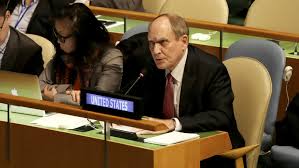
Ronald D. Goddard
Ronald D. Goddard

A short explanation for the U.S. vote against the resolution was provided to the General Assembly by Ronald D. Goddard, U.S. Senior Advisor for Western Hemispheric Affairs. He mentioned last December’s historic announcement of a new era in U.S.-Cuba relations and some of the subsequent steps toward normalization. In addition, he said that U.S. President Obama had “called on Congress to lift the embargo as soon as possible and has taken executive action to adjust regulations to facilitate many transactions involving Cuba.”

Therefore, Goddard continued, the U.S. regretted “that the Government of Cuba has chosen to proceed with its annual resolution. The text falls short of reflecting the significant steps that have been taken and the spirit of engagement President Obama has championed.. . . If Cuba thinks this exercise will help move things forward in the direction both governments have indicated they wish, it is mistaken.”

Israel.

Israel, the only other U.N. member to join the U.S. in opposing the resolution, merely said that it had followed the adoption of the resolution with great interest and welcomed the renewal of diplomatic relations between Cuba and the U.S. Given Israel’s special relationship with the latter, it had voted against the resolution.

Preliminary Documents Regarding the Resolution

Cuba’s Report to General Assembly. In June 2015 Cuba submitted a 37-page report to the General Assembly on its last year’s resolution on the embargo (blockade). This report contains a list of the U.S. statutes and regulations imposing the embargo and blockade and asserts that these U.S. actions have violated the Cuban people’s right to health and food; education, sports and culture; and development. In addition, this U.S. policy allegedly has damaged Cuba’s foreign commerce and investments; and finances, especially with its extraterritorial applications. These alleged damages total US$ 121.192 billion (in current prices) or US$ 833.755 billion (adjusted to reflect the depreciation of the US Dollar against the value of gold).[4]

These alleged damages include the alleged blocking of Cuban access to diagnostic equipment for monitoring the treatment of leukemia patients; preventing the sale to Cuban hospitals of devices critical for pediatric heart surgery patients; and hindering efforts by the U.N. Development Program getting medicine and support into Cuba for its over 18,000 patients living with HIV/AIDS.

U.N. Secretary-General’s Report to General Assembly. On July 30, 2015, the U.N. Secretary-General submitted a 178-page report to the General Assembly summarizing the comments on the resolution from 156 governments and 33 U.N. agencies and entities.[5] The U.S. and Israel, the only two countries to vote against the same resolution last year, had not submitted any comments at the time of the publication of this report, and the Holy See merely stated that it had “never drawn up or applied economic, commercial or financial laws or measures against Cuba.”

The other 155 governments basically supported the resolution with the European Union and Japan emphasizing that the U.S. “trade policy towards Cuba is fundamentally a bilateral issue,” but that “the extraterritorial extension of the [U.S.] embargo . . . violate commonly accepted rules of international trade.”

Of the 33 U.N. agencies and entities, the Office of the United Nations High Commissioner for Human Rights says that generally coercive economic sanctions justified on human rights grounds more often than not fail to improve those conditions; instead they punish the poorest people, the intended beneficiaries of the sanctions, at the cost of increased unemployment and poverty and risks to their health.

Conclusion

This blog consistently has called for the U.S. to end its embargo (blockade) of Cuba. It also has recommended that Cuba’s claims against the U.S. for alleged damages from the embargo be submitted for determination to the Permanent Court of Arbitration at The Hague in the Netherlands. In such a proceeding the U.S. could mount any and all arguments it has against (a) the major premise of the claims (the embargo is illegal under international law) and (b) the amount and causation of the alleged damages from the embargo. In the meantime, this blog has pointed out that as a matter of financial prudence the U.S. should end the embargo as soon as possible to reduce the amount of this contingent liability.[6]

==================================================

[1] United Nations, Despite Resumption of Relations between United States, Cuba, General Assembly Adopts, Almost Unanimously, Resolution Calling for Blockade to Be Lifted (Oct. 27, 2015); Assoc. Press, UN Overwhelmingly Condemns US Embargo on Cuba, N.Y. Times (Oct. 27, 2015); Reuters, Amid Renewed U.S., Cuba ties, U.N. condemns Embargo for 24th Year, N.Y. Times (Oct. 27, 2015); Whitefield, United Nations Votes 191-2 to condemn U.S. embargo against Cuba, Miami Herald (Oct. 27, 2015). As an example of the very limited U.S. coverage of this important U.N. action, the StarTribune, which is the major newspaper in the State of Minnesota, merely stated the following in an 8th page column of “nation+ world” news in the October 28th print edition: “UNITED NATIONS: Vote condemns embargo on Cuba In the first U.N. vote on a resolution condemning the U.S. embargo against Cuba since the two countries renewed diplomatic ties, the U.N. voted 191-2 in favor of the condemnation. The United States said that it couldn’t support the resolution because it failed to take into account ‘the significant steps in the spirit of engagement’ undertaken by the United States.”

[2] Bruno Rodriguez: “We will continue to present this draft resolution for as long as this blockade persists,” CubaMinRex (Oct. 27, 2015) (official Cuban Foreign Ministry English translation). On the day the resolution was debated in the General Assembly, Cuba’s newspaper, Granma, and its website, Cubadebate, had a minute-by-minute reporting of the proceedings starting at 08:33 a.m. (CDT). The Cuban Foreign Ministry has a separate website, “CubavsBloquero,” regarding the embargo (blockade). Another special Ministry website focuses on Cuba-EEUU {United States} relations.

[3] U.S. Mission to U.N., Explanation of Vote at a UN General Assembly Meeting on the Cuba Embargo (Oct. 27, 2015)  In the weeks before the General Assembly vote, the U.S. reportedly considered abstaining on the resolution this year. Last week, however, the U.S. decided it would not abstain because the text did not fully reflect the new spirit of cooperation between the two countries

 [4] Report by Cuba On Resolution 69/5 of the United Nations General Assembly entitled “Necessity of ending the economic, commercial and financial blockade imposed by the United States of America against Cuba” (June 2015). The Report breakdown for some, but not all, of the components of these alleged damages, but does not explain how the alleged gold standard dollar figures were calculated.

[5] U.N. Gen. Assembly, Report of the Secretary General: Necessity of ending the economic, commercial and financial embargo imposed by the United States of America against Cuba (July 30, 2015)

[6] E.g., Letter to President Obama Regarding Cuba (Aug. 17, 2012) (recommends ending embargo); Senator Klobuchar Introduces Bill To End Embargo of Cuba (Feb. 13, 2015) (Cuba’s “damage claim must be recognized as a contingent liability of the U.S., and ending the embargo will minimize the amount of that liability”); Resolution of U.S. and Cuba’s Damage Claims (April 6, 2015).

Presidents Obama and Castro Speak and Meet at United Nations

Over the last week Cuban President Raúl Castro has made two speeches at the United Nations in New York City as has U.S. President Barack Obama. Afterwards the two of them with advisors held a private meeting at the U.N. with subsequent comments by their spokesmen. Here is a chronological account of these events.

President Castro’s September 26th Speech[1]


On September 26, President Raúl Castro 11131154waddressed the U.N. Summit on Sustainable Development, as shown in the photograph to the right. In his remarks he said, ”The reestablishment of diplomatic relations Between Cuba and the United States of America, the opening of embassies and the policy changes announced by President Barack Obama . . . constitute a major progress, which has elicited the broadest support of the international community.”

However, he added, “the economic, commercial and financial blockade [by the U.S.] against Cuba persists bringing damages and hardships on the Cuban people, and standing as the main obstacle to our country’s economic development, while affecting other nations due to its extraterritorial scope and hurting the interests of American citizens and companies. Such policy is rejected by 188 United Nations member states that demand its removal.”

More generally Castro condemned “the pervasive underdevelopment afflicting two-thirds of the world population” and the widening “gap between the North and the South” and “wealth polarization.”

Thus, he argued, “If we wish to make this a habitable world with peace and harmony among nations, with democracy and social justice, dignity and respect for the human rights of every person, we should adopt as soon as possible concrete commitments in terms of development assistance, and resolve the debt issue.” Such a commitment, he said, would require “a new international financial architecture, removal of the monopoly on technology and knowledge and changing the present international economic order.”

Nevertheless, according to President Castro, Cuba will continue to help other developing nations despite its limited capabilities and “shall never renounce its honor, human solidarity and social justice” that “are deeply rooted in our socialist society.”

President Obama’s September 27th Speech[2]

635789669053394239-AFP-544774880

On September 27, President Obama addressed the same U.N. Summit on Sustainable Development without touching on U.S.-Cuba relations. Instead he concentrated on the purpose of the Summit– sustainable development. (His photograph is to the left.)

He started by rejecting the notion that “our efforts to combat poverty and disease do not and cannot work, that there are some places beyond hope, that certain people and regions are condemned to an endless cycle of suffering.” Instead, he asserted, “the global hunger rate has already been slashed.  Tens of millions of more boys and girls are today in school.  Prevention and treatment of measles and malaria and tuberculosis have saved nearly 60 million lives.  HIV/AIDS infections and deaths have plummeted.  And more than one billion people have lifted themselves up from extreme poverty — one billion.”

Nevertheless, much remains to be done, according to Obama, and the nations at this Summit “commit ourselves to new Sustainable Development Goals, including our goal of ending extreme poverty in our world.  We do so understanding how difficult the task may be.  We suffer no illusions of the challenges ahead.  But we understand this is something that we must commit ourselves to.  Because in doing so, we recognize that our most basic bond — our common humanity — compels us to act.”

In this work, President Obama stated, the U.S. “will continue to be your partner.  Five years ago, I pledged here that America would remain the global leader in development, and the United States government, in fact, remains the single largest donor of development assistance, including in global health.  In times of crisis — from Ebola to Syria — we are the largest provider of humanitarian aid.  In times of disaster and crisis, the world can count on the friendship and generosity of the American people.”

Therefore, Obama said, he was “committing the United States to achieving the Sustainable Development Goals” and to “keep fighting for the education and housing and health care and jobs that reduce inequality and create opportunity here in the United States and around the world.” This effort will include other “governments, more institutions, more businesses, more philanthropies, more NGOs, more faith communities, more citizens.” Moreover, the “next chapter of development must also unleash economic growth — not just for a few at the top, but inclusive, sustainable growth that lifts up the fortunes of the many.”

President Obama concluded by noting these obstacles to achieving these goals: bad governance; corruption; inequality; “old attitudes, especially those that deny rights and opportunity to women;” failure to “recognize the incredible dynamism and opportunity of today’s Africa;” war; and climate change

President Obama’s September 28th Speech[3]

 In a wide-ranging speech on international affairs, President Obama commented on U.S. relations with Cuba. He said, “I also believe that to move forward in this new era, we have to be strong enough to acknowledge when what you’re doing is not working. For 50 years, the United States pursued a Cuba policy that failed to improve the lives of the Cuban people. We changed that. We continue to have differences with the Cuban government. We will continue to stand up for human rights. But we address these issues through diplomatic relations, and increased commerce, and people-to-people ties. As these contacts yield progress, I’m confident that our Congress will inevitably lift an embargo that should not be in place anymore. Change won’t come overnight to Cuba, but I’m confident that openness, not coercion, will support the reforms and better the life the Cuban people deserve, just as I believe that Cuba will find its success if it pursues cooperation with other nations.”

Later in the speech, Obama added these words: “Think of the Americans who lowered the flag over our embassy in Havana in 1961 — the year I was born — and returned this summer to raise that flag back up. (Applause.) One of these men said of the Cuban people, “We could do things for them, and they could do things for us. We loved them.” For 50 years, we ignored that fact.

These comments were in the context of the following more general discussion of international affairs by President Obama: “We, the nations of the world, cannot return to the old ways of conflict and coercion. We cannot look backwards. We live in an integrated world — one in which we all have a stake in each other’s success. We cannot turn those forces of integration. No nation in this Assembly can insulate itself from the threat of terrorism, or the risk of financial contagion; the flow of migrants, or the danger of a warming planet. The disorder we see is not driven solely by competition between nations or any single ideology. And if we cannot work together more effectively, we will all suffer the consequences.”

“No matter how powerful our military, how strong our economy, we understand the United States cannot solve the world’s problems alone.” So too, in words that could be aimed at Cuba and others, “repression cannot forge the social cohesion for nations to succeed. The history of the last two decades proves that in today’s world, dictatorships are unstable. The strongmen of today become the spark of revolution tomorrow. You can jail your opponents, but you can’t imprison ideas. You can try to control access to information, but you cannot turn a lie into truth. It is not a conspiracy of U.S.-backed NGOs that expose corruption and raise the expectations of people around the globe; it’s technology, social media, and the irreducible desire of people everywhere to make their own choices about how they are governed.”

In a similar vein, Obama said, “The strength of nations depends on the success of their people — their knowledge, their innovation, their imagination, their creativity, their drive, their opportunity — and that, in turn, depends upon individual rights and good governance and personal security.”

Finally, according to Obama, we must “defend the democratic principles that allow societies to succeed” with a recognition that “democracy is going to take different forms in different parts of the world. The very idea of a people governing themselves depends upon government giving expression to their unique culture, their unique history, their unique experiences. But some universal truths are self-evident. No person wants to be imprisoned for peaceful worship. No woman should ever be abused with impunity, or a girl barred from going to school. The freedom to peacefully petition those in power without fear of arbitrary laws — these are not ideas of one country or one culture. They are fundamental to human progress.”

“A government that suppresses peaceful dissent is not showing strength; it is showing weakness and it is showing fear. History shows that regimes who fear their own people will eventually crumble, but strong institutions built on the consent of the governed endure long after any one individual is gone.”

“That’s why our strongest leaders — from George Washington to Nelson Mandela — have elevated the importance of building strong, democratic institutions over a thirst for perpetual power. Leaders who amend constitutions to stay in office only acknowledge that they failed to build a successful country for their people — because none of us last forever. It tells us that power is something they cling to for its own sake, rather than for the betterment of those they purport to serve.”

“Democracy — inclusive democracy — makes countries stronger. When opposition parties can seek power peacefully through the ballot, a country draws upon new ideas. When a free media can inform the public, corruption and abuse are exposed and can be rooted out. When civil society thrives, communities can solve problems that governments cannot necessarily solve alone. When immigrants are welcomed, countries are more productive and more vibrant. When girls can go to school, and get a job, and pursue unlimited opportunity, that’s when a country realizes its full potential.”

President Castro’s September 28th Speech[4]

On September 28, Cuban President Raúl Castro in his address to the U.N. General Assembly essentially reiterated his comments of two days earlier about U.S.-Cuba relations with these words: ‘After 56 years, during which the Cuban people put up a heroic and selfless resistance, diplomatic relations have been reestablished between Cuba and the United States of America.”

“Now, a long and complex process begins toward normalization that will only be achieved with the end of the economic, commercial and financial blockade; the return to our country of the territory illegally occupied by the Guantanamo Naval Base; the suspension of radio and TV broadcasts, and subversion and destabilization attempts against the Island; and, when our people are compensated for the human and economic damages they continue to endure.”

“As long as the blockade remains in force, we will continue to introduce the Draft Resolution entitled ‘Necessity of Ending the Economic, Commercial and Financial Embargo imposed by the United States of America on Cuba.’ To the 188 governments and peoples who have backed our just demand, here, and in other international and regional forums, I reaffirm the eternal gratitude of the Cuban people and government for your continued support.” [5]

The rest of this Castro speech argued that the U.N. has failed in its 70 years of existence to fulfill the lofty purposes of its Charter. The speech also noted Cuba’s solidarity with its Caribbean brothers, African countries, the Bolivarian Republic of Venezuela, the Republic of Ecuador, the people of Puerto Rico, the Republic of Argentina, the Brazilian people and President Dilma Rouseff, the Syrian people and the Palestinian people. Castro also supported the nuclear agreement with the Islamic Republic of Iran.

On the other hand, Castro reaffirmed Cuba’s “rejection of the intention to expand the presence of NATO up to the Russian borders, as well as of the unilateral and unfair sanctions imposed on that nation” and Cuba’s condemnation of NATO and European countries’ efforts to destabilize countries of the Middle East and Africa that have led to the recent migrant crisis in Europe.

In conclusion, Castro said, “the international community can always count on Cuba to lift its sincere voice against injustice, inequality, underdevelopment, discrimination and manipulation; and for the establishment of a more equitable and fair international order, truly focused on human beings, their dignity and well-being.”

The Presidents’ Meeting[6]

Obama &Castro

The two presidents with their advisors held a 30-minute private meeting at the U.N. on Tuesday, September 29. The photograph at the left shows them shaking hands.

The U.S. delegation consisted of Secretary of State, John Kerry; National Security Adviser, Susan Rice; National Security Council Senior Director for Western Hemisphere Affairs, Mark Feierstein; and the U.S. Permanent Representative to the U.N., Samantha Power.

Cuba’s delegation was composed of the Foreign Minister, Bruno Rodriguez; Consultant, Alejandro Castro Espin (the son of President Raúl Castro); Vice President of Cuba’s Defense and Security Committee, Juan Francisco Arias Fernández; Cuba’s Director General of U.S. Affairs, Ministry of Foreign Affairs, Josefina Vidal; and Cuba’s Ambassador to the U.S., José Ramón Cabañas.

White House’s Comments on the Meeting[7]

On a September 29 flight from New York City to Washington, D.C., White House Press Secretary Josh Earnest, in response to a journalist’s question, said, “I know that the two leaders had an opportunity to discuss some of the regulatory changes that have been announced in the last couple of weeks on the part of the [U.S.]. The State Department is leading civil aviation coordination talks in Cuba right now.  And these are all additional steps that are moving toward more normal relations between our two countries.”

“The President, as he always does, . . . reaffirmed our commitment to seeing the Cuban government do a better job of not just respecting, but actually proactively protecting, the basic human rights of the Cuban people.”

We “continue to believe that deeper engagement and deeper people-to-people ties, deeper economic engagement between the [U.S.] and Cuba will have the effect of moving the government and the nation in a positive direction.”

Thereafter the White House released the following written statement about the meeting: “President Obama met today with President Raul Castro of Cuba to discuss recent advances in relations between the United States and Cuba, as well as additional steps each government can take to deepen bilateral cooperation. The two Presidents discussed the recent successful visit of Pope Francis to both countries.  President Obama highlighted U.S. regulatory changes that will allow more Americans to travel to and do business with Cuba, while helping to improve the lives of the Cuban people.  The President welcomed the progress made in establishing diplomatic relations, and underscored that continued reforms in Cuba would increase the impact of U.S. regulatory changes.  The President also highlighted steps the United States intends to take to improve ties between the American and Cuban peoples, and reiterated our support for human rights in Cuba.”

Cuban Foreign Minister’s Press Conference[8]

Soon after the presidential meeting, Cuban Foreign Minister Bruno Rodriguez held a press conference at the U.N. In his opening statement, he said that in a “respectful and constructive” atmosphere, the two presidents exchanged their views on the recent visit of Pope Francisco to Cuba and the United States, as well as issues on the bilateral agenda established between the two countries.

“The presidents agreed on the need to continue working on the set bilateral agenda, which includes areas of mutually beneficial bilateral cooperation and in third countries such as Haiti, the development of dialogue on issues of bilateral and multilateral interest and resolving outstanding issues between two states.”

President Castro affirmed Cuba’s desire to build a new relationship with the U.S. based on respect and sovereign equality, but reiterated that to have normal relations the U.S. had to lift the blockade, which is causing damage and hardship to the Cuban people and affects the interests of American citizens.

Castro also confirmed that Cuba on October 27 would introduce in the General Assembly a resolution condemning the embargo (blockade). Said the foreign Minister, the blockade is “a massive, flagrant and systematic violation of human rights of all Cubans and harms all Cuban families, even Cubans living outside Cuba.” Cuba fully expects this year’s resolution to once again have overwhelming support.

The Foreign Minister said the return of the territory illegally occupied by the Guantanamo Naval Base in Cuba is a high priority element in the process of normalization of relations between the U.S. and Cuba, as a vindication of Cuban people.

At another point he added that “we are very proud of the accomplishments of Cuba on human rights and that human rights are universal, not subject to political selectivity or manipulation of any kind. ” Cuba guarantees the full exercise of political rights and civil liberties, and economic, social and cultural rights. We have many concerns with the situation on human rights in the world, particularly in the U.S. and Western Europe, as illustrated by the current immigration refugee crisis. The pattern of racial discrimination and police brutality against African Americans in the [U.S.] is really serious.

Conclusion

Cuba reiterated its insistence on ending the U.S. embargo as an essential condition for normalization of relations, an objective shared by President Obama and this blog. [9] We now await the U.N. General Assembly’s debate and anticipated approval on October 27 of another resolution condemning the embargo and whether the U.S. will, for the first time, abstain on the vote.

Cuba continues to assert that the U.S. lease of Guantanamo Bay is illegal, but its saying so does not make it so. Previous blog posts have discussed this contention and do not find it persuasive and, therefore, suggested the two countries submit the dispute for resolution to the Permanent Court of Arbitration at The Hague in the Netherlands.[10]

The same means has been suggested in this blog for resolving the disputes about whether or not Cuba has been damaged by the embargo (blockade) and the amount of such alleged damages as well as the amount of damages to U.S. interests by Cuba’s expropriation of property in the early years of the Cuban Revolution.

==============================================

[1] Cuba Ministry Foreign Affairs, Raul Castro: Unacceptable levels of poverty and social inequality persist and even aggravate across the world (Sept. 26, 2015); Reuters, Cuba’s Castro Slams U.S. Trade Embargo at United Nations, N.Y. Times (Sept. 26, 2015); Reuters, U.S. Embargo ‘Main Obstacle’ to Cuba’s Development: Castro, N.Y. Times (Sept. 26, 2015) (video)

[2] White House, Remarks by President on Sustainable Development Goals (Sept. 27, 2015).

[3] Reuters, Quotes from President Obama’s U.N. Speech, N.Y. Times (Sept. 28, 2015); President Obama’s Speech to the United Nations General Assembly 2015, N.Y. Times (Sept. 28, 2015); White House, Remarks by President Obama to the United Nations General Assembly (Sept. 28, 2015).

[4] Raúl at the United Nations: The International community can always count on Cuba’s voice in the face of injustice, Granma (Sept. 28, 2015); Full text [of Castro’s speech], Granma (Sept. 28, 2015); Reuters, At U.N., Castro Says U.S. Must End Embargo to Have Normal Cuba Ties, N.Y. Times (Sept. 28, 2015); Assoc. Press, Raúl Castro Addresses General Assembly, N.Y. Times (Sept. 28, 2015) (video); Goldman, At the U.N., Raúl Castro of Cuba Calls for End to U.S. Embargo, N.Y. Times (Sept. 28, 2015).

[5] A prior post reviewed last year’s General Assembly’s condemnation of the embargo.

[6] Assoc. Press, U.S., Cuba Leaders Meet for 2nd Time in This Year, N.Y. Times (Sept. 29, 2015); Reuters, Obama, Castro Meet as They Work on Thawing U.S.-Cuba Ties, N.Y. Times (Sept. 29, 2015); Cuba and U.S. Presidents meet, Granma (Sept. 30, 2015)

[7] White House, Press Gaggle by Press Secretary Josh Earnest en route Washington, D.C., 9/29/15; White House, Readout of the President’s Meeting with Cuban President Raul Castro (Sept. 29, 2015).

[8] Reuters, Cuban Minister on Obama-Castro Meeting, N.Y. Times (Sept. 29, 2015) (video); Bruno Rodriguez: The blockade is a massive, flagrant and systematic violation of human rights, Granma (Sept. 30, 2015).

[9] This blog has discussed the initial bills to end the embargo in the House and Senate as well as later bills to do the same in the Senate and House.

[10] Resolution of U.S. and Cuba’s Damage Claims (April 4, 2015); Resolution of Issues Regarding U.S.-Lease of Guantanamo Bay (April 6, 2015); Does Cuba Have a Right to Terminate the U.S. Lease of Guantanamo Bay? (April 26, 2015).

The First Day of Pope Francis’ Mission to Cuba

On Saturday, September 19, at 15:52 (Cuban time; EST) Pope Francis’ airplane from Rome arrived at Havana’s airport. This post will cover the Pope’s flight to Cuba, the final hours of Cuba’s preparation and anticipation of his arrival; and his arrival.[1] Subsequent posts will cover each of the Pope’s other three days in Cuba and then each of his six days in the United States of America.

The Pope’s Flight to Cuba

At 04:15 (EST) the Pope’s plane left Rome with an entourage that included Cardinal Secretary of State Pietro Parolin and Vatican “Foreign Minister” Monsignor John Gallagher. From the plane the Pope issued many tweets. One of them said: “I ask you to join me in praying for my trip to Cuba and the United States.”

On the plane the Pope told journalists, “I love the Cuban people a great deal.” He also noted the need to extend a hand and open parish doors to immigrants.

Preparations in Havana

That morning U.N. Secretary General Ban Ki-moon issued a statement acknowledging, “The visit [next week] of His Holiness Pope Francis to the United Nations comes at a moment of challenge and hope. As the world struggles to cope with conflict, poverty and climate change, Pope Francis has been a leading voice for urgent action to protect people and our planet.” The Secretary General’s message also included the following words:

  • “I am deeply privileged to have had the opportunity to meet several times with His Holiness, who impressed me as a man of great humility and humanity. When we met last year at the Vatican in May, the Pope urged senior United Nations officials to ‘work together in promoting a true, worldwide ethical mobilization which, beyond all differences of religious or political convictions, will spread and put into practice a shared ideal of fraternity and solidarity, especially with regard to the poorest and those most excluded.’”
  • “Pope Francis has called on people everywhere to work towards realizing the new sustainable development goals ‘with generosity and courage.’ As I discussed with the Pope, this will require challenging all forms of injustice.”
  • “I fully concur with Pope Francis in his recent encyclical that climate change is a moral issue, in addition to its other dimensions, and one of the principal challenges facing humanity. His Holiness rightly cited the solid scientific consensus showing significant warming of the climate system, with most global warming in recent decades mainly a result of human activity.”
  • “Pope Francis and I wholeheartedly agree on the urgency for action, and the critical need to support the poorest and most vulnerable members of our human family from a crisis they did least to cause, but suffer from the most. Other faith groups have echoed this view, including most recently a gathering of eminent Islamic scholars and religious leaders.”
  • “Pope Francis’ message extends far beyond the world’s 1.2 billion Roman Catholics. On the first page of his recent encyclical, the Pope states that ‘faced as we are with global environmental deterioration, I wish to address every person living on this planet.’”
  • “Pope Francis has demonstrated the value of religious leaders engaging on these pressing global issues. I count on him and other faith leaders to counteract the prevailing forces of division and hate with dialogue and understanding. Together, we can realize our vision of a peaceful world where all people live in safety and dignity.”
Frei Betto
Frei Betto

Later that morning Frei Betto–a Brazilian Roman Catholic priest and the author of “Fidel and Religion: Castro Talks on Revolution and Religion with Frei Betto” (1988)–held a press conference at Havana’s Hotel Nacional. He noted that “only two Latin American countries have had the privilege of receiving, in a relatively short period of time (17 years), the visit of the last three Popes: Brazil and Cuba.” While 70% of Brazilians are Roman Catholic, Cuba has religious syncretism. With the reestablishment of diplomatic relations between the U.S. and Cuba, Frei said, the challenges point toward the need to change attitudes within the U.S. government. Francis is undertaking a revolution within the Catholic Church itself, which is why some see him as the leading statesman of our time and as a strong candidate for the Nobel Peace Prize. Indeed, added Frei, Francis preaches in favor of peaceful coexistence in the world, reaching out to the poor and boosting high-impact programs to eradicate hunger, poverty and environmental degradation. The Cuban Revolution has taught evangelical values, which are the same as human moral values and are not “additional” for revolutionaries or for the religious.

Welcoming Francis at Havana’s Airport

Pope Francis & President Castro

The Pope was met at the airplane by Cuban President Raul Castro accompanied by the Cuban Foreign Minister Bruno Rodriguez and Cuban Archbishop Jamie Lucas Cardinal Ortega. In a lengthy speech that recited many of the accomplishments of the Cuban Revolution and Cuba’s claims against the U.S., President Castro said his meeting with the Pope at the Vatican gave them the opportunity to exchange ideas about important world issues. We have followed your statements about these issues with much interest. We want future generations to inherit human dignity from us. The weight of the crisis falls on the third world and minorities do not escape from it. Your Holiness, we have thanked you for your support during the talks between the United States and Cuba. Now the Pope’s meetings with the Cuban people will be very important.

Francis responded by thanking the Cuban people for their welcome and expressing his fraternal greetings to Comandante en Jefe Fidel Castro. The Pope recalled that the 80th anniversary of Cuba and the Holy See’s uninterrupted relationship is being celebrated; that Popes John Paul II and Benedicto XVI had visited Cuba; and that this trip coincides with the centenary of the declaration of Cobre’s Our Lady of Charity as Cuba’s patron saint. Francis said that Cuba plays an extraordinary role in the meeting of the North and South, East and West. Its natural vocation is as a point of encounter. The process underway toward the reestablishment of relations between Cuba and the U.S. is an example of the effectiveness of a culture of exchange and dialogue.

The Pope then left for the Apostolic Nunciature in Havana where he stayed the night. On the journey there an estimated 100,000 Cubans were on the streets to welcome him, as shown in the photographs below.

Motorcase

f0008839

Vatican Spokesman’s Press Conference

Federico Lombardi
Federico Lombardi

The Vatican spokesman, Monsignor Federico Lombardi, then held a press conference at Hotel Nacional. He said that peace was the key word for this visit, that the Pope was greatly moved by the Cuban people’s warm welcome and enthusiasm; that the Pope had highlighted the importance of 80 years of uninterrupted ties between Cuba and the Vatican; and that the Pope will visit the Shrine of Our Lady of Charity of El Cobre as a son and pilgrim.

Lombardi also emphasized that the Catholic Church and the current and previous Popes are opposed to the U.S. blockade. The process of the reestablishment of diplomatic relations between Washington and Havana constituted a sign of hope to change the history of relations between the two countries. Peace, reconciliation and the building of bridges: clear messages from Pope Francis regarding the significance of his current apostolic visit to Cuba and the United States.

According to Lombardi, the Pope’s speech at the airport and his subsequent speeches are directed toward Cuban men and women, including Cubans throughout the world no matter where they reside. Many of them remember the historic words of the first Pope to visit Cuba, now a Saint, (John Paul II): “May Cuba with all its glorious possibilities open up to the world, and may the world open up to Cuba.”

Conclusion

The incredible major sources for this and subsequent posts about the Cuban mission are Granma, the official newspaper of the Communist Party of Cuba, and the Vatican.

The online edition of Granma at 06:03 a.m. (Cuban time) commenced a minute-by-minute reporting (with photographs) of the Pope’s plane’s earlier departure from Rome and of the preparations in Cuba. It also mentioned the Cuban government’s establishment of a Twitter account: #ElPapaEnCuba. Another article in Granma focused on the actual airport arrival.

While the coverage of the Pope’s first day in Cuba by the Cuban media was focused on the details of what actually happened, the New York Times’ lead article chose to concentrate on what it saw as the Pope’s “new challenge” of trying to “open up Cuba to the Roman Catholic Church.” Its first quotation was from the Rev. Jorge Cela, who oversaw the Jesuit religious order in Cuba from 2010 to 2012, who said, “It is an occasion to ask for more openness. The relationship is not easy.” Its second identified source was Rev. José Conrado, a Cuban priest in the central city of Trinidad, who said, “We could do more. The church should not back off, even if doing so is difficult and problematic for the church itself.” The balance of the Times’ article talked about criticism of Cuban Archbishop Ortega and the need to find his successor when he retires.

The Washington Post’s lead article at least covered the welcoming speeches at the Havana airport in addition to discussing issues about the Roman Catholic’s role in Cuba and whether they would be the subjects of the Pope’s public comments or private discussions with President Castro.


Results of U.S.-Cuba Discussions After Ceremonial Opening of U.S. Embassy in Havana

John Kerry & Bruno Rodriguez

After the ceremonial opening of the U.S. Embassy in Havana on August 14, 2015, Cuba and the U.S. held closed-door discussions. Here is what was disclosed about those discussions at a joint press conference at the city’s Hotel Nacional by Secretary of State John Kerry and Cuban Foreign Minister Bruno Rodriquez and from other sources.[1]

Guarded Optimism. Repeating his earlier remarks at the Embassy, Kerry said this was an historic moment as the two countries continued to engage in a cooperative way to address the many issues that had accumulated over the last 50 years. Rodriguez said essentially the same thing.

Empowerment of People. According to Kerry, normalization “will contribute to greater empowerment of . . . the Cuban people to be able to plug into the global economy, to be able to trade more, to be able to move and travel and enjoy the fruits of their labor, to be able to raise the standards of living, and therefore improve their lives.” It will “also help [U.S.] citizens . . . , including students, the private sector to be able to learn more about this country, to be able to establish friendships and connections that will last, hopefully, for a lifetime.”

Improved U.S. Relations with Western Hemisphere. Kerry said normalization “will also remove a source of irritation and division within the hemisphere.” At April’s Summit of the Americas, many countries said “how happy they are that finally the [U.S.] and Cuba are going to move to renew their relationship, because all of them were supportive of and encouraging us to take that kind of step.”

U.S. Embargo (Blockade) Issues. Rodriguez re-emphasized Cuba’s demands for the U.S. to end its embargo (blockade) of the island and for the U.S. to pay compensation for the alleged damages to the Cuban economy caused by that measure. Kerry agreed on the need to end the embargo and emphasized President Obama’s request for Congress to do just that.

According to Reuters and the Associated Press, this issue came up again at a meeting that evening with Cuban dissidents at the official Havana residence of the charge d’affaires. Kerry then said, “the U.S. Congress was unlikely to ever lift a punishing economic embargo on Cuba unless the Communist government improved its human rights [or civil liberties] record.” The AP quoted Kerry as saying, “There is no way Congress will lift the embargo if we are not making progress on issues of conscience.”

After there had been a report of those comments, Josefina Vidal, Cuba’s lead negotiator in negotiations with the U.S., told Reuters, “Decisions on internal matters are not negotiable and will never be put on the negotiating agenda in conversations with the United States. Cuba will never do absolutely anything, not move one millimeter, to try to [obtain the end of the embargo (blockade).]”

U.S. Claims for Expropriated Property. Rodriguez said, “Cuban laws have foreseen the [need for] compensation to owners whose properties were nationalized in the 1960s. And all the owners were compensated in due time with exception of American citizens due to the circumstances . . . in the bilateral relations. I reiterate that the Cuban laws include the possibility to pay compensations.”

This point was reiterated later that day by Cuban diplomat, Josefina Vidal, who said that Cuba is willing to discuss the 5,913 claims from Americans whose properties were nationalized after the 1959 revolution that brought Fidel Castro to power. A Cuban law, however, links negotiations on property claims to Cuba’s own claims for damages caused by the embargo and other U.S. aggressions.

Guantanamo Bay Issues. Rodriguez reiterated Cuba’s request or demand for the U.S. to return Guantanamo Bay to Cuba. Kerry, however, said, “Now, at the moment, there is no current discussion or plan to change the arrangement with respect to Guantanamo, but I can’t tell you what will happen over the years in the future.”

Josefina Vidal stated that she receives the annual U.S. $4,085 rental checks for Guantanamo Bay, which Cuba refuses.to cash because it sees the U.S. occupation of Guantanamo as illegal. Instead each of the checks is stored in Cuban archives “like a historical document.”

Migration issues. According to Kerry, the U.S. supports “safe, legal, orderly migration from Cuba to the [U.S.]” and “full implementation of the existing migration accords with Cuba.” But the U.S. currently has “no plans whatsoever to alter the current migration policy, including the Cuban Adjustment Act, and we have no plans to change the ‘wet foot, dry foot’ policy.”

Rodríguez responded: “migration waves of people escaping from poverty and military conflicts are well known. Fortunately this does not happen in the Latin America and the Caribbean region.” But we have “serious concerns about the migration processes from [Central American] countries affecting hundreds [of thousands] of small children [fleeing to the U.S.]”

Rodriguez continued, “Migration relations between the U.S. and Cuba . . . should not be politicized. They should be totally normal.” We agree to encourage the “safe and orderly migration between both countries. We also agree on the risks, the dangers, and the need to establish an international and bilateral cooperation against trafficking in persons [and related transnational organized crime].” Cuba also believes “the migration accords in force between the U.S. and Cuba should be strictly respected and that any policy or any practical action which is not in accordance with the spirit and language of the accords should be abolished.” [2] We believe that the freedom of travel is also a fundamental human right.”

U.S. Human Rights Problems. Rodriguez opened his comments at the press conference with complaints of U.S. human rights transgressions — from police shootings of black men to mistreatment of prisoners at Guantanamo Bay, the U.S. naval base on Cuba that the government says must be returned. “Cuba isn’t a place where there’s racial discrimination, police brutality or deaths resulting from those problems,” Rodriguez said. “The territory where torture occurs and people are held in legal limbo isn’t under Cuban jurisdiction.”

U.S. Presidential Election of 2016. Kerry said he could not imagine “another president, Republican or Democrat, just throwing [the re-establishment of diplomatic relations and steps towards normalization] out the window.” In addition, Kerry thought “that people understand that over 54 years, we had a policy that was isolating us, not changing the world.”

Steering Committee. The two countries have established a steering committee or commission to address the many outstanding issues. This body will meet in Havana for the first time in the first or second week of September.

This body will follow three tracks. The first will encompass areas in which rapid progress is expected, such as cooperation on naval matters, climate change and the environment. The second will tackle more complex topics like the establishment of direct airline flights and U.S. telecommunications deals with Cuba. The last will take on the toughest problems, including the embargo, human rights and each country’s desire to have fugitives returned by the other.

Conclusion

The steering committee’s first tier of issues (the easiest ones) apparently will include agreements for civil aviation landing rights for each country’s airlines, direct mail, environmental protection and battling drug trafficking. (Indeed on August 17 the Wall Street Journal reported that the Obama Administration was pushing for the airliner deal by the end of this year.[3])

The third tier of issues (the most difficult) apparently will include ending the U.S. embargo (blockade), which is an issue for the U.S. Congress, not for negotiations with Cuba; U.S. compensation to Cuba for alleged damages to its economy from the embargo (blockade); Cuba’s compensation to U.S. interests for expropriation of their property in Cuba; the future status of Guantanamo Bay; and extradition of fugitives from one country to the other.[4]

I agree that the most difficult set of issues to be resolved by bilateral negotiations are those just mentioned. Indeed, as an outsider, I think they will be impossible to resolve by such negotiations.

On the other hand, I think that the way to resolve these issues is direct and simple in concept: submit these disputes to an impartial third party. There are various ways this could be done. I have suggested that the Permanent Court of Arbitration at The Hague in the Netherlands be chosen by the two countries to resolve these disputes: it has been in existence since the late 19th century and has an existing set of rules for such proceedings, which will be lengthy and complicated.

=============================================================

[1] State Dep’t, Press Availability With Cuban Foreign Minister Bruno Eduardo Rodriguez Parrilla (Aug. 14, 2015); Reuters, Kerry Says Next U.S. President Likely to Uphold New Cuba Policy, N.Y. Times (Aug. 14, 2015); Reuters, Cuba Says Won’t Move ‘One Millimeter’ to Placate Enemies in U.S., N.Y. Times (Aug. 14, 2015); Assoc. Press, A Festive Flag-Raising, Then Tough Talk on US-Cuba Relations, N.Y. Times (Aug. 15, 2015);Reuters, Cuba’s Top Diplomat for U.S. Sees Long Road for Normal Ties, N.Y. Times (Aug. 16, 2015); Cuban Foreign Minister receives John Kerry (+Photos), Granma (Aug. 14, 2015); John Kerry: We are determined to move forward, Granma (Aug. 14, 2015); Cuba and U.S. discuss next steps in developing relations, Granma (Aug. 14, 2015); Cuba and the United States: Some questions about the future, Granma (Aug. 14, 2015); In joint press conference Bruno Rodriguez Parrilla and John Kerry, Granma (Aug. 15, 2015).

[2] One of the criticized U.S. immigration policies is the dry foot/wet foot program whereby a Cuban who lands on U.S. land is eligible for special U.S. immigration status while one apprehended at sea is not.. Another is the U.S.’ Cuban medical personnel parole program.

[3] Schwartz, Nicas & Lee, Obama Administration Pushes for Deal to Start Flights to Cuba by Year’s End, W.S.J. (Aug. 17, 2015); Reuters, White House, Cuba Work to Resume Scheduled Commercial Flights, WSJ, N.Y. times (Aug. 17, 2015).

[4] Previous posts have discussed Cuba’s claim for damages from the embargo (blockade); the U.S. claims for compensation for expropriated property; the Cuban lease of Guantanamo Bay to the U.S. and whether Cuba has a legal right to terminate the lease; extradition of fugitives.


U.S. Secretary of State Speaks to the Cuban People

On August 14, 2015, the U.S. formally opened its Embassy in Havana, Cuba with the raising of the American flag and a program featuring remarks by U.S. Secretary of State John Kerry that were telecast and broadcast live throughout the island.[1] Thus, his message, in one sense, was directed to the Cuban people, and the words in bold in the following remarks were especially addressed to them.

John Kerry @ U.S. Embassy in Havana
Secretary & U.S. Flag at Havana Embassy
Kerry & U.S. Flag at Havana Embassy

Kerry’s Remarks

Kerry started by recognizing that “this is truly a memorable occasion – a day for pushing aside old barriers and exploring new possibilities” and that Presidents Obama and Castro had made “a courageous decision to stop being the prisoners of history and to focus on the opportunities of today and tomorrow.”

The U.S. needs to recognize that “U.S. policy is not the anvil on which Cuba’s future will be forged. Decades of good intentions aside, the policies of the past have not led to a democratic transition in Cuba. It would be equally unrealistic to expect normalizing relations to have, in a short term, a transformational impact. After all, Cuba’s future is for Cubans to shape. Responsibility for the nature and quality of governance and accountability rests, as it should, not with any outside entity; but solely within the citizens of this country.”

“But the leaders in Havana – and the Cuban people – should also know that the United States will always remain a champion of democratic principles and reforms. . . .[We] will continue to urge the Cuban Government to fulfill its obligations under the UN and inter-American human rights covenants – obligations shared by the United States and every other country in the Americas.”

“And indeed, we remain convinced the people of Cuba would be best served by genuine democracy, where people are free to choose their leaders, express their ideas, practice their faith; where the commitment to economic and social justice is realized more fully; where institutions are answerable to those they serve; and where civil society is independent and allowed to flourish.”

We “believe it’s helpful for the people of our nations to learn more about each other, to meet each other. That is why we are encouraged that travel from the United States to Cuba has already increased by 35 percent since January and is continuing to go up. We are encouraged that more and more U.S. companies are exploring commercial ventures here that would create opportunities for Cuba’s own rising number of entrepreneurs, and we are encouraged that U.S. firms are interested in helping Cuba expand its telecommunications and internet links, and that the government here recently pledged to create dozens of new and more affordable Wi-Fi hotspots.”

“The restoration of diplomatic ties will also make it easier for our governments to engage. After all, we are neighbors, and neighbors will always have much to discuss in such areas as civil aviation, migration policy, disaster preparedness, protecting marine environment, global climate change, and other tougher and more complicated issues. Having normal relations makes it easier for us to talk, and talk can deepen understanding even when we know full well we will not see eye to eye on everything.”

“We are all aware that . . . the overall U.S. embargo on trade with Cuba remains in place and can only be lifted by congressional action – a step that we strongly favor. For now, the President has taken steps to ease restrictions on remittances, on exports and imports to help Cuban private entrepreneurs, on telecommunications, on family travel, but we want to go further. The goal of all of these changes is to help Cubans connect to the world and to improve their lives. And just as we are doing our part, we urge the Cuban Government to make it less difficult for their citizens to start businesses, to engage in trade, access information online. The embargo has always been something of a two-way street – both sides need to remove restrictions that have been holding Cubans back.”

Kerry also thanked “leaders throughout the Americas who have long urged the United States and Cuba to restore normal ties [and] the Holy Father Pope Francis and the Vatican for supporting the start of a new chapter in relations between our countries.”

He then paid “tribute to the people of Cuba and to the Cuban American community in the United States. Jose Marti once said that ‘everything that divides men…is a sin against humanity.’ Clearly, the events of the past – the harsh words, the provocative and retaliatory actions, the human tragedies – all have been a source of deep division that has diminished our common humanity. There have been too many days of sacrifice and sorrow; too many decades of suspicion and fear. That is why I am heartened by the many on both sides of the Straits who . . . have endorsed this search for a better path.”

“We have begun to move down that path without any illusions about how difficult it may be. But we are each confident in our intentions, confident in the contacts that we have made, and pleased with the friendships that we have begun to forge. And we are certain that the time is now to reach out to one another, as two peoples who are no longer enemies or rivals, but neighbors – time to unfurl our flags, raise them up, and let the world know that we wish each other well.”

Conclusion

In attendance at the ceremony were Embassy staff, including Jeffrey DeLaurentis, the charge d’affaires; other U.S. federal government officials, including Assistant Secretary of State for Western Hemisphere Affairs, Roberta Jacobson, who led the U.S. delegation in recent negotiations with Cuba; other countries’ diplomats; U.S. Senators Patrick Leahy (Dem., VT), Barbara Boxer (Dem., CA), Amy Klobuchar (Dem., MN) and Jeff Flake (Rep., AZ); [2] U.S. Representatives Karen Bass (Dem., CA), Steve Cohen (Dem., TN), Barbara Lee (Dem., CA) and Jim McGovern (Dem., MA); [3] and James Williams, President of Engage Cuba, and Zane Kerby, President & CEO of American Society of Travel Agents.

Also in attendance was a Cuban delegation, including Josafina Vidal, who led the Cuban team in those negotiations; and Dr. José Ramón Cabañas Rodriguez, the new Cuban Ambassador to the U.S. [4]

Another highlight of the ceremony was the beautiful reading of a beautiful poem, “Matters of the Sea” or “Cosas del Mar,” by the Cuban-American poet, Richard Blanco. Afterwards Kerry walked around old Havana, met privately with Cuban Foreign Minister, Bruno Rodriguez Parrilla, participated in a joint press conference with Rodriguez and met with Cuban dissidents at the official Havana residence of the U.S. charge d’affaires These other events of the day will be discussed in subsequent posts.

=========================================================

[1] Gordon, Kerry Strikes Delicate Balance in Havana Trip for Embassy Flag-Raising, N.Y. Times (Aug. 14, 2015); Assoc. Press, A Festive Flag-Raising, Then Tough Talk on U.S.-Cuba Relations, N.Y. Times (Aug. 15, 2015);  DeYoung, In historic Cuba visit, Kerry presides over raising of U.S. flag over embassy in Havana, Wash. Post (Aug.14, 2015); Granma, Official reopening ceremony will take place today, Granma (Aug. 14, 2015); Parazza, Bécquer & Gomez, The challenge of building a future without forgetting the past, Granma (Aug. 15, 2015). A video of the ceremony also has been archived.

[2] Separate press releases celebrating the formal opening of the U.S. Embassy were issued by Senators Leahy, Boxer, Klobuchar and Flake. Back in the U.S. Senator Marco Rubio denounced the opening of the Embassy.

[3] Representatives Cohen, Lee and McGovern issued press releases welcoming the reopening of the Embassy in Havana.

[4]  Dr.Cabañas visited Minnesota last October and was mentioned in a prior post.

Reactions to Reopening of U.S. and Cuba Embassies and Other Issues Regarding U.S.-Cuba Normalization

As discussed in an earlier post, on the morning of July 20, 2015, Cuba officially opened its Embassy in Washington, D.C., and the United States did likewise in Havana although the ceremonial opening of the latter will be on August 14 when Secretary of State John Kerry goes to Havana to preside over that event. Another post, that afternoon’s joint press conference at the U.S. Department of State by U.S. Secretary of State John Kerry and Cuba’s Foreign Minister Bruno Rodriguez; yet another post, recent comments about Cuba by the White House Press Secretary.

Now we look at the reactions to the significant issues raised by these events: (1) restoration of diplomatic relations; (2) future changes in Cuba; (3) future changes in Cuban human rights; (4) ending the U.S. embargo (or blockade) of Cuba; (5) altering or terminating Cuba’s lease of Guantanamo Bay to the U.S.; (6) ending U.S. Radio and TV Marti; (7) ending USAID and other covert U.S. “democracy” programs in Cuba; (8) Cuba’s returning U.S. fugitives; and (9) nominating and confirming the appointment of an U.S. ambassador to Cuba.

1. Restoration of U.S.-Cuba Diplomatic Relations?

There has been substantial U.S. approval of the restoration of diplomatic relations.

According to the Center for Democracy in the Americas (CDA), for instance, 12 public opinion polls conducted and released since January 1 show that “public support for the Cuba opening is strong, growing, and pervasive. Support for the new policy is bipartisan. It is significantly high among segments of voters — such as Hispanics — that candidates running for office increasingly care about. Most of all, the latest research shows that public support is rising. For example, support for ending the embargo was measured in July by the Chicago Council on Global Affairs at 67%, and earlier this year by Gallup at 59% and by the Associated Press at 60%.”[1]

Moreover, CDA sees “evidence that public support for America’s new Cuba policy is exerting its force on policymakers in the U.S. Congress.” It points to last week’s action of the Senate Appropriations Committee’s approving amendments eliminating House measures that would impede normalization in various ways[2] and to Republican legislators—Senator Dean Heller (NV) and Representative Bradley Byrne (AL)–who recently joined the ranks of supporters of normalization.

Despite the vigorous opposition to normalization repeatedly expressed by Cuban-Americans in Congress—Senators Marco Rubio (Rep., FL) and Robert Menendez (Dem., NJ) and Representatives Ileana Ros-Lehtinen (Rep., FL) and Mario Diaz-Balart (Rep., FL) [3]—there has been little organized opposition to normalization in the Cuban-American community, especially in Florida.[4]

This assessment has been confirmed by prominent Cubans in the U.S. and on the island. Pedro Freyre, a Cuban-born Miami lawyer with a national law firm representing several U.S. and foreign clients seeking to do business in Cuba and a former hardliner himself, said, “It’s over and done in Miami. It died with a whimper.” Indeed, he added that President Obama’s new policy was now widely accepted by South Florida’s 1.5 million Cuban exiles. Similar views were expressed in the Miami Herald by Mike Fernandez, a healthcare millionaire and Bush supporter, who said, “Cuban-Americans everywhere, but especially the diaspora in South Florida, have been awakening to the reality that Cuba’s isolation was and is not a sustainable strategy. It’s time to accept change. Let us not heed those relatively few voices who would go on continuing to trap our minds in hatred.” Carlos Alzugaray Treto, a former Cuban diplomat who is close to President Raúl Castro and his brother Fidel, put it best. He said, “The genie is out of the bottle. And once it’s out, you’re not going to be able to put it back in.”

Senator Amy Klobuchar (Dem., MN), who is the author of a bipartisan bill to lift the embargo, said this must be done for the U.S. to avoid losing investment opportunities that will come with loosening of travel restrictions to the island. She said, “Once millions of American tourists are going, they will need places to stay and they will need food to eat. … So when they come, they are going to be starting to sleep in Spanish hotels and eat German foods because those countries will be able to supply what they need in the tourism industry, not to mention the computers and Wi-Fi and everything else.”[5]

James Williams, the President of Engage Cuba, a major bipartisan group promoting this normalization, issued a statement on the reopening of embassies. He said, “we begin a new chapter of engagement between our two countries. American diplomats will now be much better equipped to engage with the Cuban people and civil society. They will be in a stronger position to elevate issues of concern, like human rights, as well as expanding on areas of cooperation with Cuba.” He pointed out that the “vast majority of the American people, and 97% of the Cuban people support opening relations. We applaud both governments for taking this important step to move forward beyond the Cold War policies of the past and call on Congress to play a constructive role at this historic moment of transition.”[6]

John Dinges, Associate Professor at Columbia University’s School of Journalism and an expert on U.S.-Cuba relations, said for the U.S. “the new relationship with Cuba removed a stumbling block in relations with the entire region, where the US attitude [was] considered irrational and stupid.”[7]

However, others argue that this change is misguided and erroneous. For example, Edward Gonzalez, professor emeritus of political science at U.C.L.A., stated that “in the face of potentially destabilizing change and high expectations at home, Cuban officials are tightening state controls in the short term.” Moreover, “given the regime’s totalitarian proclivity and apparatus, the state’s repression of dissidents and civil society, and its control over the lion’s share of the island’s economy, it is likely to continue into the distant future.” Therefore, he continues, the new U.S. engagement with Cuba “makes the [U.S.] complicit in propping up the regime both economically and politically, while leaving Cuban society even more isolated and defenseless vis-à-vis the all-powerful, coercive state.”[8]

Moreover, Senator Marco Rubio and former Florida Governor Jeb Bush, currently two of the many contenders for the Republican nomination for president in 2016, have said that if elected president in 2016, they would rescind the diplomatic relations. And Senator Tom Cotton (Rep., AK) has pledged to “work to maintain and increase sanctions on the regime, block the confirmation of a new ambassador, demand the extradition of U.S. fugitives from justice, and hold the Castro regime accountable.”[9]

Secretary of State John Kerry in his July 20 interviews,[10] responded to these threats to rescind the relations with Cuba. Kerry said that whoever is elected president in 2016, including Marco Rubio, will have “the ability to make a decision [on whether or not to rescind the re-establishment of diplomatic relations with Cuba]. Congress, obviously, has an ability to have an impact on that.” [11] But I think it would be a terrible mistake [to rescind such diplomatic relations]. The vast majority of the American people believe this is a very good thing to do. It doesn’t make sense. I mean, we had diplomatic relations with the Soviet Union. We had diplomatic relations with then-called Red China. We have to have relationships with countries to do business. And American citizens get hurt when we don’t do that.” Moreover, Kerry added, “I believe . . . President [Obama] has taken an irreversible step. I do not believe a next president, Republican or Democrat, will change it.”

Kerry continued, “Given the fact there are so many Cuban Americans, people who have family in Cuba, to not have a relationship where we can advocate for people, advocate for human rights, advocate for fairness, for elections, for democracy, for travel, for engagement, and all these things that make a difference in the quality of life of Cubans would be a terrible, terrible mistake. So I think, as time goes on, people will see the benefits that come from this policy.”

2. Future Changes in Cuba?

As Foreign Minister Rodriguez’s July 20 statement and Secretary Kerry’s statements made clear and as both governments previously had recognized, the opening of the embassies did not mean the process of normalization had been completed. Indeed, it has just started.

Secretary Kerry, in his interviews, observed, There are “key issues in the normalization process, and . . . [Minster Rodriguez and I] both said today that it will be long and complex. . . . [T]he measure of progress and success is really going to come from what happens in the next months as we go through this early diplomatic rekindling of a relationship. My suspicion is that there’s a possibility it could move faster than people think, simply because I think the Cuban people want it. And as we are there doing diplomacy, more present, able to engage, we actually can work at these kinds of issues more effectively than we’ve been able to for the last 50, 60 years.”

Kerry added that if Cuba is “willing to embrace it, we can bring them a tremendous leap in their economy. We could bring a better standard of living to their people. We can bring technology. We can bring various modern instruments of education, of health delivery, of communications. And I believe that over time things will change . . . at a pace that will be acceptable and, frankly, helpful to Cuba.” Kerry also said, the U.S. wants to see “a true, deep engagement [by Cuba], a willingness to work through these issues. There’s so much that we can cooperate on right now. We want to cooperate on law enforcement, . . . the environment, . . . our visas, . . . health, education, the rights of people, . . . hemispheric issues and interests like the war in Colombia or the relationship with Venezuela.”

Although not in direct response to the reopening of the embassies, Cuba’s President Raúl Castro in his July 15 speech to Cuba’s legislature (the National Assembly of People’s Power)[12] asserted, “We will continue the process of transformations in Cuban society at our own pace, which we have sovereignly chosen, with the majority support of the people, in the interest of constructing a prosperous and sustainable socialism, the essential guarantee of our independence.” (Emphases added.) He reiterated this theme near the end of his speech with these words: “Changing everything which must be changed is the sovereign and exclusive domain of Cubans. The Revolutionary Government is willing to advance in the normalization of relations, convinced that both countries can cooperate and coexist in a civilized manner, to our mutual benefit, beyond the differences we have and will have, thus contributing to peace, security, stability, development and equity in our continent and the world.” (Emphases added.)

A New York Times editorial said, “The full normalization of relations between the United States and Cuba will take years and will be an arduous process. Issues that will be hard to resolve include the disposition of American property the Cuban government seized in the 1960s, and the fate of the United States Navy base in Guantánamo Bay, which the Cuban government considers an illegally occupied territory.”[13]

Professor Dinges offered a similar assessment of the future. He said, “’normal’ relations are not compatible with the [U.S.] travel ban, with [the U.S.] economic embargo, with a recent history of semi-clandestine operations by the [USAID] to promote economic and social discontent. I hope to see in the near future gestures of friendship and rapprochement. For the [U.S.], it is important to dismantle the Guantanamo prison, and the minimization of military forces at the base. On behalf of Cuba, a gesture of detente toward the Miami Cubans would not cost anything and could have huge benefits. . . . There is distrust, there is a long history of [U.S.] aggression [against Cuba]. . . . [He believes future] “changes will be economically, technically, diplomatically. It would be illusory to expect radical changes in political structures in Cuba. Equally unrealistic to think that the US will stop talking about democracy and human rights.”

3. Future Changes in Cuban Human Rights?

Probably the leading U.S. desire for future changes in Cuba is with respect to human rights. For example, in one of his July 20 interviews, Kerry said Cuba does not “want [domestic] interference, but they know we’re not going to stop raising human rights issues. We made that very clear. . . . [W]e’re not giving up the DNA of the [U.S.], which is a deep commitment to human rights, to the values of democracy, freedom of speech, and so forth. So those . . . will be on the agenda. But on the other hand, the great step forward here is that neither of us . . . [is] taking one of our issues of contention and making it a showstopper. We want to engage, and when you get to that point, that’s what begins to break down the barriers.”

Kerry also told Andrea Mitchell, “There’s been a little bit of give . . . [by Cuba] with respect to some agreement on human rights. And I think that over time the elections discussion and the more pointed human rights issues are going to be very much part of the discussion. They are in every country where we have an embassy and an ambassador. We are fearless in our determination to walk in and talk to the authorities and give them a shared our sense of the problems that exist.”

According to the non-governmental Cuban Commission for Human Rights and National Reconciliation, there were 2,822 politically related detentions in the first six months of 2015, less than half the 5,904 registered in the same period last year. Many of those detained this year, however, report being treated more roughly, however.[14]

The previous source also reports, “more than 20 U.S. lawmakers have come to Cuba since February without meeting with opposition groups that once were an obligatory stop for congressional delegations.” This was apparently due to “Cuban officials . . . [having] made clear that if Congress members meet with dissidents, they will not get access to high-ranking officials such as First Vice President Miguel Diaz-Canel, the man expected to be the next president of Cuba” and to U.S. assessment that “talking with Cuban leaders is clearly the most promising way to promote reform on the island.”

On the issue of Cuban human rights, I submit that there is an enormous cognitive dissonance in the minds of U.S. opponents of normalization. Here are the reasons for that conclusion:

  • First, any objective student of history has to conclude that the U.S., especially since the start of the Cuban Revolution in 1959, has committed and threatened serious acts of hostility towards Cuba, including the embargo, the 1961 U.S.-supported invasion of Cuba’s Bay of Pigs, the 1962 threatened bombing of Cuba during the Cuban Missile Crisis, the embargo of the island and CIA attempts to assassinate Cuban President Fidel Castro. Moreover, U.S. hostility toward Cuba started at least in 1898 when it intervened in Cuba’s war of independence from Spain. Indeed, Foreign Minister Rodriguez’ July 20 speech referred to the late 19th century warning by José Marti of the U.S. “excessive craving for domination [over Cuba].”
  • Second, Cuba, therefore, has good reason to be fearful of the much larger and more powerful U.S. and as a result to take steps to protect itself against such perceived threats by restricting dissent. What would you do if you were in the Cubans’ shoes? It, therefore, will take time for Cuba to develop a sense of trust of the U.S. and as a result modify its restrictions on free speech and assembly.
  • Third, the self-proclaimed advocates of Cuban human rights like Rubio and Jeb Bush do not appear to be aware of the first two points. In addition, they apparently do not appreciate that their very hostility towards Cuba and normalization, purportedly on the ground of promoting Cuban human rights, instead contributes to Cuban skepticism about the good intentions of the U.S. and to the prolonging of Cuba’s restrictions on free speech and other civil liberties.

4. Ending the U.S. Embargo of Cuba?

Ending the embargo or blockade, of course, is a key demand by Cuba, and President Obama has asked the Congress to do just that. As discussed in previous posts, various bills to end the embargo have been introduced in this Session of the Congress, and supporters of normalization or reconciliation of the two countries, like this blogger, urge the Congress to approve such bills as soon as possible.

Such congressional action is in the U.S. national interest because the embargo has failed for over 50 years to produce positive change in Cuba, the embargo clearly has harmed or damaged the island’s economy, and Cuba has insisted on its removal as a key requirement for full normalization of relations.

In addition, there are at least two additional reasons for ending the embargo that this blogger has not seen mentioned in all the public discussion of this issue.

  • First, last October at the U.N. General Assembly Cuba alleged that the damage to Cuba from the embargo or blockade totaled $1.1 trillion, and the longer the embargo remains in effect that number will only increase. For a U.S. business this would require at least a footnote to its balance sheet identifying this as a contingent liability and explaining whatever reasons the business has for challenging the claim or the alleged amount of the claim. The rational action for such a business would be to terminate the conduct allegedly causing the damage, especially when it is not producing some benefit to the business.
  • Second, because of the U.S.-Cuba rapprochement of last December, other countries, especially the European Union and its members, are accelerating their efforts to obtain beneficial trade arrangements with Cuba. In short, the longer the U.S. waits to end the embargo, the further behind the U.S. will be with respect to competitors from around the world seeking to do business with Cuba.

Wake up, Congress!

5. Altering or Terminating the Cuba-U.S. Lease of Guantanamo Bay?

As previously noted, Foreign Minister Rodriguez at the July 20 reopening of the Cuban Embassy and at the subsequent joint press conference with Secretary Kerry reiterated Cuba’s request or desire to have its lease of Guantanamo Bay to the U.S. terminated and the territory returned to Cuba. Although the Foreign Minister did not set forth any alleged legal basis for this claim, he did mention that the 1906 lease occurred during a period of U.S. military occupation of the island that “led to the usurpation of [this] piece of Cuban territory”and thereby suggested that the lease was unfairly or coercively obtained.

Interestingly Rodriguez did not mention a previous legal theory advanced by the Fidel Castro regime: that the lease purportedly runs in perpetuity and, therefore, is illegal under Cuban law. Nor did Rodriguez mention another theory for ending the lease: the U.S. operation of a prison/detention facility at Guantanamo that allegedly is not permitted by the lease and, therefore, the U.S. has breached the lease.[15]

At that same joint press conference, Secretary Kerry immediately rejected U.S. willingness to return Guantanamo to Cuba. However, there were caveats in his comment: he said, At this time, there is no discussion and no intention on our part at this moment to alter the existing lease“ and “I can’t tell you what the future will bring but for the moment that is not part of the discussion on our side.” (Emphasis added.) This was reiterated, with similar qualifications, on July 22 by National Security Advisor Susan Rice at a White House press conference.[16] She said, “We’ve been clear that we’re not, at this stage, at all interested in changing the nature of our understanding and arrangements on Guantanamo.  And they may choose to raise it, but we’ve been equally clear that, for us, that’s not in the offing at the present.” (Emphasis added.) Do these caveats indicate an U.S. willingness in the future to discuss altering or even terminating the lease? I could understand a lease amendment increasing the amount of the rent and perhaps making administrative changes, but would be surprised if the U.S. would be willing to discuss termination of the lease and returning Guantanamo to Cuba.[17]

Although Cuba has not mentioned the U.S. operation of a detention facility at Guantanamo and the alleged U.S. torture of some of the detainees as a reason for Cuba’s desire to have the territory returned, it should be noted that President Obama has been trying to close that facility since the start of his first term.

On July 22, White House Press Secretary Josh Earnest confirmed “that the administration is, in fact, in the final stages of drafting a plan to safely and responsibly close the prison at Guantanamo Bay and to present that plan to Congress. That has been something that our national security officials have been working on for quite some time, primarily because it is a priority of the President.  He believes it’s in our clear national security interest for us to close the prison at Guantanamo Bay.” Earnest also said the President has decided to veto a defense spending bill now being negotiated in Congress if it includes provisions that would make it harder to close the prison.[18]

A few more details about the plan to close the detention facility were offered on July 25 by Lisa Monaco, one of Obama’s top national security aides, who said that such a plan was nearing completion. It will call for the U.S. to step up the transfers of 52 detainees cleared for resettlement in other countries and for the transfer to U.S. “Supermax” or military prisons for trials or continued military detention of at least some of the other 64 detainees still at Guantanamo who are deemed too dangerous to release. Efforts will be made to reduce the size of the latter group through “periodic review boards” that have been used to clear others for transfer.[19]

6. Ending U.S. Radio and TV Marti?

Another Cuban request is for the U.S. to stop its radio and TV broadcasts aimed at Cuba (Radio and TV Marti), again mentioned on July 20 by Minister Rodriguez. On July 22 National Security Advisor Rice stated, apparently in response to this request, the U.S. ”will continue to say and do what we think is appropriate to advance our interests in human rights and democracy in Cuba. . . . we’re not going to change just because the Cuban government may wish that we did.”

7. Ending USAID and Other Covert U.S. “Democracy” Programs in Cuba?

Prior posts have discussed recent “discreet” or covert programs in Cuba operated by the U.S. Agency for International Development (USAID) through private contractors purportedly to promote democracy in Cuba and the latter’s objections to same. Rodriguez in his July 20 speech did not specifically mention such programs, but did so indirectly by objecting to the U.S. seeking “obsolete and unjust goals” (i.e., regime change) by “a mere change in the methods.”

These prior posts have expressed this blogger’s objections to such USAID programs. The New York Times has done the same.

8. Cuba Returning U.S. Fugitives?

Although not specifically mentioned last week by Secretary Kerry or Minister Rodriguez, the issue of Cuba’s returning U.S. fugitives remains a top priority for many in Congress and in the U.S. generally. On July 24 Representative Jerry McNerney (Dem., CA) raised the issue with respect to Charles Hill, who is the sole surviving member of a group who hijacked an airliner in 1971; Hill and two others were fleeing charges relating to the killing of a New Mexico state trooper. McNerney, who was on that hijacked airliner, wants Hill to be returned to the U.S.[20]

9. Nominating and Confirming U.S. Ambassador to Cuba?

With respect to congressional threats to not provide funds for the U.S. embassy in Cuba and to not confirm an ambassador to that country, Kerry observed, “it always matters when Congress is sort of stepping in the way of something being able to . . . be fully effected. . . . [W]hy are they going to do that? Are they going to do that because the [old] policy [purportedly] has been so successful? Are they going to do that because they can show so much change that’s taken place in the last 60 years that this is a crazy path? . . . [It] just doesn’t make sense to prevent our diplomats from carrying the message . . . [of human rights and democracy]. To not be able to meet with more people in Cuba to know what is going on is a huge cutoff of opportunity. So I just think it’s cutting off your nose to spite your face and it’s a shame.”

Kerry also said, “Well, it depends on whom, obviously, the next president is, and we don’t know that now. So you can’t bet on it that way. You have to do what you think is right. You have to do what’s appropriate and make the difference. Nobody can guard against every eventuality of the future. But I believe the President has taken an irreversible step. I do not believe a next president, Republican or Democrat, will change it.”

Conclusion

The time has come for all U.S. citizens to support full normalization of our relations with Cuba!

=======================================================

[1] Center for Democracy in Americas, Flag Poles to Public Opinion Polls—Is Congress (Finally) Getting the Message (July 24, 2015)

[2] The Senate Committee on July 23 voted, 18 to 12, to lift the “decades-long ban on travel to Cuba . . . . to block enforcement of a law prohibiting banks and other U.S. businesses from financing sales of U.S. agricultural exports to Cuba. . . . [and] to lift restrictions on vessels that have shipped goods to Cuba from returning to the U.S. until six months have passed.” A journalist asserted, “The panel’s votes reflect growing sentiment, even among some GOP conservatives, to ease the five-decade-plus Cuba trade embargo and travel restrictions to the island, which have failed to move the Castro regime toward democracy.” (Assoc. Press, GOP-Controlled Senate Panel Votes to Life Cuba Travel Ban, N.Y. Times (July 24, 2015); Davis, Senate Panel Takes Small Step Toward Easing Travel Restrictions with Cuba, N.Y. Times (July 23, 2015); Shabad, GOP-led Senate panel votes to lift travel ban to Cuba, The Hill (July 23, 2015).) This move in the Senate Appropriations Committee is part of a Democratic Senators’ strategy of attacking House riders in appropriation bills that imperil U.S.-Cuba reconciliation. (Shabad, Dems show their hand in budget poker, The Hill (July 26, 2015),)

[3] Menendez, Menendez Statement on Cuban Embassy Opening (July 20, 2015;    Ros-Lehtinen, Opening of Cuban Embassy in Washington, D.C. Harms Our National Security, Says Ros-Lehtinen (July 20, 2015); Diaz-Balart, Embassy in Washington, D.C. Will Represent the Castros, Not the Cuban People (July 20, 2015).

[4] Reuters, Cuban-American Resistance to Diplomatic Thaw Proves Tepid, N.Y.Times (July 21, 2015); Assoc. Press, Poll: Majority of Americans Favor Diplomatic Ties With Cuba, N.Y. Times (July 21, 2015); Reuters Video, Cubans enthusiastic about reopening of U.S. embassy in Havana, N.Y. Times (July 21, 2015).

[5] Klobuchar, News Release: Klobuchar: Opening of Cuban Embassy Marks Next Chapter in Relationship (July 20, 2015).

[6] Engage Cuba, Statement from Engage Cuba on Official Opening of U.S. and Cuba Embassies (July 20, 2015).

[7] Elizalde, John Dinges on Cuba-US relations: ‘I’m optimistic,’ CubaDebate (July 23, 2015)

[8] Gonzalez, Letter to Editor: Effects of Our Cuba Policy, N.Y. Times (July 24, 2015)

[9] Carney, GOPer doubles down on pledge to block Obama on Cuba, The Hill (July 20, 2015).

[10] Dep’t of State, [John Kerry] Interview with Steve Inskeep of National Public Radio (July 20, 2015); Dep’t of State, [John Kerry] Interview with Andrea Mitchell of NBC News (July 20, 2015).

[11] This blogger disagrees with Kerry’s saying Congress had a role in deciding to recognize a foreign government; such a congressional role appears to be unconstitutional in light of a recent U.S. Supreme Court decision that the president has the exclusive constitutional authority to recognize foreign governments.

[12] Speech presented by Army General Raúl Castro Ruz: ‘We will continue the process of transformations in Cuban society at our own pace, CubaDebate (July 15, 2015.

[13] Editorial, Formal Restoration of Diplomatic Ties with Cuba Is Just a Beginning, N.Y. Times (July 20, 2015).  The Washington Post, on the other hand, continued its opposition to normalization with Cuba with an editorial that focused on the human rights problems in Cuba and urging our diplomats to concentrate on those issues. (Editorial, U.S. diplomats in Cuba would do well to focus on human rights, Wash. Post (July 20, 2015).) As Secretary Kerry emphasized in his remarks, the U.S. continues to concentrate on those issues.

[14] Assoc. Press, Cuban Dissidents Feel Sidelined as Focuses on State Ties, N.Y. Times (July 23, 2015).

[15] A prior post suggested that Cuba’s best argument for terminating the lease was the U.S. operation of the prison/detention facility. However, Dr. Michael Strauss, an expert on this lease, asserts that at least in 2002 Cuba offered to facilitate U.S. transportation of detainees to Guantanamo; such conduct should weaken, if not demolish, such an argument for Cuba. (Strauss, Cuba and State Responsibility for Human Rights at Guantanamo Bay, 37 So. Ill. Univ. L.J. 533, 546 (2013).)

[16] White House, Press Briefing by Press Secretary Josh Earnest, 7/22/15.

[17] A prior post discussed these issues about the Guantanamo lease and recommended that the parties submit any unresolved disputes about the lease to the Permanent Court of Arbitration at the Hague in the Netherlands.

[18] Assoc. Press, White House Finishing Up Latest Plan for Closing Guantanamo, N.Y. Times (July 22, 2015) Guantanamo, N.Y. Times (July 22, 2015).

[19] Reuters, Some Guantanamo Inmates Would Go to U.S. Under New Plan: Obama Aide, N.Y. Times (July 26, 2015)

[20] Hattem, House Dem demands fugitives in Cuba be returned to the U.S., The Hill (July 24, 2015). A prior post explored the issues regarding extradition under a U.S.-Cuba treaty on the subject and recommended submitting any unresolved disputes about extradition to the Permanent Court of Arbitration at the Hague.

The Reopening of U.S. and Cuba Embassies

On the morning of July 20, 2015, Cuba officially opened its Embassy in Washington, D.C., and the United States did likewise in Havana although the ceremonial opening of the latter will be on August 14 when Secretary of State John Kerry goes to Havana to preside over that event.[1]

This post will focus on the ceremonial opening of the Cuban Embassy; subsequent posts will discuss the afternoon’s joint press conference at the U.S. Department of State by U.S. Secretary of State John Kerry and Cuba’s Foreign Minister Bruno Rodriguez as well as reactions to the reopening of the embassies.

Opening of Cuba’s Embassy

Cuban Embassy
Cuban Embassy (Photo by Andrew Hamik)

Cuba’s opening was celebrated in the morning by the raising of its flag in front of its former Interests Section building. It was the same flag that was removed 54 years ago when the two countries severed diplomatic relations.

The event was attended by more than 500 people, including U.S. Assistant Secretary of State Roberta Jacobson, who led the U.S. delegation in negotiations with Cuba after the December 17, 2014, announcement of rapprochement; Tom Malinowski, Assistant Secretary for Democracy, Human Rights and Labor of the State Department, who has participated in those negotiations; Jeffrey DeLaurentis, current charge d’affaires of the U.S. Embassy in Havana; Ben Rhodes, U.S. Deputy National Security Advisor who led 18 months of behind-the-scenes secret negotiations with Cuban officials with the aim of restoring diplomatic ties; Wayne Smith, a Cuban expert who was forced to leave the U.S. Embassy in Havana in 1961 when the two countries broke diplomatic ties; U.S. Senators Patrick Leahy (Dem, VT), Amy Klobuchar (Dem., MN) and Jeff Flake (Rep., AZ) along with U.S. Representatives Barbara Lee (Dem., CA), Donna Edwards (Dem., MD), Kathy Castor (Dem., FL), Karen Bass (Dem., CA) and Raul Grijalva (Dem., AZ).[2]

Afterwards Senator Klobuchar, the author of a bill to end the U.S. embargo (Freedom to Export to Cuba Act), said in a press release, “The opening of the Cuban embassy in Washington, DC, marks an important step in modernizing our relationship with Cuba after more than 50 years of isolation. This evolution in our relationship with 11 million people 90 miles off of our shore was long overdue, and it is now time to not only open our own fully equipped and staffed embassy in Havana, but to lift the trade embargo once and for all. Passing my bipartisan bill to lift the embargo would benefit the people of both of our countries by boosting U.S. exports and allowing Cubans greater access to American goods.”[3]

Foreign Minister Rodriguez’s Speech

The attendees then went inside the Embassy, where they heard a speech by Cuba’s Foreign Minister, Bruno Rodriguez. Here are excerpts from those remarks.

The Cuban flag now flying in front of the Embassy “embodies the generous blood that was shed, the sacrifices made and the struggle waged for more than one hundred years by our people for their national independence and full self-determination, facing the most serious challenges and risks. Today we pay homage to all those who died in its defense and renew the commitment of the present generations, fully confident on the newer ones, to serve it with honor.”

“We evoke the memory of José Martí, who was fully devoted to the struggle for the freedom of Cuba and managed to get a profound knowledge about the United States: In his “North American Scenes” he made a vivid description of the great nation to the North and extolled its virtues. He also bequeathed to us a warning against its excessive craving for domination [over Cuba] which was confirmed by a long history of disagreements.”

“We’ve been able to make it through this date thanks to the firm and wise leadership of Fidel Castro Ruz, the historic leader of the Cuban Revolution, whose ideas we will always revere with utmost loyalty. We now recall his presence in this city, in April of 1959, with the purpose of promoting fair bilateral relations, as well as the sincere tribute he paid to Lincoln and Washington. The purposes that brought him to this country on such an early time [of the Cuban Revolution] are the same that have pursued throughout these decades and coincide exactly with the ones that we pursue today.”

“This ceremony has been possible thanks to the free and unshakable will, unity, sacrifice, selflessness, heroic resistance and work of our people and also the strength of the Cuban Nation and its culture.”

“I bring greetings from President Raúl Castro, as an expression of the good will and sound determination to move forward, through a dialogue based on mutual respect and sovereign equality, to a civilized coexistence, even despite the differences that exist between both governments, which makes it possible to solve bilateral problems and promote cooperation and the development of mutually beneficial relations, just as both peoples desire and deserve.”

“We know that this [rapprochement] would contribute to peace, development, equity and stability in the continent; the implementation of the purposes and principles enshrined in the U.N. Charter and in the Proclamation of Latin America and the Caribbean as a Zone of Peace, which was signed at the Second Summit of the Community of Latin American and Caribbean States held in Havana.”

“Today, the re-establishment of diplomatic relations and the re-opening of embassies complete the first stage of the bilateral dialogue and pave the way to the complex and certainly long process towards the normalization of bilateral relations.”

“The challenge is huge because there have never been normal relations between the United States of America and Cuba, in spite of the one and a half century of intensive and enriching links that have existed between both peoples.”

“The Platt Amendment, imposed [on Cuba by the U.S.] in 1902 under a military occupation, thwarted the liberation efforts that had counted on the participation or the sympathy of quite a few American citizens and led to the usurpation of a piece of Cuban territory in Guantánamo. Its nefarious consequences left an indelible mark in our common history.”

“In 1959, the [U.S.] refused to accept the existence of a fully independent small and neighboring island and much less, a few years later, a socialist Revolution that was forced to defend itself and has embodied, ever since then, our people’s will.”

“I have referred to history to reaffirm that today an opportunity has opened up to begin working in order to establish new bilateral relations, quite different from whatever existed in the past. The Cuban government is fully committed to that.”

“Only the lifting of the economic, commercial and financial blockade which has caused so much harm and suffering to our people; the return of the occupied territory in Guantánamo; and the respect for Cuba’s sovereignty will lend some meaning to the historic event that we are witnessing today.”

“Every step forward will receive the recognition and the favorable acceptance of our people and government, and most certainly the encouragement and approval of Latin America and the Caribbean and the entire world.

“We reaffirm Cuba’s willingness to move towards the normalization of relations with the [U.S.] in a constructive spirit, but without any prejudice whatsoever to our independence or any interference in the affairs that fall under the exclusive sovereignty of Cubans.”

[For the U.S.] to insist in the attainment of obsolete and unjust goals, only hoping for a mere change in the methods to achieve them will not legitimize them or favor the national interest of the [U.S.] or its citizens. However, should that be the case, we will be ready to face the challenge.”

“We will engage in this process, as was written by President Raúl Castro in his letter of July 1st to President Obama, “encouraged by the reciprocal intention of developing respectful and cooperative relations between our peoples and governments. From this Embassy, we will continue to work tirelessly to promote cultural, economic, scientific, academic and sports relations as well as friendly ties between our peoples.”

“We would like to convey the Cuban government’s respect and recognition to the President of the [U.S.] for urging the U.S. Congress to lift the blockade as well as for the change of policy that he has announced [last December], but in particular for the disposition he has showed to make use of his executive powers for that purpose.”

“We are particularly reminded of President Carter’s decision to open the respective Interests Sections back in September of 1977.” We also “express our gratitude to the members of Congress, scholars, religious leaders, activists, solidarity groups, business people and so many U.S. citizens who worked so hard for so many years so that this day would come.”

“To the majority of Cubans residing in the [U.S.] who have advocated and called for a different kind of relation of this country with our Nation, we would like to express our recognition. Deeply moved, they have told us that they would multiply their efforts and will remain faithful to the legacy of the patriotic emigration that supported the ideals of independence.”

“We would like to express our gratitude to our Latin American and Caribbean brothers and sisters who have resolutely supported our country and called for a new chapter in the relations between the [U.S.] and Cuba, as was done, with extraordinary perseverance, by a lot of friends from all over the world.”

“From this country José Martí organized the Cuban Revolutionary Party to conquer freedom, all the justice and the full dignity of human beings. His ideas, which were heroically vindicated in his centennial year, continue to be the main inspiration that moves us along the path that our people have sovereignly chosen.”

Opening of U.S. Embassy

 With the ceremonial opening of the U.S. Embassy in Havana not happening until August 14, the changes there were subtler. There was no raising of the U.S. flag. There was no changing of the sign on the building. The U.S. diplomats who previously worked in the Interests Section now worked in the Embassy. A future post will review the ceremonial opening of the Embassy, now scheduled for August 14.

===============================================

[1] This post is based upon the following: Ahmed & Davis, U.S. and Cuba Reopen Long-Closed Embassies, N.Y. Times (July 20, 2015); Schwartz, Embassies Reopen, as U.S., Cuba Restore Ties, W.S.J. (July 20, 2015); Ayuso, ‘Mojito diplomacy’ as Cuba reboots US relations in reopened embassy, El Pais (July 21, 2015); Gómez, Cuban flag waves in U.S. capital, Granma (July 20, 2015); Gómez, The flag day, Granma (July 21, 2015).

[2] The famous Cuban-American jazz pianist and a resident of Minnesota, Nachito Herrera, was invited to attend the opening of the Cuban Embassy, but unfortunately had to decline because of previously scheduled performances at the Dakota Jazz Club in Minneapolis with his new group The Universals, featuring saxophonist Mike Phillips, who has worked with Prince and Stevie Wonder; Cuban drummer Raul Pineda; Senegal bassist Cheikh Ndoye; and violinist Karen Briggs. (Bream, On special day for Cuba, Nachito Herrera gets emotional at the Dakota, StarTribune (July 21, 2015).) As previously noted in this blog, Nachito has frequently performed at Minneapolis’ Westminster Presbyterian Church.

[3] A similar press release was issued by Senator Leahy.

President Barack Obama’s First-Term Record Regarding Cuba, 2009-2013    

In light of President Barack Obama’s historic December 17, 2014, announcement of rapprochement with Cuba, it is interesting to examine Obama’s earlier statements about Cuba. Prior posts examined his campaign for the Democratic presidential nomination in 2007-2008 and his campaign for the presidency as the Democratic Party’s nominee in 2008. Now we discuss his first presidential term, 2009-2013.[1] Subsequent posts will look at his reelection campaign in 2012 and his second presidential term (up to the December 17, 2014, announcement), 2013-2014.

As we saw in a prior post, Barack Obama and Joe Biden won the November 4, 2008 election with 69.5 million votes (52.9% of the total) to John McCain and Sarah Palin’s 59.9 million votes (45.7%). In the key state of Florida, Obama-Biden had 51.0% of the popular vote against McCain-Palin’s 48.4%. The electoral votes were Obama and Biden, 365; McCain and Palin, 173. Soon thereafter several head of states congratulated Obama while also calling for the U.S. to end its sanctions against Cubs.

Obama’s First Term, 2009

President Obama's Oath of Office with Michelle Obama
President Obama’s Oath of Office with Michelle Obama
Crowd @ Obama Inaugural 2009


Obama was inaugurated as President on January 20, 2009. His Inaugural Address first mentioned that “we are in the midst of crisis. . . . Our nation is at war against a far-reaching network of violence and hatred. Our economy is badly weakened. . . . [T]he challenges we face are real, they are serious and they are many. They will not be met easily or in a short span of time. But know this America: They will be met.” There was no mention of Latin America or Cuba.[2]

On February 25, 2009, the Department of State released its 2008 Country Reports on Human Rights Practices; the chapter on Cuba described it as a “totalitarian state” that “continued to deny its citizens their basic human rights and committed numerous, serious abuses.”

In April 2009 Obama fulfilled the pledge he made in his acceptance of the Democratic Party’s presidential nomination by lifting travel and remittance restrictions for Cuban-Americans while also authorizing U.S. telecommunications companies to contract with Cuba for improved television, radio and telephone service and Internet access.

That same month (April 2009) Obama told a journalist, “Cuba has to take some steps, send some signals that when it comes to human rights, when it comes to political rights, when it comes to the ability of Cubans to travel.” In Obama’s opinion, the previously mentioned U.S. changes called for Cuba to “send signals that they’re interested in liberalizing.”

This U.S. desire or demand for Cuban reciprocity was not well received in Havana. Cuba’s President Raúl Castro declared, “The blockade [embargo] remains intact. . . . Cuba has not imposed any sanction on the [U.S.] or its citizens. Therefore, it is not Cuba that should make gestures.” Nevertheless, “We are willing to discuss everything with the [U.S.] government, on equal footing; but we are not willing to negotiate our sovereignty or our political and social system, our right to self-determination or our domestic affairs.”[3]

Later that same month (April 2009), Obama attended the Fifth Summit of the Americas. Latin American presidents applauded the previously mentioned U.S. changes while simultaneously pressing Obama on the need to reintegrate Cuba into the inter-American community. Obama responded by reiterating his commitment to engagement, “The [U.S.] seeks a new beginning with Cuba.”

Also in April 2009, the U.S. Department of State issued its Country Reports on Terrorism 2008. Again Cuba was listed as a state sponsor of terrorism.

The next month, May 2009, the U.S. proposed to Cuba that they resume bilateral consultations on migration. Cuba agreed, and the talks took place that July. Cuba presented a draft accord to curb people smuggling and indicated an interest in also discussing cooperation on counterterrorism, counter-narcotics operations and hurricane preparation. Although no such formal agreement was reached, both sides agreed it was a productive consultation.

In June 2009 at the General Assembly of the Organization of American States (OAS), Latin American members moved to repeal the 1962 resolution suspending Cuba’s OAS membership. Facing defeat on this proposal, the U.S. negotiated a compromise: repeal the suspension if Cuba accepts “the practice, purposes, and principles of the OAS,” impliedly including the commitment to democracy in the Santiago Declaration of 1991.

In August 2009 Bill Richardson, then the Governor of New Mexico, was in Cuba on a trade mission, and at a meeting with Cuban officials was led to believe that Cuba wanted to move forward with the U.S. although Richardson said Cuba needed to reciprocate with some gestures. Cuba’s Foreign Minister Rodriguez made it clear that Cuba would not make any concessions to win better relations with the U.S. and that the U.S. blockade (embargo) was unilateral and should be lifted unilaterally.

In September 2009 an U.S. Assistant Secretary of State was in Cuba for discussions about restoring direct mail service. Over five days, she met with Cuban officials in the Justice, Agriculture, Health and Interior ministries and academics at the University of Havana as well as bloggers and dissidents. Much to the consternation of Cuban authorities, one of the bloggers was Yoani Sánchez, now an international celebrity. Nevertheless, Cuba’s Assistant Foreign Minister (Bruno Rodriguez Parrilla, now the Minister of that agency) told the U.S. official that Cuba wanted to show her their desire “to move forward in our relationship,” requiring “confidence building” as a “way forward.”

By the Fall of 2009 the White House was frustrated by Cuba’s failure to respond to the U.S. relaxing of travel and remittance restrictions for Cuban-Americans. As a result, Obama asked Spain’s Prime Minister, José Luis Rodriguez Zapatero, to have Spain’s Foreign Minister carry a back-channel message to President Rául Castro that if Cuba did not take steps of liberalization, neither could Obama and that the U.S. understands things cannot change overnight, but in the future it will be clear that this was the moment when changes began.

Castro responded with a proposal for a secret channel of communication between the two countries to discuss Cuban steps that might address the U.S. concerns. The U.S., however, at this time rejected the idea for a secret channel. (As we will see below, in December 2012, such a secret channel was opened.)

On December 3, 2009, the process of normalization was thrown off track by Cuba’s arrest of U.S. citizen, Alan Gross, who was bringing communications and computer equipment to Cuba’s Jewish community as an employee of a contractor for the U.S. Agency for International Development (USAID). Two weeks later President Castro told Cuba’s National Assembly that the U.S. alleged desire for a new relationship was “a huge propaganda campaign staged to confuse the world. The Truth is that the instruments for the policy of aggression to Cuba remain intact and that the U.S. government does not renounce its efforts to destroy the Revolution.”

By the end of 2009, therefore, things looked bleak for further normalization. Moreover, the press of many other foreign policy challenges for the U.S. pushed Cuba far down the list of priorities for the Obama Administration.

Obama’s First Term, 2010.

The arrest and jailing of Alan Gross continued to disrupt the relations of the two countries in 2010. The U.S. denied that Gross had done anything wrong and that his release from a Cuban jail was necessary for any improvement in the relationship.

The Gross arrest, however, prompted the U.S. Senate Foreign Relations Committee to investigate USAID’s Cuba democracy programs in 2010 and to develop a plan to reorient the Cuba program toward supporting genuine links between the two countries. These changes in the program were briefed for Cuban diplomats, who said it would smooth the way for the release of Gross.

On March 11, 2010, the Department of State released its 2009 Country Reports on Human Rights Practices; the chapter on Cuba described it as a “totalitarian state” that continued to deny its citizens their basic human rights, including the right to change their government, and committed numerous and serious abuses.”

In the meantime, Spain on its own initiative in May 2010 encouraged Rául Castro and Cardinal Jaime Ortega to discuss Cuba’s lifting the ban on public demonstrations by the Ladies in White, the female relatives of political prisoners, and to the release of political prisoners. In July 2010 this resulted in the government’s agreement to release 52 such prisoners, including everyone who had been arrested in 2003, and those who wished to go into exile would be welcomed by Spain. Eventually the government released 127 such prisoners.

In June 2010 Cardinal Ortega, with the consent of the Cuban government, went to Washington, D.C. to inform them of the then planned prisoner release. The Cuban government believed this prisoner release was a major concession and should “pressure U.S. political leaders to respond with other gestures of good will toward Cuba.” Ortega also told U.S. officials that Castro was ready to talk with the U.S. directly about every issue and that it would be a mistake for the U.S.to maintain the status quo until Cuba became a democracy. ”Everything should be step by step,” the Cardinal said. “It’s not realistic to begin at the end. This is a process. The most important thing is to take steps in the process.”

Obama, however, insisted that first Cuba had to release Alan Gross from prison before the U.S. could do more. Secretary of State Hilary Clinton called the Cuban prisoner release a “positive sign,” but Obama said nothing.

In August 2010 Bill Richardson returned to Cuba on another trade mission and met with officials to try to obtain Gross’ release from prison. Richardson felt encouraged, but did not obtain the release.

Also in August 2010 the Department of State issued its Country Reports on Terrorism 2009, which again listed Cuba as a “state sponsor of terrorism.”

To try to rescue the stalled discussions, an Assistant Secretary of State met with Cuba’s Foreign Minister at the U.N. in October 2010. Rodriguez opened the meeting with a lengthy recitation of Cuba’s historical grievances against the U.S. and refused to engage in discussions about the future. “It was a terrible meeting,” said the U.S. official.

Soon after this terrible meeting, Rodriguez met again with Bill Richardson at the U.N. The Foreign Minister wanted the U.S. to know that Gross was merely a symptom of the troubled relationship, not its heart. Rodriguez also wanted the U.S. to know that Cuba had asked its supporters to tone down their criticism of Obama during the debate on the resolution to condemn the U.S. blockade (embargo) and that Castro had decided to improve ties with the U.S., but that the U.S. had not reciprocated. In addition, Rodriguez stressed the need for the U.S. to make progress on the case of the Cuban Five in U.S. prison.

Also in October 2010, John Kerry, then Senator and the Chair of the Senate Foreign Relations Committee, met Rodriguez, Cuba’s Foreign Minister, to discuss the U.S. democracy programs and Alan Gross, and an informal deal for his release seemed to be on track. However, the Administration abandoned the proposed changes in the Cuba democracy programs after objections from New Jersey Senator Robert Menendez. The Obama Administration was unwilling to wage a political fight with Menendez. This resulted in the Cuban government concluding that the Administration could not be trusted.

Earlier in 2010 advocates for lifting U.S. restrictions on travel to Cuba launched a major campaign over opposition from Senator Menendez and others. During his June trip to Washington Cuba’s Cardinal Ortega urged members of Congress to allow freer travel in light of Pope John Paul II’s injunction that Cuba “open itself to the world and . . . the world open itself to Cuba.” The resistance from Menendez and Miami Congresswoman Debbie Wasserman Schultz, however, prevented any congressional action to eliminate or reduce restrictions on U.S. citizens traveling to Cuba. Apparent indifference from President Obama also contributed to nothing happening in Congress on this issue.

Instead, at Obama’s direction, the Administration worked on a more limited expansion of travel through new regulations on “people-to-people” educational travel, but in August-September 2010 opposition by Menendez and Wasserman Schultz forced the Administration to shelf the new regulations.

Obama’s First Term, 2011

In mid-January 2011, on a late Friday before a holiday weekend, the Administration finally released the new regulations on expanded “people-to-people” educational travel. Cuba’s Foreign Minister said these regulations were “positive,” but they had “a very limited scope and do not change the policy against Cuba.”

In March 2011 Jimmy Carter, former U.S. President, went to Cuba at the invitation of Rául Castro. Before Carter left, Cuban officials made it clear that Gross would not be granted freedom. Carter met with Cardinal Ortega to discuss the Roman Catholic Church’s dialogue with the government, with blogger Yoanni Sánchez, dissidents, former prisoners, relatives of the Cuban Five in U.S. prison and with Alan Gross. Foreign Minister Rodriguez stressed the importance of the Cuban Five case for Cuba. Over dinner with Rául Castro, Carter emphasized that Gross’ imprisonment was a serious obstacle to improving relations and urged his release on humanitarian grounds. Castro said there was no consensus in the Cuban government on the Gross case, but reiterated Cuba’s willingness to engage in wide-ranging talks with the U.S., “without preconditions,” and “on equal terms with full respect for our independence and sovereignty.” Any topic could be discussed. “We are ready.”

Before his departure, Carter said the U.S. should fully normalize relations with Cuba immediately; Cuba should allow full freedom of speech, assembly, travel; the U.S. embargo should be ended; Cuba should be removed from the terrorism list; the Cuban Five should be released from U.S. prison; and Alan Gross should be released from Cuban jail. Rául Castro, standing nearby, quipped, “I agree with everything President Carter said.”

Upon Carter’s return to the U.S., he had a cool meeting with Secretary of State Clinton, and the next day the Administration advised Congress it was requesting $20 million of funding for the democracy promotion programs in Cuba.

On April 8, 2011, the Department of State released its 2010 Country Reports on Human Rights Practices; the chapter on Cuba described it as a “totalitarian state” that “denied citizens the right to change their government. In addition, the following human rights abuses were reported: harassment, beatings, and threats against political opponents by government-organized mobs and state security officials acting with impunity; harsh and life-threatening prison conditions, including selective denial of medical care; arbitrary detention of human rights advocates and members of independent organizations; and selective prosecution and denial of fair trial.”

In August 2011 the Department of State released its Country Reports on Terrorism 2010, which again listed Cuba as a “state sponsor of terrorism.”

 Obama’s First Term, 2012

On May 24, 2012, the Department of State released its 2011 Country Reports on Human Rights Practices; the 27-page chapter on Cuba described it as a “totalitarian state” whose “principal human rights abuses were: abridgement of the right of citizens to change their government; government threats, intimidation, mobs, harassment, and detentions to prevent citizens from assembling peacefully; and a significant increase in the number of short-term detentions, which in December rose to the highest monthly number in 30 years.”

In July 2012 the Department of State released its Country Reports on Terrorism 2011, which again listed Cuba as a “state sponsor of terrorism.”

During the latter part of 2012 Obama and Biden were engaged in their campaign for re-election against Republican nominees Mitt Romney and Paul Ryan, which will be covered in a subsequent post.

In the meantime, in September 2012 Bill Richardson made another trip to Cuba after Cuba’s Supreme Court had affirmed Alan Gross’ conviction. The State Department gave him a list of things the U.S. was prepared to do if Gross were pardoned and released from prison. Most were possibilities, rather than commitments. The others were commitments, but already had been announced by the U.S.

The Richardson trip got off to a bad start when he leaked word of it to CNN’s Wolf Blitzer, who reported that the Governor had been invited by the Cuban government to negotiate the release of Gross. To the Cubans, this looked like an attempt to force their hand. Later the Cuban Foreign Minister told Richardson “One, you won’t get Gross; two, you won’t see Rául; and three, you won’t even see Gross.” An angry Richardson held a press conference to announce that he would not leave Cuba until he saw Gross, who was a “hostage” held by the Cubans. An angry Cuban government responded that Gross’ release was never on the table, that Richardson was aware of that position, that his request to see Gross was impossible after Richardson’s slanderous statements and that Cuba was a sovereign country that did no accept blackmail, pressure or posturing.

At the time nothing of consequence regarding Cuba is believed to have happened during the two months after the November 2012 election, in which Obama and Biden won re-election.

Ben Rhodes
Ben Rhodes

However, over the last seven months, we have learned that in December 2012 after his re-election President Obama held a long meeting with aides in the White House situation room to establish priorities for the second term. According to Ben Rhodes, the Deputy National Security Advisor who played a central role in shaping Cuba policy and who participated in that meeting, the aides all knew that Obama always had thought that the decades-long U.S. policy of trying to isolate Cuba through the embargo and other measures made no sense, and at the end of the discussion, Obama instructed aides to make Cuba a priority and “see how far we could push the envelope.”[4]

Moreover, at this December 2012 meeting the President also concluded that “it would be a good fit to have someone who was known to be very close to the President [involved in such an effort on Cuba] because the Cubans are very wary of engagement and they want to know that the engagement is reaching the top. They felt like there [had] been several other efforts of engagement where it turned out to be kind of “Lucy with the football,” where they had conversations with the Americans, [but after] they reached a certain point . . . there was never follow through [by the U.S.]. We can debate whether it was the Cubans’ fault or not, but that was their perception. So . . . [the Cubans] wanted someone . . . [involved for the U.S.] who were very close to the President and . . . they wanted it to be discreet.” Hence, the President designated Mr. Rhodes to be in charge of this new effort to engage Cuba.

Thereafter, Mr. Rhodes sent a secret message to the Cuban government that the U.S. wanted “to initiate a dialogue about prisoners and other issues.”

Obama’s First Term, January 2013

Nothing of consequence regarding Cuba was believed to have happened during the rest of President Obama’s first term, which ended on January 20, 2013, although the exact dates of the secret discussions with Cuba in 2013 are not yet known.

Conclusion

After fulfilling a campaign pledge In April 2009 to lift travel and remittance restrictions for Cuban-Americans while also authorizing U.S. telecommunications companies to contract with Cuba for improved television, radio and telephone service and Internet access, President Obama’s desire to seek normalization with Cuba was thwarted by Cuba’s December 2009 arrest and subsequent conviction and imprisonment of Alan Gross. The rest of Obama’s first term regarding Cuba seemed, at the time, concentrated on unsuccessful efforts to obtain Gross’ release. Now, however, we know that at the end of the first term a new and secret effort to engage with Cuba was launched.

=========================================================

[1] This post and the subsequent posts about Obama’s prior statements about Cuba are not based upon comprehensive research. The primary research tool was online searching of the New York Times for articles mentioning “Obama and Cuba” for the relevant time period although the details have been lost in the process of editing this post. Therefore, this blogger especially welcomes comments with corrections and additions. Ultimately after public release of many Obama Administration documents after the completion of his presidency, scholars will undertake a detailed examination of those documents and provide their assessments of his record regarding Cuba.

[2] Transcript: Barack Obama’s Inaugural Address (Jan. 20, 2009).

[3] At about the same time (April 2009), the U.S. Interests Section in Havana turned off its external streaming electronic news billboard, and Cuba replaced the black flags on poles outside the Section with Cuban flags.

[4] Reuters, How Obama Outmaneuvered Hardliners and Cut a Cuba Deal, N.Y. Times (Mar. 23, 2015); Rhodes, The Obama Doctrine: America’s Role in a Complicated World, Aspen Ideas Festival (June 29, 2015).

Two Major U.S. Groups Urge Congress To Promote U.S. Trade and Travel with Cuba

This month two major U.S. groups have reiterated pleas to Congress to promote U.S. trade and travel with Cuba. They are the United States Agricultural Coalition for Cuba and Engage Cuba. Here is a report on those efforts.

U.S. Agricultural Coalition for Cuba

On June 8, 2015, the Agricultural Coalition, an association of more than 90 U.S. agricultural companies and state and national organizations committed to normalizing exports of food and agricultural products to Cuba, sent a letter to the U.S. Senate Foreign Relations.[1]

The letter reiterated the Coalition’s opposition “to any effort to restrict trade and travel with the nation of Cuba—including possible amendments to appropriations bills or the State Department reauthorization bill.” Any such restriction “would be detrimental to the U.S. agricultural industry and the future of U.S.-Cuba relations.”[2]

Indeed, the letter continued, Coalition members “share a commitment to liberalizing trade between the United States and Cuba.  We support Congressional action to expand opportunities for U.S. agriculture by normalizing commercial relations with Cuba and, ultimately, ending the Cuban embargo.”

Because of existing restrictions in U.S. law about trade with Cuba, the letter further stated, the U.S. agriculture “industry is losing out on valuable opportunities to market U.S. food and agriculture products in Cuba. U.S. farmers, ranchers, and food businesses should not be losing out to other countries like Brazil, Canada, Argentina, Vietnam, and countries in the European Union.  Cuba is a logical export market for the U.S. industry.”

Engage Cuba

On June 16, 2105, Engage Cuba formally commenced its operations in Washington, D.C. as a coalition of major corporations, business associations and non-profit groups. Its members include the National Foreign Trade Council, the National Association of Manufacturers, the Consumer Electronics Association, the Council of the Americas, the American Society of Travel Agents, Third Way, #CubaNow, the Cuba Study Group and the Center for Democracy in the Americas. It also works directly with many leading businesses, including Procter & Gamble, Cargill, Caterpillar, Choice Hotels and The Havana Group,[3]

This coalition on June 16 started an ad campaign called “Guess What?” that is being broadcast on Fox News, MSNBC and CNBC. It calls for ending travel and trade bans on Cuba.[4]

The Engage Cuba press releases stated the various provisions that seek to halt reconciliation with Cuba that House Republicans had inserted into pending appropriations bills. He said they were “like the last gasps of a defeated army that’s in retreat. They are just trying to delay the inevitable. The Senate will not support those versions of the bill[s] and the White House already has said they would [veto them]. So they [have a] zero chance of becoming law.”

This theme about pending legislation was expanded in a June 16 article by Williams and two other Engage Cuba leaders (Steven Law and Luke Albee).[5] They said, “While there are plenty of big fights still to be had, bipartisan progress is clearly emerging on an unlikely issue: Cuba policy.” As “examples of seeking compromise and working across party lines,” they cited the bill to end the ban on U.S. travel (S.299) offered by Republican Senator Jeff Flake (AZ) and Democratic Senator Patrick Leahy (VT) and the recent bill to end the embargo (S.1543) offered by Republican Senator Jerry Moran (KS) and Independent Senator Angus King (ME).

Engage Cuba, they said, “reflects that same bipartisan spirit. The founder of the group (James Williams) is a public policy adviser to philanthropists with strong ties to the Obama Administration. Its top two advisers come from opposite sides of the political barricades: Steven Law runs American Crossroads and Luke Albee is a well-known Democrat who served more than two decades in Congress as Chief of Staff to Sens. Leahy and Warner (Dem.,VA).”

This article concluded with an urgent call for that bipartisan spirit and effort to combat “provisions . . . [to House of Representatives’] funding bills to try to roll Cuba policy back to a Cold War posture, even as embassies are in the process of being announced. The bills immediately drew veto threats, and it’s clear they have little chance of getting through the Senate with those measures. However, progress isn’t going to be made by fighting rear-guard actions; we need to move our policy toward Cuba in a new, positive direction.”

On January 15, Senator Jeff Flake (Rep., AZ) hosted a party at a Washington, D.C. bar to celebrate the launching of Engage Cuba. People from that coalition were joined by other senators; Roberta S. Jacobson, the Assistant Secretary of State for Western Hemisphere Affairs and the U.S.’ chief negotiator in the Cuba talks; and José Ramón Cabañas Rodriguez, Cuba’s ambassador-in-waiting as chief of mission at the Cuban Interests Section in Washington.

Flake,  Rodriguez, collin and Roberts
Rodriguez, Flake, Collins and Roberts

Senator Flake had just returned from another trip to Cuba, this time with Senators Susan Collins (Rep., ME) and Pat Roberts (Rep., KS). Here is a photo ot the three of them with Cuba’s Foreign Minister, Bruno Rodriguez Parrilla. Afterwards, on June 15 Flake said, “To see where we are today is really heartening. The feeling I had the last couple of visits to Cuba is that the reforms . . . that have been made are irreversible. It’s full steam ahead.”[6]

Conclusion

All supporters of U.S.-Cuba reconciliation should thank both of these organizations for their efforts to do the same while also urging their Senators and Representatives to oppose the House Republican rear-guard efforts.

===================================================

[1] This Agricultural Coalition letter was the subject of an article in Cuba’s state-owned newspaper, Granma: U.S. agricultural coalition opposes trade and travel restrictions against Cuba. Granma (June 15, 2015) Prior posts discussed the Coalition’s January 2015 launching and its March 2015 trip to Cuba.

[2]  Pending policy bills against reconciliation and the anti-reconciliation inserts in appropriations bills have been discussed in posts on May 26 and 28 and June 2, 10, 12 and 16.

[3] Torres, Major U.S. companies support new group that will lobby to lift sanctions against Cuba, Miami Herald (June 16, 2015). A prior post discussed the organization of Engage Cuba. Engage Cuba already helped helping negotiate an agreement between the Florida-based Stonegate Bank and the Cuban Interests Section in Washington to resume bank transactions for the Cuban diplomatic mission, an essential requirement for the reestablishment of diplomatic relations and the conversion of the Section to the Cuban Embassy. The group’s website has a useful page of Facts about public opinion on reconciliation in the U.S. and in Cuba, the potential Cuban market for U.S. products and services, statements of prominent individuals supporting reconciliation and lists of reconciliation-supportive businesses, agricultural organizations, faith-based and religious organizations, human rights, development and policy organizations, and labor, environmental and travel organizations. Another useful feature of the website is a form for individuals to send an email to their members of Congress.

[4] The TV ad itself is available online, and the ad is a subject of a press release from the group.

[5] Williams, Law & Albee, On Cuba, a bipartisan path emerges, The Hill (June 16, 2015).

[6] Calmes, New Group Enjoys Thaw in U.S.-Cuba Relations with a Party, N.Y. Times (June 17, 2015)