Resolution of U.S. and Cuba’s Damage Claims   

The United States has damage claims against Cuba and visa versa. This post will review those claims and propose a method for resolving them.

U.S. Claims

Cuba’s Expropriation of Property of U.S. Nationals. [1]

According to a U.S. Government report, “in 1959 and 1960 . . . the Government of Cuba after the Castro regime came into power . . . effectively seized and took into state ownership most of the property in that country owned by the [U.S.] and its nationals, with the exception of the United States Naval Base at Guantanamo Bay. No provision was made by the Cuban Government for the payment of compensation for such property as required under the generally accepted rules of international law.” (Cuba, however, has paid similar claims by Canada, France, Spain and Switzerland.) [2]

In response, a federal statute, the Cuba Claims Act, was enacted in 1964 to amend the International Claims Settlement Act of 1949 to grant the Foreign Claims Settlement Commission of the United States (FCSC), a quasi-judicial, independent agency within the U.S. Department of Justice, jurisdiction to receive and determine in accordance, with applicable substantive law, including international law, the amount and validity of certain claims by U.S. nationals of the against the Government of Cuba.

The covered claims for this purpose were those arising since January 1, 1959, for (a) “losses resulting from the nationalization expropriation, intervention or other taking of, or special measures directed against, property including any rights or interests therein owned wholly or partially, directly or indirectly at the time by nationals of the [U.S.];” (b) debts for merchandise furnished or services rendered by U.S. nationals; and (c) disability or death of U.S. nationals resulting from actions taken by, or under the authority of, the Government of Cuba since January 1, 1959.

The statute, however, did not provide for the payment of claims against the Government of Cuba, but only for the Commission to determine the validity and amounts of such claims. After its determinations, the Commission certified its findings to the Secretary of State for possible use in future negotiations with the Government of Cuba.

In signing the statute on October 16, 1964, President Lyndon Johnson said: “The Castro regime has appropriated over $1 billion worth of property of [U.S.] nationals in total disregard for their rights. These unlawful seizures violated every standard by which the nationals of the free world conduct their affairs. I am confident that the Cuban people will not always be compelled to suffer under Communist rule-that one day they will achieve freedom and democracy. I am also confident that it will be possible to settle claims of American nationals whose property has been wrongfully taken from them.”[3]

The Commission had two programs for such claims against the Cuban government, resulting in the total submission of 8,821 claims and the Commission’s determinations that 5,913 were valid with a total principal value of $1,902,202,285 (or $1.9 billion) plus 6% per annum from the date of the loss. Although 90% of these claims were filed by individuals, the largest ones are by corporations: Cuba Electric (owned by Americans),  $ 268 million; IT&T, $131 million; and Exxon, $71 million.

Recent commentaries suggest that with interest the claims now total nearly $7 billion. [4]

Default Judgment Against Cuba for Deaths of U.S. Pilots Over International Waters

A prior post about “The Cuban Five” mentioned that Cuban military planes in 1996 shot down two U.S. private planes over international waters near Cuba and killed three of their pilots and that a U.S. federal court entered a default judgment of $187 million against the Government of Cuba for their deaths. That judgment plus interest remains unpaid.

Other Claims.

Any and all other claims for damages by the U.S. against Cuba should also be included and resolved as part of any dispute-resolution procedure.

 Cuba Claims

Alleged Damages from U.S. Embargo (Blockade) of Cuba [5]

At the October 2014 session of the U.N. General Assembly, Cuba offered a resolution condemning the U.S. embargo (blockade), which overwhelmingly was approved. Speaking for the resolution, Cuba’s Foreign Minister, Bruno Gonzalez Parrilla, alleged that Cuba was damaged by the embargo and that the damages totaled $1.1 trillion.

The U.S. diplomat at the session obviously disagreed. The diplomat argued that Cuba’s economic difficulties were due to its own policies and that it would not thrive until it committed itself to a free and fair market, allowed unfettered access to information, opened its state-run monopolies and adopted sound economic policies.

Unpaid Rent for Use of Guantanamo Bay.

A prior post mentioned that Cuba for the last 56 years has not cashed the U.S. checks for the annual rent of $4,085 for Guantanamo Bay. This amounts to at least $228,760 for those years plus interest. If Cuba alleges that the annual unpaid rent should be a higher figure, then the total claim obviously would be higher.

Other Claims.

If there are any other damage claims by Cuba against the U.S., then it is fair to believe they will be asserted.

Conclusion

These claims, in my opinion, will not be resolved in negotiations between the two countries. I, therefore, suggest that the parties agree to submit all of their damage claims against each other for resolution to the Permanent Court of Arbitration at the Hague in the Netherlands under its Arbitration Rules 2012 before a panel of three or five arbitrators. A prior post made this recommendation for the expropriation claims,

My experience as a lawyer who handled business disputes in U.S. courts and in international arbitrations leads me to believe that arbitration is the appropriate way to resolve these claims by the two governments. The Permanent Court of Arbitration was established in the late 19th century to resolve disputes between governments. It would be a third-party, neutral administrator of the proceedings and the arbitrators who would be selected would also be neutral. Finally it has an existing set of arbitration rules and procedures.

A 2007 study commissioned by the U.S. Agency for International Development (USAID) proposed a treaty or a U.S. presidential executive order to establish a bilateral arbitration tribunal that would be empowered to issue an award compelling Cuba to pay money or to provide tax benefits or other incentives for new investment. This proposal like the one just proposed by this blogger advocates having a neutral third-party decide the outcome of these claims, but it adds the necessity of preparing and agreeing to the composition and rules of a new ad hoc tribunal. [6]

Everyone recognizes that Cuba does not have the financial resources to pay any large claim like the one for expropriation of U.S. nationals’ property in 1959-1960 so any substantial monetary recovery would have to come from a determination that the U.S. was liable to Cuba for damages for the embargo. Otherwise, there would have to be some settlement of the larger expropriation claims with tax or other incentives for entering into new business ventures on the island.

============================================

[1] This section of the post is based upon the Commission’s website’s description of the agency, an overview of the two Cuba programs, a final report on the first program, copies of what it terms “lead decisions” in the programs, decisions on all the claims and a spreadsheet listing all of those claims and their amounts.

[2] Creighton Univ. School of Law & Dep’t of Political Science, Report on the Resolution of Outstanding Property Claims Between Cuba and the United States (2007).
[3] Johnson Signs Bill To Aid Americans In Claims on Cuba, N.Y. Times (Mar. 18, 1964); Gordon, The Cuba Claims Act: Progress In the Development of a Viable Valuation Process in the FCSC, 13 Santa Clara Lawyer 624 (1973).

[4] Assoc. Press, Run From Cuba, Americans Cling to Claims for Seized Property, N.Y. Times (Mar. 30, 2015); Assoc. Press, Who Claims What Property Seized in Cuba? Facts and Figures, N.Y. Times (Mar. 28, 2015); Glovin & Olocunnipa, Cuba Property Claims, Yielding Pennies, May Spur Talks, BloombergBusiness (Dec. 22, 2014). There is a Cuba Claim Owners Association.

[5] U.N. Press Release, As General Assembly Demands End to Cuba Blockage for Twenty-Third Consecutive Year, Country’s Foreign Minister Cites Losses Exceeding $1 Trillion (Oct. 28, 2014).

[6] Ayuso, Expropriations, the other outstanding debt in Cuba, El Pais (Jan. 4, 2015); Creighton Univ. School of Law & Dep’t of Political Science, Report on the Resolution of Outstanding Property Claims Between Cuba and the United States (2007).


Issues of Cuban Human Rights To Be Discussed by Cuba and United States (Part III)    

On March 26 Cuba announced that the U.S. and Cuba will commence negotiations regarding human rights on March 31 in Washington, D.C.; this was covered in a prior post.

Other earlier posts covered the recent speech on this subject by Cuban Foreign Minister Bruno Rodriguez Parrilla and the U.N. Human Rights Council’s most recent Universal Periodic Review (UPR) of Cuba. Now we look at the latest U.S. State Department report on Cuban human rights (the one issued in 2014 for 2013).

Preliminarily it must be noted that this U.S. report is rather stale and it is surprising that a similar report for 2014 has not yet been released. The report for 2013 was released on February 27, 2014, and the overall report was discussed in a March 4, 2014 post and its chapter on Cuba in another March 2014 post.

In addition, a post on March 10, 2014, reviewed the implications of that report for U.S. policy regarding Cuba. This blogger saw the report’s indicating Cuba’s glass of human rights was at least half full. Or as Rev. Raúl Suárez, a Baptist pastor and head of the Martin Luther King, Jr. Center in Havana, more eloquently put it in his February 2014 briefing for the U.S. Congress: “Cuba has many problems but Cuba isn’t hell . . . . We have many good things that have been achieved [but] . . . Cuba is not the Kingdom of God.” Suárez added, “God . . . wants us [Cubans and Americans] to live like brothers and sisters.” As a result, this blogger urged reconciliation of the two countries and mentioned many of the actions to that end that started on December 17, 2014.

In any event, here is another summary of the U.S. report on Cuba for 2013. It contains many criticisms of Cuban human rights, but it also has positive comments.

Negative comments.

“Cuba is an authoritarian state led by Raul Castro, who is president of the council of state and council of ministers, Communist Party (CP) first secretary, and commander in chief of security forces. The constitution recognizes the CP as the only legal party and “the superior leading force of society and of the state.” A CP candidacy commission preapproved all candidates for the February uncontested National Assembly elections, which were neither free nor fair. The national leadership that included members of the military maintained effective control over the security forces, which committed human rights abuses against civil rights activists and other citizens alike.”

“The principal human rights abuses were abridgement of the right of citizens to change the government and the use of government threats, extrajudicial physical violence, intimidation, mobs, harassment, and detentions to prevent free expression and peaceful assembly.”

“The following additional abuses continued: harsh prison conditions, arbitrary arrest, selective prosecution, and denial of fair trial. Authorities interfered with privacy, engaging in pervasive monitoring of private communications. The government did not respect freedom of speech and press, severely restricted internet access and maintained a monopoly on media outlets, circumscribed academic freedom, and maintained significant restrictions on the ability of religious groups to meet and worship. The government refused to recognize independent human rights groups or permit them to function legally. In addition, the government continued to prevent workers from forming independent unions and otherwise exercising their labor rights.”

“Most human rights abuses were official acts committed at the direction of the government. Impunity for the perpetrators remained widespread.”

“There were credible reports that members of the security forces intimidated and sometimes physically assaulted human rights and prodemocracy advocates, dissidents, and other detainees and prisoners both during detention and while imprisoned, and they did so with impunity. Some detainees and prisoners endured physical abuse, sometimes by other inmates with the acquiescence of guards, or long periods in isolation cells.”

“Arbitrary arrest and short-term detention continued to be a common method for the government to control independent public expression and political activity. Under the criminal procedure code, police have wide discretion to stop and question citizens, request their identification, and carry out arrests and searches. The law provides that police officials provide suspects with a signed ‘act of detention,’ noting the basis, date, and location of any detention in a police facility, and a registry of personal items seized during a police search. Police officials routinely conducted extrajudicial detentions, however, often accompanied by beatings. Arbitrary stops and searches were most common in urban areas and at government-controlled checkpoints located at the entrances to provinces and municipalities. Searches and seizures of property by police officials without providing any record or legal justification were also common practice.”

“Police and security officials continued to use short-term and sometimes violent detentions to prevent independent political activity or free assembly. Such detentions generally lasted from several hours to several days. An independent domestic monitoring group, the Cuban Commission on Human Rights and Reconciliation (CCDHRN), counted 4,540 short-term detentions through October, compared with 6,602 in 2012. Long-term imprisonment of peaceful opponents, while rare, did not cease entirely. During the year authorities charged, tried, and sentenced several members of the Santiago-based opposition group Union Patriotica de Cuba (UNPACU) to prison for months or years as punishment for their political activity.”

“In addition, the law allows up to a four-year detention of individuals before they commit an actual crime, with a subjective determination of ‘potential dangerousness,’ defined as the ‘special proclivity of a person to commit crimes, demonstrated by conduct in manifest contradiction of socialist norms.’ Mostly used as a tool to control “antisocial” behaviors such as substance abuse or prostitution, authorities also used it to silence peaceful political opponents. Authorities convicted Ivan Fernandez Depestre of dangerousness and sentenced him to three years’ imprisonment for participating in a peaceful public demonstration. While there was no definitive estimate of the number of persons serving sentences for ‘potential dangerousness,’ the CCDHRN estimated that more than 3,000 citizens were held on the charge.”

“The Ministry of Interior exercises control over police, internal security forces, and the prison system. The ministry’s National Revolutionary Police is the country’s primary law enforcement organization and was moderately effective in investigating common crimes. Specialized units of the ministry’s state security branch are responsible for monitoring, infiltrating, and suppressing independent political activity. The police support state security agents by carrying out house searches, arresting persons of interest to the ministry, and providing interrogation facilities.”

“Members of the security forces acted with impunity in committing numerous, serious civil rights and human rights abuses.”

“Many state-orchestrated ‘acts of repudiation’ directed against the domestic opposition group Damas de Blanco (‘Ladies in White‘) were organized to prevent them from meeting or marching peacefully. On July 14, state security agents and affiliated groups assaulted members of the group when they left a church in Matanzas after celebrating Catholic mass, fracturing the wrist of Sonia Alvarez Campillo and breaking the ribs of her husband, Felix Navarro Rodriguez.”

Positive Comments.

The U.S. conceded that the Cuban constitution “prohibits discrimination based on race, gender, disability or social status” and that Cuban law prohibits “ abusive treatment of detainees and prisoners,” “rape, including spousal rape” (and enforces that law); and “threats and violence, including those associated with domestic violence.” Cuban law, says the U.S., also “provides penalties for sexual harassment;” accords “men and women equal rights and responsibilities regarding marriage, divorce, raising children, maintaining the home and pursuing a career;” provides “equal pay for equal work;” grants “persons with disabilities the right to equal employment opportunities and equal pay for equal work;” and prohibits “unlawful imprisonment, coercion, and extortion” although it “does not appear explicitly to prohibit forced labor.”

The U.S. report further states in 2013 that the government had centers “providing family counseling service” and “treatment for child sexual abuse victims;” that the government “actively promoted racial integration and inclusiveness;” that the government or its agents had not committed any reported arbitrary or unlawful killings or politically motivated disappearances; that there were no reported anti-Semitic acts; that there was “no societal pattern of child abuse,” no known “patterns of abuse of [children with disabilities] in educational or mental health facilities” and no discrimination officially reported or permitted based on sexual orientation in employment, housing, statelessness, or access to education or health care.”

Conclusion

It is fair to conclude that many of what the U.S. saw as negative aspects of Cuban human rights in 2013 will be raised in its forthcoming talks on the subject with Cuba.

The U.S. should approach this subject with humility and remember the U.S. immense superiority in economies and military might and the long-standing U.S. actions of hostility towards Cuba, including the following:

  • the U.S. usurpation of Cuba’s war for independence from Spain in the late 19th Century (what we in the U.S. call the “Spanish-American War“);
  • the U.S.’ making Cuba a de facto protectorate in the early 20th Century;
  • the U.S. support for the invasion of Cuba’s Bay of Pigs in 1961;
  • the U.S. threats of military action against Cuba during the pressured Cuban missile crisis of 1962;
  • the CIA’s hatching several plots to assassinate Fidel Castro when he was Cuba’s President;
  • the U.S. conduct of an embargo of Cuba over the last 50-plus years;
  • the U.S. Government’s Commission on Assistance for a Free Cuba setting forth what amounted to a U.S. blueprint for taking over Cuba; and
  • the more recent U.S. Agency for International Development (USAID) covert or “discreet” programs to promote dissent, if not regime change, on the island.

This history and the vastly superior U.S. economic and military power provide Cuba with many legitimate reasons to be afraid of the U.S. It, therefore, is understandable why Cuba has harshly treated what we call “dissidents” and what Cuba fears are or could be supporters of a U.S. takeover. And we in the U.S. should know from our own history since 9/11 that societies and governments tend to clamp down on civil liberties when they fear outside interference or attacks.


Issues of Cuban Human Rights To Be Discussed by Cuba and United States (Part II)

On March 26 Cuba announced that the U.S. and Cuba will commence their negotiations regarding human rights on March 31 in Washington, D.C.; this was covered in a prior post.

Issues of Cuban human rights that probably will be put on the agenda for further discussions were first examined in a prior post about the recent speech on this subject by Cuban Foreign Minister, Bruno Rodriguez Parrilla.

In Cuba’s March 26th announcement of the upcoming talks, Pedro Luis Pedroso, Cuba’s Deputy Director General of Multilateral Affairs and International Law, referred to “the recognition Cuba received at the last Universal Periodic Review [UPR] by the U.N. Human Rights Council, where the international community praised and commended Cuban achievements in areas such as education, health and access to cultural rights, and the contribution the island has made in those same areas in other countries.”

Therefore, this post will look at that UPR of Cuba while another post will discuss the latest U.S. State Department report on Cuban human rights (the one issued in 2014 for 2013).

The Nature of the UPR Process [1]

In order to assess the recent UPR of Cuba, we first must understand the UPR process, which provides the opportunity for each of the 193 U.N. members, on a periodic basis, to declare what actions it has taken to improve its human rights and to fulfill its human rights obligations.

The UPR process includes a report on all human rights issues from the subject country, compilations of information about the country from various U.N. organizations and from “stakeholders” (non-governmental organizations), a public interactive session of the Human Rights Council about the country, a report by a working group about the proceedings that includes conclusions and recommendations, the subject country’s responses to those conclusions and recommendations and a subsequent evaluation of the UPR by the Council.

It is exceedingly important, however, to know that these conclusions and recommendations are merely a systematic compilation or listing of all those that had been offered by all of the countries participating in the UPR. Hence, there is a lot of duplication and overlapping in this part of the report, which is not similar to an independent judicial body’s reaching certain findings and conclusions based upon an evaluation of often conflicting evidence. Indeed, the Working Group’s report expressly states that the conclusions and recommendations “should not be construed as endorsed by the Working Group as a whole.” In short, there is no overall “grade” of a country’s human rights performance by the Working Group or by the Council as a whole.

Most Recent UPR of Cuba [2]

The most recent UPR of Cuba occurred in 2013.

1. The Report of  the Working Group.

The key document in figuring out what happened in this UPR is the “Report of the Working Group on the Universal Periodic Review—Cuba” that was issued on July 8, 2013. It has the following standard structure, after a brief Introduction:

I. Summary of the proceedings of the review process

A. Presentation by the State under review

B. Interactive dialogue and response by the State under review

II. Conclusions and Recommendations

The “interactive dialogue.” This section of this report states that there was such a dialogue about Cuba involving 132 delegations at the session on May 1, 2013, and sets forth a brief summary of that dialogue in 144 numbered paragraphs. One example is paragraph 31, which states, “ Nicaragua highlighted the commitment of Cuba to human rights despite the blockade, and condemned the [U.S.] convictions against five Cubans.”

The only reference to U.S. comments in this dialogue is in paragraph 77, which states the U.S. “raised concerns for impediments to multiparty elections and freedom of expression and referred to Alan Gross and Oswaldo Paya.” Cuba, according to paragraph 111, responded to this U.S. comment by saying that “freedom of the press was guaranteed in Cuba“ and by “reiterated[ing its] . . . willingness . . . to continue talks with the [U.S.] . . . on the situation of Mr. Gross and of other individuals who were held in detention in Cuba and in the [U.S.].” [3]

Conclusions and Recommendations. This section starts with the following statement: “The recommendations formulated [by all the countries participating] during the interactive dialogue and listed below will be examined by Cuba, which will provide responses in due time, but no later than the twenty-fourth session of the Human Rights Council in September 2013” (para. 170). This section of the Report is concluded by this statement: “All conclusions and/or recommendations contained in the present report reflect the position of the submitting State(s) and/or the State under review. They should not be construed as endorsed by the Working Group as a whole” (para. 171).

The actual conclusions and recommendations are summarized in 292 numbered subparagraphs of the Report. Those offered by the U.S. are for Cuba to “allow for independent investigations into the circumstances surrounding the deaths of Oswaldo Paya and Harold Cepero” (para. 170.138) [4], to “release Alan Gross and imprisoned journalists such as Jose Antonio Torres immediately” (para. 170.187) [5] and to “eliminate or cease enforcing laws impeding freedom of expression” (para. 170.176).

2. Cuba’s Responses to the Recommendations.

In response to the U.S. recommendations and 20 others from other countries, Cuba said they “do not enjoy [its] support . . . on the grounds that they are politically biased and based on false premises; they derive from attempts to discredit Cuba by those who, with their hegemonic ambitions, refuse to accept the Cuban people’s diversity and right to self-determination. These proposals are inconsistent with the spirit of cooperation and respect demanded by the UPR process.” Moreover, said Cuba, they “are incompatible with constitutional principles and national legislation, and whose content is contrary to the spirit of cooperation and respect that should predominate at the UPR.” [6]

The other 20 numbered recommendations that were so summarily rejected by Cuba related to protecting human rights defenders, including journalists, against abusive criminal prosecutions, harassment and intimidation (Czech Republic, Austria, Australia, Germany, Hungary); release of all political prisoners (Czech Republic, Belgium, Slovenia, Poland), end indefinite extensions of preliminary criminal investigations (Belgium); improve freedom of expression (Romania, Estonia, Hungary, Spain, Switzerland, United Kingdom, France, Canada); repeal laws relating to “pre-criminal social dangerousness” (Ireland); end repression, investigate acts of repudiation and protect targets of intimidation and violence (Netherlands); and end Internet censorship (Australia, Germany).

Cuba, however, did accept 230 of the recommendations while noting, “Many of these . . . have already been complied with, or are in the process of implementation , or are included among future national priorities.” Therefore, these items “will be implemented in accordance with our capabilities and in step with the evolution of the circumstances within which Cuba is pursuing its aim of complete social justice.”

The remaining 42 recommendations were “noted” by Cuba as matters to be examined with the understanding that its “process of ratifying an international instrument is very rigorous;” that is stands ready “to continue cooperating with . . . the UN System’s human rights machinery;” that it is “philosophically opposed to the death penalty: and wants to eliminate it when suitable conditions exist;” that it has an “extensive and effective” system for resolving human rights complaints; that its “system of criminal justice . . . ensures fair and impartial hearings and full guarantees to the accused;” Cuba is working at expanding internet access; and “the right to freedom of expression and assembly . . . [is] enshrined in the Constitution and . . . national legislation.”

3. Human Rights Council’s Evaluation of this UPR. As paragraph 170 of the Report of the Working Group provided, the Council was to review the UPR of Cuba at its session in September 2013 after Cuba had submitted its response to the conclusions and recommendations. That Cuban response was just summarized, and the Council on September 20, 2013, reviewed this UPR and approved, without a vote, a resolution “to adopt the outcome of the universal periodic review of Cuba, comprising the report thereon of the Working Group on the Universal Periodic Review . . ., the views of Cuba concerning the recommendations and/or conclusions made, and its voluntary commitments and replies presented before the adoption of the outcome by the plenary to questions or issues not sufficiently addressed during the interactive dialogue held in the Working Group.” [7]

Criticism of the Recent UPR of Cuba

It must also be noted that an observer has alleged that Cuba “corrupted and abused” this UPR process by prompting the submission of many “fraudulent” stakeholder NGOs; there was a total of 454 submissions regarding Cuba compared with the next highest, 48 on Canada. As a result, says this observer (UN Watch), “numerous statements of praise taint the UN’s official summary” of stakeholders’ submissions. UN Watch also alleges that the compilation of information from U.N. agencies was unfairly slanted in favor of Cuba. [8]

Another observer (International Service for Human Rights) reported that during the UPR of Cuba, 132 countries, at 51 seconds each, took the floor to ask questions and make recommendations. As a result, Cuba received 293 recommendations, the highest number that a State under review has ever received at the UPR, but 121 of them started with the verb ‘continue,’ thus requiring minimal action to be taken by Cuba. [9]

Conclusion

I do not know whether any of NGO stakeholders at this UPR were “fraudulent,” as alleged, but it does appear that Cuba “stacked” the process to minimize the time available to authentic critics of its human rights record and to maximize the time available to its supporters. It also appears as if Cuba rejected recommendations for improving many foundational human rights.

In any event, because the UPR process does not involve a truly independent fact-finder to assess the human rights record of Cuba or any other country in such a process, I reject the assertion by Cuba’s Deputy Director General of Multilateral Affairs and International Law, Pedro Luis Pedroso, that Cuba obtained a laudatory evaluation of its human rights record by the U.N. Human Rights Council. In short, I think this UPR is irrelevant to Cuba’s human rights issues.

===============================

[1] Details about the UPR process are provided on the Council’s website. The process involves a “working group,” which is composed of all 47 members of the Council.

[2] All of the documents about the UPR of Cuba are available on the Council’s website, including the Report of the Working Group on the Universal Periodic Review—Cuba, dated July 8, 2013.

[3] As discussed in a prior post, Alan Gross was released from a Cuban prison on December 17, 2014, and returned to the U.S. as part of the U.S.-Cuba agreement to re-establish normal diplomatic relations.

[4] Paya was a Cuban political activist, a leader of the political opposition to the to the Cuban government. He was the founder and organizer of the Varela Project, which collected enough signatures to present to the government a request for changes in legislation. He was awarded the Andrei Sakharov Prize for Human Rights of the European Parliament in 2002. On July 12, 2012, Paya was killed in an automobile crash in Cuba under suspicious circumstances; Harold Cepero, a youth leader, was also killed in the crash. Many people believe they were murdered by government agents.

[5] Torres, a correspondent for the Cuban government newspaper, Granma, wrote an article about alleged mismanagement of a Santiago Cuba aqueduct project and of the installation of the Cuba-Venezuela fibre-optic cable. Afterwards he was charged and convicted of spying and sentenced to 14 years in prison and cancellation of his university degree in journalism.

[6] Report of the Working Group on the Universal Periodic Review—Cuba: Addendum: Views on conclusions and/or recommendation, voluntary commitments and replies presented by the State under review [Cuba] (Sept. 2013).

[7] Report of the Human Rights Council at its 24th session (Para. 24/114) (Jan. 27, 2014).

[8] UNWatch, Massive Fraud: The Corruption of the 2013 UPR of Cuba.

[9] Int’l Service for Human Rights, Unprecedented challeng to the Universal Periodic Review (May 31, 2013)  See also Center for Human Rights & Humanitarian Law, Alleged Fraud During Cuba’s Universal Periodic Review, Human Rights Brief (Oct. 24, 2013).


Issues of Cuban Human Rights To Be Discussed by Cuba and United States (Part I)

On March 26 Cuba announced that the U.S. and Cuba will commence their negotiations regarding human rights on March 31 in Washington, D.C.; this was covered in a prior post.

Now we examine issues of Cuban human rights that probably will be put on the agenda for further discussions by looking at the recent speech on this subject by Cuban Foreign Minister Bruno Rodriguez Parrilla. [1] Subsequent posts will look at the U.N. Human Rights Council’s most recent Universal Periodic Review (UPR) of Cuba and at the latest U.S. State Department report on Cuban human rights (the one issued in 2014 for 2013). Observations about these sources will be made in a later post while other subsequent posts will engage in a similar analysis about issues of U.S. human rights that are likely to be covered in the bilateral talks.

Bruno Rodriguez Parrilla

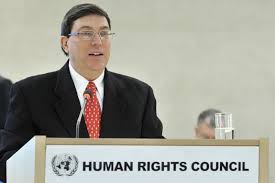
As discussed in a prior post, the U.N. Human Rights Council opened what it called its “High -Level Segment” on March 2, 2015, at its headquarters in Geneva Switzerland. One of the speakers that day was the Cuban Foreign Minister, whose speech will be excerpted below.

Cuba’s Commitment to International Human Rights. The Foreign Minister stressed Cuba’s “commitment to a genuine international cooperation based on the indivisibility of human rights, non-selectivity and non-politicization” and to “the struggle for the establishment of a more just, democratic and equitable international order that would remove the obstacles that hamper all national efforts that are made to guarantee the exercise of all human rights.”

Cuba, he asserted, maintains “a high level of cooperation and interaction with the procedures and mechanisms of the [U.N.] when it comes to universal human rights and a positive dialogue with the organs created by virtue of international treaties. It is in that spirit that we are conveying an invitation to the President of the International Committee of the Red Cross and the [U.N.] Rapporteur on Trafficking in Persons” to visit Cuba.

“Despite its deficiencies and difficulties, Cuba has shared and will continue to share its achievements and experience with other nations, with which we have made a selfless contribution to the exercise of human rights by other peoples of the world.”

For example, under Cuba’s “cooperation project known as ‘Miracle Operation,’ 3.4 million persons from 34 countries have undergone eye surgery free of charge.  Likewise, 9 million persons have already graduated from the literacy program ‘Yes, I Can,’ and 1,113,000 persons have graduated from the follow-up program ‘Yes, I Can Continue.’”

“Today, more than 51 000 Cuban health cooperation workers are offering their services in 67 countries of the world.” Cuba “will continue offering our cooperation in the struggle against the Ebola virus in Africa. More than 250 voluntary and specialized health cooperation workers of the medical brigade ‘Henry Reeve’ are taking part in this struggle in the most affected regions.  Another 4,000 Cuban health cooperation workers are participating in the prevention program that is being implemented in 32 African countries.”

“On the occasion of the Seventieth Anniversary of the [U.N.], the Principles and Purposes that were enshrined in [its] Charter and supported its creation are more valid than ever.  As was recently stated by Cuba’s President Raúl Castro Ruz: “We will never renounce our ideals of independence and social justice, or abandon a single one of our principles, nor cede a millimeter in the defense of our national sovereignty.  We will not accept any pressure regarding our internal affairs. We have earned this sovereign right through great sacrifices and at the price of great risks.”

People’s Participation in Government.The Foreign Minister emphasized that “more than 2,000 organizations and associations of an infinite diversity contribute very actively to the economic, social and cultural life [of Cuba]. . . . The participation of the people in the Governments’ decision-making processes, . . . has been the experience of the Cuban Revolution.”

This was illustrated in 2011 by the Cuban government’s consultations with the people over the proposed economic and social program that included “the introduction of 400,000 amendments thereto and the modification of two-thirds of the original text.  More recently a new Labor Code was discussed following this same procedures.”

Workers’ Rights. In Cuba “almost all workers – including those who work in small private businesses–are unionized and protected by collective agreements.  There are union representatives in the Council of Ministers as well as in the ministerial and corporate organs. In 1938 [long before the Cuban Revolution], the workers’ movement in Cuba managed to found a Unitarian Workers’ Central, which today encompasses as many as 17 different unions and thousands of other grassroots organizations.”

The Foreign Minister also raised the subjects of the International Labor Organization’s Convention 87 [2] and Convention 98 [3], both of which have been ratified by Cuba.

Palestine. Cuba supports “the inalienable right of the Palestinian people to a State of their own, on the pre-1967 borders and with East Jerusalem as its capital.  The [U.N.] General Assembly should act with resolve and guarantee, without further delay, the full [U.N.] membership of Palestine.”

Venezuela. “We ratify our firmest support to the Bolivarian Revolution and the legitimate Government headed by President Nicolás Maduro Moros.” (Several posts have investigated the reactions of Venezuela, Cuba and other countries to a U.S. executive order imposing sanctions on seven Venezuelans.)

Cuba’s Negotiations with the EU and the U.S. Cuba’s current negotiations with the U.S. and the EU over human rights and other issues were noted. Rodriguez said those discussions will occur within the agreed reciprocal basis of “sovereign equality, mutual respect, non-interference in internal affairs [and] respect for the legal systems of the parties.”

=====================================

[1] This portion of the post is based upon the following: Vigezzi, Statement by Bruno Rodriguez at Human Rights Council in Geneva, Nat’l Network on Cuba (Mar. 2, 2015); U.N. Hum. Rts. Council, Human Rights Council hears from 11 dignitaries as it continues its High-Level Segment, (Mar. 2, 2015); Cuban Foreign Minister speaks at the Human Rights Council, Granma (Mar. 4, 2015). The Cuban Foreign Minister’s speech also criticized certain aspects of the human rights records of the U.S. and other unnamed industrialized countries; these comments will be examined in a later post about issues of U.S. human rights that might be added to the agenda for discussions between the two countries.

[2] ILO Convention No. 87 (Convention on Freedom of Association and Protection of the Right to Organise [sic], 1948) has been ratified by 153 states, including Cuba and all 28 EU members. The U.S. has not so ratified and thus is not a party to this treaty although there are many federal and state laws on the subject.

[3] ILO Convention No. 98 (Right to Organize and Collective Bargaining Convention, 1949) has been ratified by 164 states, including Cuba and all 28 EU members. The U.S. has not so ratified and thus is not a party to this treaty although there are many federal and state laws on the subject.


Cuba Meets with European Union and Russian Ministers

This week Cuban leaders have held meetings in Havana with the foreign ministers of the European Union and Russia.

European Union-Cuba

A previous post examined the recent history of Cuba’s relations with the European Union (EU), including their negotiations on improving relations in 2014 and earlier this month. Another set of such negotiations or meetings took place in Havana on March 23-24 with the EU’s [1]

The most recent meetings were with the EU’s High Representative for Foreign Affairs and Security Policy and Vice President of the European Commission, Federica Mogherini.

EU +Castro

She met with Cuban President Raúl Castro and Foreign Minister Bruno Rodriguez Parrilla. Also present were Stefano Manservisi, Mogherini’s chief of staff; Herman Portocarero, EU Ambassador to Cuba; and Rogelio Sierra Diaz, Cuba’s Minister and Deputy Foreign Minister. (To the left is a photograph of Mogherini and Castro.)

In addition, Magherini met with the President of the National Assembly of Popular Power, Esteban Lazo Hernández; Vice President of the Council of Ministers and Minister of Economy and Planning, Marino Murillo Jorge; and Minister of Foreign Trade and Foreign Investment, Rodrigo Malmierca.

Afterwards Magherini said that although the pace of progress in the EU-Cuba talks on improving their relations was “slow,” it was gaining “political momentum” and that the two parties had “decided to speed up the rhythm of our negotiations, hopefully to manage to finalize the framework of our dialogue and agreement by the end of this year.” She also referred to the signing of a program between the island and the EU in the amount of 50 million euros until 2020, which will be used in commercial areas and especially in agriculture and complimented Cuba for its essential role in regional processes such as the Colombia-FARC peace negotiations taking place in Havana.

A Cuban newspaper reported the President Castro observed that “in a friendly atmosphere,” the two of them “exchanged ideas about the links between the EU and Cuba .They agreed on the importance of developing relationships of mutual respect, based on the purposes and principles of the United Nations Charter. Also, they discussed issues of common interest of the international agenda.”

Bruno Rodriguez reiterated Cuba’s “willingness to work to advance these links and . . . constructive engagement with the negotiations for an agreement on political dialogue and bilateral cooperation that is underway.” He also noted Cuba’s appreciation for the votes of EU members in support of Cuba’s resolution against the U.S. blockade (embargo) at last Fall’s U.N. General Assembly meeting.

Magherini and Bruno Rodriguez will see each other at the Summit of the Americas on April 10-11 in Panama, to which both Cuba and the EU are invited for the first time before the two of them meet in Brussels on April 22. In addition, Cuban officials will attend a summit of European and Latin American leaders scheduled for June in Brussels.

Russia-Cuba [2]


Serguei-Lavrov-y-Raúl-Castro1

On March 24, Russian Foreign Minister Sergey Lavrov met in Havana with Cuban President Raúl Castro. Also present were Mikhail L. Kamynin, Russian Ambassador to Cuba; Alexander V. Schetinin, the Director of Latin America at Russia’s Foreign Ministry; Cuban Foreign Minister, Bruno Rodríguez Parrilla; and Cuban Deputy Foreign Minister, Rogelio Sierra Díaz. (Above is a photograph of Larov and Castro.)

The participants discussed the excellent state of their relations and ratified the willingness to work together in the effective implementation of the bilateral economic agenda and deepen exchanges in areas of common interest. Castro thanked Russia’s support for ending the U.S. economic, commercial and financial blockade against Cuba and reiterated his country’s opposition to the unilateral sanctions imposed by the U.S. and its NATO allies against Russia.

Larov said, “Normalization between the United States and Cuba makes us happy. We salute this rapprochement,” and “we call for the lifting of the (U.S.) trade and financial blockade of Cuba as soon as possible.”

Earlier Larov met separately with Foreign Minister Rodriguez and with Ricardo Cabrisas, Vice President of Cuba’s Council of Ministers. They discussed bilateral cooperation and the interest of Russian companies in investing in Cuba’s development.

CubaRussia-0a5c9

Simultaneously a Russian ship of the class generally used for intelligence gathering was in the Havana Harbor as shown in the photograph to the left by Desmond Boylan/Associated Press.

 Conclusion

These meeting emphasize that Cuba’s redefining its relationships with the U.S. is not the only bilateral issue facing Cuba and that the U.S. is in competition with the EU and Russia for improving economic relations.

culPanama Canalbra-cutAnother factor influencing all of these discussions is Cuba’s construction of a deep-sea port at Mariel to accommodate larger ships going through an expanded Panama Canal, which announced this week that the expansion should be completed next year. (To the right is a photograph of one portion of the expanded canal.)

=======================================================

[1] This section of the post is based upon the following sources: Reuters, EU, Cuba to Speed Up Talks, Seek Deal by End of 2015, N.Y. Times (Mar. 24, 2015); Raúl received the High Representative of the European Union, CubaDebate (Mar. 24, 2015); Raúl received the High Representative of the European Union, Granma (Mar. 24, 2015); Forte, Visit of European High Representative promotes relations with Cuba, Granma (Mar. 24, 2015); Abellán, EU foreign affairs chief steps up talks for new Cuba cooperation policy, El Pais (Mar. 24, 2015).

[2] This section of the post is based upon the following source Assoc. Press, Russian FM Visits Cuba, Calls for End of US Trade Embargo, Wash. Post (Mar. 24, 2015); Reuters, Russian Foreign Minister Praises New U.S.-Cuba Relations, N.Y. Times (Mar. 24, 2015); Raul held meeting with the Foreign Minister of Russia, CubaDebate (Mar. 24, 2015); Raul meets with Russian Foreign Minister, Granma (Mar. 25, 2015).


Mogherini–


European Union and Cuba’s Negotiations Over Human Rights and Other Issues


U.S. and Cuba Squabble Over U.S. Sanctions Against Certain Venezuelans

The U.S. and Cuba (and indeed most of the rest of Latin America) are in a squabble over recent sanctions imposed against certain Venezuelans by an executive order issued by President Obama. After reviewing immediate events leading up to the imposition of sanctions, this post will discuss the executive order and the reactions thereto from Venezuela, Cuba and the rest of Latin America.

Events Leading Up to the Imposition of Sanctions [1]

In February 2014 there were opposition protests calling for Venezuelan President Nicolas Maduro’s resignation that sparked violence killing 43 people. In February of 2015 protesters and security forces clashed sporadically around that anniversary, while a shrinking economy and chronic product shortages have sent Maduro’s popularity tumbling.

In early February 2015, Antonio Ledezma, who is an opposition leader and the Mayor of Caracas, and two other opposition leaders signed a published open letter to President Maduro calling for a “national agreement for a transition.”

On February 10, the government announced a new three-tier currency scheme that amounted to a de facto devaluation of almost 70 percent, spurring outrage among opposition critics. This was a response to tumbling oil prices that have left the country struggling to meet its budget needs amid bulging foreign debt payments.

On February 19, the Venezuelan government announced that Ledezma had been arrested in order to halt an alleged U.S.-backed coup plot. The next day the government said that Ledezma had been indicted on charges of conspiracy against the Venezuelan government and plotting an American-backed coup. His attorney will be asking a judge to dismiss conspiracy charges against him, calling accusations that he participated in a plot to overthrow Venezuela’s socialist government “totally unfounded.”

Also on the 19th Maduro called for the Venezuelan people to defend national peace and be prepared “to deal with any scenario that may occur in Venezuela as a result of U.S. imperial aggression against our country.” That same day the Venezuelan Supreme Tribunal of Justice issued a statement reminding the U.S. that it had no jurisdiction to apply its laws outside its territory against the sovereignty and institutions of democracy in Venezuela. [2]

On February 20th the White House’s Press Secretary, Josh Earnest, responded to these charges. He said: “The United States is not promoting unrest in Venezuela, nor are we attempting to undermine Venezuela’s economy or its government.  In fact, the United States remains Venezuela’s largest trading partner.  The Venezuelan government should stop trying to distract attention from the country’s economic and political problems, and focus on finding real solutions through democratic dialogue among the people of Venezuela.  The Venezuelan government should respect the human rights of its citizens and stop trying to intimidate its political opponents.”

According to the Press Secretary, the U.S. continues “to call on the Venezuelan government to release political prisoners, including dozens of students; opposition leader; and Mayors Daniel Ceballos and Antonio Ledezma.” The U.S. “Treasury Department and the State Department are obviously closely monitoring this situation and are considering tools that may be available that could better steer the Venezuelan government in the direction that they believe they should be headed.  That obviously means that we’re continuing to engage other countries in the region in talking about operating in coordinated fashion as we deal with the situation there.”

The same day a Department of State spokesperson stated: The Venezuelan accusations “are false and baseless. And our view continues to be that political transitions must be democratic, constitutional, peaceful, and legal. We do not support a political transition in Venezuela by non-constitutional means. We’re not promoting unrest in Venezuela, nor are we attempting to undermine Venezuela’s economy or its government. And this is a continued effort . . . of the Venezuelan Government to try to distract attention from the country’s economic and political problems and focus and try to distract and make these false accusations.”

In addition, the State Department official stated the U.S. had reports that the Venezuelan intelligence service had detained the Caracas metropolitan mayor and searched his office [and] . . . that military intelligence officials plan to move opposition leader Leopoldo Lopez from his prison cell and transfer him to an unknown location. We are deeply concerned by what appears to be the Venezuelan Government’s efforts to escalate intimidation of its political opponents by rounding up these prominent leaders of the opposition. Venezuela’s problems cannot be solved by criminalizing dissent.”

President Obama’s Executive Order [3]

 On March 9th President Obama issued an executive order that blocked any U.S. assets of seven named Venezuelans and others who might be named by the U.S. Department of the Treasury, that barred these individuals from entering the U.S. and that prohibited U.S. persons from doing business with them.

These individuals were determined by the U.S. to be “responsible for the erosion of human rights guarantees, persecution of political opponents, curtailment of press freedoms, use of violence and human rights violations and abuses in response to antigovernment protests, and arbitrary arrest and detention of antigovernment protesters, as well as significant corruption.”

The executive order was not directed at the people or economy of Venezuela.

The disputes over this executive order, however, are not over these provisions, but instead to its preamble, which states:

  • [T]he situation in Venezuela, including the Government of Venezuela’s erosion of human rights guarantees, persecution of political opponents, curtailment of press freedoms, use of violence and human rights violations and abuses in response to antigovernment protests, and arbitrary arrest and detention of antigovernment protestors, as well as the exacerbating presence of significant public corruption, constitutes an unusual and extraordinary threat to the national security and foreign policy of the United States, and [the President] hereby declare a national emergency to deal with that threat.” (Emphasis added.)

 Venezuela’s Response to the Executive Order [4]

On March 10 President Maduro requested the Venezuelan legislature to enact an Anti-Imperialist Enabling Law granting him power to enact laws by his decree for the rest of this year in order to “defend the peace, sovereignty and full development of Venezuela in the face of threats from the United States empire.” Maduro said “no one in the world could believe the assertion [that Venezuela posed a national security threat to the U.S.] since the Venezuelan people are known as ‘peaceful, democratic, humanist and have a foreign policy directed toward understanding and peace . . . leaders in the struggle for integration and unity.’”

On March 14, upon Maduro’s order, Venezuela conducted a military exercise to counter an alleged U.S. threat by deploying Venezuelan soldiers and partisans across the country to march, man shoulder-fired missiles and defend an oil refinery from a simulated attack. Venezuela’s navy also performed exercises in the Caribbean Sea.

On Sunday (March 15) Venezuela’s legislature granted the requested presidential decree powers, which Maduro says are necessary to defend the country from the U.S. and which his opponents say are to justify repression and distract Venezuelans from economic problems, including acute shortages. Indeed, the country is suffering the highest inflation in the Americas, long lines for food and medicine, and shortages of many basic products.

President Maduro immediately responded to the legislature’s action. He insisted that Venezuela was ready to talk, “one on one, face to face, with respect, without arrogance or hubris” with the U.S. The first item on the agenda for such a meeting, he said, would be the immediate rescission of President Obama’s executive order.

 Cuba’s Response to the Executive Order [5]

Since Venezuela is a major ally of Cuba and the supplier of oil to Cuba, it is not surprising that the Cuban press recently has been full of Cuba’s support of Venezuela, both before and after the issuance of the executive order. Here are some of those expressions of support:

  • On March 5, Granma, Cuba’s official newspaper, issued a laudatory article about Venezuela’s former President, Hugo Chávez. It said he was “remembered . . . for his charisma, his arousing speech, his sincerity, his constant anguish to deliver for his people. Those who knew him say he often felt as though he were plowing the sea with that desire, so characteristic of him, to remain loyal to the people.” Now, “two years after his departure, . . . Chávez will be awakened together with Bolívar, to continue guiding Venezuela and Latin America.”
  • On March 6, Cuban First Vice President of the Councils of State and Ministers (and the presumptive successor to Raúl Castro as President of Cuba), Miguel Díaz-Canel Bermúdez, was in Caracas to participate in the commemoration of the second anniversary of death of Chávez, and Díaz-Canel declared that Cuba always will be a true friend of the Bolivarian Revolution.
  • On March 9, immediately after the issuance of the executive order, the Cuban government reiterated “its unconditional support and that of our people for the Bolivarian Revolution, the legitimate government of President Nicolás Maduro Moros and the heroic sister nation of Venezuela.” The Cuban government stated, “Nobody has the right to intervene in the internal affairs of a sovereign State or to declare it, without grounds, a threat to its national security.” Venezuela does not have the resources or officials to threaten the United States, and the executive order “reaffirms . . . the interventionist nature of U.S. foreign policy.”
  • On March 10, Fidel Castro in a letter to President Maduro said, “I congratulate you on your brilliant and courageous speech against the brutal plans of the U.S. government. Your words go down in history as proof that humanity can and must know the truth.”
  • On March 13 Cuban Foreign Minister Bruno Rodriguez Parrilla said that any attack on Venezuela was also an attack on Cuba and that the U.S. “has provoked serious damage to the environment in the hemisphere on the eve of the Summit of the Americas.” He added, “I hope that the U.S. government understands that it can’t handle Cuba with a carrot and Venezuela with a garrote.”
  • On March 15 thousands of Cubans attended a concert in support of Venezuela at the University of Havana. One of the Cuban Five and a Hero of the Republic of Cuba, René González, addressed the crowd, saying, “We all had in mind the warning of Che that imperialism cannot be trusted,” and that warning was confirmed by the March 9th executive order.

Other Latin American Countries’ Reactions [6]

On March 14, at Venezuela’s request, the 12-nation Union of South American Nations (UNASUR) reaffirmed “their commitment to the full observance of international law, the Peaceful Settlement of Disputes and the principle of nonintervention” and reiterated their “call for governments to refrain from applying unilateral coercive measures that violate international law.” It, therefore, called on the U.S. “to evaluate and implement alternatives for dialogue with the government of Venezuela, under the principles of respect for sovereignty and self-determination of peoples.’ As a result, it requested “the repeal of that Executive Order.”

On March 17 the Bolivarian Alliance for the Peoples of Our Americas (ALBA), at the request of Venezuela, will meet in Caracas to declare solidarity with Venezuela in its disputes with the U.S.

Conclusion

Although I am not a close follower of events in Venezuela, I do know that the recent huge declines in world oil prices have devastated its economy, that it is suffering horrendous inflation forcing it to devalue its currency, that there are shortages of all sorts of consumer products and that its government has imprisoned dissidents, including the Mayor of Caracas.

I also believe that the U.S. government must have had good cause to impose sanctions on the seven individuals named in the executive order.

Therefore, the protests of Venezuela, Cuba and the other Latin American nations, in my opinion, are not justified. The U.S. hopes for a cordial Summit of the Americas next month in Panama to celebrate a U.S.-Cuba reconciliation, however, appear to have been scuttled.

=================================================

[1] Pons & Ellsworth, Update 3-Venezuela announces new currency system, large devaluation seen, Bloomberg (Feb. 10, 2015); Reuters, Venezuela Arrests Opposition Mayor Accused of Coup Plot, N.Y. Times (Feb. 19, 2015);  White House, Press Briefing by Press Secretary, Josh Earnest, 2/20/15 (Feb. 20, 2015); U.S. Dep’t State, Daily Press Briefing (Feb. 20, 2015); Assoc. Press, Lawyer: Jailed Caracas Mayor to Fight Conspiracy Charges, N. Y. Times (Feb. 21, 2015); Gupta, Venezuela Mayor Is Accused of U.S.-Backed Coup Plot, N.Y. Times (Feb. 21, 2015),

[2] Cuba’s official newspaper, Granma, parrotted the Venezuelan government’s version of events. (E.g.Venezuela faces a stroke of continued fate, Granma (Feb. 20, 2015); Statement of the Ministry of Foreign Affairs of the Republic of Cuba, Granma (Feb. 20, 2015).)

[3] White House, Executive Order—Blocking Property and Suspending Entry of Certain Persons Contributing to the Situation in Venezuela (Mar. 9, 2015); White House, Fact Sheet: Venezuela Executive Order (Mar. 9, 2015); White House, Letter [to Speaker of U.S. House of Representatives]—Declaration of a National Emergency with respect to Venezuela (Mar. 9, 2015); White House, Statement by the Press Secretary on Venezuela (Mar. 9, 2015);DeYoung & Miroff, White House steps up sanctions against Venezuelans, Wash. Post (Mar. 9, 2015). The executive order was issued under (a) the International Emergency Economic Powers Act and (b) the Venezuela Defense of Human Rights and Civil Society Act of 2014. In section 2 of that latter statute, Congress found, among other things, that the Central Bank of Venezuela and the National Statistical Institute of Venezuela had determined that the annual inflation rate in Venezuela in 2013 was 56.30, the highest level of inflation in the Western Hemisphere and the third highest level in the world; that Venezuela’s currency controls have become the most problematic factor for doing business in the country; and that HumanRights Watch has reported the government intimidates,censors and prosecutes its critics.

[4] Editorial, In Venezuela, Punishing Scapegoats, N.Y. Times (Mar. 5, 2015); Toro & Kronicks, Venezuela’s Currency Circus, N.Y. Times (Mar. 6, 2015); Miroff & DeYoung, New U.S. sanctions lost in Venezuelan translation, Wash. Post (Mar. 11, 2015); Reuters, Mind Your Manners, Venezuela Tells U.S. Official, Jacobson, N.Y. times (Mar. 11, 2015); Neuman, Obama Hands Venezuelan Leader a Cause to Stir Support, N. Y. Times (Mar. 11, 2015); Editorial, A Failing Relationship with Venezuela, N. Y. Times (Mar. 12, 2015); Assoc. Press, Venezuela Conducts Military Exercises, Claims US Threat, N.Y. Times (Mar. 14, 2015); Reuters, Venezuela Stages Military Exercises to Counter U.S. ‘Threat,’ N.Y. Times (Mar. 15, 2015); Buitrago & Cawthorne, Elected officials grant Venezuela leader broad powers, Wash. Post (Mar. 15, 2015).

[5] Statement from the Revolutionary Government of the Republic of Cuba, Granma (Mar. 10, 2015); Letter from Fidel to Maduro, Granma (Mar. 10, 2015); Pasiero, Venezuela is sacred and to be respected, Granma (Mar. 10, 2015); Pasiero, Cuba reiterates its unconditional support of Venezuela, Granma (Mar. 6, 2015); Chávez, forever present, Granma (Mar. 5, 2015); Pasiero, Mature relationships requires respect for the United States, Granma (Mar. 16, 2015); Venezuela Are All, Granma (Mar. 16, 2015); Prada & Rodriguez, Voices for solidarity with Venezuela, Granma (Mar. 16, 2015).

[6] UNASUR, Press Union of South American Nations Executive Decree of The Government of the Unites States of Venezuela (Mar. 14, 2015); Assoc. Press, South American Bloc Demands US Revoke Venezuela Order, N.Y. Times (Mar. 14, 2015). UNASUR members are Argentina, Brazil, Bolivia, Chile, Colombia, Ecuador, Guyana, Paraguay, Peru, Suriname, Uruguay and Venezuela. ALBA members are Antigua and Barbuda, Bolivia, Cuba, Dominica, Ecuador, Grenada, Nicaragua, Saint Kitts and Nevis, Saint Lucia, Saint Vincent and Grenadines and Venezuela.


U.N. Human Rights Council Is Warned About Human Rights Violations

The U.N. Human Rights Council, which is responsible for strengthening the promotion and protection of human rights around the globe, addressing situations of human rights violations and making recommendations on the subject, [1] is in the midst of its 28th regular session at its headquarters in Geneva Switzerland with the session ending on March 27th. [2]

Zeid Ra-al Al Hussein
Zeid Ra-ad Al Hussein

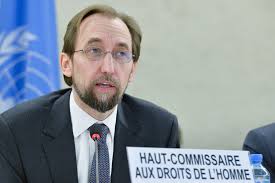
At the opening of the session on March 2 the U.N. High Commissioner for Human Rights, Zeid Ra’ad Al Hussein, [3] set forth his concerns on human rights. Three days later, on March 5th, he commented on his annual report on human rights. This post will examine both of these speeches.

From March 2 through 5, the Council conducted what it called its High Level Segment, in which national leaders addressed the Council on the overall subject of human rights. Two of those national leaders were U.S. Secretary of State john Kerry and Cuban Foreign Minister, Bruno Rodriguez Parrilla. Their remarks will be covered in subsequent posts while another post will analyze those remarks and the speeches of the High Commissioner.

High Commissioner’s Speech, March 2nd [4]

The “cruelty and moral bankruptcy of violent extremists . . . continue daily, and we condemn their merciless conduct daily.”

“And yet, if we are not careful, if we are not completely principled and cunning in our collective attempt to defang them, we will, unwittingly and inexcusably, be advancing their interests. How we define the opening chapters of this already agitated century depends heavily on us not becoming like them.  For us, international humanitarian law and international human rights law cannot be trifled with or circumvented, but must be fully observed.”

“It has been 70 years since the great Charter of the [U.N.] was drawn up, and since then States have also written and agreed to a range of strong international treaties, to establish in binding law the legal principles of human rights. They are a distillation of all human experience, all the warnings and screams of our combined human history.” By “ratifying the U.N. Charter, [states] have made a clear commitment [in the words of its Preamble] to ‘reaffirm faith in fundamental human rights; in the dignity and worth of the human person; in the equal rights of men and women, and of nations large and small; and to establish conditions under which justice and respect for the obligations arising from treaties, and other sources of international law, can be maintained; and to promote social progress, and better standards of life in larger freedom.’”

“And yet, with alarming regularity, human rights are disregarded, and violated, sometimes to a shocking degree.”

“States claim exceptional circumstances. They pick and choose between rights. One Government will thoroughly support women’s human rights and those of the LGBT communities, but will balk at any suggestion that those rights be extended to migrants of irregular status. [U.S.?] Another State may observe scrupulously the right to education, but will brutally stamp out opposing political views. [Cuba?] A third State comprehensively violates the political, civil, economic, social and cultural rights of its people, while vigorously defending the ideals of human rights before its peers.”

“In recent months I have been disturbed deeply by the contempt and disregard displayed by several States towards the women and men appointed by [the Council] as [its] independent experts – and also by the reprisals and smear campaigns that are all too frequently exercised against representatives of civil society, including those who engage with the Council and its bodies.  I appeal to all of you, once again, to focus on the substance of the complaint, rather than lash out at the critic – whether that person is mandated by States, is a member of my Office, or is a human rights defender.”

“The overwhelming majority of victims of human rights abuses around the world share two characteristics: Deprivation, and discrimination – whether it is based on race or ethnicity, gender, beliefs, sexual orientation, caste or class. From hunger to massacres, sexual violence and slavery, human rights violations are rooted in these hidden, and sometimes not so hidden, factors.”

“They are not spontaneously generated. Most violations of human rights result from policy choices, which limit freedom and participation, and create obstacles to the fair sharing of resources and opportunities.”

“The most powerful instrument in the arsenal we have against poverty and conflict is the weapon of massive instruction. Respect for the human rights of all, justice, education, equality – these are the strongly interlocking elements that will build fair, confident and resilient societies; true development; and a permanent peace.”

“Everybody knows when police use torture, and when tweets are brutally suppressed.  Everybody knows when discrimination means poverty, while corrupt elites gorge on public goods, supported by a corrupt judiciary.  Everybody knows when women are treated like property, and children go hungry, and unschooled, in squalid neighborhoods.”

“Some of the evidence may be hidden. But the reality, in far too many countries, of massacres and sexual violence; crushing poverty; the exclusive bestowal of health-care and other vital resources to the wealthy and well-connected; the torture of powerless detainees [U.S.?]; the denial of human dignity – these things are known. . . . [T]hey are what truly make up a State’s reputation; together with the real steps – if any – taken by the State to prevent abuses and address social inequalities, and whether it honors the dignity of its people.”

“The only real measure of a Government’s worth is . . . the extent to which it is sensitive to the needs – and protects the rights – of its nationals and other people who fall under its jurisdiction, or over whom it has physical control.”

“Some policy-makers persuade themselves that their circumstances are exceptional, creating a wholly new reality unforeseen by the law. This logic is abundant around the world today:  ‘I arrest arbitrarily and torture because a new type of war justifies it. I spy on my citizens because the fight against terrorism requires it. I don’t want new immigrants, or I discriminate against minorities, because our communal identity is being threatened now as never before. I kill without any form of due process, because if I do not, others will kill me.’ “

“I must remind you of the enduring and universal validity of the international human rights treaties that your States wrote and ratified. In reality, neither terrorism, nor globalization, nor migration are qualitatively new threats that can justify overturning the legal foundations of life on Earth.  They are not new.”

“At a time of intensifying global anxiety, I believe the people of the world are crying out for profound and inspiring leadership equal to the challenges we face.  We must therefore renew, by the strongest action, our dedication to the reality of inalienable and universal human rights, to end discrimination, deprivation, and the seemingly inexhaustible litany of conflicts and crises that generate such terrible, and needless, suffering.”

“What will become of us, of our world, if we ignore our treaties and principles? Can we be so stupid as to repeat scenes from the twentieth century, punctured as it was by such awful inhumanity?  You must not make it so.  This is principally your burden, and ours.  Together, if we succeed in turning the corner, in improving our global condition, we can then say the screams of history and of the millions upon millions of victims, have been heard, finally.  Let us make it so.”

High Commissioner’s Speech, March 5th [5]

The High Commissioner was “appalled by the massive suffering ISIL provokes [in Syria, Iraq and Libya]: from the murders, torture, rape and sale of children . . . ; to mass beheadings; burning people alive in cages; seemingly genocidal attacks on ethnic and religious groups; the obliteration of due process; torture; deprivation of income and every kind of service and resource; recruitment of children; the destruction of elements of the cultural heritage of humanity; and, not least, particularly vicious and comprehensive attacks on the rights of women and girls.” [Similar horrible actshe said, were perpetrated in Nigeria by Boko Haram and in Yemen and Somalia by other groups.]

“My Office strongly supports efforts by States around the world to prevent and combat terrorism, and to ensure that the perpetrators of terrorism, as well as their financiers and suppliers of arms, are brought to justice.”

“Terrorist attacks [,however,] cannot destroy the values on which our societies are grounded – but laws and policies can. Measures that build what has been termed the ‘national security state’ – such as arbitrary or prolonged detention; torture and ill-treatment; massive surveillance that contravenes the right to privacy; unfair trials; discriminatory policing; and the abusive use of legislation to curb legitimate rights to peaceful protest and to freedom of expression – are human rights violations. They generate legitimate resentment, harm social cohesion, and undermine the essential values of the international community.”

“There is real danger that in their reaction to extremist violence, opinion-leaders and decision-makers will lose their grasp of the deeper principles that underpin the system for global security which States built 70 years ago to ward off the horror of war. The fight against terror is a struggle to uphold the values of democracy and human rights – not undermine them. . . [C]ounter-terrorist operations that are non-specific, disproportionate, brutal and inadequately supervised violate the very norms that we seek to defend. They also risk handing the terrorists a propaganda tool – thus making our societies neither free nor safe. The use of torture, neglect of due process and collective punishment do not make the world any safer.”

“To be truly effective, any response to extremist violence must be targeted, proportionate, and legal. Military campaigns, financial sanctions and attempts to staunch the inflow of weapons – such as the United Nations Arms Trade Treaty – may be part of the solution.”

“But other actions are needed to stem the root causes that feed into these conflicts. We must acknowledge that large numbers of people do not join such extremist movements en masse because they have been suddenly and inexplicably hypnotized. Extremism – however repugnant – is nurtured by ideology, and by alienation fed by years of tyranny, corruption, repression, discrimination, deprivation and neglect of the legitimate rights of communities.”

He especially was “disturbed by a continuing trend of harsh restrictions on public freedoms by States across all regions. I refer to military crackdowns on demonstrations; harsh sentencing of human rights defenders, journalists and dissidents in politically motivated trials; brutal punishments for simple tweets; censorship; oppressive and illegitimate regulations of civil society movements; the use of new technologies to stifle human rights in the virtual space; and new security laws that are unjustly broad, endangering civil liberties and human rights.”

“And yet the great pillar of every resilient and participative society is freedom of expression. Freedom to formulate the ideas of equality led to the overthrow of colonialism, and has powered every movement against discrimination and injustice. To immunize against dictatorship or totalitarianism, to undo discrimination, to drive justice and accountability, we need freedom of expression – full and free and far-reaching. There is no good governance without free speech.”

The High Commissioner’s speech included specific criticisms of many countries. About the U.S., he said: “In the United States, the Senate report on torture in the context of counter-terrorism operations is courageous and commendable, but profoundly disturbing. For a country that believes so strongly in human rights to have swiftly abandoned their fundamentals at a time of crisis is as astonishing as it is deplorable. And yet few other countries have had the courage to likewise publicly investigate and publicly admit to rights abuses resulting from counter-terror operations – and many should.”

“Under international law, the [Senate] report’s recommendations must be followed through with real accountability. There is no prescription for torture, and torture cannot be amnestied. It should also lead to examination of the institutional and political causes that led the US to violate the absolute prohibition on torture, and measures to ensure this can never recur.”

“As the Senate report clearly demonstrates, the neglect of due process, use of torture and collective punishments that were permitted by US officials in the post-9/11 context did not make the world – or the US – any safer. On the contrary, they increased the threat of terrorism, by feeding into the grievances on which it thrives. The orange jumpsuits of Guantanamo are a recruitment tool for ISIL and other groups. As former President George W. Bush has conceded, Guantanamo became, I quote, ‘a propaganda tool for our enemies.’”

The High Commissioner also expressed regret at the renewed use of the death penalty in a number of countries – Jordan, Pakistan, and Indonesia – and “the continuing extensive use” of the death penalty in China, Iraq, Iran and the U.S.

In conclusion, he said, “It is the people who sustain government, create prosperity, heal and educate others and pay for governmental and other services with their labour. It is their struggles that have created and sustain States. Governments exist to serve the people – not the other way round.”

“Governments that protect human rights, combat discrimination and deprivation, and which are accountable to their people are more prosperous and more secure than those which stifle rights, hamper opportunities, and repress freedoms. When people’s rights are respected – when they are accorded dignity, have opportunities to express their skills and are given a fair share of resources – they form resilient societies. When they are wronged, their rights betrayed, there is a constant threat of turmoil. Respect for the human rights of the people is not destabilizing; but driving legitimate opposition underground is.”

 Conclusion

Speeches about human rights in international fora often are replete with platitudes. These speeches by the High Commissioner are not. While he condemns the horrible actions of ISIL and Boko Haram, these groups are not represented at the Council. Instead the countries that are represented are often the victims of their evil deeds. Therefore, the High Commissioner spent most of his time chastising the latter countries for failing to live up to the human rights commitments they have made as they are combatting terrorism. Moreover, these speeches address some countries by name and point our their failings.

In a later post we will look again at these speeches in the context of the issues of human rights in the process of U.S.-Cuba reconciliation.

==========================================================

[1] The Human Rights Council has 47 member states elected by the U.N. General Assembly. Currently both the U.S. and Cuba are such members.

[2] Materials about the Council’s 28th session are available on its website.

[3] The High Commissioner for Human Rights is the principal human rights official of the U.N. and the head of the Office of the High Commissioner for Human Rights, which “spearheads the [U.N.’s] human rights efforts . . . by strengthening international human rights mechanisms; enhancing equality and countering discrimination; combating impunity and strengthening accountability and the rule of law; integrating human rights in development and in the economic sphere; widening the democratic space; and early warning and protection of human rights in situations of conflict, violence and insecurity.”

Prince Zeid Ra’ad Al Hussein of Jordan was unanimously elected the High Commissioner by the U.N. General Assembly in June 2014. His many years of diplomatic service include being Jordan’s Ambassador to the U.S., his country’s Permanent Representative to the U.N. and his serving as an officer of the International Criminal Court. He holds a Bachelor of Arts degree from The Johns Hopkins University and a Doctorate in Philosophy from Cambridge University.

[4] Al Hussein, Opening Speech to the High Level Segment of the Human Rights Council, U.N. (Mar. 2, 2015); UN Human rights Council, Human Rights council opens twenty-eighth session (Mar. 2, 2015); Schlein, UN Council: Rights Being Violated to ‘Shocking Degree,’ VOA (Mar. 2, 2015).

[5] Al Hussein, Opening Statement, Item 2, High Commissioner’s Annual Report, U.N. (Mar. 5, 2015); Member States must enforce human rights amid rising tide of extremism—UN rights chief , UN News (Mar. 5, 2015); Human rights principles in struggle against extremism—Zaid, U.N. (Mar. 5, 2015).


U.S. Agricultural Coalition for Cuba Sends Delegation to the Island

On March 1-4, the United States Agricultural Coalition for Cuba sent a delegation of 90-plus agricultural leaders to Cuba to meet with Cuban officials and farmers. [1]

Devry Boughner Vorwerk

In announcing the visit, the Coalition’s Chair, Devry Boughner Vorwerk of Minnesota-headquartered Cargill Incorporated, said it would be a “learning journey” to expand knowledge of Cuban agriculture. It will include meetings with Cuban business and government leaders, as well as interaction with Cuban farmers and agricultural cooperatives. The idea is to expand understanding of the Cuban agricultural economy. During the trip she said, “”The message we hope will get back to Washington is that we are a unifying voice that would like to see Congress act in 2015 and end the embargo.”

She also expressed a desire for a bilateral agricultural trading relationship with the U.S. importing such things as Cuban snuff, rum, cigars, coffee, sugar, seafood (lobster and shrimp) and encouraged a Cuban delegation of officials and farmers to visit the U.S. to explore those opportunities. Indeed, some believe that Cuba’s warm winter climate could enable Cuba to export tomatoes and other vegetables all across the eastern U.S. during the cold-weather months, along with its traditional crops.

On Monday the U.S. delegation met with Cuba’s Foreign Minister, Bruno Rodriguez; Agriculture Minister, Julian González; Azcuba Business Group; the National Association of Small Farmers; and directors of other companies and agricultural cooperatives.

The next day the Americans visited farms and agricultural businesses in four provinces near Havana, including the El Trigal wholesale market, on the outskirts of the capital; the 30 de Noviembre Sugar Mill (Artemisa); the Heroes de Yaguajay Fruit and Vegetable Cooperative (Alquizar), and the tobacco cooperatives of Consolacion del Sur and Los Palacios (Pinar del Rio).

Significant U.S.-Cuba trade growth appears likely to come fastest in agriculture, the sector of the Cuban economy that has the deepest ties to the U.S. and that has been undergoing market-oriented reforms longer than any other on the island. After years of declining sales, the U.S. and mostly Republican states sold nearly $300 million of food to the island last year, primarily frozen chicken and soybean products, under a long-standing humanitarian exception to the U.S. embargo.

Such U.S. exports, however, have been hampered by U.S. sanctions limiting sales to a cash-only and barring U.S. banks from financing the sales. American trade officials and farmers are dreaming of dominating a food import market that could grow to $3 billion in coming years if Cuba’s economy improves.

The delegation included two former U.S. Secretaries of Agriculture (Democrat Mike Espy and Republican John Block); the marketing and development director for the Virginia Department of Agriculture; Missouri’s agriculture director and the spouse of its Governor, Jay Nixon, who was unable to go. Another member was Thomas Marten, an Illinois soybean farmer and the Zanesville Township GOP Committeeman. He observed, “As a Republican, I believe in trade for the betterment of all people. Prohibiting it is something that hurts us all.”

Afterwards, a Cuban researcher at the Center for Hemispheric Studies, University of Havana, Luis René Fernández, said that open trade with the U.S. is a matter of justice. Care, however, must be taken that the changes are not chaotic or overwhelmed by the U.S. interests.

=======================================

[1] A previous post described the January 8, 2015, launch of the Coalition. This post about their visit to the island is based upon the following sources: Thomas, Ag Coalition to lead trade trip to Cuba in March, Farm Futures (Feb. 20, 2015); Reuters, U.S. Agricultural Delegation Visits Cuba, Protests Embargo, N.Y. Times (Mar. 2, 2015); Cuba Hosts Delegation of 96 US Farm Sector Businesspeople, Havana Times (Mar. 2, 2015); Sosa, US farmers promote lifting the blockade on Cuba, Granma (Mar. 3, 2015); Miroff, Why Midwestern farmers want to break the Cuban embargo, Wash. Post (Mar. 3, 2015); U.S. agribusinessmen visiting Cuba call for end to embargo, FoxNewsLatino (Mar. 3, 2015); US Agriculture Organization Looks for Business Opportunities in Cuba, Escambray (Mar. 3, 2015); Weissenstein, Cuba looks north to US farmers for help with food crisis, Assoc. Press (Mar. 4, 2015); Sosa & Gomez, The fertile field for trade between US and Cuba, Granma (Mar. 5, 2015).


Nancy Pelosi and Other House Democrats Visit Cuba

A delegation of Democratic members of the U.S. House of Representatives led by Nancy Pelosi, the Minority Leader of the House, visited the island, February 17-19. They went “to build upon the announcement of U.S. normalization of relations and other initiatives announced by President Obama” and “to advance the U.S.-Cuba relationship and build on the work done by many in the Congress over the years, especially with respect to agriculture and trade.” [1]

The eight members of the delegation were David Cicilline (RI), member of the House foreign Affairs and Judiciary Committees; Rosa DeLauro (CT), the senior Democrat on the House Agriculture Appropriations Subcommittee and Co-chair of the Democratic Steering and Policy Committee;  Eliot Engel (NY), the senior Democrat on the House Foreign Affairs Committee; Anna Eshoo (CA), Ranking Member on the House Energy and Commerce Committee’s Subcommittee on Communications Technology; Steve Israel (NY), Chair of the Democratic Policy and Communications Committee; Jim McGovern (MA), member of the House Agriculture Committee and Co-Chair of the congressional Tom Lantos Human Rights Commission; Collin Peterson (MN), the senior Democrat on the House Agriculture Committee; and Nydia Velazquez (NY), the senior Democrat on the House Small Business Committee. [2]

After their arrival in Cuba, they first went to the U.S. Interests Section’s building on Havana’s Malecon. There they met with the Chief of Mission, Jeffrey DeLaurentis, and his team. “We are proud of them and the U.S. Marines serving us there,” Pelosi said. 

cuba-nancy-pelosi-bruno-rodriguezOn February 18th the delegation had a three and one-half hour meeting with Cuban Foreign Minister, Bruno Rodriguez. and Josefina VIdal, the Foreign Ministry’s leader of the current negotiations with the U.S. (Left is a photograph of Pelosi and Rodriguez.) According to a Cuban website, they “discussed issues related to the current context of ties between the two countries, including restoring diplomatic relations, opening embassies and the debate in Congress on lifting the blockade [embargo] against Cuba.” Afterwards, Pelosi said, ““We discussed areas of interest to the United States and Cuba, and our delegation listened to their concerns, including the embargo, bank and credit financing,” Pelosi said. “We underscored our commitment to human rights in Cuba and agreed to build upon the historic opportunity before us to make progress in our relationship.”

Pelosi+Diaz

On the 19th Pelosi and the delegation met with Miguel Diaz-Canel, Cuba’s First Vice President and presumptive next Cuban president. (Right is a photograph of Pelosi and Diaz-Canel.) They talked about Cuba’s market-style economic reforms, bilateral relations and prospects of the U.S. Congress lifting the country’s 53-year-old trade embargo of Cuba. Afterwards Pelosi told reporters, “There is strong bipartisan support to lift the embargo in the Congress, however it’s not universal and it certainly does not appear to be shared by those in power who have the ability to bring a bill to the floor.”

The delegation also met with leaders of Cuba’s legislature (National Assembly), including its vice president, Ana María Mari Machado. According to Pelosi, “During the meeting, we exchanged views about the actions taken by President Obama and President Raúl Castro. We agreed to continue our interparliamentary dialogue on areas of agreement and disagreement.”

U.S. House of Representatives Democratic leader Pelosi, Archbishop of Havana Cardinal Ortega and members of a delegation of congressional Democrats pose for a photograph in Havana

Other meetings were held with Cuban Cardinal Jaime Ortega (left is a photograph of the Cardinal and the delegation); American students at the Latin American School of Medicine; young entrepreneurs of the island’s emerging private sector; and representatives of civil society, but not with Cuban dissidents.

At a press conference on their last day on the island, Pelosi said, “We’re very positively impressed by what we heard here about our future prospects and the relationship.” Representative Engel noted they had raised the topic of human because “We’re very concerned with human rights and dissident rights. I’d like to see more changes from the Cuban side.”  Representative McGovern concurred with this comment: “The best way to promote human rights is to accelerate this new process to establish formal embassies in Havana and Washington.” The delegation also said they also spoken with Cuban officials about U.S. food sales to the island, internet technology and the island’s emerging small-business sector.

============================================

[1] This post is based upon the following: Press Release, Pelosi Leads Congressional Delegation to Cuba (Feb. 17, 2015); Reuters, Pelosi Traveling with Lawmakers to Cuba, N.Y. Times (Feb. 17, 2015); Fram, Pelosi Leads House Democrats Visiting Cuba, Assoc. Press (Feb. 17, 2015); Press Release, Pelosi Statement on Historic Delegation’s Meetings in Havana (Feb. 18, 2015); Miller, Nancy Pelosi visits Havana, meets with top Castro regime officials, Wash. Times (Feb. 19, 2015); Oleaga, US, Cuba Relations Update: Representative Nancy Pelosi Leads congressional Delegation to Cuba, Hopes to Advance Renewed Relations, Latin Post (Feb. 19, 2015); Cuba FM Meets with Nancy Pelosi, Havana Times (Feb. 19, 2015); Cuban FM meets U.S. lawmakers on normalization of ties, Xinhua (Feb. 19, 2015); Trotta, U.S. congressional delegation meets Cuba’s heir apparent, Reuters (Feb. 19, 2015); Miroff, In Havana, Pelosi delegation promotes Obama’s Cuba thaw, Wash. Post (Feb. 19, 2015); Agence France-Presse, US-Cuba talks tackle human rights, reopening embassies (Feb. 19, 2015);Torres, Pelosi and other Democrats meet with Cuban officials in Havana, Miami Herald (Feb. 19, 2015); Miguel Diaz-Canel received the leader of the Democratic Party in the House of Representatives of the US, Granma (Feb. 19, 2015); Nancy Pelosi: The lock [embargo] is a “measure unsuccessfully,” CubaDebate (Feb. 19, 2015)(English translation by Google Translate); Press Release, Pelosi Statement on Historic Congressional Delegation’s Final Day of Meetings in Cuba (Feb. 20, 2015).

[2] Representative Peterson is a cosponsor of H.R.403 (Free Trade with Cuba Act) while Representatives DeLauro, McGovern and Velazquez are cosponsors of H.R.664 (Export Freedom to Cuba Act of 2015).

More U.S. Senators Visit Cuba

Over the U.S. Presidents’ Day holiday (February 14-17), Democratic U.S. Senators Amy Klobuchar (MN), Claire McCaskill (MO) and Mark Warner (VA) visited Cuba. They met with government and religious leaders and people on the street. [1]

Bruno Rodriíguez Parrilla
Josefina Vidal
Josefina Vidal

Cuba’s only newspaper, Granma, in its English-language edition, had a prominent article about the senators’ meeting with Bruno Rodríguez Parrilla, Cuba’s Minister of Foreign Affairs, [2] and Josefina Vidal, General Director of Cuba’s U.S. Division in the Ministry of Foreign Affairs and the official in charge of Cuba’s current negotiations with the U.S. Granma stated that the meeting “addressed relevant topics, such as the process of reestablishing diplomatic relations between both nations and the lifting of the economic blockade [embargo].”  Cuba’s official statement about the meeting emphasized that Senator Klobuchar had “presented a legislative bill to Congress which aims to eliminate blockade restrictions.”

Senators McCaskill, Klobuchar and Warner (Granma photo)

The English-language edition of Granma had a longer article featuring this color photograph of the three senators at their concluding press conference in Havana and a video of the conference. It reported that the senators had “expressed optimism in regards to the reestablishment of diplomatic relations between the two countries, and progress toward normalization.” One of the Cuban journalists asked if the senators thought they had visited a terrorist state, and the answer was “no.”

After identifying Senator Klobuchar as the author of a bill to end the embargo, the Cuban newspaper reported the she expressed “confidence that the visit would help to broaden the prevailing view of Cuba in Washington, which should strengthen the bipartisan effort to eliminate blockade restrictions on trade and maritime transport, among others.” She also noted “that changes will not be immediate, but emphasized the need to hold a discussion involving both major U.S. parties.”

According to Granma, Senator McCaskill said there are “no problems which could not be addressed, and expressed optimism in regards to the [current U.S.-Cuba] talks.” She also reported that “the delegation had visited the Port of Mariel and the adjacent Special Development Zone, emphasizing the possibilities opening up for U.S. imports to Cuba.” (A prior post discussed this deep-sea port development to accommodate larger container ships going through an enlarged Panama Cana while a 11/07/14 comment to that post mentioned difficulties Cuba was experiencing in attracting foreign investment in the project.)

Senator Warner, according to Granma, mentioned the need to eliminate U.S. restrictions that made it more difficult for Cubans to buy goods under exemptions from the embargo.

As the three senators prepared to leave Cuba, they learned that the second round of talks for the two countries would take place in Washington, D.C. on February 27th., and according to U.S. press coverage of the press conference, they so announced to the journalists. Senator Warner said, “We look with hope and expectations to the meetings next week in Washington between the Cuban government and the American State Department to make progress.” [3]

McCaskill added, according to the U.S. journalists, “Frankly I’m optimistic because the negotiators are two women and we know how to get things done.” Perhaps more importantly, she said, largely Republican agricultural interests in the Midwest supported lifting the embargo as “they really want to sell rice [and other agricultural products] down here. So it is the business community and agricultural community who I think might have the most influence on helping us make this effort more bipartisan.”

McCaskill said right-wing opposition to other bills has been overcome when House Speaker John Boehner had allowed the entire House to vote on them, contrary to the so called Hastert Rule or Practice that would not allow a bill to come to floor of the House for a vote unless it had the support of a majority of the Republican caucus. McCaskill hoped, “This could be one of those times, especially if the Chamber of Commerce and the commodities groups and the Farm Bureaus of the world really start putting political pressure on their own party.”

Afterwards Klobuchar told a Minnesota journalist that the Cuban people often mention the date “December 17th,” the day Presidents Obama and Castro announced their countries’ agreement to pursue reconciliation, and she saw people selling artwork using the newspaper’s front page of Obama’s decree. “We met with every-day people who had started businesses who are excited. There is a real interest in buying American products.” Indeed, with U.S. trade restrictions removed, she said, Minnesota could be selling more pork, poultry, corn and soybeans, farm machinery and perhaps renewable energy technology to Cuba that could easily double its current $20 million in annual agricultural exports to the island.

These conversations led Senator Klobuchar to conclude that Cubans have a couple of top priorities: normalizing currency and getting better access to high-speed Internet and cell phones. “Once they get Internet and once they get communications,” she asserted, “ I believe there will be improvements to everything else.”

News of Senator Klobuchar’s bill to end the embargo with her photograph had appeared on the front page of Granma, causing many Cuban people to recognize her as she walked down the street. She felt like a celebrity.

=================================================

[1] This post is based upon Press Release, Klobuchar in Cuba to Discuss Economic Opportunities for Minnesota (Feb. 17, 2015); Sherry, Sen. Klobuchar spends weekend in Cuba hearing out locals, StarTribune (Feb. 17, 2015);  Assoc. Press, Amy Klobuchar, in Cuba, sees opportunity for Minnesota, Pion. Press (Feb. 18, 2015); Ikowitz, Why Sen. Klobuchar felt like a celebrity on Cuba trip, Wash. Post (Feb. 17, 2015); Assoc. Press, Senator: Next round of US-Cuba Talks Next Week, N.Y. Times (Feb. 17, 2015);  Reuters, U.S., Cuba to Meet February 27; Senators See Path for End of Embargo, N.Y. Times (Feb. 17, 2015); Cuban minister receives U.S. senators, Granma (Feb. 17, 2015); Gomez, US senators expect better relations with Cuba, Granma (Feb. 17, 2015).

[2] Last October Foreign Minister Bruno Rodríguez Parrilla presented Cuba’s resolution condemning the U.S. embargo to the U.N. General Assembly, which approved it 188 to 2.  

[3] In a separate, very short article, Granma’s Spanish-language original reported the second round of talks would take place in Washington on February 27th. (Second round of cuba-US talks, Granma (Feb. 17, 2015)(English by Google Translate).)