On June 8, U.S. and Cuba officials met in Havana to conduct their first Counterterrorism Technical Exchange. The U.S. delegation included representatives of the Federal Bureau of Investigations, U.S. Customs and Border Protection, U.S. Immigration and Customs Enforcement’s Homeland Security Investigations and U.S. Department of State. The Cuban delegation was from the Ministries of the Interior and Foreign Affairs, the Attorney General’s Office and General Customs of the Republic.[1]
Before the meeting the Department of State said, “Coordination and cooperation on counterterrorism has been one of several important topics discussed in law enforcement dialogues between the United States and Cuba. We welcome the opportunity to bring together technical experts to discuss this topic of common interest.”
Afterwards, the Cuban Foreign Ministry merely said that the meeting was conducted with “respect and professionalism” and that “both parties agreed on the importance of progress in cooperation in this sphere and agreed to continue the meetings of technicians on the topic.”
Outsiders speculated that the meeting may have included discussions about a possible high-profile prisoner swap: U.S.-jailed Cuban spy Ana Belén Montes in exchange for longtime American fugitive in Cuba, Joanne Chesimard (n/k/a Assata Shakur). The State Department, however, has refused to confirm that such an exchange was being discussed. Instead the Department merely stated that the U.S. “continues to seek the return of Cuba of fugitives from US justice” and that the State Department “brings out the cases of fugitives to the Cuban Government to be settled and will continue to do so at every appropriate opportunity.”[2]
Montes on September 21, 2001 (10 days after 9/11), was arrested and subsequently charged with conspiracy to commit espionage for the Cuban government during the 16 years she worked as an analyst for the U.S. Defense Intelligence Agency. The charges also stated she had revealed the identities of four U.S. secret agents. Montes eventually pleaded guilty to spying, and in October 2002 she was sentenced to a 25-year prison term followed by five years’ probation. Recently an international campaign has been started to seek her release from U.S. prison.
Chesimard/Shakur, as discussed in a prior post, was convicted in a New Jersey state court for participation in the murder a state trooper in 1973 and sentenced to life imprisonment, but in 1979 broke out of a New Jersey prison and in 1984 fled to Cuba, where she was granted political asylum and perhaps Cuban citizenship.
On Sunday, September 20, 2015, Pope Francis celebrated mass in Havana’s Plaza de Revolutión before a crowd of thousands. In attendance were Cuban President Raúl Castro and other government officials. The Pope also had separate private meetings with Fidel and Raúl Castro and later presided at a vespers service and met with a group of young people.[1]
Celebration of Mass in Plaza de la Revolución
The above photos show the large crowd at the Sunday morning mass at Plaza de la Revolución. In his homily Francis said, “The Gospel shows us Jesus asking a seemingly indiscreet question of his disciples: ‘What were you discussing along the way?’ It is a question he could also ask each of us today: ‘What do you talk about every day? What are your aspirations?’ The Gospel tells us that the disciples ‘did not answer because on the way they had been arguing about who was the most important.’ The disciples were ashamed to tell Jesus what they were talking about. As with the disciples then, we too can be caught up in these same arguments: who is the most important?”
“Jesus does not press the question. He does not force them to tell him what they were talking about on the way. But the question lingers, not only in the minds of the disciples, but also in their hearts.”
“Who is the most important? This is a life-long question to which, at different times, we must give an answer. We cannot escape the question; it is written on our hearts. The history of humanity has been marked by the answer we give to this question.”
“Jesus is not afraid of people’s questions; he is not afraid of our humanity or the different things we are looking for. On the contrary, he knows the ‘twists and turns’ of the human heart, and, as a good teacher, he is always ready to encourage and support us. As usual, he takes up our searching, our aspirations, and he gives them a new horizon. As usual, he somehow finds the answer which can pose a new challenge, setting aside the ‘right answers,’ the standard replies we are expected to give. As usual, Jesus sets before us the ‘logic’ of love. A mindset, an approach to life, which is capable of being lived out by all, because it is meant for all.”
“Far from any kind of elitism, the horizon to which Jesus points is not for those few privileged souls capable of attaining the heights of knowledge or different levels of spirituality. The horizon to which Jesus points always has to do with daily life, also here on ‘our island.’ something which can season our daily lives with eternity.”
“Who is the most important? Jesus is straightforward in his reply: ‘Whoever wishes to be the first among you must be the last of all, and the servant of all.’ Whoever wishes to be great must serve others, not be served by others.
“Here lies the great paradox of Jesus. The disciples were arguing about who would have the highest place, who would be chosen for privileges, who would be above the common law, the general norm, in order to stand out in the quest for superiority over others. Who would climb the ladder most quickly to take the jobs that carry certain benefits.”
“Jesus upsets their ‘logic.’ their mindset, simply by telling them that life is lived authentically in a concrete commitment to our neighbor.”
“The call to serve involves something special, to which we must be attentive. Serving others chiefly means caring for their vulnerability. Caring for the vulnerable of our families, our society, our people. Theirs are the suffering, fragile and downcast faces which Jesus tells us specifically to look at and which he asks us to love. With a love that takes shape in our actions and decisions. With a love that finds expression in whatever tasks we, as citizens, are called to perform. People of flesh and blood, people with individual lives and stories, and with all their frailty: these are those whom Jesus asks us to protect, to care for, to serve. Being a Christian entails promoting the dignity of our brothers and sisters, fighting for it, living for it. That is why Christians are constantly called to set aside their own wishes and desires, their pursuit of power, and to look instead to those who are most vulnerable.”
“There is a kind of ‘service’ that truly ‘serves,’ yet we need to be careful not to be tempted by another kind of service, a ‘service’ that is ‘self-serving/’ There is a way to go about serving which is interested in only helping ‘my people,’ [or] ‘our people.’ This service always leaves ‘your people’ outside, and gives rise to a process of exclusion.”
“All of us are called by virtue of our Christian vocation to that service which truly serves, and to help one another not to be tempted by a ‘service’ that is really ‘self-serving.’ All of us are asked, indeed urged, by Jesus to care for one another out of love. Without looking to one side or the other to see what our neighbor is doing or not doing. Jesus tells us: Whoever would be first among you must be the last, and the servant of all. He does not say: if your neighbor wants to be first, let him be the servant! We have to be careful to avoid judgmental looks and renew our belief in the transforming look to which Jesus invites us.”
“This caring for others out of love is not about being servile. Rather, it means putting our brothers and sisters at the center. Service always looks to their faces, touches their flesh, senses their closeness and even, in some cases, ‘suffers’ in trying to help. Service is never ideological, for we do not serve ideas. We serve people.”
“God’s holy and faithful people in Cuba are a people with a taste for parties, for friendship, for beautiful things. It is a people who marches with songs of praise. It is a people who has its wounds, like every other people, yet knows how to stand up with open arms, to keep walking in hope, because it has a vocation of grandeur. Today I ask you to care for this vocation of yours, to care for these gifts that God has given you, but above all I invite you to care for and be at the service of the frailty of your brothers and sisters. Do not neglect them for plans that can be seductive, but are unconcerned about the face of the person beside you. We know, we are witnesses of the incomparable power of the resurrection, which ‘everywhere calls forth the seeds of a new world.’”
“Let us not forget the Good News we have heard today: the importance of a people, a nation, and the importance of individuals, which is always based on how they seek to serve their vulnerable brothers and sisters. Here we encounter one of the fruits of a true humanity. ‘Whoever does not live to serve, does not ‘serve’ to live.’”
“We have heard in the Gospel how the disciples were afraid to question Jesus when he spoke to them about his passion and death. He frightened them, and they could not grasp the idea of seeing Jesus suffer on the cross. We too are tempted to flee from our own crosses and those of others, to withdraw from those who suffer. In concluding this Holy Mass, in which Jesus has once more given himself to us in his body and blood, let us now lift our gaze to the Virgin Mary, our Mother. We ask her to teach us to stand beside the cross of our brothers and sisters who suffer. To learn to see Jesus in every person bent low on the path of life, in all our brothers and sisters who hunger or thirst, who are naked or in prison or sick. With Mary our Mother, on the cross we can see who is truly “the greatest” and what it means to stand beside the Lord and to share in his glory.”
“Let us learn from Mary to keep our hearts awake and attentive to the needs of others. As the wedding feast of Cana teaches us, let us be concerned for the little details of life, and let us not tire of praying for one another, so that no one will lack the new wine of love, the joy that Jesus brings us.”
“I ask you now to join with me in praying to Mary, that we may place all our concerns and hopes before the heart of Christ. We pray to her in a special way for those who have lost hope and find no reasons to keep fighting, and for those who suffer from injustice, abandonment and loneliness. We pray for the elderly, the infirm, children and young people, for all families experiencing difficulty, that Mary may dry their tears, comfort them with a mother’s love, and restore their hope and joy. Holy Mother, I commend to you your sons and daughters in Cuba. May you never abandon them!”
Although the Pope had no direct remarks regarding political issues facing Cuba, he did mention the ongoing peace negotiations in Havana between the Colombian government and the FARC rebels. He said, “I feel bound to direct my thoughts to the beloved land of Colombia, ‘conscious of the crucial importance of the present moment when, with renewed effort and inspired by hope, its sons and daughters are seeking to build a peaceful society.’ May the blood shed by thousands of innocent people during long decades of armed conflict, united to that of the Lord Jesus Christ crucified, sustain all the efforts being made, including those on this beautiful island, to achieve definitive reconciliation. Thus the long night of pain and violence can, with the support of all Colombians, become an unending day of concord, justice, fraternity and love, in respect for institutions and for national and international law, so that there may be lasting peace. Please, we do not have the right to allow ourselves yet another failure on this path of peace and reconciliation.” He also added a word of gratitude to President Raul Castro for his efforts to assist the negotiations.
Meeting with Fidel Castro
The Pope & Fidel
In the early afternoon Francis met with Fidel Castro for about a half-hour at the former Cuban leader’s home. The conversation was reported to be informal and took place in the presence of Castro’s children and grandchildren.
In the Pope’s gifts for Fidel were a collection of sermons by Castro’s former Jesuit teacher, the Rev. Amando Llorente, and two CD recordings of the priest, who was forced to leave Cuba soon after Fidel took power in 1959 and who died in Miami in 2010. Other papal gifts were two books by an Italian priest, Alessandro Pronzato, and copies of Francis’ papal encyclical “Praise Be” and his book, “The Joy of the Gospel.”
Francis’ biographer, Austen Invereigh, thinks the Llorente materials were sending a subtle message to Fidel, whose rule was marked by conflict with the Catholic Church and other groups.
Castro gave Francis a collection of his own conversations about religion with Brazilian priest Frei Betto: “Fidel and Religion: Castro Talks on Revolution and religion with Frei Betto” (1988),
Meeting with Raúl Castro
Later in the afternoon the Pope met with President Raúl Castro and other government officials at the Palace de la Revolutión as shown in the above photographs. The President showed Francis what appear to be official gifts for the Pontiff on display inside the Palace: a huge crucifix made of oars and a painting of the Virgin of Charity of Cobre, Cuba’s patron saint.
Before their private meeting at the Palace, Pope Francis was heard saying to Castro: “In the first place I want to thank you for the warmth of the reception, the fact that in your speech you’ve cited things that really send a signal of (inaudible) and warmth. I also want to thank you for the pardons [of 3,522 prisoners].”
Vespers Service
Pope Francis @ Cathedral
That evening Francis presided over a vespers service in Havana’s 18th century Immaculate Conception and San Cristobal Cathedral.
He did not read his prepared homily, but instead spoke extemporaneously on the importance of poverty to the Roman Catholic Church. “Our dear mother church is poor. God wants it poor, as he wanted our Holy Mother Mary to be poor. The spirit of the world does not follow the path of the son of God who emptied himself and became poor to be like us.”
He also warned of the dangers of falling prey to the temptations of wealth. “When possessions enter the heart and guide your life, you have already lost, you are no longer like Jesus. He quoted St. Ignatius when he said that poverty was the mother and also the wall of consecrated life. Pope Francis summoned the spirit of dispossession, to leave everything behind in order to follow Jesus.
Meeting with Young People
Francis finished his busy day with a meeting with hundreds of young people at the Félix Varela Cultural Center, which is the former San Carlos and San Ambrosio Seminary and which is not far from the Cathedral.
The young people presented him for blessing a cross that will accompany them during World Youth Day in 2016, and one of them said, “Our great strength lies in maintaining solidarity at all costs to help us to overcome any obstacle.” Their representative then welcomed the Pope to Cuba, saying “the Cuban youth love you.”
In his message to the young people, Francis cited the words of a Latin American writer: “People have two eyes, one of flesh and the other made of glass, with the one of flesh we see what we are looking at, with the one made of glass we see what we dream.” The ability to dream must be included within the objectivity of life. “He who cannot dream is not young.” Dream that the world may be different, if you give the best of yourselves you will help to have a different world. “ Do not forget to dream,” he insisted.
A family is destroyed by enmity, a country destroyed by enmity, the world is destroyed by enmity. And the biggest enmity is war,” the Pope stated. We all must have respect for differences and work together for the common good. Let’s negotiate, but not kill the world anymore. We are killing the ability to unite, to create social friendship.”
“To you, young Cubans, although you have different views, I want you to be accompanied, seeking the future and the dignity of your homeland together. At the end something even better awaits you, the sweet hope of the motherland we want to achieve. I will pray for you and ask you to pray for me, and if one cannot pray because he is not a believer, at least, wish me good things. May God bless you all.”
Conclusion
Once again I am impressed and moved by the words and actions of Pope Francis. He has a constant message of humility, love and forgiveness for individuals and nations. I give thanks to God for Francis!
According to a recent article in Minnesota’s StarTribune newspaper, [1] this past January the Orchestra’s president, Kevin Smith, thought it would be great if the Orchestra could be the first U.S. ensemble to go to Cuba after the December 17th announcement of rapprochement between the U.S. and the island nation. Smith immediately called Minnesota’s U.S. Senator Amy Klobuchar and asked for help in pursing this idea. She, of course, said yes with this comment: “This trip is an example of the type of relationship we want to continue building between our people. Cubans are looking forward to more opportunities to interact with Americans.” [2]
Smith then asked the Orchestra’s musicians if they would give up a scheduled week of vacation in May in order to go to Cuba. They too said yes with enthusiasm. An Orchestra violinist, Aaron Janse, who was in a small advance group that went to Cuba in April, said, “We absolutely feel that we represent the state, the United States. We have a responsibility to be a bridge between the two countries. For us, as a community, to get this all together speaks volumes to where the Minnesota Orchestra is.”
Both concerts will be broadcast live by Minnesota Public Radio’s classical music stations (99.5 FM in the Twin Cities) on May 15 and 16 at 7:30 p.m. (CDT).Tune in.
The Orchestra also will visit a musical school and arts university and hold a joint rehearsal with a Cuban youth orchestra. The Minnesota Orchestra members will give small “Minnesota Orchestra” pins to people they meet. Presumably they will be wearing “Minnesota Twins” baseball caps as they travel around Havana. As former Minnesota Twins Cuban-American baseball player, Tony Oliva, has said, Cubans know about the Twins and their cap.
Accompanying the Orchestra on a chartered direct flight from the Twin Cities to Havana will be a group of board members and community supporters as “cultural ambassadors.” They will be led by board member, Marilyn Carlson Nelson, and her husband, Glen Nelson, who are paying for the trip. As a co-owner and former chairman of Carlson Companies, a global hotel company, Carlson Nelson is interested in business opportunities in Cuba for her company.
On a historical note, the Orchestra (then called the Minneapolis Symphony) in 1929 and 1930 performed in Havana, and one of its pieces on the first trip was Beethoven’s “Third Symphony,” which will be played again this weekend by the Orchestra. MPR News has a 1929 photograph of some of the Symphony members getting ready to board a ship in Havana after their first trip.
[1] In addition to the StarTribunearticle, check out information about the trip on the Orchestra’s website and in a MPR Newsarticle.
[2] As discussed in prior posts, Senator Klobuchar is a strong advocate for U.S.-Cuba reconciliation. She is the author of the pending Senate bill to end the U.S. embargo of Cuba. She was a member of a U.S. Senate delegation that visited Cuba this February. She endorsed the formation of the U.S. Agricultural Coalition for Cuba that is being lead by Minnesota’s Cargill Incorporated.
Since the December 17, 2014, announcement of rapprochement, Cuba has voiced at least three demands or issues regarding its lease of Guantanamo Bay to the U.S. The most serious one is ending the lease and returning this territory to complete Cuban control. The second is the U.S.’ paying for use of the territory since the Cuban Revolution’s takeover of the island in 1959. The third is Cuba’s objection to the U.S.’ establishing and maintaining a prison for detainees after 9/11 and to the U.S.’ alleged mistreatment and torture of those detainees.
Understanding these issues requires an examination of (a) the Cuban war for independence, 1895-1898, and the Spanish-American War of 1898; (b) the terms of seven documents relating to the lease, all of which predate the Cuban Revolution; and (c) the position of the Revolutionary government toward these documents and the lease. [1] In conclusion, this post will discuss methods for resolving these issues.
Before all of that, here are maps and photographs of Guantanamo Bay.
The Cuban War for Independence and the Spanish-American War [2]
In 1895 Cubans started a revolt or war of independence from Spain, which responded with ferocity, launching its “reconcentrado” campaign that herded 300,000 Cubans into re-concentration camps. Spain’s tactics infuriated many Americans, who began to raise money and even fight on the side of the Cuban nationalists while American businesses with economic interests on the island were worried about the safety of their investments. U.S. President William McKinley wanted an end to the Cuban-Spanish conflict, but demanded that Spain act responsibly and humanely and that any settlement be acceptable to Cuban nationals.
In November 1897, an amicable resolution appeared possible when the Spanish granted the Cubans limited autonomy and closed the re-concentration camps. But after pro-Spanish demonstrators rioted in Havana in January 1898 to protest Spain’s more conciliatory policies, McKinley ordered the U.S. battleship Maine to Havana to protect American citizens and property and to demonstrate that the U.S. still valued Spain’s friendship.
With the Maine safely moored in Spanish waters, the Spanish-American relationship was jolted by the publication in a New York newspaper of a letter by the Spanish minister to the U.S. describing McKinley as “weak and a bidder for the admirations of the crowd” and revealing that the Spanish were not negotiating in good faith with the U.S. Americans saw the letter as an attack on both McKinley’s and the nation’s honor. The American public’s anger only intensified following an explosion on the Maine and its sinking on February 15, 1898, in Havana Harbor, killing 266 crew members. The Navy, on March 21, reported that an external explosion, presumably from a Spanish mine, had destroyed the ship.
With diplomatic initiatives exhausted and the American public wanting an end to the Cuban crisis, McKinley, in mid-April 1898, asked Congress for authority to intervene in Cuba, which it granted. Spain soon broke relations with the U.S., and the U.S. blockaded Cuba’s ports. On April 23, Spain declared war on the U.S. Two days later the U.S. did likewise with the Teller amendment committing the U.S. to the independence of Cuba once the war had ended, disclaiming “any disposition or intention to exercise sovereignty, jurisdiction or control over said island, except for the pacification thereof.”
What became known as the Spanish-American War lasted only a little over three months with U.S. victories in Cuba, Puerto Rico and the Philippines ending in a cease fire on August 12, 1898. Under the Paris Peace Treaty of December 10, 1898, the U.S. obtained Puerto Rico, Guam, and the Philippine Islands while Spain renounced its claim to Cuba, which remained under U.S. military occupation until 1902.
Thereafter, Cuba would be a de facto U.S. protectorate until 1934.
The Lease of Guantanamo Bay
The first five of the seven documents relating to the Guantanamo lease were created during the period that Cuba was a de facto protectorate of the U.S.
Act of Congress (March 2, 1901). On this date, President McKinley signed an Act of Congress that included what was called “the Platt Amendment,” which authorized the U.S. President “to leave the government and control of the island of Cuba to its people so soon as a government shall have been established in said island under a constitution which, either as a part thereof or in an ordinance appended thereto, shall define the future relations of the United States with Cuba, [and shall include the following: provisions]:
“I. That the government of Cuba shall never enter into any treaty or other compact with any foreign power or powers which will impair or tend to impair the independence of Cuba, nor in any manner authorize or permit any foreign power or powers to obtain by colonization or for military or naval purposes or otherwise, lodgement in or control over any portion of said island.”
“III. That the government of Cuba consents that the [U.S.] may exercise the right to intervene for the preservation of Cuban independence, the maintenance of a government adequate for the protection of life, property, and individual liberty, and for discharging the obligations with respect to Cuba imposed by the treaty of Paris on the [U.S.], now to be assumed and undertaken by the government of Cuba.”
“”VII. That to enable the [U.S.] to maintain the independence of Cuba, and to protect the people thereof, as well as for its own defense, the government of Cuba will sell or lease to the [U.S.] lands necessary for coaling or naval stations at certain specified points to be agreed upon with the President of the United States.”
Constitution of Cuba (May 20, 1902). On this date, the Constitution of the Republic of Cuba was promulgated, and Article VII of its Appendix provided: “To enable the [U.S.] to maintain the independence of Cuba, and to protect the people thereof, as well as for its own defense, the Cuban Government will sell or lease to the [U.S.] the lands necessary for coaling or naval stations, at certain specified points, to be agreed upon with the President of the United States.”
U.S.-Cuba Agreement (February 23, 1903). Pursuant to the just mentioned Cuban constitutional provision, on February 23, 1903, the U.S. and Cuba entered into the “Agreement . . . for the Lease of Lands for Coaling and Naval stations.” Its Article I stated that Cuba “hereby leases to the United States, for the time required for the purposes of coaling and naval stations, the following described areas of land and water [Guantanamo Bay and Bahia Honda] [3] situated in the Island of Cuba”
This Agreement’s Article II stated, “The grant of the foregoing Article shall include the right to use and occupy the waters adjacent to said areas of land and water, and to improve and deepen the entrances thereto and the anchorages therein, and generally to do any and all thingsnecessary to fit the premises for use as coaling or naval stations only, and for no other purpose.” (Emphasis added.)
This Agreement concluded in Article III, whereby the U.S. “recognizes the continuance of the ultimate sovereignty of the Republic of Cuba over the above described areas of land and water, on the other hand the Republic of Cuba consents that during the period of the occupation by the [U.S.] of said areas under the terms of this agreement the [U.S.] shall exercise complete jurisdiction and control over and within said areas.”
Unlike most leases, this agreement did not set forth a set period of time for the lease or the compensation or rent to be paid.
Treaty between the United States of America and Cuba (May 22, 1903). This treaty in Article I states, “The Government of Cuba shall never enter into any treaty or other compact with any foreign power or powers which will impair or tend to impair the independence of Cuba, nor in any manner authorize or permit any foreign power or powers to obtain by colonization or for military or naval purposes, or otherwise, lodgment in or control over any portion of said island.”
Article III provides, “The Government of Cuba consents that the United States may exercise the right to intervene for the preservation of Cuban independence, the maintenance of a government adequate for the protection of life, property, and individual liberty, and for discharging the obligations with respect to Cuba imposed by the Treaty of Paris on the United States, now to be assumed and undertaken by the Government of Cuba.”
Article VII adds, “To enable the United States to maintain the independence of Cuba, and to protect the people thereof, as well as for its own defense, the Government of Cuba will sell or lease to the United States lands necessary for coaling or naval stations, at certain specified points, to be agreed upon with the President of the United States.”
Lease of Certain Areas of Land and Water for Naval or Coaling Stations in Guantanamo and Bahia Honda (July 2, 1903). This instrument details additional terms of the lease in seven articles. Its Article I specified the compensation that the U.S. would pay to Cuba for the leased territories: “the annual sum of two thousand dollars, in gold coin of the United States, as long as the former shall occupy and use said areas of land by virtue of said agreement.” Under Article II, the U.S. agreed “that no person, partnership, or corporation shall be permitted to establish or maintain a commercial, industrial or other enterprise within said areas.”
There still was no set period of time for the lease of the territory.
On November 12, 1903, Guantánamo Bay Outer Harbor passed into U.S. hands “without any formality” and was “effected in a quiet manner.”
Treaty between United States of America and Cuba (May 29, 1934). By 1934 there had been changes in the overall relationship between the two countries. The U.S., pursuing President Franklin D. Roosevelt’s “good neighbor” policy, proposed to nullify the previously mentioned May 22, 1903, U.S.-Cuba Treaty. Cuba had become increasingly upset with the earlier treaty’s Platt Amendment granting the U.S. the right to intervene in Cuba, and Cuba welcomed the idea of nullifying the 1903 treaty. Negotiations to that end proceeded quickly; and a new Cuban-American Treaty of Relations was signed on May 29, 1934, and after rapid ratifications by both states it entered into force on June 9, 1934. This effectively ended the U.S. de facto protectorate of Cuba.
The 1934 treaty in Article II also stated: “All the acts effected in Cuba by the [U.S.] during its military occupation of the island, up to May 20,1902, the date on which the Republic of Cuba was established, have been ratified and held as valid; and all the rights legally acquired by virtue of those acts shall be maintained and protected.”
Article III added the following language with respect to the naval station at Guantánamo Bay: “The supplementary agreement in regard to naval or coaling station signed between the two Governments on July 2, 1903, also shall continue in effect in the same form and on the same conditions with respect to the naval station at Guantánamo. So long as the United States of America shall not abandon the said naval station of Guantánamo or the two Governments shall not agree to a modification of its present limits, the station shall continue to have the territory it now has, with the limits that it has on the date of the signature of the present Treaty.”
The implication of Article III is that the U.S. at any time can walk away from the lease at Guantánamo (abandon the base), but the Cubans can never revoke the lease.
Change in Amount of Rent (1938). Although the source document has not been located, secondary sources say the annual rent for Guantanamo was changed in 1938 to $4,085 (U.S. Dollars), which was the 1938 equivalent of $2,000 in U.S. gold coins. That term has never been changed. Indeed, the U.S. documents transmitting the annual rent checks in that amount for 2011, 2012 and 2013 merely refer to the July 2, 1903, Lease while stating the amount of $4,085 was “computed in the manner of which the government of Cuba has been advised in connection with previous rental payments.” [4]
Cuba’s Revolutionary Government’s Positions Regarding the Lease
Soon after the Cuban Revolution took over the government in January 1959, it started calling for the U.S. to get out of Guantanamo. Over time Cuba set out four different, and sometimes contradictory, legal arguments for invalidating the lease. Even though some international law experts thought Cuba had a good argument for such invalidation: rebus sic stantibus (fundamental change of circumstances), [5] Cuba never instituted legal proceedings to that end. In addition, while the U.S.S.R. still existed and was a major Cuban ally, the Soviets argued that the lease was an “unequal treaty,” but that legal theory was not embraced by the U.S. and most Western nations.
In addition, Cuba has refused to cash the annual U.S. checks for $4,085 made out to the “Treasurer General of the Republic” (a position that ceased to exist after the Revolution). One such check, however, was cashed in the early days of the Revolution, Cuba says, due to confusion. (Many years ago during a televised interview, Fidel Castro opened a desk drawer in his office to show the collection of uncashed checks.)
At least by 2004, Cuba accepted the lease as valid while asserting that control over Guantanamo “will eventually revert to Cuba because of the nature of the arrangement, ad defined by its domestic law, which prohibits perpetual leases. For example, in 2004, Cuba’s Foreign Ministry stated the arrangement “does not grant a perpetual right but a temporary one over that part of our territory, by which, in due course, as a just right of our people, the illegally occupied territory of Guantanamo should be returned by peaceful means to Cuba.” In short, said Cuba, the lease is valid, but U.S. occupation of the territory is illegal. This argument is ridiculous, in the opinion of this blogger, a retired U.S. lawyer.
There have been at least two U.S. responses to these Cuban arguments of invalidity of the lease. First, under the international legal principle of pacta sunt servanda (the contract is the law between the parties), the lease remained a valid agreement between the two states and Cuba has a legal obligation to adhere to agreements previously entered into despite a change in governments. [6] Second, the revolutionary government’s acceptance of at least one of the annual rent checks was an admission of the lease’s validity or a waiver of Cuba’s objections thereto.
Conclusion
As a retired U.S. lawyer, without doing any legal research, I see potential issues of lease invalidity due to (a) possible undue influence or coercion by the U.S. in establishing the terms of the original lease in 1903 and the modifications in 1934 and 1938; [7] and (b) the U.S. use of Guantanamo possibly exceeding the uses permitted by the lease. Any such claim, however, would be potentially subject, at least in a domestic legal dispute, to the affirmative defenses of waiver, estoppel, ratification, laches and statute of limitations. [8]
The argument for invalidity based on the U.S. use of Guantanamo has been rejected by Professor Strauss. He notes that the lease permits the use of Guantanamo as a “naval station,” which is a term created by the U.S. to allow its Navy to determine the range of activities that could occur at such a “station” and which has been used for fewer functions than a full naval base and more recently as a full naval base. As a result, says Strauss, the limitation on use is “largely meaningless in a practical sense.”
In any event, if Cuba now were to assert a right to terminate the lease, over U.S. objection, then I suggest that such a claim should be submitted to a panel of three arbitrators at the Permanent Court of Arbitration at the Hague under its existing Arbitration Rules. Presumably the U.S. in addition to resisting the claim would have a contingent counterclaim (in the event of an arbitration award of termination) for reimbursement for the value of U.S. improvements to the territory.
Such an arbitration proceeding should also include any Cuban claim for compensation for the U.S. use of Guantanamo for 66 years (1960-2015). If, however, such a claims is only for the $4,085 annual rent established in 1938 for a total of $269,610 (without interest), then the claim should be resolved quickly by the U.S. paying the amount of the claim. If, however, the claim is for a higher amount based upon some theory to void the $4,085 figure and instead use a larger amount of alleged fair market value, then presumably such a claim would be contested by the U.S. and a proper claim for arbitration.
Of course, at any time the two parties could negotiate a new lease of Guantanamo, presumably for a specific term of years, with a right of renewal, at a higher and annually adjustable rent. Such a new lease could also impose limits on U.S. use of the territory such as prohibition of the operation of a prison or detention facility.
[5] The Vienna Convention on the Law of Treaties that entered into force on January 20, 1980, sets forth “the codification and progressive development of the law of treaties,” which are “international agreement[s] concluded between States in written form and governed by international law.” (Preamble & Art. 2(1)(a).) Its Article 62 recognizes a “fundamental change of circumstances” as a ground for “terminating or withdrawing from” a treaty and defines the conditions for such a ground. Cuba is a party to the treaty, and although the U.S. is not, the State Department has said that this Convention “is already generally recognized as the authoritative guide to current treaty law and practice.” (David Weissbrodt, Fionnuala Ni Aolain, Joan Fitzpatrick, Frank Newman, International Human Rights: Law, Policy, and Process at 127-28 (4th ed. LexisNexis 2009).)
[6] The Vienna Convention on the Law of Treaties notes that “the principles of free consent and of good faith and pacta sunt servanda are universally recognized” and its Article 26 under the heading “Pacta sunt servanda” states, “Every treaty in force is binding upon the parties to it and must be performed by them in good faith.”
[7] The Vienna Convention on the Law of Treaties in Article 52 provides, “A treaty is void if its conclusion has been procured by the threat or use of force in violation of the principles of international law embodied in the Charter of the United Nations.”
[8] The Vienna Convention on the Law of Treaties provides in Article 45 that a “State may no longer invoke [breach by the other party or fundamental change of circumstances] if, after becoming aware of the facts: (a) it shall have expressly agreed that the treaty is valid or remains in force or continues in operation . . .; or (b) it must by reason of its conduct be considered as having acquiesced in the validity of the treaty or its maintenance in force or in operation . . . .”
Since 1996 the European Union (EU) has had an overall strategy about engaging with Cuba that the EU calls its Common Position on Cuba. In early 2014, the EU determined that this Position would not be a precondition to negotiations and thus the two countries held negotiations in April 2014 in Havana and in August 2014 in Brussels. The third round of these negotiations took place in Havana, March 4-5, 2015, with the next round to take place in Brussels on a date to be determined. [1]
After reviewing the EU Common Position on Cuba and the subsequent history of EU-Cuba relations, we will discuss the recent negotiations and their implications.
EU’s Common Position on Cuba [2]
On December 2, 1996, the Council of the European Union [3] adopted its Common Position on Cuba, whose objective was “to encourage a process of [Cuban] transition to pluralist democracy and respect for human rights and fundamental freedoms, as well as a sustainable recovery and improvement in the living standards of the Cuban people. A transition would most likely be peaceful if the present regime were itself to initiate or permit such a process. It is not European Union policy to try to bring about change by coercive measures with the effect of increasing the economic hardship of the Cuban people” (Para. 1).
The Common Position also acknowledged “the tentative economic opening undertaken in Cuba to date” and the EU’s “wish to be Cuba’s partner in the progressive and irreversible opening of the Cuban economy. The [EU] considers that full cooperation with Cuba will depend upon improvements in human rights and political freedom, as indicated by the European Council” (Para. 2). To achieve these objectives, the E.U.
“(a) will intensify the present dialogue with the Cuban authorities and with all sectors of Cuban society in order to promote respect for human rights and real progress towards pluralist democracy;
(b) will seek out opportunities – even more actively than heretofore – to remind the Cuban authorities, both publicly and privately, of fundamental responsibilities regarding human rights, in particular freedom of speech and association;
(c) will encourage the reform of internal legislation concerning political and civil rights, including the Cuban criminal code, and, consequently, the abolition of all political offences, the release of all political prisoners and the ending of the harassment and punishment of dissidents;
(d) will evaluate developments in Cuban internal and foreign policies according to the same standards that apply to [EU] relations with other countries, in particular the ratification and observance of international human rights conventions;
(e) will remain willing in the meantime, through the Member States, to provide ad hoc humanitarian aid, subject to prior agreement regarding distribution; currently applicable measures to ensure distribution through non-governmental organizations, the churches and international organizations will be maintained and, where appropriate, reinforced . . .; [and]
(f) will remain willing, through the Member States, also to carry out focused economic cooperation actions in support of the economic opening being implemented” (Para. 3).
Finally the EU Common Position stated, “As the Cuban authorities make progress towards democracy, the [EU} will lend its support to that process and examine the appropriate use of the means at its disposal for that purpose, including: the intensification of a constructive, result-oriented political dialogue between the [EU] and Cuba; the intensification of cooperation and, in particular, economic cooperation; the deepening of the dialogue with the Cuban authorities, through the appropriate instances, in order to explore further the possibilities for future negotiation of a Cooperation Agreement with Cuba” (Para. 4).
EU-Cuba Relations 1997-2013
The EU suspended ties with Cuba in 2003 after the regime of President Fidel Castro arrested 75 dissidents in 2003 in a fierce crackdown known as Black Spring.
Upon the imprisonment of these political dissidents, the EU imposed stiff sanctions on Cuba in 2003. High-level visits to Cuba were reduced, and Fidel Castro stopped European aid from entering the country. European embassies were encouraged to invite both government officials and political dissidents to cultural events. Thereafter the Cuban government officials declined to attend any such events. Between 2003 and 2005, Cuba and the EU experienced a time of tension and animosity.
In 2005, relations between the EU and Cuba began to warm up again with Spain’s encouragement. The Cuban government released 14 political prisoners in 2005, an encouraging sign for anxious EU members looking for signs of progress. Thereafter the EU suspended sanctions and gradually repaired the economic ties between the two entities. Between 2005 and 2008, Cuba released another six political prisoners, which prompted the EU to remove all sanctions. In addition, the 2008 change of power from Fidel Castro to Raúl Castro produced optimism in the EU regarding future relaxation of tension.
After October 2008, the EU committed around € 60 million for cooperation on post-hurricane reconstruction and rehabilitation, food security, climate change and renewable energy, culture, and education. Cuba also took part in several EU-funded regional programs. The first EU Country Strategy/Paper Indicative Program for Cuba was adopted in May 2010 making available € 20 million between 2011 and 2013 for food security, climate change adaptation, and expertise exchanges. The EU also allocated € 4 million to support the population affected by Hurricane Sandy in November 2012.
In 2010, Spain unsuccessfully tried to muster support for a change in the EU’s Common Position on Cuba. The need for unanimity for such a change was thwarted by Poland and Czech Republic – both former Soviet bloc nations – which have been opposed to shifts in relations with Havana.
EU-Cuba Negotiations, 2014
In early 2014, the Dutch Foreign Minister called on the EU to change its policy toward Havana during a visit to the Caribbean island in January 2014.
The EU then decided that its Common Position on Cuba was not working and would not be used as preconditions for EU negotiations with the country. As a result, the EU Foreign Affairs Council, on February 10, 2014, extended an invitation to Cuba to start negotiations for a future bilateral agreement.
Following Cuba’s acceptance of the invitation, they conducted such negotiations In April and August 2014 on a “Political Dialogue and Cooperation Agreement” which would serve as an enabling framework for closer engagement in support of the on-going reform and modernization process in Cuba. According to the EU, human rights remain at the heart of its policy towards Cuba while seeking to expand relations with all parts of Cuban society, promoting economic and social progress, dynamic dialogue and strengthened respect for fundamental rights.
The April 29-30, 2014, round took place in Havana and focused on establishing modalities and a roadmap for negotiations. An understanding was also reached on the overall structure of the agreement, after which the parties held a first exchange of views on the main chapters and elements.
The August 27-28, 2014, negotiations took place in Brussels. The parties concentrated on the cooperation heading in the proposed agreement with progress on the global structure of the chapter, the issues and sectors to be addressed, as well as on the concrete wording of a number of articles. The EU also made a presentation on the trade chapter that would enhance commercial and investment relations based on joint objectives and established rules and principles of international trade. The political and institutional issues were not addressed.
Christian Leffler
Immediately after the August session, Christian Leffler, the European External Action Service Managing Director for the Americas, stated the parties had made “substantial progress” towards agreeing on a trade and political co-operation treaty and would discuss “more sensitive political questions,” in the next round to be held in Havana.
In addition, the August session prompted a NGO (Civil Rights Defenders) to urge the EU to press Cuba to ratify and implement the International Covenant on Civil and Political Rights [4] and the International Covenant on Economic, Social and Cultural Rights [5], which Cuba had signed in 2008. The group also called for inclusion of Cuban civil society and political opposition in the discussions.
The third round of negotiations was scheduled for early January 2015 in Havana, but on December 8, 2014, Cuba cancelled that round because it said it felt “disrespected” by a March 2014 cultural exhibit in Washington, D.C., which featured photos of Havana by a Lithuanian artist. (The real reason for the suspension is now apparent: the then upcoming December 17th announcement of Cuba-U.S. rapprochement.)
March 2015 Negotiations
The latest round of negotiations was focused on the proposed agreement’s largest and most important chapter: Cooperation and Cooperation Dialogue Sectoral Policies. This included discussion of Political dialogue and issues related to national and government policy: governance, human rights, rule of law, and joint efforts in addressing global challenges.
Before the session, Christian Leffler said such talks with Cuba require “a clear vision, steady nerves and tons of patience” and “ no illusions there will be a sudden radical transformation of Cuban society and government structures.”
Afterwards Leffler said the parties had “progressed substantially in technical legal provisions and the scope of cooperation.” He also said that human rights “was deeply discussed,” but without reaching any concrete agreements, leaving the “finding of solutions” for future meetings without the EU seeking to “impose a model” on Cuba. (In the photograph, the Cuban delegation is on the left; the EU’s on the right.)
Leffler also noted that the recent decision of Cuba and the U.S. to restore normal diplomatic relations promises should aid the EU and Cuba in their negotiations. The EU goal is to advance a “concrete, constructive and honest dialogue, to identify areas of political and economic cooperation.”
Cuba reported making that the parties had made progress on issues such as labor, culture, education, health, agriculture, trade and aid.
Future Negotiations
Although no date has been set for the next round of negotiations, some of the 28 EU members are insisting the EU accelerate the process because of concern the U.S. might progress more quickly with normalization. Spain, which counts Cuba as a key trade partner, has urged fellow members to “give EU businesses the chance to compete with American companies” on the island. And French President Francois Hollande plans to visit Cuba on May 11, the first visit ever by a French president and the first by a European or American leader since the US rapprochement.
The EU is already Cuba’s top foreign investor. EU officials say the proposed accord would give Brussels a bigger role in Havana’s market-oriented reforms, position EU companies for Cuba’s transition to a more open economy and allow the Europe to press for political freedoms on the Communist-ruled island.
Conclusion
Despite protestations to the contrary, the EU and the U.S. are now competing to gain an economic competitive edge in future dealings with Cuba. This should be an additional argument for the U.S. quickly to rescind its designation of Cuba as a “State Sponsor of Terrorism, ” to end the embargo of Cuba and to proceed on the many other issues to effectuate a normalization of relations with the island.
[2] EU Common Position on Cuba (Dec. 2, 1996 ). Before EU governments finally agree on a new piece of Union legislation, they usually reach a sort of pre-agreement called a common position. This can serve as a useful marker showing just how far governments have come towards agreeing the terms of a particularly complex piece of legislation. They have a certain legal weight and are published in the EU’s Official Journal. EU governments must adopt a common position before the European Parliament can begin its second reading of a particular proposal.
[4] The International Covenant on Civil and Political Rights, which is part of what is referenced as the International Bill of Human Rights, establishes international minimum standards for self-determination; legal redress; equality; life, liberty, freedom of movement; fair, public and speedy criminal trials, privacy; freedom of expression, thought, conscience, religion; peaceful assembly; freedom of association (including trade union rights); family; and participation in public affairs.. It also forbids “cruel, inhuman or degrading treatment or punishment; slavery; arbitrary arrest; double jeopardy; and imprisonment for debt. This treaty was approved by the U.N. General Assembly in 1966. Now 168 states, including the U.S., are parties to this treaty. The U.S. signed this treaty in 1977, but did not ratify it until 1992 with many qualifications (five reservations, five understandings, four declarations and a proviso), and the agency responsible for monitoring compliance with the treaty (U.N. Human Rights Committee) has criticized the U.S. for noncompliance with various provisions, including voting.
[5] The International Covenant on Economic, Social and Political Rights, also part of the International Bill of Human Rights, calls for the “progressive realization” of the rights to gain a living by work; to have safe and healthy working conditions; to enjoy trade union rights; to receive social security; to have protection for the family; to have adequate housing and clothing; to be free from hunger; to have health care and free public education; to participate in cultural life, creative activity and scientific research. This treaty was approved by the U.N. General Assembly in 1966, and now 162 states are parties thereto. Compliance is monitored by the U.N. Committee on Economic, Social and Cultural Rights. The U.S. by President Jimmy Carter signed this treaty in 1977, but the U.S. has never ratified it and thus is not a party thereto.
A delegation of Democratic members of the U.S. House of Representatives led by Nancy Pelosi, the Minority Leader of the House, visited the island, February 17-19. They went “to build upon the announcement of U.S. normalization of relations and other initiatives announced by President Obama” and “to advance the U.S.-Cuba relationship and build on the work done by many in the Congress over the years, especially with respect to agriculture and trade.” [1]
The eight members of the delegation were David Cicilline (RI), member of the House foreign Affairs and Judiciary Committees;Rosa DeLauro (CT), the senior Democrat on the House Agriculture Appropriations Subcommittee and Co-chair of the Democratic Steering and Policy Committee; Eliot Engel (NY), the senior Democrat on the House Foreign Affairs Committee; Anna Eshoo (CA), Ranking Member on the House Energy and Commerce Committee’s Subcommittee on Communications Technology; Steve Israel (NY), Chair of the Democratic Policy and Communications Committee; Jim McGovern (MA), member of the House Agriculture Committee and Co-Chair of the congressional Tom Lantos Human Rights Commission; Collin Peterson (MN), the senior Democrat on the House Agriculture Committee; and Nydia Velazquez (NY), the senior Democrat on the House Small Business Committee. [2]
After their arrival in Cuba, they first went to the U.S. Interests Section’s building on Havana’s Malecon. There they met with the Chief of Mission, Jeffrey DeLaurentis, and his team. “We are proud of them and the U.S. Marines serving us there,” Pelosi said.
On February 18th the delegation had a three and one-half hour meeting with Cuban Foreign Minister, Bruno Rodriguez. and Josefina VIdal, the Foreign Ministry’s leader of the current negotiations with the U.S. (Left is a photograph of Pelosi and Rodriguez.) According to a Cuban website, they “discussed issues related to the current context of ties between the two countries, including restoring diplomatic relations, opening embassies and the debate in Congress on lifting the blockade [embargo] against Cuba.” Afterwards, Pelosi said, ““We discussed areas of interest to the United States and Cuba, and our delegation listened to their concerns, including the embargo, bank and credit financing,” Pelosi said. “We underscored our commitment to human rights in Cuba and agreed to build upon the historic opportunity before us to make progress in our relationship.”
On the 19th Pelosi and the delegation met with Miguel Diaz-Canel, Cuba’s First Vice President and presumptive next Cuban president. (Right is a photograph of Pelosi and Diaz-Canel.) They talked about Cuba’s market-style economic reforms, bilateral relations and prospects of the U.S. Congress lifting the country’s 53-year-old trade embargo of Cuba. Afterwards Pelosi told reporters, “There is strong bipartisan support to lift the embargo in the Congress, however it’s not universal and it certainly does not appear to be shared by those in power who have the ability to bring a bill to the floor.”
The delegation also met with leaders of Cuba’s legislature (National Assembly), including its vice president, Ana María Mari Machado. According to Pelosi, “During the meeting, we exchanged views about the actions taken by President Obama and President Raúl Castro. We agreed to continue our interparliamentary dialogue on areas of agreement and disagreement.”
Other meetings were held with Cuban Cardinal Jaime Ortega (left is a photograph of the Cardinal and the delegation); American students at the Latin American School of Medicine; young entrepreneurs of the island’s emerging private sector; and representatives of civil society, but not with Cuban dissidents.
At a press conference on their last day on the island, Pelosi said, “We’re very positively impressed by what we heard here about our future prospects and the relationship.” Representative Engel noted they had raised the topic of human because “We’re very concerned with human rights and dissident rights. I’d like to see more changes from the Cuban side.” Representative McGovern concurred with this comment: “The best way to promote human rights is to accelerate this new process to establish formal embassies in Havana and Washington.” The delegation also said they also spoken with Cuban officials about U.S. food sales to the island, internet technology and the island’s emerging small-business sector.
[2] Representative Peterson is a cosponsor of H.R.403 (Free Trade with Cuba Act) while Representatives DeLauro, McGovern and Velazquez are cosponsors of H.R.664 (Export Freedom to Cuba Act of 2015).
On January 22 and 23, 2015, U.S. and Cuban diplomats met in Havana to discuss a multitude of issues relating to the restoration of normal diplomatic relations. No agreements were reached other than an understanding that additional talks were necessary and would be held albeit without dates or location being set.[1]
The first topic focused on technical issues related to reestablishing diplomatic ties. Gustavo Machin, the Cuban foreign ministry’s deputy director for U.S. affairs, said, “We have spoken about the principles upon which our diplomatic relations should be re-established.” The participants were “very respectful and flexible,” and not all the outstanding issues would be resolved in the first meeting.
Roberta Jacobson
At the conclusion of the first day’s meetings, U.S. Assistant Secretary of State Roberta Jacobson agreed that the participants had a “very productive and positive dialogue.” She added, “We discussed the real and concrete steps required to restore diplomatic relations and the terms for opening of embassies in our respective countries, as well as expectations about how the US Embassy in Havana would work.” She also agreed with Cuba’s assertion that the restoration of diplomatic relations would be in accordance with the Vienna Conventions on Diplomatic and Consular Relations. (In the photo to the right note the Cuban and U.S. flags at the podium at the site of the talks.)
Officials for both countries, however, outlined issues standing in the way of a normal U.S.-Cuba relationship.
Ms. Jacobson spoke of the U.S.’s persistent concerns about Cuban human rights while Cuba’s representatives talked about their concern for U.S. human rights, especially recent police killings of unarmed black men in Ferguson, Missouri and New York City and the treatment of detainees at the U.S. base in Guantanamo Bay Cuba.
An unnecessary note of discord was introduced by a problem over the U.S. translation into Spanish of the Jacobson’s English-language post-session written statement. The statement (with the English word in question put in bold) said, “As a central element of our policy, we pressed the Cuban government for improved human rights conditions, including freedom of expression and assembly.” The U.S. translation of this statement used the Spanish verb “presionar,” which means to pressure. Josefina Vidal, the head of the Cuban delegation, however, said, “I can confirm that the word ‘pressure’ was not used. I must say it’s not a word that is used in these types of conversations.” Later the U.S. apologized for its erroneous translation.
Josefina Vidal
Ms. Vidal cited as problems for restoration of diplomatic relations Cuba’s inclusion in the U.S. list of state sponsors of terrorism and the various financial restrictions imposed on the country as a result of the U.S. trade embargo. (Again note the two flags at the same podium in the photo to the right.)
Both of the countries’ leaders talked about the need for further discussions and negotiations to resolve these many issues. I expect the two sides to develop an agenda and plan for addressing these many issues, including dates and location for the next set of talks. In a subsequent post I will set forth my views, as an outsider, as to how these differences can be resolved.
A prior post reported about the planned meetings in Havana of a delegation of congressional Democrats led by Senator Patrick Leahy. Now we have news of what happened on their three-day trip.
Here is a photo of the delegation in Havana (left to right): Representative Chris Van Hollen, Senator Sheldon Whitehouse, Senator Debbie Stabenow, Representative Peter Welch and Senator Patrick Leahy. (Senator Richard Durbin is the other member of the delegation.)
On Saturday, January 17th, they “met with officials from Cuba’s Culture Ministry in order to discuss possible Cuban participation in the Smithsonian Institution’s Folklife Festival, a summer celebration of traditional art and culture on Washington’s National Mall.
On Sunday, January 18th, they met with more than a dozen dissidents including critics of the 18-month-old secret negotiations that led to last month’s announcement. All but two of them expressed support for the opening.
One of these two, Antonio Rodiles, said it “was a friendly meeting, they heard the different positions, but the senators are very much in favor of Obama’s measures and want to hear that we agree.” Rodiles, however, criticized the Obama administration for failing to win enough guarantees of reform from the Cuban government. “I said the process [of negotiating the U.S.-Cuba accords] took place without transparency or taking the full range of opinions into account.”
Another dissident, Elizardo Sanchez, head of the Cuban Human Rights and National Reconciliation Commission, a Cuban non-governmental organization tracking political detentions, said that the Cubans at the meeting “had delivered a list of 24 long-term prisoners whom they wanted to see released in addition to the 53 on the Obama administration’s list.”
On Monday, January 19th, the U.S. delegation met “for several hours with Foreign Minister Bruno Rodriguez Parrilla, who told the legislators that Cuba welcomed President Obama’s loosening of the U.S. trade embargo, which would permit more travel to Cuba and economic links including exports of telecommunications equipment and wholesale goods for use by the country’s small private sector.” According to Leahy, Rodriguez is “open to every issue from trade to communications. He talked about the travel back and forth, medical issues. Name an issue, he’s involved.” (To the right is a photo of this meeting.)
Also participating in this meeting were Josefina Vidal Ferreiro, the Director General of the North American Division of Cuba’s Foreign Ministry, and Cuba’ chief diplomat at the Cuban Interests Section in Washington, José Ramón Cabañas, the latter of whom visited Minneapolis’ Westminster Presbyterian Church last October.
The U.S. legislators also had hoped to meet with Cuban President Raúl Castro, but that did not happen apparently because the Americans had met with Cuban dissidents on Sunday.
A previous post reviewed the recent U.S. State Department report on Cuban religious freedom while another post critiqued the views on that subject from the U.S. Commission on International Religious Freedom.
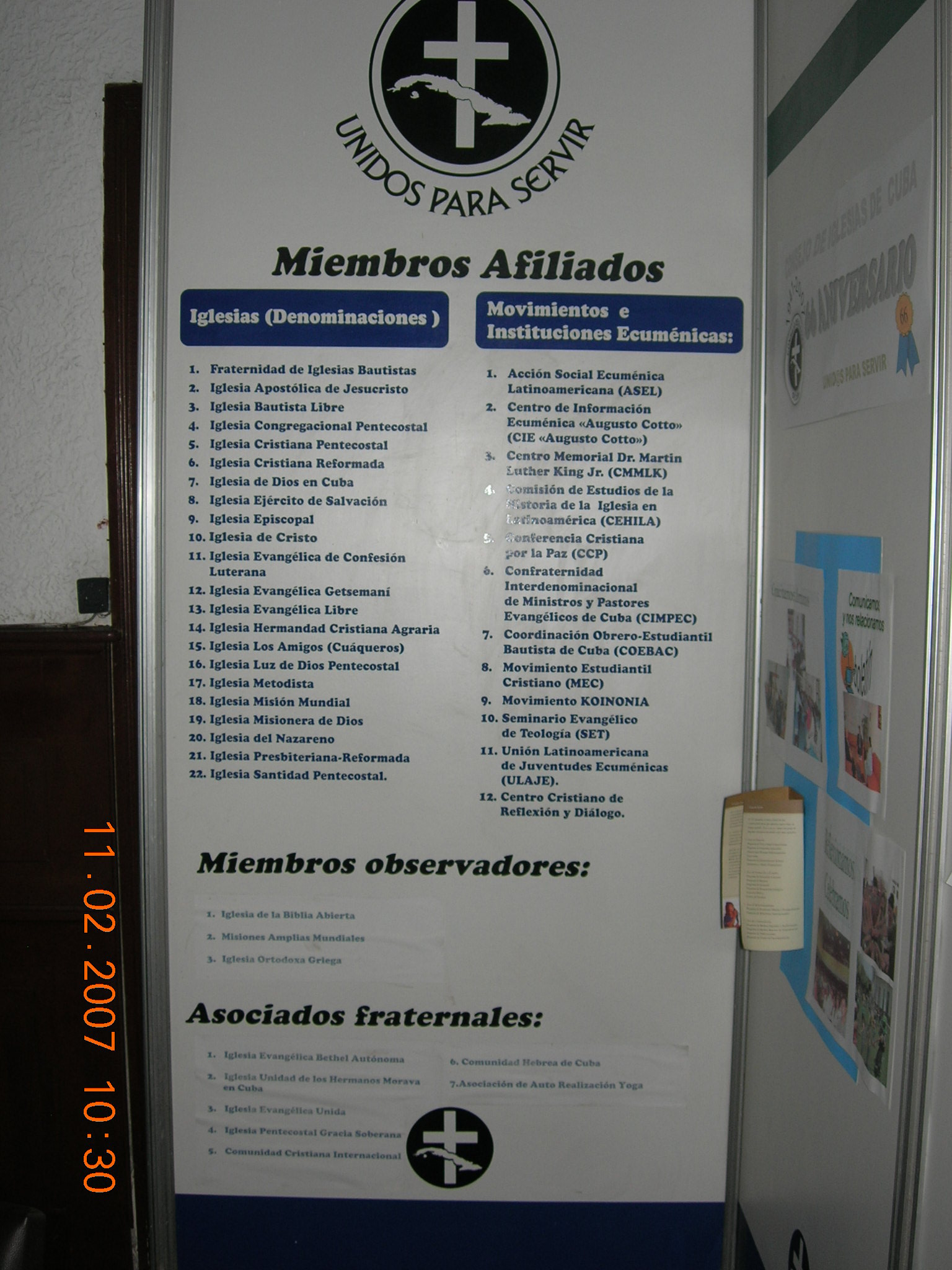
The following are comments prompted by three recent articles in Granma, Cuba’s newspaper, about religion in Cuba that are consistent with my experiences on the island and my conclusion that Cuba enjoys significant religious freedom and does not deserve to be criticized on this subject by the U.S.
The first article collects observations on that subject from Cuban religious leaders; the second reviews the recent meeting in Cuba of the Latin American Council of Churches; and the third reports on a visit to Cuba by the President of the World Communion of Reformed Churches.
Religious Freedom in Cuba
The first article from May 9th asserts that “many specialists have noted the increase of religious expression in Cuban public life. The adoption into the Constitution of the secular nature of the state in 1992 facilitated religious freedoms, and two Popes and other eminent foreign religious leaders have since visited the country.” The article supported this assertion with interviews of several Cuban religious leaders.
David Prinstein
No Anti-Semitism. At the Beth Shalom Temple in Havana’s El Vedado district, which I have visited, David Prinstein, vice president of the Jewish Community, confirmed that Cuba’s Jews were never persecuted. He said, “In the early days of the Revolution there was a distancing between different religions and the state; if you occupied a leadership position [in the state] you could not be religious, but there was no persecution.” His parents, he explained, were not “practicing Jews but my grandparents, who came to Cuba from Poland, fleeing the Nazis, always went to the synagogue.”
Currently, the Cuban Jewish Community has approximately 1,500 members. There are five synagogues in Cuba, three in Havana, one in Santiago de Cuba and another in Camagüey.”Although it is a small community in terms of numbers, it is strong in terms of what it does and the number of projects and programs in existence,” Prinstein confirms.
One challenge for Cuban Jews is adhering to dietary practices, given that they cannot eat pork, shellfish, scale-less fish, or web-footed poultry. They are assisted in respecting these regulations with allowances made for the only private butcher’s store in the country. “It was established in 1906, and was respected after the triumph of the Revolution,” notes Prinstein.
He also described relations between his community and the Cuban government as excellent. “Even before the [new] Cuban Migration and Travel Law . . ., we were always able to travel to international events to which we had been invited in Latin America, Israel and the [U.S.].”
Armando Rosindo
A New church in Cuba. The Moravian Church began to function in Cuba at the end of the 1990’s. “We started out as a small group meeting together in a house, until we joined the Cuban Council of Churches in 2003 as fraternal associates,” said Armando Rusindo, one of its leaders, and in January 2013 it was registered with the government as an independent entity.
Now Rusindo believes there is “an awakening of faith among Cubans; something that can be noted by the number of people going to church.” Nevertheless, the churches need “to constantly demonstrate what religion can contribute to a nation, by our example, conduct, dedication, and service, derived from our beliefs.”
Pedro Lazo
Cuban Islamic League. There have always been Muslims in Cuba, but for 500 years of history, there was no Muslim religious institution on the island, states Pedro Lazo, president of the Cuban Islamic League, which was officially established in 2007, although there were group meetings prior to that year. “We have been practicing since the 1990’s and we have never had a problem,” he affirmed.
The Islamic League enjoys good relations with all other religions. “Our statutes establish that these relations must be excellent, like those we must have with our neighbors, based on respect, fraternity and cooperation in all contexts.” Moreover, “Government authorities are in favor of people’s total and complete religious freedoms, as confirmed both in the Constitution and in its actions.”
The Martin Luther King Memorial Center. The Center, which I have visited, is a Christian-inspired ecumenical institution that was established in Havana in 1987.
Kirenia Criado Perez
Kirenia Criado Pérez, the director of the Center’s Reflection and Socio-Theological Training Program, believes that it “has helped break down a polarity that still exists in the minds of some people, that Cuban society is one thing and the Church another.” In her opinion, the Center’s social influence does not just come from Biblical, theological and pastoral training, but also from educational projects guided by the ideas of the Brazilian educator, Paulo Freire.
The Center also works in the area of solidarity, linked to Latin American movements, and is responsible for the Caminos publishing house. Moreover, it has been involved in building homes near the Center and elsewhere, especially after the destruction of Hurricane Sandy in October 2012.
Criado believes that, along with other institutions, the Memorial Center has helped people understand that “the Church is another social actor and as such, is responsible for the transformation of reality.” This is especially important as Cuba is going through many changes. “Everyone is thinking about how to change the country, but not everyone wants to move in the same direction. The same thing is happening in the case of the churches. That’s why it is important to understand one another, converse and get rid of old preconceptions.”
Latin American Council of Churches
In early May Cuba hosted the General Assembly of the Latin American Council of Churches, which was founded in 1982 and which comprises 188 Protestant churches and denominations in every country of the region. Its objectives are promoting the unity of God’s people as part of the concept of mission and service to the world; stimulating member churches to unify diakonia (the call to serve the poor) and evangelization; strengthening capacity in advocacy and public, social and political participation of the churches and the Council; promoting reflection and theological dialogue; and training leadership on social issues of development and pastoral work.
The Assembly was attended by 300 religious representatives from 20 Latin American and Caribbean countries.
Bishop Julio Murray
Bishop Julio Murray of Panama, who was the outgoing president of the organization, said, “Even with so many difficulties due to the U.S. blockade, the churches came together in solidarity in such a strong way and said, “No, we are going to Cuba and we are going to do everything necessary to accompany our sister churches on the island,” in this concrete gesture of solidarity and ecumenicalism. According to Bishop Murray, “the task of the Church [in Latin America] is to continue strengthening as a sign of hope, particularly in the face of situations which resemble a tremendous economic bonanza, but where so many inequalities, inequities and exclusions can be seen.” Therefore, he said, we must “seek the justice that will lead to peace.”
Other participants in the meeting described its taking place in Cuba as a concrete gesture of ecumenicalism, the maxim which guided debates on the current regional situation and challenges for the future, particularly during a historic moment in Latin America.
The new president, Argentine-Ecuadoran Felipe Adolf, stated that being in Cuba was “a very concrete gesture that we wanted to make, in keeping with the maxim of the . . . Assembly: ‘Affirming an ecumenicalism of concrete action.'”
Federico Pagura, Emeritus Bishop of the Argentine Methodist Church, described the choice of Cuba for this meeting as very relevant, adding that the Assembly was a response to actions of the U.S. to prevent its happening, and blocking Cuba’s free relations with the continent and the rest of the world.
The representative of the Anglican Church of Peru, Jaime Sianez, said that by coming to Cuba he hoped to transmit “a message of hope, compassion and loyalty to our Cuban brothers and sisters.”
The Assembly concluded with the adoption of the Havana Consensus that acknowledged that Latin America and the Caribbean had many people (33%) living in poverty and(12.5%) in extreme poverty, a high maternal mortality rate, violence against women, including human trafficking, discrimination against indigenous and African-descendant people and a high number of young people.
Therefore, the Havana Consensus declared that the churches would ” continue working to promote and defend human rights and particularly sexual and reproductive rights, from a theological, pastoral and social [perspective], in the churches, ecumenical organizations and [civil society],” provide pastoral accompaniment to “communities [that] . . . suffer and are hurt by violence, intolerance and lack of justice,” encourage “the leading role of young people as leaders in our faith communities,” and “promote human rights and the eradication of all forms of discrimination, particularly against women, the elderly, the environment, indigenous peoples and Afro-descendants, immigrants, lesbian, gay, transgender, bisexual and intersex . . . and people with disabilities.”
Another concluding document of the Assembly was the Pastoral Letter of Havana voiced similar concerns. It also deplored the U.S. “blockade” against Cuba, the U.S. designation of Cuba as a “State Sponsor of Terrorism” and the U.S. detention and torture of prisoners at Guantanamo Bay. In addition, the Letter supported the self-determination of the people of Porto Rico and expressed solidarity with the cause of the families of the “Cuban Five” still in U.S. prisons.
World Communion of Reformed Churches
Rev. Jerry Pillay
In February Jerry Pillay, the President of the World Communion of Reformed Churches, spent five days visiting the Cuban Presbyterian and Reformed Church.
He was impressed with that Church’s “numerous programmes [sp.] and projects to support and develop [their] communities.” In particular he praised the project “to supply purified water from taps on church premises” and the Matanzas seminary. (Many of these water projects have been installed by my fellow members of Minneapolis’ Westminster Presbyterian Church.) “This water, Pillay said, “is made freely available to the community at large and literally hundreds of people come regularly to fetch water. Although the church is not allowed publicly to ‘evangelize,’ it is projects such as these that enable the church to impact the community with its Christian witness and message.”
Pillay observed that although “the [Cuban] government does not propagate religion, it certainly recognizes that it need the church and other religious bodies to develop the country. Thus they have come up with a number of laws and policies to improve this working relationship and to encourage the financial sustainability of religious bodies so that they are not forever reliant on foreign assistance.”
Pillay met with family members of the “Cuban Five” who are still incarcerated in U.S. prisons. The families “have not been able to visit them . . . because of being denied visas and [other permits]. . . . The pain, suffering and anguish of the families . . . have become a pastoral matter for the church in Cuba.” Therefore, Pillay said at the end of his trip he would “attempt to unite voices and place [this issue, the release of the four Cubans still in prison and ending the U.S. embargo of Cuba] on the agenda of the World Council of Churches, the World Lutheran Federation and other ecumenical organizations.”
The World Communion consists of “Reformed, Congregational, Presbyterian, Waldensian, United and Uniting churches” with 80 million members in 108 countries. They are “joined together in Christ, to promote the renewal and the unity of the church and to participate in God’s transformation of the world.” The World Communion “coordinates joint church initiatives for economic, ecological and gender justice based on the member churches’ common theology and beliefs . . . [and fosters] unity among our member churches and promote economic, social and environmental justice.”
The organization was formed in 2010 through the merger of the World Alliance of Reformed Churches and the Reformed Ecumenical Council. The World Communion and its predecessors have created the following important confessions and statements of faith:
the Belhar Confession that rejects any church doctrine that “sanctions in the name of the gospel or of the will of God the forced separation of people on the grounds of race and colour” (1986);
the Accra Confession that declares Christians are called by biblical teachings to be advocates of social and economic justice (2004);
Pillay, the current President of the World Communion, is due to be its General Secretary next year. He is an ordained pastor in the Uniting Presbyterian Church in Southern Africa and serves as its General Secretary. He also is on the boards of the South African Council of Churches and the National Religious Leaders Forum in South Africa. He holds degrees from the University of Durban-Westville and the University of Cape Town in South Africa.
Conclusion
The criticisms of U.S. policies by the Latin American Council of Churches and by the leader of the World Communion, in my opinion, should not be seen as the expressions of anti-U.S. organizations, but rather as expressions of wide-spread opposition in Latin America and the rest of the world to these U.S. policies. As a U.S. citizen I share these opinions.
On July 30, 2012, the U.S. Department of State released its latest report on the status of religious freedom around the world; this report was discussed in a prior post. Now we analyze that report’s evaluation of religious freedom in Cuba. The previous U.S. State Department report on this subject was discussed in a prior post.
Versalles Church, Matanzas, Cuba
This analysis is based upon my personal involvement in helping to establish and manage a partnership between my church (Minneapolis’ Westminster Presbyterian Church) and Iglesia Presbiteriana-Reformada en Versalles (Versalles Presbyterian-Reformed Church in Matanzas, Cuba); my going on three church mission trips over the last 10 years to visit that congregation; my visits to the ecumenical seminary–Seminario Evangelico de Teologia (SET)–in Matanzas and other churches and religious organizations on these mission trips; my hearing reports about other trips to our Cuban partner from fellow members of my church; my conversations with Cuban Christians at their church and when they have visited my church in Minneapolis; and my extensive reading about Cuba and specifically religious freedom on the island.
Cuban Religious Makeup
First, however, we review the religious makeup of the Cuban population of roughly 11,000,000. According to the report, an estimated 60 to 70 percent (or 6,600,000 to 7,700,000) is believed to be Roman Catholic although only 4 to 5 percent regularly attend mass. Membership in Protestant churches is estimated at 5 percent of the population (or 550,000): Baptists and Pentecostals are probably the largest Protestant denominations; Jehovah’s Witnesses, 94,000; Seventh-day Adventists, 30,000; Methodists, 30,000; Anglicans, 22,000; Presbyterians, 15,000; Quakers, 300; and The Church of Jesus Christ of Latter-day Saints (Mormons), 50. The Jewish community is estimated at 1,500 members, of whom 1,200 reside in Havana. There are approximately 6,000 to 8,000 Muslims, although only an estimated 1,000 are Cubans. Other religious groups include the Greek and Russian Orthodox churches, Buddhists and Baha’is.
In addition, many Cubans consult with practitioners of religions with roots in West Africa and the Congo River basin, known as Santeria. These religious practices are commonly intermingled with Catholicism, and some even require Catholic baptism for full initiation, making it difficult to estimate accurately the total membership of these syncretistic groups. (I have visited the Slave Route Museum in the city of Matanzas, Cuba that has a room devoted to Santeria and Havana’s Callejon de Hamel, an alley with Santeria murals and other things.)
Positive Aspects of Religious Freedom in Cuba
The report had many good things to say about religious freedom in Cuba.
The Cuban “constitution protects religious freedom.” After the 1989 collapse of the U.S.S.R, the Cuban constitution was amended to eliminate “[scientific materialism or] atheism as the state creed” and to declare “the country to be a secular state” with “separation of church and state. The government does not officially favor any particular religion or church.” Moreover, says the U.S., “there were no reports of societal abuses or discrimination based on religious affiliation, belief, or practice.”
The Cuban “government’s respect for religious freedom improved” in 2011, declares the report.
“Religious organizations reported significant ability [in 2011] to attract new members without government interference. Many churches reported increased participation in religious instruction for children because government schools no longer scheduled competing activities on Saturdays or Sundays. The majority of religious groups reported little interference from the government in conducting their services and saw improvement in their ability to import religious materials, receive donations from overseas, and travel abroad to attend conferences and religious events. Some religious groups found it easier to bring in foreign religious workers. . . .”
“Religious organizations reported increased ability to conduct educational programs over the year. The Catholic Church and the Jewish Community Center offered courses on lay subjects such as computers and foreign languages. In September the Catholic Church opened a cultural center in Havana as a space for art exhibits, debates, and small classes, including a business training program. The Church’s business program was offered with the cooperation of the San Antonio University of Murcia, Spain for a master’s degree in business.”
Some religious groups “operated afterschool programs and weekend retreats for primary and secondary students and higher education programs for university graduates. The Catholic Church held twice yearly teaching workshops for public school teachers. Although not sanctioned by the government, these programs operated without interference.”
“Religious groups reported they were able to continue to provide community service programs with little interference from the government. These programs included providing assistance to the elderly, after school tutoring for children, clean water, and health clinics. International faith-based charitable operations, such as Caritas and the Salvation Army, had local offices in Havana.”
Indeed, not mentioned in the report is the de facto pharmacy for the neighborhood that is operated by our partner church in Matanzas with over-the-counter medicines donated by visitors from Westminster and by the Matanzas church’s plan to provide one free meal per week to neighborhood residents, many of whom are not members of the church.
SET Chapel, MatanzasLuyano Presbyterian-Reformed Church, Havana
In addition, the nearby seminary in Matanzas (SET) now has a clean-water system that was installed by Westminster members and that now provides clean water to SET and to people in the surrounding neighborhood, and SET also provides vegetables from its beautiful gardens to people in the neighborhood. Another clean-water system was installed by Westminster members in Havana’s Iglesia Presbiteriana-Reformada en Luyano (Luyano Presbyterian-Reformed Church), which shares the clean water with people in its neighborhood.
During the year the report says “the Catholic Church and some other churches were able to print periodicals and operate their own Web sites with little or no censorship. The Catholic Church’s periodicals sometimes included criticism of official social and economic policies. As in previous years, the Catholic Church also received permission to broadcast Christmas and Easter messages on state-run radio stations and, in 2011, a televised mass on September 8, the feast day of the Virgin of Charity of El Cobre, the country’s patron saint. The [Cuban] Council of Churches, the government-recognized Protestant umbrella organization, was authorized to host monthly two hour-long radio broadcasts. ”
The report’s referencing the Cuban Council of Churches, however, did not mention that the it was founded in 1941 (long before the Cuban Revolution), and its members now include 22 churches, 12 ecumenical movements, and seven associate organizations. The Council, whose offices I have visited, promotes unity among the Christian Churches of Cuba and helps link these churches with other churches around the world. The Council also encourages dialogue between different movements and institutions as a means for Cuban churches to expand their ecumenical vocation of service, thus deepening their responsibilities towards society and all of God’s creation. Finally the Council promotes study, dialogue, and cooperation among Christians to increase Christian witness and enhance life in Cuba.
The U.S. government’s report continued, “Religious groups . . . reported it was easier to obtain government permission to maintain and repair existing places of worship and other buildings.” Moreover, the government “frequently granted permission to repair or restore existing temples, allowing significant expansion of some structures and in some cases allowing essentially new buildings to be constructed on the foundations of the old. Numerous houses of worship were expanded or repaired.” (In a prior year our partner church in Matanzas obtained such permission to expand its facilities for children’s Sunday School programming, and Westminster members helped build that expansion.)
Even though some religious organizations and “house churches” have not been officially recognized by the government, as required by Cuban law, in practice, most unregistered organizations and “house churches” operated with little or no interference from the government.
Both the Catholic Church and the Cuban Council of Churches reported improved access to prisoners during the year, with services offered in prisons and detention centers in most, if not all, provinces. (According to the report, however, some prison authorities did not inform inmates of their right to religious assistance, delayed months before responding to such requests, and limited visits to a maximum of two or three times per year.)
The government worked with the Catholic Church to facilitate the public procession of an icon honoring the Virgin of Charity to mark the 400th anniversary of her appearance in Cuba. The procession concluded in December with a public open-air mass in Havana attended by over 3,000 citizens as well as by government officials. It was the first country-wide religious procession permitted since the Cuban revolution.
Although there is no official law of policy for conscientious objection to military service, since 2007 the government has unofficially allowed a period of civilian public service to substitute for military service for men who object on religious grounds. The leadership of Jehovah’s Witnesses and Seventh-day Adventists stated that their members usually were permitted to participate in social service in lieu of military service.
The leadership of Jehovah’s Witnesses and Seventh-day Adventists stated that mistreatment and job discrimination, which had been particularly harsh in the past, were now rare and that their members were usually exempted from political activities at school. Seventh-day Adventist leaders stated that their members employed by the state usually were excused from working on Saturdays.
Pope Benedict XVI @ Plaza de Revolucion
Not included in the report for 2011 was the late March 2012 visit to Cuba by Pope Benedict XVI. During a mass in Havana’s Plaza de Revolucion before a crowd of thousands, the Pope called for “authentic freedom.”
Negative Aspects of Religious Freedom in Cuba
The report also commented on what it saw as negative aspects of religious freedom in Cuba.
The report notes that obtaining government permission for construction of new religious buildings remained difficult. This may well be true, but, in my opinion, this difficulty springs from the government’s attempts to regulate the allocation of scarce resources in a relatively poor country and to allocate more resources to other purposes it deems more important.
By law religious groups “are required to apply to the Ministry of Justice for official recognition. The application procedure requires religious groups to identify the location of their activities and their source of funding, and requires the ministry to certify that the group is not ‘duplicating’ the activities of another recognized organization in which case, recognition is denied. A number of religious groups, such as the Jehovah’s Witnesses and the Mormons, have been waiting for years for a decision from the Ministry of Justice on their pending applications for official recognition.” (However, the report said that unrecognized religious groups reported they were able to conduct religious activities, hold meetings, receive foreign visitors, and send representatives abroad. In addition, I believe that the government’s official requirement that such applications indicate it is not “duplicating” another organization’s activities is due to the previously mentioned desire to conserve scarce resources.)
Once the Ministry of Justice grants official recognition, religious organizations have to request permission from the Cuban Communist Party, through its Office of Religious Affairs, to hold meetings in approved locations, to receive foreign visitors, and to travel abroad. Religious groups indicated that while many applications were approved within two to three years from the date of the application, other applications received no response or were denied. Some religious groups were only able to register a small percentage of their “house churches.”
The report states that religious groups may not establish schools. This is true because the Cuban Revolution nationalized all private schools–religious and nonreligious– and instead emphasized public education for all children.
The report also says, “Except for two Catholic seminaries and several interfaith training centers throughout the island, religious schools were not permitted.”
This is an erroneous or misleading statement about religious education in Cuba as shown by the report’s own acknowledgement that in 2011 religious organizations had increased ability to conduct their own educational programs and by the following facts not mentioned in the report:
Since 1946 there has been an ecumenical Protestant Christian seminary in the city of Matanzas — Seminario Evangelico de Teologia (SET)–that was founded by the Methodist, Presbyterian, and Episcopal Churches. It has a full curriculum for various degrees as well as other non-degree programs, some of which are offered in other cities on the island.
The Methodists recently withdrew from SET to start their own seminary in Havana.
SET and the Martin Luther King, Jr. Center at Ebenezer Baptist Church in Havana are developing a program for education of prospective owners and operators of private businesses on the island under the government’s announcement allowing such activities. The MLK Center, by the way, was founded in 1987 to provide training and education in King’s philosophy of nonviolence for Cuban religious and community leadership.
In the last several summers young people from Westminster have conducted a vacation Bible school at our partner church in Matanzas.
MLK Center, Havana
“A license from the Office of Religious Affairs is necessary to import religious literature and other religious materials.” (Yet, as previously mentioned, the report itself states there were fewer restrictions on such importation.)
The report also states that “the government owns nearly all printing equipment and supplies and tightly regulates printed materials, including religious literature.” This, in my opinion, is an overstatement. Our partner church in Matanzas owns old-fashioned printing presses and at least one specialized computer printer and that the church prints and distributes religious bulletins and journals for most, if not all, of the Protestant churches on the island. A photo of the covers of some of the religious publications that are printed here appears in my 12/30/11 post, “The Cuban Revolution and Religion.”
The report states that “most religious leaders reported they exercised self-censorship in what they preached and discussed during services. Many feared that direct or indirect criticism of the government could result in government reprisals, such as denials of permits from the Office of Religious Affairs or other measures that could stymie the growth of their organizations.”
The government took “measures to limit support to outspoken religious figures that it considered a challenge to its authority.”I have no basis to challenge that statement or the following specifics cited by the report on this point:
On June 26, police arrested 23 people and detained them for five hours to prevent them from attending a Sunday prayer session in support of a Methodist minister who was removed from his post by his superiors, partly because of his outspoken criticism of the government.
On October 19, police stopped Baptist pastor Mario Felix Lleonart, a vocal critic of the authorities in the province of Santa Clara, and detained him for 10 hours.
In February Pastor Omar Perez Ruiz (aka Omar Gude Perez), a leader of the Apostolic Reformation, an association of independent nondenominational churches, was released after serving almost three years of a six-year prison sentence for illicit economic activities and falsification of documents. Perez maintained his innocence and claimed his incarceration was due to his religious activities. Perez’s release was conditioned on his refraining from preaching and from leaving the city of Camaguey. Although Perez and his family were granted refugee status in the United States, they were unable to leave because the government did not grant them an exit permit.
As part of its campaign of repression of human rights activists, the government prevented many Catholics from attending religious services. Members of the Ladies in White (Damas de Blanco) group were routinely prevented from attending church, a practice that was particularly pronounced in the eastern provinces of Holguin and Santiago. The government prevented Adisnidia Cruz, mother of political prisoners Marcos and Antonio Lima-Cruz, from leaving her house in Holguin on Sundays to attend mass on dozens of occasions. In other instances the government harassed human rights activists immediately after religious services. On September 8, for example, members of the Damas de Blanco were arrested after attending mass in Santiago to celebrate the day of Cuba’s patron saint.
Conclusion
Is the glass half empty or half full? This is the question for all human activities since none of us is perfect, and it is the legitimate question about religious freedom in Cuba.
In the opinion of a respected Cuban Protestant leader, the glass of such freedom in Cuba is more than half full, and there is no basis whatsoever for the U.S. government or her citizens to castigate Cuban religious institutions or leaders or members. I concur. As Jesus said to the scribes and Pharisees when they asked him if they should stone a woman who had committed adultery, “Let anyone among you who is without sin be the first to throw a stone at her.” All of the questioners then silently departed without throwing any stones. (John 8: 3-11.)
I, therefore, am glad that this U.S. government report does not designate Cuba as a “Country of Particular Concern,” i.e., a country which has “engaged in or tolerated particularly severe violations of religious freedom,” or the ” systematic, ongoing, egregious violations of religious freedom, including violations such as torture, degrading treatment or punishment, prolonged detention without charges, abduction or clandestine detention, or other flagrant denial of the right to life, liberty, or the security of persons.” There is no basis for any such designation, in my opinion.
Nor do I think there is any basis for the quasi-independent U.S. Commission on International Religious Freedom to have put Cuba on its “Watch List of countries where the serious violations of religious freedom engaged in or tolerated by the governments do not meet the [Commission’s] . . . threshold [for designation as a Country of Particular Concern], but require close monitoring.” The Commission should cease making such a designation in its next report.


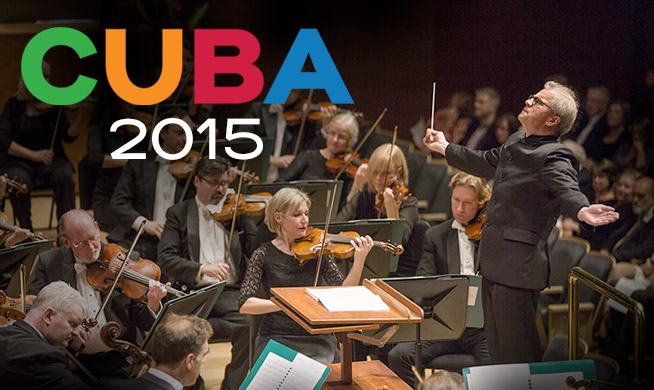


 On February 18th the delegation had a three and one-half hour meeting with Cuban Foreign Minister, Bruno Rodriguez. and Josefina VIdal, the Foreign Ministry’s leader of the current negotiations with the U.S. (Left is a photograph of Pelosi and Rodriguez.) According to a Cuban website, they