Essay About Archbishop Oscar Romero in Cuban Newspaper

On March 23, 2015, the day before the 35th anniversary of the assassination of Salvadoran Archbishop Oscar Romero, CubaDebate published an essay about Romero. The author is Adolfo Pérez Esquivel of Argentina, who started out as a painter, sculptor and architect and later became a prominent human rights advocate. In 1980 he received the Nobel Peace Prize for his work for human rights and peace. Below are extensive excerpts from that essay. [1]

“Martyrs are sowing seeds of life expectancy and strengthen the ways of faith. They have enriched the continent of Fertile Earth . . . by force of the prophetic word and the testimony of the lives of those who had the courage and faith to walk beside the Village Church of God. Their voices were raised across the continent and the world. So it was in the neighboring country of El Salvador, subjected to violence with more than 70,000 dead, exiled and persecuted. That pain was a voice of guidance, and hope emerged, denouncing violence and calling for respect for life and dignity of people under the civil war and military dictatorship.”

“It was the voice of Monsignor Oscar Arnulfo Romero, who experiences the conversion of his heart and embraces the way of the Cross. As St. Paul says: “It is madness for some; for others it is life and redemption.” (Emphasis in original.)

“Romero endured many misunderstandings in the same church; his voice, his claims and complaints would not be heard in the Vatican; there were ideological currents and misinformation about what happened in El Salvador. The conceptual and political simplification reduced everything to the East-West polarization between capitalism and communism, based on the Doctrine of the ruling National Security. They forgot the thousands of brothers and sisters who were victims of violence. Romero tried to get the Vatican to listen and help, but left distraught and returned home with pain in the soul.”

“Some peasants who knew him remember following the homilies of Monsignor Romero, with no need to hear his word directly and instead hearing them on the radios of all their neighbors who had them turned on.”

“The Archbishop knew of the [death] threats he was receiving, but the power of the Gospel and its commitment to the people were part of his own life. He sought God in prayer and silence listening to the silence of God, who taught his heart, his mind and spirit.”

“Journalists in March 1980 said that the Archbishop was on the line, targeted by the military. Romero replied, ‘Yes, I have frequently been threatened with death, but I must say that as a Christian I do not think in death without resurrection. If they kill me, I will rise again in the Salvadoran people. I say it without boasting, with the greatest humility. A bishop will die, but the church of God, which is the people, shall not perish.’” That March 23 at the Cathedral, Monsignor Romero in his homily said:

  • ‘I would like to make an appeal in a special way to the men of the army, and in particular to the ranks of the Guardia Nacional, of the police, to those in the barracks. Brothers, you are part of our own people. You kill your own campesino brothers and sisters. And before an order to kill that a man may give, the law of God must prevail that says: Thou shalt not kill! No solider is obliged to obey an order against the law of God. No one has to fulfill an immoral law. It is time to recover your consciences and to obey your consciences rather than the orders of sin. The church, defender of the rights of God, the law of God, of human dignity, the dignity of the person, cannot remain silent before such an abomination. We want the government to take seriously that reforms are worth nothing when they come about stained with so much blood. In the name of God, and in the name of this suffering people, whose laments rise to heaven each day more tumultuous, I beg you, I ask you, I order you in the name of God: Stop the repression!’”

“Monsignor Romero’s voice was heard clearly despite all odds and radio interference and equipment: “The church preaches liberation” … “The cathedral burst into applause, excited people felt the cry of their hearts.”

============================================

[1] Esquivel, San Romero of America walks alongside the peoples of our continent, CubaDebate (Mar. 23, 2015)(English translation by Google Translate). Another Cuban newspaper, Granma, published a shorter article about Romero: Oscar Arnulfo Romero, a saint of the poor of America, Granma (Mar. 23, 2015). Oscar Romero is the personal saint of this blogger, who has written many posts about Romero and who points our that Tim’s El Salvador Blog has published great early photographs of Oscar Romero from the Salvadoran Museo de la Palabra y Imagen (Museum of Word and Image) plus other photographs of images of Romero in today’s El Salvador. (35th anniversary of Romero’s assignation (Mar. 24, 2015).


U.S. and Cuba Squabble Over U.S. Sanctions Against Certain Venezuelans

The U.S. and Cuba (and indeed most of the rest of Latin America) are in a squabble over recent sanctions imposed against certain Venezuelans by an executive order issued by President Obama. After reviewing immediate events leading up to the imposition of sanctions, this post will discuss the executive order and the reactions thereto from Venezuela, Cuba and the rest of Latin America.

Events Leading Up to the Imposition of Sanctions [1]

In February 2014 there were opposition protests calling for Venezuelan President Nicolas Maduro’s resignation that sparked violence killing 43 people. In February of 2015 protesters and security forces clashed sporadically around that anniversary, while a shrinking economy and chronic product shortages have sent Maduro’s popularity tumbling.

In early February 2015, Antonio Ledezma, who is an opposition leader and the Mayor of Caracas, and two other opposition leaders signed a published open letter to President Maduro calling for a “national agreement for a transition.”

On February 10, the government announced a new three-tier currency scheme that amounted to a de facto devaluation of almost 70 percent, spurring outrage among opposition critics. This was a response to tumbling oil prices that have left the country struggling to meet its budget needs amid bulging foreign debt payments.

On February 19, the Venezuelan government announced that Ledezma had been arrested in order to halt an alleged U.S.-backed coup plot. The next day the government said that Ledezma had been indicted on charges of conspiracy against the Venezuelan government and plotting an American-backed coup. His attorney will be asking a judge to dismiss conspiracy charges against him, calling accusations that he participated in a plot to overthrow Venezuela’s socialist government “totally unfounded.”

Also on the 19th Maduro called for the Venezuelan people to defend national peace and be prepared “to deal with any scenario that may occur in Venezuela as a result of U.S. imperial aggression against our country.” That same day the Venezuelan Supreme Tribunal of Justice issued a statement reminding the U.S. that it had no jurisdiction to apply its laws outside its territory against the sovereignty and institutions of democracy in Venezuela. [2]

On February 20th the White House’s Press Secretary, Josh Earnest, responded to these charges. He said: “The United States is not promoting unrest in Venezuela, nor are we attempting to undermine Venezuela’s economy or its government.  In fact, the United States remains Venezuela’s largest trading partner.  The Venezuelan government should stop trying to distract attention from the country’s economic and political problems, and focus on finding real solutions through democratic dialogue among the people of Venezuela.  The Venezuelan government should respect the human rights of its citizens and stop trying to intimidate its political opponents.”

According to the Press Secretary, the U.S. continues “to call on the Venezuelan government to release political prisoners, including dozens of students; opposition leader; and Mayors Daniel Ceballos and Antonio Ledezma.” The U.S. “Treasury Department and the State Department are obviously closely monitoring this situation and are considering tools that may be available that could better steer the Venezuelan government in the direction that they believe they should be headed.  That obviously means that we’re continuing to engage other countries in the region in talking about operating in coordinated fashion as we deal with the situation there.”

The same day a Department of State spokesperson stated: The Venezuelan accusations “are false and baseless. And our view continues to be that political transitions must be democratic, constitutional, peaceful, and legal. We do not support a political transition in Venezuela by non-constitutional means. We’re not promoting unrest in Venezuela, nor are we attempting to undermine Venezuela’s economy or its government. And this is a continued effort . . . of the Venezuelan Government to try to distract attention from the country’s economic and political problems and focus and try to distract and make these false accusations.”

In addition, the State Department official stated the U.S. had reports that the Venezuelan intelligence service had detained the Caracas metropolitan mayor and searched his office [and] . . . that military intelligence officials plan to move opposition leader Leopoldo Lopez from his prison cell and transfer him to an unknown location. We are deeply concerned by what appears to be the Venezuelan Government’s efforts to escalate intimidation of its political opponents by rounding up these prominent leaders of the opposition. Venezuela’s problems cannot be solved by criminalizing dissent.”

President Obama’s Executive Order [3]

 On March 9th President Obama issued an executive order that blocked any U.S. assets of seven named Venezuelans and others who might be named by the U.S. Department of the Treasury, that barred these individuals from entering the U.S. and that prohibited U.S. persons from doing business with them.

These individuals were determined by the U.S. to be “responsible for the erosion of human rights guarantees, persecution of political opponents, curtailment of press freedoms, use of violence and human rights violations and abuses in response to antigovernment protests, and arbitrary arrest and detention of antigovernment protesters, as well as significant corruption.”

The executive order was not directed at the people or economy of Venezuela.

The disputes over this executive order, however, are not over these provisions, but instead to its preamble, which states:

  • [T]he situation in Venezuela, including the Government of Venezuela’s erosion of human rights guarantees, persecution of political opponents, curtailment of press freedoms, use of violence and human rights violations and abuses in response to antigovernment protests, and arbitrary arrest and detention of antigovernment protestors, as well as the exacerbating presence of significant public corruption, constitutes an unusual and extraordinary threat to the national security and foreign policy of the United States, and [the President] hereby declare a national emergency to deal with that threat.” (Emphasis added.)

 Venezuela’s Response to the Executive Order [4]

On March 10 President Maduro requested the Venezuelan legislature to enact an Anti-Imperialist Enabling Law granting him power to enact laws by his decree for the rest of this year in order to “defend the peace, sovereignty and full development of Venezuela in the face of threats from the United States empire.” Maduro said “no one in the world could believe the assertion [that Venezuela posed a national security threat to the U.S.] since the Venezuelan people are known as ‘peaceful, democratic, humanist and have a foreign policy directed toward understanding and peace . . . leaders in the struggle for integration and unity.’”

On March 14, upon Maduro’s order, Venezuela conducted a military exercise to counter an alleged U.S. threat by deploying Venezuelan soldiers and partisans across the country to march, man shoulder-fired missiles and defend an oil refinery from a simulated attack. Venezuela’s navy also performed exercises in the Caribbean Sea.

On Sunday (March 15) Venezuela’s legislature granted the requested presidential decree powers, which Maduro says are necessary to defend the country from the U.S. and which his opponents say are to justify repression and distract Venezuelans from economic problems, including acute shortages. Indeed, the country is suffering the highest inflation in the Americas, long lines for food and medicine, and shortages of many basic products.

President Maduro immediately responded to the legislature’s action. He insisted that Venezuela was ready to talk, “one on one, face to face, with respect, without arrogance or hubris” with the U.S. The first item on the agenda for such a meeting, he said, would be the immediate rescission of President Obama’s executive order.

 Cuba’s Response to the Executive Order [5]

Since Venezuela is a major ally of Cuba and the supplier of oil to Cuba, it is not surprising that the Cuban press recently has been full of Cuba’s support of Venezuela, both before and after the issuance of the executive order. Here are some of those expressions of support:

  • On March 5, Granma, Cuba’s official newspaper, issued a laudatory article about Venezuela’s former President, Hugo Chávez. It said he was “remembered . . . for his charisma, his arousing speech, his sincerity, his constant anguish to deliver for his people. Those who knew him say he often felt as though he were plowing the sea with that desire, so characteristic of him, to remain loyal to the people.” Now, “two years after his departure, . . . Chávez will be awakened together with Bolívar, to continue guiding Venezuela and Latin America.”
  • On March 6, Cuban First Vice President of the Councils of State and Ministers (and the presumptive successor to Raúl Castro as President of Cuba), Miguel Díaz-Canel Bermúdez, was in Caracas to participate in the commemoration of the second anniversary of death of Chávez, and Díaz-Canel declared that Cuba always will be a true friend of the Bolivarian Revolution.
  • On March 9, immediately after the issuance of the executive order, the Cuban government reiterated “its unconditional support and that of our people for the Bolivarian Revolution, the legitimate government of President Nicolás Maduro Moros and the heroic sister nation of Venezuela.” The Cuban government stated, “Nobody has the right to intervene in the internal affairs of a sovereign State or to declare it, without grounds, a threat to its national security.” Venezuela does not have the resources or officials to threaten the United States, and the executive order “reaffirms . . . the interventionist nature of U.S. foreign policy.”
  • On March 10, Fidel Castro in a letter to President Maduro said, “I congratulate you on your brilliant and courageous speech against the brutal plans of the U.S. government. Your words go down in history as proof that humanity can and must know the truth.”
  • On March 13 Cuban Foreign Minister Bruno Rodriguez Parrilla said that any attack on Venezuela was also an attack on Cuba and that the U.S. “has provoked serious damage to the environment in the hemisphere on the eve of the Summit of the Americas.” He added, “I hope that the U.S. government understands that it can’t handle Cuba with a carrot and Venezuela with a garrote.”
  • On March 15 thousands of Cubans attended a concert in support of Venezuela at the University of Havana. One of the Cuban Five and a Hero of the Republic of Cuba, René González, addressed the crowd, saying, “We all had in mind the warning of Che that imperialism cannot be trusted,” and that warning was confirmed by the March 9th executive order.

Other Latin American Countries’ Reactions [6]

On March 14, at Venezuela’s request, the 12-nation Union of South American Nations (UNASUR) reaffirmed “their commitment to the full observance of international law, the Peaceful Settlement of Disputes and the principle of nonintervention” and reiterated their “call for governments to refrain from applying unilateral coercive measures that violate international law.” It, therefore, called on the U.S. “to evaluate and implement alternatives for dialogue with the government of Venezuela, under the principles of respect for sovereignty and self-determination of peoples.’ As a result, it requested “the repeal of that Executive Order.”

On March 17 the Bolivarian Alliance for the Peoples of Our Americas (ALBA), at the request of Venezuela, will meet in Caracas to declare solidarity with Venezuela in its disputes with the U.S.

Conclusion

Although I am not a close follower of events in Venezuela, I do know that the recent huge declines in world oil prices have devastated its economy, that it is suffering horrendous inflation forcing it to devalue its currency, that there are shortages of all sorts of consumer products and that its government has imprisoned dissidents, including the Mayor of Caracas.

I also believe that the U.S. government must have had good cause to impose sanctions on the seven individuals named in the executive order.

Therefore, the protests of Venezuela, Cuba and the other Latin American nations, in my opinion, are not justified. The U.S. hopes for a cordial Summit of the Americas next month in Panama to celebrate a U.S.-Cuba reconciliation, however, appear to have been scuttled.

=================================================

[1] Pons & Ellsworth, Update 3-Venezuela announces new currency system, large devaluation seen, Bloomberg (Feb. 10, 2015); Reuters, Venezuela Arrests Opposition Mayor Accused of Coup Plot, N.Y. Times (Feb. 19, 2015);  White House, Press Briefing by Press Secretary, Josh Earnest, 2/20/15 (Feb. 20, 2015); U.S. Dep’t State, Daily Press Briefing (Feb. 20, 2015); Assoc. Press, Lawyer: Jailed Caracas Mayor to Fight Conspiracy Charges, N. Y. Times (Feb. 21, 2015); Gupta, Venezuela Mayor Is Accused of U.S.-Backed Coup Plot, N.Y. Times (Feb. 21, 2015),

[2] Cuba’s official newspaper, Granma, parrotted the Venezuelan government’s version of events. (E.g.Venezuela faces a stroke of continued fate, Granma (Feb. 20, 2015); Statement of the Ministry of Foreign Affairs of the Republic of Cuba, Granma (Feb. 20, 2015).)

[3] White House, Executive Order—Blocking Property and Suspending Entry of Certain Persons Contributing to the Situation in Venezuela (Mar. 9, 2015); White House, Fact Sheet: Venezuela Executive Order (Mar. 9, 2015); White House, Letter [to Speaker of U.S. House of Representatives]—Declaration of a National Emergency with respect to Venezuela (Mar. 9, 2015); White House, Statement by the Press Secretary on Venezuela (Mar. 9, 2015);DeYoung & Miroff, White House steps up sanctions against Venezuelans, Wash. Post (Mar. 9, 2015). The executive order was issued under (a) the International Emergency Economic Powers Act and (b) the Venezuela Defense of Human Rights and Civil Society Act of 2014. In section 2 of that latter statute, Congress found, among other things, that the Central Bank of Venezuela and the National Statistical Institute of Venezuela had determined that the annual inflation rate in Venezuela in 2013 was 56.30, the highest level of inflation in the Western Hemisphere and the third highest level in the world; that Venezuela’s currency controls have become the most problematic factor for doing business in the country; and that HumanRights Watch has reported the government intimidates,censors and prosecutes its critics.

[4] Editorial, In Venezuela, Punishing Scapegoats, N.Y. Times (Mar. 5, 2015); Toro & Kronicks, Venezuela’s Currency Circus, N.Y. Times (Mar. 6, 2015); Miroff & DeYoung, New U.S. sanctions lost in Venezuelan translation, Wash. Post (Mar. 11, 2015); Reuters, Mind Your Manners, Venezuela Tells U.S. Official, Jacobson, N.Y. times (Mar. 11, 2015); Neuman, Obama Hands Venezuelan Leader a Cause to Stir Support, N. Y. Times (Mar. 11, 2015); Editorial, A Failing Relationship with Venezuela, N. Y. Times (Mar. 12, 2015); Assoc. Press, Venezuela Conducts Military Exercises, Claims US Threat, N.Y. Times (Mar. 14, 2015); Reuters, Venezuela Stages Military Exercises to Counter U.S. ‘Threat,’ N.Y. Times (Mar. 15, 2015); Buitrago & Cawthorne, Elected officials grant Venezuela leader broad powers, Wash. Post (Mar. 15, 2015).

[5] Statement from the Revolutionary Government of the Republic of Cuba, Granma (Mar. 10, 2015); Letter from Fidel to Maduro, Granma (Mar. 10, 2015); Pasiero, Venezuela is sacred and to be respected, Granma (Mar. 10, 2015); Pasiero, Cuba reiterates its unconditional support of Venezuela, Granma (Mar. 6, 2015); Chávez, forever present, Granma (Mar. 5, 2015); Pasiero, Mature relationships requires respect for the United States, Granma (Mar. 16, 2015); Venezuela Are All, Granma (Mar. 16, 2015); Prada & Rodriguez, Voices for solidarity with Venezuela, Granma (Mar. 16, 2015).

[6] UNASUR, Press Union of South American Nations Executive Decree of The Government of the Unites States of Venezuela (Mar. 14, 2015); Assoc. Press, South American Bloc Demands US Revoke Venezuela Order, N.Y. Times (Mar. 14, 2015). UNASUR members are Argentina, Brazil, Bolivia, Chile, Colombia, Ecuador, Guyana, Paraguay, Peru, Suriname, Uruguay and Venezuela. ALBA members are Antigua and Barbuda, Bolivia, Cuba, Dominica, Ecuador, Grenada, Nicaragua, Saint Kitts and Nevis, Saint Lucia, Saint Vincent and Grenadines and Venezuela.


Cuba’s Reactions to U.S.-Cuba Reconciliation

Determining the overall reactions of Cubans to the December 17th announcement of their country’s embarking on a path of reconciliation with the U.S. is difficult for anyone, much less a non-Cuban living in Minnesota. Nevertheless, I will attempt to do so based upon generally available information filtered through my having been to Cuba on three church mission trips over the past 12 years, my listening to others from my church who have been on other such trips, my talking with Cubans on the island and in the U.S. and following carefully the news on this subject during these years. My analysis also endeavors to put myself in the shoes of Cubans in this historical moment.

This analysis focuses first on the actions of the leaders of the Cuban government and  then on the reactions of the Cuban people.

The Cuban Government

First, the Cuban government over 18 months conducted secret negotiations with the U.S. government to achieve the breakthrough on December 17th when President Raûl Castro announced this important development to the Cuban people.

At that time Castro said, “We need to learn to live together in a civilized way, with our differences,” He also exulted in the release of the three Cuban agents from U.S. prison, saying it was  a cause of “enormous joy for their families and all of our people.” He praised President Obama with these words””This decision by President Obama deserves respect and recognition by our people.”

Subsequently President Raûl Castro has made other statements reiterating his government’s commitment to the process of reconciliation while also emphasizing some of the difficulties in achieving complete normalization.

  • In his December 20th speech to Cuba’s National Assembly, President Castro said, “The Cuban people are grateful [for Mr. Obama’s decision] to remove the obstacles to our relations.” He also stated, “”In the same way that we have never demanded that the United States change its political system, we will demand respect for ours.”
  • At the January 28th CELAC conference in Costa Rica, President Castro stated, “The reestablishment of diplomatic relations is the beginning of a process of . . . normalization of  bilateral relations, but this will not be possible as long as the [U.S. embargo or] blockade exists, or as long as the territory illegally occupied by the Guantanamo Naval Base is not returned, or radio and television broadcasts which violate international norms continue, or just compensation is not provided our people for the human and economic damage that they have suffered.” In essence, he said, “Cuba and the United States must learn the art of civilized co-existence, based on respect for the differences which exist between both governments and cooperation on issues of common interest. . . . [In doing so Cuba will not ] renounce its ideals of independence and social justice, or abandon a single one of our principles, nor cede a millimeter in the defense of our national sovereignty.” Raul Castro continued, “If these problems are not resolved, this diplomatic rapprochement between Cuba and the United States makes no sense.”

Raúl’s brother, Fidel Castro, belatedly voiced his guarded approval. On January 27th, Fidel said,“I do not trust the politics of the United States, nor have I exchanged a word with them, but this is not, in any way, a rejection of a peaceful solution to conflicts. Any peaceful or negotiated solution to the problems between the United States and the peoples or any people of Latin America that doesn’t imply force or the use of force should be treated in accordance with international norms and principles. We will always defend cooperation and friendship with all the people of the world, including with our political adversaries.” His brother, Fidel said, had “taken the relevant steps in line with the prerogatives and authorities awarded to him by the National Assembly and the Cuban Communist Party.”

Moreover, the Cuban government has fulfilled its obligations under the accord with the U.S. to release from its jails and prisons Alan Gross, a U.S. spy and 53 Cuban dissidents.

In addition, Cuba hosted a visit of a delegation of U.S. Senators and Representatives led by Senator Leahy and the January 21-22 diplomatic conference in Havana to discuss additional steps of normalization. Although no significant agreements were reached on specific issues, both governments spoke of the spirit of respect and cooperation that was present in those sessions. The diplomatic conference was discussed in posts before and after the sessions.

The day before this conference, a senior official from Cuba’s foreign ministry told reporters that it was “unfair” to keep Cuba on the U.S. list of state sponsors of terrorism and that Cuba “cannot conceive of re-establishing diplomatic relations” while Cuba remains on that list.”

After the conference, Cuba’s top diplomat for U.S. affairs, Josefina Vidal, said, “One can’t think that in order to improve and normalize relations with the U.S., Cuba has to give up the principles it believes in. Changes in Cuba aren’t negotiable.” She also objected to allowing U.S. diplomats on the island to have liberty to go anywhere until they conducted themselves with total respect for Cuban laws. The last point was in response to the U.S. insistence that its diplomats in Havana have the unrestricted ability to travel within the country and to meet with whomever it wants, including Cuban dissidents. Vidal re-emphasized this position in an extensive February 2nd interview in Granma, Cuba’s only newspaper. 

The Cuban People [2]

As there are no national public opinion polls in Cuba, assessing such opinion relies on a melange of sources.

Immediately after the December 17th announcement of the detente, Granma reported that the Cuban people were “overjoyed to the two great events of the day, year and century: the return to the country of three Cuban heroes who were previously incarcerated in U.S. prisons, and the announcement of the reestablishment of diplomatic relations between Cuba and the U.S.”

The day after the announcement a Western journalist reported that “many Cubans expressed hope . . .  that it will mean greater access to jobs and the creature comforts taken for granted elsewhere, and lift a struggling socialist economy where staples like meat, cooking oil and toilet paper are often hard to come by. That yearning, however, was tempered with anxiety. Some fear a cultural onslaught, or that crime and drugs, both rare in Cuba, will become common along with visitors from the United States. There is also concern that the country will become just another Caribbean destination.”

Another western journalist, William Neuman, this last Christmas made a 17-hour car trip around the island and observed that in his “conversations with Cubans about the lifting of parts of the American embargo and the re-establishment of diplomatic relations, what they talked about most was that they hoped it would breathe life into the economy and eventually lead to a better standard of living.”

In early January an Associated Press journalist interviewed 10 of the 53 Cuban dissidents who were released from jail or prison by the Cuban government as part of the December 17th announcement, and eight of them “expressed confidence the decrease in tensions with the U.S. will improve life in Cuba and make their activism easier. Only one had a negative view of the deal.”

More recently, on January 23rd in Havana U.S. Assistant Secretary of State Roberta Jacobson hosted a meeting in Havana of certain Cuban dissidents, as discussed in a prior post. Some of those in attendance were opposed to the detente while others supported it. (The Cuban government was very unhappy over this meeting.)

On February 3rd a subcommittee of the U.S. Senate Foreign Relations Committee held a hearing about the detente. Four of the witnesses were the following Cuban dissidents. 

  • Berta Soler, President of Cuban Ladies in White, testified about the continued arrests and harassment of dissidents by the Cuban government.
  • Mrs. Miriam Levia, a human rights advocate and independent journalist, testified, “While many dissidents and opponents support the new approach of the American Administration in the relations with the Cuban government, others do not. Nevertheless, the objective is the same: defense of human rights, democratic values, and friendship and assistance to the Cuban people. Likewise in the opposition and dissidence, we all seek the wellbeing and progress of the Cuban people and our country.” She added, “Reestablishing relations will grant a better environment for the American diplomats in Cuba, their contacts with the Cuban population and the civil society, and their ability to access a direct channel to the national officials, among other issues. Normalizing the 56 years long estrangement will take a long time. But there is now a unique opportunity to assist the Cuban people and it must not be wasted. . . .The American policy towards the Cuban government has disserved it for 56 years, so it must be changed. The embargo must be lifted for the benefit of our peoples and nations.”
  • Manuel Cuesta Morúa, representing the Progressive Arc and Coordinator of New Country, testified, “Do not believe that the change in U.S. policy will bring us freedom, which would be the best outcome. The freedom of Cuba is exclusively a matter for Cubans. But believe me, that new policy will give us better options for us to obtain it by ourselves.”
  • Rosa Maria Paya, a member of Christian Liberation Movement and Daughter of Slain Dissident Oswaldo Paya Sardińas, testified,  ““Your government must move forward and extend a hand to the people and government of Cuba, but with the request that the hands of Cuban citizens not be tied. Otherwise, the opening will only be for the Cuban government, and will be another episode of an international spectacle full of hypocrisy. A spectacle that reinforces oppression, and plunges the Cuban people deeper into the lie and total defenselessness, seriously damaging the desire of Cubans for the inevitable changes to be achieved peacefully. The pursuit of friendship between the United States of America and Cuba is inseparable from the pursuit of liberty. We want to be free and be friends.” God bless and protect our peoples.”

This January David Adams of Reuters reported that “most Cubans firmly oppose U.S. policies and the long economic embargo . . .  but admire U.S. culture. Many have relatives living in the United States, Cuban teenagers listen more to rap and hip hop than to home-grown son and salsa, and baseball is the country’s most popular sport.”  Adams cites three examples:

  • Miguel Barnet, a poet and anthropologist and a member of Cuba’s powerful Council of State,  “fondly recalls his teenage years in the 1950s, attending one of Havana’s elite private schools, singing in the Episcopal church choir and performing in American musicals.‘I love North American culture, I was shaped by it.’”
  • The official historian of Havana, Eusebio Leal, added, “We never burned an American flag in Cuba. We Cubans don’t have our hands soaked in American blood. There is no anti-American hatred here.”
  • Camilo Martinez, the operator of a small Havana bed and breakfast, said, “Everyone wants to see what the future will bring. They can taste the consumer benefits in the future. No one can stop this. Everyone wants to work with people in the United States, we all have friends and relatives there …. Everyone can see the future: McDonald’s, Home Depot, Walmart.”

A first-time visitor to Cuba reported in January  that If you ask [Cubans] about politics, the response often starts with a deep breath or shrug. Cubans are mostly interested in economic improvement, one invariably hears, and an intangible ‘normal’ in their lives.”

Another measure of the Cuban people’s desperate economic conditions and their reactions to the detente was a post-December 17th surge in the number of U.S. Coast Guard interdictions of Cubans attempting to reach the U.S. illegally in rafts. They apparently were motivated in part by fear that the detente would mean an end to the U.S. “wet foot/dry foot” immigration policy allowing Cubans who reached U.S. soil to remain in the country.

Conclusion

The Cuban government clearly has concluded that an accord with the U.S. was in Cuba’s national interest. It potentially reduces, if not eliminates, a feared hostile U.S. intervention. It should lead to increased U.S. investment in Cuba and increased U.S. tourism, all benefiting the Cuban economy and the economic lives of many of its citizens. Such positive impacts will be enhanced by the anticipated abolition of the U.S. embargo or blockade of the island. These considerations for Cuba presumably were enhanced by the increasing economic troubles, if not possible  implosion, of Venezuela, which has been a major Cuban benefactor.

On the other hand, the Cuban government has recognized, as has the U.S., that there are many difficult problems that have accumulated over the last 50-plus years that must be addressed, but will not be easy to resolve.

I concur in the observations of the previously mentioned journalists that most Cubans have warm feelings toward the American people and culture and are hopeful that the accord will result in improvements in their daily lives.

=========================================

[1] Reuters, Cuba’s Castro Hails New Era of Living Together with U.S., N.Y. Times (Dec. 18, 2014); Cave, Raúl Castro Thanks U.S., but Reaffirms Communist Rule in Cuba, N.Y. Times (Dec. 20, 2014);  Reuters, Cuba Says U.S.Must Respect Its Communist System, N.Y. Times (Dec. 20, 2014); Assoc. Press, Cuba Digs in Heels on Concessions as Part of Better US Ties, N.Y. Times (Jan. 25, 2015); Burnett, Fidel Castro Shares Views on Warming of Relations, N.Y. Times (Jan. 27, 2015); President Raúl Castro speaks to third CELAC Summit in Costa Rica, Granma (Jan. 29, 2015); Assoc. Press, Raul Castro: US Must Return Guantanamo for Normal Relations, N.Y. Times (Jan. 28, 2015); Reuters, Raul Castro Warns U.S. Against Meddling in Cuba’s Affairs, N.Y. Times (Jan. 28, 2015), Escobar, The blockade has not ended, Granma (Feb. 2, 2015) (extensive interview of Josefina Vidal); Reuters, Cuba Sounds Warning Ahead of Next Round of U.S. Talks, N.Y. Times (Feb. 3, 2015); Reuters, Exclusive–U.S. Pressing Cuba to Restore Diplomatic Ties before April: Officials, N.Y.Times (Feb. 6, 2015).

[2] Assoc. Press, Hope and Some Fear in Cuba Amid Thaw with US, N.Y. Times (Dec. 18, 2014); Hernandez, Cuba overjoyed, Granma (Dec. 18, 2014); Assoc. Press, Coast Guard Reports Surge in Cubans Trying to Reach Florida, N.Y. Times (Jan. 5, 2015); Neuman, Cuban Road Trip: Reporter’s Notebook, N. Y. Times (Jan. 7, 2015); Assoc. Press, Freed Cuban Dissidents Praise Detente, Pledge Push for Change, N.Y. Times (Jan. 13, 2015); Adams, Cubans Look Fondly to U.S. as Talks to Resume Relations Start, N.Y. Times (Jan.21, 2015); Assoc. Press, For First-Time Visitor, Havana Is Charming-And Complicated, N.Y. Times (Jan. 24, 2015); DeYoung, As normalization talks begin, Cubans begin anticipating challenges to come, Wash. Post (Jan. 24, 2015); Miroff, Fear of immigration policy change triggers new wave of Cuban migrants, Wash. Post (Jan. 27, 2015); U.S. Senate Foreign Relations Committee, Subcommittee on Western Hemisphere, Hearing: Understanding the Impact of U.S. Policy changes on Human Rights and Democracy in Cuba (Feb. 3, 2015).

Cuba’s Perspective on This Week’s U.S.-Cuba Diplomatic Meetings in Havana

As mentioned in another post, the U.S. and Cuba will hold diplomatic meetings in Havana on January 21 and 22, 2014.

According to Granma, Cuba’s official and only newspaper, an unnamed source at Cuba’s Ministry of Foreign Affairs said that Cuba “is going to these meetings with the constructive spirit to sustain a respectful dialogue, based on sovereign equality and reciprocity, without undermining national independence and self-determination of the Cuban people.”

“We should not pretend that everything is solved in one meeting,” the source said. “Normalization is a much longer and complex process where you have to address issues of interest to both parties.”

Migration Issues

On January 21st, the focus will be migration, and the unnamed source said Cuba will report on “the progress of the measures taken in January 2013 to update the Cuban immigration policy and its impact on the flow of people between the two countries,” and the two countries will discuss ways to confront “illegal immigration, smuggling and document fraud.”

In addition, Cuba will express “its deep concern at the continuing [U.S.] policy of ‘wet foot/dry foot’ and the Cuban Adjustment Act, which is the main stimulus to illegal emigration.” Cuba also will complain about the U.S. policy “to grant parole [to] Cuban professionals and health technicians to abandon their mission in third countries.”

Normalization Issues

On January 22nd the focus will be the many issues surrounding the December 17th decision of the two countries to re-establish diplomatic relations. As previously mentioned, Assistant Secretary of State Roberta Jacobson will lead the U.S. delegation at this session.[1]

The unnamed Cuban source said there would be discussion about certain levels of existing coordination in dealing with illegal immigration, including border troops and the coastguard; drug interdiction; oil spills; and search and rescue in case of air and maritime accidents. They also “are beginning to talk about monitoring earthquakes.”

Cuba will “reiterate the proposal made last year by U.S. government to hold a respectful dialogue on the basis of reciprocity with regard to the exercise of human rights.” The source promised “a dialogue on a reciprocal basis and on an equal footing” regarding human rights. Cuba has “legitimate concerns about the exercise of human rights in the [U.S.],” including controversies over police shootings and killings of black men in Ferguson Missouri and New York City, which are “situations that do not happen in [Cuba].” The source says his country welcomes the U.S. to meet “with the recognized organizations that make up a vibrant civil society in Cuba: students, women, farmers, professionals, disabled, unions, among others.” [2]

According to this source, Cuba will emphasize “the restoration of diplomatic relations and the opening of embassies in both capitals should be based on the principles of international law enshrined in the United Nations Charter and the Vienna Conventions on Diplomatic Relations and Consular Relations.”

“Compliance with these documents, to which both countries are signatories, means mutual respect for political and economic system of each country and to avoid any interference in the internal affairs of our nations. These principles are essentially sovereign equality, the settlement of disputes by peaceful means, refrain from the threat or use of force against the territorial integrity or political independence of any state, as well as equal rights, self-determination of peoples and non-intervention in matters which are domestic jurisdiction of states.”

In this context, Cuba will raise the following issues:

  • Solving the inability of the Cuban Interests Section in Washington, D.C. to obtain banking services;
  • Ending the U.S. designation of Cuba as a “State Sponsor or Terrorism;”
  • Ending the U.S. blockade [or embargo] of Cuba and providing Cuba with “compensation for damages for a policy that has been in place for over 50 years.” (At the U.N. General Assembly meeting in October 2014, Cuba claimed that the damages were $1.1 trillion.)

These issues, the source admitted, obviously cannot be resolved at the one-day meeting this week.

Reactions

I agree that certain U.S. laws relating to Cubans’ ability to gain legal immigration status in the U.S. need to be changed if there is to be full normalization and reconciliation. This includes the so-called “wet foot/dry foot” policy whereby a Cuban who is on U.S. land is entitled to such legal status, but if a Cuban is apprehended by U.S. authorities on the high seas, he is not so entitled. So too the U.S. program for granting immigration parole to Cuban professional medical personnel needs to be ended, as recommended by a New York Times editorial and by this blogger last November. (Whether these changes may be done by the President’s executive order or whether it takes congressional action has not been investigated by this blogger.)

The U.S. repeatedly has insisted that issues of Cuban human rights and civil society need to be addressed, and the Cuban Foreign Ministry spokesperson said his country was prepared to do that so long as Cuba’s concerns about human rights in the U.S. are addressed. I agree that there should be mutuality in any such discussion.

I also agree that the restoration of normal diplomatic relations needs to be based on what should be the following noncontroversial principles of the U.N. Charter and the Vienna Conventions on Diplomatic and Consular Relations:

  • The U.N. Charter provides that it is “based on the principle of sovereign equality of all its members” (Art. 2(1)), that “[a]ll Members shall settle their disputes by peaceful means” (Art. 2(3)) and that “[a]ll Members shall refrain in their international relations from the threat or use of force against the territorial integrity or political independence of any state, or in any manner inconsistent with the Purposes of the [U.N.]” (Art. 2(4)).
  • The Vienna Convention on Diplomatic Relations provides that “The establishment of diplomatic relations between States, and of permanent diplomatic missions, takes place by mutual consent” (Art. 2) and sets forth many details on the agreed-upon ways of implementing such relations. There are 190 states that are parties to this treaty, including Cuba and the U.S.
  • Similarly the Vienna Convention on Consular Relations says “The establishment of consular relations between States takes place by mutual consent” (Art. 2(1)) and provides many details on the agreed-upon ways of implementing such relations. There are 177 parties to this treaty, including Cuba and the U.S.

Other points of agreement with the Cuban spokesperson are enabling the Cuban Interests Section in Washington, D.C. to obtain banking services in the U.S.; ending the U.S. designation of Cuba as a “State Sponsor of Terrorism;”[3] and ending the U.S. embargo of Cuba.[4] As discussed in an earlier post, the U.S. already has started the process under U.S. law for rescinding the unjustified “State Sponsor of Terrorism” designation, and I anticipate that this summer there will be such a rescission. President Obama already has decided that the embargo should end, but that requires congressional action, and the process for doing just that has commenced and will not be politically easy to accomplish

The issue of compensation, if any, for Cuba for its alleged damages of $1.1 trillion from the embargo, however, is another matter.[5] This is but one of several damage claims that need to be resolved. Others include U.S. compensation to Cuba for the U.S. use of Guantanamo Bay for at least the last 56 years; [6] Cuba’s compensating U.S. interests for expropriation of their property after 1959; and Cuba’s paying a December 1997 default judgment by a U.S. district court for $197 million (plus interest) for the deaths of three of the four pilots in the February 1966 Cuban shooting down of a private “Brothers to the Rescue” plane over international waters.

One way to resolve these claims would be an agreement by the two countries to submit all of these disputes to the Permanent Court of Arbitration at the Hague in the Netherlands, which was established by a multilateral treaty, to which both Cuba and the U.S. are parties. Other ways would be the two countries creating a special claims commission to hear and resolve all of these claims or agreeing to settle all or some of the claims.

Resolving these competing claims, however, has to recognize the economic reality, in my judgment, that Cuba does not have the financial resources to pay any large amount of money. Therefore, compensating U.S. interests for expropriation of their property in Cuba, as I see it, would have to come out of any U.S. compensation of Cuba for its claims.

What do all of these points mean for the timing of full restoration of diplomatic relations? Cuba seems to be saying that ending the embargo and the “State Sponsor of Terrorism” designation have to happen first before restoring full diplomatic relations. In the best of all possible worlds from the U.S. perspective that would be sometime this summer. An agreement on how to resolve the damage claims would be another important accomplishment that should, in my judgment, lead to the restoration of diplomatic relations and perhaps that could happen this year, but the actual resolution of the damage claims would take several years to happen absent a settlement of the claims, which seems unlikely.

In the meantime, the parties could and should agree to a process for the restoring of diplomatic relations.

======================================================================

[1] Today Senator Robert Menendez (Dem., NJ), a Cuban-American and the Ranking Member on the Senate Foreign Relations Committee, sent a letter to Jacobson, saying “it is imperative” that she demand “unconditional freedom of the [previously released] 53 political prisoners and demand an end to politically motivated arrests of peaceful democracy and human rights activists.” (Emphasis added.) Menendez also urged pressing “Cuba on a commitment to permit visits to all prisons and prisoners by the United Nations and the International Committee of the Red Cross and to begin to demand action on fugitives from U.S. justice and American citizen compensation claims for property nationalized by the Cuban government in past decades.” The U.S., according to Menendez, “must prioritize the interests of American citizens and businesses that have suffered at the hands of the Castro regime before providing additional economic and political concessions to a government that remains hostile to U.S. interests.”

[2] The Washington Post reports that on Friday Jacobson will host a breakfast meeting with Cuban civil society representatives, human rights activists and political dissidents before she returns to Washington.

[3] Prior posts have articulated the statutory process for rescission and why the Designation should be rescinded.

[4] Prior posts have stated why the embargo should be ended, a conclusion also endorsed by New York Times editorial in October 2014.

[5] From my experience as a litigator of business disputes, I anticipate that any such damage claim would be subjected to rigorous examination and rebuttal by the U.S., including the undoubted U.S. argument that all or some of the alleged damages were not caused by the embargo, but rather by Cuban economic ineptitude. Of course, the U.S. would probably argue that the major premise of Cuba’s claim—the illegality of the embargo—is invalid despite the U.N. General Assembly’s condemning the embargo by overwhelming margins for 23 consecutive years. (I have not examined the merits of this legal issue.)

[6] Cuba’s original February 23, 1903, and July 2, 1903, lease of Guantanamo Bay to the U.S. for a naval coaling station called for annual rent of $2,000 in gold coin, but this was changed to $4,085 in U.S. Dollars (the gold equivalent at the time) in a treaty of May 29, 1934. After the Cuban Revolution’s assuming power on January 1, 1959, the Cuban Government has refused to cash all of the U.S. annual checks for that amount except for one that was cashed by mistake. Although the fair market value of the lease for the last 56 years has not been determined, there could be no legitimate argument that it is not substantially in excess of $4,085. Other potential issues are (a) whether the original lease of 1903 and the 1934 amendment are subject to a claim that they are invalid because of alleged duress or undue influence by the U.S. when Cuba was a de facto U.S. protectorate; (b) whether the lease should be terminated with Cuba paying for the improvements made by the U.S.; or (c) whether there should be a new lease of this land to the U.S. under totally different conditions.

New York Times Calls for End of U.S. Program for Special Immigration Relief for Cuban Medical Personnel

On November 17th the New York Times published another editorial in its series urging changes in U.S. policies regarding Cuba.[1] Under the title “A Cuban Brain Drain, Courtesy of the U.S.,” the editorial targets the U.S.’s Cuban Medical Professional Parole Program (CMPPP).

In order to understand the editorial, we first must look at the Cuban government’s policy and program of sending Cuban medical personnel to other countries and then at the CMPPP’s response to that Cuban program. Thereafter we will examine the Times’ rationale for its recommendation along with the arguments for the Wall Street Journal’s support of the CMPPP before we voice our conclusions.

 Cuban Policy and Program of Sending Medical Personnel Abroad

According to a 2011 article in the Wall Street Journal, since 1973 Cuba has been sending medical ‘brigades’ to foreign countries, “helping it to win friends abroad, to back ‘revolutionary’ regimes in places like Ethiopia, Angola and Nicaragua, and perhaps most importantly, to earn hard currency. [The] Communist Party newspaper Granma reported in June [2010] that Cuba had 37,041 doctors and other health workers in 77 countries. Estimates of what Cuba earns from its medical teams—revenue that Cuba’s central bank counts as ‘exports of services’—vary widely, running to as much as $8 billion a year.”

Again, according to the same Wall Street Journal article, Cuban doctors often desire such overseas assignments because they provide opportunities to earn significantly more money than at home. “When serving overseas, they get their Cuban salaries [of $25 per month], plus a $50-per-month stipend—both paid to their dependents while they’re abroad. . . . In addition, they themselves receive overseas salaries—from $150 to $1,000 a month, depending on the mission.” Many on-the-side also engage in private fee-for-service medical practice, including abortions. As a result, many of the Cubans are able to save substantial portions of their overseas income, which they often use to purchase items they could not have bought in Cuba like television sets and computers. Other desirable purchases are less expensive U.S. products that they can sell at a profit when they return to Cuba.

The Wall Street Journal article adds, “Since Hugo Chávez came to power in Venezuela in 1998, Cuba has been bartering its [medical personnel] . . . for Venezuelan oil. The U.S. Energy Department estimates that in [2010] Venezuela ships Cuba 90,000 barrels of oil a day—worth more than $2 billion a year at [then] current prices. In addition, Venezuela pays Cuba for medical teams sent to countries that Mr. Chávez considered part of Venezuela’s “Bolivarian” sphere: Bolivia, Honduras, Ecuador and Paraguay.”

As a result of this quid pro quo, Cuba has over 10,000 medical personnel serving in Venezuela. According to the Los Angeles Times just this past September, the working conditions in that country for the Cubans are horrible. Many of the clinics lack air-conditioning and functioning essential medical equipment. The Cubans’ workload is often “crushing.” Common crime is rampant, and the Cubans are often caught in the middle of Venezuela’s civil unrest between followers of the late Hugo Chavez who want the Cubans to be there and more conservative forces that oppose the Cuban presence. As a result, as we will see below in the discussion of CMPPP, many Cuban medical personnel serving in Venezuela have chosen to defect to the U.S. under CMPP.

The Times editorial says, “This year, according to the state-run newspaper Granma, the government expects to make $8.2 billion from its medical workers overseas. The vast majority, just under 46,000, are posted in Latin America and the Caribbean. A few thousand are in 32 African countries.”[2]

Facts Regarding CMPPP

A U.S. Department of State website says this program was announced on August 11, 2006, “by the Department of Homeland Security in conjunction with the Department of State, [as a program] that . . . would allow Cuban medical personnel conscripted to study or work in a third country under the direction of the Cuban government to enter the United States.”[3]

Under the program “Cuban Medical Professionals” (i.e., health-care providers such as doctors, nurses, paramedics, physical therapists, lab technicians and sports trainers) are eligible if they meet the following criteria: (1) Cuban nationality or citizenship, (2) medical professional currently conscripted to study or work in a third country under the direction of the Government of Cuba, and (3) not otherwise ineligible for entry into the U.S. Spouses and/or minor children are also eligible for such parole.

According to the Times’ editorial and the Wall Street Journal, the program “was the brainchild of Cuban-born Emilio González,” a former U.S. Army colonel, the director of the U.S. Citizen & Immigration Services from 2006 to 2008 and a “staunchly anti-Castro exile.” “He has characterized Cuba’s policy of sending doctors and other health workers abroad as ‘state-sponsored human trafficking.’” The Cuban doctors, he says, work directly for health authorities in other countries and have no say in their assignments.

The Times’ editorial includes the following table showing the official numbers of CMPPP visas that have been issued:

Fiscal Year Number
2006      11
2007    781
2008    293
2009    519
2010    548
2011    384
2012    681
2013    995
2014 1,278
TOTAL 5,490

Given the large numbers of Cuban medical personnel that are sent to Venezuela to help pay for Cuba’s importation of Venezuelan oil, it is not surprising that the largest number of defections of Cubans has been from that country. As of the end of FY 2010, according to the previously mentioned Wall Street Journal article, the total defections by country were the following: Venezuela, 824; Colombia, 291; Bolivia, 60; Dominican Republic, 30; Ecuador, 28; Guatemala, 25; Brazil, 21; Namibia, 21; Peru, 19; and Guyana, 14.

Apparently the largest number of defections from Venezuela continues in light of the previously mentioned difficult working conditions. For FY 2011-2014 there were an additional 1,181 Cuban defections from Venezuela to the U.S. under CMPPP for a grand total of 2,005.[4] In addition, many of the Cubans in that country fear being seen going to the U.S. embassy in Caracas and instead fly to neighboring Colombia and apply there for CMPPP.

Another obvious reason for such defections under CMPP is the desire of the Cubans to earn more income in the U.S. I have met a Cuban neurologist whose wife was a skilled nurse, but who worked as a waitress in a nearby resort in order to earn more income and obtain tips in hard currencies. Like almost all Cubans, they did not earn enough to afford to have their own automobile and told me about Cuban television announcements that people who had an automobile or other vehicle had a special obligation to give rides to anyone in a white coat. Later while on a mission in Central America they defected to the U.S. under CMPPP. At least as I heard their story, they were merely looking for a way to improve their lives financially.

The Times’ Reasons for Ending CMPPP

The editorial starts by noting, “Secretary of State John Kerry and the American ambassador to the United Nations, Samantha Power, have praised the work of Cuban doctors dispatched to treat Ebola patients in West Africa. The Centers for Disease Control and Prevention recently sent an official to a regional meeting the Cuban government convened in Havana to coordinate efforts to fight the disease. In Africa, Cuban doctors are working in American-built facilities.The epidemic has had the unexpected effect of injecting common sense into an unnecessarily poisonous relationship.”

Therefore, says the Times, “it is incongruous for the [U.S.] to value the contributions of Cuban doctors who are sent by their government to assist in international crises like the 2010 Haiti earthquake [and the current Ebola crisis in West Africa] while working to subvert that government by making defection so easy [under CMPPP].”

Moreover, says the Times, “Cuba has been using its medical corps as the nation’s main source of revenue and soft power for many years. The country has one of the highest numbers of doctors per capita in the world and offers medical scholarships to hundreds of disadvantaged international students each year, and some have been from the United States. According to Cuban government figures, more than 440,000 of the island’s 11 million citizens are employed in the health sector.”

The creation of CMPP was really motivated by a desire by anti-Castro Americans “to strike at the core of the island’s primary diplomatic tool, while embarrassing the Castro regime.” This is hardly a worthy motivation for the U.S.

For a poor country like Cuba, it makes sense to use one of its few economic strengths to bolster its foreign exchange earnings. Is this not an example of the concept of comparative advantage first formulated by classical economists Adam Smith and David Ricardo? The program also helps Cuba garner good will around the world for helping to improve the health of others. There is no legitimate reason for the U.S. to be opposed to such a program.

Adds the Times editorial, “American immigration policy should give priority to the world’s neediest refugees and persecuted people. It should not be used to exacerbate the brain drain of an adversarial nation at a time when improved relations between the two countries are a worthwhile, realistic goal.”

In 2006 when CMPPP was commenced, Cuban medical personnel could not obtain their government’s permission to leave the island for any reason, and this was asserted as one of the reasons for the U.S.’ creation of CMPPP. Last year, however, the Times says, “the Cuban government liberalized its travel policies, allowing most citizens, including dissidents, to leave the country freely. Doctors, who in the past faced stricter travel restrictions than ordinary Cubans, no longer do.”

Moreover, the Times asserts, “The Cuban government has long regarded the medical defection program as a symbol of American duplicity. It undermines Cuba’s ability to respond to humanitarian crises and does nothing to make the government in Havana more open or democratic. As long as this incoherent policy is in place, establishing a healthier relationship between the two nations will be harder.”

Finally, according to the Times, “Many medical professionals, like a growing number of Cubans, will continue to want to move to the United States in search of new opportunities, and they have every right to do so. But inviting them to defect while on overseas tours is going too far.”

The Wall Street Journal’s Reasons for Supporting CMPPP

The Wall Street Journal’s opinions on this subject are frequently uttered by its columnist on Latin American issues, Mary Anastasia O’Grady. The headline for her November 9, 2014, column makes clear her ultimate conclusion: “Cuba’s Slave Trade in Doctors.” She asserts that Cuba’s policy and practice of sending some of its medical personnel to other countries is an “extensive human-trafficking racket now being run out of Havana.”

Her argument centers on the Cuban government’s being paid for these services by other countries like Venezuela or by international organizations like WHO and the government’s paying its medical personnel only some of the Cuban government’s revenues for their services. But this ignores the fact that any corporation or other business entity that sells services, pays the people who actually provide the service less than what is collected by the corporation because there are other cost factors that have to be covered plus a profit.

While she admits that “Cuban doctors are not forced at gunpoint to become expat slaves,” she argues they “are given offers they cannot refuse.”

Conclusion

When the CMPPP was created in 1966, Cuba’s government prohibited its medical personnel from leaving the island, and one of CMPP’s original rationales was providing a legitimate way to provide them with a way to leave Cuba and go elsewhere. Now, however, the Cuban government permits such citizens to leave. This change, in this blogger’s opinion, eliminates the only arguably legitimate basis for CMPPP.

The allegation by some supporters of CMPP that Cuba’s practice of sending medical teams to other countries is a form of human trafficking is absurd, in this blogger’s opinion. The Cuban government has paid for all of the education of its medical personnel, and sending some of them to serve in foreign countries is a way for them to compensate the state for their free education. This Cuban practice is like the U.S. practice during some wars of having a selective service system and drafting some people to serve in our armed forces. Similarly we in the U.S. from time to time have debated having some kind of required national non-military service program for younger citizens without anyone arguing that it would be illegal human trafficking.

The U.S. State Department issues annual reports on the status of other countries’ human trafficking, which the reports define as “umbrella terms for the act of recruiting, harboring, transporting, providing, or obtaining a person for compelled labor or commercial sex acts through the use of force, fraud, or coercion.” This compelled service requirement uses “a number of different terms, including involuntary servitude, slavery or practices similar to slavery, debt bondage, and forced labor.”

Although the latest U.S. report on this subject unjustly casts Cuba into the report’s Tier 3 status,[5] as argued in a prior post, that report rejects the argument that Cuba is engaged in human trafficking when it sends its medical personnel to other countries. Here is what that report says on this issue:

  • “Some Cubans participating in the work missions have stated that the postings are voluntary, and positions are well paid compared to jobs within Cuba. Others have claimed that Cuban authorities have coerced them, including by withholding their passports and restricting their movement. Some medical professionals participating in the missions have been able to take advantage of U.S. visas or immigration benefits [under the CMPPP], applying for those benefits and arriving in the United States in possession of their passports—an indication that at least some medical professionals retain possession of their passports. Reports of coercion by Cuban authorities in this program do not appear to reflect a uniform government policy of coercion; however, information is lacking.”

This blogger, therefore, supports the Times’ calling for an end to CMPPP.

===================================================================

[1] Under the overall title of “Cuba: A New Start,” the prior editorials (all of which are simultaneously published in Spanish) have urged overall reconciliation between the two countries, including ending the ending of the U.S. embargo of the island, the U.S. designation of Cuba as a “State Sponsor of Terrorism” and re-establishing normal diplomatic relations; U.S.-Cuba collaboration in combatting Ebola in West Africa; recognizing changing U.S. public opinion on relations with Cuba; U.S.-Cuba exchange of prisoners; and ending USAID covert programs to promote regime change in Cuba.

[2] Another issue unrelated to CMPPP is whether or not the services provided by the Cuban medical personnel meet the professional standards of the country where they serve. A South American ophthalmologist has told this blogger that she frequently has been called to fix problems created by Cuban doctors on such missions, but this blogger has no information about any comprehensive study of this issue.

[3] The program’s stated statutory authorization is INA section 212(d)(5)(A), 8 U.S.C. 1182(d)(5)(A) (permits parole of an alien into the United States for urgent humanitarian reasons or significant public benefit); 8 CFR 212.5(c) & (d) (discretionary authority for granting parole), whereby the U.S. Citizenship and Immigration Services (USCIS) may exercise its discretionary parole authority to permit eligible Cuban nationals to come to the United States.

[4] This calculation is based upon a November 9, 2014, article in Venezuela’s El Universal newspaper.

[5] Tier 3 is a U.S.-created category of countries that the U.S. asserts “do not fully comply with [a U.S. statute’s] minimum standards and are not making significant efforts to do so”.

Cuban Government Meets with Religious Leaders

Díaz-Canel Bermúdez
Díaz-Canel Bermúdez

Granma, Cuba’s state-owned newspaper, and the Cuban News Agency have reported that Miguel Díaz-Canel Bermúdez, the First Vice President of the Cuban Councils of State and Ministers and a member of the Cuban Communist Party’s Central Committee (Political Bureau),[1] recently met with Cuban evangelical and protestant leaders from the Cuban Council of Churches. [2] The meeting’s purpose was to celebrate the 30th anniversary of the first meeting between Comandante en Jefe Fidel Castro and leaders of the Council and to discuss current challenges facing the organization.

After the first meeting in 1984, considered to be milestone in relations between the church and State, a practice developed of holding periodic meetings between all religions and the leadership of the country to promote work and dialogue.

The Recent Meeting

Rev. Joel Ortega Dopico
Rev. Joel               Ortega Dopico

Rev. Joel Ortega Dopico, the President of the Cuban Council of Churches and a pastor of the Presbyterian-Reformed Church of Cuba, highlighted the importance of sustaining the churches’ relations with the government and of the role the Council has played, at crucial moments, for the Revolution, such as the Council’s “staunch opposition to the U.S. blockade against the Cuban economy, fighting for the return of Elián [Gonzalez to Cuba from the U.S.] and the release of our five anti-terrorist brothers from the unjust incarceration they have been subjected to in the U.S.”

Rev. Raúl Suárez
Rev. Raúl Suárez


Rev. Raúl Suárez, the pastor of the Ebenezer Baptist Church in Havana, recalled Fidel’s comments at the first of these meetings in 1984 about the need for mutual understanding between Cuban religious organizations and State institutions and Cuban society.

Rev. Pablo Odén Marichal

Rev. Pablo Odén Ma­ri­chal, Executive Secretary of the Cuban Council of Churches and Vice-President of the Evangelical Theological Seminary of Matanzas, Cuba, stated that “protestant churches have been a means of cultural penetration in Cuban society” and given this reality he urged for “a greater strengthening of the ethical and behavioral work of the faith toward the community of believers and society, based on human and patriotic values.”

Marichal emphasized greater participation of the inter-faith movement and churches in the search for solutions to problems facing Cuban society, such as an aging population. He stated, “We must revive Fidel’s idea of a strategic alliance between revolutionary Christians and Marxists, for which permanent dialogue is necessary.”

Díaz-Canel, the government Minister, commented on the importance of transmitting this historic occasion to the current generation in order to strengthen dialogue and unity among Cubans. He described the meeting as an encounter of faith, friendship and memories. He said, “It is touching to remember all those moments – lack of understanding at times which was later overcome through respectful dialogue.”

He also expressed the desire to address concerns about Cuba’s social and economic order, as well as challenges being faced in the struggle to strengthen and promote social values “in order to prevent the establishment of a base of neocolonial and neoliberal capitalist reconstruction. This is the struggle we must assume, strip away all the pseudo culture, all the banality and selfishness and individualism,” he concluded.

The First Meeting in 1984

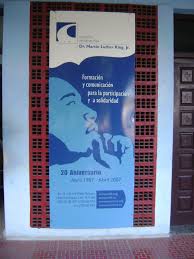
Martin Luther King, Jr. Center, Havana

In 2007 I heard directly from Rev. Raúl Suárez  about the circumstances surrounding the first meeting between Cuba’s Revolutionary government and the Cuban churches. This happened when I was with a group of Westminster Presbyterian Church members from Minneapolis that visited Havana’s Martin Luther King, Jr. Center, which is affiliated with the adjacent Baptist Church, where Rev. Suárez was the pastor.

Suárez told us that in 1984 he learned that Jesse Jackson, a candidate for the Democratic nomination for President that year, was coming to Cuba. Jackson said that Fidel Castro had invited him to discuss the status of 22 U.S. citizens then being held by the Cuban Government. Jackson said that he also wanted an invitation from a Cuban church so that he could participate in a religious service in Cuba. Jackson asked Suárez, then Executive Secretary of the Cuban Council of Churches and Director of International Relations of the Cuban Baptist Church, if that would be possible. Jackson also gave Suárez a letter to provide to Castro on this issue.

Suárez  then contacted Fidel, who responded that it would not be a problem even though atheism was the established “religion” in the Cuban constitution at the time.

Jackson made his trip to Cuba in June 1984 and gave a speech to 4,000 students at the University of Havana with Castro in attendance. Afterwards the two of them and their aides walked a few blocks to the nearby Methodist Church where Jackson would be preaching. As they neared the church, Suárez heard a Castro aide say to Fidel, “Take off your hat, you are close to a church.” Fidel took off his hat. Suárez was surprised by this comment and Fidel’s response. Suárez told Fidel that the people in the Plaza de Revolution (supporters of the Revolution) and the people in the church were one and welcomed Fidel to the church. Fidel said, do not ask me to preach.

There were 700 to 800 people in the church that day, including 35 church leaders and the Roman Catholic Archbishop (in 2007, a Cardinal). When Castro entered the church, the choir extemporaneously cried, “Fidel, Fidel, Fidel.” Castro did make a short speech from the pulpit with a cross behind him. (Another Cuban pastor who was present told me that Castro obviously felt uncomfortable with the Bible on the lectern and awkwardly put his hands behind his back.) Castro praised Dr. King and Jackson and said there was a need for more exchanges between the churches and the government.

Later that same day Suárez was invited to a dinner with Fidel and Jackson. This was the first time he had ever shaken Fidel’s hand, and Fidel asked him to come to the airport the next day to say goodbye to Jackson.

Soon thereafter Suárez asked for a meeting of religious leaders with Fidel and submitted to Fidel a document of concern about the official policy of atheism’s limiting the space for religion.

This resulted in a four-hour meeting between Fidel and about 14 Protestant leaders and the College of the Roman Catholic Bishops. Fidel expressed surprise at the Protestants, saying that when he was a boy in Jesuit schools, Roman Catholics disparaged Protestants. At the end of the meeting Castro made a covenant with these leaders: the churches will made an effort to understand “us” while Fidel and the Cuban Communist Party will make an effort to understand the churches. This agreement, said Fidel, should be easier for the churches than for the Party.

========================================================

[1] Díaz-Canel often is seen as a potential successor to Raúl Castro as President of Cuba.

[2] The Council was founded in 1941 as “a fellowship of churches, ecumenical groups, and other ecumenical organizations which confess Jesus Christ as Son of God and Savior, according to the holy scriptures of the Old and New Testaments, and seek to respond to their common calling, to the glory of God, Father, Son, and Holy Spirit.” It gives “unity to the Christian Churches of Cuba” to facilitate cooperation with other churches around the world. Its purposes include encouraging “dialogue between different movements and institutions as a means for churches to expand their ecumenical vocation of service, thus deepening their responsibilities towards society and all of God’s creation. [The Council] also promotes study, dialogue, and cooperation among Christians to increase Christian witness and enhance life in Cuba.” Its membership now includes 22 churches, 12 ecumenical groups and centers, 3 observers and 7 fraternal associates.


U.N. General Assembly Again Condemns U.S. Embargo of Cuba

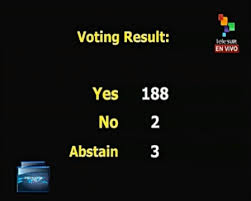
U.N. General Assembly Voting Results Screen
U.N. General Assembly   Voting Results Screen

On October 28, 2014, the U.N. General Assembly by a vote of 188 to 2 again condemned the U.S. embargo of Cuba. The two negative votes were cast by the U.S. and by Israel while three small Pacific nations abstained–Marshall Islands, Micronesia and Palau. All the other U.N. members supported the resolution. [1]

 The Resolution

The resolution [A/69/L.4] reiterated the General Assembly’s “call upon all States to refrain from promulgating and applying laws and measures of the kind referred to in the preamble to the present resolution [‘the economic, commercial and financial embargo imposed by the [U.S.] against Cuba’ and the Helms-Burton Act], in conformity with their obligations under the Charter of the United Nations and international law, which, inter alia, reaffirm the freedom of trade and navigation.”

The resolution also “again urges States that have and continue to apply such laws and measures [i.e., the U.S.] to take the steps necessary to repeal or invalidate them as soon as possible in accordance with their legal regime.”

Cuba’s Statement Supporting the Resolution

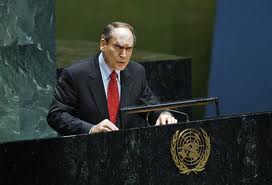
Bruno Rodriguez Parrilla

Bruno Rodríguez Parrilla, the Cuban Minister for Foreign Affairs, introducing the resolution, said that in recent times “the economic, commercial and financial blockade imposed by the [U.S.] against Cuba had been tightened, and its extraterritorial implementation had also been strengthened through the imposition of unprecedented fines, totaling $11 billion against 38 banks . . . for carrying out transactions with Cuba and other countries.” In addition, Cuba’s “accumulated economic damages of the blockade totaled $1.1 trillion . . . [and] human damages were on the rise.”

Nevertheless, “Cuba had offered every possible form of assistance to the [U.S.] in the wake of disasters there, such as in the aftermath of the September 11, 2001 terrorist attacks. Cuba had never been a threat to the national security of the [U.S.].  Opinion polls showed that there was increasing support from all sectors of [U.S.] society for lifting the blockade.  Religious leaders had citied legitimate, indisputable ethical and humanitarian reasons.“

In addition, ”the blockade was harmful to . . . the [U.S.]. The ‘absurd and ridiculous’ inclusion of Cuba on the [U.S.] list of States that sponsored international terrorism redounded to the discredit of the [U.S.].  Cuba would never renounce its sovereignty or the path chosen by its people to build a more just, efficient, prosperous and sustainable socialism.”  Neither, he continued, would his Government “give up its quest for a different international order, nor cease in its struggle for ‘the equilibrium of the world.’”

Rodríguez also invited the U.S. government “to establish a mutually respectful relation, based on reciprocity. We can live and deal with each other in a civilized way, despite our differences.”

Other Countries’ Statements Supporting the Resolution [2]

The following Latin American countries voiced support for the resolution: Argentina (MERCOSUR [3]) (embargo was “morally unjustifiable” and violated “the spirit of multilateralism and was immoral, unjust and illegal”); Barbados (CARICOM [4]); Bolivia (Group of 77 [5] and China); Brazil (Group of 77 and CELAC [6]); Colombia; Costa Rica (CELAC)); Ecuador; El Salvador (Group of 77 and CARICOM); Mexico; Nicaragua; St. Vincent and the Grenadines (CARICOM, Non-Aligned Movement, [7] Group of 77 and CELAC); Uruguay; and Venezuela.

The African supporters of the resolution that spoke were Algeria (Non-Aligned Movement, Group of 77, Group of African States [8] and Organization of Islamic Cooperation [9]); Angola; Kenya (Group of 77, Non-Aligned Movement and African Group); Malawi (African Group); South Africa (Group of 77, Non-Aligned Movement and African Group); Sudan (Group of 77, Non-Aligned Movement and Organization of Islamic Cooperation); United Republic of Tanzania; Zambia (Non-Aligned Movement) and Zimbabwe (Non-Aligned Movement, Group of 77 and African Group).

From Asia and the Pacific were Belarus; China (Group of 77); Democratic People’s Republic of Korea (North Korea); Indonesia (Group of 77);  India (Group of 77 and Non-Aligned Movement); Iran (Non-Aligned Movement); Lao People’s Democratic Republic; Myanmar (Group of 77 and Non-Aligned Movement); Russian Federation; Solomon Islands; and Viet Nam (Non-Aligned Movement, Group of 77 and China).

Middle Eastern countries speaking in favor of the resolution were Egypt, Saudi Arabia (Organization of Islamic Cooperation); and Syria (Non-Aligned Movement, Group of 77 and China).

The sole European supporter of the resolution that spoke at the session was Italy (European Union [10]), which said the U.S.’ “extraterritorial legislation and unilateral administrative and judicial measures were negatively affecting European Union interests”).

U.S. Statement Opposing the Resolution

Although Israel voted against the resolution, it chose not to speak in support of its vote. Only the U.S. by Ambassador Ronald D. Godard, U.S. Senior Advisor for Western Hemisphere Affairs, tried to justify the negative vote.

Ronald D. Godard
Ronald D. Godard

Ambassador Godard said the U.S. “conducts its economic relationships with other countries in accordance with its national interests and its principles. Our sanctions toward Cuba are part of our overall effort to help the Cuban people freely exercise their human rights and fundamental freedoms, and determine their own future, consistent with the Universal Declaration of Human Rights and the democratic principles to which the United Nations itself is committed.”

Ambassador Godard also said, “the Cuban government uses this annual resolution in an attempt to shift blame for the island’s economic problems away from its own policy failures. The Cuban government now publicly recognizes that its economic woes are caused by the economic policies it has pursued for the last, past half-century. We note and welcome recent changes that reflect this acknowledgement, such as those that allow greater self-employment and liberalization of the real estate market. But the Cuban economy will not thrive until the Cuban government permits a free and fair labor market, fully empowers Cuban independent entrepreneurs, respects intellectual property rights, allows unfettered access to information via the Internet, opens its state monopolies to private competition and adopts the sound macro-economic policies that have contributed to the success of Cuba’s neighbors in Latin America.”

According to Ambassador Godard, the U.S. “remains a deep and abiding friend of the Cuban people. The Cuban people continue to receive as much as $2 billion per year in remittances and other private contributions from the [U.S.]. This support . . . was made possible . . . by U.S. policy choices. By the Cuban government’s own account, the [U.S.] is one of Cuba’s principal trading partners. In 2013, the [U.S.] exported approximately $359 million in agricultural products, medical devices, medicine and humanitarian items to Cuba. Far from restricting aid to the Cuban people, we are proud that the people of the [U.S.] and its companies are among the leading providers of humanitarian assistance to Cuba. All of this trade and assistance is conducted in conformity with our sanctions program, which is carefully calibrated to allow and encourage the provision of support to the Cuban people.”

Furthermore, the U.S. “places the highest priority on building and strengthening connections between the Cuban people and [our] people. U.S. travel, remittance, information exchange, humanitarian and people-to-people policies updated in 2009 and 2011 provide the Cuban people alternative sources of information, help them take advantage of limited opportunities for self-employment and private property and strengthen independent civil society. The hundreds of thousands of Americans who have sent remittances and traveled to the island, under categories of purposeful travel promoted by President Obama, remain the best ambassadors for our democratic ideals.”

Ambassador Godard continued, “[The U.S.] strongly supports the Cuban people’s desire to determine their own future, through the free flow of information to, from, and within Cuba. The right to receive and impart information and ideas through any media is set forth in Article 19 of the Universal Declaration of Human Rights. It is the Cuban government’s policies that continue to prevent enjoyment of this right. The Cuban government now claims to share our goal of helping the Cuban people access the Internet. Yet the Cuban government has failed to offer widespread access to the Internet through its high-speed cable with Venezuela.  Instead, it continues to impose barriers to information for the Cuban people while disingenuously blaming U.S. policy.”

“Moreover, the Cuban government continues to detain Alan Gross, a U.S. citizen who was sentenced to 15 years in prison for facilitating Internet access for Cuba’s small Jewish community. [[11]] The [U.S.] calls on Cuba to release Mr. Gross immediately, [[12]] allow unrestricted access to the Internet, and tear down the digital wall of censorship it has erected around the Cuban people.

 {T]his resolution only serves to distract from the real problems facing the Cuban people. . . . Though Cuba’s contributions to the fight against Ebola are laudable, they do not excuse or diminish the regime’s treatment of its own people. We encourage this world body to support the desires of the Cuban people to choose their own future. By doing so, it would truly advance the principles the United Nations Charter was founded upon, and the purposes for which the United Nations was created.”

Media Coverage of the Resolution and Debate

 U.S. media coverage of this important U.N. vote was almost non-existent. It was not mentioned in the “World” or “Americas” news sections of the New York Times, and only its “Opinion” section had a short article about the issue. It got no mention whatsoever in the Wall Street Journal. Not even the Miami Herald, which has a separate page for Cuba news, mentioned it. [13]

At 2:37 p.m. on October 28th the Associated Press published a release on the subject, and the Washington Post published it online while the StarTribune of Minneapolis/St. Paul picked it up the next day in its online, but not its print, edition.

Cuba’s state-owned newspaper, Granma, of course, headlined this vote while stating that the embargo has caused $1.1 trillion of damage to the Cuban economy and “incalculable human suffering.” Its article also emphasized that this was the 23rd consecutive such resolution with a table showing that the number of votes in favor of the resolutions has increased from 59 in 1992 to 188 in 2012-2014, that the largest number of votes against the resolutions was only 4 in 1993 and 2004-2007 and that the number of abstentions has decreased from 71 in 1992 to 1 in 2005-2007 and now 3 since 2010.

Conclusion

This overwhelming international opposition to the U.S. embargo in and of itself should be enough to cause the U.S. to end the embargo. Moreover, the embargo has not forced Cuba to come begging to the U.S. for anything that the U.S. wants. The U.S. policy is a failure. The New York Times recently called for abandonment of this policy as has this blog in urging reconciliation of the two countries, in an open letter to President Obama and in a rebuttal of the President’s asserted rationale for the embargo and other anti-Cuban policies.

==============================================================

[1] This post is based upon the sources embedded above and upon U.N. General Assembly Press Release [GA/11574], As General Assembly Demands End to Cuba Blockade for Twenty-Thjrd Consecutive Year, Country’s Foreign Minister Cites Losses Exceeding $1 Trillion (Oct. 28, 2014); Londoño, On Cuban Embargo, It’s the U.S. and Israel Against the World, Again, N.Y. Times (Oct. 29, 2014); Associated Press, UN General Assembly Condemns US Cuba Embargo (Oct. 28, 2014); U.S. Dep’t of State, Explanation of Vote by Ambassador Ronald D. Godard on the Cuba Resolution in the General Assembly Hall (Oct. 28, 2014). The General Assembly also has videos of the debate (A and B). A prior post reviewed the 2011 General Assembly’s adoption of a similar resolution against the embargo.

[2] Many of the cited statements supporting the resolution were issued on behalf of, or aligned with, larger groups of nations as noted above. In addition, prior to the October 28th session of the General Assembly, the U.N. Secretary General submitted a report containing statements against the embargo from 154 states and 27 U.N. agencies.

[3] MERCOSUR (Southern Common Market) is a customs union and trading bloc of five South American countries with five other associate members in the continent.

[4] CARICOM (Caribbean Community) is a group of 15 Caribbean countries with five associate members for economic cooperation.

[5] The Group of 77 was established in 1964 by 77 developing countries to promote their collective economic interests and South-South cooperation; now there are 134 members that have retained the original name for historical significance.

[6] CELAC (Community of Latin American and Caribbean States) is a group of 33 states in the region to deepen economic integration and combat the influence of the U.S.

[7] The Non-Aligned Movement is a group of 115 developing countries that are not aligned with or against any major power bloc. Its current focus is advocacy of solutions to global economic and other problems

[8] The African Group is a group of 54 African states that are U.N. Members.

[9] The Organization of Islamic Cooperation is a group of 57 states that seek to protect the interests of the Muslim world in the spirit of promoting peace and harmony in the world.

[10] The European Union is a group of 28 European states that have combined for a peaceful, united and prosperous Europe.

[11] The activities in Cuba by Mr. Gross are not so simple. A Cuban court in 2011 found him guilty of participating in a “subversive project of the U.S. government that aimed to destroy the revolution through the use of communications systems out of the control of authorities,” and sentenced him to 15 years in prison. According to his own lawsuit against the U.S. Government, and subsequent disclosures, Gross alleged the U.S. Agency for International Development (USAID) and its contractor, DAI, sent him on five semi-covert trips to Cuba without proper training, protection or even a clear sense of the Cuban laws that led to his detainment. The case highlighted the frequent haste and lack of attention to the risks of the USAID programs in Cuba under the Helms-Burton Act, which allowed for money to be set aside for “democracy building efforts” that might hasten the fall of Fidel and Raúl Castro.

[12] In discussions with the U.S., Cuba already has expressed a willingness to exchange Mr. Gross for one or more of the three of “the Cuban Five” who remain in U.S. prisons.

[13] Nor did I find any mention of the vote in London’s Guardian or Madrid’s El Pais.


New York Times Commends Cuba for Fighting Ebola in West Africa and Again Urges U.S.-Cuba Normalization

In an October 19th editorial, titled “Cuba’s Impressive Role on Ebola,” the New York Times applauds Cuba for “having pledged to deploy hundreds of medical professionals to the front lines of the pandemic,” for already having 165 medical professionals on the ground in West Africa and for standing “to play the most robust role among nations seeking to contain the virus.” Cuba, therefore, “should be lauded and emulated.”

In contrast, says the Times, the U.S. and several other wealthy countries only have pledged funds to fight the disease. “It is a shame that Washington, the chief donor in the fight against Ebola, is diplomatically estranged from Havana, the boldest contributor” and that “American and Cuban officials are not equipped to coordinate global efforts at a high level.”

This most unfortunate situation “should serve as an urgent reminder to the Obama administration that the benefits of moving swiftly to restore diplomatic relations with Cuba far outweigh the drawbacks” as was argued in a prior Times editorial and emphasized in a recent post to this blog.

Under these circumstances, the U.S. should be ready, willing and able (a) to treat and transport any Cuban health workers in Africa who become infected; (b) to “commit to giving any sick Cuban access to the treatment center the Pentagon built in Monrovia [Liberia] and to assisting with evacuation.” The Obama Administration, however, has “callously declined to say what, if any, support they would give [the Cubans].”[1]

The Times also notes that Fidel Castro in an October 19th essay in the Cuban newspaper, Granma, said that Cuba “will gladly cooperate with U.S. personnel in this task [of combatting Ebola], not in search of peace between these two states which have been adversaries for so many years, but rather, in any event, for World Peace, and objective which can and should be attempted.” According to the Times, “[Fidel’s] absolutely right.” [2] His essay also commented on Cuba’s hosting on October 20th the Extraordinary Summit of the ALBA-TCP on Ebola as discussed in another article in Granma.

[1] The failure of the Obama Administration to embrace Cuba’s heroic contributions to the fight against Ebola unfortunately is consistent with the Administration’s pathetic pseudo-rebuttal of the many arguments for normalization of U.S.-Cuba relations as discussed in a prior post.

[2] In an another recent essay Castro impliedly endorsed the New York Times editorial calling for normalization of U.S.-Cuba relations while he quoted virtually all of the editorial itself without any disagreement (with one exception), even to the editorial’s criticism of the Cuban economy and its treatment of dissidents. See also Londoño, Still Pondering U.S.-Cuba Relations, Fidel Castro Responds, N.Y. Times (Oct. 14, 2014).

U.S.’ Secret Cuban Social Media Program Raises Questions about the Validity of Criticisms of Cuba by the U.S. Commission on International Religious Freedom

On April 3, 2014, the Associated Press (AP) reported that the U.S. Agency for International Aid (USAID) had been providing financial support from 2008 through 2012 for “a secret plan to build a social media project aimed at undermining Cuba’s communist government.” This “messaging network . . . [was designed to] reach hundreds of thousands of Cubans.” “To hide the network from the Cuban government, [there was a] byzantine system of front companies using a Cayman Islands bank account, and . . . [recruitment of] unsuspecting executives who would not be told of the company’s ties to the U.S. government.”

According to the AP, after an initial period of creating non-political messages for this social media program, the U.S. planed to “introduce political content aimed at inspiring Cubans to organize ‘smart mobs’ — mass gatherings called at a moment’s notice that might trigger a Cuban Spring, or, as one USAID document put it, “renegotiate the balance of power between the state and society.” In short, the social media program aimed to promote regime change in Cuba.

U.S. Government’s Responses to the AP Report

The U.S. Government responded to the AP article the same day by essentially confirming the existence of the social media program while playing word games over whether it was a covert operation and saying it was not aimed at changing the Cuba regime.

At an April 3rd press briefing, President Obama’s Press Secretary, Jay Carney, implicitly admitted the existence of this secret program while claiming it was not covert and was pursuant to congressionally authorized funding. He said, “suggestions that this was a covert program are wrong. . . . In implementing programs in non-permissive environments, of course the government has taken steps to be discreet.”

An USAID spokesman the same day said essentially the same thing. “Of course, [in] the implementation, . . the [U.S.]government [has] taken steps to be discreet in non-permissive environments . . . .  That’s how you protect the practitioners and the public. In hostile environments, we often take steps to protect the partners we’re working with on the ground. This is not unique to Cuba.”

USAID also issued an April 3rd statement that did not deny the AP’s report. Instead, the agency said, “It is longstanding U.S. policy to help Cubans increase their ability to communicate with each other and with the outside world. Working with resources provided by Congress for exactly this purpose, USAID is proud of its work in Cuba to provide basic humanitarian assistance, promote human rights and universal freedoms, and to help information flow more freely to the Cuban people.  All of our work in Cuba, including this project, was reviewed in detail in 2013 by the Government Accountability Office and found to be consistent with U.S. law and appropriate under oversight controls.”

USAID added, “It is also no secret that in hostile environments, governments take steps to protect the partners we are working with on the ground.” This was a backhanded way of admitting that the U.S. government’s involvement in this Cuban social media program was intentionally kept secret.

The U.S. State Department’s April 3rd briefing parroted these remarks. The spokesperson said, “there was nothing classified or covert about this program. Discreet does not equal covert.” She added, the funding was notified to Congress in a 2008 congressional notification titled “Outreach to New Sectors of Cuba Society” for the amount of $6,850,000 for a number of programs, including this one.” Moreover, the spokesperson alleged the U.S. was not “ somehow trying to foment unrest . . . [or] to advance a specific political agenda or point of view.” However, Senator Patrick Leahy has said he was not briefed on the program.

Yes, the U.S. Government Accountability Office investigated and last year issued a “clean bill of health” report on the U.S. “Cuba Democracy Assistance” programs, without mentioning the social media program. This report said that USAID and “Department of State .  . . provide democracy assistance for Cuba aimed at developing civil society and promoting freedom of information. Typical program beneficiaries include Cuban community leaders, independent journalists, women, youths, and marginalized groups.”[1]

Other U.S. Government Programs Directed at Cuba

The recent Cuban social media project must be seen in light of at least three other U.S. programs directed at and against Cuba.

First is the George W. Bush Administration’s creation in 2003 of the U.S. Commission for Assistance to a Free Cuba. It was directed it to report with recommendations for a comprehensive program to (i) “Bring about a peaceful, near-term end to the [Cuban] dictatorship;” (ii) “Establish democratic institutions, respect for human rights and the rule of law [in Cuba];” (iii) “Create the core institutions of a free economy [in Cuba];” (iv) “Modernize [Cuban] infrastructure;” and (v) “Meet [Cuban] basic needs in the areas of health, education, housing and human services.”

This Commission issued a report in May 2004 that stated “Religious organizations, including Catholic and certain authentically independent Protestant denominations, represent the fastest growing and potentially fastest growing alterative to the Cuban state in providing basic services and information to the Cuban people.” (P. 20; emphasis added.)

The rest of this report makes clear that the Commission believed that only evangelical Christian groups were authentically independent and should be used by the U.S. to build a free Cuba. According to this report, they had “the trust of the people and the means to organize through an existing social network of communications and distribution channels at all levels of society.”[i]

The report also called for the U.S. to avoid trying to use the Cuban Council of Churches, which the U.S. Commission believed had been “taken over by the Castro regime in the early 1960s and used as a means to control the Protestant churches.” (P. 64.) However, most of the clergy and laity of churches that belong to the Council, the Commission asserted, were “not sympathasizers of Castro and the communists and therefore should not be denied assistance or a role in Cuban religious affairs due to ‘guilt by association.” (P. 64)

The second other U.S. program directed against Cuba was the George W. Bush Administration’s 2005 creation of the position of Cuba Transition Coordinator in the State Department to implement the recommendations of the Commission for Assistance to a Free Cuba. Or in the words of then-Secretary of State, Condoleeza Rice, the position’s purpose was to “accelerate the demise of Castro’s tyranny.” In more practical terms, this position was charged with allocating millions of dollars in U.S. funding to Cuban dissidents and their U.S. supporters.

The third other program directed against Cuba is Radio y Televisión Martí, a radio and television broadcaster based in Miami, Florida that is financed by the U.S. Government (Broadcasting Board of Governors) and that transmits pro-democracy newscasts to Cuba.

U.S. Commission on International Religious Freedom Reports on Cuba

Another U.S. commission—the Commission on International Religious Freedom– in its annual reports consistently has been very critical of that freedom in Cuba.

This Commission has placed Cuba in its “Watch List,” now called its “Tier 2” list of countries “where religious persecution and other violations of religious freedom engaged in or tolerated by the governments are increasing” or is “on the threshold of . . . [‘Countries of Particular Concern’] status—because the  “violations engaged in or tolerated by the government are particularly severe and that at least one, but not all three, of the elements of [the governing statute’s] ‘systematic, ongoing, egregious’ standard is met (e.g., the violations are egregious but not systematic or ongoing).”

The Commission apparently based its very negative appraisal of Cuba in its most recent  report for 2012 (issued in 2013) on the following grounds with respect to the Cuban government:

  •  alleged arrests and mistreatment of evangelical pastors, especially Pentacostal pastor Reutilio Columbie;
  • alleged arrests of human rights/democracy activists, including the Ladies in White, which prevented them for attending mass; and
  • alleged harassment of Cuba’s Apostolic Reformation Movement and the Western Baptist Convention by allegedly making “short-term arrests of [their] leaders, confiscation, destruction or threats of destruction of church property; harassment and surveillance of church members and their relatives; fines of churches; and threats of losses of job, housing or educational opportunities….”

This Blog’s Prior Critiques of the Commission’s Assessment of Cuba

This blog has criticized the Commission’s reports on Cuban religious freedom for 2010, 2011 and 2012.

First, as the Commission reports themselves proclaim, there have been “improvements” or “[p]ostive developments” for the religious freedom of most of the religious organizations on the island. The most recent report states:

  • “Positive developments for the Catholic Church and major registered Protestant denominations, including Baptists, Pentecostals, Presbyterians, Episcopalians, and Methodists, continued over the last year. The State Department reports that religious communities were given greater freedom to discuss politically sensitive issues. Catholic and Protestant Sunday masses were held in more prisons throughout the island. Religious denominations continued to report increased opportunities to conduct some humanitarian and charity work, receive contributions from co-religionists outside Cuba, and obtain Bibles and other religious materials. Small, local processions continued to occur in the provinces in 2012. The government granted the Cuban Council of Churches time for periodic broadcasts early Sunday mornings, and Cuba’s Roman Catholic Cardinal read Christmas and Easter messages on state-run stations.”
  • “Relations between the Catholic Church and Cuban government continued to improve. March 2012 marked the 400th anniversary of the appearance of the Virgin de Caridad de Cobre (Our Lady of Charity), Cuba’s patron saint. Pope Benedict XVI travelled to Cuba March 26-29 to participate in the celebrations, at which time he met Fidel Castro and Cuban President Rául Castro. Throughout the year, a replica of the Our Lady of Charity statue toured the island drawing large crowds. Prior to the Pope’s visit, 13 individuals occupied the Church of Charity of Cobre in Central Havana seeking an audience with His Holiness. The government removed, but did not charge, the individuals at the request of the Church.”

Second, the Commission’s statements about positive developments cover, I submit, most of the religious organizations and believers in Cuba, whereas the organizations cited by the Commission for its harsh judgments are the distinct minority. That, of course, does not excuse the Cuban government from committing any of the alleged acts regarding these organizations and believers, if that in fact is the case.

Third, the Commission’s complaint about the treatment of “human rights/democracy activists,” if they are substantiated by evidence, are really complaints about violations of human rights other than religious freedom. Therefore, they do not really belong in the limited scope of the Commission’s mandate.

Fourth, the Commission apparently is unable to put itself in the shoes of the Cuban government, which for many years has had to contend with the super power of the North, which has consistently taken hostile actions against the island, including those of the “Cuba Democracy Assistance” program. The wise words of Matthew 7: 5 come to mind: “You hypocrite, first take the log out of your own eye, and then you will see clearly to take the speck out of your neighbor’s eye.”

Conclusion

This blogger concludes that the revelation yesterday of the U.S. secret social media program for Cuba as part of the U.S.’ so called “Cuba Democracy Assistance” programs should raise serious questions about the legitimacy of the conclusions on Cuban religious freedom coming from the U.S. Commission on International Religious Freedom.

Specifically, there should be an independent investigation of whether Cuba’s Apostolic Reformation Movement, its Western Baptist Convention and pastor Reutilio Columbie have received or are receiving any funding or other support from the U.S. Government, including USAID, the Central Intelligence Agency, the State Department and the Commission on International Religious Freedom itself. I hope that this is not the case.

More generally, such an investigation should determine whether the harshly negative views of the Commission on International Religious Freedom are being driven by the philosophy and objectives of the Cuba Assistance Programs. Again I hope this is not the case.

———————————–

[1] The Cuban government also reacted to the AP article by saying in Granma it “confirms the repeated complaints of the Cuban government. It shows once again that the U.S. government has not given up its subversive plans against Cuba, which aim to create situations of destabilization in the country to bring about change in our political system and which continues to devote multimillion dollar budgets each year. The U.S. government must respect international law and the purposes and principles of the Charter of the United Nations and, therefore, cease its illegal and covert actions against Cuba, which are rejected by the Cuban people and the international public opinion.”