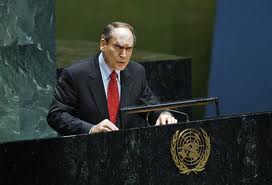
The Non-Aligned Movement Holds Summit in Venezuela

On September 17 in Venezuela Raúl Castro addressed the Summit of the Non-Aligned Movement (NAM), an organization of 120 states that advocates for solutions to global economic and other problems.[1] We will review that speech and the Summit’s concluding Declaration before making observations about this event.

Castro’s Speech

For Cuba, he said, “non – alignment means the struggle to radically change the international economic order imposed by the great powers, which has led to 360 people possessing a higher income than 45% of the world population annual wealth. The gap between rich and poor countries is growing. Technology transfer from North to South is an elusive aspiration.”

“Globalization mainly favors a select group of industrialized countries. The debt of southern countries multiplies. . . . [Mamy] people are pushed into unemployment and extreme poverty; millions [of] children die each year from hunger and preventable diseases; almost 800 million people cannot read or write, while more than 1.7 [billion] dollars are devoted to military spending.”

Castro reported that it has been “21 months since we announced simultaneously with President Barack Obama, the decision to restore diplomatic relations between Cuba and the United States.”

“There has been some progress, especially in the diplomatic arena and cooperation on issues of mutual interest, but has not been the same in the economic and commercial sphere, due to the limited scope, while positive, of the measures taken so far by the American government.”

“Cuba will continue to demand the lifting of the economic, commercial and financial blockade that [had caused] much damage and deprivation to Cuba and that also affects many countries for its extraterritorial scope.” Cuba also “will continue to demand that our sovereignty is returned to the territory illegally occupied by the US Naval Base in Guantanamo. Without [these and other changes by the U.S.] there can be no normal relations [between the two countries].”

Nevertheless, “we reaffirm the will to sustain civilized coexistence relations with the United States, but Cuba will not give up one of its principles, or . . . make concessions inherent in its sovereignty and independence. It will not relent in defending their revolutionary and anti-imperialist ideals, [or] in supporting self-determination of peoples.”

Castro also rejected any attempts to “regime change” and reaffirmed rejection of any country’s “resorting to aggression and use of force,” and “commitment to the principles of the United Nations Charter and International law; [to peaceful resolution of disputes] and full respect for the inalienable right of every state to choose its political, economic, social and cultural system as an essential condition to ensure coexistence among nations.”

More specifically Castro reaffirmed (a) Cuba’s “unconditional support for the government and Venezuelan people, the civil-military union and the constitutional President Nicolas Maduro Moros;” (b) Cuba’s rejection of the parliamentary “coup” in Brazil against President Dilma Rousseff; (c) Cuba’s support of Colombia’s “implementing the Agreement” with the FARQ; (d) Cuba’s support of “the people of the Syrian Arab Republic resolving their “without external interference aimed at promoting regime change, . . . “the creation of an independent Palestinian state with East Jerusalem as its capital, . . . the self-determination of the Saharawi people, . . . the historical demand of the Puerto Rican people towards self-determination and independence, . . . [and] the claim of Argentina over the Falkland Islands, South Sandwich and South Georgia;” and (e) Cuba’s congratulations to “the Islamic Republic of Iran for his work in the recently concluded mandate.”

Castro’s concluded with this assertion: “The only alternative to the enormous dangers and challenges ahead is unity and solidarity in defense of our common goals and interests.”

Summit’s Declaration[2]

The Summit’s Declaration concluded with a 21-point statement of NAM objectives: (1) consolidate and revitalize NAM; (2) consolidation of the international order; (3) the right to self-determination; (4) disarmament and international security; (5) human rights; (6) condemnation of unilateral sanctions; (7) condemnation of terrorism; (8) dialogue among civilizations; (9) support for Palestine; (10) reform of the U.N. Security Council and General assembly; (11) selection and appointment of new U.N. Secretary-General; (12) U.N. peace-keeping operations; (13) sustainable development goals; (14) promotion of education, science and technology for development; (15) climate change; (16) reforming the international economic governance; (17) South-South cooperation (18) international solidarity in combatting pandemics; (19) support for refugees and migrants; (20) young women, peace and security; and (21) new world order of information and communication.

Conclusion

These words of Raúl Castro were nothing new.

The real news from the NAM Summit was the low turn-out. Of the 120 NAM members only 13 attended, including the leaders of Cuba, Iran, Palestine, Ecuador, Bolivia and Zimbabwe and the Venezuelan host.

Venezuela’s President Nicolas Maduro called the meeting as an opportunity to increase international solidarity for his socialist government as the oil-dependent economy reels from widespread food shortages and triple digit inflation. However, according to observers, the low attendance indicates that almost all of the NAM members were not interested in engaging in such solidarity with this country under these circumstances.[3]

Nevertheless, Maduro spoke defiantly at the Summit about Venezuela’s problems, blaming them on the country’s foreign enemies. “Venezuela is facing a global attack, which is against all of Latin America and Caribbean. An attack that aims to impose a political, economic and cultural reorganization of our countries with the old oligarchy.”

As repeatedly stated, this blog concurs that the U.S. should end its embargo (blockade) of Cuba and that the peace agreement between the government of Colombia and the FARQ is to be applauded and hopefully will be approved in the October 2 referendum in that country. I also agree that Cuba and the other NAM members have the right to organize and advocate their many other positions.This blog, however, disagrees with Cuba’s allegation that the U.S. is illegally occupying Guantanamo Bay.

Finally soon after the NAM Summit,  President Maduro met with U.S. Secretary of State John Kerry when both were in Cartagena Colombia for the signing of the Colombia-FARQ peace agreement. The next day on his regular television show in his country, Maduro, mentioning his 40-minute meeting with Kerry, said, “I ask that God bless the results of the meeting [with Kerry] and that Venezuela opens a new era of relations with the United States.” He also said that veteran U.S. diplomat Tom Shannon, who has been the U.S. point man for the troubled relationship, will visit Caracas again soon and that an invitation was open to Kerry.[4]

The U.S. State Department, acknowledging the meeting, said, “The Secretary expressed our commitment to the well-being of the Venezuelan people, and our willingness to work with all sectors of Venezuelan society to enhance our relationship. He also spoke of our concern about the economic and political challenges that have affected millions of Venezuelans, and he urged President Maduro to work constructively with opposition leaders to address these challenges.” In addition, the Department said that “Kerry stressed our support for democratic solutions reached through dialogue and compromise” and that the two men “agreed to continue the bilateral discussions begun in recent months.”[5]

==============================================

[1] Castro, The only alternatives to the enormous dangers and challenges is unity and solidarity, Granma (Sept. 17, 2016).

[2] Declaration of the XVII Summit of Heads of State and Government of the Non-Aligned Movement (NAM), Granma (Sept. 18, 2016).

[3] Assoc. Press, Venezuela’s Crisis Keeps Non-Aligned Summit Turnout Low, N.Y. Times (Sept. 17, 2016); Reuters, Venezuela Summit Draws Few Leaders in Blow to Maduro, N.Y. Times (Sept. 17, 2016); Reuters, Maduro Revels in Support From Zimbabwe, Iran as Critics Decry Failed Summit, N.Y. Times (Sept. 19, 2016);  Castro, Venezuela closes the summit of non-aligned countries amid criticism, El Pais (Sept. 18, 2016).

[4] Reuters, Venezuela’s Maduro Calls for New Era of Relations With U.S., N.Y.Times (Sept. 27, 2016).

[5] U.S. State Dep’t, Secretary Kerry’s Meeting with Venezuelan President Maduro (Sept. 26, 2016).



Raúl Castro Discusses Cuba-U.S. Relations in Report to Seventh Congress of the Communist Party of Cuba 

The major event of the first day (April 16) of the four-day Seventh Congress of the Communist Party of Cuba was the two-hour, live televised address by Raúl Castro, the First Secretary of its Central Committee (and also President and General of the Army).[1] Most of this address concerned the country’s internal socio-economic and other issues, which will be covered in a subsequent post, while a prior post provided an overview of the Congress. This post will focus on his discussion of Cuba-U.S. relations. Here is what he had to say on that subject near the end of the speech along with this blogger’s reactions.

Castro’s Remarks

“Fifteen months have transpired since we announced, simultaneously with President Barack Obama, the decision to reestablish diplomatic relations between Cuba and the United States, on the basis of sovereign equality, non-interference in domestic affairs, and absolute respect for our independence. Hours before this speech, Fidel’s promise to the Cuban people was kept, with the completion of the return to the homeland of the Cuban Five.”

“We have reached this point thanks to the heroic resistance and sacrifice of the Cuban people, and their loyalty to the Revolution’s ideals and principles, supported by decisive international solidarity, made clear in multiple events and international organizations, in particular the overwhelming votes in the United Nations General Assembly against the blockade.”

“The political map of Our America had changed, given the advance of political forces on the left and popular movements, which contributed to progress in regional integration, symbolized by the constituting of the Community of Latin American and Caribbean States (CELAC), in December of 2011.”

“All of this placed the [U.S.] in an untenable situation of isolation within the hemisphere, and put the so-called inter-American system in crisis, as was made evident by the demand to end the blockade and opposition to the exclusion of Cuba from the 6th Summit of the Americas in Cartagena, in 2012.”

“On the other hand, changes have been occurring in U.S. society, and in the Cuban émigré community, in favor of the modification of the [U.S.’] policy toward Cuba.”

“In April of last year, we attended the 7th Summit of the Americas in Panama, with our heads held high. . . .”

“Throughout the period . . . since December of 2014, concrete results have been achieved in the dialogue and in cooperation between Cuba and the [U.S.] Nevertheless, the economic, commercial and financial blockade, imposed more than half a century ago, remains in force, with unquestionably intimidating, extraterritorial effects, although we recognize the position taken by President Obama and high-ranking administration officials against the blockade, and their repeated appeals to Congress in the interest of eliminating it.”

“The measures announced prior to [President Obama’s] visit to Havana, to introduce some modifications in the blockade’s implementation, on the basis of his executive powers, are positive but insufficient.”

“As we expressed in the meeting between the two Presidents with the press, to advance toward normalization of relations, it is imperative to eliminate the blockade, which causes our population hardship and constitutes the principal obstacle to economic development of the country; and return the territory illegally occupied by the Guantánamo Naval Base against the will of the Cuban government and people.”

“Likewise, [U.S.] programs directed toward changing the political, economic and social system, which we have chosen sovereignly, must be ended, along with other damaging policies still in effect.”

U.S. immigration “policy continues to be used as a weapon against the Revolution. The Cuban Adjustment Law, the “wet foot-dry foot” policy, and the Parole program for Cuban medical professionals remain in effect, to encourage illegal and unsafe emigration, and seeking to deprive us of qualified personnel.”[2]

“These practices do not reflect the stated change of policy toward Cuba, and generate difficulties for third countries.”

“There are more than a few U.S. government officials who upon recognizing the failure of their policy toward Cuba, make no attempt to disguise their affirmations that the goals remain the same, only the means are being modified.”

“We are willing to carry out a respectful dialogue and construct a new type of relationship with the [U.S.], one which has never existed between the two countries, because we are convinced that this alone could produce mutual benefits.”

“However, it is imperative to reiterate that no one should assume that to achieve this Cuba must renounce the Revolution’s principles, or make concessions to the detriment of its sovereignty and independence, or forego the defense of its ideals or the exercise of its foreign policy – committed to just causes, the defense of self-determination, and our traditional support to sister countries.”

“As the Constitution of the Republic stipulates, ‘Economic, diplomatic or political relations with any other state can never be negotiated under aggression, threats, or coercion by a foreign power.’”

“The road to normalization of bilateral ties is long and complex, and we will advance to the extent we are capable of putting into practice the art of civilized coexistence, or in other words, accept and respect our differences which are, and will be, profound; not making them the center of our relations, but rather concentrating on what brings us closer and not what separates us, promoting what is beneficial to both countries.”

“Relations with the [U.S.] have historically represented a challenge for Cuba, given their permanent pretension of exercising domination over our nation, and the determination of Cubans to be free and independent, regardless of the dangers to be faced, or the price we would have to pay.”

“The people’s unity with the Party, its profound patriotism and political culture, which have allowed us to confront the policy of aggression and hostility, will serve as a shield to defeat any attempt to undermine the revolutionary spirit of Cubans. This will be a challenge, especially for the youngest, who the Party recognizes as the continuators of the Revolution’s work and of the patriotic convictions of their grandparents and parents.”

Castro then launched into a defense of its Latin American allies against an unnamed foe (the U.S.):

  • “Latin America and the Caribbean find themselves experiencing the effects of a strong, articulated counteroffensive, on the part of imperialism and oligarchies, against revolutionary and progressive governments, in a difficult context marked by the deceleration of the economy, which has negatively impacted the continuity of policies directed toward development and social inclusion, and the conquests won by popular sectors.”
  • “This reactionary attack uses methods and technologies specific to the new doctrine of unconventional war, especially in the area of communications and culture, without ruling out attempts at destabilization and coups.”
  • “This policy is principally directed toward the sister Bolivarian Republic of Venezuela, and has been intensified in recent months in Bolivia, Ecuador, and Brazil, as well as Nicaragua and El Salvador.”
  • “Recent setbacks for governments of the left in the hemisphere are being used to announce the end of a progressive historical cycle, opening the way for the return of neoliberalism and demoralization of political forces and parties, social movements and working classes, which we must confront with more unity and increased articulation of revolutionary action.”
  • “We hold the firm conviction that the Venezuelan people will defend the legacy of our beloved compañero Hugo Chávez Frías, and prevent the dismantling of the accomplishments achieved. To the Bolivarian and Chavista Revolution, to President Maduro and his government, and to the civic-military union of the Venezuelan people, we reiterate our solidarity, our commitment, and energetic rejection of efforts to isolate Venezuela while dialoging with Cuba.”
  • “We demand that the sovereignty and independence of states be respected, and that interference in domestic affairs cease. At the same time, we reaffirm our firm support to all revolutionary and progressive governments, headed by prestigious leaders, whose economic and social policies have led to justice, dignity, sovereignty, and tangible benefits for the great majority, in the world’s most unequal region.”
  • “Also being renewed are efforts by the [U.S.] and their allies to undermine unity and the process of regional integration, frustrate the advance of CELAC, ALBA, UNASUR, and others, through a supposed reform of the inter-American system, in particular the OAS, attempting to promote the leading role of other schemes more compatible with their hegemonic interests.”
  • “We will never forget that the OAS – the Organization of American States – founded by the [U.S.]during the second half of the past century, at the beginning of the Cold War, has only served interests which contradict those of Our America. This organization, rightly described as the “Ministry of colonies” of the [U.S.] by the Foreign Minister of Dignity, compañero Raúl Roa García, was the one that sanctioned Cuba, and was ready to offer support and recognition to a puppet government, if the mercenary invasion at Playa Girón [Bay of Pigs] had been successful. The list of actions it took against the nascent Cuban Revolution, and other revolutionary and progressive governments, is interminable.”

Cuba’s diatribe against the U.S. was broadened to include the rest of the world with this statement by Castro: “Increasingly more serious are threats to international peace and security, as a result of U.S. imperialism’s attempts to impose its hegemonic position in the face of changes in the world’s equilibrium, and of the philosophy of usurpation and control of strategic natural resources, made evident by the increasingly offensive and aggressive military doctrine of NATO; the proliferation of non-conventional wars under the pretext of fighting “international terrorism;” the sharpening of differences with Russia and China; and the danger of a war in the Middle East of incalculable dimensions.”

Earlier in the address, Castro sought to rebut U.S. complaints about Cuban human rights with these words: Cuba is a party to 44 international treaties on human rights while the U.S. is only party to 18.[3] Moreover, “equal pay for equal work, whether for a man or woman, is a human right [in Cuba]. In other countries, including the [U.S., it is not, women earn less and thus dozens of supposed human rights can be cited. Free medical care in Cuba is a human right. In many other countries, this is not a human right, it is a business. In our country, education is free, in how many countries of the world is education free? It’s a business, too. That is, we will discuss this issue of human rights with anyone and anywhere whatsoever, and we will recognize those who are in the right.”

Raúl then made a joke about political rights. “When they say to me that in Cuba there is only one party. And I answer them, ‘Yes, like you, you have a single party,’ and the North Americans answer me: “No, we have two.” And as if I did not know, they tell me their names, ‘Democratic and Republican.’ ‘Correct, that’s right, it’s the same as if we were to have two parties in Cuba, Fidel would head one and I the other.’”

Conclusion

Given the prior public positions of the Cuban government, Castro did not say anything new on the subject of Cuba-U.S. relations. As expressed in many earlier posts, I agree that the U.S. should end its embargo of Cuba, its special immigration policies regarding Cubans and its covert or “discreet” programs purportedly promoting democracy in Cuba.

I also recognize that Cuba repeatedly has alleged that the U.S. occupation of Guantanamo Bay is illegal, but saying so does not make it so, and this blog has suggested that the dispute on this issue is unlikely to be resolved in discussions and negotiations, but instead should be submitted for resolution to an independent court like the International Court of Arbitration at the Hague along with any damage claims asserted by Cuba with respect to the embargo.

Another point of disagreement with Castro is his assertion that the U.S. goal of Cuban regime change is the same, but that the means have changed. Yes, the U.S. vigorously advocates for the right of Cubans to elect their leaders by popular vote, for the right of Cubans to protest and demonstrate against the government and to express their opinions without arrest and arbitrary detention and for the empowerment of Cubans to engage in self-employment and business. If they had such rights, that might lead to changes in the Cuban economy and government, but those changes would be chosen by the Cuban people, not imposed upon them by the U.S.

=========================================================

[1] Congress documents will be submitted to a broad discussion, Granma (April 16, 2016); 7th Party Congress underway, Granma (April 16, 2016); Raúl Castro, Central Report to 7th Congress of Communist Party of Cuba, Granma (April 16, 2016) (text in original Spanish); Raúl Castro, Central Report to 7th Congress of Communist Party of Cuba,  Granma (April 17, 2016) (text in English translation); Burnett, Raúl Castro Urges Cubans to Remain Alert to U.S. Efforts to Alter Communist System, N.Y. Times (April 16, 2016); Reuters, Castro Hardens Rhetoric, Warns Cubans to Be Alert to U.S. Intentions, N.Y. Times (April 16, 2016); Assoc. Press, Raul Castro Presents Grim Picture of Cuban Reforms, N.Y. Times (April 16, 2016); Torres, Raúl Castro proposes age limits on key jobs in CCP, Miami Herald (April 16, 2016);Raúl Castro derides US democracy in speech to Cuban Communist Party, Guardian (April 16, 2016); Editorial, Rhetoric and reality in Cuba, El Pais (April 17, 2016).

[2] Earlier in the speech Castro said, “Illegal and disorderly emigration of youth and specialists from various sectors is encouraged under the Cuban Adjustment Act, the “wet foot-dry foot” policy and the Parole Program, that is, permission to reside in the United States, granted with absolute speed, for our doctors, who provide services abroad.”

[3] Castro did not list the human rights treaties in question, and this blogger has not attempted to verify the assertion that Cuba was a party to 44 such treaties. Prior posts have pointed out that the U.S. is a party to 16 major such treaties while signing, but not ratifying 9 others and not signing and ratifying 7 others: Multilateral Human Rights Treaties Ratified by the U.S. (Feb. 9, 2013); Multilateral Treaties Signed, But Not Ratified by the U.S. (Feb. 12, 2013); Multilateral Human Rights Treaties That Have Not Been Signed and Ratified by the U.S. (Feb. 16, 2013)

Cuban Communist Party Holding Its Seventh Congress

CongressOn April 16-19 the Communist Party of Cuba will hold its Seventh Congress to set the country’s economic path through 2030.[1]

Granma, the Party’s official newspaper, reported that he Congress will work in four commissions or committees on the following topics: (1) “the conceptualization of Cuba’s socio-economic model;” (2) “the development plan . . . for the nation’s vision, priorities and strategic sectors” through 2030; (3) “the implementation of the Guidelines approved by the 6th Congress [in 2011] and their updating for the next five years;” and (4) analysis of “progress made toward meeting the objectives agreed upon by the First Party Conference [in 1975].”

The Guidelines approved at the last Congress included legalizing home and car sales, encouraging the development of mid-size cooperatives with dozens of employees and eliminating exit permits for Cubans to travel outside the country.

There will be 1,000 delegates, including “Party cadres, deputies to the National Assembly, representatives from Central State Administration bodies, our civil society, combatants, researchers from scientific centers, university professors, intellectuals, and press editors.” Women constitute 43% of the delegates, while 36% are Black or of mixed race. In addition, there will be 280 invitees, including 14 “members of Party units in our international solidarity missions, from five countries: Venezuela, Brazil, Haiti, Bolivia and Ecuador.”

In anticipation of the Congress, some “party members [have been] complaining about a lack of the advance debate on economic and social reforms seen in the past.” In response, Granma published a lengthy article admitting it had received “expressions of concern from Party members (and non-members, as well) inquiring about the reasons for which, on this occasion, plans were not made for a popular discussion process, similar to that held five years ago regarding the proposed Economic and Social Policy Guidelines of the Party and Revolution.”

Such expressions of concern said Granma, were seen as “a demonstration of the democracy and participation which are intrinsic characteristics of the socialism we are building.” Nevertheless, after reviewing the elaborate processes leading up to the decisions of the prior Congress and the difficulties in implementing all of its resolutions, Granma said that “rather than launching another process of discussion on a national level, half way along the road, what is more appropriate is finishing what has begun – continuing to carry out the people’s will expressed five years ago, and continuing to advance in the direction charted by the 6th Congress.”

This Granma article also stated that the forthcoming Congress would be evaluating six documents: (1) evaluation of the national economy’s performance during the five year period, 2011-2015; (2) progress in the implementation of guidelines [set in 2011]; (3) an updating of these guidelines for 2016-2021: (4) the conceptualization of Cuba’s socio-economic model of socialist development; (5) the Economic Development Program through 2030; and (6) the implementation status of the First National Conference’s objectives approved in January of 2012. As a result, according to Granma, the Seventh Congress “will give continuity to the previous Congress and the First National Party Conference [in 1975], and provide a much more precise definition of the path to be taken by our country – sovereign and truly independent since the triumph of the Revolution, January 1, 1959 – in order to build a prosperous and sustainable socialism.”

U.S. observers thought Party officials have been “particularly secretive” about this meeting and wondering whether the party signals it wants faster steps toward a more free-market system—such as allowing Cubans to operate more types of businesses—or if it keeps the current pace or even slows things down.” So far, however, “the only article in the official Granma newspaper to deal substantially with the congress made no mention of new initiatives” and instead said that “officials will review the implementation of economic guidelines adopted in 2011, only 21% have been put fully into practice.” [2]

Some believe President Obama’s March visit to the island “stirred great enthusiasm among ordinary people who do want change and are pushing for a better life, thereby putting pressure on Cuba’s leaders. Related to this thought is speculation that there might be a move to more selection of leaders by popular vote. Doing so for the National Assembly seems exceedingly unlikely, but such a move might come with direct election of mayors.

The Congress will be facing a vastly different economy than when it met in 2011. Now about a quarter of the labor force are working in a growing private sector, many in the booming tourist trade and are doing well financially The other 75% of the population who depend on state-sector jobs are struggling to survive on salaries that average about $25 a month, as consumer prices spike.

Many of those in the private sector now are limited to an odd list of 201 occupations that runs from cutting hair to acting as clowns in parties and want to see a greater liberalization that would permit professionals, such as lawyers, engineers and architects, to strike out on their own.

Other economic issues facing the Congress are (a) whether foreign joint ventures will have the freedom to hire Cuban workers directly, instead of having to go through state employment companies that keep most of their salaries; and (b) whether the government will create a legal framework for small and medium-size businesses to be able to export and buy supplies from a now largely nonexistent wholesale sector.

Observers also are watching to see if Miguel Diaz Canel, who was named first vice president of Cuba’s Council of State three years ago, and is widely regarded as Raúl Castro’s successor, will be promoted to second secretary of the Communist Party, succeeding the 85-year-old hard-liner José Ramón Machado Ventura.

A New York Times’ editorial complained that any economic reforms to come out of the Congress “remain a mystery to all but a few senior leaders of the party. While the policy review that preceded the last party conference, in 2011, included broad debate by rank-and-file party members, this time top officials have not shared information with them or solicited their views.” [3]

This “surreptitious approach,” says the Times, “s shortsighted at a time of change and rising discontent. Ordinary Cubans, including those who are critical of the Communist Party, should have a say in how the country will be run and by whom, without fear of reprisal and persecution.” Moreover, “If reforms continue at a glacial pace, young Cubans will keep fleeing the island in droves, fueling a exodus that has become a referendum of sorts.”

Now we wait to see what happens.

============================================================

[1] Morales, Looking toward 7th Party Congress, Granma (Feb. 29, 2016); Party congress less than a month away, Granma (Mar. 28, 2016);Eight questions about the Party Congress, Granma (April 14, 2016); 7th Party Congress begins, Granma (April 16, 2016). Here is more general U.S. information about the Communist Party of Cuba and its Sixth Congress.

[2] Assoc. Press, Cuba’s Future Economic Model in Spotlight at Party Congress, N.Y. Times (April 8, 2016); Padgett, Party Time In Cuba—With Marx, Not Mojitos. Here is What the Congress Might Do,,WRLN (April 12, 2016); Córdoba, Post-Obama Visit, Cuba’s Communist Party to Signal Next Steps, W.S.J. (April 15, 2016); Whitefield, Cuba’s Communist Party meets at critical time for country, Miami Herald (April 15, 2016); Assoc. Press, In Slow Dance With Capitalism, Cuba’s Communists Turn to Future, N.Y. Times (April 16, 2016).


[3] Editorial, Cuba’s Path to the Future Is Shrouded in Secrecy, N.Y. Times (April 15, 2016) http://www.nytimes.com/2016/04/16/opinion/cubas-path-to-the-future-is-shrouded-in-secrecy.html?ref=opinion

New York Times Calls for End of U.S. Program for Special Immigration Relief for Cuban Medical Personnel

On November 17th the New York Times published another editorial in its series urging changes in U.S. policies regarding Cuba.[1] Under the title “A Cuban Brain Drain, Courtesy of the U.S.,” the editorial targets the U.S.’s Cuban Medical Professional Parole Program (CMPPP).

In order to understand the editorial, we first must look at the Cuban government’s policy and program of sending Cuban medical personnel to other countries and then at the CMPPP’s response to that Cuban program. Thereafter we will examine the Times’ rationale for its recommendation along with the arguments for the Wall Street Journal’s support of the CMPPP before we voice our conclusions.

 Cuban Policy and Program of Sending Medical Personnel Abroad

According to a 2011 article in the Wall Street Journal, since 1973 Cuba has been sending medical ‘brigades’ to foreign countries, “helping it to win friends abroad, to back ‘revolutionary’ regimes in places like Ethiopia, Angola and Nicaragua, and perhaps most importantly, to earn hard currency. [The] Communist Party newspaper Granma reported in June [2010] that Cuba had 37,041 doctors and other health workers in 77 countries. Estimates of what Cuba earns from its medical teams—revenue that Cuba’s central bank counts as ‘exports of services’—vary widely, running to as much as $8 billion a year.”

Again, according to the same Wall Street Journal article, Cuban doctors often desire such overseas assignments because they provide opportunities to earn significantly more money than at home. “When serving overseas, they get their Cuban salaries [of $25 per month], plus a $50-per-month stipend—both paid to their dependents while they’re abroad. . . . In addition, they themselves receive overseas salaries—from $150 to $1,000 a month, depending on the mission.” Many on-the-side also engage in private fee-for-service medical practice, including abortions. As a result, many of the Cubans are able to save substantial portions of their overseas income, which they often use to purchase items they could not have bought in Cuba like television sets and computers. Other desirable purchases are less expensive U.S. products that they can sell at a profit when they return to Cuba.

The Wall Street Journal article adds, “Since Hugo Chávez came to power in Venezuela in 1998, Cuba has been bartering its [medical personnel] . . . for Venezuelan oil. The U.S. Energy Department estimates that in [2010] Venezuela ships Cuba 90,000 barrels of oil a day—worth more than $2 billion a year at [then] current prices. In addition, Venezuela pays Cuba for medical teams sent to countries that Mr. Chávez considered part of Venezuela’s “Bolivarian” sphere: Bolivia, Honduras, Ecuador and Paraguay.”

As a result of this quid pro quo, Cuba has over 10,000 medical personnel serving in Venezuela. According to the Los Angeles Times just this past September, the working conditions in that country for the Cubans are horrible. Many of the clinics lack air-conditioning and functioning essential medical equipment. The Cubans’ workload is often “crushing.” Common crime is rampant, and the Cubans are often caught in the middle of Venezuela’s civil unrest between followers of the late Hugo Chavez who want the Cubans to be there and more conservative forces that oppose the Cuban presence. As a result, as we will see below in the discussion of CMPPP, many Cuban medical personnel serving in Venezuela have chosen to defect to the U.S. under CMPP.

The Times editorial says, “This year, according to the state-run newspaper Granma, the government expects to make $8.2 billion from its medical workers overseas. The vast majority, just under 46,000, are posted in Latin America and the Caribbean. A few thousand are in 32 African countries.”[2]

Facts Regarding CMPPP

A U.S. Department of State website says this program was announced on August 11, 2006, “by the Department of Homeland Security in conjunction with the Department of State, [as a program] that . . . would allow Cuban medical personnel conscripted to study or work in a third country under the direction of the Cuban government to enter the United States.”[3]

Under the program “Cuban Medical Professionals” (i.e., health-care providers such as doctors, nurses, paramedics, physical therapists, lab technicians and sports trainers) are eligible if they meet the following criteria: (1) Cuban nationality or citizenship, (2) medical professional currently conscripted to study or work in a third country under the direction of the Government of Cuba, and (3) not otherwise ineligible for entry into the U.S. Spouses and/or minor children are also eligible for such parole.

According to the Times’ editorial and the Wall Street Journal, the program “was the brainchild of Cuban-born Emilio González,” a former U.S. Army colonel, the director of the U.S. Citizen & Immigration Services from 2006 to 2008 and a “staunchly anti-Castro exile.” “He has characterized Cuba’s policy of sending doctors and other health workers abroad as ‘state-sponsored human trafficking.’” The Cuban doctors, he says, work directly for health authorities in other countries and have no say in their assignments.

The Times’ editorial includes the following table showing the official numbers of CMPPP visas that have been issued:

Fiscal Year Number
2006      11
2007    781
2008    293
2009    519
2010    548
2011    384
2012    681
2013    995
2014 1,278
TOTAL 5,490

Given the large numbers of Cuban medical personnel that are sent to Venezuela to help pay for Cuba’s importation of Venezuelan oil, it is not surprising that the largest number of defections of Cubans has been from that country. As of the end of FY 2010, according to the previously mentioned Wall Street Journal article, the total defections by country were the following: Venezuela, 824; Colombia, 291; Bolivia, 60; Dominican Republic, 30; Ecuador, 28; Guatemala, 25; Brazil, 21; Namibia, 21; Peru, 19; and Guyana, 14.

Apparently the largest number of defections from Venezuela continues in light of the previously mentioned difficult working conditions. For FY 2011-2014 there were an additional 1,181 Cuban defections from Venezuela to the U.S. under CMPPP for a grand total of 2,005.[4] In addition, many of the Cubans in that country fear being seen going to the U.S. embassy in Caracas and instead fly to neighboring Colombia and apply there for CMPPP.

Another obvious reason for such defections under CMPP is the desire of the Cubans to earn more income in the U.S. I have met a Cuban neurologist whose wife was a skilled nurse, but who worked as a waitress in a nearby resort in order to earn more income and obtain tips in hard currencies. Like almost all Cubans, they did not earn enough to afford to have their own automobile and told me about Cuban television announcements that people who had an automobile or other vehicle had a special obligation to give rides to anyone in a white coat. Later while on a mission in Central America they defected to the U.S. under CMPPP. At least as I heard their story, they were merely looking for a way to improve their lives financially.

The Times’ Reasons for Ending CMPPP

The editorial starts by noting, “Secretary of State John Kerry and the American ambassador to the United Nations, Samantha Power, have praised the work of Cuban doctors dispatched to treat Ebola patients in West Africa. The Centers for Disease Control and Prevention recently sent an official to a regional meeting the Cuban government convened in Havana to coordinate efforts to fight the disease. In Africa, Cuban doctors are working in American-built facilities.The epidemic has had the unexpected effect of injecting common sense into an unnecessarily poisonous relationship.”

Therefore, says the Times, “it is incongruous for the [U.S.] to value the contributions of Cuban doctors who are sent by their government to assist in international crises like the 2010 Haiti earthquake [and the current Ebola crisis in West Africa] while working to subvert that government by making defection so easy [under CMPPP].”

Moreover, says the Times, “Cuba has been using its medical corps as the nation’s main source of revenue and soft power for many years. The country has one of the highest numbers of doctors per capita in the world and offers medical scholarships to hundreds of disadvantaged international students each year, and some have been from the United States. According to Cuban government figures, more than 440,000 of the island’s 11 million citizens are employed in the health sector.”

The creation of CMPP was really motivated by a desire by anti-Castro Americans “to strike at the core of the island’s primary diplomatic tool, while embarrassing the Castro regime.” This is hardly a worthy motivation for the U.S.

For a poor country like Cuba, it makes sense to use one of its few economic strengths to bolster its foreign exchange earnings. Is this not an example of the concept of comparative advantage first formulated by classical economists Adam Smith and David Ricardo? The program also helps Cuba garner good will around the world for helping to improve the health of others. There is no legitimate reason for the U.S. to be opposed to such a program.

Adds the Times editorial, “American immigration policy should give priority to the world’s neediest refugees and persecuted people. It should not be used to exacerbate the brain drain of an adversarial nation at a time when improved relations between the two countries are a worthwhile, realistic goal.”

In 2006 when CMPPP was commenced, Cuban medical personnel could not obtain their government’s permission to leave the island for any reason, and this was asserted as one of the reasons for the U.S.’ creation of CMPPP. Last year, however, the Times says, “the Cuban government liberalized its travel policies, allowing most citizens, including dissidents, to leave the country freely. Doctors, who in the past faced stricter travel restrictions than ordinary Cubans, no longer do.”

Moreover, the Times asserts, “The Cuban government has long regarded the medical defection program as a symbol of American duplicity. It undermines Cuba’s ability to respond to humanitarian crises and does nothing to make the government in Havana more open or democratic. As long as this incoherent policy is in place, establishing a healthier relationship between the two nations will be harder.”

Finally, according to the Times, “Many medical professionals, like a growing number of Cubans, will continue to want to move to the United States in search of new opportunities, and they have every right to do so. But inviting them to defect while on overseas tours is going too far.”

The Wall Street Journal’s Reasons for Supporting CMPPP

The Wall Street Journal’s opinions on this subject are frequently uttered by its columnist on Latin American issues, Mary Anastasia O’Grady. The headline for her November 9, 2014, column makes clear her ultimate conclusion: “Cuba’s Slave Trade in Doctors.” She asserts that Cuba’s policy and practice of sending some of its medical personnel to other countries is an “extensive human-trafficking racket now being run out of Havana.”

Her argument centers on the Cuban government’s being paid for these services by other countries like Venezuela or by international organizations like WHO and the government’s paying its medical personnel only some of the Cuban government’s revenues for their services. But this ignores the fact that any corporation or other business entity that sells services, pays the people who actually provide the service less than what is collected by the corporation because there are other cost factors that have to be covered plus a profit.

While she admits that “Cuban doctors are not forced at gunpoint to become expat slaves,” she argues they “are given offers they cannot refuse.”

Conclusion

When the CMPPP was created in 1966, Cuba’s government prohibited its medical personnel from leaving the island, and one of CMPP’s original rationales was providing a legitimate way to provide them with a way to leave Cuba and go elsewhere. Now, however, the Cuban government permits such citizens to leave. This change, in this blogger’s opinion, eliminates the only arguably legitimate basis for CMPPP.

The allegation by some supporters of CMPP that Cuba’s practice of sending medical teams to other countries is a form of human trafficking is absurd, in this blogger’s opinion. The Cuban government has paid for all of the education of its medical personnel, and sending some of them to serve in foreign countries is a way for them to compensate the state for their free education. This Cuban practice is like the U.S. practice during some wars of having a selective service system and drafting some people to serve in our armed forces. Similarly we in the U.S. from time to time have debated having some kind of required national non-military service program for younger citizens without anyone arguing that it would be illegal human trafficking.

The U.S. State Department issues annual reports on the status of other countries’ human trafficking, which the reports define as “umbrella terms for the act of recruiting, harboring, transporting, providing, or obtaining a person for compelled labor or commercial sex acts through the use of force, fraud, or coercion.” This compelled service requirement uses “a number of different terms, including involuntary servitude, slavery or practices similar to slavery, debt bondage, and forced labor.”

Although the latest U.S. report on this subject unjustly casts Cuba into the report’s Tier 3 status,[5] as argued in a prior post, that report rejects the argument that Cuba is engaged in human trafficking when it sends its medical personnel to other countries. Here is what that report says on this issue:

  • “Some Cubans participating in the work missions have stated that the postings are voluntary, and positions are well paid compared to jobs within Cuba. Others have claimed that Cuban authorities have coerced them, including by withholding their passports and restricting their movement. Some medical professionals participating in the missions have been able to take advantage of U.S. visas or immigration benefits [under the CMPPP], applying for those benefits and arriving in the United States in possession of their passports—an indication that at least some medical professionals retain possession of their passports. Reports of coercion by Cuban authorities in this program do not appear to reflect a uniform government policy of coercion; however, information is lacking.”

This blogger, therefore, supports the Times’ calling for an end to CMPPP.

===================================================================

[1] Under the overall title of “Cuba: A New Start,” the prior editorials (all of which are simultaneously published in Spanish) have urged overall reconciliation between the two countries, including ending the ending of the U.S. embargo of the island, the U.S. designation of Cuba as a “State Sponsor of Terrorism” and re-establishing normal diplomatic relations; U.S.-Cuba collaboration in combatting Ebola in West Africa; recognizing changing U.S. public opinion on relations with Cuba; U.S.-Cuba exchange of prisoners; and ending USAID covert programs to promote regime change in Cuba.

[2] Another issue unrelated to CMPPP is whether or not the services provided by the Cuban medical personnel meet the professional standards of the country where they serve. A South American ophthalmologist has told this blogger that she frequently has been called to fix problems created by Cuban doctors on such missions, but this blogger has no information about any comprehensive study of this issue.

[3] The program’s stated statutory authorization is INA section 212(d)(5)(A), 8 U.S.C. 1182(d)(5)(A) (permits parole of an alien into the United States for urgent humanitarian reasons or significant public benefit); 8 CFR 212.5(c) & (d) (discretionary authority for granting parole), whereby the U.S. Citizenship and Immigration Services (USCIS) may exercise its discretionary parole authority to permit eligible Cuban nationals to come to the United States.

[4] This calculation is based upon a November 9, 2014, article in Venezuela’s El Universal newspaper.

[5] Tier 3 is a U.S.-created category of countries that the U.S. asserts “do not fully comply with [a U.S. statute’s] minimum standards and are not making significant efforts to do so”.

U.N. General Assembly Again Condemns U.S. Embargo of Cuba

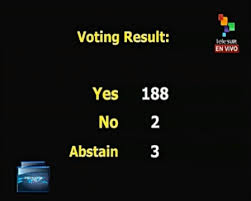
U.N. General Assembly Voting Results Screen
U.N. General Assembly   Voting Results Screen

On October 28, 2014, the U.N. General Assembly by a vote of 188 to 2 again condemned the U.S. embargo of Cuba. The two negative votes were cast by the U.S. and by Israel while three small Pacific nations abstained–Marshall Islands, Micronesia and Palau. All the other U.N. members supported the resolution. [1]

 The Resolution

The resolution [A/69/L.4] reiterated the General Assembly’s “call upon all States to refrain from promulgating and applying laws and measures of the kind referred to in the preamble to the present resolution [‘the economic, commercial and financial embargo imposed by the [U.S.] against Cuba’ and the Helms-Burton Act], in conformity with their obligations under the Charter of the United Nations and international law, which, inter alia, reaffirm the freedom of trade and navigation.”

The resolution also “again urges States that have and continue to apply such laws and measures [i.e., the U.S.] to take the steps necessary to repeal or invalidate them as soon as possible in accordance with their legal regime.”

Cuba’s Statement Supporting the Resolution

Bruno Rodriguez Parrilla

Bruno Rodríguez Parrilla, the Cuban Minister for Foreign Affairs, introducing the resolution, said that in recent times “the economic, commercial and financial blockade imposed by the [U.S.] against Cuba had been tightened, and its extraterritorial implementation had also been strengthened through the imposition of unprecedented fines, totaling $11 billion against 38 banks . . . for carrying out transactions with Cuba and other countries.” In addition, Cuba’s “accumulated economic damages of the blockade totaled $1.1 trillion . . . [and] human damages were on the rise.”

Nevertheless, “Cuba had offered every possible form of assistance to the [U.S.] in the wake of disasters there, such as in the aftermath of the September 11, 2001 terrorist attacks. Cuba had never been a threat to the national security of the [U.S.].  Opinion polls showed that there was increasing support from all sectors of [U.S.] society for lifting the blockade.  Religious leaders had citied legitimate, indisputable ethical and humanitarian reasons.“

In addition, ”the blockade was harmful to . . . the [U.S.]. The ‘absurd and ridiculous’ inclusion of Cuba on the [U.S.] list of States that sponsored international terrorism redounded to the discredit of the [U.S.].  Cuba would never renounce its sovereignty or the path chosen by its people to build a more just, efficient, prosperous and sustainable socialism.”  Neither, he continued, would his Government “give up its quest for a different international order, nor cease in its struggle for ‘the equilibrium of the world.’”

Rodríguez also invited the U.S. government “to establish a mutually respectful relation, based on reciprocity. We can live and deal with each other in a civilized way, despite our differences.”

Other Countries’ Statements Supporting the Resolution [2]

The following Latin American countries voiced support for the resolution: Argentina (MERCOSUR [3]) (embargo was “morally unjustifiable” and violated “the spirit of multilateralism and was immoral, unjust and illegal”); Barbados (CARICOM [4]); Bolivia (Group of 77 [5] and China); Brazil (Group of 77 and CELAC [6]); Colombia; Costa Rica (CELAC)); Ecuador; El Salvador (Group of 77 and CARICOM); Mexico; Nicaragua; St. Vincent and the Grenadines (CARICOM, Non-Aligned Movement, [7] Group of 77 and CELAC); Uruguay; and Venezuela.

The African supporters of the resolution that spoke were Algeria (Non-Aligned Movement, Group of 77, Group of African States [8] and Organization of Islamic Cooperation [9]); Angola; Kenya (Group of 77, Non-Aligned Movement and African Group); Malawi (African Group); South Africa (Group of 77, Non-Aligned Movement and African Group); Sudan (Group of 77, Non-Aligned Movement and Organization of Islamic Cooperation); United Republic of Tanzania; Zambia (Non-Aligned Movement) and Zimbabwe (Non-Aligned Movement, Group of 77 and African Group).

From Asia and the Pacific were Belarus; China (Group of 77); Democratic People’s Republic of Korea (North Korea); Indonesia (Group of 77);  India (Group of 77 and Non-Aligned Movement); Iran (Non-Aligned Movement); Lao People’s Democratic Republic; Myanmar (Group of 77 and Non-Aligned Movement); Russian Federation; Solomon Islands; and Viet Nam (Non-Aligned Movement, Group of 77 and China).

Middle Eastern countries speaking in favor of the resolution were Egypt, Saudi Arabia (Organization of Islamic Cooperation); and Syria (Non-Aligned Movement, Group of 77 and China).

The sole European supporter of the resolution that spoke at the session was Italy (European Union [10]), which said the U.S.’ “extraterritorial legislation and unilateral administrative and judicial measures were negatively affecting European Union interests”).

U.S. Statement Opposing the Resolution

Although Israel voted against the resolution, it chose not to speak in support of its vote. Only the U.S. by Ambassador Ronald D. Godard, U.S. Senior Advisor for Western Hemisphere Affairs, tried to justify the negative vote.

Ronald D. Godard
Ronald D. Godard

Ambassador Godard said the U.S. “conducts its economic relationships with other countries in accordance with its national interests and its principles. Our sanctions toward Cuba are part of our overall effort to help the Cuban people freely exercise their human rights and fundamental freedoms, and determine their own future, consistent with the Universal Declaration of Human Rights and the democratic principles to which the United Nations itself is committed.”

Ambassador Godard also said, “the Cuban government uses this annual resolution in an attempt to shift blame for the island’s economic problems away from its own policy failures. The Cuban government now publicly recognizes that its economic woes are caused by the economic policies it has pursued for the last, past half-century. We note and welcome recent changes that reflect this acknowledgement, such as those that allow greater self-employment and liberalization of the real estate market. But the Cuban economy will not thrive until the Cuban government permits a free and fair labor market, fully empowers Cuban independent entrepreneurs, respects intellectual property rights, allows unfettered access to information via the Internet, opens its state monopolies to private competition and adopts the sound macro-economic policies that have contributed to the success of Cuba’s neighbors in Latin America.”

According to Ambassador Godard, the U.S. “remains a deep and abiding friend of the Cuban people. The Cuban people continue to receive as much as $2 billion per year in remittances and other private contributions from the [U.S.]. This support . . . was made possible . . . by U.S. policy choices. By the Cuban government’s own account, the [U.S.] is one of Cuba’s principal trading partners. In 2013, the [U.S.] exported approximately $359 million in agricultural products, medical devices, medicine and humanitarian items to Cuba. Far from restricting aid to the Cuban people, we are proud that the people of the [U.S.] and its companies are among the leading providers of humanitarian assistance to Cuba. All of this trade and assistance is conducted in conformity with our sanctions program, which is carefully calibrated to allow and encourage the provision of support to the Cuban people.”

Furthermore, the U.S. “places the highest priority on building and strengthening connections between the Cuban people and [our] people. U.S. travel, remittance, information exchange, humanitarian and people-to-people policies updated in 2009 and 2011 provide the Cuban people alternative sources of information, help them take advantage of limited opportunities for self-employment and private property and strengthen independent civil society. The hundreds of thousands of Americans who have sent remittances and traveled to the island, under categories of purposeful travel promoted by President Obama, remain the best ambassadors for our democratic ideals.”

Ambassador Godard continued, “[The U.S.] strongly supports the Cuban people’s desire to determine their own future, through the free flow of information to, from, and within Cuba. The right to receive and impart information and ideas through any media is set forth in Article 19 of the Universal Declaration of Human Rights. It is the Cuban government’s policies that continue to prevent enjoyment of this right. The Cuban government now claims to share our goal of helping the Cuban people access the Internet. Yet the Cuban government has failed to offer widespread access to the Internet through its high-speed cable with Venezuela.  Instead, it continues to impose barriers to information for the Cuban people while disingenuously blaming U.S. policy.”

“Moreover, the Cuban government continues to detain Alan Gross, a U.S. citizen who was sentenced to 15 years in prison for facilitating Internet access for Cuba’s small Jewish community. [[11]] The [U.S.] calls on Cuba to release Mr. Gross immediately, [[12]] allow unrestricted access to the Internet, and tear down the digital wall of censorship it has erected around the Cuban people.

 {T]his resolution only serves to distract from the real problems facing the Cuban people. . . . Though Cuba’s contributions to the fight against Ebola are laudable, they do not excuse or diminish the regime’s treatment of its own people. We encourage this world body to support the desires of the Cuban people to choose their own future. By doing so, it would truly advance the principles the United Nations Charter was founded upon, and the purposes for which the United Nations was created.”

Media Coverage of the Resolution and Debate

 U.S. media coverage of this important U.N. vote was almost non-existent. It was not mentioned in the “World” or “Americas” news sections of the New York Times, and only its “Opinion” section had a short article about the issue. It got no mention whatsoever in the Wall Street Journal. Not even the Miami Herald, which has a separate page for Cuba news, mentioned it. [13]

At 2:37 p.m. on October 28th the Associated Press published a release on the subject, and the Washington Post published it online while the StarTribune of Minneapolis/St. Paul picked it up the next day in its online, but not its print, edition.

Cuba’s state-owned newspaper, Granma, of course, headlined this vote while stating that the embargo has caused $1.1 trillion of damage to the Cuban economy and “incalculable human suffering.” Its article also emphasized that this was the 23rd consecutive such resolution with a table showing that the number of votes in favor of the resolutions has increased from 59 in 1992 to 188 in 2012-2014, that the largest number of votes against the resolutions was only 4 in 1993 and 2004-2007 and that the number of abstentions has decreased from 71 in 1992 to 1 in 2005-2007 and now 3 since 2010.

Conclusion

This overwhelming international opposition to the U.S. embargo in and of itself should be enough to cause the U.S. to end the embargo. Moreover, the embargo has not forced Cuba to come begging to the U.S. for anything that the U.S. wants. The U.S. policy is a failure. The New York Times recently called for abandonment of this policy as has this blog in urging reconciliation of the two countries, in an open letter to President Obama and in a rebuttal of the President’s asserted rationale for the embargo and other anti-Cuban policies.

==============================================================

[1] This post is based upon the sources embedded above and upon U.N. General Assembly Press Release [GA/11574], As General Assembly Demands End to Cuba Blockade for Twenty-Thjrd Consecutive Year, Country’s Foreign Minister Cites Losses Exceeding $1 Trillion (Oct. 28, 2014); Londoño, On Cuban Embargo, It’s the U.S. and Israel Against the World, Again, N.Y. Times (Oct. 29, 2014); Associated Press, UN General Assembly Condemns US Cuba Embargo (Oct. 28, 2014); U.S. Dep’t of State, Explanation of Vote by Ambassador Ronald D. Godard on the Cuba Resolution in the General Assembly Hall (Oct. 28, 2014). The General Assembly also has videos of the debate (A and B). A prior post reviewed the 2011 General Assembly’s adoption of a similar resolution against the embargo.

[2] Many of the cited statements supporting the resolution were issued on behalf of, or aligned with, larger groups of nations as noted above. In addition, prior to the October 28th session of the General Assembly, the U.N. Secretary General submitted a report containing statements against the embargo from 154 states and 27 U.N. agencies.

[3] MERCOSUR (Southern Common Market) is a customs union and trading bloc of five South American countries with five other associate members in the continent.

[4] CARICOM (Caribbean Community) is a group of 15 Caribbean countries with five associate members for economic cooperation.

[5] The Group of 77 was established in 1964 by 77 developing countries to promote their collective economic interests and South-South cooperation; now there are 134 members that have retained the original name for historical significance.

[6] CELAC (Community of Latin American and Caribbean States) is a group of 33 states in the region to deepen economic integration and combat the influence of the U.S.

[7] The Non-Aligned Movement is a group of 115 developing countries that are not aligned with or against any major power bloc. Its current focus is advocacy of solutions to global economic and other problems

[8] The African Group is a group of 54 African states that are U.N. Members.

[9] The Organization of Islamic Cooperation is a group of 57 states that seek to protect the interests of the Muslim world in the spirit of promoting peace and harmony in the world.

[10] The European Union is a group of 28 European states that have combined for a peaceful, united and prosperous Europe.

[11] The activities in Cuba by Mr. Gross are not so simple. A Cuban court in 2011 found him guilty of participating in a “subversive project of the U.S. government that aimed to destroy the revolution through the use of communications systems out of the control of authorities,” and sentenced him to 15 years in prison. According to his own lawsuit against the U.S. Government, and subsequent disclosures, Gross alleged the U.S. Agency for International Development (USAID) and its contractor, DAI, sent him on five semi-covert trips to Cuba without proper training, protection or even a clear sense of the Cuban laws that led to his detainment. The case highlighted the frequent haste and lack of attention to the risks of the USAID programs in Cuba under the Helms-Burton Act, which allowed for money to be set aside for “democracy building efforts” that might hasten the fall of Fidel and Raúl Castro.

[12] In discussions with the U.S., Cuba already has expressed a willingness to exchange Mr. Gross for one or more of the three of “the Cuban Five” who remain in U.S. prisons.

[13] Nor did I find any mention of the vote in London’s Guardian or Madrid’s El Pais.


Failed Efforts To Weaken the Inter-American Human Rights System Under the Guise of Reform

A prior post discussed the March 22, 2013, resolution by the General Assembly of the Organization of American States (OAS) that strengthened the Inter-American Human Rights System, especially the Inter-American Commission on Human Rights (“Commission”).

In so doing, the OAS rejected efforts to weaken the Commission under the guise of reform proposals that had been offered by Ecuador and other states that the Commission has criticized (Venezuela, Bolivia and Nicaragua).

We now examine the background to that surreptitious effort to weaken that System and the debate at the March 22nd General Assembly meeting

Background

1. Multilateral Treaties and Other Instruments Regarding the Right of Free Expression.

The right of free expression by the media and others is well established in international law.

The United Nation’s General Assembly’s Universal Declaration of Human Rights of 1948 in Article 19 states, “Everyone has the right to freedom of opinion and expression; this right includes freedom to hold opinions without interference and to seek, receive and impart information and ideas through any media and regardless of frontiers.” In 1966 this was put into legally enforceable form in Article 19 of the International Covenant on Civil and Political Rights, which entered into force in 1976.

To like effect is the American Convention on Human Rights, which was adopted by the OAS in 1969 and which entered into force in 1978. Its Article 13(1) says, “Everyone has  the right to freedom of thought and expression . . . [including the] freedom to seek, receive, and impart information and ideas of all kinds, regardless of frontiers, either orally, in writing, in print, in the form of art, or through any other medium of one’s choice.” Article 13(3) goes on to say, “The right of expression may not be restricted by indirect methods or means, such as the abuse of government or private controls over newsprint, radio broadcasting frequencies, or equipment used in the dissemination of information, or by any other means tending to impede the communication and circulation of ideas and opinions.”

Elaborating on this right is the Inter-American Declaration of Principles of Freedom of Expression of 2000.

2. Ecuador’s Hostility to Freedom of Expression.

Ecuadorian President Rafael Correa

Ecuador under the presidency of Rafael Correa since January 2007 has through policies and actions retaliated against journalists and media that have criticized him and his government. Correa has insulted and filed lawsuits against reporters and news outlets and promoted a series of legal measures to roll back press freedoms. His government has expropriated television channels, radio stations, newspapers and magazines.

Journalists in the country also have been subjected to physical threats and assaults with lackluster efforts by the government to investigate and prosecute those responsible.

3. The Commission and Civil Society’s Criticism of Ecuador’s Hostility to Freedom of Expression.

The Commission in 1997 created the Special Rapporteur for Freedom of Expression “to encourage the defense of the right to freedom of thought and expression in the hemisphere, given the fundamental role this right plays in consolidating and developing the democratic system and in protecting, guaranteeing, and promoting other human rights.”

This Rapporteur has been in the forefront of criticizing Ecuador for these actions against journalists and the media. Since January 1, 2009 it has issued nine press releases expressing its concern over specific criminal prosecutions and imprisonments of journalists for libel for publication of articles about corruption of public officials and for specific physical threats and assaults on journalists.

In addition, since 2006 the annual reports of the Rapporteur have had sections specifically addressing Ecuador’s conduct in this area.

For example, the latest such report (for 2011) devotes 31 pages (78-108) for a detailed, footnoted review of Ecuador’s assaults and attacks on media and journalists; legal proceedings and arrests (the “Rapporteur is concerned about the consistent tendency of high-ranking public officials to rebuke, arrest, and prosecute citizens who criticize them at public events”); presidential broadcasts and government interruptions of news programs; disparaging statements by senior state authorities against media outlets and reporters critical of the government; constitutional amendment and legislative proposals to regulate the content of all media, establish the grounds for liability and the applicable sanctions and serve as an authority on enforcement; and cloture and regulation of communications media.

Such actions also have subjected the country to similar criticism by the U.N. Human Rights Council in its Universal Periodic Review of Ecuador in the summer of 2012. One of the Council’s closing recommendations in that Review was for Ecuador to reform its legislation regarding freedom of expression with a view to bringing it in conformity with international standards and those of the Inter-American Commission on Human Rights. In response Ecuador said that it could not agree to reform its legal framework in accordance with standards from the Commission, when it is the Inter-American Court of Human Rights, not the Commission, which has judicial competency over this matter. Nor could Ecuador, it said, eliminate laws that criminalize opinion since it had no such laws.

In addition, Ecuador has been severely chastised by the Committee to Protect Journalists, which put the country on its Risk List of the 10 countries in the world where press freedom suffered the most in 2012. Similar rebukes have come from Human Rights Watch, Freedom House and the Washington Post Editorial Board.

4. Ecuador’s Campaign for Its Proposed “Reforms” of the Commission.

In response to the Special Rapporteur’s persistent and documented criticism of Ecuador, the country developed a set of proposals to “reform” the Commission. Prominent in this package were reduction in funding (and hence the work) of the Special Rapporteur and elimination of his separate annual report.

Ricardo Patino
Ricardo Patino

In early 2013 Ecuador conducted a lobbying campaign in support of these proposals. Its Foreign Minister, Ricardo Patino, went on a tour of Mexico, Chile, Argentina, Brazil, Colombia, Dominican Republic, Haiti and Venezuela to promote them.  He also advocated them at a meeting of the Political Council of the Bolivarian Alliance for the Peoples of Our Americas (ALBA) [1] and at a March 11th meeting in Guayaquil, Ecuador of the 24 states that were parties to the American Convention on Human Rights.[2]

The latter event was opened by a long speech by Ecuadorian President Correa, who emphasized that the Commission should have its headquarters in a state that has ratified said Convention (not Washington, D.C.); that the Commission should have its own budget provided only by state parties to the Convention (without voluntary contributions by outsiders like the U.S., Canadian and European governments and NGO’s);  that the Commission should not be “autonomous” and instead be controlled by said states parties; the abolition of the Commission’s rules authorizing its issuance of precautionary measures; having the Commission focus on general promotion of human rights, not investigating and deciding on alleged violations of human rights; and elimination of the separate annual report of the Special Rapporteur for Free Expression and instead including such a report in a comprehensive report for all of the rapporteurships.

The Ecuador meeting resulted in the Declaration of Guayaquil whereby the 24 states parties agreed that at the March 22nd meeting of the OAS General Assembly they would support the following: a group of their foreign ministers would press the U.S., Canada and other non-parties to the Convention to ratify or accede to same; the Commission would be refocused on promotion of human rights through national systems; financing of the Commission would be increased by states parties and by “neutral” others; all rapporteurships would be treated equally; an analysis of the costs of the OAS Human Rights System would be obtained; the Commission’s headquarters would be moved to a state party; and annual conferences about reforming the System would be held.

Opposition to such proposals came forward from the U.N. High Commissioner for Human Rights, Navi Pillay, who urged the OAS members “to strengthen its exemplary human rights system, by promoting universal access for citizens . . ., respecting the Commission’s autonomy to progressively improve its policy and practices in response to the needs of victims and concerns of member states, and providing the necessary resources [to the System].” Similar concerns were voiced by Amnesty International, Human Rights Watch, the Committee to Protect Journalists, Freedom House, a group of 98 prominent Latin Americans and a coalition of 700 hemispheric human rights organizations.

Another opponent of Ecuador’s campaign was Cesar Gaviria Trujillo, a former president of Colombia and past secretary general of the OAS. He said that the so called “reforms” of the Commission put forward by Ecuador would “severely weaken the [C]omission and make it easier for governments to ignore basic rights and limit free speech.” They would “drastically curtail [the Commission’s] autonomy” and put a “financial stranglehold” on its operations, including a “devastating impact” on the Special Rapporteur for Freedom of Expression. [3]

The March 22nd OAS General Assembly Meeting

Jose Miguel Insulza, OAS Secretary General

In opening remarks that day, the OAS Secretary General, Jose Miguel Insulza from Chile, stressed that the autonomy of the System needed to be maintained. He also said that strengthening some of the Commission’s rapporteurships “cannot mean that others are weakened” and that the Special Rapporteurship on Freedom of Expression should be strengthened “with a program of ample defense of [such] freedom . . . . ” This would include “issues relating to the curtailment of that freedom by public authorities . . .  as well as the threats and crimes to which journalists and the social media are increasingly subjected in our region and the obligation of states to protect them.”

William J. Burns, U.S. Deputy Secretary of State

Similar remarks were made by U.S. Deputy Secretary of State, William J. Burns. He noted that even though the U.S. was not a party to the American Convention on Human Rights, the U.S. still collaborates with the Commission when it challenges the U.S. on such issues as the death penalty, the human rights of migrants and children and the status of detainees at Guantanamo Bay, Cuba. He added, “We must be vigilant against efforts to weaken the Commission under the guise of reform. [Such efforts] . . . seek to undermine the Commission’s ability to hold governments accountable when they erode democratic checks and balances and concentrate power through illiberal manipulation of democratic processes.”

Ecuadorian Foreign Minister Patino in his remarks accused the opposition and the media of distorting his government’s proposals. He also accused the Commission of improperly assuming the power to issue precautionary measures. Its decisions were independent, he said, but the Commission was not autonomous. He rhetorically asked, the Commission is autonomous and independent of whom? Sotto voce, a Spanish journalist answered, “You,” causing laughter by those around the journalist.

The resolution adopted by acclamation at the midnight conclusion of the March 22nd meeting already has been discussed. It clearly did not adopt all of the items in Ecuador’s package.

This resolution emerged after a long day in which the U.S., Canada, Mexico, Colombia, Costa Rica, Panama and Chile lead the opposition to the proposals from Ecuador, Bolivia, Venezuela and Nicaragua. A Human Rights Watch observer said, “It was a resounding victory for the Commission, and a major defeat for the Venezuela-Ecuador bloc. It became evident that [the latter] . . . were totally isolated, without the support they were expecting from other countries.”

Towards the end of the meeting Ecuador and Bolivia threatened to withdraw from the Commission and leave the meeting. To avoid such a rupture, Argentina offered a face-saving amendment to the resolution about the OAS’ Permanent Council continuing the dialogue on the “core aspects for strengthening” the System, which Ecuador and the other ALBA countries ultimately accepted.

Conclusion

Afterwards Ecuador’s Foreign Minister tried to whitewash his country’s defeat by saying that the resolution accepted its proposal to continue the debate in the future. Before the next meeting of the OAS General Assembly in June 2014, the Foreign Minister said that there would be another meeting of the states parties to the American Convention like the one on March 11th in Guayaquil to discuss these issues. He also hinted at Ecuador’s possible withdrawal from the OAS Commission by saying there was an agreement being negotiated to create a Human Rights Commission of the Union of South American Nations (UNASUR).

Unless there are unexpected changes in regimes or policies in this Hemisphere over the next 14 months, I do not expect Ecuador and its allies will be successful at the June 2014 OAS meeting in gaining acceptance of its proposals to weaken the Inter-American Commission.[4] We will then see if this small group will leave that Commission and form its own, more limited, human rights system.


[1] ALBA is an alternative to the U.S.-sponsored Free Trade Area of the Americas. differing from the latter in that it advocates a socially-oriented trade block rather than one strictly based on the logic of deregulated profit maximization. The only members of ALBA are Ecuador, Bolivia, Venezuela, Nicaragua and three small Caribbean states (Antigua and Barbuda, Dominica and Saint Vincent and the Grenadines.

[2]  This campaign is discussed in press releases from Ecuador’s Foreign Minister.

[3] Such a limitation on financing undoubtedly would result in a reduction of such funding and thus on the work of the Commission.

[4]  I assume that Ecuador has another burden to overcome in attempting to win support for its “reform” proposals. Its credibility within the OAS, I suspect, has been adversely affected by its recent exaggerated, alarmist call for an OAS Consultative Meeting of Foreign Ministers over the alleged United Kingdom threat to invade Ecuador’s London Embassy because of its providing diplomatic asylum in that Embassy to Julian Assange.

Organization of American States Strengthens the Inter-American System of Human Rights [1]

OAS General Assembly, 3/22/13
OAS General Assembly, 3/22/13                                                  (Photo: OEA OAS Photostream [2])
On March 22, 2013, the Extraordinary General Assembly of the Organization of American States (OAS)[3] adopted by acclamation a resolution strengthening the Inter-American System of Human Rights (“the System”).[4] The resolution had the following provisions:

  1. Requested the Inter-American Commission on Human Rights (“Commission”), an autonomous OAS organ that promotes and protects human rights in the American hemisphere, to continue to move forward with application of its responses to suggestions for reform by a special working group and the Commission’s March 18, 2013, reform of its rules.
  2. Instructed OAS’ Permanent Council[5] to continue the dialogue on the “core aspects for strengthening” the System.
  3. Urged the Commission to put into practice pending recommendations for reform.
  4. Encouraged the Commission “to strengthen its efforts in the promotion of human rights, including through its support to national systems.”
  5. Reaffirmed the OAS General Assembly’s commitment to obtain full financing of the
    System through OAS’ Regular Fund “without prejudice to the financing of the other mandates” of the OAS.
  6. Requested the OAS Secretary General to submit to the OAS Permanent Council “a detailed, up-to-date analysis of the full operating costs” of the System.
  7. Proposed that the Commission “strengthen all its rapporteurships, including by giving consideration to granting special status to all existing rapporteurships, based on adequate financing, without prejudice to its other responsibilities.”[6]
  8. Urged “OAS member states [i.e., U.S., Canada and seven others] to ratify or accede to . . . all inter-American human rights instruments, especially the American Convention on Human Rights,” and  for the U.S., Canada and eight other states “to accept . . . the contentious jurisdiction of the Inter-American Court of Human Rights.”[7]

Understanding the significance of this resolution requires elaboration.

1.1. Recommendations of the Special Working Group. In its December 2011 report the Special Working Group proposed changes to the Commission’s rules regarding individual petitions and cases; precautionary measures; monitoring of human rights in member states; promotion of human rights; a permanent presidency; financing and allocation of resources; and dissemination of criteria and jurisprudence.[8] The most controversial ones that were seen by many as efforts to muzzle the Commission were these:

  • Restrict the Commission’s discretion in granting “precautionary measures,” by, among other things, setting forth “precise objective criteria” for granting same and determining whether the situation was “serious and urgent.” The addition of such criteria would help states as well as alleged victims who are affected by such measures.
  • Require its annual report to cover human rights conditions in all OAS members, not just those with the most pressing problems.
  • Reduce the activities and funding of the Special Rapporteur on Freedom of Expression by eliminating its separate funding and instead requiring balanced funding of all rapporteurs as well as eliminating this one’s special report.
  • Require the Commission to devote more time and resources to the general promotion of human rights and thereby reduce its time and resources to deciding individual complaints.
  • Impose restrictions on the Commission’s decisions regarding individual complaints.

1.2. Commission’s Responses to Recommendations of Special Working Group. On October 23, 2012, the Commission issued its second response expressing agreement with most of these recommendations.

However, the Commission did disagree with the recommendation to assign balanced resources to all of its rapporteurships. It pointed out that the first source of funds for the Commission is the OAS Regular Fund, which covers only 54% of the Commission’s financial needs. This necessitates soliciting outside funds, some of which are designated for specific purposes (one of which implicitly is for the Freedom of Expression Rapporteurship). “[P]rohibitting or impeding any of [these] . . . funding sources would lead to the immediate structural weakening of the thematic rapporteurships and units, as well as [their] . . . important promotional and technical assistance activities.”

Moreover, the request for balanced or equal allocation of resources legitimately was seen as a back-door way to reduce the funding for the Rapporteurship for Free Expression and hence its work, an objective of those states that had been criticized for retaliation against journalists and media for criticism of the governments.

1.3. Commission’s Recent Changes in Its Rules and Policies. On March 18, 2013 (only four days before the OAS General Assembly was to consider the whole subject of reforming the System), the Commission adopted a resolution amending its rules and adopting certain institutional policies, effective August 1, 2013.

The rules that were changed were Rule 25 (Precautionary Measures); 28 (Requirements for the Consideration of Petitions); 29 (Initial Processing); 30 (Admissibility Procedure); 36 (Decision on Admissibility); 37 (Procedure on the Merits); 42 (Archiving of Petitions and Cases); 44 (Report on the Merits); 46 (Suspension of Time Limit to Refer the Case to the Court; 59 (Annual Report); 72 (Experts); 76 (Provisional Measures); and 79 (Amendment of the Rules of Procedure).

These changes adopted many of the suggestions made by the Special Working Group.

For example, one of the more signficant changes was to Rule 25 covering precautionary measures, which are actions the Commission requests a state to take to prevent irreparable harm to persons or to the subject matter of the proceedings in connection with a pending petition or case before its final resolution on the merits, as well as to persons under the jurisdiction of the State concerned, independently of any pending petition or case. The amended rules more precisely identifies the situations for same as “serious and urgent situations presenting a risk of irreparable harm to persons or to the subject matter of a pending petition or case before the organs of the inter-American system” and provides definitions of “serious situation,” “urgent situation” and “irreparable harm.” It also provides that decisions granting, extending, modifying such measures shall contain certain elements.

Similar changes were made to Rule 76 covering provisional measures, which are actions the Commission requests the Inter-American Court to take in cases of extreme gravity and urgency, and when necessary to avoid irreparable damage to persons. The amended rule provides for the first time the following criteria for deciding upon a request for such measures: (a) ” when the State concerned has not implemented the precautionary measures granted by the Commission;” (b) “when the precautionary measures have not been effective; ” (c) “when there is a precautionary measure connected to a case submitted to the jurisdiction of the Court;” or (d) “when the Commission considers it pertinent for the efficacy of the requested measures, to which end it shall provide its reasons.”

Foremost among the new institutional policies was the establishment of the following priorities: promotion of universal ratification of the American Convention on Human Rights and other similar instruments; promotion of economic, social and cultural rights; and development of a plan for a permanent presidency. Other adopted policies generally concerned measures to increase public transparency of the Commission’s activities.

2. Permanent Council’s Continuing Dialogue on Core Aspects of Reforming the System. Although most states and their representatives were ready to end the reform process with the adoption of the March 22nd resolution, they accepted this “open door” for further dialogue as a way to keep those states less friendly to the Commission (especially Ecuador, Venezuela, Bolivia and Nicaragua) involved in the Human Rights System and not renounce the American Convention on Human Rights and other treaties.

3. Commission’s  Implementing Pending Reform  Recommendations. I do not know what is meant by “pending [reform] recommendations,” and I solicit comments explaining this point. Presumably this refers to the Commission’s March 18th adoption of amended rules and of policy priorities.

4. Commission’s Strengthening Promotion of Human Rights. This is a commendable goal. The problem arises when decisions have to be made for allocation of insufficient financing of all the things that the Commission and Court would like to do to fulfill their mandates. In my opinion, such promotion should not come at the expense of reducing efforts on resolving specific complaints about alleged violations of human rights.

5. OAS’ Obtaining Full Financing of the System. This too is a commendable goal. The problem arises when decisions have to be made for allocation of insufficient financing of all the things that the Commission and Court would like to do to fulfill their mandates.

6. Analysis of Full Operating Costs of the System. This sounds like a straight-forward cost analysis of the Commission and the Inter-American Court of Human Rights (“the Court”).

7. Commission’s Strengthening of Rapporteurships. There now are the following Rapporteurships on the Rights of (i) Indigenous Peoples, (ii) Woman; (iii) Migrant Workers and Their Families; (iv) the Child; (v) Human Rights Defenders; (vi) Persons Deprived of Liberty; and (vii) Afro-Descendants and Against Racial Discrimination.

There also is a Special Rapporteurship on Freedom of Expression, which has a “general mandate to carry out activities for the protection and promotion of the right to freedom of thought and expression.”

Subject to the qualification about outside funding designated for specific purposes, there is no quarrel with the objective of strengthening all of the rapporteurships. 

8. Obtaining Universality of Ratification/Accession of the American Convention on Human Rights and Acceptance of Contentious Jurisdiction of the Inter-American Court of Human Rights.

Of the 34 members of the OAS, only 9 have not ratified or acceded to the American Convention on Human Rights with the U.S. and Canada being the major exceptions. Nor have the U.S. and Canada and 10 other states accepted the jurisdiction of the Inter-American Court of Human Rights to decide cases of their alleged violations of that Convention.[9]

The desire for universality expressed in this resolution, in my opinion, is appropriate even though I suspect it is motivated in part by the understandable resentment of the U.S. for not accepting the Convention and the Court’s jurisdiction while simultaneously criticizing other states in the Hemisphere for their violations of human rights.

Conclusion

The previously mentioned controversial recommendations by the Special Working Group were promoted by states that had been targets of individual complaints and of criticisms by the Special Rapporteur on Freedom of Expression.  Foremost among these states was Ecuador, which has become notorious for its legal claims against the media for criticism of its government and by states that understandably resent the U.S.’ not being a party to the American Convention on Human Rights and not consenting to the contentious jurisdiction of the Court. This background will be discussed in a subsequent post.


[1]  The author would like to thank Mexican attorney, Juan Carlos Arjona Estevez, for his assistance in preparing this post. Muchas gracias, amigo!

[2] This photo is subject to license with OAS.

[3] The OAS was established in 1951 to achieve among its member states “an order of peace and justice, to promote their solidarity, to strengthen their collaboration, and to defend their sovereignty, their territorial integrity, and their independence.”  Its supreme organ is the General Assembly, which is composed of delegations of the member states.

[4] The OAS Human Rights System includes the Inter-American Commission on Human Rights and the Inter-American Court of Human Rights. A chronology of the Human Rights System reform process is available on the Commission’s website. Some of the work of the Commission has been discussed in prior posts.

[5] The OAS Permanent Council under Chapter XII of the OAS Charter is the organ that is in overall charge of its activities pursuant to delegations by the OAS General Assembly or other organs.

[6] Starting in 1990, the Commission began creating thematic rapporteurships under the leadership of an individual who is an expert in the area in order to devote attention to certain groups, communities, and peoples that are particularly at risk of human rights violations due to their state of vulnerability and the discrimination they have faced historically. The aim of creating a thematic rapporteurship is to strengthen, promote, and systematize the Commission’s own work on the issue.

[7] In footnotes to the consensus resolution, Guatemala urged the Commission to (i) move its headquarters from Washington, D.C. to San Jose, Costa Rica (which hosts the Court and the Inter-American Institute for Human Rights); (ii)  draft a proposed  protocol to the American Convention on Human Rights to establish standards for precautionary measures (akin to preliminary injunctions in U.S. law); (iii) limit the Commission’s commissioners and special/thematic rapporteurs to a single term; (iv) set 2015 as the date for attaining full financing of the System; and (v) placing all rapporteurships under the leadership of the commissioners.

[8]  The Special Working Group’s report with 53 recommendations for the Commission was adopted by the OAS Permanent Council on January 25, 2012 and ratified by the OAS General Assembly on June 5, 2012.

[9] The Court’s Statute’s Article 2(1) provides that its “adjudicatory jurisdiction shall be governed by . . . Articles 61, 62 and 63 of the Convention,” and the latter’s Article 62 requires a state’s declaration “unconditionally, or on the condition of reciprocity, for a specified period, or for specific cases” that it “recognizes as binding, ipso facto, and not requiring special agreement, the jurisdiction of the Court on all matters relating to the interpretation or application of this Convention.”