U.N. General Assembly Again Condemns U.S. Embargo of Cuba

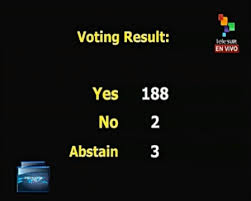
U.N. General Assembly Voting Results Screen
U.N. General Assembly   Voting Results Screen

On October 28, 2014, the U.N. General Assembly by a vote of 188 to 2 again condemned the U.S. embargo of Cuba. The two negative votes were cast by the U.S. and by Israel while three small Pacific nations abstained–Marshall Islands, Micronesia and Palau. All the other U.N. members supported the resolution. [1]

 The Resolution

The resolution [A/69/L.4] reiterated the General Assembly’s “call upon all States to refrain from promulgating and applying laws and measures of the kind referred to in the preamble to the present resolution [‘the economic, commercial and financial embargo imposed by the [U.S.] against Cuba’ and the Helms-Burton Act], in conformity with their obligations under the Charter of the United Nations and international law, which, inter alia, reaffirm the freedom of trade and navigation.”

The resolution also “again urges States that have and continue to apply such laws and measures [i.e., the U.S.] to take the steps necessary to repeal or invalidate them as soon as possible in accordance with their legal regime.”

Cuba’s Statement Supporting the Resolution

Bruno Rodriguez Parrilla

Bruno Rodríguez Parrilla, the Cuban Minister for Foreign Affairs, introducing the resolution, said that in recent times “the economic, commercial and financial blockade imposed by the [U.S.] against Cuba had been tightened, and its extraterritorial implementation had also been strengthened through the imposition of unprecedented fines, totaling $11 billion against 38 banks . . . for carrying out transactions with Cuba and other countries.” In addition, Cuba’s “accumulated economic damages of the blockade totaled $1.1 trillion . . . [and] human damages were on the rise.”

Nevertheless, “Cuba had offered every possible form of assistance to the [U.S.] in the wake of disasters there, such as in the aftermath of the September 11, 2001 terrorist attacks. Cuba had never been a threat to the national security of the [U.S.].  Opinion polls showed that there was increasing support from all sectors of [U.S.] society for lifting the blockade.  Religious leaders had citied legitimate, indisputable ethical and humanitarian reasons.“

In addition, ”the blockade was harmful to . . . the [U.S.]. The ‘absurd and ridiculous’ inclusion of Cuba on the [U.S.] list of States that sponsored international terrorism redounded to the discredit of the [U.S.].  Cuba would never renounce its sovereignty or the path chosen by its people to build a more just, efficient, prosperous and sustainable socialism.”  Neither, he continued, would his Government “give up its quest for a different international order, nor cease in its struggle for ‘the equilibrium of the world.’”

Rodríguez also invited the U.S. government “to establish a mutually respectful relation, based on reciprocity. We can live and deal with each other in a civilized way, despite our differences.”

Other Countries’ Statements Supporting the Resolution [2]

The following Latin American countries voiced support for the resolution: Argentina (MERCOSUR [3]) (embargo was “morally unjustifiable” and violated “the spirit of multilateralism and was immoral, unjust and illegal”); Barbados (CARICOM [4]); Bolivia (Group of 77 [5] and China); Brazil (Group of 77 and CELAC [6]); Colombia; Costa Rica (CELAC)); Ecuador; El Salvador (Group of 77 and CARICOM); Mexico; Nicaragua; St. Vincent and the Grenadines (CARICOM, Non-Aligned Movement, [7] Group of 77 and CELAC); Uruguay; and Venezuela.

The African supporters of the resolution that spoke were Algeria (Non-Aligned Movement, Group of 77, Group of African States [8] and Organization of Islamic Cooperation [9]); Angola; Kenya (Group of 77, Non-Aligned Movement and African Group); Malawi (African Group); South Africa (Group of 77, Non-Aligned Movement and African Group); Sudan (Group of 77, Non-Aligned Movement and Organization of Islamic Cooperation); United Republic of Tanzania; Zambia (Non-Aligned Movement) and Zimbabwe (Non-Aligned Movement, Group of 77 and African Group).

From Asia and the Pacific were Belarus; China (Group of 77); Democratic People’s Republic of Korea (North Korea); Indonesia (Group of 77);  India (Group of 77 and Non-Aligned Movement); Iran (Non-Aligned Movement); Lao People’s Democratic Republic; Myanmar (Group of 77 and Non-Aligned Movement); Russian Federation; Solomon Islands; and Viet Nam (Non-Aligned Movement, Group of 77 and China).

Middle Eastern countries speaking in favor of the resolution were Egypt, Saudi Arabia (Organization of Islamic Cooperation); and Syria (Non-Aligned Movement, Group of 77 and China).

The sole European supporter of the resolution that spoke at the session was Italy (European Union [10]), which said the U.S.’ “extraterritorial legislation and unilateral administrative and judicial measures were negatively affecting European Union interests”).

U.S. Statement Opposing the Resolution

Although Israel voted against the resolution, it chose not to speak in support of its vote. Only the U.S. by Ambassador Ronald D. Godard, U.S. Senior Advisor for Western Hemisphere Affairs, tried to justify the negative vote.
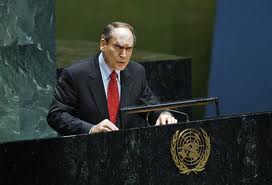
Ronald D. Godard
Ronald D. Godard

Ambassador Godard said the U.S. “conducts its economic relationships with other countries in accordance with its national interests and its principles. Our sanctions toward Cuba are part of our overall effort to help the Cuban people freely exercise their human rights and fundamental freedoms, and determine their own future, consistent with the Universal Declaration of Human Rights and the democratic principles to which the United Nations itself is committed.”

Ambassador Godard also said, “the Cuban government uses this annual resolution in an attempt to shift blame for the island’s economic problems away from its own policy failures. The Cuban government now publicly recognizes that its economic woes are caused by the economic policies it has pursued for the last, past half-century. We note and welcome recent changes that reflect this acknowledgement, such as those that allow greater self-employment and liberalization of the real estate market. But the Cuban economy will not thrive until the Cuban government permits a free and fair labor market, fully empowers Cuban independent entrepreneurs, respects intellectual property rights, allows unfettered access to information via the Internet, opens its state monopolies to private competition and adopts the sound macro-economic policies that have contributed to the success of Cuba’s neighbors in Latin America.”

According to Ambassador Godard, the U.S. “remains a deep and abiding friend of the Cuban people. The Cuban people continue to receive as much as $2 billion per year in remittances and other private contributions from the [U.S.]. This support . . . was made possible . . . by U.S. policy choices. By the Cuban government’s own account, the [U.S.] is one of Cuba’s principal trading partners. In 2013, the [U.S.] exported approximately $359 million in agricultural products, medical devices, medicine and humanitarian items to Cuba. Far from restricting aid to the Cuban people, we are proud that the people of the [U.S.] and its companies are among the leading providers of humanitarian assistance to Cuba. All of this trade and assistance is conducted in conformity with our sanctions program, which is carefully calibrated to allow and encourage the provision of support to the Cuban people.”

Furthermore, the U.S. “places the highest priority on building and strengthening connections between the Cuban people and [our] people. U.S. travel, remittance, information exchange, humanitarian and people-to-people policies updated in 2009 and 2011 provide the Cuban people alternative sources of information, help them take advantage of limited opportunities for self-employment and private property and strengthen independent civil society. The hundreds of thousands of Americans who have sent remittances and traveled to the island, under categories of purposeful travel promoted by President Obama, remain the best ambassadors for our democratic ideals.”

Ambassador Godard continued, “[The U.S.] strongly supports the Cuban people’s desire to determine their own future, through the free flow of information to, from, and within Cuba. The right to receive and impart information and ideas through any media is set forth in Article 19 of the Universal Declaration of Human Rights. It is the Cuban government’s policies that continue to prevent enjoyment of this right. The Cuban government now claims to share our goal of helping the Cuban people access the Internet. Yet the Cuban government has failed to offer widespread access to the Internet through its high-speed cable with Venezuela.  Instead, it continues to impose barriers to information for the Cuban people while disingenuously blaming U.S. policy.”

“Moreover, the Cuban government continues to detain Alan Gross, a U.S. citizen who was sentenced to 15 years in prison for facilitating Internet access for Cuba’s small Jewish community. [[11]] The [U.S.] calls on Cuba to release Mr. Gross immediately, [[12]] allow unrestricted access to the Internet, and tear down the digital wall of censorship it has erected around the Cuban people.

 {T]his resolution only serves to distract from the real problems facing the Cuban people. . . . Though Cuba’s contributions to the fight against Ebola are laudable, they do not excuse or diminish the regime’s treatment of its own people. We encourage this world body to support the desires of the Cuban people to choose their own future. By doing so, it would truly advance the principles the United Nations Charter was founded upon, and the purposes for which the United Nations was created.”

Media Coverage of the Resolution and Debate

 U.S. media coverage of this important U.N. vote was almost non-existent. It was not mentioned in the “World” or “Americas” news sections of the New York Times, and only its “Opinion” section had a short article about the issue. It got no mention whatsoever in the Wall Street Journal. Not even the Miami Herald, which has a separate page for Cuba news, mentioned it. [13]

At 2:37 p.m. on October 28th the Associated Press published a release on the subject, and the Washington Post published it online while the StarTribune of Minneapolis/St. Paul picked it up the next day in its online, but not its print, edition.

Cuba’s state-owned newspaper, Granma, of course, headlined this vote while stating that the embargo has caused $1.1 trillion of damage to the Cuban economy and “incalculable human suffering.” Its article also emphasized that this was the 23rd consecutive such resolution with a table showing that the number of votes in favor of the resolutions has increased from 59 in 1992 to 188 in 2012-2014, that the largest number of votes against the resolutions was only 4 in 1993 and 2004-2007 and that the number of abstentions has decreased from 71 in 1992 to 1 in 2005-2007 and now 3 since 2010.

Conclusion

This overwhelming international opposition to the U.S. embargo in and of itself should be enough to cause the U.S. to end the embargo. Moreover, the embargo has not forced Cuba to come begging to the U.S. for anything that the U.S. wants. The U.S. policy is a failure. The New York Times recently called for abandonment of this policy as has this blog in urging reconciliation of the two countries, in an open letter to President Obama and in a rebuttal of the President’s asserted rationale for the embargo and other anti-Cuban policies.

==============================================================

[1] This post is based upon the sources embedded above and upon U.N. General Assembly Press Release [GA/11574], As General Assembly Demands End to Cuba Blockade for Twenty-Thjrd Consecutive Year, Country’s Foreign Minister Cites Losses Exceeding $1 Trillion (Oct. 28, 2014); Londoño, On Cuban Embargo, It’s the U.S. and Israel Against the World, Again, N.Y. Times (Oct. 29, 2014); Associated Press, UN General Assembly Condemns US Cuba Embargo (Oct. 28, 2014); U.S. Dep’t of State, Explanation of Vote by Ambassador Ronald D. Godard on the Cuba Resolution in the General Assembly Hall (Oct. 28, 2014). The General Assembly also has videos of the debate (A and B). A prior post reviewed the 2011 General Assembly’s adoption of a similar resolution against the embargo.

[2] Many of the cited statements supporting the resolution were issued on behalf of, or aligned with, larger groups of nations as noted above. In addition, prior to the October 28th session of the General Assembly, the U.N. Secretary General submitted a report containing statements against the embargo from 154 states and 27 U.N. agencies.

[3] MERCOSUR (Southern Common Market) is a customs union and trading bloc of five South American countries with five other associate members in the continent.

[4] CARICOM (Caribbean Community) is a group of 15 Caribbean countries with five associate members for economic cooperation.

[5] The Group of 77 was established in 1964 by 77 developing countries to promote their collective economic interests and South-South cooperation; now there are 134 members that have retained the original name for historical significance.

[6] CELAC (Community of Latin American and Caribbean States) is a group of 33 states in the region to deepen economic integration and combat the influence of the U.S.

[7] The Non-Aligned Movement is a group of 115 developing countries that are not aligned with or against any major power bloc. Its current focus is advocacy of solutions to global economic and other problems

[8] The African Group is a group of 54 African states that are U.N. Members.

[9] The Organization of Islamic Cooperation is a group of 57 states that seek to protect the interests of the Muslim world in the spirit of promoting peace and harmony in the world.

[10] The European Union is a group of 28 European states that have combined for a peaceful, united and prosperous Europe.

[11] The activities in Cuba by Mr. Gross are not so simple. A Cuban court in 2011 found him guilty of participating in a “subversive project of the U.S. government that aimed to destroy the revolution through the use of communications systems out of the control of authorities,” and sentenced him to 15 years in prison. According to his own lawsuit against the U.S. Government, and subsequent disclosures, Gross alleged the U.S. Agency for International Development (USAID) and its contractor, DAI, sent him on five semi-covert trips to Cuba without proper training, protection or even a clear sense of the Cuban laws that led to his detainment. The case highlighted the frequent haste and lack of attention to the risks of the USAID programs in Cuba under the Helms-Burton Act, which allowed for money to be set aside for “democracy building efforts” that might hasten the fall of Fidel and Raúl Castro.

[12] In discussions with the U.S., Cuba already has expressed a willingness to exchange Mr. Gross for one or more of the three of “the Cuban Five” who remain in U.S. prisons.

[13] Nor did I find any mention of the vote in London’s Guardian or Madrid’s El Pais.


New York Times Urges Normalization of U.S.- Cuba Relations

In an October 12th editorial the New York Times says, “For the first time in more than 50 years, shifting politics in the United States and changing policies in Cuba make it politically feasible to re-establish formal diplomatic relations and dismantle the senseless embargo.” Indeed, in the Times’ opinion, these changes in U.S. policy should be accompanied by ending the U.S. designation of Cuba as a “State Sponsor of Terrorism.”[1]

 Editorial’s Commentary on Cuba’s Current Conditions

The Times points out that Cuba has “taken significant steps to liberalize and diversify the island’s tightly controlled economy.” This includes “allowing citizens to take private-sector jobs and own property.” encouraging foreign investment, constructing a major deep-sea port in Mariel with Brazilian capital and negotiating a cooperation agreement with the European Union. Although the pace of reform may seem slow and inconsistent, these are significant changes.

On the other hand, the Times asserts that the Cuban “government still harasses and detains dissidents . . . [and has not explained] the suspicious circumstances surrounding the death of political activist Oswaldo Payá.” This is outweighed, however, by the Cuban government’s in recent years having “released political prisoners” and showing “slightly more tolerance for criticism of the [government’s leadership” while loosening travel restrictions “enabling prominent dissidents to travel abroad.”[1a]

Editorial’s Recommendations for U.S. Policy

End Designation of Cuba as a “State Sponsor of Terrorism.” The Times recommends that the U.S. “should remove Cuba from State Department’s list of nations that sponsor terrorist organizations . . . .   Cuba was put on the list in 1982 for backing terrorist groups in Latin America, which it no longer does. . . . [and Cuba now] is playing a constructive role in the conflict in Colombia by hosting peace talks between the government and guerrilla leaders.” [2]

End the Embargo. Just 16 days before the U.N. General Assembly is expected again to overwhelmingly approve Cuba’s resolution to condemn the embargo, the Times says the U.S should end its embargo of Cuba as it has become “clear to many American policy makers that the embargo was an utter failure.” In addition, now a slight majority of Cuban-Americans in Florida oppose the embargo.

“Fully ending the embargo will require Congress’s approval,” which may be difficult to obtain in this time of a dysfunctional Congress, but the Administration could “lift caps on remittances, allow Americans to finance private Cuban businesses and expand opportunities for travel to the island.”

Ending the embargo, according to the Times, “could also help American companies that are interested in developing the island’s telecommunications network but remain wary of the legal and political risks. Failing to engage with Cuba now will likely cede this market to competitors. The presidents of China and Russia traveled to Cuba in separate visits in July, and both leaders pledged to expand ties.”

In addition, ending the embargo would eliminate Cuba’s using the embargo as an excuse for the Cuban government’s shortcomings.[3]

Restoration of Diplomatic Relations. Says the Times, “Restoring diplomatic ties, which the White House can do without congressional approval, would allow the United States to expand and deepen cooperation in areas where the two nations already manage to work collaboratively — like managing migration flows, maritime patrolling and oil rig safety.[4] It would better position Washington to press the Cubans on democratic reforms, and could stem a new wave of migration to the United States driven by hopelessness.”

Closer ties could also bring a breakthrough on the case of an American development contractor, Alan Gross, who has been unjustly imprisoned by Cuba for nearly five years.[5] More broadly, it would create opportunities to empower ordinary Cubans, gradually eroding the government’s ability to control their lives.

In the opinion of the Times, Restoring relations would improve U.S. “relationships with governments in Latin America, and resolve an irritant that has stymied initiatives in the hemisphere.” The most current example of that irritant is “Latin American governments . . . [insisting] that Cuba, the Caribbean’s most populous island and one of the most educated societies in the hemisphere, be invited” to next year’s Summit of the Americas in Panama over U.S. opposition.

Moreover, “The [Cuban] government has said it would welcome renewed diplomatic relations with the United States and would not set preconditions” while a significant majority of Cuban-Americans favor restoring diplomatic ties, mirroring the views of other Americans.

Reactions to the Editorial 

I concur in all of the Times’ recommendations, but believe it understates the economic reasons for these changes in U.S. policy. Here is a fuller exposition of those economic reasons.

This month Dr. José Ramón Cabañas Rodriguez, the Chief of Mission, Cuban Interests Section, said that the U.S. was running the risk of becoming economically irrelevant to Cuba. Many foreign countries, especially China, and foreign companies are developing good commercial relationships with Cuba and its new private businesses with ordinary commercial terms, unlike the U.S. sales of food and agricultural products under an exemption to the U.S. Helms-Burton Law that requires Cuba to pay in advance and in cash for such products. This U.S. practice is not a good way to encourage future business. Moreover, the new Mariel port and its adjacent business park is attracting interest from companies all over the world, and if all the space in that park is committed to these foreign companies, there will be nothing left for U.S. companies.

The geographical setting of the new Mariel port is strategic in terms of trade, industry and services in Latin America and the Caribbean. On the northern cost of Cuba only 45 km west of Havana, it is located along the route of the main maritime transport flows in the western hemisphere. As the largest industrial port in the Caribbean, it will be equipped with state-of-the-art technology to handle cargo from the larger container ships that will begin to arrive when the expansion of the Panama Canal is completed in December 2015. Those larger ships can carry up to 12,500 containers, triple the capacity of the current ships, and the port’s warehouse capacity is 822,000 containers. Here are some photos of the development of this port.

Mariel PortMariel3

The Mariel project includes highways connecting the port with the rest of the country, a railway network, and communication infrastructure. In the adjacent special zone, currently under construction, there will be productive, trade, agricultural, port, logistical, training, recreational, tourist, real estate, and technological development and innovation activities in installations that include merchandise distribution centers and industrial parks.

The special zone is divided into eight sectors, to be developed in stages. The first involves telecommunications and a modern technology park where pharmaceutical and biotechnology firms will operate. Other sectors include renewable energies, agriculture and food, chemical, construction materials, logistics and rental equipment. For the last four sectors Cuba is currently studying the approval of 23 projects from Europe, Asia and the Americas.

The May 2014 visit to Cuba by a delegation from the U.S. Chamber of Commerce evidences U.S. businesses’ cognizance of these economic and commercial realities. The delegation’s head and the Chamber’s president, Thomas Donohue,  said in a speech in Havana, “For years, the US Chamber of Commerce has demanded that our government eliminate the commercial embargo on Cuba. It’s time for a new approach.” At the conclusion of the trip he said the delegation and Cuban officials had “talked about steps forward that might be taken by both countries” to improve U.S.-‪Cuba relations and that their meetings with President Raul Castro had been “positive.” In addition, the Chamber in congressional testimony has called for an end to the embargo and has supported proposed legislation to end the ban on U.S. citizens traveling to the island and easing restrictions on U.S. exports of farm and medical products.

Another sign of U.S. companies’ interest in Cuba is the visit to the island this past June by Google executives. They said they discussed increasing Cubans access to the Internet and Cuba’s need for improving its Internet technology.

These U.S. economic concerns were highlighted in February 2014 by U.S. Senator Patrick Leahy, who earlier had led a visit with four other Senators to Cuba. Leahy said, “Trade with Latin America is the fastest growing part of our international commerce.  Rather than isolate Cuba with outdated policies, we have isolated ourselves.  Our Latin, European and Canadian friends engage with Cuba all that time.  Meanwhile, U.S. companies are prohibited from any economic activity on the island.” Therefore, the Senator said, “It is time – past time – to modernize our policies and the frozen-in-time embargo on Americans’ travel and trade with Cuba that have accomplished nothing but to give the Cuban regime a scapegoat for the failures of the Cuban economy.  Change will come to Cuba, but our policies have delayed and impeded change.  It is time to elevate the voice of a crucial stakeholder:  the American people. Thanks to this [recent public opinion] poll, they are silent no longer. It is time to recognize that U.S. policy toward Cuba has been unsuccessful in achieving any of its objectives.”

Given the limited space for an individual editorial, the New York Times editorial does not discuss any of the other many issues that need to be addressed by the two countries in order to establish truly normal relations. Nor does it discuss how this normalization process can happen or be facilitated.

In contrast, this blog repeatedly has suggested both counties need a neutral third-party with the resources and commitment to act as mediator and has called for such a third-party to step forward to offer such services, rather than waiting for the U.S. or Cuba to make such a proposal unilaterally or for the two countries to agree to such a mediation. [6]

=========================================================

[1] Interestingly the online version of the editorial is titled “End the U.S. Embargo on Cuba” with a linked Spanish translation while the print version is titled “The Moment to Restore Ties to Cuba.”

[1a] This month Dr. José Ramón Cabañas Rodriguez, the Chief of Mission, Cuban Interests Section, emphasized that Cuba now has term limits on every governmental office, including president: two terms of five years each for a total limit of 10 years, and Raul Castro has announced that this applies to him and thus ends his term as president in 2018. Dr. Cabañas also emphasized that many younger people are taking over many governmental positions and that there has been a decentralization of power to municipalities.

[2] This blog has provided detailed criticism of the ridiculous, absurd, stupid and cowardly rationales provided by the U.S. for such designations in 2010, 2011, 2012 (with supplement), 2013 and 2014.

[3] This blog has provided criticisms of the embargo.

[4] This month Dr. José Ramón Cabañas Rodriguez also said that the U.S. and Cuba in recent years have had bilateral discussions regarding migration, drug trafficking, search and rescue in the Florida straits, stopping oil spills in the Caribbean, airline security measures, scientific exchanges and restoration of direct telephone and mail services. In addition, the U.S. has invited or permitted an invitation to Cuba to attend a Clean Oil Conference in San Antonio, Texas in December 2014.

[5] Although it certainly is debatable whether Mr. Gross was unjustly convicted in Cuban courts for violating Cuban law, I agree that it is in the U.S. national interest to have him released and returned to the U.S. Cuba, however, has argued that the three of the “Cuban Five” still in U.S. prisons should also be released and allowed to return to their homes. At a minimum, I believe that negotiations between the two countries could and should lead to at least a one-for-one exchange with the U.S. President commuting the sentence of one of the three Cubans to time served.

[6] This blog has called for normalization of Cuba-U.S. relations and has criticized the U.S. for insisting on preconditions for holding any talks with Cuba to improve relations. Another blog post was a public letter to President Obama recommending reconciliation with Cuba. In addition, this year a group of 50 prominent Americans issued a public letter to the President urging him to take executive action to expand U.S. involvement with Cuba. Another blog post criticized recent opposition to pursuing such reconciliation.

Continued Bad News about U.S. Policies Regarding Cuba

Bad news about U.S. policies regarding Cuba continues to accumulate. The U.S. refuses to budge from outdated hostility towards the island nation when the U.S., in my opinion, should be pursuing reconciliation with Cuba. One glimmer of hope for rationality on this subject was provided by William M. LeoGrande and Peter Kornbluh in The Nation magazine.

Bad News

First, on September 5, 2014, President Obama issued a terse memorandum to the U.S. Secretary of State to extend for another year or through September 14, 2015, the application of the U.S. Trading with the Enemy Act to Cuba for another year. This statute, which was enacted during World War I in 1917, gives the President authority to prohibit, limit or regulate trade with hostile countries in times of war. It is a statutory foundation on which the entire range of U.S. sanctions toward Cuba rests. In a statement for the Secretaries of State and of the Treasury, Obama labeled the move “in the national interests of the United States” without any explanation.

On September 8th  Cuba denounced this decision. Cuba said the main goal of the embargo or blockade is to cause “harm and suffering” to the Cuban people” despite the embargo’s having been denounced by the U.N. General Assembly on 22 consecutive occasions since 1992.

Second, as anticipated Cuba has announced that on October 28th it will offer at the U.N. General Assembly a new resolution on the need to end the U.S. blockade against Cuba. A Cuban report in support of the resolution stresses the blockade has been described as a genocidal policy by the international community since it prevents the island from acquiring medicines, reagents, spare pieces for medical equipment and other inputs, forcing it to trade with distant markets, thus increasing the costs. The Cuban report also alleges that the embargo/blockade has caused $116.8 billion of damages to the island’s economy.

Once again, this resolution is expected to be overwhelming approved by the General Assembly.

Third, there was good news that Latin American leaders are insisting that Cuban representatives be present at the next Summit of the Americas in Panama in April 2015. Last month the Panamanian Foreign Minister visited Havana to issue such an invitation personally to Cuban President Raúl Castro. Such an invitation is supported by other Latin American countries. As Uruguay’s Foreign Minister, Luis Almago, recently said, “The Latin American countries without exception formulated in the last Summit held in Cartagena that Cuba should be part of the 2015 Summit. Panamá has welcomed this desire and I believe that the invitation sent to Cuba is good news for the inter-American family.”

The U.S., however, is opposed to Cuban attendance. A State Department representative recently made the following rather innocuous comment on the subject:

  • “Panama is the host country for the summit, and as the host country they will make the decisions on invitations to that summit.  I think the invitations in a formal sense have not yet been made. . . [We] have said from the start that we look forward to a summit that can include a democratic Cuba at the table.  We also have said that the summit process, ever since Quebec in 2001, has made a commitment to democracy, and we think that’s an important part of the summit process.  But the decision about invitations is not ours to make, and obviously there’s been no invitations formally issued to the United States and other countries.  And so there is no acceptance or rejection yet called for or made.”

More vigorous opposition was expressed by U.S. Senator Robert Menendez, a Cuban-American and the Chairman of the Senate Foreign Relations Committee. In a letter to the Panamanian President, Menendez expressed “dismay” over Panama’s intended invitation. According to Menendez, “Cuba’s participation would undermine the spirit and authority of the Summit of the Americas as a space to reaffirm the principles enshrined on the Charter of the United Nations, the Charter of the Organization of American States, and the Inter-American Democratic Charter, as well as commitments made at past Summits.”

After railing against Cuba as “the hemisphere’s most enduring dictatorship,” Menendez concluded his letter by saying such an invitation “sends the wrong message about the consolidation of democracy in the Americas, will dramatically weaken the democratic credentials of the premier meeting of heads of state in the hemisphere, and ultimately will undermine the validity of the Summits’ declarations.” This proclamation was coupled with perhaps an implied threat of adverse consequences for Panama from the U.S. should Panama proceed with the invitation; Menendez said, “I remain committed to strengthening the partnership between the U.S. and Panama.”[1]

Fourth, Alan Gross, a U.S. citizen, remains in poor health in a Cuban prison after his conviction for violating Cuban laws. In my opinion, it clearly is in the interest of both Cuba and the U.S.to have him released from that prison and returned to the U.S. before he dies and thereby creates another obstacle to improving relations between the two countries. Cuba, however, by all reports is trying to negotiate an exchange of Gross for at one or more of the three remaining “Cuban Five” in U.S. prison.

Frank Calzon, the Executive Director of the Center for a Free Cuba, however, has issued what, in my opinion, is a counterproductive suggestion. He says, “There . . . comes a time when something more [than negotiating through diplomatic channels] is needed. That time is now in Cuba. Only when U.S. government raises the stakes — the political and economic risks facing Cuba — will Alan Gross be allowed to come home, and only then will Havana have to think twice before taking another hostage.

Fifth, in 1976 then U.S. Secretary of State Henry Kissinger in the Gerald Ford Administration was in charge of a top-secret group of senior officials that developed plans to conduct, after the 1976 presidential election, air strikes on Cuban ports and military installations and to send Marine battalions to the United States Navy base at Guantánamo Bay to “clobber” the Cubans. The plan also included proposals for a military blockade of Cuba’s shores. Fortunately with Jimmy Carter’s victory in the 1976 election, this plan never was implemented,

Kissinger instigated this planning because he personally was infuriated that Fidel Castro in late 1975 had sent Cuban troops to newly independent Angola to help in its repelling attacks from South Africa and right-wing guerrillas and thereby ignored Kissinger’s behind-the-scenes effort to improve U.S. relations with Cuba.

These revelations are in documents, now available online, that recently were declassified by the Gerald R. Ford Presidential Library.

Glimmer of Hope

BackChannel book

William M. LeoGrande (Professor of Government at American University’s School of Public Affairs) and Peter Kornbluh (Director of the National Security Archive’s Cuba and Chile Documentation Projects) have published a new book, Backchannel to Cuba: The Hidden History of Negotiations Between Washington and Havana, which I want to read. [2] This book forms the basis for their recent article in The Nation magazine, Six Lessons for Obama on How to Improve Relations with Cuba. Here are those lessons.

  • Even at moments of intense hostility, there have always been reasons and opportunities for dialogue.
  • Cuban leaders instinctively resist making concessions to US demands, but they are willing to take steps responsive to US concerns so long as those steps come at Havana’s initiative.
  • Cuban leaders have had a hard time distinguishing between U.S. gestures and concessions.
  • An incremental approach to normalizing relations has not worked. It is slow and easily disrupted by other events. “Incremental steps do not fundamentally change the relations and, therefore are easily reversed.” Every incremental step gives U.S. opponents of reconciliation the opportunity to obstruct the process. Instead, the “alternative is a bold stroke that fundamentally changes the relationship (even if it doesn’t resolve every issue) and leaves opponents facing a fait accompli. Nixon’s trip to China is the paradigmatic example.”
  • Domestic politics is always an issue on both sides.
  • Cuba wants to be treated as an equal, with respect for its national sovereignty.

 Conclusion

Although I do not have the depth of knowledge of LeoGrande and Kornbluh I endorse their lessons as should be evident from this blog’s many posts on the subject of U.S.-Cuba relations.

Perhaps the bold stroke they mention as the way towards improved relations could be made by a third party—another country or an international organization or a nongovernmental organization—stepping forward with a public announcement of a desire and commitment to serve as a mediator to resolve the many issues between the two countries and inviting them to send representatives at a set time and place to discuss the procedures for such a mediation. Such an initiative, in my judgment, to have any chance of success would have to be by an entity that was neutral, that was respected by both sides and the world at large, that had the resources to be engaged in such a process for a long time and that would not be discouraged by any initial negative responses by either country. This blog made such a suggestion in 2011 and 2012.

Such a mediation would remove the desire of at least the U.S. to avoid taking the first step toward normalization. It also, in my opinion, would be in the national interest of both countries.

=========================================================

[1] A rebuttal to the Menendez letter was issued by the Center for Democracy in the Americas.

[2] LeoGrande and Kornbluh have been interviewed about the book.

Tom Hayden: Will U.S.-Cuba Normalization Fail Again?

[This is a re-posting of an August 15, 2014, article in The Democracy Journal by Tom Hayden, political activist for social justice, author and Director of the Peace and Justice Resource Center. Article licensing information appears on tomhayden.com (http://tomhayden.com/), which granted permission for this re-posting. Many similar posts have been published on http://dwkcommentaries.com/tag/cuba/.%5D

============================================

On May 12, President Obama held a confidential conversation in the White House with Uruguay’s president, Jose Mujica, the former Tupamaro guerrilla leader. The meeting was a fateful one. Did they discuss Uruguay’s becoming the first Marijuana Republic? Perhaps. Did they discuss the US-Cuba diplomatic impasse of 55 years? Most certainly, because three weeks later at an Organization of American States (OAS) meeting in Uruguay the delegates reaffirmed a decision to officially invite Cuba to a summit in Panama next May.

The Obama administration will have to accept Cuba’s recognition by the OAS this spring or sit sheepishly in isolation. Fifty years ago, the OAS voted 15-4 to terminate all diplomatic relations and trade with revolutionary Cuba. Uruguay was one of the four dissenters in those days, when the revolutionary Mujica was underground, and has not changed its position over time. One doesn’t need gray hairs to observe that the US policy towards Cuba is obsolete and counter-productive. Ten years ago, then state Senator Barack Obama called for diplomatic recognition. Hillary Clinton recently revealed her support for recognizing Cuba as secretary of state. Recent polls, even in Florida, show majorities in favor of normalization. Inner circles in both countries are trying to explore a rapprochement, wary of pitfalls and domestic critics.

The most important recent change in US policy is the lifting of the travel ban on Cuban-Americans visiting the island. As many as 500,000 travel back and forth every year, visiting family, sharing dialogue, spending millions in remittances. On the Cuba side, all agree that Raul Castro has opened significant space for private investment and entrepreneurs once condemned as counter-revolutionary. Businesslike bilateral talks are underway about issues of mutual interest, from currency exchanges to potential oil spills.

The biggest obstacle, from the Cuban view, is a persistent US program of covert “democracy promotion” – or, regime change – aimed at subverting the Cuban government by funding dissident networks in Cuba. “Stupid, stupid, stupid!”, is how US Sen. Patrick Leahy recently described the leaked revelations about a secret social media “Cuban twitter” program called ZunZuneo, after a Cuban hummingbird. One among fifty years of subversion projects, ZunZuneo was launched in 2009 after Obama spoke of building a new relationship. Its sponsor was the US Agency for International Development [AID], even after an AID contractor, Alan Gross, was arrested in Cuba for distributing communications equipment in violation of Cuban law.

Gross, now serving a 15 year sentence, is at the center of the heightened tensions now threatening normalization. Gross, 65, is widely reportedly in poor health and threatening to take his own life if he’s not released by next year. Should that occur, according to one top US official, it would end any hope of Cuba winning the return of one of its agents, Gerardo Hernandez, one of the Cuban Five who were captured in DATE while surveilling anti-Castro Cubans flying into Cuban airspace to drop propaganda materials. When two exile pilots were shot down by the Cubans after warnings conveyed directly to the US government, the Five were imprisoned on conspiracy and espionage charges. Two have served their time in federal prisons and returned to Cuba. Two others will finish their terms shortly, leaving Gerardo Hernandez facing a double life sentence.

Prisoner swaps have occurred before, for example in 1978-79 when President Jimmy Carter and Fidel Castro orchestrated the release of Puerto Rican nationalists who were imprisoned for shooting up the US House of Representatives in 1954. Although the releases were described as unrelated, the Puerto Ricans were pardoned and returned to their island while separately the US received a group of its agents held in Cuban prisons.

It would be logical therefore to swap Gross for Gerardo Hernandez, even if arranged separately, but nothing seems logical about the US-Cuban deadlock. According to interviews with participants, such a staged swap finally was being considered a few weeks ago – until the fiasco of the Obama administration’s trade of five Taliban officials for the return of the American POW, Pfc. Bowe Bergdahl. Republicans, some Democrats and the mainstream media complained that the five-for-one deal favored the Taliban, and then the issue became inflamed by hazy reports that Bergdahl had abandoned his Afghan base and was perhaps “anti-war.”

The Obama team was flat-footed in their response, failing to notify even their top Congressional allies. That  failure violated a legal requirement that Congress be informed thirty days before any such deal, an obstacle that most likely would have killed the swap. But Democratic leaders were furious at not even being informed of the move.

That’s why Alan Gross remains behind bars in Cuba with no deal for his release remotely possible. With the Gross matter unresolved, the entire process of normalization could go off track.

Many in Washington view the Cubans as too stubborn in the Gross case. But the Cubans have been burned by unfulfilled promises and miscommunications many times over the decades, and leaving Gerardo Hernandez behind is unacceptable to them – just as Obama argued that leaving Pfc. Bergdahl behind was out of the question.

The Cuban dilemma is that if anything should happen to Gross they will never see Gerardo back and a rapprochement could slip away. It may sound shocking to many Americans, but the death of Alan Gross in a Cuban prison would serve the interests of some in the anti-Castro Cuban lobby that is deeply threatened by the prospects of normalization. The death of Gross would serve the narrative that Castro’s Cuba operates a heartless gulag, ignoring the many proven examples of Cuban exile terrorism directed from Miami against Cuban civilians, like the 73 Cubans killed in an airline bombing in 1976. Cuban exiles have been a perfect examples of the “cancer on the presidency”, the metaphor once used by Nixon aide John Dean. They were the lead conspirators in the 1972 Watergate break-in, and the 1976 assassinations of Chilean diplomat Orlando Letelier and his American assistant Ronnie Moffett, on embassy row in Washington DC. Their violent attacks on Cuba from a Miami enclave are too numerous to document.

Cuba will make its own decision for its own reasons in the Gross case, and may have to make it soon. Since the Obama administration fears any appearance of a quid pro quo in the wake of the Bergdahl fiasco, should Cuba expect nothing in exchange for the release of Gross as a humanitarian gesture? That might depend on the initiative of the many in the US Congress who recognize that it’s long past time for a better relationship with Cuba. They could, for example, communicate private guarantees of White House action. They could try deleting the $20 million in federal funds for “democracy programs” in the wake of the ZunZuneo scandal. They could send a letter to Obama requesting Cuba’s removal from the list of four countries designated as “terrorist” states, which hampers Cuba’s access to financial capital. They could urge the president to lift the ban on Americans traveling to Cuba or spending US dollars there, thus undermining the current embargo. If they can’t do anything in response to a release of Gross, they could watch the prospect of normalization drift away.

Another recent crisis may shadow the US-Cuban process, revealing the complications of the impasse.. A long-planned improvement of relations between Russia, Cuba and Latin America is underway just at the moment when clouds of the Cold War are darkening the horizon over the Ukraine. Russia’s Vladimir Putin has just forgiven ninety percent of Cuba’s $30 billion debt owed to Russia for three decades, fueling the anti-communist suspicions of the Cuban Right. The arrangement is helpful to Cuba’s economy, long embargoed by the US, and adds a new counterweight against the US pressures on Cuba. If initial reports that Russia re-establishing a spy base on the island, that might chill the relationship further. Cuba, of course, has a sovereign right to accept a Russian base, especially as US regime change programs continue.

Whatever the spillover from the Bergdahl affair and the growing Russian-American conflict, however, nothing can stop the clock ticking towards 2015 when Obama has to decide whether to join the Organization of American States in restoring Cuba to equal membership. If that’s what the president’s confidential White House meeting with Uruguay’s Mujica in May was all about, the process of normalization may yet survive the remaining obstacles to resolution after five long decades.

U.S. Senate Hearing Discusses USAID’s Social Media Program for Cuba

On April 8th a subcommittee of the U.S. Senate Appropriations Committee held a hearing on the upcoming funding of the U.S. Agency for International Development (USAID). One of the subjects of the hearing was the agency’s social media program for Cuba.[1]

Dr. Rahiv Shah, the USAID Administrator, testified that the program was “an attempt to promote open communications between citizens on the island nation, not a covert attempt to overthrow the government.” He also said the program “was similar to others that the agency has financed in Africa to help citizens monitor elections.”

Senator Patrick Leahy, the subcommittee chair, did not buy that explanation. He said the program was ill conceived and endangered the lives of agency workers. “It taints U.S.A.I.D. workers as spies.” He also called it a “cockamamie” idea doomed to discovery and failure and complained that the agency did not adequately describe to Congress the program it was secretly operating. His voice rising in anger at moments, Sen. Patrick Leahy, D-Vt., said, “This one from the get-go had no possibility of working.”

Senator Leahy also was clearly upset when Dr. Shah did not answer the Senator’s repeated question, “Whose idea was this [program]?” Finally Dr. Shah said he did not know who initially proposed the program before he was the agency administrator.

Another subject of Senator Leahy’s visible annoyance was Dr. Shah’s insistence that the program was legal and not covert. The Senator blamed it for further endangering the life of Alan Gross, a USAID contractor who has been imprisoned in Cuba since 2009.

Earlier this year the Senator called for fundamental changes in U.S. policies regarding Cuba. He said the U.S. needs “to modernize our policies and the frozen-in-time embargo on Americans’ travel and trade with Cuba that have accomplished nothing but to give the Cuban regime a scapegoat for the failures of the Cuban economy.  Change will come to Cuba, but our policies have delayed and impeded change.” Leahy concluded, “Let us have the common sense, and the courage, to finally put an end to the Cold War in our own hemisphere.”

——————————

[1] This post is based on articles in the New York Times, the Washington Post and the Huffington Post. An earlier post and a comment thereto discussed the recent Associated Press’ report about the program and the reactions to it.

U.S. Policy Implications of State Department’s Report on Cuban Human Rights

A prior post reviewed the U.S. State Department’s just-released 2013 Country Reports on Human Rights Practices while another post discussed its chapter on Cuba. Now we look at the implications of that report for U.S. policies regarding Cuba.

Some people assert that the negative aspects of Cuban human rights justify continuing U.S. hostility toward the island. They see the Cuban glass of human rights at least half empty. Notable among them is U.S. Representative Mario Díaz-Balart, a Cuban-American and a Republican Congressman from Miami, who remains a stalwart powerful defender of the embargo and other anti-Cuba policies of the U.S.

Others, including this blogger, reach the opposite conclusion based, in part, on the belief that the Cuban glass of human rights is half full.

Rev. Raul Suarez
Rev. Raul Suarez

As Rev. Raúl Suárez put it at the February 27th briefing for the U.S. Congress, “Cuba has many problems but Cuba isn’t hell . . . . We have many good things that have been achieved [but] . . . Cuba is not the Kingdom of God.” Suárez added, “God . . . wants us [Cubans and Americans] to live like brothers and sisters.”[1]

Indeed, the humility expressed by Rev. Suárez should lead the U.S. to the same conclusion. As U.S. Secretary of State John Kerry said last month on release of the Human Rights Reports, “from our own nation’s journey, we know that [human rights] is a work in progress. Slavery was written into our Constitution before it was written out. And we know that the struggle for equal rights, for women, for others – for LGBT community and others – is an ongoing struggle.” Secretary Kerry admitted that we  “know that we’re not perfect. We don’t speak with any arrogance whatsoever, but with a concern for the human condition.”

In evaluating Cuba’s mixed human rights record and deciding on U.S. policies regarding that country, that same humility should cause we in the U.S. to remember the U.S. immense superiority in economies and military might and the long-standing U.S. actions of hostility towards Cuba, including the following:

  • the U.S. usurpation of Cuba’s war for independence from Spain in the late 19th Century (what we in the U.S. call the “Spanish-American War“);
  • the U.S.’ making Cuba a de facto U.S. protectorate in the early 20th Century;
  • the U.S. support for the invasion of Cuba’s Bay of Pigs in 1961;
  • the U.S. threats of military action against Cuba during the pressured Cuban missile crisis of 1962;
  • the CIA’s hatching several plots to assassinate Fidel Castro when he was Cuba’s President;
  • the U.S. conduct of an embargo of Cuba over the last 50-plus years; and
  •  the U.S. Government’s Commission on Assistance for a Free Cuba setting forth what amounted to a U.S. blueprint for taking over Cuba.

This history provides Cuba with many legitimate reasons to be afraid of the U.S. It, therefore, is understandable why Cuba has harshly treated what we call “dissidents” and what Cuba fears are or could be supporters of a U.S. takeover.

And we in the U.S. should know from our own history since 9/11 that societies and governments tend to clamp down on civil liberties when they fear outside interference or attacks.

Cuba’s regrettable lapses on human rights, though perhaps understandable in context, should not be a reason for continued U.S. hostility toward the island.

Therefore, as a prior post argued, improving Cuban human rights should be one of many items on an agenda for a comprehensive, mutually respectful negotiation between the two countries. The objectives of such a negotiation, in my opinion, should be restoration of full diplomatic relations; ending the U.S. embargo against Cuba;[2] terminating the unjustified U.S. designation of Cuba as a “State Sponsor of Terrorism;” [3] terminating the one-sided U.S. lease of Guantanamo Bay; and compensating owners for expropriation of property on the island as part of the Cuban Revolution.[4]

Such a negotiation, in my opinion, is in the interest of the U.S. Cuba poses no threat to the U.S. Our businesses and farmers would benefit economically from open relations with Cuba. Normalizing our relations with the island would be seen by most people in the world, especially Latin America, as a sign that the U.S. is a mature, rational country.

These thoughts were echoed by the Cuban religious leaders who held a U.S. congressional briefing on February 27th. Joined by the President and CEO of Church World Service, [5] they reaffirmed their long-held opposition to the U.S. embargo of Cuba.

They also called “for the U.S. government to end the ban that prevents U.S. citizens from visiting Cuba and seeing the island for themselves; to take Cuba off the list of State Sponsors of Terrorism . . . ; and for the American government to open up trade and commerce in ways that support the small enterprises, cooperatives, and non-profits that are emerging on the island. Finally, the U.S. and Cuban governments ought to open a high level dialogue between our countries to normalize relations and discuss differences in ways that honor and respect the dignity of both nations.”

Before the commencement of such complicated negotiations, the U.S. President should commute the sentences of three of the Cuban Five to the 15-plus years they already have spent in U.S. jails and prisons and let them return to their home country. Similarly Cuba should commute the sentence of U.S. citizen Alan Gross to the time he already has spent in Cuban prison and allow him to return to the U.S.

Given the long period of hostility between the two countries and the apparent lack of movement toward negotiations, I believe that the assistance of a neutral third-party mediator would be helpful to both countries. Such a mediator, in my opinion, should be someone who is bilingual in English and Spanish with experience as an international mediator, who is in fact and perceived to be neutral and who has the time (and staff?) to make a major commitment to this process.

Such a mediator indeed could and should step forward and invite representatives of both countries to participate in mediated negotiations, rather than wait on them to agree on such a process.

——————————————

[1] Suárez is a Baptist pastor and the founder and director of the Martin Luther King, Jr. Center in Havana. When I visited the Center in 2007, Rev. Suárez told our group that he had founded the Center because he thought King’s philosophy of non-violence and social justice was relevant to Cuba, especially to Afro-Cubans. He also said that in 1984 he and other religious leaders met with then President Fidel Castro to protest the government’s endorsement of atheism (or scientific materialism) as limiting the space for churches, and after the collapse of the Soviet Union in 1989, Cuba abandoned that endorsement and provided more space for churches to participate in issues facing the island.

[2] Amnesty International, Human Rights Watch and former U.S. President Jimmy Carter also call for ending the U.S. embargo. So too does world opinion as evidenced by the U.N. General Assembly’s passing resolutions condemning the embargo for the last 22 years. The last such resolution in October 2013 was passed 188 to 2 with only the U.S. and Israel voting against it.  A prior post to this blog also has argued for ending the embargo and summarized the 2011 General Assembly resolution against the embargo.

[3] This blog has reviewed the State Department’s asserted rationale for the “State Sponsor of Terrorism” designation and called it ridiculous for 2010, 2011 and 2012 and absurd for 2013. This blog also noted Cuba’s adoption of legislation against money laundering and terrorism financing and thereby negating one of the purported reasons for the designation.

[4] In a letter to President Obama that was reproduced in this blog, I called for the U.S. to terminate the Guantanamo Bay lease and for Cuba to compensate property owners for expropriating their property. A comprehensive review of this lease is found in Michael J. Strauss’ The Leasing of Guantanamo Bay.

[5] Church World Service was founded in 1946 with this mission: “Feed the hungry, clothe the naked, heal the sick, comfort the aged, shelter the homeless.” It now has 37 Protestant member communions all over the world.

Cuban Religious Freedom (U.S. Commission on International Religious Freedom)

We have provided a general overview of the latest international religious freedom reports from the U.S. Department of State and from the U.S. Commission on International Religious Freedom, and another post analyzed the State Department’s report on that freedom in Cuba.[1] Now we contrast and compare the Commission’s shorter and less detailed report on that subject for Cuba.[2]

Positive Aspects of Religious Freedom in Cuba

The report had a few good things to say about religious freedom in Cuba.

First, it did not include Cuba in its list of “countries of particular concern” (CPC), i.e.,  those that have engaged in or tolerated “particularly severe” violations of religious freedom.

Second, it recognized that “[p]ositive developments for the Catholic Church and major registered Protestant denominations, including Baptists, Pentecostals, Presbyterians, Episcopalians, and Methodists, continued over the last year.” (Emphasis added.)

The Commission endorsed the State Department reports “that religious communities were given greater freedom to discuss politically sensitive issues. Catholic and Protestant Sunday masses were held in more prisons throughout the island. Religious denominations continued to report increased opportunities to conduct some humanitarian and charity work, receive contributions from co-religionists outside Cuba, and obtain Bibles and other religious materials. Small, local processions continued to occur in the provinces.”

The Commission also stated that the Cuban government granted the Cuban Council of Churches time for periodic broadcasts early Sunday mornings, and Cuba’s Roman Catholic Cardinal read Christmas and Easter messages on state-run stations. Relations between the Catholic Church and Cuban government continued to improve,” marked by Pope Benedict XVI’s visit to Cuba.

Negative Aspects of Religious Freedom in Cuba

The report also commented on what it saw as negative aspects of religious freedom in Cuba.

Some of the criticisms echo the State Department’s report regarding the Cuban government’s system for registering religious groups, limiting certain activities to such registered groups, restricting permits for construction or repair of religious buildings, limiting access to state media and denying permission for religious processions outside religious buildings. The Commission, however, fails to mention the Department’s qualifications that these purported restrictions of religious freedom are not enforced in practice.

The Commission mentions the Cuban government’s arrest and detention of human rights/democracy activists that prevented them from attending church services, as did the Department’s report. As noted in my prior post, however, these arrests and detentions, in my opinion, are blots on Cuba’s general human rights record, not that for its religious freedom.

Another negative, according to the Commission, are the alleged Cuban government’s arrests and beatings on four occasions of evangelical pastors and the alleged targeting of the Apostolic Reformation and Western Baptist communities. We, however, do not know all the facts of these alleged events, and even if true as stated by the Commission, they do not, in my opinion, justify the Commission’s overall evaluation of Cuban religious freedom.[3]

That overall evaluation includes Cuba as one of eight countries on the Commission’s “Watch List of countries where the serious violations of religious freedom engaged in or tolerated by the governments do not meet the CPC threshold, but require close monitoring.” According to the Commission, the “Watch List provides advance warning of negative trends that could develop into severe violations of religious freedom, thereby providing policymakers with the opportunity to engage early and increasing the likelihood of preventing or diminishing the violations.”

Cuba has been on this Watch List since 2004.[4] Its inclusion yet again, in my opinion, is due to sheer long-term blinders on U.S. perceptions of Cuba, not to an objective analysis of the facts.

Recommendations for U.S. Policy 

In accordance with its authorizing statute,[5] the Commission made the following recommendations for U.S. policy with respect to Cuban religious freedom:

  • press the Cuban government to “stop arrests and harassment of clergy and religious leaders;  cease interference with religious activities and the internal affairs of religious communities; allow unregistered religious groups to operate freely and legally; revise government policies that restrict religious services in homes or on other personal property; and hold accountable police and other security personnel for actions that violate the human rights of non-violent religious practitioners;”
  • “use appropriated funds to advance Internet freedom and protect Cuban activists from harassment and arrest by supporting the development of new technologies, while also immediately distributing proven and field-tested programs to counter censorship;”
  • “increase the number of visas issued to Cuban religious leaders from both registered and unregistered religious communities to travel to the United States to interact with co-religionists;” and
  • “encourage international partners, including key Latin American and European countries and regional blocks, to ensure that violations of freedom of religion or belief and related human rights are part of all formal and informal multilateral or bilateral discussions with Cuba.”

I note first that if Cuba properly were excluded from the Watch List, there would be no basis for the Commission’s making any recommendations with respect to Cuba.

With respect to the recommendations themselves, the first one seems like an excessive concern with formalities since in practice these restrictions are not enforced. Has the U.S. updated all of its statutes and regulations to conform them to what happens in the real world?

The third recommendation should be noncontroversial, and I agree the U.S. should grant tourist visas for Cuban religious representatives to visit the U.S.

I also have no problem with the fourth recommendation, but believe that most other countries and regional blocks would not see the alleged violations of freedom of religion or belief that the Commission sees.

The second recommendation, however, raises significant problems and is objectionable.

It is difficult to know exactly what is meant by recommending the U.S. use its funds to advance Internet freedom and protect Cuban activists, to develop new technologies and to distribute proven and field-tested programs to counter censorship.

To me, it sounds like a recommendation for surreptitious efforts at regime change. Remember that the U.S. in 1961 supported an armed invasion of Cuba at the Bay of Pigs, that the U.S. through the CIA had plots to assassinate Fidel Castro, that the U.S. for over 50 years has had an embargo of Cuba and that the George W. Bush Administration had a Commission on Assistance to a Free Cuba that produced a de facto U.S. plan for such a regime change.

Another, and more powerful, reason for being at least skeptical of this second recommendation is the case of Alan Gross, a U.S. citizen, who is now in Cuban prison after conviction in 2009 for–as the Cubans see it– being part of a “subversive project of the U.S. government that aimed to destroy the Revolution through the use of communication systems out of the control of authorities.” As an employee of an USAID contractor, Mr. Gross went to Cuba on multiple occasions purportedly to establish wireless networks and Internet connections for non-dissident Cuban Jewish communities and to deliver certain communications equipment to Cubans for that purpose.

In 2012 Mr. Gross and his wife sued USAID and the contractor for allegedly failing to give him better information and training for his dangerous work, and this month (May 2013) the Grosses and the contractor reached a settlement for dismissal of the case against the corporation in exchange for an undisclosed monetary payment by the contractor.

In short, this second recommendation is not designed to improve religious freedom in Cuba.

Conclusion

The State Department’s more balanced recent report on Cuban religious freedom, in my opinion, is better grounded in reality than the Commission’s. While I believe the U.S. should encourage and promote religious freedom around the world, including Cuba, the recommendations by the Commission are unjustified and counterproductive and evidence the same bias against Cuba that we see in other aspects of U.S. policy towards Cuba.[6]


[1] The prior post also reviewed the religious makeup of the Cuban people and many other details on the subject that will not be repeated here.

[2] Prior posts examined the Commission reports for Cuba for 2010 and 2011(comment to prior post). A subsequent post will discuss the unusual structure of the Commission.

[3] The Commission’s heavy emphasis on the relatively few alleged wrongs against evangelical pastors and its ignoring the positive developments in religious freedom for “registered” religious groups like the Roman Catholics, Baptists, Pentecostals, Presbyterians, Episcopalians and Methodists demonstrate a totally inappropriate and unjustified bias in a purported nonpartisan U.S. agency of our federal government. Such a bias is not new. It also was present in the George W. Bush Administration’s Commission for Assistance to a Free Cuba, which regarded unnamed evangelical Christian groups as the only “authentically independent” religious groups that could be used by the U.S. to build a “free” Cuba.  The Cuban Council of Churches, on the other hand, was seen by this U.S. commission as “taken over by the Castro regime in the early 1960s and used as a means to control the Protestant churches” and, therefore, was not to be used by the U.S.

[4]  The other seven countries on the Commission’s Watch List are Afghanistan, Azerbaijan, India, Indonesia, Kazakhstan, Laos and Russia.

[5]  That statute charges the Commission with the responsibility of “making  . . . policy recommendations to the President, the Secretary of State, and Congress with respect to [Cuban] religious freedom.” (International Religious Freedom Act of 1988, § 202(a)(2); id. § 202(b); id. § 202(c).

Letter to President Obama Regarding Cuba

On August 13, 2012, I sent the following letter regarding Cuba to U.S. President Barack Obama.[1]

Many of the United States’ policies regarding Cuba are not in our national interest and should be changed. I write specifically about (1) the U.S. embargo of Cuba, (2) the U.S. designation of Cuba as a “State Sponsor of Terrorism,” (3) the U.S. denigration of religious freedom on the island and (4) our refusal to enter into negotiations with Cuba on the broad range of issues that have accumulated since the Cuban Revolution of 1959 without Cuba’s satisfying various U.S. preconditions.

1. U.S. Embargo of Cuba

The U.S. embargo of Cuba, in my opinion, is an out-of-date relic of the days of U.S. hostility toward, and fear of, the Cuban Revolution. Today Cuba poses no serious threat to the U.S. Cuba’s regrettable human rights violations are understandable and could be more successfully addressed in bilateral negotiations. Normalizing relations, including rescinding the embargo, would be in the economic interest of the U.S. by creating export and investment opportunities for U.S. businesses. Moreover, ending the embargo would be in the overall interests of the U.S., especially with respect to our relations with other countries in the Western Hemisphere. This is examined more fully in my blog posts: “The U.S. Should Pursue Reconciliation with Cuba,” (May 21, 2001); and “U.N. General Assembly Again Condemns  U.S. Embargo of Cuba,” (Oct. 25, 2011),

The U.S. should end its embargo of Cuba.

2. U.S. Designation of Cuba as a “State Sponsor of Terrorism”

The U.S. State Department’s Country Reports on Terrorism 2011 (July 31, 2012), assert two grounds for designating Cuba as a “State Sponsor:” (a) its being an alleged safe haven for certain ETA and FARC terrorists and U.S. fugitives; and (b) its alleged financial system deficiencies relating to money laundering and financing of terrorism.

Neither ground withstands serious analysis as shown by my blog posts: “Yet Another Ridiculous U.S. Designation of Cuba as a State Sponsor of Terrorism,” (Aug. 7, 2012) and “Additional Thoughts on the Ridiculous U.S. Designation of Cuba as a “State Sponsor of Terrorism,” (Aug. 9, 2012).

The U.S. should rescind this designation.

3. U.S. Denigration of Cuban Religious Freedom

The U.S. State Department’s 2011 Report on International Religious Freedom (July 30, 2012), had many positive things to say about the status of this important freedom in Cuba in 2011 that is confirmed by my personal experience with the subject. The report also has certain negative comments on the subject with which I do not disagree.

The resulting question, I believe, is “Is the glass half empty or half full?” I believe it is more than half full of this important freedom. The U.S. needs to remember that Cuban society and history is very different from the U.S. and humbly recognize that those differences do not mean that its religious freedom is fundamentally flawed.

My real complaint here is with the U.S. Commission on International Religious Freedom’s unrealistic overstatement of the negative aspects of Cuban religious freedom and its continued placement of Cuba on its Watch List.

My views on this subject are fully explained in my blog posts, “Cuban Religious Freedom According to the Latest U.S. Report on International Religious Freedom,” (Aug. 3, 2012) and “The Cuban Revolution and Religion,” (Dec. 30, 2011).

The U.S. should cease denigrating Cuban religious freedom and instead explore through respectful bilateral negotiations whether there are ways for the U.S. to assist Cuba in further expansion of such freedom on the island.

4.  U.S. Negotiations with Cuba

In addition to the issues discussed in this letter, there are many others that need discussion, negotiation and resolution. They include Cuban compensation for expropriated property in the Cuban Revolution, enhancement of human rights on the island, emigration and immigration between the two countries, the status of Cuba’s lease of Guantanamo Bay to the U.S., the continued U.S. imprisonment of four of the so called “Cuban Five,” Cuba’s continued imprisonment of Alan Gross, the status of U.S. fugitives in Cuba, exploration and drilling for oil in the Caribbean Sea between the two counties, Cuba’s re-entry into the Organization of American States and re-establishment of full diplomatic relations.

Perhaps such negotiations would be assisted by having the two countries agree to the appointment of a respected international mediator/conciliator to supervise the negotiations.

Cuba repeatedly has said that it is willing to engage in respectful negotiations with the U.S. on all issues. Most recently on July 26th (Revolution Day marking the 59th anniversary of the Cuban uprising against former President Batista), Cuban President Raul Castro in a public speech reiterated his country’s willingness to engage in negotiations with the U.S. as equals. He said no topic was off limits, including U.S. concerns about democracy, freedom of the press and human rights in Cuba so as long as the U.S. was prepared to hear Cuba’s own complaints. (Assoc. Press, Cuban president Raúl Castro willing to hold no-limits talks with America, Guardian (July 26, 2012); Assoc. Press, Cuba–An Impromptu Invitation, N.Y. Times (July 27, 2012).)

The U.S. should accept Cuba’s offer to engage in broad-scale negotiations over all issues between the two countries.


[1] Copies of the letter were sent to Hillary Rodham Clinton, United States Secretary of State; David Benjamin, United States Ambassador-at-Large and Coordinator for Counterterrorism; Suzan Johnson Cook, United States Ambassador-at-Large for International Religious Freedom; Dr. Katrina Lantos Swett, Chair, United States Commission on International Religious Freedom; John F. Kerry, United States Senator and Chairman of the Senate Foreign Relations Committee; Amy Klobuchar, United States Senator from Minnesota; Al Franken United States Senator from Minnesota; and Keith Ellison, United States Representative from Minneapolis, Minnesota.

U.S. and Cuba Discuss Exchange of Prisoners

One of the so-called Cuban Five recently completed his sentence in U.S. prison and is now on probation in the U.S. and not permitted by the court to return to Cuba.[1]

We now learn that the U.S. offered to allow this individual with dual U.S.-Cuban citizenship to return to Cuba in exchange for his renouncing his U.S. citizenship and Cuba’s release of imprisoned U.S. citizen, Alan Gross. Another part of the offer was U.S. stated willingness after the exchange of these two individuals  to discuss certain other issues between the two countries, including removal of Cuba from the U.S. list of state sponsors of terrorism;[2] reducing spending on Cuban democracy promotion programs like the one that led to the U.S.’ hiring of Gross; authorizing U.S. companies to help Cuba clean up oil spills from Cuba’s planned offshore drilling; improving postal exchanges; ending a program that makes it easier for Cuban medical personnel to move to the U.S.; and licensing the French company Pernod Ricard to sell Havana Club rum in the United States.[3]

This is a positive development.[4]

Cuba, however, rejected this offer on the ground that the Cuban now on probation had already served his prison sentence. Instead Cuba is reported to have counter-offered to release Gross in exchange for the U.S. pardoning some or all of the Cuban Five.[5]

This too is a positive development in keeping open the possibility of further negotiations between the two countries on the many accumulated issues burdening their relationship.

However, if the reports are correct that Cuba was seeking “pardons,” then it was asking for something that is not legally or politically possible. Federal pardons are theoretically available only to federal felons who have completed their sentences and are rarely granted as they involve collateral benefits under U.S. law. As the other four Cubans have not completed their sentences, they are not eligible for pardons. A commutation of sentence, on the other hand, reduces the period of incarceration; it does not imply forgiveness of the underlying offense, but simply remits a portion of the punishment. It has no effect upon the underlying conviction and does not necessarily reflect upon the fairness of the sentence originally imposed.The other four Cubans are eligible for clemency or commutations. [6]

I hope the U.S. and Cuba continue these preliminary discussions and reach an agreement on commuting the sentences of the Cuban Five and Alan Gross and allowing all of them to return to their home countries.


[1] See Post: Commutation and Release of Convicted “Spies” (Sept. 24, 2011); Post: Roots of Hope for U.S.-Cuba Relations (Sept. 27, 2011); Comment: Cuban Foreign Minister Attacks U.S. Policies (Sept. 28, 2011)(Comment to prior Post); Post: President Obama Is Wrong on Cuba (Sept. 29, 2011).

[2]  See Post: The Ridiculous U.S. Designation of Cuba as a “State Sponsor of Terrorism”  (May 20, 2011); Post: U.S. Repeats Its Ridiculous Designation of Cuba as a “State Sponsor of Terrorism”  (Aug. 21, 2011).

[3] Assoc. Press, AP Sources–US Offered Cuba Swap for American, N.Y. Times (Oct. 14, 2011).

[4] See Post: The U.S. Should Pursue Reconciliation with Cuba (May 21, 2011).

[5]  See n.3.

[6]  U.S. Dep’t of Justice, Office of the Pardon Attorney, http://www.justice.gov/pardon/index.html.

Roots of Hope for U.S.-Cuba Relations

Desires for normal relations between the U.S. and Cuba often seem hopeless.[1]

Today’s news offers two new reasons for hope for such a day.

Roots of Hope or Raices de Esperanza is a Miami-based non-profit network of more than 3,000 students and young professionals across the U.S. and abroad focused on empowering Cuban youth. They seek to inspire young people to care about Cuba, think outside the box and proactively support our young counterparts on the island through innovative means. They hope to make a positive impact on Cuba through academic and cultural initiatives guided by three basic principles: amor, amistad y esperanza (love, friendship and hope).[2]

The group’s current projects are (a) to provide young people in Cuba with refurbished cellular phones; (b) to publish the Ex(CHANGE) Guide that outlines different ways young people outside of Cuba can connect with young people on the island; and (c) to host an annual national youth leadership conference of diverse Cuban, Cuban-American and Cuba-loving young leaders.[3]

The other news providing hope were remarks yesterday in New York City by Cuba’s Foreign Minister, Bruno Rodriguez, to the U.N. General Assembly and to the editors and reporters of the New York Times.[4]

Rodriguez reiterated his government’s willingness and interest in moving towards normalization of relations with the U.S. One way to make progress on this overall goal was to focus on problems where, he thought, both countries had an interest in negotiating cooperation agreements. These included drug-trafficking, terrorism, human smuggling, preventing and responding to natural disasters and protecting the environment.[5]

The Foreign Minister said the U.S.’ continued imprisonment of five Cubans (known as “The Cuban Five” in the U.S. and “The Miami Five” in Cuba) was “inhumane” and called for the U.S. to release them and allow them to return to Cuba.[6]

Cuba’s imprisonment of U.S. citizen Alan Gross, the Foreign Minister said, was not linked to The Cuban Five, but he hinted otherwise. He said, “I do not see any way in which we can move on towards a solution of the Mr. Gross case but from a humanitarian point of view and on the basis of reciprocity.”[7]

The time is ripe, President Obama. Commute the sentences of the Cuban Five and allow them to return to their homes on the island. Cuba has virtually committed to respond with its release of Alan Gross.


[1] See Post: The Ridiculous U.S. Designation of Cuba as a “State Sponsor” of Terrorism” (May 20, 2011); Post: U.S. Repeats Its Ridiculous Designation of Cuba as a “State Sponsor” of Terrorism” (Aug. 21, 2011); Post: The U.S. Should Pursue Reconciliation with Cuba (May 21, 2011); Post: Commutation and Release of Convicted “Spies”

(Sept, 24, 2011).

[2] Associated Press, Nonprofit Plants Seed for Future US-Cuba Relations, N.Y. Times (Sept. 26, 2011); Roots of Hope/Raices de Esperanza, http://www.raicesdeesperanza.org.

[3] Id.

[4]  Associated Press, Cuba Seeks Normalization With US, N.Y. Times (Sept. 26, 2011); Archibold, Cuban Minister Leaves a Door Open to American’s Release, N.Y. Times (Sept. 26, 2011).

[5] Id.

[6] Id.; Post: Commutation and Release of Convicted “Spies” (Sept, 24, 2011).

[7] See n.4.