Cuba’s Reactions to U.S.-Cuba Reconciliation

Determining the overall reactions of Cubans to the December 17th announcement of their country’s embarking on a path of reconciliation with the U.S. is difficult for anyone, much less a non-Cuban living in Minnesota. Nevertheless, I will attempt to do so based upon generally available information filtered through my having been to Cuba on three church mission trips over the past 12 years, my listening to others from my church who have been on other such trips, my talking with Cubans on the island and in the U.S. and following carefully the news on this subject during these years. My analysis also endeavors to put myself in the shoes of Cubans in this historical moment.

This analysis focuses first on the actions of the leaders of the Cuban government and  then on the reactions of the Cuban people.

The Cuban Government

First, the Cuban government over 18 months conducted secret negotiations with the U.S. government to achieve the breakthrough on December 17th when President Raûl Castro announced this important development to the Cuban people.

At that time Castro said, “We need to learn to live together in a civilized way, with our differences,” He also exulted in the release of the three Cuban agents from U.S. prison, saying it was  a cause of “enormous joy for their families and all of our people.” He praised President Obama with these words””This decision by President Obama deserves respect and recognition by our people.”

Subsequently President Raûl Castro has made other statements reiterating his government’s commitment to the process of reconciliation while also emphasizing some of the difficulties in achieving complete normalization.

  • In his December 20th speech to Cuba’s National Assembly, President Castro said, “The Cuban people are grateful [for Mr. Obama’s decision] to remove the obstacles to our relations.” He also stated, “”In the same way that we have never demanded that the United States change its political system, we will demand respect for ours.”
  • At the January 28th CELAC conference in Costa Rica, President Castro stated, “The reestablishment of diplomatic relations is the beginning of a process of . . . normalization of  bilateral relations, but this will not be possible as long as the [U.S. embargo or] blockade exists, or as long as the territory illegally occupied by the Guantanamo Naval Base is not returned, or radio and television broadcasts which violate international norms continue, or just compensation is not provided our people for the human and economic damage that they have suffered.” In essence, he said, “Cuba and the United States must learn the art of civilized co-existence, based on respect for the differences which exist between both governments and cooperation on issues of common interest. . . . [In doing so Cuba will not ] renounce its ideals of independence and social justice, or abandon a single one of our principles, nor cede a millimeter in the defense of our national sovereignty.” Raul Castro continued, “If these problems are not resolved, this diplomatic rapprochement between Cuba and the United States makes no sense.”

Raúl’s brother, Fidel Castro, belatedly voiced his guarded approval. On January 27th, Fidel said,“I do not trust the politics of the United States, nor have I exchanged a word with them, but this is not, in any way, a rejection of a peaceful solution to conflicts. Any peaceful or negotiated solution to the problems between the United States and the peoples or any people of Latin America that doesn’t imply force or the use of force should be treated in accordance with international norms and principles. We will always defend cooperation and friendship with all the people of the world, including with our political adversaries.” His brother, Fidel said, had “taken the relevant steps in line with the prerogatives and authorities awarded to him by the National Assembly and the Cuban Communist Party.”

Moreover, the Cuban government has fulfilled its obligations under the accord with the U.S. to release from its jails and prisons Alan Gross, a U.S. spy and 53 Cuban dissidents.

In addition, Cuba hosted a visit of a delegation of U.S. Senators and Representatives led by Senator Leahy and the January 21-22 diplomatic conference in Havana to discuss additional steps of normalization. Although no significant agreements were reached on specific issues, both governments spoke of the spirit of respect and cooperation that was present in those sessions. The diplomatic conference was discussed in posts before and after the sessions.

The day before this conference, a senior official from Cuba’s foreign ministry told reporters that it was “unfair” to keep Cuba on the U.S. list of state sponsors of terrorism and that Cuba “cannot conceive of re-establishing diplomatic relations” while Cuba remains on that list.”

After the conference, Cuba’s top diplomat for U.S. affairs, Josefina Vidal, said, “One can’t think that in order to improve and normalize relations with the U.S., Cuba has to give up the principles it believes in. Changes in Cuba aren’t negotiable.” She also objected to allowing U.S. diplomats on the island to have liberty to go anywhere until they conducted themselves with total respect for Cuban laws. The last point was in response to the U.S. insistence that its diplomats in Havana have the unrestricted ability to travel within the country and to meet with whomever it wants, including Cuban dissidents. Vidal re-emphasized this position in an extensive February 2nd interview in Granma, Cuba’s only newspaper. 

The Cuban People [2]

As there are no national public opinion polls in Cuba, assessing such opinion relies on a melange of sources.

Immediately after the December 17th announcement of the detente, Granma reported that the Cuban people were “overjoyed to the two great events of the day, year and century: the return to the country of three Cuban heroes who were previously incarcerated in U.S. prisons, and the announcement of the reestablishment of diplomatic relations between Cuba and the U.S.”

The day after the announcement a Western journalist reported that “many Cubans expressed hope . . .  that it will mean greater access to jobs and the creature comforts taken for granted elsewhere, and lift a struggling socialist economy where staples like meat, cooking oil and toilet paper are often hard to come by. That yearning, however, was tempered with anxiety. Some fear a cultural onslaught, or that crime and drugs, both rare in Cuba, will become common along with visitors from the United States. There is also concern that the country will become just another Caribbean destination.”

Another western journalist, William Neuman, this last Christmas made a 17-hour car trip around the island and observed that in his “conversations with Cubans about the lifting of parts of the American embargo and the re-establishment of diplomatic relations, what they talked about most was that they hoped it would breathe life into the economy and eventually lead to a better standard of living.”

In early January an Associated Press journalist interviewed 10 of the 53 Cuban dissidents who were released from jail or prison by the Cuban government as part of the December 17th announcement, and eight of them “expressed confidence the decrease in tensions with the U.S. will improve life in Cuba and make their activism easier. Only one had a negative view of the deal.”

More recently, on January 23rd in Havana U.S. Assistant Secretary of State Roberta Jacobson hosted a meeting in Havana of certain Cuban dissidents, as discussed in a prior post. Some of those in attendance were opposed to the detente while others supported it. (The Cuban government was very unhappy over this meeting.)

On February 3rd a subcommittee of the U.S. Senate Foreign Relations Committee held a hearing about the detente. Four of the witnesses were the following Cuban dissidents. 

  • Berta Soler, President of Cuban Ladies in White, testified about the continued arrests and harassment of dissidents by the Cuban government.
  • Mrs. Miriam Levia, a human rights advocate and independent journalist, testified, “While many dissidents and opponents support the new approach of the American Administration in the relations with the Cuban government, others do not. Nevertheless, the objective is the same: defense of human rights, democratic values, and friendship and assistance to the Cuban people. Likewise in the opposition and dissidence, we all seek the wellbeing and progress of the Cuban people and our country.” She added, “Reestablishing relations will grant a better environment for the American diplomats in Cuba, their contacts with the Cuban population and the civil society, and their ability to access a direct channel to the national officials, among other issues. Normalizing the 56 years long estrangement will take a long time. But there is now a unique opportunity to assist the Cuban people and it must not be wasted. . . .The American policy towards the Cuban government has disserved it for 56 years, so it must be changed. The embargo must be lifted for the benefit of our peoples and nations.”
  • Manuel Cuesta Morúa, representing the Progressive Arc and Coordinator of New Country, testified, “Do not believe that the change in U.S. policy will bring us freedom, which would be the best outcome. The freedom of Cuba is exclusively a matter for Cubans. But believe me, that new policy will give us better options for us to obtain it by ourselves.”
  • Rosa Maria Paya, a member of Christian Liberation Movement and Daughter of Slain Dissident Oswaldo Paya Sardińas, testified,  ““Your government must move forward and extend a hand to the people and government of Cuba, but with the request that the hands of Cuban citizens not be tied. Otherwise, the opening will only be for the Cuban government, and will be another episode of an international spectacle full of hypocrisy. A spectacle that reinforces oppression, and plunges the Cuban people deeper into the lie and total defenselessness, seriously damaging the desire of Cubans for the inevitable changes to be achieved peacefully. The pursuit of friendship between the United States of America and Cuba is inseparable from the pursuit of liberty. We want to be free and be friends.” God bless and protect our peoples.”

This January David Adams of Reuters reported that “most Cubans firmly oppose U.S. policies and the long economic embargo . . .  but admire U.S. culture. Many have relatives living in the United States, Cuban teenagers listen more to rap and hip hop than to home-grown son and salsa, and baseball is the country’s most popular sport.”  Adams cites three examples:

  • Miguel Barnet, a poet and anthropologist and a member of Cuba’s powerful Council of State,  “fondly recalls his teenage years in the 1950s, attending one of Havana’s elite private schools, singing in the Episcopal church choir and performing in American musicals.‘I love North American culture, I was shaped by it.’”
  • The official historian of Havana, Eusebio Leal, added, “We never burned an American flag in Cuba. We Cubans don’t have our hands soaked in American blood. There is no anti-American hatred here.”
  • Camilo Martinez, the operator of a small Havana bed and breakfast, said, “Everyone wants to see what the future will bring. They can taste the consumer benefits in the future. No one can stop this. Everyone wants to work with people in the United States, we all have friends and relatives there …. Everyone can see the future: McDonald’s, Home Depot, Walmart.”

A first-time visitor to Cuba reported in January  that If you ask [Cubans] about politics, the response often starts with a deep breath or shrug. Cubans are mostly interested in economic improvement, one invariably hears, and an intangible ‘normal’ in their lives.”

Another measure of the Cuban people’s desperate economic conditions and their reactions to the detente was a post-December 17th surge in the number of U.S. Coast Guard interdictions of Cubans attempting to reach the U.S. illegally in rafts. They apparently were motivated in part by fear that the detente would mean an end to the U.S. “wet foot/dry foot” immigration policy allowing Cubans who reached U.S. soil to remain in the country.

Conclusion

The Cuban government clearly has concluded that an accord with the U.S. was in Cuba’s national interest. It potentially reduces, if not eliminates, a feared hostile U.S. intervention. It should lead to increased U.S. investment in Cuba and increased U.S. tourism, all benefiting the Cuban economy and the economic lives of many of its citizens. Such positive impacts will be enhanced by the anticipated abolition of the U.S. embargo or blockade of the island. These considerations for Cuba presumably were enhanced by the increasing economic troubles, if not possible  implosion, of Venezuela, which has been a major Cuban benefactor.

On the other hand, the Cuban government has recognized, as has the U.S., that there are many difficult problems that have accumulated over the last 50-plus years that must be addressed, but will not be easy to resolve.

I concur in the observations of the previously mentioned journalists that most Cubans have warm feelings toward the American people and culture and are hopeful that the accord will result in improvements in their daily lives.

=========================================

[1] Reuters, Cuba’s Castro Hails New Era of Living Together with U.S., N.Y. Times (Dec. 18, 2014); Cave, Raúl Castro Thanks U.S., but Reaffirms Communist Rule in Cuba, N.Y. Times (Dec. 20, 2014);  Reuters, Cuba Says U.S.Must Respect Its Communist System, N.Y. Times (Dec. 20, 2014); Assoc. Press, Cuba Digs in Heels on Concessions as Part of Better US Ties, N.Y. Times (Jan. 25, 2015); Burnett, Fidel Castro Shares Views on Warming of Relations, N.Y. Times (Jan. 27, 2015); President Raúl Castro speaks to third CELAC Summit in Costa Rica, Granma (Jan. 29, 2015); Assoc. Press, Raul Castro: US Must Return Guantanamo for Normal Relations, N.Y. Times (Jan. 28, 2015); Reuters, Raul Castro Warns U.S. Against Meddling in Cuba’s Affairs, N.Y. Times (Jan. 28, 2015), Escobar, The blockade has not ended, Granma (Feb. 2, 2015) (extensive interview of Josefina Vidal); Reuters, Cuba Sounds Warning Ahead of Next Round of U.S. Talks, N.Y. Times (Feb. 3, 2015); Reuters, Exclusive–U.S. Pressing Cuba to Restore Diplomatic Ties before April: Officials, N.Y.Times (Feb. 6, 2015).

[2] Assoc. Press, Hope and Some Fear in Cuba Amid Thaw with US, N.Y. Times (Dec. 18, 2014); Hernandez, Cuba overjoyed, Granma (Dec. 18, 2014); Assoc. Press, Coast Guard Reports Surge in Cubans Trying to Reach Florida, N.Y. Times (Jan. 5, 2015); Neuman, Cuban Road Trip: Reporter’s Notebook, N. Y. Times (Jan. 7, 2015); Assoc. Press, Freed Cuban Dissidents Praise Detente, Pledge Push for Change, N.Y. Times (Jan. 13, 2015); Adams, Cubans Look Fondly to U.S. as Talks to Resume Relations Start, N.Y. Times (Jan.21, 2015); Assoc. Press, For First-Time Visitor, Havana Is Charming-And Complicated, N.Y. Times (Jan. 24, 2015); DeYoung, As normalization talks begin, Cubans begin anticipating challenges to come, Wash. Post (Jan. 24, 2015); Miroff, Fear of immigration policy change triggers new wave of Cuban migrants, Wash. Post (Jan. 27, 2015); U.S. Senate Foreign Relations Committee, Subcommittee on Western Hemisphere, Hearing: Understanding the Impact of U.S. Policy changes on Human Rights and Democracy in Cuba (Feb. 3, 2015).

Bills To End U.S. Embargo of Cuba Introduced in House of Representatives

Two bills to end the U.S. embargo of Cuba have been filed in the House of Representatives, but so far nothing in the Senate. [1] This post will examine the status of those two bills and the positions on the embargo of Minnesota’s U.S. Senators and Representatives

 The Current Bills To End the Embargo

 On January 15th three Minnesota Congressmen—Keith Ellison, Collin Peterson and Rick Nolan, all Democrats—announced that they are co-sponsoring a bill to end the U.S. embargo of Cuba (H.R. 403) that was introduced on January 16th by Representative Charles Rangel (Dem., NY).[1] Titled “To lift the trade embargo on Cuba, and for other purposes,” neither its text nor its summary is currently available on the Library of Congress’ website for pending legislation. [2]

This bill along with another bill to the same effect (H.R. 274 by Congressman Bobby Rush (Dem., IL)) have been assigned for consideration to the following seven House committees, whose membership is listed in the hyperlinked websites:

  • Agriculture, whose members include Collin Peterson (the Ranking-Member), a co-author of the Rangel bill; Tom Emmer (Rep., MN); and Rodney Davis (Rep., IL), who earlier this month spoke in favor of ending the embargo at the launch of the U.S. Agricultural Coalition for Cuba.
  • Energy and Commerce, whose members include Bobby Rush (Dem., IL), the author of one of the bills to end the embargo, and Peter Welch (Dem., VT), who just visited Cuba with the group led by Senator Patrick Leahy (Dem., VT).
  • Financial Services, whose members include Representative Keith Ellison, a co-author of the Rangel bill to end the embargo (Dem., MN);
  • Foreign Affairs, whose members include Tom Emmer (Rep., MN) and Ileana Ros-Leltinen (Rep., FL), a vocal Cuban-American opponent of reconciliation;
  • Judiciary;
  • Oversight and Government Reform, one of whose members is the previously mentioned Peter Welch (Dem., VT); and
  • Ways and Means, whose members include Erik Paulson (Rep., MN) and the previously mentioned Peter Welch.

Those interested In repealing the embargo should examine the lists of the committees’ members and deciding whether and how to contact them to urge support for the Rangel bill (H.R. 403).

Minnesota Representatives and Senators’ Positions on the Embargo

One of the co-sponsors of H.R. 403, Congressman Keith Ellison, is on the Financial Services Committee, which has jurisdiction over some of the issues raised by H.R. 403. As co-chair of the House Progressive Caucus, on December 17th (the day of the announcement of normalization between the two countries) Ellison released a statement congratulating President Obama for the normalization of our relations with Cuba. It stated, “Congress must lift the trade embargo and normalize travel between our two nations, which are only 90 miles apart.” He repeated those sentiments on January 11th at Minneapolis’ Westminster Presbyterian Church’s celebratory concert with Cuban-American jazz pianist, Nachito Herrera.

Also on December 17th Representative Rick Nolan, another co-sponsor of H.R. 403, issued a statement lauding “President Obama’s decision to re-establish diplomatic relations with Cuba” and to obtain the release of Alan Gross from a Cuban prison. This was “a monumental step forward for both nations, allowing us to resume exports and trade, create more good paying jobs in the United States and move forward in our relationships with the entire Western Hemisphere.” This was “especially good news for farmers in Minnesota and around the nation, as well as for our manufacturing and high technology industries that will soon enjoy access to new markets in a nation that hungers for U.S. products and services.”

More recently the other Minnesota co-sponsor of the bill, Representative Collin Peterson, said the current restrictions against U.S. trade with Cuba “don’t do anything but give business to our competitors.” However, he added, “The question is what are the Republicans [in the House and Senate] going to allow to happen. They could well bottle these bills up.” Peterson, as mentioned, is the Ranking-Member on the Agriculture Committee, which has jurisdiction over some of the issues raised by H.R. 403.

Another Minnesota Democratic Representative, Betty McCollum, also is supportive of ending the embargo. On December 17th, she congratulated President Obama “for his efforts to normalize diplomatic relations with Cuba and to begin easing the trade restrictions between our countries. . . .[and] for his efforts to secure the release of USAID worker Alan Gross from prison in Cuba.” She added, “I will continue to work to end the trade embargo between our two countries as I have done since I came to Congress in 2001.  Ending the embargo and normalizing trade relations is good for Minnesota businesses and good for the people of Cuba.”

The other Minnesota Democratic Congressman, Tim Walz, has nothing about Cuba on his website, but in a December 18th interview by a Mankato, Minnesota television station he said he was cautiously optimistic about the White House’s changing policy toward Cuba. He said expanding trade is a good idea, but the U.S. needs to be cautious. “I think there needs to be accountability for what this regime has done,” he said, “and I’m glad this is Congress’ role to be involved, of looking at how this evolves, but I do think it’s an important step. As I’ve said, the status quo has been that way since before I was born, and it’s time to re–look at how we do business.”

Minnesota’s three Republican Congressmen—Erik Paulsen, John Kline and Tom Emmer—do not have any statements about Cuba on their websites

Congressman Erik Paulsen is a member of the Ways and Means Committee, which has jurisdiction over some of the issues raised by H.R. 403. In addition, on October 8, 2009, as a guest blogger on a Heritage Foundation website Paulsen made comments that could reflect his attitude on ending the embargo. He said, “There is another approach to stimulating the economy – a proven method to increase prosperity, grow our economy and create jobs: expansion of free trade. . . . We must make international markets more available to our exporters to help them grow. . . . In my own district, there are countless businesses, small and large, that benefit from free trade. . . . Unfortunately, there are consumers and markets across the globe that still cannot be accessed by American sellers because of high tariffs, quotas and other barriers to international trade. It’s time to knock down those barriers. . . . I have long advocated for increased trade and strong global relationships between the U.S. and nations abroad. I’ve visited India, China and several nations in Africa and the Middle East. In every country, free trade is essential for their own growth and prosperity, as well as the growth and vitality of the United States.”

I have not found anything by or about Congressman John Kline indicating his views on U.S. relations with Cuba, in general, or on ending the embargo, in particular. I especially solicit comments by anyone with more knowledge about his positions on these issues.

Minnesota’s newest Congressman and now in his very first Session, Tom Emmer, as mentioned is on the House Foreign Affairs and Agriculture Committees, each of which has jurisdiction over issues raised by H.R. 403. Moreover, his new website‘s page on “Foreign Affairs” states, “Regions such as Latin America, Africa and Asia present us with emerging opportunities to increase trade and diplomatic relations.” Maybe this is a hopeful sign for his favoring ending the embargo. Emmer also is on the Agriculture Committee, which has jurisdiction over some of the issues raised by H.R. 403.

Minnesota’s Senators

One of Minnesota’s Senators, Amy Klobuchar, favors ending the embargo and is willing to offer a bill to do just that, but wants to wait until after the Senate confirms the President’s future nomination of an ambassador to Cuba. She said, “Sometimes the best defense is a good offense. And part of that is legislation to remove the embargo. Some of this can be done by tying it to changes we want [Cuba] to make on human rights and other things. The timing is the question. We want this to be bipartisan.” In addition, as mentioned in a prior post, she was a speaker in favor of ending the embargo at the January 8th launch of the United States Agricultural Coalition for Cuba.

A prior post about Cuba’s perspective on this week’s diplomatic meetings in Havana suggests that there will not be a formal re-establishment of diplomatic relations, including appointments of ambassadors, until after the U.S. repeals its embargo of the island. Therefore, Senator Klobuchar may have to abandon her strategy of postponing Senate consideration of the embargo until after the Senate confirms the nomination of an ambassador to Cuba.

Our other Senator, Democrat Al Franken, does not have anything about Cuba on his website, but he has supported legislation calling for the normalizing of relationships with Cuba and is a co-sponsor of the Freedom to Travel to Cuba Act.

Conclusion

Robert Muse, a Washington, D.C. international trade lawyer with substantial experience in U.S. laws relating to Cuba, recently told Minnesota’s StarTribune that “a majority of members of Congress do not support the embargo, but will not do so publicly until Cuban-American legislators come out against the embargo.” Nevertheless, he opined, “There is zero possibility of the embargo being lifted [in 2015].”[3]

This, however, is only one opinion albeit from someone with extensive experience of dealing with Congress on Cuba issues. It merely accentuates the need for citizens to increase their advocacy of ending the embargo.

================================================================

[1] To determine whether any other bills to end the embargo have been introduced in this Session of Congress, just go to the THOMAS legislative service provided by the Library of Congress [http://thomas.loc.gov/home/thomas.php] and enter “Cuba” in the search box; that will retrieve all introduced bills that mention “Cuba.”

[2] H.R. 403 has 14 other co-sponsors from California, New York, Colorado, District of Columbia, Georgia, Illinois, Michigan, Mississippi, Missouri, Pennsylvania, Tennessee and Texas.

[3] Before the announcement of normalization, Muse wrote an article about the various actions the president could take regarding Cuba without prior congressional authorization.


This Week’s U.S.-Cuba Meetings in Havana

The U.S. and Cuba are holding two sets of meetings in Havana this week. One involves U.S. Senators and Representatives. The other is a conference of diplomats of the two counties.

Meetings of U.S. Legislators

U.S. Senator Patrick Leahy (Dem., VT) [1] has organized a trip to Havana, January 17-19, with Democratic colleagues from the Senate–Richard Durbin (IL) [2], Debbie Stabenow (MI) [3] and Sheldon Whitehouse (RI) [4]—and the House of Representatives, Chris Van Hollen (MD) [5] and Peter Welch (VT). [6]

This trip is designed to seek clarity from Cubans on what they envision normalization to look like, to develop a sense of what Cuba and the U.S. are prepared to do to make a constructive relationship possible, to impress upon Cuban leaders the importance of concrete results and positive momentum and to convey a sense of Americans’ expectations and congressional perceptions.

They intend to meet with Cuban government officials, Roman Catholic Cardinal Jaime Ortega Alamino, representatives of Cuba’s civil society, personnel at the U.S. Interests Section and ambassadors to Cuba from Mexico, Spain, Norway and Colombia.

Diplomatic Meeting

 Diplomats of the two countries will hold talks in Havana’s Convention Palace on January 21 and 22, 2015.

  1. Migration Issues

Under the countries’ Migration Accords of 1995, they have migration talks every six months, and this will be the focus of the first day’s session. They will assess progress under this Accord and other agreements and actions taken by both parties to tackle illegal migration and trafficking in migrants. The head of the U.S. delegation will be Alex Lee, Deputy Assistant Secretary of State for South America and Cuba. The Cuban delegation will be led by the Director General of the North American Division of Cuba’s Foreign Ministry, Josefina Vidal Ferreiro.

Alex Smith
Alex Smith
Josefina Vidal
Josefina Vidal
Roberta Jacobson
Roberta Jacobson


  1. Restoration of Diplomatic Relations

The January 22 session will be devoted to the process of restoration of diplomatic relations between the two countries, including opening of embassies. The head of the U.S. delegation will be Roberta Jacobson, the Assistant Secretary of State for Western Hemisphere Affairs, while Josefina Vidal Ferreiro again will be in charge of the Cuban delegation.

Jacobson has said that this “process of restoring diplomatic relations is relatively straightforward from a legal perspective, but the parties have to agree on the process for such restoration. This can be done via an exchange of letters or of notes; it does not require a formal treaty or agreement. The U.S. also will need to terminate its 53-year agreement with the Swiss Government as our protecting power [in Cuba], and the same for the Cubans [in the U.S.]; that will be done as soon as possible, whereupon the U.S. would post a new sign “Embassy of the United States of America” on the building currently housing its mission.[7] A list of all of the U.S. diplomatic officers would be declared directly to the Cuban Government.

U.S. Interests Section

What the current U.S. Interests Section does, and what the Embassy will do, Jacobson said, “is critically important for Americans and Cubans alike. It includes providing uncensored internet access for many people who visit those internet terminals and processing requests for visas for thousands of Cubans every year (nonimmigrant visas for many thousands and immigrant visas for 20,000 Cubans a year). U.S. diplomats also check on whether people who are returned to Cuba under our migration accords are harassed by the Cuban government.

Having led the migration talks in 2011, when Jacobson was the principal deputy assistant secretary, she said human rights are always part of the migration-talks agenda and will be again. One issue is whether Cuba is harassing people who apply for refugee status at our Interests Section. Another issue is how people are treated when they return to Cuba after they’ve attempted to leave. We often will talk about freedom to leave Cuba; that is different since Cuba now permits most of its citizens to leave without exit visas.

Conclusion

I expect and pray that these meetings will advance the further reconciliation of the two countries. We await the reported results of the meetings.

==================================================================

[1] On December 17, 2014 Senator Leahy was on the U.S. plane that went to Cuba to bring Alan Gross home. Afterwards, the Senator said, “By taking further steps to change a policy that is a relic of the Cold War, that has achieved none of its goals, and that has isolated the United States, President [Obama] has wisely charted a new course that serves our national interests in this hemisphere and the world.  Our policies, frozen in time, have disserved the nation and have failed utterly and abysmally in achieving their original goals.” On January 8, 2015, Senator Leahy and seven other senators offered a Senate resolution commending Pope Francis for his leadership in helping to secure the release of Alan Gross and for working with the governments of the [U.S.] and Cuba to achieve a more positive relationship.

[2] On December 17, 2014, Senator Durbin also was on the U.S. plant that went to Cuba to bring Alan Gross home. His subsequent statement expressed support for President Obama’s moves towards reconciliation with Cuba. Senator Durbin was a co-sponsor of the previously mentioned Senate resolution commending Pope Francis.

[3] On December 17th Senator Stabenow announced her support of President Obama’s changes of policies regarding Cuba.

[4] On December 17th Senator Whitehouse issued a statement applauding the changes in U.S. policies regarding Cuba.

[5] On December 17th Congressman Van Hollen also was on the U.S. plane bringing Alan Gross home and gave thanks for his release and for the “vision of a new day in the relationship between the [U.S.] and Cuba.”

[6] Representative Welch on December 17th applauded President Obama’s “bold leadership” and the “new era of openness and cooperation” with Cuba.

[7] The U.S. building, which was completed in 1953, was designed in the Modernist-Brutalist style by the architectural firm of Harrison & Abramovitz, which also designed the United Nations headquarters building in New York City. The former is a long, six-story concrete and glass building located directly on the Malecon overlooking the Bay of Havana. The building was not used by U.S. personnel between 1961 and 1977. U.S. diplomats returned to Havana in 1977, and the building was transformed into the United States Interests Section in Havana. Renovations were subsequently completed on the complex in 1997.


Rejection of Criticism of Cuba’s Cancellation of Open-Microphone Event in Havana’s Plaza de la Revolución and Arrests of Its Organizers

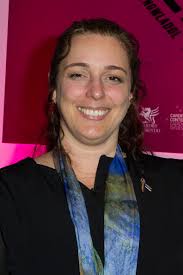
Tania Bruguera
  Tania Bruguera

On December 30th Cuban authorities cancelled an open-microphone event at Havana’s Plaza de la Revolución and detained or arrested its organizers. The principal detainee was Tania Bruguera, a Cuban citizen who lives on the island and in Miami, Florida and who is a performance artist. She intended to provide an open-microphone for any attendee to give a one-minute statement on his or her opinions and recommendations for Cuba’s future.

This cancellation and related arrests have provoked strong condemnation from the U.S. Department of State and major U.S. newspapers. Initially I was persuaded by such condemnations and worried that they would foster U.S. political resistance to recent U.S.-Cuba reconciliation. After further investigation, however, I have come to reject such harsh condemnations. In order to understand this conclusion, this post will examine what happened in Havana, the reactions from the State Department and western newspapers and then the reasons why I reject such condemnations.

Cuban Events Relating to the Open-Mike Performance[1]

Plaza_de_la_Revolution

Plaza3

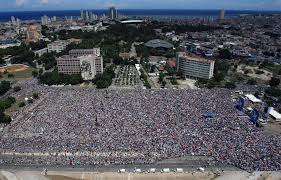
On December 30th Cuban performance artist Tania Bruguera was planning to stage an open-microphone event, “Yo tambien exijo,” [I also demand],” in Havana’s Plaza de la Revolución, the huge public square usually reserved for large government-sponsored events.[2] (The photo on the top shows an empty Plaza while the other one has a large crowd in attendance.) She planned to give any attendee a one-minute platform to discuss his or her opinions about, and recommendations for, Cuba’s future. She told the U.S. National Public Radio that she wanted “people in the street [to] come and share . . . [their] doubts, [their] happiness – whatever [they] think right now about what is happening in Cuba, and what is the idea of Cuba that [they] want?”

Bruguera was proceeding with these plans even though her application for a permit had been denied and even though the Government’s National Fine Arts Council had told her that it would not be providing her with institutional support for the event as proposed because it “would negatively impact public opinion, in a key time of negotiation between the Cuban government and the government of the United States.”

On December 30th the Council issued a public statement documenting its decision not to support the event. It said, “Under current circumstances, it is unacceptable performing this purported performance in the symbolic space of the Plaza of the Revolution, especially considering the extensive media coverage and manipulation that has been in the media broadcasters counterrevolution.”

The Council, however, also stated that Bruguera had rejected its suggestions on conducting the event subject to the following conditions: (a) move the event to the National Museum of Fine Arts, a prestigious cultural institution in the field of visual arts; (b) the Museum would be freely open to diverse people of dissimilar social sectors; (c) the government would “reserve the right” to bar people whose “sole interest is to be provocative;” and (d) the performance would be limited to 90 minutes.

Just hours before the planned event, Cuban police detained, on public disorder charges, Bruguerea and at least three leading dissidents: Antonio Rodiles, the head of Citizens Demand for Another Cuba; Eliezer Avila, the leader of the opposition group Somos Mas; and Reinaldo Escobar, a senior editor of a dissident website 14medio.com. Escobar’s spouse, Blogger Yoani Sanchez, was also detained at her home by police. There were reports that up to 50 members of the political opposition were detained.

Ms. Bruguera was released the next afternoon along with most of the political dissidents. She then announced she would hold a news conference and public gathering on the Malecón, Havana’s coastal highway, at the memorial to the Maine, the American battleship that sank in Havana Harbor in 1898. Cuban agents, however, stopped her en route to the gathering and took her away for interrogation. She was told she could not leave Cuba “for two or three months” while the case was being processed. Again she was released.

However, on January 1, 2015, she was arrested again along with several dissidents when they went to a jail to demand the release of 15 additional dissidents who had been arrested on the day of the planned event. The next day (January 2) she was released.

Reactions to the Cancelation and Arrests

On December 30th, the U.S. Department of State issued a Press Statement saying the U.S. was “deeply concerned about the latest reports of detentions and arrests by Cuban authorities of peaceful civil society members and activists . . . [and] strongly condemn[ed] the Cuban government’s continued harassment and repeated use of arbitrary detention, at times with violence, to silence critics, disrupt peaceful assembly and freedom expression, and intimidate citizens.”

The Statement added, “Freedoms of expression and peaceful assembly are internationally recognized human rights, and the Cuban government’s lack of respect for these rights, as demonstrated by today’s detentions, is inconsistent with Hemispheric norms and commitments. We urge the Government of Cuba to end its practice of repressing these and other internationally protected freedoms and to respect the universal human rights of Cuban citizens.”

The Statement concluded that the U.S. has “always said we would continue to speak out about human rights, and as part of the process of normalization of diplomatic relations, the United States will continue to press the Cuban government to uphold its international obligations and to respect the rights of Cubans to peacefully assemble and express their ideas and opinions, just like their fellow members of civil society throughout the Americas are allowed to do.”

Also on December 30th Assistant Secretary of State Roberta Jacobson tweeted “Freedom of expression remains core of US policy on #Cuba; we support activists exercising those rights and condemn today’s detentions.”

These views were shared by the New York Times’ December 30th editorial, “Cuba Turns Off Critics’ Open Mike.” It said, “By stifling critical voices, the Cuban government is showing its unwillingness to tolerate basic freedoms most citizens in the hemisphere enjoy.”

The Times’ editorial continued, “This move, unfortunately, will amplify the criticisms of those who opposed Mr. Obama’s historic shift on Cuba policy. Heavy-handed tactics by the Castro government will give them ammunition next year, when Republicans will control both chambers of Congress, to stymie the Obama administration’s steps to ease the embargo through executive authority and dim the prospects of legislative change to pare back the web of sanctions Washington imposes on Cuba. That result would be a shame and, in the long run, self-defeating for Havana.”

The editorial on the same subject by the Washington Post, which earlier opposed the December 17th reconciliation, was in the same vein. It stated, “[T]he Castro regime has been left free to continue stifling dissent, while reaping the economic and political benefits of Mr. Obama’s ‘engagement.’ Raúl Castro declared in a speech shortly after the agreement was announced that the Communist political system would remain unchanged. Two weeks later, not one of the 53 political prisoners the White House said would be freed — about half of the total identified by human rights activists — has been reported released.”

The Washington Post editorial concluded, “Cubans who seek basic freedoms continue to be arrested, harassed and silenced, while the regime celebrates what it portrays as ‘victory’ over the United States. If support for the Cuban people and American values is supposed to be the point of this process, then it is off to a very poor start.”

People opposed to the resumption of relations with Cuba were quick to hold up the arrests as a sign that the Castro government had no intention of pursuing political change and would reap only economic benefits from Mr. Obama’s moves. For example, Senator Marco Rubio, Republican of Florida and a Cuban-American, tweeted, “Castro govt. arrests of activists in #Havana exposes the folly of new Obama #CubaPolicy.”

Rejection of the Condemnation

As a long-time member of the American Civil Liberties Union and as a pro bono attorney in one of its important free speech cases, I am a strong believer in the importance of free speech. Therefore, I initially concurred in the State Department and New York Times’ condemnation of Cuba’s cancellation of this event and related arrests, and I worried that this controversy might cause the U.S. to abandon the recently announced U.S.-Cuba reconciliation.

On the other hand, I was and continue to be troubled by the State Department and most of the articles about this event not mentioning the Cuban Fine Arts Council’s willingness to support the event in another location and with certain limits. This action by the Arts Council suggests at a minimum that the State Department and western media are over-reacting to these events and unfairly rushing to judgment.

These U.S. critics also forget that governmental authorities in the U.S. sometimes determine that it is not appropriate to stage a protest at a particular time and place. It just happened in my home state of Minnesota at the Mall of America (MOA) on a big shopping day (December 20th). Although MOA officials had told the organizers that it was against its policies for them to hold a “Black Lives Matter” protest at the Mall on that day,[3] they did so anyway as this video shows. After 2,000 to 3,000 protesters flooded a Mall rotunda and held “die-ins” in front of several nearby businesses, riot-gear-clad police officers arrested 25 for trespass, peacefully dispersed the crowd and tried to block people from re-entering the rotunda. Afterwards the local city attorney announced plans “to file additional charges against ‘ringleaders’ of the protest and to seek restitution for the costs of 250 police at the event and lost sales during the two to three hours when more than 75 stores in the mall were closed.” On January 5th some of the protesters spoke against such prosecution at a city council meeting. This story obviously is not yet over.

In addition, there is a report that raises the much more serious question of whether the event was an idea of Cubans acting by themselves. According to the Wall Street Journal, an opponent of reconciliation with Cuba, at the scheduled time for the event, “Cuban cellphones received mysterious messages from a Florida area code offering cheap beer to all those gathering on the plaza.” This was confirmed in an interview by U.S. National Public Radio with Marc Frank, a U.S. journalist who was one of about a dozen people at the Plaza at the time of the planned event. He said, “text messages were sent from somewhere in Miami to a lot of cell phones here, including mine, basically saying that there’s going to be an event at the Plaza de la Revolución, and there’d be free beer.” Frank added that “Tania is an artist, lives some in Cuba and mainly in Miami, . . . [but] she’s not really well-known in Cuba at all.”[4]

These messages about free beer in the Plaza from a Miami telephone number raise the question of whether the event was actually being planned by the U.S. Agency for International Development (USAID) or another U.S. government agency or by Cuban-Americans opposed to the reconciliation of the two countries.

As discussed in prior posts, USAID (U.S. Agency for International Development) had funded via a private contractor at least three covert (or as the agency prefers to say “discreet”) programs in Cuba to promote civil society and dissent or regime change, all without the prior knowledge or consent of the Cuban government. One was for U.S. citizen Alan Gross to take communications equipment to Cuba, for which he was arrested, convicted and imprisoned in Cuba for violating its laws.[5] Another such USAID program via a private contractor unsuccessfully tried to create a Cuban social media program Yet another used Central Americans to promote purported HIV informational efforts on the island. The final one that has been discovered so far by journalists again via a private contractor attempted to infiltrate the Cuban rap-artist community.

These USAID programs were sharply criticized in a November New York Times editorial, as discussed in an earlier post. The editorial said, ““Far from accomplishing . . . the goal [of instigating democratic reforms on the island], the initiatives have been largely counterproductive. The funds have been a magnet for charlatans, swindlers and good intentions gone awry. The stealthy programs have increased hostility between the two nations, provided Cuba with a trove of propaganda fodder and stymied opportunities to cooperate in areas of mutual interest.”

Instead, the Times’ November editorial argued, “The United States should strive to promote greater freedoms on the island of 11 million people and loosen the grip of one of the most repressive governments in the world. Instead of stealth efforts to overthrow the government, American policy makers should find ways to empower ordinary Cubans by expanding study-abroad programs, professional exchanges and investment in the new small businesses cropping up around the island. They should continue to promote Internet connectivity, but realize that accomplishing that goal on a large scale will require coordination with the Cuban government.” Moreover, “Washington should recognize that the most it can hope to accomplish is to positively influence Cuba’s evolution toward a more open society. That is more likely to come about through stronger diplomatic relations than subterfuge.”

Perhaps the Times forgot this editorial when it more recently lambasted the Cuban actions over the “open-microphone” event.

In any event, the U.S. government apparently has not learned the lesson outlined by the Times in October because the USAID website, which says it was last updated on December 16 (the day before the announcement of U.S.-Cuba reconciliation), still contains general information about its Cuba programs to “[p]romote human rights and fundamental freedoms.”

In addition, on December 22, 2014 (five days after that announcement), the U.S. Department of State’s Bureau of Democracy, Human Rights and Labor issued a Public Notice of its “Request for Statements of Interest: Program Fostering Civil, Political and Labor Rights in Cuba.” The Bureau’s prospective funding of $11 million would be used for typically funded proposals, the Bureau said, like “[o]rganizational assistance to Cuban civil society to improve management, strategic planning, sustainability, and collaboration of local civil society groups; [o]ff-island trainings, short-term fellowships, or engagement; [d]istribution of software that would be easily accessible in an open society; . . . [and] ]a]ssistance mechanisms designed to provide independent Cuban civil society with tools, opportunities, and trainings that civil society counterparts in open societies can access.”

Both the USAID and State Department statements read as if they are promoting programs in Cuba without the knowledge, cooperation or agreement of the Cuban government. This is contrary to President Obama’s statement in his nationally televised speech on December 17th, in which he said the U.S. would “raise those differences [with the Cuban government] directly . . .[such as] democracy and human rights in Cuba. But I believe we can do more to support the Cuban people and promote our values through engagement [with the Cuban government].” He added, “no Cubans should face harassment or arrest or beatings simply because they’re exercising a universal right to have their voices heard, and we will continue to support civil society there.”

Similar thoughts were expressed the same day in the White House’s FACT SHEET: Charting a New Course on Cuba.” It said, “We know from hard-learned experience that it is better to encourage and support reform than to impose policies that will render a country a failed state.” It also stated, “The Administration will continue to implement U.S. programs aimed at promoting positive change in Cuba, and we will encourage reforms in our high level engagement with Cuban officials.”

Although President Obama apparently was talking about encouraging the Cuban government to expand the Cuban people’s rights to express different opinions on what their government should do, a prior post shows some ambiguity in these statements that could allow the continuation of the USAID and State Department’s covert or “discreet” efforts to promote regime change.

If the open-microphone event, in fact, was orchestrated by USAID or some other U.S. government agency, it is Orwellian. Such programs purport to promote democracy and human rights with undemocratic and non-human rights means. Such programs are publicly mentioned—in very general terms—on U.S. government websites yet are conducted covertly or “discreetly” on the island. Such programs are hostile to a country with which the U.S. purportedly is attempting to build a normal and respectful diplomatic relationship. These programs also logically motivate Cuban authorities to be vigilant in reacting to events like the “open-microphone” one.

In other words it is horribly stupid and unwise to have such behind-the-back programs when the two countries are embarking on a long and complicated path for full reconciliation. As the New York Times said in November, the U.S. “should recognize that the most it can hope to accomplish is to positively influence Cuba’s evolution toward a more open society. That is more likely to come about through stronger diplomatic relations than subterfuge.”

===========================================================

[1] This account of the planned event and the arrests by the Cuban government is based on articles in the New York Times, Washington Post, Wall Street JournalGuardian, Los Angeles Times,  National Public Radio, the Cuban Fine Arts Council and again the New York Times.

[2] The Plaza is the 31st largest public square in the world; it measures 72,000 square meters (774,936 square feet) and has been the site for crowds of 1 million for major speeches by Fidel Castro and for a mass celebrated by Pope John Paul II. The idea that the open-microphone event might create such a large crowd should have been seen as ridiculous by everyone, including the Cuban authorities, and a small gathering like the 12 or so that showed up on the 30th would have demonstrated the over-reaction of the those authorities in shutting it down and the State Department and western media in attacking the shut-down.

[3] Before the protest the local city (Bloomington) sent a letter to the protest organizers warning that the city would enforce the mall’s private-property rights under the authority of a Minnesota Supreme Court decision that held the MOA was a private entity with the right to exclude demonstrators.

[4] The Director of Security Operations at Telecommunications Company of Cuba reported that since December 21st Cuba had been receiving electronic messages calling for participation in an event with Tania Bruguera. These messages came from a platform “Wake Cuba,and these messages were similar to previous ones paid for by USAID.  Another Cuban source states that some Cuban email addresses were hacked and used to send emails to Cubans about this event.

[5] Gross on December 17th was released from Cuban prison and returned to the U.S.

Additional Details About White House’s Announcement of U.S.-Cuba Reconciliation

White House
White House

On December 17, 2014, President Barack Obama in a nationally televised speech announced the historic agreement with Cuba to restore diplomatic relations as one part of a reconciliation with Cuba. That same day the White House website had (a) “FACT SHEET: Charting a New Course in Cuba;” (b) “Background Conference Call on Policy Changes in Cuba and Release of Alan Gross;” and (c) “Readout of the Vice President’s Calls to the Presidents of Colombia and Mexico on the Administration’s Cuba Policy Changes.”

After reviewing these documents, the post will conclude with observations on some of the points raised in these documents.

“FACT SHEET: Charting a New Course in Cuba”

The introduction to the FACT SHEET, among other things, said, “It is clear that decades of U.S. isolation of Cuba have failed to accomplish our enduring objective of promoting the emergence of a democratic, prosperous, and stable Cuba. . . . It does not serve America’s interests, or the Cuban people, to try to push Cuba toward collapse.  We know from hard-learned experience that it is better to encourage and support reform than to impose policies that will render a country a failed state.  With our actions today, we are calling on Cuba to unleash the potential of 11 million Cubans by ending unnecessary restrictions on their political, social, and economic activities.” (Emphasis added.)

The FACT SHEET then provided the following “Key Components of the Updated Policy Approach:”

“Establishing diplomatic relations with Cuba-

  • The President has instructed the Secretary of State to immediately initiate discussions with Cuba on the re-establishment of diplomatic relations with Cuba, which were severed in January 1961.
  • In the coming months, we will re-establish an embassy in Havana and carry out high-level exchanges and visits between our two governments as part of the normalization process.  As an initial step, the Assistant Secretary of State for Western Hemisphere Affairs will lead the U.S. Delegation to the next round of U.S.-Cuba Migration Talks in January 2015, in Havana.
  • U.S. engagement will be critical when appropriate and will include continued strong support for improved human rights conditions and democratic reforms in Cuba and other measures aimed at fostering improved conditions for the Cuban people. (Emphasis added.)
  • The United States will work with Cuba on matters of mutual concern and that advance U.S. national interests, such as migration, counternarcotics, environmental protection, and trafficking in persons, among other issues.” (Emphasis added.)

“Adjusting regulations to more effectively empower the Cuban people-

  • The changes announced today will soon be implemented via amendments to regulations of the Departments of the Treasury and Commerce.   Our new policy changes will further enhance our goal of empowering the Cuban population.
  • Our travel and remittance policies are helping Cubans by providing alternative sources of information and opportunities for self-employment and private property ownership, and by strengthening independent civil society. 
  • These measures will further increase people-to-people contact; further support civil society in Cuba; and further enhance the free flow of information to, from, and among the Cuban people.  Persons must comply with all provisions of the revised regulations; violations of the terms and conditions are enforceable under U.S. law.”

“Facilitating an expansion of travel under general licenses for the 12 existing categories of travel to Cuba authorized by law-

  • General licenses will be made available for all authorized travelers in the following existing categories: (1) family visits; (2) official business of the U.S. government, foreign governments, and certain intergovernmental organizations; (3) journalistic activity; (4) professional research and professional meetings; (5) educational activities; (6) religious activities; (7) public performances, clinics, workshops, athletic and other competitions, and exhibitions; (8) support for the Cuban people; (9) humanitarian projects; (10) activities of private foundations or research or educational institutes; (11) exportation, importation, or transmission of information or information materials; and (12) certain export transactions that may be considered for authorization under existing regulations and guidelines. 
  • Travelers in the 12 categories of travel to Cuba authorized by law will be able to make arrangements through any service provider that complies with the U.S. Treasury’s Office of Foreign Assets Control (OFAC) regulations governing travel services to Cuba, and general licenses will authorize provision of such services. 
  • The policy changes make it easier for Americans to provide business training for private Cuban businesses and small farmers and provide other support for the growth of Cuba’s nascent private sector.  Additional options for promoting the growth of entrepreneurship and the private sector in Cuba will be explored.”

Facilitating remittances to Cuba by U.S. persons

  • Remittance levels will be raised from $500 to $2,000 per quarter for general donative remittances to Cuban nationals (except to certain officials of the government or the Communist party); and donative remittances for humanitarian projects, support for the Cuban people, and support for the development of private businesses in Cuba will no longer require a specific license.
  • Remittance forwarders will no longer require a specific license.”

“Authorizing expanded commercial sales/exports from the United States of certain goods and services-

  • The expansion will seek to empower the nascent Cuban private sector.  Items that will be authorized for export include certain building materials for private residential construction, goods for use by private sector Cuban entrepreneurs, and agricultural equipment for small farmers.  This change will make it easier for Cuban citizens to have access to certain lower-priced goods to improve their living standards and gain greater economic independence from the state.”

“Authorizing American citizens to import additional goods from Cuba-

  • Licensed U.S. travelers to Cuba will be authorized to import $400 worth of goods from Cuba, of which no more than $100 can consist of tobacco products and alcohol combined.”

Facilitating authorized transactions between the United States and Cuba-

  • U.S. institutions will be permitted to open correspondent accounts at Cuban financial institutions to facilitate the processing of authorized transactions.
  • The regulatory definition of the statutory term “cash in advance” will be revised to specify that it means “cash before transfer of title”; this will provide more efficient financing of authorized trade with Cuba.
  • U.S. credit and debit cards will be permitted for use by travelers to Cuba.
  • These measures will improve the speed, efficiency, and oversight of authorized payments between the United States and Cuba.”

“Initiating new efforts to increase Cubans’ access to communications and their ability to communicate freely-

  • Cuba has an internet penetration of about five percent—one of the lowest rates in the world.  The cost of telecommunications in Cuba is exorbitantly high, while the services offered are extremely limited.
  • The commercial export of certain items that will contribute to the ability of the Cuban people to communicate with people in the United States and the rest of the world will be authorized.  This will include the commercial sale of certain consumer communications devices, related software, applications, hardware, and services, and items for the establishment and update of communications-related systems.
  •  Telecommunications providers will be allowed to establish the necessary mechanisms, including infrastructure, in Cuba to provide commercial telecommunications and internet services, which will improve telecommunications between the United States and Cuba.”

“Updating the application of Cuba sanctions in third countries-

  • U.S.-owned or -controlled entities in third countries will be generally licensed to provide services to, and engage in financial transactions with, Cuban individuals in third countries.  In addition, general licenses will unblock the accounts at U.S. banks of Cuban nationals who have relocated outside of Cuba; permit U.S. persons to participate in third-country professional meetings and conferences related to Cuba; and, allow foreign vessels to enter the United States after engaging in certain humanitarian trade with Cuba, among other measures.”

“Pursuing discussions with the Cuban and Mexican governments to discuss our unresolved maritime boundary in the Gulf of Mexico-

  • Previous agreements between the United States and Cuba delimit the maritime space between the two countries within 200 nautical miles from shore.  The United States, Cuba, and Mexico have extended continental shelf in an area within the Gulf of Mexico where the three countries have not yet delimited any boundaries.
  • The United States is prepared to invite the governments of Cuba and Mexico to discuss shared maritime boundaries in the Gulf of Mexico”

“Initiating a review of Cuba’s designation as a State Sponsor of Terrorism-

  • The President has instructed the Secretary of State to immediately launch such a review, and provide a report to the President within six months regarding Cuba’s support for international terrorism.  Cuba was placed on the list in 1982.”[1]

“Addressing Cuba’s participation in the 2015 Summit of the Americas in Panama-

  • President Obama will participate in the Summit of the Americas in Panama.  Human rights and democracy will be key Summit themes.  Cuban civil society must be allowed to participate along with civil society from other countries participating in the Summit, consistent with the region’s commitments under the Inter-American Democratic Charter.  The United States welcomes a constructive dialogue among Summit governments on the Summit’s principles.” (Emphasis added.)

“Unwavering Commitment to Democracy, Human Rights, and Civil Society

A critical focus of our increased engagement will include continued strong support by the United States for improved human rights conditions and democratic reforms in Cuba.  The promotion of democracy supports universal human rights by empowering civil society and a person’s right to speak freely, peacefully assemble, and associate, and by supporting the ability of people to freely determine their future.   Our efforts are aimed at promoting the independence of the Cuban people so they do not need to rely on the Cuban state. (Emphasis added.)

The U.S. Congress funds democracy programming in Cuba to provide humanitarian assistance, promote human rights and fundamental freedoms, and support the free flow of information in places where it is restricted and censored.  The Administration will continue to implement U.S. programs aimed at promoting positive change in Cuba, and we will encourage reforms in our high level engagement with Cuban officials. (Emphasis added.)

The United States encourages all nations and organizations engaged in diplomatic dialogue with the Cuban government to take every opportunity both publicly and privately to support increased respect for human rights and fundamental freedoms in Cuba. 

Ultimately, it will be the Cuban people who drive economic and political reforms.  That is why President Obama took steps to increase the flow of resources and information to ordinary Cuban citizens in 2009, 2011, and today.  The Cuban people deserve the support of the United States and of an entire region that has committed to promote and defend democracy through the Inter-American Democratic Charter.”

Background Conference Call 

On December 17 two hours before President Obama’s speech to the nation, the White House conducted an hour-long “background” conference call with journalists and seven unnamed senior administration officials regarding these matters.

Among other things, one of the officials said the U.S. expects that “we’ll continue to have strong differences, particularly on issues related to democracy and human rights.  The [U.S.] will continue to promote our values.  We will continue to support civil society in Cuba.  We’ll continue our democracy programming.” In President Obama’s December 16th telephone call with President Raúl Castro, Obama “made clear his intent . . . to continue our advocacy for human rights in Cuba.”

A State Department official stated the U.S. would not reduce its “emphasis on human rights, on democracy, on the importance of civil society. . . . In fact, our emphasis on human rights will be just as strong and we believe more effective under this policy.  We will engage directly with the Cuban government on human rights.”

For example, the State Department official stated a U.S. diplomat in Havana “will be meeting with members of Cuban society and dissidents later today to walk them through the President’s initiatives of today, and to emphasize to them, as well, that their efforts on behalf of democracy and human rights in Cuba not only won’t be forgotten in these initiatives, but will, in fact, take center stage.”

In response to a question as to whether there were discussions with Cuba about “USAID programs that have been pretty controversial in Cuba,” an administration official said U.S. “democracy programming . . . did factor into the discussions [with Cuba].  The Cubans do not like our democracy programming.  They consistently protest those initiatives. . . . [The U.S., however,] made clear that we’re going to continue our support for civil society for the advancement of our values in Cuba.  [This] . . . was an issue of difference that we will continue to have with Cuba, and we fully expect them to raise those issues just as we will raise issues with the Cubans about democracy and human rights.  However, we’re going to do that through a normal relationship.  We’re going to do that through our embassy in Havana.  We’re going to do that through contacts between our various agencies.”[2]

Vice President Biden’s Telephone Calls with Presidents of Colombia and Mexico

The White House reported that Vice President Joe Biden made telephone calls about the new initiatives with Cuba  to President Juan Manuel Santos of Colombia and to President Enrique Pena Nieto of Mexico. After outlining the agreement, Biden told each of them that President Obama intended to attend the Summit of the Americas in Panama next April “as long as Cuban civil society is allowed to participate and human rights and democracy are on the agenda.” In the call to President Nieto, Biden said that the U.S. would initiate discussions with Cuba and Mexico about the unresolved maritime boundary of the Gulf of Mexico.

Conclusion

I concur in most of the FACT SHEET’s assertions about democracy and human rights that suggest that the U.S. will engage and work with the Cuban government to improve the Cuban people’s political, social and economic rights and that the U.S. no longer will seek to impose such rights or values on the Cuban people through covert or “discreet” programs. These statements are the following:

  • (i)  “It does not serve America’s interests, or the Cuban people, to try to push Cuba toward collapse.  We know from hard-learned experience that it is better to encourage and support reform than to impose policies that will render a country a failed state.  With our actions today, we are calling on Cuba to unleash the potential of 11 million Cubans by ending unnecessary restrictions on their political, social, and economic activities.”
  • (ii)  “U.S. engagement will be critical when appropriate and will include continued strong support for improved human rights conditions and democratic reforms in Cuba and other measures aimed at fostering improved conditions for the Cuban people.”
  • (iii) “A critical focus of our increased engagement will include continued strong support by the United States for improved human rights conditions and democratic reforms in Cuba.  The promotion of democracy supports universal human rights by empowering civil society and a person’s right to speak freely, peacefully assemble, and associate, and by supporting the ability of people to freely determine their future.   Our efforts are aimed at promoting the independence of the Cuban people so they do not need to rely on the Cuban state.”
  • (iv) The U.S. “will encourage [such] reforms in our high level engagement with Cuban officials.”

Other statements in the FACT SHEET, however, seems to undercut this benign interpretation: (i) “The U.S. Congress funds democracy programming in Cuba to provide humanitarian assistance, promote human rights and fundamental freedoms, and support the free flow of information in places where it is restricted and censored.  The Administration will continue to implement U.S. programs aimed at promoting positive change in Cuba. . . .” (ii) “The U.S. Congress funds democracy programming in Cuba to provide humanitarian assistance, promote human rights and fundamental freedoms, and support the free flow of information in places where it is restricted and censored.  The Administration will continue to implement U.S. programs aimed at promoting positive change in Cuba.” [3]

According to the FACT SHEET, “President Obama will participate in the Summit of the Americas in Panama.  Human rights and democracy will be key Summit themes.  Cuban civil society must be allowed to participate along with civil society from other countries participating in the Summit.” The account of the Vice President’s telephone calls, however, seems to add that President Obama intends to attend the Summit of the Americas in Panama next April “as long as Cuban civil society is allowed to participate and human rights and democracy are on the agenda.” I was surprised and disappointed to read that there was a precondition to Obama’s attending the summit: Cuba’s allowing members of its civil society to attend and participate in the Summit. While it may be a good idea to have civil society representatives from all countries, including Cuba, attend and participate, I think it unwise for the U.S. to provide Cuba with a veto on Obama’s attendance if it does not have such representatives there. I hope that this interpretation of the Vice President’s remarks is unfounded.

I am unaware of the details of the dispute about the maritime boundaries of the Gulf of Mexico, but assume that it relates to oil or other resources under the Caribbean.

================================================

[1] Prior posts discussed the legal and political issues of rescinding the designation of Cuba as a “State Sponsor of Terrorism” and the U.S.’ previous concessions that Cuba has provided assurances that it will not commit future acts of terrorism.

[2] On December 20th Secretary of State John Kerry, Secretary of Commerce Penny Pritzker and Treasury Secretary Jacob J. Lew co-authored an article in the Miami Herald. It said the U.S. would have “continued strong support for improved human-rights conditions and democratic reforms in Cuba” and would “continue to implement programs to promote positive change in Cuba.”

[3] The previous democracy/human rights programs of the U.S. Agency for International Development (USAID) and the Department of State will be part of a subsequent post about the recent controversy about Cuba’s cancellation of n “open-microphone” event and arrests of its organizers.

President Obama’s Strategic Timing of Announcement of U.S.-Cuba Reconciliation

With God’s leading or nudging the U.S. and Cuba to reconciliation, the timing of the announcement of that historic change on December 17th was due to more prosaic factors from the U.S. perspective.

Pressures for an announcement as soon as possible were several. The health of U.S. citizen, Alan Gross, was reportedly declining in a Cuban prison, and President Obama and Secretary of State John Kerry legitimately believed that reconciliation would be destroyed if he died in that prison. As we now know, the U.S. and Cuba had been engaged in secret negotiations for 18 months, and delaying the announcement ran the risk of a leak of the existence of the negotiations that would upset, if not destroy, the reconciliation. Less immediate was the upcoming Summit of the Americas in April 2015 with the U.S. needing to have a position on host country Panama’s invitation to Cuba to attend the Summit.

In addition, U.S. domestic political considerations pointed towards a December announcement before the Republican-controlled 114th Congress opened in early January and as soon as possible (the next day) after the adjournment of the 113th so that there would be no resulting interference with the completion of the many items of unfinished business of the current Congress. December also is the traditional time for exercise of presidential clemency (pardons and commutation of sentences), the latter of which was used for the release of the remaining three of the Cuban Five on December 17th.

All of these considerations suggest why the President on December 16th (the day before the announcement about Cuba) quietly signed the $1.1 trillion appropriation bill even though it contained a repeal of an important provision of the Dodd-Frank Wall Street Reform and Consumer Protection Act regulating financial institutions that Senator Elizabeth Warren passionately resisted.  The President did not want a lack of funding to interfere with or torpedo the reconciliation.

Within a week of the announcement we learned that the U.S. GDP for the third quarter had increased 5.0%, the strongest quarterly performance in a decade, and the U.S. stock market reacted with a record close on December 23 with the Dow Jones Industrial Average at 18024.17, registering its 36th record close this year. Unemployment is below 6.0%. The FY 2014 deficit is below its 40-year average. The Affordable Care Act has reduced uninsured Americans by 25%, and overall health-care spending has slowed significantly. The U.S. Dollar is stronger against other world currencies. The federal government’s bailouts of banks and the auto industry that rescued the economy from a total collapse at the start of the Obama presidency were closed out with a net profit to the taxpayers of $15.4 billion. Low world oil prices help the American consumer and weaken regimes hostile to the U.S., especially Russia, Iran and Venezuela. An amazing economic performance! (Packer, A Pretty Good Year for Government, New Yorker (Dec. 23, 2014); Higgins, Oil’s Swift Fall Raises Fortunes of U.S. Abroad, N.Y. Times (Dec. 25, 2014).)

President Obama, using the “fourth quarter” analogy of his favorite sport of basketball, obviously has concluded that he would be engaged in a vigorous “fourth quarter” (the last two years of his eight years in office) to do as much as possible of what he believes to be in the national interest of our country. Indeed, at the first Cabinet meeting after the huge Republican victories in this year’s midterm election, Obama gave every Cabinet member a white card that said, “We are entering the fourth quarter, and really important things happen in the fourth quarter.” Timothy Egan, a New York Times’ columnist, says Obama has “been liberated by defeat” and “in finally learning how to use the tools of his office, Obama unbound is a president primed to make his mark.” He is “marching ahead of politicians fighting yesterday’s wars,” who are forced “to defend old-century policies, and rely on an aging base to do it.” Moreover, Obama now “has Pope Francis as a diplomatic co-conspirator,” leaving Republican opponents of Cuban reconciliation to try to lecture “the most popular man on the planet.”  (Osnos, In the Land of the Possible, New Yorker (Dec. 22 & 29, 2014); Eagan, Obama Unbound, N.Y. Times (Dec. 20, 2014).)

Finally the merits of reconciliation and these reflections on the timing of the announcement resurrect my personal support of the President. Given the Administration’s problems with the implementation of the Affordable Care Act and other administrative issues, I was beginning to think that Obama’s lack of prior administrative experience was a reason why he would not be the great President I expected him to be. Now, however, his achieving reconciliation with Cuba is a masterful demonstration of his intellectual, administrative and political skills.

Congratulations, Mr. President!

Praise God for Leading U.S. and Cuba to Reconciliation

God acting through people of Christian faith has been leading the U.S. and Cuba to reconciliation and promises to be with the people of both countries as they confront the many issues and challenges in achieving full reconciliation.

Roman Catholic Church

Principal agents for God have been and are the Roman Catholic Church and Pope Francis.The Vatican’s role predated Pope Francis. Two of his predecessors, Pope John Paul II and Pope Benedict XVI, visited Cuba in 1998 and 2012 respectively, and the church remains hugely influential among Cubans. The Obama administration first sought to enlist the Vatican’s support when Pope Benedict XVI was in office. It worked even more actively with the Vatican after Pope Francis came to the Vatican in 2013. The pope’s new secretary of state, Cardinal Pietro Parolin, an Italian, had served as papal nuncio in Venezuela and was well versed in Latin America politics. Mr. Kerry was also in contact with the Cardinal, meeting him at the Vatican in June of this year and again a week ago.

Most significantly, as has been widely reported, Pope Francis of the Roman Catholic Church acted as a mediator to help the parties.[1]

This was verified in the Vatican’s Secretary of State’s December 17th statement, in which the Pope “wishes to express his warm congratulations for the historic decision taken by the Governments of the United States of America and Cuba to establish diplomatic relations, with the aim of overcoming, in the interest of the citizens of both countries, the difficulties which have marked their recent history.” The statement also provided the following details:

  • “In recent months, Pope Francis wrote letters to the President of the Republic of Cuba, His Excellency Mr Raúl Castro, and the President of the United States, The Honorable Barack H. Obama, and invited them to resolve humanitarian questions of common interest, including the situation of certain prisoners, in order to initiate a new phase in relations between the two Parties.”
  • “The Holy See received Delegations of the two countries in the Vatican last October and provided its good offices to facilitate a constructive dialogue on delicate matters, resulting in solutions acceptable to both Parties.”
  • “The Holy See will continue to assure its support for initiatives which both nations will undertake to strengthen their bilateral relations and promote the wellbeing of their respective citizens.”

President Obama in his December 17th televised speech announcing this important initiative acknowledged that “His Holiness Pope Francis” had supported these measures and thanked the Pope, “whose moral example shows us the importance of pursuing the world as it should be, rather than simply settling for the world as it is.” In particular, the President said, “His Holiness Pope Francis issued a personal appeal to me and to Cuban President Raul Castro urging us to resolve Alan [Gross]’s case and to address Cuba’s interest in the release of three Cuban agents who have been jailed in the United States for over 15 years.”

Similarly Cuban President Raúl Castro in his televised remarks to the Cuban people said, “I wish to thank and acknowledge the support of the Vatican, most particularly the support of Pope Francisco, in the efforts for improving relations between Cuba and the United States.”

Subsequent reports and research reveals some of the details of the Pope Francis’ involvement.[2]

Obama & Pope
Obama & Pope

On March 27, 2014, the Vatican reported that President Obama “was received in audience by His Holiness Pope Francis, after which Obama met with His Eminence Cardinal Pietro Parolin, Secretary of State, and Archbishop Dominique Mamberti, Secretary for Relations with States. During the cordial meetings, views were exchanged on some current international themes and it was hoped that, in areas of conflict, there would be respect for humanitarian and international law and a negotiated solution between the parties involved.” Presumably this was U.S.-Cuba relations.

Immediately after the Audience, at a joint news conference with Matteo Renzi, the prime minister of Italy, President Obama made comments that in retrospect might have alluded to conversations about Cuba. The President said the Pope and he “had a wide-ranging discussion.“[W]e spent a lot of time talking about the challenges of conflict and how elusive peace is around the world. . . . [W]e also touched on regions like Latin America, where there’s been tremendous progress in many countries, but there’s been less progress in others. . . . [T]he theme that stitched our conversation together was a belief that in politics and in life the quality of empathy, the ability to stand in somebody else’s shoes and to care for someone even if they don’t look like you or talk like you or share your philosophy — that that’s critical.  It’s the lack of empathy that makes it very easy for us to plunge into wars.  It’s the lack of empathy that allows us to ignore the homeless on the streets.  And obviously central to my Christian faith is a belief in treating others as I’d have them treat me.  And . . . [what has] created so much love and excitement for His Holiness has been that he seems to live this, and shows that joy continuously.” The President added, “ I was extremely moved by his insights about the importance of us all having a moral perspective on world problems and not simply thinking in terms of our own narrow self-interests.”

More recently a U.S. administration official said that at the Audience, President Obama spoke about Cuba with Pope Francis, who was “aware” that Obama was considering a change in the policy against Cuba and reached out to the President. Indeed, according to this official, Cuba was the at the center of the discussion.

Soon after the March Audience, Pope Francis sent the two presidents letters, appealing to both to keep pushing for an agreement. In June the Pope sent another letter to the two men calling on them to resolve the case of Alan Gross and the cases of the three Cubans who have been imprisoned here in the United States and also encouraging the United States and Cuba to pursue a closer relationship. . . . The letter from Pope Francis “gave us greater impetus and momentum for us to move forward. ” This appeal from the Pope was ‘very rare’ and unprecedented.

The Vatican then hosted the US and Cuban delegations in October when the parties were able to review the commitments that they to make on December 17th.” The Pope, U.S. officials said, acted as a “guarantor” that both sides would live up to the terms of a deal reached in secret.

According to a New York Times articleCardinal Jaime Ortega, the archbishop of Havana, also happened to be in Rome on October 3 and met with Francis, according to Vatican records, raising the possibility that he, too, attended the secret October meeting that is credited with sealing the diplomatic deal.’Ortega has always pushed for a gradual reform of the regime, for opening up, but at the same time he has been a trustworthy partner for the government — and with the full support of John Paul II, Benedict and Francis,’ said Marco Politi, an author and veteran Vatican analyst.”

An article by Juan Arias in El Pais, Spain’s leading newspaper, said Pope Francis “is only and always in favor of dialogue and peace, promote respect for all. Rescue the true dignity of the human being who is the subject of respect, travel partner, defender of life, rather than exploited, a commodity at the mercy of all who pay for it. In the world, managing the common good and the fight against injustice will inevitably present policy questions.” .

In the same vein, a Vatican spokesman said, in a December 18th interview with a Fox News interview, the Vatican has a culture of encounter the says it is better to be talking, rather than not talking, with another individual or country in the Vatican tradition of confidential diplomacy. Such a practice does not solve everything, but it opens up relations.

Another overall evaluation of Pope Francis’s diplomacy from the New York Times starts with his comments on December 18th to a new corps of diplomats to the Vatican, ” The work of an ambassador lies in small steps, small things, but they always end up making peace, bringing closer the hearts of people, sowing brotherhood among people. This is your job, but with little things, tiny things.” On the other hand, Francis has a “vision of diplomatic boldness, a willingness to take risks and insert the Vatican into diplomatic disputes, especially where it can act as an independent broker.”

Francis Campbell, a former British ambassador to the Holy See, adds that Francis had embraced the bully pulpit provided by the papacy. “The papacy is one of the world’s great opinion formers. Whether people agree with it or disagree with it, it has a huge voice.”

Another change under Francis is “appointing diplomats to key posts elsewhere, most notably his second-in-command, Secretary of State Pietro Parolin, an Italian cardinal who has led delicate Vatican negotiations with Vietnam and served as apostolic nuncio, or ambassador, in Venezuela.” Moreover, Francis and Cardinal Parolin are seen as working in tandem — the charismatic pope and the methodical diplomat. . . .  Paolo Rodari, a Vatican expert at La Repubblica, an Italian newspaper, added that Francis had quickly built a rapport with world leaders. ‘He establishes relationships very easily.”

Additional insight into Pope Francis’ mediation of this situation is prompted by the Associated Press’ rediscovery of his 1998 booklet, “Dialogues between John Paul II and Fidel Castro,” written while the Pope was still Jorge Mario Bergoglio. Soon to be named archbishop of Buenos Aires, he attended Pope John Paul II’s visit to Cuba.“In the booklet, Bergoglio harshly criticized socialism — and by extension Castro’s atheist revolution — for denying individuals their ‘transcendent dignity’ and putting them solely at the service of the state. At the same time, he denounced the U.S. embargo and economic isolation of Cuba that impoverished the island. ‘The Cuban people must overcome this isolation’. . . . [T]he first chapter titled ‘The value of dialogue’ . . . [says] that dialogue was the only way to end Cuba’s isolation and its hostility to the Catholic Church while promoting democracy.

This booklet was referenced by Austen Ivereigh in his new biography of Francis “The Great Reformer.” Ivereigh said Bergoglio “demonstrated an ‘incredibly evenhanded’ approach to the Cuban problem while outlining a future for the island that may well be more realistic now that the thaw has begun.” Pope Francis “sees Cuba’s future as being a democratic government rooted in the Christian, humanist values of the Cuban pueblo. It’s a kind of nationalist Catholic understanding of politics, neither left nor right, neither communism nor unadulterated market capitalism.”

Everyone in the world should be grateful that we have Pope Francis as a servant of God.

Presbyterian Church

As a member of Minneapolis’ Westminster Presbyterian Church, which has had a partnership with a sister church in Cuba, I join in the declaration by my brothers and sisters of LA IGLESIA PRESBITERIANA-REFORMADA EN CUBA (the Presbyterian-Reformed Church of Cuba) regarding the historic launching of this path of reconciliation that was signed by Dr. Reinerio Arce Valentin, the Moderator and my personal friend; Rev. Daniel Izquierdo Hernández, Secretary-General; Rev. Francisco Marrero Gutiérrez, Council President; and Rev. Antonio (Tony) Aja, D. Min. They said:

  • “Today we witnessed the televised speeches by the Presidents of Cuba and the United States in which both rulers recognized the need to put an end to the hostility of more than half a century and to re-establish Diplomatic relations between our two countries, which hopefully will lead to the normalization of relations. It was also gratifying to hear the news of the release of Mr. Alan Gross and others imprisoned in Cuba, as well as the release of the three Cuban prisoners in the U.S. American, which allows family reunification.”
  • Our church “gives thanks to God and celebrates with joy these agreements. For decades we have been encouraged with the exchange of visits between Cuban and American churches. We are in deep gratitude to the evangelical ideal to seek peace and justice, and we raised Our Voice against the severe measures, both economic and commercial, that have been imposed by American policy on our peoples.“
  • “In the same way we have received such support from our sister church, Presbyterian Church (U.S.A.), and from resolutions and talks official with leaders of the U.S. Congress and representatives of the U.S. government.”
  • “We acknowledge the efforts of the Vatican, in the person of Pope Francis, as well as the government of Canada in the achievement of these agreements. We hope that we are closer to an era of peace between our nations, it is precisely on the eve of the celebration of the Christmas which reminds us of the divine purpose of peace and Goodwill in our land.
  • “Glory to God in the highest heaven, and on earth peace among those whom he favors.” (Luke 2:14. NRSV).

The Stated Clerk of the Presbyterian Church (U.S.A.) [PCUSA], Gradye Parsons, made a similar statement. He said, “we welcome the historic steps taken by President Obama on normalizing diplomatic relations with Cuba.” The PCUSA ‘has been working for more than 30 years to help ease the hardships caused by the United States’ economic embargo on Cuba and to end the embargo itself.” We also have “emphasized [with the U.S. government] the humanitarian reasons for the release of Alan Gross and the three Cuban prisoners.” This set of decisions “also takes us closer to a day when our two peoples will have no impediments to full and flourishing relations. We rejoice along with the Cuban Council of Churches and the Presbyterian Church of Cuba for the good news that will further the cause of peace and human rights around the world.”

Another statement was issued by Rev. Dr. J. Herbert Nelson, Director of PCUSA’s Office of Public Witness. He said, “The release of Alan Gross and the three Cuban prisoners is an example of how nations can find common ground.  When there is a will to live as true neighbors as Jesus Christ has taught us, we find a way towards justice and reconciliation.” The statement also noted that this Office “has organized religious delegations from Cuba, led a coalition of denominations and faith-based organizations calling for a change in policy towards Cuba, and organized meetings with members of congress and the administration urging an opening of relations between the two countries.”

I also believe that Minneapolis’ Westminster Presbyterian Church has played a small role in these historic decisions. Our connections with Cuba, our members’ visits to the island, our Cuban brothers and sisters visiting us, our prayer partnerships with members of the Matanzas church, our installing four potable water systems in Cuban churches and our learning more about Cuba and its relations with our country have inspired many of us to urge our Government to change its policies toward the island.

Our potable water projects are part of the “Living Waters for the World” ministry of the PCUSA’s Synod of Living Waters for the States of Kentucky, Tennessee, Mississippi and Alabama. To date they have trained people from churches, primarily Presbyterian, all over the U.S. who have installed over 660 such systems in 25 other countries. Cuba has received 21 of the systems, four by my church.

The importance of such systems for the Cuban people and churches was noticed by a New York Times reporter on a visit to the 137,000-population city of Cardenas on the north coast of the island about 90 miles east of Havana. He says, “Many of the churches in Cardenas have become a moral and economic counterweight [to communism] . . . to help people survive, with food, water, and exercise classes, and by guiding their souls away from a focus on material things.” (Cave, Crucible of Cuban Zeal Redefines Revolutionary, N.Y. Times (Dec. 20, 2014).)

As an example, he cites El Fuerte Presbyterian Church which occupies a “religious campus” that used to house Escuela La Progressiva, a famous pre-revolutionary school. This church has become a “hub of activity for the community largely because of a sophisticated water filtration system carried into Cuba and installed in 2012 by members of St. Charles Avenue Presbyterian Church in New Orleans.”

Other Religious Organizations

I know that other churches and synagogues in Minnesota and all around the U.S. have connections with Cuba and am confident that they too have had similar transformative experiences with our Cuban brothers and sisters. Others without overt religious motivation also have been God’s agents for these changes; here I think specifically of the support groups for the Cuban Five and for ending the U.S. embargo.

As the Bible says, “Now there are varieties of gifts, but the same Spirit; and there are varieties of services, but the same Lord; and there are varieties of activities, but it is the same God who activates all of them in everyone. To each is given the manifestation of the Spirit for the common good.” (1 Corinth. 12:4-7)(NRSV)

We lift all of them up in our prayers of gratitude.

=============================================

[1] An August 2012 post included my public letter to President Obama suggesting, among other things,“Perhaps such negotiations would be assisted by having the two countries agree to the appointment of a respected international mediator/conciliator to supervise the negotiations.”

[2] The President’s Audience and press conference about this and other topics were discussed in a prior post.

U.S. and Cuba Embark on Reconciliation

December 17, 2014, was a historic day in the relations between the United States of America and Cuba. The day started with Cuba’s release of Alan Gross, a U.S. citizen, from a Cuban prison and his return to his home in the U.S. and of the similar release and return to the U.S. of an unnamed U.S. spy . Nearly simultaneously the U.S. released three Cuban spies from its prison..

President Obama’s Speech

President Barack Obama

At noon (EST) President Obama delivered a televised speech to the nation and the world about the U.S, and Cuba embarking on a new path of reconciliation. He opened with the bold proclamation,”Today the United States of America is changing its relationship with the people of Cuba.  After noting the prisoner exchanges, he said:

First. he had instructed Secretary of State John Kerry “to immediately begin discussions with Cuba to reestablish diplomatic relations” with an embassy in Havana. “Where we can advance shared interests, we will. . . . Where we disagree, we will raise those differences openly–as we will continue to do on issues related to democracy and human rights in Cuba.”

Second, the President had “instructed Secretary Kerry to review Cuba’s designation as a State Sponsor of Terrorism . . . to be guided by the facts and the law.”

Third, we are taking steps to increase travel, commerce, and the flow of information to and from Cuba.”

Fourth, the U.S. is “significantly increasing the amount of money that can be sent to Cuba, and removing limits on remittances that support humanitarian projects, the Cuban people, and the emerging Cuban private sector.” The U.S. is also facilitating “authorized transactions [with Cuba], . . including U.S. financial institutions opening accounts with their Cuban counterparts and increased U.S. exports as well as  “increased telecommunications connections” with Cuba.

Fifth, the U.S. embargo against Cuba requires congressional action, and the President looks forward to  “engaging Congress in an honest and serious debate about lifting the embargo.”

Sixth, the President also acknowledged that Cuba was releasing “a substantial number of prisoners” who had been jailed for political reasons, was increasing internet access to its citizens and its engagement with international institutions.

Nevertheless, the President acknowledged that there would not be “a transformation of Cuban society overnight.” He was convinced, however, “that through a policy of engagement we can more effectively stand up for our values and help the cuban people help themselves.”

Obama near the end of his speech said, “To the Cuban people, America extends a hand of friendship.” The U.S. “wants to be a partner in making the lives of ordinary Cubans little bit easier, more free, more prosperous.”

Cuban President Raul Castro’s Speech

President Raúl Castro

Nearly simultaneously Cuban President Raúl Castro made a televised speech to his country about the new path for Cuba and the U.S.  After acknowledging the prisoner exchange and the release of some Cuban political dissidents from prison, he said the countries had “agreed to the restoration of diplomatic relations.” Unfortunately the U.S. embargo will not be ended immediately, but will be modified until Congress can enact a repeal.

The two countries will take mutual steps “to improve bilateral climate and move toward normalization of ties . . . based on the principles of international law and the [U.N.] Charter.” Cuba has also reaffirmed its willingness to discuss all issues of democracy, human rights and foreign policy. Cuba has urged the U.S. “to remove obstacles that prevent or restrict th e links between our peoples, families and citizens . . ., in particular those relating to travel, direct mail and telecommunications.”

“Progress in sustained exchanges show that it is possible to find solutions to many problems. . . . [W]e must learn the art of living, in a civilized manner, with our differences.”

Conclusion

These historic agreements raise many issues that will be discussed in subsequent posts.


New York Times Criticizes USAID’s Efforts To Promote Regime Change in Cuba

On November 10, 2014, the New York Times published its latest editorial in its series “Cuba: A New Start.”[1] Under the title, “In Cuba, Misadventures in Regime Change,” this editorial focuses on criticizing the efforts by the U.S. Agency for International Development (USAID) to promote regime change in Cuba and recommending “stronger [U.S.] diplomatic relations” with Cuba as a more productive way to try “to positively influence Cuba’s evolution toward a more open society.”

The editorial also recommends that the U.S. “should find ways to empower ordinary Cubans by expanding study-abroad programs, professional exchanges and investment in the new small businesses cropping up around the island. [The U.S.] should continue to promote Internet connectivity, but realize that accomplishing that goal on a large scale will require coordination with the Cuban government.”

The editorial’s foundation is the following set of documented factual assertions:

  • In 1996, the U.S. enacted the Helms-Burton Act that spelled out “a strategy to overthrow the government in Havana and ‘assist the Cuban people in regaining their freedom.’”This statute “has served as the foundation for the $264 million the United States has spent in the last 18 years trying to instigate democratic reforms on the island.”
  • “During the final years of the Clinton administration, the [U.S.] spent relatively little on programs in Cuba under . . . [this statute].”
  • That changed when George W. Bush came to power in 2001 with an ambitious aim to bring freedom to oppressed people around the world.” USAID, “better known for its humanitarian work than cloak-and-dagger missions, became the primary vehicle for pro-democracy work in Cuba, where it is illegal.”
  • “In the early years of the [George W.] Bush administration, spending on initiatives to oust the [Cuban]government surged from a few million a year to more than $20 million in 2004. Most contracts were awarded, without much oversight, to newly formed Cuban-American groups. One used funds on a legally questionable global lobbying effort to persuade foreign governments to support America’s unpopular embargo. Other grantees sent loads of comic books to the American diplomatic mission in Havana, bewildering officials there. The money was also used to buy food and clothes, but there was no way to track how much reached relatives of political prisoners, the intended recipients.”
  • “According to a November 2006 report by the Government Accountability Office, one contractor used the pro-democracy money to buy ‘a gas chain saw, computer gaming equipment and software (including Nintendo Game Boys and Sony PlayStations), a mountain bike, leather coats, cashmere sweaters, crab meat and Godiva chocolates,’ purchases . . . [the contractor] was unable to justify to auditors.”
  • “The G.A.O. probe led . . . [USAID] to start awarding more funds to established development organizations, including some that pitched bold initiatives. In 2008, Congress appropriated $45 million for the programs, a record amount.”
  • In December 2009 Alan Gross, a U.S. citizen, went on his fifth trip to the island posing as a tourist but acting on behalf of an USAID contractor to smuggle communications equipment to Jewish groups in Cuba. Gross was arrested, charged and convicted by a Cuban court for violating Cuban law and sentenced to 15 years of imprisonment.[2]
  • “At the time [of Gross’ arrest], many senior State Department officials were not fully aware of the scope and nature of the covert programs, . . . and some argued that the covert programs were counterproductive and should be stopped. But Cuban-American lawmakers fought vigorously to keep them alive.”
  • “After Mr. Gross’s arrest, [USAID] . . . stopped sending American [citizens] into Cuba, but it allowed its contractors to recruit Latin Americans for secret missions that were sometimes detected by the Cuban intelligence services.”
  • “An investigation by The Associated Press published in April [2014] revealed . . . [that between] 2009 and 2012, Creative Associates International, a Washington firm, built a rudimentary text messaging system similar to Twitter, known as ZunZuneo, Cuban slang for a hummingbird’s tweet. It was supposed to provide Cubans with a platform to share messages with a mass audience, and ultimately be used to assemble ‘smart mobs.’” Although the contractor paid “text-messaging fees to the Cuban telecommunications company, [the contractor] never found a way to make the platform self-sustaining.”[3]
  • A second A.P. report revealed in August [2014] that U.S.A.I.D. had been sending young Latin Americans to Cuba to identify ‘potential social change actors,’ under the pretext of organizing gatherings like an H.I.V. prevention workshop. The contractors, also hired by Creative Associates, received quick pointers on how to evade Cuban intelligence and were paid as little as $5.41 an hour for work that could have easily landed them in prison.”[4]
  • Although the “American money has provided food and comfort to some relatives of political prisoners, and been used to build limited access to satellite-based Internet connections, . . . it has done more to stigmatize than to help dissidents.”
  • “Far from accomplishing . . . the goal [of instigating democratic reforms on the island], the initiatives have been largely counterproductive. The funds have been a magnet for charlatans, swindlers and good intentions gone awry. The stealthy programs have increased hostility between the two nations, provided Cuba with a trove of propaganda fodder and stymied opportunities to cooperate in areas of mutual interest.”

As previous posts to this blog have discussed, I concur in this editorial’s criticisms of the USAID covert efforts to promote regime change in Cuba and the editorial’s recommendations for changes in U.S. policies regarding the island nation.

I take exception, however, to the editorial’s unexamined assertion that Cuba has “one of the most repressive governments in the world.” Although I am confident that Cuba ideally should have a more open society and hope that it continues to move in that direction, all of us in the U.S. should try to put ourselves in the shoes of the Cubans.

For decades the immensely more powerful U.S. has openly engaged in hostile policies and actions against the small, poor and militarily weak island. This includes the U.S.-supported and unsuccessful 1961 “Bay of Pigs” invasion of Cuba; the threatened U.S. bombing and invasion of Cuba in the 1962 Cuban missile crisis; the recently revealed 1976 military plans to “clobber” Cuba that were being prepared by U.S. Secretary of State Henry Kissinger; the half-century U.S. embargo of Cuba; and the very USAID covert efforts to promote regime change in Cuba that are discussed in this editorial. If we in the U.S. were in this situation, we too would, I am confident, impose restrictions on an open society. Have we not done this very thing in our response to the 9/11 attacks and the threats of international terrorism?

As I said in an earlier post about U.S. policies regarding Cuba, all of us should remember that when the scribes and Pharisees confronted Jesus with a woman who had been caught in the act of adultery and asked Jesus what he had to say when the law of Moses said stone her, Jesus responded, “Let anyone among you who is without sin be the first to throw a stone at her.” (John 8:3-7)

Likewise, the President and all of us should also remember these other words of Jesus (Matthew 7:1-5):

  • “Do not judge, so that you may not be judged. For with the judgment you make you will be judged, and the measure you give will be the measure you get. Why do you see the speck in your neighbor’s eye, but do not notice the log in your own eye?  Or how can you say to your neighbor, ‘Let me take the speck out of your eye,’ while the log is in your own eye? You hypocrite, first take the log out of your own eye, and then you will see clearly to take the speck out of your neighbor’s eye.”

======================================================

[1] Prior posts have discussed the recent Times’ editorials urging U.S.-Cuba reconciliation, commending Cuba’s efforts to combat Ebola in West Africa, recognizing changes in U.S. public opinion about Cuba and recommending an U.S.-Cuba prisoner exchange.

[2] An earlier Times editorial urged the U.S. and Cuba negotiate an exchange of Mr. Gross for three Cubans in U.S. prisons.

[3] Prior posts to this blog on April 4,  9 and 9, 2014, discussed the AP investigation of the USAID social media program.

[4] Prior posts (August 12, 13 and 14, 2014) examined the AP investigation of the USAID “use” of Latin Americans to open HIV-AIDS clinics in Cuba.

New York Times Recommends U.S.-Cuba Prisoner Exchange

U.S. citizen Alan Gross is being held in a Cuban prison after having been tried and convicted by a Cuban court for violating Cuban law while three Cuban citizens are being held in U.S. federal prisons after having been tried and convicted by U.S. federal courts for violating U.S. law. There has been much public and governmental desire in both countries to have their respective citizens released from prisons and returned to their home countries.[1]

On November 3, 2014, a New York Times editorial recommended that the two countries negotiate a prisoner exchange. The editorial first set forth the following lengthy summary of the two sets of prisoners:

  • “Under the direction of Development Alternatives Inc.,which had a contract with the United States Agency for International Development, Mr. Gross traveled to Havana five times in 2009, posing as a tourist, to smuggle communications equipment as part of an effort to provide more Cubans with Internet access. The Cuban government, which has long protested Washington’s covert pro-democracy initiatives on the island, tried and convicted Mr. Gross in 2011, sentencing him to 15 years in prison for acts against the integrity of the state.”
  • “While in prison, Gross has lost more than 100 pounds. He is losing vision in his right eye. His hips are failing. This June, Mr. Gross’s elderly mother died. After he turned 65 in May, Mr. Gross told his loved ones that this year would be his last in captivity, warning that he intends to kill himself if he is not released soon. His relatives and supporters regard that as a serious threat from a desperate, broken man.”
  • Five Cuban men (the so-called “Cuban five”) had “infiltrated Cuban exile groups in Florida” that had “dropped leaflets over the island urging Cubans to rise up against their government.” Four of them “were convicted of non-violent crimes,” and two of these four “have been released and returned home” while the other two of these four who “remain imprisoned are due for release relatively soon.”
  • The remaining U.S. prisoner and the one “who matters the most to the Cuban government, Gerardo Hernández, is serving two life sentences.” He was the leader of the Five and “was convicted of conspiracy to commit murder” in connection with the Cuban military’s shooting down of a civilian plane operated by one of the Cuban exile groups over the unmarked border between Cuban and international waters.
  • “A three-judge panel on the United States Court of Appeals for the 11th Circuit overturned the convictions [of all five Cubans] in August 2005, ruling that a ‘perfect storm’ of factors deprived the five defendants of a fair trial. The judges found that widespread hostility toward the Cuban government in Miami and pretrial publicity that vilified the [Cuban]spies made it impossible to impanel an impartial jury.”
  • “The full [11th Circuit] court later reversed the panel’s finding, reinstating the verdict. But the judges raised other concerns about the case that led to a reduction of three of the sentences.” One of the Circuit’s judges, “Phyllis Kravitch, wrote a dissenting opinion arguing that Mr. Hernández’s murder-conspiracy conviction was unfounded. Prosecutors, she argued, failed to establish that Mr. Hernández, who provided Havana with information about the flights, had entered into an agreement to shoot down the planes in international, as opposed to Cuban, airspace. Downing the planes over Cuban airspace, which the exiles had penetrated before, would not constitute murder under American law.”

The editorial then noted that early “in Mr. Gross’s detention, Cuban officials suggested they might be willing to free him if Washington put an end to initiatives designed to overthrow the Cuban government. After those talks sputtered, the Cuban position hardened and it has become clear to American officials that the only realistic deal to get Mr. Gross back would involve releasing [the remaining] three Cuban spies convicted of federal crimes in Miami in 2001.”

Thus, according to the editorial, the key issue now is whether the U.S. Government will agree to such a prisoner exchange, and the editorial argues that the U.S. should do so for the following reasons:

  1. Gross’ “arrest was the result of a reckless strategy in which U.S.A.I.D. has deployed private contractors to perform stealthy missions in a police state vehemently opposed to Washington’s pro-democracy crusade.”
  2. “If Alan Gross died in Cuban custody, the prospect of establishing a healthier relationship with Cuba would be set back for years.
  3. A “prisoner exchange could pave the way toward re-establishing formal diplomatic ties, positioning the United States to encourage positive change in Cuba through expanded trade, travel opportunities and greater contact between Americans and Cubans. Failing to act would maintain a 50-year cycle of mistrust and acts of sabotage by both sides.
  4. “In order to swap prisoners, President Obama would need to commute the [three Cuban] men’s sentences. Doing so would be justified considering the lengthy time they have served, the troubling questions about the fairness of their trial, and the potential diplomatic payoff in clearing the way toward a new bilateral relationship.”

“Officials at the White House are understandably anxious about the political fallout of a deal with Havana, given the criticism they faced in May [of 2014] after five Taliban prisoners were exchanged for [one] American soldier kidnapped in Afghanistan. The American government, sensibly, is averse to negotiating with terrorists or governments that hold United States citizens for ransom or political leverage. But in exceptional circumstances, it makes sense to do so. The Alan Gross case meets that [criterion].”

This editorial is the latest in what the Times itself states is an editorial series on “Cuba: A New Start.” The first editorial was titled “Obama Should End the Embargo on Cuba.” The next in the series actually was “Editorial Observer: Still Pondering U.S.-Cuba Relations, Fidel Castro Responds,” by Ernesto Londoño of the newspaper’s Editorial Board; it noted Fidel Castro’s favorable reaction to the first Times editorial. The second editorial, “Cuba’s Impressive Role on Ebola” (Oct. 19, 2014). The third editorial, “The Shifting Politics of Cuba Policy.” The fourth, also published on November 3rd with Ernesto Londoño’s byline, “Editorial, Alan Gross and the Cuban Five: A Timeline.[2]

===========================================================

[1] This blog previously has discussed the Alan Gross case and the Cuban Five case and urged a prisoner exchange: The U.S. Should Pursue Reconciliation with Cuba (May 21, 2011); Commutation and Release of Convicted Spies (Sept. 24, 2011); Roots of Hope for U.S.-Cuba Relations (Sept. 27, 2011); U.S. and Cuba Discuss Exchange of Prisoners (Oct. 14, 2011); Letter to President Obama Regarding Cuba (Aug. 17, 2012).

[2] This blog previously has commented on three of these editorials: New York Times Urges Normalization of U.S.-Cuba Relations (Oct. 13, 2014); New York Times Commends Cuba for Fighting Ebola in West Africa and Again Urges U.S.-Cuba Normalization (Oct. 19, 2014); New York Times Again Urges Normalization of U.S.-Cuba Relations (Oct. 26, 2014). Another post cited Londoño’s article about the U. N. General Assembly ‘s recent vote on the U.S. embargo: U.N. General Assembly Again Condemns U.S. Embargo of Cuba (Oct. 30, 2014). Londoño joined the Times’ Editorial Board in September 2014 after a distinguished career at the Washington Post and the Dallas Morning News. Mr. Londoño , who was born and raised in Bogotá, Colombia, moved to the U.S. in 1999 to study journalism and Latin American studies at the University of Miami.