When I first tried to read this novel several years ago and again this last Fall, I was put off by the novel’s first line’s equating religion (Christianity) and fly fishing. In my boyhood and for the last nearly 35 years, I have been seeking to be a Christian, but I am not now, and never have been, a fisherman of any sort, much less a fly fisherman. To equate the two seemed absurd.
Moreover, I was baffled Bill’s reference to fly fishermen’s being the “penultimate” or next-to-last species of anglers. Who was the first or “ultimate” species of anglers, I wondered. Bill told me what should have been obvious to this Presbyterian Christian: the ultimate angler is God through Jesus. After all, in the New Testament, Jesus recruits two fishermen, Simon and Andrew, to be “fishers of men.” (Matthew 4: 18-20; Mark 1:16-18) I also relooked at the first paragraph of the novel, which says that the two brothers’ father, the Scottish Presbyterian minister (John Norman Maclean), reminded them that “Christ’s disciples [were] fishermen” and that the two brothers were left to assume “that all first-class fishermen on the Sea of Galilee were fly fishermen and that John, the favorite [disciple of Jesus], was a dry-fly fisherman.”
Bill’s allusion to the ultimate angler suggests another interpretation of the novel’s extensive (too extensive?) discussion of Paul and Norman’s careful selection of different lures to catch different kinds of fish in different kinds of waters. In short, the lure that works for one kind of fish does not work for another kind. Accordingly, Jesus’ disciples, including us, need to develop different ways of explaining our faith or evangelizing to different kinds of people in different circumstances. “One size does not fit all.”
I also was surprised by the novel’s second paragraph’s telling us that the Scottish minister-father repeatedly stressed to his two sons the importance of the first question of The Westminster Shorter Catechism: “What is the chief end of man?” and its answer “Man’s chief end is to glorify God, and to enjoy him forever.”
Although that document is one of 11 confessions and creeds contained in The Book of Confessions of The Presbyterian Church (U.S.A.), I do not recall any sermon or other discussion of that document in my years of being a Presbyterian. Perhaps its importance to the novel’s Scottish father-minister is due to the fact that it was written in 1646 and 1647 by the Westminster Assembly, a synod of English and Scottish theologians intended to bring the Church of England into greater conformity with the Church of Scotland to produce a means of educating children and those of “weaker capacity” about the Reformed Christian faith.
This emphasis on the answer to the first question of the Shorter Catechism also seems to oversimplify what Jesus endorsed as the greatest commandment: “Love God with all your heart, soul, strength and mind and your neighbor as yourself.” (Luke 10:25-37)
According to the older brother’s narration, his father held what I see as a very un-Presbyterian and un-Reform notion of God’s grace. For the father, the narrator says, “all good things—trout as well as eternal salvation—come by grace and grace comes by art and art does not come easy.” This statement suggests that grace is earned by an individual’s good works, which is the very antithesis of the Protestant Reformation. Instead, God provides many gifts by grace to many people; the gifts are not earned by the individual’s efforts. The individual, on the other hand, must first accept the gift and then develop and improve the gift by dedication and diligence so that it becomes an art. In the novel we see this in Paul’s skill and art of fly-fishing. Another example would be an individual who has a God-given musical gift of playing the violin. He or she could ignore or reject that gift and not do anything with it. If, on the other hand, he or she accepts that gift and hones it through many hours of study and practice, then he or she develops the art of playing skillfully and beautifully. In so doing, the individual glorifies God, in the parlance of the Shorter Catechism and of the novel’s father.
Finally the novel’s theme of the relationships between the two brothers and with their parents is analogous in some ways to those relationships in the Parable of the Prodigal Son (Luke 15: 11-32), an important Biblical passage for me as discussed in a prior post. In the novel and Parable, the younger brother is wayward while the older one is dutiful. Yet the fathers (and the mother in the novel) lavish love and attention on the younger brothers while ignoring the older brothers. In the Parable, the older one shows understandable signs of resentment of this treatment, but in the novel the older brother, who is the narrator, sounds like an objective bystander without any such resentment or jealousy. I find it difficult to accept the novel’s older brother’s lack of any emotion about this difference.
Perhaps Norman’s feelings on this issue leak out in his comments about the family’s Last Supper when their mother “was especially nice to me, since she hadn’t paid much attention to me so far, but soon she was back with fresh rolls, and she buttered Paul’s [but not mine]. ‘Here is your favorite chokecherry jelly,’ she said passing it to him [not me]. . . . Somewhere along the line she had forgotten that it was I who liked chokecherry jelly, a gentle confusion that none of her men minded.”
Thanks, Bill, for sharing your analysis of the novel.
For its monthly book read for November 2015, the Men’s Book Group of Westminster Presbyterian Church of Minneapolis chose Norman Maclean’s short novel, “A River Runs Through It.” By the end of our 90-minute discussion about the novel, most of our members were convinced that Maclean’s novella is much more than a story about three men who like to fly fish the rough rivers of western Montana. We cast our questions widely to open up the deeper pools of the story’s meanings by looking to the text, to the facts of Maclean’s life, and to the images of water and the Biblical Word for guidance. We shared thoughts about the author’s direct use of Presbyterian theology to structure his plot and meaning. And in the final analysis, we acknowledged that although the novel ends with a haunting tragedy, it also leaves us with the abiding consolation provided by notions of a loving God and grace-filled moments in each of our lives.
“A River Runs Through It” is the story of Maclean’s family of origin, a religious family in which, as the author tells us famously in the novel’s opening line, “there was no clear line between religion and fly fishing.” Maclean is the older son of a Scottish Presbyterian minister. From their father, Norman and his younger brother Paul receive training in theology, fly fishing, and writing, but since fishing is religion in the Maclean world and fly fishermen the penultimate species of anglers, the novel’s key scenes involve fly fishing on rivers between Missoula and Helena, in the summer of 1937. “It is hard work,” Maclean insists, “living in such fast water all the time” (page 63 in the 25th Anniversary Edition by the Univ. of Chicago Press), a comment not only about the tenacious trout these men seek to catch, but also about the younger brother, whose stubborn habits of drinking too much, fighting local customs, and getting in over his head in serious gambling games means he is always swimming against the current. The story line ends with Paul’s brutal death at the hands of angry gambling partners, which leaves Norman and his parents with deep grief and few answers about why.
Key to our discussion of this novel were two obvious points–”A River Runs Through It” is a deeply Presbyterian work as well a carefully contrived story in which the characters and the events are reflective of an overriding message about family relationships, our individual search for success and meaning, and the mystery of God’s grace.
From the opening paragraphs, Maclean uses Presbyterian theology to give meaning and order to the events of the story. His quote from the Westminster Shorter Catechism [2]–that “man’s chief end is to glorify God, and to enjoy Him forever”–provides a way of understanding why the Reverend Maclean taught his sons to appreciate the glory of the Montana setting and to find enjoyment in working the Big Blackfoot River in search of the perfect catch. Such purposeful activity in beautiful surroundings reflects Maclean’s sense of how to appreciate the beauty and majesty of the divine.
If “fly fishing stands for life” in this story, as Roger Ebert suggested in his 1992 review of the Robert Redford movie version of the novel, then it is no surprise that Norman and Paul take to the river to fish whenever they can, and in our discussion we noted the ways in which the fishing scenes are bookmarks around which the rest of the story is built–a story with the characteristics of a good trout fishing river (pp. 61-63): first the fast action of the rapids, then the inevitable complications of the deep pools, and finally the calm waters resolving at the end.
The first fishing scene of the story (pages 12-21) tells us a good deal about the brothers and the basis of their relationship, flawed though it is. Norman works diligently if slavishly to replicate his father’s approach to fly fishing (“an art that is performed on a four-count rhythm between ten and two o’clock”) and has admirable if moderate success, whereas his younger brother Paul has all the grace and power of a natural and soon exceeds the mechanical limitations of his father’s discipline to attain a masterful casting technique (“shadow casting,” Maclean calls it, as if to emphasize its origins in a world beyond ours) which his father can only describe as “beautiful.” About his younger brother, Norman says (with potent foreshadowing): “ He was a master of an art. He did not want any big brother advice or money or help, and in the end, I could not help him” (p. 6). “Helping” is a code-word for relating to and loving others, in Maclean’s taxonomy.
The notion of salvation by grace through faith is the other point of Presbyterian theology that helps structure the story as well as hint at its ultimate meanings. “My father,” says Norman, “was very sure about certain matters pertaining to the universe. To him, all good things–trout as well as eternal salvation–come by grace and grace comes by art and art does not come easily” (p. 4). Of course, Maclean has given the standard Presbyterian line a bit of a twist, adding in the role of art, the human effort to glorify God, as part of the essential human response to the promise of grace. So it is that the Reverend Maclean believes his son Paul is simply, divinely “beautiful” in his fishing artistry.
But then our discussion foundered on the obvious dilemma of this story: why is it that Paul–the wayward son eventually overcome by his own shortcomings–is the one who is described by his minister father as “beautiful,” with the implication that Paul more than the others has attained something extraordinary, something akin to divine perfection? (At one point of climax in a fishing scene, Maclean describes Paul as surrounded by a “halo” of water” as he performs his miracle cast [p. 21].) This led our discussion to the paradoxical mystery of divine grace, a grace given without qualifying effort on our part (but which also engenders effort to “glorify”).
For the Maclean brothers, these are troubled waters and when the police call Norman to come to the station house to rescue his drunken brother and girlfriend, Norman is not surprised. Despite his mastery of fly fishing, Paul seems bent on a destructive life course, drinking heavily and slipping dangerously into debt at the famed Lolo poker game. The brothers try to reach out to each other, but neither understands the other well enough to be helpful. The best they can do is to set up another fishing trip. To that end, they agree to take Norman’s no-count brother-in-law fishing, a trip that (literally) reveals the brother-in-law as a true failure but helps bring the Maclean brothers together in support of one another at least temporarily. But how should we understand their relationship?
Our deepest point of discussion of “A River Runs Through It” focused finally on two Biblical themes–the Genesis story of Cain’s question, “Am I my brother’s keeper?” and the New Testament parable of the prodigal son [3].
The notion of the younger Maclean brother Paul as a ‘prodigal son’ provides both motive and meaning. It is clear from the start of the story that the family thinks highly of Paul despite his indiscretions, and desperate to understand and love their younger son, the parents go to great lengths to show their love for Paul, nowhere more clearly than in the humorous dinner scene at the family home the evening before what proves to be Paul’s final fishing trip. The mother fusses over Paul and gratuitously butters his dinner roll for him; father and brother eagerly ask to hear Paul’s latest stories. But when Paul leaves the house early (to go gambling), the party collapses. “Although only one left,” Norman says, “all the voices had gone” (p. 80). The Rev. Maclean tries to express his (mixed) feelings about Paul to Norman, but he can only muster his conclusion that “help is giving part of yourself to somebody who comes to accept it willingly…[and so it is] that we can seldom help anybody” (p. 81). But Paul is gone; this prodigal son can’t quite make it all the way home, it seems.
By the same token, Norman is burdened from the start by his perceived sense of duty to help his younger, troubled brother. But Paul doesn’t want his help, and in fact when Norman gets in trouble with his wife and her family for the fiasco fishing trip with the brother-in-law, Paul overtly offers to “help” Norman by setting up yet another fishing trip, this one to include their father as well, on the Big Blackfoot River, their cherished chapel in the woods. When Paul suggests that they fish together, Norman says “I knew then that he was still taking care of me, because we almost always split up when we fished” (p. 85). Despite the their imperfect relationship and Paul’s growing troubles, the brothers find a moment of unity in this fishing trip, when “all things came together.” Thin place moments of sacred unity abound when the brothers are together, fishing the waters of the Blackfoot. Watching Paul catch his limit of trout on this trip, the father exclaims, “He is beautiful,” but by the very next day Norman has to deliver the news of Paul’s death to their dumbfounded parents.
Running through the book are the rivers, their waters providing thematic momentum. Like the flow of life that captures us all, the characters of this novel live and breathe and have their being on the water. After Paul’s death, Norman remembers him “both as a distant abstraction in artistry and as a closeup in water and laughter” (p. 101). In the end, Norman admits that, some thirty years after the events of the story, he is still “haunted by waters.”
So it is that, in the Maclean scheme of things, we labor mightily to glorify God, each in our own way, and to love one another despite the distance that inevitably separates us one from another. When Reverend Maclean struggles to make sense of Paul’s life and death, Norman reminds himthat “you can love completely without complete understanding” (p. 103).
[1] Bill Linder-Scholer is a member of Westminster Presbyterian Church of Minneapolis and an enthusiastic participant in its Men’s Book Study Group. Prior to his retirement in 2011, Bill was a foundation executive and consultant on strategic corporate philanthropy and public education. His participation in the Westminster men’s book group reflects his stint in teaching at the University of Illinois, Urbana-Champaign, where he completed a Ph.D. in English literature and taught classes in rhetoric and fiction.
[2] The Westminster Shorter Catechism from 1646-1647 is one of 11 creeds and confessions contained in the Book of Confessions of the Presbyterian Church (U.S.A.) (as of 2014). In such creeds and confessions, according to the Church’s Book of Order (Section F-2.01), “the church declares to its members and to the world who and what it is, what it believes, and what it resolves to do; they also “identify the church as a community of people known by its convictions as well as by its actions [and] guide the church in its study and interpretation of the Scriptures.” Such creeds and confessions, however, “are subordinate standards in the church, subject to the authority of Jesus Christ, the Word of God, as the Scriptures bear witness to him.” (Id. Section F-2.02.)
[3] For the “brother’s keeper” theme, see Genesis 4:1-16, where Cain responds to God’s inquiry about the missing (murdered) younger brother, “Am I my brother’s keeper?” Jesus’s teaching via the parable of the prodigal and his brother is recounted in the Gospel of Luke 15: 11-32. For a detailed explication of the use of this parable in Maclean’s novel, see Dooley, Patrick K. “The Prodigal Son Parable and Maclean’s “A River Runs Through it,” RENASCENCE 58.2 (Winter 2005): 165-175.
On Thanksgiving Day, E. J. Dionne Jr., the Washington Post columnist, added his thoughts about the discipline of gratitude.
“Thanksgiving is about gratitude,” he says, “which is a disposition, a virtue and a way of thinking all at once.” Indeed, it “is a form of discipline. Often those with hard lives and little wealth express enormous gratitude for what they do have, sometimes simply for life itself. Perhaps those with the least best understand Rabbi Abraham Joshua Heschel: ‘Just to be is a blessing. Just to live is holy.’”
When Dionne congratulated Yuval Levin, the conservative editor, writer and political theorist, for his great success by his age of 38, Levin responded “that ‘luck and chance go a long way,’” and that “Ecclesiastes 9:11 should be stamped on luxury cars and Harvard degrees.” That passage in the New International Version of the Bible states:
“I have seen something else under the sun: The race is not to the swift or the battle to the strong, nor does food come to the wise or wealth to the brilliant or favor to the learned; but time and chance happen to them all.”
“Gratitude,” said Dionne, “requires the swift, the strong, the wise, the wealthy, the brilliant and the learned (or those whom the world recognizes as such) to beware of their temptation to arrogance.”
“No matter how hard we might have toiled or how much we might have struggled, the bounty we enjoy is inescapably linked to unearned blessings. We need to remember what the theologian Reinhold Niebuhr said “’Nothing we do, however virtuous, can be accomplished alone. Therefore, we are saved by love.’”
Dionne’s thoughts echo those of Arthur C. Brooks that were summarized in a prior post [1] as well as those about my own gratitude.[2]
According to media reports, on October 24 the Roman Catholic Church’s Synod on the Family concluded with the adoption of a document that reinforced church doctrine but appeared to give Pope Francis enough support to advance his vision of a more merciful church. It appeared to open church doors for Catholics who divorced and remarried without receiving an annulment of their first marriages and for those living together without being married, but it continued to oppose same-sex marriage even as the document said gay people should be treated with respect.[1]
This document is now submitted to the Pope for implementation. In his speech that same day to the Synod and in homily at mass the next day he made clear that he was still focused on making the church more merciful and that others in the Church needed to be reminded of this task.
Pope Francis’ Speech at the Synod’s Conclusion [2]
Pope Francis @ Synod on Family
On the one hand, the Pope observed the doctrine of the Church by noting the Synod was “urging everyone to appreciate the importance of the institution of the family and of marriage between a man and a woman, based on unity and indissolubility, and valuing it as the fundamental basis of society and human life.”
On the other hand, said Francis, the Synod “was also about laying [aside] closed hearts. . . which frequently hide even behind the Church’s teachings or good intentions, in order to sit in the chair of Moses and judge, sometimes with superiority and superficiality, difficult cases and wounded families.” The Synod too “was about making clear that the Church is a Church of the poor in spirit and of sinners seeking forgiveness, not simply of the righteous and the holy, but rather of those who are righteous and holy precisely when they feel themselves poor sinners.”
“The Synod experience also made us better realize that the true defenders of doctrine are not those who uphold its letter, but its spirit; not ideas but people; not formulae but the gratuitousness of God’s love and forgiveness.” Therefore, the “Church’s first duty is not to hand down condemnations or anathemas, but to proclaim God’s mercy, to call to conversion, and to lead all men and women to salvation in the Lord.”
The next day, Sunday, October 25, Pope Francis delivered a homily at mass at St. Peter’s Basilica for the 270 bishops. His scriptural text was Mark 10:46-52:
“[Jesus and the disciples] came to Jericho. As Jesus and his disciples and a large crowd were leaving Jericho, Bartimaeus son of Timaeus, a blind beggar, was sitting by the roadside. When he heard that it was Jesus of Nazareth, he began to shout out and say, ‘Jesus, Son of David, have mercy on me!’Many sternly ordered him to be quiet, but he cried out even more loudly, ‘Son of David, have mercy on me!’ Jesus stood still and said, ‘Call him here.’ And they called the blind man, saying to him, ‘Take heart; get up, he is calling you.’ So throwing off his cloak, he sprang up and came to Jesus. Then Jesus said to him, ‘What do you want me to do for you?’ The blind man said to him, ‘My teacher, let me see again.’ Jesus said to him, ‘Go; your faith has made you well.’ Immediately he regained his sight and followed him on the way.”
Francis said, “Today’s Gospel [shows that] Bartimaeus is freed thanks to Jesus’ compassion. Jesus has just left Jericho. Even though he has only begun his most important journey, which will take him to Jerusalem, he still stops to respond to Bartimaeus’ cry. Jesus is moved by his request and becomes involved in his situation. He is not content to offer him alms, but rather wants to personally encounter him.”
“He does not give him any instruction or response, but asks him: ‘What do you want me to do for you?’ It might seem a senseless question: what could a blind man wish for if not his sight? Yet, with this question made face-to-face, direct but respectful, Jesus shows that he wants to hear our needs. He wants to talk with each of us about our lives, our real situations, so that nothing is kept from him. After Bartimaeus’ healing, the Lord tells him: ‘Your faith has made you well”.’ It is beautiful to see how Christ admires Bartimaeus’ faith, how he has confidence in him. He believes in us, more than we believe in ourselves.”
“There is an interesting detail. Jesus asks his disciples to go and call Bartimaeus. They address the blind man with two expressions, which only Jesus uses in the rest of the Gospel.”
“First they say to him: ‘Take heart!’ which literally means ‘have faith, strong courage!.’ Indeed, only an encounter with Jesus gives a person the strength to face the most difficult situations.”
“The second expression is ‘Rise!’ as Jesus said to so many of the sick, whom he took by the hand and healed. His disciples do nothing other than repeat Jesus’ encouraging and liberating words, leading him directly to Jesus, without lecturing him.”
“Jesus’ disciples are called to this, even today, especially today: to bring people into contact with the compassionate Mercy that saves. When humanity’s cry, like Bartimaeus,’ becomes stronger still, there is no other response than to make Jesus’ words our own and, above all, imitate his heart. Moments of suffering and conflict are for God occasions of mercy. Today is a time of mercy!”
“There are, however, some temptations for those who follow Jesus. Today’s Gospel shows at least two of them.”
“None of the disciples stopped, as Jesus did. They continued to walk, going on as if nothing were happening. If Bartimaeus was blind, they were deaf: his problem was not their problem. This can be a danger for us: in the face of constant problems, it is better to move on, instead of letting ourselves be bothered. In this way, just like the disciples, we are with Jesus but we do not think like him. We are in his group, but our hearts are not open. We lose wonder, gratitude and enthusiasm, and risk becoming habitually unmoved by grace. We are able to speak about him and work for him, but we live far from his heart, which is reaching out to those who are wounded.”
“This is the temptation: a ‘spirituality of illusion:’ we can walk through the deserts of humanity without seeing what is really there; instead, we see what we want to see. We are capable of developing views of the world, but we do not accept what the Lord places before our eyes. A faith that does not know how to root itself in the life of people remains arid and, rather than oases, creates other deserts.”
“There is a second temptation, that of falling into a ‘scheduled faith.’ We are able to walk with the People of God, but we already have our schedule for the journey, where everything is listed: we know where to go and how long it will take; everyone must respect our rhythm and every problem is a bother. We run the risk of becoming the ‘many’ of the Gospel who lose patience and rebuke Bartimaeus. Just a short time before, [the disciples] scolded the children (Mk. 10:13), and now the blind beggar: whoever bothers us or is not of our stature is excluded. Jesus, on the other hand, wants to include, above all those kept on the fringes who are crying out to him. They, like Bartimaeus, have faith, because awareness of the need for salvation is the best way of encountering Jesus.”
“In the end, Bartimaeus follows Jesus on his path (Mk. 10:52). He did not only regain his sight, but he joined the community of those who walk with Jesus.”
Conclusion
Once again Francis makes Biblically-referenced powerful comments to the Church’s leaders and to all of the rest of us. “Take heart!”
On Friday, September 25 (the fourth day of the mission to the American people) Pope Francis’ audience was in fact the whole world, when he went to the headquarters of the United Nations in east midtown Manhattan to speak briefly to U.N. employees and then extensively to the U.N. General Assembly. Francis next was driven to lower Manhattan’s 9/11 Memorial and Museum, where he participated in a multifaith worship service. In the afternoon he visited Our Lady Queen of Angels School in East Harlem. Afterwards in his popemobile, he motored through Central Park to go to Madison Square Garden, the site of a mass.[1]
The Pope told U.N. employees, “The vast majority of the work done here is not of the kind that makes the news. Behind the scenes, your daily efforts make possible many of the diplomatic, cultural, economic and political initiatives of the United Nations, which are so important for meeting the hopes and expectations of the peoples who make up our human family. You are experts and experienced fieldworkers, officials and secretaries, translators and interpreters, cleaners and cooks, maintenance and security personnel. Thank you for all that you do!”
“Your quiet and devoted work not only contributes to the betterment of the United Nations. It also has great significance for you personally. For how we work expresses our dignity and the kind of persons we are.”
“Many of you have come to this city from countries the world over. As such, you are a microcosm of the peoples whom this organization represents and seeks to serve. Like so many other people worldwide, you are concerned about your children’s welfare and education. You worry about the future of the planet, and what kind of a world we will leave for future generations. But today, and everyday, I would ask each of you, whatever your capacity, to care for one another. Be close to one another, respect one another, and so embody among yourselves this organization’s ideal of a united human family, living in harmony, working not only for peace, but in peace; working not only for justice, but in a spirit of justice.”
“Dear friends, I bless each one of you from my heart. I will pray for you and your families, and I ask each of you, please, to remember to pray for me. And if any of you are not believers, I ask you to wish me well. God bless you all.”
My predecessors have “expressed their great esteem for the Organization, which they considered the appropriate juridical and political response to this present moment of history, marked by our technical ability to overcome distances and frontiers and, apparently, to overcome all natural limits to the exercise of power. An essential response, inasmuch as technological power, in the hands of nationalistic or falsely universalist ideologies, is capable of perpetrating tremendous atrocities. I can only reiterate the appreciation expressed by my predecessors, in reaffirming the importance which the Catholic Church attaches to this Institution and the hope which she places in its activities.”
“The United Nations is presently celebrating its seventieth anniversary. The history of this organized community of states is one of important common achievements over a period of unusually fast- paced changes. Without claiming to be exhaustive, we can mention the codification and development of international law, the establishment of international norms regarding human rights, advances in humanitarian law, the resolution of numerous conflicts, operations of peacekeeping and reconciliation, and any number of other accomplishments in every area of international activity and endeavor. All these achievements are lights that help to dispel the darkness of the disorder caused by unrestrained ambitions and collective forms of selfishness. Certainly, many grave problems remain to be resolved, yet it is clear that, without all those interventions on the international level, mankind would not have been able to survive the unchecked use of its own possibilities. Every one of these political, juridical and technical advances is a path towards attaining the ideal of human fraternity and a means for its greater realization.”
“For this reason I pay homage to all those men and women whose loyalty and self-sacrifice have benefited humanity as a whole in these past seventy years. In particular, I would recall today those who gave their lives for peace and reconciliation among peoples, from Dag Hammarskjöld to the many United Nations officials at every level who have been killed in the course of humanitarian missions, and missions of peace and reconciliation.”
“Beyond these achievements, the experience of the past seventy years has made it clear that reform and adaptation to the times is always necessary in the pursuit of the ultimate goal of granting all countries, without exception, a share in, and a genuine and equitable influence on, decision-making processes. The need for greater equity is especially true in the case of those bodies with effective executive capability, such as the Security Council, the Financial Agencies and the groups or mechanisms specifically created to deal with economic crises. This will help limit every kind of abuse or usury, especially where developing countries are concerned. The International Financial Agencies are should care for the sustainable development of countries and should ensure that they are not subjected to oppressive lending systems which, far from promoting progress, subject people to mechanisms which generate greater poverty, exclusion and dependence.”
“The work of the United Nations, according to the principles set forth in the Preamble and the first Articles of its founding Charter, can be seen as the development and promotion of the rule of law, based on the realization that justice is an essential condition for achieving the ideal of universal fraternity. In this context, it is helpful to recall that the limitation of power is an idea implicit in the concept of law itself. To give to each his own, to cite the classic definition of justice, means that no human individual or group can consider itself absolute, permitted to bypass the dignity and the rights of other individuals or their social groupings. The effective distribution of power (political, economic, defense-related, technological, etc.) among a plurality of subjects, and the creation of a juridical system for regulating claims and interests, are one concrete way of limiting power. Yet today’s world presents us with many false rights and – at the same time – broad sectors which are vulnerable, victims of power badly exercised: for example, the natural environment and the vast ranks of the excluded. These sectors are closely interconnected and made increasingly fragile by dominant political and economic relationships. That is why their rights must be forcefully affirmed, by working to protect the environment and by putting an end to exclusion.”
“First, it must be stated that a true “right of the environment” does exist, for two reasons. First, because we human beings are part of the environment. We live in communion with it, since the environment itself entails ethical limits which human activity must acknowledge and respect. Man, for all his remarkable gifts, which ‘are signs of a uniqueness which transcends the spheres of physics and biology’ (Laudato Si’, 81), is at the same time a part of these spheres. He possesses a body shaped by physical, chemical and biological elements, and can only survive and develop if the ecological environment is favorable. Any harm done to the environment, therefore, is harm done to humanity. Second, because every creature, particularly a living creature, has an intrinsic value, in its existence, its life, its beauty and its interdependence with other creatures. We Christians, together with the other monotheistic religions, believe that the universe is the fruit of a loving decision by the Creator, who permits man respectfully to use creation for the good of his fellow men and for the glory of the Creator; he is not authorized to abuse it, much less to destroy it. In all religions, the environment is a fundamental good (cf. ibid.).”
“The misuse and destruction of the environment are also accompanied by a relentless process of exclusion. In effect, a selfish and boundless thirst for power and material prosperity leads both to the misuse of available natural resources and to the exclusion of the weak and disadvantaged, either because they are differently abled (handicapped), or because they lack adequate information and technical expertise, or are incapable of decisive political action. Economic and social exclusion is a complete denial of human fraternity and a grave offense against human rights and the environment. The poorest are those who suffer most from such offenses, for three serious reasons: they are cast off by society, forced to live off what is discarded and suffer unjustly from the abuse of the environment. They are part of today’s widespread and quietly growing ‘culture of waste’”.
“The dramatic reality this whole situation of exclusion and inequality, with its evident effects, has led me, in union with the entire Christian people and many others, to take stock of my grave responsibility in this regard and to speak out, together with all those who are seeking urgently-needed and effective solutions. The adoption of the 2030 Agenda for Sustainable Development at the World Summit, which opens today, is an important sign of hope. I am similarly confident that the Paris Conference on Climatic Change will secure fundamental and effective agreements.”
“Solemn commitments, however, are not enough, even though they are a necessary step toward solutions. The classic definition of justice which I mentioned earlier contains as one of its essential elements a constant and perpetual will: Iustitia est constans et perpetua voluntas ius sum cuique tribuendi. Our world demands of all government leaders a will which is effective, practical and constant, concrete steps and immediate measures for preserving and improving the natural environment and thus putting an end as quickly as possible to the phenomenon of social and economic exclusion, with its baneful consequences: human trafficking, the marketing of human organs and tissues, the sexual exploitation of boys and girls, slave labor, including prostitution, the drug and weapons trade, terrorism and international organized crime. Such is the magnitude of these situations and their toll in innocent lives, that we must avoid every temptation to fall into a declarationist nominalism which would assuage our consciences. We need to ensure that our institutions are truly effective in the struggle against all these scourges.”
“The number and complexity of the problems require that we possess technical instruments of verification. But this involves two risks. We can rest content with the bureaucratic exercise of drawing up long lists of good proposals – goals, objectives and statistical indicators – or we can think that a single theoretical and aprioristic solution will provide an answer to all the challenges. It must never be forgotten that political and economic activity is only effective when it is understood as a prudential activity, guided by a perennial concept of justice and constantly conscious of the fact that, above and beyond our plans and programs, we are dealing with real men and women who live, struggle and suffer, and are often forced to live in great poverty, deprived of all rights.”
“To enable these real men and women to escape from extreme poverty, we must allow them to be dignified agents of their own destiny. Integral human development and the full exercise of human dignity cannot be imposed. They must be built up and allowed to unfold for each individual, for every family, in communion with others, and in a right relationship with all those areas in which human social life develops – friends, communities, towns and cities, schools, businesses and unions, provinces, nations, etc. This presupposes and requires the right to education – also for girls (excluded in certain places) – which is ensured first and foremost by respecting and reinforcing the primary right of the family to educate its children, as well as the right of churches and social groups to support and assist families in the education of their children. Education conceived in this way is the basis for the implementation of the 2030 Agenda and for reclaiming the environment.”
“At the same time, government leaders must do everything possible to ensure that all can have the minimum spiritual and material means needed to live in dignity and to create and support a family, which is the primary cell of any social development. In practical terms, this absolute minimum has three names: lodging, labor, and land; and one spiritual name: spiritual freedom, which includes religious freedom, the right to education and other civil rights.”
“For all this, the simplest and best measure and indicator of the implementation of the new Agenda for development will be effective, practical and immediate access, on the part of all, to essential material and spiritual goods: housing, dignified and properly remunerated employment, adequate food and drinking water; religious freedom and, more generally, spiritual freedom and education. These pillars of integral human development have a common foundation, which is the right to life and, more generally, what we could call the right to existence of human nature itself.”
“The ecological crisis, and the large-scale destruction of biodiversity, can threaten the very existence of the human species. The baneful consequences of an irresponsible mismanagement of the global economy, guided only by ambition for wealth and power, must serve as a summons to a forthright reflection on man: “man is not only a freedom which he creates for himself. Man does not create himself. He is spirit and will, but also nature” (BENEDICT XVI, Address to the Bundestag, 22 September 2011, cited in Laudato Si’, 6). Creation is compromised “where we ourselves have the final word… The misuse of creation begins when we no longer recognize any instance above ourselves, when we see nothing else but ourselves” (ID. Address to the Clergy of the Diocese of Bolzano-Bressanone, 6 August 2008, cited ibid.). Consequently, the defense of the environment and the fight against exclusion demand that we recognize a moral law written into human nature itself, one which includes the natural difference between man and woman (cf. Laudato Si’, 155), and absolute respect for life in all its stages and dimensions (cf. ibid., 123, 136).”
“Without the recognition of certain incontestable natural ethical limits and without the immediate implementation of those pillars of integral human development, the ideal of “saving succeeding generations from the scourge of war” (Charter of the United Nations, Preamble), and “promoting social progress and better standards of life in larger freedom” (ibid.), risks becoming an unattainable illusion, or, even worse, idle chatter which serves as a cover for all kinds of abuse and corruption, or for carrying out an ideological colonization by the imposition of anomalous models and lifestyles which are alien to people’s identity and, in the end, irresponsible.”
“War is the negation of all rights and a dramatic assault on the environment. If we want true integral human development for all, we must work tirelessly to avoid war between nations and between peoples.”
“To this end, there is a need to ensure the uncontested rule of law and tireless recourse to negotiation, mediation and arbitration, as proposed by the Charter of the United Nations, which constitutes truly a fundamental juridical norm. The experience of these seventy years since the founding of the United Nations in general, and in particular the experience of these first fifteen years of the third millennium, reveal both the effectiveness of the full application of international norms and the ineffectiveness of their lack of enforcement. When the Charter of the United Nations is respected and applied with transparency and sincerity, and without ulterior motives, as an obligatory reference point of justice and not as a means of masking spurious intentions, peaceful results will be obtained. When, on the other hand, the norm is considered simply as an instrument to be used whenever it proves favorable, and to be avoided when it is not, a true Pandora’s box is opened, releasing uncontrollable forces which gravely harm defenseless populations, the cultural milieu and even the biological environment.”
“The Preamble and the first Article of the Charter of the United Nations set forth the foundations of the international juridical framework: peace, the pacific solution of disputes and the development of friendly relations between the nations. Strongly opposed to such statements, and in practice denying them, is the constant tendency to the proliferation of arms, especially weapons of mass distraction, such as nuclear weapons. An ethics and a law based on the threat of mutual destruction – and possibly the destruction of all mankind – are self-contradictory and an affront to the entire framework of the United Nations, which would end up as “nations united by fear and distrust”. There is urgent need to work for a world free of nuclear weapons, in full application of the nonproliferation Treaty, in letter and spirit, with the goal of a complete prohibition of these weapons.”
“The recent agreement reached on the nuclear question in a sensitive region of Asia and the Middle East is proof of the potential of political good will and of law, exercised with sincerity, patience and constancy. I express my hope that this agreement will be lasting and efficacious, and bring forth the desired fruits with the cooperation of all the parties involved.”
“In this sense, hard evidence is not lacking of the negative effects of military and political interventions which are not coordinated between members of the international community. For this reason, while regretting to have to do so, I must renew my repeated appeals regarding to the painful situation of the entire Middle East, North Africa and other African countries, where Christians, together with other cultural or ethnic groups, and even members of the majority religion who have no desire to be caught up in hatred and folly, have been forced to witness the destruction of their places of worship, their cultural and religious heritage, their houses and property, and have faced the alternative either of fleeing or of paying for their adhesion to good and to peace by their own lives, or by enslavement.”
“These realities should serve as a grave summons to an examination of conscience on the part of those charged with the conduct of international affairs. Not only in cases of religious or cultural persecution, but in every situation of conflict, as in Ukraine, Syria, Iraq, Libya, South Sudan and the Great Lakes region, real human beings take precedence over partisan interests, however legitimate the latter may be. In wars and conflicts there are individual persons, our brothers and sisters, men and women, young and old, boys and girls who weep, suffer and die. Human beings who are easily discarded when our only response is to draw up lists of problems, strategies and disagreements.”
“As I wrote in my letter to the Secretary-General of the United Nations on 9 August 2014, “the most basic understanding of human dignity compels the international community, particularly through the norms and mechanisms of international law, to do all that it can to stop and to prevent further systematic violence against ethnic and religious minorities” and to protect innocent peoples.”
“Along the same lines I would mention another kind of conflict which is not always so open, yet is silently killing millions of people. Another kind of war experienced by many of our societies as a result of the narcotics trade. A war which is taken for granted and poorly fought. Drug trafficking is by its very nature accompanied by trafficking in persons, money laundering, the arms trade, child exploitation and other forms of corruption. A corruption which has penetrated to different levels of social, political, military, artistic and religious life, and, in many cases, has given rise to a parallel structure which threatens the credibility of our institutions.”
“I began this speech recalling the visits of my predecessors. I would hope that my words will be taken above all as a continuation of the final words of the address of Pope Paul VI; although spoken almost exactly fifty years ago, they remain ever timely. “The hour has come when a pause, a moment of recollection, reflection, even of prayer, is absolutely needed so that we may think back over our common origin, our history, our common destiny. The appeal to the moral conscience of man has never been as necessary as it is today… For the danger comes neither from progress nor from science; if these are used well, they can help to solve a great number of the serious problems besetting mankind (Address to the United Nations Organization, 4 October 1965). Among other things, human genius, well applied, will surely help to meet the grave challenges of ecological deterioration and of exclusion. As Paul VI said: “The real danger comes from man, who has at his disposal ever more powerful instruments that are as well fitted to bring about ruin as they are to achieve lofty conquests” (ibid.).”
“The common home of all men and women must continue to rise on the foundations of a right understanding of universal fraternity and respect for the sacredness of every human life, of every man and every woman, the poor, the elderly, children, the infirm, the unborn, the unemployed, the abandoned, those considered disposable because they are only considered as part of a statistic. This common home of all men and women must also be built on the understanding of a certain sacredness of created nature.”
“Such understanding and respect call for a higher degree of wisdom, one which accepts transcendence, rejects the creation of an all-powerful elite, and recognizes that the full meaning of individual and collective life is found in selfless service to others and in the sage and respectful use of creation for the common good. To repeat the words of Paul VI, ‘the edifice of modern civilization has to be built on spiritual principles, for they are the only ones capable not only of supporting it, but of shedding light on it’ (ibid.).”
“El Gaucho Martín Fierro, a classic of literature in my native land, says: ‘Brothers should stand by each other, because this is the first law; keep a true bond between you always, at every time – because if you fight among yourselves, you’ll be devoured by those outside.’”
“The contemporary world, so apparently connected, is experiencing a growing and steady social fragmentation, which places at risk ‘the foundations of social life” and consequently leads to “battles over conflicting interests’ (Laudato Si’, 229).”
“The present time invites us to give priority to actions which generate new processes in society, so as to bear fruit in significant and positive historical events (cf. Evangelii Gaudium, 223). We cannot permit ourselves to postpone ‘certain agendas’ for the future. The future demands of us critical and global decisions in the face of worldwide conflicts which increase the number of the excluded and those in need.”
“The praiseworthy international juridical framework of the United Nations Organization and of all its activities, like any other human endeavor, can be improved, yet it remains necessary; at the same time it can be the pledge of a secure and happy future for future generations. And so it will, if the representatives of the States can set aside partisan and ideological interests, and sincerely strive to serve the common good. I pray to Almighty God that this will be the case, and I assure you of my support and my prayers, and the support and prayers of all the faithful of the Catholic Church, that this Institution, all its member States, and each of its officials, will always render an effective service to mankind, a service respectful of diversity and capable of bringing out, for sake of the common good, the best in each people and in every individual.”
Francis paused at the reflecting pools marking the footprints of the Twin Towers destroyed in the attacks and where 2,606 people died after Islamist militants of al Qaeda crashed hijacked jetliners into the buildings. Overall, 2,977 victims died and the 19 hijackers of four planes they commandeered. Here the Pope met family members of six people killed in the attacks, including five who worked in the towers and a flight attendant who had been on one of the hijacked aircraft.
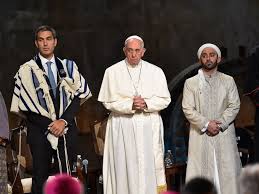
Joined by a dozen religious leaders from the Jewish, Muslim, Hindu, Sikh, Buddhist and Greek Orthodox traditions, Francis spoke to a crowd of about 700 people in an underground gallery at the Museum. To the right is a photograph of the Pope with a rabbi and an imam.
Here is what he said: “I feel many different emotions standing here at Ground Zero, where thousands of lives were taken in a senseless act of destruction. Here grief is palpable. The water we see flowing towards that empty pit reminds us of all those lives which fell prey to those who think that destruction, tearing down, is the only way to settle conflicts. It is the silent cry of those who were victims of a mindset which knows only violence, hatred and revenge. A mindset which can only cause pain, suffering, destruction and tears.”
“The flowing water is also a symbol of our tears. Tears at so much devastation and ruin, past and present. This is a place where we shed tears, we weep out of a sense of helplessness in the face of injustice, murder, and the failure to settle conflicts through dialogue. Here we mourn the wrongful and senseless loss of innocent lives because of the inability to find solutions which respect the common good. This flowing water reminds us of yesterday’s tears, but also of all the tears still being shed today.”
“A few moments ago I met some of the families of the fallen first responders. Meeting them made me see once again how acts of destruction are never impersonal, abstract or merely material. They always have a face, a concrete story, names. In those family members, we see the face of pain, a pain which still touches us and cries out to heaven.
At the same time, those family members showed me the other face of this attack, the other face of their grief: the power of love and remembrance. A remembrance that does not leave us empty and withdrawn. The names of so many loved ones are written around the towers’ footprints. We can see them, we can touch them, and we can never forget them.”
“Here, amid pain and grief, we also have a palpable sense of the heroic goodness which people are capable of, those hidden reserves of strength from which we can draw. In the depths of pain and suffering, you also witnessed the heights of generosity and service. Hands reached out, lives were given. In a metropolis which might seem impersonal, faceless, lonely, you demonstrated the powerful solidarity born of mutual support, love and self-sacrifice. No one thought about race, nationality, neighborhoods, religion or politics. It was all about solidarity, meeting immediate needs, brotherhood. It was about being brothers and sisters. New York City firemen walked into the crumbling towers, with no concern for their own wellbeing. Many succumbed; their sacrifice enabled great numbers to be saved.”
“This place of death became a place of life too, a place of saved lives, a hymn to the triumph of life over the prophets of destruction and death, to goodness over evil, to reconciliation and unity over hatred and division.”
“In this place of sorrow and remembrance I am filled with hope, as I have the opportunity to join with leaders representing the many religious traditions which enrich the life of this great city. I trust that our presence together will be a powerful sign of our shared desire to be a force for reconciliation, peace and justice in this community and throughout the world. For all our differences and disagreements, we can experience a world of peace. In opposing every attempt to create a rigid uniformity, we can and must build unity on the basis of our diversity of languages, cultures and religions, and lift our voices against everything which would stand in the way of such unity. Together we are called to say ‘no’ to every attempt to impose uniformity and ‘yes’ to a diversity accepted and reconciled.”
“This can only happen if we uproot from our hearts all feelings of hatred, vengeance and resentment. We know that that is only possible as a gift from heaven. Here, in this place of remembrance, I would ask everyone together, each in his or her own way, to spend a moment in silence and prayer. Let us implore from on high the gift of commitment to the cause of peace. Peace in our homes, our families, our schools and our communities. Peace in all those places where war never seems to end. Peace for those faces which have known nothing but pain. Peace throughout this world which God has given us as the home of all and a home for all. Simply PEACE. Let us pray in silence.”
“In this way, the lives of our dear ones will not be lives which will one day be forgotten. Instead, they will be present whenever we strive to be prophets not of tearing down but of building up, prophets of reconciliation, prophets of peace.”
After his remarks, Francis viewed relics of the 9/11 Memorial Museum. They included a cross formed of fused steel girders found in the towers’ smoldering wreckage and a copy of the New Testament found in the debris that is displayed Harlem
open to the Gospel passage in which Jesus urges believers to “turn the other cheek” rather than strike back.
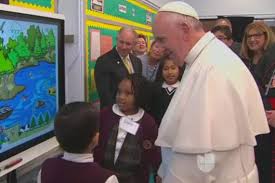
In the afternoon, Francis visited Our Lady Queen of Angels School, a Roman Catholic elementary school that has served the East Harlem Community for over 120 years with a high quality, well-rounded education, rooted in Gospel values and attentive to individual differences. There he was greeted by students and faculty as seen in the photograph to the left.
His remarks included the following: “They tell me that one of the nice things about this school is that some of its students come from other places, even from other countries. That is nice! Even though I know that it is not easy to have to move and find a new home, new neighbors and new friends. It is not easy. At the beginning it can be hard, right? Often you have to learn a new language, adjust to a new culture, even a new climate. There is so much to learn! And not just at school.”
“The good thing is that we also make new friends, we meet people who open doors for us, who are kind to us. They offer us friendship and understanding, and they try to help us not to feel like strangers. To feel at home. How nice it is to feel that school is a second home. This is not only important for you, but also for your families. School then ends up being one big family. One where, together with our mothers and fathers, our grandparents, our teachers and friends, we learn to help one another, to share our good qualities, to give the best of ourselves, to work as a team and to pursue our dreams.”
“Reverend Martin Luther King . . . said, ‘I have a dream.’ His dream was that many children, many people could have equal opportunities. His dream was that many children like you could get an education. It is beautiful to have dreams and to be able to fight for them.”
“Today we want to keep dreaming. We celebrate all the opportunities which enable you, and us adults, not to lose the hope of a better world with greater possibilities. I know that one of the dreams of your parents and teachers is that you can grow up and be happy. It is always good to see children smiling. Here I see you smiling. Keep smiling and help bring joy to everyone you meet.”
“Dear children, you have a right to dream and I am very happy that here in this school, in your friends and your teachers, you can find the support you need. Wherever there are dreams, there is joy, Jesus is always present. Because Jesus is joy, and he wants to help us to feel that joy every day of our lives.”
“Please don’t forget to pray for me, so that I can share with many people the joy of Jesus. And let us also pray so that many other people can share the joy like yours.”
At least 80,000 people crowded Manhattan’s Central Park to catch a glimpse of Pope Francis as his popemobile made its way to Madison Square Garden. Here are some photographs of that event.
At Manhattan’s Madison Square Garden, famed for its sporting events, Pope Francis celebrated mass before a congregation of 20,000. To the left is a photograph of the Pope during his his homily, when he said the following: “In this place, which represents both the variety and the common interests of so many different people, we have listened to the words: ‘The people who walked in darkness have seen a great light’ (Is 9:1).”
“The people who walked – caught up in their activities and routines, amid their successes and failures, their worries and expectations – have seen a great light. The people who walked – with all their joys and hopes, their disappointments and regrets – have seen a great light.”
“In every age, the People of God are called to contemplate this light. A light for the nations, as the elderly Simeon joyfully expressed it. A light meant to shine on every corner of this city, on our fellow citizens, on every part of our lives.”
“’The people who walked in darkness have seen a great light.’ One special quality of God’s people is their ability to see, to contemplate, even in ‘moments of darkness,’ the light which Christ brings. God’s faithful people can see, discern and contemplate his living presence in the midst of life, in the midst of the city.”
“Together with the prophet Isaiah, we can say: The people who walk, breathe and live in the midst of smog, have seen a great light, have experienced a breath of fresh air.
Living in a big city is not always easy. A multicultural context presents many complex challenges. Yet big cities are a reminder of the hidden riches present in our world: in the diversity of its cultures, traditions and historical experiences. In the variety of its languages, costumes and cuisine. Big cities bring together all the different ways which we human beings have discovered to express the meaning of life, wherever we may be.
But big cities also conceal the faces of all those people who don’t appear to belong, or are second-class citizens. In big cities, beneath the roar of traffic, beneath ‘the rapid pace of change,’ so many faces pass by unnoticed because they have no ‘right’ to be there, no right to be part of the city. They are the foreigners, the children who go without schooling, those deprived of medical insurance, the homeless, the forgotten elderly. These people stand at the edges of our great avenues, in our streets, in deafening anonymity. They become part of an urban landscape which is more and more taken for granted, in our eyes, and especially in our hearts.”
“Knowing that Jesus still walks our streets, that he is part of the lives of his people, that he is involved with us in one vast history of salvation, fills us with hope. A hope which liberates us from the forces pushing us to isolation and lack of concern for the lives of others, for the life of our city. A hope which frees us from empty‘connections,’ from abstract analyses, or sensationalist routines. A hope which is unafraid of involvement, which acts as a leaven wherever we happen to live and work. A hope which makes us see, even in the midst of smog, the presence of God as he continues to walk the streets of our city. Because God is in the city.”
“What is it like, this light travelling through our streets? How do we encounter God, who lives with us amid the smog of our cities? How do we encounter Jesus, alive and at work in the daily life of our multicultural cities?”
“The prophet Isaiah can guide us in this process of ‘learning to see.’ He speaks of the light which is Jesus. And now he presents Jesus to us as ‘Wonderful Counselor, the Mighty God, the Everlasting Father, the Prince of Peace.’ In this way, he introduces us to the life of the Son, so that his life can be our life.”
“Wonderful Counselor. The Gospels tell us how many people came up to Jesus to ask: ‘Master, what must we do?’ The first thing that Jesus does in response is to propose, to encourage, to motivate. He keeps telling his disciples to go, to go out. He urges them to go out and meet others where they really are, not where we think they should be. Go out, again and again, go out without fear, go out without hesitation. Go out and proclaim this joy which is for all the people.”
“The Mighty God. In Jesus, God himself became Emmanuel, God-with-us, the God who walks alongside us, who gets involved in our lives, in our homes, in the midst of our ‘pots and pans,’ as Saint Teresa of Jesus liked to say.”
“The Everlasting Father. No one or anything can separate us from his Love. Go out and proclaim, go out and show that God is in your midst as a merciful Father who himself goes out, morning and evening, to see if his son has returned home and, as soon as he sees him coming, runs out to embrace him. This is beautiful. An embrace which wants to take up, purify and elevate the dignity of his children. A Father who, in his embrace, is ‘glad tidings to the poor, healing to the afflicted, liberty to captives, comfort to those who mourn’ (Is 61:1-2).”
“Prince of Peace. Go out to others and share the good news that God, our Father, walks at our side. He frees us from anonymity, from a life of emptiness, and brings us to the school of encounter. He removes us from the fray of competition and self-absorption, and he opens before us the path of peace. That peace which is born of accepting others, that peace which fills our hearts whenever we look upon those in need as our brothers and sisters.”
“God is living in our cities. The Church is living in our cities. God and the Church living in our cities want to be like yeast in the dough, to relate to everyone, to stand at everyone’s side, proclaiming the marvels of the Wonderful Counselor, the Mighty God, the Eternal Father, the Prince of Peace.”
“’The people who walked in darkness have seen a great light.’ And we, as Christians, are witnesses to this.”
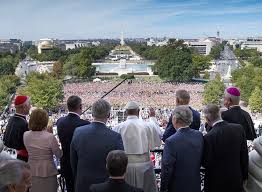
September 24 marked the third day of Pope Francis’ mission to the American people. The highlight was his morning appearance before the U.S. Congress, which was much anticipated by all members of Congress, 31% of whom are Roman Catholic along with Vice President Joseph R. Biden Jr., who serves as president of the Senate. Immediately afterwards the Pope greeted the American people from the west front of the U.S. Capitol followed by a visit to St. Patrick’s Catholic Church in D.C. and Catholic Charities of the Archdiocese of Washington before his flight to New York City. There he participated in an evening prayer service at St. Patrick’s Cathedral.
With the Chamber of the U.S. House of Representatives packed with Senators and Representatives and with invited guests in its Gallery, Pope Francis made the following lengthy remarks.
“I am most grateful for your invitation to address this Joint Session of Congress in ‘the land of the free and the home of the brave.’ I would like to think that the reason for this is that I too am a son of this great continent, from which we have all received so much and toward which we share a common responsibility.
“Each son or daughter of a given country has a mission, a personal and social responsibility. Your own responsibility as members of Congress is to enable this country, by your legislative activity, to grow as a nation. You are the face of its people, their representatives. You are called to defend and preserve the dignity of your fellow citizens in the tireless and demanding pursuit of the common good, for this is the chief aim of all politics. A political society endures when it seeks, as a vocation, to satisfy common needs by stimulating the growth of all its members, especially those in situations of greater vulnerability or risk. Legislative activity is always based on care for the people. To this you have been invited, called and convened by those who elected you.”
“Yours is a work which makes me reflect in two ways on the figure of Moses. On the one hand, as the patriarch and lawgiver of the people of Israel he symbolizes the need of peoples to keep alive their sense of unity by means of just legislation. On the other, the figure of Moses leads us directly to God and thus to the transcendent dignity of the human being. Moses provides us with a good synthesis of your work: you are asked to protect, by means of the law, the image and likeness fashioned by God on every human face.”
“Today I would like not only to address you, but through you the entire people of the United States. Here, together with their representatives, I would like to take this opportunity to dialogue with the many thousands of men and women who strive each day to do an honest day’s work, to bring home their daily bread, to save money and – one step at a time – to build a better life for their families. These are men and women who are not concerned simply with paying their taxes, but in their own quiet way sustain the life of society. They generate solidarity by their actions, and they create organizations that offer a helping hand to those most in need.”
“I would also like to enter into dialogue with the many elderly persons who are a storehouse of wisdom forged by experience and who seek in many ways, especially through volunteer work, to share their stories and their insights. I know that many of them are retired, but still active; they keep working to build up this land. I also want to dialogue with all those young people who are working to realize their great and noble aspirations, who are not led astray by facile proposals and who face difficult situations, often as a result of immaturity on the part of many adults. I wish to dialogue with all of you, and I would like to do so through the historical memory of your people.”
“My visit takes place at a time when men and women of good will are marking the anniversaries of several great Americans. The complexities of history and the reality of human weakness notwithstanding, these men and women, for all their many differences and limitations, were able by hard work and self- sacrifice – some at the cost of their lives – to build a better future. They shaped fundamental values which will endure forever in the spirit of the American people. A people with this spirit can live through many crises, tensions and conflicts, while always finding the resources to move forward, and to do so with dignity. These men and women offer us a way of seeing and interpreting reality. In honoring their memory, we are inspired, even amid conflicts, and in the here and now of each day, to draw upon our deepest cultural reserves.”
I would like to mention four of these Americans: Abraham Lincoln, Martin Luther King, Dorothy Day and Thomas Merton.
“This year marks the one hundred and fiftieth anniversary of the assassination of President Abraham Lincoln, the guardian of liberty, who labored tirelessly that ‘this nation, under God, [might] have a new birth of freedom.’ Building a future of freedom requires love of the common good and cooperation in a spirit of subsidiarity and solidarity.”
“All of us are quite aware of, and deeply worried by, the disturbing social and political situation of the world today. Our world is increasingly a place of violent conflict, hatred and brutal atrocities, committed even in the name of God and of religion. We know that no religion is immune from forms of individual delusion or ideological extremism. This means that we must be especially attentive to every type of fundamentalism, whether religious or of any other kind. A delicate balance is required to combat violence perpetrated in the name of a religion, an ideology or an economic system, while also safeguarding religious freedom, intellectual freedom and individual freedoms. But there is another temptation which we must especially guard against: the simplistic reductionism which sees only good or evil; or, if you will, the righteous and sinners. The contemporary world, with its open wounds which affect so many of our brothers and sisters, demands that we confront every form of polarization which would divide it into these two camps. We know that in the attempt to be freed of the enemy without, we can be tempted to feed the enemy within. To imitate the hatred and violence of tyrants and murderers is the best way to take their place. That is something which you, as a people, reject.”
“Our response must instead be one of hope and healing, of peace and justice. We are asked to summon the courage and the intelligence to resolve today’s many geopolitical and economic crises. Even in the developed world, the effects of unjust structures and actions are all too apparent. Our efforts must aim at restoring hope, righting wrongs, maintaining commitments, and thus promoting the well-being of individuals and of peoples. We must move forward together, as one, in a renewed spirit of fraternity and solidarity, cooperating generously for the common good.”
“The challenges facing us today call for a renewal of that spirit of cooperation, which has accomplished so much good throughout the history of the United States. The complexity, the gravity and the urgency of these challenges demand that we pool our resources and talents, and resolve to support one another, with respect for our differences and our convictions of conscience.”
“In this land, the various religious denominations have greatly contributed to building and strengthening society. It is important that today, as in the past, the voice of faith continue to be heard, for it is a voice of fraternity and love, which tries to bring out the best in each person and in each society. Such cooperation is a powerful resource in the battle to eliminate new global forms of slavery, born of grave injustices which can be overcome only through new policies and new forms of social consensus.
[Editor’s Note: The following section, which was in the prepared remarks, was not included in the speech.] [“Politics is, instead, an expression of our compelling need to live as one, in order to build as one the greatest common good: that of a community which sacrifices particular interests in order to share, in justice and peace, its goods, its interests, its social life. I do not underestimate the difficulty that this involves, but I encourage you in this effort.]
“Here too I think of the march which Martin Luther King led from Selma to Montgomery fifty years ago as part of the campaign to fulfill his ‘dream’ of full civil and political rights for African Americans. That dream continues to inspire us all. I am happy that America continues to be, for many, a land of ‘dreams.’ Dreams which lead to action, to participation, to commitment. Dreams which awaken what is deepest and truest in the life of a people.”
“In recent centuries, millions of people came to this land to pursue their dream of building a future in freedom. We, the people of this continent, are not fearful of foreigners, because most of us were once foreigners. I say this to you as the son of immigrants, knowing that so many of you are also descended from immigrants. Tragically, the rights of those who were here long before us were not always respected. For those peoples and their nations, from the heart of American democracy, I wish to reaffirm my highest esteem and appreciation. Those first contacts were often turbulent and violent, but it is difficult to judge the past by the criteria of the present.”
“Nonetheless, when the stranger in our midst appeals to us, we must not repeat the sins and the errors of the past. We must resolve now to live as nobly and as justly as possible, as we educate new generations not to turn their back on our ‘neighbors’ and everything around us. Building a nation calls us to recognize that we must constantly relate to others, rejecting a mindset of hostility in order to adopt one of reciprocal subsidiarity, in a constant effort to do our best. I am confident that we can do this.”
“Our world is facing a refugee crisis of a magnitude not seen since the Second World War. This presents us with great challenges and many hard decisions. On this continent, too, thousands of persons are led to travel north in search of a better life for themselves and for their loved ones, in search of greater opportunities. Is this not what we want for our own children? We must not be taken aback by their numbers, but rather view them as persons, seeing their faces and listening to their stories, trying to respond as best we can to their situation. To respond in a way which is always humane, just and fraternal. We need to avoid a common temptation nowadays: to discard whatever proves troublesome. Let us remember the Golden Rule: ‘Do unto others as you would have them do unto you’ (Mt 7:12).”
“This Rule points us in a clear direction. Let us treat others with the same passion and compassion with which we want to be treated. Let us seek for others the same possibilities which we seek for ourselves. Let us help others to grow, as we would like to be helped ourselves. In a word, if we want security, let us give security; if we want life, let us give life; if we want opportunities, let us provide opportunities. The yardstick we use for others will be the yardstick which time will use for us. The Golden Rule also reminds us of our responsibility to protect and defend human life at every stage of its development.”
“This conviction has led me, from the beginning of my ministry, to advocate at different levels for the global abolition of the death penalty. I am convinced that this way is the best, since every life is sacred, every human person is endowed with an inalienable dignity, and society can only benefit from the rehabilitation of those convicted of crimes. Recently my brother bishops here in the United States renewed their call for the abolition of the death penalty. Not only do I support them, but I also offer encouragement to all those who are convinced that a just and necessary punishment must never exclude the dimension of hope and the goal of rehabilitation.”
“In these times when social concerns are so important, I cannot fail to mention the Servant of God Dorothy Day, who founded the Catholic Worker Movement. Her social activism, her passion for justice and for the cause of the oppressed were inspired by the Gospel, her faith, and the example of the saints.”
“How much progress has been made in this area in so many parts of the world! How much has been done in these first years of the third millennium to raise people out of extreme poverty! I know that you share my conviction that much more still needs to be done, and that in times of crisis and economic hardship a spirit of global solidarity must not be lost. At the same time I would encourage you to keep in mind all those people around us who are trapped in a cycle of poverty. They too need to be given hope. The fight against poverty and hunger must be fought constantly and on many fronts, especially in its causes. I know that many Americans today, as in the past, are working to deal with this problem.”
“It goes without saying that part of this great effort is the creation and distribution of wealth. The right use of natural resources, the proper application of technology and the harnessing of the spirit of enterprise are essential elements of an economy which seeks to be modern, inclusive and sustainable. ‘Business is a noble vocation, directed to producing wealth and improving the world. It can be a fruitful source of prosperity for the area in which it operates, especially if it sees the creation of jobs as an essential part of its service to the common good’ (Laudato Si’, 129). This common good also includes the earth, a central theme of the encyclical which I recently wrote in order to ‘enter into dialogue with all people about our common home’ (ibid., 3). ‘We need a conversation which includes everyone, since the environmental challenge we are undergoing, and its human roots, concern and affect us all’ (ibid., 14).”
“In Laudato Si’, I call for a courageous and responsible effort to ‘redirect our steps’ (ibid., 61), and to avert the most serious effects of the environmental deterioration caused by human activity. I am convinced that we can make a difference and I have no doubt that the United States – and this Congress – have an important role to play. Now is the time for courageous actions and strategies, aimed at implementing a ‘culture of care’ (ibid., 231) and ‘an integrated approach to combating poverty, restoring dignity to the excluded, and at the same time protecting nature’ (ibid., 139). ‘We have the freedom needed to limit and direct technology’ (ibid., 112); ‘to devise intelligent ways of… developing and limiting our power’ (ibid., 78); and to put technology ‘at the service of another type of progress, one which is healthier, more human, more social, more integral’ (ibid., 112). In this regard, I am confident that America’s outstanding academic and research institutions can make a vital contribution in the years ahead.”
“A century ago, at the beginning of the Great War, which Pope Benedict XV termed a ‘pointless slaughter,’ another notable American was born: the Cistercian monk Thomas Merton. He remains a source of spiritual inspiration and a guide for many people. In his autobiography he wrote: ‘I came into the world. Free by nature, in the image of God, I was nevertheless the prisoner of my own violence and my own selfishness, in the image of the world into which I was born. That world was the picture of Hell, full of men like myself, loving God, and yet hating him; born to love him, living instead in fear of hopeless self-contradictory hungers.’ Merton was above all a man of prayer, a thinker who challenged the certitudes of his time and opened new horizons for souls and for the Church. He was also a man of dialogue, a promoter of peace between peoples and religions.”
“From this perspective of dialogue, I would like to recognize the efforts made in recent months to help overcome historic differences linked to painful episodes of the past. It is my duty to build bridges and to help all men and women, in any way possible, to do the same. When countries that have been at odds resume the path of dialogue – a dialogue which may have been interrupted for the most legitimate of reasons – new opportunities open up for all. This has required, and requires, courage and daring, which is not the same as irresponsibility. A good political leader is one who, with the interests of all in mind, seizes the moment in a spirit of openness and pragmatism. A good political leader always opts to initiate processes rather than possessing spaces (cf. Evangelii Gaudium, 222-223).”
“Being at the service of dialogue and peace also means being truly determined to minimize and, in the long term, to end the many armed conflicts throughout our world. Here we have to ask ourselves: Why are deadly weapons being sold to those who plan to inflict untold suffering on individuals and society? Sadly, the answer, as we all know, is simply for money: money that is drenched in blood, often innocent blood. In the face of this shameful and culpable silence, it is our duty to confront the problem and to stop the arms trade.”
“Three sons and a daughter of this land, four individuals and four dreams: Lincoln, liberty; Martin Luther King, liberty in plurality and non-exclusion; Dorothy Day, social justice and the rights of persons; and Thomas Merton, the capacity for dialogue and openness to God.
“I will end my visit to your country in Philadelphia, where I will take part in the World Meeting of Families. It is my wish that throughout my visit the family should be a recurrent theme. How essential the family has been to the building of this country! And how worthy it remains of our support and encouragement! Yet I cannot hide my concern for the family, which is threatened, perhaps as never before, from within and without. Fundamental relationships are being called into question, as is the very basis of marriage and the family. I can only reiterate the importance and, above all, the richness and the beauty of family life.”
“In particular, I would like to call attention to those family members who are the most vulnerable, the young. For many of them, a future filled with countless possibilities beckons, yet so many others seem disoriented and aimless, trapped in a hopeless maze of violence, abuse and despair. Their problems are our problems. We cannot avoid them. We need to face them together, to talk about them and to seek effective solutions rather than getting bogged down in discussions. At the risk of oversimplifying, we might say that we live in a culture which pressures young people not to start a family, because they lack possibilities for the future. Yet this same culture presents others with so many options that they too are dissuaded from starting a family.”
“A nation can be considered great when it defends liberty as Lincoln did, when it fosters a culture which enables people to ‘dream’ of full rights for all their brothers and sisters, as Martin Luther King sought to do; when it strives for justice and the cause of the oppressed, as Dorothy Day did by her tireless work, the fruit of a faith which becomes dialogue and sows peace in the contemplative style of Thomas Merton.”
“In these remarks I have sought to present some of the richness of your cultural heritage, of the spirit of the American people. It is my desire that this spirit continue to develop and grow, so that as many young people as possible can inherit and dwell in a land which has inspired so many people to dream.”
Immediately after the speech to the Congress, Pope Francis was escorted to the West Front of the Capitol, where he could see the thousands of people who wanted at least a glimpse of the Pope. “Buenos días,” he said. “I am so grateful for your presence here, most importantly the children. I have asked God to bless them. Father of all, bless each of them, bless the families. I ask you all, please, to pray for me. And if there are any who do not believe or who cannot pray, I ask you to send good wishes my way.”
At the church, the Pope first sent greetings to his Muslim brothers and sisters as they celebrate the feast of sacrifice and a prayer of closeness as they faced the tragedy of suffering at Mecca. He then delivered the following homily.
“Here I think of a person whom I love, someone who is, and has been, very important throughout my life. He has been a support and an inspiration. He is the one I go to whenever I am ‘in a fix.’ You make me think of Saint Joseph. Your faces remind me of his.”
“Joseph had to face some difficult situations in his life. One of them was the time when Mary was about to give birth, to have Jesus. The Bible tells us that, ‘while they were [in Bethlehem], the time came for her to deliver her child. And she gave birth to her firstborn son and wrapped him in bands of cloth, and laid him in a manger, because there was no place for them in the inn’ (Lk 2:6-7).”
“The Bible is very clear about this: there was no room for them. I can imagine Joseph, with his wife about to have a child, with no shelter, no home, no place to stay. The Son of God came into this world as a homeless person. The Son of God knew what it was to start life without a roof over his head. We can imagine what Joseph must have been thinking. How is it that the Son of God has no home? Why are we homeless, why don’t we have housing? These are questions which many of you may ask daily. Like Saint Joseph, you may ask: Why are we homeless, without a place to live? These are questions which all of us might well ask. Why do these, our brothers and sisters, have no place to live? Why are these brothers and sisters of ours homeless?”
“Joseph’s questions are timely even today; they accompany all those who throughout history have been, and are, homeless.”
“Joseph was someone who asked questions. But first and foremost, he was a man of faith. Faith gave Joseph the power to find light just at the moment when everything seemed dark. Faith sustained him amid the troubles of life. Thanks to faith, Joseph was able to press forward when everything seemed to be holding him back.”
“In the face of unjust and painful situations, faith brings us the light which scatters the darkness. As it did for Joseph, faith makes us open to the quiet presence of God at every moment of our lives, in every person and in every situation. God is present in every one of you, in each one of us.”
“We can find no social or moral justification, no justification whatsoever, for lack of housing. There are many unjust situations, but we know that God is suffering with us, experiencing them at our side. He does not abandon us.”
“We know that Jesus wanted to show solidarity with every person. He wanted everyone to experience his companionship, his help, his love. He identified with all those who suffer, who weep, who suffer any kind of injustice. He tells us this clearly: ‘I was hungry and you gave me food, I was thirsty and you gave me something to drink; I was a stranger and you welcomed me’ (Mt 25:35).”
“Faith makes us know that God is at our side, that God is in our midst and his presence spurs us to charity. Charity is born of the call of a God who continues to knock on our door, the door of all people, to invite us to love, to compassion, to service of one another.”
“Jesus keeps knocking on our doors, the doors of our lives. He doesn’t do this by magic, with special effects, with flashing lights and fireworks. Jesus keeps knocking on our door in the faces of our brothers and sisters, in the faces of our neighbors, in the faces of those at our side.”
“Dear friends, one of the most effective ways we have to help is that of prayer. Prayer unites us; it makes us brothers and sisters. It opens our hearts and reminds us of a beautiful truth which we sometimes forget. In prayer, we all learn to say ‘Father.’ ‘Dad.’ We learn to see one another as brothers and sisters. In prayer, there are no rich and poor people, there are sons and daughters, sisters and brothers. In prayer, there is no first or second class, there is brotherhood.”
“It is in prayer that our hearts find the strength not to be cold and insensitive in the face of injustice. In prayer, God keeps calling us, opening our hearts to charity.”
“How good it is for us to pray together. How good it is to encounter one another in this place where we see one another as brothers and sisters, where we realize that we need one another. Today I want to be one with you. I need your support, your closeness. I would like to invite you to pray together, for one another, with one another. That way we can keep helping one another to experience the joy of knowing that Jesus is in our midst. Are you ready?”
“’Our Father in heaven, hallowed be your name. Your kingdom come. Your will be done, on earth as it is in heaven. Give us this day and our daily bread. And forgive us our debts, as we also have forgiven our debtors. An do not bring us to the time of trial, but rescue us from the evil one. Amen.’” (NRSV)
“Before leaving you, I would like to give you God’s blessing: ‘The Lord bless you and keep you; the Lord make his face to shine upon you and be gracious to you; the Lord lift up his countenance upon you, and give you peace’ (Num 6:24-26). And, please, don’t forget to pray for me.”
Immediately afterwards the Pope went to a luncheon for the homeless outside the church, blessed the meal and greeted the people, as shown in photograph to the right.. This luncheon was sponsored by Catholic Charities of the Archdiocese of Washington.
The Pope arrived around 5:00 p.m. (EST) at New York City’s John F. Kennedy International Airport and then traveled by helicopter to lower Manhattan. The popemobile then took him by waving crowds on Fifth Avenue to 50th and 51st Street’s St. Patrick’s Cathedral. There he was greeted by New York Governor Andrew M. Cuomo, New York City Mayor Bill de Blasio and New York’s U.S. Senator Chuck Schumer.
Pope @ St. Patrick’s Cathedral
At the Cathedral the Pope participated in a vespers prayer service for nearly 2,500 worshipers, including clergy members, brothers and nuns, and delivered the following homily.
“’There is a cause for rejoicing here”, although ‘you may for a time have to suffer the distress of many trials’ (1 Pet 1:6). These words of the Apostle remind us of something essential. Our vocation is to be lived in joy.”
“This beautiful Cathedral of Saint Patrick, built up over many years through the sacrifices of many men and women, can serve as a symbol of the work of generations of American priests and religious, and lay faithful who helped build up the Church in the United States. In the field of education alone, how many priests and religious in this country played a central role, assisting parents in handing on to their children the food that nourishes them for life! Many did so at the cost of extraordinary sacrifice and with heroic charity. I think for example of Saint Elizabeth Ann Seton, who founded the first free Catholic school for girls in America, or Saint John Neumann, the founder of the first system of Catholic education in the United States.”
“This evening, my brothers and sisters, I have come to join you in prayer that our vocations will continue to build up the great edifice of God’s Kingdom in this country. I know that, as a presbyterate in the midst of God’s people, you suffered greatly in the not distant past by having to bear the shame of some of your brothers who harmed and scandalized the Church in the most vulnerable of her members… In the words of the Book of Revelation, I know well that you ‘have come forth from the great tribulation’ (Rev 7:14). I accompany you at this time of pain and difficulty, and I thank God for your faithful service to his people. In the hope of helping you to persevere on the path of fidelity to Jesus Christ, I would like to offer two brief reflections.”
“The first concerns the spirit of gratitude. The joy of men and women who love God attracts others to them; priests and religious are called to find and radiate lasting satisfaction in their vocation. Joy springs from a grateful heart. Truly, we have received much, so many graces, so many blessings, and we rejoice in this. It will do us good to think back on our lives with the grace of remembrance. Remembrance of when we were first called, remembrance of the road travelled, remembrance of graces received… and, above all, remembrance of our encounter with Jesus Christ so often along the way. Remembrance of the amazement which our encounter with Jesus Christ awakens in our hearts. To seek the grace of remembrance so as to grow in the spirit of gratitude. Perhaps we need to ask ourselves: are we good at counting our blessings?”
“A second area is the spirit of hard work. A grateful heart is spontaneously impelled to serve the Lord and to find expression in a life of commitment to our work. Once we come to realize how much God has given us, a life of self-sacrifice, of working for him and for others, becomes a privileged way of responding to his great love.”
“Yet, if we are honest, we know how easily this spirit of generous self-sacrifice can be dampened. There are a couple of ways that this can happen; both are examples of that ‘spiritual worldliness’ which weakens our commitment to serve and diminishes the wonder of our first encounter with Christ.”
“We can get caught up measuring the value of our apostolic works by the standards of efficiency, good management and outward success which govern the business world. Not that these things are unimportant! We have been entrusted with a great responsibility, and God’s people rightly expect accountability from us. But the true worth of our apostolate is measured by the value it has in God’s eyes. To see and evaluate things from God’s perspective calls for constant conversion in the first days and years of our vocation and, need I say, great humility. The cross shows us a different way of measuring success. Ours is to plant the seeds: God sees to the fruits of our labors. And if at times our efforts and works seem to fail and produce no fruit, we need to remember that we are followers of Jesus… and his life, humanly speaking, ended in failure, the failure of the cross.”
“Another danger comes when we become jealous of our free time, when we think that surrounding ourselves with worldly comforts will help us serve better. The problem with this reasoning is that it can blunt the power of God’s daily call to conversion, to encounter with him. Slowly but surely, it diminishes our spirit of sacrifice, renunciation and hard work. It also alienates people who suffer material poverty and are forced to make greater sacrifices than ourselves. Rest is needed, as are moments of leisure and self-enrichment, but we need to learn how to rest in a way that deepens our desire to serve with generosity. Closeness to the poor, the refugee, the immigrant, the sick, the exploited, the elderly living alone, prisoners and all God’s other poor, will teach us a different way of resting, one which is more Christian and generous.”
“Gratitude and hard work: these are two pillars of the spiritual life which I have wanted to share with you this evening. I thank you for prayers and work, and the daily sacrifices you make in the various areas of your apostolate. Many of these are known only to God, but they bear rich fruit for the life of the Church. In a special way I would like to express my esteem and gratitude to the religious women of the United States. What would the Church be without you? Women of strength, fighters, with that spirit of courage which puts you in the front lines in the proclamation of the Gospel. To you, religious women, sisters and mothers of this people, I wish to say “thank you”, a big thank you… and to tell you that I love you very much.” (Emphasis added to these words that drew applause from the people in the pews.)
“I know that many of you are in the front lines in meeting the challenges of adapting to an evolving pastoral landscape. Whatever difficulties and trials you face, I ask you, like Saint Peter, to be at peace and to respond to them as Christ did: he thanked the Father, took up his cross and looked forward!”
“Dear brothers and sisters, in a few moments we will sing the Magnificat. Let us commend to Our Lady the work we have been entrusted to do; let us join her in thanking God for the great things he has done, and for the great things he will continue to do in us and in those whom we have the privilege to serve.”
This was the title of David Brooks’ May 14th presentation at Minneapolis’ Westminster Presbyterian Church’s Town Hall Forum. An appreciative audience of over 3,000 filled the Sanctuary and other rooms at the church to hear the talk and demonstrated why he called Westminster his “favorite venue.”[1]
Both the talk and his recent book, “The Road to Character,”[2] emphasize “modesty and humility” and assert that “human beings are blessed with many talents but are also burdened by sinfulness, ignorance and weakness” and that “character emerges from the internal struggles against one’s own limitations.” This at least is what the Syllabus for his “Humility” course at Yale University states. Or as he said in his talk, we are “splendidly endowed, but deeply broken.”
Brooks recalled with gratitude three personal uplifting moments. One was observing his then three young children playing on a beautiful day. Another was watching women in Maryland teaching English to immigrants. The last was sitting at a luncheon next to the Dali Lama and experiencing his inner joy and laughter. These moments produced David’s overwhelming sense of gratitude to have experienced these moments of higher joy, an enlargement of his own heart and an acknowledgement that these had happened to him by the grace of God.
Because issues of morals and character in western culture have been discussed by Christian theologians, his book uses their vocabulary. We need to recover and perhaps modernize that vocabulary, said Brooks, especially to recover the meaning and importance of the concept of sin.
He also mentioned that many contemporary U.S. politicians feel compelled to promote and advertise themselves and as a result start to believe their own propaganda. Exceptions of politicians of modesty and honesty are former Vice President Walter Mondale, a Westminster member who was in the audience; Minnesota’s former U.S. Senator David Durenberger; and current U.S. Senator Amy Klobuchar.
His book provides biographical sketches of how 10 different people in different ways created disciplines that built character. He mentioned the following six of them in his talk.
Ida Stover by age 11 had lost both of her parents and then was an overworked indentured servant in another household, but at age 15 she left to be on her own, to get a job and an education. Later she married David Eisenhower, became Ida Eisenhower and raised five sons, one being Dwight D. Eisenhower. After Ike threw a temper tantrum at age 10, Ida paraphrased Proverbs 16:32 to him: “He that conquereth his own soul is greater that he who taketh a city.”[3] In other words, the central drama of your life is fighting against your own sinfulness and weaknesses. Many years later Ike said this was one of the most valuable moments of his life that helped him to recognize his temper as a weakness and to develop techniques to prevent it from interfering with his leading others.
Frances Perkins was a genteel graduate of Mount Holyoke College who found her vocation of improving worker safety by happening to be a witness to the Triangle Shirt Factory Fire in Manhattan, in which many workers lost their lives. She responded to what the world was demanding of her.
Augustine for many years resisted his mother’s efforts to become a Christian, but after he had done so, the two of them shared a beautiful moment in a garden just before she died when “all the clamors of the world slipped into silence” and were “hushed.”
Dorothy Day, a social activist, near the end of her life started to write her “life remembered,” but could not do so. Instead she “thought of our Lord [Jesus], and His visit to us all those centuries ago, and I said to myself that my great luck was to have had Him on my mind for so long in my life!” Day’s “The Long Loneliness” shows her intense self-criticism, her discovery of her vocation and her humility. It is one of Brooks’ favorite books and also of the students in his Yale course on humility.[4]
George Eliot (born Mary Anne Evans) obtained character through her love for George Lewes, and such love, according to Brooks, humbles a person, making you realize you are not in control of your own life; allows you to express tenderness and vulnerability; de-centers your self; and fuses two individuals together.
Brooks advised the high school students in the audience to make the following commitments by the time they were at least in their mid-30’s: adopting an existing faith or philosophy of life; choosing a vocation; getting married; and choosing a community in which to live. Although he did not say so, these commitments may change during your life.
With respect to the marriage commitment, Brooks quoted this beautiful excerpt from a beautiful wedding toast that was offered by his friend and noted American author, Leon Weiseltiere, to an unnamed couple:
“Brides and grooms are people who have discovered, by means of love, the local nature of happiness. Love is a revolution in scale, a revision of magnitudes; it is private and it is particular; its object is the specificity of this man and that woman, the distinctness of this spirit and that flesh. Love prefers deep to wide, and here to there; the grasp to the reach. It will not be accelerated, or made efficient: love’s pace is its pace, one of the fundamental temporalities of mortal existence, and it will not be rushed or retarded by even the most glittering pressures of service or success. Love is, or should be, indifferent to history, immune to it — a soft and sturdy haven from it: when the day is done, and the lights are out, and there is only this other heart, this other mind, this other face, to assist one in repelling one’s demons or in greeting one’s angels, it does not matter who the president is. When one consents to marry, one consents to be truly known, which is an ominous prospect; and so one bets on love to correct for the ordinariness of the impression, and to call forth the forgiveness that is invariably required by an accurate perception of oneself. Marriages are exposures. We may be heroes to our spouses, but we may not be idols.”
The unnamed couple who were thus toasted were (a) Samantha Power, the U.S. Ambassador to the United Nations, the author of the award-winning book, A Problem from Hell: America and the Age of Genocide, and a former Harvard Law School Professor and (b) Cass Sunstein, a Harvard Law School Professor, an acclaimed author and a former aide to President Obama.
[1] The audio recording of the speech is available online and later the video of same will be added. . Brooks’ prior appearances at the Forum, also to overflow audiences, are also available online: “The Historic Election of Barack Obama” (Nov. 13, 2008) and “The Social Animal: Hidden Sources of Love, Character, and Achievement” (Mar. 31, 2011).
[3] The Authorized King James Version of Proverbs 16:32 states: “He that is slow to anger is better than the mighty; and he that ruleth his spirit than he that taketh a city.”
[4] The Dorothy Day book is on the 2013 edition of the Syllabus for Brooks’ “Humility” seminar at Yale. The other books on the syllabus as well as the topics covered in the seminar make one wish to be a student again. In light of Brooks’ recent book’s not including biographical sketches of any Jewish people and his comments on that omission to a Jewish critic, it is noteworthy that the Syllabus describes one seminar session as being devoted to Moses, the “most humble man on earth;” the “Jewish formula of character building through obedience to the law;” the “way the rabbinic tradition has interpreted the struggle between internal goodness and the evil urge;” and the Book of Exodus as the reading. The Yale seminar has prompted comments by a student who was in the seminar, criticism of the Syllabus and Brooks’ defense of the seminar.
Westminster SanctuaryRev. Dr. Timothy Hart-Andersen
The subject of vocation returned to Minneapolis’ Westminster Presbyterian Church on February 9th. A prior post examined the service’s music on the subject while another set forth the Scriptures for the day: Psalm 27 and Matthew 4:12-23.[1]
The sermon that day was “What Happens When Jesus Calls?” by Rev. Dr. Timothy Hart-Andersen, the Senior Pastor.Here are excerpts from that sermon.
“If the question is what happens when Jesus calls, the answer may be that when Jesus calls we take a good, long, hard, deep look at what we perceive to be the purpose of our lives. That may suggest a job change, or not; perhaps a shift in careers, or not; it may mean finally discovering our life’s vocation.
The fishermen on the Sea of Galilee have that kind of experience with Jesus when he comes calling. His goal is not that they abandon their chosen vocation arbitrarily, but, rather, to rethink it. He never asks them to stop fishing; he asks them to rethink how and why they are doing it. In fact, Jesus even says to them that they’ll continue in the same line of work – only now they’ll be ‘fishing for people.’ He wants them to ponder who they are and what their focus ought to be in life.
When Jesus calls, it occasions an examination of our purpose in life, no matter what work we’re engaged in. In the story of Jesus calling the fishermen at least two things happen.
First, Jesus comes looking for them. The call is his idea, not theirs. They were minding their own business when he shows up and invites them to rethink their lives. We don’t have to take the first step toward Jesus; he comes for us, if we’re ready. This is what the psalmist refers to in writing, ‘Wait for the Lord. Be strong. Wait for the Lord.’
So often we think the business of faith depends on us; but it’s a gift from God, not an achievement we attain through hard work and hours of effort. Jesus comes looking for us.
Second, Jesus meets them right where they are. He looks for ordinary people who live ordinary lives. Those four fishermen had no apparent special gifts that made them uniquely attractive candidates to become disciples.
The Church will be built not of princes and priests and power brokers, but of common people who are just like anyone else. Those fishermen went from their boats to become the inner circle of Jesus and later to lead the early Church. Nothing about them suggested that they would be suited for this work. Jesus meets us right where we are.
The call Jesus extends to the fishermen changes them. We who want to follow Jesus without making much in the way of change in our lives, be it in how we conduct our business, or how we spend our time, or how we use our resources, are missing the whole point of Christianity. Faith transforms us. The old life is gone; a new life has begun.
Understanding what it means to be called, to have a vocation, is at the heart of the Presbyterian way of Christianity. Writing in the 16th century, John Calvin said.
‘The Lord bids each one of us in all life’s actions to look to his (or her) calling. For God knows with what great restlessness human nature flames, with what fickleness it is borne hither and thither, how its ambition longs to embrace various things at once.’
Calvin may be giving us a peek inside his own personality and psychological make-up when he names the ‘great restlessness’ of human nature. But many of us know precisely what Calvin refers to when he laments the way we flit about from one scheme to another as we seek to find what we’re supposed to be doing in life. Especially today, it’s difficult to know what direction to pursue when our vocation in ten years – or even in one year – may not even exist right now.
‘Therefore,’ Calvin goes on to say, ‘Each individual has his (or her) own kind of living assigned to him (or her) by the Lord as a sort of sentry post so that he (or she) may not heedlessly wander throughout life.’ (John Calvin; Institutes, III.x.6.)
‘Our own kind of living assigned to us so that we might not heedlessly wander throughout life.’
These days the average person will hold between 10 and 15 jobs in a lifetime. I was heading in that direction myself until I finally gave into the nagging sense of call to serve the church. I started seminary at age 27; by that time I had made several exploratory attempts – at least three – to test one career or another, None of them was right. I was having a hard time finding the ‘kind of living assigned to me.’ I was wandering.
Finding my vocation, my calling, depended on my feeling at home in what I was doing. I resisted accepting the call to ministry as long as I could, but in each vocation I tested – teacher, academic scholar, social service worker– I felt as if I were a stranger, as if were not quite at home. Frankly, it also had to do with needing to be sure it was my call and not something I was doing to please someone else – my parents, in particular. [2]
When I was in my mid-20’s, some 15 years later, with my life in a time of upheaval, I began, finally, to consider what I had avoided all those years: whether or not I was called into ministry. I wrestled hard with the decision– for nine months, in a kind of gestating process, I prayed and listened.
And one September Saturday morning, as I was in the bath tub, it came to me that I needed to go to seminary. The water was making a deep connection, I realized later, between baptism and vocation.
Ordained ministry was the one possibility that didn’t leave me feeling as if I were a stranger. It felt like home.
I was finding my vocation, not what my parents wanted me to do, but what I felt called to do.
Think back on your own employment history; you may be surprised how many different jobs you’ve held or careers you’ve tried, but that may or may not have anything to do with the ‘heedless wandering’ Calvin was concerned about. Christian vocation is less about a particular job and more about how we approach that job, less about what career we choose and more about the underlying purpose we sense in our lives, and how that purpose manifests itself in whatever work we do.
Nothing more thrills a pastor than to see changes happening in the lives of parishioners. I’ve seen hard-charging business leaders switch to non-profit careers because they feel called to serve the community in a new way. I’ve seen teachers give themselves over utterly to their students because they sense a call to live like that. I’ve watched retired people discover new ways to serve and follow Jesus in their later years. I’ve seen young adults light up as they discover their vocation and pursue it with determination.
When Jesus calls we get up and go, stepping forward in the direction of the one calling us. Being a follower of Jesus is not a destination; that’s what those fishermen learned that day. Being called to follow Jesus is a way of life, a pilgrimage on which we embark together.
The occasion of a memorial service – any memorial service, not only that of a much-loved public figure [like Joan Mondale][3] – invites us to reflect not only on the life of the one who has died, but also on the life you and I lead.
Someday it will be we about whom they will be speaking. What will they say? What will be the summary of the highest priorities of our lives? What will they say was the central theme of our lives?
Thanks be to God.”
[1] The bulletin, a copy of the sermon and an audio and video recording of the service are available online as are the ones for the January 26th service about vocation. Prior posts have discussed that service’s (a) Prayer of Confession; (b) an anthem beginning with the words “God be in my head;” (c) passages from the Bible’s book of Acts and the sermon’s drawing on them for comments concerning the vocations of Tabitha, Peter, Lydia and Paul; (d) a passage from Paul’s epistle from a Roman prison and the sermon’s drawing on them for comments about the preacher’s and her people’s vocations; (e) a hymn, “How Clear Is Our Vocation, Lord;” (f) another hymn, “Give Thanks, O Christian People;” and (g) an anthem, “Forth in Thy Name, O Lord, I Go.” Clicking on “Westminster Presbyterian Church” in the Tag Cloud at the top right of the blog will give you all of the posts about the church in reverse chronological order of posting.
[3] The prior day Rev. Dr. Hart-Andersen had presided at the memorial service at Westminster for long-time member and former Second Lady Joan Mondale, with remembrances from friends and acquaintances, including Vice President Joe Biden and former President Jimmy Carter. Included in the 1,000 people at the service were her husband and former Vice President Walter Mondale, Minnesota Governor Mark Dayton (who is a Westminster member), two U.S. Senators, half the Minnesota congressional delegation, several mayors, brass and strings from the Minnesota Orchestra, the Macalester College Choir and Pipe Band, gospel musicians, and a Japanese solo vocalist Another 5,000 people, including this blogger, attended via the live-stream video, which is available online.
The first was the congregational unison Prayer of Confession that spoke to the sin of pride that infects most of us in these times. The words went as follows:
“Oh Lord, we come before you, knowing that even in our vast knowledge we remain ignorant of ourselves, deceiving and blinding ourselves. We lose hold of that knowledge given us at creation, of God’s generous and continuing favor toward us, and of the original nobility that God bestowed upon our ancestor Adam. When we do remember our great gifts, we think of them as belonging to us alone, in boasting and self-assurance, when we ought instead to honor those gifts among our neighbors, for Scripture bids us to esteem others above ourselves, and to apply ourselves wholly to doing them good. We despise others, and forget that in despising them we despise ourselves, for we re together made in the image of God.”
The second part of the service was the hymn Tu Has Venido a la Orilla (Lord, You Have Come to the Lakeshore), whose gentle melody is reminiscent of a rocking boat by a lakeshore and which is easy to sing. Its lyrics are based upon Matthew 4: 18-20, when Jesus encountered two fishermen (Peter and Andrew) casting their net into the Sea of Galilee and asked them to follow him and be fishers of men and women.The lyrics go on to urge us to do the same.
Here are the words of its refrain as translated into English: “O Lord, with Your eyes You have searched me, And, while smiling, have called out my name. Now my boat’s left on the shoreline behind me, Now with You I will seek other seas.” The four verses go as follows:
“You have come up to the lakeshore, Looking neither for wise nor wealthy.You only wanted that I should follow.” (Refrain)
“You know that I own so little, In my boat there’s no money or weapons, You’ll only find there my nets and labor.” (Refrain)
“You need the caring of my hands.Through my tiredness, may others find resting. You need a love that just goes on loving.”(Refrain)
“You, who have fished other oceans, Ever longed for by souls that are waiting, My dear and good friend, as thus You call me.”(Refrain)
The Presbyterian Hymnal also contains the original Spanish verses. While most of the Westminster congregants sing the English version, some sing the Spanish. With my very rudimentary Spanish language skills, I softly sang the Spanish words to remind me of my one trip to Spain and many others to Latin America and of my friends throughout the latter region. It thus becomes for me a song of solidarity.
Cesáreo Gabaráin
This hymn was written in 1979 by Cesáreo Gabaráin (1936-1991), a Spanish Roman Catholic priest and composer of over 500 liturgical songs. He also held the position of Chaplain Prelate for Pope John Paul II.
[1] The bulletin and audio and video recordings of the service are online.
This beloved hymn was sung as an anthem by the choir at the July 28th worship service at Minneapolis’ Westminster Presbyterian Church.[1] Listening to it was enriching although joining in congregational singing of the hymn would have been even more meaningful.
At least for me, however, there is not enough time while listening to an anthem or singing a hymn to ponder the true meaning and significance of its words. I recently have discovered that gaining a better and deeper understanding of a hymn or anthem requires subsequent meditation on the words, researching the hymn’s history and writing an essay recording the results of that meditation and research. In short, such a practice has become a spiritual discipline.[2]
The Lyrics
Here are the lyrics of the three verses of “Come, Thou Fount of Every Blessing:”
1. Come, thou Fount of every blessing,
tune my heart to sing thy grace;
streams of mercy, never ceasing,
call for songs of loudest praise.
Teach me some melodious sonnet,
sung by flaming tongues above.
Praise the mount! I’m fixed upon it,
mount of thy redeeming love.
2. Here I raise mine Ebenezer;
hither by thy help I’m come;
and I hope, by thy good pleasure,
safely to arrive at home.
Jesus sought me when a stranger,
wandering from the fold of God;
he, to rescue me from danger,
interposed his precious blood.
3. O to grace how great a debtor
daily I’m constrained to be!
Let thy goodness, like a fetter,
bind my wandering heart to thee.
Prone to wander, Lord, I feel it,
prone to leave the God I love;
here’s my heart, O take and seal it,
seal it for thy courts above.
The hymn testifies to the amazing graces God provides to human beings. God bestows “streams of mercy, never ceasing.” By God’s “help I’m come” thus far in my life, and with God’s “good pleasure, [ I hope] safely to arrive at home.” “Jesus sought me when a stranger, wandering from the fold of God; he, to rescue me from danger.” [3]
Confession of sin also is prominent in the hymn. The human being has a “wandering heart” that is “prone to wander” and “prone to leave the God I love.” The human can be and has been a “stranger, wandering from the fold of God.”
Therefore, the human being needs constraints, binders and fetters to combat this impulse to wander. The human needs God to “tune my heart to sing thy grace.”
God responds to this need with “goodness.” The human in turn responds with “songs of loudest praise.” “Praise the . . . mount of thy redeeming love.” “Fount of every blessing.” The human then offers “my heart, O take and seal it, seal it for thy courts above.”
The hymn’s reference to raising “my Ebenezer” long baffled me. The answer is found in the following passages of First Samuel in the Hebrew Bible (the Old Testament), which is believed to have been written in the seventh century BCE:
Israel was engaged in battles with the Philistines. While Israel’s troops were encamped near the village of Ebenezer, the Philistines routed Israel and seized the Arc of the Covenant in accordance with the ancient custom of taking the statue of the god of the defeated enemy as booty. (1 Samuel 4-5.)
Seven months later the Philistines returned the Arc of the Covenant to Israeli people in the town of Beth-shemesh who subsequently delivered it to the people of the town of Kiriath-jearim. (1 Samuel 6-7:1.)
Twenty years passed, and Samuel, a prophet and judge, told the people of Israel. “If you are returning to the Lord with all your heart, then put away the foreign gods [and idols] . . . from among you. Direct your heart to the Lord, and serve Him only, and he will deliver you out of the hand of the Philistines.” (1 Samuel 7: 2-3.)
The people did as they were told, and Samuel said, “Gather all Israel at [the town of] Mizpah, and I will pray to the Lord” for forgiveness for your sins and for deliverance from the Philistines. The Israeli people then gathered at Mizpah for this religious ceremony. (1 Samuel 7: 4-6.)
When the Philistines learned of this assembly, their troops advanced to attack the Israeli people at Mizpah. The Lord, however, “threw [the Philistines] into confusion; and they were routed before Israel.” (1 Samuel 7: 7-11.)
To commemorate this event, “Samuel took a stone and set it up between Mizpah and [the village of] Jeshanah, and named [the stone] Ebenezer [stone of help and the site of the prior victory of the Philistines]; for he said, “Thus far the Lord has helped us.” (1 Samuel 7:12.) In other words, Samuel publicly dedicated this stone, according to another blogger, “as a monument to God’s help, God’s faithfulness, God’s eternal covenant. And as the people got on with their lives, the stone stood there, visible to all who passed that way, a reminder of judgment and repentance, mercy and restoration.”
Thus, “Here I raise my Ebenezer; hither by thy help I’m come” is a metaphorical way of saying that I recognize that God has helped me reach this point in my life and that it is important to create an outward expression of this recognition and gratitude.
The Lyricist
Robert Robinson
The lyrics were written around 1757 by Robert Robinson, an Englishman then age 22 and a recent convert to Evangelical Methodism. In 1759 after a brief period at a Congregational Chapel, he joined Stone-Yard Baptist Chapel in Cambridge, England. There he remained for most of the rest of his life, first as Lecturer and then, from 1762 to at least 1788, as Pastor.
Although Robinson had argued against Unitarianism for many years, in 1788 he apparently converted to that faith although never doubting the full divinity of Jesus Christ. In 1790 he visited Joseph Priestly, a noted Unitarian in Birmingham, England [4] and preached several sermons at his chapels. There Robinson died and was buried in that city’s Dissenters’ Burial Ground.
The Composer, Publisher and Arranger
Asahel NettletonJohn Wyeth
In the U.S., the hymn is usually set to an American folk tune known as Nettleton, composed by Asahel Nettleton (1783 –1844), an American theologian and pastor from Connecticut who was highly influential during the Second Great Awakening.
In 1813 the hymn and music were included in the Repository of Sacred Music, Part Second that was published by John Wyeth, a Philadelphia printer. This book and its predecessor, the Repository of Sacred Music, were highly successful, selling over 150,000 copies. In the preface to his work, Wyeth claimed three qualifications as a compiler of sacred music: years of attention to the charms of church music; acquaintance with the taste of eminent teachers; and the possession of more than a thousand pages of music to use.
Howard Don Small
The musical arrangement used at Westminster on July 28th was by Howard Don Small (1933-2007), who had been the Choirmaster and Organist at Minneapolis’ St. Mark’s Episcopal Cathedral. When he retired from St. Mark’s in 1998, a choir member expressed appreciation for Small’s “qualities of professionalism, musicianship, and leadership;” gratitude . . . for the opportunity to grow, learn, and deepen my spirituality; sadness – that [Small] will be leaving, but also; happiness – that [Small] will be able to be relieved of the extreme pressure of your role to do things at a manageable and enjoyable pace.”
Conclusion
Melanie OhnstadJere Lantz
Merely recounting the involvement over 250 years of four men in the creation, publication and arrangement of this hymn (and anthem) and then the Westminster choir’s singing the hymn under the direction of Jere Lantz with the organ accompaniment by Westminster Minister of Music & the Arts/Organist, Melanie Ohnstad, brings to mind two Scriptural passages.
All of these individuals are members of the “cloud of witnesses” (Hebrews 12:1-2) who meld their different gifts into one body to produce something pleasing to God (Romans 12: 3-8). Including Samuel in this cloud of witnesses, as we should, expands the time period to over 2,700 years.
I must confess that the Howard Don Small arrangement that was sung by the choir made a significant, and, I think, unfortunate change in the lyrics. Instead of “Here I raise my Ebenezer; hither by thy help I’m come,” they sang “Here I find my greatest pleasure; In the help I hope I’m come.” (I am not too sure about the latter part of this substitution.) This change undoubtedly was prompted by the arranger’s knowing that many people today do not understand the reference to “raising my Ebenezer.”
This wording change, however, obliterates Robinson’s meaning and also prevents people from researching and discovering that true meaning. A professor at Gordon-Conwell Theological Seminary, Gary A. Parrett, has been crusading against such changes to this hymn. His article in Christianity Today expressed the following reasons for this opposition, which I endorse:
“Robinson [undoubtedly] felt he had found just the right expression to say what needed to be said. His phrasing, in this case, was succinct, biblical, pointed, poignant, and poetic.”
The “revisions are, at best, inconsistent attempts to be culturally relevant. How can the revisers leave in words like hither and fetter, as they typically do, while Ebenezer is heartlessly expunged?”
The revisions ignore the Biblical foundation for Robinson’s words, as pointed out above. As Parrett says, the “single word [Ebenezer] ushers the worshiper into both the biblical episode and the greater narrative of God’s redemptive dealings with his people. It points us, also, to Robinson’s dramatic conversion three years before he penned the hymn, inviting us to reflect upon our own stories and to remember God’s faithful dealings with us. By removing the word from the hymn, we likely remove it from believers’ vocabularies and from our treasury of spiritual resources.”
“What we have in such revisions is the worst sort of accommodation, even contribution, to biblical illiteracy. Our faith is filled with names and terms that were unfamiliar to us when we joined the family—atonement, propitiation, Sabbath, Passover, Melchizedek. What are we to do with such terms? We teach! How difficult would it be to simply explain the reference to Ebenezer?”
[1] The bulletin and a video and audio recording of this service are available online.
[3] These words remind me of the third verse of another great hymn, Amazing Grace: “Through many dangers, toils and snares I have already come; ‘Tis Grace that brought me safe thus far and Grace will lead me home.”
[4]Priestly (1733 –1804) was an 18th-century English theologian, Dissenting clergyman, natural philosopher, chemist, educator, and political theorist. He usually is credited with the discovery of oxygen