I previously have set forth certain reflections on Chapter21 of the Gospel of John. Here are additional reflections on that Chapter (full text below) focused on the conversation on the beach between Jesus and Simon Peter.
On the boat Peter had stripped off his clothes to avoid their getting entangled in the fishing nets. But when he recognized Jesus, Peter put his clothes back on in perhaps a subconscious attempt to conceal his sinfulness in rejecting Jesus three times after the arrest.
Peter’s covering himself is similar to the reaction of Adam and Eve in the Garden of Eden after eating the forbidden fruit and needing to clothe themselves when God cried out for them. No one wants to be naked before God and exposing all of his or her sins.
After coming ashore and having a delicious, needed breakfast on the beach, Peter was asked a question by Jesus, “Simon son of John, do you truly love me more than these [other disciples]?” Peter responded, “Yes, Lord, you know that I love you.” Jesus did not directly challenge the answer, but did so indirectly with the comment, “Feed my lambs.” In other words, “Prove your love for me by loving others.”
This scene essentially is repeated two more times.
With his thrice repeated question Jesus implicitly was telling Peter that Jesus knew of his three denials. But Jesus did not criticize or rebuke Peter for these failings. Instead Jesus said to Peter, “Follow me.”
Jesus chose Peter to start the church. And Peter chose to accept this call.
It is another example of God’s choosing a flawed human being to do something new and of that human being’s choosing to accept the call of God.
As a teenager I could not understand why God chose imperfect individuals like Peter and David to do God’s work. Now with many more years of experience, I can see that if God only used perfect ones, all of the rest of us would wait for someone else to answer the call for service, and the work would never get done. Besides, no one is perfect. Flippantly I say, “God is like a beggar, and beggars can’t be choosers.”
“After these things Jesus showed himself again to the disciples by the Sea of [Galilee]; and he showed himself in this way. Gathered there together were Simon Peter, Thomas called the Twin, Nathanael of Cana in Galilee, the sons of Zebedee, and two others of his disciples. Simon Peter said to them, ‘I am going fishing.’ They said to him, ‘We will go with you.’ They went out and got into the boat, but that night they caught nothing.
Just after daybreak, Jesus stood on the beach; but the disciples did not know that it was Jesus. Jesus said to them, ‘Children, you have no fish, have you?’ They answered him, ‘No.’He said to them, ‘Cast the net to the right side of the boat, and you will find some.’ So they cast it, and now they were not able to haul it in because there were so many fish.The disciple whom Jesus loved said to Peter, ‘It is the Lord!’ When Simon Peter heard that it was the Lord, he put on some clothes, for he was naked, and jumped into the sea. But the other disciples came in the boat, dragging the net full of fish, for they were not far from the land, only about a hundred yards off.
When they had gone ashore, they saw a charcoal fire there, with fish on it, and bread. Jesus said to them, ‘Bring some of the fish that you have just caught.’ So Simon Peter went aboard and hauled the net ashore, full of large fish, a hundred fifty-three of them; and though there were so many, the net was not torn. Jesus said to them, ‘Come and have breakfast.’ Now none of the disciples dared to ask him, ‘Who are you?’ because they knew it was the Lord. Jesus came and took the bread and gave it to them, and did the same with the fish. This was now the third time that Jesus appeared to the disciples after he was raised from the dead.”
“When they had finished breakfast, Jesus said to Simon Peter, ‘Simon son of John, do you love me more than these?’ He said to him, ‘Yes, Lord; you know that I love you.’ Jesus said to him, ‘Feed my lambs.’”
“A second time he said to him, ‘Simon son of John, do you love me?’ He said to him, ‘Yes, Lord; you know that I love you.’ Jesus said to him, ‘Tend my sheep.'”
“He said to him the third time, ‘Simon son of John, do you love me?’ Peter felt hurt because he said to him the third time, ‘Do you love me?’ And he said to him, ‘Lord, you know everything; you know that I love you.’ Jesus said to him, ‘Feed my sheep.'”
“‘Very truly, I tell you, when you were younger, you used to fasten your own belt and to go wherever you wished. But when you grow old, you will stretch out your hands, and someone else will fasten a belt around you and take you where you do not wish to go.’ (He said this to indicate the kind of death by which he would glorify God.) After this he said to him, ‘Follow me.'”
After the crucifixion and resurrection of Jesus, Simon Peter and six other disciples return to their livelihood of fishing. They go fishing with their nets, not to do recreational fishing with rods and lures. After all, they have to live and support their families. Presumably they go out in the early morning and continue into the night without any success. They are exhausted, frustrated and famished. [1]
Jesus arrives on the scene unsolicited and unannounced. His arrival shows He recognizes and understands that even his most devoted followers have an ongoing need for inspiration, reminders and encouragement from, and companionship with, Jesus. His appearance could be seen as a test marketing of the Holy Spirit or doing market research on the Holy Spirit with a focus group.
Jesus’ appearance also shows, I believe, that he too desired companionship with his followers. There was a mutuality of interest and desire.
Jesus had good cause to rebuke his disciples that night for their failures after Jesus’ arrest and crucifixion, but Jesus did not do so. Instead, Jesus is the hospitable host. He tells them where they can catch fish [2] and then prepares the camp fire and cooks some of the fish, which he gives with bread to the hungry fishermen-disciples for breakfast. This undoubtedly reminded the disciples of His Last Supper with them when He gave them wine and bread.
The need for the followers of Jesus to be in the every-day world with all of its temptations was emphasized in the anthem “Forth in Thy Name, O Lord, I Go,” by Charles Wesley. Its very first line says, “Forth in thy name, O Lord, I go, my daily labor to pursue.” The rest of the anthem prays for guidance in that daily labor in the real world. It says, “The task thy wisdom hath assigned, O let me cheerfully fulfill; in all my works thy presence find and prove thy good and perfect will.” (Emphasis added; full text below.)
The Wesley anthem also recognizes the dark side of that daily labor with these words, “Preserve me from my calling’s snare and hide my simple heart above the thorns of choking care, the gilded baits of worldly love.” In other words, being involved in the everyday world often leads to idolizing the rewards of the secular world (“the gilded baits of worldly love”), which are the seductions of my daily labor (“my calling’s snare” and the “thorns of choking care”). (Emphasis added.)
The first phrase of this line (“my calling’s snare“) reminded me of the third verse of John Newton’s Amazing Grace: “Through many dangers, toils and snares…we have already come. T’was Grace that brought us safe thus far…and Grace will lead us home.” (Emphasis added.)
The word “snare” is not much used today so I looked it up. “Snare” originally were anchored cable or wire nooses set to catch wild animals such as squirrels and rabbits. More generally the word means something by which an unwary person is entangled, involved in difficulties, or impeded.
Thus, “my calling’s snare,” for me, means the traps that are commonly associated with my calling or profession. As a former lawyer who personally knew at least three lawyers who were convicted of crimes and served time in prison, I can say that “my calling’s snares” include embezzlement of funds entrusted to the attorney, being involved in promoting or concealing fraudulent activities of others, trading securities based on undisclosed inside information and lying or shading the truth of factual representations.
The Lord’s Prayer speaks directly to these snares or traps when it says, “Lead me not into temptation and deliver me from evil.” And the verse of “Amazing Grace” quoted above clearly acknowledges that God’s grace, rather than our own efforts, is the reason why so far we have survived the “dangers, toils and snares.”
Amen.
———————————————–
[1] Some commentators see the disciples’ fishing trip as a sign of their complete apostasy and aimlessness. 9 The New Interpreter’s Bible–Luke and John at 857 (Nashville; Abingdon Press, 1995).
[2] Immediately after following Jesus’ direction of where to fish, the disciples miraculously caught a large number of fish (153 large ones, to be precise).
“After these things Jesus showed himself again to the disciples by the Sea of [Galilee]; and he showed himself in this way. Gathered there together were Simon Peter, Thomas called the Twin, Nathanael of Cana in Galilee, the sons of Zebedee, and two others of his disciples. Simon Peter said to them, ‘I am going fishing.’ They said to him, ‘We will go with you.’ They went out and got into the boat, but that night they caught nothing.
Just after daybreak, Jesus stood on the beach; but the disciples did not know that it was Jesus. Jesus said to them, ‘Children, you have no fish, have you?’ They answered him, ‘No.’He said to them, ‘Cast the net to the right side of the boat, and you will find some.’ So they cast it, and now they were not able to haul it in because there were so many fish.The disciple whom Jesus loved said to Peter, ‘It is the Lord!’ When Simon Peter heard that it was the Lord, he put on some clothes, for he was naked, and jumped into the sea. But the other disciples came in the boat, dragging the net full of fish, for they were not far from the land, only about a hundred yards off.
When they had gone ashore, they saw a charcoal fire there, with fish on it, and bread. Jesus said to them, ‘Bring some of the fish that you have just caught.’ So Simon Peter went aboard and hauled the net ashore, full of large fish, a hundred fifty-three of them; and though there were so many, the net was not torn. Jesus said to them, ‘Come and have breakfast.’ Now none of the disciples dared to ask him, ‘Who are you?’ because they knew it was the Lord. Jesus came and took the bread and gave it to them, and did the same with the fish. This was now the third time that Jesus appeared to the disciples after he was raised from the dead.”
Rev. Hart-Andersen reminded us of our collective “bad week” with the Boston Marathon bombings, the resulting manhunt, poison letters to our president and a senator, the defeat of a bi-partisan gun control measure, the deaths in the Texas fertilizer plant explosion, the large earthquake in China and a huge snowstorm in Minnesota. “There’s something not right with the world, but that’s nothing new. It has ever been thus.”
“We Christians are realists about the human condition. The biblical story is not one long narrative of sweetness and light. Jesus is not Pollyanna. The world is not like that; the brutality of the cross teaches us the reality that there are forces loose in the world and within each of us that lead away from the light, that pull in the direction of death and destruction.”
“Our faith is not meant to ignore that darkness. Nor is it a way to withdraw from it. If we learned nothing else from the cross . . ., at least we learned that we can face the darkness and trust it will not overcome the light. That is the simple message of Easter. Love wins. The Light does not go out. Hope prevails.”
“When we come to worship each week we’re coming to shelter-in-place together, to hold fast to our trust in a God whose love and life and justice will outlast any attempts to deny them. That is the heart of our Easter faith; we need more than ever to exercise that faith in our time.”
In the Biblical text for the day(John 21: 1-14; full text below), Simon Peter and six of the other disciples of Jesus were back at their work of fishing, but without success, on the Sea of Galilee after Jesus’ crucifixion and resurrection. Said Hart-Andersen,”Easter has happened. [The disciples have] left the city. They’ve returned to work. They have families to care for. They have lives to lead, projects to finish, children to raise. . . . They go back home.”
“For the Good News to be good it has to give us hope in the present, right in the midst of all that life throws at us. That’s what occurs to the fishermen; the new hope they have is meant for the everyday world, the world of fishing and feasting and family.”
“What do we do after Easter? Like the disciples, we go back to work, we return to the routine, we get caught up in the mundane stuff of everyday life. In a way nothing has changed; and yet, everything has been altered.”
“Our faith is not something we bring out only on Sundays; in fact, the church is most active during the week, between Sundays, and not in this building, but in our work places, at our schools, in our homes, on the streets. Jesus did not mean for us to become sequestered, holy people, living apart from the world. We were saved to go and be the church in and for the world.”
“If we limit the work of the church only to that which we do within these [church] walls, or on Sundays, or at church events . . ., we miss the whole point of the gospel. . . . [Jesus] gave his life so that we might be called into a community that joins God out there in changing the world.”
“What do we do after Easter? We take that Good News, that gospel, and go right back into the world with it. Wherever we are, we work to end the violence. Whatever we do, we work to bring peace. Whoever we are, we work to restore the goodness of creation. However we do it, we work to give children a better future.”
“We join God who is already at work in the world.”
——————————————–
[1] The church bulletin along with an audio and video recording of the service is online. Other posts discuss other sermons and the ministries of Westminster. One concerned a sermon by a former Westminster Associate Pastor, Rev. Dr. Anna Carter Florence, on the same Biblical text as the April 21st sermon.
“After these things Jesus showed himself again to the disciples by the Sea of [Galilee]; and he showed himself in this way. Gathered there together were Simon Peter, Thomas called the Twin, Nathanael of Cana in Galilee, the sons of Zebedee, and two others of his disciples. Simon Peter said to them, ‘I am going fishing.’ They said to him, ‘We will go with you.’ They went out and got into the boat, but that night they caught nothing.
Just after daybreak, Jesus stood on the beach; but the disciples did not know that it was Jesus. Jesus said to them, ‘Children, you have no fish, have you?’ They answered him, ‘No.’He said to them, ‘Cast the net to the right side of the boat, and you will find some.’ So they cast it, and now they were not able to haul it in because there were so many fish.The disciple whom Jesus loved said to Peter, ‘It is the Lord!’ When Simon Peter heard that it was the Lord, he put on some clothes, for he was naked, and jumped into the sea. But the other disciples came in the boat, dragging the net full of fish, for they were not far from the land, only about a hundred yards off.
When they had gone ashore, they saw a charcoal fire there, with fish on it, and bread. Jesus said to them, ‘Bring some of the fish that you have just caught.’ So Simon Peter went aboard and hauled the net ashore, full of large fish, a hundred fifty-three of them; and though there were so many, the net was not torn. Jesus said to them, ‘Come and have breakfast.’ Now none of the disciples dared to ask him, ‘Who are you?’ because they knew it was the Lord. Jesus came and took the bread and gave it to them, and did the same with the fish. This was now the third time that Jesus appeared to the disciples after he was raised from the dead.”
This was the title of the sermon by Rev. Dr. James Gertmenian of Minneapolis’ Plymouth Congregational Church at Westminster Presbyterian Church on September 16, 2012. A prior post examined the Processional Hymn that day–“O Holy One and Nameless”–which was written by Rev. Gertmenian. A video of this service is on the web.
The sermon was based upon two passages from the New Testament of the Holy Bible.
The first, Luke 10: 25-28, says: “Just then a lawyer stood up to test Jesus.’Teacher,’ he said, ‘what must I do to inherit eternal life?’ [Jesus] said to him, ‘What is written in the law? What do you read there?’ [The lawyer] answered, ‘You shall love the Lord your God with all your heart, and with all your soul, and with all your strength, and with all your mind’ and your neighbor as yourself.’ And [Jesus] said to [the lawyer], ‘You have given the right answer; do this, and you will live.'”
Rev. Gertmenian said the lawyer, at least on the surface, wanted to know how he might gain eternal life. “It is what we all want, I think, though we use different languages to describe it. Not length of life, really, not just simple persistence into some imagined future heaven, but something that endures by virtue of its depth, by virtue of a quality that transcends time. Our faith tells us that God, the eternal one, has somehow touched us with that quality, that the life spark in us means that we partake of or are connected to the enduring, the unquenchable, the forever.”
The second Scriptural text for the day, II Corinthinians 4: 16-18, states: “So we do not lose heart. Even though our outer nature is wasting away, our inner nature is being renewed day by day. For this momentary slight affliction is preparing us for an eternal weight of glory beyond all measure, because we look not at what can be seen but at what cannot be seen; for what can be seen is temporary, but what cannot be seen is eternal.”
Yes, said Gertmenian, ”but what are those unseen things? What lasts?”
He said, “Our lives . . . are over in a flash; we burst forth, sparkle, glimmer, grow dim, and then are gone. In the cosmic scheme of things, flesh is practically as ephemeral and evanescent as vapor or gas; only rocks, ice, dust, and space endure.”
“What lasts? What do our hearts treasure? What is eternal? More specifically, what have been the eternal moments in your life? I don’t mean the big moments, or even the most memorable ones, but the deepest ones which, by virtue of their depth, make the passing of time – and even memory – irrelevant?”
Gertmenian offered two moments in his own life that upon reflection he regarded as eternal.
One was spending time with his eight-year-old daughter having ice cream after watching Halley’s Comet. “I know that for the momentary gift of [my daughter’s] hand in mine, for the frivolous pleasure of tasting ice cream, for this odd adventure on a warm evening, I will gladly, willingly, joyfully embrace the limits of my life: its brevity, its fragility, its impermanence. It is rich – this life – rich like found treasure and meant, I think, to be spent extravagantly and with exuberant gratitude to God.”
“Eternal life consists in this: in taking even one moment and living it so prodigally, with such abandon, that we do not grudge its going. One moment lived like that is eternal. One moment, lived like that, is heaven. Jesus draws this truth to its deepest level when he says: ‘Whoever seeks to save their life will lose it, and whoever loses their life for my sake will save it.'” (Matthew 10:39.)
“Think about your own life, your own self. What lasts? What [does your heart] . . . treasure? What is eternal?”
“Maybe you’ll take a few moments . . . to think about these things. And as you mull them, remember how Jesus replied to the man who wanted eternal life. Ultimately, he said, after obedience to the core commandments, the way to eternal life is in giving up what you have, in opening your hands and releasing the things you cling to. Not just possessions, but everything. Even time.”
I have pondered the question posed by Rev. Gertmenian and will share those reflections in a subsequent post.
On July 30, 2012, the U.S. Department of State released its latest report on the status of religious freedom around the world; this report was discussed in a prior post. Now we analyze that report’s evaluation of religious freedom in Cuba. The previous U.S. State Department report on this subject was discussed in a prior post.
Versalles Church, Matanzas, Cuba
This analysis is based upon my personal involvement in helping to establish and manage a partnership between my church (Minneapolis’ Westminster Presbyterian Church) and Iglesia Presbiteriana-Reformada en Versalles (Versalles Presbyterian-Reformed Church in Matanzas, Cuba); my going on three church mission trips over the last 10 years to visit that congregation; my visits to the ecumenical seminary–Seminario Evangelico de Teologia (SET)–in Matanzas and other churches and religious organizations on these mission trips; my hearing reports about other trips to our Cuban partner from fellow members of my church; my conversations with Cuban Christians at their church and when they have visited my church in Minneapolis; and my extensive reading about Cuba and specifically religious freedom on the island.
Cuban Religious Makeup
First, however, we review the religious makeup of the Cuban population of roughly 11,000,000. According to the report, an estimated 60 to 70 percent (or 6,600,000 to 7,700,000) is believed to be Roman Catholic although only 4 to 5 percent regularly attend mass. Membership in Protestant churches is estimated at 5 percent of the population (or 550,000): Baptists and Pentecostals are probably the largest Protestant denominations; Jehovah’s Witnesses, 94,000; Seventh-day Adventists, 30,000; Methodists, 30,000; Anglicans, 22,000; Presbyterians, 15,000; Quakers, 300; and The Church of Jesus Christ of Latter-day Saints (Mormons), 50. The Jewish community is estimated at 1,500 members, of whom 1,200 reside in Havana. There are approximately 6,000 to 8,000 Muslims, although only an estimated 1,000 are Cubans. Other religious groups include the Greek and Russian Orthodox churches, Buddhists and Baha’is.
In addition, many Cubans consult with practitioners of religions with roots in West Africa and the Congo River basin, known as Santeria. These religious practices are commonly intermingled with Catholicism, and some even require Catholic baptism for full initiation, making it difficult to estimate accurately the total membership of these syncretistic groups. (I have visited the Slave Route Museum in the city of Matanzas, Cuba that has a room devoted to Santeria and Havana’s Callejon de Hamel, an alley with Santeria murals and other things.)
Positive Aspects of Religious Freedom in Cuba
The report had many good things to say about religious freedom in Cuba.
The Cuban “constitution protects religious freedom.” After the 1989 collapse of the U.S.S.R, the Cuban constitution was amended to eliminate “[scientific materialism or] atheism as the state creed” and to declare “the country to be a secular state” with “separation of church and state. The government does not officially favor any particular religion or church.” Moreover, says the U.S., “there were no reports of societal abuses or discrimination based on religious affiliation, belief, or practice.”
The Cuban “government’s respect for religious freedom improved” in 2011, declares the report.
“Religious organizations reported significant ability [in 2011] to attract new members without government interference. Many churches reported increased participation in religious instruction for children because government schools no longer scheduled competing activities on Saturdays or Sundays. The majority of religious groups reported little interference from the government in conducting their services and saw improvement in their ability to import religious materials, receive donations from overseas, and travel abroad to attend conferences and religious events. Some religious groups found it easier to bring in foreign religious workers. . . .”
“Religious organizations reported increased ability to conduct educational programs over the year. The Catholic Church and the Jewish Community Center offered courses on lay subjects such as computers and foreign languages. In September the Catholic Church opened a cultural center in Havana as a space for art exhibits, debates, and small classes, including a business training program. The Church’s business program was offered with the cooperation of the San Antonio University of Murcia, Spain for a master’s degree in business.”
Some religious groups “operated afterschool programs and weekend retreats for primary and secondary students and higher education programs for university graduates. The Catholic Church held twice yearly teaching workshops for public school teachers. Although not sanctioned by the government, these programs operated without interference.”
“Religious groups reported they were able to continue to provide community service programs with little interference from the government. These programs included providing assistance to the elderly, after school tutoring for children, clean water, and health clinics. International faith-based charitable operations, such as Caritas and the Salvation Army, had local offices in Havana.”
Indeed, not mentioned in the report is the de facto pharmacy for the neighborhood that is operated by our partner church in Matanzas with over-the-counter medicines donated by visitors from Westminster and by the Matanzas church’s plan to provide one free meal per week to neighborhood residents, many of whom are not members of the church.
SET Chapel, MatanzasLuyano Presbyterian-Reformed Church, Havana
In addition, the nearby seminary in Matanzas (SET) now has a clean-water system that was installed by Westminster members and that now provides clean water to SET and to people in the surrounding neighborhood, and SET also provides vegetables from its beautiful gardens to people in the neighborhood. Another clean-water system was installed by Westminster members in Havana’s Iglesia Presbiteriana-Reformada en Luyano (Luyano Presbyterian-Reformed Church), which shares the clean water with people in its neighborhood.
During the year the report says “the Catholic Church and some other churches were able to print periodicals and operate their own Web sites with little or no censorship. The Catholic Church’s periodicals sometimes included criticism of official social and economic policies. As in previous years, the Catholic Church also received permission to broadcast Christmas and Easter messages on state-run radio stations and, in 2011, a televised mass on September 8, the feast day of the Virgin of Charity of El Cobre, the country’s patron saint. The [Cuban] Council of Churches, the government-recognized Protestant umbrella organization, was authorized to host monthly two hour-long radio broadcasts. ”
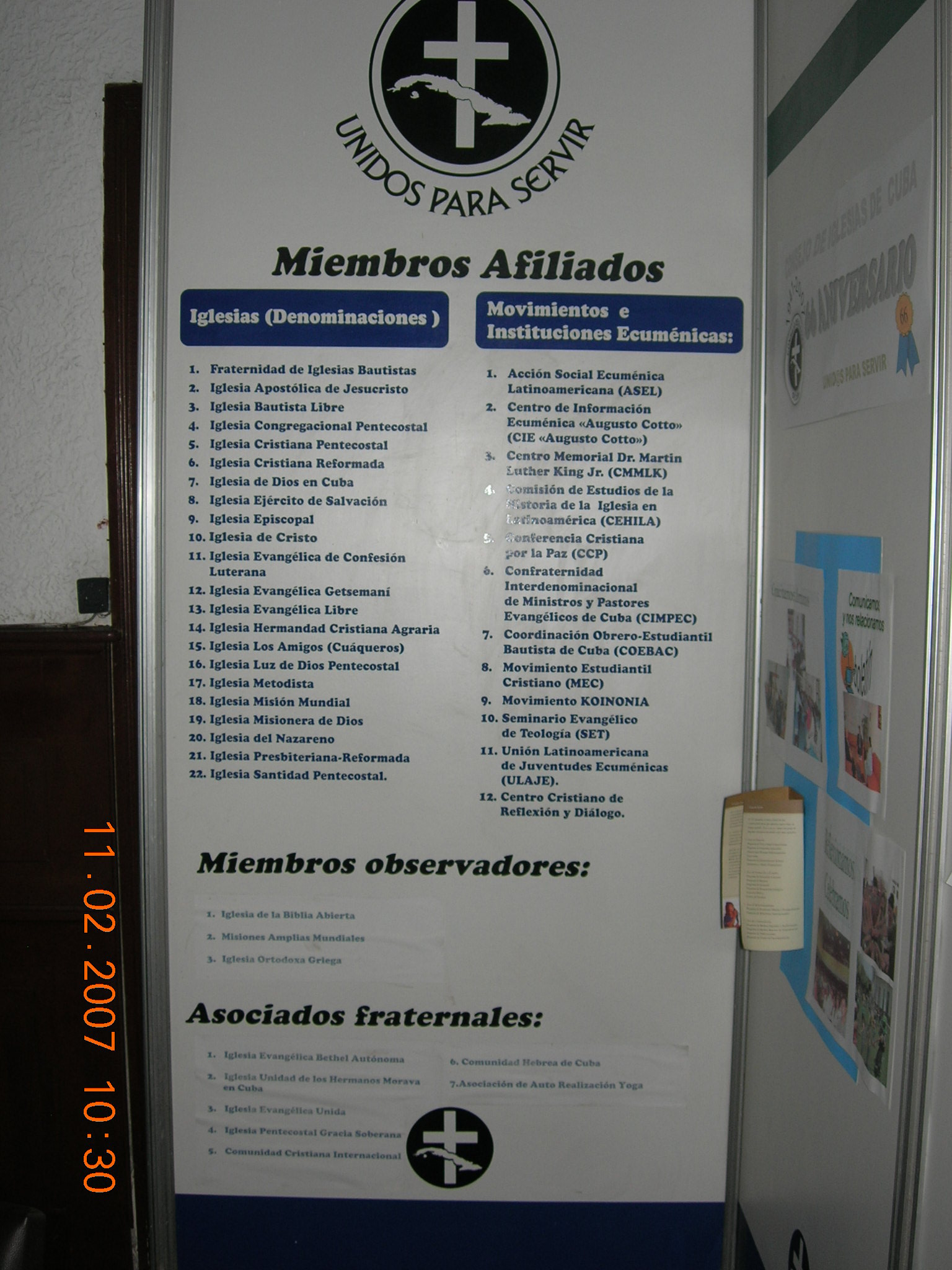
The report’s referencing the Cuban Council of Churches, however, did not mention that the it was founded in 1941 (long before the Cuban Revolution), and its members now include 22 churches, 12 ecumenical movements, and seven associate organizations. The Council, whose offices I have visited, promotes unity among the Christian Churches of Cuba and helps link these churches with other churches around the world. The Council also encourages dialogue between different movements and institutions as a means for Cuban churches to expand their ecumenical vocation of service, thus deepening their responsibilities towards society and all of God’s creation. Finally the Council promotes study, dialogue, and cooperation among Christians to increase Christian witness and enhance life in Cuba.
The U.S. government’s report continued, “Religious groups . . . reported it was easier to obtain government permission to maintain and repair existing places of worship and other buildings.” Moreover, the government “frequently granted permission to repair or restore existing temples, allowing significant expansion of some structures and in some cases allowing essentially new buildings to be constructed on the foundations of the old. Numerous houses of worship were expanded or repaired.” (In a prior year our partner church in Matanzas obtained such permission to expand its facilities for children’s Sunday School programming, and Westminster members helped build that expansion.)
Even though some religious organizations and “house churches” have not been officially recognized by the government, as required by Cuban law, in practice, most unregistered organizations and “house churches” operated with little or no interference from the government.
Both the Catholic Church and the Cuban Council of Churches reported improved access to prisoners during the year, with services offered in prisons and detention centers in most, if not all, provinces. (According to the report, however, some prison authorities did not inform inmates of their right to religious assistance, delayed months before responding to such requests, and limited visits to a maximum of two or three times per year.)
The government worked with the Catholic Church to facilitate the public procession of an icon honoring the Virgin of Charity to mark the 400th anniversary of her appearance in Cuba. The procession concluded in December with a public open-air mass in Havana attended by over 3,000 citizens as well as by government officials. It was the first country-wide religious procession permitted since the Cuban revolution.
Although there is no official law of policy for conscientious objection to military service, since 2007 the government has unofficially allowed a period of civilian public service to substitute for military service for men who object on religious grounds. The leadership of Jehovah’s Witnesses and Seventh-day Adventists stated that their members usually were permitted to participate in social service in lieu of military service.
The leadership of Jehovah’s Witnesses and Seventh-day Adventists stated that mistreatment and job discrimination, which had been particularly harsh in the past, were now rare and that their members were usually exempted from political activities at school. Seventh-day Adventist leaders stated that their members employed by the state usually were excused from working on Saturdays.
Pope Benedict XVI @ Plaza de Revolucion
Not included in the report for 2011 was the late March 2012 visit to Cuba by Pope Benedict XVI. During a mass in Havana’s Plaza de Revolucion before a crowd of thousands, the Pope called for “authentic freedom.”
Negative Aspects of Religious Freedom in Cuba
The report also commented on what it saw as negative aspects of religious freedom in Cuba.
The report notes that obtaining government permission for construction of new religious buildings remained difficult. This may well be true, but, in my opinion, this difficulty springs from the government’s attempts to regulate the allocation of scarce resources in a relatively poor country and to allocate more resources to other purposes it deems more important.
By law religious groups “are required to apply to the Ministry of Justice for official recognition. The application procedure requires religious groups to identify the location of their activities and their source of funding, and requires the ministry to certify that the group is not ‘duplicating’ the activities of another recognized organization in which case, recognition is denied. A number of religious groups, such as the Jehovah’s Witnesses and the Mormons, have been waiting for years for a decision from the Ministry of Justice on their pending applications for official recognition.” (However, the report said that unrecognized religious groups reported they were able to conduct religious activities, hold meetings, receive foreign visitors, and send representatives abroad. In addition, I believe that the government’s official requirement that such applications indicate it is not “duplicating” another organization’s activities is due to the previously mentioned desire to conserve scarce resources.)
Once the Ministry of Justice grants official recognition, religious organizations have to request permission from the Cuban Communist Party, through its Office of Religious Affairs, to hold meetings in approved locations, to receive foreign visitors, and to travel abroad. Religious groups indicated that while many applications were approved within two to three years from the date of the application, other applications received no response or were denied. Some religious groups were only able to register a small percentage of their “house churches.”
The report states that religious groups may not establish schools. This is true because the Cuban Revolution nationalized all private schools–religious and nonreligious– and instead emphasized public education for all children.
The report also says, “Except for two Catholic seminaries and several interfaith training centers throughout the island, religious schools were not permitted.”
This is an erroneous or misleading statement about religious education in Cuba as shown by the report’s own acknowledgement that in 2011 religious organizations had increased ability to conduct their own educational programs and by the following facts not mentioned in the report:
Since 1946 there has been an ecumenical Protestant Christian seminary in the city of Matanzas — Seminario Evangelico de Teologia (SET)–that was founded by the Methodist, Presbyterian, and Episcopal Churches. It has a full curriculum for various degrees as well as other non-degree programs, some of which are offered in other cities on the island.
The Methodists recently withdrew from SET to start their own seminary in Havana.
SET and the Martin Luther King, Jr. Center at Ebenezer Baptist Church in Havana are developing a program for education of prospective owners and operators of private businesses on the island under the government’s announcement allowing such activities. The MLK Center, by the way, was founded in 1987 to provide training and education in King’s philosophy of nonviolence for Cuban religious and community leadership.
In the last several summers young people from Westminster have conducted a vacation Bible school at our partner church in Matanzas.
MLK Center, Havana
“A license from the Office of Religious Affairs is necessary to import religious literature and other religious materials.” (Yet, as previously mentioned, the report itself states there were fewer restrictions on such importation.)
The report also states that “the government owns nearly all printing equipment and supplies and tightly regulates printed materials, including religious literature.” This, in my opinion, is an overstatement. Our partner church in Matanzas owns old-fashioned printing presses and at least one specialized computer printer and that the church prints and distributes religious bulletins and journals for most, if not all, of the Protestant churches on the island. A photo of the covers of some of the religious publications that are printed here appears in my 12/30/11 post, “The Cuban Revolution and Religion.”
The report states that “most religious leaders reported they exercised self-censorship in what they preached and discussed during services. Many feared that direct or indirect criticism of the government could result in government reprisals, such as denials of permits from the Office of Religious Affairs or other measures that could stymie the growth of their organizations.”
The government took “measures to limit support to outspoken religious figures that it considered a challenge to its authority.”I have no basis to challenge that statement or the following specifics cited by the report on this point:
On June 26, police arrested 23 people and detained them for five hours to prevent them from attending a Sunday prayer session in support of a Methodist minister who was removed from his post by his superiors, partly because of his outspoken criticism of the government.
On October 19, police stopped Baptist pastor Mario Felix Lleonart, a vocal critic of the authorities in the province of Santa Clara, and detained him for 10 hours.
In February Pastor Omar Perez Ruiz (aka Omar Gude Perez), a leader of the Apostolic Reformation, an association of independent nondenominational churches, was released after serving almost three years of a six-year prison sentence for illicit economic activities and falsification of documents. Perez maintained his innocence and claimed his incarceration was due to his religious activities. Perez’s release was conditioned on his refraining from preaching and from leaving the city of Camaguey. Although Perez and his family were granted refugee status in the United States, they were unable to leave because the government did not grant them an exit permit.
As part of its campaign of repression of human rights activists, the government prevented many Catholics from attending religious services. Members of the Ladies in White (Damas de Blanco) group were routinely prevented from attending church, a practice that was particularly pronounced in the eastern provinces of Holguin and Santiago. The government prevented Adisnidia Cruz, mother of political prisoners Marcos and Antonio Lima-Cruz, from leaving her house in Holguin on Sundays to attend mass on dozens of occasions. In other instances the government harassed human rights activists immediately after religious services. On September 8, for example, members of the Damas de Blanco were arrested after attending mass in Santiago to celebrate the day of Cuba’s patron saint.
Conclusion
Is the glass half empty or half full? This is the question for all human activities since none of us is perfect, and it is the legitimate question about religious freedom in Cuba.
In the opinion of a respected Cuban Protestant leader, the glass of such freedom in Cuba is more than half full, and there is no basis whatsoever for the U.S. government or her citizens to castigate Cuban religious institutions or leaders or members. I concur. As Jesus said to the scribes and Pharisees when they asked him if they should stone a woman who had committed adultery, “Let anyone among you who is without sin be the first to throw a stone at her.” All of the questioners then silently departed without throwing any stones. (John 8: 3-11.)
I, therefore, am glad that this U.S. government report does not designate Cuba as a “Country of Particular Concern,” i.e., a country which has “engaged in or tolerated particularly severe violations of religious freedom,” or the ” systematic, ongoing, egregious violations of religious freedom, including violations such as torture, degrading treatment or punishment, prolonged detention without charges, abduction or clandestine detention, or other flagrant denial of the right to life, liberty, or the security of persons.” There is no basis for any such designation, in my opinion.
Nor do I think there is any basis for the quasi-independent U.S. Commission on International Religious Freedom to have put Cuba on its “Watch List of countries where the serious violations of religious freedom engaged in or tolerated by the governments do not meet the [Commission’s] . . . threshold [for designation as a Country of Particular Concern], but require close monitoring.” The Commission should cease making such a designation in its next report.