President Obama’s Major Speech at the Summit of the Americas

On April 10 and 11, Cuba for the first time was welcomed to the Summit of the Americas. Presidents Raul Castro and Barack Obama exchanged handshakes and friendly greetings, and their speeches promised commitment to the process of reconciliation. Other leaders of the Americas celebrated this demonstration of reconciliation.

President Obama made several speeches and remarks at the Summit. This post will discuss his April 11th speech to the Summit’s plenary meeting; subsequent posts will cover his other remarks and those of President Castro.

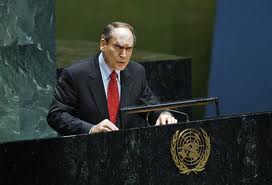
 President Obama’s Speech

Obama

“When I came to my first Summit of the Americas six years ago, I promised to begin a new chapter of engagement in this region.  I believed that our nations had to break free from the old arguments, the old grievances that had too often trapped us in the past; that we had a shared responsibility to look to the future and to think and act in fresh ways.  I pledged to build a new era of cooperation between our countries, as equal partners, based on mutual interest and mutual respect.  And I said that this new approach would be sustained throughout my presidency; it has, including during this past year.  I’ve met that commitment.”

“We come together at a historic time.  As has already been noted, the changes that I announced to U.S. policy toward Cuba mark the beginning of a new relationship between the people of the United States and the people of Cuba.  It will mean, as we’re already seeing, more Americans traveling to Cuba, more cultural exchanges, more commerce, more potential investment.  But most of all, it will mean more opportunity and resources for the Cuban people.  And we hope to be able to help on humanitarian projects, and provide more access to telecommunications and the Internet, and the free flow of information.”

“We continue to make progress towards fulfilling our shared commitments to formally reestablish diplomatic relations, and I have called on Congress to begin working to lift the embargo that’s been in place for decades.  The point is, the [U.S.] will not be imprisoned by the past.  We’re looking to the future and to policies that improve the lives of the Cuban people and advance the interests of cooperation in the hemisphere.”

“This shift in U.S. policy represents a turning point for our entire region.  The fact that President Castro and I are both sitting here today marks a historic occasion.  This is the first time in more than half a century that all the nations of the Americas are meeting to address our future together.  I think it’s no secret — and President Castro, I’m sure, would agree — that there will continue to be significant differences between our two countries.  We will continue to speak out on behalf of universal values that we think are important.  I’m sure President Castro will continue to speak out on the issues he thinks are important.”

“But I firmly believe that if we can continue to move forward and seize this momentum in pursuit of mutual interests, then better relations between the [U.S.] and Cuba will create new opportunities for cooperation across our region — for the security and prosperity and health and dignity of all our people.”

“Now, alongside our shift toward Cuba, the [U.S.] has deepened our engagement in the Americas across the board.  Since I took office, we’ve boosted U.S. exports and also U.S. imports from the rest of the hemisphere by over 50 percent.  And that supports millions of jobs in all of our countries.  I’ve proposed $1 billion to help the people of Central America strengthen governance, and improve security and help to spark more economic growth and, most importantly, provide new pathways for young people who too often see their only prospects an underground economy that too often leads to violence.”

“We’re partnering with countries across the region to develop clean, more affordable and reliable energy that helps nations to combat the urgent threat of climate change, as [Brazil’s] President Rousseff already noted.  Our 100,000 Strong in the Americas initiative is working to bring 100,000 students from Latin America to the [U.S.] and 100,000 students from the [U.S.] to Latin America.  The new initiatives that I announced in Jamaica will help empower a new generation of young people across the Americas with the skills and job training that they need to compete in the global economy.”

“During the course of my meetings with CARICOM [Caribbean Community], as well as my meetings with SICA [System for Integration of Central America] as well as the discussions that I’ve had with many of you bilaterally, there have been additional ideas that we’re very interested in — finding ways in which we can expand access to the Internet and broadband; how we can structure private-public partnerships to rebuild infrastructure across the region; and to expand our commercial ties in a broad-based and inclusive way.  Because I am firmly of the belief that we will only succeed if everybody benefits from the economic growth, not just a few at the top.”

“At home, I’ve taken executive actions to fix as much of our broken immigration system as I can, which includes trying to help people come out of the shadows so that they can live and work in a country that they call home.  And that includes hundreds of thousands of young people we call DREAMers, who have already received temporary relief.  And I’m remaining committed to working with our Congress on comprehensive immigration reform.”

“So the bottom line is this:  The [U.S.] is focused on the future.  We’re not caught up in ideology — at least I’m not.  I’m interested in progress and I’m interested in results.  I’m not interested in theoretic arguments; I’m interested in actually delivering for people.  We are more deeply engaged across the region than we have been in decades.  And those of you have interacted with me know that if you bring an issue to my attention, I will do my best to try to address it.  I will not always be able to fix it right away, but I will do my best.”

“I believe the relationship between the [U.S.] and the Americas is as good as it has ever been.  I’m here today to work with you to build on this progress.  Let me just mention a few areas in which I think we can make more progress.”

“First, we will continue to uphold the Inter-American Democratic Charter, which states that “the peoples of the Americas have a right to democracy.”  I believe our governments, together, have an obligation to uphold the universal freedoms and rights of all our citizens.  I want to again commend [Panama’s] President Varela and Panama for making civil society groups from across the region formal partners in this summit for the first time.  I believe the voices of our citizens must be heard.  And I believe going forward, civil society should be a permanent part of these summits.”

“Second, we have to focus on reigniting economic growth that can fuel progress further in those communities that have not been reached.  And that means making the Americas more competitive.  We still have work to do to harmonize regulations; encourage good governance and transparency that attracts investment; invest in infrastructure; address some of the challenges that we have with respect to energy.  The cost of energy in many communities — in many countries, particularly in Central American and the Caribbean, are so high that it presents a great challenge to economic development, and we think that we can help particularly around clean energy issues.”

“We have to confront the injustice of economic inequality and poverty.  I think that collectively we are starting to identify what programs work and which programs do not work.  And we should put more money in those things that do work, and stop doing those things that don’t.  We don’t have money to waste because of too many young people out there with enormous needs.  I think President Varela is right to focus particularly on education and skills building.  And this is an agenda which we should all tackle collectively.”

“Third, we have to keep investing in the clean energy that creates jobs and combats climate change.  The [U.S.] is today leading this global effort, along with many of you.  And I should point out that America’s carbon pollution is near its lowest level in almost two decades.  Across the Americas, I think we have the opportunity to expand our clean energy partnerships and increase our investments in renewables.”

“And finally, we have to stand firm for the security of our citizens.  We must continue to join with our partners across the region, especially in Central America, but also in the Caribbean, to promote an approach, a holistic approach that applies rule of law, respects human rights, but also tackles the narco-traffickers that devastate so many communities.  This is a shared responsibility.  And I’ve said before that the [U.S.] has a responsibility to reduce the demand for drugs and to reduce the flow of weapons south, even as we partner with you to go after the networks that can cause so much violence.”

“So, a new relationship with Cuba.  More trade and economic partnerships that reduce poverty and create opportunity, particularly focusing on education.  Increased people-to-people exchanges.  More investment in our young people.  Clean energy that combats climate change.  Security cooperation to protect our citizens and our communities.  That’s the new chapter of engagement that the [U.S.] is pursuing across the Americas.”

“I want to make one last comment addressing some of the points that [Ecuador’s] President Correa raised and I’m sure will be raised by a few others during this discussion.  I always enjoy the history lessons that I receive when I’m here.  I’m a student of history, so I tend to actually be familiar with many of these episodes that have been mentioned.  I am the first one to acknowledge that America’s application of concern around human rights has not always been consistent.  And I’m certainly mindful that there are dark chapters in our own history in which we have not observed the principles and ideals upon which the country was founded.”

“Just a few weeks ago, I was in Selma, Alabama celebrating the 50th anniversary of a march across a bridge that resulted in horrific violence.  And the reason I was there, and the reason it was a celebration, is because it was a triumph of human spirit in which ordinary people without resort to violence were able to overcome systematic segregation.  Their voices were heard, and our country changed.”

“America never makes a claim about being perfect.  We do make a claim about being open to change.  So I would just say that we can, I suppose, spend a lot of time talking about past grievances, and I suppose that it’s possible to use the [U.S.] as a handy excuse every so often for political problems that may be occurring domestically.  But that’s not going to bring progress.  That’s not going to solve the problems of children who can’t read, who don’t have enough to eat.  It’s not going to make our countries more productive or more competitive in a global economy.”

“So I just want to make very clear that when we speak out on something like human rights, it’s not because we think we are perfect, but it is because we think the ideal of not jailing people if they disagree with you is the right ideal.”

“Perhaps President Correa has more confidence than I do in distinguishing between bad press and good press.  There are a whole bunch of press that I think is bad, mainly because it criticizes me, but they continue to speak out in the [U.S.] because I don’t have confidence in a system in which one person is making that determination.  I think that if we believe in democracy it means that everybody has the chance to speak out and offer their opinions, and stand up for what they believe is right, and express their conscience, and pray as they would, and organize and assemble as they believe is appropriate — as long as they’re not operating violently.”

“So we will continue to speak out on those issues not because we’re interested in meddling, but because we know from our own history.  It’s precisely because we’re imperfect that we believe it’s appropriate for us to stand up.  When Dr. King was in jail, people outside the United States spoke up on his behalf.  And I would be betraying our history if I did not do the same.”

“The Cold War has been over for a long time.  And I’m not interested in having battles that, frankly, started before I was born.  What I am interested in is solving problems, working with you.  That’s what the [U.S.] is interested in doing.  That’s why we’ve invested so much in our bilateral relationships, and that’s why I will continue to invest in creating the kind of spirit of equal partnership and mutual interest and mutual respect upon which I believe progress can advance.”


International Reaction to U.S.-Cuba Reconciliation

The overwhelming international response to the December 17th announcement of U.S.-Cuba reconciliation has been very positive, especially in Latin America. Future posts will examine the responses in Cuba and the U.S.

Latin American Reactions [1]

Virtually all Latin American countries had been increasingly frustrated with the 50 years of estrangement and hostility between the U.S. and Cuba. According to a historian of the region, Enrique Krauze, “Cuba has been the epicenter of anti-Americanism in modern Latin America” and the Cuban Revolution of 1959 “opened a new cycle of anti-Americanism.” 

Now, Krauze continues, the U.S. has renounced its “imperial destiny and recovers much of the moral legitimacy needed to uphold the democratic ideals that led to its foundation (and also of the countries of Latin America).”

The President of Brazil congratulated Raul Castro, Obama and Pope Francis. Similar comments were made by the leaders of Mexico, Peru, Colombia and Nicaragua.

Jose Miguel Insulza, Secretary General of the Organization of American States, the regional forum where Cuba’s seat has been empty since 1962, said Obama’s decision removed a major irritant in Washington’s relations with Latin America. “This ends the attempt to isolate Cuba for so long. Cuba is undertaking a process of economic reforms that will, I hope, lead to political reforms.”.

These reactions were emphasized by U.S. Assistant Secretary of State, Roberta Jacobson, who said, ““Our previous Cuba policy was clearly an irritant and a drag on our policy in the region,”  adding that it had caused friction even with countries friendly to Washington. She said that countries “with whom we have significant differences are going to be, let’s say, thrown off their stride by a move like this.”“It removes an excuse for blaming the United States for things,” she added.

The Wall Street Journal reported the day after the announcement of the detente that government officials, diplomats and scholars believe this change has “the potential to redraw political and economic alliances across the hemisphere,” especially with countries like Argentina, Ecuador and others. It will be most difficult for Venezuela, which has held “a long-held animosity toward El Imperio–the empire.”

But the President of Venezuela immediately called the detente a “victory for Fidel and the Cuban people” while also acknowledging President Obama’s “courage” in “perhaps the most important step of his presidency.”

On January 26th the United Nations Economic Commission for Latin America and the Caribbean (ECLAC) [2] applauded the agreement’s making possible Cuba’s attending the Summit of the Americas in Panama this coming April.

European Reactions [3]

On the day after the historic announcement, the European Union released a statement hailing it as a “historic turning point.” It continued, “Today another Wall has started to fall. These moves represent a victory of dialogue over confrontation.”

The leading newspaper of Spain, El Pais, editorialized, “Today, when freedom seems to be calling for an end to the doors of Cuba, Spain must accompany Cubans in their new journey: supporting their political, economic and social modernization, with clarity, consistency and realism; aware of the limits of his diplomatic skills-but place value on the european-dimension and also aware that resetting relations with Cuba, the United States restored its relations with Latin America.”

Positive comments of the change came from leaders of Germany, Italy, France and Spain.

Other International Reactions [4]

Canada, we recall, hosted some of the secret U.S.-Cuba negotiations that resulted in the December 17th announcement of the start of the process of their reconciliation. Afterwards Canada’s Foreign Minister, John Baird, said, “”I agree with this policy. I don’t think previous U.S. policy has been effective. If you flood Cuba with American values, American people, and American investment, it will help transform the country.”

U.N. Secretary General, Ban Ki-moon, said at a press conference on December 17th, “I have been informed in advance by the US Government.  This news is very positive.  I’d like to thank President Barack Obama of the United States and President Raul Castro for taking this very important step towards normalizing relations.  As much of the membership of the United Nations has repeatedly emphasized through General Assembly resolutions during the last many, many years, it is time that Cuba and the United States normalize their bilateral relations.  In that regard, I heartily welcome today’s development.  I sincerely hope these measures, this announcement will help to expand further the exchanges between the two peoples who have been separated quite a long time.  The United Nations stands ready to help both countries to cultivate their good neighbourly relations.”

Conclusion

I would appreciate comments identifying other international reactions.

As was anticipated in the December 17th announcements by presidents Obama and Castro and as we already have seen, the path to lasting reconciliation is not easy for either country. There are many unresolved issues for the two countries over the last 50-plus years.

These words of congratulations from around the world will have to justified by the further negotiations of the two countries. If they fail to resolve these issues, the international reaction will be severe, and if other countries and international organizations believe the U.S. was primarily responsible for such failure, then there could be even worse anti-Americanism unleashed.

=========================================================

[1] Rebussio, Maduro: It is a victory for Fidel and the Cuban people, El Pais (Dec. 17, 2014); Mezzi, Venezuela is left alone, El Pais (Dec. 17, 2014); Anderson, Mynaya & Vyas, Detente Scrambles Political Calculus in Latin America, W.S.J. (Dec. 18, 2014); Assoc. Press, AP Analysis: U.S. Was at Odds With World Over Cuba Policy, N.Y. Times (Dec. 18,2014); Romero & Neuman, Cuba Thaw Lets Rest of Latin America Warm to Washington, N.Y. Times (Dec. 18, 2014); Assoc. Press, Latin America Cheers U.S.-Cuba Rapprochement, N.Y. Times (Dec. 18,2014);  Krauze, End of Anti-Americanism?, N.Y. Times (Jan. 7, 2015); ECLAC applauds presence of Cuba in Summit of the Americas, Granma (Jan. 26, 2015)

[2] ECLAC was established by the U.N. in 1948 to contribute to the economic development of the region and to promote its social development. Its 44 members include 11 from Asia (Japan and Republic of Korea), Europe (France, Germany, Italy, Netherlands, Portugal, Spain and United Kingdom) and North America (Canada and U.S.) with historical, economic and cultural ties to the region. In addition, 13 non-independent Caribbean territories are associate members. 

[3] Rebussio, Maduro: It is a victory for Fidel and the Cuban people, El Pais (Dec. 17, 2014); Reuters, “Another Wall Falls:’ Europe Hails U.S.-Cuba Breakthrough, N.Y. Times (Dec. 18, 2014); Editorial, With Cuba, El Pais (Dec. 21, 2014).

[4] Goldberg, Canada’s Foreign Minister:U.S. Influence Will Make Cuba Better, Atlantic (Dec. 21, 2014), Reuters, U.N.‘s Ban Hails Obama for ‘Courageous’ Cuba Move, N.Y. Times (Dec. 20, 2014); U.N., Press Conference by Secretary-General Ban Ki-moon at United Nations Headquarters (Dec. 17, 2014).

New York Times Reiterates Call for Ending U.S. Designation of Cuba as a “State Sponsor of Terrorism”

On December 15th a New York Times editorial, “Cuba’s Economy at a Crossroads,” called for the U.S. to end its designation of Cuba as a “State Sponsor of Terrorism.” This recommendation first was made on October 11th in the Times’ initial editorial in its series “Cuba: A New Start.”

Summary of the Editorial

Now, however, ending the designation is seen as a way the U.S. could assist a struggling Cuban economy. Surprisingly this editorial does not mention ending the U.S. embargo of the island as another, and more important, way the Cuban economy could be aided by the U.S. Instead the Times makes a vague suggestion of the U.S.’ “relaxing sanctions through executive authority and working with the growing number of lawmakers who want to expand business with Cuba.”

Most of the editorial is devoted to discussing the many problems of the Cuban economy.

The 1959 Cuban Revolution’s “[c]ommunism brought an ever more anemic and backward economy, one propped up largely by Moscow. But after the Soviet Union collapsed in 1991, so did Cuba’s economy.” After that collapse, Cuba found Venezuela as a “new benefactor” that provided “heavily subsidized oil” to the island, but now that country’s “worsening economic and political crisis” threatens that subsidy.

Low wages and poor prospects have forced many Cubans to leave the island “in recent years in search of a better life.” This could be accelerated by the elimination of the country’s two-currency system, which the government plans to do.

“The country’s birthrate is declining, while its elderly are living longer.” Couple these facts with the exodus of working-age citizens presents Cuba with an enormous demographic challenge.

“The agricultural sector remains stymied by outdated technology and byzantine policies. A foreign investment law Cuba’s National Assembly approved in March has yet to deliver a single deal.”

Cuba’s leaders have adopted various measures to reform the economy, but the “pace [of economic reform] has been halting, with plenty of backtracking from the government’s old guard.”

Yet these reforms have created a “small but growing entrepreneurial class.” All of them “struggle with the [Cuban] bureaucracy, since they are unable to import legally items as basic as mattresses and pillows. Bringing items from the United States is onerous and complicated by American sanctions.” Changes in U.S. policies could make “it easier for Americans to provide start up-capital for independent small businesses. Doing that would empower Cuban-Americans to play a more robust role in the island’s economic transformation. More significantly, it would gradually erode the Cuban government’s ability to blame Washington for the shortcomings of an economy that is failing its citizens largely as a result of its own policies.”

Continuing U.S. antagonism, on the other hand, “is only helping the old guard.”

Reactions

I concur in the Times’ call for ending the U.S. designation of Cuba as a “State Sponsor of Terrorism.” It is an unfounded, stupid, absurd action that is only counter-productive as has been argued in posts in 2010, 2011, 2012 (with supplement), 2013 and 2014.

But I do not see ending this policy as the linchpin for the U.S.’ helping the Cuban economy. Instead it is ending the embargo, which the Times on October 11th recommended, but which is not mentioned in the latest editorial.

Moreover, I think the latest editorial understates the troubled state of the Cuban economy even though a prior post expressed optimism about Cuba’s attracting $8.0 billion of foreign investment for the Mariel port’s industrial park now under construction. Further reflection raises the following points that question that optimism:

  • First, the Cuban economy by itself is obviously unable to afford to purchase the many commodities that presumably will be unloaded from the new super-container ships that will be able to cross the expanded Panama Canal.
  • Second, for the commodities to go elsewhere will require the unloading of the super-container ships at Mariel and then reloading those commodities in smaller container vessels to go to the major countries on the northern and eastern sides of the South American continent: Venezuela, Brazil, Argentina, Uruguay and Paraguay. How big are those markets?
  • Third, presumably the major Latin American countries with coasts on the Pacific Ocean like Mexico, El Salvador, Costa Rica, Colombia, Ecuador, Peru and Chile will not be markets for commodities transshipped from Mariel.
  • Fourth, unless there is U.S.-Cuba reconciliation, the largest potential market for such transshipment, the U.S., presumably would not be importing commodities from the Mariel port.

Similar skepticism about Cuba’s ability to attract foreign investment for other reasons have been voiced by foreign investment experts. The Inter-American Dialogue, which is the leading U.S. center for policy analysis, exchange, and communication on Western Hemisphere affairs, has provided the following four such skeptics.

Matthew Aho, consultant in the corporate practice group of Akerman Senterfitt in New York, said, “While the [Cuban] rhetorical message was positive: ‘Cuba is open for business,’ little has changed to improve Cuba’s general investment climate, and foreign companies there report few changes to their dealings with Cuban counterparts. In fact, many businesses say the same bottlenecks, delays and idiosyncrasies that have long frustrated investors have been exacerbated recently by growing wariness among major banks to handle legitimate Cuba-related transactions.” He added, “While Cuba clearly has potential, most mainstream investors will steer clear until the Cubans define clearer rules of the road and improve their track record with new and existing partners.”

According to José R. Cárdenas, director of Visión Américas in Washington, “Eight billion dollars is a wildly exaggerated figure that Cuba has no chance of ever realizing. [Foreign investors] demand such things as transparency, legal guarantees and predictability, which the Cuban government is incapable of providing. Witness the widely publicized ordeals of Canadian businessman Cy Tokmakjian and Englishman Stephen Purvis, among others, who wound up in incarcerated in Cuba’s Kafkaesque legal system for unclear reasons. There may as well be a ring of flashing red lights surrounding the island warning foreign investors of the exorbitant risks to doing business in Cuba. . . . Any progressing economy needs the freedom to innovate, take risks and guarantee that one will reap the benefits of their efforts. Cuba, like China, cannot ultimately offer such conditions. As long as the primacy of the Communist Party remains the Cuban lodestar, the country will continue to head into an uncertain future.”

Scott J. Morgenstern, associate professor and director of the Center for Latin American Studies at the University of Pittsburgh also was skeptical. He said, “Cuba must create new opportunities for private employment. Thus, while the reforms are making some investment possible, investors will not find wide-open markets and streamlined bureaucratic procedures. In many areas, there are severe limits concerning where people can invest and the types of businesses they can open. Currency convertibility will also be a critical issue for any business; currently there are two currencies, only one of which is convertible. Foreigners, formally, are only allowed to use the convertible currency, and the official exchange rates distort the currency values. Reforms are promised, but the uncertainty will likely discourage some investors. One other important concern for investors is the size of the Cuban domestic market. The country is attracting several million tourists per year, and many Cubans do receive financial support from abroad, but purchasing power is still limited.”

Carlos A. Saladrigas, chairman of the Cuba Study Group and Regis HR Group offered these comments. “Cuba’s economic reforms so far have been too little, too late and too timid to result in significant economic performance . . . . [Cuba’s] continuing economic mismanagement, the numerous distortions in Cuba’s economic and political systems, a stubborn ideology, an obtuse and weighty bureaucracy and the fears of change harbored by Cuba’s leaders all play even more heavily in keeping Cuba’s economy from reaching its full potential. Cuban leaders continue to expect ‘silver bullet solutions’ to their economic woes. The port of Mariel is a perfect example. Pinning hopes of an economic recovery on mega-projects or a few foreign investments take attention away from the core distortions and inefficiencies plaguing the entire domestic economy. Fear of change and ideological rigidity can be clearly seen in Cuba’s eight-month-old foreign investment law. Since the law was passed, Cuban authorities still don’t have any significant major investment projects to report. The foreign investment law was a great missed opportunity to really send a message to the world, and specifically to the United States, that Cuba is ready for business. Such a message would have added great momentum to the anti-embargo movement, which is building momentum in the United States and in Miami. Yet, they chose more of the same, leaving arbitrariness, lack of clarity and burdensome regulations.”

Similar skeptical opinions about the Cuban efforts to develop the Mariel port were expressed by Richard Feinberg, the Brookings Institution’s Nonresident Senior Fellow, Foreign Policy, Latin American Initiative. He said, “the industrial sites are not yet fully leveled nor are they hooked up to basic infrastructure! But the problems run much deeper: previous Cuban efforts to launch free trade zones floundered on the requirement of hiring expensive labor through government employment agencies, and the continuing closure of the most logical export market, the nearby [U.S.]. Cuba’s newly revised foreign investment laws appear to allow investors greater flexibility in setting wage scales, but this potentially promising reform, and its impact on labor costs, remains to be fully tested in practice.”

Finally, Miguel Coyula, a retired Cuban government official on a trip to Washington before returning home to the island, stated ““Mariel is the most promoted place in Cuba, with special development zones for investors. But soon it’ll be a year after the opening of Mariel, and there is absolutely nothing. Even the container terminal in Havana was moved to Mariel to give it a sense of activity, but no one will invest there. For one thing, potential foreign investors in Mariel don’t like the fact that they can’t hire employees on their own, but instead must pay a government employment agency in dollars for that labor. The agency, in turn, pays workers in Cuban pesos. That’s because the Castro government wants to avoid creating a class of highly paid Cubans who work for foreign companies, ‘but inequalities are there whether you like it or not.’”


New York Times Calls for End of U.S. Program for Special Immigration Relief for Cuban Medical Personnel

On November 17th the New York Times published another editorial in its series urging changes in U.S. policies regarding Cuba.[1] Under the title “A Cuban Brain Drain, Courtesy of the U.S.,” the editorial targets the U.S.’s Cuban Medical Professional Parole Program (CMPPP).

In order to understand the editorial, we first must look at the Cuban government’s policy and program of sending Cuban medical personnel to other countries and then at the CMPPP’s response to that Cuban program. Thereafter we will examine the Times’ rationale for its recommendation along with the arguments for the Wall Street Journal’s support of the CMPPP before we voice our conclusions.

 Cuban Policy and Program of Sending Medical Personnel Abroad

According to a 2011 article in the Wall Street Journal, since 1973 Cuba has been sending medical ‘brigades’ to foreign countries, “helping it to win friends abroad, to back ‘revolutionary’ regimes in places like Ethiopia, Angola and Nicaragua, and perhaps most importantly, to earn hard currency. [The] Communist Party newspaper Granma reported in June [2010] that Cuba had 37,041 doctors and other health workers in 77 countries. Estimates of what Cuba earns from its medical teams—revenue that Cuba’s central bank counts as ‘exports of services’—vary widely, running to as much as $8 billion a year.”

Again, according to the same Wall Street Journal article, Cuban doctors often desire such overseas assignments because they provide opportunities to earn significantly more money than at home. “When serving overseas, they get their Cuban salaries [of $25 per month], plus a $50-per-month stipend—both paid to their dependents while they’re abroad. . . . In addition, they themselves receive overseas salaries—from $150 to $1,000 a month, depending on the mission.” Many on-the-side also engage in private fee-for-service medical practice, including abortions. As a result, many of the Cubans are able to save substantial portions of their overseas income, which they often use to purchase items they could not have bought in Cuba like television sets and computers. Other desirable purchases are less expensive U.S. products that they can sell at a profit when they return to Cuba.

The Wall Street Journal article adds, “Since Hugo Chávez came to power in Venezuela in 1998, Cuba has been bartering its [medical personnel] . . . for Venezuelan oil. The U.S. Energy Department estimates that in [2010] Venezuela ships Cuba 90,000 barrels of oil a day—worth more than $2 billion a year at [then] current prices. In addition, Venezuela pays Cuba for medical teams sent to countries that Mr. Chávez considered part of Venezuela’s “Bolivarian” sphere: Bolivia, Honduras, Ecuador and Paraguay.”

As a result of this quid pro quo, Cuba has over 10,000 medical personnel serving in Venezuela. According to the Los Angeles Times just this past September, the working conditions in that country for the Cubans are horrible. Many of the clinics lack air-conditioning and functioning essential medical equipment. The Cubans’ workload is often “crushing.” Common crime is rampant, and the Cubans are often caught in the middle of Venezuela’s civil unrest between followers of the late Hugo Chavez who want the Cubans to be there and more conservative forces that oppose the Cuban presence. As a result, as we will see below in the discussion of CMPPP, many Cuban medical personnel serving in Venezuela have chosen to defect to the U.S. under CMPP.

The Times editorial says, “This year, according to the state-run newspaper Granma, the government expects to make $8.2 billion from its medical workers overseas. The vast majority, just under 46,000, are posted in Latin America and the Caribbean. A few thousand are in 32 African countries.”[2]

Facts Regarding CMPPP

A U.S. Department of State website says this program was announced on August 11, 2006, “by the Department of Homeland Security in conjunction with the Department of State, [as a program] that . . . would allow Cuban medical personnel conscripted to study or work in a third country under the direction of the Cuban government to enter the United States.”[3]

Under the program “Cuban Medical Professionals” (i.e., health-care providers such as doctors, nurses, paramedics, physical therapists, lab technicians and sports trainers) are eligible if they meet the following criteria: (1) Cuban nationality or citizenship, (2) medical professional currently conscripted to study or work in a third country under the direction of the Government of Cuba, and (3) not otherwise ineligible for entry into the U.S. Spouses and/or minor children are also eligible for such parole.

According to the Times’ editorial and the Wall Street Journal, the program “was the brainchild of Cuban-born Emilio González,” a former U.S. Army colonel, the director of the U.S. Citizen & Immigration Services from 2006 to 2008 and a “staunchly anti-Castro exile.” “He has characterized Cuba’s policy of sending doctors and other health workers abroad as ‘state-sponsored human trafficking.’” The Cuban doctors, he says, work directly for health authorities in other countries and have no say in their assignments.

The Times’ editorial includes the following table showing the official numbers of CMPPP visas that have been issued:

Fiscal Year Number
2006      11
2007    781
2008    293
2009    519
2010    548
2011    384
2012    681
2013    995
2014 1,278
TOTAL 5,490

Given the large numbers of Cuban medical personnel that are sent to Venezuela to help pay for Cuba’s importation of Venezuelan oil, it is not surprising that the largest number of defections of Cubans has been from that country. As of the end of FY 2010, according to the previously mentioned Wall Street Journal article, the total defections by country were the following: Venezuela, 824; Colombia, 291; Bolivia, 60; Dominican Republic, 30; Ecuador, 28; Guatemala, 25; Brazil, 21; Namibia, 21; Peru, 19; and Guyana, 14.

Apparently the largest number of defections from Venezuela continues in light of the previously mentioned difficult working conditions. For FY 2011-2014 there were an additional 1,181 Cuban defections from Venezuela to the U.S. under CMPPP for a grand total of 2,005.[4] In addition, many of the Cubans in that country fear being seen going to the U.S. embassy in Caracas and instead fly to neighboring Colombia and apply there for CMPPP.

Another obvious reason for such defections under CMPP is the desire of the Cubans to earn more income in the U.S. I have met a Cuban neurologist whose wife was a skilled nurse, but who worked as a waitress in a nearby resort in order to earn more income and obtain tips in hard currencies. Like almost all Cubans, they did not earn enough to afford to have their own automobile and told me about Cuban television announcements that people who had an automobile or other vehicle had a special obligation to give rides to anyone in a white coat. Later while on a mission in Central America they defected to the U.S. under CMPPP. At least as I heard their story, they were merely looking for a way to improve their lives financially.

The Times’ Reasons for Ending CMPPP

The editorial starts by noting, “Secretary of State John Kerry and the American ambassador to the United Nations, Samantha Power, have praised the work of Cuban doctors dispatched to treat Ebola patients in West Africa. The Centers for Disease Control and Prevention recently sent an official to a regional meeting the Cuban government convened in Havana to coordinate efforts to fight the disease. In Africa, Cuban doctors are working in American-built facilities.The epidemic has had the unexpected effect of injecting common sense into an unnecessarily poisonous relationship.”

Therefore, says the Times, “it is incongruous for the [U.S.] to value the contributions of Cuban doctors who are sent by their government to assist in international crises like the 2010 Haiti earthquake [and the current Ebola crisis in West Africa] while working to subvert that government by making defection so easy [under CMPPP].”

Moreover, says the Times, “Cuba has been using its medical corps as the nation’s main source of revenue and soft power for many years. The country has one of the highest numbers of doctors per capita in the world and offers medical scholarships to hundreds of disadvantaged international students each year, and some have been from the United States. According to Cuban government figures, more than 440,000 of the island’s 11 million citizens are employed in the health sector.”

The creation of CMPP was really motivated by a desire by anti-Castro Americans “to strike at the core of the island’s primary diplomatic tool, while embarrassing the Castro regime.” This is hardly a worthy motivation for the U.S.

For a poor country like Cuba, it makes sense to use one of its few economic strengths to bolster its foreign exchange earnings. Is this not an example of the concept of comparative advantage first formulated by classical economists Adam Smith and David Ricardo? The program also helps Cuba garner good will around the world for helping to improve the health of others. There is no legitimate reason for the U.S. to be opposed to such a program.

Adds the Times editorial, “American immigration policy should give priority to the world’s neediest refugees and persecuted people. It should not be used to exacerbate the brain drain of an adversarial nation at a time when improved relations between the two countries are a worthwhile, realistic goal.”

In 2006 when CMPPP was commenced, Cuban medical personnel could not obtain their government’s permission to leave the island for any reason, and this was asserted as one of the reasons for the U.S.’ creation of CMPPP. Last year, however, the Times says, “the Cuban government liberalized its travel policies, allowing most citizens, including dissidents, to leave the country freely. Doctors, who in the past faced stricter travel restrictions than ordinary Cubans, no longer do.”

Moreover, the Times asserts, “The Cuban government has long regarded the medical defection program as a symbol of American duplicity. It undermines Cuba’s ability to respond to humanitarian crises and does nothing to make the government in Havana more open or democratic. As long as this incoherent policy is in place, establishing a healthier relationship between the two nations will be harder.”

Finally, according to the Times, “Many medical professionals, like a growing number of Cubans, will continue to want to move to the United States in search of new opportunities, and they have every right to do so. But inviting them to defect while on overseas tours is going too far.”

The Wall Street Journal’s Reasons for Supporting CMPPP

The Wall Street Journal’s opinions on this subject are frequently uttered by its columnist on Latin American issues, Mary Anastasia O’Grady. The headline for her November 9, 2014, column makes clear her ultimate conclusion: “Cuba’s Slave Trade in Doctors.” She asserts that Cuba’s policy and practice of sending some of its medical personnel to other countries is an “extensive human-trafficking racket now being run out of Havana.”

Her argument centers on the Cuban government’s being paid for these services by other countries like Venezuela or by international organizations like WHO and the government’s paying its medical personnel only some of the Cuban government’s revenues for their services. But this ignores the fact that any corporation or other business entity that sells services, pays the people who actually provide the service less than what is collected by the corporation because there are other cost factors that have to be covered plus a profit.

While she admits that “Cuban doctors are not forced at gunpoint to become expat slaves,” she argues they “are given offers they cannot refuse.”

Conclusion

When the CMPPP was created in 1966, Cuba’s government prohibited its medical personnel from leaving the island, and one of CMPP’s original rationales was providing a legitimate way to provide them with a way to leave Cuba and go elsewhere. Now, however, the Cuban government permits such citizens to leave. This change, in this blogger’s opinion, eliminates the only arguably legitimate basis for CMPPP.

The allegation by some supporters of CMPP that Cuba’s practice of sending medical teams to other countries is a form of human trafficking is absurd, in this blogger’s opinion. The Cuban government has paid for all of the education of its medical personnel, and sending some of them to serve in foreign countries is a way for them to compensate the state for their free education. This Cuban practice is like the U.S. practice during some wars of having a selective service system and drafting some people to serve in our armed forces. Similarly we in the U.S. from time to time have debated having some kind of required national non-military service program for younger citizens without anyone arguing that it would be illegal human trafficking.

The U.S. State Department issues annual reports on the status of other countries’ human trafficking, which the reports define as “umbrella terms for the act of recruiting, harboring, transporting, providing, or obtaining a person for compelled labor or commercial sex acts through the use of force, fraud, or coercion.” This compelled service requirement uses “a number of different terms, including involuntary servitude, slavery or practices similar to slavery, debt bondage, and forced labor.”

Although the latest U.S. report on this subject unjustly casts Cuba into the report’s Tier 3 status,[5] as argued in a prior post, that report rejects the argument that Cuba is engaged in human trafficking when it sends its medical personnel to other countries. Here is what that report says on this issue:

  • “Some Cubans participating in the work missions have stated that the postings are voluntary, and positions are well paid compared to jobs within Cuba. Others have claimed that Cuban authorities have coerced them, including by withholding their passports and restricting their movement. Some medical professionals participating in the missions have been able to take advantage of U.S. visas or immigration benefits [under the CMPPP], applying for those benefits and arriving in the United States in possession of their passports—an indication that at least some medical professionals retain possession of their passports. Reports of coercion by Cuban authorities in this program do not appear to reflect a uniform government policy of coercion; however, information is lacking.”

This blogger, therefore, supports the Times’ calling for an end to CMPPP.

===================================================================

[1] Under the overall title of “Cuba: A New Start,” the prior editorials (all of which are simultaneously published in Spanish) have urged overall reconciliation between the two countries, including ending the ending of the U.S. embargo of the island, the U.S. designation of Cuba as a “State Sponsor of Terrorism” and re-establishing normal diplomatic relations; U.S.-Cuba collaboration in combatting Ebola in West Africa; recognizing changing U.S. public opinion on relations with Cuba; U.S.-Cuba exchange of prisoners; and ending USAID covert programs to promote regime change in Cuba.

[2] Another issue unrelated to CMPPP is whether or not the services provided by the Cuban medical personnel meet the professional standards of the country where they serve. A South American ophthalmologist has told this blogger that she frequently has been called to fix problems created by Cuban doctors on such missions, but this blogger has no information about any comprehensive study of this issue.

[3] The program’s stated statutory authorization is INA section 212(d)(5)(A), 8 U.S.C. 1182(d)(5)(A) (permits parole of an alien into the United States for urgent humanitarian reasons or significant public benefit); 8 CFR 212.5(c) & (d) (discretionary authority for granting parole), whereby the U.S. Citizenship and Immigration Services (USCIS) may exercise its discretionary parole authority to permit eligible Cuban nationals to come to the United States.

[4] This calculation is based upon a November 9, 2014, article in Venezuela’s El Universal newspaper.

[5] Tier 3 is a U.S.-created category of countries that the U.S. asserts “do not fully comply with [a U.S. statute’s] minimum standards and are not making significant efforts to do so”.

U.N. General Assembly Again Condemns U.S. Embargo of Cuba

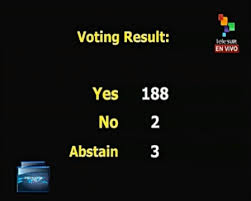
U.N. General Assembly Voting Results Screen
U.N. General Assembly   Voting Results Screen

On October 28, 2014, the U.N. General Assembly by a vote of 188 to 2 again condemned the U.S. embargo of Cuba. The two negative votes were cast by the U.S. and by Israel while three small Pacific nations abstained–Marshall Islands, Micronesia and Palau. All the other U.N. members supported the resolution. [1]

 The Resolution

The resolution [A/69/L.4] reiterated the General Assembly’s “call upon all States to refrain from promulgating and applying laws and measures of the kind referred to in the preamble to the present resolution [‘the economic, commercial and financial embargo imposed by the [U.S.] against Cuba’ and the Helms-Burton Act], in conformity with their obligations under the Charter of the United Nations and international law, which, inter alia, reaffirm the freedom of trade and navigation.”

The resolution also “again urges States that have and continue to apply such laws and measures [i.e., the U.S.] to take the steps necessary to repeal or invalidate them as soon as possible in accordance with their legal regime.”

Cuba’s Statement Supporting the Resolution

Bruno Rodriguez Parrilla

Bruno Rodríguez Parrilla, the Cuban Minister for Foreign Affairs, introducing the resolution, said that in recent times “the economic, commercial and financial blockade imposed by the [U.S.] against Cuba had been tightened, and its extraterritorial implementation had also been strengthened through the imposition of unprecedented fines, totaling $11 billion against 38 banks . . . for carrying out transactions with Cuba and other countries.” In addition, Cuba’s “accumulated economic damages of the blockade totaled $1.1 trillion . . . [and] human damages were on the rise.”

Nevertheless, “Cuba had offered every possible form of assistance to the [U.S.] in the wake of disasters there, such as in the aftermath of the September 11, 2001 terrorist attacks. Cuba had never been a threat to the national security of the [U.S.].  Opinion polls showed that there was increasing support from all sectors of [U.S.] society for lifting the blockade.  Religious leaders had citied legitimate, indisputable ethical and humanitarian reasons.“

In addition, ”the blockade was harmful to . . . the [U.S.]. The ‘absurd and ridiculous’ inclusion of Cuba on the [U.S.] list of States that sponsored international terrorism redounded to the discredit of the [U.S.].  Cuba would never renounce its sovereignty or the path chosen by its people to build a more just, efficient, prosperous and sustainable socialism.”  Neither, he continued, would his Government “give up its quest for a different international order, nor cease in its struggle for ‘the equilibrium of the world.’”

Rodríguez also invited the U.S. government “to establish a mutually respectful relation, based on reciprocity. We can live and deal with each other in a civilized way, despite our differences.”

Other Countries’ Statements Supporting the Resolution [2]

The following Latin American countries voiced support for the resolution: Argentina (MERCOSUR [3]) (embargo was “morally unjustifiable” and violated “the spirit of multilateralism and was immoral, unjust and illegal”); Barbados (CARICOM [4]); Bolivia (Group of 77 [5] and China); Brazil (Group of 77 and CELAC [6]); Colombia; Costa Rica (CELAC)); Ecuador; El Salvador (Group of 77 and CARICOM); Mexico; Nicaragua; St. Vincent and the Grenadines (CARICOM, Non-Aligned Movement, [7] Group of 77 and CELAC); Uruguay; and Venezuela.

The African supporters of the resolution that spoke were Algeria (Non-Aligned Movement, Group of 77, Group of African States [8] and Organization of Islamic Cooperation [9]); Angola; Kenya (Group of 77, Non-Aligned Movement and African Group); Malawi (African Group); South Africa (Group of 77, Non-Aligned Movement and African Group); Sudan (Group of 77, Non-Aligned Movement and Organization of Islamic Cooperation); United Republic of Tanzania; Zambia (Non-Aligned Movement) and Zimbabwe (Non-Aligned Movement, Group of 77 and African Group).

From Asia and the Pacific were Belarus; China (Group of 77); Democratic People’s Republic of Korea (North Korea); Indonesia (Group of 77);  India (Group of 77 and Non-Aligned Movement); Iran (Non-Aligned Movement); Lao People’s Democratic Republic; Myanmar (Group of 77 and Non-Aligned Movement); Russian Federation; Solomon Islands; and Viet Nam (Non-Aligned Movement, Group of 77 and China).

Middle Eastern countries speaking in favor of the resolution were Egypt, Saudi Arabia (Organization of Islamic Cooperation); and Syria (Non-Aligned Movement, Group of 77 and China).

The sole European supporter of the resolution that spoke at the session was Italy (European Union [10]), which said the U.S.’ “extraterritorial legislation and unilateral administrative and judicial measures were negatively affecting European Union interests”).

U.S. Statement Opposing the Resolution

Although Israel voted against the resolution, it chose not to speak in support of its vote. Only the U.S. by Ambassador Ronald D. Godard, U.S. Senior Advisor for Western Hemisphere Affairs, tried to justify the negative vote.

Ronald D. Godard
Ronald D. Godard

Ambassador Godard said the U.S. “conducts its economic relationships with other countries in accordance with its national interests and its principles. Our sanctions toward Cuba are part of our overall effort to help the Cuban people freely exercise their human rights and fundamental freedoms, and determine their own future, consistent with the Universal Declaration of Human Rights and the democratic principles to which the United Nations itself is committed.”

Ambassador Godard also said, “the Cuban government uses this annual resolution in an attempt to shift blame for the island’s economic problems away from its own policy failures. The Cuban government now publicly recognizes that its economic woes are caused by the economic policies it has pursued for the last, past half-century. We note and welcome recent changes that reflect this acknowledgement, such as those that allow greater self-employment and liberalization of the real estate market. But the Cuban economy will not thrive until the Cuban government permits a free and fair labor market, fully empowers Cuban independent entrepreneurs, respects intellectual property rights, allows unfettered access to information via the Internet, opens its state monopolies to private competition and adopts the sound macro-economic policies that have contributed to the success of Cuba’s neighbors in Latin America.”

According to Ambassador Godard, the U.S. “remains a deep and abiding friend of the Cuban people. The Cuban people continue to receive as much as $2 billion per year in remittances and other private contributions from the [U.S.]. This support . . . was made possible . . . by U.S. policy choices. By the Cuban government’s own account, the [U.S.] is one of Cuba’s principal trading partners. In 2013, the [U.S.] exported approximately $359 million in agricultural products, medical devices, medicine and humanitarian items to Cuba. Far from restricting aid to the Cuban people, we are proud that the people of the [U.S.] and its companies are among the leading providers of humanitarian assistance to Cuba. All of this trade and assistance is conducted in conformity with our sanctions program, which is carefully calibrated to allow and encourage the provision of support to the Cuban people.”

Furthermore, the U.S. “places the highest priority on building and strengthening connections between the Cuban people and [our] people. U.S. travel, remittance, information exchange, humanitarian and people-to-people policies updated in 2009 and 2011 provide the Cuban people alternative sources of information, help them take advantage of limited opportunities for self-employment and private property and strengthen independent civil society. The hundreds of thousands of Americans who have sent remittances and traveled to the island, under categories of purposeful travel promoted by President Obama, remain the best ambassadors for our democratic ideals.”

Ambassador Godard continued, “[The U.S.] strongly supports the Cuban people’s desire to determine their own future, through the free flow of information to, from, and within Cuba. The right to receive and impart information and ideas through any media is set forth in Article 19 of the Universal Declaration of Human Rights. It is the Cuban government’s policies that continue to prevent enjoyment of this right. The Cuban government now claims to share our goal of helping the Cuban people access the Internet. Yet the Cuban government has failed to offer widespread access to the Internet through its high-speed cable with Venezuela.  Instead, it continues to impose barriers to information for the Cuban people while disingenuously blaming U.S. policy.”

“Moreover, the Cuban government continues to detain Alan Gross, a U.S. citizen who was sentenced to 15 years in prison for facilitating Internet access for Cuba’s small Jewish community. [[11]] The [U.S.] calls on Cuba to release Mr. Gross immediately, [[12]] allow unrestricted access to the Internet, and tear down the digital wall of censorship it has erected around the Cuban people.

 {T]his resolution only serves to distract from the real problems facing the Cuban people. . . . Though Cuba’s contributions to the fight against Ebola are laudable, they do not excuse or diminish the regime’s treatment of its own people. We encourage this world body to support the desires of the Cuban people to choose their own future. By doing so, it would truly advance the principles the United Nations Charter was founded upon, and the purposes for which the United Nations was created.”

Media Coverage of the Resolution and Debate

 U.S. media coverage of this important U.N. vote was almost non-existent. It was not mentioned in the “World” or “Americas” news sections of the New York Times, and only its “Opinion” section had a short article about the issue. It got no mention whatsoever in the Wall Street Journal. Not even the Miami Herald, which has a separate page for Cuba news, mentioned it. [13]

At 2:37 p.m. on October 28th the Associated Press published a release on the subject, and the Washington Post published it online while the StarTribune of Minneapolis/St. Paul picked it up the next day in its online, but not its print, edition.

Cuba’s state-owned newspaper, Granma, of course, headlined this vote while stating that the embargo has caused $1.1 trillion of damage to the Cuban economy and “incalculable human suffering.” Its article also emphasized that this was the 23rd consecutive such resolution with a table showing that the number of votes in favor of the resolutions has increased from 59 in 1992 to 188 in 2012-2014, that the largest number of votes against the resolutions was only 4 in 1993 and 2004-2007 and that the number of abstentions has decreased from 71 in 1992 to 1 in 2005-2007 and now 3 since 2010.

Conclusion

This overwhelming international opposition to the U.S. embargo in and of itself should be enough to cause the U.S. to end the embargo. Moreover, the embargo has not forced Cuba to come begging to the U.S. for anything that the U.S. wants. The U.S. policy is a failure. The New York Times recently called for abandonment of this policy as has this blog in urging reconciliation of the two countries, in an open letter to President Obama and in a rebuttal of the President’s asserted rationale for the embargo and other anti-Cuban policies.

==============================================================

[1] This post is based upon the sources embedded above and upon U.N. General Assembly Press Release [GA/11574], As General Assembly Demands End to Cuba Blockade for Twenty-Thjrd Consecutive Year, Country’s Foreign Minister Cites Losses Exceeding $1 Trillion (Oct. 28, 2014); Londoño, On Cuban Embargo, It’s the U.S. and Israel Against the World, Again, N.Y. Times (Oct. 29, 2014); Associated Press, UN General Assembly Condemns US Cuba Embargo (Oct. 28, 2014); U.S. Dep’t of State, Explanation of Vote by Ambassador Ronald D. Godard on the Cuba Resolution in the General Assembly Hall (Oct. 28, 2014). The General Assembly also has videos of the debate (A and B). A prior post reviewed the 2011 General Assembly’s adoption of a similar resolution against the embargo.

[2] Many of the cited statements supporting the resolution were issued on behalf of, or aligned with, larger groups of nations as noted above. In addition, prior to the October 28th session of the General Assembly, the U.N. Secretary General submitted a report containing statements against the embargo from 154 states and 27 U.N. agencies.

[3] MERCOSUR (Southern Common Market) is a customs union and trading bloc of five South American countries with five other associate members in the continent.

[4] CARICOM (Caribbean Community) is a group of 15 Caribbean countries with five associate members for economic cooperation.

[5] The Group of 77 was established in 1964 by 77 developing countries to promote their collective economic interests and South-South cooperation; now there are 134 members that have retained the original name for historical significance.

[6] CELAC (Community of Latin American and Caribbean States) is a group of 33 states in the region to deepen economic integration and combat the influence of the U.S.

[7] The Non-Aligned Movement is a group of 115 developing countries that are not aligned with or against any major power bloc. Its current focus is advocacy of solutions to global economic and other problems

[8] The African Group is a group of 54 African states that are U.N. Members.

[9] The Organization of Islamic Cooperation is a group of 57 states that seek to protect the interests of the Muslim world in the spirit of promoting peace and harmony in the world.

[10] The European Union is a group of 28 European states that have combined for a peaceful, united and prosperous Europe.

[11] The activities in Cuba by Mr. Gross are not so simple. A Cuban court in 2011 found him guilty of participating in a “subversive project of the U.S. government that aimed to destroy the revolution through the use of communications systems out of the control of authorities,” and sentenced him to 15 years in prison. According to his own lawsuit against the U.S. Government, and subsequent disclosures, Gross alleged the U.S. Agency for International Development (USAID) and its contractor, DAI, sent him on five semi-covert trips to Cuba without proper training, protection or even a clear sense of the Cuban laws that led to his detainment. The case highlighted the frequent haste and lack of attention to the risks of the USAID programs in Cuba under the Helms-Burton Act, which allowed for money to be set aside for “democracy building efforts” that might hasten the fall of Fidel and Raúl Castro.

[12] In discussions with the U.S., Cuba already has expressed a willingness to exchange Mr. Gross for one or more of the three of “the Cuban Five” who remain in U.S. prisons.

[13] Nor did I find any mention of the vote in London’s Guardian or Madrid’s El Pais.


My Vocations

The words and music about vocation at the January 26th and February 9th worship services at Minneapolis’ Westminster Presbyterian Church have inspired my general thoughts about vocation set forth in a prior post. Now I reflect on my own vocations.

Until I was in my early 40’s, I had no religious beliefs after high school and no sense of vocation.

That started to change in 1981 when I joined Westminster and embraced what I now see as my first vocation: serving the church as a ruling elder (1985-1991) and over time as an active member of several of its committees (Spiritual Growth, Communications and Global Partnerships). More recently I joined its Global Choir. After all, a new member covenants to find “a definite place of usefulness” in the church.

For 10 years (2003-2013) I served as chair of Global Partnerships, which supervises the church’s partnerships with churches and other organizations in Cuba, Cameroon, Palestine and for a time in Brazil. This lead to my going on three mission trips to Cuba, one to Cameroon and another to Brazil. As a result, I established personal friendships with people in those countries as part of our collective, and my personal, vocation of being present with our brothers and sisters in other parts of the world and standing in solidarity with them. I also learned about the history, culture and current issues of those countries. This in turn lead to a strong interest in promoting reconciliation between the U.S. and Cuba and Cuban religious freedom, and as a U.S. citizen I have endeavored to do just that.

This sense of religious institutional vocation also encompassed my serving on the Board of Trustees of United Theological Seminary of the Twin Cities for another 10-year period (1988-1998). In my small way, I helped nurture future ministers of the church. In the process I got to know interesting members of the faculty, administration and board and about the life of U.S. seminaries.

I, however, initially struggled with how to integrate my newly reclaimed religious beliefs and my life as a practicing lawyer, and over the years found ways to share this struggle with others, especially with my fellow lawyers.

One way I discovered a vocation in the practice of law resulted from experiencing the bitterness and lack of reconciliation between opposing parties in litigation and, too often, as well between their lawyers, including myself. This experience lead in the late 1980’s through the 1990’s to a personal interest in, and writing and speaking about, alternative dispute resolution (ADR), one of whose objectives is resolution of such disputes more amicably, and to my active participation in the ADR Section of the Minnesota State Bar Association.

Another and more powerful vocation involving my professional life emerged when a senior partner of my law firm in the mid-1980’s asked me to provide legal counsel to the firm’s client, the American Lutheran Church (“ALC” and now the Evangelical Lutheran Church in America). The problem: how should the ALC respond to information that the U.S. immigration agency (INS) had sent undercover agents into worship services and Bible-study meetings at ALC and Presbyterian churches in Arizona that provided sanctuary or safe places to Salvadorans and Guatemalans fleeing their civil wars.

The conclusion of this engagement was the ALC and the Presbyterian Church (USA)—my own denomination—jointly suing the U.S. government to challenge the constitutionality of such spying. Eventually the U.S. district court in Arizona held that the U.S. Constitution’s First Amendment “free exercise” of religion clause protected churches from unreasonable government investigations.

U.S. immigration law was in the background of this case, but I did not know anything about that law. I, therefore, sought to remedy that deficiency by taking a training course in asylum law from the Minnesota-based Advocates for Human Rights.

I then volunteered to be a pro bono lawyer for a Salvadoran seeking asylum in the U.S. because of his claim to a well-founded fear of persecution in his home country because of his political opinions and actions opposing its government. Again, my initial motivation for this action was to be a better lawyer for the ALC.

I discovered, however, that being a pro bono asylum lawyer was my passionate vocation while I was still practicing law and continued doing so until I retired from the practice in the summer of 2001. In addition to El Salvador, my other clients came from Somalia, Afghanistan, Burma and Colombia. I was able to assist them in obtaining asylum and thereby escape persecution. In the process, I learned more about asylum law and other aspects of immigration law as well as the horrible things that were happening in many parts of the world. I was able to use my experience and gifts in investigating and presenting facts and legal arguments to courts and officials and came to see this as one of the most important and rewarding vocations I have ever had.

In the process of this asylum work, I also learned for the first time about the humbling and courageous ministry and vocation of Salvadoran Archbishop Oscar Romero, who was assassinated in March 1980 because he repeatedly spoke out against human rights violations in his country. He now is my personal saint. I also learned about the important and courageous work in that country by the Jesuit priests and professors at the University of Central America, six of whom were murdered in November 1989 for the same reason, and they too have become heroes for me.

Another Salvadoran I met on my first trip to that country enriched my sense of the potential for vocation in practicing law. He was Salvador Ibarra, a lawyer for the Lutheran Church’s human rights office, who spoke about the joy he experienced in his work.

After retiring from the full-time practice of law in 2001, I served as an Adjunct Professor at the University of Minnesota Law School (2002 through 2010) to co-teach international human rights law. I thereby hoped to encourage law students to become interested in the field and to include such work in their future professional lives. Thus, this became another vocation with the side benefit of enabling me to learn more about the broader field of international human rights.

I chose another retirement in 2011, this time from part-time teaching, in order to start this blog about law, politics, history and religion. I came to see it as yet another vocation. I think it important to share my religious experiences and beliefs in the midst of active consideration of legal and political issues and demonstrate that it is possible for an educated, intelligent individual to have such beliefs.

In 2011 as a member of the planning committee for my Grinnell College class’ 50th reunion. I thought we should do more to remember our deceased classmates than merely list their names in our reunion booklet. I, therefore, suggested that if each committee member wrote five or six obituaries, we would have written memorials for all of our departed classmates. However, no one else volunteered to participate in this project so I did it all myself except for a few written by spouses. After the reunion, I continued to do this when the need arises.

Although this project required a lot of work, I came to see it as pastoral work and rewarding as I learned about the lives of people, many of whom I had not really known when we were together as students. I drew special satisfaction when I learned that a classmate who had died in his 30’s had two sons who had never seen the College annuals that had a lot of photographs of their father as a physics student and co-captain of the football team, and I managed to find a set of those annuals which were sent to the sons. I thus came to see this as a vocation.

Many of these vocations resulted from invitations from others to do something, which I accepted. Initially the invitations did not seem to be calls for a vocation, and it was only after doing these things and reflecting upon them that I saw them as such.

The concept of vocation often seems like doing something for others without any personal rewards other than feeling good about helping others. I, therefore, am amazed by the many ways I have been enriched by these endeavors. I have learned about different areas of the law, different countries and the lives of interesting people, living and dead.

I feel blessed that I have discovered at least some of the work that God has called me to do, in Frederick Buechner’s words, “the work that I need most to do and that the world most needs to have done.”

Or as Rev. Hart-Andersen said on February 9th, “When Jesus calls we get up and go, stepping forward in the direction of the one calling us. Being a follower of Jesus is not a destination . . . . Being called to follow Jesus is a way of life, a pilgrimage on which we embark together.”

What’s next?


Cuban Blogger Obtains Cuban Passport and Plans Trip to Latin America, North America and Europe

YoaniSanchez

From her home in Havana, Cuba, Yoani Sanchez has been courageously blogging her critical comments on many aspects of life in her country as noted in a prior post.

In January 2013, under Cuban’s new law granting Cubans increased ability to obtain passports, she received her Cuban passport. She was overjoyed by this development after she had been denied a passport 20 times over the last five years.

Upon receiving the great news that she would obtain a passport, she bravely said in her blog:

  • She intends to “continue ‘pushing the limits’ of reform, to experience first hand how far the willingness to change really goes. To transcend national frontiers I will make no concessions. If the Yoani Sánchez that I am cannot travel, I am not going to metamorphose myself into someone else to do it. Nor, once abroad, will I disguise my opinions so they will let me ‘leave again’ or to please certain ears, nor will I take refuge in silence about that for which they can refuse to let me return. I will say what I think of my country and of the absence of freedoms we Cubans suffer. No passport will function as a gag for me, no trip as bait.”
  • “These particulars clarified, I am preparing the itinerary for my stay outside of Cuba. I hope to be able to participate in numerous events that will help me grow professionally and civically, to answer questions, to clarify details of the smear campaigns that have been launched against me… and in my absence. I will visit those places that once invited me, when the will of a few wouldn’t let me come; I will navigate the Internet like one obsessed, and once again climb mountains I haven’t seen for nearly ten years. But what I am most passionate about is that I am going to meet many of you, my readers. I have the first symptoms of this anxiety; the butterflies in my stomach provoked by the proximity of the unknown, and the waking up in the middle of the night asking myself, what will you look like, sound like? And me? Will I be as you imagine me?”

On February 17th she plans a worldwide tour visiting Latin American (Brazil, Argentina, Chile, Peru, Colombia and Mexico), North America (U.S. and Canada) and Europe (Italy, Czech Republic, Poland, Switzerland and Germany).

I pray that there will not be any last minute move by the Cuban government to block her leaving the island. I look forward to her comments on Cuba during her visits to these countries.

Yoani, congratulations and God Speed on your journey!

Teaching the International Human Rights Course

UM Law School Building
Prof. Fionnuala D. Ní Aoláin

After I had audited the International Human Rights Law course at the University of Minnesota Law School in the Fall of 2001, Professor David Weissbrodt asked if I wanted to help him teachthe course. Given the vast disparity between his and my knowledge of the field, I thought he was joking. “David,” I said, “you don’t need any help.” But he persisted, and I relented and accepted his offer. I then served as an Adjunct Professor at the Law School for nine years, 2002-2010.

The course continued to have the same outline and structure that I had experienced in my auditing the course in the Fall of 2001,[1] and we continued to use the same book.[2] Professors Weissbrodt and Frey still taught most of the class sessions and later were joined by another expert in the field, Fionnuala D. Ní Aoláin.[3]

Professor Weissbrodt and I decided that I would teach two class sessions. One was on refugee and asylum law that built on my experience as a pro bono asylum lawyer. The other was on civil litigation over foreign human rights abuses in U.S. federal courts that took advantage of my considerable experience litigating civil cases in these courts.

Each year to prepare for my two class sessions, I conducted legal research to learn about the many new developments in order to write supplements for the chapters on these subjects. I also assisted in the rewriting of these chapters for the fourth edition of the book that came out in 2009.[4] I thereby continued to use my legal research and writing skills.

This involvement also guided my online reading of various U.S. and foreign newspapers and periodicals and to the creation of a system for email distribution of interesting articles on human rights to friends and colleagues. Many of these articles later became incorporated into the annual supplements for the two chapters that I prepared.

I decided that I would use moot courts for my two class sessions. For refugee and asylum law, four students volunteered to be lawyers for an asylum applicant and the U.S. Government for closing arguments before me, acting as an Immigration Judge in the Minnesota office of the Immigration and Naturalization Service (INS and n/k/a Citizenship and Immigration Services (CIS). For the other session, four additional students volunteered to be the lawyers for a corporate defendant and a foreign plaintiff in a civil lawsuit in the U.S. District Court for the District of Minnesota. The moot court was before me acting as the district judge on the defendant’s motion to dismiss the plaintiff’s complaint alleging the corporation had aided and abetted human rights violations in a foreign country.

In addition to being one way to learn about the substantive law, the moot courts, in my opinion, had other advantages. I thought that the moot court approach would show the students how they could become involved in international human rights while engaged in a regular legal practice in the Twin Cities or anywhere else in the U.S. Given the strength of the international human rights program at the University of Minnesota Law School, many of its graduates have gone on to be lawyers for various U.N. agencies and international human rights NGOs, but most graduates become ordinary practicing lawyers. I also wanted to emphasize the importance of a lawyer’s work at the trial court level, rather than the typical law school moot court experience of arguing before a mock appellate court like the Minnesota or U.S. Supreme Court. Most litigators have much more experience at the trial court level and rarely, if ever, argue a case before the highest court of the state or the U.S. Finally it gave the participating students the opportunity to practice and develop their oral advocacy skills.

For each of the moot court sessions, I held preparatory meetings with the student-lawyers. I gave them guidance on what to expect and answered their questions about the substantive and procedural issues. A strong enjoyable mentorship relationship developed from this total experience.

As part of the moot court exercises, I emphasized to all the students the importance of a lawyer’s knowing the background and views of the judges before whom they appear.

The hypothetical district judge in the lawsuit over foreign human rights violations, for example, had excellent credentials. Appointed for life by the President with the advice and consent of the Senate, the judge was intelligent, honest, hard-working, fair and with a lot of experience on many kinds of civil and criminal cases. The judge, however, had never studied international human rights and along with the fellow judges in his court and his supervising court (the Eighth Circuit Court of Appeals) has never had a case like this under the Alien Tort Statute. As a result, the lawyers for this moot court needed to explain the case thoroughly and clearly. (Fortunately the judge had a law clerk who had studied the subject at the University of Minnesota Law School.)

The hypothetical immigration judge, on the other hand, has tried many asylum cases and has a thorough knowledge of the relevant law. This judge also was intelligent, honest, hard-working and fair. As a result, in this moot court there is no need to explain asylum law to the immigration judge. Instead, the attorney needs to focus on the facts of the instant case. Such judges, it should be noted, do not have lifetime appointments. Instead, they are appointed by the U.S. Attorney General as attorneys in the Department of Justice with no fixed term of office and are subject to discretionary removal and transfer by the Attorney General.

Soon after the classes were over, I sent email critiques of the students’ performance. Invariably the students rose to the challenge and made excellent arguments. I also usually issued a hypothetical decision on the dismissal motion and on the asylum request.

I also attended many other class sessions and the presentations by outside speakers in the course as well as various conferences at the Law School. As a result, I continued to learn more about the field.

Outside the classroom I was available to talk with students about the course and more generally about practicing law and other issues. I welcomed this opportunity to learn more about those who were getting ready to pursue various legal careers. I especially enjoyed getting to know the many foreign students in the course, some of whom were Hubert Humphrey Fellows. (My wife and I also volunteered to be a host family for Fellows from Ecuador, El Salvador and Brazil.)

Museum of Republic, Rio de Janeiro
Profs. Duane Krohnke & Elizabeth Sussekind @ Museum of Republic


My friendship with a Humphrey Fellow from Brazil resulted in her inviting me to participate in a symposium at the Museum of the Republic in Rio de Janeiro in the Fall of 2009. The symposium was the concluding event to commemorate the 20th anniversary of the Brazilian constitution of 1988 that ended its military dictatorship. This symposium focused on Memory and Justice, and my paper on the Truth Commission for El Salvador provided a Latin American perspective on Brazil’s not having had a similar truth commission.[5]

I thoroughly enjoyed these many aspects of having been an adjunct professor. I never would have had these experiences if I had continued practicing law after 2001. I, therefore, view them as confirmation of the wisdom of my decision to retire from lawyering that year.[6]


[1] See Post: Auditing the International Human Rights Law Course (June 30, 2011).

[2] David Weissbrodt, Joan Fitzpatrick & Frank Newman, International Human Rights: Law, Policy and Process (3d ed. 2001).

[3] University of Minnesota Law School, Fionnuala D. Ní Aoláin,  http://www.law.umn.edu/facultyprofiles/niaolainf.html.

[4]  David Weissbrodt, Fionnuala D. Ní Aoláin, Joan Fitzpatrick & Frank Newman, International Human Rights: Law, Policy and Process (4th ed. 2009).

[5] Museu da Republica, Memoria e Justica (2009).

[6] Post: Retiring from Lawyering (April 22, 2011).

My First Ten Years of Retirement

It is hard to believe that the 10th anniversary of my retirement from the practice of law is nearly here. I have no regrets. I made the correct decision. Here is my own grading of how I have met my retirement goals that I set 10 years ago.[1]

Being a good Grandfather. I now have four grandchildren, two in Minnesota and two in Ecuador. My wife and I obviously spend more time with the Minnesota kids, and our Ecuadorian grandson spent last Fall in Minnesota going to school with his cousins. We also frequently have traveled to Ecuador to see our family there although we have decided not to spend significant amounts of time there. I recently took my 10-year old Minnesota grandson to visit two federal judges and some friends at my former law firm and to observe parts of a trial and a court hearing.[2] I leave it to the grandkids to judge me on this goal, but I think I have done a pretty good job. I know I enjoy being a grandfather.

Being a good Father and Husband. I also have been making an effort to be a good father and husband. I am still working at it.

Learning Spanish. I have not taken the time to improve my very limited Spanish ability. I still wish that I were fluent in that language, but do not see myself taking the time to do this. Sorry.

Law Teaching. I had a goal of teaching law in Ecuador. I was interviewed by a university in Quito about teaching law in the English language, but I was not offered a position. My son who lives there went to the interview with me in case I needed an interpreter, and afterwards he said he thought that my positive comments about liberation theology may not have been appreciated by the university officials. In retrospect, I am not unhappy with this result. I would have had to work very hard to organize and teach one or more courses in this foreign country.

Moreover, this development opened the door for my having the opportunity to co-teach one course (international human rights law) at the University of Minnesota Law School for nine years (2002-10). This built on my experience as a federal court litigator and as a pro bono asylum lawyer. It also allowed me to work with, and become friends of, other professors at the Law School and many U.S. and foreign students. One of the foreign students was a Hubert Humphrey Fellow from Brazil who was a Professor of Law and Criminology at the Catholic university in Rio de Janeiro, and at her subsequent invitation, I presented a paper on the Truth Commission for El Salvador at a conference in Rio in 2009. In addition, through my work at the University of Minnesota I developed a strong interest in, and some expertise about, the International Criminal Court, and I have made many presentations about the ICC and have served as the Provisional Organizer for the Minnesota Alliance for the ICC.[3]

I recently decided that I would retire from this teaching job even though I have thoroughly enjoyed it. I wanted to have more time for writing as discussed below.

Human rights legal work. Without the support of a law firm, including its professional liability insurance, I decided I was not able to do pro bono legal work in retirement. But as mentioned above, I have been able to teach human rights and learn more about the subject myself. I also have developed an interest in the ICC and found a way to make use of that interest.

News “distributor.” Although not one of my goals from 2001, I have developed a practice in retirement of regularly reading many news sources online (New York Times, Washington Post, Huffington Post (Politics page), Wall Street Journal, Guardian (from the U.K.) and Granma (English translation of Cuba’s major national newspaper) and occasionally others (New York Review of Books, Atlantic and Harpers). After doing this for a while, I started sending by email interesting articles on human rights, the ICC, immigration, Cuba and Africa to friends who were interested in these subjects.

Arbitrator. Another retirement activity I had not anticipated in 2001 was being an arbitrator. But I have done so for disputes between investors and financial firms through the Financial Institutions Regulatory Authority (FINRA; f/k/a National Association of Securities Dealers), usually as chair of a panel of three arbitrators, and I have enjoyed this challenge. I try to act like the arbitrators and judges I respected in my practice: fair, impartial, respectful of the law, organized, decisive and clear (unlike some of the judges on the TV show “The Good Wife”).

Recently, however, I decided that I no longer wanted to spend my time working on other people’s problems and will not take any more cases. Sounds like my 2001 decision to retire from practicing law.

Obituary writer. Yet another surprising development over the last half-year has been being an obituary writer. As a member of my Grinnell College class’ 50th reunion committee, I have been responsible for writing or commissioning obituaries for our 53 deceased classmates. This used my factual research and writing skills from lawyering. I also came to see this activity in some cases as one of pastoral care for the families of the departed.

International travel. In addition to many trips to Ecuador and my trip to Brazil, my wife and I have been on many other fascinating international trips in the last 10 years. They include an Elder Hostel trip about Mozart to the Czech Republic and Austria, Turkey, Spain, England and Scotland, South Africa, Namibia, Botswana, Canada, Mexico, El Salvador and Peru plus my church mission trips to Cuba and Cameroon. These were great, educational experiences.  I was really glad that I was in good health to be able to take these trips. I also have been able to chair a committee that supervises the global partnerships of Westminster Presbyterian Church.

Historical research and writing. I wanted to conclude my research about Joseph Welch and Edward Burling and write articles about them. I have done so, as was mentioned in a prior post.[4] I will share some of the key points of that research in future posts. On the other hand, I have not yet been able to do additional research on two of my ancestors, but it is still a goal.

Personal journal and memoirs. I have not been able to make much progress on the goal of writing a personal journal and memoirs. I was hung up on the issue of how do I organize or structure such a writing project. Recently, however, I started this blog and have found it a great way to do the writing that I wanted to do. I do not have to worry about how I might organize all of these thoughts. It is really exciting to be able to write this blog.

Physical exercise. I have been more diligent in my personal exercise program although I should be doing more.

Financial planning and management. With the assistance of an able investment professional, I have developed appropriate methods for financial planning and management for retirement. Like nearly everyone else, we suffered financially in the recent deep recession, but we have made progress since then. I know that I am fortunate when I read articles about the many people who have not saved enough for retirement or who lost their pensions or retirement savings in the recent deep recession or through collapse of their former employers or financial fraud or who struggle to survive with investments in bank CD’s or federal securities that now pay virtually nothing in interest.

In short, I am happy with my efforts to meet my retirement goals over the last 10 years. Now I need to continue my pursuit of these now modified goals during the next phase of my life.


[1] Post: Retiring from Lawyering (4/22/11).

[2] This trip to the federal courthouse and my former law firm was inspired, in part, by recent comments of Mary Robinson, the former U.N. High Commissioner for Human Rights. Post: Tip for Grandparents (4/11/11).

[3] The Minnesota Alliance is part of the American NGO Coalition for the International Criminal Court or AMICC, http://www.amicc.org.

[4] Post: Adventures of a History Detective (4/5/11).


Minneapolis’ Westminster Presbyterian Church

Growing up in the small Iowa town of Perry, I was an active member of the local Methodist Church. I was president of MYF (Methodist Youth Fellowship), and our pastor, whom I respected, encouraged me to go into the ministry.

Once I went to college, however, I soon convinced myself that all religions were antiquated superstitions that were of no use to an intelligent, hard-working person like myself. This not uncommon sophomoric rebellion lasted for the next 24 years.

Westminster Presbyterian Church Sanctuary

In 1981 I could admit to others and myself that I did not have all the answers and that there was an inner emptiness in my life. I started attending and then joined Minneapolis’ Westminster Presbyterian Church (http://www.ewestminster.org). A friend was a member there. I worked downtown, and the church was open to the downtown community, especially through its Westminster Town Hall Forum, which brought notable people to speak on key issues in ethical perspective. This was a church, I came to understand, that respected intellect as an important aspect of religious faith and life. Its mission statement provides that “In response to the grace of God through Jesus Christ, [its mission] is:

• to proclaim and celebrate the Good News of Jesus Christ;
• to gather as an open community to worship God with dignity and joy, warmth and beauty;
• to nourish personal faith through study, prayer, and fellowship;
• to work for love, peace and justice;
• to be a welcoming and caring Christian community, witnessing to God’s love day by day;
• to work locally and beyond with our denomination and the larger Christian Church; and
• to be a telling presence in the city.”

I have been and continue to be an active member of Westminster, serving as an elder and member of various committees. Most recently I have been chairing its Global Partnerships Committee that supervises our partnerships with churches and other organizations in Brazil, Cameroon, Cuba, and Bethlehem. This is one way we endeavor to fulfill the Biblical injunction from Apostle Paul: “There is no longer Jew or Greek, there is no longer slave or free, there is no longer male or female; for all of [us] are one in Christ Jesus.” (Galatians 3:26, 28)[1] In other words, we are all brothers and sisters without the artificial distinctions that so often divide us from one another.