Issues of Cuban Human Rights To Be Discussed by Cuba and United States (Part III)    

On March 26 Cuba announced that the U.S. and Cuba will commence negotiations regarding human rights on March 31 in Washington, D.C.; this was covered in a prior post.

Other earlier posts covered the recent speech on this subject by Cuban Foreign Minister Bruno Rodriguez Parrilla and the U.N. Human Rights Council’s most recent Universal Periodic Review (UPR) of Cuba. Now we look at the latest U.S. State Department report on Cuban human rights (the one issued in 2014 for 2013).

Preliminarily it must be noted that this U.S. report is rather stale and it is surprising that a similar report for 2014 has not yet been released. The report for 2013 was released on February 27, 2014, and the overall report was discussed in a March 4, 2014 post and its chapter on Cuba in another March 2014 post.

In addition, a post on March 10, 2014, reviewed the implications of that report for U.S. policy regarding Cuba. This blogger saw the report’s indicating Cuba’s glass of human rights was at least half full. Or as Rev. Raúl Suárez, a Baptist pastor and head of the Martin Luther King, Jr. Center in Havana, more eloquently put it in his February 2014 briefing for the U.S. Congress: “Cuba has many problems but Cuba isn’t hell . . . . We have many good things that have been achieved [but] . . . Cuba is not the Kingdom of God.” Suárez added, “God . . . wants us [Cubans and Americans] to live like brothers and sisters.” As a result, this blogger urged reconciliation of the two countries and mentioned many of the actions to that end that started on December 17, 2014.

In any event, here is another summary of the U.S. report on Cuba for 2013. It contains many criticisms of Cuban human rights, but it also has positive comments.

Negative comments.

“Cuba is an authoritarian state led by Raul Castro, who is president of the council of state and council of ministers, Communist Party (CP) first secretary, and commander in chief of security forces. The constitution recognizes the CP as the only legal party and “the superior leading force of society and of the state.” A CP candidacy commission preapproved all candidates for the February uncontested National Assembly elections, which were neither free nor fair. The national leadership that included members of the military maintained effective control over the security forces, which committed human rights abuses against civil rights activists and other citizens alike.”

“The principal human rights abuses were abridgement of the right of citizens to change the government and the use of government threats, extrajudicial physical violence, intimidation, mobs, harassment, and detentions to prevent free expression and peaceful assembly.”

“The following additional abuses continued: harsh prison conditions, arbitrary arrest, selective prosecution, and denial of fair trial. Authorities interfered with privacy, engaging in pervasive monitoring of private communications. The government did not respect freedom of speech and press, severely restricted internet access and maintained a monopoly on media outlets, circumscribed academic freedom, and maintained significant restrictions on the ability of religious groups to meet and worship. The government refused to recognize independent human rights groups or permit them to function legally. In addition, the government continued to prevent workers from forming independent unions and otherwise exercising their labor rights.”

“Most human rights abuses were official acts committed at the direction of the government. Impunity for the perpetrators remained widespread.”

“There were credible reports that members of the security forces intimidated and sometimes physically assaulted human rights and prodemocracy advocates, dissidents, and other detainees and prisoners both during detention and while imprisoned, and they did so with impunity. Some detainees and prisoners endured physical abuse, sometimes by other inmates with the acquiescence of guards, or long periods in isolation cells.”

“Arbitrary arrest and short-term detention continued to be a common method for the government to control independent public expression and political activity. Under the criminal procedure code, police have wide discretion to stop and question citizens, request their identification, and carry out arrests and searches. The law provides that police officials provide suspects with a signed ‘act of detention,’ noting the basis, date, and location of any detention in a police facility, and a registry of personal items seized during a police search. Police officials routinely conducted extrajudicial detentions, however, often accompanied by beatings. Arbitrary stops and searches were most common in urban areas and at government-controlled checkpoints located at the entrances to provinces and municipalities. Searches and seizures of property by police officials without providing any record or legal justification were also common practice.”

“Police and security officials continued to use short-term and sometimes violent detentions to prevent independent political activity or free assembly. Such detentions generally lasted from several hours to several days. An independent domestic monitoring group, the Cuban Commission on Human Rights and Reconciliation (CCDHRN), counted 4,540 short-term detentions through October, compared with 6,602 in 2012. Long-term imprisonment of peaceful opponents, while rare, did not cease entirely. During the year authorities charged, tried, and sentenced several members of the Santiago-based opposition group Union Patriotica de Cuba (UNPACU) to prison for months or years as punishment for their political activity.”

“In addition, the law allows up to a four-year detention of individuals before they commit an actual crime, with a subjective determination of ‘potential dangerousness,’ defined as the ‘special proclivity of a person to commit crimes, demonstrated by conduct in manifest contradiction of socialist norms.’ Mostly used as a tool to control “antisocial” behaviors such as substance abuse or prostitution, authorities also used it to silence peaceful political opponents. Authorities convicted Ivan Fernandez Depestre of dangerousness and sentenced him to three years’ imprisonment for participating in a peaceful public demonstration. While there was no definitive estimate of the number of persons serving sentences for ‘potential dangerousness,’ the CCDHRN estimated that more than 3,000 citizens were held on the charge.”

“The Ministry of Interior exercises control over police, internal security forces, and the prison system. The ministry’s National Revolutionary Police is the country’s primary law enforcement organization and was moderately effective in investigating common crimes. Specialized units of the ministry’s state security branch are responsible for monitoring, infiltrating, and suppressing independent political activity. The police support state security agents by carrying out house searches, arresting persons of interest to the ministry, and providing interrogation facilities.”

“Members of the security forces acted with impunity in committing numerous, serious civil rights and human rights abuses.”

“Many state-orchestrated ‘acts of repudiation’ directed against the domestic opposition group Damas de Blanco (‘Ladies in White‘) were organized to prevent them from meeting or marching peacefully. On July 14, state security agents and affiliated groups assaulted members of the group when they left a church in Matanzas after celebrating Catholic mass, fracturing the wrist of Sonia Alvarez Campillo and breaking the ribs of her husband, Felix Navarro Rodriguez.”

Positive Comments.

The U.S. conceded that the Cuban constitution “prohibits discrimination based on race, gender, disability or social status” and that Cuban law prohibits “ abusive treatment of detainees and prisoners,” “rape, including spousal rape” (and enforces that law); and “threats and violence, including those associated with domestic violence.” Cuban law, says the U.S., also “provides penalties for sexual harassment;” accords “men and women equal rights and responsibilities regarding marriage, divorce, raising children, maintaining the home and pursuing a career;” provides “equal pay for equal work;” grants “persons with disabilities the right to equal employment opportunities and equal pay for equal work;” and prohibits “unlawful imprisonment, coercion, and extortion” although it “does not appear explicitly to prohibit forced labor.”

The U.S. report further states in 2013 that the government had centers “providing family counseling service” and “treatment for child sexual abuse victims;” that the government “actively promoted racial integration and inclusiveness;” that the government or its agents had not committed any reported arbitrary or unlawful killings or politically motivated disappearances; that there were no reported anti-Semitic acts; that there was “no societal pattern of child abuse,” no known “patterns of abuse of [children with disabilities] in educational or mental health facilities” and no discrimination officially reported or permitted based on sexual orientation in employment, housing, statelessness, or access to education or health care.”

Conclusion

It is fair to conclude that many of what the U.S. saw as negative aspects of Cuban human rights in 2013 will be raised in its forthcoming talks on the subject with Cuba.

The U.S. should approach this subject with humility and remember the U.S. immense superiority in economies and military might and the long-standing U.S. actions of hostility towards Cuba, including the following:

  • the U.S. usurpation of Cuba’s war for independence from Spain in the late 19th Century (what we in the U.S. call the “Spanish-American War“);
  • the U.S.’ making Cuba a de facto protectorate in the early 20th Century;
  • the U.S. support for the invasion of Cuba’s Bay of Pigs in 1961;
  • the U.S. threats of military action against Cuba during the pressured Cuban missile crisis of 1962;
  • the CIA’s hatching several plots to assassinate Fidel Castro when he was Cuba’s President;
  • the U.S. conduct of an embargo of Cuba over the last 50-plus years;
  • the U.S. Government’s Commission on Assistance for a Free Cuba setting forth what amounted to a U.S. blueprint for taking over Cuba; and
  • the more recent U.S. Agency for International Development (USAID) covert or “discreet” programs to promote dissent, if not regime change, on the island.

This history and the vastly superior U.S. economic and military power provide Cuba with many legitimate reasons to be afraid of the U.S. It, therefore, is understandable why Cuba has harshly treated what we call “dissidents” and what Cuba fears are or could be supporters of a U.S. takeover. And we in the U.S. should know from our own history since 9/11 that societies and governments tend to clamp down on civil liberties when they fear outside interference or attacks.


Issues of Cuban Human Rights To Be Discussed by Cuba and United States (Part II)

On March 26 Cuba announced that the U.S. and Cuba will commence their negotiations regarding human rights on March 31 in Washington, D.C.; this was covered in a prior post.

Issues of Cuban human rights that probably will be put on the agenda for further discussions were first examined in a prior post about the recent speech on this subject by Cuban Foreign Minister, Bruno Rodriguez Parrilla.

In Cuba’s March 26th announcement of the upcoming talks, Pedro Luis Pedroso, Cuba’s Deputy Director General of Multilateral Affairs and International Law, referred to “the recognition Cuba received at the last Universal Periodic Review [UPR] by the U.N. Human Rights Council, where the international community praised and commended Cuban achievements in areas such as education, health and access to cultural rights, and the contribution the island has made in those same areas in other countries.”

Therefore, this post will look at that UPR of Cuba while another post will discuss the latest U.S. State Department report on Cuban human rights (the one issued in 2014 for 2013).

The Nature of the UPR Process [1]

In order to assess the recent UPR of Cuba, we first must understand the UPR process, which provides the opportunity for each of the 193 U.N. members, on a periodic basis, to declare what actions it has taken to improve its human rights and to fulfill its human rights obligations.

The UPR process includes a report on all human rights issues from the subject country, compilations of information about the country from various U.N. organizations and from “stakeholders” (non-governmental organizations), a public interactive session of the Human Rights Council about the country, a report by a working group about the proceedings that includes conclusions and recommendations, the subject country’s responses to those conclusions and recommendations and a subsequent evaluation of the UPR by the Council.

It is exceedingly important, however, to know that these conclusions and recommendations are merely a systematic compilation or listing of all those that had been offered by all of the countries participating in the UPR. Hence, there is a lot of duplication and overlapping in this part of the report, which is not similar to an independent judicial body’s reaching certain findings and conclusions based upon an evaluation of often conflicting evidence. Indeed, the Working Group’s report expressly states that the conclusions and recommendations “should not be construed as endorsed by the Working Group as a whole.” In short, there is no overall “grade” of a country’s human rights performance by the Working Group or by the Council as a whole.

Most Recent UPR of Cuba [2]

The most recent UPR of Cuba occurred in 2013.

1. The Report of  the Working Group.

The key document in figuring out what happened in this UPR is the “Report of the Working Group on the Universal Periodic Review—Cuba” that was issued on July 8, 2013. It has the following standard structure, after a brief Introduction:

I. Summary of the proceedings of the review process

A. Presentation by the State under review

B. Interactive dialogue and response by the State under review

II. Conclusions and Recommendations

The “interactive dialogue.” This section of this report states that there was such a dialogue about Cuba involving 132 delegations at the session on May 1, 2013, and sets forth a brief summary of that dialogue in 144 numbered paragraphs. One example is paragraph 31, which states, “ Nicaragua highlighted the commitment of Cuba to human rights despite the blockade, and condemned the [U.S.] convictions against five Cubans.”

The only reference to U.S. comments in this dialogue is in paragraph 77, which states the U.S. “raised concerns for impediments to multiparty elections and freedom of expression and referred to Alan Gross and Oswaldo Paya.” Cuba, according to paragraph 111, responded to this U.S. comment by saying that “freedom of the press was guaranteed in Cuba“ and by “reiterated[ing its] . . . willingness . . . to continue talks with the [U.S.] . . . on the situation of Mr. Gross and of other individuals who were held in detention in Cuba and in the [U.S.].” [3]

Conclusions and Recommendations. This section starts with the following statement: “The recommendations formulated [by all the countries participating] during the interactive dialogue and listed below will be examined by Cuba, which will provide responses in due time, but no later than the twenty-fourth session of the Human Rights Council in September 2013” (para. 170). This section of the Report is concluded by this statement: “All conclusions and/or recommendations contained in the present report reflect the position of the submitting State(s) and/or the State under review. They should not be construed as endorsed by the Working Group as a whole” (para. 171).

The actual conclusions and recommendations are summarized in 292 numbered subparagraphs of the Report. Those offered by the U.S. are for Cuba to “allow for independent investigations into the circumstances surrounding the deaths of Oswaldo Paya and Harold Cepero” (para. 170.138) [4], to “release Alan Gross and imprisoned journalists such as Jose Antonio Torres immediately” (para. 170.187) [5] and to “eliminate or cease enforcing laws impeding freedom of expression” (para. 170.176).

2. Cuba’s Responses to the Recommendations.

In response to the U.S. recommendations and 20 others from other countries, Cuba said they “do not enjoy [its] support . . . on the grounds that they are politically biased and based on false premises; they derive from attempts to discredit Cuba by those who, with their hegemonic ambitions, refuse to accept the Cuban people’s diversity and right to self-determination. These proposals are inconsistent with the spirit of cooperation and respect demanded by the UPR process.” Moreover, said Cuba, they “are incompatible with constitutional principles and national legislation, and whose content is contrary to the spirit of cooperation and respect that should predominate at the UPR.” [6]

The other 20 numbered recommendations that were so summarily rejected by Cuba related to protecting human rights defenders, including journalists, against abusive criminal prosecutions, harassment and intimidation (Czech Republic, Austria, Australia, Germany, Hungary); release of all political prisoners (Czech Republic, Belgium, Slovenia, Poland), end indefinite extensions of preliminary criminal investigations (Belgium); improve freedom of expression (Romania, Estonia, Hungary, Spain, Switzerland, United Kingdom, France, Canada); repeal laws relating to “pre-criminal social dangerousness” (Ireland); end repression, investigate acts of repudiation and protect targets of intimidation and violence (Netherlands); and end Internet censorship (Australia, Germany).

Cuba, however, did accept 230 of the recommendations while noting, “Many of these . . . have already been complied with, or are in the process of implementation , or are included among future national priorities.” Therefore, these items “will be implemented in accordance with our capabilities and in step with the evolution of the circumstances within which Cuba is pursuing its aim of complete social justice.”

The remaining 42 recommendations were “noted” by Cuba as matters to be examined with the understanding that its “process of ratifying an international instrument is very rigorous;” that is stands ready “to continue cooperating with . . . the UN System’s human rights machinery;” that it is “philosophically opposed to the death penalty: and wants to eliminate it when suitable conditions exist;” that it has an “extensive and effective” system for resolving human rights complaints; that its “system of criminal justice . . . ensures fair and impartial hearings and full guarantees to the accused;” Cuba is working at expanding internet access; and “the right to freedom of expression and assembly . . . [is] enshrined in the Constitution and . . . national legislation.”

3. Human Rights Council’s Evaluation of this UPR. As paragraph 170 of the Report of the Working Group provided, the Council was to review the UPR of Cuba at its session in September 2013 after Cuba had submitted its response to the conclusions and recommendations. That Cuban response was just summarized, and the Council on September 20, 2013, reviewed this UPR and approved, without a vote, a resolution “to adopt the outcome of the universal periodic review of Cuba, comprising the report thereon of the Working Group on the Universal Periodic Review . . ., the views of Cuba concerning the recommendations and/or conclusions made, and its voluntary commitments and replies presented before the adoption of the outcome by the plenary to questions or issues not sufficiently addressed during the interactive dialogue held in the Working Group.” [7]

Criticism of the Recent UPR of Cuba

It must also be noted that an observer has alleged that Cuba “corrupted and abused” this UPR process by prompting the submission of many “fraudulent” stakeholder NGOs; there was a total of 454 submissions regarding Cuba compared with the next highest, 48 on Canada. As a result, says this observer (UN Watch), “numerous statements of praise taint the UN’s official summary” of stakeholders’ submissions. UN Watch also alleges that the compilation of information from U.N. agencies was unfairly slanted in favor of Cuba. [8]

Another observer (International Service for Human Rights) reported that during the UPR of Cuba, 132 countries, at 51 seconds each, took the floor to ask questions and make recommendations. As a result, Cuba received 293 recommendations, the highest number that a State under review has ever received at the UPR, but 121 of them started with the verb ‘continue,’ thus requiring minimal action to be taken by Cuba. [9]

Conclusion

I do not know whether any of NGO stakeholders at this UPR were “fraudulent,” as alleged, but it does appear that Cuba “stacked” the process to minimize the time available to authentic critics of its human rights record and to maximize the time available to its supporters. It also appears as if Cuba rejected recommendations for improving many foundational human rights.

In any event, because the UPR process does not involve a truly independent fact-finder to assess the human rights record of Cuba or any other country in such a process, I reject the assertion by Cuba’s Deputy Director General of Multilateral Affairs and International Law, Pedro Luis Pedroso, that Cuba obtained a laudatory evaluation of its human rights record by the U.N. Human Rights Council. In short, I think this UPR is irrelevant to Cuba’s human rights issues.

===============================

[1] Details about the UPR process are provided on the Council’s website. The process involves a “working group,” which is composed of all 47 members of the Council.

[2] All of the documents about the UPR of Cuba are available on the Council’s website, including the Report of the Working Group on the Universal Periodic Review—Cuba, dated July 8, 2013.

[3] As discussed in a prior post, Alan Gross was released from a Cuban prison on December 17, 2014, and returned to the U.S. as part of the U.S.-Cuba agreement to re-establish normal diplomatic relations.

[4] Paya was a Cuban political activist, a leader of the political opposition to the to the Cuban government. He was the founder and organizer of the Varela Project, which collected enough signatures to present to the government a request for changes in legislation. He was awarded the Andrei Sakharov Prize for Human Rights of the European Parliament in 2002. On July 12, 2012, Paya was killed in an automobile crash in Cuba under suspicious circumstances; Harold Cepero, a youth leader, was also killed in the crash. Many people believe they were murdered by government agents.

[5] Torres, a correspondent for the Cuban government newspaper, Granma, wrote an article about alleged mismanagement of a Santiago Cuba aqueduct project and of the installation of the Cuba-Venezuela fibre-optic cable. Afterwards he was charged and convicted of spying and sentenced to 14 years in prison and cancellation of his university degree in journalism.

[6] Report of the Working Group on the Universal Periodic Review—Cuba: Addendum: Views on conclusions and/or recommendation, voluntary commitments and replies presented by the State under review [Cuba] (Sept. 2013).

[7] Report of the Human Rights Council at its 24th session (Para. 24/114) (Jan. 27, 2014).

[8] UNWatch, Massive Fraud: The Corruption of the 2013 UPR of Cuba.

[9] Int’l Service for Human Rights, Unprecedented challeng to the Universal Periodic Review (May 31, 2013)  See also Center for Human Rights & Humanitarian Law, Alleged Fraud During Cuba’s Universal Periodic Review, Human Rights Brief (Oct. 24, 2013).


Issues of Cuban Human Rights To Be Discussed by Cuba and United States (Part I)

On March 26 Cuba announced that the U.S. and Cuba will commence their negotiations regarding human rights on March 31 in Washington, D.C.; this was covered in a prior post.

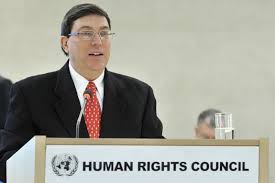
Now we examine issues of Cuban human rights that probably will be put on the agenda for further discussions by looking at the recent speech on this subject by Cuban Foreign Minister Bruno Rodriguez Parrilla. [1] Subsequent posts will look at the U.N. Human Rights Council’s most recent Universal Periodic Review (UPR) of Cuba and at the latest U.S. State Department report on Cuban human rights (the one issued in 2014 for 2013). Observations about these sources will be made in a later post while other subsequent posts will engage in a similar analysis about issues of U.S. human rights that are likely to be covered in the bilateral talks.

Bruno Rodriguez Parrilla

As discussed in a prior post, the U.N. Human Rights Council opened what it called its “High -Level Segment” on March 2, 2015, at its headquarters in Geneva Switzerland. One of the speakers that day was the Cuban Foreign Minister, whose speech will be excerpted below.

Cuba’s Commitment to International Human Rights. The Foreign Minister stressed Cuba’s “commitment to a genuine international cooperation based on the indivisibility of human rights, non-selectivity and non-politicization” and to “the struggle for the establishment of a more just, democratic and equitable international order that would remove the obstacles that hamper all national efforts that are made to guarantee the exercise of all human rights.”

Cuba, he asserted, maintains “a high level of cooperation and interaction with the procedures and mechanisms of the [U.N.] when it comes to universal human rights and a positive dialogue with the organs created by virtue of international treaties. It is in that spirit that we are conveying an invitation to the President of the International Committee of the Red Cross and the [U.N.] Rapporteur on Trafficking in Persons” to visit Cuba.

“Despite its deficiencies and difficulties, Cuba has shared and will continue to share its achievements and experience with other nations, with which we have made a selfless contribution to the exercise of human rights by other peoples of the world.”

For example, under Cuba’s “cooperation project known as ‘Miracle Operation,’ 3.4 million persons from 34 countries have undergone eye surgery free of charge.  Likewise, 9 million persons have already graduated from the literacy program ‘Yes, I Can,’ and 1,113,000 persons have graduated from the follow-up program ‘Yes, I Can Continue.’”

“Today, more than 51 000 Cuban health cooperation workers are offering their services in 67 countries of the world.” Cuba “will continue offering our cooperation in the struggle against the Ebola virus in Africa. More than 250 voluntary and specialized health cooperation workers of the medical brigade ‘Henry Reeve’ are taking part in this struggle in the most affected regions.  Another 4,000 Cuban health cooperation workers are participating in the prevention program that is being implemented in 32 African countries.”

“On the occasion of the Seventieth Anniversary of the [U.N.], the Principles and Purposes that were enshrined in [its] Charter and supported its creation are more valid than ever.  As was recently stated by Cuba’s President Raúl Castro Ruz: “We will never renounce our ideals of independence and social justice, or abandon a single one of our principles, nor cede a millimeter in the defense of our national sovereignty.  We will not accept any pressure regarding our internal affairs. We have earned this sovereign right through great sacrifices and at the price of great risks.”

People’s Participation in Government.The Foreign Minister emphasized that “more than 2,000 organizations and associations of an infinite diversity contribute very actively to the economic, social and cultural life [of Cuba]. . . . The participation of the people in the Governments’ decision-making processes, . . . has been the experience of the Cuban Revolution.”

This was illustrated in 2011 by the Cuban government’s consultations with the people over the proposed economic and social program that included “the introduction of 400,000 amendments thereto and the modification of two-thirds of the original text.  More recently a new Labor Code was discussed following this same procedures.”

Workers’ Rights. In Cuba “almost all workers – including those who work in small private businesses–are unionized and protected by collective agreements.  There are union representatives in the Council of Ministers as well as in the ministerial and corporate organs. In 1938 [long before the Cuban Revolution], the workers’ movement in Cuba managed to found a Unitarian Workers’ Central, which today encompasses as many as 17 different unions and thousands of other grassroots organizations.”

The Foreign Minister also raised the subjects of the International Labor Organization’s Convention 87 [2] and Convention 98 [3], both of which have been ratified by Cuba.

Palestine. Cuba supports “the inalienable right of the Palestinian people to a State of their own, on the pre-1967 borders and with East Jerusalem as its capital.  The [U.N.] General Assembly should act with resolve and guarantee, without further delay, the full [U.N.] membership of Palestine.”

Venezuela. “We ratify our firmest support to the Bolivarian Revolution and the legitimate Government headed by President Nicolás Maduro Moros.” (Several posts have investigated the reactions of Venezuela, Cuba and other countries to a U.S. executive order imposing sanctions on seven Venezuelans.)

Cuba’s Negotiations with the EU and the U.S. Cuba’s current negotiations with the U.S. and the EU over human rights and other issues were noted. Rodriguez said those discussions will occur within the agreed reciprocal basis of “sovereign equality, mutual respect, non-interference in internal affairs [and] respect for the legal systems of the parties.”

=====================================

[1] This portion of the post is based upon the following: Vigezzi, Statement by Bruno Rodriguez at Human Rights Council in Geneva, Nat’l Network on Cuba (Mar. 2, 2015); U.N. Hum. Rts. Council, Human Rights Council hears from 11 dignitaries as it continues its High-Level Segment, (Mar. 2, 2015); Cuban Foreign Minister speaks at the Human Rights Council, Granma (Mar. 4, 2015). The Cuban Foreign Minister’s speech also criticized certain aspects of the human rights records of the U.S. and other unnamed industrialized countries; these comments will be examined in a later post about issues of U.S. human rights that might be added to the agenda for discussions between the two countries.

[2] ILO Convention No. 87 (Convention on Freedom of Association and Protection of the Right to Organise [sic], 1948) has been ratified by 153 states, including Cuba and all 28 EU members. The U.S. has not so ratified and thus is not a party to this treaty although there are many federal and state laws on the subject.

[3] ILO Convention No. 98 (Right to Organize and Collective Bargaining Convention, 1949) has been ratified by 164 states, including Cuba and all 28 EU members. The U.S. has not so ratified and thus is not a party to this treaty although there are many federal and state laws on the subject.


Cuba and U.S. To Discuss Human Rights

Tom Malinowski
Tom Malinowski

On March 26 Cuba announced that the U.S. and Cuba will commence their discussions regarding human rights on March 31 in Washington, D.C. The next day the U.S. Department of State confirmed that date and location with Under Secretary of State Tom Malinowski as the leader of the U.S. delegation. This meeting’s purpose will be “to discuss the structure and the methodology of future human rights talks” or “the composition of delegations and the topics to be discussed.” [1]

This post will review that announcement, and subsequent posts will provide previews of the issues of Cuban and U.S. human rights that probably will be on the agenda for further talks.

Pedro Luis Pedroso
Pedro Luis Pedroso

Although these negotiations were first suggested by the U.S. as an essential part of the re-establishment of normal diplomatic relations, Cuba now is the one apparently pressing the discussion of this issue. A Cuban foreign ministry official, Pedro Luis Pedroso, the Deputy Director General of Multilateral Affairs and International Law, said,”These talks are an indication of Cuba’s willingness to address any subject with the [U.S.], despite our differences, based on equality and reciprocity.”

Pedroso added that the planned dialogue is expected to “develop in a constructive environment and on a reciprocal basis, without conditions or discriminatory treatment, and full respect for the sovereign equality, independence and non-interference in the internal affairs of the parties. There are different political systems and models for democracy. … We live in a plural world and that pluralism should apply to the case of Cuba as well.”

According to Pedroso, Cuba will “demonstrate its achievements in the promotion and protection of all human rights, not only of its people but also those of many nations with which it has cooperated in areas such as health and education.” This includes “the recognition Cuba received at the last Universal Periodic Review by the U.N. Human Rights Council, where the international community commended Cuban achievements in areas such as education, health and access to cultural rights, and the contribution the island has made in those same areas in other countries.”

Nevertheless, Cuba admits that it is not perfect and still has areas to improve.

The talks will not only be concerned with Cuban human rights. Pedroso said Cuba will “raise its concerns regarding the human rights situation in the U.S. and elsewhere where [the U.S.] has a direct impact.”

=============================================================

[1] This post is based upon the following sources: Reuters, Cuba Proposes Quick Start to Human Rights Dialogue with U.S., N.Y. Times (Mar. 26, 2015); Assoc. Press, Cuba, US to Launch Human Rights Dialogue Tuesday, N.Y. Times (Mar. 26, 2015); Gomez, Cuba and the US hold talks on human rights, Granma (Mar. 27, 2015); Foreign Ministry: Cuba expects respectful dialogue with US Human Rights next March 31, CubaDebate (Mar. 26, 2015); U.S. Dep’t of State, Daily Press Briefing (Mar. 27, 2015).


U.S. Radio and Television Broadcasts to Cuba at Crossroads

In 1983 the Cuban American National Foundation, a once-monolithic lobbying group of Cuban exiles, helped persuade the Reagan administration to establish Radio Martí, which started broadcasting from Miami to Cuba in 1985, and TV Martí began in 1990. [1]

For most of its 30 years, the Martí services have been known for their anti-Castro, one- dimensional slant and advocacy. As a result, the Cuban regime has been very hostile to these services. It has made them illegal and often blocks their reception on the island.

The Martís, with a budget of $27 million, also have U.S. critics, including former American diplomats in Cuba. These critics “have considered them taxpayer-funded relics controlled by Cuban exiles that too often slide into propaganda, which has damaged their credibility.” In addition, “reports by congressional staff members and federal agencies, like the Inspector General for the State Department, have delivered stinging assessments” of Martí; the most recent such report came last summer accusing the Martís of ‘a lack of balance, fairness and objectivity,’ of cronyism, malfeasance and, most recently, low employee morale.”

More recently Martí has “focused on diversifying coverage of Cuba and ramping up a Martí website. [This includes] bringing more Cubans into the conversation through video, articles, texts, blogs and social media. “ This includes an expansion of a “cadre of journalists in Cuba who file videos and articles, with their names made public at great risk. Some of those interviewed by the reporters are also identified, a sign of diminishing fear.” In addition, Cubans now “can post their own blogs and news items through features like “Reporta Cuba,” which often spreads news of detentions.” “And a separate social network created by the Martís, Piramideo, allows Cubans to use cellphones or email accounts to gain access to a site that circumvents government restrictions. From there, they can send messages to hundreds of Cubans in Cuba about nearly anything.”

Another goal at Martí “was to lift journalistic standards, [especially attempting] to offer more diverse views of Cuban life and [U.S.] foreign policy. Reporters now call the Cuban government to get its response for certain stories.”

Now Martí presents “snippets of life on the island, like examples of the recently unleashed zeal for private enterprise. So one of the hosts, as part of an effort to bolster Cuba’s fledgling independent businesses, recently promoted “Hilda in Havana,” who is offering desserts and decorations for events and restaurants. Next up was a listing from a Havana man peddling his churro cart.” Other topics are housing problems in Cuba, the latest small-business ventures (public bathrooms in private homes, 25 cents for a quick stop, 50 cents for longer visits), dissident detentions, how to find the rare Wi-Fi hot spots.”

In addition to their live broadcasts, every month, Martí distributes nearly 15,000 DVDs of its programming in Cuba and circulated through flash drives. The goal of all of these efforts is to provide news and information about Cuba to Cubans without Cuban censorship.

In the last few years, Martí has been challenged by increased competition. “Cubans now use flash drives that are loaded with television shows and movies from satellite dishes and sold on the black market.”

With the December 17, 2014, announcement of the U.S. and Cuba intent to pursue normal diplomatic relations, the future of the Martí ventures is under re-examination.

“While Obama administration officials support the Martís, they are eager to cut the Office of Cuba Broadcasting loose from the federal mantle. In its budget for next year, the administration proposed consolidating the Office of Cuba Broadcasting and Voice of America’s Spanish-language programs, turning them into a nonprofit. The organization would be funded by federal grants, with federal oversight, but would not be part of the government. [This is the way that] Radio Free Europe/Radio Liberty, which gained prominence during the Soviet era and served as the model for the Martís, has long operated this way.”

In January, Cuba’s President Raúl Castro called for an end to the Martís as a condition for normalizing relations with the United States, but this proposal has not been mentioned in the limited publicly available information about the negotiations between the two countries.

There is a bill in Congress to terminate the two broadcasting services: H.R.570, Stop Wasting Money on Cuba Broadcasting Act. It was offered by Minnesota’s Democratic Representative, Betty McCollum. As of March 25, there had been no action on the bill in the House of Representatives although it has gained four Democratic cosponsors—Barbara Lee (CA), Raul Grijalva (AZ), Richard Nolan (MN) and Jose Serrano (NY).

====================================

[1] This post is based upon Alvarez, Radio and TV Martí, U.S. Broadcasters for Cuba, Face New Obstacles, N.Y. Times (Mar. 24, 2015),


Cuba Meets with European Union and Russian Ministers

This week Cuban leaders have held meetings in Havana with the foreign ministers of the European Union and Russia.

European Union-Cuba

A previous post examined the recent history of Cuba’s relations with the European Union (EU), including their negotiations on improving relations in 2014 and earlier this month. Another set of such negotiations or meetings took place in Havana on March 23-24 with the EU’s [1]

The most recent meetings were with the EU’s High Representative for Foreign Affairs and Security Policy and Vice President of the European Commission, Federica Mogherini.

EU +Castro

She met with Cuban President Raúl Castro and Foreign Minister Bruno Rodriguez Parrilla. Also present were Stefano Manservisi, Mogherini’s chief of staff; Herman Portocarero, EU Ambassador to Cuba; and Rogelio Sierra Diaz, Cuba’s Minister and Deputy Foreign Minister. (To the left is a photograph of Mogherini and Castro.)

In addition, Magherini met with the President of the National Assembly of Popular Power, Esteban Lazo Hernández; Vice President of the Council of Ministers and Minister of Economy and Planning, Marino Murillo Jorge; and Minister of Foreign Trade and Foreign Investment, Rodrigo Malmierca.

Afterwards Magherini said that although the pace of progress in the EU-Cuba talks on improving their relations was “slow,” it was gaining “political momentum” and that the two parties had “decided to speed up the rhythm of our negotiations, hopefully to manage to finalize the framework of our dialogue and agreement by the end of this year.” She also referred to the signing of a program between the island and the EU in the amount of 50 million euros until 2020, which will be used in commercial areas and especially in agriculture and complimented Cuba for its essential role in regional processes such as the Colombia-FARC peace negotiations taking place in Havana.

A Cuban newspaper reported the President Castro observed that “in a friendly atmosphere,” the two of them “exchanged ideas about the links between the EU and Cuba .They agreed on the importance of developing relationships of mutual respect, based on the purposes and principles of the United Nations Charter. Also, they discussed issues of common interest of the international agenda.”

Bruno Rodriguez reiterated Cuba’s “willingness to work to advance these links and . . . constructive engagement with the negotiations for an agreement on political dialogue and bilateral cooperation that is underway.” He also noted Cuba’s appreciation for the votes of EU members in support of Cuba’s resolution against the U.S. blockade (embargo) at last Fall’s U.N. General Assembly meeting.

Magherini and Bruno Rodriguez will see each other at the Summit of the Americas on April 10-11 in Panama, to which both Cuba and the EU are invited for the first time before the two of them meet in Brussels on April 22. In addition, Cuban officials will attend a summit of European and Latin American leaders scheduled for June in Brussels.

Russia-Cuba [2]


Serguei-Lavrov-y-Raúl-Castro1

On March 24, Russian Foreign Minister Sergey Lavrov met in Havana with Cuban President Raúl Castro. Also present were Mikhail L. Kamynin, Russian Ambassador to Cuba; Alexander V. Schetinin, the Director of Latin America at Russia’s Foreign Ministry; Cuban Foreign Minister, Bruno Rodríguez Parrilla; and Cuban Deputy Foreign Minister, Rogelio Sierra Díaz. (Above is a photograph of Larov and Castro.)

The participants discussed the excellent state of their relations and ratified the willingness to work together in the effective implementation of the bilateral economic agenda and deepen exchanges in areas of common interest. Castro thanked Russia’s support for ending the U.S. economic, commercial and financial blockade against Cuba and reiterated his country’s opposition to the unilateral sanctions imposed by the U.S. and its NATO allies against Russia.

Larov said, “Normalization between the United States and Cuba makes us happy. We salute this rapprochement,” and “we call for the lifting of the (U.S.) trade and financial blockade of Cuba as soon as possible.”

Earlier Larov met separately with Foreign Minister Rodriguez and with Ricardo Cabrisas, Vice President of Cuba’s Council of Ministers. They discussed bilateral cooperation and the interest of Russian companies in investing in Cuba’s development.

CubaRussia-0a5c9

Simultaneously a Russian ship of the class generally used for intelligence gathering was in the Havana Harbor as shown in the photograph to the left by Desmond Boylan/Associated Press.

 Conclusion

These meeting emphasize that Cuba’s redefining its relationships with the U.S. is not the only bilateral issue facing Cuba and that the U.S. is in competition with the EU and Russia for improving economic relations.

culPanama Canalbra-cutAnother factor influencing all of these discussions is Cuba’s construction of a deep-sea port at Mariel to accommodate larger ships going through an expanded Panama Canal, which announced this week that the expansion should be completed next year. (To the right is a photograph of one portion of the expanded canal.)

=======================================================

[1] This section of the post is based upon the following sources: Reuters, EU, Cuba to Speed Up Talks, Seek Deal by End of 2015, N.Y. Times (Mar. 24, 2015); Raúl received the High Representative of the European Union, CubaDebate (Mar. 24, 2015); Raúl received the High Representative of the European Union, Granma (Mar. 24, 2015); Forte, Visit of European High Representative promotes relations with Cuba, Granma (Mar. 24, 2015); Abellán, EU foreign affairs chief steps up talks for new Cuba cooperation policy, El Pais (Mar. 24, 2015).

[2] This section of the post is based upon the following source Assoc. Press, Russian FM Visits Cuba, Calls for End of US Trade Embargo, Wash. Post (Mar. 24, 2015); Reuters, Russian Foreign Minister Praises New U.S.-Cuba Relations, N.Y. Times (Mar. 24, 2015); Raul held meeting with the Foreign Minister of Russia, CubaDebate (Mar. 24, 2015); Raul meets with Russian Foreign Minister, Granma (Mar. 25, 2015).


Mogherini–


European Union and Cuba’s Negotiations Over Human Rights and Other Issues


Essay About Archbishop Oscar Romero in Cuban Newspaper

On March 23, 2015, the day before the 35th anniversary of the assassination of Salvadoran Archbishop Oscar Romero, CubaDebate published an essay about Romero. The author is Adolfo Pérez Esquivel of Argentina, who started out as a painter, sculptor and architect and later became a prominent human rights advocate. In 1980 he received the Nobel Peace Prize for his work for human rights and peace. Below are extensive excerpts from that essay. [1]

“Martyrs are sowing seeds of life expectancy and strengthen the ways of faith. They have enriched the continent of Fertile Earth . . . by force of the prophetic word and the testimony of the lives of those who had the courage and faith to walk beside the Village Church of God. Their voices were raised across the continent and the world. So it was in the neighboring country of El Salvador, subjected to violence with more than 70,000 dead, exiled and persecuted. That pain was a voice of guidance, and hope emerged, denouncing violence and calling for respect for life and dignity of people under the civil war and military dictatorship.”

“It was the voice of Monsignor Oscar Arnulfo Romero, who experiences the conversion of his heart and embraces the way of the Cross. As St. Paul says: “It is madness for some; for others it is life and redemption.” (Emphasis in original.)

“Romero endured many misunderstandings in the same church; his voice, his claims and complaints would not be heard in the Vatican; there were ideological currents and misinformation about what happened in El Salvador. The conceptual and political simplification reduced everything to the East-West polarization between capitalism and communism, based on the Doctrine of the ruling National Security. They forgot the thousands of brothers and sisters who were victims of violence. Romero tried to get the Vatican to listen and help, but left distraught and returned home with pain in the soul.”

“Some peasants who knew him remember following the homilies of Monsignor Romero, with no need to hear his word directly and instead hearing them on the radios of all their neighbors who had them turned on.”

“The Archbishop knew of the [death] threats he was receiving, but the power of the Gospel and its commitment to the people were part of his own life. He sought God in prayer and silence listening to the silence of God, who taught his heart, his mind and spirit.”

“Journalists in March 1980 said that the Archbishop was on the line, targeted by the military. Romero replied, ‘Yes, I have frequently been threatened with death, but I must say that as a Christian I do not think in death without resurrection. If they kill me, I will rise again in the Salvadoran people. I say it without boasting, with the greatest humility. A bishop will die, but the church of God, which is the people, shall not perish.’” That March 23 at the Cathedral, Monsignor Romero in his homily said:

  • ‘I would like to make an appeal in a special way to the men of the army, and in particular to the ranks of the Guardia Nacional, of the police, to those in the barracks. Brothers, you are part of our own people. You kill your own campesino brothers and sisters. And before an order to kill that a man may give, the law of God must prevail that says: Thou shalt not kill! No solider is obliged to obey an order against the law of God. No one has to fulfill an immoral law. It is time to recover your consciences and to obey your consciences rather than the orders of sin. The church, defender of the rights of God, the law of God, of human dignity, the dignity of the person, cannot remain silent before such an abomination. We want the government to take seriously that reforms are worth nothing when they come about stained with so much blood. In the name of God, and in the name of this suffering people, whose laments rise to heaven each day more tumultuous, I beg you, I ask you, I order you in the name of God: Stop the repression!’”

“Monsignor Romero’s voice was heard clearly despite all odds and radio interference and equipment: “The church preaches liberation” … “The cathedral burst into applause, excited people felt the cry of their hearts.”

============================================

[1] Esquivel, San Romero of America walks alongside the peoples of our continent, CubaDebate (Mar. 23, 2015)(English translation by Google Translate). Another Cuban newspaper, Granma, published a shorter article about Romero: Oscar Arnulfo Romero, a saint of the poor of America, Granma (Mar. 23, 2015). Oscar Romero is the personal saint of this blogger, who has written many posts about Romero and who points our that Tim’s El Salvador Blog has published great early photographs of Oscar Romero from the Salvadoran Museo de la Palabra y Imagen (Museum of Word and Image) plus other photographs of images of Romero in today’s El Salvador. (35th anniversary of Romero’s assignation (Mar. 24, 2015).


New Details About U.S. Secret Normalization Negotiations with Cuba

A prior post referred to the secret U.S.-Cuba negotiations that resulted in the December 17, 2014, announcements by presidents Obama and Castro that the two countries were embarking on a process of re-establishing diplomatic relations and resolving many issues that have accumulated over the last 50 years. Another post described the involvement of Pope Francis in these negotiations.

Now Reuters reports the following new details about these subjects.

Originally the breakthrough was thought to be the result of such secret negotiations over the prior 18 months (or since June 2013). Now, says Reuters, the process really began in December 2012 when President Obama after reelection with 48% of the Cuban-American vote instructed aides to make Cuba a priority and “see how far we could push the envelope,” according to Ben Rhodes, a Deputy National Security Advisor who played a central role in shaping Cuba policy.

The next month, January 2013, Ricardo Zuniga, Obama’s top Latin American adviser, went to Miami and met with a representative of the anti-Castro Cuban American National Foundation and with young Cuban-Americans, the latter of whom helped confirm the waning influence of older Cuban exiles who have traditionally supported the half-century-old embargo.

By April 2013, the White House was ready to proceed with the Cubans by quietly proposing back-channel talks after getting notice that Havana would be receptive. Obama initially froze out the State Department on these developments in part due to concern that its “vested interests” would still be bent on perpetuating a confrontational approach. Even Secretary of State John Kerry was informed of the talks only after it appeared they might be fruitful.

In any event, the secret negotiations started in June 2013 in Ottawa, Canada. The Cubans opened with harangues about the embargo and other perceived wrongs. Rhodes, age 37, responded, “Look I wasn’t even born when this policy was put in place … We want to hear and talk about the future.”

The Cubans in these initial sessions also insisted on an exchange of the remaining three of “The Cuban Five” in U.S. prison for U.S. citizen, Alan Gross, in Cuban prison. Obama refused such a deal because Washington denied Gross was a spy and because Obama did not want a three-for-one trade. As a result by the end of 2013, the negotiations had stalled.

At a January 2014 negotiating session in Toronto, however, the U.S. proposed – to the Cubans’ surprise – Cuba’s releasing Rolando Sarraff, a spy for the U.S. who had been imprisoned in Cuba since 1995, and thereby enabling the U.S. to claim it was a true “spy swap” and giving it political cover. But the Cubans dis not immediately agree to release Sarraff, a cryptographer who Washington says helped it disrupt Cuban spy rings in the U.S.

While the Sarraff proposal was still on the table, but not yet accepted by Cuba, President Obama held a White House meeting in February 2014 with certain lawmakers, including Democratic Senators Patrick Leahy and Dick Durbin. Obama stressed his opposition to a straight Gross-Cuban Three trade, and Durbin “raised the possibility of using the Vatican and the Pope as intermediaries.”

Thereafter Senator Leahy persuaded two unnamed Roman Catholic cardinals to ask Pope Francis to raise Cuba and the prisoners when he was scheduled to hold a private audience with Obama in March.

At that private audience, as reported in a prior post, Francis and Obama did discuss the U.S.-Cuba situation, and the Pope in June sent letters to Obama and Castro urging reconciliation and the prisoner exchange. Francis’ involvement also provided Obama with political coverage against future criticism by Cuban-American Senators Robert Menendez (Dem., NJ) and Marco Rubio (Rep., FL) and others.

In October 2014 (before the U.S. mid-term elections) the deal was finalized in Rome, where the U.S. and Cuban teams met separately with Vatican officials, then all three teams together.

In early December Rhodes and Zuniga met the Cubans again to nail down logistics for the December 17 announcements of prisoner releases, easing of U.S. sanctions, normalization of U.S.-Cuba relations and Cuba’s freeing of 53 political prisoners.


Strobel, Spetalnick & Adams, How Obama Outmaneuvered Hardliners and cut a Cuba Deal, Reuters (Mar. 23, 2015),


Reuters, , N.Y. Times (Mar. 23, 2015), How Obama Outmaneuvered Hardliners and Cut a Cuba Deal

http://www.nytimes.com/reuters/2015/03/23/us/politics/23reuters-cuba-usa-insight.html

U.S. Praises Cuba’s Record on Narcotics Trafficking

On this March1st the U.S. Department of State released its annual “International Narcotics Control Strategy Report” covering the year 2014. [1]

The Report’s discussion of Cuba is overwhelmingly positive. It states,“Despite its location between the largest exporters of illegal drugs in the hemisphere and the U.S. market, Cuba is not a major consumer, producer, or transit point of illicit narcotics.”

This Cuban success story is a result of Cuba’s sustained anti-narcotics efforts. “Cuba’s domestic production and consumption remain low due to active policing, strict sentencing, and nationwide prevention and educational programs. Cuba’s intensive security presence and interdiction efforts have kept supply down and prevented traffickers from establishing a foothold. Cuba concentrates supply reduction efforts by preventing smuggling through territorial waters, rapidly collecting wash-ups, and conducting thorough airport searches. Cuba dedicates significant resources to prevent illegal drugs and their use from spreading, and regional traffickers typically avoid Cuba.”

The U.S. Report also comments on the excellent U.S.-Cuba cooperation on narcotics trafficking: “The U.S. Interests Section [in Havana] has a USCG Drug Interdiction Specialist to coordinate with Cuban law enforcement. The USCG and Cuban authorities share tactical information related to vessels transiting Cuban territorial waters suspected of trafficking and coordinate responses. . . . Cuba has demonstrated an increased willingness to apprehend and turnover U.S. fugitives and to assist in U.S. judicial proceedings by providing documentation, witnesses, and background for cases in U.S. state and federal courts.”

This excellent record, says the U.S. Report, is expected to continue. “Enhanced communication and cooperation between the [U.S.], international partners, and Cuba, particularly in terms of real-time information-sharing, would likely lead to increased interdictions and disruptions of illegal drug trafficking.”

The Report also covered money laundering and financial crimes. Here too Cuba got good marks. It was placed in the category “Other Jurisdictions Monitored” for those that “do not pose an immediate concern, . . . [but that are] important to monitor their money laundering situations because, under certain circumstances, virtually any jurisdiction of any size can develop into a significant money laundering center.”

=============================================

[1] Dep’t of State, International Narcotics Control Strategy Report (Mar. 2015);  Dep’t of State, Narcotics Control Reports. A Cuban website discussed the latest Report: State Department recognizes that Cuba is an example in the drug fight, CubaDebate (Mar. 21, 2015).


Criticism of Venezuela’s Response to President Obama’s Executive Order

An op-ed in El Pais, Spain’s leading newspaper, by Peace Zárate, an expert in public international law, criticizes Venezuela’s response to President Obama’s March 9th executive order. [1]

According to the author, the Venezuelan and UNASUR reactions to the executive order prompt four questions and answers.

First, are the reactions proportional to the executive order? “No” is his answer. He reasons, “No doubt that Caracas has the sovereign right to feel offended by the actions taken by the U.S. government. However, these [U.S.] actions are not “the most aggressive, . . . nefarious, unfair, and . . . [unprecedented measures] against Venezuela” as described by [Venezuelan President] Maduro. The measures have not been taken against the country as a whole, nor against all its citizens, nor against its economy, trade and bilateral investments, but only [against] seven officials individually responsible for severe and massive human rights violations. . . . These seven individuals are prohibited from entering U.S. territory and prevented from making transactions relating to assets located in the [U.S.].”

Second, are these sanctions illegal? “No,” again is his answer. He says, “The justification given by the Obama administration was respect for human rights and safeguarding democratic institutions within the framework of international law. These rules are contained in both treaties to which Venezuela and the [U.S.] are signatories, and in customary international law. Serious violations of human rights are not ‘internal affairs.’ They are the exception to the principle of non-intervention. And in the case of Venezuela, these violations have been established by the U.N. and [the] most respected international non-governmental human rights organizations, including Amnesty International and Human Rights Watch.” Moreover, the “U.S. sanctions [against] seven Venezuelan officials are: a minor gesture and [permissible].”

Third, was the U.S. entitled to impose these sanctions? “Yes,” is his answer even though the U.S. does not have a perfect record on human rights and even though “countries generally tend to avoid taking [their] own actions when human rights are violated in another state. . . .But this reluctance does not mean [a] State cannot adopt sanctions. . . .  And to do that, international law does not [require a state to have an unblemished record] (no state has that).”

Fourth, “what effect will [the sanctions] have for the individual rights of the citizens of Venezuela, where repression leads [to] a growing account of death and torture [as it] is governed by decree?” That question is unanswered even as “the practical effects for the seven Venezuelan officials affected by the sanctions are minimal” and “the impasse between Washington and Caracas eventually [will] be solved.”

======================================

[1] The reactions of Venezuela, UNASUR and ALBA were described in prior posts: U.S. and Cuba Squabble Over U.S. Sanctions Against Certain Venezuelans (Mar. 16, 2015); Venezuela’s Open Letter to the People of the United States (Mar. 18, 2015); and ALBA Emergency Meeting’s Action Regarding President Obama’s Executive Order Imposing Sanctions on Seven Venezuelans (Mar. 19, 2015).