Charanga Tropical is a nine-piece salsa ensemble that performs classic and modern salsa music. Performing with the unique Cuban “charanga” instrumentation that includes violins and flute, the group presents a sound that is harmonically rich and infectiously rhythmic, inspiring visions of mojitos and Caribbean sunsets.
Charanga Tropical
The group has been invited to perform at the 2015 International Festival of Danzón in Havana, Cuba, June 24th to 28th, 2015. The group is the first North American ensemble ever invited to participate in the festival, which commemorate and celebrate the rich musical style of danzón, the national dance of Cuba.
To fund the Cuban trip and Live CD recording, the group has announced a 60-day Kickstarter campaign with fundraising shows at Bedlam Lowertown, 213 E. 4th Street, St. Paul (March 13th), Cedar Cultural Center, 416 Cedar Avenue South, Minneapolis (March 14th) and Westminster Presbyterian Church, 1200 Marquette Avenue, Minneapolis (March 15th)
“The newest members of our Congregation [who were welcomed that day] . . [are] a slice of 21st century American religious reality. Gay, straight, married, single, partnered, and divorced. People at the top of their profession and others who have been homeless or are without work. Former Catholics, Lutherans, Baptists, Presbyterians from other congregations, immigrants and long-time Minnesotans. People who come with questions and doubts, others very much at home in Christian tradition. One has practiced Buddhism. Several were raised in non-Christian households. Two are becoming Christians today and will be baptized.”
“They’re here because their journey in faith brought them. For some the work of this church in the city drew them in, for others the desire to belong to a community, for others the education offered. For all of them worshipping God in this setting and with this people has given them a new spiritual home. This is the church in our time. Our journey now joins with theirs.”
“If the question is, ‘Does the Church control salvation?’ the answer needs to be offered carefully. We don’t want to try to deny other religious traditions their meaning, but at the same time we don’t want to water down our own convictions, especially on this final Sunday before Advent, when we celebrate Christ the King, the one who, in the words of Ephesians, is ‘above all rule and authority and power and dominion, and above every name that is named, not only in this age but also in the age to come.’ (Ephesians 1:21)”
“Long ago it was a basic article of faith that the Church did, in fact, control salvation. It was common knowledge that to gain God’s favor one had to be on good terms with the Church, because the saving work of Jesus Christ came through the Church. This gave the Church a lot of power over the spiritual lives of people. As in any situation with an imbalance of power, the temptation for abuse always hovered nearby.”
“The 16th century Protestant Reformation, we like to say, developed as an uprising against the abuse of power of the Roman clergy. They controlled access to God so tightly believers felt trapped on this side of heaven until they met the demands of the church. Extra ecclesiam nulla salus: no salvation outside the Church. The priest in every parish was a spiritual power-broker.”
“Lest we be too quick to speak ill of our Roman Catholic siblings, we should note that Protestant history is salted with similar declarations about who controls the gates of heaven. While Catholics placed that control in the hands of Rome and its priests, the Reformers used theological conformity as a way to maintain control over things divine. One passed heavenly muster only if one’s statement of faith met certain theological standards. It was a litmus test and we can still see it in use today in some churches.”
“That’s a Protestant version of no salvation outside the church. The continuing existence of so many Protestant denominations today is an ecclesiastical hangover from over indulgence in theological conformity among those convinced they have a lock on the truth.”
“Christians have always wanted to say who’s ‘in’ and who’s not, who’s ‘been saved’ and who has not. We would like the Church to be able to control salvation.”
“Then along comes the Final Judgment scene at the end of Matthew’s gospel, and things take on a different hue. Jesus says,‘Then the king will say to those at his right hand, ‘Come, you that are blessed by my Father, inherit the kingdom prepared for you from the foundation of the world; for I was hungry and you gave me food, I was thirsty and you gave me something to drink, I was a stranger and you welcomed me, I was naked and you gave me clothing, I was sick and you took care of me, I was in prison and you visited me.’” (Matthew 25:34-36)
“There’s nothing in there about following a particular theological roadmap; nothing in the text about staying in the church’s good graces in order to curry favor with the Almighty. In fact, neither church nor theology is mentioned.”
“It turns out salvation belongs to God alone and has nothing to do with the exercise of ecclesiastical authority or with meeting a theological litmus test, and everything to do with how we treat the poor and those deemed unworthy by the world.”
“Jesus had said that love of God and love of neighbor are the greatest commandments, when asked what we must do to inherit eternal life. Now we see what that looks like on Judgment Day: ‘Then the righteous will answer him, ‘Lord, when was it that we saw you hungry and gave you food, or thirsty and gave you something to drink? And when was it that we saw you a stranger and welcomed you, or naked and gave you clothing? And when was it that we saw you sick or in prison and visited you?’ And the king will answer them, ‘Truly I tell you, just as you did it to one of the least of these who are members of my family, you did it to me.’” (Matthew 25:37-40)
“All the theological grandstanding and all the church authority we can summon will not stand up to the clarity and power and simplicity of those words: as you did it to one of the least of these, you did it to me. It’s not what the Church thought long ago, not what it thought in the Reformation, and not what a lot of us in the Church think today, but this is what the reign of God looks like: loving others.”
“The Church does not control salvation; God does, which is a good thing, because the Almighty surely has a broader vision than any of us.”
“You and I will need to find ways to hold fast to Jesus Christ even as we respect the traditions of our neighbors, including those who have no faith at all.”
“And as far as the business of salvation, we can leave that to God.”
Conclusion
As I said in an earlier post, the first foundation of my Christian faith is Jesus’ encounter with a clever lawyer, who asked Jesus a trick question as to what the lawyer had to do to inherit eternal life. The lawyer did not really want to know the answer; instead, the lawyer wanted Jesus to give an answer that could be twisted to incriminate him. Jesus ducked the question and instead responded with another question: “What is written in the law? How do you read it?” The lawyer replied, “Love God with all your heart, soul, strength and mind and your neighbor as yourself.” Jesus then said the lawyer had answered correctly and that he would live if he did exactly that. (Luke 10:25-37)
The passage from Matthew that was one of the texts for this sermon makes the same point.
I agree that this is the greatest commandment. It clearly is difficult, if not impossible, to follow this commandment all the time. But Jesus tells us in the “Parable of the Prodigal Son” (Luke 15: 11-31) that God forgives us, time and time again, for our failure to do what we should do and doing what we should not.
A prior post reported about the planned meetings in Havana of a delegation of congressional Democrats led by Senator Patrick Leahy. Now we have news of what happened on their three-day trip.
Here is a photo of the delegation in Havana (left to right): Representative Chris Van Hollen, Senator Sheldon Whitehouse, Senator Debbie Stabenow, Representative Peter Welch and Senator Patrick Leahy. (Senator Richard Durbin is the other member of the delegation.)
On Saturday, January 17th, they “met with officials from Cuba’s Culture Ministry in order to discuss possible Cuban participation in the Smithsonian Institution’s Folklife Festival, a summer celebration of traditional art and culture on Washington’s National Mall.
On Sunday, January 18th, they met with more than a dozen dissidents including critics of the 18-month-old secret negotiations that led to last month’s announcement. All but two of them expressed support for the opening.
One of these two, Antonio Rodiles, said it “was a friendly meeting, they heard the different positions, but the senators are very much in favor of Obama’s measures and want to hear that we agree.” Rodiles, however, criticized the Obama administration for failing to win enough guarantees of reform from the Cuban government. “I said the process [of negotiating the U.S.-Cuba accords] took place without transparency or taking the full range of opinions into account.”
Another dissident, Elizardo Sanchez, head of the Cuban Human Rights and National Reconciliation Commission, a Cuban non-governmental organization tracking political detentions, said that the Cubans at the meeting “had delivered a list of 24 long-term prisoners whom they wanted to see released in addition to the 53 on the Obama administration’s list.”
On Monday, January 19th, the U.S. delegation met “for several hours with Foreign Minister Bruno Rodriguez Parrilla, who told the legislators that Cuba welcomed President Obama’s loosening of the U.S. trade embargo, which would permit more travel to Cuba and economic links including exports of telecommunications equipment and wholesale goods for use by the country’s small private sector.” According to Leahy, Rodriguez is “open to every issue from trade to communications. He talked about the travel back and forth, medical issues. Name an issue, he’s involved.” (To the right is a photo of this meeting.)
Also participating in this meeting were Josefina Vidal Ferreiro, the Director General of the North American Division of Cuba’s Foreign Ministry, and Cuba’ chief diplomat at the Cuban Interests Section in Washington, José Ramón Cabañas, the latter of whom visited Minneapolis’ Westminster Presbyterian Church last October.
The U.S. legislators also had hoped to meet with Cuban President Raúl Castro, but that did not happen apparently because the Americans had met with Cuban dissidents on Sunday.
Westminster Presbyterian Church in Minneapolis, Minnesota has connections with Cuba that go back to the late 19th century. For most of this period (1890—2000), the connection has been indirect through our denomination (now the Presbyterian Church (U.S.A.)). The direct connections have been since 2001.
Indirect Connections, 1890-1966
In 1890 Cuban Presbyterianism started when a Cuban layman (Evaristo Collazo) asked the U.S. church’s Board of Foreign Missions for counsel and oversight for the school and worship services he and his wife Magdalena were holding in their home in Havana. That Board responded by sending Rev. Antonio Graybill, who held services, baptized forty adults, organized a congregation, ordained two Elders for the Session, and then ordained Callazo to the ministry and installed him as pastor. [1]
In 1904 the U.S. church organized the Presbytery of Havana with five pastors and seven congregations under the jurisdiction of the Synod of New Jersey. In 1930 it became the Presbytery of Cuba, but still as part of the Synod of New Jersey.
In 1946, the Cuban Presbyterian-Reformed Church joined with the Cuban Methodist and Episcopal churches to create the Evangelical Theological Seminary (Seminario Evangelico de Teologia or SET) in the city of Matanzas on the north coast of the island about 90 miles east of Havana. (In 2006 the Methodists withdrew from SET in order to establish their own seminary in Havana.)
In 1966 (five years after the Cuban Revolution), the overall governing body (the General Assembly) of the U.S. church approved an overture or motion by the Cuban Presbytery to be dismissed from the U.S. church in order to become an independent church. This overture came from the Cuban church’s recognition that it had to face on its own Cuba’s “new political, social and economic situation.” Cuba was now “socialist, shaken by a Revolution which left nothing untouched by its transformation,” and the Cuban church “had the responsibility of interpreting the Christian faith in its own environment.” One of Westminster’s former members, John Sinclair, then the U.S. church’s secretary for Latin America and the Caribbean, played a key role in this change.
Indirect Connections, 1967-2000
At the inception of the independent Cuban Presbyterian-Reformed church, it had 3,082 members in 30 churches.
Immediately following its independence, the Cuban church adopted the U.S. church’s Confession of 1967 for its guidance, but started to develop its own theological reflection. The “Word of God became something nearer, more urgent, more vivid and more dramatic. The Church realized that God himself was involved in that revolutionary process which . . . led to the creation of a new society of greater justice for the people and of peace for society. The Gospel of ‘good news for the poor,’ of ‘freedom for the oppressed,’ and ‘sight for the blind’ came down upon us with all its prophetic implications.”
Ten years later, in 1977, the Cuban church adopted its own Confession of Faith to speak to Cubans’ contemporary situation. This Confession starts with “The Centrality of the Human Being Given in Jesus Christ.” It asserts that the “human being [is] the center of interest and concern of God” and, therefore, “of the Church of Jesus Christ.” The human being is an “econome” or steward of all things on behalf of God. “The human being is a social being and a free person. History is seen as “the Integrating Reconstruction of the Human Being, since the Human Being is being disintegrated by sin. . . . [and] the Kingdom of God [is] the Fulfillment of History.”
During this period, Westminster’s connections with Cuba continued to be indirect via its denomination. Here are some of the highlights of these events:
In 1985 the Presbytery of Long Island and the Presbytery of South Louisiana established contact and began visits to Cuban congregations in the Presbytery of Havana and the Presbytery of Matanzas respectively.
Also in 1985 the Cuban church invited agencies of the PC(USA) to a consultation in Havana. They drafted a Mutual Mission Agreement that included procedures for forming ties between governing bodies of the two churches. The agreement was adopted by both General Assemblies in 1986.
In 1990 the Cuban church celebrated the Centennial of Presbyterianism in Cuba. Attending was a Presbyterian delegation from the U.S. Protestant Church leaders meet with Fidel Castro to discuss church-state relations. Castro asserts that religious groups were providing important support for the Cuban people in a time of great stress and should be respected.
In 1995 the first Partnership Consultation was held in Havana, bringing together leaders of the Cuban church with staff of the U.S. denomination and representatives of the then four partner presbyteries: Long Island, Santa Fe, South Louisiana and Transylvania.
In 1996 the U.S. Presbyterian Cuba Connection was founded as an unofficial network of Presbyterians for interpretation, advocacy, and financial support of the life and mission of the Cuban church. That same year the leader of the U.S. church visited the Cuban church, participating in the October Conventions of the latter’s presbyteries.
In 1999 the Cuban Evangelical Celebration united the great majority of Cuba’s 49 Protestant Churches in a series of 19 municipal and four national public rallies, culminating on June 20 in the Jose Marti Revolution Plaza in Havana in a three-hour program of hymns, prayers, music, dance and a sermon attended by 100,000 persons, including President Fidel Castro and a number of government leaders.
In 2000 the Celebration of Mission Partnership in the New Millennium was held in Cuba bringing together representatives of the U.S. church with an equal number of representatives of the Cuban church. A joint declaration of intention and commitment was adopted.
Direct Connections, 2001- Present
During this period indirect connections similar to the ones previously mentioned continue, but now Westminster developed and strengthened its own direct connections.
In 2001 Westminster formed its Cuba Task Force to explore whether and how our congregation could have a more direct connection with the Cuban Church. (I was a member of this Task Force.) After a couple of exploratory trips to the island, we established a partnership in 2002 with Versalles Presbyterian-Reformed Church in the city of Matanzas. In our written Covenant Agreement, for a set period of time, each congregation covenanted to pray for and with each other, to engage in Bible study together, to share our personal stories, to visit each other and to stand together against all that is unjust in solidarity as brothers and sisters in Christ. (This Covenant Agreement has been renewed several times.)
Since 2002, every year Westminster members have visited our partner congregation under several licenses from the U.S. Department of the Treasury. Our visits typically include Sunday worship together, sometimes with our Spanish-speaking pastors delivering the sermon; attending meetings of its governing body (the Session); enjoying a fiesta at the church; having meals at the church and in the homes of members; visiting a school and medical clinic near the church; and staying in the church’s dormitory. The church also has printing equipment that prints materials for many of the Protestant churches on the island. (I have been on three such trips.) In more recent years some of Westminster’s high-school and college students have gone to our partner congregation to assist in conducting a Vacation Bible School for its young people and others from the neighborhood. (Our next trip to Cuba is this February.)
We also have hosted visits by Cubans from our partner and other Cuban churches and often helped defray the costs of their travel to the U.S. This coming June we are expecting the visit of a female member of the Cuban church to attend a national meeting of Presbyterian Women. In addition, last March we hosted a meeting of various churches and other organizations interested in Cuba with the First Secretary of the Cuban Interests Section in Washington, D.C. and in October with its Chief of Mission (or de facto Cuban Ambassador to the U.S.)
In 2002 we also formed a similar partnership with the governing body for the whole Presbyterian-Reformed Church in Cuba. In 2007, as part of its Sesquicentennial Capital Campaign, Westminster committed to make a substantial monetary grant over five years to the Cuban Synod to assist its education and development of ordained and lay leaders. These gifts have been made through the U.S. Treasury Department’s license to our denomination that permits certain transfers of money to Cuba.
Although Westminster does not have a formal partnership with SET (the ecumenical seminary) in Matanzas, we do have a close informal relationship. Today SET is an ecumenical institution for basic and advanced theological training of pastors and lay leaders of Cuban and other Latin American churches. It also is the home of the history of Cuban Protestantism and of the Ecumenical Movement in Cuba. In addition, SET is engaged in exchange programs with institutions in the U.S., Europe and the rest of Latin America. Situated on a hill overlooking Matanzas’ bay, it is one of the most beautiful places on the island with soft breezes usually flowing from the bay.
Since SET is in the same city as our partner congregation, our travelers to Cuba always visit the Seminary, and some of our financial grants to the Cuban Synod have subsequently gone to SET to assist in its education of church leaders. In addition, the current head of SET, Rev. Dr. Reinerio Arce, has visited Westminster several times and has delivered the Sunday sermon on at least one occasion. (This coming May or June he plans to visit us again with his yet unnamed successor as head of the seminary.)
Another way that Westminster carries out its Cuban ministry is keeping all members informed of our various activities on the island. All who go on mission trips, for example, commit to sharing their experiences with other church members. In addition, our church library now has many books about Cuba.
All of these direct connections with Cuba have prompted Westminster to become an active member of the Presbyterian Cuba Partners Network, a group of U.S. churches with Cuba partners. So too is Westminster an active member of the Presbyterian Cuba Connection that provides funds to the Cuban church under a general license from the U.S. Department of the Treasury.
As a result of this involvement, some members, including this blogger, have learned a lot about Cuba and its relations with the U.S. and have become advocates for improving those relations.
Nachito Herrera Concert at Westminster
As mentioned in a prior post, another example of our Cuba connections occurred this January 11th with a free concert at the church by Cuban-American jazz pianist Nachito Herrera.
Congressman Ellison
Before the start of the concert itself, Minnesota Congressman Keith Ellison from the Twin Cities made brief remarks.[2] He said that President Obama’s December 17th announcement of the historic changes in the relationship of the two countries demonstrated the importance of persistence and hope for all who have been urging such changes for many years, as had most of the people in the audience. He congratulated us for having this persistence and hope. This lesson also was demonstrated, he said, by the current movie, “Selma,” which the Congressman recently had seen with his children. His parting injunction to us all: now we all need to keep the pressure on Congress to end the embargo and support the reconciliation.
Hart-Andersen & HerreraConcert audience
Nachito was introduced by Rev. Dr. Timothy Hart-Andersen, our Senior Pastor, who said our church has had a partnership with Nachito. We take things to his family in Cuba on some of our mission trips, and Nachito plays music at our church. Implicitly Tim was saying the church had the better part of that understanding.
To a capacity-crowd in our Great Hall, Nachito played Cuban music with great passion. He also told us that he was surprised and overjoyed by the December 17th news of the historic change in the two countries’ relationship and wanted to celebrate this important change by sharing his music with Westminster, which he regarded as part of his family. He also was very happy with the U.S. release from prison of the remaining three members of the Cuban Five, and in recognition of this event he returned his “Free the Cuban Five” button to two members of the Minnesota Cuba Committee.
Prof. August Nimtz, Jr., Aurora Gonzalez, Frank Curbelo & Nachito
Nachito concluded the concert by saying that he and his wife (Aurora Gonzalez) recently had become U.S. citizens and by playing a beautiful jazzy rendition of “America the Beautiful.”
=================
[1] This historical sketch of Presbyterianism in Cuba is based on a summary of that history by Dean Lewis, a Presbyterian minister with long involvement with Cuba.
[2] Ellison is the Co-Chair of the House’s Progressive Caucus, which on December 17th released a statement that said the following: “Congress must lift the trade embargo and normalize travel between our two nations, which are only 90 miles apart. The Congressional Progressive Caucus looks forward to working with President Obama and members of Congress who want to stabilize relations between the U.S. and Cuba.”
In celebration of the recent announcement that the U.S. and Cuba are embarking on a path of reconciliation, the great Cuban-American jazz pianist, Nachito Herrera, will give a FREEconcert at Westminster Presbyterian Church, 1200 Nicollet Mall, Minneapolis on Sunday, January 11th at 4:00 p.m.
Westminster, the Minnesota Cuba Committee and many others have been involved in advocating for change in U.S. policy toward Cuba for many years. Westminster has partnered with a congregation in Matanzas, Cuba, since 2002 and worked closely with the Presbyterian and Reformed Church of Cuba on education and leadership development. Tim Hart-Andersen has traveled to Cuba 21 times over the past four decades and, at a recent White House event, spoke personally with President Obama about Cuba.
“We have much to celebrate with President Obama’s recent decision to normalize relations with, and ease sanctions on, Cuba,” says Tim. “We are so pleased that Nachito will be with us as we reflect on this historic event and ponder the possibilities for a new future.”
Ignacio “Nachito” Herrera combines classical music with Cuban rhythms and Latin jazz. He has been at the forefront of a renaissance in Cuban music. His musical career started at the age of 12 when he played “Rachmaninoff’s Concerto No. 2” with the Havana Symphony Orchestra. In the late 1990s, Nachito joined the famed Cuban Orquestra “Cubanismo” as its pianist, musical director and arranger, performing throughout Europe, the Far East, Canada, Central and South America and the U.S. He also toured as a member of the Afro-Cuban All Stars and continues to perform solo and with his quintet, Puro Cubano, and to teach at MacPhail Center for Music.
ALL ARE WELCOME! COME AND ENJOY THE MUSIC AND CELEBRATION!
As mentioned in a prior post, Minneapolis’ Westminster Presbyterian Church for the last 12 years has had a partnership with a Presbyterian-Reformed Church in Matanzas Cuba and with the overall synod of that church for the whole island. As a result, many members of our church have visited our brothers and sisters in Cuba and some of them have visited us. We also have installed four clean water systems in Cuban churches and the ecumenical seminary in that city. In the process many of us at our church have become close to our brothers and sisters and advocates for a closer relationship between our two countries. We, therefore, are celebrating this great gift of reconciliation between the U.S. and Cuba.
December 21, 2014 Sermon
The first such celebration was the sermon, “Is the Church Born at Christmas?”, just before Christmas Day and just after the December 17th announcement of U.S.-Cuba reconciliation. [1] Rev. Dr. Timothy Hart-Andersen, our Senior Pastor, said “Christmas is not merely about the birth of Jesus; it’s about the birth in our hearts of a new willingness to be God’s people who seek to restore creation, to work for justice, to strive for peace among the nations of the earth.” He then illustrated this point with the following words about this gift of reconciliation between the two countries:
“President Obama’s announcement this week that he’s ending the half-century quarantine of Cuba came as good news and prompted great joy. It’s the culmination of decades of patience and prayer, not to mention politics.”
“We should not underestimate the impact of the change; it’s akin to the fall of the Berlin Wall. The entire Western Hemisphere will see us differently. It will take time for Congress to end the embargo, but now it will happen. The Cubans will want to protect and preserve their way of life as much as possible, but now change is underway.”
“My phone rang within minutes of the announcement with people rejoicing at the news. The jazz pianist Nachito Herrera called to say he wants to play a gig here to celebrate and thank Westminster for its steadfast support of the Cuban people for so many years. We’re planning an event early in the New Year.”
“Presbyterians in Cuba – those who have access to email – began sending messages to us almost immediately, as well. For them it’s the coming dawn after a long night of isolation and hardship. They chose to be the Church when being the Church subjected them to suspicion or worse. They chose to be the body of Christ, the one born outside the circle of acceptability, and it was not without cost.”
“They’ve been a gentle, generous witness in the face of decades of hostility and exclusion. They built bridges while others constructed walls. They stayed the course for the sake of the gospel. They’ve been in a fifty-year season of Advent; Bethlehem has finally come into view.”
“Christmas came a little early for little town of Guanabacoa, just outside Havana, Cuba. Last month Westminster’s Clean Water team, working with local Presbyterians, installed a purification system there. That small congregation is now the sole source of clean water for the neighborhood. Emmanuel: God in our midst.”
Our team “brought back a letter from another church where they had installed a system last year. The was from a neighbor who is not part of the church. ‘Permit me to say,’ he writes, ‘That the water the church is offering the community is life and health for all of us…In this humanitarian act for our people it is clear the church wants to save lives, alleviate pain, and promote health.'”
“That’s what true Christmas looks like: good news of great joy to all the people. Sometimes it’s hard to find, but we know it when we see it.”
Concert Celebrating Renewed Friendship with Cuba
Our other celebration of this great gift of reconciliation is a concert with Cuban-American jazz pianist and Westminster amigo, Nachito Herrera, at Westminster Presbyterian Church, 1200 Nicollet Mall, Minneapolis on Sunday, January 11th at 4:00 p.m.
ALL ARE WELCOME! COME AND ENJOY THE MUSIC AND CELEBRATION!
==========================================
[1] An audio recording of the sermon and the bulletin for the service are available online.
God acting through people of Christian faith has been leading the U.S. and Cuba to reconciliation and promises to be with the people of both countries as they confront the many issues and challenges in achieving full reconciliation.
Roman Catholic Church
Principal agents for God have been and are the Roman Catholic Church and Pope Francis.The Vatican’s role predated Pope Francis. Two of his predecessors, Pope John Paul II and Pope Benedict XVI, visited Cuba in 1998 and 2012 respectively, and the church remains hugely influential among Cubans. The Obama administration first sought to enlist the Vatican’s support when Pope Benedict XVI was in office. It worked even more actively with the Vatican after Pope Francis came to the Vatican in 2013. The pope’s new secretary of state, Cardinal Pietro Parolin, an Italian, had served as papal nuncio in Venezuela and was well versed in Latin America politics. Mr. Kerry was also in contact with the Cardinal, meeting him at the Vatican in June of this year and again a week ago.
Most significantly, as has been widely reported, Pope Francis of the Roman Catholic Church acted as a mediator to help the parties.[1]
This was verified in the Vatican’s Secretary of State’s December 17thstatement, in which the Pope “wishes to express his warm congratulations for the historic decision taken by the Governments of the United States of America and Cuba to establish diplomatic relations, with the aim of overcoming, in the interest of the citizens of both countries, the difficulties which have marked their recent history.” The statement also provided the following details:
“In recent months, Pope Francis wrote letters to the President of the Republic of Cuba, His Excellency Mr Raúl Castro, and the President of the United States, The Honorable Barack H. Obama, and invited them to resolve humanitarian questions of common interest, including the situation of certain prisoners, in order to initiate a new phase in relations between the two Parties.”
“The Holy See received Delegations of the two countries in the Vatican last October and provided its good offices to facilitate a constructive dialogue on delicate matters, resulting in solutions acceptable to both Parties.”
“The Holy See will continue to assure its support for initiatives which both nations will undertake to strengthen their bilateral relations and promote the wellbeing of their respective citizens.”
President Obama in his December 17th televised speech announcing this important initiative acknowledged that “His Holiness Pope Francis” had supported these measures and thanked the Pope, “whose moral example shows us the importance of pursuing the world as it should be, rather than simply settling for the world as it is.” In particular, the President said, “His Holiness Pope Francis issued a personal appeal to me and to Cuban President Raul Castro urging us to resolve Alan [Gross]’s case and to address Cuba’s interest in the release of three Cuban agents who have been jailed in the United States for over 15 years.”
Similarly Cuban President Raúl Castro in his televised remarks to the Cuban people said, “I wish to thank and acknowledge the support of the Vatican, most particularly the support of Pope Francisco, in the efforts for improving relations between Cuba and the United States.”
Subsequent reports and research reveals some of the details of the Pope Francis’ involvement.[2]
Obama & Pope
On March 27, 2014, the Vatican reported that President Obama “was received in audience by His Holiness Pope Francis, after which Obama met with His Eminence Cardinal Pietro Parolin, Secretary of State, and Archbishop Dominique Mamberti, Secretary for Relations with States. During the cordial meetings, views were exchanged on some current international themes and it was hoped that, in areas of conflict, there would be respect for humanitarian and international law and a negotiated solution between the parties involved.” Presumably this was U.S.-Cuba relations.
Immediately after the Audience, at a joint news conference with Matteo Renzi, the prime minister of Italy, President Obama made comments that in retrospect might have alluded to conversations about Cuba. The President said the Pope and he “had a wide-ranging discussion.“[W]e spent a lot of time talking about the challenges of conflict and how elusive peace is around the world. . . . [W]e also touched on regions like Latin America, where there’s been tremendous progress in many countries, but there’s been less progress in others. . . . [T]he theme that stitched our conversation together was a belief that in politics and in life the quality of empathy, the ability to stand in somebody else’s shoes and to care for someone even if they don’t look like you or talk like you or share your philosophy — that that’s critical. It’s the lack of empathy that makes it very easy for us to plunge into wars. It’s the lack of empathy that allows us to ignore the homeless on the streets. And obviously central to my Christian faith is a belief in treating others as I’d have them treat me. And . . . [what has] created so much love and excitement for His Holiness has been that he seems to live this, and shows that joy continuously.” The President added, “ I was extremely moved by his insights about the importance of us all having a moral perspective on world problems and not simply thinking in terms of our own narrow self-interests.”
More recently a U.S. administration official said that at the Audience, President Obama spoke about Cuba with Pope Francis, who was “aware” that Obama was considering a change in the policy against Cuba and reached out to the President. Indeed, according to this official, Cuba was the at the center of the discussion.
Soon after the March Audience, Pope Francis sent the two presidents letters, appealing to both to keep pushing for an agreement. In June the Pope sent another letter to the two men calling on them to resolve the case of Alan Gross and the cases of the three Cubans who have been imprisoned here in the United States and also encouraging the United States and Cuba to pursue a closer relationship. . . . The letter from Pope Francis “gave us greater impetus and momentum for us to move forward. ” This appeal from the Pope was ‘very rare’ and unprecedented.
The Vatican then hosted the US and Cuban delegations in October when the parties were able to review the commitments that they to make on December 17th.” The Pope, U.S. officials said, acted as a “guarantor” that both sides would live up to the terms of a deal reached in secret.
According to a New York Timesarticle, Cardinal Jaime Ortega, the archbishop of Havana, also happened to be in Rome on October 3 and met with Francis, according to Vatican records, raising the possibility that he, too, attended the secret October meeting that is credited with sealing the diplomatic deal.’Ortega has always pushed for a gradual reform of the regime, for opening up, but at the same time he has been a trustworthy partner for the government — and with the full support of John Paul II, Benedict and Francis,’ said Marco Politi, an author and veteran Vatican analyst.”
An article by Juan Arias in El Pais, Spain’s leading newspaper, said Pope Francis “is only and always in favor of dialogue and peace, promote respect for all. Rescue the true dignity of the human being who is the subject of respect, travel partner, defender of life, rather than exploited, a commodity at the mercy of all who pay for it. In the world, managing the common good and the fight against injustice will inevitably present policy questions.” .
In the same vein, a Vatican spokesman said, in a December 18th interview with a Fox News interview, the Vatican has a culture of encounter the says it is better to be talking, rather than not talking, with another individual or country in the Vatican tradition of confidential diplomacy. Such a practice does not solve everything, but it opens up relations.
Another overall evaluation of Pope Francis’s diplomacy from the New York Times starts with hiscomments on December 18th to a new corps of diplomats to the Vatican, ” The work of an ambassador lies in small steps, small things, but they always end up making peace, bringing closer the hearts of people, sowing brotherhood among people. This is your job, but with little things, tiny things.” On the other hand, Francis has a “vision of diplomatic boldness, a willingness to take risks and insert the Vatican into diplomatic disputes, especially where it can act as an independent broker.”
Francis Campbell, a former British ambassador to the Holy See, adds that Francis had embraced the bully pulpit provided by the papacy. “The papacy is one of the world’s great opinion formers. Whether people agree with it or disagree with it, it has a huge voice.”
Another change under Francis is “appointing diplomats to key posts elsewhere, most notably his second-in-command, Secretary of State Pietro Parolin, an Italian cardinal who has led delicate Vatican negotiations with Vietnam and served as apostolic nuncio, or ambassador, in Venezuela.” Moreover, Francis and Cardinal Parolin are seen as working in tandem — the charismatic pope and the methodical diplomat. . . . Paolo Rodari, a Vatican expert at La Repubblica, an Italian newspaper, added that Francis had quickly built a rapport with world leaders. ‘He establishes relationships very easily.”
Additional insight into Pope Francis’ mediation of this situation is prompted by the Associated Press’ rediscovery of his 1998 booklet, “Dialogues between John Paul II and Fidel Castro,” written while the Pope was still Jorge Mario Bergoglio. Soon to be named archbishop of Buenos Aires, he attended Pope John Paul II’s visit to Cuba.“In the booklet, Bergoglio harshly criticized socialism — and by extension Castro’s atheist revolution — for denying individuals their ‘transcendent dignity’ and putting them solely at the service of the state. At the same time, he denounced the U.S. embargo and economic isolation of Cuba that impoverished the island. ‘The Cuban people must overcome this isolation’. . . . [T]he first chapter titled ‘The value of dialogue’ . . . [says] that dialogue was the only way to end Cuba’s isolation and its hostility to the Catholic Church while promoting democracy.
This booklet was referenced by Austen Ivereigh in his new biography of Francis “The Great Reformer.” Ivereigh said Bergoglio “demonstrated an ‘incredibly evenhanded’ approach to the Cuban problem while outlining a future for the island that may well be more realistic now that the thaw has begun.” Pope Francis “sees Cuba’s future as being a democratic government rooted in the Christian, humanist values of the Cuban pueblo. It’s a kind of nationalist Catholic understanding of politics, neither left nor right, neither communism nor unadulterated market capitalism.”
Everyone in the world should be grateful that we have Pope Francis as a servant of God.
Presbyterian Church
As a member of Minneapolis’ Westminster Presbyterian Church, which has had a partnership with a sister church in Cuba, I join in the declaration by my brothers and sisters of LA IGLESIA PRESBITERIANA-REFORMADA EN CUBA (the Presbyterian-Reformed Church of Cuba) regarding the historic launching of this path of reconciliation that was signed by Dr. Reinerio Arce Valentin, the Moderator and my personal friend; Rev. Daniel Izquierdo Hernández, Secretary-General; Rev. Francisco Marrero Gutiérrez, Council President; and Rev. Antonio (Tony) Aja, D. Min. They said:
“Today we witnessed the televised speeches by the Presidents of Cuba and the United States in which both rulers recognized the need to put an end to the hostility of more than half a century and to re-establish Diplomatic relations between our two countries, which hopefully will lead to the normalization of relations. It was also gratifying to hear the news of the release of Mr. Alan Gross and others imprisoned in Cuba, as well as the release of the three Cuban prisoners in the U.S. American, which allows family reunification.”
Our church “gives thanks to God and celebrates with joy these agreements. For decades we have been encouraged with the exchange of visits between Cuban and American churches. We are in deep gratitude to the evangelical ideal to seek peace and justice, and we raised Our Voice against the severe measures, both economic and commercial, that have been imposed by American policy on our peoples.“
“In the same way we have received such support from our sister church, Presbyterian Church (U.S.A.), and from resolutions and talks official with leaders of the U.S. Congress and representatives of the U.S. government.”
“We acknowledge the efforts of the Vatican, in the person of Pope Francis, as well as the government of Canada in the achievement of these agreements. We hope that we are closer to an era of peace between our nations, it is precisely on the eve of the celebration of the Christmas which reminds us of the divine purpose of peace and Goodwill in our land.
“Glory to God in the highest heaven, and on earth peace among those whom he favors.” (Luke 2:14. NRSV).
The Stated Clerk of the Presbyterian Church (U.S.A.) [PCUSA], Gradye Parsons, made a similar statement. He said, “we welcome the historic steps taken by President Obama on normalizing diplomatic relations with Cuba.” The PCUSA ‘has been working for more than 30 years to help ease the hardships caused by the United States’ economic embargo on Cuba and to end the embargo itself.” We also have “emphasized [with the U.S. government] the humanitarian reasons for the release of Alan Gross and the three Cuban prisoners.” This set of decisions “also takes us closer to a day when our two peoples will have no impediments to full and flourishing relations. We rejoice along with the Cuban Council of Churches and the Presbyterian Church of Cuba for the good news that will further the cause of peace and human rights around the world.”
Another statement was issued by Rev. Dr. J. Herbert Nelson, Director of PCUSA’s Office of Public Witness. He said, “The release of Alan Gross and the three Cuban prisoners is an example of how nations can find common ground. When there is a will to live as true neighbors as Jesus Christ has taught us, we find a way towards justice and reconciliation.” The statement also noted that this Office “has organized religious delegations from Cuba, led a coalition of denominations and faith-based organizations calling for a change in policy towards Cuba, and organized meetings with members of congress and the administration urging an opening of relations between the two countries.”
I also believe that Minneapolis’ Westminster Presbyterian Church has played a small role in these historic decisions. Our connections with Cuba, our members’ visits to the island, our Cuban brothers and sisters visiting us, our prayer partnerships with members of the Matanzas church, our installing four potable water systems in Cuban churches and our learning more about Cuba and its relations with our country have inspired many of us to urge our Government to change its policies toward the island.
Our potable water projects are part of the “Living Waters for the World” ministry of the PCUSA’s Synod of Living Waters for the States of Kentucky, Tennessee, Mississippi and Alabama. To date they have trained people from churches, primarily Presbyterian, all over the U.S. who have installed over 660 such systems in 25 other countries. Cuba has received 21 of the systems, four by my church.
The importance of such systems for the Cuban people and churches was noticed by a New York Times reporter on a visit to the 137,000-population city of Cardenas on the north coast of the island about 90 miles east of Havana. He says, “Many of the churches in Cardenas have become a moral and economic counterweight [to communism] . . . to help people survive, with food, water, and exercise classes, and by guiding their souls away from a focus on material things.” (Cave, Crucible of Cuban Zeal Redefines Revolutionary, N.Y. Times (Dec. 20, 2014).)
As an example, he cites El Fuerte Presbyterian Church which occupies a “religious campus” that used to house Escuela La Progressiva, a famous pre-revolutionary school. This church has become a “hub of activity for the community largely because of a sophisticated water filtration system carried into Cuba and installed in 2012 by members of St. Charles Avenue Presbyterian Church in New Orleans.”
Other Religious Organizations
I know that other churches and synagogues in Minnesota and all around the U.S. have connections with Cuba and am confident that they too have had similar transformative experiences with our Cuban brothers and sisters. Others without overt religious motivation also have been God’s agents for these changes; here I think specifically of the support groups for the Cuban Five and for ending the U.S. embargo.
As the Bible says, “Now there are varieties of gifts, but the same Spirit; and there are varieties of services, but the same Lord; and there are varieties of activities, but it is the same God who activates all of them in everyone. To each is given the manifestation of the Spirit for the common good.” (1 Corinth. 12:4-7)(NRSV)
We lift all of them up in our prayers of gratitude.
=============================================
[1] An August 2012 post included my public letter to President Obama suggesting, among other things,“Perhaps such negotiations would be assisted by having the two countries agree to the appointment of a respected international mediator/conciliator to supervise the negotiations.”
[2] The President’s Audience and press conference about this and other topics were discussed in a prior post.
Granma, Cuba’s state-owned newspaper, and the Cuban News Agency have reported that Miguel Díaz-Canel Bermúdez, the First Vice President of the Cuban Councils of State and Ministers and a member of the Cuban Communist Party’s Central Committee (Political Bureau),[1] recently met with Cuban evangelical and protestant leaders from the Cuban Council of Churches. [2] The meeting’s purpose was to celebrate the 30th anniversary of the first meeting between Comandante en Jefe Fidel Castro and leaders of the Council and to discuss current challenges facing the organization.
After the first meeting in 1984, considered to be milestone in relations between the church and State, a practice developed of holding periodic meetings between all religions and the leadership of the country to promote work and dialogue.
The Recent Meeting
Rev. Joel Ortega Dopico
Rev. Joel Ortega Dopico, the President of the Cuban Council of Churches and a pastor of the Presbyterian-Reformed Church of Cuba, highlighted the importance of sustaining the churches’ relations with the government and of the role the Council has played, at crucial moments, for the Revolution, such as the Council’s “staunch opposition to the U.S. blockade against the Cuban economy, fighting for the return of Elián [Gonzalez to Cuba from the U.S.] and the release of our five anti-terrorist brothers from the unjust incarceration they have been subjected to in the U.S.”
Rev. Raúl Suárez
Rev. Raúl Suárez, the pastor of the Ebenezer Baptist Church in Havana, recalled Fidel’s comments at the first of these meetings in 1984 about the need for mutual understanding between Cuban religious organizations and State institutions and Cuban society.
Rev. Pablo Odén Marichal
Rev. Pablo Odén Marichal, Executive Secretary of the Cuban Council of Churches and Vice-President of the Evangelical Theological Seminary of Matanzas, Cuba, stated that “protestant churches have been a means of cultural penetration in Cuban society” and given this reality he urged for “a greater strengthening of the ethical and behavioral work of the faith toward the community of believers and society, based on human and patriotic values.”
Marichal emphasized greater participation of the inter-faith movement and churches in the search for solutions to problems facing Cuban society, such as an aging population. He stated, “We must revive Fidel’s idea of a strategic alliance between revolutionary Christians and Marxists, for which permanent dialogue is necessary.”
Díaz-Canel, the government Minister, commented on the importance of transmitting this historic occasion to the current generation in order to strengthen dialogue and unity among Cubans. He described the meeting as an encounter of faith, friendship and memories. He said, “It is touching to remember all those moments – lack of understanding at times which was later overcome through respectful dialogue.”
He also expressed the desire to address concerns about Cuba’s social and economic order, as well as challenges being faced in the struggle to strengthen and promote social values “in order to prevent the establishment of a base of neocolonial and neoliberal capitalist reconstruction. This is the struggle we must assume, strip away all the pseudo culture, all the banality and selfishness and individualism,” he concluded.
The First Meeting in 1984
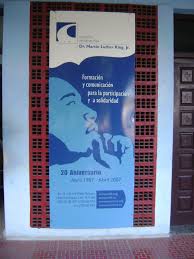
Martin Luther King, Jr. Center, Havana
In 2007 I heard directly from Rev. Raúl Suárez about the circumstances surrounding the first meeting between Cuba’s Revolutionary government and the Cuban churches. This happened when I was with a group of Westminster Presbyterian Church members from Minneapolis that visited Havana’s Martin Luther King, Jr. Center, which is affiliated with the adjacent Baptist Church, where Rev. Suárez was the pastor.
Suárez told us that in 1984 he learned that Jesse Jackson, a candidate for the Democratic nomination for President that year, was coming to Cuba. Jackson said that Fidel Castro had invited him to discuss the status of 22 U.S. citizens then being held by the Cuban Government. Jackson said that he also wanted an invitation from a Cuban church so that he could participate in a religious service in Cuba. Jackson asked Suárez, then Executive Secretary of the Cuban Council of Churches and Director of International Relations of the Cuban Baptist Church, if that would be possible. Jackson also gave Suárez a letter to provide to Castro on this issue.
Suárez then contacted Fidel, who responded that it would not be a problem even though atheism was the established “religion” in the Cuban constitution at the time.
Jackson made his trip to Cuba in June 1984 and gave a speech to 4,000 students at the University of Havana with Castro in attendance. Afterwards the two of them and their aides walked a few blocks to the nearby Methodist Church where Jackson would be preaching. As they neared the church, Suárez heard a Castro aide say to Fidel, “Take off your hat, you are close to a church.” Fidel took off his hat. Suárez was surprised by this comment and Fidel’s response. Suárez told Fidel that the people in the Plaza de Revolution (supporters of the Revolution) and the people in the church were one and welcomed Fidel to the church. Fidel said, do not ask me to preach.
There were 700 to 800 people in the church that day, including 35 church leaders and the Roman Catholic Archbishop (in 2007, a Cardinal). When Castro entered the church, the choir extemporaneously cried, “Fidel, Fidel, Fidel.” Castro did make a short speech from the pulpit with a cross behind him. (Another Cuban pastor who was present told me that Castro obviously felt uncomfortable with the Bible on the lectern and awkwardly put his hands behind his back.) Castro praised Dr. King and Jackson and said there was a need for more exchanges between the churches and the government.
Later that same day Suárez was invited to a dinner with Fidel and Jackson. This was the first time he had ever shaken Fidel’s hand, and Fidel asked him to come to the airport the next day to say goodbye to Jackson.
Soon thereafter Suárez asked for a meeting of religious leaders with Fidel and submitted to Fidel a document of concern about the official policy of atheism’s limiting the space for religion.
This resulted in a four-hour meeting between Fidel and about 14 Protestant leaders and the College of the Roman Catholic Bishops. Fidel expressed surprise at the Protestants, saying that when he was a boy in Jesuit schools, Roman Catholics disparaged Protestants. At the end of the meeting Castro made a covenant with these leaders: the churches will made an effort to understand “us” while Fidel and the Cuban Communist Party will make an effort to understand the churches. This agreement, said Fidel, should be easier for the churches than for the Party.
[1] Díaz-Canel often is seen as a potential successor to Raúl Castro as President of Cuba.
[2] The Council was founded in 1941 as “a fellowship of churches, ecumenical groups, and other ecumenical organizations which confess Jesus Christ as Son of God and Savior, according to the holy scriptures of the Old and New Testaments, and seek to respond to their common calling, to the glory of God, Father, Son, and Holy Spirit.” It gives “unity to the Christian Churches of Cuba” to facilitate cooperation with other churches around the world. Its purposes include encouraging “dialogue between different movements and institutions as a means for churches to expand their ecumenical vocation of service, thus deepening their responsibilities towards society and all of God’s creation. [The Council] also promotes study, dialogue, and cooperation among Christians to increase Christian witness and enhance life in Cuba.” Its membership now includes 22 churches, 12 ecumenical groups and centers, 3 observers and 7 fraternal associates.
The short answer to this question was remembering God by “joining the saints in worship, that ‘great cloud of witnesses’ who have gone before us.”[1] In other words, “When we gather for worship we are not alone. In liturgy the memory of those who have said the words and prayed the prayers and sung the hymns and heard the texts comes to life.”
Another answer was remembering “people . . . who had passed on the faith” to us. This was done after the sermon by hearing “the names of those from among us who have joined the communion of saints in the past year, a roll call of part of the great cloud of witnesses. They are names dear to many of us.”
The sermon also saw “All Saints’ Day . . . as the church’s collective exercise in memory-making. It began in the 8th century when Pope Gregory III declared that henceforth the first day of November would be set aside on the church calendar to offer prayers for ‘the holy apostles and…all saints, martyrs and confessors throughout the world … who are at rest.’”
“In that time there were no rules as to how one became a saint; local bishops simply conferred sainthood as they chose. Every day was another saint’s day, and it varied from town to town. The Pope wanted more order, so he declared November 1st as the day that all saints would be remembered and venerated.”
Protestants, on the other hand, “rejected the notion that some of God’s people were more holy than others and, therefore, to be venerated. Any representation of saints was deemed heretical; in 1535 John Calvin ordered all sculptures and paintings of saints in the churches of Geneva to be destroyed. The only true saints were all the followers of Jesus.”
The “basic idea that took root in the Reformation still holds: we view the ‘communion of saints’ as the heavenly equivalent of the earthly ‘priesthood of all believers.’ When we sing “For all the saints, who from their labors rest,” we sing of all those who loved God and served God in this life and have gone on before us.”[2]
‘Be Thou, triune God, in the midst of us//as we give thanks for those who have gone//from the sight of earthly eyes. They, in Thy nearer presence, still worship with us//in the mystery of the one family in heaven and on earth. If it be Thy holy will, tell them how we love them,//and how we miss them,//and how we long for the day’ when we shall meet with them again.”
=========================
[1]Hebrews 12:1-2: “Therefore, since we are surrounded by so great a cloud of witnesses, let us also lay aside every weight and the sin that clings so closely, and let us run with perseverance the race that is set before us, looking to Jesus the pioneer and perfecter of our faith, who for the sake of the joy that was set before him endured the cross, disregarding its shame, and has taken his seat at the right hand of the throne of God.”
[2] A prior post covered some of this ground in my own “musings” about saints.
Westminster Men @ ClearwaterClearwater TreesClearwater Sunset
The setting was the Presbyterian Clearwater Forest Camp and Retreat Center, which is 120 miles north of Minneapolis near Deerwood, Minnesota. In a beautiful 1,106 acres overlooking Clearwater Lake, the Center’s mission is to provide faith-building Christian programming, to provide effective facilities and services to support conferencing, to nurture active Christian community and to be the faithful steward of God’s creation at Clearwater Forest.
The passages from Acts were most meaningful for me. They discuss the community life in Jerusalem of the Jews who believed that Jesus was their Messiah. After spending much time together in the temple, they gathered together in their homes breaking bread and eating “with glad and generous’ hearts.” They also sold their possessions and distributed the proceeds to those in need.
Initially these passages said to me that this community of the first Christians was a distinct minority and needed one another’s company and support, spiritually and materially. The passages also suggest that this was a financially diverse group, thus creating a need for financial support of the poorer ones by the more affluent ones.
I also was reminded by the Acts verses of our brothers and sisters at our partner Presbyterian-Reformed congregation in Matanzas, Cuba. They are survivors of a former period of persecution and share their limited possessions with one another. On one of my trips their pastor told us that when he was unable to buy any toilet paper for our visit, he asked the members of the congregation to share whatever “TP” they had. We also bring over-the-counter medications from the U.S. to give to our partner church, which then acts as a de facto dispensary for its members and others in the neighborhood. Although our partner has its own church building that was constructed before the Revolution of 1959, newer Christian communities that do not have the money for church buildings meet in homes and are known as “house churches.”
These passages also remind me of the various utopian communities that have existed in the U.S. They shared their material resources often for religious reasons. At their best, they exhibit the same virtues of the early Christian communities discussed in Acts, but they have not been able to sustain themselves as long-term communities. At their worst, they are organizations for the self-aggrandisement of the founders of cults.
The above reactions saw the verses as relating to other times and places. On further reflection, however, I see the passages from Acts speaking to Westminster and other contemporary U.S. churches Our churches provide space and times for people of faith to gather together to renew their faith and lives and to seek forgiveness for their many failures, both individual and corporate. Moreover, just by being together in worship helps remind us all that we are not in this endeavor alone as we combat the dominant cultural emphases on materialism and secularism. Yes, we too are a minority and need support and encouragement from one another. Although we do not own all of our possessions in common today, we do respond to various calls for financial support of those in need.
Finally the retreat itself was the intentional creation of a short-term community of men. Many of us car-pooled to extend our time together on the two-hour rides to and from the Center. In our meals and times of general conversation we got to know one another at a deeper level than is usually possible when we pass one another on a Sunday in a congregation of 3,000. For example, several years ago at another men’s retreat, I became acquainted with someone for the first time and thereafter we developed a friendship.

 To fund the Cuban trip and Live CD recording, the group has announced a 60-day Kickstarter campaign with fundraising shows at Bedlam Lowertown, 213 E. 4th Street, St. Paul (March 13th), Cedar Cultural Center, 416 Cedar Avenue South, Minneapolis (March 14th) and Westminster Presbyterian Church, 1200 Marquette Avenue, Minneapolis (March 15th)