Issues of Cuban Human Rights To Be Discussed by Cuba and United States (Part III)    

On March 26 Cuba announced that the U.S. and Cuba will commence negotiations regarding human rights on March 31 in Washington, D.C.; this was covered in a prior post.

Other earlier posts covered the recent speech on this subject by Cuban Foreign Minister Bruno Rodriguez Parrilla and the U.N. Human Rights Council’s most recent Universal Periodic Review (UPR) of Cuba. Now we look at the latest U.S. State Department report on Cuban human rights (the one issued in 2014 for 2013).

Preliminarily it must be noted that this U.S. report is rather stale and it is surprising that a similar report for 2014 has not yet been released. The report for 2013 was released on February 27, 2014, and the overall report was discussed in a March 4, 2014 post and its chapter on Cuba in another March 2014 post.

In addition, a post on March 10, 2014, reviewed the implications of that report for U.S. policy regarding Cuba. This blogger saw the report’s indicating Cuba’s glass of human rights was at least half full. Or as Rev. Raúl Suárez, a Baptist pastor and head of the Martin Luther King, Jr. Center in Havana, more eloquently put it in his February 2014 briefing for the U.S. Congress: “Cuba has many problems but Cuba isn’t hell . . . . We have many good things that have been achieved [but] . . . Cuba is not the Kingdom of God.” Suárez added, “God . . . wants us [Cubans and Americans] to live like brothers and sisters.” As a result, this blogger urged reconciliation of the two countries and mentioned many of the actions to that end that started on December 17, 2014.

In any event, here is another summary of the U.S. report on Cuba for 2013. It contains many criticisms of Cuban human rights, but it also has positive comments.

Negative comments.

“Cuba is an authoritarian state led by Raul Castro, who is president of the council of state and council of ministers, Communist Party (CP) first secretary, and commander in chief of security forces. The constitution recognizes the CP as the only legal party and “the superior leading force of society and of the state.” A CP candidacy commission preapproved all candidates for the February uncontested National Assembly elections, which were neither free nor fair. The national leadership that included members of the military maintained effective control over the security forces, which committed human rights abuses against civil rights activists and other citizens alike.”

“The principal human rights abuses were abridgement of the right of citizens to change the government and the use of government threats, extrajudicial physical violence, intimidation, mobs, harassment, and detentions to prevent free expression and peaceful assembly.”

“The following additional abuses continued: harsh prison conditions, arbitrary arrest, selective prosecution, and denial of fair trial. Authorities interfered with privacy, engaging in pervasive monitoring of private communications. The government did not respect freedom of speech and press, severely restricted internet access and maintained a monopoly on media outlets, circumscribed academic freedom, and maintained significant restrictions on the ability of religious groups to meet and worship. The government refused to recognize independent human rights groups or permit them to function legally. In addition, the government continued to prevent workers from forming independent unions and otherwise exercising their labor rights.”

“Most human rights abuses were official acts committed at the direction of the government. Impunity for the perpetrators remained widespread.”

“There were credible reports that members of the security forces intimidated and sometimes physically assaulted human rights and prodemocracy advocates, dissidents, and other detainees and prisoners both during detention and while imprisoned, and they did so with impunity. Some detainees and prisoners endured physical abuse, sometimes by other inmates with the acquiescence of guards, or long periods in isolation cells.”

“Arbitrary arrest and short-term detention continued to be a common method for the government to control independent public expression and political activity. Under the criminal procedure code, police have wide discretion to stop and question citizens, request their identification, and carry out arrests and searches. The law provides that police officials provide suspects with a signed ‘act of detention,’ noting the basis, date, and location of any detention in a police facility, and a registry of personal items seized during a police search. Police officials routinely conducted extrajudicial detentions, however, often accompanied by beatings. Arbitrary stops and searches were most common in urban areas and at government-controlled checkpoints located at the entrances to provinces and municipalities. Searches and seizures of property by police officials without providing any record or legal justification were also common practice.”

“Police and security officials continued to use short-term and sometimes violent detentions to prevent independent political activity or free assembly. Such detentions generally lasted from several hours to several days. An independent domestic monitoring group, the Cuban Commission on Human Rights and Reconciliation (CCDHRN), counted 4,540 short-term detentions through October, compared with 6,602 in 2012. Long-term imprisonment of peaceful opponents, while rare, did not cease entirely. During the year authorities charged, tried, and sentenced several members of the Santiago-based opposition group Union Patriotica de Cuba (UNPACU) to prison for months or years as punishment for their political activity.”

“In addition, the law allows up to a four-year detention of individuals before they commit an actual crime, with a subjective determination of ‘potential dangerousness,’ defined as the ‘special proclivity of a person to commit crimes, demonstrated by conduct in manifest contradiction of socialist norms.’ Mostly used as a tool to control “antisocial” behaviors such as substance abuse or prostitution, authorities also used it to silence peaceful political opponents. Authorities convicted Ivan Fernandez Depestre of dangerousness and sentenced him to three years’ imprisonment for participating in a peaceful public demonstration. While there was no definitive estimate of the number of persons serving sentences for ‘potential dangerousness,’ the CCDHRN estimated that more than 3,000 citizens were held on the charge.”

“The Ministry of Interior exercises control over police, internal security forces, and the prison system. The ministry’s National Revolutionary Police is the country’s primary law enforcement organization and was moderately effective in investigating common crimes. Specialized units of the ministry’s state security branch are responsible for monitoring, infiltrating, and suppressing independent political activity. The police support state security agents by carrying out house searches, arresting persons of interest to the ministry, and providing interrogation facilities.”

“Members of the security forces acted with impunity in committing numerous, serious civil rights and human rights abuses.”

“Many state-orchestrated ‘acts of repudiation’ directed against the domestic opposition group Damas de Blanco (‘Ladies in White‘) were organized to prevent them from meeting or marching peacefully. On July 14, state security agents and affiliated groups assaulted members of the group when they left a church in Matanzas after celebrating Catholic mass, fracturing the wrist of Sonia Alvarez Campillo and breaking the ribs of her husband, Felix Navarro Rodriguez.”

Positive Comments.

The U.S. conceded that the Cuban constitution “prohibits discrimination based on race, gender, disability or social status” and that Cuban law prohibits “ abusive treatment of detainees and prisoners,” “rape, including spousal rape” (and enforces that law); and “threats and violence, including those associated with domestic violence.” Cuban law, says the U.S., also “provides penalties for sexual harassment;” accords “men and women equal rights and responsibilities regarding marriage, divorce, raising children, maintaining the home and pursuing a career;” provides “equal pay for equal work;” grants “persons with disabilities the right to equal employment opportunities and equal pay for equal work;” and prohibits “unlawful imprisonment, coercion, and extortion” although it “does not appear explicitly to prohibit forced labor.”

The U.S. report further states in 2013 that the government had centers “providing family counseling service” and “treatment for child sexual abuse victims;” that the government “actively promoted racial integration and inclusiveness;” that the government or its agents had not committed any reported arbitrary or unlawful killings or politically motivated disappearances; that there were no reported anti-Semitic acts; that there was “no societal pattern of child abuse,” no known “patterns of abuse of [children with disabilities] in educational or mental health facilities” and no discrimination officially reported or permitted based on sexual orientation in employment, housing, statelessness, or access to education or health care.”

Conclusion

It is fair to conclude that many of what the U.S. saw as negative aspects of Cuban human rights in 2013 will be raised in its forthcoming talks on the subject with Cuba.

The U.S. should approach this subject with humility and remember the U.S. immense superiority in economies and military might and the long-standing U.S. actions of hostility towards Cuba, including the following:

  • the U.S. usurpation of Cuba’s war for independence from Spain in the late 19th Century (what we in the U.S. call the “Spanish-American War“);
  • the U.S.’ making Cuba a de facto protectorate in the early 20th Century;
  • the U.S. support for the invasion of Cuba’s Bay of Pigs in 1961;
  • the U.S. threats of military action against Cuba during the pressured Cuban missile crisis of 1962;
  • the CIA’s hatching several plots to assassinate Fidel Castro when he was Cuba’s President;
  • the U.S. conduct of an embargo of Cuba over the last 50-plus years;
  • the U.S. Government’s Commission on Assistance for a Free Cuba setting forth what amounted to a U.S. blueprint for taking over Cuba; and
  • the more recent U.S. Agency for International Development (USAID) covert or “discreet” programs to promote dissent, if not regime change, on the island.

This history and the vastly superior U.S. economic and military power provide Cuba with many legitimate reasons to be afraid of the U.S. It, therefore, is understandable why Cuba has harshly treated what we call “dissidents” and what Cuba fears are or could be supporters of a U.S. takeover. And we in the U.S. should know from our own history since 9/11 that societies and governments tend to clamp down on civil liberties when they fear outside interference or attacks.


Email to President Obama Objecting to Covert or “Discreet” U.S. Government Programs Purportedly Promoting Democracy and Human Rights in Cuba

On January 7, 2015, I sent the following email to U.S. President Barack Obama with copies to Secretary of State John Kerry, Assistant Secretary of State Roberta Jacobson, Senator Amy Klobuchar, Senator Al Franken and Representative Keith Ellison.

===================================================

On December 17th I was overjoyed to hear the great news about your decision to embark upon a path of reconciliation with Cuba. That same day I sent you an email expressing my congratulations and thanks for this important decision. I also wrote the following blog posts to the same effect:

Now, however, I must express my profound disappointment in your Administration’s apparent decision to continue the covert or “discreet” USAID and other programs that purport to foster democracy and human rights on the island. It is horribly stupid and unwise to have such behind-the-back programs when the two countries are embarking on a long and complicated path for full reconciliation. As the New York Times said in October, the U.S. “should recognize that the most it can hope to accomplish is to positively influence Cuba’s evolution toward a more open society. That is more likely to come about through stronger diplomatic relations than subterfuge.” My blog post expands on these points: Rejection of Criticism of Cuban Cancellation of Open-Microphone Event and Arrests of Its Organizers (Jan. 6, 2015), .

Please, Mr. President, stop such programs as soon as possible. Instead, raise issues of democracy and human rights in direct meetings with Cuban government officials, as you have said your Administration would do.

Rejection of Criticism of Cuba’s Cancellation of Open-Microphone Event in Havana’s Plaza de la Revolución and Arrests of Its Organizers

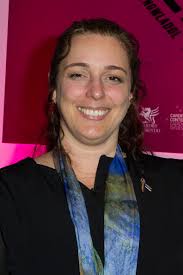
Tania Bruguera
  Tania Bruguera

On December 30th Cuban authorities cancelled an open-microphone event at Havana’s Plaza de la Revolución and detained or arrested its organizers. The principal detainee was Tania Bruguera, a Cuban citizen who lives on the island and in Miami, Florida and who is a performance artist. She intended to provide an open-microphone for any attendee to give a one-minute statement on his or her opinions and recommendations for Cuba’s future.

This cancellation and related arrests have provoked strong condemnation from the U.S. Department of State and major U.S. newspapers. Initially I was persuaded by such condemnations and worried that they would foster U.S. political resistance to recent U.S.-Cuba reconciliation. After further investigation, however, I have come to reject such harsh condemnations. In order to understand this conclusion, this post will examine what happened in Havana, the reactions from the State Department and western newspapers and then the reasons why I reject such condemnations.

Cuban Events Relating to the Open-Mike Performance[1]

Plaza_de_la_Revolution

Plaza3

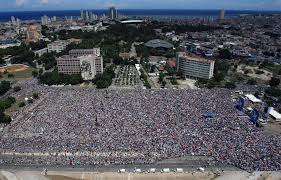
On December 30th Cuban performance artist Tania Bruguera was planning to stage an open-microphone event, “Yo tambien exijo,” [I also demand],” in Havana’s Plaza de la Revolución, the huge public square usually reserved for large government-sponsored events.[2] (The photo on the top shows an empty Plaza while the other one has a large crowd in attendance.) She planned to give any attendee a one-minute platform to discuss his or her opinions about, and recommendations for, Cuba’s future. She told the U.S. National Public Radio that she wanted “people in the street [to] come and share . . . [their] doubts, [their] happiness – whatever [they] think right now about what is happening in Cuba, and what is the idea of Cuba that [they] want?”

Bruguera was proceeding with these plans even though her application for a permit had been denied and even though the Government’s National Fine Arts Council had told her that it would not be providing her with institutional support for the event as proposed because it “would negatively impact public opinion, in a key time of negotiation between the Cuban government and the government of the United States.”

On December 30th the Council issued a public statement documenting its decision not to support the event. It said, “Under current circumstances, it is unacceptable performing this purported performance in the symbolic space of the Plaza of the Revolution, especially considering the extensive media coverage and manipulation that has been in the media broadcasters counterrevolution.”

The Council, however, also stated that Bruguera had rejected its suggestions on conducting the event subject to the following conditions: (a) move the event to the National Museum of Fine Arts, a prestigious cultural institution in the field of visual arts; (b) the Museum would be freely open to diverse people of dissimilar social sectors; (c) the government would “reserve the right” to bar people whose “sole interest is to be provocative;” and (d) the performance would be limited to 90 minutes.

Just hours before the planned event, Cuban police detained, on public disorder charges, Bruguerea and at least three leading dissidents: Antonio Rodiles, the head of Citizens Demand for Another Cuba; Eliezer Avila, the leader of the opposition group Somos Mas; and Reinaldo Escobar, a senior editor of a dissident website 14medio.com. Escobar’s spouse, Blogger Yoani Sanchez, was also detained at her home by police. There were reports that up to 50 members of the political opposition were detained.

Ms. Bruguera was released the next afternoon along with most of the political dissidents. She then announced she would hold a news conference and public gathering on the Malecón, Havana’s coastal highway, at the memorial to the Maine, the American battleship that sank in Havana Harbor in 1898. Cuban agents, however, stopped her en route to the gathering and took her away for interrogation. She was told she could not leave Cuba “for two or three months” while the case was being processed. Again she was released.

However, on January 1, 2015, she was arrested again along with several dissidents when they went to a jail to demand the release of 15 additional dissidents who had been arrested on the day of the planned event. The next day (January 2) she was released.

Reactions to the Cancelation and Arrests

On December 30th, the U.S. Department of State issued a Press Statement saying the U.S. was “deeply concerned about the latest reports of detentions and arrests by Cuban authorities of peaceful civil society members and activists . . . [and] strongly condemn[ed] the Cuban government’s continued harassment and repeated use of arbitrary detention, at times with violence, to silence critics, disrupt peaceful assembly and freedom expression, and intimidate citizens.”

The Statement added, “Freedoms of expression and peaceful assembly are internationally recognized human rights, and the Cuban government’s lack of respect for these rights, as demonstrated by today’s detentions, is inconsistent with Hemispheric norms and commitments. We urge the Government of Cuba to end its practice of repressing these and other internationally protected freedoms and to respect the universal human rights of Cuban citizens.”

The Statement concluded that the U.S. has “always said we would continue to speak out about human rights, and as part of the process of normalization of diplomatic relations, the United States will continue to press the Cuban government to uphold its international obligations and to respect the rights of Cubans to peacefully assemble and express their ideas and opinions, just like their fellow members of civil society throughout the Americas are allowed to do.”

Also on December 30th Assistant Secretary of State Roberta Jacobson tweeted “Freedom of expression remains core of US policy on #Cuba; we support activists exercising those rights and condemn today’s detentions.”

These views were shared by the New York Times’ December 30th editorial, “Cuba Turns Off Critics’ Open Mike.” It said, “By stifling critical voices, the Cuban government is showing its unwillingness to tolerate basic freedoms most citizens in the hemisphere enjoy.”

The Times’ editorial continued, “This move, unfortunately, will amplify the criticisms of those who opposed Mr. Obama’s historic shift on Cuba policy. Heavy-handed tactics by the Castro government will give them ammunition next year, when Republicans will control both chambers of Congress, to stymie the Obama administration’s steps to ease the embargo through executive authority and dim the prospects of legislative change to pare back the web of sanctions Washington imposes on Cuba. That result would be a shame and, in the long run, self-defeating for Havana.”

The editorial on the same subject by the Washington Post, which earlier opposed the December 17th reconciliation, was in the same vein. It stated, “[T]he Castro regime has been left free to continue stifling dissent, while reaping the economic and political benefits of Mr. Obama’s ‘engagement.’ Raúl Castro declared in a speech shortly after the agreement was announced that the Communist political system would remain unchanged. Two weeks later, not one of the 53 political prisoners the White House said would be freed — about half of the total identified by human rights activists — has been reported released.”

The Washington Post editorial concluded, “Cubans who seek basic freedoms continue to be arrested, harassed and silenced, while the regime celebrates what it portrays as ‘victory’ over the United States. If support for the Cuban people and American values is supposed to be the point of this process, then it is off to a very poor start.”

People opposed to the resumption of relations with Cuba were quick to hold up the arrests as a sign that the Castro government had no intention of pursuing political change and would reap only economic benefits from Mr. Obama’s moves. For example, Senator Marco Rubio, Republican of Florida and a Cuban-American, tweeted, “Castro govt. arrests of activists in #Havana exposes the folly of new Obama #CubaPolicy.”

Rejection of the Condemnation

As a long-time member of the American Civil Liberties Union and as a pro bono attorney in one of its important free speech cases, I am a strong believer in the importance of free speech. Therefore, I initially concurred in the State Department and New York Times’ condemnation of Cuba’s cancellation of this event and related arrests, and I worried that this controversy might cause the U.S. to abandon the recently announced U.S.-Cuba reconciliation.

On the other hand, I was and continue to be troubled by the State Department and most of the articles about this event not mentioning the Cuban Fine Arts Council’s willingness to support the event in another location and with certain limits. This action by the Arts Council suggests at a minimum that the State Department and western media are over-reacting to these events and unfairly rushing to judgment.

These U.S. critics also forget that governmental authorities in the U.S. sometimes determine that it is not appropriate to stage a protest at a particular time and place. It just happened in my home state of Minnesota at the Mall of America (MOA) on a big shopping day (December 20th). Although MOA officials had told the organizers that it was against its policies for them to hold a “Black Lives Matter” protest at the Mall on that day,[3] they did so anyway as this video shows. After 2,000 to 3,000 protesters flooded a Mall rotunda and held “die-ins” in front of several nearby businesses, riot-gear-clad police officers arrested 25 for trespass, peacefully dispersed the crowd and tried to block people from re-entering the rotunda. Afterwards the local city attorney announced plans “to file additional charges against ‘ringleaders’ of the protest and to seek restitution for the costs of 250 police at the event and lost sales during the two to three hours when more than 75 stores in the mall were closed.” On January 5th some of the protesters spoke against such prosecution at a city council meeting. This story obviously is not yet over.

In addition, there is a report that raises the much more serious question of whether the event was an idea of Cubans acting by themselves. According to the Wall Street Journal, an opponent of reconciliation with Cuba, at the scheduled time for the event, “Cuban cellphones received mysterious messages from a Florida area code offering cheap beer to all those gathering on the plaza.” This was confirmed in an interview by U.S. National Public Radio with Marc Frank, a U.S. journalist who was one of about a dozen people at the Plaza at the time of the planned event. He said, “text messages were sent from somewhere in Miami to a lot of cell phones here, including mine, basically saying that there’s going to be an event at the Plaza de la Revolución, and there’d be free beer.” Frank added that “Tania is an artist, lives some in Cuba and mainly in Miami, . . . [but] she’s not really well-known in Cuba at all.”[4]

These messages about free beer in the Plaza from a Miami telephone number raise the question of whether the event was actually being planned by the U.S. Agency for International Development (USAID) or another U.S. government agency or by Cuban-Americans opposed to the reconciliation of the two countries.

As discussed in prior posts, USAID (U.S. Agency for International Development) had funded via a private contractor at least three covert (or as the agency prefers to say “discreet”) programs in Cuba to promote civil society and dissent or regime change, all without the prior knowledge or consent of the Cuban government. One was for U.S. citizen Alan Gross to take communications equipment to Cuba, for which he was arrested, convicted and imprisoned in Cuba for violating its laws.[5] Another such USAID program via a private contractor unsuccessfully tried to create a Cuban social media program Yet another used Central Americans to promote purported HIV informational efforts on the island. The final one that has been discovered so far by journalists again via a private contractor attempted to infiltrate the Cuban rap-artist community.

These USAID programs were sharply criticized in a November New York Times editorial, as discussed in an earlier post. The editorial said, ““Far from accomplishing . . . the goal [of instigating democratic reforms on the island], the initiatives have been largely counterproductive. The funds have been a magnet for charlatans, swindlers and good intentions gone awry. The stealthy programs have increased hostility between the two nations, provided Cuba with a trove of propaganda fodder and stymied opportunities to cooperate in areas of mutual interest.”

Instead, the Times’ November editorial argued, “The United States should strive to promote greater freedoms on the island of 11 million people and loosen the grip of one of the most repressive governments in the world. Instead of stealth efforts to overthrow the government, American policy makers should find ways to empower ordinary Cubans by expanding study-abroad programs, professional exchanges and investment in the new small businesses cropping up around the island. They should continue to promote Internet connectivity, but realize that accomplishing that goal on a large scale will require coordination with the Cuban government.” Moreover, “Washington should recognize that the most it can hope to accomplish is to positively influence Cuba’s evolution toward a more open society. That is more likely to come about through stronger diplomatic relations than subterfuge.”

Perhaps the Times forgot this editorial when it more recently lambasted the Cuban actions over the “open-microphone” event.

In any event, the U.S. government apparently has not learned the lesson outlined by the Times in October because the USAID website, which says it was last updated on December 16 (the day before the announcement of U.S.-Cuba reconciliation), still contains general information about its Cuba programs to “[p]romote human rights and fundamental freedoms.”

In addition, on December 22, 2014 (five days after that announcement), the U.S. Department of State’s Bureau of Democracy, Human Rights and Labor issued a Public Notice of its “Request for Statements of Interest: Program Fostering Civil, Political and Labor Rights in Cuba.” The Bureau’s prospective funding of $11 million would be used for typically funded proposals, the Bureau said, like “[o]rganizational assistance to Cuban civil society to improve management, strategic planning, sustainability, and collaboration of local civil society groups; [o]ff-island trainings, short-term fellowships, or engagement; [d]istribution of software that would be easily accessible in an open society; . . . [and] ]a]ssistance mechanisms designed to provide independent Cuban civil society with tools, opportunities, and trainings that civil society counterparts in open societies can access.”

Both the USAID and State Department statements read as if they are promoting programs in Cuba without the knowledge, cooperation or agreement of the Cuban government. This is contrary to President Obama’s statement in his nationally televised speech on December 17th, in which he said the U.S. would “raise those differences [with the Cuban government] directly . . .[such as] democracy and human rights in Cuba. But I believe we can do more to support the Cuban people and promote our values through engagement [with the Cuban government].” He added, “no Cubans should face harassment or arrest or beatings simply because they’re exercising a universal right to have their voices heard, and we will continue to support civil society there.”

Similar thoughts were expressed the same day in the White House’s FACT SHEET: Charting a New Course on Cuba.” It said, “We know from hard-learned experience that it is better to encourage and support reform than to impose policies that will render a country a failed state.” It also stated, “The Administration will continue to implement U.S. programs aimed at promoting positive change in Cuba, and we will encourage reforms in our high level engagement with Cuban officials.”

Although President Obama apparently was talking about encouraging the Cuban government to expand the Cuban people’s rights to express different opinions on what their government should do, a prior post shows some ambiguity in these statements that could allow the continuation of the USAID and State Department’s covert or “discreet” efforts to promote regime change.

If the open-microphone event, in fact, was orchestrated by USAID or some other U.S. government agency, it is Orwellian. Such programs purport to promote democracy and human rights with undemocratic and non-human rights means. Such programs are publicly mentioned—in very general terms—on U.S. government websites yet are conducted covertly or “discreetly” on the island. Such programs are hostile to a country with which the U.S. purportedly is attempting to build a normal and respectful diplomatic relationship. These programs also logically motivate Cuban authorities to be vigilant in reacting to events like the “open-microphone” one.

In other words it is horribly stupid and unwise to have such behind-the-back programs when the two countries are embarking on a long and complicated path for full reconciliation. As the New York Times said in November, the U.S. “should recognize that the most it can hope to accomplish is to positively influence Cuba’s evolution toward a more open society. That is more likely to come about through stronger diplomatic relations than subterfuge.”

===========================================================

[1] This account of the planned event and the arrests by the Cuban government is based on articles in the New York Times, Washington Post, Wall Street JournalGuardian, Los Angeles Times,  National Public Radio, the Cuban Fine Arts Council and again the New York Times.

[2] The Plaza is the 31st largest public square in the world; it measures 72,000 square meters (774,936 square feet) and has been the site for crowds of 1 million for major speeches by Fidel Castro and for a mass celebrated by Pope John Paul II. The idea that the open-microphone event might create such a large crowd should have been seen as ridiculous by everyone, including the Cuban authorities, and a small gathering like the 12 or so that showed up on the 30th would have demonstrated the over-reaction of the those authorities in shutting it down and the State Department and western media in attacking the shut-down.

[3] Before the protest the local city (Bloomington) sent a letter to the protest organizers warning that the city would enforce the mall’s private-property rights under the authority of a Minnesota Supreme Court decision that held the MOA was a private entity with the right to exclude demonstrators.

[4] The Director of Security Operations at Telecommunications Company of Cuba reported that since December 21st Cuba had been receiving electronic messages calling for participation in an event with Tania Bruguera. These messages came from a platform “Wake Cuba,and these messages were similar to previous ones paid for by USAID.  Another Cuban source states that some Cuban email addresses were hacked and used to send emails to Cubans about this event.

[5] Gross on December 17th was released from Cuban prison and returned to the U.S.

Additional Details About White House’s Announcement of U.S.-Cuba Reconciliation

White House
White House

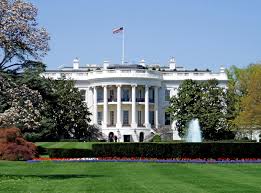
On December 17, 2014, President Barack Obama in a nationally televised speech announced the historic agreement with Cuba to restore diplomatic relations as one part of a reconciliation with Cuba. That same day the White House website had (a) “FACT SHEET: Charting a New Course in Cuba;” (b) “Background Conference Call on Policy Changes in Cuba and Release of Alan Gross;” and (c) “Readout of the Vice President’s Calls to the Presidents of Colombia and Mexico on the Administration’s Cuba Policy Changes.”

After reviewing these documents, the post will conclude with observations on some of the points raised in these documents.

“FACT SHEET: Charting a New Course in Cuba”

The introduction to the FACT SHEET, among other things, said, “It is clear that decades of U.S. isolation of Cuba have failed to accomplish our enduring objective of promoting the emergence of a democratic, prosperous, and stable Cuba. . . . It does not serve America’s interests, or the Cuban people, to try to push Cuba toward collapse.  We know from hard-learned experience that it is better to encourage and support reform than to impose policies that will render a country a failed state.  With our actions today, we are calling on Cuba to unleash the potential of 11 million Cubans by ending unnecessary restrictions on their political, social, and economic activities.” (Emphasis added.)

The FACT SHEET then provided the following “Key Components of the Updated Policy Approach:”

“Establishing diplomatic relations with Cuba-

  • The President has instructed the Secretary of State to immediately initiate discussions with Cuba on the re-establishment of diplomatic relations with Cuba, which were severed in January 1961.
  • In the coming months, we will re-establish an embassy in Havana and carry out high-level exchanges and visits between our two governments as part of the normalization process.  As an initial step, the Assistant Secretary of State for Western Hemisphere Affairs will lead the U.S. Delegation to the next round of U.S.-Cuba Migration Talks in January 2015, in Havana.
  • U.S. engagement will be critical when appropriate and will include continued strong support for improved human rights conditions and democratic reforms in Cuba and other measures aimed at fostering improved conditions for the Cuban people. (Emphasis added.)
  • The United States will work with Cuba on matters of mutual concern and that advance U.S. national interests, such as migration, counternarcotics, environmental protection, and trafficking in persons, among other issues.” (Emphasis added.)

“Adjusting regulations to more effectively empower the Cuban people-

  • The changes announced today will soon be implemented via amendments to regulations of the Departments of the Treasury and Commerce.   Our new policy changes will further enhance our goal of empowering the Cuban population.
  • Our travel and remittance policies are helping Cubans by providing alternative sources of information and opportunities for self-employment and private property ownership, and by strengthening independent civil society. 
  • These measures will further increase people-to-people contact; further support civil society in Cuba; and further enhance the free flow of information to, from, and among the Cuban people.  Persons must comply with all provisions of the revised regulations; violations of the terms and conditions are enforceable under U.S. law.”

“Facilitating an expansion of travel under general licenses for the 12 existing categories of travel to Cuba authorized by law-

  • General licenses will be made available for all authorized travelers in the following existing categories: (1) family visits; (2) official business of the U.S. government, foreign governments, and certain intergovernmental organizations; (3) journalistic activity; (4) professional research and professional meetings; (5) educational activities; (6) religious activities; (7) public performances, clinics, workshops, athletic and other competitions, and exhibitions; (8) support for the Cuban people; (9) humanitarian projects; (10) activities of private foundations or research or educational institutes; (11) exportation, importation, or transmission of information or information materials; and (12) certain export transactions that may be considered for authorization under existing regulations and guidelines. 
  • Travelers in the 12 categories of travel to Cuba authorized by law will be able to make arrangements through any service provider that complies with the U.S. Treasury’s Office of Foreign Assets Control (OFAC) regulations governing travel services to Cuba, and general licenses will authorize provision of such services. 
  • The policy changes make it easier for Americans to provide business training for private Cuban businesses and small farmers and provide other support for the growth of Cuba’s nascent private sector.  Additional options for promoting the growth of entrepreneurship and the private sector in Cuba will be explored.”

Facilitating remittances to Cuba by U.S. persons

  • Remittance levels will be raised from $500 to $2,000 per quarter for general donative remittances to Cuban nationals (except to certain officials of the government or the Communist party); and donative remittances for humanitarian projects, support for the Cuban people, and support for the development of private businesses in Cuba will no longer require a specific license.
  • Remittance forwarders will no longer require a specific license.”

“Authorizing expanded commercial sales/exports from the United States of certain goods and services-

  • The expansion will seek to empower the nascent Cuban private sector.  Items that will be authorized for export include certain building materials for private residential construction, goods for use by private sector Cuban entrepreneurs, and agricultural equipment for small farmers.  This change will make it easier for Cuban citizens to have access to certain lower-priced goods to improve their living standards and gain greater economic independence from the state.”

“Authorizing American citizens to import additional goods from Cuba-

  • Licensed U.S. travelers to Cuba will be authorized to import $400 worth of goods from Cuba, of which no more than $100 can consist of tobacco products and alcohol combined.”

Facilitating authorized transactions between the United States and Cuba-

  • U.S. institutions will be permitted to open correspondent accounts at Cuban financial institutions to facilitate the processing of authorized transactions.
  • The regulatory definition of the statutory term “cash in advance” will be revised to specify that it means “cash before transfer of title”; this will provide more efficient financing of authorized trade with Cuba.
  • U.S. credit and debit cards will be permitted for use by travelers to Cuba.
  • These measures will improve the speed, efficiency, and oversight of authorized payments between the United States and Cuba.”

“Initiating new efforts to increase Cubans’ access to communications and their ability to communicate freely-

  • Cuba has an internet penetration of about five percent—one of the lowest rates in the world.  The cost of telecommunications in Cuba is exorbitantly high, while the services offered are extremely limited.
  • The commercial export of certain items that will contribute to the ability of the Cuban people to communicate with people in the United States and the rest of the world will be authorized.  This will include the commercial sale of certain consumer communications devices, related software, applications, hardware, and services, and items for the establishment and update of communications-related systems.
  •  Telecommunications providers will be allowed to establish the necessary mechanisms, including infrastructure, in Cuba to provide commercial telecommunications and internet services, which will improve telecommunications between the United States and Cuba.”

“Updating the application of Cuba sanctions in third countries-

  • U.S.-owned or -controlled entities in third countries will be generally licensed to provide services to, and engage in financial transactions with, Cuban individuals in third countries.  In addition, general licenses will unblock the accounts at U.S. banks of Cuban nationals who have relocated outside of Cuba; permit U.S. persons to participate in third-country professional meetings and conferences related to Cuba; and, allow foreign vessels to enter the United States after engaging in certain humanitarian trade with Cuba, among other measures.”

“Pursuing discussions with the Cuban and Mexican governments to discuss our unresolved maritime boundary in the Gulf of Mexico-

  • Previous agreements between the United States and Cuba delimit the maritime space between the two countries within 200 nautical miles from shore.  The United States, Cuba, and Mexico have extended continental shelf in an area within the Gulf of Mexico where the three countries have not yet delimited any boundaries.
  • The United States is prepared to invite the governments of Cuba and Mexico to discuss shared maritime boundaries in the Gulf of Mexico”

“Initiating a review of Cuba’s designation as a State Sponsor of Terrorism-

  • The President has instructed the Secretary of State to immediately launch such a review, and provide a report to the President within six months regarding Cuba’s support for international terrorism.  Cuba was placed on the list in 1982.”[1]

“Addressing Cuba’s participation in the 2015 Summit of the Americas in Panama-

  • President Obama will participate in the Summit of the Americas in Panama.  Human rights and democracy will be key Summit themes.  Cuban civil society must be allowed to participate along with civil society from other countries participating in the Summit, consistent with the region’s commitments under the Inter-American Democratic Charter.  The United States welcomes a constructive dialogue among Summit governments on the Summit’s principles.” (Emphasis added.)

“Unwavering Commitment to Democracy, Human Rights, and Civil Society

A critical focus of our increased engagement will include continued strong support by the United States for improved human rights conditions and democratic reforms in Cuba.  The promotion of democracy supports universal human rights by empowering civil society and a person’s right to speak freely, peacefully assemble, and associate, and by supporting the ability of people to freely determine their future.   Our efforts are aimed at promoting the independence of the Cuban people so they do not need to rely on the Cuban state. (Emphasis added.)

The U.S. Congress funds democracy programming in Cuba to provide humanitarian assistance, promote human rights and fundamental freedoms, and support the free flow of information in places where it is restricted and censored.  The Administration will continue to implement U.S. programs aimed at promoting positive change in Cuba, and we will encourage reforms in our high level engagement with Cuban officials. (Emphasis added.)

The United States encourages all nations and organizations engaged in diplomatic dialogue with the Cuban government to take every opportunity both publicly and privately to support increased respect for human rights and fundamental freedoms in Cuba. 

Ultimately, it will be the Cuban people who drive economic and political reforms.  That is why President Obama took steps to increase the flow of resources and information to ordinary Cuban citizens in 2009, 2011, and today.  The Cuban people deserve the support of the United States and of an entire region that has committed to promote and defend democracy through the Inter-American Democratic Charter.”

Background Conference Call 

On December 17 two hours before President Obama’s speech to the nation, the White House conducted an hour-long “background” conference call with journalists and seven unnamed senior administration officials regarding these matters.

Among other things, one of the officials said the U.S. expects that “we’ll continue to have strong differences, particularly on issues related to democracy and human rights.  The [U.S.] will continue to promote our values.  We will continue to support civil society in Cuba.  We’ll continue our democracy programming.” In President Obama’s December 16th telephone call with President Raúl Castro, Obama “made clear his intent . . . to continue our advocacy for human rights in Cuba.”

A State Department official stated the U.S. would not reduce its “emphasis on human rights, on democracy, on the importance of civil society. . . . In fact, our emphasis on human rights will be just as strong and we believe more effective under this policy.  We will engage directly with the Cuban government on human rights.”

For example, the State Department official stated a U.S. diplomat in Havana “will be meeting with members of Cuban society and dissidents later today to walk them through the President’s initiatives of today, and to emphasize to them, as well, that their efforts on behalf of democracy and human rights in Cuba not only won’t be forgotten in these initiatives, but will, in fact, take center stage.”

In response to a question as to whether there were discussions with Cuba about “USAID programs that have been pretty controversial in Cuba,” an administration official said U.S. “democracy programming . . . did factor into the discussions [with Cuba].  The Cubans do not like our democracy programming.  They consistently protest those initiatives. . . . [The U.S., however,] made clear that we’re going to continue our support for civil society for the advancement of our values in Cuba.  [This] . . . was an issue of difference that we will continue to have with Cuba, and we fully expect them to raise those issues just as we will raise issues with the Cubans about democracy and human rights.  However, we’re going to do that through a normal relationship.  We’re going to do that through our embassy in Havana.  We’re going to do that through contacts between our various agencies.”[2]

Vice President Biden’s Telephone Calls with Presidents of Colombia and Mexico

The White House reported that Vice President Joe Biden made telephone calls about the new initiatives with Cuba  to President Juan Manuel Santos of Colombia and to President Enrique Pena Nieto of Mexico. After outlining the agreement, Biden told each of them that President Obama intended to attend the Summit of the Americas in Panama next April “as long as Cuban civil society is allowed to participate and human rights and democracy are on the agenda.” In the call to President Nieto, Biden said that the U.S. would initiate discussions with Cuba and Mexico about the unresolved maritime boundary of the Gulf of Mexico.

Conclusion

I concur in most of the FACT SHEET’s assertions about democracy and human rights that suggest that the U.S. will engage and work with the Cuban government to improve the Cuban people’s political, social and economic rights and that the U.S. no longer will seek to impose such rights or values on the Cuban people through covert or “discreet” programs. These statements are the following:

  • (i)  “It does not serve America’s interests, or the Cuban people, to try to push Cuba toward collapse.  We know from hard-learned experience that it is better to encourage and support reform than to impose policies that will render a country a failed state.  With our actions today, we are calling on Cuba to unleash the potential of 11 million Cubans by ending unnecessary restrictions on their political, social, and economic activities.”
  • (ii)  “U.S. engagement will be critical when appropriate and will include continued strong support for improved human rights conditions and democratic reforms in Cuba and other measures aimed at fostering improved conditions for the Cuban people.”
  • (iii) “A critical focus of our increased engagement will include continued strong support by the United States for improved human rights conditions and democratic reforms in Cuba.  The promotion of democracy supports universal human rights by empowering civil society and a person’s right to speak freely, peacefully assemble, and associate, and by supporting the ability of people to freely determine their future.   Our efforts are aimed at promoting the independence of the Cuban people so they do not need to rely on the Cuban state.”
  • (iv) The U.S. “will encourage [such] reforms in our high level engagement with Cuban officials.”

Other statements in the FACT SHEET, however, seems to undercut this benign interpretation: (i) “The U.S. Congress funds democracy programming in Cuba to provide humanitarian assistance, promote human rights and fundamental freedoms, and support the free flow of information in places where it is restricted and censored.  The Administration will continue to implement U.S. programs aimed at promoting positive change in Cuba. . . .” (ii) “The U.S. Congress funds democracy programming in Cuba to provide humanitarian assistance, promote human rights and fundamental freedoms, and support the free flow of information in places where it is restricted and censored.  The Administration will continue to implement U.S. programs aimed at promoting positive change in Cuba.” [3]

According to the FACT SHEET, “President Obama will participate in the Summit of the Americas in Panama.  Human rights and democracy will be key Summit themes.  Cuban civil society must be allowed to participate along with civil society from other countries participating in the Summit.” The account of the Vice President’s telephone calls, however, seems to add that President Obama intends to attend the Summit of the Americas in Panama next April “as long as Cuban civil society is allowed to participate and human rights and democracy are on the agenda.” I was surprised and disappointed to read that there was a precondition to Obama’s attending the summit: Cuba’s allowing members of its civil society to attend and participate in the Summit. While it may be a good idea to have civil society representatives from all countries, including Cuba, attend and participate, I think it unwise for the U.S. to provide Cuba with a veto on Obama’s attendance if it does not have such representatives there. I hope that this interpretation of the Vice President’s remarks is unfounded.

I am unaware of the details of the dispute about the maritime boundaries of the Gulf of Mexico, but assume that it relates to oil or other resources under the Caribbean.

================================================

[1] Prior posts discussed the legal and political issues of rescinding the designation of Cuba as a “State Sponsor of Terrorism” and the U.S.’ previous concessions that Cuba has provided assurances that it will not commit future acts of terrorism.

[2] On December 20th Secretary of State John Kerry, Secretary of Commerce Penny Pritzker and Treasury Secretary Jacob J. Lew co-authored an article in the Miami Herald. It said the U.S. would have “continued strong support for improved human-rights conditions and democratic reforms in Cuba” and would “continue to implement programs to promote positive change in Cuba.”

[3] The previous democracy/human rights programs of the U.S. Agency for International Development (USAID) and the Department of State will be part of a subsequent post about the recent controversy about Cuba’s cancellation of n “open-microphone” event and arrests of its organizers.

New York Times Criticizes USAID’s Efforts To Promote Regime Change in Cuba

On November 10, 2014, the New York Times published its latest editorial in its series “Cuba: A New Start.”[1] Under the title, “In Cuba, Misadventures in Regime Change,” this editorial focuses on criticizing the efforts by the U.S. Agency for International Development (USAID) to promote regime change in Cuba and recommending “stronger [U.S.] diplomatic relations” with Cuba as a more productive way to try “to positively influence Cuba’s evolution toward a more open society.”

The editorial also recommends that the U.S. “should find ways to empower ordinary Cubans by expanding study-abroad programs, professional exchanges and investment in the new small businesses cropping up around the island. [The U.S.] should continue to promote Internet connectivity, but realize that accomplishing that goal on a large scale will require coordination with the Cuban government.”

The editorial’s foundation is the following set of documented factual assertions:

  • In 1996, the U.S. enacted the Helms-Burton Act that spelled out “a strategy to overthrow the government in Havana and ‘assist the Cuban people in regaining their freedom.’”This statute “has served as the foundation for the $264 million the United States has spent in the last 18 years trying to instigate democratic reforms on the island.”
  • “During the final years of the Clinton administration, the [U.S.] spent relatively little on programs in Cuba under . . . [this statute].”
  • That changed when George W. Bush came to power in 2001 with an ambitious aim to bring freedom to oppressed people around the world.” USAID, “better known for its humanitarian work than cloak-and-dagger missions, became the primary vehicle for pro-democracy work in Cuba, where it is illegal.”
  • “In the early years of the [George W.] Bush administration, spending on initiatives to oust the [Cuban]government surged from a few million a year to more than $20 million in 2004. Most contracts were awarded, without much oversight, to newly formed Cuban-American groups. One used funds on a legally questionable global lobbying effort to persuade foreign governments to support America’s unpopular embargo. Other grantees sent loads of comic books to the American diplomatic mission in Havana, bewildering officials there. The money was also used to buy food and clothes, but there was no way to track how much reached relatives of political prisoners, the intended recipients.”
  • “According to a November 2006 report by the Government Accountability Office, one contractor used the pro-democracy money to buy ‘a gas chain saw, computer gaming equipment and software (including Nintendo Game Boys and Sony PlayStations), a mountain bike, leather coats, cashmere sweaters, crab meat and Godiva chocolates,’ purchases . . . [the contractor] was unable to justify to auditors.”
  • “The G.A.O. probe led . . . [USAID] to start awarding more funds to established development organizations, including some that pitched bold initiatives. In 2008, Congress appropriated $45 million for the programs, a record amount.”
  • In December 2009 Alan Gross, a U.S. citizen, went on his fifth trip to the island posing as a tourist but acting on behalf of an USAID contractor to smuggle communications equipment to Jewish groups in Cuba. Gross was arrested, charged and convicted by a Cuban court for violating Cuban law and sentenced to 15 years of imprisonment.[2]
  • “At the time [of Gross’ arrest], many senior State Department officials were not fully aware of the scope and nature of the covert programs, . . . and some argued that the covert programs were counterproductive and should be stopped. But Cuban-American lawmakers fought vigorously to keep them alive.”
  • “After Mr. Gross’s arrest, [USAID] . . . stopped sending American [citizens] into Cuba, but it allowed its contractors to recruit Latin Americans for secret missions that were sometimes detected by the Cuban intelligence services.”
  • “An investigation by The Associated Press published in April [2014] revealed . . . [that between] 2009 and 2012, Creative Associates International, a Washington firm, built a rudimentary text messaging system similar to Twitter, known as ZunZuneo, Cuban slang for a hummingbird’s tweet. It was supposed to provide Cubans with a platform to share messages with a mass audience, and ultimately be used to assemble ‘smart mobs.’” Although the contractor paid “text-messaging fees to the Cuban telecommunications company, [the contractor] never found a way to make the platform self-sustaining.”[3]
  • A second A.P. report revealed in August [2014] that U.S.A.I.D. had been sending young Latin Americans to Cuba to identify ‘potential social change actors,’ under the pretext of organizing gatherings like an H.I.V. prevention workshop. The contractors, also hired by Creative Associates, received quick pointers on how to evade Cuban intelligence and were paid as little as $5.41 an hour for work that could have easily landed them in prison.”[4]
  • Although the “American money has provided food and comfort to some relatives of political prisoners, and been used to build limited access to satellite-based Internet connections, . . . it has done more to stigmatize than to help dissidents.”
  • “Far from accomplishing . . . the goal [of instigating democratic reforms on the island], the initiatives have been largely counterproductive. The funds have been a magnet for charlatans, swindlers and good intentions gone awry. The stealthy programs have increased hostility between the two nations, provided Cuba with a trove of propaganda fodder and stymied opportunities to cooperate in areas of mutual interest.”

As previous posts to this blog have discussed, I concur in this editorial’s criticisms of the USAID covert efforts to promote regime change in Cuba and the editorial’s recommendations for changes in U.S. policies regarding the island nation.

I take exception, however, to the editorial’s unexamined assertion that Cuba has “one of the most repressive governments in the world.” Although I am confident that Cuba ideally should have a more open society and hope that it continues to move in that direction, all of us in the U.S. should try to put ourselves in the shoes of the Cubans.

For decades the immensely more powerful U.S. has openly engaged in hostile policies and actions against the small, poor and militarily weak island. This includes the U.S.-supported and unsuccessful 1961 “Bay of Pigs” invasion of Cuba; the threatened U.S. bombing and invasion of Cuba in the 1962 Cuban missile crisis; the recently revealed 1976 military plans to “clobber” Cuba that were being prepared by U.S. Secretary of State Henry Kissinger; the half-century U.S. embargo of Cuba; and the very USAID covert efforts to promote regime change in Cuba that are discussed in this editorial. If we in the U.S. were in this situation, we too would, I am confident, impose restrictions on an open society. Have we not done this very thing in our response to the 9/11 attacks and the threats of international terrorism?

As I said in an earlier post about U.S. policies regarding Cuba, all of us should remember that when the scribes and Pharisees confronted Jesus with a woman who had been caught in the act of adultery and asked Jesus what he had to say when the law of Moses said stone her, Jesus responded, “Let anyone among you who is without sin be the first to throw a stone at her.” (John 8:3-7)

Likewise, the President and all of us should also remember these other words of Jesus (Matthew 7:1-5):

  • “Do not judge, so that you may not be judged. For with the judgment you make you will be judged, and the measure you give will be the measure you get. Why do you see the speck in your neighbor’s eye, but do not notice the log in your own eye?  Or how can you say to your neighbor, ‘Let me take the speck out of your eye,’ while the log is in your own eye? You hypocrite, first take the log out of your own eye, and then you will see clearly to take the speck out of your neighbor’s eye.”

======================================================

[1] Prior posts have discussed the recent Times’ editorials urging U.S.-Cuba reconciliation, commending Cuba’s efforts to combat Ebola in West Africa, recognizing changes in U.S. public opinion about Cuba and recommending an U.S.-Cuba prisoner exchange.

[2] An earlier Times editorial urged the U.S. and Cuba negotiate an exchange of Mr. Gross for three Cubans in U.S. prisons.

[3] Prior posts to this blog on April 4,  9 and 9, 2014, discussed the AP investigation of the USAID social media program.

[4] Prior posts (August 12, 13 and 14, 2014) examined the AP investigation of the USAID “use” of Latin Americans to open HIV-AIDS clinics in Cuba.

New York Times Recommends U.S.-Cuba Prisoner Exchange

U.S. citizen Alan Gross is being held in a Cuban prison after having been tried and convicted by a Cuban court for violating Cuban law while three Cuban citizens are being held in U.S. federal prisons after having been tried and convicted by U.S. federal courts for violating U.S. law. There has been much public and governmental desire in both countries to have their respective citizens released from prisons and returned to their home countries.[1]

On November 3, 2014, a New York Times editorial recommended that the two countries negotiate a prisoner exchange. The editorial first set forth the following lengthy summary of the two sets of prisoners:

  • “Under the direction of Development Alternatives Inc.,which had a contract with the United States Agency for International Development, Mr. Gross traveled to Havana five times in 2009, posing as a tourist, to smuggle communications equipment as part of an effort to provide more Cubans with Internet access. The Cuban government, which has long protested Washington’s covert pro-democracy initiatives on the island, tried and convicted Mr. Gross in 2011, sentencing him to 15 years in prison for acts against the integrity of the state.”
  • “While in prison, Gross has lost more than 100 pounds. He is losing vision in his right eye. His hips are failing. This June, Mr. Gross’s elderly mother died. After he turned 65 in May, Mr. Gross told his loved ones that this year would be his last in captivity, warning that he intends to kill himself if he is not released soon. His relatives and supporters regard that as a serious threat from a desperate, broken man.”
  • Five Cuban men (the so-called “Cuban five”) had “infiltrated Cuban exile groups in Florida” that had “dropped leaflets over the island urging Cubans to rise up against their government.” Four of them “were convicted of non-violent crimes,” and two of these four “have been released and returned home” while the other two of these four who “remain imprisoned are due for release relatively soon.”
  • The remaining U.S. prisoner and the one “who matters the most to the Cuban government, Gerardo Hernández, is serving two life sentences.” He was the leader of the Five and “was convicted of conspiracy to commit murder” in connection with the Cuban military’s shooting down of a civilian plane operated by one of the Cuban exile groups over the unmarked border between Cuban and international waters.
  • “A three-judge panel on the United States Court of Appeals for the 11th Circuit overturned the convictions [of all five Cubans] in August 2005, ruling that a ‘perfect storm’ of factors deprived the five defendants of a fair trial. The judges found that widespread hostility toward the Cuban government in Miami and pretrial publicity that vilified the [Cuban]spies made it impossible to impanel an impartial jury.”
  • “The full [11th Circuit] court later reversed the panel’s finding, reinstating the verdict. But the judges raised other concerns about the case that led to a reduction of three of the sentences.” One of the Circuit’s judges, “Phyllis Kravitch, wrote a dissenting opinion arguing that Mr. Hernández’s murder-conspiracy conviction was unfounded. Prosecutors, she argued, failed to establish that Mr. Hernández, who provided Havana with information about the flights, had entered into an agreement to shoot down the planes in international, as opposed to Cuban, airspace. Downing the planes over Cuban airspace, which the exiles had penetrated before, would not constitute murder under American law.”

The editorial then noted that early “in Mr. Gross’s detention, Cuban officials suggested they might be willing to free him if Washington put an end to initiatives designed to overthrow the Cuban government. After those talks sputtered, the Cuban position hardened and it has become clear to American officials that the only realistic deal to get Mr. Gross back would involve releasing [the remaining] three Cuban spies convicted of federal crimes in Miami in 2001.”

Thus, according to the editorial, the key issue now is whether the U.S. Government will agree to such a prisoner exchange, and the editorial argues that the U.S. should do so for the following reasons:

  1. Gross’ “arrest was the result of a reckless strategy in which U.S.A.I.D. has deployed private contractors to perform stealthy missions in a police state vehemently opposed to Washington’s pro-democracy crusade.”
  2. “If Alan Gross died in Cuban custody, the prospect of establishing a healthier relationship with Cuba would be set back for years.
  3. A “prisoner exchange could pave the way toward re-establishing formal diplomatic ties, positioning the United States to encourage positive change in Cuba through expanded trade, travel opportunities and greater contact between Americans and Cubans. Failing to act would maintain a 50-year cycle of mistrust and acts of sabotage by both sides.
  4. “In order to swap prisoners, President Obama would need to commute the [three Cuban] men’s sentences. Doing so would be justified considering the lengthy time they have served, the troubling questions about the fairness of their trial, and the potential diplomatic payoff in clearing the way toward a new bilateral relationship.”

“Officials at the White House are understandably anxious about the political fallout of a deal with Havana, given the criticism they faced in May [of 2014] after five Taliban prisoners were exchanged for [one] American soldier kidnapped in Afghanistan. The American government, sensibly, is averse to negotiating with terrorists or governments that hold United States citizens for ransom or political leverage. But in exceptional circumstances, it makes sense to do so. The Alan Gross case meets that [criterion].”

This editorial is the latest in what the Times itself states is an editorial series on “Cuba: A New Start.” The first editorial was titled “Obama Should End the Embargo on Cuba.” The next in the series actually was “Editorial Observer: Still Pondering U.S.-Cuba Relations, Fidel Castro Responds,” by Ernesto Londoño of the newspaper’s Editorial Board; it noted Fidel Castro’s favorable reaction to the first Times editorial. The second editorial, “Cuba’s Impressive Role on Ebola” (Oct. 19, 2014). The third editorial, “The Shifting Politics of Cuba Policy.” The fourth, also published on November 3rd with Ernesto Londoño’s byline, “Editorial, Alan Gross and the Cuban Five: A Timeline.[2]

===========================================================

[1] This blog previously has discussed the Alan Gross case and the Cuban Five case and urged a prisoner exchange: The U.S. Should Pursue Reconciliation with Cuba (May 21, 2011); Commutation and Release of Convicted Spies (Sept. 24, 2011); Roots of Hope for U.S.-Cuba Relations (Sept. 27, 2011); U.S. and Cuba Discuss Exchange of Prisoners (Oct. 14, 2011); Letter to President Obama Regarding Cuba (Aug. 17, 2012).

[2] This blog previously has commented on three of these editorials: New York Times Urges Normalization of U.S.-Cuba Relations (Oct. 13, 2014); New York Times Commends Cuba for Fighting Ebola in West Africa and Again Urges U.S.-Cuba Normalization (Oct. 19, 2014); New York Times Again Urges Normalization of U.S.-Cuba Relations (Oct. 26, 2014). Another post cited Londoño’s article about the U. N. General Assembly ‘s recent vote on the U.S. embargo: U.N. General Assembly Again Condemns U.S. Embargo of Cuba (Oct. 30, 2014). Londoño joined the Times’ Editorial Board in September 2014 after a distinguished career at the Washington Post and the Dallas Morning News. Mr. Londoño , who was born and raised in Bogotá, Colombia, moved to the U.S. in 1999 to study journalism and Latin American studies at the University of Miami.


President Obama’s Response to This Blog’s Latest Post Urging Normalization of U.S.-Cuban Relations

On October 13th I posted an endorsement of the New York Times’ editorial urging normalization of U.S.-Cuban relations with an elaboration of why such normalization was in the economic interest of the U.S. The next day I sent an email with this blog post to President Barack Obama.

On October 16th I received the following email reply from the President:

  • “Thank you for writing.  Since the beginning of my Administration, I have tried to send a signal that the United States is open to a new relationship with Cuba.  However, the Cuban government must start opening up its country and allowing its people to determine their own destiny.”
  • “All of us who embrace core democratic values and principles seek a Cuba that fully respects the human rights and political and economic aspirations of all its citizens, and I am working to make that goal a reality.  To help reunite divided families, my Administration lifted all restrictions on family members traveling to Cuba.  To enhance contact with the Cuban people and support civil society, we adjusted the policies governing travel for religious, cultural, and educational purposes.  And to expand the economic independence of the Cuban people, I removed remittance restrictions so family members could more easily send money back to Cuba, and I eased the regulations on non‑family remittances.”
  • “We have made these and other changes to let the Cuban government know we are prepared to show flexibility and not stay stuck in an outdated Cold War mentality.  At the same time, we need to see signs from the Cuban government that it is prepared to lift its rigid restrictions on the freedoms of the Cuban people, such as releasing political prisoners, respecting freedom of expression and peaceful assembly, and otherwise adhering to recognized human rights norms.  As long as I am President, I will always be prepared to modify our Cuba policy, including our embargo, if such changes will further the cause of liberty in Cuba.”
  • “Again, thank you for sharing your thoughts.  Please know my Administration will remain steadfast in our outreach to the Cuban people, in providing humanitarian assistance, and in seeking to advance Cubans’ legitimate desire to freely determine their country’s future.”

This response obviously is a canned document. It does not address the blog’s specific arguments for ending the U.S. designation of Cuba as a “State Sponsor of Terrorism” or for ending the U.S. embargo of Cuba or for re-establishing normal relations with the island. Nor does it address the serious adverse economic consequences for the U.S. of continuing the obsolete, counterproductive and harmful policies regarding Cuba.

Yes, the Obama Administration has eased restrictions on U.S. citizens traveling there and remitting money to Cubans. But any U.S. concern about the civil rights of the Cuban people fails to recognize that positive changes have been happening on the island and that further progress on such issues can more effectively happen in respectful, bilateral negations between the two countries to resolve many problems that have arisen during this too-long period of hostility by the U.S. Moreover, the President’s attitude ignores the many problems of civil rights in the U.S., the recent USAID undercover efforts to promote regime change in Cuba and the universally condemned U.S. embargo of the island

As a result, the President and all of us should remember that when the scribes and Pharisees confronted Jesus with a woman who had been caught in the act of adultery and asked Jesus what he had to say when the law of Moses said stone her, Jesus responded, “Let anyone among you who is without sin be the first to throw a stone at her.” (John 8:3-7)

Likewise, the President and all of us should also remember these other words of Jesus (Matthew 7:1-5):

  • “Do not judge, so that you may not be judged.For with the judgment you make you will be judged, and the measure you give will be the measure you get.  Why do you see the speck in your neighbor’s eye, but do not notice the log in your own eye?  Or how can you say to your neighbor, ‘Let me take the speck out of your eye,’ while the log is in your own eye?  You hypocrite, first take the log out of your own eye, and then you will see clearly to take the speck out of your neighbor’s eye.”


Another USAID Effort To Promote Regime Change in Cuba: Other Reactions

On August 4th, the Associated Press (AP) reported that the United States Agency for International Development (USAID) had funded and implemented a program in 2010-2012 to attract young Cubans for purported civic programs on the island with the real purpose of recruiting them to anti-government activism.

Prior posts looked at the AP’s account of this program and the U.S. government’s reactions. Now we discuss the reactions of others.

A number of U.S. NGOs interested in U.S.-Cuba relations criticized the program. For example, the Latin American Working Group, one of the nation’s longest-standing coalitions of over 60 major religious, humanitarian, grassroots and policy organizations, said, “Programs like this greatly hamper efforts to restore relations between the United States and Cuba. The ‘Travelers Project’ not only delegitimizes global healthcare programs, but erodes trust in the U.S. Government both abroad and at home. This program has cost the United States a considerable amount of money and credibility and is a great setback to productive and respectful engagement with Cuba.”

According to Professor William L. LeoGrande, American University of Washington, D.C., “Cuba already has the best HIV/AIDS prevention program and the lowest incidence rate in Latin America. Or that everywhere else in the world, USAID’s laudable work on HIV/AIDS is conducted openly in partnership with the host government. The program in Cuba is obviously not about HIV/AIDS at all. That was just the cover story — “the perfect excuse,” as one of the program documents called it — for the real goal of recruiting “potential social change actors.”

LeoGrande added that the program was secret, covert and undercover under “the common sense meaning” of those words and that the USAID contrary position was absurd. Moreover, this and other USAID Cuba programs “have demonstrated a clear pattern of knowingly putting innocent people at serious legal risk in Cuba by involving them in subversive activity without their knowledge. That is morally reprehensible, indefensible, and sufficient reason by itself to de-fund these programs once and for all. . . . The other clear pattern these programs exhibit is comical incompetence.”

Similar criticisms were voiced by the following:

  • Pan-American Post: criticism of USAID’s use of HIV clinics as a front, confusing Cubans’ complaints with willingness to rebel against the government and providing minimal training for the people it secretly sent to Cuba;
  • Andrew Breiner of the ThinkProgress blog: U.S. using health programs in several foreign countries for ulterior purposes leads to distrust of health workers in foreign countries;
  • Phil Peters, President of the Cuba Research Center, condemns USAID’s lack of responsibility and disrespect for the Cuban citizens that are unknowingly swept into the agency’s poorly organized secret operations and USAID’s denial that the program was covert; and
  • Charles Kenny, Senior Fellow at the Center for Global Development said the use of an HIV workshop as a front for political subversion will “only make the distrust worse” in many of the places where the agency operates and potentially damage U.S.-Latin America cooperation in the face of global challenges such as the current Ebola outbreak.

Cuba’s Ministry of Foreign Relations understandingly objected to this USAID program. It said, the program “reconfirms that the [U.S.] government has not renounced its hostile, interventionist strategy in Cuba, meant to create destabilizing situations and provoke change in our political order, and to which millions of dollars are destined every year. The [U.S.] government must immediately end all subversive, illegal undercover operations in Cuba, which violate of our sovereignty and the express will of the Cuban people to perfect our economic and social model, and consolidate our democracy.”

A similar statement was released by the Bolivarian Alliance for the Peoples of Our America – Free Trade Agreement of the Peoples (ALBA-TCP), whose members are Antigua and Barbuda, Bolivia, Cuba, Dominica, Ecuador, Nicaragua, St. Vincent and the Grenadines, St. Lucia and Venezuela.

On the other hand, some of the Costa Rican and Venezuelan participants in the program denied that the purpose of the program was to foment a revolution against the Cuban government.

As of August 13th, no comment on this program has been made by Creative Associates International, the private contractor that operated the program for USAID. In fact, the company’s website does not mention Cuba at all.

Conclusion

One does not promote democracy and human rights by using antidemocratic and anti-human rights tactics like this USAID program. It is immoral and stupid.

In fact, programs like this reinforce Cuban limits on dissent. When a small and poor country like Cuba faces covert subversion programs and long-term hostility from its vastly superior, militarily and economically, neighbor to the north, that small country has to be vigilant in its own self-defense and self-preservation. If the U.S. really wanted to improve democracy and human rights in Cuba, the U.S. would enter into good-faith negotiations with Cuba to end the U.S. embargo of the island and resolve a multitude of other issues leading to reconciliation and restoration of normal diplomatic relations.[1]

Finally the U.S. assertion that this and other USAID Cuban programs are not secret, covert and undercover is nothing but Orwellian gobbledygook.

=============================================

[1] A prior post from 2011 argued for such reconciliation and another from 2012 did so in an open letter to President Obama.

Another USAID Effort To Promote Regime Change in Cuba: U.S. Government’s Reactions

As discussed in a prior post, on August 4th, the Associated Press (AP) reported that the United States Agency for International Development (USAID) had funded and implemented a program in 2010-2012 to attract young Cubans for purported civic programs on the island with the real purpose of recruiting them to anti-government activism.

Now we will look at the U.S. government’s responses to the article. Another post will discuss the reactions of others.

  1. USAID

Unknown

On August 4th, USAID issued a statement that admitted the existence of the program. It said that with congressional funding, the agency had conducted this program under the umbrella of “democracy programming in Cuba to empower Cubans to access more information and strengthen civil society.” This “is important to [USAID’s] mission to support universal values, end extreme poverty and promote resilient, democratic societies,” especially in countries like Cuba that do not enjoy the “right to speak freely, assemble and associate without fear, and freely elect political leaders.” Thus, said USAID, the AP article was correct in its assertion that the purpose of the program was “to empower citizens to ‘tackle a community or social problem, win a ‘small victory’ and ultimately realize that they could be the masters of their own destiny.’”

Yet USAID denied that the program was secret, covert or undercover. In countries like Cuba that are closed and hostile to the U.S., the USAID programs are conducted with ”discretion.”

In fact, the USAID statement continued, information about USAID’s Cuba programs, is available publicly at foreignassistance.gov. That website, however, does not provide any information about this specific program or any other such program in Cuba.

Instead, it says the State Department and USAID provides assistance to Cuba that “will support civil society initiatives that promote democracy, human rights and fundamental freedoms, particularly freedom of expression. Programs will provide humanitarian assistance to victims of political repression and their families; strengthen independent Cuban civil society; and promote the flow of uncensored information to, from, and within the island.” The website also provides the following aggregated information (in millions of dollars) about such programs for Cuba:


FY Appropriated      [1] Obligated [2] Spent [3]
2009 [$15.0] $13.5 $12.2
2010 $20.0 $ 8.9 $11.0
2011 $20.0 $ 9.6 $ 7.7
2012 $20.0 $ 8.3 $ 8.2
2013 $19.3 $ 9.0 $ 7.3
2014 $15.0 $ 1.8
2015 $20.0

The website also provides “disaggregated” data that shows an expenditure in 2013 of $171,700 to Creative Associates International for “Professional, administrative and support services.” There was no disclosure of the program mentioned above or of the Cuban social media program conducted for USAID by Creative Associates International that was discussed in prior posts.[4]

On August 7th USAID updated its own webpage titled “Cuba-Our Work.” It states, “USAID focuses on increasing the ability of Cubans to participate in civic affairs and improve human rights conditions on the island. By reaching out to the dissident community and beyond and engaging citizens to enhance local leadership skills, strengthen organizational capacity, facilitate outreach strategies, and support greater access to information and communication, the USAID program contributes to the development of independent civil society groups that can ultimately make significant contributions at the local and national levels.”

According to the “Cuba-Our Work” webpage, these programs focus on (a) humanitarian support to political prisoners and their families; (b) facilitating the free flow of information; and (c) Human rights and democracy promotion. The last of these three involves “USAID [support of] independent civic, social, and development activities by providing technical and material assistance to organize, train, and energize small groups of people within their communities. These efforts provide an opportunity for citizens to work together in a manner independent from the state. USAID also provides trainings on documenting human rights abuses according to international standards and raises awareness of such abuses within Cuba and around the world.”

That same webpage lists seven “current program partners:” Foundation for Human Rights in Cuba, Grupo de Apoyo a la Democracia, International Relief and Development, International Republican Institute, National Democratic Institute, New America Foundation and Pan-American Development Foundation. Note that Creative Associates International is not mentioned.

  1. State Department

USDeptStatesealOn August 4th a U.S. State Department spokesperson also defended the program that was the subject of the AP report. She said, “Congress . . . funds democracy program in Cuba to empower Cubans to access more information and strengthen civil society. This [HIV] workshop . . . enabled support for Cuban civil society while providing a secondary benefit of addressing the desires Cubans express for information and training about HIV prevention.” There also were “community cleanups, cultural activities, tree plantings.” Programs in countries like Cuba are operated in a discreet manner to help ensure the safety of those involved . . . . This was not a covert program. There are programs that are done discreetly in order to protect the safety of the people involved.”

  1. Senator Robert Menendez
Senator Robert Menendez

Menendez (Democrat—NJ, a Cuban-American and Chair of the Senate Foreign Relations Committee) said, “I stand in full support of [USAID] and its efforts to empower Cuban civil society.  Initiatives that facilitate community education and organizing are an important step towards addressing the social, political and economic challenges facing Cubans today, and who are denied access to an independent media and basic civic interaction.  Moreover, I reaffirm that these programs are consistent with more than a half-century of effort by the [U.S.] Government to promote democracy, human rights and universal values around the world.”

Menendez also commended “the young activists from across Latin America who traveled to Cuba to engage their peers in broad discussions about shaping their future and the future of the country.  It is my sincere hope that Latin American governments will follow the examples set by these courageous activists and will stand in support of the Cuban people – both young and old.”

  1. Senator Patrick Leahy.
Senator Patrick Leahy

Leahy (Democrat-VT and chair of the Senate appropriations subcommittee that oversees USAID) said, “It is one thing to support nascent Cuban civil society organizations, if USAID’s role is disclosed in advance to participants and beneficiaries. It is quite another to concoct an HIV/AIDS workshop to promote a political agenda. If that is what happened here it is worse than irresponsible. It may have been good business for USAID’s contractor, but it tarnishes USAID’s long track record as a leader in global health.”

  1. Senator Jeff Flake

Unknown-2Flake (Republican-Arizona) said, “”These programs are in desperate need of adult supervision. If you are using an AIDS workshop as a front for something else, that’s … just wrong.”

  1. Congresswoman Ileana Ros-Lehtinen.
Rep. Ileana Ros-Lehtinen


Ros-Lehtinen (Republican-FL and a Cuban-American) said, “USAID . . . [use of] measures to promote democracy in Cuba is no secret. We must continue to pressure the Castro regime and support the Cuban people, who are oppressed on a daily basis. I wish the press would dedicate more of their time to reporting the rampant human rights abuses in Cuba perpetrated by the Castro regime instead of manipulating the coverage of programs promoting freedom of expression and justice on the island.”

7. Congressman Mario Diaz-Balart.

Rep. Mario Diaz-Balart

Diaz-Balart (Republican-FL and a Cuban-American) said, “Efforts by the State Department and USAID to bring information to the Cuban people, and to find creative ways for the Cuban people to communicate with each other and with the outside world, are precisely the types of activities that the United States must vigorously pursue in closed societies. . . .Pro-democracy activities must be undertaken with discretion because the most innocuous acts are ‘crimes’ in totalitarian states. It is outrageous that the AP abandoned all pretense of objectivity and published an overtly biased hit piece against a program that enjoys broad bipartisan support.”

  1. Congresswoman Barbara Lee
Rep. Barbara Lee
Rep. Barbara Lee

Lee (Democrat-CA) said, “I am appalled by recent reports that the U.S. government orchestrated and funded clandestine democracy promotion efforts under the guise of public health and civic programs . . . . As co-chair of the Congressional HIV/AIDS Caucus, I am particularly concerned by the revelation that HIV-prevention programs were used as a cover. This blatant deception undermines U.S. credibility abroad and endangers U.S. government supported public health programs which have saved millions of lives in recent years around the world.

Lee also commented, “These most recent reports are particularly disturbing in light of USAID’s [Cuban social media program] fiasco first reported a few months ago. Such misguided and counterproductive programs have no place at USAID and stand to put more U.S. citizen lives at risk. Instead of this covert approach to democracy promotion; it’s long past time for American and Cuban officials to make a serious commitment to enter into open

=================================================

[1]  The foreignassistance.gov website reports that these are Appropriations for all agencies, including USAID. An USAID website says that $55.0 million was appropriated for all agencies’ Cuba programs for FY 2009-2011 and that USAID was responsible for $31.0 of those funds.

[2] The foreignassistance.gov website reports that USAID received all of the Obligated funds for these years.

[3] The foreignassistance.gov website reports that USAID spent all of the Spent funds for these years.

[4] Post, U.S. Secret Cuba Social Media Program Raises Questions about the Validity of Criticisms of Cuba by the U.S. Commission on International Religious Freedom (April 4, 2014); Post, U.S. Senate Hearing Discusses USAID’s Social Media Program for Cuba (April 9, 2014); Re-post of the Latin American Working Group, What Is Wrong with the White House’s Plan for Democracy in Cuba (April 9, 2014).

Yet Another USAID Effort To Promote Regime Change in Cuba

On August 4th, the Associated Press (AP) reported that the United States Agency for International Development (USAID) had funded and implemented a program in 2010-2012 to attract young Cubans for purported civic programs on the island with the real purpose of recruiting them to anti-government activism.

We will look at the AP’s account of this program, and subsequent posts will examine reactions to this account from the U.S. government and others.

According to the AP, USAID through a private contractor, Creative Associates International,[1] recruited nearly a dozen young people from Costa Rica, Peru and Venezuela to go to Cuba as purported tourists. Once there, they conducted a HIV workshop and visited Cuban universities. Their mission, says the AP, was “to recruit [young Cubans] with the long-term goal of turning them against their government.”

The purported tourist who organized the HIV workshop said in a report that it was “the perfect excuse” for the treatment of “the underlying theme” of generating “a network of volunteers for social transformation.”

After visiting two universities in two cities, the purported tourists identified a “target group” of students they thought both opposed the government and had organizational skills.” Their report about these visits “describe the students and their facilities in great detail, noting complaints and fairness issues that might be exploited. Potential recruits were listed by name, and then profiled, their leadership qualities assessed in a spreadsheet.” This report also described “the political culture of the university, including the role of the Union of Communist Youth, and . . . student gripes.” The “students were constantly criticizing the regime,” which, the trip report said, “assures us of having beneficiaries with a clear mind as to the objectives that we are pursuing.”

In a week’s prior training in Costa Rica, Creative Associates International told the purported tourists not to mention the company in Cuba and to keep calm if they were interrogated by Cuban officials. Their written instructions stated, “Although there is never total certainty, trust that the authorities will not try to harm you physically, only frighten you. Remember that the Cuban government prefers to avoid negative media reports abroad, so a beaten foreigner is not convenient for them.” Creative Associates provided the young people with a set of security codes for communicating with the company, but instructed not to use encrypted flash drives stamped conspicuously with the word “IronKey” and to bring personal photos and information in their laptop computers.

After there were indications that the Cuban authorities were at least suspicious about these activities, Creative Associates cancelled the purported tourists’ visits and instead decided to recruit some of the Cuban contacts to obtain Cuban exit permits so that they could go to another country for training, to pay other Cuban “beneficiaries” on the island to run the programs and to have “mules” bring the necessary cash to the island. This approach, however, was not successful.

=====================================================

[1] Creative Associates also was the private contractor for USAID’s social media program for Cuba that was discussed in a prior post, a re-posting from the Latin American Working Group and another post about a Senate hearing regarding that program.