Reforming U.S. “Democracy Promotion” Programs in Cuba

One of the major irritants to normalization of U.S.-Cuba relations has been the U.S. conducting so-called “democracy promotion” programs on the island. In reality they have been misguided programs aimed at regime change in Cuba. Prominent examples have been the “discreet” or “covert” programs sponsored by the U.S. Agency for International Development (USAID) to provide communications equipment to Jewish congregations and to promote social media systems in Cuba.[1]

Reforms of such programs have been proposed by Fulton Armstrong, a Research Fellow at American University’s Center for Latin American and Latino Studies.[2] Here are his suggestions:

  1. Collaborate with Cuba on the programs. ”U.S. runs programs to support democracy and good governance in many countries, [including] allies like Mexico and Colombia, under the authority of other laws and with a more collegial tone. “
  2. “Restore and expand what worked in the past. The distribution of books and clippings; support for exchange visits; promotion of academic and cultural events; and other nonpolitical activities that include people with government affiliation should resume. They are inexpensive and, by welcoming people to better understand us rather than trying to drive political change, they are more likely to succeed. [The] U.S. Embassy in Havana could sponsor vehicles offering non-political, non-coercive access to online information.”
  3. “Decontaminate democracy programs. The organizations that have already spent the $200 million dollars trying unsuccessfully to drive regime change should be bypassed to [have] . . . [legitimate] U.S. civil society organizations forging ties with Cuban counterparts. . . . For example, American librarians can ask their Cuban counterparts for lists of needed books and, with a U.S. grant, buy them so that Cuban youths get the information they need. Doctors eager to provide pro bono medical care should have access to funds to purchase and ship medications and equipment based on appraisals developed with on-the-ground contacts. U.S. and Cuban universities could use money to sponsor two-way exchanges of students whom they choose . . . . ”
  4. “Acknowledge that Cuba is changing. [Abandon U.S. bans on collaboration with entities connected with the Cuban government affiliated with the Cuban government.]”
  5. Abandon discreet or covert programs.

I concur in these suggestions.

===============================

[1] Prior posts have criticized such programs: U.S. Secret Cuba Social Media Program Raises Questions about the Validity of Criticisms of Cuba by the U.S. commission on International Religious Freedom (April 4, 2014); U.S. Senate Hearing Discusses USAID’s Social Media Program for Cuba (April 9, 2014); What Is Wrong with the White House’s Plan for Democracy in Cuba? (April 9, 2014); Yet Another USAID Effort To Promote Regime Change in Cuba (Aug. 12, 2014); Another USAID Effort To Promote Regime Change in Cuba: U.S. Government’s Reactions (Aug. 13, 2014); Another USAID Effort To Promote Regime Change in Cuba: Other Reactions (Aug. 14, 2014); New York Times Criticizes USAID’s Efforts To Promote Regime Change in Cuba (Nov. 10, 2014); Email to President Obama Objecting to Covert or “Discreet” U.S. Government Programs Purportedly Promoting Democracy and Human Rights In Cuba (Jan. 7, 2015).

[2] Armstrong, U.S.-Cuba: Must “Democracy Promotion” Obstruct Normalization? (circa Sept. 2015).


Additional Details About U.S.-Cuba Secret Discussions Leading up to the December 17, 2014, Public Announcement of Rapprochement

A prior post covered the surprising December 17, 2014, announcement of U.S.-Cuba rapprochement while another post discussed the initial public information about the preceding secret U.S.-Cuba negotiations about normalization; yet another post integrated that information into previous public information about U.S.-Cuba relations in President Obama’s second presidential term, 2013-2014.

Now Peter Kornbluh and William LeoGrande. both leading scholars on the relationship between the two countries, have added the following additional details about such previous secret discussions:[1]

  • In response to the January 2010 devastating Haiti earthquake, the U.S. and Cuba engaged in unprecedented cooperative disaster relief in that country.
  • Thereafter in 2010-2012 two top State Department officials—Cheryl Mills, the Chief of Staff for Secretary of State Hillary Clinton, and Julissa Reynoso, the Deputy Assistant Secretary of State for Western Hemisphere Affairs—had secret discussions with Cuban officials that initially focused on Cuba’s releasing U.S. citizen Alan Gross from a Cuban prison and the U.S.’ allowing the wives of two of the Cuban Five to visit their husbands in U.S. prisons.
  • By September 2011, the Cubans had explicitly proposed swapping the Cuban Five for Alan Gross, but the U.S. was not prepared to do so. Instead, as a show of good faith, the U.S. arranged for the wives of two of the Cuban Five to secretly visit their husbands in U.S. prisons while Cuba permitted Judy Gross regular visits with her husband in a military hospital in Havana.
  • In May 2012, Clinton received a memo from her team that stated: “We have to continue negotiating with the Cubans on the release of Alan Gross but cannot allow his situation to block an advance of bilateral relations…The Cubans are not going to budge. We either deal with the Cuban Five or cordon those two issues off.”
  • This May 2012 memo arrived soon after Clinton and President Obama had returned from that April’s Sixth Summit of the Americas where they had been chastised by heads of states furious over the U.S. stance on Cuba. Afterwards Clinton “recommended to President Obama that he take another look at our embargo. It wasn’t achieving its goals and it was holding back our broader agenda across Latin America.”
  • After his reelection in November 2012, President Obama approached Massachusetts Senator John Kerry about replacing Clinton as secretary of state and raising a new approach to Cuba. Kerry was receptive. As Chairman of the Senate Foreign Relations Committee, he had been a vocal critic of the USAID democracy promotion programs that financed Gross’ secret missions to Cuba and also had long opposed the US economic embargo of the island.
  • During the U.S.-Cuba secret discussions in Canada in 2013=2014 that were discussed in a prior post, The U.S. was not willing to talk about the USAID programs or the status of Guantán­amo Bay. Cuba, on the other hand, was not willing to discuss human rights or U.S. fugitives living in their country.
  • In September 2013 Senator Dick Durbin (Dem., IL) suggested to National Security Advisor Susan Rice that the U.S. should see about getting Pope Francis involved in helping the two countries resolve their differences.
  • In February 2014, Senator Patrick Leahy had his staff collaborate with former White House counsel, Greg Craig, to draft a 10-page memo of options “to secure Mr. Gross’ release, and in so doing break the logjam and change the course of U.S. policy towards Cuba, which would be widely acclaimed as a major legacy achievement [for President Obama].” The document, dated February 7, laid out a course of action that would prove to be a close match with the final accord.
  • Apparently also in or about February 2014, Leahy sent a confidential message to Cuban Cardinal Jaime Ortega, asking him to encourage the Pope to help resolve the prisoner issue. Drawing on the close ties between Obama’s Chief of Staff, Denis McDonough, and Cardinal Theodore McCarrick of Washington, D.C., the White House also “got word to the Vatican that the president was eager to discuss” Cuba at the upcoming upcoming March private audience with the Pope.
  • In early March 2014, a small group of Cuba policy advocates, including representatives of a newly formed coalition for changing U.S. policies regarding Cuba, met with Cardinal Seán O’Malley in the rectory of the Cathedral of the Holy Cross in Boston. The advocates of change explained the recent trends, the conversations with President and others in the administration and Congress and indicated this was a historic moment, and a message from the Pope to President Obama would be significant in moving the process forward. A letter from Senator Leahy was given to Cardinal O’Malley urging him to focus the Pope’s attention on the “humanitarian issue” of the prisoner exchange.
  • During this same time period, Leahy personally delivered a similar message to Cardinal McCarrick and arranged for yet another to be sent to Cardinal Ortega in Havana. There now were three cardinals urging the Pope to put Cuba on the agenda with Obama.
  • At the private audience later that month (March 27), Obama told the Pope that the U.S. had something going with Cuba and that it would be useful if the Pope could play a role.” (Other details about the audience were provided in a prior post.) A few days later, Francis summoned Cardinal Ortega to enlist his help.
  • On May 1, 2014, Leahy, along with Senators Carl Levin (Dem., MI) and Dick Durbin (Dem., IL) and Representatives Chris Van Hollen (Dem., MD) and Jim McGovern (Dem., MA) met in the Oval Office with Obama, Vice President Joe Biden, and National Security Advisor Susan Rice. The legislators urged Obama to press for Gross’ release and replace the policy of hostility with one of engagement. “You said you were going to do this,” McGovern reminded the president. “Let’s just do it!” Obama had a non-committal response,”We’re working on it” and gave no hint of the back-channel diplomacy then well underway.
  • On May 19, 2014, the previously mentioned coalition released an open letter to Obama signed by 46 luminaries of the U.S. policy and business world, urging the president to engage with Cuba. The signatories included former diplomats and retired military officers—among them former U.N. Ambassador Thomas Pickering; Cuban-American business leaders like Andres Fanjul, co-owner of a Florida-based multinational sugar company; and John Negroponte, George W. Bush’s director of national intelligence. The same day, not coincidentally, the conservative US Chamber of Commerce announced that its president, Tom Donohue, would lead a delegation to Cuba to “develop a better understanding of the country’s current economic environment and the state of its private sector.”
  • During the summer of 2014 the Pope wrote forceful, confidential letters to Obama and Raúl Castro, imploring the two leaders“to resolve humanitarian questions of common interest, including the situation of certain prisoners, in order to initiate a new phase in relations.”
  • To safeguard his communications, the Pope sent both letters via papal courier to Havana—with instructions to Cardinal Ortega to personally deliver the message into the two presidents’ hands. After delivering the Pope’s letter to Raúl Castro, Ortega then sent his top aide to Washington to advance his clandestine diplomatic mission to deliver the other letter to Obama. But arranging a secret face-to-face meeting with President Obama was easier said than done. Alerted to the problem, Cardinal McCarrick conferred with White House officials, who enlisted his help as a secret back-channel go-between. In early August, McCarrick traveled to Cuba carrying a note from Obama that asked Ortega to entrust McCarrick with delivering the Pope’s letter to the White House. But Ortega’s papal instructions were to deliver the message himself. McCarrick, therefore, left Cuba empty-handed.
  • Back in Washington, McCarrick worked with McDonough at the White House to arrange a secret meeting for Ortega with the President. On the morning of August 18, Ortega gave a talk at Georgetown University—providing a cover story for his presence in Washington—and then quietly went to the White House. (To make sure the meeting did not leak, U.S. officials kept Ortega’s name off the White House visitor logs.) Meeting with the President on the patio adjacent to the Rose Garden, Ortega finally completed his mission of delivering the Pope’s sensitive communication, in which he offered to “help in any way.”
  • In October 2014, at the Pope’s invitation, the two sides met at the Vatican and hammered out their final agreement on the prisoner exchange and restoring diplomatic relations. The U.S. representatives, Rhodes and Zuniga, also noted Obama’s intention to ease regulations on travel and trade, and to allow US telecom companies to help Cuban state enterprises expand internet access. They acknowledged these initiatives were aimed at fostering greater openness in Cuba. Cuban officials said that while they had no intentionof changing their political system to suit the United States, they had reviewed the Americans’ list of prisoners jailed for political activities and would release 53 of them as a goodwill gesture. The Pope agreed to act as guarantor of the final accord.
  • On October 12, the New York Times published an editorial calling for ending the U.S. embargo of Cuba and for a new relationship between the two countries; it turned out to be the first of a series of editorials on various aspects of the relationship.[2] These editorials were the work of Ernesto Londoño, a new member of the Editorial Board and a native of Colombia. He talked to administration officials, Senator Leahy’s office, and the new coalition, but recently said, “There was really no collusion or formal cooperation in what they were doing and what we were doing. The Times simply saw an opportunity to push the policy it advocated forward. We figured it was worthwhile to give it a shot.”
  • On November 6, 2014, Obama’s National Security Council met to sign off on the details. Later that month, the negotiating teams convened one last time in Canada to arrange the logistics of the prisoner exchange.

These additional details about the over two years of previously secret negotiations should be merged with the earlier post about President Obama’s Second Term Record Regarding Cuba, 2013-2014. Together they demonstrate the diplomatic skill of that Administration in achieving this historic breakthrough that will benefit both countries.

================================================

[1] Kornblu & LeoGrande, Inside the Crazy Back-Channel Negotiations That Revolutionized Our Relationship with Cuba, Mother Jones (July 2015)  This information will be incorporated in a new edition of their book: Back Channel to Cuba: The Hidden History of Negotiations Between Washington and Havana that will be published this October by the University of North Carolina Press.

[2] Previous posts covered the other Times editorials that commended Cuba’s foreign medical missions (Oct. 19), recommended normalization (Oct. 26) and prisoner exchanges (Nov. 3) and criticized USAID programs on the island (Nov. 10), the U.S. Cuban medical parole program (Nov. 17) and the U.S. designation of Cuba as a “state sponsor of terrorism” (Dec. 15).


President Barack Obama’s Second-Term Record Regarding Cuba, 2013-2014

In light of President Barack Obama’s historic December 17th announcement of rapprochement with Cuba, It is interesting to examine Obama’s earlier statements and actions about Cuba. Prior posts examined his campaign for the Democratic Party’s presidential nomination in 2007-2008; his campaign for the the presidency as the Democratic Party’s nominee in 2008; his first presidential term, 2009-2013; and his presidential re-election campaign of 2012. Now we look at the first two years of his second presidential term, 2013-2014. [1]

In November 2012, as we have seen in a prior post, President Obama won reelection with 48% of the Cuban-American vote.

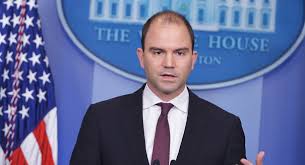
The next month (December 2012), as a prelude to his second term, Obama instructed aides to make Cuba a priority and “see how far we could push the envelope.” The President also concluded that “it would be a good fit to have someone who was known to be very close to the President [involved in such an effort on Cuba] because the Cubans are very wary of engagement and they want to know that the engagement is reaching the top. They felt like there [had] been several other efforts of engagement where it turned out . . . where they had conversations with the Americans, [but after] they reached a certain point . . . there was never follow through [by the U.S.]. . . . [In short, the Cubans] wanted someone . . . [involved for the U.S.] who were very close to the President and . . . they wanted it to be discreet.” Hence, the President designated Ben Rhodes, a Deputy National Security Advisor, to be in charge of this new effort to engage Cuba.

Thereafter, Mr. Rhodes sent a secret message to the Cuban government that the U.S. wanted “to initiate a dialogue about prisoners and other issues.” As we will see below, this created a fascinating contrast between the Administration’s public negative face on Cuba and its secret negotiations with the latter.

Obama’s Second Term, 2013

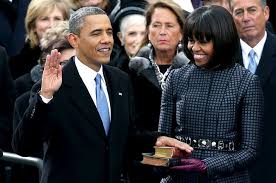
President Obama's Oath of Office, Jan. 2013
President Obama’s Oath of Office,    Jan. 2013
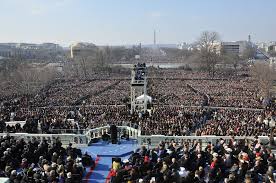
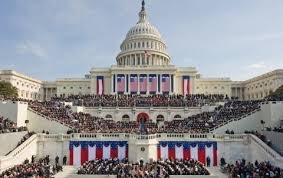
U.S. Capitol for President Obama's Inauguration, Jan. 2013
U.S. Capitol for President Obama’s Inauguration, Jan. 2013


On January 21, 2013, President Obama was inaugurated for his second term as President. Most of his Inaugural Address was focused on domestic concerns, but he did say, “We will show the courage to try and resolve our differences with other nations peacefully—not because we are naïve about the dangers we face, but because engagement can more durably lift suspicion and fear.” He made no reference to Cuba.

That same month, January 2013, we recently have come to know, Ricardo Zuniga, Obama’s top Latin American adviser, went to Miami and met with a representative of the anti-Castro Cuban American National Foundation and with young Cuban-Americans, the latter of whom helped confirm the waning influence of older Cuban exiles who have traditionally supported the half-century-old embargo. (Zuniga in 2001 as a State Department staffer contributed to its National Intelligence Estimate that officially concluded, for the first time, that the embargo of Cuba had been a failure.)

On April 19, 2013, the U.S. Department of State released its Country Reports on Human Rights Practices for 2012, and again it had a negative assessment of Cuba: it is “an authoritarian state” with the following “principal human rights abuses . . .: abridgement of the right of citizens to change the government; government threats, intimidation, mobs, harassment, and detentions to prevent free expression and peaceful assembly; and a record number of politically motivated and at times violent short-term detentions.”

By April 2013, however, we now know that the White House was ready to proceed with the Cubans by quietly proposing back-channel talks after learning that Havana would be receptive. Obama initially froze out the State Department on these developments in part due to concern that its “vested interests” would still be bent on perpetuating a confrontational approach. Even Secretary of State John Kerry was informed of the talks only after it appeared they might be fruitful.

On May 29, 2013, the plight of Alan Gross again emerged as a distracting element when a federal district court dismissed his lawsuit against the U.S. for $60 million alleging the government and its private contractor sent him on five semi-covert trips to Cuba without proper training, protection or even a clear sense of the Cuban laws that ultimately led to his arrest and detainment. Experts said the dismissal had been widely expected because of a rule barring lawsuits against the American government based on consequences suffered in foreign countries.[2]

The next day (May 30, 2013) the U.S. Department of State released its Country Reports on Terrorism 2012. Again Cuba was a designated “state sponsor of terrorism,” but the asserted grounds were very weak: there was no indication Cuba “provided weapons or paramilitary training to terrorist groups;” Cuba “has committed to adopting and implementing” anti-money laundering recommendations by an international group; but Cuba continued to provide support to certain U.S. fugitives.

In any event, the secret U.S.-Cuba negotiations started in June 2013 in Ottawa, Canada. The Cubans opened with harangues about the embargo and other perceived wrongs. Rhodes, age 37, responded, “Look I wasn’t even born when this policy was put in place. We want to hear and talk about the future.” The Cubans in these initial sessions also insisted on an exchange of the remaining three of “The Cuban Five” in U.S. prison for U.S. citizen, Alan Gross, in Cuban prison. Obama refused such a deal because Washington denied Gross was a spy and because Obama did not want a three-for-one trade. As a result by the end of 2013, the negotiations had stalled.

On December 3, 2013, Alan Gross’ imprisonment again surfaced as an important issue when his wife read a public letter from him to President Obama asking, “Why am I still here? With the utmost respect, Mr. President, I fear that my government, the very government I was serving when I began this nightmare, has abandoned me.” A White House spokesman responded by saying Mr. Obama had “personally engaged foreign leaders and other international figures to use their influence with Cuba” to free Mr. Gross.[3]

Barack Obama & Raul Castro

That same month, December 2013, something publicly happened that we now know had a positive effect on the secret U.S.-Cuba negotiations. At the funeral for Nelson Mandela in South Africa on December 15th, President Obama met and shook hands with President Raùl Castro, which at the time some in the U.S. criticized. Moments after the handshake Obama addressed the funeral gathering, talking about Mandela’s demonstrating the need for trust and reconciliation and forgiveness. Some at the time wondered whether his remarks might also apply to the apparently frozen diplomatic relationship between the U.S. and Cuba, but White House officials declined to offer any explanation of the handshake or confirm that there had been a discussion about whether to offer [an explanation].” [4]

Obama’s Second Term, 2014

In early January 2014 the U.S. and Cuba, with public notice, resumed negotiations from the prior July about migration, which the State Department said “does not represent any change in policy towards Cuba” and which journalists saw as “a signal of the longtime Cold War foes’ recent willingness to engage in areas of mutual interest but unlikely to be a harbinger of a major thaw in relations.” Afterwards Cuba said, “”The meeting took place in a respectful environment. An analysis was made of the status of compliance with the migration accords in force between both countries, including the actions taken by both parties to combat illegal migration and aliens smuggling.”[5]

At the January 2014 secret negotiation session in Toronto, said Mr. Rhodes, “the Cubans started [with just want[ing] their people back—the three Cubans who were imprisoned in the [U.S.] – [in exchange for their release of Alan Gross.] In response the U.S. proposed – to the Cubans’ surprise – Cuba’s releasing Rolando Sarraff, a spy for the U.S. who had been imprisoned in Cuba since 1995, and thereby enabling the U.S. to claim it was a true “spy swap” and giving it political cover. But the Cubans dis not immediately agree to release Sarraff, a cryptographer who Washington says helped it disrupt Cuban spy rings in the U.S.

At this January meeting Rhodes “started talking . . . about how we wanted to change the relationship. And then they started talking about some of the things that they were considering doing in terms of their own system.” However, “the idea of reestablishing diplomatic relations was not something that was . . . immediately attractive to them. . . . [T]hey’re very comfortable in a position of being an opposition to the[U.S.]. They have built the legitimacy in part [for] much of their approach around the fact that they’re resisting [purported] American aggression. So it was not a no-brainer by any stretch of the imagination for the Cubans to agree to a process of normalization and to an establishment of diplomatic relations.”

Nevertheless, according to Rhodes, the U.S. “came to the view of in the discussions . . . that if we were going to take these very difficult steps of having this prisoner exchange where we get a Cuban intelligence asset of ours and Alan Gross to be released [and] they would get these three Cubans, . . . we needed to broaden the scope of what we are talking about.” The two countries “would have one opportunity to make a big move together and . . . we should try to do as much as we could in that space. And that led to them taking certain confidence-building measures like the release of . . . political prisoners [on a list] that we provided to them, [and] that led to . . . this discussion of setting out a process of normalization . . . [and] to a discussion of establishing diplomatic relations and sending a signal to the world that essentially we are willing to leave the past behind.”

At the same time, according to Rhodes, the U.S. “made very clear in every meeting, we’re going to have differences with your political system. We are going to find much to criticize, we are going to continue [the U.S.] democracy program, we’re going to continue [to criticize] your human rights practices. It doesn’t mean we like everything you do, but we are going to get farther by engaging with this government and opening up Cuba so that there can be more business, more American travel, more engagement between the American and Cuban people. That holds out a lot greater promise to promote the things we care about than the alternative.”

Also at this secret January session in Toronto, the Cubans gratefully remarked that President Obama had treated President Castro with respect at the Mandela funeral the prior month by shaking Raúl’s hand and that no [prior U.S. president or other official had] done that before. Rhodes responded by saying “not only was it the appropriate thing to do–you see someone why would you snub them and not shake his hand. If the Cubans have the right to be any place, it’s certainly at the funeral of Nelson Mandela who[m] they helped in many ways.”

In early February 2014 reporters for Reuters concluded that U.S. relations with Cuba were “at their best in almost two decades, but President Barack Obama seems unwilling or unable to confront a well-organized anti-Cuba lobby and push for further progress.”[6] Reuters obviously did not know about the secret negotiations then going on.

On February 27, 2014, the U.S. Department of State released its Country Reports on Human Rights Practices for 2013, and again it had a negative assessment of Cuba: it is “an authoritarian state” with the following “principal human rights abuses: . . . abridgement of the right of citizens to change the government and the use of government threats, extrajudicial physical violence, intimidation, mobs, harassment, and detentions to prevent free expression and peaceful assembly.”

While the U.S. proposal for Cuba’s release of Sarraff was still on the table, but not yet accepted by Cuba, President Obama held a secret White House meeting in February 2014 with certain lawmakers, including Democratic Senators Patrick Leahy and Dick Durbin. Obama stressed his opposition to a straight Gross-Cuban Three trade and Durbin “raised the possibility of using the Vatican and the Pope as intermediaries.” Thereafter Senator Leahy confidentially persuaded two unnamed Roman Catholic cardinals to ask Pope Francis to raise Cuba and the prisoners when the Pontiff was scheduled to hold a private audience with Obama on March 27th.

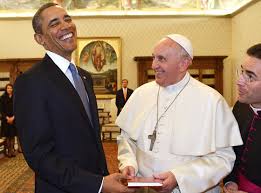
President Obama & Pope Francis

That private papal audience did occur on March 27, and immediately afterwards, as discussed in a prior post, the Vatican reported that “during the cordial meetings [with President Obama], views were exchanged on some current international themes and it was hoped that, in areas of conflict, there would be respect for humanitarian and international law and a negotiated solution between the parties involved.” We now know that this was an allusion to their discussion about U.S.-Cuba relations.

Also immediately after that private audience President Obama made comments that in retrospect also alluded to their conversations about Cuba. The President said the Pope and he “had a wide-ranging discussion.“[W]e spent a lot of time talking about the challenges of conflict and how elusive peace is around the world. . . . [W]e also touched on regions like Latin America, where there’s been tremendous progress in many countries, but there’s been less progress in others. . . . [T]he theme that stitched our conversation together was a belief that in politics and in life the quality of empathy, the ability to stand in somebody else’s shoes and to care for someone even if they don’t look like you or talk like you or share your philosophy — that that’s critical.  It’s the lack of empathy that makes it very easy for us to plunge into wars.  It’s the lack of empathy that allows us to ignore the homeless on the streets.  And obviously central to my Christian faith is a belief in treating others as I’d have them treat me.  And . . . [what has] created so much love and excitement for His Holiness has been that he seems to live this, and shows that joy continuously.” The President added, “ I was extremely moved by his insights about the importance of us all having a moral perspective on world problems and not simply thinking in terms of our own narrow self-interests.”

Soon after the March Audience, Pope Francis secretly sent the two presidents letters, appealing to both to keep pushing for an agreement.

On April 2, 2014, Alan Gross’s name started to appear in the news again as he commenced a hunger strike in his Cuban prison “to object to mistruths, deceptions, and inaction by both governments, not only regarding their shared responsibility for my arbitrary detention, but also because of the lack of any reasonable or valid effort to resolve this shameful ordeal. Once again, I am calling on President Obama to get personally involved in ending this standoff so that I can return home to my wife and daughters.” Later that month he terminated his hunger strike, and his U.S. lawyer reported that Gross had lost most vision in his right eye, walks with a limp due to hip problems, has lost a tooth and is 110 pounds lighter than at the time of his arrest. Moreover, Gross says in another year he will be dead if he stays in the Cuban prison. Later in June he was threatening to commit suicide.[7]

On April 30, 2014, the U.S. Department of State released its Country Reports on Terrorism 2013. Again Cuba was a designated “state sponsor of terrorism,” but the asserted grounds were very weak: there was no indication Cuba “provided weapons or paramilitary training to terrorist groups;” Cuba continued to provide support to certain U.S. fugitives. Cuba’s Foreign Ministry retorted that it “energetically rejects the manipulation of a matter as sensitive as international terrorism by turning it into an instrument of policy against Cuba and it demands that our country be definitively excluded from this spurious, unilateral and arbitrary list.”[8]

Another public distraction emerged in April 2014 with the Associated Press reports of a  covert or “discreet” program of the U.S. Agency for International Development (USAID) that created in Cuba a social media effort to encourage communications among dissidents. Four months later the AP reported about other USAID programs in Cuba with similar aims. [9]

In June 2014 the Pope sent additional private letters to Obama and Castro calling on them to resolve the cases of Alan Gross and the three Cubans in U.S. prison and also encouraging the two countries to pursue a closer relationship. The letter from Pope Francis, U.S. officials said after December 17th, “gave us greater impetus and momentum for us to move forward. ” This appeal from the Pope was ‘very rare’ and unprecedented. The Pope, acted as a “guarantor” that both sides would live up to the terms of a secret deal.

As the Vatican put it in its press statement on December 17th, “In recent months, Pope Francis wrote letters to . . . [the two presidents] and invited them to resolve humanitarian questions of common interest, including the situation of certain prisoners, in order to initiate a new phase in relations between the two Parties.”

Francis’ involvement also provided Obama with potential political coverage against any future criticism by Cuban-American (and Roman Catholic) Senators Robert Menendez (Dem., NJ) and Marco Rubio (Rep., FL) and others.

In the meantime, the U.S. public stance towards Cuba remained unchanged. In early October 2014, Cuba publicly stated it had not received any indication the Obama administration might change U.S. policy toward Cuba despite increasing support within the United States for closer ties. We now know that this was a false report designed to conceal their ongoing secret negotiations.[10]

On October 28, 2014, the U.N. General Assembly again condemned the U.S. embargo of Cuba by a vote of 188 to the 2 negative votes cast by the U.S. and Israel. At this session Cuba asserted that the embargo had damaged its economy in the total amount of $1.1 trillion.

Also in October 2014 the New York Times began what became a series of editorials through mid-December 2014 that called for normalization of the two countries’ relations, commended Cuba for its medical teams in West Africa that were fighting Ebola, called for prisoner exchanges and criticized the USAID programs in Cuba, the U.S. special immigration status for Cuban medical personnel and the U.S. designation of Cuba as a “state sponsor of terrorism” while reiterating its advocacy of normalization. One wonders whether the Times had advance tips or inklings that the Obama Administration soon would be announcing a major shift in U.S. policies toward Cuba and whether the Times was preparing the country for the changes.

Behind the scenes in October 2014 (before the U.S. mid-term elections) the deal was secretly finalized in Rome, where the U.S. and Cuban teams met separately with Vatican officials, then all three teams together. According to the Vatican’s press statement on December 17th, “The Holy See received Delegations of the two countries in the Vatican last October and provided its good offices to facilitate a constructive dialogue on delicate matters, resulting in solutions acceptable to both Parties.”

In early December Rhodes and Zuniga secretly met the Cubans again at the Vatican to nail down logistics for the December 17 announcements of prisoner releases, easing of U.S. sanctions, normalization of U.S.-Cuba relations and Cuba’s freeing of 53 political prisoners.

Pressures for an announcement as soon as possible at the end of 2014 were several. The health of Alan Gross was reportedly declining in a Cuban prison, and President Obama and Secretary of State John Kerry legitimately believed that reconciliation would be destroyed if he died in that prison. Delaying the announcement also ran the risk of a leak of the existence of the secret negotiations that would upset, if not destroy, the reconciliation. Less immediate was the upcoming Summit of the Americas in April 2015 with the U.S. needing to have a positive position on host country Panama’s invitation to Cuba to attend the Summit.

In addition, U.S. domestic political considerations pointed towards a December announcement before the Republican-controlled 114th Congress opened in early January and as soon as possible (the next day) after the adjournment of the 113th so that there would be no resulting interference with the completion of the many items of unfinished business of the current Congress. December also is the traditional time for exercise of presidential clemency (pardons and commutation of sentences), the latter of which was used for the release of the remaining three of the Cuban Five on December 17th.

As noted in a prior post, President Obama as part of his December 17th announcement of rapprochement with Cuba acknowledged that “His Holiness Pope Francis” had supported these measures and thanked the Pope, “whose moral example shows us the importance of pursuing the world as it should be, rather than simply settling for the world as it is.” In particular, the President said, “His Holiness Pope Francis issued a personal appeal to me and to Cuban President Raul Castro urging us to resolve Alan [Gross]’s case and to address Cuba’s interest in the release of three Cuban agents who have been jailed in the United States for over 15 years.”

Similarly Cuban President Raúl Castro in his December 17th remarks to the Cuban people said, “I wish to thank and acknowledge the support of the Vatican, most particularly the support of Pope Francisco, in the efforts for improving relations between Cuba and the United States.”

Immediately after the December 17th announcements by Presidents Obama and Castro, Pope Francis publicly expressed his “his warm congratulations for the historic decision taken by the Governments of the United States of America and Cuba to establish diplomatic relations, with the aim of overcoming, in the interest of the citizens of both countries, the difficulties which have marked their recent history.” The Pontiff also said, “The Holy See will continue to assure its support for initiatives which both nations will undertake to strengthen their bilateral relations and promote the wellbeing of their respective citizens.”

This initiative with Cuba, recently said Rhodes, is an example of what he called “the Obama doctrine and our whole foreign policy. We have to reposition the United States to be able to lead in this century. . . . We have been trying steadily to reposition the [U.S.], to refocus on the Asia-Pacific through the TPP agreement to withdraw that resource allocation and put in place a more sustainable counterterrorism policy that doesn’t eliminate risk but manages it and aims to prevent attacks on the [U.S.].

Conclusion

The Obama Administration’s conducting 24-months of secret negotiations with the Cuban government without any leak is an amazing accomplishment. One example of this lack of outside knowledge is a 2014 book by Chuck Todd, NBC’s noted Washington political reporter who reportedly knows everything that is going on, that says, “There has been little effort to engage or open Cuba, even as the end of the Castro brothers’ regime approaches. In fact, Cuba’s a great example of Obama’s famous caution. While he has been unusually critical of American policy toward Cuba, he won’t use his executive power to make a change.”[11] Sorry, Chuck, you were so very wrong.

These negotiations were without preconditions, just as then candidate Obama had urged when he was campaigning for the Democratic Party’s presidential nomination in 2007-2008. Here too he was hit with charges that such a strategy was misguided and naive. But, I submit, it is the only rational strategy after 50-plus years of trying the opposite approach when, in my opinion, many of what we in the U.S. see as Cuban human rights violations are Cuba’s understandable defensive reactions to a long record of U.S. hostility and aggression against Cuba.

While all of this was going on, U.S. public opinion polls showed increasing support for normalization of U.S.-Cuba relations, and new groups supporting normalization or reconciliation were emerging. Especially in 2014, on the other hand, the Obama Administration was compelled to react to news about the USAID’s purported pursuit of Cuban democracy through various “discreet” or covert programs. Guantanamo Bay also kept in the news with disputes about detainee transfers and Obama’s continuing efforts to close its detention facility. Of course, strident cries objecting to any normalization or reconciliation continued to come from Senators Rubio, Cruz and Menendez and from Representatives Ileana Ros-Lehtinen and Mario Diaz-Balart.

After the December 17 announcement, as recounted in many subsequent posts, the two countries engaged in publicly announced negotiations on many subjects; the U.S. loosened regulations about U.S. trade with, and travel to, the island; the U.S. rescinded its designation of Cuba as a “state sponsor of terrorism;” many U.S. politicians and business officials traveled to Cuba to observe and discuss future prospects; and bills were introduced in Congress to end the U.S. embargo and restrictions on travel to the country while die-hards in that body offered measures to try to prevent or stall normalization and reconciliation. As everyone recognizes, however, the job of normalization is just starting.

As President Obama put it in his January 20, 2015, State of the Union Address to the Congress, the American people and the world,“I believe in a smarter kind of American leadership.  We lead best when we combine military power with strong diplomacy; when we leverage our power with coalition building; when we don’t let our fears blind us to the opportunities that this new century presents.  That’s exactly what we’re doing right now.  And around the globe, it is making a difference.”

“In Cuba, we are ending a policy that was long past its expiration date.  When what you’re doing doesn’t work for 50 years, it’s time to try something new. And our shift in Cuba policy has the potential to end a legacy of mistrust in our hemisphere.  It removes a phony excuse for restrictions in Cuba.  It stands up for democratic values, and extends the hand of friendship to the Cuban people.  And this year, Congress should begin the work of ending the embargo.”

“As His Holiness, Pope Francis, has said, diplomacy is the work of ‘small steps.’ These small steps have added up to new hope for the future in Cuba.  And after years in prison, we are overjoyed that Alan Gross is back where he belongs.  Welcome home, Alan [, who was in the public gallery with First Lady Michelle Obama].  We’re glad you’re here.”

============================================

[1] Ultimately after public release of many Obama Administration documents after the completion of his presidency, scholars will undertake a detailed examination of those documents and provide their assessments of his record regarding Cuba. Now a preliminary assessment is possible based upon the following: William M. LeoGrande & Peter Kornbluh, Back Channel to Cuba: The Hidden History of Negotiations between Washington and Havana (Univ. North Carolina Press; Chapel Hill, NC; 2014);  President Barack Obama’s Inaugural Address (Jan. 21, 2013); Shear, Obama Reaches Out to Cuba’s Leader, but the Meaning May Elude Grasp, N.Y. Times (Dec. 10, 2013). Initial information about the secret negotiations is found in Reuters, How Obama Outmaneuvered Hardliners and Cut a Cuba Deal, N.Y. Times (Mar. 23, 2015) and Rhodes, The Obama Doctrine: America’s Role in a Complicated World, Aspen Ideas Festival (June 29, 2015).

[2] Cave, American Contractor Held in Cuba Loses a Lawsuit, N.Y. Times (May 29, 2013);

[3] Reuters, Contractor Jailed in Cuba Appeals to Obama to Press for Release, N.Y. Times (Dec. 3, 2013).\.

[4] Hauser, The Distraction of a Handshake in South Africa, N.Y. Times (Dec.10, 2013).

[5] Assoc. Press, U.S., Cuba to Hold Migration Talks in Havana, N.Y. Times (Jan. 8, 2014); Reuters, Cuba, U.S. Meet on Migration in Latest Sign of a Thaw (Jan. 9, 2014); Assoc. Press, US Official: Cuba Migration Talks Productive, N.Y. Times (Jan. 10, 2014).

[6] Reuters, U.S. Policy Change on Cuba Stalled by Obama, N.Y. Times (Feb. 6, 2014)

[7] Assoc. Press, American Imprisoned in Cuba Begins Hunger Strike, N.Y. Times (April 8, 2014); Assoc. Press, Lawyer: US Man Held in Cuba Seeks to Go Home Soon, N.Y. Times (April 23, 2014); Reuters, American Jailed in Cuba Plans Suicide, Lawyer Says, N.Y. Times (June 25, 2014).

[8] Reuters, Cuba Calls Terrorism Designation by U.S., Absurd, Manipulative, N.Y. Times (May 1, 2014).

[9] The USAID programs were discussed in posts on April 4, 9 and 9 and August 12, 13 and 14.

[10] Reuters, Havana Sees No Sign Obama Will Change U.S. Policy on Cuba, N.Y. Times (Oct. 8, 2014). A previous post criticized U.S. “stupidity” and “cowardice” in making this designation of Cuba as a “state sponsor of terrorism.”

[11] Chuck Todd, The Stranger: Obama in the White House at 484 (Little Brown & Co.; New York; 2014).

Reactions to Reopening of U.S. and Cuba Embassies and Other Issues Regarding U.S.-Cuba Normalization

As discussed in an earlier post, on the morning of July 20, 2015, Cuba officially opened its Embassy in Washington, D.C., and the United States did likewise in Havana although the ceremonial opening of the latter will be on August 14 when Secretary of State John Kerry goes to Havana to preside over that event. Another post, that afternoon’s joint press conference at the U.S. Department of State by U.S. Secretary of State John Kerry and Cuba’s Foreign Minister Bruno Rodriguez; yet another post, recent comments about Cuba by the White House Press Secretary.

Now we look at the reactions to the significant issues raised by these events: (1) restoration of diplomatic relations; (2) future changes in Cuba; (3) future changes in Cuban human rights; (4) ending the U.S. embargo (or blockade) of Cuba; (5) altering or terminating Cuba’s lease of Guantanamo Bay to the U.S.; (6) ending U.S. Radio and TV Marti; (7) ending USAID and other covert U.S. “democracy” programs in Cuba; (8) Cuba’s returning U.S. fugitives; and (9) nominating and confirming the appointment of an U.S. ambassador to Cuba.

1. Restoration of U.S.-Cuba Diplomatic Relations?

There has been substantial U.S. approval of the restoration of diplomatic relations.

According to the Center for Democracy in the Americas (CDA), for instance, 12 public opinion polls conducted and released since January 1 show that “public support for the Cuba opening is strong, growing, and pervasive. Support for the new policy is bipartisan. It is significantly high among segments of voters — such as Hispanics — that candidates running for office increasingly care about. Most of all, the latest research shows that public support is rising. For example, support for ending the embargo was measured in July by the Chicago Council on Global Affairs at 67%, and earlier this year by Gallup at 59% and by the Associated Press at 60%.”[1]

Moreover, CDA sees “evidence that public support for America’s new Cuba policy is exerting its force on policymakers in the U.S. Congress.” It points to last week’s action of the Senate Appropriations Committee’s approving amendments eliminating House measures that would impede normalization in various ways[2] and to Republican legislators—Senator Dean Heller (NV) and Representative Bradley Byrne (AL)–who recently joined the ranks of supporters of normalization.

Despite the vigorous opposition to normalization repeatedly expressed by Cuban-Americans in Congress—Senators Marco Rubio (Rep., FL) and Robert Menendez (Dem., NJ) and Representatives Ileana Ros-Lehtinen (Rep., FL) and Mario Diaz-Balart (Rep., FL) [3]—there has been little organized opposition to normalization in the Cuban-American community, especially in Florida.[4]

This assessment has been confirmed by prominent Cubans in the U.S. and on the island. Pedro Freyre, a Cuban-born Miami lawyer with a national law firm representing several U.S. and foreign clients seeking to do business in Cuba and a former hardliner himself, said, “It’s over and done in Miami. It died with a whimper.” Indeed, he added that President Obama’s new policy was now widely accepted by South Florida’s 1.5 million Cuban exiles. Similar views were expressed in the Miami Herald by Mike Fernandez, a healthcare millionaire and Bush supporter, who said, “Cuban-Americans everywhere, but especially the diaspora in South Florida, have been awakening to the reality that Cuba’s isolation was and is not a sustainable strategy. It’s time to accept change. Let us not heed those relatively few voices who would go on continuing to trap our minds in hatred.” Carlos Alzugaray Treto, a former Cuban diplomat who is close to President Raúl Castro and his brother Fidel, put it best. He said, “The genie is out of the bottle. And once it’s out, you’re not going to be able to put it back in.”

Senator Amy Klobuchar (Dem., MN), who is the author of a bipartisan bill to lift the embargo, said this must be done for the U.S. to avoid losing investment opportunities that will come with loosening of travel restrictions to the island. She said, “Once millions of American tourists are going, they will need places to stay and they will need food to eat. … So when they come, they are going to be starting to sleep in Spanish hotels and eat German foods because those countries will be able to supply what they need in the tourism industry, not to mention the computers and Wi-Fi and everything else.”[5]

James Williams, the President of Engage Cuba, a major bipartisan group promoting this normalization, issued a statement on the reopening of embassies. He said, “we begin a new chapter of engagement between our two countries. American diplomats will now be much better equipped to engage with the Cuban people and civil society. They will be in a stronger position to elevate issues of concern, like human rights, as well as expanding on areas of cooperation with Cuba.” He pointed out that the “vast majority of the American people, and 97% of the Cuban people support opening relations. We applaud both governments for taking this important step to move forward beyond the Cold War policies of the past and call on Congress to play a constructive role at this historic moment of transition.”[6]

John Dinges, Associate Professor at Columbia University’s School of Journalism and an expert on U.S.-Cuba relations, said for the U.S. “the new relationship with Cuba removed a stumbling block in relations with the entire region, where the US attitude [was] considered irrational and stupid.”[7]

However, others argue that this change is misguided and erroneous. For example, Edward Gonzalez, professor emeritus of political science at U.C.L.A., stated that “in the face of potentially destabilizing change and high expectations at home, Cuban officials are tightening state controls in the short term.” Moreover, “given the regime’s totalitarian proclivity and apparatus, the state’s repression of dissidents and civil society, and its control over the lion’s share of the island’s economy, it is likely to continue into the distant future.” Therefore, he continues, the new U.S. engagement with Cuba “makes the [U.S.] complicit in propping up the regime both economically and politically, while leaving Cuban society even more isolated and defenseless vis-à-vis the all-powerful, coercive state.”[8]

Moreover, Senator Marco Rubio and former Florida Governor Jeb Bush, currently two of the many contenders for the Republican nomination for president in 2016, have said that if elected president in 2016, they would rescind the diplomatic relations. And Senator Tom Cotton (Rep., AK) has pledged to “work to maintain and increase sanctions on the regime, block the confirmation of a new ambassador, demand the extradition of U.S. fugitives from justice, and hold the Castro regime accountable.”[9]

Secretary of State John Kerry in his July 20 interviews,[10] responded to these threats to rescind the relations with Cuba. Kerry said that whoever is elected president in 2016, including Marco Rubio, will have “the ability to make a decision [on whether or not to rescind the re-establishment of diplomatic relations with Cuba]. Congress, obviously, has an ability to have an impact on that.” [11] But I think it would be a terrible mistake [to rescind such diplomatic relations]. The vast majority of the American people believe this is a very good thing to do. It doesn’t make sense. I mean, we had diplomatic relations with the Soviet Union. We had diplomatic relations with then-called Red China. We have to have relationships with countries to do business. And American citizens get hurt when we don’t do that.” Moreover, Kerry added, “I believe . . . President [Obama] has taken an irreversible step. I do not believe a next president, Republican or Democrat, will change it.”

Kerry continued, “Given the fact there are so many Cuban Americans, people who have family in Cuba, to not have a relationship where we can advocate for people, advocate for human rights, advocate for fairness, for elections, for democracy, for travel, for engagement, and all these things that make a difference in the quality of life of Cubans would be a terrible, terrible mistake. So I think, as time goes on, people will see the benefits that come from this policy.”

2. Future Changes in Cuba?

As Foreign Minister Rodriguez’s July 20 statement and Secretary Kerry’s statements made clear and as both governments previously had recognized, the opening of the embassies did not mean the process of normalization had been completed. Indeed, it has just started.

Secretary Kerry, in his interviews, observed, There are “key issues in the normalization process, and . . . [Minster Rodriguez and I] both said today that it will be long and complex. . . . [T]he measure of progress and success is really going to come from what happens in the next months as we go through this early diplomatic rekindling of a relationship. My suspicion is that there’s a possibility it could move faster than people think, simply because I think the Cuban people want it. And as we are there doing diplomacy, more present, able to engage, we actually can work at these kinds of issues more effectively than we’ve been able to for the last 50, 60 years.”

Kerry added that if Cuba is “willing to embrace it, we can bring them a tremendous leap in their economy. We could bring a better standard of living to their people. We can bring technology. We can bring various modern instruments of education, of health delivery, of communications. And I believe that over time things will change . . . at a pace that will be acceptable and, frankly, helpful to Cuba.” Kerry also said, the U.S. wants to see “a true, deep engagement [by Cuba], a willingness to work through these issues. There’s so much that we can cooperate on right now. We want to cooperate on law enforcement, . . . the environment, . . . our visas, . . . health, education, the rights of people, . . . hemispheric issues and interests like the war in Colombia or the relationship with Venezuela.”

Although not in direct response to the reopening of the embassies, Cuba’s President Raúl Castro in his July 15 speech to Cuba’s legislature (the National Assembly of People’s Power)[12] asserted, “We will continue the process of transformations in Cuban society at our own pace, which we have sovereignly chosen, with the majority support of the people, in the interest of constructing a prosperous and sustainable socialism, the essential guarantee of our independence.” (Emphases added.) He reiterated this theme near the end of his speech with these words: “Changing everything which must be changed is the sovereign and exclusive domain of Cubans. The Revolutionary Government is willing to advance in the normalization of relations, convinced that both countries can cooperate and coexist in a civilized manner, to our mutual benefit, beyond the differences we have and will have, thus contributing to peace, security, stability, development and equity in our continent and the world.” (Emphases added.)

A New York Times editorial said, “The full normalization of relations between the United States and Cuba will take years and will be an arduous process. Issues that will be hard to resolve include the disposition of American property the Cuban government seized in the 1960s, and the fate of the United States Navy base in Guantánamo Bay, which the Cuban government considers an illegally occupied territory.”[13]

Professor Dinges offered a similar assessment of the future. He said, “’normal’ relations are not compatible with the [U.S.] travel ban, with [the U.S.] economic embargo, with a recent history of semi-clandestine operations by the [USAID] to promote economic and social discontent. I hope to see in the near future gestures of friendship and rapprochement. For the [U.S.], it is important to dismantle the Guantanamo prison, and the minimization of military forces at the base. On behalf of Cuba, a gesture of detente toward the Miami Cubans would not cost anything and could have huge benefits. . . . There is distrust, there is a long history of [U.S.] aggression [against Cuba]. . . . [He believes future] “changes will be economically, technically, diplomatically. It would be illusory to expect radical changes in political structures in Cuba. Equally unrealistic to think that the US will stop talking about democracy and human rights.”

3. Future Changes in Cuban Human Rights?

Probably the leading U.S. desire for future changes in Cuba is with respect to human rights. For example, in one of his July 20 interviews, Kerry said Cuba does not “want [domestic] interference, but they know we’re not going to stop raising human rights issues. We made that very clear. . . . [W]e’re not giving up the DNA of the [U.S.], which is a deep commitment to human rights, to the values of democracy, freedom of speech, and so forth. So those . . . will be on the agenda. But on the other hand, the great step forward here is that neither of us . . . [is] taking one of our issues of contention and making it a showstopper. We want to engage, and when you get to that point, that’s what begins to break down the barriers.”

Kerry also told Andrea Mitchell, “There’s been a little bit of give . . . [by Cuba] with respect to some agreement on human rights. And I think that over time the elections discussion and the more pointed human rights issues are going to be very much part of the discussion. They are in every country where we have an embassy and an ambassador. We are fearless in our determination to walk in and talk to the authorities and give them a shared our sense of the problems that exist.”

According to the non-governmental Cuban Commission for Human Rights and National Reconciliation, there were 2,822 politically related detentions in the first six months of 2015, less than half the 5,904 registered in the same period last year. Many of those detained this year, however, report being treated more roughly, however.[14]

The previous source also reports, “more than 20 U.S. lawmakers have come to Cuba since February without meeting with opposition groups that once were an obligatory stop for congressional delegations.” This was apparently due to “Cuban officials . . . [having] made clear that if Congress members meet with dissidents, they will not get access to high-ranking officials such as First Vice President Miguel Diaz-Canel, the man expected to be the next president of Cuba” and to U.S. assessment that “talking with Cuban leaders is clearly the most promising way to promote reform on the island.”

On the issue of Cuban human rights, I submit that there is an enormous cognitive dissonance in the minds of U.S. opponents of normalization. Here are the reasons for that conclusion:

  • First, any objective student of history has to conclude that the U.S., especially since the start of the Cuban Revolution in 1959, has committed and threatened serious acts of hostility towards Cuba, including the embargo, the 1961 U.S.-supported invasion of Cuba’s Bay of Pigs, the 1962 threatened bombing of Cuba during the Cuban Missile Crisis, the embargo of the island and CIA attempts to assassinate Cuban President Fidel Castro. Moreover, U.S. hostility toward Cuba started at least in 1898 when it intervened in Cuba’s war of independence from Spain. Indeed, Foreign Minister Rodriguez’ July 20 speech referred to the late 19th century warning by José Marti of the U.S. “excessive craving for domination [over Cuba].”
  • Second, Cuba, therefore, has good reason to be fearful of the much larger and more powerful U.S. and as a result to take steps to protect itself against such perceived threats by restricting dissent. What would you do if you were in the Cubans’ shoes? It, therefore, will take time for Cuba to develop a sense of trust of the U.S. and as a result modify its restrictions on free speech and assembly.
  • Third, the self-proclaimed advocates of Cuban human rights like Rubio and Jeb Bush do not appear to be aware of the first two points. In addition, they apparently do not appreciate that their very hostility towards Cuba and normalization, purportedly on the ground of promoting Cuban human rights, instead contributes to Cuban skepticism about the good intentions of the U.S. and to the prolonging of Cuba’s restrictions on free speech and other civil liberties.

4. Ending the U.S. Embargo of Cuba?

Ending the embargo or blockade, of course, is a key demand by Cuba, and President Obama has asked the Congress to do just that. As discussed in previous posts, various bills to end the embargo have been introduced in this Session of the Congress, and supporters of normalization or reconciliation of the two countries, like this blogger, urge the Congress to approve such bills as soon as possible.

Such congressional action is in the U.S. national interest because the embargo has failed for over 50 years to produce positive change in Cuba, the embargo clearly has harmed or damaged the island’s economy, and Cuba has insisted on its removal as a key requirement for full normalization of relations.

In addition, there are at least two additional reasons for ending the embargo that this blogger has not seen mentioned in all the public discussion of this issue.

  • First, last October at the U.N. General Assembly Cuba alleged that the damage to Cuba from the embargo or blockade totaled $1.1 trillion, and the longer the embargo remains in effect that number will only increase. For a U.S. business this would require at least a footnote to its balance sheet identifying this as a contingent liability and explaining whatever reasons the business has for challenging the claim or the alleged amount of the claim. The rational action for such a business would be to terminate the conduct allegedly causing the damage, especially when it is not producing some benefit to the business.
  • Second, because of the U.S.-Cuba rapprochement of last December, other countries, especially the European Union and its members, are accelerating their efforts to obtain beneficial trade arrangements with Cuba. In short, the longer the U.S. waits to end the embargo, the further behind the U.S. will be with respect to competitors from around the world seeking to do business with Cuba.

Wake up, Congress!

5. Altering or Terminating the Cuba-U.S. Lease of Guantanamo Bay?

As previously noted, Foreign Minister Rodriguez at the July 20 reopening of the Cuban Embassy and at the subsequent joint press conference with Secretary Kerry reiterated Cuba’s request or desire to have its lease of Guantanamo Bay to the U.S. terminated and the territory returned to Cuba. Although the Foreign Minister did not set forth any alleged legal basis for this claim, he did mention that the 1906 lease occurred during a period of U.S. military occupation of the island that “led to the usurpation of [this] piece of Cuban territory”and thereby suggested that the lease was unfairly or coercively obtained.

Interestingly Rodriguez did not mention a previous legal theory advanced by the Fidel Castro regime: that the lease purportedly runs in perpetuity and, therefore, is illegal under Cuban law. Nor did Rodriguez mention another theory for ending the lease: the U.S. operation of a prison/detention facility at Guantanamo that allegedly is not permitted by the lease and, therefore, the U.S. has breached the lease.[15]

At that same joint press conference, Secretary Kerry immediately rejected U.S. willingness to return Guantanamo to Cuba. However, there were caveats in his comment: he said, At this time, there is no discussion and no intention on our part at this moment to alter the existing lease“ and “I can’t tell you what the future will bring but for the moment that is not part of the discussion on our side.” (Emphasis added.) This was reiterated, with similar qualifications, on July 22 by National Security Advisor Susan Rice at a White House press conference.[16] She said, “We’ve been clear that we’re not, at this stage, at all interested in changing the nature of our understanding and arrangements on Guantanamo.  And they may choose to raise it, but we’ve been equally clear that, for us, that’s not in the offing at the present.” (Emphasis added.) Do these caveats indicate an U.S. willingness in the future to discuss altering or even terminating the lease? I could understand a lease amendment increasing the amount of the rent and perhaps making administrative changes, but would be surprised if the U.S. would be willing to discuss termination of the lease and returning Guantanamo to Cuba.[17]

Although Cuba has not mentioned the U.S. operation of a detention facility at Guantanamo and the alleged U.S. torture of some of the detainees as a reason for Cuba’s desire to have the territory returned, it should be noted that President Obama has been trying to close that facility since the start of his first term.

On July 22, White House Press Secretary Josh Earnest confirmed “that the administration is, in fact, in the final stages of drafting a plan to safely and responsibly close the prison at Guantanamo Bay and to present that plan to Congress. That has been something that our national security officials have been working on for quite some time, primarily because it is a priority of the President.  He believes it’s in our clear national security interest for us to close the prison at Guantanamo Bay.” Earnest also said the President has decided to veto a defense spending bill now being negotiated in Congress if it includes provisions that would make it harder to close the prison.[18]

A few more details about the plan to close the detention facility were offered on July 25 by Lisa Monaco, one of Obama’s top national security aides, who said that such a plan was nearing completion. It will call for the U.S. to step up the transfers of 52 detainees cleared for resettlement in other countries and for the transfer to U.S. “Supermax” or military prisons for trials or continued military detention of at least some of the other 64 detainees still at Guantanamo who are deemed too dangerous to release. Efforts will be made to reduce the size of the latter group through “periodic review boards” that have been used to clear others for transfer.[19]

6. Ending U.S. Radio and TV Marti?

Another Cuban request is for the U.S. to stop its radio and TV broadcasts aimed at Cuba (Radio and TV Marti), again mentioned on July 20 by Minister Rodriguez. On July 22 National Security Advisor Rice stated, apparently in response to this request, the U.S. ”will continue to say and do what we think is appropriate to advance our interests in human rights and democracy in Cuba. . . . we’re not going to change just because the Cuban government may wish that we did.”

7. Ending USAID and Other Covert U.S. “Democracy” Programs in Cuba?

Prior posts have discussed recent “discreet” or covert programs in Cuba operated by the U.S. Agency for International Development (USAID) through private contractors purportedly to promote democracy in Cuba and the latter’s objections to same. Rodriguez in his July 20 speech did not specifically mention such programs, but did so indirectly by objecting to the U.S. seeking “obsolete and unjust goals” (i.e., regime change) by “a mere change in the methods.”

These prior posts have expressed this blogger’s objections to such USAID programs. The New York Times has done the same.

8. Cuba Returning U.S. Fugitives?

Although not specifically mentioned last week by Secretary Kerry or Minister Rodriguez, the issue of Cuba’s returning U.S. fugitives remains a top priority for many in Congress and in the U.S. generally. On July 24 Representative Jerry McNerney (Dem., CA) raised the issue with respect to Charles Hill, who is the sole surviving member of a group who hijacked an airliner in 1971; Hill and two others were fleeing charges relating to the killing of a New Mexico state trooper. McNerney, who was on that hijacked airliner, wants Hill to be returned to the U.S.[20]

9. Nominating and Confirming U.S. Ambassador to Cuba?

With respect to congressional threats to not provide funds for the U.S. embassy in Cuba and to not confirm an ambassador to that country, Kerry observed, “it always matters when Congress is sort of stepping in the way of something being able to . . . be fully effected. . . . [W]hy are they going to do that? Are they going to do that because the [old] policy [purportedly] has been so successful? Are they going to do that because they can show so much change that’s taken place in the last 60 years that this is a crazy path? . . . [It] just doesn’t make sense to prevent our diplomats from carrying the message . . . [of human rights and democracy]. To not be able to meet with more people in Cuba to know what is going on is a huge cutoff of opportunity. So I just think it’s cutting off your nose to spite your face and it’s a shame.”

Kerry also said, “Well, it depends on whom, obviously, the next president is, and we don’t know that now. So you can’t bet on it that way. You have to do what you think is right. You have to do what’s appropriate and make the difference. Nobody can guard against every eventuality of the future. But I believe the President has taken an irreversible step. I do not believe a next president, Republican or Democrat, will change it.”

Conclusion

The time has come for all U.S. citizens to support full normalization of our relations with Cuba!

=======================================================

[1] Center for Democracy in Americas, Flag Poles to Public Opinion Polls—Is Congress (Finally) Getting the Message (July 24, 2015)

[2] The Senate Committee on July 23 voted, 18 to 12, to lift the “decades-long ban on travel to Cuba . . . . to block enforcement of a law prohibiting banks and other U.S. businesses from financing sales of U.S. agricultural exports to Cuba. . . . [and] to lift restrictions on vessels that have shipped goods to Cuba from returning to the U.S. until six months have passed.” A journalist asserted, “The panel’s votes reflect growing sentiment, even among some GOP conservatives, to ease the five-decade-plus Cuba trade embargo and travel restrictions to the island, which have failed to move the Castro regime toward democracy.” (Assoc. Press, GOP-Controlled Senate Panel Votes to Life Cuba Travel Ban, N.Y. Times (July 24, 2015); Davis, Senate Panel Takes Small Step Toward Easing Travel Restrictions with Cuba, N.Y. Times (July 23, 2015); Shabad, GOP-led Senate panel votes to lift travel ban to Cuba, The Hill (July 23, 2015).) This move in the Senate Appropriations Committee is part of a Democratic Senators’ strategy of attacking House riders in appropriation bills that imperil U.S.-Cuba reconciliation. (Shabad, Dems show their hand in budget poker, The Hill (July 26, 2015),)

[3] Menendez, Menendez Statement on Cuban Embassy Opening (July 20, 2015;    Ros-Lehtinen, Opening of Cuban Embassy in Washington, D.C. Harms Our National Security, Says Ros-Lehtinen (July 20, 2015); Diaz-Balart, Embassy in Washington, D.C. Will Represent the Castros, Not the Cuban People (July 20, 2015).

[4] Reuters, Cuban-American Resistance to Diplomatic Thaw Proves Tepid, N.Y.Times (July 21, 2015); Assoc. Press, Poll: Majority of Americans Favor Diplomatic Ties With Cuba, N.Y. Times (July 21, 2015); Reuters Video, Cubans enthusiastic about reopening of U.S. embassy in Havana, N.Y. Times (July 21, 2015).

[5] Klobuchar, News Release: Klobuchar: Opening of Cuban Embassy Marks Next Chapter in Relationship (July 20, 2015).

[6] Engage Cuba, Statement from Engage Cuba on Official Opening of U.S. and Cuba Embassies (July 20, 2015).

[7] Elizalde, John Dinges on Cuba-US relations: ‘I’m optimistic,’ CubaDebate (July 23, 2015)

[8] Gonzalez, Letter to Editor: Effects of Our Cuba Policy, N.Y. Times (July 24, 2015)

[9] Carney, GOPer doubles down on pledge to block Obama on Cuba, The Hill (July 20, 2015).

[10] Dep’t of State, [John Kerry] Interview with Steve Inskeep of National Public Radio (July 20, 2015); Dep’t of State, [John Kerry] Interview with Andrea Mitchell of NBC News (July 20, 2015).

[11] This blogger disagrees with Kerry’s saying Congress had a role in deciding to recognize a foreign government; such a congressional role appears to be unconstitutional in light of a recent U.S. Supreme Court decision that the president has the exclusive constitutional authority to recognize foreign governments.

[12] Speech presented by Army General Raúl Castro Ruz: ‘We will continue the process of transformations in Cuban society at our own pace, CubaDebate (July 15, 2015.

[13] Editorial, Formal Restoration of Diplomatic Ties with Cuba Is Just a Beginning, N.Y. Times (July 20, 2015).  The Washington Post, on the other hand, continued its opposition to normalization with Cuba with an editorial that focused on the human rights problems in Cuba and urging our diplomats to concentrate on those issues. (Editorial, U.S. diplomats in Cuba would do well to focus on human rights, Wash. Post (July 20, 2015).) As Secretary Kerry emphasized in his remarks, the U.S. continues to concentrate on those issues.

[14] Assoc. Press, Cuban Dissidents Feel Sidelined as Focuses on State Ties, N.Y. Times (July 23, 2015).

[15] A prior post suggested that Cuba’s best argument for terminating the lease was the U.S. operation of the prison/detention facility. However, Dr. Michael Strauss, an expert on this lease, asserts that at least in 2002 Cuba offered to facilitate U.S. transportation of detainees to Guantanamo; such conduct should weaken, if not demolish, such an argument for Cuba. (Strauss, Cuba and State Responsibility for Human Rights at Guantanamo Bay, 37 So. Ill. Univ. L.J. 533, 546 (2013).)

[16] White House, Press Briefing by Press Secretary Josh Earnest, 7/22/15.

[17] A prior post discussed these issues about the Guantanamo lease and recommended that the parties submit any unresolved disputes about the lease to the Permanent Court of Arbitration at the Hague in the Netherlands.

[18] Assoc. Press, White House Finishing Up Latest Plan for Closing Guantanamo, N.Y. Times (July 22, 2015) Guantanamo, N.Y. Times (July 22, 2015).

[19] Reuters, Some Guantanamo Inmates Would Go to U.S. Under New Plan: Obama Aide, N.Y. Times (July 26, 2015)

[20] Hattem, House Dem demands fugitives in Cuba be returned to the U.S., The Hill (July 24, 2015). A prior post explored the issues regarding extradition under a U.S.-Cuba treaty on the subject and recommended submitting any unresolved disputes about extradition to the Permanent Court of Arbitration at the Hague.
President Barack Obama’s First-Term Record Regarding Cuba, 2009-2013    

In light of President Barack Obama’s historic December 17, 2014, announcement of rapprochement with Cuba, it is interesting to examine Obama’s earlier statements about Cuba. Prior posts examined his campaign for the Democratic presidential nomination in 2007-2008 and his campaign for the presidency as the Democratic Party’s nominee in 2008. Now we discuss his first presidential term, 2009-2013.[1] Subsequent posts will look at his reelection campaign in 2012 and his second presidential term (up to the December 17, 2014, announcement), 2013-2014.

As we saw in a prior post, Barack Obama and Joe Biden won the November 4, 2008 election with 69.5 million votes (52.9% of the total) to John McCain and Sarah Palin’s 59.9 million votes (45.7%). In the key state of Florida, Obama-Biden had 51.0% of the popular vote against McCain-Palin’s 48.4%. The electoral votes were Obama and Biden, 365; McCain and Palin, 173. Soon thereafter several head of states congratulated Obama while also calling for the U.S. to end its sanctions against Cubs.

Obama’s First Term, 2009

President Obama's Oath of Office with Michelle Obama
President Obama’s Oath of Office with Michelle Obama
Crowd @ Obama Inaugural 2009


Obama was inaugurated as President on January 20, 2009. His Inaugural Address first mentioned that “we are in the midst of crisis. . . . Our nation is at war against a far-reaching network of violence and hatred. Our economy is badly weakened. . . . [T]he challenges we face are real, they are serious and they are many. They will not be met easily or in a short span of time. But know this America: They will be met.” There was no mention of Latin America or Cuba.[2]

On February 25, 2009, the Department of State released its 2008 Country Reports on Human Rights Practices; the chapter on Cuba described it as a “totalitarian state” that “continued to deny its citizens their basic human rights and committed numerous, serious abuses.”

In April 2009 Obama fulfilled the pledge he made in his acceptance of the Democratic Party’s presidential nomination by lifting travel and remittance restrictions for Cuban-Americans while also authorizing U.S. telecommunications companies to contract with Cuba for improved television, radio and telephone service and Internet access.

That same month (April 2009) Obama told a journalist, “Cuba has to take some steps, send some signals that when it comes to human rights, when it comes to political rights, when it comes to the ability of Cubans to travel.” In Obama’s opinion, the previously mentioned U.S. changes called for Cuba to “send signals that they’re interested in liberalizing.”

This U.S. desire or demand for Cuban reciprocity was not well received in Havana. Cuba’s President Raúl Castro declared, “The blockade [embargo] remains intact. . . . Cuba has not imposed any sanction on the [U.S.] or its citizens. Therefore, it is not Cuba that should make gestures.” Nevertheless, “We are willing to discuss everything with the [U.S.] government, on equal footing; but we are not willing to negotiate our sovereignty or our political and social system, our right to self-determination or our domestic affairs.”[3]

Later that same month (April 2009), Obama attended the Fifth Summit of the Americas. Latin American presidents applauded the previously mentioned U.S. changes while simultaneously pressing Obama on the need to reintegrate Cuba into the inter-American community. Obama responded by reiterating his commitment to engagement, “The [U.S.] seeks a new beginning with Cuba.”

Also in April 2009, the U.S. Department of State issued its Country Reports on Terrorism 2008. Again Cuba was listed as a state sponsor of terrorism.

The next month, May 2009, the U.S. proposed to Cuba that they resume bilateral consultations on migration. Cuba agreed, and the talks took place that July. Cuba presented a draft accord to curb people smuggling and indicated an interest in also discussing cooperation on counterterrorism, counter-narcotics operations and hurricane preparation. Although no such formal agreement was reached, both sides agreed it was a productive consultation.

In June 2009 at the General Assembly of the Organization of American States (OAS), Latin American members moved to repeal the 1962 resolution suspending Cuba’s OAS membership. Facing defeat on this proposal, the U.S. negotiated a compromise: repeal the suspension if Cuba accepts “the practice, purposes, and principles of the OAS,” impliedly including the commitment to democracy in the Santiago Declaration of 1991.

In August 2009 Bill Richardson, then the Governor of New Mexico, was in Cuba on a trade mission, and at a meeting with Cuban officials was led to believe that Cuba wanted to move forward with the U.S. although Richardson said Cuba needed to reciprocate with some gestures. Cuba’s Foreign Minister Rodriguez made it clear that Cuba would not make any concessions to win better relations with the U.S. and that the U.S. blockade (embargo) was unilateral and should be lifted unilaterally.

In September 2009 an U.S. Assistant Secretary of State was in Cuba for discussions about restoring direct mail service. Over five days, she met with Cuban officials in the Justice, Agriculture, Health and Interior ministries and academics at the University of Havana as well as bloggers and dissidents. Much to the consternation of Cuban authorities, one of the bloggers was Yoani Sánchez, now an international celebrity. Nevertheless, Cuba’s Assistant Foreign Minister (Bruno Rodriguez Parrilla, now the Minister of that agency) told the U.S. official that Cuba wanted to show her their desire “to move forward in our relationship,” requiring “confidence building” as a “way forward.”

By the Fall of 2009 the White House was frustrated by Cuba’s failure to respond to the U.S. relaxing of travel and remittance restrictions for Cuban-Americans. As a result, Obama asked Spain’s Prime Minister, José Luis Rodriguez Zapatero, to have Spain’s Foreign Minister carry a back-channel message to President Rául Castro that if Cuba did not take steps of liberalization, neither could Obama and that the U.S. understands things cannot change overnight, but in the future it will be clear that this was the moment when changes began.

Castro responded with a proposal for a secret channel of communication between the two countries to discuss Cuban steps that might address the U.S. concerns. The U.S., however, at this time rejected the idea for a secret channel. (As we will see below, in December 2012, such a secret channel was opened.)

On December 3, 2009, the process of normalization was thrown off track by Cuba’s arrest of U.S. citizen, Alan Gross, who was bringing communications and computer equipment to Cuba’s Jewish community as an employee of a contractor for the U.S. Agency for International Development (USAID). Two weeks later President Castro told Cuba’s National Assembly that the U.S. alleged desire for a new relationship was “a huge propaganda campaign staged to confuse the world. The Truth is that the instruments for the policy of aggression to Cuba remain intact and that the U.S. government does not renounce its efforts to destroy the Revolution.”

By the end of 2009, therefore, things looked bleak for further normalization. Moreover, the press of many other foreign policy challenges for the U.S. pushed Cuba far down the list of priorities for the Obama Administration.

Obama’s First Term, 2010.

The arrest and jailing of Alan Gross continued to disrupt the relations of the two countries in 2010. The U.S. denied that Gross had done anything wrong and that his release from a Cuban jail was necessary for any improvement in the relationship.

The Gross arrest, however, prompted the U.S. Senate Foreign Relations Committee to investigate USAID’s Cuba democracy programs in 2010 and to develop a plan to reorient the Cuba program toward supporting genuine links between the two countries. These changes in the program were briefed for Cuban diplomats, who said it would smooth the way for the release of Gross.

On March 11, 2010, the Department of State released its 2009 Country Reports on Human Rights Practices; the chapter on Cuba described it as a “totalitarian state” that continued to deny its citizens their basic human rights, including the right to change their government, and committed numerous and serious abuses.”

In the meantime, Spain on its own initiative in May 2010 encouraged Rául Castro and Cardinal Jaime Ortega to discuss Cuba’s lifting the ban on public demonstrations by the Ladies in White, the female relatives of political prisoners, and to the release of political prisoners. In July 2010 this resulted in the government’s agreement to release 52 such prisoners, including everyone who had been arrested in 2003, and those who wished to go into exile would be welcomed by Spain. Eventually the government released 127 such prisoners.

In June 2010 Cardinal Ortega, with the consent of the Cuban government, went to Washington, D.C. to inform them of the then planned prisoner release. The Cuban government believed this prisoner release was a major concession and should “pressure U.S. political leaders to respond with other gestures of good will toward Cuba.” Ortega also told U.S. officials that Castro was ready to talk with the U.S. directly about every issue and that it would be a mistake for the U.S.to maintain the status quo until Cuba became a democracy. ”Everything should be step by step,” the Cardinal said. “It’s not realistic to begin at the end. This is a process. The most important thing is to take steps in the process.”

Obama, however, insisted that first Cuba had to release Alan Gross from prison before the U.S. could do more. Secretary of State Hilary Clinton called the Cuban prisoner release a “positive sign,” but Obama said nothing.

In August 2010 Bill Richardson returned to Cuba on another trade mission and met with officials to try to obtain Gross’ release from prison. Richardson felt encouraged, but did not obtain the release.

Also in August 2010 the Department of State issued its Country Reports on Terrorism 2009, which again listed Cuba as a “state sponsor of terrorism.”

To try to rescue the stalled discussions, an Assistant Secretary of State met with Cuba’s Foreign Minister at the U.N. in October 2010. Rodriguez opened the meeting with a lengthy recitation of Cuba’s historical grievances against the U.S. and refused to engage in discussions about the future. “It was a terrible meeting,” said the U.S. official.

Soon after this terrible meeting, Rodriguez met again with Bill Richardson at the U.N. The Foreign Minister wanted the U.S. to know that Gross was merely a symptom of the troubled relationship, not its heart. Rodriguez also wanted the U.S. to know that Cuba had asked its supporters to tone down their criticism of Obama during the debate on the resolution to condemn the U.S. blockade (embargo) and that Castro had decided to improve ties with the U.S., but that the U.S. had not reciprocated. In addition, Rodriguez stressed the need for the U.S. to make progress on the case of the Cuban Five in U.S. prison.

Also in October 2010, John Kerry, then Senator and the Chair of the Senate Foreign Relations Committee, met Rodriguez, Cuba’s Foreign Minister, to discuss the U.S. democracy programs and Alan Gross, and an informal deal for his release seemed to be on track. However, the Administration abandoned the proposed changes in the Cuba democracy programs after objections from New Jersey Senator Robert Menendez. The Obama Administration was unwilling to wage a political fight with Menendez. This resulted in the Cuban government concluding that the Administration could not be trusted.

Earlier in 2010 advocates for lifting U.S. restrictions on travel to Cuba launched a major campaign over opposition from Senator Menendez and others. During his June trip to Washington Cuba’s Cardinal Ortega urged members of Congress to allow freer travel in light of Pope John Paul II’s injunction that Cuba “open itself to the world and . . . the world open itself to Cuba.” The resistance from Menendez and Miami Congresswoman Debbie Wasserman Schultz, however, prevented any congressional action to eliminate or reduce restrictions on U.S. citizens traveling to Cuba. Apparent indifference from President Obama also contributed to nothing happening in Congress on this issue.

Instead, at Obama’s direction, the Administration worked on a more limited expansion of travel through new regulations on “people-to-people” educational travel, but in August-September 2010 opposition by Menendez and Wasserman Schultz forced the Administration to shelf the new regulations.

Obama’s First Term, 2011

In mid-January 2011, on a late Friday before a holiday weekend, the Administration finally released the new regulations on expanded “people-to-people” educational travel. Cuba’s Foreign Minister said these regulations were “positive,” but they had “a very limited scope and do not change the policy against Cuba.”

In March 2011 Jimmy Carter, former U.S. President, went to Cuba at the invitation of Rául Castro. Before Carter left, Cuban officials made it clear that Gross would not be granted freedom. Carter met with Cardinal Ortega to discuss the Roman Catholic Church’s dialogue with the government, with blogger Yoanni Sánchez, dissidents, former prisoners, relatives of the Cuban Five in U.S. prison and with Alan Gross. Foreign Minister Rodriguez stressed the importance of the Cuban Five case for Cuba. Over dinner with Rául Castro, Carter emphasized that Gross’ imprisonment was a serious obstacle to improving relations and urged his release on humanitarian grounds. Castro said there was no consensus in the Cuban government on the Gross case, but reiterated Cuba’s willingness to engage in wide-ranging talks with the U.S., “without preconditions,” and “on equal terms with full respect for our independence and sovereignty.” Any topic could be discussed. “We are ready.”

Before his departure, Carter said the U.S. should fully normalize relations with Cuba immediately; Cuba should allow full freedom of speech, assembly, travel; the U.S. embargo should be ended; Cuba should be removed from the terrorism list; the Cuban Five should be released from U.S. prison; and Alan Gross should be released from Cuban jail. Rául Castro, standing nearby, quipped, “I agree with everything President Carter said.”

Upon Carter’s return to the U.S., he had a cool meeting with Secretary of State Clinton, and the next day the Administration advised Congress it was requesting $20 million of funding for the democracy promotion programs in Cuba.

On April 8, 2011, the Department of State released its 2010 Country Reports on Human Rights Practices; the chapter on Cuba described it as a “totalitarian state” that “denied citizens the right to change their government. In addition, the following human rights abuses were reported: harassment, beatings, and threats against political opponents by government-organized mobs and state security officials acting with impunity; harsh and life-threatening prison conditions, including selective denial of medical care; arbitrary detention of human rights advocates and members of independent organizations; and selective prosecution and denial of fair trial.”

In August 2011 the Department of State released its Country Reports on Terrorism 2010, which again listed Cuba as a “state sponsor of terrorism.”

 Obama’s First Term, 2012

On May 24, 2012, the Department of State released its 2011 Country Reports on Human Rights Practices; the 27-page chapter on Cuba described it as a “totalitarian state” whose “principal human rights abuses were: abridgement of the right of citizens to change their government; government threats, intimidation, mobs, harassment, and detentions to prevent citizens from assembling peacefully; and a significant increase in the number of short-term detentions, which in December rose to the highest monthly number in 30 years.”

In July 2012 the Department of State released its Country Reports on Terrorism 2011, which again listed Cuba as a “state sponsor of terrorism.”

During the latter part of 2012 Obama and Biden were engaged in their campaign for re-election against Republican nominees Mitt Romney and Paul Ryan, which will be covered in a subsequent post.

In the meantime, in September 2012 Bill Richardson made another trip to Cuba after Cuba’s Supreme Court had affirmed Alan Gross’ conviction. The State Department gave him a list of things the U.S. was prepared to do if Gross were pardoned and released from prison. Most were possibilities, rather than commitments. The others were commitments, but already had been announced by the U.S.

The Richardson trip got off to a bad start when he leaked word of it to CNN’s Wolf Blitzer, who reported that the Governor had been invited by the Cuban government to negotiate the release of Gross. To the Cubans, this looked like an attempt to force their hand. Later the Cuban Foreign Minister told Richardson “One, you won’t get Gross; two, you won’t see Rául; and three, you won’t even see Gross.” An angry Richardson held a press conference to announce that he would not leave Cuba until he saw Gross, who was a “hostage” held by the Cubans. An angry Cuban government responded that Gross’ release was never on the table, that Richardson was aware of that position, that his request to see Gross was impossible after Richardson’s slanderous statements and that Cuba was a sovereign country that did no accept blackmail, pressure or posturing.

At the time nothing of consequence regarding Cuba is believed to have happened during the two months after the November 2012 election, in which Obama and Biden won re-election.

Ben Rhodes
Ben Rhodes

However, over the last seven months, we have learned that in December 2012 after his re-election President Obama held a long meeting with aides in the White House situation room to establish priorities for the second term. According to Ben Rhodes, the Deputy National Security Advisor who played a central role in shaping Cuba policy and who participated in that meeting, the aides all knew that Obama always had thought that the decades-long U.S. policy of trying to isolate Cuba through the embargo and other measures made no sense, and at the end of the discussion, Obama instructed aides to make Cuba a priority and “see how far we could push the envelope.”[4]

Moreover, at this December 2012 meeting the President also concluded that “it would be a good fit to have someone who was known to be very close to the President [involved in such an effort on Cuba] because the Cubans are very wary of engagement and they want to know that the engagement is reaching the top. They felt like there [had] been several other efforts of engagement where it turned out to be kind of “Lucy with the football,” where they had conversations with the Americans, [but after] they reached a certain point . . . there was never follow through [by the U.S.]. We can debate whether it was the Cubans’ fault or not, but that was their perception. So . . . [the Cubans] wanted someone . . . [involved for the U.S.] who were very close to the President and . . . they wanted it to be discreet.” Hence, the President designated Mr. Rhodes to be in charge of this new effort to engage Cuba.

Thereafter, Mr. Rhodes sent a secret message to the Cuban government that the U.S. wanted “to initiate a dialogue about prisoners and other issues.”

Obama’s First Term, January 2013

Nothing of consequence regarding Cuba was believed to have happened during the rest of President Obama’s first term, which ended on January 20, 2013, although the exact dates of the secret discussions with Cuba in 2013 are not yet known.

Conclusion

After fulfilling a campaign pledge In April 2009 to lift travel and remittance restrictions for Cuban-Americans while also authorizing U.S. telecommunications companies to contract with Cuba for improved television, radio and telephone service and Internet access, President Obama’s desire to seek normalization with Cuba was thwarted by Cuba’s December 2009 arrest and subsequent conviction and imprisonment of Alan Gross. The rest of Obama’s first term regarding Cuba seemed, at the time, concentrated on unsuccessful efforts to obtain Gross’ release. Now, however, we know that at the end of the first term a new and secret effort to engage with Cuba was launched.

=========================================================

[1] This post and the subsequent posts about Obama’s prior statements about Cuba are not based upon comprehensive research. The primary research tool was online searching of the New York Times for articles mentioning “Obama and Cuba” for the relevant time period although the details have been lost in the process of editing this post. Therefore, this blogger especially welcomes comments with corrections and additions. Ultimately after public release of many Obama Administration documents after the completion of his presidency, scholars will undertake a detailed examination of those documents and provide their assessments of his record regarding Cuba.

[2] Transcript: Barack Obama’s Inaugural Address (Jan. 20, 2009).

[3] At about the same time (April 2009), the U.S. Interests Section in Havana turned off its external streaming electronic news billboard, and Cuba replaced the black flags on poles outside the Section with Cuban flags.

[4] Reuters, How Obama Outmaneuvered Hardliners and Cut a Cuba Deal, N.Y. Times (Mar. 23, 2015); Rhodes, The Obama Doctrine: America’s Role in a Complicated World, Aspen Ideas Festival (June 29, 2015).

Cuba Announces Agreement To Restore Diplomatic Relations with the United States

On July 1, 2015, the U.S. and Cuba announced an agreement to restore diplomatic relations. This post will discuss Cuba’s announcement and reactions.[1] A prior post did the same for the U.S. announcement and reactions.

The Cuban government’s announcement of the resumption of diplomatic relations stated the following:

  • “The President of the Councils of State and Ministers of the Republic of Cuba, Army General Raúl Castro Ruz, and the President of the United States of America, Barack Obama, exchanged letters through which they confirmed the decision to reestablish diplomatic relations between the two countries and open permanent diplomatic missions in their respective capitals, from July 20, 2015.”
  • “By formalizing this step, Cuba and the United States ratified the intention to develop respectful and cooperative relations between both peoples and governments, based on the purposes and principles enshrined in the Charter of the United Nations and International Law, in particular the Vienna Conventions on Diplomatic and Consular Relations.”
  • “The Government of Cuba has decided to reestablish diplomatic relations with the United States in full exercise of its sovereignty, invariably committed to the ideals of independence and social justice, and in solidarity with the just causes of the world, and reaffirming each of the principles for which our people have shed their blood and ran all risks, led by the historic leader of the Revolution Fidel Castro Ruz.”
  • “With the reestablishment of diplomatic relations and the opening of embassies, the first phase concludes of what will be a long and complex process towards the normalization of bilateral ties, as part of which a set of issues will have to be resolved arising from past policies, still in force, which affect the Cuban people and nation.”
  • “There can be no normal relations between Cuba and the United States as long as the economic, commercial and financial blockade that continues to be rigorously applied, causing damages and scarcities for the Cuban people, is maintained. It is the main obstacle to the development of our economy, constitutes a violation of International Law and affects the interests of all countries, including those of the United States.”
  • “To achieve normalization it will also be indispensable that the territory illegally occupied by the Guantanamo Naval Base is returned, that radio and television transmissions to Cuba that are in violation of international norms and harmful to our sovereignty cease, that programs aimed at promoting subversion and internal destabilization are eliminated, and that the Cuban people are compensated for the human and economic damages caused by the policies of the United States.”
  • “In recalling the outstanding issues to be resolved between the two countries, the Cuban Government recognizes the decisions adopted thus far by President Obama, to exclude Cuba from the list of state sponsors of international terrorism, to urge the U.S. Congress to lift the blockade and to begin to take steps to modify the application of aspects of this policy in exercise of his executive powers.”
  • “As part of the process towards the normalization of relations, in turn, the foundations of ties that have not existed between our countries in all their history will need to be constructed, in particular, since the military intervention of the United States 117 years ago, in the independence war that Cuba fought for nearly three decades against Spanish colonialism.”
  • “These relations must be founded on absolute respect for our independence and sovereignty; the inalienable right of every State to choose its political, economic, social and cultural system, without interference in any form; and sovereign equality and reciprocity, which constitute inalienable principles of International Law.”
  • “The Government of Cuba reiterates its willingness to maintain a respectful dialogue with the Government of the United States and develop relations of civilized coexistence, based on respect for the differences between the two governments and cooperation on issues of mutual benefit.”
  • “Cuba will continue immersed in the process of updating its economic and social model, to build a prosperous and sustainable socialism, advance the development of the country and consolidate the achievements of the Revolution.”
Ramón Cabañas & Anthony Blinken

That same day (July 1) Ramón Cabañas Rodríguez, the Head of the Cuban Interests Section in Washington, delivered to Interim Secretary of State Anthony Blinken at the U.S. State Department a letter from Raúl Castro to President Obama, confirming that “the Republic of Cuba has decided to reestablish diplomatic relations with the United States of America and open permanent diplomatic missions in our respective countries, on July 20, 2015.” That letter went on to say the following:

  • “Cuba makes this decision, motivated by the mutual intention to develop relations of respect and cooperation between both peoples and governments.”
  • “Cuba likewise draws inspiration from the principles and objectives established in the United Nations Charter and international law, namely, sovereign equality; the settlement of disputes by peaceful means; abstention from acts or threat of aggression or the use of force against the territorial integrity or political independence of any States, non-intervention in matters within the domestic jurisdiction of any State, the promotion of friendly relations among nations based on respect for the principles of equal rights and that of the people’s right to self-determination, and cooperation in solving international problems and in promoting and encouraging respect for human rights and fundamental freedoms for all.”
  • “The above stated principles are in accordance with the spirit and norms established in the Vienna Convention on Diplomatic Relations of April 18, 1961 and the Vienna Convention on Consular Relations of April 24, 1963, to which both the Republic of Cuba and the United States of America are parties, and will govern diplomatic and consular relations between the Republic of Cuba and the United States of America.”

Cuba also confirmed that on July 1 Jeffrey DeLaurentis, the Head of the U.S. Interests Section in Havana, had delivered to the Cuban Foreign Ministry a July 1 letter from President Obama to President Castro that was quoted in the prior post about the U.S. announcement of restoration of diplomatic relations.

Cuban Reaction

According to a U.S. reporter for the New York Times, Cubans in the streets of Havana welcomed the news about the resumption of diplomatic relations.

Roberto, a parking attendant who minds cars near the U.S. Interests Section on the Malecon, said, ““This will benefit the country. Maybe, I don’t know, it will eventually benefit me.”

Regina Coyula, a blogger who for several years worked for Cuban state security, commented, “People realize that the Americans aren’t going to solve their problems, and nor is the government” of Cuba. The reaction to the December 17th announcement of rapprochement was “like a firework display. Everyone watched them. Everyone thought they were beautiful. And then they went back to their lives.”

Coyula added that with American money being spent in private restaurants and homes and on car services, those Cubans who are doing well will do even better. “The difference between those Cubas is only going to grow.”

“We’ve been waiting all our lives for this, and it’s very welcome,” said Carmen Álvarez, 76, who was walking with friends near the Interests Section. “We’re waiting with our arms and our minds wide open.”

Yosvany Coca Montes de Oca, 38, who began listing his one-bedroom apartment in Havana with Airbnb, the online house-sharing service, in April, said, “Things are going really well.” He used to get four or five Americans staying at his house every month. For the past two months, he has had more than 15 and has been showered with reservations. But Mr. Coca acknowledged that he was part of a privileged economic circle that was feeling the immediate benefit of new American interest in Cuba. Many Cubans, he said, felt little change. “For ordinary people, it doesn’t have a direct impact. People are mainly concerned with getting by day to day.”

More generally, the U.S. reporter concluded,“The euphoria that prompted Cubans to toot their horns and wave flags [on December 17th] . . . has given way to a tempered hope that an influx of Americans, and the eventual end of the trade embargo, will help pry open the economy and the political system.”

Similar positive comments from people on the street in Havana were captured by Granma, the official newspaper of Cuba’s Communist Party.

Other Reactions

Cuba’s Granma newspaper reported positive reactions to the restoration of diplomatic relations from China, Brazil, the European Union and the United Nations.

Conclusion

The Cuban announcement reiterated some of the issues that Cuba has raised before and after the December 17th announcement of rapprochement and that have been addressed in prior posts to this blog.

Foremost for Cuba is ending the U.S. embargo or blockade of Cuba. President Obama agrees that this should happen and again yesterday called on Congress to adopt legislation doing just that. Senators Amy Klobuchar, Jerry Moran and Angus King have introduced bills to that end, and in the House Charles Rangel, Bobby Rush and Jose Serano have authored similar bills. Now the relevant congressional committees need to hold hearings and report the bills to the floors of the respective chambers for voting them up or down.[2]

Related to ending the embargo or blockage is Cuba’s repeated allegation that it is illegal under international law and has damaged Cuba, allegedly $1.1 trillion as of last October. It is exceedingly unlikely that the U.S. will agree with these assertions and pay Cuba that sum of money. Therefore, this blogger has suggested that this Cuban claim, along with others by Cuba and the U.S., be submitted for resolution to the Permanent Court of Arbitration at the Hague in the Netherlands.[3]

The other significant issue for Cuba is ending the alleged U.S. illegal occupation of Guantanamo Bay and returning that territory to Cuba. Again it is exceedingly unlikely that the U.S. will agree with that allegation and demand. Remember that the Cuban government in 1906 leased that territory to the U.S. for use as a “coaling station” or “naval station” and that there are many problems with Cuba’s assertion that it has the right to terminate the lease. Therefore, this blogger has suggested that this Cuban claim and others relating to Guantanamo, including unpaid rent for the last 50-plus years, also be submitted for resolution to the Permanent Court of Arbitration.[4]

Cuba’s complaint about U.S. radio and television transmissions to Cuba (Radio and TV Marti), in this blogger’s opinion, is secondary. Again I see no U.S. acceptance of this complaint, and thus it too should be submitted to the Permanent Court of Arbitration.[5]

The other secondary Cuban complaint concerns the U.S. “programs aimed at promoting subversion and internal destabilization.” This refers to the covert, secret or “discreet” programs of the U.S. Agency for International Development (USAID), such as its social media program, the HIV workshop program and the hip-hop artist campaign. These programs, in this blogger’s opinion, are a stupid waste of U.S. taxpayers’ funds and should be terminated by the U.S. Any U.S. programs to promote democracy in Cuba should be joint ventures with the Cuban government.[6]

Now the more difficult work comes for the two countries’ diplomats to meet, discuss and negotiate to attempt to resolve or at least narrow these and many other issues. We wish them courage, persistence and humility in their work.

===============================================

[1] Statement by the Revolutionary Government, Granma (July 1, 2015); Letter from Cuban President Raúl Castro to Barack Obama (July 1, 2015); Interim Minister of Foreign Relations receives letter from U.S. President to Army General Raúl Castro Ruz, Granma (July 1, 2015); Cuba and the U.S. confirm reestablishment of diplomatic relations, Granma (July 1, 2015); Burnett, Cubans Greet Latest Step in U.S. Thaw With Hope Tempered by Reality,N.Y. Times (July 1, 2015).

[2] Prior posts have discussed bills to end the embargo in the U.S. House of Representatives and similar bills by Senators Klobuchar and Moran and King.

[3] A prior post concerned the October 2014 U.N. General Assembly’s overwhelming approval of a resolution condemning the embargo and Cuba’s allegation of $1.1 trillion of damages. Arbitration of Cuba’s alleged damages claim was suggested in another post.

[4] A post examined the 1906 lease of Guantanamo Bay; another, whether Cuba had a right to terminate the lease and another. arbitration of unresolved issues about the lease.

[5] One post looked at the status of Radio and TV Marti.

[6] Prior posts have covered USAID’s social media program; the U.S. Senate’s comments on that program; USAID’s HIV workshop program and reactions thereto by the U.S. government and by others; the New York Times’ criticism of the programs; criticism of the programs by the Latin American Working Group; and this bloggers’ open letter to President Obama complaining about the programs.

More Details on Remaining Issues for Re-establishment of U.S.-Cuba Diplomatic Relations 

Two of the remaining issues for re-establishment of U.S.-Cuba diplomatic relations, as briefly mentioned in a prior post, are (1) the U.S. offering of journalism courses to Cubans at the U.S. Interests Section in Havana and (2) U.S. democracy-promotion programs in Cuba. Here are additional details about these issues.

 U.S. Journalism Courses

According to an Associated Press article,[1] the free courses cover the ABCs of journalism: how to craft a news story, write a headline and check sources. Taught via video link by professors from the International Media Center at Florida International University, there is no obvious attempt to politicize the material. John Caulfield, a retired diplomat who was in charge of the Interests Section in 2011-14, said the journalism program stays clear of politics. “It’s a very open, transparent program. What we were doing was not ideologically driven except for the fact I guess that part of our ideology is that people should have a right to free expression.”

Cuban attendees confirm the lack of an U.S. agenda for criticizing the Cuban government. One said, “”If the conversation even got close to political, the professor would say, ‘Stop, stop, stop,'”

Cuba has complained in the past about the courses. In 2013, the Cuban Foreign Ministry delivered a diplomatic note of protest, which was followed by a critical story in the official newspaper Granma. There also have been reports of Cuban attendees being roughed up, detained and having equipment stolen by security agents.

More recently President Raúl Castro mentioned the journalism courses as an obstacle to re-establishment of diplomatic relations. He said, ““What most concerns me is that they [people at the U.S. Interests Section] continue doing illegal things. For example, graduating independent journalists.”

The U.S. Department of State, however, has said, “The United States continuously works to promote free expression around the world through bilateral engagement, public diplomacy programming, and multilateral diplomacy,” the State Department said. “This includes support to independent journalists around the world, particularly in closed countries where freedom of the press is lacking or independent journalists are under threat.”

State Department and USAID Democracy Programs

The State Department website states that in the Western Hemisphere the Bureau of Democracy, Human rights and Labor “currently supports over 33 democracy, human rights, and labor programs. . . . Current funding for such programs in [the Western Hemisphere] exceeds $35 million. Program topics include forensic assistance, combating violence against women and children, increasing civic participation of indigenous groups, and supporting free press.”

The latest information about such programs in Cuba on the Department’s website says, the Bureau “has a robust Cuba program that focuses on democracy, human rights and the rule of law.”  Another Department web page states, “U.S. programs in Cuba include humanitarian support to political prisoners and their families, human rights and democracy promotion, and facilitating the free flow of information to, from and within the island.”

All such democracy programs of the Department would be appropriated nearly $2.265 billion for FY 2016 in Section 7032 (pp. 110-12) of the House Appropriations Committee’s pending appropriations bill for the Department. The programs, as defined in subsection (c ), are not subject to the prior approval by any foreign government, under subsection (e).[2]

Presidential Press Secretary, Josh Earnest, at the June 1st White House press briefing, was asked whether the U.S. would continue in Cuba the democracy-promotion programs of the State Department and the U.S. Agency for International Development (USAID).

After referring specific questions about those programs to those two government agencies, the Press Secretary said, “[T]he U.S. government will continue to invest in efforts to strengthen the engagement between our two countries, between our two governments, and even between the citizens of our two countries.” The new U.S. approach to Cuba, he added, will “give the Cuban people greater exposure to the kind of values and lifestyle that we so deeply value in this country; and that by promoting that kind of engagement, we can actually place additional pressure on the Cuban government to do a better job of living up to the values and the protection of basic universal human rights that we hold so dear in this country.”

Therefore, said the Press Secretary, the U.S. “is going to go and promote our values around the world . . . [as] something that we’ve been engaged in for quite some time in a variety of countries.  And we’re certainly going to continue to do that in a place like Cuba that so frequently tramples those kinds of values.”

==========================================

[1] Assoc. Press, US Journalism Courses Rile Cuba Amid Effort to Heal Rift, N.Y. Times (June 3, 2015).

[2] House App. Comm., Draft Bill Making appropriations for the Department of State, foreign operations, and related programs for the fiscal year ending September 30, 2016, and for other purposes (June 2, 2015)


Assessment of the Status of U.S.-Cuba Reconciliation

Three recent articles in Cuba’s state-controlled media offer the Cuban government’s assessment of the current status of U.S. reconciliation. The lead article was Cuban journalists’ interview of Josefina Vidal, Cuba’s lead diplomat for the negotiations with the U.S. This post will summarize these three articles [1] and then offer an evaluation of Cuba’s assessment.

Current Status of Negotiations

Several days after the failure of the countries to reach an agreement about re-establishing diplomatic relations, Vidal remained optimistic. In the five months since the December 17th announcement of rapprochement and the mutual release of certain prisoners, she thought there had been progress in the process of normalization of relations. The removal of Cuba from the U.S. list of state sponsors of terrorism was to happen by the end of May, as it in fact did on May 29th, and Cuba’s Interests Section in Washington, D.C. has obtained a U.S. banking relation that was necessary for the effective operation of the Section and of a future Cuban embassy. [2]

In addition, for about the last two years, she added, the countries have been discussing and progressing on “technical” matters, including collaboration on infectious diseases, narcotics trafficking, immigration (including the U.S. “wet foot/dry foot” policy under its Cuban Adjustment Act) and their respective enforcement of their own domestic laws with visitors from the other country.

Moreover, said Vidal, the Cuba-U.S. interactions “are respectful, they are professional. We are treating each other as equals, on a foundation of respect and total reciprocity.”

Also supportive of reconciliation of the two countries have been visits to Cuba by U.S. federal and state government officials and U.S. business groups. [3]

 Re-establishment of Diplomatic Relations

Although the parties had not reached agreement on the details of re-establishing diplomatic relations at their negotiations in Washington, D.C. on May 21-22, Vidal suggested that progress had been made on these details, which conceivably could be resolved through direct communications without another negotiating session.

The remaining issues, she said, focused on the future “conduct of diplomats” and “the functioning of a diplomatic mission,” all under the U.N. Charter and the Vienna Convention on Diplomatic Relations, which both parties recognize as establishing or confirming the international law on the subjects. More specifically, Vidal said, “We must talk about the number of people, what kind of staff” the embassies will have or “what type of rank these officials [are] going to have” and “what privileges and immunities.” [4]

These comments by Vidal (and by Jacobson in the footnote) suggest that the provisions of the Vienna Convention provide flexibility and thus room for negotiation on the details of the functioning of the two countries’ embassies and diplomats. Indeed, that assumption is confirmed by the following relevant provisions of the Convention:

  1. Under Article 7, “the sending State may freely appoint the members of the staff of the mission. In the case of military, naval or air attachés, the receiving State may require their names to be submitted beforehand, for its approval.” However, Article 11 provides “the receiving State may require that the size of a mission be kept within limits considered by it to be reasonable and normal, having regard to circumstances and conditions in the receiving State and to the needs of the particular mission” and also “may equally, within similar bounds and on a non-discriminatory basis, refuse to accept officials of a particular category.”
  1. With respect to diplomatic personnel’s travel and conduct, Article 26 states, “Subject to its laws and regulations concerning zones entry into which is prohibited or regulated for reasons of national security, the receiving State shall ensure to all members of the mission freedom of movement and travel in its territory.” However, Article 41 provides, “Without prejudice to their privileges and immunities, it is the duty of all persons enjoying such privileges and immunities to respect the laws and regulations of the receiving State. They also have a duty not to interfere in the internal affairs of that State.” In addition, Article 41 states, “The premises of the mission must not be used in any manner incompatible with the functions of the mission as laid down in the present Convention or by other rules of general international law or by any special agreements in force between the sending and the receiving State.”

Vidal’s concern about the “conduct of diplomats” and “the functioning of a diplomatic mission” was an allusion to Cuba’s objection to certain recent covert or secret or “discreet” programs by the U.S. Agency for International Development (USAID) allegedly to promote democracy and human rights in Cuba and to public seminars for Cuban journalists at the U.S. Interests Section in Havana that will be discussed below.

 Future Issues for Discussion and Resolution

According to the Vidal interview, Cuba has presented to the U.S. the following “preliminary list” of other issues that need to be discussed and resolved for full normalization of relations: (a) the U.S. “lifting of the blockade [embargo];” (b) “the return of the territory illegally occupied by the Guantanamo Naval Base;” (c) “an end to illegal broadcasts by Radio and Televisión Marti;” (d) an “end to [U.S.] programs which were originally conceived to promote regime change” in Cuba and which for fiscal year 2016 have requests for funding of $20 million, especially in light of President Obama’s statement at the recent Summit of the Americas that the purpose of U.S. policy regarding Cuba was not regime change; [5] (e) “compensation for our country and our people for the damages caused by U.S. policy [primarily the embargo or blockade] over 50 years; ” and (f) restitution of Cuba’s frozen funds in the U.S.

The U.S., on the other hand, say the Cubans, has identified at least one issue for discussion in the second phase of negotiations: “compensation for the properties [of U.S. nationals] which were nationalized in Cuba at the beginning of the Revolution.” [6]

Moreover, Vidal said, the parties have not yet discussed how these issues would be discussed or resolved: “if a mechanism [such as commissions or groups] will be created;” or whether the issues would be discussed as a whole or separately.

According to the Gomez article in Granma, “the greatest challenge facing Cuba and the United States is establishing a relationship of civilized co-existence based on respect for their profound differences.”

 Conclusion

The Obama Administration and this blogger concur in the need for the U.S. to end the embargo (or “blockade” in Cuba’s view), which requires action by the U.S. Congress. Prior posts have discussed pending bills in the Senate and House of Representatives to do just that and urged U.S. citizens to press both chambers to pass such bills. Another post recommended submitting Cuba’s claim for money damages ($1.2 trillion as of last October) from the embargo/blockade to the Permanent Court of Arbitration where the U.S. can mount counter-evidence and arguments.

With respect to Guantanamo Bay, as discussed in a prior post, Cuba’s continually saying that the U.S. is “illegally” occupying the territory does not make it so and I do not think the U.S. would ever agree to such a legal conclusion. If Cuba continues to assert that contention, as I expect that it will, then the parties should submit the dispute for resolution by the Permanent Court of Arbitration.

The New York Times editorial board and this blogger agree with Cuba’s contention that the U.S. improperly has mounted covert, secret or “discreet” and ill conceived USAID programs to promote regime change in Cuba and that the U.S. should cease any and all such programs. Instead, it should propose joint-programs to the Cuban government for enhancement of Cuban human rights and democracy, and if and only if the Cubans agree, then the programs could proceed. (These issues were discussed in posts of 4/4/14, 4/9, 4/9, 8/12, 8/13 and 8/14).

The U.S. claims for money damages for compensation for Cuba’s expropriation of property owned by U.S. nationals and interests will obviously be discussed, as stated above, and in the likely event that the parties will not agree to the amount of such compensation, that too should be submitted to the Permanent Court of Arbitration.

In this process of working on the many issues that have accumulated over the last 50-plus years, both sides must recognize, as I think they do, the need to build mutual trust during the initial stages of diplomatic relations and, if all goes well, to the possible future relaxation of any restrictions. It does not help the process for bystanders, like Senators Marco Rubio and Bob Menendez, to loft scathing and premature criticisms of the process and to attempt to create new legislative roadblocks and impediments to that process.

====================================================

[1] This post is based upon the following: Josefina Vidal discusses recent talks in Washington, Granma (May 26, 2015); Gómez, Seven key points, Granma (May 25, 2015); Cańedo, Cuba-United States after 17D [December 17], Cubadebate (May 25, 2015).

[2] Immediately after the May 21-22 negotiations in Washington, D.C., Assistant Secretary of State Roberta S. Jacobson, the U.S.’ lead diplomat, shared Vidal’s optimism. Jacobson said, “This round of talks was highly productive. . . . We have made significant progress in the last five months and are much closer to reestablishing relations and reopening embassies. . . . [W]e have gotten much closer than we were each time we talk. . . . I remain optimistic that we will conclude, but we still have a few things that need to be ironed out and we’re going to do that as quickly as possible.” On the other hand, according to Jacobson, “I’m also a realist about 54 years that we have to overcome.”

[3] These visits have included congressional trips in January, February (Senate and House), and May, and a visit by a major business delegation in March.

[4] Assistant Secretary Jacobson in her comments after the latest round of negotiations concurred that the Vienna Convention established the parameters for the functioning of the countries’ embassies and conceded that “there [is] a range of ways in which our embassies operate around the world in different countries. We expect that in Cuba, our embassy will operate within that range and so it won’t be unique. It won’t be anything that doesn’t exist elsewhere in the world. There are various circumstances in which embassies operate in somewhat restrictive environments. . . .[W]e have confidence that . . . our embassy will be able to function so that our officers can do their jobs as we expect them to do worldwide, but in highly varying locations around the world. So I have every expectation that it will fall within the range of other places where we operate.”

[5] Cuba correctly points out that USAID, on the one hand, proclaims on its public website that its Cuba programs “Provide humanitarian assistance (basic foodstuff, vitamins and personal hygiene supplies) to political prisoners and their families; Promote human rights and fundamental freedoms, as well as support for independent civil society by strengthening leadership skills and providing opportunities for community organizing; and Facilitate information flow to, from and within the island” and that through four named private “partners” it has spent and will spend a total of $14.2 million for these programs for the three fiscal years ending 9/30/15 and an additional $20 million in Fiscal Year 2016.  USAID, on the other hand, has carried out these programs unilaterally, without the prior knowledge or consent, of the Cuban government. In addition, the U.S. Department of State at its Interests Section in Havana has hosted seminars for journalists and a Public Information Center with a lending library and Internet-enabled computers available to Cubans and others. Assistant Secretary Jacobson said at the May 22nd press conference, “[W]e have continued to request funds from Congress for various activities in support of the Cuban people [and] that those programs have changed over time since they began in 1996” and they might be changed in the future.

[6] A prior post discussed the issue of Cuba’s compensating U.S. owners of property expropriated in the Cuban Revolution. Moreover, the U.S. already has identified at least the following additional issues for further discussion and negotiation: extradition of persons for crimes in their home country (2/24/15 post) and Cuban human rights and democracy (posts of 3/27, 3/28, 3/29, 3/30 and 4/1), and such discussions already have been commenced.


Resolution of U.S. and Cuba’s Damage Claims   

The United States has damage claims against Cuba and visa versa. This post will review those claims and propose a method for resolving them.

U.S. Claims

Cuba’s Expropriation of Property of U.S. Nationals. [1]

According to a U.S. Government report, “in 1959 and 1960 . . . the Government of Cuba after the Castro regime came into power . . . effectively seized and took into state ownership most of the property in that country owned by the [U.S.] and its nationals, with the exception of the United States Naval Base at Guantanamo Bay. No provision was made by the Cuban Government for the payment of compensation for such property as required under the generally accepted rules of international law.” (Cuba, however, has paid similar claims by Canada, France, Spain and Switzerland.) [2]

In response, a federal statute, the Cuba Claims Act, was enacted in 1964 to amend the International Claims Settlement Act of 1949 to grant the Foreign Claims Settlement Commission of the United States (FCSC), a quasi-judicial, independent agency within the U.S. Department of Justice, jurisdiction to receive and determine in accordance, with applicable substantive law, including international law, the amount and validity of certain claims by U.S. nationals of the against the Government of Cuba.

The covered claims for this purpose were those arising since January 1, 1959, for (a) “losses resulting from the nationalization expropriation, intervention or other taking of, or special measures directed against, property including any rights or interests therein owned wholly or partially, directly or indirectly at the time by nationals of the [U.S.];” (b) debts for merchandise furnished or services rendered by U.S. nationals; and (c) disability or death of U.S. nationals resulting from actions taken by, or under the authority of, the Government of Cuba since January 1, 1959.

The statute, however, did not provide for the payment of claims against the Government of Cuba, but only for the Commission to determine the validity and amounts of such claims. After its determinations, the Commission certified its findings to the Secretary of State for possible use in future negotiations with the Government of Cuba.

In signing the statute on October 16, 1964, President Lyndon Johnson said: “The Castro regime has appropriated over $1 billion worth of property of [U.S.] nationals in total disregard for their rights. These unlawful seizures violated every standard by which the nationals of the free world conduct their affairs. I am confident that the Cuban people will not always be compelled to suffer under Communist rule-that one day they will achieve freedom and democracy. I am also confident that it will be possible to settle claims of American nationals whose property has been wrongfully taken from them.”[3]

The Commission had two programs for such claims against the Cuban government, resulting in the total submission of 8,821 claims and the Commission’s determinations that 5,913 were valid with a total principal value of $1,902,202,285 (or $1.9 billion) plus 6% per annum from the date of the loss. Although 90% of these claims were filed by individuals, the largest ones are by corporations: Cuba Electric (owned by Americans),  $ 268 million; IT&T, $131 million; and Exxon, $71 million.

Recent commentaries suggest that with interest the claims now total nearly $7 billion. [4]

Default Judgment Against Cuba for Deaths of U.S. Pilots Over International Waters

A prior post about “The Cuban Five” mentioned that Cuban military planes in 1996 shot down two U.S. private planes over international waters near Cuba and killed three of their pilots and that a U.S. federal court entered a default judgment of $187 million against the Government of Cuba for their deaths. That judgment plus interest remains unpaid.

Other Claims.

Any and all other claims for damages by the U.S. against Cuba should also be included and resolved as part of any dispute-resolution procedure.

 Cuba Claims

Alleged Damages from U.S. Embargo (Blockade) of Cuba [5]

At the October 2014 session of the U.N. General Assembly, Cuba offered a resolution condemning the U.S. embargo (blockade), which overwhelmingly was approved. Speaking for the resolution, Cuba’s Foreign Minister, Bruno Gonzalez Parrilla, alleged that Cuba was damaged by the embargo and that the damages totaled $1.1 trillion.

The U.S. diplomat at the session obviously disagreed. The diplomat argued that Cuba’s economic difficulties were due to its own policies and that it would not thrive until it committed itself to a free and fair market, allowed unfettered access to information, opened its state-run monopolies and adopted sound economic policies.

Unpaid Rent for Use of Guantanamo Bay.

A prior post mentioned that Cuba for the last 56 years has not cashed the U.S. checks for the annual rent of $4,085 for Guantanamo Bay. This amounts to at least $228,760 for those years plus interest. If Cuba alleges that the annual unpaid rent should be a higher figure, then the total claim obviously would be higher.

Other Claims.

If there are any other damage claims by Cuba against the U.S., then it is fair to believe they will be asserted.

Conclusion

These claims, in my opinion, will not be resolved in negotiations between the two countries. I, therefore, suggest that the parties agree to submit all of their damage claims against each other for resolution to the Permanent Court of Arbitration at the Hague in the Netherlands under its Arbitration Rules 2012 before a panel of three or five arbitrators. A prior post made this recommendation for the expropriation claims,

My experience as a lawyer who handled business disputes in U.S. courts and in international arbitrations leads me to believe that arbitration is the appropriate way to resolve these claims by the two governments. The Permanent Court of Arbitration was established in the late 19th century to resolve disputes between governments. It would be a third-party, neutral administrator of the proceedings and the arbitrators who would be selected would also be neutral. Finally it has an existing set of arbitration rules and procedures.

A 2007 study commissioned by the U.S. Agency for International Development (USAID) proposed a treaty or a U.S. presidential executive order to establish a bilateral arbitration tribunal that would be empowered to issue an award compelling Cuba to pay money or to provide tax benefits or other incentives for new investment. This proposal like the one just proposed by this blogger advocates having a neutral third-party decide the outcome of these claims, but it adds the necessity of preparing and agreeing to the composition and rules of a new ad hoc tribunal. [6]

Everyone recognizes that Cuba does not have the financial resources to pay any large claim like the one for expropriation of U.S. nationals’ property in 1959-1960 so any substantial monetary recovery would have to come from a determination that the U.S. was liable to Cuba for damages for the embargo. Otherwise, there would have to be some settlement of the larger expropriation claims with tax or other incentives for entering into new business ventures on the island.

============================================

[1] This section of the post is based upon the Commission’s website’s description of the agency, an overview of the two Cuba programs, a final report on the first program, copies of what it terms “lead decisions” in the programs, decisions on all the claims and a spreadsheet listing all of those claims and their amounts.

[2] Creighton Univ. School of Law & Dep’t of Political Science, Report on the Resolution of Outstanding Property Claims Between Cuba and the United States (2007).

[3] Johnson Signs Bill To Aid Americans In Claims on Cuba, N.Y. Times (Mar. 18, 1964); Gordon, The Cuba Claims Act: Progress In the Development of a Viable Valuation Process in the FCSC, 13 Santa Clara Lawyer 624 (1973).

[4] Assoc. Press, Run From Cuba, Americans Cling to Claims for Seized Property, N.Y. Times (Mar. 30, 2015); Assoc. Press, Who Claims What Property Seized in Cuba? Facts and Figures, N.Y. Times (Mar. 28, 2015); Glovin & Olocunnipa, Cuba Property Claims, Yielding Pennies, May Spur Talks, BloombergBusiness (Dec. 22, 2014). There is a Cuba Claim Owners Association.

[5] U.N. Press Release, As General Assembly Demands End to Cuba Blockage for Twenty-Third Consecutive Year, Country’s Foreign Minister Cites Losses Exceeding $1 Trillion (Oct. 28, 2014).

[6] Ayuso, Expropriations, the other outstanding debt in Cuba, El Pais (Jan. 4, 2015); Creighton Univ. School of Law & Dep’t of Political Science, Report on the Resolution of Outstanding Property Claims Between Cuba and the United States (2007).