Trump and Rubio Share “Similar Views” on Cuba

At President Trump’s rambling press conference on February 16 he said that over dinner the previous night he and Senator Marco Rubio (Rep., FL) “had a very good discussion about Cuba because we have very similar views on Cuba.” Trump added that “Cuba has been very good to me, in the elections. . ., the Cuban people, Americans.” (Torres, Trump: Rubio and I have ‘very similar views on Cuba,’ Miami Herald Feb. 16, 2017).)

No details were provided on which views were similar, but Rubio’s opposition to former President Obama’s normalisation of U.S. relations with Cuba is well known, and during last year’s presidential campaign Trump voiced similar thoughts. (See posts listed in ¨ U.S. and Cuba in the Trump Administration, 2017¨section of List of Posts to dwkcommentaries.com–Topical: CUBA.)

As  an advocate of such normalization, this is disturbing, but unfortunately not surprising, news.


U.S. Ends Special Immigration Benefits for Cubans

On January 12, the U.S. announced that it is ending, effectively immediately, the “dry foot” immigration policy for Cubans and the Cuban Medical Professional Parole Policy. Below we will examine these cancelled policies, the U.S. announcement of the policy changes, Cuba’s announcement of the U.S. policy changes and reactions to the changes.

The Cancelled U.S. Policies[1]

The “dry feet” policy has allowed any Cuban who arrived on land (with “dry feet”) at a U.S. point of entry to come into the U.S. and, absent negative factors, qualify for U.S. permanent residency status after one year. This policy originated soon after the early years of the Cuban Revolution before the U.S. in 1967 had ratified the international treaty on refugees and before it had adopted in 1980 a statute implementing that treaty (the Refugee Act of 1980) and when the U.S. assumed that all Cubans arriving in the U.S. were fleeing persecution.

This policy originally included Cubans who were intercepted on the water by the U.S. Coast Guard. However, in response to the Cuban Government’s legitimate concerns about the personal safety of Cubans attempting to reach the U.S. on unsafe boats, the U.S. (Bill Clinton Administration) and Cuba on September 9, 1994, reached an agreement whereby the U.S. would return to Cuba its nationals who were intercepted at sea, i.e., who had “wet feet.”

The U.S. Cuban Medical Professional Parole Policy, which was adopted on August 11, 2006, allowed “Cuban medical personnel conscripted to study or work in a third country under the direction of the Cuban government to enter the U.S.” It was available to “health-care providers who are sent by the [Cuban government] to work or study in third countries and who . . . are often denied exit permission by the Cuban Government to come to the [U.S.] when they qualify under other established legal channels to migrate from Cuba. Doctors, nurses, paramedics, physical therapists, lab technicians and sports trainers are examples of groups that may qualify for the . . . program.”

U.S. Announcement of the Change[2]

 On January 12 President Obama announced that the U.S. “is ending the so-called “wet-foot/dry foot” policy, which was put in place more than twenty years ago and was designed for a different era.  Effective immediately, Cuban nationals who attempt to enter the [U.S.] illegally and do not qualify for humanitarian relief will be subject to removal, consistent with U.S. law and enforcement priorities.  By taking this step, we are treating Cuban migrants the same way we treat migrants from other countries. The Cuban government has agreed to accept the return of Cuban nationals who have been ordered removed, just as it has been accepting the return of migrants interdicted at sea.”

The President also said the U.S. is “ending the Cuban Medical Professional Parole Program. The [U.S.] and Cuba are working together to combat diseases that endanger the health and lives of our people. By providing preferential treatment to Cuban medical personnel, the medical parole program contradicts those efforts, and risks harming the Cuban people.  Cuban medical personnel will now be eligible to apply for asylum at U.S. embassies and consulates around the world, consistent with the procedures for all foreign nationals.”[3]

This termination follows months of negotiations with the Cuban government over the latter’s agreeing to accept returning Cubans.

Nearly simultaneously with the President, Jeh Johnson, the Secretary of the U.S. Department of Homeland Security (DHS), which includes the U.S. Immigration and Customs Enforcement (ICE), issued a statement: “To the extent permitted by the current laws of our two countries, the [U.S.] will now treat Cuban migrants in a manner consistent with how it treats others; unauthorized migrants can expect to be removed unless they qualify for humanitarian relief under our laws.”  The Department also released a Fact Sheet and the Joint Statement of the two governments about the change. Johnson pointed out that Cuba will take back citizens as long as less than four years have passed between the time the migrant left Cuba and the start of the U.S. deportation proceedings.

These changes do not affect U.S. law regarding “refugees” fleeing persecution in their home countries. Thus, if a Cuban fears “persecution” upon returning to the island, then the individual may apply for asylum in the U.S. as a “refugee” under international and U.S. law if the individual can establish that he or she has a “well-founded fear” of “persecution” in Cuba “due to” his or her “political opinion, race, religion, nationality or membership in a particular social group.” (Statutory words are in quotes.) They may do so in the U.S. or at an U.S. embassy or consulate in another country.[4]

Cuban Announcement of the Change[5]

Welcoming this change, the Cuban Government stated, “After nearly a year of negotiation and encouraged by the restoration of diplomatic relations on July 20, 2015, based on mutual respect and political will to strengthen these links and establish new understandings on various issues of common interest, [the two] governments were able to concretize this commitment that should contribute to the normalization of migration relations. . . .”

The U.S. “wet foot-dry foot” policy gave Cubans “preferential and unique treatment not received by citizens of other countries, so it was also an incitement to illegal departures. Its implementation and that of other policies led to migratory crises, kidnapping of ships and aircraft and the commission of crimes, such as trafficking in migrants, trafficking in persons, immigration fraud and the use of violence with a destabilizing extraterritorial impact on other countries of the region [that were] used [for] transit to arrive at American territory.”

This change will meant that the U.S., “consistent with its laws and international norms, shall return to the Republic of Cuba, and the Republic of Cuba, consistent with its Laws and international norms, will receive all Cuban citizens, who . . . are detected by the competent authorities of the [U.S.] when they tried to enter or stay irregularly in that country, violating its laws.”

The U.S. “Parole Program for Cuban Medical Professionals, which was part of the arsenal to deprive the country of doctors, nurses and other professionals of the sector, . . . and an attack against Cuba’s humanitarian and solidarity medical missions in Third World countries that need it so much. This policy prompted Cuban health personnel working in third countries to abandon their missions and emigrate to the [U.S.], becoming a reprehensible practice that damaged Cuba’s international medical cooperation programs.”

It “will also be necessary for the U.S. Congress to repeal the Cuban Adjustment Act of 1966.”

Unaffected are prior agreements “to prevent illegal departures by sea and to return to Cuba all persons who are intercepted in those acts or who enter the Guantánamo Naval Base. The Government of the United States will continue to guarantee regular migration from Cuba with a minimum of 20,000 people per year.”

“Both governments agreed to apply their migration laws in a non-selective manner and in accordance with their international obligations. They also undertook to prevent risky exits that endanger human life, to prevent irregular migration and to combat violence associated with such manifestations, such as trafficking and trafficking in persons.” In addition, “the parties will promote effective bilateral cooperation to prevent and prosecute those involved in trafficking in persons, as well as crimes associated with migratory movements, which endanger their national security, including the hijacking of aircraft and vessels.”

“In keeping with its international obligations and its legislation, the Government of the Republic of Cuba ratifies its commitment to guarantee regular, safe and orderly migration, as well as to fully comply with this new agreement for which the corresponding measures have been taken internally. It will continue to guarantee the right to travel and emigrate to Cuban citizens and to return to the country, in accordance with the requirements of immigration law.”

The Cuban Government also published the Joint Statement of the two governments as had DHS in the U.S.

At a press conference on January 12 Josefina Vidal, the Cuban Foreign Ministry official responsible for relations with the U.S., said that the joint “agreement recognizes the need to facilitate regular migration for the benefit of both countries, to prevent irregular migration and to prevent risky exits that endanger human life and to combat violence associated with this phenomenon and related offenses, such as trafficking in persons and trafficking in persons.”

Vidal was joined by Gustavo Machin, the Deputy Director of the United States Department of the Cuban Foreign Ministry, who summarized the joint agreement. He added that “Cuba will accept that persons who were included in the list of 2,746 Cuban citizens who migrated by the port of Mariel in 1980 [“the Mariel boat lift”] and were considered ineligible to remain in the [U.S.], . . and [those] who cannot now be returned will be replaced by other persons and returned to Cuba. Cuba will also consider receiving other Cuban citizens who are currently in the [U.S.], who violated [U.S.] laws and whom U.S. authorities have determined cannot remain in its territory.”

 Reactions to the Change[6] 

As to be expected, U.S. congressional response was mixed.

Senator Patrick Leahy (Dem, VT) said, “This is a welcome step in reforming an illogical and discriminatory policy that contrasted starkly with the treatment of deserving refugees from other countries.” Senator Jeff Flake (Rep., AZ) stated that eliminating the policy “is in our national interest. It is a win for taxpayers, border security, and our allies in the Western Hemisphere. It’s a move that brings our Cuba policy into the modern era while allowing the United States to continue its generous approach to those individuals and refugees with a legitimate claim for asylum.”

Representative Kathy Castor (Dem., FL) and co-author of a bill to end the embargo (H.R.-442), https://dwkcommentaries.com/2017/01/12/representatives-emmer-and-castor-introduce-bill-to-end-embargo-of-cuba/ said, ““The end of the “wet foot/dry foot” policy should be followed by congressional action to lift the outdated economic embargo and improve economic conditions for everyday Cubans. . . . I have witnessed how the ‘wet foot, dry foot’ policy created an uneven playing field for immigrants from other Caribbean nations who are also seeking the opportunity to pursue the American dream.    I have also seen Cubans who try to come here for short term visits to see family members negatively affected by ‘wet foot/dry foot.’  The change in policy today will help ensure that we can have safer and more orderly migration with all of our Caribbean neighbors.”

Senator Marco Rubio (Rep., FL) said that the incoming Trump administration should reverse the part of the executive order ending the medical parole system and that there should be assurances that Cubans “who arrive here to escape political persecution are not summarily returned to the regime [but] . . . are given a fair opportunity to apply for and receive political asylum.”

Representative Illeana Ros-Lehtinen, a Florida Republican who emigrated from Cuba as a child, decried the elimination of the medical parole programs, calling it a “foolhardy concession to a regime that sends its doctors to foreign nations in a modern-day indentured servitude.”

According the Senator Robert Menendez (Dem., NJ), “Today’s announcement will only serve to tighten the noose the Castro regime continues to have around the neck of its own people.” He added, “The Obama administration seeks to pursue engagement with the Castro regime at the cost of ignoring the present state of torture and oppression, and its systematic curtailment of freedom.”

A positive view of the change was taken by Peter Kornbluh, a co-author of “Back Channel to Cuba,” which recounts the secret negotiations between the United States and Cuban governments that forged the policy of engagement. He said, “The exceptionalism of the ‘wet foot, dry foot’ policy toward Cuba is a relic of the Cold War, and this decision by the administration is really its final effort to normalize an area of interaction between Cuba and the United States, migration, that is clearly in need of normalization.”

James Williams, the President of Engage Cuba, the leading coalition of private companies and organizations working to end the travel and trade embargo on Cuba, said these changes are “a logical, responsible, and important step towards further normalizing relations with Cuba. The ‘wet foot, dry foot’ policy has been an enduring problem that decades of hostility and isolation failed to solve. This change, which has long had strong bipartisan support, would not have been possible without the re-establishment of diplomatic relations with Cuba.”

Phil Peters, president of the Cuba Research Center, said that the number of Cubans entering the United States is actually much higher because tens of thousands more overstay their visitor visas and still others migrate legally. “This is a favor to Trump because it’s a tough measure to take, but it’s the right measure to take,” Mr. Peters said. “These are economic migrants coming here that, unlike any other nationality, get a big package of government benefits without any justification.”

Kevin Appleby of the Center for Migration Studies of New York praised the specific change, while questioning the broader rules covering asylum. “The good news is that it ensures equal treatment between Cubans and asylum-seekers from other nations,” he said. “The bad news is that our asylum system is broken and does not afford adequate due process and protection to those who need it.”

Support for this change of policy also was voiced by Pedro Freyre, the chair of the international practice group of the Washington, D.C. office of law firm Akerman LLP. He observed, “This partially closes Cuba’s escape valve and will put pressure on Cubans to move forward more rapidly with reforms.” For years, he said, the last resort for Cubans frustrated with the lack of opportunity on the island has been to hire a “lanchero,” or people smuggler and attempt to reach the U.S. “Now they will have to look inward to see what they can do to fix Cuba.” The same opinion was offered by Jorge Mas, president of the Cuban American National Foundation, who welcomed the change and said it would pressure the Cuban government to improve conditions on the island.

Average Cubans and opponents of the island’s communist leaders said they expected pressure for reform to increase with the elimination of a mechanism that siphoned off the island’s most dissatisfied citizens and turned them into sources of remittances supporting relatives who remained on the island. This point was emphasized by Benjamin Rhodes, White House Deputy National Security Advisor and a principal negotiator of the rapprochement, saying, “It’s important that Cuba continue to have a young, dynamic population that are clearly serving as agents of change.”

Last year thousands of Cubans who were seeking to reach the U.S. border with Mexico and to come into the U.S. with “dry feet” created major logistical and financial problems for Mexico, Guatemala, Honduras, El Salvador, Nicaragua, Costa Rica and Panama and to a lesser extent Colombia and Ecuador. This naturally upset the governments of those countries, especially when their citizens were not eligible for these U.S. immigration policies.

Therefore, these governments welcome the U.S. terminating the policies. El Salvador’s foreign ministry said, “There cannot be migrants of different categories.” Honduras said it would wait to see if the flow of Cubans actually declined.

Cubans who had left their homeland and were now trying to reach U.S. soil when the decision was announced lamented the policy change. “It has fallen on us like a bucket of water because were never thought that at this point and with so little time before Obama leaves office that his government would make this horrible decision,” said Eugenia Diaz Hernandez, a 55-year-old Cuban in Panama whose voyage with her daughter and granddaughter had taken her through Guyana, Brazil, Peru, Ecuador and Colombia. “We are adrift.” Another Cuban, Jose Enrique Manreza, who ran a soda warehouse in Havana, is now stranded in Mexico, after selling his house and belongings in Cuba to raise $10,000 for his journey to reach the U.S. “Imagine how I feel, after I spent six days and six nights running through rivers and jungles in the humidity.”

Conclusion

This policy change, in my opinion, was long overdue. I pray and hope that the incoming Trump Administration will not reverse this change.

==========================================

[1] U.S. Dep’t of State, Cuban Medical Professional Parole Program (Jan. 26, 2009)  See generally posts listed in the “Cuba Migration to U.S.” and “Cuban Medical Personnel & U.S.” sections of List of Posts to dwkcommentaries.com—Topical: Cuba.

[2] White House, Statement by the President on Cuba Policy Changes (Jan. 12, 2017); Dep’t Homeland Security, Statement by Secretary Johnson on the Continued Normalization of Our Migration Relationship with Cuba (Jan. 12, 2017); Dep’t Homeland Security, Fact Sheet: Changes to Parole and Expedited Removal Policies Affecting Cuban Nationals (Jan. 12, 2017); Dep’t Homeland Security, Joint Statement [of U.S. and Cuba regarding changes in U.S. immigration policies] (Jan. 12, 2017); Reuters, Obama Administration Ends Special Immigration Policy for Cubans, N.Y. Times (Jan. 12, 2017); Assoc. Press, Obama Ends Visa-Free Path for Cubans Who Make It to U.S. Soil, N.Y. Times (Jan. 12, 2017); Caldwell & Pace (AP), Obama making change to Cuban immigration policy, Wash. Post (Jan. 12, 2017); DeYoung, Obama ending ‘wet-foot, dry foot’ policy allowing Cubans reaching U.S. soil to stay and receive residency, Wash. Post (Jan. 12, 2017); Davis & Robles, Obama Ends Exemption for Cubans Who Arrive Without Visas, N.Y. Times (Jan. 12, 2017); Lee, Schwartz & Córdoba, U.S. Ends ‘No-Visa’ Era for Cuban Emigrés, W.S. J. (Jan. 12, 2017).

[3] See posts listed in the “Cuban Medical Personnel & U.S.” section of List of Posts to dwkcommentaries.com—Topical: CUBA.

[4] Convention Relating to the Status of Refugees, Art. I (A); 8 U.S.C. §1101(a)(42)See generally the following dwkcommentaries.com blog posts: Refugee and Asylum Law: Modern Era (July 9, 2011); Refugee and Asylum Law: Office of U.N. High Commissioner for Refugees (July 10, 2011); Becoming a Pro Bono Asylum Lawyer (May 24, 2011);Teaching the International Human Rights Course (July 1, 2011).

[5] Cuba Foreign Ministry, Declaration of Revolutionary Government (Jan. 12, 2017); Cuba Foreign Ministry, Joint Declaration Cuba-United States (Jan. 12, 2017); Cuba ratifies its commitment to regular, safe and orderly migration, Granma (Jan. 12, 2017); Assoc. Press, Havana Hails End to Special US Immigration Policy for Cubans, N.Y. Times (Jan. 13, 2017).

[6] Flake Statement on Elimination of Wet Foot, Dry Foot Policy (Jan. 12, 2017); Menendez Statement on Latest Cuba Policy Changes (Jan. 12, 2017); Rubio Comments on Obama Administration Changes to Cuba Policy (Jan. 12, 2017);Castor, Statement on Ending “Wet Foot/DryFoot” (Jan. 12, 2017); Engage Cuba Statement on Administration ‘Wet Foot, Dry Foot’ Policy Announcement (Jan. 12, 2017);Ben Rhodes: ‘There is bipartisan support’ for Congress to repeal the Adjustment Act, Diario de Cuba (Jan. 13, 2017); Wheaton, Obama’s shift on Cuban immigrants could put Trump in a bind, Politico (Jan. 12, 2017); Reuters, Cubans on Road to U.S. Distraught About Newly Closed Border, N.Y. Times (Jan. 13, 2017).


Secretary of State-Nominee Rex Tillerson Addresses U.S. Policies Regarding Cuba     

Rex Tillerson
Rex Tillerson

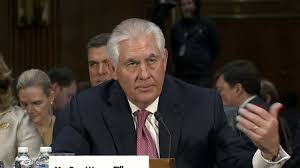
In his opening statement at the January 11 Senate Foreign Relations Committee hearing on his nomination, Secretary of State Nominee Rex Tillerson made the following comments about U.S. policies regarding Cuba:[1]

  • “And we must adhere to standards of accountability. Our recent engagement with the government of Cuba was not accompanied by any significant concessions on human rights. We have not held them accountable for their conduct. Their leaders received much, while their people received little. That serves neither the interest of Cubans or Americans.”

Later in response to questions by Senator Marco Rubio (Rep., FL), a Cuban-American and a noted opponent of normalization, Tillerson said he would advise the president to veto any legislation codifying President Obama’s thaw with Cuba, at least until the Trump administration can conduct its own review of that policy. In addition, Tillerson said the current U.S. normalization policy has not benefited most Cubans.

Tillerson specifically added that he would also advise Trump to veto any measures to lift the Cuban embargo, and “examine carefully the criteria” under which Cuba was taken off the list of state sponsors of terrorism, to determine “whether or not that de-listing was appropriate.”

Tillerson did not commit to indefinitely maintaining the above positions, instead deferring to the results of the new administration’s forthcoming review to determine its long-term Cuba policy.

Tillerson underscored that the United States “cannot ignore the law” and must comply with measures such as the Helms-Burton Act, which codified the embargo in 1996, and stated that economic restrictions must remain in force until the Cuban government complies with certain conditions, among them that the Castro family leaves power. Any modification of that legal basis on the policy toward Cuba “should be done by Congress,” according to Tillerson, who committed to strictly enforcing the law.[2]

The obvious follow-up question that I believe was not asked is whether one of the objectives of the promised review of U.S. policies regarding the island will be recommending changes to relevant statutes.

Responding to a question by Senator Robert Menendez (Dem., NJ), a Cuban-American opposed to normalization, Tillerson said that advancing human rights and democracy in Cuba and returning to justice U.S. fugitives like Joanne Chesimard, convicted of aiding and abetting the murder of a New Jersey State Trooper, would be a condition of any further engagement with Cuba.

Conclusion

This hearing was bad news and good news for advocates of normalization like this blogger.

The good news is Tillerson’s prediction that the new administration will conduct a review of existing U.S. policies regarding Cuba before making any changes in them.As previoulsy stated, this review should include recommendations to Congress for changes in existing statutes on the subject.

The bad news is the series of suggestions that many of the normalization policies will be cancelled.

Although I agree that so far Cuba has not made significant concessions on human rights, I disagree with the implicit conclusion from this statement: the U.S. needs to demand Cuban concessions on human rights as a condition for the U.S. making any further economic “concessions” to the island. This is the policy that was followed for over 50 years before December 17, 2014, without the desired result.

I also disagree with his prospective recommendation of a veto of any legislation ending the U.S. embargo of Cuba. In addition, I reject his implication that the U.S. May 2015 rescission of its designation of Cuba as a “state sponsor of terrorism” was not justified. As explained in earlier posts, the embargo is unjustified and counterproductive for the U.S. while  previous “terrorism” designations were ridiculous and unjustified and the rescission was fully consistent with the law and the facts and was implicitly endorsed by Congress’ failure to approve a joint resolution countermanding the rescission. [3]

Finally I disagree with Tillerson’s testimony that the Cuban “people have received little” from U.S.-Cuba engagement or normalization. As previously stated in various posts, the increased remittances from families and friends in the U.S. to others in Cuba, all made possible by the Obama Administration’s loosening of U.S. restrictions, have been a major source of funding for the expansion of family-owned businesses on the island. That expansion has helped to reduce the portion of the Cuban economy controlled by state-owned enterprises and has increased the income and well being of Cuban entrepreneurs and their employees, who are and will be a significant force for further modification of the Cuban economic and political system.[4]

==============================================

[1] Secretary of State Designate Rex Tillerson: Senate Confirmation Hearing Opening Statement (Jan. 11, 2017); Rex Tillerson Confirmation Hearing: Live Coverage, W.S.J. (Jan. 11, 2017); U.S. Senate For. Rel. Comm., Nomination Hearing for Secretary of State Nominee Rex Tillerson (Jan. 11, 2017) (video); Demirjian, Tillerson says Trump is prepping to review Obama’s Cuba policy, Wash, Post (Jan. 11, 2017); Menendez, Secretary of State Nom Rex Tillerson gives commitment to justice during Senate confirmation hearing (Jan. 11, 2017); Kasperowicz, Tillerson would recommend veto of bill ending Cuba embargo, Wash. Examiner (Jan. 11, 2017).

[2] Of greater interest to most of the media about this hearing was Rubio’s challenging questions to Tillerson about whether he favored sanctions against Russia and whether he thought Putin was a war criminal. (E.g., Sanger & Flegenheimer, In Rocky Hearing, Rex Tillerson Tries to Separate From Trump, N.Y. Times (Jan, 11, 2017).)  Were such questions about Russia merely a Rubio ploy to solidify Tillerson’s opposition to Cuba normalization?

[3] See posts listed in the “U.S. Embargo of Cuba” and “Cuba State Sponsor of Terrorism?” sections of List of posts to dwkcommentaries–Topical: CUBA.

[4] See posts listed in the “Cuban Economy” section of List of posts to dwkcommentaries–Topical: CUBA.

U.S. Reactions to the Death of Fidel Castro

The November 25th death of Fidel Castro has prompted comments from President-Elect Donald Trump and his aides, the Obama Administration, U.S. Senators and Representatives, U.S. editorial boards and columnists and U.S. business interests and others. All of this has fueled speculation about the future Trump Administration’s policies regarding Cuba. These topics will be explored in this post along with this blogger’s observations.

President-Elect Trump and His Aides[1]

On Saturday morning after Castro’s death the previous night, Donald Trump tweeted, “Fidel Castro is dead!” Later that same day he issued this statement:”Though the tragedies, deaths and pain caused by Fidel Castro cannot be erased, our administration will do all it can to ensure the Cuban people can finally begin their journey toward prosperity and liberty. While Cuba remains a totalitarian island, it is my hope that today marks a move away from the horrors endured for too long, and toward a future in which the wonderful Cuban people finally live in the freedom they so richly deserve.”

Vice President-Elect Mike Pence on Saturday voiced a similar reaction in a tweet: “The tyrant Castro is dead. New hope dawns. We will stand with the oppressed Cuban people for a free and democratic Cuba. Viva Cuba Libre!”

On November 28, Trump issued another tweet on the subject. He said, “If Cuba is unwilling to make a better deal for the Cuban people, the Cuban/American people and the U.S. as a whole, I will terminate deal.”

These comments were corroborated by Trump’s top aides.

On Sunday, November 27, two of the aides said that Trump would demand the release of political prisoners held in Cuba and push the government to allow more religious and economic freedoms. Reince Priebus, the incoming White House chief of staff, said the president-elect “absolutely” would reverse Mr. Obama’s policies if he didn’t get what he wanted from Cuba. “We’re not going to have a unilateral deal coming from Cuba back to the [U.S.] without some changes in their government. Repression, open markets, freedom of religion, political prisoners—these things need to change in order to have open and free relationships, and that’s what president-elect Trump believes, and that’s where he’s going to head.” Similar comments were made the same day by Trump’s spokeswoman, Kellyanne Conway.

On Monday, November 28, Trump spokesman Jason Miller gave this more nuanced statement to reporters: “Clearly, Cuba is a very complex topic, and the president-elect is aware of the nuances and complexities regarding the challenges that the island and the Cuban people face. This has been an important issue, and it will continue to be one. Our priorities are the release of political prisoners, return of fugitives from American law, and also political and religious freedoms for all Cubans living in oppression.”

The Obama Administration[2]

President Barack Obama’s statement extended the U.S. “hand of friendship to the Cuban people” and stated that “history will record and judge the enormous impact of this singular figure on the people and world around him.” According to the President, Cubans “will recall the past and also look to the future. As they do, the Cuban people must know that they have a friend and partner” in America.

U.S. Secretary of State John Kerry issued a similar positive statement. He extended “our condolences to the Cuban people today as they mourn the passing of Fidel Castro. Over more than half a century, he played an outsized role in their lives, and he influenced the direction of regional, even global affairs. As our two countries continue to move forward on the process of normalization — restoring the economic, diplomatic and cultural ties severed by a troubled past — we do so in a spirit of friendship and with an earnest desire not to ignore history but to write a new and better future for our two peoples.”

On November 28 White House Press Secretary Josh Earnest responded to several questions about Cuba and Castro’s death. Here are a few of those responses:

  • For the U.S., “I wouldn’t expect any impact [of Castro’s death] on the kind of progress that we’re committed to making on our end to begin to normalize relations with Cuba.”
  • “[W]e have seen . . . greater freedom for American citizens to visit Cuba, to send money to family members in Cuba, to engage in business and seek business opportunities in Cuba.  It also enhanced the ability of the [U.S.] government to maintain an embassy in Cuba where U.S. officials can more effectively not just engage with government officials in Cuba but also those activists in civil society that are fighting for greater freedoms. . . . They also facilitate the kind of people-to-people ties that we believe will be more effective in bringing freedom and opportunity to the Cuban people, something that they have long sought and been denied by the Cuban government.  And after five decades of not seeing any results, the President believed it was time to see something different. . . . [We] clearly haven’t seen all the results that we would like to see, but we’re pleased with the progress.”
  • Castro “obviously is a towering figure who had a profound impact on the history of not just his country but the Western Hemisphere.  There certainly is no whitewashing the kinds of activities that he ordered and that his government presided over that go against the very values that . . . our country has long defended.”
  • “[T]here is no doubt that we would like to see the Cuban government do more [on human rights], but this policy has not even been in place for two years.  But we certainly have enjoyed more benefits than was enjoyed under the previous policy that was in place for more than 50 years and didn’t bring about the kinds of benefits or the kinds of progress that we would like to see.”
  • “[T]hose Cuban citizens that do work in industries, like cab drivers or working in restaurants, even Airbnb owners, are benefitting from the enhanced economic activity between Cuban citizens and American citizens who are visiting Cuba.  They are paid at a higher rate, and they’re enjoying more economic activity than they otherwise would because of this policy to normalize relations with Cuba. . . . [T]here is a growing entrepreneurial sector inside of Cuba that is benefitting from greater engagement with the United States.  That’s a good thing, and that is a benefit that is enjoyed by the Cuban people directly.”
  • “[T]here certainly is no denying the kind of violence that occurred in Cuba under the watch of the Castro regime.  There has been no effort to whitewash the history, either the history between the United States and Cuba or the history of what transpired in Cuba while Mr. Castro was leading the country.”
  • “That’s why upwards of 90 percent of the Cuban people actually support this policy and they welcome the greater engagement with the United States.  They welcome the increased remittances that are provided Cuban-Americans to family members in Cuba.  They welcome the increase in travel by American citizens to Cuba.  There’s a lot to offer.  And the Cuban people certainly benefit from that kind of greater engagement.  And that’s why the President has pursued this policy.”
  • The U.S. “relationship with countries throughout the Western Hemisphere, particularly in Latin America, is as strong as it’s been in generations. And all of that would be undone by the reinstitution of a policy that has failed after having been in place for more than five decades.”

The next day, November 28, Press Secretary Ernest announced that the U.S. will not send a formal delegation to Cuba to attend the Castro funeral but instead will dispatch a top White House aide and a principal Cuba-normalization negotiator, Benjamin J. Rhodes, to be joined by , the top U.S. diplomat in Cuba.

U.S. Senators and Representatives[3]

Senator Bob Corker (Rep., TN), the Chair of the Senate Foreign Relations Committee, stated, Under Fidel Castro’s brutal and oppressive dictatorship, the Cuban people have suffered politically and economically for decades, and it is my hope that his passing might turn the page toward a better way of life for the many who have dreamed of a better future for their country. Subsequently after meeting with Mr. Trump about a possible appointment as Secretary of State, Corker said Mr. Trump’s “instincts on foreign policy are obviously very, very good.”

The Ranking Member of that committee, Senator Ben Cardin (Dem., MD), said, “The news of Fidel Castro’s death brings with it an opportunity to close the deep divisions that have been suffered by Cuban society and by Cuban Americans in the U.S.  For Castro’s purported goals of social and economic development to be attained, it is now time for a half-century of authoritarian rule to give way to the restoration of democracy and the reform of a system the has denied Cuba’s citizens their basic human rights and individuals freedoms. As the United States awaits a new Administration, we must continue our partnership with the Cuban people as they seek to build a more hopeful future for their country.”

Senator Marco Rubio of Florida, a Cuban-American and Republican presidential candidate this year, said in a statement: “Sadly, Fidel Castro’s death does not mean freedom for the Cuban people or justice for the democratic activists, religious leaders, and political opponents he and his brother have jailed and persecuted. The dictator has died, but the dictatorship has not…The future of Cuba ultimately remains in the hands of the Cuban people, and now more than ever Congress and the new administration must stand with them against their brutal rulers and support their struggle for freedom and basic human rights.” Senator Bob Menendez (Dem., N.J.), a Cuban-American who has opposed Mr. Obama’s policy, issued a similar statement.

Senator Jeff Flake (Rep., AZ), who has supported normalization and is the lead author of a Senate bill to end the embargo, merely said, “Fidel Castro’s death follows more than a half century of brutal repression and misery. The Cuban people deserve better in the years ahead.”

Minnesota’s Senator Amy Klobuchar (Dem.), the author of a Senate bill to end the U.S. embargo of the island, said the following: “Passing my bill with Republican Senator Jeff Flake to lift the trade embargo with Cuba would create jobs and increase exports for American farmers and businesses, and it could create unprecedented opportunity for the Cuban people. For far too long, U.S.-Cuba policy has been defined by the conflicts of the past instead of the realities of today and the possibilities for the future. The Cuban and American people are ahead of their governments in terms of wanting to see change. We need to seize this opportunity and lift the trade embargo.”

Minnesota’s other Senator, Al Franken (Dem.) said that, in the wake of Castro’s death, he hopes the Obama administration’s work to repair relations with the island nation is upheld by a new administration. “Over the past few years, we’ve made important strides to open up diplomatic relations with Cuba, and now I urge the country’s leadership to put a strong focus on improving human rights and democracy.”

On the House side, one of Minnesota’s Republican representative and an author of a bill to end the embargo, Tom Emmer, said that Congress should seize the opportunity to “assist in the transition to a democracy and market economy” in Cuba and denounced “isolation and exclusion.” He added, “The passing of Fidel Castro is yet another reminder that a new day is dawning in Cuba. As the remaining vestiges of the Cold War continue to fade, the United States has a chance to help usher in a new Cuba; a Cuba where every citizen has the rights, freedom and opportunity they deserve.”

The statement from the Speaker of the House, Paul Ryan (Rep., WI), stated, “Now that Fidel Castro is dead, the cruelty and oppression of his regime should die with him. Sadly, much work remains to secure the freedom of the Cuban people, and the United States must be fully committed to that work. Today let us reflect on the memory and sacrifices of all those who have suffered under the Castros.”

U.S. Editorial Boards and Columnists[4]

The New York Times’ editorial opposed any retreat from normalization. It said such a move would be “extremely shortsighted.” The new process of normalization, it says, “has helped establish conditions for ordinary Cubans to have greater autonomy in a society long run as a police state. It has also enabled Cuban-Americans to play a larger role in shaping the nation’s future, primarily by providing capital for the island’s nascent private sector. While the Cuban government and the Obama White House continue to have profound disagreements on issues such as human rights, the two governments have established a robust bilateral agenda that includes cooperation on environmental policy, maritime issues, migration, organized crime and responses to pandemics. These hard-won diplomatic achievements have benefited both sides.”

 If, on the other hand, said the Times, the normalization process is abandoned, U.S.-Cuba “cooperation is likely to wane. That would only embolden hard-liners in the Cuban regime who are leery of mending ties with the United States and are committed to maintaining Cuba as a repressive socialist bulwark. In Mr. Trump, they may find the ideal foil to stoke nationalism among Cubans who are fiercely protective of their nation’s sovereignty and right to self-determination.”

The editorial from the Washington Post, while criticizing some aspects of President Obama’s opening to Cuba, stated U.S. policy should “align itself with the hopes of ordinary Cubans and the legitimate demands of the island’s pro-democracy movements. That does not necessarily mean reversing the renewal of diplomatic relations and relaxed restrictions on the movement of people and goods; most Cubans still want that. But it should mean that official exchanges with the regime, and any concessions that benefit it, should be tied to tangible reforms that benefit the public: greater Internet access, expansion of space for private business and tolerance of critical speech and assembly by such groups as the Ladies in White.”

Conservative columnists and commentators welcomed Fidel’s death. George Will hoped, if not reasonably expected, “to have seen the last of charismatic totalitarians worshiped by political pilgrims from open societies. Experience suggests there will always be tyranny tourists in flight from what they consider the boring banality of bourgeois society and eager for the excitement of sojourns in ‘progressive’ despotisms that they are free to admire and then leave. Carlos Eire, a Cuban exile, author and the T.L. Riggs Professor of History and Religious Studies at Yale University, suggested a 13-point negative epitaph for Fidel’s tomb. The first point was: ”He turned Cuba into a colony of the Soviet Union and nearly caused a nuclear holocaust.” The last point was this: “He never apologized for any of his crimes and never stood trial for them.”

Another Washington Post columnist, Kathleen Parker, agreed that Fidel was a terrible dictator, but argued that Mr. Trump “should understand that Fidel Castro loved the embargo more than anyone because, as ever, he could blame the [U.S.] for his failures. For Trump to fall into this same trap [by keeping the embargo] would be a postmortem gift to Castro and breathe new life into a cruel legacy — the dictator’s final triumph over the [U.S.] and the several American presidents who could never quite bury him.”

U.S. Business Interests and Others[5]

Important interests that typically are regarded as important by Republicans are arguing against any retreats from the Obama Administration’s pursuit of normalization of Cuba relations

First, many U.S. companies are now deeply invested in Cuba under the current administration’s policy. These companies include major airlines, hotel operators and technology providers, while big U.S. phone carriers have signed roaming agreements on the island. “I think the American business community would be strongly opposed to rolling back President Obama’s changes, and strongly in favor of continuing the path toward normalization of economic and diplomatic relations,” said Jake Colvin, vice president of the National Foreign Trade Council.

Second, the U.S. farming industry is strongly supportive of normalization of U.S.-Cuba relations. For example, Kevin Paap, president of the Minnesota Farm Bureau, does not want the next administration to take any steps that would put U.S. farmers at a further disadvantage in the Cuban market. “Every other country in the world has diplomatic and trade relations with Cuba, and what we don’t want to do is lose that market share to the European Union, Brazil, Argentina.” Mr. Paap added that U.S. market share in Cuba has decreased in recent years as other countries are able to provide better financing.

But agricultural producers across the country, from rice producers in Louisiana to Northwest apple farmers to Kansas wheat growers have pushed for more, including lifting a ban prohibiting Cuba from buying American agricultural goods with U.S. credit.

Cuba’s wheat consumption is about 50 million barrels a year, said Daniel Heady, director of governmental affairs at the Kansas Association of Wheat Growers. Although not a huge market, “it’s right off the coast and it would be extremely easy for us to deliver our product.” “It is something that Kansas farmers are extremely interested in,” Heady said. “In a world of extremely depressed commodity prices, especially wheat, 50 million bushels looks extremely good right now.”

Republican governors from Texas, Arkansas and elsewhere have led trade delegations to Cuba, along with their state farm bureaus and chambers of commerce.

A U.S. journalist with extensive experience with Cuba, Nick Miroff, echoed these thoughts. He said, “A return to more hostile [U.S.-Cuba] relations . . . could also bring a new crackdown in Cuba and further slow the pace of Raúl Castro’s modest liberalization  measures at a time of stalling economic growth. Hard-liners in Cuba’s Communist Party would gladly take the country back to a simpler time, when the antagonism of the United States — not the failure of government policies — was to blame for the island’s problems, and the threat of attack, real or imagined, was used to justify authoritarian political control.’

Moreover, according to a Wall Street Journal report, any U.S. abandonment of normalization with Cuba “could drive a new wedge between Washington and Latin America . . . not only by leftist allies of Cuba like Venezuela and Bolivia but also by conservative governments in Brazil, Chile, Mexico and Colombia. It would also likely complicate regional cooperation on a range of issues, from immigration to security and anti-drug efforts.”

In Miami, many of the island’s exiles and their children and grandchildren took to the streets, banging pots and pans, waving American and Cuban flags, and celebrating in Spanish: “He’s dead! He’s dead!”

Meanwhile in faraway Minnesota, even though it has relatively few Cuban exiles, celebrated its Cuban connections. They range from festivals and restaurants in the Twin Cities that preserve and highlight Cuban culture. Its politicians in Washington, D.C. have been leaders in efforts to lift the trade embargo on Cuba, citing the potential for economic and political advancements and job growth. Christian communities in Minnesota also value their religious and moral obligations to Cubans. Cuba’s expanded Mariel Port could carry Minnesota-made goods. Other Minnesota-based companies, including Sun Country Airlines, Radisson Hotels and Cargill, could benefit from lifting the embargo.

Last year the Minnesota Orchestra took a historic trip to Cuba as the first U.S. orchestra to perform there since Obama began negotiations in 2014. Next June, some Orchestra members will perform in Cuba again along with Minnesota Youth Symphonies. They also will be joined by Cuban-American jazz musician, Ignacio “Nachito” Herrera, and his wife, who works as an attorney. Herrera grew up during the Cuban Revolution and credits Castro’s leadership for the career opportunities he and his wife have achieved. Indeed, Herrera met Castro in the 1980s while being recognized in a Classic World Piano competition. Castro was humble, Herrera said, and deeply curious about his accomplishments.

Concluding Observations

This blog consistently has applauded the U.S. pursuing normalization with Cuba. The death of Fidel Castro does not change that opinion and advocacy. Fundamentally I agree with President Obama that the 50-plus years of U.S. hostility towards Cuba has not worked—it has not persuaded or forced Cuba to change its ways and it has interfered with our having friendly relations with countries throughout the world, especially in Latin America.[6]

Indeed, the countries of the Western Hemisphere in their Summits of the Americas have made it clear to fellow member the U.S. that they would no longer reluctantly acquiesce in the U.S. desire to exclude Cuba from such Summits, and at the last such gathering in 2015, after the announcement of U.S.-Cuba normalization they praised both countries for this move.[7]

The broader world disapproval of the U.S. hostility towards Cuba is shown by the annual overwhelming approvals of resolutions condemning the U.S. embargo of the island by the U.N. General Assembly. Nor should the U.S. continue to ignore its very large contingent liability to Cuba for its alleged damages from the embargo. (The U.S., of course, disputes this contingent liability, but prudence for any nation or entity facing such a large contingent liability dictates cutting off that risk by stopping the behavior that allegedly triggers the risk.)[8]

Opponents of normalization usually point to Cuban deficiencies on human rights and democracy. But such opposition fails to recognize or admit that the U.S. does not have a perfect record on these issues, including this year’s U.S. election and efforts at voter suppression and the U.S. indirect election of the president and vice president via the Electoral College. Moreover, such opponents also fail to recognize or admit that at least some Cuban limits on dissent and demonstrations undoubtedly are triggered by their fear or suspicion that the U.S. via its so-called covert or undercover “democracy promotion” programs in Cuba is financing or otherwise supporting these efforts at regime change on the island. Finally as part of the efforts at normalization the U.S. and Cuba have been having respectful dialogues about human rights issues.[9]

Another issue sometimes raised by opponents of normalization is Cuba’s failure to provide financial compensation to U.S. persons for Cuba’s expropriation of their property in the early years of the Revolution. But such criticism fails to recognize that Cuba has paid compensation to persons from other countries for such expropriation, that it is in Cuba’s interest to do the same for U.S. persons, that the two countries have been respectfully discussing this issue as well, and there is no reason to expect that this issue cannot be resolved peacefully.[10]

Opponents of normalization also seem to believe or assume that only the U.S. and Cuba are involved in these issues. That, however, is not true. Perhaps precipitated by the December 2014 announcement that Cuba and the U.S. had agreed to seek normalization and reconciliation, other countries, especially the members of the European Union, have been accelerating their efforts to resolve differences with Cuba so that the U.S. will not beat them to gain competitive advantages with the island. China also is another competitor.[11]

Finally Cuba’s current major ally, Venezuela, obviously is near collapse and being forced to reduce its support of Cuba, thereby threatening Cuba’s stability and viability. The U.S. does not want to see Cuba become a failed state 90 miles away from the U.S. Such a situation is even more dire today according to Tom Friedman’s new book, Thank You for Being Late: An Optimist’s Guide to Thriving in the Age of Accelerations. He asserts at page 270 that it “may even be more difficult [for inhabitants of a failed state to reconstitute itself] in the age of accelerations. The lifelong learning opportunities you need to provide to your population, the infrastructure you need to take advantage of the global flows [of information], and the pace of innovation you need to maintain a growing economy have all become harder to achieve. . . . Catching up is going to be very, very difficult.”

For the U.S., once again, to act like an arrogant bully towards Cuba will not achieve any good result. All U.S. citizens interested in Cuba’s welfare and having good relations with the U.S. need to resist any efforts by the new Administration to undo the progress of the last two years.

=======================================================

[1] Assoc. Press, Trump Slams Recount Push as ‘a Scam,’ Says Election Is Over, N.Y. Times (Nov. 26, 2016); Reuters, Trump Says He Will do All He Can to Help Cuban People, N.Y. Times (Nov. 26, 2016); Assoc. Press, Vice-President-Elect Pence Says ‘New Hope Dawns’ for Cuba, N.Y. Times (Nov. 26, 2016); Assoc. Press, Trump Aides Say Cuban Government Will Have to Change, N.Y. Times (Nov. 27, 2016); Flaherty, Trump aides say Cuban government will have to change, StarTrib. (Nov. 27, 2016); Schwartz & Lee, Death of Fidel Castro May Pressure Donald Trump on Cuba Promises, W.S.J. (Nov. 27, 2016); Mazzei, Trump pledges to ‘terminate’ opening to Cuba absent ‘better deal,’ Miami Herald (Nov. 28, 2016); Cave, Ahmed & Davis, Donald Trump’s Threat to Close Door Reopens Old Wounds in Cuba, N.Y. Times (Nov. 28, 2016).

[2]   White House, Statement by the President on the Passing of Fidel Castro (Nov. 26, 2016); U.S. State Dep’t, Secretary Kerry: The Passing of Fidel Castro (Nov. 26, 2016); White House, Press Briefing by Press Secretary Josh Earnest, 11/28/16; White House, Press Briefing by Press Secretary Josh Earnest, 11/29/16; Harris, Obama to Send Aide to Fidel Castro’s Funeral, N.Y. Times (Nov. 29, 2016).

[3] Sen. For. Rel. Comm., Corker Statement on the Death of Fidel Castro (Nov. 26, 2016); Griffiths, Corker praises Trump as State Department speculation continues, Politico (Nov. 29, 2016; Sen. For. Rel. Comm, Cardin Statement on the Death of Fidel Castro (Nov. 26, 2016); Rubio, Rubio: History Will Remember Fidel Castro as an Evil, Murderous Dictator (Nov. 26, 2016); Menendez, Senator Menendez on Death of Fidel Castro (Nov. 26, 2016); Flake, Flake Statement on the Death of Fidel Castro (Nov. 26, 2016); Ryan, Statement on the Death of Fidel Castro (Nov. 26, 2016);The latest: US House Leader Urges Remembering Castro Cruelty, N.Y. Times (Nov. 26, 2016); Klobuchar, Klobuchar Statement on Passing of Fidel Castro (Nov. 26, 2016); Emmer, Emmer Statement on Death of Fidel Castro (Nov. 26, 2016).

[4] Editorial, Threatening Cuba Will Backfire, N.Y. Times (Nov. 29, 2016); Editorial,Editorial, Fidel Castro’s terrible legacy, Wash. Post (Nov. 26, 2016); Fidel Castro’s demise can’t guarantee freedom for the people of Cuba, Wash. Post (Nov. 28, 2016); Will, Fidel Castro and dead utopianism, Wash. Post (Nov. 26, 2016); Eire, Farewell to Cuba’s brutal Big Brother, Wash. Post (Nov. 26, 2016); Parker, Don’t give Fidel Castro the last laugh, Wash. Post (Nov. 29, 2016). Eire is the author of Learning To Die in Miami: Confessions of A Refugee Boy (2010) and Waiting for Snow in Havana (2003).

[5] DeYoung, Trump’s threat to terminate opening to Cuba may draw opposition from business, Republican states, Wash. Post (Nov. 29, 2016); Miroff, Cuba faces renewed tensions with U.S., but without Fidel Castro, its field marshal, Wash. Post (Nov. 28, 2016); Dube & Johnson, Donald Trump’s Line on Cuba Unsettles Latin America, W.S.J. (Nov. 28, 2016); Klobuchar, Minnesota Artists, Leaders Reflect on Castro’s Legacy (Nov. 26, 2016);  Miroff & Booth, In wake of Castro’s death, his legacy is debated, Wash. Post (Nov. 28, 2016).

[6] See List of Posts to dwkcommentaries—Topical: CUBA.

[7] Previous posts have discussed the Seventh Summit of the Americas in April 2015. https://dwkcommentaries.com/?s=Summit+of+the+Americas.

[8] Previous posts have discussed the U.N. General Assembly resolutions on the embargo in 2011, 2014, 2015 and 2016 and the suggested international arbitration to resolve the disputes about Cuba’s damage claims resulting from the embargo. (See posts listed in “U.S. Embargo of Cuba” section of List of Posts to dwkcommentaries—Topical: CUBA.

[9] See posts listed in “U.S. Democracy Promotion in Cuba,” “U.S. & Cuba Normalization, 2014-2015” and “U.S. & Cuba Normalization, 2015-2016” sections of List of Posts to dwkcommentaries—Topical: CUBA.

[10] See posts listed in “U.S. & Cuba Damage Claims” section of List of Posts to dwkcommentaries—Topical: CUBA.

[11] See list of posts in “Cuba & Other Countries” section of List of Posts to dwkcommentaries—Topical: CUBA.
Another U.N. Condemnation of the U.S. Embargo of Cuba

                                                                                       O

U.N. General Assembly

On October 26, the United Nations General Assembly voted, 191 to 0 (with two abstentions), to adopt a resolution proposed by Cuba to condemn the United States embargo of Cuba. For the first time in the 25-year history of the annual vote on such resolutions, the U.S, rather than opposing the text, cast an abstention, prompting Israel to do likewise.[1]

This post will examine the resolution’s text, its presentation by Cuba, its support by other countries and the arguments for abstention offered by the U.S. and Israel. This post will then conclude with a brief discussion of reaction to the abstention in the U.S. Prior posts discussed the similar General Assembly resolutions against the embargo that were adopted in 2011, 2014 and 2015.

The Actual Resolution

The actual resolution, “Necessity of ending the economic, commercial and financial embargo imposed by the United States of America against Cuba” (A/RES/71/5 and A/71/L.3) had two principal operative paragraphs.

It reiterated “its call upon all States to refrain from promulgating and applying laws and measures [like the U.S. embargo against Cuba] . . . in conformity with their obligations under the Charter of the United Nations and international law, which, inter alia, reaffirm the freedom of trade and navigation (¶ 2). It also urged “States that have and continue to apply such laws and measures to take the steps necessary to repeal or invalidate them as soon as possible in accordance with their legal regime (¶ 3).

The resolution’s preamble reaffirmed “the sovereign equality of States, non-intervention and non-interference in their internal affairs and freedom of international trade and navigation, which are also enshrined in many international legal instruments” and recited the previous General Assembly resolutions against the embargo. It then welcomed “the progress in the relations between the Governments of Cuba and the [U.S.] and, in that context, the visit of the President of the [U.S.], Barack Obama, to Cuba in March 2016” while also recognizing “the reiterated will of the President of the [U.S.] to work for the elimination of the economic, commercial and financial embargo against Cuba” and “the steps taken by the [U.S.] Administration towards modifying some aspects of the implementation of the embargo, which, although positive, are still limited in scope.”

Cuba’s Presentation of the Resolution

Bruno Rodriguez
Bruno Rodriguez

Speaking last in the debate, Cuba’s Foreign Minister Bruno Rodriguez Parrilla, presented arguments for adopting the resolution. Here are extracts of that speech:

“[T]here has been progress [between Cuba and the U.S. since December 2014] in the dialogue and cooperation on issues of common interest and a dozen agreements were signed [and] reciprocal benefits reported. Now just announced the vote of the US abstention on this draft resolution.”

“The [U.S.] president and other top officials have described [the embargo/blockade] as obsolete, useless to advance American’s interests, meaningless, unworkable, being a burden for [U.S.] citizens, . . . [harming] the Cuban people and [causing]. . . isolation to the [U.S.] and [have] called [for the embargo/blockade] to be lifted.”

“We recognize that executive measures [to reduce the scope of the embargo] adopted by the government of the [U.S.] are positive steps, but [have] very limited effect and scope. However, most of the executive regulations and laws establishing the blockade remain in force and are applied rigorously to this minute by U.S. government agencies.”

“Meanwhile, the U.S. Congress has not approved any of the 20 amendments or legislative initiatives, with bipartisan support, . . . [for] eliminating some restrictions of the blockade or even all of this policy. [Moreover,] there have been more than 50 legislative initiatives that threaten to reinforce key aspects of the blockade, preventing the President [from] approving new executive or implementing measures already adopted.”

“It cannot be underestimated in any way the powerful political and ethical message that [action by this Assembly] . . . sends to the peoples of the world. The truth always [finds] its way. Ends of justice prevail. The abstention vote announced surely is a positive step in the future of improved relations between the[U.S.] and Cuba. I appreciate the words and the efforts of Ambassador Samantha Power.”

“[There] are incalculable human damages caused by the blockade. [There is no] Cuban family or industry in the country that does not suffer its effects on health, education, food, services, prices of goods, wages and pensions.” For example, the “imposition of discriminatory and onerous conditions attached to the deterrent effects of the blockade restrict food purchases and the acquisition in the U.S. market for drugs, reagents, spare parts for medical equipment and instruments and others.”

“The [embargo/] blockade also [adversely] affects the interests of American citizens themselves, who could benefit from various services in Cuba, including health [services].”

“The [embargo/] blockade remains a massive, flagrant and systematic violation of human rights of all Cubans and qualifies as an act of genocide under the Convention on the Prevention and Punishment of the Crime of Genocide of 1948. It is an obstacle to cooperation [in] international humanitarian areas.”

“The blockade is the main obstacle to economic and social development of our people. It constitutes a flagrant violation to international law, the United Nations Charter and the Proclamation of Latin America and the Caribbean as a Zone of Peace. Its extraterritorial application adds further to its violation of international law nature of magnitude.”

“Other causes, in addition to [the blockade/embargo] . . . , determine our economic difficulties: the unjust international economic order; the global crisis; the historical distortions and structural weaknesses caused by underdevelopment; high dependence on energy and food imports; the effects of climate change and natural disasters; and also . . . our own mistakes.”

“Between April 2015 and March 2016, the direct economic damage to Cuba by the blockade amounted to $4.68 billion at current prices, calculated rigorously and prudently and conservatively. The damages accumulated over nearly six decades reach the figure of $753 billion, taking into account depreciation of gold. At current prices, [that is] equivalent to just over $125 billion.”

“On 16 April 2016 President Raul Castro Ruz said, ‘We are willing to develop a respectful dialogue and build a new relationship with the [U.S.], as that has never existed between the two countries, because we are convinced that this alone . . . [will provide] mutual benefits.’ And last September 17, he said ‘I reaffirm the will to sustain relations of civilized coexistence with the [U.S.], but Cuba will not give up one of its principles, or make concessions inherent in its sovereignty and independence.’”

“The government of the [U.S.] first proposed the annexation of Cuba and, failing that, to exercise their domination over it. The triumph of the Cuban Revolution . . . [prompted the U.S. adoption of the embargo whose purpose] was ‘to cause disappointment and discouragement through economic dissatisfaction and hardship … to deny Cuba money and supplies, in order to reduce nominal and real wages, with the aim of causing hunger, desperation and overthrow of government. ‘”

“The [new U.S.] Presidential Policy Directive [states] that the Government of the [U.S.] recognizes ‘the sovereignty and self-determination of Cuba’ and [the right of] the Cuban people to make their own decisions about their future.’” It also states “the U.S. will not seek a ‘change of regime in Cuba.’”[2]

But the Directive also says “’the [U.S.] will support the emerging civil society in Cuba and encourage partners and non-governmental actors to join us in advocating in favor of reforms. While the United States remain committed to supporting democratic activists, [we] also [will] participate with community leaders, bloggers, activists and other leaders on social issues that can contribute to the internal dialogue in Cuba on civic participation.’ The Directive goes on to say: “The [U.S.] will maintain our democracy programs and broadcasting, while we will protect our interests and values, such as Guantanamo Naval Base … The government of the United States has no intention of modifying the existing lease agreement and other related provisions.’”

The Directive also asserts that Cuba “remains indebted to the [U.S.] regarding bilateral debts before the Cuban Revolution.”

The U.S. needs to “recognize that change is a sovereign matter for Cubans alone and that Cuba is a truly independent country. It gained its independence by itself and has known and will know how to defend [its] greatest sacrifices and risks. We are proud of our history and our culture that are the most precious treasure. We never forget the past because it is the way never to return to it. And we decided our path to the future and we know that is long and difficult, but we will not deviate from it by ingenuity, by siren songs, or by mistake. No force in the world can force us to it. We will strive to build a sovereign, independent, socialist, democratic, prosperous and sustainable nation. We will not return to capitalism.”

Other Countries’ Statements of Support[3]

During the debate the following 40 countries expressed their support of the resolution:

  • Latin America: Argentina, Bolivia, Brazil, Colombia, Costa Rica, Dominican Republic (for Commonwealth of Latin American and Caribbean States (CELAC)), Ecuador, El Salvador, Jamaica (for Caribbean Community (CARICOM)), Mexico, Nicaragua, Saint Vincent and Grenadines, Uruguay and Venezuela (for Non-Aligned Movement (NAM)).
  • Africa: Algeria, Angola, Libya, Mozambique, Namibia, Niger (for African States), South Africa, Sudan and Tonga.
  • Middle East: Egypt, Kuwait (for Organization of Islamic Conference (OIC)) and Syria.
  • Asia: Belarus, China, Democratic People’s Republic of Korea [North Korea], India, Indonesia, Iran, Lao People’s Democratic Republic, Malaysia, Myanmar, Russian Federation, Singapore (for Association of Southeast Asian Nations (ASEAN)), Thailand (for Group of 77 and China) and Viet Nam.
  • Europe: Slovakia (for European Union (EU)).

U.S. Abstention[4]

Samantha Power
Samantha Power

The U.S. Ambassador and Permanent Representative to the United Nations, Samantha Power, announced the U.S. abstention before the debate and voting on the resolution. Here are extracts of her speech about that vote.

“For more than 50 years, the [U.S.] had a policy aimed at isolating the government of Cuba. For roughly half of those years, U.N. Member States have voted overwhelmingly for a General Assembly resolution that condemns the U.S. embargo and calls for it to be ended. The [U.S.] has always voted against this resolution. Today the [U.S.] will abstain.”

“In December 2014, President Obama made clear his opposition to the embargo and called on our Congress to take action to lift it. Yet while the Obama Administration agrees that the U.S. embargo on Cuba should be lifted, . . . we don’t support the shift for the reason stated in this resolution. All actions of the [U.S.] with regard to Cuba have been and are fully in conformity with the U.N. Charter and international law, including applicable trade law and the customary law of the sea. We categorically reject the statements in the resolution that suggest otherwise.”

“But [today’s] resolution . . . is a perfect example of why the U.S. policy of isolation toward Cuba was not working – or worse, how it was actually undermining the very goals it set out to achieve. Instead of isolating Cuba, . . . our policy isolated the [U.S.], including right here at the [U.N.].”

“Under President Obama, we have adopted a new approach: rather than try to close off Cuba from the rest of the world, we want the world of opportunities and ideas open to the people of Cuba. After 50-plus years of pursuing the path of isolation, we have chosen to take the path of engagement. Because, as President Obama said in Havana, we recognize that the future of the island lies in the hands of the Cuban people.”[5]

“Abstaining on this resolution does not mean that the [U.S.] agrees with all of the policies and practices of the Cuban government. We do not. We are profoundly concerned by the serious human rights violations that the Cuban government continues to commit with impunity against its own people – including arbitrarily detaining those who criticize the government; threatening, intimidating, and, at times, physically assaulting citizens who take part in peaceful marches and meetings; and severely restricting the access that people on the island have to outside information.”

“We [,however,] recognize the areas in which the Cuban government has made significant progress in advancing the welfare of its people, from significantly reducing its child mortality rate, to ensuring that girls have the same access to primary and secondary school as boys.”

“But none of this should mean that we stay silent when the rights of Cuban people are violated, as Member States here at the [U.N.] have too often done. That is why the [U.S.] raised these concerns directly with the Cuban government during our [recent] historic dialogue on human rights . . ., which shows that, while our governments continue to disagree on fundamental questions of human rights, we have found a way to discuss these issues in a respectful and reciprocal manner.[6] We urge other Member States to speak up about these issues as well.”

“As President Obama made clear when he traveled to Havana, we believe that the Cuban people – like all people – are entitled to basic human rights, such as the right to speak their minds without fear, and the right to assemble, organize, and protest peacefully. Not because these reflect a U.S.-centric conception of rights, but rather because they are universal human rights – enshrined in the U.N. Charter and in the Universal Declaration of Human Rights – which all of our 193 Member States are supposed to respect and defend. Rights that are essential for the dignity of men, women, and children regardless of where they live or what kind of government they have.”

The U.S. concedes that it “has work to do in fulfilling these rights for our own citizens. And we know that at times in our history, U.S. leaders and citizens used the pretext of promoting democracy and human rights in the region to justify actions that have left a deep legacy of mistrust. We recognize that our history, in which there is so much that makes us proud, also gives us ample reason to be humble.”

“The [U.S.] believes that there is a great deal we can do together with Cuba to tackle global challenges. That includes here at the [U.N.], where the decades-long enmity between our nations has at best been a distraction – and at worst, an obstacle – to carrying out some of the most important work of this institution and helping the world’s most vulnerable people.”

U.S. Reactions[7]

Engage Cuba, a U.S. national coalition of private companies, organizations and state and local leaders working to lift the embargo, said, “Year after year, the international community has condemned our failed unilateral sanctions that have caused great economic hardship for the people of Cuba and continue to put American businesses at a competitive disadvantage. The fact that the Administration and Israel abstained from voting for the first time ever demonstrates the growing recognition that the U.S. embargo on Cuba is a failed, obsolete policy that has no place in today’s international affairs.”

Senator Marco Rubio (Rep., FL), on the other hand, blasted the abstention, saying the Obama administration had failed to honor and defend U.S. laws in an international forum. Similar negative reactions were registered by Senators Ted Cruz (Rep., FL) and Robert Menendez (Dem., NJ), Republican Representatives from Florida, Ileana Ros-Lehtinen and Mario Diaz-Balart, and the U.S.-Cuba Democracy PAC.

As an U.S. citizen-advocate for ending the embargo as soon as possible, I am pleased with the U.S. abstention and agree with Ambassador Power that this vote does not mean the U.S. agrees with the resolution’s stated reasons.

Moreover, too many in the U.S. believe the Cuban damages claim from the embargo is just a crazy Cuban dream, but I disagree. Given the amount of the claim, Cuba will not someday tell the U.S. to forget it. A prior post, therefore, suggested that the two countries agree to submit this and any other damage claims by both countries for resolution by an independent international arbitration panel such as those provided by the Permanent Court of Arbitration at the Hague in the Netherlands.

========================================================

[1] U.N. Press Release, U.S. abstains for first time in annual UN vote on ending embargo against Cuba (Oct. 26, 2016).

[2] A prior post replicated the Presidential Policy Directive while another post provided reactions thereto.

[3] U.N. Press Release, General Assembly Plenary (Oct. 26, 2016); The defeat of the blockade is the world’s largest moral and political victory for the people of Cuba against the empire, Granma (Oct. 26, 2016) (Venezuela’s statement); Today not only do we vote against the blockade, we voted for hope, Granma (Oct. 26, 2016) (Bolivia’s statement).

[4] Ambassador Power, Remarks at a UN General Assembly Meeting on the Cuban Embargo (Oct. 26, 2016).  Israel, which also abstained, merely said that it welcomed the improved U.S.-Cuba relations and hoped it would lead to a new era in the region.

[5] A prior post reviewed President Obama’s eloquent speech in Havana to the Cuban people.

[6] A prior post reviewed the limited public information about the recent human rights dialogue.

[7] Ordońez, For 1st time, U.S. changes its position on U.N. resolution blasting Cuba trade embargo, InCubaToday (Oct. 26, 2016); Engage Cuba, Press Release: Engage Cuba Praises First Ever Unanimous Passage of United Nations Resolution Condemning the Cuban Embargo (Oct. 26, 2016); Lederer & Lee, US abstains in UN vote on Cuba embargo for the first time, Wash. Post (Oct. 26, 2016); Rubio, Rubio: Obama Admin Ignoring U.S. Law on Cuba Embargo, Giving More Concessions to Castro Regime at U.N. (Oct. 26, 2016).

Presidential Nomination of U.S. Ambassador to Cuba


Jeffrey DeLaurentis
Jeffrey DeLaurentis

On September 27 U.S. President Barack Obama nominated Jeffrey DeLaurentis to be the U.S. Ambassador to Cuba. If the nomination is confirmed by the U.S. Senate, he would be the first to fill that position in over 50 years.[1]

President Obama said, “Jeff’s leadership has been vital throughout the normalization of relations between the United States and Cuba, and the appointment of an ambassador is a common sense step forward toward a more normal and productive relationship between our two countries.” He “is already working with Cuba on issues that advance U.S. national interests, such as law enforcement, counternarcotics, environmental protection, combatting trafficking in persons, expanding commercial and agricultural opportunities, and cooperation in science and health.  He engages broadly with the Cuban people and expresses the United States’ strong support for universal values and human rights in Cuba.”[2]

Moreover, according to Obama, “Having an ambassador will make it easier to advocate for our interests, and will deepen our understanding even when we know that we will continue to have differences with the Cuban government. He is exactly the type of person we want to represent the United States in Cuba, and we only hurt ourselves by not being represented by an ambassador.”

This nomination was supported by Senator Patrick Leahy (Dem., VT), who said, the nominee “is a career diplomat who is universally respected by his peers, and by Democrats and Republicans in Congress, for his intellect, his integrity, and his thoughtfulness. . . . We need an ambassador who knows Cuba, who is respected by the Cuban government, and who will stand up for U.S. interests and values. Jeff is that person.”[3]

Another supporter of the nomination, Senator Jeff Flake (Rep., AZ), Sen. expects great difficulty in obtaining Senate confirmation of the nominee. He said, “Given the fight we had to go through just to approve our Mexican ambassador (Roberta Alexander) just because of her ties to the Cuba negotiations, I can just imagine what might be coming here.”[4]

Indeed, the prospects of the Republican-controlled Senate’s confirmation of this nomination in the remaining months of the Obama presidency, however, are not promising. Senator Bob Corker (Rep., TN), the Chair of the Senate Foreign Relations Committee, observed, “”The committee was notified of the nomination [on September 27] but has not yet received the appropriate paperwork to begin its work. However, it is highly unlikely that an ambassador to Cuba would be approved in the lame-duck [session ending on December 31, 2016].”[5]

For example, Senator Marco Rubio (Rep., FL) said the nomination should not advance. “Just like releasing all terrorists from Guantánamo and sending U.S. taxpayer dollars to the Iranian regime, rewarding the Castro government with a U.S. ambassador is another last-ditch legacy project for the president that needs to be stopped. This nomination should go nowhere until the Castro regime makes significant and irreversible progress in the areas of human rights and political freedom for the Cuban people, and until longstanding concerns about the Cuban regime’s theft of property and crimes against American citizens are addressed.”[6]

Rubio’s opposition was anticipated. Indeed, a key Obama aide, U.S. Deputy National Security Advisor, Benjamin Rhodes, said after the belated announcement of this nomination that the Administration did not want such opposition to an earlier nomination to distract the Administration from other U.S. priorities in pursuing normalization of affairs with Cuba, such as establishing diplomatic relations, ending the U.S. designation of Cuba as state sponsor of terrorism, the President’s March 2016 trip to the island and various bilateral meetings to work on various issues.[7]

In the meantime, Cuba welcomed the nomination while also complaining that President Obama has not done all he could do to loosen U.S. restrictions on trade with Cuba.[8]

Since August 2014 DeLaurentis has served as the Chargé d’Affaires of the U.S. Interests Section (and after July 2015 the U.S. Embassy) in Havana. He also served in the U.S. Interests Section in Havana as Consular Officer, 1991-93, and as Political-Economic Section Chief, 1999-2002. In his diplomatic career beginning in 1991 he has held many other important positions and holds the rank of ambassador.[9]

==================================================================

[1] Davis, Obama Nominates First Ambassador to Cuba in Over 50 Years, N.Y. Times (Sept, (7, 2016); Reuters, Obama Names U.S. Ambassador to Cuba, Setting Up Confirmation Fight, N.Y. Times (Sept. 27, 2016); Assoc. Press, Obama Names Career Diplomat as US Ambassador to Cuba, N.Y. Times (Sept. 27, 2016); White House, Presidential Nominations Sent to Senate (Sept. 28, 2016).

[2] White House, President Obama Announces Another Key Administration Post (Sept. 27, 2016).

[3] Leahy, Statement on the Nomination of Jeffrey DeLaurentis (Sept. 28, 2016)  Leahy’s statement also contains a lengthy rebuttal of the opposition to the nomination voiced by Senator Marco Rubio.

[4] Schwartz, Obama Nominates First U.S. Ambassador to Cuba in 50 Years, W.S.J. (Sept. 27, 2016).

[5] Reuters, U.S. Senator: ‘Unlikely’ Cuba Ambassador Will Be Approved This Year, N.Y. Times (Sept. 28, 2016).

[6] Rubio, Rubio: President Obama’s Nomination of Ambassador to Castro Regime Should Go Nowhere (Sept. 27, 2016).

[7] Ordoñez & Torres, Did Marco Rubio scare the White House away from nominating an ambassador to Cuba? InCubaToday (Sept. 28, 2016).

[8] Reuters, Cuba Ambassador Nomination but Says Obama Can Do More, N.Y. Times (Sept. 28, 2016)

[9] U.S. Embassy to Cuba, Biography of DeLaurentis.

Senate Hearing on the 2016 Human Trafficking Report

2016_Report_Cover_200_1

On July 12, the U.S. Senate Committee on Foreign Relations held a hearing about the recently released State Department’s 2016 Human Trafficking Report. After opening statements by the Committee’s Chair, Senator Bob Corker (Rep., TN), and its Ranking Member, Senator Ben Cardin (Dem., MD), the only witness was Ambassador Susan Coppedge.

Senator Corker’s Opening Statement[1]

 “The integrity of last year’s report was called into question because of controversy over how the Tier Rankings were made regarding certain countries.”

“This report and Tier Rankings are an improvement, and we thank you for your leadership in that regard and the way inter-departmentally people worked with each other. The decisions behind certain upgrades, such as Cyprus and the Philippines, and downgrades, such as Uzbekistan, Burma, and Luxembourg, are more balanced and strategic.”

“In the past, back and forth deliberations between the TIP office and the regional bureaus have been the rule. While less pronounced this year, that pattern still shows in how certain countries, such as India, Mexico and Malaysia, are ranked.”

“Each year, the TIP report makes recommendations for progress and turns these into tailored actions for our embassies. Rigorously applied TIP action plans should inform the tough calls on the Tier Rankings.”

“We encourage you to give a fair assessment of countries efforts to address trafficking this year, and we also hope you are candid with us in describing the challenges that still exist in certain countries.”

“This year’s report focuses especially on preventing modern slavery. This is important and needs to be part of substantially increasing international efforts to end modern slavery, which this committee unanimously supports and hopefully will come to fruition very quickly.”

Senator Cardin’s Opening Statement[2]

“Trafficking in persons is one of the great moral challenges of our time.  It destroys people and corrodes communities.  It distorts labor markets and undermines stability and the rule of law.  Trafficking is fueled by greed, violence, and corruption. According to the International Labor Organization, there are at least 21 million victims of modern slavery in the world.  Forced labor alone generates more than $150 billion in profits annually, making it one of the largest income sources for international criminals, second only to drug trafficking.”

Last year, we expressed significant concerns about the neutrality of the 2015 TIP report – primary among them, the decision to upgrade Cuba and Malaysia, from the Tier 3 designation to Tier 2 Watch List.” (Emphasis added.)

“After reviewing the 2016 TIP report, I believe it is a mixed bag.  We saw some aggressive evaluations in the 2016 report; yet, we still see remnants of the exact problems we had last year — pending bilateral concerns impacting the quality of the report.  Again despite little progress from Malaysia and Cuba, the State Department decided to keep both on Tier 2 Watch List this year after they were upgraded from Tier 3 in 2015. This was unnecessary and unwarranted. By contrast, for example, Uzbekistan was upgraded last year to the Tier 2 Watch List. But, as a result of continued government compelled forced labor by adults in the cotton harvest and aggressive harassment and detention of independent monitors, Uzbekistan was appropriately downgraded this year to Tier 3.”(Emphasis added.)

During the hearing Cardin later said that last year Cuba and Malaysia should not have been upgraded from Tier III to Tier II Watch List and should not have remained on that Watch List this year.

 Ambassador Coppedge’s Testimony[3]

 In her prepared testimony, Ambassador Coppedge stated, “Of the countries analyzed in the 2016 Report, 36 were placed on Tier 1, 78 on Tier 2, 44 on Tier 2 Watch List, and 27 on Tier 3. In all, there were 27 downgrades and 20 upgrades. No matter which tier a country is placed on, every nation can and should do more to combat human trafficking, which is why the Report offers recommendations for improvements for every country, even Tier 1 countries like the United States.”

In response to questions, the Ambassador described the process of ranking the countries, which involved collaboration among the people in U.S. embassies around the world and the TIP office at the State Department and arriving at consensus for such rankings for almost all countries. For the few instances of no consensus, the Secretary of State is presented optional rankings, and he or she chooses one of those options. She also testified that for the 2016 report there were no instances in which the Secretary rejected the consensus opinion and that there was only “a handful” of instances without a consensus view.

When Senator Menendez suggested possibly amending the governing statute to make the minimum standards stricter, the Ambassador disagreed. She said that the current statutory flexibility was desirable because of the number of issues and countries that were involved.

Most of the senatorial comments and questions focused on India and Malaysia with brief mention of Mauritania. In addition, the Ambassador summarized the reasons for this year’s downgrades of Burma, Haiti and Luxembourg.

Cuba was touched on by Senators Robert Menendez (Dem., NJ) and Marco Rubio (Rep., FL).[4] The Ambassador said she went to Cuba this past January and pressed officials about whether medical personnel on foreign missions were permitted to hold their own passports. She also noted, as stated in the report, that Cuba does not recognize forced labor as a problem, has no laws against that activity and no prosecutions or convictions in that area. Thus, on that issue it does not meet the U.S. statute’s “minimum standards.” Cuba, however, is making progress regarding sex trafficking, including law enforcement training, prosecutions and protection.

There also were cryptic comments about the Committee’s hearing regarding the prior year’s report and to a vigorous, closed hearing with last year’s witness, Deputy Secretary of State Anthony Blinken.[5] Senator Corker said in his opinion certain aspects of the 2015 report were driven by political considerations, rather than the TIP statute.

Immediately after the hearing Chairman Corker issued a press release.[6] It said that he had “noted improvements over last year’s report but argued for continued progress to strengthen the integrity of the Tier Rankings that will help support global efforts to fight human trafficking and end modern slavery.“ Corker “noted that more should be done to ensure recommendations from the TIP office about a country’s progress in combating trafficking are not overruled by political appointees within the State Department based upon other diplomatic considerations.”

Conclusion

Prior posts have reviewed the TIP’s reports assessments of Cuba’s record regarding human trafficking in 2015 and 2016 and mounted a vigorous and, in this blogger’s opinion, effective rebuttals of the contentions that Cuba was engaged in illegal forced labor with respect to its medical personnel on foreign missions.

As those prior posts indicate, these foreign medical missions spring from a Cuban objective of being in solidarity with people in need around the world while also building a community of international allies for the island and in more recent years being a major source of revenue for the Cuban government’s exports of services.

According to Granma, the newspaper of the Communist Party of Cuba, the country’s foreign medical missions started in 1960 when a Cuban medical brigade treated the victims of an earthquake in Chile, followed by the sending of another group in 1963, to provide health care in Algeria, then recently liberated from French colonial rule.

Through May 31, 2016, a total of 325,000 Cuban health personnel have provided medical services in 158 countries. There are currently 55,000 Cubans working in 67 countries, including more than 25,000 doctors. The Granma article provides a list of all the 158 countries with the number of Cuban medical personnel who have worked there.[7]

This year’s hearing did not examine those criticisms of the reports’ contention that Cuba was engaged in illegal forced labor on its foreign medical missions. Instead, the apparent assumption of all the senators at the hearings seemed to be that Cuba was so engaged. Nothing, however, was said at this hearing to criticize or invalidate this blogger’s contention that there is no such illegal forced labor by Cuba.

=================================================

[1] Corker Opening Statement at Hearing on “Review of the 2016 Trafficking in Persons Report,” (July 12, 2016).

[2] Cardin Remarks at Trafficking in Persons Report Hearing (July 12, 2016)

[3] Coppedge, Testimony: Review of the 2016 Trafficking in Persons Report (July 12, 2016); Senate Foreign Relations Comm., Hearing: Review of the 2016 Trafficking in Persons Report (July 12, 2016)(video).

[4] Senator Rubio’s subsequent press release contained a transcript of his interchange with Ambassador Coppedge. (Rubio, Press Release: Rubio Presses State Department On 2016 Trafficking in Persons Report (July 12, 2016).) Senator Menendez in his press release “criticized the apparent politicization of the U.S. Department of State’s annual [TIP] Report, noting that Cuba, Malaysia and other nations continue to enjoy favorable status despite failures to meet minimum legal standards prescribed by Congress.” Menendez also announced his intent to introduce a bill to change the process for preparing the TIP report. (Menendez: TIP Report Can’t Be a ‘Shell Game’ (July 12, 2016).)

[5] The Senate Committee’s closed hearing in 2015 with Deputy Secretary Blinken was touched on in a prior post.

[6] Corker: Continued Progress Needed to Strengthen Integrity of Human Trafficking Report (July 12, 2016).

[7] Barbosa, Cuba’s international health cooperation, Granma (July 15, 2016),


U.S. Reasserts Upgrade of Cuba in Annual Report on Human Trafficking  

On June 30, 2016, the U.S. Department of State released its 2016 Trafficking in Persons Report, which is “the U.S. Government’s principal diplomatic tool to engage foreign governments on human trafficking” and “ the world’s most comprehensive resource of governmental anti-human trafficking efforts.”[1]

For this Report, “severe forms of trafficking in persons” is defined in the U.S. Trafficking in Persons Victims Act (TVPA) as:

  • “sex trafficking in which a commercial sex act is induced by force, fraud, or coercion, or in which the person induced to perform such an act has not attained 18 years of age; or
  • “the recruitment, harboring, transportation, provision, or obtaining of a person for labor or services, through the use of force, fraud, or coercion for the purpose of subjection to involuntary servitude, peonage, debt bondage, or slavery.”

In this Report, the Department placed 188 countries (including the United States) into the following four tiers plus “Special Cases” (Libya, Somalia and Yemen) based on the extent of their governments’ efforts to comply with the “minimum standards for the elimination of trafficking” found in Section 108 of the TVPA:

  • TIER 1 [36] “countries whose governments fully meet the . . . [TVPA’s] minimum standards.”
  • TIER 2 [78] “countries whose governments do not fully meet the TVPA’s minimum standards, but are making significant efforts to meet those standards.”
  • TIER 2 WATCH LIST [44] “countries whose governments do not fully meet the TVPA’s minimum standards, but are making significant efforts to meet those standards AND: a) The absolute number of victims of severe forms of trafficking is very significant or is significantly increasing; b) There is a failure to provide evidence of increasing efforts to combat severe forms of trafficking in persons from the previous year, including increased investigations, prosecution, and convictions of trafficking crimes; increased assistance to victims; and decreasing evidence of complicity in severe forms of trafficking by government and convictions of trafficking crimes; or c) The determination that a country is making significant efforts to meet the minimum standards was based on commitments by the country to take additional future steps over the next year.”
  • TIER 3 [27] “countries whose governments do not fully meet the minimum standards and are not making significant efforts to do so.”

Susan Coppedge, the U.S. Ambassador-at-Large to Monitor and Combat Trafficking in Persons, made remarks at the ceremony.[2] She said the Report was the U.S.’ “principal diagnostic tool to assess government efforts across what we call the three Ps: prosecution, protection and empowerment of victims, and preventing future trafficking crimes.” She also said there had been 27 downgrades in this Report compared with the prior report and 20 upgrades. In addition, she responded to journalists’ questions, but none was asked about Cuba.

The Report’s Assessment of Cuba’s Record on Human Trafficking [3]

In the 2016 Report Cuba was again placed in the Tier 2 Watch List with the following explanation.

“Cuba is a source and destination country for adults and children subjected to sex trafficking and forced labor. Child sex trafficking and child sex tourism occur within Cuba. Cuban authorities report people from ages 13 to 20 are most vulnerable to human trafficking in the country. Traffickers also subject Cuban citizens to sex trafficking and forced labor in South America and the Caribbean. The government indirectly acknowledged the presence of foreign national trafficking victims in Cuba. The government is the primary employer in the Cuban economy, including in foreign medical missions that employ more than 84,000 workers and constitute a significant source of Cuban government revenue. Some participants in foreign medical missions and other sources allege Cuban officials force or coerce participation in the program; however, the Cuban government and some participants say the program is voluntary and well paid compared to jobs within Cuba. The government uses some high school students in rural areas to harvest crops and does not pay them for their work but claims this work is not coerced.”

“The Government of Cuba does not fully meet the minimum standards for the elimination of trafficking; however, it is making significant efforts to do so. Despite these measures, the government did not demonstrate overall increasing antitrafficking efforts compared to the previous reporting period; therefore Cuba is placed on Tier 2 Watch List for the second consecutive year. The government reported continued efforts to address sex trafficking, including the prosecution and conviction of 18 sex traffickers in 2014 (the most recent available data) and the provision of services to 13 victims in those cases. The government publicly released a written report on its anti-trafficking efforts in October 2015. Multiple ministries engaged in anti-trafficking efforts, including the Ministries of Justice, Information Science and Communication, Interior, Foreign Affairs, Education, Tourism, Labor and Social Security, Culture and Health, and the attorney general’s office. The penal code does not criminalize all forms of human trafficking, although the government reported its submission of some trafficking-related penal code amendments to the National Assembly for review during the reporting period. The Cuban government was more transparent in providing details of anti trafficking efforts and the government’s overseas medical missions program. However, the government did not prohibit forced labor, report efforts to prevent forced labor, or recognize forced labor as a possible issue affecting its nationals in medical missions abroad. The government provided funding for child protection centers and guidance centers for women and families, which serve all crime victims, including trafficking victims. These centers had the ability to screen cases, make referrals to law enforcement, assist with arranging cooperation with law enforcement up to prosecution, and provide victim services.”

RECOMMENDATIONS FOR CUBA

“Draft and enact a comprehensive anti-trafficking law that prohibits and sufficiently punishes all forms of human trafficking, including forced labor, sex trafficking of children ages 16 and 17, and the full range of trafficking “acts” (recruiting, transporting, transferring, harboring, or receiving persons); vigorously investigate and prosecute both sex trafficking and forced labor offenses; provide specialized training for managers in state-owned or controlled enterprises in identifying and protecting victims of forced labor; implement policies to prohibit force, fraud, or coercion in recruiting and retaining employees in such enterprises; train those responsible for enforcing the labor code to screen for trafficking indicators and educate workers about trafficking indicators and where to report trafficking-related violations; draft and adopt a comprehensive written national anti-trafficking action plan and dedicate resources to implement it in partnership with international organizations; provide specialized victim identification and referral training for first responders; establish formal policies and procedures to guide officials in the identification of all trafficking victims and their referral to appropriate services; adopt policies that provide trafficking-specific, specialized assistance for male and female trafficking victims, including measures to ensure identified sex and labor trafficking victims are not punished for unlawful acts committed as a direct result of being subjected to sex trafficking or forced labor; and schedule a visit and cooperate with the UN special rapporteur on trafficking in persons.”

PROSECUTION: The government sustained law enforcement efforts by prosecuting and convicting sex traffickers, but took no action to address forced labor. The penal code does not criminalize all forms of trafficking, in particular forced labor and sex trafficking of children ages 16 and 17. The government did not report any labor trafficking investigations, prosecutions, or convictions. In January 2016, the government reported it was in the process of amending the code, including submitting amendments to the National Assembly to raise the age of consent; it is unclear whether the government will make additional amendments to improve the legal framework to address trafficking. Cuba prohibits some forms of trafficking through several penal code provisions, including: article 302 (procuring and trafficking in persons); article 310.1 (corruption of minors younger than 16 for sexual purposes); article 312.1 (corruption of minors younger than 16 for begging); and article 316.1 (sale and trafficking of a child younger than 16). The penal code’s definition of sex trafficking conflates sex trafficking with prostitution and pimping. The law criminalizes inducement to or benefiting from prostitution, but treats force, coercion, and abuse of power or vulnerability as aggravating factors rather than an integral part of the crime. Legal provisions addressing “corruption of minors” criminalize many forms of child sex trafficking but define a child as an individual younger than 16 years of age; below the age set in international trafficking law, which is 18 years of age. Forced prostitution is illegal irrespective of the victim’s age, and the government has reportedly prosecuted individuals benefiting from child sex trafficking. Provisions for adult and child sex trafficking do not explicitly criminalize the acts of recruitment, transport, and receipt of persons for these purposes. In December 2013, the government amended article 346.1 of the criminal code to mandate sentences of five to 12 years’ imprisonment for various crimes, including for laundering funds obtained from trafficking in persons. Labor code article 116 prohibits entities from directly establishing labor relations with adolescents younger than age 17, even if adolescents may be authorized to join the work force.”

“In 2015, the government publicly presented official data on 147 prosecutions and convictions of sex traffickers during calendar year 2014, the most recent data available. Authorities reported 13 prosecutions and 18 convictions of sex traffickers, compared with 13 prosecutions and convictions in 2013. At least nine convictions in 2014 involved suspects accused of subjecting children to trafficking within Cuba, including the facilitation of child sex tourism in Cuba. The average sentence was seven years’ imprisonment. The government also identified a group of Cubans abroad recruiting and transporting women with false promises of employment and fraudulent work contracts in order to subject the victims to debt bondage and forced prostitution. The government has not sought extradition in this case, and therefore no prosecutions or convictions of suspected traffickers in Cuba have resulted. Students at the Ministry of Interior Academy and police assigned to tourist centers reportedly received specific anti-trafficking training and victim assistance. The government demonstrated its willingness to cooperate with other governments on investigations of possible traffickers. The government arranges for high school students in rural areas to harvest crops and allegedly forces or coerces participation in medical missions, but it denies such claims. The government did not report any investigations, prosecutions, or convictions of government officials complicit in human trafficking in 2014.”

PROTECTION: The government sustained efforts to protect sex trafficking victims, but did not make efforts to identify or protect victims of forced labor. Authorities identified 11 child sex trafficking victims and four adult sex trafficking victims in 2014; it did not identify any labor trafficking victims or male sex trafficking victims. Identified sex trafficking victims received government assistance; detailed information on assistance provided to the 15 identified victims was unavailable. Other government-organized NGOs, like the Federation of Cuban Women (FMC), the Prevention and Social Assistance Commission, and the Committees for the Defense of the Revolution contributed by identifying victims of trafficking to state authorities and providing victim services. Independent members of civil society expressed concern about the government’s anti-trafficking efforts and  limited information on the scope of sex trafficking and forced labor in Cuba given sparse independent monitoring by NGOs and international organizations. The government reportedly developed procedures to proactively identify sex trafficking victims, whereby first responders work with social workers to identify potential cases and refer them to law enforcement.”

“The government did not report having procedures to proactively identify victims of forced labor. Some participants in foreign medical missions and other sources allege Cuban officials force or coerce participation in the program; however, the government and other participants have stated the postings are voluntary. In support of their applications to receive immigration benefits from the United States, some Cubans working in missions abroad have stated Cuban authorities withheld their passports and restricted their movements. At the same time, some participants who left medical missions abroad have been able to obtain new passports from their embassies in neighboring countries. There have also been reports that Cuban authorities coerced participants to remain in the program by allegedly threatening to revoke their medical licenses or retaliate against their family members if participants leave the program. Reports of substandard working and living conditions and the presence of “minders” to monitor medical professionals outside of work also continued. Last year, Cuba reinstituted restrictions on travel for specialized doctors and some medical personnel, requiring them to obtain an exit permit from their superiors before leaving the island. On September 9, 2015, the government agreed to reinstitute medical personnel that left their positions while abroad. As of April 1, 2016, the Cuban authorities claimed that 274 medical professionals returned to Cuba and were rehired at the same salary and level of responsibility.”

“The FMC received funding from international organizations and operated centers for women and families nationwide to assist individuals harmed by violence, including victims of sex trafficking. These centers provided services such as psychological treatment, health care, skills training, and assistance in finding employment. The government reportedly developed a referral process to transfer trafficking victims to law enforcement custody, secure evidence for prosecutions, and provide victim services and follow-on care. Neither the government nor the government-organized NGOs operated shelters or provided services specifically for male trafficking victims. Police encouraged child sex trafficking victims younger than age 16 to assist in prosecutions of traffickers by gathering children’s testimony through psychologist-led videotaped interviewing, usually removing the need for children to appear in court. There were no reports of the government punishing sex trafficking victims for unlawful acts committed as a direct result of being subjected to human trafficking. The government indirectly acknowledged the existence of some foreign trafficking victims in Cuba.”

PREVENTION: The government sustained prevention efforts to combat sex trafficking; however, authorities did not make efforts to prevent or address the demand for forced labor. The attorney general’s office continued to operate a 24-hour telephone line for individuals needing legal assistance, including sex trafficking victims, and received calls related to potential trafficking cases in 2015 that led to investigations. State media continued to produce newspaper articles and television and radio programs to raise public awareness about sex trafficking. Authorities maintained an office within the Ministry of Tourism charged with monitoring Cuba’s image as a tourism destination, combating sex tourism, and addressing the demand for commercial sex acts. The Cuban government cooperated with foreign law enforcement in investigating foreign citizens suspected of sexual crimes against children, including child sex trafficking. Under Cuban law, authorities may deny entry to suspected sex tourists and expel known sex offenders, but reported no related convictions in 2014. The government did not report whether it provided anti-trafficking training for its diplomatic personnel. The government publicly released a written report on its anti-trafficking efforts in October 2015. In March 2015, authorities invited the UN special rapporteur on trafficking in persons to visit, but the visit had not been scheduled by the end of the reporting period. The government did not report specialized training for labor inspectors to screen for indicators of potential forced labor.”

Reactions to the Report

Senator Bob Corker (Rep., TN), the Chairman of the Senate Foreign Relations Committee, attended the State Department’s ceremony for launching the Report and afterwards stated, “ the committee will closely study the report to determine the integrity of the findings. . . . In order for the TIP report to be an effective tool for holding governments accountable, all judgments must be based on measurable progress on anti-trafficking efforts. Following what were clear flaws in last year’s TIP process, the committee will carefully examine the 2016 report and conduct public hearings [this July] to determine the integrity of the findings. Senator Ben Cardin, (Dem., MD), the committee’s Ranking Member, also issued a statement approving of the Report’s upgrading Thailand from Tier 3 to Tier 2 Watch List and the downgrading of Uzbekistan from Tier 2 Watch List to Tier 3. He also expressed continuing concern about Malaysia. Neither of them said anything about Cuba.”[4]

Two other members of the Senate Foreign Relations Committee, Senators Robert Menendez (Dem., NJ), and Marco Rubio (Rep., FL), also issued statements. Menendez criticized the rankings for Malaysia, Cuba and unnamed other countries that “do not match the facts on the ground” and stated his expectation that “Congress . . . [will] be aggressive in its oversight and thoroughly investigate the methodology used to justify this year’s rankings.  Further, I am convinced that new legislation to reform the ranking process is the only way to restore credibility to this broken system and I plan on introducing a bill to do just that.” Rubio asserted that last year’s upgrade of Cuba to Tier 2 Watch List, and by implication its maintenance of that position in this Report, “was not justified by the facts on the ground.” He also criticized China’s maintenance on the Tier 2 Watch List and Thailand’s upgrading to that List.[5]

Conclusion

 The comments of Senators Corker, Menendez and Rubio allude to the Senate committee’s criticism of the prior report’s upgrading of Cuba and Malaysia from Tier 3 to Tier 2 Watch List and to the Administration’s alleged political reasons for doing so, all of which was discussed in a prior post.

At the State Department’s recent ceremony to announce the release of the 2016 Report U.S. Secretary of State John Kerry anticipatorily tried to rebut similar criticisms against this Report. He said, “The tier rankings . . . reflect our department’s best assessment of a government’s efforts to eliminate human trafficking. They don’t take into account political and other factors. As I say, they’re based on . . . [established] criteria. And in addition to the rankings, the report outlines our specific concerns as well as the ways we can improve our efforts. This is not meant to be a dunning report; it is meant to be a demarcation, an encouragement process, a process of evaluation and work towards changing rankings.”[6]

We all will have to see what happens at the forthcoming February hearing to assess these criticisms.

In the meantime, we can, in my opinion, effectively rebut this Report’s half-hearted contention that Cuban medical professionals are engaged in forced labor when they work on the government’s foreign medical missions. Here are the bases for that conclusion:

  • First, the Report admits that there is conflicting information and allegations on the foreign medical mission work. Coercion is alleged by “some participants” and unnamed “other sources.” On the other hand, the Report admits, the Cuban government denies these allegations, and instead the Government and “some participants” assert the postings are “voluntary and well paid compared to jobs within Cuba.” The Report also concedes there is conflicting information on whether other means, including withholding Cuban passports, are used to coerce or force participants to remain in the program.
  • Second, there apparently has not been any fair adjudicative process to determine which of these conflicting sets of information is valid.
  • Third, the accusation of forced labor for such participants has been rejected in a study by Indiana State University’s Emeritus Professor of International Politics and Latin America, Dr. H. Michael Erisman. He says, although there may be “some cases where . . . [Cuban medical professionals] are pressured into accepting overseas assignments, . . . most evidence indicates that the overwhelming majority are motivated by philosophical and/or pragmatic considerations. In the first instance, one needs to understand that the Cuban medical profession . . . is permeated by norms which stress self-sacrifice and service to the community, both at home and abroad. At the core of this ethos is the principle, which is firmly entrenched in the curriculum of the island’s medical schools and reinforced throughout one’s career, that health care should not be seen as a business driven by a profit motive, but rather as a human right that medical personnel have an unconditional duty to protect. Such convictions often underlie participation in the medical aid brigades. There are, however, also some pragmatic factors that can come into play. Overseas service could . . . help to further one’s professional aspirations and for some assignments the total remuneration involved is more generous than what is available back in Cuba. . . . [T]hese are the considerations which apply to the vast majority of people” in such programs, not involuntary servitude.[7]
  • Fourth, According to Granma, Cuba’s Communist Party’s newspaper, “Internationalist medical aid has been a longstanding part of the Cuban people’s tradition of solidarity, since the beginning of the Revolution. As early as 1960 a brigade was sent to Chile following an earthquake there, and to Algeria in 1963, to support the new country recently liberated from colonialism.” The Granma article included the reflection of four Cuban doctors who have participated in such missions and who treasure the positive impact of those experiences on their professional and personal lives.[8]
  • Fifth, this Report does not cite to the relevant legal definition of “forced labor” to assess this claim. Most pertinent is Article 2(2) of the Forced Labour Convention, 1930, which states, in part, ”the term forced or compulsory labour shall not include . . .  any work or service which forms part of the normal civic obligations of the citizens of a fully self-governing country.” (Emphasis added.)[9]

Moreover, as a previous post noted, a respected international journalist, Alma Guillermoprieto, recently reported that Cuban medical doctors serving on the island now earn $67 per month, but $500 per month when serving on a foreign medical mission.

The $67 monthly salary for Cuban physicians in Cuba compared with the $24 or $27 monthly income of other Cubans is a result of Cuba’s adoption of a “pyramid” compensation system whereby highly trained workers like physicians earn more than lower-skilled workers like busboys. This system, however, is being undermined by lower-skilled workers like gas-station attendants and waiters earning additional income from stealing and illegally selling gasoline and from earning tips in hard currency at restaurants and hotels serving foreign tourists. Indeed, Raúl Castro in his speech at the April 2016 Congress of the Communist Party of Cuba called this the “inverted pyramid” problem that had to be solved.

Finally all of this discussion about Cuba’s foreign medical mission program is precipitated by the U.S. Cuban Medical Personnel Parole Program that allows such personnel to apply for parole into the U.S. For reasons previously provided, this program is unjustified and should be ended as soon as possible.[10]

============================================================

[1] U.S. State Dep’t, Trafficking in Persons Report 2016 (June 30, 2016).

[2] U. S. State Dep’t, Ambassador-at-Large to Monitor and Combat Trafficking in Persons Susan Coppedge on the 2016 Trafficking in Persons Report (June 30, 2016).

[3] U.S. State Dep’t, Trafficking in Persons Report 2016 : Country Narratives–Cuba, at 146-47 (June 30, 2016).

[4] Senator Corker, Corker: U.S. Must Lead Global Effort to End Human Trafficking and Modern Slavery (June 30, 2016). Senator Cardin, Cardin Statement on State Dept. Trafficking in Persons Report (June 30, 2016).

[5] Senator Menendez, Menendez Reacts to State Department 2016 Trafficking in Persons Report (June 30, 2016); Senator Rubio, Rubio Comments On State Department’s 2016 Trafficking in Persons Report (June 30, 2016).

[6] U.S. State Dep’t, [Secretary Kerry’s] Remarks at the 2016 Trafficking in Persons Report Ceremony (June 30, 2016).

[7] Erisman, Brain Drain Politics: the Cuban Medical Professional Parole Programme, Int’l J. Cuban Studies 269, 286-87 (2012).

[8] Ledn, Cuban doctors share their experiences in internationalist missions, Granma (Nov. 26, 2015).

[9] This and other parts of the definition of “forced or compulsory labour” were reaffirmed in Article 1(3) of the Protocol of 2014 to the Forced Labour Convention, 1930.

[10] New York Times Calls for End of U.S. Program for Special Immigration Relief for Cuban Medical Personnel, dwkcommentaries.com (Nov. 23, 2014); New York Times Calls for End to Special U.S. Immigration Programs for Cubans, dwkcommentaries.com (Dec. 21, 2015).


Cuban Migration Developments  

In recent weeks there have been significant developments regarding Cubans leaving, and returning to, the island and possible changes to U.S. laws regarding Cubans coming to the U.S.

Cuban Migrants in Central America

  1. “Test Plan” for Transit of Cuban Migrants to U.S.

As reported in prior posts, about 8,000 Cuban migrants have been stranded in Costa Rica on their journeys to the U.S., but last December Mexico and certain Central American governments agreed on a “test plan” to transport the migrants via air and bus from Costa Rica through El Salvador, Guatemala, Honduras and Mexico to the U.S. border.[1]

On January 12 the initial group of 180 of these migrants started this journey, and on the next morning they had arrived in Ciudad Hidalgo on the Honduras-Mexico border, where they were granted 20-day transit visas. They were then put on their own to get to the Mexico-U.S. border. The first of them reached the Mexico-U.S. border at Laredo, Texas on the evening of January 14. And on January 18 a group of 30 arrived in Florida (Tampa, Sarasota, Fort Myers and Miami).[2]

In anticipation of the arrival of many of these Cubans in the Miami, Florida area, the mayors of Miami-Dade County in Florida have asked the federal government for funds to assist in welcoming many of those Cubans who are expected to come to their county.[3]

  1. Evaluation of “Test Plan[4]
Guatemala Meeting
Guatemala Meeting

On January 20 Guatemala hosted a meeting with representatives of Costa Rica, El Salvador, Honduras, Mexico, Panama, Belize and members of the International Organization for Migration to review the operation of the “test plan.” During the meeting an analysis of the operation was performed and each country presented their experience in the management of migration and visa issues as well as logistics and security. They concluded that the process was successful and that the passage of the Cuban migrants was made in a legal, orderly, safe and transparent manner. They also agreed to collaborate better and improve coordination needed for future transfers and to meet again on February 15 to review further progress.

  1. Future Transit of Cuban Migrants to the U.S.

The representatives at the January 20 meeting also concluded to resume the transit of Cubans in Costa Rica on February 4 with two weekly flights (February 9, 11, 16, 18, 23 and 25) from Costa Rica to El Salvador followed by their busing to the Honduras-Mexico border and thence on their own to the Mexico-U.S. border. Priority will be given to households with pregnant women or children, with earlier dates of entry into Costa Rica, the numbers on their Costa Rica visas and the financial resources to pay for the transit. In addition, Costa Rican officials will visit Cubans remaining in shelters to renew their visas.

Each Cuban will pay $555 for the charter flight, the bus and food arranged by a travel agency. Once in Mexico, the Cubans will receive a 20-day transit visa to make it on their own to the U.S. border. U.S. and Mexican officials hope is to hatch a similar plan for the 3,000 Cubans stranded in Panama.

 Cuban Migrants By Sea

On May 2, 1995, in response to a large increase in Cubans who were attempting to make the dangerous crossing of the Caribbean Sea to get to Florida, the U.S. and Cuba entered into an agreement whereby the two countries “reaffirm their common interest in preventing unsafe departures from Cuba. Effective immediately, Cuban migrants intercepted at sea by the [U.S.] and attempting to enter the [U.S.] will be taken to Cuba.”[5]

Since then, the U.S. has done just that. Such an agreement and practice, it was believed, would discourage other Cubans from attempting such dangerous journeys. This then became known as the “wet feet” part of the U.S. disjunctive dry feet/wet feet policy. Here are the statistics on such interdictions:[6]

Fiscal Year

(Oct.1-Sept. 30)

Number of

Interdictions

1995    525
1996    411
1997    421
1998    903
1999 1,619
2000 1,000
2001    777
2002 666
2003 1,555
2004 1,225
2005 2,712
2006 2,810
2007 2,868
2008 2,216
2009    799
2010    422
2011    985
2012 1,275
2013 1,357
2014 2,111
2015 2,924

So far in Fiscal 2016 (10/01/15-01/14/16), the U.S. Coast Guard estimates that 1,942 Cubans have been interdicted at sea or have attempted to land in the U.S. or have actually landed by sea. For the first half of January 2016 alone, a total of 396 Cuban migrants have been picked up in the waters between Florida and Cuba and returned to Cuba. The increases in Fiscal 2015 and so far in Fiscal 2016 are believed to have been caused by the December 2014 announcement of normalization between the two countries and Cubans’ concern that the U.S. might end its special immigration benefits for Cubans.[7]

In addition, the U.S. Coast Guard reports that more of the Cubans who have been interdicted and put on Coast Guard vessels are jumping overboard, trying to poison themselves or making self-inflicted wounds in attempts to be taken to U.S. shore. As a result the Guard has added security personnel on the vessels.

A Guard official recently said, “Immigration policies have not changed, and we urge people not to take to the ocean in unseaworthy vessels. It is illegal and extremely dangerous.”

Some Cubans Returning to Cuba[8]

Nick Miroff of the Washington Post reports there is a “growing number of Cubans who have opted to move back to the island in recent years as the Castro government eases its rigid immigration rules. The returnees are a smaller, quieter counter-current to the surge of Cubans leaving, and their arrival suggests a more dynamic future when their compatriots may come and go with greater ease, helping to rebuild Cuba with earnings from abroad.”

Indeed, Miroff says, these returnees or “repatriates are not coming back for socialism. They are coming back as capitalists. . . . [or as] trailblazing entrepreneurs. Prompted by President Raúl Castro’s limited opening to small business and his 2011 move allowing Cubans to buy and sell real estate, the repatriates are using money saved abroad to acquire property and open private restaurants, guesthouses, spas and retail shops.”

In 2012, Cuban immigration officials said they were processing about 1,000 repatriation applications each year. “The numbers appear to have increased since then, at least judging from anecdotal evidence and the proliferation of new small businesses in Havana run by returnees.”

“Many of the repatriates . . . are returning from Europe and Latin America. Cubans in the [U.S.] may be more reluctant to return to the island because of their relatively high incomes . . . [in the U.S. and because U.S.] economic sanctions also make it essentially illegal for any U.S. resident to go to Cuba and run a business. And the ability to buy property remains mostly restricted to Cubans who live on the island.”

Possible Changes in U.S. Immigration Laws Regarding Cubans

 As noted in previous posts, Cuba and now Central American countries have been vigorous opponents of the U.S. policy of allowing Cubans who arrive on land to come into the U.S. without visas, and the U.S. Administration repeatedly has said it has no intentions of changing that policy.

In the meantime, the only congressional bill to end the special treatment for Cubans arriving by land at the U.S. border that was offered by Representative Paul Gosar (Rep., AZ)—Ending Special National Origin-Based Immigration Programs for Cubans Act of 2015 (H.R.3818)– has gained little support beyond its nine cosponsors.[9]

Under another law, Cubans who have arrived in the U.S. by land are automatically eligible for federal public assistance under the Refugee Resettlement Program. On January 12, 2016, Senator Marco Rubio (Rep., FL), a candidate for the Republican presidential nomination, introduced a bill to end these automatic federal benefits.[10]

The bill, The Cuban Immigrant Work Opportunity Act of 2016 (S.2441), which has no cosponsors and which was referred to the Senate Finance Committee, would terminate the automatic eligibility for federal public assistance for Cuban nationals under the Refugee Resettlement Program, while maintaining it for those that have been persecuted that are in need of resettlement assistance.

Rubio said, ““It is outrageous whenever the American people’s generosity is exploited. It is particularly outrageous when individuals who claim to be fleeing repression in Cuba are welcomed and allowed to ‎collect federal assistance based on their plight, only to return often to the very place they claimed to be fleeing. The weaknesses in our current law not only allow the flow of American tax dollars into the Castro regime’s coffers, it also undermines the legitimate cause of those Cubans who are truly fleeing repression and political persecution.”

Rubio’s rationale for this bill would also justify the U.S.’ ending its previously mentioned “dry feet” immigration policy.

Yet another special U.S. immigration program for Cubans—the Cuban Medical Professional Parole Program—is under consideration for cancellation by the Obama Administration.[11]

====================================================

[1] Cubans in Central America Provide Cuba with an Opportunity to Reiterate Its Objections to U.S. Immigration Policies (Nov. 20, 2015); Update on Cuban Migrants in Central America (Nov. 27, 2015); Status of Cuban Migrants in Central America Still Unresolved (Dec. 11, 2015); Resolution of Problem of Cuban Migrants Stranded in Costa Rica (Dec. 30, 2015).

[2] Date set for the departure of first group of Cuban migrants from Costa Rica, Granma (Jan. 8, 2016); Robles, Cubans, Fearing Loss of Favored Status in U.S., Rush to Make an Arduous Journey, N.Y. Times (Jan. 9, 2016); Reuters, First Group of Stranded Cuban Migrants Leave Costa Rica, N.Y. Times (Jan. 13, 2016); Assoc. Press, Cubans Begin Pilot Transfer From Costa Rica to Mexico, N.Y. Times (Jan. 13, 2016); Assoc. Press, Stranded Cuban Migrants Brought by Air, Bus to Mexico, N.Y. Times (Jan. 13, 2016); Reuters, Mexico to Grant Transit Visas to Cuban Migrants, N.Y. Times (Jan. 13, 2016); Perez & Cordoba, Stranded Cuban migrants brought by air, bus to Mexico, Wash. Post (Jan. 13, 2016); First group of Cuban migrants arrive in Mexico, Granma (Jan. 13, 2016); Assoc. Press, Stranded Cuban Migrants Make Plans to Cross Mexico, N.Y. Times (Jan. 14, 2015); Assoc. Press, First of 8,000 Stranded Cuban Migrants Cross Into US, N.Y. Times (Jan. 15, 2016); Barbero, The first Cubans stranded in Central America come to Miami, El Pais (Jan. 19, 2016).

[3] Barbero, Miami seeks help from Obama before the arrival of Cubans, El Pais (Jan. 7, 2016),

[4]  Prensa Latina,Guatemala: Cuban Migrant Issue to be Tackled in regional Meeting, Esacambray (Jan. 20, 2016); Costa Rice Foreign Ministry, Next trip to Cuban migrants will be on February 4 (Jan. 20, 2016); Central American governments agreed to Cubans plan, Granma (Jan. 21, 2016).

[5] U.S.-Cuba Joint Statement on Migration, May 2, 1995, Dispatch Magazine.

[6] Focus on Cuba: Current Issues and Developments at 41 (2008); U.S. Coast Guard, Alien Migrant Interdiction (May 31, 2015)

[7] Clary, Number of Cubans intercepted at sea rises to highest level in two decades, SunSentinel (Nov. 4, 2015); Flechas, U.S. Coast Guard repatriates 169 Cuban migrants, Miami Herald (Jan. 14, 2016)  Rohrer, Post-Thaw, Cuban refugees surge in Florida, Orlando Sentinel (Jan. 19, 2016); Assoc. Press, Coast Guard: Migrants Fleeing Cuba Increasingly Violent, N.Y. Times (Jan. 20, 2016).

[8] Miroff, Amid a historic wave of emigration, some Cubans are returning home, Wash. Post (Jan. 1, 2015).

[9] Gosar, Press Release: Gosar Introduces Bill to End Wet Foot/Dry foot Policy & Stop Cuban Amnesty (Oct. 23, 2015)

[10] Rubio, Rubio Introduces Legislation To End Rampant Abuse of Cuban Refugee Resettlement Benefits (Jan. 12, 2016); Reuters, Republican Rubio Authors Senate Bill to Curb Cuban Immigration Benefits, N.Y. Times (Jan. 12, 2016)  A companion bill (H.R.4247) was introduced in December 2015 in the House by Representative Carlos Curbelo, a fellow Cuban-American Republican from Florida. It has 12 cosponsors and was referred to the House Judiciary Committee.

[11] U.S. Ending Its Cuban Medical Professional Parole Program? (Jan. 8, 2016).

U.S. Upgrades Cuba in State Department’s Annual Report on Human Trafficking

2015_TIP_REPORT_Cover_200_1On July 27 the U.S. Department of State released its 2015 Trafficking in Persons Report, which is “the U.S. Government’s principal diplomatic tool to engage foreign governments on human trafficking” and “ the world’s most comprehensive resource of governmental anti-human trafficking efforts.”

In this Report, the Department placed 187 countries into one of the following four tiers based on the extent of their governments’ efforts to comply with the “minimum standards for the elimination of trafficking” found in Section 108 of the Trafficking Victims Protection Act:

  • TIER 1 [Thirty-one] countries whose governments fully comply with the Trafficking Victims Protection Act’s (TVPA) minimum standards.
  • TIER 2 [Eighty-nine] countries whose governments do not fully comply with the TVPA’s minimum standards, but are making significant efforts to bring themselves into compliance with those standards.
  • TIER 2 WATCH LIST [Forty-four] countries whose governments do not fully comply with the TVPA’s minimum standards, but are making significant efforts to bring themselves into compliance with those standards AND: a) The absolute number of victims of severe forms of trafficking is very significant or is significantly increasing; b) There is a failure to provide evidence of increasing efforts to combat severe forms of trafficking in persons from the previous year; or c) The determination that a country is making significant efforts to bring itself into compliance with minimum standards was based on commitments by the country to take additional future steps over the next year.
  • TIER 3 [Twenty-three] countries whose governments do not fully comply with the minimum standards and are not making significant efforts to do so.”

At the Department’s release of this Report, Secretary of State John Kerry made comments. In part, he said, “the purpose of this document is not to scold and it’s not to name and shame. It is to enlighten and to energize, and most importantly, to empower people. . . . [We] want to bring to the public’s attention the full nature and scope of a $150 billion illicit trafficking industry. . . . We want to provide evidence and facts that will help people who are already striving to achieve reforms to alleviate suffering and to hold people accountable. We want to provide a strong incentive for governments at every level to do all that they can to prosecute trafficking and to shield at-risk populations.”

Additional comments and responses to journalists’ questions were provided at the launch of this Report by Sarah Sewell, Under Secretary of State for Civilian Security, Democracy and Human Rights. She pointed out that “in this year’s report, some 18 countries moved up in the tier rankings, some 18 countries moved down in the tier rankings” and quoted the above statutory definitions of the different rankings.

The Report’s Assessment of Cuba’s Record on Human Trafficking

In the 2015 Report Cuba was placed in the Tier 2 Watch List, which was an upgrade from the prior year’s report that had Cuba in Tier 3.[1] The new Report states that although “information on the scope of sex trafficking and forced labor in Cuba is limited, [c]hild sex trafficking and child sex tourism occur within Cuba. Cuban authorities report people from ages 13 to 20 are most vulnerable to human trafficking in Cuba. Traffickers also subject Cuban citizens to forced prostitution in South America and the Caribbean. . . . “

As a result, the Report concludes, “The Government of Cuba does not fully comply with the minimum standards for the elimination of trafficking; however, it is making significant efforts to do so. For the second consecutive year, the government reported efforts to address sex trafficking, including the prosecution and conviction of 13 sex traffickers in 2013 and the provision of services to victims in those cases. The Cuban government reported at the beginning of 2015 that the Ministry of Labor and Social Security assumed the lead role in a committee responsible for combating gender and sexual violence, including sex trafficking. The penal code does not criminalize all forms of human trafficking, though the government reported continuing efforts to amend its criminal code, including bringing it into conformity with the requirements of the 2000 UN TIP Protocol, to which it acceded in July 2013. . . .”

In addition, the Report states the Cuban “government did not report any trafficking-specific shelters, but offered services to trafficking victims through centers for women and families harmed by violence. The Federation of Cuban Women, a government affiliated non-governmental organization, provided some outreach and education about human trafficking within the context of violence against women, but did not specifically address it as a crime involving sex trafficking and forced labor or affecting men and boys.”

The Report’s forced labor allegation is focused on Cuba’s “foreign medical missions, which employ more than 51,000 workers in over 67 countries and constitute a significant source of Cuban government income. Some participants in foreign medical missions as well as other sources allege that Cuban officials force or coerce participation in the program; [but] the Cuban government denies these allegations. Some Cubans participating in these work missions have stated the postings are voluntary and well paid compared to jobs within Cuba. There have also been claims that Cuban authorities coerced participants to remain in the program, including by allegedly withholding their passports, restricting their movement, or threatening to revoke their medical licenses or retaliate against their family members in Cuba if participants leave the program. There are also claims about substandard working and living conditions and the existence of ‘minders’ to monitor victims outside of work. Some medical professionals participating in the missions are in possession of their passports when they apply for and obtain special United States visa and immigration benefits, indicating passport retention is not a consistent practice across all work missions.”

Consistent with its denial that its foreign medical missions involve forced labor, the Cuban government “did not recognize forced labor as a problem within Cuba and did not report efforts to prevent forced labor.”

The Report goes on to make the following recommendations for Cuba:  (1) “draft and pass a comprehensive anti-trafficking law that prohibits all forms of human trafficking, including an offense of forced labor;” (2) “vigorously investigate and prosecute sex trafficking and forced labor offenses;” (3) “schedule a visit and engage in robust discussions with the UN special rapporteur on trafficking in persons on all forms of human trafficking;” (4) “provide specialized training for managers in state owned or controlled enterprises in identifying and protecting victims of forced labor and implement policies to verify the absence of coercion in such enterprises;” (5) “train those responsible for enforcing the labor code to screen for trafficking indicators and educate workers about trafficking indicators and where to report trafficking-related violations;” (6) “strengthen efforts, in partnership with international organizations, to provide specialized victim identification and referral training for first responders; (7) establish formal policies and procedures to guide officials in the identification of all trafficking victims and their referral to appropriate services;” (8) “expand upon the Ministry of Labor and Social Security’s anti-trafficking responsibilities to include all forms of trafficking and male as well as female victims, and develop an action plan to address sex trafficking and forced labor for males and females;” and (9) “adopt policies that provide trafficking-specific, specialized assistance for male and female trafficking victims, including measures to ensure identified sex and labor trafficking victims are not punished for unlawful acts committed as a direct result of being subjected to sex trafficking or forced labor.”

Under Secretary Sewell, elaborating on this assessment of Cuba in response to a journalist’s question, said, “Cuba was upgraded to the Tier 2 Watch List because of the progress that the government’s made in addressing and prosecuting sex trafficking, as well as the commitments that the Cuban Government has made to become compliant with the minimum standards. As noted in other cases, a Tier 2 Watch List ranking does not mean that a country is free from problems or free from human trafficking.”

According to Sewell, the Cuban “government reported significant efforts to address sex trafficking, including the conviction of sex traffickers, the provision of services to sex trafficking victims, and continued efforts of the ministry of tourism to address sex tourism and the demand for commercial sex. We also recognize the commitments the government has made to reform its laws to become compliant with the UN Palermo Protocol, which is a significant step, as well as the Cuban Government’s willingness to welcome the UN special rapporteur to the island.”

Nevertheless, Sewell continued, the U.S. has “a number of concerns such as the failure to recognize forced labor as a problem or to act to combat it. And so this will be very much a topic in our dialogue with Cuban officials as we work over the next year to try to help Cuba make more concrete progress in the realm of human trafficking.”

Reactions to the Report’s Assessment of Cuba

News media immediately highlighted the Report’s upgrades of Malaysia and Cuba, and a New York Times editorial was most critical of the assessment of Malaysia. Some U.S. Senators and Representatives launched criticism of those assessments in particular. Prominent with respect to Cuba, as expected, was Senator Robert Menendez (Dem., NJ), who said that by upgrading Malaysia and Cuba the administration had “elevated politics over the most basic principles of human rights” and vowed to do all he could “from hearings to legislation to investigations” to challenge the moves.” Representative Chris Smith (Rep., NJ) was upset by the same upgrades as well as relatively lenient ratings for Vietnam and China and stated the report had “careened off into a new direction where the facts regarding each government’s actions in the fight against human trafficking are given almost no weight when put up against the president’s political agenda.” Similar criticism came from Senator Marco Rubio (Rep., FL). [2]

A Reuters investigation concluded that the State Department’s office responsible for the TIP reports was overruled by senior Department officials on 14 of the 18 upgrades, including Malaysia, Cuba, China, India, Uzbekistan and Mexico. The final decision on disputed rankings this year, said Reuters, was made in meetings attended by some of the State Department’s most senior diplomats, including Deputy Secretary of State Tony Blinken, Under Secretary of State for Political Affairs Wendy Sherman and Kerry’s Chief of Staff, Jonathan Finer.[3]

On July 29 the Chairman (Bob Corker (Rep., TN)) and the Ranking Member (Ben Cardin (Dem., MD)) of the Senate Foreign Relations Committee in a joint letter asked Secretary of State John Kerry for a briefing on the Report in order “to better understand” the basis for its upgrade of several countries, including Malaysia and Cuba. They added, “We recognize that U.S. policy and engagement on trafficking does not exist in a vacuum, and we appreciate the many varied and nuanced trade-offs that are necessary between competing policy issues. We also believe that it is critical that the impartial reliability of the TIP Report be safeguarded and maintained if it is to have utility on this critical issue in the future.” [4]

Senate Foreign Relations Committee Hearing

Under Secretary Sarah Sewell
Under Secretary           Sarah Sewell

On August 6 that Committee held a hearing on this subject with Under Secretary Sewell as its sole witness.[5]

She testified that in “most cases, this assessment process [of different countries’ record on human trafficking] clearly places governments into one of the tiers; in other cases, further discussion among senior Department officials is required to clarify information and assess the totality of government efforts. This ultimately leads to the Secretary of State’s designation of Tier rankings for each country and approval of the TIP Report. Tier rankings do not assess the severity of human trafficking in a given country, but rather that government’s efforts in addressing human trafficking problems over the current reporting period compared to its own efforts in the prior year. Determinations about the direction and quality of that progress in a given country are guided by complex criteria outlined in the TVPA and described on pages 45 through 50 of the TIP Report.”[6]

More specifically for the six countries, including Cuba, that moved up to Tier 2 Watch List this year, Sewell testified, “the Department closely evaluated the efforts those governments had made during the reporting period as well as the commitments they made for next year. Our posts are working with host governments to encourage them to implement the recommendations outlined in this year’s Report, and the TIP Office is finalizing assistance programming strategy to help make those recommendations a reality. I am receiving reports from the field on the frank and focused dialogues Embassy personnel are having with host government officials on how to overcome the challenges they face to better combat this crime and protect their citizens.”

With only Chairman Corker, Ranking Member Cardin and Senator Menendez in attendance, most of the questions focused on the upgrade of Malaysia. Corker, for example, said, “The administration’s policies toward those countries trumped any real regard for humans being trafficked.” The Department, he continued, “threw the trafficking phase under the bus to ensure that . . . [the Administration was] successful with [the Trans-Pacific Partnership (TPP) that included Malaysia].” [7] Menendez added a few comments and questions about the Cuba upgrade.

Sewell declined to answer questions about internal Department discussions about these upgrades and instead repeatedly emphasized that the statutory framework for tier rankings created a complex set of factors to be analyzed and that a Tier 2 Watch List ranking did not indicate a country had a great record on trafficking.[8]

At the conclusion of the hearing, Chair Corker said it had been the “most heartless, lacking of substance” presentation and that he and the two other Senators in attendance had the strong impression that inappropriate political considerations had influenced some or all of the tier upgrades. As a result, the Committee would be asking for the Department to produce records about its internal consideration of the tier rankings. Senator Cardin also said he was interested in exploring whether Congress should amend the relevant statutes in light of what a further hearing might disclose.

After the hearing, a State Department spokesman said that the Department was waiting for the committee to submit a formal request, “but speaking generally, of course we try to be responsive to Congress.”

Conclusion

I agree that the annual T.I.P. reports are important tools in combatting trafficking in persons and that these reports should be free of political influence. On the other hand, I believe that the relevant statutes appropriately create a complex set of factors that require analysis in reaching conclusions about placing countries in the different tiers and that it is appropriate for senior Department officials to be involved in that process.

With respect to Cuba, for at least the following reasons I disagree with the Report’s assertion that Cuban medical personnel’s participation in foreign medical missions is illegal forced labor:

  • First, the Report admits that “information on the scope of . . . forced labor in Cuba is limited.”
  • Second, the Report admits that there is conflicting information and allegations on the foreign medical mission work. Coercion is alleged by “some participants” and “other sources.” On the other hand, the Cuban government denies these allegations, and other participants “have stated the postings are voluntary and well paid compared to jobs within Cuba.” The Report also concedes there is conflicting information on whether other means, including withholding Cuban passports, are used to coerce or force participants to remain in the program.
  • Third, there apparently has not been any fair adjudicative process to determine which of these conflicting sets of information is valid.
  • Fourth, the accusation of forced labor for such participants has been rejected in a study by Indiana State University’s Emeritus Professor of International Politics and Latin America, Dr. H. Michael Erisman. He says, although there may be “some cases where . . . [Cuban medical professionals] are pressured into accepting overseas assignments, . . . most evidence indicates that the overwhelming majority are motivated by philosophical and/or pragmatic considerations. In the first instance, one needs to understand that the Cuban medical profession . . . is permeated by norms which stress self-sacrifice and service to the community, both at home and abroad. At the core of this ethos is the principle, which is firmly entrenched in the curriculum of the island’s medical schools and reinforced throughout one’s career, that health care should not be seen as a business driven by a profit motive, but rather as a human right that medical personnel have an unconditional duty to protect. Such convictions often underlie participation in the medical aid brigades. There are, however, also some pragmatic factors that can come into play. Overseas service could . . . help to further one’s professional aspirations and for some assignments the total remuneration involved is more generous than what is available back in Cuba. . . . [T]hese are the considerations which apply to the vast majority of people” in such programs, not involuntary servitude.[9]
  • Fifth, the Report does not cite to the relevant legal definition of “forced labor” to assess this claim. Most pertinent is Article 2(2) of the Forced Labour Convention, 1930, which states, in part, ”the term forced or compulsory labour shall not include . . .  any work or service which forms part of the normal civic obligations of the citizens of a fully self-governing country.” (Emphasis added.) [10] Cuba is a “fully self-governing country” and the participants in the foreign medical missions are Cuban “citizens,” and as Professor Erisman states, such participation is regarded as “part of the normal civic obligations” of such citizens with the appropriate medical qualifications.
  • Sixth, relevant to this issue, but not mentioned in the Report, is the fact that medical education in Cuba (at the Latin American School of Medicine) is free. As a result requiring medical graduates to pay the country back by such participation seems entirely appropriate and may indeed be a contractual or quasi-contractual obligation. Indeed, as Professor Erisman reports, Cuban medical professionals, especially doctors, may apply to leave Cuba after they have obtained their free medical education and thereafter provided three to five years of service in the country.

We now await the Committee’s formal request for Department documents, the production of such documents and additional hearings on the subject. In the meantime, as always, I welcome comments of correction or amplification.

==========================================================

[1] A prior post examined in detail the prior human trafficking report about Cuba.

[2] Reuters, U.S. Softens View of Malaysia, Cuba in Human Trafficking Report, N.Y. Times (July 27, 2015); Reuters, Obama Administration Faces Criticism Over Human Trafficking Report, N.Y. Times (Aug. 3, 2015); Editorial: Obama Administration Ignores Malaysia’s Trafficking Record, N. Y. Times (July 31, 2015); Menendez, Press Release: Sen. Menendez on Human Trafficking Report Politicization (July 27, 2015); Rubio, Press Release: Rubio: State Department’s Human Trafficking Report Should Be Based on Reality Not Politics (July 27, 2015).

[3] Reuters, Special Report-U.S. State Department Watered Down Human Trafficking Report, N.Y. Times (Aug. 3, 2015).

[4] Reuters, Lawmakers Want State Briefing on Trafficking Report, N.Y. Times (July 29, 2015); U.S. Sen. Foreign Relations Comm., Press Release: Senators Cardin and Corker Request Briefing on State Department’s Trafficking in Person Report in Letter to Secretary Kerry (July 29, 2015); Reuters, Lawmakers to Demand Full Accounting on Human Trafficking Report, N.Y. Times (Aug. 4, 2015).

[5] Senate Foreign Relations Comm., Review of the 2015 Trafficking in Persons Report (Aug. 6, 2015); Hattem, Senators accuse State Dept. of picking politics over human trafficking, The Hill (Aug. 6, 2015); Reuters, Top Senator Demands State Department Documents on Human Trafficking Report, N.Y. Times (Aug. 6, 2015); Assoc. Press, Senators Demand Documents Over Malaysia Trafficking Upgrade, N.Y. Times (Aug. 6, 2015); Corker, Corker Fears Politicization of State Department’s 2015 Human Trafficking Report Over Questionable Upgrades (Aug. 2015); Cardin, Senator Cardin Statement Regarding 2015 Human Trafficking Report (Aug. 6, 2015).

[6] Sarah Sewell, Testimony to Senate Foreign Relations Committee (Aug. 6, 2015).

[7] Secretary of State Kerry, who was in Malaysia on the day of the hearing, categorically denied that politics had played any role in the ranking of Malaysia. “I personally signed off on it. And I had zero conversation with anybody in the administration about the Trans-Pacific Partnership relative to this decision — zero. The reason I made this decision was based on the recommendation of my team, because Malaysia has passed additional legislation in 2014, they’ve consulted with civil society, they drafted amendments to Malaysia’s anti-trafficking law in order to allow the country’s flawed victim protection regime to change.” (Assoc. Press, Kerry: Malaysia Trafficking Upgrade Not Due to Trade Talks, N.Y. Times (Aug. 6, 2015); Reuters, Kerry Says ‘Zero Communication’ on Trade Pact and Malaysian Trafficking Record,  N.Y. Times (Aug. 6, 2015).

[8] The text of the U.S. statutes regarding trafficking in persons is set forth on a State Department web page and the Report contains a summary of “forced labor” without any mention of the exceptions to the definition discussed below.

[9] Erisman, Brain Drain Politics: the Cuban Medical Professional Parole Programme, Int’l J. Cuban Studies 269, 286-87 (2012).

[10] This and other parts of the definition of “forced or compulsory labour” were reaffirmed in Article 1(3) of the Protocol of 2014 to the Forced Labour Convention, 1930.