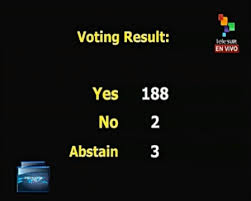
U.N. General Assembly Again Condemns U.S. Embargo of Cuba

U.N. General Assembly Voting Results Screen
U.N. General Assembly   Voting Results Screen

On October 28, 2014, the U.N. General Assembly by a vote of 188 to 2 again condemned the U.S. embargo of Cuba. The two negative votes were cast by the U.S. and by Israel while three small Pacific nations abstained–Marshall Islands, Micronesia and Palau. All the other U.N. members supported the resolution. [1]

 The Resolution

The resolution [A/69/L.4] reiterated the General Assembly’s “call upon all States to refrain from promulgating and applying laws and measures of the kind referred to in the preamble to the present resolution [‘the economic, commercial and financial embargo imposed by the [U.S.] against Cuba’ and the Helms-Burton Act], in conformity with their obligations under the Charter of the United Nations and international law, which, inter alia, reaffirm the freedom of trade and navigation.”

The resolution also “again urges States that have and continue to apply such laws and measures [i.e., the U.S.] to take the steps necessary to repeal or invalidate them as soon as possible in accordance with their legal regime.”

Cuba’s Statement Supporting the Resolution

Bruno Rodriguez Parrilla

Bruno Rodríguez Parrilla, the Cuban Minister for Foreign Affairs, introducing the resolution, said that in recent times “the economic, commercial and financial blockade imposed by the [U.S.] against Cuba had been tightened, and its extraterritorial implementation had also been strengthened through the imposition of unprecedented fines, totaling $11 billion against 38 banks . . . for carrying out transactions with Cuba and other countries.” In addition, Cuba’s “accumulated economic damages of the blockade totaled $1.1 trillion . . . [and] human damages were on the rise.”

Nevertheless, “Cuba had offered every possible form of assistance to the [U.S.] in the wake of disasters there, such as in the aftermath of the September 11, 2001 terrorist attacks. Cuba had never been a threat to the national security of the [U.S.].  Opinion polls showed that there was increasing support from all sectors of [U.S.] society for lifting the blockade.  Religious leaders had citied legitimate, indisputable ethical and humanitarian reasons.“

In addition, ”the blockade was harmful to . . . the [U.S.]. The ‘absurd and ridiculous’ inclusion of Cuba on the [U.S.] list of States that sponsored international terrorism redounded to the discredit of the [U.S.].  Cuba would never renounce its sovereignty or the path chosen by its people to build a more just, efficient, prosperous and sustainable socialism.”  Neither, he continued, would his Government “give up its quest for a different international order, nor cease in its struggle for ‘the equilibrium of the world.’”

Rodríguez also invited the U.S. government “to establish a mutually respectful relation, based on reciprocity. We can live and deal with each other in a civilized way, despite our differences.”

Other Countries’ Statements Supporting the Resolution [2]

The following Latin American countries voiced support for the resolution: Argentina (MERCOSUR [3]) (embargo was “morally unjustifiable” and violated “the spirit of multilateralism and was immoral, unjust and illegal”); Barbados (CARICOM [4]); Bolivia (Group of 77 [5] and China); Brazil (Group of 77 and CELAC [6]); Colombia; Costa Rica (CELAC)); Ecuador; El Salvador (Group of 77 and CARICOM); Mexico; Nicaragua; St. Vincent and the Grenadines (CARICOM, Non-Aligned Movement, [7] Group of 77 and CELAC); Uruguay; and Venezuela.

The African supporters of the resolution that spoke were Algeria (Non-Aligned Movement, Group of 77, Group of African States [8] and Organization of Islamic Cooperation [9]); Angola; Kenya (Group of 77, Non-Aligned Movement and African Group); Malawi (African Group); South Africa (Group of 77, Non-Aligned Movement and African Group); Sudan (Group of 77, Non-Aligned Movement and Organization of Islamic Cooperation); United Republic of Tanzania; Zambia (Non-Aligned Movement) and Zimbabwe (Non-Aligned Movement, Group of 77 and African Group).

From Asia and the Pacific were Belarus; China (Group of 77); Democratic People’s Republic of Korea (North Korea); Indonesia (Group of 77);  India (Group of 77 and Non-Aligned Movement); Iran (Non-Aligned Movement); Lao People’s Democratic Republic; Myanmar (Group of 77 and Non-Aligned Movement); Russian Federation; Solomon Islands; and Viet Nam (Non-Aligned Movement, Group of 77 and China).

Middle Eastern countries speaking in favor of the resolution were Egypt, Saudi Arabia (Organization of Islamic Cooperation); and Syria (Non-Aligned Movement, Group of 77 and China).

The sole European supporter of the resolution that spoke at the session was Italy (European Union [10]), which said the U.S.’ “extraterritorial legislation and unilateral administrative and judicial measures were negatively affecting European Union interests”).

U.S. Statement Opposing the Resolution

Although Israel voted against the resolution, it chose not to speak in support of its vote. Only the U.S. by Ambassador Ronald D. Godard, U.S. Senior Advisor for Western Hemisphere Affairs, tried to justify the negative vote.
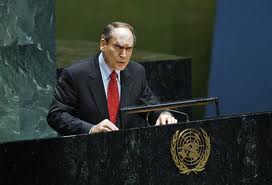
Ronald D. Godard
Ronald D. Godard

Ambassador Godard said the U.S. “conducts its economic relationships with other countries in accordance with its national interests and its principles. Our sanctions toward Cuba are part of our overall effort to help the Cuban people freely exercise their human rights and fundamental freedoms, and determine their own future, consistent with the Universal Declaration of Human Rights and the democratic principles to which the United Nations itself is committed.”

Ambassador Godard also said, “the Cuban government uses this annual resolution in an attempt to shift blame for the island’s economic problems away from its own policy failures. The Cuban government now publicly recognizes that its economic woes are caused by the economic policies it has pursued for the last, past half-century. We note and welcome recent changes that reflect this acknowledgement, such as those that allow greater self-employment and liberalization of the real estate market. But the Cuban economy will not thrive until the Cuban government permits a free and fair labor market, fully empowers Cuban independent entrepreneurs, respects intellectual property rights, allows unfettered access to information via the Internet, opens its state monopolies to private competition and adopts the sound macro-economic policies that have contributed to the success of Cuba’s neighbors in Latin America.”

According to Ambassador Godard, the U.S. “remains a deep and abiding friend of the Cuban people. The Cuban people continue to receive as much as $2 billion per year in remittances and other private contributions from the [U.S.]. This support . . . was made possible . . . by U.S. policy choices. By the Cuban government’s own account, the [U.S.] is one of Cuba’s principal trading partners. In 2013, the [U.S.] exported approximately $359 million in agricultural products, medical devices, medicine and humanitarian items to Cuba. Far from restricting aid to the Cuban people, we are proud that the people of the [U.S.] and its companies are among the leading providers of humanitarian assistance to Cuba. All of this trade and assistance is conducted in conformity with our sanctions program, which is carefully calibrated to allow and encourage the provision of support to the Cuban people.”

Furthermore, the U.S. “places the highest priority on building and strengthening connections between the Cuban people and [our] people. U.S. travel, remittance, information exchange, humanitarian and people-to-people policies updated in 2009 and 2011 provide the Cuban people alternative sources of information, help them take advantage of limited opportunities for self-employment and private property and strengthen independent civil society. The hundreds of thousands of Americans who have sent remittances and traveled to the island, under categories of purposeful travel promoted by President Obama, remain the best ambassadors for our democratic ideals.”

Ambassador Godard continued, “[The U.S.] strongly supports the Cuban people’s desire to determine their own future, through the free flow of information to, from, and within Cuba. The right to receive and impart information and ideas through any media is set forth in Article 19 of the Universal Declaration of Human Rights. It is the Cuban government’s policies that continue to prevent enjoyment of this right. The Cuban government now claims to share our goal of helping the Cuban people access the Internet. Yet the Cuban government has failed to offer widespread access to the Internet through its high-speed cable with Venezuela.  Instead, it continues to impose barriers to information for the Cuban people while disingenuously blaming U.S. policy.”

“Moreover, the Cuban government continues to detain Alan Gross, a U.S. citizen who was sentenced to 15 years in prison for facilitating Internet access for Cuba’s small Jewish community. [[11]] The [U.S.] calls on Cuba to release Mr. Gross immediately, [[12]] allow unrestricted access to the Internet, and tear down the digital wall of censorship it has erected around the Cuban people.

 {T]his resolution only serves to distract from the real problems facing the Cuban people. . . . Though Cuba’s contributions to the fight against Ebola are laudable, they do not excuse or diminish the regime’s treatment of its own people. We encourage this world body to support the desires of the Cuban people to choose their own future. By doing so, it would truly advance the principles the United Nations Charter was founded upon, and the purposes for which the United Nations was created.”

Media Coverage of the Resolution and Debate

 U.S. media coverage of this important U.N. vote was almost non-existent. It was not mentioned in the “World” or “Americas” news sections of the New York Times, and only its “Opinion” section had a short article about the issue. It got no mention whatsoever in the Wall Street Journal. Not even the Miami Herald, which has a separate page for Cuba news, mentioned it. [13]

At 2:37 p.m. on October 28th the Associated Press published a release on the subject, and the Washington Post published it online while the StarTribune of Minneapolis/St. Paul picked it up the next day in its online, but not its print, edition.

Cuba’s state-owned newspaper, Granma, of course, headlined this vote while stating that the embargo has caused $1.1 trillion of damage to the Cuban economy and “incalculable human suffering.” Its article also emphasized that this was the 23rd consecutive such resolution with a table showing that the number of votes in favor of the resolutions has increased from 59 in 1992 to 188 in 2012-2014, that the largest number of votes against the resolutions was only 4 in 1993 and 2004-2007 and that the number of abstentions has decreased from 71 in 1992 to 1 in 2005-2007 and now 3 since 2010.

Conclusion

This overwhelming international opposition to the U.S. embargo in and of itself should be enough to cause the U.S. to end the embargo. Moreover, the embargo has not forced Cuba to come begging to the U.S. for anything that the U.S. wants. The U.S. policy is a failure. The New York Times recently called for abandonment of this policy as has this blog in urging reconciliation of the two countries, in an open letter to President Obama and in a rebuttal of the President’s asserted rationale for the embargo and other anti-Cuban policies.

==============================================================

[1] This post is based upon the sources embedded above and upon U.N. General Assembly Press Release [GA/11574], As General Assembly Demands End to Cuba Blockade for Twenty-Thjrd Consecutive Year, Country’s Foreign Minister Cites Losses Exceeding $1 Trillion (Oct. 28, 2014); Londoño, On Cuban Embargo, It’s the U.S. and Israel Against the World, Again, N.Y. Times (Oct. 29, 2014); Associated Press, UN General Assembly Condemns US Cuba Embargo (Oct. 28, 2014); U.S. Dep’t of State, Explanation of Vote by Ambassador Ronald D. Godard on the Cuba Resolution in the General Assembly Hall (Oct. 28, 2014). The General Assembly also has videos of the debate (A and B). A prior post reviewed the 2011 General Assembly’s adoption of a similar resolution against the embargo.

[2] Many of the cited statements supporting the resolution were issued on behalf of, or aligned with, larger groups of nations as noted above. In addition, prior to the October 28th session of the General Assembly, the U.N. Secretary General submitted a report containing statements against the embargo from 154 states and 27 U.N. agencies.

[3] MERCOSUR (Southern Common Market) is a customs union and trading bloc of five South American countries with five other associate members in the continent.

[4] CARICOM (Caribbean Community) is a group of 15 Caribbean countries with five associate members for economic cooperation.

[5] The Group of 77 was established in 1964 by 77 developing countries to promote their collective economic interests and South-South cooperation; now there are 134 members that have retained the original name for historical significance.

[6] CELAC (Community of Latin American and Caribbean States) is a group of 33 states in the region to deepen economic integration and combat the influence of the U.S.

[7] The Non-Aligned Movement is a group of 115 developing countries that are not aligned with or against any major power bloc. Its current focus is advocacy of solutions to global economic and other problems

[8] The African Group is a group of 54 African states that are U.N. Members.

[9] The Organization of Islamic Cooperation is a group of 57 states that seek to protect the interests of the Muslim world in the spirit of promoting peace and harmony in the world.

[10] The European Union is a group of 28 European states that have combined for a peaceful, united and prosperous Europe.

[11] The activities in Cuba by Mr. Gross are not so simple. A Cuban court in 2011 found him guilty of participating in a “subversive project of the U.S. government that aimed to destroy the revolution through the use of communications systems out of the control of authorities,” and sentenced him to 15 years in prison. According to his own lawsuit against the U.S. Government, and subsequent disclosures, Gross alleged the U.S. Agency for International Development (USAID) and its contractor, DAI, sent him on five semi-covert trips to Cuba without proper training, protection or even a clear sense of the Cuban laws that led to his detainment. The case highlighted the frequent haste and lack of attention to the risks of the USAID programs in Cuba under the Helms-Burton Act, which allowed for money to be set aside for “democracy building efforts” that might hasten the fall of Fidel and Raúl Castro.

[12] In discussions with the U.S., Cuba already has expressed a willingness to exchange Mr. Gross for one or more of the three of “the Cuban Five” who remain in U.S. prisons.

[13] Nor did I find any mention of the vote in London’s Guardian or Madrid’s El Pais.
 

U.S. State Department’s Latest Human Rights Report

StateDeptlogo

On February 27, 2014, the U.S. State Department released its 2013 Country Reports on Human Rights Practices (commonly known as the Human Rights Reports) to the U.S. Congress. Now in their 38th year, the reports are mandated by Congress to inform U.S. government policy and foreign assistance and to provide reference material for other governments, international institutions, non-governmental organizations, legal professionals, scholars, interested citizens, and journalists.[1]

According to the Department, the following were among the most noteworthy human rights developments in 2013.

Increased Crackdown on Civil Society and the Freedoms of Association and Assembly

“Governments in every region of the world continued to stifle civil society and restrict citizens’ universal right to freedoms of assembly and association. Authorities increasingly used legislation to silence political dissidence and used excessive force to crack down on civil society and protest.”

Restrictions on Freedom of Speech and Press Freedom

“Governments around the world also continued to restrict freedom of expression and press freedom as a means of tightly controlling or eliminating political criticism and opposition. This included hampering the ability of journalists to report on issues deemed politically sensitive by placing onerous restrictions on members of the press, such as requiring government approval prior to meeting with international organizations or representatives, and limiting visas for foreign journalists. Governments also used harassment and physical intimidation of journalists to create a climate of fear and self-censorship, both online and offline. Authorities further censored the media by closing independent newspaper outlets and television stations. Officials detained or arrested activists and journalists on false charges in order to limit criticism of the government and impede peaceful protest, and some have even been killed for simply voicing dissent.”

Accountability Deficits for Security Forces Abuses

“In too many places, government security forces abused human rights with impunity and failed to protect their citizens. Military and security forces in numerous countries engaged in unlawful arrests and extrajudicial killings, gender-based violence, rape, torture, and abductions . . . . Weak or nonexistent justice institutions did not hold security forces accountable for human rights abuses and often failed to uphold the rights to due process and a fair trial.”

Lack of Effective Labor Rights Protections

“People continued to work in conditions that were hazardous to their health and safety, some – often migrant workers – against their will. Workers’ attempts to organize and bargain collectively for improved labor rights protections were frequently impeded by governments’ inability or unwillingness to enforce labor protections, as well as government interference in their activities and violence and threats against labor leaders. However, 2013 did see the entry-into-force of International Labor Organization (ILO) Convention 189, which set forth protections for fundamental rights [for domestic workers] . . . , and several countries took steps to enact legislation to protect the rights of domestic workers.”[2]

The Continued Marginalization of Vulnerable Groups

There was “continued marginalization of religious and ethnic minorities, women and children, lesbian, gay, bisexual, and transgender (LGBT) persons, persons with disabilities, and other vulnerable populations. Governments subjected these groups to repressive policies, societal intolerance, discriminatory laws, and disenfranchisement, and authorities failed to hold those who committed crimes against them accountable. Faith organizations and religious and ethnic minorities suffered growing intolerance and violence, as well as faced threats to and restrictions on their religious belief and practice. Women and girls in all regions suffered endemic societal discrimination, and there was a surge in gender-based violence. The rights of LGBT persons were increasingly threatened, as limitations on freedoms of association and assembly for the LGBT community and new laws criminalizing consensual same-sex relations unleashed increased violence and intimidation against LGBT persons. Finally, persons with disabilities continued to experience a lack of access to quality inclusive education, inaccessible infrastructure, and weak non-discrimination protections.”

—————————————

[1] This summary of the most noteworthy overall human rights issues of 2013 comes from the Department’s simultaneously released 2013 Human Rights Fact Sheet. Also accompanying the reports themselves were remarks by Secretary of State John Kerry and by Acting Assistant Secretary of State, Bureau of Democracy, Human Rights, and Labor, Uzra Zeya. Articles about the reports appeared in the New York Times and the Washington Post. Future posts will examine the reports on human rights in Cuba and Ecuador. A prior post reviewed the similar reports for 2012.

[2] ILO Convention No. 189 (Convention concerning decent work for domestic workers) entered into force on September 5, 2013, after eight nation-states had ratified the treaty. As of March 4, 2014, the number of ratifications had increased to 12; this group does not include the U.S.


Ecuador Continues To Restrict Freedom of the Press

On June 14, 2013, Ecuador’s national legislature adopted the Organic Law on Communications with the following provisions that threaten freedom of the press:

  • Prohibition of “media lynching,” which is defined as “a concerted effort, coordinated by several media or carried out by just one, to destroy a person’s honor or prestige.”
  • Establishment of “everyone’s right that information of public interest received through the media should be verified, balanced, contextualized and opportune” without defining those terms.
  • Establishment of media’s responsibility to accept and promote obedience to the Constitution, the laws and the legitimate decisions of public authorities.
  • Creation of the office of Superintendent of Information and Communication with the power to regulate the news media, investigate possible violations and impose potentially large fines.
  • Creation of the Council for Media Regulation and Development headed by a representative of the President with the power to exact a public apology (and impose fines for repeat offenses) when media fail to accord someone the right to a correction or the right of reply.
  • Retention of the system of “cadenas,” or official messages which all over-the-air TV and radio stations have to broadcast that the President and the National Assembly speaker may use whenever they think it necessary and that other public office holders may use for five minutes per week.

Another provision on the surface may appear to be non-controversial: a requirement for allocation of broadcast frequencies (state, 34%; private, 33%; and community, 33%). Currently an estimated 60% are privately owned. Therefore, this requirement is seen as a means of the government’s closing privately owned media, presumably those critical of the government.

Other provisions of the new law are more benign. It prohibits any form of censorship by government officials or civil servants, guarantees the right of journalists to protect their sources and to maintain professional confidentiality.[1]

Ecuadorian legislators opposing the Communications Law

This new law was strenuously challenged by the Ecuadorian legislators opposing the law, who said it will allow the government to control media through loosely defined regulations. (To the right is a photo of the objecting legislators with signs and masks over their mouths.)

Over 50 Colombian newspapers published a joint editorial condemning the law. Some Ecuadorian newspapers     (Hoy and El Commercio) had similar criticisms. Human Rights Watch said the law “is yet another effort by President Correa to go after the independent media. The provisions for censorship and criminal prosecutions of journalists are clear attempts to silence criticism.” The law also was criticized by the Inter-American Press Association, Reporters Without Borders and the Committee To Protect Journalists.

The law was defended by its author who is a member of President Correa’s political party and who said it will “protect freedom of speech with a focus on everybody’s rights, not just for a group of privileged.” Another member of that party who is the president of the legislature predicted that the law would promote more balanced news coverage.

In his TV and radio speech to the country on June 15th President Correa said that law was a precedent that other Latin American countries would follow. Critics of the law, he said, were members of the “gallada” or club that opposes any regulation of the media.

This is not the first effort by Ecuadorian President Rafael Correa to restrict the media. Such prior attempts have been protested by the previously mentioned NGO’s, the U.S. Department of State in its annual human rights reports and the Inter-American Commission on Human Rights.

The Commission’s criticisms have caused Ecuador to launch a full-scale attack on the Commission that was not successful this last past March, but that Ecuador promises to keep pursuing.


[1] This summary of the new law is based upon articles in an Ecuadorian newspaper (Hoy), the New York Times and the Wall Street Journal and a commentary by Reporters Without Borders. As always, I invite others to provide comments to correct any errors of mine and to express other opinions about the new law.


Latest U.S. Report on Human Rights Around the World

StateDeptlogo

On Friday (April 19th), the U.S. Department of State released its latest annual Country Reports on Human Rights Practices.[1]

In his Preface, Secretary of State John F. Kerry said, “It is in our interest to promote the universal rights of all persons. Governments that respect human rights are more peaceful and more prosperous. They are better neighbors, stronger allies, and better economic partners. Governments that enforce safe workplaces, prohibit exploitative child and forced labor, and educate their citizens create a more level playing field and broader customer base for the global marketplace. Conversely, governments that threaten regional and global peace, from Iran to North Korea, are also egregious human rights abusers, with citizens trapped in the grip of domestic repression, economic deprivation, and international isolation.”

Therefore, Kerry continued,” we advocate around the world for governments to adopt policies and practices that respect human rights regardless of ethnicity, religion, gender, race, sexual orientation, or disability; that allow for and honor the results of free and fair elections; that ensure safe and healthy workplaces; and that respect peaceful protests and other forms of dissent.”

In so doing, Kerry acknowledged that “from our own experience [we know] that the work of building a more perfect union – a sustainable and durable democracy – will never be complete.”

The Introduction to the Report highlighted these five developments from 2012.

  1. Shrinking space for civil society activism around the world. Active participation of civil society in determining policies for the society is an important part of human rights. Yet in 2012, many governments “continued to repress or attack the means by which individuals have the ability to come together, air their views, and put forward their own proposals.” Mentioned specifically in this regard were Iran, Venezuela, Russia, Egypt, Bangladesh and China. [2]
  2. The ongoing struggle by people in the Middle East and North Africa for democratic change. Although there were some encouraging changes in this region, there also was “erosion of protections for civil society, sexual violence against women, violence against and increased marginalization of members of religious minorities, and escalating human rights violations.” This was most pronounced in Syria, but significant problems in this regard were seen in Bahrain and Egypt.
  3. Steps toward emerging democracy and a tentative opening for civil society in Burma. In 2012 Burma “continued to take significant steps in a historic transition toward democracy.” These changes are “the result of hard work by the Burmese people and sustained U.S. and international pressure to reform.” This transition, however, is not yet complete. Much work remains to be done.[3]
  4. The game-changing nature of information and communication technologies, in the face of increased suppression of traditional media and freedom of expression.  New technologies have made information more widely available throughout the world. Yet some governments seek to stop the free press. The world-wide number of journalists killed or imprisoned increased. Some governments used counter-terrorism as a “pretext for suppressing freedom of expression.”  Others endeavored to restrict internet freedom. Ecuador was cited as an example of a state where the president publicly criticized specific journalists and encouraged lawsuits to be brought against them, where a ban was instituted on press coverage favoring one candidate, philosophy or political theory and where the government used legal pretexts to harass and close several media outlets.[4]
  5. The continued marginalization of and violence against members of vulnerable groups. Too many governments “continue to persecute, or allow the persecution of, members of religious and ethnic minorities; women; lesbian, gay, bisexual and transgender (LGBT) people; people with disabilities; migrants; and members of other vulnerable populations, including tribal communities.” Anti-Semitism in the Middle East, Europe and Latin America was specifically mentioned as a problem.

These reports have been prepared by the State Department pursuant to a 1961 federal statute. Since then other federal statutes require U.S. foreign and trade policy to take into account countries’ human rights and worker rights performance.

Since 1976 a Coordinator of Human Rights (later upgraded to an Assistant Secretary) in the Department of State has the overall responsibility for preparing these reports based upon information from U.S. embassies and consulates abroad, foreign government officials, nongovernmental and international organizations, published reports, foreign government officials, jurists, the armed forces, journalists, human rights monitors, academics, and labor activists.


[1]  News of the Report in the U.S. media has been virtually nonexistent. Here is the New York Times article on the Report.

[2] On April 21st China responded to the U.S. criticism with “The Human Rights Record of the United States in 2012.” This year, the Chinese report focused on U.S. gun crime, citing “astonishing casualties”; growing poverty in the U.S. and a wide wealth gap; and America’s overseas wars. It also singled out what it said was low voter participation in U.S. elections and the detention of terrorism suspects in Guantánamo.

[3] Similar recent reports about Burma come from Human Rights Watch, Former South African Archbishop Desmond Tutu and a Burmese Buddhist. On the other hand, the government continues to declare amnesties and release political prisoners, and we continue to be inspired by Aung San Suu Kyi’s, whose  acceptance in 2012 of her Nobel Peace Prize of 1991 was the subject of an earlier post.

[4] Ecuador’s wide-ranging measures to squelch hostile journalism have been the subject of persistent and detailed criticism by the Inter-American Commission on Human Rights, and as discussed in a prior post Ecuador in retaliation has mounted, and continues to mount, a campaign to try to weaken the Commission and thereby its criticism of Ecuador.

Failed Efforts To Weaken the Inter-American Human Rights System Under the Guise of Reform

A prior post discussed the March 22, 2013, resolution by the General Assembly of the Organization of American States (OAS) that strengthened the Inter-American Human Rights System, especially the Inter-American Commission on Human Rights (“Commission”).

In so doing, the OAS rejected efforts to weaken the Commission under the guise of reform proposals that had been offered by Ecuador and other states that the Commission has criticized (Venezuela, Bolivia and Nicaragua).

We now examine the background to that surreptitious effort to weaken that System and the debate at the March 22nd General Assembly meeting

Background

1. Multilateral Treaties and Other Instruments Regarding the Right of Free Expression.

The right of free expression by the media and others is well established in international law.

The United Nation’s General Assembly’s Universal Declaration of Human Rights of 1948 in Article 19 states, “Everyone has the right to freedom of opinion and expression; this right includes freedom to hold opinions without interference and to seek, receive and impart information and ideas through any media and regardless of frontiers.” In 1966 this was put into legally enforceable form in Article 19 of the International Covenant on Civil and Political Rights, which entered into force in 1976.

To like effect is the American Convention on Human Rights, which was adopted by the OAS in 1969 and which entered into force in 1978. Its Article 13(1) says, “Everyone has  the right to freedom of thought and expression . . . [including the] freedom to seek, receive, and impart information and ideas of all kinds, regardless of frontiers, either orally, in writing, in print, in the form of art, or through any other medium of one’s choice.” Article 13(3) goes on to say, “The right of expression may not be restricted by indirect methods or means, such as the abuse of government or private controls over newsprint, radio broadcasting frequencies, or equipment used in the dissemination of information, or by any other means tending to impede the communication and circulation of ideas and opinions.”

Elaborating on this right is the Inter-American Declaration of Principles of Freedom of Expression of 2000.

2. Ecuador’s Hostility to Freedom of Expression.

Ecuadorian President Rafael Correa

Ecuador under the presidency of Rafael Correa since January 2007 has through policies and actions retaliated against journalists and media that have criticized him and his government. Correa has insulted and filed lawsuits against reporters and news outlets and promoted a series of legal measures to roll back press freedoms. His government has expropriated television channels, radio stations, newspapers and magazines.

Journalists in the country also have been subjected to physical threats and assaults with lackluster efforts by the government to investigate and prosecute those responsible.

3. The Commission and Civil Society’s Criticism of Ecuador’s Hostility to Freedom of Expression.

The Commission in 1997 created the Special Rapporteur for Freedom of Expression “to encourage the defense of the right to freedom of thought and expression in the hemisphere, given the fundamental role this right plays in consolidating and developing the democratic system and in protecting, guaranteeing, and promoting other human rights.”

This Rapporteur has been in the forefront of criticizing Ecuador for these actions against journalists and the media. Since January 1, 2009 it has issued nine press releases expressing its concern over specific criminal prosecutions and imprisonments of journalists for libel for publication of articles about corruption of public officials and for specific physical threats and assaults on journalists.

In addition, since 2006 the annual reports of the Rapporteur have had sections specifically addressing Ecuador’s conduct in this area.

For example, the latest such report (for 2011) devotes 31 pages (78-108) for a detailed, footnoted review of Ecuador’s assaults and attacks on media and journalists; legal proceedings and arrests (the “Rapporteur is concerned about the consistent tendency of high-ranking public officials to rebuke, arrest, and prosecute citizens who criticize them at public events”); presidential broadcasts and government interruptions of news programs; disparaging statements by senior state authorities against media outlets and reporters critical of the government; constitutional amendment and legislative proposals to regulate the content of all media, establish the grounds for liability and the applicable sanctions and serve as an authority on enforcement; and cloture and regulation of communications media.

Such actions also have subjected the country to similar criticism by the U.N. Human Rights Council in its Universal Periodic Review of Ecuador in the summer of 2012. One of the Council’s closing recommendations in that Review was for Ecuador to reform its legislation regarding freedom of expression with a view to bringing it in conformity with international standards and those of the Inter-American Commission on Human Rights. In response Ecuador said that it could not agree to reform its legal framework in accordance with standards from the Commission, when it is the Inter-American Court of Human Rights, not the Commission, which has judicial competency over this matter. Nor could Ecuador, it said, eliminate laws that criminalize opinion since it had no such laws.

In addition, Ecuador has been severely chastised by the Committee to Protect Journalists, which put the country on its Risk List of the 10 countries in the world where press freedom suffered the most in 2012. Similar rebukes have come from Human Rights Watch, Freedom House and the Washington Post Editorial Board.

4. Ecuador’s Campaign for Its Proposed “Reforms” of the Commission.

In response to the Special Rapporteur’s persistent and documented criticism of Ecuador, the country developed a set of proposals to “reform” the Commission. Prominent in this package were reduction in funding (and hence the work) of the Special Rapporteur and elimination of his separate annual report.

Ricardo Patino
Ricardo Patino

In early 2013 Ecuador conducted a lobbying campaign in support of these proposals. Its Foreign Minister, Ricardo Patino, went on a tour of Mexico, Chile, Argentina, Brazil, Colombia, Dominican Republic, Haiti and Venezuela to promote them.  He also advocated them at a meeting of the Political Council of the Bolivarian Alliance for the Peoples of Our Americas (ALBA) [1] and at a March 11th meeting in Guayaquil, Ecuador of the 24 states that were parties to the American Convention on Human Rights.[2]

The latter event was opened by a long speech by Ecuadorian President Correa, who emphasized that the Commission should have its headquarters in a state that has ratified said Convention (not Washington, D.C.); that the Commission should have its own budget provided only by state parties to the Convention (without voluntary contributions by outsiders like the U.S., Canadian and European governments and NGO’s);  that the Commission should not be “autonomous” and instead be controlled by said states parties; the abolition of the Commission’s rules authorizing its issuance of precautionary measures; having the Commission focus on general promotion of human rights, not investigating and deciding on alleged violations of human rights; and elimination of the separate annual report of the Special Rapporteur for Free Expression and instead including such a report in a comprehensive report for all of the rapporteurships.

The Ecuador meeting resulted in the Declaration of Guayaquil whereby the 24 states parties agreed that at the March 22nd meeting of the OAS General Assembly they would support the following: a group of their foreign ministers would press the U.S., Canada and other non-parties to the Convention to ratify or accede to same; the Commission would be refocused on promotion of human rights through national systems; financing of the Commission would be increased by states parties and by “neutral” others; all rapporteurships would be treated equally; an analysis of the costs of the OAS Human Rights System would be obtained; the Commission’s headquarters would be moved to a state party; and annual conferences about reforming the System would be held.

Opposition to such proposals came forward from the U.N. High Commissioner for Human Rights, Navi Pillay, who urged the OAS members “to strengthen its exemplary human rights system, by promoting universal access for citizens . . ., respecting the Commission’s autonomy to progressively improve its policy and practices in response to the needs of victims and concerns of member states, and providing the necessary resources [to the System].” Similar concerns were voiced by Amnesty International, Human Rights Watch, the Committee to Protect Journalists, Freedom House, a group of 98 prominent Latin Americans and a coalition of 700 hemispheric human rights organizations.

Another opponent of Ecuador’s campaign was Cesar Gaviria Trujillo, a former president of Colombia and past secretary general of the OAS. He said that the so called “reforms” of the Commission put forward by Ecuador would “severely weaken the [C]omission and make it easier for governments to ignore basic rights and limit free speech.” They would “drastically curtail [the Commission’s] autonomy” and put a “financial stranglehold” on its operations, including a “devastating impact” on the Special Rapporteur for Freedom of Expression. [3]

The March 22nd OAS General Assembly Meeting

Jose Miguel Insulza, OAS Secretary General

In opening remarks that day, the OAS Secretary General, Jose Miguel Insulza from Chile, stressed that the autonomy of the System needed to be maintained. He also said that strengthening some of the Commission’s rapporteurships “cannot mean that others are weakened” and that the Special Rapporteurship on Freedom of Expression should be strengthened “with a program of ample defense of [such] freedom . . . . ” This would include “issues relating to the curtailment of that freedom by public authorities . . .  as well as the threats and crimes to which journalists and the social media are increasingly subjected in our region and the obligation of states to protect them.”

William J. Burns, U.S. Deputy Secretary of State

Similar remarks were made by U.S. Deputy Secretary of State, William J. Burns. He noted that even though the U.S. was not a party to the American Convention on Human Rights, the U.S. still collaborates with the Commission when it challenges the U.S. on such issues as the death penalty, the human rights of migrants and children and the status of detainees at Guantanamo Bay, Cuba. He added, “We must be vigilant against efforts to weaken the Commission under the guise of reform. [Such efforts] . . . seek to undermine the Commission’s ability to hold governments accountable when they erode democratic checks and balances and concentrate power through illiberal manipulation of democratic processes.”

Ecuadorian Foreign Minister Patino in his remarks accused the opposition and the media of distorting his government’s proposals. He also accused the Commission of improperly assuming the power to issue precautionary measures. Its decisions were independent, he said, but the Commission was not autonomous. He rhetorically asked, the Commission is autonomous and independent of whom? Sotto voce, a Spanish journalist answered, “You,” causing laughter by those around the journalist.

The resolution adopted by acclamation at the midnight conclusion of the March 22nd meeting already has been discussed. It clearly did not adopt all of the items in Ecuador’s package.

This resolution emerged after a long day in which the U.S., Canada, Mexico, Colombia, Costa Rica, Panama and Chile lead the opposition to the proposals from Ecuador, Bolivia, Venezuela and Nicaragua. A Human Rights Watch observer said, “It was a resounding victory for the Commission, and a major defeat for the Venezuela-Ecuador bloc. It became evident that [the latter] . . . were totally isolated, without the support they were expecting from other countries.”

Towards the end of the meeting Ecuador and Bolivia threatened to withdraw from the Commission and leave the meeting. To avoid such a rupture, Argentina offered a face-saving amendment to the resolution about the OAS’ Permanent Council continuing the dialogue on the “core aspects for strengthening” the System, which Ecuador and the other ALBA countries ultimately accepted.

Conclusion

Afterwards Ecuador’s Foreign Minister tried to whitewash his country’s defeat by saying that the resolution accepted its proposal to continue the debate in the future. Before the next meeting of the OAS General Assembly in June 2014, the Foreign Minister said that there would be another meeting of the states parties to the American Convention like the one on March 11th in Guayaquil to discuss these issues. He also hinted at Ecuador’s possible withdrawal from the OAS Commission by saying there was an agreement being negotiated to create a Human Rights Commission of the Union of South American Nations (UNASUR).

Unless there are unexpected changes in regimes or policies in this Hemisphere over the next 14 months, I do not expect Ecuador and its allies will be successful at the June 2014 OAS meeting in gaining acceptance of its proposals to weaken the Inter-American Commission.[4] We will then see if this small group will leave that Commission and form its own, more limited, human rights system.


[1] ALBA is an alternative to the U.S.-sponsored Free Trade Area of the Americas. differing from the latter in that it advocates a socially-oriented trade block rather than one strictly based on the logic of deregulated profit maximization. The only members of ALBA are Ecuador, Bolivia, Venezuela, Nicaragua and three small Caribbean states (Antigua and Barbuda, Dominica and Saint Vincent and the Grenadines.

[2]  This campaign is discussed in press releases from Ecuador’s Foreign Minister.

[3] Such a limitation on financing undoubtedly would result in a reduction of such funding and thus on the work of the Commission.

[4]  I assume that Ecuador has another burden to overcome in attempting to win support for its “reform” proposals. Its credibility within the OAS, I suspect, has been adversely affected by its recent exaggerated, alarmist call for an OAS Consultative Meeting of Foreign Ministers over the alleged United Kingdom threat to invade Ecuador’s London Embassy because of its providing diplomatic asylum in that Embassy to Julian Assange.

Organization of American States Strengthens the Inter-American System of Human Rights [1]

OAS General Assembly, 3/22/13
OAS General Assembly, 3/22/13                                                  (Photo: OEA OAS Photostream [2])
On March 22, 2013, the Extraordinary General Assembly of the Organization of American States (OAS)[3] adopted by acclamation a resolution strengthening the Inter-American System of Human Rights (“the System”).[4] The resolution had the following provisions:

  1. Requested the Inter-American Commission on Human Rights (“Commission”), an autonomous OAS organ that promotes and protects human rights in the American hemisphere, to continue to move forward with application of its responses to suggestions for reform by a special working group and the Commission’s March 18, 2013, reform of its rules.
  2. Instructed OAS’ Permanent Council[5] to continue the dialogue on the “core aspects for strengthening” the System.
  3. Urged the Commission to put into practice pending recommendations for reform.
  4. Encouraged the Commission “to strengthen its efforts in the promotion of human rights, including through its support to national systems.”
  5. Reaffirmed the OAS General Assembly’s commitment to obtain full financing of the
    System through OAS’ Regular Fund “without prejudice to the financing of the other mandates” of the OAS.
  6. Requested the OAS Secretary General to submit to the OAS Permanent Council “a detailed, up-to-date analysis of the full operating costs” of the System.
  7. Proposed that the Commission “strengthen all its rapporteurships, including by giving consideration to granting special status to all existing rapporteurships, based on adequate financing, without prejudice to its other responsibilities.”[6]
  8. Urged “OAS member states [i.e., U.S., Canada and seven others] to ratify or accede to . . . all inter-American human rights instruments, especially the American Convention on Human Rights,” and  for the U.S., Canada and eight other states “to accept . . . the contentious jurisdiction of the Inter-American Court of Human Rights.”[7]

Understanding the significance of this resolution requires elaboration.

1.1. Recommendations of the Special Working Group. In its December 2011 report the Special Working Group proposed changes to the Commission’s rules regarding individual petitions and cases; precautionary measures; monitoring of human rights in member states; promotion of human rights; a permanent presidency; financing and allocation of resources; and dissemination of criteria and jurisprudence.[8] The most controversial ones that were seen by many as efforts to muzzle the Commission were these:

  • Restrict the Commission’s discretion in granting “precautionary measures,” by, among other things, setting forth “precise objective criteria” for granting same and determining whether the situation was “serious and urgent.” The addition of such criteria would help states as well as alleged victims who are affected by such measures.
  • Require its annual report to cover human rights conditions in all OAS members, not just those with the most pressing problems.
  • Reduce the activities and funding of the Special Rapporteur on Freedom of Expression by eliminating its separate funding and instead requiring balanced funding of all rapporteurs as well as eliminating this one’s special report.
  • Require the Commission to devote more time and resources to the general promotion of human rights and thereby reduce its time and resources to deciding individual complaints.
  • Impose restrictions on the Commission’s decisions regarding individual complaints.

1.2. Commission’s Responses to Recommendations of Special Working Group. On October 23, 2012, the Commission issued its second response expressing agreement with most of these recommendations.

However, the Commission did disagree with the recommendation to assign balanced resources to all of its rapporteurships. It pointed out that the first source of funds for the Commission is the OAS Regular Fund, which covers only 54% of the Commission’s financial needs. This necessitates soliciting outside funds, some of which are designated for specific purposes (one of which implicitly is for the Freedom of Expression Rapporteurship). “[P]rohibitting or impeding any of [these] . . . funding sources would lead to the immediate structural weakening of the thematic rapporteurships and units, as well as [their] . . . important promotional and technical assistance activities.”

Moreover, the request for balanced or equal allocation of resources legitimately was seen as a back-door way to reduce the funding for the Rapporteurship for Free Expression and hence its work, an objective of those states that had been criticized for retaliation against journalists and media for criticism of the governments.

1.3. Commission’s Recent Changes in Its Rules and Policies. On March 18, 2013 (only four days before the OAS General Assembly was to consider the whole subject of reforming the System), the Commission adopted a resolution amending its rules and adopting certain institutional policies, effective August 1, 2013.

The rules that were changed were Rule 25 (Precautionary Measures); 28 (Requirements for the Consideration of Petitions); 29 (Initial Processing); 30 (Admissibility Procedure); 36 (Decision on Admissibility); 37 (Procedure on the Merits); 42 (Archiving of Petitions and Cases); 44 (Report on the Merits); 46 (Suspension of Time Limit to Refer the Case to the Court; 59 (Annual Report); 72 (Experts); 76 (Provisional Measures); and 79 (Amendment of the Rules of Procedure).

These changes adopted many of the suggestions made by the Special Working Group.

For example, one of the more signficant changes was to Rule 25 covering precautionary measures, which are actions the Commission requests a state to take to prevent irreparable harm to persons or to the subject matter of the proceedings in connection with a pending petition or case before its final resolution on the merits, as well as to persons under the jurisdiction of the State concerned, independently of any pending petition or case. The amended rules more precisely identifies the situations for same as “serious and urgent situations presenting a risk of irreparable harm to persons or to the subject matter of a pending petition or case before the organs of the inter-American system” and provides definitions of “serious situation,” “urgent situation” and “irreparable harm.” It also provides that decisions granting, extending, modifying such measures shall contain certain elements.

Similar changes were made to Rule 76 covering provisional measures, which are actions the Commission requests the Inter-American Court to take in cases of extreme gravity and urgency, and when necessary to avoid irreparable damage to persons. The amended rule provides for the first time the following criteria for deciding upon a request for such measures: (a) ” when the State concerned has not implemented the precautionary measures granted by the Commission;” (b) “when the precautionary measures have not been effective; ” (c) “when there is a precautionary measure connected to a case submitted to the jurisdiction of the Court;” or (d) “when the Commission considers it pertinent for the efficacy of the requested measures, to which end it shall provide its reasons.”

Foremost among the new institutional policies was the establishment of the following priorities: promotion of universal ratification of the American Convention on Human Rights and other similar instruments; promotion of economic, social and cultural rights; and development of a plan for a permanent presidency. Other adopted policies generally concerned measures to increase public transparency of the Commission’s activities.

2. Permanent Council’s Continuing Dialogue on Core Aspects of Reforming the System. Although most states and their representatives were ready to end the reform process with the adoption of the March 22nd resolution, they accepted this “open door” for further dialogue as a way to keep those states less friendly to the Commission (especially Ecuador, Venezuela, Bolivia and Nicaragua) involved in the Human Rights System and not renounce the American Convention on Human Rights and other treaties.

3. Commission’s  Implementing Pending Reform  Recommendations. I do not know what is meant by “pending [reform] recommendations,” and I solicit comments explaining this point. Presumably this refers to the Commission’s March 18th adoption of amended rules and of policy priorities.

4. Commission’s Strengthening Promotion of Human Rights. This is a commendable goal. The problem arises when decisions have to be made for allocation of insufficient financing of all the things that the Commission and Court would like to do to fulfill their mandates. In my opinion, such promotion should not come at the expense of reducing efforts on resolving specific complaints about alleged violations of human rights.

5. OAS’ Obtaining Full Financing of the System. This too is a commendable goal. The problem arises when decisions have to be made for allocation of insufficient financing of all the things that the Commission and Court would like to do to fulfill their mandates.

6. Analysis of Full Operating Costs of the System. This sounds like a straight-forward cost analysis of the Commission and the Inter-American Court of Human Rights (“the Court”).

7. Commission’s Strengthening of Rapporteurships. There now are the following Rapporteurships on the Rights of (i) Indigenous Peoples, (ii) Woman; (iii) Migrant Workers and Their Families; (iv) the Child; (v) Human Rights Defenders; (vi) Persons Deprived of Liberty; and (vii) Afro-Descendants and Against Racial Discrimination.

There also is a Special Rapporteurship on Freedom of Expression, which has a “general mandate to carry out activities for the protection and promotion of the right to freedom of thought and expression.”

Subject to the qualification about outside funding designated for specific purposes, there is no quarrel with the objective of strengthening all of the rapporteurships. 

8. Obtaining Universality of Ratification/Accession of the American Convention on Human Rights and Acceptance of Contentious Jurisdiction of the Inter-American Court of Human Rights.

Of the 34 members of the OAS, only 9 have not ratified or acceded to the American Convention on Human Rights with the U.S. and Canada being the major exceptions. Nor have the U.S. and Canada and 10 other states accepted the jurisdiction of the Inter-American Court of Human Rights to decide cases of their alleged violations of that Convention.[9]

The desire for universality expressed in this resolution, in my opinion, is appropriate even though I suspect it is motivated in part by the understandable resentment of the U.S. for not accepting the Convention and the Court’s jurisdiction while simultaneously criticizing other states in the Hemisphere for their violations of human rights.

Conclusion

The previously mentioned controversial recommendations by the Special Working Group were promoted by states that had been targets of individual complaints and of criticisms by the Special Rapporteur on Freedom of Expression.  Foremost among these states was Ecuador, which has become notorious for its legal claims against the media for criticism of its government and by states that understandably resent the U.S.’ not being a party to the American Convention on Human Rights and not consenting to the contentious jurisdiction of the Court. This background will be discussed in a subsequent post.


[1]  The author would like to thank Mexican attorney, Juan Carlos Arjona Estevez, for his assistance in preparing this post. Muchas gracias, amigo!

[2] This photo is subject to license with OAS.

[3] The OAS was established in 1951 to achieve among its member states “an order of peace and justice, to promote their solidarity, to strengthen their collaboration, and to defend their sovereignty, their territorial integrity, and their independence.”  Its supreme organ is the General Assembly, which is composed of delegations of the member states.

[4] The OAS Human Rights System includes the Inter-American Commission on Human Rights and the Inter-American Court of Human Rights. A chronology of the Human Rights System reform process is available on the Commission’s website. Some of the work of the Commission has been discussed in prior posts.

[5] The OAS Permanent Council under Chapter XII of the OAS Charter is the organ that is in overall charge of its activities pursuant to delegations by the OAS General Assembly or other organs.

[6] Starting in 1990, the Commission began creating thematic rapporteurships under the leadership of an individual who is an expert in the area in order to devote attention to certain groups, communities, and peoples that are particularly at risk of human rights violations due to their state of vulnerability and the discrimination they have faced historically. The aim of creating a thematic rapporteurship is to strengthen, promote, and systematize the Commission’s own work on the issue.

[7] In footnotes to the consensus resolution, Guatemala urged the Commission to (i) move its headquarters from Washington, D.C. to San Jose, Costa Rica (which hosts the Court and the Inter-American Institute for Human Rights); (ii)  draft a proposed  protocol to the American Convention on Human Rights to establish standards for precautionary measures (akin to preliminary injunctions in U.S. law); (iii) limit the Commission’s commissioners and special/thematic rapporteurs to a single term; (iv) set 2015 as the date for attaining full financing of the System; and (v) placing all rapporteurships under the leadership of the commissioners.

[8]  The Special Working Group’s report with 53 recommendations for the Commission was adopted by the OAS Permanent Council on January 25, 2012 and ratified by the OAS General Assembly on June 5, 2012.

[9] The Court’s Statute’s Article 2(1) provides that its “adjudicatory jurisdiction shall be governed by . . . Articles 61, 62 and 63 of the Convention,” and the latter’s Article 62 requires a state’s declaration “unconditionally, or on the condition of reciprocity, for a specified period, or for specific cases” that it “recognizes as binding, ipso facto, and not requiring special agreement, the jurisdiction of the Court on all matters relating to the interpretation or application of this Convention.”

The Importance of Protecting Foreign Diplomats and Diplomatic Missions

People who are the full-time representatives of their home countries in foreign countries fulfill important responsibilities. They represent the policies and interests of their own governments and peoples to the governments and peoples of the foreign countries. They gather information about the policies and interests of the foreign governments and peoples and report that information to the diplomats’ own governments. They also make recommendations on policies to their own governments. They do all of this on foreign soil without the protections of their own governments.[1]

International Law Regarding Protection of Foreign Diplomats and Missions

All states need such diplomatic presences in other countries and hence have a common interest in having their diplomats and diplomatic premises protected by the foreign governments. Indeed, as preamble to the Vienna Convention on Diplomatic Relations state, having a treaty setting forth such protections “contribute[s] to the development of friendly relations among nations, irrespective of their differing constitutional and social systems” and hence to “the maintenance of international peace and security” under the U.N. Charter.

These common interests have existed for a long time and were the motivation for the well established international practice and custom of providing special protection and immunity from criminal jurisdiction for ambassadors. By the time of the Congress of Westphalia in 1648, permanent legations were accepted as the normal way of conducting international business among sovereign States, and over the next century detailed rules emerged in relation to the immunity of ambassadors and their accompanying families and staff from civil as well as criminal proceedings, the inviolability of their embassy premises and their exemption from customs duties and from taxes. These rules of customary international law were described in detail by early writers such as Grotius (1625), Bynkershoek (1721) and Vattel (1758).

The first international treaty or other instrument codifying any aspect of diplomatic law was the Regulation adopted by the Congress of Vienna in 1815. Codification among States of immunities and privileges of diplomatic agents did not begin until the Havana Convention of 1928 drawn up among the States of the Pan-American Union and the Draft Convention drawn up in 1932 by the Harvard Research in International Law.

After the establishment of the United Nations in 1945, efforts to develop a comprehensive multilateral treaty on diplomatic relations began. The initial draft of such a treaty was produced in 1957, and its 1958 revision was the basis for the U.N. Conference on Diplomatic Intercourse and Immunities in Vienna, Austria in March and April of 1961. On April 18, 1961, this Conference concluded with the signing of the Convention on Diplomatic Relations, which entered into force on April 24, 1964, after 22 states had ratified the treaty.

Now 187 of the 193 members of the U.N. are parties to this treaty. Its success may be ascribed first to the fact that the central rules regulating diplomatic relations had been stable for over 200 years. An embassy’s basic functions of representing the sending State and protecting its interests and those of its nationals, negotiation with the receiving State, observing and reporting on conditions and developments there remained and still remain unaltered. In addition, because the establishment of diplomatic relations and of permanent missions takes place by mutual consent, every State is both a sending and receiving State. Its own representatives abroad are in a sense hostages who may on a basis of reciprocity suffer if it violates the rules of diplomatic immunity, or may be penalized even for minor restrictions regarding privileges or protocol.

Article 22(2) of the Vienna Convention states, “The receiving State is under a special duty to take all appropriate steps to protect the premises of the mission against any intrusion or damage and to prevent any disturbance of the peace of the mission or impairment of its dignity.” In addition, Article 29 provides, “The person of a diplomatic agent shall be inviolable. He shall not be liable to any form of arrest or detention. The receiving State shall treat him with due respect and shall take all appropriate steps to prevent any attack on his person, freedom or dignity.”

Recent Breaches of International Law Regarding Protection of Diplomats and Diplomatic Missions

The recent horrific attacks on U.S. diplomatic posts throughout the world, especially the attack on the U.S. Consulate in Benghazi, Libya and the murder of U.S. Ambassador J. Christopher (“Chris”) Stevens and three other U.S. citizens, are stark examples of the dangers facing all diplomats throughout history.

These attacks also represent breaches by many states of their important international legal obligation “to take all appropriate steps to protect the premises of the mission” and “to prevent any attack on [“the head of the mission or a member of the diplomatic staff of the mission”‘s ] . . . person, freedom or dignity.”

Ecuador’s Specious Allegation of the U.K.’s Breach of These Legal Obligations

These deplorable breaches also, in my opinion, show the utter speciousness of Ecuador’s complaint about the alleged failure of the United Kingdom to honor its important obligation with respect to the Ecuadorian Embassy in London after Ecuador had granted temporary lodgings, and subsequent diplomatic asylum, to Julian Assange.

Dispassionate analysis of the U.K.’s alleged written threat to invade the Embassy shows this not to be the case, as discussed in a prior post.

In addition, there were British police outside the Ecuadorian Embassy, but they were there to protect the Embassy and to arrest Assange if he tried to leave the Embassy. After all Assange had violated the terms of his bail by a British court by leaving a specific place west of London and surreptitiously entering the Embassy in order to avoid being arrested pursuant to a European Arrest Warrant to be sent to Sweden for investigations for his alleged criminal sexual conduct. In short, Assange was a fugitive from justice. Moreover, British police or other authorities never came close to entering the Ecuadorian Embassy. And no Ecuadorian diplomatic personnel were injured or even threatened.

By the way, negotiations between Ecuador and the U.K. to resolve their disputes over Assange apparently are deadlocked.


[1]  The many duties of diplomatic personnel and the dangers they face were well stated on Minnesota Public Radio’s “The Daily Circuit” by Ronald E. Neuman, President of the American Academy of Diplomacy and a former U.S. Ambassador to Afghanistan, Algeria, and Bahrain.

Ecuador’s Dispute with the United Kingdom and Sweden Over Julian Assange: Granting Asylum to Assange

On August 16, 2012, the Government of Ecuador made its decision to grant the petition for diplomatic asylum submitted by Julian Assange, an Australian national temporarily residing at the Ecuadorian Embassy in London, United Kingdom (“the Decision”).[1] The U.K. and Sweden challenge the legitimacy of this action, and this post will explore the issues relating to this dispute.[2]

The Decision sets forth a list of what it describes as 12 “fundamental principles of general international law” regarding asylum that purportedly support its grant of asylum. These principles are said to be derived from, and supported by, Ecuador’s own laws regarding asylum and 16 international treaties and declarations.

The Decision also states what it deems to be the relevant facts for the application along with a summary of Ecuador’s efforts to cooperate with the governments of the U.K., Sweden and the U.S. and the measures Ecuador will seek from the U.K. regarding Assange.

Let us examine these legal and factual assertions.

The Relevant Law

In its extensive legal discussion, the Decision fails even to mention what, in my opinion, is the essential first step in any such analysis: the International Court of Justice’s  judgment in 1950 that diplomatic asylum was not part of general international law.

In Colombian-Peruvian Asylum Case, I.C.J. Rep. 1950, p. 266 (Nov. 20, 1950), the court concluded, “A decision to grant diplomatic asylum involves a derogation [or departure] from the sovereignty of [the territorial] . . .  State [where the diplomatic premises are located]. It withdraws the offender from the jurisdiction of the territorial State and constitutes an intervention in matters which are exclusively within the competence of that State. Such a derogation from territorial sovereignty cannot be recognized [as a matter of general international law] unless its legal basis is established in each particular case.” Moreover, if the State granting diplomatic asylum had the “unilateral and definitive” authority to determine whether the offense of the asylum-seeker was a political or common crime, it would “aggravate . . . the derogation” and is “not inherent in the institution of diplomatic asylum.” (In addition, Judge Alvarez from Chile, dissenting in this case, said there also was no customary American international law of diplomatic asylum.)

Seven months later in the same case the ICJ rendered another judgment that stated, “The safety that arises out of [diplomatic] asylum cannot be construed as a protection against the laws and against the jurisdiction of legally constituted tribunals [of the host state].” (Haya de La Torre Case, I.C.J. Rep. 1951, p. 71 (June 13, 1951).)

Nor did Ecuador’s Decision refer in any way to the unsuccessful effort by Latin American countries to overrule the I.C.J. judgments by having diplomatic asylum recognized in the 1961 Vienna Convention on Diplomatic Relations or the unsuccessful U.N. effort to prepare and adopt an international, multilateral treaty on the subject of diplomatic asylum. In 1977 the U.N.’s International Law Commission concluded that there was not sufficient interest to justify any further work on the subject.

Another response to these ICJ rulings was an Inter-American Conference in Caracas, Venezuela on March 28, 1954, that adopted the text of the Inter-American Convention on Diplomatic Asylum. Today it is the only such treaty in the world, and Ecuador is one of the only 14 of the 35 states of the Organization of American States that have ratified that treaty.[3] In other words, 179 of the 193 U.N. member states have not adopted this or any similar treaty. The U.K. and Sweden, which are not in the Inter-American system, obviously are not parties to this treaty; nor is the U.S., which was eligible to sign and ratify. As a result, this treaty cannot and does not impose any legal obligations on the U.K., Sweden or the U.S.

It, therefore, is not too surprising that Ecuador’s Decision does not analyze the terms of this treaty for the current dispute although it is on the list of 16 international treaties and declarations that purportedly support the Decision.

Even more damning, the Decision does not address the clear problem facing all instances of diplomatic asylum, as pointed out in the ICJ judgment. A decision like Ecuador’s to grant asylum to someone in one of its embassies in a foreign country is at least a potential infringement upon the competence of that foreign country. Such an infringement or derogation cannot be ignored. Indeed, as discussed in a prior post, Article 41(1) of the Vienna Convention on Diplomatic Relations states that “it is the duty of all persons enjoying such [diplomatic] privileges and immunities to respect the laws and regulations of the receiving State. They also have a duty not to interfere in the internal affairs of that State. . . .” In addition, Article 41(3) of that Convention provides that the “premises of the mission must not be used in any manner incompatible with the functions of the mission as laid down in the present Convention or by other rules of general international law or by any special agreements in force between the sending and the receiving State.”

Instead of focusing on these clearly relevant legal issues, Ecuador’s Decision merely lists 15 other treaties and declarations that mention asylum while not offering direct legal support for the Decision. They are the following:

  • All four of the countries involved in the current dispute are parties to the Convention Relating to the Status of Refugees, which is the major general treaty on refugees and asylum and which was discussed in a prior post. But it does not apply for various reasons. Assange cannot claim he has a “well-founded fear of persecution” on certain grounds in his home country of Australia, and the treaty excludes “any person with respect to whom there are serious reasons for considering that . . . [he] has committed a serious non-political crime [here, in Sweden]  outside the country of refuge prior to his admission to that country as a refugee . . . .”
  • Ecuador was a state party to five of the other cited treaties that mentioned asylum, but they are not relevant to the current application or grant of asylum.[4]
  • Another four treaties mention asylum, but they are from other regions of the world, and Ecuador is not, and could not be, a state party to them.[5]
  • One treaty does not mention asylum at all. Instead it is a treaty on the interpretation of treaties.[6]
  • The last four of the 16 cited sources are declarations, not treaties, and thus are not sources of binding international legal obligations on any state.[7]

Nor is the possibility of the U.S.’ seeking or imposing the death penalty on Assange for the crime of making public secret U.S. documents “persecution” under international law. Under Article 6 (2) of the International Covenant on Civil and Political Rights, “In countries which have not abolished the death penalty, sentence of death may be imposed only for the most serious crimes in accordance with the law in force at the time of the commission of the crime and not contrary to the provisions of the present Covenant . . . .  This penalty can only be carried out pursuant to a final judgment rendered by a competent court.” [8]

The U.K. and Sweden as well as other countries in Europe, however, have a different opinion regarding the propriety of the death penalty after initially permitting such in Article 2(1) of the European Convention for the Protection of Human Rights and Fundamental Freedoms of 1953. This changed in 1985, when Protocol No. 6 to this treaty went into force and provided in Article 1, “The death penalty shall be abolished. No one shall be condemned to such penalty or execution.” [9]

As a result, those 46 European states that have ratified Protocol No.6, including the U.K. and Sweden, routinely deny requests to extradite suspects to the U.S. when there are true risks of the imposition of the death penalty.

Indeed, the U.S.’ extradition treaty with the European Union, to which both the U.K. and Sweden belong, expressly provides that when an offense for which extradition is sought is punishable by death under the law of the requesting state [here theoretically, the U.S.] but not under the law in the requested state [here theoretically, the U.K. or Sweden], the requested state may grant the extradition on condition that the death penalty shall not be imposed or if imposed shall not be carried out. A similar provision is included in the recent extradition treaty between the U.S. and the U.K.

Assange, therefore, cannot have a “well-founded fear” of imposition of the death penalty even if it were regarded as “persecution,” which it is not.

Perhaps Ecuador was implicitly suggesting that the 11 of the 16 listed instruments that occurred after the previously mentioned ICJ decision of 1950 changed the general international law regarding diplomatic asylum. The Decision hints at this when it said, “The lack of international convention or internal legislation of the States cannot be legitimately claimed to limit, impinge or deny the right to asylum.” But a recent  treatise on public international law asserts that this type of asylum is not part of general international law as does a recent thesis at the University of Leiden,  a contemporary expert and London’s Economist.  Ecuador’s veiled contrary suggestion, I submit, is patently ridiculous.

The U.K. certainly disagrees with Ecuador’s legal argument.

On August 17th (the day after the grant of asylum), the U.K.’s Foreign Secretary William Hague stated that the U.K. “was disappointed” in this decision and would not allow Assange safe passage out of the country. “The UK does not accept the principle of diplomatic asylum. It is far from a universally accepted concept: the [U.K.] is not a party to any legal instruments which require us to recognize the grant of diplomatic asylum by a foreign embassy in this country. Moreover, it is well established, even for those countries which do recognize diplomatic asylum, it should not be used for the purposes of escaping the regular processes of the courts.” In addition, the U.K. has “painstakingly explained the extensive human rights safeguards built into our law.”

These points were reiterated at the August 24th OAS meeting by the UK’s Permanent Observer, Philip Barton. He said the U.K. was not party to the Inter-American Convention on Diplomatic Asylum, and “there is no legal basis for the [U.K.] to meet the request of . . . Ecuador to grant safe passage for Mr. Assange out of the [U.K.].” He also said the U.K. has advised Ecuador about “the safeguards in place under the European Convention on Human Rights, international law, European Union law and [U.K.] law [that] fully address the concerns raised by Mr. Assange and by . . . Ecuador.”

Observer Barton further told the OAS meeting representatives that the purported concern about Assange’s human rights upon extradition to Sweden was “completely unfounded,” and an “argument to this effect was comprehensively rejected by the courts in the UK.” The U.K. and Swedish courts “robustly implement and adhere to the highest standards of human rights protection.”

In any event, the Decision’s legal argument, in my opinion, is not persuasive.

The Relevant Facts

The Decision starts its statement of the relevant facts with the noncontroversial: Assange is a communication professional with international awards for his struggle for freedom of expression, freedom of press and human rights, and through WikLeaks he has publicized documents from different sources. The Decision then provides more contentious, and I think unfounded, assertions.

According to Ecuador’s Decision, the U.S. and other countries that produced these documents have threatened retaliation risking Assange’s safety, integrity and even his life and have refused to provide guarantees to protect his life and safety. Extradition of Assange to a third country outside the European Union [the U.S.] is feasible without the proper guarantees for his safety and personal integrity. If extradited to the U.S., Assange would not have a fair trial; he could be judged by a special or military court; and he probably would receive cruel and demeaning treatment and be condemned to a life sentence or the death penalty.

Other than stating the U.S. is not a party to the Inter-American Convention on Diplomatic Asylum and does not recognize the concept of diplomatic asylum, the U.S. has declined to comment on the merits of the dispute and has urged trilateral negotiations by the parties to resolve the dispute. There, however, is no credible evidence for Assange and Ecuador’s impugning the independence of fairness of the U.S. federal judicial system, and any risk of capital punishment in the U.S. would be eliminated by the European practice and law forbidding extradition to other countries where there is a risk of such punishment.

Any accusation against the independence and honesty of the U.K. courts is absurd. Indeed, Assange in 2011-2012 challenged his extradition to Sweden on the merits in the U.K. courts (magistrate’s court, High Court and Supreme Court) without any objection to the procedural rights he was accorded.

Ecuador’s Decision also has harsh allegations against the Swedish prosecutor’s office with respect to its ongoing investigation of Assange on criminal sexual charges. That office allegedly has prevented Assange from the total exercise of his legitimate right to defense to criminal charges. His procedural rights allegedly have been infringed during that investigation. Pretrial detention of Assange in Sweden would facilitate his extradition to a third country, i.e., the U.S.

Sweden has strongly rejected these charges. It did so at meetings with Ecuador’s Ambassador in Stockholm shortly after June 19th (when Assange arrived at the Ecuadorian Embassy in London) and on August 16th. This rebuttal, in part, emphasized that in the last months of 2010 Assange challenged the European Arrest Warrant on the merits in Swedish courts (district court, court of appeal and Supreme Court) without any objection to the procedural protections of Swedish law.

In addition, after Assange was in temporary “residence” at the Ecuadorian Embassy, Sweden rejected his offer to be interrogated at that Embassy with respect to the Swedish investigation. Sweden did so because it wanted to confront Assange in Sweden with the existing evidence and conduct supplementary interviews of others depending upon what Assange had to say. The Swedish prosecutors also wanted him in their country to assure his presence at any criminal trial that might result from the investigation, as required by their law.

At the OAS meeting on August 24th, a Swedish diplomat stressed that Sweden had an independent judiciary that needed to proceed with investigation of Assange’s alleged sexual offenses. There had been no request to Sweden for extradition to a third country, she added, but European and Swedish law prohibits extradition when there is a risk of capital punishment.

The Decision also says the governments of the U.K., Sweden and the U.S. will “not respect the international conventions and treaties and would give priority to internal laws of secondary hierarchy, contravening explicit norms of universal application.” It is difficult to understand exactly what Ecuador means by this allegation. If it means that the U.K., Sweden and the U.S. do not agree with Ecuador’s legal argument, then that is certainly correct.

In summary, there is no credible evidence to support the extreme accusations against the judicial systems of the U.K., Sweden and the U.S.

Conclusion

Ecuador’s granting of asylum to Assange, in my opinion, is wrong on the law and wrong on the facts. Indeed, there is speculation in the press that the real reason for President Correa’s deciding to grant “asylum” in this case was to enhance his own political standing in his own country for next year’s presidential election.

Other than litigating these issues before the International Court of Justice or arbitrating or mediating them before a neutral third party, the only other peaceful way to resolve this dispute is for the parties to do so through diplomatic negotiations, as recommended by the OAS on August 24th.

——————————————————-

[1] According to the Decision, Assange’s written asylum application was submitted on June 19th with a June 25th written supplement, but neither of these documents is publicly available. This secrecy seems more than ironic for the self-proclaimed advocate for public transparency and disclosure. It also is ironic for Ecuadorian President Correa, who is known for his hostility to the press, to be the defender and protector of Assange.

[2] A prior post set forth the background for this dispute, and another post discussed the issue of the inviolability of the Ecuadorian Embassy in London.

[3]  The other 13 parties to the Inter-American Convention on Diplomatic Asylum are Argentina, Brazil, Costa Rica, Dominican Republic, El Salvador, Guatemala, Haiti, Mexico, Panama, Paraguay, Peru, Uruguay and Venezuela.

[4] U.N. Charter, Art. 1(3) (one of U.N. purposes is achieving “universal cooperation in . . . promoting and encouraging respect for human rights”); American Convention on Human Rights, Art. 22.7 (“Every person has the right to seek and be granted asylum in a foreign territory, in accordance with the legislation of the state and international conventions, in the event he is being pursued for political offenses or related common crimes”); Inter-American Convention for Extradition (no extradition when “the person sought has been tried or sentenced or is to be tried before an extraordinary or ad hoc tribunal of the requesting State” (Art. 4.3) or when “the offense for which the person is sought is a political offense, an offense related thereto, or an ordinary criminal offense prosecuted for political reasons” (Art. 4.4) or when “persecution for reasons of race, religion or nationality is involved, or that the position of the person sought may be prejudiced for any of these reasons” (Art. 4.5): and Convention may not “be interpreted as a limitation on the right of asylum when its exercise is appropriate” (Art. 6)); Inter-American Convention on Territorial Asylum, (“Every State has the right, in the exercise of its sovereignty, to admit into its territory such persons as it deems advisable” (Art. I); this includes persons who “are persecuted for their beliefs, opinions, or political affiliations, or for acts which may be considered as political offenses” (Art. II); no “obligation to surrender to another State, or to expel from its own territory, persons persecuted for political reasons or offenses” (Art. III); no extradition of persons “sought for political offenses, or for common offenses committed for political ends, or when extradition is solicited for predominantly political motives” (Art. IV)); Geneva Convention [IV] Relative to Protection of Civilian Persons in Time of War, Art. 45 (“In no circumstances shall a protected person be transferred to a country where he or she may have reason to fear persecution for his or her political opinions or religious beliefs”).

[5] African Charter on Human and Peoples’ Rights, Art. 12.3 (“Every individual shall have the right, when persecuted, to seek and obtain asylum in other countries in accordance with laws of those countries and international conventions”); European Union Charter of Fundamental Rights, Art. 46 (“Every citizen of the [European] Union shall, in the territory of a third country in which the Member State of which he or she is a national is not represented, be entitled to protection by the diplomatic or consular authorities of any Member State, on the same conditions as t he nationals of that Member State”); European Convention on the Suppression of Terrorism, Art. 5 (“no obligation to extradite if the requested State has substantial grounds for believing that the request for extradition . . . has been made for the purpose of prosecuting or punishing a person on account of his race, religion, nationality or political opinion, or that that person’s position may be prejudiced for any of these reasons”); European Extradition Treaty, Art. 3.1 (“Extradition shall not be granted if the offence in respect of which it is requested is regarded by the requested Party as a political offence or as an offence connected with a political offence”).

[6] Vienna Convention on the Law of Treaties, Art. 53 (“treaty is void if . . . it conflicts with a peremptory norm of general international law . . . . [i.e.,] a norm accepted and recognized by the international community of States as a whole as a norm from which no derogation is permitted and which can be modified only by a subsequent norm of general international law having the same character”), Art. 64 (“If a new peremptory norm of general international law emerges, any existing treaty which is in conflict with that norm becomes void and terminates”), Art. 66(b) (A party to a “dispute concerning the application or the interpretation of article 53 or 64 may . . .submit it to the International Court of Justice for a decision”).

[7]  Universal Declaration of Human Rights, Art. 14 (“Everyone has the right to seek and to enjoy in other countries asylum from persecution. This right may not be invoked in the case of prosecutions genuinely arising from non-political crimes or from acts contrary to the purposes and principles of the [U.N.]”);U.N. Declaration on Territorial Asylum (recommends territorial asylum practices include asylum for “persons struggling against colonialism” (Art. 1.1) , non-rejection of persons at the frontier and non-explusion to state where person may be subjected to persecution (Art. 3.1)); American Declaration of the Rights and Duties of Man, Art. 27 (“Every person has the right, in case of pursuit not resulting from ordinary crimes, to seek and receive asylum in foreign territory, in accordance with the laws of each country and with international agreements”); Cartegena Declaration (at 1984 meeting to discuss protection of refugees in Central America, Mexico & Panama, reiteration of “importance of non-refoulement (including the prohibition of rejection at the frontier)”).

[8]  In addition, Article 1 (1) of the Convention Against Torture and Other Cruel, Inhuman or Degrading Treatment or Punishment states that “torture” “does not include pain or suffering arising from, inherent in or incidental to lawful sanctions.”

[9]  It should be noted that Protocol No. 6 had an exception that allowed the death penalty in times of war, but in 1988, Protocol No. 13 to the European Human Rights Convention eliminated this exception. Both the U.K. and Sweden have ratified Protocol No. 13.

Ecuador’s Dispute with the United Kingdom and Sweden over Julian Assange: The Inviolability of Ecuador’s Embassy in London

OAS Meeting, 8/24/12

As noted in a prior post, on August 24, 2012, the Organization of American States (OAS) held a full-day Meeting of Consultation of Foreign Ministers at its headquarters in Washington, D.C.

It was called at the request of the government of Ecuador to discuss certain issues in its dispute with the United Kingdom (and Sweden) regarding Julian Assange.[1] The central issue was the “inviolability” of Ecuador’s Embassy in London or its not being subjected to violation or invasion by U.K. officials.[2]

All of the states represented at the meeting, including observers representing the U.K. and Sweden, agreed that such inviolability has been a long-established practice and principle of international law, as expressed in the Vienna Convention on Diplomatic Relations, to which 187 of the 193 U.N. members are parties. Its Article 22 states:

  • “1. The premises of the mission shall be inviolable. The agents of the receiving State may not enter them, except with the consent of the head of the mission.
  • 2.The receiving State is under a special duty to take all appropriate steps to protect the premises of the mission against any intrusion or damage and to prevent any disturbance of the peace of the mission or impairment of its dignity.
  • 3. The premises of the mission, their furnishings and other property thereon and the means of transport of the mission shall be immune from search, requisition, attachment or execution.”

Mention was also made at the meeting to the strong endorsement of this principle of international law by the International Court of Justice [3] and the U.N. Security Council.[4]

Ecuador’s Foreign Minister, Ricardo Patino

The Foreign Minister of Ecuador, Ricardo Patino, introduced the draft resolution that reiterated this principle and called for a conclusion that the U.K. had threatened to enter the Ecuadorian Embassy in London and thus violated this principle. The draft resolution also would have the meeting endorse Ecuador’s granting of asylum to Assange.

U.K. Permanent Observer to OAS, Philip Barton

Toward the end of the meeting, the U.K.’s observer, Philip Barton, responded to Ecuador’s charges. He stressed the U.K.’s “absolute commitment to the principles of the Vienna Convention” and to its “always act[ing] in full compliance with [its] provisions.” He also stated that “at no time has the UK government made any threat against the Embassy of Ecuador.”

On the other hand, Barton implied, there obviously could be situations where the host country (or receiving state) will need to enter the diplomatic premises of other countries. This is alluded to in the obligations imposed on the sending State (here, Ecuador) in Article 41 of the Vienna Convention. That Article states, in part:

  • “1.Without prejudice to their privileges and immunities, it is the duty of all persons enjoying such privileges and immunities to respect the laws and regulations of the receiving State. They also have a duty not to interfere in the internal affairs of that State. . . .
  • 3. The premises of the mission must not be used in any manner incompatible with the functions of the mission as laid down in the present Convention or by other rules of general international law or by any special agreements in force between the sending and the receiving State.”

Barton added, “The rights of diplomatic missions conferred by the Vienna Convention comes with responsibilities. Article 41 of the Vienna Convention sets out the obligations of diplomatic missions to respect the laws and regulations of the receiving State [here, the U.K.]. And these include the duty not to impede the due legal process of that State.” Ecuador, however, according to the U.K. observer, had improperly failed to respect U.K. laws and regulations and impeded the due process and legal obligations of the U.K. to extradite Assange to Sweden by the Embassy’s providing refuge to Assange, who was a “fugitive from justice” and thereby denying “the women who have made serious allegations against him the right to have their own voices heard.”

These concerns by the U.K. were echoed by the representatives of Canada, Panama and St. Lucia.

This Vienna Convention and its parallel Vienna Convention on Consular Relations were mentioned in the preamble of the U.K.’s 1987 Diplomatic and Consular Premises Act, one of whose stated purposes was to “give certain [of their]provisions . . . the force of law in the [U.K.].”

Presumably the concerns expressed in Article 41 of the Vienna Convention were behind this U.K. statute, which was referenced in its August 15th communication to Ecuador and which in section 1(3) gives the government the power to withdraw recognition from diplomatic premises and thereby permit police to enter and arrest people on the premises. That section states, in part:

  • “In no case is land to be regarded as a state’s diplomatic or consular premises for the purposes of any enactment or rule of law unless it has been so accepted or the secretary of state has given that state consent under this section in relation to it; and if —
  • (a) a state ceases to use land for the purposes of its mission or exclusively for the purposes of a consular post; or
  •  (b) the secretary of state withdraws his acceptance or consent in relation to land, ii thereupon ceases to be diplomatic or consular premises for the purposes of all enactments and rules of law.”

However, the U.K. Act of 1987 goes on to state in section 1(4), “The secretary of state shall only give or withdraw consent or withdraw acceptance if he is satisfied that to do so is permissible under international law,” while section 1(5) states that in deciding whether to withdraw consent, the minister “shall have regard to all material considerations, and in particular, but without prejudice to the generality of this subsection —

  • (a) to the safety of the public;
  • (b) to national security; and
  • (c) to town and country planning.”

These U.K. statutory considerations or limitations were highlighted at the OAS meeting by the representative of St. Vincent and the Grenadines, a former British colony and a self-proclaimed “proud” member of the British Commonwealth of Nations. He said these provisions should bar the U.K. from withdrawing its consent to the presence of the Ecuadorian embassy and thereby permitting entry of British police because there could be no threat by Assange to the U.K. public safety in light of his having been free on bail in the country for a long period of time, because there is no basis for alleging he is a threat to U.K. national security and because there was no issue of U.K. town and country planning. A similar opinion on the non-applicability of this statute to the current situation was expressed in the press by an English attorney.

These provisions of the Vienna Convention and the U.K. statute were the legal framework for the discussion at the OAS meeting as to whether the U.K. in its August 15th letter to Ecuador or otherwise had threatened the inviolability of the Ecuadorian Embassy over its providing refuge to Assange. As mentioned above, Ecuador strongly asserted that there had been such a threat while the U.K. strongly disagreed with support from the U.S., Canada and Panama. The purpose of the meeting, however, was not to make findings of fact and conclusions of law on this and other issues.

Instead, at the conclusion of the meeting, the OAS member states unanimously adopted the following resolution:

  • “1. To reiterate the full validity of the principles and standards that govern diplomatic relations among states, especially those that concern full respect for the inviolability of the premises of diplomatic missions and consular offices, as recognized in the 1961 Vienna Convention on Diplomatic Relations and the 1963 Vienna Convention on Consular Relations.
  • 2. To reaffirm that those principles and standards constitute fundamental rules for ensuring the peaceful coexistence of all the countries that comprise the international community.
  • 3. To reiterate the full validity of the principles enshrined in international law, such as respect for sovereignty, faithful compliance with international treaties, peaceful settlement of disputes, peaceful coexistence among states, and rejection of the threat or use of force to settle disputes.
  • 4. To reject any attempt that might put at risk the inviolability of the premises of diplomatic missions, to reiterate the obligation / of all states not to invoke provisions of their domestic law to justify noncompliance with their international obligations, and, in this context, to express its solidarity and support for the Government of the Republic of Ecuador.
  • 5.To urge the Governments of Ecuador and the United Kingdom of Great Britain and Northern Ireland to continue to engage in dialogue in order to settle their current differences in accordance with international law, taking into account the statements made recently by authorities of both governments.
  • 6. To entrust the Permanent Council [of the OAS]with the due follow-up of this matter.”

In so doing, the meeting refused to adopt other parts of Ecuador’s draft resolution that mentioned and quoted the August 15th U.K. communication and that stated that there had been a threat by the U.K. on the inviolability of the Ecuadorian Embassy in London.[5]

Ecuadorian President Rafael Correa

On August 25th (the day after the OAS meeting), Ecuador’s government announced it had received “a communication from the British Foreign Office which said that there was no threat to enter the embassy.” In addition, Ecuador’s President Rafael Correa said in his weekly media address on Saturday, “We consider this unfortunate incident over, after a grave diplomatic error by the British in which they said they would enter our embassy.”

In fact, before, and at, the OAS meeting the U.K. had been reiterating that it had not and was not threatening the inviolability of the Ecuadorian Embassy. Ecuador’s sudden reversal on this issue suggests that all along it intentionally had exaggerated the U.K. August 15th communication in order to make a big splash in the international arena. Now I imagine some of the other Latin American foreign ministries will believe they were hoodwinked by Ecuador into agreeing to the extraordinary OAS meeting and will be more skeptical of any future Ecuadorian cries of alarm.


[1] I watched and listened to most of the live streaming video of this meeting, which is now archived on the OAS website. A press release and articles about the meeting are available in the OAS, the New York Times and the Guardian. The photographs of the meeting in this post are from the OAS website. Under Article 61 of the OAS Charter, such meetings of the foreign ministers are “to be held in order to consider problems of an urgent nature and of common interest to the American States,” and this was only the 27th such meeting in the 64-year history of the OAS.

[2] Also discussed at the meeting was Ecuador’s grant of asylum to Assange, a subject which will be addressed in a subsequent post.

[3] U.S.A. v. Iran, ICJ Reports 1980 3 (I.C.J. May 24, 1980), http://www.icj-cij.org/docket/files/64/6291.pdf.

[4]  U.N. Sec. Council Res. 457 (Dec. 4, 1979) (with respect to the Iranian takeover of the U.S. Embassy, the Council reaffirms “the solemn obligation of all States parties to the Vienna Convention on Diplomatic Relations . . . to respect the inviolability of diplomatic personnel and the premises of their missions”), http://daccess-dds-ny.un.org/doc/RESOLUTION/GEN/NR0/370/75/IMG/NR037075.pdf?OpenElement; UN Security Council strongly condemns attacks against British Embassy in Tehran, (Nov. 30, 2011), http://english.peopledaily.com.cn/90777/7661653.html (Council “condemned in the strongest terms the [Iranian] attacks against [U.K.’s] embassy in Tehran, . . . which resulted in intrusions into diplomatic and consular premises causing serious damage;” the Council emphasized “the fundamental principle of the inviolability of diplomatic and consular premises, and the obligations on host governments, including under the [two Vienna Conventions mentioned here], to take all appropriate steps to protect diplomatic and consular premises against any intrusion or damage”).

[5] The meeting also refused to adopt Ecuador’s draft resolution’s endorsement of Ecuador’s grant of asylum to Assange.

Ecuador’s Dispute with the United Kingdom and Sweden over Julian Assange: Background

Assange @                      Ecuadorian Embassy
Ecuadorian Embassy, London

On August 16, 2012, the Government of Ecuador granted the petition for asylum submitted by Julian Assange, an Australian national temporarily residing at the Ecuadorian Embassy in London, United Kingdom.[1]

Assange, of course, is the individual behind WikiLeaks, the international, online, self-described not-for-profit organization publishing submissions of private, secret, and classified media from anonymous news sources, news leaks and whistleblowers. In 2010 it obtained many secret U.S. documents and released them to the world through various media outlets.[2]  No U.S. criminal charges have been publicly filed against Assange with respect to the releases of these U.S. government documents, but he fears that such charges secretly have been filed or will be filed and that such charges may seek life imprisonment or the death penalty.[3]

In August 2010 Assange was visiting Sweden, where he allegedly had certain sexual encounters with two Swedish women, who subsequently filed some kind of complaint about these encounters with Swedish authorities. As a result, these authorities have been investigating whether Assange committed rape or some other kind of sexual assault on these women. To pursue that investigation the authorities obtained an European Arrest Warrant to extradite Assange to Sweden for questioning.

In December 2010 Assange, then in Britain, learned about the European Arrest Warrant and voluntarily went to a British police station to advise them of his whereabouts. He immediately was arrested and taken into custody. After a short stay in prison, Assange was freed on bail of  £340,000 (nearly $540,000), of which £ 200,000 was deposited with the court, plus his being confined to  a specific site in Norfolk, England, fitted with an electronic tag and ordered to report to police daily.

Assange then went to the U.K. courts to challenge his extradition to Sweden.  In February 2011, however, a U.K. court upheld the Swedish request, which was affirmed nine months later (November) by the U.K.’s High Court and in May 2012 by the U.K.’s Supreme Court (5 to 2). In addition, that Supreme Court on June 14th denied Assange’s request for a rehearing and ordered that he be extradited to Sweden by July 7th.

Thereafter (on June 19th) Assange somehow violated the terms of his bail and managed secretly to enter the Ecuadorian Embassy in London, where he filed his claim for asylum.

In the roughly two months between June 19th and Ecuador’s August 16th’s granting of asylum, the governments of Ecuador and the U.K. apparently had private diplomatic exchanges and public sparring over this situation. Especially significant in light of later developments were the following incidents:

  • On August 15th, the U.K. Embassy in Quito apparently delivered a letter to Ecuador’s Ministry of Foreign Affairs that said: “You need to be aware that there is a legal base in the UK, the Diplomatic and Consular Premises Act 1987, that would allow us to take actions in order to arrest Mr Assange in the current premises of the Embassy.” The letter purportedly also stated, “We need to reiterate that we consider the continued use of the diplomatic premises in this way incompatible with the Vienna Convention [on Diplomatic Relations] and unsustainable and we have made clear the serious implications that this has for our diplomatic relations.”  The latter added, “”We sincerely hope that we do not reach that point, but if you are not capable of resolving this matter of Mr. Assange’s presence in your premises, this is an open option for us.”
  • The Ecuadorian government immediately and publicly disclosed some of the contents of the August 15th letter and characterized the statements just quoted as “threats against the sovereignty of the Ecuadorean embassy” and as “a clear breach of international law and the protocols set out in the Vienna Convention [on Diplomatic Relations].”
  • In response, the U.K. Foreign Office stated, “The UK has a legal obligation to extradite Mr. Assange to Sweden to face questioning over allegations of sexual offences and we remain determined to fulfill this obligation.” Therefore, “it is only right that we give Ecuador the full picture. Throughout this process we have drawn the Ecuadorians’ attention to relevant provisions of our law, whether, for example, the extensive human rights safeguards in our extradition procedures, or the legal status of diplomatic premises in the UK.” Moreover, the U.K. stated its continued commitment “to reaching a mutually acceptable solution.”
OAS Building, Washington, D.C.

On August 24th, at Ecuador’s request, the Organization of American States (OAS) held an extraordinary Meeting of Consultation of Ministers of Foreign Affairs, to discuss the dispute. This meeting concluded with a unanimous resolution focused on the inviolability of diplomatic missions under international law. A subsequent post will review this OAS meeting and the legal issue of the status of diplomatic missions in host countries.

Another subsequent post will examine the merits of the Assange asylum claim.

In the meantime, Assange continues to be a full-time “guest” at the Ecuadorian Embassy in London.


[1] This post is drawn from caches of articles about all of these events in the New York Times and the Guardian.

[2] By happenstance, as reported in a prior post, some of the U.S. government documents released by WikiLeaks were cables from the then U.S. Ambassador to Ecuador, Heather Hodges, to the U.S. State Department in Washington, D.C. asserting that there were multiple reports of illegal activities by Ecuador’s national police chief and that Ecuador’s President Correa might use these activities to manipulate the police chief. After these cables became public, President Correa called these statements “unacceptable, malicious and imprudent” and expelled Hodges. In retaliation, the U.S. expelled the Ecuadorian Ambassador to the U.S., Luis Gallagos. Both Hodges and Gallagos, in my opinion, are honorable professional diplomats, and neither one did anything wrong.

[3] A U.S. national and member of the U.S. Armed Forces, Bradley Manning, allegedly participated in obtaining these documents for WikiLeaks, and he currently is in U.S. custody facing criminal charges for that alleged conduct. Discussion of the many issues relating to his case is beyond the scope of this post.