A prior post reported about the planned meetings in Havana of a delegation of congressional Democrats led by Senator Patrick Leahy. Now we have news of what happened on their three-day trip.
Here is a photo of the delegation in Havana (left to right): Representative Chris Van Hollen, Senator Sheldon Whitehouse, Senator Debbie Stabenow, Representative Peter Welch and Senator Patrick Leahy. (Senator Richard Durbin is the other member of the delegation.)
On Saturday, January 17th, they “met with officials from Cuba’s Culture Ministry in order to discuss possible Cuban participation in the Smithsonian Institution’s Folklife Festival, a summer celebration of traditional art and culture on Washington’s National Mall.
On Sunday, January 18th, they met with more than a dozen dissidents including critics of the 18-month-old secret negotiations that led to last month’s announcement. All but two of them expressed support for the opening.
One of these two, Antonio Rodiles, said it “was a friendly meeting, they heard the different positions, but the senators are very much in favor of Obama’s measures and want to hear that we agree.” Rodiles, however, criticized the Obama administration for failing to win enough guarantees of reform from the Cuban government. “I said the process [of negotiating the U.S.-Cuba accords] took place without transparency or taking the full range of opinions into account.”
Another dissident, Elizardo Sanchez, head of the Cuban Human Rights and National Reconciliation Commission, a Cuban non-governmental organization tracking political detentions, said that the Cubans at the meeting “had delivered a list of 24 long-term prisoners whom they wanted to see released in addition to the 53 on the Obama administration’s list.”
On Monday, January 19th, the U.S. delegation met “for several hours with Foreign Minister Bruno Rodriguez Parrilla, who told the legislators that Cuba welcomed President Obama’s loosening of the U.S. trade embargo, which would permit more travel to Cuba and economic links including exports of telecommunications equipment and wholesale goods for use by the country’s small private sector.” According to Leahy, Rodriguez is “open to every issue from trade to communications. He talked about the travel back and forth, medical issues. Name an issue, he’s involved.” (To the right is a photo of this meeting.)
Also participating in this meeting were Josefina Vidal Ferreiro, the Director General of the North American Division of Cuba’s Foreign Ministry, and Cuba’ chief diplomat at the Cuban Interests Section in Washington, José Ramón Cabañas, the latter of whom visited Minneapolis’ Westminster Presbyterian Church last October.
The U.S. legislators also had hoped to meet with Cuban President Raúl Castro, but that did not happen apparently because the Americans had met with Cuban dissidents on Sunday.
The U.S. and Cuba are holding two sets of meetings in Havana this week. One involves U.S. Senators and Representatives. The other is a conference of diplomats of the two counties.
This trip is designed to seek clarity from Cubans on what they envision normalization to look like, to develop a sense of what Cuba and the U.S. are prepared to do to make a constructive relationship possible, to impress upon Cuban leaders the importance of concrete results and positive momentum and to convey a sense of Americans’ expectations and congressional perceptions.
They intend to meet with Cuban government officials, Roman Catholic Cardinal Jaime Ortega Alamino, representatives of Cuba’s civil society, personnel at the U.S. Interests Section and ambassadors to Cuba from Mexico, Spain, Norway and Colombia.
Diplomatic Meeting
Diplomats of the two countries will hold talks in Havana’s Convention Palace on January 21 and 22, 2015.
Migration Issues
Under the countries’ Migration Accords of 1995, they have migration talks every six months, and this will be the focus of the first day’s session. They will assess progress under this Accord and other agreements and actions taken by both parties to tackle illegal migration and trafficking in migrants. The head of the U.S. delegation will be Alex Lee, Deputy Assistant Secretary of State for South America and Cuba. The Cuban delegation will be led by the Director General of the North American Division of Cuba’s Foreign Ministry, Josefina Vidal Ferreiro.
Alex SmithJosefina VidalRoberta Jacobson
Restoration of Diplomatic Relations
The January 22 session will be devoted to the process of restoration of diplomatic relations between the two countries, including opening of embassies. The head of the U.S. delegation will be Roberta Jacobson, the Assistant Secretary of State for Western Hemisphere Affairs, while Josefina Vidal Ferreiro again will be in charge of the Cuban delegation.
Jacobson has said that this “process of restoring diplomatic relations is relatively straightforward from a legal perspective, but the parties have to agree on the process for such restoration. This can be done via an exchange of letters or of notes; it does not require a formal treaty or agreement. The U.S. also will need to terminate its 53-year agreement with the Swiss Government as our protecting power [in Cuba], and the same for the Cubans [in the U.S.]; that will be done as soon as possible, whereupon the U.S. would post a new sign “Embassy of the United States of America” on the building currently housing its mission.[7] A list of all of the U.S. diplomatic officers would be declared directly to the Cuban Government.
U.S. Interests Section
What the current U.S. Interests Section does, and what the Embassy will do, Jacobson said, “is critically important for Americans and Cubans alike. It includes providing uncensored internet access for many people who visit those internet terminals and processing requests for visas for thousands of Cubans every year (nonimmigrant visas for many thousands and immigrant visas for 20,000 Cubans a year). U.S. diplomats also check on whether people who are returned to Cuba under our migration accords are harassed by the Cuban government.
Having led the migration talks in 2011, when Jacobson was the principal deputy assistant secretary, she said human rights are always part of the migration-talks agenda and will be again. One issue is whether Cuba is harassing people who apply for refugee status at our Interests Section. Another issue is how people are treated when they return to Cuba after they’ve attempted to leave. We often will talk about freedom to leave Cuba; that is different since Cuba now permits most of its citizens to leave without exit visas.
Conclusion
I expect and pray that these meetings will advance the further reconciliation of the two countries. We await the reported results of the meetings.
[1] On December 17, 2014 Senator Leahy was on the U.S. plane that went to Cuba to bring Alan Gross home. Afterwards, the Senator said, “By taking further steps to change a policy that is a relic of the Cold War, that has achieved none of its goals, and that has isolated the United States, President [Obama] has wisely charted a new course that serves our national interests in this hemisphere and the world. Our policies, frozen in time, have disserved the nation and have failed utterly and abysmally in achieving their original goals.” On January 8, 2015, Senator Leahy and seven other senators offered a Senate resolution commending Pope Francis for his leadership in helping to secure the release of Alan Gross and for working with the governments of the [U.S.] and Cuba to achieve a more positive relationship.
[2] On December 17, 2014, Senator Durbin also was on the U.S. plant that went to Cuba to bring Alan Gross home. His subsequent statement expressed support for President Obama’s moves towards reconciliation with Cuba. Senator Durbin was a co-sponsor of the previously mentioned Senate resolution commending Pope Francis.
[3] On December 17th Senator Stabenow announced her support of President Obama’s changes of policies regarding Cuba.
[4] On December 17th Senator Whitehouse issued a statement applauding the changes in U.S. policies regarding Cuba.
[5] On December 17th Congressman Van Hollen also was on the U.S. plane bringing Alan Gross home and gave thanks for his release and for the “vision of a new day in the relationship between the [U.S.] and Cuba.”
[6] Representative Welch on December 17thapplauded President Obama’s “bold leadership” and the “new era of openness and cooperation” with Cuba.
[7] The U.S. building, which was completed in 1953, was designed in the Modernist-Brutalist style by the architectural firm of Harrison & Abramovitz, which also designed the United Nations headquarters building in New York City. The former is a long, six-story concrete and glass building located directly on the Malecon overlooking the Bay of Havana. The building was not used by U.S. personnel between 1961 and 1977. U.S. diplomats returned to Havana in 1977, and the building was transformed into the United States Interests Section in Havana. Renovations were subsequently completed on the complex in 1997.
Effective January 16th the U.S. is easing restrictions on Americans’ travel and exports to Cuba.[1]
Under the new regulations, Americans will now be allowed to travel to Cuba for any of the following specific reasons without first obtaining a special license from the U.S. government:
family visits;
official business of the U.S. government, foreign governments, and certain intergovernmental organizations;
journalistic activity;
professional research and professional meetings;
educational activities;
religious activities;
public performances, clinics, workshops, athletic and other competitions, and exhibitions;
support for the Cuban people;
humanitarian projects;
activities of private foundations or research or educational institutes; exportation, importation, or transmission of information or information materials; and
certain authorized export transactions.
Airlines and travel agents will be allowed to provide service to Cuba without a specific license.
Travelers will be permitted to use credit cards and spend money while in the country and bring back up to $400 in souvenirs, including up to $100 in alcohol or tobacco. In addition, Americans will be allowed to send more money to Cubans, up to $2,000 every three months instead of the $500 currently permitted.
The new regulations will also make it easier for U.S. telecommunications providers and financial institutions to do business with Cuba.
Treasury Secretary Jacob J. Lew, whose department oversees sanctions policy, said in a statement, “These changes will have a direct impact in further engaging and empowering the Cuban people, promoting positive change for Cuba’s citizens. The amended regulations also will facilitate authorized business for U.S. exporters and enhance communications and commerce between Cuba and the United States. To the extent legally possible, the President has made clear that we want U.S. policy to ease the burdens on the Cuban citizens we seek to help.”
“Cuba has real potential for economic growth and by increasing travel, commerce, communications, and private business development between the United States and Cuba, the United States can help the Cuban people determine their own future.”
Commerce Secretary Penny Pritzker issued a similar statement with respect to changed regulations from her department. She said, “our regulations will change export policy and authorize the flow of certain goods and services to Cuba without a license, to spur private sector activity and encourage entrepreneurship in Cuba. These are smart changes in America’s outdated policy that will help the Cuban people realize an improved standard of living, greater economic independence, and increased prosperity.”
As mentioned in a prior post, as part of the December 17th joint announcement of the U.S. and Cuba embarking on the path of reconciliation, Cuba agreed to release 53 Cuban political dissidents from its prisons.
On January 12th, Cuba fulfilled this agreement by completing its release of the 53 individuals. This was announced by senior Obama administration officials, who said, “Our Interests Section in Havana was able to verify these releases.”[1]
The 53 Cubans were named by the U.S. in the two countries’ earlier negotiations based upon reports from independent human rights organizations as “having been jailed for promoting political reforms or trying to exercise free speech and other internationally respected rights.” (Additional details about the development and negotiation of the list are provided in a New York Timesarticle.)
It now appears possible that not all 53 had been in prison. On December 17, Cuban President Raúl Castro said that Cuba had agreed to grant “penal benefits including release” to those on the list. That raises the possibility that some on the list were already free but under restrictions including travel bans that may have been lifted as part of the U.S. deal.
All of this was confirmed at the January 12th afternoon Daily Press Briefing. A State Department spokesperson said, “the Cuban Government has notified us that they have completed the release of the 53 political prisoners that they had committed to free. We welcome this very positive development and are pleased that the Cuban Government followed through on this commitment. These political prisoners were individuals who had been cited by various human rights organizations as being imprisoned by the Cuban Government for exercising internationally protected freedoms or for their promotion of political and social reforms in Cuba.” The spokesperson added, “During our discussions with the Cubans we shared the names of individuals jailed in Cuba on charges related to their political activities. The Cuban Government made this sovereign decision to release those individuals.” In addition, the Department of State has shared the full list with Congress and “fully expect[s] it will be in the public domain.”
Before the announcement of Cuba’s completing the release of the 53, some members of Congress and U.S. journalists revealed their impatience by being quite agitated over the fact that not all 53 had been released within three weeks of the announcement of the historic agreements. [2] My response: relax for implementation of a multifaceted agreement.
International law regarding voting is found in the International Covenant on Civil and Political Rights (ICCPR or Covenant) that was approved and adopted by the United Nations General Assembly on December 16, 1966. The drafting of the treaty was the work of the U.N. Commission on Human Rights, in which the U.S. participated.[1]
The Covenant’s Terms and Parties
This Covenant establishes an international minimum standard of governmental conduct for rights of self-determination; legal redress; equality; life; liberty; freedom of movement; fair, public and speedy trial of criminal charges; privacy; freedom of expression, thought, conscience and religion; peaceful assembly; freedom of association; family; and participation in public life. The Covenant forbids “cruel, inhuman or degrading treatment or punishment;” slavery; arbitrary arrest; double jeopardy; and imprisonment for debt.
Article 25 (b) of this treaty states, “Every citizen shall have the right and the opportunity, without any of the distinctions mentioned in article 2 [race, colour [sic], sex, language, religion, political or other opinion, national or social origin, property, birth or other status] and without unreasonable restrictions: To vote and to be elected at genuine periodic elections which shall be by universal and equal suffrage and shall be held by secret ballot, guaranteeing the free expression of the will of the electors.” (Emphasis added.)
On June 8, 1992, the U.S. finally became a party to the treaty, nearly 26 years after the Covenant had been approved by the U.N. The U.S. accession to the treaty was subject to five reservations, five understandings, four declarations and one proviso. Potentially relevant to the issue of voting rights for felons are the U.S. understandings that (1) distinctions based on . . . other status [felon?] are permissible if rationally related to a legitimate governmental objective; . . . (3) certain practices concerning accused and convicted individuals were preserved; . . . and (5) the obligation of the U.S. federal government to enforce the Covenant in the federal system were limited.”[2]
Earlier (on March 23, 1976), the Covenant had gone into force, in accordance with its Article 49(1), after 35 states had ratified or acceded to the treaty. Now there are 168 states parties to the Covenant.
The Covenant’s Human Rights Committee
Article 28 of this treaty establishes a Human Rights Committee that is empowered under Article 40 to receive, analyze and comment on periodic reports from parties to the treaty regarding their compliance with its provisions, and the Committee may also issue authoritative “general comments” about the treaty.
The Committee’s General Comment No. 25 Regarding Voting Rights
On August 27, 1996, the Committee issued its General Comment No. 25: “The right to participate in public affairs, voting rights and the right of equal access to public service.”
It stated, in part, “The right to vote at elections and referenda must be established by law and may be subject only to reasonable restrictions, such as setting a minimum age limit for the right to vote. It is unreasonable to restrict the right to vote on the ground of physical disability or to impose literacy, educational or property requirements. Party membership should not be a condition of eligibility to vote, nor a ground of disqualification.” (Para. 10) (Emphasis added.)
The Comment added, “In their reports, States parties should indicate and explain the legislative provisions which would deprive citizens of their right to vote. The grounds for such deprivation should be objective and reasonable. If conviction for an offence [sic] is a basis for suspending the right to vote, the period of such suspension should be proportionate to the offence [sic] and the sentence. Persons who are deprived of liberty but who have not been convicted should not be excluded from exercising the right to vote.” (Para. 14)
Proceedings Regarding the Most Recent U.S. Report to the Committee[3]
The U.S. Report to the Committee.
The U.S. has submitted four periodic reports to the Committee, most recently on December 30, 2011, which stated the following with respect to voting rights:
“Criminal conviction and mental incompetence. The Fourteenth Amendment to the United States Constitution explicitly recognizes the right of states to bar an individual from voting ‘for participation in rebellion, or other crime.’ Accordingly, most states deny voting rights to persons who have been convicted of certain serious crimes. The standards and procedures for criminal disenfranchisement vary from state to state. In most states, this inability to vote is terminated by the end of a term of incarceration or by the granting of pardon or restoration of rights.” (Para. 457) (Emphasis added.)
“Felony disenfranchisement is a matter of continuing debate in the states of the United States. It has been criticized as weakening our democracy by depriving citizens of the vote, and also for its disproportionate affects on racial minorities. As noted in the Second and Third Periodic Report, in August 2001 the National Commission on Federal Election Reform, chaired by former Presidents Carter and Ford, recommended that all states restore voting rights to citizens who have fully served their sentences. At the time of the previous report, a number of states had moved to reduce the scope of felony disenfranchisement or otherwise to facilitate the recovery of voting rights for those who can regain them.” (Para. 458) (Emphasis added.)
“Since the submission of the Second and Third Periodic Report in 2005, modification of state laws and procedures has continued. For example, in 2005, the Governor of Iowa issued an executive order eliminating lifetime disenfranchisement for persons convicted of an “infamous crime” and making restoration of voting rights automatic for persons completing their sentences. This order, however, was revoked by a successor Governor in 2011. Also in 2005, the legislature in Nebraska repealed its lifetime ban on voting for all felons and replaced it with a 2-year post-sentence ban. In 2006, Rhode Island voters approved a referendum to amend the state’s constitution to restore voting rights to persons currently serving a sentence of probation or parole. In 2006, the Tennessee legislature amended its complex restoration system to provide a more straightforward procedure under which all persons convicted of felonies (except electoral or serious violence offenses) are now eligible to apply for a ‘certificate of restoration’ upon completion of their sentences. In 2007, the Maryland legislature repealed all provisions of the state’s lifetime voting ban and instituted an automatic restoration policy for all persons upon completion of a sentence.” (Para. 459)
“In 2009, the Washington state legislature enacted the Washington Voting Rights Registration Act, which eliminates the requirement that persons who have completed their felony sentences pay all fees, fines and restitution before being allowed to vote. Florida, however, toughened its laws in March 2011, banning automatic restoration of voting rights for all convicted felons. Currently 48 states restrict voting by persons convicted of felonies in some manner; further information on felony disenfranchisement can be found in the Common Core Document.” (Para. 459)
“In July 2009, a bill entitled the Democracy Restoration Act of 2009 was introduced in both the Senate (S. 1516) and the House of Representatives (H.R. 3335). This bill would establish uniform standards restoring voting rights in elections for federal office to Americans who are no longer incarcerated but continue to be denied their ability to participate in such elections. A hearing on H.R. 3335 was held in the House of Representatives on March 16, 2010, but the bills did not proceed further. This legislation has been reintroduced in the House in the 112th Congress (H.R. 2212).” (Para. 460)[4]
The Committee’s List of Issues for the U.S.
On April 29, 2013, the Committee issued its “List of issues” for response by the U.S. Its paragraph 26(a) stated, “Please provide information on: (a) The rationale for prohibiting persons with felony convictions from voting in federal elections once they have completed their sentence. Please provide information on steps taken to ensure that states restore voting rights to citizens who have fully served their sentences and those who have been released on parole. Please also provide information on the extent that the regulations relating to deprivation of votes for felony conviction impact on the rights of minority groups.” (Emphasis added.)
U.S. Replies to the Committee’s List of Issues
On July 5, 2013, the U.S. submitted its replies to the Committee’s list of issues. In paragraph 128, the U.S. stated, “The U.S. Constitution generally provides that governments of the individual states, not the U.S. Congress, determine who is eligible to vote in their state. Congress has the power to regulate elections for federal offices and has constitutional authority to eradicate discrimination in voting through the Fourteenth and Fifteenth Amendments. According to the Brennan Center of NYU Law School, 48 states restrict voting by persons convicted of felony offenses in some manner, although the majority of these states provide for restoration of voting rights to felons who have been released from prison and/or are no longer on parole or probation. A few states prohibit felons from voting for life. Legal challenges alleging that state felon disenfranchisement laws violate either the U.S. Constitution’s non-discrimination principle or other federal voting rights statutes have generally not succeeded absent proof of racially discriminatory purpose.” (Emphasis added.)
U.S. Attorney General’s Statement About Felony Disenfranchisement
Attorney General Eric Holder
Outside the context of the Committee’s review of the U.S. report, on February 11, 2014, U.S. Attorney General Eric Holder made extensive and powerful comments regarding felony disenfranchisement in his speech, “Criminal Justice Reform,” at Georgetown University Law Center. He said the following:
“[W]e’ve seen that maintaining family connections, developing job skills, and fostering community engagement can reduce the likelihood of re-arrest. And we know that restoring basic rights – and encouraging inclusion in all aspects of society – increases the likelihood of successful reintegration. We’ve taken significant steps forward in improving reentry policies and addressing the unintended collateral consequences of certain convictions.”
“Yet formerly incarcerated people continue to face significant obstacles. They are frequently deprived of opportunities they need to rebuild their lives. And in far too many places, their rights – including the single most basic right of American citizenship – the right to vote – are either abridged or denied.”
“As the Leadership Conference Education Fund articulated very clearly in . . . [its] recent report, ‘there is no rational reason to take away someone’s voting rights for life just because they’ve committed a crime, especially after they’ve completed their sentence and made amends.’ On the contrary: there is evidence to suggest that former prisoners whose voting rights are restored are significantly less likely to return to the criminal justice system. As . . . [this] report further notes, a study recently conducted by a parole commission in Florida found that, while the overall three-year recidivism rate stood at roughly 33 percent, the rate among those who were re-enfranchised after they’d served their time was just a third of that.”
“Unfortunately, the [Florida] re-enfranchisement policy that contributed to this stunning result has been inexplicably and unwisely rolled back since that study was completed. And, in other states, officials have raised hurdles to be faced by those with past convictions seeking to regain their access to the ballot box. And that’s why I believe that . . . [it] is time to fundamentally reconsider laws that permanently disenfranchise people who are no longer under federal or state supervision.”
“These restrictions are not only unnecessary and unjust, they are also counterproductive. By perpetuating the stigma and isolation imposed on formerly incarcerated individuals, these laws increase the likelihood they will commit future crimes. They undermine the reentry process and defy the principles – of accountability and rehabilitation – that guide our criminal justice policies. . . . At worst, these laws, with their disparate impact on minority communities, echo policies enacted during a deeply troubled period in America’s past – a time of post-Civil War repression. And they have their roots in centuries-old conceptions of justice that were too often based on exclusion, animus, and fear.”
“The history of felony disenfranchisement dates to a time when these policies were employed not to improve public safety, but purely as punitive measures – intended to stigmatize, shame, and shut out a person who had been found guilty of a crime. Over the course of many decades – court by court, state by state – Americans broadly rejected the colonial-era notion that the commission of a crime should result in lifelong exclusion from society.”
“After Reconstruction, many Southern states enacted disenfranchisement schemes to specifically target African Americans and diminish the electoral strength of newly-freed populations. The resulting system of unequal enforcement – and discriminatory application of the law – led to a situation, in 1890, where ninety percent of the Southern prison population was black. And those swept up in this system too often had their rights rescinded, their dignity diminished, and the full measure of their citizenship revoked for the rest of their lives. They could not vote.”
“Yet – despite this remarkable, once-unimaginable [civil rights] progress – the vestiges, and the direct effects, of outdated practices remain all too real. In many states, felony disenfranchisement laws are still on the books. And the current scope of these policies is not only too significant to ignore – it is also too unjust to tolerate.”
“Across this country today, an estimated 5.8 million Americans – 5.8 million of our fellow citizens – are prohibited from voting because of current or previous felony convictions. That’s more than the individual populations of 31 U.S. states. And although well over a century has passed since post-Reconstruction states used these measures to strip African Americans of their most fundamental rights, the impact of felony disenfranchisement on modern communities of color remains both disproportionate and unacceptable.”
“Throughout America, 2.2 million black citizens – or nearly one in 13 African-American adults – are banned from voting because of these laws. In three states – Florida, Kentucky, and Virginia – that ratio climbs to one in five. These individuals and many others – of all races, backgrounds, and walks of life – are routinely denied the chance to participate in the most fundamental and important act of self-governance. They are prevented from exercising an essential right. And they are locked out from achieving complete rehabilitation and reentry – even after they’ve served the time, and paid the fines, that they owe.”
“Fortunately . . . in recent years we have begun to see a trend in the right direction. Since 1997, a total of 23 states – including Nebraska, Nevada, Texas, and Washington State – have enacted meaningful reforms. In Virginia, just last year, former Governor McDonnell adopted a policy that began to automatically restore the voting rights of former prisoners with non-violent felony convictions.”
“These are positive developments. But many of these changes are incremental in nature. They stop well short of confronting this problem head-on. And although we can be encouraged by the promising indications we’ve seen, a great deal of work remains to be done. Given what is at stake, the time for incrementalism is clearly over.”
“Eleven states continue to restrict voting rights, to varying degrees, even after a person has served his or her prison sentence and is no longer on probation or parole – including the State of Florida, where approximately 10 percent of the entire population is disenfranchised as a result. In Mississippi, roughly 8 percent of the population cannot vote because of past involvement with the criminal justice system. In Iowa, action by the governor in 2011 caused the state to move from automatic restoration of rights – following the completion of a criminal sentence – to an arduous process that requires direct intervention by the governor himself in every individual case. It’s no surprise that, two years after this change – of the 8,000 people who had completed their sentences during that governor’s tenure – voting rights had been restored to fewer than 12.”
“That’s moving backwards – not forward. It is unwise, it is unjust, and it is not in keeping with our democratic values. These laws deserve to be not only reconsidered, but repealed. And so today, I call upon state leaders and other elected officials across the country to pass clear and consistent reforms to restore the voting rights of all who have served their terms in prison or jail, completed their parole or probation, and paid their fines.”
“And I call upon the American people – who overwhelmingly oppose felony disenfranchisement – to join us in bringing about the end of misguided policies that unjustly restrict what’s been called the ‘most basic right’ of American citizenship.”
The “inconsistent patchwork of laws affecting felony disenfranchisement varies so widely between states – and, in some places, between cities and counties – that even those who administer the laws are sometimes unfamiliar with how to apply them. The New York Times noted in 2012 that this kind of confusion means that many who are legally allowed to vote erroneously believe that their rights are restricted. And too often, those who do understand their rights are wrongfully turned away.”
“[P]ermanent exclusion from the civic community does not advance any objective of our criminal justice system. It has never been shown to prevent new crimes or deter future misconduct. And there’s no indication that those who have completed their sentences are more likely to commit electoral crimes of any type – or even to vote against pro-law enforcement candidates.
“What is clear – and abundantly so – is that these laws sever a formerly incarcerated person’s most direct link to civic participation. They cause further alienation and disillusionment between these individuals and the communities . . . . And particularly at a time when our prisons are overflowing – and many who are serving sentences for nonviolent drug crimes find themselves trapped in a vicious cycle of poverty and incarceration – it is counterproductive to exclude these individuals from the voting franchise once their involvement with the corrections system is at an end. It is contrary to the goals that bring us together today.”
“Whenever we tell citizens who have paid their debts and rejoined their communities that they are not entitled to take part in the democratic process, we fall short of the bedrock promise – of equal opportunity and equal justice – that has always served as the foundation of our legal system. So it’s time to renew our commitment – here and now – to the notion that the free exercise of our fundamental rights should never be subject to politics, or geography, or the lingering effects of flawed and unjust policies.”
Committee’s Hearings
At a Committee hearing on March 14, 2014, an U.S. representative (Roy Austin, Jr., Deputy Assistant Attorney General, Civil Rights Division, Department of Justice) said, “Persons convicted of crimes were not necessarily informed before sentencing that they would lose their right to vote.“
Austin also stated later at that hearing, “There was no national guarantee ensuring that defendants and prisoners were made aware of the loss of the right to vote. However, in practice, whenever defendants took a plea or were sentenced, they were informed of the fact that they would lose certain constitutional rights. Furthermore, the American Bar Association had launched a website entitled the National Inventory on the Collateral Consequences of Conviction as part of an effort to help defence [sic] lawyers fully inform their clients of, inter alia, any rights they would lose as the result of a conviction for a crime.”
Committee’s Concluding Observations
After reviewing all of the records regarding the U.S. report,[5] the Committee on March 26, 2014, adopted its Concluding Observations. Here is what it said in paragraph 24 about U.S. voting rights.
“While noting with satisfaction the statement by the Attorney General on 11 February 2014, calling for a reform of state laws on felony disenfranchisement, the Committee reiterates its concern about the persistence of state-level felon disenfranchisement laws, its disproportionate impact on minorities and the lengthy and cumbersome voting restoration procedures in states. The Committee is further concerned that voter identification and other recently introduced eligibility requirements may impose excessive burdens on voters and result in de facto disenfranchisement of large numbers of voters, including members of minority groups. Finally, the Committee reiterates its concern that residents of the District of Columbia (D.C.) are denied the right to vote for and elect voting representatives to the United States Senate and House of Representatives (arts. 2, 10, 25 and 26)”
“The State party should ensure that all states reinstate voting rights to felons who have fully served their sentences; provide inmates with information about their voting restoration options; remove or streamline lengthy and cumbersome voting restoration procedures; as well as review automatic denial of the vote to any imprisoned felon, regardless of the nature of the offence. The State party should also take all necessary measures to ensure that voter identification requirements and the new eligibility requirements do not impose excessive burdens on voters and result in de facto disenfranchisement. The State party should also provide for the full voting rights of residents of Washington, D.C.” (Emphasis in original.)
This very polite language is the way the Committee was saying the U.S. was not complying with the Convention’s provisions regarding voting.[6]
Conclusion
The U.S. problem of felon disenfranchisement still persists. The previously mentioned proposed federal Democracy Restoration Act has not been adopted. Only two states (Maine and Vermont) do not have any restrictions on voting by citizens convicted of a felony. Thirteen states and the District of Columbia restore voting after completion of the term of incarceration; four states, after incarceration and parole; 20 states, after incarceration and parole and probation. The other 11 states permanently ban voting by felons under certain conditions. In addition 10 states restrict some people convicted of misdemeanors from voting.
Therefore, the U.S. is not complying with the Convention’s provisions regarding voting.
[1] Weissbrodt, Ni Aoláin, Fitzpatrick & Newman, International Human Rights: Law, Policy, and Process at 141-43 (4th ed. LEXIS-NEXIS 2009). The Covenant is baed upon the Universal Declaration of Human Rights of 1948, which states in Article 21(3), “The will of the people shall be the basis of the authority of government, this will shall be expressed in periodic and genuine elections which shall be by universal and equal suffrage . . . .”
[2] The long, convoluted history of the U.S. accession to the Covenant is discussed in a prior blog post.
[3] The most recent Committee’s consideration of the U.S. human rights record has been discussed in prior posts about the Committee’s hearings, its concluding observations and felon voting. The actual U.S. report, the list of issues, the U.S. replies to that list of issues, a summary of the hearings, the submissions from Civil Society Organizations and the concluding observations are available on the Committee’s website.
[4] The Democracy Restoration Act also was introduced in the Senate (S. 2017) in the 112th Congress, but it died in committees in both chambers.
[5] The record included several hundred submissions from Civil Society Organizations. Felony disenfranchisement was addressed by at least one such submission: the one from the American Civil Liberties Union, the ACLU of Florida, the Lawyers’ Committee for Civil Rights under Law, the Leadership Conference, the NAACP, the NAACP Legal Defense Fund and the Sentencing Project. It argued that U.S. felony disenfranchisement laws had a disproportionate impact on minorities, and it reviewed the history and rationale of such laws, the increasing international isolation of the U.S. on such laws, the terms of such laws and the legal challenges to such laws. This submission also criticized the U.S. reply to this issue on the Committee’s list of issues and suggested recommendations for the Committee to make to the U.S.
[6] Another treaty to which the U.S. is not a party–the Protocol 1 to the European Convention on the Protection of Human Rights and Fundamental Freedoms–has been interpreted to ban national laws that “applied automatically to convicted prisoners in detention, irrespective of the length of their sentence and irrespective of the nature or gravity of their offence [sic] and their individual circumstances.” This was the decision in 2005 by the European Court of Human Rights, which said “the severe measure of disenfranchisement was not to be resorted to lightly and the principle of proportionality required a discernible and sufficient link between the sanction and the conduct and circumstances of the individual concerned. “ (Hirst v. United Kingdom, 2005-IX Reports of Judgments & Decisions 195 (Eur. Ct. Hum. Rts. 2005),}
On January 8th the United States Agricultural Coalition for Cuba, whose purpose is “to re-establish Cuba as a market for U.S. food and agriculture exports,” was publicly launched at the National Press Club in Washington, D.C.
The Agricultural Coalition’s Basics
To achieve this purpose, the Coalition’s mission is “to strive to turn Cuba from an enemy to an ally . . . by building trade relations with an honest appraisal of the past and a fresh look to the future.” This mission is based upon the beliefs that “the improvement of agricultural trade between the U.S. and Cuba is the foundation for building successful and enduring relations between the two countries” and that “an increased exchange of ideas, knowledge, capital and credit will benefit both countries.”
In implementing its mission, the Coalition will be “advancing a constructive dialogue in the [U.S.] on U.S.-Cuba relations . . . to end the long-standing embargo, . . . to build momentum that drives historical change . . . [and] to explain [to the public] the moral imperative of liberalizing trade between the two countries.”
Its website lists the following benefits for the U.S. of ending the U.S. embargo: enhancement of regional security and the global economy; improvement of U.S. travel, research and cultural and business relations; helping Cubans gain rights; assisting both countries in natural disaster preparedness, crop disease management and food security; improving both countries’ economies; and contributing to U.S. strength and Cuban sovereignty. There also is a similar list of benefits for Cuban citizens for ending the U.S. embargo. In addition, the website has comments about post-embargo and food security issues.
The 30-member Coalition is lead by Cargill Incorporated, a Minnesota company responsible for 25% of all U.S. grain exports, along with representatives of rice, wheat, barley, soybean, corn, oilseed, dry beans and canola growers and producers of dairy, beef, pork and poultry products; and other agricultural groups. (The complete list of the members is on the Coalition’s website.)
Devry Boughner Vorwerk, the Chair of the Coalition and Cargill’s Vice President of Corporate Affairs, said, “We will work with key stakeholders to build momentum that drives historical change.” The Vice Chair of the Coalition, Paul Johnson, is the Executive Director of the Illinois Cuba Working Group, which was created by a unanimous resolution of the state legislature, and an owner of a company that exports food products to the island; he also lived in Havana while working on a thesis on Cuba’s economic development.
The National Press Club Event
The launch of the Coalition featured remarks by U.S. Secretary of Agriculture Tom Vilsack; Democratic Missouri Governor Jay Nixon; U.S. Representatives Sam Farr (Dem., CA), Kevin Cramer (Rep., ND), and Rodney Davis (Rep., IL); and U.S. Senators Jerry Moran (Rep., KS) and Amy Klobuchar (Dem., MN). (A video of the launch program along with text of the remarks is available on C-Span-3.)
Secretary Vilsack noted that American agriculture had a good year in 2014, but that an opening with Cuba would allow the sector to do even better. He said the embargo “isolated us from the rest of the hemisphere, and isolated ordinary Cubans from the outside world.” The new presidential opening to Cuba “will make our products much more price competitive and they’ll expand choices for Cubans shopping in Cuban grocery stores. Cuba imports about 80 percent of its food, which means that there is significant economic potential for our producers. It’s a 1.7 billion dollar market.” Secretary Vilsack also pointed out that the “president had done what he can, but we still have legislative hurdles to cross. Congress has to act to remove all the U.S. trade barriers that make it hard for [U.S. agriculture] . . . to sell in Cuba.”[1]
Governor Jay Nixon
Governor Nixon called the opening up of Cuba “a tremendous opportunity to strengthen our farms and our economy. The more Missouri goods we sell overseas, the more good jobs we create back at home—it’s really pretty simple. But right now, when it comes to Cuba, we are not on a level playing field, because of the sanctions.” He, therefore, called on members of Congress “to support our farmers, support the free market, and support this outstanding opportunity to strengthen our economy . . . . Now is the time for Congress to follow through and remove these financial restrictions. Lift the embargo and do away with the self-imposed barriers that are holding us back. In a competitive world we cannot ignore 11-million customers 90 miles from our country.”[2]
Representative Sam Farr
Representative Farr said the President’s opening to Cuba “will be one of the great modern events of America. We will have torn down our iron wall.” But “it’s going to be very difficult” politically to do this in the U.S. Nor will it be easy politically for Cuba. But “Cuba is a well-educated country. Its people have a can-do attitude. They really like Americans.” Representative Farr also noted, “Every other country in this hemisphere has diplomatic and trade relations with Cuba.” They have chastised the U.S. for having this “archaic policy.” When President Obama goes to the Summit of the Americas in Panama this April “he’s going to be welcomed as a hero. Now we will be able to unify the hemisphere.”
On the other hand, Farr said, “The battle will be in Congress because of a really small minority of Cuban-Americans.” Therefore, congressional supporters of the Cuban opening are “going to start a new Cuba Working Group.” The American people and agricultural and business people need to “use their political voices to show” Congress that we need to go forward with Cuba trade and relations.
Representative Kevin Cramer
Representative Cramer remarked that the U.S. has “the opportunity to spread liberty, to spread democracy and to sell products. We can test it incrementally. We can open up little by little and provide assurance to those colleagues of ours in the House and Senate that might not be inclined to go all in. I have learned in my time in Congress that persuasion does not happen quickly. Almost nothing happens quickly.”
Representative Rodney Davis
Representative Davis said he wants “to see communism lifted in Cuba so that the Cuban people can experience the same freedoms we experience here in the [U.S.].” Indeed, “increasing the trade we already have with the Cuban nation is going to allow America to invest in a Cuban economy that‘s going to free the Cuban citizens from the conditions that they live under now.” He also noted that for a long time he has supported “more normalized trade relations with the Cuban people.”
Senator Jerry Moran
Senator Moran stated that the U.S. is a “natural supplier to Cuba. The cost of transportation from Europe to Cuba is about $25 a ton” while the “cost from the [U.S.] is $6 or $7. We have to take advantage of that.” More importantly, “it’s something more noble than the trading relationship or the selling opportunity. It’s about changing the opportunity that Cubans have in relationship with the government. A growing economy and standard of living creates the opportunities for the Cuban people to make demands [on their government]. There is a noble calling of trying to make the world a better place for all citizens of the world. Common sense says we ought to do this and morality says we ought to. Let’s make the difference and the change. This is a Congress that has the ability to do that.”
Senator Amy Klobuchar
Senator Klobucharsaid America has “a historic opportunity right now to modernize our country’s relationship with Cuba – and it’s a moment we must seize. By increasing travel and commerce between our two countries, we can boost American exports to Cuba and create American jobs to produce the goods for 11 million new customers, while also helping to improve the quality of life for Cubans. I’m looking forward to working with our agriculture community and members of both parties to help build a practical and positive relationship between the people of Cuba and the United States.” She “hopes we can have a robust and substantive debate. Congress must avoid obstructive actions like blocking the confirmation of an ambassador to Cuba or the funding of activities regarding Cuba.”
Conclusion
As a supporter of the reconciliation of our two countries, I rejoice in the launching of this new coalition to end the embargo and to add their support for this reconciliation.
[1] On the day of President Obama’s announcement of the breakthrough with Cuba (December 17th), Secretary Vilsack issued this statement: “Throughout history, agriculture has served as a bridge to foster cooperation, understanding and the exchange of ideas among people. I have no doubt that agriculture will continue to play that powerful role as we expand our relationship with the Cuban people in the coming years” He added, “Today’s announcement expands opportunity for U.S. farmers and ranchers to do business in Cuba. It removes technical barriers between U.S. and Cuban companies and creates a more efficient, less burdensome opportunity for Cuba to buy U.S. agricultural products. It also makes those products far more price competitive, which will expand choices for Cuban shoppers at the grocery store and create a new customer base for America’s farmers and ranchers.”
[2] Missouri’s Democratic Senator, Claire McCaskill, on the same day as the Press Club event, announced that she will be going to Cuba at the end of February to assess whether Cuba would be a suitable market for Missouri agriculture. Another Senator, John Boozman (Rep., AR), announced his support of the Coalition and expanding trade with Cuba.
In celebration of the recent announcement that the U.S. and Cuba are embarking on a path of reconciliation, the great Cuban-American jazz pianist, Nachito Herrera, will give a FREEconcert at Westminster Presbyterian Church, 1200 Nicollet Mall, Minneapolis on Sunday, January 11th at 4:00 p.m.
Westminster, the Minnesota Cuba Committee and many others have been involved in advocating for change in U.S. policy toward Cuba for many years. Westminster has partnered with a congregation in Matanzas, Cuba, since 2002 and worked closely with the Presbyterian and Reformed Church of Cuba on education and leadership development. Tim Hart-Andersen has traveled to Cuba 21 times over the past four decades and, at a recent White House event, spoke personally with President Obama about Cuba.
“We have much to celebrate with President Obama’s recent decision to normalize relations with, and ease sanctions on, Cuba,” says Tim. “We are so pleased that Nachito will be with us as we reflect on this historic event and ponder the possibilities for a new future.”
Ignacio “Nachito” Herrera combines classical music with Cuban rhythms and Latin jazz. He has been at the forefront of a renaissance in Cuban music. His musical career started at the age of 12 when he played “Rachmaninoff’s Concerto No. 2” with the Havana Symphony Orchestra. In the late 1990s, Nachito joined the famed Cuban Orquestra “Cubanismo” as its pianist, musical director and arranger, performing throughout Europe, the Far East, Canada, Central and South America and the U.S. He also toured as a member of the Afro-Cuban All Stars and continues to perform solo and with his quintet, Puro Cubano, and to teach at MacPhail Center for Music.
ALL ARE WELCOME! COME AND ENJOY THE MUSIC AND CELEBRATION!
On January 7, 2015, I sent the following email to U.S. President Barack Obama with copies to Secretary of State John Kerry, Assistant Secretary of State Roberta Jacobson, Senator Amy Klobuchar, Senator Al Franken and Representative Keith Ellison.
On December 17th I was overjoyed to hear the great news about your decision to embark upon a path of reconciliation with Cuba. That same day I sent you an email expressing my congratulations and thanks for this important decision. I also wrote the following blog posts to the same effect:
Now, however, I must express my profound disappointment in your Administration’s apparent decision to continue the covert or “discreet” USAID and other programs that purport to foster democracy and human rights on the island. It is horribly stupid and unwise to have such behind-the-back programs when the two countries are embarking on a long and complicated path for full reconciliation. As the New York Times said in October, the U.S. “should recognize that the most it can hope to accomplish is to positively influence Cuba’s evolution toward a more open society. That is more likely to come about through stronger diplomatic relations than subterfuge.” My blog post expands on these points: Rejection of Criticism of Cuban Cancellation of Open-Microphone Event and Arrests of Its Organizers (Jan. 6, 2015), .
Please, Mr. President, stop such programs as soon as possible. Instead, raise issues of democracy and human rights in direct meetings with Cuban government officials, as you have said your Administration would do.
On December 30th Cuban authorities cancelled an open-microphone event at Havana’s Plaza de la Revolución and detained or arrested its organizers. The principal detainee was Tania Bruguera, a Cuban citizen who lives on the island and in Miami, Florida and who is a performance artist. She intended to provide an open-microphone for any attendee to give a one-minute statement on his or her opinions and recommendations for Cuba’s future.
This cancellation and related arrests have provoked strong condemnation from the U.S. Department of State and major U.S. newspapers. Initially I was persuaded by such condemnations and worried that they would foster U.S. political resistance to recent U.S.-Cuba reconciliation. After further investigation, however, I have come to reject such harsh condemnations. In order to understand this conclusion, this post will examine what happened in Havana, the reactions from the State Department and western newspapers and then the reasons why I reject such condemnations.
Cuban Events Relating to the Open-Mike Performance[1]
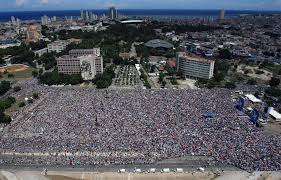
On December 30th Cuban performance artist Tania Bruguera was planning to stage an open-microphone event, “Yo tambien exijo,” [I also demand],” in Havana’s Plaza de la Revolución, the huge public square usually reserved for large government-sponsored events.[2] (The photo on the top shows an empty Plaza while the other one has a large crowd in attendance.) She planned to give any attendee a one-minute platform to discuss his or her opinions about, and recommendations for, Cuba’s future. She told the U.S. National Public Radio that she wanted “people in the street [to] come and share . . . [their] doubts, [their] happiness – whatever [they] think right now about what is happening in Cuba, and what is the idea of Cuba that [they] want?”
Bruguera was proceeding with these plans even though her application for a permit had been denied and even though the Government’s National Fine Arts Council had told her that it would not be providing her with institutional support for the event as proposed because it “would negatively impact public opinion, in a key time of negotiation between the Cuban government and the government of the United States.”
On December 30th the Council issued a public statement documenting its decision not to support the event. It said, “Under current circumstances, it is unacceptable performing this purported performance in the symbolic space of the Plaza of the Revolution, especially considering the extensive media coverage and manipulation that has been in the media broadcasters counterrevolution.”
The Council, however, also stated that Bruguera had rejected its suggestions on conducting the event subject to the following conditions: (a) move the event to the National Museum of Fine Arts, a prestigious cultural institution in the field of visual arts; (b) the Museum would be freely open to diverse people of dissimilar social sectors; (c) the government would “reserve the right” to bar people whose “sole interest is to be provocative;” and (d) the performance would be limited to 90 minutes.
Just hours before the planned event, Cuban police detained, on public disorder charges, Bruguerea and at least three leading dissidents: Antonio Rodiles, the head of Citizens Demand for Another Cuba; Eliezer Avila, the leader of the opposition group Somos Mas; and Reinaldo Escobar, a senior editor of a dissident website 14medio.com. Escobar’s spouse, Blogger Yoani Sanchez, was also detained at her home by police. There were reports that up to 50 members of the political opposition were detained.
Ms. Bruguera was released the next afternoon along with most of the political dissidents. She then announced she would hold a news conference and public gathering on the Malecón, Havana’s coastal highway, at the memorial to the Maine, the American battleship that sank in Havana Harbor in 1898. Cuban agents, however, stopped her en route to the gathering and took her away for interrogation. She was told she could not leave Cuba “for two or three months” while the case was being processed. Again she was released.
However, on January 1, 2015, she was arrested again along with several dissidents when they went to a jail to demand the release of 15 additional dissidents who had been arrested on the day of the planned event. The next day (January 2) she was released.
Reactions to the Cancelation and Arrests
On December 30th, the U.S. Department of State issued a Press Statement saying the U.S. was “deeply concerned about the latest reports of detentions and arrests by Cuban authorities of peaceful civil society members and activists . . . [and] strongly condemn[ed] the Cuban government’s continued harassment and repeated use of arbitrary detention, at times with violence, to silence critics, disrupt peaceful assembly and freedom expression, and intimidate citizens.”
The Statement added, “Freedoms of expression and peaceful assembly are internationally recognized human rights, and the Cuban government’s lack of respect for these rights, as demonstrated by today’s detentions, is inconsistent with Hemispheric norms and commitments. We urge the Government of Cuba to end its practice of repressing these and other internationally protected freedoms and to respect the universal human rights of Cuban citizens.”
The Statement concluded that the U.S. has “always said we would continue to speak out about human rights, and as part of the process of normalization of diplomatic relations, the United States will continue to press the Cuban government to uphold its international obligations and to respect the rights of Cubans to peacefully assemble and express their ideas and opinions, just like their fellow members of civil society throughout the Americas are allowed to do.”
Also on December 30th Assistant Secretary of State Roberta Jacobson tweeted “Freedom of expression remains core of US policy on #Cuba; we support activists exercising those rights and condemn today’s detentions.”
These views were shared by the New York Times’ December 30th editorial, “Cuba Turns Off Critics’ Open Mike.” It said, “By stifling critical voices, the Cuban government is showing its unwillingness to tolerate basic freedoms most citizens in the hemisphere enjoy.”
The Times’ editorial continued, “This move, unfortunately, will amplify the criticisms of those who opposed Mr. Obama’s historic shift on Cuba policy. Heavy-handed tactics by the Castro government will give them ammunition next year, when Republicans will control both chambers of Congress, to stymie the Obama administration’s steps to ease the embargo through executive authority and dim the prospects of legislative change to pare back the web of sanctions Washington imposes on Cuba. That result would be a shame and, in the long run, self-defeating for Havana.”
The editorial on the same subject by the Washington Post, which earlier opposed the December 17th reconciliation, was in the same vein. It stated, “[T]he Castro regime has been left free to continue stifling dissent, while reaping the economic and political benefits of Mr. Obama’s ‘engagement.’ Raúl Castro declared in a speech shortly after the agreement was announced that the Communist political system would remain unchanged. Two weeks later, not one of the 53 political prisoners the White House said would be freed — about half of the total identified by human rights activists — has been reported released.”
The Washington Post editorial concluded, “Cubans who seek basic freedoms continue to be arrested, harassed and silenced, while the regime celebrates what it portrays as ‘victory’ over the United States. If support for the Cuban people and American values is supposed to be the point of this process, then it is off to a very poor start.”
People opposed to the resumption of relations with Cuba were quick to hold up the arrests as a sign that the Castro government had no intention of pursuing political change and would reap only economic benefits from Mr. Obama’s moves. For example, Senator Marco Rubio, Republican of Florida and a Cuban-American, tweeted, “Castro govt. arrests of activists in #Havana exposes the folly of new Obama #CubaPolicy.”
Rejection of the Condemnation
As a long-time member of the American Civil Liberties Union and as a pro bono attorney in one of its important free speech cases, I am a strong believer in the importance of free speech. Therefore, I initially concurred in the State Department and New York Times’ condemnation of Cuba’s cancellation of this event and related arrests, and I worried that this controversy might cause the U.S. to abandon the recently announced U.S.-Cuba reconciliation.
On the other hand, I was and continue to be troubled by the State Department and most of the articles about this event not mentioning the Cuban Fine Arts Council’s willingness to support the event in another location and with certain limits. This action by the Arts Council suggests at a minimum that the State Department and western media are over-reacting to these events and unfairly rushing to judgment.
These U.S. critics also forget that governmental authorities in the U.S. sometimes determine that it is not appropriate to stage a protest at a particular time and place. It just happened in my home state of Minnesota at the Mall of America (MOA) on a big shopping day (December 20th). Although MOA officials had told the organizers that it was against its policies for them to hold a “Black Lives Matter” protest at the Mall on that day,[3] they did so anyway as this video shows. After 2,000 to 3,000 protesters flooded a Mall rotunda and held “die-ins” in front of several nearby businesses, riot-gear-clad police officers arrested 25 for trespass, peacefully dispersed the crowd and tried to block people from re-entering the rotunda. Afterwards the local city attorney announced plans “to file additional charges against ‘ringleaders’ of the protest and to seek restitution for the costs of 250 police at the event and lost sales during the two to three hours when more than 75 stores in the mall were closed.” On January 5th some of the protesters spoke against such prosecution at a city council meeting. This story obviously is not yet over.
In addition, there is a report that raises the much more serious question of whether the event was an idea of Cubans acting by themselves. According to the Wall Street Journal, an opponent of reconciliation with Cuba, at the scheduled time for the event, “Cuban cellphones received mysterious messages from a Florida area code offering cheap beer to all those gathering on the plaza.” This was confirmed in an interview by U.S. National Public Radio with Marc Frank, a U.S. journalist who was one of about a dozen people at the Plaza at the time of the planned event. He said, “text messages were sent from somewhere in Miami to a lot of cell phones here, including mine, basically saying that there’s going to be an event at the Plaza de la Revolución, and there’d be free beer.” Frank added that “Tania is an artist, lives some in Cuba and mainly in Miami, . . . [but] she’s not really well-known in Cuba at all.”[4]
These messages about free beer in the Plaza from a Miami telephone number raise the question of whether the event was actually being planned by the U.S. Agency for International Development (USAID) or another U.S. government agency or by Cuban-Americans opposed to the reconciliation of the two countries.
As discussed in prior posts, USAID (U.S. Agency for International Development) had funded via a private contractor at least three covert (or as the agency prefers to say “discreet”) programs in Cuba to promote civil society and dissent or regime change, all without the prior knowledge or consent of the Cuban government. One was for U.S. citizen Alan Gross to take communications equipment to Cuba, for which he was arrested, convicted and imprisoned in Cuba for violating its laws.[5] Another such USAID program via a private contractor unsuccessfully tried to create a Cuban social media program Yet another used Central Americans to promote purported HIV informational efforts on the island. The final one that has been discovered so far by journalists again via a private contractor attempted to infiltrate the Cuban rap-artist community.
These USAID programs were sharply criticized in a November New York Timeseditorial, as discussed in an earlier post. The editorial said, ““Far from accomplishing . . . the goal [of instigating democratic reforms on the island], the initiatives have been largely counterproductive. The funds have been a magnet for charlatans, swindlers and good intentions gone awry. The stealthy programs have increased hostility between the two nations, provided Cuba with a trove of propaganda fodder and stymied opportunities to cooperate in areas of mutual interest.”
Instead, the Times’ November editorial argued, “The United States should strive to promote greater freedoms on the island of 11 million people and loosen the grip of one of the most repressive governments in the world. Instead of stealth efforts to overthrow the government, American policy makers should find ways to empower ordinary Cubans by expanding study-abroad programs, professional exchanges and investment in the new small businesses cropping up around the island. They should continue to promote Internet connectivity, but realize that accomplishing that goal on a large scale will require coordination with the Cuban government.” Moreover, “Washington should recognize that the most it can hope to accomplish is to positively influence Cuba’s evolution toward a more open society. That is more likely to come about through stronger diplomatic relations than subterfuge.”
Perhaps the Times forgot this editorial when it more recently lambasted the Cuban actions over the “open-microphone” event.
In any event, the U.S. government apparently has not learned the lesson outlined by the Times in October because the USAID website, which says it was last updated on December 16 (the day before the announcement of U.S.-Cuba reconciliation), still contains general information about its Cuba programs to “[p]romote human rights and fundamental freedoms.”
In addition, on December 22, 2014 (five days after that announcement), the U.S. Department of State’s Bureau of Democracy, Human Rights and Labor issued a Public Notice of its “Request for Statements of Interest: Program Fostering Civil, Political and Labor Rights in Cuba.” The Bureau’s prospective funding of $11 million would be used for typically funded proposals, the Bureau said, like “[o]rganizational assistance to Cuban civil society to improve management, strategic planning, sustainability, and collaboration of local civil society groups; [o]ff-island trainings, short-term fellowships, or engagement; [d]istribution of software that would be easily accessible in an open society; . . . [and] ]a]ssistance mechanisms designed to provide independent Cuban civil society with tools, opportunities, and trainings that civil society counterparts in open societies can access.”
Both the USAID and State Department statements read as if they are promoting programs in Cuba without the knowledge, cooperation or agreement of the Cuban government. This is contrary to President Obama’s statement in his nationally televised speech on December 17th, in which he said the U.S. would “raise those differences [with the Cuban government] directly . . .[such as] democracy and human rights in Cuba. But I believe we can do more to support the Cuban people and promote our values through engagement [with the Cuban government].” He added, “no Cubans should face harassment or arrest or beatings simply because they’re exercising a universal right to have their voices heard, and we will continue to support civil society there.”
Similar thoughts were expressed the same day in the White House’s FACT SHEET: Charting a New Course on Cuba.” It said, “We know from hard-learned experience that it is better to encourage and support reform than to impose policies that will render a country a failed state.” It also stated, “The Administration will continue to implement U.S. programs aimed at promoting positive change in Cuba, and we will encourage reforms in our high level engagement with Cuban officials.”
Although President Obama apparently was talking about encouraging the Cuban government to expand the Cuban people’s rights to express different opinions on what their government should do, a prior post shows some ambiguity in these statements that could allow the continuation of the USAID and State Department’s covert or “discreet” efforts to promote regime change.
If the open-microphone event, in fact, was orchestrated by USAID or some other U.S. government agency, it is Orwellian. Such programs purport to promote democracy and human rights with undemocratic and non-human rights means. Such programs are publicly mentioned—in very general terms—on U.S. government websites yet are conducted covertly or “discreetly” on the island. Such programs are hostile to a country with which the U.S. purportedly is attempting to build a normal and respectful diplomatic relationship. These programs also logically motivate Cuban authorities to be vigilant in reacting to events like the “open-microphone” one.
In other words it is horribly stupid and unwise to have such behind-the-back programs when the two countries are embarking on a long and complicated path for full reconciliation. As the New York Times said in November, the U.S. “should recognize that the most it can hope to accomplish is to positively influence Cuba’s evolution toward a more open society. That is more likely to come about through stronger diplomatic relations than subterfuge.”
[2] The Plaza is the 31st largest public square in the world; it measures 72,000 square meters (774,936 square feet) and has been the site for crowds of 1 million for major speeches by Fidel Castro and for a mass celebrated by Pope John Paul II. The idea that the open-microphone event might create such a large crowd should have been seen as ridiculous by everyone, including the Cuban authorities, and a small gathering like the 12 or so that showed up on the 30th would have demonstrated the over-reaction of the those authorities in shutting it down and the State Department and western media in attacking the shut-down.
[3] Before the protest the local city (Bloomington) sent a letter to the protest organizers warning that the city would enforce the mall’s private-property rights under the authority of a Minnesota Supreme Court decision that held the MOA was a private entity with the right to exclude demonstrators.
[4] The Director of Security Operations at Telecommunications Company of Cuba reported that since December 21st Cuba had been receiving electronic messages calling for participation in an event with Tania Bruguera. These messages came from a platform “Wake Cuba,” and these messages were similar to previous ones paid for by USAID. Another Cuban source states that some Cuban email addresses were hacked and used to send emails to Cubans about this event.
[5] Gross on December 17th was released from Cuban prison and returned to the U.S.
After reviewing these documents, the post will conclude with observations on some of the points raised in these documents.
“FACT SHEET: Charting a New Course in Cuba”
The introduction to the FACT SHEET, among other things, said, “It is clear that decades of U.S. isolation of Cuba have failed to accomplish our enduring objective of promoting the emergence of a democratic, prosperous, and stable Cuba. . . . It does not serve America’s interests, or the Cuban people, to try to push Cuba toward collapse. We know from hard-learned experience that it is better to encourage and support reform than to impose policies that will render a country a failed state. With our actions today, we are calling on Cuba to unleash the potential of 11 million Cubans by ending unnecessary restrictions on their political, social, and economic activities.” (Emphasis added.)
The FACT SHEET then provided the following “Key Components of the Updated Policy Approach:”
“Establishing diplomatic relations with Cuba-
The President has instructed the Secretary of State to immediately initiate discussions with Cuba on the re-establishment of diplomatic relations with Cuba, which were severed in January 1961.
In the coming months, we will re-establish an embassy in Havana and carry out high-level exchanges and visits between our two governments as part of the normalization process. As an initial step, the Assistant Secretary of State for Western Hemisphere Affairs will lead the U.S. Delegation to the next round of U.S.-Cuba Migration Talks in January 2015, in Havana.
U.S. engagement will be critical when appropriate and will include continued strong support for improved human rights conditions and democratic reforms in Cuba and other measures aimed at fostering improved conditions for the Cuban people. (Emphasis added.)
The United States will work with Cuba on matters of mutual concern and that advance U.S. national interests, such as migration, counternarcotics, environmental protection, and trafficking in persons, among other issues.” (Emphasis added.)
“Adjusting regulations to more effectively empower the Cuban people-
The changes announced today will soon be implemented via amendments to regulations of the Departments of the Treasury and Commerce. Our new policy changes will further enhance our goal of empowering the Cuban population.
Our travel and remittance policies are helping Cubans by providing alternative sources of information and opportunities for self-employment and private property ownership, and by strengthening independent civil society.
These measures will further increase people-to-people contact; further support civil society in Cuba; and further enhance the free flow of information to, from, and among the Cuban people. Persons must comply with all provisions of the revised regulations; violations of the terms and conditions are enforceable under U.S. law.”
“Facilitating an expansion of travel under general licenses for the 12 existing categories of travel to Cuba authorized by law-
General licenses will be made available for all authorized travelers in the following existing categories: (1) family visits; (2) official business of the U.S. government, foreign governments, and certain intergovernmental organizations; (3) journalistic activity; (4) professional research and professional meetings; (5) educational activities; (6) religious activities; (7) public performances, clinics, workshops, athletic and other competitions, and exhibitions; (8) support for the Cuban people; (9) humanitarian projects; (10) activities of private foundations or research or educational institutes; (11) exportation, importation, or transmission of information or information materials; and (12) certain export transactions that may be considered for authorization under existing regulations and guidelines.
Travelers in the 12 categories of travel to Cuba authorized by law will be able to make arrangements through any service provider that complies with the U.S. Treasury’s Office of Foreign Assets Control (OFAC) regulations governing travel services to Cuba, and general licenses will authorize provision of such services.
The policy changes make it easier for Americans to provide business training for private Cuban businesses and small farmers and provide other support for the growth of Cuba’s nascent private sector. Additional options for promoting the growth of entrepreneurship and the private sector in Cuba will be explored.”
“Facilitating remittances to Cuba by U.S. persons–
Remittance levels will be raised from $500 to $2,000 per quarter for general donative remittances to Cuban nationals (except to certain officials of the government or the Communist party); and donative remittances for humanitarian projects, support for the Cuban people, and support for the development of private businesses in Cuba will no longer require a specific license.
Remittance forwarders will no longer require a specific license.”
“Authorizing expanded commercial sales/exports from the United States of certain goods and services-
The expansion will seek to empower the nascent Cuban private sector. Items that will be authorized for export include certain building materials for private residential construction, goods for use by private sector Cuban entrepreneurs, and agricultural equipment for small farmers. This change will make it easier for Cuban citizens to have access to certain lower-priced goods to improve their living standards and gain greater economic independence from the state.”
“Authorizing American citizens to import additional goods from Cuba-
Licensed U.S. travelers to Cuba will be authorized to import $400 worth of goods from Cuba, of which no more than $100 can consist of tobacco products and alcohol combined.”
“Facilitating authorized transactions between the United States and Cuba-
U.S. institutions will be permitted to open correspondent accounts at Cuban financial institutions to facilitate the processing of authorized transactions.
The regulatory definition of the statutory term “cash in advance” will be revised to specify that it means “cash before transfer of title”; this will provide more efficient financing of authorized trade with Cuba.
U.S. credit and debit cards will be permitted for use by travelers to Cuba.
These measures will improve the speed, efficiency, and oversight of authorized payments between the United States and Cuba.”
“Initiating new efforts to increase Cubans’ access to communications and their ability to communicate freely-
Cuba has an internet penetration of about five percent—one of the lowest rates in the world. The cost of telecommunications in Cuba is exorbitantly high, while the services offered are extremely limited.
The commercial export of certain items that will contribute to the ability of the Cuban people to communicate with people in the United States and the rest of the world will be authorized. This will include the commercial sale of certain consumer communications devices, related software, applications, hardware, and services, and items for the establishment and update of communications-related systems.
Telecommunications providers will be allowed to establish the necessary mechanisms, including infrastructure, in Cuba to provide commercial telecommunications and internet services, which will improve telecommunications between the United States and Cuba.”
“Updating the application of Cuba sanctions in third countries-
U.S.-owned or -controlled entities in third countries will be generally licensed to provide services to, and engage in financial transactions with, Cuban individuals in third countries. In addition, general licenses will unblock the accounts at U.S. banks of Cuban nationals who have relocated outside of Cuba; permit U.S. persons to participate in third-country professional meetings and conferences related to Cuba; and, allow foreign vessels to enter the United States after engaging in certain humanitarian trade with Cuba, among other measures.”
“Pursuing discussions with the Cuban and Mexican governments to discuss our unresolved maritime boundary in the Gulf of Mexico-
Previous agreements between the United States and Cuba delimit the maritime space between the two countries within 200 nautical miles from shore. The United States, Cuba, and Mexico have extended continental shelf in an area within the Gulf of Mexico where the three countries have not yet delimited any boundaries.
The United States is prepared to invite the governments of Cuba and Mexico to discuss shared maritime boundaries in the Gulf of Mexico”
“Initiating a review of Cuba’s designation as a State Sponsor of Terrorism-
The President has instructed the Secretary of State to immediately launch such a review, and provide a report to the President within six months regarding Cuba’s support for international terrorism. Cuba was placed on the list in 1982.”[1]
“Addressing Cuba’s participation in the 2015 Summit of the Americas in Panama-
President Obama will participate in the Summit of the Americas in Panama. Human rights and democracy will be key Summit themes. Cuban civil society must be allowed to participate along with civil society from other countries participating in the Summit, consistent with the region’s commitments under the Inter-American Democratic Charter. The United States welcomes a constructive dialogue among Summit governments on the Summit’s principles.” (Emphasis added.)
“Unwavering Commitment to Democracy, Human Rights, and Civil Society
A critical focus of our increased engagement will include continued strong support by the United States for improved human rights conditions and democratic reforms in Cuba. The promotion of democracy supports universal human rights by empowering civil society and a person’s right to speak freely, peacefully assemble, and associate, and by supporting the ability of people to freely determine their future. Our efforts are aimed at promoting the independence of the Cuban people so they do not need to rely on the Cuban state. (Emphasis added.)
The U.S. Congress funds democracy programming in Cuba to provide humanitarian assistance, promote human rights and fundamental freedoms, and support the free flow of information in places where it is restricted and censored. The Administration will continue to implement U.S. programs aimed at promoting positive change in Cuba, and we will encourage reforms in our high level engagement with Cuban officials. (Emphasis added.)
The United States encourages all nations and organizations engaged in diplomatic dialogue with the Cuban government to take every opportunity both publicly and privately to support increased respect for human rights and fundamental freedoms in Cuba.
Ultimately, it will be the Cuban people who drive economic and political reforms. That is why President Obama took steps to increase the flow of resources and information to ordinary Cuban citizens in 2009, 2011, and today. The Cuban people deserve the support of the United States and of an entire region that has committed to promote and defend democracy through the Inter-American Democratic Charter.”
Background Conference Call
On December 17 two hours before President Obama’s speech to the nation, the White House conducted an hour-long “background” conference call with journalists and seven unnamed senior administration officials regarding these matters.
Among other things, one of the officials said the U.S. expects that “we’ll continue to have strong differences, particularly on issues related to democracy and human rights. The [U.S.] will continue to promote our values. We will continue to support civil society in Cuba. We’ll continue our democracy programming.” In President Obama’s December 16th telephone call with President Raúl Castro, Obama “made clear his intent . . . to continue our advocacy for human rights in Cuba.”
A State Department official stated the U.S. would not reduce its “emphasis on human rights, on democracy, on the importance of civil society. . . . In fact, our emphasis on human rights will be just as strong and we believe more effective under this policy. We will engage directly with the Cuban government on human rights.”
For example, the State Department official stated a U.S. diplomat in Havana “will be meeting with members of Cuban society and dissidents later today to walk them through the President’s initiatives of today, and to emphasize to them, as well, that their efforts on behalf of democracy and human rights in Cuba not only won’t be forgotten in these initiatives, but will, in fact, take center stage.”
In response to a question as to whether there were discussions with Cuba about “USAID programs that have been pretty controversial in Cuba,” an administration official said U.S. “democracy programming . . . did factor into the discussions [with Cuba]. The Cubans do not like our democracy programming. They consistently protest those initiatives. . . . [The U.S., however,] made clear that we’re going to continue our support for civil society for the advancement of our values in Cuba. [This] . . . was an issue of difference that we will continue to have with Cuba, and we fully expect them to raise those issues just as we will raise issues with the Cubans about democracy and human rights. However, we’re going to do that through a normal relationship. We’re going to do that through our embassy in Havana. We’re going to do that through contacts between our various agencies.”[2]
Vice President Biden’s Telephone Calls with Presidents of Colombia and Mexico
The White House reported that Vice President Joe Biden made telephone calls about the new initiatives with Cuba to President Juan Manuel Santos of Colombia and to President Enrique Pena Nieto of Mexico. After outlining the agreement, Biden told each of them that President Obama intended to attend the Summit of the Americas in Panama next April “as long as Cuban civil society is allowed to participate and human rights and democracy are on the agenda.” In the call to President Nieto, Biden said that the U.S. would initiate discussions with Cuba and Mexico about the unresolved maritime boundary of the Gulf of Mexico.
Conclusion
I concur in most of the FACT SHEET’s assertions about democracy and human rights that suggest that the U.S. will engage and work with the Cuban government to improve the Cuban people’s political, social and economic rights and that the U.S. no longer will seek to impose such rights or values on the Cuban people through covert or “discreet” programs. These statements are the following:
(i) “It does not serve America’s interests, or the Cuban people, to try to push Cuba toward collapse. We know from hard-learned experience that it is better to encourage and support reform than to impose policies that will render a country a failed state. With our actions today, we are calling on Cuba to unleash the potential of 11 million Cubans by ending unnecessary restrictions on their political, social, and economic activities.”
(ii) “U.S. engagement will be critical when appropriate and will include continued strong support for improved human rights conditions and democratic reforms in Cuba and other measures aimed at fostering improved conditions for the Cuban people.”
(iii) “A critical focus of our increased engagement will include continued strong support by the United States for improved human rights conditions and democratic reforms in Cuba. The promotion of democracy supports universal human rights by empowering civil society and a person’s right to speak freely, peacefully assemble, and associate, and by supporting the ability of people to freely determine their future. Our efforts are aimed at promoting the independence of the Cuban people so they do not need to rely on the Cuban state.”
(iv) The U.S. “will encourage [such] reforms in our high level engagement with Cuban officials.”
Other statements in the FACT SHEET, however, seems to undercut this benign interpretation: (i) “The U.S. Congress funds democracy programming in Cuba to provide humanitarian assistance, promote human rights and fundamental freedoms, and support the free flow of information in places where it is restricted and censored. The Administration will continue to implement U.S. programs aimed at promoting positive change in Cuba. . . .” (ii) “The U.S. Congress funds democracy programming in Cuba to provide humanitarian assistance, promote human rights and fundamental freedoms, and support the free flow of information in places where it is restricted and censored. The Administration will continue to implement U.S. programs aimed at promoting positive change in Cuba.” [3]
According to the FACT SHEET, “President Obama will participate in the Summit of the Americas in Panama. Human rights and democracy will be key Summit themes. Cuban civil society must be allowed to participate along with civil society from other countries participating in the Summit.” The account of the Vice President’s telephone calls, however, seems to add that President Obama intends to attend the Summit of the Americas in Panama next April “as long as Cuban civil society is allowed to participate and human rights and democracy are on the agenda.” I was surprised and disappointed to read that there was a precondition to Obama’s attending the summit: Cuba’s allowing members of its civil society to attend and participate in the Summit. While it may be a good idea to have civil society representatives from all countries, including Cuba, attend and participate, I think it unwise for the U.S. to provide Cuba with a veto on Obama’s attendance if it does not have such representatives there. I hope that this interpretation of the Vice President’s remarks is unfounded.
I am unaware of the details of the dispute about the maritime boundaries of the Gulf of Mexico, but assume that it relates to oil or other resources under the Caribbean.
================================================
[1] Prior posts discussed the legal and political issues of rescinding the designation of Cuba as a “State Sponsor of Terrorism” and the U.S.’ previous concessions that Cuba has provided assurances that it will not commit future acts of terrorism.
[2] On December 20th Secretary of State John Kerry, Secretary of Commerce Penny Pritzker and Treasury Secretary Jacob J. Lew co-authored an article in the Miami Herald. It said the U.S. would have “continued strong support for improved human-rights conditions and democratic reforms in Cuba” and would “continue to implement programs to promote positive change in Cuba.”
[3] The previous democracy/human rights programs of the U.S. Agency for International Development (USAID) and the Department of State will be part of a subsequent post about the recent controversy about Cuba’s cancellation of n “open-microphone” event and arrests of its organizers.