U.N. Human Rights Council Is Warned About Human Rights Violations

The U.N. Human Rights Council, which is responsible for strengthening the promotion and protection of human rights around the globe, addressing situations of human rights violations and making recommendations on the subject, [1] is in the midst of its 28th regular session at its headquarters in Geneva Switzerland with the session ending on March 27th. [2]
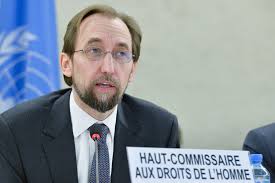
Zeid Ra-al Al Hussein
Zeid Ra-ad Al Hussein

At the opening of the session on March 2 the U.N. High Commissioner for Human Rights, Zeid Ra’ad Al Hussein, [3] set forth his concerns on human rights. Three days later, on March 5th, he commented on his annual report on human rights. This post will examine both of these speeches.

From March 2 through 5, the Council conducted what it called its High Level Segment, in which national leaders addressed the Council on the overall subject of human rights. Two of those national leaders were U.S. Secretary of State john Kerry and Cuban Foreign Minister, Bruno Rodriguez Parrilla. Their remarks will be covered in subsequent posts while another post will analyze those remarks and the speeches of the High Commissioner.

High Commissioner’s Speech, March 2nd [4]

The “cruelty and moral bankruptcy of violent extremists . . . continue daily, and we condemn their merciless conduct daily.”

“And yet, if we are not careful, if we are not completely principled and cunning in our collective attempt to defang them, we will, unwittingly and inexcusably, be advancing their interests. How we define the opening chapters of this already agitated century depends heavily on us not becoming like them.  For us, international humanitarian law and international human rights law cannot be trifled with or circumvented, but must be fully observed.”

“It has been 70 years since the great Charter of the [U.N.] was drawn up, and since then States have also written and agreed to a range of strong international treaties, to establish in binding law the legal principles of human rights. They are a distillation of all human experience, all the warnings and screams of our combined human history.” By “ratifying the U.N. Charter, [states] have made a clear commitment [in the words of its Preamble] to ‘reaffirm faith in fundamental human rights; in the dignity and worth of the human person; in the equal rights of men and women, and of nations large and small; and to establish conditions under which justice and respect for the obligations arising from treaties, and other sources of international law, can be maintained; and to promote social progress, and better standards of life in larger freedom.’”

“And yet, with alarming regularity, human rights are disregarded, and violated, sometimes to a shocking degree.”

“States claim exceptional circumstances. They pick and choose between rights. One Government will thoroughly support women’s human rights and those of the LGBT communities, but will balk at any suggestion that those rights be extended to migrants of irregular status. [U.S.?] Another State may observe scrupulously the right to education, but will brutally stamp out opposing political views. [Cuba?] A third State comprehensively violates the political, civil, economic, social and cultural rights of its people, while vigorously defending the ideals of human rights before its peers.”

“In recent months I have been disturbed deeply by the contempt and disregard displayed by several States towards the women and men appointed by [the Council] as [its] independent experts – and also by the reprisals and smear campaigns that are all too frequently exercised against representatives of civil society, including those who engage with the Council and its bodies.  I appeal to all of you, once again, to focus on the substance of the complaint, rather than lash out at the critic – whether that person is mandated by States, is a member of my Office, or is a human rights defender.”

“The overwhelming majority of victims of human rights abuses around the world share two characteristics: Deprivation, and discrimination – whether it is based on race or ethnicity, gender, beliefs, sexual orientation, caste or class. From hunger to massacres, sexual violence and slavery, human rights violations are rooted in these hidden, and sometimes not so hidden, factors.”

“They are not spontaneously generated. Most violations of human rights result from policy choices, which limit freedom and participation, and create obstacles to the fair sharing of resources and opportunities.”

“The most powerful instrument in the arsenal we have against poverty and conflict is the weapon of massive instruction. Respect for the human rights of all, justice, education, equality – these are the strongly interlocking elements that will build fair, confident and resilient societies; true development; and a permanent peace.”

“Everybody knows when police use torture, and when tweets are brutally suppressed.  Everybody knows when discrimination means poverty, while corrupt elites gorge on public goods, supported by a corrupt judiciary.  Everybody knows when women are treated like property, and children go hungry, and unschooled, in squalid neighborhoods.”

“Some of the evidence may be hidden. But the reality, in far too many countries, of massacres and sexual violence; crushing poverty; the exclusive bestowal of health-care and other vital resources to the wealthy and well-connected; the torture of powerless detainees [U.S.?]; the denial of human dignity – these things are known. . . . [T]hey are what truly make up a State’s reputation; together with the real steps – if any – taken by the State to prevent abuses and address social inequalities, and whether it honors the dignity of its people.”

“The only real measure of a Government’s worth is . . . the extent to which it is sensitive to the needs – and protects the rights – of its nationals and other people who fall under its jurisdiction, or over whom it has physical control.”

“Some policy-makers persuade themselves that their circumstances are exceptional, creating a wholly new reality unforeseen by the law. This logic is abundant around the world today:  ‘I arrest arbitrarily and torture because a new type of war justifies it. I spy on my citizens because the fight against terrorism requires it. I don’t want new immigrants, or I discriminate against minorities, because our communal identity is being threatened now as never before. I kill without any form of due process, because if I do not, others will kill me.’ “

“I must remind you of the enduring and universal validity of the international human rights treaties that your States wrote and ratified. In reality, neither terrorism, nor globalization, nor migration are qualitatively new threats that can justify overturning the legal foundations of life on Earth.  They are not new.”

“At a time of intensifying global anxiety, I believe the people of the world are crying out for profound and inspiring leadership equal to the challenges we face.  We must therefore renew, by the strongest action, our dedication to the reality of inalienable and universal human rights, to end discrimination, deprivation, and the seemingly inexhaustible litany of conflicts and crises that generate such terrible, and needless, suffering.”

“What will become of us, of our world, if we ignore our treaties and principles? Can we be so stupid as to repeat scenes from the twentieth century, punctured as it was by such awful inhumanity?  You must not make it so.  This is principally your burden, and ours.  Together, if we succeed in turning the corner, in improving our global condition, we can then say the screams of history and of the millions upon millions of victims, have been heard, finally.  Let us make it so.”

High Commissioner’s Speech, March 5th [5]

The High Commissioner was “appalled by the massive suffering ISIL provokes [in Syria, Iraq and Libya]: from the murders, torture, rape and sale of children . . . ; to mass beheadings; burning people alive in cages; seemingly genocidal attacks on ethnic and religious groups; the obliteration of due process; torture; deprivation of income and every kind of service and resource; recruitment of children; the destruction of elements of the cultural heritage of humanity; and, not least, particularly vicious and comprehensive attacks on the rights of women and girls.” [Similar horrible actshe said, were perpetrated in Nigeria by Boko Haram and in Yemen and Somalia by other groups.]

“My Office strongly supports efforts by States around the world to prevent and combat terrorism, and to ensure that the perpetrators of terrorism, as well as their financiers and suppliers of arms, are brought to justice.”

“Terrorist attacks [,however,] cannot destroy the values on which our societies are grounded – but laws and policies can. Measures that build what has been termed the ‘national security state’ – such as arbitrary or prolonged detention; torture and ill-treatment; massive surveillance that contravenes the right to privacy; unfair trials; discriminatory policing; and the abusive use of legislation to curb legitimate rights to peaceful protest and to freedom of expression – are human rights violations. They generate legitimate resentment, harm social cohesion, and undermine the essential values of the international community.”

“There is real danger that in their reaction to extremist violence, opinion-leaders and decision-makers will lose their grasp of the deeper principles that underpin the system for global security which States built 70 years ago to ward off the horror of war. The fight against terror is a struggle to uphold the values of democracy and human rights – not undermine them. . . [C]ounter-terrorist operations that are non-specific, disproportionate, brutal and inadequately supervised violate the very norms that we seek to defend. They also risk handing the terrorists a propaganda tool – thus making our societies neither free nor safe. The use of torture, neglect of due process and collective punishment do not make the world any safer.”

“To be truly effective, any response to extremist violence must be targeted, proportionate, and legal. Military campaigns, financial sanctions and attempts to staunch the inflow of weapons – such as the United Nations Arms Trade Treaty – may be part of the solution.”

“But other actions are needed to stem the root causes that feed into these conflicts. We must acknowledge that large numbers of people do not join such extremist movements en masse because they have been suddenly and inexplicably hypnotized. Extremism – however repugnant – is nurtured by ideology, and by alienation fed by years of tyranny, corruption, repression, discrimination, deprivation and neglect of the legitimate rights of communities.”

He especially was “disturbed by a continuing trend of harsh restrictions on public freedoms by States across all regions. I refer to military crackdowns on demonstrations; harsh sentencing of human rights defenders, journalists and dissidents in politically motivated trials; brutal punishments for simple tweets; censorship; oppressive and illegitimate regulations of civil society movements; the use of new technologies to stifle human rights in the virtual space; and new security laws that are unjustly broad, endangering civil liberties and human rights.”

“And yet the great pillar of every resilient and participative society is freedom of expression. Freedom to formulate the ideas of equality led to the overthrow of colonialism, and has powered every movement against discrimination and injustice. To immunize against dictatorship or totalitarianism, to undo discrimination, to drive justice and accountability, we need freedom of expression – full and free and far-reaching. There is no good governance without free speech.”

The High Commissioner’s speech included specific criticisms of many countries. About the U.S., he said: “In the United States, the Senate report on torture in the context of counter-terrorism operations is courageous and commendable, but profoundly disturbing. For a country that believes so strongly in human rights to have swiftly abandoned their fundamentals at a time of crisis is as astonishing as it is deplorable. And yet few other countries have had the courage to likewise publicly investigate and publicly admit to rights abuses resulting from counter-terror operations – and many should.”

“Under international law, the [Senate] report’s recommendations must be followed through with real accountability. There is no prescription for torture, and torture cannot be amnestied. It should also lead to examination of the institutional and political causes that led the US to violate the absolute prohibition on torture, and measures to ensure this can never recur.”

“As the Senate report clearly demonstrates, the neglect of due process, use of torture and collective punishments that were permitted by US officials in the post-9/11 context did not make the world – or the US – any safer. On the contrary, they increased the threat of terrorism, by feeding into the grievances on which it thrives. The orange jumpsuits of Guantanamo are a recruitment tool for ISIL and other groups. As former President George W. Bush has conceded, Guantanamo became, I quote, ‘a propaganda tool for our enemies.’”

The High Commissioner also expressed regret at the renewed use of the death penalty in a number of countries – Jordan, Pakistan, and Indonesia – and “the continuing extensive use” of the death penalty in China, Iraq, Iran and the U.S.

In conclusion, he said, “It is the people who sustain government, create prosperity, heal and educate others and pay for governmental and other services with their labour. It is their struggles that have created and sustain States. Governments exist to serve the people – not the other way round.”

“Governments that protect human rights, combat discrimination and deprivation, and which are accountable to their people are more prosperous and more secure than those which stifle rights, hamper opportunities, and repress freedoms. When people’s rights are respected – when they are accorded dignity, have opportunities to express their skills and are given a fair share of resources – they form resilient societies. When they are wronged, their rights betrayed, there is a constant threat of turmoil. Respect for the human rights of the people is not destabilizing; but driving legitimate opposition underground is.”

 Conclusion

Speeches about human rights in international fora often are replete with platitudes. These speeches by the High Commissioner are not. While he condemns the horrible actions of ISIL and Boko Haram, these groups are not represented at the Council. Instead the countries that are represented are often the victims of their evil deeds. Therefore, the High Commissioner spent most of his time chastising the latter countries for failing to live up to the human rights commitments they have made as they are combatting terrorism. Moreover, these speeches address some countries by name and point our their failings.

In a later post we will look again at these speeches in the context of the issues of human rights in the process of U.S.-Cuba reconciliation.

==========================================================

[1] The Human Rights Council has 47 member states elected by the U.N. General Assembly. Currently both the U.S. and Cuba are such members.

[2] Materials about the Council’s 28th session are available on its website.

[3] The High Commissioner for Human Rights is the principal human rights official of the U.N. and the head of the Office of the High Commissioner for Human Rights, which “spearheads the [U.N.’s] human rights efforts . . . by strengthening international human rights mechanisms; enhancing equality and countering discrimination; combating impunity and strengthening accountability and the rule of law; integrating human rights in development and in the economic sphere; widening the democratic space; and early warning and protection of human rights in situations of conflict, violence and insecurity.”

Prince Zeid Ra’ad Al Hussein of Jordan was unanimously elected the High Commissioner by the U.N. General Assembly in June 2014. His many years of diplomatic service include being Jordan’s Ambassador to the U.S., his country’s Permanent Representative to the U.N. and his serving as an officer of the International Criminal Court. He holds a Bachelor of Arts degree from The Johns Hopkins University and a Doctorate in Philosophy from Cambridge University.

[4] Al Hussein, Opening Speech to the High Level Segment of the Human Rights Council, U.N. (Mar. 2, 2015); UN Human rights Council, Human Rights council opens twenty-eighth session (Mar. 2, 2015); Schlein, UN Council: Rights Being Violated to ‘Shocking Degree,’ VOA (Mar. 2, 2015).

[5] Al Hussein, Opening Statement, Item 2, High Commissioner’s Annual Report, U.N. (Mar. 5, 2015); Member States must enforce human rights amid rising tide of extremism—UN rights chief , UN News (Mar. 5, 2015); Human rights principles in struggle against extremism—Zaid, U.N. (Mar. 5, 2015).
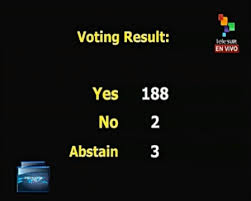


U.N. General Assembly Again Condemns U.S. Embargo of Cuba

U.N. General Assembly Voting Results Screen
U.N. General Assembly   Voting Results Screen

On October 28, 2014, the U.N. General Assembly by a vote of 188 to 2 again condemned the U.S. embargo of Cuba. The two negative votes were cast by the U.S. and by Israel while three small Pacific nations abstained–Marshall Islands, Micronesia and Palau. All the other U.N. members supported the resolution. [1]

 The Resolution

The resolution [A/69/L.4] reiterated the General Assembly’s “call upon all States to refrain from promulgating and applying laws and measures of the kind referred to in the preamble to the present resolution [‘the economic, commercial and financial embargo imposed by the [U.S.] against Cuba’ and the Helms-Burton Act], in conformity with their obligations under the Charter of the United Nations and international law, which, inter alia, reaffirm the freedom of trade and navigation.”

The resolution also “again urges States that have and continue to apply such laws and measures [i.e., the U.S.] to take the steps necessary to repeal or invalidate them as soon as possible in accordance with their legal regime.”

Cuba’s Statement Supporting the Resolution

Bruno Rodriguez Parrilla

Bruno Rodríguez Parrilla, the Cuban Minister for Foreign Affairs, introducing the resolution, said that in recent times “the economic, commercial and financial blockade imposed by the [U.S.] against Cuba had been tightened, and its extraterritorial implementation had also been strengthened through the imposition of unprecedented fines, totaling $11 billion against 38 banks . . . for carrying out transactions with Cuba and other countries.” In addition, Cuba’s “accumulated economic damages of the blockade totaled $1.1 trillion . . . [and] human damages were on the rise.”

Nevertheless, “Cuba had offered every possible form of assistance to the [U.S.] in the wake of disasters there, such as in the aftermath of the September 11, 2001 terrorist attacks. Cuba had never been a threat to the national security of the [U.S.].  Opinion polls showed that there was increasing support from all sectors of [U.S.] society for lifting the blockade.  Religious leaders had citied legitimate, indisputable ethical and humanitarian reasons.“

In addition, ”the blockade was harmful to . . . the [U.S.]. The ‘absurd and ridiculous’ inclusion of Cuba on the [U.S.] list of States that sponsored international terrorism redounded to the discredit of the [U.S.].  Cuba would never renounce its sovereignty or the path chosen by its people to build a more just, efficient, prosperous and sustainable socialism.”  Neither, he continued, would his Government “give up its quest for a different international order, nor cease in its struggle for ‘the equilibrium of the world.’”

Rodríguez also invited the U.S. government “to establish a mutually respectful relation, based on reciprocity. We can live and deal with each other in a civilized way, despite our differences.”

Other Countries’ Statements Supporting the Resolution [2]

The following Latin American countries voiced support for the resolution: Argentina (MERCOSUR [3]) (embargo was “morally unjustifiable” and violated “the spirit of multilateralism and was immoral, unjust and illegal”); Barbados (CARICOM [4]); Bolivia (Group of 77 [5] and China); Brazil (Group of 77 and CELAC [6]); Colombia; Costa Rica (CELAC)); Ecuador; El Salvador (Group of 77 and CARICOM); Mexico; Nicaragua; St. Vincent and the Grenadines (CARICOM, Non-Aligned Movement, [7] Group of 77 and CELAC); Uruguay; and Venezuela.

The African supporters of the resolution that spoke were Algeria (Non-Aligned Movement, Group of 77, Group of African States [8] and Organization of Islamic Cooperation [9]); Angola; Kenya (Group of 77, Non-Aligned Movement and African Group); Malawi (African Group); South Africa (Group of 77, Non-Aligned Movement and African Group); Sudan (Group of 77, Non-Aligned Movement and Organization of Islamic Cooperation); United Republic of Tanzania; Zambia (Non-Aligned Movement) and Zimbabwe (Non-Aligned Movement, Group of 77 and African Group).

From Asia and the Pacific were Belarus; China (Group of 77); Democratic People’s Republic of Korea (North Korea); Indonesia (Group of 77);  India (Group of 77 and Non-Aligned Movement); Iran (Non-Aligned Movement); Lao People’s Democratic Republic; Myanmar (Group of 77 and Non-Aligned Movement); Russian Federation; Solomon Islands; and Viet Nam (Non-Aligned Movement, Group of 77 and China).

Middle Eastern countries speaking in favor of the resolution were Egypt, Saudi Arabia (Organization of Islamic Cooperation); and Syria (Non-Aligned Movement, Group of 77 and China).

The sole European supporter of the resolution that spoke at the session was Italy (European Union [10]), which said the U.S.’ “extraterritorial legislation and unilateral administrative and judicial measures were negatively affecting European Union interests”).

U.S. Statement Opposing the Resolution

Although Israel voted against the resolution, it chose not to speak in support of its vote. Only the U.S. by Ambassador Ronald D. Godard, U.S. Senior Advisor for Western Hemisphere Affairs, tried to justify the negative vote.

Ronald D. Godard
Ronald D. Godard

Ambassador Godard said the U.S. “conducts its economic relationships with other countries in accordance with its national interests and its principles. Our sanctions toward Cuba are part of our overall effort to help the Cuban people freely exercise their human rights and fundamental freedoms, and determine their own future, consistent with the Universal Declaration of Human Rights and the democratic principles to which the United Nations itself is committed.”

Ambassador Godard also said, “the Cuban government uses this annual resolution in an attempt to shift blame for the island’s economic problems away from its own policy failures. The Cuban government now publicly recognizes that its economic woes are caused by the economic policies it has pursued for the last, past half-century. We note and welcome recent changes that reflect this acknowledgement, such as those that allow greater self-employment and liberalization of the real estate market. But the Cuban economy will not thrive until the Cuban government permits a free and fair labor market, fully empowers Cuban independent entrepreneurs, respects intellectual property rights, allows unfettered access to information via the Internet, opens its state monopolies to private competition and adopts the sound macro-economic policies that have contributed to the success of Cuba’s neighbors in Latin America.”

According to Ambassador Godard, the U.S. “remains a deep and abiding friend of the Cuban people. The Cuban people continue to receive as much as $2 billion per year in remittances and other private contributions from the [U.S.]. This support . . . was made possible . . . by U.S. policy choices. By the Cuban government’s own account, the [U.S.] is one of Cuba’s principal trading partners. In 2013, the [U.S.] exported approximately $359 million in agricultural products, medical devices, medicine and humanitarian items to Cuba. Far from restricting aid to the Cuban people, we are proud that the people of the [U.S.] and its companies are among the leading providers of humanitarian assistance to Cuba. All of this trade and assistance is conducted in conformity with our sanctions program, which is carefully calibrated to allow and encourage the provision of support to the Cuban people.”

Furthermore, the U.S. “places the highest priority on building and strengthening connections between the Cuban people and [our] people. U.S. travel, remittance, information exchange, humanitarian and people-to-people policies updated in 2009 and 2011 provide the Cuban people alternative sources of information, help them take advantage of limited opportunities for self-employment and private property and strengthen independent civil society. The hundreds of thousands of Americans who have sent remittances and traveled to the island, under categories of purposeful travel promoted by President Obama, remain the best ambassadors for our democratic ideals.”

Ambassador Godard continued, “[The U.S.] strongly supports the Cuban people’s desire to determine their own future, through the free flow of information to, from, and within Cuba. The right to receive and impart information and ideas through any media is set forth in Article 19 of the Universal Declaration of Human Rights. It is the Cuban government’s policies that continue to prevent enjoyment of this right. The Cuban government now claims to share our goal of helping the Cuban people access the Internet. Yet the Cuban government has failed to offer widespread access to the Internet through its high-speed cable with Venezuela.  Instead, it continues to impose barriers to information for the Cuban people while disingenuously blaming U.S. policy.”

“Moreover, the Cuban government continues to detain Alan Gross, a U.S. citizen who was sentenced to 15 years in prison for facilitating Internet access for Cuba’s small Jewish community. [[11]] The [U.S.] calls on Cuba to release Mr. Gross immediately, [[12]] allow unrestricted access to the Internet, and tear down the digital wall of censorship it has erected around the Cuban people.

 {T]his resolution only serves to distract from the real problems facing the Cuban people. . . . Though Cuba’s contributions to the fight against Ebola are laudable, they do not excuse or diminish the regime’s treatment of its own people. We encourage this world body to support the desires of the Cuban people to choose their own future. By doing so, it would truly advance the principles the United Nations Charter was founded upon, and the purposes for which the United Nations was created.”

Media Coverage of the Resolution and Debate

 U.S. media coverage of this important U.N. vote was almost non-existent. It was not mentioned in the “World” or “Americas” news sections of the New York Times, and only its “Opinion” section had a short article about the issue. It got no mention whatsoever in the Wall Street Journal. Not even the Miami Herald, which has a separate page for Cuba news, mentioned it. [13]

At 2:37 p.m. on October 28th the Associated Press published a release on the subject, and the Washington Post published it online while the StarTribune of Minneapolis/St. Paul picked it up the next day in its online, but not its print, edition.

Cuba’s state-owned newspaper, Granma, of course, headlined this vote while stating that the embargo has caused $1.1 trillion of damage to the Cuban economy and “incalculable human suffering.” Its article also emphasized that this was the 23rd consecutive such resolution with a table showing that the number of votes in favor of the resolutions has increased from 59 in 1992 to 188 in 2012-2014, that the largest number of votes against the resolutions was only 4 in 1993 and 2004-2007 and that the number of abstentions has decreased from 71 in 1992 to 1 in 2005-2007 and now 3 since 2010.

Conclusion

This overwhelming international opposition to the U.S. embargo in and of itself should be enough to cause the U.S. to end the embargo. Moreover, the embargo has not forced Cuba to come begging to the U.S. for anything that the U.S. wants. The U.S. policy is a failure. The New York Times recently called for abandonment of this policy as has this blog in urging reconciliation of the two countries, in an open letter to President Obama and in a rebuttal of the President’s asserted rationale for the embargo and other anti-Cuban policies.

==============================================================

[1] This post is based upon the sources embedded above and upon U.N. General Assembly Press Release [GA/11574], As General Assembly Demands End to Cuba Blockade for Twenty-Thjrd Consecutive Year, Country’s Foreign Minister Cites Losses Exceeding $1 Trillion (Oct. 28, 2014); Londoño, On Cuban Embargo, It’s the U.S. and Israel Against the World, Again, N.Y. Times (Oct. 29, 2014); Associated Press, UN General Assembly Condemns US Cuba Embargo (Oct. 28, 2014); U.S. Dep’t of State, Explanation of Vote by Ambassador Ronald D. Godard on the Cuba Resolution in the General Assembly Hall (Oct. 28, 2014). The General Assembly also has videos of the debate (A and B). A prior post reviewed the 2011 General Assembly’s adoption of a similar resolution against the embargo.

[2] Many of the cited statements supporting the resolution were issued on behalf of, or aligned with, larger groups of nations as noted above. In addition, prior to the October 28th session of the General Assembly, the U.N. Secretary General submitted a report containing statements against the embargo from 154 states and 27 U.N. agencies.

[3] MERCOSUR (Southern Common Market) is a customs union and trading bloc of five South American countries with five other associate members in the continent.

[4] CARICOM (Caribbean Community) is a group of 15 Caribbean countries with five associate members for economic cooperation.

[5] The Group of 77 was established in 1964 by 77 developing countries to promote their collective economic interests and South-South cooperation; now there are 134 members that have retained the original name for historical significance.

[6] CELAC (Community of Latin American and Caribbean States) is a group of 33 states in the region to deepen economic integration and combat the influence of the U.S.

[7] The Non-Aligned Movement is a group of 115 developing countries that are not aligned with or against any major power bloc. Its current focus is advocacy of solutions to global economic and other problems

[8] The African Group is a group of 54 African states that are U.N. Members.

[9] The Organization of Islamic Cooperation is a group of 57 states that seek to protect the interests of the Muslim world in the spirit of promoting peace and harmony in the world.

[10] The European Union is a group of 28 European states that have combined for a peaceful, united and prosperous Europe.

[11] The activities in Cuba by Mr. Gross are not so simple. A Cuban court in 2011 found him guilty of participating in a “subversive project of the U.S. government that aimed to destroy the revolution through the use of communications systems out of the control of authorities,” and sentenced him to 15 years in prison. According to his own lawsuit against the U.S. Government, and subsequent disclosures, Gross alleged the U.S. Agency for International Development (USAID) and its contractor, DAI, sent him on five semi-covert trips to Cuba without proper training, protection or even a clear sense of the Cuban laws that led to his detainment. The case highlighted the frequent haste and lack of attention to the risks of the USAID programs in Cuba under the Helms-Burton Act, which allowed for money to be set aside for “democracy building efforts” that might hasten the fall of Fidel and Raúl Castro.

[12] In discussions with the U.S., Cuba already has expressed a willingness to exchange Mr. Gross for one or more of the three of “the Cuban Five” who remain in U.S. prisons.

[13] Nor did I find any mention of the vote in London’s Guardian or Madrid’s El Pais.


Is the International Criminal Court Flawed?

A July 8th New York Times headline proclaims, “Arab Uprisings Point Up Flaw in Global Court.” It erroneously suggests that the people operating the International Criminal Court are stupid or cowardly or that the diplomats who in 1998 drafted the ICC’s governing treaty, the ICC’s Rome Statute, were similarly stupid or cowardly.

The article starts with the facts that the ICC has not initiated an investigation of human rights abuses in Yemen and Syria. That is lamentable, but it is not due to a flaw in the operations of the ICC or the Rome Statute.

It is due instead to the limitations on the Court’s jurisdiction that were intentionally established in the drafting of the Rome Statute because of opposition of states like the U.S. that did not want the Court commencing investigations or criminal prosecutions against their citizens if the state did not ratify that Statute.

That Statute’s Article 12 provides, in part, that the Court has jurisdiction if certain crimes (genocide, crimes against humanity or war crimes) are committed on the territory of a state that is a party to the Rome Statute or by nationals of such a state. Neither Yemen nor Syria is such a party, as is true for all other states in the Mideast except Jordan. Thus, the Court does not have jurisdiction of such an investigation or prosecution under Article 12.

The Rome Statute’s Article 13(b) also provides jurisdiction for the Court if the U.N. Security Council, acting under Chapter VII of the U.N. Charter (Action with Respect to Threats to the Peace, Breaches of the Peace, and Acts of Aggression), refers a situation of suspected crimes of that nature to the ICC even if the state where the conduct occurred or whose nationals are involved had not ratified the Rome Statute. In fact, as the New York Times article points out, the Security Council has twice done so: Sudan (Darfur) and Libya.

However, as most people know, the U.N. Charter that was drafted in 1945 at the end of World War II grants in Article 27(3)  a veto on any action by the Council to each of its five permanent members: the U.S., the United Kingdom, France, the Union of Soviet Socialist Republics [now Russia] and the Republic of China. The failure of the ICC to undertake any investigation of the Yemen situation is due to a threatened veto by the U.S. of such a referral.

With respect to Syria, the U.S. in June 2011 reportedly was seeking Russian and Chinese support for a Council referral of the situation to the Court, but that was obviously unsuccessful because no such proposal was actually advanced in the Council. In November 2011 four U.S. Senators (Dick Durbin, Benjamin Cardin, Robert Menendez and Barbara Boxer) sent a letter to the U.S. Ambassador to the U.N. (Susan Rice) asking for such a Security Council referral. They said, “The people of Syria deserve to know that the people of the United States understand their plight, stand behind them, and will work to bring justice to the country.” Security Council referral of Syria to the ICC also has been endorsed by the New York Times.

The next month (December 2011) the U.N. High Commissioner for Human Rights urged the Security Council to make such a referral. But nothing happened, again because of threatened vetoes by Russia and China.

If there is any “flaw” in this structure with respect to Yemen and Syria it is the veto right of the five permanent members of the Security Council. Although many, if not most, of the U.N. members that are not permanent Council members dislike the superior status and veto rights of the permanent Council members and voice various suggestions for reform of the Security Council, expert observers of the U.N. do not think that is at all likely in the near future.

In the meantime, 121 of the 192 U.N. members are now parties to the Rome Statute, and the Court’s governing body (its Assembly of States Parties) is working towards its goal of universal ratification of the Rome Statute. If and when that happened, the Court could initiate investigations and prosecutions with respect to all such parties without Security Council action.

Over the last 60-plus years the peoples of the world through their nation-state governments have been struggling to climb out of the pits of depravity of World War II by creating or codifying international norms or human rights and by constructing mechanisms to protect individuals that are beyond the control of their own national governments while such governments still have sovereignty over most aspects of their lives. The creation and operation of the International Criminal Court and other so-called ad hoc international criminal tribunals are important pieces of this effort. This is an inherently difficult process, and many compromises are necessary in order to make any progress. But the story is not finished. Further development, I am confident, will occur.