Fidel Castro’s Disingenuous Criticism of President Obama Over Nuclear Weapons

As reported in a prior post, Fidel Castro on August 12, 2016, criticized President Obama over his not apologizing to Japan over the 1945 U.S. dropping of atomic bombs on Hiroshima and Nagasaki. This criticism on its face was unfair. Although Obama in his recent speech at Hiroshima did not apologize, he recounted the horror of the bombing and stressed the need for the U.S. and other countries to eliminate nuclear weapons.

Fidel’s criticism of Obama also was disingenuous because near the end of what we call the Cuban Missile Crisis Fidel was urging the Soviet Union to conduct a nuclear attack on the U.S. and to keep its nuclear missiles in Cuba. Here are the details according to historians with access to original records.[1]

Background: The Bay of Pigs and the Cuban Missile Crisis

Let us first, however, set the stage for these remarks by Fidel from what is now known.

In April 1961 at the start of the third year of the Cuban Revolution’s operation of the Cuban government, a CIA-sponsored paramilitary group conducted an unsuccessful invasion of Cuba’s de Playa Girón (the Bay of Pigs).[2]

Soon thereafter, Fidel Castro told the Cuban people, “The result of aggression against Cuba will be the start of a conflagration of incalculable consequences, and they will be affected too. It will no longer be a matter of them feasting on us. They will get as good as they give.”

In July 1961, at a secret meeting of Fidel Castro and Nikita Khrushchev, the Premier of the Soviet Union agreed to Castro’s request to station nuclear missiles on the island to deter U.S. harassment of Cuba. Later that summer construction commenced on the sites for such missiles.

On October 14, 1962, an American U-2 spy plane making a high-altitude pass over Cuba photographed a Soviet medium-range ballistic missile being assembled for installation.[3]

On October 16, 1962, President Kennedy was briefed about the situation, and he immediately called together a group of advisors and officials. For nearly the next two weeks, the president and his team wrestled with this weighty crisis as did their counterparts in the Soviet Union.

On October 22, 1962, in a national television broadcast President Kennedy notified the American people about the presence of the missiles, explained his decision to enact a naval blockade of shipping to and from Cuba and made it clear that the U.S. was prepared to use military force if necessary to neutralize this perceived threat to U.S. national security.

On October 24, Soviet ships bound for Cuba neared the line of U.S. vessels enforcing the blockade, but stopped short of the blockade.

On October 26, Khrushchev sent a message to Kennedy offering to remove the Cuban missiles in exchange for a promise by U.S. leaders not to invade Cuba. The letter stated, “Let us then display statesmenlike wisdom. I propose: we, for our part, will declare that our ships bound for Cuba are not carrying any armaments. You will declare that the United States will not invade Cuba with its troops and will not support any other forces which might intend to invade Cuba. Then the necessity for the presence of our military specialists in Cuba will be obviated.”

The following day, the Soviet leader sent a second letter proposing that the Soviets would dismantle its missiles in Cuba if the Americans removed their missile installations in Turkey.

The Kennedy administration decided to accept the terms of the first letter, and on October 28, Robert F. Kennedy, the Attorney General, hand delivered to the Soviet Ambassador in Washington the administration’s letter accepting the terms of the first message. (The administration officially ignored the second letter, but privately agreed to withdraw U.S. missiles from Turkey.)

On October 28, the immediate crisis drew to a close with a joint U.S. and Soviet announcement of the agreement.

On November 20, 1962, after all Soviet offensive missiles and light bombers had been withdrawn from Cuba, the blockade was formally ended.

Fidel’s Urging Nuclear Armageddon and Nuclear Missiles in Cuba

In the midst of this crisis Fidel strenuously objected to the Soviets removing nuclear missiles from Cuba and pleaded for those missiles to remain on the island. “Castro fumed. He had been bypassed in negotiations between the two superpowers. Set on keeping the nuclear warheads [on the island], he began to chafe at his handlers in Moscow.”

On October 26, Castro summoned the Soviet Ambassador, Aleksandr Alekseev, to the Cuban command post. Fidel could not understand why Soviet troops in Cuba were sitting on their hands while American planes were flying over the island with impunity. He urged them to start shooting at U-2 spy planes with surface-to-air missiles and suggested that Cuban troops should begin firing on low-flying planes with antiaircraft guns, contrary to Soviet wishes. Alekseev promised to relay Castro’s complaints to the Kremlin.

Very early the next day, October 27, Castro, unaware of Kennedy and Khrushchev’s progress toward a deal, decided to send a cable to Khrushchev, encouraging him to use his nuclear weapons to destroy the United States in the event of an invasion of Cuba. At 3:00 a.m., he arrived at the Soviet Embassy in Havana and told Ambassador Alekseev that they should go into the bunker beneath the embassy because a U.S. attack was imminent. According to declassified Soviet cables, a groggy but sympathetic Alekseev agreed, and soon they were set up underground with Castro dictating and aides transcribing and translating a letter.

Castro became frustrated, uncertain about what to say. After nine drafts, with the sun rising, Alekseev finally confronted Castro: are you asking Comrade Khrushchev to deliver a nuclear strike on the U.S.? Castro responded, “If they attack Cuba, we should wipe them off the face of the earth!” Alekseev was shocked, but he dutifully assisted Castro in fine-tuning the 10th and final draft of the cable and then cabled it to Moscow.

That cable stated that in the event of an American invasion, “the danger that that aggressive policy poses for humanity is so great that following that event the Soviet Union must never allow the circumstances in which the imperialists could launch the first nuclear strike against it.” A U.S. invasion of Cuba “would be the moment to eliminate such danger forever through an act of clear, legitimate defense however harsh and terrible the solution would be, for there is no other.”

Premier Khrushchev, according to his son and biographer, received the Castro cable in the midst of a tense leadership meeting and shouted, “This is insane; Fidel wants to drag us into the grave with him!” Khrushchev had not understood that Castro believed that Cuba was doomed, that war was inevitable, and that the Soviets should transform Cuba from a mere victim into a world martyr.

To calm Castro down, Khrushchev in early November sent Soviet Deputy Prime Minister Anastas Mikoyan to Havana. Mikoyan initially told Castro he could keep the tactical nukes that had escaped U.S. notice. On November 20, Castro instructed Cuba’s U.N. ambassador to tell the world that Cuba possessed tactical nuclear warheads, but that announcement was never made because Mikoyan said all Soviet missiles had to be removed from the island.

This rescission happened on November 22 after Mikoyan on his own had concluded that Castro could not be trusted and that the USSR could not control Cuba. Mikoyan told Castro that a Soviet law — which did not exist — banned a permanent transfer to the Cubans. Fidel responded, “So you have a law that prohibits transfer of tactical nuclear weapons to other countries? It’s a pity. And when are you going to repeal that law?” Mikoyan merely said, “We will see.”

Conclusion

When, Fidel, did you offer an apology for your 1962 efforts to threaten the United States and the world with nuclear Armageddon? You are not a wizened guru of world peace.

==============================================================

[1] Bright & Lang, How Castro Held the World Hostage, N.Y. Times (Oct. 25, 2012); Bright & Lang, The Armageddon Letters: Kennedy/Khrushchev/Castro in the Cuban MIssile Crisis (2012); Mikoyan & Savranskaya (ed.), The Soviet Cuban Missile Crisis: Castro, Mikoyan, Kennedy, Khrushchev, and the Missiles (2012); Cuban Missile Crisis’ Untold Story: Casto Almost Kept Nuclear Warheads on the Island, Huff. Post (Oct. 15, 2012). James G. Blight and Janet M. Lang are professors at the Balsillie School of International Affairs (Waterloo, Ontario, Canada) and the authors of “The Armageddon Letters: Kennedy/Khrushchev/Castro in the Cuban Missile Crisis.” Many of the documents mentioned above have been donated to George Washington University’s National Security Archive by the son of Anastas Mikoyan, Sergo Mikoyan, who with the Archive’s researcher, Svetlana Savranskaya, co-authored the previously mentioned “The Soviet Cuba Missile Crisis.”


[2] Invasion of Bar of Pigs, Wikipedia. https://en.wikipedia.org/wiki/Bay_of_Pigs_Invasion


[3] Cuban Missile Crisis, History, http://www.history.com/topics/cold-war/cuban-missile-crisis

Nikita– https://en.wikipedia.org/wiki/Nikita_Khrushchev
 

Minnesota Welcomes New U.S. Citizens  

The ultimate step in the process of becoming a naturalized U.S. citizen that was discussed in a prior post is taking the Oath of Allegiance to the United States. This is usually done in a collective ceremony.

Such a ceremony was held on May 26, 2015, by the U.S. District Court for the District of Minnesota when it welcomed 453 new U.S. citizens from the following regions of the world: Africa, 167; Asia, 160; Latin America, 56; Europe 43; Middle East, 20; and Other, 7. Of the 76 foreign countries represented, the largest numbers came from Somalia, 42; Ethiopia, 34; Liberia, 26; Burma (Myanmar), 24; Thailand, 23; Nigeria, 23; and Mexico, 22.

After everyone sang the “Star-Spangled Banner,” an officer of the U.S. Citizenship and Immigration Services collectively presented the new citizens to the court, and U.S. Magistrate Judge Jeffrey J. Keyes administered the following Oath of Allegiance to the new citizens:

“I hereby declare, on oath, that I absolutely and entirely renounce and abjure all allegiance and fidelity to any foreign prince, potentate, state, or sovereignty, of whom or which I have heretofore been a subject or citizen; that I will support and defend the Constitution and laws of the United States of America against all enemies, foreign and domestic; that I will bear true faith and allegiance to the same; that I will bear arms on behalf of the United States when required by the law; that I will perform noncombatant service in the Armed Forces of the United States when required by the law; that I will perform work of national importance under civilian direction when required by the law; and that I take this obligation freely, without any mental reservation or purpose of evasion; so help me God.”

Judge Keyes then congratulated them. He said he saw the U.S. as a fabric or quilt of diverse elements that combined to create a beautiful whole that continuously is regenerated with new citizens. He urged the new citizens never to forget the poetry, the culture, the land and the ancestors of their homelands.

On a personal note, Keyes said his ancestors came from Ireland 150 years ago, and he was confident that they never imagined that someday an Irishman could become President of the United States. Yet in 1960 John F. Kennedy of Irish heritage was elected to that office. So too many people in this country could not have imagined that a black man could also be so elected, and yet Barack Obama was the victor in the presidential elections of 2008 and 2012.

With citizenship came many rights and responsibilities under our Bill of Rights, Keyes continued. There was freedom of speech and the responsibility to listen and understand the opinions of others. There was no established religion and the freedom to have or not have your own religious beliefs and the responsibility to understand and accept others’ religious beliefs. Another right was the freedom of assembly and the responsibility to engage in the political arena and to vote.

Other words of welcome were made in a videotape presentation by President Obama. One of his messages was in American no dream is impossible.

The ceremony concluded with everyone reciting the Pledge of Allegiance.

One of the largest single naturalization ceremonies in Minnesota was on September 6, 2012, when 1,509 individuals from 100 countries became U.S. citizens; the largest numbers of these came from Somalia (344), Ethiopia (141), Laos (101), Liberia (95) and Mexico (84).


Cuban President Raul Castro’s Major Speech at the Summit of the Americas

On April 10 and 11, Cuba for the first time was welcomed to the Summit of the Americas. Presidents Raul Castro and Barack Obama exchanged handshakes and friendly greetings, and their speeches promised commitment to the process of reconciliation. Other leaders of the Americas celebrated this demonstration of reconciliation.

On April 11th after President Obama’s speech that was discussed in a prior post, President Castro delivered his major Summit speech, most of which was a critical review of the history of U.S. relations with Cuba and other Latin American countries.

This post contains substantial extracts from Castro’s speech. Other posts will examine the two presidents’ subsequent private meeting at the Summit plus Obama’s comments on other subjects and the reactions from other leaders.

 President Castro’s Speech

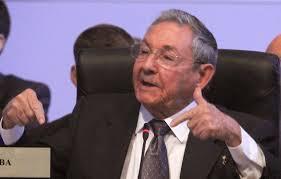
President RAul castro
President Raul Castro

“In 1800, there was the idea of adding Cuba to the [U.S.] to mark the southern boundary of the extensive empire. The 19th century witnessed the emergence of such [U.S.] doctrines as the Manifest Destiny, with the purpose of dominating the Americas and the world, and the notion of the ‘ripe fruit’, meaning Cuba’s inevitable gravitation to the [U.S.], which looked down on the rise and evolution of a genuine rationale conducive to emancipation.”

“Later on, through wars, conquests and interventions that expansionist and dominating force stripped Our America of part of its territory and expanded as far as the Rio Grande.”

“After long and failing struggles, José Martí organized the ‘necessary war’ [for independence against Spain], and created the Cuban Revolutionary Party to lead that war and to eventually found a Republic ‘with all and for the good of all’ with the purpose of achieving ‘the full dignity of man’. . . . Martí committed to the duty ‘of timely preventing the [U.S.] from spreading through the Antilles as Cuba gains its independence, and from overpowering with that additional strength our lands of America.’”

On “April 11, 1898, the President of the [U.S.] requested Congressional consent for military intervention in the [Cuban] independence war already won with rivers of Cuban blood, and that legislative body issued a deceitful Joint Resolution recognizing the independence of the Island ‘de facto and de jure.’ Thus, [the U.S.] entered [this war] as [Cuba’s supposed] ally and seized the country as an occupying force.”

“Subsequently, an appendix was forcibly added to Cuba’s Constitution, the Platt Amendment, that deprived it of sovereignty, authorized the powerful neighbor to interfere in [Cuba’s] internal affairs, and gave rise to Guantánamo Naval Base, which still holds part of our territory without legal right. It was in that period that the [U.S.] invaded the country, and there were two military interventions and support for cruel dictatorships.”

At the time, the prevailing [U.S.] approach to Latin America was the ‘gunboat policy’ followed by the ‘Good Neighbor’ policy. Successive interventions ousted democratic governments and in twenty countries installed terrible dictatorships, twelve of these simultaneously and mostly in South America, where hundreds of thousands were killed. President Salvador Allende [of Peru] left us the legacy of his undying example.”

“It was precisely 13 years ago that a [U.S.] coup d’état staged against beloved [Venezuelan] President Hugo Chavez Frías was defeated by his people. Later on, an oil coup would follow.”

“On January 1st, 1959, sixty years after the U.S. troops entered Havana, the Cuban Revolution triumphed and the Rebel Army commanded by Fidel Castro Ruz arrived in the capital.”

“On April 6, 1960, barely one year after victory, [U.S.] Assistant Secretary of State Lester Mallory drafted a wicked memorandum, declassified tens of years later, indicating that ‘The majority of Cubans support Castro […] An effective political opposition does not exist […]; the only foreseeable means of alienating internal support [to the government] is through disenchantment and disaffection based on economic dissatisfaction and hardship […] to weaken the economic life of Cuba […] denying it money and supplies to decrease monetary and real wages, to bring about hunger, desperation and overthrow of government.’”

“We have endured severe hardships. Actually, 77% of the Cuban people were born under the harshness of the blockade, but our patriotic convictions prevailed. Aggression increased resistance and accelerated the revolutionary process. Now, here we are with our heads up high and our dignity unblemished.”

“When we had already proclaimed socialism and the people had fought in the Bay of Pigs to defend it, President Kennedy was murdered, at the exact time when Fidel Castro, leader of the Cuban Revolution, was receiving [Kennedy’s] message seeking to engage Cuba in a dialogue.”

“After the [U.S.] Alliance for Progress, and [after] having paid our external debt several times over while unable to prevent its constant growth, our countries were subjected to a wild and globalizing neoliberalism, an expression of imperialism at the time that left the region dealing with a lost decade.”

“Then, the [U.S.] proposal of a ‘mature hemispheric partnership’ resulted in the imposition of the Free Trade Association of the Americas (FTAA), –linked to the emergence of these Summits– that would have brought about the destruction of the economy, sovereignty and common destiny of our nations, if it had not been derailed at [the Fourth Summit of the Americas at] Mar del Plata [Argentina] in 2005 under the leadership of Presidents Kirchner, Chavez and Lula. The previous year, Chavez and Fidel had brought to life the Bolivarian Alternative known today as the Bolivarian Alliance for the Peoples of Our America.”

“We have expressed to President Barack Obama our disposition to engage in a respectful dialogue and work for a civilized coexistence between our states while respecting our profound differences. I welcome as a positive step his recent announcement that he will soon decide on Cuba’s designation in a list of countries sponsor of terrorism, a list in which it should have never been included.”

“Up to this day, the [U.S.] economic, commercial and financial blockade is implemented against the island with full intensity causing damages and scarcities that affect our people and becoming the main obstacle to the development of our economy. The fact is that it stands in violation of International Law, and its extraterritorial scope disrupts the interests of every State.”

“We have publicly expressed to President Obama, who was also born under the blockade policy and inherited it from 10 former Presidents when he took office, our appreciation for his brave decision to engage the U.S. Congress in a debate to put an end to such policy.” In an apparent extemporaneous addition, Castro said, “I apologize to Obama for expressing myself so emotionally. President Obama has no responsibility for this. There were 10 presidents before him; all have a debt to us, but not President Obama. . . . I have read his books — parts of them — and I admire his life.”

“This and other issues should be resolved in the process toward the future normalization of bilateral relations.”

“As to us, we shall continue working to update the Cuban economic model with the purpose of improving our socialism and moving ahead toward development and the consolidation of the achievements of a Revolution that has set to itself the goal of ‘conquering all justice.’”

“Venezuela is not, and it cannot be, a threat to the national security of a superpower like the United States. We consider it a positive development that the U.S. President has admitted it.”

A major section of the Castro speech covered Cuba’s continued advocacy for the ideals of the Revolution, for true international governance of the Internet, for changes in hemispheric relations and cooperation against cyber warfare, climate change, terrorism, drug-trafficking organized crime and inequality and for eradication of poverty, illiteracy and hunger. He also commended the efforts in these areas of CELAC [Community of Latin American and Caribbean States], UNASUR [Union of South American Nations], CARICOM [Caribbean Community], MERCOSUR [Southern Common Market], ALBA-TCP [Bolivarian Alliance of the Peoples of Our America—Peoples’ Trade Treaty], SICA [System for Integration of Central America] and ACS [Association of Caribbean States].

Castro concluded with these words: “Cuba, a small country deprived of natural resources, that has performed in an extremely hostile atmosphere, has managed to attain the full participation of its citizens in the nation’s political and social life; with universal and free healthcare and education services; a social security system ensuring that no one is left helpless; significant progress in the creation of equal opportunities and in the struggle against all sorts of discrimination; the full exercise of the rights of children and women; access to sports and culture; and, the right to life and to public safety.”

“Thanks to Fidel and the heroic Cuban people, we have come to this Summit to honor Martí’s commitment, after conquering freedom with our own hands ‘proud of Our America, to serve it and to honor it […] with the determination and the capacity to contribute to see it loved for its merits and respected for its sacrifices.’”

Conclusion.

It would be easy to criticize this speech as an unnecessary historical review going back to the late 19th century and as an unproductive way to advance the cause of Cuba-U.S. reconciliation in 2015.

On the other hand, I see the speech as a necessary recital to the U.S., other countries in the hemisphere and the world of the reasons for Cuba’s historical and current suspicions of U.S. motives and actions and for Cuba’s wariness in engaging in the current negotiations for restoration of normal relations with the U.S. Nevertheless, this history is not preventing Cuba ifrom engaging in those negotiations, and by its actions Cuba is demonstrating that such reconciliation is in Cuba’s national interest.