Two more congressional delegations visited Cuba this week.[1]
Senator Tom Udall’s Delegation
Senator Mark Udall
On May 25th U.S. Senator Tom Udall (Dem., NM), the author of a bill to expand U.S. telecommunications trade with Cuba (S.1389),[2] led a delegation of fellow Democrats on a visit to Cuba: Senator Al Franken (MN)[3] and Congressmen Raul Grijalva (AZ)[4] and John Larson (CT),[5] all of whom support ending the U.S. embargo of Cuba. Their visit included a meeting with Cuba’s Foreign Minister, Bruno Rodriguez Parrilla, as well as meetings with Cuba’s Ministries of Foreign Trade and Foreign Investment and Agriculture as well as self-employed members of small cooperatives and investors from foreign countries.
At a May 27th press conference in Havana at the end of their trip, Senator Udall noted that the U.S. designation of Cuba as a “state sponsor of terrorism” would end in two days (May 29th) and asserted his belief that “it will be a matter of weeks when we have restored diplomatic relations.”
Senator Udall said that there is growing bipartisan support for separate pieces of legislation that would permanently end a ban on travel, allow trade in agricultural goods and enable U.S. telecommunications and Internet companies to provide services and devices in Cuba.”Today in the Foreign Relations Committee of the Senate, the majority of both Democrats and Republicans are in favor of the travel ban being lifted.” Although he was optimistic about bills eliminating the U.S. embargo/blockade, he added, “I do not think “it will happen tomorrow.”
In response to a question, Udall defended most of U.S. initiatives to “spread democracy,” but criticized such projects when they seek to “undermine governments.”
Senator Franken observed that the majority of the American people support eliminating the embargo, as shown in recent surveys. Even in Florida, most of the public agrees with a change in this policy towards Cuba. Yet a “very small minority” in Congress still backs continuing the embargo, said Franken, and “there is work to be done” to overcome their objections.
Franken also stressed the need to obtain compensation for Cuba’s expropriation of property owned by U.S. interests at the beginning of the Revolution. In response to a question about the issue of returning Guantanamo to Cuba, he said it was not “a salient issue at this time” and that he did not have a “strong opinion” on the naval base, though he supports closing its detention center for terrorism suspects.
Congressman Grijalva said the cultural, artistic and scientific exchanges are vital for normalization, but those that tend towards subversion must be analyzed and set aside. He stressed the statement of President Barack Obama that the U.S. was “not in the business of regime change” in Cuba.
Representative Mark Sanford’s Delegation
Rep. Mark Sanford
Three days later, May 28, the Foreign Minister met with another delegation led by Representative Mark Sanford (Rep., SC), the author of a bill to expand U.S. travel to Cuba (H.R.664), with Bradley Byrne (Rep., AL), Tom Emmer (Rep., MN), Earl Carter (Rep., GA) and Don Beyer (Dem., VA).
[2] A prior post about pending bills supporting U.S.-Cuba reconciliation identified Senator Jeff Flake as the author of the bill. Now the THOMAS website identifies Flake as a cosponsor and Senator Udall as the author, and the latter issued a press release to that effect, calling the bill The Cuba Digital and Telecommunications Advancement Act — or Cuba DATA Act.
[3] Franken’s press release before the trip stressed the trip was “to explore ways the U.S. and Cuba can expand trade opportunities . . .[and] ways the [U.S.] can further open relations with Cuba through trade and tourism.” Franken said, “Expanding trade opportunities with Cuba could be of enormous benefit to many Minnesota industries, including our medical technology industry, agricultural producers and our energy sector.”
[4] Grijalva’s press release before the trip emphasized that it would focus on “ways the [U.S.] can further open relations with Cuba through trade and tourism and by expanding opportunities for cultural exchange.” Another purpose was exploring “opportunities for U.S. companies to participate in the expansion of telecommunications infrastructure; expanding ecotourism; and marine conservation efforts.”
[5] Larson’s pre-trip press release was virtually the same as Grijalva’s.
References to Cuba are also found in three pending appropriation bills that appropriate or set aside money to specific federal departments, agencies and programs; such bills, under the Constitution, must originate in the House of Representatives. Other references to Cuba exist in two pending authorization bills that authorize activities of federal departments, agencies and programs; such bills, under the Constitution, may originate in either chamber of the Congress. Details of these bills may be found on the Library of Congress’ THOMAS website. All of these bills will be discussed in this post.
Appropriation Bills
Department of Homeland Security Appropriations Act, 2015 (H.R.240). This bill was introduced in the House on January 9, 2015, was passed by the House on January 14th and by the Senate with an amendment on February 27, and on March 3 the House concurred in the Senate’s amendment. On March 4 it was signed into law (Pub. L. No. 114-4) by the President.[1]
Section 533 of Pub. L. No. 114-4 states, “None of the funds appropriated or otherwise made available in this or any other Act may be used to transfer, release, or assist in the transfer or release to or within the United States, its territories, or possessions Khalid Sheikh Mohammed or any other detainee who—(1) is not a United States citizen or a member of the Armed Forces of the United States; and (2) is or was held on or after June 24, 2009, at the United States Naval Station, Guantanamo Bay, Cuba, by the Department of Defense.” (Emphasis added.)
Military Construction and Veterans Affairs and Related Agencies Appropriations Act, 2016 (H.R.2029). This bill was introduced in the House on April 24 and passed by the House on April 30. On May 21, the bill was reported favorably by the Senate Appropriations Committee with an amendment in the nature of a substitute, and it was placed on the Senate’s Legislative Calendar.
Section 512 of the House’s version of this bill and section 410 of the Senate’s version of this bill provides that none of the funds “may be used to construct, renovate, or expand any facility in the United States, its territories, or possessions to house any individual [who is not a U.S. citizen or member of the U.S. armed forces] detained at United States Naval Station, Guantánamo Bay, Cuba, for the purposes of detention or imprisonment in the custody or under the control of the Department of Defense.” However, this restriction does not apply to any modification of the Guantanamo Bay Naval Station.
Transportation, Housing and Urban Development Appropriations Act, 2016 (H.R.—) On May 13th the U.S. House Appropriations Committee approved the Final Committee Draft of this Act under the title, “A BILL –Making appropriations for the Departments of Transportation, and Housing and Urban Development, and related agencies for the fiscal year ending September 30, 2016, and for other purposes.” The vote to approve was adopted on a straight party-line vote, 30 Republicans to 21 Democrats.[2]
This draft bill contains two restrictions on U.S. travel to Cuba. One of the proposed restrictions is found in Section 193 (pp. 69-70), which states as follows:
“None of the funds made available in this Act may be used to facilitate new scheduled air transportation originating from the United States if such flights would land on, or pass through, property confiscated by the Cuban Government, including property in which a minority interest was confiscated, as the terms confiscated, Cuban Government, and property are defined in paragraphs (4), (5), and (12)(A), respectively, of section 4 of 5 the Cuban Liberty and Democratic Solidarity (LIBERTAD) Act of 1996 (22 U.S.C. 6023 (4), (5), and 7 (12)(A)): Provided, That for this section, new scheduled air transportation shall include any flights not already regularly scheduled prior to March 31, 2015.”
The other proposed restriction is in Section 414 of the draft bill (p. 154), which states as follows:
“None of the funds made available by this Act may be used by the Federal Maritime Commission or the Administrator of the Maritime Administration to issue a license or certificate for a commercial vessel that docked or anchored within the previous 180 days within 7 miles of a port on property that was confiscated, in whole or in part, by the Cuban Government, as the terms confiscated, Cuban Government, and property are defined in paragraphs (4), (5), and (12)(A), respectively, of section 4 of the Cuban Liberty and Democratic Solidarity (LIBERTAD) Act of 1996 (22 U.S.C. 6023).”
Authorization Bills
National Defense Authorization Act for Fiscal Year 2016 (H.R.1735). This bill was introduced in the House on April 13 and was passed by the House on May 15. It has the following nine sections relating to Guantanamo Bay Naval Station:
Section 1034 requires reports to Congress about contacts between terrorists and former Guantanamo detainees.
Section 1035 requires reports to Congress to include information about recidivism of former Guantanamo detainees.
Section 1036 bans the release of certain Guantanamo detainees into the U.S.
Section 1037 bans use of funds to construct or modify facilities in U.S. for certain Guantanamo detainees.
Section 1038 bans the transfer of Guantanamo detainees to a combat zone.
Sections 1039-1041 require certain certifications and documents to be submitted to Congress for transfer of Guantanamo detainees to foreign countries.
Section 1042 bans the use of funds to transfer Guantanamo detainees to Yemen.
National Defense Authorization Act for Fiscal Year 2016 (S.1376). On May 19 it was introduced and reported favorably to the Senate and placed on its Legislative Calendar. It contains provisions (Sections 1031-1038) regarding Guantanamo Bay detainees that are similar to those in the House version of the bill.
Conclusion
For two reasons, the most troublesome of these bills for U.S.-Cuba reconciliation is the Transportation, Housing and Urban Development Appropriations Act, 2016. First, it would impose restrictions on travel by air or sea from the U.S. to Cuba. Second, although President Obama has the power to veto this bill as he has for all other bills, including those discussed in the prior post about measures opposing reconciliation, vetoing an appropriations bill means that certain parts of the federal government would not be funded for the period covered by the bill with a lot of adverse collateral consequences beyond the Cuba issues.
The other bills mentioned in this post have provisions directly interfering with President Obama’s long-held desire to close the Guantanamo Bay detention facilities and program and indirectly affecting U.S. negotiations over Guantanamo with Cuba.[3]
Supporters of reconciliation should urge their representatives in the Senate and House to oppose the Cuba anti-travel provisions in the Transportation, Housing and Urban Development Appropriations Act, 2016. Contact information for the members of the House and Senate is available online.
[1] H.R.240 apparently superseded H.R.861 Department of Homeland Security Appropriations Act, 2015 and S.272 Department of Homeland Security Appropriations Act, 2015.
[2] This House Appropriations Committee action was discussed in a prior post.
[3] Most of these provisions about Guantanamo exist in free-standing bills discussed in the post about bills opposing reconciliation.
A prior post reviewed the pending bills in this Session of Congress that support U.S.-Cuba reconciliation. Now we look at the 16 pending bills and resolutions opposing U.S.-Cuba reconciliation, all but two of which have had no substantive action taken by either chamber. Details on these measures are available on the Library of Congress’ THOMAS website.
Three of them—H.R.1782, S.1388 and H.R.2466—seek to impose preconditions for seeking normalization of diplomatic relations with Cuba and thereby attack a major premise of the Administration’s current efforts regarding Cuba: for over 50 years the U.S. has failed to obtain Cuban reforms through imposing preconditions and sanctions.
The other 13 pending measures are less threatening to the Administration’s ongoing efforts to normalize relations with Cuba.
Improved Cuban Human Rights as Precondition for Reconciliation
The major premise of the Administration’s new approach to Cuba is attacked by H.R.1782 “Cuba Human Rights Act of 2015” authored by Rep. Christopher Smith (Rep., NJ) with 12 cosponsors. Until Cuba ceases violating the human rights of its citizens, the bill, among other things, would prohibit any changes in the U.S. relationship with Cuba and require the U.S. to oppose Cuban membership on the U.N. Human Rights Council. The bill was referred to the House Committee on Foreign Affairs, which in turn referred it to its subcommittees on the Western Hemisphere and on Africa, Global Health, Global Human Rights and International Organizations. No substantive action on the bill has been taken by that Committee and said subcommittees.
Less intrusive on the Administration’s approach to Cuba on human rights is S.Res.152 “A resolution recognizing threats to freedom of the press and expression around the world and reaffirming freedom of the press as a priority in efforts of the United States Government to promote democracy and good governance.” It condemns actions around the world that suppress freedom of the press and reaffirms the centrality of freedom of the press to U.S. efforts to support democracy, mitigate conflict, and promote good governance. A preamble references a Freedom House report that ranked Cuba as one of the countries having the worst obstacles to access, limits on content, and violations of user rights among countries and territories rated by Freedom House as “Not Free.” More recently the Committee to Protect Journalists leveled another criticism of press freedom in Cuba. The resolution was offered by Senator Robert Casey, Jr. (Dem., PA) and was referred to the Senate Committee on Foreign Relations, which has not yet taken any action on the matter.
Plan for Resolving U.S. Claims for Expropriated Property as Precondition for Reconciliation
Two pending bills relate to Cuba’s expropriation of property of U.S. nationals without compensation in violation of international law. Resolution of U.S. claims for money damages for such acts clearly is an important subject for direct discussions with the Cuban government in the first instance. As discussed in a prior post, those claims are currently estimated to total at least $7.0 billion.
Although I am not privy to how the U.S. Government intends to proceed on such claims, that prior post anticipated an inability to resolve these claims through direct negotiations and, therefore, suggested that the U.S. submit such claims to the Permanent Court of Arbitration along with all other U.S. claims for money damages against the Cuban government and that Cuba similarly submit all of its claims for money damages against the U.S. government. Moreover, that prior post pointed out that any consideration of U.S. claims for money damages against the Cuban government has to recognize that Cuba does not have the financial resources to pay a large sum of money.
S.1388: “A bill to require the President to submit a plan for resolving all outstanding claims relating to property confiscated by the Government of Cuba before taking action to ease restrictions on travel to or trade with Cuba, and for other purposes.” This bill legitimately recognizes that such claims are important for the U.S. and need to be resolved, but in this blogger’s opinion, this bill unwisely makes a plan for resolution a precondition for proceeding with reconciliation. On the other hand, the bill does not require actual resolution of the claims as a precondition so maybe the bill is not as threatening to reconciliation as might first appear. The bill is authored by Senators Marco Rubio (Rep., FL) and David Vitter (Rep., LA) with 11 cosponsors. It was introduced on May 19th and referred to the Senate Committee on Banking, Housing and Urban Affairs, which has not taken any action on the bill. Senator Rubio, however, referred to this bill at a Senate Foreign Relations Committee hearing about Cuba on May 20th.
The companion bill in the House with the same title is H.R.2466 introduced on May 20th by Rep. Thomas Rooney (Rep., FL) with no cosponsors. It was referred to the House Committee on Foreign Affairs, which has not yet taken any action on the bill.
Limits on Certain Trademarks Expropriated by Cuba
Cuba’s expropriation of property owned by U.S. nationals without compensation, in some instances, included trademarks. Therefore, such trademarks need to be included in the previously mentioned U.S. claims against Cuba.
This subject is addressed by S.757 “No Stolen Trademarks Honored in America Act, ” which would prohibit U.S. courts from recognizing, enforcing, or otherwise validating, under certain circumstances, any assertion of rights by a designated Cuban national of a mark, trade name, or commercial name that was used in connection with a business or assets that were confiscated by the Cuban government. The bill is authored by Senator Bill Nelson (Dem., FL) with 2 cosponsors and was referred to the Senate Committee on the Judiciary, which has not taken any action on the bill.
The companion bill with the same title in the House (H.R.1627) was authored by Rep. Darrell Issa (Rep., CA) with 10 cosponsors. It was referred to the House Committee on the Judiciary, which in turn referred the bill to its Subcommittee on Courts, Intellectual Property, and the Internet. Neither that Committee nor the Subcommittee has taken any action on the bill.
These bills on trademarks are less troublesome, in this blogger’s opinion, and could provide an interim measure of relief until resolution of the U.S. claims for expropriated property.
Seeking Extradition of U.S. Fugitives from Cuba
Two pending congressional measures relate to fugitives from U.S. justice in Cuba. The U.S.’ seeking Cuba’s extradition of them has been recognized by the Obama Administration as an important subject for negotiations with Cuba. Indeed, some such discussions already have occurred, and further discussions are to take place. However, as discussed in a prior post, existing extradition treaties between the U.S. and Cuba provide each country the right to not grant extradition if it determines that the offense in the other country is of a “political character,” and Cuba has invoked that provision to deny previous U.S. requests for extradition of some of the most notorious U.S. fugitives.
H.R.2189 “ Walter Patterson and Werner Foerster Justice and Extradition Act” was authored by Rep. Christopher Smith (Rep., NJ) with 3 cosponsors. It would require the president to submit an annual report to Congress regarding U.S. efforts to obtain extradition of fugitives from U.S. justice. One of the proposed findings of the bill states, “The refusal of Cuba to extradite or otherwise render Joanne Chesimard, an escaped convict who fled to Cuba after killing Werner Foerster, New Jersey State Trooper, is a deplorable example of a failure to extradite or otherwise render, and has caused ongoing suffering and stress to Mr. Foerster’s surviving family and friends.” The bill was referred to the House Committee on Foreign Affairs, which has not taken any action on the bill.
H.Res.181 “Calling for the immediate extradition or rendering to the United States of convicted felon William Morales and all other fugitives from justice who are receiving safe harbor in Cuba in order to escape prosecution or confinement for criminal offenses committed in the United States.” It was authored by Rep. Peter King (Rep., NY) with 15 cosponsors and was referred to the House Committee on Foreign Affairs, which in turn referred the bill to the Subcommittee on the Western Hemisphere. Neither body has taken any action on the proposed resolution.
The above bill (H.R. 2189) does not interfere with the Administration’s efforts to pursue reconciliation with Cuba as the bill implicitly recognizes that the U.S. may seek, but not compel, extradition. A prior post reported that the U.S. has made several requests over the years for the extradition of Joanne Chesimard (a/k/a Assata Shakur) and that Cuba had rejected such requests on the ground that her offenses in the U.S. were of a “political character.” Anticipating that Cuba would continue to reject such requests, the prior post recommended submitting disputes over extradition to the Permanent Court of Arbitration. The proposed resolution is merely a call by Congress for such extradition.
Various Measures Regarding U.S. Naval Station, Guantanamo Bay, Cuba
As discussed in a prior post, the U.S. has leased Guantanamo Bay from Cuba since 1903, and since September 11, 2001, one of the U.S. uses of that territory has been to house, interrogate and make adjudications of detainees from other countries. Since President Obama took office in 2009, he has sought to end the use of Guantanamo Bay for such detentions. Moreover, Cuba has made it known that it wants to have the U.S. leave Guantanamo Bay and return the territory to Cuba. Another prior post examined whether Cuba had a legal right to terminate the lease and recommended submission of any unresolved conflicts over this territory to the Permanent Court of Arbitration.
There has been considerable congressional opposition to ending the detention facilities at Guantanamo Bay and to ending the lease and returning the territory to Cuba. This is seen in the following six pending measures in this Session of Congress.
Ban on U.S. Abandoning Lease of Guantanamo Bay, Cuba. This is the intent of H.R.654 “Naval Station Guantanamo Bay Protection Act” authored by Rep. David Jolly (Rep., FL) with 56 cosponsors. It would bar the U.S. from modifying, terminating, abandoning, or transferring said lease. It was referred to the House Committee on Foreign Affairs, which has not taken any action on the bill. This bill would limit the Administration’s discretion in negotiations over Guantanamo with Cuba, including obtaining a new lease with significantly higher rental fees.
Ban on Transferring Guantanamo Bay Detainees to Other U.S. Facilities. Senator Kelly Ayotte (Rep., NH) with 27 cosponsors submitted S.165: “Detaining Terrorists to Protect America Act of 2015.” It was referred to the Senate Committee on Armed Services, which on February 12thapproved the bill with an amendment in the nature of a substitute that would prohibit (i) the construction or modification of any U.S. facility to house certain individuals detained in Guantanamo Bay, Cuba, as of October 1, 2009; (ii) the transfer or release of certain detainees at Guantanamo Bay to other U.S. facilities and foreign countries; and (iii) judicial review of certain claims by said detainees. On 23rd February it was placed on the Senate’s Legislative Calendar.
The companion bill with the same title in the House (H.R.401) was authored by Rep. Jackie Walorski (Rep., IN) with 38 cosponsors. It was referred to the House Committee on Armed Services, which has not taken any action on the bill.
Neither of these bills about transfer of detainees would have direct adverse effects on U.S. reconciliation efforts although it could complicate any negotiations over Guantanamo with Cuba.
Ban on Aid to Certain Countries That Accept Transfer of Guantanamo Bay Detainees. S.778: “Guantanamo Bay Recidivism Prevention Act of 2015” would prohibit certain assistance for five years to a foreign country if: (1) the country received an individual who was released or transferred from Guantanamo Bay on or after February 1, 2015; and (2) after the date of such release or transfer, the individual is included in a report of individuals confirmed or suspected of returning to terrorist activities. The bill is authored by Senator Tom Cotton (Rep., AR) with 4 cosponsors and was referred to the Senate Committee on Foreign Relations, which has not taken any action on the bill.
The companion bill in the House (H.R.1689) “To prohibit the provision of certain foreign assistance to countries receiving certain detainees transferred from United States Naval Station, Guantanamo Bay, Cuba” was authored by Rep. Ron DeSantis (Rep., FL) with 6 cosponsors. It was referred to the House Committee on foreign Affairs, which has not taken any action on the bill. Neither of these bills about foreign assistance would adversely affect U.S. negotiations with Cuba.
Fund for Constructing and Improving Guantanamo Bay Detention Facilities. S.Con.Res.11 establishes the congressional budget for the federal government for FY 2016. S.Amdt.664 to this Concurrent Resolution was offered by Senator Tom Cotton (Rep., AR) to establish a reserve fund for constructing or improving detention facilities at Guantanamo Bay. On March 27th this amendment was ruled out of order.
Continuation of Radio Marti and Television Marti.
H.R.2323 “United States International Communications Reform Act of 2015” would reform the U.S. government agencies responsible for international communications, but in section 124(b) would not affect Radio Marti and Television Marti. The bill was offered by Rep. Edward Royce (Rep., CA) with 14 cosponsors. It was referred to the House Committee on Foreign Affairs, which on May 21st reported it with amendments to the full House.
This bill could be a minor irritant on advancing reconciliation as Cuba consistently has objected to these services.
Imposing Sanctions on North Korea.
This is the subject of H.R.204 “North Korea Sanctions and Diplomatic Nonrecognition Act of 2015,” which was authored by Rep. Ileana Ros-Lehtinen (Rep., FL) with 17 cosponsors and was referred to the House committees on Ways and Means and on Foreign Affairs, the latter of which referred the bill to its Subcommittee on Asia and the Pacific. No action on the bill has been taken by either committee or by the subcommittee.
This bill is mentioned here for two reasons. First, Rep. Ros-Lehtinen, a Cuban-American, is a vigorous opponent of U.S.-Cuba reconciliation and conceivably would find ways to use the bill to oppose U.S.-Cuba reconciliation. Second, the bill’s proposed findings refer to the U.S. Treasury Department and the U.N. Security Council’s imposition of sanctions on North Korean shipping companies for attempting to import a concealed shipment of arms and related material from Cuba and to the U.S. telling the Security Council that Cuba had participated in a “cynical, outrageous and illegal attempt” to circumvent U.N. sanctions and had made “false claims” about the shipment.
Conclusion
U.S. citizens who support U.S.-Cuba reconciliation should contact their Senators and representatives in Congress to urge them to oppose the above measures, especially those–H.R.1782, S.1388 and H.R.2466— that would impose preconditions for such reconciliation.
A subsequent post will examine pending authorization and appropriation measures that relate to Cuba.
May 29th is the date for the official U.S. rescission of its designation of Cuba as a “State Sponsor of Terrorism.” This was covered in a prior post.
In anticipation of that rescission, Cuba’s President, Raúl Castro on May 12th said to journalists, “This sort of unjust accusation [sponsor of terrorism] is about to be lifted, and we’ll be able to name ambassadors.” [1]
Later that same day the U.S. State Department said, “an exchange of ambassadors would be a logical step . . . only once we re-establish diplomatic relations. We do not have a fixed time for that. We are still in negotiations . . . with Cuban authorities about re-establishing diplomatic relations.”
The latter statement confirms there are still unresolved issues for such normalization.
The main one appears to be whether or not U.S. diplomats in Cuba would be free to travel wherever and whenever they wanted and Cuba’s complaints that U.S. diplomats having meetings with Cuban dissidents amounted to meddling in Cuba’s internal affairs in violation of international treaties on diplomatic relations.
Indeed, yesterday President Castro stated he had told President Obama that such diplomatic encounters remained Cuba’s chief concern about establishing normal relations, particularly programs at the American Interests Section in Havana to assist independent journalists. In Castro’s own words (English translation), “I told . . . President Obama . . . that . . . I was most worried about . . . they continue to do illegal things. For example, graduating independent journalists. [The U.S. gives Cuban journalists] . . . I don’t know how many classes, on screen, in teleconferences from the United States. I don’t know if they give them a diploma and of course they give them their corresponding monthly payment.”
The U.S. Interests Section does offer free classes in journalism, English and information technology, but students are not paid by the U.S.
Another unresolved issue for establishment of normal diplomatic relations is the U.S. insistence that it must be allowed to bring secure shipping containers into the country, in accordance with global diplomatic protocols.
Castro in his remarks to journalists yesterday also mentioned that the U.S. embargo or blockade “must be removed” [2] and the Guantanamo Naval Base, which was leased after the U.S. had taken over Cuba in the early 20th century, “should be returned to Cuba.” [3] Neither of these will happen immediately, and the latter may never happen.
Cuban negotiators are due to arrive in Washington as soon as this week for a fourth round of talks. Presumably at least some of these issues will be at the top of the agenda.
Conclusion
Jeffrey DeLaurentis
Once the U.S. and Cuba resolve these issues, each country first would change the names on their respective buildings from “interests section” to “embassy.” And the U.S. presumably would change the title of Jeffrey DeLaurentis, the current “Head of Mission” of the U.S. Interests Section in Havana to “Charge d’Affaires” or “Acting Ambassador.” (He already has the title of “Ambassador” from the previous Senate confirmation of his appointment as Alternate Representative for Special Political Affairs at the U.S. Mission to the United Nations.)
President Obama at some point would appoint someone to be the U.S. Ambassador to Cuba, but under Article II, Section 2(2) of the U.S. Constitution, the U.S. Senate, by a simple majority vote, has to give its “advice and consent” to such an appointment. Such a vote would be taken after hearings and consideration of the appointment by the U.S. Senate Foreign Relations Committee, currently chaired by Senator Bob Corker (Rep., TN). Two members of the Committee, both Cuban-Americans, Marco Rubio (Rep., FL) and Bob Menendez (Dem., NJ), are ardent foes of U.S.-Cuba reconciliation and are potential problems for such confirmation. And Rubio is the Chair of the Subcommittee on Western Hemisphere, Transnational Crime, Civilian Security, Democracy, Human Rights, and Global Women’s Issues, which might consider the nomination before the full Committee does so.
[2] Prior posts discussed bills to end the embargo in the U.S. House of Representatives and the U.S. Senate that were introduced in this Session of Congress. According to the Library of Congress, as of May 12th there had been no committee action on any of these bills.
[3] An earlier post reviewed issues relating to Guantanamo Bay while another post looked at whether Cuba had a legal right to terminate its lease of the Guantanamo territory..
Whether Cuba has a legal right to terminate its lease of Guantanamo Bay to the U.S. is an important issue that has been addressed by Michael J. Strauss, an expert in international relations with a specialty in territorial leases by states. [1] A prior post referred to his 2013 article that touched on this topic, and this post is based upon his more extensive discussion of the issue in his 2009 book and a 2014 article. His book also helps clarify the history regarding the amount of the rent charged to the U.S. under the lease. [2]
Does Cuba have a legal right to terminate the lease?
As the lease does not grant Cuba an express right of termination and as there has been no decision by a court or arbitrator on the validity of any other purported termination right, no definitive answer can be given as to whether Cuba has a legal right to terminate the lease. At least the following four theories have been suggested for such a result.
First, after the Revolution, Cuba asserted that the lease was perpetual and, therefore, invalid. For example, a 1970 book by the Cuban Ministry of Foreign Affairs asserted, “The contract for the lease in perpetuity . . . lacks existence and juridical validity because it is faulty in its essential elements: a) radical incapacity of the government of Cuba to cede a piece of national territory in perpetuity; b) for the same reason, the object and the reason are illegal; c) consent was wrested through irresistible and unjust moral violence.” (Book at 104, 171.)
Strauss, however, rejects the notion that the lease is perpetual. As noted in the prior post, the lease does not have a set termination date, unlike most U.S. leases (commercial and residential) and most leases “at the state level” (or “are otherwise open to termination by various means”). (Book at 106.) The absence of a termination date, however, does not mean that the lease is perpetual as most perpetual “leases [at the state level] . . . tend to explicitly [so] specify.” (Book at 107.)
Moreover, “the lease has had clearly stated conditions by which it can be ended.” The original 1903 lease was for “the time required for the purposes of [U.S.] coaling and naval stations.” And the 1934 treaty, reconfirming the lease, provided that it could be terminated by U.S. abandonment of Guantanamo Bay or by mutual agreement. (Book at 108, 215, 233.)
In addition, on two occasions after the Cuban Revolution, the U.S. has considered terminating the lease. One was in U.S. internal discussions about ways to resolve the Cuban Missile Crisis of 1962, but that idea was rejected internally and not publicly disclosed. (Book at 109-12.) The second was the idea’s incorporation in section 201 of the Helms-Burton (Libertad) Act of 1996 requiring the U.S. in order to provide assistance to a hoped-for free and independent Cuba to “be prepared to enter into negotiations . . . to return the [U.S.] Naval Base at Guantanamo to Cuba or to renegotiate the present agreement under mutually agreeable terms.” (Book at 112-14, 249-50.)
A second legal theory for Cuba’s termination of the lease is a fundamental change in circumstances (rebus sic stantibus) from the lease’s negotiation and signing in 1903 to today. This theory is covered by Article 62 of the Vienna Convention on the Law of Treaties and was discussed in the prior post. Strauss discusses the views on this issue by international legal scholars and notes the reluctance of international tribunals to invoke this ground. Another difficulty with this theory is the passage of time (over 112 years). As a result, Strauss does not see it as a winning approach for Cuba. (Book at 114-19.) Related to this theory is the 1970 argument by Cuba that the purpose of the lease had ceased to exist: the purpose of the 1903 lease (enable the U.S. to maintain Cuba’s independence and protect its people) was negated by the 1934 treaty’s emphasis on friendly relations between the two countries and that treaty’s purpose was negated by the hostile relations after the Cuban Revolution. (Book at 171.)
A third legal theory, also discussed in the prior post, would be the argument that the lease was procured by “the threat of force or use of force in violation of the principles of international law embodied in the [U.N.] Charter” under Article 52 of said Vienna Convention. That Convention, however, provides in Article 4 that it can be used only by states that are parties to the Convention and only after they became parties, and Cuba became such a party on September 9, 1998. Moreover, the U.N. was not in existence when the lease was signed in 1903. Nor, says Strauss, has “a new peremptory norm of general international law emerged” on this issue that could be a basis for a Cuban claim of a right to terminate the lease. (Book at 119-21.) This theory was put forward in 1970 as part of an argument advanced in a book by Cuba’s Foreign Ministry. (Book at 171.)
The fourth legal theory for a Cuban claim to a right to terminate would be based on alleged U.S. breach of the lease. This is covered by Article 60 of said Vienna Convention and is limited to a “material breach,” which for present purposes is “the violation of a provision essential to the accomplishment of the object or purpose of the treaty.” Strauss discussed two possible grounds for this theory:
The lease restricts U.S. use of Guantanamo Bay to a “coaling station” or a “naval station,” and Cuba would have to argue and prove that the U.S. has exceeded those uses. Strauss is skeptical of such a general argument because the U.S. consistently has opted for a broad interpretation of these limitations with Cuba’s tacit agreement and because it should be difficult to satisfy the definition of “material” breach. However, the U.S. use of Guantanamo as a facility for detention of alleged terrorists after 9/11 and the U.S.’ alleged violations of the human rights of such detainees would be a stronger claim reinforced by consistent Cuban objections to such uses and by the remote possibility that Cuba could be subject to liability for any human rights violations at the Base. (Book at 121-23, 144-55, 174; Cuba Responsibility.)
In Article III of the second part of the 1903 lease the U.S. “agrees that no person, partnership, or corporation shall be permitted to establish or maintain a commercial, industrial or other enterprise within [Guantanamo].” The U.S. has clearly breached this provision by having a McDonald’s Restaurant and a bowling alley on the site, but it is difficult to see such ventures as a “material breach” of the lease. A stronger argument for such a claim could be built on the U.S.’ more recently having private-contractor employees participate in the interrogation and alleged abuse of detainees. Such an argument also ties in with the assertion that the U.S.’ use of Guantanamo as a detention facility and its alleged abuse of detainees constitutes a material breach of the lease. But do such breaches affect the object and purpose of the lease and thus constitute a material breech? (Book at 123; Private Sector; Cuba Responsibility.)
The Amount of the Rent
The original 1903 lease called for annual rent of $2,000 in gold coin for Guantanamo Bay and Bahía Honda without a breakdown for the two territories. Because the Guantanamo Bay territory constituted 94.5% of the total territory, the rent hypothetically could be divided on that basis, resulting in annual rent for Guantanamo of $1,890. This amount, argues Strauss, was “considerably higher than what any other party would have paid in 1903 for renting the same territory.” In other words, the rent was a material element, not a token or trivial amount. (Book at 126.)
In 1916, however, the U.S. presumably abandoned Bahía Honda, and the rent remained at $2,000 in gold coin, which in Strauss’ judgment was still in excess of the fair market value of the Guantanamo territory. (Book at 127.)
In 1933, at the start of the Great Depression, the U.S. left the gold standard, and the next year (1934), the U.S. Dollar was devalued with “the value of old U.S. gold dollars being fixed at $1.693125 in legal U.S. currency. The annual rent of $2,000 in gold for Guantanamo Bay, when converted at this rate, became $3,386.25. This was the amount the [U.S.] began paying annually to Cuba, by U.S. government check, starting in 1934.” This change was made unilaterally by the U.S. without a signed agreement with Cuba, which acquiesced in the change. (Book at 127-30.)
Similar changes were made unilaterally by the U.S. in 1973 with an increase of the annual rental check to $3,676.50 (based upon a 1972 revision in the value of the old U.S. gold dollar) and in 1974 to $4,085 (based upon a 1973 revision in the value of the old U.S. gold dollar). (Book at 130-31.) [3]
As mentioned in a prior post, since 1974 the $4,085 figure has continued to be used by the U.S. for the annual rental checks that have not been cashed by Cuba since the Cuban Revolution take-over of the government in 1959 (except for the first one in 1959). (Book at 136-37).
As Strauss recognizes, the rental amount has never been adjusted to reflect ever changing fair market values of the territory. As a result, the annual rental for at least the half-century after the Cuban Revolution has become a token payment. (Book at 131-32.)
[1] Strauss is Lecturer in International Relations at the Centre d’Etudes Diplomatiques et Stratégiques, Paris, specializing in territorial leases as phenomena of international relations and international law for resolving sovereignty disputes. Prior to entering academia, he was an international journalist and served as bureau chief for Agence France-Presse’s AFX News in Paris, Knight-Ridder Financial News in Madrid, and Dow Jones News Service in Geneva. He took his Ph.D. in International Relations and Diplomacy from the above Centre and his M.Sc. in Journalism from Columbia University, where he was an International Fellow in the School of International Affairs. He is the author of The Viability of International Leases in Resolving International Sovereignty Disputes: A Comparative Study.
The United States has damage claims against Cuba and visa versa. This post will review those claims and propose a method for resolving them.
U.S. Claims
Cuba’s Expropriation of Property of U.S. Nationals. [1]
According to a U.S. Government report, “in 1959 and 1960 . . . the Government of Cuba after the Castro regime came into power . . . effectively seized and took into state ownership most of the property in that country owned by the [U.S.] and its nationals, with the exception of the United States Naval Base at Guantanamo Bay. No provision was made by the Cuban Government for the payment of compensation for such property as required under the generally accepted rules of international law.” (Cuba, however, has paid similar claims by Canada, France, Spain and Switzerland.) [2]
In response, a federal statute, the Cuba Claims Act, was enacted in 1964 to amend the International Claims Settlement Act of 1949 to grant the Foreign Claims Settlement Commission of the United States (FCSC), a quasi-judicial, independent agency within the U.S. Department of Justice, jurisdiction to receive and determine in accordance, with applicable substantive law, including international law, the amount and validity of certain claims by U.S. nationals of the against the Government of Cuba.
The covered claims for this purpose were those arising since January 1, 1959, for (a) “losses resulting from the nationalization expropriation, intervention or other taking of, or special measures directed against, property including any rights or interests therein owned wholly or partially, directly or indirectly at the time by nationals of the [U.S.];” (b) debts for merchandise furnished or services rendered by U.S. nationals; and (c) disability or death of U.S. nationals resulting from actions taken by, or under the authority of, the Government of Cuba since January 1, 1959.
The statute, however, did not provide for the payment of claims against the Government of Cuba, but only for the Commission to determine the validity and amounts of such claims. After its determinations, the Commission certified its findings to the Secretary of State for possible use in future negotiations with the Government of Cuba.
In signing the statute on October 16, 1964, President Lyndon Johnson said: “The Castro regime has appropriated over $1 billion worth of property of [U.S.] nationals in total disregard for their rights. These unlawful seizures violated every standard by which the nationals of the free world conduct their affairs. I am confident that the Cuban people will not always be compelled to suffer under Communist rule-that one day they will achieve freedom and democracy. I am also confident that it will be possible to settle claims of American nationals whose property has been wrongfully taken from them.”[3]
The Commission had two programs for such claims against the Cuban government, resulting in the total submission of 8,821 claims and the Commission’s determinations that 5,913 were valid with a total principal value of $1,902,202,285 (or $1.9 billion) plus 6% per annum from the date of the loss. Although 90% of these claims were filed by individuals, the largest ones are by corporations: Cuba Electric (owned by Americans), $ 268 million; IT&T, $131 million; and Exxon, $71 million.
Recent commentaries suggest that with interest the claims now total nearly $7 billion. [4]
Default Judgment Against Cuba for Deaths of U.S. Pilots Over International Waters
A prior post about “The Cuban Five” mentioned that Cuban military planes in 1996 shot down two U.S. private planes over international waters near Cuba and killed three of their pilots and that a U.S. federal court entered a default judgment of $187 million against the Government of Cuba for their deaths. That judgment plus interest remains unpaid.
Other Claims.
Any and all other claims for damages by the U.S. against Cuba should also be included and resolved as part of any dispute-resolution procedure.
Cuba Claims
Alleged Damages from U.S. Embargo (Blockade) of Cuba [5]
At the October 2014 session of the U.N. General Assembly, Cuba offered a resolution condemning the U.S. embargo (blockade), which overwhelmingly was approved. Speaking for the resolution, Cuba’s Foreign Minister, Bruno Gonzalez Parrilla, alleged that Cuba was damaged by the embargo and that the damages totaled $1.1 trillion.
The U.S. diplomat at the session obviously disagreed. The diplomat argued that Cuba’s economic difficulties were due to its own policies and that it would not thrive until it committed itself to a free and fair market, allowed unfettered access to information, opened its state-run monopolies and adopted sound economic policies.
Unpaid Rent for Use of Guantanamo Bay.
A prior post mentioned that Cuba for the last 56 years has not cashed the U.S. checks for the annual rent of $4,085 for Guantanamo Bay. This amounts to at least $228,760 for those years plus interest. If Cuba alleges that the annual unpaid rent should be a higher figure, then the total claim obviously would be higher.
Other Claims.
If there are any other damage claims by Cuba against the U.S., then it is fair to believe they will be asserted.
Conclusion
These claims, in my opinion, will not be resolved in negotiations between the two countries. I, therefore, suggest that the parties agree to submit all of their damage claims against each other for resolution to the Permanent Court of Arbitration at the Hague in the Netherlands under its Arbitration Rules 2012 before a panel of three or five arbitrators. A prior post made this recommendation for the expropriation claims,
My experience as a lawyer who handled business disputes in U.S. courts and in international arbitrations leads me to believe that arbitration is the appropriate way to resolve these claims by the two governments. The Permanent Court of Arbitration was established in the late 19th century to resolve disputes between governments. It would be a third-party, neutral administrator of the proceedings and the arbitrators who would be selected would also be neutral. Finally it has an existing set of arbitration rules and procedures.
A 2007 study commissioned by the U.S. Agency for International Development (USAID) proposed a treaty or a U.S. presidential executive order to establish a bilateral arbitration tribunal that would be empowered to issue an award compelling Cuba to pay money or to provide tax benefits or other incentives for new investment. This proposal like the one just proposed by this blogger advocates having a neutral third-party decide the outcome of these claims, but it adds the necessity of preparing and agreeing to the composition and rules of a new ad hoc tribunal. [6]
Everyone recognizes that Cuba does not have the financial resources to pay any large claim like the one for expropriation of U.S. nationals’ property in 1959-1960 so any substantial monetary recovery would have to come from a determination that the U.S. was liable to Cuba for damages for the embargo. Otherwise, there would have to be some settlement of the larger expropriation claims with tax or other incentives for entering into new business ventures on the island.
============================================
[1] This section of the post is based upon the Commission’s website’s description of the agency, an overview of the two Cuba programs, a final report on the first program, copies of what it terms “lead decisions” in the programs, decisions on all the claims and a spreadsheet listing all of those claims and their amounts.
[3] Johnson Signs Bill To Aid Americans In Claims on Cuba, N.Y. Times (Mar. 18, 1964); Gordon, The Cuba Claims Act: Progress In the Development of a Viable Valuation Process in the FCSC, 13 Santa Clara Lawyer 624 (1973).
Since the December 17, 2014, announcement of rapprochement, Cuba has voiced at least three demands or issues regarding its lease of Guantanamo Bay to the U.S. The most serious one is ending the lease and returning this territory to complete Cuban control. The second is the U.S.’ paying for use of the territory since the Cuban Revolution’s takeover of the island in 1959. The third is Cuba’s objection to the U.S.’ establishing and maintaining a prison for detainees after 9/11 and to the U.S.’ alleged mistreatment and torture of those detainees.
Understanding these issues requires an examination of (a) the Cuban war for independence, 1895-1898, and the Spanish-American War of 1898; (b) the terms of seven documents relating to the lease, all of which predate the Cuban Revolution; and (c) the position of the Revolutionary government toward these documents and the lease. [1] In conclusion, this post will discuss methods for resolving these issues.
Before all of that, here are maps and photographs of Guantanamo Bay.
The Cuban War for Independence and the Spanish-American War [2]
In 1895 Cubans started a revolt or war of independence from Spain, which responded with ferocity, launching its “reconcentrado” campaign that herded 300,000 Cubans into re-concentration camps. Spain’s tactics infuriated many Americans, who began to raise money and even fight on the side of the Cuban nationalists while American businesses with economic interests on the island were worried about the safety of their investments. U.S. President William McKinley wanted an end to the Cuban-Spanish conflict, but demanded that Spain act responsibly and humanely and that any settlement be acceptable to Cuban nationals.
In November 1897, an amicable resolution appeared possible when the Spanish granted the Cubans limited autonomy and closed the re-concentration camps. But after pro-Spanish demonstrators rioted in Havana in January 1898 to protest Spain’s more conciliatory policies, McKinley ordered the U.S. battleship Maine to Havana to protect American citizens and property and to demonstrate that the U.S. still valued Spain’s friendship.
With the Maine safely moored in Spanish waters, the Spanish-American relationship was jolted by the publication in a New York newspaper of a letter by the Spanish minister to the U.S. describing McKinley as “weak and a bidder for the admirations of the crowd” and revealing that the Spanish were not negotiating in good faith with the U.S. Americans saw the letter as an attack on both McKinley’s and the nation’s honor. The American public’s anger only intensified following an explosion on the Maine and its sinking on February 15, 1898, in Havana Harbor, killing 266 crew members. The Navy, on March 21, reported that an external explosion, presumably from a Spanish mine, had destroyed the ship.
With diplomatic initiatives exhausted and the American public wanting an end to the Cuban crisis, McKinley, in mid-April 1898, asked Congress for authority to intervene in Cuba, which it granted. Spain soon broke relations with the U.S., and the U.S. blockaded Cuba’s ports. On April 23, Spain declared war on the U.S. Two days later the U.S. did likewise with the Teller amendment committing the U.S. to the independence of Cuba once the war had ended, disclaiming “any disposition or intention to exercise sovereignty, jurisdiction or control over said island, except for the pacification thereof.”
What became known as the Spanish-American War lasted only a little over three months with U.S. victories in Cuba, Puerto Rico and the Philippines ending in a cease fire on August 12, 1898. Under the Paris Peace Treaty of December 10, 1898, the U.S. obtained Puerto Rico, Guam, and the Philippine Islands while Spain renounced its claim to Cuba, which remained under U.S. military occupation until 1902.
Thereafter, Cuba would be a de facto U.S. protectorate until 1934.
The Lease of Guantanamo Bay
The first five of the seven documents relating to the Guantanamo lease were created during the period that Cuba was a de facto protectorate of the U.S.
Act of Congress (March 2, 1901). On this date, President McKinley signed an Act of Congress that included what was called “the Platt Amendment,” which authorized the U.S. President “to leave the government and control of the island of Cuba to its people so soon as a government shall have been established in said island under a constitution which, either as a part thereof or in an ordinance appended thereto, shall define the future relations of the United States with Cuba, [and shall include the following: provisions]:
“I. That the government of Cuba shall never enter into any treaty or other compact with any foreign power or powers which will impair or tend to impair the independence of Cuba, nor in any manner authorize or permit any foreign power or powers to obtain by colonization or for military or naval purposes or otherwise, lodgement in or control over any portion of said island.”
“III. That the government of Cuba consents that the [U.S.] may exercise the right to intervene for the preservation of Cuban independence, the maintenance of a government adequate for the protection of life, property, and individual liberty, and for discharging the obligations with respect to Cuba imposed by the treaty of Paris on the [U.S.], now to be assumed and undertaken by the government of Cuba.”
“”VII. That to enable the [U.S.] to maintain the independence of Cuba, and to protect the people thereof, as well as for its own defense, the government of Cuba will sell or lease to the [U.S.] lands necessary for coaling or naval stations at certain specified points to be agreed upon with the President of the United States.”
Constitution of Cuba (May 20, 1902). On this date, the Constitution of the Republic of Cuba was promulgated, and Article VII of its Appendix provided: “To enable the [U.S.] to maintain the independence of Cuba, and to protect the people thereof, as well as for its own defense, the Cuban Government will sell or lease to the [U.S.] the lands necessary for coaling or naval stations, at certain specified points, to be agreed upon with the President of the United States.”
U.S.-Cuba Agreement (February 23, 1903). Pursuant to the just mentioned Cuban constitutional provision, on February 23, 1903, the U.S. and Cuba entered into the “Agreement . . . for the Lease of Lands for Coaling and Naval stations.” Its Article I stated that Cuba “hereby leases to the United States, for the time required for the purposes of coaling and naval stations, the following described areas of land and water [Guantanamo Bay and Bahia Honda] [3] situated in the Island of Cuba”
This Agreement’s Article II stated, “The grant of the foregoing Article shall include the right to use and occupy the waters adjacent to said areas of land and water, and to improve and deepen the entrances thereto and the anchorages therein, and generally to do any and all thingsnecessary to fit the premises for use as coaling or naval stations only, and for no other purpose.” (Emphasis added.)
This Agreement concluded in Article III, whereby the U.S. “recognizes the continuance of the ultimate sovereignty of the Republic of Cuba over the above described areas of land and water, on the other hand the Republic of Cuba consents that during the period of the occupation by the [U.S.] of said areas under the terms of this agreement the [U.S.] shall exercise complete jurisdiction and control over and within said areas.”
Unlike most leases, this agreement did not set forth a set period of time for the lease or the compensation or rent to be paid.
Treaty between the United States of America and Cuba (May 22, 1903). This treaty in Article I states, “The Government of Cuba shall never enter into any treaty or other compact with any foreign power or powers which will impair or tend to impair the independence of Cuba, nor in any manner authorize or permit any foreign power or powers to obtain by colonization or for military or naval purposes, or otherwise, lodgment in or control over any portion of said island.”
Article III provides, “The Government of Cuba consents that the United States may exercise the right to intervene for the preservation of Cuban independence, the maintenance of a government adequate for the protection of life, property, and individual liberty, and for discharging the obligations with respect to Cuba imposed by the Treaty of Paris on the United States, now to be assumed and undertaken by the Government of Cuba.”
Article VII adds, “To enable the United States to maintain the independence of Cuba, and to protect the people thereof, as well as for its own defense, the Government of Cuba will sell or lease to the United States lands necessary for coaling or naval stations, at certain specified points, to be agreed upon with the President of the United States.”
Lease of Certain Areas of Land and Water for Naval or Coaling Stations in Guantanamo and Bahia Honda (July 2, 1903). This instrument details additional terms of the lease in seven articles. Its Article I specified the compensation that the U.S. would pay to Cuba for the leased territories: “the annual sum of two thousand dollars, in gold coin of the United States, as long as the former shall occupy and use said areas of land by virtue of said agreement.” Under Article II, the U.S. agreed “that no person, partnership, or corporation shall be permitted to establish or maintain a commercial, industrial or other enterprise within said areas.”
There still was no set period of time for the lease of the territory.
On November 12, 1903, Guantánamo Bay Outer Harbor passed into U.S. hands “without any formality” and was “effected in a quiet manner.”
Treaty between United States of America and Cuba (May 29, 1934). By 1934 there had been changes in the overall relationship between the two countries. The U.S., pursuing President Franklin D. Roosevelt’s “good neighbor” policy, proposed to nullify the previously mentioned May 22, 1903, U.S.-Cuba Treaty. Cuba had become increasingly upset with the earlier treaty’s Platt Amendment granting the U.S. the right to intervene in Cuba, and Cuba welcomed the idea of nullifying the 1903 treaty. Negotiations to that end proceeded quickly; and a new Cuban-American Treaty of Relations was signed on May 29, 1934, and after rapid ratifications by both states it entered into force on June 9, 1934. This effectively ended the U.S. de facto protectorate of Cuba.
The 1934 treaty in Article II also stated: “All the acts effected in Cuba by the [U.S.] during its military occupation of the island, up to May 20,1902, the date on which the Republic of Cuba was established, have been ratified and held as valid; and all the rights legally acquired by virtue of those acts shall be maintained and protected.”
Article III added the following language with respect to the naval station at Guantánamo Bay: “The supplementary agreement in regard to naval or coaling station signed between the two Governments on July 2, 1903, also shall continue in effect in the same form and on the same conditions with respect to the naval station at Guantánamo. So long as the United States of America shall not abandon the said naval station of Guantánamo or the two Governments shall not agree to a modification of its present limits, the station shall continue to have the territory it now has, with the limits that it has on the date of the signature of the present Treaty.”
The implication of Article III is that the U.S. at any time can walk away from the lease at Guantánamo (abandon the base), but the Cubans can never revoke the lease.
Change in Amount of Rent (1938). Although the source document has not been located, secondary sources say the annual rent for Guantanamo was changed in 1938 to $4,085 (U.S. Dollars), which was the 1938 equivalent of $2,000 in U.S. gold coins. That term has never been changed. Indeed, the U.S. documents transmitting the annual rent checks in that amount for 2011, 2012 and 2013 merely refer to the July 2, 1903, Lease while stating the amount of $4,085 was “computed in the manner of which the government of Cuba has been advised in connection with previous rental payments.” [4]
Cuba’s Revolutionary Government’s Positions Regarding the Lease
Soon after the Cuban Revolution took over the government in January 1959, it started calling for the U.S. to get out of Guantanamo. Over time Cuba set out four different, and sometimes contradictory, legal arguments for invalidating the lease. Even though some international law experts thought Cuba had a good argument for such invalidation: rebus sic stantibus (fundamental change of circumstances), [5] Cuba never instituted legal proceedings to that end. In addition, while the U.S.S.R. still existed and was a major Cuban ally, the Soviets argued that the lease was an “unequal treaty,” but that legal theory was not embraced by the U.S. and most Western nations.
In addition, Cuba has refused to cash the annual U.S. checks for $4,085 made out to the “Treasurer General of the Republic” (a position that ceased to exist after the Revolution). One such check, however, was cashed in the early days of the Revolution, Cuba says, due to confusion. (Many years ago during a televised interview, Fidel Castro opened a desk drawer in his office to show the collection of uncashed checks.)
At least by 2004, Cuba accepted the lease as valid while asserting that control over Guantanamo “will eventually revert to Cuba because of the nature of the arrangement, ad defined by its domestic law, which prohibits perpetual leases. For example, in 2004, Cuba’s Foreign Ministry stated the arrangement “does not grant a perpetual right but a temporary one over that part of our territory, by which, in due course, as a just right of our people, the illegally occupied territory of Guantanamo should be returned by peaceful means to Cuba.” In short, said Cuba, the lease is valid, but U.S. occupation of the territory is illegal. This argument is ridiculous, in the opinion of this blogger, a retired U.S. lawyer.
There have been at least two U.S. responses to these Cuban arguments of invalidity of the lease. First, under the international legal principle of pacta sunt servanda (the contract is the law between the parties), the lease remained a valid agreement between the two states and Cuba has a legal obligation to adhere to agreements previously entered into despite a change in governments. [6] Second, the revolutionary government’s acceptance of at least one of the annual rent checks was an admission of the lease’s validity or a waiver of Cuba’s objections thereto.
Conclusion
As a retired U.S. lawyer, without doing any legal research, I see potential issues of lease invalidity due to (a) possible undue influence or coercion by the U.S. in establishing the terms of the original lease in 1903 and the modifications in 1934 and 1938; [7] and (b) the U.S. use of Guantanamo possibly exceeding the uses permitted by the lease. Any such claim, however, would be potentially subject, at least in a domestic legal dispute, to the affirmative defenses of waiver, estoppel, ratification, laches and statute of limitations. [8]
The argument for invalidity based on the U.S. use of Guantanamo has been rejected by Professor Strauss. He notes that the lease permits the use of Guantanamo as a “naval station,” which is a term created by the U.S. to allow its Navy to determine the range of activities that could occur at such a “station” and which has been used for fewer functions than a full naval base and more recently as a full naval base. As a result, says Strauss, the limitation on use is “largely meaningless in a practical sense.”
In any event, if Cuba now were to assert a right to terminate the lease, over U.S. objection, then I suggest that such a claim should be submitted to a panel of three arbitrators at the Permanent Court of Arbitration at the Hague under its existing Arbitration Rules. Presumably the U.S. in addition to resisting the claim would have a contingent counterclaim (in the event of an arbitration award of termination) for reimbursement for the value of U.S. improvements to the territory.
Such an arbitration proceeding should also include any Cuban claim for compensation for the U.S. use of Guantanamo for 66 years (1960-2015). If, however, such a claims is only for the $4,085 annual rent established in 1938 for a total of $269,610 (without interest), then the claim should be resolved quickly by the U.S. paying the amount of the claim. If, however, the claim is for a higher amount based upon some theory to void the $4,085 figure and instead use a larger amount of alleged fair market value, then presumably such a claim would be contested by the U.S. and a proper claim for arbitration.
Of course, at any time the two parties could negotiate a new lease of Guantanamo, presumably for a specific term of years, with a right of renewal, at a higher and annually adjustable rent. Such a new lease could also impose limits on U.S. use of the territory such as prohibition of the operation of a prison or detention facility.
[5] The Vienna Convention on the Law of Treaties that entered into force on January 20, 1980, sets forth “the codification and progressive development of the law of treaties,” which are “international agreement[s] concluded between States in written form and governed by international law.” (Preamble & Art. 2(1)(a).) Its Article 62 recognizes a “fundamental change of circumstances” as a ground for “terminating or withdrawing from” a treaty and defines the conditions for such a ground. Cuba is a party to the treaty, and although the U.S. is not, the State Department has said that this Convention “is already generally recognized as the authoritative guide to current treaty law and practice.” (David Weissbrodt, Fionnuala Ni Aolain, Joan Fitzpatrick, Frank Newman, International Human Rights: Law, Policy, and Process at 127-28 (4th ed. LexisNexis 2009).)
[6] The Vienna Convention on the Law of Treaties notes that “the principles of free consent and of good faith and pacta sunt servanda are universally recognized” and its Article 26 under the heading “Pacta sunt servanda” states, “Every treaty in force is binding upon the parties to it and must be performed by them in good faith.”
[7] The Vienna Convention on the Law of Treaties in Article 52 provides, “A treaty is void if its conclusion has been procured by the threat or use of force in violation of the principles of international law embodied in the Charter of the United Nations.”
[8] The Vienna Convention on the Law of Treaties provides in Article 45 that a “State may no longer invoke [breach by the other party or fundamental change of circumstances] if, after becoming aware of the facts: (a) it shall have expressly agreed that the treaty is valid or remains in force or continues in operation . . .; or (b) it must by reason of its conduct be considered as having acquiesced in the validity of the treaty or its maintenance in force or in operation . . . .”
The U.N. Human Rights Council, which is responsible for strengthening the promotion and protection of human rights around the globe, addressing situations of human rights violations and making recommendations on the subject, [1] is in the midst of its 28th regular session at its headquarters in Geneva Switzerland with the session ending on March 27th. [2]
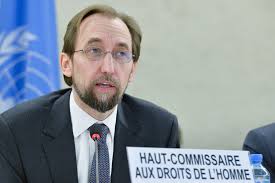
Zeid Ra-ad Al Hussein
At the opening of the session on March 2 the U.N. High Commissioner for Human Rights, Zeid Ra’ad Al Hussein, [3] set forth his concerns on human rights. Three days later, on March 5th, he commented on his annual report on human rights. This post will examine both of these speeches.
From March 2 through 5, the Council conducted what it called its High Level Segment, in which national leaders addressed the Council on the overall subject of human rights. Two of those national leaders were U.S. Secretary of State john Kerry and Cuban Foreign Minister, Bruno Rodriguez Parrilla. Their remarks will be covered in subsequent posts while another post will analyze those remarks and the speeches of the High Commissioner.
High Commissioner’s Speech, March 2nd [4]
The “cruelty and moral bankruptcy of violent extremists . . . continue daily, and we condemn their merciless conduct daily.”
“And yet, if we are not careful, if we are not completely principled and cunning in our collective attempt to defang them, we will, unwittingly and inexcusably, be advancing their interests. How we define the opening chapters of this already agitated century depends heavily on us not becoming like them. For us, international humanitarian law and international human rights law cannot be trifled with or circumvented, but must be fully observed.”
“It has been 70 years since the great Charter of the [U.N.] was drawn up, and since then States have also written and agreed to a range of strong international treaties, to establish in binding law the legal principles of human rights. They are a distillation of all human experience, all the warnings and screams of our combined human history.” By “ratifying the U.N. Charter, [states] have made a clear commitment [in the words of its Preamble] to ‘reaffirm faith in fundamental human rights; in the dignity and worth of the human person; in the equal rights of men and women, and of nations large and small; and to establish conditions under which justice and respect for the obligations arising from treaties, and other sources of international law, can be maintained; and to promote social progress, and better standards of life in larger freedom.’”
“And yet, with alarming regularity, human rights are disregarded, and violated, sometimes to a shocking degree.”
“States claim exceptional circumstances. They pick and choose between rights. One Government will thoroughly support women’s human rights and those of the LGBT communities, but will balk at any suggestion that those rights be extended to migrants of irregular status. [U.S.?] Another State may observe scrupulously the right to education, but will brutally stamp out opposing political views. [Cuba?] A third State comprehensively violates the political, civil, economic, social and cultural rights of its people, while vigorously defending the ideals of human rights before its peers.”
“In recent months I have been disturbed deeply by the contempt and disregard displayed by several States towards the women and men appointed by [the Council] as [its] independent experts – and also by the reprisals and smear campaigns that are all too frequently exercised against representatives of civil society, including those who engage with the Council and its bodies. I appeal to all of you, once again, to focus on the substance of the complaint, rather than lash out at the critic – whether that person is mandated by States, is a member of my Office, or is a human rights defender.”
“The overwhelming majority of victims of human rights abuses around the world share two characteristics: Deprivation, and discrimination – whether it is based on race or ethnicity, gender, beliefs, sexual orientation, caste or class. From hunger to massacres, sexual violence and slavery, human rights violations are rooted in these hidden, and sometimes not so hidden, factors.”
“They are not spontaneously generated. Most violations of human rights result from policy choices, which limit freedom and participation, and create obstacles to the fair sharing of resources and opportunities.”
“The most powerful instrument in the arsenal we have against poverty and conflict is the weapon of massive instruction. Respect for the human rights of all, justice, education, equality – these are the strongly interlocking elements that will build fair, confident and resilient societies; true development; and a permanent peace.”
“Everybody knows when police use torture, and when tweets are brutally suppressed. Everybody knows when discrimination means poverty, while corrupt elites gorge on public goods, supported by a corrupt judiciary. Everybody knows when women are treated like property, and children go hungry, and unschooled, in squalid neighborhoods.”
“Some of the evidence may be hidden. But the reality, in far too many countries, of massacres and sexual violence; crushing poverty; the exclusive bestowal of health-care and other vital resources to the wealthy and well-connected; the torture of powerless detainees [U.S.?]; the denial of human dignity – these things are known. . . . [T]hey are what truly make up a State’s reputation; together with the real steps – if any – taken by the State to prevent abuses and address social inequalities, and whether it honors the dignity of its people.”
“The only real measure of a Government’s worth is . . . the extent to which it is sensitive to the needs – and protects the rights – of its nationals and other people who fall under its jurisdiction, or over whom it has physical control.”
“Some policy-makers persuade themselves that their circumstances are exceptional, creating a wholly new reality unforeseen by the law. This logic is abundant around the world today: ‘I arrest arbitrarily and torture because a new type of war justifies it. I spy on my citizens because the fight against terrorism requires it. I don’t want new immigrants, or I discriminate against minorities, because our communal identity is being threatened now as never before. I kill without any form of due process, because if I do not, others will kill me.’ “
“I must remind you of the enduring and universal validity of the international human rights treaties that your States wrote and ratified. In reality, neither terrorism, nor globalization, nor migration are qualitatively new threats that can justify overturning the legal foundations of life on Earth. They are not new.”
“At a time of intensifying global anxiety, I believe the people of the world are crying out for profound and inspiring leadership equal to the challenges we face. We must therefore renew, by the strongest action, our dedication to the reality of inalienable and universal human rights, to end discrimination, deprivation, and the seemingly inexhaustible litany of conflicts and crises that generate such terrible, and needless, suffering.”
“What will become of us, of our world, if we ignore our treaties and principles? Can we be so stupid as to repeat scenes from the twentieth century, punctured as it was by such awful inhumanity? You must not make it so. This is principally your burden, and ours. Together, if we succeed in turning the corner, in improving our global condition, we can then say the screams of history and of the millions upon millions of victims, have been heard, finally. Let us make it so.”
High Commissioner’sSpeech, March 5th [5]
The High Commissioner was “appalled by the massive suffering ISIL provokes [in Syria, Iraq and Libya]: from the murders, torture, rape and sale of children . . . ; to mass beheadings; burning people alive in cages; seemingly genocidal attacks on ethnic and religious groups; the obliteration of due process; torture; deprivation of income and every kind of service and resource; recruitment of children; the destruction of elements of the cultural heritage of humanity; and, not least, particularly vicious and comprehensive attacks on the rights of women and girls.” [Similar horrible actshe said, were perpetrated in Nigeria by Boko Haram and in Yemen and Somalia by other groups.]
“My Office strongly supports efforts by States around the world to prevent and combat terrorism, and to ensure that the perpetrators of terrorism, as well as their financiers and suppliers of arms, are brought to justice.”
“Terrorist attacks [,however,] cannot destroy the values on which our societies are grounded – but laws and policies can. Measures that build what has been termed the ‘national security state’ – such as arbitrary or prolonged detention; torture and ill-treatment; massive surveillance that contravenes the right to privacy; unfair trials; discriminatory policing; and the abusive use of legislation to curb legitimate rights to peaceful protest and to freedom of expression – are human rights violations. They generate legitimate resentment, harm social cohesion, and undermine the essential values of the international community.”
“There is real danger that in their reaction to extremist violence, opinion-leaders and decision-makers will lose their grasp of the deeper principles that underpin the system for global security which States built 70 years ago to ward off the horror of war. The fight against terror is a struggle to uphold the values of democracy and human rights – not undermine them. . . [C]ounter-terrorist operations that are non-specific, disproportionate, brutal and inadequately supervised violate the very norms that we seek to defend. They also risk handing the terrorists a propaganda tool – thus making our societies neither free nor safe. The use of torture, neglect of due process and collective punishment do not make the world any safer.”
“To be truly effective, any response to extremist violence must be targeted, proportionate, and legal. Military campaigns, financial sanctions and attempts to staunch the inflow of weapons – such as the United Nations Arms Trade Treaty – may be part of the solution.”
“But other actions are needed to stem the root causes that feed into these conflicts. We must acknowledge that large numbers of people do not join such extremist movements en masse because they have been suddenly and inexplicably hypnotized. Extremism – however repugnant – is nurtured by ideology, and by alienation fed by years of tyranny, corruption, repression, discrimination, deprivation and neglect of the legitimate rights of communities.”
He especially was “disturbed by a continuing trend of harsh restrictions on public freedoms by States across all regions. I refer to military crackdowns on demonstrations; harsh sentencing of human rights defenders, journalists and dissidents in politically motivated trials; brutal punishments for simple tweets; censorship; oppressive and illegitimate regulations of civil society movements; the use of new technologies to stifle human rights in the virtual space; and new security laws that are unjustly broad, endangering civil liberties and human rights.”
“And yet the great pillar of every resilient and participative society is freedom of expression. Freedom to formulate the ideas of equality led to the overthrow of colonialism, and has powered every movement against discrimination and injustice. To immunize against dictatorship or totalitarianism, to undo discrimination, to drive justice and accountability, we need freedom of expression – full and free and far-reaching. There is no good governance without free speech.”
The High Commissioner’s speech included specific criticisms of many countries. About the U.S., he said: “In the United States, the Senate report on torture in the context of counter-terrorism operations is courageous and commendable, but profoundly disturbing. For a country that believes so strongly in human rights to have swiftly abandoned their fundamentals at a time of crisis is as astonishing as it is deplorable. And yet few other countries have had the courage to likewise publicly investigate and publicly admit to rights abuses resulting from counter-terror operations – and many should.”
“Under international law, the [Senate] report’s recommendations must be followed through with real accountability. There is no prescription for torture, and torture cannot be amnestied. It should also lead to examination of the institutional and political causes that led the US to violate the absolute prohibition on torture, and measures to ensure this can never recur.”
“As the Senate report clearly demonstrates, the neglect of due process, use of torture and collective punishments that were permitted by US officials in the post-9/11 context did not make the world – or the US – any safer. On the contrary, they increased the threat of terrorism, by feeding into the grievances on which it thrives. The orange jumpsuits of Guantanamo are a recruitment tool for ISIL and other groups. As former President George W. Bush has conceded, Guantanamo became, I quote, ‘a propaganda tool for our enemies.’”
The High Commissioner also expressed regret at the renewed use of the death penalty in a number of countries – Jordan, Pakistan, and Indonesia – and “the continuing extensive use” of the death penalty in China, Iraq, Iran and the U.S.
In conclusion, he said, “It is the people who sustain government, create prosperity, heal and educate others and pay for governmental and other services with their labour. It is their struggles that have created and sustain States. Governments exist to serve the people – not the other way round.”
“Governments that protect human rights, combat discrimination and deprivation, and which are accountable to their people are more prosperous and more secure than those which stifle rights, hamper opportunities, and repress freedoms. When people’s rights are respected – when they are accorded dignity, have opportunities to express their skills and are given a fair share of resources – they form resilient societies. When they are wronged, their rights betrayed, there is a constant threat of turmoil. Respect for the human rights of the people is not destabilizing; but driving legitimate opposition underground is.”
Conclusion
Speeches about human rights in international fora often are replete with platitudes. These speeches by the High Commissioner are not. While he condemns the horrible actions of ISIL and Boko Haram, these groups are not represented at the Council. Instead the countries that are represented are often the victims of their evil deeds. Therefore, the High Commissioner spent most of his time chastising the latter countries for failing to live up to the human rights commitments they have made as they are combatting terrorism. Moreover, these speeches address some countries by name and point our their failings.
In a later post we will look again at these speeches in the context of the issues of human rights in the process of U.S.-Cuba reconciliation.
[1] The Human Rights Council has 47 member states elected by the U.N. General Assembly. Currently both the U.S. and Cuba are such members.
[2] Materials about the Council’s 28th session are available on its website.
[3] The High Commissioner for Human Rights is the principal human rights official of the U.N. and the head of the Office of the High Commissioner for Human Rights, which “spearheads the [U.N.’s] human rights efforts . . . by strengthening international human rights mechanisms; enhancing equality and countering discrimination; combating impunity and strengthening accountability and the rule of law; integrating human rights in development and in the economic sphere; widening the democratic space; and early warning and protection of human rights in situations of conflict, violence and insecurity.”
Prince Zeid Ra’ad Al Hussein of Jordan was unanimously elected the High Commissioner by the U.N. General Assembly in June 2014. His many years of diplomatic service include being Jordan’s Ambassador to the U.S., his country’s Permanent Representative to the U.N. and his serving as an officer of the International Criminal Court. He holds a Bachelor of Arts degree from The Johns Hopkins University and a Doctorate in Philosophy from Cambridge University.
On February 12th the Senate Armed Forces Committee approved, 14 to 12, S.165 (Detaining Terrorists to Protect America Act of 2015). This bill “would (a) reinstate more restrictive standards for sending detainees at Guantanamo Bay, Cuba, to third countries; (b) extend rules barring the movement of prisoners to the mainland United States for two years, until after Obama steps down in early 2017; and (c) impose a two-year suspension on the transfer of any detainees ever categorized by the United States as posing a high or medium risk to the United States or its allies.”
The Committee’s press release stated that it had approved three amendments to the bill proposed by three of its Democratic members: (1) codification ofthe lawful procedures already in place to ensure that detainees are treated humanely (Sen. Kaine); (2) promotion of transparency by requiring a report about the use of Department of Defense facilities, including Guantanamo Bay, and Bureau of Prisons facilities as terrorist propaganda tools and explaining whether this propaganda is effective and what the administration is doing to counter it (Sen. McCaskill); and (3) allowance of temporary transfer of a detainee to a Department of Defense facility in the U.S. for emergency or critical medical treatment (Sen. Reed).
This press release does not identify who cast the 14 to 12 votes on the bill, but as the Committee has 14 Republican and 12 Democratic members, it is safe to assume that the voting was on party lines.
On February 23rd the Senate Committee favorably reported S.165 with amendments to the Senate, and it was placed on the Senate’s Legislative Calendar.
The companion bill in the House (H.R.401: Detaining Terrorists to Protect America Act of 2015) was referred to its Armed Service Committee, which has 36 Republican and 27 Democratic members, including John Kline (Rep., MN) and Tim Walz (Dem., MN). On February 12th its Subcommittee on Oversight and Investigations held a hearing on detainee transfers from GITMO.
President Obama has indicated that he would veto such a bill if it passes both chambers of the Congress. Presumably his overriding interest is fulfilling his commitment at the start of his presidency to close the prison at Guantanamo. It is highly unlikely that any effort to override such a veto could get the constitutionally required two-thirds votes in both chambers of Congress.
This measure also complicates the reconciliation with Cuba because there are various unresolved issues regarding Guantanamo with Cuba, including its request or demand for the cancellation of its lease in perpetuity of this part of the island to the U.S. and the return of same to Cuba’s control.
On February 13th the U.S. Department of State announced that a new regulation will allow certain goods and services produced by independent Cuban entrepreneurs to be imported into the U.S. Cuba’s nascent private sector includes self-employed individuals, private small businesses, and private cooperatives that are independent of Cuba’s state sector. [1]
However, many goods were excluded from the liberalization, including food and agricultural products, alcohol, minerals, chemicals, textiles, machinery, vehicles, arms and ammunition.
Exports of all services are permitted. Some observers believe this may be more significant. This, for example, could allow Cuban graphic designers, computer programmers, market researchers or party planners to acquire U.S. clients.
On the diplomatic front, the U.S. reportedly is pressing Cuba to agree to restoration of normal diplomatic relations before the Summit of the Americas in Panama in April. This blogger, however, thinks that is unlikely given the inconclusive results of the initial negotiations in Havana in January and the lack of any announcement of a second round of talks that supposedly were going to happen in Washington this month.
More importantly Cuba has made statements suggesting that normal relations could not be commenced until the U.S. agrees its diplomats would not have private meetings with Cuban dissidents and rescinds its designation of Cuba as a “State Sponsor of Terrorism.” Based on publicly available information, neither of these will happen before April. In addition, President Raúl Castro has suggested that such relations could only happen after the U.S. ends the embargo, pays compensation to Cuba for its alleged damages from the embargo and returns Guantanamo Bay to Cuba. Clearly these will not happen before April, if ever.
========================================
[1] This account of the new regulations is based upon a Department of State document and reports from Reuters andAssociated Press.