Cuban Protestant Leader: Cuban Religious Freedom

Dr. Reinerio Arce
Seminary Chapel, Matanzas, Cuba


Dr. Reinerio Arce, a Presbyterian pastor and President of the Evangelical Theological Seminary of Matanzas, Cuba, recently commented on various issues in Cuba, including religious freedom.

He advised this blogger that the recent report by the U.S. Commission on International Religious Freedom accurately described improvements in Cuban church-state relations in 2011, when it stated:

  • Positive developments for the Catholic Church and major registered Protestant denominations, including Baptists, Pentecostals, Presbyterians, Episcopalians, and Methodists, continued over the last year. The State Department reports that religious communities were given greater freedom to discuss politically sensitive issues. Sunday masses were held in more prisons throughout the island. Religious denominations continued to report increased opportunities to conduct some humanitarian and charity work, receive contributions from co-religionists outside Cuba, and obtain Bibles and other religious materials. Small, local processions continued to occur in the provinces in 2011. The government granted the Cuban Council of Churches time for periodic broadcasts early Sunday mornings, and Cuba‘s Roman Catholic Cardinal read Christmas and Easter messages on state-run stations. Additionally, there were fewer reports of illegal house churches being fined, confiscated, or evicted.”
  • “Relations between the Catholic Church and Cuban government continue to improve, although the government maintains strict oversight of, and restrictions on, church activities. Cardinal Jaime Ortega has been instrumental in negotiating the release of political prisoners and intervening to stop officials from preventing the Ladies in White from attending mass in Havana. March 2012 marks the 400th anniversary of the appearance of the Virgin de Caridad de Cobre (Our Lady of Charity), Cuba‘s patron saint. Pope Benedict XVI will travel to Cuba starting on March 26 to participate in the celebrations, at which time he will be received by Cuban President Rául Castro. Throughout the year, a replica of the Our Lady of Charity statue, La Mambisa, has toured the island, drawing large crowds.”

Arce emphasized the rapprochement between the Cuban government and the Roman Catholic Church that was marked by the recent visit to the island by Pope Benedict XVI. Work was suspended so Cuban people could attend the papal Mass in Havana’s Plaza de Revolucion, and the government granted the Pope’s request to make Good Friday a national holiday. Before this visit, Arce noted, there was nearly a month-long pilgrimage of the statue of the Virgin of Cobre, the patron saint of charity and of Cuba, all over the island and in hospitals, prisons and other public places.

According to Arce, however, the Commission engaged in manipulating half truths and bringing together things that are not related when it talked about some Cuban religious leaders and followers having been arrested and held for short periods of time and reports by some church leaders about increased government surveillance and interference with church activities.

Even more astounding to Arce and to this blogger is the failure and refusal of the Commission to appreciate that the positive developments in Cuba outweighed any negatives and to remove Cuba from its “Watch List of countries where the serious violations of religious freedom engaged in or tolerated by the governments do not meet the CPC [Countries of Particular Concern] threshold, but require close monitoring.” (Cuba has been on this Watch List since 2004.)

Cuba is going through significant economic changes with more opportunities for Cuban private business ventures. Simultaneously, Arce pointed out,”the government has withdrawn from many of the subsidized [industries] to make room for the private businesses. Now, many people are [becoming] unemployed because [government jobs] are going to this private sector. It has been a great challenge in Cuban society–especially for the churches because many [Cubans] do not know how to rearrange their work [to be in the private sector]. Many of them are coming to the church to ask for help, which is a big challenge for all of the churches in Cuba.”

In response to this challenge, the Matanzas seminary and the Martin Luther King, Jr. Memorial Center (in Havana) are planning a joint course focusing on business administration and related subjects. The seminary and the MLK Center have agreed this program will not promote small, private businesses, but instead cooperatives. Arce said, “We think it is more within the Christian understanding of economy.”

Arce gave thanks for recent changes in U.S. policies regarding travel to Cuba. Now it is easier for U.S. church groups to obtain U.S. Treasury Department licenses to go to Cuba to be with their Christian brothers and sisters. These are important “bridges between our people; [after] all these years of confrontation between our countries, the churches have maintained a strong relationship between the people.”

Another recent change in U.S. policies was commended by Arce. Many Cuban churches–Presbyterian, Episcopal, Baptist and Methodist–were once parts of their corresponding U.S. churches, and the Cuban pastors earned U.S. pension benefits. Until recently, however, the U.S. government prevented the U.S. churches from paying the Cubans their earned pensions. Earlier this year the U.S. government ended the freeze, and the pensions will soon be paid. The Cuban pastors have been in a very difficult financial situation caused by the freeze. This blogger has personal experience with this issue because the Cuban pastor of Minneapolis’ Westminster Presbyterian Church’s partner church in Matanzas, Cuba was one of those who could not receive his pension benefits from the U.S. church. I join Arce in shouting a big “Hallelujah”

Many U.S. and Cuban church members have been involved in people-to-people exchanges in recent years. In the process they have experienced the joy of love and solidarity. The Promised Land of more general friendship and respect and solidarity between our peoples is our goal. Praise the Lord!

/

http://lawg.org/action-center/lawg-blog/69-general/997-dr-reinerio-arce-if-you-go-this-year-you-will-find-another-cuba?utm_source=feedburner&utm_medium=email&utm_campaign=Feed


The National Geographic Bee

For at least the last 24 years, the National Geographic Society has conducted the annual Geographic Bee in the U.S. to promote the study of geography.

This year the National Champion will receive a $25,000 college scholarship, a trip to the Galapagos Islands and lifetime membership in the Society. The 2nd and 3rd place national winners will receive $15,000 and $10,000 college scholarships respectively. This year’s national Bee will be held at the Society in Washington, D.C., May 22-24, 2012 and will be shown live on the National Geographic Channel on cable television.

Minnesota State Geographic BEE Contestants, 3/30/12

Each state has its own Bee to select its candidate for the national competition. This year’s state competitions were held on March 30th. Minnesota’s was at St. Cloud State University for 100 fourth through eighth graders who won their local schools’ competitions and who were the highest scorers on a written examination out a field of 500. Here was the makeup of this year’s 100 Minnesota contestants: fourth graders, 3; fifth graders, 6; sixth graders, 9; seventh graders, 23; and eighth graders, 59. Only 7 of the 100 were girls.

Minnesota Geographic BEE Final Round, 3/30/12

The Minnesota Bee started with four Preliminary Rounds. The 15 top scorers in those four sessions with perfect scores of 8 were then assembled for a Tiebreaker Round to select the top 10 individuals for the Final Round, two of whom were girls. These 10 were questioned, and eventually only two individuals were left for the Championship Round. More questions were addressed to the two contestants until one individual was eliminated, leaving the other as the state champion. The deciding question was “Name the Baltic country that replaced its currency (the kroon) in early 2011 with the Euro, becoming the most recent country to join the eurozone?” (Correct answer: Estonia.)

The Minnesota State Champion this year was Gopi Ramanathan, an 8th grader from Sartell Middle School; he also was the State Champion in 2010 and the second-place state winner in 2011. The second-place winner this year was William Bogenschultz, an 8th grader from Ramsey Junior High School in St. Paul; he was the State Champion in 2011 and the second-place state winner in 2010.

The procedures for the Bee are very detailed and very fair as were the questions.

For example, in the Preliminary Round that I observed, there were 21 contestants, who were randomly assigned numbers 1 through 21 and who were then questioned in that order. For each of eight rounds of questions after an initial practice round, the moderator announced the type of question that would be asked. For example, the first round was a set of questions asking which of two named states in the U.S. had a certain characteristic. She then asked questions, and the contestant had 15 seconds to answer. One of the questions in the first round was “Which state has the longer shoreline, Maryland or New Hampshire?” (Correct answer: Maryland.) The questions got more difficult with each passing round. In the eighth and final round the questions were about political geography, and one of the questions was “What southeastern Asian country near the Gulf of Tonkin was reunited in 1976, Myanmar or Vietnam?” (Correct answer: Vietnam.)

Similar procedures were followed in the Tiebreaker, Final and Championship Rounds with increasingly more difficult questions.

Before the start of questioning in the Final Round, a film “What will you do with geography?” was shown. It had brief comments by a number of people whose jobs required knowledge of different types of geographical subjects. I learned a lot about this topic from the film and thought it was answering a question that many of the contestants and their parents probably had.

Elliott Krohnke

I attended the Minnesota Bee because my grandson, Elliott, a sixth grader at Lakes International Language Academy (LILA) in the town of Forest Lake, was one of the 100 contestants. Afterwards Elliot said that this year’s competition would help him prepare for next year’s BEE. (Last Spring as a fifth grader, he prepared a presentation at his school about Libya and the NATO bombing,)

Gratitude I

It is so easy to credit all of your successes to your own talents and hard work. I know that I too often do that.

Lately, however, I am pausing to acknowledge the many blessings in my life.

My mother and father, Marian Frances Brown and Ward Glenn Krohnke, were directly responsible for endowing me with good genes. They also were loving and nurturing, especially in my early years, and supporting my many activities through college and beyond. Although of modest financial circumstances, my parents were able to afford many of the creature comforts of American middle class life as I was growing up. I did not have to work to provide financial support for the family although in junior and senior high school I had part-time jobs to earn spending money and saving for college. My parents and I were in good health as I grew up with no major illnesses or accidents. I am grateful.

The public schools in my small Iowa home town of Perry did not provide many of the curricular and extra-curricular activities of private schools or large, prosperous suburban school districts in the rest of the country. Yet I had many excellent teachers who did not let me coast through school. The teacher I remember most fondly for this nurturing and challenging was Emma Hepker, who taught speech and English Literature. I also participated in speech contests, football, baseball, track and concert and marching band playing the e-flat alto saxophone. I often focused on the limitations of growing up in this small town far away from where things were really happening. But I can now see that there were benefits from this protective environment. I am grateful.

Grinnell College, the next stop on my educational journey, was challenging and enriching. My major was history with a lot of political science and economics. The professors were excellent, especially Joe Wall, Alan Jones, Samuel Barron, Richard Westfall and George Drake in history, Harold Fletcher in political science and Philip Thomas and John Dawson in economics. As a student at a small college I had the opportunity to participate in many activities, including intercollegiate baseball and football and student government. I am grateful.

In the midst of my Grinnell experience, I had one semester at American University on the Washington Semester Program. The focus was seminars and meetings with politicians, government officials and others as we learned about American government in our nation’s capitol. Professor Louis Loeb was the excellent leader of our group. Each of us also did independent research for a paper. My topic was the participation of political interest groups in the U.S. Supreme Court’s consideration of contempt of Congress cases, mostly coming from the House Un-American Activities Committee, which I thought itself was un-American. I spent a lot of time in the Supreme Court Library reading briefs of the parties and of amici curiae (friends of the court), usually the American Civil Liberties Union and the American Association of University Professors, and then comparing their arguments with the Court’s decisions. This was also the first time I had lived in a major city, and I thoroughly enjoyed its many cultural attraction. I am grateful.

After Grinnell, I had the tremendous privilege and honor of being a student for two years at the University of Oxford. There I studied or, as they say, “read” Philosophy, Politics and Economics. During the three eight-week terms of the academic year, each week I read suggested readings on two topics or issues and prepared essays for two tutorials, usually by myself, but sometimes with one other student. The tutors, especially John Sargent and Roger Opie in economics and Michael Hinton in philosophy, were warm and encouraging while pressing me onward. During the terms you could also attend university-wide lectures in the subjects while over the vacations or “vacs” you were expected to continue your readings in the three fields. At the end of my two years, I had university-wide examinations or “Schools” as they were given in a building called “The Examination Schools.” There were six required examinations (two each in the three disciplines) plus two optional subjects (mine were public finance and currency and credit). Each examination was three hours long, and you had to answer four questions from a printed list of about 12 questions. Your answers were then read and graded by a university-wide committee, and your overall grade or results were posted on the Oxford bulletin boards and published in the London Times. I am grateful.

I then returned to the U.S. for three years at the University of Chicago Law School. Whereas there was great student independence at Oxford, Chicago like most law schools had large classes with daily assignments, usually with professors grilling the students with questions about the cases or statutes we were studying. At the end of the semester there was the familiar practice of the course’s professor giving the final examinations. There were great professors at Chicago: Harry Kalven, Walter Blum, Francis Allen, David Currie, Philip Kurland, Phil Neal, Bernard Meltzer, Soia Mentschikoff and Kenneth Dam to name a few. I am grateful.

In 1966 I commenced practicing law with the Wall Street firm of Cravath, Swaine & Moore, probably the preeminent law firm in New York City. In my four years there as a junior associate, I worked on many interesting cases, usually with the “grunt” work. The senior lawyers for whom I worked helped me to “learn the ropes” of practicing law. Jack Hupper and Tom Barr were the most significant in that regard. I am grateful.

In 1970 my family and I moved to Minneapolis where I commenced what turned out to be a 31-year career with the law firm of Faegre & Benson (now Faegre Baker Daniels). Here too I worked with excellent lawyers who helped me develop my legal skills. I think especially of John French, Norman Carpenter, Larry Brown and Jim Loken; Jim is now a Judge of the U. S. Court of Appeals for the Eighth Circuit. I am grateful.

After my retirement from Faegre in 2001, Professor David Weissbrodt at the University of Minnesota Law School asked me to help teach the international human rights course. I accepted the offer and did so for nine years (2002-10). I learned much more about this field of law and met many interesting students and faculty. I am grateful.

For all of these blessings, I give thanks to God and to those named and unnamed individuals who helped me along the way.

The Art of Fact: Weaving Your Personal Story into Historical Context

Kristen Iversen

On February 17th this was the topic of a talk at the 7th annual San Miguel de Allende (Mexico) Writers Conference. The speaker was Kristen Iversen, Director of the MFA Program in Creative Writing at The University of Memphis.

She said setting your personal story in a broader historical context makes it more interesting and more meaningful. You should identify moments in your own life that are important for you and develop them in writing as fully as possible. Then think about what was going on in the world at the same time and research local, national or world events that appear connected to your story and weave those facts into your story. Consider writing your story in the present tense to make it more immediate.

Iversen then talked about how she did this herself.

As a young girl, she and her family lived in Arvada, Colorado, which was close to the Rocky Flats nuclear weapons plant, which secretly produced more than 70,000 plutonium triggers for nuclear bombs and contaminated the environment with toxic and radioactive materials. Over the last 10 years or so, she conducted research into what happened at Rocky Flats. She read hundreds of pages of documentation, including oral history interview transcripts at the University of Colorado, newspaper articles, photographs and previously classified information. She also conducted extensive interviews of some of the workers at the facility.

In late February 2011, after the prior year’s San Miguel writers’ conference, she finished her book about growing up near this facility.

She read a section of her book about the “Mother’s Day Fire” at the facility in 1969. While she and her family were having brunch at a restaurant, a fire broke out in the production line at the facility, and only two guards were on duty with limited knowledge about how to fight such a plutonium fire. Her present-tense account of fighting the fire was gripping. After the reading, she added that the roof of the facility almost exploded in this fire. If it had, it would have been a Chernobyl-like disaster for the entire Denver metropolitan area.

Iversen hired an agent to get the book published. Then on March 11, 2011, Japan was hit with an earthquake and tsunami that created the disaster at the Fukushima Daiichi nuclear power plant with radiation leaks into the air and contaminated water spilling into the sea. Now there was intense interest around the world in nuclear disasters.

Her book was now a “hot item.” it was auctioned in New York City by her agent with publishers’ representatives calling Iversen with questions at her office in Memphis. It was eventually sold to Crown Publishers and is to be published on June 5, 2012. A subsequent auction in London sold the rights to another publisher for the U.K. Iversen added that Angelina Jolie had expressed interest in the movie rights to the book.

The tentative title of the book is “Full Body Burden: Growing Up in the Nuclear Shadow of Rocky Flats.” I told the author that I did not think it was a good title because most people and I did not know what “Full Body Burden” meant. (I found out later it means the burden on a human body of nuclear radiation or other toxic chemicals.) Nor did I think most people would recognize the term ‘Rocky Flats.” In addition, I thought the tentative cover of the U.S. edition of the book did not help to sell the book.

Naomi Wolf, the noted author and public commentator, was another speaker at the San Miguel Writers’ Conference and afterwards published an article in The Guardian in London titled “From Rocky Flats to Fukushima: this nuclear folly.” Wolf reported that as Iversen grew up, she became aware of the growing incidence of bizarre cancers being diagnosed in local children. Thirty years later, cancer rates remain elevated in neighborhoods around Rocky Flats (plutonium has a half-life of 24,000 years), and recent tests confirm there is still contamination in the soil. Yet purportedly to “save” the high costs of cleaning up the site, most of the Rocky Flats has been designated a “wildlife refuge” to be open to the public in 2013. Wolf uses these facts to argue that it is folly to plan any expansion of nuclear power as the U.S. is  planning to do.

Iversen discussed many of these same issues as well as her new book in last Sunday’s New York Times‘ “Sunday Review.”

“Full Body Burden” will hit the book market at about the same time as a new book by physicist and historian Spencer Weart. His book, The Rise of Nuclear Fear,”  is reported to argue that scientists do not know about the physical impact of radiation. On the other hand, the psychological impact of radiation exposure is evident. Precisely because physical damage from very-low-level radiation cannot be detected, exposure leaves people in great uncertainty. Many believe they have been fundamentally contaminated for life. They may refuse to have children for fear of birth defects. They may be shunned by others who fear a sort of mysterious contagion.

I recommend Iversen’s forthcoming book on what should be a fascinating approach to an important public policy issue.

Intimations of Mortality

I am in excellent health. Like most people I try to take each day as it comes. Each day requires a “To Do” list and running around doing this and that. More of the same, day after day.

Recently, however, there have been reminders of human mortality, including my own.

Over the last several years four of my former law partners at Faegre & Benson (n/k/a Faegre Baker Daniels) have died as have four adult children from this larger group of colleagues. A good friend of mine from our church died last October, and my remarks at his memorial service were recently posted.

Last June was my Grinnell College class’ 50th reunion. As mentioned in an earlier post, I was the de facto obituary writer-in-chief for our reunion booklet. Of the 359 in our class, 53 were deceased. Since then three other classmates have died, one of whom was a friend. I have written their obituaries for our class letter.

For the asset side of  my December 31st family financial statements, I calculate the present values of certain future income streams like Social Security benefits and a law firm pension. The first step in that calculation is looking at the Internal Revenue Service’s Life Expectancy Tables. For 12/31/11, these Tables said my life expectancy was 15.5 years or 186 months. (Statistically this is the median of the anticipated survival time of the entire cohort of people of a certain age or the time when 50% of the cohort will have died.)

All of this reminds me of Frank Sinatra singing September Song, “The days dwindle down to a precious few. One hasn’t got time for the waiting game.”

Memorial services for our departed friends and acquaintances should be times for us to pause and reflect on where we are in our own lives and what should be important for our remaining days or years. Be kind and loving to your family and friends and those people who will come into your life around the next bend in the road. It is not work harder or make more money, important as they may be.

The memorial service for one of my fellow retired law partners at Minneapolis’ Plymouth Congregational Church was especially touching and moving. In early adulthood he and his wife had three children. In mid-life he and his wife divorced after he recognized that he was gay. At the service the minister read a loving remembrance from his male life partner. The deceased’s younger brother made an emotional speech about how much his brother had meant to him. A fellow law firm partner talked about his excellence as a lawyer and leader of the firm as well as his personal concern for the welfare of his colleagues. Three of his grandchildren read the Scriptures. All aspects of his life were acknowledged and celebrated. As the newspaper obituary stated, he was “a devoted partner, loving husband, beloved father and grandfather, caring brother, delightful uncle, and cherished friend.”  Sitting in the pew at the service, I gave thanks to God for the life of this amazing man and for this Christian church’s witness to the unbounded love of God for all human beings.

Is Chad Harbach’s “The Art of Fielding” a Great Novel?

Target (baseball) Field, Minnesota Twins

The Art of Fielding, a first novel by Chad Harbach, has received spectacular reviews in the U.S. and the U.K. The New York Times even made it one of their 10 Best Books of 2011.

The main character of the novel is Henry Skrimshander, a baseball player at a small college in the Midwest (Wisconsin). He is inspired by a fictional book (“The Art of Fielding”) written by a fictional baseball player (Aparicio Rodriguez), who supposedly played shortstop for the St. Louis Cardinals for 18 years, was regarded as the greatest defensive player at that position of all time and a member of the Baseball Hall of Fame.

Luis Aparicio

The fictional baseball player appears to be closely modeled on a real major leaguer, Luis Aparicio from Venezuela, who played shortstop for three teams (Chicago White Sox, Baltimore Orioles and Boston Red Sox) for 18 years. A great defensive player, he was on the American League All-Star team 13 times and was elected to the Baseball Hall of Fame. But he did not write a book about fielding or any other subject, to my knowledge.

Being a Minnesota Twins baseball fan who once played college baseball at a small college in the Midwest (Grinnell College in Iowa) that played teams from small colleges in Wisconsin (Ripon and Lawrence), I was really looking forward to reading this book.

The novel, however, was exceedingly disappointing.

The fictional book within the book is based on the very unlikely premise that a Latin American major leaguer would write any book, much less a book that sounds zen-like. Here are some of the words of advice on the subject of picking up and throwing a baseball that mean absolutely nothing to me as a former middle infielder (shortstop and second baseman):

  • “The shortstop is a source of stillness at the center of the defense. He projects this stillness and his teammates respond.”
  • “To field a ground ball must be considered a generous act and an act of comprehension.”
  • “There are three stages: Thoughtless being. Thought. Return to thoughtless being.”
  • “Death is the sanction of all that the athlete does.”

Skrimshander, who starts out as a great fielding shortstop, develops a problem in making accurate throws to first or second base on easy ground balls, and he cannot shake off this affliction.

Chuck Knoblauch

This has actually happened to several major-league middle infielders, who are briefly mentioned in the book. One is Chuck Knoblauch, who was a great fielding second baseman for the Minnesota Twins, from 1991 through 1997 and the American League Rookie of the Year in 1991. He was traded to the New York Yankees, where he played from 1998 through 2001 before a final season in 2002 with the Kansas City Royals. In 1999 he developed a problem in making accurate throws to first base, forcing the Yankees to move him to the outfield on defense or to have him be the designated hitter (one who bats, but does not play defense, but only in the American League). I, however, don’t think Chuck was an obsessive reader of any book about fielding like Skrimshander was or any other book for that matter.

Although this fielding problem is a major event in the life of the lead character in the novel and the life and success of his college baseball team, there is no exploration in the novel of why or how this happened. In baseball and other sports, coaches often tell their players not to think too much because thinking gets in the way of batting or fielding in baseball and other actions in other sports. Perhaps this is the explanation for Skrimshander’s problem. He was spending too much time reading the Aparacio book about fielding and thinking about the task of picking up and throwing a baseball. More generally this ironically suggests an anti-intellectual message in a college setting devoted to the life of the mind. (Never mind that this explanation does not fit with the real-life Knoblauch.)

The president of the fictional college (Westich College) is a late-middle-aged man (Guert Affenlight), who is divorced with an adult daughter. We the readers discover that he is gay as he embarks on an affair with Skrimshander’s roommate and fellow baseball player. This story soon takes over the novel. But there is no exploration of the many serious issues this conduct raises.

On the other hand, perhaps the main character in the novel is Mike Schwartz, the captain and catcher on the baseball team. In the summer before his senior year of college, Schwartz sees Skrimshander play baseball for another team and recognizes his great fielding ability as a shortstop. Schwartz, therefore, convinces him to apply for admission to the college. Once there, Schwartz pushes Skrimshander to do all sorts of strengthening exercises in order to become an even better player. In doing all of this, Schwartz knows his own talents come nowhere near those of his new teammate, but Schwartz does not show any signs of jealousy or insecurity. Perhaps the novel is saying that the less talented, but dedicated, selfless individual is really the most important person in any team or organization.

Moreover, although the novel makes a big deal about the importance of the defensive skills of the shortstop on a baseball team and does not really discuss the role of the catcher, a strong case can be made that the catcher is really the most important of the nine defensive positions on a team.

The catcher is involved in every play on defense while the shortstop is not as pivotal. The catcher directs with hand signals the pitcher on what kind of pitch to throw (fastball, curve ball, slider, change-up, knuckleball, etc.) and where (high, low, inside, outside). These decisions are influenced by what the coaches suggest or direct and by the catcher’s knowledge of the pitcher’s skills, the batter’s strengths and weaknesses, the umpire’s “strike zone” and the score and time in the game. All of this requires a player who fully understands the game and who is able to make instantaneous decisions.

Joe Mauer

Positioned behind home plate, the catcher can see the whole field. Therefore, he is in the best position to indicate to the other players where they should position themselves. He also must be able to throw the ball quickly and accurately to second base to prevent a runner on first base from stealing second base as seen in this photo of Minnesota Twins catcher Joe Mauer.

Joe Mauer

Doing all of this is difficult and dangerous for the catcher. Crouching behind home plate is hard on the knees as shown in this photo of  Joe Mauer. Foul tips by the batter or flying bats can easily injure the catcher who is positioned immediately behind the batter.

Alex Rodriguez & Joe Mauer

Bone-rattling collisions sometimes occur when an opposing player is trying to score a run by touching home plate before the ball arrives as we see in this photo of the Yankees’ Alex Rodriguez trying to score a run against the Twins.

Therefore, the catcher wears a steel mask, chest protector and shin guards and an extra-thick glove. In baseball jargon, these are known as “the tools of ignorance” in recognition that an intelligent person would not be stupid enough (or brave enough) to assume all of the risks of playing catcher. Perhaps this is another anti-intellectual allusion in the novel.

Another aspect of the novel was not convincing or credible for me. Supposedly Herman Melville, the great 19th century American and New England author of Moby-Dick and other great novels, visited the fictional college in Wisconsin and gave a lecture. To honor this connection with fame, the college’s athletic teams are called “The Harpooners,” and there is a statue of Melville on the college grounds looking out at Lake Michigan.

The book jacket says the book “is an expansive, warmhearted novel about ambition and its limits, about family and friendship and love, and about commitment–to oneself and to others.” The jacket also has laudatory blurbs from noted novelists like John Irving and Jonathan Franzen. The reviews previously mentioned are of like mind. Sorry, I must be too dense to see these great themes in this book.

I do not pretend to be a literary scholar. If someone really believes this is a great novel or sees some connection between Melville or Moby-Dick and what happens in the novel, I would like to hear or see such an explanation.

After so many posts about torture and other serious topics, this post is a change of pace. Or to use baseball jargon, it is my change-up. It is also in celebration of the opening of spring training for the Minnesota Twins and other major league baseball teams.

Tribute to Jim de Jong

Jim de Jong

Jim de Jong, my friend, died on October 31, 2011, just one day short of his 70th birthday.

He was a Professor of German at Normandale Community College in Bloomington, Minnesota from 1969 through 1996, when he was forced to take early disability retirement because of multiple sclerosis. He held degrees from Western Illinois University (B.A., 1964), the University of Chicago (M.A., 1966) and the University of Minnesota (Ph.D., 1975). He was survived by his wife Sheila, daughter Anne-Marie, son Peter (Jill) and four grandsons.

I first met Jim and Sheila over 25 years ago at Minneapolis’ Westminster Presbyterian Church where we all were members.

Jim and I quickly discovered we shared some things in common besides our love for Westminster. We both were born in the same hospital in Keokuk, Iowa–only two years apart.  We both held degrees from the University of Chicago. We both were interested in politics and liked to travel. We both then were parents of teenagers with all that that entails. And I at least knew a few words and phrase auf Deutsch.

Jim as a Professor of German had a special love and passion for one of the masterpieces of Germany’s greatest writer, Johann Wolfgang von Goethe. His Hermann und Dorothea is a love story of Dorothea, a poor refugee, and Hermann, the young son of a wealthy German businessman. His father is opposed to his son’s marrying Dorothea because she is below their status. Hermann’s mother, however, assists the son in overcoming his father’s opposition to the marriage. For Jim, this was a story that is “eternally valid, in contemporary dress” and could reach students no matter what time or place.

Jim’s collection of 162 editions of this epic poem now resides at the Elmer L. Andersen Library on the West Bank of the University of Minnesota.

As an undergraduate, Jim spent a year abroad at the University of Vienna. As reported in The Haunted Land: Facing Europe’s Ghosts After Communism Jim was befriended in Vienna by a lecturer from Czechoslovakia who was forced to try to recruit Jim as a spy for the Communist regime. After I learned this, I liked to tease Jim that I did not know if he had been–and perhaps still was– a spy for the Communists or for the CIA. Jim never answered my implicit question, and only redently did I learn from Sheila that Jim was interested in a CIA career, but was disqualified because of her British citizenship.

Jim was a good friend, always interested in what my wife and I, our sons and grandchildren were doing. Our Ecuadorian granddaughter still remembers at a very young age being in Jim and Sheila’s home one Christmas when in accordance with German custom, they decorated their Tannenbaum with actual burning candles.

Jim had the gift of being able to laugh at himself. He liked to tell us about his and Sheila’s vacation in Scotland to visit some of her relatives. Jim became ill and needed medical care. No medical doctor was available. “No problem,” Jim added–with a twinkle in his eye–“I was treated by a veterinarian.”

Later Jim discovered that he had suffered a heart attack just two days before they left home for that vacation. He converted this bad news into proof of his intestinal fortitude.

During his last years, Jim’s multiple sclerosis forced him to be confined to bed at home with occasional stays in hospitals and nursing homes.

I know how much Jim missed not being able to attend Westminster’s worship services and our Virtues and Values adult education class on Sunday mornings and to visit his grandsons in Boston and then Chicago.

Yet he did not complain or grumble about his plight. Jim accepted the limitations imposed by his disease with dignity and grace. He liked to tell us about the friendships he had made with his health care aides from Africa. There always was another language Jim wanted to learn.

Jim was still able to laugh and tell jokes. Some were even “off color.”  He was a kind, gentle soul that we all will miss.

Danke schoen, mein Freund.

 Auf wiedersehen.      


Litigating Against Scientology

RTC logo
Arnoldo Lerma

In the mid-1990s one of my partners in the Denver office of Faegre & Benson was retained to represent Arnoldo Lerma, who had been sued by the Religious Technology Center, an affiliate of the Church of Scientology. The complaint alleged copyright infringement and misappropriation of trade secrets by Lerma’s posting certain Scientology documents on the Internet.

The case was brought in the federal district court in Alexandria, Virginia, near where Lerma lived. At the time this court was known as “The Rocket Docket” because it put civil cases on a fast track to complete discovery and go to trial. As a result, our Denver office needed help on the case, and I volunteered.

My major task in the case was to represent Mr. Lerma at a deposition that the plaintiff was taking in Fort Lauderdale, Florida of a former Scientologist who previously had posted certain Scientology documents on the Internet. The deposition, in my opinion, was a very unpleasant professional experience.

I am glad that I had no other significant involvement in the case. From the Internet I believe that the district court eventually determined that Mr. Lerma had committed a small number of non-willful copyright violations and imposed a small fine. The Internet also reports that the court apparently dismissed claims by the Religious Technology Center against the Washington Post for articles it had published about the case.

U.S. District Court Alexandria, VA
Judge Leonie Brinkema

The judge in the case, by the way, was U.S. District Judge Leonie Brinkema. After 9/11, she presided over the criminal trial of Zacarias Moussaoui, who was convicted for conspiring to kill U.S. citizens in the 9/11 attacks.

Racing to Court for Sports Car Racing

Brainerd International Sppedway

On short notice I was retained to be the lawyer for a professional sports car driver. The mission was to obtain an injunction to prevent the Sports Car Club of America (the Club) from excluding him from a weekend race at the Brainerd (Minnesota) International Raceway approximately 130 miles northwest of Minneapolis.

1986 VW Scirocco

The driver was Eddie Wachs, who was racing a Volkswagen Scirocco in a series of races operated by the Club. Because of the alleged illegal modification of his car at a prior race, the Club was threatening to not permit Wachs to race at Brainerd.

I prepared the appropriate papers and met Wachs at the Brainerd airport, as I recall. We then flew in his private airplane to a lake in northern Minnesota where he was going to obtain the necessary certification for flying a float plane. After staying that night at a resort at the lake, we flew the next morning in his plane to Brainerd.

Somehow I served the papers on an official of the Club. I do not remember if we went to court and obtained the injunction or if the Club agreed to let Wachs participate in the race. But participate he did. I do not recall how he did in the race, but I do remember being in the pit for his car. (I did not attempt to do anything to assist the pit crew. I would just get in the way.)

Paul Newman & Eddie Wachs

Long after my brief encounter with Wachs, in 2005 he joined with the famous actor Paul Newman to form Newman Wachs Racing to operate their auto racing team.

Cuban Religious Freedom According to the U.S. Commission for Assistance to a Free Cuba

On October 10, 2003, President George W. Bush created the U.S. Commission for Assistance to a Free Cuba and directed it to report with recommendations for a comprehensive program to (i) “Bring about a peaceful, near-term end to the [Cuban] dictatorship;” (ii) “Establish democratic institutions, respect for human rights and the rule of law [in Cuba];” (iii) “Create the core institutions of a free economy [in Cuba];” (iv) “Modernize [Cuban]infrastructure;” and (v) “Meet [Cuban] basic needs in the areas of health, education, housing and human services.”[1]

This Commission issued two reports and has not been heard from in the Obama Administration. Its government website (www.cafc.gov) no longer exists.

Its first report in May 2004, in my opinion, was a U.S. blueprint for taking over Cuba. It said, “Religious organizations, including Catholic and certain authentically independent Protestant denominations, represent the fastest growing and potentially fastest growing alterative to the Cuban state in providing basic services and information to the Cuban people.” (P. 20; emphasis added.) The rest of the report makes clear that the Commission believed that only evangelical Christian groups were authentically independent and should be used by the U.S. to build a free Cuba. According to this report, they had “the trust of the people and the means to organize through an existing social network of communications and distribution channels at all levels of society.”[2]

The report also called for the U.S. to avoid trying to use the Cuban Council of Churches, which the U.S. Commission believed, had been “taken over by the Castro regime in the early 1960s and used as a means to control the Protestant churches.” (P. 64.) However, most of the clergy and laity of churches that belong to the Council, the Commission asserted, were “not sympathizers of Castro and the communists and therefore should not be denied assistance or a role in Cuban religious affairs due to ‘guilt by association.” (P. 64.)

The second Commission report in July 2006 provides more details for how the U.S. wants to see Cuba function.[3] President George W. Bush immediately approved the report and directed his Administration to implement its recommendations.[4]

The Commission’s castigation of the Cuban Council of Churches (CCC), in my opinion, is totally unjustified and particularly outrageous. I note that the most recent reports by the U.S. Department of State and by the U.S. Commission on International Religious Freedom do not attack the Cuban Council in this or any other manner.[5]

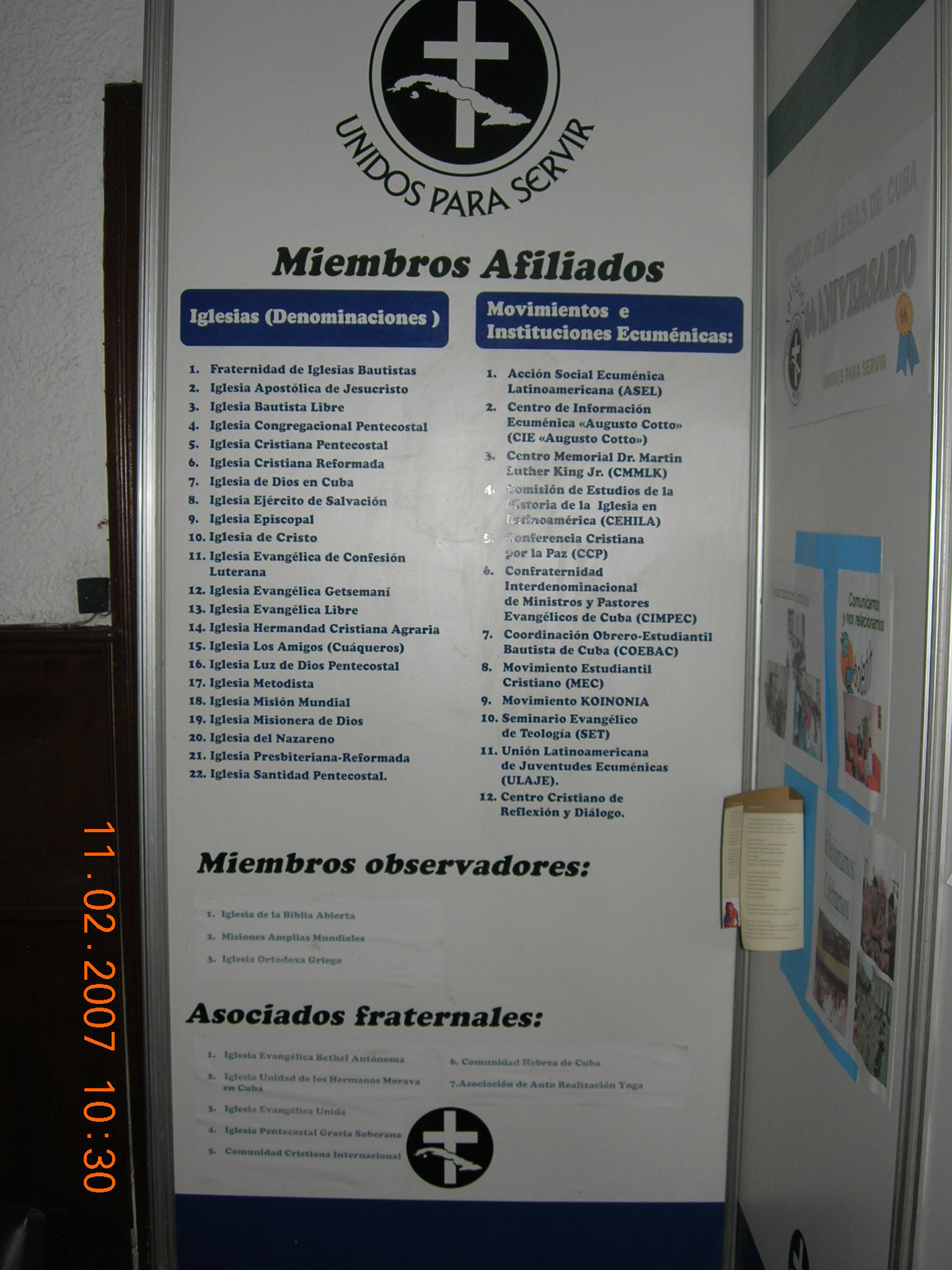
The CCC was founded in 1941 and “is a fellowship of churches, ecumenical groups, and other ecumenical organizations which confess Jesus Christ as Son of God and Saviour, according to the holy scriptures of the Old and New Testaments, and seek to respond to their common calling, to the glory of God, Father, Son, and Holy Spirit.” Today their membership consists of 22 churches, 12 ecumenical groups. 3 observer members and 7 fraternal associates.[6]

The CCC seeks “to give unity to the Christian Churches of Cuba and to help unify Cuban churches with other churches around the world.” It also “encourages dialogue between different movements and institutions as a means for churches to expand their ecumenical vocation of service, thus deepening their responsibilities towards society and all of God’s creation.” Finally CCC “promotes study, dialogue, and cooperation among Christians to increase Christian witness and enhance life in Cuba.” [7]

One of its specific programs is the CCC Committee of Emergency Relief that provides relief and building emergency response infrastructure . . . in times of natural disaster” like the hurricanes that hit the island.[8]

Moreover, I have visited the Havana office of the CCC and met some of its employees. I also know a Cuban pastor and seminary official who has been president of the CCC. Based on this personal experience I believe the Council is a legitimate Christian organization that assists its member churches and congregations in a multitude of ways to conduct their ministries in the Cuban context.

<<<<Here is a photo of the CCC sign outside its office. The other photo shows a banner listing its members and programs that I saw in the office.>>>>>>>

These Commission reports, in my opinion, are absolutely outrageous. They assume that it is entirely appropriate for the U.S. to consider and develop plans for a U.S.-imposed regime change in Cuba. They also assume that it is entirely appropriate for the U.S. to make decisions on who in Cuba (or any other country for that matter) is authentically Christian. And they assume that the U.S. may properly use certain Cuban churches, and not others, to advance U.S. objectives in Cuba. All of these assumptions and the conclusions from these assumptions are, in my opinion, illegal, immoral and unwise. I trust that its disappearance from the public scene is final.


[1] Wikipedia, Commission for Assistance to a Free Cuba, en.wikipedia.org/siki/Commission for Assistance to a Free Cuba.

[2]  Commission on Assistance to a Free Cuba, Report to the President (May 2004), http://pdf.usaid.gov/pdf_docs/PCAAB192.pdf.

[3] Commission on Assistance to a Free Cuba, Report to the President (July 2006), available on Council on Foreign Relations website, http://www.cfr.org/cuba/commission-assistance-free-cuba-report-president/p11093.

[4] White House (President George W. Bush), Fact Sheet: Commission on Assistance to a Free Cuba Report to the President (July 10, 2006), http://georgewbush-whitehouse.archives.gov/news/releases/2006/07/20060710-1.html.

[5] See Post: U.S. Government’s Opinions on Religious Freedom in Cuba (Jan. 5, 2011).

[6] World Council of Churches, Cuban Council of Churches, http://www.oikoumene.org/en/member-churches/regions/Caribbean/cuba/cic.html; [U.S.] National Council of Churches, Background on the Cuban Council of Churches, http://www.ncccusa.org/news/cuba/cccbackground.html.

[7] Id.; United Church of Christ, Cuban Council of Churches, http://globalministries.org/lac/projects/Cuban-council-of-churches.html. See Comment: U.S. Church Leaders Call for U.S.-Cuba Reconciliation (Dec. 10, 2011)[Comment to Post: President Obama Is Wrong on Cuba (Sept. 29, 2011)].

[8] Id.