On May 6, 2012, two Palestinian Christian hymns had their world premiers during the Sunday morning worship service at Minneapolis’ Westminster Presbyterian Church. Both were commissioned by two Westminster members to celebrate the church’s partnership with Evangelical Lutheran Christmas Church of Bethlehem, Palestine.
The music for these hymns was written by Palestinian musicians Marwan Abado, Naser Musa and Georges Lammam. They along with three others (Antoine Lammam, Miles Jay and Tim O’Keefe) constitute the Georges Lammam Ensemble who were present and played and sung the hymns and other Middle Eastern music during the service. The lyrics for both were written by Rev. Dr. Mitri Raheb, the Pastor of the Christmas Church.
The first hymn, Ahar (We Are Free), had three verses and refrain that were a Christian response to the realities of the contemporary Middle East. The hymn’s lyrics in Arabic were on the cover of the church bulletin for the service shown at the right. The verses were sung in Arabic by the Ensemble to their own accompaniment on Middle Eastern instruments. The refrain was sung in English by the congregation:
“We’re free, unbound from slavery.
We’re free, in our humanity.
As dark as it may seem, we’ll work toward the dream until we see the beam, the light of liberty.
We’re free. We’re free. We’re free.”
The lyrics for the other hymn, Ghanu Lil Hayat (A Hymn for Life) had a message of resurrection to be sung in the Easter season. Its two verses were sung in Arabic by the Palestinian musicians with their own accompaniment, and the congregation repeated the first verse in Arabic:
Lai sa ho wa ha hou naa ha hou naa
Kuf fu a’n nii bu kaa caa ma naa buu ha y aat
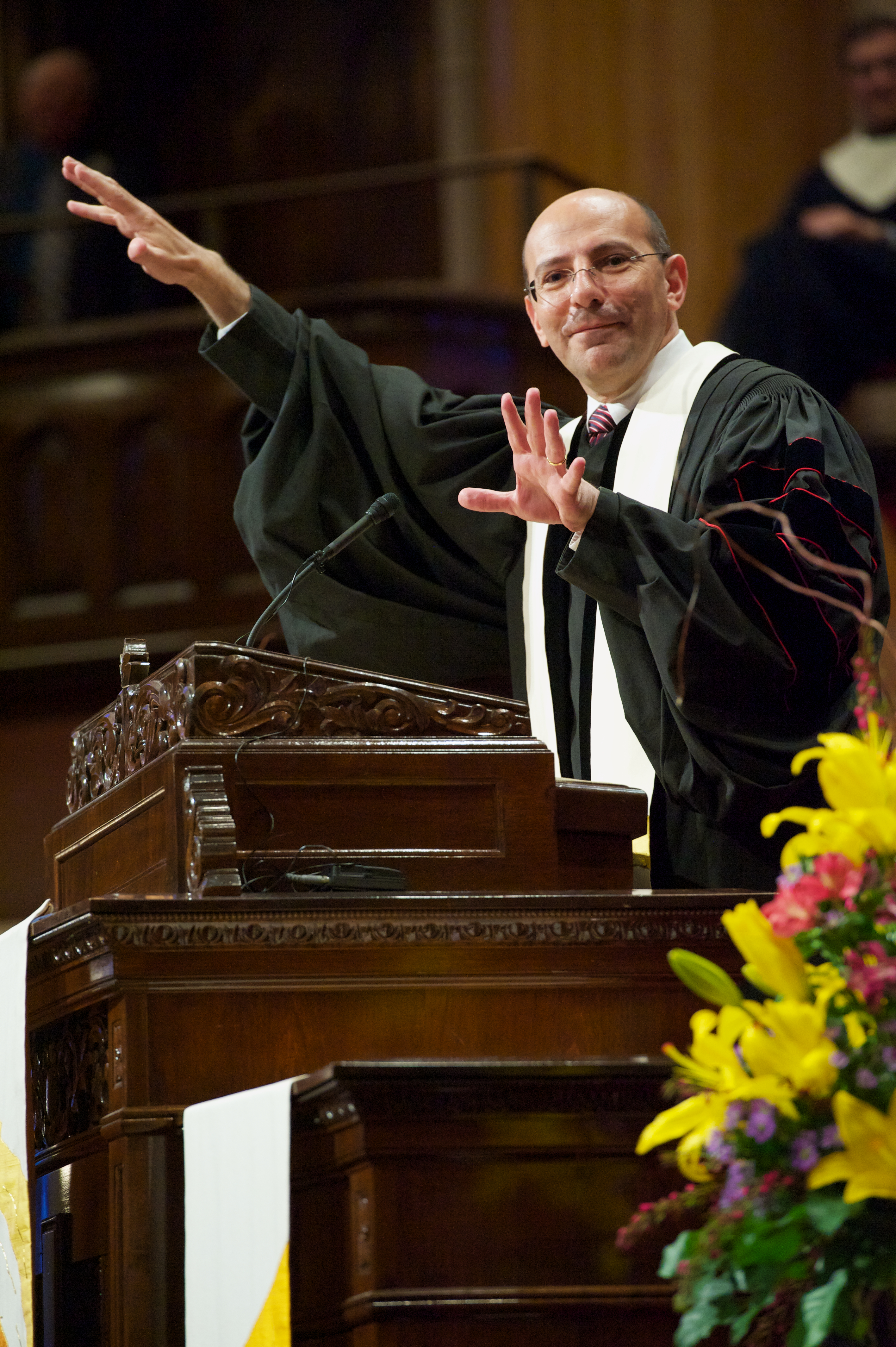
Rev. Raheb (Northenscold photo)
Rev. Raheb delivered the sermon, “A Village Tour,” based on this passage from the Gospel of Mark (1: 35-39):
“In the morning, while it was still very dark, [Jesus] got up and went out to a deserted place, and there he prayed. And Simon and his companions hunted for him. When they found [Jesus], they said to him, ‘Everyone is searching for you.’ He answered, ‘Let us go on to the neighboring towns, so that I may proclaim the message there also; for that is what I came out to do.’ And he went throughout Galilee, proclaiming the message in their synagogues and casting out demons.”
This passage, Raheb said, was a short summary of Jesus’ political program. In the context of His having been born, raised and lived under Roman occupation and having been oppressed day and night, He was faced with the question, how can His people be liberated?
To answer this question, Raheb continued, Jesus chose not to go to Rome, the capitol of the occupying power, to demand that the people be liberated. Nor did He have any desire to be a king or religious leader or the founder of a political party. Jesus had a different concept of liberation. Instead He chose to go on a village tour to preach, teach and heal the people who were marginalized, who were not in control of their lives. Jesus told them that their liberation starts in the mind and in the heart and that they–the outsiders– were being called to be His ambassadors for the Kingdom of God. We are free!
The service was attended by a local Islamic imam and was live-streamed to the Internet and watched by members of Christmas Church in Bethlehem and by Christians in Europe. It is now archived and can be watched by anyone. It was the concluding event in Westminster’s Palestinian Arts Festival.
In my opinion, this worship service was one of the most meaningful in Westminster’s recent history. It fully integrated the mission of our global partnerships with our worship service. It emphasized that God speaks and acts in different ways, in different times and in different places. We in the United States do not have a monopoly on understanding God and Jesus. The Bible was not written in English in 21st century U.S.A. We can gain additional perspectives on God and Jesus from symbolically standing in the shoes of our brothers and sisters in different places and circumstances. Jesus lived and worked in an era of occupation.
John Brown (my maternal 6th great-grandfather as Henry Louis Gates, Jr. would say) in 1745 served in the British colonial army during the reign of King George II in what was known in North America as King George’s War.[1] Let us see how that came about.
In 1740 war broke out in Europe. The pretexual issue was whether Maria Theresa was eligible to succeed to the Hapsburg throne of Austria after the death of her father, Charles VI. This issue was created by Salic or Frankish law precluding royal inheritance by a woman. Thus, this war in Europe is known as the War of the Austrian Succession. This war eventually involved most of the European powers and other issues of a more real politik nature. By 1744 France and Great Britain were on opposite sides of this war, and in that year each declared war on the other.
North America. cir. 17
At that time (1744) both Britain and France had large colonial interests in North America. Britain then in the reign of King George II, of course, had the 13 colonies[2] plus Newfoundland, Nova Scotia, New Brunswick and Hudson’s Bay. France had New France, which extended from Isle Royale (Cape Breton Island today) in the east to the Rocky Mountains in the west and from what is now southern Ontario in the north to the Gulf of Mexico in the south.
Importantly, however, under the 1713 Treaty of Utrecht the extant of New France had been reduced with France ceding to Britain what is now Hudson’s Bay, Nova Scotia, New Brunswick, part of Maine and Newfoundland.
This loss of territory by France made Isle Royale (Cape Breton Island) very important to France as the guardian of the approach to the St. Lawrence River, which was the gateway to French Canada, and of the Grand Banks fisheries. As a result, between 1720 and 1740 France constructed the strongest fortress in North America, the walled city of Louisburg at the eastern end of Isle Royale. It became “the key and stronghold of French power” in New France.[3] It was designed and built to resist ship attacks from the sea, but as the French discovered in 1745 the hills behind the fortress made it vulnerable to bombardment by cannons on those hills.
Grand Banks of Newfoundland
For the British colonists in North America, however, Louisburg “menaced the lifeline of the New England colonies.” With this fortress, France could sweep the coast of New England and its ships with French expeditions. As a result, New England’s merchants were reluctant to risk putting their ships to sea and its fishermen were threatened from cod fishing in the Grand Banks of Newfoundland, then and now one of the richest fishing grounds in the world.[4]
Once Great Britain and France had declared war against each other in Europe in 1744, military skirmishes between them occurred in North America, primarily on the frontier between their colonies. In 1744, French forces raided the British port at Canso, Nova Scotia not far from Louisburg and another British fort, Fort St. Anne, in New York. This became known in North America as King George’s War.
These French attacks and the existence of the war in Europe provided an opportunity (or excuse) for the colonists (with British assistance) to attack the French fortress at Louisburg. William Vaughan, a local fisheries and lumber baron, persuaded the Governor of the Province of Massachusetts Bay to seek colonial legislative authorization for just such an attack. That authorization was obtained by just one vote.[5]
In March of 1745, a Massachusetts-led colonial force of 4,200 soldiers and sailors aboard 90 ships set sail from Boston to do just that. At Canso, Nova Scotia, they were joined by an additional 16 ships under the command of British Commodore Peter Warren. John Brown was in that expedition as a captain of one of the units and participated in the successful 47-day siege and bombardment of the fortress and its capture on June 18, 1745.
The Louisburg siege and capture turned out to be the most significant military engagement of King George’s War. It strengthened the colonists’ military spirit, provided a training school for their future fighting in the Revolutionary War and gave them a new awareness of their own capabilities.[6]
William Shirley, Governor of Massachusetts BayDuke of Newcastle
In October 1745, the Governor of the Province of Massachusetts Bay, William Shirley, reported to the Duke of Newcastle, who was Britain’s Secretary of State for the Southern Department, on the details of this significant military victory. In what undoubtedly was true at the time, but ironic in retrospect, the Governor concluded the report with these words:
“I hope that the Services of the New England troops in the Field, which seem to have equaled the Zeal of the Massachusetts Council and Assembly within their Province, for His Majesty’s Service, upon this Occasion, may be gracefully accepted by His Majesty, as a Proof of that perfect Duty and firm Loyalty which, I am persuaded, all the Colonies concerned in the reduction of this Place [the Louisburg Fortress] (but especially that of the Massachusetts Bay, for which I can more particularly answer) bear to His Majesty’s sacred Person, and to his Government.”[7]
The War of the Austrian Succession and its North American sideshow (King George’s War) lasted until 1748 when all of the parties negotiated the Treaty of Aix-la-Chapelle. Much to the consternation of the British colonists, Louisburg was returned to France under this treaty.
Louisburg Fortress (today)
The Fortress of Louisbourg is now a National Historic Site of Canada.
———————————————–
[1] Carol Willits Brown, William Brown–English Immigrant of Hatfield and Leicester, Massachusetts, and His Descendants c. 1669-1994 at 6 (Gateway Press; Baltimore, MD 1994).
[2] The 13 colonies were Province of New Hampshire, Province of Massachusetts Bay, Colony of Rhode Island and Providence Plantation, Connecticut Colony, Province of New York, Province of New Jersey, Province of Pennsylvania, the Lower Colonies on Delaware, Province of Maryland, Colony and Dominion of Virginia, Province of North Carolina, Province of South Carolina and Province of Georgia.
[3] Samuel Adams Drake, The Taking of Louisburg 1745 at 13 (Boston; Lee & Shepard 1891) [“Drake”]; Fairfax Downey, Louisbourg: Key to a Continent at 1(Englewood Cliff, NJ; Prentice-Hall 1965) [“Downey”].
As mentioned in a prior post, Rev. Charles Edwin Brown (my maternal great-great grandfather or 2nd great-grandfather in Henry Louis Gates, Jr.’s terminology) was a Baptist missionary to the Iowa Territory in 1842. His and, therefore, my lineage in the U.S. has been traced to at least 1686.[1]
William Brown was born somewhere in England around 1669 and emigrated to the American colonies sometime before 1686. William was one of the early settlers of Hadley (later Hatfield), Massachusetts and the builder of its first house. By 1720 he had relocated to Leicester, Massachusetts approximately 45 miles west of Boston. He died in Leicester, Massachusetts in 1752. (William was my maternal 7th great-grandfather.)
One of William’s sons was John Brown, who was born in Hatfield, Massachusetts on November 3, 1703. Sometime before 1720 he and his family moved to be among the original settlers of Leicester, Massachusetts, where he became an important figure. John was a representative in the Commonwealth’s legislature for many years between 1749 and 1768. He died on December 24, 1791 in Leicester. (John was my maternal 6th great-grandfather.)
One of John’s sons was Perley Brown, who was born on May 27, 1737 in Leicester, Massachusetts and who died on October 28, 1776, in White Plains, New York. (Perley was my maternal 5th great-grandfather.)
John and Perley and four of John’s other sons (John, Jr., Benjamin, William and Daniel) had significant military experience, including the American Revolutionary War, that will examined in subsequent posts.
One of Perley’s sons was Nathaniel Brown, who was born in Leicester, Massachusetts on November 5, 1767 and who died on October 1, 1854 in Hamburg, New York. (Nathaniel Brown was my maternal 4th great-grandfather.)
Phillip Perry Brown was one of Nathaniel’s sons, having been born on September 17, 1790 in Bennington, Vermont. He was an ordained Baptist pastor who served several churches in Madison County, New York. He died in Madison, New York on September 23, 1876. (Phillip Perry Brown was my maternal 3rd great-grandfather.)
Phillip Perry was the father of Charles Edwin Brown, who was born on February 23, 1813 in Augusta, New York and who died in Ottumwa, Iowa on July 23, 1901.
Future posts will explore Charles Edwin’s ministry and service in Iowa and the lives of (a) his son, James DeGrush Brown (my maternal 1st great-grandfather); (b) Charles Edwin’s grandson, George Edwin Brown (my maternal grandfather); (c) and Charles Edwin’s great-grand-daughter, Marian Frances Brown Krohnke (my Mother). Another son of Charles Edwin–William Carlos Brown–had a remarkable railroad career that will be examined in other posts.
————————————————————————-
[1] The source for this geneology is Carol Willits Brown, William Brown–English Immigrant of Hatfield and Leicester, Massachusetts, and His Descendants c. 1669-1994 (Gateway Press; Baltimore, MD 1994).
In May 1842 Rev. Charles Edwin Brown and his wife, Frances Lyon Brown, both 29 years old, and their two young sons (Benjamin Perry Brown, almost three years old, and Charles Perry Brown, one and a half years old) left their home in the small village of Warren in the central part of the State of New York to go on a Baptist missionary trip of roughly 1,500 miles to another small village, Maquoketa, in the eastern part of the Iowa Territory.
At the time Rev. Brown was the Pastor of the Baptist Church in Warren. Previously he had submitted an application for appointment as a missionary “in the distant West” with a preference for the Iowa Territory, and his application had been endorsed by the New York State Missionary Convention. Later the American Baptist Home Missionary Society appointed him to be a missionary to the forks of the Maquoketa River in Iowa at an annual salary of $100 plus $75 for travel expenses.
The Browns could not economically ship all of their household goods to Iowa so they sold everything except clothing, bedding, a table, a stand, a rocking chair and a small cook stove. These remnants weighed approximately 1,600 pounds.
This would not be an easy journey. Of course, there were no airplanes or automobiles on Interstate highways to take them there. Nor were there any cross-country railroads. An account of the journey that is set forth in the memoirs of Rev. Brown, my maternal great-great grandfather (2nd great-grandfather in Henry Louis Gates, Jr.’s parlance), provides a window into what life and transportation were like in the U.S. of 1842 when approximately 17 million people lived in the 26 states of the Union. (Four years later, in 1846, Iowa became the 29th state in the Union.)
The First Stage: Warren to Utica, New York
Utica, NY, 1855
The initial stage of their trip for six or seven days, from Warren to Little Falls and Utica, New York, of approximately 130 miles presumably was by horse-drawn wagon. Utica, then a town with a population of approximately 13,000, was a terminus on the 17-year old Erie Canal that had been built to connect New York City’s harbor with Lake Erie and the other Great Lakes and thereby improve transportation into, and from, the interior of the U.S. This stage cost the family $15.00.
The Second Stage: Utica to Buffalo, New York
Erie CanalErie Canal Packet Boat
On Monday, May 2nd, at Utica the Browns boarded the Little Western, a passenger packet or Line boat on the Erie Canal for the second stage of their journey. They had a comfortable cabin in the bow. The kitchen and dining cabin were in the stern with freight and baggage amidships. “With good company, clean wholesome food, a sober and accommodating master and crew, the two hundred mile trip from Utica to Buffalo was comfortable and pleasant.” As the boat did not run on Sunday, it was tied up for the day in Tonawanda, New York. This gave the family the opportunity to attend a Methodist Church worship service in the morning and for Rev. Brown to preach in the afternoon. On Monday (May 9th), they arrived in Buffalo, then a town of 18,000 people. The family’s total fare at 2 cents per mile for each adult was $8.00.
The Dart Grain Elevator, Buffalo, NY, 1842
With the Erie Canal, Buffalo became a key junction for the shipment of western grain to the east coast and beyond as the Great Lakes ships were too big to go on the Erie Canal. Until 1842 loose grain on the ships had to be manually scooped into baskets and transferred to the wharves by block and tackle while sacks, barrels and casks of grain and flour had be to manually hauled to the wharves and then loaded onto the canal boats, oftentimes with an in-between hauling into and out of warehouses. In late 1842, however, this changed with the invention by Joseph Dart and Robert Dunbar of a grain elevator with a steam-powered conveyor belt and buckets for the direct transfer of grain from the ships to grain elevators on the land.
The Third Stage: Buffalo, New York to Chicago, Illinois
Great Western Steamer
On May 9th, the family boarded the Great Western, a Great Lakes steamer, for the third stage of their journey. The four-year old, 185-foot Great Western was one of the largest and finest of the day and was the first to have a spacious upper cabin for its nearly 400 passengers. The entire hull was occupied by the boilers with holds for freight and wood.
Great Lakes Map
Prior to completion of the Erie Canal in 1825, shipping on the Great Lakes was primarily on sailing craft as traffic was not sufficient to make the more-expensive steamers profitable to operate. The Erie Canal, however, expanded Lakes traffic so that steamers increasingly became the preferred mode of transportation as they offered fast, efficient and predictable delivery of passengers and freight.
The Great Lakes voyage on the Great Western steamer took six days before arrival on Sunday, May 15th, in the village of Chicago, population of approximately 5,000. Other than a storm the first night out, the trip was pleasant with short stops in Cleveland (population of 6,000) and Detroit (population of 9,000). Mrs. Brown commented that on the way they had seen the “pleasant villages” of Milwaukee, Racine and Southport, Wisconsin. The total fare for the family was $48.00.
The Fourth Stage: Chicago to Savanna, Illinois
After an overnight stay at the New York House, a two-story hotel in Chicago, Rev. Brown hired a man with horses and lumber wagon to take the family and their possessions the additional 200 miles to Savanna, Illinois on the Mississippi River. Their rocking chair and a small chair were put on top of the boxes for Mrs. Brown and the older son to sit on during the ride.
On Monday, May 16th, the fourth stage of the journey began in the lumber wagon. After two over-night stops, they arrived in the town of Rockford, Illinois, the home of the wagon owner. Unfortunately the owner had to testify in a trial, and the family was forced to stay there until the following Monday. The delay, however, gave Rev. Brown the opportunity to preach that Sunday in Rockford’s Baptist Church, his “first sermon in the west.”
On the following Monday after a day’s ride, near Crane’s Grove, Illinois, they asked Mrs. Crane, “middle aged and stout” with a pail of milk, if they could stay there that night. She replied, “Oh, I reckon, though I am mighty tired. The old cow gives a right smart of milk, well on to half a bushel.”
The next morning, the owner of the lumber wagon discovered that he had overfed his horses and one had died. Mr. Crane was then enlisted to take the Browns, again by horse-drawn wagon, the next 18 miles to Cherry Grove, Illinois, where the next day (May 24th) another man, Mr. Gardner, took the family to Savanna, Illinois on the Mississippi River. This was the Brown family’s first view “of the mighty river, its volume then being much greater than in later years.”
The Fifth Stage: Savanna, Illinois to Charleston, Iowa
Mississippi River, Savanna, Illinois
The fifth stage of the journey on the evening of the 24th was a ferry across the Mississippi River from Savanna to Charleston (later Sabula), Iowa where they stayed the night in the local tavern. Perhaps the ferry looked like the one pictured at the right.
The Sixth Stage: Charleston to Maquoketa, Iowa
The next morning, May 25th, Rev. Brown hired yet another man and team to take them the final 25 to 30 miles to Maquoketa, Iowa. Around midnight they arrived at their destination, Mr. C. W. Doolittle’s cabin. “With cordial frontier hospitality . . . Mr. and Mrs. Doolittle turned out and welcomed us, prepared supper and then gave us their bed, while they found lodging for themselves and family in the cabin loft. Tired and worn by the long and tedious last day’s drive we slept sweetly and soundly, four in the bed, myself, wife and two children.”
Conclusion
This six-stage journey took a month: 6 or 7 days from Warren to Utica plus 24 days from Utica to Maquoketa.
Rev. Brown served as a Baptist missionary in Iowa for most of the following 36 years, a subject that will be examined in a subsequent post.
The U.S. Senate Rules, in my opinion, are an embarrassing blot on our democracy.
Just this week two Senators, Democrat Carl Levin and Republican Lamar Alexander, agreed that the Senate was “dysfunctional, gridlocked and broken.” They pointed out that the current Senate Rules require, at most steps of the legislative process, agreement from all 100 senators; absent unanimous agreement, the Rules entail a time-consuming process that requires a supermajority of 60 senators to move forward.
Levin and Alexander then proposed a revised rule that would allow the majority leader to bring a bill to the floor for a vote without the 60-vote process on condition that the bill would be open to all relevant amendments, but not to non-relevant amendments.
Any change to the Senate Rules to reduce or eliminate the ability of one Senator to block consideration of important matters is better than none. But this proposed change is too miniscule as is true for other suggested reforms on this subject in recent years.
Instead I advocate more significant changes.
First, the Senate should operate by majority rule except where the Constitution requires a supermajority (two-thirds) vote for (a) overriding a presidential veto or (b) consenting to the ratification of treaties or (c) proposing constitutional amendments or (d) expelling a member.
Second, the Senate should have weighted voting so that a Senator from a more populous state would have more clout than a Senator from a sparsely populated state. For example, a Senator from Wyoming (the least populous state) would have one vote while a Senator from California (the most populous state) would have 66 votes.
Such significant changes would recognize that in a democracy the wishes of the majority of the people should be the fundamental governing principle (except when the Constitution otherwise provides) and that our primary allegiance is as U.S. citizens, not citizens of 50 states.
As noted in a prior post, on April 22nd CBS-TV’s 60 Minutes aired the report “Christians of the Holy Land.” It reported that Christians have been leaving Palestine in large numbers for years and that its Christian population is now less than two percent. The program explored differing explanations for this decline.
Rev. Dr. Mitri Raheb, the Pastor of Evangelical Lutheran Christmas Church, said that Palestinian Christians, once a powerful minority, are becoming the invisible people, squeezed between a growing Muslim majority and burgeoning Israeli settlements. “If you see what’s happening in the West Bank, you will find that the West Bank is becoming more and more like a piece of Swiss cheese where Israel gets the cheese that is the land, the water resources, the archaeological sites. And the Palestinians are pushed in the holes behind the walls.”
The Israeli Ambassador to the U.S., Michael Oren, however, vigorously disagreed. He asserted that the Christians in Palestine were being persecuted by Islamic extremism and that the Israeli government did not bother to respond to a 2009 Christian document, Kairos, because it allegedly made inflammatory accusations that Israel had crimes historically associated with anti-Semitism.
Rev. Raheb and others rejected the Ambassador’s assertion that Islamic extremism was the basic cause of the Christian exodus. Raheb said he was a member of the Christian group that wrote and published Kairos: A Moment of truth: A word of faith, hope and love from the heart of Palestinian suffering. This document, he said, criticized Islamic extremism and advocated non-violent resistance to the Israeli occupation which they called a sin against God. This document was endorsed by the leaders of 13 Christian denominations, including Greek Orthodox, Roman Catholic, Lutheran and Anglican.
The 60 Minutes reference to the Kairos document calls for a more complete account of its contents. It is available on the web and opens with descriptions of what it calls “The reality on the ground: ” “Israeli occupation of Palestinian territories, deprivation of our freedom.” Here are the specifics of that accusation:
“1.1.1 The separation wall erected on Palestinian territory, a large part of which has been confiscated for this purpose, has turned our towns and villages into prisons, separating them from one another, making them dispersed and divided cantons. Gaza, especially after the cruel war Israel launched against it during December 2008 and January 2009, continues to live in inhuman conditions, under permanent blockade and cut off from the other Palestinian territories.”
“1.1.2 Israeli settlements ravage our land in the name of God and in the name of force, controlling our natural resources, including water and agricultural land, thus depriving hundreds of thousands of Palestinians, and constituting an obstacle to any political solution.”
“1.1.3 Reality is the daily humiliation to which we are subjected at the military checkpoints, as we make our way to jobs, schools or hospitals.”
“1.1.4 Reality is the separation between members of the same family, making family life impossible for thousands of Palestinians, especially where one of the spouses does not have an Israeli identity card.”
“1.1.5 Religious liberty is severely restricted; the freedom of access to the holy places is denied under the pretext of security. Jerusalem and its holy places are out of bounds for many Christians and Muslims from the West Bank and the Gaza strip. Even Jerusalemites face restrictions during the religious feasts. Some of our Arab clergy are regularly barred from entering Jerusalem.”
“1.1.6 Refugees are also part of our reality. Most of them are still living in camps under difficult circumstances. They have been waiting for their right of return, generation after generation. What will be their fate?”
“1.1.7 And the prisoners? The thousands of prisoners languishing in Israeli prisons are part of our reality. The Israelis move heaven and earth to gain the release of one prisoner, and those thousands of Palestinian prisoners, when will they have their freedom?”
“1.1.8 Jerusalem is the heart of our reality. It is, at the same time, symbol of peace and sign of conflict. While the separation wall divides Palestinian neighbourhoods, Jerusalem continues to be emptied of its Palestinian citizens, Christians and Muslims. Their identity cards are confiscated, which means the loss of their right to reside in Jerusalem. Their homes are demolished or expropriated. Jerusalem, city of reconciliation, has become a city of discrimination and exclusion, a source of struggle rather than peace.”
“1.2 Also part of this reality is the Israeli disregard of international law and international resolutions, as well as the paralysis of the Arab world and the international community in the face of this contempt. Human rights are violated and despite the various reports of local and international human rights’ organizations, the injustice continues.”
The Kairos document concludes with these appeals to the peoples of Palestine and beyond:
“8. Finally, we address an appeal to the religious and spiritual leaders, Jewish and Muslim, with whom we share the same vision that every human being is created by God and has been given equal dignity. Hence the obligation for each of us to defend the oppressed and the dignity God has bestowed on them. Let us together try to rise up above the political positions that have failed so far and continue to lead us on the path of failure and suffering.”
“9.1 This is a call to see the face of God in each one of God’s creatures and overcome the barriers of fear or race in order to establish a constructive dialogue and not remain within the cycle of never-ending manoeuvres [sic] that aim to keep the situation as it is. Our appeal is to reach a common vision, built on equality and sharing, not on superiority, negation of the other or aggression, using the pretext of fear and security. We say that love is possible and mutual trust is possible. Thus, peace is possible and definitive reconciliation also. Thus, justice and security will be attained for all.”
“9.3 Trying to make the state a religious state, Jewish or Islamic, suffocates the state, confines it within narrow limits, and transforms it into a state that practices discrimination and exclusion, preferring one citizen over another. We appeal to both religious Jews and Muslims: let the state be a state for all its citizens, with a vision constructed on respect for religion but also equality, justice, liberty and respect for pluralism and not on domination by a religion or a numerical majority.”
“9.4 To the leaders of Palestine we say that current divisions weaken all of us and cause more sufferings. Nothing can justify these divisions. For the good of the people, which must outweigh that of the political parties, an end must be put to division. We appeal to the international community to lend its support towards this union and to respect the will of the Palestinian people as expressed freely.”
“10. In the absence of all hope, we cry out our cry of hope. We believe in God, good and just. We believe that God’s goodness will finally triumph over the evil of hate and of death that still persist in our land. We will see here ‘a new land’ and ‘a new human being,’ capable of rising up in the spirit to love each one of his or her brothers and sisters.”
Rev. Dr. Mitri RahebWestminster Presbyterian Church
Today (April 22nd), Rev. Dr. Mitri Raheb, the Pastor of Evangelical Lutheran Christmas Church in Bethlehem, Palestine, will appear on CBS-TV’s “60 Minutes” program.
The opening event at noon (CDT) on Thursday, May 3rd, will be a Westminster Town Hall Forum presentation entitled “Playing for Peace in Gaza” by Patrick McGrann. A Minnesota native, McGrann has spent the last 15 years creating toys and events for young people living in the midst of violence. He now lives in Gaza where he has taught at the Islamic University, lead the rebuilding of the American International School and developed educational partnerships between the Middle East and the West. The Forum is free and open to the public and broadcast on Minnesota Public Radio. The Forum is preceded by a half-hour of free music and followed by a free reception and a discussion group.
Diyar Dance
Later that same day (May 3rd) at 7:30 p.m. at the Women’s Club of Minneapolis (410 Oak Grove Street) 14 young dancers from the Diyar Dance Theatre of Bethlehem, Palestine will perform. Tickets at $10 are available at Westminster on Sundays or on the web. Starting at 5:00 p.m. the public is welcome to dine at the Women’s Club; call 612-813-5300 for reservations. A reception with dessert will follow the performance.
On Friday, May 4th, at 6:00 p.m. an art exhibit, Room for Hope, opens at Westminster. It brings realistic, abstract and provocative images by Palestinian artists expressing their visions of the present and their hopes for the future.
Ibtisam Barakat (Steve Fisch credit)
Also on Friday, May 4th, at 7:30 p.m. will be a concert at Westminster. Ibtisam Barakat will present her “Freedom Doors Made of Poems.” She grew up in Ramallah, West Bank, and now lives in the U.S. Her work focuses on healing social injustices and the hurts of wars, especially those involving young people. Ibtisam emphasizes that conflicts are more likely to be resolved with creativity, kindness, and inclusion rather than with force, violence, and exclusion. The concert will also include Palestinian musicians playing music from their homeland.
On Saturday, May 5th at 1:00 p.m. a Palestinian Short Film Festival will be presented in Westminster’s Great Hall.
Rev. Dr. Mitri Raheb
The concluding event of the Festival will be part of Westminster’s Sunday worship service on May 6th at 10:30 a.m. (CDT). Rev. Dr. Mitri Raheb of Evangelical Lutheran Christmas Church in Bethlehem, Palestine will be the preacher. Palestinian musicians will lead the world debut of specially commissioned music during the service. Our guests will sing in Arabic while Westminster members and others sing in English. For those who cannot attend the service, it is live-streamed and subsequently archived on the web.
This historic Festival is the outgrowth of Westminster’s partnership with the Christmas Church and of mission trips to that church by Westminster members. (Westminster also has partnerships with churches and other organizations in Brazil, Cameroon and Cuba.)
In “Gratitude I” I expressed gratitude for my educational and professional mentors. In “Gratitude II” the subject was gratitude for my wife, children and grandchildren, my spiritual journey and my financial ability to retire at age 62. Here are some other things to add to my list for thankfulness.
Malcolm Gladwell’s Outliers emphasizes the importance of an individual’s family and place and date of birth as determinants of success. Warren Buffett, the great investor from Omaha, frequently says how fortunate he is to have won the ovarian lottery by having been born born in the U.S. in the 1920’s. They remind me to be grateful for having been born in the U.S.A. It is indeed a great country and provided me with opportunity after opportunity.
I am also grateful that I was born at the end of the Great Depression-era and as a result am a member of a relatively small age-cohort. This has meant that I faced less competition for many of the opportunities I have had. This also meant that I entered the labor force, after all of my university-level education, in 1966 when there was strong demand in the U.S. for new law graduates with good records. Today I read the many stories in the press about the difficulties of contemporary law graduates in finding good jobs, and this is confirmed by the law students I know at the University of Minnesota Law School. I am grateful I was not in that predicament when I was starting out.
Contemporary law graduates and other young people today often finish their student days with large student debts, further exasperating their situation in this difficult job market. Because of the full-tuition scholarships I had over nine years at Grinnell College and the Universities of Oxford and Chicago, I did not have any student debt and did not face this problem. For this I am also grateful.
This last point also uncovers another reason for gratitude. The three scholarships I had were the result of businessmen (George F. Baker and Cecil Rhodes) and lawyers who were financially successful in capitalist systems and who had philanthropic motivations to give back and encourage others.
Elizabeth Warren, a Harvard Law School Professor and a candidate for the Democratic nomination for the U.S. Senate from Massachusetts, is absolutely correct when she says:
“There is nobody in this country who got rich on his own. Nobody. You built a factory out there? Good for you. But I want to be clear: you moved your goods to market on the roads the rest of us paid for; you hired workers the rest of us paid to educate; you were safe in your factory because of police forces and fire forces that the rest of us paid for. You didn’t have to worry that marauding bands would come and seize everything at your factory, and hire someone to protect against this, because of the work the rest of us did.”
“Now look, you built a factory and it turned into something terrific, or a great idea? God bless. Keep a big hunk of it. But part of the underlying social contract is you take a hunk of that and pay forward for the next kid who comes along.”
The same thought is expressed many times and many ways in the Bible. Here is what the letter to the Hebrews says. “[S]ince we are surrounded by so great a cloud of witnesses, let us also lay aside every weight and the sin that clings so closely, and let us run with perseverance the race that is set before us, looking to Jesus the pioneer and perfecter of our faith.” (Hebrews 12: 1-2.) “Let mutual love continue. Do not neglect to show hospitality to strangers, for by so doing that some have entertained angels without knowing it. Remember those who are in prison, as though you were in prison with them; and those who are being tortured, as though you yourselves were being tortured.” (Hebrews 13: 1-3.)
For all of these blessings, I give thanks to God and to those named and unnamed individuals who helped me along the way.
A prior post expressed my gratitude for teachers, professors and professional colleagues who have helped me. But that hardly exhausts my reasons for gratitude.
I was blessed for having met and married Mary Alyce. An intelligent, attractive woman, she gave birth to our two sons, Alan and Brian, and bore the major responsibility for raising them to adulthood. All of us have been healthy without major accidents, another blessing. There have been problems along the way, of course, but we have managed to confront and surmount them. I am grateful.
For 24 years, 1957 through early 1981, I had no religious or spiritual life. I clearly suffered from the sin of pride. Yet I give thanks for those years. They gave me a strong sense of what it is like to be without a spiritual grounding as well as an understanding and appreciation for intellect, logic and reason. I am grateful.
In May 1981 I had a major turning when I could admit to myself and others that I did not have all the answers to life and when I joined Minneapolis’ Westminster Presbyterian Church. I am now in my 31st year of active membership at this church, and it has been and continues to be a major blessing in my life. I lament the way that Christianity is often presented to the rest of the world today, especially in my home state of Iowa over their recent Republican caucuses. I, therefore, strive to present in my own way an intelligent person’s understanding of the faith. I am grateful.
I now have four grandchildren. They are wonderful, intelligent, curious, polite and healthy human beings. I am now concerned to do what I can to help them go to college and achieve all that they can be. I am grateful.
My practice of law provided an excellent income, and my wife and I were able to save for our retirement, making it possible for me to retire at age 62. As I read the many stories in the press about so many people today unexpectedly not being able to retire for financial reasons, I know that I am privileged. I am grateful.
I am also glad that I decided to retire from lawyering early at age 62 in order to have time, energy and good health to do things I wanted to do. Similarly I am glad I retired at the end of 2010 from my part-time job of law school teaching and from volunteering as an arbitrator for the Financial Institutions Regulatory Authority in order to create time for writing and doing things I wanted to do. I am grateful.
For all these blessings, I give thanks to God and to those named and unnamed individuals who helped me along the way.