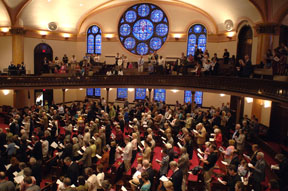
Westminster‘s September 2nd worship service opened with a jazzy set of three organ preludes entitled “Organ, Timbrel, and Dance,” played by Melanie Ohnstad, the church’s Organist and Director of Music and the Arts.
The three preludes were based on German chorales as reinterpreted in jazz idioms. As a lover of German organ music and American and Latin jazz, I was fascinated and moved by the three pieces:
“Swing Five” used the rhythms of Dave Brubeck’s “Take Five” for the chorale “Erhalt uns, Herr” (Lord, Keep Us Steadfast).
“Bossa Nova,” the Brazilian rhythms for “Wunderbarer Konig” (Wonderful King).
“Afro-Cuban,” the rhythms and melody of Leonard Bernstein’s “America” from West Side Story for “In dir ist Freude” (In Thee Is Gladness).
Johannes Matthias Michel
The composer is Johannes Matthias Michel, who was born in 1962 and grew up at Lake Constance (Germany) and who studied piano, church music, and organ in Basel, Heidelberg, Frankfurt and Stuttgart. He has composed many pieces for organ, and his organ discography includes more than a dozen CD recordings. One is of these three preludes, and there is a YouTube video of Michel playing these preludes.
Michel teaches artistic and liturgical organ playing at the University for Church Music of the Protestant Regional Church in Baden (Hochschule fur Kirchenmusik Heidelberg). Affiliated with the Evangelical Lutheran Church, the University is in the city of Heidelberg in the historical region of Baden on the east bank of the Rhine River. Baden is the western part of the Baden-Wurttemberg state of Germany.
Christuskirche, Mannheim
Since 1999 he also has been the director of music at Christuskirche in Mannheim, which also is located in Baden. This is a Protestant church in the Oststadt district of the city. The church’s building was built in the early 20th century in the Art Nouveau style with Neo-Baroque accents. It escaped major damage in World War II. At Mannheim Michel also conducts the Bachchoir Mannheim and the chamber choir Mannheim and teaches organ at the State Academy of Music (Staatlichen Hochschule für Musik) in Mannheim.
Melanie Ohnstad
Melanie Ohnstad has served Westminster as organist since November 1995. She received the Doctor of Musical Arts degree from the University of Minnesota. She also holds the Master of Music in Organ Performance degree from Arizona State University and the Bachelor of Music degree from St. Olaf College.
A streaming video of the Westminster worship service is available on the web so you too can hear this amazing set.
On March 17, 1776, the 11-month colonists’ Siege of Boston ended when the British troops and their dependants evacuated the town of Boston. A fleet of 120 British ships set sail for a British military base in Halifax, Nova Scotia with nearly 10,000 British troops and over 1,000 dependants. This was discussed in a prior post.
New York City, 1776New York City area, 1776
Both sides’ attention next turned to New York City, which then was a town of 25,000 at the southern tip of the island of Manhattan (then known as York Island). This post will review what is known as the Campaign for New York and New Jersey, March 18, 1776, through January 1777.[1]
For the British, the City was an obvious strategic target. It had a large harbor from which the vastly superior British navy could easily command the area and be a base to conquer the middle colonies to the south and west. The terminus of the Hudson (or North) River into that harbor would provide the British with a route north to connect with British forces in what is now Canada and thereby potentially separate New England from the other colonies. Moreover, many British Loyalists lived in the City and thus made it a friendlier host for British troops than Boston had been.
General George Washington
The strategic importance of the City also was obvious to General George Washington. Not knowing that the British troops were going from Boston to Nova Scotia, he was worried that they would instead be sent directly to New York. Therefore, Washington immediately after the British evacuation of Boston sent some colonial regiments from Boston to New York to join the colonial forces already there under the command of General Charles Lee. Thereafter other colonial troops were sent from Boston, including my 5th maternal great-grandfather, Perley Brown, and his brothers William and Benjamin. Perley and his comrades arrived in New York City in late July on a ship from New Haven, Connecticut.[2]
These transfers of troops from Boston were not easy. The men first had to march 100 to 120 miles over five to seven days to the Connecticut ports of New Haven or New London, where they boarded sailing ships to take them via Long Island Sound to New York City.
Archibald Kennedy Mansion
General Washington himself arrived in the City on April 13th and established his headquarters in the Archibald Kennedy Mansion at No. 1 Broadway.[3]
Washington soon discovered that much work still needed to be done to finish the construction of fortifications in Brooklyn on Long Island and on York Island. He was kept busy supervising their continued construction, inspecting the troops and deciding on command assignments and troop deployments.
Another problem faced Washington in the City. The soldiers were growing sickly. Smallpox appeared causing the deaths of several of the men. In the summer heat, “camp fever” became epidemic, and poor sanitation caused dysentery. At least 3,000 to 6,000 men were ill at one time or another, and many died. One of the victims of these illnesses was William Brown (Perley’s brother), who died in a City hospital on August 27th after being sick for eight days. Also sick at this time was brother Benjamin, but his health improved so he could return to active duty.[4]
New York Harbor & Sandy Hook
The long anticipated arrival in New York of the British troops began on June 29th when 120 British ships arrived at Sandy Hook, a barrier spit jutting northward into Lower New York Bay from the New Jersey shore. Three days later (July 2nd) 9,000 British troops from their Nova Scotia base left these ships to establish their new base on the unguarded Staten Island southwest across the harbor from York Island and directly west of the present-day southern part of Brooklyn.
British fleet @ Staten Island, July 1776
And the British ships kept coming with another 15,000 British and Hessian soldiers soon thereafter. On August 13th 96 more ships entered the harbor plus 20 more the next day. That summer more than 400 British ships with 1,200 cannon and 10,000 sailors under the command of Admiral Lord Richard Howe were anchored in the harbor, and more than 32,000 British and Hessian troops under the command of his brother, General Sir William Howe, were on the nearby land. This turned out to be the largest expeditionary force of the 18th century.
Admiral Lord Richard HoweGeneral Sir William Howe
The British, however, did not launch an immediate attack.
Instead General Howe, on July 14th sent a messenger from Staten Island to York Island with a letter addressed to “George Washington, Esq.” conveying an offer to meet and discuss ending the rebellion. Washington’s assistant rejected the letter because it was not addressed to “General George Washington” and because there was no one there by the letter’s simple title. Three days later (July 17th) a second letter was sent; this one was addressed to “George Washington, Esq., etc.,” which also was rejected for the same reason. The next day (July 18th) the British returned to York Island to ask if General Washington would meet with Adjutant General Patterson, and Washington said “yes.”
On July 20th such a peace conference was held at the Kennedy Mansion on York Island. In the midst of polite formalities Washington said he understood that General Howe only had authority to grant pardons, but that those who had committed no wrongs wanted no pardons. This ended these British peace efforts.
In the meantime, General Washington had 19,000 colonial troops in the area, but did not know where the British planned to attack. Therefore, Washington split the Continental Army into fortified positions in Brooklyn on Long Island and in Manhattan with some held in a reserve so-called “Flying Camp” in northern New Jersey to be deployed when they knew where the British were going to attack.
The fighting phase of the campaign for New York and New Jersey began on August 22nd when the British troops invaded Long Island. Thus began what turned out to be the largest battle of the War (the Battle of Long Island or the Battle of Brooklyn) that lasted until August 30th with a British victory.
Staten Island Peace Conference
Soon thereafter– on September 11th (an ironic date in light of its 225th anniversary falling on the day of the 9/11 attacks of 2001)–another attempt was made to end the rebellion peacefully at the Staten Island Peace Conference.
The Conference participants were Admiral Lord Howe and Continental Congressmen John Adams, Benjamin Franklin and Edward Rutledge. The Americans insisted on British recognition of their recently declared independence. Admiral Lord Howe said he could not do that. Howe was also pressed to repeal the Prohibitory Act that authorized a blockade of the colonies, but he said he could not do that either. Instead, Howe offered to suspend execution of the blockade if the Americans agreed to end hostilities and make fixed financial contributions to Britain. This offer was rejected by the Americans. There was no peace agreement. The War continued.
With the exception of an American victory at Harlem Heights on York Island, the British won all the military encounters of this campaign through Christmas Eve Day (December 24, 1776) and forced General Washington and the Continental Army to retreat from New York into New Jersey and then from New Jersey into Pennsylvania. Future posts will review the Battles of Long Island (Brooklyn), Harlem Heights and White Plains.
The British victory in this campaign looked secure at that time. But on Christmas Day (December 25th) Washington and 2,400 of his troops made their now famous “crossing the Delaware River” maneuver. They crossed the partially frozen river from Pennsylvania to return to New Jersey to make their successful surprise attack on British and Hessian troops at Trenton, New Jersey. This was followed on January 3rd with another successful colonial attack at Princeton, New Jersey and Washington’s establishing his winter headquarters in Morristown, New Jersey.
Fighting essentially ceased in January 1777 due to winter conditions.
Nevertheless, it has to be said that the British won the Campaign for New York and New Jersey and that the British occupied New York City for the duration of the War.
[1] In addition to the hyperlinked sources in this post, it also draws from David McCullough, 1776 at 110-154 (New York; Simon & Schuster 2005). See also, e.g., T. Harry Williams, Richard N. Current & Frenk Freidel, A History of the United States [To 1876], at 151 (New York: Alfred A. Knopf 1959); Henry Steele Commager & Richard B. Morris, The Spirit of ‘Seventy-Six: The Story of the American Revolution as Told by Participants, Ch. Eleven (New York: Harper & Row, 1967). From July 1966 through March 1970, I worked for a New York City law firm with offices in the Wall Street district at the southern end of Manhattan.As a result, I frequently walked around the area where General Washington and the Continental Army troops lived and worked 190 years earlier, but unfortunately I did not scout out where things happened in the Revolutionary War.
[2] Carol Willits Brown, William Brown–English Immigrant of Hatfield and Leicester, Massachusetts, and His Descendants c. 1669-1994 at 18-19 (Gateway Press; Baltimore, MD 1994) (letter, Perley Brown to his wife Elizabeth Brown (Aug. 1, 1776)).
[3] By July 1776, Washington moved his abode and headquarters to City Hall because it was deemed to be more secure. By the way, No. 1 Broadway now is the location of an office building known as “1 Broadway.” Facing Battery Park, it was built in 1884 and extensively remodeled in 1921.
[4] Carol Willits Brown, William Brown–English Immigrant of Hatfield and Leicester, Massachusetts, and His Descendants c. 1669-1994 at 7, 20-21, 24-25, 31-32, 210-11 (Gateway Press; Baltimore, MD 1994) (letters, Perley Brown to his wife Elizabeth Brown (Aug. 1, 1776; Sept. 9, 1776; Oct. 4, 1776).
Last Sunday (August 5th) at Minneapolis’ Westminster Presbyterian Church I heard the following powerful prayer as the text of an anthem ,”God Be in My Head:”
God be in my head,
Westminster Presbyterian Church
And in my understanding;
God be in my eyes
And in my looking;
God be in my mouth
And in my speaking;
God be in my heart
And in my thinking;
God be at my end,
And at my departing.
(A video of this worship service is available on the web.)
Sarum Primer, title page, 1555
I was surprised I had never heard this prayer or anthem before. The church bulletin said this text was from the Sarum Primer of 1514, which meant nothing to me.
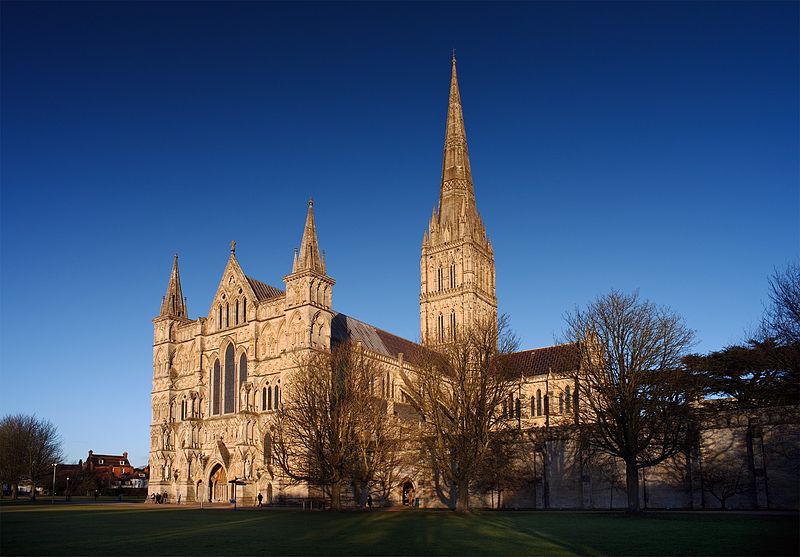
After I returned home and goggled “Sarum Primer,” I discovered that it was a book of prayers and Christian worship resources in the Roman Catholic Church that was collected by the clergy at Salisbury Cathedral in the south central part of England. It was published in 1514 in the “Book of Hours” (Cambridge) and republished as the “Sarum Primer” in Salisbury in 1558. (“Sarum” is the abbreviation for Sarisburium, the Latin word for Salisbury, which was and is both a city and a diocese in England. “Primer” is the Middle English term for a Book of Hours.)
I remember the beautiful Salisbury Cathedral from a visit in 1962. To the right are photographs of its interior and exterior.
David Evan Thomas
The composer of the anthem is David Evan Thomas, who was born in Rochester, New York in 1958 and holds degrees from Northwestern University (B.A.) the Eastman School of Music of the University of Rochester (M.A.) and the University of Minnesota (Ph.D.). He lives in Minneapolis and in addition to composing sings in the city’s Plymouth Congregational Church Choir. I was surprised to discover that he had been a composer in residence at my church (Westminster Presbyterian Church).
I pray that God will be in my head, understanding, eyes, looking, mouth, speaking, heart and thinking. And eventually in my end and departing.
On July 30, 2012, the U.S. Department of State released its latest report on the status of religious freedom around the world; this report was discussed in a prior post. Now we analyze that report’s evaluation of religious freedom in Cuba. The previous U.S. State Department report on this subject was discussed in a prior post.
Versalles Church, Matanzas, Cuba
This analysis is based upon my personal involvement in helping to establish and manage a partnership between my church (Minneapolis’ Westminster Presbyterian Church) and Iglesia Presbiteriana-Reformada en Versalles (Versalles Presbyterian-Reformed Church in Matanzas, Cuba); my going on three church mission trips over the last 10 years to visit that congregation; my visits to the ecumenical seminary–Seminario Evangelico de Teologia (SET)–in Matanzas and other churches and religious organizations on these mission trips; my hearing reports about other trips to our Cuban partner from fellow members of my church; my conversations with Cuban Christians at their church and when they have visited my church in Minneapolis; and my extensive reading about Cuba and specifically religious freedom on the island.
Cuban Religious Makeup
First, however, we review the religious makeup of the Cuban population of roughly 11,000,000. According to the report, an estimated 60 to 70 percent (or 6,600,000 to 7,700,000) is believed to be Roman Catholic although only 4 to 5 percent regularly attend mass. Membership in Protestant churches is estimated at 5 percent of the population (or 550,000): Baptists and Pentecostals are probably the largest Protestant denominations; Jehovah’s Witnesses, 94,000; Seventh-day Adventists, 30,000; Methodists, 30,000; Anglicans, 22,000; Presbyterians, 15,000; Quakers, 300; and The Church of Jesus Christ of Latter-day Saints (Mormons), 50. The Jewish community is estimated at 1,500 members, of whom 1,200 reside in Havana. There are approximately 6,000 to 8,000 Muslims, although only an estimated 1,000 are Cubans. Other religious groups include the Greek and Russian Orthodox churches, Buddhists and Baha’is.
In addition, many Cubans consult with practitioners of religions with roots in West Africa and the Congo River basin, known as Santeria. These religious practices are commonly intermingled with Catholicism, and some even require Catholic baptism for full initiation, making it difficult to estimate accurately the total membership of these syncretistic groups. (I have visited the Slave Route Museum in the city of Matanzas, Cuba that has a room devoted to Santeria and Havana’s Callejon de Hamel, an alley with Santeria murals and other things.)
Positive Aspects of Religious Freedom in Cuba
The report had many good things to say about religious freedom in Cuba.
The Cuban “constitution protects religious freedom.” After the 1989 collapse of the U.S.S.R, the Cuban constitution was amended to eliminate “[scientific materialism or] atheism as the state creed” and to declare “the country to be a secular state” with “separation of church and state. The government does not officially favor any particular religion or church.” Moreover, says the U.S., “there were no reports of societal abuses or discrimination based on religious affiliation, belief, or practice.”
The Cuban “government’s respect for religious freedom improved” in 2011, declares the report.
“Religious organizations reported significant ability [in 2011] to attract new members without government interference. Many churches reported increased participation in religious instruction for children because government schools no longer scheduled competing activities on Saturdays or Sundays. The majority of religious groups reported little interference from the government in conducting their services and saw improvement in their ability to import religious materials, receive donations from overseas, and travel abroad to attend conferences and religious events. Some religious groups found it easier to bring in foreign religious workers. . . .”
“Religious organizations reported increased ability to conduct educational programs over the year. The Catholic Church and the Jewish Community Center offered courses on lay subjects such as computers and foreign languages. In September the Catholic Church opened a cultural center in Havana as a space for art exhibits, debates, and small classes, including a business training program. The Church’s business program was offered with the cooperation of the San Antonio University of Murcia, Spain for a master’s degree in business.”
Some religious groups “operated afterschool programs and weekend retreats for primary and secondary students and higher education programs for university graduates. The Catholic Church held twice yearly teaching workshops for public school teachers. Although not sanctioned by the government, these programs operated without interference.”
“Religious groups reported they were able to continue to provide community service programs with little interference from the government. These programs included providing assistance to the elderly, after school tutoring for children, clean water, and health clinics. International faith-based charitable operations, such as Caritas and the Salvation Army, had local offices in Havana.”
Indeed, not mentioned in the report is the de facto pharmacy for the neighborhood that is operated by our partner church in Matanzas with over-the-counter medicines donated by visitors from Westminster and by the Matanzas church’s plan to provide one free meal per week to neighborhood residents, many of whom are not members of the church.
SET Chapel, MatanzasLuyano Presbyterian-Reformed Church, Havana
In addition, the nearby seminary in Matanzas (SET) now has a clean-water system that was installed by Westminster members and that now provides clean water to SET and to people in the surrounding neighborhood, and SET also provides vegetables from its beautiful gardens to people in the neighborhood. Another clean-water system was installed by Westminster members in Havana’s Iglesia Presbiteriana-Reformada en Luyano (Luyano Presbyterian-Reformed Church), which shares the clean water with people in its neighborhood.
During the year the report says “the Catholic Church and some other churches were able to print periodicals and operate their own Web sites with little or no censorship. The Catholic Church’s periodicals sometimes included criticism of official social and economic policies. As in previous years, the Catholic Church also received permission to broadcast Christmas and Easter messages on state-run radio stations and, in 2011, a televised mass on September 8, the feast day of the Virgin of Charity of El Cobre, the country’s patron saint. The [Cuban] Council of Churches, the government-recognized Protestant umbrella organization, was authorized to host monthly two hour-long radio broadcasts. ”
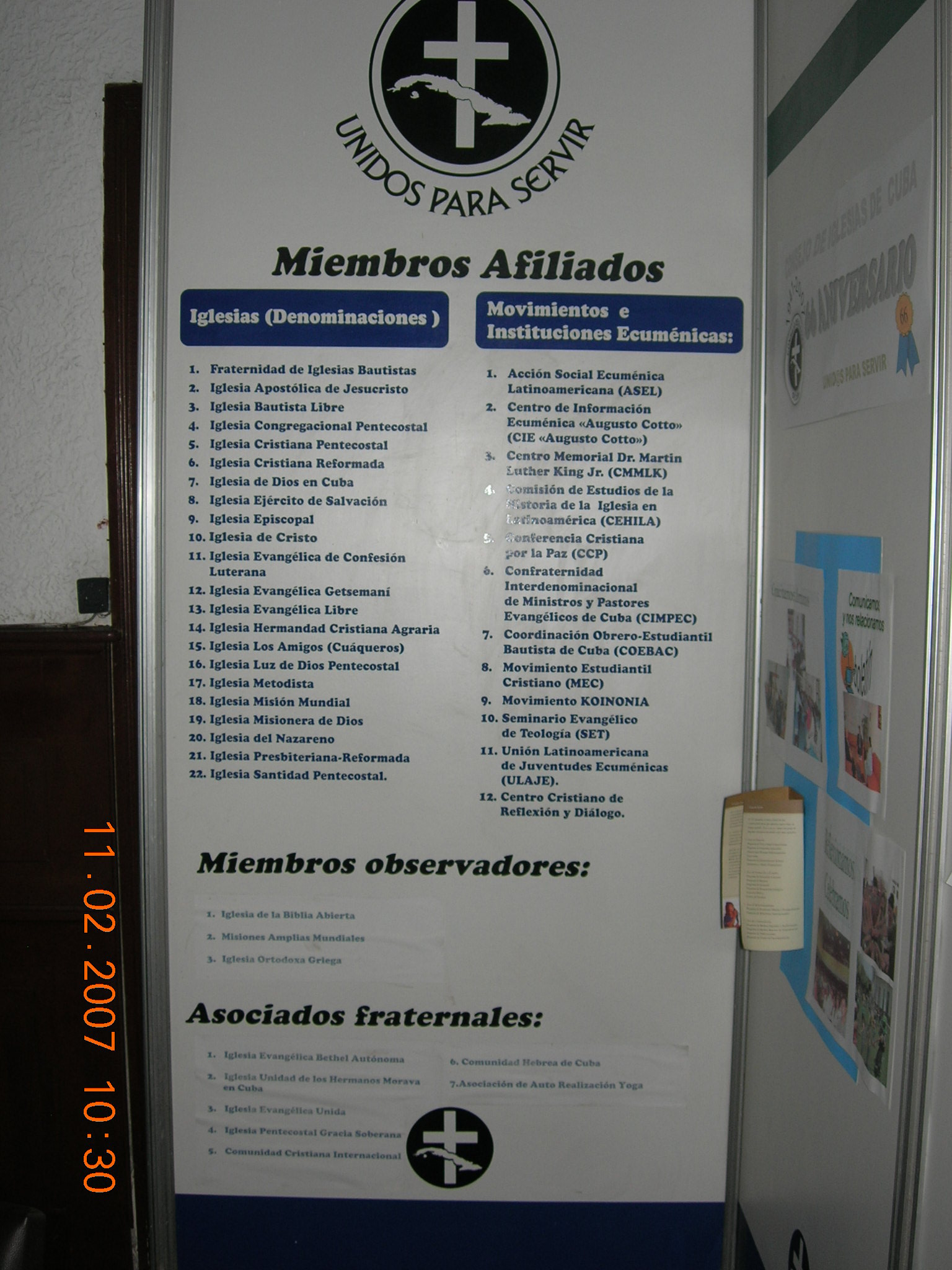
The report’s referencing the Cuban Council of Churches, however, did not mention that the it was founded in 1941 (long before the Cuban Revolution), and its members now include 22 churches, 12 ecumenical movements, and seven associate organizations. The Council, whose offices I have visited, promotes unity among the Christian Churches of Cuba and helps link these churches with other churches around the world. The Council also encourages dialogue between different movements and institutions as a means for Cuban churches to expand their ecumenical vocation of service, thus deepening their responsibilities towards society and all of God’s creation. Finally the Council promotes study, dialogue, and cooperation among Christians to increase Christian witness and enhance life in Cuba.
The U.S. government’s report continued, “Religious groups . . . reported it was easier to obtain government permission to maintain and repair existing places of worship and other buildings.” Moreover, the government “frequently granted permission to repair or restore existing temples, allowing significant expansion of some structures and in some cases allowing essentially new buildings to be constructed on the foundations of the old. Numerous houses of worship were expanded or repaired.” (In a prior year our partner church in Matanzas obtained such permission to expand its facilities for children’s Sunday School programming, and Westminster members helped build that expansion.)
Even though some religious organizations and “house churches” have not been officially recognized by the government, as required by Cuban law, in practice, most unregistered organizations and “house churches” operated with little or no interference from the government.
Both the Catholic Church and the Cuban Council of Churches reported improved access to prisoners during the year, with services offered in prisons and detention centers in most, if not all, provinces. (According to the report, however, some prison authorities did not inform inmates of their right to religious assistance, delayed months before responding to such requests, and limited visits to a maximum of two or three times per year.)
The government worked with the Catholic Church to facilitate the public procession of an icon honoring the Virgin of Charity to mark the 400th anniversary of her appearance in Cuba. The procession concluded in December with a public open-air mass in Havana attended by over 3,000 citizens as well as by government officials. It was the first country-wide religious procession permitted since the Cuban revolution.
Although there is no official law of policy for conscientious objection to military service, since 2007 the government has unofficially allowed a period of civilian public service to substitute for military service for men who object on religious grounds. The leadership of Jehovah’s Witnesses and Seventh-day Adventists stated that their members usually were permitted to participate in social service in lieu of military service.
The leadership of Jehovah’s Witnesses and Seventh-day Adventists stated that mistreatment and job discrimination, which had been particularly harsh in the past, were now rare and that their members were usually exempted from political activities at school. Seventh-day Adventist leaders stated that their members employed by the state usually were excused from working on Saturdays.
Pope Benedict XVI @ Plaza de Revolucion
Not included in the report for 2011 was the late March 2012 visit to Cuba by Pope Benedict XVI. During a mass in Havana’s Plaza de Revolucion before a crowd of thousands, the Pope called for “authentic freedom.”
Negative Aspects of Religious Freedom in Cuba
The report also commented on what it saw as negative aspects of religious freedom in Cuba.
The report notes that obtaining government permission for construction of new religious buildings remained difficult. This may well be true, but, in my opinion, this difficulty springs from the government’s attempts to regulate the allocation of scarce resources in a relatively poor country and to allocate more resources to other purposes it deems more important.
By law religious groups “are required to apply to the Ministry of Justice for official recognition. The application procedure requires religious groups to identify the location of their activities and their source of funding, and requires the ministry to certify that the group is not ‘duplicating’ the activities of another recognized organization in which case, recognition is denied. A number of religious groups, such as the Jehovah’s Witnesses and the Mormons, have been waiting for years for a decision from the Ministry of Justice on their pending applications for official recognition.” (However, the report said that unrecognized religious groups reported they were able to conduct religious activities, hold meetings, receive foreign visitors, and send representatives abroad. In addition, I believe that the government’s official requirement that such applications indicate it is not “duplicating” another organization’s activities is due to the previously mentioned desire to conserve scarce resources.)
Once the Ministry of Justice grants official recognition, religious organizations have to request permission from the Cuban Communist Party, through its Office of Religious Affairs, to hold meetings in approved locations, to receive foreign visitors, and to travel abroad. Religious groups indicated that while many applications were approved within two to three years from the date of the application, other applications received no response or were denied. Some religious groups were only able to register a small percentage of their “house churches.”
The report states that religious groups may not establish schools. This is true because the Cuban Revolution nationalized all private schools–religious and nonreligious– and instead emphasized public education for all children.
The report also says, “Except for two Catholic seminaries and several interfaith training centers throughout the island, religious schools were not permitted.”
This is an erroneous or misleading statement about religious education in Cuba as shown by the report’s own acknowledgement that in 2011 religious organizations had increased ability to conduct their own educational programs and by the following facts not mentioned in the report:
Since 1946 there has been an ecumenical Protestant Christian seminary in the city of Matanzas — Seminario Evangelico de Teologia (SET)–that was founded by the Methodist, Presbyterian, and Episcopal Churches. It has a full curriculum for various degrees as well as other non-degree programs, some of which are offered in other cities on the island.
The Methodists recently withdrew from SET to start their own seminary in Havana.
SET and the Martin Luther King, Jr. Center at Ebenezer Baptist Church in Havana are developing a program for education of prospective owners and operators of private businesses on the island under the government’s announcement allowing such activities. The MLK Center, by the way, was founded in 1987 to provide training and education in King’s philosophy of nonviolence for Cuban religious and community leadership.
In the last several summers young people from Westminster have conducted a vacation Bible school at our partner church in Matanzas.
MLK Center, Havana
“A license from the Office of Religious Affairs is necessary to import religious literature and other religious materials.” (Yet, as previously mentioned, the report itself states there were fewer restrictions on such importation.)
The report also states that “the government owns nearly all printing equipment and supplies and tightly regulates printed materials, including religious literature.” This, in my opinion, is an overstatement. Our partner church in Matanzas owns old-fashioned printing presses and at least one specialized computer printer and that the church prints and distributes religious bulletins and journals for most, if not all, of the Protestant churches on the island. A photo of the covers of some of the religious publications that are printed here appears in my 12/30/11 post, “The Cuban Revolution and Religion.”
The report states that “most religious leaders reported they exercised self-censorship in what they preached and discussed during services. Many feared that direct or indirect criticism of the government could result in government reprisals, such as denials of permits from the Office of Religious Affairs or other measures that could stymie the growth of their organizations.”
The government took “measures to limit support to outspoken religious figures that it considered a challenge to its authority.”I have no basis to challenge that statement or the following specifics cited by the report on this point:
On June 26, police arrested 23 people and detained them for five hours to prevent them from attending a Sunday prayer session in support of a Methodist minister who was removed from his post by his superiors, partly because of his outspoken criticism of the government.
On October 19, police stopped Baptist pastor Mario Felix Lleonart, a vocal critic of the authorities in the province of Santa Clara, and detained him for 10 hours.
In February Pastor Omar Perez Ruiz (aka Omar Gude Perez), a leader of the Apostolic Reformation, an association of independent nondenominational churches, was released after serving almost three years of a six-year prison sentence for illicit economic activities and falsification of documents. Perez maintained his innocence and claimed his incarceration was due to his religious activities. Perez’s release was conditioned on his refraining from preaching and from leaving the city of Camaguey. Although Perez and his family were granted refugee status in the United States, they were unable to leave because the government did not grant them an exit permit.
As part of its campaign of repression of human rights activists, the government prevented many Catholics from attending religious services. Members of the Ladies in White (Damas de Blanco) group were routinely prevented from attending church, a practice that was particularly pronounced in the eastern provinces of Holguin and Santiago. The government prevented Adisnidia Cruz, mother of political prisoners Marcos and Antonio Lima-Cruz, from leaving her house in Holguin on Sundays to attend mass on dozens of occasions. In other instances the government harassed human rights activists immediately after religious services. On September 8, for example, members of the Damas de Blanco were arrested after attending mass in Santiago to celebrate the day of Cuba’s patron saint.
Conclusion
Is the glass half empty or half full? This is the question for all human activities since none of us is perfect, and it is the legitimate question about religious freedom in Cuba.
In the opinion of a respected Cuban Protestant leader, the glass of such freedom in Cuba is more than half full, and there is no basis whatsoever for the U.S. government or her citizens to castigate Cuban religious institutions or leaders or members. I concur. As Jesus said to the scribes and Pharisees when they asked him if they should stone a woman who had committed adultery, “Let anyone among you who is without sin be the first to throw a stone at her.” All of the questioners then silently departed without throwing any stones. (John 8: 3-11.)
I, therefore, am glad that this U.S. government report does not designate Cuba as a “Country of Particular Concern,” i.e., a country which has “engaged in or tolerated particularly severe violations of religious freedom,” or the ” systematic, ongoing, egregious violations of religious freedom, including violations such as torture, degrading treatment or punishment, prolonged detention without charges, abduction or clandestine detention, or other flagrant denial of the right to life, liberty, or the security of persons.” There is no basis for any such designation, in my opinion.
Nor do I think there is any basis for the quasi-independent U.S. Commission on International Religious Freedom to have put Cuba on its “Watch List of countries where the serious violations of religious freedom engaged in or tolerated by the governments do not meet the [Commission’s] . . . threshold [for designation as a Country of Particular Concern], but require close monitoring.” The Commission should cease making such a designation in its next report.
The American Revolutionary War with Great Britain started on April 19, 1775, with fighting in Lexington and Concord, Massachusetts. Immediately thereafter, the colonists commenced a siege of the town of Boston, where the British troops were quartered. For nearly the first two months of the siege, there were only minor skirmishes between the two forces as the British soldiers were confined within Boston.
The British, however, wanted to break out of their confinement and to protect Boston against colonial attacks from the hills overlooking the town.[1]
On May 25th, the immediate events leading to the Battle of Bunker Hill commenced. On that date British generals began developing a plan to break out and protect Boston from attack from the adjacent hills. On June 12th they finalized a plan to take the Boston and Dorchester Necks (narrow strips of land separately connecting the town of Boston and Dorchester Heights to the mainland), fortify the Dorchester Heights to the southeast of the town and then attack the colonial forces stationed in Roxbury to the south of the town.
Boston map 1775Map of Charleston & Breed’s & Bunker HIlls, 1775
Once the British southern flank had been secured, the British plan called for having troops cross the Harbor north of the town to take the two hills behind the town of Charlestown (Breed’s Hill, 62 feet above sea level, and Bunker Hill,110 feet above sea level). These hills overlooked both Boston and its harbor and thus were critical vantage points. Assuming these objectives were secured, the plan was then to attack the colonial forces in Cambridge. The British attack was set for June 18th.
On June 13th (the day after these plans were finalized), however, the colonial forces received intelligence about the plans. As a result, the colonials decided that additional defenses needed to be erected on the Charlestown Peninsula, specifically on Bunker Hill. After a prayer service led by Harvard College President Langdon, 1,200 colonial troops In the dark of the night on June 16th stealthily occupied Bunker Hill and the adjacent lower Breed’s Hill. They constructed an earthen redoubt or wall on Breed’s Hill (not Bunker Hill), probably because Breed’s Hill was closer to where the British ships were positioned allowing the colonists a better attacking position than at Bunker Hill. That night the colonists also built lightly fortified lines across most of the Charlestown Peninsula.
At sunrise the next day (June 17) the British were surprised to discover the new colonial positions on the two hills, and some of the British ships in the Harbor started shelling those positions with little effect. Although Bunker Hill was the original objective of both British and colonial troops and is the name of the battle, most of the actual fighting later that day took place on the shorter hill closer to the Harbor (Breed’s Hill).
British 1st assault, Breed’s HillBritish 1st assault, Breed’s Hill (H. Pyle)
The initial British attack did not take place until after 3:00 that afternoon due to a shortage of boats to bring the British troops from Boston, poor navigational maps and tides. They landed east of the town of Charleston. When colonial snipers began firing, the British had the town set afire by cannon shots from their ships. The British continued their assault. The British just expected to march up the hill and scare the colonists away. The British troops advanced with bayonets fixed; many of their muskets were not even loaded. The British troops, wearing their bright red wool jackets and weighed down by heavy equipment, marched up hill over farm fields and low stone walls hidden in the tall grass.
As the colonists saw this massive red line approach slowly and steadily, they remained calm and did not open fire. Once the British came within range, the colonists began firing, and the British soldiers started to fall rapidly. This resistance and resulting casualties forced the British to retreat.
British 2nd assault, Breed’s HillBritish 3rd assault, Breed’s Hill
The British immediately regrouped and started a second assault. Again they suffered heavy casualties and retreated.
The third assault, however, was successful with the British taking control of both hills. The colonial troops were running out of ammunition and were forced to retreat to Cambridge, suffering their most significant losses on Bunker Hill.This assault and the Battle were over by approximately 6:00 p.m.
While the result was a victory for the British, they suffered heavy losses: 828 wounded and 226 killed (nearly a third of the deployed forces of 3,000), including a notably large number of officers. The battle is seen as an example of a Pyrrhic victory because the immediate gain (the capture of Bunker Hill) was modest and did not significantly change the state of the siege, while the cost was high. Meanwhile, colonial forces were able to retreat and regroup in good order, having suffered few casualties (115 wounded and 305 killed). Furthermore, the battle demonstrated that relatively inexperienced colonial forces were willing and able to stand up to regular army troops.
Perley Brown (my maternal fifth great-grandfather) and three of his brothers–John, Benjamin and William Brown–were members of the colonial forces at the Battle of Bunker Hill.[2]
Their regiment left their camp in Cambridge around noon that day and for unknown reasons halted about an hour at Lechmere Point (near the eastern edge of present-day Cambridge). When they arrived later at the northern base of Bunker Hill, they were met by a man who said that additional troops had been ordered to halt. But the regiment’s commander said those were “Tory orders” and instead ordered the men to follow him into combat. They actually arrived at the hostilities just before the colonial retreat was ordered at the end of the battle.
During the colonial retreat, John Brown was shot in the left thigh near the bone and in his right heel, rendering him unable to walk. The regiment’s captain took Brown under one arm and their two muskets under the other and moved Brown out of immediate danger. The captain then found Brown’s brother, Perley Brown (my maternal fifth great-grandfather), who carried John the rest of the way to safety.
John was unable to go to a hospital or home and remained at a nearby residence to recuperate. That October he finally was able to return home to Leicester, Massachusetts. In April 1777 the Massachusetts legislature granted him a pension of 20 shillings per month for his disability, and in 1786 the new nation awarded him a pension. He died in 1821 at the age of 87.
As I was researching for this post, I had three unanswered questions. First, why did the British not execute their plan to take control of the Dorchester Heights? Second, given the obvious strategic importance of Breed’s and Bunker Hills, why had the colonists not constructed fortifications before June 16th and why had they not stationed troops there? Third, given that same strategic importance, why did the British not maintain their victorious positions on the two hills? I would greatly appreciate comments with answers to these questions and any corrections to the above account of the Battle of Bunker Hill.
[1]E.g., T. Harry Williams, Richard N. Current & Frenk Freidel, A History of the United States [To 1876], at 150 (New York: Alfred A. Knopf 1959); Henry Steele Commager & Richard B. Morris, The Spirit of ‘Seventy-Six: The Story of the American Revolution as Told by Participants, Ch. Four (New York: Harper & Row, 1967) (collection of original documents).
[2] Carol Willits Brown, William Brown–English Immigrant of Hatfield and Leicester, Massachusetts, and His Descendants c. 1669-1994 at 6, 11-27, 31-41, 50 (Gateway Press; Baltimore, MD 1994); Emory Washburn, Topographical and historical sketches of the town of Leicesterin the Commonwealth of Massachusetts (1826); Emory Washburn, Historical sketches of the town of Leicester, Massachusetts, during the first century from its settlement (1860.
After the April 19, 1775 Battles of Lexington and Concord, Massachusetts, the 1,700 British soldiers returned to their quarters in Boston, then a town of approximately 15,500 people in addition to the British troops. The colonial Minute Men, numbering at least 14,000 to 16,000, were gathered four miles to the west in Cambridge.
Geography is the key to understanding this American use of the military tactic of siege, i.e., militarily surrounding a town or other place with the intent of preventing free movement to or from the place or conquering by attrition rather than by attack.
The town of Boston then was located on a peninsula surrounded on virtually all sides by the Charles River and the Boston Harbor and connected to the south mainland only by a narrow strip of land (“The Boston Neck”). (Today landfill has eliminated the Boston Neck.) Although British ships controlled the water and thus were able to resupply the British troops in the town, as they did in May 1775 with an additional 4,300 troops (for a total force of 6,000), these troops essentially were land locked.
Siege of Boston map, 1775-1776
The Americans obviously understood the British predicament, and with the Americans having the larger number of troops and not wanting to wage war in Boston, they imposed a siege of the town of Boston by stationing the militia men in a line starting in Chelsea to the northeast of Boston, going west to Charlestown and then south to Roxbury. This siege line was able to prevent the British troops from leaving Boston and engaging in war against the Americans. The Siege was an American offensive maneuver implemented for defensive purposes until the very end of the siege.
Among those participating in the Siege were Perley Brown (my maternal fifth great-grandfather) and three of his brothers–John, William and Benjamin. All four apparently had enlisted for eight months or through the balance of the year of 1775, and all except for John presumably were engaged in the Siege at least until then. John’s service unfortunately ended on June 17, 1775, when he was wounded in the Battle of Bunker Hill as we will see in a subsequent post.[1]
For most of the 11 months of siege, there were relatively minor skirmishes between the two forces except for the just mentioned Battle of Bunker Hill.
One of the skirmishes occurred in May of 1775 on Noddle’s and Hog Islands in the Harbor northeast of Boston (near today’s Boston Logan International Airport). Because of their domination of the sea, the British were using the farmers and livestock on the island to supply the British troops with fresh meat. In addition, the British were storing some naval supplies there. The colonists responded by removing livestock and hay from the islands or by killing the livestock and burning the hay and barns. On May 27 and 28, 1775, the opposing forces fought the Battle of Chelsea Creek, which was a creek between the two islands and the mainland.
The colonists without suffering any fatalities were successful in forcing the retreat of the British troops in this battle. In addition, the colonists’ cannons were able to capture and sink the British ship, HMS Diana, the first such accomplishment in the war and a big boost to their morale. One of the colonists in this military engagement was Benjamin Brown.
General George WashingtonGeneral Washington’s Headquarters, Cambridge, 1775-1776
Nearly three weeks after the Battle of Chelsea Creek, on June 14, 1775, the Second Continental Congress voted to establish the Continental Army for purposes of common defense by incorporating the 16,000 or so militia men already in action in the Boston area plus the 5,000 other men in New York. The next day (June 15th) the Congress unanimously elected George Washington as the Commander-in-Chief of the Army.
On July 3, 1775, General Washington arrived in Cambridge, Massachusetts to take command of the troops in the field. He established his headquarters and abode in a beautiful house in Cambridge that later in the 19th century was owned by the American poet, Henry Wadsworth Longfellow. (The house is now open to the public as a National Historic Site.)
On January 24, 1776, the colonists obtained a major strategic advantage with the arrival in Cambridge of over 50 heavy cannons that had been seized eight months earlier (on May 10, 1775) from the British Fort Ticonderoga at the southern end of Lake Champlain in present-day upstate New York. (The reconstructed Fort is now open to the public.)
The successful capture of the Fort was led by Ethan Allen and the Green Mountain Boys and Colonel Benedict Arnold. (Arnold in 1780 defected to the British and thereby became an infamous American traitor.)
Artillery for Boston, 1775
Between November 1775 and January 24, 1776, in a remarkable logistical operation Colonel Henry Knox and a team of engineers used boats, horse and ox-drawn sledges and manpower to transport the heavy cannons nearly 250 miles over poor roads, forest, swamps and the frozen Hudson and Connecticut Rivers to Cambridge.
Once in Cambridge, the canons were moved to Dorchester Heights overlooking Boston from the southeast. In early March 1776, the Americans started to bombard Boston with the cannons, killing some British soldiers and destroying some houses. The British returned artillery fire, but their cannons could not reach the colonists’ weapons.
British Evacuation of Boston, 1776
After a planned British assault on the Dorchester Heights was cancelled due to a storm, the British decided to leave Boston. On March 8th General Washington received an anonymous letter saying the British would not destroy the town of Boston if they were permitted to depart without attack. Washington formally rejected the letter, but on March 17th the British evacuated Boston without hostile fire and without any destruction.
A British fleet of 120 ships with 9,906 British troops plus 1,220 women and children left Boston for the 400 mile northeastern sail to the unused British military base in Halifax, Nova Scotia.
Now in Boston March 17th is celebrated as Evacuation Day.
[1] Carol Willits Brown, William Brown–English Immigrant of Hatfield and Leicester, Massachusetts, and His Descendants c. 1669-1994 at 6, 11-27, 31-41, 50, 308-12(Gateway Press; Baltimore, MD 1994). This account of the Brown brothers’ participation is based upon two secondary sources about the town of Leicester written in the 19th century by Emory Washburn: (a) Topographical and historical sketches of the town of Leicester in the Commonwealth of Massachusetts at 49-50 (1826); and (b) Historical sketches of the town of Leicester, Massachusetts, during the first century from its settlement at 296-99(1860).
On April 19, 1775, the opening battles of the American Revolutionary War occurred in Lexington and Concord, Massachusetts and along the road from those villages to Boston.
Minute Man statue, Lincoln, MA
Battles There was no organized colonial army at the time. Instead, the Americans who fought the British that day were “Minute Men,” who were volunteers committed to being ready to fight on a minute’s notice and who had been mustered into service that day by warnings that the British were coming.
A concrete example of the mustering of the Minute Men can be seen by what happened that same day (April 19th) in Leicester, Massachusetts, a village 30 miles west of Concord.
Early that same afternoon a messenger on horseback arrived in Leicester. He stopped in front of the blacksmith shop of the captain of the local unit of the Minute Men. The messenger yelled, “The war has begun! The British are marching to Concord!”[1]
The blacksmith immediately stopped working on the ploughshare he was sharpening. He grabbed his loaded musket. He rushed into the street and fired the musket in the air. This was the agreed upon signal for the Minute Men to assemble. Some who previously had been appointed as messengers went through the town and adjoining countryside to spread the news.
By 4:00 p.m. all the Minute Men had assembled in the town Common. No one had a uniform. But everyone had his musket, powder horn and bullet pouch along with a few necessities. Among those present were Perley Brown (my maternal fifth great-grandfather) and two of his brothers–John and William. They all apparently enlisted for eight months or through the balance of the year of 1775.
Watching the Leicester men assemble were family and friends. To provide the men with shot for their muskets the lead weights of one family’s valuable clock were melted down and cast into bullets. Rev. Conklin, the local clergyman, prayed for their protection and safe return. The mother of the unit’s captain approached him to give him a hug. He responded by saying for all to hear, “Mother, pray for me, and I will fight for you.”
Just before sundown that same day, 80 Minute Men from the town, including the three Brown brothers, marched east approximately 24 miles through Worcester to Marlborough, Massachusetts, a village of 1,500 people. There upon hearing the news that the British had retreated to Boston, they and colleagues from other towns stopped for a short sleep.
The next day (April 20th) they marched another 21 miles to Watertown, Massachusetts and stopped for a night’s rest. The following day (April 21st) they completed their march when they arrived in Cambridge, Massachusetts, which was five miles to the east and which had been selected as the staging center for the American forces.
This tale of the mustering of the Leicester men undoubtedly was repeated throughout Massachusetts and the rest of New England for the Leicester men were joined in Cambridge by thousands of other Minute Men. One of the other Minute Men was another Brown brother, Benjamin Brown, from the village of Rowe in northwestern Massachusetts near present-day Vermont.
As we will see in a subsequent post, these men then participated in the Siege of Boston from April 20, 1765 through March 17, 1776.
[1] Carol Willits Brown, William Brown–English Immigrant of Hatfield and Leicester, Massachusetts, and His Descendants c. 1669-1994 at 6, 11-27, 31-41, 50, 308-12(Gateway Press; Baltimore, MD 1994); Emory Washburn, Topographical and historical sketches of the town of Leicester in the Commonwealth of Massachusetts at 49-50 (1826); Emory Washburn, Historical sketches of the town of Leicester, Massachusetts, during the first century from its settlement at 296-99(1860).
On June 16, 2012, Aung San Suu Kyi gave her lecture in Oslo, Norway accepting the Nobel Peace Prize awarded her 21 years ago. She was unable to be present on that prior occasion because she was under house arrest in her native Myanmar (Burma) for protesting the abuses of its military regime.
The 1991 Peace Prize Presentation
Nobel Prize Medal
When the Prize was presentedin absentia in 1991 for her non-violent struggle for democracy and human rights in Burma, the Chairman of the Norwegian Nobel Committee said, “In the good fight for peace and reconciliation, we are dependent on persons who set examples, persons who can symbolise [sic]what we are seeking and mobilise [sic] the best in us. Aung San Suu Kyi is just such a person. She unites deep commitment and tenacity with a vision in which the end and the means form a single unit. Its most important elements are: democracy, respect for human rights, reconciliation between groups, non-violence, and personal and collective discipline.”
The presentation continued, “The central position given to human rights in her thinking appears to reflect a real sense of the need to protect human dignity. Man is not only entitled to live in a free society; he also has a right to respect. On this platform, she has built a policy marked by an extraordinary combination of sober realism and visionary idealism. And in her case this is more than just a theory: she has gone a long way towards showing how such a doctrine can be translated into practical politics.”
An “absolute condition [for such a translation] is fearlessness,” the Nobel Chairman stated. He added that Aung San Suu Kyi had said “it is not power that corrupts, but fear. The comment was aimed at the totalitarian regime in her own country. They have allowed themselves to be corrupted because they fear the people they are supposed to lead. This has led them into a vicious circle. In her thinking, however, the demand for fearlessness is first and foremost a general demand, a demand on all of us. She has herself shown fearlessness in practice.”
The Nobel Committee concluded its 1991 statement with the words: “In awarding the Nobel Peace Prize … to Aung San Suu Kyi, the Norwegian Nobel Committee wishes to honour [sic] this woman for her unflagging efforts and to show its support for the many people throughout the world who are striving to attain democracy, human rights and ethnic conciliation by peaceful means.”
Recognizing her inability to be present for the award in 1991, the Nobel Committee Chairman said, “The great work we are acknowledging has yet to be concluded. She is still fighting the good fight. Her courage and commitment find her a prisoner of conscience in her own country, Burma. Her absence fills us with fear and anxiety . . . .”
Aung San Suu Kyi’s Acceptance Speech
Aung San Suu Kyi @ Oslo City HallAung San Suu Kyi (Photo: Daniel S. Lauten/AFP/ Getty Images
Twenty-one years later, Aung San Suu Kyi formally accepted the 1991 Peace Prize in the City Hall of Oslo, Norway. The text and video of the speech are available online.
She talked about the impact in 1991 of learning of the award while she was under house arrest. “Often . . . it felt as though I were no longer a part of the real world. There was the house which was my world, there was the world of others who also were not free but who were together in prison as a community, and there was the world of the free; each was a different planet pursuing its own separate course in an in different universe. What the Nobel Peace Prize did [in 1991] was to draw me once again into the world of other human beings outside the isolated area in which I lived, to restore a sense of reality to me. . . . And what was more important, the Nobel Prize had drawn the attention of the world to the struggle for democracy and human rights in Burma. We were not going to be forgotten.”
She continued, “To be forgotten . . . is to die a little. It is to lose some of the links that anchor us to the rest of humanity. . . . When the Nobel Committee awarded the Peace Prize to me they were recognizing that the oppressed and the isolated in Burma were also a part of the world, they were recognizing the oneness of humanity. So for me receiving the Nobel Peace Prize means personally extending my concerns for democracy and human rights beyond national borders. The Nobel Peace Prize opened up a door in my heart.”
“The Burmese concept of peace,” she explained, is “the happiness arising from the cessation of factors that militate against the harmonious and the wholesome. . . . Everywhere there are negative forces eating away at the foundations of peace. Everywhere can be found thoughtless dissipation of material and human resources that are necessary for the conservation of harmony and happiness in our world.”
“Are we not still guilty, if to a less violent degree, of recklessness, of improvidence with regard to our future and our humanity? War is not the only arena where peace is done to death. Wherever suffering is ignored, there will be the seeds of conflict, for suffering degrades and embitters and enrages.”
While living in isolation she said she ruminated over the meaning of the Buddhist concept of the six great “dukha” or suffering: “to be conceived, to age, to sicken, to die, to be parted from those one loves, to be forced to live in propinquity with those one does not love. . . . I thought of prisoners and refugees, of migrant workers and victims of human trafficking, of that great mass of the uprooted of the earth who have been torn away from their homes, parted from families and friends, forced to live out their lives among strangers who are not always welcoming.”
“How often during my years under house arrest have I drawn strength from my favourite [sic] passages in the preamble to the Universal Declaration of Human Rights:
……. disregard and contempt for human rights have resulted in barbarous acts which have outraged the conscience of mankind, and the advent of a world in which human beings shall enjoy freedom of speech and belief and freedom from fear and want has been proclaimed as the highest aspirations of the common people,
…… it is essential, if man is not to be compelled to have recourse, as a last resort, to rebellion against tyranny and oppression, that human rights should be protected by the rule of law . . .”
“The peace of our world is indivisible,” Aung San Suu Kyi continued.” As long as negative forces are getting the better of positive forces anywhere, we are all at risk. It may be questioned whether all negative forces could ever be removed. The simple answer is: ‘No!’ It is in human nature to contain both the positive and the negative. However, it is also within human capability to work to reinforce the positive and to minimize or neutralize the negative. Absolute peace in our world is an unattainable goal. But it is one towards which we must continue to journey, our eyes fixed on it as a traveller in a desert fixes his eyes on the one guiding star that will lead him to salvation. Even if we do not achieve perfect peace on earth, because perfect peace is not of this earth, common endeavours [sic] to gain peace will unite individuals and nations in trust and friendship and help to make our human community safer and kinder.”
She then emphasized kindness. [The] most precious . . . [lesson from her isolation] I learnt . . . [was] the value of kindness. Every kindness I received, small or big, convinced me that there could never be enough of it in our world. To be kind is to respond with sensitivity and human warmth to the hopes and needs of others. Even the briefest touch of kindness can lighten a heavy heart. Kindness can change the lives of people. ”
Aung san Suu Kyi concluded with these words. “Ultimately our aim should be to create a world free from the displaced, the homeless and the hopeless, a world of which each and every corner is a true sanctuary where the inhabitants will have the freedom and the capacity to live in peace. Every thought, every word, and every action that adds to the positive and the wholesome is a contribution to peace. Each and every one of us is capable of making such a contribution. Let us join hands to try to create a peaceful world where we can sleep in security and wake in happiness.”
Conclusion
I have never been to Myanmar (Burma), and I do not know the history of that country in any great detail. But in 2001 as a pro bonoattorney I helped a Burmese man obtain asylum in the U.S. because of his well-founded fear of persecution if he returned to his homeland due to his political opposition to its military regime. He had been arrested in his home country for distributing video tapes of the movie “Beyond Rangoon [now Yangon],” which was critical of the military regime.
Aung San Suu Kyi also suffered persecution because of her political opinions and thereby demonstrated the importance of human rights for her and for all of us. I share this belief in human rights although I never have had to pay the personal cost she did. I also share with her the experience of having “read” Philosophy, Politics and Economics at the University of Oxford.
Aung San Suu Kyi’s life and her acceptance speech are especially moving for me.
Michael Lewis, a member of Princeton University’s Class of 1982 and author of such successful books as Moneyball and Boomerang, gave the 2012 Baccalaureate speech at his alma mater.
He said, “Life’s outcomes, while not entirely random, have a huge amount of luck baked into them. Above all, recognize that if you have had success, you have also had luck — and with luck comes obligation. You owe a debt, and not just to your Gods. You owe a debt to the unlucky.” The text of the speech is available, as is a YouTube video.
I made a similar point in my post, Gratitude III, where I said,“Malcolm Gladwell’s Outliers emphasizes the importance of an individual’s family and place and date of birth as determinants of success. Warren Buffett, the great investor from Omaha, frequently says how fortunate he is to have won the ovarian lottery by having been born in the U.S. in the 1920′s. They remind me to be grateful for having been born in the U.S.A. It is indeed a great country and provided me with opportunity after opportunity.”
Every one of us owes so much to so many people who helped us along the way. Our successes are not ours alone. Be grateful. Help others as you have been helped.
On May 3, 2012, 10 teenager members of the Diyar Dance Theater of Bethlehem, Palestine presented their “Portraits of Fear . . . Room for Hope” at the Women’s Club of Minneapolis’ packed auditorium. It was the opening event in Westminster Presbyterian Church’s Palestinian Arts Festival.
This performance emphasized the process of creating hope in the midst of fear in the following six segments:
Palestinian young people come together from different neighborhoods to discover their identities and self-confidence in the midst of oppression.
The young people try to develop a positive spirit in the face of depressing information in the newspapers about the occupation.
The young people live within many social constraints created by men oppressing women, the old oppressing the young and the strong oppressing the weak.
The young people face lack of work opportunities with 40% youth unemployment.
Fears of isolation help the young people unite to become stronger as a community.
The young people find strength by uniting to forge hope, artistic confidence and a feeling of freedom.
The Diyar Dance Theater is a program of the Evangelical Lutheran Christmas Church of Bethlehem, Palestine, which is a partner of Westminster Presbyterian Church. Its mission is to celebrate Bethlehem’s rich history and culture and to nurture creativity, imagination and freedom of expression.