President Trump’s Unsound Action Regarding the U.S. Prison at Guantanamo Bay, Cuba    

On January 30, just before leaving the White House for his State of the Union Address at the Capitol, President Donald Trump signed an executive order regarding the U.S. prison at Guantánamo Bay, Cuba.

The Guantanamo Bay Executive Order[1]

The Executive Order entitled “Presidential Executive Order on Protecting American Through Lawful Detention of Terrorists” started with these Findings:

  • “Consistent with long-standing law of war principles and applicable law, the United States may detain certain persons captured in connection with an armed conflict for the duration of the conflict” and that since 9/11 the U.S. “remains engaged in an armed conflict with al-Qa’ida, the Taliban, and associated forces, including the Islamic State of Iraq and Syria.” (Section 1(a), (b).)
  • “The detention operations at the U.S. Naval Station Guantánamo Bay are legal, safe, humane, and conducted consistent with United States and international law.” (Section 1(c ).) “Those operations are continuing given that a number of the remaining individuals at the detention facility are being prosecuted in military commissions, while others must be detained to protect against continuing, significant threats to the security of the United States, as determined by periodic reviews.” (Section 1(d).)

The Order than addressed the Status of Detention Facilities at U.S. Naval Station Guantánamo Bay. After revoking President Obama’s January 22, 2009, executive order ordering the closure of those facilities (Section 2(a)),  it stated, “Detention operations at U.S. Naval Station Guantánamo Bay shall continue to be conducted consistent with all applicable United States and international law, including the Detainee Treatment Act of 2005” and the U.S. “may transport additional detainees to U.S. Naval Station Guantánamo Bay when lawful and necessary to protect the Nation.” (Section 2 (b), (c))

The Order also directed certain government officials to “recommend policies to the President regarding the disposition of individuals captured in connection with an armed conflict, including policies governing transfer of individuals to U.S. Naval Station Guantánamo Bay.” (Section 2 (d).)

There, however, were modest concessions to the plight of the detainees and other interests. It states, the detainees “shall [be] subject to the [previously established] procedures for periodic review . . . to determine whether continued law of war detention is necessary to protect against a significant threat to the security of the United States” (Section 2(e)); the order shall not “prevent the Secretary of Defense from transferring any individual away from the U.S. Naval Station Guantánamo Bay when appropriate, including to effectuate an order affecting the disposition of that individual issued by a court or competent tribunal of the United States having lawful jurisdiction” (Section 3(a); the order shall not “affect existing law or authorities relating to the detention of United States citizens, lawful permanent residents of the United States, or any persons who are captured or arrested in the United States” (Section 3(b); and the order shall not “prevent the Attorney General from, as appropriate, investigating, detaining, and prosecuting a terrorist subject to the criminal laws and jurisdiction of the United States” (Section 3 (c ).

The State of the Union Address[2]

The President announced that he had “just signed an order directing Secretary Mattis to reexamine our military detention policy and to keep open the detention facilities at Guantánamo Bay. I am also asking the Congress to ensure that, in the fight against ISIS and al-Qa’ida, we continue to have all necessary power to detain terrorists — wherever we chase them down.”

He also said, “My Administration has also imposed tough sanctions on the communist and socialist dictatorships in Cuba and Venezuela.”

Reactions

Roger Cohen, a New York Times columnist, said the prison at Guantanamo Bay “is widely viewed around the world as a facility incompatible with the American principles of fair trial, human rights and the rule of law.” Moreover, this decision “will be seen by many as a signal of an American return to the excesses of the war on terror — the use of torture, extraordinary renditions and C.I.A ‘black sites.’”[3]

Admiral Dennis Blair, the former Director of National Intelligence, said Cohen, once testified to Congress that the “detention center at Guantánamo has become a damaging symbol to the world and that it must be closed. It is a rallying cry for terrorist recruitment and harmful to our national security, so closing it is important for our national security.”

The Center for Constitutional Rights (CCR) stated, “Trump’s planned executive order is not the last word on the fate of Guantánamo, any more than his attempted Muslim bans and arbitrary transgender military ban—struck down by the courts—were the last word on those matters. CCR has filed a new legal challenge to the illegality and racism driving Trump’s Guantánamo policy and demanding detainees’ release. It is the courts, not the authoritarian-in-chief, that will ultimately determine the fate of the men detained at Guantánamo.”[4]

The just mentioned CCR action on behalf of 11 Guantánamo detainees was filed on January 11, 2018, in the U.S. District Court for the District of Columbia. It alleges that Trump’s proclamation against releasing anyone from Guantánamo, regardless of their circumstances is arbitrary and unlawful and amounts to “perpetual detention for detention’s sake.”  This move was supported by Muslim, Faith-Based and Civil Rights Community Organizations.[5] On January 18, the court ordered the federal government to provide information about its Guantánamo policy.[6]

The New York Times in an editorial supported this challenge to the continued detention of individuals at the U.S. prison in Cuba. The editorial stated, “the men make a straightforward case for their release. The Supreme Court has ruled that prisoners at Guantánamo must have a “meaningful opportunity” to challenge the legal and factual grounds for their detention, which means that the federal courts have the power to review those claims and grant any appropriate relief. If the Constitution stands for anything, the plaintiffs argue . . ., it must stand for the proposition that the government cannot detain someone for 16 years without charge.”[7]

Conclusion

The U.S. prison at Guantánamo Bay has long been a major source of legitimate complaints against the U.S. and should be closed as soon as possible, not potentially expanded as this Executive Order would permit. In addition, this prison provides Cuba with its strongest argument that the U.S. has breached its 1905 lease of the site of the prison from Cuba.[8]

============================================

[1] White House, Presidential Executive Order on Protecting American Through Lawful Detention of Terrorists (Jan. 30, 2018).

[2]   White House, President Donald J. Trump’s State of the Union Address (Jan. 30, 2018).

[3] Cohen, Trump’s Volk and Vaterland, N.Y. Times (Jan. 31, 2018).


[4] Center for Const’l Rts, Guantánamo Attorneys blast Trump “Keep Gitmo Open” Order (Jan. 30, 2018).

[5]  Brief of Amici Curiae Muslim, Faith-Based, and Civil Rights Community Organizations in Support of Petitioners’’ Motion for Order Granting Writ of Habeas Corpus, Awad al Bihani v. Trump, Case No, 1:09-cv-00745-RCL (D.D.C. Jan. 22,  2018).

[6] Center Const’l Rts, Court Orders Government to Clarify Guantánamo Policy, Attorneys React (Jan. 18, 2018); Order, Awad al Bihani v. Trump, Case No, 1:09-cv-00745-RCL (D.D.C.J an. 18, 2018).

[7] Editorial, Donald Trump vs. Guantánamo’s Forever Prisoners, N.Y. Times (Jan. 16, 2018).

[8]  See these posts to dwkcommentaries.com: Resolution of Issues Regarding Cuba Lease of Guantánamo Bay (April 4, 2015); Resolution of U.S. and Cuba’s Damage Claims  (April 6, 2016); Does Cuba Have the Right To Terminate the U.S. Lease of Guantánamo Bay? (April 26, 2015)


Perplexing Status of U.S. Travel to Cuba 

Three recent news reports have muddied the waters about U.S. visitors to Cuba .

First, last year was a record year for tourism in Cuba with 4.7 million visitors pumping more than $3 billion into the country’s struggling economy. Travelers from the U.S. rose to 619,000, which is more than six times the pre-Obama level.[1]

However, as a result of Hurricane Irma’s hitting the island last September and the Trump Administration’s hostility towards Cuba, including travel restrictions, U.S. visitors to Cuba dropped 30% last month according to Jose Manuel Bisbe York, the president of the Cuban state travel agency. Visitors from other countries also have decreased, but not as much as the U.S. This happened event though Cuba has fixed its tourism facilities over the last several months.[2]

Second, to  counter this recent drop in U.S. visitors to the island, on January 29, a score of US companies linked to the tourism sector met  in Havana to proclaim  that Cuba is a safe destination to which U.S.  citizens can still travel legally. The meeting was organized by InsightCuba, a pioneer in organizing and promoting trips to the island.[3]

An executive of American Airlines, which operates nine daily flights to Cuba, said, at the gathering, “We see many opportunities in Cuba, especially on the Havana-Miami route,” and “we have requested permission for 17 additional flights.” The president of the Association of Tour Operators of the United States, Terry Dale, added, “The message is that Cuba is open to business, safe, wonderful and legal for travelers from the United States” Another U.S. businessman said, “The reality is that Americans can continue to travel to Cuba almost as they did before the new regulations.”

Third, also on January 29 the U.S. State Department’s Bureau of Western Hemispheric Affairs told the Nuevo Herald of Miami that 19 U.S. citizens who had visited Cuba after September 2017 had reported medical symptoms similar to those of some U.S. diplomats who had been stationed there. [4]

The Department’s  spokeswoman did not say whether US citizens reported hearing strange noises – as did some of the 24 diplomatic victims so far confirmed – nor whether they would have stayed at the Nacional or Capri hotels in Havana that previously had been identified as sites of some of the “attacks.” .Nor did it clarify whether U.S. doctors and investigators could have determined whether these travelers would have suffered the same kind of attack as diplomats. It encouraged “those who are concerned to seek medical attention.” For reasons of “privacy”, the Department will not disclose where the alleged attacks occurred or their symptoms or even what cities they had visited.

Conclusion

As explained in a prior post, the U.S. still has 12 general license categories that permit U.S. citizens to travel to Cuba. Thus, it is legal for U.S. citizens to travel to Cuba. In addition, the latest revision of the State Department’s travel advisory system does not advise citizens not to travel to Cuba; rather, it suggests that citizens reconsider plans to travel to the island (Category 3 of the new advisory system) and only tells them to avoid Havana’s Hotel Nacional and Hotel Capri, where some of the alleged “attacks” on diplomats occurred.

The apparent inability of the U.S. Government after 14 months of investigations here and in Cuba to identify the cause or culprit of the so-called “attacks” on U.S. diplomats and now apparently some ordinary U.S. citizens is at best “perplexing” as State Department officials recently testified at a Senate Subcommittee hearing.[5]

We all need to continue to pay close attention to ongoing developments on these issues.

=====================================

[1] Rodriguez, Tourism booming in Cuba despite tougher new Trump policy, Wash. Post (Jan. 19, 2018).

[2] Reuters, Cuba Tourism Slides in Wake of Hurricane Irma, Trump, N.Y. Times (Jan. 29, 2018)

[3]  Tourism companies in the United States say Cuba is a safe destination, CubaDebate (Jan. 29, 2018).

[4]  Torres, 19 visiting Americans  report symptoms of attacks in Cuba, Neuvo Herald (Jan. 29, 2018); Valencia, U.S. citizens in Cuba Suffered Similar Symptoms Experienced by Diplomats in Havana, State Department Says, Newsweek (Jan. 29, 2018); Nineteen tourists from the US have reported symptoms of attacks in Cuba, Diario de Cuba (Jan. 30, 2018).

[5] See posts listed in the “U.S. Diplomats Medical Problems in Cuba, 2017”     section of List of Posts to dwkcommentaries–Topical: CUBA.


Minneapolis Interfaith Gathering To End Homelessness 

On January 28 nearly 1,000 people gathered at Westminster Presbyterian Church in downtown Minneapolis to support the Emergency Rental Assistance Program of Downtown Congregations To End Homelessness (DCEH).[1]

The gathering was  emceed by Minneapolis Mayor Jacob Frey  and  joined by senior clergy from the downtown congregations (Christian, Jewish and Muslim) and two former NFL Vikings stars: punter Greg Coleman and defensive end Mark Mullaney. Testimony was offered by two individuals who had been helped by the DCEH.

Music was provided by local artists J.D. and Fred Steele, who are members of the popular singing group The Steele Family; Amwaaj Middle Eastern Ensemble; MacPhail Community Youth Choir; Mill City Singers; Street Song MN; and Klezmer Cabaret Orchestra. Teen artist Kaaha Kaahiye shared her spoken words. Below is a photograph of J.D. Steele and Becky Bratton with the Mill City Singers:

Attendees enjoyed delicious food from Holy Land Market and assembled dignity bags for people who are homeless (consisting of hygiene products, socks, hand warmers, food, etc.).

The event showcased Minnesota interfaith cooperation one week before the Super Bowl football game just several miles from this church and was co-sponsored by the Super Bowl Host Committee. An amusing promotional video for the event had Greg Coleman coaching clergy getting ready for a fictitious football game with the cheer “One Hope, One Mind, One Spirit.”

===========================

[1]  Hopfensperger, Faith and football combine at unusual Super Bowl event, StarTribune (Jan. 28, 2018).


Discovering the Ideas of Jordan Peterson

Jordan Peterson

Recently two prominent columnists, David Brooks of the New York Times and Peggy Noonan of the Wall Street Journal, simultaneously have discovered the ideas of Jordan Peterson, about whom I had known nothing. I now know that he is a University of Toronto psychologist, author of a popular new book, “12 Rules for Life:  An Antidote to Chaos,” and popular YouTube analyst of classical and biblical texts and critic of identity politics and political correctness. [1]

David Brooks’ Observations

For Brooks, Peterson’s “worldview begins with the belief that life is essentially a series of ruthless dominance competitions. The strong get the spoils and the weak become meek, defeated, unknown and unloved.” Peterson argues, says Brooks, that “for much of Western history, Christianity restrained the human tendency toward barbarism. But God died in the 19th century, and Christian dogma and discipline died with him. That gave us the age of ideology, the age of fascism and communism — and with it, Auschwitz, Dachau and the gulag.” Now “we’ve decided to not have any values. We’ll celebrate relativism and tolerance.”

Peterson, according to Brooks, rejects these views. Instead, Peterson emphasizes that “life is suffering” and that everyone needs to “choose discipline, courage and self-sacrifice.”

In Brooks’ opinion, “much of Peterson’s advice sounds to me like vague exhoratory banality. Like Hobbes and Nietzsche before him, he seems to imagine an overly brutalistic universe, nearly without benevolence, beauty, attachment and love. His recipe for self-improvement is solitary, nonrelational, unemotional. I’d say the lives of young men can be improved more through loving attachment than through Peterson’s joyless and graceless calls to self-sacrifice.”

Peggy Noonan’s Observations

Noonan distills Peterson’s new book this way: “Know life’s limits, see and analyze your own, build on what you’ve got and can create. And be brave. Everything else is boring and won’t work.”

These views come from his “respect for the stories and insights into human behavior—into the meaning of things—in the Old and New Testaments. (He’d like more attention paid to the Old.) Their stories exist for a reason, he says, and have lasted for a reason: “They are powerful indicators of reality, and their great figures point to pathways. He respects the great thinkers of the West and the Christian tradition.”

Therefore, says Peterson through Noonan, ”Admit “you will die and on the way to death you will suffer; throughout you will be harassed by evil, both in the world and in your heart. . . .Accept the terrible responsibility of life with eyes wide open. . . . Fix what you can fix. Don’t be arrogant. . . .Become aware of your own insufficiency. . Don’t lie about anything, ever.”

Conclusion

Peterson’s ideas and new book sound intriguing. I am adding the book to my reading list.

=========================================

[1]  Brooks, The Jordan Peterson Moment, N.Y. Times (Jan. 25, 2018); Noonan, Who’s Afraid of Jordan Peterson?, W.S.J. (Jan. 25, 2018).

State Department Creates Cuba Internet Task  Force and Suspends Enforcement of Statutory Liability for Trafficking in Certain Cuban Expropriated Property 

This week the U.S. State Department has taken two actions regarding Cuba: (1) creation of the Cuba Internet Task Force and (2) granting another six-month extension of the right of U.S. persons to sue traffickers in U.S. property that was expropriated by the Cuban government.

U.S.’ Cuba Internet Task Force.

On January 23, the U.S. Department of State issued a terse announcement that it “is convening a Cuba Internet Task Force composed of U.S. government and non-governmental representatives to promote the free and unregulated flow of information in Cuba. The task force will examine the technological challenges and opportunities for expanding internet access and independent media in Cuba.” The announcement also stated that the first public meeting of the Task force would be on February 7.[1]

This action was pursuant to President Trump’s June 16, 2017’s National Security Presidential Memorandum on Strengthening the Policy of the United States Toward Cuba that he dramatically signed at a public meeting in the Little Havana district of Miami, Florida. The purpose of that document was to announce various policies “to promote a stable, prosperous, and free country for the Cuban people. . . . [to] channel funds toward the Cuban people and away from a regime that has failed to meet the most basic requirements of a free and just society [and to condemn abuses by the Cuban regime]. . . . [The] Administration will continue to evaluate its policies so as to improve human rights, encourage the rule of law, foster free markets and free enterprise, and promote democracy in Cuba.” (Section 1)[2]

More specifically Section 2 (d) of that Presidential Memorandum stated that the U.S. was to “Amplify efforts to support the Cuban people through the expansion of internet services, free press, free enterprise, free association, and lawful travel.”

The creation of the Task Force was criticized by Michael Bustamante, an assistant professor of Latin American history at Florida International University. He said, “By casting the issue of internet access in an explicitly political frame, it will only create greater obstacles for those U.S. telecom companies that have made inroads toward partnerships with the Cuban side. Measures like these strengthen the hand of those in Cuba for whom the prospect (and reality) of external meddling justifies maximum caution with respect to internal reform.”

Cuba immediately registered strong objections to the creation of this Task Force with good reason.[3]

Granma, the official newspaper of the Communist Party of Cuba, said, “In the past phrases like promoting “’freedom of speech’ and ‘expanding access to the internet in Cuba’ have been used by Washington as a pretext for schemes to destabilize the country using new technologies.”

One of Granma’s journalists, Sergio Gómez, declared, “If the administration of President Donald Trump intends to use new technologies to impose changes in the internal order of Cuba, he chose very old roads that have already demonstrated their ineffectiveness, without mentioning the obvious fact that they violate the laws of the affected country. even those of the United States.” Moreover, the “terrain chosen for the new aggression, Internet, clearly demonstrates what the true objectives of Washington are when it demands ‘ree access’  to the network in the countries that oppose it, while in its territory it maintains a tracking system and accumulation of data about what citizens do on the web.”

Gómez also asserted that the U.S. “shows a clear pattern of the use of social networks and the internet with objectives geopolitical and domination. All part of a doctrine of unconventional war designed to destabilize nations without the direct use of military forces, which has taken root after the failures in the conflicts in Iraq and Afghanistan.”

In another article, Gómez added details about Cuba’s expanded Internet access apparently to reject the implicit premise of the U.S. announcement that Cuba was continuing to suffer from lack of such access. Gomez said, “Cuba, by sovereign decision and to the extent of its economic possibilities, is increasing the access of its citizens to the network of networks. According to information provided by specialist Rosa Miriam Alizada, ‘2017 will be remembered as the boom in the expansion of access to the network in our country, with 40% of Cubans connected to the Internet, 37% more than in 2010, and for the naturalization of the internet connection in urban spaces from one end of the island to the other.’”

Another Cuban journalist with a Doctorate in Political Science from the University of Havana, Randy Alfonso Falcón, reported this was not the first time the U.S. had attempted to use the Internet regarding Cuba. On February 14, 2006, then Secretary of State Condoleezza Rice created the Global Internet Freedom Task Force for “maximizing freedom of expression and free flow of information and ideas, especially in Cuba, Iran and China. The author also asserts that this general strategy was continued in the Obama administration.

Therefore, Falcón believes, “In the face of US action In the Cuban digital public space, our response cannot be merely defensive. We must look forward with a scientifically based vision that mobilizes responses and alternatives from Cuba to the extraordinary ideological and cultural confrontation that arises. Take by assault, from the knowledge, the tools of the new colonizers, build ours and endow them with symbols and emancipating essences.”

Suspension of Right To Sue Over Trafficking in Expropriated Property[4]

On January 24, the day after the creation of the Task Force, the State Department announced that once again it was suspending for six months the right to bring a legal action under Title III of the Cuban Liberty and Democratic Solidarity (LIBERTAD) Act of 1996 (a/k/a the Helms-Burton Law).

That Title III in section 302 states, “any person that . . . traffics in property which was confiscated by the Cuban Government on or after January 1, 1959, shall be liable to any United States national who owns the claim to such property for money damages.”

Since its adoption in 1996, however, Title III has been suspended for consecutive six-month periods by orders of Presidents Bill Clinton, George W. Bush, Barack Obama and now Donald Trump. These suspensions have been made to avoid risking the alienation of U.S. setting legal precedents that contradict other principles of U.S. or international law and opening the door to a potential flood of claims.

John Kavulich, president of the United States-Cuba Economic and Trade Council, said last year that this clause could be “used as a surgical tool to pressure” governments and foreign companies to encourage the Government of Cuba to resolve the 5,913 certified claims that there is in the United States ,” for a total amount of $1.9 billion (with interest).

As previous posts have explained, Cuba recognizes its obligation under international law to pay reasonable compensation for expropriation of property owned by foreigners and in fact has done so for claimants from other countries. Thus, Cuba has conceded the major premise of any I.S. claim for damages for expropriation. In addition, this blog has suggested that the dispute over compensation for expropriation of property owned by Americans be submitted for resolution by an international arbitration tribunal. Presumably the only issue that might be disputed is the value of the property at the time of the expropriation and the amount of interest thereon.[5]

Conclusion

U.S. citizens who support U.S.-Cuba normalization now must see who is appointed to the Cuba Internet Task Force and what it proposes to do. For this blogger, the Task force is based on the erroneous premise that the U.S. may and should unilaterally decide what Internet facilities and access another country should have and unilaterally provide such facilities and technology.  Instead, the U.S. should seek to negotiate bilateral agreements with other countries to cooperate on such issues.

==========================================

[1] U.S. State Dep’t, Creation of the Cuba Internet Task Force (Jan. 23, 2018); Reuters, State Department creates Cuba Internet Task Force (Jan.23, 2018); Torres, Trump administration wants to expand internet access in Cuba, Miami Herald (Ja. 23, 2018).

[2] President Trump Announces Reversal of Some U.S.-Cuba Normalization Policies, dwkcommentaries.com (June 19, 2017).   Surprisingly this Presidential Memorandum is no longer available on the White House website.

[3] Washington creates Internet Task Force to promote subversion in Cuba, Granma (Jan. 24, 2018); Gomez, The United States takes up failed policies towards Cuba, Granma (Jan. 23, 2018); Gomez, United States creates a new Task Force on the Internet for subversion in Cuba, Granma (Jan. 24, 2018).  See also posts cited in the “U.S. Democracy Promotion in Cuba” section of List of Posts to the List of Posts to dwkcommentaries.com—Topical: CUBA.

[4]  U.S. State Dep’t, United States Determination of Six Months’ Suspension Under Title III of Libertad (Jan. 24, 2018); Provision that allows Cuban Americans to sue for confiscated property in Cuba is suspended, Miami Herald (Jan. 24, 2018); Trump suspends for another six months the clause of the Helms Burton that allows expropriation lawsuits, Diario de Cuba (Jan. 24, 2018); Falcón, The US strategy for Cuba in the digital public space, CubaDebate (Jan, 24, 208).

[5]  See Resolution of U.S. and Cuba’s Damage Claims, dwkcommentaries.com (April 6, 2015); Resolving U.S. and Cuba Damage Claims, dwkcommentaries.com (Dec. 13, 2015).


New Uses of New Spaces at Minneapolis’ Westminster Presbyterian Church   

The previous post covered the joyous celebration of the new addition at Westminster Presbyterian Church on Martin Luther King, Jr. Sunday, January 14, 2018. Now we examine how that new space will be used after looking at these photographs of the new addition (the last two show a 21st century version of stained glass windows provided by a film application from 3M).

The Westminster Counseling Center— which the church has long supported with funding, office space and administrative support — has new offices on the second floor of the new expansion to provide counseling by licensed psychotherapists, welcoming people of all faiths or none at all to seek counseling and mental health services in an open and welcoming environment. Such services are provided on a sliding-fee scale to ensure  high-quality counseling to those who could not otherwise afford it, no matter their circumstances.

The expansion will also soon house the Harman Center for Child & Family Wellbeing, a new and innovative early intervention clinic of St. David’s Center–Child & Family Development.[1] The Harman Center will occupy approximately 8,000 square feet of space on the second floor, and will primarily serve children from birth to age five who have experienced relational trauma. Services will include an infant team to assess and treat families with children in out-of-home placement, children’s mental health services and pediatric rehabilitative therapies, a clinical training site for graduate students in mental health, and a new home for the Center’s day-treatment program for young Somali children diagnosed with autism. A private space for Islamic prayer will be provided.

The new Recreation Room and adjacent Youth Room offer open, youth-friendly places for Westminster’s young people as well as youth groups from all over the country who often need a place to connect and stay.

In partnership with Hennepin County Library, Westminster will host an onsite senior community center two days per week to respond to the needs of the downtown seniors dispersed by the recent closures of two senior centers in the area. The church also will be providing a safe space for homeless people to store their belongings.

Westminster is planning two new worship services for Westminster Hall: starting February 14, a 6:30 p.m. Wednesday contemplative service called “The Clearing,” and in September, a 5:00 p.m. Sunday service.

There also are these upcoming inaugural events.

January 28 (2:00 p.m.)  Bold Hope in the North. This free and open-to-the-public event is co-sponsored by Downtown Congregations to End Homelessness  and the Super Bowl Host Committee.  100% of the free-will donations at the event will go to the highly effective Emergency Rental Assistance Program (80% of families who received this assistance have remained housed after six months). The program will be emceed by Minneapolis Mayor Jacob Frey  and  joined by senior clergy from the downtown congregations (Christian, Jewish and Muslim) and two former NFL Vikings stars: punter Greg Coleman and defensive end Mark Mullaney. Music will be provided by J.D. and Fred Steele, Amwaaj Middle Eastern Ensemble, MacPhail Community Youth Choir, Mill City Singers, Spoken- word teen artist Kaaha Kaahiye and Klezmer Cabaret Orchestra. Following the program, attendees will enjoy delicious food from Holy Land Market and assemble dignity bags for people who are homeless (consisting of hygiene products, socks, hand warmers, food, etc.).

February 25 (4:00 p.m.) Annual Youth Coffeehouse Cabaret will be presented by the church’s youth to showcase their talents through individual and group performances and a skit comedy.

March 2 (7:30 p.m.)Cantus, a male chamber a cappella ensemble that has an office and practice space at Westminster, will present the inaugural concert in Westminster Hall, a photograph of which is below. Additional details to be announced.

March 3 (10:30 a.m.—12:30 p.m.). Community Open House and Justice Choir Sing-Along. Tesfa Wondemagegnehu, Westminster’s Director, Choral Ministries, will lead all in the sing-along.

April 17. Harman Center Grand Opening with two events: over the lunch hour will be dedicated to the downtown business community and in the afternoon the broader community will be involved. More details will be forthcoming on its website: https://www.stdavidscenter.org/.

May 5 (5:00 p.m.-8:30 p.m.). Celebration of Open Doors/Open Future Campaign. Worship in the sanctuary to recognize the generosity of the congregation and leaders in the Open Doors Open Futures project. Vice President Walter Mondale, a Westminster member, will be a speaker, as well as several youth and the campaign co-chairs. Afterwards games and activities on both Nicollet and Marquette Green and a  buffet dinner and light appetizers. Watch the Westminster website for updates.

May 17-19. Windows into Palestine: Encountering the Heart of a People through Art. This collaboration among Westminster; its partner congregation, Christmas Lutheran Church of Bethlehem, Palestine; Bright Stars of Bethlehem; and Bethlehem Lutheran Foundation will include an art exhibit, Choral and Instrumental Music, featuring the Georges Lammam Ensemble; Food Tastings and Cooking Demonstrations; Chef Showcase – featuring Chef Sameh Wadi of Minneapolis’ World Street Kitchen and Chef Bassem Hazboun from Bethlehem; and  Spice and Crafts Market. Most of these programs will be at Westminster. Check the festival’s website for more details: https://www.windowsintopalestine.org.

Conclusion

Welcome all to this beautiful new space and inspiring programs!

============================================

[1] St. David’s Center at its Minnetonka campus offers an exceptional preschool, children’s mental health clinic and pediatric therapy clinic as well as day-treatment programs for children with autism and mental health diagnoses.


Martin Luther King, Jr. Sunday at Minneapolis’ Westminster Presbyterian Church

This year’s celebration of Martin Luther King, Jr. Sunday on January 14 was a very special occasion for Minneapolis’ Westminster Presbyterian Church.[1] We welcomed the pastors and members of our local partner congregations, Liberty Community Church and Grace-Trinity Community Church, to hear the sermon by Rev. Dr. J. Herbert Nelson, II , the highest official (Stated Clerk) of the Presbyterian Church (U.S.A.) denomination.[2] The Biblical passages for the day were 1 Samuel 3:1-10 and John 1: 43-51.

After the worship service, we explored the spaces in our new addition whose front exterior is shown in this photograph.

The following is a summary of this historic day by the church’s communications consultant, Kathy Graves, with the first photograph by Westminster member, Tom Northenscold, and the other two by Rev. Brennan Blue.[3]

The Worship Service

“A celebratory, soulful group of musicians from Westminster and its partner [congregations] welcomed people to worship. . . [followed by a reminder from] Tim Hart-Andersen, senior pastor at Westminster. . .: ‘Today is just the beginning. Many of us have worked long and hard to get to this moment, but our vision of a parking lot has grown into a vision for transforming our presence in the city. Our work is ahead of us.’”[4]

Alika Galloway, co-pastor of Liberty, Minnesota’s only primarily African-American PC(USA) congregation, shared the successes of her church’s 21st Century Academy, a rigorous after-school and summer academic program partially funded by [Westminster’s] Open Doors Open Futures. Daniel Vigilante, pastor of Grace-Trinity, described the support his congregation received from Westminster’s campaign. Five years ago, the congregation had expected to close because of dwindling numbers and resources when Westminster and Grace-Trinity formed a unique partnership. Today, Grace-Trinity is thriving and nearly self-supporting.”

“Rev. J. Herbert Nelson II [in the  photograph to the left] spoke [in his sermon] of the need to ‘get real about those being left behind.’ He urged the congregation to listen to what God is calling them to be, especially in the beautiful new spaces created by Open Doors Open Futures. “’Be consumed not with the love of this building but by a love of this community,’ he told worshippers. ‘Use this space wisely. You have much and have already used it for the glory of God. Take it and do a whole lot more. Let the world know you are standing firm.’”

“Worship concluded with [a call-and-response reading of the unique] “Litany for a New Day,” which offered these words [by everyone in the congregation]: ‘We hope this is where new life happens, where friendships are made and children are loved, where hands serve and prophetic voices are nurtured out of silence, where good news is proclaimed in a broken world and radical hospitality is our daily practice, where you, O God, are worshipped and another generation experiences resurrection.’”

The Reception

“Following worship, the congregation cut the ribbons’ on the expansion, which were actually handcrafted banners created by [Rev.] Beth Hart-Andersen from textiles donated by Westminster members and which were carried down the Trinity Staircase of the new space by Westminster youth as shown in the photograph to the right.

“Drummers [then] led a procession of nearly 1,100 people out into the new wing and down the four-story “Trinity Staircase” (and adjacent elevators) into the new 300-stall underground parking garage. Outside temperatures below zero led to a brisk and festive blessing of the garage.’

“As the youth group sang “Amazing Grace,’ they made their way back up to the first floor to inaugurate Westminster Hall with the premiere of composer Tom Trenney’s ‘I Will Make a Way,’ a setting of Isaiah 43:19, commissioned by Westminster for the occasion. Tesfa Wondemagegnehu, Westminster’s director of choral ministries, led the Westminster Choir in a performance that showed off the magnificent acoustics of the space as shown in this photograph.[5]

“’The new hall will allow the church to diversify its worship offerings as well as fulfill long-unmet needs for community meetings and congregational celebrations. ‘Westminster Hall is the heart of the new first floor expansion,’ said Hart-Andersen. ‘It will allow us to worship in a new key. The city is right here,’ he said, gesturing to a full-length wall of glass overlooking Westminster Plaza on Nicollet Mall. ‘We can see the city and it can see us.’”

“The hall comfortably accommodates up to 400 people. State-of-the art lighting and acoustics allow for a wide array of programming. Sunlight passes through a tree-like canopy overhead, speaking to passages in scripture that reference the power and symbolism of nature and life’s cycles.”

James Dayton, the lead architect, thanked the congregation for its steadfast support of the project. ‘My firm does this work every day, but you don’t,’ he said. ‘You had to learn a whole set of skills. And you did. This building makes manifest the faith of this congregation. Thank you for allowing us to be part of this.’”

“’Westminster is a church open to creative new ways to serve and engage the city,’ said Hart-Andersen. ‘This new wing gives us the tools to do that: easy access, multi-use space, enhanced technology, inspired green design, and much more.’” (A subsequent post will discuss how that new space will be used.)

=====================================

[1] The live stream of the service is on the church website, and the bulletin for the service should soon be there as well..

[2]  Rev. Nelson is the son, grandson, and nephew of Presbyterian pastors and the first African- American to lead the denomination, which has a 300-year history in the U.S. As Stated Clerk his duties include interpreting assembly actions, representing the church on various denominational and ecumenical councils, witnessing on behalf of the church to social justice

[3] Graves, Westminster Presbyterian Church opens doors on expansion to historic downtown Minneapolis building, Presbyterian Outlook (Jan. 19, 2018); Powell, Westminster Presbyterian to serve as a cornerstone of justice, Presbyterian Mission (Jan. 17, 2018).

[4] The musicians were Sam Reeves, Jr., pianist and Liberty Church’s  Minister of Music; Brian “Snowman” Powers, a Louisiana-bred saxophonist, composer and music producer; and Chris Koza, a singer-songwriter-guitarist and member of Grace-Trinity Community Church.

[5] The Westminster Choir also was joined by the church’s Global Choir (in which this blogger sings bass), and Youth Choir while the children’s Choristers danced for a performance of “Bonse Aba,” a beautiful traditional Zambian anthem, whose native language words translate in English as, “All that sing have the right to be called the children of God.


Senator Jeff Flake Condemns President Trump’s “Fake News” Tirades

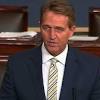
On January 17, Senator Jeff Flake delivered another speech on the Senate floor that lambasted President Donald Trump, this time for his “fake news” tweets and comments.[1] This speech was a sequel to the Senator’s October 24, 2017, speech and Washington Post article rejecting the President’s character and actions.[2] Here is a photograph of the Senator giving the speech.

Senator Flake’s Speech

Near “the beginning of the document that made us free, our Declaration of Independence, Thomas Jefferson wrote: “We hold these truths to be self-evident…” So, from our very beginnings, our freedom has been predicated on truth. The founders were visionary in this regard, understanding well that good faith and shared facts between the governed and the government would be the very basis of this ongoing idea of America.”

“As the distinguished former member of this body, Daniel Patrick Moynihan of New York, famously said: ]Everyone is entitled to his own opinion, but not to his own facts.” During the past year, I am alarmed to say that Senator Moynihan’s proposition has likely been tested more severely than at any time in our history.”

“It is for that reason that I rise today, to talk about the truth, and its relationship to democracy. For without truth, and a principled fidelity to truth and to shared facts, . . . our democracy will not last.”

“2017 was a year which saw the truth – objective, empirical, evidence-based truth — more battered and abused than any other in the history of our country, at the hands of the most powerful figure in our government. It was a year which saw the White House enshrine ‘alternative facts’ into the American lexicon, as justification for what used to be known simply as good old-fashioned falsehoods. It was the year in which an unrelenting daily assault on the constitutionally-protected free press was launched by that same White House, an assault that is as unprecedented as it is unwarranted. ‘The enemy of the people,’ was what the president of the United States called the free press in 2017.”

It “is a testament to the condition of our democracy that our own president uses words infamously spoken by Josef Stalin to describe his enemies. It bears noting that so fraught with malice was the phrase ‘enemy of the people,’ that even Nikita Khrushchev forbade its use, telling the Soviet Communist Party that the phrase had been introduced by Stalin for the purpose of ‘annihilating such individuals’ who disagreed with the supreme leader.”

“This alone should be a source of great shame for us in this body, especially for those of us in the president’s party. For they are shameful, repulsive statements. And, of course, the president has it precisely backward – despotism is the enemy of the people. The free press is the despot’s enemy, which makes the free press the guardian of democracy. When a figure in power reflexively calls any press that doesn’t suit him ‘fake news,’ it is that person who should be the figure of suspicion, not the press.”

“I dare say that anyone who has the privilege and awesome responsibility to serve in this chamber knows that these reflexive slurs of ‘fake news’ are dubious, at best. Those of us who travel overseas, especially to war zones and other troubled areas around the globe, encounter members of U.S. based media who risk their lives, and sometimes lose their lives, reporting on the truth.  To dismiss their work as fake news is an affront to their commitment and their sacrifice.”

According to the International Federation of Journalists, 80 journalists were killed in 2017, and a new report from the Committee to Protect Journalists documents that the number of journalists imprisoned around the world has reached 262, which is a new record. This total includes 21 reporters who are being held on ‘false news” ‘charges.”

So “powerful is the presidency that the damage done by the sustained attack on the truth will not be confined to the president’s time in office.  Here in America, we do not pay obeisance to the powerful – in fact, we question the powerful most ardently – to do so is our birthright and a requirement of our citizenship — and so, we know well that no matter how powerful, no president will ever have dominion over objective reality.”

“No politician will ever get to tell us what the truth is and is not. And anyone who presumes to try to attack or manipulate the truth to his own purposes should be made to realize the mistake and be held to account. That is our job here. And that is just as Madison, Hamilton, and Jay would have it.”

“Of course, a major difference between politicians and the free press is that the press usually corrects itself when it gets something wrong. Politicians don’t.”

“No longer can we compound attacks on truth with our silent acquiescence. No longer can we turn a blind eye or a deaf ear to these assaults on our institutions. . . .  An “American president who cannot take criticism – who must constantly deflect and distort and distract – who must find someone else to blame — is charting a very dangerous path. And a Congress that fails to act as a check on the president adds to the danger.”

“Now, we are told via twitter that today the president intends to announce his choice for the ‘most corrupt and dishonest’ media awards. It beggars belief that an American president would engage in such a spectacle. But here we are.”

“And so, 2018 must be the year in which the truth takes a stand against power that would weaken it. In this effort, the choice is quite simple. And in this effort, the truth needs as many allies as possible. Together, my colleagues, we are powerful. Together, we have it within us to turn back these attacks, right these wrongs, repair this damage, restore reverence for our institutions, and prevent further moral vandalism.”

“Together, united in the purpose to do our jobs under the Constitution, without regard to party or party loyalty, let us resolve to be allies of the truth — and not partners in its destruction.”

“It is not my purpose here to inventory all of the official untruths of the past year. But a brief survey is in order. Some untruths are trivial – such as the bizarre contention regarding the crowd size at last year’s inaugural.”

?But many untruths are not at all trivial – such as the seminal untruth of the president’s political career – the oft-repeated conspiracy about the birthplace of President Obama. Also not trivial are the equally pernicious fantasies about rigged elections and massive voter fraud, which are as destructive as they are inaccurate – to the effort to undermine confidence in the federal courts, federal law enforcement, the intelligence community and the free press, to perhaps the most vexing untruth of all – the supposed “hoax” at the heart of special counsel Robert Mueller’s Russia investigation.”

“To be very clear, to call the Russia matter a ‘hoax’ – as the president has many times – is a falsehood. We know that the attacks orchestrated by the Russian government during the election were real and constitute a grave threat to both American sovereignty and to our national security.  It is in the interest of every American to get to the bottom of this matter, wherever the investigation leads.”

“Ignoring or denying the truth about hostile Russian intentions toward the United States leaves us vulnerable to further attacks. We are told by our intelligence agencies that those attacks are ongoing, yet it has recently been reported that there has not been a single cabinet-level meeting regarding Russian interference and how to defend America against these attacks. Not one. What might seem like a casual and routine untruth – so casual and routine that it has by now become the white noise of Washington – is in fact a serious lapse in the defense of our country.”

The impulses underlying the dissemination of such untruths are not benign. They have the effect of eroding trust in our vital institutions and conditioning the public to no longer trust them. The destructive effect of this kind of behavior on our democracy cannot be overstated.”

Every “word that a president utters projects American values around the world. The values of free expression and a reverence for the free press have been our global hallmark, for it is our ability to freely air the truth that keeps our government honest and keeps a people free. Between the mighty and the modest, truth is the great leveler. And so, respect for freedom of the press has always been one of our most important exports. . . . “

“This feedback loop [from foreign leaders] is disgraceful. . . . Not only has the past year seen an American president borrow despotic language to refer to the free press, but it seems he has in turn inspired dictators and authoritarians with his own language. This is reprehensible.”

“We are not in a ‘fake news’ era, , , , We are, rather, in an era in which the authoritarian impulse is reasserting itself, to challenge free people and free societies, everywhere.”

“In our own country, from the trivial to the truly dangerous, it is the range and regularity of the untruths we see that should be cause for profound alarm, and spur to action. Add to that the by-now predictable habit of calling true things false, and false things true, and we have a recipe for disaster.  As George Orwell warned, ‘The further a society drifts from the truth, the more it will hate those who speak it.’”

“Any of us who have spent time in public life have endured news coverage we felt was jaded or unfair. But in our positions, to employ even idle threats to use laws or regulations to stifle criticism is corrosive to our democratic institutions. Simply put: it is the press’s obligation to uncover the truth about power. It is the people’s right to criticize their government. And it is our job to take it.”

“What is the goal of laying siege to the truth? President John F. Kennedy, in a stirring speech on the 20th anniversary of the Voice of America, was eloquent in answer to that question:

  • ‘We are not afraid to entrust the American people with unpleasant facts, foreign ideas, alien philosophies, and competitive values. For a nation that is afraid to let its people judge the truth and falsehood in an open market is a nation that is afraid of its people.’”

The “question of why the truth is now under such assault may well be for historians to determine. But for those who cherish American constitutional democracy, what matters is the effect on America and her people and her standing in an increasingly unstable world — made all the more unstable by these very fabrications. What matters is the daily disassembling of our democratic institutions.”

“We are a mature democracy – it is well past time that we stop excusing or ignoring – or worse, endorsing — these attacks on the truth. For if we compromise the truth for the sake of our politics, we are lost.” 

“I will close by borrowing the words of an early adherent to my faith that I find has special resonance at this moment. His name was John Jacques, and as a young missionary in England he contemplated the question: “’What is truth’” His search was expressed in poetry and ultimately in a hymn that I grew up with, titled ‘Oh Say, What is Truth. It ends as follows:

  • ‘Then say, what is truth? ‘Tis the last and the first,

For the limits of time it steps o’er.

Tho the heavens depart and the earth’s fountains burst.

Truth, the sum of existence, will weather the worst,

Eternal… unchanged… evermore.’”

Conclusion

The same day as Senator Flake’s speech, Arizona’s other Republican Senator, John McCain, published an op-ed article in the Washington Post with similar criticisms of President Trump.[3] This commentary reminded us of McCain’s criticism of Congress’ ignoring regular procedures over the so-called “repeal and replace” Obama Care bill when McCain killed the bill with his negative vote.[4]

President Trump’s response to these criticisms first came from his Press Secretary, Sarah Sanders, who said, Senator Flake was “not criticizing the president because he’s against oppression. He’s criticizing the president because he has terrible poll numbers and he is, I think, looking for some attention.” Note the ad hominem response and refusal to grapple with the merits.

Later that night the President on Twitter also ignored the substance of these criticisms when he  announced his “fake news” awards to CNN (four times); The New York Times (two times); and ABC, The Washington Post, Time and Newsweek (one time each).[5]

All of these comments reminded me of the struggle between the Washington Post and the Nixon White House over the publication of the Pentagon Papers and the work that is involved in publishing real news, all of which is skillfully portrayed in the current movie, “The Post.”

I commend Senators Flake and McCain for standing up for true American values in their criticisms of the President.

===================================================

[1] Press Release, Flake: Reflexive “Fake News” Claims Not Good For Democracy (Jan. 16, 2018)

[2] Senator Jeff Flake’s Courageous Defense of American Values and Democracy, dwkcommentaries.com (Nov. 6, 2017),

[3]  McCain, Mr. President, stop attacking the press, Wash. Post (Jan. 17, 2018); Sullivan, Arizona’s GOP Senators Assail Trump for His Attacks on the Press, N.Y. Times (Jan. 17, 2018); Reuters, U.S. Senators Rip Trump Over His Attacks on the Media, N.Y. Times (Jan. 17, 2018).

[4] McCain Floor Statement on Need for Bipartisanship (July 25, 2017)

[5] Flegenheimer & Grynbaum, Trump Hands Out ‘Fake News Awards,’ Sans the Red Carpet, N.Y. Times (Jan. 17, 2018).


Cuba and U.S. Continue To Hold Bilateral Meetings on Various Issues

On January 12,  16 and 17, Cuba and the U.S. held bilateral meetings in Washington, D.C. to discuss cybersecurity, criminal matters and terrorism. No mention of these meetings was found in the U.S. State Department website or the U.S. media while the Cuban coverage was very terse.[1]

Cybersecurity

The Cuba Foreign Ministry’s statement briefly said that the parties agreed “on the importance to advance cooperation in this area and . . . to continue holding these technical meetings in the future” and that the “meeting was held in an ambiance of respect and professionalism.”

Criminal Matters

The Cuba Foreign Ministry merely said this “meeting was held in an ambiance of respect and professionalism. Both delegations shared the view on the usefulness of the meeting and agreed to maintain these talks in the future.”

Terrorism

The Cuban Embassy in Washington, D.C. said the meeting’s “purpose was to advance cooperation in this area,” that “both countries agreed on the importance of [such] cooperation” and holding future meetings on the same subject and that “the meeting took place in a climate of respect and professionalism.”

Conclusion

While followers of U.S.-Cuba relations would like to know more about meetings like these, it is good to know that the two countries continue to hold discussions on important issues.

=====================================

[1]  Cuba Foreign Ministry, Cuban and Us Representatives hold meeting on Cybersecurity and the combat against Cybercrimes (Jan. 12, 2018); Cuba Foreign Ministry, Cuban and the United States hold talks on the cooperation in criminal matters (Jan. 16, 2018); Cuban Embassy, Authorities of Cuba and the USA exchange on confrontation with terrorism (Jan. 17, 2018); Washington and Havana talk about ‘prevention and confrontation’ to terrorism, Diario de Cuba (Jan. 18, 2018).

Is Cuba Concealing Bad Economic Data? 

The Cuban government  has not yet released 2016 data on the country’s gross domestic product, exports, money supply and debt even though in June-July 2017 it did release other statistical information. The government even failed to respond to a Reuters question in January 2018 as to when this 2016 information would be released. [1]

Many speculate that this omission is deliberate to facilitate the Cuban government’s claims in late December 2017 that the economy grew in 2017 by 1.6%[2] when Moody’s and the Economist’s Intelligence Unit had projected that the Cuban recession continued in 2017, while the Economic Commission for Latin America and the Caribbean (ECLAC) had projected Cuba would have for 2017 an anemic growth of 0.5%.

“The abnormal delay in macroeconomic indicators for 2016 casts doubt on the official estimate of GDP growth in 2017,” said Carmelo Mesa-Lago , professor emeritus of economics at the University of Pittsburgh and author of numerous books on Cuba’s economy. This opinion was echoed by an anonymous Cuban economist, who said, “Whenever things are bad the response from the government is to hide information.”

=======================================

[1] Frank, Cuban economy even more opaque as data omitted from 2016 accounts, Reuters (Jan. 15, 2018); Havana omits economic data in its 2016 accounts, Diario de Cuba (Jan. 15, 2018); ONE, 2016 Statistical Yearbook of Cuba.

[2]  Cabrisas: The Economy grew 1.6% despite ‘adverse situations,’ Diario de Cuba (Dec. 21, 2017).