Vice President Mike Pence Addresses Disruption and Transformation in the Americas

On May 7, U.S. Department of State co-hosted the 49th Annual Washington Conference on the Americas, which is designed to provide an  opportunity to hear from the most senior-level officials and engage with over 250 business and policy leaders, members of the diplomatic community, and media representatives from throughout the hemisphere. The theme of this year’s Conference was “disruption and transformation in the Americas.”

Vice President Pence’s Speech

At this Conference U.S. Vice President Mike Pence presented the Trump Administration position on these issues.[1] His focus was Venezuela,which he said was “the single greatest source of disruption.”  After reviewing that country’s significant events of the last year, Mr. Pence outlined the following new U.S. actions regarding Venezuela:

  • [At] “the President’s direction, the United States Navy will deploy the USNS Comfort to the Caribbean, Central America, and South America this June. The Comfort will embark on a 5-month humanitarian mission to address the Venezuelan crisis.  The United States military and medical personnel, working alongside their counterparts across the region, will be there to provide medical assistance to communities in need and help relieve countries overwhelmed by the influx of the suffering people of Venezuela.” (However, before it can be deployed from its homeport of Norfolk, Virginia, a staff of doctors, nurses and other medical staff has to be assembled.)
  • The U.S. has “ positioned more than 500 metric tons of food and humanitarian supplies on the Venezuelan border, ready for immediate distribution.  The American people have provided nearly $260 million in aid to support displaced Venezuelans and the host nations that support them so generously.”
  • “If the Supreme Court of Venezuela does not return to its constitutional mandate to uphold the rule of law, the [U.S.] will hold all 25 of its magistrates accountable for their actions.”
  • The U.S. “has sanctioned more than 150 government officials and state-owned businesses loyal to the dictator.”
  • But “these sanctions need not be permanent.” The U.S. “will consider sanctions relief for all those who step forward, stand up for the constitution, and support the rule of law — like General Manuel Cristopher Figuera, the former chief of the Venezuelan intelligence service, who just last week broke ranks with the Maduro regime and rallied to the support of the Venezuelan constitution and the National Assembly.  In recognition of his recent actions in support of democracy and the rule of law, . . .[the U.S.] is removing all sanctions on General Manuel Cristopher Figuera effective immediately.”
  • The U.S. “will help the fledgling Venezuelan democracy regain its footing.  We’ll build a brighter future after Maduro is gone — creating jobs, fighting poverty, and expanding opportunity.”
  • The U.S. “will continue to exert all diplomatic and economic pressure to bring about a peaceful transition of democracy in Venezuela.  But to those who continue to oppress the good people of Venezuela, know this: All options are on the table.

Conclusion

There are at least two items of good news in Vice President Pence’s remarks. First, he did not say anything about any current U.S. plan to use any military force with respect to Venezuela. Second, the hospital ship to be deployed should be helpful to ordinary Venezuelans who have been deprived of adequate medical care.
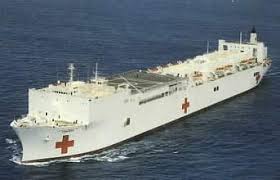
The USNS Comfort (in the above photograph) is a non-commissioned hospital ship owned by the U.S. Navy and operationally crewed by civilians from the Military Sealift Command, consisting primarily of naval officers from the Navy’s Medical Corps, Dental Corps, Medical Service Corps, Nurse Corps and Chaplain Corps, and naval enlisted personnel from the Hospital Corpsman rating and various administrative and technical support ratings When fully staffed it can provide the following services: general surgery, ophthalmologic surgery, dermatology, medical evaluation and treatment, preventive medicine, dental screenings and treatment, optometry screenings, eyewear distribution and public health. In accordance with the Geneva conventions it and its crew do not carry any offensive weapons.[2]

Without referencing Pence’s speech, Spain’s acting foreign minister, Josep Borrell, on May 8 said that Venezuela needs “a peaceful, negotiated and democratic solution” to its problems and that Spain and other European countries “will continue to reject any pressure that borders on military intervention” in Venezuela.”  The U.S. repeated assertion that “all options are on the table” is like “a western cowboy” who is threatening to draw his gun.[3]

Again without specifically discussing the Pence speech, U.S. commentators offer another perspective. They say that Trump “has yet to articulate a coherent theory for when the United States should push for such change and when it should avoid it.” Instead, they say, “Trump’s approach to foreign intervention is largely ad hoc and idiosyncratic — driven less by ideology than by his hunger for foreign policy victories and confidence in his own deal-making skills.”[4]

This “lack of ideological coherence has played to the advantage of Secretary Pompeo and the national security adviser, John R. Bolton, two hawkish officials with strong interventionist tendencies,” who have used hawkish rhetoric regarding Venezuela, Cuba and Iran, for example. “Critics say the disconnect between Mr. Trump and his advisers is confusing the nation’s allies and heightening the risk of a military conflict.” [5]

=============================

[1] White House, Remarks by Vice President Pence at the Washington Conference on the Americas (May 7, 2019); Reuters, U.S. Lifts Sanctions on Venezuelan General Who Broke With Maduro, N.Y. Times (May 7, 2019); Assoc. Press, US to Send Hospital Ship to Help With Venezuelan Refugees, N.Y. Times (May 7, 2019).

[2] Southcom, Hospital Ship USNS Comfort in Latin America; Enduring Promise Medical Assistance MissionUSNS Comfort (T-AH-20), Wikipedia.

[3] Assoc. Press, The Latest: Spain Official: US Like a ‘Cowboy’ on Venezuela, N.Y. Times (May 8, 2019).

[4] Landler, With Mix of threats and Blandishments, Trump Bandies Policy of Regime Change, N.Y. Times (May 8, 2019).

[5] See n. 4 supra. See also U.S. Reactions to Failure of Juan Guiadó’s Attempt To Takeover Venezuelan Government, dwkcommentaries.com (May 6, 2019).


U.S. Reactions to Failure of Juan Guaidò’s Attempt To Take Over Control of Venezuela

Last week saw the failure of an attempt to take over the Venezuelan government by the country’s opposition leader and president of the National Assembly, Juan Guaidó, and U.S. reactions to this development.

Failed Take Over[1]

On Tuesday morning (April 30),  Guaidó, with the support of his mentor (Leopoldo López), the director of the regime’s intelligence agency (Manuel Ricardo Cristopher Figuera Manuel) and some low-ranking soldiers called for other officials and soldiers to join them in attempting to remove President Nicolás Maduro from power. Trump Administration officials—Trump himself plus Vice President Pence, Secretary of State Pompeo and National Security Advisor John Bolton—publicly announced support for what they called “Operaciōn Libertad.”

By sunset that same day, however, it was clear that Mr. Guaidó had failed to persuade the military to rise up against Mr. Maduro. As a result, Leopoldo Lopez and family sought and obtained refuge in the Spanish Embassy while Figuera had fled the country.  The attempted takeover had failed.

Nevertheless, the following Saturday (May 3), Guaidó tried again to enlist Government officials and soldiers to join his movement. Again it failed.

In addition, by the end of the week, Venezuela’s Attorney General publicly announced that  everyone linked to the recent attempted coup had turned themselves into traitors to be prosecuted in accordance with the country’s constitution and laws. Already 18 arrest warrants have been issued, including one for Leopoldo Lopez in the Spanish Embassy.

Trump Administration’s Public Reactions[2]

Before the attempted takeover Secretary of State Mike Pompeo had focused on Russia’s alleged influence over Maduro and repeated that all options, including U.S. military intervention, were still on the table, while President Trump had issued a tweet attacking Cuba for supporting Maduro and promising new economic sanctions on the island.

Immediately after the events of April 30, U.S. National Security Advisor John Bolton and U.S. Special Envoy for Venezuela, Elliott Abrams, publicly accused the Venezuelans minister of defense, Vladimir Padrino López, and two other regime leaders of backing out after having promised to remove Mr. Maduro and support Mr. Guaidó.

On Friday, May 3, President Trump added to this U.S. discombobulation with  a long telephone conversation with Russia’s Vladimir Putin on several topics. Afterwards Trump apparently accepted Putin’s assurances that Russia “is not looking at all to get involved [in Venezuela], other than he’d like to see something positive happen.” Trump added, “”And I feel the same way. We want to get some humanitarian aid. Right now people are starving.” (This statement was obviously contradicted by what Secretary Pompeo and Bolton had been saying and by the Kremlin’s subsequent statement that Putin in his telephone conversation had condemned “outside interference in . . . [Venezuela’s] internal affairs” and added that “attempts to change the government in Caracas by force undermine prospects for a political settlement of the crisis.”)

Nevertheless, on Sunday, May 5, Secretary Pompeo appeared on several national television programs to reiterate the old and now discredited Administration talking points about Venezuela, which he reprised with journalists on his flight later on Sunday to Finland for the Arctic Council Ministerial.

On  ABC’s “This Week”, for example, Pompeo rejected the notion that there had been faulty U.S. intelligence over the apparent failure of Juan Guiadó’s call for a removal of Maduro. The Secretary said, Oh, no, not at all. This is the Venezuelan people attempting to re-establish their democracy. The United States has joined with them. We have supported the National Assembly’s choice. Juan Guaido is the interim president of the country. . . . [These] things sometimes have bumpy roads, to be sure, but Maduro can’t feel good. He’s ruling for the moment, but he can’t govern. There is enormous poverty, enormous starvation, sick children that can’t get medicine. . . . This is not someone who can be part of Venezuela’s future, and whether that change takes place today or tomorrow or a week from now, one can’t predict.”

Pompeo continued on ABC, “Our mission is to work with a large coalition, now 50 countries-plus, who are determined to restore democracy and then ultimately a productive economy to Venezuela. What we can do is provide support, get support from the Organization of American States, the Lima Group, the entire region, that understands that restoring democracy for the Venezuelan people is an imperative, and get them all to work together so that we get the outcome we’re looking for.”

In response to the ABC journalist’s direct question of whether “a U.S. military invasion of Venezuela  [was] really an option?’” Pompeo said, “Oh, make no mistake, we have a full range of options that we’re preparing for. That’s part of what we were doing on Friday [May 3] was making sure that when this progresses and a different situation arises that the President has a full-scale set of options: diplomatic options, political options, options with our allies, and then ultimately a set of options that would involve use of U.S. military. We’re preparing those for him so that when the situation arises, we’re not flat-footed.”

Another direct question on the ABC program was posed as to whether the President believes that he can intervene militarily without getting congressional authorization Pompeo responded, “I don’t want to speak to that. The president has his full range of Article 2 authorities, and I’m very confident that any action we took in Venezuela would be lawful.”General Joseph Dunford

Trump Administration’s Internal Reactions[3]

On May 1 the White House held an emergency session of senior national security advisors for discussion about Venezuela. Their discussions apparently included an “intense debate . . . over whether the U.S. military should be used to raise pressure on Maduro, with senior Pentagon officials warning an armed intervention would be counterproductive.” This meeting included Admiral Craig Faller, Commander of the Southern Command, Acting Defense Secretary Patrick Shanahan and other senior officials, including Marine General Joseph Dunford, Chairman of the Joint Chiefs of Staff; Secretary of State Mike Pompeo; Director of National Intelligence Dan Coats;  National Security Advisor John Bolton and Acting White House Chief of Staff Mick Mulvaney.

Another meeting occurred on Friday, May 3 with the same people.

The Southern Command reportedly has “given the White House an array of options for potential military action. . . . [including] U.S. naval exercises or deployments of warships outside Venezuelan waters, delivery of humanitarian aid into the country, and more military contacts with neighboring countries to try to enlist their support for joint action.” Admiral Craig Faller, the current head of Southern Command, said the Pentagon was also “carefully looking at plans” to expand an embargo on Cuba, as Trump suggested in a tweet this week, to erode Havana’s support for Maduro’s government.”

Evaluation of U.S. Policies Regarding Venezuela[4]

A former senior administration official with deep knowledge of the region described the failed coup as “ the Bay of Pigs II” — a reference to the failed U.S.-backed attempt to invade Cuba and overthrow Fidel Castro in 1961.

Several analysts have said that “the Trump administration has misread the dynamics of the Venezuela crisis. They said the White House underestimated Maduro’s resilience and fostered unrealistic expectations about the ease of regime change, partly by trusting apparently duplicitous Venezuelan military officials.” One of them, Michael Shifter, president of the nonpartisan Inter-American Dialogue, a Washington think tank that specializes in Latin America, said, “They have made a series of terrible miscalculations,”

Shifter added,“The Trump administration’s repeated ultimatums, hints of military intervention and threats to blockade Cuba, all of which could backfire by eroding broad international diplomatic support for the anti-Maduro forces, and by goading the Venezuelan armed forces to rally around [Maduro].”

Another expert on Venezuela in the Washington Office on Latin Ameera, a nonprofit nongovernmental organization, David Smilde, said, “This is characteristic of the neoconservatives who are running foreign policy now. They think they can huff and puff and put forth strong rhetoric … and the foe will back down. But time and again, that doesn’t happen. The sociology of authoritarian governments is far more complex.”

A New York Times editorial correctly summed up the current status. U.S. military intervention, “repeatedly cited as a possibility by Mr. Trump and Mr. Pompeo, remains a terrible idea. However invested the Trump administration is in the ouster of Mr. Maduro, a direct intervention would find little support across a region with bad memories of American meddling, and would brand Mr. Guaidó as an American lackey.”

A different conclusion was reached by a Washington Post editorial. After reciting some of the Maduro regime’s horrible policies and actions, the editorial said, “Therefore, whatever its ultimate outcome or, indeed, its strategic wisdom, Tuesday’s uprising is not a ‘coup attempt,’ as the Maduro regime, echoed by too many people abroad, calls it. Rather, it is the latest in a series of legitimate and, for the most part, nonviolent efforts by Venezuelans, both civilian and military, to throw off an oppressive, toxic regime so that they can freely elect a legitimate government. Supporters of freedom and democracy should stand in solidarity with Mr. Guaidó and the many thousands of Venezuelans now bravely asserting their rights.” However, the editorial concluded, “By working closely with these [six South American nations that are backing Guaidó. . .  , and not by intervening militarily, the Trump administration may increase the chances that Mr. López’s declaration Tuesday — “It’s time to conquer freedom” — proves out.”

Conclusion

These recent events should put the kibosh on the  Southern Command’s “plan” of February 2018 for military invasion of Venezuela, as discussed in a prior post. One can only hope that another result could be the diminution of the influence  or actual ouster, of John Bolton as National Security Advisor.

============================================

[1] Venezuela Crisis: Guaidó Calls for Uprising as Clashes Erupt, N.Y. Times (April 30, 2019); Zuñiga, Faiola & McCoy, Venezuela’s Maduro denies Pompeo’s claim that he sought to escape to Cuba after day of clashes left 1 dead, dozens hurt, Wash. Post (April 30, 2019); Reuters, Trump Threatens ‘Full’ Embargo on Cuba Over Venezuela Security Support, N.Y. Times (April 30, 2019); Rogers, Trump, Seeking to Put Pressure on Maduro, Threatens Full Embargo of Cuba, N.Y. Times (April 30, 2019); Gearon & DeYoung, Trump threatens ‘complete embargo’ and ‘highest-level sanctions’ against Cuba over Venezuela, Wash. Post (April 30, 2019); Shifter & Binetti, Juan Guaidó’s Uprising Failed. What’s Next for Venezuela?, N.Y. Times (May 3, 2019); Fayola, How a plot filled with intrigue and betrayal failed to oust Venezuela’s president, Wash. Post (May 3, 2019); Venezuelan justice will act with weight against coup, says prosecutor, CubaDebate (May 4, 2019).

[2] Landler, Trump Says He Discussed the “Russian Hoax” in a Phone Call with Putin, N.Y. Times (May  3, 2019); Ballhaus & Salama, Trump & Putin Discuss Venezuela, North Korea, Mueller Report, W.S.J. (May 3, 2019); State Dep’t, [Secretary Pompeo] Interview With Jonathan Karl of ABC’s This Week (May 5, 2019); Demirjian & Sonne, Pompeo won’t promise to consult Congress about potential military intervention in Venezuela, Wash. Post (May 5, 2019); State Dep’t, [Secretary Pompeo’s] Interview With Chris Wallace of Fox News Sunday (May 5, 2019); State Dep’t, [Secretary Pompeo’s] Interview With Margaret Brennan of CBS Face the Nation (May 5, 2019); State Dep’t, [Secretary Pompeo’s] Remarks to Traveling Press on Plane (May 6, 2019).

[3] Wilkinson & Cloud, White House scrambles on Venezuela after major setback, Los Angeles Times (May 2, 2019); Assoc. Press, Shanahan, Pompeo and Bolton Meet on Venezuela, N.Y. Times (May 3,2019); Specia, Five Things You Need to Know to Understand Venezuela’s Crisis, N.Y. Times (May 3, 2019).

[4] See n. 3 supra; Editorial, A Treacherous Stalemate in Venezuela, N.Y. Times (May 2, 2019); Editorial, Don’t call it a coup. Venezuelans have a right to replace an oppressive, toxic regime, Wash. Post (April 30, 2019).

U.S. Needs To Cooperate with U.N. Human Rights Experts

The U.N. Human Rights Council, based in Geneva, Switzerland, has what it calls Special Procedures, which are “”independent human rights experts with mandates to report and advise on human rights from a thematic or country-specific perspective. The system of Special Procedures is a central element of the United Nations human rights machinery and covers all human rights: civil, cultural, economic, political, and social. As of 1 August 2017, there are 44 thematic and 12 country mandates.”[1]

Recent U.S. Non-Cooperation with U.N. Human Rights Council

On January 4, 2019, the London-based Guardian newspaper published an article asserting that the Trump Administration “has stopped cooperating with UN investigators over potential human rights violations occurring inside America, in a move that delivers a major blow to vulnerable US communities and sends a dangerous signal to authoritarian regimes around the world.”[2]

More specifically, the Guardian said the U.S. State Department “has ceased to respond to official complaints from UN special rapporteurs, the network of independent experts who act as global watchdogs on fundamental issues such as poverty, migration, freedom of expression and justice. There has been no response to any such formal query since 7 May 2018, with at least 13 requests going unanswered..

In addition, the Trump Administration has not “extended any invitation to a UN monitor to visit the US to investigate human rights inside the country since the start of Donald Trump’s term two years ago in January 2017. (Two UN experts have made official fact-finding visits . . .[since then] – but both had been invited by President Obama].”[3]

The U.S. thereby has now joined the ranks of countries like North Korea, Iran and Eritrea that simply ignore the requests of UN human rights monitors.

 U.S. Senator Menendez Asks for State Department Explanation

Therefore, on April 25, U.S. Senator Robert Menendez (Dem., NJ), the Ranking Member on the U.S. Senate Foreign Relations Committee, sent a letter to Secretary of State Mike Pompeo on this situation. The Senator started his letter by stating, “the work Special Rapporteurs conduct remains one of the international community’s most important tools for promoting and protecting human rights.”[4]

The letter continued,“Under previous Democratic and Republican administrations the United States welcomed visits by UN Special Rapporteurs and regularly responded to official queries, regardless of U.S. participation in the Human Rights Council at the time. Engaging with UN Special Rapporteurs is an essential part of U.S. global leadership and demonstrates our commitment to addressing complex human rights issues and the rule of law both at home and around the globe. The credibility of the work of UN Special Rapporteurs depends heavily on their ability to apply the same international standards to all countries, including democracies.”

“By shutting out UN Special Rapporteurs, the United States risks undermining a foundational value of the United Nations as well as human rights progress globally and will be seen as empowering repressive regimes, like China and Russia, who seek to delegitimize internationally accepted human rights norms. Though the United Nations is an imperfect body, UN Special Rapporteurs play an important role in advancing the fundamental human values traditionally championed by every previous U.S. Administration.”

Therefore, the Senator asked the Secretary to respond to the following questions by May 30, 2019:

1)     “Is there a policy, either formal or informal, in place with regards to responding to queries and visit requests from UN Special Rapporteurs? What is that policy?”

2)     “Since May 7, 2018, has the State Department responded either formally or informally to any queries or visit request from UN Special Rapporteurs? If yes, please provide detailed information, including: which UN Special Rapporteur the Department responded to, the date of last correspondence or engagement, the type of engagement (formal vs. informal) and copies of any formal responses.”

Conclusion

U.S. advocates for human rights here and around the world need to thank Senator Menendez for this request and urge Secretary Pompeo to stop this apparent practice or policy of non-cooperation with these human rights monitors.

=======================================

[1] U.N. Office of the High Commissioner for Human Rights, Special Procedures of the Human Rights Council.

[2] Pilkington, US halts cooperation with UN on potential human rights violations, Guardian (Jan. 4, 2019); Goldberg, US ceases cooperation with UN Human Rights Special Rapporteurs, U.N. Hum. Rts. Council (Jan. 8, 2019).

[3] Apparently after President Trump became President, Philip Alston, the U.N. Special Rapporteur on Extreme Poverty and Human Rights, visited the U.S. by President Obama’s invitation, and Alston’s final report in June 2018 was harshly criticized by U.S. Ambassador to the U.N. Nikki Haley. (See U.N. Official’s Report About U.S. Poverty Is Criticized by U.S., dwkcommentaries.com (June 28, 2018).)

[4] Press Release, Menendez Questions Sec. Pompeo about State Department’s Apparent Decision to Cut Contact with UN Human Rights Experts (April 25, 2019).

New State Department Ethos

On April 26, Secretary of State Mike Pompeo introduced the Department’s new ETHOS or its “operating principles.”[1] They are set forth below along with the Secretary’s explanations.

“I am a champion of American diplomacy.  We need to have the competitive mentality of a team trying to win a championship. Inside the department, we should have a healthy competition of ideas in which the best idea is victorious. And outside of it, we need to win the battle of competing ideologies. Our mission is to champion the American way of life.” Diplomacy is “our DNA; it’s who we are. It’s why we come to work every day. We need to keep this at the forefront of everything that we do.”

“My colleagues and I proudly serve the United States and the American people at the Department of State, America’s first executive department. 

We support and defend the Constitution of the United States.[E]very one of us, when we were sworn in, took an oath to the Constitution. It sets forth the foundational principles of American life. It guarantees our rights. It must guide our work. We have to support and defend it in everything that we do.”

We protect the American people and promote their interests and values around the world by leading our nation’s foreign policy. The “American People: Never forget who it is that we work for. Their interests, not ours, not yours, not those with whom we’re interacting, unless they’re Americans – the American people are whose interests we must protect.”

As a member of this team, I serve with unfailing professionalism, in both my demeanor and my actions, even in the face of adversity. [P]rofessionalism – adhering to a set of common commitments to be best. Professionalism isn’t dependent on position or salary. It’s about disagreeing without being uncivil, and building up our institution, not tearing it down, marching forward as a team.”

“I act with uncompromising personal and professional integrity.[Integrity] integrity. This goes for all of us, every single one. Honesty and trust are absolutely essential to everything that we do, and a high-performing team has never existed without a deep understanding of a common effort to have integrity in everything that we do.”

I take ownership of and responsibility for my actions and decisions. We’re putting an awful lot of effort into ensuring a new focus on personal accountability. Let’s do the job right, let’s hold ourselves accountable, each and every one of us, and hold others around us accountable for their efforts as well.”

I show unstinting respect in word and deed for my colleagues and all who serve alongside of me. We need to make sure we show unfailing respect for each other, simply because we are all human beings created by God. And if we don’t, our mission will splinter. It’ll fall apart.”

=====================================

[1] State Dep’t, One Team, One Mission: Introducing Our Ethos (April 26, 2019).


European and Other Countries’ Reactions to New U.S. Anti-Cuban Policies

Strong objections to the  new U.S. policies regarding Cuba have been registered by Europe and Canada, both major investors in, and having significant business with, Cuba. Russia also objects for more strategic reasons.

Europe and Canada[1]

The EU is the largest foreign investor in Cuba and the latter’s top export market. In December 2016, the EU and Cuba concluded a new framework for boosting economic and trade links that were encouraged by the Obama administration’s efforts to reset relations with Havana. Some European companies, including Spanish hotel chain Meliá Hotels International SA, recently have announced fresh investments there.

Immediately after the U.S. announcement of the activation of Title IIII of the Helms-Burton Act, the EU  by its High Representative/Vice President Federica Mogherini and its Commissioner for Trade Cecilia Malmström) issued this joint statement: “In the light of the United States Administration’s decision to not renew the waiver related to Title III of the 1996 Helms-Burton (LIBERTAD) Act, the European Union reiterates its strong opposition to the extraterritorial application of unilateral Cuba-related measures that are contrary to international law. This decision is also a breach of the United States’ commitments undertaken in the EU-US agreements of 1997 and 1998, which have been respected by both sides without interruption since then. In those agreements, the US committed to waive Title III of the Helms-Burton Act and the EU, inter alia, suspended its case in the World Trade Organization against the US.”

This EU statement added, “The EU will consider all options at its disposal to protect its legitimate interests, including in relation to its WTO rights and through the use of the EU Blocking Statute. [This EU Statute] prohibits the enforcement of US courts judgements relating to Title III of the Helms-Burton Act within the EU, and allows EU companies sued in the US to recover any damage through legal proceedings against US claimants before EU courts.

Canada, whose companies are other major investors in, and conductors of business with, Cuba, also issued an immediate rejection of this U.S. change of policy. Its Minister of Foreign Affairs, Chrystia Freeland, stated, “Canada is deeply disappointed with today’s announcement. We will be reviewing all options in response to this U.S. decision.” She added the following:

  • “Since the U.S. announced in January it would review Title III, the Government of Canada has been regularly engaged with the U.S. government to raise our concerns about the possible negative consequences for Canadians—concerns that are long-standing and well known to our U.S. partners.”
  • “I have met with U.S. Secretary of State Mike Pompeo to register those concerns. Canadian and U.S. officials have had detailed discussions on the Helms-Burton Act and Canada’s Foreign Extraterritorial Measures Act. I have also discussed this issue with the EU.”
  • Finally, “I have been in contact with Canadian businesses to reaffirm we will fully defend the interests of Canadians conducting legitimate trade and investment with Cuba.”

According to EU Ambassador to the U.S., Alberto Navarro, there is “enormous worry” by European businesses.  “There are business people who’ve been . . .[in Cuba] 20, 30 years, who’ve made bets on investing their financial resources in Cuba to stimulate commerce, tourism, international exchange, and many of them tell me that they haven’t lived through a similar situation.” He also said, “”any country can adopt whatever legislation it wants, and apply the law within its own country, we can criticize whether we like it or not. What that country cannot do is impose its legislation on others. We are the front line of defense in Cuba, and obviously have legitimate interests in Cuba and we want to defend them and protect our citizens and our investors.”

The EU and Canada also issued a joint statement that said the U.S. decision would have “an important impact on legitimate EU and Canadian economic operators in Cuba” and that they would seek to use the WTO dispute-resolution framework to protect their companies. This U.S. decision was “regrettable” and an “extraterritorial application of unilateral Cuba-related measures contrary to international law.” It “can only lead to an unnecessary spiral of legal actions.”

The EU and Canada already have so-called blocking statutes against some U.S. sanctions on Cuba, which bans the enforcement of U.S. court judgments against EU and Canadian firms and allows counterclaims to be filed against U.S. firms bringing legal action. However, these blocking statute have rarely been used.

A former Canadian ambassador to Cuba, Mark Entwistle, got it right when he opined that the origins of these new U.S. policies “lie partly in the historic dynamics of American presidential politics and partly in an obsession in some circles about a mythical existential threat posed by the developing Caribbean island nation.”

Moreover, according to Entwistle, the activation of Title III of the Helms-Burton Act “seeks to impose American domestic law on other countries” or attempts “to off-load responsibility to third parties and internationalize what is and should be a bilateral issue between the United States and Cuba.” This is extraterritoriality that “ violates basic sovereignty,”  supposedly highly valued by Trump. This recent Trump decision, however, fits with his scepticism of, if not outright hostility towards,  rules-based multilateral systems.

These sentiments were echoed by EU member, France, whose Finance Minister Bruno Le Maire said Europe would respond to any sanctions by the U.S. on investments in Cuba. “If the American administration decided to also impose a regime of sanctions on investments in Cuba, in contravention of what has been decided for several years now by our American allies, we would react. Europe would also react and is ready to also impose sanctions at our end.”

In Spain, another EU member which has large investments in hotels and other tourism-related ventures on the island, a senior government official said its government  promised that it will ‘absolutely support’ Spanish companies established on the island in the face of the U.S. new policies and that it understands that “the EU will support, together with Spain, those companies that have their commercial activities, legitimate and well organized in Cuba and in other countries.”

Another EU member, Portugal, joined the choir by saying that it “regrets the US decision to authorize the filing of legal actions in its territory [under] . . .Title III of the Helms Burton Law against certain foreign companies operating in Cuba, ” This U.S. decision “reinforces the commercial tension between the [EU] . . .and the United States.”

The United Kingdom’s Foreign Office joined in these objections. It stated, “The extraterritorial application of … sanctions, which we consider to be illegal under international law, threaten to harm UK and EU companies doing legitimate business in Cuba by exposing them to liability in U.S. courts. We will work alongside the EU to protect the interests of our companies.”

Also critical was Ivan Briscoe, the Latin American director for the International Crisis Group, an independent Belgium-based organization “working to prevent wars and shape policies that will build a more peaceful world” and to sound “the alarm to prevent deadly conflict.” He said, John Bolton’s “honoring one of U.S.’ greatest military fiascos from 60 years back [the Bay of Pigs invasion] suggests U.S. policy to Latin America owes more now to a perverse Cold War nostalgia than practical benefits for people of the region.”

Mexico added its objections to the new U.S. measures. It said that it “lamented” the U.S. decision that the government will work to protect Mexican companies that have business interests in Cuba.

Russia[2]

Russia’s Deputy Foreign Minister Sergei Ryabkov considers the new U.S. sanctions against Cuba and Venezuela to be illegal and it plans to do everything to support its allies in these two countries. “Venezuela and Cuba are our allies and strategic partners. We join the voices of those who condemn US impositions on Latin America or any other region of the world.”

A spokeswoman of the Russian Foreign Ministry, Maria Zajárova, added that Moscow “is against any unilateral sanction.”

Conclusion

This blog supports the objections from the EU and its members, including the United Kingdom (still a member), Canada and Mexico. Also deserving special commendation is Ivan Brisco’s rejecting John Bolton’s statement:“honoring one of U.S.’ greatest military fiascos from 60 years back [the Bay of Pigs invasion as suggesting that] U.S. policy to Latin America owes more now to a perverse Cold War nostalgia than practical benefits for people of the region.”

============================================

[1] EU, Joint Statement by High Representative/Vice President Federica Mogherini and Commissioner for Trade Cecilia Malmström on the decision of the United States to further activate Title III of the Helms-Burton (Libertad) Act (April 17, 2019) (his EU Joint Statement was issued shortly after the EU’s Press Release, EU, Latin America and Caribbean: Partnering for prosperity, democracy, resilience and global governance (April 17, 2019)); Assoc. Press, EU Ambassador: Trump Cuba Policy Worries European Companies. N.Y. Times (April 24, 2019); Global Affairs Canada, Government of Canada will defend interests of Canadians doing business in Cuba  (April 17, 2019); Entwistle, The Trump Administration’s new Cuba restrictions are harmful and belligerent, Toronto Globe & Mail (April 19, 2019); Anchfield, Canada pushes back against U.S. move to allow lawsuits against foreign firms in Cuba, Toronto Globe & Mail (April 27, 3029); Norman & McBride, EU, Canada Vow to Fight New U.S. Sanctions on Cuba,  W.S.J. (April 17, 2019); The European Union could prohibit the application of Judgments of US courts against their companies, Diario de Cuba (April 17, 2019); Reuters, Europe Would Respond to Any U.S. Sanctions on Investments in Cuba: French Minister, N.Y. Times (April 18, 2019); Madrid promises to ‘defend” the interests of Spanish companies in Cuba, Diario de Cuba (April 17, 2019); Parra, Spain wants EU to challenge US policy in Cuba, Wash. Post (April 17, 2019); Portugal: Application of Helms-Burton reinforces commercial tension between the European Union and the US, Cubadabate (April 20, 2019); Reuters, UK Condemns U.S. Application of Cuba Sanctions to Foreign Companies, N.Y. Times (April 18, 2019); Reactions: Canada and Mexico promise to protect their companies in Cuba,  Diario de Cuba (April 18, 2019); Reuters, Trump’s Cuba Hawks Try to Squeeze Havana Over Venezuela Role, N.Y. Times (April 18, 2019); Gómez, What antidotes are there against Helms-Burton?, Cubadebate (April 25, 2019) (details about these laws against Helms-Burton Act: 1996 EU Statute of Blockade, the 1996 Canadian Foreign Extraterritorial Measures Act, the 1996 Mexico Law on Protection of Trade and Investment of Foreign Standards that Contravene International Law and the 1996 Cuba Law of Reaffirmation of Cuban Dignity and Sovereignty (Law 80)).

[2] Reuters, Russia Says It Will Help Venezuela, Cuba to Weather U.S. Sanctions: RIA, N.Y. Times (April 18, 2019); Assoc. Press, Putin Envoy in Caracas Rejects US Revival of Monroe Doctrine, N.Y. Times (April 18, 2019).


Additional State Department Briefing on Helms-Burton Changes

A prior post discussed the changes in U.S. implementation of Title III of the Helms-Burton Act that were announced on April 17 by Secretary of State Mike Pompeo and discussed by an Assistant Secretary of State. That same day an unidentified senior official of the Department held a briefing for journalists, apparently at the U.S. Embassy in Havana. Here are highlights of that briefing.[1]

General Comments on Helms-Burton Act

“[U]nder Title III, Congress gave U.S. nationals with a claim to confiscated property in Cuba the right to file a lawsuit against the people or companies who were trafficking in that property.  But for more than 22 years, U.S. Presidents or Secretaries of State have suspended American’s rights under Title III which Congress authorized when both necessary to U.S. national interests and necessary to expedite a transition to democracy in Cuba.”

“Now our decision on Title III is fundamentally related to the actions of the Cuban regime.  After suspending Title III for more than 22 years in a row we still have not seen Cuba transition to democracy.  In fact the opposite is true.  Cuba shows no sign that it will achieve democracy in the near future as the repressive political situation in Cuba has persisted.  And even under a new leader in Cuba, nothing has fundamentally changed.  The recent illegitimate constitutional referendum on February 24th simply entrenched the one-party rule in Cuba, and of course the human rights situation in Cuba remains abysmal.”

“But not only has the situation in Cuba worsened, Cuba also actively undermines democracy in the region as a whole.  We’ve seen it export dictatorship, export torture, export arbitrary detentions, and export the harassment and intimidation of dissidents and opposition factors.  And in all of these actions Cuba continues to prop up the former Maduro regime which denies Venezuelans their right to self-determination.”

“So under the Trump administration U.S. policy towards Cuba will reflect reality.  Twenty-two years of suspending Title III has failed to advance the goal set forth by the legislation in the first place.  Secretary Pompeo’s decision today recognizes the truth of that failure and enacts Congress’ common sense policy to starve the Cuban regime of the wealth it needs to hold onto power while simultaneously supporting the people of Cuba.”

“So ending the suspension of Title III sends a strong signal against trafficking in these confiscated properties as well as opens a path for U.S. claimants whose property was confiscated by the Cuban regime to seek compensation.”

“[S]tarting with NSPM5 [National Security Presidential Memorandum], this administration has made clear its intent on holding the Cuban regime accountable for repression on the island and maligned activity overseas, while at the same time supporting the Cuban people.  And this administration will not allow those trafficking in confiscated property off the hook for their complicity in the regime’s malign behavior.”

“The purpose of the legislation as it was originally passed was to ensure that there was justice for those who had their property illegally confiscated by the Cuban regime.  So of course any European company, any American company, any company around the world that traffics in property that was confiscated by the regime does have the possibility of being hit by this legislation.”

“So I wouldn’t be comfortable giving an assessment on how many companies that applies to, but the LIBERTAD Act also does include certain conditions and requirements to bring an action under Title III.  So in that instance we advise potential plaintiffs to consult with legal counsel.”

Impact of U.S. Changes on Europe

“{O]ou relationship with our partners in Europe is very critical to this administration.  We’ve consulted with them numerous times.  We’ve taken into account their considerations and their concerns. . . . we all agree on the broader strategy to promote democracy and human rights in Cuba.  There is some disagreement on the tactics to get there.”

“[W]hether the Europeans would be taking this to the World Trade Organization, I would just defer to them on their response and what their actions will be, and just simply reiterate that we here are implementing the laws passed by Congress.”

“With this . . . implementation of this legislation we are not targeting any specific countries or specific companies.  The Secretary has made very clear that this is a decision not to waive, that has no exceptions.  So there is no direct targeting reflected here.”

“And in terms of the broader message that we’re trying to communicate writ large, it is the administration’s continued focus on holding the Cuban regime accountable for human rights abuses, and again, simultaneously supporting the people of Cuba in their fight for democracy. [No response to question about impact on Russia.]

“[T[his administration is very committed and clear-eyed in its focus on bringing human rights to Cuba.  This decision is part of a long trajectory that started with NSPM5 and continues with the Cuba restricted list with this decision.  I think you will continue to see decisions and announcements from this administration up to and until a moment when we have democracy in Cuba.” [No response to question about possible re-designation of Cuba as a State Sponsor of Terrorism.]

Cuba and Venezuela

“We have already begun to undertake a number of actions when it comes to Cuba’s role in Venezuela.  As mentioned, this is based [on] . . . the Cuban regime’s activities, both inside Cuba as well as its actions inside Venezuela.”

So we have been very clear on our intent to ratchet up that pressure.  We’ve also been clear that we’re monitoring the impact, the recent suspensions had on bringing about meaningful reform in Cuba.  And we have seen none of those things”

“{T]his is administration has already come out with a number of sanctions and designations specifically related to Cuba’s, the relationship between Cuba and Venezuela, so that again is an indication that we are willing to ratchet up the pressure with respect to Cuba’s foreign intervention in that country.”{

We would agree, there definitely is military intervention in Venezuela.  It’s not on the part of President Juan Guaido or the United States.  It is uniquely on the part of former regime leader Nicolas Maduro, the Cubans, the Russians, and the Iranians.  It is something that we do not accept.  The Lima Group recently announced that they do not accept this intervention.  It is against all of the principles of non-intervention that are held so dear to the people of the Western Hemisphere.  So we absolutely agree with that assertion.”

“We have no tolerance or patience for the recent landing of Russian military personnel inside Venezuela.  We have no tolerance or patience for the way the Cuban regime treats the people of Venezuela, how it props up the Maduro regime, how it provides repression training and tactics to Sebin and others.  So accordingly we are and will continue to take action.”

“We know that there are Cuban military and intelligence services present in Venezuela.  It is widely known both inside and outside of Venezuela that these officers are deeply entrenched in the Venezuela state.  They are the ones providing physical protection and other support directly to Maduro and to the inner circle.  And Maduro himself has made no secret of his partnership with the Cuban armed forces’

In October 2018 Maduro celebrated the deployment of Cuban Special Forces units which were called the Black Wasps, to the Venezuelan-Colombia border for provocative military exercises, and we’ve seen publicly the provocative actions undertaken by the Russians in recent weeks as well.”

In terms of the next steps that we can do, . . . on April 12th the United States sanctioned four companies for operating in the oil sector of the Venezuelan economy and identified nine vessels as blocked properties pursuant to an Executive Order.  Those actions were themselves a follow-on to previous designations and identifications announced earlier in the month which targeted entities and vessels known to be involved in the transportation of crude oil from Venezuela to Cuba.”

All “of these actions are aligned with our broader Venezuela strategy which seeks to hinder the former Maduro regime’s ability to line its pockets with the profits from natural resources that properly belong to the people of Venezuela but that Maduro himself steals.  And it’s also very consistent with our policy approach when it comes to Cuba, which is making sure that we are again holding the regime accountable for its abuses, both inside the country as well as its abuses outside the country.”

Potential Claims for Expropriated Cuban Property

The U.S. “ Foreign Claims Settlement Commission has certified nearly $2 billion worth of claims.  That doesn’t include possible interest.  The United States did an assessment, . . .in 1996, where we saw that there were over 6,000 certified claims.  However,  . . . [today’s] determination is not specifically focused only on certified claims . . . [and] there could be as many as 200,000 certified claims [and] uncertified claims.  That’s why we can’t give a concrete assessment of exactly how many companies or how much money this would entail.  However it’s possible that it could be in the tens of billions of dollars.”

“Title IV  [of the Helms-Burton Act] was never suspended, and what I can say is that we are going to be ramping up investigations in that space as well.”

Conclusion

Exceedingly important facts are ignored by the U.S. cancelling further waiver of Title III of the Helms-Burton Act, by the U.S. current discussion of the claims by U.S. nationals for Cuba’s expropriation of their property on the island, by the above comments by a State Department official as well as Secretary Pompeo’s April 17 announcement of the changes regarding the Act and by the subsequent briefing by Assistant Secretary Breier, as set forth in a prior post.

First, Cuba has consistently recognized that it has an obligation under international law to pay fair compensation for all property that was expropriated in the early years of the Cuba Revolutionary Government. [2]

Second, Cuba has negotiated and paid such expropriation claims by claimants from other countries. [2]

Third, during  the Obama Administration in 2015-2016 held bilateral meetings with Cuba in Washington, D.C. and Havana on many issues that had accumulated during the 50-plus years of U.S.-Cuba estrangement. One such subject was compensation for U.S. claimants for expropriated property. However, there was no resulting agreement on this and many other subjects. I suspect this was due to the complexity of these many issues, potential U.S. political difficulties in approving any such settlement and Cuba’s lack of money to pay such U.S. claims. [2]

Fourth, as a result, this blog has proposed, in an earlier post, that the U.S. and Cuba should agree to an international arbitration over this and other U.S. and Cuba damage claims. (Remember every Fall at the U.N. General Assembly Cuba alleges large amounts of damages from the U.S. embargo when the Assembly overwhelmingly approves Cuba’s resolution condemning that U.S. embargo and this Cuba claim would also be part of the arbitration.) This is a peaceful, responsible way to settle these claims, and frequently in U.S. litigation over large, competing claims, settlements frequently occur after the parties become further educated about the merits and risks of such claims.

The current U.S. bluster over the Helms-Burton Act totally fails to recognize this solution to the issue of compensation of U.S. nationals for expropriation of their property in Cuba.

============================================

[1] U.S. Embassy in Cuba, Telephonic Press Briefing with Senior State Department Official  on the U.S. Policy Towards Cuba (April 17, 2019).

[2] See posts listed in the “U.S. (Obama) & Cuba (Normalization), 2015” and “U.S. (Obama) & Cuba (Normalization), 2016” sections of List of Posts to dwkcommentaries–Topical: CUBA.


State Department’s Announcement of New Sanctions Against Cuba

On April 17, the U.S. announced new sanctions against Cuba. The major change was eliminating the waiver of Title III of the Helms-Burton (LIBERTAD) Act allowing U.S. litigation by U.S. owners of Cuban property that was expropriated by the Cuban government in the early years of the Cuban Revolution. This Act also allows the U.S. to deny or revoke U.S. visas to any person or corporate officer “involved in the confiscation of property or trafficking in confiscated property,” as well as their family members.[1]

State Department’s Announcement of Sanctions[2]

The State Department made the official announcement of this change in remarks to the Press by Secretary of State Mike Pompeo, who said the following:

  • “In 1996, Congress passed the Cuban Liberty and Democratic Solidarity Act, also known as Libertad. Until Title III of that act, United States citizens who had their property confiscated by the Castro regime were given the right to file suit against those who traffic in such properties.”
  • “But those citizens’ opportunities for justice have been put out of reach for more than two decades. For now more than 22 years, every president, every secretary of state has suspended Title III in the hope that doing so would put more pressure on the Cuban regime to transition to democracy.”
  • The “Trump administration recognizes reality. We see clearly that the regime’s repression of its own people and its unrepentant exportation of tyranny in the region has only gotten worse because dictators perceive appeasement as weakness, not strength.”
  • “President Obama’s administration’s game of footsy with the Castros’ junta did not deter the regime from continuing to harass and oppress the heroic Ladies in White, a group of women dedicated to peacefully protesting the regime’s human rights abuses.”
  • “More broadly, the regime continues to deprive its own people of the fundamental freedoms of speech, press, assembly, and association. Indeed, according to NGO reports, Cuban thugs made more than 2,800 arbitrary arrests in 2018 alone. In the run-up to the country’s recent sham constitutional referendum, one that enshrined the Communist Party as the only legal political party in Cuba, the regime harassed, beat, and detained leaders and – opposition leaders and activists. Three hundred and ten people were arbitrarily detained according to the Cuban Commission on Human Rights and National Reconciliation.”
  • “Cuba’s behavior in the Western Hemisphere undermines the security and stability of countries throughout the region, which directly threatens United States national security interests. The Cuban regime has for years exported its tactics of intimidation, repression, and violence. They’ve exported this to Venezuela in direct support of the former Maduro regime. Cuban military intelligence and state security services today keep Maduro in power.”
  • “Sadly, Cuba’s most prominent export these days is not cigars or rum; it’s oppression. Detente with the regime has failed. Cozying up to Cuban dictators will always be a black mark on this great nation’s long record of defending human rights.”
  • “For these reasons, I’m announcing that the Trump administration will no longer suspend Title III. Effective May 2nd, . . . the right to bring an action under Title III of the Libertad Act will be implemented in full. I have already informed Congress of my decision.”
  • “Implementing Title III in full means a chance at justice for Cuban Americans who have long sought relief for Fidel Castro and his lackeys seizing property without compensation. For the first time, claimants will be able to bring lawsuits against persons trafficking in property that was confiscated by the Cuban regime. Any person or company doing business in Cuba should heed this announcement.”
  • “In addition to being newly vulnerable to lawsuits, they could be abetting the Cuban regime’s abuses of its own people. Those doing business in Cuba should fully investigate whether they are connected to property stolen in service of a failed communist experiment. I encourage our friends and allies alike to likewise follow our lead and stand with the Cuban people.”
  • “As I said throughout my trip to South America this last week, the Trump administration is committed to helping grow the wave of democracy, good governments, and openness, which is steadily building throughout the entire Western Hemisphere. On my trip last week, I saw these positive changes firsthand, and told our friends and allies that we’re with them. We’re on the side of what’s right and what is just.”
  • “Today we are holding the Cuban Government accountable for seizing American assets. We are helping those whom the regime has robbed get compensation for their rightful property. And we’re advancing human rights and democracy on behalf of the Cuban people.”

Immediately after the Secretary’s remarks, Kimberly  Breier, Assistant Secretary of State for Western Hemisphere Affairs, responded to journalists’ questions. Here are her significant responses:

  • “[O]bviously we’ve been in very deep and close contact with our allies in Europe and Canada and around the world as we consulted on this decision over the past several months as the Secretary had been shortening the period of suspension with his previous decisions. I think it’s clear if you look in the macro sense we have broad agreement with our allies in Europe and Canada and around the world on the policy objective, which is to promote democracy in Cuba and to free the Cuban people from the tyranny that they live under.”
  • “We are in broad agreement on this. Where we sometimes disagree is on the best way to achieve that. And I think at the end of the day, you’ll need to speak to the European Union and to our allies as to what response they will have, but I would like to emphasize that European companies that are operating in Cuba will have nothing to worry about if they are not operating on property that was stolen from Americans post-revolution. So I think the vast number of European companies will not have any concerns operating in Cuba.”
  • We “took a decision today based on our laws and our sovereign concerns for the property of American citizens and Europeans will respond as they see fit, and we will continue to work closely with them on this policy and on the policy in Venezuela.”
  • The “decision today is part of the trajectory that started with the Trump Administration’s NSPM-5, which was announced in June of 2017.[3]The objective of that was . . . to support the Cuban people and to deny resources to the regime, and in particular to the security services in Cuba. So this is part of a trajectory. We have since published a Cuba restricted list. We have since amended the restricted list several times, and this is part of the trajectory of the administration trying to ensure that we support the people of Cuba and not the regime of Cuba.”
  • The “Secretary’s decision was about the actions of the Cuban regime; certainly, the actions of the Cuban regime in Venezuela are part of the context of the moment in which we are living. And we are very clear, and . . . the Lima Group, which is a group of 12 countries in the Western Hemisphere, for the very first time this week announced its concern over Cuba’s role in Caracas and made public its concern, and called on the Cuban regime to support the transition in Caracas. So I think it’s a very important moment in our relations in the hemisphere as well.”
  • Over “the past two years building off of NSPM-5 and looking at the various tools that we have to implement the President’s vision for how we would conduct this policy. I think you’re going to be seeing quite a bit more from us, and that this is the beginning of a new process on this that recognizes the reality on the ground in Cuba, which is in the past 20-plus years the underlying reality in Cuba has not changed for the average Cuban..[There was no direct response to the question about whether the U.S. was considering t returning Cuba to the State Sponsors of Terrorism list.[4]]
  • “There will not be any exemptions [from this new sanction for any U.S. company doing business in Cuba].” (Emphasis added.)
  • The “Foreign Claims Settlement Commission . . . has certified nearly 6,000 claims for property confiscated in Cuba with a total value of approximately 2 billion. With interest, we believe that value is somewhere in the $8 billion range. The most recent estimate we have from 1996, at the time that the law was enacted, that there could be up to 200,000 uncertified claims that were not certified by the Foreign Claims Settlement Commission, and that value could very easily be in the tens of billions of dollars. But it will depend on, of course, whether claimants decide to pursue legal cases or not.”[5]

The day before the official announcement in an embargoed briefing for journalists, an unidentified senior State Department official said that foreigners who have been trafficking in such properties  have “had over 20 years of profiting from property stolen from American citizens.”

Hints of This and Other Anti-Cuba Measures[6]

For the last several weeks the Administration has been hinting that more anti-Cuba measures were coming.

One such  hint came from Vice President Mike Pence at a U.N. Security council meeting on April 10, when he said, “For decades, Cuba has tried to create client states across our region.  While normal countries export goods, Cuba exports tyranny and strong-arm tactics.  Even now, Cuban military and intelligence services train and support and equip Venezuela’s secret police as they silence opponents, jail and torture members of the opposition.” Pence added, “Last week, the United States took action to sanction ships transporting Venezuelan oil to Cuba.  And soon, at President Trump’s direction, the United States will announce additional action to hold Cuba accountable for its malign influence in Venezuela.” (Emphasis added.)

 Two days later, President Trump issued his Proclamation on Pan American Day and Pan American Week, which said, in part, “Sadly, the people of Cuba, Venezuela, and Nicaragua continue to live under tyranny and authoritarianism.  The brutality and corruption of the illegitimate former regime in Venezuela has crippled the country and brought it to ruin.  We must not forget that the struggle is one between dictatorship and democracy, between oppression and freedom, and between continued suffering for millions of Venezuelans and an opportunity for a renewed future of freedom and prosperity.  The community of democracies in our Western Hemisphere must continue to support the people of Venezuela, Cuba, and Nicaragua as they fight for the restoration of democracy and liberty. (Emphases added.)

Another tip came from the State Department when it announced that  that the U.S. was adding four companies and nine vessels  to the list of Venezuelan companies  that were sanctioned for transporting oil to Cuba.[7] The Department also said the U.S.“will continue to do all we can to stand up against Cuba’s support for the former Maduro regime and its hostility to the Venezuelan people’s aspiration to a peaceful, prosperous, democratic future. Cuba’s intervention only seeks to delay the inevitable—the peaceful transition back to freedom and democracy that is underway in Venezuela, led by the Venezuelan people, Interim President Juan Guaido, and the National Assembly.”  (Emphasis added.)

Another hint came directly from Secretary Pompeo on April 14 in a speech in Cucata, Colombia, when he said, “ “Cubans must understand too that there will be cost associated with continued support of Nicolas Maduro.”  (Emphasis added.)

Conclusion

Later the same day (April 17), U.S. National Security Advisor John Bolton in a speech in Miami addressed these new sanctions and other santi-Cuba measures that will be discussed in a subsequent post. Another post will review the responses to these new measures from the U.S., Cuba, Europe and Canada.

=================================

[1]  Baker, Trump to Increase Pressure on Cuba by Lifting Lawsuit Limits, N.Y. Times (April 16, 2019); Reuters, In Major Shift, Trump to Allow Lawsuits Against Foreign Firms, N.Y. Times (April 16, 2019); Assoc. Press, Trump to Allow Lawsuits Over US Properties Seized in Cuba, N.Y. Times (April 16, 2019); DeYoung, Trump administration will allow U.S. citizens to sue over property seized after 1959,  Wash. Post (April 16, 2019).

[2] State Dep’t, [Secretary Pompeo’s] Remarks to the Press (April 17, 2019); State Dep’t, Briefing With Assistant Secretary for Western Hemisphere Affairs, Kimberly Breier (April 17, 2019).

[3] NSPM refers to National Security Presidential Memorandum on Strengthening the Policy of the United States Toward Cuba (June 16, 2017). See President Trump Announces Reversal of Some Cuba Normalization Policies, dwkcommentaries.com (June 19, 2017).

[4] See posts listed in the “Cuba: State Sponsor of Terrorism?” section of List of Posts to dwkcommentaries—Topical: CUBA.

[5]  See Resolution of U.S. and Cuba Damage Claims, dwkcommentaries.com (April 6, 2015).

[6] White House, Remarks by Vice President Pence at a Special Session of the United Nations Security Council  on the Crisis in Venezuela/New York, NY (April 10, 2019); White House,  Proclamation on Pan American Day and Pan American Week (April 15, 2019); State Dep’t, The United States Takes Action To End Cuba’s Malign Influence on Venezuela (April 12, 2019).


Another Two Week Suspension of Title III of the Helms Burton Act

On April 3, the U.S. Department of State stated, “Today, Secretary of State Michael R. Pompeo announced his decision to continue for two weeks, from April 18 through May 1, 2019, the current suspension with an exception of the right to bring an action under Title III of the 1996 Cuban Liberty and Democratic Solidarity (LIBERTAD) Act. The current suspension expires April 17.” The statement also noted that the  Suspension does not apply to: the “right to bring an action against a Cuban entity or sub-entity identified by name on the State Department’s List of Restricted Entities and Sub-entities Associated with Cuba (known as the Cuba Restricted List), as may be updated from time to time.“ [1]

The Department’s statement added, “The Department continues to examine human rights conditions in Cuba, including ongoing repression of the rights of the Cuban people to free speech, free expression and free assembly. The Department is also monitoring Cuba’s continued military, security, and intelligence support to Nicolas Maduro, who is responsible for repression, violence, and a man-made humanitarian crisis in Venezuela.” Therefore, “We encourage any person doing business in Cuba to reconsider whether they are trafficking in confiscated property and abetting the Cuban dictatorship.”

Comments at U.S. Reception Honoring NATO

Perhaps this U.S. statement was made at this time because the U.S. was hosting a celebration of NATO’s 70th anniversary with representatives of other NATO members, many of whom object to the prospect of U.S. litigation against foreign firms for using Cuban property formerly owned by U.S. nationals. [2]

One prominent spokesman of such objections was Spain’s Foreign Minister Joseph Borrell, who said his country “has told the U.S. administration that Spain is concerned about Washington’s potential decision to allow U.S. citizens to sue foreign firms doing business in Cuba.” The Spanish message included “its firm rejection, as a matter of principle, to the extraterritorial application of national sanction laws, considering it contrary to international law,” This was the Foreign Minister’s message on April 1 to U.S. Secretary of State Mike Pompeo and on April 3 to U.S. National Security Advisor John Bolton.[3]

Canadian Foreign Minister Cryslia Freeland also met with Secretary Pompeo on this occasion and told him that “the Government of Canada will defend the interests of Canadians conducting legitimate trade and investment with Cuba, if the United States enforces Title III of the Helms-Burton Act.” [4]

 Cuba’s Reactions [5]

After the announcement of the new two-week suspension, Cuba Foreign Minister Bruno Rodriguez issued the following two tweets:

  • The first said (per Google Translate), “I reject the announcement of . . . [Secretary Pompeo] about #HelmsBurton law, an aberration that should never have existed. [It] violates International Law, damages all #Cuba, each family. 191 countries claim to be eliminated in its entirety. US aggression against #Venezuela must cease without further pretexts.” ·
  • The second (again per Google Translate) said the following: “The Helms-Burton Act is not applicable in #Cuba or against Cubans or foreigners. It’s “Monroeist” [Monroe Doctrine] domination purpose arouses the overwhelming rejection of the international community. The new measures are isolating the #US even more. They will fail to achieve their goals.”

Cuba’s President, Miguel Díaz=Canel, also tweeted on this development. He said (per Google Translate): “We reject the #EEUU announcement on #HelmsBurton law. They persist in the threats, with arrogance they pose a genocidal law that violates International Law, condemns #Cuba and Cuban families. 191 countries demand [in U.N. General Assembly] that it be eliminated in its entirety. #SomosCuba”

========================================

[1] State Dep’t, Secretary Pompeo Extends for Two Weeks Title III Suspension with an Exception (LIBERTAD Act) (April 3, 2019).

[2] State Dep’t, Remarks at the Reception to Celebrate NATO’s 70th Anniversary (April 3, 2019); State Dep’t, Briefing on the Upcoming NATO Ministerial (April 2, 2019).

[3] Reuters, Spain Rejects Possible U.S. Lawsuits Against Foreign Firms in Cuba, N.Y. Times (April 3, 2019); Guimōn,  The US repeals and prolongs the suspension of a law that would toughen the embargo on Cuba, El Paīs (April 3, 2019).

[4] Gomez,  Canada will defend its investments in Cuba if the United States applies title III of Helms-Burton, CubaDebate (April 4, 2019); Readout of Foreign Affairs Minister’s meeting with U.S. Secretary of State, Global Affairs Canada (April 4, 2019).

[5] Havana rejects the new partial suspension of the Helms-Burton, DiariodeCuba (April 4, 2019).


Latest U.S. Report on Cuban Human Rights

On March 13, the U.S. Department of State released its 43rd annual report on the human rights record  for 2018 of 191 other countries (the U.S. is not included). This report is submitted to the Congress, pursuant to Sections 116(d) and 502B(b) of the Foreign Assistance Act of 1961. Sections 2464, 2467 of that Act also require that U.S. foreign and trade policy take into account countries’ human rights and worker rights performance. [1]

The Report’s Preface

“The United States was founded on the premise that all persons “are created equal, that they are endowed by their Creator with certain unalienable Rights, that among these are Life, Liberty and the Pursuit of Happiness.” Our Constitution secures these unalienable rights by proclaiming in the First Amendment that “Congress shall make no law respecting an establishment of religion, or prohibiting the free exercise thereof; or abridging the freedom of speech, or of the press; or the right of the people peaceably to assemble, and to petition the Government for a redress of grievances.” The Fifth Amendment also sets out that no person shall “be deprived of life, liberty, or property, without due process of law.” These same concepts were adopted internationally in the Universal Declaration of Human Rights, particularly in Articles 3, 10, 12, 18, 19, and 20.”

“The founders of the United States and the delegates to the UN Commission on Human Rights recognized that these fundamental freedoms of religion or belief, expression, peaceful assembly and association belong to every human being. These freedoms are not granted by governments but are derived from the inherent dignity of the human person. Nor may they be unduly restricted by governments even to further some economic, social, or cultural purpose. They are unalienable.”

“Governments are charged with ensuring that the government itself does not wrongfully interfere with human rights and fundamental freedoms.”

“Those sovereign states with which we have the closest, most long-standing, and productive collaboration are those where the government generally respects human rights, including the freedoms of religion or belief, expression, peaceful assembly, and association and do not engage in gross violations of human rights such as extrajudicial killing, torture, and extended arbitrary detention. Conversely, the states that threaten regional stability, are state sponsors of terrorism, or become inviting targets for terrorist recruitment almost invariably are states with governments that fail to respect the unalienable rights of those within their borders.”

“The policy of this Administration is to engage with other governments, regardless of their record, if doing so will further U.S. interests. At the same time, we recognize that U.S. interests in the enduring stability, prosperity, and security of a world filled with strong, sovereign states will only be served if governments respect human rights and fundamental freedoms. To that end, individuals seeking reforms to end the wrongful interference in the exercise of unalienable rights – whether those individuals are in or out of government – will find a sympathetic friend and strong supporter in the United States of America.”

Executive Summary of the Report on Cuba [2]

“Cuba is an authoritarian state led by Miguel Diaz-Canel, president of the Council of State and Council of Ministers, with former president Raul Castro serving as the first secretary of the Communist Party (CP). Cuba has a one-party system in which the constitution recognizes the CP as the only legal party and the highest political entity of the state. On March 11, citizens voted to ratify a preselected list of 605 candidates to the National Assembly. A CP candidacy commission prescreened all candidates, and the government actively worked to block non-CP approved candidates from the ballot. On April 19, the National Assembly elected Diaz-Canel president of the Council of State and Council of Ministers. Neither the legislative nor the national elections were considered to be free or fair.”

“The national leadership, including members of the military, maintained effective control over the security forces.”

“Human rights issues included reports of an unlawful and arbitrary killing by police; torture of political dissidents, detainees, and prisoners by security forces; harsh and life-threatening prison conditions; arbitrary arrest and detention; holding of political prisoners; and arbitrary or unlawful interference with privacy. The government engaged in censorship, site blocking, and libel is criminalized. There were limitations on academic and cultural freedom; restrictions on the right of peaceful assembly; denial of freedom of association, including refusal to recognize independent associations; and restrictions on internal and external freedom of movement and on political participation. There was official corruption, trafficking in persons, outlawing of independent trade unions, and compulsory labor.”

“Government officials, at the direction of their superiors, committed most human rights abuses and failed to investigate or prosecute those who committed the abuses. Impunity for the perpetrators remained widespread.”

Cuba’s Response [3]

Later the same day Cuba Foreign Minister, Bruno Rodriguez, ignored the above criticisms of Cuba and instead lambasted the U.S. in the following tweet:

  • “USA lacks moral authority in matter of [human rights]. It is a global repressor. Discriminates against minorities, makes the poor poorer, deprives millions of citizens to vote, violates the [human rights] of migrants and abundant cases of sexual abuse of minors in custody of the authorities.”

====================================

[1] State Dep’t, 2018 Country Reports on the Human Rights Practices (Mar. 13, 2019); State Dep’t, [Secretary Pompeo]: Remarks on the Release of the 2018 Country Reports on Human Rights Practices (Mar. 13, 2019).

[2] State Dep’t, Country Reports on Human Rights Practices for 2018: CUBA (Mar. 13, 2019).

[3] Bruno Rodriguez: The United States lacks the moral to speak about human rights, Cubadebate (Mar. 13, 2019).

Venezuelan Power Outage Causes New Crisis

On March 7 Venezuela had a major electrical power outage that continues to this day. On March 11 this outage resulted in harsh words and actions by the United States, Cuba and Venezuela. When and how it will end, the public does not know.

Secretary Pompeo’s Morning Comments [1]

On the morning of March 11, U.S. Secretary of State Mike Pompeo at a press conference at the State Department said Cuba and Russia “have played [a central role] and continue to play in undermining the democratic dreams of the Venezuelan people and their welfare.” He followed with these comments about Cuba:

  • “No nation has done more to sustain the death and daily misery of ordinary Venezuelans, including [its] . . .  military and their families, than the communists in Havana. Cuba is the true imperialist power in Venezuela. The Cuban government of Miguel Diaz-Canel provides political cover for Maduro and his henchmen so that they may stay in power. It is Cuba that has offered Maduro its unwavering solidarity. It’s Cuba that calls Venezuela’s true government, led by Interim President Juan Guaido, which 54 of the world’s democratic nations recognize as a legitimate government—Cubans call this a puppet government of the United States.”
  • “Yet it’s Cuba that’s trained Venezuelans’ secret police and torture tactics, domestic spying techniques, and mechanisms of repression the Cuban authorities have wielded against their own people for decades. Members of the Cuban military and intelligence services are deeply entrenched in the Venezuelan state. Cuban security forces have displaced Venezuelan security forces in a clear violation of Venezuelan sovereignty. I even hear that Maduro has no Venezuelans around him. Many of his personal security and closest advisors are acting not at the direction of the Venezuelan people, and frankly, perhaps not even at the direction of Maduro, but rather at the direction of the Cuban regime. They provide physical protection and other critical material and political support to Maduro and to those around him. So when there’s no electricity, thank the marvels of modern Cuban-led engineering. When there’s no water, thank the excellent hydrologists from Cuba. When there’s no food, thank the Cuban communist overlords.”
  • “Why is Cuba asserting so much influence in Venezuela? What’s in it for them? Follow the ideology, follow the corrupt elites, and perhaps most importantly, follow the money. Cuba’s communist revolutionaries share a natural affinity with Maduro’s socialists. They both disdain private property rights, the rule of law, and free and fair elections. The very same economic theories that have decimated the Cuban economy since 1959 have now turned Venezuela’s economy, one of the richest in Latin America, into a case of decline that economists study with amazement and horror. Both of these countries routinely violate the basic human rights of their peoples.”
  • “The two nations also share a feature: a deeply corrupt ruling class. Maduro learned from the Castros that the best way to stay in power is to buy enough generals to protect you and make sure that the only way to be rich, or even to avoid poverty, is to feed off the regime and stay in its good graces.”
  • “Lastly, there’s an economic relationship between Cuba and Venezuela as well. The Maduro regime sends up to 50,000 barrels of oil to Cuba per day, and Cuba needs this cheap Venezuelan energy to prop up its tottering socialist economy, while Maduro needs Cuban expertise in repression to keep his grip on power. That’s a match made in hell.”

Cuba’s Response Regarding Venezuela [2]

“The Revolutionary Government strongly condemns the sabotage perpetrated against the power supply system in Venezuela, which is a terrorist action intended to harm the defenseless population of an entire nation and turn it into a hostage of the non-conventional war launched by the government of the United States against the legitimate government headed by comrade Nicolás Maduro Moros and the civic and military union of the Bolivarian and Chavista people.”

“This adds to the ruthless economic and financial warfare imposed on Venezuela with the clear intention to subjugate, through shortages and deprivations, the political and sovereign will of a people that has not been brought to its knees.”

“This is an escalation of a non-conventional war led by the US government against that sister nation, which is taking place after the failed provocation  orchestrated on February 23 with the intention of carrying by force an alleged humanitarian aid into Venezuela, thus challenging the legitimate authorities of that country and violating International Law and the principles and norms of the United Nations Charter, with the purpose of causing widespread death and violence as a pretext for a “humanitarian intervention.”

“The experience of Cuba’s own history and the history of other countries in the region show that these actions are a prelude of violent acts of a larger scope, as was the case of the armed invasion through Bay of Pigs in 1961.  The international community has accumulated sufficient evidence to be on the alert.”

“The usurper and self-proclaimed ‘president’ made in the US has publicly said that, when the time comes, he would invoke Article 187 of the Constitution to authorize the use of foreign military missions in the country; and has repeated exactly the same phrase used by his American mentors: ‘All options are on the table.’”

“He just needs to receive an order from Washington, since it is known that, during his tour around South America, he already asked certain governments to support a military intervention in his country.”

“The offensive launched against Venezuela has been accompanied by a ferocious campaign of McCarthyist propaganda and lies coordinated by the National Security Advisor of that country, John Bolton, as a pretext to apply by force the Monroe Doctrine, for which he has counted on the active participation of the anti-Cuban Senator Marco Rubio, who has frantically resorted to social networks, thus evidencing his interest and personal and conspiratorial involvement in the maneuvers perpetrated against Venezuela.”

One of the most relentless and shameless statements made has been the slanderous assertion that Cuba has ‘between 20 and 25 thousand troops in Venezuela’ which ‘exercise control’ on that sister and sovereign nation and  ‘keep’ the members of the glorious and combative National Bolivarian Armed Forces ‘under threat.’  Cuba categorically rejects that lie and equally strongly refutes any insinuation that there is some level of political subordination by Venezuela to Cuba or by Cuba to Venezuela.”

“It is absolutely not true that Cuba is taking part in operations carried out by the National Bolivarian Armed Forces or the security services.  This is a slanderous rumor deliberately disseminated by the government of the United States.  When Bolton as well as other politicians and officials of the US government rely on such rumors, they are deliberately lying to pursue aggressive political purposes.  They have sufficient data and information and know the truth.”

“Cuba does not interfere in the internal affairs of Venezuela, just as Venezuela does not interfere in Cuba’s internal affairs.”

“Unlike the United States, which has about 80 military bases in Latin America and the Caribbean, including the one that is usurping the Cuban territory in Guantánamo; and around 800 in the entire planet, with more than 250 000 quartered troops, Cuba does not have any base in any country; or specialists in torture and police repression; or secret prisons; or naval or air forces prowling around the coasts or the immediate air space of sovereign States; or satellites watching every single detail.”

“The Revolutionary Government warns and denounces that the tendency of the government of the United States to lie without any limit or restraint whatsoever has already had dangerous consequences in the past that could replicate in the present.”

Maduro’s Comments [3]

Early on Tuesday, the Venezuelan foreign ministry said that talks on keeping some U.S. representation collapsed due to hostility from Washington and that the presence of U.S. diplomats entails risks for peace and stability.

Later in a televised statement to the country, Maduro said the electrical problems would be resolved by the end of the week. He also said, “his opponents in Venezuela and the United States Government [are] responsible for these blackouts, which became frequent in the country under his Administration and despite the fact that almost all the stations of the National Electric System (SEN) are under the protection of the public force under his orders. [Our opponents] are going to insist on their attacks so I ask for maximum awareness and understanding if new attacks affect the service of their people, in their community, in their state, maximum understanding.” Maduro also said President Donald Trump was the “main [one] responsible for the cyber attack” to [Venezuela’s electrical power system].”

Pompeo’s Late Night Comments [4]

At 9:50 pm (EDT) Secretary Pompeo issued the following tweet: “The U.S. will withdraw all remaining personnel from [the U.S. Embassy in Caracas] this week. This decision reflects the deteriorating situation in [Venezuela] as well as the conclusion that the presence of U.S. diplomatic staff at the embassy has become a constraint on U.S. policy.” (Emphasis added.) This was reiterated in the following statement by the State Department: “this decision reflects the deteriorating situation in Venezuela as well as the conclusion that the presence of U.S. diplomatic staff at the embassy has become a constraint on U.S. policy.”

Conclusion

Pompeo’s comment that the “presence of U.S. diplomatic staff at the embassy has become a constraint on U.S. policy” could be read as a hint that the U.S. was planning some kind of military intervention. A former U.S. diplomat who has worked in Caracas, Brett Bruen, said this announcement “appeared hasty and lacked the details . . . to make sense of what American actions and policy are” and “played into Mr. Maduro’s warnings that the United States was the actual power behind an attempted coup.”

It is well documented that Venezuela has been experiencing a devastating economic crisis with outrageously high inflation, lack of food and medical supplies and the exodus of millions of its citizens to neighboring countries.

At the same time it is difficult to trust the conflicting statements by the governments of the U.S., Cuba and Venezuela. I pray that there will be no U.S. military intervention.

==================================================

[1] U.S. State Dep’t, Remarks to the Press (Mar. 11, 2019);Sanger, Kurmanaev & Herrera, Pompeo Accuses Cuba and Russia of Propping Up Venezuelan Ruler, N.Y. Times (Mar. 11, 2019).

[2] Cuba Foreign Ministry, Statement by the Revolutionary Government of Cuba: Cuba Condemns the Terrorist Sabotage Against the Power Supply System in Venezuela (Mar. 11, 2019).

[3] Assoc. Press, Venezuela says breakdown in talks led to US pullout, Wash. Post (Mar. 12, 2019); 

In the middle of the massive blackout, Maduro called the collectives to “active resistance,” El Comercio (Mar.12, 2019). 

[4] Wong & Victor, In Setback in Venezuela, U.S. Is Withdrawing Diplomats From Its Embassy, N.Y. Times (Mar. 12, 2019); U.S. State Dep’t, On the Withdrawal of U.S. Diplomatic Personnel from Venezuela (Mar. 11, 2019).