As anticipated, today, May 29, the U.S. officially rescinded its designation of Cuba as a “State Sponsor of Terrorism.”[1]
The official Department of State announcement noted that “on April 8, 2015, the Secretary of State completed the review of [that designation] and recommended [rescission] to the President” and that “on April 14, the President submitted to Congress the statutorily required report indicating the Administration’s intent to rescind . . . [the designation], including the certification that Cuba has not provided any support for international terrorism during the previous six-months; and that Cuba has provided assurances that it will not support acts of international terrorism in the future.”
The announcement further stated that the “45-day Congressional pre-notification period has expired [today, May 29], and the Secretary of State has made the final decision to rescind Cuba’s designation as a State Sponsor of Terrorism, effective today, May 29, 2015.”
In conclusion, the announcement said, “The rescission . . . reflects our assessment that Cuba meets the statutory criteria for rescission. While the United States has significant concerns and disagreements with a wide range of Cuba’s policies and actions, these fall outside the criteria relevant to the rescission.”
This decision is an important step in President Obama’s effort to normalize relations between the two countries.
Last month two groups of religious leaders and Pope Francis demonstrated their commitment to U.S.-Cuba reconciliation.
World Council of Churches Group
On April 10th the World Council of Churches, the Cuban Council of Churches, the Latin American Council of Churches and the National Council of Churches USA issued a statement that began with this Biblical quotation: “God shall judge between many peoples, and shall arbitrate between strong nations far away; they shall beat their swords into plowshares, and their spears into pruning hooks; nation shall not lift up sword against nation, neither shall they learn war any more.” (Micah 4:3).
This statement then expressed “thanks, appreciation, and encouragement for the ongoing negotiations of the governments of Cuba and the United States of America to normalize relations.” The statement also urged the countries “to have conversations in a spirit of mutual respect and equality that will accelerate the process of normalization” and for the U.S. “to remove Cuba from the list of nations sponsoring terrorism, and to terminate the embargo that has created so much suffering in Cuba.”
National Council of Churches USA Group
On April 27th 30 U.S. religious leaders released a public letter to Members of Congress voicing their support for ending the U.S. embargo and all remaining restrictions on U.S. travel to the island and for restoration of “full diplomatic relations, greater opportunities for religious and cultural travel, loosened restrictions on remittances and commodities, Cuba’s removal from the list of state sponsors of terrorism, more trade and new opportunities to support Cuba’s private sector.”This letter was informed by “many decades” of U.S. and Cuban churches having “worked with one another toward common goals” and by strengthening their “relationships . . . as religious freedom in Cuba has improved and church membership has grown.”
The Christian churches and groups on the letter besides the National Council of Churches USA included the American Baptist Church; American Friends Service Committee; Christian Church (Disciples of Christ); Church of the Brethren; Church World Service; Episcopal Church; Evangelical Lutheran Church in America; Jesuit Conference of Canada and U.S.; Maryknoll Fathers, Brothers, Sisters and Missioners; NETWORK (National Catholic Social Justice Lobby); Presbyterian Church (USA); Unitarian Universalists Association; United Church of Christ; and United Methodist Church.
The letter also was signed by the Cuba America Jewish Mission and by the Islamic Society of North America.
Pope Francis previously had planned a trip to the U.S. this September, and on April 22nd, the Vatican announced the Pope also will visit Cuba just before going to the U.S.. Given the Pope’s significant involvement in helping the two countries to embark on the path of reconciliation last December 17th, he is expected to reiterate his Holiness’ prayers for U.S.-Cuba peace and reconciliation.
Orlando Márquez, a spokesman for the Havana Archdiocese of the Roman Catholic Church, celebrated the announcement as “great news. It has been a special time in our country since the presidents of Cuba and the United States announced the process of re-establishing relations, and both of them thanked Pope Francis for his efforts to move the process forward. That is well known in Cuba, and the Cuban people are grateful.”
On April 27, Cuba’s President Raúl Castro had a “cordial” meeting in Havana with Cardinal Beniamino Stella, the Prefect of the Congregation for the Clergy of the Roman Catholic Church. They discussed the upcoming visit by the Pope, and the Cardinal said he was “confident” the papal visit will help improve the relationship between Cuba and the U.S.
During the Pope’s visit to the U.S. he is expected to meet with President Obama and to address a joint session of the U.S. Congress.
Conclusion
Praise God for these religious leaders demonstration of support for this historic reconciliation!
On April 14th President Barack Obama rescinded the U.S. designation of Cuba as a “State Sponsor of Terrorism” and so notified the Congress. This post will review that decision and its background. [1]
As discussed in a prior post, on December 17, 2014, President Obama asked Secretary of State John Kerry to undertake a review of whether the U.S. should rescind this designation while another post reviewed the statutory framework for this process: review and recommendation by the Department of State followed by a decision by the president and notification of such a decision to the Congress with such a decision to become effective 45 days after that notification. Yet another post set forth the reasons why this blogger believes that such past designations of Cuba have been unjustified, absurd, ridiculous.
On April 14, 2015, Secretary Kerry publicly announced that the State Department had recommended that the President rescind the designation of Cuba as a “State Sponsor of Terrorism.” His press release stated that last week the “Department submitted a report to the White House recommending, based on the facts and the statutory standard, that President Obama rescind Cuba’s designation as a State Sponsor of Terrorism.”
“This recommendation,” the Statement continued, “reflects the Department’s assessment that Cuba meets the criteria established by Congress for rescission . . . . whether Cuba provided any support for international terrorism during the previous six months, and whether Cuba has provided assurances that it will not support acts of international terrorism in the future.” This conclusion was based, in part, upon “corroborative assurances received from the Government of Cuba.”
Nevertheless, according to the Secretary’s statement, “the United States has had, and continues to have, significant concerns and disagreements with a wide range of Cuba’s policies and actions, [but] these concerns and disagreements fall outside of the criteria for designation as a State Sponsor of Terrorism.”
At a special briefing on April 14th, a senior State Department official noted, “the Cubans have for a long time shown us many, many, many speeches by their leaders, both Fidel and Raul, in which they have rejected terrorism; many instances, in fact, of terrorist acts that they have decried publicly, I think the latest probably being the Charlie Hebdo incident in France. But certainly, there are lots of incidents that they can point to. And in terms of commitments for the future, they point to both statements by their leadership and ratifications of international treaties, and the assurances that they gave us.”
Another senior official stated, ”the assurances they provide were fairly wide-ranging and fairly high-level. . . . [T]hey addressed the key elements that we know in the past have been a factor. [T]hey also addressed the pledge or the assurances that they will no longer support acts of terrorism in the future.”
One of the officials in response to a journalist question said, “The statutes . . . provide that no rescission can be made if within 45 days after the receipt of the report from the President the Congress enacts a joint resolution on the issue prohibiting the rescission. The President, of course, can veto any such joint resolution and Congress then, of course, can further act to override the veto. . . . Congress has the right to act.”
President Obama’s Decision
That same day (April 14) a White House press release stated the President had “submitted to Congress the statutorily required report and certifications indicating the Administration’s intent to rescind Cuba’s State Sponsor of Terrorism designation.”
This presidential decision was based upon the previously mentioned State Department recommendation that was based on its “careful review of Cuba’s record, which was informed by the Intelligence Community, as well as assurances provided by the Cuban government.”
This press release also stated, “As the President has said, we will continue to have differences with the Cuban government, but our concerns over a wide range of Cuba’s policies and actions fall outside the criteria that is relevant to whether to rescind Cuba’s designation as a State Sponsor of Terrorism. That determination is based on the statutory standard – and the facts – and those facts have led the President to declare his intention to rescind Cuba’s State Sponsor of Terrorism designation. More broadly, the [U.S.] will continue to support our interests and values through engagement with the Cuban government and people.”
The actual presidential message to Congress was even shorter. It stated, “Pursuant to the Constitution and the laws of the United States, and consistent with section 6(j)(4)(B) of the Export Administration Act of 1979, Public Law 96-72, as amended (50 U.S.C. App. 2405(j)), and as continued in effect by Executive Order 13222 of August 17, 2001, I hereby certify, with respect to the rescission of the determination of March 1,
1982, regarding Cuba that:(i) the Government of Cuba has not provided any support for international terrorism during the preceding 6-month period; and
(ii) the Government of Cuba has provided assurances that it will not support acts of international terrorism in the future.
This certification shall also satisfy the provisions of section 620A(c)(2) of the Foreign Assistance Act of 1961, Public Law 87-195, as amended (22 U.S.C. 2371(c)), and section 40(f)(1)(B) of the Arms Export Control Act, PublicLaw 90-629, as amended (22 U.S.C. 2780(f)).”
Reactions to the Decision
Senators Patrick Leahy (Dem., VT), Dick Durbin (Dem., IL) and Benjamin Cardin (Dem., MD) were among those officials who offered immediate support of the decision. Geoff Thale of the Washington Office on Latin America, a private group that promotes democracy in the hemisphere, said: “Taking Cuba off the list of terrorist states is a sensible, and long-overdue step. Whatever U.S. and Cuban differences, the Cuban government has not been a supporter of terrorism. Taking Cuba off the list will remove an unnecessary irritant in the relationship, and perhaps allow us to discuss the real differences we do have in a more serious way. It should help pave the way for normal diplomatic relations.” The same sentiment came from another U.S. NGO focusing on Latin America, the Latin American Working Group.
Josefina Vidal, Cuba’s top diplomat for U.S. Affairs, endorsed the decision. She said, “The Cuban government recognizes the just decision taken by the President of the [U.S.] to eliminate Cuba from a list on which it never should have been included, especially considering that our country has been the victim of hundreds of acts of terrorism that have cost 3,478 lives and disabled 2,099 Cuban citizens. As the Cuban government has reiterated on multiple occasions, Cuba rejects and condemns all acts of terrorism in all their forms and manifestations, as well as any action that is intended to instigate, support, finance or conceal terrorist acts.”
Not surprisingly long time Cuban-American opponents of the U.S.-Cuba rapprochement criticized this decision: U.S. Senators Marco Rubio (Rep., FL) and Robert Menendez (Dem., NJ) and Representatives Ileana Ros-Lehtine (Rep., FL) and Mario Diaz-Balart (Rep., FL).
Rubio’s opposition undercuts his just-announced presidential campaign assertion that the “time has come for our generation to lead the way toward a new American Century.” In contrast, he said, “too many of our leaders and their ideas are stuck in the twentieth century. They are busy looking backward. . . . They look for solutions in yesterday.” Sorry, Senator Rubio, your ideas and solutions for U.S.-Cuba relations “are stuck in the twentieth century . . . in yesterday.” Stop looking backward!
At the invitation of John Boehner, the Republican Speaker of the U.S. House of Representatives, Israeli Prime Minister Benjamin Netanyahu is planning to give a speech to the U.S. Congress regarding sanctions on Iran. Apparently this plan was suggested by Ron Dermer, Israel’s Ambassador to the U.S., who once worked for a Republican pollster in Florida and who is a confident of Sheldon Adelson, a billionaire GOP donor. [1]
This was done without the prior knowledge and approval of the Obama Administration which under the U.S. Constitution is in charge of foreign affairs. In response the White House Press Secretary, Josh Earnest, said that the planned speech was “a departure from protocol [as] such invitations are usually made leader to leader” and that Obama would not meet with Netanyahu while he was in the U.S.
An unnamed U.S. official was more outspoken. He or she said this “is not the way people act. It is unprecedented. It is barbaric behaviour. It is so impolite it is disgraceful.” Richard Cohen, a columnist for the Washington Post, said it showed Netanyahu’s contempt for Obama and threatened U.S. bipartisan understanding and support for Israel. Cohen sarcastically said he would not be surprised to see Netanyahu as a delegate at the Republican Party’s 2016 national convention.
U.S. criticism is also directed at Ambassador Dermer. A senior Obama administration official said the Ambassador had “repeatedly placed Mr. Netanyahu’s political fortunes above the relationship between Israel and the U.S.”
Netanyahu is in the midst of an election campaign in Israel and undoubtedly saw the speech as bolstering his status as an international statesman. But instead it has prompted severe criticism in his country. His former ambassador to the U.S., Michael Oren, who is running for the country’s parliament, called on Netanyahu to cancel the speech, and Amos Yadlin, a former Israeli military intelligence chief, denounced the plan as “irresponsible.” An Israeli professor specializing in Israeli-American relations, said, “It’s a huge miscalculation. People are now questioning [Netanyahu’s] judgment.”
The controversy also apparently is bolstering support for Obama’s Iran policies from at least the Democrats in Congress
Finally the forceful criticism of the planned Netanyahu speech shows the validity of a prior post’s description of the Cuban government’s unhappiness with the recent meeting in Havana with Cuban dissidents by U.S. Assistant Secretary of State Roberta Jacobson and with the USAID covert or “discreet” programs on the island purportedly to promote democracy and human rights.
[1] This post is based upon Zogby, Boehner, Netanyahu outsmarted themselves, Chicago Trib. (Jan. 26, 2015); Cohen, Netanyahu’s Contempt for President Obama, Wash. Post (Jan. 26, 2015); Bernstein, Is Netanyahu’s address to Congress unconstitutional?, Wash. Post (Jan. 26, 2015); Rudoren, Israeli Opposition Takes Aim at Netanyahu Over Planned Speech to Congress, N.Y. Times (Jan. 27, 2015); Peters, G.O.P.’s Invitation to Netanyahu Is Aiding Obama’s Cause on Iran, N.Y. Times (Jan. 29, 2015); Davis, White House’s Dismay Over Netanyahu’s Visit Extends to Ambassador, N.Y. Times (Jan. 29, 2015); Hulse & Peters, Netanyahu Is Talking to Leading Democrats to Little Effect So Far, N.Y. Times (Jan. 30, 2015); Robinson, Boehner’s Invitation to Netanyahu backfires on them both, Wash. Post (Jan. 29, 2015); Kagan, Five reasons Netanyahu should not address Congress, Wash. Post (Jan. 29, 2015).
Westminster Presbyterian Church in Minneapolis, Minnesota has connections with Cuba that go back to the late 19th century. For most of this period (1890—2000), the connection has been indirect through our denomination (now the Presbyterian Church (U.S.A.)). The direct connections have been since 2001.
Indirect Connections, 1890-1966
In 1890 Cuban Presbyterianism started when a Cuban layman (Evaristo Collazo) asked the U.S. church’s Board of Foreign Missions for counsel and oversight for the school and worship services he and his wife Magdalena were holding in their home in Havana. That Board responded by sending Rev. Antonio Graybill, who held services, baptized forty adults, organized a congregation, ordained two Elders for the Session, and then ordained Callazo to the ministry and installed him as pastor. [1]
In 1904 the U.S. church organized the Presbytery of Havana with five pastors and seven congregations under the jurisdiction of the Synod of New Jersey. In 1930 it became the Presbytery of Cuba, but still as part of the Synod of New Jersey.
In 1946, the Cuban Presbyterian-Reformed Church joined with the Cuban Methodist and Episcopal churches to create the Evangelical Theological Seminary (Seminario Evangelico de Teologia or SET) in the city of Matanzas on the north coast of the island about 90 miles east of Havana. (In 2006 the Methodists withdrew from SET in order to establish their own seminary in Havana.)
In 1966 (five years after the Cuban Revolution), the overall governing body (the General Assembly) of the U.S. church approved an overture or motion by the Cuban Presbytery to be dismissed from the U.S. church in order to become an independent church. This overture came from the Cuban church’s recognition that it had to face on its own Cuba’s “new political, social and economic situation.” Cuba was now “socialist, shaken by a Revolution which left nothing untouched by its transformation,” and the Cuban church “had the responsibility of interpreting the Christian faith in its own environment.” One of Westminster’s former members, John Sinclair, then the U.S. church’s secretary for Latin America and the Caribbean, played a key role in this change.
Indirect Connections, 1967-2000
At the inception of the independent Cuban Presbyterian-Reformed church, it had 3,082 members in 30 churches.
Immediately following its independence, the Cuban church adopted the U.S. church’s Confession of 1967 for its guidance, but started to develop its own theological reflection. The “Word of God became something nearer, more urgent, more vivid and more dramatic. The Church realized that God himself was involved in that revolutionary process which . . . led to the creation of a new society of greater justice for the people and of peace for society. The Gospel of ‘good news for the poor,’ of ‘freedom for the oppressed,’ and ‘sight for the blind’ came down upon us with all its prophetic implications.”
Ten years later, in 1977, the Cuban church adopted its own Confession of Faith to speak to Cubans’ contemporary situation. This Confession starts with “The Centrality of the Human Being Given in Jesus Christ.” It asserts that the “human being [is] the center of interest and concern of God” and, therefore, “of the Church of Jesus Christ.” The human being is an “econome” or steward of all things on behalf of God. “The human being is a social being and a free person. History is seen as “the Integrating Reconstruction of the Human Being, since the Human Being is being disintegrated by sin. . . . [and] the Kingdom of God [is] the Fulfillment of History.”
During this period, Westminster’s connections with Cuba continued to be indirect via its denomination. Here are some of the highlights of these events:
In 1985 the Presbytery of Long Island and the Presbytery of South Louisiana established contact and began visits to Cuban congregations in the Presbytery of Havana and the Presbytery of Matanzas respectively.
Also in 1985 the Cuban church invited agencies of the PC(USA) to a consultation in Havana. They drafted a Mutual Mission Agreement that included procedures for forming ties between governing bodies of the two churches. The agreement was adopted by both General Assemblies in 1986.
In 1990 the Cuban church celebrated the Centennial of Presbyterianism in Cuba. Attending was a Presbyterian delegation from the U.S. Protestant Church leaders meet with Fidel Castro to discuss church-state relations. Castro asserts that religious groups were providing important support for the Cuban people in a time of great stress and should be respected.
In 1995 the first Partnership Consultation was held in Havana, bringing together leaders of the Cuban church with staff of the U.S. denomination and representatives of the then four partner presbyteries: Long Island, Santa Fe, South Louisiana and Transylvania.
In 1996 the U.S. Presbyterian Cuba Connection was founded as an unofficial network of Presbyterians for interpretation, advocacy, and financial support of the life and mission of the Cuban church. That same year the leader of the U.S. church visited the Cuban church, participating in the October Conventions of the latter’s presbyteries.
In 1999 the Cuban Evangelical Celebration united the great majority of Cuba’s 49 Protestant Churches in a series of 19 municipal and four national public rallies, culminating on June 20 in the Jose Marti Revolution Plaza in Havana in a three-hour program of hymns, prayers, music, dance and a sermon attended by 100,000 persons, including President Fidel Castro and a number of government leaders.
In 2000 the Celebration of Mission Partnership in the New Millennium was held in Cuba bringing together representatives of the U.S. church with an equal number of representatives of the Cuban church. A joint declaration of intention and commitment was adopted.
Direct Connections, 2001- Present
During this period indirect connections similar to the ones previously mentioned continue, but now Westminster developed and strengthened its own direct connections.
In 2001 Westminster formed its Cuba Task Force to explore whether and how our congregation could have a more direct connection with the Cuban Church. (I was a member of this Task Force.) After a couple of exploratory trips to the island, we established a partnership in 2002 with Versalles Presbyterian-Reformed Church in the city of Matanzas. In our written Covenant Agreement, for a set period of time, each congregation covenanted to pray for and with each other, to engage in Bible study together, to share our personal stories, to visit each other and to stand together against all that is unjust in solidarity as brothers and sisters in Christ. (This Covenant Agreement has been renewed several times.)
Since 2002, every year Westminster members have visited our partner congregation under several licenses from the U.S. Department of the Treasury. Our visits typically include Sunday worship together, sometimes with our Spanish-speaking pastors delivering the sermon; attending meetings of its governing body (the Session); enjoying a fiesta at the church; having meals at the church and in the homes of members; visiting a school and medical clinic near the church; and staying in the church’s dormitory. The church also has printing equipment that prints materials for many of the Protestant churches on the island. (I have been on three such trips.) In more recent years some of Westminster’s high-school and college students have gone to our partner congregation to assist in conducting a Vacation Bible School for its young people and others from the neighborhood. (Our next trip to Cuba is this February.)
We also have hosted visits by Cubans from our partner and other Cuban churches and often helped defray the costs of their travel to the U.S. This coming June we are expecting the visit of a female member of the Cuban church to attend a national meeting of Presbyterian Women. In addition, last March we hosted a meeting of various churches and other organizations interested in Cuba with the First Secretary of the Cuban Interests Section in Washington, D.C. and in October with its Chief of Mission (or de facto Cuban Ambassador to the U.S.)
In 2002 we also formed a similar partnership with the governing body for the whole Presbyterian-Reformed Church in Cuba. In 2007, as part of its Sesquicentennial Capital Campaign, Westminster committed to make a substantial monetary grant over five years to the Cuban Synod to assist its education and development of ordained and lay leaders. These gifts have been made through the U.S. Treasury Department’s license to our denomination that permits certain transfers of money to Cuba.
Although Westminster does not have a formal partnership with SET (the ecumenical seminary) in Matanzas, we do have a close informal relationship. Today SET is an ecumenical institution for basic and advanced theological training of pastors and lay leaders of Cuban and other Latin American churches. It also is the home of the history of Cuban Protestantism and of the Ecumenical Movement in Cuba. In addition, SET is engaged in exchange programs with institutions in the U.S., Europe and the rest of Latin America. Situated on a hill overlooking Matanzas’ bay, it is one of the most beautiful places on the island with soft breezes usually flowing from the bay.
Since SET is in the same city as our partner congregation, our travelers to Cuba always visit the Seminary, and some of our financial grants to the Cuban Synod have subsequently gone to SET to assist in its education of church leaders. In addition, the current head of SET, Rev. Dr. Reinerio Arce, has visited Westminster several times and has delivered the Sunday sermon on at least one occasion. (This coming May or June he plans to visit us again with his yet unnamed successor as head of the seminary.)
Another way that Westminster carries out its Cuban ministry is keeping all members informed of our various activities on the island. All who go on mission trips, for example, commit to sharing their experiences with other church members. In addition, our church library now has many books about Cuba.
All of these direct connections with Cuba have prompted Westminster to become an active member of the Presbyterian Cuba Partners Network, a group of U.S. churches with Cuba partners. So too is Westminster an active member of the Presbyterian Cuba Connection that provides funds to the Cuban church under a general license from the U.S. Department of the Treasury.
As a result of this involvement, some members, including this blogger, have learned a lot about Cuba and its relations with the U.S. and have become advocates for improving those relations.
Nachito Herrera Concert at Westminster
As mentioned in a prior post, another example of our Cuba connections occurred this January 11th with a free concert at the church by Cuban-American jazz pianist Nachito Herrera.
Congressman Ellison
Before the start of the concert itself, Minnesota Congressman Keith Ellison from the Twin Cities made brief remarks.[2] He said that President Obama’s December 17th announcement of the historic changes in the relationship of the two countries demonstrated the importance of persistence and hope for all who have been urging such changes for many years, as had most of the people in the audience. He congratulated us for having this persistence and hope. This lesson also was demonstrated, he said, by the current movie, “Selma,” which the Congressman recently had seen with his children. His parting injunction to us all: now we all need to keep the pressure on Congress to end the embargo and support the reconciliation.
Hart-Andersen & HerreraConcert audience
Nachito was introduced by Rev. Dr. Timothy Hart-Andersen, our Senior Pastor, who said our church has had a partnership with Nachito. We take things to his family in Cuba on some of our mission trips, and Nachito plays music at our church. Implicitly Tim was saying the church had the better part of that understanding.
To a capacity-crowd in our Great Hall, Nachito played Cuban music with great passion. He also told us that he was surprised and overjoyed by the December 17th news of the historic change in the two countries’ relationship and wanted to celebrate this important change by sharing his music with Westminster, which he regarded as part of his family. He also was very happy with the U.S. release from prison of the remaining three members of the Cuban Five, and in recognition of this event he returned his “Free the Cuban Five” button to two members of the Minnesota Cuba Committee.
Prof. August Nimtz, Jr., Aurora Gonzalez, Frank Curbelo & Nachito
Nachito concluded the concert by saying that he and his wife (Aurora Gonzalez) recently had become U.S. citizens and by playing a beautiful jazzy rendition of “America the Beautiful.”
=================
[1] This historical sketch of Presbyterianism in Cuba is based on a summary of that history by Dean Lewis, a Presbyterian minister with long involvement with Cuba.
[2] Ellison is the Co-Chair of the House’s Progressive Caucus, which on December 17th released a statement that said the following: “Congress must lift the trade embargo and normalize travel between our two nations, which are only 90 miles apart. The Congressional Progressive Caucus looks forward to working with President Obama and members of Congress who want to stabilize relations between the U.S. and Cuba.”
As mentioned in a prior post, as part of the December 17th joint announcement of the U.S. and Cuba embarking on the path of reconciliation, Cuba agreed to release 53 Cuban political dissidents from its prisons.
On January 12th, Cuba fulfilled this agreement by completing its release of the 53 individuals. This was announced by senior Obama administration officials, who said, “Our Interests Section in Havana was able to verify these releases.”[1]
The 53 Cubans were named by the U.S. in the two countries’ earlier negotiations based upon reports from independent human rights organizations as “having been jailed for promoting political reforms or trying to exercise free speech and other internationally respected rights.” (Additional details about the development and negotiation of the list are provided in a New York Timesarticle.)
It now appears possible that not all 53 had been in prison. On December 17, Cuban President Raúl Castro said that Cuba had agreed to grant “penal benefits including release” to those on the list. That raises the possibility that some on the list were already free but under restrictions including travel bans that may have been lifted as part of the U.S. deal.
All of this was confirmed at the January 12th afternoon Daily Press Briefing. A State Department spokesperson said, “the Cuban Government has notified us that they have completed the release of the 53 political prisoners that they had committed to free. We welcome this very positive development and are pleased that the Cuban Government followed through on this commitment. These political prisoners were individuals who had been cited by various human rights organizations as being imprisoned by the Cuban Government for exercising internationally protected freedoms or for their promotion of political and social reforms in Cuba.” The spokesperson added, “During our discussions with the Cubans we shared the names of individuals jailed in Cuba on charges related to their political activities. The Cuban Government made this sovereign decision to release those individuals.” In addition, the Department of State has shared the full list with Congress and “fully expect[s] it will be in the public domain.”
Before the announcement of Cuba’s completing the release of the 53, some members of Congress and U.S. journalists revealed their impatience by being quite agitated over the fact that not all 53 had been released within three weeks of the announcement of the historic agreements. [2] My response: relax for implementation of a multifaceted agreement.
[This is a re-posting of a blog post by Zuleika Rivera, an Intern at the Latin American Working Group (April 08, 2014), http://lawg.org/action-center/lawg-blog.]
ZunZuneo or the “Cuban Twitter” continues to dominate headlines as details regarding U.S. Agency of International Development’s (USAID) failure to inspire a “Cuban Spring” through a “discreetly” funded social networking platform remain unclear. The Associated Press (AP) first broke the story on April 3, 2014 outlining the parameters of the USAID and Creative Associates International program to develop a bare-bones “Cuban Twitter,” using cell phone text messaging to evade Cuba’s strict control of information and its restrictions of the internet. The idea behind the development of the social media platform, according to AP, was to create a credible news source for Cubans on the island. ZunZuneo drew more than 40,000 followers and gathered data (such as location, cell phone numbers) on its users which was hoped to be used for political purposes. According to the AP, the social network managers hoped to use this information to trigger “smart mobs” that would protest the current Cuban government and generate a “Cuban Spring,” head nodding to the “Arab Spring,” a series of protests and uprisings that swept through a handful of Arab countries from 2010-2013.
How did the United States successfully keep ZunZuneoa secret for so long? USAID used shell companies and foreign banks in the Cayman Islands, United Kingdom, Spain and Costa Rica in order to conduct its programs. USAID contracted with Washington Software Inc who was given $3.2 million to text subscribers of TV and Radio Marti. They were required to send 24,000 messages a week and no fewer than 1,800 an hour. They were also required to create an account and give full access to the Authorized Representative for the contracting officer, the government’s technical experts who are responsible for developing and managing the technical parts of a contract. USAID subcontractor, Creative Associates, received $6.5 million to carry out work in Cuba and later another received $11 million from USAID. The U.S. Broadcasting Board of Governors gave to Mobile Accord $60,000, and USAID also gave Mobile Accord $1.69 million to help run ZunZuneo. Similarly, the New America Foundation was given $4.3 million in 2012 under the Open Technology Institute; their role in the program, if any, remains unclear.
Soon after its creation in 2010, ZunZuneo gathered a lot of followers; and when famous Colombian-born singer Juanes hosted his “Peace Concert” in Cuba’s revolutionary plaza, the ZunZuneo took the opportunity to begin collecting data on Cubans. They polled all of their users on their general thoughts on the concert line-up; and as Cubans innocently answered, ZunZuneo gathered their data. In 2010 when ZunZuneo was at its height, they asked a Denver-based mobile company to join in (Mobile Accord). In their article, the Associated Press mentions a Mobile Accord memo that indicates that they were fully aware of their involvement, stating, “There will be absolutely no mention of the United States government involvement. If it is discovered that the platform is, or ever war, backed by the United States government, not only do we risk the channel being shut down by Cubacel [Cuba’s cell phone provider], but we risk the credibility of the platform as a source of reliable information, education, and empowerment in the eyes of the Cuban people.”
At this point Creative Associates had moved all corporations abroad and had made sure there was no money trail leading back to the United States. By 2011 Creative Associates was thinking of expanding their program and had agreed that the management team should not find out the United States government was involved. At this time they asked Mobile Accord to become independent from the United States government; but that became increasingly more difficult to do, as revenue from text messages was not enough. Finally, in September 2012 the program had to be cut, and it disappeared mysteriously from the Cuban landscape.
The White House has said that the program was not covert because they had disclosed the program to Congress and the program was intended to foster the free flow of information amongst Cubans on the island. Congress denies ever knowing about the program. The legality of this program is also in question since according to U.S. law any covert action by a federal agency must have presidential authority and Congress should also be notified. USAID has said that it is a “congressionally mandated and congressionally supported effort” and that it was reviewed by the Government Accountability Office (GAO). But the GAO report does not list any programs by name or any specifics about what programs were being carried out. It only says that USAID is conducting programs with “greater focus on information technology to support independent bloggers and developing social network platforms.”
Similar to the White House, USAID said this was a discreet, not covert program. USAID came out with its own statement claiming that much of what was reported is false. While ZunZuneo doesn’t portray the full scope of the Obama Administration’s plan towards democracy promotion in Cuba, it is certainly the ugly side of it.
ZunZuneo proved it had little success in promoting freedom of expression on the island to support a more open civil society through a covert, or “discreet” program; and when compared to the White House’s policy to facilitate cross-cultural communication through people-to-people exchanges, ZunZuneo’s success diminishes to zero. In 2011 President Obama took a big step towards “promoting democracy” in Cuba by easing restrictions on travel for U.S. citizens to Cuba. While Cuba remains a sovereign state with its own political system, the legacy of U.S. policy towards Cuba doesn’t recognize this. The Obama Administration has taken steps to engage Cuba in a different way but still under the guise of “democracy promotion.” The President has liberalized travel regulations for purposeful travel as a way to empower and engage civil society in Cuba and in the United States. Its success was immediate: in 2011 73,500 U.S. citizens traveled legally to Cuba, and in 2012 that number increased to more than 98,000. Since the easing of restrictions, the Office of Foreign Assets Control (OFAC) has issued more than 250 people-to-people licenses, nine charter companies have been set up and there are more than 20 active travel service providers. People-to-people travel has led to authentic interactions between Cubans and U.S. citizens, which has deconstructed the Cold War image of Cuba as the enemy and presented a more accurate Cuban reality. Current regulations have allowed researchers and students to travel to Cuba, to study Cuba “on the ground,” and come back to the United States ready to share their experiences of a different Cuba, a Cuba that is changing.
People-to-people travel has created a new class of ambassadors: citizen ambassadors that in their exchanges on the island promote the core values of democracy. The exchange of ideas between real people via a different brand of “democracy promotion,” program, such as people-to-people travel, is what will inform Cubans about “democracy,” not spam social messaging. The Obama Administration should focus on initiatives such as un-restricted travel to Cuba for all U.S. citizens, and high level dialogue with the Cuban government to talk about a variety of issues of common interest. These tactics will not only save money from unknowing taxpayers, but educate about U.S. ideals and realities by real people who are not trying to destroy Cuba, in a much clearer, less secret, non-covert manner. Rather than staining USAID’s reputation around the world, and smearing the Obama Administration as cold war re-enactors, the time is long overdue to sever our ties with difficult-to-clarify, “discreet” democracy promotion programs.
ZunZuneo proved to be a failure; the 53-year-old economic embargo on Cuba, another failure, and the list could go on. Cuba is not our enemy, rather our neighbor; and we should begin to treat them as such. Behind closed doors, judgments can be passed; but in the world arena, we should be “keeping up with the Joneses”—the 188 countries that annually vote in the UN General Assembly to end the embargo—and begin on the path toward a respectful, normal relationship with Cuba.
As noted in the prior post, on February 27th six Cuban Protestant Christian leaders briefed the U.S. Congress on the status of Cuban religious freedom.
Additional details about that briefing have been provided by one of these six leaders, Rev. Joel Ortega Dopico, who is a Presbyterian minister and President of the Cuban Council of Churches.
In an article co-authored by Rev. John L. McCullough, who is a United Methodist minister in the U.S. and the President and CEO of Church World Service, they reported in the briefing “there is a thriving, growing faith community in Cuba.” In fact, there is “a wide range of churches active in the country, and religious membership and participation has been growing for twenty years. The Cuban Council of Churches has 54 member organizations. Church World Service and many of its 37 Protestant, Orthodox and Anglican member communities work closely with churches in Cuba and with the ecumenical Cuban Council of Churches.”
These churches, their Council and their international religious colleagues work together in “providing humanitarian aid in times of disasters and . . . accompanying and supporting the Cuban churches as they have gained more space to minister and offer social services over the past twenty years.”
They also noted that “[r]eal change is going on in Cuba today, including within the Cuban economy, that will reduce the size of the state workforce and expand private enterprise and cooperatives. Efforts are being made to preserve the gains in health care and education that Cubans are proud of. Change presents both challenges and opportunities for the Cuban people and the churches, but together we [in the Cuban churches] are committed to helping this process advance.”
“As church leaders and citizens of our respective countries, we have learned to work well together, and we have learned from each other in the process. We urge our governments to do the same.”
On February 27, 2013, the U.S. Supreme Court heard oral arguments in a case challenging the constitutionality of an important provision of the Voting Rights Act of 2006. [1] That provision imposes a requirement in section 5 for certain states to obtain pre-clearance from a special federal court or the U.S. Department of Justice for any changes in their election laws.
Prior posts have reviewed the original Voting Rights Act of 1965 and its extension in the Voting Rights Act of 2006. Before we discuss the recent Supreme court argument, we now look at another of its predicates: the previous Supreme Court decision regarding the Voting Rights Act of 2006: Northwest Austin Municipal Utility District No. One v. Holder. [2]
Opinion of the Court
Chief Justice John Roberts
The opinion for the Court was written by Chief Justice John Roberts, who was joined by seven Associate Justices (Stevens, Scalia, Kennedy, Souter, Ginsburg, Breyer and Alito).
The Roberts opinion interpreted the statute as reauthorized in 2006 to allow any covered jurisdiction, including the utility district bringing suit in that case, to seek bailout, thus avoiding the need to resolve whether the 25-year reauthorization in 2006 was constitutional.
As a result, the rest of the opinion’s extensive discussion of constitutional concerns over the 2006 statute technically are dicta, but the Supreme court’s dicta are obviously important for the lower federal courts and legal observers to see which way the winds are blowing.
The opinion paid at least verbal homage to the longstanding legal principles that “judging the constitutionality of an Act of Congress is ‘the gravest and most delicate duty that this Court is called on to perform’” and that “Congress is a coequal branch of government whose Members take the same oath we do to uphold the Constitution of the United States.’” Moreover, Roberts emphasized that “the Fifteenth Amendment empowers ‘Congress,’ not the Court, to determine in the first instance what legislation is needed to enforce it.”
Roberts acknowledged that in 1965 when the original statute was passed, “unconstitutional discrimination was rampant and the ‘registration of voting-age whites ran roughly 50 percentage points or more ahead’ of black registration in many covered States” and that the Court had upheld the constitutionality of the original statute and its extensions through 2006.
However, Roberts left the distinct impression that at least he thought that since 2006 the work of abolishing racial discrimination in voting was over.
He said, “Things have changed in the South. Voter turnout and registration rates now approach parity. Blatantly discriminatory evasions of federal decrees are rare. And minority candidates hold office at unprecedented levels.” Moreover, “many of the first generation barriers to minority voter registration and voter turnout that were in place prior to the [original Voting Rights Act] have been eliminated.” The “registration gap between white and black voters is in single digits in the covered States; in some of those States, blacks now register and vote at higher rates than whites. Similar dramatic improvements have occurred for other racial minorities.”
“These improvements are no doubt due,” the opinion stated, “in significant part to the [original] Voting Rights Act itself [as extended through 2006] , and stand as a monument to its success.”
Almost offhandedly the opinion conceded, “It may be that these improvements are insufficient and that conditions continue to warrant preclearance under the Act.”
And the opinion did say that “Congress amassed a sizable record in support of its decision to extend the preclearance requirements, a record the District Court determined ‘document[ed] contemporary racial discrimination in covered states.’ The District Court also found that the record “demonstrat[ed] that section 5 prevents discriminatory voting changes’ by ‘quietly but effectively deterring discriminatory changes.’”
But Roberts did not refer to, quote or discuss the extensive congressional findings in the Voting Rights Act itself that fighting voter racial discrimination was not finished.
The Court’s opinion identified two “serious . . . questions” about section 5’s continued constitutionality, namely, whether the “current burdens” it imposes are “justified by current needs,” and whether its “disparate geographic coverage is sufficiently related to the problem that it targets.”
These burdens, said the opinion, were the “federal intrusion into sensitive areas of state and local policymaking.” Section 5, it continued, “goes beyond the prohibition of the Fifteenth Amendment by suspending all changes to state election law—however innocuous—until they have been precleared by federal authorities in Washington, D. C. The preclearance requirement applies broadly, and in particular to every political subdivision in a covered State, no matter how small.”
The second problem identified by Roberts stemmed from the statue’s differentiation “between the States, despite our historic tradition that all the States enjoy “equal sovereignty.” Such “distinctions can be justified in some cases. But a departure from the fundamental principle of equal sovereignty requires a showing that a statute’s disparate geographic coverage is sufficiently related to the problem that it targets.”
Opinion of Justice Clarence Thomas
Associate Justice Clarence Thomas
Associate Justice Clarence Thomas filed a separate opinion in this case, concurring in the judgment in part and dissenting in part.
Thomas said, “the Court’s statutory decision does not provide appellant with full relief” and, therefore, he concludes, “it is inappropriate to apply the constitutional avoidance doctrine in this case. I would therefore decide the constitutional issue presented and hold that §5 exceeds Congress’ power to enforce the Fifteenth Amendment.” The latter conclusion was based upon his assertion that there was a “lack of current evidence of intentional discrimination with respect to voting.”
————————
[1] The 2006 statute’s correct title is the Fannie Lou Hamer, Rosa Parks, Coretta Scott King Voting Rights Act Reauthorization and Amendments Act of 2006.
[2] Another predicate to the recent Supreme court argument will be discussed in a future post: the 2012 decision of the U.S. Court of Appeals for the D.C. Circuit that is the subject of the recent argument in the Supreme Court (Shelby County, Alabama v. Holder).
On February 27, 2013, the U.S. Supreme Court heard oral arguments in a case challenging the constitutionality of an important provision of the Voting Rights Act of 2006.[1] This provision extended for 25 years a requirement in section 5 of the original Voting Rights Act of 1965 for certain states to obtain pre-clearance from a special federal court or the U.S. Attorney General for any changes in their election laws.[2]
Before we review that oral argument, we will examine in separate posts four predicates for that argument.[3] This post will discuss the first of these predicates–the relevant substance of the original Voting Rights Act of 1965.[4]
This 1965 statute (as well as the 2006 statute) was enacted pursuant to Section 2 of the Fifteenth Amendment to the U.S. Constitution that provides, “The Congress shall have power to enforce this article by appropriate legislation.” That amendment, which was ratified after the Civil War in 1870, states in Section 1: “The right of citizens of the United States to vote shall not be denied or abridged by the United States or by any state on account of race, color, or previous condition of servitude”
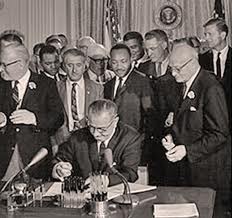
The Voting Rights Act of 1965 is seen as a major accomplishment of the Congress and President Lyndon B. Johnson. (The photo to the left shows President Johnson signing the statute; immediately behind him is Rev. Dr. Martin Luther King, Jr.) It was adopted as a result of congressional recognition that case-by-case litigation over racial voting discrimination was slow, expensive and ineffective and that a stature was needed “to cure the problem of voting discrimination” and “rid the country of racial discrimination in voting,” (South Carolina v. Katzenbach, 383 U.S. 301, 313, 315 (1966).)
The 1965 Act combined a permanent, case-by-case enforcement mechanism with a set of more stringent, temporary remedies designed to target those areas of the country where racial discrimination in voting was concentrated.
Section 2, the Act’s main permanent provision, forbids any “standard, practice, or procedure” that “results in a denial or abridgment of the right of any citizen of the United States to vote on account of race or color.” (42 U.S.C. § 1973(a).) Applicable nationwide, section 2 enables individuals to bring suit against any state or jurisdiction to challenge voting practices that have a discriminatory purpose or result. (SeeThornburg v. Gingles, 478 U.S. 30, 35 (1986).)
Section 5 of the statute and the focus of the current case before the Supreme Court only applies to certain “covered jurisdictions” and “prescribes remedies . . . which go into effect without any need for prior adjudication.” (Katzenbach, 383 U.S. at 327-28.) Section 5 suspends “all changes in state election procedure until they [are] submitted to and approved by a three-judge Federal District Court in Washington, D.C., or the [U.S.] Attorney General.” (Northwest Austin Municipal Utility District No. One v. Holder, 129 S. Ct. 2504, 2509 (2009),
A “covered jurisdiction” seeking to change its voting laws or procedures must either submit the change to the Attorney General or seek preclearance directly from the three-judge court. If such a jurisdiction opts for the former and if the Attorney General lodges no objection within 60 days, the proposed law can take effect.(42 U.S.C. § 1973c(a).) But if the Attorney General lodges an objection, the submitting jurisdiction may either request reconsideration, (28 C.F.R. § 51.45(a)), or seek a de novo determination from the three-judge district court. (42 U.S.C. § 1973c(a).)
Either way, preclearance may be granted only if the jurisdiction demonstrates that the proposed change to its voting law neither “has the purpose nor . . . the effect of denying or abridging the right to vote on account of race or color.” (Id.) This provision “preempted the most powerful tools of black disenfranchisement ,” resulting in “undeniable” improvements in the protection of minority voting rights. (Northwest Austin, 129 S. Ct. at 2509. 2511.)
The “covered jurisdictions” subject to section 5 were identified in section 4(b), as originally enacted, as any state or political subdivision of a state that “maintained a voting test or device as of November 1, 1964, and had less than 50% voter registration or turnout in the 1964 presidential election.” (Voting Rights Act of 1965, Pub. L. No. 89-110, § 4(b), 79 Stat. 437, 438.) Congress chose these criteria carefully because it knew precisely which states it sought to cover, those six southern states with the worst historical records of racial discrimination in voting: Alabama, Georgia, Louisiana, Mississippi, South Carolina, and Virginia.
In so doing, Congress recognized that these criteria for determining “covered jurisdictions” might have to be adjusted over time.
First, as it existed in 1965, section 4(a) allowed jurisdictions to earn exemption from coverage by obtaining from a three-judge district court a declaratory judgment that in the previous five years (i.e., before they became subject to the Act) they had used no test or device “for the purpose or with the effect of denying or abridging the right to vote on account of race or color.” (1965 Act § 4(a).) This so-called “bailout” provision, as subsequently amended, addresses potential over-inclusiveness of section 5, allowing jurisdictions with clean records to terminate their section 5 pre-clearance obligations.
Second, section 3(c) authorizes federal courts to require pre-clearance by any non-covered state or political subdivision found to have violated the Fourteenth or Fifteenth Amendments. (42 U.S.C. § 1973a(c).) Specifically, courts presiding over voting discrimination suits may “retain jurisdiction for such period as [they] may deem appropriate” and order that during that time no voting change take effect unless either approved by the court or unopposed by the Attorney General. (Id.) This judicial “bail-in” provision addresses the formula’s potential under-inclusiveness.
In South Carolina v. Katzenbach, the Supreme Court sustained the constitutionality of section 5, holding that its provisions “are a valid means for carrying out the commands of the Fifteenth Amendment.” As originally enacted in 1965, section 5 was to remain in effect for five years. Congress subsequently renewed these temporary provisions, including sections 4(b) and 5, in 1970 (for five years), in 1975 (for seven years), and in 1982 (for twenty-five years).[5] The Supreme Court also sustained the constitutionality of each extension through 2007. (Georgia v. United States, 411 U.S. 526 (1973); City of Rome v. United States, 446 U.S. 156 (1980); Lopez v. Monterey County, 525 U.S. 266 (1999).)
——————————
[1] The 2006 statute’s correct title is the Fannie Lou Hamer, Rosa Parks, Coretta Scott King Voting Rights Act Reauthorization and Amendments Act of 2006.
[2] The states now subject to section 5 are Alabama, Alaska, Arizona, Georgia, Louisiana, Mississippi, South Carolina, Texas and Virginia.
[3] The other predicates to be examined in separate posts are the Voting Rights Act of 2006; the 2009 Supreme Court decision regarding the 2006 statute (Northwest Austin Municipal Utility District No. One v. Holder); and the 2012 decision of the U.S. Court of Appeals for the D.C. Circuit, 2 to 1, upholding the constitutionality of the 2006 statute in the case now pending in the Supreme Court. (Shelby County, Alabama v. Holder.)
[5] The 1982 extension also made the provision for “bailout” from section 5 restrictions substantially more permissive.