The U.S. State Department’s just-released 2013Country Reports on Human Rights Practices’ chapter on Cuba needs analysis.[1]
The Report’s Negative Comments about Cuban Human Rights
The Executive Summary of its chapter on Cuba has a strongly negative tone. It states the following:
“Cuba is an authoritarian state led by Raul Castro, who is president of the council of state and council of ministers, Communist Party (CP) first secretary, and commander in chief of security forces. The constitution recognizes the CP as the only legal party and ‘the superior leading force of society and of the state.’ A CP candidacy commission preapproved all candidates for the February uncontested National Assembly elections, which were neither free nor fair. The national leadership that included members of the military maintained effective control over the security forces, which committed human rights abuses against civil rights activists and other citizens alike.
In January the government largely dropped travel restrictions that prevented citizens from leaving the island, but these reforms were not universally applied, and authorities denied passport requests for certain opposition figures or harassed them upon their return to the country.
The principal human rights abuses were abridgement of the right of citizens to change the government and the use of government threats, extrajudicial physical violence, intimidation, mobs, harassment, and detentions to prevent free expression and peaceful assembly.
The following additional abuses continued: harsh prison conditions, arbitrary arrest, selective prosecution, and denial of fair trial. [2] Authorities interfered with privacy, engaging in pervasive monitoring of private communications. The government did not respect freedom of speech and press, severely restricted internet access and maintained a monopoly on media outlets, circumscribed academic freedom, and maintained significant restrictions on the ability of religious groups to meet and worship. The government refused to recognize independent human rights groups or permit them to function legally. In addition, the government continued to prevent workers from forming independent unions and otherwise exercising their labor rights.
Most human rights abuses were official acts committed at the direction of the government. Impunity for the perpetrators remained widespread.”
The Report’s Positive Comments about Cuban Human Rights
This Executive Summary paints a bleak picture of Cuban human rights, and I have no doubt that many of these points are legitimate. But I still believe that it overstates the negatives.
Indeed, the Executive Summary failed to acknowledge that the Report itself stated there were “no reports that the [Cuban] government or its agents committed arbitrary or unlawful killings . . . [or] politically motivated disappearances.”
In addition, the Report itself stated in Cuba that there was “no societal pattern of child abuse;” that the government operated family counseling centers; that the government “continued to carry out media campaigns” against domestic violence; that the government “actively promoted racial integration and inclusiveness;” that a government resolution “accords persons with disabilities the right to equal employment opportunities and equal pay for equal work;” and that there was no “discrimination officially reported or permitted based on sexual orientation” accentuated by President Castro’s daughter’s promotion of LGBT rights.
With respect to Cuba’s prisoners and pretrial detainees, the Report conceded that they “had access to visitors;” that many “were able to communicate information about their living conditions through telephone calls to human rights observers and reports to family members;” that they “could practice limited religious observance;” and that “the Catholic Church and the Cuban Council of Churches reported access to prisoners during the year, with services offered in prisons and detention centers in most if not all provinces.”
On Cuban religious freedom more generally, the Report merely incorporated by reference the section on Cuba in the Department’s most recent International Religious Freedom Report that this blog previously criticized as understating the extent of religious freedom on the island.[3]
Moreover, the new overall Human Rights Report admits that “religious groups reported greater latitude to express their opinions during sermons and at religious gatherings than in the past;” that “[r]eligious leaders in some cases criticized the government, its policies, and even the country’s leadership without reprisals;” that the “Catholic Church operated a cultural center in Havana that hosted debates featuring participants voicing different opinions about the country’s future, at which well-known dissidents were allowed to participate;” and that the “Catholic Church published two periodicals that sometimes included criticism of official social and economic policies . . . [and] a pastoral letter advocating for political and economic reforms and greater rights for citizens.”
The new overall Report also says that the “Catholic Church received permission to broadcast Christmas and Easter messages on state-run television stations . . . [while] the Council of Churches, the government-recognized Protestant umbrella organization, was authorized to host a monthly 20-minute radio broadcast;” that religious “groups reported the ability to gather in large numbers without registering or facing sanctions;” and that “[r]ecognized churches, [and] the Roman Catholic humanitarian organization Caritas . . . were . . . legally permitted to function outside the formal structure of the state, the [Communist Party], and government-organized organizations.” In addition, there were “no reports of anti-Semitic acts.”
Finally the Report concedes that the Cuban constitution and other laws prohibit abusive treatment of detainees and prisoners and provide alternative sentencing for nonviolent offenders and juveniles as well as rights to seek redress for improper prison conditions and treatment. Cuban law, the Report said, also specifies reasonable procedures for investigations and prosecutions of alleged crimes.
Conclusion
Cuba’s regrettable lapses on human rights, though perhaps understandable in context, should not be a reason for continued U.S. hostility toward the island. A subsequent post will examine what this blogger sees as the implications of this report for U.S. policies regarding Cuba.
[1] A prior post reviewed the Department’s overall summary of global human rights in 2013.
[3] This blog criticized the prior reports on Cuban religious freedom by the State Department and by the U.S. Commission on International Religious Freedom. In addition, another post reviewed positive comments on religious freedom from religious leaders with direct experience on the island. Similar points were made on February 27th, 2014, by six Cuban Protestant Christian leaders at a congressional briefing hosted by U.S. Senator Jeff Flake (Republican of Arizona) and Representative Jim McGovern (Democrat of Massachusetts). In response, a strong supporter of current U.S. policies regarding Cuba launched an unwarranted ad hominem attack on these leaders.
The top officials of the U.S. Commission on International Religious Freedom –Its Chairperson, Robert P. George, and its Vice Chairperson, Katrina Lantos Swett –recently have been entering the public forum to discuss that freedom. A prior post reviewed their recent essay in the Wall Street Journal entitled “Religious Freedom Is About More Than Religion.”
The Criticism
Now in the Washington Post they have criticized the U.S. Government for its alleged failure to comply with the requirements of the International Religious Freedom Act of 1998 (“the Act“). They assert that the statute requires all administrations to conduct annual reviews and designations of “countries of particular concern,” defined as those governments engaging in or allowing ‘systematic, ongoing, egregious” violations.’” Unfortunately, they continue, “neither Republican nor Democratic administrations have consistently designated countries that clearly meet the standard for offenders.”
Now, the Commission leaders say, “a key deadline for action [is] arriving this month, [and] it is time to confront this unwise failure to act.”As a result, they ask Congress to press the executive branch “to apply the International Religious Freedom Act fully and the country designation process decisively.”
Analysis
George and Swett apparently refer to section 402 (b)(1) (A) of the Act, which states:
“Not later than September 1 of each year, the President shall review the status of religious freedom in each foreign country to determine whether the government of that country has engaged in or tolerated particularly severe violations of religious freedom in that country during the preceding 12 months or since the date of the last review of that country under this subparagraph, whichever period is longer. The President shall designate each country the government of which has engaged in or tolerated violations described in this subparagraph as a country of particular concern for religious freedom.”
Guidance on this requirement is provided in section 402(b)(1)(B) of the Act, which says that such presidential review “shall be based upon information contained in the latest [State Department} Country Reports on Human Rights Practices, the [State Department’s] Annual Report [on International Religious Freedom], and on any other evidence available and shall take into account any findings or recommendations by the [U.S.] Commission [on International Religious Freedom] with respect to the foreign country.”
Given these statutory provisions, I think George and Swett erroneously say that various administrations have failed to comply with section 402 (b)(1)(A) of the Act. That provision, as I read it, invests the president with the exclusive authority to make the determination of whether another country has “engaged in or tolerated particularly severe violations of religious freedom.” In so doing, the president determination shall be based on any available evidence, including said reports by the State Department and the Commission.
Moreover, Ms. Swett undercut her and Mr. George’s criticism when she acknowledged the Commission has limited authority when compared with the U.S. Department of State and implicitly the U.S. President.
In an interview about whether or not the U.S. should grant a visa to an Indian politician, she said, “The State Department has a more difficult job than we do because they are balancing American security interests, American commercial interests, American cultural interests, American exchange interests, a whole range of diplomatic interests, and one of the things that they are putting into that mix is the defense of our fundamental values, human rights and religious freedom and other such things. Because of its much larger portfolio the State Department cannot be as single-minded as we are.”
The top officials of the U.S. Commission on International Religious Freedom have set forth compelling reasons why religious freedom around the world is important. Its Chairperson, Robert P. George, and its Vice Chairperson, Katrina Lantos Swett, have done so in an essay in the Wall Street Journal entitled “Religious Freedom Is About More Than Religion.”
Dr. Robert P. GeorgeDr. Katrina Lantos Swett
They assert, “To respect fundamental human rights is to favor and honor the [human being] . . . who is protected by those rights—including the rights to freedom of speech, press, assembly and religion.” Therefore, honoring the individual human being favors “human flourishing in its many dimensions. For those who regard humans not just as material beings but also as spiritual ones—free, rational and responsible—it is obvious that their spiritual well-being is no less important than their physical, psychological, intellectual, social and moral well-being.”
Such human flourishing “requires respect for their freedom—as individuals and together with others in community—to address the deepest questions of human existence and meaning. This allows them to lead lives of authenticity and integrity by fulfilling what they conscientiously believe to be their religious and moral duties.”
Moreover, religious “faith by its nature must be free. A coerced ‘faith’ is no faith at all. Compulsion can cause a person to manifest the outward signs of belief or unbelief. It cannot produce the interior acts of intellect and will that constitute genuine faith.” Indeed, coercion “in the cause of belief, whether religious or secular, produces not genuine conviction, but pretense and inauthenticity.”
Religious freedom, therefore, must “include the right to change one’s beliefs and religious affiliation. It also includes the right to witness to one’s beliefs in public as well as private, and to act—while respecting the equal right of others to do the same—on one’s religiously inspired convictions in carrying out the duties of citizenship.”
As a result, “one of the aims of U.S. foreign policy should be to combat . . . [religious] intolerance—not just because religious freedom reduces the risk of sectarian conflict, but more fundamentally because it protects the liberty that is central to human dignity.”
Conclusion
This statement echoes the words of the international legal instruments that appropriately guide the work of the U.S. Commission on International Religious Freedom: the Universal Declaration of Human Rights, which the U.S. supported in the U.N. General assembly in 1948, and the International Covenant on Civil and Political Rights, which the U.S. ratified in 1992.
The Universal Declaration opens with these words in its Preamble: “recognition of the inherent dignity and of the equal and inalienable rights of all members of the human family is the foundation of freedom, justice and peace in the world.” It then declares in Article 18, “Everyone has the right to freedom of thought, conscience and religion; this right includes freedom to change his religion or belief, and freedom, either alone or in community with others and in public or private, to manifest his religion or belief in teaching, practice, worship and observance.”
These latter words are essentially repeated in Article 18(1) of the International Covenant. Its Article 18(2) goes on to say, “No one shall be subject to coercion which would impair his freedom to have or to adopt a religion or belief of his choice.”
The U.S. Commission on International Religious Freedom was created by the International Religious Freedom Act of 1998 as an independent U.S. government body that monitors religious freedom worldwide and makes policy recommendations to the President, Secretary of State, and Congress. On December 16, 2011, the Commission’s life was extended by Congress through 2018 after a series of brief extensions had kept it in existence after its previous authorization expired in September 2011.
Under the statute, the Commission is to be composed of nine “distinguished [U.S. citizens] noted for their knowledge and experience in fields relevant to the issue of international religious freedom, including foreign affairs, direct experience abroad, human rights and international law.”
The nine are to be appointed as follows: three by the U.S. President; three by the U.S. Senate’s President pro tempore and three by the Speaker of the U.S. House of Representatives. Each of the sets of the congressional appointees is to be upon two recommendations from the leader of the political party that does not control the White House and one recommendation from the leader of the President’s political party. Currently there is one vacancy on the Commission.
Rev. William ShawEric P. Schwartz
The current Presidential appointees are Rev. William Shaw and Eric P. Schwartz. Shaw is a Baptist Pastor and Immediate Past President of the National Baptist Convention; he serves as a Vice Chair of the Commission. Schwartz is the Dean of the Humphrey School of Public Affairs at the University of Minnesota. He previously was a senior official of the State Department, the National Security Council, the U.N. and the U.S. Congress.
Dr. Katrina Lantos Swett
The appointee upon recommendation of U.S. Senate Majority Leader Harry Reid is Dr. Katrina Lantos Swett, the Founder, President and Chief Executive Officer of the Lantos Foundation for Human Rights in honor of her father, Tom Lantos, the only Holocaust survivor ever elected to Congress. She also is a professor of human rights and American foreign policy at Tufts University and serves as the Commission’s Chair.
Sam Gejdenson
Sam Gejdenson is the appointee upon recommendation of Nancy Peloisi, House Minority Leader. He is a former Democratic Congressman, the first child of Holocaust survivors to serve in Congress and a leader in human rights, democracy and global engagement.
Mary Ann GlendonDr. M. Zuhdi Jasser
Appointees upon recommendations by U.S. Senate Minority Leader Mitch McConnell are Mary Ann Glendon andthe Learned Hand Professor of Law at Harvard University, President of the Pontifical Academy of Social Sciences and former U.S. Ambassador to the Holy See. Professor Glendon also serves as a Vice Chair of the Commission.[1] Dr. Jasser is a physician and the President of the American Islamic Forum for Democracy whose parents fled oppression in Syria.
Elliott AbramsDr. Robert P. George
Appointees upon recommendation of House Minority Leader Eric Cantor are Elliott Abrams and Dr. Robert P. George. Abrams is aSenior Fellow for Middle Eastern Studies at the Council on Foreign Relations, a professor of U.S. foreign policy at Georgetown University’s School of Foreign Service and a former senior official in the George W. Bush and Reagan Administrations.[2] Dr. George is the McCormick Professor of Jurisprudence and Director of the James Madison Program in American Ideals and Institutions at Princeton University and a distinguished appointee to various U.S. and UNESCO bodies.
Suzan Johnson Cook
These Commissioners are joined by the U.S. Ambassador at Large for International Religious Freedom (ex officio and nonvoting). That currently is Suzan D. Johnson Cook.
[2] In 1991 upon his guilty plea Abrams was convicted on two misdemeanor counts of withholding information from Congress in the Iran-Contra scandal, but in December 1992 he was pardoned by President George H. W. Bush. In 1997 the U.S. Court of Appeals for the D.C. Circuit publicly censured Abrams, an attorney, for giving false testimony on three occasions to Congress.
We have provided a general overview of the latest international religious freedom reports from the U.S. Department of State and from the U.S. Commission on International Religious Freedom, and another post analyzed the State Department’s report on that freedom in Cuba.[1] Now we contrast and compare the Commission’s shorter and less detailed report on that subject for Cuba.[2]
Positive Aspects of Religious Freedom in Cuba
The report had a few good things to say about religious freedom in Cuba.
First, it did not include Cuba in its list of “countries of particular concern” (CPC), i.e., those that have engaged in or tolerated “particularly severe” violations of religious freedom.
Second, it recognized that “[p]ositive developments for the Catholic Church and major registered Protestant denominations, including Baptists, Pentecostals, Presbyterians, Episcopalians, and Methodists, continued over the last year.” (Emphasis added.)
The Commission endorsed the State Department reports “that religious communities were given greater freedom to discuss politically sensitive issues. Catholic and Protestant Sunday masses were held in more prisons throughout the island. Religious denominations continued to report increased opportunities to conduct some humanitarian and charity work, receive contributions from co-religionists outside Cuba, and obtain Bibles and other religious materials. Small, local processions continued to occur in the provinces.”
The Commission also stated that the Cuban government granted the Cuban Council of Churches time for periodic broadcasts early Sunday mornings, and Cuba’s Roman Catholic Cardinal read Christmas and Easter messages on state-run stations. Relations between the Catholic Church and Cuban government continued to improve,” marked by Pope Benedict XVI’s visit to Cuba.
Negative Aspects of Religious Freedom in Cuba
The report also commented on what it saw as negative aspects of religious freedom in Cuba.
Some of the criticisms echo the State Department’s report regarding the Cuban government’s system for registering religious groups, limiting certain activities to such registered groups, restricting permits for construction or repair of religious buildings, limiting access to state media and denying permission for religious processions outside religious buildings. The Commission, however, fails to mention the Department’s qualifications that these purported restrictions of religious freedom are not enforced in practice.
The Commission mentions the Cuban government’s arrest and detention of human rights/democracy activists that prevented them from attending church services, as did the Department’s report. As noted in my prior post, however, these arrests and detentions, in my opinion, are blots on Cuba’s general human rights record, not that for its religious freedom.
Another negative, according to the Commission, are the alleged Cuban government’s arrests and beatings on four occasions of evangelical pastors and the alleged targeting of the Apostolic Reformation and Western Baptist communities. We, however, do not know all the facts of these alleged events, and even if true as stated by the Commission, they do not, in my opinion, justify the Commission’s overall evaluation of Cuban religious freedom.[3]
That overall evaluation includes Cuba as one of eight countries on the Commission’s “Watch List of countries where the serious violations of religious freedom engaged in or tolerated by the governments do not meet the CPC threshold, but require close monitoring.” According to the Commission, the “Watch List provides advance warning of negative trends that could develop into severe violations of religious freedom, thereby providing policymakers with the opportunity to engage early and increasing the likelihood of preventing or diminishing the violations.”
Cuba has been on this Watch List since 2004.[4] Its inclusion yet again, in my opinion, is due to sheer long-term blinders on U.S. perceptions of Cuba, not to an objective analysis of the facts.
Recommendations for U.S. Policy
In accordance with its authorizing statute,[5] the Commission made the following recommendations for U.S. policy with respect to Cuban religious freedom:
press the Cuban government to “stop arrests and harassment of clergy and religious leaders; cease interference with religious activities and the internal affairs of religious communities; allow unregistered religious groups to operate freely and legally; revise government policies that restrict religious services in homes or on other personal property; and hold accountable police and other security personnel for actions that violate the human rights of non-violent religious practitioners;”
“use appropriated funds to advance Internet freedom and protect Cuban activists from harassment and arrest by supporting the development of new technologies, while also immediately distributing proven and field-tested programs to counter censorship;”
“increase the number of visas issued to Cuban religious leaders from both registered and unregistered religious communities to travel to the United States to interact with co-religionists;” and
“encourage international partners, including key Latin American and European countries and regional blocks, to ensure that violations of freedom of religion or belief and related human rights are part of all formal and informal multilateral or bilateral discussions with Cuba.”
I note first that if Cuba properly were excluded from the Watch List, there would be no basis for the Commission’s making any recommendations with respect to Cuba.
With respect to the recommendations themselves, the first one seems like an excessive concern with formalities since in practice these restrictions are not enforced. Has the U.S. updated all of its statutes and regulations to conform them to what happens in the real world?
The third recommendation should be noncontroversial, and I agree the U.S. should grant tourist visas for Cuban religious representatives to visit the U.S.
I also have no problem with the fourth recommendation, but believe that most other countries and regional blocks would not see the alleged violations of freedom of religion or belief that the Commission sees.
The second recommendation, however, raises significant problems and is objectionable.
It is difficult to know exactly what is meant by recommending the U.S. use its funds to advance Internet freedom and protect Cuban activists, to develop new technologies and to distribute proven and field-tested programs to counter censorship.
To me, it sounds like a recommendation for surreptitious efforts at regime change. Remember that the U.S. in 1961 supported an armed invasion of Cuba at the Bay of Pigs, that the U.S. through the CIA had plots to assassinate Fidel Castro, that the U.S. for over 50 years has had an embargo of Cuba and that the George W. Bush Administration had a Commission on Assistance to a Free Cuba that produced a de facto U.S. plan for such a regime change.
Another, and more powerful, reason for being at least skeptical of this second recommendation is the case of Alan Gross, a U.S. citizen, who is now in Cuban prison after conviction in 2009 for–as the Cubans see it– being part of a “subversive project of the U.S. government that aimed to destroy the Revolution through the use of communication systems out of the control of authorities.” As an employee of an USAID contractor, Mr. Gross went to Cuba on multiple occasions purportedly to establish wireless networks and Internet connections for non-dissident Cuban Jewish communities and to deliver certain communications equipment to Cubans for that purpose.
In 2012 Mr. Gross and his wife sued USAID and the contractor for allegedly failing to give him better information and training for his dangerous work, and this month (May 2013) the Grosses and the contractor reached a settlement for dismissal of the case against the corporation in exchange for an undisclosed monetary payment by the contractor.
In short, this second recommendation is not designed to improve religious freedom in Cuba.
Conclusion
The State Department’s more balanced recent report on Cuban religious freedom, in my opinion, is better grounded in reality than the Commission’s. While I believe the U.S. should encourage and promote religious freedom around the world, including Cuba, the recommendations by the Commission are unjustified and counterproductive and evidence the same bias against Cuba that we see in other aspects of U.S. policy towards Cuba.[6]
[1] The prior post also reviewed the religious makeup of the Cuban people and many other details on the subject that will not be repeated here.
[2] Prior posts examined the Commission reports for Cuba for 2010 and 2011(comment to prior post). A subsequent post will discuss the unusual structure of the Commission.
[3] The Commission’s heavy emphasis on the relatively few alleged wrongs against evangelical pastors and its ignoring the positive developments in religious freedom for “registered” religious groups like the Roman Catholics, Baptists, Pentecostals, Presbyterians, Episcopalians and Methodists demonstrate a totally inappropriate and unjustified bias in a purported nonpartisan U.S. agency of our federal government. Such a bias is not new. It also was present in the George W. Bush Administration’s Commission for Assistance to a Free Cuba, which regarded unnamed evangelical Christian groups as the only “authentically independent” religious groups that could be used by the U.S. to build a “free” Cuba. The Cuban Council of Churches, on the other hand, was seen by this U.S. commission as “taken over by the Castro regime in the early 1960s and used as a means to control the Protestant churches” and, therefore, was not to be used by the U.S.
[4] The other seven countries on the Commission’s Watch List are Afghanistan, Azerbaijan, India, Indonesia, Kazakhstan, Laos and Russia.
[5] That statute charges the Commission with the responsibility of “making . . . policy recommendations to the President, the Secretary of State, and Congress with respect to [Cuban] religious freedom.” (International Religious Freedom Act of 1988, § 202(a)(2); id. § 202(b); id. § 202(c).
Annually the U.S. Department of State, pursuant to statutory authorization, releases a report on the status of religious freedom in every country in the world.[1] In addition, the quasi-independent U.S. Commission on International Religious Freedom releases annual reports on the same subject for selected countries.[2]
It should be noted at the outset that these two agencies are not seeking to impose on the rest of the world the U.S. constitutional prohibition of the “establishment of religion” or of “abridging the free exercise [of religion].” [3] Instead the agencies reports rely upon this definition of the freedom in the Universal Declaration of Human Rights: “Everyone has the right to freedom of thought, conscience and religion; this right includes freedom to change his religion or belief, and freedom, either alone or in community with others and in public or private, to manifest his religion or belief in teaching, practice, worship and observance.” Similar provisions are found in several multilateral human rights treaties.[4]
The post will review the latest State Department report on this subject for all 194 other countries in the world and the Commission’s latest report on 29 countries plus one large region (Western Europe).[5]
Latest State Department Report
After emphasizing the importance of religious freedom, the State Department’s May 20, 2013, report “tells stories of courage and conviction, but also recounts violence, restriction, and abuse. While many nations uphold, respect, and protect religious freedom, regrettably, in many other nations, governments do not protect this basic right; subject members of religious minorities to violence; actively restrict citizens’ religious freedom through oppressive laws and regulations; stand by while members of societal groups attack their fellow citizens out of religious hatred, and fail to hold those responsible for such violence accountable for their actions.”
The report continues.”The immediate challenge is to protect members of religious minorities. The ongoing challenge is to address the root causes that lead to limits on religious freedom. These causes include impunity for violations of religious freedom and an absence of the rule of law, or uneven enforcement of existing laws; introduction of laws restricting religious freedom; societal intolerance, including anti-Semitism and lack of respect for religious diversity; and perceptions that national security and stability are best maintained by placing restrictions on and abusing religious freedom.”
Highlighted for concern by the report were “[l]aws and policies that impede the freedom of individuals to choose a faith, practice a faith, change their religion, tell others about their religious beliefs and practices, or reject religion altogether remain pervasive. Numerous governments imposed such undue and inappropriate restrictions on religious groups and abused their members, in some cases as part of formal government law and practice.” Another concern was the “use of blasphemy and apostasy laws.” They “continued to be a significant problem, as was the continued proliferation of such laws around the world. Such laws often violate freedoms of religion and expression and often are applied in a discriminatory manner.”
The report documented “a continued global increase in anti-Semitism. Holocaust denial and glorification remained troubling themes, and opposition to Israeli policy at times was used to promote or justify blatant anti-Semitism. When political leaders condoned anti-Semitism, it set the tone for its persistence and growth in countries around the world. Of great concern were expressions of anti-Semitism by government officials, by religious leaders, and by the media.”
According to the report, “Governments that repress freedom of religion and freedom of expression typically create a climate of intolerance and impunity that emboldens those who foment hatred and violence within society. Government policy that denies citizens the freedom to discuss, debate, practice, and pass on their faith as they see fit also undercuts society’s ability to counter and combat the biased and warped interpretations of religion that violent extremists propagate. Societal intolerance increased in many regions during 2012.”
Finally the report said, “Governments exacerbated religious tensions within society through discriminatory laws and rhetoric, fomenting violence, fostering a climate of impunity, and failing to ensure the rule of law. In several instances of communal attacks on members of religious minorities and their property, police reportedly arrested the victims of such attacks, and NGOs alleged that there were instances in which police protected the attackers rather than the victims. As a result, government officials were not the only ones to commit abuses with impunity. Impunity for actions committed by individuals and groups within society was often a corollary of government impunity.”
The report also acknowledged the Department’s statutory obligation to designate “Countries of Particular Concern (CPCs), i.e., those countries that are considered to commit “particularly severe violations of religious freedom,” and whose records call for the U.S. government to take certain actions under the terms of the Act. The term ‘‘particularly severe violations of religious freedom’’ means systematic, ongoing, egregious violations of religious freedom, including violations such as: (a) torture or cruel, inhuman, or degrading treatment or punishment; (b) prolonged detention without charges; (c) causing the disappearance of persons by the abduction or clandestine detention of those persons; or (d) other flagrant denial of the right to life, liberty, or the security of persons.”
Accordingly the report re-designated the following eight countries as CPCs: Burma, China, Eritrea, Iran, North Korea, Saudi Arabia, Sudan and Uzbekistan.[6]
Latest Commission Report
Under the authorizing statute, the Commission is required to designate as “countries of particular concern” (CPC) (or “Tier 1 Countries”) those that have engaged in or tolerated “particularly severe” violations of religious freedom.
In its latest report, issued on April 30, 2013, the following 15 countries were so designated: Burma, China, Eritrea, Iran, North Korea, Saudi Arabia, Sudan and Ubekistan (all of which had been designated as “Countries of Particular Concern” (CPC) by the State Department the prior year) plus Egypt, Iraq, Nigeria, Pakistan, Tajikistan, Turkmenistan and Vietnam.
The Commission also designates some countries as “Tier 2 Countries,” i.e., countries on the threshold of Tier 1 status, i.e., when their “violations . . . are particularly severe” and when at least one, but not all three, of the criteria for that status (“systematic, ongoing and egregious”) is met.
The latest report designated the following eight countries as Tier 2: Afghanistan, Azerbaijan, Cuba, India, Indonesia, Kazakhstan, Laos and Russia.[7]
The latest report also discussed six other countries (Bahrain, Bangladesh, Belarus, Ethiopia, Turkey and Venezuela and one region (Western Europe) that it monitored during the year. At first glance the monitoring of Western Europe seems anomalous, but here are the topics of concern to the Commission:
Restrictions on religious dress (full-face veils) in France and Belgium.
Failure in Sweden, Luxembourg, Switzerland, Poland, Norway and Iceland to exempt religious slaughter of animals from laws requiring prior stunning of the animals.
Suggestions in Germany and Norway that religious circumcisions of male children were illegal.
Restrictions on construction of Islamic minarets in Switzerland, and the lack of an official mosque in Athens, Greece.
“Incitement to hatred” and other laws in almost all European states that can be used to restrict expression of religious beliefs.
Reluctance in many European states to provide accommodation of religious objections to generally applicable laws.
Measures in France, Austria, Belgium and Germany against religious groups perjoratively characterized as “cults” or “sects.”
Societal intolerance, discrimination and violence based on religion or belief such as towards Muslim women with full-face veils, Jewish people and Jehovah’s Witnesses.
It should also be noted that the Commission sometimes takes an adversarial position vis-à-vis the U.S. State Department. For example, on April 30, 2013, when the Commission released its latest report, its simultaneous press release recommended that the Department designate as “Countries of Particular Concern” the seven additional countries the Commission had placed in Tier 1 as noted above.
When the Department failed to do so in its May 20th report, the next day the Commission issued a press release criticizing the Department for failure to make additional CPC designations since August 2011 and to do so for the same seven additional countries.
Conclusion
Because of my personal interest in Cuba, including its religious freedom, a subsequent post will compare and contrast the two reports regarding that country.
Such a comparison, in my opinion, will show that the State Department’s reports are more balanced and fair at least with respect to Cuba.
[5] A prior post examined the prior State Department report.
[6] The State Department report noted that it considers the recommendations of the Commission on CPCs, but that the Secretary of State makes the final decision on that issue. The Department’s report thereby implicitly rejected the Commission’s recommendation for an additional seven countries to be so designated.
[7] Previously the Commission called this group the “Watch List of countries where the serious violations of religious freedom engaged in or tolerated by the governments do not meet the CPC threshold, but require close monitoring.” According to the Commission, the “Watch List provides advance warning of negative trends that could develop into severe violations of religious freedom, thereby providing policymakers with the opportunity to engage early and increasing the likelihood of preventing or diminishing the violations.”
On August 13, 2012, I sent the following letter regarding Cuba to U.S. President Barack Obama.[1]
Many of the United States’ policies regarding Cuba are not in our national interest and should be changed. I write specifically about (1) the U.S. embargo of Cuba, (2) the U.S. designation of Cuba as a “State Sponsor of Terrorism,” (3) the U.S. denigration of religious freedom on the island and (4) our refusal to enter into negotiations with Cuba on the broad range of issues that have accumulated since the Cuban Revolution of 1959 without Cuba’s satisfying various U.S. preconditions.
1. U.S. Embargo of Cuba
The U.S. embargo of Cuba, in my opinion, is an out-of-date relic of the days of U.S. hostility toward, and fear of, the Cuban Revolution. Today Cuba poses no serious threat to the U.S. Cuba’s regrettable human rights violations are understandable and could be more successfully addressed in bilateral negotiations. Normalizing relations, including rescinding the embargo, would be in the economic interest of the U.S. by creating export and investment opportunities for U.S. businesses. Moreover, ending the embargo would be in the overall interests of the U.S., especially with respect to our relations with other countries in the Western Hemisphere. This is examined more fully in my blog posts: “The U.S. Should Pursue Reconciliation with Cuba,” (May 21, 2001); and “U.N. General Assembly Again Condemns U.S. Embargo of Cuba,” (Oct. 25, 2011),
The U.S. should end its embargo of Cuba.
2. U.S. Designation of Cuba as a “State Sponsor of Terrorism”
The U.S. State Department’s Country Reports on Terrorism 2011 (July 31, 2012), assert two grounds for designating Cuba as a “State Sponsor:” (a) its being an alleged safe haven for certain ETA and FARC terrorists and U.S. fugitives; and (b) its alleged financial system deficiencies relating to money laundering and financing of terrorism.
The U.S. State Department’s 2011 Report on International Religious Freedom (July 30, 2012), had many positive things to say about the status of this important freedom in Cuba in 2011 that is confirmed by my personal experience with the subject. The report also has certain negative comments on the subject with which I do not disagree.
The resulting question, I believe, is “Is the glass half empty or half full?” I believe it is more than half full of this important freedom. The U.S. needs to remember that Cuban society and history is very different from the U.S. and humbly recognize that those differences do not mean that its religious freedom is fundamentally flawed.
My real complaint here is with the U.S. Commission on International Religious Freedom’s unrealistic overstatement of the negative aspects of Cuban religious freedom and its continued placement of Cuba on its Watch List.
The U.S. should cease denigrating Cuban religious freedom and instead explore through respectful bilateral negotiations whether there are ways for the U.S. to assist Cuba in further expansion of such freedom on the island.
4. U.S. Negotiations with Cuba
In addition to the issues discussed in this letter, there are many others that need discussion, negotiation and resolution. They include Cuban compensation for expropriated property in the Cuban Revolution, enhancement of human rights on the island, emigration and immigration between the two countries, the status of Cuba’s lease of Guantanamo Bay to the U.S., the continued U.S. imprisonment of four of the so called “Cuban Five,” Cuba’s continued imprisonment of Alan Gross, the status of U.S. fugitives in Cuba, exploration and drilling for oil in the Caribbean Sea between the two counties, Cuba’s re-entry into the Organization of American States and re-establishment of full diplomatic relations.
Perhaps such negotiations would be assisted by having the two countries agree to the appointment of a respected international mediator/conciliator to supervise the negotiations.
Cuba repeatedly has said that it is willing to engage in respectful negotiations with the U.S. on all issues. Most recently on July 26th (Revolution Day marking the 59th anniversary of the Cuban uprising against former President Batista), Cuban President Raul Castro in a public speech reiterated his country’s willingness to engage in negotiations with the U.S. as equals. He said no topic was off limits, including U.S. concerns about democracy, freedom of the press and human rights in Cuba so as long as the U.S. was prepared to hear Cuba’s own complaints. (Assoc. Press, Cuban president Raúl Castro willing to hold no-limits talks with America, Guardian (July 26, 2012); Assoc. Press, Cuba–An Impromptu Invitation, N.Y. Times (July 27, 2012).)
The U.S. should accept Cuba’s offer to engage in broad-scale negotiations over all issues between the two countries.
[1] Copies of the letter were sent to Hillary Rodham Clinton, United States Secretary of State; David Benjamin, United States Ambassador-at-Large and Coordinator for Counterterrorism; Suzan Johnson Cook, United States Ambassador-at-Large for International Religious Freedom; Dr. Katrina Lantos Swett, Chair, United States Commission on International Religious Freedom; John F. Kerry, United States Senator and Chairman of the Senate Foreign Relations Committee; Amy Klobuchar, United States Senator from Minnesota; Al Franken United States Senator from Minnesota; and Keith Ellison, United States Representative from Minneapolis, Minnesota.
On July 30, 2012, the U.S. Department of State released its latest report on the status of religious freedom around the world; this report was discussed in a prior post. Now we analyze that report’s evaluation of religious freedom in Cuba. The previous U.S. State Department report on this subject was discussed in a prior post.
Versalles Church, Matanzas, Cuba
This analysis is based upon my personal involvement in helping to establish and manage a partnership between my church (Minneapolis’ Westminster Presbyterian Church) and Iglesia Presbiteriana-Reformada en Versalles (Versalles Presbyterian-Reformed Church in Matanzas, Cuba); my going on three church mission trips over the last 10 years to visit that congregation; my visits to the ecumenical seminary–Seminario Evangelico de Teologia (SET)–in Matanzas and other churches and religious organizations on these mission trips; my hearing reports about other trips to our Cuban partner from fellow members of my church; my conversations with Cuban Christians at their church and when they have visited my church in Minneapolis; and my extensive reading about Cuba and specifically religious freedom on the island.
Cuban Religious Makeup
First, however, we review the religious makeup of the Cuban population of roughly 11,000,000. According to the report, an estimated 60 to 70 percent (or 6,600,000 to 7,700,000) is believed to be Roman Catholic although only 4 to 5 percent regularly attend mass. Membership in Protestant churches is estimated at 5 percent of the population (or 550,000): Baptists and Pentecostals are probably the largest Protestant denominations; Jehovah’s Witnesses, 94,000; Seventh-day Adventists, 30,000; Methodists, 30,000; Anglicans, 22,000; Presbyterians, 15,000; Quakers, 300; and The Church of Jesus Christ of Latter-day Saints (Mormons), 50. The Jewish community is estimated at 1,500 members, of whom 1,200 reside in Havana. There are approximately 6,000 to 8,000 Muslims, although only an estimated 1,000 are Cubans. Other religious groups include the Greek and Russian Orthodox churches, Buddhists and Baha’is.
In addition, many Cubans consult with practitioners of religions with roots in West Africa and the Congo River basin, known as Santeria. These religious practices are commonly intermingled with Catholicism, and some even require Catholic baptism for full initiation, making it difficult to estimate accurately the total membership of these syncretistic groups. (I have visited the Slave Route Museum in the city of Matanzas, Cuba that has a room devoted to Santeria and Havana’s Callejon de Hamel, an alley with Santeria murals and other things.)
Positive Aspects of Religious Freedom in Cuba
The report had many good things to say about religious freedom in Cuba.
The Cuban “constitution protects religious freedom.” After the 1989 collapse of the U.S.S.R, the Cuban constitution was amended to eliminate “[scientific materialism or] atheism as the state creed” and to declare “the country to be a secular state” with “separation of church and state. The government does not officially favor any particular religion or church.” Moreover, says the U.S., “there were no reports of societal abuses or discrimination based on religious affiliation, belief, or practice.”
The Cuban “government’s respect for religious freedom improved” in 2011, declares the report.
“Religious organizations reported significant ability [in 2011] to attract new members without government interference. Many churches reported increased participation in religious instruction for children because government schools no longer scheduled competing activities on Saturdays or Sundays. The majority of religious groups reported little interference from the government in conducting their services and saw improvement in their ability to import religious materials, receive donations from overseas, and travel abroad to attend conferences and religious events. Some religious groups found it easier to bring in foreign religious workers. . . .”
“Religious organizations reported increased ability to conduct educational programs over the year. The Catholic Church and the Jewish Community Center offered courses on lay subjects such as computers and foreign languages. In September the Catholic Church opened a cultural center in Havana as a space for art exhibits, debates, and small classes, including a business training program. The Church’s business program was offered with the cooperation of the San Antonio University of Murcia, Spain for a master’s degree in business.”
Some religious groups “operated afterschool programs and weekend retreats for primary and secondary students and higher education programs for university graduates. The Catholic Church held twice yearly teaching workshops for public school teachers. Although not sanctioned by the government, these programs operated without interference.”
“Religious groups reported they were able to continue to provide community service programs with little interference from the government. These programs included providing assistance to the elderly, after school tutoring for children, clean water, and health clinics. International faith-based charitable operations, such as Caritas and the Salvation Army, had local offices in Havana.”
Indeed, not mentioned in the report is the de facto pharmacy for the neighborhood that is operated by our partner church in Matanzas with over-the-counter medicines donated by visitors from Westminster and by the Matanzas church’s plan to provide one free meal per week to neighborhood residents, many of whom are not members of the church.
SET Chapel, MatanzasLuyano Presbyterian-Reformed Church, Havana
In addition, the nearby seminary in Matanzas (SET) now has a clean-water system that was installed by Westminster members and that now provides clean water to SET and to people in the surrounding neighborhood, and SET also provides vegetables from its beautiful gardens to people in the neighborhood. Another clean-water system was installed by Westminster members in Havana’s Iglesia Presbiteriana-Reformada en Luyano (Luyano Presbyterian-Reformed Church), which shares the clean water with people in its neighborhood.
During the year the report says “the Catholic Church and some other churches were able to print periodicals and operate their own Web sites with little or no censorship. The Catholic Church’s periodicals sometimes included criticism of official social and economic policies. As in previous years, the Catholic Church also received permission to broadcast Christmas and Easter messages on state-run radio stations and, in 2011, a televised mass on September 8, the feast day of the Virgin of Charity of El Cobre, the country’s patron saint. The [Cuban] Council of Churches, the government-recognized Protestant umbrella organization, was authorized to host monthly two hour-long radio broadcasts. ”
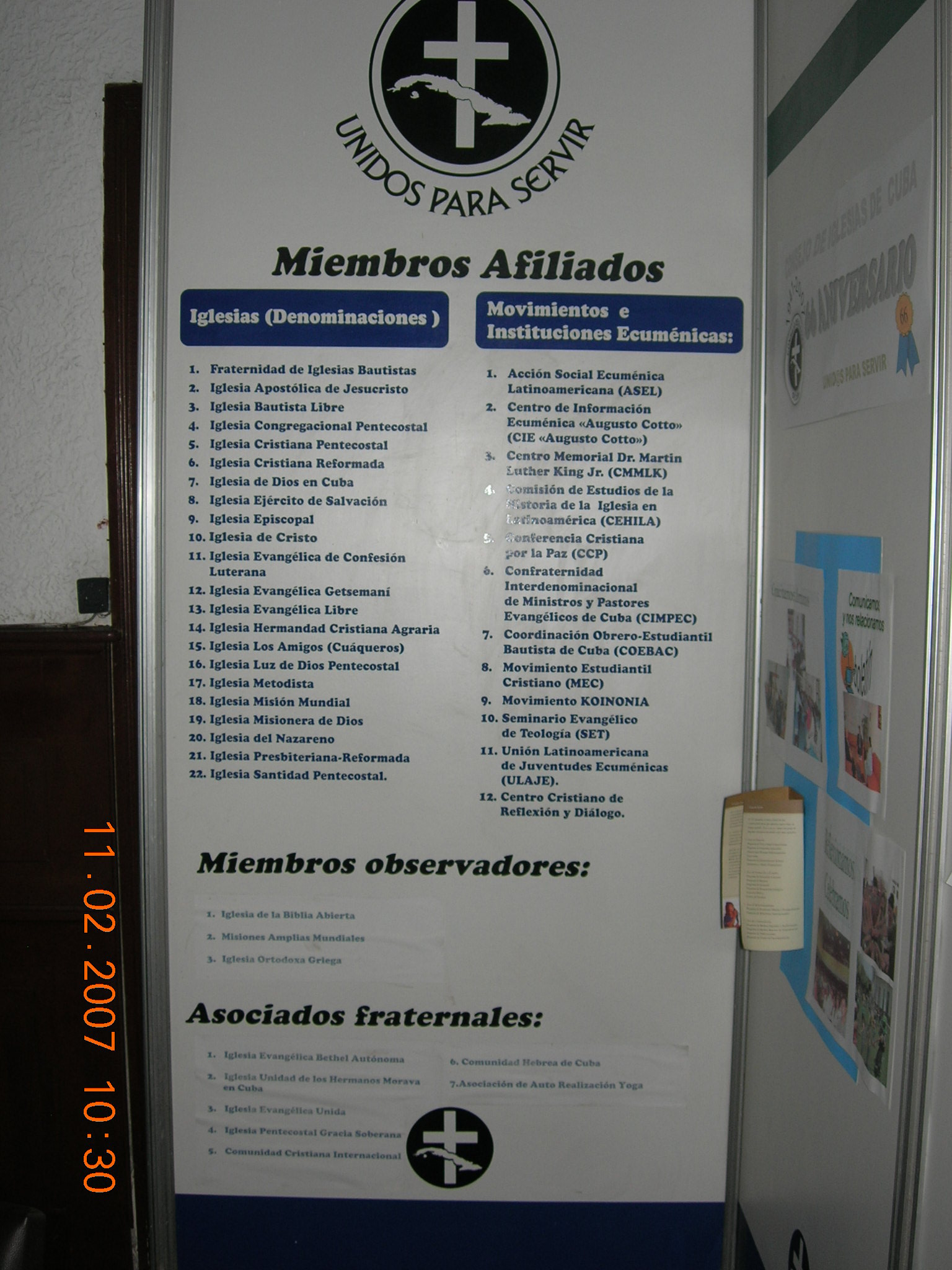
The report’s referencing the Cuban Council of Churches, however, did not mention that the it was founded in 1941 (long before the Cuban Revolution), and its members now include 22 churches, 12 ecumenical movements, and seven associate organizations. The Council, whose offices I have visited, promotes unity among the Christian Churches of Cuba and helps link these churches with other churches around the world. The Council also encourages dialogue between different movements and institutions as a means for Cuban churches to expand their ecumenical vocation of service, thus deepening their responsibilities towards society and all of God’s creation. Finally the Council promotes study, dialogue, and cooperation among Christians to increase Christian witness and enhance life in Cuba.
The U.S. government’s report continued, “Religious groups . . . reported it was easier to obtain government permission to maintain and repair existing places of worship and other buildings.” Moreover, the government “frequently granted permission to repair or restore existing temples, allowing significant expansion of some structures and in some cases allowing essentially new buildings to be constructed on the foundations of the old. Numerous houses of worship were expanded or repaired.” (In a prior year our partner church in Matanzas obtained such permission to expand its facilities for children’s Sunday School programming, and Westminster members helped build that expansion.)
Even though some religious organizations and “house churches” have not been officially recognized by the government, as required by Cuban law, in practice, most unregistered organizations and “house churches” operated with little or no interference from the government.
Both the Catholic Church and the Cuban Council of Churches reported improved access to prisoners during the year, with services offered in prisons and detention centers in most, if not all, provinces. (According to the report, however, some prison authorities did not inform inmates of their right to religious assistance, delayed months before responding to such requests, and limited visits to a maximum of two or three times per year.)
The government worked with the Catholic Church to facilitate the public procession of an icon honoring the Virgin of Charity to mark the 400th anniversary of her appearance in Cuba. The procession concluded in December with a public open-air mass in Havana attended by over 3,000 citizens as well as by government officials. It was the first country-wide religious procession permitted since the Cuban revolution.
Although there is no official law of policy for conscientious objection to military service, since 2007 the government has unofficially allowed a period of civilian public service to substitute for military service for men who object on religious grounds. The leadership of Jehovah’s Witnesses and Seventh-day Adventists stated that their members usually were permitted to participate in social service in lieu of military service.
The leadership of Jehovah’s Witnesses and Seventh-day Adventists stated that mistreatment and job discrimination, which had been particularly harsh in the past, were now rare and that their members were usually exempted from political activities at school. Seventh-day Adventist leaders stated that their members employed by the state usually were excused from working on Saturdays.
Pope Benedict XVI @ Plaza de Revolucion
Not included in the report for 2011 was the late March 2012 visit to Cuba by Pope Benedict XVI. During a mass in Havana’s Plaza de Revolucion before a crowd of thousands, the Pope called for “authentic freedom.”
Negative Aspects of Religious Freedom in Cuba
The report also commented on what it saw as negative aspects of religious freedom in Cuba.
The report notes that obtaining government permission for construction of new religious buildings remained difficult. This may well be true, but, in my opinion, this difficulty springs from the government’s attempts to regulate the allocation of scarce resources in a relatively poor country and to allocate more resources to other purposes it deems more important.
By law religious groups “are required to apply to the Ministry of Justice for official recognition. The application procedure requires religious groups to identify the location of their activities and their source of funding, and requires the ministry to certify that the group is not ‘duplicating’ the activities of another recognized organization in which case, recognition is denied. A number of religious groups, such as the Jehovah’s Witnesses and the Mormons, have been waiting for years for a decision from the Ministry of Justice on their pending applications for official recognition.” (However, the report said that unrecognized religious groups reported they were able to conduct religious activities, hold meetings, receive foreign visitors, and send representatives abroad. In addition, I believe that the government’s official requirement that such applications indicate it is not “duplicating” another organization’s activities is due to the previously mentioned desire to conserve scarce resources.)
Once the Ministry of Justice grants official recognition, religious organizations have to request permission from the Cuban Communist Party, through its Office of Religious Affairs, to hold meetings in approved locations, to receive foreign visitors, and to travel abroad. Religious groups indicated that while many applications were approved within two to three years from the date of the application, other applications received no response or were denied. Some religious groups were only able to register a small percentage of their “house churches.”
The report states that religious groups may not establish schools. This is true because the Cuban Revolution nationalized all private schools–religious and nonreligious– and instead emphasized public education for all children.
The report also says, “Except for two Catholic seminaries and several interfaith training centers throughout the island, religious schools were not permitted.”
This is an erroneous or misleading statement about religious education in Cuba as shown by the report’s own acknowledgement that in 2011 religious organizations had increased ability to conduct their own educational programs and by the following facts not mentioned in the report:
Since 1946 there has been an ecumenical Protestant Christian seminary in the city of Matanzas — Seminario Evangelico de Teologia (SET)–that was founded by the Methodist, Presbyterian, and Episcopal Churches. It has a full curriculum for various degrees as well as other non-degree programs, some of which are offered in other cities on the island.
The Methodists recently withdrew from SET to start their own seminary in Havana.
SET and the Martin Luther King, Jr. Center at Ebenezer Baptist Church in Havana are developing a program for education of prospective owners and operators of private businesses on the island under the government’s announcement allowing such activities. The MLK Center, by the way, was founded in 1987 to provide training and education in King’s philosophy of nonviolence for Cuban religious and community leadership.
In the last several summers young people from Westminster have conducted a vacation Bible school at our partner church in Matanzas.
MLK Center, Havana
“A license from the Office of Religious Affairs is necessary to import religious literature and other religious materials.” (Yet, as previously mentioned, the report itself states there were fewer restrictions on such importation.)
The report also states that “the government owns nearly all printing equipment and supplies and tightly regulates printed materials, including religious literature.” This, in my opinion, is an overstatement. Our partner church in Matanzas owns old-fashioned printing presses and at least one specialized computer printer and that the church prints and distributes religious bulletins and journals for most, if not all, of the Protestant churches on the island. A photo of the covers of some of the religious publications that are printed here appears in my 12/30/11 post, “The Cuban Revolution and Religion.”
The report states that “most religious leaders reported they exercised self-censorship in what they preached and discussed during services. Many feared that direct or indirect criticism of the government could result in government reprisals, such as denials of permits from the Office of Religious Affairs or other measures that could stymie the growth of their organizations.”
The government took “measures to limit support to outspoken religious figures that it considered a challenge to its authority.”I have no basis to challenge that statement or the following specifics cited by the report on this point:
On June 26, police arrested 23 people and detained them for five hours to prevent them from attending a Sunday prayer session in support of a Methodist minister who was removed from his post by his superiors, partly because of his outspoken criticism of the government.
On October 19, police stopped Baptist pastor Mario Felix Lleonart, a vocal critic of the authorities in the province of Santa Clara, and detained him for 10 hours.
In February Pastor Omar Perez Ruiz (aka Omar Gude Perez), a leader of the Apostolic Reformation, an association of independent nondenominational churches, was released after serving almost three years of a six-year prison sentence for illicit economic activities and falsification of documents. Perez maintained his innocence and claimed his incarceration was due to his religious activities. Perez’s release was conditioned on his refraining from preaching and from leaving the city of Camaguey. Although Perez and his family were granted refugee status in the United States, they were unable to leave because the government did not grant them an exit permit.
As part of its campaign of repression of human rights activists, the government prevented many Catholics from attending religious services. Members of the Ladies in White (Damas de Blanco) group were routinely prevented from attending church, a practice that was particularly pronounced in the eastern provinces of Holguin and Santiago. The government prevented Adisnidia Cruz, mother of political prisoners Marcos and Antonio Lima-Cruz, from leaving her house in Holguin on Sundays to attend mass on dozens of occasions. In other instances the government harassed human rights activists immediately after religious services. On September 8, for example, members of the Damas de Blanco were arrested after attending mass in Santiago to celebrate the day of Cuba’s patron saint.
Conclusion
Is the glass half empty or half full? This is the question for all human activities since none of us is perfect, and it is the legitimate question about religious freedom in Cuba.
In the opinion of a respected Cuban Protestant leader, the glass of such freedom in Cuba is more than half full, and there is no basis whatsoever for the U.S. government or her citizens to castigate Cuban religious institutions or leaders or members. I concur. As Jesus said to the scribes and Pharisees when they asked him if they should stone a woman who had committed adultery, “Let anyone among you who is without sin be the first to throw a stone at her.” All of the questioners then silently departed without throwing any stones. (John 8: 3-11.)
I, therefore, am glad that this U.S. government report does not designate Cuba as a “Country of Particular Concern,” i.e., a country which has “engaged in or tolerated particularly severe violations of religious freedom,” or the ” systematic, ongoing, egregious violations of religious freedom, including violations such as torture, degrading treatment or punishment, prolonged detention without charges, abduction or clandestine detention, or other flagrant denial of the right to life, liberty, or the security of persons.” There is no basis for any such designation, in my opinion.
Nor do I think there is any basis for the quasi-independent U.S. Commission on International Religious Freedom to have put Cuba on its “Watch List of countries where the serious violations of religious freedom engaged in or tolerated by the governments do not meet the [Commission’s] . . . threshold [for designation as a Country of Particular Concern], but require close monitoring.” The Commission should cease making such a designation in its next report.
On July 30, 2012, the U.S. Department of State released its 2011 Report on International Religious Freedom.
The operating definition for this purpose is found in Article 18 of the Universal Declaration of Human Rights that was approved by the United Nations General Assembly in 1948. It states, “Everyone has the right to freedom of thought, conscience and religion; this right includes freedom to change his religion or belief, and freedom, either alone or in community with others and in public or private, to manifest his religion or belief in teaching, practice, worship and observance.” Similar provisions are found in several multilateral human rights treaties.
Introducing the report, U.S. Secretary of State Hilary Clinton placed the subject in a broader context. She said, “religious freedom is both an essential element of human dignity and of secure, thriving societies. It’s been statistically linked with economic development and democracy stability.” Without such freedom, she continued, there can be “a climate of fear and suspicion that weakens social cohesion and alienates citizens from their leaders” and thereby “make it more difficult to solve national problems.” Indeed, she asserted that “the absence of religious freedom . . . is correlated with religious conflict and violent extremism.” As a result, the Obama Administration has made such freedom a diplomatic priority.
This report highlights what it sees as key trends in the year 2011: (a) the impact of political and demographic transitions on religious minorities; (b) the effects of conflict on religious freedom; (c) expanded use and abuse of blasphemy laws; and (d) the rising tide of anti-Semitism;
This annual report reviewing the worldwide status of religious freedom is mandated by the International Religious Freedom Act of 1988, which also requires the report to designate countries as “Countries of Particular Concern” when they have “engaged in or tolerated particularly severe violations of religious freedom,” i.e., ” systematic, ongoing, egregious violations of religious freedom, including violations such as torture, degrading treatment or punishment, prolonged detention without charges, abduction or clandestine detention, or other flagrant denial of the right to life, liberty, or the security of persons.”
In this latest report covering 2011, the following eight countries were so designated: Burma, China, Eritrea, Iran, North Korea, Saudi Arabia, Sudan and Uzbekistan.
With respect to China, the report said in 2011 there was a “marked deterioration . . . in the government’s respect for and protection of religious freedom.” It cited specific restrictions In the Tibetan Autonomous Region and other Tibetan areas. The report noted that only “groups belonging to one of the five state-sanctioned ‘patriotic religious associations'(Buddhist, Taoist, Muslim, Roman Catholic, and Protestant) . . . [could] register with the government and legally hold worship services.” Moreover, “Proselytizing in public or unregistered places of worship is not permitted” and some “religious and spiritual groups are outlawed.” Finally according to the report “Chinese Communist Party (CCP) members are required to be atheists and are generally discouraged from participating in religious activities.”
Not too surprisingly China immediately rejected the report’s comments. China said the report was “full of prejudice, arrogance and ignorance” and was “a political tool used by the U.S. Government to exert pressure on other countries, mostly deemed its rivals.”
The importance of religious freedom for the U.S. is evidenced by the U.S. Constitution’s First Amendment stating “Congress shall make no law respecting an establishment of religion, or prohibiting the free exercise thereof” and by the U.S. Supreme Court’s broad interpretation of those provisions. This importance also has been demonstrated by the following more recent events:
The 1988 enactment of the previously mentioned International Religious Freedom Act, which In addition to requiring the annual reports on the subject, created in the Department of State the Office of International Religious Freedom headed by an Ambassador at Large for International Religious Freedom.
That same Act also created the quasi-independent U.S. Commission on International Religious Freedom that is required to issue separate annual reports on such freedom. In addition, it is charged to “consider and recommend options for policies of the [U.S.] Government with respect to each foreign country the government of which has engaged in or tolerated violations of religious freedom, including particularly severe violations of religious freedom, including diplomatic inquiries, diplomatic protest, official public protest demarche of protest, condemnation within multilateral fora, delay or cancellation of cultural or scientific exchanges, delay or cancellation of working, official, or state visits, reduction of certain assistance funds, termination of certain assistance funds, imposition of targeted trade sanctions, imposition of broad trade sanctions, and withdrawal of the chief of mission.”
On October 18, 2011, the Department of State established the Working Group on Religion and Foreign Policy that includes representatives of religious groups and other members of civil society. Its mission is to engage in “a continuing dialogue with religious leaders and other members of civil society that informs U.S. foreign policy and fosters common partnerships with the NGO community, including faith-based groups, in support of conflict mitigation and development as well as efforts to promote human rights, including religious freedom.”
I have developed a special interest in Cuban religious freedom, and a subsequent post will review this report’s section on Cuba.
Dr. Reinerio Arce, a Presbyterian pastor and President of the Evangelical Theological Seminary of Matanzas, Cuba, recently commented on various issues in Cuba, including religious freedom.
He advised this blogger that the recent report by the U.S. Commission on International Religious Freedom accurately described improvements in Cuban church-state relations in 2011, when it stated:
“Positive developments for the Catholic Church and major registered Protestant denominations, including Baptists, Pentecostals, Presbyterians, Episcopalians, and Methodists, continued over the last year. The State Department reports that religious communities were given greater freedom to discuss politically sensitive issues. Sunday masses were held in more prisons throughout the island. Religious denominations continued to report increased opportunities to conduct some humanitarian and charity work, receive contributions from co-religionists outside Cuba, and obtain Bibles and other religious materials. Small, local processions continued to occur in the provinces in 2011. The government granted the Cuban Council of Churches time for periodic broadcasts early Sunday mornings, and Cuba‘s Roman Catholic Cardinal read Christmas and Easter messages on state-run stations. Additionally, there were fewer reports of illegal house churches being fined, confiscated, or evicted.”
“Relations between the Catholic Church and Cuban government continue to improve, although the government maintains strict oversight of, and restrictions on, church activities. Cardinal Jaime Ortega has been instrumental in negotiating the release of political prisoners and intervening to stop officials from preventing the Ladies in White from attending mass in Havana. March 2012 marks the 400th anniversary of the appearance of the Virgin de Caridad de Cobre (Our Lady of Charity), Cuba‘s patron saint. Pope Benedict XVI will travel to Cuba starting on March 26 to participate in the celebrations, at which time he will be received by Cuban President Rául Castro. Throughout the year, a replica of the Our Lady of Charity statue, La Mambisa, has toured the island, drawing large crowds.”
Arce emphasized the rapprochement between the Cuban government and the Roman Catholic Church that was marked by the recent visit to the island by Pope Benedict XVI. Work was suspended so Cuban people could attend the papal Mass in Havana’s Plaza de Revolucion, and the government granted the Pope’s request to make Good Friday a national holiday. Before this visit, Arce noted, there was nearly a month-long pilgrimage of the statue of the Virgin of Cobre, the patron saint of charity and of Cuba, all over the island and in hospitals, prisons and other public places.
According to Arce, however, the Commission engaged in manipulating half truths and bringing together things that are not related when it talked about some Cuban religious leaders and followers having been arrested and held for short periods of time and reports by some church leaders about increased government surveillance and interference with church activities.
Even more astounding to Arce and to this blogger is the failure and refusal of the Commission to appreciate that the positive developments in Cuba outweighed any negatives and to remove Cuba from its “Watch List of countries where the serious violations of religious freedom engaged in or tolerated by the governments do not meet the CPC [Countries of Particular Concern] threshold, but require close monitoring.” (Cuba has been on this Watch List since 2004.)
Cuba is going through significant economic changes with more opportunities for Cuban private business ventures. Simultaneously, Arce pointed out,”the government has withdrawn from many of the subsidized [industries] to make room for the private businesses. Now, many people are [becoming] unemployed because [government jobs] are going to this private sector. It has been a great challenge in Cuban society–especially for the churches because many [Cubans] do not know how to rearrange their work [to be in the private sector]. Many of them are coming to the church to ask for help, which is a big challenge for all of the churches in Cuba.”
In response to this challenge, the Matanzas seminary and the Martin Luther King, Jr. Memorial Center (in Havana) are planning a joint course focusing on business administration and related subjects. The seminary and the MLK Center have agreed this program will not promote small, private businesses, but instead cooperatives. Arce said, “We think it is more within the Christian understanding of economy.”
Arce gave thanks for recent changes in U.S. policies regarding travel to Cuba. Now it is easier for U.S. church groups to obtain U.S. Treasury Department licenses to go to Cuba to be with their Christian brothers and sisters. These are important “bridges between our people; [after] all these years of confrontation between our countries, the churches have maintained a strong relationship between the people.”
Another recent change in U.S. policies was commended by Arce. Many Cuban churches–Presbyterian, Episcopal, Baptist and Methodist–were once parts of their corresponding U.S. churches, and the Cuban pastors earned U.S. pension benefits. Until recently, however, the U.S. government prevented the U.S. churches from paying the Cubans their earned pensions. Earlier this year the U.S. government ended the freeze, and the pensions will soon be paid. The Cuban pastors have been in a very difficult financial situation caused by the freeze. This blogger has personal experience with this issue because the Cuban pastor of Minneapolis’ Westminster Presbyterian Church’s partner church in Matanzas, Cuba was one of those who could not receive his pension benefits from the U.S. church. I join Arce in shouting a big “Hallelujah”
Many U.S. and Cuban church members have been involved in people-to-people exchanges in recent years. In the process they have experienced the joy of love and solidarity. The Promised Land of more general friendship and respect and solidarity between our peoples is our goal. Praise the Lord!