Conservative Columnist George Will Condemns Donald Trump

This blog recently has discussed the severe criticism of Donald Trump by a Wall Street Journal editor and by other conservatives and Republicans. Another longtime conservative commentator, George Will, also has aggressively condemned Donald Trump, both before and after the latter’s July 21 Republican presidential nomination. Moreover, in June, when Trump was the presumptive nominee, George Will changed his party affiliation from Republican to “unaffiliated” because of Trump.[1]

Here are at least seven of these condemnations by Mr. Will.

Pre- Nomination

1.Donald Trump relishes wrecking the GOP[2]

Trump “boasts of his sexual athleticism, embraces torture and promises to kill terrorists’ families.” He has “ myriad [religious] conversions-of-convenience.” More importantly for Will, Trump has disavowed Will’s conservative milestones by liking the Obamacare mandate and by opposing Social Security reform and reductions.

2. The albatross of a Trump endorsement[3]

 “Trump’s distinctive rhetorical style — think of a drunk with a bullhorn reading aloud James Joyce’s ‘Finnegans Wake’ under water — poses an almost insuperable challenge to people whose painful duty is to try to extract clarity from his effusions.”

“Trump, the thin-skinned tough guy, . . . has neither respect for nor knowledge of the Constitution, and he probably is unaware that he would have to ‘open up’ many Supreme Court First Amendment rulings in order to achieve his aim. . . . [of chilling] free speech, for the comfort of the political class, of which he is now a gaudy ornament.”

Trump, “whose breadth of . . . ignorance is the eighth wonder of the world, actually thinks that judges ‘sign’ bills. Trump is a presidential aspirant who would flunk an eighth-grade civics exam”

3. Do Republicans really think Donald Trump will make a good Supreme Court choice?[4]

Trump is “a stupendously uninformed dilettante who thinks judges ‘sign’ what he refers to as ‘bills.’ There is every reason to think that Trump understands none of the issues pertinent to the Supreme Court’s role in the American regime, and there is no reason to doubt that he would bring to the selection of justices what he brings to all matters — arrogance leavened by frivolousness.”

“Trump’s multiplying Republican apologists do not deny the self-evident — that he is as clueless regarding everything as he is about the nuclear triad.”

4. If Trump is nominated, the COP must keep him out of the White House?[5]

“Donald Trump’s damage to the Republican Party, although already extensive, has barely begun. Republican quislings will multiply, slinking into support of the most anti-conservative presidential aspirant in their party’s history. These collaborationists will render themselves ineligible to participate in the party’s reconstruction.”

“If Trump is nominated, Republicans working to purge him and his manner from public life will reap the considerable satisfaction of preserving the identity of their 162-year-old party while working to see that they forgo only four years of the enjoyment of executive power.”

5. How entangled with Russia is Trump?[6]

After bewailing Trump’s many statements supporting Russia and Putin, Will says it “is unclear whether any political idea leavens the avarice of Trump and some of his accomplices regarding today’s tormented and dangerous Russia. Speculation about the nature and scale of Trump’s financial entanglements with Putin and his associates is justified by Trump’s refusal to release his personal and business tax information. Obviously he is hiding something, and probably more than merely embarrassing evidence that he has vastly exaggerated his net worth and charitableness.”

 Post- Nomination

 6. Trump’s shallowness runs deep [7]

Trump’s “speeches are . .syntactical train wrecks. . . . [He] rarely finishes a sentence. . . . [But maybe] he actually is a sly rascal, cunningly in pursuit of immunity through profusion.

“The nation, however, is . . . [being damaged] by Trump’s success in normalizing post-factual politics. It is being poisoned by the injection into its bloodstream of the cynicism required of those Republicans who persist in pretending that although Trump lies constantly and knows nothing, these blemishes do not disqualify him from being president.”

7. The sinking fantasy that Trump would defend the constitution,[8]

According to Will, “Trump knows nothing about current debates concerning the [Supreme Court’s]. . . proper role.”

Moreover, Trump has erroneous views on what Will regards as “the two most important [Supreme Court] decisions this century.

Trump has criticized Citizens United v. Federal Elections Commission, 558 U.S. 310 (2010), which held corporations have a first amendment free speech right to make financial political contributions and which Will favors on the ground that “Americans do not forfeit their free-speech rights when they band together in corporate form to magnify their political advocacy.”

The other case, Kelo v. City of New London, 545 U.S. 469 (2005), held, 5-4, that a municipal government “behaved constitutionally when it bulldozed a residential neighborhood for the ‘public use’ of transferring the land to a corporation that would pay more taxes than the neighborhood’s residents paid to the government.” For Trump, his “interests as a developer and a big-government authoritarian converge in his enthusiasm for Kelo.” Will, however, thinks this decision “did radical damage to property rights.”

In addition, Will decries President Obama’s use of executive orders, which Trump promises to expand.

Conclusion

Although I disagree with George Will on the various political issues he discusses in these columns, I do endorse his condemnation of Donald Trump’s temperament, judgment and knowledge.

==================================================================

[1] Diaz, George Will: Trump’s judge comments prompted exit from GOP, CNN (June 21, 2016).

[2] Will, Donald Trump relishes wrecking the GOP, Wash. Post (Feb. 21, 2016).

[3] Will, The albatross of a Trump endorsement. Wash. Post (Feb. 28. 2016).

[4] Will, Do Republicans really think Donald Trump will make a good Supreme Court choice, Wash. Post ( March 18, 2016).

[5] Will, If Trump is nominated, the GOP must keep him out of the White House, Wash. Post (April 29, 2016).

[6] Will, How entangled with Russia is Trump?, Wash. Post (July 29, 2016).

[7] Will, Trump’s shallowness runs deep, Wash. Post (Aug. 3, 2016).

[8] Will, The sinking fantasy that Trump would defend the constitution, Wash. Post (Aug. 5, 2016).


President Obama and Others Call for Republicans To Stop Backing Donald Trump

On August 2 at the White House President Obama said Donald Trump was “unfit to serve as president” and urged the leaders of the Republican Party to withdraw their backing for his candidacy.   This comment was part of a lengthy response to a reporter’s question at a joint press conference with Prime Minister Lee of Singapore. Many others have been voicing similar comments.

President Obama’s Statement[1]

President Obama
President Obama

“I think the Republican nominee is unfit to serve as President.  I said so last week, and he keeps on proving it.  The notion that he would attack a Gold Star family that had made such extraordinary sacrifices on behalf of our country, the fact that he doesn’t appear to have basic knowledge around critical issues in Europe, in the Middle East, in Asia, means that he’s woefully unprepared to do this job.”

“And this is not just my opinion. . . . [There also have been] repeated denunciations of his statements by leading Republicans, including the Speaker of the House and the Senate Majority Leader, and prominent Republicans like John McCain. . . . [They] have to ask themselves is, if you are repeatedly having to say in very strong terms that what he has said is unacceptable, why are you still endorsing him?  What does this say about your party that this is your standard bearer?  This isn’t a situation where you have an episodic gaffe.  This is daily, and weekly, where they are distancing themselves from statements he’s making.  There has to be a point in which you say, this is not somebody I can support for President of the United States, even if he purports to be a member of my party.”

“And the fact that that has not yet happened makes some of these denunciations ring hollow.  I don’t doubt their sincerity.  I don’t doubt that they were outraged about some of the statements that Mr. Trump and his supporters made about the Khan family.  But there has to come a point at which you say somebody who makes those kinds of statements doesn’t have the judgment, the temperament, the understanding to occupy the most powerful position in the world.”

“This “is different than just having policy disagreements.  I recognize that they all profoundly disagree with myself or Hillary Clinton on tax policy or on certain elements of foreign policy.  But there have been Republican Presidents with whom I disagreed with, but I didn’t have a doubt that they could function as President.  I think I was right, and Mitt Romney and John McCain were wrong on certain policy issues, but I never thought that they couldn’t do the job.  And had they won, I would have been disappointed, but I would have said to all Americans . . . this is our President, and I know they’re going to abide by certain norms and rules and common sense, will observe basic decency, will have enough knowledge about economic policy and foreign policy and our constitutional traditions and rule of law that our government will work, and then we’ll compete four years from now to try to win an election.”

“But that’s not the situation here.  And that’s not just my opinion; that is the opinion of many prominent Republicans.  There has to come a point at which you say, enough.  And the alternative is that the entire party, the Republican Party, effectively endorses and validates the positions that are being articulated by Mr. Trump. . . . [But] I don’t think that actually represents the views of a whole lot of Republicans.”

Others’ Comments About Trump

Meg Whitman
Meg Whitman

Similar thoughts were offered the same day by a prominent Republican and Hewlett Packard executive, Meg Whitman. Saying that Mr. Trump was “a dishonest demagogue” who could lead the country “on a very dangerous journey,” Whitman announced that she supported Hillary Clinton, including making a substantial donation to her campaign. Whitman also stated that she “absolutely” stood by her comments at a private gathering of Republican donors this year comparing Mr. Trump to Hitler and Mussolini.[2]

Richard Hanna
Richard Hanna

Representative Richard Hanna, Republican of New York, who called Mr. Trump “unfit to serve.” The Congressman added, “I was stunned by the callousness of his comments [about the Kahns]. I think Trump is a national embarrassment. Is he really the guy you want to have the nuclear codes?” The Representative also announced that he was planning to vote for Mrs. Clinton in the November election.[3]

Newt Gingrich, the former Republican Speaker of the House and a loyal Trump supporter said,

Former House speaker Newt Gingrich, one of Trump’s most loyal defenders, warned that his friend was in danger of throwing away the election and helping to make Democratic nominee Hillary Clinton president unless he quickly changes course. Said Gingrich, “The current race is which of these two is the more unacceptable, because right now neither of them is acceptable. Trump is helping her to win by proving he is more unacceptable than she is.” More generally “a feeling of despair and despondence . . . [has fallen] over the Republican establishment.” [4a]

Other advocates for Republicans to withdraw their endorsements and support for Mr. Trump were a Wall Street Journal editor, as discussed in a prior post; and the editorial board of the New York Times[4] and the Washington Post;[5] conservative columnist Michael Gerson; [6] conservative author and pubic servant, Robert Kagan;[7] University of Chicago Professor Harold Pollack;[8] and many other Republicans.[9]

From France came this comment by President François Hollande. He said Mr. Trump’s comments on the Khan family were “hurtful and humiliating” and his “excesses end up making you feel like you want to retch.”[10]

 Trump’s Reactions

Mr. Trump’s response to all this negative news? More of the same. On August 2 he said he had no regrets about his clash with the Khan family ; he declined to endorse for re-election several Republicans who had criticized him, including the House speaker, Paul D. Ryan of Wisconsin, and Senator John McCain of Arizona, who both face primaries this month.; and he had harsh words for Republican Senator Kelly Ayotte of New Hampshire, who had criticized his treatment of the Khans.[11]

The Republican vice presidential candidate, Mike Pence, however, on August 3 endorsed his “longtime friend” and a “strong conservative leader.” Paul Ryan. According to Pence, he had discussed his endorsement of Ryan with Trump on Wednesday morning and Trump had “strongly encouraged me to endorse Paul Ryan in next Tuesday’s primary.” [11a]

What will Trump now say about the federal judge of Mexican heritage, who on August 2 denied Trump’s motion to dismiss the case alleging that he had “knowingly participated in a scheme to defraud” with respect to Trump University. Instead, the judge ruled that this was an issue of fact that had to be resolved at trial.[12]

=======================================================

[1] White House, Remarks by President Obama and Prime Minister Lee of Singapore at Joint Press Conference (Aug, 2, 2016); Shear, Obama Says Republicans Should Withdraw Support for TrumpN.Y. Times (Aug. 2, 2016). 

[2] Meg Whitman, Calling Donald Trump a ‘Demagogue,’ Will Support Hillary Clinton for President, N.Y. Times (Aug. 2, 2016).

[3] Burns, House Republican Backs Hillary Clinton, Calling Donald Trump ‘Unfit to Service,” N.Y. Times (Aug. 2, 2016).

[4] Editorial, Mr. Trump and Spineless Republicans, N.Y. Times (Aug. 2, 2016).

[4a] Rucker & Balz, GOP reaches ‘new level of panic’ over Trump’s candidacy, Wash. Post (Aug. 3, 2016), https://www.washingtonpost.com/politics/gop-reaches-new-level-of-panic-over-trumps-candidacy/2016/08/03/de461880-5988-11e6-831d-0324760ca856_story.html?hpid=hp_hp-top-table-main_gop-120pm%3Ahomepage%2Fstory.

[5] Editorial, Donald Trump is a unique threat to American democracy, Wash. Post (July 22, 2016); Editorial, Is the G.O.P. turning on Mr. Trump?, Wash. Post (Aug.1, 2016) ttps://www.washingtonpost.com/opinions/is-the-gop-turning-on-mr-trump/2016/08/01/70b0a02c-581d-11e6-9aee-8075993d73a2_story.html.

[6] Gerson, Dear Republican leaders: it’s not too late to dump Trump, Wash. Post (Aug. 1, 2016), https://www.washingtonpost.com/opinions/republican-leaders–its-not-too-late-to-repudiate-trump/2016/08/01/6e9db5b4-5812-11e6-831d-0324760ca856_story.html?tid=hybrid_collaborative_1_na.

[7] Kagan, There is something very wrong with Donald Trump, Wash, Post (Aug. 1, 2016), https://www.washingtonpost.com/opinions/there-is-something-very-wrong-with-donald-trump/2016/08/01/73809c72-57fe-11e6-831d-0324760ca856_story.html?tid=a_inl.

[8] Pollack, Joe McCarthy was brought down by attacks on his decency. Trump will lose the same way, Wash. Post (Aug. 1, 2016), https://www.washingtonpost.com/posteverything/wp/2016/08/01/joe-mccarthy-was-brought-down-by-attacks-on-his-decency-trump-will-lose-the-same-way/?tid=a_inl.

[9] Blake, A former Christie aide is latest Republican to back Clinton, and the list is growing, Wash. Post (Aug. 2, 2016), https://www.washingtonpost.com/news/the-fix/wp/2016/06/30/heres-the-growing-list-of-big-name-republicans-supporting-hillary-clinton/.

[10] Breeden, France’s President Says Trump’s ‘Excesses’ Make People ‘Want to Retch,’ N.Y. times (Aug. 3, 2016) . http://www.nytimes.com/2016/08/04/world/europe/francois-hollande-donald-trump.html?ref=world&_r=0.

[11] Burns, Ignoring Advice, Donald Trump Presses Attacks on Khan Family and G.O.P. Leaders, N.Y. Times (Aug. 2, 2016) http://www.nytimes.com/2016/08/03/us/politics/donald-trump-gop.html?rref=collection%2Fsectioncollection%2Fus&action=click&contentCollection=us&region=rank&module=package&version=highlights&contentPlacement=2&pgtype=sectionfront; Corasanti, Donald Trump Refuses to Endorse Paul Ryan and John McCain, N.Y. Times (Aug. 2, 2016), http://www.nytimes.com/2016/08/03/us/politics/donald-trump-refuses-to-endorse-paul-ryan-and-john-mccain.html?ref=politics.

[11a] Johnson, Mike Pence ‘strongly’ endorses Paul Ryan, as Trump refuses to do the same, Wash. Post (Aug. 3, 2016),https://www.washingtonpost.com/news/post-politics/wp/2016/08/03/mike-pence-strongly-endorses-paul-ryan-as-trump-refuses-to-do-the-same/?hpid=hp_hp-top-table-main_pence-2pm%3Ahomepage%2Fstory.

[12] Eder, Federal Judge Allows Suit Against Trump University to Proceed, N.Y. Times Aug. 2, 2016) http://www.nytimes.com/2016/08/03/us/politics/trump-university-case.html?


Political and Civics Lessons from President Obama at Rutgers University

On May 15, President Obama delivered the commencement address at Rutgers University in New Brunswick, New Jersey.[1] Below are photographs of the President and the graduates at Rutgers.

Obama @ Rutgers

Rutegers stduents


The press naturally focused on the following remarks that indirectly criticized Donald Trump, the presumptive Republican presidential nominee:

  • “When you hear someone longing for the “good old days,” . . . It ain’t so. The ‘good old days’ weren’t that great.”
  • “The world is more interconnected than ever before, and it’s becoming more connected every day.  Building walls won’t change that. . . . [To] help ourselves we’ve got to help others, not pull up the drawbridge and try to keep the world out. . . . Building walls . . . won’t boost our economy, and it won’t enhance our security either.”
  • “Isolating or disparaging Muslims, suggesting that they should be treated differently when it comes to entering this country . . . is not just a betrayal of our values . . . it would alienate the very communities at home and abroad who are our most important partners in the fight against violent extremism.   Suggesting that we can build an endless wall along our borders, and blame our challenges on immigrants — that doesn’t just run counter to our history as the world’s melting pot; it contradicts the evidence that our growth and our innovation and our dynamism has always been spurred by our ability to attract strivers from every corner of the globe.  That’s how we became America.”
  • “Facts, evidence, reason, logic, an understanding of science — these are good things. These are qualities you want in people making policy. Facts, evidence, reason, logic, an understanding of science — these are good things. These are qualities you want in people making policy. . . . In politics and in life, ignorance is not a virtue. It’s not cool to not know what you’re talking about. That’s not keeping it real, or telling it like it is. That’s not challenging political correctness.  That’s just not knowing what you’re talking about.”

Obama also continued with his civics lessons that were discussed in his final State of the Union Address and remarks at the Illinois General Assembly, a London town hall meeting and Howard University’s commencement ceremony that were discussed in earlier posts. Here are the similar remarks at Rutgers.

“America’s progress has never been smooth or steady.  Progress doesn’t travel in a straight line.  It zigs and zags in fits and starts.  Progress in America has been hard and contentious, and sometimes bloody.  It remains uneven and at times, for every two steps forward, it feels like we take one step back.”

“But progress is bumpy.  It always has been.  But because of dreamers and innovators and strivers and activists, progress has been this nation’s hallmark.  I’m fond of quoting Dr. Martin Luther King, Jr., who said, ‘The arc of the moral universe is long, but it bends towards justice.’ It bends towards justice.  I believe that.  But I also believe that the arc of our nation, the arc of the world does not bend towards justice, or freedom, or equality, or prosperity on its own.  It depends on us, on the choices we make, particularly at certain inflection points in history; particularly when big changes are happening and everything seems up for grabs.”

“You are graduating at such an inflection point.  Since the start of this new millennium, you’ve already witnessed horrific terrorist attacks, and war, and a Great Recession.  You’ve seen economic and technological and cultural shifts that are profoundly altering how we work and how we communicate, how we live, how we form families.  The pace of change is not subsiding; it is accelerating.  And these changes offer not only great opportunity, but also great peril.”

Therefore, the new graduates need to participate in the political process. You need to vote. “And if participation means voting, and it means compromise, and organizing and advocacy, it also means listening to those who don’t agree with you.”

“If you disagree with somebody, bring them in and ask them tough questions.  Hold their feet to the fire.  Make them defend their positions.   If somebody has got a bad or offensive idea, prove it wrong.  Engage it.  Debate it.  Stand up for what you believe in. Don’t be scared to take somebody on.  Don’t feel like you got to shut your ears off because you’re too fragile and somebody might offend your sensibilities.  Go at them if they’re not making any sense. Use your logic and reason and words.  And by doing so, you’ll strengthen your own position, and you’ll hone your arguments.  And maybe you’ll learn something and realize you don’t know everything.  And you may have a new understanding not only about what your opponents believe but maybe what you believe.  Either way, you win.  And more importantly, our democracy wins.”

“Gear yourself for the long haul.  Whatever path you choose, you’re going to have some setbacks.  You will deal occasionally with foolish people.  You will be frustrated.  You’ll have a boss that’s not great.  You won’t always get everything you want — at least not as fast as you want it.  So you have to stick with it.  You have to be persistent.  And success, however small, however incomplete, success is still success. . . . Better is good.  It may not be perfect, it may not be great, but it’s good.  That’s how progress happens — in societies and in our own lives.”

“So don’t lose hope if sometimes you hit a roadblock.  Don’t lose hope in the face of naysayers.  And certainly don’t let resistance make you cynical.  Cynicism is so easy, and cynics don’t accomplish much.  As a friend of mine who happens to be from New Jersey, a guy named Bruce Springsteen, once sang, “they spend their lives waiting for a moment that just don’t come.”  Don’t let that be you.  Don’t waste your time waiting.”

“Throughout our history, a new generation of Americans has reached up and bent the arc of history in the direction of more freedom, and more opportunity, and more justice.”

=============================================

[1] White House, Remarks by the President at Commencement Address at Rutgers, the State University of New Jersey (May 15, 2016); Rutgers University, Commencement Address: President Barack Obama (May 15, 2016) (video); Harris, Obama Swipes at Trump, but Doesn’t Name Him, in Speech at Rutgers, N.Y. Times (May 15, 2016).

Raúl Castro Discusses Cuba-U.S. Relations in Report to Seventh Congress of the Communist Party of Cuba 

The major event of the first day (April 16) of the four-day Seventh Congress of the Communist Party of Cuba was the two-hour, live televised address by Raúl Castro, the First Secretary of its Central Committee (and also President and General of the Army).[1] Most of this address concerned the country’s internal socio-economic and other issues, which will be covered in a subsequent post, while a prior post provided an overview of the Congress. This post will focus on his discussion of Cuba-U.S. relations. Here is what he had to say on that subject near the end of the speech along with this blogger’s reactions.

Castro’s Remarks

“Fifteen months have transpired since we announced, simultaneously with President Barack Obama, the decision to reestablish diplomatic relations between Cuba and the United States, on the basis of sovereign equality, non-interference in domestic affairs, and absolute respect for our independence. Hours before this speech, Fidel’s promise to the Cuban people was kept, with the completion of the return to the homeland of the Cuban Five.”

“We have reached this point thanks to the heroic resistance and sacrifice of the Cuban people, and their loyalty to the Revolution’s ideals and principles, supported by decisive international solidarity, made clear in multiple events and international organizations, in particular the overwhelming votes in the United Nations General Assembly against the blockade.”

“The political map of Our America had changed, given the advance of political forces on the left and popular movements, which contributed to progress in regional integration, symbolized by the constituting of the Community of Latin American and Caribbean States (CELAC), in December of 2011.”

“All of this placed the [U.S.] in an untenable situation of isolation within the hemisphere, and put the so-called inter-American system in crisis, as was made evident by the demand to end the blockade and opposition to the exclusion of Cuba from the 6th Summit of the Americas in Cartagena, in 2012.”

“On the other hand, changes have been occurring in U.S. society, and in the Cuban émigré community, in favor of the modification of the [U.S.’] policy toward Cuba.”

“In April of last year, we attended the 7th Summit of the Americas in Panama, with our heads held high. . . .”

“Throughout the period . . . since December of 2014, concrete results have been achieved in the dialogue and in cooperation between Cuba and the [U.S.] Nevertheless, the economic, commercial and financial blockade, imposed more than half a century ago, remains in force, with unquestionably intimidating, extraterritorial effects, although we recognize the position taken by President Obama and high-ranking administration officials against the blockade, and their repeated appeals to Congress in the interest of eliminating it.”

“The measures announced prior to [President Obama’s] visit to Havana, to introduce some modifications in the blockade’s implementation, on the basis of his executive powers, are positive but insufficient.”

“As we expressed in the meeting between the two Presidents with the press, to advance toward normalization of relations, it is imperative to eliminate the blockade, which causes our population hardship and constitutes the principal obstacle to economic development of the country; and return the territory illegally occupied by the Guantánamo Naval Base against the will of the Cuban government and people.”

“Likewise, [U.S.] programs directed toward changing the political, economic and social system, which we have chosen sovereignly, must be ended, along with other damaging policies still in effect.”

U.S. immigration “policy continues to be used as a weapon against the Revolution. The Cuban Adjustment Law, the “wet foot-dry foot” policy, and the Parole program for Cuban medical professionals remain in effect, to encourage illegal and unsafe emigration, and seeking to deprive us of qualified personnel.”[2]

“These practices do not reflect the stated change of policy toward Cuba, and generate difficulties for third countries.”

“There are more than a few U.S. government officials who upon recognizing the failure of their policy toward Cuba, make no attempt to disguise their affirmations that the goals remain the same, only the means are being modified.”

“We are willing to carry out a respectful dialogue and construct a new type of relationship with the [U.S.], one which has never existed between the two countries, because we are convinced that this alone could produce mutual benefits.”

“However, it is imperative to reiterate that no one should assume that to achieve this Cuba must renounce the Revolution’s principles, or make concessions to the detriment of its sovereignty and independence, or forego the defense of its ideals or the exercise of its foreign policy – committed to just causes, the defense of self-determination, and our traditional support to sister countries.”

“As the Constitution of the Republic stipulates, ‘Economic, diplomatic or political relations with any other state can never be negotiated under aggression, threats, or coercion by a foreign power.’”

“The road to normalization of bilateral ties is long and complex, and we will advance to the extent we are capable of putting into practice the art of civilized coexistence, or in other words, accept and respect our differences which are, and will be, profound; not making them the center of our relations, but rather concentrating on what brings us closer and not what separates us, promoting what is beneficial to both countries.”

“Relations with the [U.S.] have historically represented a challenge for Cuba, given their permanent pretension of exercising domination over our nation, and the determination of Cubans to be free and independent, regardless of the dangers to be faced, or the price we would have to pay.”

“The people’s unity with the Party, its profound patriotism and political culture, which have allowed us to confront the policy of aggression and hostility, will serve as a shield to defeat any attempt to undermine the revolutionary spirit of Cubans. This will be a challenge, especially for the youngest, who the Party recognizes as the continuators of the Revolution’s work and of the patriotic convictions of their grandparents and parents.”

Castro then launched into a defense of its Latin American allies against an unnamed foe (the U.S.):

  • “Latin America and the Caribbean find themselves experiencing the effects of a strong, articulated counteroffensive, on the part of imperialism and oligarchies, against revolutionary and progressive governments, in a difficult context marked by the deceleration of the economy, which has negatively impacted the continuity of policies directed toward development and social inclusion, and the conquests won by popular sectors.”
  • “This reactionary attack uses methods and technologies specific to the new doctrine of unconventional war, especially in the area of communications and culture, without ruling out attempts at destabilization and coups.”
  • “This policy is principally directed toward the sister Bolivarian Republic of Venezuela, and has been intensified in recent months in Bolivia, Ecuador, and Brazil, as well as Nicaragua and El Salvador.”
  • “Recent setbacks for governments of the left in the hemisphere are being used to announce the end of a progressive historical cycle, opening the way for the return of neoliberalism and demoralization of political forces and parties, social movements and working classes, which we must confront with more unity and increased articulation of revolutionary action.”
  • “We hold the firm conviction that the Venezuelan people will defend the legacy of our beloved compañero Hugo Chávez Frías, and prevent the dismantling of the accomplishments achieved. To the Bolivarian and Chavista Revolution, to President Maduro and his government, and to the civic-military union of the Venezuelan people, we reiterate our solidarity, our commitment, and energetic rejection of efforts to isolate Venezuela while dialoging with Cuba.”
  • “We demand that the sovereignty and independence of states be respected, and that interference in domestic affairs cease. At the same time, we reaffirm our firm support to all revolutionary and progressive governments, headed by prestigious leaders, whose economic and social policies have led to justice, dignity, sovereignty, and tangible benefits for the great majority, in the world’s most unequal region.”
  • “Also being renewed are efforts by the [U.S.] and their allies to undermine unity and the process of regional integration, frustrate the advance of CELAC, ALBA, UNASUR, and others, through a supposed reform of the inter-American system, in particular the OAS, attempting to promote the leading role of other schemes more compatible with their hegemonic interests.”
  • “We will never forget that the OAS – the Organization of American States – founded by the [U.S.]during the second half of the past century, at the beginning of the Cold War, has only served interests which contradict those of Our America. This organization, rightly described as the “Ministry of colonies” of the [U.S.] by the Foreign Minister of Dignity, compañero Raúl Roa García, was the one that sanctioned Cuba, and was ready to offer support and recognition to a puppet government, if the mercenary invasion at Playa Girón [Bay of Pigs] had been successful. The list of actions it took against the nascent Cuban Revolution, and other revolutionary and progressive governments, is interminable.”

Cuba’s diatribe against the U.S. was broadened to include the rest of the world with this statement by Castro: “Increasingly more serious are threats to international peace and security, as a result of U.S. imperialism’s attempts to impose its hegemonic position in the face of changes in the world’s equilibrium, and of the philosophy of usurpation and control of strategic natural resources, made evident by the increasingly offensive and aggressive military doctrine of NATO; the proliferation of non-conventional wars under the pretext of fighting “international terrorism;” the sharpening of differences with Russia and China; and the danger of a war in the Middle East of incalculable dimensions.”

Earlier in the address, Castro sought to rebut U.S. complaints about Cuban human rights with these words: Cuba is a party to 44 international treaties on human rights while the U.S. is only party to 18.[3] Moreover, “equal pay for equal work, whether for a man or woman, is a human right [in Cuba]. In other countries, including the [U.S., it is not, women earn less and thus dozens of supposed human rights can be cited. Free medical care in Cuba is a human right. In many other countries, this is not a human right, it is a business. In our country, education is free, in how many countries of the world is education free? It’s a business, too. That is, we will discuss this issue of human rights with anyone and anywhere whatsoever, and we will recognize those who are in the right.”

Raúl then made a joke about political rights. “When they say to me that in Cuba there is only one party. And I answer them, ‘Yes, like you, you have a single party,’ and the North Americans answer me: “No, we have two.” And as if I did not know, they tell me their names, ‘Democratic and Republican.’ ‘Correct, that’s right, it’s the same as if we were to have two parties in Cuba, Fidel would head one and I the other.’”

Conclusion

Given the prior public positions of the Cuban government, Castro did not say anything new on the subject of Cuba-U.S. relations. As expressed in many earlier posts, I agree that the U.S. should end its embargo of Cuba, its special immigration policies regarding Cubans and its covert or “discreet” programs purportedly promoting democracy in Cuba.

I also recognize that Cuba repeatedly has alleged that the U.S. occupation of Guantanamo Bay is illegal, but saying so does not make it so, and this blog has suggested that the dispute on this issue is unlikely to be resolved in discussions and negotiations, but instead should be submitted for resolution to an independent court like the International Court of Arbitration at the Hague along with any damage claims asserted by Cuba with respect to the embargo.

Another point of disagreement with Castro is his assertion that the U.S. goal of Cuban regime change is the same, but that the means have changed. Yes, the U.S. vigorously advocates for the right of Cubans to elect their leaders by popular vote, for the right of Cubans to protest and demonstrate against the government and to express their opinions without arrest and arbitrary detention and for the empowerment of Cubans to engage in self-employment and business. If they had such rights, that might lead to changes in the Cuban economy and government, but those changes would be chosen by the Cuban people, not imposed upon them by the U.S.

=========================================================

[1] Congress documents will be submitted to a broad discussion, Granma (April 16, 2016); 7th Party Congress underway, Granma (April 16, 2016); Raúl Castro, Central Report to 7th Congress of Communist Party of Cuba, Granma (April 16, 2016) (text in original Spanish); Raúl Castro, Central Report to 7th Congress of Communist Party of Cuba,  Granma (April 17, 2016) (text in English translation); Burnett, Raúl Castro Urges Cubans to Remain Alert to U.S. Efforts to Alter Communist System, N.Y. Times (April 16, 2016); Reuters, Castro Hardens Rhetoric, Warns Cubans to Be Alert to U.S. Intentions, N.Y. Times (April 16, 2016); Assoc. Press, Raul Castro Presents Grim Picture of Cuban Reforms, N.Y. Times (April 16, 2016); Torres, Raúl Castro proposes age limits on key jobs in CCP, Miami Herald (April 16, 2016);Raúl Castro derides US democracy in speech to Cuban Communist Party, Guardian (April 16, 2016); Editorial, Rhetoric and reality in Cuba, El Pais (April 17, 2016).

[2] Earlier in the speech Castro said, “Illegal and disorderly emigration of youth and specialists from various sectors is encouraged under the Cuban Adjustment Act, the “wet foot-dry foot” policy and the Parole Program, that is, permission to reside in the United States, granted with absolute speed, for our doctors, who provide services abroad.”

[3] Castro did not list the human rights treaties in question, and this blogger has not attempted to verify the assertion that Cuba was a party to 44 such treaties. Prior posts have pointed out that the U.S. is a party to 16 major such treaties while signing, but not ratifying 9 others and not signing and ratifying 7 others: Multilateral Human Rights Treaties Ratified by the U.S. (Feb. 9, 2013); Multilateral Treaties Signed, But Not Ratified by the U.S. (Feb. 12, 2013); Multilateral Human Rights Treaties That Have Not Been Signed and Ratified by the U.S. (Feb. 16, 2013)
Senator Chuck Grassley’s Outrageous Conduct Regarding the Supreme Court Nomination of Merrick Garland 


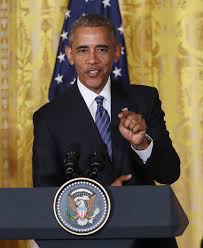
Iowa Senator Charles (“Chuck”) Grassley, the current Chair of the Senate Judiciary Committee, is following the dictates of the Senate Majority Leader and his fellow Republican, Mitch McConnell, to not do anything with respect to President Obama’s Supreme Court nomination of Merrick Garland. Grassley’s conduct with respect to this nomination stands in sharp contrast to the rational argument for the nomination recently offered by President Obama as discussed in a prior post and in the White House’s website for the nomination.

Grassley started out this “do-nothingism” on what was a high note for him. Immediately after the announcement of the Garland nomination Grassley said “Article II, Section 2 [of the Constitution grants] the power to nominate an individual to the Supreme Court . . . to the President and authority is given to the Senate to provide advice and consent.  Nowhere in the Constitution does it describe how the Senate should either provide its consent or withhold its consent.” In addition, according to the Senator, “A majority of the Senate [the Republicans] has decided to fulfill its constitutional role of advice and consent by withholding support for the nomination during a presidential election year.”[1]

Grassley, therefore, has not submitted any questionnaire to the nominee, has refused to schedule any hearing on the nomination and has promised not to submit the nomination for a vote by the entire Senate. In addition, Grassley initially even refused to extend the courtesy of meeting with Judge Garland. Subsequently, however, Grassley said he would meet with Garland to tell him why Grassley was not supporting the nomination.[2]

Grassley Speech on Senate Floor

On April 5, Grassley escalated his obstructionism by an intemperate speech on the Senate floor criticizing Chief Justice Roberts for saying, 10 days before the death of Associate Justice Scalia and thus before the controversy over the Garland nomination: “When you have a sharply divided political divisive hearing process, it increases the danger that whoever comes out of it will be viewed in those terms.  You know if the Democrats and Republicans have been fighting so fiercely about whether you’re going to be confirmed, it’s natural for some members of the public to think, well, you must be identified in a particular way as a result of that process.” [3]

According to Grassley, “the Chief Justice has it exactly backwards.  The confirmation process doesn’t make the Justices appear political.  The confirmation process has gotten political precisely because the court has drifted from the constitutional text, and rendered decisions based instead on policy preferences. In short, the Justices themselves have gotten political.  And because the Justices’ decisions are often political and transgress their constitutional role, the process becomes more political.”

“In fact, many of my constituents believe, with all due respect, that the Chief Justice is part of this problem,” added Grassley. “And contrary to what the Chief Justice suggested, a major reason the confirmation process has become more divisive is that some of the Justices are voting too often based on politics and not on law.   If they’re going to be political actors after they’re confirmed, then the confirmation process necessarily will reflect that dynamic.”

This Grassley speech also criticized Roberts for trying to counter the perception by some Americans that the Court has become politicized. Said the Senator, “I think he is concerned with the wrong problem. He would be well served to address the reality, not perception, that too often there is little difference between the actions of the court and the actions of the political branches. So, physician, heal thyself.”

Reacting to this speech, Jeffrey Toobin of the New Yorker, said this speech “was close to breathtaking in its intemperate incoherence.” It included an “extended attack on Chief Justice John Roberts, who had recently expressed the unexceptional view that the Court should stay out of politics as much as possible.” According to Grassley, “The confirmation process has gotten political precisely because the Court has drifted from the constitutional text and rendered decisions based instead on policy preferences.” Presumably Grassley was referring to two cases upholding the Affordable Care Act that were written by Roberts.

An editorial in the Baltimore Sun had similar words of condemnation. It said that Grassley’s argument was “infantile” and “allows Mr. Grassley or any other self-appointed expert on constitutional law to make a similar claim every time a justice interprets the law in a manner that is not lock-step with the critic’s own. . . . Shame on Senator Grassley for suggesting that Justice Roberts has somehow betrayed the institution when it is the judiciary chairman who seems to be bent on rewriting the Constitution — not only to limit President Barack Obama’s authority to fill a court vacancy but now to imply that the chief justice has somehow sabotaged the court. . . . Iowa voters, take note: Your six-term senator deserves to be put out to pasture, if only for sheer soft-headedness.”[4]

Grassley Op-Ed in Des Moines Register

On April 10, in reaction to a Des Moines Register editorial objecting to the Senate’s obstruction of the nomination and probably to Iowa voters objecting to his “do-nothingism,” Grassley published an op-ed in that newspaper” to defend his position.[5]

He asserted that it was absurd to argue that somehow “the federal judiciary is debilitated without a ninth Supreme Court justice for a brief period of time.  As the [changing] numbers [of the Justices over time] make clear, the size of the court as Congress designed it over the years has frequently changed, and hasn’t left the court in disarray.” He continued, “The temporary impact of a split decision pales in comparison to the damage an election-year political brawl would cause the court and the country . . . . A nomination considered during this heated campaign season would be all about politics, not the Constitution.”

Grassley-Garland Breakfast Meeting

The Grassley-Garland meeting did happen over breakfast in the Senate Dining Room on April 12. After the one-hour breakfast, Grassley tweeted that the meeting has been “pleasant” as he explained to Judge Garland why the Senate would not be moving forward with his nomination. Later the Senator’s staff released a statement: “The meeting was cordial and pleasant. As he indicated last week, Grassley explained why the Senate won’t be moving forward during this hyper-partisan election year. Grassley thanked Judge Garland for his service.” [6]

Grassley ‘s Reaction to President Obama’s Statement About the Nomination

Later that same day, April 12, the Senator released a statement to be made on the Senate floor in response to President Obama’s comments at the University of Chicago Law School that were discussed in an earlier post.[7]

“[U]nlike the President, I think it’s a bad thing that there’s politics in judicial decision-making these days. Politics in judicial rulings means that something other than law forms the basis of those decisions. It means the judge is reading his or her own views into the Constitution.  Unlike the President, I believe the biggest threat to public confidence in the court is the justices’ willingness to permit their own personal politics to influence their decisions. “

According to Grassley and contrary to the President, “what’s in a judge’s ‘heart,” or their personal “perspective [and] ethics’ have no place in judicial decision-making” and ‘is totally at odds with our constitutional system.   We are a government of laws and not a government of judges.”

Said Grassley, “Politics belongs to us—it’s between the people and their elected representatives.  It’s important that judges don’t get involved in politics. That’s because, unlike senators, lifetime-appointed federal judges aren’t accountable to the people in elections.  It’s also because when nine unelected justices make decisions based on their own policy preferences, rather than constitutional text, they rob from the American people the ability to govern themselves.”

Conclusion

A negative assessment of the obstructions to the Garland nomination by Chairman Grassley and other Republican Senators has been provided by 15 former presidents of the American Bar Association (ABA) and by this blogger.

The ABA leaders asserted in a letter to Senate leaders that “there is no election-year exception” to the Senate’s advice and consent responsibilities in the Constitution, that Chief Judge Merrick Garland is “one of the most outstanding judges in the country” and that leaving the seat vacant “injects a degree of politics into the judicial branch that materially hampers the effective operation of our nation’s highest court.” Therefore, say the bar leaders, “The president has fulfilled his constitutional duty, and it is time for the members of the United States Senate to fulfill theirs by holding a fair hearing and timely vote.”[8]

Grassley’s previously cited op-ed made what, in this blogger’s opinion, is an absurd argument. He contended that with a vacancy on the Court this election year, “the American people have a unique opportunity to engage in a serious discussion about the meaning of our Constitution and the way justices read it.” So far there has not been any such serious discussion of this or any other issue and it is unrealistic to expect that there will be any difference during the remaining six-plus months of this election.

Moreover, Grassley who is not an attorney and who, to my knowledge, has never studied constitutional law, proceeds from an over-simplistic view of how cases present constitutional questions and how courts resolve them. He also ignores the Senate’s own interpretation of the relevant constitutional provisions by its consistent practice of holding hearings and votes on nominations even in election years. Finally Grassley errs in suggesting that issues of constitutional law should be submitted to the average voter, similarly unversed in constitutional law. Instead the constitutional system submits selection of judges to the President and the Senate, neither of which originally was elected directly by the people.[9] This system of judicial selection is one way to preserve the independence of the judiciary.

Although I now live and vote in Minnesota, I am a native Iowan who obtained education in the public schools of the Iowa town of Perry and at the state’s Grinnell College. I, therefore, wrote to Senator Grassley on March 20, 2016. After reciting my Iowa background, I stated:

  • “I have long believed that most Iowans were reasonable, fair-minded people and that their elected representatives reflected this admirable trait.”
  • “You, however, disappointingly have dispelled this belief by your enlistment in the Republican Senate leadership campaign to deny a hearing and a Senate vote by the Senate Judiciary Committee and the full Senate on advising and consenting to President Obama’s nomination of Judge Merrick Garland to the United States Supreme Court.”
  • “In so doing, you ignore that in 2012 President Obama won reelection for a term of office that does not end until January 20, 2017 with a popular vote of 65.9 million, which was nearly 5.0 million more votes than those received by the Republican presidential candidate, Mitt Romney. You also ignore that under Article II, Section 2 of the U.S. Constitution the President has the power and the duty to “nominate . . . Judges of the supreme Court” and that the Senate has the power and duty to provide its “Advice and Consent” to such nominations.”
  • “Remember this is the Senate Judiciary Committee, not the Republican Judiciary Committee nor “your” Judiciary Committee.”
  • “I hope during this Senate recess that your Iowa constituents will voice similar views to you and that you change your position on this important issue and authorize the Judiciary Committee to proceed with its consideration of this nomination.”

To date I have not received any response to this letter from the Senator.

====================================

[1] Grassley, Grassley Statement on the President’s Nomination of Merrick Garland to the U.S. Supreme Court (Mar. 16, 2016)

[2] Reuters, Senator Grassley to Meet Garland Despite Opposition to Nominee, N.Y. Times (April 4, 2016); Shear, Meeting Merritt Garland to Tell Him Why G.O.P. Won’t Hold Hearings, N.Y. Times (April 4, 2016).

[3] Grassley, Grassley Floor Statement on the Public Perception of the Supreme Court (April 5, 2016); Assoc. Press, Capitol Hill Buzz: Grassley Takes on Chief Justice Roberts, N.Y. Times (April 5, 2016); Toobin, The Supreme Court Extremism of Clarence Thomas and Chuck Grassley, New Yorker (April 8, 2016).

[4] Editorial, Grassley v. Roberts, Baltimore Sun (April 10, 2016).

[5] Grassley: Grassley: Sky won’t fall with one less justice, Des Moines Register (April 10, 2016).

[6] Herszenhorn, Senator Grassley and Judge Garland Meet, and Rehash the Obvious, N.Y. Times (April 12, 2016);Reuters, Senate Judiciary Chairman Grassley Tells Garland No Hearings, N.Y. Times (April 12, 2016); Assoc. Press, Senate Judiciary Chair Grassley Has Breakfast with Garland, N.Y. Times (April 12, 2016).

[7] Grassley, The Supreme Court and the Remarks of President Barack Obama at the University of Chicago (April 12, 2016).

[8] Assoc. Press, Ex-American Bar Association Chiefs Push for a Vote on Garland, N/Y. Times (April 11, 2016); Mascaro, Top GOP senator meets Obama’s Supreme court pick to tell him there will be no vote, Chic. Tribune (April 12, 2016).

[9]  U.S. Senators were not elected by popular vote of the people until 1913 with the adoption of the Seventeenth Amendment to the U.S. Constitution requiring such method of election. (U.S. Senate, Direct Election of Senators.) The President and Vice President, originally and still true today, are not elected by popular vote, but instead by electors in the Electoral College. And the first time there was a popular vote for electors was in 1824 with the procedure for the Electoral College established by the Twelfth Amendment to the Constitution that was adopted in 1804.


President Obama Continues To Demonstrate His Intelligence, Eloquence and Strong Record

Obama ChicagoOn April 7th President Obama returned to the University of Chicago Law School, my alma mater and where he taught for 10 years. He did not give a speech; instead he engaged in a conversation with Professor David Strauss and with current law students. [1] (To the right is a photograph of the President at the Law School.)


The stated purpose of this visit was for the President to stress the importance of the U.S. Supreme Court and of the U.S. Senate proceeding with its normal processes for evaluating a presidential nominee to join the Court and thus to provide a hearing and a vote on the President’s nomination of Chief Judge Merrick Garland to the Supreme Court.

The President did just that.

After pointing out the importance of the federal judiciary in general and the Supreme Court in particular in our system of government, the President stressed that Merrick Garland was an “eminently qualified jurist,” a characteristic not disputed by anyone in either major political party. Obama added that in selecting nominees to the federal courts, he wanted to find out about their personal lives as windows to their character. For Judge Garland, Obama was impressed by the nominee’s impromptu defense of a classmate’s right to free speech in speaking against the Vietnam War and Garland’s careful investigation of the Oklahoma City’s bombing tragedy and his empathy for the victims and their families.

Responding to a question from Professor Strauss, the President suggested that liberals should not be disappointed in the choice of Judge Garland because the role of the courts was only rarely to engage in broad societal change. “The courts are a terrific shield; they are not always a very effective sword,”

Obama added, “If you start getting into a situation in which the process of appointing judges is so broken, so partisan that an eminently qualified jurist cannot even get a hearing, then we are going to see the kinds of sharp partisan polarization that have come to characterize our electoral politics seeping entirely into the judicial system. And the courts will be just an extension of our legislatures and our elections and our politics. And that erodes the institutional integrity of the judicial branch. At that point, people lose confidence in the ability of the courts to fairly adjudicate cases and controversies. And our democracy can’t afford that.”

Mr. Obama warned that Republicans’ stance on this nomination could have lasting effects. If he were succeeded by a Republican, Obama said, Democrats would be unlikely to give a new nominee an easy path to confirmation, potentially leaving the seat unfilled for an extended period.

Watching the President’s informal session at the Law School, I again was impressed by his intelligence, eloquence and very personable and disarming manner.  Later I lamented that this intelligence, eloquence and engaging manner were lacking in so many of the current candidates for the presidency.

I also lament that the current presidential campaigning ignores the amazing economic performance of the U.S. during the Obama Administration: [2]

  • The U.S. economy has added jobs for 72 months straight.
  • Unemployment is down to 5 percent.
  • The U.S. is not in a recession and a massive recession does not loom.
  • The auto industry just had its best year ever.
  • The economy is growing.
  • Most Americans like their jobs and get satisfaction from them.
  • Wages are too slowly rising — but they are going up.
  • The average gap in economic satisfaction between the upper and lower thirds in income is lower than it was during the Reagan, George H.W. Bush, Clinton or George W. Bush years, according to the respected Index of Consumer Satisfaction.
  • Nothing has dimmed Americans’ desire to innovate and make technology work for them.
  • According to the Kaiser Family Foundation, employers are even more determined to provide health benefits than before the Affordable Care Act took effect. The percentage of adults under 65 with employer-based insurance held firm for the last five years after steadily declining since 1999.
  • More than 16 million previously uninsured people now have health insurance.

========================================================

[1] White House, President Obama Participates in a Conversation about the Supreme Court and Our Country’s Judicial System (April 7, 2016) (video of the conversation); Shear, Obama Revisits Law School to Give a Supreme Court Lecture, N.Y. Times (April 8, 2016); Ellperin & DeBonis, To press his Supreme Court nominee’s case, Obama returns to his academic roots, Wash. Post (April 7, 2016); Tau, Obama Says Garland Fight Putting Federal Court System’s Legitimacy at Risk, W.S.J. (April 7, 2016); Gillespie, Obama Returns to the Law School, University of Chicago Law School (April 7, 2016).

[2] McFeatters, And now for the good news about America, StarTribune (April 7, 2016)

President Obama’s Lack of Comments About Cuba During His Reelection Campaign of 2012


In light of President Barack Obama’s historic December 17, 2014, announcement of rapprochement with Cuba, it is interesting to examine Obama’s earlier statements about Cuba. Prior posts examined his campaign for the Democratic presidential nomination in 2007-2008; his campaign for the presidency as the Democratic Party’s nominee in 2008; and his first presidential term, 2009-2013. Now we examine his presidential reelection campaign of 2012.[1] A subsequent post will examine his second presidential term (up to the December 17, 2014, announcement), 2013-2014.

On April 4, 2011, Obama had an unusual way of formally announcing he would be running for reelection in 2012. He did so with an understated two-minute Internet video titled “It Begins With Us,” which features his supporters talking about the need to re-elect him and in which he does not appear. No mention of Cuba was made.

As the incumbent president, Obama secured the Democratic nomination with no serious opposition at its national convention in Charlotte, North Carolina. On September 5, 2012, he was re-nominated, and the following night he accepted the nomination. In his acceptance speech he said the election “will be a choice between two different paths for America, a choice between two fundamentally different visions for the future. Ours is a fight to restore the values that built the largest middle class and the strongest economy the world has ever known.”

Obama in his acceptance speech asked all citizens “to rally around a set of goals for your country, goals in manufacturing, energy, education, national security and the deficit, real, achievable plans that will lead to new jobs, more opportunity and rebuild this economy on a stronger foundation. That’s what we can do in the next four years, and that is why I am running for a second term as president of the United State.” Obama also talked about various problems around the world, but made no mention of Cuba.

His Republican opponent, Mitt Romney, previously had been nominated at its national convention on August 28 with his acceptance on August 30.

The campaigns focused heavily on domestic issues: debate centered largely around sound responses to the Great Recession in terms of economic recovery and job creation. Other issues included long-term federal budget issues, the future of social insurance programs, and the Affordable Care ActForeign policy was also discussed including the phase-out of the Iraq War, the size of and spending on the military, preventing Iran from obtaining nuclear weapons, and appropriate counteractions to terrorism.

The two main presidential candidates held three debates, all in October (3rd, 16th and 22nd).

In the first debate on October 3 the candidates “quarreled aggressively over tax policy, the budget deficit and the role of government, with each man accusing the other of being evasive and misleading voters.” Romney, for example, accused Obama of failing to lead the country out of the deepest economic downturn since the Great Depression of the 1930’s while Obama implored Americans to be patient. On a basic level it was a clash of two ideologies, the president’s Democratic vision of government playing a supporting role in spurring economic growth, and Mr. Romney’s Republican vision that government should get out of the way of businesses that know best how to create jobs.” There was practically no mention of foreign issues, and not a word about Cuba.

The second debate on October 16 again dealt primarily with domestic affairs, including taxes, unemployment, job creation, the national debt, energy and energy independence, women’s rights and immigration. But this debate also touched on foreign policy, especially the then recent attack on the U.S. consulate in Benghazi, Libya. Again, no mention of Cuba.

The last debate on October 22 was to be devoted to foreign policy, and it did have discussions about the attack on Benghazi, Iran’s nuclear program, the Arab Spring, the Syrian civil war, relations with Israel and Pakistan, the War on Terror, the withdrawal of U.S. troops from Afghanistan, the size and scope of the U.S. military, and relations and trade with China. There also were further comments about domestic policy issues, such as job creation, the federal deficit and education. Again, there was no mention of Cuba.

On November 6, 2012, Obama was re-elected for his second term as President of the United States. He won 65,916,000 popular votes (51.1%) and 332 electoral votes to Romney/Ryan’s 60,934,000 (47.2%) and 206 electoral votes. Nationally the Democratic ticket overwhelmingly won the Hispanic vote, 71% to 27% for the Republicans. Obama and Biden also won the key state of Florida, 50.0% versus 49.1% for Romney and Ryan, with nearly 50% of the state’s Cuban-Americans going for the Obama ticket.

In his victory speech in Chicago, President Obama proclaimed, “Tonight, in this election, you, the American people, reminded us that while our road has been hard, while our journey has been long, we have picked ourselves up, we have fought our way back, and we know in our hearts that for the United States of America, the best is yet to come.”

Conclusion

 Unless it was due to my limited research, there was no mention of U.S. policy regarding Cuba during this presidential election. This is not too surprising in light of the primacy of domestic economic issues in 2012, the problems in the Middle East and the Administration’s apparent lack of attention to Cuba since Cuba’s arrest of Alan Gross in December 2009 and its subsequent conviction and imprisonment of Gross.

=======================================================

[1] This post and the subsequent posts about Obama’s prior statements about Cuba are not based upon comprehensive research. The primary research tool was online searching of the New York Times for articles mentioning “Obama and Cuba” for the relevant time period. Therefore, this blogger especially welcomes comments with corrections and additions. Ultimately after public release of many Obama Administration documents after the completion of his presidency, scholars will undertake a detailed examination of those documents and provide their assessments of his record regarding Cuba. This post is based upon the following: Shear, Obama Begins re-Election Facing New Political Challenges, N.Y. Times (April 4, 2011) President Obama’s Full Remarks From the Democratic National Convention, N.Y. Times (Sept. 6, 2012); Zeleny & Rutenberg, Obama and Rommey, in First Debate, Spar Over Fixing the Economy, N.Y. Times (Oct. 3, 2012); Baker, A Clash of Philosophies, N.Y. Times (Oct. 4, 2012); Transcript of the Last Debate, N.Y. Times (Oct. 22, 2012); Baker & Cooper, Sparring Over Foreign Policy, Obama Goes on the Offensive, N.Y. Times (Oct. 22, 2012); President Obama’s Election Night Speech, N.Y. Times (Nov. 7, 2012); Wikipedia, 2012 Democratic National Convention; Wikipedia, Barack Obama presidential campaign, 2012; Wikipedia, 2012 Republican National Convention; Wikipedia, United States presidential election debates, 2012; Wikipedia, United States presidential election, 2012; Jonathan Alter, The Center Holds: Obama and His Enemies (Simon & Schuster; New York; 2013); Daniel Belz, Collision 2012: Obama vs. Romney and the future of elections in America (Viking; New York; 2013).

Barack Obama’s Comments About Cuba During His Campaign for the Presidency, August 28 through November 4, 2008

 In light of President Barack Obama’s historic December 17, 2014, announcement of rapprochement with Cuba, it is interesting to examine Obama’s earlier statements about Cuba. A prior post examined his campaign for the Democratic presidential nomination in 2007-2008. This post will discuss his campaign for the presidency as the Democratic Party’s nominee in 2008.[1] Future posts sill look at his first presidential term (including his 2012 presidential election campaign), 2009-2013; and his second presidential term (up to the December 17, 2014, announcement), 2013-2014.

Remember, as discussed in a prior post, that on August 28, 2008, Barack Obama accepted the Democratic Party’s presidential nomination. A week later (September 4th) Senator John McCain accepted the Republican Party’s presidential nomination.

In the next two months leading to the presidential election on November 4th, the two candidates met in three debates on September 26 and October 7 and 15.

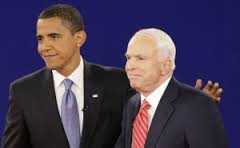
Obama & McCain Debate 2008

The New York Times thought the first debate on September 26 “was generally a relief from the campaign’s nastiness. Both John McCain and Barack Obama worked to strike a more civil and substantive tone. And Americans could see some differences between the candidates on correcting the regulatory disasters that led to the Wall Street crisis, on how to address the country’s grim fiscal problems and on national security. There were also differences in the candidates themselves. Mr. McCain fumbled his way through the economic portion of the debate, while Mr. Obama seemed clear and confident. Mr. McCain was more fluent on foreign affairs, and scored points by repeatedly calling Mr. Obama naïve and inexperienced.” However, there was no discussion about Cuba.

Obama & McCain Debate 2008

During the second debate on October 7 McCain criticized Obama for saying he would speak, without preconditions, to the leaders of countries like Pakistan (and presumably Cuba). McCain said he would deal with leaders of foes the way Theodore Roosevelt did: “talk softly, but carry a big stick. Senator Obama likes to talk loudly.” Again, no direct discussion about Cuba.

McCain, Bob Schieffer & Barack Obama Debate 2008

Throughout the last debate on October 15, reported the New York Times, “Mr. McCain offered voters what amounted to a reprise of all the attacks that have been lodged at Mr. Obama over the past year, by Mr. Obama’s Democratic and Republican opponents, Ms. Palin, Republican leaders and, at times, Mr. McCain.” But again no discussion about Cuba.

Moreover, said the Times, “the split-screen visual contrast [in the last debate] between the two men – Mr. McCain often appearing coiled and annoyed, Mr. Obama seeming at ease and smiling – was striking, and may not be what Mr. McCain was looking for a time when Mr. McCain’s favorable ratings have been falling, and when many voters say they think Mr. McCain is spending more time attacking than saying what he would do as president.”

On October 23, the New York Times endorsed Obama. It said, “After nearly two years of a grueling and ugly campaign, Senator Barack Obama of Illinois has proved that he is the right choice to be the 44th president of the United States.” The only mention of Cuba in that editorial was this: “Both candidates have renounced torture and are committed to closing the prison camp in Guantánamo Bay, Cuba.”

In the election on November 4, 2008, Barack Obama and Joe Biden obtained 69.5 million votes (52.9% of the total) while John McCain and Sarah Palin received 59.9 million votes (45.7%). In the key state of Florida, Obama-Biden had 51.0% of the popular vote against McCain-Palin’s 48.4%.The electoral votes were Obama and Biden, 365; McCain and Palin, 173.

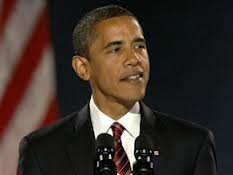
Obama's Victory Speech, Nov. 4, 2008
Obama’s Victory Speech, Nov. 4, 2008
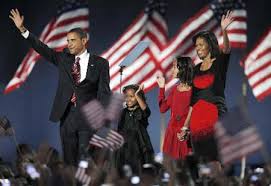
Barack, Malia, Sasha & Michelle Obama,Nov. 4, 2008
Barack,Sasha, Malia & Michelle Obama, Nov. 4, 2008


In his victory speech to an open-air crowd of thousands at Chicago’s Grant Park,Obama siad, “If there is anyone out there who still doubts that America is a place where all things are possible, who still wonders if the dream of our founders is alive in our time, who still questions the power of our democracy, tonight is your answer.” He went on, “I will never forget who this victory truly belongs to. It belongs to you. It belongs to you.” His conclusion was the following: “This is our time, to put our people back to work and open doors of opportunity for our kids; to restore prosperity and promote the cause of peace; to reclaim the American dream and reaffirm that fundamental truth, that, out of many, we are one; that while we breathe, we hope. And where we are met with cynicism and doubts and those who tell us that we can’t, we will respond with that timeless creed that sums up the spirit of a people: Yes, we can.”

After Obama and Joe Biden won the November 2008 election, several head of states congratulated Obama while also calling for the U.S. to end its sanctions against Cuba.

Conclusion

In contrast with the campaigning for the Democratic presidential nomination, there was practically no mention of Cuba or of Obama’s proposed policies regarding that nation in the presidential race. Surprisingly the emphasis in the nomination campaign on Obama’s willingness to meet, without preconditions, leaders of states like Cuba almost disappeared in the campaign for the presidency.

================================================

[1] This post and the other posts about Obama’s prior statements (and actions) about Cuba are not based upon comprehensive research. The primary research tool was online searching of the New York Times for articles mentioning “Obama and Cuba” for the relevant time period. Therefore, this blogger especially welcomes comments with corrections and additions. This post is based upon the following: Nagourney & Cooper, McCain vows to End ‘Partisan Rancor,’ N.Y. Times (Sept. 4, 2008); Editorial: The First Debate, N.Y. Times (Sept. 26, 2008); Nagourney, Economic Woes Set Tone for Rivals in 2nd Debate, N.Y. Times (Oct. 7, 2008); First Impressions on the Last Debate, N.Y. Times (Oct. 15, 2008); Rutenberg, Candidates Clash Over Character and Policy, N.Y. Times (Oct. 15, 2008); Editorial: The Final Debate, N.Y. Times (Oct. 15, 2008); Healy, McCain Attacks, but Obama Stays Steady, N.Y. Times (Oct. 16, 2008); Editorial: Barack Obama for President, N.Y. Times (Oct. 23, 2015); Wikipedia, United States presidential election debates, 2008; Wikipedia, United States presidential election, 2008.

Why Did Senator Patrick Leahy and Two Other Senators Make A Trip to Cuba Last Week?

On June 25 three U.S. Senators arrived in Cuba: Senators Patrick Leahy (Dem., VT) and Ben Cardin (Dem., MD), who have been there before, and Senator Dean Heller (Rep., NV). There has been no recent development that seems to have prompted this trip, which prompts the question: why this trip at this time?[1]

The U.S. Interests Section in Havana said they were there to focus “on continued progress towards normalization of relations between the United States and Cuba.”

Upon arrival in Havana, Senator Leahy said, “I’m glad to see things are changing between our countries, and the more they change, the faster they change, the better for both countries.”

They met with (i) Miguel Diaz-Canel, Cuba’s First Vice President and heir-apparent to Raul Castro, (ii) Josefina Vidal Ferreiro, Director General of the U.S. Ministry of Foreign Affairs, and (iii) other Foreign Ministry officials. They discussed relations between Cuba and the United States and the debate currently taking place in the U.S. Congress on the elimination of restrictions on travel and trade with Cuba and the lifting of the U.S. embargo (blockade).They also met with religious leaders, ambassadors and others in Havana and the eastern city of Santiago.

Senators Heller, Leahy & Cardin
Senators Heller, Leahy & Cardin in Havana

At a press conference in Havana on June 27, Senator Leahy asserted, “The embargo has been an error of American policy.” He also said, “I’ve been here three times since the announcements of December 17, and “I see a new, very positive change in Cuba.”


Leahy added, “Obviously we still have differences, but I look forward to the United States being able to have a real embassy here. We hope that [the opening of embassies] can be very soon. Some in Congress oppose the opening, but I like to think that they are minority. We must open a full embassy. ​​We have a magnificent ambassador here and the staff and appropriate facilities. I like to think that the U.S. is a great country, and our embassies should reflect that.”

Senator Cardin said the delegation made clear to Cuban officials that the path to normalization must include dealing with thorny issues where the U.S. and Cuba have serious disagreements, such as human rights. “For normal relations to move down a productive path, it’s critically important for Cuba to recognize that it is out of step today with international human rights issues.”

The only Republican in the group, Senator Heller on his first visit to Cuba, said, “When the president is right, I support Obama, and he is right in the case of Cuba. Heller acknowledged that there is still much resistance to change in Congress. One way to overcome this resistance, he said, was for Americans to travel to Cuba to talk to people and see the reality with their own eyes. “That will change minds and hearts as has happened to me.” Heller, by the way, is a member of the Senate Committee on Finance; its Banking, Housing, and Urban Affairs Committee; its Committee on Veterans’ Affairs; its Commerce, Science, and Transportation Committee; and the Senate Special Committee on Aging.

A number of Cuba initiatives are pending in the Senate, including a bill to remove the travel ban on Americans and a more ambitions bill to rescind the decades-old U.S. economic embargo, but these proposals are opposed by the Republican leadership in control of the Senate and the House of Representatives. The three senators in Havana thought there were better prospects for progress on Cuba legislation in their chamber. Senator Heller observed, “I think the Senate can move the House, but the Senate’s going to have to act first.”

The reasons for this Republican resistance to reconciliation were captured by Héctor E. Schamis, Adjunct Associate Professor at Washington, D.C.’s Georgetown University, who said:

  • The Republican Party, “the former pragmatic party of big business, is increasingly a party of ideology and short-term electioneering.Their incentives are to protect their districts–socially homogeneous, culturally and ideologically dogmatic and uniform– attributes that rise to the surface in such varied topics as immigration, gay marriage … or the Cuban transition. Its social base is the pure and simple anti-communism, which is also old. It is a reading of the world backward, not forward. Ignore the demographic change in the Cuban-American community, where the younger they are, the more they support the strategy of Obama. The Republican Party does not know that for these young people, Castro and Napoleon belong to the same place: the history books.”

Conclusion

At the start of this post, I said there has been no recent development that seems to have prompted this trip. That is true and reveals, in my opinion, the reason for this trip at this time. By now many in the U.S. at least were expecting that the two countries would have announced that they were re-establishing diplomatic relations and thus converting their interests sections into embassies. Keys for that anticipated announcement in June were the May 29, 2015, U.S. rescission of its designation of Cuba as a “state sponsor of terrorism;” the Cuban Interests Section establishing a banking relationship with a bank in Florida; and a reported agreement regarding conditions for U.S. diplomats’ travel in Cuba.

Thus, in my opinion, the reason for this trip at this time was for Senator Leahy to attempt to determine whether there was some unknown reason from the Cubans for the lack of such an announcement and to press them to conclude the agreement for re-establishing diplomatic relations. Leahy also in the private discussions with the Cuban Foreign Ministry officials may have talked about political reasons from the U.S. perspective to have an announced re-establishment of diplomatic relations as soon as possible. After all, in his public comments in Havana, Leahy stressed the desire for a prompt opening of embassies and the need for the U.S. to open a full embassy.

Let us hope that in the next few days or weeks there will be an announcement of the resumption of diplomatic relations.

=========================

[1] This post is based upon the following: Assoc. Press, Leahy Heads US Senate Delegation to Cuba Ahead of Embassies, N.Y. Times (June 26, 2015); Diaz-Canel received US Senators, Granma (June 26, 2015); Miguel Diaz-Canel meets with US Senator Patrick Leahy, Marti (June 26, 2015); Senator Leahy in Havana: The blockade has been an error of US policy, CubaDebate (June 27, 2015); Gomez, Normalization is the right way, say US senators in Havana, Granma (June 27, 2015); Assoc. Press, US Sen. Leahy Sees ‘Positive Change,’ Work to Do in Cuba, N.Y. Times (June 27, 2015); Reuters, U.S. Senators Visit Cuba, Hope Congress Will Ease Restrictions, N.Y. Times (June 27, 2015); Schamis, Obama’s Cuba and its discontents, El Pais (June 28, 2015).


Obama’s Negative Reaction to Netanyahu’s Planned Speech to U.S. Congress Validates Cuba’s Negative Reaction to U.S. Meeting with Cuban Dissidents in Cuba

At the invitation of John Boehner, the Republican Speaker of the U.S. House of Representatives, Israeli Prime Minister Benjamin Netanyahu is planning to give a speech to the U.S. Congress regarding sanctions on Iran. Apparently this plan was suggested by Ron Dermer, Israel’s Ambassador to the U.S., who once worked for a Republican pollster in Florida and who is a confident of Sheldon Adelson, a billionaire GOP donor. [1]

This was done without the prior knowledge and approval of the Obama Administration which under the U.S. Constitution is in charge of foreign affairs. In response the White House Press Secretary, Josh Earnest, said that the planned speech was “a departure from protocol [as] such invitations are usually made leader to leader” and that Obama would not meet with Netanyahu while he was in the U.S.

An unnamed U.S. official was more outspoken. He or she said this “is not the way people act. It is unprecedented. It is barbaric behaviour. It is so impolite it is disgraceful.” Richard Cohen, a columnist for the Washington Post, said it showed Netanyahu’s contempt for Obama and threatened U.S. bipartisan understanding and support for Israel. Cohen sarcastically said he would not be surprised to see Netanyahu as a delegate at the Republican Party’s 2016 national convention.

U.S. criticism is also directed at Ambassador Dermer. A senior Obama administration official said the Ambassador had “repeatedly placed Mr. Netanyahu’s political fortunes above the relationship between Israel and the U.S.”

Netanyahu is in the midst of an election campaign in Israel and undoubtedly saw the speech as bolstering his status as an international statesman. But instead it has prompted severe criticism in his country. His former ambassador to the U.S., Michael Oren, who is running for the country’s parliament, called on Netanyahu to cancel the speech, and Amos Yadlin, a former Israeli military intelligence chief, denounced the plan as “irresponsible.” An Israeli professor specializing in Israeli-American relations, said, “It’s a huge miscalculation. People are now questioning [Netanyahu’s] judgment.”

The controversy also apparently is bolstering support for Obama’s Iran policies from at least the Democrats in Congress

Finally the forceful criticism of the planned Netanyahu speech shows the validity of a prior post’s description of the Cuban government’s unhappiness with the recent meeting in Havana with Cuban dissidents  by U.S. Assistant Secretary of State Roberta Jacobson and with the USAID covert or “discreet” programs on the island purportedly to promote democracy and human rights.

========================================================

[1] This post is based upon Zogby, Boehner, Netanyahu outsmarted themselves, Chicago Trib. (Jan. 26, 2015); Cohen, Netanyahu’s Contempt for President Obama, Wash. Post (Jan. 26, 2015); Bernstein, Is Netanyahu’s address to Congress unconstitutional?, Wash. Post (Jan. 26, 2015); Rudoren, Israeli Opposition Takes Aim at Netanyahu Over Planned Speech to Congress, N.Y. Times (Jan. 27, 2015); Peters, G.O.P.’s Invitation to Netanyahu Is Aiding Obama’s Cause on Iran, N.Y. Times (Jan. 29, 2015); Davis, White House’s Dismay Over Netanyahu’s Visit Extends to Ambassador, N.Y. Times (Jan. 29, 2015); Hulse & Peters, Netanyahu Is Talking to Leading Democrats to Little Effect So Far, N.Y. Times (Jan. 30, 2015); Robinson, Boehner’s Invitation to Netanyahu backfires on them both, Wash. Post (Jan. 29, 2015); Kagan, Five reasons Netanyahu should not address Congress, Wash. Post (Jan. 29, 2015).