Cuban President Raul Castro’s Major Speech at the Summit of the Americas

On April 10 and 11, Cuba for the first time was welcomed to the Summit of the Americas. Presidents Raul Castro and Barack Obama exchanged handshakes and friendly greetings, and their speeches promised commitment to the process of reconciliation. Other leaders of the Americas celebrated this demonstration of reconciliation.

On April 11th after President Obama’s speech that was discussed in a prior post, President Castro delivered his major Summit speech, most of which was a critical review of the history of U.S. relations with Cuba and other Latin American countries.

This post contains substantial extracts from Castro’s speech. Other posts will examine the two presidents’ subsequent private meeting at the Summit plus Obama’s comments on other subjects and the reactions from other leaders.
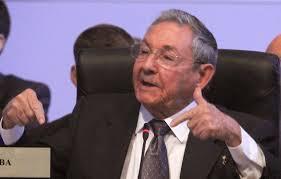
 President Castro’s Speech

President RAul castro
President Raul Castro

“In 1800, there was the idea of adding Cuba to the [U.S.] to mark the southern boundary of the extensive empire. The 19th century witnessed the emergence of such [U.S.] doctrines as the Manifest Destiny, with the purpose of dominating the Americas and the world, and the notion of the ‘ripe fruit’, meaning Cuba’s inevitable gravitation to the [U.S.], which looked down on the rise and evolution of a genuine rationale conducive to emancipation.”

“Later on, through wars, conquests and interventions that expansionist and dominating force stripped Our America of part of its territory and expanded as far as the Rio Grande.”

“After long and failing struggles, José Martí organized the ‘necessary war’ [for independence against Spain], and created the Cuban Revolutionary Party to lead that war and to eventually found a Republic ‘with all and for the good of all’ with the purpose of achieving ‘the full dignity of man’. . . . Martí committed to the duty ‘of timely preventing the [U.S.] from spreading through the Antilles as Cuba gains its independence, and from overpowering with that additional strength our lands of America.’”

On “April 11, 1898, the President of the [U.S.] requested Congressional consent for military intervention in the [Cuban] independence war already won with rivers of Cuban blood, and that legislative body issued a deceitful Joint Resolution recognizing the independence of the Island ‘de facto and de jure.’ Thus, [the U.S.] entered [this war] as [Cuba’s supposed] ally and seized the country as an occupying force.”

“Subsequently, an appendix was forcibly added to Cuba’s Constitution, the Platt Amendment, that deprived it of sovereignty, authorized the powerful neighbor to interfere in [Cuba’s] internal affairs, and gave rise to Guantánamo Naval Base, which still holds part of our territory without legal right. It was in that period that the [U.S.] invaded the country, and there were two military interventions and support for cruel dictatorships.”

At the time, the prevailing [U.S.] approach to Latin America was the ‘gunboat policy’ followed by the ‘Good Neighbor’ policy. Successive interventions ousted democratic governments and in twenty countries installed terrible dictatorships, twelve of these simultaneously and mostly in South America, where hundreds of thousands were killed. President Salvador Allende [of Peru] left us the legacy of his undying example.”

“It was precisely 13 years ago that a [U.S.] coup d’état staged against beloved [Venezuelan] President Hugo Chavez Frías was defeated by his people. Later on, an oil coup would follow.”

“On January 1st, 1959, sixty years after the U.S. troops entered Havana, the Cuban Revolution triumphed and the Rebel Army commanded by Fidel Castro Ruz arrived in the capital.”

“On April 6, 1960, barely one year after victory, [U.S.] Assistant Secretary of State Lester Mallory drafted a wicked memorandum, declassified tens of years later, indicating that ‘The majority of Cubans support Castro […] An effective political opposition does not exist […]; the only foreseeable means of alienating internal support [to the government] is through disenchantment and disaffection based on economic dissatisfaction and hardship […] to weaken the economic life of Cuba […] denying it money and supplies to decrease monetary and real wages, to bring about hunger, desperation and overthrow of government.’”

“We have endured severe hardships. Actually, 77% of the Cuban people were born under the harshness of the blockade, but our patriotic convictions prevailed. Aggression increased resistance and accelerated the revolutionary process. Now, here we are with our heads up high and our dignity unblemished.”

“When we had already proclaimed socialism and the people had fought in the Bay of Pigs to defend it, President Kennedy was murdered, at the exact time when Fidel Castro, leader of the Cuban Revolution, was receiving [Kennedy’s] message seeking to engage Cuba in a dialogue.”

“After the [U.S.] Alliance for Progress, and [after] having paid our external debt several times over while unable to prevent its constant growth, our countries were subjected to a wild and globalizing neoliberalism, an expression of imperialism at the time that left the region dealing with a lost decade.”

“Then, the [U.S.] proposal of a ‘mature hemispheric partnership’ resulted in the imposition of the Free Trade Association of the Americas (FTAA), –linked to the emergence of these Summits– that would have brought about the destruction of the economy, sovereignty and common destiny of our nations, if it had not been derailed at [the Fourth Summit of the Americas at] Mar del Plata [Argentina] in 2005 under the leadership of Presidents Kirchner, Chavez and Lula. The previous year, Chavez and Fidel had brought to life the Bolivarian Alternative known today as the Bolivarian Alliance for the Peoples of Our America.”

“We have expressed to President Barack Obama our disposition to engage in a respectful dialogue and work for a civilized coexistence between our states while respecting our profound differences. I welcome as a positive step his recent announcement that he will soon decide on Cuba’s designation in a list of countries sponsor of terrorism, a list in which it should have never been included.”

“Up to this day, the [U.S.] economic, commercial and financial blockade is implemented against the island with full intensity causing damages and scarcities that affect our people and becoming the main obstacle to the development of our economy. The fact is that it stands in violation of International Law, and its extraterritorial scope disrupts the interests of every State.”

“We have publicly expressed to President Obama, who was also born under the blockade policy and inherited it from 10 former Presidents when he took office, our appreciation for his brave decision to engage the U.S. Congress in a debate to put an end to such policy.” In an apparent extemporaneous addition, Castro said, “I apologize to Obama for expressing myself so emotionally. President Obama has no responsibility for this. There were 10 presidents before him; all have a debt to us, but not President Obama. . . . I have read his books — parts of them — and I admire his life.”

“This and other issues should be resolved in the process toward the future normalization of bilateral relations.”

“As to us, we shall continue working to update the Cuban economic model with the purpose of improving our socialism and moving ahead toward development and the consolidation of the achievements of a Revolution that has set to itself the goal of ‘conquering all justice.’”

“Venezuela is not, and it cannot be, a threat to the national security of a superpower like the United States. We consider it a positive development that the U.S. President has admitted it.”

A major section of the Castro speech covered Cuba’s continued advocacy for the ideals of the Revolution, for true international governance of the Internet, for changes in hemispheric relations and cooperation against cyber warfare, climate change, terrorism, drug-trafficking organized crime and inequality and for eradication of poverty, illiteracy and hunger. He also commended the efforts in these areas of CELAC [Community of Latin American and Caribbean States], UNASUR [Union of South American Nations], CARICOM [Caribbean Community], MERCOSUR [Southern Common Market], ALBA-TCP [Bolivarian Alliance of the Peoples of Our America—Peoples’ Trade Treaty], SICA [System for Integration of Central America] and ACS [Association of Caribbean States].

Castro concluded with these words: “Cuba, a small country deprived of natural resources, that has performed in an extremely hostile atmosphere, has managed to attain the full participation of its citizens in the nation’s political and social life; with universal and free healthcare and education services; a social security system ensuring that no one is left helpless; significant progress in the creation of equal opportunities and in the struggle against all sorts of discrimination; the full exercise of the rights of children and women; access to sports and culture; and, the right to life and to public safety.”

“Thanks to Fidel and the heroic Cuban people, we have come to this Summit to honor Martí’s commitment, after conquering freedom with our own hands ‘proud of Our America, to serve it and to honor it […] with the determination and the capacity to contribute to see it loved for its merits and respected for its sacrifices.’”

Conclusion.

It would be easy to criticize this speech as an unnecessary historical review going back to the late 19th century and as an unproductive way to advance the cause of Cuba-U.S. reconciliation in 2015.

On the other hand, I see the speech as a necessary recital to the U.S., other countries in the hemisphere and the world of the reasons for Cuba’s historical and current suspicions of U.S. motives and actions and for Cuba’s wariness in engaging in the current negotiations for restoration of normal relations with the U.S. Nevertheless, this history is not preventing Cuba ifrom engaging in those negotiations, and by its actions Cuba is demonstrating that such reconciliation is in Cuba’s national interest.


ALBA Emergency Meeting’s Action Regarding President Obama’s Executive Order Imposing Sanctions on Seven Venezuelans

As discussed in a prior post, Venezuela has been organizing Latin American opposition to President Obama’s March 9th executive order imposing sanctions on seven Venezuelans. The latest venue for such opposition was the March 17th ALBA emergency meeting in Caracas, Venezuela.

This post will discuss that ALBA resolution and Cuban President Rául Castro’s passionate speech at the meeting against the U.S. and the executive order. We will conclude with some observations.

ALBA’s Resolution Regarding the U.S. Executive Order [1]

After speeches and discussion, ALBA adopted a resolution that:

  • Demanded “the U.S. government and its president, [to] repeal Executive Order adopted on March 9, 2015, against the Bolivarian Republic of Venezuela, which constitutes a threat to their sovereignty and interference in the internal affairs of this sister nation.”
  • Expressed “their strong support for the process of dialogue for the restoration of relations between Cuba and the [U.S.], urging President Obama to adopt with determination the measures within their executive powers to amend the implementation of the economic, commercial and financial [embargo or blockade], and to stop the illegal occupation of the territory occupied by the Guantanamo Naval Base.”
  • Urged “Panama, as host of the VII Summit of the Americas to ensure through a transparent process the widest, legitimate and representative participation in the Forum of Civil Society, popular movements and country NGOs that advocate for nuclear disarmament, environmentalists, against neoliberalism, the Occupy Wall Street and Occupy region, university and secondary students, farmers, unions, indigenous communities, organizations that oppose the contamination of shale, advocates for the rights of immigrants, denouncing torture, extrajudicial killings, police brutality, racist practices, claiming for women equal pay for equal work, which require compensation for damage to the transnational companies.”

President Rául Castro’s Speech [2]

President Rául Castro

“ALBA brings us together today to reaffirm our firmest support for the Bolivarian people and government in the face of the latest interventionist measures and threats from the U.S. government against Venezuela.” (In the photograph to the left Cuban Foreign Minister Bruno Rodriguez Parrilla is seated behind President Castro at the ALBA meeting.)

“The facts demonstrate that history cannot be ignored. The relations between the United States and Latin America and the Caribbean have been marked by the “Monroe Doctrine” and the objective of exercising domination and hegemony over our nations.”

“Simon Bolívar had anticipated that the [U.S.] ‘seems destined by Providence to plague America with misery in the name of Liberty,’ and [Jose] Martí fell in combat before concluding the letter in which he explained the “duty of preventing the [U.S.] from spreading throughout the Antilles as Cuba gains its independence, and from overpowering with that additional strength our lands of America.’”

“Later came the military interventions, the coup d’états, the maneuvers to overthrow nationalist or progressive governments, the backing of bloody military dictatorships, the undercover operations, the support for terrorism and subversion, as well as the appropriation and plundering of our resources to perpetuate dependence and underdevelopment.”

Cuba’s “triumphant audacity to carry out a socialist revolution just 90 miles from the [U.S.] has meant immense sacrifices, suffering, loss of life and material deprivation for the Cuban people, subject to . . . every kind of hostility, including the support and organization of armed bands in the mountains from . . . [late]1959, the Bay of Pigs Invasion in 1961 and the formalization of the blockade in 1962, all with the stated intention of defeating the Revolution and changing the political, economic and social order we freely chose and subsequently confirmed in a constitutional referendum.”

“The result has been a resounding failure [for the U.S.], the harming of our people and the complete isolation of the [U.S.] . . . , as recently recognized by President Barack Obama on announcing a new policy [on December 17, 2014] and resolving to open another chapter. However, his government spokespeople insist on clarifying that the objectives persist and only the methods change.”

“The triumph of the Bolivarian Revolution was an extraordinary milestone in the history of Venezuela and the whole region, which had begun to awaken from the long neoliberal slumber. An era of change commenced in the continent and other nations decided to embark on the path towards full independence and integration and again take up the flags of our national heroes.”

“ALBA, UNASUR [and] CELAC were created, which united, in their diversity, previous groupings and initiatives of genuine Latin Americanist and Caribbean calling, founded on principles of solidarity, cooperation, social justice and defense of sovereignty.”

“PetroCaribe was an extraordinary, generous and humanistic contribution of President Hugo Chávez Frías. Now [the U.S.] wants to destroy PetroCaribe, to threaten its member states, to submit them to the oil multinationals and separate them from Venezuela. They do not realize that our peoples have decided, irrevocably, to continue our unstoppable advance and fight for a multipolar and just world, where those who were historically excluded have a voice, hope and dignity.”

“U.S. imperialism has attempted, without success, practically all possible formulas to destabilize and subvert the Bolivarian Chavista revolution, to recover its control of the largest oil reserves on the planet, and to deliver a blow to the integrationist, emancipation process underway in Our America.”

“The arbitrary, aggressive, unjustified executive order issued by the [U.S.] President regarding the Bolivarian Republic of Venezuela’s government, describing it as a threat to its national security, shows that the [U.S.] is able to sacrifice the peace and the direction of hemispheric and regional relations, for reasons of domination and domestic politics.”

“The idea is untenable that a country like Venezuela — which has shown so much solidarity, never invaded or harmed any other, and contributes in a significant and altruistic manner to the energy security and economic stability of a considerable number of nations of the continent — could represent a threat to the security of the greatest super-power in history.”

“We support the honorable, valiant, constructive position taken by President Nicolás Maduro, who, despite the seriousness of this threat, has extended his hand to the [U.S.] President to initiate a dialogue based on international law and mutual respect, which could lead to the unconditional revocation of President Obama’s executive order and the normalization of relations. ALBA and CELAC should join in this proposal.”

“Today Venezuela is not alone, nor is our region the one it was 20 years ago. We will not tolerate the violation of sovereignty or allow peace in the region to be broken with impunity.”

“Threats to the peace and stability of Venezuela represent threats to regional stability and peace, as well.”

“The peace, which Venezuela today demands and which we all need, [is] a “peace with justice, with equality; the peace on our feet, not on our knees; peace with dignity and development,” as Maduro said. It is the peace to which we committed ourselves in the Proclamation of Latin America and the Caribbean as a Zone of Peace, adopted by the II CELAC Summit in Havana.”

Cuba’s “position under these circumstances remains unchanged. I reiterate the firm solidarity of the Cuban Revolution with the Bolivarian Revolution, with constitutional President Nicolás Maduro and with the civic-military union which he heads. I reiterate our absolute loyalty to the memory of Comandante Hugo Chávez Frías, the Cuban Revolution’s best friend.”

“We reaffirm once again, “The Cuban collaborators present in [our] sister country [Venezuela], will continue to fulfill their duties under any circumstances whatsoever, to the benefit of the fraternal, noble, generous people of Venezuela.”

“The [U.S.] must understand once and for all that it is impossible to seduce or buy Cuba, or intimidate Venezuela. Our unity is indestructible.”

“Nor will we concede one iota in the defense of sovereignty and independence, or tolerate any type of interference or conditions on our internal affairs.”

“Nor will we cease to defend just causes in Our America and the world, nor will we ever abandon our brothers in the struggle. We have come to close ranks with Venezuela and ALBA, and reaffirm that principles are not negotiable.”

“To defend these convictions, we will attend the 7th Summit of the Americas. We will present our positions with firmness, clarity and respect. We will reject with determination any attempt to isolate or threaten Venezuela, and demand a definitive end to the blockade of Cuba. Cuban civil society will be the voice of those without a voice, and we will expose the mercenaries who will appear there [posing] as Cuba’s civil society.”

“We must call upon all peoples and governments of Our America to mobilize and remain alert in the defense of Venezuela. Solidarity is the foundation of unity and regional integration.”

Conclusion

As mentioned in a prior post, I have not been a close observer of events in Venezuela and U.S. relations with that country and thus have no grounds for siding with Venezuela’s version of those events and relations or with the U.S. version. Therefore, I will try to set out these different versions in future posts [3] and invite respectful comments agreeing or disagreeing with these conflicting versions and hopefully containing citations to sources.

As an advocate for U.S.-Cuba reconciliation, I am troubled by the prospect that what I have called the “squabble” over President Obama’s March 9th executive order will adversely affect or derail that reconciliation, a concern heightened by the previously mentioned speech by President Castro.

========================================================

[1] Declaration of the Special Summit of Heads of State and Government of the Bolivarian Alliance for the Peoples of Our America-Trade Treaty (ALBA-TCP), Granma (Mar. 17, 2015); Hernández, Cuba and Alba in solidarity with Venezuela, Granma (Mar. 18, 2015).

[2] Rául Castro, We must call upon all the peoples and governments of Our America to mobilize and be alert in defense of Venezuela, Granma (Mar. 18, 2015). The day before this speech the President’s brother, Fidel Castro, in a long letter to Venezuelan President Maduro condemned “the outrageous policy of the United States government toward Venezuela and Alba.” Fidel concluded by saying, “Whatever U.S. imperialism may do, it will never be able to count on them [the Bolivarian National Armed Forces] to do what they did for so many years. Today Venezuela can count on the best-equipped soldiers and officers in Latin America. When you [Maduro] met with officers recently, it was evident that they were ready to give their last drop of blood for the homeland.” (Fidel sends message to President Nicolás Maduro, Granma (Mar. 17, 2015).)

[3] Venezuela’s version of events was set forth in this post and in “Venezuela’s Open Letter to People of the United States.”  Both sides’ versions were discussed in “U.S. and Cuba Squabble Over U.S. Sanctions Against Certain Venezuelans” (Mar. 16, 2015),


More Observations on Cuba’s Reactions to U.S.-Cuba Reconciliation

A prior post discussed the reactions to U.S.-Cuba reconciliation by Cuba’s government and its people. Here are additional observations on these topics.

As noted in that prior post, Josefina Vidal, Cuba’s deputy foreign minister in charge of North America, gave an extensive interview on the U.S.-Cuba negotiations to a Granma journalist, and more recently Granma published the official English translation of the interview. Vidal reveals a great knowledge of the intricacies of U.S. law on the embargo and “wet foot/dry foot” immigration practices.

She also rebutted the contention by some U.S. critics of the rapprochement that the U.S. failed to obtain a “quid pro quo” for its concessions. She said, “Relations between Cuba and the United States have historically been asymmetrical. Therefore, the notion of quid pro quo cannot automatically be applied, taking into consideration that there are many more things to dismantle on the U.S. side than on the Cuban side. Cuba does not have sanctions against U.S. companies or citizens; nor do we hold occupied territory in the United States;  we don’t have programs financed by Cuba intent upon influencing the situation within the United States or promoting changes in the internal order of the United States; we don’t have radio or television broadcasts, specially conceived in Cuba and directed toward the U.S.”

Moreover, she said, “questions of an internal nature for Cuba or questions directed toward promoting changes in our internal order will never be put on the table during this process of negotiation.”

Meanwhile, President Raúl Castro on February 13th received Army General Sergei Shoigu Kuzhuguetovich, Minister of Defense of the Russian Federation. During the meeting, Granma reported, they discussed the historical ties between the two nations and ratified the willingness to continue strengthening the bonds of cooperation.

In January a el Nuevo Herald journalist from Miami visited  the island and concluded, “many Cubans, including laborers who have started up their own small businesses,  employees of state enterprises and retirees were hopeful that the new approach in relations between the U.S. and Cuba would result in greater prosperity for the average citizen after 56 years under the control of Castro.”

Cuban boy in Havana
Cuban boy in Havana

The journalist also saw Cuban children with T-shirts emblazoned with the face of President Obama and  Cuban women and men wearing shirts or pants with “American flag.”

This February, a BBC journalist talked with some of the young people at the annual March of the Torches at the University of Havana to commemorate Cuba’s revered poet and independence hero, Jose Marti. They welcomed the announcement of a thaw with Washington. “In the past, the two countries have had their problems, not between the people but our governments,” said 18-year-old Daimara. “But now we can improve relations with the US and the whole world.” Her friend, Sandra, added, “It was about time! It’s a step forward, a step towards better ties with everyone.”