On the morning of July 20, 2015, Cuba officially opened its Embassy in Washington, D.C., and the United States did likewise in Havana although the ceremonial opening of the latter will be on August 14 when Secretary of State John Kerry goes to Havana to preside that event. Prior posts discussed the ceremonial opening of the Cuban Embassy and the joint press conference later that day at the U.S. Department of State by U.S. Secretary of State John Kerry and Cuba’s Foreign Minister Bruno Rodriguez. This post reviews the extensive July 20 comments about the U.S.-Cuba relationship by White House Press Secretary Josh Earnest.[1] A subsequent post will review the reactions to these events.
Emphasizing Secretary Kerry’s Comments
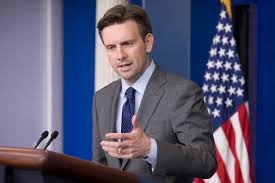
Josh Earnest
Earnest first underscored Secretary Kerry’s comments about the reopening of embassies by saying, “The [U.S.] welcomes today’s historic opening of the embassy of the [U.S.] in Havana, Cuba, and the opening of the Cuban embassy here in Washington, D.C. Today’s openings are the result of respectful dialogue between the [U.S.] and the Republic of Cuba following the December 17th announcements by President Obama and President Raúl Castro to reestablish diplomatic relations between our two nations.”
“This is yet another demonstration that we don’t have to be imprisoned by the past. We look forward to working collaboratively to normalize relations with the Cuban government and the Cuban people after more than a half-century of discord. Beginning today, U.S. diplomats in Havana will have the ability to engage more broadly across the island of Cuba, with the Cuban government, Cuban civil society, and even ordinary Cuban citizens.”
“We look forward to collaborating with the Cuban government on issues of common interest, including counterterrorism and disaster response, and we are confident that the best way to advance universal values like freedom of speech and assembly is through more engagement with the Cuban people.”
U.S. Ambassador to Cuba
The Press Secretary said he did “not have a specific commitment in terms of when [a nominee for U.S. Ambassador to Cuba] would be announced or who that person would be. We certainly do believe that U.S. interests in Cuba would be best represented by somebody serving as the ambassador there.” Later in the conference, when pressed, he said despite anticipated resistance to the appointment of anyone to that position by some Senate Republicans, he expected such an a nomination to be made by the President.
The “current Chief of Mission is a gentleman named Jeffrey DeLaurentis. He is somebody who had previously served as the Deputy Assistant Secretary of State for the Bureau of Western Hemisphere Affairs. He is somebody who has done two previous stints at the U.S. Interests Section in Havana, and somebody who has served in a wide variety of diplomatic roles, including as the political counselor to the U.S. Mission at the United Nations in Geneva, a political counselor at the U.S. embassy in Bogota, even did a stint here at the White House at the National Security Council.
So this is somebody . . . with a wide range of experience in a variety of roles, and we’ve got a lot of confidence in the ability of Ambassador DeLaurentis to represent U.S. interests on the island in Cuba. But I certainly wouldn’t rule out that the President would nominate somebody to serve at the rank of ambassador at the U.S. embassy in Cuba.”
DeLaurentis’ “top agenda item will be to represent the interests of the [U.S.] on the island. In some cases, that is going to involve making sure that U.S. businesses and U.S. individuals that are engaged in commercial activity on the island of Cuba, that their interests are represented and protected on the island. That’s certainly one reason that we’ve seen some bipartisan support in Congress for this policy change.”
“But obviously diplomats who are working at the new U.S. embassy in Cuba will also have the ability to more freely travel throughout Cuba and to interact and engage the Cuban people and, yes, even some members of the political opposition. And we believe that that will better represent the interest of the [U.S.] on the island.”
Cuban Human Rights.
The change in U.S. policy regarding Cuba “is consistent with the national security interests of the [U.S. and] . . . with the kinds of values that this President and previous Presidents have aggressively advocated all around the world. Those values are the respect for the basic human rights that we hold dear in this country — freedom of speech, freedom of assembly, freedom of religion, freedom of the press.”
“It’s clear that Cuba has significant progress to make in all of those areas. What’s also clear is that the previous [U.S.] . . . [did not] really make much progress [on these issues]. The President believed that a change was necessary. And we’re hopeful that in the coming years we’ll start to see the kind of respect for basic human rights on the island of Cuba that the U.S.] has long advocated.”
[Moreover, an] overwhelming percentage of the Cuban people are supportive and optimistic about this change in policy because of a chance that is has to improve their prospects on the island nation of Cuba.”
“So the President is looking forward to these kinds of changes taking effect [so] that the Cuban people and the Cuban government start to enjoy the benefits and see the results from greater engagement with the [U.S.]”
“In the days after this agreement was announced back in December, a substantial number of individuals who had previously been held by the Cuban government for their political views were released. And that’s an indication that the Cuban government is trying to at least change their reputation when it comes to these issues.“
“But we have got a long list of concerns.” In addition, “for a long time the U.S. policy of trying to isolate Cuba became a source of irritation in the relationship between the [U.S.] and other countries in the Western Hemisphere. And by removing that source of irritation, the [U.S.] can now focus attention of . . . other countries in the Western Hemisphere on the Cuban government’s rather sordid human rights record.”
“And again, that is part of the strategy for seeking to engage the Cuban people more effectively, and bring about the kind of change that we would like to see inside of Cuba.”
U.S. Leverage To Effect Change in Cuba.
As a result of the change in U.S. policy regarding Cuba, the U.S. will “have the leverage of the other countries in the Western Hemisphere that now are no longer distracted by the U.S. embargo against Cuba. . . . In fact, . . . we’ve remove[d] that irritant and allowed the rest of the Western Hemisphere to focus more closely on the conduct and policies of the Cuban government. That certainly is a positive development.”
“[A]ny perceived leverage [for the U.S.] that was included in an embargo did not succeed in generating the kind of outcome that its most ardent advocates believe is important. We didn’t see the kind of progress on human rights reforms that we would like to see while that embargo was in place.”
That is “why the President has called for the removal of the embargo and . . . to take steps to restore diplomatic ties between our two nations. [T]he policy of isolation . . . [has] failed and it was time to try a different approach to succeed in achieving the goal that we all share, which is a Cuba that thrives and a Cuban government that respects and even protects the basic human rights of their citizens.”
“[P]art of this agreement included ensuring that Cuban citizens have greater access to the Internet and greater access to information, and we believe that, equipped with that knowledge, that that’s a good thing for the Cuban people.”
“What is persuasive [about this enhanced U.S. leverage] is that most public polls indicate that upwards of 90 percent of the Cuban population actually support this policy change. . . . [This] is an indication that it’s not just the U.S. interests that are best served by this policy; it’s actually the interests of the Cuban people that are best served by this policy as well.”
This “is something that we can evaluate in the years to come. I certainly am not going to make you wait 55 years to evaluate the success of this policy, but it’s clear that the previous policy could be evaluated over 55 years and it clearly did not bring about the kind of results that we’d like to see.”
On the morning of July 20, 2015, Cuba officially opened its Embassy in Washington, D.C., and the United States did likewise in Havana although the ceremonial opening of the latter will be on August 14 when Secretary of State John Kerry goes to Havana to preside over that event.[1]
This post will focus on the ceremonial opening of the Cuban Embassy; subsequent posts will discuss the afternoon’s joint press conference at the U.S. Department of State by U.S. Secretary of State John Kerry and Cuba’s Foreign Minister Bruno Rodriguez as well as reactions to the reopening of the embassies.
Opening of Cuba’s Embassy
Cuban Embassy (Photo by Andrew Hamik)
Cuba’s opening was celebrated in the morning by the raising of its flag in front of its former Interests Section building. It was the same flag that was removed 54 years ago when the two countries severed diplomatic relations.
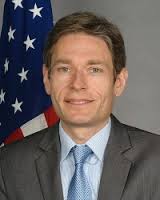
The event was attended by more than 500 people, including U.S. Assistant Secretary of State Roberta Jacobson, who led the U.S. delegation in negotiations with Cuba after the December 17, 2014, announcement of rapprochement; Tom Malinowski, Assistant Secretary for Democracy, Human Rights and Labor of the State Department, who has participated in those negotiations; Jeffrey DeLaurentis, current charge d’affaires of the U.S. Embassy in Havana; Ben Rhodes, U.S. Deputy National Security Advisor who led 18 months of behind-the-scenes secret negotiations with Cuban officials with the aim of restoring diplomatic ties; Wayne Smith, a Cuban expert who was forced to leave the U.S. Embassy in Havana in 1961 when the two countries broke diplomatic ties; U.S. Senators Patrick Leahy (Dem, VT), Amy Klobuchar (Dem., MN) and Jeff Flake (Rep., AZ) along with U.S. Representatives Barbara Lee (Dem., CA), Donna Edwards (Dem., MD), Kathy Castor (Dem., FL), Karen Bass (Dem., CA) and Raul Grijalva (Dem., AZ).[2]
Afterwards Senator Klobuchar, the author of a bill to end the U.S. embargo (Freedom to Export to Cuba Act), said in a press release, “The opening of the Cuban embassy in Washington, DC, marks an important step in modernizing our relationship with Cuba after more than 50 years of isolation. This evolution in our relationship with 11 million people 90 miles off of our shore was long overdue, and it is now time to not only open our own fully equipped and staffed embassy in Havana, but to lift the trade embargo once and for all. Passing my bipartisan bill to lift the embargo would benefit the people of both of our countries by boosting U.S. exports and allowing Cubans greater access to American goods.”[3]
The attendees then went inside the Embassy, where they heard a speech by Cuba’s Foreign Minister, Bruno Rodriguez. Here are excerpts from those remarks.
The Cuban flag now flying in front of the Embassy “embodies the generous blood that was shed, the sacrifices made and the struggle waged for more than one hundred years by our people for their national independence and full self-determination, facing the most serious challenges and risks. Today we pay homage to all those who died in its defense and renew the commitment of the present generations, fully confident on the newer ones, to serve it with honor.”
“We evoke the memory of José Martí, who was fully devoted to the struggle for the freedom of Cuba and managed to get a profound knowledge about the United States: In his “North American Scenes” he made a vivid description of the great nation to the North and extolled its virtues. He also bequeathed to us a warning against its excessive craving for domination [over Cuba] which was confirmed by a long history of disagreements.”
“We’ve been able to make it through this date thanks to the firm and wise leadership of Fidel Castro Ruz, the historic leader of the Cuban Revolution, whose ideas we will always revere with utmost loyalty. We now recall his presence in this city, in April of 1959, with the purpose of promoting fair bilateral relations, as well as the sincere tribute he paid to Lincoln and Washington. The purposes that brought him to this country on such an early time [of the Cuban Revolution] are the same that have pursued throughout these decades and coincide exactly with the ones that we pursue today.”
“This ceremony has been possible thanks to the free and unshakable will, unity, sacrifice, selflessness, heroic resistance and work of our people and also the strength of the Cuban Nation and its culture.”
“I bring greetings from President Raúl Castro, as an expression of the good will and sound determination to move forward, through a dialogue based on mutual respect and sovereign equality, to a civilized coexistence, even despite the differences that exist between both governments, which makes it possible to solve bilateral problems and promote cooperation and the development of mutually beneficial relations, just as both peoples desire and deserve.”
“We know that this [rapprochement] would contribute to peace, development, equity and stability in the continent; the implementation of the purposes and principles enshrined in the U.N. Charter and in the Proclamation of Latin America and the Caribbean as a Zone of Peace, which was signed at the Second Summit of the Community of Latin American and Caribbean States held in Havana.”
“Today, the re-establishment of diplomatic relations and the re-opening of embassies complete the first stage of the bilateral dialogue and pave the way to the complex and certainly long process towards the normalization of bilateral relations.”
“The challenge is huge because there have never been normal relations between the United States of America and Cuba, in spite of the one and a half century of intensive and enriching links that have existed between both peoples.”
“The Platt Amendment, imposed [on Cuba by the U.S.] in 1902 under a military occupation, thwarted the liberation efforts that had counted on the participation or the sympathy of quite a few American citizens and led to the usurpation of a piece of Cuban territory in Guantánamo. Its nefarious consequences left an indelible mark in our common history.”
“In 1959, the [U.S.] refused to accept the existence of a fully independent small and neighboring island and much less, a few years later, a socialist Revolution that was forced to defend itself and has embodied, ever since then, our people’s will.”
“I have referred to history to reaffirm that today an opportunity has opened up to begin working in order to establish new bilateral relations, quite different from whatever existed in the past. The Cuban government is fully committed to that.”
“Only the lifting of the economic, commercial and financial blockade which has caused so much harm and suffering to our people; the return of the occupied territory in Guantánamo; and the respect for Cuba’s sovereignty will lend some meaning to the historic event that we are witnessing today.”
“Every step forward will receive the recognition and the favorable acceptance of our people and government, and most certainly the encouragement and approval of Latin America and the Caribbean and the entire world.
“We reaffirm Cuba’s willingness to move towards the normalization of relations with the [U.S.] in a constructive spirit, but without any prejudice whatsoever to our independence or any interference in the affairs that fall under the exclusive sovereignty of Cubans.”
[For the U.S.] to insist in the attainment of obsolete and unjust goals, only hoping for a mere change in the methods to achieve them will not legitimize them or favor the national interest of the [U.S.] or its citizens. However, should that be the case, we will be ready to face the challenge.”
“We will engage in this process, as was written by President Raúl Castro in his letter of July 1st to President Obama, “encouraged by the reciprocal intention of developing respectful and cooperative relations between our peoples and governments. From this Embassy, we will continue to work tirelessly to promote cultural, economic, scientific, academic and sports relations as well as friendly ties between our peoples.”
“We would like to convey the Cuban government’s respect and recognition to the President of the [U.S.] for urging the U.S. Congress to lift the blockade as well as for the change of policy that he has announced [last December], but in particular for the disposition he has showed to make use of his executive powers for that purpose.”
“We are particularly reminded of President Carter’s decision to open the respective Interests Sections back in September of 1977.” We also “express our gratitude to the members of Congress, scholars, religious leaders, activists, solidarity groups, business people and so many U.S. citizens who worked so hard for so many years so that this day would come.”
“To the majority of Cubans residing in the [U.S.] who have advocated and called for a different kind of relation of this country with our Nation, we would like to express our recognition. Deeply moved, they have told us that they would multiply their efforts and will remain faithful to the legacy of the patriotic emigration that supported the ideals of independence.”
“We would like to express our gratitude to our Latin American and Caribbean brothers and sisters who have resolutely supported our country and called for a new chapter in the relations between the [U.S.] and Cuba, as was done, with extraordinary perseverance, by a lot of friends from all over the world.”
“From this country José Martí organized the Cuban Revolutionary Party to conquer freedom, all the justice and the full dignity of human beings. His ideas, which were heroically vindicated in his centennial year, continue to be the main inspiration that moves us along the path that our people have sovereignly chosen.”
Opening of U.S. Embassy
With the ceremonial opening of the U.S. Embassy in Havana not happening until August 14, the changes there were subtler. There was no raising of the U.S. flag. There was no changing of the sign on the building. The U.S. diplomats who previously worked in the Interests Section now worked in the Embassy. A future post will review the ceremonial opening of the Embassy, now scheduled for August 14.
[2] The famous Cuban-American jazz pianist and a resident of Minnesota, Nachito Herrera, was invited to attend the opening of the Cuban Embassy, but unfortunately had to decline because of previously scheduled performances at the Dakota Jazz Club in Minneapolis with his new group The Universals, featuring saxophonist Mike Phillips, who has worked with Prince and Stevie Wonder; Cuban drummer Raul Pineda; Senegal bassist Cheikh Ndoye; and violinist Karen Briggs. (Bream, On special day for Cuba, Nachito Herrera gets emotional at the Dakota, StarTribune (July 21, 2015).) As previously noted in this blog, Nachito has frequently performed at Minneapolis’ Westminster Presbyterian Church.
In light of President Barack Obama’s historic December 17, 2014, announcement of rapprochement with Cuba, it is interesting to examine Obama’s earlier statements about Cuba. Prior posts examined his campaign for the Democratic presidential nomination in 2007-2008 and his campaign for the presidency as the Democratic Party’s nominee in 2008. Now we discuss his first presidential term, 2009-2013.[1] Subsequent posts will look at his reelection campaign in 2012 and his second presidential term (up to the December 17, 2014, announcement), 2013-2014.
As we saw in a prior post, Barack Obama and Joe Biden won the November 4, 2008 election with 69.5 million votes (52.9% of the total) to John McCain and Sarah Palin’s 59.9 million votes (45.7%). In the key state of Florida, Obama-Biden had 51.0% of the popular vote against McCain-Palin’s 48.4%. The electoral votes were Obama and Biden, 365; McCain and Palin, 173. Soon thereafter several head of states congratulated Obama while also calling for the U.S. to end its sanctions against Cubs.
Obama’s First Term, 2009
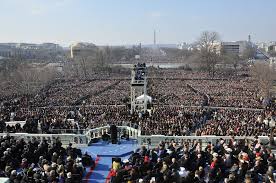
President Obama’s Oath of Office with Michelle ObamaCrowd @ Obama Inaugural 2009
Obama was inaugurated as President on January 20, 2009. His Inaugural Address first mentioned that “we are in the midst of crisis. . . . Our nation is at war against a far-reaching network of violence and hatred. Our economy is badly weakened. . . . [T]he challenges we face are real, they are serious and they are many. They will not be met easily or in a short span of time. But know this America: They will be met.” There was no mention of Latin America or Cuba.[2]
On February 25, 2009, the Department of State released its 2008 Country Reports on Human Rights Practices; the chapter on Cuba described it as a “totalitarian state” that “continued to deny its citizens their basic human rights and committed numerous, serious abuses.”
In April 2009 Obama fulfilled the pledge he made in his acceptance of the Democratic Party’s presidential nomination by lifting travel and remittance restrictions for Cuban-Americans while also authorizing U.S. telecommunications companies to contract with Cuba for improved television, radio and telephone service and Internet access.
That same month (April 2009) Obama told a journalist, “Cuba has to take some steps, send some signals that when it comes to human rights, when it comes to political rights, when it comes to the ability of Cubans to travel.” In Obama’s opinion, the previously mentioned U.S. changes called for Cuba to “send signals that they’re interested in liberalizing.”
This U.S. desire or demand for Cuban reciprocity was not well received in Havana. Cuba’s President Raúl Castro declared, “The blockade [embargo] remains intact. . . . Cuba has not imposed any sanction on the [U.S.] or its citizens. Therefore, it is not Cuba that should make gestures.” Nevertheless, “We are willing to discuss everything with the [U.S.] government, on equal footing; but we are not willing to negotiate our sovereignty or our political and social system, our right to self-determination or our domestic affairs.”[3]
Later that same month (April 2009), Obama attended the Fifth Summit of the Americas. Latin American presidents applauded the previously mentioned U.S. changes while simultaneously pressing Obama on the need to reintegrate Cuba into the inter-American community. Obama responded by reiterating his commitment to engagement, “The [U.S.] seeks a new beginning with Cuba.”
Also in April 2009, the U.S. Department of State issued its Country Reports on Terrorism 2008. Again Cuba was listed as a state sponsor of terrorism.
The next month, May 2009, the U.S. proposed to Cuba that they resume bilateral consultations on migration. Cuba agreed, and the talks took place that July. Cuba presented a draft accord to curb people smuggling and indicated an interest in also discussing cooperation on counterterrorism, counter-narcotics operations and hurricane preparation. Although no such formal agreement was reached, both sides agreed it was a productive consultation.
In June 2009 at the General Assembly of the Organization of American States (OAS), Latin American members moved to repeal the 1962 resolution suspending Cuba’s OAS membership. Facing defeat on this proposal, the U.S. negotiated a compromise: repeal the suspension if Cuba accepts “the practice, purposes, and principles of the OAS,” impliedly including the commitment to democracy in the Santiago Declaration of 1991.
In August 2009 Bill Richardson, then the Governor of New Mexico, was in Cuba on a trade mission, and at a meeting with Cuban officials was led to believe that Cuba wanted to move forward with the U.S. although Richardson said Cuba needed to reciprocate with some gestures. Cuba’s Foreign Minister Rodriguez made it clear that Cuba would not make any concessions to win better relations with the U.S. and that the U.S. blockade (embargo) was unilateral and should be lifted unilaterally.
In September 2009 an U.S. Assistant Secretary of State was in Cuba for discussions about restoring direct mail service. Over five days, she met with Cuban officials in the Justice, Agriculture, Health and Interior ministries and academics at the University of Havana as well as bloggers and dissidents. Much to the consternation of Cuban authorities, one of the bloggers was Yoani Sánchez, now an international celebrity. Nevertheless, Cuba’s Assistant Foreign Minister (Bruno Rodriguez Parrilla, now the Minister of that agency) told the U.S. official that Cuba wanted to show her their desire “to move forward in our relationship,” requiring “confidence building” as a “way forward.”
By the Fall of 2009 the White House was frustrated by Cuba’s failure to respond to the U.S. relaxing of travel and remittance restrictions for Cuban-Americans. As a result, Obama asked Spain’s Prime Minister, José Luis Rodriguez Zapatero, to have Spain’s Foreign Minister carry a back-channel message to President Rául Castro that if Cuba did not take steps of liberalization, neither could Obama and that the U.S. understands things cannot change overnight, but in the future it will be clear that this was the moment when changes began.
Castro responded with a proposal for a secret channel of communication between the two countries to discuss Cuban steps that might address the U.S. concerns. The U.S., however, at this time rejected the idea for a secret channel. (As we will see below, in December 2012, such a secret channel was opened.)
On December 3, 2009, the process of normalization was thrown off track by Cuba’s arrest of U.S. citizen, Alan Gross, who was bringing communications and computer equipment to Cuba’s Jewish community as an employee of a contractor for the U.S. Agency for International Development (USAID). Two weeks later President Castro told Cuba’s National Assembly that the U.S. alleged desire for a new relationship was “a huge propaganda campaign staged to confuse the world. The Truth is that the instruments for the policy of aggression to Cuba remain intact and that the U.S. government does not renounce its efforts to destroy the Revolution.”
By the end of 2009, therefore, things looked bleak for further normalization. Moreover, the press of many other foreign policy challenges for the U.S. pushed Cuba far down the list of priorities for the Obama Administration.
Obama’s First Term, 2010.
The arrest and jailing of Alan Gross continued to disrupt the relations of the two countries in 2010. The U.S. denied that Gross had done anything wrong and that his release from a Cuban jail was necessary for any improvement in the relationship.
The Gross arrest, however, prompted the U.S. Senate Foreign Relations Committee to investigate USAID’s Cuba democracy programs in 2010 and to develop a plan to reorient the Cuba program toward supporting genuine links between the two countries. These changes in the program were briefed for Cuban diplomats, who said it would smooth the way for the release of Gross.
On March 11, 2010, the Department of State released its 2009 Country Reports on Human Rights Practices; the chapter on Cuba described it as a “totalitarian state” that “continued to deny its citizens their basic human rights, including the right to change their government, and committed numerous and serious abuses.”
In the meantime, Spain on its own initiative in May 2010 encouraged Rául Castro and Cardinal Jaime Ortega to discuss Cuba’s lifting the ban on public demonstrations by the Ladies in White, the female relatives of political prisoners, and to the release of political prisoners. In July 2010 this resulted in the government’s agreement to release 52 such prisoners, including everyone who had been arrested in 2003, and those who wished to go into exile would be welcomed by Spain. Eventually the government released 127 such prisoners.
In June 2010 Cardinal Ortega, with the consent of the Cuban government, went to Washington, D.C. to inform them of the then planned prisoner release. The Cuban government believed this prisoner release was a major concession and should “pressure U.S. political leaders to respond with other gestures of good will toward Cuba.” Ortega also told U.S. officials that Castro was ready to talk with the U.S. directly about every issue and that it would be a mistake for the U.S.to maintain the status quo until Cuba became a democracy. ”Everything should be step by step,” the Cardinal said. “It’s not realistic to begin at the end. This is a process. The most important thing is to take steps in the process.”
Obama, however, insisted that first Cuba had to release Alan Gross from prison before the U.S. could do more. Secretary of State Hilary Clinton called the Cuban prisoner release a “positive sign,” but Obama said nothing.
In August 2010 Bill Richardson returned to Cuba on another trade mission and met with officials to try to obtain Gross’ release from prison. Richardson felt encouraged, but did not obtain the release.
Also in August 2010 the Department of State issued its Country Reports on Terrorism 2009, which again listed Cuba as a “state sponsor of terrorism.”
To try to rescue the stalled discussions, an Assistant Secretary of State met with Cuba’s Foreign Minister at the U.N. in October 2010. Rodriguez opened the meeting with a lengthy recitation of Cuba’s historical grievances against the U.S. and refused to engage in discussions about the future. “It was a terrible meeting,” said the U.S. official.
Soon after this terrible meeting, Rodriguez met again with Bill Richardson at the U.N. The Foreign Minister wanted the U.S. to know that Gross was merely a symptom of the troubled relationship, not its heart. Rodriguez also wanted the U.S. to know that Cuba had asked its supporters to tone down their criticism of Obama during the debate on the resolution to condemn the U.S. blockade (embargo) and that Castro had decided to improve ties with the U.S., but that the U.S. had not reciprocated. In addition, Rodriguez stressed the need for the U.S. to make progress on the case of the Cuban Five in U.S. prison.
Also in October 2010, John Kerry, then Senator and the Chair of the Senate Foreign Relations Committee, met Rodriguez, Cuba’s Foreign Minister, to discuss the U.S. democracy programs and Alan Gross, and an informal deal for his release seemed to be on track. However, the Administration abandoned the proposed changes in the Cuba democracy programs after objections from New Jersey Senator Robert Menendez. The Obama Administration was unwilling to wage a political fight with Menendez. This resulted in the Cuban government concluding that the Administration could not be trusted.
Earlier in 2010 advocates for lifting U.S. restrictions on travel to Cuba launched a major campaign over opposition from Senator Menendez and others. During his June trip to Washington Cuba’s Cardinal Ortega urged members of Congress to allow freer travel in light of Pope John Paul II’s injunction that Cuba “open itself to the world and . . . the world open itself to Cuba.” The resistance from Menendez and Miami Congresswoman Debbie Wasserman Schultz, however, prevented any congressional action to eliminate or reduce restrictions on U.S. citizens traveling to Cuba. Apparent indifference from President Obama also contributed to nothing happening in Congress on this issue.
Instead, at Obama’s direction, the Administration worked on a more limited expansion of travel through new regulations on “people-to-people” educational travel, but in August-September 2010 opposition by Menendez and Wasserman Schultz forced the Administration to shelf the new regulations.
Obama’s First Term, 2011
In mid-January 2011, on a late Friday before a holiday weekend, the Administration finally released the new regulations on expanded “people-to-people” educational travel. Cuba’s Foreign Minister said these regulations were “positive,” but they had “a very limited scope and do not change the policy against Cuba.”
In March 2011 Jimmy Carter, former U.S. President, went to Cuba at the invitation of Rául Castro. Before Carter left, Cuban officials made it clear that Gross would not be granted freedom. Carter met with Cardinal Ortega to discuss the Roman Catholic Church’s dialogue with the government, with blogger Yoanni Sánchez, dissidents, former prisoners, relatives of the Cuban Five in U.S. prison and with Alan Gross. Foreign Minister Rodriguez stressed the importance of the Cuban Five case for Cuba. Over dinner with Rául Castro, Carter emphasized that Gross’ imprisonment was a serious obstacle to improving relations and urged his release on humanitarian grounds. Castro said there was no consensus in the Cuban government on the Gross case, but reiterated Cuba’s willingness to engage in wide-ranging talks with the U.S., “without preconditions,” and “on equal terms with full respect for our independence and sovereignty.” Any topic could be discussed. “We are ready.”
Before his departure, Carter said the U.S. should fully normalize relations with Cuba immediately; Cuba should allow full freedom of speech, assembly, travel; the U.S. embargo should be ended; Cuba should be removed from the terrorism list; the Cuban Five should be released from U.S. prison; and Alan Gross should be released from Cuban jail. Rául Castro, standing nearby, quipped, “I agree with everything President Carter said.”
Upon Carter’s return to the U.S., he had a cool meeting with Secretary of State Clinton, and the next day the Administration advised Congress it was requesting $20 million of funding for the democracy promotion programs in Cuba.
On April 8, 2011, the Department of State released its 2010 Country Reports on Human Rights Practices; the chapter on Cuba described it as a “totalitarian state” that “denied citizens the right to change their government. In addition, the following human rights abuses were reported: harassment, beatings, and threats against political opponents by government-organized mobs and state security officials acting with impunity; harsh and life-threatening prison conditions, including selective denial of medical care; arbitrary detention of human rights advocates and members of independent organizations; and selective prosecution and denial of fair trial.”
In August 2011 the Department of State released its Country Reports on Terrorism 2010, which again listed Cuba as a “state sponsor of terrorism.”
Obama’s First Term, 2012
On May 24, 2012, the Department of State released its 2011 Country Reports on Human Rights Practices; the 27-page chapter on Cuba described it as a “totalitarian state” whose “principal human rights abuses were: abridgement of the right of citizens to change their government; government threats, intimidation, mobs, harassment, and detentions to prevent citizens from assembling peacefully; and a significant increase in the number of short-term detentions, which in December rose to the highest monthly number in 30 years.”
In July 2012 the Department of State released its Country Reports on Terrorism 2011, which again listed Cuba as a “state sponsor of terrorism.”
During the latter part of 2012 Obama and Biden were engaged in their campaign for re-election against Republican nominees Mitt Romney and Paul Ryan, which will be covered in a subsequent post.
In the meantime, in September 2012 Bill Richardson made another trip to Cuba after Cuba’s Supreme Court had affirmed Alan Gross’ conviction. The State Department gave him a list of things the U.S. was prepared to do if Gross were pardoned and released from prison. Most were possibilities, rather than commitments. The others were commitments, but already had been announced by the U.S.
The Richardson trip got off to a bad start when he leaked word of it to CNN’s Wolf Blitzer, who reported that the Governor had been invited by the Cuban government to negotiate the release of Gross. To the Cubans, this looked like an attempt to force their hand. Later the Cuban Foreign Minister told Richardson “One, you won’t get Gross; two, you won’t see Rául; and three, you won’t even see Gross.” An angry Richardson held a press conference to announce that he would not leave Cuba until he saw Gross, who was a “hostage” held by the Cubans. An angry Cuban government responded that Gross’ release was never on the table, that Richardson was aware of that position, that his request to see Gross was impossible after Richardson’s slanderous statements and that Cuba was a sovereign country that did no accept blackmail, pressure or posturing.
At the time nothing of consequence regarding Cuba is believed to have happened during the two months after the November 2012 election, in which Obama and Biden won re-election.
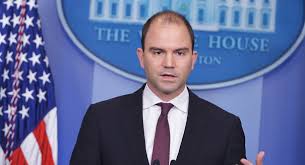
Ben Rhodes
However, over the last seven months, we have learned that in December 2012 after his re-election President Obama held a long meeting with aides in the White House situation room to establish priorities for the second term. According to Ben Rhodes, the Deputy National Security Advisor who played a central role in shaping Cuba policy and who participated in that meeting, the aides all knew that Obama always had thought that the decades-long U.S. policy of trying to isolate Cuba through the embargo and other measures made no sense, and at the end of the discussion, Obama instructed aides to make Cuba a priority and “see how far we could push the envelope.”[4]
Moreover, at this December 2012 meeting the President also concluded that “it would be a good fit to have someone who was known to be very close to the President [involved in such an effort on Cuba] because the Cubans are very wary of engagement and they want to know that the engagement is reaching the top. They felt like there [had] been several other efforts of engagement where it turned out to be kind of “Lucy with the football,” where they had conversations with the Americans, [but after] they reached a certain point . . . there was never follow through [by the U.S.]. We can debate whether it was the Cubans’ fault or not, but that was their perception. So . . . [the Cubans] wanted someone . . . [involved for the U.S.] who were very close to the President and . . . they wanted it to be discreet.” Hence, the President designated Mr. Rhodes to be in charge of this new effort to engage Cuba.
Thereafter, Mr. Rhodes sent a secret message to the Cuban government that the U.S. wanted “to initiate a dialogue about prisoners and other issues.”
Obama’s First Term, January 2013
Nothing of consequence regarding Cuba was believed to have happened during the rest of President Obama’s first term, which ended on January 20, 2013, although the exact dates of the secret discussions with Cuba in 2013 are not yet known.
Conclusion
After fulfilling a campaign pledge In April 2009 to lift travel and remittance restrictions for Cuban-Americans while also authorizing U.S. telecommunications companies to contract with Cuba for improved television, radio and telephone service and Internet access, President Obama’s desire to seek normalization with Cuba was thwarted by Cuba’s December 2009 arrest and subsequent conviction and imprisonment of Alan Gross. The rest of Obama’s first term regarding Cuba seemed, at the time, concentrated on unsuccessful efforts to obtain Gross’ release. Now, however, we know that at the end of the first term a new and secret effort to engage with Cuba was launched.
[1] This post and the subsequent posts about Obama’s prior statements about Cuba are not based upon comprehensive research. The primary research tool was online searching of the New York Times for articles mentioning “Obama and Cuba” for the relevant time period although the details have been lost in the process of editing this post. Therefore, this blogger especially welcomes comments with corrections and additions. Ultimately after public release of many Obama Administration documents after the completion of his presidency, scholars will undertake a detailed examination of those documents and provide their assessments of his record regarding Cuba.
[3] At about the same time (April 2009), the U.S. Interests Section in Havana turned off its external streaming electronic news billboard, and Cuba replaced the black flags on poles outside the Section with Cuban flags.
On July 1, 2015, the U.S. and Cuba announced an agreement to restore diplomatic relations. This post will discuss the U.S. announcement and reactions.[1] A subsequent post will do the same for the Cuban announcement and reactions.
U.S. Announcement
President Obama & Vice President Biden
In the White House’s Rose Garden, President Obama announced the plans to reopen the embassies. Here is what he said:
“More than 54 years ago, at the height of the Cold War, the United States closed its embassy in Havana. Today, I can announce that the United States has agreed to formally re-establish diplomatic relations with the Republic of Cuba, and re-open embassies in our respective countries. This is a historic step forward in our efforts to normalize relations with the Cuban government and people, and begin a new chapter with our neighbors in the Americas.”
“When the United States shuttered our embassy in 1961, I don’t think anyone expected that it would be more than half a century before it re-opened. After all, our nations are separated by only 90 miles, and there are deep bonds of family and friendship between our people. But there have been very real, profound differences between our governments, and sometimes we allow ourselves to be trapped by a certain way of doing things.”
“For the United States, that meant clinging to a policy that was not working. Instead of supporting democracy and opportunity for the Cuban people, our efforts to isolate Cuba despite good intentions increasingly had the opposite effect -– cementing the status quo and isolating the United States from our neighbors in this hemisphere. The progress that we mark today is yet another demonstration that we don’t have to be imprisoned by the past. When something isn’t working, we can -– and will –- change.”
“Last December, I announced that the United States and Cuba had decided to take steps to normalize our relationship. As part of that effort, President Raul Castro and I directed our teams to negotiate the re-establishment of embassies. Since then, our State Department has worked hard with their Cuban counterparts to achieve that goal. And later this summer, Secretary Kerry will travel to Havana formally to proudly raise the American flag over our embassy once more.”
“This is not merely symbolic. With this change, we will be able to substantially increase our contacts with the Cuban people. We’ll have more personnel at our embassy. And our diplomats will have the ability to engage more broadly across the island. That will include the Cuban government, civil society, and ordinary Cubans who are reaching for a better life.”
“On issues of common interest –- like counterterrorism, disaster response, and development -– we will find new ways to cooperate with Cuba. And I’ve been clear that we will also continue to have some very serious differences. That will include America’s enduring support for universal values, like freedom of speech and assembly, and the ability to access information. And we will not hesitate to speak out when we see actions that contradict those values.”
“However, I strongly believe that the best way for America to support our values is through engagement. That’s why we’ve already taken steps to allow for greater travel, people-to-people and commercial ties between the United States and Cuba. And we will continue to do so going forward.”
“Since December, we’ve already seen enormous enthusiasm for this new approach. Leaders across the Americas have expressed support for our change in policy; you heard that expressed by President Dilma Rousseff of Brazil yesterday. Public opinion surveys in both our countries show broad support for this engagement. . . .
“Here in the United States, we’ve seen that same enthusiasm. There are Americans who want to travel to Cuba and American businesses [that] want to invest in Cuba. American colleges and universities . . . want to partner with Cuba. Above all, Americans who want to get to know their neighbors to the south. And through that engagement, we can also help the Cuban people improve their own lives.”
“Americans and Cubans alike are ready to move forward. I believe it’s time for Congress to do the same. I’ve called on Congress to take steps to lift the embargo that prevents Americans from travelling or doing business in Cuba. We’ve already seen members from both parties begin that work. After all, why should Washington stand in the way of our own people?”
“Yes, there are those who want to turn back the clock and double down on a policy of isolation. But it’s long past time for us to realize that this approach doesn’t work. It hasn’t worked for 50 years. It shuts America out of Cuba’s future, and it only makes life worse for the Cuban people.”
So I’d ask Congress to listen to the Cuban people. Listen to the American people. Listen to the words of a proud Cuban-American, Carlos Gutierrez, who recently came out against the policy of the past, saying, ‘I wonder if the Cubans who have to stand in line for the most basic necessities for hours in the hot Havana sun feel that this approach is helpful to them.’”
“Of course, nobody expects Cuba to be transformed overnight. But I believe that American engagement — through our embassy, our businesses, and most of all, through our people — is the best way to advance our interests and support for democracy and human rights. Time and again, America has demonstrated that part of our leadership in the world is our capacity to change. It’s what inspires the world to reach for something better.”
“A year ago, it might have seemed impossible that the United States would once again be raising our flag, the stars and stripes, over an embassy in Havana. This is what change looks like.”
“In January of 1961, the year I was born, when President Eisenhower announced the termination of our relations with Cuba, he said: It is my hope and my conviction that it is ‘in the not-too-distant future it will be possible for the historic friendship between us once again to find its reflection in normal relations of every sort.’ Well, it took a while, but I believe that time has come. And a better future lies ahead.”
Secretary John Kerry
The same day Secretary of State John Kerry from Vienna, Austria also discussed the plans, including his intent to travel to Havana for the opening of the embassy later this month. His statement included the following:
“Later this summer, as the President announced, I will travel to Cuba to personally take part in the formal reopening of our United States Embassy in Havana. This will mark the resumption of embassy operations after a period of 54 years. It will also be the first visit by a Secretary of State to Cuba since 1945. The reopening of our embassy . . . is an important step on the road to restoring fully normal relations between the United States and Cuba. Coming a quarter of a century after the end of the Cold War, it recognizes the reality of the changed circumstances, and it will serve to meet a number of practical needs.”
“The United States and Cuba continue to have sharp differences over democracy, human rights, and related issues, but we also have identified areas for cooperation that include law enforcement, safe transportation, emergency response, environmental protection, telecommunications, and migration. The resumption of full embassy activities will help us engage the Cuban Government more often and at a higher level, and it will also allow our diplomats to interact more frequently, and frankly more broadly and effectively, with the Cuban people. In addition, we will better be able to assist Americans who travel to the island nation in order to visit family members or for other purposes.”
In addition, the State Department conducted a special briefing by a senior official on this historic development. This individual said, “We’re confident that our embassy in Havana will be able to operate similar to other embassies operating in restrictive environments. We will be able to meet and exchange opinions with a variety of voices and views both within the government and outside. We’ll be able to engage a broad range of Cuban civil society and citizens.” The conditions for “access to diplomatic facilities, travel of diplomats, and the level of staffing . . . are acceptable for carrying out the core diplomatic functions necessary for implementing the President’s new policy direction on Cuba.” There were not any agreed “constrains or restrictions” on the exact types of programs or facilities that each of our embassies conducts.
According to the State Department spokesperson, there will be future discussions or negotiations with Cuba over human rights, telecommunications, health issues, fugitives, law enforcement, U.S. claims for property expropriation, Cuban claims for damages under the embargo and U.S. broadcasts to the island. Until there is a nomination and confirmation of an ambassador, Jeffrey DeLaurentis will be the charge d’affaires and will lead the embassy.
Jeffrey DeLaurentis & Marcelinio Medina
Also earlier the same day Cuba’s Foreign Ministry confirmed that the head of the US Interests Section in Cuba, Jeffrey DeLaurentis, had delivered to the Acting Foreign Minister, Marcelino Medina, a letter from President Obama to Army General Raul Castro confirming “the restoration of diplomatic relations and the opening of embassies in the respective countries” on or after July 20. Here is the text of that letter:
“I am pleased to confirm, after high-level talks between our two governments, and in accordance with international law and practice, that the United States of America and the Republic of Cuba decided to restore diplomatic relations and permanent diplomatic missions in our respective countries 20 July 2015. This is an important step forward in the normalization process, which started last December, with regard to relations between our two countries and peoples.”
“In making this decision, the United States are encouraged by the mutual intention to enter into friendly and cooperative relations between our two peoples and governments, consistent with the purposes and principles enshrined in the Charter of the United Nations, in particular those relating to equality sovereign states, the settlement of international disputes by peaceful means, respect for the territorial integrity and political independence of States, respect for the equal rights and self-determination of peoples, non-interference in internal affairs States as well as promoting and encouraging respect for human rights and fundamental freedoms for all.”
“The United States and Cuba are parties to the Vienna Convention on Diplomatic Relations, signed in Vienna on April 18, 1961, and the Vienna Convention on Consular Relations, signed in Vienna on April 24, 1963. I am pleased to confirm the understanding the United States that the above conventions apply to diplomatic and consular relations between our two countries.”
Although the U.S. can easily change the plaque on its building in Havana to one proclaiming that it is the Embassy of the United States of America, the State Department has said it needs $6.6 million to retrofit the building to make it suitable as an embassy. This may require a supplemental appropriation by Congress.
The U.S. will need an Ambassador to Cuba, and such an appointment needs to be confirmed by the U.S. Senate. In the meantime, as just noted, the U.S. has a capable career diplomat running the interests section, Jeffrey DeLaurentis, who will be in charge.
Reactions to the Announcement
The announcement of re-establishment of diplomatic relations drew widespread praise. Senator Jeff Flake (Rep., AZ) stated, “It’s long past time for U.S. policy toward Cuba to be associated with something other than five decades of failure. It is difficult to overstate the importance of resuming diplomatic relations with Cuba, in furthering our own national interests, benefiting our relations in the region, and encouraging a positive future for the Cuban people. I am confident that this move will lead to increased travel and contact between U.S. citizens and everyday Cubans, to the benefit of both.” Senator Amy Klobuchar (Dem., MN), a co-sponsor of a bill to expand U.S. travel to Cuba and the author of a bill to lift the trade embargo, said, “This is the first step that must happen in order to lift the embargo.” Democratic Senators Patrick Leahy (VT) and Benjamin Cardin (MD) issued similar positive statements.
Engage Cuba, a bipartisan public policy organization dedicated to coalescing and mobilizing American businesses, non-profit groups and concerned citizens for the purpose of supporting the ongoing U.S.‐Cuba normalization process and enacting legislation to reform U.S. travel and trade restrictions with Cuba, issued a statement of support. It said, “We applaud this important step in bringing the U.S. and Cuba closer together, and urge Congress to hasten the day when American travelers and companies have the freedom to engage with one of our nearest neighbors. Opening embassies in Washington and Havana is an important step toward the day when Americans can make their own decisions on where they travel, and our businesses can compete with the rest of the world. We are making history by making it clear that America’s engagement isn’t a concession, it is a show of strength and the best way to promote our values and create opportunities for both Americans and the Cuban people.”
Moreover, said Engage Cuba, “A vast majority of the American people – and 97% of the Cuban people – support re-establishing diplomatic relations. Today is a great day for the American and Cuban people who seek a brighter future for their two countries. After 54 years of a failed Cold war policy, better days finally lie ahead.”
A similar supportive statement came from the Center for Democracy in the Americas (CDA), which is “devoted to changing U.S. policy toward the countries of the Americas by basing our relations on mutual respect, fostering dialogue with those governments and movements with which U.S. policy is at odds, and recognizing positive trends in democracy and governance” and which is a member of Engage Cuba. CDA stated, “”This is a moment we have been working toward for many years. The restoration of diplomatic relations between our countries is a major achievement that will help to heal decades of mistrust and will open opportunities for the U.S. and Cuba to collaborate on issues of mutual interest like immigration, environmental conservation, and regional trade. We applaud the tireless work of Cuban and U.S. diplomats, policymakers, academics, and activists who have helped make this possible. We are ready to work with all our allies to defend these positive steps initiated by President Obama and to move forward with removing the embargo once and for all.”
The day before this announcement, President Obama held a joint press conference at the White House with the visiting President of Brazil, Dilma Rousseff.[2] In his opening remarks, Obama said, “As President, I’ve pursued a new era of engagement with Latin America where our countries work together as equal partners, based on mutual interest and mutual respect. As we saw at the recent Summit of the Americas, the United States is more deeply engaged in the region than we’ve been in decades, and I believe the relationship between the United States and Latin America is as good as it’s ever been. We’re focused on the future — what we can accomplish together.”
After he had reviewed the many ways that Brazil and the U.S. cooperate, Obama commented, “And finally, we’re working together to uphold democracy and human rights across Latin America. I very much appreciate President Rousseff and Brazil’s strong support for our new opening toward Cuba. I updated Dilma on our progress, including our work to open embassies in Havana and Washington. And I believe that Brazil’s leadership in the region, as well as its own journey to democracy and a market economy can make it an important partner as we work to create more opportunities and prosperity for the Cuban people.”
In her response President Rousseff remarked about “the importance for Latin America of the recent decision made by President Obama and by President Raul Castro, even with the partnership with Pope Francis to the effect of opening up relations with — or resuming relations with Cuba, a very decisive milestone and point in time in U.S. relations with Latin America. It is really about putting an end to the lingering vestiges of the Cold War. And it ultimately elevates the level of the relations between the U.S. and the entire region. May I acknowledge the importance of that gesture to all of Latin America and also to world peace at large. It is an important example of relations to be followed.”
These thoughts were echoed in the subsequent Joint Communique by the two presidents: “President Rousseff praised President Obama’s policy changes towards Cuba, and the Leaders agreed that the latest Summit of the Americas (held in Panama, on April 10 and 11, 2015) demonstrated the region’s capacity to overcome the differences of the past through dialogue, thereby paving the way for the region as a whole to find solutions to the common challenges facing the countries of the Americas.”
As anticipated, however, Senator Marco Rubio (Rep., FL), a Cuban-American, immediately issued a press release condemning the agreement.[3] It said:
“Throughout this entire negotiation, as the Castro regime has stepped up its repression of the Cuban people, the Obama Administration has continued to look the other way and offer concession after concession. The administration’s reported plan to restore diplomatic relations is one such prized concession to the Castro regime. It remains unclear what, if anything, has been achieved since the President’s December 17th announcement in terms of securing the return of U.S. fugitives being harbored in Cuba, settling outstanding legal claims to U.S. citizens for properties confiscated by the regime, and in obtaining the unequivocal right of our diplomats to travel freely throughout Cuba and meet with any dissidents, and most importantly, securing greater political freedoms for the Cuban people. I intend to oppose the confirmation of an Ambassador to Cuba until these issues are addressed. It is time for our unilateral concessions to this odious regime to end.”
Conclusion
I am glad that my recent concern about the delay in announcing resumption of diplomatic relations has been alleviated. This is an important development in the reconciliation of our country with Cuba. Now all advocates for reconciliation need to notify their senators and representatives to oppose any of the measures put forward by Senator Rubio and others to try to block this important move.
[3] Senator Rubio in a letter to Secretary Kerry in June “vowed to oppose the confirmation of any ambassador until issues like human rights, fugitive terrorists and billions of dollars of outstanding claims were resolved.” The Senator said it is “important that pro-democracy activities not be sacrificed in the name of ‘diplomacy’ just so that we can change the name of a building from ‘Interest Section’ to ‘Embassy,’ ” Similar negative press releases came from other Cuban-Americas in the Congress: Senator Robert Menendez (Dem., NJ) and Republican Representatives from Florida, Ileana Ros-Lehtinen and Mario Diaz-Balart.
On June 25, 2015, the U.S. Department of State released its 2014 Country Reports on Human Rights Practices.[1]
Introduction
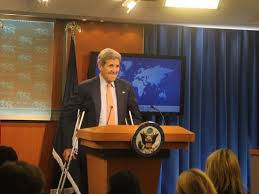
John Kerry
In introducing the report, U.S. Secretary of State John Kerry said, “The message at the heart of these reports is that countries do best when their citizens fully enjoy the rights and freedoms to which they are entitled. This is not just an expression of hope. This is a reality, and it is proven out in country after country around the world. After all, we live in a time when access to knowledge and openness to change are absolutely essential. And in such an era, no country can fulfill its potential if its people are held back, or more so if they are beaten down by repression.”
On the other hand, Kerry observed, “There is nothing sanctimonious in this. There is zero arrogance. And we couldn’t help but have humility when we have seen what we have seen in the last year in terms of racial discord and unrest. So we approach this with great self-awareness. But we also understand that when human rightsis the issue, every country, including the United States, has room to improve. And the path to global respect always begins at home.”
The U.S. cares, according to Kerry, “because respect for human rights provides the truest mirror that we have of ourselves, the most objective test of how we have come over the centuries, and how far we still have to go. It is a yardstick by which we can measure life itself. I realize that that is placing a lot of weight on what is, after all, just a report, but I think the description fits. And I hope it will inspire us – people here and around the world – between this year and next to take more steps, hopefully giant steps, in the direction of greater justice, wider decency, and peace.”
Tom Malinowski
Following the Secretary’s remarks, Tom Malinowski, Assistant Secretary of State for Democracy, Human Rights and Labor, added comments. He said, “the Human Rights Reports demonstrate America’s commitment to human rights, and they’re a tool in their own right in the advancement of those rights. They cover 199 countries and entities. They strive to provide a comprehensive and factual review of conditions around the world. They are also the most widely read document that we put out at the State Department every single year. And I think that just reminds us that what America says about human rights around the world – just the words – matters greatly.”
Malinowski also addressed the section of the report on Cuba. He said, “But on Cuba . . ., one of our sayings here is that engagement is not the same thing as endorsement. . . . [It] should be crystal-clear, that our opening to Cuba . . . was designed because we felt that the new policy is better suited to promoting human rights in Cuba than the old policy. . . . [The] opening was associated very closely with the release of over 50 political prisoners in Cuba. The situation needs to get far better before any of us can say that we are where we want to be, but we feel that what we have done is to . . . take away the Cuban Government’s ability to say that the problems on the island are the fault of the United States and the embargo, and to put the focus where it belongs – on their actions and on their policies.”
Malinowski continued, “[We] did see a fairly dramatic decision by the Cuban Government to release the vast majority of political prisoners . . . [about whom] we had been raising concern . . . for some time. We have not yet seen a letup in the kind of day-to-day harassment that civil society activists face in Cuba. Short-term arrests, unfortunately, have continued. I am not particularly surprised about that. We, in fact, I think, expected that precisely because the Cuban Government would be nervous about the implications of the opening, that in the short term they might actually intensify a crackdown. We very firmly believe that in the long run . . . this is going to put us in a much stronger position to promote human rights and to stand by civil society on the island.”
The Report on Cuban Human Rights
The Executive Summary of the extensive report on Cuban human rights for 2014 stated, “Cuba is an authoritarian state led by Raul Castro, who is president of the council of state and council of ministers, Communist Party (CP) first secretary, and commander in chief of security forces. The constitution recognizes the CP as the only legal party and “the superior leading force of society and of the state.” A CP candidacy commission preapproved all candidates for the February 2013 uncontested National Assembly elections, which were neither free nor fair. The national leadership, including members of the military, maintained effective control over the security forces.”
“The principal human rights abuses included those involving the abridgement of the ability of citizens to change the government and the use of government threats, extrajudicial physical assault, intimidation, violent government-organized counter-protests against peaceful dissent, and harassment and detentions to prevent free expression and peaceful assembly.”[2]
“The following additional abuses continued: short-term, arbitrary unlawful detentions and arrests, harsh prison conditions, selective prosecution, denial of fair trial, and travel restrictions. Authorities interfered with privacy, engaging in pervasive monitoring of private communications. The government did not respect freedom of speech and press, restricted internet access, maintained a monopoly on media outlets, circumscribed academic freedom, and maintained some restrictions on the ability of religious groups to meet and worship. The government refused to recognize independent human rights groups or permit them to function legally. In addition the government continued to prevent workers from forming independent unions and otherwise exercising their labor rights.”
“Most human rights abuses were committed by officials at the direction of the government. Impunity for the perpetrators remained widespread.”
More details are provided in the report itself under the following uniform structure:
1. Respect for the Integrity of the Person, Including Freedom from:
A. Arbitrary or Unlawful Deprivation of Life
B. Disappearance
C. Torture, and Other Cruel, Inhuman, or Degrading Treatment or Punishment
D. Arbitrary Arrest or Detention
E. Denial of Fair Public Trial
F. Arbitrary Interference with Privacy, Family, Home, or Correspondence
2. Respect for Civil Liberties, Including:
A. Freedom of Speech and Press
B. Freedom of Peaceful Assembly and Association
C. Freedom of Religion
D. Freedom of Movement, Internally Displaced Persons, Protection of Refugees, and Stateless Persons
3. Respect for Political Rights: The Right of Citizens to Change their Government
4. Corruption and Lack of Transparency in Government
5. Governmental Attitude Regarding International and Nongovernmental Investigation of Alleged Violations of Human Rights
6. Discrimination, Societal Abuses, and Trafficking in Persons
7. Worker Rights
A.Freedom of Association and the Right to Collective Bargaining
B. Prohibition of Forced or Compulsory Labor
C. Prohibition of Child Labor and Minimum Age for Employment
D.Discrimination with Respect to Employment or Occupation
E. Acceptable Conditions of Work
Conclusion
This report again demonstrates the State Department’s extensive efforts to collect and report information about human rights conditions in 199 countries of the world, including Cuba. As an observer of such matters over the last years, I believe their reports to be trustworthy.
I, therefore, accept their criticism of Cuban human rights. On the other hand, I believe that everyone needs to understand the well-founded fear that Cuba has of the U.S. as a vastly larger and superior (in so many ways) country that has expressed and acted with hostility toward Cuba over the last 50-plus years. In that context, it is easier to understand, but not applaud, their human rights failures. In my opinion, if and when a sense of trust develops between the two countries as a result of the process of normalization, then I anticipate and hope that Cuba will gradually improve the human rights covered by this report.
[2] Cuban artist, Tania Bruguera, was arrested last December over a planned “open-mike” event in Havana’s Revolutionary Square. Since then she has been detained four more times and has been barred from leaving the country while facing charges of disturbing the public order, resisting arrest and inciting criminal behavior. Bruguera’s most recent arrests occurred in the middle of Cuba’s biggest art festival — the Havana Biennial — with many of the world’s leading gallery owners and collectors in town. (Miroff, Cuban artist pushed boundary between art and politics, and pays a price, Wash. Post (June 26, 2015).)
On June 8, 2015, the U.S. Supreme Court, 6 to 3, decided that the U.S. President had the exclusive power in the U.S. Government to recognize foreign nations and governments. The Court, therefore, declared unconstitutional an Act of Congress that allowed U.S. citizens born in Jerusalem to have their U.S. passports identify Israel as their birthplace. (Zivotofsky v. Kerry, No. 13-628.)
This decision has major implications for the ongoing Obama Administration to normalize relations with Cuba with respect to existing law as well as current congressional Republican efforts to halt or hinder that normalization.
Zivotofsky v. Kerry
The Facts
Since the U.S. official recognition of the State of Israel in 1948, every U.S. president consistently has not acknowledged any country’s sovereignty over Jerusalem. Instead, the Executive Branch has maintained that “‘the status of Jerusalem . . . should be decided not unilaterally but in consultation with all concerned.’” Moreover, this issue of sovereignty is of great sensitivity in Arab-Israeli relations and negotiations. Therefore, the consistent policy and practice of the U.S. Department of State has been
to record the place of birth on a U.S. passport as the “country [having] present sovereignty over the actual area of birth” and to record the place of birth for citizens born in Jerusalem as “Jerusalem.”
In 2002, Congress passed the Foreign Relations Authorization Act, Fiscal Year 2003,116 Stat. 1350. Section 214 of the Act is titled “United States Policy with Respect to Jerusalem as the Capital of Israel,” and its subsection (d) allows U.S. citizens born in Jerusalem to list their place of birth as “Israel.”
When President George W. Bush signed the Act, he issued a statement declaring that section 214 would, “if construed as mandatory rather than advisory, impermissibly interfere with the President’s constitutional authority to formulate the position of the United States, speak for the Nation in international affairs, and determine the terms on which recognition is given to foreign states.” Therefore, since then the State Department has not changed the previously described policy and practice regarding U.S. passports, the statute would not be honored.
When the State Department rejected the request on behalf of U.S. citizen Menachem Binyamin Zivotofsky, who was born in Jerusalem, to have his passport designate Israel as his birthplace, his guardians sued to enforce Section 214. Thus, the issue for the Supreme Court was whether Section 214 was constitutional.[1]
The opinion of the Court by Justice Anthony Kennedy acknowledged the international sensitivity of the issue. It said, “A delicate subject lies in the background of this case. That subject is Jerusalem. Questions touching upon the history of the ancient city and its present legal and international status are among the most difficult and complex in international affairs.” Moreover, “Jerusalem’s political standing has long been, and remains, one of the most sensitive issues in American foreign policy, and indeed it is one of the most delicate issues in current international affairs.”
The opinion then started with key constitutional provisions regarding foreign affairs. The key was Article II, Section 3 of the U.S. Constitution, which directs that the President “shall receive Ambassadors and other public Ministers.” After consulting the writings of international legal scholars at the time of the drafting of the Constitution, the Court concluded that it is “a logical and proper inference, then, that a Clause directing the President alone to receive ambassadors would be understood to acknowledge his power to recognize other nations.” This conclusion also was supported by the President’s other constitutional powers to make treaties, by and with the Advice and Consent of two-thirds of two-thirds of the Senators present (Art. II, §2, cl. 2.) and the power to “nominate, and by and with the Advice and Consent of the Senate, . . . [to] appoint Ambassadors” as well as “other public Ministers and Consuls.”
These provisions and other considerations led the Court to conclude that “the text and structure of the Constitution grant the President the power to recognize foreign nations and governments” and that this power is exclusively the President’s. “Put simply, the Nation must have a single policy regarding which governments are legitimate in the eyes of the United States and which are not. Foreign countries need to know, before entering into diplomatic relations or commerce with the United States, whether their ambassadors will be received; whether their officials will be immune from suit in federal court; and whether they may initiate lawsuits here to vindicate their rights. These assurances cannot be equivocal.”
Nevertheless, the Court said in dicta, “many decisions affecting foreign relations—including decisions that may determine the course of our relations with recognized countries— require congressional action. Congress may ‘regulate Commerce with foreign Nations,’ ‘establish an uniform Rule of Naturalization,’ ‘define and punish Piracies and Felonies committed on the high Seas, and Offences against the Law of Nations,’ ‘declare War,’ ‘grant Letters of Marque and Reprisal,’ and ‘make Rules for the Government and Regulation of the land and naval Forces.’” (U. S. Const., Art. I, §8.) “In addition, the President cannot make a treaty or appoint an ambassador without the approval of the Senate.” (Art. II, §2, cl. 2.) “The President, furthermore, could not build an American Embassy abroad without congressional appropriation of the necessary funds.” (Art. I, §8, cl. 1.) (Emphasis added.) [3] Under basic separation-of-powers principles, it is for the Congress to enact the laws, including ‘all Laws which shall be necessary and proper for carrying into Execution’ the powers of the Federal Government.”(§8, cl. 18)
This point about congressional power was underscored by the Court when it said “it is essential the congressional role in foreign affairs be understood and respected. For it is Congress that makes laws, and in countless ways its laws will and should shape the Nation’s course. The Executive is not free from the ordinary controls and checks of Congress merely because foreign affairs are at issue. It is not for the President alone to determine the whole content of the Nation’s foreign policy.” (Citations omitted.)
Reactions to the Court’s Decision
The White House Press Secretary, Josh Earnest, released a statement embracing the decision as it “reaffirms the long-established authority of the President to recognize foreign states, their governments, and their territorial boundaries” and “upholds the President’s long-standing authority to make these sensitive recognition determinations as part of his conduct of diplomacy and foreign policy.”
Alan Morrison, the Lerner Family Associate Dean for Public Interest & Public Service Law, George Washington University Law School and the author of an amicus brief in the case in support of the Zivotofsky family, saw possible implications of the case for the current conflicts over Cuba policy between President Obama and the Republican-controlled Congress. Morrison said, President Obama “might announce that he has recognized the Castro-led Cuban government, with no worry about an effort of Congress to override him.” Congress, on the other hand, “might decide to up the ante by . . . using the power of the purse, especially as part of a bill that the president must sign to keep the government from shutting down.”[4]
Indeed, the Center for Democracy in the Americas asserts that this decision invalidates a major portion of the Helms-Burton Act, which “arrogates to the Congress a lot of authority for determining when – and under what circumstances – the United States can resume normal relations [with Cuba]. The law says . . . [only] when the government in Cuba fits the definition of a government in transition or a democratically-elected government can the President recognize Cuba, trade with Cuba, negotiate with Cuba over Guantanamo, allow Cuba to enter the World Bank or other financial institutions, etc.”[5]
In addition, at least three pending bills in Congress would appear to be unconstitutional under this recent Supreme Court decision as they would impose congressional preconditions to a presidential normalization and re-establishment of diplomatic relations: H.R.1782 (Cuba ceasing to violate human rights of its citizens), H.R.2466 and S.1388 (Administration plan for resolving all U.S. claims for property expropriated by Cuba).[6]
There also is at least one pending bill that would bar use of appropriated funds to construct a U.S. Embassy in Havana or expand the present facility housing the U.S. Interests Section there; that is the Department of State’s Appropriations Act FY 2016 that is still before the House Appropriations Committee.[7] That certainly would inhibit the operation of such a facility, but the Court in dicta in Zivotofsky said, ““The President, furthermore, could not build an American Embassy abroad without congressional appropriation of the necessary funds.” (Emphasis added.) Thus, this pending bill would seem to be within Congress’ prerogative, but the Administration always could make a request for a supplemental appropriation to convert the building to an embassy.
There are many bills imposing restrictions on U.S. changes affecting the prison or detention facility at Guantanamo Bay Cuba that, in my opinion, unnecessarily would limit the Administration’s desire to close that facility as well as its discussions with Cuba about the lease of that territory to the U.S., but would not run afoul of the Zvotofsky decision. In the House they are H.R.240, H.R. 401, H.R.654, H.R.1689, H.R.1735, H.R.2029, H.R.2578 and H.R.2685; in the Senate, S.165, S.778 and S.1376.[8]
Other pending bills similarly would impede reconciliation, but would not be barred by the Zvotofsky case. They are H.R.2323 (maintain Ratio and TV Marti), H.R.2577 (ban travel to Cuba on or over expropriated U.S. property), H.R.2578 (no exports to Cuban military and intelligence personnel and their families) and Department of Treasury Appropriations Act FY 2016 pending in the House Appropriations Committee (no imports of expropriated property and no financial transactions with Cuban military personnel).
Conclusion
Maybe this legal discussion is beside the point.
There are reports that the U.S. and Cuba by early July will re-establish diplomatic relations, and on June 13, Senator Jeff Flake (Rep., AZ) predicted the opening of both a Cuban embassy in Washington and a U.S. embassy in Havana will occur in the very near future. “Nothing has been set, but it’s imminent,” he said. Flake’s comments were made just after a meeting in Havana with Cuba’s Foreign Minister Bruno Rodriguez Parrilla, Josafina Vidal, Cuba’s lead negotiator with the U.S., and Cuba’s First Vice President Miguel Diaz Canel. [9]
If this happens, any new legislation to impose preconditions to recognition would be moot and litigation over the constitutional issue would take years to resolve. In any event, however, the Zvotofsky decision bolsters the Obama Administration’s pursuit of normalization and reconciliation with Cuba.
[1] The case originally was dismissed by the district court on the grounds that the petitioner lacked standing and that the case presented a nonjusticiable political question. The court of appeals affirmed on the political question ground while reversing on the standing ground. The Supreme Court granted certiorari, vacated the judgment and remanded for the circuit court to decide whether the statute was constitutional. Upon remand the circuit court decided that the statute was unconstitutional, which was affirmed by the Supreme Court in this recent decision..
[2] Mr. Justice Thomas filed a separate opinion, concurring in part and dissenting in part. Chief Justice Roberts filed a separate dissenting opinion, and he along with Mr. Justice Alito joined the dissenting opinion of Mr. Justice Scalia. Analysis of these opinions will be left to others. The opinion of the Court and these other opinions are briefly discussed in Liptak, Supreme Court Backs White House on Jerusalem Passport Dispute, N.Y. Times (June 8, 2015).
[3] On commentator saw the highlighted mention of congressional power to withhold funds for building an embassy as a reference to a possible future congressional refusal to appropriate funds to convert the U.S. Interests Section in Havana to a U.S. Embassy.
The Council of the Americas (COA) [1] and the Americas Society (AS) [2] previously announced their support of the December 17th announcement of the U.S.-Cuba rapprochement and of the more recent presidential rescission of the U.S. designation of Cuba as a “State Sponsor of Terrorism.”
On April 21st COA and AS held their 45th annual Washington Conference at the U.S. Department of State. The theme this year was “Integration & Innovation: The Americas Agenda.” One of its speakers was U.S. Secretary of State John Kerry.
Secretary Kerry quoted President Obama’s speech at the recent Summit of the Americas: the U.S. is engaged in “a new chapter of engagement in this region. I believed that our nations had to break free from the old arguments, the old grievances that had too often trapped us in the past, that we had a shared responsibility to look to the future and to think and act in fresh ways. [There is] . . . a new era of cooperation between our countries, as equal partners, based on mutual interest and mutual respect.” This commitment was being met, Kerry said, –“and not solely because of our new policy towards Cuba.”
Therefore, stated Kerry, “what we need is . . . a common agenda for the shared progress, a blueprint for the next steps that will help to ensure the democratic and economic promise in the region is actually fulfilled. That is why the [U.S.] is engaged throughout the Americas on priorities that our partner governments and its citizens themselves have identified as important. These priorities fall into three broad categories. They include the building blocks of shared prosperity – education, innovation, trade, investment. They include energy and environmental security. And they include reconciliation and strengthening democratic and inter-American institutions across the board.”
Kerry specifically addressed Cuba. He said, “In December, President Obama made the courageous decision to update our Cuba policy, which was doing far more to isolate [U.S.] from our friends in the hemisphere than it was to isolate Havana. In Panama, the President and I met for hours with our Cuban counterparts, the first such formal meetings since the 1950s. And we’re committed to moving forward on the path to normalized relations. This new course is based not on a leap of faith, but on a conviction that the best way to promote U.S. interests and values while also helping to bring greater freedom and opportunity to the Cuban people is exactly what we are doing.”
Kerry also said the “same principle applies to Venezuela. In Panama, President Obama spoke briefly with President Maduro, and a week earlier, State Department Counselor Tom Shannon was in Caracas at the invitation of the government. It is no secret that relations between our two countries have been severely strained in recent years. But I began my tenure as Secretary with a long conversation with the then-foreign minister of Venezuela in an effort to promote a more productive relationship, and the [U.S.] remains open to further addressing our differences and attempting to find areas of common ground.”
Another speaker at the Conference was New Jersey Governor Chris Christie, who said he is opposed to the new U.S. rapprochement with Cuba, describing the Castro government as a ”dictatorial family regime that denies freedoms to their people and is a sponsor of terrorism.” He spoke of the Cuban government’s asylum of Assata Shakur, who was convicted of murdering a New Jersey state trooper in 1973. Stating that he is not opposed on principle to welcoming Cuba back into the “family of civilized nations, there is still a ways to go for that to happen.”
[1] The COA says it is, “the premier international business organization whose members share a common commitment to economic and social development, open markets, the rule of law, and democracy throughout the Western Hemisphere. The Council’s membership consists of leading international companies representing a broad spectrum of sectors, including banking and finance, consulting services, consumer products, energy and mining, manufacturing, media, technology, and transportation.”
[2] The COA is affiliated with the AS, which describes itself as “the premier forum dedicated to education, debate, and dialogue in the Americas. Its mission is to foster an understanding of the contemporary political, social, and economic issues confronting Latin America, the Caribbean, and Canada, and to increase public awareness and appreciation of the diverse cultural heritage of the Americas and the importance of the inter-American relationship.” The COA and AS have a Cuba Working Group, which includes “corporate leaders from the worlds of banking, financial services, energy, telecommunications, hospitality, pharmaceuticals, and law. Working group meetings look at the steps companies can take under current U.S. restrictions to pre-position themselves for future investment. This effort has produced a series of papers on regulations and laws affecting U.S. business activity under the U.S. embargo and in Cuba.”
This coming Friday, April 10, President Obama, Secretary of State Kerry and other U.S. officials will be in Panama for the Seventh Summit of the Americas. In preparation for this major meeting, President Obama and other officials have been clarifying U.S. positions about Cuba and Venezuela. The New York Times also chimed in with an editorial about U.S. and Cuba.[1]
Cuba
During a April 4th interview with New York Times columnist, Thomas Friedman, President Obama said, “engagement,” combined with meeting core strategic needs, could serve American interests vis-à-vis [Cuba as well as Iran and Burma] . . . far better than endless sanctions and isolation. He added that America, with its overwhelming power, needs to have the self-confidence to take some calculated risks to open important new possibilities. “
“You take a country like Cuba. For us to test the possibility that engagement leads to a better outcome for the Cuban people, there aren’t that many risks for us. It’s a tiny little country. It’s not one that threatens our core security interests, and so [there’s no reason not] to test the proposition. And if it turns out that it doesn’t lead to better outcomes, we can adjust our policies.”
The President made other comments about Cuba this week in an interview by National Public Radio. He said, “As soon as I get a recommendation [from the State Department on rescinding the designation of Cuba as a “State Sponsor of Terrorism”], I’ll be in a position to act on it.” The President added, “The criteria is [sic] very straightforward. Is this particular country considered a state sponsor of terrorism — not, do we agree with them on everything, not whether they engage in repressive or authoritarian activities in their own country. I think there’s a real opportunity here, and we are going to continue to make – move forward on it. Our hope is to be in a position where we can open an embassy there, that we can start having more regular contacts and consultations around a whole host of issues, some of which we have interests in common.”
Benjamin J. Rhodes, a deputy national security adviser in the White House and a principal U.S. negotiator of the agreement with Cuba to engage in reconciliation, said this week that the terrorism review is likely in the final stages. “It made no sense that the [U.S.] consistently essentially made the decision to isolate ourselves from the rest of the Americas because we were clinging to a policy that wasn’t working. We would anticipate that this [rescission of the terrorism designation] does help begin to remove a significant impediment to having a more constructive engagement in the hemisphere, because we demonstrated an openness to engage all the countries in the Americas, to include Cuba.”
These remarks have prompted a lot of speculation that just before or at the Summit, the State Department will announce that it has finished its review of its designation of Cuba as a “State Sponsor of Terrorism” and concluded that it should be rescinded and that the President has decided to do just that.
Venezuela
Mr. Rhodes also tried to dampen Latin American outcries against the President’s March 9thexecutive order imposing sanctions against seven Venezuelans and stating that “[T]he situation in Venezuela . . . constitutes an unusual and extraordinary threat to the national security and foreign policy of the United States, and [the President] hereby declare a national emergency to deal with that threat.”[2]
According to Mr. Rhodes this week, the wording of the executive order “is completely pro forma. This is a language that we use in executive orders around the world. So the [U.S.] does not believe that Venezuela poses some threat to our national security. We . . . just have a framework for how we formalize these executive orders.” Moreover, the executive order was not “aimed at targeting the Venezuelan government broadly or bringing about some type of dramatic change in terms of the government of Venezuela. It was focused on a number of individuals who had been determined to be associated with human rights violations. And we have executive orders like this around the world, and they’re a tool that allows us to have consequences associated with our support for universal values.” [3]
New York Times Editorial
An April 7th editorial in the New York Times recognizes the obvious: the change is unfolding slowly. “Untangling the web of sanctions the [U.S.] imposes on Cuba will take years because many are codified into law. The Cuban government, while publicly welcoming a rapprochement, seems intent on moving cautiously at a pivotal moment when its historically tight grip on Cuban society will inevitably be tested.”
Nevertheless, the Times argues, “it has already reset Cubans’ expectations about their future and their nation’s role in a global economy.” And “it has made it increasingly hard for [Cuba’s] leaders to blame their economic problems and isolation on the [U.S.].”
Moreover, the Times points out, “some early concrete steps are promising. Obama administration officials and business executives have met in recent weeks with Cuban officials to explore how American companies can help upgrade the nation’s telecommunications infrastructure and provide cheaper and more available Internet service. Executives from Google, whose platforms and services are widely desired in Cuba, visited the island in mid-March to make headway in the company’s goal of establishing its presence there.
In addition, “Airbnb, the company based in San Francisco that allows people to list their homes online for short-term rentals, announced last week that it had broken into the Cuban market, unveiling 1,000 listings there. That debut in Cuba could boost the small, but growing private sector in a nation where people have only recently been allowed to earn a living outside state employment.”
The new U.S. policy of engagement is gaining the increased support of Cuban-Americans. A “poll conducted last month by Bendixen & Amandi International found that 51 percent of Cuban-Americans agreed with the decision to start normalizing relations with Cuba, an increase from 44 percent in a survey in December.”
[2] The President’s executive order and the reactions in Latin America were subjects of posts on March 16, 18, 19 and 20.
[3] Mr. Rhodes’ dismissal of the preamble to the executive order, in my opinion, is undoubtedly correct as a matter of U.S. national security and is helpful in trying to calm Latin American nerves, But Rhodes’ comment raises a troubling question. I assume the preamble is based upon a federal statute allowing certain sanctions to be imposed in certain circumstances threatening national security. If that is the law and if, in fact, Venezuela does not impose a threat to national security, then is the executive order illegal under U.S. law?
A prior post referred to the secret U.S.-Cuba negotiations that resulted in the December 17, 2014, announcements by presidents Obama and Castro that the two countries were embarking on a process of re-establishing diplomatic relations and resolving many issues that have accumulated over the last 50 years. Another post described the involvement of Pope Francis in these negotiations.
Now Reuters reports the following new details about these subjects.
Originally the breakthrough was thought to be the result of such secret negotiations over the prior 18 months (or since June 2013). Now, says Reuters, the process really began in December 2012 when President Obama after reelection with 48% of the Cuban-American vote instructed aides to make Cuba a priority and “see how far we could push the envelope,” according to Ben Rhodes, a Deputy National Security Advisor who played a central role in shaping Cuba policy.
The next month, January 2013, Ricardo Zuniga, Obama’s top Latin American adviser, went to Miami and met with a representative of the anti-Castro Cuban American National Foundation and with young Cuban-Americans, the latter of whom helped confirm the waning influence of older Cuban exiles who have traditionally supported the half-century-old embargo.
By April 2013, the White House was ready to proceed with the Cubans by quietly proposing back-channel talks after getting notice that Havana would be receptive. Obama initially froze out the State Department on these developments in part due to concern that its “vested interests” would still be bent on perpetuating a confrontational approach. Even Secretary of State John Kerry was informed of the talks only after it appeared they might be fruitful.
In any event, the secret negotiations started in June 2013 in Ottawa, Canada. The Cubans opened with harangues about the embargo and other perceived wrongs. Rhodes, age 37, responded, “Look I wasn’t even born when this policy was put in place … We want to hear and talk about the future.”
The Cubans in these initial sessions also insisted on an exchange of the remaining three of “The Cuban Five” in U.S. prison for U.S. citizen, Alan Gross, in Cuban prison. Obama refused such a deal because Washington denied Gross was a spy and because Obama did not want a three-for-one trade. As a result by the end of 2013, the negotiations had stalled.
At a January 2014 negotiating session in Toronto, however, the U.S. proposed – to the Cubans’ surprise – Cuba’s releasing Rolando Sarraff, a spy for the U.S. who had been imprisoned in Cuba since 1995, and thereby enabling the U.S. to claim it was a true “spy swap” and giving it political cover. But the Cubans dis not immediately agree to release Sarraff, a cryptographer who Washington says helped it disrupt Cuban spy rings in the U.S.
While the Sarraff proposal was still on the table, but not yet accepted by Cuba, President Obama held a White House meeting in February 2014 with certain lawmakers, including Democratic Senators Patrick Leahy and Dick Durbin. Obama stressed his opposition to a straight Gross-Cuban Three trade, and Durbin “raised the possibility of using the Vatican and the Pope as intermediaries.”
Thereafter Senator Leahy persuaded two unnamed Roman Catholic cardinals to ask Pope Francis to raise Cuba and the prisoners when he was scheduled to hold a private audience with Obama in March.
At that private audience, as reported in a prior post, Francis and Obama did discuss the U.S.-Cuba situation, and the Pope in June sent letters to Obama and Castro urging reconciliation and the prisoner exchange. Francis’ involvement also provided Obama with political coverage against future criticism by Cuban-American Senators Robert Menendez (Dem., NJ) and Marco Rubio (Rep., FL) and others.
In October 2014 (before the U.S. mid-term elections) the deal was finalized in Rome, where the U.S. and Cuban teams met separately with Vatican officials, then all three teams together.
In early December Rhodes and Zuniga met the Cubans again to nail down logistics for the December 17 announcements of prisoner releases, easing of U.S. sanctions, normalization of U.S.-Cuba relations and Cuba’s freeing of 53 political prisoners.
Strobel, Spetalnick & Adams, How Obama Outmaneuvered Hardliners and cut a Cuba Deal, Reuters (Mar. 23, 2015),
Reuters, , N.Y. Times (Mar. 23, 2015), How Obama Outmaneuvered Hardliners and Cut a Cuba Deal
The U.N. Human Rights Council, which is responsible for strengthening the promotion and protection of human rights around the globe, addressing situations of human rights violations and making recommendations on the subject, [1] is in the midst of its 28th regular session at its headquarters in Geneva Switzerland with the session ending on March 27th. [2]
Zeid Ra-ad Al Hussein
At the opening of the session on March 2 the U.N. High Commissioner for Human Rights, Zeid Ra’ad Al Hussein, [3] set forth his concerns on human rights. Three days later, on March 5th, he commented on his annual report on human rights. This post will examine both of these speeches.
From March 2 through 5, the Council conducted what it called its High Level Segment, in which national leaders addressed the Council on the overall subject of human rights. Two of those national leaders were U.S. Secretary of State john Kerry and Cuban Foreign Minister, Bruno Rodriguez Parrilla. Their remarks will be covered in subsequent posts while another post will analyze those remarks and the speeches of the High Commissioner.
High Commissioner’s Speech, March 2nd [4]
The “cruelty and moral bankruptcy of violent extremists . . . continue daily, and we condemn their merciless conduct daily.”
“And yet, if we are not careful, if we are not completely principled and cunning in our collective attempt to defang them, we will, unwittingly and inexcusably, be advancing their interests. How we define the opening chapters of this already agitated century depends heavily on us not becoming like them. For us, international humanitarian law and international human rights law cannot be trifled with or circumvented, but must be fully observed.”
“It has been 70 years since the great Charter of the [U.N.] was drawn up, and since then States have also written and agreed to a range of strong international treaties, to establish in binding law the legal principles of human rights. They are a distillation of all human experience, all the warnings and screams of our combined human history.” By “ratifying the U.N. Charter, [states] have made a clear commitment [in the words of its Preamble] to ‘reaffirm faith in fundamental human rights; in the dignity and worth of the human person; in the equal rights of men and women, and of nations large and small; and to establish conditions under which justice and respect for the obligations arising from treaties, and other sources of international law, can be maintained; and to promote social progress, and better standards of life in larger freedom.’”
“And yet, with alarming regularity, human rights are disregarded, and violated, sometimes to a shocking degree.”
“States claim exceptional circumstances. They pick and choose between rights. One Government will thoroughly support women’s human rights and those of the LGBT communities, but will balk at any suggestion that those rights be extended to migrants of irregular status. [U.S.?] Another State may observe scrupulously the right to education, but will brutally stamp out opposing political views. [Cuba?] A third State comprehensively violates the political, civil, economic, social and cultural rights of its people, while vigorously defending the ideals of human rights before its peers.”
“In recent months I have been disturbed deeply by the contempt and disregard displayed by several States towards the women and men appointed by [the Council] as [its] independent experts – and also by the reprisals and smear campaigns that are all too frequently exercised against representatives of civil society, including those who engage with the Council and its bodies. I appeal to all of you, once again, to focus on the substance of the complaint, rather than lash out at the critic – whether that person is mandated by States, is a member of my Office, or is a human rights defender.”
“The overwhelming majority of victims of human rights abuses around the world share two characteristics: Deprivation, and discrimination – whether it is based on race or ethnicity, gender, beliefs, sexual orientation, caste or class. From hunger to massacres, sexual violence and slavery, human rights violations are rooted in these hidden, and sometimes not so hidden, factors.”
“They are not spontaneously generated. Most violations of human rights result from policy choices, which limit freedom and participation, and create obstacles to the fair sharing of resources and opportunities.”
“The most powerful instrument in the arsenal we have against poverty and conflict is the weapon of massive instruction. Respect for the human rights of all, justice, education, equality – these are the strongly interlocking elements that will build fair, confident and resilient societies; true development; and a permanent peace.”
“Everybody knows when police use torture, and when tweets are brutally suppressed. Everybody knows when discrimination means poverty, while corrupt elites gorge on public goods, supported by a corrupt judiciary. Everybody knows when women are treated like property, and children go hungry, and unschooled, in squalid neighborhoods.”
“Some of the evidence may be hidden. But the reality, in far too many countries, of massacres and sexual violence; crushing poverty; the exclusive bestowal of health-care and other vital resources to the wealthy and well-connected; the torture of powerless detainees [U.S.?]; the denial of human dignity – these things are known. . . . [T]hey are what truly make up a State’s reputation; together with the real steps – if any – taken by the State to prevent abuses and address social inequalities, and whether it honors the dignity of its people.”
“The only real measure of a Government’s worth is . . . the extent to which it is sensitive to the needs – and protects the rights – of its nationals and other people who fall under its jurisdiction, or over whom it has physical control.”
“Some policy-makers persuade themselves that their circumstances are exceptional, creating a wholly new reality unforeseen by the law. This logic is abundant around the world today: ‘I arrest arbitrarily and torture because a new type of war justifies it. I spy on my citizens because the fight against terrorism requires it. I don’t want new immigrants, or I discriminate against minorities, because our communal identity is being threatened now as never before. I kill without any form of due process, because if I do not, others will kill me.’ “
“I must remind you of the enduring and universal validity of the international human rights treaties that your States wrote and ratified. In reality, neither terrorism, nor globalization, nor migration are qualitatively new threats that can justify overturning the legal foundations of life on Earth. They are not new.”
“At a time of intensifying global anxiety, I believe the people of the world are crying out for profound and inspiring leadership equal to the challenges we face. We must therefore renew, by the strongest action, our dedication to the reality of inalienable and universal human rights, to end discrimination, deprivation, and the seemingly inexhaustible litany of conflicts and crises that generate such terrible, and needless, suffering.”
“What will become of us, of our world, if we ignore our treaties and principles? Can we be so stupid as to repeat scenes from the twentieth century, punctured as it was by such awful inhumanity? You must not make it so. This is principally your burden, and ours. Together, if we succeed in turning the corner, in improving our global condition, we can then say the screams of history and of the millions upon millions of victims, have been heard, finally. Let us make it so.”
High Commissioner’sSpeech, March 5th [5]
The High Commissioner was “appalled by the massive suffering ISIL provokes [in Syria, Iraq and Libya]: from the murders, torture, rape and sale of children . . . ; to mass beheadings; burning people alive in cages; seemingly genocidal attacks on ethnic and religious groups; the obliteration of due process; torture; deprivation of income and every kind of service and resource; recruitment of children; the destruction of elements of the cultural heritage of humanity; and, not least, particularly vicious and comprehensive attacks on the rights of women and girls.” [Similar horrible actshe said, were perpetrated in Nigeria by Boko Haram and in Yemen and Somalia by other groups.]
“My Office strongly supports efforts by States around the world to prevent and combat terrorism, and to ensure that the perpetrators of terrorism, as well as their financiers and suppliers of arms, are brought to justice.”
“Terrorist attacks [,however,] cannot destroy the values on which our societies are grounded – but laws and policies can. Measures that build what has been termed the ‘national security state’ – such as arbitrary or prolonged detention; torture and ill-treatment; massive surveillance that contravenes the right to privacy; unfair trials; discriminatory policing; and the abusive use of legislation to curb legitimate rights to peaceful protest and to freedom of expression – are human rights violations. They generate legitimate resentment, harm social cohesion, and undermine the essential values of the international community.”
“There is real danger that in their reaction to extremist violence, opinion-leaders and decision-makers will lose their grasp of the deeper principles that underpin the system for global security which States built 70 years ago to ward off the horror of war. The fight against terror is a struggle to uphold the values of democracy and human rights – not undermine them. . . [C]ounter-terrorist operations that are non-specific, disproportionate, brutal and inadequately supervised violate the very norms that we seek to defend. They also risk handing the terrorists a propaganda tool – thus making our societies neither free nor safe. The use of torture, neglect of due process and collective punishment do not make the world any safer.”
“To be truly effective, any response to extremist violence must be targeted, proportionate, and legal. Military campaigns, financial sanctions and attempts to staunch the inflow of weapons – such as the United Nations Arms Trade Treaty – may be part of the solution.”
“But other actions are needed to stem the root causes that feed into these conflicts. We must acknowledge that large numbers of people do not join such extremist movements en masse because they have been suddenly and inexplicably hypnotized. Extremism – however repugnant – is nurtured by ideology, and by alienation fed by years of tyranny, corruption, repression, discrimination, deprivation and neglect of the legitimate rights of communities.”
He especially was “disturbed by a continuing trend of harsh restrictions on public freedoms by States across all regions. I refer to military crackdowns on demonstrations; harsh sentencing of human rights defenders, journalists and dissidents in politically motivated trials; brutal punishments for simple tweets; censorship; oppressive and illegitimate regulations of civil society movements; the use of new technologies to stifle human rights in the virtual space; and new security laws that are unjustly broad, endangering civil liberties and human rights.”
“And yet the great pillar of every resilient and participative society is freedom of expression. Freedom to formulate the ideas of equality led to the overthrow of colonialism, and has powered every movement against discrimination and injustice. To immunize against dictatorship or totalitarianism, to undo discrimination, to drive justice and accountability, we need freedom of expression – full and free and far-reaching. There is no good governance without free speech.”
The High Commissioner’s speech included specific criticisms of many countries. About the U.S., he said: “In the United States, the Senate report on torture in the context of counter-terrorism operations is courageous and commendable, but profoundly disturbing. For a country that believes so strongly in human rights to have swiftly abandoned their fundamentals at a time of crisis is as astonishing as it is deplorable. And yet few other countries have had the courage to likewise publicly investigate and publicly admit to rights abuses resulting from counter-terror operations – and many should.”
“Under international law, the [Senate] report’s recommendations must be followed through with real accountability. There is no prescription for torture, and torture cannot be amnestied. It should also lead to examination of the institutional and political causes that led the US to violate the absolute prohibition on torture, and measures to ensure this can never recur.”
“As the Senate report clearly demonstrates, the neglect of due process, use of torture and collective punishments that were permitted by US officials in the post-9/11 context did not make the world – or the US – any safer. On the contrary, they increased the threat of terrorism, by feeding into the grievances on which it thrives. The orange jumpsuits of Guantanamo are a recruitment tool for ISIL and other groups. As former President George W. Bush has conceded, Guantanamo became, I quote, ‘a propaganda tool for our enemies.’”
The High Commissioner also expressed regret at the renewed use of the death penalty in a number of countries – Jordan, Pakistan, and Indonesia – and “the continuing extensive use” of the death penalty in China, Iraq, Iran and the U.S.
In conclusion, he said, “It is the people who sustain government, create prosperity, heal and educate others and pay for governmental and other services with their labour. It is their struggles that have created and sustain States. Governments exist to serve the people – not the other way round.”
“Governments that protect human rights, combat discrimination and deprivation, and which are accountable to their people are more prosperous and more secure than those which stifle rights, hamper opportunities, and repress freedoms. When people’s rights are respected – when they are accorded dignity, have opportunities to express their skills and are given a fair share of resources – they form resilient societies. When they are wronged, their rights betrayed, there is a constant threat of turmoil. Respect for the human rights of the people is not destabilizing; but driving legitimate opposition underground is.”
Conclusion
Speeches about human rights in international fora often are replete with platitudes. These speeches by the High Commissioner are not. While he condemns the horrible actions of ISIL and Boko Haram, these groups are not represented at the Council. Instead the countries that are represented are often the victims of their evil deeds. Therefore, the High Commissioner spent most of his time chastising the latter countries for failing to live up to the human rights commitments they have made as they are combatting terrorism. Moreover, these speeches address some countries by name and point our their failings.
In a later post we will look again at these speeches in the context of the issues of human rights in the process of U.S.-Cuba reconciliation.
[1] The Human Rights Council has 47 member states elected by the U.N. General Assembly. Currently both the U.S. and Cuba are such members.
[2] Materials about the Council’s 28th session are available on its website.
[3] The High Commissioner for Human Rights is the principal human rights official of the U.N. and the head of the Office of the High Commissioner for Human Rights, which “spearheads the [U.N.’s] human rights efforts . . . by strengthening international human rights mechanisms; enhancing equality and countering discrimination; combating impunity and strengthening accountability and the rule of law; integrating human rights in development and in the economic sphere; widening the democratic space; and early warning and protection of human rights in situations of conflict, violence and insecurity.”
Prince Zeid Ra’ad Al Hussein of Jordan was unanimously elected the High Commissioner by the U.N. General Assembly in June 2014. His many years of diplomatic service include being Jordan’s Ambassador to the U.S., his country’s Permanent Representative to the U.N. and his serving as an officer of the International Criminal Court. He holds a Bachelor of Arts degree from The Johns Hopkins University and a Doctorate in Philosophy from Cambridge University.