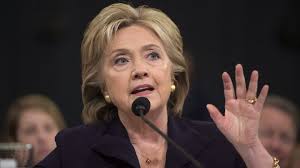
Yesterday I watched the opening and the closing of the hearing held by the House Select Committee on Benghazi to interrogate former Secretary of State Hillary Clinton. I could not watch any more because of my disgust at the conduct of the Committee members, both Republicans and Democrats.[1]
As a retired lawyer, I kept wanting to say that most of the questions were objectionable as argumentative, assume facts not in evidence, multiple, irrelevant or repetitive.
If I had been in the witness chair, I would have wanted to scream in protest.
Yes, I know that a congressional hearing is not in charge of a judge to rule on objections. I know that not all Congressmen and women have legal education and experience. I know that even those who have that education and experience do not use it. I know that such hearings are not designed to gain admissible evidence, but instead are opportunities for Congressional Representatives to show off to certain constituencies.
The whole process is disgusting and atrocious.
I am a Democrat who had been hoping to be able to support Joe Biden for president in 2016. With his refusal to run, I am now a backer of Hillary.
A prior post covered the surprising December 17, 2014, announcement of U.S.-Cuba rapprochement while another post discussed the initial public information about the preceding secret U.S.-Cuba negotiations about normalization; yet another post integrated that information into previous public information about U.S.-Cuba relations in President Obama’s second presidential term, 2013-2014.
Now Peter Kornbluh and William LeoGrande. both leading scholars on the relationship between the two countries, have added the following additional details about such previous secret discussions:[1]
Thereafter in 2010-2012 two top State Department officials—Cheryl Mills, the Chief of Staff for Secretary of State Hillary Clinton, and Julissa Reynoso, the Deputy Assistant Secretary of State for Western Hemisphere Affairs—had secret discussions with Cuban officials that initially focused on Cuba’s releasing U.S. citizen Alan Gross from a Cuban prison and the U.S.’ allowing the wives of two of the Cuban Five to visit their husbands in U.S. prisons.
By September 2011, the Cubans had explicitly proposed swapping the Cuban Five for Alan Gross, but the U.S. was not prepared to do so. Instead, as a show of good faith, the U.S. arranged for the wives of two of the Cuban Five to secretly visit their husbands in U.S. prisons while Cuba permitted Judy Gross regular visits with her husband in a military hospital in Havana.
In May 2012, Clinton received a memo from her team that stated: “We have to continue negotiating with the Cubans on the release of Alan Gross but cannot allow his situation to block an advance of bilateral relations…The Cubans are not going to budge. We either deal with the Cuban Five or cordon those two issues off.”
This May 2012 memo arrived soon after Clinton and President Obama had returned from that April’s Sixth Summit of the Americas where they had been chastised by heads of states furious over the U.S. stance on Cuba. Afterwards Clinton “recommended to President Obama that he take another look at our embargo. It wasn’t achieving its goals and it was holding back our broader agenda across Latin America.”
After his reelection in November 2012, President Obama approached Massachusetts Senator John Kerry about replacing Clinton as secretary of state and raising a new approach to Cuba. Kerry was receptive. As Chairman of the Senate Foreign Relations Committee, he had been a vocal critic of the USAID democracy promotion programs that financed Gross’ secret missions to Cuba and also had long opposed the US economic embargo of the island.
During the U.S.-Cuba secret discussions in Canada in 2013=2014 that were discussed in a prior post, The U.S. was not willing to talk about the USAID programs or the status of Guantánamo Bay. Cuba, on the other hand, was not willing to discuss human rights or U.S. fugitives living in their country.
In September 2013 Senator Dick Durbin (Dem., IL) suggested to National Security Advisor Susan Rice that the U.S. should see about getting Pope Francis involved in helping the two countries resolve their differences.
In February 2014, Senator Patrick Leahy had his staff collaborate with former White House counsel, Greg Craig, to draft a 10-page memo of options “to secure Mr. Gross’ release, and in so doing break the logjam and change the course of U.S. policy towards Cuba, which would be widely acclaimed as a major legacy achievement [for President Obama].” The document, dated February 7, laid out a course of action that would prove to be a close match with the final accord.
Apparently also in or about February 2014, Leahy sent a confidential message to Cuban Cardinal Jaime Ortega, asking him to encourage the Pope to help resolve the prisoner issue. Drawing on the close ties between Obama’s Chief of Staff, Denis McDonough, and Cardinal Theodore McCarrick of Washington, D.C., the White House also “got word to the Vatican that the president was eager to discuss” Cuba at the upcoming upcoming March private audience with the Pope.
In early March 2014, a small group of Cuba policy advocates, including representatives of a newly formed coalition for changing U.S. policies regarding Cuba, met with Cardinal Seán O’Malley in the rectory of the Cathedral of the Holy Cross in Boston. The advocates of change explained the recent trends, the conversations with President and others in the administration and Congress and indicated this was a historic moment, and a message from the Pope to President Obama would be significant in moving the process forward. A letter from Senator Leahy was given to Cardinal O’Malley urging him to focus the Pope’s attention on the “humanitarian issue” of the prisoner exchange.
During this same time period, Leahy personally delivered a similar message to Cardinal McCarrick and arranged for yet another to be sent to Cardinal Ortega in Havana. There now were three cardinals urging the Pope to put Cuba on the agenda with Obama.
At the private audience later that month (March 27), Obama told the Pope that the U.S. had something going with Cuba and that it would be useful if the Pope could play a role.” (Other details about the audience were provided in a prior post.) A few days later, Francis summoned Cardinal Ortega to enlist his help.
On May 1, 2014, Leahy, along with Senators Carl Levin (Dem., MI) and Dick Durbin (Dem., IL) and Representatives Chris Van Hollen (Dem., MD) and Jim McGovern (Dem., MA) met in the Oval Office with Obama, Vice President Joe Biden, and National Security Advisor Susan Rice. The legislators urged Obama to press for Gross’ release and replace the policy of hostility with one of engagement. “You said you were going to do this,” McGovern reminded the president. “Let’s just do it!” Obama had a non-committal response,”We’re working on it” and gave no hint of the back-channel diplomacy then well underway.
On May 19, 2014, the previously mentioned coalition released an open letter to Obama signed by 46 luminaries of the U.S. policy and business world, urging the president to engage with Cuba. The signatories included former diplomats and retired military officers—among them former U.N. Ambassador Thomas Pickering; Cuban-American business leaders like Andres Fanjul, co-owner of a Florida-based multinational sugar company; and John Negroponte, George W. Bush’s director of national intelligence. The same day, not coincidentally, the conservative US Chamber of Commerce announced that its president, Tom Donohue, would lead a delegation to Cuba to “develop a better understanding of the country’s current economic environment and the state of its private sector.”
During the summer of 2014 the Pope wrote forceful, confidential letters to Obama and Raúl Castro, imploring the two leaders“to resolve humanitarian questions of common interest, including the situation of certain prisoners, in order to initiate a new phase in relations.”
To safeguard his communications, the Pope sent both letters via papal courier to Havana—with instructions to Cardinal Ortega to personally deliver the message into the two presidents’ hands. After delivering the Pope’s letter to Raúl Castro, Ortega then sent his top aide to Washington to advance his clandestine diplomatic mission to deliver the other letter to Obama. But arranging a secret face-to-face meeting with President Obama was easier said than done. Alerted to the problem, Cardinal McCarrick conferred with White House officials, who enlisted his help as a secret back-channel go-between. In early August, McCarrick traveled to Cuba carrying a note from Obama that asked Ortega to entrust McCarrick with delivering the Pope’s letter to the White House. But Ortega’s papal instructions were to deliver the message himself. McCarrick, therefore, left Cuba empty-handed.
Back in Washington, McCarrick worked with McDonough at the White House to arrange a secret meeting for Ortega with the President. On the morning of August 18, Ortega gave a talk at Georgetown University—providing a cover story for his presence in Washington—and then quietly went to the White House. (To make sure the meeting did not leak, U.S. officials kept Ortega’s name off the White House visitor logs.) Meeting with the President on the patio adjacent to the Rose Garden, Ortega finally completed his mission of delivering the Pope’s sensitive communication, in which he offered to “help in any way.”
In October 2014, at the Pope’s invitation, the two sides met at the Vatican and hammered out their final agreement on the prisoner exchange and restoring diplomatic relations. The U.S. representatives, Rhodes and Zuniga, also noted Obama’s intention to ease regulations on travel and trade, and to allow US telecom companies to help Cuban state enterprises expand internet access. They acknowledged these initiatives were aimed at fostering greater openness in Cuba. Cuban officials said that while they had no intentionof changing their political system to suit the United States, they had reviewed the Americans’ list of prisoners jailed for political activities and would release 53 of them as a goodwill gesture. The Pope agreed to act as guarantor of the final accord.
On October 12, the New York Times published an editorial calling for ending the U.S. embargo of Cuba and for a new relationship between the two countries; it turned out to be the first of a series of editorials on various aspects of the relationship.[2] These editorials were the work of Ernesto Londoño, a new member of the Editorial Board and a native of Colombia. He talked to administration officials, Senator Leahy’s office, and the new coalition, but recently said, “There was really no collusion or formal cooperation in what they were doing and what we were doing. The Times simply saw an opportunity to push the policy it advocated forward. We figured it was worthwhile to give it a shot.”
On November 6, 2014, Obama’s National Security Council met to sign off on the details. Later that month, the negotiating teams convened one last time in Canada to arrange the logistics of the prisoner exchange.
These additional details about the over two years of previously secret negotiations should be merged with the earlier post about President Obama’s Second Term Record Regarding Cuba, 2013-2014. Together they demonstrate the diplomatic skill of that Administration in achieving this historic breakthrough that will benefit both countries.
[2] Previous posts covered the other Times editorials that commended Cuba’s foreign medical missions (Oct. 19), recommended normalization (Oct. 26) and prisoner exchanges (Nov. 3) and criticized USAID programs on the island (Nov. 10), the U.S. Cuban medical parole program (Nov. 17) and the U.S. designation of Cuba as a “state sponsor of terrorism” (Dec. 15).
An August 3 New York Timeseditorial asserts that the U.S. Congress is rethinking the wisdom of the U.S. embargo of Cuba. Why does the Times come to this conclusion? Is it justified?
I wish it were so, but I think it is too soon to say that the Congress is changing its opinion on the embargo.
The only relevant asserted basis in the editorial is the recent introduction in the House of Representatives by a Republican, Tom Emmer of Minnesota, of a bill to end the embargo (H.R.3238). (This bill was covered in a recent post.)
Yes, this bill and its companion (S.1543) in the Senate by Republican Senator Jerry Moran are important in light of Republicans current control of Congress. But as of yesterday the House has taken no action on the Emmer bill (H.R.3238) or on the three earlier bills to end the embargo that had been offered by Democrats (H.R.274, H.R.403 and H.R.735). The same is true in the Senate on Moran’s bill (S.1543) and on the bill to end the embargo introduced earlier by Minnesota’s Democratic Senator Amy Klobuchar (S.491).
The other basis for the editorial’s conclusion was an action of a Senate Committee on a different, but related, subject: ending the ban on U.S. citizens traveling to Cuba. Yes, this is a hopeful sign, but insufficient to say the Congress as a whole is rethinking these issues.
The editorial also cites increasing public support for ending the embargo and other measures to promote normalization of U.S. relations with the island. But that public opinion has not yet been translated into action by the Congress.
Another fact mentioned by the editorial was the forceful call for ending the embargo that recently was uttered by Democratic presidential contender, Hillary Clinton. But as the Times also pointed out, Republican presidential hopefuls, Jeb Bush and Marco Rubio, immediately expressed their disagreement on this issue.
U.S. citizens need to continue to press their Senators and Representatives to embrace normalization, including ending the embargo.
In light of President Barack Obama’s historic December 17, 2014, announcement of rapprochement with Cuba, it is interesting to examine Obama’s earlier statements about Cuba. Prior posts examined his campaign for the Democratic presidential nomination in 2007-2008 and his campaign for the presidency as the Democratic Party’s nominee in 2008. Now we discuss his first presidential term, 2009-2013.[1] Subsequent posts will look at his reelection campaign in 2012 and his second presidential term (up to the December 17, 2014, announcement), 2013-2014.
As we saw in a prior post, Barack Obama and Joe Biden won the November 4, 2008 election with 69.5 million votes (52.9% of the total) to John McCain and Sarah Palin’s 59.9 million votes (45.7%). In the key state of Florida, Obama-Biden had 51.0% of the popular vote against McCain-Palin’s 48.4%. The electoral votes were Obama and Biden, 365; McCain and Palin, 173. Soon thereafter several head of states congratulated Obama while also calling for the U.S. to end its sanctions against Cubs.
Obama’s First Term, 2009
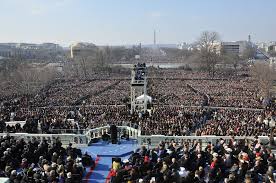
President Obama’s Oath of Office with Michelle ObamaCrowd @ Obama Inaugural 2009
Obama was inaugurated as President on January 20, 2009. His Inaugural Address first mentioned that “we are in the midst of crisis. . . . Our nation is at war against a far-reaching network of violence and hatred. Our economy is badly weakened. . . . [T]he challenges we face are real, they are serious and they are many. They will not be met easily or in a short span of time. But know this America: They will be met.” There was no mention of Latin America or Cuba.[2]
On February 25, 2009, the Department of State released its 2008 Country Reports on Human Rights Practices; the chapter on Cuba described it as a “totalitarian state” that “continued to deny its citizens their basic human rights and committed numerous, serious abuses.”
In April 2009 Obama fulfilled the pledge he made in his acceptance of the Democratic Party’s presidential nomination by lifting travel and remittance restrictions for Cuban-Americans while also authorizing U.S. telecommunications companies to contract with Cuba for improved television, radio and telephone service and Internet access.
That same month (April 2009) Obama told a journalist, “Cuba has to take some steps, send some signals that when it comes to human rights, when it comes to political rights, when it comes to the ability of Cubans to travel.” In Obama’s opinion, the previously mentioned U.S. changes called for Cuba to “send signals that they’re interested in liberalizing.”
This U.S. desire or demand for Cuban reciprocity was not well received in Havana. Cuba’s President Raúl Castro declared, “The blockade [embargo] remains intact. . . . Cuba has not imposed any sanction on the [U.S.] or its citizens. Therefore, it is not Cuba that should make gestures.” Nevertheless, “We are willing to discuss everything with the [U.S.] government, on equal footing; but we are not willing to negotiate our sovereignty or our political and social system, our right to self-determination or our domestic affairs.”[3]
Later that same month (April 2009), Obama attended the Fifth Summit of the Americas. Latin American presidents applauded the previously mentioned U.S. changes while simultaneously pressing Obama on the need to reintegrate Cuba into the inter-American community. Obama responded by reiterating his commitment to engagement, “The [U.S.] seeks a new beginning with Cuba.”
Also in April 2009, the U.S. Department of State issued its Country Reports on Terrorism 2008. Again Cuba was listed as a state sponsor of terrorism.
The next month, May 2009, the U.S. proposed to Cuba that they resume bilateral consultations on migration. Cuba agreed, and the talks took place that July. Cuba presented a draft accord to curb people smuggling and indicated an interest in also discussing cooperation on counterterrorism, counter-narcotics operations and hurricane preparation. Although no such formal agreement was reached, both sides agreed it was a productive consultation.
In June 2009 at the General Assembly of the Organization of American States (OAS), Latin American members moved to repeal the 1962 resolution suspending Cuba’s OAS membership. Facing defeat on this proposal, the U.S. negotiated a compromise: repeal the suspension if Cuba accepts “the practice, purposes, and principles of the OAS,” impliedly including the commitment to democracy in the Santiago Declaration of 1991.
In August 2009 Bill Richardson, then the Governor of New Mexico, was in Cuba on a trade mission, and at a meeting with Cuban officials was led to believe that Cuba wanted to move forward with the U.S. although Richardson said Cuba needed to reciprocate with some gestures. Cuba’s Foreign Minister Rodriguez made it clear that Cuba would not make any concessions to win better relations with the U.S. and that the U.S. blockade (embargo) was unilateral and should be lifted unilaterally.
In September 2009 an U.S. Assistant Secretary of State was in Cuba for discussions about restoring direct mail service. Over five days, she met with Cuban officials in the Justice, Agriculture, Health and Interior ministries and academics at the University of Havana as well as bloggers and dissidents. Much to the consternation of Cuban authorities, one of the bloggers was Yoani Sánchez, now an international celebrity. Nevertheless, Cuba’s Assistant Foreign Minister (Bruno Rodriguez Parrilla, now the Minister of that agency) told the U.S. official that Cuba wanted to show her their desire “to move forward in our relationship,” requiring “confidence building” as a “way forward.”
By the Fall of 2009 the White House was frustrated by Cuba’s failure to respond to the U.S. relaxing of travel and remittance restrictions for Cuban-Americans. As a result, Obama asked Spain’s Prime Minister, José Luis Rodriguez Zapatero, to have Spain’s Foreign Minister carry a back-channel message to President Rául Castro that if Cuba did not take steps of liberalization, neither could Obama and that the U.S. understands things cannot change overnight, but in the future it will be clear that this was the moment when changes began.
Castro responded with a proposal for a secret channel of communication between the two countries to discuss Cuban steps that might address the U.S. concerns. The U.S., however, at this time rejected the idea for a secret channel. (As we will see below, in December 2012, such a secret channel was opened.)
On December 3, 2009, the process of normalization was thrown off track by Cuba’s arrest of U.S. citizen, Alan Gross, who was bringing communications and computer equipment to Cuba’s Jewish community as an employee of a contractor for the U.S. Agency for International Development (USAID). Two weeks later President Castro told Cuba’s National Assembly that the U.S. alleged desire for a new relationship was “a huge propaganda campaign staged to confuse the world. The Truth is that the instruments for the policy of aggression to Cuba remain intact and that the U.S. government does not renounce its efforts to destroy the Revolution.”
By the end of 2009, therefore, things looked bleak for further normalization. Moreover, the press of many other foreign policy challenges for the U.S. pushed Cuba far down the list of priorities for the Obama Administration.
Obama’s First Term, 2010.
The arrest and jailing of Alan Gross continued to disrupt the relations of the two countries in 2010. The U.S. denied that Gross had done anything wrong and that his release from a Cuban jail was necessary for any improvement in the relationship.
The Gross arrest, however, prompted the U.S. Senate Foreign Relations Committee to investigate USAID’s Cuba democracy programs in 2010 and to develop a plan to reorient the Cuba program toward supporting genuine links between the two countries. These changes in the program were briefed for Cuban diplomats, who said it would smooth the way for the release of Gross.
On March 11, 2010, the Department of State released its 2009 Country Reports on Human Rights Practices; the chapter on Cuba described it as a “totalitarian state” that “continued to deny its citizens their basic human rights, including the right to change their government, and committed numerous and serious abuses.”
In the meantime, Spain on its own initiative in May 2010 encouraged Rául Castro and Cardinal Jaime Ortega to discuss Cuba’s lifting the ban on public demonstrations by the Ladies in White, the female relatives of political prisoners, and to the release of political prisoners. In July 2010 this resulted in the government’s agreement to release 52 such prisoners, including everyone who had been arrested in 2003, and those who wished to go into exile would be welcomed by Spain. Eventually the government released 127 such prisoners.
In June 2010 Cardinal Ortega, with the consent of the Cuban government, went to Washington, D.C. to inform them of the then planned prisoner release. The Cuban government believed this prisoner release was a major concession and should “pressure U.S. political leaders to respond with other gestures of good will toward Cuba.” Ortega also told U.S. officials that Castro was ready to talk with the U.S. directly about every issue and that it would be a mistake for the U.S.to maintain the status quo until Cuba became a democracy. ”Everything should be step by step,” the Cardinal said. “It’s not realistic to begin at the end. This is a process. The most important thing is to take steps in the process.”
Obama, however, insisted that first Cuba had to release Alan Gross from prison before the U.S. could do more. Secretary of State Hilary Clinton called the Cuban prisoner release a “positive sign,” but Obama said nothing.
In August 2010 Bill Richardson returned to Cuba on another trade mission and met with officials to try to obtain Gross’ release from prison. Richardson felt encouraged, but did not obtain the release.
Also in August 2010 the Department of State issued its Country Reports on Terrorism 2009, which again listed Cuba as a “state sponsor of terrorism.”
To try to rescue the stalled discussions, an Assistant Secretary of State met with Cuba’s Foreign Minister at the U.N. in October 2010. Rodriguez opened the meeting with a lengthy recitation of Cuba’s historical grievances against the U.S. and refused to engage in discussions about the future. “It was a terrible meeting,” said the U.S. official.
Soon after this terrible meeting, Rodriguez met again with Bill Richardson at the U.N. The Foreign Minister wanted the U.S. to know that Gross was merely a symptom of the troubled relationship, not its heart. Rodriguez also wanted the U.S. to know that Cuba had asked its supporters to tone down their criticism of Obama during the debate on the resolution to condemn the U.S. blockade (embargo) and that Castro had decided to improve ties with the U.S., but that the U.S. had not reciprocated. In addition, Rodriguez stressed the need for the U.S. to make progress on the case of the Cuban Five in U.S. prison.
Also in October 2010, John Kerry, then Senator and the Chair of the Senate Foreign Relations Committee, met Rodriguez, Cuba’s Foreign Minister, to discuss the U.S. democracy programs and Alan Gross, and an informal deal for his release seemed to be on track. However, the Administration abandoned the proposed changes in the Cuba democracy programs after objections from New Jersey Senator Robert Menendez. The Obama Administration was unwilling to wage a political fight with Menendez. This resulted in the Cuban government concluding that the Administration could not be trusted.
Earlier in 2010 advocates for lifting U.S. restrictions on travel to Cuba launched a major campaign over opposition from Senator Menendez and others. During his June trip to Washington Cuba’s Cardinal Ortega urged members of Congress to allow freer travel in light of Pope John Paul II’s injunction that Cuba “open itself to the world and . . . the world open itself to Cuba.” The resistance from Menendez and Miami Congresswoman Debbie Wasserman Schultz, however, prevented any congressional action to eliminate or reduce restrictions on U.S. citizens traveling to Cuba. Apparent indifference from President Obama also contributed to nothing happening in Congress on this issue.
Instead, at Obama’s direction, the Administration worked on a more limited expansion of travel through new regulations on “people-to-people” educational travel, but in August-September 2010 opposition by Menendez and Wasserman Schultz forced the Administration to shelf the new regulations.
Obama’s First Term, 2011
In mid-January 2011, on a late Friday before a holiday weekend, the Administration finally released the new regulations on expanded “people-to-people” educational travel. Cuba’s Foreign Minister said these regulations were “positive,” but they had “a very limited scope and do not change the policy against Cuba.”
In March 2011 Jimmy Carter, former U.S. President, went to Cuba at the invitation of Rául Castro. Before Carter left, Cuban officials made it clear that Gross would not be granted freedom. Carter met with Cardinal Ortega to discuss the Roman Catholic Church’s dialogue with the government, with blogger Yoanni Sánchez, dissidents, former prisoners, relatives of the Cuban Five in U.S. prison and with Alan Gross. Foreign Minister Rodriguez stressed the importance of the Cuban Five case for Cuba. Over dinner with Rául Castro, Carter emphasized that Gross’ imprisonment was a serious obstacle to improving relations and urged his release on humanitarian grounds. Castro said there was no consensus in the Cuban government on the Gross case, but reiterated Cuba’s willingness to engage in wide-ranging talks with the U.S., “without preconditions,” and “on equal terms with full respect for our independence and sovereignty.” Any topic could be discussed. “We are ready.”
Before his departure, Carter said the U.S. should fully normalize relations with Cuba immediately; Cuba should allow full freedom of speech, assembly, travel; the U.S. embargo should be ended; Cuba should be removed from the terrorism list; the Cuban Five should be released from U.S. prison; and Alan Gross should be released from Cuban jail. Rául Castro, standing nearby, quipped, “I agree with everything President Carter said.”
Upon Carter’s return to the U.S., he had a cool meeting with Secretary of State Clinton, and the next day the Administration advised Congress it was requesting $20 million of funding for the democracy promotion programs in Cuba.
On April 8, 2011, the Department of State released its 2010 Country Reports on Human Rights Practices; the chapter on Cuba described it as a “totalitarian state” that “denied citizens the right to change their government. In addition, the following human rights abuses were reported: harassment, beatings, and threats against political opponents by government-organized mobs and state security officials acting with impunity; harsh and life-threatening prison conditions, including selective denial of medical care; arbitrary detention of human rights advocates and members of independent organizations; and selective prosecution and denial of fair trial.”
In August 2011 the Department of State released its Country Reports on Terrorism 2010, which again listed Cuba as a “state sponsor of terrorism.”
Obama’s First Term, 2012
On May 24, 2012, the Department of State released its 2011 Country Reports on Human Rights Practices; the 27-page chapter on Cuba described it as a “totalitarian state” whose “principal human rights abuses were: abridgement of the right of citizens to change their government; government threats, intimidation, mobs, harassment, and detentions to prevent citizens from assembling peacefully; and a significant increase in the number of short-term detentions, which in December rose to the highest monthly number in 30 years.”
In July 2012 the Department of State released its Country Reports on Terrorism 2011, which again listed Cuba as a “state sponsor of terrorism.”
During the latter part of 2012 Obama and Biden were engaged in their campaign for re-election against Republican nominees Mitt Romney and Paul Ryan, which will be covered in a subsequent post.
In the meantime, in September 2012 Bill Richardson made another trip to Cuba after Cuba’s Supreme Court had affirmed Alan Gross’ conviction. The State Department gave him a list of things the U.S. was prepared to do if Gross were pardoned and released from prison. Most were possibilities, rather than commitments. The others were commitments, but already had been announced by the U.S.
The Richardson trip got off to a bad start when he leaked word of it to CNN’s Wolf Blitzer, who reported that the Governor had been invited by the Cuban government to negotiate the release of Gross. To the Cubans, this looked like an attempt to force their hand. Later the Cuban Foreign Minister told Richardson “One, you won’t get Gross; two, you won’t see Rául; and three, you won’t even see Gross.” An angry Richardson held a press conference to announce that he would not leave Cuba until he saw Gross, who was a “hostage” held by the Cubans. An angry Cuban government responded that Gross’ release was never on the table, that Richardson was aware of that position, that his request to see Gross was impossible after Richardson’s slanderous statements and that Cuba was a sovereign country that did no accept blackmail, pressure or posturing.
At the time nothing of consequence regarding Cuba is believed to have happened during the two months after the November 2012 election, in which Obama and Biden won re-election.
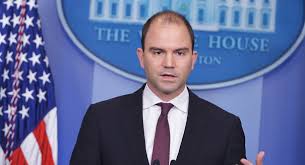
Ben Rhodes
However, over the last seven months, we have learned that in December 2012 after his re-election President Obama held a long meeting with aides in the White House situation room to establish priorities for the second term. According to Ben Rhodes, the Deputy National Security Advisor who played a central role in shaping Cuba policy and who participated in that meeting, the aides all knew that Obama always had thought that the decades-long U.S. policy of trying to isolate Cuba through the embargo and other measures made no sense, and at the end of the discussion, Obama instructed aides to make Cuba a priority and “see how far we could push the envelope.”[4]
Moreover, at this December 2012 meeting the President also concluded that “it would be a good fit to have someone who was known to be very close to the President [involved in such an effort on Cuba] because the Cubans are very wary of engagement and they want to know that the engagement is reaching the top. They felt like there [had] been several other efforts of engagement where it turned out to be kind of “Lucy with the football,” where they had conversations with the Americans, [but after] they reached a certain point . . . there was never follow through [by the U.S.]. We can debate whether it was the Cubans’ fault or not, but that was their perception. So . . . [the Cubans] wanted someone . . . [involved for the U.S.] who were very close to the President and . . . they wanted it to be discreet.” Hence, the President designated Mr. Rhodes to be in charge of this new effort to engage Cuba.
Thereafter, Mr. Rhodes sent a secret message to the Cuban government that the U.S. wanted “to initiate a dialogue about prisoners and other issues.”
Obama’s First Term, January 2013
Nothing of consequence regarding Cuba was believed to have happened during the rest of President Obama’s first term, which ended on January 20, 2013, although the exact dates of the secret discussions with Cuba in 2013 are not yet known.
Conclusion
After fulfilling a campaign pledge In April 2009 to lift travel and remittance restrictions for Cuban-Americans while also authorizing U.S. telecommunications companies to contract with Cuba for improved television, radio and telephone service and Internet access, President Obama’s desire to seek normalization with Cuba was thwarted by Cuba’s December 2009 arrest and subsequent conviction and imprisonment of Alan Gross. The rest of Obama’s first term regarding Cuba seemed, at the time, concentrated on unsuccessful efforts to obtain Gross’ release. Now, however, we know that at the end of the first term a new and secret effort to engage with Cuba was launched.
[1] This post and the subsequent posts about Obama’s prior statements about Cuba are not based upon comprehensive research. The primary research tool was online searching of the New York Times for articles mentioning “Obama and Cuba” for the relevant time period although the details have been lost in the process of editing this post. Therefore, this blogger especially welcomes comments with corrections and additions. Ultimately after public release of many Obama Administration documents after the completion of his presidency, scholars will undertake a detailed examination of those documents and provide their assessments of his record regarding Cuba.
[3] At about the same time (April 2009), the U.S. Interests Section in Havana turned off its external streaming electronic news billboard, and Cuba replaced the black flags on poles outside the Section with Cuban flags.
In light of President Barack Obama’s historic December 17, 2014, announcement of rapprochement with Cuba, it is interesting to examine Obama’s earlier statements about Cuba.[1] This post will examine his campaign for the Democratic presidential nomination in 2007-2008.[2] Future posts will look at his 2008 presidential campaign; his first presidential term (including his 2012 presidential election campaign), 2009-2013; and his second presidential term (up to the December 17, 2014, announcement), 2013-2014.
Barack Obama’s Announcement Speech February 2007
On February 10, 2007, at theI llinois State Capitol in Springfield Barack Obama announced his candidacy for the Democratic Party’s presidential nomination. Almost all of his speech was about domestic issues with the exception of his pledge to end the war in Iraq and “bring our combat troops home by March of 2008.” There was no mention of Cuba.
Later that month (February 2007) the New York Times’ Nicholas Kristof asked Obama, “Is the [Cuba] embargo a failure?” Obama responded, “I think we’ve got a potential opportunity with Castro’s health waning to reopen the debate. We probably shouldn’t be overly optimistic that it’s going to change overnight. And I think it’s important that the United States isn’t too heavy-handed post-Castro in swooping [in] and suggesting that somehow Cuba’s going to change immediately. I do think that it opens up the conversation among not just the United States but among Cubans both in the U.S. and in Cuba about breaking down some of the restrictions on travel and commerce….I don’t think we automatically ease those restrictions simply because Castro has died. What I think is that with Castro’s death there are going to be a new set of players, I think it’s going to be important for us to do an entire reevaluation of our strategy towards Cuba. And I think the aim should be to create a more open relationship….But that is still going to be contingent on having some desire on the part of the Cuban government to initiate that process as well.”
In the CNN/YouTube debate with Hillary Clinton in July 2007, Obama was asked, “’Would you be willing to meet, separately, without preconditions, during the first year of your administration, in Washington or anywhere else, with the leaders of Iran, Syria, Venezuela, Cuba and North Korea, in order to bridge the gap that divides our countries?” Obama replied, ‘I would,’ and added that it was a “disgrace that the Bush administration had refused on principle to do so.”
The Obama campaign team anticipated that the Clinton campaign would seize on Obama’s willingness to meet, without preconditions, with leaders of so-called rouge regimes. Obama, however, welcomed this attack and told his aides “we will not back down on this one bit.” This position was supported by polling in Iowa, the early caucus state, and showed that Obama represented change and Hillary did not.
Indeed, as anticipated, immediately after the debate, Hillary Clinton charged that Obama was too soft on talking with such countries. The Obama campaign responded that Mr. Obama would pursue “tough diplomacy,” but also use carrots like leader-to-leader talks.”
On August 21, 2007, Obama wrote an op-ed article in the Miami Herald “calling for ‘unrestricted rights’ for Cuban Americans to visit and send money to family in Cuba.” The following Saturday he campaigned in Miami’s Little Havana and told the crowd at a rally, “We’ve been engaged in a failed policy with Cuba for the last 50 years, and we need to change it.” He went on to promise to end restrictions on remittances and family travel for Cuban-Americans, to revive “people-to-people” educational and cultural exchanges and to engage Cuba on issues of mutual interest. Such engagement, he said, offered the best hope for promoting “a democratic opening in Cuba,” which is the “foremost objective of [U.S.] policy.”
At a December 1, 2007, televised Iowa debate among the Democratic candidates for their presidential nomination, Obama agreed with Mrs. Clinton, John Edwards and Joe Biden that the U.S. should not normalize relations with Cuba while Fidel Castro was still in power. Only Christopher Dodd and Dennis Kucinich were in favor of working for change with Fidel.
On February 19, 2008, the outside world provided a new circumstance for the candidates to react to. Fidel Castro resigned as President of Cuba due to poor health, and his brother, Raúl Castro, became Acting President and five days later (February 24, 2008) the President upon election by Cuba’s National Assembly.
In the meantime in a February 21, 2008 debate with Hillary Clinton in Austin, Texas, Obama made extensive comments about the U.S. and Cuba. He said, “The starting point for our policy in Cuba should be the liberty of the Cuban people. And I think we recognize that that liberty has not existed throughout the Castro regime. And we now have an opportunity to potentially change the relationship between the United States and Cuba, after over half a century. I would meet without preconditions, although Senator Clinton is right that there has to be preparation. It is very important for us to make sure that there was an agenda and . . . that [the] agenda [included] human rights, releasing of political prisoners, opening up the press. And that preparation might take some time.” His other points about Cuba were the following:
More generally “it is important for the United States not just to talk to its friends but also to talk to its enemies. In fact, that’s where diplomacy makes the biggest difference.”
“One other thing that I’ve said as a show of good faith, that we’re interested in pursuing potentially a new relationship, what I’ve called for is a loosening of the restrictions on remittances from family members to the people of Cuba as well as travel restrictions for family members who want to visit their family members in Cuba. And I think that initiating that change in policy as a start and then suggesting that an agenda get set up is something that could be useful, but I would not normalize relations until we started seeing some of the progress that Senator Clinton talked about.”
When challenged that he had had a different position on Cuba in 2003, Obama responded, “I support the eventual normalization [with Cuba], and it’s absolutely true that I think our [Cuba] policy has been a failure. . . . [D]uring my entire lifetime . . . you essentially have seen a Cuba that has been isolated but has not made progress when it comes to the issues of political rights and personal freedoms that are so important to the people of Cuba. So I think that we have to shift policy. I think our goal has to be ultimately normalization, but that’s going to happen in steps.”
“[T]he first step . . . is changing our rules with respect to remittances and with respect to travel. And then I think it is important for us to have the direct contact not just in Cuba, but I think this principle applies generally. [As] John F. Kennedy once said, . . . we should never negotiate out of fear, but we should never fear to negotiate. And this moment, this opportunity when Fidel Castro has finally stepped down, . . . is one that we should try to take advantage of.”
Immediately after this Democratic candidates debate, Senator John McCain, then a candidate for the Republican presidential nomination, jumped in with his criticism of Obama. McCain said, “Not so long go Senator Obama favored complete normalization of relations with Fidel Castro’s Cuba. Last night, he said that as president he’d meet with the imprisoned island’s new leader ‘without preconditions.’ So Raul Castro gets an audience with an American president, and all the prestige such a meeting confers, without having to release political prisoners, allow free media, political parties, and labor unions, or schedule internationally monitored free elections. Instead, Senator Obama says he would meet Cuba’s dictator without any such steps in the hope that talk will make things better for Cuba’s oppressed people. Meet, talk, and hope may be a sound approach in a state legislature, but it is dangerously naive in international diplomacy where the oppressed look to America for hope and adversaries wish us ill.”
Obama’s campaign promptly retorted, ““John McCain would give us four more years of the same Bush-McCain policies that have failed U.S. interests and the Cuban people for the last fifty years. My policy will be based on the principle of liberty for the Cuban people, and I will seek that goal through strong and direct presidential diplomacy, and an immediate change in policy to allow for unlimited family visitation and remittances to the island. In November, the American people will have a clear choice: a new direction versus more war in Iraq, more not talking to leaders we don’t like, and more of a Cuba policy that has failed to achieve freedom for the Cuban people. I am confident that the American people will choose the promise of the future over the failed policies and predictable political attacks of the past.”
President George W. Bush echoed some of McCain’s criticisms of Obama at a February 28, 2008 press conference. Bush called Cuba’s new President, Rául Castro, a “tyrant,” who was “nothing more than an extension of what his brother [Fidel] did, which was to ruin an island, and imprison people because of their beliefs.” Bush also rejected Obama’s willingness to meet with the new Cuban leader because it would “send the wrong message. It’ll send a discouraging message to those who wonder if America will continue to work for the freedom of prisoners, it’ll give great status to those who have suppressed human rights and human dignity.”
John McCain continued his criticism of Obama’s stance on Cuba on March 6, 2008. According to McCain, he would meet with Cuban leaders “as soon as the political prisoners are free … and free elections have been held. Then I would sit down with any freely elected president or leader of Cuba. But until that day came I would not in any way, as Senator Obama wants to do, legitimize an individual who has been responsible for education, repression, political prisons and a gulag. I don’t think that it would be appropriate to legitimize someone like Raul Castro by quote, sitting down with him. And under no circumstance would I do it.’’
On May 20, 2008, this line of criticism was reiterated by McCain. At a rally in Miami, he said, “Now Senator Obama has shifted positions and says he only favors easing the embargo, not lifting [it]. He also wants to sit down unconditionally for a presidential meeting with Raul Castro. These steps would send the worst possible signal to Cuba’s dictators — there is no need to undertake fundamental reforms, they can simply wait for a unilateral change in U.S. policy.”
Responding from a campaign stop in Oregon the next day (May 21, 2008), Obama said, “with Fidel Castro stepping down from the presidency” and his brother Raul now in that post, “I think it’s a good time for us to reassess our Cuba policy. Cuba is a dictatorship that does not respect human rights or the free exercise of religion.” On the other hand, Obama argued, “our Cuba policy was shaped when I was born and basically hasn’t changed for 46 years.” Since that policy of political and economic isolation “hasn’t worked,” he added, it is now time to “try different things.” Mr. Obama spoke of the possibility of normalizing relations with Cuba if diplomatic contacts prove fruitful. But he also argued that “it is important to send some signals right now,” recognizing that “our relationship may be at a moment of transition right now.” In particular, Mr. Obama indicated that he favors lifting restrictions both on visits by Cuban-Americans to their families on the island and on the money they send back to those relatives.
Two days later (May 23, 2008) Obama appeared in Miami before the Cuban American National Foundation, the most prominent of the anti-Castro Cuban exile groups. Obama said he would meet with the Cuban leader, Rául Castro, “at a time and place of my choosing.” After eight years of the disastrous policies of George Bush, “it is time to pursue direct diplomacy, with friend and foe alike, without preconditions.” Obama also said that if elected president he would immediately lift the bans on family travel to Cuba and the limits on how much money people can send to their relatives in the communist nation. But he “will maintain the embargo. It provides us with the leverage to present the regime with a clear choice: If you take significant steps toward democracy, beginning with the freeing of all political prisoners, we will take steps to begin normalizing relations.”
Three months later, August 25 to 28, the Democratic Party held its National Convention in Denver, Colorado, where it adopted its national platform and officially nominated its candidates for President and Vice President. Obama was nominated on August 27, when his former opponent, U.S. Senator Hillary Clinton, interrupted the official roll call to move that Obama be selected by acclamation. U.S. Senator Joe Biden also was nominated for Vice President that same night, following which he accepted the nomination.
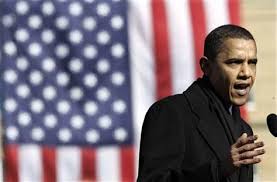
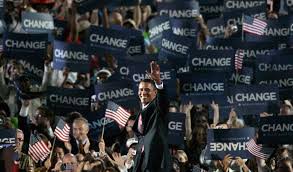
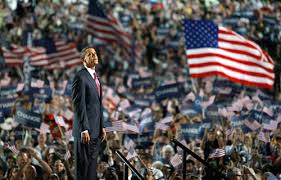
Barack Obama @ Democratic Party’s National Convention 2008Barack Obama @ Democratic Party’s National Convention 2008
On August 28 Obama accepted his nomination in a speech at INVESCO Field before a record-setting crowd of 84,000 people in attendance plus additional millions on national and international television. The speech concentrated on his visions for the future of the U.S. economy and better lives. He did not mention Cuba or any other foreign policy issue other than his promise to end the war in Iraq.
Conclusion
Obama in his campaign for the nomination consistently asserted that he favored discussions or negotiations with Cuba and other rogue states “without preconditions.” That, in fact, is what he did in the 2013-2014 secret negotiations with Cuba that led to the December 17, 2014, announcement of rapprochement with Cuba.
This campaign position was based upon the assumption that the nearly 50-years of U.S. policy regarding Cuba was a failure and needed to be changed. This, in fact, is what he said in the December 17th announcement and the July 1st announcement of re-establishment of diplomatic relations with Cuba.
In this campaign Obama advocated liberalizing U.S. restrictions on travel to Cuba and U.S. citizens’ remittances to Cubans. This, in fact, is what he did in early 2009 and in 2014.
Obama in this campaign also talked about the importance of the U.S. pressing Cuba on human rights, releasing of political prisoners and opening up the Cuban press. This, in fact, since December 17 these subjects are being discussed with Cuba.
There, however, was one discordant note in this campaign. On May 23, 2008, Obama said he would maintain the embargo whereas in the December 17, 2014, announcement he called for Congress to end the embargo.
[1] This post and the subsequent posts about Obama’s prior statements about Cuba are not based upon comprehensive research. The primary research tool was online searching of the New York Times for articles mentioning “Obama and Cuba” for the relevant time period. Therefore, this blogger especially welcomes comments with corrections and additions.
Granma, the official newspaper of the Communist Party of Cuba, published an article regarding U.S. reactions to the restoration of diplomatic relations between the U.S. and Cuba.[1]
It reported positive reactions from Democratic Senators Patrick Leahy, Chris Murphy, and Ben Cardin and from Republican Senator Jeff Flake and Republican Representative Bradley Byrne.
Others expressing support were Hillary Clinton, former Secretary of State and current candidate for president in 2016, and Wayne Smith, a former head of the U.S. Interests Section in Cuba.
Opposition, Granma reported, came from Republican Senators Marco Rubio and Ted Cruz; Republican Representatives John Boehner and Ileana Ros-Lehtinen; and Republican presidential candidate, Jeb Bush.
The article also included a reference to a public opinion survey taken May 27-June 17, 2015, by the Chicago Council on Global Affairs that showed that “Americans favor lifting the trade embargo on Cuba and believe the proposed changes in U.S.-Cuba relations will have mutual benefits.” More specifically, the survey demonstrated the following:
“Two in three Americans (67 percent) support the United States ending the trade embargo with Cuba.”
“Support for ending the embargo is bipartisan, with majorities of Democrats (79 percent), Republicans (59 percent) and Independents (63 percent) all in favor of lifting the ban on U.S. trade with Cuba.”
“A majority of Americans are very or somewhat confident that the proposed changes in U.S.-Cuba relations will have benefits for both countries. Majorities of Americans say the changes will help the Cuban economy (70 percent), help U.S. businesses (62 percent), improve living standards in Cuba (60 percent), improve the image of the United States in the world (57 percent), improve human rights in Cuba (54 percent) and improve political freedoms in Cuba (53 percent).”
“Majorities of all partisan groups are very or somewhat confident that the proposed changes in U.S.-Cuba relations will help the Cuban economy (78 percent of Democrats, 65 percent of Republicans, 70 percent of Independents).”
“Otherwise, Democrats and Independents are more confident than Republicans in the benefits. Majorities of both Democrats and Independents are confident that the changes will help U.S. businesses (75 percent of Democrats, 61 percent of Independents) and improve Cuban standards of living (71 percent of Democrats, 59 percent of Independents), while Republicans are divided (50 percent each). Democrats are also more confident than Republicans that the proposed changes in U.S.-Cuba relations will improve the image of the United States in the world (74 percent of Democrats, 45 percent of Republicans, 52 percent of Independents), improve human rights in Cuba (68 percent of Democrats, 38 percent of Republicans, 55 percent of Independents) and improve political freedoms in Cuba (65 percent of Democrats, 39 percent of Republicans, 53 percent of Independents).”
On August 13, 2012, I sent the following letter regarding Cuba to U.S. President Barack Obama.[1]
Many of the United States’ policies regarding Cuba are not in our national interest and should be changed. I write specifically about (1) the U.S. embargo of Cuba, (2) the U.S. designation of Cuba as a “State Sponsor of Terrorism,” (3) the U.S. denigration of religious freedom on the island and (4) our refusal to enter into negotiations with Cuba on the broad range of issues that have accumulated since the Cuban Revolution of 1959 without Cuba’s satisfying various U.S. preconditions.
1. U.S. Embargo of Cuba
The U.S. embargo of Cuba, in my opinion, is an out-of-date relic of the days of U.S. hostility toward, and fear of, the Cuban Revolution. Today Cuba poses no serious threat to the U.S. Cuba’s regrettable human rights violations are understandable and could be more successfully addressed in bilateral negotiations. Normalizing relations, including rescinding the embargo, would be in the economic interest of the U.S. by creating export and investment opportunities for U.S. businesses. Moreover, ending the embargo would be in the overall interests of the U.S., especially with respect to our relations with other countries in the Western Hemisphere. This is examined more fully in my blog posts: “The U.S. Should Pursue Reconciliation with Cuba,” (May 21, 2001); and “U.N. General Assembly Again Condemns U.S. Embargo of Cuba,” (Oct. 25, 2011),
The U.S. should end its embargo of Cuba.
2. U.S. Designation of Cuba as a “State Sponsor of Terrorism”
The U.S. State Department’s Country Reports on Terrorism 2011 (July 31, 2012), assert two grounds for designating Cuba as a “State Sponsor:” (a) its being an alleged safe haven for certain ETA and FARC terrorists and U.S. fugitives; and (b) its alleged financial system deficiencies relating to money laundering and financing of terrorism.
The U.S. State Department’s 2011 Report on International Religious Freedom (July 30, 2012), had many positive things to say about the status of this important freedom in Cuba in 2011 that is confirmed by my personal experience with the subject. The report also has certain negative comments on the subject with which I do not disagree.
The resulting question, I believe, is “Is the glass half empty or half full?” I believe it is more than half full of this important freedom. The U.S. needs to remember that Cuban society and history is very different from the U.S. and humbly recognize that those differences do not mean that its religious freedom is fundamentally flawed.
My real complaint here is with the U.S. Commission on International Religious Freedom’s unrealistic overstatement of the negative aspects of Cuban religious freedom and its continued placement of Cuba on its Watch List.
The U.S. should cease denigrating Cuban religious freedom and instead explore through respectful bilateral negotiations whether there are ways for the U.S. to assist Cuba in further expansion of such freedom on the island.
4. U.S. Negotiations with Cuba
In addition to the issues discussed in this letter, there are many others that need discussion, negotiation and resolution. They include Cuban compensation for expropriated property in the Cuban Revolution, enhancement of human rights on the island, emigration and immigration between the two countries, the status of Cuba’s lease of Guantanamo Bay to the U.S., the continued U.S. imprisonment of four of the so called “Cuban Five,” Cuba’s continued imprisonment of Alan Gross, the status of U.S. fugitives in Cuba, exploration and drilling for oil in the Caribbean Sea between the two counties, Cuba’s re-entry into the Organization of American States and re-establishment of full diplomatic relations.
Perhaps such negotiations would be assisted by having the two countries agree to the appointment of a respected international mediator/conciliator to supervise the negotiations.
Cuba repeatedly has said that it is willing to engage in respectful negotiations with the U.S. on all issues. Most recently on July 26th (Revolution Day marking the 59th anniversary of the Cuban uprising against former President Batista), Cuban President Raul Castro in a public speech reiterated his country’s willingness to engage in negotiations with the U.S. as equals. He said no topic was off limits, including U.S. concerns about democracy, freedom of the press and human rights in Cuba so as long as the U.S. was prepared to hear Cuba’s own complaints. (Assoc. Press, Cuban president Raúl Castro willing to hold no-limits talks with America, Guardian (July 26, 2012); Assoc. Press, Cuba–An Impromptu Invitation, N.Y. Times (July 27, 2012).)
The U.S. should accept Cuba’s offer to engage in broad-scale negotiations over all issues between the two countries.
[1] Copies of the letter were sent to Hillary Rodham Clinton, United States Secretary of State; David Benjamin, United States Ambassador-at-Large and Coordinator for Counterterrorism; Suzan Johnson Cook, United States Ambassador-at-Large for International Religious Freedom; Dr. Katrina Lantos Swett, Chair, United States Commission on International Religious Freedom; John F. Kerry, United States Senator and Chairman of the Senate Foreign Relations Committee; Amy Klobuchar, United States Senator from Minnesota; Al Franken United States Senator from Minnesota; and Keith Ellison, United States Representative from Minneapolis, Minnesota.
On May 24, 2012, the U.S. Department of State released its annual report on human rights conditions in every other country in the world. Secretary of State Clinton said that the reports “make clear to governments around the world: We are watching and we are holding you accountable. And they make clear to citizens and activists everywhere: You are not alone. We are standing with you.” Assistant Secretary of State Michael Posner added, “In too many countries, egregious human rights violations continue, including torture, arbitrary detention, denial of due process of law, disappearance, and extrajudicial killings.”
The annual U.S. reports cover internationally recognized individual, civil, political, and worker rights, as set forth in the Universal Declaration of Human Rights and various international treaties. The U.S. Department of State submits reports on all countries receiving assistance and all United Nations member states to the U.S. Congress in accordance with the Foreign Assistance Act of 1961 and the Trade Act of 1974.
The Department of State prepares these reports using information from U.S. embassies and consulates abroad, foreign government officials, nongovernmental and international organizations and published reports. U.S. diplomatic missions abroad prepared the initial drafts of the individual country reports, using information they gathered throughout the year from a variety of sources, including government officials, jurists, the armed forces, journalists, human rights monitors, academics, and labor activists.
Once the initial drafts of the individual country reports are completed, the Department’s Bureau of Democracy, Human Rights and Labor, in cooperation with other Department offices, work to corroborate, analyze, and edit the reports, drawing on their own sources of information. These sources included reports provided by U.S. and other human rights groups, foreign government officials, representatives from the U.N. and other international and regional organizations and institutions, experts from academia and the media. Bureau officers also consult experts on worker rights, refugee issues, military and police topics, women’s issues, and legal matters, among many others. The guiding principle was to ensure that all information was reported objectively, thoroughly, and fairly.
As Secretary of State Clinton stated on the release of the latest report, “Congress mandated these country reports more than three decades ago to help guide lawmakers’ decisions on foreign military and economic aid, but they have evolved into something more. Today, governments, intergovernmental organizations, scholars, journalists, activists, and others around the world rely on these reports as an essential update on human rights conditions around the world – where we have seen progress, where progress has come too slowly or at great cost, and all too often, where it has been rolled back.”
In my work as a pro bono lawyer for asylum seekers in the U.S., for example, these reports were important corroborative evidence to support the claim of someone who alleges that he or she has a well founded fear of persecution on account of race, religion, ethnic group, political opinion or membership in a particular social group if returned to his or her home country. In addition, my experience with some of the country reports, especially El Salvador, has shown that over time they have become increasingly more objective.
With respect to China, the new report said that human rights had deteriorated. It cites “repression and coercion” of rights advocates, tight restrictions on political dissidents, curbs on journalists and on Internet access, and “severe cultural and religious repression” of ethnic Uighurs and Tibetans.
The next day (May 25th) China said that the U.S. report was inaccurate and irresponsible. As the Foreign Ministry spokesperson said, the report was “baseless, biased and completely wrong.” In fact, the spokesman said China has made world-recognized gains in improving human rights since broad social and economic reforms were launched 30 years ago. China’s economy has grown rapidly over the last three decades, and the government marks poverty reduction as one of its greatest human rights achievements. Moreover, the person said, “The Chinese people themselves are the most qualified to judge China’s human rights condition . . . . Countries can hold talks about human rights on equal footing to increase mutual understanding and help each other improve, but should never use the relevant issue as a tool for interfering in the internal affairs of other countries.”
China simultaneously retaliated with its report on human rights in the U.S. It criticized the arrest of Occupy Wall Street protesters and other alleged U.S. violations of civil and political rights.
The Chinese report on human rights in the U.S. reflects other countries’ frequent criticism of the U.S.’ annual reports for failure to evaluate and criticize the U.S. itself. But the U.S.’ recent submission of its own human rights record to Universal Periodic Review by the U.N. Human Rights Council, as discussed in a prior post, is another means for the U.S. to do just that with on-the-record comments and criticism by other governments.
On May 23, 2012, the U.S. Senate Committee on Foreign Relations held a hearing on the Law of the Sea Convention that the Committee called “The U.S. National Security and Strategic Imperatives for Ratification.”
Senator John Kerry
Opening the hearing, Democratic Senator John Kerry of Massachusetts, the Committee Chairman, said he was “deeply supportive” of the treaty and believed “it is now more urgent than ever that we ratify it because to remain outside of it is fundamentally, directly counter to the best interests of our country.” Ratification, he said, “will protect America’s economic interests and our strategic security interests.”
Kerry promised a comprehensive set of hearings so that proponents and opponents of the treaty can be heard. Kerry, however, said he would delay a Committee vote until after the November election in order to keep the debate about ratification out of the “hurly-burly of presidential politics.”
Three Obama Administration officials–Secretary of State Hillary Clinton, Secretary of Defense Leon Panetta and Chairman of the Joint Chiefs Martin Dempsey–were the witnesses at the May 23rd hearing. Their full testimony is available online.
Secretary Hillary Clinton
Secretary Clinton said, “Whatever arguments may have existed for delaying U.S. accession no longer exist and truly cannot even be taken with a straight face.” By refusing to ratify the treaty, Mrs. Clinton said, the U.S. could fail to exploit untapped oil and gas deposits buried beneath the offshore seabed. It could lose out to Russia, Norway and other countries in staking claims to the Arctic Ocean, where melting ice is opening up untold mineral riches. And the U.S. could lose credibility in challenging China’s maritime ambitions in the South China Sea.
Secretary Leon PanettaGeneral Martin Dempsey
Secretary Panetta and General Dempsey focused on the national security benefits, arguing that by instituting rules and a mechanism for resolving disputes, the treaty reduces the threat of conflict in hot spots like the South China Sea and the Strait of Hormuz, which Iran has threatened to block in retaliation for oil sanctions. Panetta’s lengthy earlier speech about the treaty was summarized in a prior post.
Two Republican members of the Senate Committee voiced opposition to ratification. Senator James Inhofe of Oklahoma complained that under the treaty, the U.S. would have to transfer billions of dollars in royalties from oil and gas production on the continental shelf to an international authority, which would redistribute the money to less developed countries. Senator James Risch of Idaho said the treaty would oblige the U.S. to adhere to international agreements to stem greenhouse gas emissions. “That’s got Kyoto written all over it,” he said, referring to the climate change treaty previously rejected by the United States.
There is other opposition to ratification. Last week the U.S. House of Representatives passed an amendment to a defense spending bill that banned funding for implementation of the treaty. Also opposed are The Heritage Foundation and other conservative organizations.
The U.S. Chamber of Commerce, however, supports ratification as offering “clear legal rights and protections” to U.S. businesses to “take advantage of the vast natural resources in and under the oceans off the U.S. coasts and around the world.”