Former Salvadoran Generals Held Liable by U.S. Courts for $54.6 Million for Failure To Stop Torture

We have seen the development of the U.S. federal courts use of the Alien Tort Statute (ATS) starting with the 1980 decision of the U.S. Court of Appeals for the Second Circuit and the 2004 decision of the U.S. Supreme Court.[1]


General Garcia
General Casanova

In 2005 former Salvadoran Generals Jose Guillermo Garcia and Carlos Eugenio Vides Casanova were unsuccessful in their defense against Alien Tort Statute (ATS) and Torture Victims Protection Act (TVPA) claims by three Salvadoran refugees who allegedly were tortured by Salvadoran military personnel at various times from 1979 to 1983.[2]

The defendants in pre-trial proceedings moved for dismissal of the case that was brought in 1999 on the basis of the 10-year U.S. statute of limitations. This motion was denied with the trial court leaving the issue of equitable tolling or suspension of the statute of limitations to be resolved by a lay jury. In 2002, after a four-week trial and 20 hours of deliberation, the jury returned a verdict for the plaintiffs, concluding that the statute of limitations was tolled or suspended until the end of the Salvadoran civil war in 1992. The amount of the verdict was $54.6 million.[3]

The defendants appealed with the sole issue on appeal being the tolling or setting aside the statute of limitations.

Affirming the lower court, the federal appeals court stated, “The record swells with evidence regarding the brutality and oppression that the Salvadoran military visited upon the people of El Salvador. The evidence includes reports on abductions, torture, and murder by the military. The evidence reveals a judiciary too meek to stand against the regime.” Moreover, the appellate court endorsed the trial court’s finding that the plaintiffs “legitimately feared reprisals from the Salvadoran military, despite the fact that the defendants resided in the United States. The military regime, in which both Garcia and Casanova had held positions of great influence, remained in power. State-sponsored acts of violence and oppression continued to ravage El Salvador. The very regime against whom the plaintiffs leveled their accusations remained intent on maintaining its power at any cost and acted with impunity to do so.” Thus, held the appellate court, the trial court did not abuse its discretion by tolling the statute of limitations until the end of the civil war in 1992.[4]

The defendants did not request the U.S. Supreme Court to review the appellate court’s decision. As a result, the case is over except for the plaintiffs’ efforts to collect the $54.6 million judgment. So far they have collected $300,000.

Parenthetically, both of the former Generals in this case have been charged with violations of U.S. immigration laws.

In early 2009, Garcia was indicted by the U.S. government for illegally entering the U.S. with a Salvadoran passport he had obtained by fraudulently telling Salvadoran officials that he had lost his prior passport when in fact it had been seized by U.S. authorities and for falsely telling the latter officials his attorney had told him that the passport had been lost. In September 2009, the indictment was dismissed upon corroborated evidence that his attorney had given him advice about his ability to obtain a substitute Salvadoran passport.[5]

Casanova was charged with assisting or otherwise participating in torture in El Salvador as grounds for removal or deportation from the U.S. The removal hearing in Orlando, Florida took place in April and May 2011, and a decision is expected in early 2012.[6]

This case is also instructive on how to prove under the ATS or TVPA that superior officials had knowledge of human rights abuses by their subordinates.  One of the plaintiffs’ witnesses was a researcher at Amnesty International (AI) during the period in question.  He testified to its practice of Urgent Actions to solicit letters from AI members to government officials about human rights abuses in their countries, its Urgent Actions about El Salvador, and a response to one of the letters from one of the defendants thanking the letter-writer for his interest.[7] This experience suggests that organizations like AI should keep good records of its requests for letters to be sent to government officials and should develop a practice of keeping copies of such letters or urging the authors of the letters to keep copies.


[1] See Post: U.S. Circuit Court’s 1980 Decision Validates Use of Alien Tort Statute To Hold Foreign Human Rights Violators Accountable (Oct. 23, 2001); Post: The Alien Tort Statute, 1980-2004 (Oct. 25, 2011); Post: The Alien Tort Statute Interpreted by the U.S. Supreme Court in 2004 (Nov. 9, 2011).

[2]  Arce v. Garcia, 434 F.3d 1254, 1255-57 (11th Cir. 2005). The plaintiffs also asserted claims under the U.S. Torture Victims Protection Act (TVPA), 28 U.S.C. § 1350 footnote. The case was brought on behalf of the plaintiffs by the Center for Justice and Accountability, a San Francisco NGO that is “dedicated to deterring torture and other severe human rights abuses around the world and advancing the rights of survivors to seek truth, justice and redress.” (CJA, About Us, http://www.cja.org/article.php?list=type&type=86; CJA, Arce v. Garcia and Casanova, http://www.cja.org/article.php?list=type&type=82.

[3]  434 F.3d at 1255. The trial evidence included the Report of the Truth Commission for El Salvador.

[4]  Id. at 1263-65. The court of appeals earlier had reversed the jury verdict on the ground that there were no equitable circumstances warranting the tolling of the statute of limitations. (Arce v. Garcia, 400 F.3d 1340 (11th Cir. 2005).) The court, however, on its own motion, vacated this prior ruling and affirmed the judgment against the defendants. (434 F.3d at 1255.)

[5]  Indictment, U.S. v. Garcia, No. 09-20045 CR-Seitz (S.D. Fla. Jan. 22, 2009); U.S. Attorney’s Office, S.D. Fla., Press Release: Former Salvadoran Defense Minister Charged with Immigration Violations (Jan. 23, 2009), http://www.usdoj.gov/usao/fls/PressReleases/090223.html; Order for Dismissal, U.S.A. v. Garcia, No. 09-20045-CR  (Sept. 30, 2009).

[6] Preston, Salvadoran in Florida Faces Deportation for Torture, N.Y. Times (April 17, 2011); CJA,CJA Reporting from Vides Casanova Removal Hearing (April 18, 2011); Trial of Vides Casanova, Former El Salvador Defense Minister Accused of Condoning Killing of American Churchwomen, Gets Underway, Fox News Latino (April 19, 2011); Blum, Update: First Round of Testimony–The Removal Case against General Vides-Casanova, Former Minister of Defense of El Salvador, http://www.cja.org (May 2, 2011); Center for Democracy in the Americas, El Salvador Update–April 2011 (May 4, 2011); email, Blum of CJA to author (Sept. 14, 2011).

[7] Michael McClintock, A Glimmer of Justice for El Salvador, amnesty now, Fall 2002, at 12.

Annual Commemorations of Oscar Romero’s Life

Memory is important in all aspects of human life, especially when we consider religious and moral leaders and exemplars. Oscar Romero was such a man, and as we have seen, Oscar Romero is remembered in music, film, art and books.[1]

Perhaps the most important way he is remembered and honored, however, is the series of annual commemorations of his life on March 24th, the day he was assassinated in 1980. They happen in many places around the world.

Romero celebration @ Chapel, March 2000
El Salvador de Mundo

In San Salvador, the commemorations are especially poignant. The central event is a gathering of people from all over the world at the chapel where he was killed and where a special memorial service is held. Then the people march through the city, passing a traffic circle appropriately called “El Salvador de Mundo” (the Savior of the World), before going on to the Cathedral where Romero is buried. There a worship service with music is held in the plaza in front of the Cathedral.

I went to the 20th anniversary commemoration in 2000 with a group from Minneapolis’ Center for Global Education (CGE) of Augsburg College.[2] In 2010 for the 30th anniversary I went with a group organized by a Salvadoran NGO, Centro de Intercambio y Solidaridad (CIS).[3]

Both institutions participated in the previously mentioned central event. They also visited the chapel where Romero was murdered, his apartment across the street and the Cathedral where he is buried. On both occasions we went to Universidad de Centro America (UCA) to see the Romero Chapel and the Monsenor Romero Pastoral Center with its museum of the civil war.

Romero banner, March 2000
Romero banner, March 2010
CIS Romero banner, March 2010
German Romero banner, March 2010
Mass @ El Salvador de Mundo, March 2000

They both also organize other activities, including meetings with local economists and political scientists to learn about the history and current conditions of El Salvador.  Other common activities are concerts and trips outside the capitol to learn more about the country.

In 2000 we met with UCA’s Rector, Dean Brakeley, a U.S. citizen who came to El Salvador in January 1990 to take over the leadership of UCA two months after the murders of the previous Rector, Ignacio Ellacuria, and his five brother Jesuits. Brackley’s “deepening analysis of the plight of the poor would connect the dots between Medellin and the complex inequities built into trade agreements, global capitalism, immigration policy and the war on terror.” All of this analysis always was within the theological understanding that “God is with the poor, making them ambassadors to the rest of us, evangelists who invite us to save ourselves by responding to their plight.” Brackley taught theology at UCA, but he identified a special role for himself in educating U.S. and European visitors to El Salvador about the realities of poverty and oppression in that part of the world and the roles played by the U.S. in helping to maintain that situation. Brackley died of pancreatic cancer in El Salvador on October 16, 2011.[4]

In the 2000 trip we learned about the work of Equipo Maiz, the Salvadoran NGO. We saw a special art exhibit about Romero in Parque Cuscatlan.

Our 20th anniversary group traveled to Oscar Romero’s home town of Ciudad Barrios in the northeastern part of the country. There we saw the house where he was born, the town’s church and the Radio Romero studio. We even had one day of relaxation on a beach on the Pacific Ocean.

In 2010 we again visited the chapel where Romero was murdered, his apartment across the street and the Cathedral where he is buried. We went to the Presidential Theater to see a new documentary film, “Romero by Romero.” I was touched to see the portion of the film showing Romero walking around a poor area and warmly greeting and touching the people he met without a lot of ceremony.

We met in 2010 with the UCA Rector, Father Jose Maria Tojeira, S.J. He was an amazingly light-hearted man. He told us he was new to UCA in November 1989 and lived nearby, but not on the campus. During the night of November 18th he heard gunfire and thought there must have been a skirmish between the Salvadoran security forces and the guerrillas. The next morning he went to the campus, and was one of the first people to see the dead bodies of his six fellow Jesuits and their cook and her daughter. He nonchalantly said, “That morning I thought I was the next one to be killed.” Later that day he went to his office and found faxed messages of support and solidarity from people all over the world. Then in the same nonchalant manner, he said he thought, “Well, maybe I am not the next to be killed.”

Romero mural & bomb shell, Cinquera
Helicopter, Cinquera

In 2010 we visited towns (San Isidro and Victoria) in the Department of Cabanas, where we learned about current controversies over gold mining and murders and death threats of people opposed to the mining. Another village (Cinquera) in the Department of Chalatenango on our itinerary was heavily damaged in the civil war, and a damaged helicopter sits on a pedestal in the town square.[5]

We were fortunate in 2010 to have in our group Dr. Marian Mollin, An Associate Professor of History at Virginia Tech University. She is working on a historical biography of Sister Ita Ford, who was one of the four American church women murdered in El Salvador in December 1980.[6] Professor Mollin shared her insights into Sister Ford and the other sisters on our visits to where the women were murdered and where they are buried; I will discuss these visits in a future post about the four church women.

U.S. Embassy, San Salvador

We also had a meeting 2010 at the new and very large U.S. Embassy with U.S. officials. There we learned the current U.S. perspective on El Salvador. We asked them tough questions on the U.S. position about gold mining in the country and the current violence directed at anti-mining activists.

My 2000 trip with CGE was my second trip with them. I went to El Salvador for the first time in 1989 with CGE. My 2010 trip with CIS was also my second trip with them. My other trip was in 2003 to be an election observer.

I was not aware of Oscar Romero during his life. I give thanks to God for helping me to discover him starting in 1989. He was and is a truly inspiring, brave, wonderful human being, servant of God and Christian.


[1] Post: Remembering Oscar Romero in Music (Oct.14, 2011); Post: Remembering Oscar Romero in Film (Oct. 15, 2011); Post: Remembering Oscar Romero in Art (Oct. 16, 2001); Post, Remembering Oscar Romero in Books (Oct. 17, 2011).

[2] Center for Global Education, http://www.augsburg.edu/global. CGE also usually organizes November trips for the commemoration of the six Jesuits and December trips for honoring the four American church women.

[3]  Centro de Intercambio y Solidaridad, http://www.cis-elsalvador.org. CIS also usually organizes November trips for the commemoration of the six Jesuits and December trips for honoring the four American church women. In addition, CIS has regular election observation missions, Spanish and English language courses and grassroots organizing activities.

[4] Dean Brackley on the 20th Anniversary of the Jesuit Martyrs of El Salvador, http://www.youtube.com/watch?v=lHywPAqj4Eo (Nov. 1, 2009); Mike, Dean Brackley returns to El Salvador, http://centralamericanpolitics.blogspot.com ( Sept. 24, 2011); Jesuit who replaced slain Salvadoran priests dies, Nat’l Catholic Reporter (Oct. 17, 2011).

[5]  There is a new documentary film about the war in Cinquera that I have not yet seen. (Echeverria, A beautiful documentary about the war in El Salvador surprises in Biarritz [France], http://www.diariocolatino.com (Sept. 30, 2011)(Google English translation).)

[6] Virginia Tech Univ., Marian Mollin, Ph.D., http://www.history.vt.edu/Mollin.

Remembering Oscar Romero at Westminster Abbey

Westminster Abbey, London, UK
Romero Statue, Westminster Abbey, London, UK

In 1998 Westminster Abbey in London opened its gallery of Christian Martyrs of the Twentieth Century. Their 10 statues are set in outside niches above the main entrance. The Abbey did so to proclaim that the 20th century was one of Christian martyrdom greater than in any previous period in the history of the church.[1]

In niche number 6 is the statue of Oscar Romero. He stands between the statues of Dr. Martin Luther King, Jr., the great U.S. civil rights leader and preacher, and Dietrich Bonhoeffer, the German Lutheran pastor and theologian who was executed by the Nazi regime just before the end of World War II for his involvement in a plot to assassinate Adolph Hitler.[2]

The biographical essay about Romero in a book about this gallery of martyrs is by Philip Berryman, an U.S. liberation theologian and leading authority on Christianity in Central and South America.

Berryman was in El Salvador in March 1980 and heard Romero’s famous homily ordering the military to stop the repression. Immediately afterwards, Berryman said he expressed his amazement at Romero’s boldness in saying what the Salvadoran military officers must have thought was treasonous. The next day when Berryman heard that Romero had been shot, he rushed to the hospital only to find out that Romero had died. Shortly after the assassination, he reports that Ignacio Ellacuria, the Rector of the Universidad de Centro America (UCA), celebrated a mass and said that with Archbishop Romero, God had visited El Salvador.[3]

Berryman recounts the familiar story about Romero’s being conservative and soft-spoken when he was appointed Archbishop in early 1977 and being converted to social and political justice after the murder of his friend, Father Rutilio Grande. To the same point, he quotes another friend of Romero, Jesuit priest and liberation theologian at UCA, Jon Sobrino, who said that when Romero gazed “at the mortal remains of Rutilio Grande, the scales fell from his eyes. Rutilio had been right! The kind of pastoral activity, the kind of church, the kind of faith he had advocated had been the right kind after all. . . .  [I]f Rutilio had died as Jesus died, if he had shown that greatest of all love, the love required to lay down one’s very life for others–was this not because his life and mission had been like the life and mission of Jesus? . . . Ah then, it had not been Rutilio, but Oscar who had been mistaken! . . .  And Archbishop Romero , , , [made] a decision to change.” In short, Grande’s life and death gave Romero a new direction for his life and the strength to pursue it.[4]

Romero, according to Berryman, prepared his homilies in consultation with a team of priests and lay people to review the situation in the country. Then he would write the homily from his notes, the newspapers of the week and the Biblical texts and commentaries. The homilies themselves usually lasted about 45 minutes, mostly devoted to a systematic and thematic reflection on the Biblical texts for the day, but also with Romero’s observations on the human rights violations of the prior week.[5]

Berryman also comments on the strained relationship between Romero and the U.S. government. Early in 1978, for example, Romero met with Terrance Todman, the U.S. Under-Secretary of State for Inter-American Affairs, who urged Romero to have a less confrontational and more constructive relationship with the Salvadoran government. Romero immediately responded that the U.S. and Rodman did not understand what was happening in El Salvador. “The problem is not between Church and government, it’s between government and people. . . . It’s not the church, much less the archbishop! If the government improved its treatment of the people, we will improve our relations with the government.”[6]

The Anglican Dean of Westminster Abbey came to El Salvador for the 20th anniversary of Romero’s assassination in 2000 and participated in a mass at the El Salvador de Mundo (the Savior of the World) traffic circle lead by the Roman Catholic Archbishop of Los Angeles. I cried during the service when Salvadorans passed the peace to me after all my country had done to support the Salvadoran government during their civil war.


[1] Andrew Chandler, Christian Martyrs of the Twentieth Century (Westminster Abbey; London 1999); Andrew Chandler (ed.), The Terrible Alternative–Christian Martyrdom in the Twentieth Century (Cassell; London 1998).

[2] Christian Martyrs of the Twentieth Century at 3, 8, 10, 13.

[3]  The Terrible Alternative at 159-60. Father Ellacuria, of course, was one of the six Jesuit priests murdered by the Salvadoran military in November 1989. (See Post: International Criminal Justice: The Salvadoran Murders of the Jesuit Priests (June 2, 2011).)

[4]  Id. at 160, 164-65; Jon Sobrino, Archbishop Romero: Memories and Reflections at 9-10 (Orbis; Maryknoll, NY 1990); Post: Oscar Romero, A Saint for All People and All Time (Oct. 5, 2011). Jon Sobrino, whom I met at UCA in April 1989, escaped being murdered with his fellow Jesuits in November 1989 because he was lecturing in Southeast Asia. (Jon Sobrino, Ignacio Ellacuria, et al., Companions of Jesus: The Jesuit Martyrs of El Salvador at 4-9 (Orbis Books; Maryknoll, N.Y. 1990).)

[5]  The Terrible Alternative at 167-68.

[6]  Id. at 170.

Remembering Oscar Romero in Books

As we have seen, Oscar Romero is remembered in music, film and art.[i] Now it is the turn for books.

There are many books about Oscar Romero. Here are comments about those in my personal library, most of which have been cited in my posts about Romero.

The leading biography is by Father James R. Brockman, S.J., The Word Remains: A Life of Oscar Romero (Orbis; Maryknoll, NY 1982). Brockman interviewed friends and associates of the Archbishop and examined Romero’s files and archives. Another biography is Placido Erdozain, Archbishop Romero: Martyr of El Salvador (Orbis; Maryknoll, NY 1981) (John McFadden & Ruth Warner, Translators).

Four books have the words of Romero himself (in English translation).

His diary was begun on March 31, 1978, after he had been Archbishop for just over a year, and the last entry was March 20, 1980, just four days before he was assassinated. For these two years he records many of the events, meetings and conversations of his busy life. His conflicts with the Vatican, his fellow Salvadoran bishops and with the U.S. government are mentioned as are some of the death threats that he received. Although he discusses some of his own thoughts, it is not a diary of the soul or a private record of his spiritual life. (Archbishop Oscar Romero, A Shepherd’s Diary (St. Anthony Messenger Press; Cincinnati, OH 1993)(Irene B. Hodgson, Translator).)

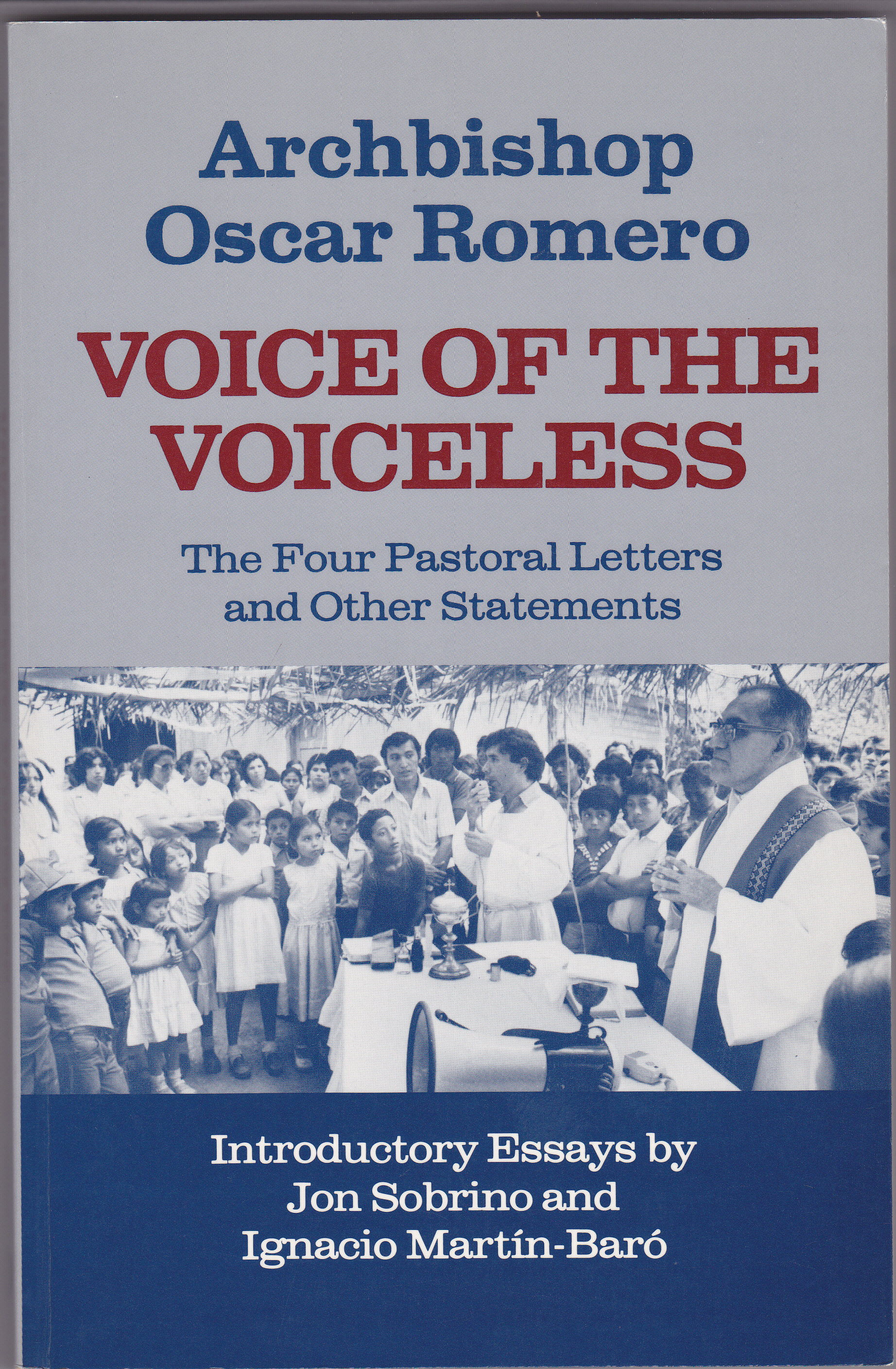
Three books contain extracts from Romero’s homilies, pastoral letters, interviews, statements and articles. They are essential in obtaining clear insight into his Christian and theological beliefs and his statements on human rights. (Oscar Romero, The Church Is All of You: Thoughts of Archbishop Oscar Romero (Winton Press; Minneapolis, MN 1984) (James R. Brockman, S.J., Translator & Compiler); Oscar Romero, The Violence of Love: The Pastoral Wisdom of Archbishop Oscar Romero(Harper & Row; San Francisco, CA 1988) (James R. Brockman, S.J., Translator & Compiler); Oscar Romero, Voice of the Voiceless: The Four Pastoral Letters and Other Statements (Orbis; Maryknoll, NY 1985) (Michael J. Walsh, Translator).)

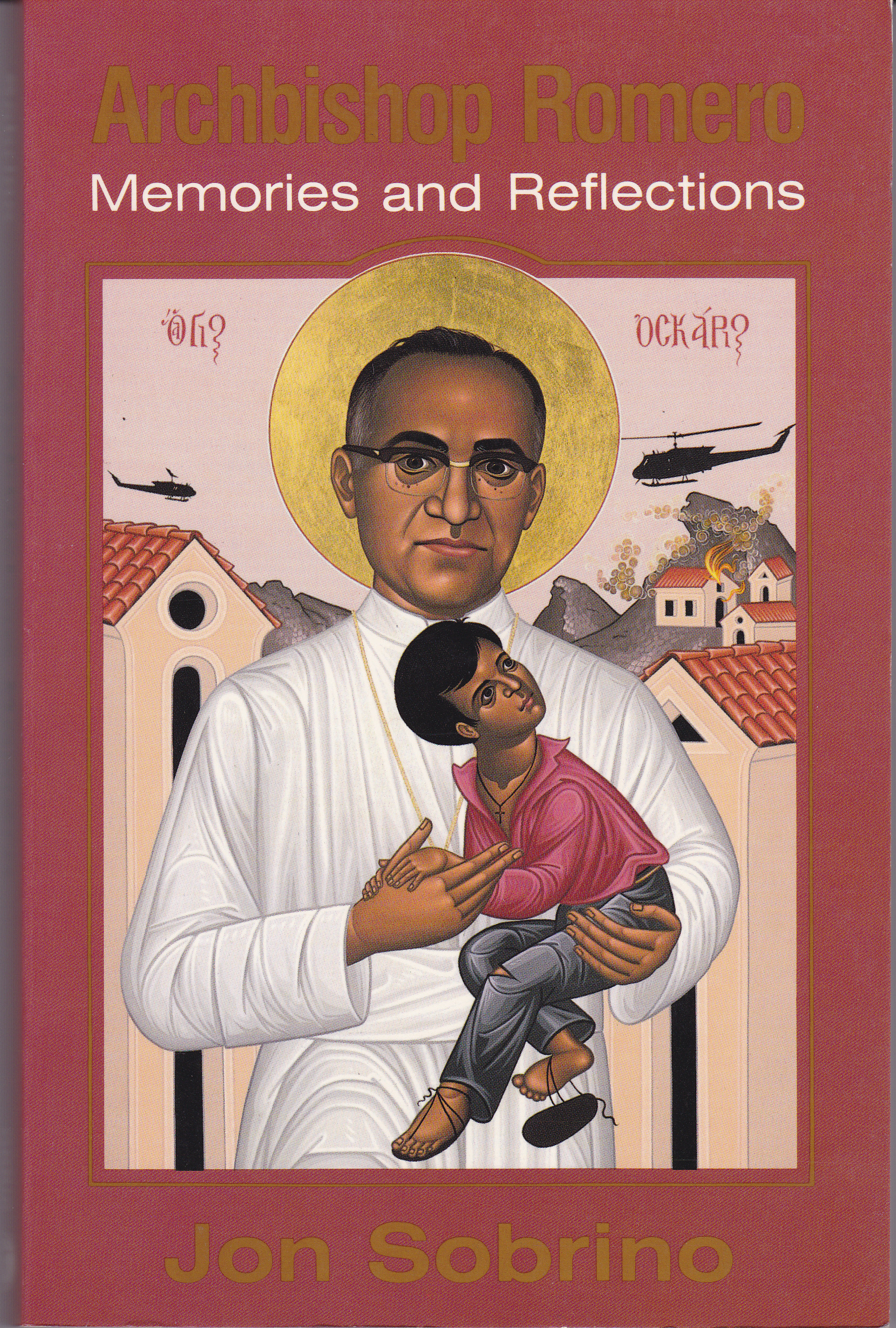
Three other books offer others’ memories and reflections on Romero. (Jon Sobrino, Archbishop Romero: Memories and Reflections (Orbis; Maryknoll, NY 1990)(Robert R. Barr, Translator); Marie Dennis, Renny Golden & Scott Wright, Oscar Romero: Reflections on His Life and Writings (Orbis; Maryknoll, NY 2000); Maria Lopez Vigil, Oscar Romero: Memories in Mosaic (EPICA; Washington, D.C. 2000)(Kathy Ogle, Translator)(fascinating collection of memories of Romero from hundreds of Salvadorans chronologically organized as multiple images of the Archbishop).)

Romero’s inclusion in Westminster Abbey’s gallery of Christian martyrs of the 20th century is set forth in Andrew Chandler, Christian       Martyrs of the Twentieth Century(Westminster Abbey; London 1999); Andrew Chandler (ed.), The Terrible Alternative–Christian Martyrdom in the Twentieth Century (Cassell; London 1998).

Wonderful photographs of Romero as a young boy, seminarian, priest and Archbishop along with the shocking ones of him just after he had been killed and of his funeral are found in Romero (Equipo Maiz, El Salvador 2000).

Music about Romero appears on two CD-ROMs: Romero (Equipo Maiz 2000); Homenaje a Monsenor Romero–30 Aniversario– Marzo 1980-2010 (El Salvador Government 2010).

——————————————————————

[i] Post: Remembering Oscar Romero in Music (Oct.14, 2011); Post: Remembering Oscar Romero in Film (Oct. 15, 2011); Post: Remembering Oscar Romero in Art (Oct. 16, 2001).

Remembering Oscar Romero in Art

 Oscar Romero is remembered in music and film.[1] We also have seen some of the art about Romero.[2] Now let us look at some of the other art.

Romero mural on country church

There are murals of Romero on the exteriors of churches throughout the country. Many of them are painted by artists employed by a Salvadoran NGO, Equipo Maiz, one of whose missions is to keep Romero’s memory alive. In 2000 I observed one such mural being painted on a country church.

Romero posters @ Equipo Maiz

Equipo Maiz also produces posters and t-shirts with Romero’s image for the celebrations of his life on the anniversaries of his assassination.

Romero bust @ Universidad de Centro America
Romero Chapel, Universidad de Centro America

One also sees busts of Romero at churches. One is outside the entrance to the Romero Chapel at the Universidad de Centro America, not too far from where his friends, the six Jesuit priests, were murdered in 1989.

Romero painting, March 2000

For the 20th anniversary celebrations in 2000 there was a special art exhibit in the capitol city of paintings about Romero. Here is one of the paintings in that exhibit.

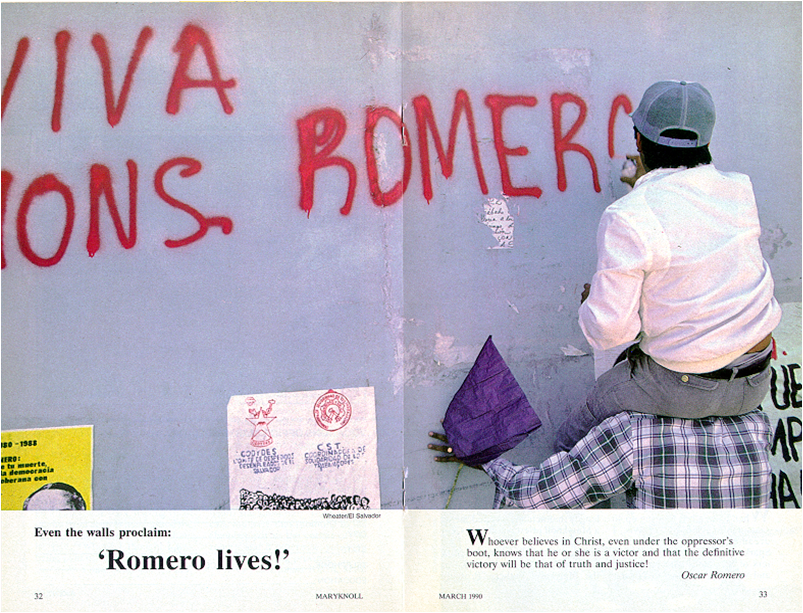
Graffiti also needs to be included in the art about Romero. Indeed, it is art of the people. I vividly recall riding in a van in 1989 on the way for my very first visit to the chapel where Romero was assassinated. Graffiti on the white walls sheltering the nearby homes proclaimed, “Romero vive!” (Romero lives!)[3]


[1] Post: Remembering Oscar Romero in Music (Oct. __, 2011); Post: Remembering Oscar Romero in Film (Oct. __, 2011).

[2] Post: Oscar Romero’s Last Homily (Oct. 7, 2011)(Romero mural near his apartment); Post: Oscar Romero’s Tomb (Oct. 10, 2011)(Romero’s tombs); Post: Oscar Romero’s Assassination Case in the Inter-American Commission on Human Rights (Oct. __, 2011)(Romero mural at San Salvador airport; 2010 Romero poster); Post: Remembering Oscar Romero in Music (Oct. __, 2011)(Romero assassination painting in church in Ciudad Barrios).

[3] Post: My Pilgrimage to El Salvador, April 1989 (May 25, 2011).

Remembering Oscar Romero in Film

 Oscar Romero is remembered in music.[1] So too is he remembered in three films.

Oliver Stone in his 1986 film Salvador stars actor James Wood as U.S. journalist Richard Boyle who goes to El Salvador to report on the violence of the early years of its civil war. It includes the famous portion of Oscar Romero’s homily of March 23, 1980. Woods was nominated for an Oscar for his role as were Stone and Boyle for their screenplay.[2]

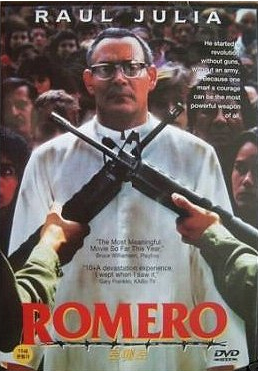
The biographical film Romero from 1989 was produced by the Paulist Fathers, and in one sense it is a Christian evangelical film designed to convert people to Christianity as lived by Romero.

Staring Raul Julia as Romero, the film accurately shows the new Archbishop in 1977 as a man singularly unsuited for high office, particularly in such a time of crisis. By nature timid, bookish, and retiring, he had no presence, no political instincts, no sense of moral authority. Romero, however, had one important “virtue” at the start of his service as Archbishop–in the eyes of El Salvador’s wealthy oligarchy, military officials and other Salvadoran bishops: he was noncontroversial.[3]

What no one anticipated — including Romero himself — was how he would respond when horrible things happened. Less than a month into his office, demonstrators in the main plaza of San Salvador were surrounded by police forces, and some were killed. Days later, Romero was stunned when his friend, Father Rutilio Grande, who was known for his advocacy of reform and social justice, was assassinated, along with an old man and a young boy accompanying him to Mass. The film shows Romero’s increasing courage in denouncing the human rights violations in his country and includes his homily asking President Jimmy Carter to stop military aid and the most famous homily in which he says to men in the military, “I beg you, I implore you. I order you in the name of God: Stop the repression!”[4]

"Romero" film in Plaza Libertad, March 2000

When I was in El Salvador for the 20th anniversary of Romero’s assassination in March 2000, the Romero film was being shown for the first time in the country. In Plaza Libertad in front of the Cathedral the film was playing in continuous loop on television monitors. Many people were watching the film as I walked through the plaza.

Rutilio Grande Memorial
Misa para Rutilio Grande, March 2003

The mention of Father Grande reminds me that in March 2003 I attended his 25th memorial mass in the village of El Paisnal, where he served near the town of Aguilares. On the road to the village we stopped to pay our respects at the memorial where he was assassinated. Interestingly the priest at the church in 2003, Father Orlando, was a former banker and a relative of Grande’s.

A third film, a documentary, about Romero entitled “Romero by Romero” was premiered in San Salvador in March 2010 as part of the Romero anniversary celebration. I was especially touched to see scenes of Romero walking around a poor neighborhood and warmly greeting and touching the people he met without a lot of ceremony. This was the film promised by the Funes Administration at the November 2009 hearing at the Inter-American Commission on Human Rights. (Post: Oscar Romero’s Assassination Case in the Inter-American Commission on Human Rights (Oct. 13, 2011); Tim’s El Salvador Blog, Romero’s life documented in film and video, http://luterano.blogspot.com (Mar. 17, 2010) (includes YouTube trailer for the film).)


[1] Post: Remembering Oscar Romero in Music (Oct. 14, 2011).

[2] Wikipedia, Salvador (Film), http://en.wikipedia.org/wiki/Salvador_(film); Post: Oscar Romero, A Saint for All People and All Time (Oct. 5, 2011).

[3] Decent Films Guide, Romero (1989), http://www.decentfilms.com/reviews/romero.html; Wikipedia, Paulist Fathers, http://en.wikipedia.org/wiki/Paulist_Fathers.

[4]  Decent Films Guide, Romero, supra; Post: Oscar Romero, A Saint for All People and All Time (Oct. 5, 2011).

Remembering Oscar Romero in Music

In April 1989 I attended a service of solidarity in San Salvador for a Catholic priest who that week had received death threats. The service was in a screened recreational building next to a very dusty soccer field. As we entered, we were handed mimeographed sheets with words for hymns of the people about Archbishop Oscar Romero, who had been murdered nine years earlier. Thus began my learning about Romero.[1]

I returned to El Salvador for the 20th anniversary of Romero’s assassination in March 2000. One of the special events was a concert at the National University in the capitol to celebrate the release of a CD of music about Romero. Rock, pop and traditional styles of music were featured, and everyone enjoyed the music. The CD also contained an audio recorded extract from Romero’s famous homily of March 23, 1980. (See Post: Oscar Romero, A Saint for All People and All Time (Oct. 5, 2011).)

Romero CD, 2000
Romero concert, 2000

On this trip we visited Romero’s home town of Ciudad Barrios where we saw a dramatic painting of his assassination. We also spent time at the station of Radio Romero, which despite death threats broadcasts his words and music about him by a local group.

Romero painting, Ciudad Barrios
Radio Romero, Ciudad Barrios
Romero CD, 2010

For the 30th anniversary of Romero’s assassination in March 2010 I again was in El Salvador. A new CD of music about Romero was released similar to the earlier one.


[1] See Post: My Pilgrimage to El Salvador, April 1989 (May 25, 2011).

Oscar Romero’s Assassination Case in the Inter-American Commission on Human Rights


Oscar Romero

In late 1993, a complaint regarding the Romero case was filed with the Inter-American Commission on Human Rights (IACHR) by the Director of Oficina de Tutela Legal of the Archdiocese of San Salvador and by Romero’s brother. The petition alleged that the State of El Salvador had violated Romero’s right to life, to a fair trial and to judicial protection as well as the state’s obligation to respect and guarantee the rights set forth in the American Convention on Human Rights.[1]

The Salvadoran government did not question the admissibility of the petition and did not controvert or challenge its factual assertions. Instead, it asserted that the release of the persons implicated in the crime was in accordance with, and required by, the General Amnesty Law.[2]

Nearly seven years later, on April 13, 2000 (just after the 20th anniversary of Romero’s assassination), the IACHR issued its report making detailed factual findings.[3] In relying extensively on the Truth Commission Report, the IACHR stated that the Truth Commission had a “seriousness of methodology” and a “guarantee of impartiality and good faith derived from its composition,” that had been agreed to by the State. Therefore, the IACHR concluded “the results of [the Truth Commission] investigations into this case merit faith” and will be considered.[4] This is an example of what I have called the interactive global struggle against impunity.

The IACHR concluded that El Salvador had violated various provisions of the American Convention on Human Rights as alleged by the petitioners.[5] The Commission then recommended that the government (a) undertake “expeditiously a complete, impartial, and effective judicial investigation to identify, try and punish all the direct perpetrators and planners of the violations . . . notwithstanding the amnesty” law; (b) make reparations for the violations; and (c) “adapt its national legislation to the American Convention with a view to nullifying the General Amnesty Law.” [6]

The last recommendation regarding the General Amnesty Law followed the Commission’s lengthy analysis of the legality of that law under international law. The Commission noted that it had held similar laws in other countries to violate a state’s obligations under the American Convention [7] and that it previously had advised the Salvadoran government that its General Amnesty Law was also invalid.[8]

Although El Salvador as a member of the Organization of American States (OAS) has an obligation to comply with the Commission’s recommendations, it had not done so as of July 2007. This failure was the subject of a hearing before the Commission in October 2007, when it was revealed that the government and the San Salvador Archbishop’s office had been engaged in a dialogue about the Romero case and other issues. What, if anything, was accomplished in this dialogue is still unclear.[9]

In any event, El Salvador did not adopt any of these recommendations during the administrations of President Flores and Saca from the ARENA Party from 2000 through June 2009.

Since taking office in June 2009, however, President Funes from the FMLN Party has taken steps to adopt at least some of the IACHR recommendations in this case.

In November 2009 at an IACHR hearing on the status of the Romero case, the Funes government advised the Commission that El Salvador accepted responsibility in the case for the State’s violation of the right to life and to justice. It also announced that the State would produce an official video about Romero’s life and legacy and would make a public confession of the State’s responsibility. In addition, the Funes administration formally advised the IACHR that the Salvadoran state accepted the binding nature of the Commission’s past decisions involving the country and the state’s responsibility to implement its recommendations. The Funes government, however, told the IACHR that it could only request the prosecutor to reopen the Romero case and that repeal of the Amnesty Law was up to the Salvadoran legislature. [10]

In January 2010, at a ceremony to mark the 18th anniversary of the signing of the Peace Accords, President Funes on behalf of the Salvadoran state admitted that during the civil war state security forces “committed serious human rights violations and abuses of power, made an illegitimate use of violence, broke the constitutional order and violated basic norms of peaceful coexistence.” These crimes included “massacres, arbitrary executions, forced disappearances, torture, sexual abuse, arbitrary deprivation of freedom” and other acts of repression. Funes on behalf of the state then said “I apologize to children, youth, women and men, elders, religious, peasants, workers, students, intellectuals, political opponents and human rights activists.” Funes also announced the creation of a commission to offer redress to the victims.[11]

Romero Mural at San Salvador Airport, March 2010
Romero Poster, March 2010

In March 2010, on the 30th anniversary of Romero’s assassination, Funes dedicated a mural about Romero in the departure lounge between all the souvenir shops and restaurants at the country’s international airport. There in his capacity as President, Funes said, “I apologize on behalf of the Salvadoran State for this assassination.” He also apologized to Romero’s family and extended his condolences. Later to journalists Funes said he apologized because the state failed to investigate and that any new investigation was a decision for the courts, not the President.[12]

At the same time, March of 2010, the President made positive remarks about Romero at one of the public rallies commemorating Romero’s life.  In addition, at a concert in honor of Romero at that time, Funes said that Romero was the spiritual guide for El Salvador and for his government and that Romero would not want more hate, more confrontations or more violence; instead Romero believed in a civilization of love which is justice and truth.[13]


[1] I-A Comm’n on Hum. Rts., Monsignor Romero v. El Salvador, ¶¶ 1-2 (Case No. 11.481; Rep. No. 37/00 April 13, 2000).

[2]  Id. ¶ 3.  After the dismissal of the criminal charges against Saravia, he was a defendant in a civil case in a U.S. federal court about the Romero murder. See pp. 21-22 infra.

[3]   I-A Comm’n on Hum. Rts., Monsignor Romero v. El Salvador, ¶¶  30-55.

[4]  Id. ¶ 30-54, 88, 120.

[5]  Id. ¶¶ 4, 87-122, 157.

[6]  Id. ¶¶ 4, 159.

[7]  Id. ¶¶ 123-51.

[8]  Id. ¶¶ 131-32; I-A Comm’n on Hum. Rts., Report on the Situation of Human Rights in El Salvador § II (4) (Feb. 11, 1994); I-A Comm’n on Hum. Rts., Annual Report 1994, ch. IV (Feb. 17, 1995); Massacre Las Hojas v. El Salvador, Rep. No. 26/92 ¶¶ 11-13 & Conclusions ¶¶ 3, 4, 5(a), 5( c) (Case No, 10.287 Sept. 24, 1992)(1987 amnesty law).

[9]  El Salvador: Who’s Defending Monsignor Romero, Revista Envio Jan. 2008.

[10] Inter-Am Comm’n on Human Rights, Press Release No. 78/09: IACHR Concludes Its 137th Period of Sessions (Nov. 13, 2009); Assassination of Archbishop Romero: 30 Years of Impunity, Revista envoi (April 2010).

[11] Caravantes, Funes pide perdon por abusos durante la Guerra, http://www.elfaro.net (Jan. 16, 2010); El Salvador President Apologizes to Civil War Victims, Latin American Herald Tribune (Jan. 22, 2010). Earlier that same day the country’s Vice President, Salvador Sanchez Ceren, apologized for the actions of the FMLN guerrillas during the war. Immediately after President Funes’ apology, two former presidents from the ARENA political party (Calderon Sol and Alfredo Cristiani) and three other officials form their administrations criticized the speech and said it was “revenge without equanimity.” (Caravantes, supra.) The IACHR, however, announced its satisfaction over Funes’ recognition of state responsibility, apology and creation of a reparations commission. (IACHR, Press Release No. 4/10: IACHR Welcomes El Salvador’s Recognition of Responsibility and Apology for Grave Human Rights Violations During the Armed Conflict (Jan 21, 2010).

[12] Assassination of Archbishop Romero: 30 Years of Impunity, Revista envio (April 2010).

[13] Email, Ann Butwell (Center for Global Education) to the author (Mar. 15, 2010).

Litigation Against Conspirators in the Assassination of Oscar Romero


Alvaro Saravia

As previously mentioned, the Truth Commission for El Salvador named Alvaro Saravia, an aide to Roberto d’Aubuisson, as one of the participants in the plot to assassinate Archbishop Oscar Romero.[1]

When the Truth Commission report was released in March 1993, criminal charges against Saravia were being considered by the Salvadoran courts. Soon thereafter, however, those criminal charges were dismissed pursuant to the country’s hastily enacted General Amnesty Law.[2]

In September 2003, a U.S. human rights organization, the Center for Justice and Accountability, filed a civil lawsuit by a relative of Oscar Romero alleging that Saravia, then a California resident, as an aide to Roberto d’Aubuisson played a key role in organizing this assassination. The case sought money damages under two U.S. statutes, the Alien Tort Statute (ATS) and the Torture Victims Protection Act (TVPA).[3]

A year later, the court held that it had personal jurisdiction over Saravia as he was a resident of the California district and legally had been served with process to commence the case. The court also held that the case (initiated 13 years after the murder) was not barred by the U.S. 10-year statute of limitations under the U.S. equitable tolling doctrine because the plaintiff could not have obtained justice in Salvadoran or U.S. courts due to his legitimate fear of being killing for making such a claim and the Salvadoran government’s erection of roadblocks to Salvadoran judicial remedies. Similarly the lack of any effective Salvadoran judicial remedy meant that the plaintiff did not have to satisfy the TVPA requirement to have exhausted remedies in the foreign country.[4]

In this context, the U.S. court discussed the March 1993 El Salvador amnesty law and the invocation of that law to end the Salvadoran criminal case against Saravia. These actions were seen by the U.S. court as evidence of the plaintiff’s inability to obtain any judicial relief in that country, thereby eliminating any requirement for the plaintiff to have exhausted his Salvadoran remedies. The U.S. court apparently assumed that the Salvadoran amnesty law had no application to the U.S. case as that issue was not discussed.[5] However, the court did receive testimony that the Law was “directed to what the Salvadoran courts should do. It tells the Salvadoran courts how to deal with these cases” and that courts in other countries need not, and should not, take that Law into account.[6]

Saravia never responded to the civil complaint and did not participate in any way in this lawsuit. Even though this default constituted, by operation of law, an admission of all the well-pleaded allegations of the complaint and a conclusive establishment of his liability, the court conducted a five-day default hearing, and the plaintiff provided independent evidence in support of the claims, including the live testimony of the driver of the assassin’s car.[7]

The court then entered extensive findings of fact and conclusions of law holding Saravia liable and ordering him to pay $10 million of compensatory and punitive damages to the plaintiff. The court determined that the murder constituted a crime against humanity, because it was part of a widespread and systematic attack intended to terrorize a civilian population. As the court stated, “Here the evidence shows that there was a consistent and unabating regime that was in control of El Salvador, and that this regime essentially functioned as a militarily-controlled government.” The government perpetrated “systematic violations of human rights for the purpose of perpetuating the oligarchy and the military government.” The court also concluded that what happened in El Salvador was the “antithesis of due process” and that there could not be a better example of extrajudicial killing than the killing of Archbishop Romero.[8]

The court received into evidence the Truth Commission Report and relied extensively on it in reaching its findings.[9]

Because Saravia had not participated in this case in any way, there was no appeal, and the district court’s decision became the final judgment. Now Saravia is one of the “most wanted fugitives” for “human rights violations” by the U.S. Immigration and Customs Enforcement agency.[10]

In 2006 and again in 2010, Saravia was reported to be in an unidentified Latin American country for his personal security when he was interviewed by Salvadoran journalists and admitted to his involvement in the assassination plot. He appeared to be a tormented person barely getting by.[11] He has not paid any part of the $10 million judgment and undoubtedly never will.

Roberto d’Aubuisson, who was named as the “intellectual author” of the assassination by the Truth Commission, died of cancer in February 1992, just after the signing of the Peace Accords that created the Truth Commission.[12]  He never was subjected to any criminal or civil charges for this horrific crime. Nor was anyone else other than Saravia.


[1] See Post: Oscar Romero’s Assassination (Oct. 8, 2011). Information about the Truth Commission’s creation and operations has been provided. (See Post: International Criminal Justice: The Jesuits Case in the Truth Commission for El Salvador (June 9, 2011).)

[2]  See Post: International Criminal Justice: El Salvador’s General Amnesty Law and Its Impact on the Jesuits Case (June 11, 2011).

[3] CJA, Key Conspirator in Assassination of Salvadoran Archbishop Romero Faces Lawsuit in U.S. Court, Sept. 16, 2003, http://www.cja.org/cases/romero.shtmo; Chang, Modesto man accused in ’80 slaying of bishop, San. Fran. Chronicle, Sept. 17, 2003; Branigan, Suit Filed in ’80 Death of Salvadoran Bishop, Washington Post, Sept. 17, 2003.

[4]  Doe v. Saravia, 348 F. Supp.2d 1112, 1118-19, 1142-43, 1147-48 (E.D. Cal. 2004). The roadblocks included the Salvadoran government’s thwarting Saravia’s extradition from the U.S. to El Salvador and the adoption and application of the amnesty law to the Salvadoran criminal case against Saravia. (Id. at 1148.)

[5]  Id. at 1133-34, 1151-53.

[6]  Trial Transcript at 772-73, Doe v. Saravia (E.D. Cal. Sept. 3, 2004), http://www.cja.org/cases/RomeroTranscripts/9-3-04%20Trial%20Transcript.txt. See also Post: El Salvador’s General Amnesty Law in U.S. Federal Court Cases (June 14, 2011).

[7]  348 F. Supp.2d at 1143-44.

[8]  Doe v. Saravia, supra; CJA, El Salvador: Alvaro Rafael Savaria, http://www.cja.org/cases/romero.shtml; Rigoberta Menchu Tum, Justice Comes to the Archbishop, http://www.nytimes.com/2004/08/31/opinion/31menchu.html.

[9]  Doe v. Saravia, 348 F. Supp. 2d at 1131-32.

[10] U.S. I.C.E., News: ICE Most Wanted Fugitive, http://www.icc.gov/pi/investigations/wanted/Rafael_saravia.htm.

[11] Reyesei, Conspirator in Romero assassination speaks out, Nuevo Herald  (Mar. 24, 2006); Tim’s El Salvador Blog, Conspirator in Romero assassination speaks out (Mar. 24, 2006),http://luterano.blogspot.com; Dada, How we killed Archbishop Romero, (Mar. 25, 2010), http://www.elfaro.net.

[12] Severo, Roberto d’Aubuisson, 48, Far-Rightist in Salvador, N.Y. Times (Feb. 21, 1992).

Oscar Romero’s Tomb

San Salvador Cathedral, 1989


My first visit to Oscar Romero’s tomb in the Cathedral of San Salvador was in April 1989. The Cathedral is in el centro with all the noise and hurly-burly of buses and other traffic. The building was not finished. Steel rods protruded from the rough concrete shell of the building waiting for other parts of the structure. (Romero had halted all construction because he did not think it was right for the church to be spending money on its building when the people were suffering from poverty and human rights abuses.) On the steps were women from COMADRES with their bullhorns protesting against the latest wave of repression. Inside, scraps of linoleum were on the floor along with scattered plain wooden benches. In the right transept was Romero’s tomb–plain concrete covered with flowers and prayers of the people. As I stood there, the words “My body broken for you” from the Christian sacrament of communion echoed in my mind. Tears still come when I remember being in that place at that time. (See Post: My Pilgrimage to El Salvador, April 1989 (May 25, 2011).)


San Salvador Cathedral, 2000
Oscar Romero Tomb, 2000


In March 2000 on the 20th anniversary of Romero’s assassination I visited the Cathedral again. The construction of the building had been completed. In a formal sense, the exterior was beautiful with ceramic tiles by the country’s great artist, Fernando Llort, surrounding the main entrance. The tomb had been moved to the crypt and was more formal and elegant. But it had lost its spiritual power for me.


March 2010 marked the 30th anniversary of the assassination when I returned to the Cathedral. The tomb had been moved again, now to a more central and prominent part of the crypt. It was totally covered with flowers, pictures and other things so that it was impossible to tell what the tomb itself looked like. Only when I found photographs on the Internet could I see the tomb itself. At the four corners of the bronze tomb, sculptured figures of Salvadorans are rising from the horizontal image of the dead Romero with his Archbishop’s Mitre. The artist apparently was inspired by Romero’s statement shortly before he was assassinated, “If they kill me, I will rise again in the Salvadoran people.”  The separate elements of this tomb are beautifully executed, but as a whole it is depressing. All I could think, what an ugly brass four-poster bed. I extend my apologies to Romero and the artist.


Oscar Romero Tomb, 2010
President Obama @ Oscar Romero Tomb, 2011