Cuban President Raul Castro’s Major Speech at the Summit of the Americas

On April 10 and 11, Cuba for the first time was welcomed to the Summit of the Americas. Presidents Raul Castro and Barack Obama exchanged handshakes and friendly greetings, and their speeches promised commitment to the process of reconciliation. Other leaders of the Americas celebrated this demonstration of reconciliation.

On April 11th after President Obama’s speech that was discussed in a prior post, President Castro delivered his major Summit speech, most of which was a critical review of the history of U.S. relations with Cuba and other Latin American countries.

This post contains substantial extracts from Castro’s speech. Other posts will examine the two presidents’ subsequent private meeting at the Summit plus Obama’s comments on other subjects and the reactions from other leaders.
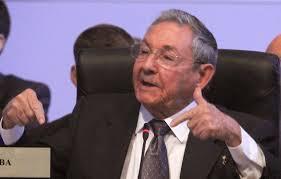
 President Castro’s Speech

President RAul castro
President Raul Castro

“In 1800, there was the idea of adding Cuba to the [U.S.] to mark the southern boundary of the extensive empire. The 19th century witnessed the emergence of such [U.S.] doctrines as the Manifest Destiny, with the purpose of dominating the Americas and the world, and the notion of the ‘ripe fruit’, meaning Cuba’s inevitable gravitation to the [U.S.], which looked down on the rise and evolution of a genuine rationale conducive to emancipation.”

“Later on, through wars, conquests and interventions that expansionist and dominating force stripped Our America of part of its territory and expanded as far as the Rio Grande.”

“After long and failing struggles, José Martí organized the ‘necessary war’ [for independence against Spain], and created the Cuban Revolutionary Party to lead that war and to eventually found a Republic ‘with all and for the good of all’ with the purpose of achieving ‘the full dignity of man’. . . . Martí committed to the duty ‘of timely preventing the [U.S.] from spreading through the Antilles as Cuba gains its independence, and from overpowering with that additional strength our lands of America.’”

On “April 11, 1898, the President of the [U.S.] requested Congressional consent for military intervention in the [Cuban] independence war already won with rivers of Cuban blood, and that legislative body issued a deceitful Joint Resolution recognizing the independence of the Island ‘de facto and de jure.’ Thus, [the U.S.] entered [this war] as [Cuba’s supposed] ally and seized the country as an occupying force.”

“Subsequently, an appendix was forcibly added to Cuba’s Constitution, the Platt Amendment, that deprived it of sovereignty, authorized the powerful neighbor to interfere in [Cuba’s] internal affairs, and gave rise to Guantánamo Naval Base, which still holds part of our territory without legal right. It was in that period that the [U.S.] invaded the country, and there were two military interventions and support for cruel dictatorships.”

At the time, the prevailing [U.S.] approach to Latin America was the ‘gunboat policy’ followed by the ‘Good Neighbor’ policy. Successive interventions ousted democratic governments and in twenty countries installed terrible dictatorships, twelve of these simultaneously and mostly in South America, where hundreds of thousands were killed. President Salvador Allende [of Peru] left us the legacy of his undying example.”

“It was precisely 13 years ago that a [U.S.] coup d’état staged against beloved [Venezuelan] President Hugo Chavez Frías was defeated by his people. Later on, an oil coup would follow.”

“On January 1st, 1959, sixty years after the U.S. troops entered Havana, the Cuban Revolution triumphed and the Rebel Army commanded by Fidel Castro Ruz arrived in the capital.”

“On April 6, 1960, barely one year after victory, [U.S.] Assistant Secretary of State Lester Mallory drafted a wicked memorandum, declassified tens of years later, indicating that ‘The majority of Cubans support Castro […] An effective political opposition does not exist […]; the only foreseeable means of alienating internal support [to the government] is through disenchantment and disaffection based on economic dissatisfaction and hardship […] to weaken the economic life of Cuba […] denying it money and supplies to decrease monetary and real wages, to bring about hunger, desperation and overthrow of government.’”

“We have endured severe hardships. Actually, 77% of the Cuban people were born under the harshness of the blockade, but our patriotic convictions prevailed. Aggression increased resistance and accelerated the revolutionary process. Now, here we are with our heads up high and our dignity unblemished.”

“When we had already proclaimed socialism and the people had fought in the Bay of Pigs to defend it, President Kennedy was murdered, at the exact time when Fidel Castro, leader of the Cuban Revolution, was receiving [Kennedy’s] message seeking to engage Cuba in a dialogue.”

“After the [U.S.] Alliance for Progress, and [after] having paid our external debt several times over while unable to prevent its constant growth, our countries were subjected to a wild and globalizing neoliberalism, an expression of imperialism at the time that left the region dealing with a lost decade.”

“Then, the [U.S.] proposal of a ‘mature hemispheric partnership’ resulted in the imposition of the Free Trade Association of the Americas (FTAA), –linked to the emergence of these Summits– that would have brought about the destruction of the economy, sovereignty and common destiny of our nations, if it had not been derailed at [the Fourth Summit of the Americas at] Mar del Plata [Argentina] in 2005 under the leadership of Presidents Kirchner, Chavez and Lula. The previous year, Chavez and Fidel had brought to life the Bolivarian Alternative known today as the Bolivarian Alliance for the Peoples of Our America.”

“We have expressed to President Barack Obama our disposition to engage in a respectful dialogue and work for a civilized coexistence between our states while respecting our profound differences. I welcome as a positive step his recent announcement that he will soon decide on Cuba’s designation in a list of countries sponsor of terrorism, a list in which it should have never been included.”

“Up to this day, the [U.S.] economic, commercial and financial blockade is implemented against the island with full intensity causing damages and scarcities that affect our people and becoming the main obstacle to the development of our economy. The fact is that it stands in violation of International Law, and its extraterritorial scope disrupts the interests of every State.”

“We have publicly expressed to President Obama, who was also born under the blockade policy and inherited it from 10 former Presidents when he took office, our appreciation for his brave decision to engage the U.S. Congress in a debate to put an end to such policy.” In an apparent extemporaneous addition, Castro said, “I apologize to Obama for expressing myself so emotionally. President Obama has no responsibility for this. There were 10 presidents before him; all have a debt to us, but not President Obama. . . . I have read his books — parts of them — and I admire his life.”

“This and other issues should be resolved in the process toward the future normalization of bilateral relations.”

“As to us, we shall continue working to update the Cuban economic model with the purpose of improving our socialism and moving ahead toward development and the consolidation of the achievements of a Revolution that has set to itself the goal of ‘conquering all justice.’”

“Venezuela is not, and it cannot be, a threat to the national security of a superpower like the United States. We consider it a positive development that the U.S. President has admitted it.”

A major section of the Castro speech covered Cuba’s continued advocacy for the ideals of the Revolution, for true international governance of the Internet, for changes in hemispheric relations and cooperation against cyber warfare, climate change, terrorism, drug-trafficking organized crime and inequality and for eradication of poverty, illiteracy and hunger. He also commended the efforts in these areas of CELAC [Community of Latin American and Caribbean States], UNASUR [Union of South American Nations], CARICOM [Caribbean Community], MERCOSUR [Southern Common Market], ALBA-TCP [Bolivarian Alliance of the Peoples of Our America—Peoples’ Trade Treaty], SICA [System for Integration of Central America] and ACS [Association of Caribbean States].

Castro concluded with these words: “Cuba, a small country deprived of natural resources, that has performed in an extremely hostile atmosphere, has managed to attain the full participation of its citizens in the nation’s political and social life; with universal and free healthcare and education services; a social security system ensuring that no one is left helpless; significant progress in the creation of equal opportunities and in the struggle against all sorts of discrimination; the full exercise of the rights of children and women; access to sports and culture; and, the right to life and to public safety.”

“Thanks to Fidel and the heroic Cuban people, we have come to this Summit to honor Martí’s commitment, after conquering freedom with our own hands ‘proud of Our America, to serve it and to honor it […] with the determination and the capacity to contribute to see it loved for its merits and respected for its sacrifices.’”

Conclusion.

It would be easy to criticize this speech as an unnecessary historical review going back to the late 19th century and as an unproductive way to advance the cause of Cuba-U.S. reconciliation in 2015.

On the other hand, I see the speech as a necessary recital to the U.S., other countries in the hemisphere and the world of the reasons for Cuba’s historical and current suspicions of U.S. motives and actions and for Cuba’s wariness in engaging in the current negotiations for restoration of normal relations with the U.S. Nevertheless, this history is not preventing Cuba ifrom engaging in those negotiations, and by its actions Cuba is demonstrating that such reconciliation is in Cuba’s national interest.


Issues of Cuban Human Rights To Be Discussed by Cuba and United States (Part III)    

On March 26 Cuba announced that the U.S. and Cuba will commence negotiations regarding human rights on March 31 in Washington, D.C.; this was covered in a prior post.

Other earlier posts covered the recent speech on this subject by Cuban Foreign Minister Bruno Rodriguez Parrilla and the U.N. Human Rights Council’s most recent Universal Periodic Review (UPR) of Cuba. Now we look at the latest U.S. State Department report on Cuban human rights (the one issued in 2014 for 2013).

Preliminarily it must be noted that this U.S. report is rather stale and it is surprising that a similar report for 2014 has not yet been released. The report for 2013 was released on February 27, 2014, and the overall report was discussed in a March 4, 2014 post and its chapter on Cuba in another March 2014 post.

In addition, a post on March 10, 2014, reviewed the implications of that report for U.S. policy regarding Cuba. This blogger saw the report’s indicating Cuba’s glass of human rights was at least half full. Or as Rev. Raúl Suárez, a Baptist pastor and head of the Martin Luther King, Jr. Center in Havana, more eloquently put it in his February 2014 briefing for the U.S. Congress: “Cuba has many problems but Cuba isn’t hell . . . . We have many good things that have been achieved [but] . . . Cuba is not the Kingdom of God.” Suárez added, “God . . . wants us [Cubans and Americans] to live like brothers and sisters.” As a result, this blogger urged reconciliation of the two countries and mentioned many of the actions to that end that started on December 17, 2014.

In any event, here is another summary of the U.S. report on Cuba for 2013. It contains many criticisms of Cuban human rights, but it also has positive comments.

Negative comments.

“Cuba is an authoritarian state led by Raul Castro, who is president of the council of state and council of ministers, Communist Party (CP) first secretary, and commander in chief of security forces. The constitution recognizes the CP as the only legal party and “the superior leading force of society and of the state.” A CP candidacy commission preapproved all candidates for the February uncontested National Assembly elections, which were neither free nor fair. The national leadership that included members of the military maintained effective control over the security forces, which committed human rights abuses against civil rights activists and other citizens alike.”

“The principal human rights abuses were abridgement of the right of citizens to change the government and the use of government threats, extrajudicial physical violence, intimidation, mobs, harassment, and detentions to prevent free expression and peaceful assembly.”

“The following additional abuses continued: harsh prison conditions, arbitrary arrest, selective prosecution, and denial of fair trial. Authorities interfered with privacy, engaging in pervasive monitoring of private communications. The government did not respect freedom of speech and press, severely restricted internet access and maintained a monopoly on media outlets, circumscribed academic freedom, and maintained significant restrictions on the ability of religious groups to meet and worship. The government refused to recognize independent human rights groups or permit them to function legally. In addition, the government continued to prevent workers from forming independent unions and otherwise exercising their labor rights.”

“Most human rights abuses were official acts committed at the direction of the government. Impunity for the perpetrators remained widespread.”

“There were credible reports that members of the security forces intimidated and sometimes physically assaulted human rights and prodemocracy advocates, dissidents, and other detainees and prisoners both during detention and while imprisoned, and they did so with impunity. Some detainees and prisoners endured physical abuse, sometimes by other inmates with the acquiescence of guards, or long periods in isolation cells.”

“Arbitrary arrest and short-term detention continued to be a common method for the government to control independent public expression and political activity. Under the criminal procedure code, police have wide discretion to stop and question citizens, request their identification, and carry out arrests and searches. The law provides that police officials provide suspects with a signed ‘act of detention,’ noting the basis, date, and location of any detention in a police facility, and a registry of personal items seized during a police search. Police officials routinely conducted extrajudicial detentions, however, often accompanied by beatings. Arbitrary stops and searches were most common in urban areas and at government-controlled checkpoints located at the entrances to provinces and municipalities. Searches and seizures of property by police officials without providing any record or legal justification were also common practice.”

“Police and security officials continued to use short-term and sometimes violent detentions to prevent independent political activity or free assembly. Such detentions generally lasted from several hours to several days. An independent domestic monitoring group, the Cuban Commission on Human Rights and Reconciliation (CCDHRN), counted 4,540 short-term detentions through October, compared with 6,602 in 2012. Long-term imprisonment of peaceful opponents, while rare, did not cease entirely. During the year authorities charged, tried, and sentenced several members of the Santiago-based opposition group Union Patriotica de Cuba (UNPACU) to prison for months or years as punishment for their political activity.”

“In addition, the law allows up to a four-year detention of individuals before they commit an actual crime, with a subjective determination of ‘potential dangerousness,’ defined as the ‘special proclivity of a person to commit crimes, demonstrated by conduct in manifest contradiction of socialist norms.’ Mostly used as a tool to control “antisocial” behaviors such as substance abuse or prostitution, authorities also used it to silence peaceful political opponents. Authorities convicted Ivan Fernandez Depestre of dangerousness and sentenced him to three years’ imprisonment for participating in a peaceful public demonstration. While there was no definitive estimate of the number of persons serving sentences for ‘potential dangerousness,’ the CCDHRN estimated that more than 3,000 citizens were held on the charge.”

“The Ministry of Interior exercises control over police, internal security forces, and the prison system. The ministry’s National Revolutionary Police is the country’s primary law enforcement organization and was moderately effective in investigating common crimes. Specialized units of the ministry’s state security branch are responsible for monitoring, infiltrating, and suppressing independent political activity. The police support state security agents by carrying out house searches, arresting persons of interest to the ministry, and providing interrogation facilities.”

“Members of the security forces acted with impunity in committing numerous, serious civil rights and human rights abuses.”

“Many state-orchestrated ‘acts of repudiation’ directed against the domestic opposition group Damas de Blanco (‘Ladies in White‘) were organized to prevent them from meeting or marching peacefully. On July 14, state security agents and affiliated groups assaulted members of the group when they left a church in Matanzas after celebrating Catholic mass, fracturing the wrist of Sonia Alvarez Campillo and breaking the ribs of her husband, Felix Navarro Rodriguez.”

Positive Comments.

The U.S. conceded that the Cuban constitution “prohibits discrimination based on race, gender, disability or social status” and that Cuban law prohibits “ abusive treatment of detainees and prisoners,” “rape, including spousal rape” (and enforces that law); and “threats and violence, including those associated with domestic violence.” Cuban law, says the U.S., also “provides penalties for sexual harassment;” accords “men and women equal rights and responsibilities regarding marriage, divorce, raising children, maintaining the home and pursuing a career;” provides “equal pay for equal work;” grants “persons with disabilities the right to equal employment opportunities and equal pay for equal work;” and prohibits “unlawful imprisonment, coercion, and extortion” although it “does not appear explicitly to prohibit forced labor.”

The U.S. report further states in 2013 that the government had centers “providing family counseling service” and “treatment for child sexual abuse victims;” that the government “actively promoted racial integration and inclusiveness;” that the government or its agents had not committed any reported arbitrary or unlawful killings or politically motivated disappearances; that there were no reported anti-Semitic acts; that there was “no societal pattern of child abuse,” no known “patterns of abuse of [children with disabilities] in educational or mental health facilities” and no discrimination officially reported or permitted based on sexual orientation in employment, housing, statelessness, or access to education or health care.”

Conclusion

It is fair to conclude that many of what the U.S. saw as negative aspects of Cuban human rights in 2013 will be raised in its forthcoming talks on the subject with Cuba.

The U.S. should approach this subject with humility and remember the U.S. immense superiority in economies and military might and the long-standing U.S. actions of hostility towards Cuba, including the following:

  • the U.S. usurpation of Cuba’s war for independence from Spain in the late 19th Century (what we in the U.S. call the “Spanish-American War“);
  • the U.S.’ making Cuba a de facto protectorate in the early 20th Century;
  • the U.S. support for the invasion of Cuba’s Bay of Pigs in 1961;
  • the U.S. threats of military action against Cuba during the pressured Cuban missile crisis of 1962;
  • the CIA’s hatching several plots to assassinate Fidel Castro when he was Cuba’s President;
  • the U.S. conduct of an embargo of Cuba over the last 50-plus years;
  • the U.S. Government’s Commission on Assistance for a Free Cuba setting forth what amounted to a U.S. blueprint for taking over Cuba; and
  • the more recent U.S. Agency for International Development (USAID) covert or “discreet” programs to promote dissent, if not regime change, on the island.

This history and the vastly superior U.S. economic and military power provide Cuba with many legitimate reasons to be afraid of the U.S. It, therefore, is understandable why Cuba has harshly treated what we call “dissidents” and what Cuba fears are or could be supporters of a U.S. takeover. And we in the U.S. should know from our own history since 9/11 that societies and governments tend to clamp down on civil liberties when they fear outside interference or attacks.


ALBA Emergency Meeting’s Action Regarding President Obama’s Executive Order Imposing Sanctions on Seven Venezuelans

As discussed in a prior post, Venezuela has been organizing Latin American opposition to President Obama’s March 9th executive order imposing sanctions on seven Venezuelans. The latest venue for such opposition was the March 17th ALBA emergency meeting in Caracas, Venezuela.

This post will discuss that ALBA resolution and Cuban President Rául Castro’s passionate speech at the meeting against the U.S. and the executive order. We will conclude with some observations.

ALBA’s Resolution Regarding the U.S. Executive Order [1]

After speeches and discussion, ALBA adopted a resolution that:

  • Demanded “the U.S. government and its president, [to] repeal Executive Order adopted on March 9, 2015, against the Bolivarian Republic of Venezuela, which constitutes a threat to their sovereignty and interference in the internal affairs of this sister nation.”
  • Expressed “their strong support for the process of dialogue for the restoration of relations between Cuba and the [U.S.], urging President Obama to adopt with determination the measures within their executive powers to amend the implementation of the economic, commercial and financial [embargo or blockade], and to stop the illegal occupation of the territory occupied by the Guantanamo Naval Base.”
  • Urged “Panama, as host of the VII Summit of the Americas to ensure through a transparent process the widest, legitimate and representative participation in the Forum of Civil Society, popular movements and country NGOs that advocate for nuclear disarmament, environmentalists, against neoliberalism, the Occupy Wall Street and Occupy region, university and secondary students, farmers, unions, indigenous communities, organizations that oppose the contamination of shale, advocates for the rights of immigrants, denouncing torture, extrajudicial killings, police brutality, racist practices, claiming for women equal pay for equal work, which require compensation for damage to the transnational companies.”

President Rául Castro’s Speech [2]

President Rául Castro

“ALBA brings us together today to reaffirm our firmest support for the Bolivarian people and government in the face of the latest interventionist measures and threats from the U.S. government against Venezuela.” (In the photograph to the left Cuban Foreign Minister Bruno Rodriguez Parrilla is seated behind President Castro at the ALBA meeting.)

“The facts demonstrate that history cannot be ignored. The relations between the United States and Latin America and the Caribbean have been marked by the “Monroe Doctrine” and the objective of exercising domination and hegemony over our nations.”

“Simon Bolívar had anticipated that the [U.S.] ‘seems destined by Providence to plague America with misery in the name of Liberty,’ and [Jose] Martí fell in combat before concluding the letter in which he explained the “duty of preventing the [U.S.] from spreading throughout the Antilles as Cuba gains its independence, and from overpowering with that additional strength our lands of America.’”

“Later came the military interventions, the coup d’états, the maneuvers to overthrow nationalist or progressive governments, the backing of bloody military dictatorships, the undercover operations, the support for terrorism and subversion, as well as the appropriation and plundering of our resources to perpetuate dependence and underdevelopment.”

Cuba’s “triumphant audacity to carry out a socialist revolution just 90 miles from the [U.S.] has meant immense sacrifices, suffering, loss of life and material deprivation for the Cuban people, subject to . . . every kind of hostility, including the support and organization of armed bands in the mountains from . . . [late]1959, the Bay of Pigs Invasion in 1961 and the formalization of the blockade in 1962, all with the stated intention of defeating the Revolution and changing the political, economic and social order we freely chose and subsequently confirmed in a constitutional referendum.”

“The result has been a resounding failure [for the U.S.], the harming of our people and the complete isolation of the [U.S.] . . . , as recently recognized by President Barack Obama on announcing a new policy [on December 17, 2014] and resolving to open another chapter. However, his government spokespeople insist on clarifying that the objectives persist and only the methods change.”

“The triumph of the Bolivarian Revolution was an extraordinary milestone in the history of Venezuela and the whole region, which had begun to awaken from the long neoliberal slumber. An era of change commenced in the continent and other nations decided to embark on the path towards full independence and integration and again take up the flags of our national heroes.”

“ALBA, UNASUR [and] CELAC were created, which united, in their diversity, previous groupings and initiatives of genuine Latin Americanist and Caribbean calling, founded on principles of solidarity, cooperation, social justice and defense of sovereignty.”

“PetroCaribe was an extraordinary, generous and humanistic contribution of President Hugo Chávez Frías. Now [the U.S.] wants to destroy PetroCaribe, to threaten its member states, to submit them to the oil multinationals and separate them from Venezuela. They do not realize that our peoples have decided, irrevocably, to continue our unstoppable advance and fight for a multipolar and just world, where those who were historically excluded have a voice, hope and dignity.”

“U.S. imperialism has attempted, without success, practically all possible formulas to destabilize and subvert the Bolivarian Chavista revolution, to recover its control of the largest oil reserves on the planet, and to deliver a blow to the integrationist, emancipation process underway in Our America.”

“The arbitrary, aggressive, unjustified executive order issued by the [U.S.] President regarding the Bolivarian Republic of Venezuela’s government, describing it as a threat to its national security, shows that the [U.S.] is able to sacrifice the peace and the direction of hemispheric and regional relations, for reasons of domination and domestic politics.”

“The idea is untenable that a country like Venezuela — which has shown so much solidarity, never invaded or harmed any other, and contributes in a significant and altruistic manner to the energy security and economic stability of a considerable number of nations of the continent — could represent a threat to the security of the greatest super-power in history.”

“We support the honorable, valiant, constructive position taken by President Nicolás Maduro, who, despite the seriousness of this threat, has extended his hand to the [U.S.] President to initiate a dialogue based on international law and mutual respect, which could lead to the unconditional revocation of President Obama’s executive order and the normalization of relations. ALBA and CELAC should join in this proposal.”

“Today Venezuela is not alone, nor is our region the one it was 20 years ago. We will not tolerate the violation of sovereignty or allow peace in the region to be broken with impunity.”

“Threats to the peace and stability of Venezuela represent threats to regional stability and peace, as well.”

“The peace, which Venezuela today demands and which we all need, [is] a “peace with justice, with equality; the peace on our feet, not on our knees; peace with dignity and development,” as Maduro said. It is the peace to which we committed ourselves in the Proclamation of Latin America and the Caribbean as a Zone of Peace, adopted by the II CELAC Summit in Havana.”

Cuba’s “position under these circumstances remains unchanged. I reiterate the firm solidarity of the Cuban Revolution with the Bolivarian Revolution, with constitutional President Nicolás Maduro and with the civic-military union which he heads. I reiterate our absolute loyalty to the memory of Comandante Hugo Chávez Frías, the Cuban Revolution’s best friend.”

“We reaffirm once again, “The Cuban collaborators present in [our] sister country [Venezuela], will continue to fulfill their duties under any circumstances whatsoever, to the benefit of the fraternal, noble, generous people of Venezuela.”

“The [U.S.] must understand once and for all that it is impossible to seduce or buy Cuba, or intimidate Venezuela. Our unity is indestructible.”

“Nor will we concede one iota in the defense of sovereignty and independence, or tolerate any type of interference or conditions on our internal affairs.”

“Nor will we cease to defend just causes in Our America and the world, nor will we ever abandon our brothers in the struggle. We have come to close ranks with Venezuela and ALBA, and reaffirm that principles are not negotiable.”

“To defend these convictions, we will attend the 7th Summit of the Americas. We will present our positions with firmness, clarity and respect. We will reject with determination any attempt to isolate or threaten Venezuela, and demand a definitive end to the blockade of Cuba. Cuban civil society will be the voice of those without a voice, and we will expose the mercenaries who will appear there [posing] as Cuba’s civil society.”

“We must call upon all peoples and governments of Our America to mobilize and remain alert in the defense of Venezuela. Solidarity is the foundation of unity and regional integration.”

Conclusion

As mentioned in a prior post, I have not been a close observer of events in Venezuela and U.S. relations with that country and thus have no grounds for siding with Venezuela’s version of those events and relations or with the U.S. version. Therefore, I will try to set out these different versions in future posts [3] and invite respectful comments agreeing or disagreeing with these conflicting versions and hopefully containing citations to sources.

As an advocate for U.S.-Cuba reconciliation, I am troubled by the prospect that what I have called the “squabble” over President Obama’s March 9th executive order will adversely affect or derail that reconciliation, a concern heightened by the previously mentioned speech by President Castro.

========================================================

[1] Declaration of the Special Summit of Heads of State and Government of the Bolivarian Alliance for the Peoples of Our America-Trade Treaty (ALBA-TCP), Granma (Mar. 17, 2015); Hernández, Cuba and Alba in solidarity with Venezuela, Granma (Mar. 18, 2015).

[2] Rául Castro, We must call upon all the peoples and governments of Our America to mobilize and be alert in defense of Venezuela, Granma (Mar. 18, 2015). The day before this speech the President’s brother, Fidel Castro, in a long letter to Venezuelan President Maduro condemned “the outrageous policy of the United States government toward Venezuela and Alba.” Fidel concluded by saying, “Whatever U.S. imperialism may do, it will never be able to count on them [the Bolivarian National Armed Forces] to do what they did for so many years. Today Venezuela can count on the best-equipped soldiers and officers in Latin America. When you [Maduro] met with officers recently, it was evident that they were ready to give their last drop of blood for the homeland.” (Fidel sends message to President Nicolás Maduro, Granma (Mar. 17, 2015).)

[3] Venezuela’s version of events was set forth in this post and in “Venezuela’s Open Letter to People of the United States.”  Both sides’ versions were discussed in “U.S. and Cuba Squabble Over U.S. Sanctions Against Certain Venezuelans” (Mar. 16, 2015),


New York Times Criticizes USAID’s Efforts To Promote Regime Change in Cuba

On November 10, 2014, the New York Times published its latest editorial in its series “Cuba: A New Start.”[1] Under the title, “In Cuba, Misadventures in Regime Change,” this editorial focuses on criticizing the efforts by the U.S. Agency for International Development (USAID) to promote regime change in Cuba and recommending “stronger [U.S.] diplomatic relations” with Cuba as a more productive way to try “to positively influence Cuba’s evolution toward a more open society.”

The editorial also recommends that the U.S. “should find ways to empower ordinary Cubans by expanding study-abroad programs, professional exchanges and investment in the new small businesses cropping up around the island. [The U.S.] should continue to promote Internet connectivity, but realize that accomplishing that goal on a large scale will require coordination with the Cuban government.”

The editorial’s foundation is the following set of documented factual assertions:

  • In 1996, the U.S. enacted the Helms-Burton Act that spelled out “a strategy to overthrow the government in Havana and ‘assist the Cuban people in regaining their freedom.’”This statute “has served as the foundation for the $264 million the United States has spent in the last 18 years trying to instigate democratic reforms on the island.”
  • “During the final years of the Clinton administration, the [U.S.] spent relatively little on programs in Cuba under . . . [this statute].”
  • That changed when George W. Bush came to power in 2001 with an ambitious aim to bring freedom to oppressed people around the world.” USAID, “better known for its humanitarian work than cloak-and-dagger missions, became the primary vehicle for pro-democracy work in Cuba, where it is illegal.”
  • “In the early years of the [George W.] Bush administration, spending on initiatives to oust the [Cuban]government surged from a few million a year to more than $20 million in 2004. Most contracts were awarded, without much oversight, to newly formed Cuban-American groups. One used funds on a legally questionable global lobbying effort to persuade foreign governments to support America’s unpopular embargo. Other grantees sent loads of comic books to the American diplomatic mission in Havana, bewildering officials there. The money was also used to buy food and clothes, but there was no way to track how much reached relatives of political prisoners, the intended recipients.”
  • “According to a November 2006 report by the Government Accountability Office, one contractor used the pro-democracy money to buy ‘a gas chain saw, computer gaming equipment and software (including Nintendo Game Boys and Sony PlayStations), a mountain bike, leather coats, cashmere sweaters, crab meat and Godiva chocolates,’ purchases . . . [the contractor] was unable to justify to auditors.”
  • “The G.A.O. probe led . . . [USAID] to start awarding more funds to established development organizations, including some that pitched bold initiatives. In 2008, Congress appropriated $45 million for the programs, a record amount.”
  • In December 2009 Alan Gross, a U.S. citizen, went on his fifth trip to the island posing as a tourist but acting on behalf of an USAID contractor to smuggle communications equipment to Jewish groups in Cuba. Gross was arrested, charged and convicted by a Cuban court for violating Cuban law and sentenced to 15 years of imprisonment.[2]
  • “At the time [of Gross’ arrest], many senior State Department officials were not fully aware of the scope and nature of the covert programs, . . . and some argued that the covert programs were counterproductive and should be stopped. But Cuban-American lawmakers fought vigorously to keep them alive.”
  • “After Mr. Gross’s arrest, [USAID] . . . stopped sending American [citizens] into Cuba, but it allowed its contractors to recruit Latin Americans for secret missions that were sometimes detected by the Cuban intelligence services.”
  • “An investigation by The Associated Press published in April [2014] revealed . . . [that between] 2009 and 2012, Creative Associates International, a Washington firm, built a rudimentary text messaging system similar to Twitter, known as ZunZuneo, Cuban slang for a hummingbird’s tweet. It was supposed to provide Cubans with a platform to share messages with a mass audience, and ultimately be used to assemble ‘smart mobs.’” Although the contractor paid “text-messaging fees to the Cuban telecommunications company, [the contractor] never found a way to make the platform self-sustaining.”[3]
  • A second A.P. report revealed in August [2014] that U.S.A.I.D. had been sending young Latin Americans to Cuba to identify ‘potential social change actors,’ under the pretext of organizing gatherings like an H.I.V. prevention workshop. The contractors, also hired by Creative Associates, received quick pointers on how to evade Cuban intelligence and were paid as little as $5.41 an hour for work that could have easily landed them in prison.”[4]
  • Although the “American money has provided food and comfort to some relatives of political prisoners, and been used to build limited access to satellite-based Internet connections, . . . it has done more to stigmatize than to help dissidents.”
  • “Far from accomplishing . . . the goal [of instigating democratic reforms on the island], the initiatives have been largely counterproductive. The funds have been a magnet for charlatans, swindlers and good intentions gone awry. The stealthy programs have increased hostility between the two nations, provided Cuba with a trove of propaganda fodder and stymied opportunities to cooperate in areas of mutual interest.”

As previous posts to this blog have discussed, I concur in this editorial’s criticisms of the USAID covert efforts to promote regime change in Cuba and the editorial’s recommendations for changes in U.S. policies regarding the island nation.

I take exception, however, to the editorial’s unexamined assertion that Cuba has “one of the most repressive governments in the world.” Although I am confident that Cuba ideally should have a more open society and hope that it continues to move in that direction, all of us in the U.S. should try to put ourselves in the shoes of the Cubans.

For decades the immensely more powerful U.S. has openly engaged in hostile policies and actions against the small, poor and militarily weak island. This includes the U.S.-supported and unsuccessful 1961 “Bay of Pigs” invasion of Cuba; the threatened U.S. bombing and invasion of Cuba in the 1962 Cuban missile crisis; the recently revealed 1976 military plans to “clobber” Cuba that were being prepared by U.S. Secretary of State Henry Kissinger; the half-century U.S. embargo of Cuba; and the very USAID covert efforts to promote regime change in Cuba that are discussed in this editorial. If we in the U.S. were in this situation, we too would, I am confident, impose restrictions on an open society. Have we not done this very thing in our response to the 9/11 attacks and the threats of international terrorism?

As I said in an earlier post about U.S. policies regarding Cuba, all of us should remember that when the scribes and Pharisees confronted Jesus with a woman who had been caught in the act of adultery and asked Jesus what he had to say when the law of Moses said stone her, Jesus responded, “Let anyone among you who is without sin be the first to throw a stone at her.” (John 8:3-7)

Likewise, the President and all of us should also remember these other words of Jesus (Matthew 7:1-5):

  • “Do not judge, so that you may not be judged. For with the judgment you make you will be judged, and the measure you give will be the measure you get. Why do you see the speck in your neighbor’s eye, but do not notice the log in your own eye?  Or how can you say to your neighbor, ‘Let me take the speck out of your eye,’ while the log is in your own eye? You hypocrite, first take the log out of your own eye, and then you will see clearly to take the speck out of your neighbor’s eye.”

======================================================

[1] Prior posts have discussed the recent Times’ editorials urging U.S.-Cuba reconciliation, commending Cuba’s efforts to combat Ebola in West Africa, recognizing changes in U.S. public opinion about Cuba and recommending an U.S.-Cuba prisoner exchange.

[2] An earlier Times editorial urged the U.S. and Cuba negotiate an exchange of Mr. Gross for three Cubans in U.S. prisons.

[3] Prior posts to this blog on April 4,  9 and 9, 2014, discussed the AP investigation of the USAID social media program.

[4] Prior posts (August 12, 13 and 14, 2014) examined the AP investigation of the USAID “use” of Latin Americans to open HIV-AIDS clinics in Cuba.

U.S. Policy Implications of State Department’s Report on Cuban Human Rights

A prior post reviewed the U.S. State Department’s just-released 2013 Country Reports on Human Rights Practices while another post discussed its chapter on Cuba. Now we look at the implications of that report for U.S. policies regarding Cuba.

Some people assert that the negative aspects of Cuban human rights justify continuing U.S. hostility toward the island. They see the Cuban glass of human rights at least half empty. Notable among them is U.S. Representative Mario Díaz-Balart, a Cuban-American and a Republican Congressman from Miami, who remains a stalwart powerful defender of the embargo and other anti-Cuba policies of the U.S.

Others, including this blogger, reach the opposite conclusion based, in part, on the belief that the Cuban glass of human rights is half full.

Rev. Raul Suarez
Rev. Raul Suarez

As Rev. Raúl Suárez put it at the February 27th briefing for the U.S. Congress, “Cuba has many problems but Cuba isn’t hell . . . . We have many good things that have been achieved [but] . . . Cuba is not the Kingdom of God.” Suárez added, “God . . . wants us [Cubans and Americans] to live like brothers and sisters.”[1]

Indeed, the humility expressed by Rev. Suárez should lead the U.S. to the same conclusion. As U.S. Secretary of State John Kerry said last month on release of the Human Rights Reports, “from our own nation’s journey, we know that [human rights] is a work in progress. Slavery was written into our Constitution before it was written out. And we know that the struggle for equal rights, for women, for others – for LGBT community and others – is an ongoing struggle.” Secretary Kerry admitted that we  “know that we’re not perfect. We don’t speak with any arrogance whatsoever, but with a concern for the human condition.”

In evaluating Cuba’s mixed human rights record and deciding on U.S. policies regarding that country, that same humility should cause we in the U.S. to remember the U.S. immense superiority in economies and military might and the long-standing U.S. actions of hostility towards Cuba, including the following:

  • the U.S. usurpation of Cuba’s war for independence from Spain in the late 19th Century (what we in the U.S. call the “Spanish-American War“);
  • the U.S.’ making Cuba a de facto U.S. protectorate in the early 20th Century;
  • the U.S. support for the invasion of Cuba’s Bay of Pigs in 1961;
  • the U.S. threats of military action against Cuba during the pressured Cuban missile crisis of 1962;
  • the CIA’s hatching several plots to assassinate Fidel Castro when he was Cuba’s President;
  • the U.S. conduct of an embargo of Cuba over the last 50-plus years; and
  •  the U.S. Government’s Commission on Assistance for a Free Cuba setting forth what amounted to a U.S. blueprint for taking over Cuba.

This history provides Cuba with many legitimate reasons to be afraid of the U.S. It, therefore, is understandable why Cuba has harshly treated what we call “dissidents” and what Cuba fears are or could be supporters of a U.S. takeover.

And we in the U.S. should know from our own history since 9/11 that societies and governments tend to clamp down on civil liberties when they fear outside interference or attacks.

Cuba’s regrettable lapses on human rights, though perhaps understandable in context, should not be a reason for continued U.S. hostility toward the island.

Therefore, as a prior post argued, improving Cuban human rights should be one of many items on an agenda for a comprehensive, mutually respectful negotiation between the two countries. The objectives of such a negotiation, in my opinion, should be restoration of full diplomatic relations; ending the U.S. embargo against Cuba;[2] terminating the unjustified U.S. designation of Cuba as a “State Sponsor of Terrorism;” [3] terminating the one-sided U.S. lease of Guantanamo Bay; and compensating owners for expropriation of property on the island as part of the Cuban Revolution.[4]

Such a negotiation, in my opinion, is in the interest of the U.S. Cuba poses no threat to the U.S. Our businesses and farmers would benefit economically from open relations with Cuba. Normalizing our relations with the island would be seen by most people in the world, especially Latin America, as a sign that the U.S. is a mature, rational country.

These thoughts were echoed by the Cuban religious leaders who held a U.S. congressional briefing on February 27th. Joined by the President and CEO of Church World Service, [5] they reaffirmed their long-held opposition to the U.S. embargo of Cuba.

They also called “for the U.S. government to end the ban that prevents U.S. citizens from visiting Cuba and seeing the island for themselves; to take Cuba off the list of State Sponsors of Terrorism . . . ; and for the American government to open up trade and commerce in ways that support the small enterprises, cooperatives, and non-profits that are emerging on the island. Finally, the U.S. and Cuban governments ought to open a high level dialogue between our countries to normalize relations and discuss differences in ways that honor and respect the dignity of both nations.”

Before the commencement of such complicated negotiations, the U.S. President should commute the sentences of three of the Cuban Five to the 15-plus years they already have spent in U.S. jails and prisons and let them return to their home country. Similarly Cuba should commute the sentence of U.S. citizen Alan Gross to the time he already has spent in Cuban prison and allow him to return to the U.S.

Given the long period of hostility between the two countries and the apparent lack of movement toward negotiations, I believe that the assistance of a neutral third-party mediator would be helpful to both countries. Such a mediator, in my opinion, should be someone who is bilingual in English and Spanish with experience as an international mediator, who is in fact and perceived to be neutral and who has the time (and staff?) to make a major commitment to this process.

Such a mediator indeed could and should step forward and invite representatives of both countries to participate in mediated negotiations, rather than wait on them to agree on such a process.

——————————————

[1] Suárez is a Baptist pastor and the founder and director of the Martin Luther King, Jr. Center in Havana. When I visited the Center in 2007, Rev. Suárez told our group that he had founded the Center because he thought King’s philosophy of non-violence and social justice was relevant to Cuba, especially to Afro-Cubans. He also said that in 1984 he and other religious leaders met with then President Fidel Castro to protest the government’s endorsement of atheism (or scientific materialism) as limiting the space for churches, and after the collapse of the Soviet Union in 1989, Cuba abandoned that endorsement and provided more space for churches to participate in issues facing the island.

[2] Amnesty International, Human Rights Watch and former U.S. President Jimmy Carter also call for ending the U.S. embargo. So too does world opinion as evidenced by the U.N. General Assembly’s passing resolutions condemning the embargo for the last 22 years. The last such resolution in October 2013 was passed 188 to 2 with only the U.S. and Israel voting against it.  A prior post to this blog also has argued for ending the embargo and summarized the 2011 General Assembly resolution against the embargo.

[3] This blog has reviewed the State Department’s asserted rationale for the “State Sponsor of Terrorism” designation and called it ridiculous for 2010, 2011 and 2012 and absurd for 2013. This blog also noted Cuba’s adoption of legislation against money laundering and terrorism financing and thereby negating one of the purported reasons for the designation.

[4] In a letter to President Obama that was reproduced in this blog, I called for the U.S. to terminate the Guantanamo Bay lease and for Cuba to compensate property owners for expropriating their property. A comprehensive review of this lease is found in Michael J. Strauss’ The Leasing of Guantanamo Bay.

[5] Church World Service was founded in 1946 with this mission: “Feed the hungry, clothe the naked, heal the sick, comfort the aged, shelter the homeless.” It now has 37 Protestant member communions all over the world.

U.S. State Department’s Latest Report on Cuban Human Rights

U.S. Flag
U.S. Flag

The U.S. State Department’s just-released 2013 Country Reports on Human Rights Practices’ chapter on Cuba needs analysis.[1]

The Report’s Negative Comments about Cuban Human Rights

The Executive Summary of its chapter on Cuba has a strongly negative tone. It states the following:

  • “Cuba is an authoritarian state led by Raul Castro, who is president of the council of state and council of ministers, Communist Party (CP) first secretary, and commander in chief of security forces. The constitution recognizes the CP as the only legal party and ‘the superior leading force of society and of the state.’ A CP candidacy commission preapproved all candidates for the February uncontested National Assembly elections, which were neither free nor fair. The national leadership that included members of the military maintained effective control over the security forces, which committed human rights abuses against civil rights activists and other citizens alike.
  • In January the government largely dropped travel restrictions that prevented citizens from leaving the island, but these reforms were not universally applied, and authorities denied passport requests for certain opposition figures or harassed them upon their return to the country.
  • The principal human rights abuses were abridgement of the right of citizens to change the government and the use of government threats, extrajudicial physical violence, intimidation, mobs, harassment, and detentions to prevent free expression and peaceful assembly.
  • The following additional abuses continued: harsh prison conditions, arbitrary arrest, selective prosecution, and denial of fair trial. [2] Authorities interfered with privacy, engaging in pervasive monitoring of private communications. The government did not respect freedom of speech and press, severely restricted internet access and maintained a monopoly on media outlets, circumscribed academic freedom, and maintained significant restrictions on the ability of religious groups to meet and worship. The government refused to recognize independent human rights groups or permit them to function legally. In addition, the government continued to prevent workers from forming independent unions and otherwise exercising their labor rights.
  • Most human rights abuses were official acts committed at the direction of the government. Impunity for the perpetrators remained widespread.”

The Report’s Positive Comments about Cuban Human Rights

This Executive Summary paints a bleak picture of Cuban human rights, and I have no doubt that many of these points are legitimate. But I still believe that it overstates the negatives.

Indeed, the Executive Summary failed to acknowledge that the Report itself stated there were “no reports that the [Cuban] government or its agents committed arbitrary or unlawful killings . . . [or] politically motivated disappearances.”

In addition, the Report itself stated in Cuba that there was “no societal pattern of child abuse;” that the government operated family counseling centers; that the government “continued to carry out media campaigns” against domestic violence; that the government “actively promoted racial integration and inclusiveness;” that a government resolution “accords persons with disabilities the right to equal employment opportunities and equal pay for equal work;” and that there was no “discrimination officially reported or permitted based on sexual orientation” accentuated by President Castro’s daughter’s promotion of LGBT rights.

With respect to Cuba’s prisoners and pretrial detainees, the Report conceded that they “had access to visitors;” that many “were able to communicate information about their living conditions through telephone calls to human rights observers and reports to family members;” that they “could practice limited religious observance;” and that “the Catholic Church and the Cuban Council of Churches reported access to prisoners during the year, with services offered in prisons and detention centers in most if not all provinces.”

On Cuban religious freedom more generally, the Report merely incorporated by reference the section on Cuba in the Department’s most recent International Religious Freedom Report that this blog previously criticized as understating the extent of religious freedom on the island.[3]

Moreover, the new overall Human Rights Report admits that “religious groups reported greater latitude to express their opinions during sermons and at religious gatherings than in the past;” that “[r]eligious leaders in some cases criticized the government, its policies, and even the country’s leadership without reprisals;” that the “Catholic Church operated a cultural center in Havana that hosted debates featuring participants voicing different opinions about the country’s future, at which well-known dissidents were allowed to participate;” and that the “Catholic Church published two periodicals that sometimes included criticism of official social and economic policies . . . [and] a pastoral letter advocating for political and economic reforms and greater rights for citizens.”

The new overall Report also says that the “Catholic Church received permission to broadcast Christmas and Easter messages on state-run television stations . . . [while] the Council of Churches, the government-recognized Protestant umbrella organization, was authorized to host a monthly 20-minute radio broadcast;” that religious “groups reported the ability to gather in large numbers without registering or facing sanctions;” and that “[r]ecognized churches, [and] the Roman Catholic humanitarian organization Caritas . . . were . . . legally permitted to function outside the formal structure of the state, the [Communist Party], and government-organized organizations.” In addition, there were “no reports of anti-Semitic acts.”

Finally the Report concedes that the Cuban constitution and other laws prohibit abusive treatment of detainees and prisoners and provide alternative sentencing for nonviolent offenders and juveniles as well as rights to seek redress for improper prison conditions and treatment. Cuban law, the Report said, also specifies reasonable procedures for investigations and prosecutions of alleged crimes.

Conclusion

Cuba’s regrettable lapses on human rights, though perhaps understandable in context, should not be a reason for continued U.S. hostility toward the island. A subsequent post will examine what this blogger sees as the implications of this report for U.S. policies regarding Cuba.


[1] A prior post reviewed the Department’s overall summary of global human rights in 2013.

[2] The most recent annual report (May 2013) from Amnesty International makes similar allegations about Cuba as did Human Rights Watch’s April 2013 submission to the U.N. Human Rights Council regarding its Universal Periodic Review of Cuba.

[3] This blog criticized the prior reports on Cuban religious freedom by the State Department and by the U.S. Commission on International Religious Freedom. In addition, another post reviewed positive comments on religious freedom from religious leaders with direct experience on the island. Similar points were made on February 27th, 2014, by six Cuban Protestant Christian leaders at a congressional briefing hosted by U.S. Senator Jeff Flake (Republican of Arizona) and Representative Jim McGovern (Democrat of Massachusetts). In response, a strong supporter of current U.S. policies regarding Cuba launched an unwarranted ad hominem attack on these leaders.


Cuban Religious Freedom (U.S. Commission on International Religious Freedom)

We have provided a general overview of the latest international religious freedom reports from the U.S. Department of State and from the U.S. Commission on International Religious Freedom, and another post analyzed the State Department’s report on that freedom in Cuba.[1] Now we contrast and compare the Commission’s shorter and less detailed report on that subject for Cuba.[2]

Positive Aspects of Religious Freedom in Cuba

The report had a few good things to say about religious freedom in Cuba.

First, it did not include Cuba in its list of “countries of particular concern” (CPC), i.e.,  those that have engaged in or tolerated “particularly severe” violations of religious freedom.

Second, it recognized that “[p]ositive developments for the Catholic Church and major registered Protestant denominations, including Baptists, Pentecostals, Presbyterians, Episcopalians, and Methodists, continued over the last year.” (Emphasis added.)

The Commission endorsed the State Department reports “that religious communities were given greater freedom to discuss politically sensitive issues. Catholic and Protestant Sunday masses were held in more prisons throughout the island. Religious denominations continued to report increased opportunities to conduct some humanitarian and charity work, receive contributions from co-religionists outside Cuba, and obtain Bibles and other religious materials. Small, local processions continued to occur in the provinces.”

The Commission also stated that the Cuban government granted the Cuban Council of Churches time for periodic broadcasts early Sunday mornings, and Cuba’s Roman Catholic Cardinal read Christmas and Easter messages on state-run stations. Relations between the Catholic Church and Cuban government continued to improve,” marked by Pope Benedict XVI’s visit to Cuba.

Negative Aspects of Religious Freedom in Cuba

The report also commented on what it saw as negative aspects of religious freedom in Cuba.

Some of the criticisms echo the State Department’s report regarding the Cuban government’s system for registering religious groups, limiting certain activities to such registered groups, restricting permits for construction or repair of religious buildings, limiting access to state media and denying permission for religious processions outside religious buildings. The Commission, however, fails to mention the Department’s qualifications that these purported restrictions of religious freedom are not enforced in practice.

The Commission mentions the Cuban government’s arrest and detention of human rights/democracy activists that prevented them from attending church services, as did the Department’s report. As noted in my prior post, however, these arrests and detentions, in my opinion, are blots on Cuba’s general human rights record, not that for its religious freedom.

Another negative, according to the Commission, are the alleged Cuban government’s arrests and beatings on four occasions of evangelical pastors and the alleged targeting of the Apostolic Reformation and Western Baptist communities. We, however, do not know all the facts of these alleged events, and even if true as stated by the Commission, they do not, in my opinion, justify the Commission’s overall evaluation of Cuban religious freedom.[3]

That overall evaluation includes Cuba as one of eight countries on the Commission’s “Watch List of countries where the serious violations of religious freedom engaged in or tolerated by the governments do not meet the CPC threshold, but require close monitoring.” According to the Commission, the “Watch List provides advance warning of negative trends that could develop into severe violations of religious freedom, thereby providing policymakers with the opportunity to engage early and increasing the likelihood of preventing or diminishing the violations.”

Cuba has been on this Watch List since 2004.[4] Its inclusion yet again, in my opinion, is due to sheer long-term blinders on U.S. perceptions of Cuba, not to an objective analysis of the facts.

Recommendations for U.S. Policy 

In accordance with its authorizing statute,[5] the Commission made the following recommendations for U.S. policy with respect to Cuban religious freedom:

  • press the Cuban government to “stop arrests and harassment of clergy and religious leaders;  cease interference with religious activities and the internal affairs of religious communities; allow unregistered religious groups to operate freely and legally; revise government policies that restrict religious services in homes or on other personal property; and hold accountable police and other security personnel for actions that violate the human rights of non-violent religious practitioners;”
  • “use appropriated funds to advance Internet freedom and protect Cuban activists from harassment and arrest by supporting the development of new technologies, while also immediately distributing proven and field-tested programs to counter censorship;”
  • “increase the number of visas issued to Cuban religious leaders from both registered and unregistered religious communities to travel to the United States to interact with co-religionists;” and
  • “encourage international partners, including key Latin American and European countries and regional blocks, to ensure that violations of freedom of religion or belief and related human rights are part of all formal and informal multilateral or bilateral discussions with Cuba.”

I note first that if Cuba properly were excluded from the Watch List, there would be no basis for the Commission’s making any recommendations with respect to Cuba.

With respect to the recommendations themselves, the first one seems like an excessive concern with formalities since in practice these restrictions are not enforced. Has the U.S. updated all of its statutes and regulations to conform them to what happens in the real world?

The third recommendation should be noncontroversial, and I agree the U.S. should grant tourist visas for Cuban religious representatives to visit the U.S.

I also have no problem with the fourth recommendation, but believe that most other countries and regional blocks would not see the alleged violations of freedom of religion or belief that the Commission sees.

The second recommendation, however, raises significant problems and is objectionable.

It is difficult to know exactly what is meant by recommending the U.S. use its funds to advance Internet freedom and protect Cuban activists, to develop new technologies and to distribute proven and field-tested programs to counter censorship.

To me, it sounds like a recommendation for surreptitious efforts at regime change. Remember that the U.S. in 1961 supported an armed invasion of Cuba at the Bay of Pigs, that the U.S. through the CIA had plots to assassinate Fidel Castro, that the U.S. for over 50 years has had an embargo of Cuba and that the George W. Bush Administration had a Commission on Assistance to a Free Cuba that produced a de facto U.S. plan for such a regime change.

Another, and more powerful, reason for being at least skeptical of this second recommendation is the case of Alan Gross, a U.S. citizen, who is now in Cuban prison after conviction in 2009 for–as the Cubans see it– being part of a “subversive project of the U.S. government that aimed to destroy the Revolution through the use of communication systems out of the control of authorities.” As an employee of an USAID contractor, Mr. Gross went to Cuba on multiple occasions purportedly to establish wireless networks and Internet connections for non-dissident Cuban Jewish communities and to deliver certain communications equipment to Cubans for that purpose.

In 2012 Mr. Gross and his wife sued USAID and the contractor for allegedly failing to give him better information and training for his dangerous work, and this month (May 2013) the Grosses and the contractor reached a settlement for dismissal of the case against the corporation in exchange for an undisclosed monetary payment by the contractor.

In short, this second recommendation is not designed to improve religious freedom in Cuba.

Conclusion

The State Department’s more balanced recent report on Cuban religious freedom, in my opinion, is better grounded in reality than the Commission’s. While I believe the U.S. should encourage and promote religious freedom around the world, including Cuba, the recommendations by the Commission are unjustified and counterproductive and evidence the same bias against Cuba that we see in other aspects of U.S. policy towards Cuba.[6]


[1] The prior post also reviewed the religious makeup of the Cuban people and many other details on the subject that will not be repeated here.

[2] Prior posts examined the Commission reports for Cuba for 2010 and 2011(comment to prior post). A subsequent post will discuss the unusual structure of the Commission.

[3] The Commission’s heavy emphasis on the relatively few alleged wrongs against evangelical pastors and its ignoring the positive developments in religious freedom for “registered” religious groups like the Roman Catholics, Baptists, Pentecostals, Presbyterians, Episcopalians and Methodists demonstrate a totally inappropriate and unjustified bias in a purported nonpartisan U.S. agency of our federal government. Such a bias is not new. It also was present in the George W. Bush Administration’s Commission for Assistance to a Free Cuba, which regarded unnamed evangelical Christian groups as the only “authentically independent” religious groups that could be used by the U.S. to build a “free” Cuba.  The Cuban Council of Churches, on the other hand, was seen by this U.S. commission as “taken over by the Castro regime in the early 1960s and used as a means to control the Protestant churches” and, therefore, was not to be used by the U.S.

[4]  The other seven countries on the Commission’s Watch List are Afghanistan, Azerbaijan, India, Indonesia, Kazakhstan, Laos and Russia.

[5]  That statute charges the Commission with the responsibility of “making  . . . policy recommendations to the President, the Secretary of State, and Congress with respect to [Cuban] religious freedom.” (International Religious Freedom Act of 1988, § 202(a)(2); id. § 202(b); id. § 202(c).