At its May 1999 Commencement Exercises, Grinnell College, my alma mater, granted me the honorary degree, Doctor of Humane Letters.
The citation said that I had “discovered a way to integrate his professional life as an attorney with his spiritual life and his desire to ‘do good.’ In the midst of a prestigious legal career, [he] found ‘a reawakening of [his] spiritual life’ through tireless pro bono work on behalf of clients in need of political asylum in the United States. . . . A 1989 trip to El Salvador to learn more about conditions there was, for him, a ‘spiritual journey.’ Despite the horrendous suffering he witnessed, [he] found himself uplifted and transformed by the faith and hope of the Salvadoran people. . . . Of this work, he says, ‘it provides a deeper sense of satisfaction of really helping someone.'”[1]
I responded with these words to the new graduates:
Listen to your life. To your successes and joys. To your disappointments and pain. To the strangers you encounter on the road to your Jericho.
As you listen and reflect, hopefully with the support of a community of faith, attempt to discern how God is present and active in your life. Then allow yourself to be nudged down paths that are consonant with God’s will for your life.
Thirty-eight years ago when I was at my Grinnell commencement, I was convinced that all that mattered were intellect, rationality, logic, knowledge and hard work, all of which were challenged and enhanced by my being a member of this academic community. I had persuaded myself that religion and spirituality were antiquated superstitions of no use to a liberally educated, intelligent person.
I eventually learned otherwise, but it took a long time.
[1] See Post: My Christian Faith (April 6, 2011); Post: Minneapolis’ Westminster Presbyterian Church (April 6, 2011); Post: The Parable of the Prodigal Son and His Older Brother (April 20, 2011); Post: The Sanctuary Movement Case (May 22, 2011); Post: Becoming a Pro Bono Asylum Lawyer (May 24, 2011); Post: My Pilgrimage to El Salvador, April 1989 (May 25, 2011).
[2] These comments were inspired by my own life and by the words of Frederick Buechner, an author and Presbyterian pastor, in Now and Then: A Memoir of Vocation (1990): “Listen to your life. See it for the fathomless mystery that it is. In the boredom and pain of it no less than in the excitement and gladness: touch, taste, small your way to the holy and hidden heart of it because in the last analysis all moments are key moments, and life itself is grace.” (See also George Connor, Listening to Your Life: Daily Meditations with Frederick Buechner (1992).) Recently I have encountered another book with the same theme by Parker Palmer, Let Your Life Speak: Listening for the Voice of Vocation (1999). (See Post: Westminster Town Hall Forum: Krista Tippett (July 26, 2011).)
In the modern era, the principal U.N. agency responsible for refugees is the Office of the United Nations High Commissioner for Refugees (UNHCR) in Geneva, Switzerland.[1]
The UNHCR was established by U.N. General Assembly Resolution 28(v), December 14, 1950 (after the Universal Declaration of Human Rights, but before the signing of Convention Relating to Status of Refugees). This Resolution adopted the Statute for the UNHCR that charges the agency with “providing international protection . . . to refugees . . . and . . . seeking permanent solutions for the problem of refugees by assisting Governments and . . . private organizations to facilitate the voluntary repatriation of such refugees, or their assimilation within new national communities.” The Statute also contained a definition of “refugee” that was similar to the one set forth in the subsequent Convention Relating to the Status of Refugees. This definition states a “refugee” is
“Any person who, as a result of events occurring before 1 January 1951 and owing to well-founded fear of being persecuted for reasons of race, religion, nationality or political opinion, is outside the country of his nationality and is unable or, owing to such fear or for reason other than personal convenience, is unwilling to avail himself of the protection of that country . . . .”
To fulfill this mandate UNHCR “strives to ensure that everyone can exercise the right to seek asylum and find safe refuge in another State, and to return home voluntarily. By assisting refugees to return to their own country or to settle permanently in another country, UNHCR also seeks lasting solutions to their plight.” It also publishes a handbook on procedures and criteria for determining refugee status and guidelines on common issues that have arisen in such determinations.[2]
The UNHCR now is concerned with refugees, 80% of whom are in poorer, developing countries, and certain other individuals in the world. As of January 2010, it was concerned with the welfare of the following people:
[2] One example of these publications is UNHCR Guidelines on International Protection No. 1: “Gender-Related Persecution,” (May 7, 2002), http://www.unhcr.org/3d58ddef4.html.
As previously indicated, the history of refugees and asylum, in my opinion, may be divided into two major periods: the pre-modern era (before the adoption of the Universal Declaration of Human Rights in 1948) and the modern era (after that adoption).[1] We now examine that Declaration and its implementation in the Convention Relating to the Status of Refugees and the Protocol Relating to the Status of Refugees.
Universal Declaration of Human Rights
The United Nations Charter, which entered into force on October 24, 1945, created the Economic and Social Council in Chapter X. Under Article 68 of the Charter, this Council was to establish a commission for the promotion of human rights.[2]
In early 1946 this Council created a committee to make recommendations on the structure and functions of such a commission. Eleanor Roosevelt, the widow of U.S. President Franklin D. Roosevelt, and eight others were appointed to this committee, and she was elected its chair. It recommended that the first project of the new commission should be the writing a bill of human rights. Thereafter, in June 1946, the Council created the U.N. Human Rights Commission and directed it to prepare an international bill of human rights.[3]
In January 1947 the Human Rights Commission held its first meeting and elected Eleanor Roosevelt as its chair.[4]
At the Commission’s June 1947 meeting Great Britain proposed preparing a covenant or treaty of human rights, rather than a declaration full of high-sounding generalities. The U.S., however, favored a broad declaration followed by treaties. The U.S. position appears to have been a strategy to avoid the U.S. Senate ratification process that constitutionally was necessary for ratification of treaties, but was not required for U.S. voting in the U.N. General Assembly. Remember that President Truman was heading into the 1948 presidential election and did not want to provoke a Senate vote he might lose. In any event, the Commission decided to work on both a declaration and covenants.[5]
In December 1948 (only one month after Truman won the presidential election), the U.N. General Assembly adopted the Universal Declaration: 48 in favor (including the U.S.); 0 against; 8 abstentions (the USSR and its allies, South Africa and Saudi Arabia); and 2 absences.[6]
Eleanor Roosevelt & UDHR
The Declaration had two important provisions relevant to refugees and asylum. Its Article 13(2) stated, “Everyone has the right to leave any country, including his own, and to return to his country.” Article 14(1) went on to say, “Everyone has the right to seek and to enjoy in other countries asylum from persecution.” (Emphasis added.)[7]
Even though the Declaration was not a treaty that created legal obligations for subscribing states, its declaring that every individual human being had a right to asylum was a historic departure from the pre-modern era where asylum was a matter of discretion for the protecting state. This provision also set an objective for the treaty on refugees then being formulated. These provisions of the Universal Declaration, in my opinion, also constitute an atonement for the failure of the civilized world in the 1930’s to protect German Jewish refugees.
In any event, ever since its adoption, the Universal Declaration has set the agenda for the subsequent development of international human rights treaties. The Declaration also continues to act as an inspirational and aspirational document throughout the world, as I discovered on my first visit to El Salvador in April 1989.[8]
Convention Relating to the Status of Refugees
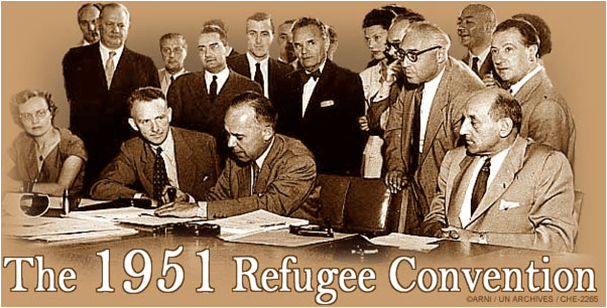
On July 2, 1951, an international conference in Geneva, Switzerland concluded with the signing of the Convention Relating to the Status of Refugees by the conference attendees and the opening of the treaty for accession or ratification by nation states.[9] By its Article 43(1) it was to enter into force or become a binding treaty 90 days after the sixth state had acceded or ratified the treaty. That happened on April 22, 1954.[10]
Its preamble noted that the U.N. had “manifested its profound concern for refugees and endeavored to assure refugees the widest possible exercise of . . . fundamental rights and freedoms.” The preamble also stated, “the grant of asylum may place unduly heavy burdens on certain countries, and . . . a satisfactory solution of a problem . . . [of] international scope and nature cannot therefore be achieved without international cooperation.”
This treaty adopted the following definition of “refugee” in Article 1(A)(2) as any person who:
“[As a result of events occurring before 1 January 1951] and owing to well- founded fear of being persecuted for reasons of race, religion, nationality, membership of a particular social group or political opinion, is outside the country of his nationality and is unable or, owing to such fear, is unwilling to avail himself of the protection of that country; or who, not having a nationality and being outside the country of his former habitual residence as a result of such events, is unable or, owing to such fear, is unwilling to return to it.”
The bracketed phrase [“As a result of events occurring before 1 January 1951”] was the provision that limited the coverage of the Convention to the problems still being faced by many World War II refugees still scattered across Europe. This limiting phrase was eliminated in the Protocol Relating to the Status of Refugees discussed below.
Excluded from the definition of “refugee” in Article 1(F) was “any person . . . [who] (a) . . . has committed a crime against peace, a war crime or a crime against humanity . . . ; (b) . . . has committed a serious non-political crime outside the country of refuge prior to his admission to that country as a refugee; [and] (c) . . . has been guilty of acts contrary to the purposes and principles of the [U.N.].”[11]
The Convention granted refugees certain rights within a country of refuge as well as imposing on them certain obligations. The Convention further stipulates that, subject to specific exceptions, refugees should not be penalized for their “illegal entry or presence.” This recognizes that the seeking of asylum can require refugees to breach immigration rules. Prohibited penalties might include being charged with immigration or criminal offences relating to the seeking of asylum, or being arbitrarily detained purely on the basis of seeking asylum.
Importantly, the Convention contains various safeguards against the expulsion of refugees. Its Article 33(1) states, “No Contracting State shall expel or return (‘refouler’) a refugee in any manner whatsoever to the frontiers of territories where his life or freedom would be threatened on account of his race, religion, nationality, membership of a particular social group or political opinion.”
Protocol Relating to the Status of Refugees
By 1966, it had become apparent that new refugee situations had arisen since the Refugee Convention had been adopted and that all refugees should enjoy equal status. As a result, a new treaty was prepared to eliminate the previously mentioned limitation of the Convention to those refugees created by pre-1951 events. This was the Protocol Relating to the Status of Refugees that went into force on October 4, 1967.[12]
Parties to the Convention or Protocol
As of April 1, 2011, there were 145 nation states (and the Holy See) that were parties to the Convention and Protocol or the latter, including the U.S. That represents 76.2% of the U.N. members (plus the Holy See).[13]
Conclusion
In subsequent posts we will review (a) the work of the principal U.N. agency concerned with refugees (the Office of the United Nations High Commissioner for Refugees); (b) U.S. law and procedures for refugees; and (c) U.S. law and procedures for asylum.
[1] See Post: Refugees and Asylum Law: The Pre-Modern Era (July 7, 2011).
[3]See Mary Ann Glendon, A World Made New: Eleanor Roosevelt and the Universal Declaration of Human Rights (New York: Random House 2002)(fascinating history of the development of the Universal Declaration).
[13] UNHCR, States Parties to the 1951 Convention relating to the Status of Refugees and the 1967 Protocol,http://www.unhcr.org/3b73b0d63.html. In addition Madagascar and St. Kitts & Nevis are parties only to the Convention with its now outmoded temporal limitations. (Id.)
The history of refugee and asylum law, in my opinion, may be divided into two major periods: (a) the pre-modern era before the adoption of the Universal Declaration of Human Rights in 1948 and (b) the modern era starting with that 1948 adoption.[1] There are four major points from this earlier period that have impressed me.
First, there have been instances when individual states granted protection or asylum to people of another state, but the granting of such protection was always within the discretion or grace of the potential protecting state. Whether or not this was done was influenced by a multitude of circumstances. Correspondingly the individual fleeing his or her own country had no legal right to claim protection from another state. An interesting example of this type of asylum happened in 615 CE, when Mohammad requested his cousin and other followers to leave Mecca and seek refuge in Abyssinia or Ethiopia to escape persecution by Mecca’s leading tribe. This is known as the First Hijra (Migration) of Muslims. At the time, the King of Abyssinia was a Christian and known for his justice and respect for human beings. Responding to a letter from Mohammad, the King said he understood that Mohammad respected Jesus and, therefore, granted asylum to the Muslims.[2]
Second, as we have just seen, religious belief sometimes has motivated a government to grant asylum in this earlier period. In addition, religious bodies and individuals often call upon their members and fellow believers to be hospitable to outsiders such as those fleeing persecution. In Judaism and Christianity, for example, there are numerous Biblical texts to this effect. In the Hebrew Bible, the people are told, “Do no mistreat an alien or oppress him for you were aliens in Egypt.” (Exodus 222:21.) Similarly, “You are to have the same law for the alien and for the native born.” (Leviticus 24:22.) In the New Testament, Jesus when asked what the greatest commandment was, said, “Love the Lord your God with all you heart and with all your soul and with all your mind. This is the first and greatest commandment. And the second is like it: Love your neighbor as yourself.” (Matthew 22:37-39.)[3] Similarly Arabic traditions and customs have served as a solid foundation for protecting human beings and preserving their dignity. These include “istijara” (plea for protection), “ijara” (granting protection) and “iwaa” (sheltering). The Islamic Shari’a further consolidated the humanitarian principles of brotherhood, equality and tolerance among human beings. Relieving suffering and assisting, sheltering, and granting safety to the needy, even enemies, are an integral part of Islamic Shari’a. In fact, Islamic Shari’a addressed the issue of asylum explicitly and in detail, and guaranteed safety, dignity and care for the “musta’men” (asylum-seeker). Moreover, the return, or refoulement, of the “musta’men” was prohibited by virtue of Shari’a.[4]
Third, after World War I, the Covenant of the League of Nations did not have any explicit provision regarding refugees. The closest it came was its Article 25, which states, “The Members of the League agree to encourage and promote the establishment and co-operation of duly authorised [sic] voluntary national Red Cross organisations [sic] having as purposes the improvement of health, the prevention of disease and the mitigation of suffering throughout the world.”[5] There also were various treaties regarding refugees in the 1920s and 1930s, but they did not grant legal rights to asylum.[6]Fourth, German persecution of the Jews in the 1930s showed the weaknesses of this discretionary approach to asylum. In 1933 the Nazis took over control of the German government and fired Jews from the civil service and sponsored boycotts of Jewish-owned businesses. Germany also started an official encouragement of German Jewish emigration, and in September 1935 Germany’s Nuremberg Laws cancelled German citizenship for Jews. By the end of 1937 450,000 German Jews had left the country.[7] In March of 1938 German annexed Austria (das Anschluss) and thereby brought the 200,000 Austrian Jews under German laws, including the Nuremberg Laws.
President Franklin D. RooseveltEvian Conference
Several days later U.S. President Franklin D. Roosevelt decided to call an international conference to facilitate the emigration of Jews from Germany and Austria and to establish an international organization to work towards an overall solution to this problem. That July the conference was held in Evian, France. Thirty-two countries attended and expressed sympathy for the refugees. With one exception, however, no country agreed to take additional Jewish refugees. The exception was the Dominican Republic, and it did so because its dictator, Trujillo, wanted more white people in his country. The Conference also created the Intergovernmental Committee on Refugees to “approach the governments of the countries of refuge with a view to developing opportunities for permanent settlement.” It also was to seek German cooperation in establishing “conditions of orderly emigration.” This Committee, however, never received the necessary authority or support from its members and, therefore, failed to accomplish anything. After the conference, Hitler said, “It is a shameful spectacle to see how the whole democratic world is oozing sympathy for the poor tormented Jewish people, but remains hard hearted and obdurate when it comes to helping them . . . .” Moreover, the failure of the Conference to do anything about the German Jews was seen as an encouragement for Germany’s increasing persecution of the Jews, including Kristallnachtin October 1938 and the Holocaust itself through the end of World War II in 1945.
[1] I have not studied what I can the pre-modern era in great depth and especially invite comments and critiques of this analysis.
[3] Religious beliefs motivated most, if not all, of those people and congregations that were involved in the Sanctuary Movement in the 1980’s to provide safe space to Salvadorans and Guatemalans fleeing their civil wars. See Post: The Sanctuary Movement Case (May 22, 2011).
[5] Covenant of the League of Nations, http://avalon.law.yale.edu/20th_century/leagcov.asp#art25; Holborn, The Legal Status of Political Refugees, 32 Am. J. Int’l L. 680 (1938); Holborn, The League of Nations and the Refugee Problem, 203 Annals Am. Acad. Of Pol. & Soc. Sci. 124 (1939).
UM Law School BuildingProf. Fionnuala D. Ní Aoláin
After I had audited the International Human Rights Law course at the University of Minnesota Law School in the Fall of 2001, Professor David Weissbrodt asked if I wanted to help him teachthe course. Given the vast disparity between his and my knowledge of the field, I thought he was joking. “David,” I said, “you don’t need any help.” But he persisted, and I relented and accepted his offer. I then served as an Adjunct Professor at the Law School for nine years, 2002-2010.
The course continued to have the same outline and structure that I had experienced in my auditing the course in the Fall of 2001,[1] and we continued to use the same book.[2] Professors Weissbrodt and Frey still taught most of the class sessions and later were joined by another expert in the field, Fionnuala D. Ní Aoláin.[3]
Professor Weissbrodt and I decided that I would teach two class sessions. One was on refugee and asylum law that built on my experience as a pro bono asylum lawyer. The other was on civil litigation over foreign human rights abuses in U.S. federal courts that took advantage of my considerable experience litigating civil cases in these courts.
Each year to prepare for my two class sessions, I conducted legal research to learn about the many new developments in order to write supplements for the chapters on these subjects. I also assisted in the rewriting of these chapters for the fourth edition of the book that came out in 2009.[4] I thereby continued to use my legal research and writing skills.
This involvement also guided my online reading of various U.S. and foreign newspapers and periodicals and to the creation of a system for email distribution of interesting articles on human rights to friends and colleagues. Many of these articles later became incorporated into the annual supplements for the two chapters that I prepared.
I decided that I would use moot courts for my two class sessions. For refugee and asylum law, four students volunteered to be lawyers for an asylum applicant and the U.S. Government for closing arguments before me, acting as an Immigration Judge in the Minnesota office of the Immigration and Naturalization Service (INS and n/k/a Citizenship and Immigration Services (CIS). For the other session, four additional students volunteered to be the lawyers for a corporate defendant and a foreign plaintiff in a civil lawsuit in the U.S. District Court for the District of Minnesota. The moot court was before me acting as the district judge on the defendant’s motion to dismiss the plaintiff’s complaint alleging the corporation had aided and abetted human rights violations in a foreign country.
In addition to being one way to learn about the substantive law, the moot courts, in my opinion, had other advantages. I thought that the moot court approach would show the students how they could become involved in international human rights while engaged in a regular legal practice in the Twin Cities or anywhere else in the U.S. Given the strength of the international human rights program at the University of Minnesota Law School, many of its graduates have gone on to be lawyers for various U.N. agencies and international human rights NGOs, but most graduates become ordinary practicing lawyers. I also wanted to emphasize the importance of a lawyer’s work at the trial court level, rather than the typical law school moot court experience of arguing before a mock appellate court like the Minnesota or U.S. Supreme Court. Most litigators have much more experience at the trial court level and rarely, if ever, argue a case before the highest court of the state or the U.S. Finally it gave the participating students the opportunity to practice and develop their oral advocacy skills.
For each of the moot court sessions, I held preparatory meetings with the student-lawyers. I gave them guidance on what to expect and answered their questions about the substantive and procedural issues. A strong enjoyable mentorship relationship developed from this total experience.
As part of the moot court exercises, I emphasized to all the students the importance of a lawyer’s knowing the background and views of the judges before whom they appear.
The hypothetical district judge in the lawsuit over foreign human rights violations, for example, had excellent credentials. Appointed for life by the President with the advice and consent of the Senate, the judge was intelligent, honest, hard-working, fair and with a lot of experience on many kinds of civil and criminal cases. The judge, however, had never studied international human rights and along with the fellow judges in his court and his supervising court (the Eighth Circuit Court of Appeals) has never had a case like this under the Alien Tort Statute. As a result, the lawyers for this moot court needed to explain the case thoroughly and clearly. (Fortunately the judge had a law clerk who had studied the subject at the University of Minnesota Law School.)
The hypothetical immigration judge, on the other hand, has tried many asylum cases and has a thorough knowledge of the relevant law. This judge also was intelligent, honest, hard-working and fair. As a result, in this moot court there is no need to explain asylum law to the immigration judge. Instead, the attorney needs to focus on the facts of the instant case. Such judges, it should be noted, do not have lifetime appointments. Instead, they are appointed by the U.S. Attorney General as attorneys in the Department of Justice with no fixed term of office and are subject to discretionary removal and transfer by the Attorney General.
Soon after the classes were over, I sent email critiques of the students’ performance. Invariably the students rose to the challenge and made excellent arguments. I also usually issued a hypothetical decision on the dismissal motion and on the asylum request.
I also attended many other class sessions and the presentations by outside speakers in the course as well as various conferences at the Law School. As a result, I continued to learn more about the field.
Outside the classroom I was available to talk with students about the course and more generally about practicing law and other issues. I welcomed this opportunity to learn more about those who were getting ready to pursue various legal careers. I especially enjoyed getting to know the many foreign students in the course, some of whom were Hubert Humphrey Fellows. (My wife and I also volunteered to be a host family for Fellows from Ecuador, El Salvador and Brazil.)
Museum of Republic, Rio de JaneiroProfs. Duane Krohnke & Elizabeth Sussekind @ Museum of Republic
My friendship with a Humphrey Fellow from Brazil resulted in her inviting me to participate in a symposium at the Museum of the Republic in Rio de Janeiro in the Fall of 2009. The symposium was the concluding event to commemorate the 20th anniversary of the Brazilian constitution of 1988 that ended its military dictatorship. This symposium focused on Memory and Justice, and my paper on the Truth Commission for El Salvador provided a Latin American perspective on Brazil’s not having had a similar truth commission.[5]
I thoroughly enjoyed these many aspects of having been an adjunct professor. I never would have had these experiences if I had continued practicing law after 2001. I, therefore, view them as confirmation of the wisdom of my decision to retire from lawyering that year.[6]
[1] See Post: Auditing the International Human Rights Law Course (June 30, 2011).
[2] David Weissbrodt, Joan Fitzpatrick & Frank Newman, International Human Rights: Law, Policy and Process (3d ed. 2001).
In the Fall of 2001, after retiring from Faegre & Benson, I audited the International Human Rights Law course at the University of Minnesota Law School.[1] Although I had gained some knowledge of refugee and asylum law from my pro bono asylum work,[2] I knew very little about the rest of the field. Through this experience at the Law School I started to learn about other aspects of this area of law and developed a continuing interest in trying to keep up with new developments in the field.
Prof. David WeissbrodtProf. Barbara Frey
The course was lead by Professor David Weissbrodt, a world authority on the subject and now the first and only Regents Professor at the UM Law School.[3] He was the main author of the book that we used.[4] Some classes were taught by Professor Barbara Frey, whom I had met when she was the Executive Director of Minnesota Advocates for Human Rights (n/k/a Advocates for Human Rights) and had taken its training course in asylum law.[5]
The topics for the course were the following: (a) drafting, ratification and implementation of international human rights treaties; (b) state reporting under such treaties; (c) U.N. Charter-based mechanisms to address human rights violations; (d) humanitarian intervention; (e) international human rights fact-finding; (f) criminal liability for human rights violations; (g) regional human rights systems (Inter-American and European); (h) refugee and asylum law; (i) U.S. federal court litigation over foreign human rights violations; (j) use of international human rights treaties and law in litigation over U.S. issues; and (k) causes of human rights violations.
The course used different teaching styles. Some classes were the traditional law school Socratic questioning by the professor. Others were lectures while some involved role playing by the students. One class was a mock hearing before the U.S. Senate Foreign Relations Committee on whether the Senate should give its advice and consent to U.S. ratification of an international human rights treaty. The course also had an unusual structure. The class met once a week for two hours on Friday morning immediately followed by another hour when we were joined by an undergraduate human rights class for presentations by outside speakers on various related topics.
For three days in February 1986 I was the practitioner in residence at the University of Iowa College of Law. I helped teach a class, made a presentation to a faculty seminar, gave a speech to an assembly of students and faculty and talked to a student group and a legal clinic seminar.[1]
Professor Patrick Bauer, a friend and former colleague at the Faegre & Benson law firm in Minneapolis, taught a first-year civil procedure class that I joined. The topic was Rule 11 of the Federal Rules of Civil Procedure that requires an attorney who submits a pleading, written motion or other paper to a federal district court to make an implicit representation that it was not presented for an “improper purpose,” that is was “warranted by existing law or by a nonfrivolous argument” for changing the law and that its factual contentions had or were likely to have “evidentiary support.” [2]
The problem for the class that day was posed by a recent case in which the court had denied a defense motion to dismiss a complaint and had directed defense counsel to submit a brief as to why they should not be subject to Rule 11 sanctions for their dismissal motion. The court thereafter decided that such sanctions were appropriate and imposed a fine on the defense counsel (in an amount to be determined). The violation of Rule 11, according to the court, occurred because the dismissal motion was not warranted by existing law and because the lawyers had not made a reasonable inquiry to determine if the motion was warranted by existing law.[3]
In the civil procedure class, I played the role of a law firm partner soliciting input and advice from his associate lawyers (played by the students) on preparing a complaint for a new civil lawsuit. Professor Bauer at the blackboard wrote down Rule 11 issues that were created by the ideas put forward by the associates.
“Sue the Bastard! Ruminations on American Litigiousness” was the title of my presentation to a faculty seminar. I had prepared this paper while on my sabbatical leave at Grinnell College. I discussed what I saw as the causes and effects of such litigiousness and suggested changes in our legal system and national psyche.[4]
An assembly of faculty and students was the forum for my speech, “The Pilgrimage of a Hired Gun–The First Twenty Years.” Accepting the challenge of Judge Frank M. Coffin for lawyers and judges to make “interiorly revealing” comments about their professional lives,[5] I discussed my first 20 years of practicing law and my search for meaning and spiritual values in a litigator’s life.
The first five years were my apprenticeship period when I was learning how to be a litigator and how to function in two large law firms in two new cities while also becoming a father to two sons. The self-sufficient, inner-directed person I thought I was had found a home in the well-paid, high-powered, eminently secular law firm.
The next five years I saw as my yuppie period. I was becoming more proficient as a lawyer. I advanced to partner at Faegre & Benson. We bought an upper-middle-class home. Still no room for a spiritual, religious life.
The next four or five years or so, in retrospect, was a time of mid-life crisis. I was increasingly skeptical of the significance of what I was doing for a living while facing personal challenges.
I started to sort out these problems over the next five years and started to integrate the various aspects of my life. In 1981 I joined Minneapolis’ Westminster Presbyterian Church and started to re-discover a spiritual life.[6] In 1982 I took a sabbatical leave from my law firm to teach at Grinnell College.[7] In 1984, I organized a liberal arts seminar for lawyers at the College.[8] I started to do research about two lawyers whom I admired: Joseph Welch and Edward Burling.[9] Being a practitioner in residence also gave me the opportunity to reflect on these issues and to share these thoughts with others.
I concluded my “Pilgrimage” speech by saying, “I embrace the tools of the trade [and] the craftsman’s pride in a job well done and let go of the omni-competent, omnipotent attitude of the successful lawyer.”
Little did I know at the time of this speech that my then just-starting involvement in the Sanctuary Movement case[10] would be an integrative experience that would lead to my becoming a pro bono asylum attorney,[11] my making a life-changing pilgrimage to El Salvador[12] and my becoming an adjunct professor of international human rights law at the University of Minnesota Law School.[13]
While a practitioner in residence at the Iowa College of Law in February 1986, I also spoke to a meeting of the Christian Legal Society on “Legal Issues Arising Out of the Sanctuary Movement and Government Infiltration of the Churches.” This was an account of the federal criminal case against leaders of the Sanctuary Movement and the Government’s disclosure that it had sent under-cover agents into worship services and Bible-study meetings at Arizona churches involved in the Movement. I also discussed the just-filed civil case against the U.S. Government over “the spies in the churches” by the American Lutheran Church and the Presbyterian Church (U.S.A.).[14]
Another activity at the Iowa College of Law was attending a legal clinic seminar. I talked about the American Bar Association’s Model Rules of Professional Conduct for lawyers and legal malpractice.[15] I shared my opinion that legislatures and courts were in the process of altering the balance between a lawyer’s role as advocate and the role as officer of the court to give greater importance to the latter. One example was the previously mentioned court’s imposing sanctions on lawyers for arguments that were not deemed in accordance with established law. I attributed this shift to increasing legal fees and the costs of litigation, the public perception that litigation processes had been abused and the knowledge that some lawyers are dishonest. This rebalancing carried with it a risk of diminishing a lawyer’s responsibilities to a client and hence an increased risk of malpractice. I concluded with this quotation: “Clients are entitled to much. They are entitled to dedication, diligent preparation, undivided loyalty, superb research, the most zealous advocacy and even sleepless nights; but they are not entitled to the corruption of our souls . . . . We do not lie, we do not cheat, we do not suborn, and we do not fabricate. We do not lie to clients. We do not lie for clients.”[16]
[1]Duane Krohnke Is First Daum Practitioner in Residence, Iowa Advocate, Fall/Winter 1985-86, at 15. The widow of F. Arnold Daum, a 1934 graduate of the Iowa College of Law and a senior partner in a Wall Street law firm, established the F. Arnold Daum Visiting Practitioner’s Program in the Law College to support bringing leading practitioners to the law school to appear in classes and exchange ideas with faculty and students. I was the first such practitioner to participate in this program.
Because U.S. immigration law was in the background of the Sanctuary Movement case in which I was involved in the mid-1980’s,[1] I sought to obtain some knowledge of this area of law by taking a training course in asylum law from a Minneapolis NGO–Advocates for Human Rights.[2]
I learned that there is a legitimate claim for asylum under U.S. and international law if an alien establishes that he or she is a “refugee,” i.e., he or she has been persecuted or has a “well-founded fear of [future] persecution [in his or her home country] on account of race, religion, nationality, membership in a particular social group or political opinion.”[3]
I then volunteered to be a pro bono (no legal fees) lawyer for Jorge, a young Salvadoran asylum seeker, and started to learn about his country. He had participated in demonstrations against his government at the national university in San Salvador and feared he would be persecuted for his political opinions by the government if he returned to his country. With the aid of an experienced immigration lawyer, I tried his case before an immigration judge who denied his application, which was typical for the time. We immediately filed an appeal to the Board of Immigration Appeals, and under the law at that time he had legal permission to remain and work in the U.S. while the appeal was pending.
In 1988 I volunteered to take another pro bono Salvadoran asylum case. My client had a middle class background. He had held a position in the Salvadoran government and had publicly protested about corruption in her military forces. As a consequence, he was imprisoned and severely tortured in El Salvador, and one of the reasons he came to Minnesota was to receive treatment at our Center for the Treatment of Victims of Torture.[4] He had been persecuted, and he and members of his family feared future persecution by the Salvadoran military for their political opinions. He and his family members subsequently were granted asylum.
I was now on my way to becoming a pro bono asylum lawyer.
Thereafter I was a lawyer for successful asylum applicants from Somalia, Afghanistan, Burma and Colombia. (Later, in 2002, I became an Adjunct Professor at the University of Minnesota Law School, where I taught refugee and asylum law as part of an international human rights course.)
The asylum work enabled me to get to know, and to help, interesting, brave people. I also learned a lot about conditions in these countries. In the process, I was weaned away from accepting what our government said about conditions in other countries at face value and from avoiding making my own judgments about those questions because there was no way that I could know as much as our government knew. As an asylum lawyer I had to investigate conditions in these other countries and come to my own conclusions on such issues and then advocate for individuals as to why they had well-founded fears of persecution (death, physical harm, imprisonment) due to their political opinions or other grounds protected by refugee law.
Moreover, the Sanctuary Movement case and my pro bono asylum work liberated me from the narrow vision and focus of a practicing lawyer concentrating on the laborious development of detailed factual records and legal analysis and arguments in the succession of individual cases. In this prior life I had little time and inclination to be concerned about, or interested in, broader concepts of law or the plight of people around the world who lack a trustworthy legal system to protect them from assassinations, “disappearances,” torture or even mere injustice. To the extent I thought about such things at all, I regarded international human rights as touchy-feely mush that did not qualify for the important “real world” things that corporate lawyers like myself were concerned about.
I also was liberated from the notion that was fostered by the life of a corporate litigator in our secular society that churches and religious people rarely had major impact on our lives in the U.S.
As a result, I often refer to this experience as El Salvador’s liberation of an American lawyer.[5]
[1] See Post: The Sanctuary Movement Case (May 22, 2011).
[3] E.g., David Weissbrodt, Fionnuala Ní Aoláin, Joan Fitzpatrick, and Frank Newman, International Human Rights: Law, Policy and Process, ch. 15 (4th ed. 2009); Convention [Treaty] Relating to the Status of Refugees, 189 U.N.T.S. 137; Protocol of 1967 Relating to the Status of Refugees, 606 U.N.T.S. 267; U.N. High Commissioner for Refugees, http://www.unhcr.org/cgi-bin/texis/vtx/home; Refugee Act of 1980, 8 U.S.C. § 1101 (a)(42).
[5] Krohnke, And Then There Was Light, Minnesota’s Journal of Law & Politics, at 10 (Jan. 1992); Krohnke, The Liberation of a Corporate Lawyer, LXXXI Am. Oxonian 146 (1994).
From April 1970 through June 2001, I practiced law with the Minneapolis office of the eminent Faegre & Benson law firm, first as an associate and then as a partner and of counsel. I was in its business litigation group and handled many kinds of cases, including dealer/distributor terminations, securities fraud, antitrust, copyright, trade secrets and contract. I also assisted in drafting dispute resolution provisions for contracts prepared by others in the firm.
When I joined Faegre in 1970, the firm, as I recall, had approximately 50 lawyers in its only office in Minneapolis. Today it has nearly 500 lawyers in Minneapolis and five additional offices (Des Moines, Denver, Boulder, London and Shanghai). This year it celebrates its 125th anniversary. (www.faegre.com.)
I particularly liked being in a large law firm. Large firms tended to get the more challenging and remunerative cases. I could easily obtain assistance from other lawyers who specialized in different aspects of the law or who could discuss difficult tactical and strategic problems. Faegre also encouraged its lawyers to provide pro bono legal services. Moreover, I did not have to participate in managing all of the firm’s many business details. Practicing law itself took a large hunk of my time, and I did not want to pile on the additional time necessary for management. I, however, did participate in the work of some of the firm’s committees–Alternative Dispute Resolution and Legal Assistants.
Over 31 years there are too many fellow lawyers at the firm with whom I had excellent professional relations to mention them all. Instead I will just call out a few of my seniors from my group in the firm: John French, who had been President of the Harvard Law Review, a U.S. Supreme Court clerk for Justice Frankfurter and a leader of Minnesota’s Democratic Farmer Labor Party; Larry Brown; Gordon Busdicker; Norman Carpenter; and James B. Loken, who had clerked for U.S. Supreme Court Justice Byron White and been an assistant to President Richard Nixon and is now a Judge of the U.S. Court of Appeals for the Eighth Circuit.
On Thanksgiving Day of 1982 Minneapolis had the largest fire in its history. It started in the demolition site of a former downtown department store and soon engulfed most of the adjacent Northwestern National Bank Building that housed the Faegre offices. That bitterly cold night my wife and I went to watch the fire and saw flames shooting out the windows of my office on the 13th floor. (The next week we in hard hats were escorted to my floor where I found my completely destroyed office and here and there a few fragments of papers from my files. For several weeks thereafter I had nightmares of being caught in the fire.) Amazingly the firm opened for business the following Monday in new offices in the nearby IDS Center. The other attorneys and I immediately set out to recreate the files in our active cases and files by requesting copies from clients, other attorneys and the courts. Luckily by then the firm used computers to record and manage the firm’s billable hours, i.e., its inventory of unbilled time, and stored a duplicate set of the computer records in another building. Previously the firm’s records of unbilled time had been manually recorded on heavy-stock paper and maintained in three-ring binders all over the office; they probably would have been destroyed in the fire. Such unbilled time is a major asset of a law firm, and the loss of such an asset probably would have doomed the firm.
Some of my cases over these 31 years cases are memorable and important and will be discussed in future posts. They include cases involving issues of constitutional law and contract, auditor’s liability, international arbitration, securities fraud, copyright, patents and trade secrets. In addition, in the mid-1980’s I became a pro bono (no fee) lawyer for foreigners seeking asylum in the U.S.; as will be seen in a subsequent post, this has had, and continues to have, an enormous impact on my professional, political and religious life.
In my 70-plus years I have developed strong interests in U.S. and international law, politics, economics and history.
This is due to an excellent education at Grinnell College and the Universities of Oxford and Chicago, 35 years of practicing law in New York City and Minneapolis, being a pro bono lawyer for asylum seekers, teaching international human rights law, international travel and wide reading. These activities by themselves provide additional subjects for commentaries.
These interests also have been furthered by a renewed Christian faith and an active membership in Minneapolis’ Westminster Presbyterian Church. This faith and learning about other religious traditions are other major interests of mine.
As will become apparent in subsequent postings, I have particular interests in certain legal topics–refugee and asylum law; litigation in U.S. federal courts under the Alien Tort Statute that covers lawsuits by foreigners for human rights abuses; U.S. constitutional law; and alternative dispute resolution– and in certain countries–Great Britain, El Salvador, Ecuador, Cuba, Brazil and Cameroon.
I already have written a lot on these subjects and have decided to share these writings on this blog. I also will comment on other issues as they arise. Many of these writings will be longer than a typical blog. In subsequent postings I will describe my political philosophy and Christian faith that I hope is evident in my writings.
 At its May 1999 Commencement Exercises, Grinnell College, my alma mater, granted me the honorary degree, Doctor of Humane Letters.